ISSUE 50
C E L E B R AT I N G
VOLUME 49
47 YEARS
F R I D AY
IN
DECEMBER 10, 2 0 21
PRINT S E AT T L E ’ S L G B T Q I A + N E W S & E N T E R TA I N M E N T W E E K LY S I N C E 19 74
SAWANT SEEKS TO HOLD ONTO DISTRICT 3 COUNCIL SEAT IN DIVIDED RECALL ELECTION
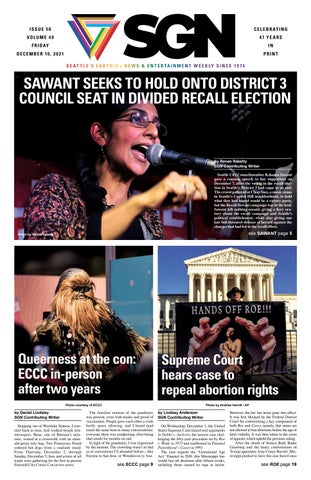
by Renee Raketty SGN Contributing Writer Seattle City Councilmember Kshama Sawant gave a rousing speech to her supporters on December 7, after the voting in the recall election in Seattle’s District 3 had come to an end. The crowd gathered at Chop Suey, a music venue in Seattle’s Capitol Hill neighborhood, to hold what they had hoped would be a victory party, but the Recall Sawant campaign was in the lead. Sawant left nothing unsaid, giving a fiery oratory about the recall campaign and Seattle’s political establishment, while also giving one last full-throated defense of herself against the charges that had led to the recall effort.
see SAWANT page 5
Photo by Renee Raketty
Queerness at the con: ECCC in-person after two years
Supreme Court hears case to repeal abortion rights
Photo courtesy of ECCC
by Daniel Lindsley SGN Contributing Writer Stepping out of Westlake Station, I traveled back in time. Jedi walked beside stormtroopers. Bane, one of Batman’s nemeses, waited at a crosswalk with an emerald-green tote bag. Two Princesses Peach ordered hot dogs from a roadside stand. From Thursday, December 2, through Sunday, December 5, fans and artists of all kinds were gathering for the first in-person Emerald City Comic Con in two years.
Photo by Andrew Harnik / AP
The familiar tension of the pandemic was present, even with masks and proof of vaccination. People gave each other a wide berth, space allowing, and I heard (and used) the same beat in many conversations: everyone there was readjusting, after being shut inside for months on end. In light of the pandemic, I was impressed by the turnout. The crowding wasn’t as bad as at conventions I’d attended before—like Fanime in San Jose, or Wondercon in Ana-
see ECCC page 9
by Lindsey Anderson SGN Contributing Writer On Wednesday, December 1, the United States Supreme Court heard oral arguments in Dobbs v. Jackson, the newest case challenging the fifty-year precedent set by Roe v. Wade in 1973 and reaffirmed in Planned Parenthood v. Casey in 1993. The case regards the “Gestational Age Act.” Enacted in 2018, this Mississippi law would ban all abortions after fifteen weeks, including those caused by rape or incest.
However, the law has never gone into effect. It was first blocked by the Federal District Court for contravening a key component of both Roe and Casey, namely, that states are not allowed to ban abortions before the age of fetal viability. It was then taken to the court of appeals, which upheld the previous ruling. After the death of Justice Ruth Bader Ginsburg and the hasty confirmation of Trump appointee Amy Coney Barrett, Mississippi pushed to have the case heard once
see ROE page 19
GREEN CARDS • VISAS • ASYLUM • CITIZENSHIP 1836 Westlake Ave N, Suite 302 Seattle, WA 98109
(206) 724-1940 olivielaw.com
THIS AD SPACE HAS BEEN GENEROUSLY DONATED BY KRISTIN COSTELLO IN MEMORY OF SGN PUBLISHER GEORGE BAKAN
2
SGN
DECEMBER 10, 2 0 21
C E L E B R AT I N G 4 7 Y E A R S!
ORIGINALLY SEATTLE GAY NEWS FOUNDED 1974 MEMBER
509 10th Ave E Seattle, WA 98102 (206) 324-4297 sgnpaper@gmail.com sgn.org
2021
Deadlines Calendar | Tuesday at 6pm Display Ads Space Reservation | Monday at 5pm Ad Copy (non-camera ready) | Tuesday at 5pm Ad Copy (camera-ready) | Wednesday at 5pm Letters to the Editor | Tuesday at 5pm Obituaries | Call the SGN office All others | Tuesday at 5pm
Publisher Angela Cragin Managing Editor A.V. Eichenbaum Copy Editor SGN Staff • Richard Isaac Advertising Maggie Bloodstone, Advertising Manager National Advertising Rep. Rivendell Media (212) 242-6863 Staff Writers Mike Andrew • Sara Michelle Fetters Contributing Writers Lindsey Anderson • Janice Athill Josephine Baird • Alice Bloch Maggie Bloodstone Kylin Brown • Sharon Cumberland Carter Hemion • Daniel Lindsley Paige McGlauflin • Tim Peter Jessica Price • Renee Raketty • Nick Rapp Hannah Saunders • Gaysha Starr Sarah Toce • Ed Walsh Social Media Manager SGN Staff Cartoonist Ken Campbell Photographers Nate Gowdy • Renee Raketty Production Mike Pham SGN is published by Angela Cragin. © 2021. All Rights Reserved. Reprints by permission. Publication of names, photographs, or likeness of any person, organization, event or business in this publication cannot be taken as any indication of the sexual orientation of the person, organization, event or business. Opinions expressed in bylined articles, columns, and letters are those of the authors only and do not necessarily reflect the views of the staff or management of this paper. SGN welcomes unsolicited material, including letters to the editor, but reserves the right to edit or reject material. All rights revert to authors upon publication. We assume no liability for loss or damage of materials, solicited or not. We invite feedback, please write. And please play safe. It is our policy that no money shall be refunded if you choose to cancel your ad. Credit will be given for the balance owed. No exceptions.
In Loving Memory Of George Bakan
Scott Roger Alpert Cookie Andrews-Hunt James Arnold Steve Foiles Shaun Knittel James Leland Moore Don Paulson Randy Peters Lee Richeson Shaun Shelton Jim Tully
Follow SGN
VISIT US ONLINE SGN.ORG
In this Issue LOCAL NEWS 4 A&E • FILM • BOOKS 7 OP-ED 17 NATIONAL NEWS 19 INTERNATIONAL NEWS 21 DECEMBER 10, 2 0 21
SGN
3
Local News
Gay City, AIDS Memorial Pathway host World AIDS Day commemoration
Photo by Kylin Brown
Art, progress, and remembrance Shortly before dusk, dozens of people meandered above Capitol Hill Station as award-winning writer Rosette Royale, the AMP’s appointed story-gathering consultant, took to the stage to make introductory remarks. Royale’s keynote detailed actions by AMP organizers and Gay City in the fight against AIDS, and he explained the significance of the space and its correlated artworks.
At the center of the AMP, the piece “andimgonnamisseverybody” by artist Christopher Paul Jordan, has now seen several gatherings in its shadow. Still, some passersby have yet to discover its deep significance. Jordan, in his accompanying artist statement, says the piece is made from speakers from historic LGBTQ spaces which “carry stories, [acting] as witnesses of our gathering and connections across time.” Referring to the piece’s large X made of speakers, Jordan’s statement explains: “In a time where mass-incarceration, housing insecurity, HIV criminalization, anti-Blackness, transphobia, colonialism, sexism, and ableism deepen the impact of HIV and AIDS on targeted communities, this X is a call for transformative action.” Gay City Executive Director Fred Swan-
4
DECEMBER 10, 2 0 21
by Kylin Brown SGN Contributing Writer On December 1, Gay City partnered with AIDS Memorial Pathway organizers to host a World AIDS Day commemoration. This year marks the 40th anniversary of the AIDS epidemic.
SGN
son also spoke briefly about the importance of art and installations such as the AMP’s impact on HIV/AIDS awareness. He recognized the progress that has been made in the last 40 years as well as “tremendous amounts of loss in our city alone.” Other keynote speakers at the event included Bill Hall, a long-time HIV/AIDS activist and Tlingit native from southeast Alaska; psychotherapist and writer Julene Tripp Weaver, who performed two poems; and Horatio Hung-Yan Law, another artist with the AMP whose work explores issues of identity and memory. A candlelight vigil, led by the Sisters of Perpetual Indulgence, the Abbey of St. Joan, followed, and it included a surprise sainting ceremony for Rosette Royale. Royale’s saint name is now, “Saint Roses are Read, Why Mess with Perfection,
Scribe of the Underrepresented.” Audience members were pleasantly allowed a moment to smile and even laugh, thanks to the Sisters in that moment, before receiving individual candles that would later be placed near the AMP’s List of Names. While the pathway has now been open to the public for months, this commemoration of World AIDS Day allowed visitors to engage in history, art, and remembrance. Reaching 40 years of the AIDS crisis is a major milestone, and progress is slowly inching forward. Thanks to the COVID-19 pandemic, new research is underway but, as Royale mentioned in his keynote, vaccines for the coronavirus wouldn’t be possible today if not for the tireless efforts by AIDS activists in this epidemic over the last four decades.
C E L E B R AT I N G 4 7 Y E A R S!
Photos by Renee Raketty
SAWANT
continued from cover “While we cannot be sure of the final result, if past trends hold, it appears working people may have prevailed in this fight,” said Sawant. “Win or lose, we should not forget the ruling class keeps going after us because we have shown how to win for the working class. Not once, not twice, but repeatedly, with unprecedented victories.” The Recall Sawant campaign held a more downbeat election night event nearby. Henry Bridger II, the campaign manager, commented to the SGN about the race. “We are very encouraged by last night’s returns and owe a huge debt of gratitude to all the District 3 voters who have shown up to make their voices heard in this critical election,” he wrote to the SGN on December 8. “We see last night’s results as sending a clear signal: That District 3 is tired of not being represented on Seattle City Council by someone who is allergic to accountability; voters are tired of the vitriolic and divisive rhetoric that prioritizes Sawant’s own political ambitions ahead of the needs of District 3 residents, families and business; and that District 3 voters are ready to restore civility and build a better and brighter Seattle.” The election was historic, the first time a city council recall made it to the ballot. Voters in District 3, which includes the Capitol Hill, Central District, First Hill, Madison Park, Madrona, and Mount Baker neighborhoods, were asked: “Shall City of
VISIT US ONLINE SGN.ORG
Seattle Councilmember Kshama Sawant be recalled from office?” While the election is over now, the answer to that question is not. At press time Thursday, the two sides are separated by only 232 votes with Sawant’s anti-recall campaign in the lead. The recall comes just one month from the general election in November, when Seattle voters elected two new at-large council members and a new city attorney. Some saw that election as a sign that the electorate was moving away from progressive candidates, including Council President Lorena Gonzalez, who ran for mayor, and Nikkita Oliver, who ran for Council Position 8; both lost their races. Ann Davison, a Republican, won her race for city attorney against abolitionist candidate Nicole Thomas-Kennedy. However, Bridger said the recall was not about politics but only Sawant’s conduct. Recall supporters allege that she used city resources and abused public disclosure requirements; disregarded COVID-19 precautions by allowing Black Lives Matter protesters to gather at City Hall; and led a march to Mayor Jenny Durkan’s residence in the Windermere neighborhood of Seattle. Durkan’s address is protected due to her past position as a federal prosecutor. The state Supreme Court found that since “[a]ll elected public officials in Washington State are subject to recall for malfeasance, misfeasance, or violation of their oath of office,” that Sawant should face the voters who would “determine whether the charges are true and…whether they in fact justify
recalling the official.” Sawant accused the state Supreme Court of waiting “nearly three months” to rule with “no explanation given,” which, she claimed in her speech on election night, “allowed the recall to bypass the normal November election.” “Working people are not nice, we cannot afford to be naive. This blatant voter suppression did not come out of thin air,” Sawant said. “It came from the state Supreme Court—from the institutions of the capitalist class. And it’s no surprise that the right-wing recall campaign took the opportunity for voter suppression that was offered. “The laws under capitalism are not written for us. And the courts themselves uphold— just as much as they can get away with—the interests of the billionaires. They defend a deeply unequal racist status quo, in which the overwhelming majority struggle to get by, while the very wealthy live in enough opulence to last a thousand lifetimes.” Fernando Medina Corey, a software engineer and author, noted that interests on both sides of the recall had raised and spent huge sums. He said his research moved him to support Sawant through campaign donations and one volunteer shift. “I think one of the most surprising things about the recall is how unsurprising the recall’s core donors are,” he said. “The same real estate and development barons keep coming in to fight. In this case, against the council member who has consistently put forward pro-renter policies like the economic eviction assistance and six months’
DECEMBER 10, 2 0 21
notice of rent increases. “The Solidarity Campaign is right when they call out the recall groups for having right-wing donors. A quick search of the [Federal Election Commission] contributions for the highest donors to ‘A Better Seattle’ also shows that some of them contribute to politicians like Cathy McMorris Rodgers, who is noted as one of the most conservative members of Congress.” Sawant noted on Tuesday that her campaign had “more in-district donors than any campaign in Seattle history,” with over 5000 donors, “nearly triple…the number from the right-wing recall campaign.” Sawant is a former software engineer who won election to the City Council in 2013 in a major political upset. She defeated Councilmember Richard Conlin, who had been a four-term incumbent. Sawant has been shaking things up at City Hall ever since. She has been the lone dissenting vote on every proposed Seattle budget for the past eight years, one example her critics say points to a lack of cooperation with her council colleagues. Her efforts have made both a champion and a foe, largely depending on one’s point-of-view. If the Recall Sawant campaign is successful, she would continue to serve until the results of the election are certified on Dec. 17. The remaining city councilmembers would appoint her replacement until a special election could be held in November 2022. Theoretically, Sawant could run to win back the seat or for any other elected office.
SGN
5
Local News
With booster shots on the rise, data on LGBT adults and COVID remains limited by Paige McGlauflin SGN Contributing Writer With the delta coronavirus variant raging and the omicron variant emerging in the United States, many are looking to get COVID-19 vaccine booster shots for further protection from the disease. Over 25% of fully vaccinated adults in the United States have received a booster, according to the Centers for Disease Control and Prevention data as of December 5. In King County, over 460,000 boosters or additional doses have been administered. While some statistics on LGBT adults and vaccinating against COVID provide hopeful outlooks, data on the pandemic’s impact on LGBT communities across the United States remains limited and contradictory. A study from Kaiser Family Foundation published in August 2021 found that, based on LGBT identity alone, LGBT adults are more supportive of vaccine mandates, with 65% of LGBT adults supporting mandates versus 50% of non-LGBT adults. Eighty-two percent of LGBT adults have received at least one dose of the vaccine versus 62% of nonLGBT adults. KFF also found similar levels of support for a soon-to-be published study focusing on the booster. “It does seem that LGBT people will be more interested in getting the booster than non-LGBT people,” Lindsey Dawson, KFF’s associate director of HIV policy, told the SGN. KFF surveyed individuals about their opinions on the booster before it was made widely available to all US adults on Nov. 19. “The question we asked—when this is available to you or to somebody like you, would you be interested in getting a booster?—seven in 10 vaccinated LGBT people said that they would definitely or probably get the booster when the FDA or CDC recommends it.” While KFF’s findings largely provide a positive outlook on vaccinations in the LGBT community, other findings have unearthed hesitations. March 2021 research from the Human Rights Campaign (HRC) Foundation and PSB Insights found that while 42% of LGBT adults reported they were very likely to get vaccinated, only 29% of Black LGBT adults, 38% of Bisexual adults, and 38% of Latinx LGBT adults reported the same sentiment. This aversion, often dubbed “vaccine hesitancy” by media outlets and medical institutions alike, is often rooted in trauma for many LGBT individuals. “Vaccine hesitancy” rooted in trauma for marginalized people “I personally don’t like the term vaccine hesitancy,” Becky Reitzes, a sexual health educator with Public Health Seattle & King County told the SGN. Reitzes has served as program manager with the King County COVID-19 Speakers Bureau after being redeployed to work on COVID efforts in March 2020. While many do hesitate to get a vaccine for reasons like fears of needles or concerns over medical reactions, Reitzes noted poor treatment in the medical field is also a major factor affecting COVID vaccination decisions. “I think there are some people who are hesitant, and then there are other people who have a really, really huge, valid distrust of government and medical communities,” Reitzes said. For instance, 29% of Transgender individuals reported being turned away from a doctor or healthcare provider simply because of their gender identity, according to 2015 data from the Center for American Progress. “How are we expecting them to get a vaccine?” Reitzes said. “How are we expecting them to go back to the medical community?” When encountering these individuals, Reitzes approaches conversations around
6
SGN
Image by SGN Staff
the vaccine with empathy and understanding, and she would like others to do the same with their vaccine-averse loved ones. “I think people expect to have a conversation with someone, and they go get the vaccine tomorrow. I’ve had that happen, and that’s wonderful, [but] that’s not my goal,” Reitzes said. “My goal is—I get to plant a seed, and maybe that seed will grow. Maybe they will come back for more information, and maybe not.” For COVID’s impact on LGBT individuals, existing data helps paint the picture There is limited data on how LGBT individuals have been directly impacted by COVID-19, largely because sites administering tests and vaccines do not ask for LGBT identity from patients, but existing data indicates a need for LGBT individuals to get the vaccine or booster shot. “We don’t have a lot of good information around how COVID has impacted our communities, but we know that it has to impact our communities disproportionately; one, because of the health care
DECEMBER 10, 2 0 21
issues—of not having health care or insurance, and then two, having much higher rates of underlying health conditions than their cis or straight counterparts,” Reitzes said. LGBT adults are statistically more likely to have underlying health conditions that place them at higher risk of getting sick or dying from COVID. According to March 2020 data from the HRC, 37% of LGBT adult smokers smoke every day compared to 27% of non-LGBT people; 21% of LGBT adults have asthma compared to 14% of non-LGBT people; one in five LGBT adults aged 50 or older has diabetes; and 17% of LGBT adults do not have any health insurance coverage compared to 12% of nonLGBT adults. “So we know that LGBTQ communities have been harder hit by COVID, we just don’t have the stats,” Reitzes said. Economic factors also have made an impact on LGBT adults; a KFF study released in March found 56% of LGBT adults, or someone in their household, experienced COVID-era job loss, compared to 44% non-LGBT adults.
Accessing boosters and any future mandates On Nov. 19, the CDC opened up eligibility for booster vaccines to all fully vaccinated adults in the United States. For individuals looking to get a vaccine or booster shot, the Washington State Department of Health and Public Health Seattle & King County both offer resources. In King County, individuals can visit kingcounty.gov/vaccine to access a vaccine locator, a COVID-19 vaccine FAQ site, ways to access at-home vaccinations, free rides to vaccine clinics, and free childcare, as well as a language interpretation hotline, which can also be accessed by calling (206) 477-3977. As for any possibility of booster mandates, the future remains uncertain. “Once efficacy, or the effectiveness of the vaccine, goes away, that person is no longer vaccinated. So, it wouldn’t be surprising to me to also then mandate a booster, but I have no idea if it will happen,” Reitzes said when asked if future booster mandates might be a possibility. “I have no crystal ball.”
C E L E B R AT I N G 4 7 Y E A R S!
Arts & Entertainment
Seattle welcomes Cirque du Soleil
Oyuna-erdene Senge – Photo by Lindsey Anderson
by Lindsey Anderson SGN Contributing Writer The stage seems to bend around contortionist Oyun-erdene Senge with each precise movement. Oyuna does not strain or even shake while spinning around and balancing on three small poles. The music intensifies, but the contortionist never loses their concentration. Small gasps are heard from the crowd; Oyuna smiles faintly. A lifetime of performing has led to this moment, when the crowd focuses on Oyuna and a connection is forged through awe and inspiration. Oyuna is one of the many performers sharpening up their acts for the opening night of Cirque du Soleil’s Seattle performance of its show Alegria. While this is not Oyuna’s first time in the show, passion and excitement still run deep. “I have been performing with Cirque du Soleil for almost seventeen years,”
says Oyuna, “I started when I was eleven years old on the original Alegria, and I have done four shows with Cirque du Soleil so far.” Cirque du Soleil includes performers from 27 different countries, and Oyuna was proud to add Mongolia to the list. “Feeling grateful and so happy to add my Mongolian flag back to the row of flags!” Oyuna said in a post on Instagram shortly before coming to Seattle. Oyuna believes audiences can glean new perspectives from the variety of physical performances Alegria has to offer. “I hope the audience can see what the body can do because, with contortion, that’s what I’m trying to show people, that you can create these shapes with your bodies,” Oyuna says. “So I find that very cool, and I hope they get to see the different shapes and the strength of what the human body can do and most importantly just take a lot of happiness and joy and inspiration and excitement.”
Alegria is a chance for performers like Oyuna to showcase their amazing abilities, but it is also a story for audiences to connect. The show tells the story of a kingdom in ruins and on the brink of revolution: a timely tale for all those struggling through 2021. The performers hope to bring new joy to an audience that has been waiting nearly two years to see live theater again. While Oyuna’s performance shows the possibilities of the human body through contortion, they also work hard to maintain a level of strength and endurance most can only dream of. The contortionist remarks, “The hardest part would be maybe staying in shape and keeping the level high, and giving your 100% every time because we do eight to ten shows a week, so kind of maintaining would be the hard part, but at the same time, we’re doing so many shows, so it comes quite natural.”
With eight to ten shows a week, some might think it’d be easy to burn out, but not for Oyuna. “The performance part is really fun, then you know you get to perform your art, and you receive so much love and energy back from the audience, so that’s amazing.” The energy helps Oyuna to give their all in each performance. For Oyuna, performing means more than just honing strength and flexibility; the art of contortion is also about connecting to oneself. “My performance, so I do contortion and hand balancing, and it’s quite intimate, feminine, at the same time very strong,” says Oyuna. Finding the connections between femininity and strength have helped Oyuna to understand just how their abilities can go. “You’ll see a lot of strength and flexibility,” Oyuna says of the act, which reflects the complexities of feminine power. Cirque du Soleil provides a space for performers to display their talents and strengths regardless of who they are or where they come from. The show encourages people to explore the unique characteristics make them strong. Through their differences, Cirque’s artists form a tightknit chosen family, reflecting experiences that Queer fans of the show can relate to. “I think at Cirque du Soleil we are open to everyone, and it’s just to show art and to be human and to just be always together,” says Oyuna. The solidarity performers feel with one another derives from their shared human experiences, regardless of what they look like or how they perform. “We all come from 27 different countries, all from different nationalities, different cultures, different backgrounds, so I think the circus is a beautiful community, and we’re here to show that to the rest of the world.” Oyuna believes that queer audiences especially can find inspiration and connection when they attend the circus. If you’re looking for a fun night out, inspiration, and connection to the human experience, look no further than Cirque du Soleil’s Alegria. Alegria plays at King County’s Marymoor Park, under the big top, from January 18, 2022, to March 13, 2022. Tickets are available now.
VISIT US ONLINE SGN.ORG
DECEMBER 10, 2 0 21
SGN
7
Arts & Entertainment
Balanchine’s Nutcracker dazzles even after all these years
Annalise Dautricourt as Clara (center) with Pacific Northwest Ballet School students in the party scene from George Balanchine’s The Nutcracker®, choreographed by George Balanchine © The George Balanchine Trust – Photo © Angela Sterling
by Sharon Cumberland SGN Contributing Writer GEORGE BALANCHINE’S THE NUTCRACKER McCaw Hall December 3, 2021 I first saw choreographer George Balanchine’s The Nutcracker in 1980, at the State Theater in New York City’s Lincoln Center. My most vivid memory of that experience is of the magical Christmas tree that grows before your eyes from a regular size—like the one so many of us have in our living rooms during the holidays—to a huge, mythic tree that dwarfs everything and everyone around it. Because it transforms slowly to Tchaikovsky’s mesmerizing music, the miracle is even more exciting. Our normal world slowly shrinks as the tree grows, reducing the dancers—and the viewers—to the size of toy sol-
diers and stuffed animals. An optical illusion carries us away to a magical world of dancing snowflakes and sugarplum fairies. The fact that I’ve remembered this theatrical wonder for 41 years is a testament to Balanchine’s astonishing and delightful showmanship. Though the production has been restaged all over the world with different sets, costumes, and dancers, Balanchine’s wonderful ballet has remained the same since its first production in 1954. His repetiteurs—former dancers who have learned all the steps and can teach them to others—travel to ballet companies everywhere to make sure this great work is produced the way “Mr. B” intended. Pacific Northwest Ballet has one of the very best productions of this famous work for two reasons: when he was just ten years old, the artistic director of PNB, Peter Boal, danced the role of the Little Prince (the Nutcracker brought to life and transformed
into a hero). Mr. Balanchine himself taught the steps to young Boal, who went on to become a principal dancer at the New York City Ballet before coming to Seattle in 2005. Boal is a repetiteur of Balanchine’s choreography and teaches at the School of American Ballet, where he was originally trained—so we know that we’re seeing the work in as pure a form as is possible in the absence of the great choreographer himself, who died in 1983. The second reason PNB has one of the best productions ever is that the sets, costumes, and production values were entirely reimagined when Balanchine’s The Nutcracker replaced PNB’s charming but outdated Maurice Sendak/Kent Stowell version that was beloved by Seattleites for 31 years. For the new version, premiered in 2015, children’s book writer and illustrator Ian Falconer designed a charming, colorful world—set in the mythical beauty
of an American town of the late 19th century—and introduced by a distinctly modern video that carries you into that world in a delightfully surprising way. I’m willing to bet that no other Nutcracker in the country—or the world—has the fresh, magical charm of PNB’s production, which will surely last another 31 years, if not longer. I had the distinct pleasure of bringing a seven-year-old and her mother to the production this year, and though you don’t need a child in tow to enjoy the delights of this ballet—which brings out your own inner child—it’s fascinating to see how a youngster reacts to seeing a troupe of kids her own age dancing on stage alongside adults. The Disneyfication of childhood is in full swing, blunting the sense of wonder in kids who stream Frozen on a daily basis, so it’s great to see a child register the reality of a production with real live people, a real live orchestra, and a real live audience.
Pacific Northwest Ballet soloist Cecilia Iliesiu as Dewdrop with company dancers in a scene from George Balanchine’s The Nutcracker®, choreographed by George Balanchine © The George Balanchine Trust – Photo © Angela Sterling
8
SGN
DECEMBER 10, 2 0 21
C E L E B R AT I N G 4 7 Y E A R S!
Pacific Northwest Ballet company dancers in the snow scene from George Balanchine’s The Nutcracker®, choreographed by George Balanchine © The George Balanchine Trust – Photo © Angela Sterling
My young friend was sparkling with pleasure, brimming with questions, and fully attentive. Her favorites were “the girl in the green dress” (Juliet Prine as Dewdrop), and “the mouse with all the heads” (Miles Pertl doing double duty as Dr. Stahlbaum and the twelve-headed Mouse king). She also liked looking into the orchestra pit at intermission and seeing all the instruments as well as “the man who waves his arms like this” (here she imitated conductor Josh Archibald-Seiffer). The intermission cupcake was a hit, as well as Sarah Sze’s hanging sculpture made of hardware—”Look! It’s got a water bottle!” But the best part, in my opinion, was that she
and her mother saw an opera house for the first time, heard un-mediated music and saw their first ballet. These experiences expand a child’s frame of reference forever (and a grown-up’s too). My own favorite moment—the one I look forward to year after year—is the “Waltz of the Flowers.” Fourteen beautiful dancers in vivid petal-shaped skirts accompany the Dewdrop soloist, whose elegant, athletic leaps and pirouettes are framed by the cavalcade of Flowers in ever-evolving formations. The words “kaleidoscopic” and “military precision” come to mind, but nothing describes the beauty of this dance—six minutes and twenty seconds of
the most charming vision you can imagine. While the Dewdrop is the center attraction, Balanchine has given the Flowers the most memorable moments as they form and reform into patterns, their arms aloft like airy wands, their feet like points of light in a constellation of pure loveliness. Listen, if you’ve gotten this far into this review, you need to go see “Balanchine’s The Nutcracker” for yourself. If you’ve seen it before, see it again. It never gets old. And bring a child, a teenager, your bestie, your spouse, your mom and dad—anyone whose company you cherish. McCaw Hall did a great job with safety: social distancing, spaces between seats, and everyone
in masks, including the children dancing on stage. (This last was a great touch: the premise was that the grownups were vaccinated, despite the time period, but the children hadn’t had their shots yet and wore masks that matched their costumes.) This damned pandemic has us all feeling like…well, like we need a big lift. Seize the moment and the joy of PNB’s great seasonal gift to Seattle. Balanchine’s The Nutcracker is in performance at McCaw Hall through December 28, 2021. For tickets and more information, see pnb.org or call (206) 441-2435.
Photos courtesy of ECCC
ECCC
continued from cover heim—but that was a welcome change and a planned safety measure. Even with attendance cut in half, there were enough people there to keep the sizable Washington State Convention Center lively from morning to evening each day. I was not as impressed by the lineup of specifically LGBTQ+-oriented panel discussions, which seemed sparse compared to the proportion of Queer artists and fans attending. Maybe I overestimated that proportion, since I was there looking for Queer attendees anyway, but during the four days of the convention, only one panel was
VISIT US ONLINE SGN.ORG
explicitly intended for discussing LGBTQ+ topics in popular media. The panel in question, “Queering The Wheel of Time,” was about the popular and lengthy fantasy series by Robert Jordan. I had never read the books, nor had I watched the new Amazon TV show, but the five panelists were all deeply knowledgeable superfans—and Queer, to boot. The enlightening discussion compared the books to the show, and it criticized and complicated the rigid gender binary of the series’ cosmology. I only wish the convention had had more panels like it. Mind you, there was certainly LGBTQ representation on the guest list. Nebula Award–winning author Cat Rambo, who
uses they/she pronouns, was part of a panel about “finding your people” through speculative media. Also presenting was Trans author Charlie Jane Anders, and the Queer authors Julia Ember, Margaret Owen, and Zoe Hana Mikuta ran a panel on how to write good YA fiction. That all counts for a lot. But I found some of the convention’s strongest LGBTQ presence in Artist Alley, which took up two and a half ballrooms on the fourth floor. I went to any booth that featured Pride flag merch, art by Queer couples, or any artist I knew to be Queer through prior research and checked in with the people there. For some of the vendors in Artist Alley,
DECEMBER 10, 2 0 21
art was their only job, whether through traditional publishing or self-publishing combined with crowd funding. Others weren’t quite there yet, but the convention was a big opportunity. In every case, their talent floored me, and now, with a stack of business cards (and a pile of neat stickers), I hope to bring some of these artists’ work the attention it deserves. It’s hard to say what next year’s ECCC will look like. Our only constant during the pandemic seems to be uncertainty. But in the words of William Strunk Jr., “Writers will often find themselves steering by stars that are disturbingly in motion.” As for fans, they can hope conditions allow for another convention like this one next year.
SGN
9
Film
Spielberg reasserts his cinematic prowess with magnificent West Side Story
Ansel Elgort and Rachel Zegler in West Side Story – Photo courtesy of 20th Century Studios
by Sara Michelle Fetters SGN Staff Writer WEST SIDE STORY Theaters It’s been said Steven Spielberg has been wanting to make a full-blown movie musical for decades. Anyone who has marveled at the opening title sequence in Indiana Jones and the Temple of Doom or signature moments from pictures as divergent as 1941, Always, Hook and Catch Me If You Can already knows he more than has the chops to do it. Spielberg is often labeled “America’s greatest living director” for good reason, after all. Whether or not you think Spielberg deserves that title—I’d venture he’s in the running, but I would probably default to Martin Scorsese—it’s still difficult not to wonder why he’d choose West Side Story, of all titles, to finally make his musical dreams a reality. Not only is the Arthur Laurents (book)/Jerome Robbins (play, choreography)/Leonard Bernstein (music)/Stephen Sondheim (lyrics) Broadway production a staple of high school theatrical troupes everywhere, the 1961 feature adaptation directed by Robbins and Robert Wise won ten Academy Awards and is widely considered one of the greatest motion pictures ever made. We shouldn’t have worried. Spielberg, working closely with screenwriter Tony Kushner and frequent cinematographer Janusz Kaminski, is at the top of his game. This is one the best directed films he’s ever made, which is saying something, the powerful urgency of the original production translated in a manner that remains grounded in the era of the story’s conception yet also feels bracingly modern in several unexpected ways.
Are there issues? Certainly, not the least of which are the obnoxious, overtly theatrical performances from many of the actors portraying the Jets. This facet of the production is made all the more glaring courtesy of the realistically grounded turns by their Puerto Rican adversaries the Sharks. There is also Ansel Elgort as Tony, and while he has a surprisingly strong singing voice and is rather nimble in his athletic dance scenes, he’s otherwise an emotive wet noodle the rest of the time. But these hardly feel like problems as far as the bigger picture is concerned. This production feels lived-in, entirely authentic on every other level. The dance sequences have pop and vitality, leaping off the screen with effervescent enthusiasm. While still keeping the frame wide and showcasing
10
DECEMBER 10, 2 0 21
SGN
Ariana de Bose (center) in West Side Story – Photo courtesy of 20th Century Studios
every movement with exquisite splendor, Spielberg and Kaminski take the viewer inside each dance sequence, the camera moving along with the action in heart-stopping jubilation. I continually found myself holding my breath in spellbound anticipation, each individual moment more stunning than the last. Then there is the remainder of the performances. Newcomer Rachel Zegler is magnificent as Maria, bringing a winsome resolve to the role that’s spellbinding. Equally wonderful are David Alvarez as Bernardo and Mike Faist as Riff—although I must admit the latter’s singing voice does leave something to be desired—and if both actors emerge as budding superstars over the next few years it wouldn’t surprise me one single bit. Then there is the divine, age-
less wonder that is Rita Moreno. She returns to the property that garnered her a Best Supporting Actress Academy Award six decades ago, this time playing convenience store owner Valentina, and to say she is superb would be a drastic understatement. But the biggest breakout, star-making performance is delivered by Ariana DeBose. The former dancer turned singer and actress is flat-out awesome as Anita. She brings vivacious intensity to her portrayal of the character while adding an emotional complexity that’s equally ferocious. DeBose elevates an already stunning cinematic enterprise to a level a few steps above where it already was, her last scene with Zegler one of the finest moments between two actors I’ve had the pleasure to witness in all of 2021. The story remains untouched, this musical variation on Romeo & Juliet on the rough streets of New York still as comfortingly obvious as it has ever been. But while Kushner’s modifications appear minor on the surface, they are monumental in the unfussy manner in which they are implemented. Issues of gentrification, immigration, racism and police misconduct are presented with subtle specificity, Spielberg allowing these elements to present themselves with organic naturalism and free from didactic embellishment. Did the world need a new West Side Story? I hate that question. I’d always prefer to see original material get produced, but when a movie is as grandly entertaining as this one, who am I to get angry at Spielberg for choosing to direct a remake? The filmmaker reasserts himself as one of the great visionaries of the past fifty years, hitting these streets with him an absolute pleasure that I’m going to be singing the praises of for a very long time.
C E L E B R AT I N G 4 7 Y E A R S!
VISIT US ONLINE SGN.ORG
DECEMBER 10, 2 0 21
SGN
11
12
SGN
DECEMBER 10, 2 0 21
C E L E B R AT I N G 4 7 Y E A R S!
VISIT US ONLINE SGN.ORG
DECEMBER 10, 2 0 21
SGN
13
14
SGN
DECEMBER 10, 2 0 21
C E L E B R AT I N G 4 7 Y E A R S!
Film
Kidman’s powerhouse Lucille Ball elevates an otherwise uneven Ricardos
Nicole Kidman and Javier Bardem in Being the Ricardos – Photo courtesy of Amazon Studios
by Sara Michelle Fetters SGN Staff Writer BEING THE RICARDOS Theaters (Dec. 10) Amazon Prime (Dec. 24) The one thing Being the Ricardos does better than anything else is prove that it’s incredibly foolish to doubt Nicole Kidman. When this drama, written and directed by Aaron Sorkin, was announced late last year, I had my doubts the vaunted, Academy Award–winning actress would be able to successfully portray legendary comic superstar Lucille Ball. It just felt like a bad match. This is why preconceptions are bad. Kidman is extraordinary. Not only does she bring Ball to life, she deftly mixes the woman’s public and private personas with such immersive ease I almost forgot I was watching the Moulin Rouge!, The Hours and The Others actor up there on the screen. She vanishes into the role. Her delivery of Sorkin’s snappy dialogue is magnificent, and the overall effect of her achievement is nothing short of magical. The movie? That’s got issues, not the least of which is the obnoxiously serious tone Sorkin sets. It’s like he’s trying to make a sequel to his short-lived Studio 60 on the Sunset Strip television series, only this one would be the behind-the-scenes I Love Lucy spin-off edition. While that approach occasionally works—most notably when his film dives into the relationship between Ball and co-star Vivian Vance (a superb Nina Arianda) or focuses on curmudgeonly, perceptive actor William Frawley (J.K. Simmons)—mostly it comes across as theatrically staid and emotionally stifled. The story begins on the Sunday night
VISIT US ONLINE SGN.ORG
Nicole Kidman in Being the Ricardos – Photo courtesy of Amazon Studios
before the first read-through of an episode of I Love Lucy, when radio gossip columnist Walter Winchell announces that Lucille Ball is being investigated as a Communist. If that weren’t bad enough, the next day’s tabloid newspapers are going to report that Desi Arnaz (Javier Bardem) is stepping out on his wife with another woman. Topping it off, Lucy is pregnant, a fact she and Desi were planning on disclosing to executive producer Jess Oppenheimer (Tony Hale) and their sponsors at Philip Morris on Monday morning. Historically, these events did not take place all at once. That does not mean I begrudge Sorkin his creative license. The idea is to showcase the pressures Lucy and
Desi were under as they created and ran their groundbreaking series, so I get what the filmmaker is attempting to do. The issue is that the picture has barely any heart. It’s all zippy patter and witty asides, and while every line is delivered with aplomb by the sensational ensemble cast, in my case, much of it sadly landed on deaf ears. However, when this film sings, it does so with a passionate determination that can be heard from one end of the theater to the other. The table read sequences crackle with intensity. A moment between Lucy, Vivian, and show writer Madelyn Pugh (Alia Shawkat) on a bench outside the studio is divine in its intimately, astutely rendered femininity. A quiet detour with Lucy
DECEMBER 10, 2 0 21
and William at a neighborhood bar sharing a drink overflows with unexpected honesty, while a scene where Desi breaks down for a cadre of executives that their pregnancy will be a part of the show and that’s all there is to it had me wanting to jump out of my seat and applaud right then and there. Which is why it is so unfortunate that so little feels authentic. It’s all staged. The plot mechanics are forced. Sorkin’s building blocks for the narrative are nothing more than a rickety Jenga tower, and the moment one piece is out of place, the whole structure tumbles into ruins. This is especially true right at the end, when the adultery angle is resurrected in the most egregiously annoying manner possible, spoiling a perfectly terrific moment of triumph and reconciliation that transpired only seconds before. But then there is Kidman. She is marvelous, delivering one of the finest performances of her justifiably celebrated career. Kidman throws herself into the proceedings, her physical ingenuity matching her intellectual spontaneity. This is a fiercely determined portrait of the iconic artist, and the way she brings Lucille Ball to life is astonishing. I was blown away, and it won’t surprise me at all if most who give this film a look feel the same. Do these positives, coupled with Kidman’s magnificence, make up for the shortcomings of Sorkin’s production? That’s what I thought at first. Unfortunately, Being the Ricardos didn’t sit well with me the longer I allowed it to marinate. Still, there’s quite a lot to love, and there’s no way I can dismiss the entire picture out of hand. But that does not qualify as a recommendation. It’s a mixed bag, and those expecting a comedic sensation along the lines of I Love Lucy will undoubtedly exit the theater disappointed.
SGN
15
Books
Light up your Christmas with Roan Parrish by Lindsey Anderson SGN Contributing Writer Our SGN winter book club is getting more festive thanks to Roan Parrish and their new holiday book The Lights on Knockbridge Lane. This book takes a page from the Hallmark Channel, with all your favorite holiday tropes—it has a small-town Christmas, a sunshine and grumpy pairing, and a precocious child teaching their single parent a thing or two about love. An accidental author I sat down with Parrish this week to discuss the book and what inspired them to create such a jolly tale. “I love holiday stories, and this is a Christmas book,” they said. “I’m Jewish and people were like, why are you writing a Christmas book? Growing up not celebrating Christmas, I have no negative association with it. It’s just magical and snowy and cheerful. I wanted to write a Hallmark Christmas movie in book form, but Gay, very Gay,” they laughed. Parrish got into writing Queer romances while pursuing their PhD. “I didn’t read romance until grad school. I was doing my PhD and excited to have escapist fun reading.” They fell into writing romance novels by accident, after a trip to visit a close friend. “I wrote my first romance novel as a joke for a friend,” they revealed. “I had no interest in publishing it. My best friend had started a job as a professor and was lonely and wished there was a romance novel about her. I said, I’ll write you one. I wrote the first chapter on the plane back to Philadelphia and sent it to her.” Parrish laughed as they recalled the story. They thought their friend would call them a nerd, but instead, she loved the chapter. “She had to know what happened next. I kept sending her chapters. When it was done she told me I needed to publish it.” After Best Laid Plans was published, they realized they had a knack for writing feel-good stories. The next step was to make them Queer. “I’m Queer myself, and was always interested in reading all the stories,” they said about creating a unique style of LGBTQ+ centered romance novels.
Image courtesy of Herlequin Special Edition
For Parrish, writing is a way to work through these feelings. “All my books have intentions. The Lights is the first and only book I have written with a child. I’m not a kid person, I don’t have kids, I don’t want kids, but my sister and her wife had a kid a few years ago. The coolest thing about kids is that they haven’t been beaten down by society yet. Their raw and basic desires are still visible in them.” Parrish found that writing about Gus, the charming young daughter of Knockbridge Lane’s main character, let them analyze how adults can lose their autonomy as they learn to grow up and function in society. “For this book, the two love interest characters have lost the ability to ask for what they want and understand their desires. Both of them have lost that spark of saying what you want. Gus models what honesty about desires can look like. It’s a cheerful Hallmark-esque love story, but you can’t have a real love story until you access the desires and have the bravery to speak them out loud.”
Real-life vibes Although their books typically consist of feel-good vibes, Parrish often finds inspiration in real-world problems. “I think a lot of the time I write a book as an outgrowth of a problem, either a personal problem or a world problem,” they said. “One book I wrote is a sort of riff on a rockstar romance. My lead character hates fame. It almost ruins music for him. His love interest is in rehab because of fame and stress. I wrote this book in response to the first time I was publicly visible.”
Hallmark-worthy tropes When planning a Hallmark-worthy love story, Parrish had to make some tough decisions, particularly which cliche tropes to include. “I love opposites attract. I enjoy grumpy/sunshine where one character is grouchy, and not that social, and the other character is extraverted and sunny. At a certain point, it has to flip flop,” they said. “For a holiday romance, I love a Gilmore Girls–style tight-knit town with wackadoodle traditions where everyone knows everyone’s business. So ripe for romance cheesiness,” they laughed. You can find all the best small-town wonderment and sunshine/ grumpy dynamics in Knockbridge Lane. One thing you won’t find in a Roan Parrish novel is an unrealistic misunderstanding that motivates drama. “My least favorite thing is the misunderstanding that catalyzes the whole second act. It’s a very unpleasant and super 1990s straight couple problem,” they say of the overdone trope. “Seriously?! You didn’t ask for a follow-up?” When writing Queer couples, a lack of communication is just inauthentic, Parrish thinks. Aside from communication, Queer romances also do the “found family” trope best, they say. “One of the best [Queer tropes] is found family. So many Queer people have a lot of experience with later in life needing to create a family because all the people you were friends with are married and straight and boring,” they said about the trope. “It’s always positive and nurturing.” However, when it comes to Queer stories, they would like an improvement on the biological family aspect. “I would love to see more Queer stories about families
16
DECEMBER 10, 2 0 21
Navigating misogyny While Parrish is female-presenting, most of their main characters are cis-males. “It’s really interesting,” they said about writing female characters, “I think the character Ginger from Small Change was the hardest to write. For me, it was that there’s so much pressure if you’re a woman writing a female character that they stand in for you. I also struggled with a romance novel being satisfying with a happy ending. With male characters, love does solve their problems, but with a woman it felt disingenuous. The misogyny was difficult to navigate,” they said. Writing male characters is not difficult for Parrish; it gives them enough distance from their subjects while also being able to write some of themself into each character. “Some of their hobbies are based on people I know in real life,” they said of characters Adam and Wes from Knockbridge Lane. “Adam likes to go to Estate sales, and that’s my hobby too. Adam loves Christmas movies and is cheerful and cozy whereas Wes is very introverted and hides in his house. That’s me. I plucked certain things from real life.”
SGN
Roan Parrish – Photo courtesy of the author
that aren’t homophobic,” they said, recalling some of the more recent Queer holiday disasters to hit streaming services. Coming soon Parrish is already hard at work on their next few projects. “I am super excited about a couple of projects,” they gushed. “In September, I have my first rom-com: The Holiday Trap. It’s like The Holiday meets Schitt’s Creek. It’s a house-swapping romance that takes place in New Orleans and Maine. Both the main characters swap houses for December and they both fall in love. Gretta finds Queer community, and Truman feels connected to the small town and close-knit community.” Parrish is also wrapping up their first dive into the horror genre with a project they collaborated on with their girlfriend. “I love horror, and I did my first horror project. It was a collaboration with my girlfriend Timmy, who’s a musician. It’s a sixhorror anthology with music scored to each piece.” For this project, Parrish would write a story, and Timmy would write music to go along with it, or Timmy would write a score, and then Parrish would come up with a story to match. “In the future, I am hoping to do more horror. I also really wanna write YA and branch into other genres,” they said. Holiday traditions with Roan Parrish While they wait for their projects to hit the shelves, Parrish is excited to celebrate the holiday season with their friends and
family. “I celebrate both Hannukah and Christmas. The entire month of December is just full of cozy vibes and gifts,” they laughed. Their favorite thing to do around the holidays is bake cookies with their sister. “I am an avid baker. I love anything that means baking for people. Every year I make gingerbread men with my sister,” they said. “We eat so much we get sick and wanna die. We say we won’t do it next year, but we always do!” They love to give away extra cookies to their friends and neighbors. “People gave cards back last year; it was so lovely.” While the holidays for Parrish are always sweet, there is one thing that would make it even sweeter. “I would want to pack a warm picnic with hot cider, coffee, and cute finger food. I would drive out to the Christmas tree farm in the country and wander through the trees and have a winter picnic, standing, of course, because of all the snow, and commune with the trees. Then I would go home and set up our fake tree because I wouldn’t want to cut down a whole tree for just a month,” they laughed as they described their ideal holi-date. If you’re looking for a sweet treat this holiday, pick up a copy of Roan Parrish’s The Lights on Knockbridge Lane and read along with us this week! You can check out the SGN book club on Instagram at @sgn_ books, and you can find Roan Parrish on their new advice podcast, Dear Romance Writer, now streaming on Spotify!
C E L E B R AT I N G 4 7 Y E A R S!
Bland Recovery fails to reinvent the wheel by Terri Schlichenmeyer Special to the SGN RETAIL RECOVERY: HOW CREATIVE RETAILERS ARE WINNING IN THEIR POST-APOCALYPTIC WORLD MARK PILKINGTON © 2021, Bloomsbury $28.00 / higher in Canada 310 pages Buy, buy, buy. That’s what you want customers to do when they come to your store: open their wallets and buy. But things have changed during the pandemic. In his new book Retail Recovery, Mark Pilkington shows readers that retail survival hinges on getting customers to buy in. If you’ve paid attention in the last twentytwo months, you know that shopping has changed. First of all, says Pilkington, retail stores shuttered in droves or were bought up by larger companies; storefronts were left empty and landlords struggled to find tenants. Big brands often disappeared along with their stores, or they cut manu-
Image courtesy of Bloomsbury
facturing. Retailers struggled to get goods shipped from overseas and trucked to phys-
Op-Ed
ical locations, while customers struggled to find a store open for shopping. Add quarantines and shelter-in-place mandates, and you have a recipe for convincing customers to shop online. Worse still for brick-andmortar stores, consumers have learned to love the convenience. What a mess. There’s hope in Retail Recovery, but not until about a third of the way into the book. For the first eighty pages, Pilkington tells readers things they already know: in the last several years, even before the pandemic, stores struggled, declared bankruptcy, and closed. Yes, the book includes statistics, and yes, Pilkington writes about the outlook overseas, but it’s more of the same news that business-savvy readers already know. It’s a reminder, for sure, but a dismal one at that. And yet Pilkington offers hope. During these “difficult changes,” he claims, “the groundwork was being laid for a potential, yet very substantial, Retail Revival.” Because consumers have shown that they’re willing to pay more for purchases from a service business, smart retailers have learned to set themselves up as professionals or experts. Consumers, Pilkington says, also want to
shop with a conscience, and they’re attracted to businesses that are “purpose-built.” If you are a retailer, Pilkington advises you to learn from your website by collecting customer data and integrating your online and physical presences. Hire a customer service consultant and learn to embrace “showrooming” by offering customers home delivery or automatic reordering. Remember: brick-and-mortar stores can lend personal touches that online entities cannot; retailers need to utilize that advantage by offering customers more than they can get from an impersonal website. Says Pilkington, such reinvention is the “only route forward.” Get through the stuff you already know— skim it if you want—and then settle in. There’s good advice in the last two thirds of this book, and intriguing information that may help find the survival skills you might need if you’re a retailer—although you might think it’s pretty commonsensical, once you’ve seen it in print. In your heart, you already know this stuff, but Retail Recovery still might help attract customers to buy, buy, buy.
Poetry = Life: Dreams That Wake As Words several years, and stayed in touch with her after he moved to New York City, where he eventually died of AIDS. Though Levertov does not give Blevins’ birth or death dates, I imagine that he might have been twenty years old when he took her class, and perhaps forty when he died, given that Levertov herself passed away in 1997. Levertov, who lived in Maple Valley and was a great supporter of Seattle poets, collected Blevins’ poems in an elegant volume that captures his voice—full of love, grief, and hope—and makes sure that the name of Steven Blevins, poet, is not writ in water.
by Sharon Cumberland SGN Contributing Writer DREAMS THAT WAKE AS WORDS STEVEN BLEVINS Some poets never become famous. Make that most poets. If you want to be rich and famous, poetry may not be your career path. This has always been true, even in the eras when poetry was the primary written art form. For every Shakespeare or Byron or T.S. Eliot, there were multitudes of poets whose work floated away on the streams of time. Even those who survived their own eras to become famous later thought they were dying in obscurity, like John Keats (1795-1821) whose tombstone reads “Here lies one whose name was writ in water.” Keats died of tuberculosis—the plague of his times—but HIV/AIDS was the terrifying epidemic for those of us living as young adults in the 1980s and ‘90s. We will never know how many poets died from AIDS in the decades before antiviral medications were developed, but one such poet, Steven Blevins, was an AIDS victim whose work was rescued by an act of tremendous generosity.
Image courtesy of Arundel Books
VISIT US ONLINE SGN.ORG
Dreams That Wake as Words (Tangram, 1997), by Steven Blevins, was printed in an edition of 180; copies are still available online. The original proceeds were donated to a volunteer organization that offered meals, housecleaning services. and general support to AIDS patients. Denise Levertov – Photo by David Geier
Poet Denise Levertov (1923-1997) made sure that Blevins’ poems were collected and published after his death she had been his teacher, employer, and friend. From
her introduction to Dreams That Wake As Words, we know that Blevins showed up in her poetry class at the University of Cincinnati in 1973, became her secretary for
Sharon Cumberland is Professor Emeritus of English and Creative Writing at Seattle University. Her poetry collection Found in a Letter 1959 is forthcoming from Ex Ophidia Press in January 2022.
I Love You Dolly Parton
The Next Word
Valentine
I love you Dolly Parton though your hair is fake as the Swiss Chalets of Disneyland, though your bra and girdle allow you to defy gravity and deceive the eye, though your shadows and blushes are pure Max Factor, I love you. Because under the gloss, a child watches the world from Appalachian hills, and through her hungry mouth springs the country’s diva’s perfect fountain of sorrow, sung so sweetly bees listen with envy. Every time your soprano soars above the schmaltz, there’s my poor relations making ends meet, there’s the barn smell, light over Ohio, autumn setting fire to the trees, brighter in your voice than in all the violins in Hollywood.
Whenever I want you I write a poem about the way you looked on a given night, streetlight in your hair, laughter making your eyes open books.
They are perfect blood red tulips, dark eyes circle the yellow fire and they will open and fall like you, the only color in this impossibly white landscape. For a year your ashes have sung to me. Maybe even you are weary of so many tears from one man.
I think then I’ll be able to read you and have you with me always, a joyful arrangement of words and punctuation through which no detail of you is lost. But the time comes when I must put down the pen and the book and wander around my lonely life calling your name. No poems will do, no memory can save me. The next word like the tree in the forest falling with no one to hear must reach your ear to be spoken.
DECEMBER 10, 2 0 21
The news you probably already know: Greg can’t die fast enough and Tommy’s gone blind in one eye, maybe the other. Blind he said with Audrey Hepburn’s intonation and there it was that total fearlessness I fear not having. Oh your silver tones were a gift man does not expect to be given. Every week they take more of my blood and send it away. My ghost is following, through this white blindness your trail of petals.
SGN
17
Op-Ed
Jessica Watkins on track to go where no Black woman has gone before
Jessica Watkins – Photo by NASA / Bill Ingalls
by Janice Athill SGN Contributing Writer Representation matters. It’s how children connect who they are with who they can become. While children of color today can see many more possible accomplishments and career paths, space exploration has remained largely white. There are Black astronauts, but not many, and they’re not much talked about. On Nov. 16, NASA made a welcome announcement: geologist Dr. Jessica Andrea Watkins will serve as a mission specialist on the upcoming SpaceX Crew-4 mission aboard the ISS. She is scheduled to spend six months on the space station and will be the first Black woman to live and work there. Watkins earned a bachelor’s degree in geological and environmental science from Stanford University and a doctorate in geology from the University of California, Los Angeles. She started her career with NASA as an intern working at the Ames Research Center in California and at NASA’s Jet Propulsion Laboratory in Southern California, where she conducted her graduate research on the emplacement mechanisms of large landslides on Mars and Earth. She was selected as an astronaut in 2017, and this will be her first trip to space. Along with her education, Watkins brings broad experience to her new mission. As an intern at the Jet Propulsion Laboratory, she analyzed near-Earth asteroids, and has also served on an “analog” mission in the Utah desert, participating in spaceflight training on Earth. She lived and worked underwater on the Aquarius as part of the NASA Extreme Environment Mission Operations, and later she was part of a science team collaborator for the Mars rover Curiosity. Crew-4 consists of Watkins, her NASA colleagues Kjell Lindgren and Robert Hines, and European Space Agency
18
SGN
astronaut Samantha Cristoforetti. They are scheduled to launch in April 2022 on a Crew Dragon spacecraft and Falcon 9 rocket from Launch Complex 39A at NASA’s Kennedy Space Center in Florida. This is the fourth rotation of astronauts on the SpaceX Crew Dragon spacecraft to the International Space Station. Watkins is also one of 18 astronauts selected to join NASA’s Artemis team.
According to Meghan Bartels from Space. com, these astronauts will be the first to set foot on the moon since the crew of Apollo 15, 50 years ago. The Artemis program will see the first woman and the first person of color reach the moon. Having grown up admiring astronauts like Sally Ride (the first American woman in space) and Mae Jemison (the first Black woman in space), Watkins hopes her work
aboard the ISS will inspire more children of color to aspire to be astronauts. She told Colorado Public Radio last year, “I do hope that all young girls, especially young girls of color that are interested in STEM and interested in exploring space, feel empowered to do so.… I just hope young girls across the country feel that way now.”
Jessica Watkins – Photo by NASA / David DeHoyos
DECEMBER 10, 2 0 21
C E L E B R AT I N G 4 7 Y E A R S!
National News
This artist sketch depicts Mississippi Solicitor General Scott Stewart speaking to the US Supreme Court on December 1. Justices seated from left are Brett Kavanaugh, Elena Kagan, Samuel Alito, Clarence Thomas, John Roberts, Stephen Breyer, Sonia Sotomayor, Neil Gorsuch, and Amy Coney Barrett – Image courtesy of Dana Verkouteren via AP
The Jackson Women's Health Organization, shown on Oct. 27, is Mississippi's only abortion clinic. – Photo by Rory Doyle/Reuters)
ROE
continued from cover again in front of the Supreme Court. The state is now urging the court to use this case as precedent to overturn Roe and Casey. While it has been thirty years since an attempt to overturn Roe has gone in front of the Supreme Court, one justice can still remember that case. Justice Clarence Thomas sat on the court in 1992 and wrote in the dissent of Casey, “Roe was wrongly decided, and it can and should be overruled.” Thomas, it seems, may now have the chance he has been waiting for. Arguing on behalf of the state of Mississippi, State Solicitor General Scott Stewart started his arguments by saying, “Roe v. Wade and Planned Parenthood v. Casey haunt our country.” He went on to claim that these decisions “have no basis in the Constitution. They have no home in our history or traditions. They’ve damaged the democratic process. They’ve poisoned the law. They’ve choked off compromise. For 50 years, they’ve kept this court at the center of a political battle that it can never resolve. And 50 years on, they stand alone. Nowhere else does this court recognize a right to end a human life.” The fact-checking site The Cut flagged Stewart’s statements as fallacy-ridden. While Roe and Casey protect the right to receive legal and medically professional abortions before fetal viability, they did not introduce the practice to the United States. Before Roe v. Wade the ruling, people were still receiving abortions, but they were doing so in secret, in “back-alley” facilities or on their own. The result was a much higher maternal death rate. In pockets of the country where laws have made it harder for people to receive abortions and clinics have had to close, people without access to transportation are unable to find affordable reproductive healthcare. Around the world, maternal mortality rates have been fall-
VISIT US ONLINE SGN.ORG
Photo by Andrew Harnik / AP
ing for the past 30 years, but in the United States, the number of birth-related deaths has begun to skyrocket, doubling between 1992 and 2014. Outlawing abortions stands to make those numbers worse. According to the World Health Organization, 13.2% of the world’s annual maternal deaths are attributed to unsafe and unregulated abortions. In a study done at Tulane University, it was found that there are higher maternal mortality rates in states with more abortion restrictions. The victims of these statistics are most often people of color or people living in poverty. For many, abortion is a financial decision. While the court did examine the costs associated with “forced motherhood,” they did not discuss the out-of-pocket costs that a pregnancy and childbirth entail. Justice Stephen Bryer noted the strong accusations put forward by Stewart but reminded him that repealing a case with 50 years of precedent is not done easily. “Feelings run high. And it is particularly important to show what we do in overturning a case is grounded in principle and not social pressure, not political pressure,” he said. Breyer’s statement evoked sentiments of former President Trump, who promised during his presidential campaign that he would appoint justices who would repeal Roe v. Wade. Breyer reminded Stewart why the justices agreed to the stare decisis decision in the ruling of Casey; he pointed to sentences in Casey that “say overruling unnecessarily and under pressure would lead to condemnation, the court’s loss of confidence in the judiciary, the ability of the court to exercise the judicial power and to function as the Supreme Court of a nation dedicated to the rule of law.” Justice Sonia Sotomayor echoed Breyer’s concerns and brought up her own: that the argument was only in front of the court now because of its new, more conservative majority. “Now the sponsors of this bill, the House bill, in Mississippi, said we’re doing it because we have new justices,” she said,
Photo by Jose Luis Magana / AP
adding that the same was true about the Mississippi “Heartbeat Bill” that was passed earlier this year. “Will this institution survive the stench that this creates in the public perception — that the Constitution and its reading are just political acts?” Sotomayor said. Arguing in favor of Jackson Women’s Health, Julie Rikelman of the Center for Reproductive Rights stated, “Mississippi’s ban on abortion two months before viability is flatly unconstitutional under decades of precedent.” US Solicitor General Elizabeth Prelogar, speaking for the United States in favor of Jackson Women’s Health, added, “The real-world effects of overruling Roe and Casey would be severe and swift. Nearly half of the states already have or are expected to enact bans on abortion at all stages of pregnancy, many without exceptions for rape or incest. … If this court renounces the liberty interests recognized in Roe and reaffirmed in Casey, it would be an unprecedented contraction of individual rights and a stark departure from principles of stare decisis.” Despite these arguments, conservative justices such as Barrett tried to justify the repeal of abortion protection laws by bringing up adoption. “Why don’t the safe haven laws take care of that problem?” Barrett asked, bringing up laws that make it legal for birth parents to abandon infants they cannot care for at federally designated locations. “And insofar as you and many of your amici focus on how forced parenting, forced motherhood would hinder women’s access to the workplace, and to equal opportunities, it’s also focused on the consequences of parenting and the obligations of motherhood that flow from pregnancy— why don’t the safe haven laws take care of that problem? It seems to me that it focuses the burden much more narrowly. There is, without question, an infringement on bodily autonomy, you know, which we have in other contexts, like vaccines. However,
DECEMBER 10, 2 0 21
it doesn’t seem to me to follow that pregnancy and then parenthood are all part of the same burden,” she finished. While Barrett did bring up the argument that forced parenthood puts an extreme financial burden on an individual, her solution was to remind Americans that this burden can be avoided if they choose to put the child up for adoption instead of receiving an abortion. This argument only works if people are willing to overlook the cost of pregnancy itself. In Seattle, the cost of giving birth will range from $14,000 to $18,000, depending on whether complications arise. The mental and physical toll of nine months of unwanted pregnancy constitute an additional burden Barrett could not account for in justifying adoption. The cost of adoption also weighs heavily on the child, as Christina Dornan, founder of Finally Family Homes, says. As the Finally Family website states, 20% of all children who age out of the foster care system become homeless, which means that, annually, 4,000 teens become homeless on their eighteenth birthday. In an investigative piece in Newsweek, reporter Michael Dose also confirms that most Americans who are victims of sex trafficking come from foster care systems. With greater access to abortion, statistics like these have gone down. However, Barrett was content to ignore the sobering facts behind adoption, claiming that “safe haven laws” justify repealing Roe. After two hours of arguments, Thomas, Alito, and Kavanaugh looked willing to overturn the laws outright. Other conservative justices, such as Barrett, seemed at least willing to scrap the “fetal viability” portion of the law, amending it so that states cannot outlaw abortion but can continue to restrict the procedure to the point where access will be nearly impossible. A ruling for the case is expected to be announced sometime in the summer session of 2022.
SGN
19
National & International News
Seattle earns highest score for LGBTQ+ policies, laws, and services
“This includes harms created by the carceral state in our criminal legal system, where we are seeking to address this through a $1 million grant in our Collective Network fund to support community alternatives to incarceration and policing with a priority focus on Black transgender and gender nonconforming individuals and the broader Black community. “We will continue to listen to and lift up the LGBTQ+ community here in Seattle, to create the kind of equitable city where all residents and visitors feel safe, valued, and liberated.”
by Hannah Saunders SGN Contributing Writer On Nov. 18, the Human Rights Campaign released its tenth annual Municipal Equality Index, and Seattle was among the cities that earned the highest score, 100. The MEI, produced in partnership with the Equality Federation, is the country’s only assessment of LGBTQ+ municipal policies, laws, and services. “LGBTQ+ people are everywhere—in every city, county and ZIP code. Throughout its ten-year history, the Municipal Equality Index has been centered on supporting and celebrating the work municipalities do to serve LGBTQ+ people in the places they call home,” said JoDee Winterhof, HRC’s Campaign Senior Vice President of Policy and Political Affairs. “This year, state-wide lawmakers have zeroed in on attacking Transgender and Non-binary children—for no reason other than in an effort to harm and erase them. Local leaders, however, have continued to move the needle of progress forward, and by doing so, they have spurred economic growth by signaling to residents, visitors and employers that their city is open to everyone,” Winterhof stated. Statistics and MEI background According to the report, 181 cities currently offer Transgender-inclusive healthcare benefits to city employees, which is up from 179 last year. The national city score average also hit an all-time high of 67 points, whereas last year’s average was 64. Additionally, 43 municipalities have anticonversion therapy ordinances in states that offer no state-level protection, an increase from 38 municipalities last year. The MEI assesses each city on 49 different criteria that range from city-wide discrimination protections to policies for municipal employees, city services, law enforcement, and the city’s leadership on LGBTQ+ equality. For this report, Washington DC was excluded from the process, and MEI rated 506 American cities including: • 200 of the largest cities in the country • 50 state capitols • 25 small cities with the greatest proportion of same-sex couples • 25 midsized cities with the greatest proportion of same-sex couples • 25 large cities with the greatest proportion of same-sex couples • 99 cities that are home to each state’s two biggest public universities that offer undergraduate and graduate programs • 98 cities selected by the HRC and the Equality Federation’s state group members and supporters • Five of the largest cities in each state The HRC and the Equality Federation found that more than 74 cities received more than 85 points. Some of these higherscoring cities were in the 20 states that lack non-discrimination statutes protecting gender identity and sexual orientation. (For comparison, in 2012 there were just five states without such non-discrimination statutes.) Since the 2020 MEI, 35 state averages have increased and only eight cities received zero-point scores. The report mentions how local municipalities set the standard for LGBTQ+ equity and inclusion through prioritized measures such as enacting nondiscrimination laws and Transgender-inclusive healthcare benefits for city employees. The report also includes a brief for policymakers on how municipalities can better support Nonbinary and Transgender individuals was also included in the report, and contains information on challenges gender nonconforming individuals face, as well as
20
SGN
Image courtesy of HRC
guidance on anti-Trans and Nonbinary violence prevention. Washington cities Ten cities from Washington state were rated in this year’s MEI: Bellevue, Bellingham, Kent, Olympia, Pullman, Seattle, Spokane, Tacoma, Vancouver, and Vashon. The city of Seattle received a total of 98 points, in addition to 13 FLEX score points, with a final score of 100. Final scores cannot exceed 100 points, and FLEX points are awarded for criteria that apply only to some cities. The report scores the cities in five categories. For the nondiscrimination laws category, which evaluates whether discrimination based on gender identity or sexual orientation is prohibited by the city, county, or state in housing, employment and public accommodations, Seattle received 30 out of 30 points. Municipality as employer is the second category; it focuses on equal benefits and protections for LGBTQ+ employees, inclusive workspaces, and commitment to treating LGBTQ+ employees equally. For this section Seattle scored 26 out of 28 points and received zero out of two points for inclusive workplace at the municipal level. The municipal services category evaluates Seattle’s efforts to ensure LGBTQ+ residents are included in city programs and services, such as services for LGBTQ+ youth and Transgender communities. Seattle received 12 out of 12 points for this category. The law enforcement category focuses
on fair law enforcement, including reporting hate crimes to the FBI, engaging with the LGBTQ+ community in a mindful and respectful manner, and having an LGBTQ+ liaison or task force in the police department. Seattle received 22 out of 22 points in this category. The last category is leadership on LGBTQ+ equality, which focuses on Seattle’s commitment to full inclusion of and advocacy for the LGBTQ+ community, as well as having elected or appointed leaders who are openly LGBTQ+. Seattle received 22 out of 22 points in this category. In a statement to Seattle Gay News, the Seattle Office for Civil Rights mentioned that, in light of this recognition, they are proud to be a part of the City of Seattle. “A 100/100 score is truly remarkable, and we recognize that reaching this milestone would not be possible without community organizing and activism, which allows us to listen to and amplify the voices of the LGBTQ+ community, including the City’s LGBTQ Commission who offer us counsel and guidance,” the Seattle Office for Civil Rights said. “We do, however, understand that even with this score, there is still more work to be done to truly make our city a more equitable place for the people in our LGBTQ+ community, especially Black, Indigenous, and other transgender people of color who experience violence, both systemic and overt, in our community and across the nation every day.
MEI All-Star cities The MEI lists what it refers to as “All Star” cities, which are 75 cities that received a score of 85 points or higher, regardless of being in states with a lack of nondiscrimination protections for the LGBTQ+ community. Last year, there were 61 All-Star cities. This year’s All-Star cities are in Indiana; Oklahoma; Kentucky; South Dakota; Missouri; Florida; Kansas; Texas; Arizona; Pennsylvania; North Carolina; Michigan; Alaska; Georgia; Ohio; Alabama; Montana; West Virginia; Nebraska; and Louisiana. For the top-scoring cities that received 94 points or more: • 39 had thorough nondiscrimination laws for Transgender people than the state • 48 support direct services for the Transgender community • 65 offer employee benefits to different and same sex partners • 73 support direct services for LGBTQ+ youth • 78 directly support services that assist those living with HIV/AIDS • 84 have elected or appointed officials in senior leadership who are openly LGBTQ+ • 92 offer Transgender-inclusive healthcare for city employees • 99 have an LGBTQ+ liaison to the city executive • 106 had contractor nondiscrimination policies, including gender identity • 110 reported hate crime statistics to the FBI To learn more about the MEI, report visit https://www.hrc.org/resources/municipalequality-index
Image courtesy of HRC
DECEMBER 10, 2 0 21
C E L E B R AT I N G 4 7 Y E A R S!
Church boots pastor over drag drama
International news highlights by Daniel Lindsley SGN Contributing Writer
Photo by Mark Blinch / Reuters
Pastor Craig on We're Here – Photo courtesy of HBO
by Mike Andrew SGN Staff Writer A Methodist pastor in Indiana has been fired by his church after appearing in drag on the HBO series We’re Here. Pastor Craig Duke had served as head pastor at Newburgh United Methodist Church since 2018. He is married and the father of a Pansexual daughter. While the United Methodist Church—a mainstream Protestant denomination— does not condemn same-sex attractions, it does not endorse marriage equality or allow partnered Gay or Lesbian people to be ordained as clergy. Nevertheless, Duke earned a reputation as an ally of the LGBTQ community in his hometown of Evansville, Indiana, and when We’re Here was looking to cast queerfriendly locals, Duke was recommended to them by the Evansville Pride organization.
The show features drag stars Eureka O’Hara, Shangela, and Bob the Drag Queen. The trio travels across small town America, transforming locals into drag queens and highlighting local stories of LGBTQ perseverance. Duke said he participated in the show to learn greater empathy for the LGBTQ community and also to show support for his daughter, who came out as Pansexual two years ago. “It was an incredibly wonderful, refreshing, deepening, powerful spiritual experience,” Duke told Religion News Service. “I was surrounded and immersed in a culture that I’ve never been immersed in, and one of the things in ministry, if you want to involve people different than yourself in your ministry, you have to go to where people different than you are. The invitation to be part of the show allowed me that.” Duke’s church looked at the matter dif-
ferently, however. While the church has made no public statement on Duke’s TV performance or his future as a pastor, he’s been relieved of his duties and dropped from the church website. The weekly sermon page, previously written by “Pastor Craig,” is now attributed to “Pastor Mark.” Duke’s supporters have set up a GoFundMe to help replace his salary. “Pastor Craig considers himself to be a man of faith, a father, a husband, a social justice advocate, and ally for the LGBTQIA+ community,” says the fundraiser page set up by Chris and Erin Sexton. The fundraiser message adds, “Craig has a hope and has fought for a fully inclusive church that is welcoming to people of all races, all genders, and all sexual orientations. He longs for a day that all people are able to marry and serve as ordained clergy in the United Methodist Church.”
National news highlights by Daniel Lindsley SGN Contributing Writer USA: Dictionary.com chooses “allyship” NBC reported on December 6 that Dictionary.com has made the word “allyship” its word of the year, after adding it to the site just a month earlier. John Kelly, one of the company’s content overseers, said the word has “evolved to take on a more nuanced and specific meaning” since it was first recorded in the mid-1800’s. Especially in the last decade, Kelly said, it has become a word for the role allies take in social justice. NBC noted that other dictionaries chose pandemic-related words this year, with Oxford Languages choosing “vaccine,” and Merriam-Webster choosing “vax.” The Collins Dictionary chose “NFT.”
VISIT US ONLINE SGN.ORG
Photo courtesy of KARE11
Minnesota: Child outed, hundreds march NBC reported December 6 on a rally held in support of LGBTQ youth, after the eight-year-old child of school board candidate Kelsey Waits was publicly outed by members of a conservative Facebook group. Hundreds turned out for the rally, which featured LGBTQ speakers, organizations, and elected officials. Minnesota Gov. Tim
Walz tweeted his support on Saturday: “Everyone deserves to live in a state that values them for who they are — especially our kids.” A Trans demonstrator at the rally told KARE-TV, “My message to Kit is to don’t give up. We’re here, we’re loud, we’re queer and we have your back.” Waits told NBC that the rally “was amazing. I could not have expected almost a thousand people to come out for my kid.”
DECEMBER 10, 2 0 21
Canada: Conversion therapy banned On Tuesday, Dec. 7, the Canadian Senate passed a bill to ban all conversion practices in the country. The Canadian government agreed to fast-track the bill with little debate, reports The New York Post. In a tweet, Canadian Prime Minister Justin Trudeau said of the decision, “It’s official: Our government’s legislation banning the despicable and degrading practice of conversion therapy has received Royal Assent — meaning it is now law. LGBTQ2 Canadians, we’ll always stand up for you and your rights.” Canada joins several other countries, including — but not limited to — Brazil, Ecuador, Samoa, Germany, and Taiwan in banning the debunked practice. Meanwhile, here in the US, conversion therapy is only banned in 20 of 50 states.
Saudi Arabia: Racers wear rainbows at Grand Prix LGBTQ Nation reported December 3 on the three Formula One drivers at the Grand Prix in Saudi Arabia who have decried the country’s persecution of LGBTQ people and women. Lewis Hamilton, Mike Schumacher, and Sebastian Vettel wore varying degrees of rainbow-striped gear, from wristbands to helmets, in protest. Hamilton, a star racer and seven-time world champion, said in a press conference, “Do I feel comfortable here? I would not say I do. But it’s not my choice to be here. The sport has taken the choice to be here. And whether it’s right or wrong, I feel like it’s important that we try to raise awareness.”
Hungary: LGBT referendum before big election Reuters reported on November 30 that Hungary’s parliament has passed a resolution that could lead to a national referendum on LGBT issues. Meanwhile, Hungarian Prime Minister Viktor Orban’s anti-LGBT campaign continues, pushing for policies he says safeguard Christian values, such as banning LGBT subjects from schools. The referendum will ask Hungarians whether they support schools holding of sexual orientation workshops without parents’ consent, whether they believe gender reassignment procedures should be promoted among children, and whether media content that could affect sexual orientation should be shown to children without restrictions.
SGN
21
22
SGN
DECEMBER 10, 2 0 21
C E L E B R AT I N G 4 7 Y E A R S!
Episode 14: Kenna Lindsay In this episode, Ash & Lindsey approach New Year's Resolutions, a cat causes trouble, and we talk about the bank! Our special guest this week is Santa Cruz-based body positive artist Kenna Lindsay.
BI-WEEKLY! FIND US WHEREVER YOU LISTEN TO PODCASTS!
VISIT US ONLINE SGN.ORG
DECEMBER 10, 2 0 21
SGN
23