KRYSTAL MARX

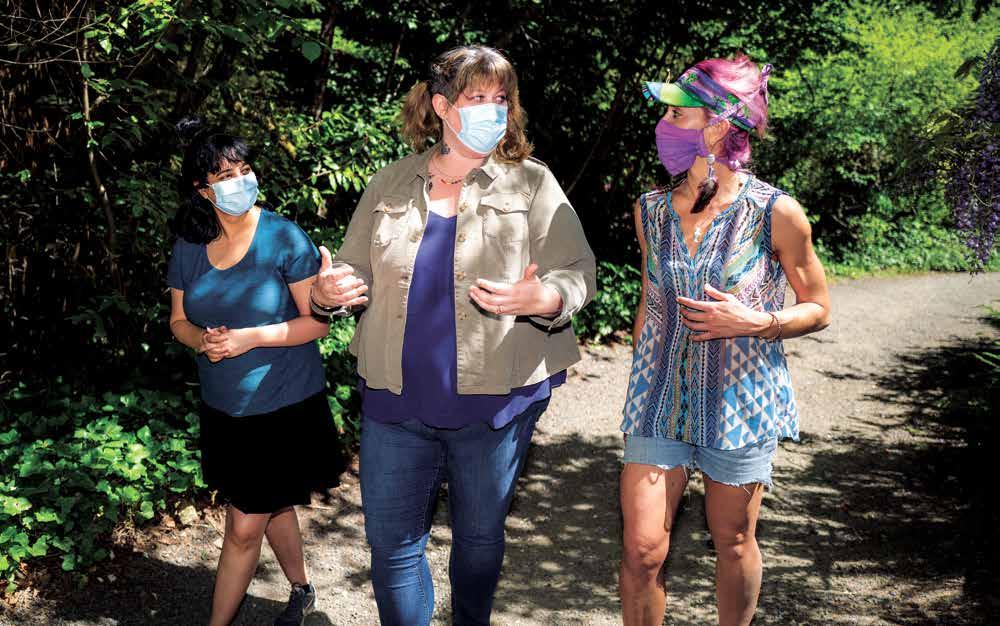
Krystal Marx, deputy mayor of Burien, announced she will seek to unseat Adam Smith in the 9th Congressional District
by Renee Raketty SGN Contributing Writer
From the beginning, Krystal Marx has been an unlikely candidate. She first ran for elected office in 2018, when she was elected to the Burien City Council. Since then, she has made waves in the city — throwing out the status quo and emerging as a voice for all, including the less affluent or politically connected. She has been the target of those on the right who view her positions to be too left-leaning for the suburban city.
Marx, who became deputy mayor in 2019, is seeking reelection to her Burien City Council seat. She found herself in a competitive race in the August 3 primary, appearing on the ballot next to five other candidates. However, she leads the vote total at press time and will go on to the Nov. 2 general election. Marx will face off against Stephanie Mora, a small business advocate who is calling for an increase in police officers and a limited approach to social services in the city.
see KRYSTAL MARX page 4
PrEP to be covered in insurance plans
A win for some, but holes remain in federal plan to end HIV epidemic WA to follow CDC’s new mask recommendations as the Delta COVID variant continues to spread
by Paige McGlauflin
SGN Contributing Writer
The Treasury, Labor, and Health and Human Services Departments issued joint guidance in late July requiring insurance companies to cover the cost of pre-exposure prophylaxis (PrEP) prescriptions for insured recipients of the medication. The decision was made in part to increase
the coverage of certain preventive services under the Affordable Care Act and in alignment with the federal government’s goal of ending the HIV epidemic by 2030. Companies have 60 days following the decision to cover the medication, which includes brand names Descovy and Truvada, depending on insurance plans.

by Hannah Saunders SGN Contributing Writer
nent variant of the virus, which is now circulating through our communities. It is not abnormal for viruses to continuously mutate in order to find easier (and more destructive) ways to infect their hosts. The Delta variant, also classified as variant B.1.617.2, was first identified in India last year. What scientists and researchers see PREP page 19
On July 27 the Centers for Disease Control and Prevention (CDC) issued new guidance for vaccinated individuals. A day later, Gov. Jay Inslee gave a press conference in support of the new recommendations. These updates came after an increase of coronavirus cases caused by the Delta variant, the most promi-
MASK UPDATE page 10

SEATTLE (Aug. 5, 2021)— Pride at Work is saddened to hear the news of the passing of AFL-CIO President Richard L. Trumka. President Trumka dedicated his life to fighting for working people across the country and around the world.
He was an ally to LGBTQ working people as well, speaking loudly and often about the need to pass the Equality Act and other LGBTQ inclusive legislation. Within the labor movement, he was an advocate for LGBTQ-inclusive contracts and reminded union leaders of the need for better inclusion in our ranks.
“Richard Trumka was an ally to the queer community, a rock and leader in our labor movement,” said Pride at Work National Co-President, Shellea Allen. “He will be missed.”
The Pride at Work National Executive Board, our members, and our staff send our heartfelt condolences to President Trumka’s family and loved ones.
Pride At Work is the largest national organization that builds power for LGBTQIA+ working people. We organize mutual support between the organized

Labor Movement and the LGBTQIA+ Community for social and economic justice. We seek full equality for LGBTQIA+ working people in our workplaces, our unions, and the public square. We organize in the spirit of the union movement’s historic motto, “An



“I am extremely grateful to the Burien voters for moving me into the general election,” Marx told the SGN on Wednesday. “I think our shared vision of facing regional issues with regional solutions is resonating with people, and I am excited to talk to more folks at the doors in the next few months.”
Marx remains confident in the outcome of the race and even announced her intentions to face off with Rep. Adam Smith next year for his seat in the 9th Congressional District, a position he has held for 24 years. Mora has been critical of Marx for her announcement. “Burien deserves city councilmembers who aren’t focused on running for higher office while pretending to care about their community,” she wrote on her campaign Facebook page.
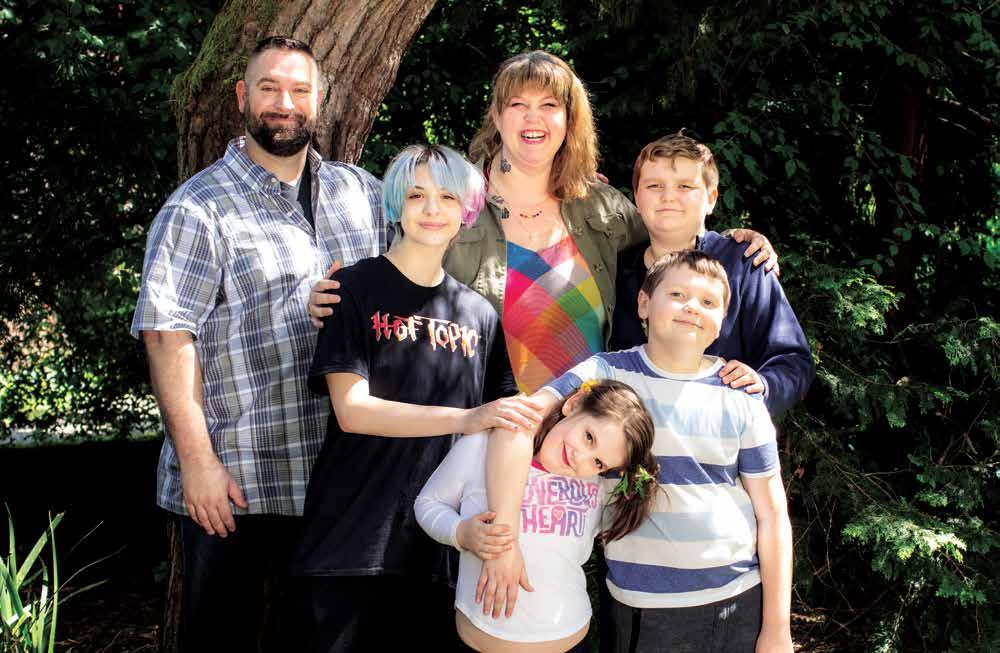
In addition to her position in Burien, Marx is raising four kids and three dogs with her husband, a disabled veteran, and she serves on the King County Board of Health. She has also helped displaced workers gain new skills to compete for jobs in competitive industries and to get women elected to office. Currently, she serves as the executive director of Seattle Out and Proud (SOAP), which produces the Seattle Pride Parade, and has overseen a 750% increase in programming since the start of the pandemic.
The SGN spoke with Marx about her city leadership, community organizing, and life experiences that suggest she has what it takes to take on Congress in the other Washington.
Renee Raketty: You’ll be facing off with an incumbent who’s been in office since 1997. Why did you decide to get into this race?
Krystal Marx: There was no strong anti–Adam Smith sentiment… In the political world, there are always people that you want to see yanked out of office, who are actively harming our communities. In some cases, not really pushing for advancement
or for greater protections or for things our communities need can be just as big of a harm. I saw the current representative, Adam Smith, in the 9th District, as kind of that latter category — of not pushing for things that our district needs.
off stickers… [that read:] “Burien looks like ‘S[hit].’” It had my face on it, and it was not a flattering picture… [T]hey are plastering them around the city. That was just a recent one, but usually they go after anything [about] my appearance. I’m heavily
The SGN spoke with Marx about her city leadership, community organizing, and the life experiences that suggest she has what it takes to take on Congress in the other Washington.
As someone who has experienced homelessness as a child, who has been evicted right before I ran for office, as my husband’s caregiver for his service-connected PTSD in the Army, as having a Trans kiddo... I mean, there’s so many things that I think many of us in Washington state, especially in the 9th, are experiencing.
Likewise, housing insecurity, food insecurity, and [the] high cost of medical bills — my son has type 1 diabetes, having just being diagnosed with that in October — the cost of that alone is astronomical. We’re not seeing the fight that we need and… deserve to make sure that all of our people are protected and can live a life of dignity, are able to focus on their jobs… instead of worrying about housing… For me, [it’s] that desire to see more done and using the experience that I have as deputy mayor and as serving on the City Council for the last four years to work within governmental organizations to effect that change.
RR: As a member of the Burien City Council, you have been the target of a few people on the far right. Can you speak to that a little bit? Tell me more about how these attacks may not reflect modern values.
KM: I definitely have been a target. The most recent big one was people… printing
tattooed as an elder millennial, it’s kind of my thing. [Also] my weight as a plus-size woman and someone who’s a fat activist.
You know, [they even use my] having been evicted from housing — even if it was a “no-fault eviction” where the landlord sold our house… and asked us to move. They pick apart every part of my identity — not even the policies as much as just how I look and what I’ve been through. It’s been really difficult.
The first couple of years, it was difficult to be able to focus on policy when I’m constantly getting harassing phone calls. We had a severe death threat that actually got the FBI involved and Interpol — believe it or not — because the person lived in Ireland…
It stems from a fear of where things are progressing towards. I represent a younger community, more progressive values, and a willingness to stop the status quo from continuing… making sure that we fight for the people that we’re charged to represent. When that happens, old systems get disrupted. People that have been used to power and are comfortable being in power are asked to move aside or join along. If they don’t want to join along, then, they feel threatened. I think that’s where it’s coming from: it’s just that fear of not knowing where their values were going to be accepted next.
RR: You are also associated with She Should Run, which is an organization that helps women get elected to public office. I did want to ask you: how does having more diverse representation help create better outcomes?
KM: As a program facilitator for She Should Run, I taught women over a sevenweek… course, a cohort of 30-40 women across the nation — in an online setting — the basics of how to run for office, build up leadership skills, and recognize your lived experience as legitimate for running for office… Having that diversity of candidates — especially making sure we have women and nonbinary folks represented in office — means that we see things that are typically left out when the status quo is maintained, which typically has been older, often retired, white, cisgender men. When that’s the case, you don’t have equal representation. You don’t know what the struggles are in every aspect of your community, so things get overlooked and problems get made worse. By making sure we get more women or nonbinary folks running — more nonwhite people running, more Queer folks running — you are making sure that everyone in the community is seen and their needs are elevated to a level where something can actually be done to help.
RR: As you know, the 9th Congressional District encompasses diverse interests from multiple communities, stretching from northeast Tacoma to the Eastside and even South Seattle. What makes you uniquely qualified to represent so many varied constituencies?
KM: After I left Grays Harbor County as a kid, when I came out of homelessness, I was actually placed with my father in Bellevue. That’s where I spent most of my life through adolescence and graduated… from Sammamish High School...
Then, when I started my family and I was in my first marriage, we moved to SeaTac and Renton. I moved into South Seattle after we were divorced and have been throughout different areas of the region.
So, experiencing it… seeing the disparity that exists in Bellevue versus SeaTac, but also seeing the sense of community that ties us together… that is what needs to be focused on.
I’ve got the experience of not only living at the very… depths of poverty and not knowing where our meals are coming from — if we can keep the lights on, [keep from] being evicted, being homeless — but also knowing what it’s like to have a stable roof over my head and, now, being the executive director of a nonprofit, being able to care for my family and pay most of our bills, you know, when it’s not a pandemic. Having had that lived experience is important.
I also serve on regional committees that serve this entire area. I’m on the Board of Health for King County. So, I’m responsible for listening to the needs throughout the region, Eastside, North End, South Seattle, all the way down through south King County… looking at the health disparities that present and realizing that we have poor people in east King County too. We’ve got extremely rich people in south King County. We’ve got multimillion-dollar mansions in Burien.
So, it’s being able and… willing to see where we’re the same and where those disparities are and to present them in a way that really gets stuff done.
RR: According to a study by the US Census bureau in 2019, 8.7% of persons living in the 9th Congressional District live below the poverty line. Whose responsibility is it to address this concern, and what should be done about it?
KM: I think it’s every layer of government’s responsibility to address this. At the federal level, we need to be raising the minimum wage. We need to have it at a level where it’s a livable wage for folks — that isn’t necessarily $15 an hour anymore either. It would have been great if we all would have caught up to that — like the City of SeaTac did a few years ago.
That cost is rising. It’s rising a lot higher due the cost of housing as well. People are spending more than 30% of their income on housing costs. We are severely cost burdened in the 9th Congressional, where we’re spending over 50-60% of our income on housing costs alone.
It is the county or the state level as well, making sure that we’re passing progressive revenue reform. We’re doing things like capital gains taxes: we’re getting money from the wealthiest among us in those unique situations that isn’t going to leave them bankrupt, but it’s making sure it’s a more fair taxation for our community, so we stop overly taxing our lowest-income folks at the county levels.
It’s making sure that we are funding community projects. We are funding community organizations that are experienced in working on the ground and providing culturally appropriate care and services to people who are at or below the poverty line. It does not matter if there’s a program… if a whole entire community doesn’t know how to access it, because there’s a language barrier or they don’t trust local government. We have to be funding these community organizations that have those direct ins and that are trusted messengers and at the city level as well.
It’s knowing really what people are asking for. It’s more than just surveys. It’s putting out programs and access points locally and feeding that information back up to the federal level and demanding that our federal delegations help us. So, having that full cycle of every layer of government involved is crucial…
RR: According to that same US Census study, only 53% of people own their own home in the 9th District. How do you propose that the federal government help get families into homes so they can build some wealth through home ownership?
KM: I believe that housing is a human right. We have over 230,000 of our renter households in Washington fall under that extremely low-income threshold... So, it’s focusing on those folks first. It’s making sure we pass a Green New Deal on public housing. It will create thousands of jobs nationally and something close to 12,000 public housing units in Washington state alone. So that already is a huge relief on the system.

“Having [a] diversity of candidates — especially making sure we have women and nonbinary folks represented in office — means that we see things that are typically left out when the status quo is maintained, which typically has been older, often retired, white, cisgender men.”
It’s also making sure that we also don’t increase… homelessness by making sure that we have tenant protections and housing stability, ordinances and laws throughout our state…so we stop people from sliding into homelessness.
It’s also making sure that we have federal assistance and equity in the rental market so that folks can, while they’re renters, build up that equity and that generational wealth, without that fear of their housing being ripped from them, so they can build things as a stepping stone and be able to step into home ownership.
A lot of it falls to reparations as well. Who are the community members that have been the most harmed when we talk about things like marijuana laws and… the folks who are in jail for marijuana offenses? They’re Black men, whereas it’s usually white men that are owning the pot shops here now. What are our
reparations looking like? It’s providing those home loans. It’s providing those business loans to the Black community that help them to stabilize [and] build generational wealth and equity, and also it leads into purchasing homes. It’s all connected.
RR: I think you addressed this a little bit, but if you want, get more specific talking about evictions and what can be done to help stabilize those renters right now in a difficult situation?
KM: First and foremost, we have to cancel rent, and we have to cancel mortgage payments that were due during the pandemic period. We have the ability of the federal government to do so, and we have to do it…
Even during the payment plans [sic] and the things we’ve passed here in Washington state, people couldn’t afford it during the pandemic, and they’ve been laid off or they don’t feel safe going back into their lowpaying jobs and risking their health and the health of their families. They’re not going to be able to pay those payment plans moving forward, and they’re going to find themselves evicted.
Same thing with landlords… if we weren’t able to pay our rent, that is property that they own, that’s a mortgage that they’re paying on. So, we need to be able to cancel that as well and work with the banks to make sure that we are protecting all of our community members. I think that is the biggest thing that we can do right now coming out of COVID-19 to make sure that we don’t have more evictions and more people sliding into homelessness.
RR: Obviously, there’s a shortage of housing, a shortage of building materials, and so the prices of houses are going up. Then, there is also gentrification as a result of people moving into communities that were traditionally mostly people of color. Can you talk to that a little bit?
KM: The Central District… used to be a majority Black community, and now under 17% are communities of color, as gentrification moves through and people
are pushed out further and further.
I think it’s important that it isn’t just the federal government or the state or local government stepping in. It is also about empowering community-based organizations who already know the community — who have deep roots there — with funds... sectioning off areas of town that are “no-touch zones.” These are just for these communities to rebuild in the way that works best for them and to support businesses from those communities that are anchor businesses.
There are folks who have been in business for a long time… that get pushed out. First, bringing them back in saying: “This is your space. We’re here to support you. Small business loans are easy to access. Your dedicated case manager helps you get those small business loans.” Organizations like Ventures work fantastically with immigrantand refugee-owned businesses. It’s empowering those organizations to work with the community to make sure that that people have the resources that they need.
That’s what helps to fight against gentrification more than even housing policies at the local level. It’s supporting the communities that have been pushed out.
RR: I wanted to address police accountability a little bit. Washington obviously passed 12 pieces of legislation that limit police powers and seek to ensure that bad actors within law enforcement are held accountable. Would you take that reform to Washington, DC, and seek to enact those measures nationwide?
KM: One hundred percent. What we’re doing now is to prevent lateral hires from folks who have disciplinary records on file…[This] is crucial... More importantly… it’s long overdue...
What I’ve learned serving on the Burien City Council is that if you do not work with neighboring cities to pass… similar ordinances, then it’s a one-off, and it does not help a community that tends to shift and move. We realize none of us stay in our one
continued from page 5
city: we work in a different city, or we worship in a different city. We go to school in a different city. We travel frequently.
It’s the same thing when it comes to police reform: if you are expected to live up to one standard in one place and you don’t like it as an officer, you can go somewhere else and you can operate in a way that is not safe for communities in other places. That’s why we need to add a federal level to have those protections.
Additionally, we need to demilitarize the police and divest federal funding from law enforcement and the prison-industrial complex. It’s enabling the BREATHE Act as well, which will replace police involvement in school settings and behavioral health emergencies with interventions by trained trauma-informed counselors and mental health experts. I just championed this on the Burien City Council on Monday night. We’re putting in a couple of mental health crisis responders in downtown Burien, as opposed to just adding more police to the downtown core to respond to safety needs. We need to take that from the local to the federal [level].
RR: The Washington state legislature did pass changes to our drug-possession laws, making drug possession a misdemeanor and creating a pathway away from incarceration and toward treatment. Is this something you would call on Congress to support?
KM: One hundred percent. I believe that we have to have trauma-informed care. We have to focus on harm-reduction models. Telling people who have faced substance use disorder or drug addiction for a long time… “Shame on you, go to jail and figure it out” hasn’t worked. The war on drugs has not worked.
We have to provide people with the dignity to choose their best path out and support them until they do. It includes things like permanent supportive housing, if folks are slipping into homelessness due to drug addiction. It’s a smaller population than, you know, folks who are slipping into homelessness for other reasons, but we still need to support everyone where they’re at.
RR: It sounds like you’ve done in Burien what Jay Inslee has done when he signed a bill designating 988 as the state suicide prevention hotline and encouraging us to move away from law enforcement and directing people toward the appropriate professionals in mental health or chemical dependency, for example. Is there anything you want to say further on that?
KM: It’s difficult at the city level or the federal level just to flip a switch and go from a very militarized police force to suddenly nothing. I’m against incrementalism. I don’t think we make little baby steps toward change, because it’s too easy to get pushed backward, but I think there’s a middle ground maybe more toward the demilitarization/defund level that we should be aiming for to be able to make a really good step in that direction. That’s hiring additional service providers, like we talked about. Not necessarily look at taking away the police force and then leaving a gap, but hiring what we need first and then moving the police force down. That’s what the focus has been on.
RR: You mentioned that you’re on the King County Board of Public Health. I’m hoping you might have a perspective on reaching those underserved populations, helping them to get vaccinated, and then, also speaking to how the federal government can help those COVID-19 long-haulers that may be suffering the ill effects of the virus for years to come.
KM: On the Board of Health, it’s been really important for us to look at this from a regional point of view. So, it’s no longer all about King County. The King County aggregate numbers are fantastic… but if
you look in Burien and Tukwila, in the far reaches of Kent, the vaccination rates are way lower, and COVID infection rates are still higher than the King County average.
So we have to look at what’s completely different about how we’re responding to COVID in these areas. Are we doing testing at the same rate as we are in Bellevue or in Shoreline or in downtown Seattle? Or is south King County kind of an afterthought? So that’s where my focus has been constantly...
We have to look at these other communities — going to where it’s important: childcare centers, where we’re seeing immigrant and refugee communities… at community gardens where a lot of people are growing their food. It’s not that difficult to set up a testing site or a vaccination site and getting that done regularly and hiring trusted messengers — people from the community…
It’s making sure that we acknowledge where we’ve messed up as government by kind of forcing things and making a onesize-fits-all approach and making it a lot more universal.
There’s a ton of stuff that comes with bouncing back from COVID-19 recovery that the federal government really should be focusing on in addition to a vaccination. It’s also things like passing the THRIVE Act, which is a $10 trillion investment over 10 years, with at least 50% of it going directly to impacted BIPOC communities, that focuses on addressing systemic racism and gender injustice and all these things that we’ve done.
It’s an opportunity for us to pass legislation that can help people come back from the COVID-19 pandemic, not the same but actually better off than they were before. I think we have to look at all of these things instead of just vaccine testing and housing and evictions — it’s an opportunity to look at all of it.
RR: What about the long-haulers who will be suffering for a very long time?
KM: There needs to be a level of care here for the folks who are going to be suffering for a long time. The only answer that I can see for that is Medicare for All. If we do not pass universal healthcare for folks, where you don’t have to worry about how you’re going to be paying those bills, there’s no answer...
[It’s about] how our healthcare system is defined: its tied to your job. If you’re [not] lucky enough to have a job that provides health care as an option… tough luck, you’re paying for yourself on the exchange.
The way that we can support people, is pass Medicare for All and get that going immediately.
RR: The Human Rights Campaign has said that 2021 is on the cusp of surpassing 2015 as the worst year for anti-LGBTQIA+ legislation in recent history. As an out Bisexual person, how can you help turn the tide if you’re elected to Congress?
KM: It is terrifying. We have to pass the Equality Act…
[M]y focus will have to be on the most marginalized in our LGBTQIA+ community. So, Transgender people’s right to exist free of discrimination in housing, employment, public spaces, and healthcare. It’s bringing that lens to every part of these conversations that we’re having in those spaces... Eliminating the unnecessary and discriminatory obstructions that are faced by Transgender people when seeking transition-related treatment, comprehensive health care — including gender-affirming surgeries, PrEP, hormone replacement therapy, mental health support, and surrogacy. We’re not seeing the passionate urgent support in Congress or in the Senate of these policies… that will benefit our Trans community.
Then, it is also things like passing a federal ban... [on] the Trans “panic defense.”
I’m so glad we passed it here in Washington state, but that panic defense is used by folks who… are on a date with someone and… find out that they’re Trans and… panic… so much that it leads to murder or an assault. That’s a legitimate excuse in so many of our states… That is an excuse to have a charge
dropped or to find someone not guilty. That is ridiculous. That is a federal policy that we can easily put in place. That is one of the first things I’ll be fighting for in terms of public safety for our LGBTQIA+ community.
RR: Too many Transgender Americans have lost their lives due to violence. In 2020 alone, 44 Trans and gender-nonconforming individuals were murdered or shot. The numbers this year probably will be worse. What can be done at a federal level to reduce hate crimes, especially those committed against the Trans community. I think we both know Black, Indigenous, and people of color are already at even greater risk.
KM: I think a lot of it has to start with how these crimes are reported, because a lot of the time, that’s where we’re going to see the huge jumps as well, and not just in what was actually committed, but things that were committed even years prior when hate crimes weren’t acknowledged. For a long time, there was no such thing as a hate crime against people in our community because… [we] were seen as divergent anyway.
So, it’s going back through the records and looking at old evidence — like we do with our rape kits and, especially here in Washington state… looking back at old DNA evidence… that was collected from these crimes and saying… this person was Bisexual, Gay, Transgender, gender-nonconforming, [or] Lesbian, and making sure we actually get the numbers correct. If we don’t have those, as horrible as this sounds, people in positions of power will not listen. They don’t think that it’s a huge problem. We need to show… it… really is.
I would also bring my activism hat. I’m a housing activist almost first and foremost. I am a Bisexual woman. I’m a mother. I’m a partner. I’m an employee and all these things, but having been through what I’ve been through, it’s turned me into a housing activist. I would take that activism hat and put it on this as well — rallying folks to fight for recognition that crimes against our community are hate crimes and need to be treated as such at the federal level…. [having] federal dollars assigned to a federal LGBTQIA+ hate crime task force that is implemented and is accessible…to every state: that helps in discovering and investigating all of these crimes.
RR: As you may be aware, combat veterans have issues accessing the healthcare and resources they need once they return to civilian life. How can the federal government meet the needs of veterans where they’re at and ensure that they have what they need to be?
KM: My husband is a combat veteran with severe PTSD. He has a nearly 100% disability rating. It means he’s unable to work, and it’s entirely connected to what he experienced overseas. This is something that I live with on a daily basis.
There have been some good steps taken... It used to be if you only had an honorable discharge that you were able to access a lot of the VA health benefits. Less than honorable was not considered okay. You didn’t have access to full things. [Those with] dishonorable discharges also didn’t have access. We need to make sure that we protect [those with] any level of discharge from the military, [so they] have access to the care that [they] need.
So many of our people in our own community and the LGBTQIA+ community had dishonorable discharges because they were found out to be Transgender while in the military or they were found out to be Queer while serving. That’s just it. It’s their sexual identity is what got them a dishonorable discharge.
Well, imagine the havoc that wreaks on your mental health as well, and now you don’t have access to services. The other thing is that we need [is] — and something I will push for in Congress — we have to support the caregivers of these veterans — whatever that looks like. A lot of times, veterans do not present at the VA, or when
they finally go, they don’t present with their full range of symptoms because they are either… too proud…[or]…don’t acknowledge that this is actually an issue… [T]hey don’t want to cause trouble. They may not even notice the ways that their lives have changed, but those people around them who are caring for them do.
So, caregivers need compensation for their time that they are taking out of work. It’s not always covered by the FMLA [Family Medical Leave Act]; especially if company isn’t the right size, you don’t reach that capacity to [be covered by the] FMLA.
These caregivers also need to have education on what to look for as well in veteran communities. Are you noticing someone exhibiting these signs? Suicide is the leading cause of death among American veterans. That is ridiculous. The 22-a-day statistic that came out years ago has increased. There are more than 22 veterans suicides a day. So, there are definitely tangible ways that we can help.
RR: The US is facing a crisis with transportation infrastructure. We not only have bridges that are falling apart across America, but we have greater demand to move cars through urban areas. What can be done on the federal level to address this matter?
KM: I think we have to invest in a just transition for labor unions. We’re talking about needing to improve or replace… our infrastructure across the country. There are so many good union jobs that are in fields that are becoming more and more obsolete. So, [about] coal miners and all of that. So, a transition from these jobs into jobs in the infrastructure world, passing things like a Green New Deal — especially that will create millions of unionized, goodpaying, clean-energy jobs and revitalize our economy.
We need to transform our energy manufacturing and transportation infrastructure to be sustainable for the future health of our species and of our planet. Making repairs to aging infrastructure and increased oversight is also important so that all of us have access to clean air and clean water.
It’s seeing all these things as interconnected, shooting for net-zero emissions in 10 years.
Again, I mentioned a just transition for folks in the coal mining industry, but also in the fracking industries.
It’s also a thing about land sovereignty and tribal sovereignty [for] our Indigenous people... We can’t talk about infrastructure and crisscrossing our nation without talking about reaching out to Indigenous communities for their free, prior, and informed consent in all decisions that affect tribal nations and their territories, and vowing never to repeat those destructive incidences, like the Dakota Access Pipeline at Standing Rock.
RR: You mentioned some of the displaced low-income workers. We obviously have a tech industry here, but unfortunately, many people find they can’t get access to the skills they need to compete for those jobs. Furthermore, getting internet access has been a great burden for many Americans. So how can Congress address those issues?
KM: Something that I have direct experience with was as an apprenticeship services coordinator for the Aerospace Joint Apprenticeship Company about six years ago now… As we’re talking about new jobs, apprenticeships are a way for you to learn on the job — and still make money — as opposed to just going back to school for a traditional nine-to-five job — which is fantastic, but not for everybody. Not everyone can afford to not get a paycheck while they’re going to school. It’s investing in apprenticeships in a variety of fields in manufacturing, in these Green New Deal carbon-neutral jobs.
If jobs are going away, it’s beyond time for free college, free access to universities. We need to be making sure that we are producing on a global scale, and we’re not able to do that if our people can’t afford to pay for it.
RR: The Democrats hold a slim majority in both the House and Senate, and, obviously, you have a lot on your agenda. I viewed your website. I found a lot of your policies there. How would you fight for that agenda, even if it was a Republican-controlled House of Representatives?
KM: I would fight for this agenda the same way that I have fought for the working-families agenda here in Burien, on a divided council, for the last four years. That is through community organizing. It is making it impossible to say no to the communities that people represent. It is being willing to not just talk to the folks in my district but spread that message [among] fellow congresspeople in different states, working with fellow senators in different states. “Here are the same issues. You’re on board already. How can we make this so it is an impossible movement to say no to?”
Grassroots organizing, I think, is something that we’ve moved away from a lot after the early-industrial era — once we won some union rights and bargaining rights and all of that — but that is where our power lies. That is a skill that I have that I will bring forward.
It’s also saying I’m not going to talk with you about this bill that you’re wanting to pass unless you are willing to talk and make concessions on these things. “These are nonnegotiable items and I hope you enjoy not getting the vote of all these other congressional people too, because we are all in unity on this.” … It’s pressuring congressional leadership. “We’re not going to pass this budget unless it includes these items.”
Making those statements and sticking to them and showing that we’re serious, and being willing to be unpopular, being willing to be seen as that stubborn, is fine with me. As you mentioned earlier, I’m used to the attacks from the right. I’m used to the attacks from people saying that I’m too far left. Well, let’s take that to Congress. That’s the level of fight and determination that we need, that sense of urgency.
Even if we’re in the minority, we will find a way to show that the majority of Americans — on either side of the aisle — support these policies because it’s good for all of us.
RR: As the deputy mayor of the City of Burien, can you highlight maybe three of the issues where you feel you really made a difference to secure a victory?
KM: First one, right off the bat in 2018.
I had just taken office, and [at] the Fox Cove Apartments — 36 units of the last truly affordable housing in Burien — all these people were being evicted right before the holidays. I was elected November of 2017 and took office in January of 2018. Right after, we had a huge influx of evictions come through. I met with people on the ground, brought the faith community, educators, students, union leaders, and activists all together. We educated ourselves on what tenant protections could look like in the City of Burien.
On October 10, 2019, I believe it was, we passed a full suite of tenant protections that included “a just-cause eviction” ordinance — only the second in the state — to say that you cannot be evicted for a list of reasons that previously were completely acceptable.
[We also passed] a first-last-and-deposit payment plan that was a requirement for people if they needed it when they’re moving into new housing. Instead of having to pay $6,000 for a $2,000 [a month] house all upfront to move in — which is next to impossible for someone paying month-tomonth rent — it’s a payment plan that you can pay out over time to allow you to move into safe, healthy housing. So, tenant protections was a huge thing.
Recently, it was passing hazard pay. In the City of Burien, we passed a $5 an hour — the highest in the state — hazard pay for our grocery workers during the COVID-19 pandemic. I led the charge on that on the council, with UFCW 21, working to make sure our ordinance was even stronger than the one passed in Seattle. We got sued, just like Seattle did, but we beat the lawsuit. That ordinance is still in place.
On Monday night, some folks tried to reverse it and we said, “No, we’ll talk about it in September.” That gives us some time to organize around this. So, that was huge as well.
[Also,] taking on public safety in Burien, no longer being content with the cycle of recidivism, where someone commits a low-level crime; is arrested, jailed, and released; and then commits another lowlevel crime. These… crimes of poverty… are happening in our city more than anything else. I campaigned [for] the Law Enforcement Assisted Diversion program, and we got it passed in 2018. It was fully implemented in late 2019, early 2020. So, it’s reimagining how we’re doing
policing in our city. It’s no longer showing up to a petty theft at a drug store theft and saying, “Okay, you’re going to jail.” Instead, it’s, “Why did you steal this? What needs do you have that are not being met? Let’s hook you up with a caseworker. Do you have housing? No. Okay. Let’s look at getting you housing. What does that look like?” Getting them into coordinated entry… and… shifting the focus from a “commit and punish” to a “commit and address the root causes.” Since then, we’ve gotten… over 14 people now, especially during COVID, off of the streets and into housing.
So, we’re addressing those root causes and we’re saying, “It’s no longer necessary for you to be involved in the criminal justice world. Let’s look instead at addressing those needs.”
RR: I also wanted to ask a little bit about Seattle Out and Proud, an organization known as Seattle Pride. Can you describe for folks what it is that you do at Seattle Out and Proud?
KM: As the executive director there, we put on the Seattle Pride parade every year, right along Fourth Avenue from Westlake Park ending at Seattle Center…We also put on Seattle Pride in the Park two weeks before the festival. That’s kind of where things had been up until 2019…
So… over the last, basically, two years that I’ve been in this role, since COVID hit, we’ve increased our programming 750%. We do a monthly Pride Speaks events where we’re focusing on topics the last Wednesday of every month virtually, on a really cool platform called Hopin. It’s free to everyone. All of our events are…
We’re also a 501(c)(4) organization. So, we get to engage in advocacy. We get to make sure that we send out action alerts if something happens. Dori Monson put out a really transphobic tweet last year that was making Trans folks the butt of a joke, talking about going to Olympia to change your birth certificate and isn’t that so super zany and crazy… That’s not how you treat people. We sent emails out… and they started writing emails into KIRO Radio and to the Seahawks. We activated people and said, “You know what? This is not okay. We need him to step down off the air.” He lost his spot on the Seahawks radio programming for the Seahawks games.
[Editor’s note: Monson returned to his KIRO radio show a few weeks after being sus-
pended, and the Seahawks website lists him as a pregame-show host.]
So we use that power that we’ve built up. We use the money that we’ve brought in from our amazing corporate partners. We put on these free events for people so they can feel connected, especially during COVID, when we’re all so separated.
RR: I think a lot of people don’t know that also we’re talking about 400,000 people downtown. We’re talking about a budget over a million dollars. We’re talking about a quarterly magazine. There’s a lot that you oversee as the executive director of SOAP.
KM: There is definitely a whole lot that we do. We also do grants and sponsorships. We have a COVID-19 Emergency Fund that is $25,000. We did last year and this year, we maxed out both. We’ve given out over $190,000-something in the last four years in grants and sponsorships to other LGBTQIA+-serving organizations.
So we’re taking money that we’re getting from our corporate sponsorships, we’re reinvesting in free programs, in grants, and supporting Queer-serving orgs and using that to amplify their messaging as well.
RR: What else would you like our readers to know?
KM: Circling back to what we talked about at the very beginning, it’s one thing when there’s an incumbent that is not horrible — but not horrible does not equal impactful. We need to have fresh leadership that reflects our communities. It is so important for people to not just vote but to donate, to volunteer, to talk and get engaged, to figure out what is important to themselves. “What does success look like for you? What does health look like for you? What does it look like for people that may not have the resources that you do?”
If you realize that the people that are representing you are not fighting for those things, you need to fight for the people that will. That is my biggest ask: that folks check out our website, KrystalMarx.com; follow us on social media or on every platform you can think of.
I’m really fighting to make sure that we’re better represented, or represented with someone who knows what it’s like to have to fight with urgency.
It’s Harrell vs. Gonzalez for Seattle mayor
by Mike Andrew SGN Staff Writer
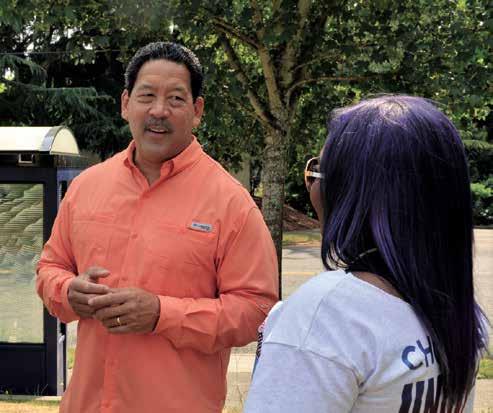
Former Seattle City Council member Bruce Harrell will face off against current Council President Lorena Gonzalez for mayor of Seattle in the November general election.
Early returns in the August 3 primary election showed Harrell and Gonzalez with commanding leads over potential opponents. According to the initial returns posted by King County Elections, Harrell ran first in the field, with more than 38% of the votes, and Gonzalez came second with almost 29%.
Housing activist Colleen Echohawk ran a distant third, with somewhat more than 8%, in spite of a vigorous and well-financed campaign. Openly LGBTQ candidate Andrew Grant Houston pulled 2.6% of the votes.
In all, 14 candidates ran for mayor.
Harrell drew endorsements from a number of former officeholders, including openly Gay state Sen. Jamie Pedersen (D-43) and former City Councilmember Tom Rasmussen. He also won the support of public figures in the African American community (former King County Councilmember Larry Gossett, for example) and Asian–Pacific Islander community (like former City Councilmember David Della).
Gonzalez drew support from organized labor, with endorsements from MLK Labor — King County’s central labor council — and many public- and private-sector unions. She was also endorsed by Bernie Sanders, Seattle-area Rep. Pramila Jayapal, and former HUD Secretary Julian Castro.
“Our campaign’s message of unity, accountability, and action clearly resonated with voters,” Harrell said in an election night statement.
“I’m looking forward to taking this energy into the general election and into office as mayor, as we unite our city and address the challenges facing Seattle.”
González was more exuberant. “Seattle voters are sending a powerful message, and that is a message of change,” she shouted to a jubilant crowd at her Georgetown election night celebration.
The mayor’s office became an open race when incumbent Jenny Durkan — embattled by massive anti-police demonstrations in the wake of George Floyd’s murder — announced she would not run for reelection.
Seattle City Council
In the race for at-large Seattle City
Council position 8, the incumbent Teresa Mosqueda held a huge lead after the initial results were announced on election night.
Mosqueda pulled in nearly 55% of the votes. Her nearest opponent, Kenneth Wilson, drew only 18%. Mosqueda has held the seat since 2016.
Prior to her election, she was political director for the Washington State Labor Council. Wilson is a civil engineer and owns his own consulting firm.
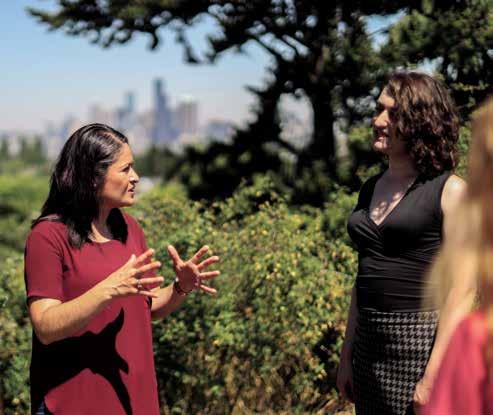
In at-large Position 9 — the seat Lorena Gonzalez vacated to run for mayor — voters in November will choose between brewery owner Sara Nelson and Queer activist Nikkita Oliver.
lar constellation of forces as Bruce Harrell. Oliver won the endorsements of MLK Labor, many local unions, and Pride At Work, and LGBTQ labor organization affiliated with the AFL-CIO.
Seattle City Attorney
Three-term City Attorney Pete Holmes may be looking at the end of the trail if trends revealed on primary night hold in the general election.
In a very tight three-way race, Holmes was running only slightly ahead of challenger Nicole Thomas-Kennedy for a spot in the November general election. Leading the pack was challenger Ann Davison.
Nelson ran first, with just over 42% of the votes; Oliver was second, at 35%.
Nelson campaigned as a champion of the city’s small businesses but opposes measures like the Jump Start program — which Mosqueda championed from her City Council seat — that would require big businesses to foot the bill for the city’s social safety net.
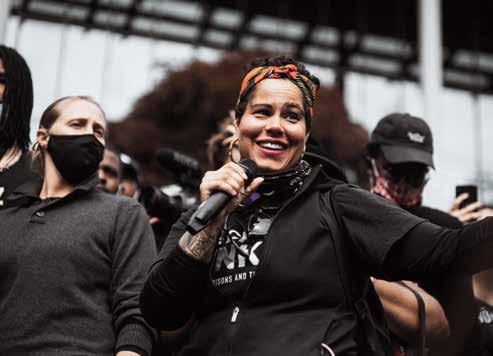
Oliver has been an outspoken local activist, opposing the new youth jail and calling for diverting funds from Seattle police to community-based public safety programs. They ran for mayor in 2017, narrowly missing a spot in the general election.
Nelson has been endorsed by a simi-
Though undoubtedly popular during his previous terms, Holmes has been labeled “soft on crime” by conservatives and “tough on the homeless” by progressives.
Of the three candidates, leader Davison is the law-and-order candidate and the only registered Republican with any chance of winning a citywide office. ThomasKennedy is a former public defender and police abolitionist who has accused Holmes of using his office to prosecute people for crimes of poverty.
County Executive Incumbent County Executive Dow Constantine will face state Sen. Joe Nguyen
(D-36) in the November general election.
In the first drop of numbers form King County Elections, Constantine was well ahead of the field, with more than 53% of the votes. Nguyen came second, with just short of 30%.
Republican Bill Hirt trailed badly, at 12%. Perennial candidate Goodspaceguy — who runs on a platform of space colonization — garnered 3% of the votes.
Three-term incumbent won endorsements from MLK Labor and many individual union locals, although Nguyen won the support of Metro bus drivers (ATU 587) and UAW 4121, representing UW researchers and teaching assistants.
In at-large Position 9 — the seat Lorena Gonzalez vacated to run for mayor — voters in November will choose between brewery owner Sara Nelson and Queer activist Nikkita Oliver.
King County Elections will continue to update its reports at least once a day until all ballots have been counted. The first numbers released usually reflect the first ballots received by election officials, and these are usually thought to be older, whiter, more affluent voters, so that later results often skew in favor of more progressive candidates.
Given the wide margins enjoyed by the top-tier candidates in almost every race, though, it’s unlikely new ballot drops will change most of the races. The only exception is the tight three-way race for Seattle city attorney, where incumbent Holmes might well be edged out of the general election by progressive challenger Thomas-Kennedy. The top two vote-getters go on to the general election in November.


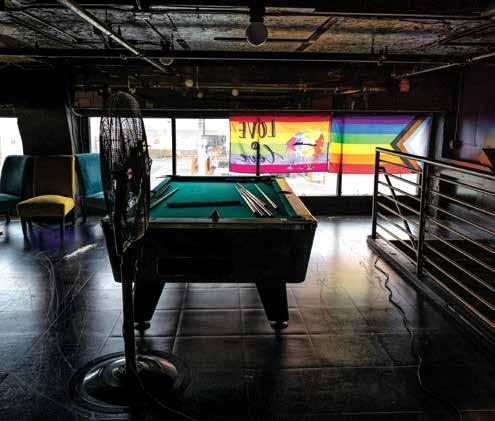
by Renee Raketty SGN Contributing Writer
Neighbours Nightclub on Capitol Hill was bustling with activity on Tuesday as volunteers and staff put the finishing touches on the iconic LGBTQIA+ landmark. A DJ mix thrummed from loudspeakers over an empty dance floor clad with lights, lasers, and a disco ball.
“Neighbours has been a safe place for the LGBT community for 38-going-on-39 years, and everyone is welcome,” Roxy Doll, a popular Seattle drag performer, told the SGN this week. “It has been a place people can call home for decades. Many drag artists and other performers started on this stage through the decades.”
Her Imperial Sovereign Majesty Olympia XLII Sahara Dior D, a female impersonator and member of the Imperial Court of Seattle since 2004, said that Neighbours is “important to the LGBT community” and has “always supported our organization and our many pageants there.”
“I know there are a lot of people waiting to see it reopen its doors again, and yes, I am one of them,” she said. “On a personal level, when I wasn’t there in [drag] or representing the [Court], I went there with friends to have a good time.
“I really wish them well, and hopefully, they can have a comeback and become the number one place where people can go and enjoy themselves safely.”
“A crazy year and a half”
In March 2020, the disco ball at Neighbours went dark after the governor and local health officials shuttered indoor operations at restaurants and bars to stem the rise of COVID-19 infections. During the shutdown, the establishment experienced a series of break-ins; was home to squatters, who left human waste and trash throughout the club; and, finally, suffered from vandals, who spray-painted and tore open walls. However, the disco ball survived unscathed.
Capitol Hill business owner Carl Medeiros of Panache said it has been a “crazy year and a half,” with bars and ven-
“Neighbours has been a safe place for the LGBT community for 38-going-on-39 years, and everyone is welcome. It has been a place people can call home for decades.”
ues being among the “hardest hit” economically during the pandemic and demonstrations for racial justice, which became an almost daily occurrence in the neighborhood. “Sadly, some [businesses] couldn’t hold on long enough to see the light at the end of the tunnel,” he said. “Yet others are coming back, and coming back strong.
“The vandalism was horrific for so many of us. Every day, as a business owner, I dreaded driving up to my store in fear that my window would be broken or my shop looted. It was a stressful ride for everyone. Neighbours got hit badly. They were in the middle of all the protesting. I’m glad they are returning. I’m looking forward to their reopening.”
Medeiros says he has a soft spot for the nightclub, because it was his first after moving to Seattle from Hawaii back in the mid-1980s. “I have a lot of great memories there,” he said. “It’s the longest-lasting club. Many of us, both young and old, have a fun story to tell about our time growing up and being there. We need this type of business to stay for at least another generation.
“I’m very happy Neighbours will come alive again.”
The renovation Doll, who books talent for Neighbours and oversaw the renovations, documented the progress to reopen the business on its Facebook page. She said many individu-
see NEIGHBOURS page 10
continued from page 9
als, businesses, and generous donors made the reopening possible. She said the kitchen, dance floor and walk-in cooler needed to be replaced and that over 200 bags of trash were removed. The sound systems, lighting equipment, and cameras had been stolen and were replaced. The entire establishment also underwent a major cleaning and sanitization.
“In November 2020, my partner Evan Evans and I took on the project of bringing the community together so the club could rise again,” she said. “I have been going there since I was 21 years old. My shows started here, and I have paved the way for all [the] talent within Neighbours’ walls — not just drag. Neighbours has been my home away from home for decades.
“It will feel good to know our effort to save Neighbours has fully come true and that the doors are open for a safe space for all.”
Doll has also established a GoFundMe for Neighbours that had raised $12,790 from 217 donors, as of press time. The fundraising campaign has a goal of raising $100,000. “More money is needed to replace so much that has been destroyed and lost,” she said.
Medeiros praised Doll for her efforts. “Neighbours would not have the ability to be where it is today without the love and hard work of Roxy,” he said. “Every busi-
know about it is that it is two to three times as transmissible as the Alpha variant that we saw back in March of 2020, and the effectiveness of vaccines for this specific variant is slightly lower than for the Alpha variant.
“Vaccinated people are transmitting it, and the extent is unclear, but there’s no doubt they’re transmitting it,” said Chief Medical Officer Dr. Anthony Fauci.
The CDC has classified the Delta variant as a variant of concern (VOC) due to three factors: evidence of increased transmissibility, evidence of increased disease severity, and evidence of its impact on diagnostics, vaccines, and treatment.
Changes for those who are fully vaccinated
The CDC recommends that fully vaccinated people living in areas of high or substantial transmission risk wear masks in public indoor settings. Universal indoor mask wearing for all teachers, staff, and school visitors — regardless of vaccination status — is recommended in order to protect young children. (Full vaccination status is achieved two weeks following a second dose of the Pfizer or Moderna vaccine, or two weeks following the single dose of the Johnson & Johnson vaccine.)
In addition, the CDC emphasized that fully vaccinated people who are immunocompromised or are living with someone who is at an increased risk for contracting the coronavirus may choose to continue to wear masks, regardless of transmission level in the community. It is suggested that those who have a weakened immune system speak with their healthcare providers in order to determine their potential reduced immune responses to the virus, and to follow current prevention measures, such as wearing a mask, maintaining six feet of distance, and avoiding poorly ventilated and crowded areas. Masking indoors is the most crucial prevention measure for those who are at an increased risk.
The CDC mentioned that only a small portion of fully vaccinated people contract the Delta variant, although breakthrough COVID cases still happen. It also stated that individuals should continue to follow applicable federal, state, local, tribal, or territorial laws, rules, and regulations.
ness out there needs someone like a Roxy to be part of their team. If you find that person, keep that person.”
Neighbours has had dark times before. In 1990, federal authorities notified the nightclub that three members associated with the Church of Jesus Christ Christian, better known as the Aryan Nations, had plotted to blow it up. In 2009, the establishment received a typewritten letter that threatened to poison a patron with highly toxic ricin.
In 2014, a man who had told a friend that “homosexual people” should be “exterminated” attempted to light Neighbours on fire — threatening the lives of 750 people there for New Year’s festivities.
“I want people to realize that it is a LGBT business that has survived many decades,” said Doll. “Hopefully, it will be here for many years to come, thanks to all the hard work from so many of our community and the donations that were given to help Neighbours rise again.”
Neighbours will open to the general public on Saturday at 9 p.m. The popular LEO Party, a fundraiser organized by Neighbours bartender Joe Torres, will return for its 18th year on Sunday at 8 p.m; the event will be hosted by Aleksa and Atasha Manila and will feature DJs, go-go boys, and Seattle’s best drag talent. Tickets are available at www.leofoundation.us.


What does this mean for Washington state?
On July 28, Gov. Inslee gave a press conference on the state’s response to COVID19, saying, “We will continue our safe practices of masking for our students and our young people, and we will ask people to consider masking in other conditions consistent with the CDC recommendations.”
“We know the dominant variant today is the Delta variant,” said Inslee. “It is twice as infectious. It is more likely to cause seri-
ous illness. And it is easily the most dangerous mutation to date of this virus. And we know that this curve is trending upward.” Inslee described how the Delta variant has slowed the state’s progress in beating the virus, and brought up how there has been a dramatic increase in coronavirus cases over the last 14 days, in addition to there being a dramatic drop in vaccination rates across the state. Inslee mentioned that for the time being, hospitals are not overwhelmed by cases as they once were, but
that they could very easily become strained again if we don’t proceed with caution.
“We have the tools to beat this. We have the tools to break the back of this COVID pandemic, but there are too many people who, although they have access to a free, life-saving vaccine, have not availed themselves of that.”
Inslee still plans to open schools this fall, but it will be a legal requirement that all students and employees wear face masks while in school, consistent with the updated CDC recommendations.
Unvaccinated individuals are at the greatest risk
Inslee described how the state has seen correlations between counties with low vaccination rates and high coronavirus infection rates.
Currently, the percentage of the population aged 12 and up that have initiated the vaccine in King County is 79.1%. San Juan County has the highest percentage, at 81.4%; Garfield County comes in with the lowest rate, at 31.7%.
One of the greatest struggles in getting Washingtonians vaccinated comes from misinformation, primarily. According to Inslee, a good portion of the misinformation is spread via social media, which has caused question about the vaccine. If one has questions or concerns about getting vaccinated, it is recommended to speak with a healthcare provider.
“We know everyone wants to save lives of the loved ones around them. So, this isn’t just about your life; it’s about the people around you,” said Inslee after expressing the importance of getting a vaccine.
What can you do?
Kids under the age of 12 are still not yet eligible to receive a vaccine, which means a portion of our population, however strongly they may desire to get a vaccine, remain unprotected. Be thoughtful about indoor mask wearing and the benefits it may have, not only for yourself but for others in the same space.
If you have a friend or family member who has not yet received a vaccine, talk to them. Listen to their concerns and attempt to direct them toward their healthcare provider, because, as Inslee put it, “96% of all people in our hospitals today have one thing in common: they didn’t get the vaccine.”


BI-WEEKLY! FIND US WHEREVER YOU LISTEN TO PODCASTS!






by Lindsey Anderson SGN Contributing Writer
It’s been a hot summer for Doja Cat. The singer-rapper, whose real name is Zandile Dlamini, released her third album, Planet Her, on June 25, 2021, receiving massive public and critical acclaim. Since gaining attention with her second album, Hot Pink, the once up-and-coming artist is now quite mainstream, having been featured on tracks with Ariana Grande, Megan Thee Stallion, and The Weeknd.
While known by many for her fashion, attitude, and of course her catchy music, Doja Cat is now gaining attention for a more private aspect of her life: her sexuality.
In mid-July, rumors started to circulate around the internet that Doja Cat, who had previously been linked with indie singer Johnny Utah, had a new love interest — and this time it wasn’t a man.
While usually private about her sexuality and relationships, Doja Cat had casually mentioned her sexuality as fluid, although she has never publicly come out to her fans. In an Instagram Live in 2019, she shared with her fans, “I like both. I like dicks, and I also like, um, I like people I can have sex with. You can kind of have sex with anyone, right?”
While this seemed to be confirmation to some fans that Doja Cat is a part of the LGBTQ community, most were quick to dismiss the comments as glib. After all, it has been a trend for many young celebrities to “queerbait,” identifying with traditionally LGBTQ trends and sentiments only to “come out” to fans as exclusively heterosexual.
Most recently, pop singer Billie Eilish got into hot water for this. She posted a video of herself cuddling and dancing with cast members of her “Lost Cause” music video,

with the caption, “I love girls.” With the post dropping in the middle of Pride Month, many fans thought Eilish was coming out. The stunt worked to increase talk about Eilish and her upcoming music but eventually led many LGBTQ fans to feel betrayed. Doja Cat hasn’t gone without her own involvement in queerbaiting scandals. After releasing a remix to “Say So” with Nicki Minaj, both artists were called out for Minaj’s problematic line, “I used to be Bi, now I’m just hetro,” seeming to once again use LGBTQ identities to engage fans, only to let them down by “coming out” as straight.
Despite fans not putting much energy into the scuttlebutt, internet sites Reddit and Twitter continued to circulate clickbait about Doja Cat and her rumored girlfriend, Bree Runway. On July 19, Doja Cat confirmed the rumors, posting images of Runway on Twitter with the caption, “I have a girlfriend and I’m going public @breerunway.”
In response, Runway posted images of the two of them together on Instagram with the caption, “You know I’m crazy about my WOMANNNN! Love youuuuu @dojacat best night everrrr.”
The reception both Doja Cat and Runway have received since going public has been mostly positive, with fans of both artists tweeting support and excitement. The confirmation came as a surprise to some of Doja Cat’s more casual listeners, though, as the artist has only cast male leads in her music videos and tends to only use male pronouns when singing.
Many fans of Doja Cat have been fans of Runway as well. She is an English singer and rapper, known for the singles “ATM” and “All Night.” Like Doja Cat, Runway primarily uses male pronouns in her songs and male actors in her music videos, making the announcement of her new same-sex relationship a bit of a surprise to many who
had not been aware of her sexuality.
In the wake of Doja Cat and Runway confirming their relationship publicly, some have wondered if it will impact their music. Lesbian artists, such as Hayley Kiyoko and Girl in Red, are known for using same-sex casting and female pronouns in both songs and music videos, and some are wondering if Doja Cat and Runway will start doing the same now that they are in a sapphic relationship.
While it’s possible, it seems unlikely that either will use different pronouns or release a music video with a female love interest. At the end of the day, they are both trying to carve out careers in rap music, a genre that has been hard enough for women to break into, let alone Queer women.
For rappers, sex and sexuality sell. While two women in a music video could still be popular for the sex appeal and fetishization that comes with the ever-present male gaze, homoeroticism might damage its reception. Rappers like Lil Naz X have attempted to release music and music videos that showcase same-sex relationships, and while they have been provocative, these songs have also led to hate speech and threats.
Whether Doja Cat releases music about her relationship with Runway, or continues to write about men, even just going public with her new relationship is a game changer. Seeing one of the most popular artists of the summer openly in love with another woman, gaining so much acceptance, and not facing career backlash as a result is a huge step forward.
Doja Cat and Bree Runway are showing the world that sometimes pretty women just love other pretty women, and the internet is here for it.
by Sara Michelle Fetters SGN Staff Writer
MASQUERADE
Theaters / PVOD
I can’t decide if I appreciate the baitand-switch device at the heart of the home invasion thriller Masquerade by writerdirector Shane Dax Taylor (Bloodworth), or if it instead annoys me to the point that I feel like it is undeserving of the plaudits or kudos I’m tempted to throw its way. There is an element to what transpires that is tricky seemingly for the sake of being tricky, and I can’t say that’s a trait I’ve ever been all that fond of.
But oddly, it kind of works here. This Twilight Zone meets Tales from the Crypt flipping of the script is suitably character driven, and Taylor pours just enough of a foundation that, when the big reveal happens, I didn’t shake my head in disbelief. Better, it does not make any of the events we’ve experienced up to that point impossible. While not all of what transpires is plausible, it is believable, and sometimes that makes all the difference in the world.
After a pair of masked intruders break into her home, 11-year-old Casey (Alyvia Alyn Lind) begins a game of cat-and-mouse against her assailants. One of the pair is clearly over their head, unsure of what they’re supposed to do to nab the young girl currently putting a serious crimp in their carefully laid plan. As for the other villain, they appear to be all too eager to resort to lethal force. In fact, it’s almost as if that’s exactly the outcome they’re hoping for.
Also, bartender Rose (Bella Thorne) offers to drive wealthy art brokers Daniel (Austin Nichols) and Olivia (Mircea

Monroe) home after they have too much to drink at a swanky fundraiser. Unbeknownst to them, something sinister is taking place back at their house. The power has been cut, the security system is switched off, and their babysitter is not answering their phone. That these two storylines will collide is not a surprise. How they do it is the deception Taylor coyly waits until the last few minutes to unveil, and the filmmaker does a decent job holding his cards close to his vest for the majority of the film’s brief 80-minute running time. Wisely, the director keeps the primary focus on Casey, only intermittently going back to Rose, Daniel, and Olivia, if only to remind the viewer this trio has a part to play in the climactic outcome.
There is an uneasy alliance between
these two halves of the narrative. I would have liked a little more ambiguity as to how Rose fits into things; Taylor makes that reveal far too early, in my opinion. I also think the foreshadowing of having Casey watch a low-rent horror movie with her babysitter not too long before the intruders arrive is a bit on the nose. This made the subsequent ultra-violence slightly less impactful, and the shock value of what transpires is nowhere near as frightening as it should have been.
What Taylor does get right is how all of this affects Casey. This isn’t Home Alone or Deadly Games. This isn’t a wisebeyond-their-years youngster who cleverly lays traps for their assailants to cluelessly stumble into. No, Casey is an honest-to-
goodness little girl who is initially scared senseless and has to find an inner resolve if she’s going to make it through the night alive.
I loved that. While her screams could be a tad irritating, and while some of her decisions almost made me want to throw something at the screen, the majority of her reactions and most of what she did to survive still came across as authentic. It’s honestly not until the very end where some of what she did rang a little false. But by that point, Taylor had garnered enough goodwill with me that I was fine with the convenient, violent silliness of it all. I was genuinely rooting for her to be victorious, and as far as I can tell, that’s exactly as it was supposed to be. It’s too dark, though. I liked the way cinematographer Mark Rutledge’s camera slinks and glides throughout the hallways, bedrooms, and attic spaces of Casey’s spacious home, but things are so dimly lit that I found it frustratingly difficult to see what was going on. Ben Lovett’s score does help a great deal, however, The Wind and The Wolf of Snow Hollow composer once again adding a musical component to a motion picture that’s nothing short of exceptional. It all comes down to the twist the entire plot hinges on. Taylor doesn’t cheat. The groundwork for this climactic sleight of hand has been laid. But I cannot say I cared enough about the characters and their fates that this reveal affected me from an emotional standpoint. Still, Masquerade pulls off this final act of subterfuge just well enough that I do believe some will come away suitably shocked and impressed — and maybe that’s enough for this one to warrant a mild recommendation.

by Sara Michelle Fetters SGN Staff Writer
My grandmother Doris loved Marilyn Monroe. While she was the one who introduced me to classic Universal monster movies like Dracula and Frankenstein, it was the former Norma Jeane Mortenson who owned her heart. Grandma knew everything there was to know about the iconic actress, and sitting down with her to watch Gentlemen Prefer Blondes or The Seven Year Itch was a titanic joy.
I can’t tell you how many of Monroe’s films I watched with my grandmother, but there were a lot of them, including some of her lesser-known classics, like Monkey Business (where she memorably gets to play second-fiddle to Cary Grant and Ginger Rogers) and Niagara (where she gets to go full-blown murderous film noir seductress on an initially clueless Joseph Cotten). But I do know the one that she couldn’t watch, that she actually switched off roughly halfway through with tears in her eyes: 1961’s The Misfits
The Misfits is famous for several reasons, most of them having nothing to do with the film being a superlative drama, masterfully directed by the great John Huston and starring the mind-blowing superstar trifecta of Monroe, Clark Gable, and Montgomery Clift. This would be the last on-screen appearance for both Monroe and Gable; Clift would be gone five short years later. That, sadly, is what this film is most known for even now, six decades after its initial release.
Written by Monroe’s husband, playwright Arthur Miller, the plot follows Roslyn Taber (Monroe) meeting up with aging cowboy Gay Langland (Gable), grizzled pilot Guido (Eli Wallach), and down-on-his-luck rodeo star Perce Howland (Clift), while she’s staying with friend Isabelle Steers (Thelma Rit-
ter) in Reno, while she waits for her divorce to be finalized. These are sad, lonely people, all longing for something new and aching to make a personal bond that will last longer than — at best — a couple of months.
They’re all searching for a reason to go on. While hope isn’t lost, whether they want to admit it or not, each can see the end of an unfinished road not too far out in the distance. It visibly wears them down, and there isn’t a single moment where the scars from this constant battle for human connectivity aren’t plainly visible, no matter what lengths they go to to conceal them.
The whole thing is a shocking emotional tornado sweeping through the Nevada desert with unrelenting ferocity. Little things set each character off: Gay wanting to kill rabbits in a garden he and Roslyn have triumphantly brought back to life, much to her tearful dismay; Perce shocked to receive a modicum of kindness after he awakens from a serious concussion; Guido working hard to finish a patio while holding back angry, drunken tears.
It all builds to a roundup of wild horses. Roslyn is beside herself in angry, emotional devastation when she learns these glorious creatures are going to be sold, only to be slaughtered and canned for dog food. It puts all three men at odds, each inching closer to one another’s throats as they decide what to do. It all builds to a climactic confrontation between Gay, Perce, and Roslyn that’s heartbreaking in its brutal honesty, each character learning more about themselves in this single moment than they have at any other point of the story.
That there’s a hint of hopefulness at the very end doesn’t dilute the stinging, intimate majesty of Miller’s script or the heartlessly visceral urgency that fuels Huston’s handling of the material. Gable’s final performance is so stripped down, so nakedly raw
that the moments where the actor’s trademark charismatic spunk bursts forth hit with a zesty winsomeness that’s crushing. Clift is equally superb, while both Wallach and Ritter give two of the best performances of their long and luminous careers.
But it is Monroe who rips your heart to shreds. While many claim 1956’s Bus Stop is the actress’s finest hour, as terrific as she is in that film, her work here as Roslyn knocks my socks clean off. She taps into the material with such bracing sincerity that it’s hard to know where Monroe begins and her character ends. She is stunning, and while this film was criminally overlooked during its original release, that it’s grown into something of a minor classic all these years later is exactly as it should be.
That my grandmother was so affected by The Misfits doesn’t surprise me. If you see pictures of Doris as a young woman, she was preternaturally gorgeous — and I’m not just saying that because I’m related to her. She had a laugh that could fill a room. A smile from her made you feel like you could do anything your heart desired. My grandmother made the world a better place just by being in it, and it still wrecks me that she was gone far too soon from cancer, when I was just a sophomore at the University of Washington.
I can see why she felt so intimately connected to both Monroe and to this particular film. Things were going on behind the scenes between her and my grandfather that I was never privy to and only vaguely suspected as a youngster. There were unrealized dreams that I think haunted her, hopes and desires that never fully materialized. At times, there was a tender sadness hidden behind her eyes that I knew was there but never fully understood. She was a strong, independent woman who never got to flex those aspects of herself like I wish
she could have, and the unfairness of this travesty is infuriating.
But, much like Roslyn, my grandmother never lost that incandescent spark that allowed her to see the best in everyone she encountered, especially those she loved. She taught me how to be my best self, giving me an inner resilience to carry on even during my darkest hours. As bleak as things can get, as hard as life can be, and as awful as it can feel when certain aspirations go unrealized, there is always hope for a better tomorrow — if we have the strength and resilience to fight for it.
The list continues
The oldest film on the list this month is Fritz Lang’s innovative science fiction masterwork Metropolis from 1927. A case could be made this is the most influential motion picture ever made — and that’s not hyperbole: the continued reverberations of this one are still being felt almost a full century after its debut.
The newest film is Isabel Sandoval’s Lingua Franca from 2019. This was an adjustment to the list. Over the past year, her seductively searing drama has seeped deeper into my soul. Its truthfully byzantine layers bewitch me, and the way Sandoval deftly explores the unfathomable depths of modern interpersonal interactions in a polarized, muddily obtuse world is truly extraordinary.
I wonder, who are the actors you feel a kinship to and why, and which films of theirs do you adore but have trouble watching because they hit much too close to the bone? For my grandmother Doris, that actor was Marilyn Monroe and that motion picture was The Misfits. It’s a phenomenal motion picture, a haunting depressive beauty that’s unquestionably stood the test of time. Give it a look.
Les Cousins (Claude Chabrol) (1959)
Letter from an Unknown Woman (Max Ophüls) (1948)
Letters from Iwo Jima (Clint Eastwood) (2006)
Leviathan (Andrey Zvyagintsev) (2014)
The Life of Oharu (Kenji Mizoguchi) (1952)
Lilies of the Field (Ralph Nelson) (1963)
Lingua Franca (Isabel Sandoval) (2019)
The Lion in Winter (Anthony Harvey) (1968)
Little Caesar (Mervyn LeRoy) (1931)
A Little Princess (Alfonso Cuarón) (1995)
Little Women (Gillian Armstrong) (1994)
The Lives of Others (Florian Henckel von Donnersmarck) (2006)
Local Hero (Bill Forsyth) (1983)
Lone Star (John Sayles) (1996)
Lone Wolf and Cub: Baby Cart to Hades (Kenji Misumi) (1972)
The Long Day Closes (Terrence Davies) (1992)
The Long Good Friday (John Mackenzie) (1980)
The Long Goodbye (Robert Altman) (1973)
The Longest Yard (Robert Aldrich) (1974)
The Loneliness of the Long Distance Runner (Tony Richardson) (1962)
The Lord of the Rings: The Two Towers (Peter Jackson) (2002)
Lorenzo’s Oil (George Miller) (1992)
Lost in America (Albert Brooks) (1985)
The Lost Weekend (Billy Wilder) (1945) Love & Basketball (Gina PrinceBythewood) (2000)
Lovely & Amazing (Nicole Holofcener) (2001)
M (Fritz Lang) (1931)
M*A*S*H (Robert Altman) (1970)
Mad Max: Fury Road (George Miller) (2015)
Mad Max 2: The Road Warrior (George Miller) (1981)
The Magnificent Ambersons (Orson Welles) (1942)
Magnolia (Paul Thomas Anderson) (1999)
Malcolm X (Spike Lee) (1992)
The Maltese Falcon (John Huston) (1941)

A Man for All Seasons (Fred Zinnemann) (1966)
The Man from Laramie (Anthony Mann) (1955)
Man of Iron (Andrzej Wajda) (1981)
The Man Who Came to Dinner (William Keighley) (1942)
The Man Who Fell to Earth (Nicolas Roeg) (1976)
The Man Who Shot Liberty Valance (John Ford) (1962)
The Man Who Would Be King (John Huston) (1975)
Man with a Movie Camera (Dziga Vertov) (1929)
The Manchurian Candidate (John Frankenheimer) (1962)
Manhunter (Michael Mann) (1986)
The Many Adventures of Winnie the Pooh (John Lounsbery, Wolfgang Reitherman) (1977)
Margaret (Kenneth Lonergan) (2011)
Maria Full of Grace (Joshua Marston) (2004)
Marianne and Juliane (Margarethe von Trotta) (1981)
Marty (Delbert Mann) (1955)
Marwencol (Jeff Malmberg) (2010)
Mary Poppins (Robert Stevenson) (1964)
The Mask of Zorro (Martin Campbell) (1998)
The Master (Paul Thomas Anderson) (2012)
Master and Commander: The Far Side of the World (Peter Weir) (2003)
Matewan (John Sayles) (1987)
Matinee (Joe Dante) (1993)
The Matrix (Lana Wachowski, Lilly Wachowski) (1999)
A Matter of Life and Death (Michael Powell, Emeric Pressburger) (1946)
Maurice (James Ivory) (1987)
McCabe & Mrs. Miller (Robert Altman) (1971)
Mean Girls (Mark Waters) (2004)
Meet Me in St. Louis (Vincente Minnelli) (1944)
Memento (Christopher Nolan) (2000)
Mephisto (István Szabó) (1981)
Merrily We Go to Hell (Dorothy Arzner) (1932)
Merry Christmas, Mr. Lawrence (Nagisa Ôshima) (1983)
Metropolis (Fritz Lang) (1927)
Middle of Nowhere (Ava DuVernay) (2012)
Midnight Cowboy (John Schlesinger) (1969)
Midnight Run (Martin Brest) (1988)
Mildred Pierce (Michael Curtiz) (1945)
Miller’s Crossing (Joel Coen, Ethan Coen) (1990)
Miracle on 34th Street (George Seaton) (1947)
The Misfits (John Huston) (1961)
Mishima: A Life in Four Chapters (Paul Schrader) (1985)
Missing (Costa-Gavras) (1982)
Mister Roberts (John Ford, Mervyn LeRoy) (1955)
Modern Times (Charles Chaplin) (1936)
Mona Lisa (Neil Jordan) (1986)
Monsieur Hulot’s Holiday (Jacques Tati) (1953)
Monsoon Wedding (Mira Nair) (2001)
Moonlight (Barry Jenkins) (2016)
Moonrise Kingdom (Wes Anderson) (2012)
The Mortal Storm (Frank Borzage) (1940)
Moulin Rouge! (Baz Luhrmann) (2001)
Mr. Smith Goes to Washington (Frank Capra) (1939)
Mrs. Miniver (William Wyler) (1942)
Mulholland Drive (David Lynch) (2001)
The Mummy (Karl Freund) (1932)
The Muppet Movie (James Frawley) (1979)
The Music Lovers (Ken Russell) (1971)
Mustang (Deniz Gamze Ergüven) (2015)
Mutiny on the Bounty (Frank Lloyd) (1935)
My Brilliant Career (Gillian Armstrong) (1979)
My Darling Clementine (John Ford) (1946)
My Life as a Dog (Lasse Hallström) (1985)
My Man Godfrey (Gregory La Cava) (1936)
My Neighbor Totoro (Hayao Miyazaki) (1988)
My Night at Maud’s (Éric Rohmer) (1969)
My Own Private Idaho (Gus Van Sant) (1991)
by Sara Michelle Fetters
SGN Staff Writer
NEVER GONNA SNOW AGAIN
Theaters / PVOD
A small gated community located somewhere in Poland. A suburban enclave where the wealthy residents go about their lives purposefully clueless as to anything happening anywhere else in the world. Residents deal with a variety of everyday issues, ranging from loneliness and adultery and parental neglect to life-and-death struggles with cancer and everything that lies serendipitously in between.
Into this world comes immigrant Zhenia (Alec Utgoff). Ukrainian? Russian? Most of the residents don’t pretend to care. But they’ve welcomed this strange, quietly mesmerizing masseur into their well-to-do enclave all the same. Zhenia’s hypnotic presence and magical touch bring something entirely unexpected to every person he comes into contact with, and the people living in this community will have their lives forever changed — whether they want them to or not.
I watched Never Gonna Snow Again twice before sitting down to write this review, and I still don’t quite know what I want to say about the film. Written and directed by Malgorzata Szumowska and Michal Englert (the former having made her English-language debut with 2019’s uncomfortably masterful The Other Lamb), this drama is a surrealistic dream-

scape reminiscent of Wim Wenders’ Wings of Desire, Louis Malle’s Black Moon, and David Lynch’s Blue Velvet
I do not make those comparisons lightly. While I have no idea if Szumowska and Englert’s opus will stand the test of time in the same way those classics have, that I can mention it in the same breath as that trio should speak volumes. Themes involving conformity, immigration, gender, economic disparity, depression, and climate change are all explored. The beauteous
serenity of these examinations are haunting in their comforting elasticity, and the filmmakers generate an uncertain aura of empathetic perceptiveness that’s overwhelming in its tender grip.
The first trip through this community pushed me further toward the edge of my seat the longer it went along. Zhenia introduces the viewer to the comings and goings between neighbors, and it quickly becomes clear why they are all so captivated by the masseur. Even the older children find they
have trouble shaking off his penetrating gaze.
It’s an open question how each person is going to respond to his touch. Sometimes just being there in the room is enough for him to cause a lost soul to start seeing the world in a different light.
This doesn’t mean he’s some sort of divine being sent by a higher power to solve their problems. That’s not the case. At all. For some of these people, it’s an open question as to whether he’s helped them at all. For others, he eases one sort of pain, only to uncover a deeper vein of emotional agony that may never be healed and will always linger like an aching, omnipresent scar.
The whimsical melancholy of this adventure is frequently thrilling. I never knew what Zhenia was going to do or what any of his clients — or their children, for that matter — were going to ask of him next. Through it all, Utgoff is mesmerizing, the rhapsodic intricacies of his performance showcasing a playfully stoic concentration that’s imaginatively unique. Like the residents of this community, I couldn’t have taken my eyes off of Zhenia had I wanted to — the actor delivered in ways so abnormally idiosyncratic that the overall effect he had on me was nothing short of extraordinary.
I’m not going to say anything more. Szumowska and Englert have delivered something marvelously peculiar with Never Gonna Snow Again, and watching it with little foreknowledge has been one of the more profoundly befuddling joys I’ve had this year.
by Lindsey Anderson SGN Contributing Writer
If you take a stroll down Magnolia’s sweet and quiet streets, you might just stumble upon a friendly neighborhood stop, Magnolia’s Bookstore. Sitting right next to a lovely little bakery, it’s the perfect place to enjoy a morning coffee, a croissant, and a new novel.
“It’s definitely very community oriented,” said owner and manager Georgiana Blomberg, as we sat down at one of the shaded tables out front, which are hardly ever empty. “We’re a small general bookstore, only new [books], and all the people who like to read and hang out at bookstores come here. That’s the atmosphere.”
This atmosphere of Magnolia’s streets bleeds into the shop as well, as friends and neighbors stop by on their way to work, always happy to chat with Blomberg and pick up a new book. “I always get my books here,” one passerby shared with me. “I used to shop here with my daughter, and then when my granddaughter was born, she would sit on the floor in there and look at the little kids’ books.
“I still come here to pick out books to mail to her,” she added, reflecting on the ways her granddaughter, now a recent college graduate, had grown up coming to the little store with her.
Another patron, enjoying coffee outside, told a story about a rough time. While struggling with a long-term illness, she would call and ask for book recommendations from Blomberg, who in return got her hooked on a mystery series. “I would call her and ask if they had books 3, 4, and 5, and ask her to send them with one of my friends, [who delivered them] to me at home,” she said. “What kind of place does that?”
Magnolia’s Bookstore is definitely a piece of the community, and Blomberg has worked hard to make sure the books on the shelves match the energy and environment she sees on the street outside. “When I first worked at the store, it was mostly older people, not very many young ones,” Blomberg said. “And now there’s so many young people! We didn’t have that many kids’ books, and now we have a huge [number].”
When it comes to housing LGBTQ
titles, Magnolia’s is no stranger. “As far as the LGBTQ community, there’s a lot more books being published that appeal to that population, and over the last few years, it’s just become much more predominant,” Blomberg said. While the store does not
have a specific LGBTQ section, Blomberg says that they have been adding more and more such titles to all sections, especially the book recommendations section.
“One that’s on our recommended shelf is The House in the Cerulean Sea,” Blomberg said, recommending the novel to the SGN ’s Instagram book club (which can be found @SGN_books).
Other popular titles in the store include The Magnolia History Book. “Our bestseller last year was the third volume,” Blomberg added. Others are The Night Watchman, Utopia Avenue, and We Ride Upon Sticks
Running the bookstore is Blomberg’s passion, and her love of literature and community is very clear, from the relationships she has curated to the special shelf of recommendations. “I totally love it! The bookstore opened, and I started working here, and then [the previous owner] asked me if I wanted to buy it, and I said, ‘Yes!’” she related.
“It’s just the best — you get to talk to interesting people about interesting stuff all day. If you love reading and you love books, it cannot be better! You get to see
by Terri Schlichenmeyer Special to the SGN
WE ALL KNOW HOW THIS ENDS
ANNA LYONS & LOUISE WINTER
© 2021 Green Tree / Bloomsbury
$20.00 / $26.99 Canada
304 pages
Imagine leaving work one night this week. For good.
No more 9-to-5s, no more waiting for that important document or email. No more Mondays, managers, or meetings — because you’ll be dead and you won’t sweat those things anymore. Everybody dies and so will you.
And in We All Know How This Ends by Anna Lyons and Louise Winter, can we talk about it?
We should, because, according to Lyons and Winter, we don’t talk about death nearly enough, and certainly not in the right way. We skitter around the subject, using euphemisms, trying to be polite, when the truth is that nobody “lost their battle” or “just gave up” or “passed away.”
Nope. Someone died
There’s no shame in it, say the authors, and to make sure, they joined forces several years ago. Lyons is an end-of-life doula, and Winter is “a progressive funeral director,” and together, they’re the team behind Life. Death. Whatever, an organization to help people learn how to talk about dying, funerals, grief, death, and life.
An end-of-life doula is similar to a birth doula, but Lyons works at goodbyes, rather than hellos. She helps ensure that a person’s last days of life are spent “living right up to their very last breath,” and she offers support to the dying person’s family and friends. She also helps people communicate better when someone is dying.
According to Winter, “a progressive funeral director” does what a regular funeral director does, but with “an unconventional approach” that helps families and friends to bid adieu to the deceased, in a way that makes the most sense to everyone involved. She encourages readers to ask questions and to personalize funerals for their loved ones, as well as for mourners.
all the new books coming out, and you get free books — it’s just fascinating. You’re exposed to the world of knowledge and imagination all day!”
As for retirement, Blomberg can’t even imagine life without the store. “Everyone is like, ‘When are you gonna retire?’ and I can’t imagine ever being retired,” she said with a laugh.
Surely much to the joy of the Magnolia community, it seems that Blomberg and Magnolia’s Bookstore are here for the long haul. A hidden gem to those outside of the neighborhood, it’s been a part of the community for the last thirty years, providing good books to folks on the go or ready for an adventure at Discovery Park or a delicious pastry from next door. But thanks to the dedicated work of Blomberg herself, Magnolia’s has become a place worth the drive out on its own account.
Magnolia’s Bookstore is located at 3206 W. McGraw St., and online at magnoliasbookstore.com.
to do. This was it.”
In a way, We All Know How This Ends is a bit of a mess. It’s loosely organized into two halves —with a stress on loosely,— and you’ll be very, very glad there’s a table of contents. Add in a number of guestauthored chapters that feel somewhat commonsensical and repetitious, and you might be tempted to just pick and choose what you read. But that’s what makes this book worth having.
The authors first explain what they do and how a reader can follow in their footsteps. From there, the advice fans out to the physical and the emotional, from how to choose where to die to deciding if you want to witness a cremation. The authors offer their counsel in a way that’s calm but to the point, nontechnical but not disrespectful to a reader’s senses.
Be aware that this book is informative, rather than soft-pillow-and-a-hug comforting. It’s real, and it’s straightforward, and if that’s what’ll make you feel better, or if you’re looking for a new job, We All Know How This Ends will fit the bill. Image
And as to why she became a funeral director, she says, “I wanted to do something with my life. I didn’t want something

by Hannah Saunders SGN Contributing Writer
On July 27, it came as a shock to many when 24-year-old, 4-foot-8 Simone Biles — one of the best gymnasts in history, with a combined total of 30 Olympic and World Championship medals — took a step back from the 2020 Tokyo Olympics after her
continued from cover
“With respect to ending the epidemic, this particular policy decision absolutely helps to support us getting to that goal. PrEP is effective as a strategy… so let’s do the work to decrease barriers to access,” Dr. Stephaun Wallace, a staff scientist with Fred Hutch’s Vaccine and Infectious Disease team and clinical assistant professor with the University of Washington, told the SGN
With recent news of a potential HIV vaccine, the new policy might serve as a beacon of hope for increasing access to other preventive measures.
“[When] we do have an HIV vaccine, access is going to be a critical conversation. This particular decision lays the groundwork for precedent,” said Dr. Wallace, who also serves as director of external relations for
shaky performance on the vault, during which she attempting to do two and a half spins — but instead did one and a half. In addition, Biles nearly fell while landing. Afterward, she went over to her coaches and teammates, and soon thereafter, it was announced that Biles had dropped out of the team event. She did not want her performance to cost the team a medal.
Fred Hutch’s HIV Vaccine Trials Network. “It makes the conversation about how we can get other strategies covered — injectable treatment, injectable PrEP, vaccines, whatever else is coming down the pipe — that we can also get those things covered to ensure that people, regardless of insurance status, have access to these options.”
Less than 10% of individuals who could benefit from PrEP are taking the medication, and forty thousand new cases are diagnosed in the US each year, according to Kaiser Health News. For Dr. Wallace, the increase of access to medications will only be successful when HIV stigma, and the intersection of stigma with oppressed groups, is also addressed.
“While getting people access to prevention methods is a critical component to ending the epidemic, we also need to ensure that we’re also putting attention into addressing stigma and particular intersec-
Later, at a news conference, Biles stated, “I just felt like it would be a little bit better to take a back seat, work on my mindfulness. And I knew that the girls would do an absolutely great job.” (The American women went on to win silver.)
“It’s been really stressful, this Olympic
see SIMONE BILES page 20
tions of stigma: people who identify with the LGBTQ community, people who are living with HIV, people of color, immigrants, migrants, transgender communities, sex workers, people who use drugs,” Dr. Wallace said.
“We can pump out all of the behavioral and biomedical interventions. But if we do not address the environmental factors that contribute to seroconversions, then we will be missing the mark.”
The government’s policy decision also excludes Americans without adequate insurance and those facing more difficulty getting access to PrEP. For example, the pharmaceutical company Gilead recently announced plans to change reimbursement agreements with nonprofits and HIV prevention clinics. This change leaves more uninsured or underinsured patients to foot the bill for their own access to PrEp, which can cost nearly $2,000 per month.
by Daniel Lindsley SGN Contributing Writer

Hungary:
LGBT issues put to a vote
Reuters reported on July 30 that the Hungarian National Election Committee has approved a list of questions on LGBT issues for a referendum on the country’s recent measure that severely limits schools’ teaching of subjects like homosexuality and Transgender issues. Among other questions, voters will be asked “whether content that could affect sexual orientation should be shown to children without any restrictions.”
Hungarian Prime Minister Viktor Orban has called the ongoing struggle with the EU over his string of anti-LGBT laws an “ideological war.” Polls on voter support of and opposition to his party are mixed, showing a narrow race in an upcoming election.
Ghana:
Anti-LGBT bill may be ‘the worst’
NBC News reported on July 29 that Ghana’s parliament may soon vote on a bill that would make identifying as LGBTQ, or even an LGBTQ ally, a second-degree felony with up to five years of jail time as penalty — or up to 10 years for LGBTQ advocacy. The bill also bans samesex marriage and adoption, LGBTQ groups, and gender-affirming surgery. Same-sex displays of affection and cross-dressing would be punishable by up to a year. LGBTQ rights groups have expressed shock at the bill’s broad scope, saying many members of Ghana’s LGBTQ community have been afraid to appear in public. Although a vote for the bill hasn’t been scheduled, it has strong parliamentary support.
by Daniel Lindsley

Kentucky: Christian music festival rejects Christian adoption agency
LGBTQ Nation reported on July 31 that the 40 Days and 40 Nights Christian Music Festival canceled its sponsorship of a Christian adoption agency after learning that the agency has worked with LGBTQ people in the past. The festival is run by Answers in Genesis, a group based out of the Creation Museum in Petersburg. In the style of Nation’s “Bias Watch” articles, writer Juwan J. Holmes made the point that the music festival was still happening in Kentucky in the midst of a pandemic that has hit the state particularly hard.
Grant Park, Chicago: DaBaby canceled at Lollapalooza
NBC News reported August 1 on music festival Lollapalooza’s choice to cancel DaBaby’s performances, after the rapper made homophobic remarks during a performance at the Rolling Loud music festival in Miami. Although DaBaby has since apologized on Twitter, Lollapalooza representatives said in a statement about the decision that the festival was “founded on diversity, inclusivity, respect, and love.”



continued from page 19
Games,” she continued. “I think just as a whole, not having an audience, there are a lot of different variables going into it.”
The day prior to Biles’ vault event, she had posted on Instagram that she felt as though “the weight of the world” was on her shoulders.
A July 28 USA Gymnastics announcement stated that Biles had further withdrawn from several individual competitions to focus on her mental health. The statement read: “We wholeheartedly support Simone’s decision and applaud her bravery in prioritizing her well-being,” and that “her courage shows yet again why she is a role model for so many.”
Athleta’s Chief Brand Officer Kyle Andrew, who sponsors Biles, issued a statement that said, “We stand by Simone and support her well-being both in and out of competition… Being the best also means knowing how to take care of yourself. We are inspired by her leadership today and are behind her every step of the way.”
Ever heard of “the twisties?”
Leading up to the competition, Biles described how she felt shaky, and when she hopped on the vault during the team event, she started experiencing something that gymnasts refer to as “the twisties.”
During the following days, Biles relayed to reporters that she had been having “a little bit of the twisties,” which is a term used to describe the mental block (in most cases, out of nowhere) that can allow gymnasts to lose their sense of direction.
The twisties can be extremely dangerous, especially since it can mean that the athlete does not know how high they are, which direction they are going, and how hard they are going to land. Biles is very fortunate to have not been injured in competition, especially after discovering what was truly going on with her. If she hadn’t landed in the way that she did, then she could have easily broken bones.
Biles continued to experience the twisties and has even posted some video footage to her social media accounts
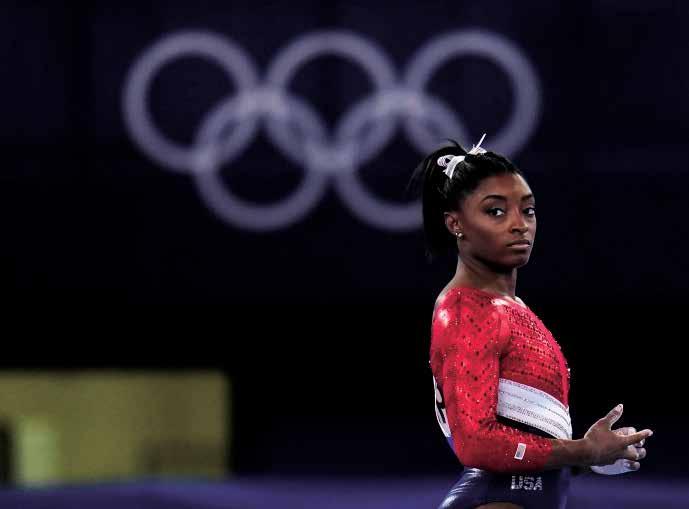
The fact that a Black athlete is initiating conversations surrounding mental health is starting to make waves.
showing her practicing her gymnastics routines while suffering the condition.
Biles was qualified to compete in four individual event finals, and although she has dropped out of three, she competed in the balance beam event on Aug. 3.
The impact Longtime fans of Biles cheered her on, as she took a step back to focus on her mental health. Her courage shows how mental and physical health go hand in hand, and that they are equally important to a one’s safety and well-being.
“The outpouring love & support I’ve
received has made me realize I’m more than my accomplishments and gymnastics, which I never truly believed before,” said Biles on both Instagram and Twitter.
Furthermore, the fact that a Black athlete is initiating conversations surrounding mental health is starting to make waves. People of color are more likely to experience anxiety and depression and are far less likely to seek help in comparison to their white counterparts. Hopefully seeing Biles — one of the greatest gymnasts and a woman of color — put the Olympics on hold for her mental well-being will inspire other people of color — everyone in fact — to do the same.
by Janice Athill SGN Contributing Writer
There are a number of obstacles that should have prevented the Tokyo games: the negative effect the Olympics tend to have on the country holding them, Japan’s current COVID-related state of emergency, the racially charged decisions made by the International Olympic Committee, and the host country’s reputation for being hostile toward the LGBTQ+ community.
Yet, true to form, people demand entertainment, and it shall be supplied.
The 2020 Olympic Games have proven to be entertaining and epic so far, but now one of the USA’s most legendary teams is in the spotlight, and history is on the verge of being made, again.
The WNBA has delivered a unique sports experience since its inception in 1996, and the game of basketball itself has grown tremendously since its beginning in 1892. The historic formation of the USA women’s national team took the world by storm and has since been unstoppable.
The 5-on-5 team is hunting down their seventh consecutive Olympic gold medal, which would make them equal with the US men’s streak of seven straight gold medals from 1936 to 1968.
The women have won gold at every Summer Games since 1996, and this star-studded, top-ranked team has won fifty of their

last Olympic games and currently includes five spectacular, openly Gay players.
Sue Bird and Diana Taurasi, veterans on track to be the first women’s basketball players to win five Olympic gold medals, are easily two of the most famous Gays on the team.
Bird posed naked with soccer star Megan Rapinoe (who is now her fiancée) in the 2017 ESPN Body Issue, while Taurasi is a ninetime WNBA All-Star known for her killer three-point shots — and for telling a ref, “See you in the lobby later” after a personal foul.
Chelsea Gray is a three-time WNBA All-Star who hosted a video series about Queer history with her wife, Tipesa, for Pride 2020. Breanna Stewart, a WNBA MVP, is one of the most decorated players in women’s basketball. She is also engaged to pro basketball player Marta Xargay.
Then there is Brittney Griner, one of eleven players to earn an Olympic gold medal, FIBA World Cup gold medal, WNBA title, and NCAA title, as well as the only collegiate player to participate in the 2011 US national team’s European tour. Griner owns a 34-2 record in a USA Basketball uniform, from 2011 through 2020, and is the only NCAA basketball player to score 2,000 points and block 500 shots. Griner’s unmatched stats are perfectly suited for the dominating US Olympic basketball team and have no doubt contributed to their winning streak.
She has also been open about the homophobia she experienced as an athlete at Baylor University, but she didn’t allow it to keep her from marrying her wife, Cherelle.
The US team has a surplus of Olympic experience and continues to reign supreme. As of Monday night, they had secured a spot in the Olympic quarterfinals despite rocky starts in their first three games. This team is composed of all the best players women’s basketball has to offer in our country, and their victories have become almost an expectation, having earned a reputation as one of the best sports teams in history.
by Lindsey Anderson SGN Contributing Writer
The 2020 Olympic Games have been, without a doubt, the Gayest Olympics ever. With at least 180 LGBTQ athletes, the Queer community just keeps winning in Tokyo.
But one athlete in particular is taking the world by storm. Quinn, who only goes by one name — in the style of another soccer superstar, Pelé — has been gaining traction in the world of international soccer. Quinn, who is one of only three out Trans and/or nonbinary athletes in the Olympics, is competing on Canada’s women’s soccer team.
Tokyo is not Quinn’s first Olympics. They competed in Rio in 2016, but this is their first Olympics since coming out as Trans/nonbinary to the public in September 2020. While Quinn had been out to their close friends and family, they decided to post on Instagram, because, as they said, “I want to be visible to queer folks who don’t see people like them on their feed.”
Following that, Quinn posted a casual shirtless photo in June 2021, showing off their top surgery. Because women’s soccer was one of the first sports to begin playing this year (before the opening ceremony), Quinn also became the first openly Trans athlete in history to compete in the games, followed shortly after by Laurel Hubbard, a weightlifter from Australia; and American skateboarder Alana Smith.
Quinn’s journey
Quinn’s journey to becoming the most decorated Trans athlete in the 2020 Olympics started in 2016, when they decided to play with Canada in the Olympics (Quinn had previously played soccer in both Canada and the United States).
They attended Duke University while also competing in the 2016 Olympics, and after graduating, went on to play professional soccer for the United States Women’s Soccer League. In 2018, Quinn was the
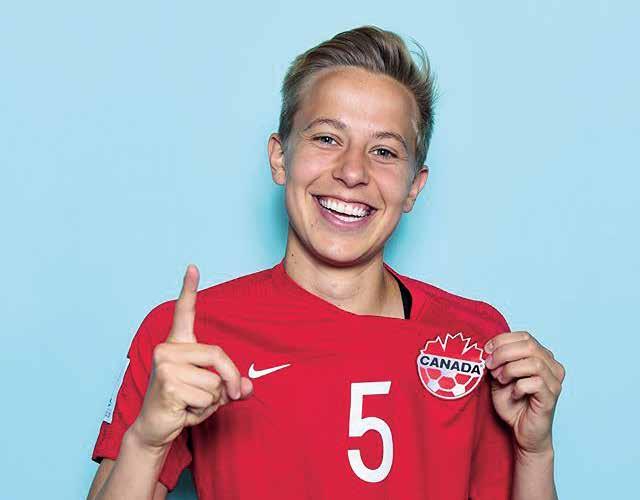
highest drafted Canadian in the USWSL, having been chosen third in the draft by the Washington Spirit. In 2019, Quinn transferred to the Seattle Reign, where they would train and compete along with Queer soccer legend Megan Rapinoe.
While the Canadian women’s soccer team left Rio with bronze in 2016, Quinn was determined to help lead their team to victory the next chance they got. They bid Seattle farewell, and headed to Toronto to train for Tokyo.
On Monday, August 2, 2021, Canada faced off against the United States, fourtime gold medalists in women’s soccer. The game was close, and after 75 minutes, the world was shocked to see Canadian player Jessie Fleming launch the ball into the back of the net after a penalty kick was awarded to Canada.
The win marked Canada’s first victory against the United States since 2001, and landed Quinn and their team a spot in the final match against Sweden. The win also guarantees Quinn a medal — either gold or silver.
Trans and nonbinary athletes
Quinn has been open about the pride they feel, not only for representing Canada but Transgender and nonbinary athletes from around the world. “I feel proud seeing ‘Quinn’ up on the lineup and on my accreditation,’ they said, ‘[but] I feel sad knowing there were Olympians before me unable to live their truth because of the world.”
Quinn has been vocal about their support for Trans athletes, and was often seen wearing a “Protect Trans Kids” sweatshirt in Seattle Reign pre-game events.
While Quinn has been forging a path for future Trans athletes to be able to compete on the world stage, limitations on them are still in place. Since Olympic sports are gendered, the International Olympic Committee has set up specific restrictions on Trans and nonbinary athletes. Trans men are allowed to compete as men with no restrictions or setbacks, but to compete in any “women’s sports,” Trans people must provide evidence that their blood contains less than 10 nanomoles of testosterone per liter for at least 12 months prior to competition. This rule continues to stand, even though there is no proven scientific evidence that testosterone increases athletic ability.
In 2018, Namibian athlete Caster Semanya was banned from national competition because she had naturally higher levels of testosterone and refused to take drugs to reduce those levels.
This ban also means that many Trans athletes, like Quinn, are limited as to how much T they can take while undergoing transition, so athletes transitioning to female face even more challenges when it comes to balancing a healthy transition and monitoring body levels of testosterone, so as to make sure they can be eligible for international competition.
Despite all the challenges Quinn has faced to get to where they are today — including unfair and intrusive regulations regarding their body and testosterone levels, struggles with coming out on such a public stage, and of course competing against the United States women’s soccer team — they are poised to possibly become the Olympics’ first-ever Trans gold medalist.
The Olympic women’s soccer final will be on Thursday August 5, 2021, at 7 p.m. Pacific time. No matter the outcome of the game, Quinn has made history, and will continue to inspire many young athletes both on and off the field.