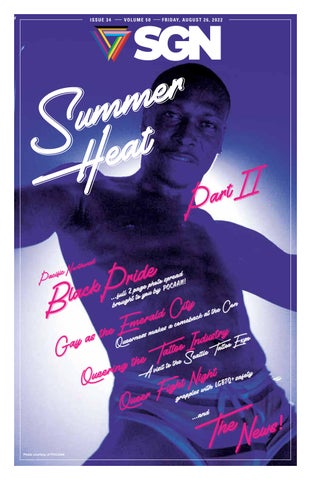
ISSUE 34
VOLUME 5 0
F R I D AY, A U G U S T 2 6 , 2 0 2 2
r e m m u S at e I H I t r a P
cific a P
est w h t r No
ead r p s oto AAN! h p age u b y POC p 2 ll o … f u g ht t o y brou
P k c la
B
e h t s ya
Ga
d l a r e
Em
Q
ne ss r e e u
m
y t i C
ac s e k a
o
ac k b e m
A
er e u Q
v
a
C t t he
on
y r t s po ndu Ex
I Tatt oo o o att eattle
T S e e h h t t o g isit t
n i r e ue
Q
Photo courtesy of POCAAN
e d i r
t + safet y h g i t N GBTQ
h e s w i th L g i F ppl gra
d
e ews! h T N
… an
2
SGN
AUGUST 26, 20 2 2
C E L E B R AT I N G 4 8 Y E A R S!
ORIGINALLY SEATTLE GAY NEWS FOUNDED 1974 MEMBER 509 10th Ave E Seattle, WA 98102 (206) 324-4297 info@sgn.org sgn.org
SUPPORT INDEPENDENT JOURNALISM
DONATE TO SGN TODAY!
Publisher Angela Cragin Managing Editor / Acting Editor-in-Chief A.V. Eichenbaum Copy Editor SGN Staff • Richard Isaac Advertising Maggie Bloodstone, Advertising Manager National Advertising Rep. Rivendell Media (212) 242-6863 Staff Writers Lindsey Anderson • Mike Andrew Sara Michelle Fetters • Daniel Lindsley Contributing Writers Alice Bloch • Maggie Bloodstone Kylin Brown • Sharon Cumberland Carter Hemion • Eve Kucharski Benny Loy • Isabel Mata Paige McGlauflin • Gaysha Starr Social Media Manager SGN Staff Photographers Juliana Adams • Nate Gowdy • SGN Staff Production Mike Pham SGN is published by Angela Cragin. © 2022. All Rights Reserved. Reprints by permission. Publication of names, photographs, or likeness of any person, organization, event or business in this publication cannot be taken as any indication of the sexual orientation of the person, organization, event or business. Opinions expressed in bylined articles, columns, and letters are those of the authors only and do not necessarily reflect the views of the staff or management of this paper. SGN welcomes unsolicited material, including letters to the editor, but reserves the right to edit or reject material. All rights revert to authors upon publication. We assume no liability for loss or damage of materials, solicited or not. We invite feedback, please write. And please play safe. It is our policy that no money shall be refunded if you choose to cancel your ad. Credit will be given for the balance owed. No exceptions.
In Loving Memory Of George Bakan
Scott Roger Alpert Cookie Andrews-Hunt James Arnold Ken Campbell Steve Foiles Shaun Knittel James Leland Moore Don Paulson Randy Peters Lee Richeson Shaun Shelton Jim Tully
Follow SGN
VISIT US ONLINE SGN.ORG
In this Issue
LOCAL NEWS 4 SUMMER HEAT 5 FILM 12 BOOKS 14 OP-ED 16 NATIONAL / INTERNATIONAL NEWS 17 AUGUST 26, 20 2 2
SGN
3
Local News
Police charge man with the murder of Brent Wood by Lindsey Anderson SGN Staff Writer On Tuesday, August 16th, Seattle police charged 41-year-old Alexander Jay with the violent murder of Brent Wood. Wood was attacked in the early hours of the morning on March 3 behind the Rite Aid on East Broadway on Capitol Hill. Police initially investigated an “unresponsive man” in a pool of blood, but Wood was declared dead when they arrived at the scene. They later discovered the murder weapon, a bloody piece of rebar, stashed in a nearby recycling bin. After sending it off to forensics, the SPD confirmed that the blood matched that found on Jay’s shoes; police took him into custody several days later. Despite police arresting Jay in March, they did not yet suspect him of murder. Instead, they held him on two accounts of assault, both of which occurred on March 2. A violent rampage around Seattle The day before Wood’s murder, Jay allegedly went on a violent rampage. He first attacked Harborview Medical employee Kim Hayes at the International District light rail stop, throwing her down the stairs twice. Hayes sustained multiple broken ribs and a broken clavicle. She alerted authorities immediately. Following the attack, Jay acquired a knife from a local business and then headed to a nearby bus stop at 12th Avenue, where he stabbed a 29-year-old woman in the neck, face, arms, and chest ten times. He fled the scene as a bus approached. Just hours after these first two attacks, Jay murdered Brent Wood behind the Rite Aid. Police were finally able to charge him with the crime after DNA evidence returned in June linking the blood on his shoes to the weapon found near the crime scene. The violent attacks from March are not the first crimes to dot Jay’s record. The Seattle local has a criminal history rich with assault, theft, and burglary throughout Washington and California. According to King County prosecutors, Jay’s criminal history includes seven charges from the last five years and twenty overall. Most recently, police arrested him on charges of burglary in Bellevue. Before upping his charge to include firstdegree murder, his bail had been set at $650,000. Now it sits at $5 million.
Photo courtesy of Brent Wood / Facebook
talization are currently taking up space as they await transfer to long-term care facilities. The Department of Social and Health Services says it will likely not have room to take Jay until October, further pushing back his murder trial. In a June hearing, a judge ruled that each day he goes without treatment, the DSHS owes him $250. As of August 9, Jay has acquired $23,000 (dating back to May).
Victim of Seattle’s ongoing mental health crisis Jay was first scheduled to appear in court on April 7, following his arrest for assault, but was diagnosed with unspecified schizophrenia disorder. As a result, his attorneys argued that Jay was not competent to stand trial for the charges. In order that he could stand a trial, Judge Johanna Bender ordered Jay to be admitted to Western State Hospital to receive competency restoration treatment. Court records show that Jay has previously successfully received such treatment after being forcibly medicated. Competency restoration treatment typically involves a patient receiving a clinical evaluation from a psychiatrist. If the psychiatrist declares the defendant incompetent (or unable to participate in their defense due to mental health issues), the state is required to provide services that can bring them back to competency. These can include education, therapeutic and recreational activities, and medication. Afterward, they are reevaluated for their competency to stand trial. Although the court ordered Jay to undergo such treatment, he has yet to do so, as Washington State Hospital still does not have enough beds to take him. The lack of space in the hospital is partially due to COVID-19 patients. However, it is also because those who do not require hospi-
4
SGN
Justice for Brent Wood While friends of Brent Wood were initially heartbroken to hear of his murder and adamant that his killer face justice, they are not angry to hear that Jay is getting state money as he sits in jail. “They lived parallel lives,” said Jamie Lutton, owner of Twice Sold Tales and former employer of Wood. “The fellow who killed him, if he had been caught as a teenager and his paranoid
schizophrenia had been treated, he wouldn’t have been on the streets attacking people. The mentally ill, people who haven’t gotten help — it’s a tragedy all around.” As for Wood, Lutton said, “I miss him, we all miss him. He would come nearly every day and talk to us, and I’m very sorry he’s gone.” She believes the lack of care and attention Seattle gives its homeless is just as much to blame for Wood’s death as Jay is. “He’s one of those people who wouldn’t have been homeless if it hadn’t been that horrible process that Gay men go through [in adolescence]. I miss him, and the only reason he was murdered was that we don’t take better care of our unhoused people,” she said. According to Lutton, Wood lived in a social housing program (apartments built and managed by the government that are affordable to people making varying incomes) during the height of the COVID pandemic, but eventually they kicked him out. “He wouldn’t have been killed if he hadn’t been kicked out of social housing,” she said. “He was killed because he was wandering the streets after midnight. Nothing good ever happens after midnight.” While Lutton acknowledges that Wood’s homelessness contributed to his early death, she is still relieved the police have finally charged someone in his murder. “We were all overjoyed! I started screaming, and I started calling people. Yes, the police did a good job on this one,” she said. While some in Seattle may be able to rest easier knowing an accused murderer is off the street for now, others know that Brent Wood has still not received justice. Justice for Wood will not come with the institutionalization of another homeless man. It will only come once the city can adequately treat the mentally ill and protect and provide proper resources for the homeless.
Photo by Lindsey Anderson
AUGUST 26, 20 2 2
C E L E B R AT I N G 4 8 Y E A R S!
r e m m u S at e H
y a G
e h t as
d l a y r t e i m C E
Queerness makes a comeback at the Con BY DANIEL LINDSLEY SGN STAFF WRITER
Photos by Daniel Lindsley
In contrast to the pandemic doldrums of last year, the Seattle Convention Center and surrounding buildings were swept up last weekend in a storm of geeks, gamers, and cosplayers during Emerald City Comic Con (ECCC) 2022, and the venue was more than prepared. Aside from a universal mask requirement (with “mask stewards” to enforce it and provide spares), everything had returned to a pre-pandemic bustle. The halls were lively and the panels popular, and yet there was clearly a conscious effort by most attendees to keep distance from others while indoors. Best of all, the Queer presence was increased tenfold. According to leading convention staff, most Queer organizations and speakers had been understandably reluctant or unable to attend in 2021, which meant only a few events that year were oriented toward LGBTQ issues and the community. This year, the opposite was true, and I had my work cut out for me as a journalist for a Queer paper. There were multiple relevant panels each day, sometimes back to back — to say nothing of Artist Alley, which was both a gauntlet and a scavenger hunt of Queer artists and their stunning work. I only learned near the convention’s end that at least one mainstay of ECCC’s queerness was actually missing this year, that being the burlesque shows during the official afterparties. Actors famous for Taiko Waititi’s unabashedly Queer comedies, like the paranormal What We Do in the Shad-
VISIT US ONLINE SGN.ORG
ows and the pirate series Our Flag Means Death, were present to sign autographs and answer fan questions. Our Flag Means Death in particular was at least mentioned during most panels, not just as a source of Queer joy but an example of how the passion of a fandom can get a show renewed. Our Flag’s Tumblr community is thriving with fan art and GIF sets, and the actors present — Nathan Foad, Con O’Neill, and Kristian Nairn — saw their slots for autographs and photo ops all but sold out by the time the convention had begun. Panels, panels, panels Meanwhile the Queer panelists had a diverse set of perspectives and a strong intersectional awareness, which made discussions about Queer media, representation, and industry discrimination especially fruitful. Writer L.L. McKinney, who is Black and Queer, emphasized the need for allies that are “accomplices” rather than bystanders, both generally and in an industry that often demands that marginalized creators censor certain identities in their work. That censorship, she said, often takes the form of a sacrifice or fragmentation, performing one marginalized identity while masking the other. What could we do as consumers outside the industry, then? Request Queer books at libraries and bookstores, McKinney said, and buy the books if you can. Become friends with your local bookstore’s man-
ager, and keep those marginalized authors and subjects in their consciousness. Finally, if a creator’s work resonates with you, reach out and let them know; they will always appreciate it, and it might be the motivation they need to keep creating. And as for the string of anti-LGBTQ book bans in public schools across the country, McKinney called for showing up to town halls and PTA meetings, because the people advocating for the bans are far outnumbered, she said, as long as those against them actually show up and speak. Neurodiversity was also a common subject, as was Bi erasure, and the Asexual and Aromantic spectra. Author and artist Margaret Owen said in a panel about Queer young adult fiction that part of her work’s focus was letting kids know that what they feel, or don’t feel, is okay. Graphic novelist Kat Leigh chimed in with the idea that writing fiction for Queer teens was, in a way, a healing process for the author as well. The panel “Cosplay Is for Everyone” brought a message of inclusivity regarding age, ability, and body type, with tips and testimonies from a trio of people who had navigated the stigmas of cosplay and convention culture. “Genderbending the Rules of Cosplay” took a similar concept in a more Queer direction, with panelists giving insight on cosplaying characters whose presentations might not match one’s gender identity, and on changing characters’ gender presentations. One of the panel’s big takeaways was
AUGUST 26, 20 2 2
that gender is hardly the largest defining trait in most character designs, if at all. “Queer Space Nine” took a look at the recent resurgence of the ’90s Star Trek spinoff series Deep Space 9, which was rediscovered by a younger generation of viewers over the pandemic and newly appreciated for its Queer representation, as well as other progressive elements. The panelists agreed that the show wasn’t without some glaring flaws, but especially when compared to past and contemporary science fiction media, it was way ahead of its time. In the afternoon of the con’s final day, renowned drag queens Jinkx Monsoon and BenDeLaCreme of RuPaul’s Drag Race fame took to the main stage of the Sheraton in “A Terminally Delightful Monsoon Season.” The two queens bantered with actor Hale Appleman about their partnership, their post-Drag Race activities, and how to combine therapy with magic rituals for success and confidence. They took questions from the audience at the end. There were a few panel and celebrity cancelations this year, but overall, the convention felt organized, safe, and very Queer. I never felt crushed or overcrowded. Complaints during the ECCC Staff Q&A panel were minor and few. Next year, the staff said, they’d be moving to a venue that could house the entire convention under one roof; no more separate buildings or maze-like hallways. I’m looking forward to it.
SGN
5
r e mm u S at e H
c i f i c a t P s e w h t r o N
e k d c i r a l B P
Photos courtesy of POCAAN
6
SGN
AUGUST 26, 20 2 2
C E L E B R AT I N G 4 8 Y E A R S!
r e mm u S at e H
Photos courtesy of POCAAN
VISIT US ONLINE SGN.ORG
AUGUST 26, 20 2 2
SGN
7
er m m u S at e H
g n i r e e
u Q the
y r t s o u o d tt n Ta I
BY ISABEL MATA SGN CONTRIBUTING WRITER
A visit to the Seattle Tattoo Expo Photos by A.V. Eichenbaum
The familiar buzz of the tattoo gun radiated through the vast halls of the Seattle Exhibition Center when I walked in on the second day of the Seattle Tattoo Expo, hosted by Hidden Hand Tattoo and Connors & Company. Over a hundred artists from all over the country had gathered for three days of live music, contests, burlesque performances, and of course, tattooing. The venue was swarming with artists and fans alike, all grateful to be together after a two-year hiatus. The large exhibition hall was packed with rows of shops and artists looking to showcase their best work. As I searched around anxiously, wondering where to start looking around, I was surprised by the number of women tattoo artists. For an industry that is notorious for being predominantly white and male-dominated, it made my heart flutter to see this change in front of my very eyes. When asked about diversity and inclusion within the industry, artist Nicole Roar from Studio Arcanum said that while things may be trending upward, the industry is still far from perfect. “Honestly, I feel like it’s still a little too white, but it does seem like maybe that landscape is changing a little bit,” she said. “There seems to be more POC and Queer tattooists that are coming up, which is really great to see.” As I continued wandering the rows, looking to for an artist to tattoo something Bisexual on my arm (shoutout to Rae at the Laughing Buddha for coming through), I was disappointed in the lack of rainbow flash tattoos to choose from. For many members of the Queer community, myself included, “tattoos and body modification
in general are a very self-affirming thing,” said Misha Dumois, an artist at Electric Kitten in Ballard, a safe and inclusive space for Queer people to get tattoo. “Feeling comfortable in a space where you are appreciated and understood is a big factor for Queer people,” she continued, which is why Queer tattoo shops are more important than ever. When it comes to queerness in the industry, Castro Tattoo in San Francisco is one of the first places to come to mind. With artists across the gender and sexuality spectrum, it is known for being a safe space for all. “When I first started in the tattoo scene, you had to be a lot more closeted,” if you wanted to succeed as a woman in the industry, let alone as a Queer person, said Haley Adams, one of Castro’s many Queer artists. But now, thanks to finding a home at Castro, Adams can lead by example and help bring up the next generation of Queer and POC tattoo artists. Adams is also one of the founders of the Queer Tattoo Alliance, an SF-based organization dedicated to the unification of the Queer professional tattoo community. While that’s still in the works, Adams was excited to share that they are working with a team to host the very first Queer tattoo conference, a weekend of seminars, education, and entertainment tentatively to be held in New Mexico in March 2023. “I think it’s going to change the world, especially for Queer artists who are interested in tattooing,” Adams said about the potential impact that this kind of educational event could have.
8
AUGUST 26, 20 2 2
SGN
Asked about the importance of Queer inclusion in the tattoo community, Jim Blundell, 57, a self-proclaimed tattoo collector who has been attending the expo since its inception more than 15 years ago, said, “When I was in my twenties, there weren’t a lot of Queer tattoo people. It wasn’t mainstream back then… Now you see so many Queer tattoo people and artists, and it’s great to see the community supporting each other.” As a Bisexual tattoo lover, I am also excited to see more Queer artists showing up in spaces that are traditionally resistant to change. While the industry has a lot of work to do to make it a truly safe space, the fact that there are more Queer artists and shops shows that change is coming.
C E L E B R AT I N G 4 8 Y E A R S!
er m m u S at e H
r e e u Q t h g i t F h g i N
BY MAKAYLA BAKER-CURTIS SGN INTERN
The world of martial arts can be isolating for Queer people, says Charlie, a Seattle-based martial artist who began training in principle-based self-defense in 2020. “Unfortunately, martial arts are not financially accessible, or socially acceptable, for people like me.” Being Transmasculine, Charlie hadn’t felt comfortable in traditionally gendered martial arts spaces. “Men’s martial arts and women’s martial arts don’t fit us,” they said. “It’s terrifying. Like, it’s fucking horrible to go to a gym or a dojo where you’re hated and you’re unwanted.” So, when they heard about Queer Fight Night, it seemed like the perfect opportunity to finally “feel comfortable and… safe” in the combat arts. Having such a space dedicated to the Queer community is “something that’s so valuable and needed,” they said, “especially in the Queer community and marginalized groups who just really need to be able to physically defend themselves.” Two years ago, Gwen Roote founded Queer Fight Night, advertising the event as a Queer-dedicated venue for martial arts instruction and open sparring. After hosting the event for over a year, Roote announced on Instagram that she would be taking a break from organizing. Having seen the excitement generated from previous nights, Charlie wanted to help QFN continue. After a three-month hiatus, in July, they revamped QFN with the help of a few friends, working with Roote on goals and logistics. Charlie hopes QFN will not only bridge the martial arts community in terms of gender and sexuality but also across various skill levels and combat styles.
VISIT US ONLINE SGN.ORG
grapples with LGBTQ+ safety
An evening at QFN Hosted every first Saturday of the month at Seven Star Women’s Kung Fu, QFN begins at 6 p.m. with a round of introductions from Charlie, volunteers, and the night’s guest instructor. The theme for August 20 was “Become Unpinnable,” with participants learning the common ways an aggressor can hold them down and the most effective ones to escape. The instructor demonstrated first with a volunteer, then participants joined in, practicing the new techniques with a partner and working on moves such as “the shrimp,” to mount defenses intended to escape an aggressor up to several times larger. Marco, a beginner to martial arts, arrived at QFN having never stepped foot in a studio before. “I am very easy to pin down, especially [by] people who know what they’re doing,” he said. “But with the ‘Become Unpinnable’ training,’ I kind of felt like I kind of had a chance with the predefined motions.” At 7 p.m., Charlie and the guest instructor laid down safety guidelines and opened up the mats to spars. A mix of low- and high-intensity games followed. Some of the more experienced participants jumped in quickly, while beginners were slower to find a partner. The partners “negotiate beforehand, so that they’re not doing anything that they aren’t ready for,” said Charlie. But in this way, “they can still see themselves in participating in a more advanced martial arts environment.” Shade and a group of fellow Balintawak martial artists arrived shortly before 7 p.m. after training together in Olympia. For Shade, QFN presents an opportunity to spar with people familiar with different
Photos by Makayla Baker-Curtis
combat styles, like kickboxing and jiu-jitsu, which they said is “not an experience I have very often.” Charlie described the importance of testing one’s skills against various fighting styles. “For example, if you do jiu-jitsu, that is non-striking. And so you can come to the spar… and play different fighting games that might involve striking, and see how you feel about it in a safe environment, and see where your training needs to be bolstered.” Finding safety in community For Marco, a big part of creating a safe environment is creating a space built on trust and acceptance — and Queer Fight Night does just that. For him, being able to learn from and practice with fellow Queer people means “being able to be more vulnerable... That’s very important, because you are getting very physical, there’s a lot of contact, so you need to be able to be comfortable with the people you are sparring with, or you won’t want to do it.” Seeing Queer representation in the martial arts is important, said Shade. “I just like talking to the people here. It’s a great feeling to be able to train with other Queer people… to be interested in learning together and teaching.” Charlie added that QFN carves out a space dedicated to Queer people to grow their confidence in martial arts and enter others they might have otherwise shied away from. “You are able to go to places where you might not have felt comfortable or safe, and you’re able to push yourself in new ways.” And with this confidence, they said, QFN creates “people who can go out [to] spaces where there [hasn’t traditionally been] room for Queer people.”
AUGUST 26, 20 2 2
Queering martial arts Beyond creating solidarity, another goal of QFN is to tailor martial arts to the specific challenges that Queer people face and to look beyond traditional gendered styles of combat. “Queering martial arts spaces, to me, means applying it in news ways and finding different avenues of interruption of violence… to address the violence of our lives,” Charlie explained. “As Queer people, we are subject to a very special kind of violence, and multiple kinds… — like trans-misogyny, homophobia, transphobia in general.” True inclusivity, they said, “means having things that actually are applicable and worthwhile for us to learn. The only people who can do that are Queer martial artists, the only people who know our struggles and know our dangers, who know the constant environments [that face] a Queer person — only we can come up with solutions that will work for ourselves.” For Charlie, Queer Fight Night provides a unique opportunity, one in which allows Queer people to come together as a community, “exploring together… and coming up with new solutions to these problems we’ve been facing, but that we’ve never been given tools to actually fix. It’s really, really magical.” The next Queer Fight Night will be Saturday, September 3, with future dates on the first Saturday of every month. The upcoming QFN will be hosted at Seven Star Women’s Kung Fu at 525 21st Ave. in the Central District. It is open to all genders and skill levels. For up-to-date information, visit @qt.combatarts.206 on Instagram.
SGN
9
10
SGN
AUGUST 26, 20 2 2
C E L E B R AT I N G 4 8 Y E A R S!
VISIT US ONLINE SGN.ORG
AUGUST 26, 20 2 2
SGN
11
Film
George Miller’s fearlessly ambitious Three Thousand Years is a romantic dream come true
by Sara Michelle Fetters SGN Staff Writer THREE THOUSAND YEARS OF LONGING Theaters While the Mad Max series has understandably come to define his cinematic legacy, Academy Award winner George Miller is far from being a one-trick pony. He’s also the warped, undeniably fearless mind behind films as diverse as The Witches of Eastwick, Lorenzo’s Oil, Happy Feet, and Babe: Pig in the City. The filmmaker goes for broke each time he steps behind the camera, and you can immediately feel how much of himself he has put into his productions within the first handful of minutes. This goes for Miller’s latest flight of exuberant fancy, the masterfully immersive adult romantic fantasy Three Thousand Years of Longing. A dynamic, blatantly melodramatic spin on storytelling, loss, aging, and love, it analyzes “be careful what you wish for” in playfully minute detail, but does so in a way that also dissects the situational irony that lies at the center of the quote. And yet, Miller also stays true to his two primary characters, never belittling or undermining them just for the sake of a cheap joke, an unexpected thrill, or a sensationalistic jolt of emotional hokum. While the director’s latest is unabashedly romantic, it similarly refuses to be mushy. The picture proudly wears its heart on its sleeve — imperfections, wounds, scars, and all — and in doing so allows Miller to craft a timeless spectacle of human understanding that’s one of best of its kind I’ve seen in years, maybe even decades, maybe ever. Dr. Alithea Binnie (Tilda Swinton) is a student of story. She dissects tales as old as Beowulf and as current as the latest cheap dime store mystery in a never-ending attempt to unearth the connective tissue that has allowed humankind to document its messy history throughout the centuries. In Istanbul for a conference, Alithea discovers a dirty blue glass bottle in a random antique shop. Although it’s unlikely to be of any value, it piques her interest, and the academic eagerly
takes it back to her hotel in the hope of deciphering aspects of the object’s story, no matter how mundane they may prove to be. The bottle is anything but that, however. Inside, trapped for eons, is a djinn (Idris Elba), and he requires Alithea to make three wishes born from her heart’s desire to finally achieve his freedom. But as a scholar, this is one piece of storytelling mythology she is intimately acquainted with. Wishes never work, and no matter how fond she grows of the djinn and would like to help him, Alithea is hesitant to do what he asks, knowing things will undoubtedly go wrong if she does. Based on British author A.S. Byatt’s 1994 short story The Djinn in the Nightingale’s Eye, Miller and co-writer Augusta Gore’s screenplay dreams big, attempting to showcase fantastical anecdotes of tragedy, longing, and love spanning the course of multiple millennia. The djinn recollects all three times he was trapped inside of a bottle, each a cautionary tale showcasing an aspect of the human condition that confirms the lengths people go to in their attempts to make lasting connections, right along with the varying missteps that all too frequently transpire. Almost all of the dialogue happens inside Alithea’s hotel room, with Swinton and Elba verbally dueling in fluffy white bathrobes while sipping tea. This does not mean this is a staid, theatrically stage-bound production or a thinly veiled My Dinner with
12
AUGUST 26, 20 2 2
SGN
Idris Elba and Tilda Swinton in Three Thousand Years of Longing – Photo courtesy of MGM
Andre retread crossed with One Thousand and One Nights. Miller has veteran director of photography John Seale treat this small, enclosed space as if it were the wide, goldenhued endless deserts the latter brought to vivid life in The English Patient and Mad Max: Fury Road. There is a majesty to how the actors are framed, and while the djinn is a giant and Alithea far more diminutive in stature, the pair slowly become physical equals as the day becomes night and one fanciful recollection bleeds into another. Then there are the djinn’s stories themselves. Each is an explosion of movement, life, and color, yet none look or feel the same. They have a distinct aesthetic that makes them easy to separate, yet the connective tissue utilized by production designer Roger Ford (Babe), supervising art director Sophie Nash (The Nightingale), costume designer Kym Barrett (The Matrix), set decorator Lisa Thompson (The Dressmaker), and the film’s talented makeup team to link them together remains seamless. But this technical perfection would mean nothing without the human element, and there Miller does not disappoint. Swinton and Elba have divine chemistry, and the growing affinity between their characters throughout this long conversation happens with eloquent naturalism. Both Alithea and the djinn have been hurt, and this pain has taken root deep inside their souls, almost to the point they’ve each forgotten it exists.
Swinton and Elba burst this bubble, allowing these emotions to morph into something fresh, unexpected, and hauntingly new. The pair are extraordinary. Because of this, the climactic turn of events hit me like a magically ethereal freight train, the tears I shed appearing with such sudden authenticity that I didn’t have time to reach for a tissue before my shirt collar was soaked. Miller takes big swings, and not all of them connect. There are points where elements come off a bit silly, and others just linger to the side, as if hoping they’ll somehow get tied into the bigger picture before they fade away into nothingness. It’s as if the director doesn’t know how to rein himself in, and there are moments of weird obnoxiousness that stand out for reasons I have difficulty believing were planned. I say so what, though, as I easily could be wrong about all of that. None of these nitpicks matter. Miller maintains such a firm grasp on what he’s saying and where he wants to go that even the pieces of Three Thousand Years of Longing that do not fit in this metaphorical romantic puzzle end up feeding into a larger narrative of what it means to be human and the unfathomably obtuse convolutions that tie everyone together. It is the story of life, and as frustrating and maddening as that can be, it’s also quite beautiful: the continual hope for a better tomorrow is a wish worth making, no matter what the risks.
C E L E B R AT I N G 4 8 Y E A R S!
Unforgettables: Cinematic milestones with Sara Michelle 75 years of magic, romance, and feminine perseverance with The Ghost and Mrs. Muir
Rex Harrison and Gene Tierney in The Ghost and Mrs. Muir – Photo courtesy of 20th Century Studios
by Sara Michelle Fetters SGN Staff Writer It is the year 1900, and this new century and all its promise have recently widowed Mrs. Lucy Muir (Gene Tierney) giddily excited. She has taken up residence in a quaint seaside cottage with daughter Anna (Natalie Wood) and housekeeper Martha Huggins (Edna Best), much to the consternation of estate agent Mr. Coombe (Robert Coote). His reasons for not wanting Mrs. Muir to take on the lease have nothing to do with the woman’s finances, however, but instead the home’s disquieting history, and he’s worried she’ll flee before making the first month’s payment. Why? The place is haunted by the ghost of its former owner, cantankerous professional seaman Capt. Daniel Gregg (Rex Harrison). He’s pompous and angry, and has no wish to have roommates, let alone a young mother, her inquisitive child, and a kooky servant. But Mrs. Muir is undeterred. She will not let Capt. Gregg shoo her away, and therefore resolves to come to
an arrangement with the apparition, never realizing that, in doing so, the pair will enter into a relationship that will transcend practical reality and even time itself. The Ghost and Mrs. Muir is one of the most passionately romantic motion pictures I’ve ever seen. Based on the novel by R.A. Dick, adapted for the screen by the great Philip Dunne (How Green Was My Valley, The Agony and the Ecstasy), and directed by the legendary Joseph L. Mankiewicz (All About Eve, A Letter to Three Wives), this 1947 classic is one of those motion pictures that leaves a permanent impression. Even 75 years later, this remains a shockingly modern tale of feminine rebellion and everlasting love that’s nothing short of timeless. But that’s not the reason The Ghost and Mrs. Muir sits right next to my heart. This was the last film my maternal grandmother Doris and I watched together, a few months before she succumbed to cancer. Even though it was difficult to get away from my classes at the University of Washington, I still felt it necessary to make the roughly 90-minute trek from Seattle to Tenino
whenever I could. Doris meant the world to me, and as often as she was there for me in my young life, it was only right I try to do the same when she needed it most. I’m not entirely sure how we came to watch the film. Most of my visits were rather quiet. We’d play cards. Doris would ask how my classes were. I’d lie, doing my best to convince her things were going great when the reality wasn’t so pleasant. She would in turn feign believing me, and in between shuffles would grab my hand and give me a reassuring smile that was like an atomic bomb of kindness. These were our moments, and I will forever treasure them. I was taking an introduction-to-film class and would sometimes bring VHS homework during my visits, and The Ghost and Mrs. Muir was one of those titles I had randomly decided to bring with me. Doris loved Rex Harrison and George Sanders (he plays Miles Fairley, a successful author of children’s books who becomes enamored with Mrs. Muir, the consequences of which have a huge impact on the third act), and while she wasn’t as fond of Gene Tier-
George Sanders and Gene Tierney in The Ghost and Mrs. Muir – Photo courtesy of 20th Century Studios
VISIT US ONLINE SGN.ORG
AUGUST 26, 20 2 2
ney, my grandma did recall enjoying this one quite a bit when she was young. Few moviegoing experiences in my life have ever equaled this one. Neither of us made a sound other than a few soft giggles early on, when Lucy and Capt. Gregg are getting to know one another. We barely moved. When it was nearly over, and as Bernard Herrmann’s memorable score built to a powerful crescendo, we shared a box of tissues and as tight a hug as her frail condition would allow. While the rest of the day is a foggy blur, the 104 minutes we sat there watching the picture are burned into my soul, and that’s no small thing. Mankiewicz adored strong women. His filmography is littered with them, All About Eve’s Margo Channing — so brilliantly portrayed by Bette Davis — arguably towering about them all. But to me, Tierney’s Lucy Muir is the character I shall always be most fond of. Her strength, her resilience, her ability to maintain her dignity in the face of all obstacles — these were all traits my grandmother embodied, and ones I have done my best to emulate as the years have slowly passed. The final moments of The Ghost and Mrs. Muir are profoundly cinematic. Charles Lang’s lush black-and-white cinematography (the seventh of his 17 Academy Award nominations) creates an otherworldly dreamscape that hovers right at the edge of reality and fantasy. Hermann’s music propels things forward with baroque dynamism. Harrison’s larger-than-life performance reaches its zenith, and Tierney’s hushed, almost imperial elegance brings forth a waterfall of tears. It’s pure perfection, made even more so by Mankiewicz’s stubborn refusal to overplay his hand. He chooses subtlety over melodramatic excess, knowing that, even during the climax, less remains more and that the audience will fall even more into his hands via a gentle coaxing, not a forceful shove. The magic of The Ghost and Mrs. Muir refuses to dissipate, making it even more unforgettable now than it was three-quarters of a century ago. Now celebrating its 75th anniversary, The Ghost and Mrs. Muir is available on DVD (the Blu-ray is sadly out of print) and to purchase digitally on multiple platforms..
SGN
13
Books
West Seattle’s favorite reading spot
by Lindsey Anderson SGN Staff Writer In West Seattle sits a small bookstore with a big heart. Founded three years ago by Desirae Wilkerson and her husband, Paper Boat Booksellers has provided the community with a cozy place to relax, find new reads, and get to know the neighborhood. West Seattle needed a bookstore The Wilkersons decided to open the store as a “next step” in their life. “Also, we love books, we love bookstores… Even though we own a bookstore, any chance we get to go to… an independent bookstore, we go and buy books,” Wilkerson said with a laugh. “We didn’t have a new independent bookstore in West Seattle, so that was huge… I mean, we needed one.” Once the couple knew they wanted to open up a new bookstore, they still had a lot of work ahead of them. “About a year before we decided to open, we took a weeklong retreat and went to Nashville with a whole bunch of other people from around the country who also wanted to open bookstores,” Wilkerson said. “There was a couple who taught this workshop for the week, and it was inspiring to hear other people wanting to open bookstores and their ideas. It helped with bringing all the pieces together, enough for [us] to open [our] bookstore.” The retreat was only the beginning for the Wilkersons, however. “We thought, one day we’ll find the perfect space, and then we drove past this space. We were like, this is going to be good.” With the location secured, they still felt like the space was missing something before the store would be ready to open. With a background in interior design, Wilkerson set to work making sure the store could be as cute and cozy as possible. “It is pretty homey in here. I mean, that is how it was designed. There was stuff in here that we couldn’t do much with… these office ceilings and things that needed to stay, so it was just about making it a great comfortable space,” she said. Looking back on the last few years, from opening the store to stocking the shelves with books and other trinkets, she thinks it’s all been worth the effort. “I think it’s a good balance. There are tough parts, but it’s all is worth it, because we have great customers. …This is their second home, so it’s all worth it in the end.” “It’s home” What sets Paper Boat Booksellers apart from other stores in the neighborhood is the quaint and cozy atmosphere that draws readers of all ages. “It’s home. It’s warm in here. It’s walking distance from a lot of neighborhoods, so we get a lot of families...” Wilkerson said. “The [downside] is there’s no parking, but still, it’s not as cramped down here as it is in the main junction. Yeah, it is just comfy, and that’s what we hear from people, that they feel relaxed in here and that it’s like a library. If their kids are having a fit or something like that, it’s just okay.” Because Paper Boat is a general-interest bookstore, it carries a wide variety of titles, but nothing has been as in such demand as this summer’s Queer hit graphic novel
14
SGN
series Heartstopper. “Heartstopper is by far [the hottest book of the summer]. Where did that come from?” Wilkerson said, laughing. “I know the show came out. Our daughter is 11, and she doesn’t like to read, and she was like, ‘You have to get me the Heartstopper books — all of them.’ …They’ve been on back order: we’ve been waiting for them, and they’re just out the door. So that has been very popular this year.” For readers looking to find Heartstopper or another Queer YA equivalent, Paper Boat has the titles, just not in any specific LGBTQ+ section. “We don’t have a specific section,” Wilkerson said, “but because we’re a general-interest bookstore, we try to make every section as diverse as we possibly can. There’s always a mix of something in there. That was important to us, since we’re not a specialty store and don’t have a special niche or anything like that. It’s just general interest, just really trying to diversify each section and …make sure that we have something for everyone.” Local authors at Paper Boat Paper Boat Booksellers loves to promote all kinds of authors, but the favorites are local ones. Before the pandemic, the store hosted many author readings and book signings. Now, as things slowly return to how they were, it is preparing to do more events. “Because…we’re tucked away over [in West Seattle], a lot of our events are local authors. People want to come and see their neighbors or someone who has written a book that’s from here. We’ll slowly start doing things again, but mostly it’s just coming up with space for us since it’s so tiny here. …When we’ve had events, we have to push everything out of the way, so we’ve been doing more off-site events.” The next author event will be held down the street from Paper Boat, at C&P Coffee. “We have an event coming up on September 13, Wilkenson said. “[It’s] a local author, [Madeline Ostrander]… from West Seattle, [who] wrote a book called At Home in an Unruly Planet… It’s a really interesting book about how we live in our homes as we’re navigating through this climate change that we’re going through.” For anyone looking to explore West Seattle, hoping to learn a little bit more about climate change, or trying to find a place that might just have a copy of Heartstopper, Paper Boat Booksellers is the place to be. Paper Boat Booksellers is located at 6040 California Ave. SW, and online at https://www.paperboatbooksellers.com.
AUGUST 26, 20 2 2
Photos by Lindsey Anderson
C E L E B R AT I N G 4 8 Y E A R S!
From Gay to Z an essential encyclopedia for the now by Terri Schlichenmeyer Special to the SGN FROM GAY TO Z: A QUEER COMPENDIUM JUSTIN ELIZABETH SAYRE, illustrations by FREDY RALDA © 2022 Chronicle Books $24.95 312 pages
Image courtesy of Chronicle
VISIT US ONLINE SGN.ORG
For most of your life, you’ve been fed a steady diet of history, but what do you know about Gay history, pop culture, and standout activists? Everything you don’t know about your GayBCs is in tiny entries in this new book by Justin Elizabeth Sayre, illustrated by Fredy Ralda. For instance, check out the entry for drag, or a method of performance that Sayre thinks “queer people have always participated in.” Drag is performance, but it’s also campy theatre, “empowerment,” and “a chance to... get to be the person you always wanted to be.” Also included are places to meet, dance, play, or vacation, and a lot of New York and San Francisco hot spots, both current and otherwise. “So much of New York is gone,” says Sayre, but some are immortalized here. And by the way, do you speak Polari? Inside this humorous collection, you’ll read about trailblazers like Christine Jorgensen, sources of controversy like Robert Mapplethorpe and Chelsea Manning, activists like Marsha P. Johnson, and the male We’wha of the Zuni tribe, who lived as “female-bodied people.”
AUGUST 26, 20 2 2
You’ll also find notable performers from then and now. For instance, do you know who Wayland Flowers was, and his sidekick Madame? If so, you’ll enjoy the entry for Liberace, too — and if not, then read about Lil Nas X, Billy Porter, Brandi Carlisle, Freddie Mercury, and dozens of LGBTQ allies and “icons.” You’ll also find entries about notable LGBTQ-owned newspapers, as well as authors, playwrights, movies and moviemakers. In the introduction for From Gay to Z, Sayre says that there was no way “of boiling down the entirety of queer culture into one book.” It’s true: just page through and you’ll likely enumerate AWOL entries almost immediately (What? No Danica Roem? No Bettie Page?). No worries, though: you’ll also instantly see something else that Sayre promises: lighthearted humor. There’s so much goodness packed between the covers of From Gay to Z that you almost don’t know where to start. Be conventional, and begin with “A” — or take a chance and flip open the book at random. There’s something interesting either way. Sayre goes pretty far back into Gay history for the entries chosen, but there’s plenty for a modern reader, or for someone who’s recently out, or who badly needs a brush-up on history. Each entry is quick to read, too, so no great commitment is required. Even so, this book is like a bag of potato chips: you can’t help but dip into it until it’s gone.
SGN
15
Op-Ed
Ask Izzy: Handling Bi erasure and finding therapeutic alignment
Isabel Mata – Photo by Alex Quetzali @grainy.girl
by Isabel Mata SGN Contributing Writer Ever since I was a kid, I have been using my own experiences (and traumas) as a bisexual, neurodivergent chronic over-sharer to help my friends, family, and even random strangers on the internet have stronger relationships, better sex, and healthier mindsets. I find joy in writing about all the things no one else wants to talk about. The more cringe, the better. Using my experience and my innate ability to connect with empathy, every other week I will respond to your questions about life, love, friendships, sexuality, mental health, and whatever else is on your mind. Nothing is off limits. Dear Izzy, I’m a Nonbinary Bisexual in a straightpassing relationship with another Bisexual. A lot of my friends are Queer, and they’re always supportive, but sometimes I feel like we’re not quite fitting in or being accepted. At times, I feel like my partner and I are just seen as a token straight couple, even though we definitely aren’t that. What can we do to feel more at ease or fit in better? —Imposter Syndrome in Seattle Dear Imposter Syndrome, I am so sorry that you are not feeling accepted by your Queer friends. I know exactly how you feel, and it really sucks. But I am here for you. Unfortunately, this is all too common for Bisexuals in long-term straight-passing relationships, because people seem to think that the gender of their partner is indicative of their “real” sexuality. Which just isn’t true! Regardless, it hurts to feel like you don’t belong, even when you absolutely do. Just remember, do not need to prove your queerness to anyone. Your bisexuality is valid regardless of who you are dating. And if your friends make you feel like you don’t belong, then frankly, fuck them. It’s biphobic, elitist, and contributes to Bi erasure. The challenge is that this kind of thinking is so engrained in Queer culture that your friends may not even be aware that this is what they are doing. Have you tried sharing with them how their actions or comments make you feel? You deserve to feel seen, and if they are truly your friends, they will be open to hearing you and hopefully change their behavior. But this is only a temporary fix. It’s hard to feel secure in your sexuality if you are constantly searching for validation from your peers. I recommend finding ways to self-validate your sexuality, so you are not relying on the Queer community to do it for you. This could be in the form of owning your Bisexual look, creating a Bisexual display in your home, or even engaging with the local Bisexual community. Reflect on what being Bisexual means to you and your partner, and you might be surprised what comes from it. For more ideas, check out the article I wrote on creating Bi visibility in monogamous relationships (https://www.sgn.org/ story.php?id=317327).
16
SGN
Dear Izzy, I’ve been seeing the same therapist for a long time. I’m worried that he’s getting bored, and I already know what to expect from his answers. How do I keep things spicy with my therapist? Should I search for something new?—Maybe Stable in Seattle Dear Maybe Stable, It sounds like you might be the bored one, according to your letter. If you already know what to expect from your therapist’s answers and you don’t feel as though you are gaining anything from your sessions, you are right that it might be time to look for someone new. But before you go through that process, I want to introduce you to a concept called therapeutic alliance, which psychotherapists describe as a collaborative relationship between patient and therapist in which they share the common goal of working to overcome the patient’s struggles, whatever they may be. For a therapy to be “successful,” both parties need to be aligned on what your goals are and what you are hoping to get out of each session. Because there are so many kinds of therapists, I would start by asking yourself what you want in a therapist and what you don’t want. Start with your current therapist. What don’t you like about their methods? Do you wish they gave more tangible advice and tools? Are you tired of talking the whole time and wish they asked better questions?
Photo by cottonbro / Pexels
Here is an example of a chart I made when searching for a new therapist a few years back: What I wanted in a therapist
• Someone young, hip, cool, in the know
What I didn’t want in a therapist
• Someone who just sat and listened to me
• Someone from a diverse background, Queer would be a bonus
• Someone who played devil’s advocate
Once you’ve created this list, bring it to your therapist. While it might be a scary conversation to have, it’s not personal for them. It’s their job to help you, and if it’s no longer a match, it serves you both to end the working relationship. No one wants their time to be wasted.
Depending on how that conversation goes, you may want to explore different types of therapy. The clearer you are on your therapeutic goals, the easier it will be to find a match. It may take time to find a therapist you align with, but when you do, it will be worth it. I promise!
• Someone who helped me learn actual • Someone who made me feel crazy or tools and skills to apply to real life used language making it seem like my mental illness was my fault
Photo by SHVETS Production / Pexels
AUGUST 26, 20 2 2
C E L E B R AT I N G 4 8 Y E A R S!
National News
Tucker Carlson claims Biden wants to put chemicals in milk to turn kids Trans by Mike Andrew SGN Staff Writer Tucker Carlson is insane. That’s not exactly breaking news, but the Fox News host gave still more evidence of his tenuous grasp on reality on his August 22 show. In a segment dealing with the legal woes of Amish farmer Amos Miller, Carlson suggested that the Biden administration wanted to add “endocrine-disrupting chemicals” to milk in order to make children Transgender. Miller has had long-standing disputes with the federal Food and Drug Administration (FDA), dating back to the Obama administration. He currently owes more that $300,000 in fines for violations of food safety laws, resulting from sales of unpasteurized milk and uninspected meat and poultry. Carlson and guest Jeremy Loffredo of the far-right website Rebel News supported Miller, with Carlson stating that “they’re against anything that’s wholesome and edifying and that makes you stronger and healthier and are in favor of anything that diminishes you and makes you more dependent.” The Biden administration is going after Miller because“food without endocrinedisrupting chemicals must be eliminated immediately,” Carlson continued. He also suggested that the lack of genetically modified organisms (GMOs) in Miller’s food was a reason the FDA and the US Department of Agriculture (USDA) are going after the farm, even though the concept of GMOs is completely unrelated to the complaints against Miller. In response, Loffredo noted that Miller doesn’t use “any gasoline or any fertilizer.” He said that those two things “have become very expensive, because of Biden’s policies in regards to the war in Ukraine and Russia,”
Photo by Christian Monterrosa / AP
and the Biden administration is “coming after him for it.” “Maybe if he promises to put more chemicals in the milk that turn kids Trans, they’ll lay off,” Carlson replied. Earlier this year, Carlson noted that testosterone levels are dropping among men in the
US. He used the observation to promote his documentary film entitled The End of Men. Urologists usually attribute the decline in testosterone to a number of factors, including increases in average weight, dietary changes, lack of exercise, and possible environmental toxins, but Carlson had
another theory: the lack of sunshine reaching testicles. “If you want to optimize and take it [your testosterone] to another level, expose yourself to red-light therapy,” a guest on Carlson’s show said. “It’s testicle tanning, but it’s also full-body red-light therapy.”
National news highlights by Daniel Lindsley SGN Staff Writer
Trans sports ban blocked, leaving decision to commission Utah state Judge Keith Kelly has reversed a state ban on Trans girls in girls’ sports, leaving behind a fallback system created by Republican lawmakers in case the ban was contested. Under the system, Trans girls will be evaluated by a commission panel to determine, in each case, whether their participation would cause unfairness. The commission, being made up of politically appointed experts in the fields of athletics and medicine, will ask for and assess the child’s height and weight — a requirement advocates for Trans students argue could make children feel targeted for having their bodies measured. It’s unclear when, if ever, the commission will actually call a student forward. Of the over 80,000 students playing high school sports last year, a state sports association said, only one Trans girl competed. In addition, school sports have already started for the year.
VISIT US ONLINE SGN.ORG
A 12-year-old Trans swimmer waits by a pool in Utah – Photo by Rick Bowmer
Judge Kelly said during the ruling that the attorneys representing the Trans students’ families have showed that the families have
suffered significant distress “by singling them out for unfavorable treatment as Transgender girls.”
AUGUST 26, 20 2 2
Far-right media launches online attacks against children’s hospitals Doctors and other staff at Boston Children’s Hospital have been receiving violent threats over its surgical program for Trans youth, an administrator said — an experience apparently shared by other children’s hospitals in the country. As the home of the country’s first pediatric and adolescent Trans health program, Boston Children’s has been targeted by far-right social media, news outlets, and bloggers who had found the hospital’s informational YouTube videos about gender-affirming surgeries for Trans patients. The hospital responded by removing the videos, and said in a statement that it is working with law enforcement to protect staff and patients alike, and to “hold the offenders accountable.” The ire of these large, right-wing social media accounts have since shifted to similar programs, like that of hospitals in Pittsburgh and Phoenix. Some might think this is nothing new, but C.P. Hoffman, senior policy counsel at the National Center for Transgender Equality, would say otherwise. Hoffman said it was the first time the center had heard of such vicious and sustained online attacks against children’s hospitals specifically. “It really makes one worry about the safety of Trans youth and their families and the individuals who provide services to them,” they said.
SGN
17
National & International News
Gay Black congressman loses seat in New York primary by Mike Andrew SGN Staff Writer Mondaire Jones, one of only two Gay Black members of Congress, lost his seat in the August 23 New York primary. Jones came third in a field of 12 Democratic candidates. The race was complicated by redistricting following the 2020 census. Jones, who originally represented a Hudson River Valley district, found himself competing with another Democratic incumbent, Sean Patrick Maloney, for a newly redrawn district. Thinking that Maloney was too tough an opponent, Jones then moved to a new Lower Manhattan–North Brooklyn district left without an incumbent congressmember. The primary ended with Dan Goldman winning the election, Yuh-Line Niou coming second, and Jones — relatively unknown in his new district — in third place. Goldman is a former federal prosecutor who acted as lead counsel during the first Trump impeachment investigation. He is also the heir to the Levi Strauss clothing fortune and poured $4 million of his own money into the campaign. Niou is a New York State Assemblymember with roots in New York’s Taiwanese immigrant community. Jones served one term in Congress representing a suburban district. He came to national attention in 2020 when he filed suit against Donald Trump and Postmaster Louis DeJoy to reverse changes in post office policy that would have made mail-in voting harder. Jones was one of the progressive candidates in the race, advocating Medicare for All, the Green New Deal, and police reform. The winner, Goldman, also supports progressive policies, but endorses New York Mayor Eric Adams’ get-tough policing policies.
Mondaire Jones – Photo by Tom Williams / AP
The other Black Gay member of Congress, Ritchie Torres, won the primary in his South Bronx district. Sean Patrick Maloney, whose reputation as a tough campaigner caused Jones to move to a New York City district, won his primary against a more progressive oppo-
nent, Alessandra Biaggi, who was endorsed by Rep. Alexandria Ocasio-Cortez. In Upper Manhattan, incumbents Jerry Nadler and Carolyn Maloney (no relation to Sean Patrick) were forced to run against each other, with Nadler winning by an almost two-to-one margin.
All the New York City districts have large Democratic majorities, and winning the Democratic Party primary is tantamount to winning the November election. Maloney’s suburban district is considered a swing district, but he is favored to win the general election.
International news highlights by Daniel Lindsley SGN Staff Writer Italian fascist polls high as advocates worry about backslide Italian far-right politician Giorgia Meloni is leading in polls to become the country’s first female premier and also its first far-right government leader. While the subject of her first rally was energy policy, much of her rhetoric mirrored that of the Brothers of Italy party, whose symbol borrows from that of a neo-fascist party. “I’m starting in Ancoma not by chance,” Meloni said. She did it to remind voters that “we have a class of leaders ready to govern the country.” Meloni also claimed that the political right is “ready to give answers to the country that the left hasn’t been able to do for years.” Most worrying for LGBTQ advocates is the fact that in past public appearances, Meloni has criticized the “LGBTQ lobby.”’ Matteo Marchegiani, head of advocacy group Arcigay’s Ancona chapter, told the Associated press that he’s worried about the possibility of a Meloni majority victory, which “could lead to the cancelation of the new civil rights that the LGBTQ community has… obtained after decades of work and great effort.”
18
SGN
Participants at Singapore's Pink Dot parade – Photo by Wong Maye-E / AP
Today, due to the efforts of right-wing and pro-Vatican politicians, Italy still doesn’t permit same-sex marriage. Singapore will legalize Gay sex, outlaw Gay marriage According to Singapore’s Prime Minister Lee Hsien Loong, the country will soon repeal a colonial-era law that criminalizes sex between men but amend the constitution to outlaw same-sex marriage. Loong said he believed the repeal was the
AUGUST 26, 20 2 2
“right thing to do,” given most Singaporeans would accept it. “Private sexual behavior between consenting adults does not raise any law-andorder issue,” Loong said. “There is no justification to prosecute people for it nor to make it a crime. This will bring the law into line with the current social mores and, I hope, provide some relief to Gay Singaporeans.” Yet Loong also assured crowds at a rally that the country’s norms regarding fam-
ily, schooling, media, and public conduct wouldn’t change. “Even as we repeal Section 377A,” he said, “we will uphold and safeguard the institution of marriage.” Other countries in the Asia-Pacific region, especially former British colonies, have similar laws. Malaysia jailed a former deputy premier for sodomy twice, once in 2000 and again in 2014. Meanwhile, India decriminalized sex between men in 2018, and both Taiwan and Thailand are moving toward allowing same-sex unions.
C E L E B R AT I N G 4 8 Y E A R S!
VISIT US ONLINE SGN.ORG
AUGUST 26, 20 2 2
SGN
19