An interview with Alki Beach Pride founder Stacy Bass-Walden by Cameron Martinez SGN Intern
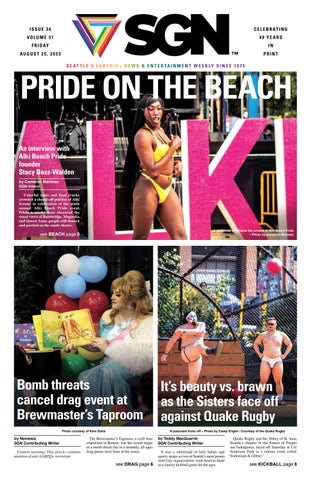
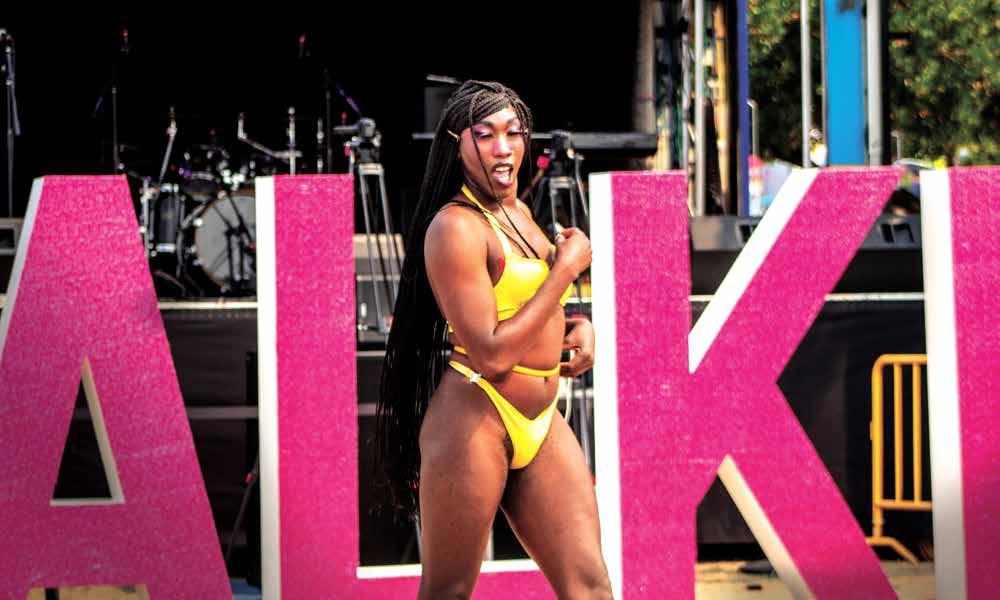
Colorful tents and food trucks crowded a closed-off portion of Alki Avenue in celebration of the ninth annual Alki Beach Pride event. While a smoky haze obscured the usual views of Bainbridge, Magnolia, and Queen Anne, people still danced and partied on the sandy shores.
by Teddy MacQuarrie
SGN Contributing Writer It was a whirlwind of holy habits and sporty straps as two of Seattle’s most prominent Gay organizations went head-to-head in
charity kickball game for the ages.
Quake Rugby and the Abbey of St. Joan, Seattle’s chapter of the Sisters of Perpetual Indulgence, faced off Saturday at Cal Anderson Park in a riotous event called “Jockstraps & Glitter.”
by Nemesis
SGN Contributing Writer
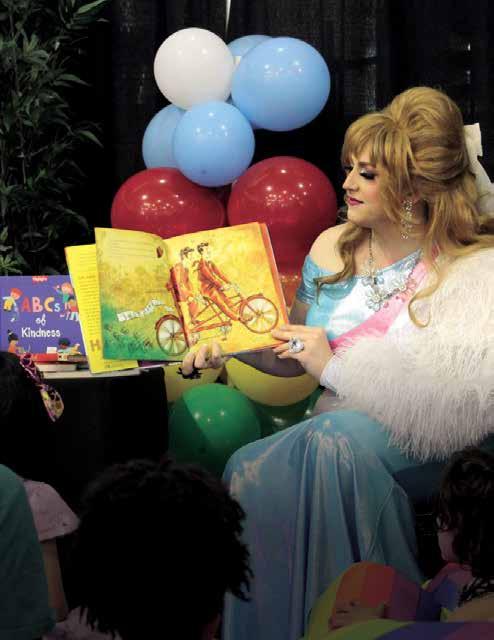
Brewmaster’s Taproom, a craft beer emporium in Renton, was the recent target of a bomb threat due to a monthly, all-ages drag queen story hour at the venue.
A postulant kicks off – Photo by Casey Engler / Courtesy of the Quake Rugby
Photo courtesy of Kara Sutra
A performer entertains the crowds at Alki Beach Pride – Photo by Cameron Martinez
Local News
Vice President Kamala Harris in Seattle: The climate clock is “banging”
by Benny Loy SGN Acting Editor
On August 15, Vice President Kamala Harris touched down at King County International Airport (aka Boeing Field), then went to McKinstry, a construction and energy services company “dedicated to innovating the waste and climate harm out of the built environment.” Once there, she and others shared remarks about the BidenHarris administration’s efforts to address the climate crisis by creating a robust “clean-energy economy” through the Inflation Reduction Act (IRA).
First on stage was McKinstry’s chief executive officer and chairman, Dean Allen, who welcomed the crowd, saying, “We’re here to celebrate our achievements but also to look forward. We’re enthused about the future but also nervous.” He also discussed McKinstry’s part in President Biden’s plans for investing in businesses that prioritize their impact on the environment.
McKinstry committed to reducing its greenhouse gas emissions by 50% by 2025 and carbon emissions to net zero by 2030 when it signed the Climate Pledge, an environmental promise initiated by Amazon. Allen spoke about taking action for the future, saying, “We need to be better at moving our feet and not just our lips.”
Next, Mayor Bruce Harrell of Seattle stepped up to the podium. “Major cities across the country are responsible for 70% of the world’s carbon emissions,” he said. “Cities have the obligation and opportunity to drive progress with the Biden-Harris administration.”
According to the City of Seattle’s Office of Sustainability and Environment “2020 Community Greenhouse Gas Emissions Inventory” report, between 2008 and 2020, emissions from buildings, transportation, and waste decreased 21.5%. Though the report admits that shutdowns during the pandemic skewed the numbers to a degree, it is clear that Seattle’s environmental policies and plans are working.
Mayor Harrell continued, “We’re working right now on our commitment to our city through policy... to develop a 30% tree canopy and a clear goal of innovating emissions performance in decarbonizing our buildings. We’re doing the hard policy work right here in Seattle. The IRA is helping us to go in further.”
“A new beast”
Next up was Washington Gov. Jay Inslee, who said, “[Climate change] must be defeated. We knew that beast was coming for us a year ago. Look what has happened since that time, in the intervening year across the world. People falling on the pavement being burned, massive ice melts, and our cataclysmic wildfires. We have to recognize reality. This is not your grandmother’s climate change anymore. It is a new beast. It’s an accelerating thing that demands immediate action.”
Gov. Inslee spoke on the IRA and its benefits, saying, “[Washingtonians] are going to get more charging stations, so people can charge their electric cars, leading the transition to an electric future all across the state of Washington. This means more jobs as these initiatives come into place across the United States… The Biden-Harris administration is turning the Rust Belt in the Midwest into a clean-energy belt of jobs.”
According to a report by the nonprofit climate advocacy group Climate Power, clean-energy companies announced over 100,000 new jobs in 31 states after the IRA became law, including 1,300 in Washington. When predicting the effects of the IRA over a decade, the Labor Energy Partnership projected 1.3 million jobs created.
A more optimistic prediction from Blue Green Alliance and the Political Economy Research Institute said that over 9 million jobs would be created by 2030.
“Fighting climate change through investment”
Sen. Maria Cantwell was next to address the room. “Washington has long been the epicenter of affordable energy pricing,” she said, “and we know that we may have record heat in Seattle, but we also have a record investment in diversifying our energy future and driving down the cost for consumers. The IRA is about… saying to legacy companies that just holding on to your record profits is not the direction we need to go.”
Sen. Cantwell added that the IRA is making electric vehicles more affordable for the average citizen through tax credits starting this year. Those that switch to electric cars could see savings of around $2,000 a year in fuel costs. She said that the investments in industries like aviation and waste management through the IRA will not only fight climate change but have a “certainty to lower costs” for the average American.
Secretary of Energy Jennifer Granholm said that “America’s passivity” when it came to clean energy was seen as an “opportunity” by other countries to gain more say on the world stage. However, with the IRA, the United States will repair its economy through stackable tax credits for companies that pay prevailing wages, hire union apprentices, use American-made components, provide jobs in low-income communities, and employ clean energy.
A young woman followed Secretary Granholm, an HVAC technician helping build the clean-energy future the previous speakers were celebrating. She shared how her father was a technician and how he inspired her to join the industry, saying, “As a woman in the trades, I do whatever I can to advocate to young people about what’s possible.”
After a few more words, she introduced the long-awaited vice president.
The administration’s efforts “Every day around the world, the impact of the climate crisis, we are seeing it in real life,” Vice President Harris said. “Here, of course, in Washington state, you have received deadly heat waves and devastating wildfires. Across the nation, we see communities choked by drought, washed out by flood, and decimated by hurricanes. So, I will say that President Biden will con-
tinue to do all that we can to help people in Hawaii. Both in terms of what they need now and what they need in terms of recovering… So all that to say, it is clear the clock is not just ticking. It is banging.”
Vice President Harris discussed how President Biden enacted “the largest climate investment in America’s history,” incentivizing consumers to drive electric vehicles, more solar and wind energy production, and even electric school buses. She elaborated on the effects of this on the job market, saying to applause, “Already, we have created 2,500 new solar panel manufacturing jobs… we have created more than 175,000 new cleanenergy jobs... good-paying union jobs.” The Biden-Harris administration will also be “building thousands of miles of new highvoltage transmission lines” to deliver clean energy to American homes.
She summarized the benefits of President Biden’s plans by highlighting the importance of saving consumers money through cheaper electric bills, “Every year, working families spend thousands of dollars just to keep the fridge and lights on.”
Bringing her speech to a close, she said, “All this to say, together we are building a clean-energy economy. Through all our work, President Biden and I are building an economy that works for working people. And that, my friends, is called Bidenomics.”
Photos by Nate Gowdy
Local News
Wildfires rage across Eastern Washington, residents evacuated as flames spread
by Lindsey Anderson SGN Staff Writer
On Friday, August 18, flames erupted just outside the rural Eastern Washington town of Medical Lake. Dubbed the “Gray Fire,” the conflagration engulfed dry pine trees, homes, and other buildings as it grew. Responders attempted to assess the damage, and nearby towns evacuated. By the end of the day, parts of I-90 were closed as the flames neared the road.
The cause is still under investigation, though the dry heatwave that settled over the entire Pacific Northwest the previous week didn’t help. For several days, temperatures in Eastern Washington rose above 100 degrees.
Andrea Callaghan, an attorney in Spokane, was flying back to the city on Friday night. She could see the destructive orange glow of the enormous wildfire from her plane window. At that point, it had spread to 10,000 acres.
“Watching the Medical Lake community burn while flying over it was a very somber experience,” she said. “It looked apocalyptic, and my heart ached for the families. I was sitting next to a dear friend whose family was evacuating while we flew over them, totally unable to help.”
The path of the fire looked like a maze, burning entire houses to the ground in one neighborhood, while just a block away, the flames didn’t even touch others. One man watched his home burn down through Ring doorbell footage as he evacuated residents of Lakeland Village, a state group facility for the developmentally impaired. Staff there pushed residents in wheelchairs a mile to Eastern State Hospital as the fire encroached on the supportive living facility.
As of Tuesday, August 22, the Gray Fire was 25% contained. It is estimated it has burned over 10,000 acres, destroyed at least
80 buildings, and claimed one life. Some level 3 evacuation orders have been lifted, and residents of nearby towns, such as Cheney, are returning home. The Red Cross has set up a shelter at the Spokane Falls Community College for evacuated residents.
The Spokane County Fairgrounds also set up a shelter for people to bring their large animals. Because the areas hit by the fires are rural, the effect on livestock has been devastating. Still, the Spokane community has united to try and rescue as many people and animals as possible.
“Multiple people were banding together with horse trailers, ready to help move livestock,” Spokane resident Rachelle Anderson reflected. “The areas hit were largely rural — grazing fields and newly harvested wheat fields.” Evacuees had also reported seeing many animals running loose, mostly dogs and horses.
The Oregon Road Fire
Now that the Gray Fire is a quarter of the way to being contained, I-90 is back open in both directions, though crews are still working to remove dangerous trees at risk of falling along the interstate. Firefighters advise anyone planning to drive on I-90 between Four Lakes and Tyler using extreme caution, as they are still hard at work in the area. State Route 902 is still closed.
While the containment of the Gray Fire is good news for Eastern Washington residents, they aren’t out of the woods yet.
The Oregon Road Fire started on Friday as just a two-acre brush fire but, due to high winds, quickly spread. The blaze is currently over 11,036 acres and 0% contained. Residents of Elk and Chattaroy, WA, and some in Pend Oreille County have all been evacuated, with many taking shelter in Newport, WA. The Red Cross set up another shelter at Riverside High School.
The Newport rodeo grounds are tak-
ing large animals. The Spokane Livestock Emergency Evacuation Team rushed in to rescue hundreds of animals, including chickens, cows, horses, goats, sheep, and alpacas.
Authorities are also unsure of how the Oregon Road Fire started but report that over a hundred structures have been destroyed, and at least one person has died.
On Tuesday, Elk County said a new national team of firefighters, the Pacific Northwest Team 3, has arrived to help. There are currently 630 people actively working to contain the blaze, the largest command post that Eastern Washington has seen.
After five days of attempting to contain the fire with no success, crews switched tactics. Instead of using all hands on deck to keep it from expanding at the edges, they’re dividing their teams into twice as many divisions to focus on building stronger lines, which will hopefully help them achieve containment.
The biggest game changer came Tuesday morning, when the region saw some
light rain showers in the early hours. With cooling temperatures and more rain in the forecast, experts are hoping the change in weather could be the best tactic to finally contain the fire.
Small blazes continued to pop up around Spokane County, with one off Thorpe Road and another in Whitman County. Local fire marshals are begging residents to remain vigilant, as they cannot take on any more blazes.
Experts also advise anyone in a location where the air quality is hazardous to remain indoors as much as possible and wear a mask when outside. Pets should also stay inside when the air quality is poor.
Hundreds of families in Eastern Washington have lost their homes. The Red Cross is requesting donations of clothing, food, pet supplies, and toiletries. Visit redcross.org, call 1-800-RED-CROSS (800733-2767), or text the word REDCROSS to 90999 to make a $10 donation.
According to the owner, Mary Rall, who spoke to the SGN, this month’s story hour was originally set to take place on August 12. On that day, both Rall and her husband were met with a knock by law enforcement on their front door several hours prior to the event. The police informed the couple that someone had emailed the US Attorney’s Office, which was then forwarded to the Bureau of Alcohol, Tobacco, and Firearms, which then contacted Renton police. The email stated that the person behind the threat would bomb the taproom as well as Rall’s home if the event took place.
Due to the threats on Rall’s home and livelihood, law enforcement recommended she evacuate her home and business. The Port of Seattle brought in bomb-sensing dogs and robots to the Brewmaster’s Taproom to assess the threat. It and several nearby businesses were closed for several hours while the bomb squad worked diligently. Those businesses lost out on much-needed Saturday afternoon revenue due to the threats.
Rall said that after this whole experience, she feels “left in the dark, with no sense of protection, leads, or further information on the matter.” She has “been trying not to think about the threats and doesn’t want to live her life in fear.” Rall stated that she wants everyone in the community to feel safe and comfortable at her establishment.
When asked what she would say to the people behind this threat, Rall said, “I’m sorry you’re so hurt. You are welcome to come and see what’s really going on. Check out drag queen story hour instead of making assumptions.”
An interview with drag queen
Kara Sutra
Kara Sutra, drag queen extraordinaire, was hired to host this month’s story hour. When asked by the SGN who was behind the bomb threats, Kara said, “The threat was made anonymously over email. The person has not been identified as far as I’m aware. The threat contained language that references making America great again.”
She also discussed how this setback impacted her financially.“The cancelation not only impacted my weekly income but caused several local businesses to be closed and evacuated for hours, resulting in loss of income for everyone.”
Kara offered a theory as to why conservatives are so afraid of drag. She said,
“I think fear always comes from a lack of understanding and exposure. As a queen who has hosted drag shows and performed in locations like Orting and Sequim, areas that are often seen as more conservative, I’ve had some of the greatest experiences bringing drag to those places and interacting in those spaces.”
As for why conservatives automatically equate drag with adult entertainment, Kara said, “There is a lot of misinformation out there. If people are seeing drag as anything other than performance art, they are mistaken. Drag can be formatted for different audiences. Some shows take place in 21-and-over venues and are formatted for adult audiences, while other performances, like storytimes, take place at all-ages venues and are family friendly. I think when
queens are equated with adult-only entertainment, it’s solely for the purpose of misleading others.”
Asked if there was a message that she wanted to share with the SGN aimed at the people behind the recent bomb threats, Kara said, “The LGBTQIA+ community will continue to hold our heads high and produce events to bring the community together. Diversity and inclusivity are important tenets of the stories we read. We are resilient and will not be intimidated by hate. We have so much love to give.”
The taproom and Kara Sutra have have canceled the August 26 story hour; the next one will be on September 9. You can find the Brewmasters Taproom at 2000 Benson Rd. S. in Renton.
Photo courtesy of Spokane County Fire District 10
The Brewmaster's Taproom – Photo by Will Foster DRAG
Third places can keep the gayborhood alive
by Daniel Lindsley SGN Staff Writer
It’s the buzz of urbanist groups across the country: our “third places,” where people from all walks of life gather to socialize, are disappearing. They have been for over a decade, and the COVID-19 pandemic only made the trend worse.
The definition of a third place differs slightly depending on where you look, but at its core, it’s a relaxed, familiar spot separate from the workplace and the home. Think of bars, parks, cafés, barber shops, and churches. What holds them together is that they’re accessible, accommodating to all, and on neutral ground, meaning that social status is often dropped and people generally aren’t obligated to be there.
A 2019 paper published in the journal Health & Place sought to examine how a lack of accessible third places might impact public health. It used that year’s polar vortex in the Midwest as an example, pointing to the many libraries, churches, and community centers that served as vital emergency warming centers, and the local businesses that donated food.
It also showed that the number of public and private establishments commonly considered third places sharply declined between 2008 and 2015, with little indication of changing course.
Only libraries and archives saw a healthy increase of 14%, which is good. Meanwhile “eateries” like bars, cafés, and restaurants increased slightly, by just 2%, but that was long before the pandemic; according to data from the Bureau of Labor Statistics, in 2020, restaurants and bars closed at almost double the normal rate.
A glance at 2021’s closures might make it seem like the industry pulled out of its tailspin, but many of the surviving businesses are now weighed down by considerable debt.
The Queer community of Seattle has lost spaces like the Comeback, Re-Bar, OutWest, and others. Still more struggle to get by: the Wildrose, one of the oldest and few remaining Lesbian bars in the US, has nearly closed multiple times.
The Seattle Times and Capitol Hill Blog have already sounded the alarm on this issue, particularly as it pertains to Capitol Hill. Back in 2014, they reported on Amin Ghaziani’s book There Goes the Gayborhood?, which cited US Census data that measured the number of same-sex couples in various neighborhoods of Seattle. They found that since 2000, the proportion of same-sex couples in Capitol Hill fell from 5% to 1.5%.
There are some limits to the census numbers. They don’t measure Queer singles, or Bi/Pan people in different-sex couples. But in every neighborhood other than Capitol Hill, the percentage of same-sex couple households went up, implying that those in Seattle’s Queer community who could afford it have spread out — or at least that Queer people who move to Seattle choose less often to live on Capitol Hill.
Ghaziani’s book gives a few possible reasons for these trends. It could be that more widespread acceptance of Queer people lessened the demand for Queer-centric districts, though the spike in hate crimes in King County last year could be taken as a powerful contradiction of that idea.
A more concrete reason would be rises in rent and the general cost of living. By many measures, Seattle is one of the most expensive cities in the country.
That’s a big problem for a large portion of the Queer people already here. Despite the stereotype of the affluent Gay couple, the 2021 Public Health – Seattle and King County Pride survey found that 20% of LGBTQ people living in the area earned less than $15,000, and 15% earned between $15,000 and $30,000. That’s not even close to the amount one would need to live comfortably, let alone spend a night out every week.
On a brighter note, Capitol Hill is still a hub of Queer culture in the city in many ways — because geographically, it’s still in the city’s center, and its history draws people there. Places like Optimism Brewing Company host a number of Queer hobbyist groups, like the Queer Mountaineers. And I’d be remiss not to mention Queerfriendly game shops, like RayGun Lounge and Phoenix Comics and Games.
In areas without easy access to light rail, like Delridge and White Center, Queer culture has concentrated around venues like the recently restored Lumber Yard bar and the Southgate Roller Rink.
Going over the numbers might seem all doom and gloom, but in reality, the subject of third places in the modern day remains understudied, and doesn’t come up in policymaking very often per se. And as cities go, Seattle is one of the best for its systems of public parks and libraries.
As new zoning laws are proposed and the Queer community becomes more spread out across King County, these numbers might serve as a reminder that we can have a role in nurturing existing third places and cultivating more, whether they’re exclusively Queer or not. That takes advocacy, participation in local politics, and an awareness and appreciation of what makes these places so special.
Photo courtesy of Optimism Brewing Company
Local News
KICKBALL
After a two-year absence forced by the COVID-19 pandemic, it was a triumphant return.
More than 150 people were in attendance, and local drag performer DonaTella Howe and Quake Rugby alum Kung Pow Meow served as co-hosts.
Eric Bonesteel, a bartender at CC Attle’s and member of the Imperial Court, served as umpire, while the always-fabulous Aleksa Manila, also a local drag queen, spoke on behalf of Asia Pride.
Organized by Dylan Quiggle, community chairperson of Quake Rugby, and Sister Mrsa Kitt, who assisted in the creation of the first “Jockstraps & Glitter” in 2010, the event featured countless moments of fun and laughter, including Kung Pow Meow riding on an electric scooter with a creepy baby doll.
The Seattle Pups, however, brought joy to the event by performing the most enviable task of all: helping the Quake players shed their clothing, most of whom were in just their jocks by the end of the game.
Not to be upstaged, some of the Sisters also ended in just their jocks. To be fair, they did not strip as much as the Quake — after all, they kept their whiteface and veils.
BEACH
ABP co-founder Stacy Bass-Walden (she/they) spoke to the SGN between hugging attendees, dancing, answering phone calls from volunteers, and spending time with her wife and co-founder Jolie.
“Alki Beach Pride,” said Bass-Walden with an emphasis on the word “beach.” “You got to put the ‘beach’ in there, because this is the only beach pride in the entire state… Some people say ‘Alki Pride,’ but it’s the only beach, baby!”
Bass-Walden has a special connection to Alki because she has resided in the neighborhood for about 25 years and even married her wife on the beach nearly seven years ago. She is so well-known in the area that businesses call her “the mayor.”
While the Pride event has garnered larger crowds throughout the years, it started out as a small get-together in the women’s apartment during Pride.
“[We started] bringing it out to the beach and enjoying what the parks have to offer: something a little different, something with fewer crowds, and to support the local businesses over here,” Bass-Walden said. “So, it’s a little combination of everything.”
It is usually a two-day celebration with roller skating, a car parade, and other outdoor activities, but due to other organizations reserving the beach, ABP was only able to use it for a single day this year.
“[In] December, we start the process [of organizing Pride] by reaching out to the Parks Department and trying to secure a date,” Bass-Walden said. “I would say that’s the hardest thing, because this beach is very busy and popular. So, between weddings and salsa dancing… there are some [people] who snag all the dates throughout the whole year. Maybe [the Parks Department] can work on that system a little bit better so that we don’t have to be limited on when we have hours.”
Make it beautiful”
Despite a change to the usual plans, Bass-Walden and other attendees still made the best of the event. Besides vendors and food trucks, there was also a plethora of entertainment, such as drag shows, live music, live comedy, a twerking contest, and many opportunities for arts and crafts. There was also an emphasis on showcasing people of color.
“[The event is] important, because the newer, younger generation needs to be able to see the faces of who else can run Pride events,” Bass-Walden said. “Two Black
Fun with a purpose
Saturday’s kickball game was the 10th played between the Sisters and the Quake.
“Jockstraps & Glitter” was originally organized in 2010 as a novice project of the late Sister Karma Za Betch, who passed away the night before the second annual match.
In poignant testimony to the camaraderie of both organizations, which have a history of working well together, the teams honored deceased members. While the Sisters commemorated Sister Karma, the Quake paid tribute to Thomas Derricks, a cherished teammate who passed away just a few months after Karma.
Reflecting on the groups’ partnership, Sister Mrsa, who is also a Quake veteran, told the SGN, “When the Sisters first approached the Quake back in 2010, we were like, ‘This sounds ridiculous — we’re in!’
“The Quake and the Sisters have always worked well together, [so] it’s no surprise the event is fun, silly, and loved by both sides. I am glad we get to keep Sister Karma’s dream alive, [and honor] Thomas Derricks and the others we have lost since the event’s inception. We are grateful for all the other contributors from … our community, truly making the event what it is.”
Generous donations poured in from
women decided to throw a beautiful, intimate party at their apartment and now, nine years later, what we listen to is what the folks wanted us to do. They said, ‘Don’t give it up, keep it going, and make it beautiful.’”
Bass-Walden hopes that with the tenth anniversary on the horizon, ABP will become Washington state’s destination beach pride event.
“I don’t know if we’re at that point yet, but I would love to that hear one of the airlines is sponsoring, because it’s a destination pride in West Seattle,” Bass-Walden said. “I want that kind of buzz to happen, because this West Seattle area has a family vibe anyway.”
Even if ABP doesn’t get the airline sponsorship Bass-Walden hopes for next year, there is still going to be a positive impact on
enthusiastic audience members eager to see the ruggers strip to their jockstraps, as well as for the chance to sunscreen the players, embrace glitter-bombs, and orchestrate playful kisses between players. Funds raised benefited Asia Pride and the Abbey of St. Joan’s grant fund.
Workers for the PITCH Study, an HIVoriented community health initiative conducted by King County, were in attendance, administering surveys to audience members. If there was one thing Sister Mrsa found harder to contain than her veil, it was her excitement. “After a two-year hiatus, it feels really good to be back.”
the neighborhood and its visitors.
“I want folks to remember that pride is 365 days a year,” Bass-Walden said. “And I want them to remember to come back to Alki Beach in the fall and the winter. We have beautiful restaurants... I want them to remember it’s not just in June. The beach is for everyone, and we can do the damn thing every year.”
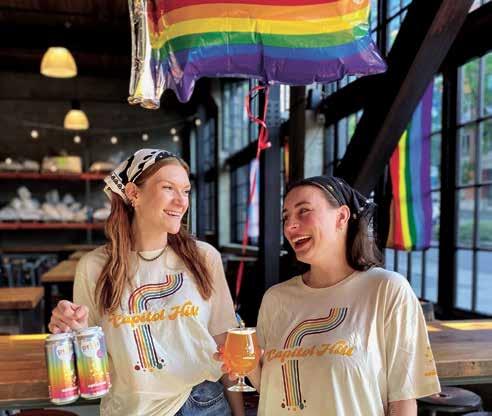
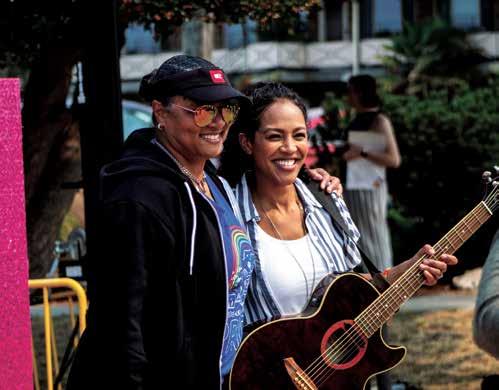
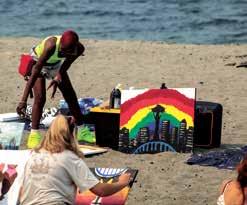
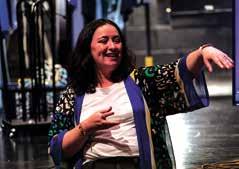
(top left) Stacy Bass-Walden with musician Lakin, snapshots of the event along Alki Beach– Photos by Cameron Martinez
The participants of the 10th annual Jockstraps & Glitter, The Pups help a rugger remove his clothes
– Photos by Casey Engler / Courtesy of the Quake Rugby
Arts & Entertainment
A preview of Seattle Rep’s ambitious public production of The Tempest
by Teddy MacQuarrie
SGN Contributing Writer
Curtailed by the pandemic, live theater productions have taken a major hit. This weekend, however, marks a turning point as the community nonprofit Seattle Repertory Theatre, known as “the Rep,” presents its first live production since COVID’s onset, a musical adaptation of William Shakespeare’s play The Tempest, featuring an ensemble cast of over 60 performers.
The show tells the story of Prospero, a powerful wizard banished to an island by a conniving sibling, and his scheme to exact revenge by conjuring a storm to shipwreck his sibling on the same island. Set in 2023, the plot weaves together romance, political intrigue, fantasy, drama, and comedy.
Drawing from local inspirations
The Rep’s production features music and lyrics by Todd Almond and extensively incorporates elements unique to the Pacific Northwest, making it a focal point, almost like a character in the story. Scenic designer Matthew Smucker, along with costume designer An-lin Dauber, draw inspiration from the region, using imagery from the Olympic Peninsula, the San Juan Islands, the Washington coast, and the Hoh Rain Forest.
According to production director Hattie Claire Andres, “It is set in a magical amalgamation of those places that we [the ensemble] get to imagine and create together. We have a great, mighty ensemble who are the magical creatures of this island. As an ensemble, they create the island’s ecosystem.”
Incorporating Public Works values
Lear DeBessonet originally conceived this adaptation of The Tempest in 2013 for the Public Theater in New York, of which the Seattle Rep is a partner, specifically to involve a large community ensemble. The cast and crew come from all walks of life and experience levels.
As a part of the Rep’s Public Works program, The Tempest is a project that involves partnerships between the theater and several community-based organizations, and
it incorporates the Public Works program’s values of equity, imagination, and joy.
“For me as a director and teaching artist with the program, it’s really refreshing,” said Andres. As for the language used and shortcuts taken by theater professionals, she added, “When you have someone stopping you in the middle of rehearsal and asking you, ‘What does that mean?,’ it can lead to some really special opportunities to pause and reflect.”
Cast member Leah Sainz-Jones, a teaching artist and actor who plays an Island Spirit and the Wedding Singer, commented on the transformative impact working this play has had on them.
“One of the biggest things that hit me as a realization or discovery in being a part of this program has been the feeling of being in a room where all bodies, all walks of life, and all experience levels are lifted up in the same capacity anywhere onstage, anywhere backstage. One of my big hopes in people coming to the theater and watching is that they also have that realization and are swept away by that.”
An ambitious return to the stage
The Tempest marks the Rep’s first live production since 2020, and on an ambitious scale, but it has been a fun challenge for Andres. “It is a huge scale of project and production,” she said. “We have 60 community ensemble members and five equity actors; our creative team is more than 20 people.”
Sainz-Jones added, “This year, since we are putting on the whole production, it’s been very apparent just exactly how much work and time and intention goes into [bringing a whole cast together] from both the community side and the production side, of making sure each body and each artist feels seen and supported on the stage.”
The show includes cameo artists and performances. One such is Justin Huertas, whose show Lydia and the Troll graced the Rep’s stages earlier this spring and whose new song in The Tempest serves as an anthem for the island spirits. Local singer Shaina Shepherd also joins in the storytelling, along with he Morningstar Korean
Cultural Center, which helped create the storm, some magic, and mayhem.
Notably, Buoy the Seatroll, the mascot of the Seattle Kraken, also makes a cameo. As Andres recounted, “It was amazing to be in rehearsal with him. He’s an absolute natural on stage, as you’d imagine.”
The Tempest runs on August 25, 26, and 27 at the Bagley Wright Theater at 155 Mercer Street. Showtimes are August 25 at 7:30pm, August 26 at 2pm with ASL interpretation and audio description, and August 27 at 7:30pm with English open captions and mask requirements. A limited number of tickets are available for walk-up guests at the theater one hour before each showing. There will be a live video feed displayed in the lobby for overflow guests and those requiring such accommodations. The running time is about 90 minutes without intermission.
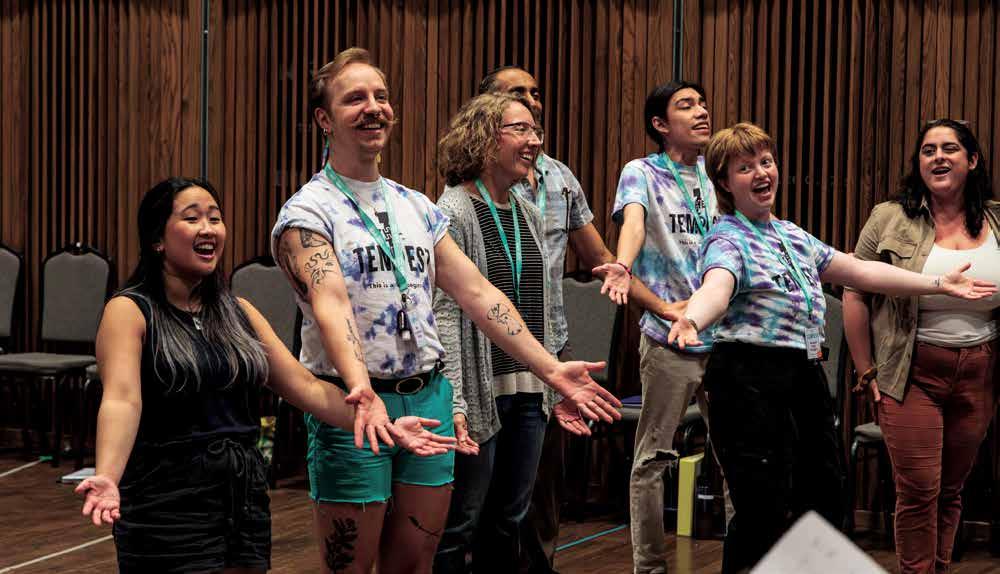
From top: Performers in rehearsals, Production director Hattie Claire Andres, Music director and conductor Steven Tran, Costume director An-lin Dauber's designs for the Forest Spirits – Photos courtesy of Seattle Rep
Film
Unforgettables: Cinematic milestones with Sara Michelle
The Ballad of Little Jo : The revisionist 1993 Western remains a bleak feminist drama of gender identity and self-determination
by Sara Michelle Fetters SGN Staff Writer
The first time I watched Maggie Greenwald’s revisionist Western, The Ballad of Little Jo, I almost walked out of the theater. Not because the film was bad — far from it — but more because many of its images and themes were hitting too close to home. Its depiction of gender nonconformity in the fabled “Old West” of the late 19th century struck a nerve, and as a freshman at the University of Washington struggling to deal with their own issues regarding gender identity, watching this bleak, uncompromisingly dark drama proved difficult.
I’ve revisited Greenwald’s best-known feature on occasion over the past 30 years, and I’m continually struck by how brutally chilly it is. While certain elements haven’t aged particularly well, and while its relationship to the true story of small-town Idaho rancher “Little Joe” Monahan is flimsy at best (and insulting at worst), there is still a certain visceral power to this tale that the filmmaker has so meticulously constructed.
Much like Clint Eastwood’s Unforgiven or Robert Altman’s McCabe & Mrs. Miller, this is a confident evisceration of Hollywood archetypes and tropes about the West. This feminist takedown of backwoods, male-dominated communities is purposefully unsubtle and frequently stunning in its steadfast cruelty as it clubs the viewer into submission. But there is also a quiet, forlorn beauty to Greenwald’s epic that’s mesmerizing, and the affection the director has for her hero is readily apparent first frame to the last.
Suzy Amis stars as Jo Monahan, and even though she never disappears entirely into the role (or is particularly believable at maintaining a masculine façade), this somehow remains one of the most spellbinding performances of the talented character actor’s career. Amis combines a raw
physicality with an emotional dexterity that’s extraordinary. It’s a unnerving portrait of a person desperately trying to be their true self, only to be continually bludgeoned by a society that wants to fit them into a box that matches its conservative patriarchal point of view.
The story begins with Jo — known by her hypocritically puritanical family as Josephine —being cast aside after giving birth out of wedlock. After initially heading west in all her frilly Bostonian finery (including a fancy bonnet and a whimsical parasol), it doesn’t take the young woman too long to figure out that she’ll need a more masculine disguise if she ever hopes to survive. Finally settling down in the windswept, isolated emptiness of Ruby City, Idaho, Jo buys a small sheep ranch and begins to build a life, and the townsfolk
begrudgingly accept the smallish, somewhat feminine newcomer as one of their own.
It’s impossible not to notice how Greenwald posits that Jo’s Transgender identity is a matter of survival. The historical record is hazy on that front, but it seems pretty clear that the real “Little Joe” embraced their male self and made the best life that was possible during the 1880s and ’90s. As such, this film doesn’t dive into key issues involving Trans self-expression, sexuality, or gender ideology of the period nearly as much as it could have.
There are also issues involving Tinman Wong, a Chinese immigrant whom Jo saves from being lynched, only to have him forced upon her as a live-in ranch hand. If not for David Chung’s superlative performance, Greenwald could be accused of reinforcing effeminate cultural stereotypes. Even
though Wong turns out to be far more complicated, self-assured, and intelligent than he appears, the way his character is presented is more akin to Hollywood B-films of the 1930s and ’40s and thus does not entirely fit into the rule-breaking ethos Greenwald otherwise is aiming for.
But The Ballad of Little Jo continues to haunt me all the same. Greenwald may have toned down the more overt LGBTQ elements, but they nonetheless remain front and center. For a 19-year-old, far from home, living on their own for the first time, and with no one who understood what they were going through close by, seeing Jo meticulously construct an alternate gender identity in the face of such overwhelming odds, while also under an overly invasive microscope, was disquietingly powerful. There is a majesty to these images of Jo slowly but surely becoming their true self that I instantly responded to, and the fact there was no one I could talk to about what it all meant to me at that moment was borderline heartbreaking.
I don’t know what the legacy of this film is, now three decades after its original release. Magnificently shot by Declan Quinn (Sylvie’s Love) and featuring exquisite, consistently discomforting supporting turns from heavy hitters like Rene Auberjonois, Ian McKellen, Anthony Heald, Carrie Snodgrass, and a never-better Bo Hopkins, there’s certainly plenty here that’s more than stood the test of time.
For me, however, The Ballad of Little Jo remains essential. Even with its missteps, my connection to Greenwald’s film remains strong. Its ethereal, penetrating tenacity as it strips Western mythology to shreds and reveals its blatantly misogynistic center is striking, and the tragically haunting truthfulness of its final images is impossible to forget.
Now celebrating its 30th anniversary, The Ballad of Little Jo is available to purchase on DVD.
Scrappily inventive Blue Beetle showcases a memorable family of everyday heroes
by Sara Michelle Fetters SGN Staff Writer
BEETLE
Blue Beetle is one of the better Warner Bros./DC Comic superhero entries in recent memory. It’s an old-school comic book origin story throwback, similar in tone and style to Sam Raimi’s Spider-Man or Jon Favreau’s Iron Man, only set to an invigorating Mexican beat. Director Ángel Manuel Soto’s feature is a fun, funny, and at times surprisingly moving treat, and as Warner continues to figure out what it wants to do with its lineup of superpowered characters, here’s hoping Jaime Reyes (Xolo Maridueña) and his charming family are among those slated to return for more adventures.
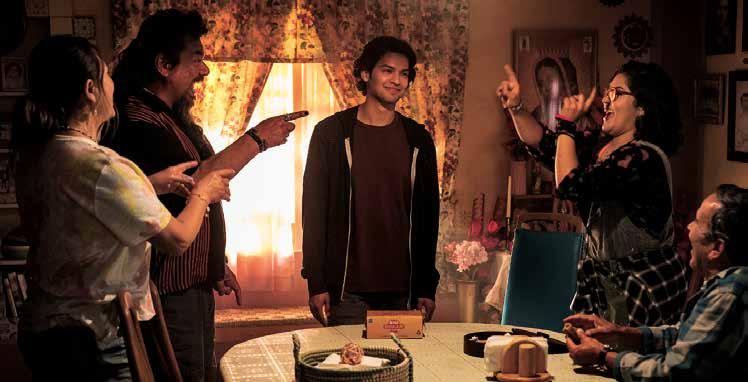
Recent college graduate Jaime Reyes returns home to Palmera City and the loving arms of his family: dad Alberto (Damián Alcázar), mom Rocio (Elpidia Carrillo), younger sister Milagro (Belissa Escobedo), uncle Rudy (George Lopez), and grandmother Nana (Adriana Barraza). Amid all the joy of the clan’s reunification, however, is a layer of underhanded woe. The powerful Kord Corporation has snatched up the mortgage on the family home, and it’s increased the monthly payments to such a degree that foreclosure is all but inevitable.
In an unfathomable turn of events, Jaime captures the eye of Jenny Kord (Bruna Marquezine), a powerful executive in the company who does not jibe with the plans of the current CEO — who happens to be her aunt Victoria (Susan Sarandon) — to restart the corporate giant’s defunct military weapons
program. Thinking he’s going into the Kord offices for a job interview, instead young Jaime walks back out carrying a top-secret piece of alien technology known cryptically as “the scarab.”
Taking a page out of the Robocop, Upgrade, Venom, or any other sci-fi story
dealing with the symbiotic melding of a human with a decidedly nonhuman component, Jaime ends up merging with the scarab (voiced by Becky G) and transforms into the otherworldly superhero in the film’s title.
BLUE
Theaters
The Ballad of Little Jo – Photo courtesy of Fine Line
Blue Beetle – Photo courtesy of Warner Bros.
Suitably abhorrent Bottoms gets top marks for queerly vulgar teenage debauchery
by Sara Michelle Fetters SGN Staff Writer
BOTTOMS
Theaters
Bottoms is director Emma Seligman’s masterful follow-up to her 2020 stunner, Shiva Baby. It reunites her with that film’s star, Rachel Sennott, and this time the pair take their collaboration up a notch by also working together to craft this comedy’s delightfully anarchic and creatively vulgar screenplay. More importantly, much like its predecessor, this picture is also a bona fide winner, making this wildly inventive, R-rated slice of Heathers -meets- Mean Girls-meets-Bring It On depravity one of 2023’s best pieces of rule-breaking pop entertainment.
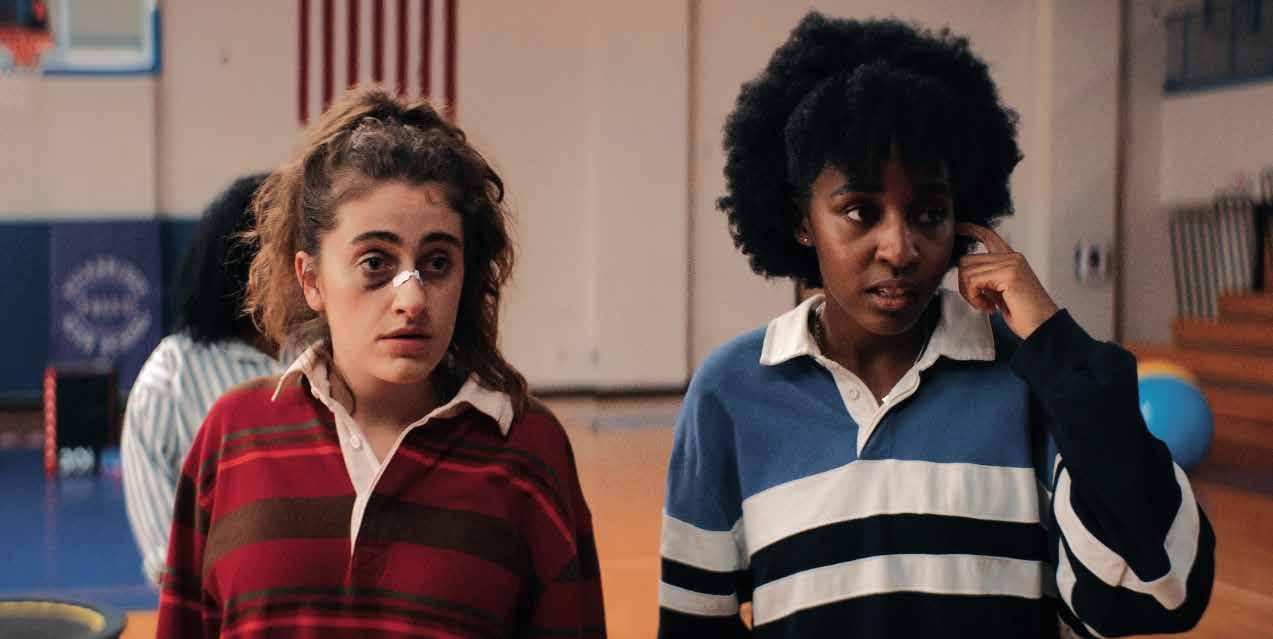
Trying to break down the film into a quick and easy synopsis doesn’t really do it any justice. The basics? Under the guise of it being an afterschool self-defense course, high school seniors PJ (Sennott) and Josie (Ayo Edebiri) start a female fight club with the hope that this will lead to their losing their virginity to cheerleaders Isabel (Havana Rose Liu) and Brittany (Kaia Gerber). They end up empowering several of their more marginalized classmates (including young Willow and Mare of Easttown star Ruby Cruz) to stand up for them-
BLUE BEETLE
continued from page 10
There are montages of him learning how to use his gifts, set pieces involving his first encounters with a collection of heavily armed bad guys, and the discovery that it is his selfless goodness that gives him his true power, not the cybernetic attributes the scarab has granted him.
None of this is new. Pretty much every superhero origin story has covered a lot of this ground at one time or another, so there isn’t a lot of novelty in seeing Jaime blasting off into space, awkwardly fumbling to try and use his abilities, and mostly making a silly fool of himself. Been there, done that. Part of me wanted to yawn.
selves against the misogynistic tyranny of the school’s football heroes (led by Red, White & Royal Blue’s Nicholas Galitzine).
What Seligman and Sennott have delivered is so much crazier than any of that sounds, in fact unleashing 92 minutes of madness that rocked my world. This isn’t some foolish piece of nutty, scattershot, joke-a-second lunacy made in the style of Airplane, Scary Movie, or Not Another Teen Movie. Instead, this is an absurdist, high-concept ensemble piece about identity, alienation, empowerment, and friendship — only with a bevy of broken noses, black eyes, and dislocated shoulders, and an unexpectedly high body count.
It’s obvious that this sort of thing won’t tickle every viewer’s funny bone. Even those that agree with its social and feminist outlook may find it too cartoonishly ridiculous. There’s also a good chance they’ll not fall in line with the film’s arch tone. It’s as if the director is channeling her inner Luis Buñuel or Paul Thomas Anderson and crossed them both with a Wes Anderson–John Hughes hybrid. The whole thing is as painful as it is uproarious, and much like with Shiva Baby, Seligman is as eager to amuse her audience as she is to make them uncomfortably anxious.
I tapped into what Seligman and Sennott were doing almost immediately. The jokes fly fast and furious, and they’re consistently
But thankfully I never did. Why? Soto (Charm City Kings) and screenwriter Gareth Dunnet-Alcocer (Miss Bala) wisely play up the cultural and familial elements. This gives the film a rich, distinctive voice. Even with limited screen time, Alcázar, Carrillo, Escobeo, Lopez, and Barraza manage to make lasting impressions on the material. This is a real family. Their interactions are pure, genuine, and emotionally resonant. Their deep love for one another is the driving force around which the narrative revolves, and this helps make all the familiar pieces feel electrically alive in ways that kept my eyes glued to the screen — even when I was all but certain I knew exactly what was going to happen next.
It also helps that Maridueña, best known for his role as Miguel Diaz on Cobra Kai,
two or three steps beyond plausible reality. And yet, they are also laced with an acidic truthfulness that’s frequently — and suitably — abhorrent. Better, the filmmakers don’t care a lick whether or not PJ and Josie are entirely likable.
But that makes them real, and considering how farcical the events surrounding and involving the two are, this adds an aura of authenticity that allows the overall insanity to hit harder than it ever would have otherwise.
Then there are the performances. The entire ensemble is terrific, including a scene-stealing Marshawn Lynch as the teacher who agrees to oversee this “selfdefense club” — and isn’t anywhere as clueless as to what is really going on as PJ and Josie erroneously assume. There’s not a single bad apple to be found: all of the actors fit so well into Seligman’s peculiarly personalized satirical world, it’s as if they’ve lived there their entire lives.
Yet none of this works without Sennott and Edebiri. Their chemistry is off the charts, and it’s immediately clear how much PJ and Josie depend on one another for their sanity. This friendship has been forged by the types of microaggressions, belittlements, and abuses every teenager can relate to, especially LGBTQ kids trying to discover who they are, with seemingly an entire world ridiculing and judging them with every step they attempt to take.
is a magnetic force of nature and every bit the budding superstar. The actor has charisma oozing out of every pore, exuding a form of exuberant, optimistic happiness I completely adored. But Maridueña can mine much darker territory when required as well. This makes Jaime’s evolution from flippant everyman into resolute hero all the more affecting, lending his climactic faceoff against Victoria’s menacing, unstoppable henchman Carapax (a terrific Raoul Max Trujillo) a shocking amount of morally complex weight that’s somewhat unexpected. The other major plus is the visual fluidity of the third-act action set pieces. Even when it’s two people in CGI-created mechanical suits battling against one another as if they were video game characters, Soto stages things in a tactile manner. While the good
Edebiri is particularly fearless. Josie has the stronger backbone, but it’s still easy to see how she would fall in line with PJ’s goofy plan, even though every fiber of her being tells her she should be telling all their newfound friends that the fight club is built on a foundation of selfish lies. Edebiri is awkward yet resilient, outwardly tough yet emotionally naked. There is a steely fortitude to this performance that’s sublime. It’s clear 2023 has been a titanic comingout party for the highly talented youngster, the likes of which we’ve rarely seen (she’s appeared in everything from Theater Camp to Spider-Man: Across the SpiderVerse to Teenage Mutant Ninja Turtles: Mutant Mayhem to The Bear, and those are just four of the dozen or so projects she’s been involved with this year).
The less said about the film’s raucously violent climax, the better. Let’s just say Seligman and Sennott unleash a level of dismembering rambunctiousness that threw me for a loop. I couldn’t believe what I was seeing, and it’s rare for a film to shock me senseless while it had me laughing myself hoarse at the same time. Bottoms is a riotous assault on the status quo, making this Queer gem of revolutionary bedlam a sex-positive sensation that grabbed me by the jugular and refused to let go.
guy obviously has to come out on top, how he’ll get there is a minor mystery, and this gives every punch and every kick an added ounce of refreshing oomph.
Whereas The Flash felt like too many of its core elements were conceived in a boardroom, Black Adam came across as a tonally turgid mishmash of disconnected ideas, and Shazam! Fury of the Gods was an amusingly forgettable trifle and nothing more, Blue Beetle has a distinctive creative voice that needs to be heard. The Reyes family is a wonderful addition to the cinematic comic book canon. Whenever DC and Warner finally decide where they are going to go next and how they are going to get there, if this group of scrappy everyday heroes isn’t part of the plan, then that would be a gigantic — and unforgivable — mistake.
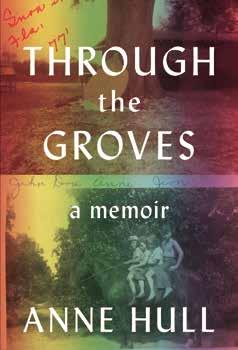
She still recalls the smell and the heat and the pesticides.
Anne Hull was her daddy’s sidekick the summer she was six years old, riding along with him on his job as a fruit buyer in the middle of Florida, where rows of orange trees stretched for miles. Together, they visited the dusty, scarred older Black men who worked the groves on her father’s route, and he taught her all about “withholding confidential information” and not telling her mother about using a chalky field as a bathroom or about the gun in his car.
Hull’s mother already knew about the roadside stops he made, and the bars along his way home. The ride-alongs Hull so enjoyed were meant to deter her father from “Friday afternoon fever” and bright neon beer signs.
Back then, Hull was only starting to notice that her family moved often, from
one ramshackle house to another, and she saw the weekly checks her great-grandmother gave her father. She already knew that adults kept secrets that weren’t so
secret to a growing girl who was obsessed with being a spy someday. These were adventures, just like the ones she had with cousins and her little brother, who was an
accident-prone
“calamity.”
When Hull’s mother left and moved in with her own mother, that was an adventure, too — until it wasn’t. Hull had became old enough to understand genteel poverty and that handme-downs weren’t cool. She bonded with her grandmother over music; sneered at her mother, as teenagers do; and thought about her dad, but only in the abstract. He never forgot about her, though. He never stopped trying to be her father. Rather than opening this tale where most childhood memoirs start, with eye-rolling, attitudinal teen years, Hull’s solid and sincere story begins the summer she was six years old. This gives readers the gift of an observant kid’s-eye view of life — one who is older than her years and doesn’t miss a thing, but is not insufferably precious or precocious. Viewed through the lens of a grown-up, then, those early memories give readers the “more” they crave, becoming a triple-whammy of coming-of-age, coming out, and coming to terms with the frailty of family. That’s sharp as flint but also hilarious.
Hull says her father was a storyteller, and this apple doesn’t fall far from the tree. Start Through the Groves and you’ll find that you just can’t leaf it.
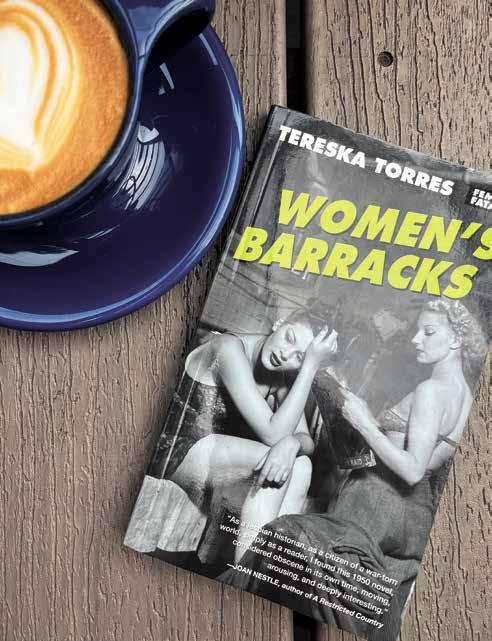
Women’s Barracks : Or compulsory heterosexuality in the Free French Forces
Content warning: suicide, self-harm, pedophilia, sexual assault.
When I picked up Women’s Barracks, with its sexy, lingerie-clad soldiers exchanging sultry looks under heavy lashes, I was expecting a fun romp through the first Lesbian pulp fiction published in America. I wanted chain-smoking vixens and swaggering butches, maybe punching a Nazi or two before consummating their forbidden love with a shag in the bomb shelter.
This is not that.
This was sad, unsettling, unnerving, and (did I mention?) so sad. It was also real to the experience of Queer women in the 1940s and, if that doesn’t give it away, I would like to emphasize again: it’s a bummer.
To summarize, Tereska Torres, the author and semifictionalized narrator, joins the Free French Forces in London, where she is put in a room, dubbed the “Virgin’s Room,” with a few other girls. The rest of the story generally follows their romantic affairs (Queer and straight) throughout the war.
One woman becomes a pedophile because she had an abortion. Another attempts suicide and permanently injures herself after being assaulted for years by her guardians — but don’t worry, because, in the words of our narrator, she only did it out of “a need for drama.” Finally, a pregnant woman takes her own life days after the war has ended.
When the narrator was not being an incel, I did find myself pitying her from the parts of my younger, closeted self that related to how she was speaking. While Torres did not identify as Queer during her lifetime — and married two men — she spends paragraphs detailing the bodies of her friends, the exact shape of their breasts,
and the curves of their hips. She lingers lovingly on how they look as they lie naked in front of fires, their glowing eyes, and the softness of their skin. Over and over again she writes how kissable her friend’s lips are: Jacqueline’s are “as soft to the eyes as they would be to kiss,” and Mickey’s are
“constantly ready to be kissed.” Her descriptions of men are... not that. She focuses on their clothes, the stripes indicating rank, and such details as that one didn’t take his shirt off during sex. The physical description we get at most is that one is “tall” — coincidentally the same
answer a closeted teenage me gave when asked what I looked for in men.
More tellingly, none of the women really want to have sex with men. When they do, it’s almost out of embarrassment that they haven’t, something to check off the list so they can become “a real woman.” In their liaisons with men, they’re thinking of their women friends, and how sleeping with a man will make them closer to their women friends or more like them.
The most beautiful woman of the group, Jacqueline, comes the closest to lust. She’s deeply infatuated with a man, but it’s because he’s married and unattainable. She treats it as a game in which she wishes to conquer said man, and, when she finally gets into a long-term relationship with a different, also married man, she’s delighted he doesn’t want to have sex with her, because, while she enjoyed the chase, she doesn’t want to have sex with him either.
This is all as is to be expected, according to Torres, who also rejected reviewers describing her book as Queer literature because “only one and a half of them can be considered Lesbian.” Thinking about your women friends while forcing yourself to have sex with men, dwelling on their kissable lips, choosing unattainable men to fantasize about, thinking of sex with men as a game (at most gymnastics), and believing it natural that only women would be capable of having tender, enjoyable sexual encounters... that’s how straight women think, right?
What I’m reading to get over this: One Last Stop, by Casey McQuiston Red, White and Royal Blue just came out on Amazon Prime, reminding me of Casey McQuiston’s other work, the excellent One Last Stop, the book that started my love affair with the rom-com genre. It is cute and happy, and requires none of the content warnings that Women’s Barracks does.
Up next: Spring Fire, by Vin Packer This a fictionalized account of an affair between sorority sisters, based on the author’s experience. A Queer relationship in the 1950s — what could go wrong?
Image courtesy of Henry Holt Anne Hull – Photo by Nils Hünerfürst
Courtesy photo
Books LGBTQ+ books for back to school
by Lindsey Anderson SGN Staff Writer
The end of August means the new school year is approaching! While squeaky new shoes and sharp new pencils are a great way to get into the spirit, nothing compares to the joy of purchasing new books! As the kids in your life prepare to enter the next grade, send them on their way with some of the best (and most challenged) LGBTQ+ books to encourage confidence, love, and pride all year long!
Preschool readers
It’s never too early to start young readers off right! Board books for little ones often focus on colors, shapes, and animals, and what better way to brighten the baby in your life’s world than with Pride-filled stories?
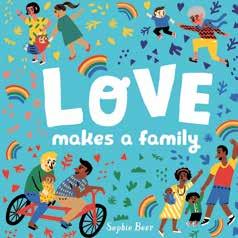
Love Makes a Family from 2018 is an adorable first introduction to family diversity for the preschooler in your life, with simple language and cute illustrations by Sophie Beer.
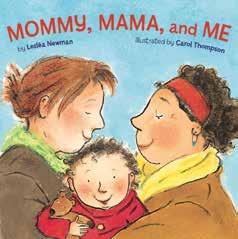
Another early read for preschoolers is Daddy, Papa, and Me and Mommy, Mama, and Me, two stories that showcase the uniqueness of LGBTQ+ families. With easy-tounderstand words, these 2009 board books by Lesléa Newman and Carol Thompson are a great way to have age-appropriate conversations about families with two mommies or two daddies.
Picture books for K-2nd graders
Children’s literature about Queer and Trans identities has come a long way in the last 15 years. Today, there are a plethora of beautiful picture books about diverse families, gender identity, and first crushes.
Are you looking to add some diversity to the fairytale shelf? Why not pick up a copy of Prince and Knight, a delightful same-sex fairytale by Daniel Haack and illustrated by Stevie Lewis. Originally published in 2021, this easy-to-read rhyming book tells the tale of a prince and knight who battle a dragon and fall in love along the way.
Another love story perfect for K-2nd graders is Love, Violet. This 2023 Stonewall Book Award winner, written by Charlotte Sullivan Wild and illustrated by Charlene Chua, tells the simple tale of a shy little girl who has to work up the courage to tell her crush how she feels.
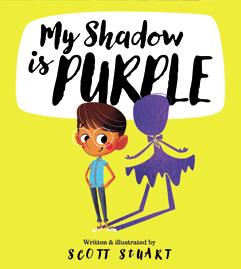
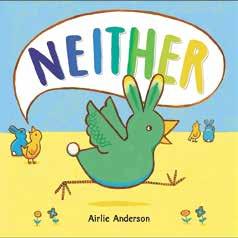
Of course, elementary schoolers are never too young to talk about gender, something society has pushed on them since before they were born. Stories like Arlie Anderson’s Neither and Scott Stuart’s My Shadow Is Purple take more abstract approaches to gender identity, comparing the topic to mythical creatures and colorful auras. With few words and cute illustrations, both stories are an exemplary way to support and encourage gender expression outside the binary structure.
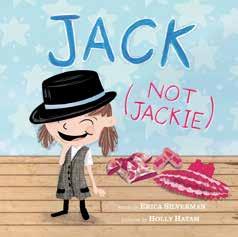
Reading stories with your child about diverse characters is a great way to form the early building blocks of empathy and acceptance. Many books about Transgender children exist to encourage LGBTQ+ kids to love themselves and their allies to show kindness to those around them. In Jack (Not Jackie), a 2009 picture book written by Erica Silverman and illustrated by Holly Hatam, the story is told by an older sister coming to terms with her Trans sibling. The book acknowledges that transition can be difficult for some young people to understand but ultimately shows that love for friends and family can transcend physical features.
Julian Is a Mermaid by Jessica Love is another Stonewall Book Award winner that depicts a child transgressing the boundaries of gender, although words like “Transgender” or “genderqueer” are not used in this whimsical and beautifully illustrated picture book. The tale focuses on Julian, a little boy who wants more than anything to be a mermaid. Featuring a cast of drag queen characters and a supportive parental figure, Julian Is a Mermaid shows that being yourself can be fabulous.
Early chapter books for 3rd-5th graders
Older elementary schoolers ready for chapter books can find stories about LGBTQ+ characters and families. Fans of Judy Blume’s middle-school novels will get a kick out of The Misadventures of the Family Fletcher. Centering around average elementary school kids, this beginner chapter book by Dana Alison Levy depicts the fun and humorous antics of the Fletcher family, led by two patriarchs, as they navigate everyday life.
For fantasy lovers, Clarbel Ortega’s 2022 series Witchlings provides fun adventures in a magical world full of witches. Centering on friendship and introducing budding romances between two female protagonists, Witchlings is the perfect book for Harry Potter and The Owl House fans.
One of the most banned books in the country is a beginner novel for 3rd through 5th graders: Melissa, a delightful tale about love, friendship, and individuality by Alex Gino. Featuring easy-to-understand language, it tells the story of a Trans girl in elementary school who, along with her best friend, finds her voice and the courage to be herself. Melissa can be checked out from any Seattle Public Library without a library card.
Fans of nonfiction will love Jamey Christoph’s Stonewall: A Building, A Uprising, and a Revolution. This introduction to the Gay liberation movement, illustrated by Rob Sanders, introduces young readers to important historical figures with ageappropriate and easy-to-understand language.
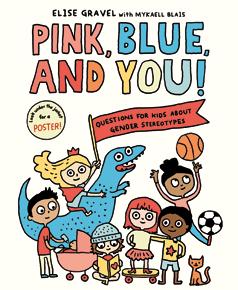
Pink, Blue, and You by Mykaell Blais and Elise Gravel is another nonfiction book for
younger readers looking to explore topics of gender and sexuality. This illustrated guide is a great way to approach conversations about identities safely and positively.
Images courtesy of the publishers
Middle-school novels
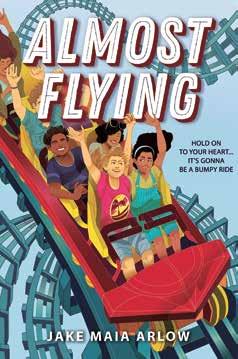
Middle schoolers can find connection, solidarity, and identity through literature during a time full of awkwardness, identity crises, and first crushes. Almost Flying by Jake Maia Arlow is a 2021 novel that follows a middle schooler on a fun summer road trip as she grapples with her first crush and what it means for her identity. The age-appropriate romance is full of humor and poignancy, focusing on love for others and oneself.
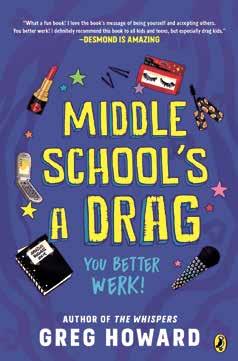
Another fun middle-school novel about self-discovery and newfound friendships is Greg Howard’s Middle School’s a Drag: You Better Werk. While the premise — a tween talent agent — is funny enough, the story holds a lot of heart at the center as protagonist Mikey Pruitt learns to accept his new friend, a 13-year-old drag queen, and his own budding sexuality.
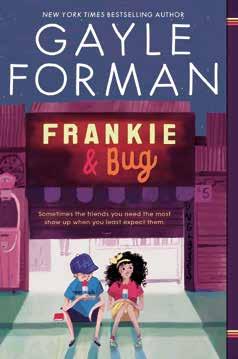
Friendship is often a favorite topic for middle schoolers. Gayle Forman’s beautiful and emotional novel Frankie and Bug is about platonic love, self-discovery, allyship, and a friendship sprouting in an unlikely place.
Fantasy lovers will get a kick out of Greg Howard’s The Whispers. This fantastical novel, featuring a Gay protagonist on a magical adventure full of mystical wish-granting creatures, can get emotional and touches on parental loss, but it is a joyful tale about growing up.
Another fun mystery for middle-school readers is Zenobia July. This story of a Trans middle schooler at a brand-new school is perfect for anyone feeling anxious about the changes this time can bring. While the novel focuses on a low-stakes mystery, it also centers on the main character’s attempts to make new friends and show the world the real her.
Obie Is Man Enough is another fun read featuring a Trans middle schooler. Following the experiences of the titular Obie, it centers on a Trans boy grappling with all the changes that come with coming out — new friends, a new swim team, a new look — while remaining the same person all along.
Graphic novels have grown in popularity over the last few years, and there are many options for middle-school readers. For anyone charmed by recent film adaptations of classics like Anne with an E and Gretta Gerwig’s Little Women, there now comes
a modern, illustrated take — in which the characters dare to be openly Queer. Kathleen Gros’s 2020 novel Jo: An Adaptation of Little Women (Sort Of) tells the story of a modern-day Meg, Jo, Beth, and Amy as they explore a year of school. While literature experts have debated Jo’s sexuality in the original novels, this graphic-novel adaptation makes her explicitly Queer and even gives her a small romantic arc.
Gros’s Anne: An Adaptation of Anne of Green Gables (Sort Of) takes a similar spin on L.M. Montgomery’s classic tale with one catch — Anne is in love with Diana instead of Gilbert!
Young-adult novels for high schoolers
It isn’t hard to find quality LGBTQ+ YA novels for high schoolers. There are many titles on the shelves of every indie bookstore in Seattle.
One of the best LGBTQ+ books of 2022 is Sonora Reyes’s The Lesbiana’s Guide to Catholic School. A story of family, friendship, and coming out, Reyes’ debut novel is fun, funny, and at times heartbreaking.
Readers should know that it doesn’t shy away from topics such as parental rejection, suicide, and depression.
While new books are popping up everywhere, there’s nothing like the classics. Aristotle and Dante Discover the Secrets of the Universe is a much-loved example. With a new sequel and a movie out, this new school year is the perfect time to dive into the adventures of best friends Ari and Dante as they explore the world around them in this beautifully written tale about the love between family, best friends, and community.
Fans of classics can’t forget Alison Bechdel’s graphic novel Fun Home. An emotional examination of her real childhood with her closeted father, this gorgeous story is a timeless piece of literature and a perfect introduction to graphic novels for anyone hesitant to try them.
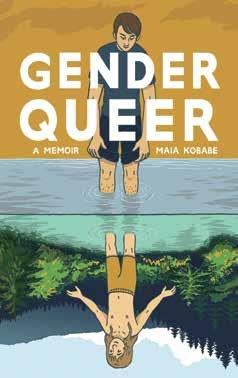
Of course, the most talked about graphic novel of recent years is Maia Kobabe’s Gender Queer. Like Fun Home, Gender Queer is an autobiographical narrative about a Queer kid coming of age. Though different from Bechdel in style, Kobabe’s
memoir has become an instant classic and serves as an introduction to topics of gender and sexuality. As a bonus, it also discusses Asexual identities, something many YA novels have yet to explore.
Fantasy fans should pick up a copy of Aiden Thomas’s Cemetery Boys before Halloween. It focuses on Yadriel, a Transgender teenager excluded from his family’s magical masculine traditions, who summons the ghost of Gay classmate Julian. Together, the two boys must solve Julian’s murder while proving Yadriel’s masculinity to his family. Full of twists, turns, and mystery, this story is perfect for YA readers who can’t wait for the spooky season to begin!
Readers of all ages can look forward to returning to school by picking up an extra book or two! You’re never too young (or old) to start learning about Queer and Trans topics. Early reading is also a great way to expose young children to empathy and selfacceptance. Books with diverse characters are essential for promoting good mental health for older readers as well.
Happy reading!
Images courtesy of the publishers
Spain celebrates first Women’s World Cup victory Sports
by Lindsey Anderson SGN Staff Writer
The most dramatic Women’s World Cup wrapped up spectacularly this week. The semifinal matches saw four of the best teams in the world face off. They were evenly matched in skill, speed, and grit, but ultimately steadfast defenders determined who rose and fell.
Australia vs. England
The first semifinal match set home-team Australia against Europe’s powerhouse, England. The Matildas excited the raucous crowd as star player Sam Kerr took to the field to start for the first time in the tournament.
Despite holding the home-field advantage, Australia started off in defensive mode when England began with deadly attacks. In the 8th minute, English midfielder Georgia Stanway got the first shot on goal. But her strike wasn’t enough to get past Australia’s legendary keeper Mackenzie Arnold, who used her toe to tap the ball away.
England dominated the first half, maintaining possession and passing straight around Australia’s backline. In the 35th minute, forward Alessia Russo dribbled up the corner of the field. While the defense predicted a shot from her, the expert striker instead sent the ball behind her to teammate Ella Toone. With one touch, Toone sent it flying into the upper right corner of the goal.
Now down by one, Australia was not ready to give up. Two minutes later, they countered an attack with a brilliant shot at England’s net. However, keeper Mary Earps was ready and waiting to catch the ball right at her chest.
Australia returned to the pitch in the second half, ready to make their comeback. In the 62nd minute, Kerr dribbled the ball up from half field. England’s defenders tried to narrow in and snuff her momentum as she neared the top of their box, but Kerr expected that. She ripped a shot before
Photo by Amanda Perobelli / Reuters
crossing into the danger zone, rocketing the ball past two English defenders and right into the back of the net. The game was tied, and the Australian crowd erupted in cries of relief and pride.
Australia kicked their intensity up even more following Kerr’s beautiful goal. The game quickly evolved into a Kerr vs. Earps showdown. In the 66th minute, Kerr crashed the box for another chance at getting the ball into the net. Her head made contact, but Earps was prepared and nabbed it out of the air.
England countered with an attack in the following minutes. Their forwards sent strike after strike in the direction of Australia’s goal, but nothing was on target enough for Arnold to even touch the ball.
After several vicious attacks, Australia’s defense seemed to lose its intensity. England forward Lauren Hemp took advantage of the lull. Scrapping around for the ball in the box, Hemp managed to get a quick touch on it despite being marked by two defenders. The defense overshot their runs, giving Hemp just enough of an opening to poke the ball into the net, right past Arnold’s mitts. England was ahead again.
Desperate to recover, Australia initiated a new game plan: pass the ball to Kerr. In the 81st minute, the powerhouse forward made another attempt, connecting her head with the ball. Unfortunately, she sent it over the center post yet again.
The difference in the game ultimately came down to the defenders. When England’s goalie spilled a save, their defense was ready in the blink of an eye to scoop the rebound before Australia could get another shot.
Kerr continued to receive the ball in front of the net, but the pressure of playing on the world’s stage in front of her own country may have weighed her down. Every shot she got went over the goal. In the 85th minute, England’s Russo got one last breakaway past Australia’s defensive line. With her shoul-
Evenly matched in skill, speed, and grit, but ultimately steadfast defenders determined who rose and fell.
ders up, Russo sent the ball confidently into the far left corner of the net. With just a few minutes left until the final whistle, her point had secured England’s 3-1 victory, sending them to the final match for the first time.
Spain vs. Sweden
The second semifinal saw Spain take on Sweden. The Swedes had built momentum in the tournament, knocking two former champions, the US and Japan, out of the competition. The team knew how to take on a confident challenger but could not have expected what lay ahead in their match against the underdogs, Spain.
Early on, Spain showed their dominance. They attacked with calculated plays. Passes glided to each player’s feet like the stroke of a paintbrush. They seemed to be having fun as they teased Sweden’s defense. Spain’s strikers weren’t afraid to take risky shots and rattled off several out-of-the-box strikes on goal. Their first shot, by defender Olma Carmona, went wide, but it was enough to put Sweden on edge and force the squad into a much more defensive lineup. Sweden’s emphasis on defense didn’t last long. Immediately following Carmona’s dangerous attempt, the team countered. Forward Johanna Kaneyrd made a run toward the goal and sent a header shot right at Spain’s keeper, Cata Coll, who caught the ball more easily than a cold.
Despite maintaining a 0-0 tie in the first half, Spain played as if they were leading by
double digits. The squad got too confident in the 41st minute, passing the ball back and forth in their defensive third. Sweden intercepted a defensive pass, leading to a powerful shot by Fridolina Rolfo. Luckily for Spain, Coll was ready for the interception and got her body in front of the ball before it made contact with the net behind her.
Sweden kicked up their aggression, using the same physicality shown in their previous matches against the US and Japan. Unfortunately for them, the ref was less willing to put up with their shoving and called a foul just outside the team’s 18-yard box. In the 66th minute, Spanish forward Mariana Caldentey took the kick with members of both squads lined up on the 18-yard line for the rebound and just feet from the shooter to try and block her aim. Caldenty’s shot smacked the middle of Sweden’s defensive wall.
In the 69th minute, Caldenty received the ball and ran up the field. She sent a pass forward for Jenny Hermoso to run onto. Hermoso sent it to Alba Redondo, who slid a sneaky shot at the goal, falling to the ground as the ball left her foot, then dipped wide and rolled toward the out-of-bounds line. Out of nowhere, defender Oihane Hernández sped up and tapped it back into play. It slid back to Redondo, who was still on the ground. She flicked one more touch. The ball glided toward the net. The team celebrated before realizing the shot had hit the outside the net —not a goal.
In the 80th minute, Hermoso controlled an in-the-air ball right above Sweden’s box. She blasted a shot at the net, but the expert defenders deflected it. However, Salma Paralluelo was in the perfect position to scoop up the rebound. Without a second thought, she tucked her shot into the far corner of the net, putting Spain ahead 1-0.
With just three minutes to go until the final whistle, it seemed to be Spain’s game. However, Sweden wasn’t ready to give up their dream of winning the gold. In the last minutes, Swedish star forward Lina Hurtig controlled the ball on a wild cross and then lobbed it to the feet of Rebecka Blomqvist, who sent a gorgeous volley right into the back of the net. The game was, once again, tied.
Spain countered hard, determined not to go into overtime play. Just one minute after Sweden’s tying goal, the squad earned a corner kick. After a brief scuffle, the ball dropped back to Eva Navarro. On her toes, Navarro sent the perfect shot at the net from the top of the box. Sweden’s keeper tried to hit the ball out of the air, but with a ricochet off the crossbar, the shot landed perfectly behind the goal line — mirroring Hurtig’s winning goal against the US in penalties.
Spain celebrated in a roar of applause and jovial tackles. With just moments left, all they had to do was defend. The last play was called as soon as Sweden’s final shot, on a corner kick, flew into the hands of Coll. For the first time, Spain would be going to the World Cup final.
Final match: Spain vs. England
The last match (after Sweden beat Australia for third place) saw two European teams face off — neither of which had ever made it to the final round of the Women’s World Cup. Both had undoubtedly fought hard to make it to the pitch. Beforehand, experts predicted England would play a physical game while Spain would rely on the speed and agility of their midfield and attacking forwards.
England had the first dangerous attack on goal. In the 15th minute, English defender Lucy Bronze sent the ball into the box from the right side. Rachel Daly was waiting and ready to control it at her feet. Before Spain’s defense could predict what Daly would do, she dropped a pass to striker Lauren Hemp, who rattled a shot right off the post. The ball bounced back into the fray, but before England’s forwards could get another shot, Spain cleared it.
Spain used their momentum and took advantage of England’s defenders in their half. They countered a quick attack with
a cross to the feet of Paralluelo. She had a perfect opportunity on goal but shanked her shot. Redondo followed up behind, ready to scoop the ball and finish the rebound, but England’s keeper, Mary Earps, pushed her body in front of the shot.
England regained possession and composure following Spain’s dangerous attack. They connected crisp passes around Spain’s defense but couldn’t pass the ball into the net. Their passing game ultimately halted when Spain intercepted the ball and sent a pass to Olga Carmona, a defender on a breakaway run upfield. Carmona took her chance and shot low and hard. Earps dove to stop the shot but couldn’t get in front of it before it blasted into the net.
Carmona celebrated by lifting her shirt and running around the field. A message scribbled on her red undershirt was revealed in her victory celebration. Some fans speculated that the word, “Merchi,”
may have had something to do with protests over the squad’s coach, but after the game, Carmona revealed it was a special message to a dear friend who had recently lost their mother. (Unbeknownst to Carmona, Merchi wasn’t the only angel watching her. Her father had just passed hours before the start of the game. Her family kept the news from her until after the match.)
In the final minute of the first half, Spain’s aggressive offense showed yet again. Paralluelo blasted another shot at the net when the ball crossed her way, but, once again, it missed just barely.
England returned to the pitch for the second half with a much more defensive lineup. They stacked an extra player on their backline to prevent another Spanish goal and end the game with an attacking play. However, in taking numbers from their top line, England allowed Spain to get more chances.
When Spanish attackers got close to the net, England’s defense responded with a double-teaming defense. Their strategy seemed to hold up, as each Spanish shot looked premature and failed to get close to the frame of the net. The only on-frame shot came from Parallelo, but Earps saved it with a dramatic dive and a pat of her glove.
In the 63rd minute, Spain crashed the box again. Stationed up front again, Carmona received the ball and cut it back to Caldentey, who settled the pass and pushed past England’s defense. She shifted the ball to Paralluelo, who took a shot. English defender Alex Greenwood deflected it and shepherded it out of bounds. Instead of awarding a corner kick, the ref examined replay footage and found that before it settled, midfielder Kiera Walsh grazed the ball with her hand in the box.
The foul meant a coveted penalty kick for Spain. Hermoso was selected to take the shot. Predictably, she aimed for the lower right corner. Knowing Hermoso favored that side, Earps was ready to dive and caught the ball at her chest.
In the 89th minute, Paralluelo got possession and dribbled up the field. She sent a pass to Caldentey, who deposited the ball at the feet of Hermoso, waiting at the net. With a last chance to redeem her flubbed PK, she struck the ball but sent it wide.
England’s last chance to tie the game came with a final corner kick. The clock ticked past the extended time as the ball curved in the air in front of the net. The entire English team pushed forward for their final attempt at a goal. The ball didn’t even get a chance to rattle around the box: Coll caught it in the air and fell to the ground. As she hugged the ball to her chest, the ref blew the final whistle, and she exhaled a sigh of relief.
With emotions high, Spain celebrated, and England mourned their loss. Prior to this year’s tournament, Spain had only ever won a single Women’s World Cup match. Paralluelo won the FIFA Best Young Player award for standing out on the field at just 19 years old. For defending Paralluelo’s countless strikes, Earps took home the Golden Glove Award. Spain’s star playmaker, Aitana Bonmati walked away with the Golden Ball Award for scoring three goals and two assists throughout the tournament.
Spain’s victory was a team effort and could not have been accomplished without some of the squad’s most skilled Queer players, including forward Alba Redondo, defender Irene Paredes, defender Ivana Andres, and midfielder Teresa Abelleiora. On August 20, the entire team lifted their trophy for their country in a historic, firstever World Cup victory for Spain.
England’s Jessica Carter kicks the ball ahead of Spain’s Olga Carmona – Photo by Alessandra Tarantino / AP
Spain's Salma Paralluelo – Photo by Andrew Cornaga / AP
Op-Ed
Maintaining a balanced body budget
Dear Izzy,
I am a 35-year-old single woman with a high-stress job. I love my job and the life I have created for myself, but lately, I’ve been neglecting self-care and feeling drained, and it is starting to impact my performance at work. What are some simple daily practices I can adopt to boost my overall well-being, without putting too much pressure on myself?
— Self-Care Seeker
Dear Seeker,
Okay, independent, self-aware queen! You are already doing the right thing by acknowledging that you haven’t been taking care of yourself enough to keep up with your fast-paced, high-stress lifestyle. If you love your job and want to keep doing what you have been doing but also feel better, more aligned, and less drained, let me introduce you to a concept called your “body budget.”
I recently read a book, How Emotions Are Made: The Secret Life of the Brain, and in it, author Lisa Feldman Barrett introduces the concept as a way to regulate your energy and emotions. Essentially, it is your body/mind/brain’s capacity to cope with all of the experiences life throws at you. According to Barrett, maintaining a balanced body budget is crucial for your overall sense of well-being.
Maintaining a healthy body budget is actually quite simple, as it includes commonsense practices like eating well, exercising daily, and taking time to rest and relax.
Another term for body budget is allostasis, the process by which the body responds to stressors in order to regain homeostasis, that is, the process that runs the systems of our bodies to keep us alive and thriving in a relatively stable state of equilibrium. The reason I bring this up is because some people think the brain’s only job is to think. But the truth is that it has a far greater job: knowing when to expend and receive energy and resources.
Viewing the brain in this way helps us better appreciate the two-way relationship between our mind and body so we can take a more holistic approach to understanding and improving our physical and mental well-being. Pretty much all the time, our
by Isabel Mata SGN Staff Writer
Ask Izzy is a biweekly advice column about relationships, mental health, and sexuality. Written by Isabel Mata — a Seattle-based lifestyle writer, podcast host, and mental health advocate — Ask Izzy offers tangible expert advice so all readers can have stronger relationships, better sex, and healthier mindsets. Submit your question today by emailing info@sgn.org with the subject “Ask Izzy.”
brains are anticipating our bodies’ needs and deciding where to spend resources.
When it senses an adjustment is needed, it uses our memories and past experiences to automatically predict how it can fix the gap between where our energy levels are and where they should be. A lifestyle blog, Restoring Balance, gives a few helpful examples of this:
Cortisol is proactively released into our bloodstream when we wake up, giving us a quick shot of energy to get ourselves out of bed.
Our heart rate increases if we’re about to do exercise, in expectation that we’ll soon need more oxygen flowing around the body.
Our digestive functions engage before we’re likely to be eating, ready to start processing food as soon as it arrives in the stomach.
How body budgeting works is that for
every action that uses a resource, we need to pay the body back with an action that tops up our supply. Things like movement and learning take the most energy, while eating and sleeping give us the most back.
While there might have been a time when you could manage your body budget and hustle as hard as you have been going without any consequences, it doesn’t seem like that is working for you anymore. When you neglect self-care, you are in turn letting your body budget become imbalanced.
Barrett suggests a bunch of activities that can be added to your self-care routine in order to make sure your needs are being met, such as yoga, reading, spending time outside, and meditation. Another powerful body-budget booster is gratitude, because it increases happiness and overall well-being.
If you are worried about incorporating more self-care into your life without
feeling overwhelmed, I urge you to start simply. When you feel tired, rest. When you are hungry, eat. Same goes for drinking enough water and nourishing your body with nutrient-rich foods. As humans, we are incredibly intuitive when it comes to knowing what our bodies need, but unfortunately because of society, we are sometimes taught to ignore what our gut is telling us, in place of things like hustle and diet culture.
One of my favorite sayings is that you can’t fill from an empty cup. Meaning, if you want to succeed at work, have a thriving social life, and build healthy relationships, you have to make sure your cup is full by maintaining your body budget. Right now, you are overspending your body budget. If you take the time to refill your own cup, I can promise that it will benefit you greatly in the long run.
Photo by Valeria Ushakova / Pexels
National/ International News
National news highlights
by Teddy MacQuarrie SGN Contributing Writer
Trump to be booked at Fulton County jail, faces $200,000 bond
Former President Donald Trump faces a $200,000 bond as he awaits trial for election interference in Georgia. The bond includes terms that prohibit him from obstructing justice and intimidating witnesses, including through social media posts.
The restrictions related to witness intimation follow Trump and supporters having released the personal information of the grand jurors involved in the latest indictment. Trump, his attorneys, Fulton County District Attorney Fani Willis, and Fulton County Superior Court judge Scott McAfee have signed the bond agreement, which stipulates that the restrictions “shall include, but are not limited to, posts on social media or reposts of posts made by another individual on social media.”
The August 24 booking follows Trump’s most recent round of indictments by a state grand jury in Atlanta. The indictment pertains to alleged crimes aimed at overturning the 2020 presidential election and includes 18 co-defendants, including Trump’s attorney and former New York mayor Rudy Giuliani, and Trump’s former chief of staff, Mark Meadows.
Trump has until Friday at noon Eastern to surrender or face arrest.
Judge McAfee has yet to decide the trial date. Prosecutors have requested March 2024, while Trump’s defense team has asked for a trial date in 2026.
International news highlights
by Teddy MacQuarrie SGN Contributing Writer
Content warning: This article mentions transphobia and homophobia.
International Chess Federation bans Transgender competitors from women’s events
The International Chess Federation (FIDE) has banned Transgender women from competing in women’s events while it conducts a “thorough analysis” of developments. FIDE’s new rule went into effect Monday, August 21.
In addition to subjecting the participation of Transgender participants to such review, the federation also removed titles from players who won in women’s categories and later transitioned to male. Under the new guidelines, Transgender players are still able to compete in “open” events, in which men and women can compete against each other.
FIDE’s reasoning is that, after an influx of requests for gender changes for Transgender competitors, it needed to make regulations as “change of gender is a change that has a significant impact on a player’s status.” It cited a need to conduct a review of that impact — a process that can take up to two years.
The National Center for Transgender Equality wrote in a post on X (formerly Twitter), “This is so insulting to cis women,
Southern California faces first tropical storm in 84 years
Tropical Storm Hilary made landfall Sunday night, dumping heavy rains on a region that has not seen such conditions since September 1939.
Hilary first slammed into the northern portion of the Baja California Peninsula in Mexico. Initially a category 4 hurricane, it was downgraded to a tropical storm shortly after landfall. Though Hilary dissipated Monday, remnants from the storm brought heavy rain, including flash flooding and mud and rockslides. Hilary dropped 10 inches of rain over a desert region that is normally dry. Some parts are expected to
receive the equivalent of half their average annual rainfall.
Damage to infrastructure was minimal. As of Monday there have been no reported deaths or injuries due to the storm in the US. One man in Mexico died when Hilary made landfall.
Weather scientists attribute Hialry’s unusual path to warmer-than-average water temperatures in the Pacific Ocean, where this year’s El Niño has warmed surface water 3.5 to 5 degrees higher than normal. According to the Associated Press, UCLA Western weather scientist Daniel Swain explained that this is how Hilary intensified so rapidly as to gain 75 mph
to trans women, and to the game itself. It assumes that cis women couldn’t be competitive against cis men — and relies on ignorant anti-trans ideas.”
Professional chess player Yosha Iglesias also wrote in a post on X, “The new regulations will make trans chess players all over the world face a horrible dilemma: transition or quit chess.” Iglesias calls attention to the experiences of Transgender women chess players, outlining the challenges they face because of their gender designations.
Several chess federations, such as those in the US and Germany, have come out
against these changes. The German Chess Federation said in a statement on Friday, August 18, “If a person is legally recognised as a woman, it is incomprehensible to us what FIDE still wants to check and why it needs two years for this.”
In its statements and regulations, it is not clear what impact FIDE understands gender transition to have on a player’s ability to compete, nor what research evidence it requires in order to fully integrate Transgender players into women’s events. It is similarly not clear why FIDE considers existing research inadequate for such a determination.
wind speeds in less than 24 hours. Jim Kossin, a former National Oceanic and Atmospheric Administration (NOAA) scientist, explain to the AP that “for a storm to intensify the way Hilary did, the conditions would have to be ideal.” These include warm water that runs deep, and no crosswinds to disrupt the storm at higher altitudes. In a rare combination of events, all of these conditions were present in the Pacific, where waters tend to run much colder.
As of Monday, the remnants of Tropical Storm Hilary have moved into the desert regions of Southern California, Arizona, and Nevada, where they continue to drop heavy rain. Palm Springs saw three inches.
Italy’s top army general fired after publishing anti-Queer, anti-minority book
A top army general in Italy was fired Friday, August 18, over a series of anti-Queer, anti-Muslim, and anti-minority statements in his self-published book The World Upside Down
According to Reuters, Gen. Roberto Vanacci, 54, wrote statements calling Gay men “not normal,” claimed the existence of a “gay lobby” intent on brainwashing the world, and appeared to call into question whether Black people can be Italian — an apparent reference to Paola Egonu, an Italian volleyball athlete born to Nigerian parents. He decried what he calls “the tyranny of minorities” and excoriated feminists, environmentalists, people of color, and immigrants.
Little known to the public until excerpts came to light in Italian news outlets on Thursday, Vanacci formerly headed Italy’s elite paratrooper unit, carrying out missions in Iraq and Afghanistan. Subsequently, he served as defense attache in Moscow until September 2022, when he was expelled due to the Ukraine war. His most recent posting has been to Italy’s Military Geographic Institute.
On Thursday, August 17, Italian Defense Minister Guido Crosetto said “the personal ramblings of a general” discredited the Italian armed forces. He vowed to open disciplinary proceedings against Vanacci, who as of Friday has been terminated from the army. Gen. Vanacci defended himself on Italian television outlet Rete4, claiming that he had not expected a firestorm for a book “expressing my thoughts, without offending anyone.” Stating that his book falls under constitutionally protected free speech, he claimed he would not take anything back. Italian farright figures, such as the neo-Fascist group Forza Nuova, rallied around him.