“It is unequivocal that human influence has warmed the atmosphere, ocean, and land,” stated a portion of the United Nations climate change report. The UNappointed Intergovernmental Panel on Climate Change (IPCC) released its Sixth Assessment Report, known as the AR6 WG1, on August 9, 2021. It addresses the current state of the global climate, how climate change is shifting, how humans are the leading cause, and possible climate futures.
by Mike Andrew SGN Staff Writer
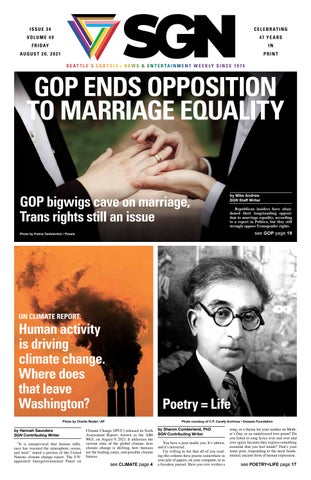
Republican insiders have abandoned their longstanding opposition to marriage equality, according to a report in Politico, but they still strongly oppose Transgender rights.
by Sharon Cumberland, PhD
SGN Contributing Writer
You have a poet inside you. It’s inborn, and it’s universal. I’m willing to bet that all of you reading this column have poems somewhere in your pile of papers, on your computer, or in a forsaken journal. Have you ever written a song, or a rhyme for your mother on Mother’s Day, or an undelivered love poem? Do you listen to song lyrics over and over and over again, because they express something essential that you feel inside? That’s your inner poet, responding to the most fundamental, ancient form of human expression.
Photo by Charlie Reidel / AP
Photo courtesy of C.P. Cavafy Archives / Onassis Foundation
Photo by Polina Tankilevitch / Pexels see GOP page 19
Local News
What causes climate change
Several factors are contributors, although fossil fuels play a particularly critical role in global warming. During the Industrial Revolution, humans began ramping up the use of fossil fuels through the burning of coal, oil, and natural gas for energy. Since the 19th century, our use of fossil fuels has drastically increased.
The burning of fossil fuels emits CO2, or carbon dioxide — a greenhouse gas that traps heat in the earth’s atmosphere for lengthy time periods. Renewable energy such as wind power and hydropower are alternatives to fossil fuels, although we still burn fossil fuels in our daily lives from heating our homes, running a car, hopping on an airplane, and even turning on the lights. At a larger scale, manufacturing is a key player in fossil fuel emissions.
How humans have shifted the global climate
Like fossil fuels, deforestation releases CO2 into the atmosphere. Trees contain stored carbon, which is ejected when they are cut down or left to rot. Furthermore, deforestation destroys habitats and the species living in them.
The greenhouses gases released via the burning of fossil fuels has impacted our
planet’s oceans, because they absorb much of the CO2 we release. As a result, water temperatures have continued to rise, threatening marine wildlife threatened. Warmer water temperatures mean that there is less available oxygen, making it more difficult for oceanic life to breathe. Carbon dioxide in oceans also causes acidification, which makes it challenging for coral, shellfish, and plankton to rebuild their shells and structures adequately. This also threatens coastal communities that require seafood as a primary food source.
Predictions for North and Central America
The UN report provided regional expectations for future climate activity. North and Central America are predicted to see an increase in temperatures — specifically, extremely high temperatures. Sea levels are also projected to rise along most coasts, as are the intensity and duration of marine heatwaves and acidification.
Additionally, expect cyclones and storms to become more severe in certain regions.
“Many changes due to past and future greenhouse gas emissions are irreversible for centuries to millennia, especially changes in the ocean, ice sheets, and global sea level.”
“Many changes due to past and future greenhouse gas emissions are irreversible for centuries to millennia, especially changes in the ocean, ice sheets, and global sea level,” states the AR6 WG1 report.
According to the report, marine heatwaves have nearly doubled in frequency since the 1980s, and the loss of ice sheets and glaciers due to continued global warming has contributed to rising sea levels, further habitat destruction, and coastal erosion.
Western and Central North America are projected to experience a rise in droughts and fire weather, as well as precipitation.
Washington’s climate challenges
“We’re already locked in for a certain amount of warming. Even if we were to hit net-zero CO2 emissions tomorrow, the earth is going to keep warming,” said Matt Rogers, a research scientist at the University of Washington’s Climate Impacts Group,
which identifies climate challenges in the Northwest via scientific evidence and develops guidance on addressing climate change.
Rogers explained how the recently released IPCC AR6 WG1 report was not that different from previous reports, even though it has gained much attention this time around. One thing that has been different from previous IPCC reports, however, is that scientists have a stronger certainty that humans are the cause of our ongoing climate crisis.
Washington should expect to see an increase in heat throughout each season. Earlier springs and loss of snowpacks will result in more fire extremes: our forests will remain dryer for longer time periods, which allows for wildfires to spread at a more rapid rate. Climate scientists at Washington’s Department of Ecology predict that by the 2040s, 1.1 million acres of land will succumb to wildfires. It is important to be mindful that human activities, including bonfires, smoking, and fireworks, are primary causes of wildfires in the state.
“Here in the Northwest, one of the big things we have been seeing is declining snowpacks — less snowpack in the winter because we have more precipitation falling as rain,” described Rogers. An increase in precipitation and sea levels creates greater risk for winter flooding, and the loss of snowpacks as a result of rising temperatures will have a continued negative effect on our salmon population that relies on snowpack for feeding and spawning.
Photo by Felipe Dana / AP
Rogers mentioned a marine heatwave event that occurred several years ago, which resulted in largescale marine life loss, and how similar patterns will likely continue for years to come. Both land and sea creatures remain stressed from adapting to the rise in temperatures, which is also not expected to change anytime soon.
Managing the change — it’s not reversable
The IPCC report stated that “every tonne of CO2 emissions adds to global warming,” and that in order to limit carbon dioxide emissions, the world must reach a net zero
while also heavily reducing other greenhouse gas emissions.
When the coronavirus took the world by storm in early 2020, there was a temporary yet detectable reduction of air pollution, so working remotely and being on lockdown is good for planet Earth.
“We do have the power to prevent the worst from happening,” stated Rogers, who went on to explain how, although we cannot reverse certain climate impacts, we can mitigate them. Rogers brought up how methods such as reducing, reusing, and recycling are helpful, although the issue is greater than merely one single individual.
“You’re going to be hard pressed to make a dent in CO2 emissions globally without some sort of legislation that doesn’t just limit private citizens but businesses and manufacturing industries as well,” Rogers said. He also described how a big portion of tackling climate change is communicating with local policymakers who need to push the issue further in order to come up with preventive measures and prepare for rising challenges.
It’s never too late to have hope More recently, young adults have been grappling with the thought of bringing children into a world where the climate’s
Washington
should expect
to see an increase in heat throughout each season. Earlier springs and loss of snowpacks will result in more fire extremes: our forests will remain dryer for longer time periods, which allows for wildfires to spread at a more rapid rate.
future seems bleak, but Rogers responds to that view by saying, “We can make a difference.”
“In my research I have seen a lot of people on the ground in Washington state take climate change into consideration and how they prepare their communities for upcoming changes and what we can expect as climate changes. It is really heartening. We can always do more, and there are people working on it, but it’s going to take all of us,” he said.
To learn more about how Washington is responding to climate change, visit https:// ecology.wa.gov/Air-Climate/Climatechange/Greenhouse-gases/Reducinggreenhouse-gases.
The Whitmore Fire started on Aug. 3, 2021, burned 14 miles west of Nespelem, Wash. – Photo courtesy of the Incident Information System
Rebecca Hall is a fiery powerhouse residing inside a grief-filled Night House
by Sara Michelle Fetters
SGN Staff Writer
THE NIGHT HOUSE
Theaters
While on the outside The Night House appears to be nothing more than a routine ghost story revolving around a woman mourning the sudden loss of her husband, once the doors to this abode open, a labyrinthine puzzle begins to take shape. Like an M.C. Escher drawing, director David Bruckner (The Ritual) and Super Dark Times screenwriters Ben Collins and Luke Piotrowski create an impenetrably fascinating mosaic of trauma that shook me to the core.
Their film grabbed me by the throat and slowly squeezed. As the mystery at the center of this horrifying drama took shape, the pressure on my psychological sternum only amplified. This is a hauntingly primal tale of loss, where the search for truth comes with monstrously unforeseen consequences, and knowing what lies cleverly outside of direct sight, hiding in the darkness, isn’t nearly as comforting as it initially seems.
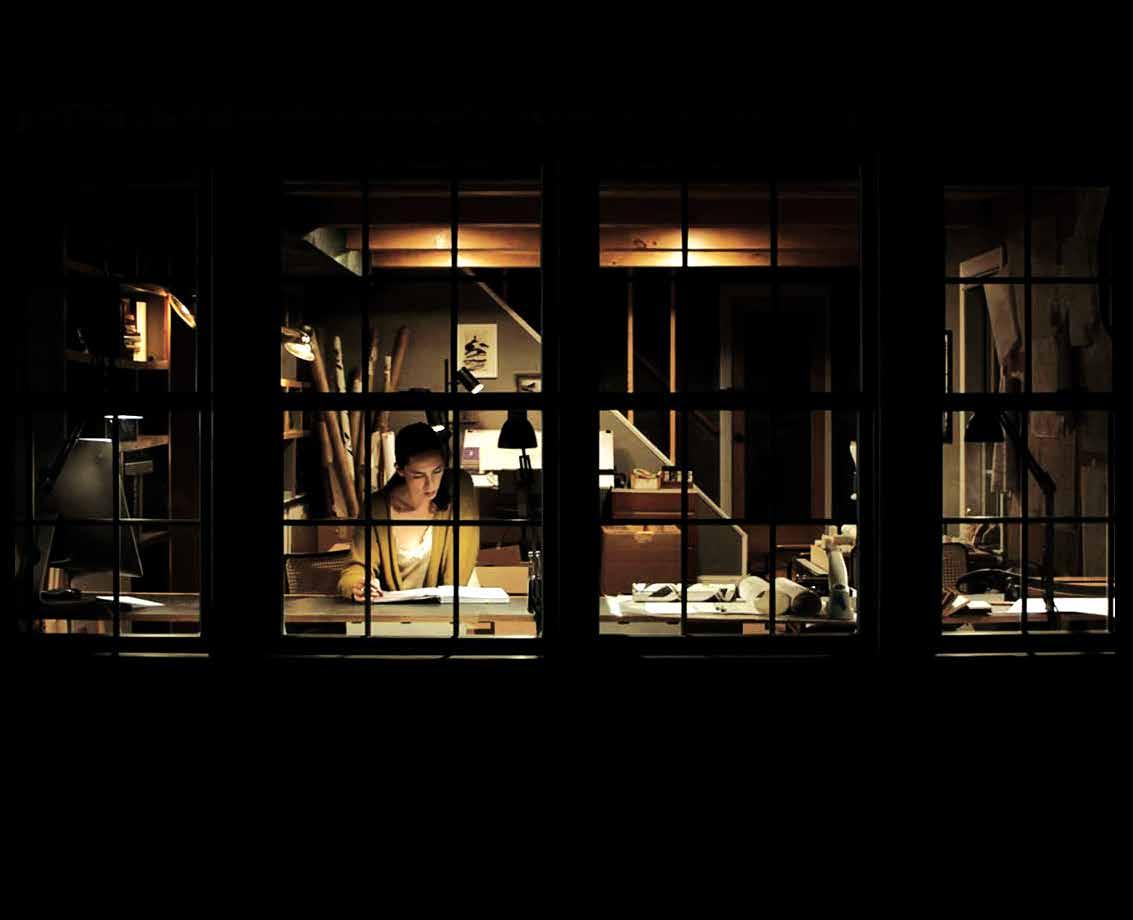
Beth’s (Rebecca Hall) architect husband Owen (Evan Jonigkeit) is dead. He committed suicide on a boat in the lake, just outside the house he built and designed for the two of them. It was senseless. There were no signs he was struggling with depression. Even the note he left is so vague it could be viewed as nonsensical, and Beth is left to maddeningly wonder if it was her fault
Owen put a gun to his forehead and pulled the trigger.
There’s more. Beth discovers information that leads her to believe Owen was hiding inconceivable truths about himself from her. There are pictures of other women, all of whom look strangely like her, on his phone. Their neighbor Mel (Vondie Curtis-Hall) uncomfortably deflects direct
tino’s devastatingly bleak The Dark and the Wicked did so as well. Both pictures achieved magnetically caustic intimacy that lingered with me for days, and just thinking about them now is enough to send frazzled shockwaves up and down my spine.
So Bruckner, Collins, and Piotrowski are hiking down a well-worn path. But even so, they still find ways to make this
This is a hauntingly primal tale of loss, where the search for truth comes with monstrously unforeseen consequences, and knowing what lies cleverly outside of direct sight, hiding in the darkness, isn’t nearly as comforting as it initially seems.
questions when asked if he ever saw her husband acting strangely. Most of all, Beth believes there is a sinister presence residing in the house, and the more she learns about Owen, the more a throbbing worry develops that whatever — or whoever — it is wants to toy with her until she, too, takes her own life.
Lots of horror films utilize the genre to analyze the paralyzing aftereffects caused by the sudden loss of a loved one. Recently, Natalie Erika James’ magnificent Relic did this with debilitating specificity. Bryan Ber-
secluded backwoods sojourn come alive in a variety of innovative and surprising ways. Beth isn’t so much residing in a haunted house as she’s discovered an alternate reality that’s straight out of Alice Through the Looking Glass, a mirrored realm that’s both figurative and literal at the same time.
Cinematographer Elisha Christian (Columbus) is a wizard behind the camera. She navigates with pinpoint precision through the twisted, immaculately constructed maze by production designer Kathrin Eder (Life Happens) . Shadow and
light assault one another. Irregular shapes conspire to form hazily irregular, humanlike apparitions that fade back into invisibility when viewed from a different angle. It’s extraordinary work.
Then there is Hall. She’s a gifted actor — that she didn’t garner an Academy Award nomination for 2016’s Christine still blows my mind, since her performance was one of the best I’ve seen in the past two decades — and what she accomplishes here is breathtaking. Beth’s emotional permutations are never what I expected or anticipated them to be.
Hall ties herself into pretzel-like knots: flying high one moment, wallowing in selfpity and despair a nanosecond later. Spitting venomous anger toward shocked coworkers — only to instantly devolve into warmly exasperated jolts of laughter that instantaneously put anyone sitting at her table at relieved ease. Everything Hall does is achingly genuine, and this makes her physical and psychological permutations during the climax all the more powerful. There is a cleanliness to the resolution I’m not entirely sure works. In the same breath, Beth has been fighting a battle that began years before Owen committed suicide, one against ephemeral forces so nightmarish they couldn’t be real. But in The Night House, they are, and the only way to overcome the depressive grief they produce is to recognize that love and loss walk hand in hand, and to fully embrace the former, the latter must be given its due.
Rebecca Hall in The Night House – Photo courtesy of Searchlight Pictures
Film
Messy Habit is a stylistically inconsequential bit of pulp fiction
by Sara Michelle Fetters
SGN Staff Writer
HABIT
Theaters & VOD (Aug. 20)
Blu-ray (Aug. 24)
Texan Mads (Bella Thorne) and her best friends and roommates Evie (Libby Mintz) and Addy (Andreja Pejić) are three young women trying to make a go of it in Los Angeles. As scantily clad hostesses at a local club, the trio moonlight for former child star turned drug dealer Eric (Gavin Rossdale), sexily selling his illegal wares to earn some easy extra cash.
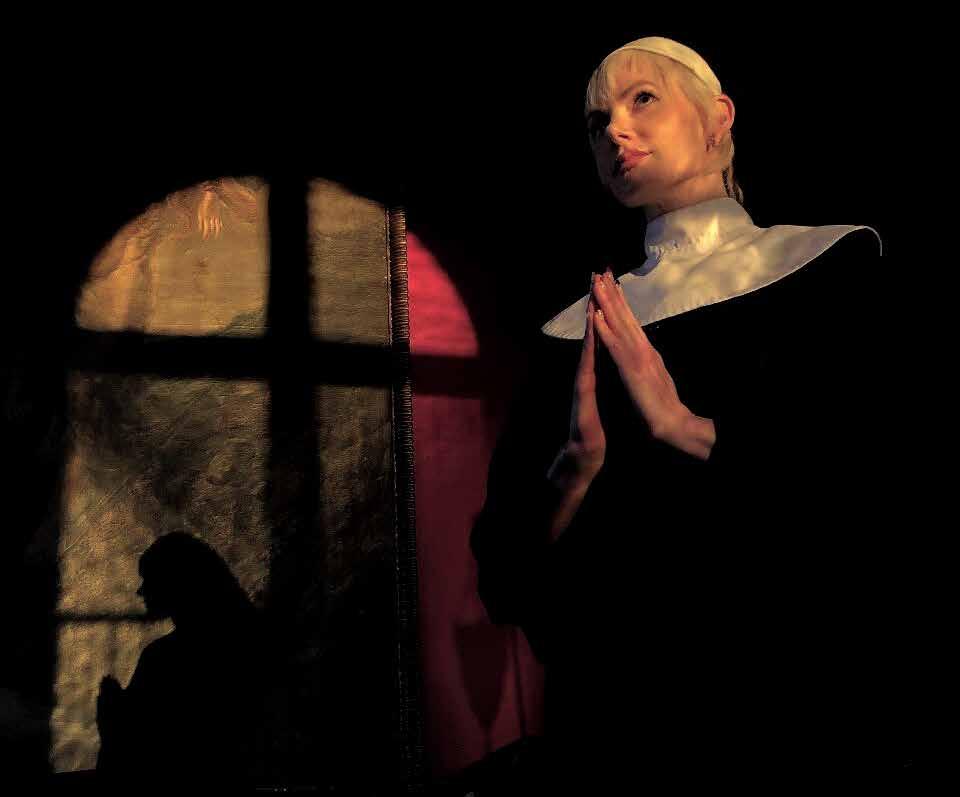
But when the unsold drugs and all of the evening’s profits are stolen by a one-nightstand, the ladies inadvertently make an enemy of the powerful Queenie (Josie Ho) and her murderous henchman Tuff (Jamie Hince). Knowing they need to hide out in the last place anyone would think to look for them, the Jesus-loving Mads decides they should masquerade as nuns until they have enough money to quietly escape town. Habit is something of a 1990s Pulp Fiction –style throwback with female leads who find themselves navigating a True Romance –meets– Sister Act type narra-
Habit is something of a 1990s Pulp Fiction –style throwback with female leads who find themselves navigating a True Romance –meets–Sister Act type narrative that is as unwieldy as it is oddly compelling.
tive that is as unwieldy as it is oddly compelling. Directed by Janell Shirtcliff from a story she conceived with Mintz, the film is a messy genre mashup that never quite works. But I still couldn’t take my eyes off of it, and at a quick 81 minutes, it’s safe to say I never found a second of it boring. I appreciated that Mads, Evie, and Addy are human train wrecks right from the start. Shirtcliff never tries to paint any of them as being anything more than what they are, and because of this, they all become moderately more realistic than they deserve to be in what is essentially a whack-a-doodle live-action cartoon. While I can’t say these ladies engendered my sympathies, they did keep my attention. I was always curious to discover what they would do next, even when their decisions frequently caused me
to incredulously roll my eyes or ticked me the heck off.
I can’t decide what I think of Thorne. There’s something fascinating about the actress, a chaotically unhinged energy hidden behind her eyes that makes me think she’s always on the cusp of doing something unexpectedly outstanding. I always want her to succeed.
But in the same moment, whether in primary roles like this one here, the recent home-invasion thriller Masquerade, or last year’s Bonne and Clyde wannabe Infamous, or in brief supporting turns in genre riffs, like the excellent Assassination Nation or Netflix’s hit The Babysitter, I feel like I can always see Thorne acting. She never disappears into the material, making her an animatedly artificial presence in
seemingly every project she appears in. That kind of works here, especially considering just how hyperactively cartoonish both Mintz and Pejić are. For a scenario where Mads is supposed to be the most “believable” fake nun — blue hair, heavy makeup, and all — thanks to the histrionics of her co-stars, Thorne comes incredibly close to pulling that particular impossible magic trick off. Evie and Addy are a human tsunami made flesh and blood, each woman callously, maybe even vindictively, yet also undeniably unintentionally wreaking all sorts of aggressive havoc no matter where they go.
Did I like Habit? No. I can’t say that I did. Was I still suitably impressed by the visual imagination fueling Shirtcliff’s handling of the material? Absolutely. No question whatsoever. This violently goofy descent into mayhem and gore is a stylistic marvel even if it is disastrously free of anything remotely substantive. I imagine for some viewers that will be enough. For others, they’ll be left wanting for more, their prayers hungering for something even passingly consequential frustratingly left unanswered.
Habit – Photo courtesy of Lionsgate
Secret Garden Books: More than just the magic of childhood
by Lindsey Anderson SGN Contributing Writer
Hidden right in plain sight, along one of Ballard’s busier streets, sits Secret Garden Books. The cozy little shop is perfect for anyone who misses the magic and adventure of childhood or who found their love of reading in the illustrated pages of classic picture books. While it’s filled with beautiful children’s literature, it has equally engaging “grown-up” books, basically, a little bit of everything.
Suzanne Perry has been working at Secret Garden for a little over 14 years, and she says she has watched the store literally “grow up” before her eyes. “We’ve really been trying to grow our shop up, ever since I got here,” Perry said. “I think we do still have a reputation as a kids’ bookshop, but we’re a neighborhood that’s great for grownups!... You’ll see when you look at the front of the shop, it’s grown-up books at the front. [That’s] more than half our business.”
For example, hot summer reads like On Earth We’re Briefly Gorgeous and Red, White, and Royal Blue are flying off the shelves. Perry also runs a book club for adults, which helps expose her to more mature reads that are sure to become instant classics. “I can’t recommend Shuggie Bain enough!” Perry gushed, sharing details about the newest adult read she has been obsessed with.
Along with becoming a more “grownup” store over the last decade and a half, Secret Garden has also begun to main-
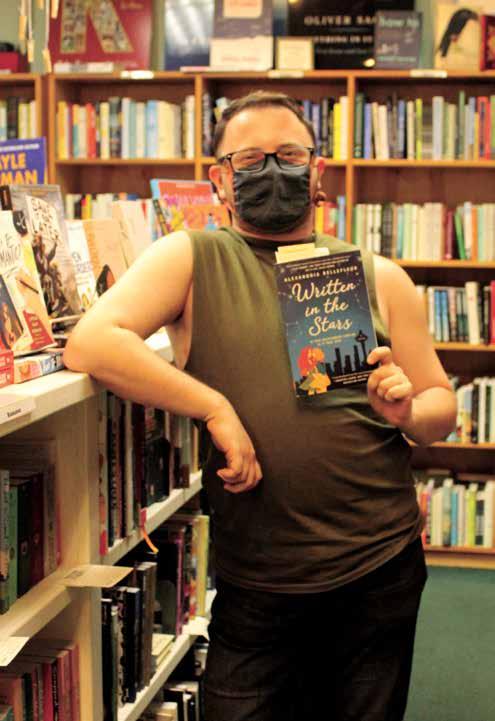
stream the previous LGBTQ books section. Now, they can be found in any part of the store, even the children’s and young readers’ section. Andrew King, curator of the young adult section, gave me a tour, pointing out some of the hottest Queer YA titles
Photos by Lindsey Anderson
on the shelves this summer.
“Sapphic novels have been really good lately,” King said, pulling out tomes like Written in the Stars, and One Last Stop, and gushing about the pure joy that can be found in such Hallmark-esque rom-com reads.
Secret Garden has also begun to mainstream the previous LGBTQ books section. Now, they can be found in any part of the store, even the children’s and young readers’ section.
Secret Garden is also making sure to include LGBTQ titles in its sections for younger readers, with titles like Six of Crows, Late to the Party, and When We Were Magic featured in the front of the YA section.
When it comes to choosing what books to include, the store isn’t hiding Queer stories. “Key staff are Gay, so that has an impact for sure,” Perry shared when explaining why the store chooses to display so many LGBTQ titles.
Secret Garden has been in Seattle for decades and seen many major changes since its grand opening in the 1970s. Despite being one of the longest-running bookstores in Seattle, it has always held the door open for progress, advocating for feminism and helping to increase awareness of the importance of independent bookstores. “The shop has been around since 1977, all owned by women. We’re on our third woman owner now,” Perry explained.
Hosting authors and illustrators
Hosting visiting-writer events and promoting local authors and illustrators is one way Secret Garden is giving back to its Ballard community. Before the pandemic, it brought in local authors, like Jewell Parker
Rhodes, for book launches and community reading events. Now that the COVID threat seems to be winding down, the staff are looking forward to getting authors back into the store.
While Secret Garden is still trying to grow into a more “adult” look, it has not severed ties with its childhood charm yet. “We’re a nationally recognized children’s book shop,” Perry said. “So when any of the huge children’s book superstars come to town, it’s us who tours them around to schools and public events... and we’ll do an evening book event with them here.”
Perry’s face lit up as she reminisced about past visitors to the store and discussed plans for upcoming events. “Launch parties for local authors and illustrators are something we do all the time. We have a lot of pretty famous children’s authors and illustrators right here in Seattle: Suzzanne Coffman is an illustrator who had huge success with Big Feelings and All Are Welcome, Jessica Bagley works in Seattle, and Ben Clanton does just hundreds of Narwhal and Jelly books.”
“We’re doing our first in-person event on August 22,” Perry continued. “They are an author and an illustrator of children’s books. Their first children’s book was released in March of 2020 [but was] completely forgotten. The author is Amanda Abler, and the illustrator is Levi Hastings, an LGBTQ illustrator from here in Seattle.”
For decades, Secret Garden Books has provided children with an oasis of reading, and brought visiting literary superstars into the Ballard community, inspiring a love of reading in kids and grown-ups alike. Today adults can find plenty of books that will interest them, and the young — and young at heart — will still find delightful stories, including some incredible LGBTQ titles in the YA section. There’s a little something for everyone!
Secret Garden Books will host its first visiting-author event, with Amanda Abler and Levi Hastings, on Sunday, August 22, at 2 p.m. It can be found at 2214 NW Market St. or online at www. secretgardenbooks.com.
Books
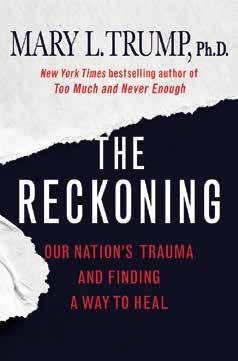
The Reckoning : Opening eyes to our personal and national trauma
You can barely stand to look. You open your eyes quick and scan, though, because you need to be informed. But the news is sometimes hard to take lately. Consuming it in small bites may be best, or devour it if you can, but take care. Because, as author Mary L. Trump, PhD, says in The Reckoning,” you may have been the victim of trauma. But she also offers a way to work beyond it.
Trump, a psychologist who was diagnosed with complex post-traumatic stress disorder, blames much of her condition on her infamous uncle. But for America as a whole, she says we’ve been through something deeper and wider-ranging: the trauma of slavery, theft of land, injustice, and ongoing inequality — mostly for Blacks but also for Native Americans and LGBTQ people — as well as war, hardship, and betrayals of all sorts (not to mention disease) that continue to permeate every corner of American life. “This country was born on trauma,” she says.
She wondered what things might be like for America after months of divisive politics and the pandemic. White people
inherently enjoy white privilege, Trump says plainly; they might try to deny it, but the fact is that the world whites walk in so blithely is not the same one Black citizens live. That causes trauma in both directions, because “trauma shapes us in ways we may not be aware of, and will always do so unless we face what has happened to us... [and] what we’ve done to each other.”
And that’s where politics enter, especially since the end of the Civil War: politicians have become adept at convincing
Trump, a psychologist who was diagnosed with complex post-traumatic stress disorder, blames much of her condition on her infamous uncle. But for America as a whole, she says we’ve been through something deeper and wider-ranging: the trauma of slavery, theft of land, injustice, and ongoing inequality — mostly for Blacks but also for Native Americans and LGBTQ people… “This country was born on trauma,” she says.
white America, subtly or overtly, that Black people are lesser; that “moving on” without reckoning is possible; and that we should put transgressions aside by whitewashing them, minimizing them, and by refusing to demand accountability.
“But as seductive as it is, wiping out chapters in our history,” says Trump, “... leaves future generations vulnerable. We know this. Only remembering will heal us. Maybe it will even set us free.”
Let me add that readers who come to
The Reckoning for another dose of Trump’s family story will not be disappointed. She has plenty of acid left to spray on the last administration’s years. But that’s not this book’s primary focus.
White privilege and the dismantling of racism is, and that comes as some surprise,
in both the history Trump uses to make her points and in the obvious passion in her arguments. What she writes, however, and the lofty ideals she espouses are nothing new, yet here they feel like small terriers at your feet, nipping for unwavering attention, demanding focus and deep consideration. You may not like what you read, but it’s going to force you to think, hard, about the future, individually and nationally.
Unfortunately, The Reckoning is going to be politicized, when the book itself is not, or not entirely. Though it shouldn’t, that may chase away politics-weary readers who would otherwise get a lot out of a book like this, one that may be an absolute eyeopener.
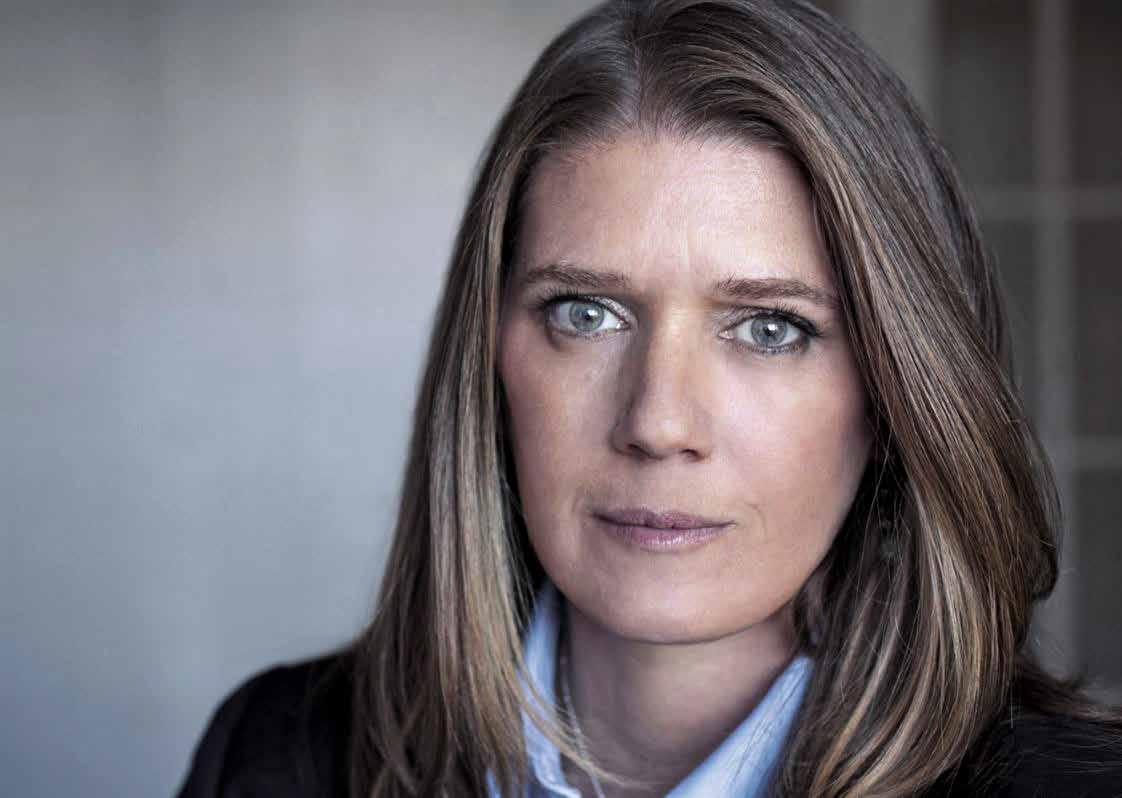
Mary L. Trump – Photo by Peter Serling
Image courtesy of St. Martin's Press
Op-Ed
Shoe Gummi by Shantel Jackson: Relieving foot pain and bringing high heels out the closet
by Janice Athill SGN Contributing Writer
If you love high-heeled shoes but don’t wear them as often as you’d like because of pain and discomfort, this article is about to change your life.
A young woman from one of the roughest neighborhoods in Miami, Florida, with big dreams and even bigger ambition, defied the odds of her upbringing and created one of the most innovative products the fashion industry has ever seen: Shoe Gummi, the world’s first outer sole made specifically for combating the pain and discomfort high heels are infamous for.
From discrimination to invention Shantel Jackson, a fair-skinned Black woman, experienced the discrimination that comes with colorism very early on in life. The term “white girl” was used to tease and bully her, but these issues she would readily solve with her own fists.
“In my neighborhood, girls would call me white and want to fight me because of how I look,” she said during our conversation. “I was a little hot-headed back then, and felt I had to defend my honor and my blackness... Growing up in a certain area and looking a certain way, people feel like they can try [to disrespect] you, so I was like, go ahead and try.”
This type of behavior tends to get many young Black girls labeled “problematic”; adults and authority figures typically disregard the provocation for it.
There are a multitude of stereotypes that follow Black girls into womanhood, (mammy, whore, baby mama) and others that follow Black women in the media limelight (video vixen, gold digger, etc.). These expectations and perceptions are applied in a cookie-cutter fashion.
Jackson, also known by her stage name Miss Jackson, has defied them all, while staying professional throughout her modeling career. She built from scratch what is now one of the world’s most unique inventions, Shoe Gummi, which orthopedic surgeon Dr. Richard Lehman calls “the most innovative orthotic to relieve foot stress in high-heeled shoes that I have seen in my 31 years of practice.”
Lab tested
Wearing high heels shifts your body weight forward, putting pressure on the balls of your feet, toes, and ankles. Shoe Gummi is designed to change the way you feel in your high heels by shortening the distance between the impact of the ground and your foot, absorbing the pressure applied to the balls of your feet. It tilts the shoe back slightly, adjusting the pressure put on the forefoot, stopping one’s feet from sliding forward and redistributing weight to the heels.
Designed with shock-absorbing, waterproof, heat- and wear-resistant foam with anti-slip ridges, Jackson’s product has gone through extensive testing to confirm its effectiveness, optimize product design, and create marketing data based on performance.
After hundreds of prototypes, redesigns, and restless nights, lab testing of what would become Shoe Gummi’s final product was conducted. Eight women equipped with in-shoe sensors walked in high heels with and without Shoe Gummi prototypes. The results without Shoe Gummi indicated pressure in the front of the foot. Those with the product showed a redistribution of weight more evenly throughout the foot, proving it is effective for relieving pressure and pain while wearing highheeled shoes.
Expanding options
What began as a simple idea for personal use has since blossomed into a global phenomenon, with shipments worldwide.
Shoe Gummi is also not a one-size-fitsall product. When it launched in December of 2019, it would only accommodate
women’s shoe sizes 7-9. However, as of this month, it now accommodates foot sizes as small as a women’s 5 and as large as a women’s 12, and has added a design for pointed high-heel shoes, for which there wasn’t an option before.
Shoe Gummi may have been originally
A young woman from one of the roughest neighborhoods in Miami, Florida, with big dreams and even bigger ambition, defied the odds of her upbringing and created one of the most innovative products the fashion industry has ever seen: Shoe Gummi, the world’s first outer sole made specifically for combating the pain and discomfort high heels are infamous for.
designed with a certain view of women in mind, but it is steadily evolving. When I asked if she planned to research the market for Trans women’s foot sizes that go past a women’s 12, she replied, “If all goes well with the launch of my larger Gummi, I would like to offer an option for shoes extending to a women’s 14. From there, I’ll be looking into a more cost-efficient way of offering custom sizes for our sisters with bigger feet.”
Bottom line: This is a Black-owned company with a product dedicated to providing relief and comfort for high heel lovers everywhere.
Visit Shoegummi.com to learn more and place an order.
Photos courtesy of Shantel Jackson
Op-Ed
The Stainless Banner carries the stain of Southern hate
by Lindsey Anderson SGN Contributing Writer
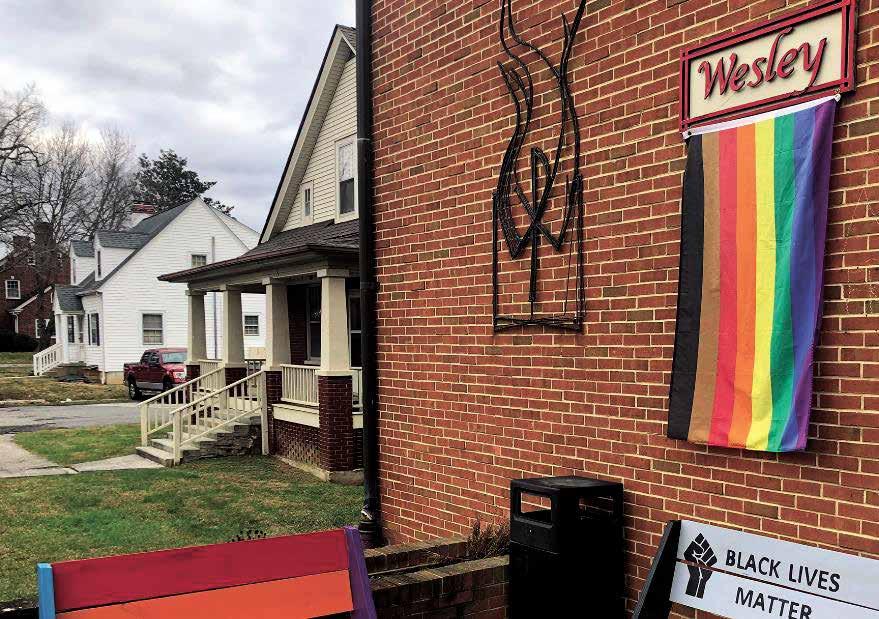
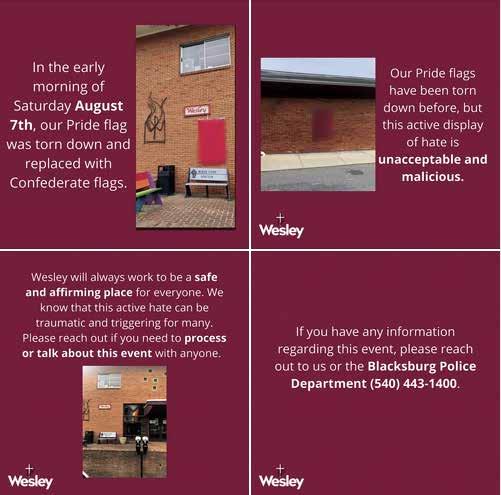
Students at Virginia Tech are fearing for their safety this week after Pride flags were stolen from school grounds and replaced with flags of the Confederate Army.
While this may not come as much of a surprise — Virginia was once the slave capital of the country — the act of replacing the flags with ones that symbolize racism and hate has many students on campus feeling unwelcome.
The rainbow flags were originally hung outside the Virginia Tech religious center, a symbol of peace and acceptance from an institution traditionally reluctant to accept homosexuality. Despite this, homophobic tensions are still very present in the community. Over the last two weeks, Pride flags have been stolen from the religious center three times. However, after the latest incident, the vandals responsible left a calling card: two Confederate flags ominously floating in the wind.
While annoying, petty theft of Pride flags was never much of a concern when it came to the safety and well-being of students on campus. Church officials and campus security had not looked into previous incidents, due to the lack of a threat. After all, it could just be some neighboring kids attempting a prank.
But with the emergence of the Confederate flags, a known symbol of white supremacy and hatred, authorities were alerted, and an investigation has been opened. Brett Graham, who runs the religious center, noted safety as one of the main reasons behind the heightened concern “My number one concern is the students and making sure they feel they have a safe environment to come, to live out their faith, and to be affirmed in who they are,” he said in a press statement.
A symbol of violence, a history of lies
Despite those that claim the Confederate flag is a symbol of history, it has always incited fear in anyone who is not white, cis, or straight. The flag we commonly associate with the Confederate Army today, sometimes referred to as “the Southern Cross” or “the Stainless Banner,” was the second design for the seceding states. The first attempt, a cheap knock-off of the United States flag, was so similar that Confederate soldiers fired at their own troops.
(Modern Confederate sympathizers also argue the war wasn’t about slavery, but rather economics, despite the fact that Confederate soldiers couldn’t even understand who they were fighting, let alone the economic system of a developing country.)
That ugly second attempt of a flag didn’t even last long in the Civil War, as the Confederate army drew up two more flags, which are not seen or displayed today. If fans of the Confederate flag took a class on critical race theory instead of attempting to get all their information from History Channel commercials, they might have the good sense to at least switch it up and use some of the other flag designs.
The Southern Cross flag actually disappeared after the Confederate Army fell and the country entered the period called Reconstruction. By the early 20th century, Southerners had conveniently forgotten many inconvenient details about the Civil War, arguing that it was actually fought to protect the genteel way of Southern life and states’ rights from “Northern aggression.”
As such fairytales about the antebellum era began to be popularized, so did the image of the Confederate flag and the ideals of Jim Crow. Staunch conservatives, angered by Black voters, began to fly the flag as a symbol of “Dixie,” out of a desire to return to the mythical old South, to halt the civil rights movement, and to end racial segregation.
As hate crimes continue to happen on campuses across the United States, even here in Washington, students are finding it harder to feel safe at their schools.
After the landmark 1954 court decision in Brown v. Board of Education, which desegregated schools, the flag became even more popular. State capitals began to fly it, and its symbols were incorporated into state flags. The Ku Klux Klan also began to fly the flag in their violent raids and attempts to intimidate Black citizens.
The flag today stands as a symbol of hatred toward the Black community. It carries little historical context regarding the Civil War or Southern heritage, as it only began to gain popularity as a symbol against integration and progress. Today, most rightly associate it with the KKK and other domestic terrorist organizations.
A danger to students
The KKK has loudly been against the LGBTQ community. In 2015 a KKK rally called on all members of the Klan to “slaughter Gay people.” Replacing the Pride flag with a known symbol of hatred is a chilling reminder that many people still harbor violently racist and homophobic ideas.
This ideology is especially frightening when it occurs on college campuses. In less populated areas and more conservative counties, the student body is often much more diverse than the surrounding region, as most students come from other towns, states, and even countries. For BIPOC and LGBTQ students from more accepting hometowns, this adjustment to a homogeneous white and
straight culture can be incredibly isolating.
Furthermore, hate crimes on college campuses have been on a steady rise over the last few years. Since the events of Charlottesville in 2017, wherein the KKK took to the streets and killed a young protester with a car, hate crimes have occurred at a much higher frequency.
In March 2021, the University of Washington released a statement addressing an increase in hate crimes against Asian students and faculty after two Asian American churches in North Seattle were vandalized and a Japanese-language teacher from the university was assaulted.
In November 2020, Gonzaga University, in Spokane, also issued a statement addressing racially charged hate crimes after a Zoom meeting of the Black Student Union was hijacked by an unidentified individual
who proceeded to show clips of lynchings and the Confederate flag.
As hate crimes continue to happen on campuses across the United States, even here in Washington, students are finding it harder to feel safe at their schools. The latest crime at Virginia Tech goes to show that, even when institutions make an effort to show students they are welcome, the greater community is still there, watching and ready to strike.
Until these acts of violence and intimidation are taken seriously, we will not see an end. There is no justification for the Confederate flag: it is not a symbol of history but rather a symbol of hatred and terror. BIPOC and LGBTQ students in all communities deserve better. They deserve protection from heinous acts like those at Virginia Tech, and those responsible must be held accountable.
Photos courtesy of Wesley at Virginia Tech / Facebook
POETRY = LIFE
continued from cover
This column will bring you the voices of some fellow humans — living now or from the recent or far past — who have strong feelings about who they are, how they feel, and who or what they love. (I talk about them in the present tense, because poetry, like love, never dies. It is always in the present, and always with us.)
You may already know some of these poets, or they may be new to you. I hope their experiences and their artful use of language will resonate with you on some essential level. They are your fellow poets.
Cavafy was a Gay man living in a time and place when homosexuality was outlawed, punishable by imprisonment... his poetry has provided many people with a voice of fierce insight, sympathy, and companionship.
One of the great poets of the turn of the 20th century is Constantine Cavafy (1863–1933), who wrote in Greek and is only known to us in translation, yet his writing is so powerful that his poems are famous in many languages. Cavafy was a Gay man living in a time and place when homosexuality was outlawed, punishable by imprisonment. He never published his poems in his lifetime, and he is known to have had only two brief sexual relationships in his life. He worked as a civil servant and lived alone, but his true lifework — poetry — has provided many people with a voice of fierce insight, sympathy, and companionship.
Both of the following poems are translated from the Greek by Rae Dalvin from The Complete Poems of Cavafy Translated, and with Notes (Harvest Books, 1961). The first poem, “Their Beginning,” written in 1922, shows how a young man that the world considers “deviant” follows his passion and reaps a harvest of inspiration for the rest of his life. The second poem, “The Mirror in the Hall,” written in 1930, uses the metaphor of a mirror to capture a sensation we all have had when struck to the heart by a beautiful passer-by.
Sharon Cumberland is a professor emerita of English at Seattle University.
THEIR BEGINNING
The fulfillment of their deviant, sensual delight is done. They rose from the mattress, and they dress hurriedly without speaking. They leave the house separately, furtively; and as they walk somewhat uneasily on the street, it seems as if they suspect that something about them betrays into what kind of bed they fell a little while back.
But how the life of the artist has gained. Tomorrow, the next day, years later, the vigorous verses will be composed that had their beginning here.
THE MIRROR IN THE HALL
The wealthy home had in its entrance an enormous, extremely old mirror, that must have been bought at least eighty years ago.
An unusually handsome lad, a tailor’s employee (on Sundays an amateur athlete), stood holding a parcel. He delivered it to someone in the house, who carried it inside to fetch the receipt. The tailor’s employee was left by himself, and he waited. He approached the mirror and took a look at himself, and he straightened his tie. Five minutes later they brought back the receipt. He took it and left.
But the old mirror that had seen and seen, during the long, long years of its existence, thousands of objects and faces; but this time the old mirror was delighted, and it felt proud that it had received unto itself for a few moments an image of flawless beauty.
Photo courtesy of C.P. Cavafy Archives / Onassis Foundation
National News
Truth wins out: The continuing fight against conversion therapy
by Lindsey Anderson
SGN Contributing Writer
It’s been a decade since Lady Gaga informed the world that LGBTQ people were, in fact, “born this way” and every teenage girl decided she needed a Gay Best Friend. Marriage equality became the law of the land, every single brand in the world celebrates Pride Month now, and Queer Eye won an Emmy.
So why is there still a fight to be had against conversion therapy and ex-Gay ministries?
“What you learn in this business is there’s no finish line. As long as there’s prejudice and bigotry, there is going to be a supplyand-demand issue,” said Wayne Besen, author and activist with Truth Wins Out, an organization founded to fight what it calls “anti-gay religious extremism.”
“If you’re supplying enough hate, it will create a demand for these groups, and somebody will fill it,” he added.
A lifelong journey
Besen has been involved in the movement since he came out at age 18. At first, his parents were devastated, and while walking through the mall one day, a booth caught their attention.
“There was an ex-Gay table called ‘Gay and Unhappy’ and it was really weird,” he said. “The first half of it was… this soft and religious pretty music, and the second part was subliminal and it had some guy talking, going, ‘You love women, you love the way they talk, you love the way they smell,’ and it was really that ridiculous.”
The experience was so strange that Besen later spoofed it when appearing on The Daily Show in 2006. But it also opened his eyes to the dangers of extreme religious pressures put on LGBTQ people to attempt to suppress their identities in order to fit into their communities.
“That got me involved initially. I knew it was a scam; I knew it was a fraud, and if my
family would fall for it — and we weren’t religious — imagine the pull to it for families who did grow up religious. How devastating it was — after you worked so hard to speak your truth and be who you are — to have some con artist come and upset that process, and to have your own family and friends give you this kind of rejection. I realized that was the core of our movement. That message was an existential threat.”
seemed like the conversion therapy movement was starting to die down and he was looking forward to taking a break. Then George W. Bush began to push for a federal ban on Gay marriage.
“In 2006, George W. Bush invited [exGay leaders] to the White House to push for a federal marriage amendment outlawing same-sex marriage in the Constitution, and in reaction to that I said, ‘That’s enough of
Despite the years of work Wayne Besen and others have put in with organizations dedicated to helping expose the lies of the religious right, conversion therapy is still a reality in many parts of the country.
A few years later Besen joined a campaign that worked to combat the New Hampshire “Truth and Love” organization, which was featured on the cover of Newsweek as well as on segments of the Oprah Winfrey Show and 60 Minutes. It was making the argument that, with special programs and enough prayer, LGBTQ people could be “cured” and live happily and heterosexually.
Over the next decade and a half, Besen helped to shut down leaders of some of the most prominent groups, usually by photographing them in Gay bars or finding records of their participation in same-sex orgies and prostitution. “I photographed the king of the ex-Gay ministries, John Paul, who was on the cover of Newsweek, and was on Oprah and 60 Minutes. he was the chairman of Exodus and ran Focus on the Family’s ‘Love Won Out’ [an ex-Gay ministry]. He wrote two books, with his exLesbian wife. I photographed him in a Gay bar, and pretty well, there went his career.”
After that, Besen published his first book, Anything But Straight, and went on a national tour to support it. At the time, it
this.’ And I went to DC and launched the organization, and the rest is history.”
For the next 15 years he worked with his organization, Truth Wins Out, to expose the lies of the religious right. “They don’t believe that stuff for a second. They think it’s just as absurd as I do, but they’re putting out that message to pass laws that hurt us,” he explained. “They want to say that LGBTQ people do not deserve equal rights, and the reason they don’t is because it is a sinful, sick lifestyle choice that can change. ‘They don’t need to get married; they just need to be changed and marry someone of the opposite sex.’ It’s all about punitive laws.”
Rebooting the ex-Gay movement
Despite the years of work Besen and others have put in with organizations dedicated to helping expose the lies of the religious right, conversion therapy is still a reality in many parts of the country. “Now there’s a resurgence. In 2019 it really took off. After Exodus closed in 2013, there was kind of a lull — they were so embarrassed by their incredible failures… Now they’re launching
new movements like ‘Changed Movement’ and ‘Freedom Arches.’ It’s a rebranding, a rebooting, if you like. But we’re gonna do what we did with that first batch of ex-Gays and put them out of business.”
Not only are new organizations popping up across America, but they are also beginning to move abroad. “Overseas we see these American activists, having failed at home, trying to peddle their snake oil abroad. We’re trying to stop that as well,” said Besen.
Currently, Truth Wins Out is working on creating programs in other languages, starting with Spanish and hoping to move soon into Korean, Russian, Chinese, and Polish. The hope is that they will be able to help people dealing with different religious and cultural pressures to feel accepted for who they are.
Shame, trauma, and money
Churches and conservative groups push these hurtful messages, instilling fear in young people who suspect they may be a part of the LGBTQ community. The result is self-hatred, years of trauma, and sometimes even death.
Why do these groups target LGBTQ rights? According to Besen, it comes down to money and shame. “The main reason there’s money in this and the religious right is behind it is because they want to hurt our community,” he explained. “Some of them make a handsome profit. It’s a good living.”
For those that do not profit financially from the church, there is still something to be said for being able to maintain social status. Community is essential for the wellbeing of all living things, and in conservative pockets, where the LGBTQ community is invisible or seemingly nonexistent, some Queer folks may go to desperate measures in order to feel like they are still accepted. “If you grow up in that atmosphere and that’s what you know and you want to please people and be accepted, you’re still gonna feel a very strong draw to at least try to change.”
Wayne Besen – Photo courtesy of Truth Wins Out
Conversion therapy close to home
Here in Seattle, where Pride flags wave along the streets of Capitol Hill, pronouns are often asked and respected, and a little Gay newspaper can be found in nearly every coffee shop, we don’t have to worry about such issues as the religious right, right?
Not according to Besen. “In every community, no matter how liberal, there’s a conservative right-wing church. In your neighborhood, Seattle, that’s where Exodus International got started. That’s where the former executive director lived. Exodus’ home base was in Seattle for many, many years, actually most of the organization’s existence. John Paul came from a Portland fellowship. The modern ex-Gay ministries was started right outside of San Francisco. So the liberal communities are where these began and flourished in the beginning.
“Even in the most liberal cities, there are still conservative churches, either in the cities themselves or in the outlying suburbs that surround it. I’m sure you can go right outside Seattle and see some of these crazy right-wing militia types...
“This affects all parts of the country. There are portions of the country that are still steeped very heavily in the church, and it’s a problem.”
On a federal level the threat still looms as well. “Things change radically quickly politically. Had Trump been successful with his coup attempt, who do you think all those people [are] who were joining him? They’re all Christian fundamentalists. Ted Cruz, Jim Jordan, Marjorie Taylor Greene: all of these atrocious people are right-wing
GOP continued from cover
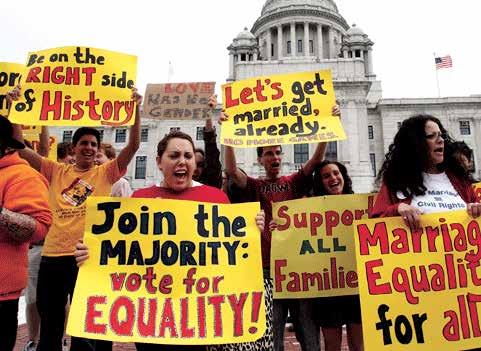
The magazine said it had interviewed Republican operatives, former Trump administration officials, and conservative leaders, and found there is a widespread acceptance that marriage equality is a settled issue.
There is no serious discussion about trying to overturn Obergefell v. Hodges, Politico said. In Congress, LGBTQ activists found potential allies in newly elected Republicans like Rep. Dan Crenshaw (R-TX), Rep. Elise Stefanik (R-NY), and Rep. Young Kim (R-CA).
“There is Republican support for LGBTQ issues. There is more energy in the GOP for help for gay and transgender issues than a lot of issues Biden cares about,” Tyler Deaton, a Republican consultant and senior adviser to the American Unity Fund, told the publication.
Out of step
Republicans were definitely late to the party. Much of the country grew to accept same-sex marriage well in advance of the Supreme Court decision legalizing it in 2015, but GOP voters didn’t. A Gallup poll from 2014 showed only 30% of Republican voters in support.
There were also prominent conservatives who warned Republican party leaders that they were dramatically out of step with the public as a whole.
Ken Mehlman, who managed George W. Bush’s 2004 presidential run, apologized for the anti-same-sex marriage rhetoric of that campaign and for his role in fighting marriage equality, while announcing that he was Gay.
One of the founding members of the Federalist Society, conservative attorney Ted Olson, joined forces with David Boies, a Democratic attorney, to overturn Proposition 8, California’s ban on same-sex marriage. Hedge fund billionaire and Republican donor Paul Singer quietly donated to pro–Gay rights causes and formed the American Unity PAC and American Unity Fund, which advocate for LGBTQ and religious freedom. And former Vice President Dick Cheney was famously at odds with President Bush over same-sex marriage and became a supporter of the movement. His daughter, Mary Cheney, has been married to her wife since 2012.
“The main reason there’s money in this and the religious right is behind it is because they want to hurt our community.”
Christians who believe in this garbage. Our last Vice President, Mike Pence, was a huge supporter of this stuff.
“Imagine if they had seized power. We were very close.”
We have seen the effects the silent conservative majority can have. People aren’t always vocal about their hate, but those who stormed the Capitol in January, those who voted for Trump in November, are the same people spreading the idea to their friends, family, and children that being LGBTQ is a choice and a sin — and something that can be corrected or at least deeply hidden.
Fighting the fallout of shame
Tools like the internet, Truth Wins Out, and other LGBTQ+ resources have become more accessible to young people living in conservative areas and households, but often they aren’t enough. The resurgence of the ex-Gay movement relies on the internet to expedite their information.
“Truth and Love,” the organization that first pulled Besen into the fight, has
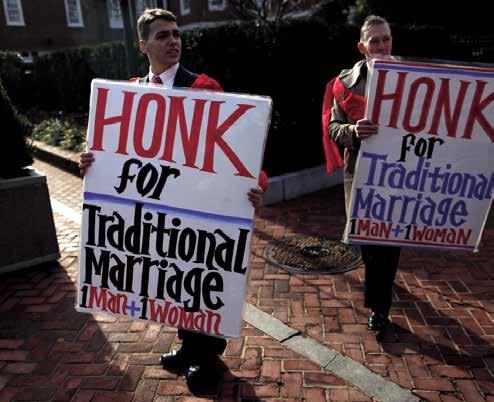
[Among] Republican operatives, former Trump administration officials, and conservative leaders, there is a widespread acceptance that marriage equality is a settled issue. Now Transgender issues are shaping up as the new dividing line.
Some GOP faithful still find LGBTQ rights hard to accept, however. When Republican National Committee chair Ronna McDaniel tweeted an innocuous “Happy #PrideMonth!” in June, she met a firestorm of protest from the GOP’s stillpowerful evangelical wing.
Tony Perkins, leader of the Family Research Council, blasted her in a scathing blog post and even told religious people not to donate to the RNC.
Trans issues are the new dividing line Transgender issues are shaping up as the new dividing line for Republican activists. According to Politico, fierce opposition to Trans rights still exists within GOP ranks.
The Trump-era Education Department eliminated guidance that sought to extend protections around the treatment of transgender students. And Trump himself issued an executive order, via tweet, prohibiting Transgender individuals from serving in the military — a move later overturned by President Biden.
Potential 2024 candidates like Nikki Haley and Florida Gov. Ron DeSantis have backed laws that would ban Transgender athletes from participating in sports consistent with their gender identity. According to the Human Rights Campaign, 2021 was a record year for anti-Transgender legislation, with dozens of laws introduced in
rebranded with a new website and testimonial videos, including one from an “exTransgender” person.
“These former ex-Gay leaders, they’re culpable, they’ve killed people, essentially, [they have] blood on their hands,” said Besen. “But it’s also true they were victims themselves before they became victimizers; they were from very conservative areas, and there were no positive messages. They were told they were going to hell and they’re sick and they’re sinful and they can change. They themselves were victims before they abused others.”
Often, this shame hurts more than just LGBTQ people. “Unfortunately, it’s a tragedy for everyone involved, especially the families that are torn apart. You have the parents that are told their children are Gay because of their parenting, which is not true. You have the spouses who are collateral damage, essentially used as props in this ideological drama, and their lives are ruined. They could have been happy with someone who was attracted to them and actually loved them, but they were used by the churches so these people could fit into society. And then there’s the kids: if there’s divorce, they’re left with a broken home, so the implications are far-reaching.”
So, what can we do to stop this resurgence of the religious right? According to Besen, the answer is loud public tolerance.
“That 70% of Americans support same sex marriage is kryptonite to them. It’s a shame-based model, and the more acceptance we get, the harder it will be for them.”
He is also working hard to make sure we
don’t forget just how real and dangerous the ex-Gay movement is, and how damaging conversion therapy has been. Besen has been spending the summer archiving his records with the Philadelphia LGBTQ Center so that these stories and experiences are not forgotten.
“I want to create a very robust record of what happened during this time period when these groups were very powerful, and the Republican machine tried to use their stories to change lives. They were a house of cards built on a lie. I want to create an indisputable record of what happened, so that the truth can be found, [so that anybody] can look back and see what actually happened. And what they’ll see is that this was an experiment that failed and failed spectacularly.”
The more Americans begin to agree with love over hate, celebrate pride, and normalize LGBTQ identities, the harder it will be for these churches to hurt people.
Wayne Besen, the author of Anything But Straight and Bashing Back, can be found on Instagram at @truthwinsout_org. He is the founder of Truth Wins Out and was a former spokesperson for the Human Rights Campaign. He has been nominated for the Lambda Literary Award for Spirituality and the Lambda Literary Award for LGBTQ Studies.
Truth Wins Out has just released its newest publication, To The Dark Side and Back, detailing the history of the ex-Gay movement.
“I
But
Republican legislatures across the country placing restrictions on Transgender people.
think even with Christians, the Gay [marriage] issue, that ship has sailed.
the Trans issue is different,” one unnamed Trump adviser told Politico
Photo by Patrick Semansky / AP
Photo by Steven Senne / AP
National & International News
National news highlights
by Daniel Lindsley SGN Contributing Writer
Ambassador James Hormel
–
San Francisco:
First openly Gay US ambassador dies NBC News and the Associated Press reported on August 13 that James Hormel, the first openly Gay US ambassador, has died at age 88. Hormel was a philanthropist, funding human rights organizations and AIDS research. He served in the Clinton administration from June 1999 to 2000, but not without facing hatred and hardship. The process of his nomination was “strenuous, arduous, insulting... [and] full of antagonism,” Hormel said at a book signing in West Hollywood in 2012. Although he was never appointed by a Senate vote, Hormel believes he paved the way for others, and most honoring him now — Bill and Hillary Clinton, Pete Buttigieg, and Nancy Pelosi included — seem to agree.
Illinois:
Hobby Lobby will pay for anti-Trans discrimination LGBTQ Nation reported August 13 on an Illinois court’s ruling that Christian-owned retail chain Hobby Lobby discriminated against one of its workers because of her status as a Transgender woman. Meggan Sommerville was barred from using the women’s restroom at Hobby Lobby for nearly ten years of her employment there. According to the court, Hobby Lobby “repeatedly changed its precondition” for limiting Sommerville to the men’s restroom, “violat[ing] both Article 2 and Article 5,” which each outlaw gender discrimination and discrimination in the access of public accommodations and facilities. Hobby Lobby will pay Sommerville $220,000 in damages, or possibly more if the commission so decides.
Anti-vax Catholic cardinal on ventilator for COVID
Raymond Burke: enemy of science and LGBTQ community
by Mike Andrew SGN Staff Writer
The staff of Roman Catholic Cardinal Raymond Burke confirmed on August 14 that the prelate is on a respirator being treated for a COVID-19 infection.
Burke, a traditionalist Catholic and a longtime thorn in the side of Pope Francis, had previously spoken out against COVID vaccines.
In a follow-up on the cardinal’s condition, his religious foundation, the Shrine of Our Lady of Guadalupe, noted that Burke is surrounded by religious relics — thought by traditionalist Catholics to have healing powers — and cautioned supporters to stop sending advice on the cardinal’s treatment.
“As of August 17th, His Eminence remains in serious but stable condition,” the Shrine staff said.
“His family, who with a team of doctors, is responsible for all medical decisions while the Cardinal remains sedated and on a medical ventilator, has great confidence in the care he is receiving. The Cardinal has received the Sacraments from priests nearby to him. There are several relics in his room.
“While the Cardinal’s family appreciates the good intentions of those who have
Cardinal Burke, a traditionalist Catholic is in serious condition after contracting COVID-19. He has spoken out against vaccinations and against the LGBTQ+ community.
suggested treatments, consultations, etc., they ask that people refrain from sending anything further. They also ask that you not contact them, members of the Shrine staff, or the Cardinal’s residence in Rome to discuss his condition.”
Burke has dissented from Pope Francis on many theological questions — at one point suggesting that the Pope had committed no less than six doctrinal errors — and also opposes the Pope’s advice that Catholics should be vaccinated against COVID.
Speaking at the Rome Life Forum, Burke said that “vaccination itself cannot be imposed, in a totalitarian manner, on citizens.”
He also quoted groups that suggested that COVID-19 vaccines inject “a kind of microchip” that allow citizens to “be controlled by the state regarding health and about other matters which we can only imagine.”
In a 2020, homily, the cardinal also referred to COVID as the “Wuhan virus,” an anti-Chinese buzzword often used by Burke’s political ally, Donald Trump.
Burke is no stranger to political controversy. He once declared, for example, that Joe Biden isn’t a real Catholic and should be denied Holy Communion because of Biden’s support for LGBTQ rights and reproductive choice.
Burke also stated that “those suffering from the homosexual condition” should have no right to “form families.” Ireland, he added, is now “worse than the pagans” for voting to legalize same-sex marriage.
Once a major figure in the Vatican bureaucracy, Burke has been sidelined by Pope Francis and now devotes most of his time to promoting his religious foundation and the traditionalist Latin Mass.
Photo by Alessandro Bianchi / Reuters
Photo courtesy of Randi Lynn Beach / AP
FDA authorizes COVID-19 vaccine boosters for immunocompromised Americans — with a few catches
by Hannah Saunders SGN Contributing Writer
On August 12, 2021, the Food and Drug Administration (FDA) authorized a third dose of the mRNA vaccines against the coronavirus for those who are immunocompromised. The Emergency Use Authorization (EUA) for both the Pfizer-BioNTech and Moderna SARS-CoV-2 vaccines has been amended to allow for the administration of additional doses for certain immunocompromised people — specifically, solid organ transplantation recipients or those with health conditions that have an equal level of immunocompromise.
“The country has entered yet another wave of the COVID-19 pandemic, and the FDA is especially cognizant that immunocompromised people are particularly at risk for severe disease. After a thorough review of the available data, the FDA determined that this small, vulnerable group may benefit from a third dose of the Pfizer-BioNTech or Moderna Vaccines,” stated acting FDA Commissioner Janet Woodcock, MD.
The following day, the Centers for Disease Control and Prevention (CDC) released updated information regarding vaccines and immunocompromised individuals, which aligned with that of the FDA.
“Today, I signed CDC’s Advisory Committee on Immunization Practices’ (ACIP) recommendation that endorsed the use of an additional dose of COVID-19 vaccine for people with moderately to severely compromised immune systems after an initial two-dose vaccine series,” stated CDC Director Rochelle Walensky, MD, MPH.
Immune response and COVID-19
In the United States, those who are immunocompromised account for approximately 3% of the adult population, yet studies show that fully vaccinated immunocompromised people make up a large portion of hospitalized breakthrough COVID cases: 40-44%.
Those who are immunocompromised have weakened immune systems and have a much slower immune response when it comes to fighting off foreign invaders. Because of this, they are at greater risk of contracting and spreading COVID-19 and developing severe COVID-19-related outcomes.
Although vaccines increase protection against COVID-19 tremendously, many who are immunocompromised and fully vaccinated do not have the same level of protection as someone who is fully vaccinated and not immunocompromised, due to a weaker antibody response. A third dose of the vaccine helps increase the antibody response, which in turn, increases the recipient’s level of protection. It is also
important to note that immunocompromised protection rates may vary based on health condition.
Who is eligible?
According to the CDC, immunocompromised people who are eligible to receive a third dose of the vaccine include those who:
• Are receiving active treatment for cancerous tumors or for blood cancers
• Have advanced or an untreated HIV infection
• Are organ transplant recipients and taking medication that suppresses the immune system
• Have had a stem cell transplant within the last two years or are taking meds that suppress the immune system
• Have a moderate to severe immunodeficiency, such as DiGeorge syndrome or Wiskott-Aldrich syndrome
• Have an active treatment with high-dose corticosteroids or other medications that may suppress the immune system
• People living with chronic health conditions, such as heart disease, asthma, and diabetes — which puts them at greater risk for serious related outcomes from COVID19 — are not eligible to receive a third dose at this time. The CDC suggests that they speak with their healthcare providers about their medical conditions in order to determine whether a third dose of the vaccine would be beneficial.
What you need to know about getting your third dose
It’s important to note that the Pfizer vaccine is authorized for use in those aged 12 and up, while the Moderna vaccine is authorized for those aged 18 and up. A third dose for those who are immunocompromised and fit the criteria should be given at minimum 28 days following the second dose, according to the FDA.
International news highlights
by Daniel Lindsley SGN Contributing Writer
Hungary: Booksellers face anti-LGBTQ censorship
On August 13, Reuters brought forth the voices of Hungarian book sellers who may have to self-censor after conservative nationalist Prime Minister Viktor Orban placed restrictions on the sale of books with “LGBT themes.” Such books intended for minors would have to be sold sealed and wrapped, and never within 200 meters of a school or church regardless of the intended audience. The head of the Association of Hungarian Book Publishers said this measure would severely limit access to LGBT-themed material in small towns, where many bookstores are within 200 meters of a school or church. A publishing house owner noted that, to enforce the law, the government would have to review the entire history of literature.
Reactions to the third dose are similar to those from the first two doses and range from mild to moderate, with the most commonly reported symptoms being fatigue and pain at the injection site.
In addition, people should stick with the same mRNA they’ve been going with: those fully vaccinated with Pfizer should receive a third dose of the Pfizer vaccine, and those fully vaccinated with Moderna should receive a third dose of the Moderna vaccine.
Johnson & Johnson on stand-by
The FDA and the CDC are working on the best course of action for immunocompromised Americans who received the single-dose Johnson & Johnson vaccine. According to the CDC, “There is not enough data at this time to determine whether immunocompromised people who received the Johnson & Johnson’s Janssen COVID-19 vaccine also have an improved antibody response following an additional dose of the same vaccine.”
Due to the lack of data, the EUA of the Johnson & Johnson vaccine has yet to be amended, and those that received it who are immunocompromised must wait.
Additional recommendations from health officials
A focus of the CDC and FDA is on making sure immunocompromised Americans have enough protection against the coronavirus. It is recommended that those who are immunocompromised follow all safety precaution measures, including wearing a mask, maintaining six feet of distance from others outside of one’s household, and avoiding large crowds and poorly ventilated areas.
Those who are in close contact with immunocompromised people should also get fully vaccinated, if they are not already.
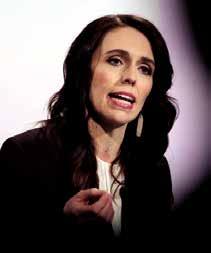
New Zealand: Parliament puts self-ID law to public review
Reuters reported on August 11 that New Zealand’s new “self-identification” law is one step closer to passing, now being sent to a committee to receive public feedback. The law would make changing one’s sex on their birth certificate far easier than before, to ensure “the best process” for transgender, non-binary and intersex people. Reuters noted that the country also passed legislation last month that outlaws all types of LGBT conversion programs.
On August 13, 2021, 24 deaths were reported in Washington state, which has been seeing on average 3,000 cases per day — a high since the winter surge.
Undoubtedly, the coronavirus continues to spread in Washington, which is why the Department of Health recommends that everyone — including those who are not immunocompromised — continue to follow all preventive measures, such as mask wearing, frequent handwashing, keeping gatherings small and outdoors, and staying home if symptomatic or exposed.
“We need to use all the tools we have to reduce the ongoing spread of this virus in our community and to keep ourselves and our loved ones safe,” stated the Secretary of Health Umair A. Shah, MD.
New Zealand Prime Minister Jacinda Ardern – Photo by Fiona Goodall / Reuters