Two philanthropic foundations have partnered to create a two-year pilot program that will provide $1.6 million in unrestricted funding to organizations that serve Queer youth in Washington. The Paul G. Allen Family Foundation, which invests in Pacific Northwest communities and focuses on underserved populations and youth, is providing the funds. Pride Foundation’s role is implementing the project.
by Lindsey Anderson SGN Staff Writer
When author Jake Arlow was in middle school, they were diagnosed with Crohn’s disease, a chronic illness affecting how one
goes to the bathroom. As a young kid learning how to navigate the world around them, Arlow often felt embarrassed about their disease. Now, 15 years later, a lot has changed.
by Ian Crowley SGN Contributing Writer While
Don’t Drag Me Down festival in Ballard this past hot and sunny Tuesday, a realization
see ARLOW page 17
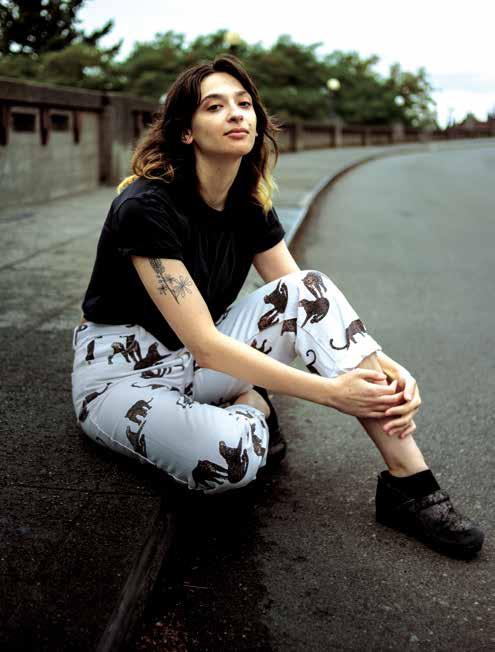
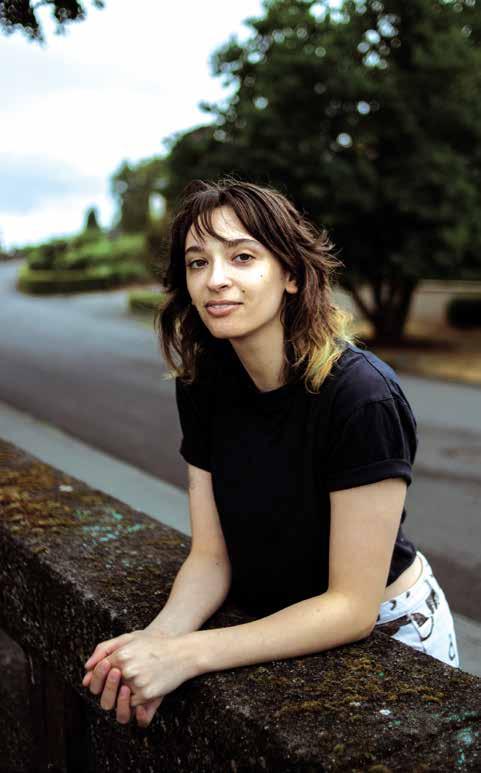
Jake Arlow – Photo by Torrin Nelson
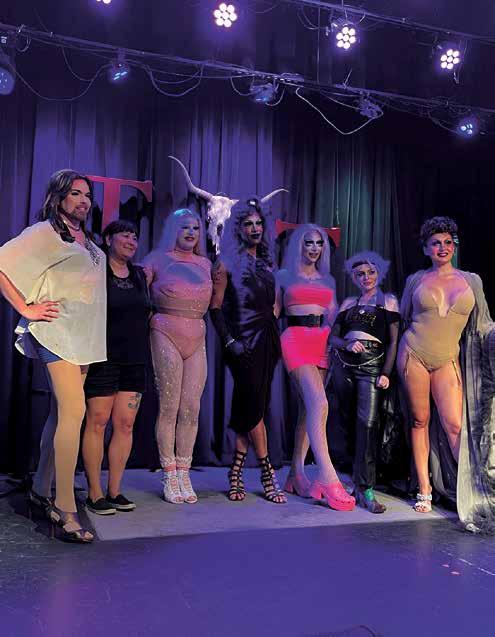
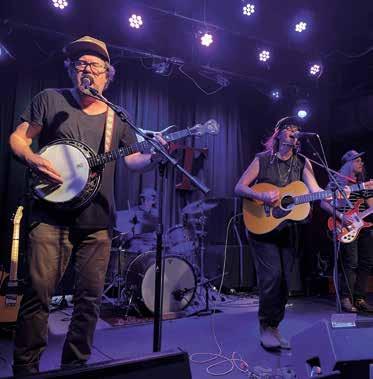
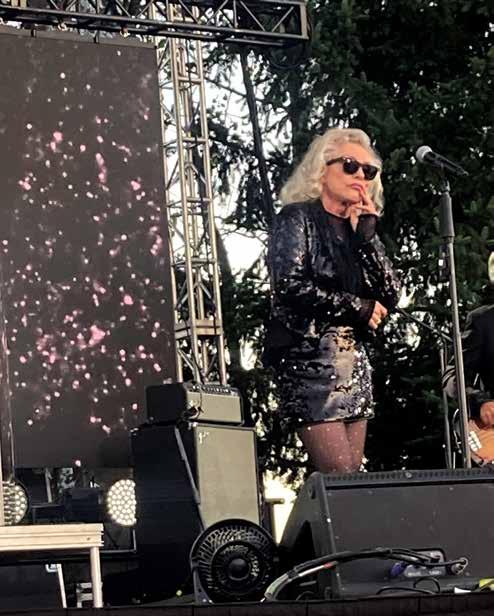
(l-r) DonnaTella, This Girl, Athena, Siren The Barbie, Edith Pilaf and Fraya Love on stage at The Tractor Tavern – Photo by Ian Crowley
Photo by Charina Pitzel
Courtesy of Paul G. Allen Family Foundation
Local News
Market of the Beast embraces the “other” in society
by Cameron Martinez SGN Contributing Writer
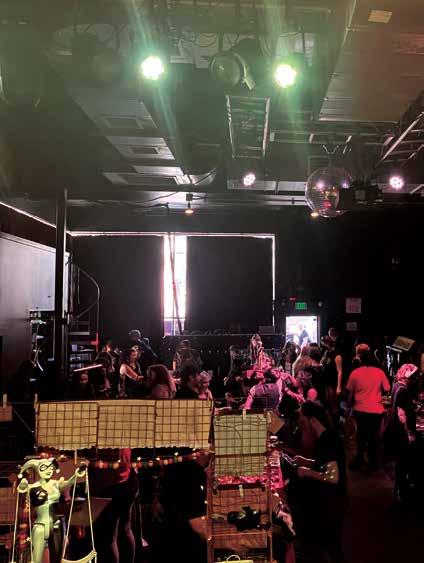
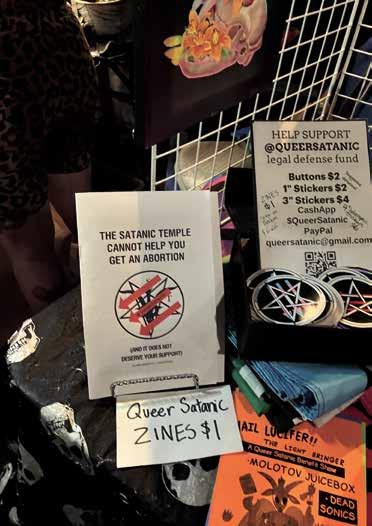
On August 13 at Neumos, hordes of people wearing dark clothes weaved their way between vendors offering oddities and curiosities not found in typical markets. The Market of the Beast, a traveling event for artists and merchants of the weird, wild, and occult, embraces the feeling of being an “other.”
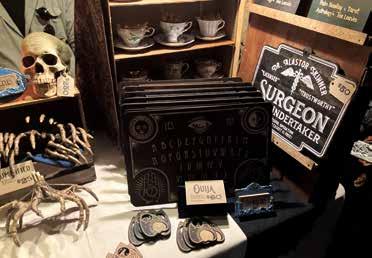
“[MotB offers] all the dark and creepy handmade goods like taxidermy, wet specimens, entomology, witchcraft tools, jewelry, apparel, illustrations, home decor, and more,” reads the market’s Instagram post advertising the event in Seattle. Part of the $5 entry fee goes to the Lavender Rights Project, an organization that strives to empower the Black Trans community in Seattle.
The artists and merchants
The dimly lit atmosphere, paired with the large assortment of strange objects, made it the perfect environment for alternative lifestyles to flourish.
“I came back around to [MotB this year] because a lot of this stuff is about … the hedonism, the pleasure, [and] indulging in it,” said James, a leathermaker who is part of a Queer collective called We Are Pansies. “I was like, ‘You know what, we’ll make the two-and-a-half-hour drive from Yakima and set up for the day.’”
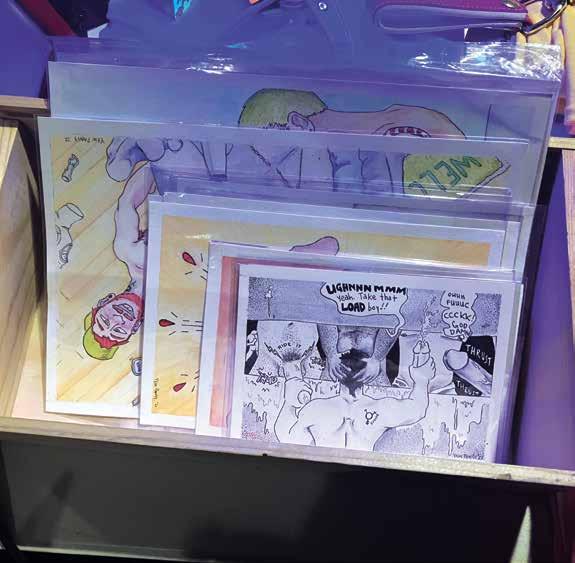
James, like many other people at the market, was selling artwork and leather harnesses that were sexual in nature. For many, embracing the darkness also means embracing their truest selves sexually.
Artist Kelly Dean Verity’s booth was covered in items celebrating queerness in every sense of the word. They had stickers ranging from Teenage Mutant Ninja Turtles saying “Antifa” to adorable satanic goats proclaiming “Pride is no sin” to colorful paintings of satanic bongs and goats.
“If you know what it’s like to be considered an ‘other,’ you can either try and assimilate or you can kind of lean into that,” Verity said when asked about the connection between the occult and being Queer. “I feel like just leaning into an alternative style — whether it’s my art or the way I dress — … sort of … goes along with that.
Because … they’re not gonna believe that I’m cis and they’re not going to believe that I’m straight anyway, so I might as well as lean in and be as … weird as possible.”
Connecting with nature through magic
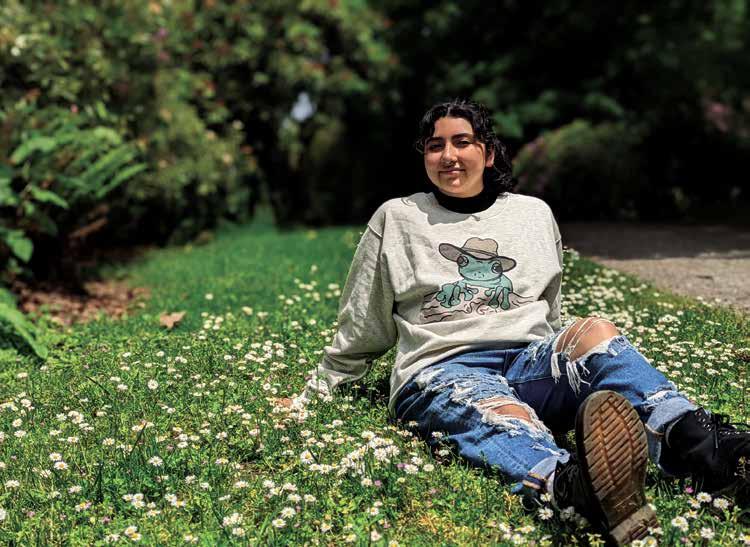
Artist Vivian with Batch Life: Art and Accessories also chose the market as an opportunity to embrace their Queer art. Their booth featured funny T-shirts that said things like “Be Gay do crime,” and “MILF: Man I Love Frogs.”
“I feel like my Queerdom is a really big part of my art, and when I find the people that understand my art, it’s like a sense of community,” Vivian said. “I’m not necessarily super connected to the dark… but I’m very woo-woo.
“I think it’s just kind of like being Queer is a part of nature. And it’s always been inherently natural to be Queer, especially when you look at animals and minerals and all that shit. It just feels like the nature of art. The dark arts, it’s all … one together. And it’s like an ancient rhythm from thousands and millions of years ago. That’s how I guess queerdom connects to magic.”
Vivian was not the only one who was connecting with the natural parts of magic, however. Cecy Graf and Schatzie Miller with Hedge Witch Tea, a women-owned tea seller and coven, strive to share their spiritual powers with people through the natural healing ingredients found in tea.
“I started making tea because I had to cut back on my caffeine,” said Graf, the head witch of Hedge Witch Tea. “But as
I was drinking more tea, I realized that a lot of the herbs in tea are in various spells. And I started being more intentional about how I use those herbs… All the herbal mixes and all the teas are based on the attributes, or the component brought to us, and so any of them can be used as spell work… On the back of our teas, we have step-by-step … how to manifest the spell.”
So while many people might fear “the dark,”, others find it a more accepting place than “the light,” and the Market of the Beast is somewhere to explore that.
If you are interested in the Market of the Beast, you can find it online at https://www. marketofthebeast.net. The next events will be on Nov. 12 in Tacoma and Dec. 10 in Seattle.
Photos by Cameron Martinez
YOUTH
The two groups connected as early as 2020, when the Pride Foundation created a “Crisis Community Care Fund” for LGBTQ+ organizations. At the time, the Paul G. Allen Family Foundation had made a grant to Pride Foundation to support the emergency efforts.
“The partnership was developed over time as we continued to have greater alignment around shared priorities,” said Katie Carter, CEO of Pride Foundation.
Though Pride Foundation also serves Alaska, Idaho, Montana, and Oregon, the pilot project is starting in Washington. The staff member at Pride Foundation working on the project did a landscape scan of groups in the state, and tried to find organizations outside of Seattle to provide rural support.
Thirteen subgrantees have received funds, and Carter says that Pride Foundation will put out an open call later this year or early next year for groups that might have been missed.
The staff member leading the project at Pride Foundation, who has 15 years of experience, will be conducting paid interviews with Queer youth to understand what kind of support they need.
“We’re really using this as an exploration to understand how we can better support these organizations,” Carter said.
There is currently no commitment on paper for similar projects in the future, but the language “pilot program” implies there may be more to come.
Stable funding
The grants are unrestricted general operating support, meaning the organizations that received the money are in control of it, and the funds don’t come with any additional reporting requirements or prescribed projects from either foundation. This type of grant is somewhat abnormal in the philanthropic world, Carter said, and allows for the organizations to continue doing what they’re doing, but with a more stable funding source.
“I can intimately understand the competing priorities for many smaller organizations having to decide between fundraising,
writing grants, and then participating in other things,” Carter said. “We’re hoping this frees up space for what they’re doing.”
Cilia Jurdy, development and operations director at FEEST, one of the organizations receiving a grant, said that grants that aren’t unrestricted can take up capacity on the nonprofit recipient’s end due to arduous reporting requirements and receipt tracking. The unrestricted grants provide some flexibility, so the group can also change where the money is going, if need be.
“Direct programming is sexy, right? Saying, ‘Oh, the money is going directly to our young people through youth stipends,’ people love that,” Jurdy said. “In the nonprofit world, we’re seeing movement toward unrestricted general operating [funds], but that has been [after] many years of nonprofit folks really pushing for that.”
Bridging a gap
LGBTQ+ issues are generally underfunded. Funders for LGBTQ Issues, an organization that works to increase philanthropic resources available to Queer communities, found that in 2021, only 28 cents for every $100 of philanthropic support by US foundations specifically supported LGBTQ communities and issues.
Carter said that Pride Foundation is small but mighty, and knows that other partners will be necessary to provide support. Using its expertise and connections in the community, the foundation works with larger organizations a to bridge that gap.
“Our hope is that … the visibility associated with this partnership will elevate the opportunity to resource Queer, Trans groups and organizations in a more meaningful way by philanthropy,” Carter said.
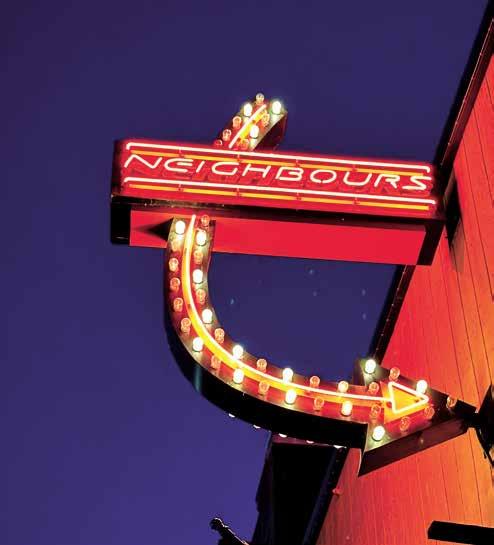
Neighbours’ final Leo Party
Courtesy photo
by Nemesis SGN Contributing Writer
Neighbours, one of Seattle’s oldest Gay nightclubs, recently celebrated its 20th and final Leo Party. With All Stars 8 finalist Jessica Wild as the headliner for the evening — along with a lineup of some of the city’s most iconic queens, including Ladie Chablis and Aleksa Manila — the event was set up to be a night to remember.
If the Leo Party went according to plan, it could have been an outstanding night of Queer art and entertainment. However, its potential was greatly overshadowed by an incredibly late show start.
Let’s start with the positive takeaways from the evening. DJ Pedro played wonderful tracks throughout my time there.
The go-go dancers were very talented and ethnically diverse. The lineup of entertainers was incredible. Aleksa looked beautiful and statuesque.
Fifty percent of all proceeds from the event were donated to 89.5 FM and Pride Asia. The Sisters of Perpetual Indulgence hosted a raffle ticket contest.
Now for the negatives. Let me start off by prefacing. I showed up at the venue at 7:30 p.m. Doors opened at 7 p.m. with a VIP meet-and-greet with Jessica at 8 p.m. and a scheduled start time of 8:25 p.m. I stayed at the venue until 9:50 p.m. During my time there, the go-go dancers danced a few sets. The Sisters hosted their raffle contest. Aleksa said a few words on the mic. And nothing else transpired. As someone
Jurdy has had a positive experience with Pride Foundation, saying it’s been wonderful to to see trust-based and communitycentric philanthropy.
“They are really open to conversations. Specifically for this grant, they were really low barrier. The questions they asked were thoughtful. They provided a lot of opportunities for us to reach out with whatever support we needed.”
As for Pride Foundation, it’s waiting for feedback from the community before deciding on next steps.
“The future is iterative. The future will be based on what we hear from groups and organizations,” Carter said.
who bartends full-time, does drag, writes for the SGN, and has a husband with disabilities and five fur babies, my life is extremely busy. I could only squeeze the first two hours of the show into my calendar. From what I could gather through various social media outlets, the Leo Party still took place, just way off of its scheduled time. I would also like to note that while the go-go dancers were diverse in ethnicity, we as Queer people are not all hairless muscle twinks — which is exactly what the dancers’ bodies looked like. Some of us are skinny. Some of us are large and in charge. We have stretch marks, scars, body hair. In 2023 there is no excuse to not have various body types giving much needed representation for our community. Their absence can be very damaging for a lot of people, myself included.
We as entertainers work in an industry where punctuality and professionalism are incredibly important. However, things don’t always happen according to plan. It’s unfortunate, but it’s a part of the fabric of reality. It happens. Neighbours is a vital piece of Seattle’s nightlife. Please continue to support not only the nightclub but the wonderful staff that work there and entertainers that grace its stage.
You can catch a plethora of wonderful shows and events at Neighbors, including “Fridays Are a Drag” with the champ of Camp Wanakiki season 5, Miss Texas 1988, every Friday at 10 p.m. at 1509 Broadway, in Seattle.
Photo courtesy of FEEST Seattle
Arts & Entertainment
Seattle Opera’s fascinating, innovative Rheingold the best show in town
by Alice Bloch & Sharon Cumberland SGN Contributing Writers
DAS RHEINGOLD
by Richard Wagner
Seattle
Opera
McCaw Hall, Seattle Center
August 12, 2023
Seattle Opera’s founding general director, Glyn Ross, made international news in 1975 by presenting Richard Wagner’s four-opera epic, Der Ring des Nibelungen, to Seattle’s growing audiences and to the world. It was an audacious act of imagination that catapulted a scrappy little opera company into the destination organization it’s become, known worldwide for innovative productions and first-rate singers.
The current production of Das Rheingold — the first opera in the cycle — is an equally audacious, brilliant return to Seattle’s Ring tradition, and the best show in town.
This epic requires a huge orchestra — 78 musicians — usually hidden in the orchestra pit like a genie in a bottle. But in this production, the genie escapes to the stage, with conductor Ludovic Morlot as a kind of magician controlling the action with his baton. The audience can now watch as well as hear the music rise up from the instrumentalists themselves as the gods, goddesses, villains, and mermaids struggle over a magical ring that controls the world. (If this plot sounds familiar, Frodo and Harry Potter can thank the Norse myths for their adventures.)
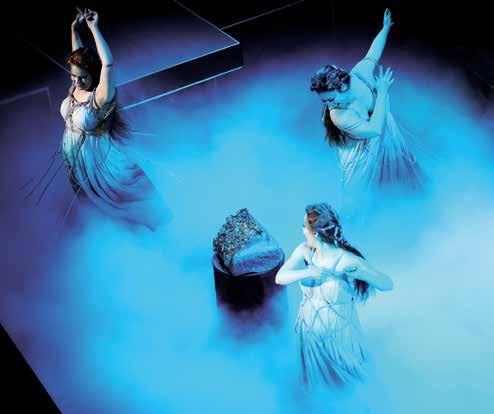
In a surprising coup de théâtre, the orchestra pit becomes the Rhine River, using choreography and theatrical fog to create the illusion of water while the three Rhine Daughters dive and splash around a hoard of gold that sets the epic in motion. This is just the first of many delights and surprises in the current production, directed by Brian Staufenbiel and based on his 2016 design for the Minnesota Opera. The three-tiered structure of the Rhine Daughters’ river, the orchestra’s middle world, and the gods’ and goddesses’ airy bridge hovering above the stage give the audience a chance to watch the mechanics of Wagner’s universe — a great wheel of action that moves this epic from its lilting start to its inspiring conclusion.
The most remarkable aspect of Staufenbiel’s concept is the introduction of the singularity: the merging of the electronic, mechanical world with the human and epic worlds. The giants of the underworld, Fasolt and Fafner, become cyborgs whose communication with the gods is conveyed through electronic projections. The audience sees them confer with one another, then turn their faces to project a hideous electronic image onto a screen visible to the gods. The gods themselves have merged with the machines that move the universe — a weird suggestion of where humans in the real world might be headed. The balance between natural and sci-fi worlds in this production is elegant and unsettling.
Voices equal to the dazzling technical effects
On opening night, the singers’ performances were superb. Bass-baritone Greer Grimsley has been Seattle Opera’s one and only Wotan since 2005, and the depth of experience imbued his performance. How wonderful it was to have his commanding presence back on Seattle Opera’s stage!
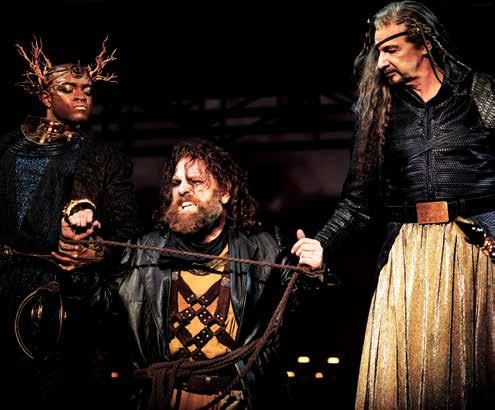
Baritone Michael Mayes was simply terrific as a menacing but vulnerable Alberich, whose rascally humor in the opening scenes was a triumph. Tenor Frederick Ballentine sang the role of the fire god Loge while scampering over the stage like a tongue of fire, his hands flickering even
when he stood still. In the smaller role of the god Froh, Viktor Antipenko showed off an equally gorgeous tenor voice. Soprano Katie Van Kooten gave a lovely and powerful performance as the goddess Freia.
Sopranos Jacqueline Piccolino and Shelly Traverse and mezzo-soprano Sarah Larsen as the three Rhine Daughters sang beautifully and danced impressively as well, diving and weaving around the sparkling golden hoard that becomes the contested Ring of the Nibelung in the next three operas.
The Nibelungs, miner-slaves who haul up the gold from the underworld, were played with menacing charm by a gang of cleverly disguised children.
As the goddess Fricka, mezzo-soprano Melody Wilson seemed somewhat uninvolved but sang adequately. Unfortunately, mezzo-soprano Denyce Graves as the earth goddess Erda sounded a bit ragged; she usually sings much better than this, and the crucial scene in which Erda rises from the depths to admonish Wotan was marred by her disappointing performance.
Seattle Opera dramaturg Jonathan Dean’s English captions were even better than his usual translations: clever and apt, with lots of alliteration and much humor. These essential projections of English — easily read on an upper scrim — are a performance all their own.
Stage manager Keri Muir deserves special praise for the perfectly coordinated technical effects. The visual effects themselves, by projection designer David Murakami and lighting designer Mextly Couzin, were absolutely thrilling.
Is another Ring cycle in the works?
Here’s the big question for Seattle Opera fans and opera lovers everywhere: When will Wagner’s four-opera extravaganza return to our fair city? General Director Christina Scheppelmann recently said, “When someone gives us a million dollars.” The same question was put to Jonathan Dean after opening night of Das Rheingold, and his answer was more encouraging: “Stay tuned.”
Those of us who love the Ring cycle are staying tuned, and those of you who attend the current Rheingold will join us, because it’s a marvelous combination of music, theater, visual beauty, and thoughtful consideration of the future of humanity. What a bargain — don’t miss it!
Performances run through August 20. For more information and to purchase tickets, visit https://seattleopera.org.
Top, from left: the gods Freia (Katie Van Kooten), Loge (Frederick Ballentine), Wotan (Greer Grimsley), Fricka (Melody Wilson), Froh (Viktor Antipenko), and Donner (Michael Chioldi). Bottom, from left: the giants Fasolt (Peixin Chen) and Fafner (Kenneth Kellogg) in Das Rheingold at Seattle Opera – Photo by Philip Newton
Clockwise, from top left: the Rhine Daughters Flosshilde (Sarah Larsen), Woglinde (Jacqueline Piccolino), and Wellgunde (Shelly Traverse) in Das Rheingold at Seattle Opera – Photo by Philip Newton
(from l) Frederick Ballentine as Loge, Michael Mayes as Alberich, and Greer Grimsley as Wotan in Das Rheingold at Seattle Opera – Photo by Philip Newton
Arts & Entertainment
Day In Day Out Fest secures its place as Seattle’s most casual music marathon
by Kylin Brown SGN Contributing Writer
Last weekend, Day In Day Out Fest was sold out for the first time, in its third year of bringing indie rock to Seattle Center, thus continuing to establish its place in our city’s live music events scene. The festival once again brought multiple LGBTQ+ and BIPOC artists to center stage, part of a must-see lineup spanning all day Saturday and Sunday.
Organized by Daydream State, a collective of businesses owned by Jason Lajeunesse, Day In Day Out is part of a powerful network of partners, allowing it to bring big-name brand sponsors and collaborations along for a full festival experience in the heart of Seattle.
From freebies like Guayakí Yerba Maté and Naloxone from This Must Be The Place, to Liquid Death canned water and Cycling Frog THC drinks, as well as sponsorships from Caffe Vita, Celsius, Tito’s, and Parch nonalcoholic agave drinks, Day In Day Out’s on-the-ground partnerships this year matched the spirit of the event and were healthily stocked for imbibers of all kinds.
Other vendors included food trucks such as Thai-U-Up and Isidro’s Authentic Mexican Food.
How fast can you go from Yaeji to Ethel Cain? Fast!
While the vendors were right on brand, this year’s Day In Day Out only ran two days, compared to last year, which mirrored the three-day timespan and force of its sibling festival, Capitol Hill Block Party. While the latter has multiple stages throughout the Pike/Pine area, Day In Day Out’s prime location under the Space Needle only had room for a main stage and a DJ booth, which was graced by local artists in short sets sandwiched between each mainstage performance.
Photos by Shivo Brar
As a one-stage, two-day event, with a full lineup, the pacing of Day In Day Out this year felt hurried given its chill reputation. However, the festival was well attended and enjoyed, both by ticket holders and several volunteers whom I found lounging on the grass, waiting for their favorite artists after a few hours of running ice to vendors or putting wristbands on guests at the entrance.
While volunteering or working at a venue — as many did just to see Taylor Swift — can be a great way to see your favorite artists for free, it also says something about cost and equitable access to live music.
Ticket prices for Day In Day Out Fest went for about $100 per day, but that felt worth it to one festival-goer, who told me they had waited years to see Bon Iver live.
“There are so many great artists here. I’ve paid more to see one person in concert,” they said.
With widely loved headliners like the soulful Leon Bridges and the melancholic Bon Iver, the crowd for Day In Day Out Fest reached into more mature age brackets than Capitol Hill Block Party typically does, including parents who set up in the lawn with strollers or danced with their 10-year-olds.
While the all-ages atmosphere created a more family-friendly atmosphere, the beer garden (which occupied the stage front and most of the lawn) was typically more full. Gaggles of young millennials and Gen Zers mostly attributed their attendance to preheadliners Dominic Fike and WILLOW.
A notable local band featured was the Tacoma-based Enumclaw, who kicked off the event early Saturday afternoon with a perfectly rounded example of indie rock. Enumclaw’s compelling electric guitar and lyrics delivered a set of grunge and lo-fi sound in front of an audience wearing sunglasses shining in 75-degree heat.
As the DJ stage saw more local notables, like Sea Lemon and THEM, artists such as Indigo to Souza, Surf Curse, and Yaeji took to the mainstage in a roller coaster of
genre-bending performances without much downtime in between.
Indigo de Souza’s punk-influenced, forceful songs built off of Enumclaw’s performance, just before Yaeji swooped in with a sledgehammer, literally and metaphorically, to share her eccentric concoction of EDM, rap, and pop with a heavy focus on her latest album, With a Hammer Yaeji surprised the crowd with full choreography to deepen the emotional impact of her performance, with her trademarked combination of both Korean and English lyrics and a pulsating synthetic beat beneath her gentle vocals.
Though Day In Day Out is indie rockcentric, artists in this year’s lineup, like Yaeji, expanded the definition of what can fit in or around the genre. In retrospect, there is no way I could have expected to transition from music like Yaeji’s to someone like Ethel Cain, who graced the stage Sunday afternoon in a camo shirt and red sunglasses for a melancholic and riveting love-hate performance dedicated to her Floridian roots.
However jarring it may sound, Sunday began with Queens-based R&B singer YayaBey, followed by synth-heavy New Wave from Nation of Language, an artful layering of indie rock between other genres that balanced out the lineup well, making each set just as refreshing as the next.
Notably, headliner Leon Bridges performed a set with little rock involvement, but of course, still moved everyone to dance and sway with their friends, partners, and children as he performed well-known, romantic ballads like “Texas Sun” and “Across the Room” to close out the night on Saturday.
Festival safety questions arise duringBon Iver
On Sunday night, just as fans began to sway and swoon over Bon Iver, the artist stopped abruptly to request medical attention for
people in the center of the crowd. It seemed that no medics or security were surveying the audience, or at least were unaware of this safety concern in the middle of the lawn.
“Where are the medics here? We need a medic now,” he said, as whispers echoed, and people wondered why we were still waiting as time ticked on. It took over a minute and 30 seconds for medics to begin making their way through the crowd.
“You’re okay, baby. It’s okay,” he said into the microphone as the medics reached the person in need.
Later on, between songs, the artist paused once again, and called for medics a second time. A Daydream State spokesperson followed up with us after the show to let us know that everyone ended up okay, and to speak to their capacity for emergency response.
“Daydream State and the Seattle Center had highly trained medical professionals and security teams on-site to provide first aid and emergency care,” they said. “The medical team worked quickly to provide care to attendees; everyone who had medical issues on-site is doing well.
Since artists have the loudspeaker right in front of them, and, at Fisher Pavillion, a direct view of the crowd, it is often only they who can see when someone is in trouble in a sea of faces.
“We appreciate Bon Iver calling our attention to issues so that we could help festivalgoers promptly,” said the Daydream State spokesperson.
Only in its third year, Day In Day Out Fest has room to grow in this area. Security was serious and present throughout the venue, but in future incidents, those personnel could be more useful if placed at better vantage points during peak attendance.
Overall, the festival did not disappoint, and hundreds of people enjoyed seeing a variety of currently trendy, local, and longfamous musicians.
Art is about relating to one’s society, bringing joy to others, and taking in the absurd beauty of this life together. Thus, it moves us into a space where understanding and emotional resonance bind us together.
For Queer people, this is especially the case. When art is created and shared for the purpose of joy in the face of oppression, it is at its most transformative.
That’s why shows like Don’t Drag Me Down are so important. Its mission was to raise awareness of the anti-drag and anti-Trans bills being proposed and passed all across the country in the last few years (over 500 in 2022–23 alone, with a little under a hundred passed, according to translegislation.com), though they are still largely unpopular with the general population.
The charities selected were the Trans Justice Funding Project and Southern Trans Youth Emergency Fund.
Dazzling performances
Don’t Drag Me Down was organized and hosted by DonaTella Howe, a spectacular performer with a true knack for comedy. The performances were both eclectic and electric, ranging from classic musical numbers and songs from the soundtrack of the new Barbie film, to bluegrass country/folk and New Wave synth pop. The stage was equipped with mood lighting and delightful sound quality — as well as an electric fan to blow the drag queens’ hair, lending some America’s Next Top Model realness.
The festival took place at three collaborating establishments in Ballard: the Tractor Tavern, the Sunset Tavern, and Conor Byrne Pub, all within walking distance of one another. The schedules overlapped, but were staggered to allow patrons to catch some of each show, which most did.
Starting the night off right at the Conor Byrne Pub (which was city themed, with brick covering the walls and the stage illuminated by two streetlights), rappersinger Da Qween amped the crowd right up. Effortlessly flowing from beat to beat and sound to sound, Da Qween’s performance was full of life, humor, and drive.
After that, Siren The Barbie and Athena took the stage. Their hair, makeup, and outfits stole the show. Both were dressed to the nines, with an unbeatable comedic chemistry throughout.
At the Tractor (decorated with a ranch/ farm aesthetic), the group Zoe Morra and the Strange Kind performed emotional country and bluegrass rockers that showcased songwriting about intimate subjects. At a certain point, Morra reflected on how personal the cause was to them.
“Growing up, at two years old, I knew I wasn’t a girl,” Morra said. Reactions around the room revealed the power behind the words.
Unfortunately I did not make it in time for Zoe and Starkey, but a close friend I know attended and vouched for how entertaining they were. (All performers can be found via Don’t Drag Me Down’s social media posts.)
DonaTella Howe performed a lip sync to “Diamonds Are Forever” by Shirley Bassey and “Rehab” by Amy Winehouse, gliding around the room and interacting with the audience in all kinds of fun ways.
In between acts, pockets of prerecorded audio from television or movies played over the speakers, during which Howe mimed the words and acted out the scene. This provoked big reactions from the crowd, who were eager to see what kind of multimedia belly-laugh was next.
After Howe was This Girl, who came out in a pink, sparkly, sequined outfit that matched the high energy on display. She performed her lip sync to “Gimme! Gimme! Gimme!,” with her breathtaking choreography and athleticism on display.
At the tropically decorated Sunset Tavern, Freya Love made her way around the room theatrically. Her lip sync performance of “Little Girls” (from Annie: The Musical ) would be best described as delightfully unhinged. Her acting skills were on point, exuding emotion as she held the audience’s attention.
Edith Pilaf came dressed in a bandanna, sunglasses, and leather, exuding true macho drag king energy. He graced the crowd with “I’m Just Ken,” the popular Ryan Gosling–led song from the blockbuster of the summer, Barbie. Edith’s performance of the hit proved why it is begging to become a staple of drag king playlists for years to come.
Raising money and hope
Throughout the night, participants were asked to buy raffle tickets to win gift boxes with prizes provided by the many corporate sponsors of the night. The ticket sales and raffle raised upwards of $9,000 for the charities selected.
A person working the raffle stand wore a hat that read, “Drag is not a crime.” If drag were a crime, then it’s one that pays well: a venue organizer made it a point to mention that all of the performers got paid up front, so the entirety of the cash raised went directly to the organizations!
One of the producers got on stage (along with all the queens) and spoke about the nature of shows like Don’t Drag Me Down, and how she views opportunities in which people can come together and witness love and joy essential in fighting injustice. While speaking about the anti-drag and anti-Trans legislation being passed, she got choked up.
As she paused to quickly collect herself, a person in the crowd yelled, “We love you!” to loud applause. She went on to explain that committing to causes like this is “who our community is and how we come together,” and that the purpose of the night was to show that sharing vulnerability with one another is one way to bring us all closer together, illustrating that no Queer person is alone. Benefit shows are often seen as an opportunity for privileged people to make themselves feel like they’re making a difference to a thing they have no experience with. Don’t Drag Me Down contrasted with this notion, proving with that it is often marginalized people themselves who show
up for one another, maintain solidarity, and build each other back up.
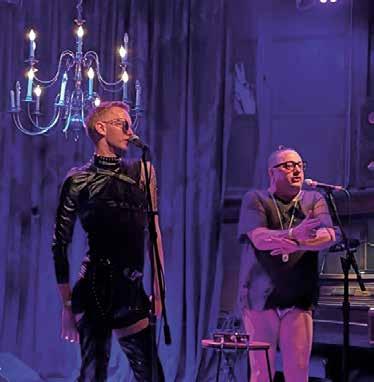
Ending the night strong Lady80 performed at Conor Byrne, where blue and pink lights shone down on the performers’ goth outfits as they danced and sang over electronic and New Wave beats. At the beginning of the set, there were only a few people watching, including one woman in a disco ball outfit and helmet (who, I might add, seemed to be having an absolute blast). People filled in quickly, though, as the show progressed. It was so ’80s, one of the performers even wore sunglasses at night…indoors. (The other performer was wearing regular glasses, which were also cool.)
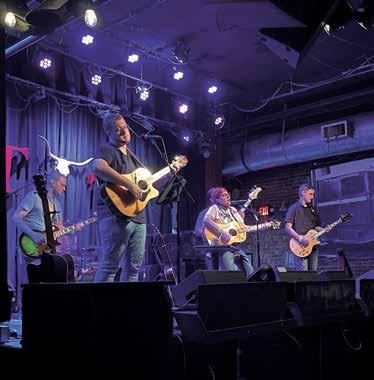
Sera Cahoone and her band contributed to the night at the Tractor, coming out on stage saying, “We’re just gonna play some country music.” There was a banjo soloist who added context, detail, and whimsy. The drummer employed some snare work that was colorful and intentional, pitter-pattering elegantly to evoke feeling. Cahoone herself also played harmonica for a few tracks, mirroring the very nostalgic, melancholic, and storied words of her songs.
Day Soul Exquisite ended the night musically on a profoundly high note. Seeing this band live in such an intimate venue felt like something one won’t be able to experience soon, considering this group is destined to blow up. Showcasing an impressive range of neo-soul, R&B, and jazz-fusion, the riveting performance oozed personality and feeling. The songs chronicled the realities of Queer love, often focusing on its ethereal and joyous aspects. The music of the night ended here, with an intrepid and impactful groove.
A talk with DonnaTella
At the end of the night I got a chance to speak with DonaTella Howe about the night. When asked about the importance of the diversity of performers on stage, she responded, “My goal was to try and show diversity not just with drag performers but
Trans individuals and how that intersects.”
She went on to speak of the relationships she had with the queens involved: “These are all people that I thought of because of what they bring to the community themselves. These are all people I knew I could say [to], ‘Hey, this is the deal — are you gonna come and do this?’ and they all said yes.”
About her feelings on Don’t Drag Me
Down overall and the results of the fundraiser, she said, “I’m very happy to see that we hit such a high number. It’s really awesome to be a part of the Tractor Tavern family. I’d never stepped foot in Conor Byrne or the Sunset, but walking in today to get everyone situated…all it’s been is family.
“It’s been an honor to stand up to do part of what needs to be done, that we all need to do, performers, community members, or otherwise.”
DonaTella also touched on the future and the need for more work to be done, which she said is “maybe in a way necessary to understand why drag exists. And it is really good to see people who are willing to do that.”
Shows like this should be commonplace, an opportunity to see and hear from Queer people on their own terms. When everyone uplifts and supports one another’s identity and expression, all in the name of combating hate, we are better off. Since art is forged from the relationship one has to one’s society, using it to celebrate one’s marginalization is liberatory.
DonaTella Howe is performing at House of Glitteratti in October and December with performer Boom Boom L’Roux; and in Ballard this month with Glam Chowder, as well as working bingo at the West Seattle Senior Center. As mentioned, all performers can be found via their social media accounts, which are all tagged in the posts made by Don’t Drag Me Down. Learn more about the Trans Justice Funding Project at https://www. transjusticefundingproject.org and the Southern Trans Youth Emergency Fund at https://southernequality.org/styep
(Clockwise from top) Edith Pilaf performing “I’m Just Ken” at The Sunset Tavern, Xolie Morra and The Strange Kind performing at
The Tractor Tavern, Lady80 performing at Conor Byrne Pub, and Sera Cahoone performing at The Tractor Tavern – Photos by Ian Crowley
Arts & Entertainment
Genre-reviving Baldur’s Gate III shines in first impressions
by Daniel Lindsley SGN Staff Writer
Baldur’s Gate III shares the name of its predecessors but might as well be considered a stand-alone video game. Both of its prequels were released at around the turn of the century, made by a different studio, and based on a version of Dungeons & Dragons (D&D) that was current for the time but wildly different from today’s 5th Edition
That might not mean much to readers unfamiliar with video and tabletop games, but a helpful comparison might be movie reboots, many of which are written, acted, and directed by different people than the originals. And while such films are often brushed aside as nostalgia-targeting cash grabs, a few do buck the trend and bring new life to a franchise, or even a whole genre.
This isn’t to say that Baldur’s Gate III is the Spiderman: Enter the Spiderverse of combat role-playing games (CRPGs). But it is a modern revival of the D&D -based CRPG.
For reference, the most recent original game in this subgenre was the crowdfunded Solasta: Crown of the Magister (2021) — a labor of love, to be sure, but one without the full weight of a resourced RPG veteran like Larian Studios, not to mention D&D’s best-known setting, the Forgotten Realms. To find the most recent Forgotten Realms CRPG specifically, one has to dig back through years of remasters to Neverwinter Nights 2 (2006).
Needless to say, fans of the old D&D CRPGs have been waiting a long time for a game like Baldur’s Gate III. Buyers should keep in mind, however, that the way it plays is much closer to Larian’s previous title, Divinity: Original Sin II (2017), albeit with a distinct D&D twist.
Oil and water mix
Larian has gracefully transposed the rules of D&D: 5th Edition onto combat encounters with dynamic and responsive battlefields. By responsive I mean that many objects and terrain elements — whether a barrel, river, mushroom, or cauldron — are more than just props.
For example, if a wizard casts a fireball into a room full of wooden furniture, the wood will ignite, filling the space with searing embers and blinding smoke. Conjuring or throwing water will quench the fire. Zapping the puddle left behind will electrify it (and anyone standing inside).
Of course, if a character is physically strong enough, they can nix the fire and lighting altogether and just toss the furniture at their enemies instead. Or just toss their enemies at their enemies. How your character fights is up to you.
Mastering Baldur’s Gate III ’s tactical, turn-based combat means learning to take careful stock of your surroundings and using them to your advantage, at a much deeper level than previous D&D -based CRPGs. In relation to these responsive battlefields, enemies can be brutally clever and comically dumb in equal measure, which can be entertaining either way.
Mind you, the combat system did inherit some quirks from Divinity: Original Sin II. Rather than using hexagons or squares on a grid for positioning characters, it lets players position them freely, meaning that in tense situations, victory can sometimes hinge on hunting for the precise pixel that will enable a crucial attack or other maneuver. It’s also easy to clip the edge of a terrain hazard by accident, whether you’re in combat or not.
The game does have certain tools in place to keep things from being too fiddly or frustrating, like a “tactical view” that switches the camera from isometric to top-down, but these can take some getting used to. Thankfully, players can choose between three difficulties on the fly if they find themselves in more fiddly situations than they’d prefer (or not enough).
Putting the “D” in D&D
The most prominent carry-over from the first two Baldur’s Gate games might be the option to, over the course of the adventure, strike up romances or other intimate encounters with a cast of colorful characters. And there are a lot of options.
To name a few such “companions,” there’s Astarion, a vampire evocative of Tim Curry in Rocky Horror; Karlach, a massive, coinoperated warrior of hell; Wyll, the golden boy with a devil problem; Shadowheart, the definition of “I can fix her”; and Gale, the most burned-out gifted kid.
When the game begins, a player must choose a “primary” character to act as their avatar — either one of the six companions with more detailed story arcs, or more of a custom “blank slate” type. The player’s choice of “class,” or their fantasy archetype (wizard, barbarian, monk, etc.), will influence not only their best approach to combat but also their strengths while exploring and their options when speaking with other characters.
In its process of creating a custom character, the game is progressive in several small but important ways. Rather than labeling certain physiques as “male” or “female,” it uses the term “body type” and labels them numerically. Some of the lineages (dwarf, elf, gnome, etc.) have only two body type options, which could be interpreted as enforcing a gender binary; half-orcs and dwarves, it seems, are ABAB (Assigned Bear At Birth).
But most other lineages have as many as four body types, and options like facial hair, gender identity, and even genitals are independent from others. During dialogue, characters will adjust their pronoun usage to account for a custom character’s chosen identity.
Regardless of who the player chooses to be, every romanceable character is a romance option, premade characters included. The fan community has landed on the term “playersexual” to describe this feature, since it’s not like every character in the game is explicitly stated to be Pansexual or Bisexual.
Your mileage may vary on how the romance scenes are written. Depending on the actions the player takes throughout the story, they may find that several characters are already smitten with their avatar by the end of the second in-game day, or that a character will turn from cold to flirty on a dime. If fan testimonials are to be believed, polyamory is possible.
On the issues that plague the Western fantasy genre, Baldur’s Gate III does a few radical things. Only species that are truly monstrous, like the demonic, hyenoid gnolls, go unnamed — and even then, the player’s avatar can often gain glimpses into their minds.
Meanwhile, species like goblins, hobgoblins, duergar, and drow are all named and given at least one unique voice line; they’re depicted not as generic monsters but as deeply flawed people with their own motivations. It’s not perfect by any means, but it’s progress.
The writing overall seems strongest in the first act, as it allows the greatest breadth of player choice, but it starts to show cracks by the second, and there seems to be a general consensus that the game’s storyline is ultimately quite linear. The illusion of choice is strong. Fans are already anticipating a “definitive edition” that would improve elements of the story that might have been rushed. If the Divinity series is any indication, though, that could take up to a year.
In the meantime, there are technical improvements to be made. Other players and I have found that Baldur’s Gate III runs worse the longer it remains open, even on high-end computers. Switching from DirectX 11 to Vulkan in the launcher seems to help but causes graphical glitches in some systems. There are also few bugs in animations (especially when skipping dialogue quickly) and in how certain creatures are coded, but these issues can probably be fixed with enough time.
Images courtesy of Larian Studios
Arts & Entertainment
Writers’ strike reaches third month with no agreement
by Lindsey Anderson SGN Staff Writer
On May 2, 2023, writers affiliated with the Writers Guild of America stepped out of their offices, exchanged their pencils for picket signs, and initiated the second such strike in America in 15 years.
The strike was a long time coming, but since the studios refused to meet their demands for fair wages from streaming services and increased staffing, the members of the WGA felt it was time to take action.
Three months later, 11,000 film, television, news, radio, and online writers are still out of work.
“Though we negotiated intent on making a fair deal — and though your strike vote gave us the leverage to make some gains — the studios’ responses to our proposals have been wholly insufficient, given the existential crisis writers are facing,” the WGA said in an announcement. “We must now exert the maximum leverage possible to get a fair contract by withholding our labor.”
Streaming services change the way work gets done
As streaming services have continued to change how Americans consume content, they have also changed how writers make a living. Shows produced by services such as Netflix, HBO, Hulu, and Amazon Prime have a much lower renewal rate than those for cable television, where shows can often run for five or more seasons. With the increase in demand for quick, bingeable programs and the brutal slashing of anything that doesn’t receive Euphoria-level numbers in its premiere week, more and more writers are scrambling for jobs.
They also don’t receive high residual pay for the work they produce when it’s aired via streaming services. Based on money writers are paid for the original work, they are typically also given a percentage in residuals each time their project is aired as a rerun. According to the WGA, “residuals are compensation paid for the reuse of a credited writer’s work. When you receive credit on produced Guildcovered material, you are entitled to compensation if the material is reused.” However, streaming services, which provide thousands of hours of rerun material, pay writers mere cents for their residuals.
Writers like Valentina Garza, who has worked on Only Murders in the Building, Wednesday, and Jane the Virgin, went viral earlier this summer when she shared two residual checks she received for episodes of Jane the Virgin. “One for .01 [cents] another for .02. I think the streamers can do better,” she wrote on Twitter.
Streaming shows are also not included in the Minimum Basic Agreement, which established a universal minimum wage for television and film writers. This means that those who work for a show that is exclusively streamed must negotiate individually with the streaming company that employs them. This often leads writers who do the same work as those working for cable to be paid much less.
Concerns include staffing, AI
The strikers also want fuller writers’ rooms. Many productions have begun using “mini-rooms,” meaning they hire fewer writers for less time in order to cut production costs. Not only does this mean less pay and fewer job opportunities for many in the WGA, but it also means that those who can find jobs are overworked. Therefore, another part of the contract they hope to work out is a “minimum staffing agreement,” meaning that an agreed-upon minimum number of writers will be used for projects. Those would also have a set duration of employment, which will help provide more job security.
Writers are also concerned about new artificial intelligence in film and television production, so they hope to extract a promise from studios to only use programs like
ChatGPT as a tool to aid writers, and not something to replace them.
Before the strike began, the WGA attempted to negotiate with the Alliance of Motion Picture and Television Producers for six weeks, demanding higher compensation. Its original proposal would have cost the studios $429 million. The studios countered with an offer of just $86 million.
After two months of the strike, which delayed and canceled many major Hollywood projects, the SAG-AFTRA actors union joined. Members of the Screen Actors Guild and American Federation of Television and Radio Arts, including President Fran Drescher, had been picketing along with writers in front of studios since the first day of the strike. Many prominent Hollywood actors have noted that without writers, they wouldn’t have a job.
The financial burden of striking
The dual strikes have impacted workers of all kinds, not just writers and actors. Hair and makeup artists, set designers, animal trainers, and craft service workers are also out of work.
Writers have begun auctioning off television memorabilia to raise money for those now without income. Abbi Jacobson, writer and creator of Broad City and A League of Their Own, auctioned off a dress worn by her sitcom character earlier this year to help raise money for the strikers.
Actor Billy Porter also recently spoke out about the financial burden the strike is causing him. “I have to sell my house,” he told The Evening Standard. “The life of an artist, until you make ‘fuck-you money’ — which I haven’t made yet — is still check to check,” the Pose star continued.
On Tuesday, August 15, the WGA and
SAG-AFTRA met with the Alliance of Motion Picture and Television Producers, and both sides were reportedly willing to negotiate. While the AMPTP has agreed to increase residuals, previous talks between WGA chief negotiator Ellen Stutzman and the AMPTP stalled due to the latter’s refusal to institute a minimum staffing level and guaranteed minimum number of weeks of employment for episodic television writers. The WGA is still committed to fighting for these issues.
“Negotiations between the AMPTP and the WGA concluded without an agreement today,” the AMPTP said in a press statement Tuesday night. “The AMPTP presented a comprehensive package proposal to the Guild last night, which included generous increases in compensation for writers as well as improvements in streaming residuals.”
Your favorite show put on hold
As the strikes continue, projects of all shapes and sizes remain on hiatus. The first to halt were live and late-night programs, like The Tonight Show with Jimmy Fallon, Late Night with Seth Myers, The Daily Show, and The Amber Ruffin Show, which halted programming immediately, as did Saturday Night Live, which ended its 49th season without a finale.
While unscripted television, like game shows and reality programs, often flourish during writers’ strikes, Jeopardy! is also impacted. Host Mayim Bialik decided to step down in solidarity with the strikers. The program continued using interim host Ken Jennings.
Many streaming and cable series are delayed until further notice. Amazon Prime’s 1923 season 2 is “delayed indefinitely” until the strike ends. Because film-
ing for the series was set to begin in June 2023, it is likely production on the latest season won’t occur for another year.
NBC’s hit comedy Abbott Elementary is also delaying its third season. The show’s first writers’ room was set to meet on May 2, the first day of the strike. Now the season remains on hold indefinitely.
Production of Netflix’s American Horror Story is also suspended, though mostly due to production workers standing in solidarity with writers. According to Deadline, trucks headed for the New York City set saw picketers and immediately turned around.
Live-action programs aren’t the only ones affected. Nick Kroll’s hilariously Queer adult cartoon Big Mouth has halted its season 8 writer’s room. The series was six weeks into writing when the strike started. Even Disney is feeling the effects of the strikes. Disney Channel’s longest-running live-action series BUNK’D has also stopped filming. Twelve of the latest season’s 20 episodes were already filmed when the first strike started, however.
Much to the chagrin of Euphoria fans, who are already feeling a loss after the death of star Angus Cloud, the third season’s release date has moved back. Now, the earliest anyone can expect to see Hunter Schafer and Zendaya on screen together again is 2025.
While fans of Outlander are enjoying the steamy seventh season, the series’ executive producer Maril Davis announced that even though the writers have finished their scripts for the final eighth season, they will delay production until the strikes end.
More hotly awaited series finales have also paused until agreements can be reached. Netflix’s Stranger Things released an official statement about production delays. “Writing does not stop when filming begins,” wrote the Duffer brothers. “While we’re excited to start production with our amazing cast and crew, it is not possible during this strike. We hope a fair deal is reached soon so we can all get back to work.”
HBO’s latest Queer-related hit, The Last of Us, has stopped all work. The series was in the middle of casting actors for roles for the second season, but without scripts, the actors had to read lines from the video game the show is based on.
Another drama with Queer characters, Yellowjackets, has announced a delay. “We had exactly one day in the writers’ room,” creator Ashely Lyle said on Twitter the day the strike started. “It was amazing and creatively invigorating, and so much fun, and I’m very excited to get back to it as soon as the WGA gets a fair deal.”
Many actors and writers have begun streaming new podcasts for anyone looking to binge more content while they wait for the strikes to end.
Photos by Chris Pizzello / AP
Last Voyage of the Demeter sets sail into vampiric terror Film
by Sara Michelle Fetters SGN Staff Writer
THE LAST VOYAGE OF THE DEMETER
Theaters
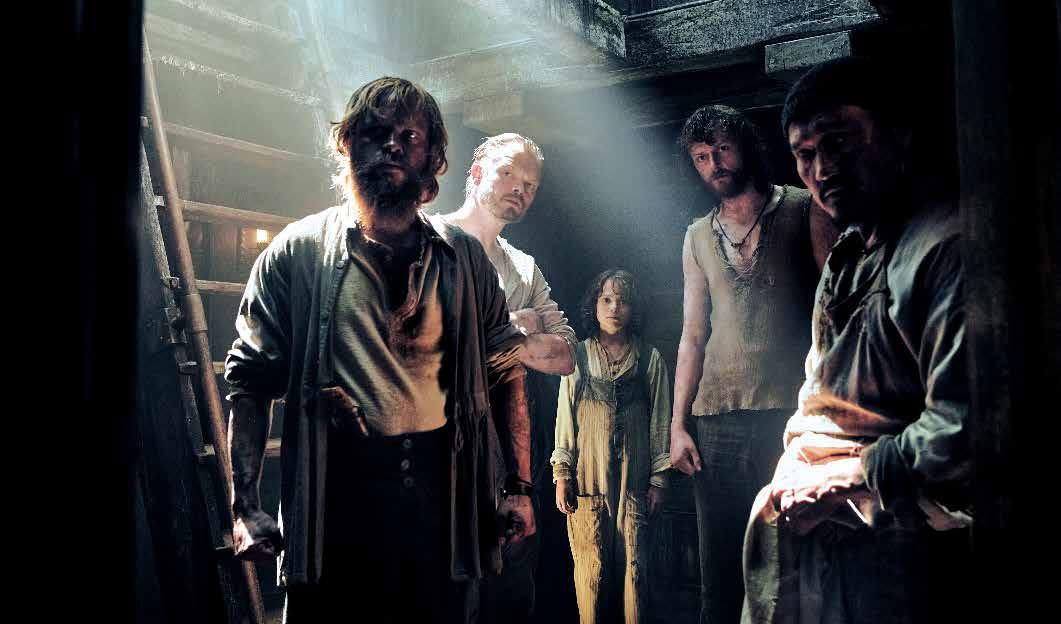
July 1897: Under the command of the stoic Captain Eliot (Liam Cunningham), the trade ship the Demeter is leaving a Romanian port bound for London carrying a mysterious, if potentially profitable, cargo: 50 heavy crates bearing the crest of a dragon. This is going to be Eliot’s final turn at the helm, as the veteran seaman is looking to retire to the Scottish countryside with his grandson Toby (Woody Norman) and turn over this great ship to his trusted — and beloved by the crew — second-in-command, Wojcheck (David Dastmalchian).
Unfortunately, this will be no ordinary voyage. Not only has the Demeter brought on a new doctor, the tightlipped Clemens (Corey Hawkins), but a deathly ill young woman named Anna (Aisling Franciosi) has apparently stowed away in one of those puzzling crates, covered in dirt and in desperate need of a blood transfusion. The crew initially wants to throw the woman overboard, seeing her arrival as an ill omen.
But she is the least of the Demeter’s worries. There’s a third newcomer aboard, and this creature comes out at night and consumes blood — human blood in particular — and unless the ship’s crew does something about it, none of them will make it to London alive.
The final destination of the Demeter and its crew will not shock anyone. Heck, it’s right there in the film’s title: The Last Voyage of the Demeter, which is based on a short passage from Bram Stoker’s immortal Dracula. Dracula is sleeping in one of those crates filled with diseased earth, and this means Captain Eliot and his men are facing off against an unstoppable evil none of them have the first clue how to deal with.
Thanks to a crackerjack ensemble, André Øvredal’s confidently deft direction, and a smart, literately inventive screenplay written by Bragi F. Schut (Escape Room) and Zak Olkewicz (Fear Street: Part II – 1978), this highly enjoyable horror throwback satisfies, even with its inevitable outcome. It’s like an inspired cross between a Universal monster
movie from Hollywood’s golden age, a Terence Fisher Hammer entry from the 1960s, Ridley Scott’s Alien, and Peter Weir’s Master and Commander: The Far Side of the Sea. The film is a great deal of insidious fun, and I have a sneaky suspicion that my fondness for it will only grow as I return to it again and again over the coming years.
Most of the focus is on the characters not found in Stoker’s source material, and this allows for a moderate aura of ambiguity. Even if the tragedy of the Demeter is preordained, because the fates of Clemens, Anna, and Toby are not already known, there is a fighting chance one (or all of them) could make it to the end alive. This allows for a modicum of suspense I did not anticipate. I cared about what was going to happen to them, and my emotional investment in the trio was authentically substantive.
Yet, much like James Cameron’s Titanic, just because the fates of these characters is a forgone conclusion, that did not stop me from rooting for their survival. While Eliot and Wojcheck understandably stand out the most, the entire crew manages to
make an impression. Øvredal does a nice job of giving these men individual voices, so by the time Dracula starts picking them off or bending them to his carnivorous will, their deaths have a hushed weightiness that intensifies the overwhelming sense of petrifying panic considerably.
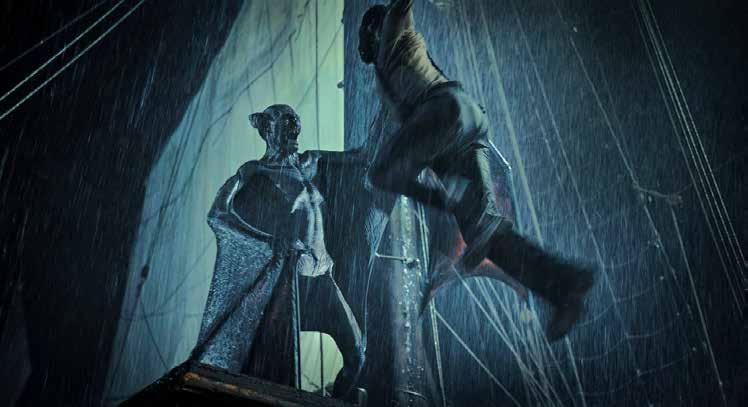
The creature design for Dracula is nothing short of outstanding. The practical makeup effects allow this unholy vampiric demon to come spectacularly alive. He’s a superb combination of Max Schreck’s incarnation from 1922’s Nosferatu, Klaus Kinski’s take from 1979’s Nosferatu the Vampire, and Gary Oldman’s brief incarnation in 1992’s Bram Stoker’s Dracula
Under all of the layers of latex and raindrenched goop, veteran actor Javier Botet (It, Crimson Peak, REC ) delivers another outstanding performance, making his Dracula a memorable, throat-ripping devil whose power to entrance and terrify only grows as the film builds to its conclusion.
There are sequences where Øvredal dips into the CG bag to allow Dracula to zip around the screen or contort his carnivo -
rous features into an otherworldly, unhuman shape. These moments do not work nearly as well as the practical ones. They have a digital shimmer that does not quite mesh with the wickedly lithe cinematography by Tom Stern (American Sniper), the grounded, suitably withered production design crafted by genre veteran Edward Thomas (Monster Hunter), or the inventively distressed and disheveled designs by Carlo Poggioli (The Raven). These are small complaints. With Troll Hunter, The Autopsy of Jane Doe, and Scary Stories to Tell in the Dark, Øvredal is quickly proving himself to be a master of old-school thrills and chills. He gives his actors the freedom to make each character moment their own, knows how to manufacture spine-tingling sensations of anxiety with subtle ease, and casts a spell upon the audience that will send them out of the theater on an adrenaline-filled high. All of this is certainly the case here, making The Last Voyage of the Demeter a journey into tension-filled dread and a suitably undead nightmare worth setting sail on.
The Last Voyage of the Demeter – Photos courtesy of Universal Pictures
Strays is a one-joke movie. Director Josh Greenbaum and writer Dan Perrault have basically taken The Incredible Journey and A Dog’s Purpose and given them an R-rated, talking-animal (à la Babe) twist. That’s it. There’s not much more to it. Thankfully, this thin slice of foulmouthed, four-legged carnage offers up enough hearty laughs to make its nonsensical, bare-bones premise moderately worthwhile. Perrault’s script goes to some unexpectedly nasty (and unsurprisingly politically incorrect) places, and Greenbaum has the determination to join him there without flinching. The comedy also boasts an outstanding vocal ensemble, with Will Ferrell, Jamie Foxx, Randall Park, and a superb (and almost unrecognizable) Isla Fisher each turning in exceptional performances worth barking in appreciation for.
After border terrier Reggie (voiced by Ferrell) is abandoned by his slovenly, illtempered owner Doug (Will Forte) hours away from home, he is befriended by foulmouthed Boston terrier Bug (Foxx). He’s a stray and insists his new friend is now one, too. But the happy-go-lucky Reggie is resolute that Doug is only playing a game with him, and as long as he somehow makes it back to his owner with his trusty tennis ball in his mouth, all will go back to normal.
The pair are joined on this impossible trek by Australian shepherd Maggie (Fisher), who has suddenly been forced into the shadows when her influencer owner buys a new puppy; and Great Dane Hunter (Park), a former police dog who was kicked off of the force and now works as an emotional support animal for hospice residents. Making their way through county fairs, eagle attacks, firework displays, and a field of hallucinogenic mushrooms, the quartet is determined to battle all obstacles in their singleminded quest to get Reggie home to Doug. Sounds simple enough, and Perrault’s scenario certainly doesn’t stray too far from the one author Sheila Burnford introduced in her award-winning 1961 novel.
The kicker? Once Reggie has his eyes opened to the reality of what Doug has done, he has no interest in making nice with his owner. Instead, he wants to bite him right in the you-know-where, and this is what gets Bug, Maggie, and Hunter interested in joining their new friend on this adventure. Greenbaum directs with the same creative flair he brought to Barb and Star Go to Vista Del Mar, and most of the major set pieces satisfyingly tickled my funny bone. But even at a brisk 93 minutes, there’s some definite padding happening here, and not all of the pieces are as amusing or as inventive as I kept hoping they would be. Still, I laughed quite a bit, and the heartwarming moments brought a well-earned smile to my face.
This is unquestionably adult stuff. There’s a four-letter obscenity seemingly every third
or fourth word, and at least a third of the gags revolve around the size of each canine’s genitals or how much fun it is to have sex with inanimate objects. The segment with those aforementioned mushrooms gets surprisingly dark (the humor goes several levels beyond pitch black to bordering on being outright gruesome), and I’m still not entirely sure I’m a fan of where Greenbaum and Perrault rather aggressively decide to take things during this sequence.
But I admit I loved the climax. The filmmakers went for broke, and I’m glad. It’s a crazy, messed-up blast of magnificently orchestrated chaos, and just when I began to think Greenbaum and Perrault were going to pull their punches, they instead did the exact opposite. I was laughing so hard that my eyes watered and my side began to
hurt, and from the sounds crashing through the theater like a tidal wave of gut-busting hilarity, it’s safe to say I was far from the only member of my preview audience who felt this way.
There’s not a lot more to add. The animal performances are strong and the puppet work is equally noteworthy, while the visual effects allowing the dogs to speak are reasonably strong. I enjoyed myself far more than I did not, and as silly and as uncouth as the film is, rarely did any of what Greenbaum and Perrault were doing come across as amateurish or sophomoric.
Strays pawed its way into my heart, and I’m not even that much of a dog lover. I can only imagine that those audience members who are will fall over their own joyfully wagging tails after they watch it for themselves.
Strays – Photos courtesy of Universal Pictures
Books
Writing an aspirational world
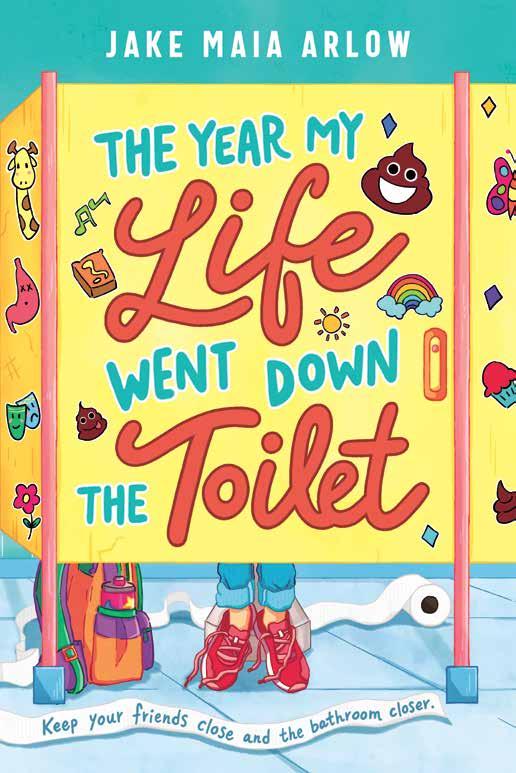
Today, Arlow is a successful middleschool novelist, and they see Crohn’s disease as just another facet of their identity, no different than being Jewish or Queer. They’re also getting ready to release their third book, The Year My Life Went Down the Toilet, a story about a Queer middle schooler who, like Arlow, is diagnosed with Crohn’s.
“It was a challenge … to put all those aspects of my own identity that I share into a book and to show both myself and people reading that people are like this, [that] it’s not too much to have all these things going on,” Arlow said. “I wanted to write a book where a main character is diagnosed with Crohn’s disease in middle school, because that’s when I was diagnosed.”
Arlow enjoys writing stories about middle schoolers because the awkward self-awareness is fodder for drama. “It is such a fertile ground to talk about body issues and self-esteem in middle school,” they explained, “because that is already on every kid’s mind, and to add to that, a chronic illness that deals with the bathroom compounds all those emotions.”
“I just love writing books where kids get to experience the full depth of their kid emotions,” they added. “I can still so distinctly remember back to middle school and high school, where everything felt so huge and every emotion felt life-altering. That’s such a fun thing to write, because it increases the stakes. That is how kids feel, [so] getting to write from that perspective — that every moment of my day is a new, huge, terrible thing — is just so fun.”
Arlow likes to draw from some of their
experiences when writing but also builds a world they wish they had as a child for the characters. “I wanted to write a utopian idea of what it could have been like in middle school with a chronic illness,” they said.
“The parts [of my life] that I did draw from are parts where she has bathroom emergencies. I drew from my most embarrassing stories, but… I wanted to give [Al, the main character] a better experience with her diagnosis and a more supportive experience to show that it is possible and there are communities like that. But the parts I drew from [my experience] were the mortifying parts of it.”
Representing chronic illness
While Al is Queer, like Arlow, the character discovers and embraces her identity much earlier than Arlow did.
“I didn’t realize I was Queer until I was much older, until I was in college,” they said. “Here, it’s a lot more aspirational.”
Throughout the book, Al discovers the rich community around her and finds other LGBTQ+ people and those with chronic illnesses to connect with.
“She’s able to express it more and has a lot of Queer community, and that’s another thing I didn’t have in middle school but …would have loved to have had. So I didn’t draw on my own experiences, or if I did, they were experiences I had later in my life. I …wanted to show a supportive environment for a Queer middle schooler.”
Part of Arlow’s motivation to give their character a more supportive and encouraging environment than they actually had is due to the way societal perception of both queerness and chronic illness has changed since they were in school. Even the way young people are diagnosed with conditions like Crohn’s disease is different.
“Diagnosis has changed since I was a kid. Medicine changes so quickly. Even since I was a kid, diagnosis has become much more humane and advanced than it was 15 years ago, when I was diagnosed,” Arlow explained. “I wanted to make sure [the book] was accurate to what a kid getting diagnosed today would go through.”
Al’s experience with Crohn’s is similar to Arlow’s, but the author knows that no two people experience the illness the same way. It was important to them to include other kinds of Crohn’s patients as well.
“[Another] member of the support group [Al] is a part of has an ostomy bag, which is not something I have,” Arlow said, “but I have had a lot of friends who have them, and also the YouTuber Hannah Witton has one… I love her. She has a lot of videos about ostomy bags, so I definitely pulled from her in my research. I thanked her in my acknowledgments. I pulled from both lived experience and also research.”
Writing a story about a kid with Crohn’s disease was something Arlow had wanted to do for a long time. It was a story they would have loved to have read as a kid, and they know there are young people out there who will see a part of themselves portrayed on the page for the first time.
Arlow first got the idea to write The Year My Life Went Down the Toilet in 2019 while browsing one of the most iconic bookstores in the Pacific Northwest. “I was in Powell’s in Portland, and I was like, ‘I should write a book about a kid with Crohn’s.’ Then it took me a while until I actually was ready to start drafting.”
The pandemic led to a lot of creative burnout for Arlow, who put off writing the story for months. Unlike their last two published novels, they felt pressure when representing a community that isn’t often the subject of fiction.
“This is my first book where a character has a chronic illness, and I wanted to make sure I was portraying it authentically, even though I also live with this disease,” they explained. “I think there was a lot of pressure to ensure that I am representing the experience accurately, so I wanted to take my time.”
Finding community in unlikely places Arlow hopes their latest book gives kids confidence, especially those with chronic illnesses. “I want them to know that every part of themselves is both important and intrinsic, worth loving and worth sharing,” they said. “Al has these intersecting identities that lead to a lot of embarrassment, but it’s also the reason she finds community in her support group and the way she relates to other Queer kids, and she finds a lot of community in her Jewish identity.”
Overall, The Year My Life Went Down the Toilet is about finding community in unlikely places. “I want people to understand, yes, a chronic illness can be a really taxing experience, but it’s also something you can find community from,” Arlow said. While it may not have happened for Arlow in middle school, they eventually found a supportive community around Crohn’s. “I just got back from volunteering at a Crohn’s camp I went to as a kid, and that was such a healing experience of having that community who understands what you’re going through. I want kids to know that every part of themselves is worth loving and that they can find joy and community through parts of them that they see as struggles as well.”
The Year My Life Went Down the Toilet is available this August. Fans of Arlow can also check out their previous novels, Almost Flying and How to Excavate a Heart.
Jake Arlow – Photo by Torrin Nelson Image courtesy of Dial Penguin ARLOW
continued from cover
The goal post defines fates in Women’s World Cup quarterfinals Sports
by Lindsey Anderson SGN Staff Writer
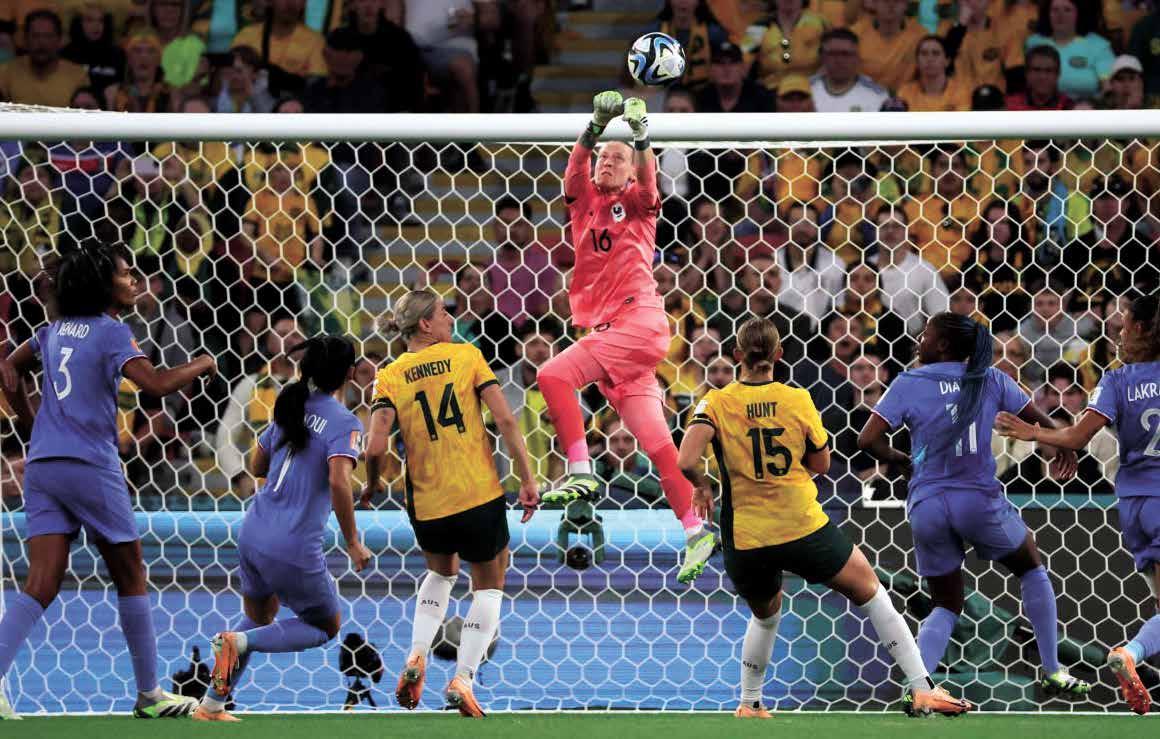
This week the Women’s World Cup quarterfinals featured some of the most dramatic matches of the tournament. The dream of a world championship ended for four teams, but not before 90 minutes of some of the best soccer ever seen. While several MVPs rose to the challenge, one of the biggest game changers throughout the four matches was the goalpost, which blocked would-be winning goals and finalized victories.
Spain vs. the Netherlands
While the Netherlands entered the match with eyes on the final, where they’d get a chance to redeem their second-place finish from the last tournament, Spain was ready to fight and had nothing to lose. Having never made it past the Round of 16, the country had already progressed further than ever before.
Spain attacked first, hard, and with precise calculations. Unfortunately, their final shots lacked the precision of their plays, and they couldn’t get the ball in the net. After 17 minutes of back and forth, Alba Redondo ran onto a cross with a perfect header. The ball hit the post but rebounded right back for her to head it a second time. Once again, the ball hit the post, this time going out of bounds.
Throughout the first half, Spain continued to press into their attacking third. The squad took advantage of the fact that one of the Netherlands’ best players, Danielle Van de Donk, was out of this match. In the 35th minute, forward Esther González scored the first goal when she knocked the ball right over the left shoulder of the Netherlands’ goalie with the top of her boot.
The squad’s celebration was short-lived, however. Following the goal, the ref con-
sulted playback footage and revoked it due to being offside. The half ended 0-0.
The Netherlands picked up steam in the second half. Beerenstein continued to lead the team down the field with breakaway runs. In the 62nd minute, she had her chance on a corner kick but was pulled to the ground by Spanish defender Irene Paredes. The ref immediately called a foul and issued a yellow card to Paredes. Because the foul occurred in the box, it also meant the Netherlands would get a penalty kick (PK) — a perfect chance to pull ahead. However, the ref consulted playback footage again, which motivated her to change her mind. She recalled the yellow card and restarted the play with a drop ball.
In the 77th minute, Spain’s powerhouse forward Salma Paralluelo carried the ball up the right side of the field and ripped what would have been a dangerous cross. Out of nowhere, Stefanie Van Der Gragt jumped in front of the ball, successfully changing its trajectory by just grazing the ball with her hand. To make matters worse for the Netherlands, a review of playback footage found that the handball occurred just above the line of the box. The ref awarded Spain a PK.
In the 80th minute, Mariona Caldentey took the kick. She sent the ball careening into the left side of the net as the keeper dove to the right. The ball hit the same post that denied Redondo two headers, but this time it spun into the far right corner of the net. With just ten minutes left in the game and Spain ahead, the Netherlands turned up the intensity. Beerenstein rattled shot after shot off, but she couldn’t land anything behind the goal line.
In the 90th minute, the ball flew past Spain’s back line. Van Der Gragt ran onto it and launched her shot past the keeper, redeeming her handball and tying the game. Spain’s defenders raised their hands in protest, indicating that Van Der Gragt had been offside. When the ref reviewed
While several MVPs rose to the challenge, one of the biggest game changers throughout the four matches was the goalpost, which blocked would-be winning goals and finalized victories.
the play, she found that Van Der Gragt had timed her run at the exact second the ball left her teammate’s foot, putting her barely onside — and putting the Netherlands just barely back in the game.
As stoppage time continued, the Netherlands dominated possession and continued to attack. Once again, Beerenstein had a near goal but shanked the ball wide. Minutes later, she got another shot on a corner kick but sent the ball several feet over the crossbar.
The game went into overtime. In the 110th minute, Paralluelo obtained a breakaway. She aimed for the left side of the goal. The ball hit the same post. This time, the post showed mercy on Paralluelo, and the ball flew into the far side of the net.
At 122 minutes, after two intense overtime halves, the ref blew the final whistle. The game was over, and Spain moved on to the semifinals.
Sweden vs. Japan
Experts predicted that both teams would make it far, due to the success of their past squads. In 2003 Sweden got second place in the tournament, and in 2011 Japan won in a
shootout. This match was anyone’s game, but from the beginning, Sweden showed they were willing to put up more than just a fair fight.
Throughout the first half, Sweden attacked Japan’s back line and maintained possession of the ball. In the 30th minute, the squad got a free kick a few yards out from the box. Players on both teams lined up at the top of the box as Kosovare Asllani took the kick.
The ball flew over the heads of Japanese defenders and Swedish forwards right toward goalie Ayaka Yamashita, who was ready to punch it out of the air. She sent the ball toward the top of the box, where Nathalie Björn was waiting. Björn controlled the ball to her feet and then sent it back to the middle of the chaos, where her teammate Magdalena Eriksson received it. Eriksson fumbled with the ball at her feet as two Japanese defenders doubled-teamed her. She attempted a futile kick, but the ball bounced right off Saki Kumagai’s shin guard and landed in front of Amanda Ilestedt, who didn’t hesitate before ripping the shot off and sending the ball into the top right corner of the net.
Photo by Tertius Pickard / AP
For the next several minutes, Sweden didn’t even let Japan touch the ball outside their half. In a well-organized attack, Asllani found herself with the ball at the top of the 18 and ripped off another dangerous shot. The ball was headed for the left post, the kind of shot that could have crossed into the far corner of the net. But Yamashita was ready. She dove just in time, preventing the ball from making contact with that pesky post.
In the second half, Yamashita saw the most action out of any Japanese player as Sweden continued to press forward. Three minutes into the half, Johanna Kaneryd launched a shot at Japan’s goal from above the 18-yard line. Once again, Yamashita made an immaculate dive, preventing another Sweden goal but providing them with another corner kick. Jonna Andersson sent the ball into complete chaos. It bounced off heads, shoulders, knees, toes, and — upon further inspection by the ref — a hand. In review, the ref saw that Japan’s Fuka Nagano accidentally touched the ball with her hand in the box. Sweden got a penalty kick.
In the 50th minute of the game, Filippa Angeldal took the kick. She confidently sent the ball to the left side of the net while Yamashita dove to the right. The stadium erupted in cheers, and Sweden’s players tackled one another in a joyous celebration. Now up by 2, their victory seemed imminent.
Although Sweden had a significant lead, Japan was not ready to give up. In the 70th minute, they got their chance when Aoba Fujino crossed the ball on a shot to the far post. Unfortunately for her, the Netherlands’ keeper got just the tip of her finger on the ball — enough to send it out of bounds.
Sweden seemed to change their tactics by the 73rd minute and began playing a much more defensive game, which provided Japan with more opportunities to score. Toward the end of the half, a scuffle broke out in Sweden’s box. Madelen Janogy fouled Riko Ueki and without a second thought, the ref blew the whistle and awarded Japan a PK.
In the 75th minute, Ueki prepared for the kick. Adrenaline racing from the foul, she sent her shot to the crossbar, which slammed it down right in front of the goal line. Japanese forwards rushed the box for the rebound, but the ball went wide.
The chances kept coming for Japan. In the 86th minute, they got a free kick just a few yards from the box. Fujino took it, with her teammates lined up for the rebound. Once again, the ball hit the crossbar and smacked down right in front of the goal. Sweden immediately moved in to clear the ball, but before they could cross the half, Japan apprehended it with a quick turnaround attack.
The ball flew to the middle of the field, where Yui Hasegawa controlled it and dribbled into space. She found the perfect
opportunity and sent it to Jun Endo, who was making a run up the left side. Endo controlled it at her feet and then sent it to Kiko Seike. Under immense pressure and marked by two defenders, Seike quickly deposited the ball to the middle of the box, where it bounced off a defender and right to the boot of Honoka Hayashi, who was ready and able to finish the shot. Emboldened by their goal, Japan continued to make opportunities as the half closed around them. With added stoppage time, they maintained possession and pressed into Sweden’s defensive third. However, they couldn’t find the goal before the clock ran out. The Swedish team rushed to celebrate with each other, having now knocked out two former champions.
Australia vs. France
The most highly anticipated quarterfinal match saw home-team Australia duke it out with France. Neither team had ever made it beyond a quarterfinal before — and both intended to make history. France showed up in the first half with strength and determination, though it took them 30 minutes to get an accurate shot on goal.
In the 31st minute, Australia’s keeper Mackenzie Arnold punched the ball straight up on a corner kick. The defense could not clear the ball, resulting in midfielder Kenza Dali receiving it at the top of the box. Australia’s defense blocked her shot, but Maelle Lakrar was ready for the rebound and secured a final touch before Arnold knocked the ball out of bounds.
While France continued to battle for every touch, Australia kept their composure. In the 40th minute, they got their closest chance at goal when Ellie Carpenter tucked the ball behind the defense for forward Hayley Raso to run onto it. It was headed out of bounds, but Raso saved it at the last moment. France’s keeper, Pauline Peyraud-Magnin, came out to clear the ball, but Emily Van Egmond beat her to it. In a trick shot, she sent the ball behind her and the keeper. Mary Fowler ran in and had a perfect shot on an empty goal. When the ball left her foot, French defender Élisa De Almedia dove in front and used her knee to deflect it over the goal. It was the most impressive play from either team all game. De Almedia continued to prove just how valuable she is in the second half. In the 59th minute, Australia had another shot on goal. Peyraud-Magnin threw her body in front of the ball but couldn’t get a grip on it. The ball bounced off her and toward another Australian attacker waiting for the rebound. Once again, De Almedia swooped in out of nowhere and cleared the box. As the second half wore on, the match seemed to be even. In the 99th minute, Eugenie Le Sommer headed it into the goal, but the ref called the point off due to a foul in the box. Upon review, Le Sommer
had grabbed Alanna Kennedy’s jersey and pulled her to the ground when she jumped up for the header.
After the initial 90 minutes of gameplay, the match went into overtime. France continued to get chances as the clock ticked on. In the 106th minute, Becho ripped a powerful shot at the goal, but Australia’s goalie dove and knocked it over the net. In the 108th minute, Selma Bacha cut the ball back and passed it to Le Sommar, whose shot went straight at the keeper, who, with the help of Steph Catley, cleared it.
In the 121st minute, the game was still 0-0. Anticipating a penalty kick shootout, France switched keepers from PeyraudMagnin to Solène Durand. Australia started the PKs out with a save, when Bacha sent the ball at the keeper. They scored their first shot, putting them ahead, but only briefly. Their second shot, taken by Catley, went straight to Durand. The teams seemed to be in a stalemate. Each Australian player copied the French shooter before them.
The PKs progressed into sudden death. The first to break the tie with a goal would win. The game couldn’t have been closer. Both squads had made their first three shots when Dali stepped up for France. Arnold dove and blocked her shot, but upon the ref’s review, it appeared Arnold had come off her line. The kick was retaken. Dali aimed for the same spot, Arnold dove for the same spot, and the ball did not go into the net. Clare Hunt took the next shot for Australia, which, once again, was saved.
With six goals for each side, Becho came forward. A rock-hard kick sent the ball smashing into the pesky left post and away from the net. Next up was Australia’s Cortnee Vine. With all the pressure in the world, she sent the ball to the right corner. Durand dove a fraction of a second too late, and the ball glided into the back of the net beneath her. Australia celebrated in disbelief, having finally won the most evenly matched game in the tournament.
Colombia
vs. England
The last quarterfinal match saw underdog Colombia take on powerhouse England. Due to an offensive foul that earned her a red card in the previous match, forward Lauren James was forced to sit out.
Despite missing James on the field, England got off to a good start. In the 26th minute, Georgia Stanway sent the ball from the top of the 18-yard box to Millie Bright for a header. Unfortunately for Bright, Colombia’s goalie was ready and caught the shot. England’s chances just kept coming. One minute later, Rachel Daley got a shot in but ripped it too hard and sent the ball over the goal. Despite the lack of accuracy, England continued to attack and press forward, forcing Colombia to play a defensive half.
In the 45th minute, Colombia showed
they could do more than play excellent defense. Leicy Santos rattled a shot from the top of England’s box and past Mary Earps into the far corner of the net. While it looked like Colombia would finish the half with a lead, England wasn’t ready to give up so easily.
The English team was determined to get their goal back. In the fifth minute of first-half stoppage time, defender Alex Greenwood received the ball at midfield. She passed to Keira Walsh, who crossed the ball to the other side. A skirmish broke out, but England quickly won the challenge for the ball in the air, sending it toward Alessia Russo right in front of the goal. Colombia’s keeper, Catalina Pérez, stepped up to grab the shot but flubbed it as she fell to the ground. Russo kicked it loose from her gloves while Lauren Hemp ran in to finish the final touch — a toe punt into the back of the net.
Despite great goals, the players returned to the second half just as they started — in a tie. England pressed an early attack, earning a corner kick that didn’t produce anything more than pure chaos. In the 62nd minute, Stanway took the ball up through the midfield before passing it along to Russo. Using her back foot to kick the ball beyond the defender, Russo gave herself a breakaway. Sprinting onto the ball, Russo took a shot and sent it flying to the back of the net.
In the 67th minute, Colombia exchanged keepers, subbing Pérez out for Natalia Giraldo in hopes that they could prevent another England goal. Now up by one, England also changed tactics, focusing on defending their lead.
In the 70th minute, Colombia’s Lorena Bedoya Durango received the ball yards outside the box. Far from goal, she took the shot anyway. Not only was it accurate and powerful, but it was also on-frame. Earps barely got a touch on the ball to knock it away from the net.
Colombia kept trying to win back their goal from England. In the 81st minute, Ivonne Chacón dribbled at the goal and maintained possession of the ball even when an English defender dove for a tackle. She shot right in front of the net, but the ball swung wide. Just five minutes later, Santos took a long dribble up to England’s goal line. She sent the ball right across to the keeper. Santos was determined to get her goal, though, and once again, in the 96th minute, she directed a play for her squad. She sent a pass for teammate Kasato to run onto, but the latter also failed to get her shot on target. At the final whistle, it was England 2, Colombia 1.
The semifinals are about to begin. The next two matches will see England play Australia while Spain will face off against Sweden. With so much drama already, fans are eager to see what the next stage will bring.
Team Australia – Photo by Tertius Pickard / AP
What’s in a name
by Benny Loy
SGN Acting Editor
Studies show that adopting a chosen name and its use by family, friends, and coworkers can reduce depression. This is why using someone’s preferred name is considered an integral part of genderaffirming care. It can be a simple way to improve the mental health of Transgender and gender-nonconforming people.
But taking the initial leap can be anxiety inducing for some. Fear of rejection can be a powerful motivator that keeps some people from sharing how they want to be called.
As many in our community know, hearing the experiences of others can help us to put words and actions to our feelings and identities. Hopefully, by sharing my personal experience, readers can better understand others or possibly even themselves.
I never liked my first name, Bethany. It would be to my parents’ chagrin to hear this, considering they picked it out, but I felt it never fit me. Like many people, though, I unthinkingly accepted my given name, deciding to think of it as a simple label instead of something that defines me. For most of my life, going by something other than what in the original Hebrew is said to mean “house of figs,” “house of god,” or my favorite, “house of affliction,” didn’t occur to me.
It would be an easy guess if you assumed my family is religious. My father is a pastor and, at the time of my birth, was preaching to a tiny farming town in Oregon. Growing up as a nondenominational pastor’s kid in a
multidenominational family, I was exposed to various “takes” on Christian belief.
I mixed and matched the ideas shared with me for a long time, trying to understand what really makes a “good person.” But, as I learned more, I realized that for some Christians, belief alone was the one qualifier for the “good-person test.”
All this is to say that my biblical name sometimes leaves a sour taste in my mouth. I am no longer religious. However, I’ve had the luxury in my adulthood of meeting Christians that exemplify love and acceptance, and I admire them greatly for it.
So that is strike one for my name; strike two would be that I have an aunt named Bethany. She is currently in her forties and has six children. This has caused confusion among family members over the years. In one instance, I contacted a second cousin that I assumed knew me because of how familiarly he would speak to me over Facebook.
When we met in person, we hugged and talked about our parents. He was shocked when I told him about my father’s past struggles with alcoholism, and he exclaimed, “No way! I’d never guess James would turn to that.”
I paused for a moment and then said, “Wait. Who do you think I am?”
My father’s name is Eric, and my grandfather is James. How my distant relative thought I was a mother of six in her forties when I was visibly in my early twenties is beyond me.
Strike three would be my gender identity. Growing up, I realized I didn’t quite
Names are not just labels for social simplicity. They offer us improved self-definition, self-acceptance, and self-expression.
identify as a woman or a man. I’ve always felt like something in between, so when I learned about Nonbinary people, I had an “aha” moment.
In kindergarten, the teacher asked us to think of a positive quality about ourselves that starts with the first letter of our names. When I couldn’t think of a word I felt aligned with, the teacher suggested “beautiful Bethany.” I cringed at that choice, even telling the teacher, “No.” I wanted a word that would describe my personality and was gender neutral, but I didn’t have a way to express that clearly.
Once I reached adulthood, I wanted to use a different name. I didn’t know how to go about it, and I couldn’t think of something that felt defining. Funnily enough, I had my true name for almost my whole life and didn’t even realize it.
Benny.
My little brother had difficulty pronouncing Bethany when he was a toddler, so he shortened it to Benny. He never stopped calling me that. Hearing him and his
friends use that nickname always felt right. Cut to when I was 19 and talking to my coworker at my first job. I told him what my brother calls me, and my coworker replied, “I like that. That’s what I’m calling you now.”
A sense of newfound freedom washed over me; I couldn’t believe it was that easy to change what others call you. My younger self felt they needed someone’s permission before taking the leap, and they had finally gotten it. From then on, I’ve gone by my chosen name, because at my core, it’s who I am.
Names are not just labels for social simplicity. We can pick them out to better match our identities and personalities. They offer us improved self-definition, selfacceptance, and self-expression.
Don’t wait for someone’s permission, but if you feel you need it, I’ll give it to you here.
“I like that. That’s what I’m calling you now.”
Composite by SGN / Original photo by cottonbro / Pexels
Debbie, Barbie, and turning 60
by Jack Hilovsky
SGN Contributing Writer
This summer I turned 60. I know: it’s a big deal. Many of my older Gay brothers never made it past 30, 40, or 50.
I came out at the height of the AIDS epidemic, in 1987. I was 23 years old and had just moved to Seattle from Cleveland, where I grew up and attended college. I’d joined a volunteer organization similar to the Peace Corps and VISTA called the Jesuit Volunteer Corps. The Jesuits are the most progressive order of the Catholic Church, committed to social justice and taking action to right the wrongs of the world. My placement at the then Northwest AIDS Foundation (later called Lifelong AIDS Alliance and now just Lifelong) provided my first exposure to real live Gay and Lesbian people who actually had jobs and didn’t spend all their time in nightclubs and bars, which was my stereotypical impression of what it meant to be Queer.
As I adjust to this new stage in life, I am happy to occupy a healthy, athletic body; enjoy the work I do to make a living; and am surrounded by loving friends who form my Seattle family. Despite these assets, I have to admit I’m still struggling with the concept of 60, because in my mind’s eye, I’ve experienced many people in their sixties who’ve appeared crotchety and infirm. That is not me!
But how does one create a new paradigm for what it means to age happily and proudly? The first step, I think, is to celebrate one’s age, and be grateful you are
still standing. One friend recommended I shout from the mountaintops, arms in the air, “This is the new 60!”
That sounded brave, if a little dramatic, but I kind of did it when I threw myself a birthday party in June, inviting cherished folks far and wide. We shared chocolate cake, photographs, and sparkling wine, and I recited an inspired passage on friendship from The Little Prince
I’m also getting back in touch with my favorite pastimes and hobbies from a while ago. During the pandemic, I bought a paddleboard and snowshoes — anything new to do outdoors. But recently I’ve picked up my tennis racquet again, a sport I grew up with and enjoyed playing for countless summers in high school and college. A younger neighbor and I rallied several times a week at Volunteer Park, and a co-worker and I recently agreed to meet to bat the ball. Who knows? Will I succumb to pickleball? Only time will tell.
Streaming music from my tween, teen, and young adult years is also something that’s giving me a new perspective and appreciation. I’m realizing half the time I didn’t know the correct lyrics to songs I loved during my angsty adolescence. I guess that happens when you don’t have your own stereo and headphones to blast your ears out! In the meantime, I’ve become acquainted with work by newer artists like Sam Smith and Dua Lipa. Last night my best friend in Seattle and I attended a concert featuring Debbie Harry of the popular 1970s-’80s band Blondie. Her hit “Call Me” from the film American Gigolo catapulted to number one my junior
year in high school. And seeing Richard Gere in one scene of that film, without a stitch of clothing, forever cemented the song in my imagination.
Speaking of blondes and unforgettable movies, I joined countless others in attending a showing of the summer blockbuster Barbie earlier this month. From an early age, I coveted my girl cousin’s Barbies and loved playing with the large styling head. I could comb her hair forever!
So, despite some well-placed hesitancy (a storyline revolving around dolls?) and outfitted in pink with popcorn in hand, some neighbors and I sat in anticipation in my favorite movie house, the Egyptian. The excitement and fun the film generated won me over. While one can argue about its politics, and whether Barbie is an icon of the left or right, the colorful art design and costuming, clever dialogue, and freewheeling adventure from Barbieland to the real world and back again sweep you up.
Maybe the wonderful thing about growing older is embracing the idiosyncrasies we all have. If we’re lucky, and climate change doesn’t incinerate or drown us all, we’ll live to a point where we no longer need to make excuses, and we can just say, “This is me.”
Don’t get me wrong: there is always room for improvement and growth.
The post–George Floyd and #MeToo years have proven that, as a society, we all need to keep developing our muscles around awareness and respect.
But our own personal history colors our identity, who we are. Each of us brings uniqueness — color, so to speak — to the world. Lately I’ve been bathing in that nostalgia, comforting or provocative though it may be. What is old is new again, in art or otherwise. Just ask Barbie.
Or as Debbie Harry wisely observed about her friendship with fellow auteur Andy Warhol: “I think the best thing he taught me was always to be open to new things, new music, new style, new bands, new technology and just go with it. Never get mired in the past, and always accept new things whatever age you are.”
Sage advice to this tennis player who (so far) holds the line on pickleball.
Jack Hilovsky is an author, actor, and blogger who has made his home in Seattle since 1986. His first book, RJ, Farrah and Me: A Young Man’s Gay Odyssey from the Inside Out, was published in June 2022. It can be found at Elliott Bay Book Co., Madison Books, Nook & Cranny, and University Bookstore, among other local booksellers.
Courtesy photos
National/ International News
National news highlights
by Teddy MacQuarrie
SGN Staff Writer
Teen pleads not guilty to hate crime killing of O’Shae Sibley
Seventeen-year old Dmitriy Popov, who allegedly shot and killed O’Shae Sibley, a Gay Black man, for voguing at a Brooklyn gas station on July 29, pleaded not guilty on August 11 to second-degree murder and criminal possession of a weapon. Popov’s plea follows a grand jury indictment. He faces up to 25 years in prison for the alleged killing, which includes a hate crime enhancement of 15–20 years.
According to security footage, 28-year old Sibley was dancing with a group of friends to music by Beyoncé when a group of men, including Popov, taunted them, leading to a confrontation. Sibley died after Popov allegedly stabbed him in the ribs, damaging his heart.
Despite being 17, Popov is being tried as an adult for the alleged crime.
Brooklyn District Attorney Eric Gonzalez said Sibley was “dancing joyfully” and “harming no one,” calling the killing “tragic and senseless” during an August 11 press conference. Gonzalez claimed that Popov and the group of men demanded that Sibley and his friends stop dancing, using “anti-Black, homophobic slurs.”
The defense attorney for Popov, Mark Pollard, suggested to news outlets that he might pursue a self-defense argument. “He regrets what happens, he certainly does,” Pollard said. “But that doesn’t mean he’s guilty of a crime. It’s two different things.”
Judge Craig S. Walker ordered Popov held in a Brooklyn juvenile detention center without bail. Popov’s next court date is October 10.
Maui fires become most deadly in modern US history
Hawaii Gov. Josh Green declared in a nine-minute video that, as of August 13, 93 people have died in the historic wildfires in and around the town of Lahaina on the island of Maui. The death toll is expected to rise. Firefighters have mostly contained the blaze that destroyed more than 2,700 structures and caused an estimated $5.6 billion in damage.
In addition to sending additional support to conduct search-and-rescue operations, Green has ordered a comprehensive review to understand all of the actions taken before, during, and after last week’s wildfires. The governor said, “There is a lot to share. There is a lot of information that
people want. And to that end, I’ve authorized a comprehensive review of what happened in the early hours of the fire and hours thereafter.” The cause of the wildfires remains under investigation.
The fires are Hawaii’s deadliest natural disaster since a 1946 tsunami killed more than 150 people on the Big Island. The fires have destroyed much of Lahaina, a town of 13,000, leaving more than 4,500 people in need of shelter. About 1,000 people remain missing, and the death toll is expected to grow.
Green attributed such heavy losses to what he calls a “fire hurricane.” Temperatures within the blaze — fueled by a dry summer and winds from a passing hurricane reaching 81 miles per hour — reached over 1,000 degrees Fahrenheit, and it spread at a rate of about a mile per minute.
Continuing questions linger over the lack of warning and evacuation plans for those in the path of the fire. Sirens did not sound, and emergency management services did not act on early warnings of devastation. The governor did not address these questions.
ACLU calls for federal probe of antiQueer actions in Texas schools
The American Civil Liberties Union of Texas has filed federal complaints against a charter school and a school district that it says violated Title IX of the Education Amendments of 1972.
In one complaint to the Department of Education’s Civil Rights Office, the ACLU alleges that the Fort Worth Academy of Fine Arts violated Title IX — which prohibits discrimination on the basis of sex discrimination as well as sexual orientation and gender identity — by preventing a Transgender student from joining the school’s prestigious choir, the Singing Girls of Texas, and adopting a policy requiring students to audition only for choirs matching their sex assigned at birth.
According to the complaint, Transgender and Nonbinary student Margo Moe (a pseudonym) auditioned for a spot in the choir but was not offered an official invitation to join after Paul Gravely, the president and CEO of the school’s governing body, called for the board to determine eligibility requirements.
The meeting was marked by anti-Trans statements by the board chair, Daniel Bates. A survey was sent to parents to measure their thoughts, which referenced “indoctrination” and “Radical Gender Theory.”
The complaint states, “As a result of the board’s vote and the discriminatory and hostile tenor of the board meeting, Margo feels stigmatized, dejected, and no longer welcome as a part of the FWAFA community.” It continues, “They are devastated that their school board members voted to keep them from the choir that would allow them to thrive as a non-binary soprano singer and pursue their career aspirations in vocal performance.”
The ACLU also alleges in a separate complaint filed August 10 (also with the DOE’s Civil Rights Office) that the Keller Independent School District fostered a “pervasively hostile atmosphere” for Queer students.
The school board had voted in a June 28 decision “to enact a ‘Facility Standards’ policy, which prohibits transgender and nonbinary students from using the restrooms and locker rooms that align with their gender identity,” and an “’Identification of Students’ policy, which allows and encourages teachers, staff, and students to purposefully misgender transgender and nonbinary students at school,” according to the ACLU’s press release.
Chloe Kempf, ACLU Texas attorney and author of the press release, stated, “It is deeply disappointing that these North Texas school boards have targeted their transgender, nonbinary, and intersex students, who just want to feel as though they belong. They’ve enacted policies depriving students of books that reflect their experiences. They’ve banned students from using the facilities and from participating in the activities that align with who they are, all the while subjecting them to harassment and bullying.
Both complaints highlight a 2021 executive order signed by President Joe Biden which makes clear that the discrimination banned by Title IX includes discrimination on the basis of sexual orientation and gender identity.
Jack Kelly (r), father to O'Shae Sibley, carries the casket with fellow pallbearers following a celebration of life on Aug. 8, 2023 in Philadelphia, Penn. –
Photo by Joe Lamberti / AP
Smoke and flames from the wildfires in Lahaina on Aug. 9 – Photo by Alan Dickar / AP
International news highlights
by Teddy MacQuarrie SGN Staff Writer
World Bank cuts off funding to Uganda in wake of of anti-Queer law
In the wake of anti-Queer legislation signed into law in May, the World Bank has cut off all new funding to Uganda.
The new law provides the death penalty for what it calls “aggravated homosexuality,” meaning sex while HIV-positive, sex with a minor, and incest; and life imprisonment for “non-aggravated” homosexuality.
In a statement released August 8, the organization stated, “Uganda’s Anti-Homosexuality Act fundamentally contradicts the World Bank Group’s values. We believe our vision to eradicate poverty on a livable planet can only succeed if it includes everyone irrespective of race, gender, or sexuality. This law undermines those efforts. Inclusion and nondiscrimination sit at the heart of our work around the world.”
As of last year, the World Bank had lent Uganda over $5.4 billion through its International Development Association. According to Reuters, loans already agreed to will continue, but there will be no new IDA financing.
Human rights groups and world leaders alike, including President Joe Biden, have condemned the new law. The Convening for Equality Coalition, an alliance of Queer activists and allies working for equality in Uganda, welcomed the World Bank’s action, and encouraged further measures.
Clare Byarugaba, a co-convener of the coalition and worker for Chapter Four Uganda, said in a statement, “Other countries considering similarly discriminatory laws should take notice of the World Bank’s decision and the negative economic impact on their economies. Open and inclusive societies are better for business and better for economic growth.”
Frank Mugisha, an activist with Sexual Minorities Uganda and additional co-convener of the coalition, added, “The only way forward is for Uganda’s courts to stand up for the principle of nondiscrimination — already enshrined in our constitution — and rule that the law is unconstitutional as soon as possible.”
A similar law passed the Ugandan parliament in 2014, but it did not call for the death penalty for “aggravated” homosexuality. A Ugandan court struck it down, not
because of its content but because of irregularities in its passage.
Similar laws are being considered in Ghana and Kenya, while the governments in Tanzania and Ethiopia are clamping down on Queer people.
Queer activists in Ethiopia raise alarm over increasing persecution Government officials in Ethiopia’s capital, Addis Ababa, have introduced a wave of persecution against the African nation’s Queer communities, according to the House of Guramayle, a Queer rights organization in Ethiopia.
A press release from the organization says, “On Friday, August 4, the Addis Ababa Tourism Bureau released a statement on its official Facebook page stating that it is working to bring attention to hotels and restaurants that are allegedly providing services to LGBTQIA+ persons. The Addis Ababa Police Commission has encouraged the public to report business establishments that allow ‘homosexual activities’ — a generalisation that could lead to the incrimination of anyone, regardless of their sexual or gender identity.”
Officials in Addis Ababa issued a
warning in the Facebook post, saying “If there is any sympathy for those who commit and execute this abominable act that is hated by man and God, [the bureau] will continue to take action.” Soon after the post, the department launched a hotline for reporting “illegal activities that deviate from the law and social values.”
Sexual activities between members of the same gender are illegal in Ethiopia, though Reuters reports that there are no records of anyone being convicted for such acts recently.
That seems to be changing. The Addis Abada police raided a guest house and several venues under suspicion of being “institutions where homosexual acts are carried out.” Troublingly, violent acts by private citizens appear to be increasing, fueled by hate speech in social media content.
The House of Guramayle points to videos and messages on social media sites such as TikTok, Meta, and YouTube that incite violence against Queer people, calling on these platforms to remove content that contributes to oppression and violence against these communities.
Bahiru Shewaye, co-founder of the House of Guramayle, said, “TikTok is
being used to incite violence,” and though several videos calling for anti-Queer violence have been reported, “we are still waiting for them to take action.”
For its part, TikTok spokesman Ben Rathe said that the platform has removed videos and banned accounts for violating its community guidelines.
Earlier this year, the Queer advocacy group GLAAD, in its Social Media Safety Index, said that all social media platforms, including TikTok, do poorly at protecting Queer users from hate speech and discrimination.
The organization cites a similar pattern of persecution cresting through several African nations. “While similar increases in attacks against LGBTQIA+ communities are being reported by human rights organisations in other parts of the African continent, the escalation in Ethiopia is especially concerning due to the country’s religious history, current worsening sociopolitical climate, and growing nationalism.”
“This was a vulnerable group in the first place,” Bahiru said. “But the new scale of these calls for violence, it has grown out of control.”
Marching in solidarity with Uganda's LGBTI community – Photo courtesy of Alisdare Hickson via Flickr
Addis Ababa, Ethiopia – Photo by Tiksa Negeri / AP