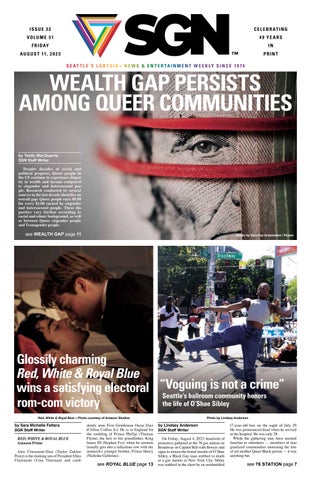
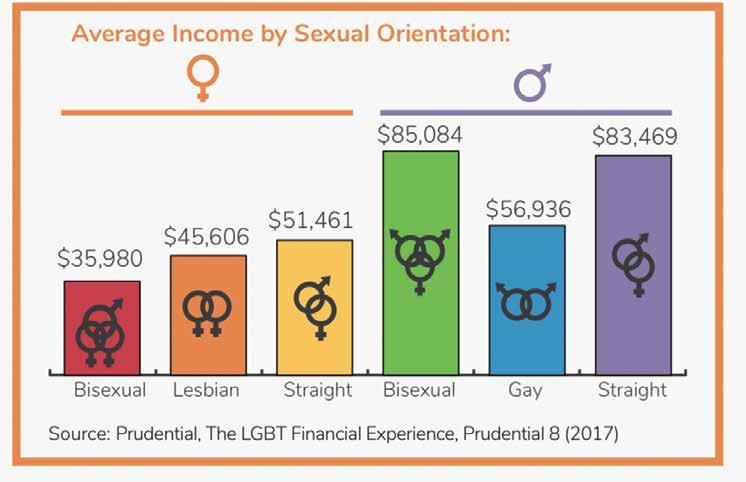
Despite decades of social and political progress, Queer people in the US continue to experience disparity in wealth and income compared to cisgender and heterosexual people. Research conducted by several sources in the last decade identifies an overall gap: Queer people earn $0.90 for every $1.00 earned by cisgender and heterosexual people. These disparities vary further according to racial and ethnic background, as well as between Queer cisgender people and Transgender people.
by Lindsey Anderson SGN Staff Writer
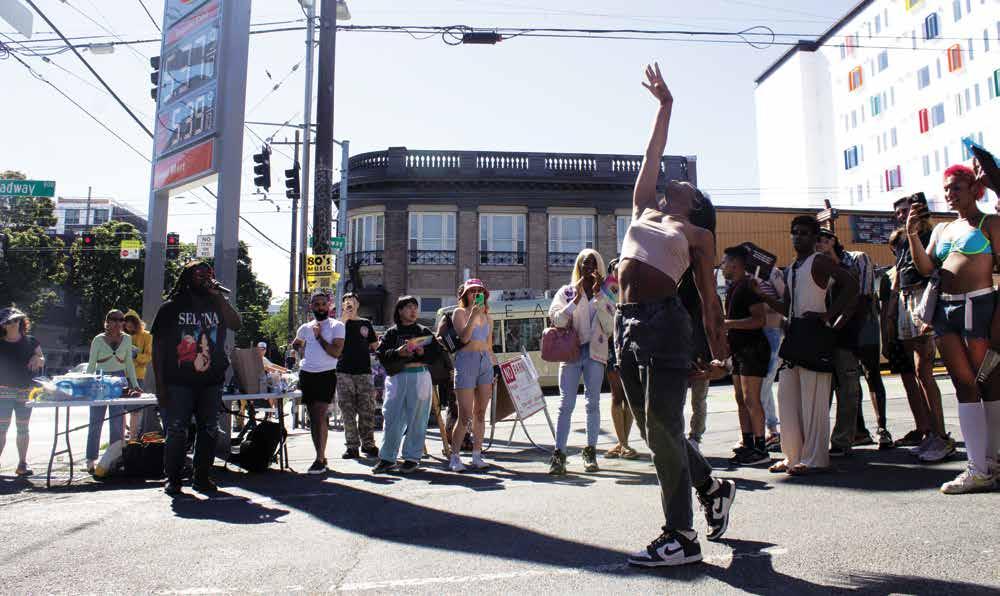
On Friday, August 4, 2023, hundreds of protesters gathered at the 76 gas station on Broadway on Capitol Hill with flowers and signs to mourn the brutal murder of O’Shae Sibley, a Black Gay man stabbed to death at a gas station in New York City. Sibley was stabbed in the chest by an unidentified
17-year-old boy on the night of July 29. He was pronounced dead when he arrived at the hospital. He was only 28. While the gathering may have seemed familiar to onlookers — members of marginalized communities mourning the loss of yet another Queer Black person — it was anything but.
by Sara Michelle Fetters SGN Staff Writer
RED, WHITE & ROYAL BLUE Amazon Prime
Alex Claremont-Diaz (Taylor Zakhar Perez) is the dashing son of President Ellen Claremont (Uma Thurman) and confi-
dently stoic First Gentleman Oscar Diaz (Clifton Collins Jr.). He is in England for the wedding of Prince Phillip (Thomas Flynn), the heir to his grandfather, King James III (Stephen Fry), when he unintentionally gets into a ridiculous row with the monarch’s younger brother, Prince Henry (Nicholas Galitzine).
Photo by Lindsey Anderson Red, White & Royal Blue – Photo courtesy of Amazon Studios
Photo by Karolina Grabowska / Pexels
Local News
Dolly Parton to celebrate statewide early literacy program
by Daniel Lindsley SGN Staff Writer
Musician and philanthropist Dolly Parton will be visiting Washington state on August 15 to celebrate her Imagination Library achieving statewide coverage. In Washington alone, the library sends its 65,000 current enrollees — children under the age of 5 — one book each month, and has surpassed 1.6 million books so far.
“This is such a magnificent moment and achievement!” said Brooke Fisher-Clark, executive director of the Imagination Library of Washington. “Now we take a moment to celebrate and continue igniting support and enthusiasm around this for future generations.”
Gov. Jay Inslee and Lt. Gov. Denny Heck have announced they will proclaim August 15 “Imaginary Library of Washington Day” to honor the occasion.
“We welcome the great Dolly Parton to celebrate our statewide program and promote registration for our youngest learners into the Imagination Library,” Inslee said. “It is important to get high-quality books to children from a young age and ensure that their families, and their unique races, ethnicities, and identities are well represented among the selection of books.”
Parton’s program is also active across Ireland, Canada, Australia, and the United Kingdom, but it started in her home area of Sevier County, Tennessee, and was inspired by her father, who was illiterate. Its Washington state branch was sponsored through the Office of Superintendent of Public Instruction and the Department of Children, Youth, & Families, and is administered by United Ways of the Pacific Northwest.
Although Parton’s event is invite-only, it will be streamed live on TVW and the Imagination Library of Washington’s social media. It will include a fireside chat and a short performance, and will highlight the efforts of the people making Washington state coverage possible.
“It’s been an honor to support the expansion of early literacy across Washington,” said State Superintendent Chris Reykdal. “By providing free books to our youngest learners, the Imagination Library is breaking down barriers to skills that will support Washington children for a lifetime.”
Parton might be most readily recognized for “9 to 5,” a song originally recorded for a 1980 comedy film of the same name, and one that has since become a kind of feminist anthem for the working woman. More recently, it has been used as a walkin theme for politicians such as Elizabeth Warren and Hillary Clinton.
Whether at the Oscars, on talk shows, or performing on stage, Parton has been famously accepting and uncontroversial despite her roots in rural Tennessee and the suggestive themes in her music and humor. She has chalked this up to being an entertainer first and foremost, whose job it is to help people feel welcome.
When asked about the LGBTQ+ community, she has repeatedly said in interviews that judgment is God’s job, and that she
“It is important to get high-quality books to children from a young age and ensure that their families, and their unique races, ethnicities, and identities are well represented among the selection of books.”
believes we’re on this earth to be who we truly are and to love each other.
Her policy of tolerance has historically meant she has hesitated to speak out against controversial figures like Donald Trump, though in February of 2021, she told TODAY that she refused the now-former president’s Presidential Medal of Freedom twice, citing her husband being ill and
a case of COVID as her reasons. She also refused the award when it was offered by President Joe Biden.
“Now I feel like if I take it, I’ll be doing politics, so I’m not sure,” Parton said. “I don’t work for those awards. It’d be nice, but I’m not sure that I even deserve it. But that’s a nice compliment for people to think that I might deserve it.”
Photos courtesy of Dolly Parton Imagination Library
Local News
Islamic Center of Federal Way seeks help to identify burglars
by Cameron Martinez SGN Intern
On July 29, the Islamic Center of Federal Way was burgled and vandalized by two unidentified men. Both the ICFW and Washington’s chapter of the Council on AmericanIslamic Relations are seeking help from the public in identifying the culprits.
“Seeing a house of worship targeted and disrespected like this is highly concerning,” said Imraan Siddiqi, CAIR-WA’s executive director. “We stand with the ICFW community in calling for those who burglarized to be identified and caught.”
In the video shared by the mosque on Facebook, two dark-haired, bearded men wearing bright clothing are seen entering
the space through a window and breaking into the mosque’s office. They then proceeded to steal the donations, according to ICFW officials.
CAIR-WA also called on mosques and Islamic institutions to use the advice offered in its “Best Practices for Mosque and Community Safety” booklet. An online version can be found at https://cairwa.org/
If you can identify the men in the video, please reach out to the Islamic Center of Federal Way at (253) 520-6544 or info@ masjidicfw.org; and the Federal Way Police Department at (253) 835-6700.
Starbucks workers’ national bus tour hits Seattle
Actions at Pike Place Market and Starbucks headquarters
by Mike Andrew SGN Staff Writer
A national bus tour of Starbucks workers hit Seattle on Monday, August 7, kicking off two days of actions in support of Starbucks Workers United (SBWU), the union organizing Starbucks stores across the country.
The tour, which started in MinneapolisSt. Paul on July 10, was intended to spark new organizing efforts and highlight the ongoing struggles of unionized Starbucks stores to get their employer to sit down and bargain for a contact.
Seattle — home of the company’s corporate headquarters — was the final and climactic stop.
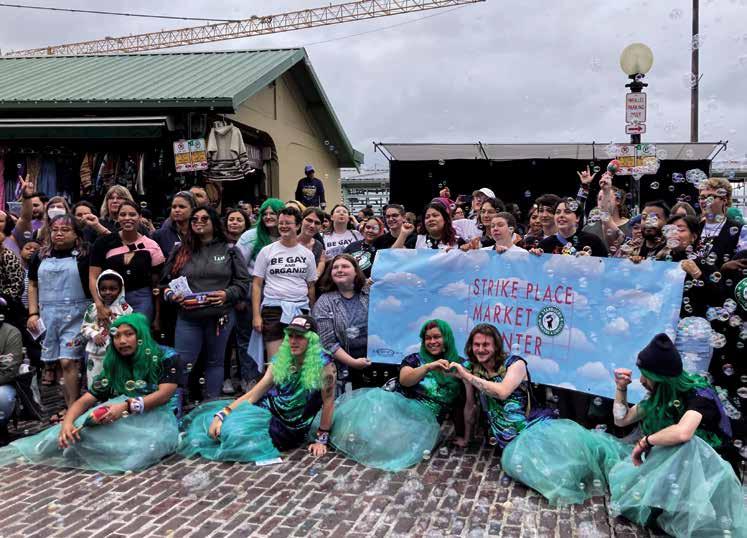
On Monday, the SBWU bus stopped at the world’s very first Starbucks in the Pike Place Market, which was renamed “Strike Place Market” for the occasion.
About a hundred Starbucks workers, joined by supporters from other unions and the wider community, rallied in front of the store, calling for a strike in support of employees’ organizing. Later in the day, workers set up “bargaining tables” in front of some Starbucks stores, symbolizing the company’s refusal to sit down with them and bargain for a union contract.
The next day, August 8, some 150 SBWU workers marched on Starbucks corporate headquarters at First Avenue S. and S. Lander Street.
Ahead of the march, community supporters had infiltrated the Reserve Roastery in the headquarters building, posing as customers. When SBWU entered the store in a silent march, supporters rose, held up their fists in a sign of solidarity and revealed previously concealed signs that read “Customers support union coffee,” “You deserve a union,” “Union strong,” and similar prounion statements.
Customers looked on — many with approval, others in surprise — as Starbucks workers and their supporters stood silently with signs and banners for 10 minutes, then marched out of the store.
US Rep. Pramila Jayapal spoke at a post-action rally down the street from the Starbucks building. She noted that when Starbucks was founded, it consisted of six unionized stores. When current owner
Howard Schultz bought the company and turned it into a multinational megacorporation, he dissolved the union and has fought unionization ever since.
April Sims, president of the Washington State Labor Council (WSLC), also spoke. Sims, whose organization represents some 400 union locals and district councils and half a million workers, pointed out that SBWU organizing is gaining momentum, with more than 340 stores in 41 states currently unionized. Sims is the first woman to head the WSLC and the first African American woman to lead a state labor council.
Starbucks workers charged that the company has responded to unionization efforts by firing individual activists and closing stores that had unionized or were in the
process of doing so. Four stores have been closed in the Seattle area, including the first Seattle store to unionize, the popular Capitol Hill location at Denny and Broadway.
Nevertheless, SBWU has continued to rack up local victories. The Redmond Starbucks location has voted to unionize, and stores at Seattle Center and Third Avenue and Madison Street have filed for union elections.
Maia Hepburn, a worker at the Seattle Center Starbucks, told the crowd that the turning point for her came at the end of a “truly exhausting shift.”
“I felt like quitting,” she recalled, “but I also felt like that would be abandoning my friends and fellow workers.” She then turned to union organizing, thinking that “we have to make it better by ourselves.”
Liz Duran, a worker at the already unionized Reserve Roastery on Pike Street, said they were “so proud of every worker at every store” that was fighting for a union, and promised they would all keep fighting “till we get to a contract.” They then led a chant of “See you at the bargaining table!” Ari Bray, a worker at the also-unionized U District Starbucks, explained that SBWU had laid out all its demands to the company, but Starbucks had yet to respond with a single proposal of its own.
“It hasn’t been easy,” they told the SGN “The company has resorted to scorchedearth tactics. But we’re still here, we’re still organizing, we’re still reaching out to other workers, and we’re winning.”
Photo courtesy of SBWU / Twitter
Images courtesy of Islamic Center of Federal Way / Facebook
STATION continued from cover
Protesting with bodies
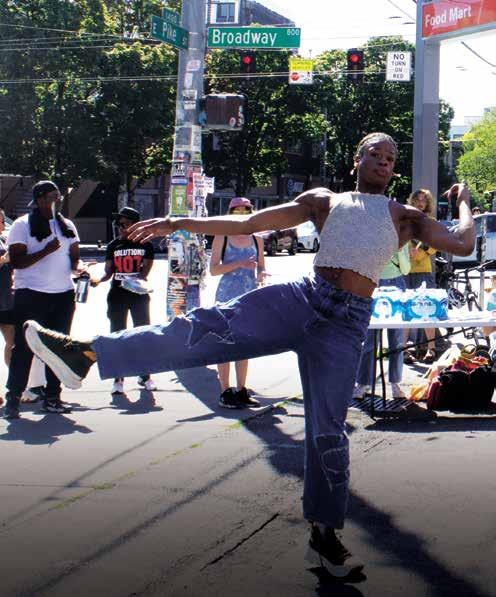
“I was thinking about another Black life senselessly taken for no reason,” event commentator Notorious T said into the microphone as the crowd formed a large circle beside the gas pumps. “They would want to be celebrated, so we’re going to have a good time. DJ, pop the beat when you’re ready.”
Bass gave new life to the mourning crowd as Notorious T began to call out the names of members of Seattle’s ballroom community to come forward and move their bodies to honor Sibley, who was a professional dancer. Their brilliance shone through every drop, twist, and leap.
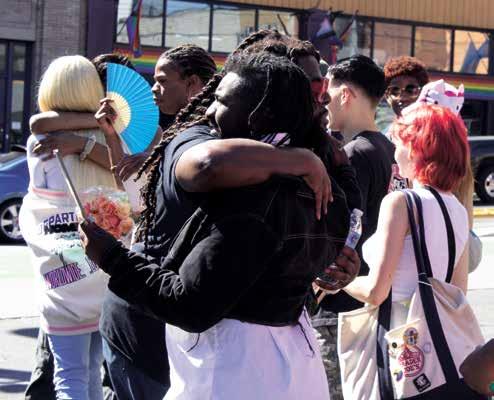
While nobody at the protest knew Sibley personally, it still felt as though they’d lost a close friend or family member, because, in a way, they had. Sibley was a part of the ballroom community, a Black and Brown LGBTQ+ subculture that began to flourish toward the end of the 20th century.
“[Ballroom] was a safe space created by Queer and Trans Black and Brown people,” event organizer Julian Everett said. “[Ballroom is] a safe space of inclusivity, because we didn’t feel included within the general public of LGBTQ+ people. We needed to have a space of our own, and also for us to be celebrated and affirmed of our talents and visibility, and our lived experiences. We haven’t necessarily had those spaces given to us, and we had spaces taken away from us. We had to create them on our own.”
Ballroom is more than just a space for people to dance — it’s a place where found families are established, a haven for Black and Brown LGBTQ+ people often excluded from white, cis-normative spaces. The environment has shaped modern drag culture, and its influence has extended even beyond Queer and Trans people. Ballroom is known for high-energy music, elaborate costumes, and voguing — which Sibley was doing when his attackers took notice.
“I want you to understand how impactful this was — we didn’t just lose anybody, we lost a member of the ballroom community,” Everett said to the crowd before the music began.
“O’Shae was with his friends, like we are in this very parking lot, just chilling, not doing anything harmful. Some people had other plans and an agenda. O’Shae decided to go ahead and try to handle it as best as possible, in a nonviolent way. They decided to get violent, and unfortunately, he was stabbed and died. That’s the reality
that could happen to any of us in this parking lot right now, because we are all a part of ballroom — even if we are not a part of houses. Even if we simply just admire ballroom, we are still at risk.”
“Voguing is not a crime”
Everett concluded his speech by thanking the members of Seattle’s ballroom community for coming out and showing their camaraderie with Sibley. He also acknowledged that the violent murder of BIPOC and especially Queer and Trans BIPOC people is far too common.
“We’re going to allow our creativity, our capability to use our bodies as a sense of protest so that people know you can’t get rid of us, you can’t stop us, you can’t stop ballroom,” Everett said. “Ballroom is not a crime, voguing is not a crime. At the end of the day, like it or love it, we’re going to keep it moving.”
For over an hour, participants shook, shimmied, and strutted through a supportive circle. After each person who participated ended their set, Notorious T encouraged others to give them a round of applause.
Acts of bravery
The protest was joyous and sorrowful, beautiful and tragic, and above all, an act of sheer bravery.
Hundreds of people, particularly young ones, showed up to do something they love, something they now knew (if they didn’t before) could get them killed. Despite what happened to Sibley, the dancers at the protest showed no fear.
“I’m here to vogue out for O’Shae Sibley,” said Aaliyah Williams, a young woman who showed up with flowers and later showed off her amazing skills.
“We are happy in our Black Trans Queer bodies,” Williams’ friend, Hippolyta Toussaint, added.
“We are here today in the name of O’Shae,” said Zakai Davis-Rodriguez.
“He was a Black Queer man who was stabbed at the gas station for simply just expressing the way he identifies through dance. It’s too common: people getting attacked for who they’re born to be. We’re here today to express ourselves through our dance. We’re here to come together as a community and show we’re stronger as a community. You can take one of us away, but more will come back.”
The country mourns for Sibley Seattle wasn’t the only city to hold a dance-out for Sibley. Throughout the country, the ballroom community came together to honor his memory. Even Beyoncé wrote an online statement about him.
“We’re here to come together as a community and show we’re stronger as a community. You can take one of us away, but more will come back.”
In Brooklyn, where he lived, dancers marched through the street from an LGBTQ+ center to Pier 46, a favored spot for ballroom houses. There they set up candles in the shape of his name, laid flowers on the ground, and splattered fake blood.
“As a member of the ballroom community, I don’t feel that I would be doing my part by simply remaining quiet, remaining silent,” Everett said as he reflected on why he decided to organize an event in Seattle for a man murdered thousands of miles away.
“This will not stop ballroom from existing,” he continued. “We all deserve inclusivity, and we all deserve space. [We want] to simply bring awareness that hate crimes are still occurring and are higher amongst Black and Brown Queer folks and Trans folks in the United States. So we continue
to push for solidarity.”
Everett believes the best way to honor Sibley’s life is by supporting the community he loved. In Seattle, that can mean giving to nonprofit organizations like the Lavender Rights Project and Project Kiki. The event’s organizers also stressed the importance of showing loved ones that they matter.
“This is how we save lives: we show up, and we love on each other, every moment that we get, because we don’t know what we’ll get, what will happen tomorrow,” another speaker, Aariyah, said.
Anyone interested in donating or volunteering with the Lavender Rights Project can visit https://www. lavenderrightsproject.org
Photos by Lindsey Anderson
“My pet comes first” The high cost of pet ownership
by Lindsey Anderson SGN Staff Writer
Since the pandemic, more American households own pets than ever before, and they are spending more on them, too. In 2022, Americans spent $136.8 billion on their furry friends. According to Forbes, 66% of American households (86.9 million homes) own pets — 74% have at least one dog, and 53.5% own at least one cat.
The number of pet owners is even greater in Seattle. According to the latest US census, there are currently more dogs than children in the city.
While pets certainly enrich our lives, just what is the cost of housing them, and how far are Americans willing to go to spoil their animals?
Dogs are kids
On average, dog owners in America spend about $730 on their pooches each year, according to Forbes; however, many pet owners in Seattle estimate spending more, according to Lending Tree. In cities with higher populations of young people, the cost of pet ownership is also higher, both sources say.
While millennials are more likely to raise a dog than a child, Gen Z is the most likely to treat their pets like a child. Thirty-two percent of 18-25-year-olds buy clothing for their pets, 35% buy them birthday cakes, and 39% purchase presents for birthdays and holidays, according to Forbes, which also says that young people are the most likely to invest in specialized pet food, dog walking services, daycare, and behavioral training.
Justin Walker and Maia Larsen said they spend nearly $1,000 a year on their Chihuahua, Tinkles.
“It’s only getting worse,” Walker said with a laugh as he carried a armful of specialty dog food out of Mud Bay.
Sacrificing for our pets
People in Seattle also report making sacrifices in their personal lives for their pets. According to Forbes, nearly 40% say they live on a tighter budget for their animals, 14% report moving into a house with a yard specifically for their dog, and 6% have broken up with a significant other who didn’t get along with their dog. People living in Washington state are also some of the most likely to stay at a job that allows them to bring their dogs to work or work remotely to care for them.
While inflation has led many Americans to cut costs everywhere, from the grocery store to the gas pump, Walker and Larsen said it would take a lot to consider changing Tinkles’ lifestyle.
“Yeah, I would [cut costs for myself first,]” Walker said.
“We’d do away with amenities for us for sure,” Larsen added.
Cat owners feel the same way. Taylor Richmond is the owner of nine-year-old Thor. “He’s a big boy and a butthead,” he said of his black and brown tabby. Even though Richmond works at Mud Bay and receives a significant discount, he still estimates that he spends around $1,000 a year on his cat. He said he would also make cuts to his life before doing anything that would impact his cat.
Most pet owners in Seattle agree. Washington state ranked seventh on the Forbes list of most dedicated dog owners. Of the Washingtonians surveyed, 43% said they would spend up to $4,000 to save their dog’s life. However, 42% of Americans also reported that a $999 vet bill would cause them to go into debt, according to Forbes
Inflation leads to overcrowded shelters
Despite Walker and Larsen’s commit-
While pets certainly enrich our lives, just what is the cost of housing them, and how far are Americans willing to go to spoil their animals?
ment to providing premium care for their dog, which echoed the sentiment of several other Mud Bay customers, Seattle-area shelters are reporting a drastic increase in animal intakes this summer, most of which are due to financial hardship and inflation.
“Anytime we see an increase in owner surrenders, it’s a good indicator that we’re heading into a recession,” the chief operating officer of Seattle Humane told the Seattle Times earlier this month.
Shelters across the country are facing capacity issues. From July 17 to 24, the Humane Society for Tacoma and Pierce County waived all adoption fees after taking in 460 animals.
Between 2021 and 2022, 3% of pet owners had to give their animals up for adoption, according to Forbes. The top reason for rehoming their beloved animals was inflation. Other reasons included the rising cost of rent, the inability to afford a pet’s medical bills, and the cost of pet deposits for apartments.
For Walker and Larsen, the idea of giving Tinkles up is unthinkable.
“I would never,” Walker said. “She’s been through some things.”
“She’s not going anywhere,” Larsen added.
“I would never give [Thor] up,” Richmond said. “I’ve moved back into my mom’s place, because I didn’t have a place to live, and I would do that again or something similar before I did anything to him. My pet comes first.”
When vet care is too much
Willow owns a Daschund mix named Whiskey. Their dog has a moderate skin condition, which isn’t too much for Willow to handle. However, they understand the issue that costly vet bills can cause.
“If it was a situation where their life could be extended, but I can’t afford to keep their life going, I would give them to someone who could afford them — if crowdfund-
ing and stuff, which is unfortunately what a lot of people have to do, didn’t work out,” Willow said. “That would probably be the point, to extend his life if that would be good for him.”
Unfortunately, the high costs of caring for an elderly or special-needs pet can often land the animals behind bars. Pets with expensive health needs are the least likely to make it out of shelters. As more Americans report buying a dog from a pet store or breeder, the average number of animals euthanized in shelters continues to rise, according to PETA. As of 2022, it was 1.5 million, according to The Zebra, an insurance comparison site.
Some pet owners, like Chase Fisher, already feel the strain of added vet bills. Fisher has a five-month-old kitten named Lasso. “We think he has worms, but we’re trying to avoid going to the vet to have to pay for that kind of stuff, so we’re here to get [over-the-counter] medication,” Fischer said as he browsed Mud Bay’s selection of homeopathic remedies. “We have to think about the cost a lot more.”
While Fisher would make cuts to Lasso’s treat and toy supplies when budgeting, he still says it would take a lot for him to consider rehoming his pet. “I would give up things of my own before I give him up,” he said.
Vet care can be one of the biggest costs to pet owners — and it’s often one they don’t consider before adopting. The average household spends $326 a year on vet costs, according to Forbes, though a serious incident can cost more than $1,000.
Dog owners are the most likely to face high vet bills. “We see a lot of dogs,” Amber Liu, the receptionist at Urban Animal on Capitol Hill, said. “Just in general, cats are a little bit more hardy, so they don’t need as much care. When we see cats, it’s pretty traumatic things they need to be treated for.”
The great vet shortage
The cost of vet care is skyrocketing
in America, partially due to an increase in pet ownership during the pandemic. Despite the high demand for vets, the number of professionals in the field continues to decrease. Even before the pandemic, veterinarians were feeling overworked and underpaid. The stress of the job has led male veterinarians to have a suicide rate 2.1 times higher than the average American, and female vets are 3.5 times more likely to kill themselves, according to VetAdvantage.com.
A 2018 study from the American Veterinary Medical Association found that 6,291 full-time vets would be required to accommodate the desire of current doctors to work fewer hours. The existing vets were even willing to take dramatic pay decreases. The study also predicted that 22,909 additional vets will be needed by 2030 to keep up with the increase in pet ownership.
According to a new poll from PetLab, Washington ranks sixth in demand for veterinarians. The need for care is straining Urban Animal, where employees report seeing an influx of new clients daily. “We just keep collecting more… because a lot of people have their vet, but they can’t see them for months, so they just come to us instead,” Liu said.
The vet shortage in Washington means that the average time between scheduling an appointment and receiving care is one to two months. The increase in new pet owners has led many established clinics to refuse to take on new clients.
“COVID has caused other clinics to stop taking new patients,” Liu explained. “People were getting pets a lot during the pandemic, and people started coming to us because they either couldn’t get into their regular vet or a vet near them was not accepting new patients. We get a huge influx of patients every single day — new patients and new clients — because of that.”
Urban Animal is a walk-in clinic, like urgent care for animals. While it does take appointments for surgeries and dental cleanings, most of its patients are brought in and treated on the same day. However, this can mean long wait times, especially when an emergency comes up.
“Our walk-in is helpful for people if they need something immediately or the day of, like a health certificate later in the day. It’s a good way to work the clinic,” Liu said, though she acknowledged that the walk-in style can be difficult for some.
“We do have an estimated wait time,” she said. “Right now, it’s about four hours, but we’ve quoted people four hours, and they might not [be seen] for six hours, maybe, because we have emergencies run in, and it throws a wrench in things.”
Keeping vet care affordable
Urban Animal is working hard to keep up with the demand. The Capitol Hill location recently hired a few new doctors and technicians. Other locations, like the downtown clinic, have moved to appointments only.
“I think if we could see more, we would love to,” Liu said. “I know the owner is pushing us to keep seeing more and more patients every day. It’s just really tough, because we have emergency cases that take up our doctors’ time. I feel like, at the moment, we’re seeing as many as we can.”
Urban Animal knows that the cost of vet care is often a determining factor in whether or not people can keep their pets. Because of that, it has a few programs to help keep its clinics affordable.
“We are partnered with Doney Coe pet clinic. Right now, they’re working out of our White Center location,” Liu said. For 35 years, the Doney Coe Pet Clinic has provided free veterinary care for low-income and houseless pet owners in the Seattle area. The clinic is open one day a week and, like most Urban Animal locations, only takes walk-ins.
Photo by Los Muertos Crew / Pexels
“It is hard, because you have to line up and stay in line the whole time, but I’ve heard it helps people who struggle to pay for things. We donate our expired meds, or if people bring in meds they have already opened, but they’re unused, we give those to Doney Coe,” Liu said.
Pet stores and veterinary clinics have been hit hard by inflation. Willow, who works at Mud Bay, has noticed a steady price increase since inflation set in. “I’ve only been here for two years, so I don’t have a long history here, but I have noticed that when we do price changes, they always go up. So, yeah, the prices have increased.”
Urban Animal has launched a new “Affordable Care Together” subsidy to help keep its costs from increasing for those who cannot afford it. The program adds an optional 15% to every vet bill. Clients are asked to give a little more, but those who can’t may opt out.
“Although this subsidy is optional, it is our hope that those who can [will] keep it on their invoices to help others. Urban Animal is confident this additional amount will still provide care [that’s] comparably priced or less than other area practices,” the clinic said in a statement.
“It’s not necessarily the low-income clients getting the [ACT] subsidy. It just helps everyone overall,” Liu added. “The owner of our company decided [that] instead of raising the cost of everything across the board, we just left it up to the clients, if they’re able to add a little bit more money
— not necessarily a donation, it’s more of an optional [amount added to] the bill to help us keep our costs lower. It helps you over time. It is optional, so people can opt in or out of the subsidy.”
As the cost of pet ownership continues to
Photo by RDNE Stock Project / Pexels
rise in America, experts recommend putting money away or investing in pet insurance. Adopting a pet is a big — and often expensive — decision. Those who do so, however, should be ready to make a lifetime commitment.
17th Ave. SW, Seattle, WA 98106. Its website is https://doneycoe.org.
Crypto going the way of the Beanie Baby bubble
by Ian Crowley SGN Contributing Writer
Crypto speculation
Cryptocurrency has to be one of the most-talked-about technological innovations of the last 10 years. Speculation about what it could make possible has run wild among neophytes and experts alike. Some of these predictions seemed quite optimistic and futurist, while others urged people to remain skeptical, as the high-risk nature of things like cryptocurrencies can lead to the destruction of one’s financial stability. This is due to the fact that cryptocurrencies are speculative ventures that often rely on hype and exclusivity to drive growth, which is likely to create bubbles in the market when it shifts. Some have likened crypto to the Wild West, in reference to the lack of proper regulations, due to the technology being so new. Still, despite this, cryptocurrencies and related blockchain technology were a growth behemoth throughout the last decade, only to experience a sharp decline in value (from an estimated at $3 trillion in 2022, to $1 trillion in 2023) over the past few years. This article hopes to shine a light on why.
An overview
When discussing how hype can undermine and create bubbles in crypto markets, it’s beneficial to briefly go over what cryptocurrency (and its tangential forms) is and how it works. Cryptocurrency is any virtual asset that is logged and purchased on a public blockchain. The blockchain acts as a series of statements (“blocks”) recording all participants’ transactions, in a decentralized system. It is a currency (go figure!) hosted on the blockchain that can be used in transactions or traded.
Another form of blockchain technology are NFTs, certificates of ownership of unique digital identifiers housed on the blockchain. These identifiers can come in many different shapes, often a piece of art. The seller creates an artificial scarcity, selling only a fixed number of whatever item. This is why companies market these assets on exclusivity. After the certain number are gone, the only way to acquire these assets is through the resale market.
When particular assets were accompanied by a lot of hype, their resale price skyrocketed. Bored Apes (a popular NFT touted by many celebrities, including Jimmy Fallon, Paris Hilton, Eminem, and Snoop Dogg, to name a few) sold for millions of dollars on resale.
The term NFT refers to a “nonfungible token,” which means that on the blockchain, it cannot be replaced or copied. Off of the blockchain, however, on the internet, the NFT’s likeness can be copied, sent, and multiplied infinitely. Many NFT holders, faced with social media trolls copying and pasting their NFTs ad nauseam, claimed that such a thing “isn’t allowed.” This stands diametrically opposed to the fact that there are no enforced rules prohibiting this, only an honor system.
The validity of the exclusivity of NFTs — and if said exclusivity on the blockchain meant, well, anything…materially — quickly became a point of discourse. Critics compared NFTs to owning a star, or being sold a certificate of ownership of the Brooklyn Bridge. As you can imagine, this contributed to the decline in the public perception for cryptocurrencies.
Beanie Babies and crypto
The editor of this publication likened crypto’s story to the Beanie Baby bubble, an analogy that rings true. When the hype surrounding Beanie Babies reached a critical mass in 1999, a bubble forming and bursting was likely to occur in the speculative market. When the creator of Beanie Babies decided to end the series of toys, it caused a nosedive in demand. This cultural shift away from Beanie Babies caused the bubble to burst, and the value of the brand would never recover.
The way in which markets can be manipulated by cultural changes is important to
recognize, especially when considering that any promise of “guaranteed returns” are based on current market trends, or projected ones. As mentioned, the market is constantly changing due to outside factors. While Beanie Babies provide a fun example to compare crypto to, there are many other comparable markets, like the dot-com bubble of the early 2000s.
Malpractice
Under this critical lens, it is hard to believe the cryptocurrency market was valued at $3 trillion just two years ago. Such a high-risk investment with high losses doesn’t seem like it would be such a profitable endeavor. And it isn’t, necessarily. As mentioned before, the crypto market has lost over 60% of its value, equating to over $2 trillion.
Most of that was held by the companies pushing the product. Those on top often made back their investment multiple times over, leaving the project before most people lost their (sometimes very large) investments. This tactic of heavily hyping an asset to consumers and investors, only to exit as prices hit their peak, is commonly referred to in the crypto community as a “pump and dump.” This practice is very common, specifically because investors know they can make a ton of money doing it, with little to no consequences.
Others (who are most likely selling crypto, or received a large payout from engaging with it) claimed it was the start of a new, freer, fully decentralized economic system.
While the technology itself could present potential (given the proper circumstances of use and oversight), to think it could replace our current economic system without government involvement, in the opinion of this writer, is naive. Furthermore, the environmental impacts of this technology highlight its unsustainability as a realistic alternative to big banks. Thankfully, as the technology ages, attempts at regulation are becoming more common, but how that manifests changes in the system is yet to be seen.
The ability of this technology to operate without adequate, regulatory oversight can hopefully be further remedied by more public knowledge on the matter. This could lead to comprehensive legislation being passed. Important insight can be gained simply by recognizing the unraveling of crypto companies by their own malpractice due to lack of proper regulation.
A popular example of this is the Bahamasbased cryptocurrency exchange company FTX. It came under fire when it was revealed its CEO was housing exchange tokens in an associated trading firm that he owned. This led rival companies to sell all of their stock, causing the market price of FTX to plummet. This also led to a crash of the exchange, due to the number of people trying to withdraw their currency. This scandal has also had a measurable effect on the market, increasing skepticism around investing in crypto. Multiple firms filed for bankruptcy in addition to the loss in value.
I hate to burst your bubble
Due to all of these factors, larger investors, such as celebrities, sports, and brands, have cut ties with cryptocurrency and its various uses. Examples include JP Morgan cutting ties with Binance (a popular exchange firm) and basically all of Hollywood walking back their endorsements. It would seem the risk related to lack of regulation is becoming increasingly toxic as consumers recognize the likelihood of being manipulated into investing in a sinking ship.
While abandonment by investors is certainly the reason for this shift away from crypto, the public’s perception of NFTs and related crypto projects is instrumental in driving people away. Just as Beanie Baby demand fell in unison with the hype surrounding the product, fewer people taking seriously and being interested in crypto drives growth through the floor, creating less hype for the market to run on. Pop!
For anyone struggling to find affordable vet care, Urban Animal offers low-cost walk-in visits five days a week. The Doney Coe clinic is also available on weekends in White Center at 9610
Photo by Thought Catalog / Pexels
Tax-filing middlemen feeling the heat after scrutiny, IRS direct file system to launch
by Daniel Lindsley SGN Staff Writer
According to IRS data, if you had to file taxes for 2022, odds are that you did it electronically, and that you did it through a service like TurboTax. But the company behind that service, Intuit, has been under increasing scrutiny from the press and the IRS over the last few years. If next year’s IRS e-filing program gains enough traction, the taxpayers who need it most will be increasingly able to cut out the middleman and file directly with the government for free.
Those who have just used TurboTax for the first time might rush to defend it, perhaps saying that the company has made tax season easier (or at least less dreadful). Sure, the service skims a bit off the top of our returns, but it’s convenient. Would taxpayers actually benefit from a governmentrun, returnless system?
The IRS has been involved with private tax prep companies for a long time. ProPublica published an article in 2019 that brought together employee testimonials, internal documents, and legislation from over 20 years of e-filing history. It alleged that since 1998, multiple administrations’ plans to create a free, no-return tax filing system have been quashed by Intuit’s lobbying efforts — often with backing from the IRS itself.
In 2002, in response to the George W. Bush administration’s proposal to develop “an easy, no-cost option for taxpayers to file their tax returns online,” IRS Commissioner Charles Rossotti said that the IRS couldn’t possibly handle that workload, and
that Congress “will never give you sufficient funding.”
Four years later, a slide would be shown in a presentation to the Intuit board of directors, outlining the “repeated challenges” from government legislation, which the company had “successfully met” through lobbying and negotiation.
Out of the 2002 kerfuffle in particular, a lasting deal between the IRS and Intuit was born: as long as Intuit and a coalition of other companies offered free electronic tax prep to a larger percentage of taxpayers, the IRS promised not to develop a free system of its own.
That promise was taken for granted until
Joey Amato creates financial literacy roadmap for LGBTQ readers Features
by Lindsey Anderson SGN Staff Writer
Finances can be difficult for anyone, but for members of the LGBTQ+ community, they can be even more tricky. While there are several financial guidebooks, gurus, and motivational speakers ready to give advice, many lack the experience and understanding of the unique struggles LGBTQ+ investors can face.
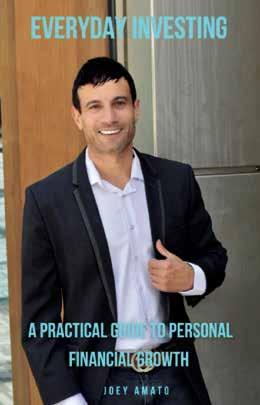
This was one of the reasons why Gay travel journalist and publisher Joey Amato decided to write his latest book, Everyday Investing.
“The book takes readers on a transformative journey, starting with the basics of investing and gradually building upon that foundation,” Amato explained. “Readers will explore various investment vehicles, including stocks, bonds, mutual funds, real estate, and more.”
While Amato admits he is not a financial expert, he has found success in his own life. Now he is offering his journey as a road map for other LGBTQ+people to follow if they’re feeling lost on the winding journey of one’s finances.
The book breaks down financial topics, language, and theories into easy-to-understand concepts. Amato uses language the average person can understand when diving into topics that are often frustrating and overwhelming to the average American.
He also uses stories and anecdotes from his own experiences, which helps the book feel more like a conversation between friends and less like a Finance 101 class. He breaks down his past mistakes, like getting into credit card debt right out of college — to the tune of $50,000 — and explains how to avoid doing the same thing.
“I made many financial mistakes throughout the early part of my life, and my dream for this book is to educate people so they don’t make the same mistakes I made,” he said.
Throughout the book, Amato focuses on how emotional responses to finances can lead many people to experience problems. He dives into fear, greed, and preconceived biases that can hold people back when it comes to achieving financial success.
Amato also notes that while emotions can often get in the way of success when it comes to finances, talking about money can be an emotional topic. He specifies that there is a time and a place for feelings in investment and encourages readers to let their values guide their investment decisions.
Unlike many other financial guides, Amato considers the wider world. He is aware that many of his LGBTQ+ readers may feel hesitant to grow their finances when the world seems to be in constant environmental and social disarray. Throughout his book, he shows that there are ethical ways to invest in sustainable and socially beneficial projects.
“I wrote Everyday Investing because I want people in the LGBTQ community to be confident and proud about investing for their future,” Amato said. “Many of us focus on today, spending thousands of dollars per year on vacations, dinners, and luxury items when we should be planning for our future. It’s perfectly okay to splurge now and then, but I would much rather be able to retire by 50 than 62 — the earliest age that a person can choose to receive Social Security benefits.”
By using the tips and guides in Amato’s book, readers can start planning their finan-
2018, when the IRS asked its Advisory Council, a panel of outside experts, to take another look at the coalition’s “Free File” system. It turned out that Intuit’s stock price and market share hadn’t grown so large for no reason. For 12 years, the company had been pushing a product with a similar name, “Free Edition,” and hiding the government-backed “Free File” program deliberately.
Another 2019 ProPublica article recounted some of the ways TurboTax’s “Free Edition” lured taxpayers in with the promise of “free,” and only charged them after they had gone through the trouble of entering sensitive information.
The company had also hidden the actual government-backed “Free File” webpage from appearing on search engines, and even if someone managed to find the right page, each free tax prep service had different requirements based on age, income, and location. TurboTax in particular would only count simple returns in its free service; anything more complicated than a W-2 would incur additional charges.
Partly as a result of ProPublica’s exposés, Intuit was sued by multiple states for shady business practices, and in May last year, the company reached a settlement of up to $85 for each of the 4.4 million people who used TurboTax in 2016, 2017, and 2018. Intuit then promptly left the Free File program along with H&R Block, citing a need for more room to innovate.
In a statement to ProPublica, an Intuit spokesperson argued that the IRS shouldn’t be responsible for tax preparation because it would be “fraught with conflicts of interest,” as the agency is already responsible for tax collection, investigation, and enforcement. Other proponents of tax prep companies have continued to point out that the IRS remains chronically underfunded.
But at least 30 other wealthy nations already have simple, returnless systems in place, in which a government agency does most of the paperwork for taxpayers, and then sends the mostly completed forms to them for verification.
In May this year, the IRS announced plans to launch a pilot program for a similar “direct file system,” which the agency claims could save taxpayers billions of dollars annually. The program will launch in 2024.
cial strategies. Amato uses himself as a success story: at the age of 31, he started taking his finances seriously and is now 100% debt free. By using his tips in Everyday Investing, readers can hopefully follow his lead.
“Although I am not a financial advisor, nor did I go to school for finance, I spent years educating myself and learning about investing. I wrote this book intending to provide LGBTQ+ readers with a clear road
map to financial success,” Amato said. “I believe that everyone has the potential to achieve their financial goals, and I am thrilled to share my knowledge with my community.”
Everyday Investing is available on Amazon until August 31. A portion of all the proceeds from the sale will be donated to GLAAD.
Photo by Erin Scott / Reuters
Image courtesy of the author
Using data gathered from the Bureau of Labor Statistics, a 2021 analysis by the Human Rights Campaign Foundation, “The Wage Gap Among LGBTQ+ Workers in the United States,” found that of 7,000 full-time, Queer workers in the US, earnings were about $900 weekly compared to $1,001 for the average US worker. Troublingly, the analysis found that “LGBTQ+ people of color, transgender women and men, and nonbinary individuals earn even less when compared to the typical worker.”
According to this analysis, poverty rates among Queer people reflect this trend, with about one in five Queer adults living in poverty. “In particular, the poverty rates of transgender adults (29%) and cisgender bisexual women (29%) in the US tower over those of other groups. Furthermore, Black (40%) and Latinx (45%) transgender adults are more likely to live in poverty than transgender people of any other race.”
Causes of income inequality
In addressing the causes of these disparities, the Center for LGBTQ Economic Advancement & Research (CLEAR) analyzed multiple sources of research and determined that the wealth gap between Queer people and cisgender and straight people was caused by four contributing gaps in financial health: income and savings, access to financial information, public policy, and disparities in the market.
• Lack of savings and assets. CLEAR determined that Queer people, despite sometimes higher-than-average educational attainment, are more frequently underemployed, with lower-than-average pay, and are thus less able to save or purchase assets. This extends to homeownership and retirement savings, with Queer people being only 75% as likely to own a home and much less likely to hold an individual retirement account (18% to 35%).
• Lack of research data. Research data concerning Queer financial well-being is sparse. CLEAR calls this information gap one of the main contributors to Queer wealth inequality. In a 2014 article, “HDMA Data Offers Clues in Discrimination Against Gays” for American Banker,
“Though Queer income inequality is first and foremost a problem that affects Queer communities of all demographics, it is a particularly destructive problem for Queer and Trans people of color.”
Mark Fogarty describes the conundrum: “There is, no doubt, prejudice against LGBT applicants. But there’s not a lot of data to show how much.” CLEAR also cites a 2016 World Bank report, which found that “huge gaps in research and data on LGBTI experiences persist in every country, blocking progress toward inclusion and the realization of human rights for all.” This report points to blind spots in existing data, which fails to address issues such as accurate size
estimates of the Queer community, public opinion on Queer communities, the impact of Queer inclusion in economic development, the impact of laws that make Queer people more vulnerable, and the impact of the multiple identities held by Queer people that affect their economic experiences (race, class, gender, ethnicity, etc.).
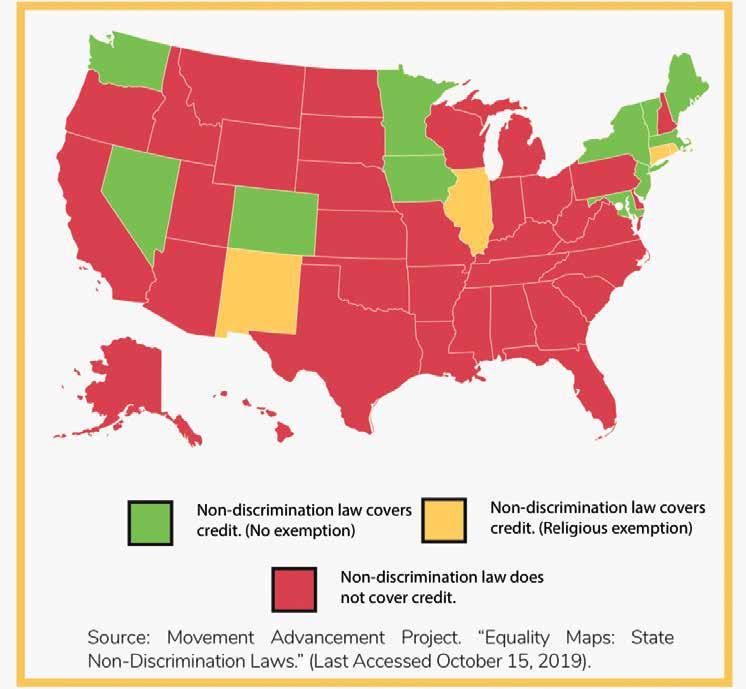
• Lack of legal protection. In the US, Queer people lack federal protection from discrimination on the basis of sexual orien-
tation or gender expression. However, there exists an uneven patchwork of state, county, and municipal laws that protect Queer people from unjust employment, housing, credit, and public accommodations practices. Even among states with protections, some contain religious exemption laws that can be used to discriminate against Queer people.
• Uneven access to goods and services Calling it a “market gap,” CLEAR points out how discrimination against Queer people in the marketplace exacerbates the wealth gap. This includes access to credit, borrowing, and favorable interest rates. Mortgage data from the Federal Reserve studied by researchers at Iowa State University showed that same-sex couples seeking mortgages were denied 73% more frequently than heterosexual counterparts, and as a whole, overpaid by an estimated $86 million per year in higher interest rates, averaging 0.2% higher. Additionally, one in three (32%) Queer student loan borrowers in 2018 reported discrimination from a financial advisor or professional.
CLEAR also described the particular impact structural policies have on Transgender communities: “Trans and GNC customers, in particular, are singled out and denied banking or credit services because of harassment or unfair and outdated policies requiring customers to produce multiple forms of matching identification to open accounts — and to obtain courtordered name changes to manage accounts in their preferred name.”
The impacts of Queer income inequality Across the board, disparity in income and wealth correlates to negative outcomes in other areas: education, health and quality of life, social well-being, and community vitality. CLEAR’s report points out that such outcomes necessitate resources directed toward social and health services, and negatively impact productivity and output, as well as the effectiveness of investments in human capital.
Though Queer income inequality is first and foremost a problem that affects Queer communities of all demographics, it is a particularly destructive problem for Queer and Trans people of color.
Furthermore, it is not merely a problem that affects Queer communities. The effects erode the long-term stability of the US economy, job and labor market, and standing within the global economy.
These studies and reports demonstrate that in order to address the Queer income gap, future efforts must increase and renew emphasis on employment and public accommodations nondiscrimination policies. In light of the recent Supreme Court decision 303 Creative LLC vs. Elenis, this fight must include federal legislation as the end goal, along with pressure for state and municipal legislation across the country.
Film
Frustrating Meg 2 is more dumb than fun
by Sara Michelle Fetters
Staff Writer
MEG 2: THE TRENCH
Theaters
I’m all for dumb, B-grade aquatic thrillers. When the Syfy Channel used to actually broadcast such fare, I’d have no regrets tuning in to watch Sharktopus or Piranhaconda. They were schlocky fun, and most of them never took themselves too seriously. They’re not exactly “good” per se, but if you were sitting on the couch folding laundry, they were a decent enough distraction, and I miss the days when the channel would program a marathon of such goofy, reasonably well-made rubbish pretty much every other weekend.
Meg 2: The Trench is not agreeably daffy enough to be considered alongside many of those Syfy offerings. Its production values are much too high. No one appears to be in on the joke. While I appreciate how seriously everyone takes things, unlike its 2018 predecessor, there’s not much fun this time around. While there are a handful of strong moments, on the whole, this sequel is tediously laborious, and as a fan of everything from Up from the Depths to Jaws 3-D to Leviathan, that fact I walked out of the theater disappointed says it all.
We rejoin Jonas Taylor (Jason Statham) a few years after the events of the previous film. He’s now working full-time for best friend Mac (Cliff Curtis) at the Zhang Institute, studying the undersea creatures — including the massive Megalodons — residing in the mysterious recesses of the Trench. Taylor also moonlights as an ecological activist, busting corporate environmental polluters any way he can. Also back for seconds is the energetic and inquisitive Meiying (Sophia Cai). After the tragic death of her mother Suyin, she looks to Jonas for familial support, while he in turn thinks of the teenager as the daughter he never had. They are joined in this parental circle by Meiying’s outgoing uncle Jiuming (Wu Jing). His astonishing diving technology has revolutionized undersea exploration. Moreover, he’s even caught a Meg, the only one in captivity, and he’s determined to prove it can be tamed.
Based on the second book in author Steve Alten’s popular prehistoric shark vs. humanity series, Meg 2: The Trench is unsurprisingly convoluted and aggressively nonsensical, and that’s fine. But as scripted by Jon Hoeber, Erich Hoeber, and Dean Georgaris, the narrative feels like a randomly disconnected series of vague ideas. Things happen because they need to, not because there’s any organic progression
from one beat to the next, and that makes caring about anything that happens in this sequel difficult.
The biggest issue — literally and figuratively — is that the film’s title character ends up a forgettable afterthought. There are three Megs this time: Jiuming’s pride and joy hooks up with two older, much larger beasts and, through a series of explosive events, also frees them from the Trench. While the trio do cause the requisite high volume of havoc, they rarely take center stage. The creatures are rarely scary, and only scenes showing unfortunate swimmers being ingested whole by the Megs, as seen from inside their mouths, resonate in any meaningful way.
But the action is relatively well staged (if oddly reminiscent of Paul Greengrass’s shaky-cam aesthetic perfected in The Bourne Ultimatum), and there is fun to be had watching Statham zip around on a jet ski hurling homemade harpoons. There’s also a nice bit with a giant octopus trying to tear apart a seaside dock overflowing with terrified tropical vacationers, while Meiy-
ing and Jiuming balletically try to save as many as they can while dodging the creature’s tentacles.
Other problems include the takeover of the Mana One research facility by a team of gun-toting mercenaries. While the reasons for this are best left unspoiled in a review, they’re so randomly out of left field that these moments are more unintentionally laughable than anything else. The whys end up not mattering too terribly much, and there are times where it seems like the only reason grizzled baddie Montes (Sergio PerisMencheta) is hanging around is to add a human villain to the proceedings so Statham can show off his hand-to-hand prowess. The major set piece is masterful and pathetic in almost equal measure. Taylor leads the science team back into the Trench for the umpteenth time, only for things to go horrifically wrong. Not only do they make an unexpected — and all too human — discovery that shouldn’t exist in the first place, the entire group must take sanctuary there when they’re forced into high-tech dive suits after their subs are catastrophi-
cally damaged, taking pages out of The Abyss, Deep Star Six, and Underwater While there are undeniable instances of magic, there are just as many unintentionally laughable ones right along with them. Indie wunderkind Ben Wheatley makes his major Hollywood studio bow with this expensive sequel, and while he adds a few idiosyncratic touches to the proceedings, I can’t see how the same guy who made Kill List, Sightseers, or Free Fire was also the one calling the shots here. Too much of the film feels like it was shaped in a corporate boardroom. The pieces rarely fit together, and the bad stuff sits out like a sore thumb, which I found frustrating to the nth degree. If Meg 2: The Trench is a sizable enough a hit to lead to another adaption of one of Allen’s books, I’ll be first in line to see what’s next for Taylor and the surviving members of the Mana One team. But this does not mean this sequel did anything for me or that I found all that much worth sinking my teeth into; it just means I eternally remain a sucker for underwater monster movies involving man-eating sharks.
SGN
Meg 2: The Trench – Photos courtesy of Warner Bros.
as in person, with increasing frequency.
Using their crack diplomatic skills, the pair quickly transform this mountain of an international incident into a charmingly silly molehill rather quickly. In the process, Alex and Henry discover that their mutual animosity has been stupidly misplaced. In fact, even though their backgrounds and upbringings are massively different, they have far more in common than either assumed. A strong friendship between them begins to materialize, with Alex and Henry intimately conversing by text, email, and phone, as well
I get that Bros was far more high-profile (and received a legit theatrical release, not just a cursory bow in a couple of venues before beginning a streaming run on Amazon Prime), but as jubilantly giddy, studiofinanced, Gay-themed rom-coms go, I’ll take director Matthew López’s Red, White & Royal Blue over it every day of the week.
Goodness knows, the film follows an overly familiar playbook. But that happily does not make it any less enjoyable. This is a harmless love story told with energetic conviction that happily allows its Queer characters to just be and not be entirely defined by their sexuality.
Not that any of this is especially deep. Having never read author Casey McQuiston’s original novel, I can’t say with any certainty how closely this adaptation mirrors the source material. However, based on the above synopsis alone, it’s safe to say that making this effort a colorfully glossy fairy tale is hardly an accident. Problems are solved with rudimentary ease. All of the outcomes pretty much go as expected. Happy endings are par for the course.
And that’s perfectly fine. López’s debut is handsomely mounted and exceedingly well cast, has several enchanting moments, and ends up being such romantically satisfying fun that the fact that it isn’t particularly pro-
found isn’t nearly as problematic as it could have been. Alex and Henry fall into one another’s arms (and beds) with intoxicating ease, and this makes the naturalistic grace of their blossoming romance difficult to resist. There are plenty of subplots that, had they been fleshed out and allowed more room to develop, could have substantially elevated the material and maybe made the film something truly special. Instead, entire threads involving President Claremont’s reelection bid and another centered on Alex’s supposedly masterful plan to switch Texas from red to blue (thus ensuring his mother’s victory) don’t really go anywhere. They and other tangents (Sarah Shahi as the White House deputy chief of staff is mostly wasted, save one amusing moment in which she catches Alex and Henry with their pants down) add an additional layer of sitcom simplicity that’s distracting, and I wish López had given them tangible narrative weight.
But Perez and Galitzine have terrific chemistry, and every time they’re together — which is most of the time — things can’t help but spring to life. There is also something to be said about seeing a love affair like this one affirmed and celebrated, and even though there are obvious roadblocks placed in front of the pair to sabotage their future happiness, these are dealt with in a goofily satisfying, simplistic manner that fits the tenor of the material beautifully. Right now, with all that’s happening in the world and the way that the very existence of LGBTQ communities has once again inexplicably become a hot-button political talking point, that something as smart and as entertaining like Red, White & Royal Blue exists is nothing to scoff at. That it does so with such unapologetic confidence is even more so. As slight as it may be, this is a winning romantic comedy that will leave viewers smiling and, in this instance at least, that’s more than enough to satisfy.
ROYAL BLUE continued from cover
Red, White & Royal Blue – Photos courtesy of Amazon Studios
Books
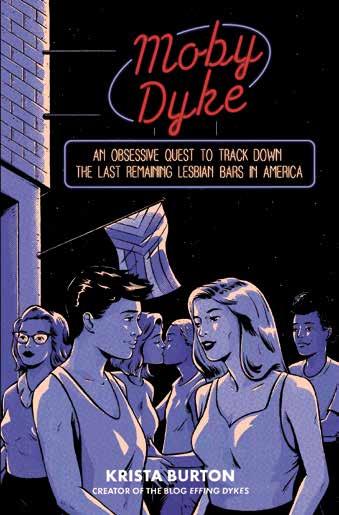
Moby Dyke : Road-tripping to America’s remaining Lesbian bars
by Terri Schlichenmeyer
Special to the SGN
MOBY DYKE: AN OBSESSIVE QUEST TO TRACK DOWN THE LAST REMAINING LESBIAN BARS IN AMERICA
A few years ago, toward the end of the pandemic, masking, and lockdowns, author-blogger Krista Burton was asked what she missed most. Her answer was a surprise: she longed to be in a crowded “dyke bar,” shoulder to shoulder with people like her.
Dyke bars. Wouldn’t that make a great subject for a book?
Burton found an agent, but then bad news: supposedly, there were just 20 lesbian bars left in the entire country!
Not wanting to miss the opportunity, and with book contract in hand, Burton began planning road trips. It was, she said, “the gayest possible dream project...”
She began in San Francisco at “the oldest... lesbian-founded, owned, and continuously operated bar” there. She flew to New York City to visit two other bars. A visit to a San Diego location was wrapped up with a friend’s wedding.
She caught a drag show in Indiana. Columbus, Ohio, was “extremely queerfriendly.” She endured karaoke in Nashville, and she visited a cannabis dispensary while in Denver. Burton’s husband, a Trans
man, loved the football atmosphere in a Milwaukee Lesbian bar. Seattle was a place of nostalgia.
She was mistaken for straight in Houston, was impressed by a real Dallas club, almost missed visiting a Mobile bar, wanted to quit when she was in Atlanta (but didn’t), then went to Phoenix and Richmond, imagined herself as a “senator’s gay wife” in Washington, DC. And she wrapped up her tour in Tulsa and Oklahoma City.
Once, Burton says, LGBTQ people were persecuted and arrested for dancing, drinking, and being themselves in a public place. “We could all go anywhere now,” she says.
So — just 20 lesbian bars, for real? It’s okay, Burton addresses that number at the end of Moby Dyke by writing with delight that since lockdowns are over, Lesbian bars have rebounded.
She doesn’t address the bars she missed in the first place, and yet, you’ll get the picture with the 20 she includes — in part, because, as she admits and as many bartenders and owners told her, Lesbian bars aren’t just for Lesbians anymore. To call a drinking establishment a “Lesbian bar” ignores the diverse crowds, drag shows, quiet activism, and inclusion that’s now offered alongside the fun Burton craved.
Don’t think this book is all about barhopping, either. It’s funny, with observations that are so sharp they’ll cut you, and it’s part memoir that’ll hurt your heart. Yes, there are omissions in this book, but what’s here overshadows what’s missing. If you want a fun, funny memoir-in-a-bar, grab Moby Dyke and pull up a stool.
Image courtesy of Simon & Schuster
Krista Burton – Photo by Cori Miller Photography
New HIV status and relationships: what you need to know
Dear Izzy,
I’m a Gay man who recently tested HIV positive. I am also recently single. How do tell potential partners about my status? Is this a dealbreaker? I’m afraid of being rejected.
— Positively Stressed
Dear Positively,
Thank you for being vulnerable and reaching out to me. There is a lot of stigma associated with HIV, but you are not alone. The first thing you need to remember when beginning to date around is to be honest about your status. If a potential partner rejects you because of your HIV status, it’s their loss. There are plenty of people out there who will accept you for who you are. By being honest, you set the tone for the rest of the relationship, as it can help build trust and communication.
As you go on this new journey, you might find it helpful to meet, and maybe even date, other people who are also HIV positive. The Puget Sound area is home to a variety of organizations that are dedicated to supporting people affected by HIV (and also committed to discovering treatments and cures). Here are a few to look into:
Living Positively
A social group offering support, education, and community activities for those living with HIV. The group meets Wednesdays from 5 to 6pm at Seattle’s LGBTIQ+ Center at 400 Pine St. (the entrance is on Bellevue Ave.). For more information, you can email Joseph Grant: josephg@lifelong.org.
Black AIDS Institute
The Black AIDS Institute (BAI) is dedicated to ending the HIV/AIDS epidemic in the Black community. It believes in “complete freedom for Black people by eradicating systematic oppression so that we can live long, healthy lives.” The BAI has a variety of programs; for more information, check out https://blackaids.org.
Entre Hermanos
The organization’s mission is focused on promoting “the health and well-being of the Latino Gay, Lesbian, Bisexual, Transgender, and questioning community in a culturally appropriate environment through disease prevention, education, support services, advocacy and community building.” It offers a variety of programming on its website: https://entrehermanos.org.
POZ Community Forums
This is an online, “round-the-clock discussion area for people with HIV/AIDS,
by Isabel Mata SGN Staff Writer
Ask Izzy is a biweekly advice column about relationships, mental health, and sexuality. Written by Isabel Mata — a Seattle-based lifestyle writer, podcast host, and mental health advocate
— Ask Izzy offers tangible expert advice so all readers can have stronger relationships, better sex, and healthier mindsets. Submit your question today by emailing info@sgn.org with the subject “Ask Izzy.”
their friends/family/caregivers, and others concerned about HIV/AIDS.” Find resources, programming, and more online at https://forums.poz.com.
The Tribe Wellness Community
This is a “peer-to-peer support group for individuals or family living with HIV/ AIDS, newly diagnosed to long-term survivors.” There, members can find “a place to share stories, encouragement and friend-
ship.” Learn more at https://support.therapytribe.com/hivaids-support-group.
Other community organizations in the Seattle/Tacoma region:
• Pierce County AIDS Foundation (https://www.pcaf-wa.org)
• People of Color Against AIDS Network (https://www.pocaan.org)
• Peer Seattle (https://www.peerwa.org)
• AIDS Project Snohomish County (https://aidsprojectsnoco.org)
As you enter this new phase of your life, make sure to hold your head high. You are beautiful and worthy of love, regardless of your HIV status. You have nothing to be ashamed of, and if anyone ever tries to make you feel differently, they are not worthy of your time or attention. You will find your people.
Photo by Nicholas Swatz / Pexels
Women’s World Cup Round of 16: Heartbreaking loss for US; Australia keeps fighting on Sports
by Lindsey Anderson SGN Staff Writer
The Round of 16 has come to a close in this year’s women’s World Cup. In a tournament that has been anything but typical, fans have seen surprising upsets, heartbreaking defeats, and underdog teams rising to the top. The action will only continue as eight teams move on to the next round.
Sweeping victories:
Spain takes Switzerland
While most matches in the round-robin phase have been close in points and skill level, two teams have stood out for continuing to run up the score. In the first match of the knockout portion of the tournament, Spain annihilated Switzerland.
Just four minutes into the match, Spanish forward Slama Paralluello sent a cross toward teammate Alba Redondo, who flicked the ball at the goal. Switzerland’s keeper made a last-second dive to defend the net but couldn’t get to the ball in time. Out of nowhere, Swiss defender Nadine Riesen appeared at the goal line, kicking the ball out. Unfortunately for Switzerland, Riesen only cleared the ball to the top of the box, where midfielder Aitana Bonmati was on her toes: she launched the ball to the back of the net, sending it flying past Switzerland’s goalie — who didn’t even have a second to react.
Just seven minutes later, Spain scored again — though it wasn’t on the right goal! Defender Laia Codina flubbed a pass back to her goalie, not fully gaining control of the ball as it bounced off her shin. The attempted pass wasn’t even close enough for goalie Cota Coll to run onto, resulting in an own goal and a tied score.
Spain didn’t let their own goal get them down. Less than a minute later, they were back in their attacking third. Redondo was ready to make up for her missed shot earlier in the game. The ball crossed directly to the forward; she sent it into the goal with her head and gave Spain the lead once again.
Switzerland barely got a chance to bring the ball across the half-field line. For the rest of the first half, they played defense, trying to keep Spain from scoring more goals. Their attempts were futile. In the 35th minute, Bonmati got her second goal of the match when she received a pass in the middle of the box and shot it right past the goalie.
Before the first half ended, Codona found a way to make up for her own goal. Spain’s whole squad crashed the box for a corner kick, leading to absolute chaos. Codona got the final touch and flicked the ball into the net.
In the second half, Spain was more relaxed and ready to connect passes. They attacked less but maintained possession throughout the half. In the 69th minute, forward Jennifer Hermoso broke past Switzerland’s defensive line. With just the goalie to beat, Hermoso finished the job, scoring the final match point. At the last whistle, the score was 5-1, with Spain scoring every point in the game.
Kadidiatou Diani leads France to easy victory
The final match of the Round of 16 saw France dominate Morocco. France started the game strong, attacking numerous times but unable to find the net. They finally got their first goal when forward Kadidiatou Diani sank the ball into the net with a beautiful header in the 14th minute. Diani is known for her powerful shot, and this goal marked her fourth in the tournament.
Diani was the clear MVP of the game. She seemed to be everywhere all at once. Four minutes after scoring France’s first match point, she sent a cross to teammate Kenza Dali, who rocked a shot from the top of the box. The ball hit the post and crossed
into the goal. Not only did this point set France up for a likely victory, but it was also Dali’s first-ever World Cup goal.
France proved they could not be stopped as they continued to attack mercilessly. In the 22nd minute, Moroccan defender Nesryne El Chad attempted to clear the ball from the backline to prevent a corner kick. Dianai jumped in front of her and got a touch on it, sending the ball spiraling toward the middle of the box, right where Eugenie Le Sommer was waiting. In the blink of an eye, France was up by 3.
In the 69th minute, France got their final goal of the match when Le Sommer snuck a header right behind the goalie. Le Sommer waited behind the far post for a cross to come and finished the play before Morocco knew what had happened.
Despite France winning the game with an impressive 4-0 victory, Morocco, participating in their first-ever World Cup, showed they’re a team to be taken seriously in the next tournament. Nobody expected this underdog team to make it past the round-robin play. With France shaping up for a potential tournament victory, the fact that Morocco didn’t let more goals in shows just how much potential they have and how skilled keeper Khadija Er-Rmichi is.
Japan gets narrow victory over Norway
While France and Spain proved they’re two teams to watch out for as the tournament progresses, Japan is another emerging super squad. In their match against Norway, Japan started strong. They nearly scored a goal in the first minute, attacking hard and fast. The Japanese attackers had Norway’s defense working overtime.
After 15 minutes and several more shots on goal by Japan, the country scored its first point, though technically it was credited to Norway as an own goal. Norwegian defender Ingrid Syrstad Engen tried to deflect the ball but accidentally flicked it into the opposite side of the net, while goalie Aurora Mikalsen dove in the direction of the original trajectory. While the mistake was embarrassing, it also serves as a good reminder that even the best players in the world mess up sometimes.
Norway made a comeback when forward Guro Reiten scored in the 19th minute, heading the ball in on a cross sent right to her. The match continued with both teams showcasing their skills. However, before the ref blew the whistle, Japan got one more goal in when Japanese forward Hinata Miyazawa intercepted the ball in the middle of the box and launched it right into the back of the net, giving the team the lead again.
Though Norway put up a good fight in the second half, Japan’s squad hit the field more determined than ever to defend their victory. Proving that sometimes the best defense is offense, the team continued to attack Norway’s half. Their persistence continued to pay off when, in the 80th minute, Miyazawa timed the perfect breakaway, launching away from the defender guarding her just as her teammate sent the ball flying over their heads. Miyazawa started her run just in time and beat the keeper in a one-to-one showdown.
Despite the 2-1 score, Norway was determined to make up for their first-half own goal. In the final minutes of the game, they achieved a corner kick that looked like it could be the play to tie the match up once again. However, Japan’s goalie Ayaka Yamashita came through with one of the most incredible saves of the tournament so far. She dove and batted the ball out of bounds, preventing the nearinevitable goal.
At the final call of the ref, the game was 3-1, sending Japan on to the next match and Norway back home.
Netherlands battle South Africa
While Japan and Spain showed they could come out and dominate a game from start to finish, other victorious teams took some on-field time to warm up. Despite setting themselves up as one of the most dangerous squads, the Netherlands got a slow start against South Africa. In the first five minutes, South Africa had their first shot on goal. However, seeing their opponents get that close to an early lead snapped the Dutch girls back into the game.
In the eighth minute, Dutch forward Jill Roord scored a header off a cross, putting her team in the lead.
The game was far from over. South Africa was ready to come back. Thembi Kgatlana made a great run, taking the ball nearly half the field before shooting it just over the top of the goal. Kgatlana continued to show off her talent, relying on her foot skills to bring the ball back into the Netherlands’ danger zone for another near-goal.
Kgatlana continued to show for the ball, run after run. Near the end of the half, in the 45th minute, she made another long sprint toward the goal. Again, her shot was blocked by goalie Daphne Van Domselaar, but latter couldn’t get a hold of the ball, sending the rebound back to Kgatlana. She took another shot, but Van Domselaar was ready this time and pounced on the ball to finish the play. Just three minutes later, Kgatlana shot once again and failed to score.
Despite South Africa dominating in terms of possession, the Netherlands found themselves with the ball and an opportunity. Sending the ball forward, Lieke Martens ran onto the pass and scored a quick goal. The ref recalled the point, however, because her teammate Victoria Pelova was offside.
The Netherlands came back into the second half more determined to step their game up. In the 67th minute, forward Lineth Beerensteyn made a breakaway through South Africa’s defensive line. She let the ball rip from the top corner of the box, sending it directly into the net. Beerensteyn seemed to be on a roll, scoring another goal on a breakaway in the 79th minute as well. However, the flag came up, signaling yet another off-side play, and the point was revoked.
Despite the 2-0 score, South Africa gave it their all until the final whistle. Kgatlana had one more shot on goal in the 93rd minute, which was once again deflected by the keeper. Her tenacity should have earned her a point by the end of the match, but Van Domselaar proved she is just that unstoppable.
Australia continues on Home team Australia has lived to play another match after a 2-0 victory over Denmark. Much like the Netherlands, Australia began the first half languorously. Denmark attacked early and had the first shot on goal in the first minute. The team continued to strike, but Australia’s keeper Lydia Williams was always in the right place at the right time.
In the 28th minute, Caitlin Foord ran onto a pass lobbed over Denmark’s backline. Foord sent the ball careening into the goal with finesse and ease after Denmark’s goalie Lene Christensen came off her line, opening the goal wide open.
In the second half, Australia seemed to have more focus. They kept possession of the ball and built tactful attacks on their opponent. In the 70th minute, Hayley Raso scored the team’s second goal after the squad passed the ball around in Denmark’s box, waiting for an opening. They had a chance for one more goal when Sam Kerr gained possession on a breakaway toward Denmark’s net. However, Kerr got too excited and launched her shot far above the crossbar.
Colombia makes history
Colombia showed up to their match against Jamaica ready to dominate. They made goalie Rebecca Spencer continue to work as they earned corner kick after corner kick in the first half. The squad’s inability to get the ball in the net was a testament to the tenacity of the Jamaican team, who had already come much further in the competition than anyone had expected. Underfunded, they had to raise money to send themselves to the World Cup once they qualified.
Jamaica played a physical game. As the score continued to flash 0-0, their frustration became obvious. In the 40th minute, defender Chantelle Swaby earned a yellow card when she slapped Myra Ramirez in the face on a run. The team was already playing with a starter on the bench due to yellows.
The team continued to play with strength, grit, and cunning fouls. Just five minutes later, Linda Caicedo tripped in a tackle. Not one to stay down, she popped back up, and the play continued. She regained possession of the ball but was then pulled to the ground by Drew Spence, who made no attempts to make the foul discreet. The ref called the foul, but tensions were running high. Colombian team captain Catalina Usme had some choice words with Spence before the ref separated them. The whole time, Caicedo writhed in pain on the ground. Spence got a yellow card, the team’s second in the half.
Denmark vs. Australia – Photo by Rick Rycroft / AP
Tense emotions have worked to motivate players, as it did in the Colombia game, when Usme came back in the 50th minute, channeling her rage into the game. She received a cross at the top of the box while her mark was behind her, opening her up for the perfect shot. The defender tried to grab her, but it was too late. Usme already had her foot locked on the ball, and nothing was going to stop her. The crowd erupted as she scored the goal that put Colombia into the next round.
Colombia made history by beating Jamaica 1-0. The team will now move on to the quarterfinals — the farthest they’ve ever gone in the tournament since their first appearance in 2011.
US is out after heartbreaking PKs Penalty kicks are the most anxiety-fueling part of any soccer tournament. Though they are usually more common in final and semifinal rounds, two matches went into PK shootouts after ending in 0-0 ties.
The most heartbreaking for many Seattle fans was the US vs. Sweden match. Fans were anxious after watching the USWNT barely qualify for the knockout rounds, and some predicted that if they couldn’t get a goal in the first half, it would be over for them.
The US seemed to know this and came out of the gate swinging. They played a great first half, connecting passes, dominating possession, and continually attacking up the right side of the field. Unfortunately, senior player Alex Morgan couldn’t get in the right place for the crosses sent her way. When she did align herself for a shot, more often than not, it wasn’t even on the frame.
Despite the frustration of one of the team’s greatest players of all time having an off night, newcomer Sophie Smyth continued to prove herself as a rising star and playmaker, dribbling the ball for lengths and connecting crosses right around Sweden’s defense.
When the USWNT returned for the second half, they seemed nervous, aware they were in rough waters after failing to get that first goal. Sweden took advantage of their
drop in morale and held firm with possession throughout the half. Coach Vlatko Andonovski had the team in a defensive setup by the end of the half, wanting to prioritize defending against a goal and aiming for PKs.
Before the final whistle, Megan Rapinoe subbed in for Morgan. Though Rapinoe wasn’t much better at connecting shots on goal, she had less opportunity. With her help, the US squad earned a few more corner kicks, but nothing hit the net. At the end of the second half, with just one minute of stoppage time added, the ref blew the whistle, and the team prepared for the dreaded PKs.
Shooting first for the US was midfielder Andi Sullivan, who sent the ball to the opposite side of Sweden keeper Zechira Musovic, getting the first goal. Sweden’s Fridolina Rolfo kept the score even, sinking her first shot too.
Captain Lindsey Horan was next up for the USWNT and scored a vital second point, matched by Sweden’s second shooter, Elin Rubensson. Fans felt a flutter of hope when Kristie Mewis scored the team’s third straight goal, immediately
followed by a miss by Sweden’s Nathalie Bjorn. That hope was short-lived, however, when Rapinoe shanked her shot wide.
The PKs continued in a pretty even stalemate. US goalie Alyssa Naeher scored her PK, with the first round of shots even. This tie sent the teams into sudden death.
Kelly O’Hara cracked under the pressure and missed her first shot, setting Sweden up to get the winning goal. Their final shooter, Lina Hurtig, sent the ball right at Naeher, who deflected it up in the air. Naeher leaped back to punch the ball out of the goal and immediately declared it had been saved.
With such a close call, all the refs gathered to watch recap footage to determine if the ball had crossed the line. After deliberation, they said it had, and the US was knocked out of the World Cup in the earliest stage in women’s soccer history.
Though fans and players alike were disappointed at the final results, the team acknowledged that the level of soccer for women worldwide has increased exponentially. Their defeat only shows how far female athletes have come in the last 25 years.
National News
Trump faces yet another indictment
Over 70 felony charges and counting
by Cameron Martinez SGN Intern
On August 1, former president Donald Trump was indicted for multiple alleged crimes in his effort to overturn the 2020 election results. The 45-page indictment displays and explains how Trump knowingly spread false information about fraud and electors, and attempted to block the certification of the election on January 6, 2021. This is the first time an American president has ever been indicted federally.
Trump’s charges include two felony counts of obstructing an official proceeding, one felony count of conspiracy to defraud the United States, and one felony count of conspiracy against rights. The indictment includes six unnamed coconspirators, but CNN speculates that five of these people are Rudy Giuliani, John Eastman, Sidney Powell, Jeffrey Clark, and Kenneth Chesebro.
This is on top of his three other criminal cases in which he faces 34 felony counts in connection with hush money payments to Stormy Daniels ahead of the 2016 election and 40 felony counts for keeping classified documents in his Mar-a-Lago home; a Georgia prosecutor is also investigating Trump’s interference in the 2020 election in the state.
The former president has denied wrongdoing in all the cases.
Others are not so sure. “As we got closer to January 6, I knew he was cooking up all these things, but what was he going to do about it?” said Rep. Nancy Pelosi in an interview with New York magazine. “It was clear that he knew he did not win the election.”
A Politico article explaining the ongo-
England wins despite bad sportsmanship
In one of the most physical games of the tournament, England managed to hold on to a victory after also going to PKs. Nigeria attacked early in the game, and forward Ashleigh Plumptre had a fantastic shot deflected by the crossbar just 15 minutes in. The team held strong and continued to attack for another minute until the English keeper Mary Earps finally had a solid save.
The game continued to get physical the longer the teams went without a score. In the 33rd minute, the ref called a PK after an English player was pushed into the box. However, on further evaluation, she changed her mind.
In the 83rd minute of the game, England’s Laura James got a yellow card for what many have now called “the worst show of sportsmanship” in the World Cup this year. James clobbered Nigeria’s Michelle Alozie to the ground, then stomped her cleat down on Alozie’s butt before taking off after the ball. After watching the replay footage, the ref determined that James stepped on Alozie on purpose and changed the card to red. Throughout the game, Nigeria had more shots and controlled possession. Unfortunately, they could not get the ball behind Earps. When the final whistle blew after added play, it was time for the dreaded PKs. Unlike the US-Sweden game, both teams started with a miss. England’s Georgia Stanway missed the target, followed by Nigeria’s Desire Oparanozie, who did the same.
The final winning point was scored by Chloe Kelly for England, barely putting the team through to the next match. Of course, James will not be allowed to play due to the red card.
It has been a dramatic week of soccer!
Watching the USWNT lose in a shootout was especially painful for anyone who stayed up until 4:30 a.m. for the match. Though the era of the “dream team” may be over, there are many more rising stars to continue to root for in this World Cup.
ing criminal cases explains that one of the strengths of the Jan. 6 case is the fact that “many of the top aides in the Trump administration testified to the grand jury, giving investigators remarkable insight into what was happening privately in Trump’s orbit during the critical two-month period and perhaps providing important evidence about Trump’s state of mind. [Former Vice President Mike] Pence — who resisted Trump’s pressure to try to annul the election results
on Jan. 6 — was the most notable witness. Others included Trump’s former chief of staff, Mark Meadows; his White House counsel, Pat Cipollone; his national security adviser, Robert O’Brien; and his senior policy adviser, Stephen Miller.”
Despite the indictment and ongoing criminal investigations, if Trump is convicted, he can still run for president in 2024. The only requirements for running for federal office, according to the Supreme Court,
are what’s written in the Constitution.
“Anyone who puts himself over the Constitution should never be president of the United States,” Pence said to reporters at the Indiana State Fair about Trump’s Jan. 6 case. “And anyone who asks someone else to put themselves over the Constitution should never be president of the United States again.”
Megan Rapinoe (r) reacts to Team USA's loss to Sweden – Photo by Scott Barbour / AP
Photo by John Bazemore / AP
National/ International News
National news highlights
by Kali Herbst Minino SGN Intern
Michigan and Minnesota could lead the way for states with Democratic majorities Michigan and Minnesota currently have Democratic majorities in their legislative bodies, which has allowed for quick policy changes.
Within the past couple of months, Michigan codified LGBTQ+ protections within a civil rights law, prohibited companies from retaliating against people who get abortions, and banned conversion therapy for minors.
Minnesota’s legislature passed a law that provides free school meals for K-12 students, as well as two gun safety measures — one that expands background checks for gun transfers and another that gives authorities the ability to temporarily take guns away from someone who is deemed to be a threat to others or themselves. The state also passed bills making voting easier by allowing 16- and 17-year-olds to preregister to vote and automatically registering people when they apply for a driver’s license or public program like Medicaid.
Michigan and Minnesota are two of four states that gained Democratic “trifectas” in the 2022 state legislative elections, meaning that Democrats have control of the state House and Senate, and the governor is Democratic. Democrats currently hold 17 trifectas, Republicans hold 22.
Pennsylvania state Sen. Sharif Street says he’s paid attention to what the two states have managed to do. “I’ve offered to Pennsylvanians that if we could flip the Senate, we could pass similar legislation,” Street said.
In the 2024 elections, there’s an opportunity for Democrats in some states — like Pennyslvania, Arizona, and New Hampshire — to achieve a trifecta. In Michigan, it was possible because the districts were not redrawn by legislators. In 2018, a constitutional amendment passed that established a randomly selected, 13-member panel to redraw district maps.
It’s unclear how long the trifectas will last. Minnesota’s last trifecta lasted two
years, and Michigan’s Republican legislators in both the House and Senate outraised Democrats during 2023.
Kansas state court set to weigh lawsuit from abortion providers
On Aug. 8, Kansas’s state court was scheduled to hear a legal challenge from abortion providers to an existing law and a new one. The existing law currently requires a 24-hour waiting period between a consultation and the procedure itself. The new law, which became active July 1 but is currently on hold, would require providers to tell patients that their medication abor-
International news highlights
by Kali Herbst Minino SGN Intern
Trans women banned from female British Rowing events
The governing body of British Rowing said on Aug. 3 that only people “assigned female at birth” can participate in its events and represent the country in an international setting. A separate category will be available for Trans and Nonbinary people.
“British Rowing is committed to promoting an environment in which rowing is accessible and inclusive and to ensuring that we provide opportunities and enjoyment for everyone,” said a statement released by the organization.
World Rowing allows Trans women to compete, but only under a restriced testosterone level.
Governing bodies for world cycling and world swimming have also made decisions regarding Trans athletes. For cycling, Trans women who transitioned after puberty cannot participate in events, and for swimming, only Trans athletes who transition before the age of 12 are allowed to compete.
British Rowing’s new rule will be reconsidered on an annual basis.
tion can be stopped via a regimen used to prevent miscarriages. Medical groups have called the regimen unproven and possibly dangerous.
Although Kansas has a Republican legislature, it deviates from other states with similar political setups. In 2019, the state Supreme Court ruled that its constitution protects abortion rights. In 2022, the decision was reasserted by voters.
American Academy of Pediatrics reestablishes support for gender-affirming care While states across the country pass
restrictions on gender-affirming care, the American Academy of Pediatrics, representing 67,000 pediatricians, unanimously reaffirmed its support for the practice on Aug. 3.
The board also decided to provide additional resources to pediatricians, like clinical and technical reports, as well as research into such care.
Currently, 21 states have passed laws banning gender-affirming care for minors, according to the HRC. The AAP’s CEO, Mark Del Monte, called such state restrictions “unprecedented.”
Rowing practice for the 2016 Summer Olympics – Photo by David Goldman / AP
Michigan Gov. Gretchen Whitmer in Royal Oak, Mich. – Photo by Carlos Osorio / AP
Episode 73: Dion Dior Black
The drama is real! Hear stories of soccer, stray bullets, and Swiftmania from the wild weeks of co-hosts Benny and Lindsey, with updates on the Pope's stance on Trans people and the Seattle Police Department's scandal involving office decorations. Lindsey interviews local drag queen Dion Dior Black on today's drag scene, locally and nationally.