
by Mike Andrew SGN Staff Writer
A Fred Meyer employee says he and his husband were subjected to anti-Gay bias at the retail chain’s Mill Creek store.
by Mike Andrew SGN Staff Writer
“Lee parked in the employee lot, came in through the regular door, and we both exited through the employee door,” Evans recalled. As they were going out the employee door, they were stopped by a
Jack Evans told the SGN that the incident happened in December 2018, when his husband, Lee, came to pick him up after his shift.
see FRED MEYER page 6

[On April 24, 2019], Gov. Inslee signed into law the Responsible Teen Communications Act (SHB 1742), which protects teenagers from felony prosecution for distribution or possession of child pornography when they make explicit messages and images of
themselves (“selfies”) and share them with peers, and invests in evidence-based prevention and intervention strategies.
“Washington has a responsibility to protect its young people – and that includes
see SEXTING page 11
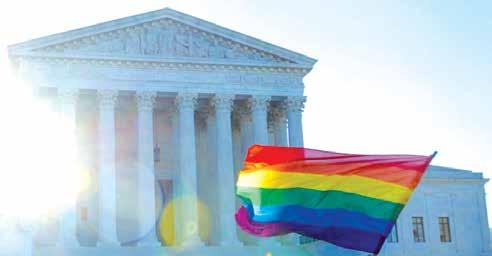
The US Supreme Court said on April 22 that it would hear three related LGBT discrimination cases in its next term. Decisions on the cases would come by the end of the court’s term in June 2020.
All three cases have to do with workplace discrimination against LGBT employees. They turn on whether existing federal laws barring discrimination on account of sex also protect sexual orientation and gender identity.
see SCOTUS page 5
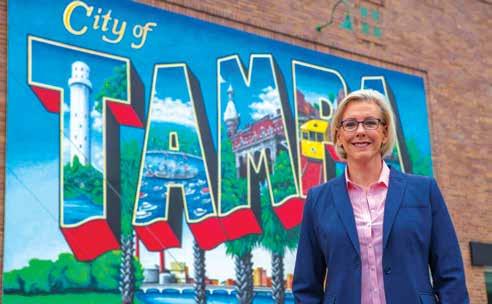
WASHINGTON, DC (April 23, 2019) –Today, the Human Rights Campaign (HRC) – the nation’s largest lesbian, gay, bisexual, transgender, and queer (LGBTQ) civil rights organization – released the following statement celebrating Jane Castor’s elec-
tion victory in the race for mayor of Tampa, Florida. Castor will now make history as the city’s first openly LGBTQ mayor.
“Today, Tampa voters made history by electing Jane Castor as the city’s first see JANE CASTOR page 6





Representing yourself in court can be a complicated process. Learn the basics of the civil lawsuit process at one of our upcoming workshops from 6pm to 7:30pm Wednesdays, May 1, 8 and 15 at the Central Library, 1000 Fourth Ave, Level 4, Howard S. Wright Family & Janet W. Ketcham Meeting Room 2, 206-386-4636.
Library events and programs are free and everyone is welcome. Online registration is required, see calendar listings to sign up. Parking is available in the Central Library garage for $7 after 5pm.
Civil Lawsuits without Tears: The Basics of Representing Yourself in Court
This workshop focuses on court rules, court procedures, forms, scheduling and deadlines. Some of the common civil lawsuit types covered will include: landlord tenant, family law, wills and probate, garnishment of wages, personal injury and property disputes. Wednesday, May 1 – 6pm to 7:30pm – Central Library, 1000 Fourth Ave., Level 4, Howard S. Wright Family & Janet W. Ketcham Meeting Room 2, 206-386-4636.
The Nuts & Bolts of Motions: Advanced Workshop for Self-Represented Litigants

This workshop is for people who have attended the Library’s workshop, “Civil Lawsuits without Tears,” or for people who need more information about motions and orders. You’ll learn about the purpose, content, format and calendaring of motions, along with the court rules governing them. Wednesday, May 8 – 6pm to 7:30pm –Central Library, 1000 Fourth Ave., Level 4, Howard S. Wright Family & Janet W. Ketcham Meeting Room 2, 206-386-4636.

This workshop is for people who have attended the Library’s workshop, “Civil Lawsuits without Tears,” or for people who need more information on the process for conducting pretrial discovery. You’ll learn about: the process of requesting information and documents from the other party and responding to requests, asking and answering interrogatories (written questions to the other party), the basics of depositions, and the court rules governing the discovery process. Wednesday, May 15 – 6pm to 7:30pm – Central Library, 1000 Fourth Ave., Level 4, Howard S. Wright Family & Janet W. Ketcham Meeting Room 2, 206-386-4636.
These workshops are taught by The Public Law Library of King County. The
workshops will not cover immigration proceedings, or criminal proceedings such as a D.U.I or felony and misdemeanor offenses.
The Library brings people, information and ideas together to enrich lives and build community. We support universal access to information and ideas, and form strong partnerships with community organizations to offer classes and workshops that are accessible to all.
For more information, call 206-3864636 or visit https://www.spl.org/using-thelibrary/ask-us. For ADA accommodations, please contact: leap@spl.org
Courtesy of the Seattle Public Library

WASHINGTON, DC (April 22, 2019)
– Today, the Human Rights Campaign (HRC), the nation’s largest lesbian, gay, bisexual, transgender, and queer (LGBTQ) civil rights organization, responded to the US Supreme Court’s decision to grant review in three cases that could decide whether federal nondiscrimination laws apply to LGBTQ people. Today, the court announced it will take up the cases of R.G. & G.R. Harris Funeral Homes v. EEOC and Aimee Stephens and Bostock v. Clayton County, consolidated with Altitude Express, Inc. v. Zarda
Several federal courts have ruled that anti-LGBTQ discrimination is a form of sex discrimination that violates federal law. These courts have found that discrimination against LGBTQ people violates laws, including Title VII of the Civil Rights Act of 1964 and Title IX of the Education Amendments of 1972. The Trump-Pence administration, however, has recently threatened to redefine federal sex discrimination through regulations attempting to erase protections for transgender people, and has asked the Supreme Court to reverse course and bar LGBTQ people from receiving federal nondiscrimination protections. The Supreme Court’s decision in these cases could effectively decide whether to solidify or take away nondiscrimination protections for LGBTQ people under federal civil rights laws [that] prohibit sex

discrimination in contexts ranging from employment to housing, healthcare, and education.
“No one should be denied a job or fired simply because of who they are or who they love, including LGBTQ people,” said Sarah Warbelow, HRC Legal Director. “The growing legal consensus is that our nation’s civil rights laws do protect LGBTQ people against discrimination under sex nondiscrimination laws. The Supreme Court has an opportunity to clarify this area of law to ensure protections for LGBTQ people in many important areas of life. The impact of this decision will have very real consequences for millions of LGBTQ people across the country. Regardless of the eventual outcome, it’s critical that Congress pass the Equality Act to address the significant gaps in federal civil rights laws and improve protections for everyone.”
In R.G. & G.R. HARRIS FUNERAL HOMES v. EEOC and AIMEE STEPHENS, Aimee Stephens worked as a funeral director at R.G. & G.R. Harris Funeral Homes. When she informed the funeral home’s owner that she is transgender and planned to come to work as the woman she is, the business owner fired her, saying it would be “unacceptable” for her to appear and behave as a woman. The 6th Circuit Court of Appeals ruled in March 2018 that when the funeral home fired her for being transgender and departing from
sex stereotypes, it violated Title VII, the federal law prohibiting sex discrimination in employment.
In ALTITUDE EXPRESS INC. v. ZARDA, Donald Zarda, a skydiving instructor, was fired from his job because of his sexual orientation. A federal trial court rejected his discrimination claim, saying that the Civil Rights Act does not protect him from losing his job for being a gay man. In February 2018, the full 2nd Circuit Court of Appeals ruled that discrimination based on sexual orientation is a form of discrimination based on sex that is prohibited under Title VII. The court recognized that when a lesbian, gay, or bisexual person is treated differently because of discomfort or disapproval that they are attracted to people of the same sex, that’s discrimination based on sex.
In BOSTOCK v. CLAYTON COUNTY, Gerald Lynn Bostock was fired from his job as a county child welfare services coordinator when his employer learned he is gay. In May 2018, the 11th Circuit Court of Appeals refused to reconsider a 1979 decision wrongly excluding sexual orientation discrimination from coverage under Title VII’s ban on sex discrimination, and denied his appeal.
While the Supreme Court prepares to hear these cases, Congress could act immediately to pass the Equality Act, which would provide clear, comprehensive
protections for LGBTQ people across key areas of life, including employment, housing, credit, education, public spaces and services, federally funded programs, and jury service. Reintroduced in Congress in March, the bipartisan legislation has growing, unprecedented support, including from nearly 70% of Americans, hundreds of members of Congress, more than 190 major businesses, and more than 350 social justice, religious, medical and child welfare organizations. House leadership has made it a priority to pass the Equality Act this spring.
Recent polling finds that a growing majority of Americans support the federal nondiscrimination protections contained in the Equality Act. A recent survey by PRRI found that nearly seven in 10 Americans support laws like the Equality Act, including majorities in every single state and majorities of Republicans, independents, and Democrats alike.
The Human Rights Campaign is America’s largest civil rights organization working to achieve equality for lesbian, gay, bisexual, transgender, and queer people. The HRC envisions a world where LGBTQ people are embraced as full members of society at home, at work, and in every community.
Courtesy of the HRC
WASHINGTON (April 22, 2019) – The Supreme Court today agreed to hear R.G. & G.R. Harris Funeral Homes v. EEOC & Aimee Stephens and Altitude Express Inc. v. Zarda, and to decide whether to take away federal civil rights protections from LGBTQ workers.
Stephens, whom the American Civil Liberties Union and the ACLU of Michigan represents, was fired from her job after coming out as transgender, and the 6th Circuit Court of Appeals ruled that her firing was a form of sex discrimination that violates Title VII of the Civil Rights Act. Five federal appeals courts and dozens of federal district and state courts have affirmed that view, ruling that existing federal laws protect transgender people from discrimination.
Donald Zarda was fired from his job after a client learned he was gay, and the 2nd Circuit Court of Appeals ruled that his firing was a form of sex discrimination that
violates Title VII of the Civil Rights Act. The 7th Circuit has also ruled that firing someone because of their sexual orientation is a form of sex discrimination, as has the federal Equal Employment Opportunity Commission, which investigates charges of workplace discrimination nationwide.
Zarda died in an accident in 2014. His surviving partner, Bill Moore, and his sister, Melissa Zarda, have continued the lawsuit on behalf of the estate. The American Civil Liberties Union represents the estate as co-counsel with Greg Antollino of Antollino PLLC and with Pam Karlan and Jeff Fisher of the Stanford Law School Supreme Court Litigation Clinic.
This is a key judicial test of the theory put forward by the Department of Justice in a leaked memo last fall that aims to erase transgender people from sex discrimination protections. Should the Supreme Court overturn the lower courts’ rulings, it would take away existing protections
from lesbian, gay, bisexual, and transgender employees, saying that it is lawful under federal law to fire LGBTQ people for their gender identity or sexual orientation.
James Esseks, director of the ACLU LGBT & HIV Project, had the following response:
“Most of America would be shocked if the Supreme Court said it was legal to fire Aimee because she’s transgender or Don because he is gay. Such a ruling would be disastrous, relegating LGBTQ people around the country to a second-class citizen status. The LGBTQ community has fought too long and too hard to go back now, and we are counting on the justices not to reverse that hard-won progress.”
Aimee Stephens had the following response:
“What happened to me was wrong, it was hurtful and it harmed my family. I hope the Supreme Court will see that firing me because I’m transgender was discrimination.”
Melissa Zarda had the following response:
“When my brother told me that he was fired, I was shocked. I couldn’t believe that you could be fired for being gay. I thought that this had to be against the law. I hope the Supreme Court will see that what happened to my brother was wrong.”
Attorney Greg Antollino had the following response:
“What happened to Don Zarda was both wrong and against the law. All Americans should be able to work and not fear discrimination because of who they are. This case matters because it is about basic human dignity, and the promise of equal treatment for all.”
Courtesy of the ACLU
WASHINGTON, DC (April 22, 2019) –The US Supreme Court today announced it will review three cases that address whether discrimination on the basis of sexual orientation or gender identity violates the Civil Rights Act of 1964, the federal law that prohibits employers from discriminating against employees on the basis of sex, race, color, national origin, and religion.
The three cases [are]: Altitude Express v. Zarda, a New York case where the US Court of Appeals for the 2nd Circuit ruled in favor of the estate of a skydiving instructor who was fired because he was gay; Bostock v. Clayton County, where the US Court of Appeals for the 11th Circuit ruled against a Clayton County, Georgia, child welfare services coordinator fired when his employer discovered he was gay; and: R.G. & G.R. Harris Funeral Homes v. EEOC, a Michigan case brought by the ACLU and ACLU of Michigan, where the US Court of Appeals for the 6th Circuit ruled in favor of [Aimee Stephens,] a transgender woman fired from her job as a funeral director when she informed her boss she intended to transition. Lambda Legal filed a friend-of-thecourt brief and argued the Zarda case before the full 2nd Circuit in September 2017. Lambda Legal also filed fried-of-the-court briefs in the Georgia and Michigan cases.
“After many years of courts grappling
with these questions, the Supreme Court has decided to step in and resolve whether discrimination against someone for their sexual orientation or gender identity is a form of sex discrimination prohibited by the Civil Rights Act. Multiple courts have understood that discrimination against someone for being transgender or being in a same-sex relationship is a form of discrimination because of sex, plain and simple. There is no reason for the Supreme Court to carve LGBT people out of a law that by its own terms protects us from discrimination,” said Greg Nevins, senior counsel and Workplace Fairness Program Strategist for Lambda Legal. “Title VII obviously requires equal treatment of men and women, so it was wrong to treat Donald Zarda [or Gerald Bostock] differently because of his attraction to men, when a Donna Zarda or Geraldine Bostock would not have endured discrimination for liking men. And when Aimee Stephens’ employer fired her after learning that she was undertaking a gender transition, her employer discriminated against her because of sex. These arguments couldn’t be more straightforward, and we are hopeful that the Court will confirm that they are correct.”
In recent years, an increasing number of courts have recognized that the federal law prohibiting sex discrimination also reaches claims of discrimination based on
sexual orientation and gender identity, but there remains a split among courts across the country. The US Courts of Appeals for the 2nd Circuit and the 7th Circuit both convened en banc (meaning all active judges, not just a three[-judge] panel) to reconsider prior decisions holding against coverage, and in both cases, the courts agreed that discrimination on the basis of sexual orientation is a form of sex discrimination. By contrast, the 11th Circuit has rejected multiple petitions to convene en banc to reconsider old precedent.
Lambda Legal has been at the center of this work for many years, serving as counsel of record in the 7th Circuit case (Hively), and by arguing as amicus before the 2nd Circuit (in Zarda). We were counsel of record in Evans v. Georgia Regional Hospital in the 11th Circuit, and won a landmark victory on behalf of a Georgia state employee fired for being transgender in Glenn v. Brumby, also in the 11th Circuit. And since the start of 2019, we have presented arguments as either party counsel or amicus on these questions in the 3rd, 5th, 8th, and 10th Circuits.
These cases are part of Lambda Legal’s larger effort to secure equal employment opportunity for LGBT people and everyone living with HIV. For example, we have sued on behalf of people living with HIV denied employment or promotion (Harri-
son v. Mattis, Doe & Voe v. Mattis, Pierce v. Ackal ), and are currently challenging the federal government’s ban on military service by transgender people (Karnoski v. Trump). We also have multiple lawsuits challenging discrimination in employerprovided health insurance plans (Kadel v. Folwell, Fletcher v. State of Alaska, Simonson v. Oswego County). Lambda Legal also launched a public education campaign, Out at Work, to raise awareness among LGBT people about their rights under federal law, and to highlight the message that all people have the right to a job with dignity, free from repercussions for who they are or whom they love.
More information about Lambda Legal’s work on employment protections is available at http://www.lambdalegal. org/issues/employment-and-rights-in-theworkplace.
Lambda Legal is a national organization committed to achieving full recognition of the civil rights of lesbians, gay men, bisexuals, transgender people, and everyone living with HIV through impact litigation, education, and policy work. See more at www.lambdalegal.org
Courtesy of Lambda Legal
In the consolidated cases Altitude Express Inc. v. Zarda and Bostock v. Clayton County, Georgia, a skydiving instructor and a child welfare services coordinator, respectively, said they were fired for being Gay.
In R.G. & G.R. Harris Funeral Homes v. Equal Employment Opportunity Commission, a funeral home employee said she was fired because she came out as Transgender.
Collectively, the three cases will determine the meaning of Title VII of the Civil Rights Act, which says that employers may not discriminate based on “sex.”
The law doesn’t explicitly prohibit anti-LGBT discrimination, but the Equal Employment Opportunity Commission (EEOC), the federal agency charged with enforcing federal anti-discrimination laws in the workplace, has ruled that LGBT employees are protected under Title VII.
The Obama-era Department of Justice (DOJ) agreed, and so have a number of
federal courts. In R.G. & G.R. Harris Funeral Homes v. EEOC, for example, the 6th Circuit Court of Appeals found that “it is analytically impossible to fire an employee based on that employee’s status as a transgender person without being motivated, at least in part, by the employee’s sex.”
But some courts have also ruled against a pro-LGBT reading of Title VII. The 11th Circuit Court, for example, said that “discharge for homosexuality is not prohibited by Title VII.”
In a major reversal of DOJ policy, the Trump administration has also argued that Title VII doesn’t prohibit discrimination based on sexual orientation or gender identity.
The arguments on both sides
Trump’s DOJ argues that sexual orientation and gender identity are not protected by existing federal civil rights laws, because the authors of those laws never intended to ban anti-LGBT discrimination and never believed that the word “sex” in the legislation they wrote covered sexual orientation and gender identity.
LGBT rights advocates, on the other hand, say that legal precedent establishes that the original intent of laws’ authors is irrelevant.
Joshua Block, an attorney with the ACLU LGBT and HIV Project, said that the US Supreme Court decision in Oncale v. Sundowner Offshore Services Inc. (1998) establishes that the intent of legislators doesn’t overrule a plain reading to the law’s text.
In the Oncale case, the high court unanimously agreed that bans on sex discrimination prohibit same-sex sexual harassment, even though the authors of federal civil rights laws never considered that possibility.
“Oncale says that’s irrelevant whether [Congress] contemplated it,” Block explained. “This is literal sex discrimination. Whether or not that’s what Congress was focused on doesn’t make it any less a type of discrimination covered by the statute.”
How the decision may come down
It’s unclear how the Supreme Court will rule. The Court now seems to have a
solidly conservative majority on LGBT issues. Former Justice Anthony Kennedy, an LGBT ally despite his conservative record on most other issues, retired in 2018 and was replaced by Brett Kavanaugh. That could be bad news for LGBT rights.
It’s also possible the high court may split the difference, and rule that Trans workers are covered under Title VII, but Lesbian, Gay, and Bi workers are not.
This would mirror the process by which the EEOC and the Obama administration came to protect LGBT rights. The EEOC first ruled that Title VII protects gender identity in 2012 but did not extend its reasoning to cover sexual orientation until 2015.
Even if the Supreme Court rules that Title VII does ban discrimination based on sexual orientation and gender identity, under federal law that would only create explicit protections in the workplace, housing, and schools, but not public accommodations. Federal civil rights laws don’t ban sex discrimination in public accommodations, leaving a significant a loophole in nondiscrimination laws.
continued from cover
store security employee, who told them the area was for employees only.
“Oh, that’s all right, that’s my husband,” Evans told the security person. According to him, she “made a disgusted face, held that face for more than five seconds, then rolled her eyes.” As Evans and his husband left, they both agreed they had been disrespected by the other employee.
Evans walked back in the store and asked to speak to management. He was confronted by his immediate supervisor and an HR person, he says. He then lodged a complaint about the security employee’s conduct.
“I told them ‘I want to call my union rep,’” he explained to the SGN. Like all Fred Meyer employees, Evans is represented by United Food and Commercial Workers (UFCW) Local 21.
“The HR person asked, ‘For what?’” Evans recounted. “At that point I didn’t know what to say because I’d never had to use my union before.”
Evans told the SGN he’d never had issues with other employees or with management before the incident with the security employee. His immediate supervisor, the store’s deli manager, was always friendly to him, Evans added.
The supervisors on the scene assured Evans that he was mistaken, and the security employee was not homophobic. “They calmed me down, and I went home,” he recalled.
Filing complaints
Evans later filed a formal complaint with the Mill Creek store management, in which he detailed the facts of the incident, but he never got a response. When he followed up on the complaint, he was told there was no written statement in the store’s records.
“They said there was no written complaint, so whatever I wrote must have been thrown away,” he told the SGN
“All I wanted was an investigation and an apology. They made me feel like I’m crazy. When I think about it, it feels like I’m not important enough to respond to.”
Evans also filed a complaint with the Equal Employment Opportunity Commission (EEOC), the federal agency charged with enforcing civil rights laws in the workplace. But “they told me they couldn’t do anything because there was no [physical or written] evidence. They said they’d keep my complaint on file for a year in case there were more issues.”
Microaggressions
The kind of anti-Gay bias Evans experi-
enced is often referred to as “microaggression” – bias that doesn’t go as far as overt verbal harassment or physical assault. But the incident was far from “micro” for him.
Evans said he suffered significant mental and physical health consequences. He has experienced severe anxiety over his treatment by Fred Meyer management. He is HIV positive, he explained, and the stress caused him to develop folliculitis.
“I blew through 50 hours of my sick pay when this first happened,” Evans told the SGN, “and they seem unconcerned. I’m asking for six months’ leave now, so I can get some mental peace back.”
In documents Evans made available to the SGN, the Kroger Corporation – owners of Fred Meyer and QFC – denied his request for personal leave to deal with the health consequences of his experience.
Evans also felt he’d lost the support of his immediate supervisors. “Before, I was friends with the deli manager,” he told the SGN. “Now he’s icy. He used to tell me I was a great employee. Now it feels like I’m a troublemaker.”
Evans transferred to the Everett Fred Meyers store but eventually quit when he was ambushed in the Everett store’s HR office by a Mill Creek manager.
According to Evans, manager Kevin Ruoff surprised him in the office of Everett HR manager Kathleen Price, even though
Evans had previously declined to meet with him. While there, Ruoff told Evans his complaints were groundless “and he doesn’t know what I want,” Evans said. “I told him I want the results in writing.”
Evans has now filed a grievance against Ruoff for the incident, but he found it so stressful that he suffered a relapse of folliculitis.
“I am not going back to work,” he told the SGN. “I have to see a mental health professional to try and cope with the mental and physical stress this company gave me.”
The SGN reached out to the Mill Creek Fred Meyer management for a comment on Evans’ charges. A management employee who would only identify himself as “Robert” referred the SGN to Fred Meyer corporate headquarters in Portland. There, questions were referred to Jeffery Temple in the corporate Public Affairs office. Temple did not respond to a request for comment.
Evans said he has received Facebook posts and texts from Fred Meyer employees supporting him and offering to confirm his story. At least one employee told him she had similar experiences with the security person in question.
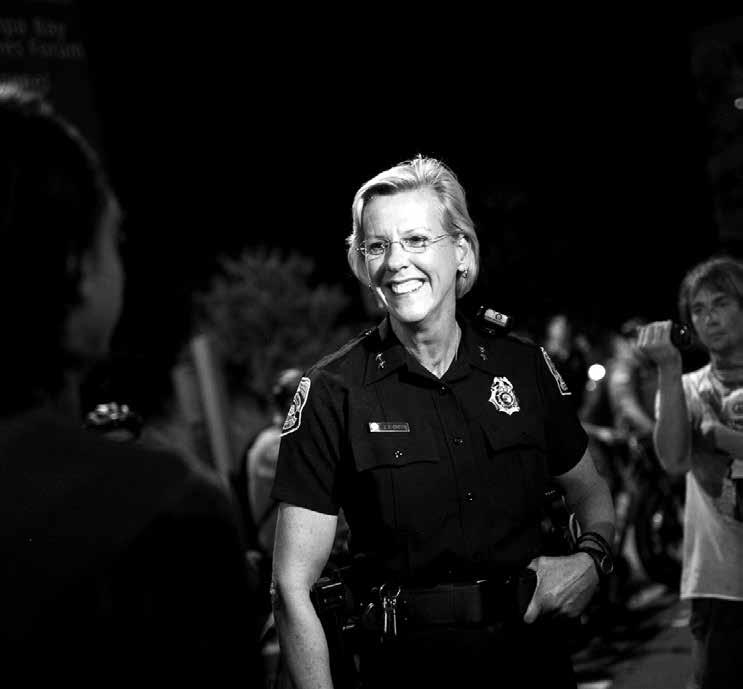
WASHINGTON, DC (April 23, 2019) – Jane Castor easily beat her opponent in the Tampa mayoral runoff Tuesday night and became the first openly LGBTQ person elected mayor of a top-100 city in the southeastern United States. Castor received the Victory Fund’s Spotlight endorsement in January – the organization’s highest endorsement level – and the Victory Fund directly contributed $1,750 and raised more than $4,000 for her campaign. Castor is the third out lesbian to win a big city mayoral race in 2019 – more than doubling the total number of lesbians who have ever served as big city mayors. Both Lori Lightfoot of Chicago and Satya Rhodes-Conway of Madison, Wisconsin, won their mayoral elections earlier this month.
Former Houston Mayor Annise Parker – now president and CEO of the LGBTQ Victory Fund and the first openly LGBTQ mayor of a top-five American city –released the following statement about Castor’s victory:
“A lavender ceiling was shattered in Florida Tuesday night – with voters overwhelmingly electing Jane Castor the first openly lesbian big-city mayor in the southeastern United States. Both LGBTQ people and women face tremendous obstacles in running for public office, but Jane’s victory shows that lesbian candidates can win citywide office with a strong record of public service and policy priorities that align with their constituents. While voters chose Jane because of her vision for Tampa, her willing-
continued from cover
openly LGBTQ mayor,” said HRC Senior Vice President for Policy and Political Affairs JoDee Winterhof. “the HRC was proud to endorse Castor and help turn out the vote in her historic election. We congratulate Jane Castor on her victory and
ness to be open and honest about her life lent her an authenticity that voters are drawn to not just in Tampa but across the nation. That is why an unprecedented number of lesbian
look forward to working closely with her to ensure the city continues to move forward as an inclusive and welcoming place for everyone.”
candidates are plowing through crowded primaries and winning big city mayoral races this cycle – putting us on track to make 2019 the Year of the Lesbian Mayor.”
Jane Castor served 31 years at the Tampa Police Department, most recently as police chief from 2009 to 2015. She was the department’s first woman and openly LGBTQ chief. Under Jane’s leadership as police chief, Tampa’s crime rates decreased by 72 percent. Castor brought efficiency, accountability, and real problem solving to the Tampa Police Department. Castor was also endorsed by the Tampa Bay Times, Equality Florida Action PAC, Emily’s List, Ruth’s List, the Victory Fund, LPAC, the Hillsborough County LGBTA Democratic Caucus, and the Tampa Bay Area Chiefs of Police Association.
Only five out lesbians have ever been elected mayor of top 100 cities – three of them elected just this year. If Jolie Justus wins her race for Kansas City mayor this June, that number will rise to six, tripling the number of lesbian mayors elected to top-100 cities. Before this cycle, only two out lesbians were elected big-city mayors: Annise Parker and Jenny Durkan. The complete list [follows]:
Mayor-elect Jane Castor, Tampa (2019–present)
Mayor Jenny Durkan, Seattle (2017–present)
Mayor-elect Lori Lightfoot, Chicago (2019–present)
Mayor Annise Parker, Houston (2010–2016)
Mayor Satya Rhodes-Conway (2019–present)
There are 38 openly LGBTQ people currently serving as mayors in cities large and small. Their names are available on LGBTQ Victory Institute’s Out for America elected officials map [https://bit. ly/2ITncy4].
The LGBTQ Victory Fund works to change the face and voice of America’s politics and achieve equality for LGBTQ Americans by increasing the number of openly LGBTQ elected officials at all levels of government. victoryfund.org
Courtesy of the Victory Fund
The Human Rights Campaign is America’s largest civil rights organizations working to achieve equality for lesbian, gay, bisexual, transgender, and queer people. The HRC envisions a world where LGBTQ people are embraced as full members of society at home, at work and in every community.
Courtesy of the HRC




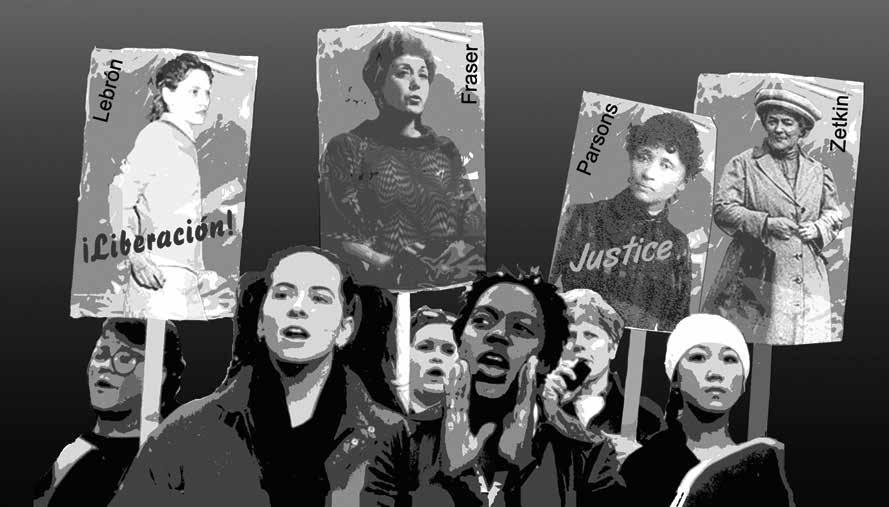
On April 2, 2019, the International Socialist Organization (ISO) publicly announced that members had voted to disband because of their failure of confidence in an organization to which many had devoted decades. The problems centered on sexual abuse, racism, and a lack of democracy. The ISO’s dissolution is proof of the necessity for socialist feminist practice on the Left. The tragedy is that the ISO is not the only group on the international Left that has been torn apart over sexual abuse in the last ten years. These failures discredit the entire movement and drive women out of radical politics.
Serious problems became widely known at the ISO’s February 2019 convention, where participants stood up to a bureaucratic national leadership. Old-guard officials had been shutting down nonwhite members who wanted to organize in communities of color and form internal caucuses. Members recounted how their attempts to raise issues of race or gender were blocked and demonized as “identity politics,” which was narrowly defined as nonrevolutionary, self-indulgent, and separatist. As a result of this bullying, a reform slate was voted in.
The next month, however, it was revealed that a leader who was part of the reform slate had been accused of rape of a supporter six years earlier. A disciplinary committee had investigated and recommended that he be expelled. But other national leaders suppressed the charge and overruled the disciplinary committee. The rape revelations put the final nail in the ISO’s coffin.
Sexism on the Left Radical Women (RW) knows well how sexism has poisoned radical movements. RW was formed in 1967 out of the outrage of New Left women who were silenced and belittled by macho anti-war and civil rights leaders. In combination with seasoned feminists from the Old Left, RW emerged as the world’s first socialist feminist women’s organization. Its mission was to be a radical voice in the feminist movement and a feminist voice on the Left.
That voice was greatly needed. New Left men refused to give an inch on the issues of inequality and sexual abuse within the organizations they ran and in which women were essential fighters but were denied any level of authority. Under the immense pressure of the exploding women’s liberation movement, some male-led groups adjusted their views to give lip service to a watered-down feminism. But little changed in their methods of operation. Always these groups (and there were many of them at one time) dragged their feet and called Radical Women petty-bourgeois dividers of the class struggle for fighting for women’s rights. In Washington state, the International Socialists (precursor of the ISO) opposed a state Equal Rights Amendment because the male-dominated union leader-
continued from cover
protection from the lifelong consequences of unnecessary prosecution,” said ACLU of Washington Executive Director Michele Storms. “This bill addresses irresponsible teenage behavior in a more productive way.”
A majority of teenagers use cell phones, and according to numerous studies, at least 20% of them use their phones to exchange explicit images of themselves, mostly with someone they are dating. This exposes a large number of young people to the threat
ship claimed it would destroy protective labor legislation for women – hiding their hostility to female equality behind a false chivalry. When the state ERA passed, Radical Women went on to fight for and win legislative extension of the labor protections to the entire workforce, male and female. The ISO abstained from this effort.
The International Socialist Organization did not have the backbone to stand up to conservative elements within the working class. Therefore, it declared the working class to be free of such problems. Radical Women debated the ISO on its twisted theory that “working class men do not benefit from sexism, working class white people do not benefit from racism, and working class straight people do not benefit from the oppression of lesbian, gay, bisexual, and transgender people,” as stated in a 2009 ISO leaflet. It’s hard to believe this viewpoint was promoted by a group that believed itself to be a voice for liberation! ISO members, including women and people of color, defended that point of view or were accused of “identity politics” and driven out.
As in other sexist Left groups, there were always women in the ISO who covered for the men in attacking socialist feminism. National leader Sharon Smith put forward the group’s position in her book Women and Socialism (Haymarket Press, 2005). It was a treatise against feminism, which it laboriously and falsely distinguished from support for women’s equality. After ISO members won revision of that embarrassing and archaic line, Smith rewrote most of the book (Haymarket Press, 2015) and reversed its approach to feminism, with barely an acknowledgment of this about-face. Given that history, it is not surprising that Smith was one of the two national leaders who suppressed the rape charges.
Although feminism was finally given the ISO’s seal of approval, hostility to members who promoted women’s issues did not disap-
of criminal prosecution for behaviors that could be effectively addressed in more productive ways.
Prior to this bill, teenagers who sent or received sexually explicit messages and images could be charged with distribution or possession of child pornography –a felony conviction that would result in a criminal record, sex offender registration, and lifelong barriers to housing, employment, and education.
The Responsible Teen Communications Act replaces those harsh penalties with investment in developing evidence-based prevention and intervention strategies that
pear. Feminism never became an organizational practice. This would have meant seeking out the views and advancing the participation of female comrades, particularly women of color, and eliminating bullying by party officials.
Instead, the ISO’s severe political contradictions on this and other issues tainted the politics and internal culture of a group that claimed to be a revolutionary force. For example, it refused to endorse electoral candidates of other socialist groups, then suddenly jumped on the bandwagon of anti-socialist Ralph Nader in 2000. It paid lip service to Lenin’s concept of vanguard parties, but softpedaled the critical need for revolutionary leadership and instead emphasized “revolution from below.” It never truly operated through democratic centralism, where the membership is the highest policy-making body of an organization. Instead, it used bureaucratic centralism to keep an untouchable leadership calling the shots.
Which way forward?
Rank-and-file democracy is vital for any working-class organization. Bureaucratic methods perpetuate bad policies and uphold male dominance and white privilege – because to deal with these pervasive social influences involves a willingness to shake up the status quo and be open to criticism. Bureaucracy is a shield against all kinds of wrongdoing – as evidenced by more and more revelations from former ISOers of financial misfeasance, sexual assaults, racism, and intimidation of anyone who raised questions.
Some disillusioned ISO members are mistakenly labeling the concept of democratic centralism as the source of the group’s problems. But Radical Women functions in a democratic-centralist manner and finds this the most effective way to make sure the membership’s will is carried out.
Others are questioning the validity of revolutionary parties. Radical Women knows
educate teens to make responsible decisions. It also retains misdemeanor-level criminal penalties for youth who share images of others. This will encourage teenagers to seek out adult help to guide them toward responsible behaviors and to prevent exploitation and harassment.
“Young people will make mistakes, but a teen who sends a naked selfie should not suffer the same consequences as a child pornographer,” said the bill’s prime sponsor, Rep. Noel Frame, D-Seattle. “By bringing state law up to date with technology, we are protecting teens from the unintended consequences of a law meant to keep them from
from years of work with our sister organization, the Freedom Socialist Party (FSP), that a deep understanding of feminism by comrades of all genders, support for the leadership of the most oppressed, and rank-andfile democracy can keep an organization as good as its word. Radical Women is also proud of the fact that RW and FSP members of color provide leadership on internal and external questions of race and gender through the joint Comrades of Color Caucus.
The ISO attracted many individuals who are serious about fighting for socialism and human liberation. We hope that these committed radicals will not abandon the struggle.
We invite them to examine the socialist feminist politics of Radical Women and the Freedom Socialist Party. Let’s use this opportunity to strengthen the US socialist movement on the basis of the leadership of the most oppressed.
Every day, capitalism is losing credibility and socialism is gaining. But if half the human race cannot trust the leaders and organizations struggling to make revolutionary change, the whole socialist effort is doomed. This is not a secondary or tertiary question. It is the main issue facing the global Left: either women’s rights and leadership contributions will be recognized and nourished – or socialism is just a pipe dream.
To learn more about the socialist feminist critique of ISO, please see these resources:
“Radical Women responds to International Socialist Organization on the impact of racism, sexism and homophobia on the working class” (2009): https://bit.ly/2W5BfUV
“ISO: taking the feminism out of women’s liberation” (2006): https://bit.ly/2UXtvaU
“The revolutionary harmony of Marxism and feminism” (2011): https://bit. ly/2GzXETW
“Revisiting ‘Feminism and the crisis in the British SWP’” (2013, 2019): https://bit. ly/2UY0qME
“In Defense of Marxist Feminism: Radical Women and Freedom Socialist Party Debate the International Socialist Organization” (2008): https://bit.ly/2W6WVzU
Donations are appreciated! As a grassroots group, Radical Women is sustained by support from people like you. Please contribute online or mail a check, payable to Radical Women, Seattle Office 5018 Rainier Ave. S, Seattle, WA 98118.
You can find fiery Radical Women writings [http://www.radicalwomen.org/literature.shtml] on the RW webpage [www. radicalwomen.org]. Learn more about RW through The Radical Women Manifesto [http://www.radicalwomen.org/literature. shtml#RWManifesto], an exhilarating exploration of Marxist feminist theory and organizing methods. Buy a copy [https://bit. ly/2IWPDuW] or read it on Google Books [https://bit.ly/2UD4XPM].
harm, while ensuring that malicious behavior can still be punished appropriately.”
Many stakeholders advocated for the passage of SHB 1742, including the Washington Association of Prosecuting Attorneys, the Office of the Superintendent of Public Instruction, the Washington State Coalition Against Domestic Violence, Team Child, the Washington Defender Association, the Washington Association of Criminal Defense Lawyers, and the Justice for Girls Coalition.
Courtesy of the ACLU of Washington
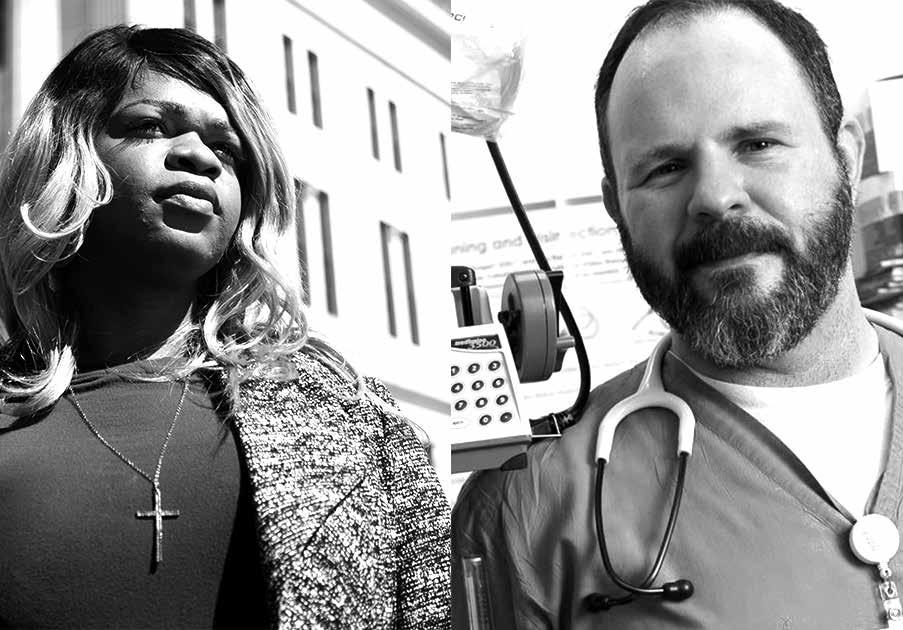
NASHVILLE, Tenn. (April 24, 2019) – Lambda Legal yesterday filed a federal lawsuit challenging Tennessee’s policy prohibiting transgender people born in Tennessee from correcting the gender marker on their birth certificates. Tennessee is one of just three remaining states, [with] Kansas and Ohio, where Lambda Legal has similar lawsuits currently pending in federal district court, to have such a discriminatory policy.
“I have been a woman my entire life. However, the state of Tennessee refuses to recognize my identity and forces me to carry incorrect identity documents. Tennessee’s discriminatory policy complicates every aspect of transgender people’s lives,” said plaintiff Kayla Gore, 33, who lives in Memphis, Tenn. “In times where anti-trans violence is escalating, especially against transgender women of color, I deserve to have identity documents that reflect who I am and don’t put me in harm’s way – the same as anyone would want for themself and their loved ones.”
“Tennessee’s birth certificate policy is archaic and discriminatory. By refusing to correct the birth certificates of transgender Tennesseans, Tennessee puts transgender people in harm’s way and violates our most fundamental constitutional rights,” said Lambda Legal senior attorney Omar Gonzalez-Pagan. “Forty-seven states, DC, and Puerto Rico acknowledge the importance of allowing people to have access to essential government identity documents
that accurately reflect their sex, consistent with their gender identity. It is time for Tennessee to join them. We won’t rest until we remove every governmental barrier to recognizing and respecting every transgender person’s identity in this country.”
Lambda Legal filed the lawsuit today in the US District Court for the Middle District of Tennessee in Nashville on behalf of four transgender people born in Tennessee – Kayla Gore, Jason Scott, and two plaintiffs identified by their initials, L.G. and K.N. With this lawsuit, Tennessee is the fifth jurisdiction with a categorical exclusion on birth certificates that Lambda Legal has challenged, including Puerto Rico and Idaho, where the civil rights organization secured victories in court that prompted policy changes.
“A birth certificate is an extremely important and necessary document for every aspect of life,” said plaintiff Jason Scott, 47, who was born in Tennessee and now lives in Seattle. “I have had to put up with a lot since I decided to live as the man that I am over twenty-five years ago. The state of Tennessee does not get to define who I am by incorrectly identifying me as female on my birth certificate. Getting a correct birth certificate in alignment with who I am would be life-changing.”
In the lawsuit, Gore v. Lee, Lambda Legal argues that denying transgender people in Tennessee the ability to obtain accurate birth certificates violates the Equal Protection and Due Process clauses
of the US Constitution. The lawsuit also argues that forcing transgender people through their birth certificates to identify with a sex that is not who they are violates their free speech rights under the First Amendment.
“Merchant & Gould is proud to provide pro bono legal services to advance the cause of civil rights and pleased to partner with Lambda Legal once again,” said John Winemiller, PhD, managing partner of Merchant & Gould’s Knoxville office and local counsel on this case. “A birth certificate is a person’s most important identifying document, and all people have a right to express their identity without discrimination.”
“Baker Botts is proud to partner with Lambda Legal on this important case, and we look forward to seeing it through to a successful conclusion,” said Stuart Plunkett, co-counsel in the case and partner at the law firm Baker Botts.
There are a number of anti-LGBT bills moving in the Tennessee legislature, including bills that would allow child welfare agencies to reject same-sex couples seeking to adopt based on religious grounds, once again prohibit same-sex couples from marrying, and restrict transgender people’s access to facilities. This federal lawsuit lies in direct contrast to these attempts to dehumanize LGBT people and institutionalize discrimination, and sends a message that the government must recognize a person’s core identity.
According to the 2015 US Transgender
Survey, almost one-third of transgender [people] who showed an identity document with a name or gender marker that conflicted with their perceived gender were harassed, denied benefits or services, discriminated against, or assaulted. Transgender people also are disproportionately targeted for hate crimes.
Handling the case on behalf of Lambda Legal are senior attorneys Omar Gonzalez-Pagan and Sasha Buchert, and counsel Tara Borelli. They are joined by pro-bono co-counsel Stuart C. Plunkett, Maddy Dwertman, Brandt Thomas Roessler, Kathryn S. Christopherson of Baker Botts LLP, and John Winemiller of Merchant & Gould PC.
Read more about the case here: https:// www.lambdalegal.org/in-court/cases/tn_ gore-v-lee
Learn more about the plaintiffs here: https://www.lambdalegal.org/gore-v-leetn-plaintiffs
Lambda Legal is a national organization committed to achieving full recognition of the civil rights of lesbians, gay men, bisexuals, transgender people, and everyone living with HIV through impact litigation, education, and public policy work.
Courtesy of Lambda Legal
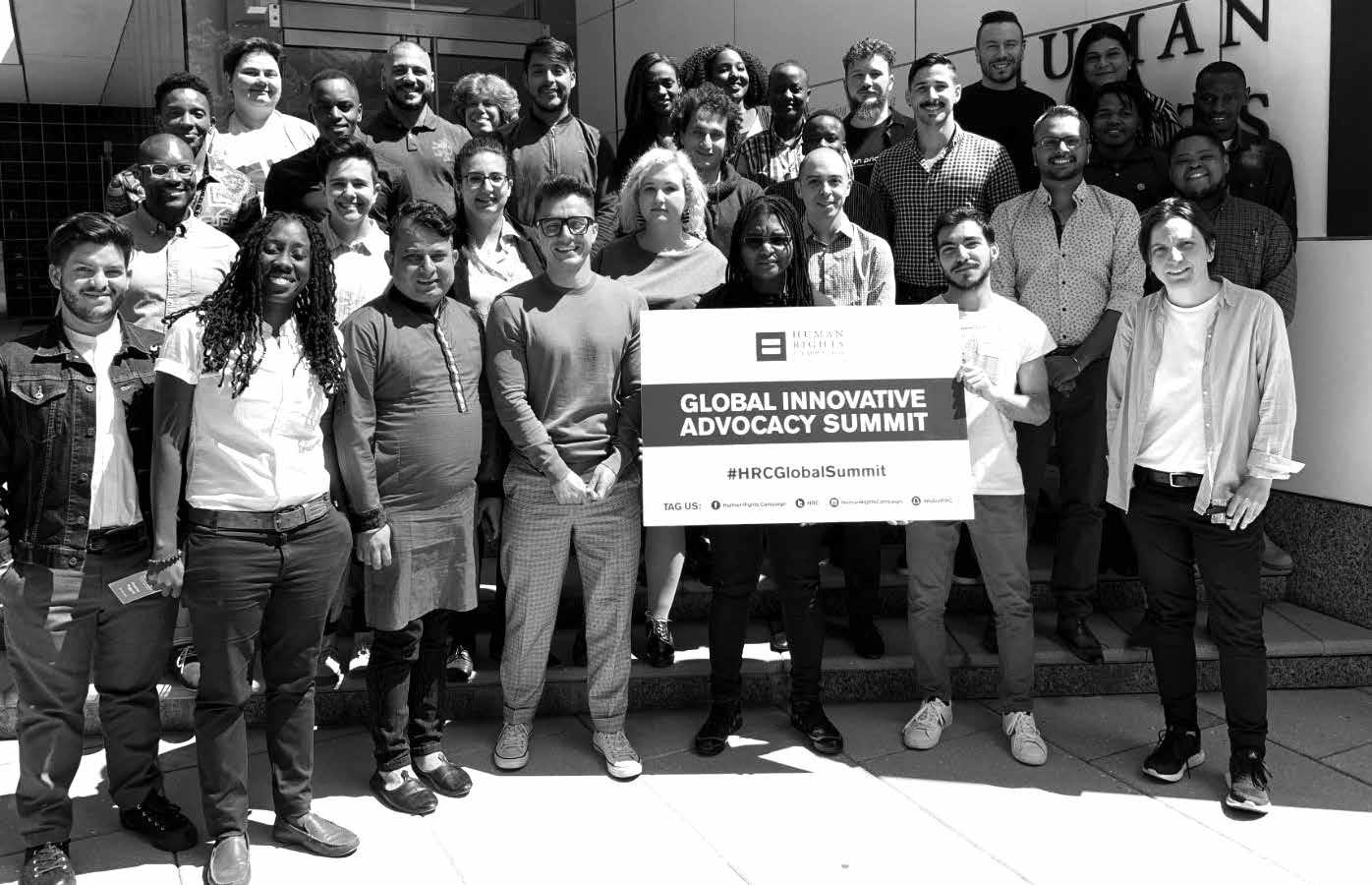
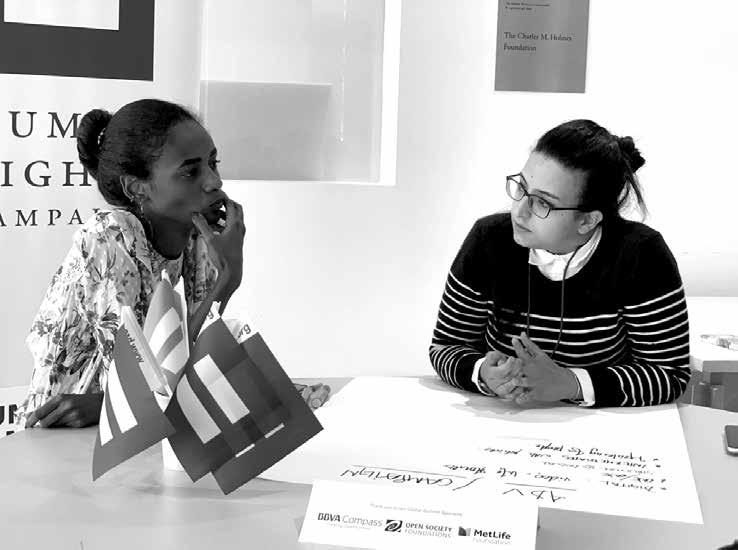
WASHINGTON, DC (April 22, 2019) –Today, the Human Rights Campaign (HRC) Foundation, the educational arm of America’s largest lesbian, gay, bisexual, transgender, and queer (LGBTQ) civil rights organization, kicked off its fourth Global Innovative Advocacy Summit, an annual event bringing international LGBTQ advocates from around the world together in Washington, DC, to discuss trends and innovative ways to advance LGBTQ equality.
This year, the HRC is hosting 29 LGBTQ advocates and allies from 27 countries and territories for the four-day gathering, during which participants will share personal and professional experiences and ideas to help them in their efforts to engage key stakeholders and allies in improving the lives of LGBTQ people in their countries. This year’s summit will focus on campaign strategies, security and migration patterns, and cutting-edge practices to bolster LGBTQ advocacy in challenging places. The HRC is proud that the summit is supported by Open Society Foundation,
MetLife Foundation, and BBVA Compass.
“At a time when so many LGBTQ people’s lives are at risk around the globe, the ability of advocates to collaborate on innovative tools advancing basic human rights and LGBTQ equality is crucially important,” said HRC Director of Global Leadership Jay Gilliam. “We are thrilled to welcome these advocates whose commitment to advancing LGBTQ equality in some of the world’s most challenging places is truly remarkable.”
This year’s impressive group of creative Global Innovators are from some of the most difficult areas of the world for LGBTQ people. Some of the emerging leaders participating in the summit include a transgender advocate fighting for hijra communities living with HIV in India, a journalist using media platforms to advocate for LGBTQ Pakistanis, a public health professional and founder of an LGBTQ-friendly network of health providers in Puerto Rico, and an advocate leading efforts to secure gender-neutral housing for LGBTQ college students in South Africa.
The 2019 HRC Global Innovators are from the Democratic Republic of Congo, Kenya, Malawi, Namibia, Rwanda, Tanzania, South Africa, Uganda, India, Nepal, Pakistan, Azerbaijan, Bosnia and Herzegovina, Bulgaria, Romania, Serbia, Ukraine, Argentina, Barbados, Ecuador, Mexico, Trinidad and Tobago, Egypt, Lebanon, Morocco, and Sudan, as well as Puerto Rico.
Since 2016, the HRC Foundation’s Global Summit has served as a powerful and inspiring way for the HRC to connect LGBTQ leaders and allies to help strengthen the capacity of their movements.
The 2019 Global Innovators join the HRC’s growing network of advocates and partners who represent more than 80 countries and territories.
HRC Global strengthens the global equality movement through public education, advocacy, fellowships, partnerships, and research. While millions of LGBTQ people around the world are gaining visibility and fighting for their rights, far too many
still live in fear and isolation – and under the rule of governments that criminalize their very identities. The HRC has worked to shine a spotlight on dire situations for LGBTQ people in Chechnya, Brunei, Tanzania, and elsewhere. The HRC also continues to collaborate with local LGBTQ advocates as they work to decriminalize same-sex relations, advance the rights of transgender and gender-nonconforming people, and achieve marriage equality.
For more information on the HRC’s international work, please visit hrc.org/ global.
The Human Rights Campaign Foundation is the educational arm of America’s largest civil rights organization working to achieve equality for lesbian, gay, bisexual transgender, and queer people. The HRC envisions a world where LGBTQ people are embraced as full members of society at home, at work, and in every community.
Courtesy of the HRC