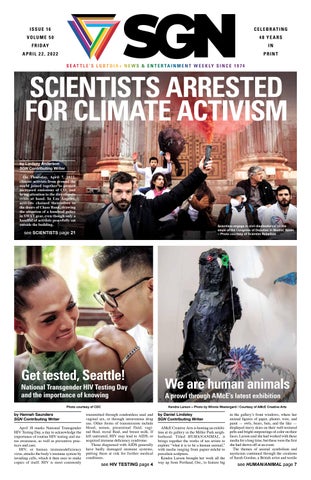
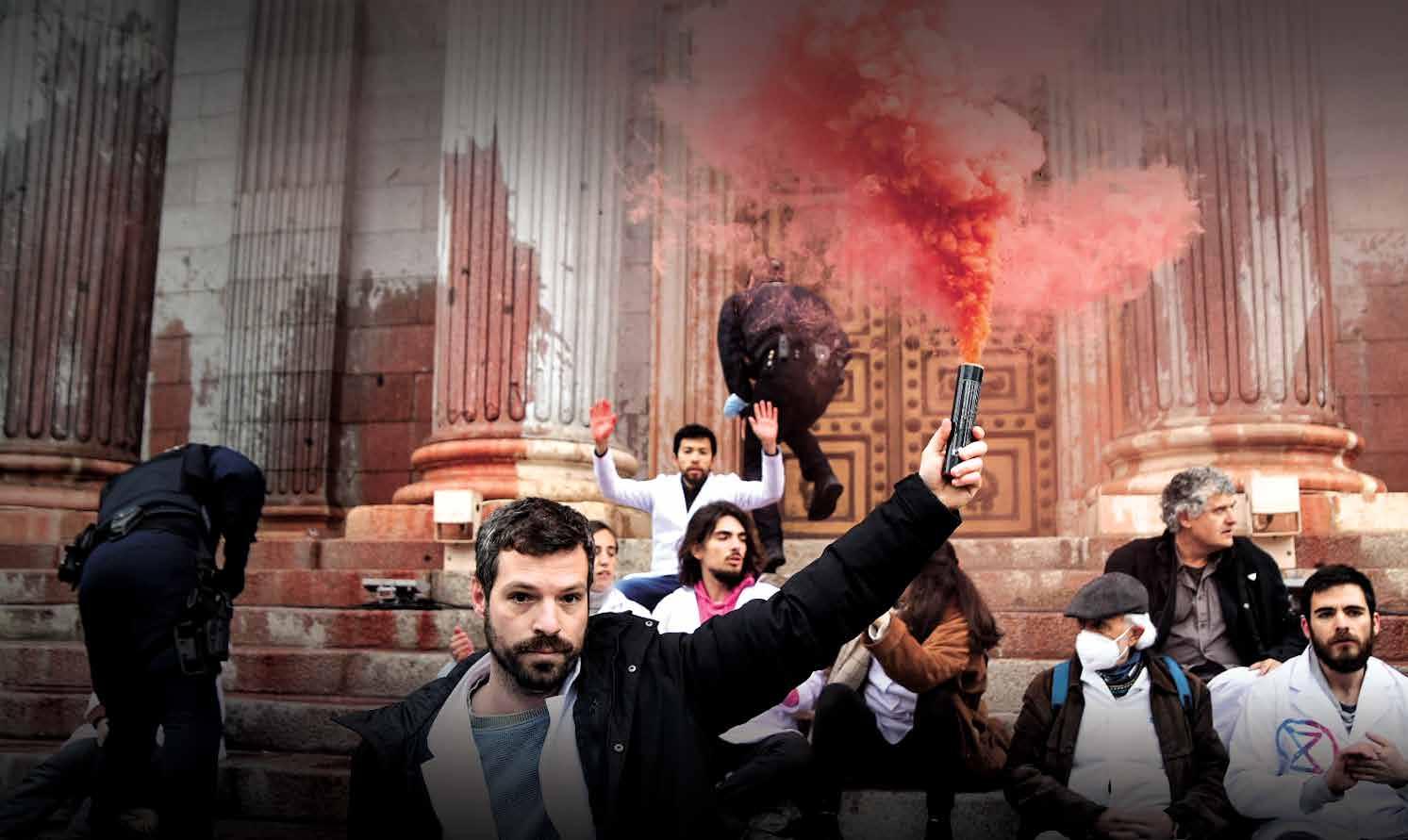
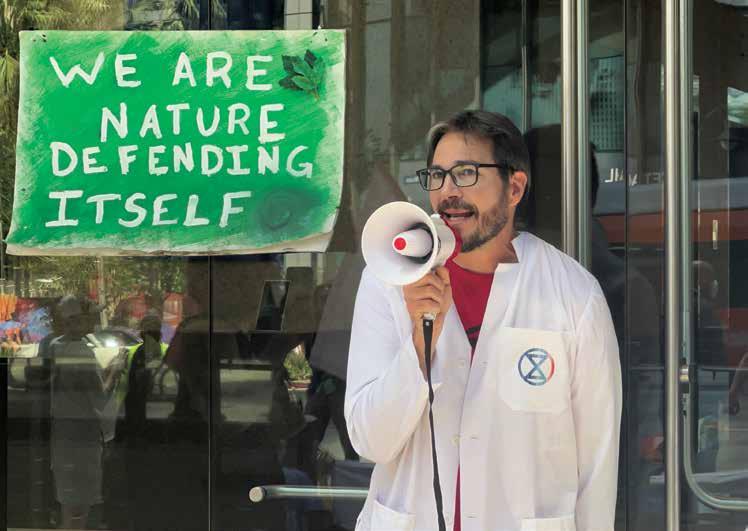
On Thursday, April 7, 2022, climate activists from around the world joined together to protest increased emissions of CO2 and bring attention to the dire climate crisis at hand. In Los Angeles, activists chained themselves to the doors of Chase Bank, drawing the attention of a hundred police in SWAT gear, even though only a handful of activists peacefully sat outside the building.
see SCIENTISTS page 21
Get tested, Seattle!
by Hannah Saunders SGN Contributing Writer
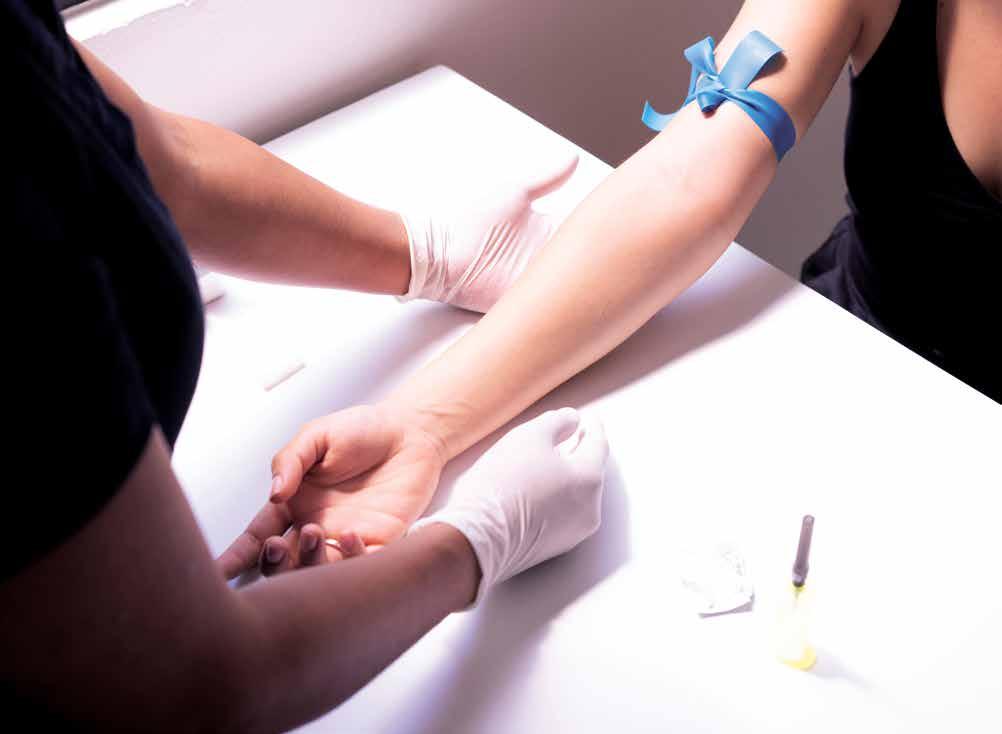
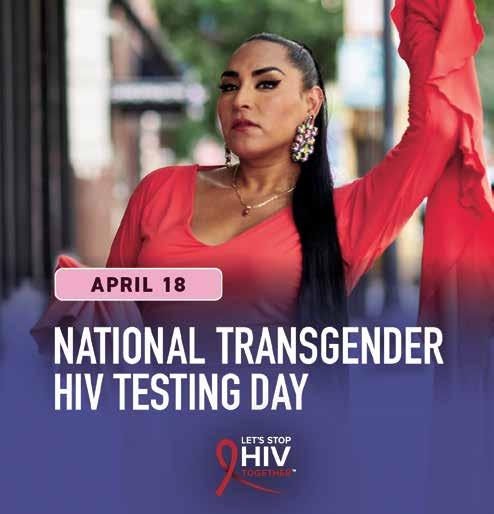
April 18 marks National Transgender HIV Testing Day, a day to acknowledge the importance of routine HIV testing and status awareness, as well as preventive practices and care.
HIV, or human immunodeficiency virus, attacks the body’s immune system by invading cells, which it then uses to make copies of itself. HIV is most commonly
transmitted through condomless anal and vaginal sex, or through intravenous drug use. Other forms of transmission include blood, semen, preseminal fluid, vaginal fluid, rectal fluid, and breast milk. If left untreated, HIV may lead to AIDS, or acquired immune deficiency syndrome.
Those diagnosed with AIDS generally have badly damaged immune systems, putting them at risk for further medical conditions.
by Daniel Lindsley SGN Contributing Writer
AMcE Creative Arts is hosting an exhibition at its gallery in the Miller Park neighborhood. Titled HUMAN/ANIMAL , it brings together the works of ten artists to explore “what it is to be a human animal,” with media ranging from papier-mâché to porcelain sculpture.
in the gallery’s front windows, where her animal figures of paper, plaster, wire, and paint — owls, bears, bats, and the like — displayed starry skies on their well-textured pelts and bright outpourings of color on their faces. Larson said she had worked with these media for a long time, but these were the first she had shown off at an event.
The themes of animal symbolism and mysticism continued through the creations of Sarah Gordon, a British artist and textile see HIV TESTING page 4 see HUMAN/ANIMAL page 7
Kendra Larson brought her work all the way up from Portland, Ore., to feature big
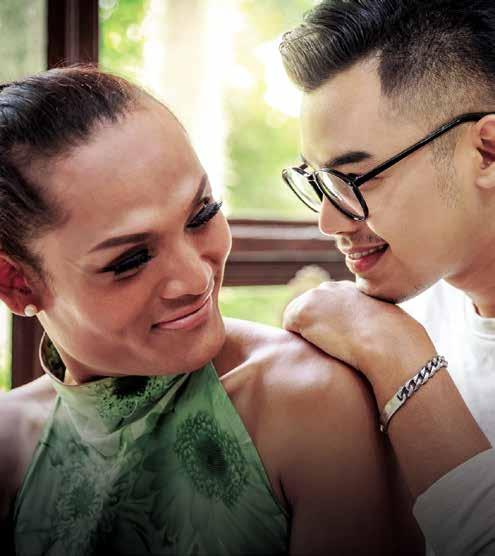
Photo courtesy of CDC
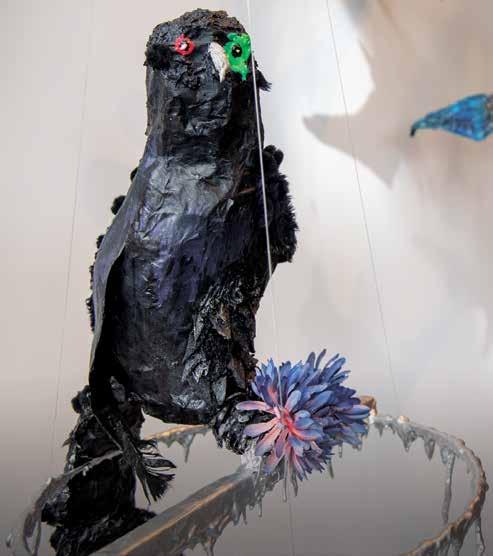
Kendra Larson – Photo by Winnie Westergard / Courtesy of AMcE Creative Arts
Scientists engage in civil disobedience on the steps of the Congress of Deputies in Madrid, Spain – Photo courtesy of Scientist Rebellion
Local News
HIV TESTING
Currently, not much is known about how HIV/AIDS impacts the Transgender community, because the majority of studies consider Transgender people as their sex assigned at birth, and not what they currently identify as. Not only does this discount Transgender identities, but it also allows for the Transgender community to become invisible to public health officials.
What is known about how being Transgender relates to HIV/AIDS is that there are barriers to care and a lack of inclusiveness.
What the data show
According for the Centers of Disease Control and Prevention (CDC), 26,801 people in the United States and dependent areas received an HIV diagnosis in 2019. The number of HIV diagnoses decreased by 9% overall from 2015 to 2019, and the number of new HIV diagnoses were the greatest among those aged 25–34.
The CDC states that in 2019, Transgender people accounted for 2% of new HIV diagnoses, out of which male-to-female Transgender people accounted for almost all (93%), and female-to-male Transgender people accounted for 7%.
The agency recommends that everyone aged 13–64 get tested for HIV at least once as part of their routine healthcare. Those at greater risk of contracting HIV, such as Queer and Bisexual men, Transgender women, and those who use injectable drugs, should consider getting tested more often.
Preventive measures and medicine
To prevent an HIV diagnosis, health officials recommend wearing condoms during sex when a partner’s status is unknown. Getting tested to confirm one’s sexually transmitted infection status is also highly recommended.
Medication is also available for those seeking to further reduce HIV exposures. PrEP, which stands for pre-exposure prophylaxis, is a pill taken once per day that reduces the risk of acquiring HIV.
PrEP, commonly sold under the brand name Truvada, can reduce the risk of contracting HIV from sexual intercourse by 99% when taken as prescribed. It works by blocking the HIV virus from making copies of itself and spreading through the body.
It also works for those receiving genderaffirming hormones.
A medication for those who have a highrisk event, such as condomless sex with a partner whose HIV status is unknown, is called PEP, which stands for post-exposure prophylaxis. Two to three medications are generally prescribed as part of a PEP regimen and must be taken as prescribed for 28 consecutive days. PEP has been shown to work, but it is not 100% effective.
Treatment
Treatment for HIV involves taking medication that reduces the amount of HIV in one’s body, called ART, or antiretroviral therapy. According to the CDC, most individuals can get the virus under control within six months with the use of ART. ART is recommended for all those living with HIV and should be taken as soon as possible to decrease one’s viral load and prevent the development of AIDS.
Undetectable=Untransmittable (U=U)
Those who are HIV positive and adhere to antiretroviral therapy can reach undetectable viral loads. According to the CDC, undetectable viral loads mean that the virus cannot be transmitted to sexual partners, even without condom use.
Where to get tested in the Seattle area
For those interested in becoming up to date on their HIV status, several clinics in the Seattle area offer testing and treatment options.
Planned Parenthood locations offer STI testing and treatment options: www. plannedparenthood.org/health-center. Gay City: Seattle’s LGBTQ Center (www.gaycity.org), located at 517 E. Pike St., offers free STI testing for clients aged 14 and above. Testing services include HIV, syphilis, chlamydia, gonorrhea, and hepatitis C. Gay City also assists clients with finding PrEP and with medication costs.
POCAAN, which stands for People of Color Against AIDS Network, offers free HIV and STI testing and prevention for BIPOC individuals who are at risk of infection. POCAAN is located at 4437 Rainier Ave. S. (www.pocaan.org).
UTOPIA, located at 841 Central Ave. N. #C-106 (utopiawa.org/health-harm-reduction), is an organization led by Queer and Transgender people of color and offers HIV and STI testing, as well as PrEP navigation.
Image courtesy of CDC
Photo by Los Muertos Crew / Pexels
Arts & Entertainment
“I never outgrow the fact that we are family”
A conversation with the one and only Kathy Sledge
by Nick Rapp SGN Contributing Writer
Of all the chart-topping hits in history, few are quite as timeless as “We Are Family” by Sister Sledge. The song far outlived its disco-era omnipresence, and its earworm chorus is instantly recognizable and just as infectious after all these years.
“We Are Family” was inducted into the Grammy Hall of Fame in 2008 and added to the Library of Congress’ National Recording Registry in 2017. Sister Sledge’s lead singer, Kathy Sledge, honors this legacy: she continues to perform with the same fervor of her teenage years, both to intimate crowds and at festivals.
On April 28, Sister Sledge featuring Kathy Sledge kick off a four-day set of performances at Dimitriou’s Jazz Alley. I got the chance to chat with the girl-group icon herself ahead of the upcoming show.
Nick Rapp: How does it feel to have sung the lead vocals on one of the most widely known songs of all time? And what was it like watching “We Are Family” blow up and become such a cultural touchstone?
Kathy Sledge: Well, you know, if you’d asked me that when I was 16 — when I sang it — I would wonder [if it would be successful], which is really a true story.
I used to always follow Nile Rodgers around in the studio. I was this goofy kid with braces. And I would ask him, “Do you think they’re even going to play this record?” And to this day we laugh at that, because he had his confidence — he and the late Bernard Edwards.
So, to answer your question, I had no idea. And it feels surreal to be a voice that people relate to, to sing a song that literally brought the world together, you know, as a family, and in so many ways. I’m hugely proud, and it feels surreal.
And I never outgrow the fact that we are family. I always know it’s gonna be here when we’re all long gone, so I feel like it’s always new to me. It always catches a feeling when I’m singing it.
I can’t even tell you how many times I have performed that song. But just like this upcoming show in Seattle, it’s going to be new to everyone in that room, that experience. NR: Obviously family is a fraught subject in the Queer community. With chosen families and Queer friendships, family often represents those people who make up your closest relationships in life. So, it’s interesting to me that the song shifts and takes on so many meanings to you in performing it. “We Are Family” brings about such a loving, connected group energy that really is the essence of what family and close friendship is.
KS: Yeah, I totally agree, one hundred percent. And I think it’s a song that embraces you. It’s a song of a feeling of belonging to each other.
Performing it, not just for the Gay community — everywhere I perform it — it does the same thing. What I learned with “We Are Family” is that by the end of it, you’re just hugging that person next to you. I feel like I had no idea, again, at 16, what it would mean globally to so many different platforms.
And I think the reason that it is embraced the way it is — I always say from the Gay community to the Girl Scouts — is because it’s real. The realness of it was originally written about the sisters; it was describing this closeness that we really did have when we were younger. But it’s gone far beyond that.
I always say, we live a lifetime knowing what our passion is. I love music. But sometimes it takes a lifetime to find out what our purpose is. And what I’m really learning at this place in my life, is that I hear a lot that
my voice brings joy, and that song brings a cohesiveness unlike any other. And I feel like “wow,” what a very cool feeling of having the purpose of being a voice that brings people together and embraces you.
NR: How did you meet the current band members that you’re touring with?
KS: No pun intended, but they’re like my family. My husband is actually the drummer. And I met him, what, when I was 19 years old? We’ve been married forever. And they [the current band members] have formed their own band within themselves, called Somebody Tell Joe, because they used to have a percussionist named Joe. Joe didn’t have email and he didn’t have a voicemail. So, all our emails would always end like, “Here’s the itinerary and by the way, will somebody tell Joe?” It stuck. And anyway, the guys are family to me.
I always, no matter what, have a family-style dinner after our performances, because I really believe that the true cohesiveness starts there. I just make sure that we are all embracing each other musically, as well as who we are as people. That’s what makes the music so strong and so real. Onstage, when we perform, there’s a feeling of support that we have for each other.
NR: Have you performed in Seattle before?
KS: You know, if I have, it’s been so long ago, I don’t remember. But that’s why I’m really hyped. I’m very excited about what we’ll be doing at Jazz Alley. It is definitely intimate, up close and personal.
I’m also hyped because I’ve been producing shows with the real surprise of jazz. I’m working on a project now with the legendary Stanley Clarke, because he says I have one of
the strongest jazz voices that he’s heard. And coming from him, that’s huge to me. So, there will be jazz along with the hits that we know and love. And I’m just really excited.
According to a press release, the band members are: Kathy Sledge (vocals), two special guest vocalists, Philip Lightfoot (drummer), Michael Kwas (keys), Stacey McGee (bass), Dai Miyazaki (guitar), and Louis Taylor (trumpet). Showtimes are Thursday and Sunday at 7:30 p.m., Friday and Saturday at 7:30 and 9:30 p.m.; doors open at 6:00 p.m. Thursday and 5:30 p.m. Friday through Sunday. More information at www.jazzalley.com/www-home/artist. jsp?shownum=6332. Jazz Alley is at 2033 6th Avenue in Seattle.
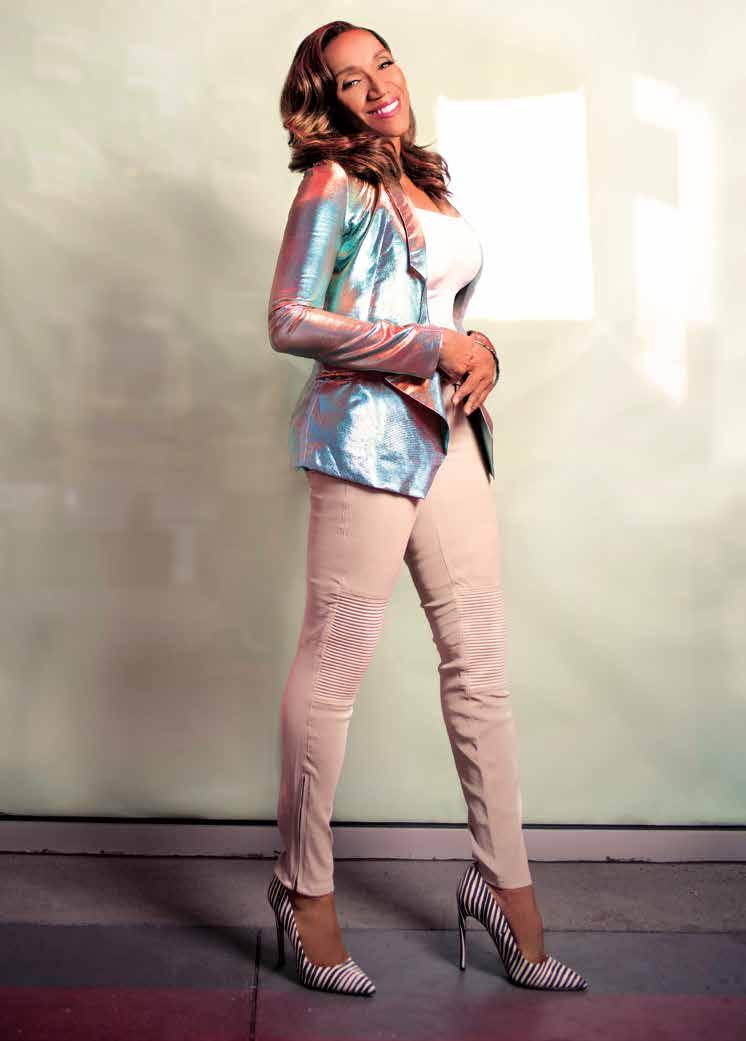
Kathy Sledge – Photo courtesy of the artist
Arts & Entertainment
Two-Mile Hollow to explore white supremacy with AAPI cast
by Hannah Saunders SGN Contributing Writer
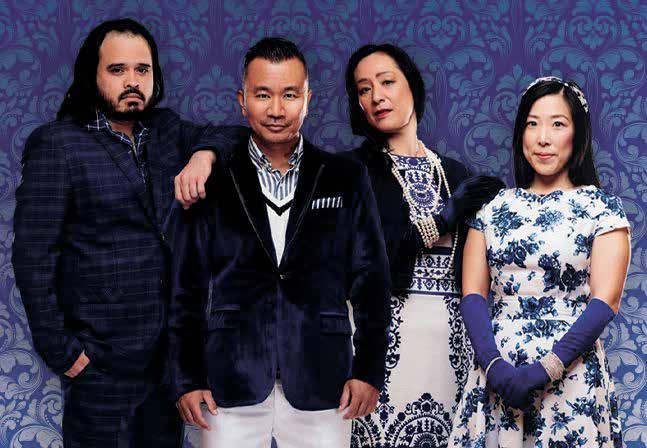
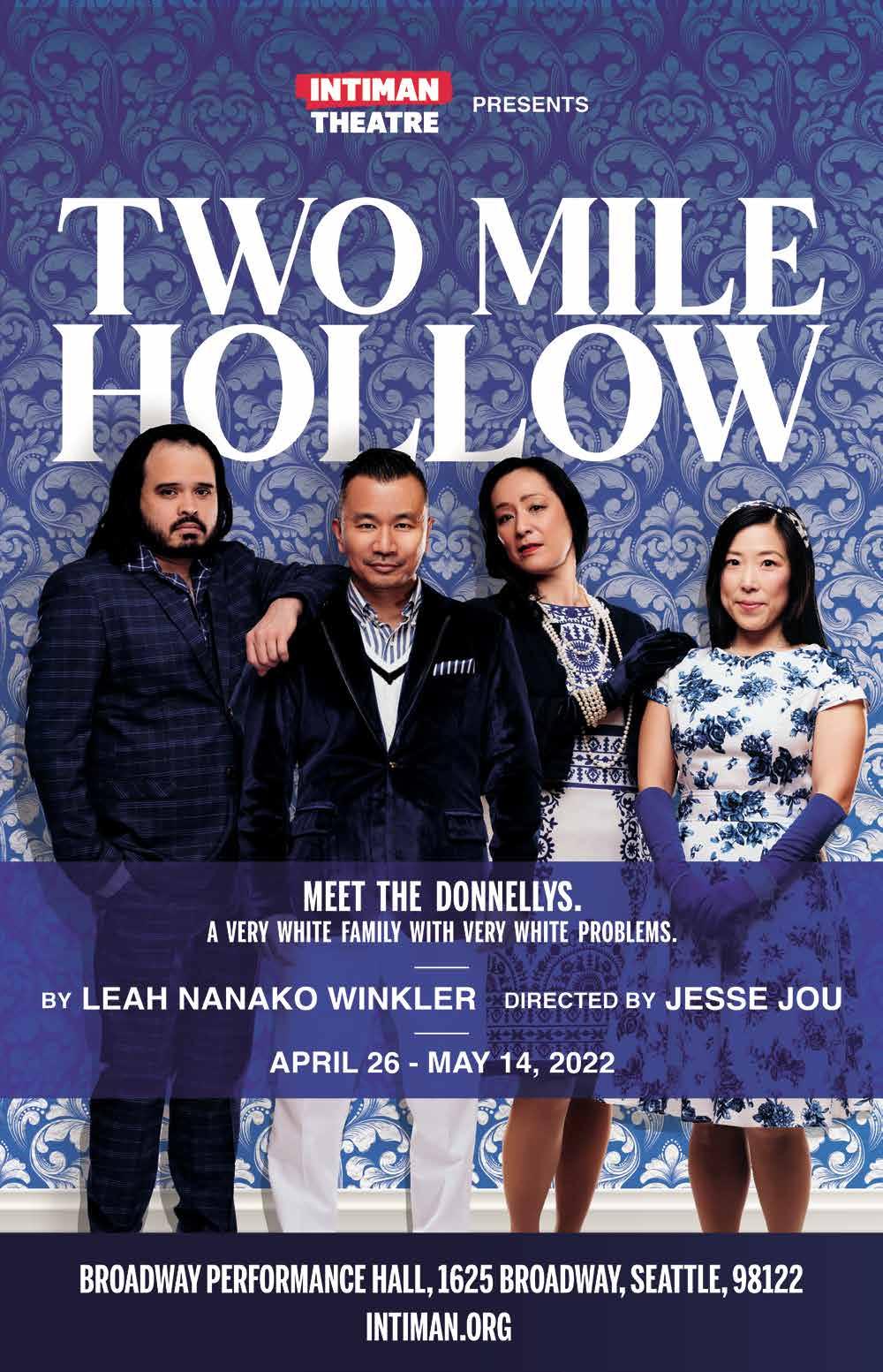
From April 26 until May 14, Intiman Theatre will present Two Mile Hollow, which features a cast of Asian Americans and Pacific Islanders playing the Donnellys, a very white family with very white problems. The cast features Naho Shioya, M. Keala Milles Jr., Ray Tagavilla, and Annie Yim.
It will be director Jesse Jou’s first production for Intiman, and in Seattle. Currently based in Texas, where he works at Texas Tech University, Jou met Intiman’s artistic director, Jennifer Zeyl, about five years ago.
“She reached out to me last year because Intiman was producing Two Mile Hollow and wanted to see if I was interested in coming out… I know the playwright and I love the play, so I’m super excited by the opportunity,” said Jou.
Two Mile Hollow is written by Asian American playwright Leah Nanako Winkler. The story centers around a celebrated acting family whose patriarch has passed away. The matriarch decides to sell their estate in the Hamptons, where the family comes together for a final weekend to tie up loose ends.
“She [Winkler] had noticed this sort of recurring theme in American playwrighting, about what she likes to call ‘rich white people by the water’ plays… usually about wealthy families that came together,” said
Jou. “Most of these stories centered around revelations of family secrets and old family grudges.”
Jou describes Two Mile Hollow as a humorous and insightful play about white supremacy, and how it can be dismantled and resisted through the choices people make. According to Jou, Winkler wanted to satirize this genre and create further opportunities for actors of the global majority who don’t often get to play these kinds of roles.
“The fun we’re having in the rehearsal
room is really talking a lot about exploring and dismantling these tropes around these stories that we all sort of grew up with in terms of representation,” said Jou.
Jou brought up how during his childhood in the 1980s, he noticed how families portrayed in entertainment — specifically dramas — were generally white, such as the Carringtons on Dynasty
“The impact that had on all of us… seeing only white families dealing with those issues… how fun and ridiculous it is to
have a company of AAPI actors who have a chance to explore and celebrate and recognize our own family dynamics inside of these kinds of stories,” said Jou.
Jou described how casting a group of AAPI actors to play stereotypical, rich white characters with white issues has been an affirming aspect of the story. “We’re also taking a moment to say, ‘Oh, hey, sometimes we see ourselves in these characters and in these situations,’ and having a little bit of fun with ourselves inside of it as well.”
Jou described how he has been heavily thinking throughout the pandemic about what he wants audience members to walk away with following performances. With the difficulties and the pain the pandemic has brought, Jou has one primary goal.
“One of my goals as an artist right now is just to create more joy, and I’m hoping that audiences have a really great time, and they laugh, and they recognize themselves in the story, and they also take a moment to reflect about ways in which we can all create more inclusive spaces for people,” said Jou. “But first and foremost, I’m hoping it’s just a good time for everybody.”
Previews of Two Mile Hollow will take place on April 26 and April 27, with opening night on April 28 at 7:30 p.m. Tickets are $5-75, and each Friday performance will be ASL interpreted. For ticket information visit www.intiman.org/ two-mile-hollow.
Pacific Music Works’ Les Fêtes Parisiennes celebrates women composers
by Sharon Cumberland SGN Contributing Writer
If you’ve never heard a concert at the gorgeous Epiphany Parish in Madrona, put it on your list of things to do — especially if it’s a concert by the fabulous Pacific Music Works. That early-music ensemble, led by conductor and scholar Stephen Stubbs, is known worldwide for its Grammy-winning recordings of music from the past.
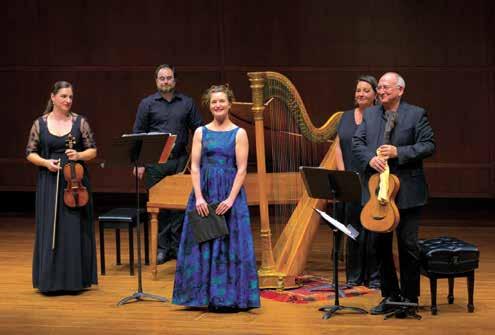
Its early spring concert this year on April 3 — in person again, thank goodness — focused on music by forgotten female composers of the period: harpist Zoé de la Rüe (1770–1832) and pianist Anne Brillon de Jouy (1744–1824). It was a varied, fascinating afternoon of music featuring not only the brilliant playing of harpist Maxine Eilander but the introduction of a new (old) instrument, the fortepiano, played by keyboard artist and restorer Henry Lebedinsky.
Also featured were the always great Tekla Cunningham on Baroque violin and soprano Danielle Reuter-Harrah, without whom a PMW concert would be incomplete. Conductor Stephan Stubbs, playing an early classical guitar by the French maker Soriot (c. 1830), was also the arranger of many of the pieces in this fascinating concert, which has been filmed and is still available online.
The program opened with beautiful and familiar selections from Christoph Willlibald Gluck’s opera Orphée et Euridice (Paris, 1774), which referenced the influence of French Baroque tradition of Lully (1632–1687) and Rameau (1683–1764). If you saw Seattle Opera’s January production of Gluck’s Italian version, Orfeo ed Euridice (1762), you had a rare opportunity to compare a fully produced chamber opera with a parlor-sized presentation consisting of melodic passages with a single singer. This familiar love story of Orpheus is as compel-
ling in the lighter parlor mode as it is in the full opera with its larger musical forces and heavier weight of tragedy. PMW’s chamber version not only featured the playful arias of L’Amour, sung with great allure by ReuterHarrah, but it also featured Eilander’s airy harp — reminding us that Orpheus was the ancient god of music, who opened the gates to the underworld by charming the furies with his instrument.
The program continued with pieces that further contextualized the works of de la Rüe and de Jouy, demonstrating the influence of the harp on French composition. Since brilliant women performers and composers were limited to practicing in private spaces, the parlor became a backdrop for some of the finest music for harp, pianoforte, and strings.
The Baroque guitar was also an important part of early music composition, dem-
onstrated by a very welcome a sequence of songs by Fernando Sor (1778–1839), whose seguidillas for voice and guitar are the perfect weight both for private spaces and for contemporary audiences. Sor’s passionate pieces of love and loss (“In Love’s Prisons,” “Prepare Me for My Tomb”) perfectly matched de la Rüe’s lyrical and witty songs. Her “C’en est fait” (“It’s Over”) on a poem by Évariste de Parny, is in the voice of a young lover who stole a kiss knowing that his crime would end the affair but who seems to prefer having the kiss as a souvenir to having the girl herself. This distinctly female view of masculine behavior is refreshing, especially when the male voice is sung by a woman. Stubb’s guitar, with its plush tone, was a telling backdrop to Reuter-Harrah’s naughty boy, as well as to the anguished, overwrought lovers of Sor’s seguidillas.
PMW’s members are known for their scholarship, since much of the music from this period must be brought to light by searching private and public libraries for unpublished works. One of the “fetes” to celebrate is keyboardist Henry Lebedinsky’s discovery of the harp and violin works of de la Rüe in the Bibliothèque Nationale of France — a find that inspired Eilander to continue developing repertoire by this previously forgotten harpist and composer.
Lebedinsky, who usually performs on the harpsichord, also brought his marvelous reproduction of an 18th-century fortepiano to the concert, to play de Jouy’s “Piano Sonata in A Minor.” The instrument, which looks like a harpsichord with pedals, has a smaller keyboard than a piano and a softer tone, because the frame is made of wood and the hammers are lined with leather. It has a surprising range of dynamics ( piano = soft; forte = loud), because there are foot pedals that control felt dampers — a refinement that a harpsichord lacks. This must have been a revelation to composers of the day, and de Jouy’s energetic “Andante con molto espressione” showed off all the colors and possibilities of the new instrument.
Les Fêtes Parisiennes captures a historical moment in the development of music that not only resurrects important women composers of the day but preserves them for the future and sets their work firmly among famous and familiar male composers. By using period instruments and focusing on the compositions that preceded and followed Zoé de la Rüe and Anne Brillion de Juoy, PMW has given us a host of revelations, along with an array of splendid music brilliantly performed.
This great concert is still available at pacificmusicworks.org/tickets/fetesparisiennes-on-demand until September 9, 2022.
Photo by Joe Moore
Photo courtesy of Pacific MusicWorks
HUMAN/ANIMAL continued from cover
designer working out of her studio on Bainbridge Island. Her acrylic illustrations on watercolor paper featured animals, plants, and other natural elements in stylish abstraction, with contrasting colors and patterns both natural and off-beat. The titles of the pieces anthropomorphized the animals therein, such as Philosopher, Extroverted Introvert, and Maximalist
The works of painter Robin McCauley of Rockford, Ill., had titles of a similar kind, emphasizing the unique talents of her subjects. Each of her pieces was a hyperrealistic rendition of a nonhuman animal on a black background, with a single red line running through the frame — some held in a mouth, claw, or beak, and other odd ones tugged to an angle by a forepaw, or freestanding.
Los Angeles painter Matt Adrian displayed a collection of realistic bird portraits, rendered in acrylic with stunning detail, with titles like I Assure You That My Knives and Swords Are Strictly Ceremonial. One of his books, The Mincing Mockingbird Guide to Troubled Birds, was available for sale at the front.
The most direct depictions of nonhuman animals ended there, then the boundaries began to blur even further. Debra Broz of Los Angeles has been using the rare skill of ceramics restoration to seamlessly combine pieces of old porcelain figurines into chimeras of kitsch, such as a dolphin with a cartoon boy’s head, or Victorian noblewomen with pink elephant features. Broz said the oddities might draw attention to the medium, which she felt was often ignored.
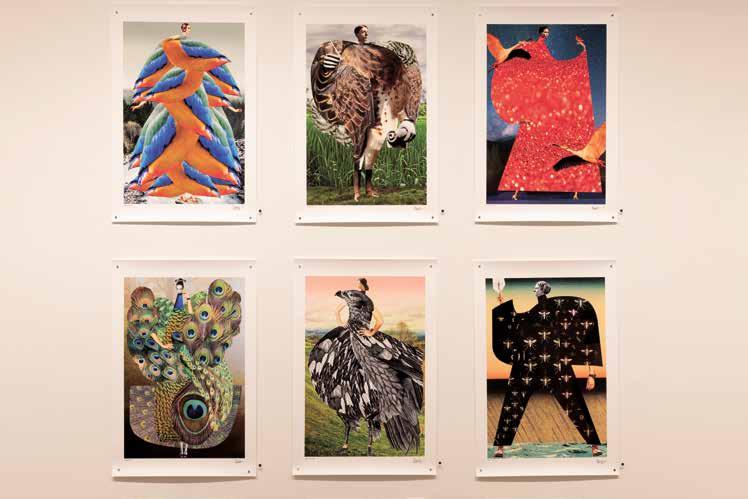
New York illustrator Johanna Goodman’s digital collages, all from her massive collection titled Catalogue of Imaginary Beings, brought to life titanic characters composed of disparate parts: towering figures made from birds, supermodels, old black-and-white portraits, and seas of glitter, all with an impressive clarity to their poses despite their bulky attire.
LA ceramicist Kim Tucker’s sculp -
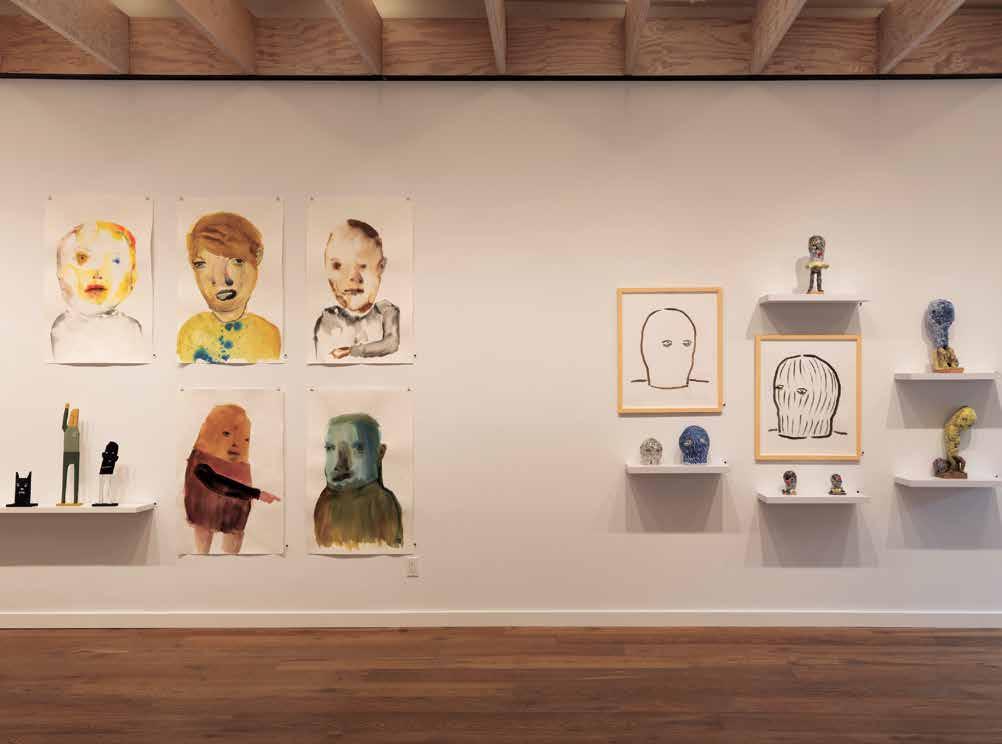
tures and watercolors made up a few more ambiguous human-animal figures, which were often armless but standing upright, with bulbous heads, round noses, tired eyes, and painted fur. The more minimalist portraits of hers were a recent development, Tucker said, and she described her work as having a “lineage,” with each piece evolving from the last.
Yet another LA artist, Jon Huck, brought more of his popular watercolor portraits and painted wooden sculptures. His portraits were abstract, with colors bleeding into each other yet respecting the boundaries of grander shapes, and though his faces possessed a vagueness, like a dream half-remembered,
they carried a great deal of personality.
The most direct depictions of humans came from Kim Bagwill and Kirsten Tradowsky, both of whom worked in oil paint on panels. Bagwill’s paintings were unique in composition, with human faces on bold, solid colors, cut short by the edges of the panels. Some of the partial faces stare straight out at the viewer, and others look elsewhere, but all give a strange feeling of candidness.
Finally, Tradowsky’s paintings were copied from found photos of birthday celebrations, block parties, and other gatherings of yore, mimicking the photos down to their color palettes but with far less clarity of detail.
As a whole, the exhibition explored the
theme of human animals with a net cast wide, bringing together playful works in what AMcE curator McLean Emenegger had hoped would be “a visual cocktail party.” It’s fitting, then, that the energy on the opening evening was electric. Emenegger said she was thrilled that there were far more visitors than she expected.
The HUMAN/ANIMAL group exhibition will be on display at AMcE Creative Arts (612 19th Ave. E.) until June 11, 2022. Until then, the works displayed in the gallery and in the store at the front are for sale. You can preview the gallery and find out more at amcecreativearts.com.
Johanna Goodman – Photo by Winnie Westergard / Courtesy of AMcE Creative Arts
Jon Huck and Kim Tucker – Photo by Winnie Westergard / Courtesy of AMcE Creative Arts
Arts & Entertainment
Queer as Folk takes New Orleans
A first look at the upcoming reboot
by Kylin Brown SGN Contributing Writer
Queer as Folk first appeared as a British television series about Gay friends in Manchester in 1999. Then, Showtime picked up the title for an early 2000s rendition set in Pittsburgh. Since its final season in 2005, the series has been retired — that is, until now.
Arriving exclusively to Peacock on June 9, the newest iteration of Queer as Folk was announced last week through a teaser video and sneak-peek photos.
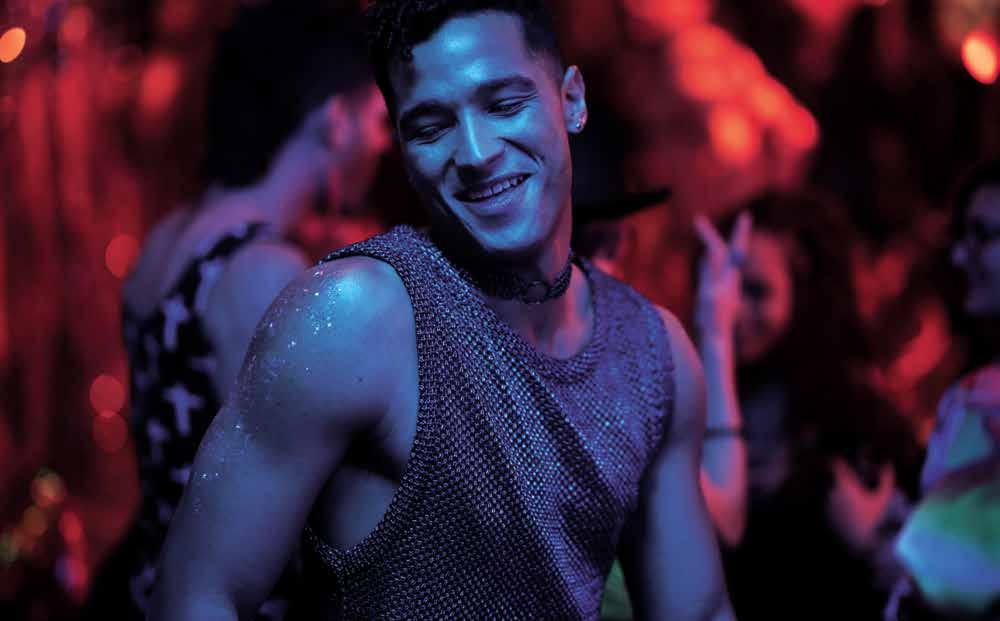
While the teaser is a whopping 18 seconds of neon signage and doesn’t feature any footage from the set, it confirms one important recurrence: the show will once again revolve around a club called Babylon, where characters mix and mingle on the vibrant nightlife scene.
One look at the character descriptions tell you that this reimagined QaF will introduce newer concepts to Babylon, like pronouns, and the show’s creators have cast according to the actors’ identities (Nonbinary people will play Nonbinary characters, etc.). The characters will also be notably more diverse regarding ability, race, and class than their predecessors.
The show will take place in New Orleans, “following a tragedy.” We don’t want to guess from our grim list which contemporary American issue this plotline could
portray, but it will surely be relatable.
“I wanted to create a new, groundbreaking version of this show for this moment,” said creator, executive producer, writer, and director Stephen Dunn. “Our new Queer as Folk is set in New Orleans — one of the most unique Queer communities in North America — and I am immensely proud that the new series is [composed] of an electric ensemble of fresh characters that mirror the modern global audience.”
Dunn, who had a “unique relationship” with the show as a Queer kid in the ’90s, wanted to make sure that all types of Queers felt seen and celebrated, in the same way that the original QaF offered to the creator two decades ago.
“Growing up, I was desperate for any sort of connection with people like me. It was the first time I really felt seen. The show offered a new paradigm — one where we could accept and celebrate Queer love, families, and communities on a global stage,” Dunn said.
Russell T. Davies, the creator of the original British QaF, entrusted Dunn with the task of reawakening this shared mission.
“I’m very proud of what we achieved in 1999, but in Queer years, that was a millennium ago! As a community, we’ve radicalized, explored, opened up, and found new worlds” said Davies. “Stephen pitched a brand-new version of Queer as Folk, with so
much imagination, insight, and crucially, joy that I simply couldn’t resist. I thought it was about time the title belonged to a whole new generation. The 2022 show is more diverse, more wild, more free, more angry — everything a Queer show should be.”
Executive producer and writer Jaclyn Moore had felt a familiar frustration with how LGBTQ+ people and Queer culture are often represented in media.
“All too often I feel as though Queer and Trans representation in art is limited to extremes,” she said. “We are either shown as saintly heroes bravely surviving a bigoted society or two-dimensional, Queercoded villains that feel airdropped in from some previous era.”
In this rendition, the creators “aimed to depict Queer characters who live in the messy middle,” added Moore. “People who are complicated. Who are funny and caring and flawed and sometimes selfish, but still worthy of love. Still worthy of narrative. As a Trans woman, I’m excited to take steps to move past telling stories that seem to just be arguing for our basic humanity. My hope is that Queer as Folk is one such step.”
Some now-familiar stars will lead this well-developed cast, including Devin Way (Grey’s Anatomy, Station 19), Big Sky’s Jesse James Keitel, Fin Argus (Clouds, The Gifted ), CG from Acts of Crime, and Johnny Sibilly of Hacks and Pose
Way’s character, Brodie, is billed as a charming yet chaotic commitment-phobe. CG plays a Nonbinary professor named Shar who must transition from punk to parenthood, and Sibilly plays Noah, a successful lawyer who is not as put together as he seems. Dunn’s QaF will also feature appearances from guest stars, including Kim Cattrall, Juliette Lewis, Ed Begley Jr., Armand Fields, Chris Renfro, Eric Graise, Sachin Bhat, Benito Skinner, Nyle DiMarco, Lukas Gage, Megan Stalter, Olli Haaskivi, and Calvin Seabrooks.
Premiering amid nationwide political turmoil and reactionary legislative moves, the show aims to offer a fair and accurate representation of the lives of the LGBTQ+ community today, and solace in a time of frequent isolation.
“If there’s one person who is able to see Queer as Folk and feel less alone, or who now feels more supported and seen, our job is done, said Dunn. “In the true spirit of the original, our show doesn’t shy away from the harsh realities of our community. But above all else, the series is about people who live vibrant, vital, unapologetically Queer lives.”
Queer as Folk premieres exclusively on Peacock June 9. Find out more and watch it at www.peacocktv.com.
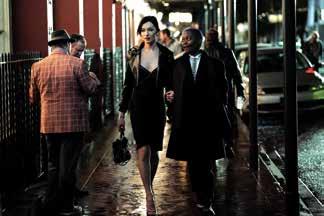
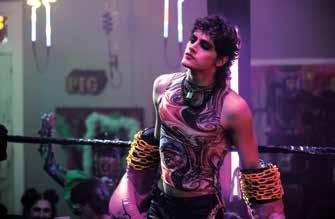
(top) Devin Way as Brodie, from (l-r) Johnny Sibilly as Noah, Jesse James Keitel as Ruthie and CG as Shar, Fin Argus as Mingus in Peacock’s Queer as Folk
I Hope We Choose Love : A radical love letter to the Queer community Books
by Lindsey Anderson
SGN Contributing Writer
As each day wears on, it can feel like we are living through the apocalypse. Climate change, anti-LGBTQ legislation, and constant new waves of COVID pound our community, draining what little radical hope we may have somehow held onto. With all this darkness, it can be hard to move forward.
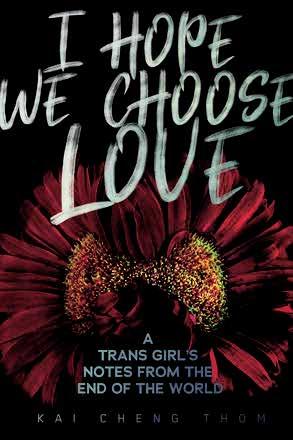
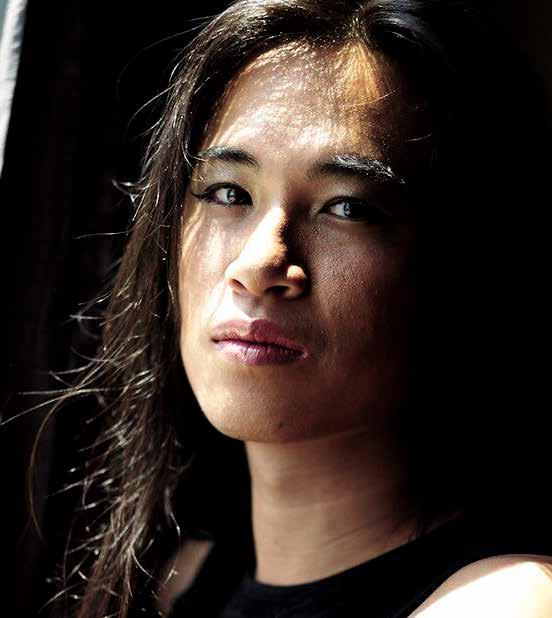
Yet writer and activist Kai Cheng Thom has graced us with I Hope We Choose Love: A Trans Girl’s Notes from the End of the World, a series of essays divided into three parts, reflecting on everything from Trans identity to the Queer community to the constant feeling of impending doom that seems to weigh heavy on us all.
The problem with SJWs
She begins her writing by calling out the problems of social justice culture. Thom reminds readers that her critiques of the movement are not on the same level as conservative and centrist thinkers (referring to the latter as “right-wingers without the backbone to call themselves that”) and that there are several merits to social justice work.
The follies of the movement start with its emphasis on privilege. As Thom argues, “In the social justice movement, privilege is our original sin... shame and judgment are the twin flames of trauma, and we are trained to see ourselves and others through their eyes.”
Akin to this thinking, she calls out social justice warriors who treat those with marginalized identities, such as BIPOC Trans women, as the saviors of the movement, expecting them to contribute to a cause simply because of their existence. “In the social justice movement, the price of a trans woman’s presence is to play the part of a revolutionary figurehead, to raise her voice like a Valkyrie leading an army into battle, and to perform survivorhood in exchange for praise.”
Diving deeper into her critiques of radical liberal communities, Thom also recognizes the unspoken toxicity of the Queer community. She explains that the problem is complex, because the community is made up of traumatized people longing for acceptance in this world. Because abusers in the community tend to come from a background of victimhood themselves, she notes it is easy for us to overlook their sins, which ultimately enables others to suffer from their abuses.
Queer enablers and the fight for mental health
Enabling, she argues, is the greatest flaw of the LGBTQ+ community. “We do it because this is how queer counterculture has trained us to love,” she explains. “Because so many of our formative experiences of family, education, and health care have been authoritarian.”
The Queer community enables abuse, self-harm, and toxic cycles because to limit individual freedom and expression is to succumb to the fascist behaviors of our previous abusers.
“We tell them that they know themselves best, and if self-harm is the only option that they see for survival, then they should go on doing it, no questions asked,” Thom writes. She says enabling contributes to high LGBTQ+ suicide rates. “The urge to overvalidate comes from our fear of crossing boundaries, of replicating the traumas that abusive families and social oppression have enacted on our developing selves.”
Thom continues her analysis of the relationship between overvalidation in the Queer community and mental health with the essay “Robin Williams, Mental Health, and the Stories We Tell about Suicide.” This section dives into the taboo around suicide, and calls on readers to stop referring to mental illness as a “disease.”
She posits that mental health is a community issue, not an individual one. Thom argues that when we reduce someone’s suicide to a result of their “poor mental health,” we refuse to acknowledge the roles we, as a society, have played in their death.
When we equate suicide to a disease, Thom says, “We are also saying that person did not die of abuse, of neglect, of isolation, of horrifying individual circumstances, of social oppression, of the fact that just living in this place and this time is very often an incredibly difficult thing.”
She asks the reader, “How does immediately jumping into a medicalized dialogue around individual mental health allow us to avoid discussing the fact that we have created social environments that make us suicidal?”
She marries the topics of suicide and Queer overvalidation in order to dissect the incredibly high suicide rates of Trans girls in her essay “Stop Letting Trans Girls Kill Ourselves.” In it, she once again brings forward the idea that sometimes loving and caring for someone means taking away their autonomy.
Contrary to many far-left arguments about individualistic freedom, Thom defends her stance. She argues that “the predominant (white, colonial) queer/trans narrative of ‘proper’ consent to being cared for goes something like this: Someone expresses that they are in pain, or you
happen to see that they are. You offer them help. If they refuse, you back off, no questions asked. Any further attempt to help could be considered a violation.”
Thom calls out this way of thinking, stating that as a community, we need to understand the nuances of violation and see that sometimes unwanted intervention is necessary.
“This was not something I had been taught to believe in the queer community,” she writes, “that love and care might mean following someone, even after they have rejected you.”
She argues that Trans women die by suicide because of the conditions of the world they live in. Supporting Trans women, and respecting them and their decisions, does not mean allowing them to kill themselves.
“There is a big fucking difference between not shaming or pathologizing a suicide and being complicit in it,” she concludes.
A look at abuse in LGBTQ community
In part 2, Thom’s critique of the LGBTQ+ community comes via the lens of the #MeToo movement. As she reflects on it, which kicked off in the fall of 2017, she calls out members of her Queer community, not for taking part in the abuse per se, but on the hypocrisy of calling out others when they enable similar behavior in their circles. In
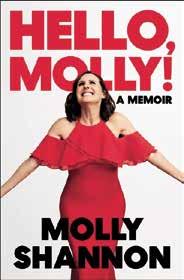
For most of her life, Molly Shannon’s mother stood off to one side, a main character with a big role but few lines. She was killed in a car accident when Shannon was just four, as if she made a cameo appearance and then was written out of the script.
But not entirely. With the help of family and friends, Shannon’s father, Jim, raised her and her sister, Mary, to remember their mother and to seize life in every way possible, encouraging his girls to be bold and “wild.”
Once, when Shannon was 13 and her best friend was 11, Shannon’s father planted the idea in her head to hop a plane. The
girls ended up stowing away in plain sight on a flight from Cleveland (near their home town) to New York City. He paid for their trip back home.
And yet, being Jim Shannon’s daughter wasn’t all fun and games. He was an alcoholic, as was his father and his father-inlaw. When he was sober, Shannon recalls parties, spontaneous trips, permission to skip school, and loving encouragement. When he was drunk, she says that she and her sister were always watchful for his mercurial moods and his propensity for a different kind of “wild” behavior.
She couldn’t wait to leave home.
And yet, through college, a fledgling career, and a popular spot on Saturday Night Live, her father was always there, always a touchpoint for her past but also an irritation; he was enormously proud of her, but there was a bit of a wall between them.
It wasn’t until she was well into her adulthood that Shannon realized he harbored a
secret, and then everything made sense... You don’t expect a terrible, gasp-worthy accident to be the foundation for a funny story, but there it is, the opening number in Hello, Molly!, Shannon’s memoir.
Quickly, though, Shannon pulls readers in — somewhat awkwardly, at first, but in the same excited way that your fourthgrade BFF did when there was something important or interesting that you simply had to see. That, in fact, is the feel you’ll get in the first part of this book: like you’ve been taken by the hand and pulled toward something that was going to make this the best day ever.
As you read on, that’s not much hyperbole. If you like Shannon’s work, you’re going to adore this memoir, which appears a lot like her skits: hectic, heartfelt, hold-yoursides hilarious, honest, and always, always arms-wide charming. Bring your sense of humor here — but bring tissues, too.
Let You Sound Like a White Girl expand your worldview
by Terri Schlichenmeyer Special
to
the
SGN
KAI CHENG THOM
continued from page 10
writing in this vein of “cancel culture,” she says, “we make monsters from that which we fear to see in the mirror.”
She describes intimate encounters with domestic violence and abuse within the LGBTQ+ community, even though many feign ignorance and assume that these are only patriarchal and heterosexual issues.
The complexity of domestic violence, according to Thom, is that those who suffer abuse are more likely to become perpetrators later on. Statistics already show that LGBTQ+ youth are at a higher risk of abuse from parents, classmates, and other members of heteronormative society. Because of this, they are likely to bring abuse into LGBTQ+ spaces and normalize it.
“In the world I had grown up in, love and rage were so closely linked as to be almost synonymous, and I know that I am not the only one,” Thom writes. “Isn’t that the message that parents give to queer children as they punish them?”
Thom’s critiques, when read in the wrong tone, may sound conservative, but they come from a place of love. She calls out the community that she cherishes to make it better. Thom recognizes that the LGBTQ+ community has a complex relationship with abuse, as many are simultaneously victims and perpetrators.
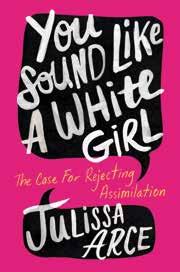
YOU SOUND LIKE A WHITE GIRL: THE CASE FOR REJECTING ASSIMILATION
For the first eleven years of her life, Julissa Arce was a Mexican child living in Mexico. She was not ethnically different from any of her neighbors; in fact, “eating the food, speaking the language, dancing to the music — it was all like breathing air.”
And then everything changed. Her parents moved their family across the border to the United States, a sacrifice they made to ensure better opportunities for their children. But with those opportunities came struggle. Arce constantly worked to fit in: she cut her long hair, and she practiced until she could speak English almost flawlessly.
Thom also brings readers back to the fundamental question she addressed in her chapters on suicide. “I wonder if there are other truths that we miss when we focus solely on understanding intimate violence as an individual choice made by a few monstrous people, rather than as part of a systemic problem in which we all play a part,” she asks.
She raises questions that the blissfully ignorant refuse to address. Through her arguments, she fishes out the root of the problem: the Queer community is at a crossroads, and how we choose to move forward will determine how we address Thom’s critiques.
Where are we going: neoliberalism or a radical future?
Thom blames neoliberalism for the crossroads the Queer community now faces. When the Queer liberation movement first began in the ’60s and ’70s, Thom explains, most LGBTQ+ people were after a radical change. They did not wish to assimilate into the heteronormative culture but rather dismantle it.
Now, as affluent, white (mostly Gay and Lesbian) people become accepted and celebrated, the community’s goals have shifted.
“In later decades… [the LGBTQ+ community] became increasingly focused on the narrower goals that primarily served the interests of white, middle-class, cisgender gays and lesbians: the rights to marry, adopt children, serve in the military, and work in prestige professions,” Thom writes.
But even the smallest mistake set her back in the eyes of her white classmates. She was never going to be white. So why try?
For centuries, she says, white people have told Hispanic and Black people that if they worked hard, “everything was possible” — while they were making it impossible for anyone with darker skin to get ahead. As a result, people of color relinquished their culture and language with hopes of assimilating or, at least, being accepted. They stopped speaking their native tongue, while white schools proudly taught it in “dual-language... programs.”
Most bruisingly, the system resulted in a widely held preference for lighter skin, and not just in the US: a similar preference “infiltrates” Mexican life, too, says Arce.
The solution, she suggests, is to stop trying to assimilate, period.
“There is so much power in the uniqueness of our names, our food, our heritage,” she says. “Only when we refuse to change and instead recognize the beauty that has
She uses celebrities like Caitlyn Jenner as an example of the ways members of the LGBTQ+ community have fallen into the neoliberal trap. “The myth of exceptionalism has always been a cornerstone of neoliberal philosophy — the idea that since a few people can ‘make it’ under capitalism, then everyone else can too,” Thom explains.
This ideology is dangerous to the community, she warns. Neoliberalism places responsibility, guilt, and exceptionality all on the individual. The result is blaming the mentally ill for their conditions, seeing sexual assault as an individual flaw and not a reflection of the community, and expecting LGBTQ+ people to pick up the tools of heteronormativity to assimilate, giving up their former dreams of a radically new world.
The idea of assimilation as a necessity, while perhaps attainable for cis, white, middle-class Queers, is much harder for Trans people, like Thom. She explains that this way of thinking puts a higher burden on Trans people to “pass,” and punishes those who, for financial or personal reasons, cannot.
“I don’t want to live in a world where middle-class trans people can use public washrooms that match their gender identities, but homeless trans people are barred from public spaces,” Thom says. “I don’t want to live in a world where trans people are put in prisons that match their gender identity; I want to live in a world without prisons.” She uses her last few chapters to call out
been passed down to us will we truly find acceptance within ourselves.”
When you prepare to dive into You Sound Like a White Girl, be sure to leave your assumptions at the door. Arce is going to make you examine everything you ever thought about your natal culture, no matter what your origins.
And she does it with an angry eloquence that makes you wonder why anyone would ever want to work so hard to fit in anyhow. Through her own stories, history, and research, she lets readers know that they’re not alone in their efforts to assimilate, that their frustration is not unique, and that there’s ample reason to quit the fight. It comes with a good amount of pride and not a few surprises.
While this book may seem like it could have a “No Whites Allowed” sign hidden somewhere on the cover, nothing could be further from the truth. To make our society better, letting everyone of any race read You Sound Like a White Girl is key.
members of the LGBTQ+ community who celebrate small victories or assimilation and lose sight of the greater goal of reinvention.
A radical manifesto and love letter
I Hope We Choose Love is a radical Queer manifesto, a love letter to a community that the author is not afraid to critique. At times raw, triggering, and pointedly controversial, Thom’s memoir is a work of art. She balances her prose with pages of thought-provoking poetry and uses both to draw in the reader. Thom reminds LGBTQ+ readers that, despite existing in a community that rejects binaries, we are sometimes unable to look at all the gray that exists in our own spaces.
Thom brings up difficult topics like suicide, mental health, and sexual assault, not to trigger readers but to examine how black-and-white thinking on punishment and guilt simplifies these problems. She doesn’t hold back in her critiques of the community, and while she does praise the resiliency of the Queer community, she also notes that surviving shouldn’t be a prerequisite to membership.
I Hope We Choose Love is thought-provoking. It is the kind of book you cannot read just once. It will call to you to reexamine all the stages of your Queer lifetime. Kai Cheng Thom is a revolutionary of Queer theory, and she calls on us to keep the torch lit.
Image courtesy of Ecco
Image courtesy of Flatiron Books
Gory Wyrmwood: Apocalypse is a high-octane blast
by Sara Michelle Fetters SGN Staff Writer
WYRMWOOD: APOCALYPSE
PVOD
It’s taken a few years, but with Wyrmwood: Apocalypse, brothers Kiah and Tristan Roache-Turner have finally returned to the zombiefied Australian wasteland of their rambunctious 2014 cultfavorite, Wyrmwood: Road of the Dead While not nearly as fresh as its predecessor, this second helping of blood-splattered dystopian craziness is still a decent bit of fun. I had a terrific time revisiting this cartoonish Outback wasteland, where the RoacheTurners deliver high-octane undead antics that kept me happily satisfied.
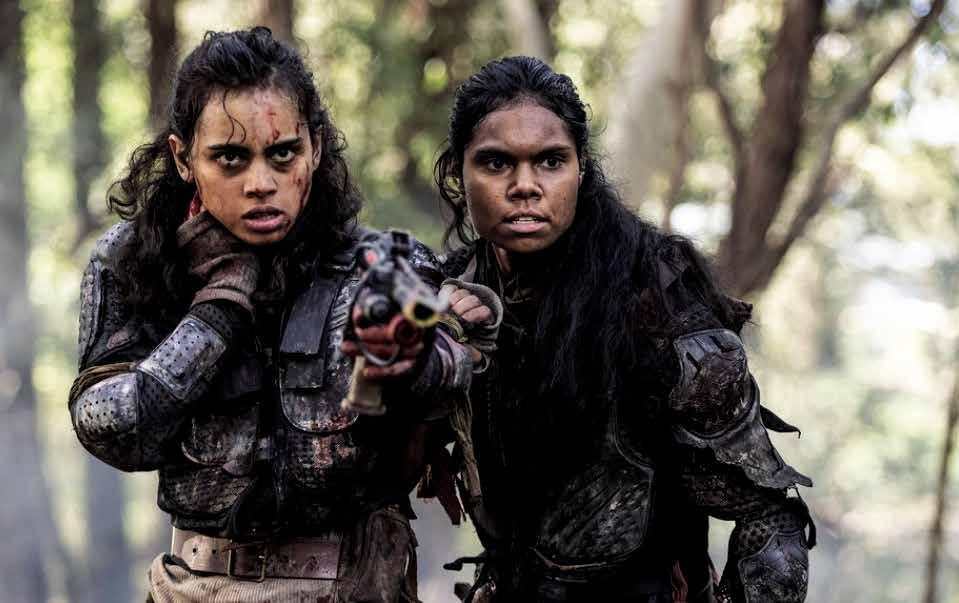
The storytelling can be a little slapdash, especially during the oddly chaotic opening third. While not picking things up directly after the events of the first film, the sequel still drops the viewer right in the middle of a melee involving returning survivors Barry (Jay Gallagher) and his flesh-eating hybrid sister Brooke (Bianca Bradey) — she can control zombies with her mind — taking out a small squad of soldiers. The duo has also teamed up with indigenous siblings Maxi (Shantae Barnes-Cowan) and Grace (Tasia Zalar), and after the fracas comes to a gruesome conclusion, the two young women strongly consider putting an end to their partnership.
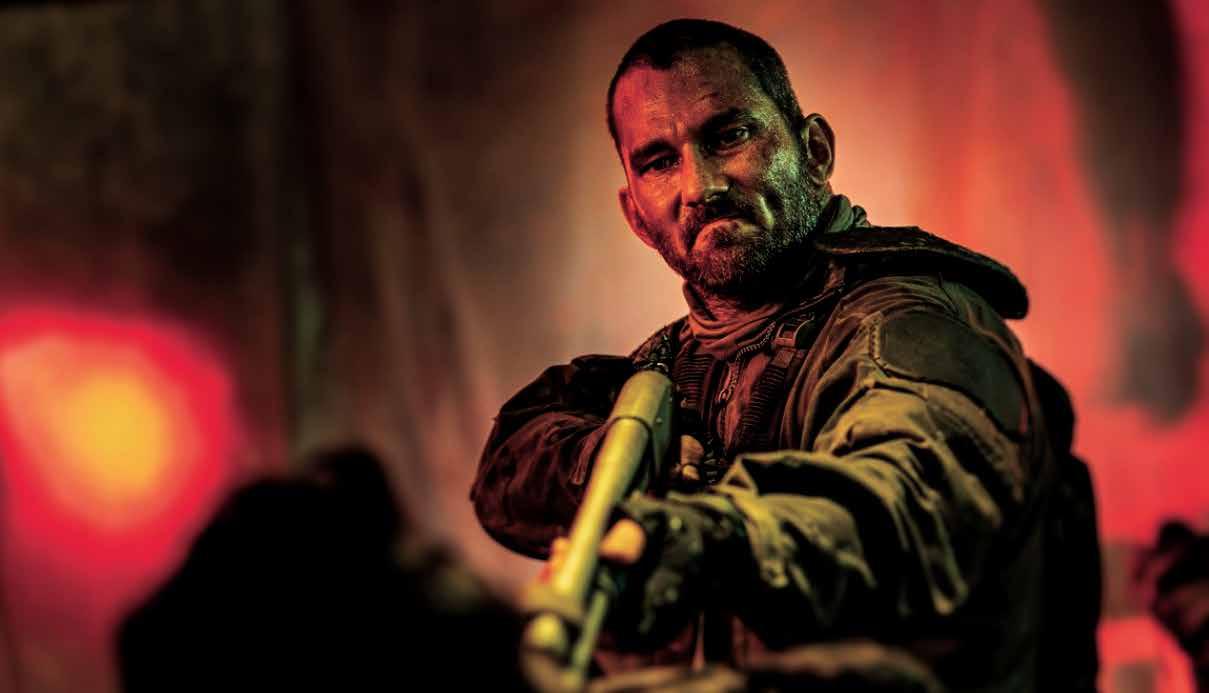
But that’s not the main plot. After the opening title drop, the narrative shifts gears to focus on Rhys (Luke McKenzie), the twin brother of the brutal Captain who helped make Brooke the telekinetic halfhuman, half-zombie she is today and a soldier working for the mysterious Surgeon General (Nicholas Boshier). He’s been rounding up survivors and delivering them to this scientist in his underground bunker under the impression they’re being protected and are helping the doctor find a cure for the zombie outbreak.
Not that this will come as a shock to anyone, but Rhys is wrong about all of that. Through a series of crazy events that I’m not about to spoil, the soldier ends up teaming with Maxi to save her sister Grace from the clutches of the Surgeon General and his
maniacal machinations. Additionally, he runs smack-dab into Barry and Brooke, the pair who killed his brother, and is forced to reconcile his thirst for vengeance with the knowledge that they may be the only thing standing between humanity’s continued survival and outright extinction.
What I like about Kiah Roache-Turner as a director is that he’s clearly studied at the George Miller school of “how to shoot action.” Not to say he’s in the same class as the Mad Max and The Witches of Eastwick Oscar winner, but as imitators go, the guy has done his homework. I get the sense that he is growing increasingly confident behind the camera with each new project. There is a crisp fluidity to all of the big set pieces, and I love that he manages to bring a sensation of a constant state of motion in a way that does not feel overly frenzied or visually incoherent.
The mixture of comedy, horror, and action was stronger in Road of the Dead, though. A lot of that had to do with the presence of Leon Burchill, who was terrific, and he’s sadly missed this time around. This leaves it to Boshier to do all the truly zany stuff, and the actor is certainly game to go into Peter Sellers-meets-Marx Brothersmeets-Bruce Campbell territory whenever the director allows him to. But he’s almost too over the top, his goofy antics frequently taking me out of the story instead of adding to the film’s overall effectiveness. On the positive side of the ledger are McKenzie and Barnes-Cowan. They do a fine job, and I liked how their performances immediately feel lived-in and multidimensional even when the script from the Roache-Turner siblings works in comic book shorthand and doesn’t spend much
time fleshing out either Rhys or Maxi in a fashion that isn’t immediately obvious. It’s an interesting and daring thing to make your two primary newcomers the stars of an already established franchise, but McKenzie and Barnes-Cowan are up to the challenge, and if the Wyrmwood saga gets a concluding chapter, I’m all for seeing more of the both of them.
At a brisk 88 minutes, there’s not much depth to any of this, and there are moments where events brazenly tread into terrain Paul W.S. Anderson covered many times over during his six-film Resident Evil franchise. But the Roache-Turners still put their personal stamp on things, and there is an old-school, renegade Aussie spirit running through Wyrmwood: Apocalypse that’s reminiscent of the Ozploitation heyday of the 1970s and ’80s. Give this one a look.
Tasia Zalar and Shantae Barnes-Cowan in Wyrmwood Apocalypse – Photo courtesy of Guerilla Films
Luke McKenzie in Wyrmwood Apocalypse – Photo courtesy of Guerilla Films
Mesmerizing World’s Fair is a terrifying digital fairy tale of self-discovery
by Sara Michelle Fetters SGN Staff Writer
WE’RE ALL GOING TO THE WORLD’S FAIR
Theaters
We’re All Going to the World’s Fair is about as contemporary as they come. It deals with technology, social media, and teenage mental health issues so “hot button” they might as well be on fire. Writerdirector Jane Schoenbrun has tapped into something intimately primal with their mesmerizing creepypasta feature-length debut, exhibiting a magnificent level of disquieting, introspective authority.
What’s most remarkable about what Schoenbrun has accomplished is that, as current as the story might be, the filmmaker has still fashioned a timeless scenario of identity, anxiety, isolation, and discovery that viewers of all ages and backgrounds will likely respond and relate to. Themes revolving around personal self-discovery are universal in their eerie effectiveness, and there were multiple moments where I saw myself in the main character, a quiet shiver cascading down my spine every time.
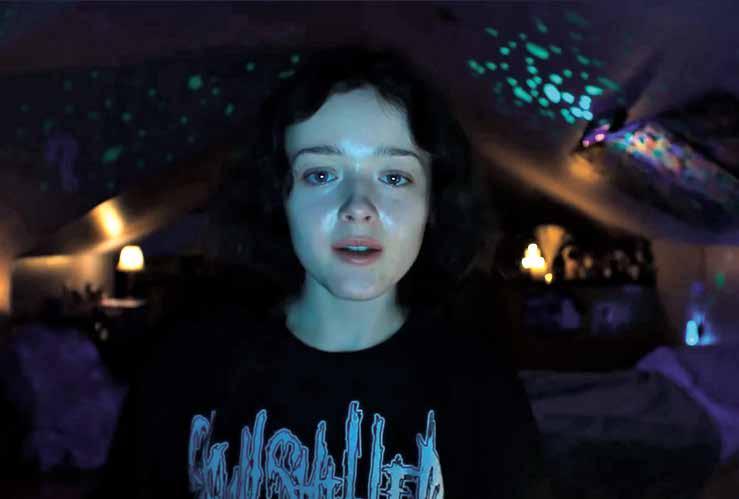
Casey (newcomer Anna Cobb in a striking, unforgettable debut) is struggling. Her home life is in disarray. It doesn’t appear that she has very many — if any — friends. Instead, the teen turns to the internet for support, communication, and community. This has become the chief way that Casey connects with a larger world, posting videos and visual essays in the pursuit of followers who will hopefully validate her existence.
To increase her visibility even further, Casey puts on a perkily brave face and states she’s going to take “the World’s Fair chal-
lenge.” She pricks her finger and draws some blood. She watches a hypnotic, headacheinducing video filled with strobe lights and weird images. After that? Casey needs to post daily videos about what happens next, the challenge being a long-term project with an uncertain outcome, as each participant’s transformation into “something different” is never the same from one player to the next. In lesser hands, all of this could become something of a Paranormal Activity meets Unfriended clone with just a dash of Japanese cyberpunk horror reminiscent of Kiyoshi Kurosawa’s 2001 classic Pulse. But that’s not what Schoenbrun is up to. Yes, there are several unsettling images, not the least of which are ones of another player who posts videos of herself seemingly
transforming into an unmoving plastic doll, but the director has more on their mind than generating a few random nightmares or making the viewer squirm uncomfortably in their seat.
While that certainly happens, Schoenbrun is also asking fairly big questions about gender and identity. Casey is laboring to understand who she is in this world, making things up as she goes along, looking for reasons to blossom into the person she’d like to be, even if it always feels as if outside elements are forcing her to conform to a status quo she has no desire to be a part of. She’s trying to find herself, looking to transition out of childhood into something new, and this particular challenge appears to be a tool for her to do just that, maybe even more.
Cobb is sensational. Casey’s jittery timidity isn’t so much a smokescreen as it is a trait the youngster is attempting to overcome by playing the game. For a film in which she spends long passages in a darkened room staring at a computer screen, with only her face taking up the majority of the frame, Cobb’s expressive physicality in bringing all of her character’s internal permutations to life is nothing short of extraordinary. This is a livewire performance reminiscent of James Dean’s triumphant explosion of youthful rage in Rebel Without a Cause or Sidney Flanigan’s hauntingly hushed brilliance in Never Rarely Sometimes Always, comparisons I do not make lightly.
Schoenbrun doesn’t always have a firm grip on things, and a key subplot involving another online participant, the mysterious “JLB” (Michael J. Rogers), an adult who takes special interest in Casey, starts off on rather shaky ground. But I like the ambiguity of the relationship that develops between the two, and to the director’s credit, the uncertainty of JLB’s intentions never overshadows the frequently thrilling, often terrifying transformative journey the teenager is on. This remains Casey’s story, and when reality appears to bend, fracture, and blur, she still retains enough cognitive authority to not let a shadowy online figure have too much info about her offline reality.
Ultimately, We’re All Going to the World’s Fair is a digital Grimm’s fairy tale of a loner investigating a secluded virtual forest, worrying they may not have left enough breadcrumbs behind them to make it back to the safety of their familial cottage. But Casey’s road is full of beguilingly petrifying wonders, each one helping her discover who she wants to be and what kind of person she will hopefully grow to become.
An interview with writer-director Jane Schoenbrun
Talking gender, cross-generational experiences, and We’re All Going to the
by Sara Michelle Fetters SGN Staff Writer
Jane Schoenbrun’s sensationally unnerving
We’re All Going to the World’s Fair made its debut at the 2021 Sundance Film Festival. It has met with almost instantaneous universal acclaim and became one of the most talked about indie dramas to play the festival circuit — including the Pacific Northwest’s own North Bend Film Festival, where it won an award for being Unclassifiably Awesome — before being picked up by Utopia for theatrical distribution in early 2022 and HBO Max for a streaming release later in the year.
Schoenbrun’s film is a deliriously low-fi creepypasta stunner about teenage loner Casey (Anna Cobb) going into the wilds of the internet to participate in a mysterious, transformational horror game in the hopes of meeting new friends and making human connections she’s been unable to find offline. It is a surreal examination of identity and selfperception that grows in unnerving eloquence as it moves along, building to a powerfully ethereal climax that’s so intimately personal, there were moments I wondered if the director had made this film for me and me alone.
I had the pleasure to sit down over Zoom with the talented Nonbinary filmmaker to discuss their revelatory debut in greater detail. Here are the edited transcripts of everything we talking about during our 20-minute conversation:
Sara Michelle Fetters: I know you’ve been talking about your film for quite some time now, but you have no idea how excited I am to be speaking with you after over a year of waiting to be able to really talk about We’re All Going to the World’s Fair in greater detail.
Jane Schoenbrun: That’s so flattering. Thank you. I still really [like] talking about
World’s Fair
it. I know it’s over a year of me talking about the film now, but there’s still so much to talk about. It’s so personal.
SMF: This movie debuted at Sundance in 2021 and it was pretty much universally praised, but it never got out there into the public consciousness until now, 16 months later. What has this journey been for you?
JS: It’s been really strange. I so rarely got to experience the film with human beings or talk to people about their experiences, or to audiences about their experiences as they watched it. It all happened in the background, and it’s been surreal to understand that it has been this slow crawl towards this moment — and I don’t think is the end or the crescendo. I think there’s going to be something really special that happens when the film hits HBO Max, and then Halloween happens and people stumble across Casey’s painted face on that app and being, “What is this?” Then they click play and hopefully getting their mind blown.
But the film finds its people naturally. I think that when you make a film like this, without a lot of money and without famous people, this is all you could hope for, that it’ll be this cult sleeper thing that slowly by word of mouth reaches outside of your circles and reaches strangers.
SMF: When I first saw the film during Sundance, it was unnerving. But watching it at home on my laptop and not in the theater felt appropriate, almost as if you had made this just for me. I don’t think I’m alone in having that feeling while watching the film.
JS: What made you feel like that?
SMF: It was like you had a camera set up in my dorm room at the UW when I was exploring this strange new thing
Anna Cobb in We're All Going to the World's Fair – Photo courtesy of Utopia
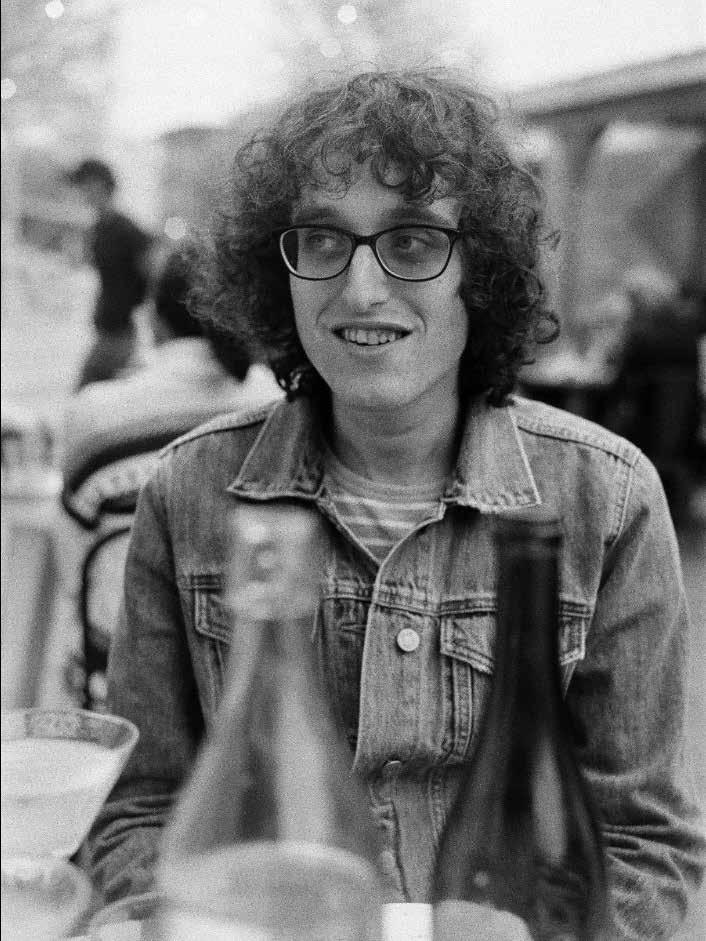
Jane Schoenbrun – Photo by Mila Matveeva
SCHOENBRUN
continued from page 17
called the internet and trying at the same time to figure out who I was, fearful that the rest of the world would find out secrets I wasn’t ready to reveal, while I was in those chat rooms and learning who I was, making connections, and realizing I wasn’t alone.
JS: Maybe we had similar college experiences. [laughs] I think what you just described is the feeling that I’ve had sharing the film with people. Feeling alone [but] realizing I’m not alone. I think it resonates in that way.
I wouldn’t say the film is an autobiography but a personal reflection on feelings and things that I hadn’t fully processed and unpacked, but that I had maybe always had the sense of — that’s all there. I think I always kept my online life and my real life very, very separate, because there’s a lot of shame associated with being creative in ways outside of what are considered normal. I wasn’t going to high school and bragging about the X-Files fan fiction websites I was hanging out on or whatever.
But there is still that weird process that you’re talking about, of maybe exploring your identity in these spaces and within the safety of fiction. I don’t think I realized how weird that can be. How both beautiful and also scary and strange and potentially damaging that can be, to be doing that in these spaces that are unmoderated.
I don’t think it was until the movie came out and I started reading other Queer people and Trans people and just people from any non-normative identity… people with disabilities, just hearing how common these sorts of feelings and experiences were for people of my generation and the generations that followed. I think if it felt unusual to you to feel seen through the film, it’s because there aren’t a lot of us making movies about our experiences yet, and these experiences themselves are invisible to Hollywood.
SMF: That this film would play so well generationally, was this something that you were thinking about when you made it? Or was it maybe something you lucked into?
JS: I don’t think I lucked into it, because I don’t think that experience is luck by any stretch of the imagination. But I do think it’s this feeling of not overintellectualizing what I was trying to do. I was really just pulling from lived experience and lived feelings that I still hadn’t processed and that I’m definitely still in the process of processing. I’ll be processing dysphoria and I’ll be processing the feeling of unreality that comes with a life that isn’t yours until
you claim it forever. That’s just reality.
I think the film resonates because I wasn’t trying to explain it in a “Dysphoria for Dummies” handbook. I was trying to capture the way it felt, and still felt at the time, and thankfully now feels like less. So there was some intentionality. It was important to me that I be releasing this film as a Trans person and saying this is a Trans film.
While there is a humongous difference in experience growing up as a Gen Z Trans, versus… growing up as a millennial Trans, or a Gen X Trans, I think the language of transness and how it feels to us from within the experience is something that (a) you can find commonalities within and (b) those commonalities haven’t been adequately explored. We haven’t talked enough about them.
Instead, we’ve let cis people talk about them and tell us what these experiences are when they’ve been totally wrong. It makes perfect sense, then, when you think about it, this idea of going into spaces detached from physical form and IRL identity to explore parts of yourself. These spaces are beautiful, but they’re also horrific.
I think that’s because you see yourself a certain way. [Your attraction] to beauty has been pegged as monstrous by the people in your daily life. You’re working all of these things out.
I don’t want to say that’s a universal Trans experience, but it did surprise me, and it no longer surprises me, that this is something that a lot of people coming from a different background than I do have found commonalities with. The film crosses generations.
SMF: I imagine it was difficult to manage and balance that pain and that euphoria of discovery, of identity, of selfactualization, when making the film. This isn’t just a black-and-white dichotomy. There are so many variations. Was it sometimes painful to get that up there on the screen?
JS: Definitely meaningful, because it required a level of self-interrogation that I was only able to do because I was ready to do it. I really do believe that it’s impossible for me to detangle my transition from having the urge to be an artist.
But it was also fun. I think I’m the type of person who is meant to do stuff like this. Art comes naturally to me. I’m sure you can see [that] in the film, and once I get to make some more films, you’ll see it in those films. Too, this deep love, this complicated relationship with art, right?
Growing up, it was important to me to have these spaces that I could hide, whether that was in a Belle and Sebastian song or an episode of Buffy the Vampire Slayer. It was a coping mechanism. I needed those spaces a lot more than somebody who was able to find
something in their real life, because they were allowed to have them in their real life, and I felt I wasn’t afforded that opportunity.
So [I] have a lot of shit that I’m unpacking about art and identity and coming out [and am] starting the process of emerging from the fugue state of dysphoria and putting it all into the work. The work is helping me deal with it.
SMF: You have to talk to me really briefly about Anna Cobb. She’s just freaking phenomenal.
JS: She is! And, so crazy, she convinced her family to move to New York City so she could pursue acting. I spent months looking for the lead and was prepared to delay production, because I was like, I don’t know where I’m going to find this person, but I need to find someone extraordinarily special or I’m not making the film. Then along Came Anna.
It was a street casting process in its way. We talked to acting school teachers and we got recommendations from agencies. I had this instinct that all of those people were going to be a little too grape-juice-commercial for me, a little too cute or “CW teen drama,” not a human being you stumble across at random and wonder what’s going on in their interior life.
Then I saw Anna’s photo in a casting submission. We got a tape from her, and it was just so immediately clear that this was the one-in-a-million person who both is so serious about her craft and so talented, but also such a hard, disciplined performer.
The amount of work and prep that she put into this — it was months and months of time. Really high-level prep for a 17-yearold. I’m intimately thankful to have found her, and she’s also such a magnetic human being. In a different way than Casey is, but still so full of personality that fit the character, and that was a joy to pull that thread and not let this talented actor disappear into this role that I had written on the page, but to instead evolve from the thing I had written on the page into this amazing person.
SMF: What was more satisfying to you, all of the awards and nominations for the film that you were receiving, or all of the awards and nominations for the film that she was receiving?
JS: I think a lot of Trans people don’t enjoy the spotlight. Even though I think I’m good in the spotlight, I don’t necessarily enjoy being in it. That spotlight is a function of the work. If I can speak and be the center of something that people want to engage with, if it helps enable the work that I want to make or if it can be an extension of the work I want to make, then I need to do it.
But I’m a proud mom. When I see people seeing in Anna what I saw in Anna, it
fills me with joy. I gave so much of the film over to them because I think they’re incredibly special and incredibly talented, and getting to see them see other people react so strongly [to their performance] and having their life change, that’s incredible. Obviously, my own life changing is cool, but this feels less complicated. I can be really happy for this amazing person and know that I had some small role in helping enable this really well-deserved thing to happen to them.
SMF: While I know it’s been a long road for this film, but with everything that you’re seeing happening in Texas and Alabama and Idaho, the fact that it is now hitting theaters, and then later hitting HBO Max, it almost feels like the timing couldn’t be better. What do you hope the response your film is, especially in juxtaposition to this senseless hate that we’re also seeing?
JS: It’s a great question. There’s me as a human and an artist thinking about what I want my life to feel like and be. That person is aghast at the time and world I live in for many reasons.
But there’s the me that found myself through reading a lot of theory and watching a lot of movies. There’s the me that understands that, in a lot of ways, I’m a function of privilege and I’m a function of a time and space that enabled me to make this movie.
Look: The Matrix needed to be made the way it was made in 1999. I needed to be in the closet and repressed in that year. I wasn’t in a safe place to be me. I don’t make this film without those experiences.
I’m hyperaware of the role that I’m maybe playing in this moment. It’s a lot like the role that the New Queer Cinema filmmakers felt when they didn’t have infrastructure or people on the other sides of the tables that understood them in the way where they could be understood and have the power to make the art that they wanted to make. I have an understanding that, no matter what, I’m just a small part of this wave that is coming, artists who have a different understanding of gender and have a different understanding of sexuality and have a different gaze on how f’d-up this country and world [are] than the one my generation has.
If I can be one little example of this change in terms of getting to make work that feels truthful to your lived experience as a Trans person, that feels healing to me. I don’t think it solves any problems, ultimately, because power in this country is going to take a lot more than that to shift and change specifically and structurally. But it feels worth doing, and that makes me feel good.
Anna Cobb in We're All Going to the World's Fair – Photo courtesy of Utopia
Lifestyle
Stay out of the sun: The effect light has on your skin
Rachel Gray
Special to the SGN
For many of us, there are few better feelings than soaking up some rays. The warm glow of the sun on our skin is guaranteed to boost our mood and can even give us our own enviable glow.
But did you know the sun is the biggest cause of skin damage and aging?
Luckily, there are different types of light therapy that can mimic the way the sun feels on our skin — with added skincare benefits. Here, we’ll cover the type of lights you should stay away from, and the ones you need to become familiar with.
Stay away from UV rays
That’s right. Your Miami beach vaca-
tions and sunbed sessions are potentially doing you damage. UV rays are the number one culprit of skin cancer — whether you get them from a sunbed or a day on the coast. But shockingly, only 11% of Americans regularly use sunscreen, and 46% never use it! It’s no wonder that skin cancer is the most common cancer in the States.
As well as the horrifying dangers of skin cancer, UV rays are also the biggest contributor to skin aging. There’s no better way to illustrate this than the famous photo of the truck driver who never wore SPF and only got sun damage on one side of his face due to his routes exposing the left side more than the right.
Because of all of this, it’s essential that you wear SPF — yes, even on the coldest, cloudiest days. UV rays can penetrate
through clouds and damage your skin even in the winter, so it’s non-negotiable if you want to avoid the risk of skin cancer and keep your skin healthy and youthful.
We’re not saying you should never go out in the sun again, but make sure you’re wearing SPF all over, don’t spend too long in the sun on hot days, and bring plenty of cover-ups, like hats, kaftans, and sarongs. If you’re missing your golden beach tan, using tanning water is a guaranteed safe way to do it. No need to forego your golden glow to stay safe!
Invest your time in blue light therapy
If you’ve been a sunbed junkie for years and you’re prepared to give up this damaging habit, blue light therapy is for you. Think of it as the antidote to all the damage
that has been caused by sunbathing without SPF or using sunbeds.
Blue light is used to reverse some of the damage caused by UV rays. It can both prevent skin cancer from forming and treat cancerous growths or patches of skin. When combined with a photosynthesizing treatment applied to the skin, it can target and kill off cancer cells. If you’re a reformed sunbather or sunbed user, we recommend talking to your dermatologist about blue light therapy.
As well as these health-saving benefits, blue light therapy also has skincare benefits. If you have large pores and produce a lot of oil, blue light therapy can reduce the size of your sebaceous glands and in turn reduce acne. If all of that isn’t enough, it’s also used to treat depression and is particularly effective when treating seasonal affective disorder (SAD). A true all-rounder.
Get to know red light therapy
Red light therapy is a treatment that has been around for a long time. This therapy can be used for a range of treatments, from psoriasis to acne and premature aging. It delivers low-level wavelengths of red light to your skin and comes in many different forms.
Red light therapy masks have become popular in recent years as a way to address premature aging on our faces. Facial red light therapy can also be delivered through handheld devices available at your dermatologist or as at-home devices — but be aware that at-home devices may be less effective.
For full-body treatments like soothing psoriasis symptoms or chemotherapy side effects, you can bask in the light of a full booth. If you’re a sunbed junkie seeking that relaxing, warm experience, red light therapy is a much safer treatment — and comes with way more benefits than UV sunbeds.
Whether you live on the sunny West Coast or you’re an East Coaster who vacations in the Sunshine State, chances are you love basking in the sun. And although there are ways to do this while protecting yourself, it’s a habit that’s not good for your skin or your health. We recommend shunning UV sunbeds in favor of blue or red light therapy booths and reducing your exposure to the sun to keep your skin and your body youthful.
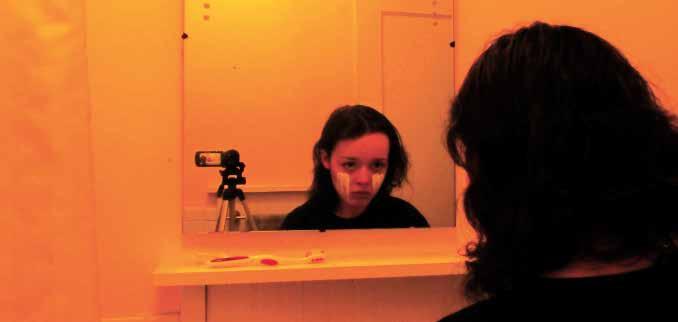
Photo by Anna Tarazevich / Pexels
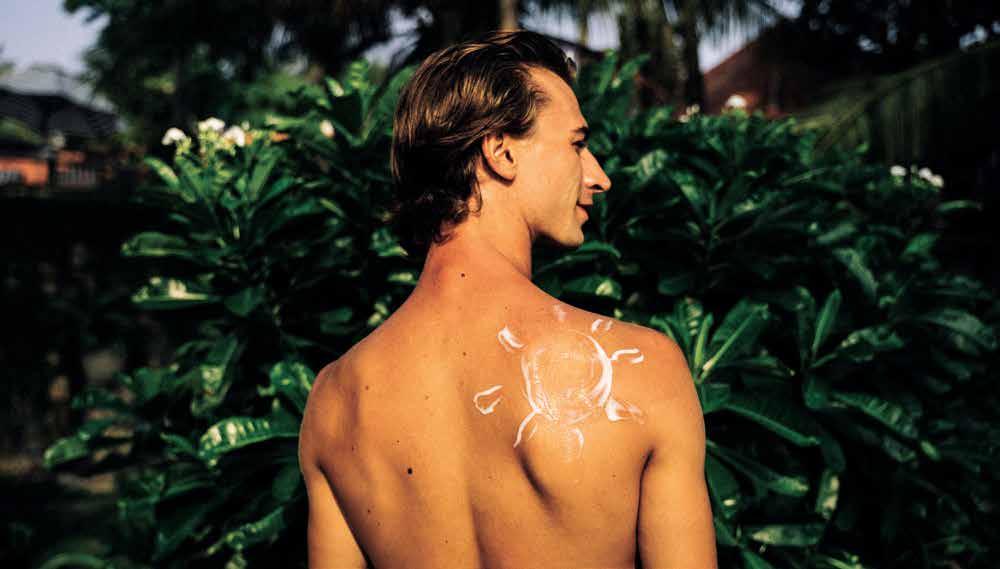
Photo by R._.F Studio / Pexels
National News
National news highlights
by Daniel Lindsley SGN Contributing Writer
Kansas:
Gov. Kelly vetoes bills on Trans athletes, censorship
NBC News reported on April 18 that Kansas Democratic Gov. Laura Kelly has vetoed a proposed ban on Trans athletes in girls’ and women’s sports and another proposal meant to make it easier for parents to remove materials from public schools.
One bill would require local school boards to create procedures for parents to review classroom and library materials, and request certain materials be removed, in what Republican lawmakers call “transparency over secrecy.” Critics say schools don’t hide what they teach, and that lesson plans are regularly available to parents.
Neither measure cleared the largely Republican state legislature with the majority needed to override Kelly’s decision, but NBC predicted that the subject of Trans athletes in sports would feature heavily in Kelly’s race for re-election this year.
Kelly suggested to lawmakers in her veto message that the proposals were a “divisive” political move. “It’s harmful to students and their families,” she said, “and it’s bad for business.” Kelly vetoed a similar measure last year.
Florida:
Roommate charged with activist’s murder
NBC News reported on April 18 that Steven Yinger, the roommate of the late Gay rights activist Jorge Diaz-Johnston, has been charged with murder. A report from a circuit court in Leon County says that Yinger strangled Diaz-Johnston at his Tallahassee home and dumped his body, which was found at a landfill in Baker, Florida.
Yinger, who has an extensive criminal history according to public records, is being held at the Leon County jail without bail, and faces charges of first-degree murder, tampering with evidence, and grand theft (given that he used Diaz-Johnston’s BMW, iPhone, and cash).
Diaz-Johnston’s husband, Don Diaz-Johnston, commented after the indictment: “I still haven’t come to terms with the fact that my life has been completely altered, and this turned everything upside down and ended all of our hopes and plans. To now be a part of this and have our marriage end this way is something I just never saw coming and still frankly can’t accept.”
Bristol Myers Squibb settles HIV meds lawsuit
Will pay $11 million to patients who overpaid
by Mike Andrew SGN Staff Writer
Pharmaceutical megacorporation Bristol Myers Squibb will pay out $11 million to settle a lawsuit charging it with illegal marketing tactics to keep generic HIV medications off the market.
The suit, filed by veteran LGBTQ rights activist Peter Staley in 2019, charged three pharma giants — Bristol Myers Squibb, Johnson & Johnson, and Gilead — with making exclusive deals to use only their drugs, and not generic substitutes, in any so-called “cocktail therapies” designed to combat HIV infections.
According to Staley’s court filings, this applied even after patents on the companies’ drugs had run out, keeping lower-cost generics out of the mix. Individual purchasers were therefore forced to pay more for the final HIV cocktail treatments.
Writing about Gilead on Twitter, Staley explained how the companies manipulated the pharma market to keep their profits high.
“How did a company that invented only 2 antivirals end up dominating the market?” Staley asked.
“Buried in Gilead’s SEC filings, our lawyers found the answers. As they partnered w/other cos. to make combo-pills, the contracts kinda said ‘never make the same pill with a generic…’
“The deal went both ways. Each com-
pany agreed not to make a combo pill using a generic version of the other company’s drug. Ultimately, we think 12 far cheaper combo pills have been blocked from the market. Is it any wonder there’s been no price competition?”
The $11 million settlement will be paid out to compensate HIV patients who paid more than they would have had they been able to buy generic meds.
The settlement only involves Bristol Myers Squibb. Johnson & Johnson and Gilead are awaiting court trials.
If the settlement is approved by a federal judge, not only would past patients be compensated for their overpayments but a generic version of the cocktail treatment Evotaz, comprising atazanavir and cobicstat, would be available to future patients. The first ingredient is made by Bristol Myers Squibb and the latter by Gilead.
If the settlement is not approved, generics might be out of the picture until September 2029.
Although Bristol Myers Squibb reportedly agreed to the settlement, it still denies any wrongdoing.
“While we believe the plaintiffs’ claims are without merit,” the company said in an email statement, “we are pleased to put this matter behind us so that we can continue to focus our resources on advancing more scientific innovations for patients in areas of significant unmet need.”
When the lawsuit surfaced in 2019, a Gilead spokesperson said the company “entered into partnerships with other companies with the goal of bringing lifesaving therapies to patients in need,” and “any suggestion that we had improper motives is absolutely false.”
Peter Staley was an early member of ACT UP, spearheading the group’s fundraising efforts. He later founded the Treatment Action Guerillas (TAG, later renamed Treatment Action Group).
Staley figures prominently in the 2012 documentary How to Survive a Plague, which depicts the early years of the AIDS epidemic and the actions of ACT UP and TAG. For the film, director David France relied heavily on archival footage, much of it taken from VHS tapes in Staley’s personal collection.
Biden administration to reverse Trump-era rules for medical workers
No longer OK to refuse treatment on moral grounds
by Mike Andrew SGN Staff Writer
The Biden administration is considering how to reverse Trump-era rules that allow medical workers to refuse treatment to patients on the grounds of religious or moral beliefs.
According to Politico, three separate sources close to the policy discussions say that change is on the agenda. A Department of Health and Human Services (HHS) spokesperson confirmed the reports.
“HHS has made clear through the unified regulatory agenda that we are in the rule-making process,” the HHS spokesperson said.
HHS could propose new rules as soon as the end of this month. The change in policy is seen as a rebuttal to Republicancontrolled states that are moving to limit access to abortions and Transgender care.
“As state politicians continue to strip people of their sexual and reproductive rights and freedoms, it’s imperative that the Biden-Harris administration revoke this discriminatory policy and help ensure [that] people can access the health care and information they need when they need it,” said Jacqueline Ayers, the senior vice president of policy, organizing, and campaigns for Planned Parenthood.
“We look forward to seeing the details of the new rule and are excited about this step forward.”
Trump’s so-called “conscience rule,” unveiled in 2018 and finalized in 2019, was itself intended to reverse Obama-era rules that required health care providers to treat patients regardless of their own personal religious convictions.
Dozens of states, cities, and advocacy
groups filed suit to block the Trump rule — including Planned Parenthood — and it has never been implemented.
Had it gone forward, it would have allowed doctors, nurses, medical students, pharmacists, and other health workers to refuse to provide abortions, contraception, gender-affirming care, HIV and STD services, vasectomies, or any procedure to which they object.
Rescinding the rule is seen by activists as a key part of dismantling the Trump administration’s legacy on reproductive rights, which Democrats promised to do once they took control of Washington. Last year, Biden moved to undo anti-abortion restrictions on family planning programs and foreign aid, and many groups have pushed for the “conscience” rule to be next.
“There is so much to unravel,” said Leila Abolfazli, the director of federal reproductive rights at the National Women’s Law Center, which sued the Trump administration over
the rule in 2019. “I’m encouraged that they have been working through all these pieces.”
Many groups say they’re reserving judgment on the new rules until they see whether the Biden administration will completely undo the Trump administration’s policies or leave some parts in place.
“We look forward to seeing the proposed rule’s text to ensure that the federal government safeguards patients’ need for high-quality health care,” said Audrey Sandusky, the spokesperson for the National Family Planning and Reproductive Health Association.
“This action will go a long way toward strengthening patient access to high-quality health care and protecting the integrity of key HHS programs, including the Title X family planning program,” she added.
The planned rules changes are currently under review at the Office of Management and Budget, which is often the final step before a proposed regulation goes public.
Photo by Brian Snyder / Reuters
Photo by Benoit Tessier / Reuters
Kansas Gov Laura Kelly – Photo by John Hanna / AP
International News
SCIENTISTS
continued from cover
NASA scientist arrested
One of the activists, NASA scientist Peter Kalmus, was arrested. Following this, Kalmus penned an opinion piece for The Guardian in which he described his experiences from earlier in the day.
“I’m a climate scientist and a desperate father. How can I plead any harder? What will it take? What can my colleagues and I do to stop this catastrophe unfolding now all around us with such excruciating clarity?” he wrote.
Kalmus is a part of an organization called Scientist Rebellion, which was started by scientists disgruntled by the fact that governments and corporations are unwilling to take the climate crisis seriously. Before switching to earth science in 2012, Kalmus had been an astrophysicist. “I’d realized the facts alone were not persuading world leaders to take action,” he wrote.
The frustration many in the scientific community feel when it comes to the ignorance of world leaders led to the birth of the Scientist Rebellion. “As scientists, we have tried writing reports and giving presentations about the climate and ecological crisis to those in power. We must now have the humility to accept [that] these attempts have not worked,” the organization said in a statement. “Now is the time for us to take action so that we show how seriously to take our warnings.”
“Nothing has worked,” Kalmus reiterated in his article. “It’s now the eleventh hour, and I feel terrified for my kids and terrified for humanity.”
According to Scientist Rebellion’s manifesto, “Human industrial activity has impacted the world as severely as the asteroid which wiped out the dinosaurs.” Scientists credit greenhouse gasses for increased temperatures, the melting of the Arctic, and disastrous global weather events.
“I’m here because I’m desperate,” Kalmus said in a live interview from the steps of Chase Bank. “I’m desperate for something to be done about the climate breakdown, I mean, it’s getting so bad, and I’ve tried to do so many things already, and nothing has worked.”
Activism across the globe
While he has now become the face of the movement in the United States, Kalmus is not the only activist who feels like the crisis is out of control.
In Spain, protesters threw fake blood all over the National Congress to support Scientist Rebellion. In Panama, protesters rallied at embassies. In Germany, protesters superglued themselves to an iconic bridge, and in Malawi and Uganda, they held teach-ins.
In Europe, scientists protested at the headquarters of Shell, calling out the corporation for exploiting natural resources for profit. In the United States, scientists chose to target Chase Bank for similar reasons. The 60 largest banks in the world, including JP Morgan Chase, have provided $3.8 trillion to fossil fuel companies since the 2015 Paris Climate Accord.
“We chose JP Morgan Chase, because, out of all the investment banks in the world, JP Morgan Chase funds the newest fossil fuel projects,” Kalmus wrote. “As the new IPCC report explains, emissions from current and planned fossil energy infrastructure are already more than twice the amount that would push the planet over 1.5 [degrees Celsius] of global heating, a level of heating that will bring much more intense heat, fire, storms, flooding, and drought than the present 1.2 [degrees Celsius].”
“It’s no exaggeration to say that Chase and other banks are contributing to murder and neocide [the deliberate killing of young people and future generations] through their fossil fuel finance,” Kalmus added.
IPCC warns that climate crisis is dire
According to the Intergovernmental Panel on Climate Change, whose facts Scientist Rebellion has used, population growth remains a contributor to fossil fuel emissions. While emissions have been on a steady increase, the report shows that the COVID-19 pandemic led to a significant drop in emissions from fossil fuels. However, by the end of 2020, the numbers were back up to their staggering levels.
The IPCC also indicates that the highest global demand for emissions comes from transportation and industry, particularly construction. In countries where incentives for investment in greener technologies are reinforced by national policy and international agreements, emissions are much more likely to drop.
The IPCC also indicated that the climate crisis goes hand in hand with income inequality. The study shows a global redistribution of energy sources, to which the wealthiest have the greatest access, would not only be possible but would result in a reduction of current emission levels.
International news highlights
by Daniel Lindsley SGN Contributing Writer
United Kingdom: Trans women showrunners for Doctor Who podcast
“The additional energy demand needed to support decent living standards for all is estimated to be well below current average energy consumption,” the report said. “More equitable income distributions can reduce carbon emissions, but the nature of this relationship can vary by level of income and development.”
The IPCC found that the wealthiest 10% contribute the most global emissions, which it believes has become the biggest factor in the current crisis. “Increasing inequality within a country can exacerbate dilemmas of redistribution and social cohesion, and affect the willingness of rich and poor to accept lifestyle changes for mitigation and policies to protect the environment,” the report said.
Don’t look up
Because of the breakdown between the world’s richest (who benefit greatly from fossil fuels), and everyone else, the climate crisis is quickly becoming out of control. “Earth breakdown is much worse than most people realize,” Kalmus wrote. “The science indicates that as fossil fuels continue to heat our planet, everything we love is at risk. For me, one of the most horrific aspects of all this is the juxtaposition of present-day and near-future climate disasters with the ‘business as usual’ occurring all around me. It’s so surreal that I often find myself reviewing the science to make sure it’s happening, a sort of scientific nightmare arm-pinch. Yes, it’s happening.”
The “surreal” feeling Kalmus describes is starting to catch up to members of the public outside the scientific community.
“The fact that NASA’s data scientist risked his whole career just to get people to listen gives me Don’t Look Up vibes,” tweeted Jodi Solis. “We can’t get people to wear masks when asked, how are we gonna stop climate change in 3 years?”
“Why did they arrest the scientists for speaking up?” asked another Twitter user, Jim Gumboc. Twitter user Stafford said, “Scientists, not conspiracy theorists, scientists, who are now desperate enough to break the law and get arrested to try and get the message through. The habitable planet is dying, climate change is here, now, what is your government doing? What are you doing?”
“We have to stop the financing of fossil fuels,” Kalmus said through tears, shortly before being taken away by police. “We have to stop new fossil fuel projects. The more carbon we put into the atmosphere now, the worse it’s going to get — and it’s already really, really bad.”
The BBC reported on April 14 that a new Doctor Who spin-off podcast, Doctor Who: Redacted, is being written by Trans woman Juno Dawson and stars Trans activist Charlie Craggs. Dawson told Radio 1 Newsbeat, “It’s a real first for the Doctor Who universe to have a cast that’s completely led by women and completely led by Queer women.” She added, “It’s important that every person who comes to Doctor Who brings their own little identity. And of course, as a Transgender woman myself, it was important to me to see the lead character being Trans as well.”
Craggs will be playing Cleo, “a Trans girl from a council estate in London — which is literally just me,” Craggs said. “Cleo, unlike me, actually has had quite a hard time with her family... My family were all very accepting, but most of my friends who are Trans haven’t had that experience.”
The story will follow three young women who make a conspiracy podcast about a mysterious blue box that appears throughout historical records, and will include an encounter with the eponymous doctor.
Ukraine:
LGBTQ group founder pepper-sprayed
LGBTQ Nation reported on April 14 that feminist activist Olena Shevchencko, founder of the Ukrainian LGBTQ group Insight, has been pepper-sprayed in the western city of Lviv. Prominent Ukrainian journalist Katerina Sergatskova says the one responsible might be a Russian saboteur.
“I don’t know how it is possible even to think of attacking people while there are hard bombings across the country,” Sergatskova said.
LGBTQ Nation noted that Insight has provided assistance to minority communities in Ukraine during the war, and does so with what Shevchenko describes as a “feminist structure, and even now there are no male cisgenders on our team.”
“Insight includes Transgender men and women,” she went on, “and most of the cisgender women are lesbian or bisexual. We use the same approach in regional office, where not a single senior position is held by a cisgender man.” Insight was lauded by KyivPride for its work over the last year, but the group has been operating since 2008.
Dr. Peter Kalmus protests outside the JP Morgan Chase building in L.A. – Photo courtesy of Scientist Rebellion
Writer Juno Dawson (l) with actors Jodie Whittaker, and Charlie Craggs – Photo courtesy of BBC