
EARTH DAY

EARTH DAY

by A.V. Eichenbaum SGN Editor-in-Chief
The Washington state Senate passed SB 5599 on Wednesday, April 19. The bill was written to protect young people seeking gender-affirming care or reproductive health services and remove barriers to shelter for at-risk youth. The bill passed on a 27-19 vote. It could aid Trans youths leaving troubled home lives. see SENATE page 5

by Daniel Lindsley SGN Staff Writer
On Friday and Saturday this weekend, the Triple Door theater is hosting a revival of living music legend Elton John’s era. Complete with a red baby grand piano, a colorful setup, and authentic outfits, Elton Dan and the Rocket Band will take to the stage and share their love of the British
musician’s 1970s work.
Elton Dan recently spoke to the SGN from Monterey, California, about how it all began.
“I have been an Elton John fan since I was probably 15, 16, right there,” Dan said. But also, “I grew up mostly listening to, believe it or not, classical music.”

by Lindsey Anderson SGN Staff Writer
While the neighborhood has certainly felt its absence, a new venue is getting ready to open and promises to bring back comedy with it, along with some familiar faces. Dane Hesseldahl and Jess Anderson own the soon-to-open Capitol Hill Comedy/Bar, just a block from the old Jai Thai, in what used to be Club Lagoon. see ELTON
Following the official closure of Jai Thai in late 2022, Broadway has been lacking a certain kind of laughter. The bar and restaurant, which doubled as a comedy venue, hosted a variety of talent and became well-known in the Seattle comedy world.
4








continued from cover
“I ran the bar [at Jai Thai] for a while, but …it was small and only open three nights a week. This is like my first bar bar, a real bar,” Hesseldahl said. Anderson will run the comedy end of Comedy/Bar.
Location, location, location
“It’s the best location in the city for comedy,” Hesseldahl said. “The light rail is right there, Dick’s, so many restaurants and bars up the street. Julia’s drag club is just a block away. I love that place. They bring in such an energetic crowd. We’re hoping to get some of that. The neighbors downstairs, the ax-throwing place, is a lot of fun. They’re going to open an escape room in the back there. It’s just going to be an entertainment complex here.”
Hesseldahl and Anderson are hoping to capitalize on the energy of the Hill, which is no stranger to groups coming out to enjoy late-night adventures.
“We’re going to get a lot of people out here having fun who go have dinner, have a couple of drinks, … and are not ready to go home yet. They see, ‘Oh wow, an open mic! Let’s watch some people be bad at comedy!’ I’m looking forward to that part of the neighborhood, just being a part of the scene here.”
There will be plenty of opportunities for patrons to watch people be bad (and good!) at comedy, since Comedy/Bar will be open six nights a week, Tuesday through Sunday. The venue will host two weekly open mics, on Tuesdays and Fridays, and welcome professional comedians the rest of the time.
Building the comedy community
For comedians who miss Jai Thai’s open mics, Hesseldahl has some good news. “[At Jai Thai] we used to do what we call ‘show up, go up’ mics, which means anyone who wants to go up, all you have to do is show up, put your name on the list, and you’re guaranteed to go. We’d go until 1 a.m. if we had to.” The format allowed comics of all levels to get a chance at the mic.
“We’re going to re-create that over here. We’re going to revive the Tuesday ‘show-up, go up,’” Hesseldahl added.
He also believes there’s no better place for comedy than Capitol Hill. “The crowds here on this street, in this neighborhood, have always been warm and accepting. Even if you go up there and bomb, they still love you. They still clap for you. We want to provide the entire spectrum: first-time comedians, and nationally touring comedians coming in. We’ve had people from Comedy Central come in, do Club Comedy, run over, and do a show at Jai Thai, and we’re hoping to do the same thing. We want it to be open for everybody,” he said.
Capitol Hill Comedy/Bar won’t be the only such club in the neighborhood, though. Club Comedy has been operating on 15th Avenue for years. However, Comedy/Bar isn’t trying to compete.
“Our focus is going to be building up the local comedy community,” Hesseldahl said. “I want this to be the place where comedians come, they hang out with each other, they give each other feedback, they hang out after shows… I want this to be a place to elevate Seattle comedy. I think that’s what’s going to set us apart.”
Creating a safe environment
While Hesseldahl hopes his venue can elevate Seattle comedy, the space currently lacks a necessary accommodation. “Unfortunately, our elevator is broken. …It’s incredibly important to me that we resolve that... It’s not within my control to fix it. That’s not an excuse — it’s just the reality of the situation,” Hesseldahl explained. “It upsets me that I can’t offer that. There’s a comedian that I love that can’t come to our opening. I hate that so much. I’m doing as much as I can. I’m talking with [the elevator repair company] every week. I hope they understand that and move with urgency.”



Hesseldahl and Anderson are also working hard to ensure that Capitol Hill Comedy/Bar will be a safe space for all comedians. Not only are they trying to repair the elevator so the venue can be accessible, but they are taking steps to keep the room free from any punching down.
“We have a code of conduct. When you sign up for one of our open mics, you have to agree to it. There’s a lot to be said about comedy, the state of comedy right now, and what’s right and what’s wrong. I just try to take a stance on what’s decent. I think it’s pretty easy to tell. We don’t tolerate comedy at the expense of others. We don’t tolerate comedy based on appearance, weight, or sexual orientation,” Hesseldahl said.
“We want people to come here, have a good time, and feel included,” he added.
“The comedy has to reflect that. If it doesn’t, we will take action to ensure that. I expect comedians, when they’re in my club, to act within the values [we] set.”
Anderson will book all the comedians who come to Capitol Hill Comedy/Bar.
“She has 100% say on who goes onto stage,” Hesseldahl said, “and I think that’s important, because a lot of comedy bookers have
been men, and it has been challenging for women to approach because of the gatekeeping. The hope is, with her booking, there’s more openness [to] female comedians, and not just traditional cis men will feel comfortable coming here.”
Another step they’ve taken to create a safe environment for comedians, guests, and employees is implementing a security team.
“The reality … is it’s a gorgeous, vibrant neighborhood full of amazing people, but sometimes it can be dicey. Safety is important to us, both our employees and the people who come here. We plan to have security here every night that we’re open, initially, just to see how things go. We’re also going to be implementing security plans for evacuations and for our employees to get to their cars safely at night,” Hesseldahl said.
Getting ready to party
Capitol Hill Comedy/Bar will have its soft open on May 1. “We’d love for the neighborhood to stop by for low-stakes drinks,” Hesseldahl said. As the curator of the bar’s new menu, he is excited to bring his creations to life. “We want to do classics with a twist. One of the drinks I’ve
been into lately is a mezcal negroni. It’s just a little twist on that. Or a tequila Old Fashioned. Or kinda fruity, light, other classics, like a Tequila Sunrise, Bay Breeze, gin gimlet, just classic stuff.”
The grand opening will occur the following Saturday, May 6. The lineup includes Sam Miller, Jess Anderson, and Joe Gomez. Tickets for the show are on sale now but going fast.
“It’s going to be a great show. We’re going to do raffle prizes and have special guests,” Hesseldahl said.
“Jai Thai used to be a social center of Seattle comedy. Everybody came to it,” he added. “I want [Comedy/Bar] to be the hub of Seattle local comedy.” Now, he’s bringing that Jai Thai energy back to Broadway with a new focus on inclusivity. Capitol Hill Comedy/Bar has the potential to become Seattle’s next great comedy venue.
Capitol Hill Comedy/Bar will have a soft opening on May 1, 2023. Its grand opening show will be May 6. It is located at 210 Broadway East and online at https:// comedyslashbar.com.

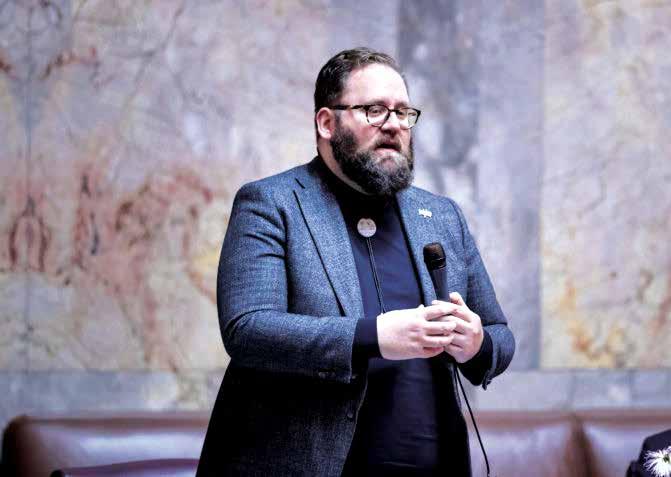
SB 5599 is designed to ensure that there’s shelter for teens seeking care of this nature who may have also been kicked out of their homes by their parents. Currently, the law requires shelters to notify the parents of a minor within 72 hours of the minor coming to them, but this bill would allow the shelter to contact the Washington Department of Children, Youth, and Families instead.
According to the US Dept. of Housing and Urban Development, 20–40% of all unhoused youth identify as members of the LGBTQ+ community.
SB 5599 has sparked online outrage, with viral posts claiming incorrectly that the legislation would mean that Trans children would be taken from their unsupportive parents by the government, but there is nothing in the bill that addresses child custody issues.
“There’s no procedure in here whatsoever that talks about taking children away,” Seattle University law professor Deirdre Bowen told the Associated Press. “It is not remotely what this bill says.”
“If a young person is totally estranged from their parents [or] has no meaningful relationship, we need someone to care for that child,” Gov. Jay Inslee said in a press conference April 13.
“This legislation ensures that our trans youth have safe options and access to secure, stable shelter when they may not be welcome at home.”
After it passed in the House that same day, Republican Rep. Jim Walsh of Aberdeen released a statement opposing it that seemed to imply the bill doesn’t account for a parent’s tough love against the “short-
term desires” of transitioning.
“Among its many flaws,” the statement said, “the bill assumes [that] families that don’t ‘affirm’ a child’s short-term desires are being abusive. Wrong! Sometimes love requires to not affirm their child’s whims. Loving parents guide their children as they grow. Sometimes that means saying ‘no.’”
Sen. Marko Liias of Everett, who sponsored the bill, also released a statement April 13, when the bill returned to the state Senate for approval of amendments made by the House. “We know that young people experiencing homelessness are exposed to dangerous and harmful outcomes. That is why we must take every step we can to ensure their safety,” the statement said.
“This legislation ensures that our trans youth have safe options and access to secure, stable shelter when they may not be welcome at home,” it continued.
The statement also reminded readers that 452 anti-LGBTQ bills have been introduced across 45 states in 2023. Twentynine bills have passed in 14 different states.
Still, critics of the bill claimed during hearings that if Gov. Inslee signs it into law, Washington state would be legalizing “kidnapping minors” and giving them away to the “gender-affirming industry” or supporters thereof. The bill’s detractors also claim that it mandates state-funded transitioning medication for all minors seeking care who have run away from home. This is simply not the case.
“We’re not mandating care,” said Liias, “but the protections or the provisions of the bill are designed for youth who are seeking gender-affirming care to have that housing and stability while they’re seeking that care.”
by Sharon Cumberland Special to the SGN
Pacific Northwest Ballet
A Midsummer Night’s Dream Choreography by George Balanchine McCaw Hall
April 14, 2023 (runs through April 23; streaming digitally April 27–May 1)
Many people who see a ballet in their youth — and fall in love with dance for the rest of their lives — generally see The Nutcracker on their very first trip. Its beguiling music, troupes of dancing children, and mystical creatures transport the audience to an unforgettable world of magic that they want to visit again and again.
But wait! There’s another ballet that’s equally beautiful, fascinating, and magical — and you don’t have to wait for Christmas to see it. Pacific Northwest Ballet’s A Midsummer Night’s Dream, based on Shakespeare’s comedy, is just as beautiful, elegant, and hilarious as The Nutcracker. It mobilizes a wonderful group of dancing children as magical creatures, and deploys its entire gravity-defying company in a wonderful story about love gone wrong… then-right.
This great work, with the familiar, charming music of Felix Mendelssohn and choreography by the ingenious George Balanchine, only comes around every five years — and this is the year! Now is the time to take your children, and the child within you to this “forever ballet.” You’ll never see a better version, and you’ll never forget it.
The story is easy to follow, even if you’re unfamiliar with the play. Puck, a mischievous fairy, is sent by the fairy king Oberon to play a trick on fairy queen, Titania. Confusion and comedy ensue when a quartet of human lovers and a troupe of amateur actors wander into the forest and cross paths with the prankish Puck, danced on opening night by Christian Poppe, who seemed to levitate with glee each time he caused havoc in the human and fairy worlds.
Act I tells Shakespeare’s story with impish joy, and it’s made even more charming by the dozens of children who run on tiptoe to Mendelssohn’s pizzicato violins, flapping their fairy wings and surrounding the principals with a miniature cloud of mystical creatures.
More than in other story ballets, these principals are called upon to be dramatic actors in addition to world-class dancers. Kyle Davis performed King Oberon’s electrifying dance passages with the mixture of nobility and malice that the role requires. Elizabeth Murphy, in the role of Titania, had the double responsibility of portraying a haughty queen as well as the bedazzled lover to Bottom, a humble character that Puck has turned into an ass (yes, a donkey). Her graceful dance with the clunky, floppy-eared Bottom, performed by Ezra Thompson, brought the house down with its ingenious combination of pathos, humor, charm, and winsome dancing.
The other half of the story that Shakespeare weaves so cleverly into this tale of mistaken identity is of two pairs of lovers taking a stroll in the forest, presumably to have a little private time to themselves. That plan is upended when Puck sprinkles magic flower dust into one boyfriend’s eyes to swap his affections from one girl to the other. Helena, danced by the willowy Cecilia Iliesu, is now being pursued by both Lysander (James Yoichi Moore) and Demetrius (Mies Pertl), while Hermia, danced by the beautiful Leta Biasucci, dashes around in the forest in comical despair. How it all comes together into a second act of happily wedded fairies and humans is the stuff of great writing, great music, great choreography, and an army of brilliant dancers.
Only in the world of ballet is the story sometimes told in the first act and a celebration of the story then told in the second act. Both The Nutcracker and A Midsummer Night’s Dream take this form, which allows

the ballet company to do what they do best: perform the fascinating, intricate, kaleidoscopic feats of dance that Balanchine choreographs so well.
After intermission in the beautiful lobbies and promenades of McCaw Hall, the audience returns to Mendelssohn’s familiar wedding march, as all the happy couples get married in a veritable extravaganza of fascinating dances. Balanchine is a master of shapes — circles that become squares, squares that become lines that twirl like batons and march like armies, armies that break up into couples who transform into waves — so it’s all absolutely entrancing,
and done with a level of precision that only a great ballet company like PNB can achieve.
The original costumes of Martin Pakledinaz dazzle the eyes, and his scenic designs trick our eyes — with giant mushrooms, flowers, and snails — into seeing the tiny world of fairies. As always, the PNB orchestra, led by Music Director Emil de Cou, continues its world-class excellence. Coming to PNB means hearing a wonderfully performed concert at the same time you’re seeing a world-class ballet.
Seattle is a major center for great music and dance. Treat yourself and the children and young-at-heart in your life to this for-
ever ballet — the one you will always return to whenever it comes around again. And if you know any kids, give them this special treat. They need to know that there’s more to ballet than the (admittedly fabulous) Nutcracker. There is the elegant, funny, spectacular adventure of A Midsummer Night’s Dream by the Pacific Northwest Ballet, through April 23 (streaming digitally April 27–May 1).
Details and tickets can be found at https://www.mccawhall.com/events/detail/ midsummer-nights-dream-2023.


That was his family’s go-to, and Dan had been playing classical piano for most of his life at that point. Reaching his teens likely made it urgent, however, to branch out a bit. Piano was important, “but it wasn’t cool.” But, he said, “when I heard Elton John I was like, ‘That’s it.’ He made piano cool.”
Years later, when he was in his early twenties, Dan saw John live for the first time, in the early ’90s. He had VIP ticket for one of John’s Red Piano concerts at Caesar’s Palace in Las Vegas, and he recalled standing on stage during the final song, just five feet away from a man he considers a “piano virtuoso.”
“Since then, I’ve seen him 22 times,” Dan said. “I saw his final two performances at Dodgers Stadium.”

John’s music has been constant in Dan’s musical repertoire, but it was only eight years ago that he committed to his current act.
“Tribute bands started to become [more of] a thing about ten years ago, when a lot of those ’70s rock n’ rollers were either passing or retiring,” Dan said.
He recounted how someone approached him with a proposal: “Dan, you’ve always loved Elton John and his music, and you play it well. Why don’t you do a tribute?”
At the time, Dan says, he thought it was “cheesy.”
“I thought, you know, ‘The artist is still alive. Would it be disrespectful?’” he said. “And they kept on me, so about two years later — that was about eight years ago — I agreed to do one show. And it was so incredible. I saw the people smiling and singing along, and I [said], ‘You know, I think we can keep that experience and that beautiful music alive.’ A lot of people don’t get to see Elton. He’s not touring anymore now.”
Love and caring
In Dan’s judgment, the crowds that show up are not only from all walks of life, but they tend to be drawn together by John and the themes of love of his most prolific songwriter, Bernie Taupin.
“Everybody’s just been wonderful,” Dan said. “They’re just a really loving group of people.”
As for age groups, “It’s definitely a mix, and I think that’s one of the coolest things about Elton John, right?” Dan said. “He’s got fifty years of music, and it spans everything from my kids to my parents ... The Lion King music all the way back to that ’70s rock n’ roll stuff.”
Dan also pointed out how often John does collaborations with young, up-andcoming artists, which not only boosts their careers but brings younger generations to his work.
On that note, Dan and his band’s work hasn’t gone unnoticed by those in John’s close orbit.
“I get this phone call ... and they say, ‘Hey, we’re looking for Elton Dan,’” Dan said. “And I was ready to hang up, thinking it was some kind of whatever. And they go, ‘David Furnish is in Kansas City, and he would like to meet you.’”
Furnish is Elton John’s husband, so this was a big deal. So Dan showed up in his full Elton John outfit, and though he isn’t sure whether John ever got to see the video of Dan’s birthday concert (which had happened two days prior), Furnish certainly did.
Of course, John didn’t accomplish what he did alone, and Dan didn’t either. There are complete bios on the band’s website, but the other members are all lifelong musicians. Dean Christopher and C.J. Dothage play guitar, Wes Faulconer and Bill Graham are on drums, Paul Greenlease is on bass. Prolific country vocalist Karen BackesDothage performs as another lead singer, and Chelsy Larson of jazz/pop fusion band Clowder sings harmony.
“You know, it’s a team, right? No matter what,” Dan said. “I’ve been playing music almost my entire life. I’ve played on cruise ships, played overseas, played in original bands — done about everything in between [under] the sun. And bands are like herding cats, and there’s always drama.”
But that hasn’t been the case with this particular group, who Dan said are a delight to work with.
“I can honestly say, this group of musicians ... we love each other, we care about each other, and we support each other, and we need each other to make the music right. I finally have that. It’s been the golden goose I’ve been chasing, and it happens to be with my favorite music, Elton John.
“It’s been honestly the most enjoyable musical experience I’ve ever had in my life.”
Dan plans to share that enthusiasm and appreciation with audiences this weekend, and during the rest of his 20-day, 17-show tour. In particular, Seattle fans of Elton John can expect some of the artist’s more “B-side” content and “deeper cuts,” as Dan put it.
“Music is sharing, and I believe that with everything I stand for,” Dan said. “A lot of [John’s] songs are really about love and caring. Now, he has some really abstract and some really cool blues stuff, but many of his songs are just about love. And he says that at his concerts. He really is that kind of person.”
You can buy tickets to either of two April 22 shows at the Triple Door and find out more about Elton Dan and the Rocket Band at https://eltondan.com.

by Sara Michelle Fetters
Staff Writer
CHEVALIER
Theaters
Joseph Bologne (Kelvin Harrison Jr.) is the son of African slave Nanon (Ronke Adekoluejo) and wealthy Frenchman George Bologne (Jim High), owner of a massive plantation in the Caribbean. Sent away to attend school in France, Joseph is on his own in a racist and classist society determined to see him fail. But he does not allow this to happen.
Joseph quickly makes a name for himself in French society as a virtuoso violinist, accomplished fencer, and master composer. His prowess both as an artist and as a swordsman catches the affectionate eye of none other than the Queen of France, Marie Antoinette (Lucy Boynton). She is so impressed with his accomplishments that she bestows upon Joseph the prestigious title of Chevalier de Saint-Georges. More importantly, she offers him a fighting chance to become the head of the Paris Opera.
I had never heard of the real-life Joseph Bologne, Chevalier de Saint-Georges, before stepping into the theater to watch director Stephen Williams’ superbly entertaining drama, Chevalier. And that’s a travesty, because Joseph was a man far ahead of his time. His surviving works are extraordinary. His accomplishments before, during, and after the French Revolution were nothing short of flabbergasting. His story should be more widely documented than it is. Here’s hoping that after the release of this film, this will be the case.
Historical aspects aside, Williams and screenwriter Stefani Robinson — both making the leap from television, the former best known for directing Watchman and the latter an Emmy nominee for Atlanta and What We Do in the Shadows — have outdone themselves with this motion picture. While not exactly rewriting the biopic rule book, the pair manage to craft a masterfully entertaining film that moves like lightning and is a sumptuous feast for the senses. This is an emotional, music-filled 18th-century roller-coaster ride, and while watching it, my heart overflowed with pleasure from first frame to last.
The majority of the film revolves around Bologne’s pursuit to be the head of the Paris Opera. To do this, the queen commands him and his competitor to write operas, both of which will be judged; the winner
will earn the prestigious position each is longing for. Bologne’s work leads him to pursue author Madame de Genlis (Sian Clifford) as a benefactor and cast talented unknown Marie-Josephine de Comarieu (Samara Weaving) in the lead role. Numerous complications arise, not the least of which is the composer’s affair with Marie-Josephine. She is the wife of the powerful Marquise de Montalembert (Marton Csokas), whose racist and patriarchal beliefs are hardly a secret. Also muddying the water is the arrival of Bologne’s mother Nanon, recently freed from bondage upon the untimely death of his father. Then there is the slight matter of the growing social unrest that will eventually lead to the French Revolution, a slowly rising wave that will build into a full-blown tsunami.
Robinson’s playfully lithe screenplay is unsurprisingly well researched. But rarely does any facet come across as professorial or overly journalistic. Robinson has written these characters as if she has known them all her life. It’s almost autobiographical, with Bologne standing center stage, directing the various encounters he has as if he were conducting his orchestra.
This gives the proceedings an electrifying vitality that’s wonderful. I felt immediately
connected to Bologne, Marie-Josephine, Nanon, and even Marie Antoinette and the despicable Marquise de Montalembert. These relationships leap off the screen. I could almost feel each character sitting next to me as events progressed. Robinson presents every moment of this section of Bologne’s life as a personal conversation and not some sort of dry, sumptuously mounted costume-drama sermon delivered by a somber, dispassionate lecturer. Harrison is magnificent. This is a thrilling performance, with the actor showcasing a limber physicality that perfectly suits the character. But there is also an interior component that’s even more impressive. The complexity of Harrison’s portrait is mesmerizing, and whether it is Joseph’s verbal jousts with Marie Antoinette, his heartfelt passions for Marie-Josephine, or his unexpected familial tenderness with Nanon, every note rings true. But while Bologne is understandably the central figure, Robinson and Williams do not forget about the women. Even though there have been numerous cinematic portraits of Marie Antoinette, Boynton still does a fine job of making the queen come alive in a variety of memorably novel ways. Adekoluejo and Clifford are equally outstanding, both making the most of every moment they
appear on the screen. Also standing out is Minnie Driver as the grande dame of the Paris Opera, La Guimard, and while her part is relatively small, the effect her character has on the proceedings is titanic.
Best of all is Weaving. She’s delivered a bevy of strong performances in films as diverse as Ready or Not, Mayhem, the Picnic at Hanging Rock limited series, and even Bill & Ted Face the Music, but I think her work here as Marie-Josephine tops everything she’s done up to now. The emotional ride her character goes on is something special, pleasure and pain intermixing with euphoria and tragedy with an almost casual grace that’s stunning. Weaving’s latter scenes with Harrison are shatteringly poignant, the pair achieving a level of charismatic intimacy that held me spellbound even as it broke my heart.
Chevalier doesn’t entirely escape biopic conventions, but when things are handled this spectacularly, that’s hardly an issue. Joseph Bologne’s story is inherently fascinating, and Williams and Robinson tell it with imaginative vitality. Though apparently lost to history, this man’s exploits have been triumphantly resurrected, and Bologne’s operatic majesty leaves a lasting impression that should never be forgotten.









Chevalier director Stephen Williams and screenwriter Stefani Robinson resurrect revolutionary French composer Joseph Bologne’s story for the big screen
by Sara Michelle Fetters SGN Staff Writer
Before sitting down to watch Chevalier, I admit I had never heard of 18th-century French virtuoso violinist, champion fencer, and celebrated composer Joseph Bologne, aka the Chevalier de Saint-Georges. If I had heard any of his celebrated compositions, I never would have known he authored them. It was as if this extraordinary man of African descent had been lost to history — and as travesties go, this is an egregious one.
Vaunted television producer and screenwriter Stefani Robinson felt the same. A six-time Emmy nominee for her work on What We Do in the Shadows and Atlanta, Robinson first encountered Bologne’s story while still in high school, and it immediately took root. “I don’t even know what book it was,” she said with a wistful chuckle, “but I do know that my mom had given it to me. It was some kind of reading material, and it mentioned him, maybe a paragraph or two. It wasn’t an exhaustive account of [Bologne’s] life, more a highlight reel. But once you read or learn more about this guy, it’s a pretty impressive highlight reel.”
From that moment, Robinson was hooked. “Everything about his life was fascinating to me,” she continued. “I think the thing that drew me in was the feeling that no one knew anything about him. I was asking people at school, teachers, my mom, whoever, ‘Can you believe this guy?’ No one could.
“Throughout my life, that seemed to be the case. No matter what bubble or what group that I was in, no one knew who [Bologne] was. When I had the opportunity to pitch the movie, obviously he had never left my mind. I was extremely enthusiastic, and Searchlight bought the pitch! Somewhat surprising, because no one there had heard about [him], either.”
From the moment Stephen Williams, an Emmy winner for HBO’s Watchmen, read Robinson’s script, he knew he’d make the leap to features with Chevalier. “I had never heard of Chevalier before,” admitted Williams candidly. “It was unbelievable to me that [I had never heard of] this person, such an amazingly accomplished person, a virtuosic violinist, a composer of concertos [and] opera, a champion equestrian, a champion fencer, a champion marksman, someone the American president, John Adams, referred to as the greatest, the most accomplished European of his day…
“I knew I needed to learn more. I started doing a deep dive into what little information exists about him. I was just floored by how innately operatic, innately cinematic his life story was.”
An irresistible cocktail
But it didn’t stop there for the filmmaker. “On a smaller, more personal level, there started to emerge similarities that I could recognize and identify with,” said Willaims. “He’s from the Caribbean island of Guadeloupe. I’m from Jamaica. Both of us made our way to Europe under completely different circumstances, but still at an early age. There were aspects of his life trajectory and the challenges that he encountered that I recognized from my own experience.
“All of those things together — coupled with the fact that …minus the wigs and minus the costumes, so much of [the social ferment that] was happening in prerevolutionary France at the time …was reminiscent of things that are happening in our contemporary world. His times and his life felt culturally relevant to where we are now. It made kind of an irresistible cocktail for a movie, and I felt like I had to tell the story.”

The finished film streamlines much of Bologne’s story. It follows him (spectacularly portrayed by Kelvin Harrison Jr.) as he catches the eye of Queen Marie Antoinette (Lucy Boynton) — who gives him his title of chevalier — and enters into a competition to lead the Paris Opera. Along the way, his mother Nanon (Ronke Adekoluejo), a former slave given her freedom only after Bologne’s father’s untimely death, journeys from the Caribbean to join her son in Paris, while the composer also has a steamy
affair with Marie-Josephine de Comarieu (Samara Weaving), the wife of feared professional soldier the Marquise de Montalembert (Marton Csokas).
The cherry on top? All of this takes place in the growing shadow of the forthcoming French Revolution.
This story did need some additional fleshing out, and it fell to Robinson to put many of the pieces together. “There is a lot of information on Joseph out there,” explains the screenwriter, “and every day,
I think more comes to light. I had a great foundation to build on …through these historical documents — albeit mostly from other people’s perspectives of him. It was either someone writing a letter about him, or someone writing a journal and they mentioned him, or it was reviews [of] one of his operas. It took work piecing together [Bologne’s] legacy. There was nothing there that felt like it came from him. There were no letters, no diary entries. And a third of his music has been lost to history.

“It was a lot of work to fill in those blanks. To really get inside his brain and how he must have been feeling, how he must have been reacting to the things that were happening to him. It took a lot of [inferring]. Just trying to fill in the psychic blanks.”
“Joseph’s life is so rich,” added Williams. “It could fuel six movies. I think that we all come into the world in one posture. Life happens to us, we have experiences in life, and we grow and we change, and hopefully we become more authentic and truer versions of ourselves, having gone through the gristmill of all that life can throw at us. This felt like an empowering story despite all the obstacles. It’s a story that I recognize. More, it is one I want to share with people.”
Doing the story justice
This sharing did not come without complications. But the only pressure Robinson and Williams felt was that which they put on themselves to do Bologne’s story justice. “Stefani and I were completely united in the idea that we weren’t going to tell a cradle-to-grave biopic,” the director emphatically stated.
“We don’t even think of this movie as a biopic. We think of it as a not-quite-biopic. It’s a movie. It’s not a documentary. Stefani said this very early on in our working together, and it became our mantra: ‘I’m not writing a Wikipedia page.’ We embraced that straight off the top.
“There’s also this amazing Tom Stoppard quote: ‘Facts are facts, and truth is something else entirely and is a product of the imagination.’ That was our North Star, too. We felt like we set out to honor Joseph’s life as a real person. I mean, in the fog of awareness, it’s easy to only think of him being a historical figure, but he was also a real person that lived and breathed on the same earth that we do. We were constantly mindful of trying to [drill] down to the essence of what was truthful about him, even when it wasn’t necessarily in that instance factual. Hopefully, even when taking these dramatic licenses, we still honored him and his legacy.”
Part of honoring that legacy was also ensuring that the women who played a vital role in shaping Bologne’s narrative were as three-dimensional as he was. Marie Antoinette, Marie-Josephine, Nanon, and the grande dame of the Paris Opera, La Guimard (Minnie Driver), all have a vital part to play in the composer’s aria.
“At the end of the day, this is Joseph’s story,” explained Robinson. “It had to be, and we didn’t have the time or the luxury to explore every peripheral character the way that I maybe would’ve wanted.
“But I do think that these historical figures are incredibly complicated, complex, and fascinating and tragic, and each woman should be celebrated for their own reasons. It was hard to balance, but I think within limitations, you’re forced to be creative about how you tell a story like this, and it was important to give each woman agency and life.

“This story doesn’t end with Joseph. There are so many people who have been marginalized or erased because of race, sexuality, gender, religion, nationality, and what have you, and he’s one of many human beings who have contributed incredible things to this world that we just didn’t know about yet.”
“As a woman, and [with] my own experience in this world, I wanted to push up against [that] they were just there to support Joseph. Thinking specifically of Marie-Josephine and Marie Antoinette, both can equally be seen as disappointing or repulsive at times. At the same time, I have a lot of compassion for those women. Marie-Josephine is someone who recognizes that she doesn’t have any autonomy. She’s stuck in this marriage she can’t escape from, and recognizes Joseph’s plight as well, but ultimately makes the choice to hide within the confines of her marriage, at least for the time being, and that to me is its own little mini-tragedy.”
Williams made a point to single out the performances by Weaving, Boynton, Adekoluejo, and Driver when discuss -
ing these four characters. “Each of those women had immensely rich lives in and of themselves,” remarked the director. “Like La Guimard, who Minnie Driver plays so beautifully, if you read up about her, she has an amazingly rich life. Marie-Josephine and obviously Marie Antoinette, these are immensely rich characters. The hard part for us was trying to distill them down to the roles that they played and the impact that they had on the trajectory of Joseph’s life through the course of the movie. But Lucy Boynton and Samara Weaving and Minnie Driver and Ronke Adekoluejo, I mean, we’re just so blessed to have this level of talent as part of our movie.
“And don’t forget Sian Clifford’s character, Caroline-Stéphanie-Félicité, Madame

de Genlis, the celebrated French writer and essayist. She’s fantastic as well.”
Entertaining and educational
The filmmakers can’t wait to see how audiences will react, many of whom will be coming to Bologne’s story for the first time. “I want people to endeavor to be curious and open,” proclaimed Robinson. “That’s the thing for me. This story doesn’t end with Joseph. There are so many people who have been marginalized or erased because of race, sexuality, gender, religion, nationality, and what have you, and he’s one of many human beings who have contributed incredible things to this world that we just didn’t know about yet. I can’t wait for all of those other people to be excavated and celebrated. I hope that people become investigators of their own history, and do not take everything at face value.”
Williams mulled things over before adding his thoughts. “Very awkward movies like this, we can make them end up sounding and feeling medicinal,” he admitted with a shrug, “and I definitely didn’t want to make a movie that was medicine. This movie, it’s entertaining, but you are also going to learn something about someone you probably didn’t know about, and it is nestled into a time period that has something to say about our current moment.”
He paused for a moment before concluding, a proudly confident smile taking over his face: “To bring things full circle, there is a musical revolutionary that is the flag bearer of the country I come from, Jamaica, and his name is Bob Marley. I was informed by the legacy of Bob Marley, by the spirit of Bob Marley, while making this movie, about another musical revolutionary, Joseph Bologne, the Chevalier de Saint-Georges. Hopefully, the thematic takeaways, as Bob said in “Redemption Song,” ‘Emancipate yourselves from mental slavery. None but ourselves can free our minds.’
“If anyone watching Chevalier feels even a touch of that, then our time making it would have been well served.”
by Terri Schlichenmeyer
Special to the SGN
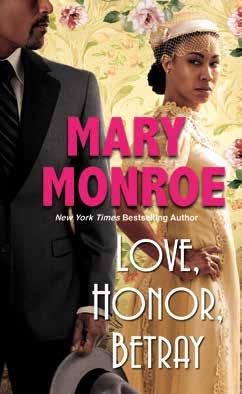
LOVE, HONOR, BETRAY
MARY MONROE
© 2023 Dafina
$26.00
320 pages
The truth, the whole truth, and nothing but the truth.
Those are words you hear when someone is about to testify in a court of law. They put the “sworn” into sworn testimony, and you’ll also find the phrase in courtroom dramas, legal thrillers, and Perry Mason.
You don’t hear those words in a marriage ceremony, but in the new book Love, Honor, Betray by Mary Monroe, maybe you should.
Hubert Wiggins, a respected businessman in the Black community, could’ve looked all over Lexington, Alabama, for the rest of his life and not have found a morefitting wife than his Maggie had been.
Before he met her, she’d been sexually assaulted, and though she wanted to take her
vows with someone special, she swore that she’d never have relations again — which was fine with Hubert. He preferred to sleep with men anyhow, so their marriage was perfect.
Alas, Maggie died just over a year ago, and Hubert needed a new wife.
Jessie, Maggie’s best friend, had her sights set on Hubert the day he put Maggie in the ground. In order to land him, she lied to him, saying that he’d raped her when he was drunk and now she was pregnant — even though Hubert swore that he was traumatized by loss and couldn’t perform in bed because of it.
Jessie was sure she could cure Hubert’s problem, though. In the meantime, she wasn’t above having a fling when a fine man made it possible.
It was 1941, and sneaking around to see his boyfriend Leroy was a challenge for Hubert, especially when the police were doubly rough on a Black man in a nice car at night. They didn’t care that he was a funeral director or that his business had buried almost all the murder victims of a serial killer loose in the area.
The police might have had something to
say, though, if they knew that Hubert and Jessie had murdered a woman named Blondeen... Love a wild romp between the pages? Then you’ll be overjoyed with the opening two-thirds of Love, Honor, Betray, in which infidelity becomes an art form.
It’s rowdy and fun, in fact, until the book’s pinnacle, at a point where the author might seem to be wrapping things up. But look: there’s a chunk of book left — and that’s where everything falls apart.
It’s as if someone took a hammer to the plot here and busted it to pieces. Characters act contrary to the personalities that were built up for them for 200 solid pages, and they do things that feel disrespectful to Gay readers. This destroys the sense of fun that accompanied the everybody-sleeps-around chaos early in the book. Is it merciful or irritating, then, that the story doesn’t tie up loose threads but just... ends?
Readers who are comfortable not finishing a book will enjoy this one, if they put it aside before it’s done. Go too far into Love, Honor, Betray, though, and you’ll be sorry you finished the whole thing.
by Lindsey Anderson SGN Staff Writer
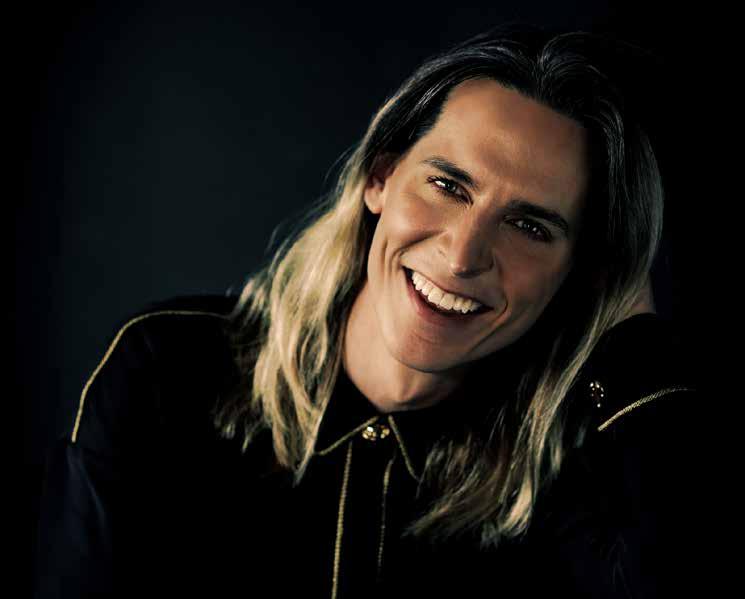
What if we lived in a society where the concept of gender never existed? This was one of the questions on author Jason June’s mind when he created his novel Out of the Blue. Of course, the fantasy/contemporary YA novel was inspired by a myriad of things, including his fascination with merpeople.
“My greatest inspiration is just that I freaking love merpeople,” he gushed. “I have always been obsessed with merculture and mer-lore. The very first movie I saw in the theater was The Little Mermaid, and I have just been hooked ever since.”
Exploring gender through multiple perspectives
One of the reasons Jason June (his “twoname first name, like Mary-Kate without the hyphen”) loves mer-culture so much is the lack of human complications.
“One of my favorite aspects of Out of the Blue is exploring gender and the binary we have in human society, and letting mer be these people that don’t see gender that way. They all have fins. They don’t have the genitals that we’ve become so obsessed with in human culture,” he explained.
As he built a world around mermaids, it only seemed natural to explore a society that existed aside from the gender binary. Jason June decided to use dual perspective in his novel, switching back and forth between Crest, a merperson, and Sean, a human. By alternating perspectives, he developed a rich dichotomy between a character raised in the gender binary and one who had never experienced it.
“One …point of view is [that of] Crest, who goes by Ross on land,” he explained. “They are mer. We’re in their head, where we get to figure out how they think. We get to see, in real time, them reacting to things that are so gendered that don’t need to be gendered.”
Jason June explored and expressed some of his feelings toward the gender binary through Crest. “They don’t understand why high heels, which have nothing to do with genitals, are so gender-ruled. It’s like, ‘Heels are for people with vaginas and not people with penises,’ and they’re like, ‘Wait a minute, this makes zero sense?’ And it
makes zero sense! There’s nothing about the inherent build of that shoe that should go with either set of genitals. It’s so bizarre that we code it that way.”
Through the perspective of Sean, Jason June was also able to show how cis people can alter their ways of thinking to be more inclusive of those outside of the gender binary. “When Sean first meets Crest, he refers to Crest with he/him pronouns, not knowing that they go by they/them pronouns,” he said. “They just show once you have this conversation — which doesn’t have to be this huge moment — once somebody says, ‘Hey, these are my pronouns,’ they switch. It was this subtle signal to
folks, especially cis folks, that it doesn’t have to be a huge, big deal. It’s just about respect.”
Everybody makes mistakes
Sean’s character is treated with grace and forgiveness when he initially gets Crest’s pronouns wrong, showing that even wellmeaning people can get tripped up by the gender binary. “He automatically does what so many of us good-naturedly do. We’re not trying to impose expectations on people about gender.”
Even people like Jason June, who is Genderqueer, can make mistakes from time to time. In some of the first few copies of
the novel, Crest is misgendered on more than one occasion. “It was this realization that we are all in this prison-house of language,” he said, “and even though I read the book a dozen times before it went to print — multiple people read the book multiple times to catch things — there was still this handful of times where none of us caught that the pronoun was used incorrectly. We’re so ingrained that it’s just he/him or she/her that it can still slip by.”
While it was embarrassing, he believes his mistake was a great example of how to handle misgendering someone. He fixed the problem and moved on.

Femmes just wanna have fun
Jason June had a lot of fun writing Out of the Blue. The novel was very personal to him, as he felt more connected to Crest than any other character he’d created.
“They present themselves very feminine. They wear feminine clothes and experiment with makeup and high heels,” he explained. “That’s the closest thing I’ve gotten to my own life, being a Genderqueer person, being a femme person.”
Jason June expresses his identity by embracing femininity and scrambling the gender binary. “I like working out where humans have gone wrong in their binary thinking. That’s not to say that when people identify with either end of the binary that’s not also a beautiful thing, too, because it is. Everyone’s gender, even if it’s traditional cisgender identification, is a great thing and a wonderful aspect of ourselves to embrace, love, and show the world. I wanted to show in this how beautiful it can be when someone doesn’t want to be on either end of [the spectrum] and knows they’re not on that binary. Gender should be a beautiful expression for all of us.”
In love with La La Land
Not only was Jason June able to write about some aspects of femininity he loves to embrace, but he shared his love for a special place. “[The book is] set in Los Angeles, and I fell in love with Los Angeles,” he said. He originally grew up just outside Spokane, a conservative city in Eastern Washington. After leaving, he settled in Seattle for school. Eventually, he found his way to the City of Angels.
“I find that Queer people, like myself, who are from a small town, find an area that is very warm and welcoming and wants us to be there. Sometimes that’s hard to find in a small rural environment,” he explained. “When we get to this area, often a big city, we feel like we’re a part of the community. We literally fall in love with the place, and the place becomes a part of our being. I wanted to explore what happens when you fall in love with a place, but you’re also in love with a person. You have to choose one another.”
For Jason June, the place he loves is LA. For Crest, it was the ocean. Putting their real feelings for the place they call home into the novel added depth to Crest’s love of
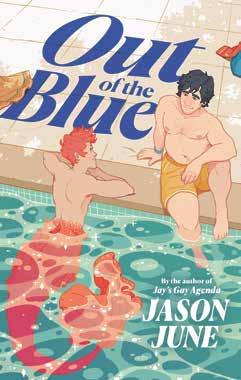
“Gender should be a beautiful expression for all of us.”
The Blue and a great conflict for a budding romance. While many love stories play on the “person vs. place” love triangle, Jason June examines the message at the core of the conflict.
“Sometimes the best choice, especially in a young adult novel, is for us to lead our own lives and not build our sense of self on another person,” he said.
Learning to love ourselves
Jason June has been with his husband for 12 years. He believes romance is important in life and can lead to tremendous selfgrowth. However, he hopes readers take away the message that self-love is just as, if not more, important, especially for young people. “Both options are very valid, and both options can make you happily-everafters,” he said.
While his novels are fun and creative from start to finish, he follows a rigid schedule to keep himself on track. “I am a very type-A Virgo, so my creative process can sometimes seem business-y and analytical. I won’t start a novel until I have a whole outline first,” he said with a laugh.
And Jason June’s outlines can be pretty extensive. For Out of the Blue, he accumulated 30 pages of notes before ever drafting. “It gives me a roadmap to figure out what this story is going, so that I can figure out the kinks before I get to them and potentially experience writer’s block.”
It usually takes him about a month to complete an outline. From there, he begins his drafting stage. “I set myself word-counting goals, as unromantic as that sounds. I’ll do 1,500 to 2,000 words a day. I can get a first draft written in about six to eight weeks.
Then I send it off to my editor.”
His preplanning allows Jason June to put all his mental energy into creativity once he’s got the bones of the story down. “It sounds obsessive, and it kind of is,” he joked.
Up next: Gay chaos
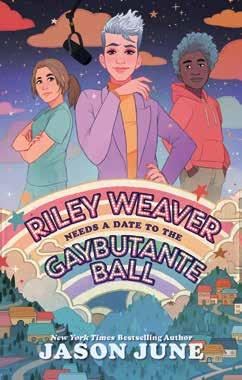
Jason June is in the final stages of wrapping his latest novel, Riley Weaver Needs a Date to the Gay Gaybutante Ball. “It’s my favorite thing that I’ve ever written. It follows a femme Gay teen named Riley, who has these big podcasting dreams,” he explained. The story is set in a fictional small town called Mountain Pass, located in the Cascades, just outside Seattle. Riley dreams of making it big and hopes to join a Gay debutant organization to help network.
“It’s a fictional society, but it would be so magical if this were real,” he added.
Riley must complete the four pillars of gayness: “hosting a party, mentorship, service, and lastly, general Gay chaos, which as we all know in the Queer community, we tend to create,” Jason June explained. His final task is finding a date to the ball, a prospect hindered by a fellow Queer classmate who exclaims that “real” Gay men aren’t attracted to femmes.
“He’s got that sort of ‘dudes are into dudes’ mentality, and so if you have a male body and present yourself femininely, you’re something other than Gay,” Jason June said.
To prove his classmate wrong, Riley bets his future as a gaybutant and sets out to find a masculine date to the ball. The novel is full of humor, Washington vibes, and Gay chaos.
“Through it all, we discover that labels for our gender and sexuality can be liberating, but they can also be very limiting,” Jason June said. “Sometimes, just because labels aren’t 100% accurate for us doesn’t mean we don’t get to have them or claim them. What label is 100% accurate for any person?”
Riley Weaver Needs a Date to the Gaybutante Ball will be available starting on May 23. Out of the Blue is out now. Grab a copy and read along with us at the SGN Book Club!

family, knowing your worth, and cutting toxic ties
“I feel like I’m not being seen by the ones I love.”
Dear Izzy,
I’m a masc-presenting Trans/Nonbinary person with a huge family. I’ve got five siblings, something like 75 cousins, and a whole slew of aunts and uncles — not counting close friends that have been adopted by our clan as part of the family.
Despite our size, we’re all close. News travels fast, and we all keep up as much as we can with each other, despite life getting crazy.
I’ve been out for years, and I’m proud of who I am and how far I’ve come, but I still feel like I’m not being seen by the ones I love. They still don’t get my pronouns right, and I get the sense that when I’m not there, they don’t use my chosen name. It can be really draining to have the same conversation repeatedly when I’m not being heard.
I love them, truly. Family is everything to me. But I can’t help but think that interacting with them too much is bad for my mental health. I feel small. I end up just ignoring the low-key transphobic and homophobic remarks, knowing that if it were anyone else, I wouldn’t let it slide. Cutting ties altogether seems selfish somehow.
Is there a way to keep these bonds strong without sacrificing who I am?
— Family Matters on I-5
Dear Family Matters,
I am so sorry that your family has treated you this way and left you thinking about cutting ties. It is the hardest thing you can do, and I understand that it is a difficult decision to make.
But your gut is right when you say that interacting with them is bad for your mental health. The truth of the matter is that you deserve to be treated with kindness, love, and respect. Period. By your family, friends, acquaintances, and any people you cross paths with.
Thinking dialectically, it’s important to know that you can love your family and know that you do not deserve the disrespect that they are showing you. Doesn’t make it any easier, but thinking in shades of gray offers some flexibility.
Maybe cutting ties completely isn’t the solution. But if every interaction you have with them leaves you feeling belittled and alone, then it’s time to take yourself out of the situation. You shouldn’t have to keep repeating yourself. If your family truly respected you, then they would listen the first time you told them your preferred pronouns and name. After that, it becomes a conscious choice to do otherwise. And that’s not okay.
by Isabel Mata SGN Staff Writer
Ask Izzy is a biweekly advice column about relationships, mental health, and sexuality. Written by Isabel Mata — a Seattle-based lifestyle writer, podcast host, and mental health advocate — Ask Izzy offers tangible expert advice so all readers can have stronger relationships, better sex, and healthier mindsets.


Photo by Askar Abayev / Pexels
“The bottom line is that you can’t change certain family members’ behavior, but you can limit their access to you by setting boundaries on the relationship.”
My advice is to find the balance that works for you. Maybe it’s having visits with smaller groups of people, instead of attending large family gatherings. While it might seem like there are unspoken rules about having to show up to everything, that’s just not true. Just because someone shares your blood does not mean you are obligated to put their needs before your own.
This is where the concept of the chosen family comes in. You are in the driver’s seat of your life, and you get to decide who is worthy of your time and energy. If you are not sure who those people are, go back to your core values. Maybe it’s respect, equality, and acceptance. Find people who share those same values and prioritize those relationships.
Remember, quality over quantity. You only need a few good people in your inner circle, and I guarantee that those relationships will leave you feeling more filled up than any time with your current family seems to. The bottom line is that you can’t change certain family members’ behavior, but you can limit their access to you by setting boundaries on the relationship. For example, if they refuse to use your correct pronouns, then they are no longer welcome to your time. The challenge will be following through on these boundaries and being comfortable with the response you get when you take a stand.
It won’t be easy in the beginning, given how much our society values traditional blood family structures, but it will get easier. In the meantime, start building your chosen family based on the values you hold closest to your heart. Surround yourself with people who lift you up, and you will find the peace you are searching for. It exists, I promise.
by Benny Loy SGN Contributing Writer
The rise in transphobia across the United States has many members of the community concerned for the safety of Trans and gendernonconforming people. Last month, far-right commentator Michael Knowles announced at the Conservative Political Action Conference (CPAC) that “transgenderism must be eradicated from public life entirely.” Though he claims that “transgenderism” and Trans people are separate, many saw his use of “eradicate” as a genocidal call.
Fears that the Trans community is being increasingly dehumanized have been rising recently, particularly after a Florida legislative committee hearing on a Transgender-related restroom bill. During that hearing, Republican Rep. Webster Barnaby called Trans people “demons,” “imps,” and “mutants.”
Transphobic hysteria has also been spreading the idea that Trans people are dangerous and violent. This contrasts starkly with the findings of a study by the Williams Institute at UCLA School of Law that found that Transgender people are more than four times more likely than cisgender people to be the victims of violence.
The Florida legislature passed House Bill 1297 on April 13, and it will likely be signed into law by Gov. Ron DeSantis once it reaches his desk. This will expand the death penalty to anyone who “commits sexual battery upon, or in an attempt to commit sexual battery, injures the sexual organs of a person less than 12 years of age.”
At first glance, this bill seems appealing to those who want harsher penalties for child abusers. However, some are raising the alarm that if Florida’s definition of sexual battery were to be expanded, it would have devastating consequences. The question is: will Florida define gender-affirming care for minors as sexual battery?
This is not a far-fetched idea; Texas has House Bill 42 in committee, which would define certain “acts by a medical professional or mental health professional for the purpose of attempting to change or affirm a child’s perception of the child’s sex, if that perception is inconsistent with the child’s biological sex,” as child abuse, including puberty blockers.
To say that Florida could take a similar approach is not a stretch of the imagination, and in that case, the lives of parents and doctors seeking to treat Trans youth in the state could be put in jeopardy.
by A.V. Eichenbaum SGN Editor-in-Chief
Florida expands “Don’t Say Gay”
Florida’s Gov. Ron DeSantis expanded the state’s current ban on classroom lessons about sexual orientation to include grades 4–12. The rule change is part of DeSantis’s targeted political agenda against the LGBTQ+ community, but it does not include optional reproductive health instruction courses.
The original ban, which was passed last year, prohibited discussion of sexual orientation and gender identity in kindergarten through third grade. This garnered backlash from LGBTQ+ advocacy groups and President Biden, who called it “hateful.”
Gov. DeSantis is expected to soon announce his 2024 run for the presidency.

It can happen here Florida’s HB 1297 also changes the requirement of a unanimous jury vote for a capital offense to eight out of twelve voting in favor. This will likely go to the Supreme Court, where its constitutionality will be debated. In 2008, the Supreme Court decided in the case of Kennedy v. Louisiana that the death penalty should only be applied to crimes in which the victim died or else it violates the Eighth Amendment’s Cruel and Unusual Punishments Clause. It cannot be said for sure what our current Supreme Court might decide.
But it is no longer an option to argue that “it can’t happen here” given that Florida has proved how far it is willing to go to hurt the LGBTQIA+ community.
For example, Senate Bill 254 says that
the state can take emergency custody if a child or a sibling or a parent is “at risk of, or is being subjected to the provision of sex-reassignment prescriptions or procedures.” If made law, this would separate Trans youths from their families and would legalize cisgendered children to be taken from their Trans parents.
Considering that Florida legislators are willing to state that the “risk” of exposure to gender-affirming care is child abuse, they are only a few steps away from redefining what constitutes sexual battery to a minor.
It is clear that, when one examines the potential effects of these bills combined, along with the possible laws they could propose next, Florida is not a safe place for Trans people. State legislators are treating Trans identities as a “social contagion”;
under the guise of “wanting to protect children,” they intend to punish doctors and parents for trying to provide potentially life-saving care to Trans youths. House Bill 1297 can do a lot of harm, especially if the Supreme Court finds in favor of it. The fear that this expansion of the death penalty could extend to Trans people is not unreasonable. Consider the many pieces of anti-LGBTQIA+ legislation in Florida and the growing slander of calling Trans people “child groomers.” When lawmakers, politicians, and far-right commentators say they want to “eradicate transgenderism from public life” verbally or through passing anti-Trans bills, we should believe them.
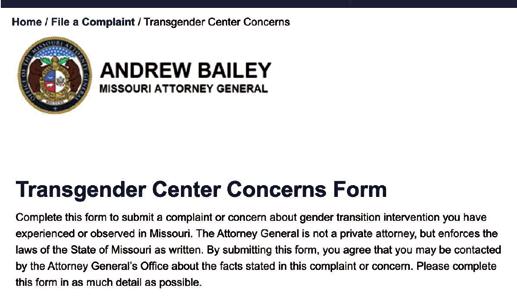
Activists work to thwart Missouri anti-Trans “whistleblower” site
Activists on social media are calling for people to protest an online form requesting that Missouri residents “submit a complaint or concern about gender transition intervention you have experienced or observed in Missouri.”
The form, which was created by Mis-
souri Attorney General Andrew Bailey, does not appear to require any form of documentation or evidence backing any claims or complaints. Activists are encouraging pro-Trans allies to fill out the form with positive Trans messages and absurd submissions in order to flood the server and gum up the works.
“You can just submit stuff. And YOU

should,” said twitter user @MxInevitable, who added that the form allows citizens to “report on your trans neighbors like a sort of horrendous snitch.” The site, which follows on Missouri’s newly imposed restrictions on gender-affirming care, can be found at the following https://ago. mo.gov/file-a-complaint/transgendercenter-concerns.
by Benny Loy SGN Contributing Writer
Access to the abortion drug mifepristone is at risk because of a lawsuit by the legal advocacy group Alliance Defending Freedom in Texas, which is challenging the FDA’s 23-year-old approval of the drug by claiming that it was rushed and that the drug is unsafe. Unsurprisingly, it filed this lawsuit in Amarillo, Texas, to guarantee getting Trump-appointed US District Judge Matthew Kacsmaryk, who sided with the plaintiffs and suspended the FDA’s approval.
Since that decision, this situation has only gotten more complicated, with national consequences. Here’s what you need to know.
What is mifepristone?
Mifepristone blocks the hormone progesterone., which causes the uterus lining to break down, after which the pregnancy cannot continue. This drug is the first step in the process of medication abortion, after which misoprostol is used, which causes the uterus to empty. This process is used up to ten weeks after the first day of one’s last menstrual period and makes up over 50% of all abortions in the United States.
Large doses of misoprostol without mifepristone can also successfully end an early pregnancy but will often cause more discomfort and pain to the patient. When combined, the required dosage of misoprostol is lower and thus makes the process easier and more comfortable.
Mifepristone has been used in America for over two decades, and studies have shown that major adverse reactions are exceedingly rare. According to the American Medical Association, the drug is one of “the most studied medications prescribed in the nation,” whose “scientific evidence supporting its safety and efficacy is overwhelming.” The AMA states that the “risk of patient death from medication abortion is near zero.”
by A.V. Eichenbaum SGN Editor-in-Chief
Museveni returns harsh anti-LGBTQ bill to Ugandan parliament for “strengthening”
Ugandan President Yoweri Museveni rejected a bill imposing the death penalty on HIV-positive Gay people who have sex, instead sending it back to the parliament “to facilitate the reinforcement and the strengthening of some provisions in line with our best practices,” the National Resistance Movement chief whip Denis Hamson Obua told the press on April 20.
There have been no statements made explaining what exactly about the bill needs reinforcement.
The bill, which the US, the EU, the UN, and several international corporations have condemned, also includes a 20-year prison sentence for promoting homosexuality.
Same-sex relations are currently illegal in Uganda, but the bill will expand the laws already in place. The Ugandan parliament passed the bill with nearly unanimous support last month.

Photo by Evelyn Hockstein / Reuters
Who is Judge Kacsmaryk?
Judge Kacsmaryk was nominated by President Trump in 2017 and then sworn in as a district Judge of the US District Court of the Northern District of Texas in 2019.
From 2014 to 2019, he acted as deputy general counsel for the Christian conservative legal group First Liberty Institute. Since 2012 he has been a member of the Federalist Society, a conservative and libertarian legal organization whose members hold positions of power throughout our government. Six of the nine Supreme Court Judges are current or former members.
Throughout his career, Judge Kacsmaryk has argued against LGBTQ+ and reproductive rights. His writings include calling homosexuality “disordered” and being Trans “delusional.” From day one of his career, he has opposed Roe v. Wade, and in 2017 wrote an article arguing that doc-
tors with religious objections should not be required to treat Trans people. Judge Kacsmaryk, for the past three years, has opposed the Biden administration’s policies, such as his 2022 vacating protections for Trans workers.
What is the lawsuit?
The case is Alliance of Hippocratic Medicine (AHM) v. U.S. Food and Drug Administration (FDA). AHM, an anti-abortion organization incorporated in August 2022, is being represented by the Alliance Defending Freedom. AHM claims that the FDA, in its process to approve mifepristone, “disregarded the substantial evidence that chemical abortion drugs cause more complications than even surgical abortions.” The suit is filled with false claims about the over-twodecades-old drug and the effect of chemical abortion on women’s bodies.
The defendants argued that the FDA approval in 2000 followed standard procedure. They cited years of scientific studies that show that complications are rare and that less than 1% of patients require hospitalization. Compared to other common medications, mifepristone is safer than Tylenol, penicillin, and Viagra.
When the judge sided with the plaintiffs, he stated that the FDA did not consider the risks associated with the drug and the “intense psychological trauma and posttraumatic stress women often experience from chemical abortion.”
How potentially forcing women to use more painful forms of medication abortion or to get a surgical abortion outside of their homes is less traumatic was not explained.
This is the first time a district judge has ruled to suspend the approval of a drug, and it could be argued that it is not in the purview of lower courts to do so. The FDA must follow the rules set by Congress, but depending on the Supreme Court’s decision, that could change.
What are the ramifications?
Within an hour of Judge Kacsmaryk’s ruling, a Washington judge, Thomas O. Rice, who President Obama appointed, made a ruling to protect access to the drug, which created a conflict that forced the issue to be brought to the Supreme Court. Justice Samuel Alito issued a temporary stay, meaning that the drug will remain available until the Supreme Court’s decision on April 21. If the court upholds Judge Kacsmaryk’s decision, this could affect access to this drug and open the door to further restrictions on abortion medication, such as the ability to receive it in the mail. The ramifications of whatever decision comes this Friday could be vast. It could not only restrict access to abortions in blue states but also create a dangerous precedent concerning access to any medication. If a lawsuit filled with unscientific claims can just be shopped around to the right judge, other medications could also be restricted.




Ash brings on anthropologist
Michael Eichenbaum in for a chat about Transphobia's roots in European colonialism. TikTok: @the_human_odyssey
WEEKLY! FIND US WHEREVER YOU LISTEN TO PODCASTS!