Celebrating 41 Years! Issue 16 Volume 42
FRIDAY April 18, 2014 FREE!
25¢ in bookstores & newsstands
Seattle Gay News
Scout Leader hires lawyer AP
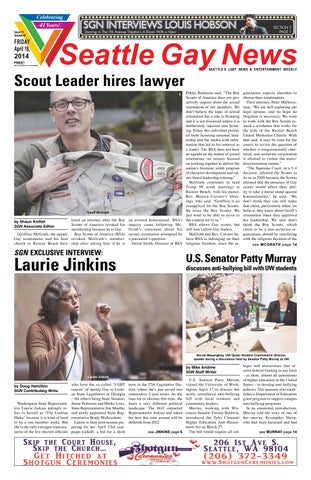
Geoff McGrath
hired an attorney after the Boy Scouts of America revoked his membership because he is Gay. Boy Scouts of America (BSA) Geoffrey McGrath, the openly revoked McGrath’s memberGay scoutmaster and his host ship after asking him if he is church in Rainier Beach have by Shaun Knittel SGN Associate Editor
an avowed homosexual. BSA’s inquiry came following McGrath’s statement about his sexual orientation prompted by a journalist’s question. Deron Smith, Director of BSA
SGN EXCLUSIVE INTERVIEW:
SEATTLE’S LGBT NEWS & ENTERTAINMENT WEEKLY
Public Relations said, “The Boy Scouts of America does not proactively inquire about the sexual orientation of our members. We don’t believe the topic of sexual orientation has a role in Scouting and it is not discussed unless it is deliberately injected into Scouting. Today, this individual provided both Scouting national leadership and the media with information that led to his removal as a leader. The BSA does not have an agenda on the matter of sexual orientation; we remain focused on working together to deliver the nation’s foremost youth program of character development and values-based leadership training.” McGrath continues to lead Troop 98 scout meetings at Rainier Beach, with his pastor, Rev. Monica Corsaro’s blessings, who said, “Geoffrey is an evangelical for the Boy Scouts. He loves the Boy Scouts. We just want to be able to serve in the context we’re in.” BSA allows Gay scouts, but still won’t allow Gay leaders. McGrath and Rev. Corsaro believe BSA is infringing on their religious freedom, since the or-
ganization expects churches to choose their scoutmasters. Their attorney, Peter Mullenix, said, “We are still exploring our legal options, and we hope no litigation is necessary. We want to work with the Boy Scouts toward a resolution that works for the kids of the Rainier Beach United Methodist Church. With that said, it may be time for the courts to revisit the question of whether a congressionally chartered, non-sectarian corporation is allowed to violate the states’ discrimination statute.” “The Supreme Court, in a 5-4 decision, allowed the Scouts to do so in 2000 because the Scouts claimed that the presence of Gay scouts would affect their ability to take a moral stand against homosexuality,” he said. “We don’t think they can still make that claim, particularly when, we believe, they knew about Geoff’s orientation when they approved his leadership. We also don’t think the Boy Scouts, which claim to be a non-sectarian organization, should be interfering with the religious decision of the see MCGRATH page 14
U.S. Senator Patty Murray
Laurie Jinkins
discusses anti-bullying bill with UW students Joshua Bessex
Legislative Photography
Nicole Masangkay, UW Queer Student Commission director, speaks during a discussion held by Senator Patty Murray at UW
by Mike Andrew SGN Staff Writer Laurie Jinkins
by Doug Hamilton SGN Contributing Write Washington State Representative Laurie Jinkins jokingly refers to herself as “The Lesbian Mafia” because it is kind of hard to be a one-member mafia. But she is the only estrogen representative of the five elected officials
who form the so-called “LGBT caucus” of openly Gay or Lesbian State Legislators in Olympia – the others being State Senators Jamie Pedersen and Marko Liias, State Representative Jim Moeller and newly appointed State Representative Brady Walkinshaw. Laurie is busy post-session preparing for her April 23rd campaign kickoff, a bid for a third
U.S. Senator Patty Murray visited the University of Washington April 17 to discuss her newly introduced anti-bullying bill with local students and community leaders. Murray, working with Wisconsin Senator Tammy Baldwin, introduced the Tyler Clementi Higher Education Anti-Harassment Act on March 27. The bill would require all colsee Jinkins page 6
term in the 27th Legislative District, where she’s just served two consecutive 2-year terms. As she runs for re-election this time, she faces a very different political landscape. The SGN contacted Representative Jinkins and asked her how this time around will be different from 2012.
leges and universities that receive federal funding in any form – in short, almost all institutions of higher education in the United States – to develop anti-bullying policies. The measure also establishes a Department of Education grant program to support campus anti-bullying programs. In an emotional introduction, Murray told the story of one of her interns, Kristopher Sharp, who had been harassed and had see Murray page 14
2 Seattle Gay News
April 18, 2014
Celebrating 41 Years!
An open letter to Pope Francis by Mark Segal Philadelphia Gay News Your Holiness, A couple of weeks ago a delegation from Pennsylvania came to visit you to urge you to come to Philadelphia next year when our city hosts the 8th World Meeting of Families. Let me add my voice to the list of those who hope you grace our city with your presence. Like millions of others I have been impressed with your views and acts of tolerance and human dignity. For one who has been downright angry at your church in the past, your statements have been a beacon of light in a dark tunnel. Your Holiness, I’m a Gay man and to be polite about it, your church has not always been kind to the LGBT community. There is no need to list the numerous injustices that have been done in the church’s name, but it is my sincere expectation that they are in the past. This is not to suggest that we will always agree, we will not; but we can agree to disagree with politeness. But this letter is also a plea. A plea for your help. While we can
agree to disagree on marriage equality, I believe we can agree on nondiscrimination. You, yourself, expressed as much in your call with theologian Marcelo Márquez after Argentina passed its marriage equality law. Here in the northeastern part of United States, Pennsylvania is the only state that does not protect its LGBT community from discrimination. This means that Gay people are fired simply because of who they are, Gay people lose their homes, and are denied services. Fellow human beings should not be treated with such disregard. It is my belief that you feel the same. Unfortunately, the church in Philadelphia and its political lobby in the state capital have not changed their position on nondiscrimination in 40 years. Your holiness, if we cannot agree on the human value of non-discrimination, how can we move on to more complex issues like the family? Your trip to Philadelphia to address the issues of families is at a time when the definition of a family is changing. You can add a soothing voice in a turbulent time of societal change. Family issues need to be addressed
not ignored. Divorced families, single parent families, interracial and interreligious families and yes, even LGBT families. Your words have brought new hope to a world tired of strafe. We need to find common ground and move on to greater issues. Please come to Philadelphia, and please do as you’ve done since the beginning of your pontificate by bringing your special kindness and sense of human dignity. Mark Segal, publisher of the Philadelphia Gay News, has been recognized by the National Newspaper Association, Pennsylvania News-media Association, Suburban Newspapers of America and the Society of Professional Journalists, among others. He can be reached via facebook or twitter. Reprinted courtesy of Mark Segal and Philadelphia Gay News Read more at http://www.philly. c om /ph i l ly/c olu m n ist s/m a rk _ sega l / A n _open _ letter_to_ Pope_ Fra ncis. html#aGPAPHbGMD8VVrpz.99
Register now for Seattle Pride Parade! Pride Parade announcers selected Seattle Out & Proud, the non-profit organization that produces the Seattle Pride Parade is reporting that registration for the parade is open and filling fast for the 2014 Seattle Pride Parade, which will be held on Sunday, June 29, starting at 11:00 a.m. on 4th Avenue in downtown Seattle. To register your organization to march in the Parade, simply visit www.seattlepride.org, then select “Parade Registration” from the menu options. Registration will close on May 1st. The theme for the 40th anniversary of Seattle Pride is, “Generations of Pride.” With 2014 Pride, Seattle Out & Proud aims to celebrate the history of the Northwest’s LGBT rights movement and advance the ongoing progress the LGBT community has made since first coming out in 1974, the year of the first Seattle Pride celebration.
Visit us online www.sgn.org
Seattle Out & Proud has announced that Sylvia O’Stayformore and Mama Tits will host the main stage at Westlake Park. The pair hosted the Pride Parade for the last four years at the 4th and Bell stage, and Mama Tits was one of the hosts of the 2010 PrideFest Main Stage at Seattle Center. Known as Seattle’s Skyscraper Hostess, Mama Tits is the producer and star of “Mimosas with Mama,” Seattle’s longest-running weekly Drag Brunch, and works various events around the area and across the country. Sylvia O’Stayformore will join Mama
Tits at Westlake Park’s Main Stage. Sylvia has been performing in drag in Seattle since 1997. She has performed across the Northwest and was named the Hottest Drag Queen in America of the Moment by Out Magazine in 2003. Sylvia produces “Bacon Strip Seattle,” a monthly theater show, and is the hostess of Rainbow Bingo at senior centers in West Seattle, Ballard and Columbia City, as well as hosting a brunch show at different locations of the south end. Sarah Rudinoff and Cherry Sur Bête will greet the parade around the far turn at 4th and Bell. Cherry Sur Bête is a performance artist and a conceptual artist with a fetish for drag. Cherry will be joined by performer Sarah Rudinoff, a recipient of the Stranger Genius Award in theater and an actress and cabaret singer.
April 18, 2014
Seattle Gay News 3
In previous years, more than 200 marching contingents, representing commercial, civic and non-profit organizations from throughout the region, have participated in the march along 4th Avenue.
“REVEALING QUEER” – LGBT HISTORY AT MOHAI FEBRUARY 14-JULY 6 Seattle’s Museum of History and Industry (860 Terry Ave. N. in South Lake Union) presents “Revealing Queer,” a landmark exhibit on the history of the Puget Sound region’s LGBTQ community. Admission: $14 general; $12-student/senior/military/ teacher; children under 14 free when accompanied by an adult. Museum hours: 10 a.m.-5 p.m. daily, Thursdays until 8 p.m. First Thursdays FREE. www.mohai.org. “DINA MARTINA: HER GREATEST VIDEOS … AND MORE!” On Fridays and Saturdays, at 8 p.m., and Sundays, at 2 p.m., through Sunday, April 27, at Re-bar (1114 Howell St.), this show, hosted by Miss Martina herself, celebrates Dina Martina’s legacy by featuring all her best film and video segments plus new video, live singing and dancing. Tickets: $20 in advance, $25 at the door. www.brownpapertickets.com/event/546683.
IMPERIAL COURT OF SEATTLE – EASTER BONNET CONTEST & PARADE On Sunday, April 20, from 3-5 p.m., at C.C. Attle’s (1701 E. Olive Way), join the Imperial Sovereign Court of Seattle for their Third Annual Easter Bonnet Contest. 1st Place is $50 cash; 2nd Place is $40 gift certificate; 3rd Place is $25 gift certificate. Contest entry is FREE. Easter Eggs will be on sale with chances to win more prizes. The Easter Bonnet Parade will be held at 4 p.m. Proceeds from this event will benefit The J.C./Lady Graytop Scholarship Fund. www.imperialcourtofseattle.com and on Facebook. SEATTLE PRIDE IDOL On Sunday, April 20, Seattle Out & Proud (SO&P) hosts the 6th annual Seattle Pride Idol talent showcase and competition. The event will be held at Neighbours Nightclub (1509 Broadway) – with contestant registration beginning at 6:30 p.m., doors at 7 p.m. and contest at 8 p.m. Registration is free, and contestants may bring their own musical accompaniment. There is no cover charge. Regular competitions will be held every Sunday, April 4-May 25 (except May 18) at Neighbours Nightclub. Regular competitions will also be held on Thursday, May 1 at Baltic Room (1207 Pine St.), Wednesday May 7 at The Lobby Bar (916 E. Pike St.), and Thursday May 22 at OutWest Bar (5401 California Ave. SW). The Wild Card Night will be held on Sunday, June 1 at Neighbours and the Finale on Sunday, June 8 at Neighbours. For more information, call 206-322-9561, email info@seattlepride.org, or visit www. seattlepride.org.
OUT FOR SUSTAINABILITY – EARTH GAY SEATTLE On Saturday, April 19, from 9:30 a.m.-noon and noon-2:30 p.m., at Cheasty Greenspace on Beacon Hill (meet at the open lawn off Cheasty Blvd. S. approximately 2 blocks east of Beacon Ave.), OUT for Sustainability will be partnering with Beacon Bike Park to restore Cheasty Greenspace, an urban forest located on Beacon Hill, in preparation for the implementation of bike trails. During Earth Gay, volunteers will be removing invasive species like blackberry and English ivy, weeding, mulching, protecting tree systems from invasive species, and planting native species. Wear sturdy shoes, smart layers, and BAR NUN BINGO bring your own water bottle. Gloves and APRIL 22 & 24 tools, water and snacks, and direction will On Tuesday, April 22 at 9 p.m. at Pobe provided, with possibly a few musicians. quito’s (1000 E. Pike St.) and on Thurswww.out4s.org. day, April 24 at 7:30 p.m. at Pike Brewing
Company (1415 First Ave.) join the Sisters of Perpetual Indulgence, the Abbey of St. Joan, and the Planned Parenthood Young Professionals for a festive evening of fun and games! Bar Nun Bingo will feature fantastic prizes, Happy Hour food prices and drink, and delightful special guests. Tickets are $15 and include 4 bingo cards – if you purchase online at www.strangertickets.com, you’ll receive an extra bingo card – and all proceeds benefit Planned Parenthood’s Someone You Know Fund, which provides essential, preventive reproductive healthcare to local women and men. POZ SEATTLE – SECOND MONTHLY SOCIAL On Wednesday, April 23, from 6-8 p.m., at C.C. Attle’s (1701 E. Olive Way), join POZSeattle for their Second Monthly Social. Meet inside for drinks, light fare of food provided by C.C. Attle’s friendly kitchen, socializing, and a whole lot of fun. $5 suggested donation to help defray POZ Seattle overhead expenses, but no one will be turned away for lack of fund. www.pozseattle.org. DINING OUT FOR LIFE APRIL 24 Annual fundraising event to benefit Lifelong AIDS Alliance in Seattle and Martin Luther King County and Pierce County AIDS Foundation in Tacoma and Olympia and Pierce, Thurston and Lewis Counties. For a complete list of participating restaurants, visit www.diningoutforlife.com. GREATER SEATTLE BUSINESS ASSOCIATION – WOMEN ON TOP On Thursday, April 24, from 5:30-7:30 p.m., at White Pages in Rainier Tower, 1301 5th Ave., Ste 1600, the GSBA hosts Women on Top, Seattle’s premier cocktail hour for LBTA professional women. Join us and strengthen connections with colleagues you haven’t seen for a while, make
new connections and take some time to enjoy friendships with other professional women colleagues in a fun and relaxed atmosphere. Whether you’re in business, nonprofits, academia, or government, Women on Top is the perfect time and place to enjoy the company of other likeminded professional women. Cost: $10 members, $15 nonmembers, $10 students. Register online at www.thegsba.org or call 206-363-9188. Q-SQUARED MEN – Q-SPRING 2014 APRIL 25-27 Q-Spring, a celebration of self and Spring for Gay, Bisexual and Transgender men, is a chance to gather with other men to reflect on, embrace, and celebrate who you are, where you have been, and where you are headed. Discover new parts of yourself and enjoy the company of other men in a non-judgmental, attitude-free atmosphere. For more information and to register, visit www.qsquared.org or phone 253-216-3997. 2014 LANGSTON HUGHES AFRICAN AMERICAN FILM FESTIVAL APRIL 25-MAY 4 www.langstoninstitute.org SEATTLE EROTIC ART FESTIVAL – LAUNCH PARTY On Friday, April 25, from 9 p.m.-1:30 a.m., at Within Sodo (2916 Utah Ave. S.), dance the night away to music by DJs Raymond Forbes, Jayson Spaceotter, and Ramaro of Uniting Souls. Enjoy amazing aerial bondage performances by Suspended Animation, sexy Go-Go Dancers, and a variety of delicious art from past Seattle Erotic Art Festivals. Tickets: $15 advance; $20 at the door. www. strangertickets.com.
Effort to add four words sparks activist wave in Idaho If you call Seattle home, it’s probably difficult for you to imagine a place where you can be fired for being Gay. Or where you can be denied a roof over your head simply because you are perceived to “look or act Gay.” If you’re like most Americans, you probably think this sort of discrimination is already illegal in the United States and you might be wondering what sort of backwards part of the world we are talking about. Unfortunately, if you’re a member of the LGBT community, you probably already know that though it is illegal in many states to discriminate based on sexual orientation or gender identity, the majority of states do not have such laws protecting the LGBT community. Just a couple hundred miles east of Seattle exists a place where LGBT discrimination in housing and employment are perfectly legal – a state called Idaho. Aside from a few forward thinking towns with anti-discrimination ordinances in place, the majority of the state offers no protections. Fortunately, change is in the forecast for the Gem State. This is because a courageous
group of activists, organizers, and volunteers is speaking up and acting out on behalf of LGBT Idahoans across the state. Add The Words, Idaho is an LGBT activist group advocating adding the four words “sexual orientation” and “gender identity” to the state’s human rights act. The group formed in 2010 out of several smaller groups that have been advocating for LGBT protections for nearly a decade. After eight years, however, a proposed bill to “add the words” has never even been allowed to be filed by the Republican controlled legislature. This year the group has decided to accelerate their movement, citing 81% of Idahoans who think people shouldn’t be fired from work for being Gay or Transgender. On February 3rd, under the leadership of former State Senator Nicole LeFavour, a group of peaceful protestors called “Add the 4 Words” filled the state capitol in a peaceful protest insisting Idaho’s legislature finally add the words to Idaho’s Human Rights Act. That day, 44 protesters were arrested on suspicion of trespassing, including LeFavour. In a press release, the group stated that “Gay and transgender Idahoans have tried every means to get the legislature to
4 Seattle Gay News
April 18, 2014
by Victor Bogatko SGN Contributing Writer
consider the “Add the Words” legislation. If the legislature again chooses to ignore us and not hear or vote on the bill, we are prepared to peacefully remain here to bring attention to the issue.” A week later, a second demonstration of at least 65 people was held on February 13th. Protesters silently filled the Statehouse rotunda after being refused entry into the Senate and House galleries. No arrests were made. Days later, a third demonstration of about 200 people was held at the Statehouse on February 17th, filling multiple rotunda floors, without any arrests. A total of five demonstrations were held in February, with 192 arrests. Last winter, a special session was granted and representatives from the LGBT and business community were allowed to tell the legislature why the human rights act amendment was important. Despite personal invitations, no Republican legislators were in attendance and the bill to amend the human rights act was once again denied. Idaho’s defiant governor was also unwilling to listen. Instead, he chose to mock the group by telling them to “create their own forum and then invite” Republican legislators to it. He also called the demonstrations counterproductive, costly, and disruptive. “I
always understand the frustration,” he said. “The question here now is, are they starting to hurt their own cause?” Despite such intense opposition and indifference, advocates remain hopeful and persistent. “There has been a huge turning point in public opinion and recent developments are encouraging,” says Mistie Tolman, spokesperson for Add the Words. “Discussions with leadership hint to a hearing next year, so we are preparing for that and trying to spread the word even more.” Eight consecutive legislative sessions have passed since activists began working on adding protections for LGBT Idahoans. A very long time, but activists are determined to win this fight. “If we need to, there will be a ninth year and there will be a 10th year. We’ll keep coming back. We’re not going away until we right this wrong,” says Tolman. Indeed, signs of a turning point are sprouting up all over Idaho as more cities pass non-discrimination ordinances and more people become aware of “Add the Words” – four words that could prevent young Idahoans from knowing that they could be fired from work or denied a place to live because of their “sexual orientation” or “gender identity.”
Celebrating 41 Years!
Rodney Tom out of 38th Dist. Senate race, former Kirkland mayor Joan McBride is frontrunner by Mike Andrew SGN Staff Writer State Senator Rodney Tom has dropped his bid for reelection in the Eastside’s 38th Legislative District, leaving former Kirkland Mayor Joan McBride as the frontrunner in the race. Tom, a Republican-turned-Democrat who then turned Democrat-who-votes-with-Republicans, withdrew from the race April 14, citing his own health problems and a serious injury to his 85-year-old father. McBride, who served as Mayor of Kirkland from 2010 to 2103, was first elected to the Kirkland City Council in 1997. She has been endorsed by the Victory Fund – an organization that promotes LGBT candidates – as well as a host of prominent Democrats. On April 16, McBride also won the endorsement of the Martin Luther King County Labor Council, a group that represents 150 union locals and some 78,000 workers. Tom was condemned by the Washington State Democratic Party for “gross disloyalty” and “perfidious behavior” in 2013, when he and fellow Democrat Senator Tim Sheldon joined Senate Republicans to form the so-called “Majority Coalition Caucus” and seize control of the Senate. Tom’s reward for switching sides was to be elected Senate Majority Leader, but he earned the wrath of Democratic Party regulars who vowed to unseat him this November. Tom’s decision to drop out changes the complexion of the race, McBride told SGN. “When I started it was very easy to say what I was running against,” she said, “but now I’m focusing on what I’m running for: “A balanced transportation plan; ample funding for our educational system, including
higher ed; for our middle class, in particular, to deal with growing wage disparity; for the Reproductive Parity Act [which would require state insurance plans to cover contraceptives and abortions if they cover maternity care].” McBride, who has already raised more than $61,000, touts her “robust field campaign,” and says she is optimistic about her chances. “I’ve been in many races, and I’ve always won,” she told SGN. “This will be a contested race. The Republicans will file a candidate. But the way to win is to work hard, and listen to what the constituents say.” In February Tom hired Republican publicist Keith Schipper as his campaign manager, and Republicans were expected to stay out of the race. With Tom gone, the GOP will almost certainly try to field a candidate to preserve their razor-thin majority in the Senate. Other Democrats who might be candidates – state Representatives Ross Hunter and Cyrus Habib – have already endorsed McBride. McBride, who recently married her partner of 14 years, also enjoys the Victory Fund’s “stamp of approval,” she notes. As Mayor of Kirkland, McBride presided over a period of rapid expansion and development. She oversaw the purchase of the Cross Kirkland Corridor to facilitate rail and other transit, and development of the Kirkland Transit Center and South Kirkland Park and Ride. McBride also championed a parks and roads levy, and funded local Youth and Senior councils, and a city Teen Center. Although she is a veteran campaigner, McBride says she has been surprised at some feedback from 38th District voters. “I’ve always considered myself an environmentalist, but I was surprised by how
Joan McBride
many people are worried about climate change,” she said. “I’ve been surprised at the number of people who are concerned about the Republican Party, about them being the party of No, about how we lost the ability to have constructive debate.
“I’m also surprised when I talk to small business owners about their economic viability. They can be as vulnerable as some of the most vulnerable individuals.” McBride added that community members who wish to help her campaign can donate or volunteer via her website, JoanMcBride.com.
Lambda Legal sues doctor for refusing to treat Trans woman Lambda Legal Defense Fund
Naya Taylor
Visit us online www.sgn.org
Lambda Legal filed suit in federal court on April 16 on behalf of a Trans woman whose doctor refused to prescribe hormone replacement therapy for her. The suit says that the doctor violated the Affordable Care Act. Naya Taylor, the plaintiff in the suit, requested hormone replacement therapy (HRT) as part of her transition-related healthcare regimen. Her primary care physician, Dr. Aja Lystila refused to prescribe the therapy. HRT is a medically necessary and often life-saving procedure used to treat gender dysphoria, a serious recognized medical condition. Initially, the doctor claimed she was not experienced in providing hormone therapy. Later, her clinic told Taylor that it “does not have to treat people like you.” According to Lambda Legal, Dr. Lystila’s clinic receives federal funding and, therefore, may not discriminate on the basis of sex, which includes gender identity. “When they said, ‘we don’t have to treat people like you,’ I felt like the smallest, most insignificant person in the world,” Tay-
lor told the Windy City Times. “The doctor and office provide hormone replacement therapy for others at the same clinic, they just refused to do that for me.” Lambda Legal’s suit names Dr. Lystila and the Carle Clinic as defendants. Lambda also filed a separate complaint with the Illinois Human Rights Commission. In a statement, Lambda Legal senior counsel Kenneth Upton said that the doctor was in clear violation of federal law. “The provisions of the Affordable Care Act are clear: doctors receiving federal funds cannot discriminate in providing patient care just because a person is transgender,” Upton said. “Patients such as Naya Taylor place their health and well-being in a doctor’s hands. Ms. Taylor asked for her doctor to provide services similar to those provided to other clinic patients who are not transgender and the doctor and clinic refused, posing a significant risk to Ms. Taylor’s health. The ACA’s non-discrimination provisions were intended to ensure appropriate medical care for transgender people, a community that already faces a disproportionate amount of discrimination, violence and suicide rates.”
April 18, 2014
Seattle Gay News 5
by Mike Andrew SGN Staff Writer
Jinkins
continued from cover
Doug Hamilton: What is at stake for the average voter in the upcoming Washington State elections? What issues do you feel LGBTQ+ people and their allies should be primarily concerned about in this election cycle? Laurie Jinkins: Our margins in the house are getting slimmer, and we have a Republican controlled Senate. So I think for LGBT people in particular, for instance, we weren’t able to pass the ban on reparative therapy this year [the bill would have made it illegal for licensed medical or mental health providers to try to convert a minor’s sexual orientation], and we need to have a Democratic Senate, and a more Democratic controlled House, if we are going to do some of the really big things we want. That was just an example of an LGBT issue. I think in the grand scheme of things the biggest issue in my book is not being able to have a rational dialogue at all about how we generate revenue in the state of Washington, and what we need to do about it. We’re not able to have a rational dialogue about closing loopholes that don’t do anybody in the state any good. We are not able to talk about how regressive our tax system is, and how the poorest people end up paying the highest percentage of their income in taxes, and instead move to something that’s more progressive, like having a capital gains tax like 47 other states do, how are we going to fund our K-12 education system, which is a moral obligation that we have to our children. We are just not able to realistically talk about any of those things, because for the most part we have a Republican Senate, which refuses to engage in any kind of discussion about revenue or taxation.
Hamilton: I would agree with that analysis that there certainly is not a front-and-center issue at this time. Social economic justice is there as an issue on the burner, and there are people in our community who are aware of that, and who are working on it. But it doesn’t seem to have really captured the imagination of the general supporter who could see really directly how marriage would affect them, or how in the past HIV/AIDS was such a huge crisis. It seems like really we need to have a crisis that we can really rally around before they are willing to get out of their comfort zones. DISCRIMINATORY “RELIGIOUS FREEDOM” LEGISLATION Hamilton: There are some other things which are developing, which are these religious exemptions to anti-discrimination laws. And we’ve seen them defeated state-by-state. Notably with Governor Brewer’s veto in Arizona, but we’ve also seen them pass in Mississippi. Is there any movement like that we should be aware of, and what can we do to educate ourselves and counteract it going forward? Jinkins: Certainly, Senator Padden, courtesy of Laurie Jinkins
Washington’s 27th Legislative District includes most of northern Tacoma, which despite The Advocate giving Tacoma the title of “Gayest City in America” in 2012, is a port city with its share of blue-collar workers, and an economy more dependent upon shipping and export. Tacoma bore the brunt of the Great Recession much as the rest of the state and nation did, with lots of lay-offs and slowly returning jobs. Jinkins has been challenged with representing her district with an unapologetically progressive agenda in a long cycle of budget shortfalls. And while the economy seems to have turned the corner, budget issues still loom large in Olympia. Fortunately, perhaps because of the influence of labor unions, her district is one of the most progressive in the State. Washington State Representative Laurie Jinkins live a life like many busy working mothers. Her Facebook posts are full of tales of juggling life as a representative with her home life with her wife, Laura Wulf, and their son, Wulf – laundry, family meals, shopping trips, and school performances figuring prominently in the mix. When I called her for this interview, Representative Jinkins had just returned from a doctor’s visit for Wulf, who was suffering from a nose and ear infection. Despite her busy schedule, she very graciously agreed to my phone interview, and we spoke for nearly half an hour.
they will never change or raises taxes at all, what kind of dialogue can you have? That piece has actually been very educational for me. Because it is one of the reasons that I decided I don’t sign pledges of any type, even if I totally believe what the pledge is, I just don’t believe in signing them, because you just never know where the point of compromise is, or when it may come, or if you are going to be able to have dialogue, and if there may be a solution that you haven’t thought of before. So I think it is just very hard to have any dialogue that is rational whatsoever. There is certainly a number of things that I might be willing to do that in my progressive district, the voters in this district would support. In other districts they wouldn’t. When we look at school levies and park levies, and we see what happens in Seattle on this transportation initiative, the voters are not saying they don’t want to pay for anything. So the voters are willing to pay more taxes, and the voters have made it very clear that they do not like some of the loopholes that we have. But when we have elected officials who are not even willing to engage in that conversation, it makes it hard to move forward.
(l to r) Laura Wulf, Wulf, and Laurie Jinkins
IDEOLOGICAL POLARITY PREVENTS HONEST DIALOGUE Hamilton: Do you feel that this is an ideological polarity, and that there is not really an opportunity for a strong moderate influence to come forward? Jinkins: Yes, I do think it is ideological, absolutely. An absolute ideological split. When you have the number of members of the House and Senate on the Republican side who sign Grover Norquist’s Pledge that
NEXT MAJOR ISSUE FOR LGBT COMMUNITY Hamilton: In the 80s and 90s HIV/AIDS became the LGBTQ movement’s signature cause, and then the issue of marriage equality united the LGBTQ community from the year 2000 to the present. What do you see as the next impetus for LGBTQ community action? Jinkins: I think that it will be interesting, and it is hard to say. Both of those topics were so huge, that it is a little bit hard to think of what LGBT issues there are that are that huge. I will tell you that two of the things that I am working on, that I don’t think are small, and they relate to kids especially being subjected to reparative therapy, which I absolutely know is damaging to them, both as kids, and as they become adults. And so, figuring out how to address that. My personal feeling is that the issue of Transgender access to real healthcare services that they deserve should be a huge issue for the community. Now honestly, I feel like the LGBT community, as well as many others, should be as interested in the issues of income equality as anybody, but I think that remains. It is just so interesting. For all the years I’ve been involved in the LGBT community, I see the community as much more involved on issues that almost exclusively impact the LGBT community. And once it starts to affect a broader community, too, I see our community kind of drift away more, and not feel the linkages. Which is a long way of saying “I don’t know.”
6 Seattle Gay News
April 18, 2014
lated to when people filed their title in real estate transactions, the $40 recording fee. And there actually was enough of a public outcry that they were able to pluck it from committee, and say that that bill was necessary to pass the budget. But that type of thing is very rare. Do you think it was the political outcry that caused that to actually get past the committee system? Jinkins: Yeah, I think there is no doubt. But we should learn and understand that that works both ways, right? So there’s the bill Senator Angel thought she had killed in committee, and she didn’t, and we ended up being able to pass it. Not in the form that many of us wanted, but it will continue to address homelessness. The LGBT community should be very thoughtful and paying attention. Every bill that you think is dead, it might not always be dead. And there are a lot of the processes the legislature can do to make things seem one way, when in fact they may be another way. And we should really pay attention to that. I think the other thing we should be paying attention to is the U.S. Supreme Court right now in the Hobby Lobby case, which is the case in which a private business says, “I don’t want to offer my female employees reproductive health services. I don’t even want to offer them a limited number of services. I don’t want to offer abortion, which you are not required to do under federal law, but now I don’t want to offer them the opportunity to obtain contraception and stuff like that. Even though I am in a business, my religious views should prevail.” If the Supreme Court agrees with that, that’s essentially tantamount to agreeing to the Arizona religious freedom laws that you referred to. Hamilton: The Supreme Court hasn’t actually issued a ruling on the Hobby Lobby case that I’m aware of. . . Jinkins: No, they won’t yet, but we should be watching that case though, and the decision will come out by the end of June. So in the next couple of months, we will know. Hamilton: It really does seem to be where the lines are being drawn, as far as the opposition, or far right are doing. It is as though they see marriage is no longer a winnable front for them, so they are saying, “Okay, so we’re just going to etch out huge swaths of places where it is okay for us to be able to practice discrimination and use it in the guise of religious freedom.” Jinkins: It will be really interesting to watch those cases, because I think, and I’m talking a little bit out of school here, but I think that there was the New Mexico case, which they decided not to hear, in which it was a photography or baker or floral case, in which a provider did not want to provide services to a Lesbian or Gay couple in their wedding, because of their religious beliefs, and that the lower court said, “No. You are required to because you are open, you are a public accommodation, you are a business.” And they appealed to the U.S. Supreme Court, and the Supreme Court said, “We’re not going to hear the case.” When the Supreme Court says they are not going to hear the case, I guess they could think either they are going to deal with this issue in the Hobby Lobby case, or they are saying, “No, you have to, if you are going to be open to the public, you’ve got to be open to the public, and you have to follow the nondiscrimination laws.” So, we’ll know by June.
who is chair of the Law and Justice Committee, filed a bill just like that this year in the Washington state Senate. So I think we have to keep our eyes wide-open and watch for that and make sure that we are prepared to help people understand what these bills are about, because they usually, like Senator Padden’s bill, just says basically, that of all the other rights in Washington – be they in the State Constitution, or in law – the primary one is freedom of religion, and it should take precedence over everything. That doesn’t really sound bad to people when they look at it, and when they just think about it in passing, until they start to realize, oh, that can be used if you are in business, and you say “I don’t want to serve a Lesbian and Gay people because of my faith, then that takes precedence. And I can do that, if I don’t want to serve people of color.” We’ve had that in Washington, and we’ve been able to actually kill the bill in a place where it wasn’t able to move out of committee at all. Hamilton: That is the thing, how bills can die in committee. That’s exactly what happened to the ban on Gay conversion therapy, or “sexual orientation change efforts.” I think that is really hard for people SEXUAL ORIENTATION & on the outside to understand how something GENDER IDENTITY BASED can pass almost unanimously in one body, PAY DISCREPANCY and then go to committee, and one person Hamilton: The City of Seattle just ancan just simply say “no,” and that’s that. nounced they would begin collecting sexual There was the thing that happened with orientation and gender identity statistics on funding for homelessness. The funding re- their employees in order to analyze pay dis-
Celebrating 41 Years!
lar people who aren’t lobbyists, who aren’t legislators, and aren’t necessarily all that politically active in the world. But there are people who found an important issue that they connected to, they went and talked to a legislator about and through that were able to find a legislative champion, and then they worked on the issue very persistently. I had one group of people who had been
Laurie Jinkins speaking to Planned Parenthood
interested in providing funding for one set of those, versus the other. And it is very, very true that not knowing numbers is one of the primary reasons why legislators say, “We can’t do anything because we don’t know enough about this.” So, one of the reasons to not do anything about something is to just kind of take a blind eye to it. And to make sure on a policy basis we do not count them. We don’t count Gay and Lesbian homeless youth, or we don’t count Gay and Lesbian couples, or the number of Transgender folks who aren’t getting access to the healthcare that they need. Things like that. The first step for making them policy change issues is really knowing who the population being affected is. Because even though in small areas like that, I think you make a very good point. We should know and understand that just having solid demographic and good data helps us move a policy forward, and it is those small steps that help us take bigger steps. Hamilton: It is a lot more of a long, drawn out process than probably the average citizen has that much patience for. Looking at the social changes that we’ve accomplished, it seems that people like yourself who have been willing to take a long view, and be very tenacious about the step-by-step process have achieved great results. And you are really looked up to in our community as somebody who is just very effective in a quietly, competent way. And so, I’m just wondering, looking at the younger generation that is very tuned into social media, and kind of has this “push button” activism, what advice would you give to them in terms of how to change the world or the culture, and where to start? Because it can seem really overwhelming if you don’t understand how the system works. Jinkins: Well, first off I would say that one of the things I love doing at the end of every session, I think that at least for the last three, if not all four, that I’ve been in, is that I go down after a bill signing, and I just talk to the people crowd about what bill they are there for to see signed, and why it is important to them, and how they got involved with that bill. And the thing I think of that is great is how you see that sometimes it is lobbyists there, and for some bills it is only lobbyists, but for the most part what you see is regu-
Visit us online www.sgn.org
working on a bill since 1999 that passed this year. 15 years. Another guy that had been working on a bill that related to children’s health status. He had been coming down for three years, and he finally got it through. Another woman who had been working on disability issues ever since her son was born. And he is actually now deceased, but lived into adulthood. And she had been working every year to make sure that changes happened, having different degrees of success. First of all, I would tell people that they should never think it is as hard or complicated as people lead them to believe. That believing in something, believing in it strongly, and advocating for it are two things that most people do not ever do. But then, once you do that, then you find the way to do it. I think that Facebook and Twitter are two of lots of social media tools that you can use to get people interested, but the other thing that I always tell people is that there is a vast difference between people being interested in a topic, and liking what your post is on Facebook, or re-tweeting your message, and people who are voting. As you start to get more politically involved on an issue, you do start to realize those kinds of things. You want to first choose an issue that you want to really work on it, and third be able to get the word out, and depending upon who is voting on it the issue – be it the legislators, or if it’s the gen-
eral public, you have to be really engaged, think about who is voting on this, when will they vote on it, whether they care about it, and how do I engage with them. And social media is one way to do it. And I think it is awesome. Facebook was really new when I was running the first time, and I just loved it when I would go out doorbelling all day, and there would be a lot of people who were not home, and I would come back at night, and I’d have two or three friend requests from people who said I’d left literature at their door, and they were going to vote for me. So, that was totally fun, and great. Now I’m not sure if they did or not, but they’d go on my GOTV [get out the vote] list, so I think they did. So it can work, and I’m not the smartest on using it. I mean there’s a lot more people, like the Obama campaign, that obviously have done the most work on it nationally on knowing how to leverage these tools. But I would say we didn’t do too bad. Hamilton: You’ve brought up another question, and that is how the 2014 elections are going to differ from the 2012 elections. Because at that point, we had marriage on the ballot, and there was a huge GOTV effort behind that which benefited the progressive candidates as well. We won’t have that this year. Is that going to make it a more challenging election for you? Jinkins: Probably not for me personally. I’m from probably one of the five most progressive districts in the state. But, it will be hard to get voters to turn out in an off-year election like this. We have very, very important Senate and House races that will make the difference between how much progress the Lesbian and Gay community can make, and how much they can’t in terms of law-making and legislative action. And even in being able to kill bad bills that come forward. So, we are going to have to work really hard, and be very focused in particular districts. The 28th District is one, which is down here in Pierce County, and the 26th District. Pierce County is going to kind of be the epicenter for important races this year. We are lucky because we have Brady Walkinshaw who was just appointed, so we have an openly Gay member hopefully being elected to the 43rd District. But we also have an open Lesbian running in the 28th, Christine Kilduff, and for the Senate we have former Kirkland Mayor Joan McBride, an open Lesbian, running in the 48th, and since Rodney Tom has dropped out of that race, Joan has a good chance of winning. So, we’ve got two open Lesbians running, one in the House, one in the Senate, and a Gay man making his first run. So we have the opportunity to make progress, and it is tiresome to be the only member of the Lesbian Mafia. So I’d really like to have more members join me. courtesy of Laurie Jinkins
LEGISLATIVE PROCESS Hamilton: I’ve gotten complaints from Transgender individuals dealing with the DSHS who very strongly feel that there is a bias within the institution. For instance, how custody judges would adjudicate child custody cases if a member of the family that was being split up was undergoing a transition. I’ve also submitted a rule change request to the DSHS, whereby we could get some idea of who the people who are using the DSHS services are in terms of gender identity or sexual orientation. And their response was “Well, there really is no requirement that we do so, and we don’t have the resources. So no.” And this is also a controversial question, because of confidentiality and privacy issues involved around sexual orientation. We understand that there are a lot of barriers, but we also feel that this is new, this hasn’t been asked for on a statewide level, and a lot of readers and supporters do not really understand the process of how a new idea actually comes to fruition. We saw that with marriage – marriage wasn’t always by popular support. So I was wondering if you could kind of speak to the process of how best specifically to engage to work for a specific change. Jinkins: You mean collecting data? Hamilton: Well yes, that as an example. Or just getting a law changed. Kind of like “Lobbying 101” or “I’m just a bill” kind of thing, in terms of if it is something that is really happening on an institutional level that members of the community look at and say “this is not fair.” When you go for redress, the people who are the department heads or bureaucrats are going to point to the laws and regulations that are attached to their funding, and say, “We have no reporting requirement, so no, we are not going to produce that report, or collect that data.” Jinkins: It is interesting that you ask that question, because we had one of these issues just this year. My seatmate, Jake Fey, had a bill that would have required Washington state to do a count of homeless children under school age. Because right now, once a kid gets into the K-12 system, we do count them, and we do know we have 30,000 kids who are homeless in our K-12 system, which is I think, an extraordinarily high number. But we don’t know about the kids who are younger than that. So Fey proposed a bill, it passed the
House, it did not pass the Senate. Interestingly, somebody else proposed a bill to count the number of children associated with military families, which did pass the House and Senate. I think that was a good thing to do, but it is very interesting to me that it seemed to be more controversial to count homeless kids, than it was to county military kids. And people seem to be more
Legislative Photography
crepancies. Is there any movement like that for the state of Washington? Do we have any idea how many LGBTQ homeless people there are in Washington state, for instance? Jinkins: I don’t know that I’m aware of too much of what the state of Washington is doing. The other place we can look is to somewhat get a sense of this is through the Census data, nationally that would help us. I think those are really very valid questions, and I think you and I both know, that historically, this has been one of the arguments about Lesbian and Gay people, is that we’re wealthy, right? We’re a wealthy population, and therefore, we shouldn’t have anti-discrimination laws, and stuff like that, because obviously we are so rich. Which, when all of that data is looked at, shows that this is a very skewed, and not at all scientifically accurate. So I think it is worthwhile to pursue looking at demographic data. More typically, we would try to do that though through the U.S. Census would be the place that would help us most find that, because that’s the thing that ties to income. But because Washington state doesn’t have its own income tax, we actually do not, on a statewide level, have the most comprehensive data on income by race, or by any other category. We usually want to get the gross statistics for income in Washington state. And I think most states actually do.
Laura Wulf (l) and Laurie Jinkins
April 18, 2014
Seattle Gay News 7
Pro-Gay Republican super PAC raises $2.75 million Steve Marcus/ reuters
Hedge Fund Manager and American Unity Pac donor Paul Singer
by Mike Andrew SGN Staff Writer A super PAC that supports Republican candidates in favor of marriage equality has reported a whopping $2.75 million in fundraising for the first quarter of 2014. American Unity PAC has been in existence since the 2012 election, but only raised some $2.75 million for the whole year and did relatively little funding of campaigns. In the off year 2013 cycle, it raised only $260,000. “American Unity PAC is the voice of Republican voters who are committed to equal rights and full relationship recognition for gay and lesbian Americans,” the group says on its website. “We are committed to the values of freedom – limited government, free enterprise, individual liberty, personal responsibility, a strong national defense and the importance of family. In the spirit of these values, we believe the promise of America should be extended to all, regardless of their orientation.” So-called “super PACs” may not make contributions to candidate campaigns or parties or coordinate with them, but may engage in unlimited political spending independent-
ly of the campaigns. Unlike traditional PACs, they can raise funds from individuals, corporations, unions, and other groups without any legal limit on donation size. The majority of American Unity’s total contributions, $1.75 million, came from a single individual – hedge fund manager Paul Singer. Described by Fortune magazine as “a passionate defender of the 1% and a rising Republican power broker,” Singer has contributed to Gay rights groups, but also to the George W. Bush and Mitt Romney campaigns, and to the Koch Brothersbacked Club for Growth. About $1 million more came to the super PAC from billionaire derivatives investor Seth Klarman. Klarman also contributes to the American Jewish Committee and proIsraeli political groups. Only one other person contributed more than $25 to the super PAC. Gay Republicans are running in two high-profile Congressional races this year. Richard Tisei is running for the same Massachusetts seat he narrowly lost in 2012, and Dan Innis is running in a Republican congressional primary in New Hampshire. Gay Republican Carl DeMaio is also running for mayor of San Diego.
Nevada GOP drops opposition to marriage equality
8 Seattle Gay News
April 18, 2014
Getty Images
A raucous Nevada Republican convention adopted a platform without the traditional planks opposing same-sex marriage and abortion in a show of hands on April 12. According to the Las Vegas Review Journal, less than half of the convention’s 520 delegates were present for the evening vote approving the recommendations of the GOP platform committee. Previously, the state party platform defined marriage as “between a man and a woman,” as does the Nevada Constitution. The past platform also described the party as “pro-life,” or against abortion, a stance most Republicans still agree with. Platform committee members said they decided not to deal with hot-button social issues this year because the U.S. Supreme Court and lower courts have weighed in, and it makes no sense for the “party of personal freedom” to have the government or the political party get involved in people’s personal lives. “The issue was how can we back out of people’s personal lives,” said platform committee member Dave Hockaday. “We need to focus on issues where we can have an impact.” “I think it was about inclusion, not exclusion,” Nevada Republican chair Michael McDonald said about the platform vote. “This is where the party is going.” Log Cabin Republicans, the party’s small LGBT caucus, issued a statement saying they were pleased with the new platform. “The state party has made it clear that they want a ‘bigger tent’ and has welcomed us into it,” said Ed Williams, President of Log Cabin Republicans of Nevada and a delegate at the convention. “Today’s historic vote positions the Log Cabin Re-
publicans of Nevada and our allies to be strike down the law anyway. ment Republicans pitted against consereven more effective in demonstrating that For several years the Nevada GOP has vative Tea Party members and voters who the Republican Party is the party of lim- been split by the same divisions as the na- backed former U.S. Representative Ron ited government, personal responsibility tional Republican party – with establish- Paul for president. and individual liberty.” Log Cabin Republicans National Executive Director Gregory T. Angelo also issued a statement seemingly taking credit for the platform changes. “Once again, our local Log Cabin Republicans members have made a critical difference pushing the GOP toward the right side of history by going where others fear to tread – or cannot tread because of their party affiliation,” he said. “The Republican Party is at a crossroads: In a year where the Massachusetts GOP rolled back the clock and added divisive social issues to its platform, the [Nevada] state Republican Party responsible for nominating Sharron Angle in 2010 seems to have finally learned to focus on the issues that truly matter to voters, which will lead to massive Republican wins at the ballot box this fall.” In another controversial move, the convention endorsed incumbent Republican Governor Brian Sandoval for reelection in the June 10 primary, despite his unpopularity with the party’s right wing. Conservative delegates were reportedly disenchanted with Sandoval for his absence from the convention, and for balancing the state’s biennial budgets in 2011 and 2013 by twice extending a $600 million tax package that was supposed to expire. Sandoval also agreed with Nevada’s Democratic Attorney General, Catherine Cortez Mastro, that the state should not defend its laws against same-sex marriage in a case now pending before the Ninth Circuit Court of Appeals. He personally opposes same-sex marriage, Sandoval Brian Sandoval says, but he thinks the appeals court will
by Mike Andrew SGN Staff Writer
Celebrating 41 Years!
Visit us online www.sgn.org
April 18, 2014
Seattle Gay News 9
10
Seattle Gay News
April 18, 2014
Celebrating 41 Years!
Visit us online www.sgn.org
April 18, 2014
Seattle Gay News 11
MoSS Alley MotorS, Inc. SpecialiStS in VolVo, Honda, toyota and Subaru
932 12th ave. Seattle, Wa 98122 (206).325--.3992 www.mossalley.com Seattle’s most progressive auto shop!
12
Seattle Gay News
April 18, 2014
Celebrating 41 Years!
Judge stays ruling on Ohio marriages Federal District Judge Timothy Black has stayed his ruling ordering Ohio to recognize same-sex marriages performed in other jurisdictions. In an April 16 order, Black said Ohio must recognize only the marriages of the four couples who are plaintiffs in the lawsuit Henry v. Hymes, formerly Henry v. Wymyslo. Black ruled in that case on April 14, saying that the state’s ban on recognizing legal same-sex marriages was unconstitutional. The state of Ohio has appealed that ruling. In explaining the stay, Black said that although he thinks the state’s appeal will not succeed, there is still a chance the Sixth Circuit Court of Appeals could overturn his decision. “The court recognizes that recognition of same-sex marriages is a hotly contested issue in the contemporary legal landscape, and, if (the) appeal is ultimately successful, the absence of a stay ... is likely to lead to confusion, potential inequity and high costs,” Black said. “Premature celebration and confusion do not serve anyone’s best interests.” Had Black not issued the stay, all samesex married couples living in Ohio would
immediately have been able to obtain the same rights and benefits as any other married couple in the state, including inheritance and property rights, and the right to make some medical decisions for each other. Al Gerhardstein, the Cincinnati civil rights attorney who represents the four couples in the lawsuit argued against a stay of any kind. In a statement after the stay was issued, he said that “at least for these four couples, the Constitution stands on the side of love.” “The implementation of same-sex marriage recognition has started and we are all very excited,” he added. “We will try and expedite the appeals process so full marriage recognition for all same-sex couples does not trail too far behind.” Three of the four couples in the lawsuit live in the Cincinnati area. One spouse in each relationship is pregnant and due to give birth this summer. The fourth couple lives in New York City, but adopted a child from Ohio. In a court filing attorneys for the state did not contest Black’s stated intention to allow both partners to be listed on their children’s birth certificates. In his April 14 ruling, Black said the state’s refusal to recognize out-of-state Gay marriage is a violation of constitutional rights and “unenforceable in all circumstances.” “The record before this court ... is stagger-
lgbtqnation.com
by Mike Andrew SGN Staff Writer
U.S. District Judge Timothy Black
ingly devoid of any legitimate justification for the state’s ongoing arbitrary discrimination on the basis of sexual orientation,” Black wrote. Including Black, eight federal judges have issued rulings supporting same-sex marriage since the Supreme Court decision striking down the key section of DOMA in USA v.
Windsor last June. All but one of those rulings has been stayed pending appeal. Although Black’s order does not force Ohio to allow Gay marriages to be performed in the state, Gerhardstein said he was planning to file a lawsuit in the next couple of weeks seeking such a ruling.
Utah asks court to block adoptions by same-sex couples by Mike Andrew SGN Staff Writer In continuing fallout from Utah’s samesex marriage lawsuit, attorneys for the state have asked the Utah Supreme Court to block adoptions by two same-sex couples. In petitions filed April 7 and April 9, the state’s attorneys allege that Third District Judge Elizabeth A. Hruby-Mills “abused [her] discretion” by approving an adoption for one Lesbian couple and ordering the agency to issue a new birth certificate for their child. One petition asks the court to stay the order and the other requests a hearing on the validity of the adoption decisions. Hruby-Mills approved the adoption on February 13, and the state office of vital statistics received a request for an amended birth certificate listing both parents on April 4. The state’s petition says Hruby-Mills’ order violates “the plain text of the Utah Constitution and Utah law prohibiting recognition of same-sex marriage.” In another adoption, this one approved by 3rd District Judge Andrew Stone, state attorneys argue the judge “erred” by recognizing the couple’s same-sex marriage as valid.
The Office of the Utah Attorney General those marriages as valid, but Utah state ofsaid in a statement that complying with the ficials say they will not, at least not until oradoption orders would lead to legal confu- dered to do so by the Tenth Circuit. Utah allows single parents to adopt chilsion, because it would contradict the state’s position in a federal marriage lawsuit now dren, and it allows married couples to adopt children, but it does not allow unmarried before the Tenth Circuit Court of Appeals. “Without guidance from Utah’s appellate couples to do so. Allowing same-sex coucourts, compliance with the court order [for ples to adopt children jointly would tacitly admit they are adoption] before the federal “The argument that those adoptions legally married, fears. courts rule is aren’t legal because the marriages theAstate ttorney likely to create Laura Milliken more uncertain- weren’t legal stands on shaky Gray, who repty in Utah law resents several and for Utah ground. It also amounts to a totally same-sex coufamilies,” the statement said. uncalled-for slap at both the parents ples trying to do e c ond-p a r ent Federal Disand the innocent children involved.” sadoptions said t r ict Judge Robert Shelby ruled on December 20 that Wednesday that her clients are “floored Utah’s ban on same-sex marriage was and dismayed” by the state’s “extraordinary unconstitutional. Both Shelby and the steps to undo the adoption that they beTenth Circuit declined to stay the ruling, lieved in good faith was fully completed.” “My clients, and others in their same and more than 1,300 couples were subseplace, feel as if the AG’s office is pummelquently married before a stay was ordered ing them at this point by actively interferby the U.S. Supreme Court. ing with their private adoption cases and U.S. Attorney General Eric Holder said taking the outrageous position that the the federal government would recognize
Department of Health can ignore a district court order,” Gray said. In an April 11 editorial, the Salt Lake Tribune blasted state officials for trying to block the adoptions. “In rapid succession,” the newspaper said, “the official Utah position on same-sex marriage has gone from mainstream conservative to merely retrograde to downright nasty… “The argument that those adoptions aren’t legal because the marriages weren’t legal stands on shaky ground. It also amounts to a totally uncalled-for slap at both the parents and the innocent children involved. “The core of the many district court rulings allowing same-sex marriage is Supreme Court Justice Anthony Kennedy’s opinion holding, in the case that struck down the federal Defense of Marriage Act, that DOMA was an impermissible denigration of the many children who live in such households. “Utah’s state attempt to block these adoptions is exactly the kind of cruelty that Kennedy was talking about. And, if there is any justice, it will be another example the backers of same-sex marriage will use to prove that Utah isn’t out to protect families, but to harm them.”
Louisiana lawmakers vote to keep unconstitutional sodomy law on the books by Mike Andrew SGN Staff Writer
Louisiana’s House of Representatives voted on April 15 to keep the state’s sodomy law on the books, even though the U.S. Supreme Court ruled such measures unconstitutional in 2003. The vote was 27 to repeal the old law, and 67 to retain it. Eleven House members did not vote. All but three of the 27 votes to strike down the law were from Democrats, while all but 11 of the 66 votes to keep it were from Republicans. Most of those who did not vote were Democrats. The sponsor of the repeal bill, Democratic Representative Patricia Haynes Smith of Baton Rouge, told Times-Picayune reporters that “I never thought [the repeal bill]
would pass, but I thought it would do better. Some of the folks who voted to get it out of committee voted against it on the floor.” According to The Associated Press, Republican Representative Valarie Hodges was the only person to speak against the repeal, telling her colleagues that “we’re not here to rubber-stamp the Supreme Court.” Louisiana code 14:89 prohibits consensual “unnatural carnal copulation,” including oral sex and all same-sex contact. The “use of the genital organ of one of the offenders of whatever sex is sufficient to constitute the crime,” the law says. Curiously enough, a number of sexual acts are explicitly described in the law, but necrophilia is omitted and therefore is presumably legal. The U.S. Supreme Court ruled in Lawrence v. Texas that such laws violate constitutional rights to privacy, thus making the
Visit us online www.sgn.org
Louisiana law unenforceable. Nevertheless, the Louisiana Family Forum lobbied strongly to keep the measure on the books. “Louisiana’s anti-sodomy statute is consistent with the values of Louisiana residents who consider this behavior to be dangerous, unhealthy and immoral,” the group wrote in a letter to lawmakers. The Louisiana Family Forum also alleged that the law was essential to protect children from sodomy, even though several other state laws provide for such protections. During the floor debate on repeal, Representative Smith pushed back against those arguments, pointing out that the law is unconstitutional and therefore void. Last year the law made headlines when the Baton Rouge Sheriff’s Department used it to justify a sting operation aimed at local Gay
men. Deputies were sent to entrap men cruising Manchac Park, arresting several men who agreed to go to a private home to have sex. The Sheriff defended the operation by citing the state’s sodomy law. When informed that the law was unconstitutional, the department apologized for entrapping the men. The Louisiana Sheriff’s Association did not take a position on repealing the bill.
April 18, 2014
Seattle Gay News 13
Murray
continued from cover his confidential medical records – including his HIV status – published after he ran for a student government position at the University of Houston. Sharp said he was devastated by the revelation, but felt even worse after the university administration told him they would not try to catch and discipline the perpetrators. “It seemed so horrendous to me that the university said it couldn’t do anything,” Murray said shaking her head. “By sharing that, he helped me truly understand” the problem of harassment at colleges and universities, she added. Following Murray, several students and community members related their own experiences of harassment, and the toll it took on their mental and physical health. Nicole Masangkay, a UW student, said she had been a valedictorian as a high school senior, but in her senior year, “my gender expression changed,” so that teachers who had previously “shown me off” became hostile to her. In one incident, she remembered, a teacher confronted her in a checkout line at a local Walmart and insulted her. She still suffers from anxiety, depression, and PTSD that have twice caused her to apply for hardship withdrawals from school. Joey Hunziker, now working on his master’s degree in social policy, recounted his undergrad days at small liberal arts college where he was “one of only three open Queers out of 2,300 students.” “It was a very masculine campus culture,” he recalled, “where countless micro-aggressions build up and add up to an unlivable situation.” In one incident, he said, he and a couple of friends were pelted with fruit and called “fags” in a drive-by assault by other students. Former Equal Rights Washington staffer Doug Hamilton added his experience as an undergrad at Arizona State University in 1981. When he heard that Senator Murray would be in town collecting stories of bullying, “I felt compelled to come forward,” he said. Hamilton was tricked by his dorm mates into revealing his sexual orientation and then subjected to merciless harassment, suffering a nervous breakdown as a result. “I felt humiliated,” he said. “Eventually I lost control of my ability to take care of myself.” Finally he was checked into a county hospital, but escaped to the roof of an adjacent
building, where he briefly considered jumping to his death. “I’m grateful I stuck around to see what happens,” he added. UW Q Center Director Jennifer Self added that such experiences, while horrifying, are not exceptional. “People think Seattle is liberal and maybe things are OK here,” she said, “but that isn’t really the case.” The Q Center routinely deals with students who have been bullied, she said, and tries to offer “a safe space – emotionally, spiritually, as well as physically safe,” for them to come to. In response to a question about using First Amendment guarantees of religious freedom as an excuse to avoid dealing with anti-LGBT harassment, Murray said flatly, “The bill says that if you get federal money you must have an anti-harassment policy. If you don’t want to have the policy, you don’t have to take the money.” While she admitted that the bill faces an uncertain future in Congress, Murray noted that introducing the legislation and holding public events where people can share their experiences of bullying helps create a climate where the problem can be addressed. “The LGBT community knows as well as I do – if you don’t speak up nothing changes,” she said.
MCGRATH
continued from cover Church, which believes strongly that God would disapprove of discrimination based on sexual orientation.” The controversy has brought up a question that churches across the country have begun asking, since more than 70 United Methodist Churches with scout troops are also “reconciling congregations,” which means they welcome all people, regardless of sexual orientation. “Whose rules, when?” Rev. Corsaro asked. “The Boy Scouts have said to United Methodist churches, ‘You are responsible for getting the staff.’ I have recruited such leaders, and then to be told, ‘Oh, except for this.’” If McGrath, an Eagle scout, was a scout today, he could be openly Gay. What happens now, he wonders, when an 18-year-old Gay scout wants to become a leader?
Legal Services MARTIN SJOLIE Over 20 Years Experience
Last Will, Power of Attorney & Health Care Directive (Living Will)
$500.00/Person or $750.00/Couple for complete, personalized services.
(206) 841–1373 www.sjolielaw.com
Auto accidents, DUI, Small business needs.
14
Seattle Gay News
April 18, 2014
Celebrating 41 Years!
Religion & Spirituality www.sgn.org
Health and Personal Services
www.sgn.org
Visit us online www.sgn.org
April 18, 2014
Seattle Gay News 15
Home & Specialized Services
Gary D. TorGerson Co. Expert Painting and Repairs Rot Repair: siding, doors, windows, porches and decks. Lead-Safe Certified
See photographs of our work at www.TorgersonCompany.com Email: info@torgersoncompany.com Contractor Registration #: GARYDTC134CJ Phone: 206-781-0999
16
Seattle Gay News
www.sgn.org
April 18, 2014
Celebrating 41 Years!
Make a safer selfie wasa_d
by Stephen J. Fallon, PhD Special to the SGN These days, everything is about the selfie. We listen to our personalized music playlists on our phones, binge-watch entire seasons of our favorite program on demand, and target our social media shout outs to specific people on our friends list. So it’s no surprise that you can now customize your strategy for staying safe from HIV. Choice is empowering. Yet too many new choices can be confusing. So here’s the new menu of choices for staying safe. Create your safer selfie. Condoms: Lots of guys use condoms when they hook up with someone who looks like he gets around, but then skip the rubbers when they meet a “quality” guy. Even quality guys may have had playful pasts, and many are telling the truth when they say they don’t think that they’re infected … even though they haven’t tested in years. So how well do condoms protect you? Best case: If a condom appears intact after use, you’ve lowered by 125,000 times your chance of catching HIV. Condoms also offer this undeniable benefit: you can check to see if the other guy is really wearing one right now. No guarantees: Condoms only work when someone is wearing them. Gay guys who claim to use condoms all the time reduced their HIV risks by 70%. Rule out the guys who seem to be forgetting the nights they skipped the condoms, and protection is much higher. Condoms break or slip off in as few as 0.4% to 0.6% of uses, and that’s because these numbers include the people who fumble with them drunk or use wildly inappropriate lubricants. Still, if you just can’t stand using condoms, there are other choices. PrEP: Never heard of it? You will. With PrEP, an HIV-negative guy takes the antiHIV combination medicine that people living with HIV take. The difference is that he takes it every day before a possible exposure to HIV. That’s the “pre” in PrEP. Best case: PrEP can offer almost complete protection from an HIV exposure. In the largest studies conducted, none of the guys who took at least most of their PrEP medications became infected. PrEP does take advance planning,
though. You can’t start taking PrEP the day you’re planning to have sex (it takes about a week to build up in the body). No guarantees: Truth is, in the largest PrEP study, new HIV infections were only reduced by 44%, mainly because some people who said they were going to start PrEP never did, or they only took a few of their pills. So just like condoms, you have to use it to get the benefits. Treatment as Prevention: If your HIV+ partner is taking anti-HIV medications, that helps him and protects you. Less virus in his bloodstream makes him far less contagious. The first large study said that the risk of catching HIV from a treated person drops 96%. There were some holes in the study: nearly everyone in the study was heterosexual and married, so would the results translate for Gay men? In this year’s newer PARTNER study, about a third of the people living with HIV were Gay men, and none of their partners got infected either. Best case: taking anti-HIV treatment is something many positive guys are already doing. No guarantees: there’s no way to see if the other guy is taking his treatment the way you could check for a condom. Once they’re off the meds, the drugs start draining out of their system, and that means you’re not protected anymore.
PEP: Whichever safer selfie method you choose, if something goes wrong and you realize you’ve been exposed to HIV, there’s one more option. If you get on a six-week prescription of anti-HIV medicines right away (“post-exposure”), you can often stop the virus from “latching on.” Best case: Officially, you have 72 hours to start treatment, and your odds of becoming HIV+ drop by about three-quarters. No guarantees: Don’t take the deadline too literally, and wait the whole weekend. The same studies show that the earlier you start PEP, the better the protection. Why choose any option? Maybe you just don’t consider staying HIV-free that important anymore. If and when you catch it, you’ll just take a pill a day, and live forever. Well, you’re not entirely wrong, but there’s more to it than that. Best case: If you keep to your doctor’s appointments and take your medicines faithfully, you can live a long life these days with HIV. Some studies predict that people can live with HIV for three or four decades, or even up to 53 years. I’ve never been as hopeful for my friends and community as I am these days. No guarantees: HIV treatments still cause side effects, from the unpleasant and common ones (diarrhea, fatigue, sleeplessness) to the silent bodily changes that can add up over time to cause other serious health problems in some people to trigger cardiac events, kidney failure, liver failure, and bone fractures. Then there’s our community’s dirty little secret of stigma: some guys still act as if HIV makes you sexually radioactive. If you’re HIV-negative now, life’s probably easier if you can stay that way.
Whichever safer option you choose, the best thing you can do is just to make a choice. Condomless sex is up 20% amongst Gay men over the past five years. HIV is still causing the equivalent of five 9-11s in U.S. deaths each year. Almost all new HIV infections are happening to guys who aren’t following any of these strategies. So pick one, stick to it, and make a safer selfie. © 2014 Stephen J. Fallon
Rose. Condom Efficacy by Consistency of Use among Men Who Have Sex with Men: US. 20th Conference on Retroviruses and Opportunistic Infections (CROI 2013). Atlanta, March 3-6, 2013. Abstract 32. No transmissions in PARTNER study by gay HIV+ men who were successfully treated (viral load <200) having unprotected sex with HIV- partners: Rodger A et al. HIV transmission risk through condomless sex if HIV+ partner on suppressive ART: PARTNER study. 21st Conference on Retroviruses and Opportunistic Infections, Boston, abstract 153LB, 2014. Monogamy not protective from HIV if not preceded by HIV testing: Stephen J. Fallon, David W. Forrest. Unexamined Challenges to Applying the Treatment as Prevention Model Among Men Who Have Sex With Men in the United States: A Community Public Health Perspective AIDS and Behavior. 2012;16(7):1739-1742. http://www.medscape.com/viewarticle/773076 Gay men can become infected by primary partners, but longer relationships, and monogamy seem to rule out risk: Patrick S. Sullivan, Laura Salazar, Susan Buchbinder and Travis H. Sanchez. Estimating the proportion of HIV transmissions from main sex partners among men who have sex with men in five US cities AIDS 2009 Jun 1;23(9):1153-62. Long life expectancy potential for PLWH today: van Sighem Gras L, et al, and ATHENA Natl Observational Cohort Study. Life expectancy of recently diagnosed asymptomatic HIV-infected patients approaches that of uninfected individuals. 17th CROI. February 16-19, 2010. San Francisco. Abstract 526. Lohse N, et al. “Survival of Persons with and without HIV Infection in Denmark, 1995–2005.” Annals of Internal Medicine 16 January 2007, 146;2: 87-95. VD Lima, RS Hogg, PR Harrigan, et al. “Continued improvement in survival among HIV-infected individuals with newer forms of highly active antiretroviral therapy.” AIDS 21(6): 685-692. March 30, 2007. Lewden C, et al. HIV-infected adults with CD4 cell count above 500/mm3 on long term combination antiretroviral therapy reach same mortality rates as the general population. JAIDS 2007;46(1):72-7.
Stephen Fallon is the President of Skills4, a healthcare consulting firm that provides services to CDC and Post-Exposure Prophylaxis efficacy: CDC. Antiretroviral Postexposure ProphyTest twice, Talk, and Trust: This is HRSA funded providers, primarily Gaynot the same as only hooking up with or minority-based agencies and clinics. laxis After Sexual, Injection-Drug Use, or Other Nonoccupational Exposure to HIV in the guys you think are HIV-negative. Here, www.skills4.org United States. Morbidity and Mortality Weekyou take an HIV test with your partner, Reprinted courtesy of Stephen Fallon ly Report. January 21, 2005 / 54(RR02);1and discuss whether you’re both comfort20. http://www.cdc.gov/mmwr/preview/ able having a “closed” relationship (or SOURCES: mmwrhtml/rr5402a1.htm open only with protection). If you both Roland ME et al. Seroconversion followare, you test again to confirm neither had 125,000x reduction in HIV transmis- ing nonoccupational postexposure prophya new HIV infection that the first test missed, and then you may choose to take sion if condom intact; low rates of con- laxis against HIV. Clin Infect Dis 2005 dom breakage or condoms that slip off: Nov 15; 41:1507-13. the condoms off. National Institutes of Health. Scientific Best case: Many guys have been using this Gay condomless sex up 20%: strategy for years (including me), and it appears Evidence on Condom Effectiveness for Sexually Transmitted Disease (STD) Prevention. CDC. HIV Testing and Risk Behaviors to work for those who follow all the steps. Among Gay, Bisexual, and Other Men Who No guarantees: If you do allow “play- [Workshop summary report] July 20, 2001. ht t p://w w w.niaid.nih.gov/about/ Have Sex with Men — United States. Moring,” remember that condoms protect better against HIV than against some other organization/dmid/documents/con- bidity and Mortality Weekly Report, November 29, 2013 / 62(47); 958-962. STDs that are easier to transmit. Also, domreport.pdf Overall 70% reduction in HIV risk long ht t p://w w w.cdc . gov/mmw r/pre once you’re in the habit of condomless sex at home, it may be harder to stick to your term amongst “consistent” condom users: view/mmwrhtml/mm6247a4.htm?s_ D Smith, J Herbst, X Zhang, and C cid=mm6247a4_w#fig1 pledge of protected playing outside.
Visit us online www.sgn.org
April 18, 2014
Seattle Gay News 17
18
Seattle Gay News
April 18, 2014
Celebrating 41 Years!
Visit us online www.sgn.org
April 18, 2014
Seattle Gay News 19