
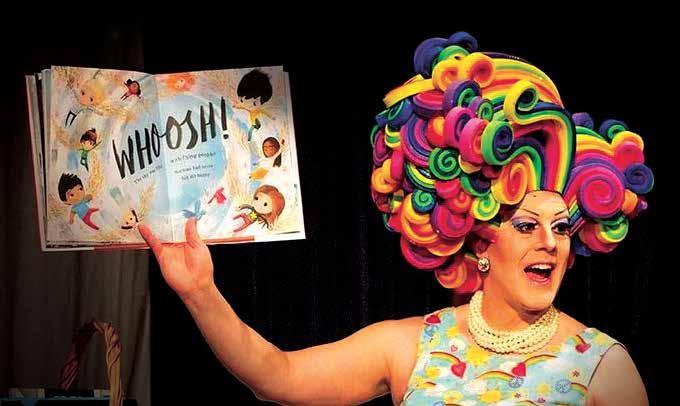
ANTI-DRAG BILL ADVANCES IN FLORIDA
by Mike Andrew SGN Staff Writer

by Benny Loy
SGN Contributing Writer
by Gary L. Day
Special to the SGN
Photo courtesy of Museum of Pop Culture
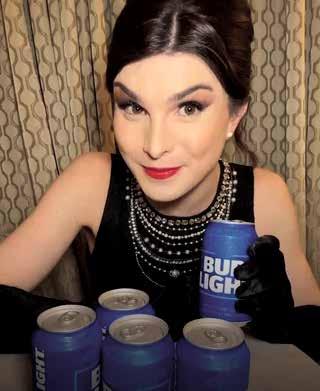
Image courtesy of Dylan Mulvaney / Instagram
Photo courtesy of Drag Queen Story HourFlorida Chapter / Facebook








Local News
Seattle LGBTQ Commission seeks candidates
by John McDonald SGN Contributing Writer
The City of Seattle is seeking representatives for its LGBTQ Commission. The 21-member body of appointed Seattle residents works in an advisory capacity to the mayor, City Council, Office for Civil Rights, and several other city departments.
Janet Stafford, commission liaison to the City Council, said recruitment is ongoing.
“We are definitely always accepting applications, doing ongoing recruitment, and holding interviews,” Stafford said. “I’d encourage anyone who is interested to visit the commission meetings or listen in to get an overview of things and make some connections.”
The commission holds monthly hybrid meetings — both in person and remote — on the third Thursday from 6:30 to 8:30 p.m. The next meeting is scheduled for April 20 at City Hall.
Stafford said the goal is to have a diverse pool of applicants from all districts of the city. Commissioners serve for two years and are required to participate a minimum of eight to 10 hours per month. It is a volunteer, nonpaid position.
Every meeting has a public comments portion, during which people are given two minutes to speak. Stafford said the issue now getting the most attention involves homelessness in the LGBTQ community.
The current commission is led by cochairs Nate Higby, Andrew Ikechukwu Ashiofu, and Brett Pepowski.
For more information, call (206) 6844500 or email slgbtq@seattle.gov.
Doctors release new findings on groundbreaking anal cancer prevention
by Lindsey Anderson SGN Staff Writer
Anal cancer is becoming one of the most common cancers in the United States. According to the American Cancer Society, 9,760 people are diagnosed with the disease yearly, and 1,870 will die. Inspired by this news, a group of doctors and scientists from around the country have just made a breakthrough in preventive anal cancer treatment.
A new threat to the LGBTQ+ community
“Anal cancer is relatively rare in the [general] population, except for a select group of people who have their immune system suppressed,” explained Dr. Vlad “Val” Simianu, one of the leading researchers in the groundbreaking ANCHOR (Anal Cancer HSIL Outcomes Research) study.
While anal cancer is not very common among the heterosexual population, it is recurrent among the LGBTQ+ community, especially for AMAB (assigned male a birth) people who are HIV positive. Doctors now know that people living with HIV are more likely to develop anal cancer over time, and because they are living longer, this likelihood is increasing.
“It’s probably the fourth most common cancer for people with HIV. In fact, in men living with HIV who have sex with other men, it’s 11 times more likely than in the regular population, and 40 times more likely in women living with HIV,” Dr. Simianu said. Anal cancer is also on the rise, according to the American Cancer Society. One of the reasons doctors believe this cancer is increasing is due to its relationship with HPV. “Ninety-nine percent of cases of anal cancer are caused by the human papillomavirus,” Dr. Simianu explained. “[HPV is] an extremely common sexually transmitted

infection. On top of that, there are a number of risk factors. HIV and smoking, which are higher in [the LGBTQ+] community, are related to why people get anal cancer.”
In recent decades, doctors have made tremendous progress in developing drugs and vaccines to prevent and treat HIV and HPV, but vaccinations are not enough to prevent anal cancer.
Just because someone has received the HPV vaccine does not mean they can’t still
catch the virus. “There’s probably a hundred different types of this virus. Not all of them lead to cancer, and not all the vaccines cover all the types,” Dr. Simianu said. “As the vaccines get better, we cover more [variations] of the virus. From data we have in kids, we think that getting the vaccine prevents the HPV infection.”
HIV-positive people are more likely to develop anal cancer because the disease attacks the immune system. “[HIV is] a
virus that affects our immune system and our ability to fight off viruses and cancer cells in particular,” Dr. Simianu said. “Part of our immune system is to prevent cancer from ever arising in our bodies, so when the virus affects that, then people living with HIV are at higher risk of certain cancers that otherwise our immune systems would prevent, like anal cancers or cancers caused by the human papilloma virus.”
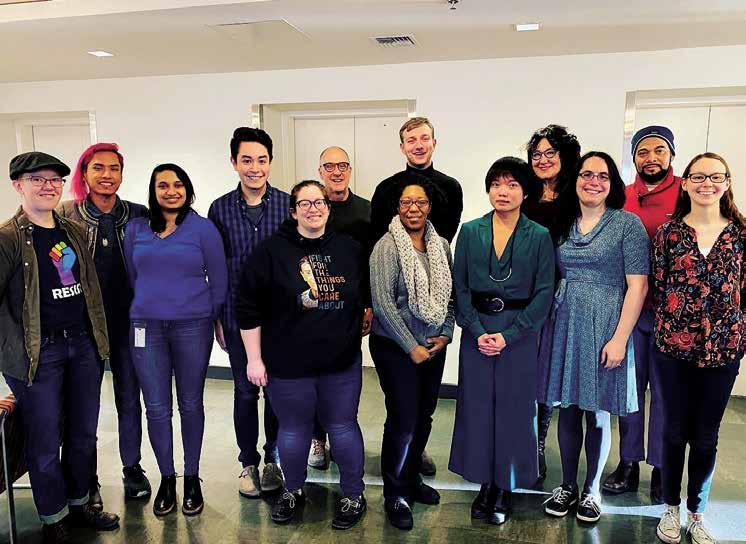
Commissioners standing together for a group photo at their last in-person Commission retreat – Photo courtesy of Seattle LGBTQ Commission
Image courtesy of the Anchor Study

Early detection
When detected early, anal cancer is treatable, although it usually requires radiation and chemotherapy. “We can treat and cure maybe 60–70% of anal cancer, as long as we catch it at an early stage. We used to do pretty aggressive surgery about three or four decades ago. We figured out that this cancer goes away almost completely with radiation, so about 90% of the time, radiation with a couple of doses of chemotherapy can make [it] go away,” explained Dr. Simianu.
Even when caught early, anal cancer is still very hard on the body, and treatments like chemotherapy can be hard to undergo. In extreme cases, anal cancer can also require surgery to remove the anal canal, which leaves patients unable to have bowel movements and requires them to use an ostomy bag. It can also metastasize to other organs and the lymphatic system, which makes it much more difficult to treat.
For those who do not want to risk living with an ostomy bag, prevention is key. “Even though we are in the business of treating cancer, boy, we’d love to prevent it,” Dr. Simianu said.
While vaccinating against HPV, taking medications like PrEP, and having open conversations with partners about sexual health and history are some of the best ways to prevent anal cancer, the number one thing doctors recommend is attending yearly screenings. “The key with prevention is you want to catch it before it becomes cancer or becomes symptomatic,” Dr. Simianu added.
Just like how people should get a colonoscopy at age 45, doctors believe people should start screening for anal cancer once they’re middle-aged. For some people, screenings should happen earlier than 45 and as frequently as once a year.
“For men and women living with HIV, they probably should start anal cancer screening right away. Even for men having sex with men who are not HIV positive, because of their
risk for HPV, they should probably start in their forties,” Dr. Siminu said.
A study cut short
Following the release of the new ANCHOR study, doctors have even more reasons to recommend early screenings for anal cancer. Once chronic, HPV causes precancerous growths to mature around the vaginal and anal canals. These growths, known as high-grade squamous intraepithelial lesions (HSILs), can develop into either cervical or anal cancer. Previously, doctors would monitor HSILs to see if they would eventually evolve into cancer. In people living with HIV, the likelihood of this was much greater.
In the ANCHOR study, doctors from across the United States studied two groups of HIV-positive patients. One group was the control and the other group had their HSILs removed. The doctors then monitored both groups to see how likely it was those who had their HSILs removed would
“Even though we are in the business of treating cancer, we’d love to prevent it.”
develop anal cancer. “After seven years, the trial stopped early,” Dr. Simianu said.
“In the group of patients for whom we were treating the lesions versus watching them, we prevented so much more cancer.”
The doctors discovered that removing the HSILs had a direct link to preventing anal cancer, and they felt it was cruel to prevent the control group from receiving the same care. The control group returned to participating treatment centers, where they also had their HSILs removed. Doctors will continue monitoring both groups but have confidence that this new treatment is the most effective way to prevent anal cancer in people with HIV and HPV.
Due to the overwhelming success of the study, doctors recommend this treatment be used in all immunocompromised people who have developed HSILs. While this first group was made up entirely of HIV-positive people, the results will be able to help others who are immunocompromised for a variety of reasons.
“Now we can hopefully expand to transplant patients and other immunosuppressed patients. We know it works, so it’s not like we can not give those patients the treatment,” Dr. Simianu said.
Spread the word!
The next step to preventing anal cancer is just getting the word out. Now that the study is out, doctors everywhere are aware of this medical breakthrough, but it is still up to patients to seek screenings and HSIL removal. HSIL removal is relatively noninva-
sive (it does not require surgery or anesthesia). The growths can be removed with freezing or heat techniques, like a mole or wart. Dr. Simianu warns that just because this new procedure is an option for people to use in preventing anal cancer, early vaccination against HPV is still the primary way to go. Anyone who is HIV positive, especially anyone who has both HIV and HPV; people who have a personal history of cervical, vulva, or vaginal cancer; or AMAB people over the age of 45 who are also having sex with AMAB people are at the highest risk of developing anal cancer and should have a yearly high-resolution anoscopy to detect HSILs. If detected, patients can schedule the procedure to have them removed.
People Dr. Simianu classifies as “moderate risk” include AMAB people over the age of 30 who are having sex with AMAB people, people who have experienced precancerous changes to the cervix or vulva, patients five years out from an organ or marrow transplant, or people who have suppressed immune systems from conditions like colitis or lupus. These people should seek an anal pap as a precursor to an anoscopy. Thanks to Dr. Simianu, and all the other doctors working tirelessly at Virginia Mason, the Polyclinic, and Harborview Medical Center, we are one step closer to preventing anal cancer altogether. If you have concerns about cancerous HSIL growths or are at an increased risk for anal cancer, talk with your doctor about scheduling a screening today.
Photo courtesy of Memorial Sloan Kettering Cancer Center
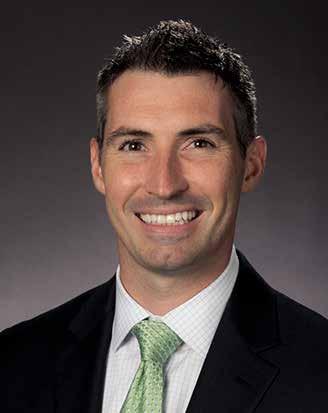
Vlad (Val) Simianu, MD – Photo courtesy of Virginia Mason
Arts & Entertainment
Live-action role-playing group Amtgard ramps up recruitment
by Daniel Lindsley SGN Staff Writer
Those of us who venture outside these days, or have done so in the past, have likely witnessed a certain kind of scuffle in our local park. It isn’t the common kind, involving children who disagree over who gets to hold the pine cone, nor a similar conflict in the realm of adults, but instead a blur of colorful fabric accompanied by the drum of foam swords.
There’s a good chance that that scuffle was a small part of Amtgard, a live-action role-playing (LARPing) organization dedicated to safe, fun, high-fantasy-styled role-playing and combat. Since the official end of pandemic-related social distancing, chapters in the greater Seattle area have been growing their numbers once again.
There are other LARPing groups that participate in such “battlegames,” namely Dagorhir and Belegarth, but Amtgard sets itself apart in ways less readily recognized by outsiders.
For one thing, like many of its tabletopgame counterparts, Amtgard puts realism aside and includes rules for players to act out a “class,” a medieval fantasy archetype with unique combat abilities. An Amtgardian can be a warrior monk, a ranger, or a wizard, among other things. But as its fans will attest, there’s a lot more to the organization overall.
“There are so many sides to Amtgard,” said veteran member Shieldmaiden Stoat (she/they). “There’s something for everybody, you know? You can be involved in a part of the community and never set foot on the battlefield.”
Many LARP communities have a barrier to entry, like a fee or strict dress codes, but Amtgard is a not-for-profit organization in far more than name alone. It’s democratic, decentralized, and enthusiastically DIY, and many of its fans volunteer their time and skills to keep it that way.
After all, someone has to make the rules, hand out the trophies, and organize the events themselves, not to mention staff them. That they do it without pay, especially in this economy, is a testament to their love for the hobby.
“You can be a garber, you can be in organizing, you can donate your time ... you can cook meals for people at events,” Stoat said. And you can do all of that in character if you want.
Origins in the hobby
Stoat has been LARPing for over ten years. Her first encounter with Amtgard was “this huge kingdom-level event where there were hundreds of people fighting in this massive battle. I was like, ‘This is the coolest thing I’ve ever seen in my life.’ And I’ve been hooked ever since.”
Stoat admitted that she never really got into Amtgard’s inner politics, but Swordbearer Kodiak (they) joined just nine months ago and has already taken on ample responsibilities for the Redmond chapter. That has meant diving headfirst into the grander structure of the organization.
To give a sense of Amtgard’s scale, North America is divided into 20 different kingdoms so far. Each kingdom is responsible for its chapters (called “parks”), and a chapter that consistently attracts enough people can apply for a higher rank of recognition (shires, baronies, duchies, etc.).
Each kingdom has its own charter, procedures, and elected government, but every year or so, their leaders convene to make sweeping decisions, like approving new battlegame rules.
Western Washington is romantically dubbed the “Kingdom of the Northern Lights,” and as a baron in role but not title, Kodiak has done scheduling, administrative work, and outreach at local geekdom hot spots. They’ve been at big ones like this year’s Emerald City Comic Con, but also smaller ones, like the opening day of the
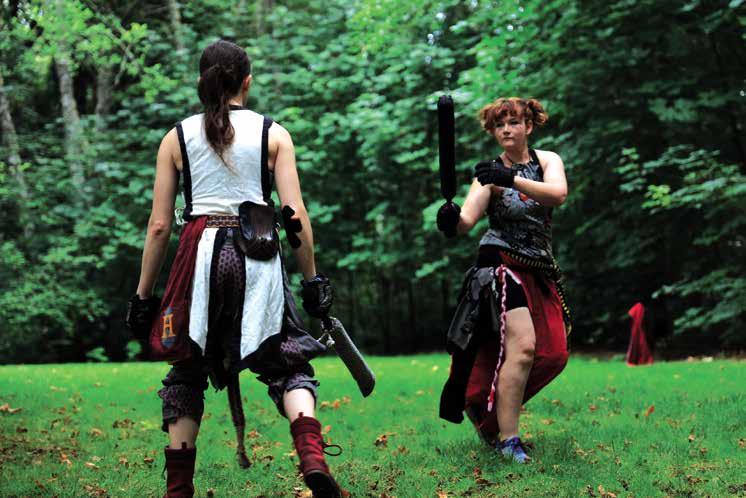
Amtgard puts realism aside and includes rules for players to act out a “class,” a medieval fantasy archetype with unique combat abilities.
Dungeons & Dragons movie, where they and other Amtgardians handed out information in costume.
Side by side, the stories of Stoat and Kodiak give a good sense of how differently Amtgard can be approached and yet enjoyed all the same. Stoat started out as a monk, a class known for its simplicity, since she wanted to jump right in and start whacking.
Kodiak applied their administrative skills to playing as a spell caster, which
involves reciting specific incantations quickly and accurately while still avoiding attacks. Including magic in the rules has meant that Amtgardians don’t have to be fantastically athletic to have an edge in combat, Stoat explained, though good cardio certainly helps.
During battlegames that use the class system, “regardless of where your strengths are, you can play a spell caster, and most of that is about learning and memorizing rules and
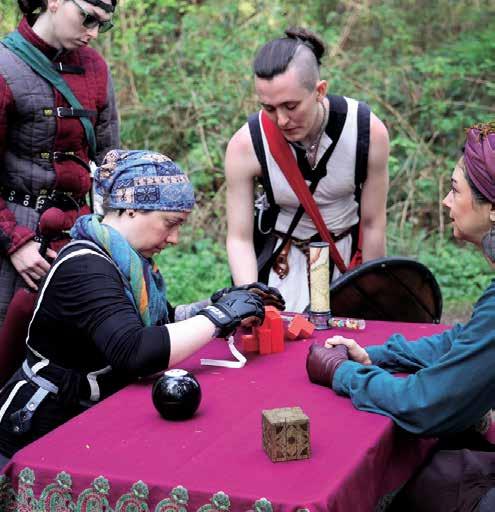
stuff,” Stoat said. “Or you can play an archer, which is a completely different playstyle.”
The opposite of gatekeeping
Most Amtgardians are eager to teach new players, and that applies to the battlegame rules as much as crafting weapons, armor, and outfits.
One could always commission a premium foam weapon, but “you’re just as good off having a player help you make one,” Kodiak said. “I was gifted a lot of my stuff. The quiver that Stoat uses is a quiver that was gifted to me.”
“Amtgardians tend to be pretty generous,” Stoat said. “They’ll help you make your first sword, or help you make your first tunic.”
More than that, “through Amtgard, you can get mastery in a trade skill for free,” Stoat said. “Specifically leatherworking and sewing are two giant pillars of this game.”
Yet for newbies, whether they’re interested in the swords, the sorcery, or the smithing, the hobby can still be pretty intimidating.
“I think an Amtgard battlegame is probably one of the most complex social situations I’ve ever witnessed or encountered,” Stoat said. “It’s dozens and dozens of people all playing by the same rule book and resolving all these mechanical interactions with each other constantly.”
Reading that might not help, but there’s a big reason that play-fighting at that scale works: people aren’t taking it too seriously.
“You can be a total goober,” Stoat said. “There was someone whose name was Render, and they wanted to become a knight, so when they became a knight, their name would be Sir Render.”
“All my titles are based off of bears for a reason,” Kodiak added.
Another player had a foam sword styled like a giant salmon.
Currently, the Kingdom of the Northern Lights is holding a friendly competition called Spring Muster, to see which chapters can recruit the most players.
So far, to Kodiak, the numbers are looking promising. “Specifically at my park, half of us that are coming out regularly are newer than I am. So I feel a little bit more optimistic that people are coming and that we’re gonna get up to duchy numbers next year.”
You can find your nearest Amtgard park and more info on the Kingdom of Northern Lights at https://amtgardnorthernlights.org.
Amtgardians participating in a quest – Photo by Jamie Velandra
Two Amtgardians square off at a tournament – Photo by Jamie Velandra

CAMP
continued from cover
MoPOP is running three summer camps, and two are already sold out. “Rock ‘n’ Rolling Camp” and “Fantasy STEAM Explorers Camp” have filled up fast, but “Drag-tastic: The Art of Drag Camp” is still open for registration.
MoPOP’s summer camp page states, “Calling all future kings and queens! Explore self-expression in MoPOP’s dragtastic summer camp! Led by Seattle performer Joshua Hancock, you’ll investigate drag history and work together with local artists to create your own personas.”
The camp is five days of kids choosing names, exploring hair and makeup techniques, and developing their character’s stage presence, all culminating in a celebration of their newly created drag personas in a private showcase.
There are two options for scheduling, with the camp being held on July 24–28 and August 7-11. Children and teens aged 12–18 are welcome to join the fun. Tuition, if one registers before May 31, will cost $380; after that, it will be $400. A $25 discount is available to any MoPOP members registering for the camp.
Hancock has worked in theater, burlesque, and drag for 30 years. They have a master of arts from Texas Women’s University in theater. Their drag persona, Deanna Parton, is based on the popular Star Trek character Commander Deanna Troi mixed with the iconic superstar Dolly Parton. Hancock uses Deanna Parton’s voice to “spread love and open minds.” They believe that “drag is for everyone… it is more than one thing, and can be used to heal and to bring joy, sadness, and love to people.”
Hancock added, “I am so grateful for MoPOP to have the vision and trust to allow me to teach this art form to kids. I am so proud of these kids, and so grateful, because if I had something like this camp, it would have helped me to feel seen, appreciated, and loved. I am forever changed seeing the love these kids have and the need for them to have this in their lives.”
This isn’t Drag-tastic’s first run. As a

“I am so proud of these kids, and so grateful, because if I had something like this camp, it would have helped me to feel seen, appreciated, and loved.”
MoPOP spokesperson stated last year, “We celebrate creativity with all members of our community as a core part of our mis-
sion. Like any other arts enrichment program, we are proud to offer an opportunity for young people to use drag to explore
self-expression through creating characters and performances that express and uplift their unique identities.”
This summer camp is an excellent opportunity for young creatives to learn from experienced, educated performers in a supportive environment. So if you’re a parent or guardian ramping up your summer planning and your child has expressed interest in exploring this art form, this summer camp is highly recommended. Please don’t wait until it’s sold out. Register now and give your kid a chance to learn how dragtastic a summer camp can be.
Find out more at https://www.mopop. org/programs-plus-education/education/ summer-camps.
Photos courtesy of Museum of Pop Culture
Arts & Entertainment
Taproot Theatre celebrates annual gala


by Ry Armstrong Special to the SGN
On Saturday, April 1, 2023, the Taproot Theatre Company held its annual gala at the Triple Door in downtown Seattle. The experience was unusual in that so many theatrical patrons have not been together like this for some time, due to the pandemic.
Moreover, what felt like an April Fool’s joke was that two other large institutions (Seattle Rep and Seattle Town Hall) had their gala events that same night. Talk about the siloed nature of the arts community in Seattle, as you would think they would have coordinated this to make sure they could maximize their individual fundraising efforts. But perhaps there really are that many wealthy people in Seattle, and if
so, let’s go full throttle into supporting our creative economy right away!
As a person who wears heels to most fancy events, it was quite the juxtaposition to be wandering around in purple wedges and an orange kaftan at an event made up of an audience of mostly privileged, religious, white patrons. In contrast, the diversity represented on stage during the theatrical programming was actually quite refreshing.
The regal nature of the venue was also in contrast with the geeked-out Star Trek theme of the entertainment — hence the evening’s title: “Boldly Go.” To a queer person, the latter was actually artistically fulfilling, if not hilarious, due to the great performances by the actors, despite the audio feedback issues present throughout the program.
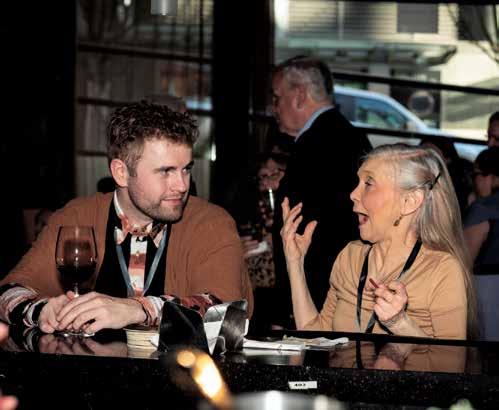
Among some of the esteemed guests present at the gala were Scott Nolte, the emeritus producing artistic director, and Barbara Callander, a Western principal councilor for Actor’s Equity Association, the union of stage actors and stage managers. The evening was sponsored by National Christian Foundation Northwest and the Beneficial State Bank.
It was very clear that the passion and love for this art form was extremely present among those who attended, which seems to be due to the outstanding leadership of Karen Lund, who took over as artistic director right before the pandemic in 2020.
Lund stated, in jest, that her taking over the reins was “the most elaborate and well-constructed dirty trick played on anyone ever.”
Without Lund, this institution might not
have made it through to the other side of COVID-19, and so as a community, we can say a bold thank-you to her for taking on the burden that she dutifully accepted of making sure this theater still exists.
It seems that this professional theater will be around for quite some time, making incredible productions and robust educational programming for not only the Greenwood area but the entirety of the Pacific Northwest.
If you would like to watch the livestream of the event, go to https://www.youtube. com/@TaprootTheatreCo. Taproot Theatre Company, founded in 1976, is located at 204-212 N 85th St., Seattle, WA 98103. To donate, visit https://www.taproottheatre. org/donate.
Photos courtesy of Taproot Theatre
Like Mike in his prime, Affleck’s Air soars Film
by Sara Michelle Fetters
SGN Staff Writer
AIR
Theaters
The first thing to know about director Ben Affleck’s Air is that you are watching a bigger commercial for Nike than any currently airing. The second is that the film goes out of its way to celebrate Nike founder and CEO Phil Knight in a manner that feels more like hero worship than anything incisive or observationally poignant. The third is that the narrative revolves entirely around a shoe endorsement contract and is an ode to capitalism in all its guises.
But the most important item, the one that the majority of the audience will care about? Air is phenomenally entertaining. Heck, some might even call it a slam dunk.
While I wouldn’t go quite that far, I will say that Affleck’s latest is a characterdriven winner that scores a cinematic triple-double: It’s very funny, it’s emotionally honest, and, most of all, it refuses to overstay its welcome and knows just when to wrap things up.
It is 1984. Nike’s basketball division is an industry joke that resides in the deep, dark recesses of Adidas’s and Converse’s massive shadows. Basketball expert Sonny Vaccaro (Matt Damon) was brought in personally by Phil Knight (Affleck) to work alongside VP of Marketing Rob Strasser (Jason Bateman) and executive Howard White (Chris Tucker), since things have been going poorly for years now. Unless sales increase, the Nike board of directors is strongly considering shutting the entire basketball division down.
Sonny has had enough. Nike isn’t giving him or the team enough money to attract top talent. They’ve done a poor job of selling themselves as a top-flight provider of basketball gear. The board keeps them all working with one arm metaphorically tied behind their backs, and as much as Sonny loves Phil and would do almost anything for him, he’s also starting to believe that the CEO has lost the fearless risk-taking determination that helped make Nike one of the world’s largest athletic shoe companies.
What follows is Sonny’s courtship of Chicago Bulls rookie Michael Jordan, the third pick in that year’s draft and a die-hard Adidas fan. He risks everything he has — and inad-
vertently the careers of everyone in the Nike basketball division — on signing a contract with an unknown and untested player, but one he is certain will turn out to be among the best the NBA has ever seen. Sonny does this by persuading the one person he’s certain can convince Michael to listen to his team’s pitch: Jordan’s mother Delores (Viola Davis).
Although portions are clearly improvised by the talented ensemble, Alex Convery’s intelligently witty script is masterfully constructed. Each piece fits snugly together with its immediate counterpart. Elements that are foreshadowed are elegantly paid off later on. Every character, no matter how seemingly insignificant, has shading, layers, and attributes that allow them to exist as if they were sitting in the theater with everyone else. There’s poetry to the way he’s taken this true(ish) story and made it sing, and much like Moneyball or The Social Network, this is a ticking-clock corporate roller coaster worth buying a ticket to ride.
This is Damon’s best performance since 2009’s The Informant!, and his lively pugnaciousness is instantly endearing. Rumor is Michael Jordan himself urged Affleck to go after Davis to portray his mother — and
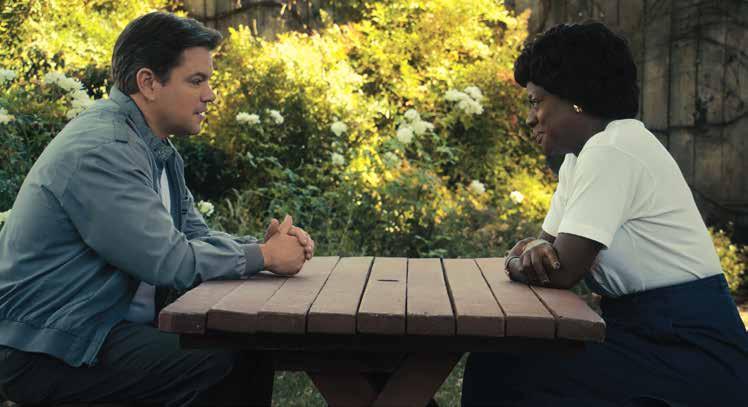
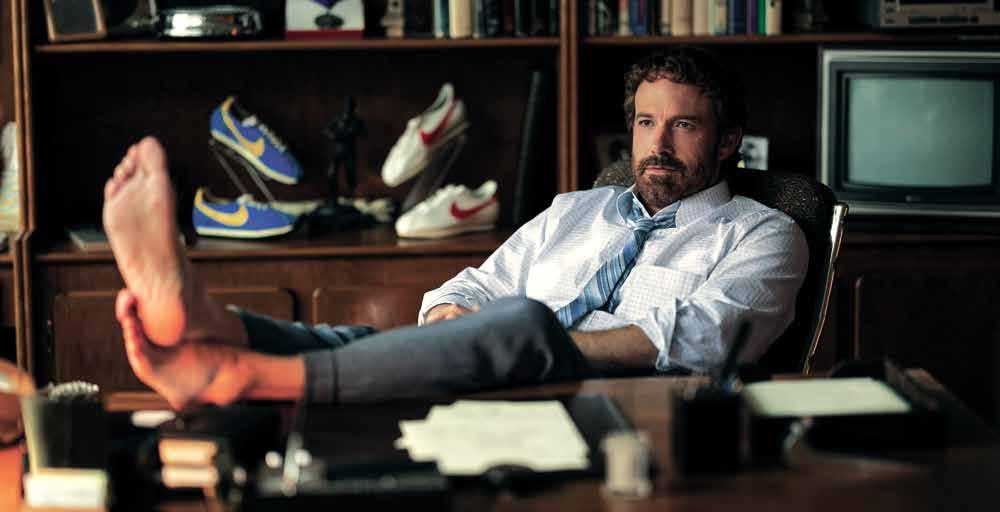
who am I to argue with his good sense? Anyhow, she’s unsurprisingly superb. Bateman is excellent, and Tucker delivers a knock-out reminder as to how easily he can balance humor and drama when suitably challenged to do so. As for Affleck, he’s dynamite as Phil Knight, so effortlessly slipping into the Nike founder’s iconic sneakers, it’s almost as if he’s been training to wear them for his entire career.
But as wonderful as Affleck the actor is, it’s his direction that’s the MVP element. He may have won a Best Picture Academy Award for Argo and knocked a lot of socks off with his debut, Gone Baby Gone, but it is his dexterous handling of this material I find especially impressive. There’s not an ounce of fat on this film’s physique, and Affleck keeps the pace moving even though everything that’s happening is entirely driven by the dialogue.
The soundtrack overflows in pop, rock, and electronic classics from the era (choice cuts from Dire Straits, Tangerine Dream, and Harold Faltermeyer are especially well utilized), but the sheer volume of needle drops does become a tad exhausting after a while. Cinematographer Robert Richardson may be an industry legend (he has three Oscars on his mantel, for JFK, The Aviator, and Hugo, for good reason), but there is still a drab visual flatness to this film that I sadly admit I did not find particularly appealing.
Thankfully, Zero Dark Thirty editor William Goldenberg’s hands are all over this production, and the Academy Award winner executes with exhilarating precision. There’s also the meticulously livedin production design by François Audouy (Ford v Ferrari ) and the authentically relaxed clothes by costume designer Charlese Antoinette Jones (Judas and the Black Messiah). All the little details border on perfection, and Affleck’s handling of the majority of the technical aspects is beyond reproach.
Air may not soar to the same stratospheric heights that Jordan did during his illustrious Hall of Fame career, but that does not make the film anything close to a misfire. It may not be a jumper from the top of the key as time runs out to be talked about in hushed tones and replayed over and over again forever, but that doesn’t make this victory any less remarkable. Affleck’s latest saunters into the tunnel a champion and, ultimately, that’s what matters.
Ben Affleck in Air – Photo courtesy of Amazon Studios
Matt Damon and Viola Davis in Air – Photo courtesy of Amazon Studios




Cage’s operatic splendor makes Renfield a debauched, blood-soaked comedic feast
by Sara Michelle Fetters SGN Staff Writer
RENFIELD Theaters
The exuberantly gory Renfield from Chris McKay (The Tomorrow War) reminded me a heck of a lot of Wes Craven’s 1995 endeavor, Vampire in Brooklyn, starring Eddie Murphy and Angela Bassett. However, unlike that sadly underwhelming curiosity, this horror-action comedy actually works, pulling from a variety of influences, ranging from classic Universal monster movies and Hammer’s Christopher Lee vampire yarns to 1970s urban crime thrillers and popular EC Comics series like Tales from the Crypt
It helps that McKay’s latest doesn’t have nearly as many cooks working in its kitchen. Robert Kirkman’s original idea is cleverly expanded on and playfully fleshed out by screenwriter Ryan Ridley. Star Nicolas Cage is content to gobble up the scenery with his larger-than-life performance yet still confident enough to play second fiddle to co-stars Nicholas Hoult, Awkwafina, and Shohreh Aghdashloo. McKay doesn’t overplay his hand, delivering a handful of wacky, blood-soaked action sequences that feature crack stunt choreography, superb practical makeup effects, and crackerjack editing courtesy of Ryan Folsey, Giancarlo Ganziano, and Mako Kamitsuna.
That’s not to say it’s entirely seamless or that all the elements work in harmony. Much like Craven’s effort, the horror and the comedy are not always in complementary balance. Some of the jokes fall oddly flat, while Hoult’s therapeutic voiceover aimlessly explains what’s going on instead of supplying insight, context, or amusingly self-reflective commentary on the violent and nasty action. A few potentially riotous gags are winningly set up — only to frustratingly never pay off, making me wonder if a few key scenes were left on the cutting room floor to try and keep the running time to a brisk 93 minutes.
But where Vampire in Brooklyn wasted a superior performance by Bassett and shockingly never allowed Murphy to fully transform into a demonic force of evil, that is not the case with Renfield. Hoult is positively delightful. I love how he appears to be combining quirks and traits from some of his previous roles in features as diverse as Warm Bodies, The Favourite, and even Mad Max: Fury Road. As the title character, Hoult’s jittery, insecure physicality gives way to a dynamic athleticism every time Renfield eats a bug, and somehow he makes this transformation feel unconventionally unique.
Awkwafina is in fine comedic form as a determined New Orleans cop who stumbles into a supernatural situation far outside the norm, while Aghdashloo is a fiery sensation as the leader of a massive crime syndicate who has the majority of the city’s police force on her payroll. Most of the action scenes are staged with inventive flair, with one gigantic battle — drowning in blood and soaring in brutally pulverizing imagination — set on the outside staircase of a three-story apartment complex.
But this is Cage’s showcase, and he more than makes the most of it. After returning to freewheeling, unconventional form in a series of idiosyncratic sensations, such as Joe, Mom and Dad, Mandy, Color Out of Space, Pig, and The Unbearable Weight of Massive Talent, it was only a matter of time before a director took the actor off the leash entirely. Cage’s Dracula is a viciously evil egotist who slits throats with playful indifference and slaughters innocents with carnally voracious elation. It’s a marvelous display of venal depravity, and I can’t help but think both Bela Lugosi and Christopher Lee would heartily approve as the actor
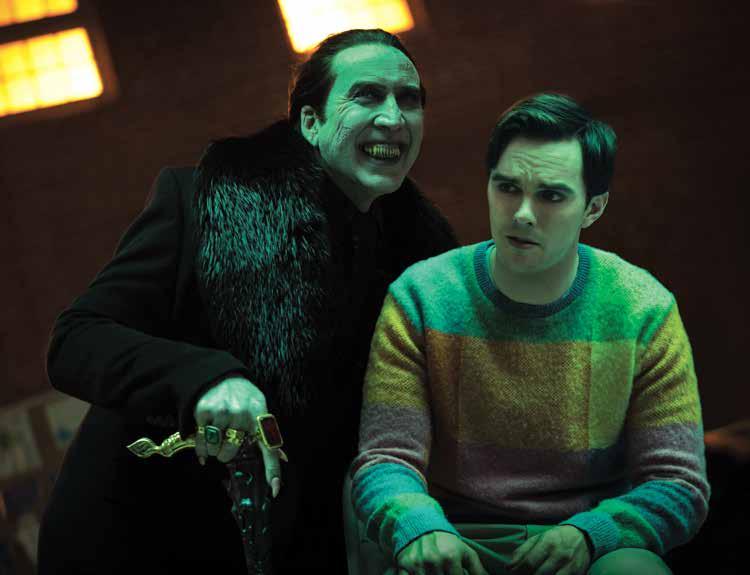
pays homage to each of them while also making author Bram Stoker’s iconic character distinctively his own.
There’s not a lot to say about the plot. It’s a lot of dopy hokum, but I’m fairly certain that’s by design. The basics are that, after more than a century of being Dracula’s devoted, bug-eating lackey, Renfield is beginning to wonder if he’s had enough. After attending weekly meetings at a support group for people looking to get out of toxic relationships, the frazzled lawyer-turned-minion has concluded it’s time he stepped out of his master’s vampiric shadow.
Ridley’s screenplay is more contrived than that simplistic synopsis, of course, but not by as much as early scenes may lead audience members to believe. Instead, McKay toys around with filmmaking styles ranging from Tod Browning’s gothic framing of 1931’s Dracula to the more colorfully sensationalistic rendering of the character and his environments found in the Christopher Lee Hammer films released between 1958 and 1973. He mixes in action sequences reminiscent of Hong Kong staples from the likes of Jackie Chan, Sammo Hung, and Corey Yeun, while also trying to channel his inner
Evil Dead –era Sam Raimi along the way. Renfield is hardly perfect, and there were times where my mind did wander and I began to think the film was going to stumble past the point of recovery. But there is so much fun to be had that these moments of imbalance never caused my affections to significantly deteriorate. Besides, Cage’s Wagnerian theatricality as Dracula is enough to warrant the ticket price all by itself. Watching him sink his teeth into this nonsense with such malevolent relish is a deliciously debauched feast worth gorging on.
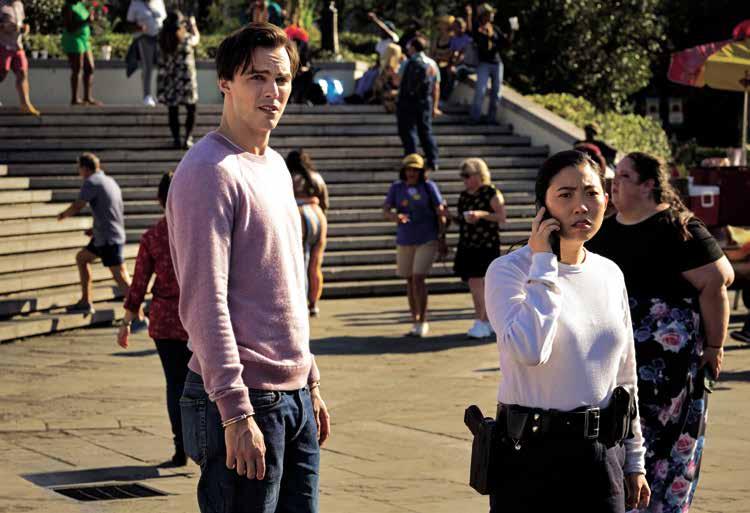
Nicholas Hoult and Awkwafina in Renfield – Photo courtesy of Universal Pictures
Nicolas Cage and Nicholas Hoult in Renfield – Photo courtesy of Universal Pictures
Books
Thriller author Jay Lang keeps readers in suspense

by Lindsey Anderson
SGN Staff Writer
In just a few short years, Jay Lang went from being a university student to a published author, with nearly a dozen books on the market.
Despite pumping out novel after novel, Lang initially did not see herself becoming an author. She returned to university later in life and took creative writing classes to fulfill the required credits.
“I was taking a summer credits course… in children’s lit. I had to write these silly stories, so I did, and the professor was like, ‘Oh my goodness, you’ve got quite a knack for this,’” Lang recalled. “She said, ‘You should look into writing,’ and I thought, ‘I do not want to be a writer. There is nothing in me that wants to sit and write.’ And then the next professor — the same thing. It just went on from there.”
Honest portrayal of Queer identities
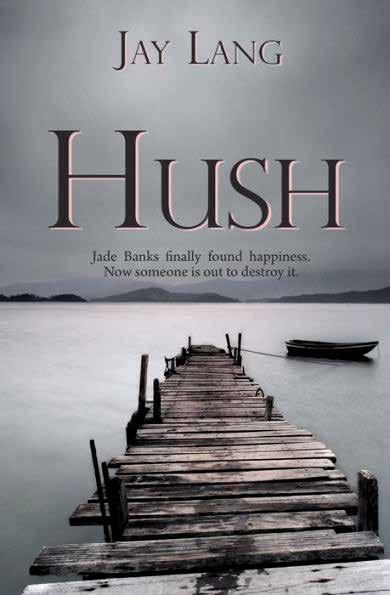
Inspired by the encouragement of her professors, Lang decided to give writing a shot. In 2020 she published her first novel, Hush, a psychological thriller with a Queer female lead. Lang was encouraged to include LGBTQ+ characters in her stories by a grant from the Canadian government, which provides funding to publishing houses that release diverse stories.
“I am Bisexual, and I have a lot of
friends and family who are Queer, so it was easy [to write about],” Lang said. She felt that Canadian fiction needed more LGBTQ+ representation, and that her identity and connections to the community put her in a position to provide it.
After sending out her first book, Lang immediately received praise for her Lesbian protagonist. Her story editor wrote back to her after reading her draft to share how important seeing Queer identities was.
“She said, ‘I just wanted to thank you for writing something that portrayed Lesbians in a very realistic and respectable way.’
I felt like maybe I’m doing something honest and good. It gave me more energy,” Lang recalled.
Nonstop
Since 2020, Lang has published ten fulllength novels and has two more on the way.
To keep up with the demand, she sticks to a rigorous writing schedule, which she jokes has left her with no social life.
“I do two weeks of outline and research for every book. I’d say it takes me about six weeks. I have a word quota I do every day, about 2,000-3,000 a day. That’s my process,” she explained.
While she spends most of her time writing, Lang genuinely enjoys her work. “It sounds clichéd, and they say books are a great escape, but honestly, if I’m having stress or
“[My story editor] said, ‘I just wanted to thank you for writing something that portrayed Lesbians in a very realistic and respectable way.’ I felt like maybe I’m doing something honest and good.”
normal life stuff, it’s a great therapy for me. It’s the best therapy I’ve ever had. It helps me disengage from the rhetoric that’s on us every day,” she said.
Writing may be an escape for Lang, but when she gets into the headspace to create a new novel, she enters a world far from fantasy. “I must have this thing in the back of my head that’s kind of [messed up],” she said with a laugh. “I don’t watch scary stories. I’m scared of everything, but there’s all this [dark] stuff in my head. It’s like these intricate, strange, weird dark stories that I have in there.”
Her characters, settings, and backstories usually come from everyday things Lang encounters,, but the dark twists and turns all arise deep within the confines of her imagination.
“As disturbing as this is going to sound, this crap is in my head. I’ll start writing and go, ‘Ahh, this stuff is in my head!?’ Oh my god. It’s based on my fears or my nightmares or things that would scare me.”
see LANG page 14
Jay Lang – Photo courtesy of the author
Books
Black and white and read all over (or it should be)
Two books about local newspapers
by Terri Schlichenmeyer Special to the SGN
BEACONS IN THE DARKNESS
DAVE HOEKSTRA
© 2022 Agate Publishing
$18.99
287 pages
AMERICAN DEADLINE: REPORTING FROM FOUR NEWS-STARVED TOWNS IN THE TRUMP ERA
GREG GLASSNER, CHARLES RICHARDSON, SANDRA SANCHEZ, AND JASON TOGYER
© 2023 Columbia University Press
$30.00
301 pages
It’s no secret that newspapers struggle today, as they have since long before the pandemic. Years ago, large corporations gobbled up small newspapers and gutted their staffs, and newsrooms were decimated by consolidation and buyouts. In Beacons in the Darkness, author Dave Hoekstra says that family-owned papers and independent publishers were sent “racing to the exit sign,” and as advertising fell and page-counts were slashed, some areas were left entirely without a newspaper. This, Hoekstra indicates, is a problem for small towns.
“The quality of the life of the community,” he says, “can be directly affected by the level of involvement by the newspaper.” Locally owned newspapers “embed them-
LANG
continued from page 13
Real-life reflections
Like any great writer, Lang also likes to reflect on real-life issues in her work.
“In every one of my books, I try to have a theme of something going on in society, maybe an adverse thing, like drugs, alcohol, abuse, mental illness,” she explained. “[My latest book] encompasses many of those things in one story, so it’s a challenge, but it’s my favorite book so far, because it had so many puzzle pieces.”
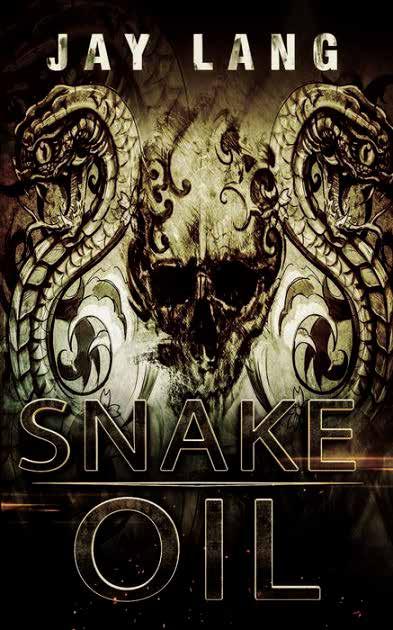
This story, Snake Oil, came to Lang one afternoon when she drove past a homeless encampment on the side of the road. “They have tent cities and all the homeless, young people that have drug issues. It’s clear they have mental illnesses, and it’s really sad,” she said. She spent a lot of time thinking about the young people living in the tent cities and started to draw comparisons between them and the kids she attends university with.
Because all her books draw on reallife issues, Lang spends quite a bit of time researching before writing. Through her research, she learned about forensics, police departments, and human psychology. Some of what she found has truly shocked her.
“It’s morbid, but I didn’t realize how volatile we are as human beings, and how many ways there are to kill people. It’s opened up my spectrum. You can see how these people are doing it, and that’s been interesting,” she said.
Hope and empathy
Lang wants readers to take away a sense of hope from her books, despite how dark they may be. By telling stories about LGBTQ+ people who get wrapped up in crazy encounters, she hopes her fans can strengthen their ability for empathy.
“I hope, after reading one of my books, people have a broader interpretation of another perspective instead of seeing things in black and white. We all have a pur-
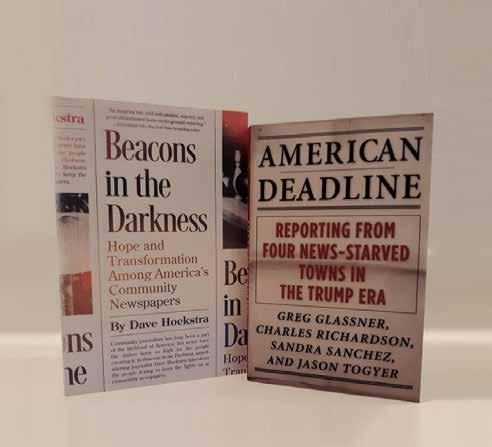
Photo by Terri Schlichenmeyer
selves into community.” They hold the history of people and the things they care about, they serve as watchdogs for local government, dig for stories that need daylight, and employ your neighbors.
To do this, they need flexibility. Today’s newspapers may go all-digital, or become
print-digital hybrids. They may set up popup newsstands. Some assume nonprofit status; others reach for community involvement, and then keep doing what they do best: serve as the voice of the towns they’re in, and help to keep people informed on issues they need to know.
pose, and we all matter. I hope that they see someone going through one of these adversities [and understand] they’re just like us,” she said.
Lang doesn’t plan on slowing down anytime soon. She hopes to evoke Stephen King vibes with her latest novel, a historical fiction/suspense-thriller set in British Columbia. While readers wait for that book to hit shelves, they’ll still have plenty of shocking and twisted stories by Lang to read, all of which are available to purchase online.
This is particularly important, according to Greg Glassner, Charles Richardson, Sandra Sanchez, and Jason Togyer, in this time of political partisanship and division. In their new book, American Deadline, they tell the tales of four towns that lost their newspapers during the pandemic, and how this vanishing is a problem for everyone.
Without a local newspaper — the kind that reports not just on big stories but also about hometown people and events — there’s often a void left that diminishes important conversations about essential issues. It’s easy, with no local newspaper, for people to become unaware of what they need to know.
That’s especially dangerous when it comes to national news. Community newspapers thrive on reliability and reader trust. Without one in town, too many people may come to rely on unreliable sources for their news.
The four towns that serve as settings for this book are in the south and east; two lost their local newspapers entirely and two had vastly diminished staffs. This book, the stories in which made up an “experiment” in reporting, show how cities and towns suffered when several large news events happened and there was no one to record them.
Like any good feature story, these books are worth reading, because they serve to remind readers why their parents and grandparents supported local news. If you care about your community, it’s time you do, too.
“I hope, after reading one of my books, people have a broader interpretation of another perspective instead of seeing things in black and white.”
Images courtesy of BWL Publishing
for the ages
by Jack Hilovsky SGN Contributing Writer
A week ago, I received the message. His husband left word that my friend Gil had entered hospice with widespread metastatic cancer. The next day, Good Friday, Gil passed, a little after 9 p.m.
I guess I might have been prepared, as my friend was in his eighties. One year ago, he had suffered a fall and injuries related to it. But he had been on the mend, and his life in Palm Springs — well, his entire life — had been an active one.
Memories
I met Gil in my mid-twenties. I was moving into an old house in Madrona and preparing to start grad school. A petite man with an auburn beard, who often wore a bandanna around his head, rented a room. A former priest, he rode his bike around the city and cleaned houses for a living. At heart, he was a contemplative who had a magnificent way of listening and befriending people.
On a walk with him, we discovered a small Catholic church several blocks away from our house. When we passed by on Sundays, we heard the glorious sounds of a gospel choir. I ended up joining the church, singing in the choir, and dating one of the other choir members. It was a joyous time.
I only lived six months in the Madrona house before moving back to Capitol Hill, but Gil and I maintained a friendship. Both of us used bicycles to get around the city, so I benefited from his knowledge of the most gradual hills to take when navigating between Lake Washington, downtown Seattle, and the University District.
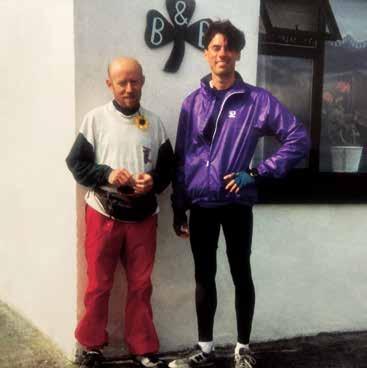
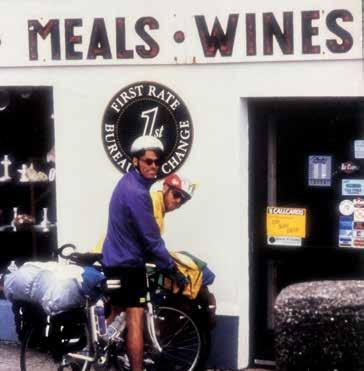
And when I finished my master’s, I invited him to join me on a bicycling adventure in Ireland to mark my 30th birthday. We flew to Dublin, our bicycles in tow, then hopped a train to Limerick and biked north along the western coast. We cycled along the Cliffs of Moher, stopped in Westport to visit the church where my maternal greatgrandparents were married before setting sail for America, delighted in the music and modernity of Galway, and sailed through the Aran Islands. On the way back from Connemara National Park, we visited a girl we met on the plane, who had invited us to stay with her and her family in Ballina. Her pa owned a fish-and-chips eatery, and we dined with them and stayed in their home.
That was 30 years ago this June. And it seems like a dream.
I never viewed my friend as an activist. And yet he possessed a strong sense of what was right and wrong. Maybe that was the priest in him. His anger at the church of John Paul II and Pope Benedict XVI for condemning the morality of LGBTQ+ people boiled under the surface. He and his husband were married in a University District Congregational church, and I attended the service. It was my first same-sex wedding before marriage equality became the
law of the land 15 years later (thank you, Supreme Court!).
In addition to bicycling, he was a runner. And a nudist! He invited me to my first Bare Buns run near Issaquah. I’ll never forget how nervous I was prior to the start of the race. Men and women without a stitch on, were racing through the woods, up and down hill and dale. It was a wonderful experience and so freeing.
Grief
Grief arises in a variety of ways. Sometimes you want to be alone; sometimes you want to be held. The tears may not come right away. Now it’s more like being hit with a stun gun.
It’s so true about that song, “You Don’t Know What You’ve Got Until It’s Gone.” I didn’t take for granted my friendship with Gil, but it just always seemed to be there. We last saw each other in April 2022. I had trav-
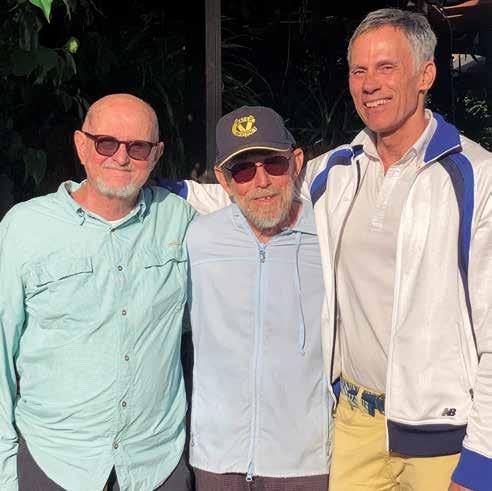
eled to Palm Springs with my significant other for IGLA, the LGBTQ+ international swim competition. We took Gil and his husband Mike out for a Mexican dinner one night. It was sunny, bright, and dry. The conversation was relaxed, and my companion and I talked about our upcoming trip to Spain and preparations to walk the Camino de Santiago. Gil was thrilled about our adventure.
Soon thereafter, he took his fall, but he followed our trek on social media. He said it inspired him during his long recovery, made him want to get up and walk again. My friend was a quiet, unassuming man, whom you may never have noticed in a crowd. He had a beautiful sense of humility, a striking contrast in these loud and often impolite times in which we live.
During a spring break visit to Palm Springs five years ago, I stayed with him and Mike during a particularly lonely time in my life.
As we were in the garage loading the car, preparing to depart for the airport, I broke down and wept, telling them they were like family to me. And from that time on, they became my “guncles,” my Gay uncles. We silently drove to the airport as I dried tears from my eyes. As I got out of the car, Gil embraced me and said, “You are always welcome here.”
That is the type of person my friend was. A welcoming soul who was a priest at heart despite rejecting the church that had turned him away. I am sure there are a pair of welcoming wings awaiting him in the afterlife. Shalom, sweet Gil. Your mission on earth is now complete.
Jack Hilovsky is an author, actor, and blogger who has made his home in Seattle since 1986. His first book RJ, Farrah and Me: A Young Man’s Gay Odyssey from the Inside Out, was published in June 2022. It can be found at Elliott Bay Book Co., Madison Books, Nook & Cranny, and University Bookstore, among other local booksellers.
Gil & Jack cycling in Ireland’s Aran Isles, June 1993
Jack & Gil on the road in Ireland, June 1993
Mike, Gil, and Jack in Palm Springs, April 2022
National News
Tennessee city OKs Pride Festival by one vote
“Community
decency” policy up for a vote soon
by Mike Andrew SGN Staff Writer
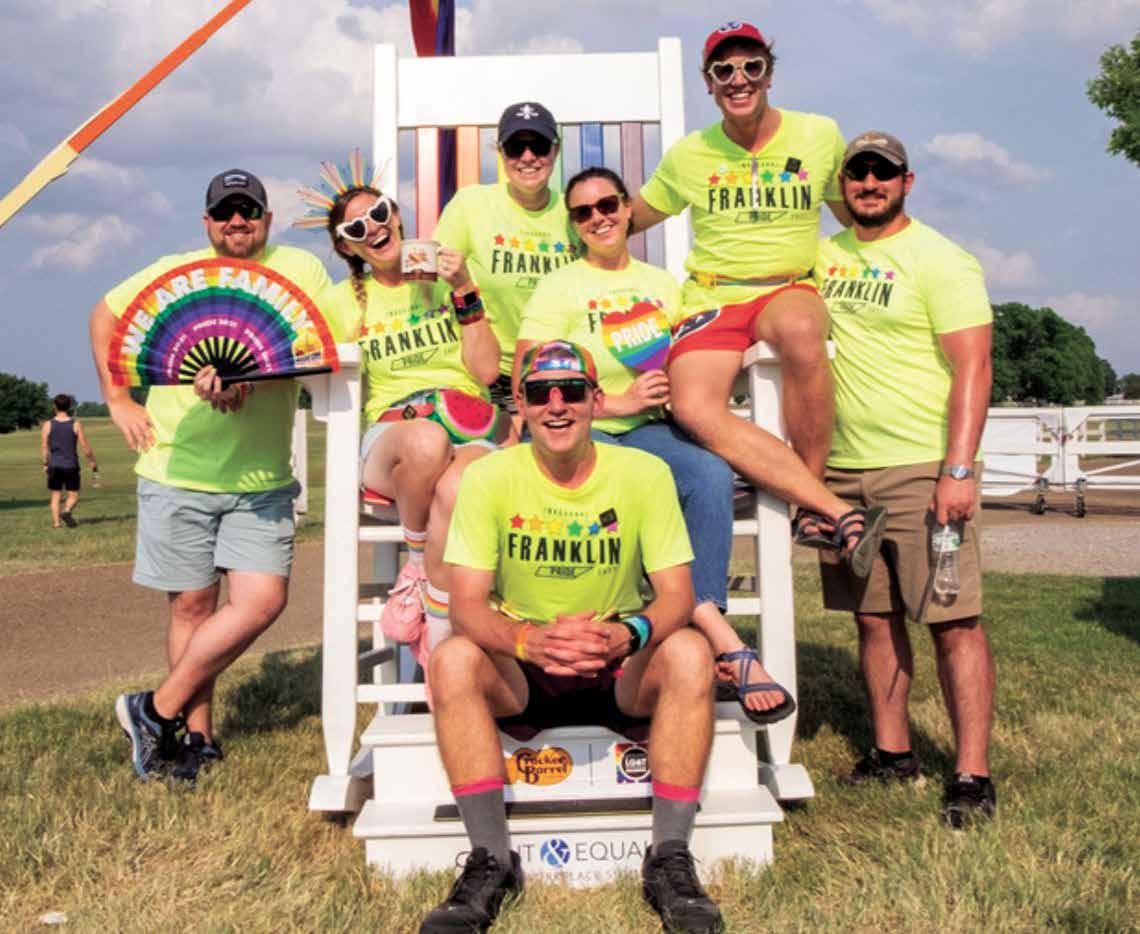
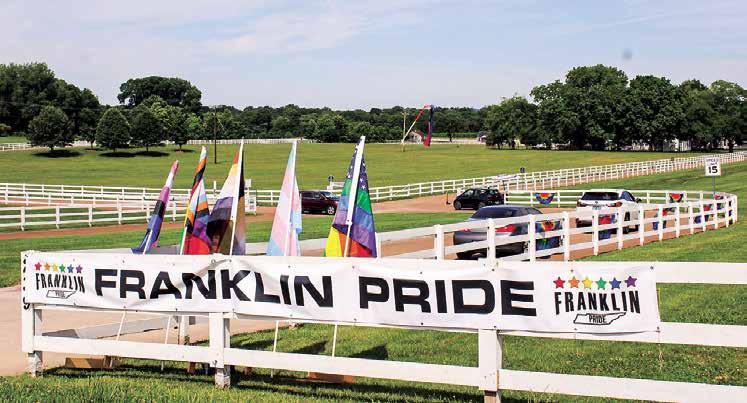
The City of Franklin, Tennessee, a suburb of Nashville, voted narrowly to reauthorize the annual Pride Festival. The April 11 vote of the city’s aldermen resulted in a 4-4 tie, with Mayor Ken Moore casting the deciding vote in favor of the festival.
Moore said he would approve the event because he wants to unite the community, but according to the local Fox affiliate, he warned Pride organizers that their festival “would be under a microscope.”
According to NBC News, “a handful of community members had pleaded with the Board of Mayor and Aldermen (BOMA) to block the event’s permit, claiming that Pride festivals are intended to ‘groom’ children.”
The festival president, Clayton Klutts, retorted that many of the festival’s detractors “were not in attendance” during last year’s event. Klutts added that “they have somehow reimagined it to be a very different event than what was actually held.”
“As you consider our application, I encourage you to listen to the voices of the people who were there and vote to approve our application,” Klutts told the city board.
The board also postponed a vote on a “community decency” policy that would prohibit “any act or conduct that is not consistent with generally accepted standards of behavior and conduct,” including a vaguely worded prohibition of “lewd or sexually suggestive behavior” and “excessive and offen-
sive intimate public displays of affection.”
Last month, the state of Tennessee enacted a new anti-drag law that restricts “adult cabaret performances” in public or in the presence of children, and bans them from occurring within 1,000 feet of schools, public parks, or places of worship. This was passed alongside separate leg-
islation that bans transgender minors in Tennessee from receiving gender-affirming care like puberty blockers, hormones, and surgery.
Those found violating the anti-drag law face misdemeanor charges in the first instance, punishable by a fine up to $2,500 and/or up to a year in jail. Subsequent viola-
tions incur a felony charge, punishable by up to six years in jail.
LGBTQ activists warned that the newly enacted state law and the Franklin city “decency” policy — if enacted — could be used to bar Transgender people from appearing in public spaces, or even to separate Trans parents from their own children.
Photos courtesy of Franklin Pride

FLORIDA
continued from cover
The bill will now go to the House, where it is almost certain to pass in the Republican-controlled chamber.
According to Florida Politics, the measure does not explicitly mention drag performances, but it does forbid “lewd conduct, or the lewd exposure of prosthetic or imitation genitals or breasts,” meant to appeal to “prurient, shameful, or morbid interests,” and displays that are patently offensive and “without serious literary,
National news highlights
by Daniel Lindsley
SGN Staff Writer
Supreme Court blocks West Virginia sports ban
On Thursday last week, the Supreme Court blocked West Virginia from enforcing its ban on Trans athletes participating in female sports teams in public schools, citing the fact that a lower court injunction against the ban will remain until litigation over a particular case ends.
That case might sound familiar. Twelveyear-old Trans girl Becky Pepper-Jackson sued the state over the ban in 2021 after she wasn’t allowed on her middle school’s cross-country and track teams. She and her mother Heather argued that the state has violated both Title IX and the 14th Amendment by discriminating against Becky on the basis of sex.
Republicans have not been happy. West Virginia officials, such as Attorney General Patrick Morrissey, appealed to “common sense” and “biological differences” to justify the law.
In a joint statement, the American Civil Liberty Union and Lambda Legal said, “This was a baseless and cruel effort to keep Becky from where she belongs — playing alongside her peers as a teammate and as a friend.
artistic, political, or scientific value for the age of the child present.”
The measure authorizes state officials of the Department of Business and Professional Regulation (DBPR) to suspend or revoke the liquor license of any establishment that admits minors to a live, adult performance.
A person who admits a child to such a performance, as the bill defines it, would face a first-degree misdemeanor, punishable by up to $1,000 in fines and up to a year in prison.
During a House committee hearing on the bill, Republican Rep. Webster Barnaby, a fundamentalist minister who has deliv-
ered benedictions for several Trump rallies, labeled Transgender people as “mutants, devils, and imps.”
“To have a lawmaker say something so vile and so hurtful and so painful about any group of people … I don’t go for that,” said Democratic Sen. Rosalind Osgood. Osgood indicated she had voted for the bill in committee but was changing her vote because she did not agree with anti-Trans bigotry.
Democratic Sen. Tina Polsky slammed the bill as “a waste of time” and the “height of hypocrisy” from a legislature that has passed numerous bills in the name of “parental rights.”
“Why does a person dressed in a costume of the other sex scare you so much?” she asked. The anti-Transgender movement exemplified in Rep. Barnaby’s speech could result in real harm, Polsky added.
“This bill feeds into that kind of dangerous rhetoric, and it will lead to violence,” she warned. “Here is yet another example of big government going too far to take away our freedom. There’s no other way to describe it.”
No Republican lawmaker other than the bill’s sponsor, Sen. Clay Yarborough, spoke in favor of the measure.

Conservative justices Samuel Alito and Clarence Thomas publicly dissented from the Supreme Court decision.
Teacher refuses students’ preferred pronouns, loses job
A 7th Circuit Court of Appeals ruled on Friday last week that an Indiana high school was within its rights when it allegedly forced music teacher John Kluge to
quit, after he refused to use students’ preferred names and pronouns. Kluge said doing so was against his Christian beliefs.
“The 7th Circuit’s ruling shows why the Supreme Court needs to fix the standard for accommodating religious employees,” said Rory Gray, Kluge’s lawyer from the conservative Christian legal group Alliance Defending Freedom.
At first, the school had allowed Kluge to
call students by their last names only, but when students and faculty complained, the district backpedaled.
“Kluge’s last-names-only practice stigmatized the Transgender students and caused them demonstrable emotional harm,” wrote Circuit Judge Ilana Rovner. The potential disruption of his conduct on students’ learning outweighed his religious beliefs.
Becky Pepper-Jackson – Photo courtesy of ACLU of West Virginia
Photo courtesy of Wynwood Pride
National/International News
MULVANEY
continued from cover
Within a day, singer and well-known gun enthusiast Kid Rock posted a response video on Instagram where he, while wearing a MAGA hat, takes a shotgun and blasts several cases of Bud Light to smithereens. He then turns to the camera, spewing several vitriolic words of outrage to the makers of Bud Light.
In support, country singer Travis Tritt announced from the stage during a performance that he was removing Bud Light’s signage and anything related to the brand from his concerts henceforth.
One TikTok posting featuring a couple pouring several cans of Bud Light down the drain and calling for a boycott racked up over a million views in one day. The call was echoed by several right-wing media outlets, such as the Washington Stand newspaper and the Rubin Report podcast.
Anheuser-Busch has, thus far, not addressed the backlash specifically. In a statement released to the media, the company said, “Anheuser-Busch works with hundreds of influencers across our brands as one of many ways to authentically connect with audiences across various demographics and passion points. From time to time, we produce unique commemorative cans for fans and for brand influencers, like Dylan Mulvaney. This commemorative can was a gift to celebrate a personal milestone and is not for sale to the general public.”
It is unlikely that the conservative back-
International news highlights
by Daniel Lindsley SGN Staff Writer
German soccer policy lets
Trans amateur players choose
This season the German football association DFB introduced a groundbreaking policy that allows Trans and Nonbinary players to choose between men’s and women’s teams in amateur and youth leagues.
DFB diversity ambassador Thomas Hitzlsperger said other football associations, like Scotland and Wales, had already reached out to learn more.
The policy had been in trials since 2019 and was implemented in 2022. Notably, it does not require Trans women to lower their testosterone levels to play on women’s teams.
“Football is for all, and we’ve got to make sure that everybody who wants to play football is allowed to play football,” Hitzlsperger told the BBC. He said that “it takes more than just being strong and fast, it takes skill and team effort to play football.”
Since she transitioned three years ago, German footballer Charlotte Jerke has played as a defender for DFC Kreuzberg in Berlin.
“This new rule was just totally necessary because it was like a big gray box,” she said. “No one knew where to put us, so now we know that we can decide.”
“I know there are critics, but I don’t think I have a physical advantage. I am not the fastest player, I am not the strongest player on my team. I wouldn’t play football if I didn’t have this team. I just feel so comfortable, so welcomed, so seen, and so appreciated.”
lash and calls for boycott will change the company’s pro-LGBT stance. Bud Light has partnered with the Gay & Lesbian Alliance Against Defamation for over 20 years. In 2019, the brand produced a special commemorative rainbow can in honor of International Pride, with $1 from each case sold donated to GLAAD.
Interestingly, many of those calling for a boycott of Bud Light have urged people to buy one of the beer’s competitors instead, such as Coors Light or Miller Lite. Ironically, both those brands have been staunch supporters of the LGBT community for years, annually running multiple ads celebrating Pride.
Mulvaney has worked with a number of major companies to promote their products, including Netflix, Kate Spade Fashions, Crest, InstaCart, and Hershey’s. The current controversy does not seem to be cooling her corporate appeal, as there have been no reports of any company backing out of an arrangement with the influencer. In fact, it was just recently announced that Nike has signed a deal with Mulvaney for her to promote its line of sports bras.
It must be said that social media has also been buzzing with shout-outs of support, including from some celebrities. Sammi Sweet from Jersey Shore tweeted to Mulvaney, “How awesome, cheers to you!” On Instagram, Paris Hilton posted a simple word of support: “Cheers!”
Mulvaney herself posted a muted response to the controversy, saying only that it was the support and encouragement of strangers on the street that helped give her the spirit to move on and get on with her life.


Award-winning UK indie mag closes doors
London-based independent magazine gal-dem is shutting down after publishing the art and writing of Queer, BIPOC, and neurodivergent youth for eight years.
The publication cited structural and financial difficulties as the primary reason for closure.
“There was always a delicate balance to strike in marrying our values, rooted in our beginnings as a volunteer-led organization, with profitability that was
Photo by Yossy Akinsanya
needed to sustain and reinvest in the business, all while delivering groundbreaking creative work that served our community with an organizational structure that works,” the staff said in a collective goodbye letter.
“It’s a balance we committed to navigating carefully and responsibly, and while we’re incredibly proud of the projects that we created, it also came with its own set of challenges.” gal-dem was founded in 2015 by London-born Liv Little. The magazine was popular enough that its first two issues
sold out. It saw its fair share of hardship over the years, such as in 2020, when it lost over three-quarters of its advertising revenue to the COVID-19 pandemic. Back then, it managed to come back from the brink.
“We want to wholeheartedly thank everyone who was been a part of this journey with us — whether you have been a reader from the beginning, a party-goer from our early days, or a more recent member,” the staff said.
Image courtesy of Dylan Mulvaney / Instagram



Episode 57: Michael Eichenbaum
Ash brings on anthropologist
Michael Eichenbaum in for a chat about Transphobia's roots in European colonialism. TikTok: @the_human_odyssey
WEEKLY! FIND US WHEREVER YOU LISTEN TO PODCASTS!