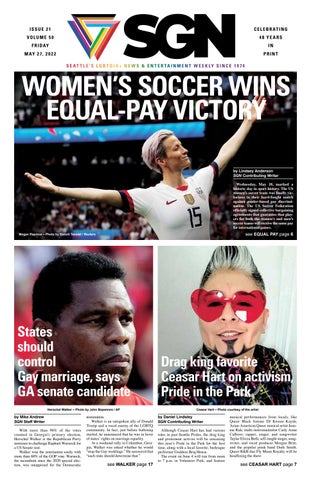
WOMEN’S SOCCER WINS EQUAL-PAY VICTORY
by Mike Andrew SGN Staff Writer
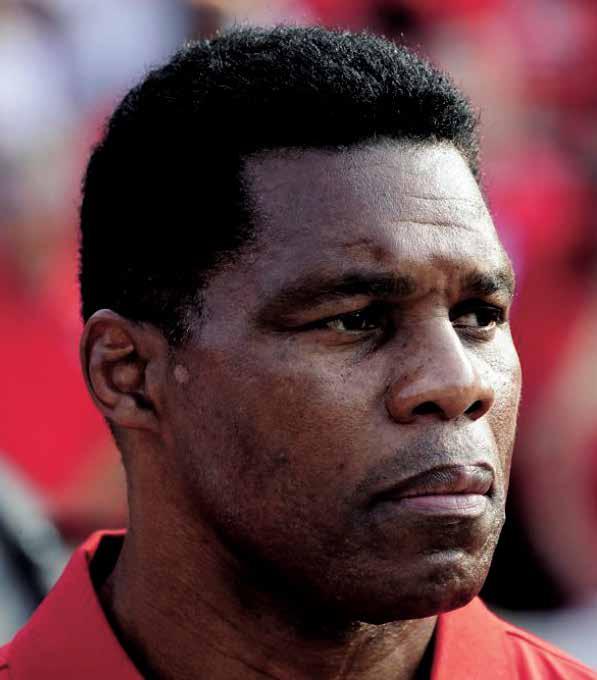
With more than 96% of the votes counted in Georgia’s primary election, Herschel Walker is the Republican Party nominee to challenge Raphael Warnock for a US Senate seat. Walker won the nomination easily with more than 68% of the GOP vote. Warnock, the incumbent since the 2020 special election, was unopposed for the Democratic nomination.
Walker is an outspoken ally of Donald Trump and a vocal enemy of the LGBTQ community. In fact, just before balloting started, he announced that he was in favor of states’ rights on marriage equality.
At a weekend rally in Columbus, Georgia, Walker was asked whether he would “stop the Gay weddings.” He answered that “each state should determine that.”
by Lindsey Anderson SGN Contributing Writer
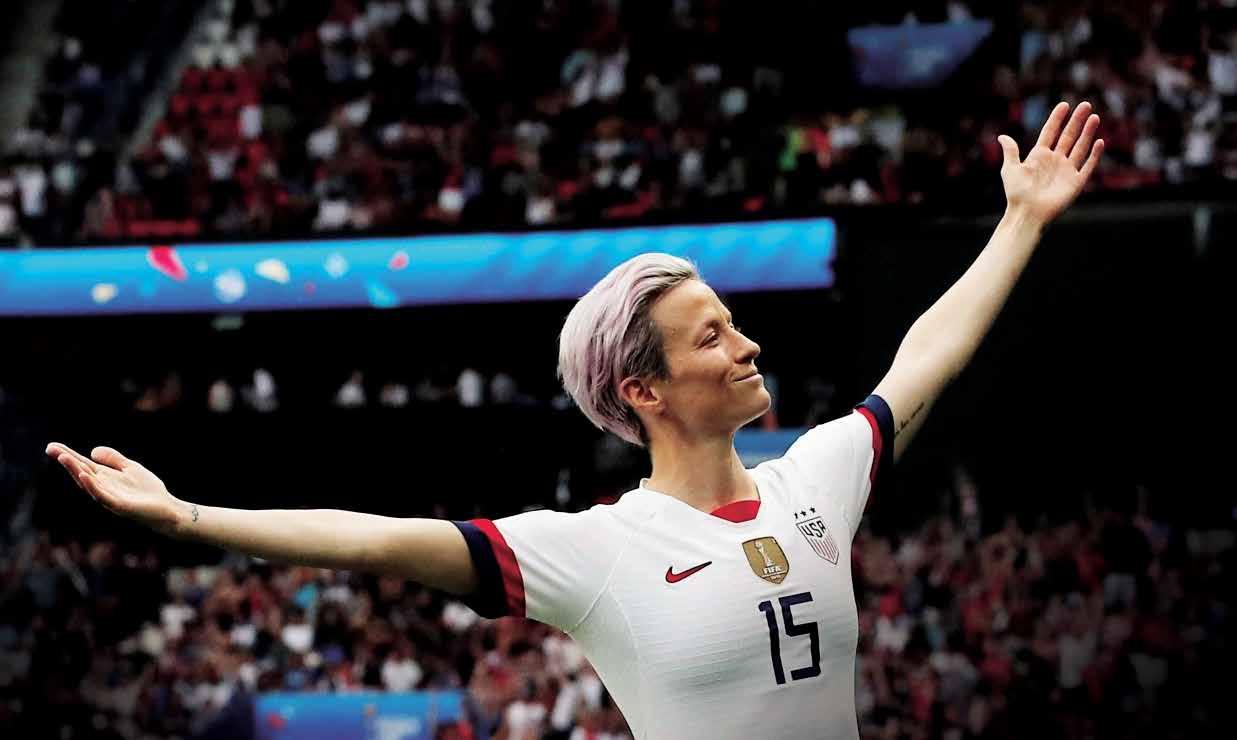
Wednesday, May 18, marked a historic day in sport history. The US women’s soccer team was finally victorious in their hard-fought match against gender-based pay discrimination. The US Soccer Federation officially signed collective bargaining agreements that guarantee that players for both the women’s and men’s soccer teams will receive the same pay for international games.
EQUAL PAY
6
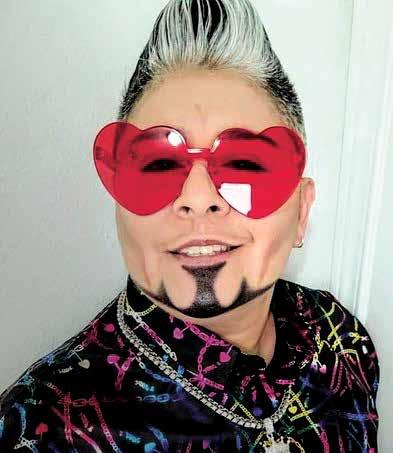
by Daniel Lindsley SGN Contributing Writer
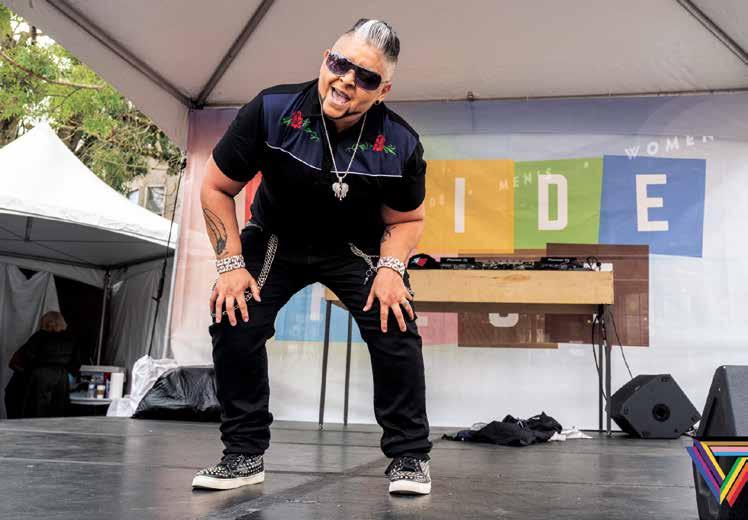
Although Ceasar Hart has had various roles in past Seattle Prides, the drag king and prominent activist will be emceeing this year’s Pride in the Park for the first time, along with a local favorite, burlesque performer Goddess Briq House. The event on June 4 will run from noon to 7 p.m. in Volunteer Park, and feature
musical performances from locals, like Queer Black femme DJ Kween Kaysh; Asian-American Queer musical artist Jeannie Rak; multi-instrumentalist Carly Anne Calbero; rapper, singer, and songwriter Taylar Elizza Beth; self-taught singer, songwriter, and vocal producer Morgan Britt; and the popular punk band Dark Smith. Queer R&B duo Fly Moon Royalty will be headlining the show.
see CEASAR HART page 7 see WALKER page 17









by Lindsey Anderson SGN Contributing Writer
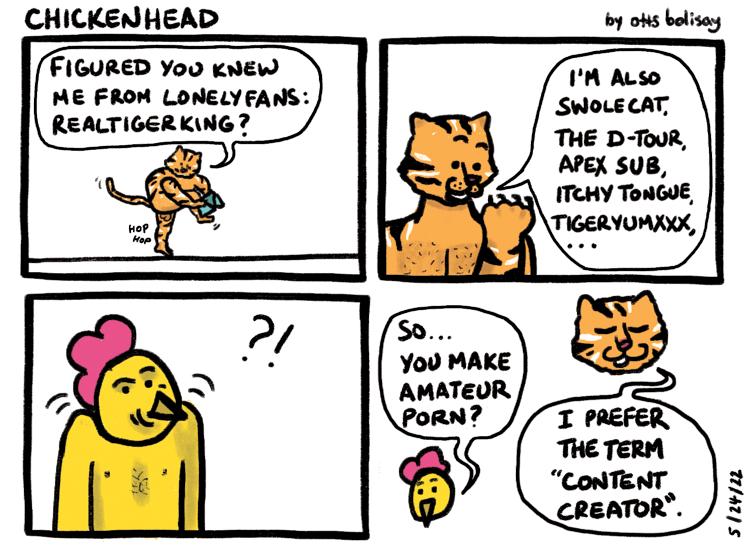
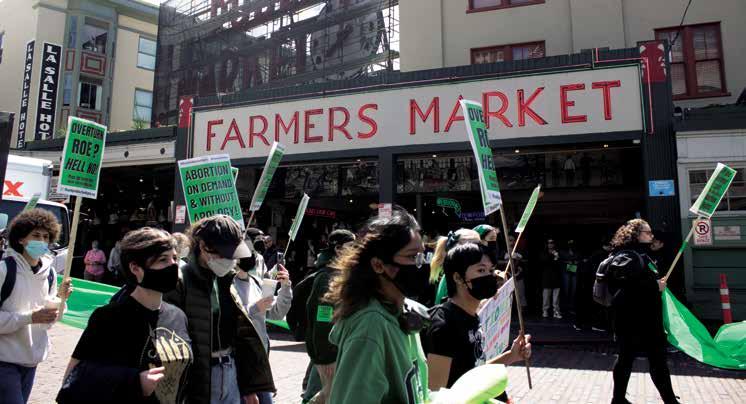
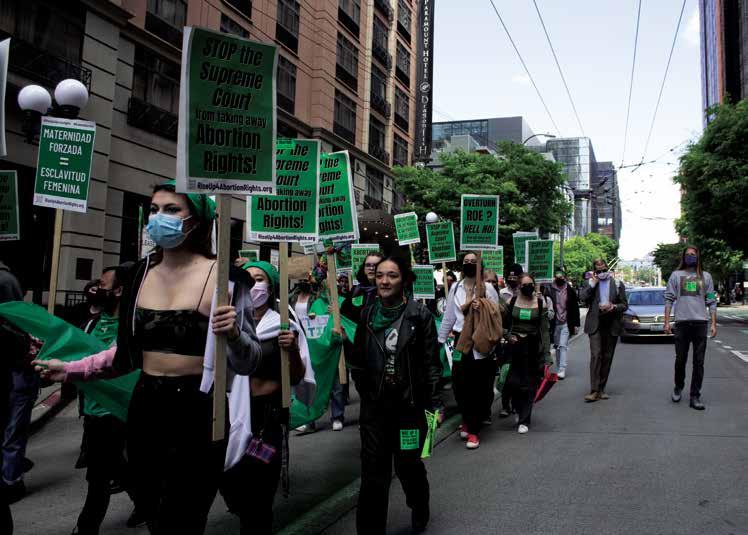
On Thursday, May 19, students from across Seattle walked out of school to support abortion rights. Donning green and taking to the streets, the protesters gathered in front of Seattle Central College on Capitol Hill before marching downtown and to Pike Place.
Rise Up 4 Abortion Rights organizer Margo Heights energized the crowd by reminding them of the importance of continued activism. “All of you are key to bringing forth those thousands and thousands of people who need to not just come out and protest on a Saturday, but need to keep coming back, disrupting business as usual, changing their schedules on a weekday, walking out of school, walking out of work, following the example that you are all setting today,” Heights said.
While Rise Up 4 Abortion Rights has been organizing monthly protests and walkouts, these events ramped up after Politico leaked Justice Samuel Alito’s draft decision reversing Roe v. Wade, the landmark 1973 decision that legalized abortion. Despite the draft indicating that Roe is soon to be no more, activists like Heights continue to remind the public that abortion is still legal, and that the decision to overturn the case will not go down without a fight.
“You are in the right place. You are among other people who have decided to stay in these streets and to stop the Supreme Court from decimating abortion rights, because this draft memo is not yet law,” Heights reminded the crowd. “Now is the time, in these weeks, to do everything we can to throw in, to make history.”
Students speak out
After she finished, Heights welcomed student activists and Megan, a leader from the University of Washington, to the stage. “I want to thank y’all for taking the time,” Megan started. “I know most of y’all have classes, skipped classes — you know I did — and I want to thank you for seeing the importance of being out in the streets.”
She mentioned the current baby formula shortage and how male government officials have been mishandling yet another women’s issue. “Government officials said we should resort to breastfeeding, and that kind of just illustrates how little they know about our bodies, because not all mothers are able to produce enough, or even any, breast milk,” she said.
After mentioning the crisis facing children in foster care, she continued: “These are just two examples of how the [term] ‘pro-life’ is such a lie, because if they are actually pro-life, we wouldn’t have to be here right now,” she declared to a chorus of cheers. “We wouldn’t have to fight for this protected right. If they’re actually prolife, they wouldn’t prioritize a fetus or an embryo over the life of a pregnant person. If they’re actually pro-life, they wouldn’t be focusing on this developing fetus… they would be focusing on the lives of the people who are already born, they would focus on human security, they would try to solve the cause of why women get abortions instead of banning abortion.”
After the speeches concluded, the students took to the streets with chants of “Reverse Roe? Hell no!”
Reasons for marching
Everyone in attendance had their reasons for marching. Some, like UW student Zoltin Wolfe, were there as allies. “I’m here because if you love women in your life, if you care about people who can give birth, you care about their health and safety, just like you’d care about anyone else’s health and safety who lives on earth, in my opinion. So I’m here to protect their rights from people that are huge pieces of shit,” he said.
“I’m here to support reproductive rights for all,” added ally Bob Thimbly, who showed up with two “protest dogs” decked out in green bandanas. “They’re protest dogs. They just like to come out and be around people, and I don’t know if they really understand, but they’re here to support.”
Some students had personal reasons to take to the streets. Aliyah, a student from the Seattle Academy of the Arts and Sciences, said, “I’m out marching today because women’s rights are important to me and my grandma. When she was younger, she got pregnant at a really young age and was forced to carry to full term, when she had a miscarriage. She had to give birth to a dead child. It’s important to me that women get the right healthcare.”
Some of the students at the march had been coming out week after week and rallying to bring in more activists from their campuses. “I’m here today because we cannot allow the Supreme Court to decimate our very minimal rights,” said Lizzie. “I am a student organizer at UW, so I’ve been out here for a while, and me and Megan, we’ve been working our asses off to get more people out here, so it’s so exciting to see people showing up.”
“I’m here because when I heard about the draft [decision] to overturn Roe, I felt hopeless,” student organizer Wednesday Sky said. “But it’s not hopeless, because it hasn’t been overturned yet, and it’s much harder to reinstate a right after it’s been taken away, so we have to speak up now and we have to do it loudly.”
The Green Wave Rise Up 4 Abortion Rights has adopted the color green to symbolize the fight against patriarchy and oppressive governmental systems that aim to take away reproductive rights. Organizers asked all who support the movement to wear green in solidarity, even if they were unable to walk out of work or school for the event.
“Only the people can stop the Supreme Court from decimating abortion rights,” Heights said to an energized crowd. “We do this through powerful and relentless resistance, by walking out of school and work, speaking in the arts and in society, speaking out, disrupting business as usual. We do this through the sounds of our collective rage and disciplined fury of our actions... We do this because it is right, and because we can do no other. We do this by being a green wave.”
“The Green Wave” began in Latin America, where dedicated activists took to the streets to demand reproductive justice. “That’s what they did in Colombia, in Argentina, in Mexico,” Heights added.
Photo by Lindsey Anderson
“They came out into the streets when the other avenues of decriminalizing abortion were closed to them. When they tried everything, when they could see this future laid out for them of more and more brutality, more and more lost lives, and more and more blood on the hands of their government, they took to the streets, not just once but over and over again until their demand was met, and they won! We can do this here.”
With green shirts and bandanas, the students were ready to form a green wave. Some, like UW student Storm Wolf, even dyed their hair for the march. “I did dye my hair for the march,” Wolf explained, “because abortion rights are human rights, and I’m a woman. My sister is going to be moving to Missouri for college, which is one of those ‘trigger states’ that would get abortion bans automatically, and I just don’t want to stand silent while this shit goes down.
“We can’t silently wait for things to happen. We need to do things now, right now.”
As the students marched, onlookers noticed. The reception, for the most part, was positive. Armed with green flyers explaining the movement and inviting more people to join the next Thursday protest, young activists reached out to anyone and everyone who showed interest on the sidewalks.
“Off of the sidewalks and into the streets!” the protesters chanted as they passed businesses and construction sites. Bystanders showed support with fists raised in the air. A busker in Westlake Center took to a microphone to echo the chants of the Green Wave as the march progressed downtown. Tourists in Pike Place cheered the students on as if they were watching a Seahawks victory march. Others pulled out cellphones to record the march that took up entire city blocks.
Some onlookers were visibly moved by the show of solidarity. One woman broke down in tears on the sidewalk as the crowd passed by. Heights and Megan stepped out of line to comfort her, sitting with her and listening to her story.
Some members of the public even joined. One man, coffee in hand, hopped into the march and began using his strong baritone voice to augment the chants for several blocks.
Not all the reception the students received was positive, however. The march ran into opponents on Pine Street. A man exited his vehicle to condemn the reproductive justice movement. Volunteer security attempted to surround the man and calm him down while acting as a human buf-
fer between him and the protesters. The angered man did not calm down. After a few minutes of cursing, he hopped back in his car and erratically attempted to drive into the crowd.
Leaders pushed the march back, directing students to scatter onto the sidewalk until the man and his car were gone. Security remained bravely between the car and the students until the man left, honking and yelling out his window.
When the march proceeded into Pike Place, protesters caught the attention of market security, who vowed to closely follow the ensemble until they had exited the venue. “Oh, the security, those little motherfuckers,” laughed one marcher, Christina, who attempted to film them when they got too close to her.
“Oh, because it’s the market and they’re market security, so they were going to follow us, because they can do that, because they’re market security,” she scoffed. “I was like, okay that’s fine, and then I filmed them, and they were like, ‘You film me, I’m going to film you,’ and I was like okay, and then he starts and goes ‘Oh, don’t fall,’” she recalled. The security personnel continued to taunt the protesters, making snide comments and laughing at them. “I was just like, ‘You said you were going to follow us, and now you’re talking shit, so you should probably shut up,’” Christina said.
Police harassment isn’t something new for the Green Wave.
“We went to [a] Catholic church for Mother’s Day to do a die-in, and I’m almost positive the church hired private security,” Christina added. “As we were walking up the stairs, the private security pushed one of our elderly activists down the stairs and broke her kneecap. I have footage of it and everything, and then SPD came and threatened to arrest me for not getting off the stairs. I was like, why don’t you arrest him for assaulting somebody, and they didn’t do shit.”
Despite the harassment and violence from men, the march continued until it returned to Seattle Central College.
Gender-neutral language
Unlike Rise Up 4 Abortion events of the past, the chants at the student-organized walkout tended to use gender-inclusive language, often referring to “people” instead of “women.”
The decision to use gender-neutral language was intentional, said Sky. “[The gender-neutral language] was on purpose. A lot of us who are participating identify as Nonbinary or Trans, so it’s really important for us to use the word ‘people,’ because not just women have uteruses, and some women don’t have uteruses,” they explained.
The use of gender-neutral language also functioned as a reminder of just what’s at stake if Roe is overturned. “Forcing women to have children against their will is a form of enslavement. Forcing Trans and Nonbinary people to have children against their will is a form of enslavement,” Heights had said in her introduction. “It would hit Black and other women of color especially hard and accelerate the theocratic Christian fascist juggernaut that is also aimed at contraception, LGBTQ rights, voting rights, Black people and other people of color, immigrants, and many more.”
Open-mic testimonies
After the march ended, the students held an “open mic” for those particularly moved to share their anger and their stories.
The mic began in true Gen Z fashion. “I saw this on TikTok like a week ago, but it was basically about how lawyers are held to a very high standard, and if they’re caught in a lie, there are huge consequences for that,” said Zoe, a student. “These Supreme Court justices were once lawyers. There is no reason they should not be held to the same standard their coworkers are held to. They said in their Senate confirmation hearings that Roe v. Wade is precedent, but now they’re fighting to overturn it? Doesn’t make sense.”
Next to the mic was a middle schooler, Catharine, who said she was inspired by the march on Saturday and wanted to keep the activism going. Joined by her father, who many in the crowd deemed “the dad of the year,” she walked out of school, but not before first bringing over a hundred flyers to her campus and encouraging fellow middle schoolers to wear green in solidarity and walk out if they could. “I’ve found something I’m interested in now, and I just wanted to thank everyone here for being here and doing this,” she said.
Others who stepped up to the mic did so to share their stories, like Emily, a Seattle U nursing student. “I actually got an abortion about ten years ago, and I’m not sorry, I’m not fucking sorry,” she said. “I wouldn’t be here right now if I didn’t have the abortion.
“This is my choice. This is my body. The fact that they are trying to take away this from people, just like me… In Texas, they’re taking away nurses, they’re taking
away doctors, they’re taking away lawyers, they’re taking away people who can do real things right now. It’s fucked up. We need to be in the streets! We need to be in the streets every week. It’s very important. We won’t do anything else that’s more important, in my opinion.”
Others shared their testimonies, speaking out about the dangers of a post-Roe world.
“When I was raped at the age of 15, I was too afraid to tell anyone,” another student organizer told the silent crowd. “I was too afraid to seek help, to tell the world what had happened and call out my abuser. I had to perform an abortion on myself, and I am lucky to be here in front of you today to tell the story. Nobody should ever have to be in that situation, nobody should ever
be afraid to call out their abuser. Nobody should ever be afraid to go to their parents and get help.”
“That’s the problem in today’s society,” they continued. “We are afraid. We have let them make us afraid. That time is over. We are done being afraid. We are not going to sit still and let you control us anymore. We will fucking burn it to the ground if we have to...
“This is just the start. If Roe v. Wade is overturned, that just opens up the door for the government to attack other laws regarding LGBT communities, Black communities, and other minorities. This is our chance, and we will not get this chance again. We must stand up, we must fight back, we must raise hell. We won’t go back.”
The event, as a whole, was affirming. It was a chance for those angered by the draft decision to come together and do something about it. A community was formed through the brave voices of those willing to share their stories, the tears of those on the side, and the fire sparked in the hearts of all who raised their voices and fists against the latest attempts to police reproductive justice. Rise Up 4 Abortion Rights will be hosting weekly marches at Seattle Central College every Thursday at 1 p.m. until “this isn’t an issue anymore.” All are welcome and encouraged to walk out of work or school and join in. For those unable to physically join the fight but still dedicated to showing support, the movement suggests wearing green on Thursdays.
by Daniel Lindsley
SGN Contributing Writer
A big challenge living as a Queer person today is learning and internalizing that one’s own feelings are okay — and it’s no secret why that challenge exists. The world teaches us that certain desires are shameful, even when they don’t really hurt anyone. Even when they would do the opposite of hurting, and lead people to a personal (and often mutual) truth and fulfillment, the shame remains.
And though this challenge is out in the open, it’s difficult for many to find a space accepting enough in which to explore their feelings fully. Enter Ico Edward Fish, a “sacred sexuality coach” offering counseling to LGBTQ+ people, as well as those who are kinky, polyamorous, or both.
“One of my superpowers,” said Fish in a Zoom interview, “is being able to hold people in unconditional love and acceptance as they explore who they want and what they desire. Because once they have that visceral experience of it actually being okay, and being loved and accepted for who it is they want and what they desire, it’s much easier for them to love and accept themselves.”
Fish’s counseling practice began around 2009. But their journey to where they are today took a winding path, their practice evolving as they learned more about their own identity and sexuality.
That more general process started in 2004, when Fish started to get into personal growth work. “I started reading everything I could about women, dating, sex, and attraction,” they said. Some of that reading introduced them to the idea of ethical nonmonogamy (ENM), which eventually led
Fish to the idea of polyamory, which they found suited their need for emotional connection better.
As Fish continued their personal growth work, they noticed a pattern. “I found more and more people starting to share really intimate things with me, and then saying, ‘I have never shared anything like this before with anyone,’” Fish said. “It was that, and another personal growth course, that pointed me in the direction of becoming a relationship coach.”
“As I also developed my spiritual side,” they added. “I came to realize that I was helping guide people to the truths of their heart and soul.”
For some time after this revelation, Fish played with their image. “I tried to make myself into what I thought a relationship guru looked like. I had been an accountant in IT work... and I got tired of people looking at me and saying, ‘Are you an accountant? Are you in IT?’”
Their solution at the time was simple: “I grew out this really long beard.”
A 2018 communications course brought another change. “People kept reflecting to me, ‘There’s something getting in the way of me connecting with you. I can’t put my finger on it. I don’t know what it is,’” Fish recounted.
“Then there was some kind of what I can only say is divine inspiration. On the very last day of the course, I did something that I’d never expected myself to do. I shaved off my beard completely and let that go. I put on a blouse, and a skirt, and pantyhose, and I showed up to the last session dressed feminine-presenting.”
Feedback from everyone in the course was positive, Fish said. Whatever was getting in the way of people connecting with them was gone, and the instructor said that as long as they denied that feminine side of themself, something would be missing from their life.
This isn’t to say Fish has themself completely “figured out.” Throughout the interview, they talked about their growth not in the past tense but in the present progressive.
Their for-profit counseling practice is just one part of Fish’s Enlightened Consent brand. On the nonprofit side of things, the Enlightened Consent Foundation is the latest effort in Fish’s “commitment to the divine” to cause a “paradigm shift in how humanity relates to sexuality and sexual expression.” They realized early on that such a monumental task would require help, especially with such a diverse clientele, who might not always want to “mix.” For example, someone might be LGBTQ+ but not kinky or polyamorous.
Part of what the foundation aims to do is
create a network of sex educators, relationship coaches, and tantra teachers who share the same mission. Fish compared their own role in that mission to that of a travel agent, someone who helps people recognize their own feelings and presents possible destinations. Others in the network would act more like tour guides, with knowledge and experience of shortcuts, pitfalls, and beauty others might miss.
In other words, if you were just discovering that you’re Trans, the foundation could put you in touch with someone who’s been living as Trans for a long time. The same goes for someone discovering that they’re into rope play, or that they’re polyamorous. Fish talked at length about Enlightened Consent’s biggest event yet, a three-day “LGBTQ+ Art of Love” online summit. Each day has a different theme, with live talks from teachers to match. Fish said their goal for attendance is at least 100 LGBTQ+ people and allies.
Day 1 will cover “loving yourself and everything inside of you,” with speakers like Jonathan Troen, founder of Self Love Revolution. Day 2 will get into “loving others and everything outside of you,” and day 3 will wrap it up with “loving the all, bringing the inner and outer together to love the whole that you already are,” featuring Samson Love, a Nonbinary shaman with an ineffable presence.
Tickets to the summit are $47 per person. One-day passes are also available at a discount. To get involved, book an appointment, or find out more, visit enlightenedconsentfoundation.org.

This win comes after years of hard-fought legal battles. In 2016, five members of the US women’s national soccer team (USWNT) filed a federal equal-pay complaint. They noted that despite being the most successful team in international women’s soccer and bringing home a World Cup victory the previous year, they were still paid less than their male counterparts, who, in comparison, did not even qualify for the tournament in 2018.
When nothing came out of the complaint, the team fought back harder, filing a federal lawsuit in 2020 accusing US Soccer of institutionalized gender discrimination for its refusal to provide equal pay. The federal judge who oversaw their case ruled against the women’s claims, stating that they were receiving equal pay because they were making slightly more than the men’s team over the past year.
In response to that decision, the USWNT released a statement, which said in part, “Because the district court used a total-compensation standard, it completely ignored the fact that the players’ pay depends on performance. The only way the women could achieve the same overall pay as the men [is] by performing much better than them. That is not equal pay for equal work.”
Indeed, the reason the women’s and men’s salaries looked so similar in 2020 was because the women’s team had just won the World Cup in 2019, and the international prize money was lumped into their yearly assets. The men’s team’s salary came only from minor domestic and international games.
Recognizing that the ruling was unjust and that the women’s team deserved better, the US men’s national team (USMNT) joined them in the union dispute. In late 2021 the USMNT agreed to share some of their earnings by pooling their World Cup bonus money with the women’s team. This recognition from the men’s team that the women were deserving of more pay prompted the US soccer federation to reconsider the differing contracts made with the two teams, effectively equalizing World Cup payments.
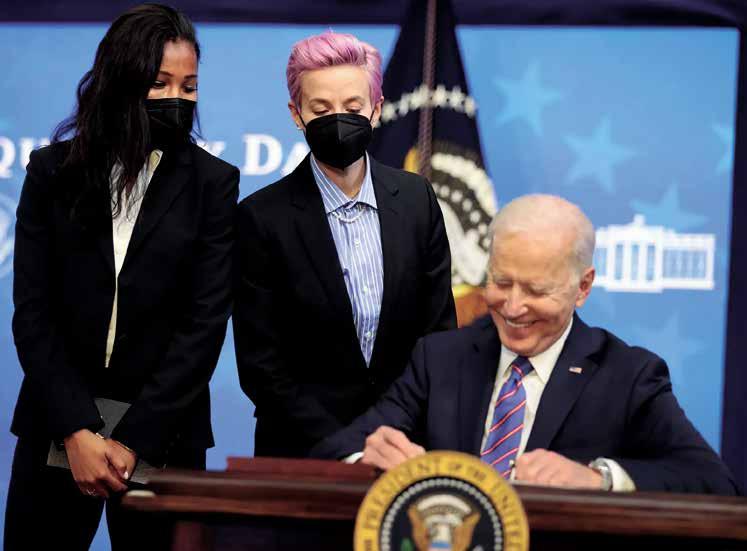
US Soccer President Cindy Cone praised the new agreement, saying in a statement, “No other country has ever done this. I think everyone should be proud of what we’ve accomplished here. It truly is historic.”
Now players hope to inspire FIFA (the international governing body) to enact similar equal-pay strategies to benefit other countries’ women’s teams that have continuously outperformed their male counterparts.
Players have also been speaking out in praise of the historic victory. Becky Sauerbrunn, a defender for the national team and president of the USWNT Players Association, praised the ratification of the collective bargaining agreement, writing, “The
accomplishments in this CBA [are] a testament to the incredible efforts of the WNT players on and off the field.” While Sauerbrunn is satisfied, she also notes that “it’s hard to get so, so excited about something we should have had all along.”
“I think what this CBA does is it finally creates that ‘one nation, one team,’” said USWNT forward Midge Purce. “And I think that it’s brought us together under that ideology that we’ve been chasing after for a long time.”
Megan Rapinoe, a Seattle local and the face of the equal-pay movement, praised the contract as a “huge win” and said the CBA means “[we] will have equal pay on
everything moving forward.”
“It’s honestly kind of surreal,” she continued. “I feel like I need to take a step back. We’ve all been in the trenches of it for so long. I think I honestly don’t even understand how monumental this is.” On top of the CBA win, US Soccer agreed to provide $22 million in back pay to the women athletes to settle the discrimination lawsuit out of court.
While pay will still fluctuate based on individuals, injuries, and the number of international games played, it is looking like the women’s team will finally be making what they deserve.
by Lindsey Anderson SGN Contributing Writer
If you’re looking to enjoy some live comedy in Seattle, the city is full of great openmic stops to get you laughing. Unfortunately, even a liberal and welcoming city like this can fall prey to flocks of comedy bros who love to elicit a cheap laugh at the expense of marginalized identities.
Wanting a safe escape from the Brads and Chads lurking in the shadows of standup clubs, a group of Queer women and Nonbinary people got together to create a revolutionary new space.
Originally known as “The Comedy Womb,” the female-centered show opened its doors in 2013 to Queer and female comedians often not featured in other venues. For the last nine years, it has rotated through different weekly producers, welcomed special featured performers, and even pulled in some outstanding out-of-town acts, all to the delight of dedicated fans.
After a while, the show’s producers decided to rename the event “The Comedy Nest,” shifting focus away from anatomical words such as “womb” so as to emphasize that women-centered comedy does not have to focus on reproductive systems. The name also did not reflect the experiences of women without wombs.
Each week, up-and-coming comedians still sign up for three-minute open-mic slots on Tuesday nights. The Nest reserves half for self-identifying women and keeps a strict “no punching down” policy. Comedians at the Nest refrain from sexist, racist, homophobic, transphobic, ableist, or fatphobic jokes. The room is also “heckle-free.”
It’s a great environment for new and aspiring comedians to get on stage and practice their sets in front of a wonderfully warm and supportive audience. Event producers frequent the show and are more than willing to offer a tip or trick of the trade to those just starting. And experienced comedians often visit to try out new material and connect with old buddies
continued from cover
Performances of other kinds will mix with the music, like drag pieces from Hot Pink Shade and the duo LÜChi, and drag queen story time with Cookie Couture. Hart spoke with me over the phone about the event. He said he was especially excited to see Cookie Couture and Hot Pink Shade, but emceeing the event for the first time was a big highlight. “It feels amazing,” he said. “I am counting down the days. I am so ready!” Hart was just as enthusiastic about all the connections Pride would foster, both old and new. “It’s like Christmas,” he said, because for so many, Pride is a chance for Queer found families to reconnect and grow. His hope, of course, is that everyone will remain cautious about COVID-19 while they’re at it.
That kind of community awareness has been a big part of Hart’s drag and activism career so far, and that probably influenced the committee selection of him for an event themed around reuniting.
When I told him I’d heard he was basically royalty in Seattle, he laughed and said, “Yeah, I’ve been doing my thing here for a while.”
Since 2004, Hart has participated in nonprofits, community outreach, and fundraising for the Queer community. He gives lectures on topics like using drag as a way to raise awareness of and advocate for the LGBTQ+ community, or helping parents understand and accept their Queer children’s identities.
Some of Hart’s recent activism has focused on Grays Harbor, his county of residence, where people are far more conservative than in Seattle. Hart joked about

For fans of Seattle’s underground comedy scene, the Nest is a great place to spot local comedy stars and make friends among a wonderfully Queer community. Fans, comedians, and bartenders connect over delicious drinks and experimental new jokes.
This week the Nest hosted a full house of great up-and-coming talent, with a special feature performance from Seattle’s incredibly talented Jaleesa Johnson, who
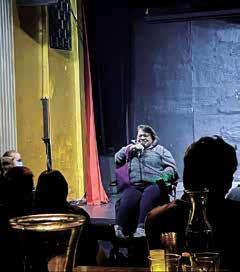

has become known as the “Lesbian Pete Davidson.” Johnson drenched her audience in never-before-heard jokes that had the audience in stitches with her clever stoner humor. Many familiar faces also took to the stage before Johnson closed out the night.
One returning comedian, Gretta Gimp, has become one of the Nest’s biggest celebrities in recent years. With her dry wit and deadpan delivery, fans adore her dark and


often very sexual jokes. What solidified Gimp’s space in Comedy Nest history was not her iconic “dolphin sex” set but the night in early 2021 when she decided to officially come out on stage to a round of warm applause.
Located at the Rendezvous in Belltown, the Comedy Nest is one of the friendliest spaces in Seattle. Come for the jokes and stay for the camaraderie, and the booze.
the hypocrisy of the signs on the roads leading into Aberdeen, which say “Come as you are,” but also recounted some small victories. Resources for the community have increased over the last few years, and during a recent Founder’s Day parade, the Queer community float was “the brightest
entry in a sea of drab,” Hart said. In general, though, Hart wished the Pride events outside the big cities got more attention. “Drag shows help a community learn that Queer people are normal people,” he said. “We could use just a sliver more support out in the boonies.”
by Lindsey Anderson
SGN Contributing Writer
Memoirs always tend to hold a special place on the bookshelf. They are not perfect, cookie-cutter stories written from the idyllic mind of a young dreamer but rather stories penned with the grit, authenticity, and ugly scars of real people. Memoirs connect to a reader’s soul like a long conversation with a friend.
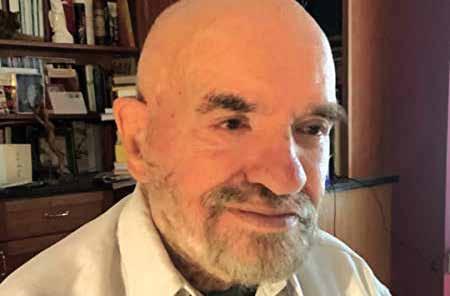
This week the SGN had the pleasure to discuss Forgiveness: A Gay Man’s Memoir with author Vincent Burke. His collection of stories takes readers a step back in time, following the life and legacy of a man who lived through some of the LGBTQ community’s most trying decades. For Burke, writing a memoir was like therapy.
A labor of love
Once Burke decided to sit down and write out his stories, he found the process moved along quickly.
“I completed [the book] probably last October,” he recalled. “It was pretty fast. I worked on it for six months, but you know, it was something I enjoyed doing, so it wasn’t work.”
When Burke began writing, he didn’t plan on completing or publishing a memoir. “I started small,” he said. “I had a strange aunt, Mary, that I lived with for a short time when I was changing location, and she was odd, but I felt an affection for her, so I wrote a story about her, and I thought, well, maybe I can have this printed someplace.”
While doing this, Burke realized he had never really taken the time to tell his Aunt Mary just how much he liked her. “My story was really a release for me [in] that I was writing… on paper that I liked her, and that made me feel good, so I just continued,” he said.
Burke decided to go back to his childhood and write about the influential people in his life, those he had never recalled thanking or sharing his admiration for. As he continued, Burke realized that many of the people he wished to acknowledge had since passed. “I thought if I had this published, it was a way of acknowledging how good they were, and I felt good writing it,” he said.
As the title suggests, the theme of Burke’s memoir is forgiving people, even those who may not seem to deserve it. “The focus is forgiving people for past things that you objected to,” he said.
“Every Gay person has come across bias, even now. …I believe you should forgive those people because of several reasons, but mainly because they were brainwashed, they were indoctrinated, just like how a soldier who is captured is indoctrinated, so they really could not help it,” Burke explained.
Hateful indoctrination and forgiveness
He believes that much of the mistreatment LGBTQ+ people faced in the early days of the movement was due to the hateful ideology taught to otherwise wellmeaning people. Today, Burke says, we see a different America, where people can recognize the flaws in their prior “indoctrinated” thinking.
“Many of them are coming out of it now,” he explained. “We, as a Gay community, should lead in forgiving, especially now that many of them have become our friends. We can now be friends with straight people.” Burke cites the acceptance and even adoration straight people have come to hold for the Queer community in recent decades as a reason for forgiveness of past transgressions.
“In my early life, I could not be friends with straight people without worrying about what they would think if they knew I was Gay,” he said. “I did not come out as Gay, but I was worried all the time even though I had straight people I was friends
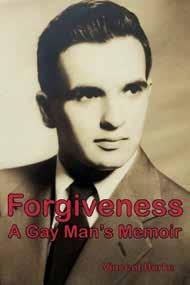
with who were good people. I worried about being brainwashed and what they would think of me as a result if they knew my other life.”
“That affects every Gay person. Bias, even today, affects every Gay person,” Burke continued. Despite the trauma that can come from experiencing bias, “I think [we] should handle it by forgiving,” he said.
Burke believes the key to forgiveness is acknowledging “that these people are victims and should be treated like a soldier who is indoctrinated and who will come out of it.”
Forgiveness is a journey for everyone, even Burke, who admitted it hasn’t always come easy. “I mean, amazingly, I have forgiven policemen,” he said, recalling the abuse LGBTQ+ people faced at the hands of the police in the days of Gay bar raids.
“I was fired on and approached where guys gather at night,” he remembered. “I was standing there, and suddenly there was an announcement by two men in the shadows, and I knew that was the police, and I fled.” Burke barely escaped that night.
“I understand that they were just like everyone else at the time. That was their job, and they were brainwashed. I will forgive someone like that,” he admitted.
One person Burke has had trouble forgiving was a co-worker. For a while, he worked in an ad department in New York City, inspired by the value the company put on diversity. Even with that “progressive” business stance, Burke still encountered homophobia.
“There were people in [that company] who called one of the TV producers by a terrible, insulting name because he was Gay, and they called him that name in secret,” he said. “I am having a hard time forgiving them. That’s the only one. I think it’s because it was more recent, and they would have known better in that field.”
Through his stories, Burke paints a picture of Queer history. He lived in New York in the 1960s, when Stonewall happened, and can recall his feelings about the events.
“I am a little embarrassed about Stonewall,” he admitted. “I came back to New York City to my apartment, which was in the Village… and I did not even find out about it until about a week later, when I [saw] items in the paper,” he said. “I should have been down there on Sunday night. Unfortunately I regret that I did not participate in it.”
However, he also acknowledges that if he had the chance to go, he may not have been comfortable being in such a public place. “I have to tell you, my life was hidden,” he admitted. “I had this undercover life. I would have gone there and been on the outskirts of the riot and cheering the rioters on, but I would not have been able to be a rioter. I was not brave enough to be on the forefront.”
Burke’s stories are not uncommon. The bias, the hatred, and the risk of societal exile kept many members of the LGBTQ+ community in the closet in the ’60s and ’70s. His memoir stands as a testament to the experiences of the average Queer just trying to survive in the 20th century.
Another influential period in Queer history Burke recalls is the HIV/AIDS epidemic of the ’80s. Like most Gay men at the time, Burke watched as close friends perished of the disease. “I never had a large group of friends, but I had a few close friends who died from [AIDS],” he said with sadness. “It was in part the government’s lack of involvement in it for as long as they could get away with it.”
“I think back on the people,” Burke said. “I think back on one particular guy who was a partner of a good friend of mine, who died. He was in his early thirties. I was, at that time, in Provincetown, Massachusetts, which is a Gay center, and the male Gay community [there] was stunned and immobile by what was going on,” he remembered.
“But you know who came forth? The Lesbians in Provincetown… like Florence Nightingale, running around with food and caring for people. And that is something I’ve never forgotten about them.”
Standing up
After surviving the riots of the ’60s and the epidemic of the ’80s, Burke was finally ready to stand out and proud for a cause he believed in: the right for LGBTQ+ people to marry.
“My partner and I got married in 2013, and under Washington, DC law, which had already passed several years before, we got married,” he said, with the joy reflected in his voice.
Burke’s wedding was a spectacular statement against the injustice of American law: “We were married on the terrace of the
Supreme Court,” he said.
“Our purpose in choosing [that location] was to assert our right to it and dare them to deny us the right to [marry]. So, there we were on the Supreme Court terrace on May 3, 2013, getting married. I mean, let Justice Roberts or anyone else look out their windows. There we were,” he said with a laugh.
What does the future hold?
On the day the high court announced its ruling on Gay marriage, Burke and his husband celebrated. However, they, along with thousands of couples in the country, now face an uncertain future.
“I certainly am worried about [the future of Obergefell v. Hodges], too. If they’re going to have this victory over [abortion] now, I doubt they’re going to be satisfied stopping right there.”
Despite his fears about the future, Burke stands strong in his unrelenting optimism. “With Gay marriage, it’s going to be a little more difficult thing. People have joined their property under a married couple’s name. It’s going to be very legally entangled, but that might not stop them. Let’s just hope that someone stays as president and that we have a change in the Supreme Court now and then,” he said.
While Burke spends most of his memoir looking toward the past, paying his respects to those he loves, and recalling important moments in history, he also displays optimism for the future. He sees with each new decade more acceptance and love for the LGBTQ+ community, which brings him hope, but also concern.
The LGBTQ+ community is where Burke found himself and his people and a corner of the world he credits for making him into the man he is today. Burke is happy to see straight people accepting the Queer community but hopes it doesn’t mean a diminished culture for queers. “I think that unless this undercurrent of bigots gets ahead in the United States and the world… we are going to be intermingled and lose this sense of community,” Burke said with worry.
“That’s something I value when I look back at my life,” he recalled. “I was hidden, but it was like belonging to a private club, and everywhere you went, you saw members of your club, and they welcomed you. I’m just afraid that that’s going to diminish, and I would hate to see that end.
“I have had Gay friends, and they have been the best friends I’ve had in my life and the most loyal people you could rely on. I just hate [to think] that in 10 or 20 years, that… is going to be reduced,” he admitted.
Despite the acceptance of LGBTQ+ culture by the mainstream, leading to a reduction of Queer-exclusive spaces, the changes are not all bad. LGBTQ+ kids have a unique opportunity to come out and live as their true selves much younger than Burke ever felt he could. His advice to the younger members of the community? “These days you should come out as soon as [you] can, as soon as you feel comfortable, because there is no point in hiding. Anyone who does not accept you should be the one in hiding.”
Burke also recommends reflection in the form of writing for anyone, old or young. “I would advise anyone to write a memoir, because it gives you a chance to say things you have neglected to say.”
Burke’s story is full of heart and warmth. It is a firsthand account of Queer history told through the kind and well-thought-out perspective of a survivor. Burke reminds readers that hatred is an ideology that can be unlearned, and forgiveness is never something to withhold.
At the end of the day, his writing is also a reminder to cherish the ones you love and to let them know you care about them. It’s a wonderful read and a great example that everyone has stories worth sharing.



BI-WEEKLY! FIND US WHEREVER YOU LISTEN TO PODCASTS!






by Terri Schlichenmeyer Special to the SGN
EVERY CLOAK ROLLED IN BLOOD
JAMES LEE BURKE
© 2022 Simon & Schuster
$27.00
288 pages
Eighty-five-year-old Aaron Holland Broussard knew death.
He’d seen it before: in Vietnam as a young man, on the rez near his Montana farm, when friends died, when his wife died. He wasn’t afraid of it anymore. But he refused to accept the fact that his daughter, Fannie Mae, was gone forever.
She was the kindest person he knew. An animal lover, she was just 54 when she died, and every day since was another shard of anguish in Broussard’s heart. Every day, he looked for ways to bring her back somehow.
If this made him a target of vandals,
then so be it. His capacity to care was all but gone, but his heart wasn’t so hardened that he couldn’t give a couple of local boys a hand up. Life near the rez was tough; the opioid epidemic didn’t help, so Broussard would do his part to help his neighbors, despite someone making it abundantly clear that he should mind his own business.
How could he do that, when the local state trooper, Ruby Spotted Horse, told him that she was hiding a portal to evil, locked in her basement?
Sometimes, Broussard saw Fannie Mae on the edge of his vision, visiting him in ways that only he could see. But he also started seeing opaque horrors of the past, the murder of Native innocents, and small, malevolent children. Any of them might masquerade as his beloved daughter.
Then evil began visiting his home in the shape of real humans, and though Aaron Broussard didn’t want to live anymore, dying by his own hand was no longer an option...
Well, here’s a departure. In his note to readers, author James Lee Burke explains why he wrote this novel, and you must read that before you set eyes on the first sentence of the story. It explains why Every Cloak Rolled in Blood is saturated with unbearable, fiery grief, the kind that makes your throat raw just from reading it. Read that note and you’ll understand why metaphysical threads tie this story together. Before you go thinking, though, that it’s just some weird one-off in a horror vein, know that this book is still a mystery. It’s got the familiar Big Sky settings that Burke fans want, current-events-style issues, diverse characters, and murderous villains. The difference is that those villains may be real, or they may not.
Every Cloak Rolled in Blood could be Burke’s best novel; surely, it will appeal to fans beyond the whodunit genre. Try it and you’ll love its beauty and pain — and the shivers.


by Sara Michelle Fetters SGN Staff Writer
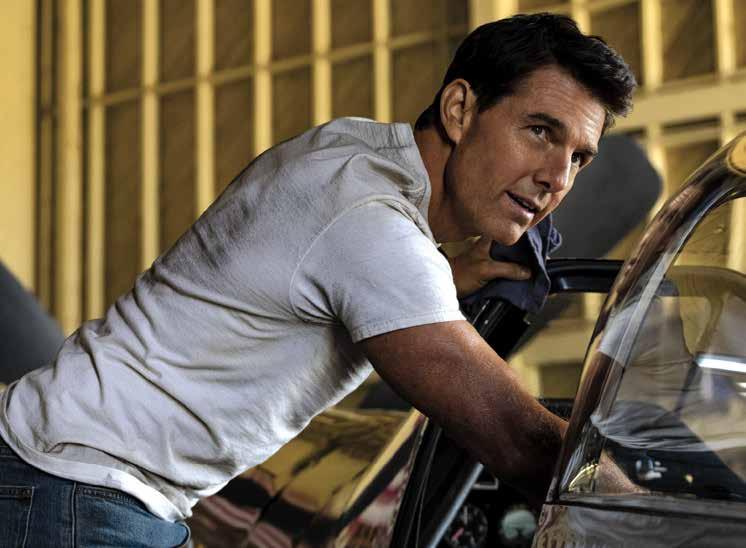
There is one thing to know about Top Gun: Maverick up front and that’s that — exactly like its Reagan-era, slickly produced predecessor — this legacy sequel is also an unabashedly jingoistic, feature-length commercial for the US Navy. It’s propaganda, pure and simple, and would not exist without the full-throated support of the military establishment granting the filmmakers access to aircraft, weaponry, and machinery they never would have seen, touched, or utilized without Pentagon approval.
With that out of the way, here’s the other thing I’m going to make crystal clear: Top Gun: Maverick is almost certainly one of the best films I’m going to see this year. Director Joseph Kosinski (Oblivion, TRON: Legacy), producer-star Tom Cruise, and the sequel’s quintet of writers —
including Cruise’s Jack Reacher and frequent Mission: Impossible series collaborator Christopher McQuarrie — have done the unimaginable. They have collectively delivered an extraordinary, one-of-a-kind, eye-popping cinematic experience. This is big-budget Hollywood sensationalism of the first degree that will almost certainly have audiences hooting, hollering, and returning to the theater multiple times.
This isn’t nostalgia for nostalgia’s sake. Much like 1986’s The Color of Money (which just so happened to feature Cruise in a breakthrough performance and came out the same year as the original Top Gun) supplied a scenario worthy of the return of The Hustler’s main character, “Fast Eddie” Felson, the same can be said about how this script brings back Capt. Pete “Maverick” Mitchell for a second adventure. It is immediately clear that, chiseled bod and cocksure smile notwithstanding, this seasoned Navy aviator has felt the full weight of the past three-plus decades since viewers last saw him.
And what is a now-fiftysomething Maverick up to? He’s a military test pilot work-
ing on a top-secret project. But when belligerent Rear Admiral Chester “Hammer” Cain (Ed Harris) wants to shut the program down for taking too long to reach its goals, Maverick goes rogue to ensure that funding continues and those working on the project keep their jobs.
Normally, this stunt would be enough for someone as powerful as Cain to finally kick the rule-breaking pilot out of the Navy. Only he can’t. World events have conspired in Maverick’s favor. Under urgent orders of Tom “Iceman’” Kazansky (Val Kilmer) — now admiral of the Pacific fleet — the pilot must go back to the one place in the world he never thought he’d ever return: the United States Navy Fighter Weapons School at Naval Air Station Miramar, California, otherwise known as “Top Gun.”
It’s all fairly standard stuff, and it’s not like the screenplay goes in a single unexpected direction. Maverick is required to train several hot-shot pilots for a secret assignment, and Iceman believes his former wingman is the only person for the job. Among the diverse group of aviators he must pick through for
this potential suicide mission is Lt. Bradley “Rooster” Bradshaw (Miles Teller), the son of his best friend, Lt. Nick “Goose” Bradshaw (Anthony Edwards), tragically killed back when they were both Top Gun scholars over three decades prior.
There are a variety of reasons this all ends up being pretty great, not the least of which are the stunning visuals and the thrillingly immersive sound design. Kosinski places the entire cast right inside the cockpits of the planes their characters are flying, with ace cinematographer Claudio Miranda (Life of Pi) doing things with his camera that defy belief. While there is some digital augmentation here and there, by and large, the aerial footage is real. Better yet, it shows, and outside of actually getting to sit in the backseat of an F-18, I doubt even a deluxe virtual-reality simulator could achieve the type of you-are-there euphoria of flight this film does.
But that would not matter if this weren’t a multidimensional melodrama where the characters come first and the razzle-dazzle second. Not that Kosinski and the writers are crafting some sort of Unforgiven-style deconstruction of the military drama — that isn’t the case at all. Instead, they’ve drawn inspiration from WWII-era classics like Air Force and Thirty Seconds Over Tokyo, grounding their ensemble in authentic human emotions and giving them inner lives beyond what happens to them in the cockpit.
Does it all work? No. While Jennifer Connelly is wonderful and has exquisite chemistry with Cruise, and while fans of the original will love the surprise of which character she is portraying, her entire arc feels more in service of helping Maverick find himself than it is in giving her her own agency. Additionally, there’s an undeniably silly homage to Star Wars smack-dab in the middle, when the mechanics of the secret mission the pilots are training for is finally described to them. I laughed during the entire sequence. And I was far from the only one.
Not that I care. I sat in the theater in a constant state of dazzled euphoria. I shed tears when I was supposed to, I cheered during the final aerial battle, and I maybe even let out a series of low-level, giddy chuckles during a few of the cornier bits connecting the original film to this one. Cruise refuses to phone it in, delivering a superb performance full of raw honesty and emotional nuance that took me completely by surprise.
I loved Top Gun: Maverick. This sequel hasn’t lost that loving feeling. It’s the best of the best, making this return to the danger zone a rapturous aerial extravaganza that frankly took my breath away.


by Sara Michelle Fetters SGN Staff Writer
When Breakdown debuted in May of 1997, it wasn’t like minimalist highway thrillers were anything new. Heck, they weren’t even unique when Steven Spielberg revitalized the genre with his release of Duel in 1971. I also cannot say that director Jonathan Mostow’s scenario of a Boston man traveling with his wife to a new job in San Diego — only for her to go missing and for no one to believe him — was out of the ordinary. Alfred Hitchcock already did it best, after all: 1938’s The Lady Vanishes is still the gold standard on that front.
And yet, 25 years after its release, Breakdown remains an unforgettable tickingclock thriller that’s only improved with age. Mostow and co-writer Sam Montgomery’s screenplay is a model of efficiency. Each piece fits into the next with pinpoint precision. Its simplicity is striking, and because the central premise is wholly believable, the sensational and impossible aspects become equally genuine as the film goes along.
The setup to all this madness is glorious. Jeff Taylor (Kurt Russell) and his wife Amy
(Kathleen Quinlan) are driving cross-country in a red Jeep Cherokee. In the middle of the desert, their vehicle breaks down. Red Barr (J.T. Walsh), a kindly semitruck driver, stops and offers to drive Amy to a truck stop a few miles up the road so she can call for a tow. She never returns.
From there, things are off and running. No one believes Jeff that Amy has been kidnapped. Red even coolly convinces a belligerent state trooper that not only does he not know what happened to this man’s wife, but also that he’s never even met Jeff before. Jeff is made impotent, stranded in literal backcountry nowhere, looking like he’s gone insane.
Much like audiences knew Margaret Lockwood’s determined Iris was telling the truth about May Whitty’s kindly governess Miss Froy in Hitchcock’s The Lady Vanishes, they are equally in the know that Amy has not run off and that Red is a lying bastard. But Mostow allows the Jeff’s psychological discombobulation to create an aura of uncertainty that’s so riddled with anxiety and tension that the overall effect is paralyzing.
Russell is outstanding as the mild-mannered everyman forced to find an internal for-
titude and resilience in the face of unimaginable danger. You can feel the weight of the circumstances crashing down upon him, as the accomplished Hollywood superstar gives one of the finest performances of his six-decade (and counting) career. Russell goes for broke both from a physical standpoint and an emotional one, too, making Jeff’s full conversion into a go-getting man of action believable with every initially hesitant step.
He’s matched by the late, great Walsh. A veteran character actor who made an indelible impression in every motion picture he appeared in, no matter how big or small the role, his performance here as the jovial, yet still menacing, Red Barr is hauntingly beautiful. There is a quiet minimalism to what Walsh is doing, an ease to his movements and a calm certainty to his vocal inflections that would be otherwise charming if they weren’t so ominously disconcerting. It’s a spectacular, larger-thanlife portrait of captivating villainy. Red’s smarmy grin is more lethal than Michael Meyers, Jason Vorhees, and Freddy Krueger combined.
Comparisons to 1970s thrillers like the aforementioned Duel and even George

Miller’s original Mad Max were a dime a dozen back when Breakdown was first released, and while those were apt, I do think that time has shown that Mostow constructed a scenario representative of the change between analog and digital realities. Not just with the technology — although the size of the few working cellular phones does warrant a couple of hearty chuckles — but most notably in the core relationships between the various characters.
What do I mean? Red and his closest compatriots in backroads interstate crime understand that times are changing, and that their days of ruining the lives of unlucky travelers for their own financial gain are coming to an end — but they’ll keep taking advantage of the situation until the last possible second. As for Jeff and Amy, they’re excitedly moving on into a brave new world they barely understand yet are eager to learn about, knowing that if they can do it together, they’ll be able to overcome all impediments, no matter what they may be.
Mostow doesn’t overemphasize any of this, however, remaining laser-focused on Jeff’s journey and transformation as he puts the pieces of this puzzle together and comes up with a last-ditch plan to save Amy from Red’s clutches. The film goes from being a paranoia thriller throwback to a cat-andmouse tale of subterfuge to a full-throttle vehicular chase flick, complete with muscle car fireballs and shotgun blasts through the windshield, and it’s magnificent.
But as breathtaking as that may be — and it is pretty dang incredible, considering there’s almost zero digital trickery and most of the carnage was staged for real — it’s Mostow’s ability to keep his film’s hero from being dwarfed by the outsized melodrama that has allowed Breakdown to continue to resonate with viewers for 25 years. Jeff could be anyone. Jeff is everyone. If he can succeed in facing down obstacles as severe as those showcased here, why can’t we all do the same?
Now celebrating its 25th anniversary, Breakdown is available on Blu-ray and DVD from Paramount Home Entertainment and to purchase digitally on multiple platforms. It is also currently streaming on HBO Max.
What I mean when I say I’m pro-gun Or, an angry Queer comes to terms

by A.V. Eichenbaum SGN Managing Editor
I think I started to accept violent crime as a fact of life in 2014, two years after Sandy Hook, when a man I considered a friend was set on fire in his car for being an outspoken, intelligent Black activist in the wrong — predominantly white — California city. Marc Thompson died in Chico, and the part of my brain that processes tragedy calcified into a thing that produces cold, calculated rage.
That part of my brain works overtime. Violence, especially gun violence, is constantly in the news, and all any of us can do is watch, grieve, seethe, rinse, repeat.
Since 2014, there have been 3,605 mass shootings in the United States. Every time it happens, the news cycle gets shorter, some politician makes an impassioned plea for gun control — and nothing happens.
This time around, the deaths of 19 children caused a furious Connecticut senator to beg his colleagues for compromise. Not gun control, not new laws. Compromise.
We’re all so exhausted that his desperation is being mistaken for heroism.
We’ve all noticed that whenever a mass shooting makes national news — increasingly rare these days — the response is that it’s not the time to be political, but a time to mourn and reflect. There’s a simple reason that the Republicans don’t respond to these tragedies and the Democrats do nothing but share thoughts and prayers.
They don’t care about us more than they care about their bank accounts.
If they cared, we’d have had gun licensing, universal background checks, and stricter control on gun show loopholes after Columbine. Instead, even the strict-
est states, like my home state of California, have laws that barely come close to the restrictions governments across the world have placed on weapons.
A government that would sell out its own people to arms manufacturing lobbyists cannot be trusted, and we must be prepared to defend ourselves, if not from them, then from the fallout of their decisions.
We saw in 2020 that mass protests over police brutality and racial inequality did nothing but harm our buildings and damage our lungs. The cops were better armed and better protected than we were, and once calm returned, our politicians ensured that nothing changed.
We’ve seen the people we voted into power strip the rights of women and Trans people in the last year, and they’re running full speed toward the death of our ecosystem for a few extra bucks from big oil. They don’t care about our quality of life, and they’re taking steps toward outlawing people like you, me, and our loved ones.
If your response to this is to trust that entity with taking away forms of self-defense that might function easily and reliably on a mass scale, i.e., a full ban on private ownership of weapons, I believe you likely come from a place of privilege, where your rights are not under constant assault.
Armed Queers don’t get bashed.
If our government cared about us, we would have the type of gun laws that slightly more sensible countries have. Look at Australia. In 1996, 35 died and 23 were wounded in a mass shooting, leading the conservative government there to put into effect laws that have decreased gun violence and homicide rates, despite private gun ownership being perfectly legal. These laws included mandatory 30-day cool-off periods after a pur-
Armed Queers don’t get bashed — but we all need stricter gun laws.
chase, different licenses and requirements for different categories of firearms, and mandatory firearms safety courses.
If these very basic measures had been put in place by the US after Columbine in 1998, this would be a very different essay. While I believe these steps are the right ones for the US to take as a whole, I no longer have faith in our government to enact or enforce similar laws without abusing its power.
It’s hard to reconcile my mistrust of the powers that be with my hope for a better world. Believe me, it’s just as depressing to have these opinions as it is to read them. So, I have an addendum to my earlier statement: Armed Queers don’t get bashed — but we all need stricter gun laws.
And that’s only the first step.
I don’t have to tell our readers that this is the only country in the world where mass shootings happen so regularly that the average American stops caring after a few days. Gov. Abbot said the Uvalde massacre “could’ve been worse.” The worst mass shooting in his state’s history, and his response is, “Meh.”
There are proven ways to prevent this without violating our right to protect ourselves. In addition to following Australia’s example when it comes to gun laws at the federal level, we — meaning you and me and our loved ones — need to start performing acts of mutual aid. Acts of trust that give back to the community and strengthen it from within.
If you can’t trust your government, gov-
ern yourself. When they stop caring, we care harder.
If you want to stop senseless violence — like I know you do — you have to support programs that support the poor, the unhoused, and the underprivileged, and you have to speak out at every turn.
Act now. Speak up, but not just to your friends and family on social media so you feel like a good person. Call your congressmembers, sure, but working within your community and helping your neighbors is an immediate way to make everyone safer.
Stricter gun control stops the mass shootings. Organizing ourselves protects our kids, too.
I’ll end with this divulgence: I don’t own a gun.
I think it would be reckless for me, a person who loses their keys every morning and is prone to doomsday overthinking, to keep a gun in my apartment. I don’t feel powerful at the shooting range, and honestly, I don’t think they’re sleek or sexy like some gun lovers do.
To me, a gun is a tool. I grew up with guns, I know how to use and maintain one, and I’ve decided it’s a tool I don’t have use for. But I do think it’s important to recognize that in a country actively reversing decisions that protect our rights to bodily autonomy, we’ve got to hold on, at least in part, to what we do have. And the unfortunate truth is that we’ve got more than enough guns.
Nancy Pelosi admonished by Catholic Church
by Mike Andrew SGN Staff Writer
House Speaker Nancy Pelosi, a practicing Roman Catholic, publicly rebuked San Francisco’s Catholic Archbishop Salvatore Cordileone in a TV interview on May 24.
Cordileone — a notoriously traditionalist and authoritarian cleric — sent Pelosi a letter in April informing her that he would bar her from receiving Holy Communion because she’d promised to codify Roe v. Wade in federal law.
The Catholic Church opposes abortion because it considers fetuses living human beings with human souls. In the past, some Catholic clergy have attempted to bar politicians who support abortion rights from communion, but Pope Francis has publicly opposed such harsh measures.
Although the Pope favors a more conciliatory approach, each bishop has authority to bar people from communion in his own diocese. Cordileone said he attempted to reason with Pelosi first, and only disqualified her from communion when she wouldn’t do what he wanted.
In an open letter to San Francisco Catholics, Cordileone said he told Pelosi that she must either repudiate her support of abortion rights or stop speaking publicly about her Catholic faith. He’d asked several times to meet with the speaker, Cordileone said, but her office didn’t respond.
“After numerous attempts to speak with
continued from cover
That would, of course, require the US Supreme Court to reverse its Obergefell decision — something that is clearly on the agenda of Justice Samuel Alito. Obergefell was one of the high court decisions Alito cited as bad law in his leaked opinion reversing Roe v. Wade
Polls consistently show that most Americans now accept that same-sex couples should have a right to marry, just as they accept that women should have a right to an abortion.
Soon after Walker’s statement against marriage equality hit the news, his campaign staff tried to walk it back. Spokesper-
by Daniel Lindsley SGN Contributing Writer
South Carolina:
State boards the Trans ban wagon
Reuters reported on May 17 that South Carolina has joined a number of other states in banning Trans people from sports, as Gov. Henry McMaster signed a bill doing just that last week. Titled the “Save Women’s Sports Act,” the bill cleared the House in April, with Republicans persisting through about a thousand amendments from the Democratic minority — a stalling tactic.
The bill bars Trans girls and women from competing in women’s academic sports at any level, including private school teams that compete against public schools. It was amended in the Senate to bar Trans boys and men as well, with the exception of sports in which no women’s team exists at a given school.

her to help her understand the grave evil she is perpetrating, the scandal she is causing, and the danger to her own soul she is risking, I have determined that the point has come in which I must make a public declaration that she is not to be admitted to Holy Communion,” Cordileone wrote.
In a May 24 interview on MSNBC’s Morning Joe, Pelosi noted she came from a large Catholic family, and many of her relatives also oppose abortion.
“I respect people’s views about that,” Pelosi said. “But I don’t respect us foisting it onto others.”
Pelosi added, “Our archbishop has been vehemently against LGBTQ rights. In fact he led the way in an initiative on the ballot in California.”
son Mallory Blount said that voters should not take Walker’s statement to mean he wants to overturn the US Supreme Court ruling in Obergefell
“Herschel understands that the Supreme Court has ruled on same-sex marriage and respects the authority of the courts,” Blount said. “He didn’t mean to imply anything else.”
Walker’s son Christian, a social media influencer, is Gay, although he rejects the use of that word, describing himself as “a conservative who likes men.” He currently has some half-million followers on Instagram and 90,000 on TikTok.
Walker is a Heisman Trophy winner and retired NFL running back. He currently makes his money as a chicken parts distributor.
Supporters walk the well-trodden road of saying such measures ensure a level playing field in women’s sports. Opponents call the laws cruel and unnecessary, because they address a problem that doesn’t exist, given how few Trans athletes are in school sports.
Ivy Hill, the community health program director of Campaign for Southern Equality, said in a statement, “Transgender youth are not a threat to faireness in sports, and this law now needlessly stigmatizes young people who are simply trying to navigate their adolescence, make friends, and build skills like teamwork and leadership, winning and losing.”
Cordileone was, in fact, the architect of California’s Proposition 8, a constitutional amendment outlawing same-sex marriage in 2008. It was finally reversed by a federal court in 2010.
Over the past year, Cordileone has been among the most outspoken US bishops advocating that communion be denied to President Joe Biden and other politicians who support abortion rights.
The Archbishop of Washington DC, Cardinal Wilton Gregory, has indicated he will allow Biden and other pro-choice Catholics to continue taking communion.
Cordileone was appointed archbishop of San Francisco by the ultraconservative Pope Benedict XVI.
Like his mentor, Donald Trump, Walker has been caught inflating his business successes. Walker has claimed that he runs a “mini Tyson Foods” empire, with processing plants and hundreds of employees. In fact, like Trump, he merely licenses use of his name to processing plant owners who want to associate themselves with his football legacy.
When his former wife, Cindy DeAngelis Grossman, filed for divorce in 2002, she accused Walker of physical and mental abuse, including holding a pistol to her head and threatening, “I’m going to blow your fucking brains out!”
Polling averages show Walker with a slight lead — less than one percentage point — over Warnock at this time.
Georgia:
Conservatives target living Trans woman for crimes of dead shooter
NBC News reported on May 25 that a Georgia Trans woman’s photo is being used to spread baseless theories about the recent mass shooting at an elementary school in Uvalde, Texas. The theories began on the infamous online forum 4chan, spreading to Republican Facebook groups and even prominent conservatives.
The woman in question asked to go by Sam, to protect her privacy and safety. She told NBC News that the photo was taken from her personal Instagram, and that she’s faced harassment and threats as a result. Although the Uvalde shooter was killed at the scene, proliferators of the rumor claim that Sam’s photo depicts the shooter.
Although Republican Rep. Paul Gosar deleted his own brazen tweet about the subject, conspiracy theorist Alex Jones, who was successfully sued for false claims that the Sandy Hook shooting was a hoax, joined conservative personality Candace Owens in claiming the shooting suspect was Trans.
“This isn’t the first time I was harassed, but it is the first time I’ve been accused of murder,” Sam said. According to NBC, she said she was more annoyed than anything: “I’m more worried about the families of the victims of the attack.”
by Daniel Lindsley SGN Contributing Writer

Indonesia: Ambassador summoned over rainbow flag
Reuters reported on May 23 that Indonesia summoned Owen Jenkins, Britain’s ambassador to the country, to have him explain the British embassy’s raising of a rainbow flag.
As part of an appeal to foreign institutions, and to avoid further backlash from conservatives, Foreign Ministry spokesperson Teuku Faizasyah said, “The Foreign Ministry reminds foreign representatives to be respectful of the sensitivities among Indonesians on matters relevant to their culture, religion, and belief.”
Faizasyah went so far as to cite the Vienna Convention on Diplomatic Relations, which stipulates that only a nation’s flag can be flown at an embassy.
Reuters added the event to a greater context of Indonesia becoming less tolerant of its LGBTQ+ community, with politicians becoming more vocal about Islam playing a larger state role, as attested by activists and advocacy groups.
Although homosexuality is not illegal in Indonesia, barring one shariaruled province, a 2020 Pew Research Center survey showed that 80% of Indonesians believe it “should not be accepted by society.”
Canada:
Illustration of Gay Muslims sparks backlash
The London Free Press reported on May 19 that Western University in London, Ontario, took down an illustration from its Instagram after members of the city’s Muslim community called it “inappropriate” and “disrespectful.”
Made to celebrate the International Day Against Homophobia and Transphobia, the illustration had the title “Celebrate the power of love” and featured drawings of a diverse set of couples kissing, one of which was two women wearing hijabs.
Although the university initially stood their ground, a spokesperson said after removing the image, “We believe this presents an opportunity for genuine, thoughtful discussion about how we can best support members of the Queer Muslim community, and those from all faiths and backgrounds within the 2SLGBTQ+ community.”
Iman Abd Alfatah Twakkal, a Muslim community leader, had this to say: “We respect the human rights of everyone as protected under Ontario’s human rights [law]. While we appreciate that the intent is to promote inclusion, the poster is doing the opposite... Singling [out] a Muslim religious symbol in that setting is inappropriate.”
A user on Twitter joined others in support of the poster: “I cannot believe people are mad that it acknowledges that Gay Muslims exist.”