STARBUCKS WORKERS TO HOLD LABOR RIGHTS RALLY AT CAL ANDERSON
LABOR RIGHTS page 4
by Lindsey Anderson SGN Contributing Writer
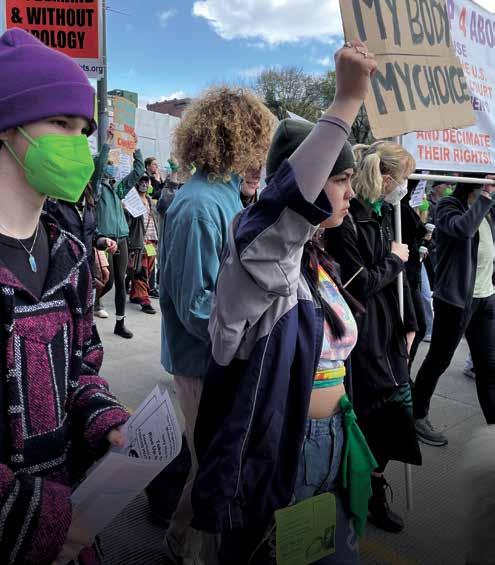
On April 9, Rise Up 4 Abortion Rights and Refuse Fascism came together for their monthly protest of anti-abortion legislation, an action that has gained traction in many red states. As the events have inspired more activists to march in the streets, especially youth activists, they have also drawn attention from counterprotesters, who were known to get violent in the past.
Despite threats of protests from religious and alt-right organizations, activist Margo Heights has tirelessly worked to ensure that the marches will go on. She says the protesters indicate that the country is moving toward a more conservative future and demonstrate just how important reproductive rights activism is right now.
“The counterprotesters are a sign of how the Christian fascist movement is anticipat-
An interview with the women behind Seattle’s latest trivia pop-up
by Nick Rapp SGN Contributing Writer
After the iconic success of Jeopardy! star Amy Schneider, trivia seems more on everyone’s minds than ever lately.
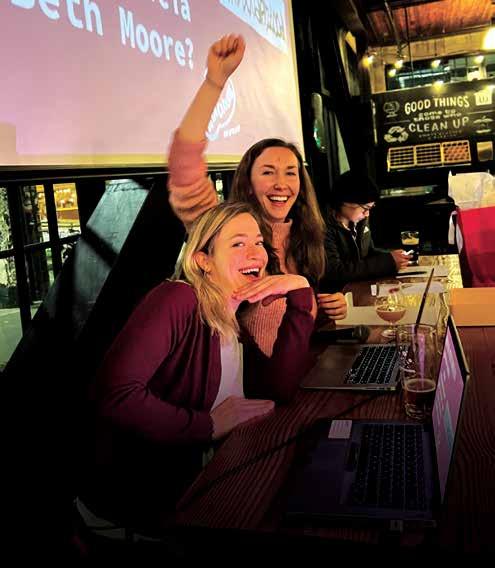
Two women from Seattle, Sally Neumann and Leah Caglio, are Jeopardy! champs and trivia buffs as well (from 2016 and 2021, respectively). They met in a University of Washington honors English seminar,
when Caglio was working on a crossword in the back of class. Since then, they’ve developed a close friendship, and this past year, they decided to start their own trivia company, named “Head in the Clouds,” to continue the fun.
The SGN got the chance to speak with them about shaping a company out of love of trivia and a desire to expand the categories of what is askable.
TRIVIA page 9
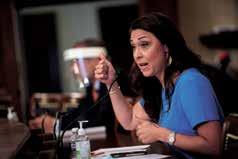
Photo by Margo Heights
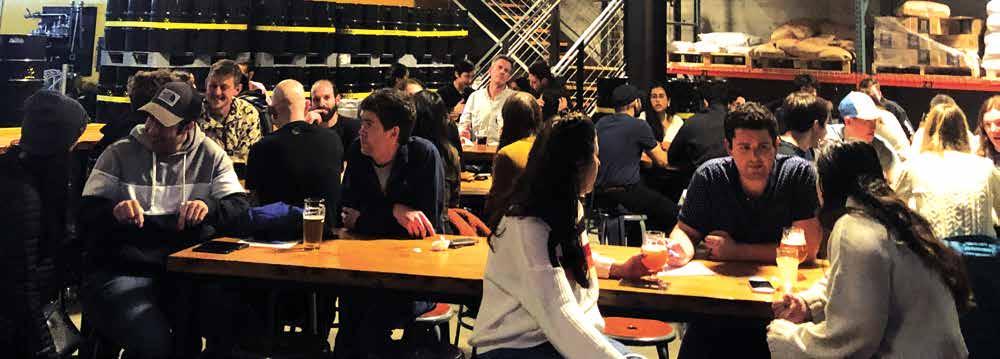
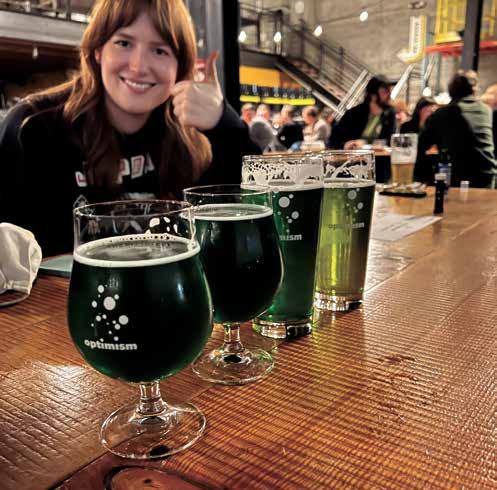
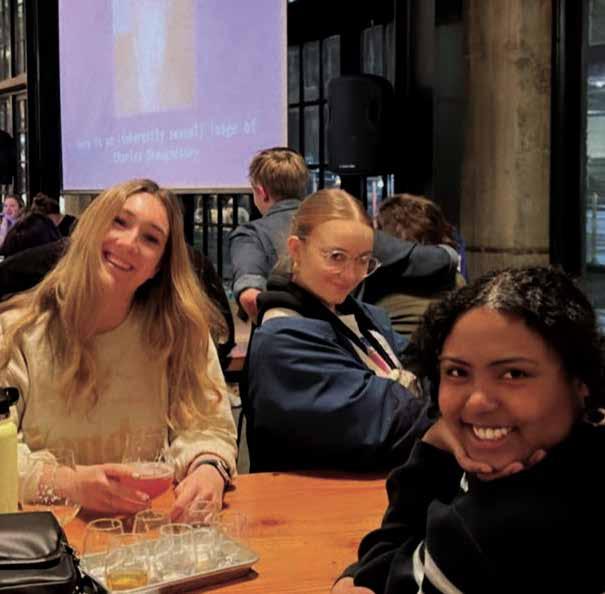
Leah Caglio and Sally Neumann – Photo courtesy of Optimism Brewery
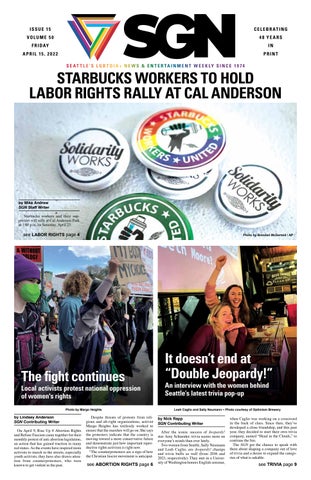
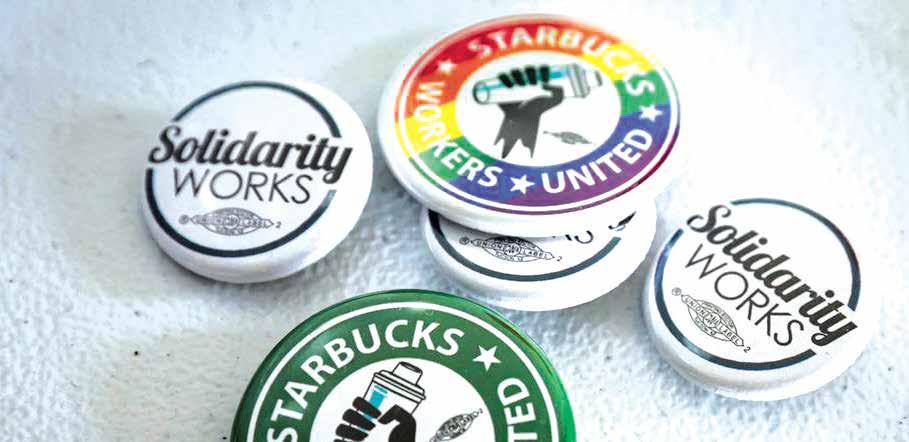
Photo by Brendan McDermid / AP
by Mike Andrew SGN Staff Writer
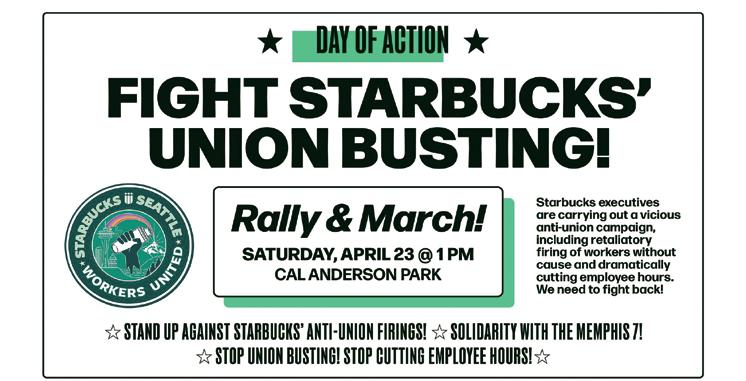
Starbucks workers and their supporters will rally at Cal Anderson Park at 1:00 p.m. on Saturday, April 23.
Remembering Sheldon Jacobs
(1928–2022): A celebration of life
On Saturday, April 23 from 3 to 7 p.m., there will be a celebration of life for Sheldon Jacobs, at CC’s, 1701 E. Olive Way in Seattle. Sheldon was born in 1928 and raised in New York. He was a lifelong actor and singer. After serving in the army, Sheldon performed on Broadway and in touring com-
panies across the country through the 1960s. He then moved to Los Angeles to act in film and television. Sheldon continued his career after his move to Seattle, while also volunteering at the Museum of Flight as a docent and indulging his lifelong love of airplanes. He was also passionate about music and art,
Local News
LABOR RIGHTS
continued from cover
The event is the latest escalation in the workers’ ongoing unionization campaign. They charge their employer, the international coffee behemoth, with illegal retaliation against pro-union workers. Starbucks corporation denies the charges.
Employees at Starbucks’ Denny and Broadway store voted unanimously to unionize on March 22. Seven other Seattle locations are heading in the same direction, including Starbucks’ flagship Reserve Roastery on Pike Street and the Olive Way and Summit Avenue store.
Six other Starbucks locations in Buffalo, NY, and Mesa, AZ, have voted to unionize, with some 150 other stores filing for union elections. The union, Starbucks Workers United, is part of Workers United, an affiliate of the Service Employees International Union (SEIU).
Union activists in Seattle as well as other Starbucks locations around the country say the company is working overtime to intimidate and punish union supporters.
Seven union supporters in Memphis, TN, were fired as group. Another union activist in North Carolina was fired for allegedly “breaking a sink” in her store. The woman says the poorly maintained sink fell on her as she was washing dishes.
Seattle Starbucks employee Sarah Pappin told NPR that the company retaliated against her pro-union stand by cutting her hours by 32%. Others say they’ve been forced to attend so-called “captive audience” meetings, mandatory staff meetings in which the company offers anti-union
and spent many years learning the history of family members lost in the Holocaust. Sheldon was also long-time leatherman, a member of MCs in New York and Los Angeles, and a proud member of Seattle Men in Leather. He was named Seattle Leather Grandad 1995.
Sheldon was an entertaining and beloved member of Seattle’s leather community, and was cared for by its members to the end of his life. He will be sorely missed.
propaganda. A barista at Seattle’s Reserve Roastery told NPR that employees there were required to attend four such meetings in a single week.
Transgender Starbucks employee Phoenix Vinup told NPR they want to see the company live up to its brand.
“It was really surprising to me because Starbucks as a company wants to be invested in Trans rights; they try to provide healthcare for Trans partners. But I realized once I started working there that that wasn’t always the case,” they said.
Vinup’s first job was at Starbucks, but
once they were on staff at Seattle’s Reserve Roastery, they quit. Vinup said they were mistreated by customers and other employees and were brushed off by management when they asked for support.
They subsequently got rehired at a new location, something they said they were inspired to do because of the new union movement.
Apparently in desperation, Starbucks has brought back Starbucks founder Howard Schultz as CEO. At Starbucks’ recent shareholders meeting, board chair Mellody Hobson said the company understands and
recognizes its workers’ right to organize.
“We are also negotiating in good faith, and we want a constructive relationship with the union,” she said.
She told CNBC’s “Squawk Box” that Starbucks “made some mistakes” when asked about the union push.
“When you think about, again, why we’re leaning on Howard in this moment, it’s that connection with our people where we think he’s singularly capable of engaging with our people in a way that will make a difference,” she said.
Image courtesy of Seattle City Councilmember Sawant
Photo courtesy of friends of Sheldon Jacobs
Local News
WA GOP primaries get ugly
Trumpism's staying power on the line
by Mike Andrew SGN Staff Writer
Ex-President Donald Trump’s continued power over the Republican Party will be tested soon in two Washington state congressional primaries.
Incumbent Republican Reps. Jamie Herrera Beutler (WA-3) and Dan Newhouse (WA-4) were among the 10 Republicans who voted to impeach Trump in his second impeachment. Consequently, they are now on Trump’s enemies list.
The ex-president has endorsed Joe Kent in District 3 and Loren Culp in District 4. Kent says he expects Trump to appear with him at an in-person rally sometime before the August primary election. Kent has already enjoyed a Mar-A-Lago fundraiser hosted by the ex-president.
In District 4, Trump has endorsed failed GOP gubernatorial candidate Loren Culp.
ABORTION RIGHTS
continued from cover
ing the overturning of Roe v. Wade and having ‘won’ in the red states, so now they’re turning their attention to the blue states,” Heights said. “This movement has a history of laying siege to abortion clinics and creating a climate that led to anti-abortion forces bombing clinics and assassinating doctors. There are no safe spaces, and there are no safe states. These fascists will not stop until abortion is illegal everywhere.”
Heights believes there is strength in numbers, and if Saturday’s rally is any indicator, the numbers, at least in Seattle, still seem to be on the side of abortion rights. Many of the attendees were youth, with some as young as 14 making their way to the front of the action.
“Historically, youth have been at the forefront of every successful radical social movement,” Heights said. “They have the potential to fight for a future worth living in, and they haven’t yet been ground down into accepting things that are unacceptable.”
Thanks to the dedication of youth activists and senior organizers, like Heights and Rise Up 4 Abortion Rights, the event was a success. Protesters got the attention of bystanders with physical demonstrations like the “rise up” and catchy chants while they moved from Capitol Hill to downtown Seattle.
Next steps
While the event was successful, Heights says they’re not done, yet. “Our next steps are a National Week of Action to Rise Up 4 Abortion Rights on May 8–15. We’re having an all-hands-on-deck organizing summit on Zoom on Saturday, April 16. Everything we’re doing needs to grow quickly into a massive ‘green wave,’ like what happened in Argentina, Colombia, and Mexico just recently,” Heights said.
The “green wave” Heights calls for echoes the advocacy of Central and South American countries that successfully decriminalized abortion after years of protests and calls for action. There, the color green was chosen to represent the cause; those who stand in solidarity, like Rise Up 4 Abortion, have also been spotted wearing green bandanas to protests.
“After decades of advocacy, women in these countries could no longer tolerate being imprisoned for miscarriages or watching their friends and family members dying from illegal, botched abortions,” Heights said of “the green wave.” “So, they started taking to the streets: marching, protesting, and wearing green. They did this over and over again, coming back stronger each time, hundreds growing into thousands and eventually a million people. It was nonviolent, yet so disruptive and so undeniable as being the
While a Trump endorsement remains meaningful in the Republican Party, it has — so far — been insufficient to drive out other far-right competitors to Herrera Beutler. In addition to Kent, she faces challenges from state Rep Vicki Kraft and Christian home-school activist Heidi St John.
In addition to Culp, Newhouse also faces other Republican challengers — Benancio
Garcia, Corey Gibson, and Brad Klippert — all representing the far right of the GOP.
Kent is waging an “America First” campaign marked by fealty to Trump and resentment of Democratic and Republican elites.
In addition to calling for probes of the 2020 election, he says Congress should investigate Anthony Fauci over COVID-19’s origins. He supports a near-total shutdown of immigration to the US, including barring refugees fleeing Ukraine.
Earlier this month, he called Vladimir Putin’s demands that Ukraine cede territory to Russia “very reasonable.”
Culp’s issues are similar. He charges that noncitizens vote illegally in US elections, for example. Culp also believes that vaccines should be totally voluntary, and that critical race theory should be banned from schools.
Both Herrera Beutler and Newhouse have retained the support of mainstream
will of the people, that those in power were forced to meet their demand.”
Despite modeling their activism after “the green wave,” Heights recognizes that Rise Up 4 Abortion Rights is fighting an entirely different battle. “It is much easier to keep a constitutional right than it is to get back a constitutional right that’s been lost,” she said. Right now, advocates are hoping to influence those in power to prevent Roe v. Wade, the Supreme Court decision that legalized abortion, from being overturned.
Heights says the clock is quickly running out. The court is expected to decide on abortion rights as early as June.
“Those in power and all political institutions are influenced by public opinion — especially when it’s being expressed in the streets in massive protests day after day. Taking away a woman’s right to abortion would be a cataclysmic change. We have to let them know they can’t get away with it,” Heights said.
“If we don’t rise up en masse, if we’re passive during the next couple months, the Supreme Court will almost certainly gut or overturn Roe v. Wade, and at least 20 more states will be without abortion virtually overnight.”
New bans; impacts on marginalized communities Heights says forced pregnancy is the equivalent of female enslavement, as it makes a woman a prisoner of her own body. “When people don’t have ‘abortion on demand,’ then it doesn’t matter what your plans or dreams are. It doesn’t matter if you’re in poverty or in an abusive relationship. You will be forced by the state to have a child against your will. That is female enslavement, and that is the future if we don’t stop it,” she said. Heights minced no words when she informed her followers that we are in the midst of a women’s rights crisis. “Most
Republican officials. GOP challengers in both congressional districts are expected to compete for the far-right vote that aligns with Trump, QAnon, and the January 6 insurrectionists.
Neither Herrera Beutler nor Newhouse have been friends of the LGBTQ community in their terms in Congress. Both opposed marriage equality and both voted against the Equality Act, for example.
Two Democratic candidates, Brent Hennrich and Marie Perez, are also campaigning for the 3rd District seat. Democrat Doug White is running for the 4th District. All three are first-time candidates.
In the August 2 primary, the two candidates who receive the most votes, regardless of party, will advance to the November 8 general election.
people who support the real genocide of Black people and Black children by mass incarceration and murder by police.”
These politicians are all cut from the same cloth, Heights said. “There’s a Christian-fascist movement in this country that’s driving the attacks on abortion. They want no separation between church and state. They want the Bible taken literally to be the law of the land. They truly believe that the only way for women to atone for the ‘original sin’ when Eve bit the apple is by having children. They view motherhood and obeying and serving the husband as women’s reason for being,” she said.
Heights believes the main reason conservatives oppose abortion rights is not that they are “pro-life” but because they are resentful of social progress that granted women greater autonomy, making them less reliant on men in their lives.
people have no idea that there have been 529 abortion restrictions and 82 abortion bans introduced or enacted just in 2022. This is across 48 states. There are also restrictions and bans on the abortion pill, mailing the abortion pill, and preventing women from traveling to access abortion in another state,” Heights said.
She’s not wrong. On Tuesday, April 12, Oklahoma Gov. Kevin Sitt signed Senate Bill 612 into law, which creates a total ban on abortion with the only exception being if a woman’s life is in danger. “No exceptions for rape or incest,” Heights said. “It’s modeled after the Texas abortion ban and empowers any ‘family member’ of the fetus to sue anyone who performs an abortion for $20,000. People have pointed out that this allows a woman’s rapist or his family to claim a $20,000 bounty for forcing his victim to have the rapist’s child.”
New abortion bans have a disproportionate impact on BIPOC people and those living in poverty. “Women of color and poor women are hit the hardest by abortion rights restrictions, especially Black women,” Heights explained. “They are more likely to live in an area that has less access to basic healthcare. They are more likely to have lower-paying jobs that make it difficult to support their families, and find that they need to access abortion services more frequently. Then when they do, they have to spend more money to travel longer distances to get to a clinic, often out of state.
“And now all of those doors are closing.”
Rise of the Christian right Conservatives who are anti-abortion are also quick to use caustic rhetoric to target and blame people of color for seeking an abortion.
“What makes me angry is how the antiabortion groups will then accuse Black women of committing genocide on Black babies,” Heights said. “These are the same
“[Conservatives] hate the fact changes in the economy and radical and revolutionary movements of the late ’60s and early ’70s liberated women in many ways — got women out of the house and into the workforce, that women were finally able to control their own lives by using birth control or accessing abortion when they wanted to limit, time, or not have children. They want to punish women for daring to play a full role in society as human beings,” she said. Rise Up 4 Abortion Rights and Refuse Fascism also want to clarify that abortion is a Queer issue. In a study out of Rutgers University, scientists found that unintended pregnancies occur in up to 30% of Trans men. The impacts of a pregnancy on a Trans man’s mental health can be devastating. The study found that Trans people also receive far less quality care from gynecologists who are not as prepared to handle a male pregnancy.
“Our bodies are our own. Being forced to give birth against our will is an act of violence no different from rape. This is the case for ALL people who can become pregnant,” Heights said. “The attacks on abortion are part of a whole fascist program being implemented before our eyes. These same forces are coming for marriage equality and birth control, attacking Trans rights and Trans kids, and criminalizing their families. Unity and standing together to fight this are not just a matter of supporting each other. It’s the only way we can defeat these attacks and bring a better world into being.”
Resist Fascism and Rise Up 4 Abortion are getting down to the wire as they plan their next steps in hopes of catching national attention before it’s too late. If you are interested in getting involved as a volunteer or coming down to the next march in May, visit www.RiseUp4AbortionRights. org for more information.
Rep. Jaime Herrera Beutler (R-WA) – Photo by Al Drago / Pool via Reuters
Photo by Margo Heights
You can get it from oral, vaginal, or anal sex.
Syphilis infections are on the rise among transgender and non-binary people.
If you notice a sore, a reddish-brown spotted rash on your hands, feet, chest, or back, skin growths, or changes to your hearing or vision, it could be syphilis.
Arts & Entertainment
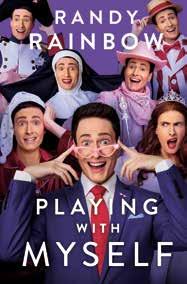
Randy Rainbow's Playing with Myself beautifully self-indulgent
People ask Randy Rainbow all the time if his last name is real. Yes, it is, he writes with glee, and it’s one of the best things his father ever gave him. Because, seriously, could there be a more fitting name for a Gay “topical comedian”?
Being in the limelight has always been in Rainbow’s blood: he recalls staging a Disney play for neighborhood parents when he was very young. He was the lead actor, the director, the stage manager, and the costumer. His playmates were rather less than enthusiastic but the parents applauded, and Rainbow was hooked.
It probably helped that his mother was a big Broadway fan, and so Rainbow grew up with show tunes. As an adolescent, he collected soundtrack CDs and, after he was introduced to “a form of religion that was... Barbra Streisand,” he collected videos of certain performances he grew to love best.
Also as an adolescent, he became awkward. His other religion was crunchy snacks, and he spent a lot of time in his room. His parents had moved the family from New York to Florida; their marriage was in shreds, and it took a while for Rainbow to get his confidence back.
So it wasn’t until he was in high school that he found that old rhythm, his scathing sense of humor, and a cadre of like-minded theater and drama friends.
After graduation, Rainbow returned to New York, where he ultimately found his community and sharpened his talent. Res-
taurants and clubs kept the lights on while he was learning to monetize the podcasts he was making, when an agent told him that he was “still a nobody!”
“Enter,” says Rainbow, “the 2016 presidential candidates.”
You didn’t really think Playing with Myself would be as hilarious as Rainbow’s videos, did you? Yes, this book’s funny but alas, not quite as LOL as his parodies.
You probably won’t mind, though: Rainbow’s biography is still plenty entertaining nonetheless. From his first pair of ruby shoes to the shoo-off he jokingly gives readers at the end, we get a peek at how he gained what he admits is “an encyclopedic knowledge of Broadway musicals,” how his sense of humor was honed, and how that all led to a library of YouTube bits that roast those in the news.
Politicians seem to be special targets for Rainbow — not surprisingly, as you’ll see here — but anyone’s fair game for needling.
Playing with Myself is slightly bruised by an overdose of name-dropping, the presence of which may surprise nobody. Still, if you don’t hate on that and you love a little faux pearl-clutching, this book is too good to pass up.
Heather could never: Conan Gray live at the Moore
by Lindsey Anderson
SGN Contributing Writer
Fans lined up around the block on Saturday, April 9, as they waited for the doors of the historic Moore Theatre to open. It was the final night of indie pop singer Conan Gray’s Seattle show before continuing on to Portland on his North American tour.
A sea of oversized blazers, ripped tights, and of course, Doc Martins swayed in anticipation as the door finally opened and dedicated fans were ushered through the grand entrance of the theater. Gray’s fan base, which includes a high volume of Queer Gen Z girls and Nonbinary people, was giddy when ushers and volunteers distributed goody bags of keepsakes.
Minds Bülow-n
Fans who had been taking advantage of the glow of purple concert lights and the track of mid-2000s punk-pop quickly found their seats as soon as band members entered the stage for the opening act: Canadian/German pop singer Bülow.
The crowd erupted when she glided onto the stage in a flowing white fairy dress plucked right out of our collective cottagecore fantasies. With angst and a bit of twang, she performed each of her songs after giving the audience a bit of context . Bülow sang about relatable young adult experiences: parties, losing a guy to Jennifer, and unrequited love for a friend’s dad. As she sat down for the the latter ballad, her band signaled to the audience to sway their phone lights back and forth, mimicking the lighters of old. One by one, Gen Z kids whipped out their prestigious iPhones and lit the room brighter than the house lights could.
Bülow ended her set with a highly anticipated TikTok bop that had the crowd on their feet and ready for the rest of the show.
The show begins
Lights came up on Conan Gray’s band, all femme-presenting people, rocking out to the interlude of his 2020 hit “Wish You Sober.” The crowd grew antsy as Gray’s voice echoed on prerecorded background tracks. Finally, with a stroke of a bass and the beat of a drum, the lights flashed to reveal Gray in all his ethereal glory, stand-
ing atop a staircase-like structure framing the stage.
Fans greeted him with shrieks that could wake the dead, and Gray flashed a cheeky smile before sassily swaying his hips to the beat. He wore flared black pants and a flowy, white button-down shirt, giving nods to gender-fluid pop stars of the ’80s, like Michael Jackson and David Bowie.
He hyped the crowd with one of his most recent songs, “Telepath,” then got into some upbeat tracks from his album, Kid Krow The crowd sang along to “Comfort Crowd,” a song he explained was about friendship, and “Fight or Flight,” an angsty ode to an unhealthy relationship.
In a brief interlude, a recording played “Online Love,” while Gray prepared for an energy shift, situating himself in a set made to replicate his bedroom. Atop the bed, he sang his latest release, “Astronomy,” while beautiful visuals depicted the night sky above his head.
“Fun fact, actually, really sad fact,” Gray said while still seated on the bed, “they make me sleep here every night!” The audience erupted in laughter. The little quips and references to internet jokes and memes
highlighted Gray’s charm and roots as a product of the internet age.
An internet sensation
Conan Gray started his YouTube channel at the age of 13, originally as a way to show off his interests in art and photography. He eventually switched over to the now-extinct platform Vine, where he became famous for his irreverent humor and song covers.
On YouTube, Gray became known as a vlogger, showcasing everything from his everyday school routines to homemade music videos for his original songs. In 2018, a year after he graduated high school, Gray signed a deal with Republic Records and released his debut EP, Sunset Season Gray rose to prominence just in time for the pandemic to hit. In 2020 he released his first official album, Kid Krow, which debuted at number 5 on the US Billboard 200, making him the biggest new US artist of 2020. Two of his songs, “Maniac” and “Heather,” became trending sounds on TikTok, earning him global recognition.
Gray gives fans Moore
Most of the songs he chose to perform
at the Moore were from his debut album, although he did sprinkle in some newer releases, which have yet to be put into an album, including, “Jigsaw,” “People Watching,” and “Overdrive.”
The performances were full of showmanship, and Gray’s personality came out to play when he showed off silly dance moves and sassy hair flips. Special effects added an extra element to his fast-paced songs, punctuating them with flashing strobe lights.
He took a break toward the end of his set to introduce the audience to his band and show off a superfan who had attended the last ten of his concerts. He chuckled as he “annoyed” his bandmembers, gushing about their talent to a crowd cheering supportively. Shortly after, the energy dipped, but only for a moment, when he announced he would only be performing one more song. Fans looked around incredulously, trying to determine which of his most popular hits, “Heather” and “Maniac,” he would choose.
The answer, as it turned out, was “Maniac.” Gray joyfully held the microphone out to the audience to sing along with him as he hopped around the stage with an enthusiasm only mirrored by the Energizer rabbit. An ear-splitting standing ovation rang out as he ran off stage giddily waving goodbye.
Despite his “very real” promise that “Maniac” would be the last song, the crowd began chants of “Heather,” hoping to encourage him to return to the stage once more. To hardly anyone’s surprise, Gray hopped back on stage within minutes.
Fans cheered and gawked at his quick outfit change into a plaid, pleated skirt and sweater vest, reminiscent of a Catholic schoolgirl. With somehow even more energy, Gray serenaded the crowd with his angsty anti-love song to Heather, the object of his lover’s affection. With the final stroke of the bass, the room went dark, and Gray disappeared back into the shadows.
Fans exited their seats and headed for the door, a chaotic and happy swarm of friends sharing with those around them just how special and life-changing the night had been. Gray’s career may have started during the early days of the pandemic, but if his first-ever tour is any indication, he’s headed straight for the stars. It’s astronomy.
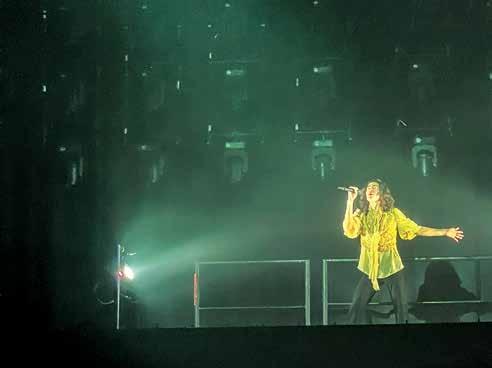
Conan Gray – Photo by Izabel Diaz
Image courtesy of St. Martin’s Press
Food & Nightlife
Editor’s note: This interview has been edited for clarity and brevity.
Nick Rapp: On the subject of crosswords, one of my favorite activities with friends is doing the NYT crossword together — a sort of trivia. There’s a special kind of group energy when working on logic puzzles and fun-fact activities. What do you think it is about trivia that brings people together?
Leah Caglio: I think about Captain Planet, where it’s like “I bring heart!” and “I bring power!” Everyone is bringing their little superpowers to the team. And there’s always a person when you’re hosting trivia who’s like “I’m that person that doesn’t know anything except for one question,” but with that one question, your team is gonna go wild, and so are you. That’s what’s great about it.
Sally Neumann: I also think it’s an avenue for people who are more introverted, or intense, to be less socially nervous and have an opportunity to non-nervously interact — to share more of themselves in a group.
NR: With access to information widely available since the advent of the internet, it seems like everyone can learn everything about anything. Now it’s almost more tough to have deep knowledge in a few subjects than it is to know a little bit about a lot. Do you think this makes it harder or easier to be good at trivia?
SN: I think, kind of, both. We talk about
this all the time, how we feel like we’re actively getting dumber. You know, COVID and our dusty, 30-year-old brains. You don’t have to retain stuff as much anymore. It’s usually a fun exercise, like a sport, but now it’s like, “Ah, I forgot this dude’s name, let me pull up my IMDb app.” But second, it’s easier, because at night, our fun activity is cruising Wikipedia and all the listicles and fun facts. I don’t know… Do you think it makes it harder to write something that seems novel?
LC: That is one of the hardest things. When we’re writing questions and there are gonna be Gen Z’ers in the audience, you kind of assume that you’ve gotta go heavy on internet stuff. But “internet stuff” is referring to all sorts of things in the greater body of knowledge. I think a lot of people that are attached to that internet economy of memes and stuff like that are learning stuff without really knowing it. It’s a really cool part of trivia when they don’t realize that some dumb meme they were looking at is actually the answer to a historical or deeper pop culture question.
NR: How did you decide to start Head in the Clouds?
LC: When I was studying for Jeopardy! I thought, “Man, I would love to host trivia. That would be really fun.”
SN: And then we were at a restaurant and she [Leah] was like, “I would really love to start a trivia company,” and I was like, “Wait, same, are you serious?” And she said, “Yeah.”
LC: I never thought that starting a business would be a part of my life, but I was kind of like, “Why not?” [Trivia’s] some-
thing that I really enjoy doing and people obviously love participating in. The timing was hilarious, because it was deep into COVID and on the one hand we had nothing to do and were afraid it would be a total flop, but on the other hand, it gave us a lot of time to lay good groundwork and develop a variety of questions and test out formats. So thanks, pandemic, I guess?
NR: Your trivia is split into general knowledge, audio rounds, and visual rounds. What do these categories look like?
LC: In the audio rounds, we play eight to ten tracks, and they’ll have a theme, or be weird in a certain way. For example, we’ll have a category called “Celestial Songs,” so songs with “star, moon, or sun” in the title. Or, sometimes there are “eight-bit tunes,” popular songs played in that screechy, chiptune version. It’s a really nice way to break up the rounds, so if you’re just there tagging along and you’re not a trivia person, it’s a good way to break it up.
SN: When it’s a space with really good audio, we’ll play scenes from movies. But in the big venues, where the sound is weird, we’ll just do songs. For the visual rounds, my favorite are where we do kind of like a visual puzzle. We’ll put together certain images to assemble the title of a rom-com or something. I make them super intense. I’ll be like, “This, minus this thing in parenthesis, plus this, times two,” and it’s super intimidating but very doable. And we like to make them very tongue-in-cheek.
NR: You mention on your website that trivia has historically been sort of exclusionary and focused on a narrow canon.
What do you see as the most glaring omissions from the mainstream trivia world?
SN: You can’t help but write from your perspective — where everybody starts is what they’re interested in. And obviously part of that comes from what sociocultural place we’re coming from. So, first of all, just having women write trivia at all is different. We’re more inclined to write stuff about the “womanier things,” so, classically, fine arts…
LC: A lot of things that are considered “trash” like reality TV, fashion, beauty… those are all facts and they’re hundreds of years old at this point, so it’s kind of crazy that we don’t treat [something like] natural dyes used to make lipstick as a chemistry question. It’s all chemistry, but just in different ways. I had a team that suggested menstrual periods as their category, so I wrote a whole category about them. There are so many angles to topics that would most of the time be a “no-no.”
Another cool thing… about geography or international cultures is writing about them [in] a way that is not “from America.” Instead of “America did this to this country,” it’s more like “Today is Pakistan’s Independence Day.”
SN: Our Thanksgiving questions were “White Failure, Indigenous Victory.” They’re never gonna be about, like, “the harmonious meal.”
Register for Neumann and Caglio’s latest events and read more about their company at www.headinthecloudstrivia.com.
Photos courtesy of Optimism Brewery
Food & Nightlife
The Mountaineering Club brings hiker chic to new heights
by Kylin Brown SGN Contributing Writer
Have you ever wanted to be a part of some exclusive club, just to sound cool? Are you into camp(ing)? Or maybe just the idea of the outdoors (aka, the s’mores part)? Thanks to the Graduate Hotel’s rooftop bar, you can enjoy all of these things, without embarking on that “easy” hike that your trademark PNW friend invited you on.
A brief 16-story elevator hike to the rooftop bar, fittingly called the Mountaineering Club, will satisfy your s’mores cravings in an ideal campy camping atmosphere, while also offering adventuresome cocktails and panoramic views of Seattle.
Peak pleasures
On this rooftop, the best direction to face is south. Get up early to snatch a coveted sunset reservation slot for a spectacular view of the Space Needle, the Puget Sound, and the Olympic Mountain range on the horizon in the southwest corner, or bathe in the hues of pink that play above Mount Rainier to the southeast.
Of course, don’t forget to check the weather, commonly cited as the culprit for our lack of rooftop bars. While light clouds can make for a more vivid sunset, a “mostly cloudy” or windy forecast might call for a rain check. Luckily, the Mountaineering Club has installed heated, covered, and indoor seating up there as well.
“Covered seating here makes me feel like I’m not going to fall off the building,” I overheard one patron say. Meanwhile, couples took selfies overlooking the city lights below.
Per popular recommendation, I went with “the girlies,” a small group of friends, and we ordered the s’mores. It felt like summer camp. It felt like friendship bracelets. (In fact, I recalled, the venue actually hosted a friendship bracelet party for “Galentine’s Day.”)
S’mores are always theoretically good, but never quite what we remember from childhood. At the Mountaineering Club, however, the cheer of watching the sunset over locally inspired cocktails evoked fond memories of the colloquial snack. Nothing says catharsis more than roasting marshmallows with warm cheeks — from the open flame or the drinks.
Other fare to pique the interest of any outdoorsperson include options like Shigoku oysters, gravlax, a couple of different cheese and charcuterie boards, panini, and a famously fancy Wagyu and Dungeness crab hot dog. This place really is a textbook “choose your own adventure,” so I went on a more vegetarian route. Let us know on social media what you do, though!
Drinks from the bar’s seasonally changing menu yielded a Sakura Cosmo (through last week) for the Cherry Blossom Festival, meaning a new PNW cocktail is likely on its way soon. Other offerings on the current list include “Smoke Follows Beauty,” a
fresh, biting sal de gusano agave adventure quietly tucked into a petite green elixir.
A safe space for all?
A surprising twist arose in researching the Mountaineering Club. Because the bar is incorporated into the Graduate Hotel, it does not have a full website of its own, including staff or story, which I usually analyze alongside social media for proof of allyship.
But I found that while the bar itself has a since-genesis story of celebrating Pride through benefits for LGBTQ+ youth and families and great relationships with local Queer DJs, a website was made in 2019 calling out former bar manager Jabriel Donohue for homophobic remarks.
The page, named for Donohue, cited a 2019 Facebook comment of his, wherein he argued with a fellow bartender by referencing Gay oral sex. The creator of the website saw this as homophobic.
Fortunately for Donohue, his very public online activity meant that I could fact-check this claim. This comment was nowhere to be found, and his records actually show years of allyship.
Donohue has been a long-time Gay rights advocate, discussing QTBIPOC issues from a progressive stance publicly throughout a nearly decade of online presence. During the pandemic, Donohue also parted ways with the Mountaineering Club and started a bar-talk podcast, which includes
topics of race and equity in the restaurant and bartending industry.
After traveling down a winding road, I’ve returned to my first impression: the Mountaineering Club is kind of campy, and it seems like it’s just waiting to be Queered. While outdoorsiness is an extremely exclusive culture among Seattleites, this bar welcomes all to indulge in smoky flavors, plaid, and “bonfires” just tame enough to avoid Smokey the Bear (who obviously led the interior design team).
Though the bar is still new, having opened in 2019, its first Pride weekend celebration included DJ MIXX America and raised funds for Camp Ten Trees, an LGBTQ+-only youth summer camp (which is currently accepting volunteer applications at camptentrees.org/volunteer.) The Graduate Hotel is also a member of World Rainbow Hotels collection of LGBTQ+friendly hotels.
The rooftop oasis is set to bring back Pride celebrations in 2022 after the pandemic closure, and hopes to support Queer patrons and staff year-round as allies in the industry.
The Mountaineering Club is open by reservation after 4 p.m. Tuesday through Sunday at www.themountaineeringclub. com or by phone at (206) 634-2000, although walk-ins will be accommodated as space permits. It also offers DoorDash and take-out options.
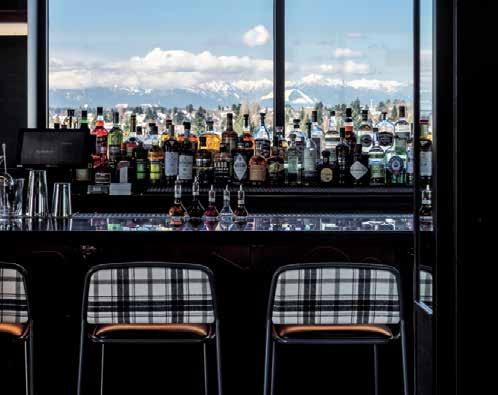
Photos courtesy of the Mountaineering Club
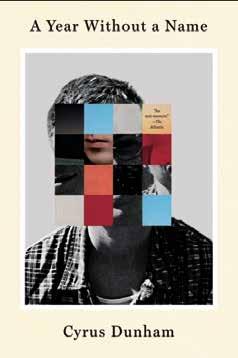
A Year Without a Name an authentic look at Trans experiences Books
by Lindsey Anderson SGN Contributing Writer
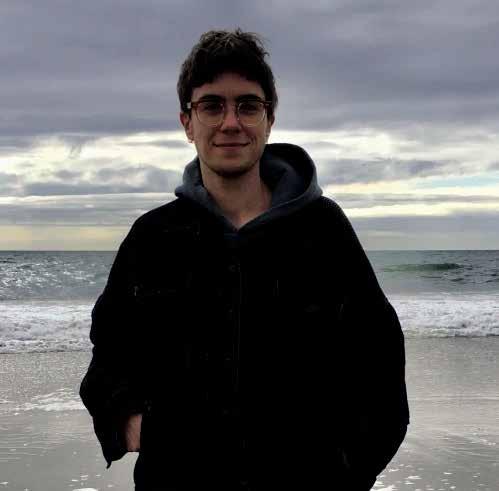
This week, the SGN Book Club is reading Cyrus Dunham’s highly introspective masterpiece A Year Without a Name. Dunham, who may be most commonly known as the younger sibling of controversial and feminist comedian Lena Dunham, breaks out of his own mind to deliver a raw, poignant, and reflective series of essays written in the year leading up to his official transition.
Rewriting the popular Trans narrative
“Some trans people always know they are trans and never question it,” Dunham writes in his introduction. “Others do not know for a long time, question it often, and even change their mind. I have met more of the latter. It is neither the province nor the responsibility of trans people to embody certainty.”
He begins his series of essays with a preface written after A Year Without a Name had been originally published. In it, he notes that his book has been lumped in with an anti-Trans book titled Irreversible Damage: The Transgender Craze Seducing Our Daughters. Dunham reflects on his own journey, one that was less marked by a youthful certainty in his male identity and more by a twisting journey of adult selfdiscovery.
In this brief analysis of social acceptance of Trans identities, Dunham remarks that many “allies” and “feminists” are happy to validate Trans existence, but only when it follows the narrative of the “child born in the wrong body.” Despite this, he shows that Trans identities are very nuanced and do not often follow a script.
Like the popular Trans narrative, Dunham describes the all-too-familiar childhood experience of feeling different. He describes feelings of gender dysphoria as a child, and even recalled an instance when he asked his family to call him “Jimmy,” which they refused. He also relates his struggles with obsessive compulsive disorder and anxiety, finding comfort in even numbers and hiding away in the deep recesses of his mind to escape the realities of the world.
“When, around the age of five, I began to recognize myself in words, I was afraid of the words that described me being found out. The words were always in my mouth. They felt like a part of me. My parents and their friends cherished me for being a little girl. I knew I was a pervert. I was tricking them,” he writes.
As a teenager, Dunham identified as a Lesbian but knew to keep that identity a secret. He talks about growing up the child of feminists and feeling special in his identity as a girl. Despite this, “girl” never felt quite right.
The truth in lies
An underlying parallel to the first half of the book is a life-changing trip Dunham took to India at the beginning of his year without a name. At the time, he was identifying as Nonbinary and struggling to understand how he might fit into the world as a man, simultaneously gaining and losing the privileges he had come to understand how to wield.
“As a teenage girl, I’d stood behind the podium in debate tournaments and wielded language to assert my intellectual superiority,” he reflects. “One of the privileges of white girlhood was feeling entitled to prove that I was the best. I was taught to believe that winning would correct for centuries of oppression. Girlhood loomed larger than my own power.”
For Dunham, transitioning opened up the fear of becoming the oppressor and inheriting the guilt of a white man, while still living with the experiences and memories of being the oppressed. He struggled with seeing transition as a rejection of his femininity and feared it would make him a misogynist in the eyes of the world.
This internalized struggle is materialized physically when Dunham, still identifying as Nonbinary and presenting androgynously, meets Zoya. Immediately he was smitten with her but expressed concern when he
learned of her disgust for men. Knowing the person he held within, Dunham worried he was lying as he charmed Zoya.
Gender as physical; gender social
After returning to the United States and losing touch with Zoya, Dunham’s essays become even more self-reflective as he analyzes his complex relationship with his family, fame, and desire to be seen as “special.” Through the encouragement of new friends and his acclimation to Trans spaces, he starts to debate surgery, testosterone, and a name change.
Through his reflections, Dunham reveals the struggles he went back and forth on for months. He finally picked out a new name, Cyrus, but could not commit to using it all the time, as he feared it meant he was failing his former self. He discusses the constant fear that he was a liar, that using his birthname when introducing his masculine persona to others made him wrong, and that using his chosen name betrayed the love of the people who had not chosen it for him.
Dunham also weighs his thoughts on physical alterations, namely top surgery and starting testosterone. On one hand, he believed that if he attempted to conform his body to society’s standards of masculinity (flat chest, square jaw, and facial hair), then he was only contributing to the issues that cause gender dysphoria in the first place. He explains that in an ideal society, we should move away from masculinizing and feminizing specific physical traits of bodies. However, his desires to see himself as a man ultimately win out, and he schedules his top surgery.
Dunham debates how far he wants to go with his transition. He desires a flat chest and greater muscle mass but admits facial hair feels like too much. As he mentally prepares for his physical transition, he also grapples with the reality of coming out to his family. Dunham reflects on his childhood, the close bonds he shared with his parents and older sister, and fears most that he is betraying the love they gave him by rejecting the person they tried shaping him into.
The questions he poses to himself and his readers are deep and familiar to many Trans people. The book ends with a poignant reflection on his year, the ways his thoughts and worries have changed, and the admission that he does still struggle with many of the same fears. Dunham admits that he still feels a pull to his old self on occasion and that he still questions society’s focus on and expectations of gender. However, he admits that he is happy in a way he never had been, and perhaps that is enough.
Dunham writes as if he is pondering life with a close friend, and maybe he is. His eloquent ways of describing his fears around change and possible regret resonate with many Trans readers, especially those who struggle with uncertainty. He describes a process that is often ignored by allies in the media, one of constant selfdoubt, questioning, and in the end, hope for a better life.
A Year Without a Name is a must-read for anyone who is, or knows someone going through gender questioning.
Cyrus Dunham – Photo by Rosie Stockton
Image courtesy of Little Brown
Bay’s Ambulance is a high-octane jolt of pure adrenaline
by Sara Michelle Fetters SGN Staff Writer
AMBULANCE
Theaters
It’s been a while since I’ve enjoyed an entire film directed by Michael Bay. The first Transformers entry wasn’t terrible, and both The Island and 13 Hours have their moments. But liking the whole motion picture? Start to finish? With no hesitation? You have to go back to 1998’s Armageddon, that cartoonish disaster flick with Bruce Willis and Ben Affleck about deep-sea oil rig workers sent into outer space to destroy a planet-killing meteorite that was far more goofy fun than it has any right to be.
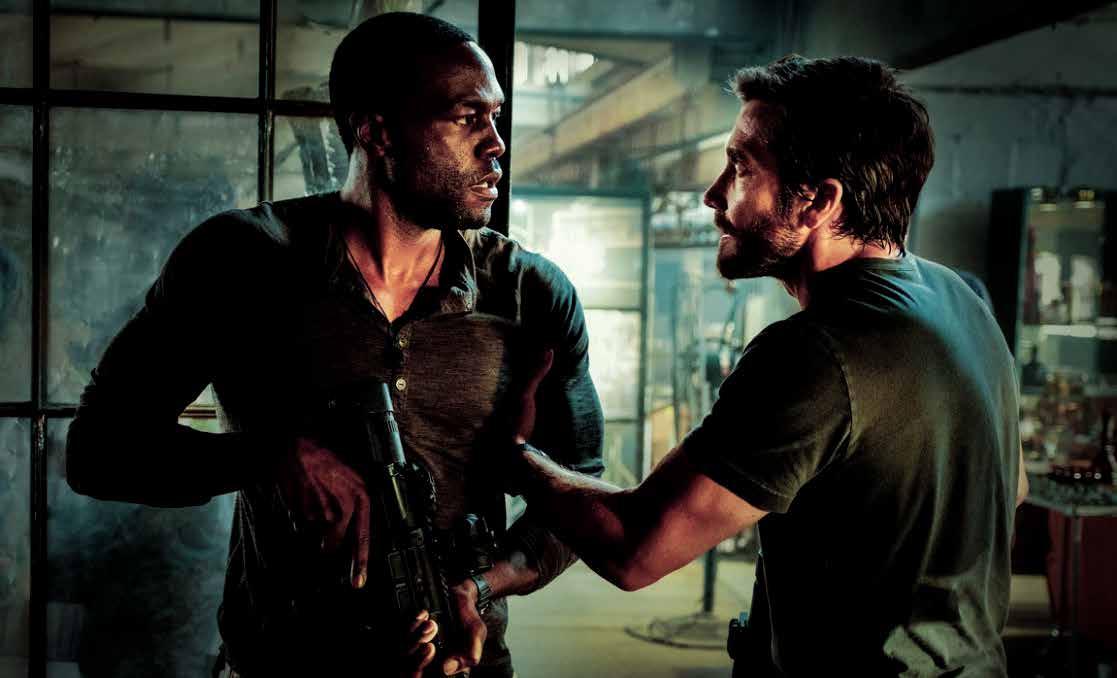
But Bay has now crafted his best film in almost a quarter-century with the frenzied, chaotic Ambulance. A remake of the 2005 French hit Ambulancen, written by Chris Fedak and starring Jake Gyllenhaal, Yahya Abdul-Mateen II, and Eiza González, this is a loony, pedal-to-the-metal actioner that hits the ground running and doesn’t let up for a single second of the lengthy 136-minute running time.
Featuring Bay’s signature brand of visual and auditory freneticism, only stripped down to its barest essentials, this is a brawny, if nonsensical, operetta of vehicular carnage that comes perilously close to bludgeoning the viewer into stupefied submission. But the director displays confident control of the orgiastic excess throughout. For once, Bay keeps the focus on his three primary characters in a way that allows them to have interior lives, and as sensationalistic as it is, there is an authentic beating heart hidden beneath this high-octane skin I wasn’t expecting.
Decorated former Marine Will Sharp (Abdul-Mateen) is nearing the end of his rope. His wife Amy (Moses Ingram) is in desperate need of an experimental medical procedure that their insurance won’t cover. With no other options available, Will turns to his estranged adopted brother Danny (Gyllenhaal) for a loan. While he doesn’t have the money right this second, he does
offer his sibling an option to earn the cash. But Will has to decide immediately. No hesitation. No questions. Yes or no. If it’s the former, Will is going to split $32 million five ways, and all his financial problems will be erased with two hours of work.
It’s no spoiler to say that things do not go as planned. Danny’s foolproof bank robbery is undone by a bumbling rookie cop (Jackson White) who inadvertently gets himself shot during the heist. Things go from bad to worse when an ambulance carrying EMT Cam Thompson (González) arrives to treat the fallen officer. With all their escape routes cut off, Danny and Will take the paramedic and the wounded policeman hostage, fleeing in a stolen ambulance with seemingly all of the LAPD hot on their tail.
From Bad Boys to pretty much every installment of the Transformers franchise, Bay’s fondness for car chases is a matter of public record. He stages them big and loud, and it’s as if the director is attempting to top his prior antics each time. With Ambulance, Bay unleashes the mother of all car chases, an almost two-hour rollercoaster ride of constant movement that never stops, rarely pauses, and refuses to step on the brakes.
It’s outlandish, but there’s no surprise there. The director utilizes every trick in the book — and a few new ones he likely had a hand in inventing — to showcase all this mechanized madness. Cinematographer Roberto De Angelis unleashes a visual flurry of snazzy images, while editors Doug Brandt, Pietro Scalia, and Calvin Wimmer cut it together to match Bay’s signature rapid-fire sensibilities, keeping the viewer physically discombobulated throughout.
Normally I’d decry some of this. Bay’s preferred editing technique isn’t for everyone and, in some of his films, this style has the unfortunate side effect of transforming the cinematic image into a headache-inducing visual blur. But here it works quite well, and much like The Rock or even 13 Hours, all of these quick cuts and swirling camera movements do a great job of planting the viewer right in the middle of the story. I felt an emotional kinship with Will, Danny, and Cam, with the physical and mental toll of their situation augmented considerably thanks to Bay’s orchestration of the technical components. It helps that Gyllenhaal, Abdul-Mateen, and González are fully invested in this hogwash. They give robust, larger-thanlife performances that fit right in with the
situations their characters find themselves in. Do any of their decisions make a lick of sense? No, but that does not mean they call attention to how absurd these events are. They’re all in, and it thankfully shows.
Part of me does think I enjoyed this one as much as I did because it’s a non-superhero, non-reboot, non-sequel piece of pop action entertainment made by a major filmmaker with a signature style who’s been given the freedom to get his vision up on the screen with precious few strings attached. That’s no small thing, and while Bay’s approach to action and his thematic sensibilities have rarely meshed with mine, there’s no denying that when the director is at the top of his game, few can stylistically match what he has to offer.
I had a blast while watching Ambulance. There was something about sitting in a giant theater with a full audience and having that awesome sound design wash over me like a tidal wave, with people giggling, shrieking, and cheering in unison at all the moments they were supposed to. This crazed shot of pure melodramatically idiotic adrenaline was just what I needed, and the thunderous roar of every engine was a fast and furious joy worth getting excited about.
An action scene from Ambulance – Photo courtesy of Universal Pictures
Yahya Abdul-Mateen II and Jake Gyllenhaal in Ambulance – Photo courtesy of Universal Pictures
2022 Seattle International Film Festival preview A conversation with Artistic Director Beth Barrett
by Sara Michelle Fetters SGN Staff Writer
The 48th annual Seattle International Film Festival (SIFF) began an 11-day hybrid run with the local premiere of the documentary Navalny at the Paramount Theatre. Concluding April 24, this year’s festival features its usual eclectic mix of features, documentaries, shorts, workshops, forums, and numerous additional programs.
While the majority of screenings and events will be happening at theaters throughout Seattle and the Pacific Northwest, there is also a virtual option for almost two-thirds of this year’s selections. It’s an exciting cinematic smorgasbord, and while still not quite the massive 25-day feast SIFF has typically been known for, the festival still remains a massive, eye-opening opportunity to indulge on tasty storytelling treats from all around the globe.
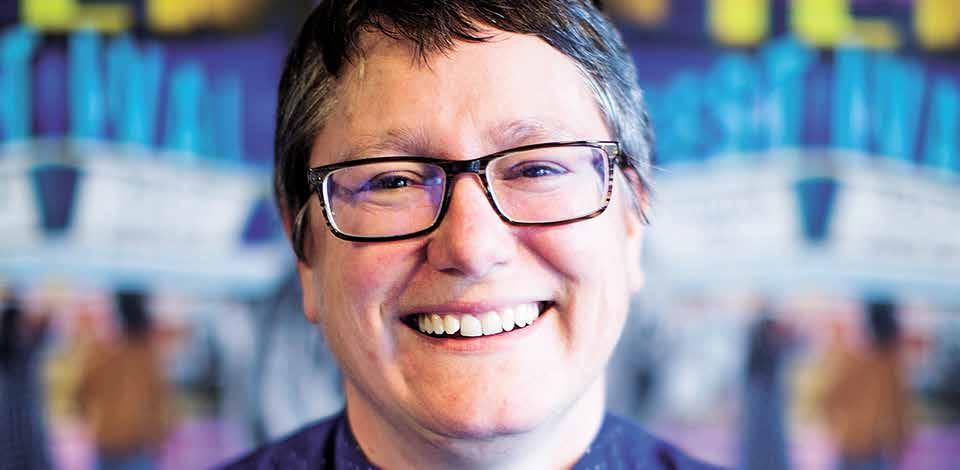
I sat down with longtime SIFF Artistic Director Beth Barrett to chat about this year’s festival. The following are edited transcripts of what they had to say:
Sara Michelle Fetters: Last year when we touched base, SIFF was virtual only. Now we’re back in theaters, but there’s also still a virtual option. What has all of this been like? Was utilizing this hybrid model even more stressful to program?
Beth Barrett: Yes and no. The in-person part of it was actually surprisingly easy. I’ve got nearly 20 years of muscle memory of how to do this, about how we put a film in a theater, so that part all felt really familiar. It was interesting talking to distributors about the hybrid [option]. Some we’re very receptive. We were clear about what we were trying to do, which is recognize that the pandemic is not over and people are at varying different levels of comfort in coming out to a physical space.
But there’s also this accessibility that we gained over doing the virtual festival [in 2021]; we had audiences across the country watching films. We recognize people “festival” in different ways. When we were trying to set up the structure of the 2022 festival, we were trying to do it as pandemically safe and accessible as possible, while still being celebratory and ecstatic about being back in cinemas.
With the hybrid, and especially if you have a film pass or even a six-pack, you can choose to see a film in a cinema on a Saturday and then, on Sunday afternoon, you can watch a couple [films] at home. You can then see two more on Monday night. You can design your festival experience in your own way, theatrical or virtual with the films we have on the SIFF Channel or a both. It’s exciting.
SMF: There really does seem to be this freedom of choice this year. I mean, there’s never been one way to SIFF. You’ve always had many different ways that you could try to SIFF. But this year, it’s like you’ve embraced this concept of what makes you feel the most comfortable. You really seem to embrace the potential viewer in a warm little virtual hug. It’s like you’re saying, “We’re going to let you do what you want to do, and we’re still going to try to show you as much as we can.” That had to be the plan, right?
BB: It was. But it’s also getting filmmakers and getting those stories out to people that don’t have physical access to the festival. We have a lot of access here in Seattle in terms of in cinema experience, but go an hour out and that access to independent and international films is much, much less. Go two hours out and you don’t have that access at all. But you still want to engage with the programming. You still want to have the experience that SIFF can bring. Having the virtual option allows that to happen.
SMF: And, looking at the guide, it does seem like several distributors and/or filmmakers were open to you being able to do this. It does seem like you’ve got many more virtual options than I admit I expected was going to be the case.
BB: Yeah, me too. To be perfectly honest, I actually thought that we’d get about 30%, maybe 40%, and we have around 60% of our titles with a virtual option. I think that in the last two years, people have recognized that the value of the festival is in the exposure to the audience. I think distributors are starting to see that if they want their films to be seen by audiences. embracing this hybrid model is one great way for them to be seen outside of those traditional hubs.
SMF: But, for those eager to get back to a traditional theatrical experience…
BB: It’s back!
SMF: Right. It’s back. For SIFF, it had to have been nice that you were able to reopen
your theaters in a tiered process, one where you brought people back incrementally. I feel like this helped you be even more prepared for this year’s festival than you may been had everything just opened back all at once.
BB: Absolutely. We would never have been able to reopen the cinemas with the festival. That would have been impossible. We began reopening our cinemas in October of 2021, and there’s new processes and a different way that we’re doing things. There weren’t very many silver linings to the pandemic, but one of them was the ability to look at what we were doing and how we were doing it from an exhibition standpoint. It’s been amazing to have had these months under our belts in terms of people coming back to the cinemas, having some bigger shows, and getting more comfortable. I think it’s going to take us all a while to be as comfortable as we were three years ago, but we’re hopefully going to get there.
SMF: Did it also help that you were able to do DocFest and Noir City festivals before this one? Personally, when I went to my couple Noir City showings, I was surprised how comfortable I felt and how streamlined that process was of getting back into that theater in a festival setting.
BB: I think it’s absolutely right that we were able to give some of the staff and some of the house managers experience through those events and with the mini-festivals. It’s a different feeling, these festival and special events, so I think it really did help us to be able to practice and to try some things before we got to SIFF.
SMF: So let’s talk more about this year’s SIFF. I shouldn’t be impressed, because you and your team always seem to be able to this, but this year you were able to come up with this really cool, very diverse program in the middle of all of the craziness that’s still going on right now.
What was that like? Putting these pieces together, talking to these filmmakers, getting films programed, and making all your selections so that you could have this rich diversity over a two-week period?
BB: All your great words are all because of our programmers. We work as a team, and they are some of the most dedicated, savvy, smart people that I’ve ever worked with. They are able to understand what we’re looking for, which is that depth of
well-roundedness while yet also remaining a tiny bit shallow, if that makes sense. It’s not all documentaries or it’s not all films from France. It’s not all of one anything. SIFF is a little bit of everything. There’s depth everywhere. There were the fights — we should have, this but we can’t have this, but we need this film — but that happens every year. And, in the past, we would have about 250 features in the festival. This year we’re down to about 150 features. But that’s still up from 2021. Last year we were at 92.
The increase is nice. It allowed us to have a little bit of breathing room in terms of numbers of films that we could book, but also allowed us to take chances on some of the smaller titles that we would not have been able to program last year because we were so limited.
But we have a unique vision, and these are the kinds of films SIFF is known for, those discovery films. So 60% of our filmmakers this year are, this is their first or second film. Also, another 60%, do not currently have US distributions. So these films are a real chance for the audiences to connect to stories and to see something that they otherwise may never get another chance to see. That’s exciting.
SMF: Speaking of films a person may not get another chance to see, you’ve got the work-in-progress forums back.
BB: We do! We’re really excited about the two work-in-progress forums this year. They’ll be on Thursday and Friday, the 22nd and 23rd. One of the programs is Motherland, and the filmmakers are coming from some pretty tough situations right now in the world. The fact that they’re still making their film is really extraordinary.
The team behind Ten Meter Tower, the short film, they’re back with Broadcasts, which is all told with extemporaneous video. It’s a really interesting process of being able to hear from the filmmakers, see what they’ve got, and then be able to give your feedback and have discussions about what they’re thinking and hear where they intend to go next. It’s exciting.
Another thing we’re really excited about this year, we’re bringing Kaltrina Krasniqi’s Vera Dreams of the Sea. That was one of our work-in-progress selections last year for the virtual festival. Now she’s finished the film based on some of that feed-
Beth Barrett – Photo courtesy of SIFF
back and then went on to win a prize at the Venice Film Festival! We’re so excited to have Kaltrina back at the festival this year.
SMF: Let’s talk about guests. You have in-person guests back this year!
BB: Yes! Isn’t it great? We’ve got guests with about 55 of our features, which is a lot. It’s actually roughly about the number of guests that we would have in a 25-day festival period. This is only roughly an 11-day period. So it’s a lot.
There are days that are full of guest screenings, and we’ve got all of those listed on our website in the SIFF blog, in the news area, where there’s a whole list of films that have special guests. Granted, as we know, in this world, with how everything is right now, things do change rapidly. But these are the folks that we are all very hopeful that they will be able to attend.
SMF: Well, in regards to the state of the world and everything that’s going on right now, you’re opening night film Navalny, it suddenly couldn’t be timelier.
BB: Yeah. When that decision was made, to have Navalny open the festival, Russia had not invaded Ukraine. There were still posturing and so sadly, every day, it has become just a little bit more timely in looking at what is the human cost to standing up to authoritarianism. Film creates conversations, and the conversations that we’re having in the US right now, and not just in the US but around the world, they’re massive. What is democracy? How do you maintain human rights and human dignity and freedom of choice? How do we be the world that we want to be even when faced with all of the horrible things happening around us?
Film provides a way to have those conversations without them being philosophical conversations because they’re lived experiences. You’re seeing those stories play out in real life or, in the case of Navalny — which is crazy, because it really plays like a thriller even though it’s all true — play through the lens of a documentary. This is true with documentary and it is also true in a scripted film. People are still looking at those same big questions. They’re just asking them in different ways.
SMF: And, speaking of asking big questions that have gained additional resonance due to current events outside of the control of the filmmakers, with what just happened in Alabama and with what’s going on in Florida and Texas, you have a fairly hardhitting LGBTQ slate this year, I think it’s safe to say.
BB: We do. There’s a lot going on in the world right now. We sought to try to represent, again, not the depth of the LGBTQ+
experience, because Three Dollar Bill and the Seattle Queer Film Festival do such a great job, and Translations does such a great job and can go into more depth than we can. But the broader questions, like how are rights around the world being talked about or how is the experience in other countries, these are questions we sought to answer.
We’ve got the world premiere of Craig Boreham’s Lonesome, which is a sexually explicit coming-of-age drama. We’ve also got Saul Williams and Anisia Uzeyman’s Neptune Frost, which is an electro-pop, Queer, musical, experimental, Rwandan experience. Those are both quite exciting.
But filmmakers are expressing themselves and expressing Queer ideas in so many different ways! One of my favorites, actually, is the Icelandic comedy Cop Secret, which takes the toxic police drama and makes it a Queer thriller comedy. It’s pretty great.
Honestly? Those Scandinavians really showed up this year. There’s Girl Picture, a Finnish film of three young women. So Damn Easy Going is another great one, a really wonderful Swedish young Lesbian drama, and the Lesbians don’t die in the end! I’m hoping that we have gotten past that narrative where the queer drama has to include some sort of punitive damage to the queer characters. We’re done with that.
SMF: Another thing that I noticed this year: there are quite a few films dealing with humanity’s relationship to nature. Was that a conscious decision? Or was this just a random trend that happened with this year’s submissions?
BB: I think it just sort of happens. Seattle’s a very environmentally conscious city, and so we’re always looking for ways to incorporate those films into the festival, films like Raul James’ Invisible Demons It’s interesting, because the way he tells his story, it is not just about the environment or just about how Delhi’s air is unbreathable and the water is undrinkable. It also ties how class plays into all of that. What are the economics of a destructive environment? James comes at these questions from a place of privilege when he says, very early on, my family had an air conditioner.
The very simple fact that his family was at a certain class and had a certain status and had a certain privilege, they had an air conditioner and they didn’t have to breathe the Delhi air. It’s a really fascinating look at the emotional toll that environmental disaster takes without going deep into the environmental disaster itself. It looks at it from a different, unexpected angle.
But the air and the water in Delhi
remains an endemic challenge. It really is not safe to live in parts of Delhi.
SMF: And, of course, the “Northwest Connections” section of the festival is back, as it should be, and we also have the return of local filmmaker Megan Griffiths.
BB: I’m so excited [for] the world premiere of I’ll Show You Mine. It’s a pretty intimate film. There’s just two characters and it wasn’t shot here, but crew are all Seattle folks who are either still living in Seattle or still consider Seattle their home. I’m really, really, really excited to be able to share this film with audiences.
SMF: Another Northwest Connections entry I’m looking forward to is Sweetheart Deal
BB: You should be looking forward to that one. It’s a really deep look at the women working on Aurora, and the filmmakers have been working on it for almost a decade now. They went into the film thinking it was going to be one thing, and like many documentarians, they discovered their story was about something totally different. They got to know these women. We’re so thrilled to be able to present the world premiere and to finally get these stories out there for audiences to experience.
SMF: This is the second year in a row that we’re in the April timeframe and not in SIFF’s traditional spot of the week before Memorial Day. This is also a two-week festival and not one that runs for 25 days as in the past. How has this April timeframe been for you all? Are you sticking here going forward? Or do you want to move back to that traditional early summertime spot at the end of May?
BB: April has been really good. I love it. For years, the festival has fought with the sun. SIFF was never intended to be a summer festival, and so being in April has really allowed a lot of different access. Kids are still in school. Universities are still in session but they’re not in finals. This means university and college students have access to the films in a different way.
I really enjoy April. There’s a lot of different festivals that happen roughly at the same time across the country. We’re sharing a guest with Cleveland. We’re sharing a guest with Hot Docs. We’re sharing three guests with San Francisco. Because we’re in April, we can work together as a festival community on films that we have in common to support each other, to bring international guests in because when not all having to bust our guest relations budget. When you get to pull it all together and work as a team, a flight from Kosovo to bring in a director suddenly seems reasonable.
SMF: For somebody who’s grabbing a festival six-pack, what are you sending them to?
BB: I’m sending them to Fire of Love, an incredible documentary from Sara Dosa. I’m sending them to The Pez Outlaw, which is hilarious. It’s about a Pez collector who finds a line to Pez dispensers that are not available in the United States. He flies to Eastern Europe, Hungary, and Czechoslovakia… and brings them back into the United States. He essentially becomes a Pez smuggler and it’s a great, great film. What else? How about Daughter of a Lost Bird, which is directed by Brooke Swaney about her friend, Kendra Potter, who was… from the Lummi Nation and was adopted as a baby to a white family, grew up, and as an adult found her birth mother. There’s the journey that they go on as a mother and daughter, but also the journey they go on discovering — and rediscovering — what it means to be indigenous and Native American. Really extraordinary film.
I would also send people to see Girl Picture, which is one of my favorites. Also Kaepernick & America. Colin Kaepernick is one of those social justice warriors that is somewhat enigmatic but also caused giant change in one of the most staid conservative sectors of our world: professional sports. By taking a knee, he threw a spanner in the works. It’s terrific film, and it’s also another world premiere. How do I choose just one more? I am going to go with Flux Gourmet, because this random six-pack person deserves something that will just make them say, “What am I seeing here?” It’s a Peter Strickland film, the director behind In Fabric and Berberian Sound System. It centers around an alimentary band. They create experimental noise music with food, but, of course, they’re sequestered away in a giant mansion with... it’s hard to even explain. It’s Peter Strickland, so it’s confrontational and it’s squirmy, but it’s also just like, I don’t know... beautiful.
SMF: Lastly, for you, what is going to make this year’s SIFF a success?
BB: Just seeing people engaging with film and seeing people coming out and being there and being together in the cinema and having these experiences. There’s nothing quite like it, to walk into a cinema and to see people sitting and watching a movie. Learning, laughing, crying, being infuriated, all the same things, all of those things. Together.
Image courtesy of SIFF
Humor A zoomer gets lost: One brave reporter's incredible journey home with only her dog, her wits, and no cell service
by Lindsey Anderson SGN Contributing Writer
“No SIM detected,” read the message on the shattered screen of my iPhone 6S. My trusted device had picked the worst possible time to finally betray me. I had just taken a wrong turn off I-5 and now sat parked in my car in an unknown arterial in Tacoma.
The first thing that struck me about Tacoma was how desolate it was on a Monday afternoon. Not a single soul could be seen walking the streets or patronizing any of the few businesses around me. Not that another person would have been comforting. I couldn’t remember the last time I had asked an actual human for directions, and the prospect felt more terrifying than being stuck there forever.
I looked over at my traveling companion, my small dog, Peter, the only creature with a worse sense of direction than me. I felt I should break the news to him.
“Well, I guess we live here now,” I said as Peter looked back at me with the far-off gaze of someone who has smoked just a little too much pot.
This must be how someone comes to find themselves a resident of Tacoma. Lost, wrong turn off the freeway, and no lifeline to the outside world. I was about to accept my fate when the rain came.
A torrential downpour came out of nowhere. I watched longingly out the window, reminded of my Seattle home, many miles from where I now sat.
And then, out of the corner of my eye, I saw her. A woman down the street, the first human I had seen in what felt like ages. As the figure came closer to me, however, I realized there was something odd about her, almost un-human.
My eyes darted to the object in her hand. I realized where my uncanny discomfort was coming from, for above her head, she held an umbrella.
Shocked at the sight, I turned to my dog. “Peter, I’ve the feeling we’re not in Seattle anymore,” I exclaimed.
There was nothing behind those eyes of his.
I was now determined to reboot my GPS by any means necessary. Digging into the deep recesses of my mind, I remembered a time before cell phones, a simpler day full of Angry Birds and Fruit Ninja on a yellow iPod Touch. How did I figure anything out back then? With Wi-Fi!
I bade Peter farewell and left the warmth of my car in search of any spot that might provide a gigabyte of free Wi-Fi. Alas, this street did not have a McDonald’s or a Starbucks. It was as if I had wandered into some strange alternate dimension.
Finally, I found a restaurant with Wi-Fi. Huddled outside the doors, I shielded my precious phone from the sideways rain and prayed for a connection.
It worked! I had just enough to program my GPS for my destination. Once I left the Wi-Fi, my GPS would continue to work. I just had to be careful enough not to make any wrong turns because it could not reroute me without the internet.
Within a few minutes, the clouds had parted. Peter and I were back on the road toward our final stop in Tacoma, which turned out to be easy and took almost no time.
However, it was in the middle of a Wi-Fi desert. I walked up and down the street searching for even the weakest of signals to help program my GPS, to no avail.
I started to see mirages, a far-off image of someone swiping and clicking away. I knew my mind was playing tricks on me. Eventually, I admitted defeat. The only
way I would make it home now would be to follow the street signs to the highway. Like my nomadic forefathers, I followed the wind — and a blue Honda Civic — toward the roar of the highway.
Green signs informed me which way to take to Seattle, and I entered a straight path toward home.
With no Spotify to play me my favorite music, I was forced to tune into the radio while I drove. I was surprised to learn that Seattle’s local radio loves Lil Nas X and Doja Cat even more than I do.
The radio provided a strange new experience. It was like listening to a podcast and a playlist all at once, but without Spotify Premium, of course. I was also surprised at what phrases were censored from Doja Cat’s songs. The radio edit would not play the words “choke,” “bite,” or “slap,” even though I clearly remember singing every word to Rihanna’s “S&M” over the radio in 2010.
Perhaps it was my distraction due to the hot radio jams, but after a few minutes, I real-
Photo by Lindsey Anderson
ized there were no more green signs reassuring me that we were still going toward Seattle. Sure, we hadn’t taken any turns yet, but without my GPS telling me in an Australian accent every three minutes that I was on the fastest route to Seattle, I was not certain we were still going the right way.
One exit passed. Then two. Peter didn’t seem to care, but I started to worry. My gas tank was sitting half empty (I am ever the pessimist in dire situations), and I had no clue how to find a gas station, let alone the cheapest one, without Google. Frantically, I pulled off at the next exit, hoping to readjust and maybe find some Wi-Fi.
The town I pulled into was called Fife, and it was straight out of the 1990s, which made sense, taking my situation into account. Telephone poles lined the streets even though nobody here had technology beyond a Walkman. I sucked in a deep breath and looked around for signs leading me back to the highway.
When we were back on the road, I was
determined to pay attention. I turned off the sweet Lil Nas X beats and followed the green signs. I pushed through the uncertainty that rose once I had gone several miles without seeing any signs pointing toward Seattle and prayed I was going in the right direction.
Finally, as we crossed a bridge, I could see it: the Space Needle, a sign of hope summoning me back to my city. While my directional skills remained abysmal, I knew I could find my way home once safely back in Seattle’s confines.
The rest of the drive went by smoothly. When we finally spotted our old brick apartment building, Peter and I sighed with relief. I don’t know how any of the millennials survived in the days before Siri, Google Maps, and a good old Spotify playlist, but I have to say, after my trip back from Tacoma, I have a newfound appreciation for my pioneering predecessors.
Nat’l & Int’l News
High-profile West Hollywood political donor gets 30 years in fetish death case
by A.V. Eichenbaum
SGN Managing Editor
Ed Buck killed two men in his California apartment before a third’s story of survival led to his arrest in 2019. Buck, a prominent donor to LGBTQ+ and Democratic causes, was sentenced to 30 years in prison for the deaths of Gemmel Moore and Timothy Dean, who Buck killed via lethal injection of methamphetamine.
Moore was found dead in Buck’s’ apartment July 27, 2017. Dean’s body was found January 7, 2019. During the investigation of Moore’s death, Buck continued to pay Gay men so he could inject them for his own sexual gratification. Even after two deaths, Buck’s transgressions persisted.
“Buck’s lack of remorse is aptly captured in one image: As he was hiding out in a hotel, evading arrest for Gemmel Moore’s death, he was injecting Dane Brown, another young Black man, with back-toback slams of methamphetamine,” said Assistant U.S. Attorney Chelsea Norrell in a court filing.
Dane Brown was hospitalized on September 4, 2019, after being shot up three doses of meth. According to prosecutors, Brown had five times the amount of methamphetamine in his system than Dean and
National news highlights
by Daniel Lindsley
SGN Contributing Writer
Alabama: Gender-affirming care for youth made a felony
Reuters reported on April 8 that Alabama Gov. Kay Ivey has signed into law a bill that would criminalize gender-affirming healthcare for Trans youth, as part of a string of similar bills by other conservative state legislatures.
The law will make it a felony to provide medical care like hormone treatment, puberty blockers, and gender-affirming surgery to a minor, with a prison sentence of up to 10 years.
Gov. Ivey cited Christian doctrine of God’s design in a statement about the decision, and called gender-affirming care “radical, life-altering drugs and surgeries” from which youth, he argued, should be protected.
Moore when they had died. Brown, homeless at the time, returned to Buck’ apartment less than a week later.
Soon after, he felt himself immobilized and overdosing. According to Brown, Buck refused to help him. Brown managed to escape the apartment and call for help at a nearby gas station.
On Thursday, April 14, Buck, 67, stood before a federal judge and said he was not responsible.
“Their deaths were tragic,” he told the court, “but I did not cause their deaths.”
Federal prosecutors said that Buck’s unrelenting desire to satisfy a fetish by preying on young, vulnerable, often Black men, should be enough to give him a life sentence.
Who is Ed Buck?
Born Edward Bernard Peter Buckmelter in 1954, Ed Buck grew up in Phoenix, Arizona. At the age of 16, according to a 2017 article from WEHOville, and worked as a model in Europe shortly after. Buck made his fortune by buying an Arizona-based company out of bankruptcy and selling it 5 years later.
Buck was active in politics in the 80s as a Republican, leading the campaign to impeach Republican Arizona Gover-
nor Evan Mecham in ’87 and becoming a “household name in Arizona” according to The Arizona Republic. Buck switched his affiliation to Democrat in ’88.
Buck retired to West Hollywood at 32 and spent his time in politics donating to LGBTQ+ causes and running a campaign to ban the sale of fur in Los Angeles.
During his time in LA as a political advocate, he also operated a drug den out of his rent-controlled West Hollywood apartment. Detractors say the rich, white Buck used his wealth, race, and connections to avoid the consequences of his crimes for years.
“Buck used his money and privilege to exploit the wealth and power imbalances between himself and his victims, who were unhoused, destitute, and/or struggling with addiction,” said Norell. “He spent thousands of dollars on drugs and party and play sessions that destroyed lives and bred insidious addictions.”
Though the prosecution aimed for a life sentence, Buck’s defense lawyers say the current sentence may as well be considered a life sentence due to his age.
“It was a tremendous honor to be able to vindicate the rights of the victims in the case,” said Norell when the conviction was announced.
Ivey signed the measure despite the American Academy of Pediatrics reminding her that medical and mental health professionals agree that gender-affirming care reduces the risk of depression and suicide.
“This legislation targets vulnerable young people and puts them at great risk of physical and mental harm,” said the academy’s chief executive, Mark Del Monte, in a statement. “Criminalizing evidence-based, medically necessary services is dangerous.”
International news highlights
by Daniel Lindsley SGN Contributing Writer
London:
Rights con canceled after boycotts over bill
Reuters reported on April 6 that the United Kingdom has canceled a conference meant to promote global LGBT+ rights, after charities and advocate groups boycotted the event in response to a conversion therapy ban that didn’t prohibit the practice from targeting Trans people. The country’s “first LGBT+ business champion,” Iain Anderson, also quit in response. He said in a public letter to Prime Minister Boris Johnson, “Now —more than ever —we need tolerance and respect in our national conversations.”
Johnson said in response that “we will have a ban on Gay conversion therapy, which to me is utterly abhorrent, but there are complexities and sensitivities when you move from the area of sexuality to the question of gender.”
Other critics of a ban for conversion therapy targeting Trans people have argued that it could “complicate discussions about gender identity with parents or health officials.” Johnson himself has said that he had underestimated the complexity of the issue.
United Kingdom:
Washington, DC:
Book bans a national issue
Reuters reported on April 7 that more than a thousand books have been banned from classrooms and school libraries in the last nine months, as conservative parents and officials have pressured the institutions to limit access to material addressing racism and LGBTQ issues.
Writers’ organization PEN America made the announcement after compiling a database of banned books, which includes titles by Nobel Prize winner Toni Morrison and a memoir by actor and activist George Takei.
“Challenges to books, specifically books by non-white male authors, are happening at the highest rates we’ve ever seen,” said Jonathan Friedman, the author of the report. “What is happening in this country in terms of banning books in schools is unparalleled in its frequency, intensity, and success.”
The issue of book bans reached Congress on April 7, where a hearing was held addressing book bans and academic censorship.
Indie musical celebrates South Asian LGBTQ people
The BBC reported April 7 on Queer Parivaar, a musical short film by British-Indian director Shiva Raichandani in which the 29-year-old explores questions like, “What would it look like for someone who is Queer, South Asian, and Brown to get married? What would it look like for an elder, Queer South Asian to come out?” The film first premiered in London in March, at the LGBTQ+ film festival BFI Flare.
Raichandani, who is Nonbinary, said they wanted to tell a different kind of story about LGBTQ+ people of color. “A lot of our narratives tend to be really bleak, and just sad,” they told Radio 1 Newsbeat. “We don’t get to see things that give people joy.”
BBC described the film as “an explosion of color, humor, and love that celebrates the idea of family — both blood relatives, and the chosen family many LGBTQ+ people surround themselves with.” Raichandani co-wrote the film with author Amani Saeed, and it was made with a LGBTQ+ cast and crew, on a budget built through crowdfunding.
Buck in September 2019 – Photo by Damian Dovarganes / AP Ed Buck via Facebook from August 2017
Photo by Carlo Allegri / Reuters
A rainbow arch installed at Number 10 Downing Street – Photo by Henry Nicholls / Reuters