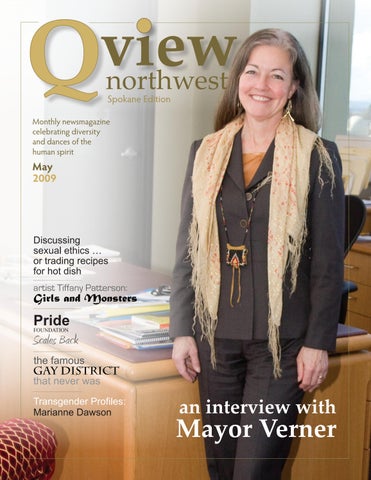
. view Q northwest Spokane Edition
Monthly newsmagazine celebrating diversity and dances of the human spirit
May 2009
Discussing sexual ethics … or trading recipes for hot dish artist Tiffany Patterson:
Girls and Monsters
Pride Scales Back FOUNDATION
the famous
gay district that never was
Transgender Profiles: Marianne Dawson
an interview with
Mayor Verner
www.qviewnorthwest.com | Q View Northwest - Spokane Edition | May 2009 |
Qview
northwest SPOKANE EDITION May 2009 Vol. 3 Issue 9
Monthly newsmagazine celebrating diversity and dances of the human spirit Distributed free throughout the Pacific Inland Northwest and online at
www.qviewnorthwest.com Publisher MIKE SCHULTZ Advertising STEVEN SANFORD Layout MIKE SCHULTZ Bouncer MIKE SCHULTZ
Contributors RHONDA BROWN NICOLE HENSLEY JOAN OPYR ERIKA PRINS STEVE RODENBOUGH DAVID R. WEISS NATALIE WENDT CATHERINE D. WILLIS LISA WINK
Front Cover Photograph LISA WINK
Distribution STEVEN SANFORD
Website MIKE SCHULTZ Q View Northwest is published by Q View Media, LLC. 1506 W. Mission Ave Spokane, WA 99201 Phone: 509.570.8768 E-mail: mail@qviewnorthwest.com Website: www.qviewnorthwest.com All contents © 2009. No portion of this publication may be reproduced without written consent from the publisher. Neither Q View Media LLC nor Q View Northwest publication assumes responsibility for errors in content, photos, or advertisements. The views expressed herein do not necessarily represent the views of the publisher or advertisers.
| May 2009 | Q View Northwest - Spokane Edition | www.qviewnorthwest.com
C O N T E N T S 3 Discussing sexual ethics... or trading recipes for a hot dish by David R. Weiss 4 Artist Tiffany Patterson: Girls and Monsters by Joan Opyr 6 Pride Foundation scales back By Catherine D. Willis 7 The famous Gay District that never was by Natalie Wendt 8 An interview with Mayor Verner A look at priorities, public service and her passion for diversity By Rhonda Brown 13 Transgender Profiles: Marianne Dawson by Erika Prins
by David R. Weiss
S
ooner or later churches that genuinely welcome GLBTQ persons of faith will need to talk about sexual ethics. We’re hardly ready for this, but we stand before a rare moment, with an opportunity to reconsider the nature and place of sexuality in the whole of our lives—both gay and straight. That makes this moment both daunting and exciting. How might we frame a conversation for GLBTQA persons of faith that is expansive enough to weigh openly and honestly the range of sexual behaviors and relationships before us but also principled enough to remain recognizably rooted in a posture of faith? I suspect this conversation needs to happen in a whole bunch of places, but as a church-going Ally, I am most invested in helping it happen well in churches. Also, because this conversation isn’t likely to go far at the generic level, the best I can do is offer principles that will resonate with other church-going folks. I surely don’t mean to suggest that the only “ethical” sex happens among Christians! I’m simply being honest to say I think these principles can help progressive Christians have thoughtful and respectful conversations about sexual ethics. Other communities may find other principles more helpful … and that’s okay. When it comes to ethical principles, less is more. A well chosen few will carry us further than a whole bunch that function more and more like rules. I’ll name just five. I begin with three mentioned famously by the Hebrew prophet Micah (Micah 6:8) some 2500 years ago: do justice, show mercy, and walk humbly. Micah is talking about how to live a Godpleasing life in general, but his wisdom is pretty far-reaching. Justice suggests that healthy, whole sex is not exploitive of power differences, whether based
Discussing sexual ethics … or trading recipes for hot dish in money, age, race, gender, or social role. It raises real doubts about sex that eroticizes the dynamic of domination. But because this is a principle, not a rule, it doesn’t absolutely forbid anything. It simply says, “make the case that this (or any) particular sexual expression doesn’t transgress justice.” Mercy is not pity but compassion. Healthy, whole sex involves mutuality, a genuine care for the other’s joy, comfort, and pleasure. It invites trust in moments of deep vulnerability. Part of the power of sexual intimacy is its capacity—its alchemy—whereby vulnerability becomes transcendence. Absent either justice or mercy, such vulnerability is neither wise nor safe. This implies fidelity as a corollary of mercy. But, listen carefully: fidelity is about promised faithfulness that is honest and clear. It may not always be life-long. It may not always be exclusive. But it ought to be honest and clear in its terms. Fidelity is not a single cookiecutter; I suspect it is a tin full of different patterns. Humility offers two words of wisdom. First, to be patient with ourselves and others. Sexual intimacy is an unfolding mystery better paced by our own deepest intuitions than by the messages of the marketplace. Second, that as we encounter persons—whether in our intimate relations or in our public communities—whose sexual practices and preferences differ markedly from our own,
we begin by listening for the truth of their experience. We need not affirm everything we hear, but we are fools when we think we have nothing new to learn. To these three I add two others: whole and healthy sex should be procreative and joyful. Procreative does not mean relationships in which physical reproduction is not a biological option (or desire) are somehow deficient. But because this term is so often wielded against GLBTQ persons, it seems worthwhile to reclaim it in a broader—and truer—meaning. To be procreative is to care for this world, from natural eco-systems to familial and civic communities. This is a human vocation, quite independent of sexual activity. But given that sex is one powerful way we generate and share energy, it seems fair to ask that energy so deliciously brought forth between lovers also spill outward into the world around us. Joyful. Well, good sex ought to be fun. And if it’s clouded by shame, disgust, obligation, fear, etc., that’s pretty good evidence that the sex in question is somehow less than healthy and whole. For Christians this will be a real challenge because most of us have been taught either that sex is the primal temptation that turns us from God or at least that it is ETHICS continued on page 14
www.qviewnorthwest.com | Q View Northwest - Spokane Edition | May 2009 |
“Urban Latte” by Tiffany Patterson, 2008
| May 2009 | Q View Northwest - Spokane Edition | www.qviewnorthwest.com
Acrylic paint and pigment pen on canvas. Painted for the benefit exhibition and auction “War on Want” at the SFCC Art Gallery. Proceeds went to the Volunteers of America and Union Gospel Mission to pay for food and shelter for those in need.
Photo by Nicole Hensley
artist Tiffany Patterson
Girls and Monsters By Joan Opyr
T
iffany Patterson is exhausted. She spent every night of the month of March painting works for her new installation, a joint show with Mariko Sullivan at The Empyrean called “A notice to
the inhabitants of my dress: Are you there?” Patterson describes her work as “ridiculously happy with a little bit of creepy,” and if you’ve seen her work in Spokane’s Constant Creations Tattoo Parlor or if you’ve visited her MySpace page, you may feel that’s apt. I also think there’s
something about Patterson’s painting that is reminiscent of The Triplets of Belleville, so make that ridiculously happy, a little bit of creepy, hypnotic, evocative, and French. PATTERSON continued on page 15
www.qviewnorthwest.com | Q View Northwest - Spokane Edition | May 2009 |
Pride FOUNDATION
Scales Back by Catherine D. Willis
“Pride Foundation is very fortunate to not be at financial risk in these hard times,” declared Pride Foundation’s regional program coordinator Farand Gunnels in response to the survey I circulated in January and reported on in these pages in March. Circumstances changed abruptly after that story ran. The Seattle-based nonprofit closed its Spokane office March 31. Gunnels will continue to serve the area, working out of his home at three-quarters time. There was no conspiracy to deceive Q View’s readers, Pride Foundation’s director of communications Zan McCollochLussier assured me in a telephone interview April 7. “It was purely a timing thing.” Financials were reviewed beginning in midJanuary. Budget discussions followed in February. The organization’s fiscal year starts April 1. With individual giving off by 10 percent and their portfolio down 15 percent, foundation managers determined that the 2009-2010 budget had to be 10 percent leaner than 2008-2009’s. “It was not until the first weeks in March that we had a budget that we felt was the right one. The board didn’t even approve that budget until the third Tuesday [March 17].” Along with Gunnels, a staff member in Portland has seen her work hours reduced by 25
percent, a Seattle staffer was furloughed, and an open position will go unfilled. Pay for the rest of the staff was pared by 6 percent as well. “The expense reductions that we made in the Inland Northwest (Farand’s time and the office) represent only 6 percent of the total cuts we made in expenses,” concluded McColloch-Lussier. Outreach Endangered Some members of the local steering committee were unsettled by the breadth and timing of the cuts. “I was not surprised to hear that there were going to be some changes,” noted Rose Wardian. “What did surprise was the impact to the staff in the outlying regions. ... I have been witness to the strides in visibility over the years. Farand Gunnels’ position with the Pride Foundation has been instrumental in this progress.” The steering committee and the broader GLBTQA community can and will carry on, she conceded, “but a full-time staff person is a vital link to the outreach program. I would hate to see the momentum slow.” “I am not happy that these changes were dropped on the Pride Foundation/Inland Northwest steering committee just after the annual budget was set,” declared Dan Brown. “Had we known earlier, I hope we would have reallocated funds to keep more of Farand’s essential time and travel budget. We cover a huge geographic area and any restriction of travel funding will significantly impact our outreach.” “Pride Foundation has worked very hard at building a presence in Idaho and Montana,” wrote Jenne Lee, who has chaired the Inland Northwest steering committee for the better part of three years. “I would have preferred to keep our Spokane office open because of the visibility.”
| May 2009 | Q View Northwest - Spokane Edition | www.qviewnorthwest.com
She took a more measured, even philosophical, position on the changes, however. “We aren’t the only nonprofit to have our struggles in this hard economy. We need to stay strong and positive to make it through these tough times. As soon as the changes were announced, our steering committee committed to a new game plan.” Members agreed that they will have to pick up the slack. They will act as faces of Pride Foundation in the community, attending as many events as possible, and partnering with organizations to raise funds and support GLBTQ interests. This may also require some travel to outlying communities. “We’re counting on them,” said McColloch-Lussier. “We have a great steering committee. It’s been one of our most active, one of the oldest.” Gunnels reinforced this attitude, lauding the strengths and commitment of the local committee. He also reaffirmed his own commitment to Pride Foundation and to the communities he continues to serve. Fears and Frustration “Many people were shocked” [when news of the cutbacks surfaced] and afraid that Pride Foundation would completely pull out of the Spokane area,” noted Lee. “Pride Foundation has been a major contributor for GLBTQA events in our community.” Activities for 2009 have not been restricted, she stressed. “Pride Foundation/ Inland Northwest is as much a part of the community as ever.” The staffing changes reflect a deliberate decision by Pride Foundation management to make community funding the number one priority. “We feel that’s why people give to us, PRIDE continued on page 11
By Natalie Wendt
I
f you, like me, ever wished that Spokane had a gay district, you’re not alone. Back in 2005, Spokane got national attention when a group called “Let’s Get Visible” tried to create one. No building ever took place but the plan drew commentary from religious groups, media outlets, bloggers, and gay communities across the country. Four years later, it seems the whole thing has faded into history without ever breaking ground. Why? It all started in the early 2000s when the Spokane Downtown Partnership began studying the Creative Class Theory of Richard Florida. Florida’s theory focuses on “the creative class,” the roughly thirty percent of workers whose careers depend on their ingenuity. According to Florida, talent, technology, and tolerance are needed to draw these workers to your city. Creative class workers are a group Spokane tends to lack. In researching why, the Partnership concluded that though we have technology and talent, our city wants for the diversity that the creative class craves. The Inland Northwest Business Alliance’s “Vision Commitment” wondered if a more visible GLBTQ community would help attract creative class workers. Developing a gay district leaped to the forefront of ideas. So in 2004, the Vision Committee surveyed the GLBTQ community of Spokane about the idea. Inspired by the large majority who supported the possibility, that November they held a workshop about the gay district. Local news coverage of the workshop sparked letters to the editor from both supporters and opponents. As the project developed, the group behind the plan spun off of the Vision Commitment and renamed itself “Let’s Get Visible.” Over the next few months AP Press picked up the story. NPR commented on it. Free Republic posters typed away about the
the famous
gay district that never was proposed neighborhood’s likeness to Sodom and Gomorrah. Local networks of conservatives claimed the district would clash with Spokane’s image as what former Mayor John Talbott called “a family-friendly, traditional values community.” Opponents of the plan worried that the district would bring crime, drug use, sexual predators and other social ills. Walton Mize, bishop of the Christ Holy Sanctified Church declared, “It’s a culture based upon sex” and warned of the “underbelly” of the gay community. Others claimed, falsely and rather absurdly, that heterosexuals would be denied residence in the district. A few bloggers complained that a gay district was a step away from inclusion and towards segregation and gay ghettos. Meanwhile, members of the gay community wondered if a gay district could really be planned, as most thriving examples, like San Francisco’s Castro or Seattle’s Capital Hill, evolved organically over time. The public uproar raised questions about the value of announcing intentions to create the district before building. Supporters countered that the visibility of the project assured developers and investors that there was interest and inspired involvement. Proponents of the plan explained that it fit with the city’s efforts to get the creative class, and that the district’s new businesses would mean more jobs. They also hoped that increased visibility of the gay community would make Spokane a more welcoming environment to come out in and help GLBTQ young adults find positive role models without needing to flee to Seattle, New York or San
Francisco. The district was to be a mix of businesses and residential homes, a vibrant place to live, work, and play. Yet the district never found a home. In trying to track down the proposed neighborhood’s location, INBA’s Jeremy Bolton told me in an email, “One of the proposals at the time was to look for land near or around the Kendall Yards project. Unfortunately the high-end Kendall Yards is no longer being built.” INBA is no longer tied to Let’s Get Visible or the gay district project. The city government was not involved in funding the district. Private investors backed the project, but the economic downturn took its toll. Let’s Get Visible is a volunteer organization, and despite repeated attempts, could not be reached for comment on this article. Did the criticism kill the project, or was the gay district’s downfall simply an uncooperative economy? We’ll never know for sure. But Spokane’s GLBTQ did indeed become more visible, so Let’s Get Visible lived up to its name.
Natalie Wendt grew up in Idaho and graduated from College of Santa Fe in 2005. She is a substitute teacher and lives in Spokane.
www.qviewnorthwest.com | Q View Northwest - Spokane Edition | May 2009 |
photo by Lisa Wink
an interview with City of Spokane Mayor
Mary Verner
A look at priorities, public service and her passion for diversity | May 2009 | Q View Northwest - Spokane Edition | www.qviewnorthwest.com
by Rhonda Brown
M
ayor Mary Verner ‘s road has not always been one of the pothole-riddled ones we here in Spokane are used to, but to call her a transplant would be to deny how rooted in our community she is. She has attended one of our proudest local institutions, she has raised children here, she has worked with our local tribal organizations in a variety of capacities and has served in our city government for years. Her most recent experience has her in a leadership position as our Mayor and she approaches the challenge with the solemnity of one who plans to face it headon and work to see our city prosper. While her past includes an impressive resume beginning with degrees from Yale, Davidson and Gonzaga to powerful administrative positions with regional tribes and as a member on committees and boards ranging from Kiwanis to the Native American Alliance for Policy & Action, Mary has never shown herself to have forgotten her own roots. She was born and raised in the Southeast to parents of Native American/Caucasian descent. She spent much of her early working years teaching and working for environmental programs. It is this combination of learning experiences that paved the road leading her to 7th floor of City Hall. But what can we expect from someone who has such a wide array of life experiences? During my recent interview with her one theme kept repeating itself: Diversity. Her definition of diversity doesn’t just have one meaning, either. The kind of diversity that Mary Verner embraces is one of cultural, racial, sexual, fiscal, intellectual, political, environmental and every other meaning that could be given to the word. One idea is never
enough – all ideas should be embraced. In her recent State of the City address Verner repeats the question she has been asked so many times: “Why did I get into politics? I didn’t. I got into public service.” The ways in which she has served are numerous. As a City Council Member she was integral to taking steps to protect Spokane’s diversity. One example is in the City’s Domestic Partnership benefits that provide any city employee, regardless of gender or marital status, to name a “partner” as the one to receive what would otherwise be referred to as “spousal benefits”. In her words, together with the city’s non-discrimination policies, this makes us “blind to orientation and gender” in respect to how employees are treated. When pressed as to whether transgender was included in this, she emphasized that as the municipal code is currently written, there is no language that defines what any committed relationship should look like and has had no issues up to this point with the policies excluding anyone of any identity. As Mayor, a project she is actively taking a hand in is the newly created position of the Police Department Ombudsman, for which the city budgeted $200,000. As to the decision to invest in this position she states, “This is an investment in the community’s trust in our police organization and in transparency and openness in the relationship between our community and the police. The ombudsman will be empowered to look into those citizen inquiries, whether they arise as a question of sexual orientation, gender orientation or other issues that the citizens might have.” She remains outside of the candidate review process at this point, as
they narrow down their initial applicants, but looks forward to being part of the final selection of an Ombudsman that will be directly accessible to the citizens. Outside of city government is harder, though. While she may have a say in how those who work for the city are treated, she doesn’t have authority over everything within the city limits. One place we can’t expect her to speak for diversity is within our public schools. The Mayor’s office and city government partner often with District 81 on projects such as the Annual Dropout Summit, but when it comes to curriculum and school policy, Verner has no say as to policies such as discussing homosexuality and gender identity in health education courses or in the general population. She feels out of her depth on those decisions and reports, “it’s outside of the scope of my expertise… I’m not an educator, nor am I a child psychologist so I really can’t opine about what’s appropriate. I have two children and I have two grandchildren and what I try to imbue to them is acceptance of people for who they are and what they are.” Another place where her reach is only so far is where it joins with the County. Mayor Verner also serves on the Board of Directors of the Spokane Regional Health District and has had a vote in budgets, program changes and the decisions to terminate Dr. Kim Thorburn and hire Dr. Joel McCullough as the Health Officer. While the decision to fire Dr. Thorburn was a very difficult one for her, she feels that with the information the board had and with complex personnel issues, she maintains it was the right VERNER continued next page
www.qviewnorthwest.com | Q View Northwest - Spokane Edition | May 2009 |
VERNER continued from previous page decision. The delay was much longer than she hoped it would be, and with the lack of an onsite Health Officer, the executive staff had to shoulder a lot of the responsibilities outside their regular duties. She looks forward to Dr. McCullogh coming in as the new officer and praises him as, “a really good candidate because he is a really good listener. He’s open to hearing from his staff, who are the experts… he’s a teambuilder. I was very impressed with his sense of need to facilitate and coach as the team captain, and he’s really interested in hearing from the community about priorities for the Health District.” For her, supporting the Health District is a huge priority because, even though it is a separate entity that serves the entire County, “we are the urban center and public health issues are seen most frequently inside our jurisdiction.” The other major theme of our discussion was one that repeats itself daily in the news and around the water coolers of America: Money. Budgets are tightening daily in governments worldwide and Spokane’s is no exception. This involves working with the City Council to ensure that there is funding where there is need. She is concerned about holding on to funding for programs such as infectious and contagious disease control. She expresses admiration for the staff at the SRHD, as they maintain their own programs on a shoestring and are at a breaking point where services will begin to diminish as funds become tighter. As part of her agenda she seeks to find steady funding streams to keep the city alive, stimulus funds are one-time and our city’s needs are more than one-time needs. She is trying to wean the city off of its dependence of these funds so it can survive in the hardiest of recessions.
This sometimes means leaning on non-profit and private organizations that provide so much of what government cannot – which she has a healthy respect for. Her office has a healthy working relationship with many local nonprofits, many of which provide provisions to the homeless or disenfranchised, providing housing, energy assistance, nutrition and partner with the city on providing “core services.” She would ideally like to see a greater partnership with a larger volume of nonprofits, and would love to hear ideas on how to form better alliances as the private sector carries a greater load when she cannot.
matter very seriously. The matter was immediately investigated by both offices, and several activists in the GLBT community asked that this was addressed and Mayor Verner wanted to make sure it was. The investigation turned what she referred to as, “theft-related incidents,” and no additional occurrences have been brought to her attention. She urges everyone to consider the fact that the area between 3rd Ave. and the train tracks in downtown is not safe for anyone late at night, regardless of who they are, and to not “test the theory” of whether there is a gay-bashing trend. But since she has not heard any additional news of attacks, she feels this is an example of no news is good news.
But don’t take that the wrong way – she’s not turning down the Federal Stimulus Funds. What about those streets that you voted to have fixed? They’re on the list and a committee is actively working on how to allocate those funds to bridge the gaps in funding so that the road construction, as aggravating as it may be, can continue all summer. Other items on the menu include: energy efficiency updates, government restructuring projects that will consolidate government offices, and other bigger projects that in the past may not have had the dollars all there at once to accomplish much-needed upgrades. If all the money-talk was laid aside, and Mayor Verner had a blank check, she wouldn’t even have to think about her priorities. First and foremost on the agenda would be public safety in all areas of life. It’s a no-brainer for her that the community cries out for a safe environment every time they’re asked. And our priorities are hers, as well.
Another of her blank-check priorities would be sustainable economic development. In essence a city with jobs, plenty of jobs, diverse jobs – which means developing our local economy to prevent a boom and bust cycle. When asked as to whether this vision included the possibility of a Gay District, she acknowledges that, as a public servant, it wouldn’t be her job to promote. There would have to be a grassroots momentum behind it, similar to those that rebuilt areas such as the Perry St. and Garland Districts. She notes: “They arose out of the initiative of business owners themselves. So if there’s a concept that has some legs to it… I’m interested.” Should the long ago discussed possibility of a Gay District become a reality, she would encourage it to be successful as it has been in other cities. But as business license requests come through the door, it’s going to be business that gets licensed, not the orientation of the owner.
When first confronted with the possibility that a pseudo-skinhead group was targeting gay men on Spokane’s downtown streets late at night she and Chief Kirkpatrick both got involved and took the
On the road Mayor Verner travels she must wear many hats: from Mayor to Mom, from Citizen to Civil Servant, from rapper to environmentalist, and on and on. Despite her many roles, one thing
10 | May 2009 | Q View Northwest - Spokane Edition | www.qviewnorthwest.com
we can count on is that during her time in office we in the GLBT community can be sure of an advocate sitting in the Mayor’s office. Her passion for diversity is a major part of her desire to serve, and that’s the hat she wears every day.
Rhonda Brown is a graduate of Gonzaga University. By day she is an Office Manager, but her real passion is her art. Her primary pieces are Intaglio prints but she works in many different mediums and has had shows in galleries as far away as Munich, Germany. She lives just west of Spokane with her fiancé and two dogs.
PRIDE continued from page 6 first and foremost,” explained McColloch-Lussier. “The great news, in terms of funding, is we’re projected to give out $20,000 in grants to organizations this fiscal year, which is the same as last year; $10,000 in scholarships to students, the same as last year; and then about another $1,800 in sponsorship dollars, again the same as last year.” Brown took on the elephant in the living room that troubles many of Washington’s statewide nonprofits: “Our region has zero representation on the Pride Foundation board [of directors]. Had this been available, I have to think that this [funding decision] could have been handled better.” He thought the foundation should have reduced community grants and scholarships for the year rather than cutting staff.
That solution “would have been far easier,” committeeman David Victor acknowledged. He applauded the selflessness of Pride Foundation staff in sacrificing pay and hours to sustain the organization’s primary mission.
what the ‘big bicture’ is. Honor diversity, foster mutual respect and celebrate our equality.” copyright © 2009 End o’ the Rainbow Enterprises
Next Steps “I’m just very happy that the employees were able to keep their positions,” said Robin Peltier, who echoed several steering committee members in suggesting a lemons-to-lemonade approach to what most deemed a temporary setback. “Step up to the plate!” she implored the GLBTQA community. “Give hours, services, money.” “Stick together,” urged Lee. “If we can band together as one united group, we can focus on
Catherine D. Willis is a writer, editor and community activist who has served on nearly two dozen neighborhood, corporate and community boards and committees over a period of 30 years.
www.qviewnorthwest.com | Q View Northwest - Spokane Edition | May 2009 | 11
Wendy A. Biondi, LHMC Mental Health Therapist Adults, Youth, Diversity
ASBELL (509) 534-1731 PROFESSIONAL GROUP
140 S. Arthur, Suite 690 Spokane, WA 99202-2260 Fax (509) 535-7073 apg@asbellgroup.com www.asbellgroup.com
My oh Myah... Just sold another one!
509-954-9207
www.MyOhMyah.com
$1295 Domain Registration Linux or Windows Hosting plans under $8 per month
(509) 232-0721 www.wilburnweb.com
12 | May 2009 | Q View Northwest - Spokane Edition | www.qviewnorthwest.com
Transgender profiles:
Marianne Dawson “Pick your battles,” she advises, a phrase she says is a mantra for the transgender community. by Erika Prins
“We know that God has a special place for each person within the body of Christ,” reads the Spokane Christian Center’s website. But when Marianne Dawson became transgender, she says church leaders asked her to leave the congregation. Her rejection from her long-time home church and several other subsequent churches she attended does not change her faith or her personal relationship with God, says Dawson. She knows of several local churches that do accept transgender attendees, but she wants shared faith to be reason enough for all Christians to welcome her. “I don’t want to go where I’m readily accepted,” she says. “I want to go where I please.”
photo by Steve Rodenbough
She has found a group of Christians with whom to meet and has engaged with her community and worked to improve it by helping found Papillion, a local support network for transgender people. Through Papillion, she met her husband who supported her through every DAWSON continued next page www.qviewnorthwest.com www.qviewnorthwest.com || Q Q View View Northwest Northwest -- Spokane Spokane Edition Edition || May May 2009 2009 || 13 13
ETHICS continued from page 3
DAWSON continued from previous page
deserving of near total discretion in polite conversation. Good sex is neither. Where else in our lives are we so mistrusting or quiet about that which brings such joy? Learning to embrace and name the joy of our sex is what will make the rest of the conversation worth the challenges involved. It might be (to acknowledge my Minnesota-Lutheran context) as exciting as trading recipes for hot dish!
step of her transition.
Naming these principles hardly settles every ethical question in advance by producing a fixed rule. But that isn’t how ethics works. It isn’t how adults operate. It isn’t how life is lived. Integrity—which is the goal here—is improvisation grounded in creativity and character, not rote repetition. It is the fruit of good conversation, in which ideas and practices can be compassionately and appreciatively contested. Hardly the final word, they simply offer us a place to begin the conversation. Now, go talk amongst yourselves.
David R. Weiss is a theologian, writer, poet and hymnist committed to doing “public theology” around issues of sexuality, justice, diversity, and peace. His first book is To the
Tune of a Welcoming God: Lyrical reflections on sexuality, spirituality and the wideness of God’s welcome (2008 / www.davidrweiss.com).
A lifelong Lutheran, David is a graduate of Wartburg College, Wartburg Seminary, and the University of Notre Dame. He has taught religion and theology at the University of Notre Dame, Luther College, Augsburg College, and Hamline University. Beyond his professional work, David has been active in local peace work and both locally and nationally as an ally for GLBT persons in faith communities. He lives with his wife and children in St. Paul, MN.
When she transitioned from male to female, Dawson was going to school and cleaned floors for American Building Maintenance in Spokane at night. Her manager was tolerant of her decision—as long as she didn’t “go wild” on the makeup. Fine, she said. It was, after all, a maintenance job. Soon after, her eleven fellow employees approached the manager and threatened to quit if Dawson remained on the job. Dawson’s manager moved her to a janitorial position. She was offered a higher wage for transferring to another department but still saw the move as a demotion—she had been re-assigned to the position she started in seven years before. Dawson holds a master’s degree in social work from Eastern Washington University (EWU), which she pursued in hopes of becoming a social worker. She has worked as a janitor and cosmetologist, and is now a school bus driver. Her field of study never became her profession as she expected it would. She believed her competence would outweigh potential employers’ judgments. She believed she was legally protected from discrimination. Whether because she began her studies later in life, or because she is “fairly obviously” transgender, Dawson now believes she has been denied the opportunity to become a social worker by a series of educators’ and potential employers’ prejudice. Dawson completed her undergraduate studies in psychology at EWU before transitioning to female. She planned to complete a master’s degree in social work at EWU following her transition but was barred from the program. “I was told [by the chair of the psychology department], ‘Not at
14 | May 2009 | Q View Northwest - Spokane Edition | www.qviewnorthwest.com
this college,’ because it would be too much of a cognitive transition for the professors,” she says. Several years later, Dawson reapplied for the same master’s program. This time, she was admitted. The faculty member in charge of placing her in an internship suspected Dawson was transgender. She pressed for more information, says Dawson, saying she had to know “what [was] going on here” to appropriately place her. Dawson maintained that information about her gender change was irrelevant to the work she was doing and refused to discuss it. “That’s not important,” she says, then revises her statement—“It shouldn’t be.” When she was finally placed in an internship, her male supervisor at Eastern State Hospital paid very little attention to mentoring her, she says. Dawson eventually gave up on the career she worked so hard for. “Pick your battles,” she advises, a phrase she says is a mantra for the transgender community. She now focuses on making the most of the job she does have, but continues to feel unsatisfied at not having achieved her goals. “I’m not getting any work as a social worker,” she says. “I decided to go back to work as a school bus driver because it was something.”
Erika Prins is a writer, local small business manager and novice marathon runner. She is a recent graduate of Whitworth University, where she tirelessly advocated for chartering a Gay-Straight Alliance club, sometimes instead of doing her homework.
PATTERSON continued from page 5 Which is not to say that Patterson is French. On the contrary, she’s a self-taught artist originally from Wenatchee, Washington. Raised in a Catholic family, Patterson left home at eighteen to pursue a course in photography in Spokane. There, while working two jobs and growing frustrated with the lack of emphasis on art in her courses, Patterson met Jacinda, and her world turned upside down. First came love, and then came painting. The two were married on Patterson’s twenty-first birthday, and it was at Jacinda’s urging that Patterson picked up brushes and began the serious work of learning to paint. “I’ve always struggled with words,” Patterson says. “With painting, I was finally able to express myself in a different way. I began experimenting. My style evolved, and I found my girls – my monsters. At first, they were like stick figures, but now, I’m putting in a whole bunch of detail. I’ve found my style now.” March was an especially important time for Patterson. “I grew so much in a month,” she says. “I painted every night. And I’ve found a group of other women artists, The Shrinking Violets. We share skills, conversation, do things together . . . it’s just been amazing. People think that to do art you have to be in Seattle or Portland, but those places are completely oversaturated. The Shrinking Violets are really committed to Spokane. I’m always telling people I love Spokane, and I really mean it.” Patterson does note that there are some logistical difficulties to being an artist (or a writer or a musician) in Spokane. The music and art scenes are still in their infant stages of development, and so there are no centralized calendars of events.
“But that will happen,” Patterson says quickly. “I’m sorry. Am I talking too fast?” I assure her that she’s not. “I take great notes,” I say. “I wouldn’t be a writer,” she says. “Once, I came across this group – they stack rocks. They get together with bags of sand and piles of rocks and that’s what they do. They stack rocks. I love that. That’s what I’d do – but I wouldn’t do it in front of people.” “You’d stack your rocks in private?”
what I’d do.” “Take your time,” I say. “What would happen to your girls and monsters?” Patterson answers slowly. “I’d want someone to adopt me, not give me money. Someone to adopt me and give me studio space and endless supplies.” “And access to a river?” I suggest. “And access to a river,” Patterson laughs.
Patterson laughs. “Yes. I like to go to the river and sit quietly and stack rocks.” “Well now I know how painters relax. Writers just switch to decaf.” I wind up my final pitch. “What art would you make, Tiffany, if someone were to give you all the money you needed, and you could go anywhere you wanted?” “Oh, that’s a terrible question,” Patterson says. “I don’t know
Joan Opyr is a gigantic crank. Her life is frequently weird, and she enjoys writing and talking about that. She’s a transplanted Southerner who dreams of golden beaches, sweet iced tea, and sunny skies. She believes that Eva Cassidy should be beatified. Oh, and she’s also an award-winning novelist.
Q do the
GLBTQA Resources and Calendar are online!
www.qviewnorthwest.com www.qviewnorthwest.com | Q View Northwest - Spokane Edition | May 2009 | 15
A benefit for Planned Parenthood of the Inland Northwest
Saturday, June 13, 2009 | 8:00 PM Martin Woldson Theater at The Fox Tickets Available Now! $47 | $57 | $127 *Premier seating ticket Purchase tickets from: Martin Woldson Theater at The Fox: 509-624-1200 | www.martinwoldsontheater.com TicketsWest: 509-325-7328 | www.TicketsWest.com 16 | May 2009 | Q View Northwest - Spokane Edition | www.qviewnorthwest.com
*Includes post-show party at Scratch Restaurant, across from Martin Woldson Theater (Wanda Sykes will not be attending the post show party)