ST. PAUL’S
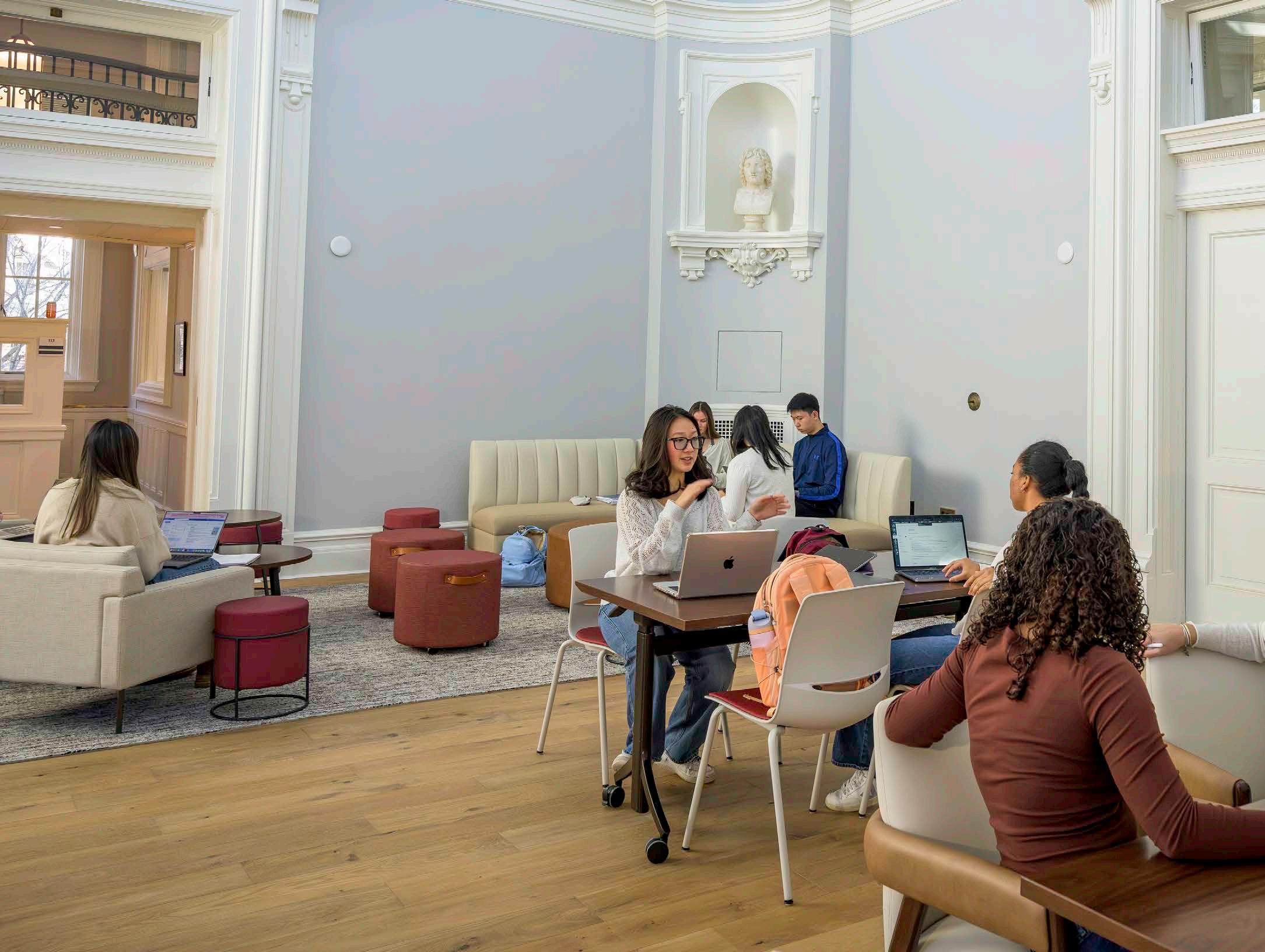
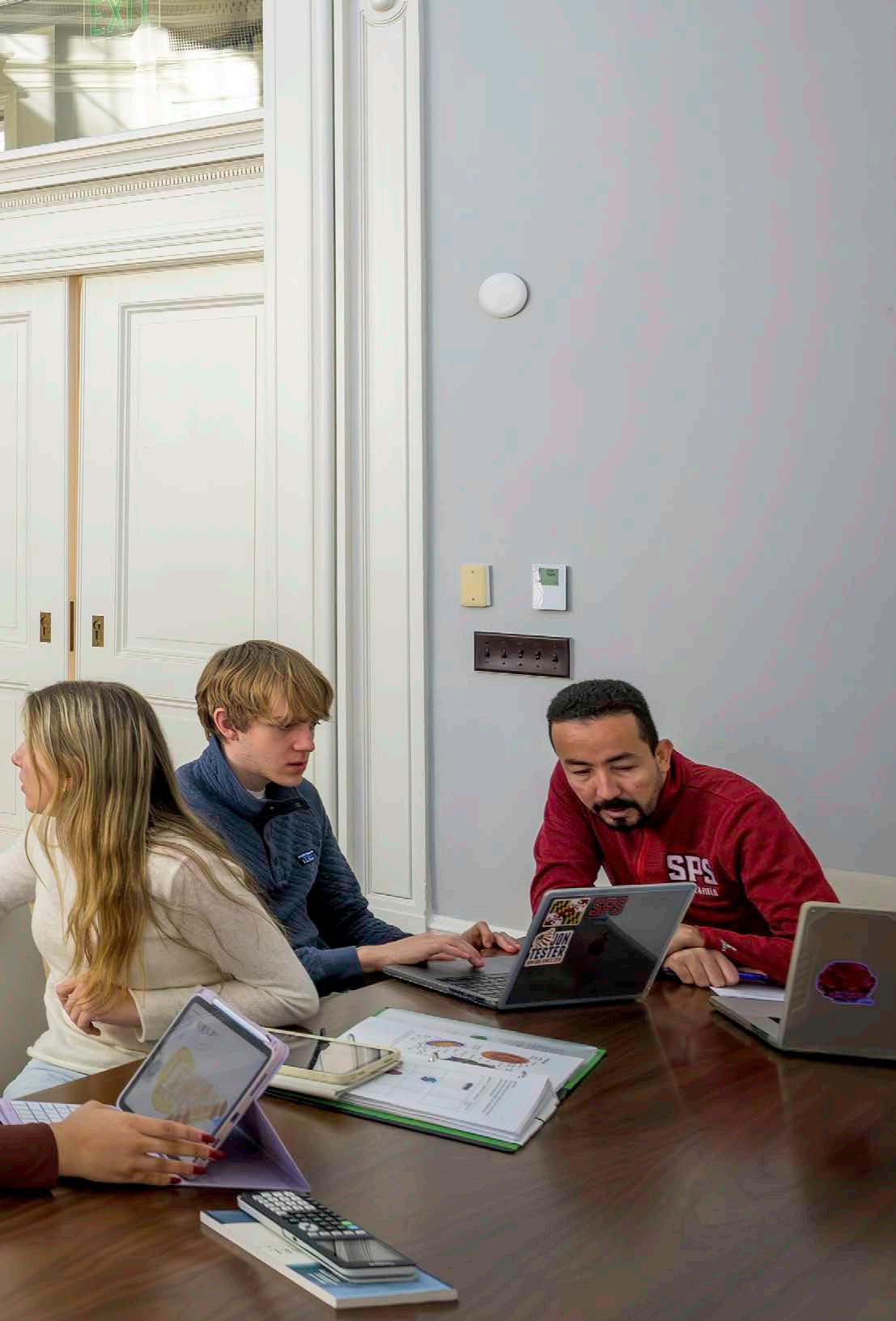
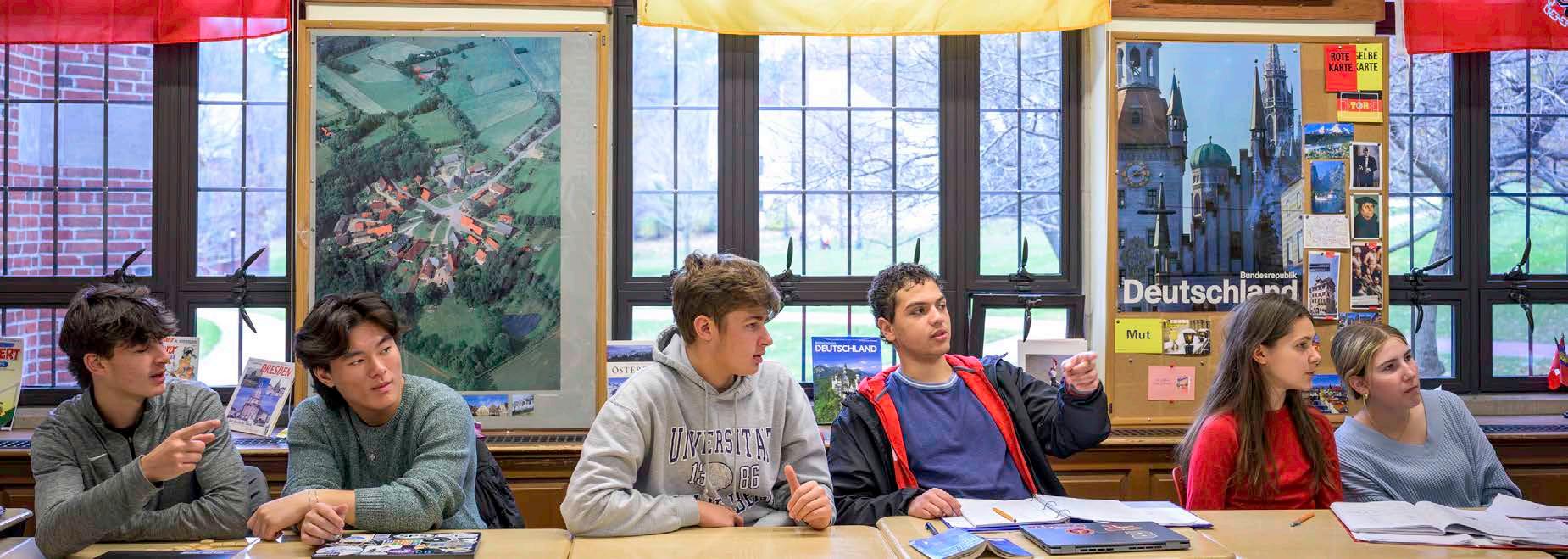
The St. Paul’s School academic program offers exceptional depth and breadth, giving students both a solid grounding in the fundamentals and the flexibility to pursue varied and enriching electives. The core curriculum includes challenging courses in humanities, mathematics, sciences, languages, religion and the arts.
At SPS, students and their teachers work in collaboration — in discussion around Harkness tables, in laboratories, and in the field to investigate new and age-old questions. Through rigorous academic standards, students are encouraged to attain the highest level of scholarship, intellectual growth and development. St. Paul’s School students, working with exceptional faculty, prepare intensively toward future success.
The School offers a comprehensive science curriculum that begins with physics and continues with chemistry and biology. Building on the concepts and processes learned in these foundational courses, students have the opportunity to pursue advanced topics in astronomy, engineering, robotics and computer science. In mathematics, students likewise encounter a thoughtfully designed curriculum that allows them to progress from algebra and geometry through calculus, statistics and advanced topics, building their skills as analytical thinkers and problem solvers.
In our integrated, interdisciplinary humanities curriculum, students draw on primary source materials to connect important ideas from literature, history, philosophy and religious studies in a discussion-based format that emphasizes critical thinking and strong writing skills. As part of our commitment to broadening students’ global perspectives, our languages curriculum offers courses in six languages — four modern and two ancient. Recognizing that intense and regular involvement in the arts is fundamental to academic and social development, the School also offers a performance-based arts program to support students at all levels in music, dance, theater and fine arts.
St. Paul’s School requires participation in four other areas of community life to complement the academic endeavors of our students: living in community, community engagement, athletics and chapel. The School’s commitment to education and caring for the whole person, as reflected in this all-encompassing view of education, supports and nurtures the intellectual, spiritual, physical and emotional development of our students. Teachers at SPS come from diverse backgrounds and bring with them a variety of world perspectives, educational excellence and rich life experiences. Our faculty members live among the students in our fully residential community and serve as advisers, coaches and mentors, making it easy for them to forge lifelong bonds with students.
GRADUATION REQUIREMENTS
See the St. Paul’s School Handbook for diploma requirements.
CREDIT REQUIREMENTS: ARTS
1. Matriculate in Third Form: 3 credits.
2. Matriculate in Fourth Form: 3 credits.
3. Matriculate in Fifth Form: 3 credits.
CREDIT REQUIREMENTS: HUMANITIES
1. Matriculate in Third Form: 19 credits; sequence of Humanities III (6 credits), Humanities IV (6 credits), Humanities V (6 credits). Then one term course in religious studies (1 credit).
2. Matriculate in Fourth Form: 13 credits; sequence of Humanities IV (6 credits), Humanities V (6 credits). Then one term course in religious studies (1 credit).
3. Matriculate in Fifth Form: 7 credits; Humanities V (6 credits). Then one term course in religious studies (1 credit).
CREDIT REQUIREMENTS: LANGUAGES
1. Matriculate in Third Form: 9 credits; three-year sequence in the same language.
2. Matriculate in Fourth Form: 6 credits; two-year sequence in the same language.
3. Matriculate in Fifth Form: 3 credits; one-year sequence in the same language.
CREDIT REQUIREMENTS: MATHEMATICS
1. Matriculate in Third Form: 9 credits or through Precalculus (minimum of 3 credits earned in residence at St. Paul’s School).
2. Matriculate in Fourth Form: 6 credits or through Precalculus (minimum of 3 credits earned in residence at St. Paul’s School).
3. Matriculate in Fifth Form: 3 credits earned in residence at St. Paul’s School.
1. Matriculate in Third Form: 9 credits; recommended series of Physics First (3 credits), Chemistry (3 credits), Biology (3 credits).
2. Matriculate in Fourth Form: 6 credits; recommended 6 credits in two of the following: Physics (3 credits), Chemistry (3 credits), Biology (3 credits).
3. Matriculate in Fifth Form: 3 credits.
(samples)
1. Matriculate in Third Form: 10 terms; Third Form (3 terms: must be team-oriented, 2 must involve physical activity); Fourth Form (3 terms: 2 must be team-oriented, 2 must involve physical activity); Fifth Form (2 terms: 1 must be team-oriented, 1 must involve physical activity; Sixth Form (2 terms: 1 must be team-oriented, 1 must involve physical activity); swim test.*
2. Matriculate in Fourth Form: 7 terms; Fourth Form (3 terms: 2 must be team-oriented, 2 must involve physical activity); Fifth Form (2 terms: 1 must be team-oriented, 1 must involve physical activity; Sixth Form (2 terms: 1 must be team-oriented, 1 must involve physical activity); swim test.*
3. Matriculate in Fifth Form: 4 terms; Fifth Form (2 terms: 1 must be team-oriented, 1 must involve physical activity; Sixth Form (2 terms: 1 must be team-oriented, 1 must involve physical activity); swim test.*
*New students required to pass a swim test within 2 years of matriculation.
Team-oriented: Interscholastic, Club/Instructional, Community Engagement, Theater, Afternoon Music (with instructor permission).
Team-oriented/Physical: Interscholastic, Club/ Instructional, Musical Theater.
Physical: Instructional Fitnesss.
Courses are assigned 1 credit per term, with the exception that Humanities III, Humanities IV, and Humanities V are each assigned 2 credits per term
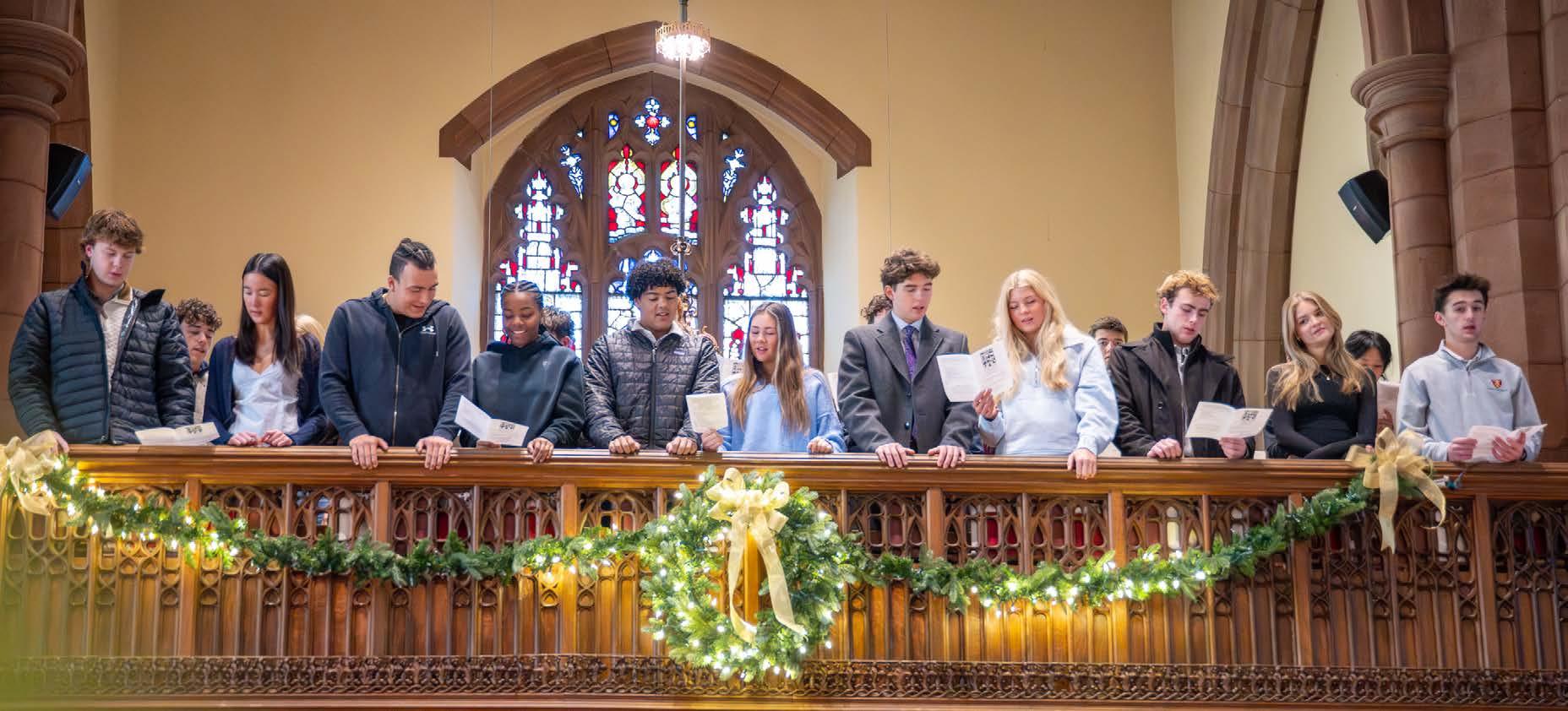
As a residential community, St. Paul’s School is committed to the development of the whole person. To support students’ emerging social and emotional competencies and to encourage personal reflection and commitment to the world around us, our Living in Community program provides opportunities for exploration.
Third Form Course (Full Year, required)
This course meets once a week. The focus is on students’ introduction and transition to living in our residential community. Topics include, but are not limited to, self-awareness, respect for self and others, communication and compromise, healthy choices and appropriate use of technology. This course encourages students to develop a balanced approach to their experience at St. Paul’s.
Fourth Form Course (One Term, required)
This course meets three times a week. Fourth Formers discuss a wide array of topics that influence their growth as individuals. Topics include, but are not limited to, interpersonal relationships, diversity in all its forms, sexuality and substance use. We explore these issues in many ways, which includes grappling with contemporary issues in an effort to understand how to live in community while making individual choices. Our goal is to provide accurate information in a trusting environment as our students develop their own perspective and identity.
Fifth and Sixth Form Seminar (Fall, Winter and Spring Term, required)
This course meets nine times a year. The seminar provides an intensive training in bystander intervention and human sexuality.
The Community Engagement and Education (CEE) program is an integral part of the School’s commitment to helping students build purposeful lives in service to the greater good. An intentional, immersive and educational program that provides students with opportunities to explore, understand and address some of the complex challenges faced by society today, CEE:
• Connects students with the local community and wider world through learning opportunities, community outreach initiatives and service-learning trips
• Fosters empathy and a deeper appreciation for diverse perspectives
• Encourages students to thoughtfully consider their involvement, the lessons they are learning and the impact of their service work both on themselves and on the communities they serve
As students engage with community service work, their advisers will:
• Serve as thought partners, helping students identify suitable programs, reflect on their experiences and connect their service activities to personal growth and the School’s mission
• Facilitate students’ self-reflection and provide space for students to openly discuss their experiences, challenges and successes
• Help students gain deeper insights into their service endeavors and make connection between their actions and their values and those of the School
The Missionary (MISH) Society, the School’s student-run philanthropic and service organization, plays a key role in driving participation and supporting students’ efforts to find relevant and impactful community engagement and education opportunities. Rising Fourth, Fifth and Sixth Formers interested in serving in a leadership role in MISH must apply and take part in an interview process.
St. Paul’s School values and recognizes the commitment of students to community engagement and education. Students who demonstrate exceptional dedication, leadership and impact in their service initiatives will receive recognition, such as awards, certificates or public acknowledgment, to honor their contributions.
St. Paul’s School offers opportunities for students of all levels of athletic ability and interests. By engaging in athletics and afternoon program offerings, students develop key values such as teamwork, sportsmanship, personal excellence, courage, humility and respect for others. All Third and Fourth Formers must participate in an Athletic/Afternoon Program each term. As a Third Former, two terms must involve physical activity and three terms must be team-oriented. As a Fourth Former, two terms must involve physical activity and two terms must be team-oriented. All Fifth and Sixth Formers must participate in an Athletic/ Afternoon Program in at least two out of three terms each year. As a Fifth and Sixth Former, one term must involve physical activity and one term must be team-oriented. All new students are required to pass a swim test for graduation, completed within two years of matriculation. Free swim lessons are offered, and students may take the test as many times as necessary.
Fall Term:
Cross Country (boys/girls)
Field Hockey (girls)
Football (boys)
Soccer (boys/girls)
Volleyball (girls)
Winter Term:
Alpine Skiing (boys/girls)
Basketball (boys/girls)
Ice Hockey (boys/girls)
Nordic Skiing (boys/girls)
Squash (boys/girls)
Swimming and Diving (boys/girls)
Wrestling (all-gender)
Spring Term:
Baseball (boys)
Crew (boys/girls)
Golf (all-gender)
Lacrosse (boys/girls)
Softball (girls)
Tennis (boys/girls)
Track and Field (boys/girls)
Full-year commitment:
SPS Ballet Company (all-gender)
Clubs/Programs (all-gender)
Fall Term:
Afternoon Music (with instructor permission), Climbing, Debate, Farm Team, Fitness, Racquets, Robotics, Service-Learning Team, Theater
Winter Term:
Afternoon Music (with instructor permission), Ski/Snowboarding, Climbing, Debate, Fitness, Robotics, Service-Learning Team, Squash, Theater
Spring Term:
Afternoon Music (with instructor permission), Climbing, Fitness, Service-Learning Team, Theater
Team-Oriented: Afternoon Music, Debate, Robotics, Service-Learning, Theater
Team-/Physical-Oriented: All Interscholastic, Climbing, Farm Team, Racquets, Ski/Snowboarding, Squash
Physical-Oriented: Fitness
Mission
St. Paul’s School believes that a student’s education extends beyond the classroom and that a change in physical environment enriches perspective. Our educational philosophy embraces diversity and endorses the principle that as individuals we learn when we broaden our own beliefs, values and customs and seek out the wisdom and experience of others. To foster these values, we encourage our students to pursue an authentic understanding of a culture different from their own and to engage this new culture with an open mind.
Goals
• Complement the student’s on-campus education by offering meaningful personal connections with different cultures and other perspectives.
• Challenge students to open themselves to new voices, customs and understanding so that, in turn, they will become more aware of their own values and beliefs.
• Represent a broad range of interests and opportunities to account for the reality that each student differs in readiness to go beyond familiar comforts.
• Balance both domestic and international opportunities because a student does not have to leave the United States to find the cultural diversity and difference that will offer a significant and enriching experience.
• Incorporate preparatory exercises, reflection and a culminating project to provide an integrated experience that enriches the student and the School community.
• Offer a transformative experience that will foster a passion and a sense of responsibility for the world beyond the student’s familiar exposure.
The off-campus experience is defined by a student’s significant exposure to a culture different from their own, as well as one or more of the following conditions:
• Specific connection to the student’s on-campus experience or program of study.
• Comprehensive immersion into a language different from primary language.
• Significant participation in service-learning activity.
• Understanding of a major global issue (e.g., environmental stewardship, sustainable development, globalization, poverty, healthcare, education, social justice, inclusivity and governance).
• Experiential leadership opportunity.
Program offerings (may vary)
• School Year Abroad in France, Italy and Spain
• Two-week Eton cultural exchange in England
• One-week service-learning programs in New Hampshire and Washington, D.C.
• Language program Spring Vacation trips to Taiwan, Spain, Italy and Greece, offered every other year.
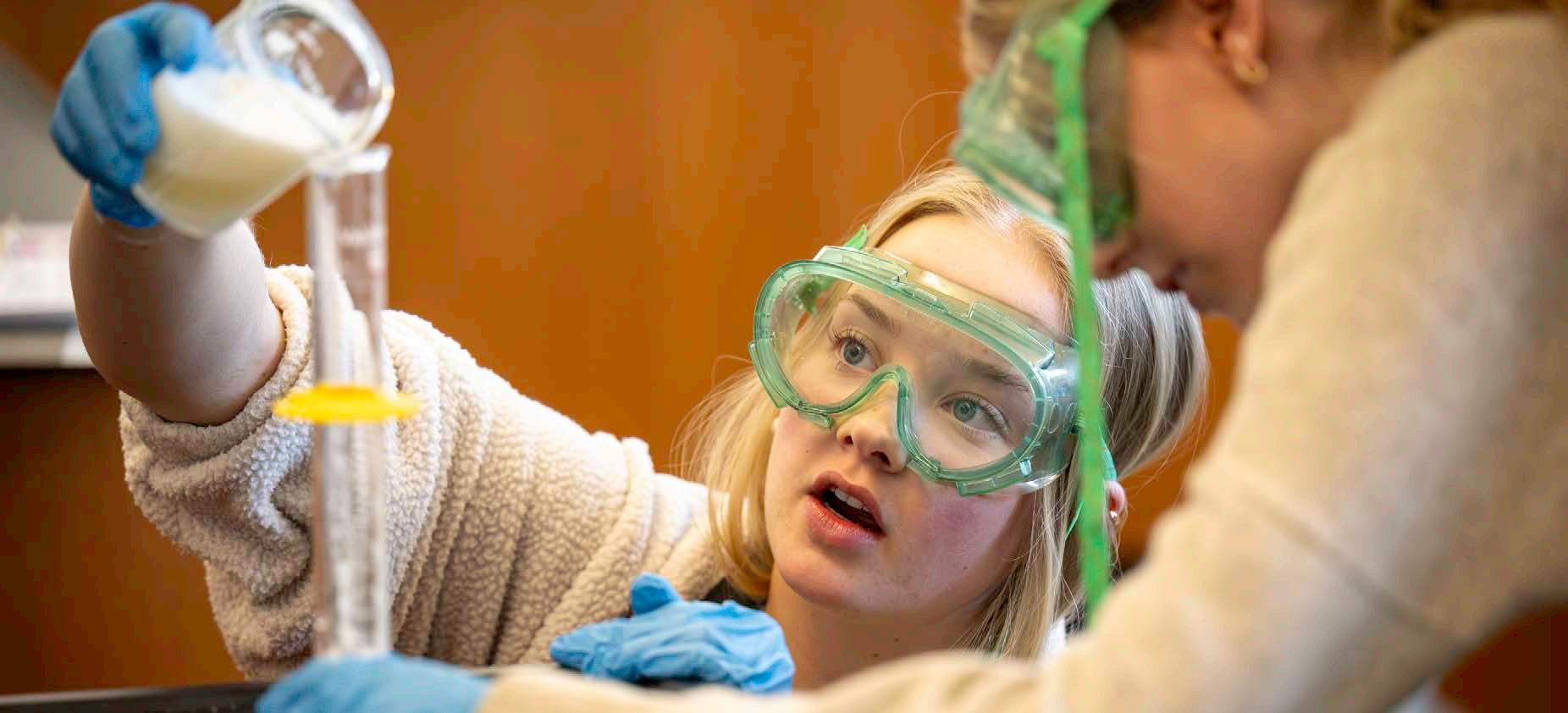
Sixth Formers who fully exhaust all courses in a department, including electives, may pursue Advanced Topics in a particular discipline. Advanced Topics are available in the Arts, Languages, Mathematics and Science Departments. Advanced Topics offer an opportunity for a student to pursue independent work under the supervision of a faculty member. Students interested in pursuing Advanced Topics must be highly motivated independent learners with excellent academic records. Students must petition a faculty member to serve as the adviser to their project, recognizing that not all faculty members will be able to take on this extra time commitment. As part of the application process, a student must have written approval from his or her adviser, the Advanced Topics adviser and corresponding Department Head. All proposals for Advanced Topics are reviewed and approved by the Associate Dean of Academic Affairs and the department heads.
Students may apply for an Independent Study Project (ISP) during their Sixth Form year. An ISP is a term- to year-long project in which a student is able to explore an interest in depth. Independent study projects may include activities ranging from internships and terms abroad to movie production or writing a book of short stories, but all emphasize the experience and understanding of one’s self gained from working in an independent setting. Proposals are submitted to a committee of faculty and students, and the approved projects are overseen by a faculty adviser of the student’s choosing.
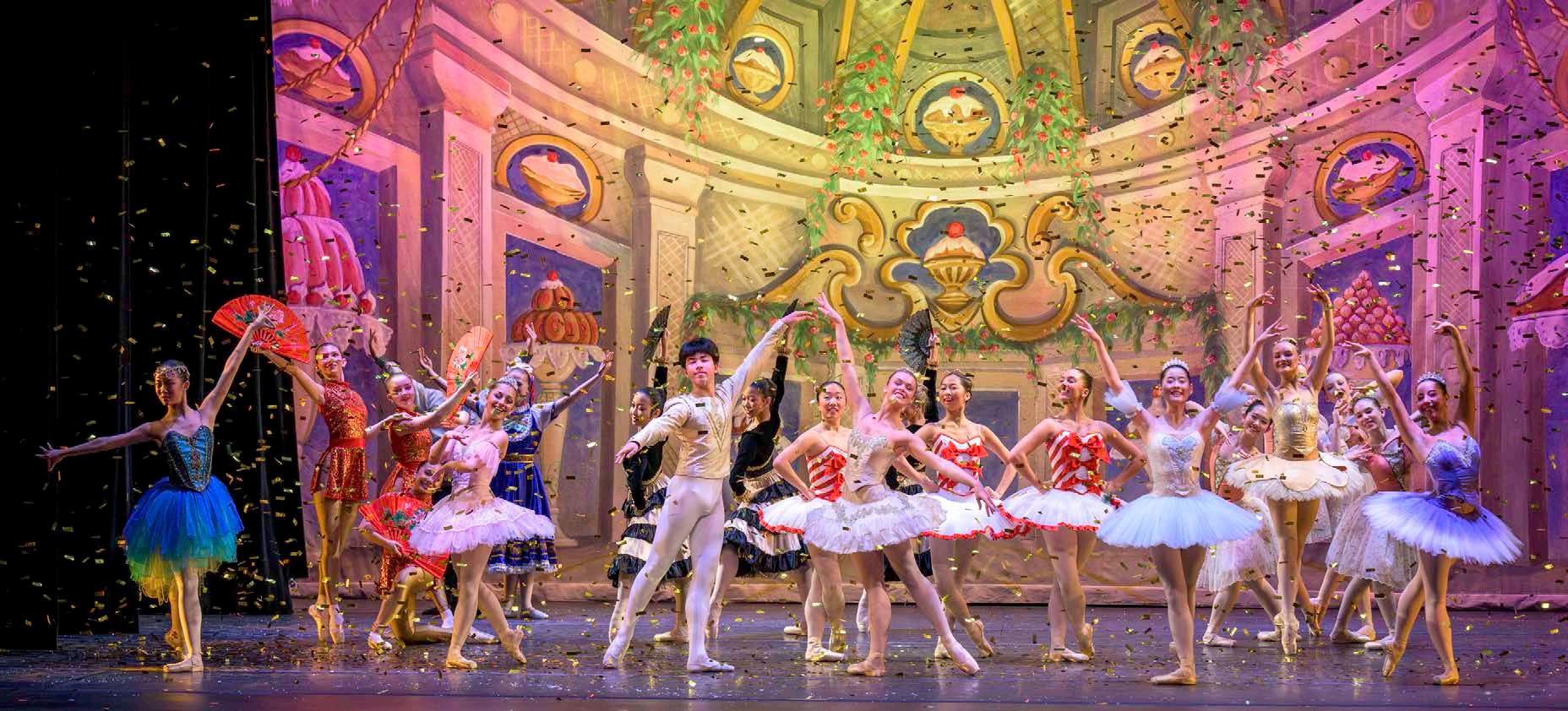
These are the cornerstones of the nurturing, rigorous, inclusive environment of the Arts Department at St. Paul’s School, in which students become empowered, independent, creative thinkers. Through process-based instruction in classes, performances, and exhibitions, students develop the skills, knowledge, and language of their craft.
Students in the fine arts, music, dance and theater programs are guided by teachers who themselves are artists and performers. World-class visiting artists model high level achievement and inspire our students as well as the broader community.
At the core of all our programs is the belief that participation in any creative endeavor is an enormously empowering experience for young people. Through our art courses, students grow and develop a personal vision while becoming more in tune with the world around them.
Students are strongly encouraged to study in one Arts program for three terms, and to continue to study in the Arts throughout their time at SPS.
Enrollment in Arts courses is subject to permission of the Program Head and/or the Department Head.
St. Paul’s School provides students with the opportunity to combine a rigorous academic education with the finest dance training in a dedicated dance facility. The St. Paul’s School Dance Program fosters a fun, nurturing and artistic learning environment and prepares its students to dance at the pre-professional and college level through instruction in classical ballet, modern dance, anatomical theory and performance. The St. Paul’s School faculty is committed to the idea that studying dance is a process and that dancers are always evolving and growing. Our goal is to train technically proficient dancers with a sound work ethic, promote artistic growth and support dancers of all backgrounds.
Serious dancers may audition for the St. Paul’s School Ballet Company (SPSBC), a year-round program that can be substituted for athletic participation at the varsity level. SPSBC dancers work one-on-one with faculty and guest teachers and choreographers, rehearsing daily throughout the academic calendar, and performing four different programs per school year. Its repertory includes classics as well as contemporary works. Guest teachers and choreographers have included members of internationally recognized companies such as American Ballet Theater, Dance Theatre of Harlem, BalletX, The Balanchine Trust, Mikhail Baryshnikov’s White Oak Dance Project, Merce Cunningham Dance Company, Twyla Tharp, New York City Ballet, Paul Taylor Dance Company and Batsheva Dance Company.
About the courses offered
Students interested in dance are encouraged to fulfill their 3-term arts requirement in their first year with three consecutive dance courses.
DA110: DANCE 1
Fall, Winter and Spring Term: 3 credits
Fall and Winter Term: 2 credits
Spring Term: 1 credit
Dance 1: Ballet Technique
Fall Term: 1 credit
Dance 1: Modern Dance Fundamentals
Winter Term: 1 credit
Dance 1: Contemporary Technique
Spring Term: 1 credit
This fun and fast-paced studio-based course is geared toward beginner-level students and athletes looking to learn the fundamentals of dance technique while improving strength, flexibility, agility, stamina, body control and core stability. Each term will focus on a specific dance technique — Fall Term: Ballet Technique; Winter Term: Modern Dance Fundamentals; Spring Term: Contemporary Technique. Students will learn the fundamentals of these dance techniques while also focusing on proper alignment, muscle balance, injury prevention, musicality and rhythm. Additional movement techniques including core-strengthening Pilates exercises, GYROKINESIS® and yoga will supplement with the purpose of improving balance and coordination. Basic anatomy will be introduced to develop an understanding of the function of each muscle group and how it pertains to movement.
Fall, Winter or Spring Term: 1 credit
With the goal of building strength, flexibility, agility, and body awareness, this class focuses on movement practices from The GYROKINESIS® Method and The MELT Method®, along with conditioning exercises, dynamic stretching and ballet technique
exercises to provide cross training for the student athlete. GYROKINESIS® is a movement method that addresses the entire body, opening energy pathways, stimulating the nervous system, increasing range of motion and creating functional strength through rhythmic, flowing movement sequences. It is an original and unique method that coordinates movement, breath and mental focus. The MELT Method® is a gentle self-care technique that enhances mobility, stability and performance, with the intention of eliminating mental and physical stress that accumulates from daily living before it causes persistent pain and dysfunction. Ballet technique exercises utilize the concept of turnout, which provides the opportunity to build hip and core stability. Basic anatomy and readings on these methods will help to deepen one’s understanding of the body. This class introduces students to a different way of approaching body care and injury prevention, and strength and flexibility building through movement patterns.
Fall, Winter, or Spring Term: 1 credit
Prerequisite: successfully completed Movement for Strength and Agility 1
Movement for Strength and Agility 2 builds upon the foundational work completed in Movement for Strength and Agility 1. Students will build a stronger understanding of technical skills covered in Movement for Strength and Agility 1. Students will learn about and apply additional technical concepts and details that will deepen their understanding of the The GYROKINESIS® Method. This class will continue to utilize The MELT Method® and other supplemental forms of movement with a goal of continuing to develop strength, flexibility, agility, and body awareness.
Fall, Winter or Spring Term: 3-credit sequence
Prerequisites: Some previous dance training, for example Dance 1.
This course teaches classical ballet techniques at the elementary level. Classes cover barre, center practice and the introduction and further study of pointe work. Working from the syllabus of classical ballet, students develop their technique, artistry and functional understanding of anatomy. Students with prior dance training should enroll in Ballet 2. Throughout the year, students may have visiting guest teachers from professional companies in disciplines ranging from classical to modern and contemporary techniques.
Full Year: 3 credits
Prerequisite: Permission of the Director of Dance.
This course is developed within the syllabus of classical ballet at a beginning pre-professional level. Students will work to explore and improve their capacity for movement through the practice of classical ballet. Students will be expected to work at their own level of proficiency while being guided to improve in all areas. Classes will cover barre, center practice, pointe work and traditional men’s technique. In addition, students will develop artistry, work toward improving their strength and flexibility, learn about pertinent anatomy and gain knowledge of classical terminology and techniques. To be placed in Ballet 3, students need a significant background in classical ballet and a desire to continue their training at an intensive level. Throughout the year, students will receive training from visiting artists from professional companies in disciplines ranging from classical ballet to modern and contemporary techniques.
Full Year: 3 credits
Prerequisite: Permission of the Director of Dance. This course teaches classical ballet technique at a pre-professional beginning/intermediate level. Therefore, the physical vocabulary and combinations the dancers will be learning and practicing build on what was learned in Ballet 3 and are geared toward helping the dancers progress to Ballet 5. Students will work to explore and improve their capacity for movement through the practice of classical ballet. Students will be expected to participate with the proficiency that is industry standard for their level. Classes will cover barre, center practice, pointe work and traditional men’s technique. In addition, students will develop artistry, work toward improving their strength and flexibility, learn about pertinent anatomy and gain knowledge of classical terminology and techniques. Throughout the year, students will receive training from visiting artists from professional companies in disciplines ranging from classical ballet to modern and contemporary techniques. Students with a significant background in ballet who are interested in continuing their training at an intensive level will be placed in Ballet IV by the Director of Dance. Membership in the SPS Ballet Company is a prerequisite for placement in this level.
Full Year: 3 credits
Prerequisite: Permission of the Director of Dance.
This course teaches classical ballet technique at a pre-professional intermediate level. Therefore, the physical vocabulary and combinations the dancers will be learning and practicing build on what was learned in Ballet 4 and are geared toward helping the dancers progress to Ballet 6 at the end of the year. Students will work to explore and improve their capacity for movement through the practice of classical ballet. Students will be expected to participate with the proficiency that is industry standard for their level. Classes will cover barre,
center practice, pointe work and traditional men’s technique. In addition, students will develop artistry, work toward improving their strength and flexibility, learn about pertinent anatomy and gain knowledge of classical terminology and techniques. Throughout the year, students will receive training from visiting artists from professional companies in disciplines ranging from classical ballet to modern and contemporary techniques. Students with a significant background in ballet who are interested in continuing their training at an intensive level will be placed in Ballet 5 by the Director of Dance. Membership in the SPS Ballet Company is a prerequisite for placement in this level.
Full Year: 3 credits
Prerequisite: Permission of the Director of Dance
This course teaches classical ballet technique at a pre-professional advanced level. Dancers at this level need to have had Ballet 3-5 or the equivalent. The physical vocabulary and combinations the dancers will be learning and practicing are the most advanced that the St. Paul’s School Dance Program has to offer. Students will work to hone their capacity for movement through the practice of classical ballet. Students will be expected to participate with the proficiency that is industry standard for a preprofessionally trained dancer. Classes will cover barre, center practice, pointe work and traditional men’s technique. In addition, students will continue to develop artistry, strength and flexibility. They will be asked to refer to anatomy as it pertains to what they are working on. They will continue to develop their knowledge of classical terminology, styles and techniques. Throughout the year, students will receive training from visiting artists from professional companies in disciplines ranging from classical ballet to modern and contemporary techniques. Students with a significant and appropriate background in ballet who are interested in continuing their training at this intensive level will be placed in Ballet 6 by the Director of Dance.
The Fine Arts Program offers studio courses in which students work hands-on with materials and tools to learn about their world and themselves. Studio assignments are supplemented by a broad introduction to art history, theory, criticism and aesthetics, and exhibition of student artwork is an integral element of the curriculum. All students are offered extensive elective opportunities in one of three major areas: drawing, painting and printmaking; sculpture, glass and ceramics; or photography and computer graphics. Advanced Portfolio courses are offered as culminating classes in each of these three major areas of study. The program also offers courses in art history.
Emphasis is placed on both skill building and creativity. The Fine Arts Program supports introductory students through those who wish to study in the studio arts in depth throughout their St. Paul’s career and beyond. The Fine Arts Program strongly encourages students to explore mediums in depth.
Requirements: New students are encouraged to fulfill their three-term arts requirement during their first year in one of the following sequences:
Ceramics: 1, 2 and 3
2D Art: 1, 2 and 3
Photography: 1, 2 and 3
Fall, Winter or Spring Term: 1 credit
This introductory course focuses on hand-building techniques, including pinch, coil and slab methods. Students will use tools such as the slab roller and extruder while learning about clay and glaze chemistry, firing processes and 3D design principles. Through hands-on projects, research and exploration of historical and contemporary ceramic art, students will develop their understanding of form, texture and color to create expressive and functional works.
Fall, Winter or Spring Term: 1 credit
Prerequisite: Ceramics 1
This course introduces students to the discipline of wheel throwing, focusing on the wheel as a tool for creating a variety of forms. Students will learn essential techniques for shaping, trimming and refining their work on the wheel. They will also learn basic clay and glaze chemistry, along with the firing processes. Historical and contemporary ceramic practices will inspire both the making and research aspects of the course, as students continue to explore form, texture and color in their creations.
Fall, Winter or Spring Term: 1 credit
Prerequisite: Ceramics 2
This course builds on wheel-throwing techniques with a focus on larger, more complex forms and functional pottery. Students will refine their skills and explore advanced methods, including combining wheel-thrown and handbuilt elements. Through hands-on projects, students will develop a personal approach to both material and process. Advanced glazing and firing techniques will be introduced, along with a deeper study of historical and contemporary ceramic practices. Emphasis is placed on form, function, and sculptural possibilities, with the wheel serving as a foundation for creative exploration.
Fall, Winter or Spring Term: 1 credit
Prerequisite: Ceramics 3
Ceramics 4 is an advanced-level course designed for highly motivated ceramics students seeking to further develop their technical skills and conceptual depth. Building upon prior experience, this course focuses on the complexities of ceramic surfaces, from glaze and pattern to decoration and ornamentation. Students will explore surface treatments through multiple firing techniques, glaze chemistry, and both commercial and digital applications. With an emphasis on historical and contemporary perspectives, the course also encourages students to critically examine surface in ceramics. Students will propose and develop a conceptual idea across a series of works, using research, writing, and studio practice to create resolved, meaningful pieces that integrate technical mastery with personal expression.
Fall, Winter or Spring Term: 1 credit
This introductory-level course focuses on the basic techniques of observational drawing from life. Techniques in the fundamentals of drawing with pencil, ink, charcoal, pastels, and Conté crayon are explored. Line, shape, and value are the primary skills addressed, as well as examinations of art history, critique, and reflection. Projects simultaneously build skills and encourage creative responses. Elements of design are introduced and reinforced in this course. The course is designed for students from all levels of experience and serves as a prerequisite for all subsequent 2D Art courses.
Fall, Winter or Spring Term: 1 credit
Prerequisite: 2D Art 1 or Drawing 1
2D Art 2 builds on the foundational skills learned in 2D Art 1. This course introduces students to linear perspective, landscape drawing, and considerations of composition and 2D design. Students gain familiarity with the tools and keep a sketchbook to build their artistic practice. Studio work is informed by art history, master artist references and feedback from group critique. A heightened emphasis is placed on creative thinking and project planning. The class culminates in a co-curated, end-of-term exhibition for the School.
Fall, Winter or Spring Term: 1 credit
Prerequisite: 2D Art 2 or Drawing 2
This course utilizes and builds on the drawing skills learned in 2D Art 1 and 2, and focuses on the basic techniques of painting. Beginning with transparent watercolor, students practice painting skills through landscape, portrait, and still life painting. Emphasis is placed on drawing and painting from life. Elements of design and color theory are introduced with acrylic paint. Explorations in art history and field trips to local museums and galleries support the technical and creative growth of each student-artist.
Fall, Winter or Spring Term: 1 credit
Prerequisite: 2D Art 3 or Drawing 3
2D Art 4: Advanced Drawing and Painting builds on the foundations introduced in 2D Art 1-3 and develops those skills for large-scale oil painting. Greater emphasis is placed on color mixing, painting process, and brush techniques, while more conceptual assignments utilize observational skills of rendering from life for heightened effect. Art History, sketchbook, and critique form the bedrock of the collaborative studio culture, and students are encouraged to be ambitious with their creativity.
Full Year: 3 credits
Prerequisite: Open to Fifth or Sixth Formers with four or more terms in Drawing and Painting, six or more terms in Arts and permission of the Department Head
Designed for students with strong technical skills and an independent, ambitious creative drive, this yearlong capstone course guides students as they create an original body of work for presentation to the School. The project-based course structure encourages experimentation, rigorous reflection, advanced technical instruction and strong critical thinking skills in the studio. The contemporary art context interweaves throughout the year with art history discussions, Crumpacker Gallery shows, visiting artist connections and group critiques. Students develop their unique creative voice and learn to converse in the language of visual artists. Projects are due every three to four weeks. Students work together daily and regularly meet with the full Studio Arts Seminar cohort and instructors across mediums for feedback and collaboration. The Spring term culminates in a Crumpacker Gallery co-curated exhibition and community-wide Artist Talk event. Students taking this course are also encouraged to take an art history course at SPS.
Fall, Winter or Spring Term: 1 credit
This course introduces the basics of manipulating hot glass through the use of a blowpipe and hand tools. Students learn how to gather glass from the furnace and shape it using hand tools at the glassblowing bench. Using heat, gravity and centrifugal force, students create vessels such as tumblers, bowls and vases. Students are introduced to basic color applications and grinding and polishing techniques. Students study historical and contemporary examples of blown glass, as well as the artists involved with glass. Emphasis is given to developing hand skills, teamwork, creative thinking, self-expression and shop safety.
FG210: GLASS 2
Fall, Winter or Spring Term: 1 credit
Prerequisite: Glass 1
This course builds on Glass 1, advancing students’ skills in manipulating molten glass with a blowpipe and hand tools. Students refine their gathering and hand skills with tools at the bench while creating vessels that explore heat, gravity and centrifugal force. Students are introduced to wooden blow molds, bronze optic molds and DIY molds. The course expands into historical glass working processes, bit and solid working and color application, with an emphasis on designing refined forms and developing work that can be produced in multiples. Students continue practicing foundational cold-working techniques — including grinding, polishing, lathe work and sandblasting. Throughout the course, emphasis is placed on technical proficiency, teamwork, creative problem-solving, self-expression and shop safety.
Fall, Winter or Spring Term: 1 credit
Prerequisite: Glass 2
This course advances students’ technical control and conceptual development in hot glass, emphasizing refined craftsmanship and intentional form. Students continue to strengthen their gathering, marvering and hand skills while moving beyond basic vessels to set up and control bubbles for specific forms such as amphoras, bottles and rondels. The course introduces the use of color bar and the pick-up oven, expanding possibilities for surface, pattern and color integration. Cold shop investigations continue with more advanced surface design and an introduction to cold construction using adhesives. Throughout the term, teamwork remains central, as students work collaboratively and rely on one another’s assistance to execute increasingly ambitious and technically demanding work.
Fall, Winter or Spring Term: 1 credit
This course introduces students to graphic design through projects in printed and digital media, challenging students to create original images in the areas of design, color and typography. Students will survey the history of graphic design, examine modern applications and practice the visual communication of ideas through their own artworks.
Fall, Winter or Spring Term: 1 credit
An introductory photography course designed for students with little or no previous photography experience, this course introduces the principles of photography through a blend of traditional and digital processes. The main objective is to teach students to see light rather than things. Students gain foundational understanding of the 35mm camera, black-and-white film, digital scanning, Adobe Photoshop and digital printing. Students may borrow a fully manual 35mm film camera from the Department. (Arrangements can be made with the photography instructor for borrowing cameras.) Each photography course is concerned with the aesthetics, history and practice of this light-generated form of art. Additionally, productive critique procedures are cultivated.
Fall, Winter or Spring Term: 1 credit
Prerequisite: Photography 1
Students further develop black-and-white photography concepts introduced in Introduction to Photography, this time with a focus on people and the body. The Zone Simple System, studio lighting and other intermediate-level techniques are explored, and several historical and contemporary artists are discussed. An emphasis is placed on portraiture and self-portraiture and the exploration of gesture and meaning. Additionally, students refine their ability to discuss art and exchange constructive feedback within a collaborative studio environment. Students should be highly motivated and have strong critical skills in all intermediate- and advanced-level photography courses. Students must have access to a fully manual 35mm camera or may borrow one from the Department.
Fall, Winter or Spring Term: 1 credit
Prerequisite: Photography 2
Students continue to develop photographic vocabulary and vision while building upon intermediate-level black-and-white photography techniques. They also are introduced to computer colorization, color photography, color digital printing and basic computer image manipulation. Emphasis will be placed on developing narratives using photographic imagery. Students must have access to a fully manual 35mm camera or may borrow one from the Department.
Fall, Winter or Spring Term: 1 credit
Prerequisite: Photography 3
Highly motivated students explore the creative potential and history of the photography medium. Students continue to use the Zone Simple System with advanced-level black-and-white and digital processes in photography, including night photography, SLOfilm, infrared photography, and other alternative and multimedia techniques. Students are expected to work more independently and experimentally in this exploration of photography as a living and material medium. Students must have access to a fully manual 35mm camera or may borrow one from the Department.
FT480:
Full Year: 3 credits
Prerequisite: Open to Fifth or Sixth Formers with four or more terms in Photography, six or more terms in Arts and permission of the Department Head
Designed for students with strong technical skills and an independent, ambitious creative drive, this yearlong capstone course guides students as they create an original body of work for presentation to the School. The project-based course structure encourages experimentation, rigorous reflection, advanced technical instruction and strong critical thinking skills in the studio. The contemporary art context interweaves throughout the year with art history discussions, Crumpacker Gallery shows, visiting artist connections and group critiques. Students develop their unique creative voice and learn to converse in the language of visual artists. Projects are due every three to four weeks. Students work together daily and regularly meet with the full Studio Arts Seminar cohort and instructors across mediums for feedback and collaboration. The Spring Term culminates in a Crumpacker Gallery co-curated exhibition and community-wide Artist Talk event. Students taking this course are also encouraged to take an art history course at SPS.
The St. Paul’s School Music Program is primarily performance-based, with vibrant choral and instrumental ensembles involving more than 20% of the student body. The music curriculum is designed in part to support student participation in the ensembles by enhancing students’ skills through private lessons and musicianship classes as part of the Applied Music Program. Students may enter the Applied Music Program at any level and may take Applied Music as many years as they wish.
Participation in at least one School ensemble (Choir, Wind Ensemble, Orchestra) is a requirement for enrollment in Applied Music. However, any qualified musician may participate in any ensemble without being enrolled in the Applied Music class. In such cases, we strongly encourage students to take non-credit private lessons. Please note that a fee is charged for non-credit music lessons; aside from the normal Arts fee schedule, lessons for those enrolled in Applied Music are free.
All music classes and lessons are taught by highly trained professional musicians.
[May be taken for more than one year.]
Private year-long instruction is available to all students who want to study music for no credit/no grade. Daily practice is required. Music studied in this course is based on individual needs and abilities and may include a breadth of styles and genres, based on personal interests. A fee is charged for these lessons. As the School retains contracted music teachers annually based on the full academic year registrations received, early withdrawal from these music lessons does not release families from their financial obligations for the academic year. Please note that students may choose the options of Non-Credit Music lessons for the full academic year, for the Winter and Spring Terms or for the Spring Term only.
Fall, Winter or Spring Term: 1 credit
This one-term course is intended to provide an overview of musical masterpieces from the 16th century to the present day. Using recorded examples, historical context and basic analysis, students will have the opportunity to gain an appreciation for the progression of musical composition during the last five centuries. Class discussions, deep listening and score study will illuminate the world of music appreciation for the novice musician as well as the experienced artist. As a one-term course, this offering is ideal for a non-musician looking to fulfil the three-term arts requirement in combination with other artistic disciplines. This course also provides an opportunity for experienced music students to sharpen their music appreciation skills.
This course is offered to musicians who are new to SPS and the ensemble program, and fulfills the one-year Arts graduation requirement through participation in one or more of the School’s ensembles (Choir, Orchestra, Small Ensembles). The year-long Applied Music 1 curriculum consists of two basic musicianship classes (BMC), one private or group lesson on their chosen instrument and two or more evening ensemble rehearsals each week for those who qualify.
The basic musicianship classes are designed for practicing musicians to acquire and hone crucial skills involving the understanding and performance of two of the five basic elements of music: pitch and rhythm. Students will learn to read four of the seven clefs using “fixed do” solfège. Students will learn how to accurately sing scales in all keys, recite solfège syllables in rhythm and orally perform complex rhythms through a series of recitations of graduated difficulty. Students will also practice aural recognition of tonality, rhythm and intervallic relationships of pitch. All students must learn to be comfortable using their voice as their classroom instrument.
Ensemble rehearsals are typically held on Tuesday and Thursday evenings for 90 minutes each. Grades are based on performance in BMC, lessons and ensemble participation. Musicians who do not pass the audition for an ensemble — or play an instrument for which there is no ensemble offered — will be expected to demonstrate their progress through a short performance examination (jury). Students must pass the BMC portion of Applied Music 1 in order to receive credit for the course and move to Applied Music 2. Although the standard arts fee applies, private and group lessons are free of charge to all students enrolled in Applied Music 1.
MU210, MU310, MU410: APPLIED MUSIC 2, 3, 4
Full Year: 3 credits
Prerequisite: Applied Music 1
Satisfies arts requirement
[May be taken for more than one year.]
This course is a continuation of the Applied Music curriculum and is offered to students who have fulfilled the Basic Musicianship requirement by successfully completing the Basic Musicianship Class and Applied Music 1. Students enrolled in this class receive two private lessons, or one private and one group lesson per week, and must participate in one or more Major Ensembles. More advanced students are encouraged to participate in smaller “splinter” groups such as Madrigal Choir, Chamber Music, Jazz Ensemble or other small ensembles coordinated by members of the Music Program faculty. Applied Music satisfies the School’s Arts requirement.
The Theater Program at St. Paul’s School offers all students the opportunity to explore theater as a craft in a welcoming, caring and inclusive environment. We offer Stanislavski-based top-level actor training that complements the rigorous academic preparation for which St. Paul’s is known. This breadth and depth gives students various entry points into the program, including performance opportunities, technical theater opportunities and various offerings in our course work.
Intellect, Imagination, Creative Collaboration, SelfExpression — these are the cornerstones of the St. Paul’s Theater Program. Through our studentcentered courses, our experienced faculty guide students to become storytellers who empathize and explore the world around them while developing a deeper understanding of self and others.
About the courses offered
For the most comprehensive and in-depth actor training, courses are designed to take in sequence — for example, Improv, Acting 1 and Acting 2. However, if students meet any prerequisites or have the permission of the Director of Theater, they may take the courses in any order their schedules allow. There also are courses students may take more than once.
The theater program supports all students from the introductory student to the student who desires to study theater in more depth during their time at St. Paul’s School.
Recommended: new students interested in the study of theater are encouraged to fulfill their three-term arts requirement with the following three courses, taken in sequence during their first year: Theater Arts Foundations, Theater Arts Ensemble, Improvisation.
TH110: THEATER ARTS: FOUNDATIONS
Fall Term: 1 credit
This course is a practical, on-your-feet introduction to theater as a collaborative tool for communication. The class also serves as the foundation for the progression of theater courses. Through a series of projects focusing on specific aspects of acting, writing, directing and design, students will build skills in theatrical communication. Each new project features a global artist who uses theater to shake up, shock, challenge or entertain their communities, and will include a chance to read and watch representative works before students create their own work in response. This course is designed to challenge and engage students who have previous experience and interest as well as those who are brand new to theater.
Winter Term: 1 credit
This class is a continuation of the work begun in Theater Arts Foundations, building an understanding of how the components of a theatrical production work together to create a meaningful story. Students will explore the work of professional theater artists and respond to project prompts with their own creations, using theater to question the status quo, speak to communities in conflict and unite people around a common cause. Each member of the class will be asked to direct, write, perform and design over the course of multiple projects, so students should come prepared for a highly interactive and collaborative class.
Spring Term: 1 credit
You do not have to be funny — effective improv is the result of understanding the structure of a scene, working well with partners and being willing to live boldly in the present moment. Over the term, students will learn how to develop those skills plus many others while recognizing patterns to create characters and scenes on the spot. This course is designed both for students who have previous acting experience and those who have never performed before.
Anyone taking this class must be prepared to fully engage in physical class activities, games and discussions. The class will culminate in a fully improvised pop-up performance for the SPS community.
Winter Term: 1 credit
Prerequisite: Previous SPS theater class or involvement in SPS theater production
In a world of AI and CGI, crammed with content creators, can an ancient art form like theater ever be cutting edge? Students will study the work of performance artists, contemporary theater companies during the pandemic, site-specific theater and interactive digital storytellers. Using techniques drawn from Devised Theater, the bulk of our class work will involve collaborating to create an innovative world-premiere piece of experimental theater for the SPS community.
Fall Term: 1 credit
This course is a prerequisite for any student who wants their script produced in the Winter Term one-act play festival. The class will begin by writing a series of monologues, short scenes and flash plays as we explore the elements of character, dialogue, narrative structure, plot and visual spectacle. Since the word “wright” refers to a craftsperson, much of the class time will function as an intensive writer’s workshop. To ensure effective peer critiques, students will learn and use Liz Lerman’s Critical Response Technique, which was designed for artists sharing feedback on creative works in progress. We will also read and discuss a variety of professional one-act plays. This course is open to all students regardless of previous experience in theater.
Fall Term: 1 credit
Prerequisite: This class is open to Fifth and Sixth Formers with previous SPS theater experience
Building on skills developed in previous classes and/or productions, this ensemble-based acting class will challenge students with a wide variety of exercises, monologues and scenes used as text for our explorations of technique and craft. Students are expected to come to class with memorization work completed. Advanced Acting students will learn the system of Practical Aesthetics while continuing to build their individualized process for effective acting. The class will also study elements of craft technique, increasing physical and vocal clarity, employing spatial relationships and growing moment-to-moment specificity.
Students are encouraged to take Advanced Acting, Advanced Acting Ensemble and Advanced Acting Production by the end of the SPS careers.
Winter Term: 1 credit
Prerequisite: This class is open to Fifth and Sixth Formers with previous SPS theater experience
This ensemble of intermediate- and advanced-level actors will work together to bring a production to life. The exact nature and scope of the project will depend on the interests and skills of the students in the class. As a company, students may choose to compete at the New Hampshire Educational Theatre Guild one-act competition, create a traveling childrens’ show, devise an original work, tackle an advanced script or explore a new form of theater.
Students are encouraged to take Advanced Acting, Advanced Acting Ensemble and Advanced Acting Production by the end of the SPS careers.
Spring Term: 1 credit
Prerequisite: This class is open to Fifth and Sixth Formers with previous SPS theater experience
This ensemble of intermediate- and advanced-level actors will work together to bring a production to life. The exact nature and scope of the project will depend on the interests and skills of the students in the class. As a company, students may choose to compete at the New Hampshire Educational Theatre Guild one-act competition, create a traveling childrens’ show, devise an original work, tackle an advanced script or explore a new form of theater.
Students are encouraged to take Advanced Acting, Advanced Acting Ensemble and Advanced Acting Production by the end of the SPS careers.
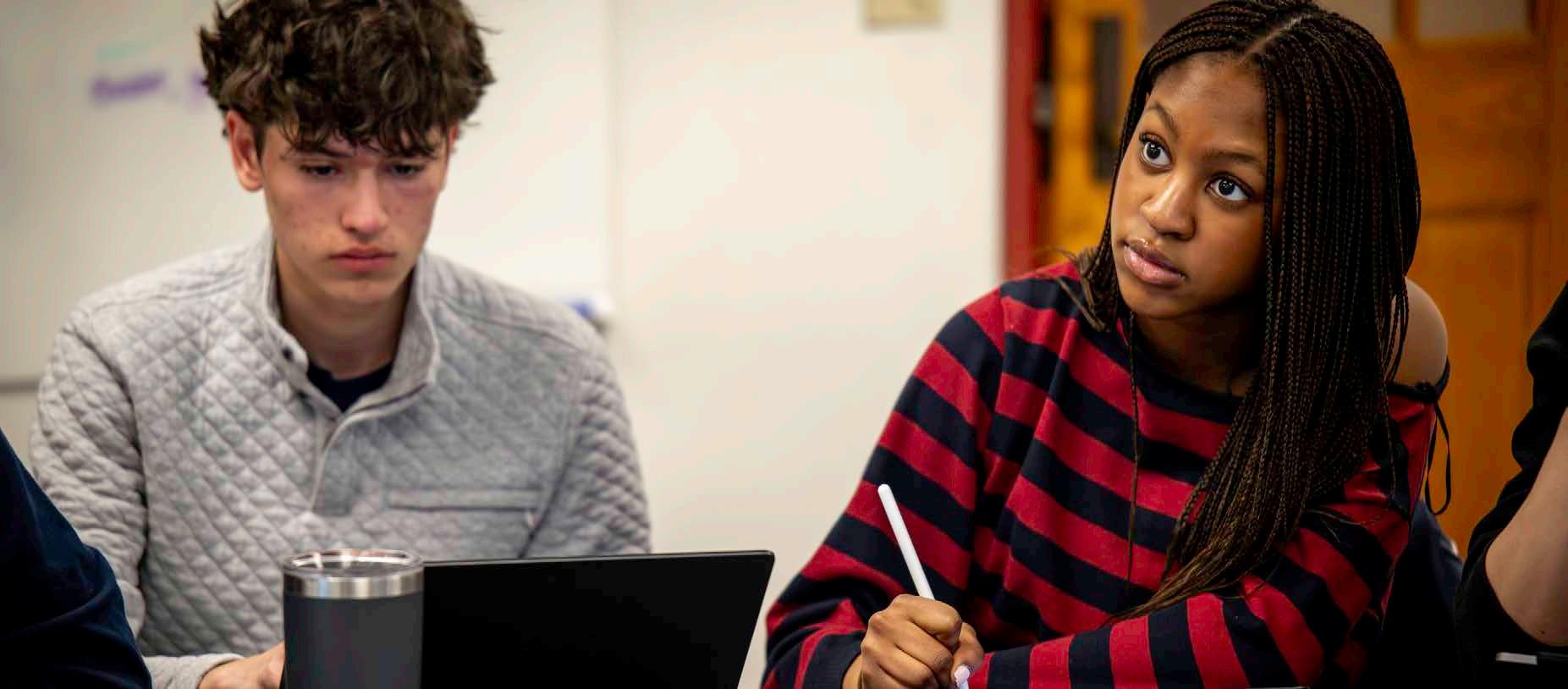
The interdisciplinary Humanities curriculum reflects an approach to learning that does not separate subjects but weaves them together to explore the human condition. Students are challenged to become engaged citizens and responsible leaders in an increasingly global world. Students in humanities courses are taught to use critical thinking, interpretation and analysis of myriad texts to make connections between different time periods and different voices as the foundation for helping them develop their critical thinking skills. The Humanities curriculum aims to help students discover the complexities of an interconnected world.
The Humanities Department strives to enable students to become confident writers in whatever fields they pursue in college and their lives beyond. We teach students to write with clarity, efficiency, integrity and purpose through a wide range of assignments. The basis of the Humanities program is a commitment to developing skilled, assured analytical writers. Because good writers are good readers, students engage with a rich and diverse range of texts and voices.
Students study how arguments are built, how evidence is deployed, and how style and structure shape meaning.
Analytical writing skills development is central to the Humanities program as students learn to construct a clear thesis, evaluate and integrate evidence, and develop a sustained, coherent argument. Students also engage in the process of developing research questions and are taught how to find source material, assess evidence and build a well-reasoned, evidence-based research essay. The Humanities program of study is committed to vertical skill development, which prepares students for increasingly sophisticated inquiry.
We recognize the importance of students learning to develop a set of tools that enable them to reflect on their writing process. Through their writing, students build necessary habits of mind such as problem-solving, creative thinking and curiosity.
Enrollment in Humanities courses is subject to permission of the Department Head.
Full Year: 6 credits (2 credits per term)
Humanities III focuses on identity and stories. The stories we read, tell and learn inform the way we look at the world and understand ourselves in relation to the world. To help students understand these ideas we examine creation stories from ancient Mesopotamia to Judeo-Christian narratives to Indigenous American cultures and history. Particular focus is devoted to planning and writing analytical essays. Students also develop their critical thinking skills through close reading, writing, discussion and presentations. Particular focus is devoted to planning and writing analytical essays.
Full Year: 6 credits (2 credits per term)
In Humanities IV, students study American history and literature to explore the complex relationships among individuals and their communities through a varied and integrated disciplinary approach. Building on the self-conception considered in Humanities III and anticipating the examination of the forces and beliefs shaping our modern world studied in Humanities V, Humanities IV investigates why individuals choose to come together in community, how they cope with tension and change and how communities develop and evolve. Considering specific periods in American history, students explore American experiences through primary and secondary texts such as historical documents, artwork and literature. Discussion and activity-driven classes encourage students to develop curiosity about the human condition, study and understand founding documents, develop their own perspectives and
value others’ viewpoints. Students practice writing on a weekly basis as well as in major assessments as a critical means of self-expression with emphasis on analytical writing. Varied assessments foster skill building that includes critical reading, research, visual image analysis and public speaking. During the Spring Term, students conduct a major research project examining some aspect of American history or culture.
Full Year: 6 credits (2 credits per term)
Centering on history and literature from the 19th and 20th centuries, Humanities V explores the forces that shaped the contemporary world. Specific units focus on the history and literature of China, Africa, India and Europe. The course aims to find recurring trends and themes relevant to all places, peoples and time. Students learn to interpret events and cultural artifacts through the lenses of economics, politics, race, gender and religion. Through a close examination of diverse texts — poetry, philosophy, novels, historical documents — students imaginatively and rigorously recreate the context both informing and informed by these works. Students refine the skill of close reading and develop critical vocabularies for various disciplines. Close attention is given to planning and writing analytical essays. Students also engage in a variety of other assessments — DBQ exams, research, historically based simulations — to develop greater appreciation for and control of the nuances of language and self-expression. Students are expected to be active participants in their own education. The course culminates in an independent research project in which each student expands their understanding of a topic introduced in Humanities V.
The Humanities department offers a 200-level course, Foundations in Sacred Studies, for Fourth Form students. In addition to building an understanding of religious history and narrative, the course aims to help students with their writing. Students whose schedules do not allow them to take this one-term elective during Fourth Form will instead take a 400-level religion elective as Fifth or Sixth Formers.
The 400-level electives offer course content, context and homework load aimed at Sixth Formers. Fifth Form students must have earned a grade of B or above in Humanities IV to enroll in a 400-level elective. New Fifth Form students must have the approval of the Humanities Department Head and the Associate Dean of Academic Affairs to enroll in a 400-level elective.
HU210: FOUNDATIONS IN SACRED STUDIES
Fall, Winter, or Spring Term: 1 credit
Satisfies religion requirement
Students will be introduced to the central texts of the Abrahamic traditions: Judaism, Christianity and Islam. Through the study of sacred text and literature, students will develop a basic understanding of religious history and approaches for making meaning of religious symbols, myth, and narratives. Students will learn skills of close reading and writing to advance their religious literacy.
Winter Term: 1 credit
[NCAA English core course]
The 2000s have been defined by technology, activism, informatization and an increased awareness of identity. This course will ask students to examine some of the most prolific Black writers of the 21st century. Over the course of the semester, students will read contemporary novels that explore themes of race, culture and politics. While we consider the novels of the present, we will also look to the past to consider: How did we get here? Students will be asked to consider other works and forms, such as the poetry of Claudia Rankine and Terrance Hayes, to better understand what characterizes 21st century Black literature. By the end of the term, students will have an understanding of the power of literature, representation and voice. Possible authors include Yaa Gyasi, Colson Whitehead and Angie Thomas.
Spring Term: 1 credit
[NCAA: English core course; does not count toward credit in the Humanities curriculum]
Prerequisite: Successful completion of, or currently enrolled in Biology.
This course will be a literary and scientific study of the natural world. Looking closely at the natural world around us, journaling about our own observations, and conducting scientific field studies are the essentials of this course, as we read and discuss the work of a number of nature writers to help inspire our own writing and reflection. How can we learn to become more environmentally aware through our close observations, labwork, reading, and discussions about nature? What makes celebrated nature writers and why are they such accomplished writers? How do we model that in our own writing? What changes could the SPS community make to become a more self-sustaining community? How do we become agents for change? Students will explore these and other questions.
HU410:
Fall Term: 1 credit
[NCAA English core course]
How is the voice of a people defined? In this course, we will trace the African American literary tradition since the publication of Phyllis Wheatley’s poetry in 1773. Students will be asked to consider how major racial, economic and political themes have developed within this tradition, from the colonial era to now. We will explore how the literary works of African American writers both represent and defy the dominant culture of their times. This course will challenge the assumption of a monolithic Black experience in the United States by surveying a wide variety of literature that ranges across time and space. Through interpreting and discussing the complex works of authors like Zora Neale Hurston, Ralph Ellison, Nella Larsen, Toni Morrison and more, students in this course will have the opportunity to expand their knowledge of the American literary canon and understand the perspective of a marginalized group in America.
HU410: AMERICA’S PASTIME THROUGH LITERATURE
Spring Term: 1 credit
[NCAA English Core Course]
This course will look closely at how the game of baseball has mirrored American social, political, and economic currents. The course will follow a chronological timeline, from the rise of the major leagues in the 1870s through the modern era, paying particular attention to the game’s impact on individuals and families; racial discrimination and integration; labor relations; urbanization; roles of women; treatment of gay athletes; and implications of performance-enhancing drugs.
Winter or Spring Term: 1 credit
This course focuses on the historical and cultural forces in the United States. With a thematic approach, the class explores issues of the American family, gender roles, race and other defining cultural values that have shaped modern America. To supplement the historical readings, classic American films are used as cultural centerpieces to enrich discussions and essays. Some of the films used in past classes include “Rebel Without a Cause,” “High Noon,” ”Easy Rider,” “The Graduate” and “Dr. Strangelove.”
HU410:
Winter Term: 1 credit
This course asks students to examine the paradigm that governs American foreign policy and the key moments in history when that paradigm has shifted. In our study of foreign policy decisions, this course examines America’s role as an imperial power, the role of human rights in America’s foreign policy decisions, the relationship between the United States and the United Nations and the concept of America as the world’s global police. Students are expected to pay particular attention to current events. There are several research projects as a major component of this course.
Fall or Spring Term: 1 credit
The objective of this course is to introduce you to the institutions, processes and actors that comprise the American political system at the national level, as well as to engage you in empirical and critical thinking regarding the nature and quality of American democracy. This course begins with an exploration of the ways we can systematically examine American politics, and then turns to the structure of American government, emphasizing the divisions of power between levels of government and branches of government. We’ll investigate the legislative and executive branches of government, specifically focusing on the workings of the Con-
gress, presidency and bureaucracy, and how these institutions engage in policy-making and policy execution. We also will examine the role of American elections and the combination of forces that lead to policy change. We will conclude the course by considering the American judicial system and its role in our system of government. Current events will be incorporated regularly and used as lenses into the issues we are studying.
Fall Term: 1 credit
In this course, students will study current political issues and trends. We will analyze the partisan divide in the country and how this engenders political division in the American government. We will discuss the dynamics, organization and decisionmaking processes of the American Congress and pay attention to the relationship between legislators and their constituents and between legislators and the president. We will examine the growth of presidential power, the cult of presidential personality, and the issue of presidential accountability. Some crucial questions we might address include: What is the relationship between citizens and elected officials? How do the political parties function in terms of decisions made by members of Congress? How is power balanced among the three branches of government? At its heart, this course will be a current-events course focusing on issues within the political system of the United States.
Spring term: 1 credit
[NCAA English core course]
How do we as an American society analyze and tackle the tough issues facing our generation? This course is intended as an introduction to how policymakers analyze and craft solutions to issues such as the environment, social justice, welfare policy, etc. Over the course of the term, we will consider the fundamental question of why some conditions become problems for the government
to solve, while other issues are ignored. The goal of this course is for each student to better understand how ideas become policy in the United States and feel comfortable that they personally have an important role in having their voice heard and shaping solutions to the problems facing the world today.
Winter or Spring Term: 1 credit Satisfies religion requirement
This religion elective will explore the tenets of developing an ethic of care and belonging for individuals and communities. The course will examine the religious history, practical theology and ethical applications of the Beloved Community in an increasingly diverse and rapidly changing world. Students will engage the scholarship of Paul Tillich, Emilie Townes and Howard Thurman. Students will create their own ethic of care by writing weekly reflections and completing two research projects on articles and texts, including Tillich’s “Love, Power and Justice,” Townes’ “Womanist Ethics and the Cultural Production of Evil” and Thurman’s “Jesus and the Disinherited.”
Fall Term: 1 credit
[NCAA English core course]
Boarding schools are consistently chosen as the setting for novels, short stories and poems. Something about this concentration of teenagers makes for an appealing backdrop to examine the human condition. In this course, students will read literature about boarding schools — such as “A Separate Peace,” by John Knowles, “The Fall of Rome,” by Martha Southgate, and “Black Ice,” by Lorene Cary ’74 — and try to articulate just what it is about the adolescent experience at boarding school that makes this literature so enthralling. Additionally, students will use their own experiences in conjunction with the texts to both broadly explore the utility of boarding schools in a constantly evolving societal landscape.
Fall Term: 1 credit
Capitalism conjures an array of preconceptions and misunderstandings of an incredible force that has shaped the world around us. Is Capitalism an economic system? A set of fixed rules? A dangerous ideology? Scholars put forth no shortage of interpretations in defining and sometimes vilifying or valorizing the notion of Capitalism. This course will push students to draw upon the work of modern scholars and past seminal thinkers to define and then analyze the evolution of Capitalism. Students will then explore and evaluate an aspect of modern Capitalism through multiple lenses. This course incorporates the iconic work of Smith, Mill, Marx, Veblen, Weber, Keynes, Hayek, and Friedman, among others. The essential question for this course is: How might we analyze the long, complex thread of Capitalism and refocus how we interpret the world around us?
Winter term: 1 credit
[NCAA English core course]
This course explores the principles and practices of rhetoric as developed in ancient Greece and Rome. Through the study of key works by authors such as Plato, Aristotle, and Cicero, students will learn the techniques used by ancient speakers to persuade and inform. We will examine rhetorical strategies in speeches, political debates, and legal proceedings, considering how these tools shaped public discourse in the ancient world. The course will also explore how Classical rhetoric continues to influence modern communication.
Winter Term: 1 credit
[NCAA English core course]
This course is a discussion-based seminar focusing on questions concerning academic frameworks for contemporary ethics. The term begins with an overview of the modern framework for ethics (e.g., consequentialism, deontological ethics, virtue ethics) before examining the nuances of contemporary writers through the study of thought experiments. Students will discuss the practical application of ethical philosophies. Writing exercises will focus on demonstrating knowledge of ethical principles according to established philosophers and applying those principles to real-world scenarios.
Winter Term: 1 credit
[NCAA English core course]
This course examines a diverse selection of novels and short stories from authors around the world. Selected works will offer students the chance to explore differing perspectives on universal themes: love and loss, faith and hope, identity and alienation and more. Students will hone their analytical writing skills and pursue a research project connected with a major theme from the selected works for the course. Selected authors may include Margaret Atwood, Jhumpa Lahiri, Paulo Coelho, Gabriel Garcia Marquez, Nella Larsen and others.
Spring Term: 1 credit
[NCAA English core course]
This one-term creative writing course invites students to read, write and workshop poetry with intention and curiosity. Students explore a wide range of poets and styles while experimenting with imagery, sound, line, form and voice in their own original work. Through close reading and regular peer workshops, writers learn how poems are crafted and how revision deepens meaning. Em-
phasis is placed on thoughtful feedback, creative risk-taking and developing a personal poetic voice. As Emily Dickinson wrote, “If I feel physically as if the top of my head were taken off, I know that is poetry,” highlighting poetry’s power to awaken thought and feeling. Audre Lorde said, “Poetry is not a luxury,” and she’s right. It is a necessary way of seeing, shaping and speaking truth.
Spring term: 1 credit
[NCAA English core course]
Students will engage in creative writing of their own, concluding the term by writing a complete first chapter of a novel with a synopsis of forward action. This course will also examine some of the most influential and renowned novels written since the year 2000. Students will debate the utility of literature and storytelling in a rapidly evolving world, gain a deeper appreciation and understanding of the craft of fiction, and use novels as a means for discussing current events. Texts may include Rumaan Alam’s “Leave the World Behind,” Jennifer Egan’s “A Visit From the Goon Squad,” Kazuo Ishiguro’s “Never Let Me Go,” Barbara Kingsolver’s “Demon Copperhead,” Colson Whitehead’s “The Underground Railroad” and more.
Fall Term: 1 credit
[NCAA English core course]
This course is designed to help young writers experiment in order to find an original voice. Students work over the term toward a final portfolio of pieces in several media, which they can revise right up to the end. Offering the opportunity to try out poetry, fiction, personal writing, creative nonfiction and script writing, the course enables students to find their own writing voice. In addition, for Sixth Formers, the course yields interesting material that might be useful for the process of developing college essays, but it will not specifically prepare students for that task. Students are taught how to read texts not
in terms of literary analysis but in terms of their usefulness, regularly work-shopping their drafts with the rest of the group and studying new techniques and processes through a variety of assignments.
Winter Term: 1 credit
[NCAA English core course]
In this course, we will study the craft of the short story. First, we will read a wide selection of works from authors of diverse backgrounds and time periods because, as Joyce Carol Oates says, “Reading is the springboard to writing.” We will explore the power of the story to highlight human emotion. We will take risks in the way we write, the subjects we tackle and the way in which we put ourselves out there to learn our craft and better understand our own voices. Through workshops and multiple drafts, we will develop the skills of constructive criticism to support the writing of peers, as well as the art of re-seeing our own writing through multiple revisions. The course will culminate in the submission of a final portfolio and presentation of the students’ work.
Spring Term: 1 credit
[NCAA English core course]
Could a utopian society ever exist, and why does a search for the perfect world typically backfire? How do authors use dystopian literature as a form of social commentary on their own societies, and how effective is this form of criticism? How are decades-old social commentaries relevant to our society today? In this course, we will strive to answer these questions as we study the works of Orwell and Atwood, among others. In addition, we will look at the way this genre has evolved with the emergence of several contemporary dystopian literature series. Besides novels, short stories and films/TV series also may be used.
Spring Term: 1 credit
[NCAA English core course]
Many people have their own story about how and why the Great Recession of the 21st century marked an era of financial and economic instability in America. Writers, economists and historians offer rich insight into the economic and historical uniqueness of this crisis that still looms large in modern memory. Students will dissect these perspectives using macroeconomic data, historical/ economic frameworks, scholarly analyses, documentaries and pop culture literature as we interpret this critical moment in American culture. To build context, we will comparatively analyze the Panic of 1907, the Great Depression and the Great Recession as we make sense of how history informs policy and the present. The course is guided by three central questions: How do historians, economists and cultural commentators preserve the memory of the worst financial crisis since the Great Depression? So what? and How do these lenses refract what is happening in our own economy?
Spring Term: 1 credit
How should human beings think about and relate to the natural world? Are all species equal or are some species more equal than others? How should we balance economic needs with environmental goals? What is the value of wilderness? These are just some questions addressed in the course. To address these questions, we will explore several key areas of environmental philosophy, including animal ethics, sentientism and ecocentrism, anthropocentrism and nonanthropocentrism, the aesthetics of nature and ecomodernism. Using historical and contemporary texts, we will think about wilderness, climate ethics and potential duties to future generations. The course introduces and practices the distinctive mode of philosophical inquiry, with its pursuit of good arguments, clear concepts, and meaningful
distinctions. Students should be ready to have their beliefs challenged and be ready to respectfully challenge the beliefs of their peers. In the end, students will aim to develop an environmental outlook that is logically consistent, morally defensible and open to revision in the face of new evidence.
Winter Term: 1 credit
[NCAA English core course]
How does a literary work portray family roles and individual characteristics? How do behavioral patterns play out in family dynamics? What aspects of family dynamics may be universal? In this course, we strive to answer these questions as we study works of literature that feature complicated family dynamics. Using the framework of assorted theories, such as Bowen’s family systems theory and Adler’s birth order theory, we consider the psychological infrastructure of the family unit and the various manifestations of familial relationships. The course includes reading plays, novels and psychological theories; deep dives into analysis of characters and literary devices; and frequent writing — both analytical and personal — on all covered subjects. Texts may include “Cat on a Hot Tin Roof,” “August: Osage County,” “Salvage the Bones” and “Ordinary People.”
Spring Term: 1 credit
Satisfies religion requirement
How people produce, obtain and prepare their food is about more than nutrition — it says something important about both our ethical and spiritual commitments. In this course, students will investigate the ethical and spiritual dimensions of their personal foodways and our global food system, seeking to identify what a “just” food system must include. The course focuses on the impacts food has on the individual, a culture and our planet. It
will consider the food norms and taboos from a variety of religious perspectives to discover the ethics they imply. Students also will explore key movements in the area of food justice, from the Coalition of Immokalee Workers to urban farming to food sovereignty and beyond. The course draws on a diversity of source material, including sacred texts, poetry and non-fiction. Students will meet farmers and chefs, prepare and share food and get their hands dirty. Ultimately, students will consider and answer for themselves: If we are what we eat, then what (and who) are we?
Fall Term: 1 credit
[NCAA English core course]
More than two millennia ago, the Greek philosopher Socrates argued that the unexamined life is not worth living. To better examine our lives, he urged us to do philosophy. This course is an introduction to the four major areas of philosophy — logic, epistemology, metaphysics and ethics. We will address questions such as: What is philosophy and how is it done? What is knowledge? Is reality subjective or objective? How does logic help us find truth? Is there such a thing as human nature, and is it good or bad? How should we interact with the natural world? We will read ancient and modern texts (and watch a few contemporary films) to discuss topics such as the nature of identity, the purpose of education and the scope and limit of human reason. The course will create a foundation for students wishing to take other courses in philosophy at SPS or in college.
Winter Term: 1 credit
Satisfies religion requirement
We live in an age where scientific and technological knowledge have come to dominate both public discourse as well as our understanding of what we are and know. For many, religious or spiritual knowledge is something less valuable, outdated or even irrelevant. As such, religion and science are often cast as engaged in some great battle. What if, though, they each have vital truths to teach us about the capacity and limits of human knowledge, as well as our essential nature? To answer this, we will investigate science and religion not merely as sets of facts, but as both representing epistemic cultures which each provide distinct and vital methods of inquiry into the world and our place in it, and which each have their own rules and limits. Through our investigation of our innate capacity as both spiritual and scientific creatures, we will identify how science and religion have important things to teach us about both what is true and how we should live.
Spring term: 1 credit
This course explores how societies across time have understood health, illness, and the body. Our discussions will survey a wide range of healing traditions, including Mesopotamia, Egypt, Greece, and China, as well as early modern Europe. We will analyze how these traditions reflect religious, social, and philosophical worldviews, while also considering how medical practices have changed over time.
Fall term: 1 credit
[NCAA English core course]
The Holocaust is a moment in modern history that has been the subject of much historical inquiry as well as artistic creativity. As more time passes since the end of the Holocaust, the experience is not only told by Jewish survivors or their relatives, but also by artists, authors and filmmakers personally disconnected from the Jewish diaspora. What is it that makes the story of the Holocaust so enduring? Is it acceptable to deviate from the historical facts in creative works? In this course we will examine the causes of the Holocaust and the way the experience has been told through film, novels and other creative works across time.
Winter Term: 1 credit
This course builds economic literacy to interpret the ever-changing world we face through a deep understanding of the role of government, the Federal Reserve and external forces that affect economic stability, prices and employment. Students will analyze key macroeconomic indicators (unemployment, inflation and GDP) as tools for distinguishing sound economic evidence from polarized, ideological interpretations. From this foundation, students will learn about international economic topics such as trade imbalances, capital flows and foreign exchange markets to understand how the US economy and financial system fit into the global economy. Students will think critically through the application of theory, assessed by weekly current event analyses, working paper creations, policy briefs, collaborative discussions and other real-world, student-directed assignments that connect to their interests.
Fall Term: 1 credit
This course is the first module of a year-long World History class designed to prepare students for the AP Modern World History exam. Our historical study begins in 1200 with the rise and fall of individual states. Examining their respective cultural, social and political developments, we will seek to understand the nature of societies before the conquest of the Americas. Finally, we will explore the rise of both land-based and maritime empires through the 1700s. This course is designed for those who have an authentic desire to deepen their understanding of history.
HU410:
Winter Term: 1 credit
This course is the second module of a year-long World History class designed to prepare students for the AP Modern World History exam. Our historical study continues in 1750 with the rise of global revolutions, both political and intellectual, before examining the Industrial Revolution. The final unit explores the emergence of industrialized nations and their impact, both within and between individual societies, ending with the world wars. This course is designed for those who have an authentic desire to deepen their understanding of history.
Spring Term: 1 credit
This course is the third module of a year-long World History class designed to prepare students for the AP Modern World History exam. Our historical study continues in 1945 at the conclusion of WWII. We will explore the emergence of a new world order established after the world wars and throughout the Cold War. Our lens will extend beyond the dichotomy of the United States and the USSR, considering the emergence of newly independent nations and their role in a new paradigm. This course is designed for those who have an authentic desire to deepen their understanding of history.
Fall term: 1 credit
This course offers an in-depth examination of Greek and Roman mythology by way of such authors as Homer, Euripides, Virgil, and Ovid. Through close readings of individual myths, we will examine the religious, social, and literary significance of these stories within the cultures that produced them. Each myth will also be studied alongside later artistic and literary receptions, highlighting the enduring influence of these texts.
Spring Term: 1 credit
Satisfies religion requirement
[NCAA English core course]
This course offers an introduction to the study of sacred literature, with a focus on selections from the New Testament and other non-canonical texts, and explores the ways that the authors of the New Testament, early Jesus followers and modern readers use scripture to explore theological and ethical questions. In this course, students will learn different methods for reading sacred literature and examine the ways that oral and written religious traditions develop and spread. Students will use their own imaginations to ponder the gaps in sacred narratives and practice using sacred literature to make theological and ethical arguments.
Fall Term: 1 credit
Satisfies religion requirement
[NCAA English core course]
This course offers an introduction to the study of sacred literature, with a focus on selections from the Old Testament, also known as the Hebrew Bible, and the Torah. It explores the ways that the authors and early readers of the Hebrew Bible, early rabbinic traditions and modern readers use scripture to explore theological and ethical questions. In this course, students will learn different methods for reading sacred literature. Students will be invited to examine the ways that oral and written religious traditions develop and spread, and will use their own imaginations to wonder about the gaps in sacred narratives. During class discussions, students will practice using sacred literature to make theological and ethical arguments.
Winter Term: 1 credit
[NCAA English core course]
This course offers students a rich survey of poetry across literary movements, from the Renaissance to contemporary works. Students will engage in close reading, annotation, and discussion of poems by celebrated poets such as Shakespeare, Dickinson, Whitman, Hughes, and Eliot, exploring themes like identity, nature, love, and the human condition. The course emphasizes understanding of poetic devices, forms, and techniques. In addition to longer essays, students will practice timed writing and multiple-choice questions similar to the poetry section of the AP Literature exam. Regardless of whether students take that exam, by the end of the course, students will be prepared to analyze poetry with confidence and insight while fostering a lifelong appreciation for the power of verse.
HU410:
Spring Term: 1 credit
[NCAA English core course]
Political philosophy is the study of people in societies, focusing on the claims they have on each other in the form of rights and obligations, and their demands for justice, equality and liberty. It is concerned with an analysis of the state and related institutions. This course studies questions about sovereignty (the power and authority assumed by the ruler) and political obligation (the duty and submission assumed by the ruled). Students will examine questions such as: Under which conditions can political obligation arise and to what extent? Are freedom and equality compatible? What is justice: An idea, an ideal, or simply a routine legal process? What connection is there between justice and law? What is a law? How are laws justified and are there aspects of human life that laws should not attempt to regulate? Should we always obey the law or are there conditions under which breaking the law is justifiable?
Spring Term: 1 credit
[NCAA English core course]
This course explores the genre of satire through a combination of reading and writing activities. Students read a wide variety of satire in order to appreciate different authors’ mastery of the craft, and then use these samples as models for crafting their own satirical pieces. Through critical reading and discussion, students gain a deeper understanding of satire as a form of social and political commentary. The course includes a weekly workshop component for offering feedback on student work, deep dives into identifying satirical narrative strategies and frequent writing exercises.
Fall Term: 1 credit
Satisfies religion requirement
This course will explore contemporary and ancient texts at the intersection of religion and ecology through the theological (religion and spirituality), the ecological (environment and nature) and the anthropological (human society and relationships). Students will develop an understanding of what it means to be a creature and the roles of religion and history in shaping the nature and bounds of human relationships to self and others, including the “natural” world or “environment.” Additional topics include environmental justice and ethics, including whether there are “rights” beyond humans. Readings include a diversity of genres, such as academic writing by Lynn White, historical works on St. Francis of Assisi, poetry, the novel “Ishmael” by Daniel Quinn and sacred texts from Christian and Indigenous traditions.
Fall or Winter Term: 1 credit
Satisfies religion requirement
This course is a survey of religion as an important source of ethical analysis and moral decisionmaking. Students will engage the writing of ethicists of various religious traditions from Augustine, Aquinas, Bonhoeffer, Tillich and Niebuhr to Thich Nhat Hanh, Heschel and Townes. Students will be able to apply the ethical systems and writings to contemporary contexts and issues.
Fall Term: 1 credit
This course will provide students with the opportunity to examine in great detail one of the most important world events in the last sixty years, the conflict in Vietnam. Specific topics such as the life of the “grunt” and turmoil on the home front will be explored, as well as larger questions about the nature of war itself in the second half of the twentieth century. In an effort to answer questions about the war as it really was, versus that seen in popular literature and film, the class will consider a broad selection of media, as well as a variety of historical texts and essays. Documentaries and motion pictures to be studied include: Hearts and Minds, The Hanoi Hilton, The Green Berets, Apocalypse Now, Platoon, Full Metal Jacket, Born on the 4th of July, Casualties of War, and others. Works read will include, but are not limited to, excerpts from: Philip Caputo’s A Rumor of War, Truong Nhu Tang’s A Vietcong Memoir, Tim O’Brien’s The Things They Carried, Robert Mason’s Chickenhawk, Michael Herr’s Dispatches, Stanley Karnow’s Vietnam: A History, and a selection of essays from Major Problems in the History of the Vietnam War.
Fall or Spring Term: 1 credit [NCAA English core course]
This course is designed to help young writers refine their prose by experimenting with nonfiction essay writing. Students will work over the course of the term reading various models of essay writing by professional writers and exploring their own voices to create clear, concise, engaging prose. For Sixth Formers, the course may generate good material for college essays, although this is not the goal of the course. Some of the various prose models students will examine and write themselves include sharing a narrative, illustrating an idea, explaining a process, comparing and contrasting, using definition, arguing persuasively. Throughout the term, students will learn ways to generate ideas, keep an active journal, help one another in regular in-class writing workshops and discover the value of the revision process.
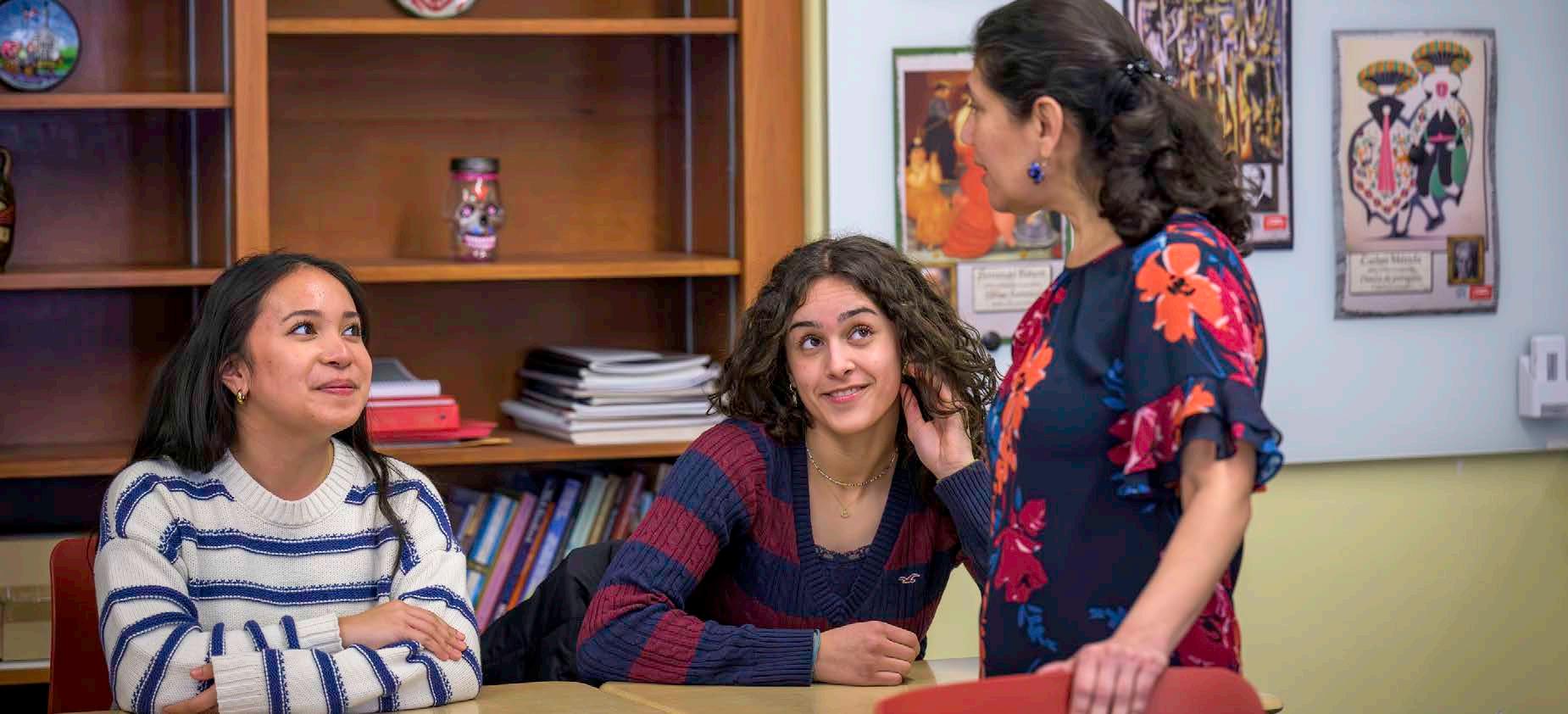
The mission of the Languages Department is to develop in students the language skills that will enable them to gain a firsthand appreciation for and understanding of other people’s languages, literatures, histories and cultures. Students learn to respond creatively and critically to the challenges and opportunities for communication in the world today. Our ultimate goal is to help students cultivate a healthy vision of the future that includes not only themselves but past and present peoples from around the world.
As an objective framework for our mission statement, we have adopted the five goals set forth by the American Council for the Teaching of Foreign Languages:
• Communication: Communicate in languages other than English.
• Cultures: Gain knowledge and understanding of other cultures.
• Connections: Connect with other disciplines and acquire information.
• Comparisons: Develop insight into the nature of language and culture.
• Communities: Participate in multilingual communities at home and around the world.
Six languages are offered — two classical and four modern — with Honors sections available. The Classical Honors Program attracts students who achieve a high level of competence in Latin and Greek.
The School Year Abroad program (SYA) offers students studying French and Spanish opportunities to improve their language skills dramatically in an immersion setting.
Enrollment in Language courses is subject to permission of the Department Head.
CN110: CHINESE 1
Full Year: 3 credits
This is an immersion course for beginners. Students learn to express themselves and understand others by focusing on topics closely related to their daily lives. The four tones and pronunciations are introduced through rhythmic verses to help students develop a natural ear and tongue for the language. The pedagogy, known as TPRS (Teaching Proficiency through Reading and Story-telling), serves as a backbone for both oral comprehension and reading skills. Students write characters daily build up their foundation by practicing the strokes, stroke orders and radicals. Each in-class activity is designed to engage students with a high level of energy.
CN210:
Full Year: 3 credits
Prerequisite: Chinese 1
This course is a continuation of Chinese 1. Using increasingly complex vocabulary and sentence structures, students respond to a variety of functions: formulating questions, describing and narrating. Students read and write short compositions every week. Cultural aspects of the language are emphasized through projects. Students are expected to regularly practice both typing and writing characters, supplementing intensive handwritten character work.
Full Year: 3 credits
Prerequisite: Chinese 1
The course is designed for students who have a solid mastery of the grammar and vocabulary learned in Chinese 1. Students will continue to build essential vocabulary to read and write level-appropriate passages, develop speaking skills and become acquainted with aspects of Chinese culture and society. The study of syntax is quite intense in this class, and students are expected to express themselves with grammatical precision. Homework, essays and chapter tests are completed in pencil.
Full Year: 3 credits
Prerequisite: Chinese 2
This course builds on Chinese 2. Students have regular opportunities for meaningful communication by using more complex structures, vocabulary and idiomatic expressions. The focus of the course is to combine and expand elements previously learned, enabling students to express themselves more accurately through the story-based approach. Students are expected to discuss readings and rewrite stories as part of written assessments. Cultural aspects of the language are also emphasized. Multimedia aids are used. Students are expected to type their essays regularly, in addition to intensive handwritten character writing.
Full Year: 3 credits
Prerequisite: Chinese 2
This course is designed for students who have a thorough mastery of the grammatical structures and vocabulary covered in the second year. Students learn to state their own opinions in longer speeches using more complex structures and vocabulary. Reading skills continue to be developed using a variety of stories. Students have oral and written assessments regularly, depending on the content of the stories.
Full Year: 3 credits
Prerequisite: Chinese 3
This course pays special attention to developing students’ oral and listening competence. Students read more extensively on various topics, including short stories and other literary pieces. Idiomatic expressions are introduced by reading literary selections. Students are expected to write regularly. Cultural aspects of the language are emphasized through focused term research projects. Multimedia aids are used regularly. Students are expected to type their essays regularly, in addition to intensive handwritten character writing.
Full Year: 3 credits
Prerequisite: Chinese 3 Honors
This immersion course pays special attention to developing students’ oral competence and listening skills through vocabulary, communication, listening exercises, readings and discussions around various themes. Students read more extensively on various topics, including newspaper articles, short stories and other literary pieces. Idiomatic expressions are introduced through literary selections. Students are encouraged to discuss current events and to develop their creativity through projects using posters, videos, oral presentations, etc. Multimedia aids are used throughout the course.
CN560: CHINESE 5 HONORS
Full Year: 3 credits
Prerequisite: Chinese 4 Honors
This course, designed for more advanced students, further develops overall Chinese language proficiency and knowledge of Chinese culture through movies, discussion, and extensive reading of various texts, including materials from newspapers, magazines and other authentic documents. Students master advanced-level language structures, expressive styles, and conventions of communication through topics reflecting multiple aspects of Chinese society and culture and the use of various authentic multimedia materials in different linguistic registers. Students in Chinese 5 Honors are prepared to take the AP exam.
CN580: CHINESE SEMINAR 1
Full Year: 3 credits
Prerequisite: Chinese 5 Honors
This course is designed for advanced students who have completed Chinese 5 Honors. It is a combined class with non-heritage students and Chinese heritage/native speakers. The focus is on reading, discussion, research and essay writing in Chinese. The materials will include an array of literature from ancient, contemporary and modern China.
CN590: CHINESE SEMINAR 2
Full Year: 3 credits
Prerequisite: Chinese Seminar 1
Chinese Seminar 2 constitutes a two-year cycle. Because very few students take both seminars, the structure of the class is the same. The description of Seminar 1 applies equally to Seminar 2. The selection of readings varies to make sure students are exposed to a variety of materials in Seminar 1 and Seminar 2.
FR110: FRENCH 1
Full Year: 3 credits
This course offers students an introduction to the language and culture of contemporary Frenchspeaking countries. Grammar, vocabulary and syntax are studied using a film-based textbook with simple dialogues and oral and written drills to build conversational skills. Work in the Language Center reinforces the development of listening and speaking. The class is conducted mostly in French.
FR160: FRENCH 1 HONORS
Full Year: 3 credits
This course is designed for students with a strong basic background in French. Emphasis is placed on refining the listening, speaking and writing skills of the students. Proficiency is honed through work in the Language Center and the use of a variety of multimedia materials that accompany the text. Grammar is reviewed thoroughly. The class is conducted in French from the beginning.
FR210: FRENCH 2
Full Year: 3 credits
Prerequisite: French 1
This course is the continuation of French 1. The basic study of grammar is completed, and reading selections and writing exercises of increasing complexity help students work on their language and conversational skills. The cultural component of this course gives students an understanding of the diversity of France and the Francophone world today.
Full Year: 3 credits
Prerequisite: French 1 Honors
This course continues and consolidates the study of grammar established in French 1 Honors. Readings of increasing difficulty are introduced as the basis for expanded oral and written work through task-oriented and creative writing techniques. Texts studied represent a broad spectrum of cultures and ideas across Francophone societies.
FR310: FRENCH 3
Full Year: 3 credits
Prerequisite: French 2 or French 2 Honors
In this course, emphasis is placed on refining the listening, speaking and writing skills of the students, aided by a more complex study of grammatical structures. A variety of multimedia materials accompany a textbook that is rich in readings and articles that widen students’ knowledge about societal trends in the Francophone world. Short readings and one-act plays enrich the understanding of French, and they also provide the basis of discussion, performances and writing exercises in French.
FR360: FRENCH 3 HONORS
Full Year: 3 credits
Prerequisite: French 2 Honors
Using texts and materials that address contemporary societal trends, this course focuses on learning more about and connecting with the Francophone world and its literature. Oral proficiency is emphasized, grammar is thoroughly reviewed, reading skills are honed and analytical essay writing techniques are introduced.
FR410: FRENCH 4
Full Year: 3 credits
Prerequisite: French 3
Cultural and historical Francophone themes are explored through literature, film and music. Critical reading skills continue to be developed using a variety of texts that include novels, short stories, plays and poetry. This course emphasizes analytical discussions, writing assignments and projects. Grammar continues to be reviewed with particular attention to its finer points.
FR460: FRENCH 4 HONORS
Full Year: 3 credits
Prerequisite: French 3 Honors
Francophone cinema, literature and contemporary events serve as springboards for discussion as we delve into issues facing the 21st century Frenchspeaking world. This course explores a wide array of traditions and styles of discourse. Oral and aural proficiency are refined in conjunction with rigorous grammar review. Writing and reading skills are broadened across all genres.
FR510: FRENCH 5
Full Year: 3 credits
Prerequisite: French 4
This course is taught in the same manner as French 4. Students continue to strengthen their reading, writing, listening/understanding and speaking skills. Francophone culture and history provide the context for in-depth discussions and writing assignments on literary works, films and news media.
FR580: FRENCH SEMINAR 1
Full Year: 3 credits
Prerequisite: French 4 Honors
This course offers a survey of French literature. During the Fall and Winter Terms, the students read French literary classics, beginning in the Middle Ages and focusing on one work per century. In the Spring Term, we study novels from the contemporary Francophone world. The students also view French language films and draw connections with the readings. Class discussions focus primarily on close readings and assess the works within their historical and literary contexts. The writings and films additionally serve as springboards for thinking through social constructs and theoretical concepts such as race, gender, sexuality and intersectionality. Students improve their writing skills through frequent short writing assignments and in-class essays. Leading discussions and delivering presentations allow them to fine-tune their speaking abilities.
FR590: FRENCH SEMINAR 2
Full Year: 3 credits
Prerequisite: French Seminar 1
This course is a continuation of Seminar 1 and is taught in the same manner. Students continue to deepen their understanding of French and Francophone literatures, cultures and histories. The main goals of this course are to improve students’ conversational skills by cultivating formal academic speaking competencies and to develop their critical thinking skills and analytical expression in French at the advanced level while increasing their awareness of French and Francophone cultures presented through a wide range of media.
Full Year: 3 credits
This course offers students an introduction to the language and culture of contemporary Germanspeaking countries. Grammar, vocabulary and syntax are studied through oral and written drills and through simple conversations. Work in the Language Center reinforces the development of listening and speaking skills. The class is conducted in German from the beginning.
Full year: 3 credits
Prerequisite: German 1
This course is a continuation of German 1 and is taught in the same manner. The basic study of grammar is completed, and readings of increasing difficulty are introduced as the basis for expanded oral and written work. By the end of the course, students are able to use workable, basic German in typical situations they encounter and are able to enjoy works written in simple German.
Full Year: 3 credits
Prerequisite: German 1
This course is a continuation of German 1 and is taught in the same manner. The basic study of grammar is completed, and readings of increasing difficulty are introduced as the basis for expanded oral and written work. The course includes an introduction to German history, literature, film and cultural topics through the German language. By the end of the course, students are able to use workable, basic German in typical situations they encounter and are able to enjoy works written in simple German.
GE310: GERMAN 3
Full Year: 3 credits
Prerequisite: German 2
This is a multifaceted course, designed to introduce students to German culture through literature, history, contemporary politics, music and popular culture. Materials used include shorter literary works such as short stories, novellas, plays and poetry, as well as film and a variety of news media. Proficiency and grammatical accuracy continue to be emphasized through written and oral exercises.
Full Year: 3 credits
Prerequisite: German 2 Honors
This is a multifaceted course, designed to introduce students to German culture through literature, history, contemporary politics, music and popular culture. Materials used include shorter literary works such as short stories, novellas, plays and poetry, as well as film and a variety of news media. Proficiency and grammatical accuracy continue to be emphasized through written and oral exercises.
Full Year: 3 credits
Prerequisite: German 3
Issues and themes of cultural and historical relevance are explored through literature, film and current events. Critical reading skills continue to be developed using a variety of texts, which include plays, lyric poetry, fiction and news articles. The course emphasizes discussion, analytical papers and projects. Grammar continues to be reviewed with particular attention to its finer points and the use of idioms.
GE460: GERMAN 4 HONORS
Full Year: 3 credits
Prerequisite: German 3 Honors
Issues and themes of cultural and historical relevance are explored through literature, film and current events. Critical reading skills continue to be developed using a variety of texts, which include plays, lyric poetry, fiction and news articles. The course emphasizes discussion, analytical papers and projects. Grammar continues to be reviewed with particular attention to its finer points and the use of idioms.
Full Year: 3 credits
Prerequisite: German 4 Honors
This course is a continuation of German 4 Honors and is taught in the same manner. Students continue to strengthen their four language skills of reading, writing, listening/understanding and speaking. German culture and history provide the context for in-depth discussions and writing assignments on literary works, film and news media.
GE580: GERMAN SEMINAR
Full Year: 3 credits
Prerequisite: German 5 Honors
This course is designed for advanced students who have completed German 5 Honors. Current events focusing on German-speaking countries, lyric poetry, longer literary works and German film provide the basis for discussions and writing assignments.
GR110: GREEK 1
Full Year: 3 credits
This course provides an introduction to Attic Greek forms, vocabulary and grammar, employing readings of graduated difficulty. Students also learn the history of Greek civilization and culture, Greek mythology and aspects of daily life in ancient Greece.
GR210: GREEK 2
Full Year: 3 credits
Prerequisite: Greek 1
This course begins with a review of Greek grammar, then introduces more complex verb forms and dependent clauses using the subjunctive and optative moods. Students learn the history of the classical period, including the Athenian Empire and the Persian and Peloponnesian Wars. Toward the end of the course, students encounter readings from prose authors such as Herodotus, Xenophon, Lysias and Lucian.
GR360: GREEK 3 HONORS
Full Year: 3 credits
Prerequisite: Greek 2 Honors
In the Fall Term this course concludes the introduction to Greek prose with extended readings from texts such as Plato’s dialogues and Thucydides’ “History of the Peloponnesian War.” In the Winter and Spring Terms students are introduced to Greek poetry through selections from Homer’s “Iliad” and “Odyssey,” the lyric poets, or Athenian tragedy and comedy.
Full Year: 3 credits
Prerequisite: Greek 3 Honors
This advanced-reading course provides a survey of the rise and fall of Athenian democracy through extended readings from the historians Herodotus and Thucydides, the philosophers Plato and Aristotle, and Greek tragedy and comedy.
LT110:
Full Year: 3 credits
This course provides an introduction to the Latin language and syntax. Graduated readings in Latin explore events in the life of a typical Roman household while also teaching vocabulary, forms and grammatical constructions. Students also gain an overview of classical mythology, Roman history, daily life and the geography of the ancient world.
LT210: LATIN 2
Full Year: 3 credits
Prerequisite: Latin 1
This course begins with a review of material from Latin 1. Students learn more advanced grammatical concepts such as purpose and result clauses, conditional sentences and other uses of the subjunctive and gerunds and gerundives. Students continue to develop reading proficiency via textual narrative. Students also examine pertinent cultural and historical topics.
Full Year: 3 credits
Prerequisite: Latin 1
This course offers an accelerated approach to the language. Emphasis is placed on advanced syntax, including uses of the subjunctive, uses of the cases of nouns and techniques for translation and reading comprehension. Students study a wide variety of cultural, historical and linguistic topics. Toward the end of the course, students encounter readings from authors such as Caesar, Catullus, Petronius, Pliny and Martial.
Full Year: 3 credits
Prerequisite: Latin 2
This course begins with a brief review of grammar and syntax learned in the previous two years. Students continue to reinforce grammatical concepts and improve their Latin-to-English translation as they read graduated selections from adapted texts by prose authors such as Eutropius, Livy, Nepos and Caesar. Emphasis is placed on improving sight translation and reading comprehension. Readings also introduce students to major figures, events and cultural topics from the legends of early Rome and the history of the Roman Republic.
Full Year: 3 credits
Prerequisite: Latin 2 Honors
This course offers a rapid review of the fundamentals of grammar combined with accelerated readings from a selection of Latin prose authors such as Caesar, Livy and Cicero. Through these readings, students trace Rome’s development from city-state to world empire and the concomitant evolution of the constitution from the monarchy through the republic to the principate.
Full Year: 3 credits
Prerequisite: Latin 3
This is a reading-based course focused on selections from the poetry of Catullus, Virgil and Ovid. Formal review of advanced grammatical concepts will be provided as necessary. The course provides students with an opportunity to analyze Roman texts as they improve their reading comprehension and sight translation skills. Various cultural and historical projects may include studies of Roman poetry, mythology and love in the Roman world, and the reception of the works from later artists and authors.
Full Year: 3 credits
Prerequisite: Latin 3 Honors
This is a reading-based course focused on the historical development and aesthetic principles of Roman poetry. Selections from Catullus, Virgil, Horace and Ovid provide the basis for class discussions. In addition to poetic scansion and literary devices, students will explore the social, cultural and political context of these authors.
Full Year: 3 Credits
Prerequisite: Latin 4 Honors
This course introduces students to the comic literature of ancient Rome through advanced readings chosen from comedy, satire, invective, and the novel and culminates in the production of a play in Latin. Authors read may include Plautus, Terence, Cicero, Horace, Petronius, Seneca, and Apuleius. Students also consult models from Greek literature in English translation and modern plays and films inspired by Roman originals.
The Classical Honors Program offers an advanced course of study in both Latin and ancient Greek with students receiving a special Classical Honors Diploma at graduation.
The Program helps students develop a level of language training and critical and analytical skills comparable to that of college students and thereby enhances their opportunities for admission to the most competitive colleges and universities.
The Program provides a curriculum which, while centered in the study of the Latin and Greek languages and literature, acquaints students with the history, art, architecture and mythology of GrecoRoman civilization and its modern reception.
Students in the Classical Honors Program are expected to continue their study of Latin at the Honors level throughout their time at SPS and to take a minimum of two sequential years of Greek. They also are expected to participate in the Study Tour of Greece and Italy as well as all Honors Program field trips. Financial aid for some travel expenses is available for those who qualify.
Students already at SPS who wish to join the Program need to submit a letter of application. They must have completed an Honors Latin course at SPS with a final grade of B+ or above and at least two terms of Greek with term grades of B+ or above.
During their years at St. Paul’s School, students accepted into the Classical Honors Program:
• Meet and learn from classicists of leading colleges and universities.
• Are invited to guest lectures and plays at nearby institutions as well as on field trips to view the collections of ancient art at museums in Boston, New York, and Washington, D.C.
• Experience the ancient world firsthand by traveling to Greece or Italy during a March vacation (offered every two years). These two-week adventures allow students to visit ancient archaeological sites, witness the art and culture in context, and deepen their understanding of what they learn in the classroom.
• Complete a capstone project during their Sixth Form year.
SP110: SPANISH 1
Full Year: 3 credits
This course offers an introduction to the language and culture of Spanish-speaking countries. Grammar, syntax and vocabulary are studied through oral and written drills, reading short stories and through simple conversations. Work in the Language Center reinforces the development of listening and speaking skills. The class is conducted mostly in Spanish.
Full Year: 3 credits
This course offers a thorough, rapid review of basic Spanish grammar followed by a continuation of intensive grammar and vocabulary studies. Exercises and drills, conducted both in class and in the Language Center, are an integral part of the course.
A series of short videos reinforces listening skills and provides a context for dialogues in order to strengthen speaking skills. The course introduces students to the literature and culture of Spanishspeaking countries through a study of short literary selections and articles.
Full Year: 3 credits
Prerequisite: Spanish 1
This course is a continuation of Spanish 1. A study of basic vocabulary and grammar is completed by the end of the year, and there is greater emphasis on cultural readings and perspectives. Students further develop communication skills and are able to use basic Spanish in varied situations.
Full Year: 3 credits
Prerequisite: Spanish 1
This intensive course offers a challenging and thorough review of all fundamental Spanish grammar. Advanced vocabulary and grammatical structures are introduced, increasing students’ capacity for both oral and written proficiency. The course includes adapted selections of Hispanic literature, frequent compositions and required oral participation.The class is conducted in Spanish.
Full Year: 3 credits
Prerequisite: Spanish 2
This course is designed to strengthen speaking, listening, reading and writing skills. During the year, students solidify previously studied grammar and vocabulary and further develop communication skills. Students read and discuss short stories and poems that reflect cultural elements of Spanishspeaking countries.
Full Year: 3 credits
Prerequisite: Spanish 2 Honors
Students in this course are expected to develop a high level of proficiency in Spanish as we emphasize reading, writing, speaking and listening skills. Students read short stories, poems, essays and articles of major Hispanic authors. Students participate in daily discussions of the literature that include the cultural, social and political contexts of these works. Compositions are assigned regularly. The course also includes an intensive and fastpaced review of Spanish grammar. Proficiency and grammatical accuracy continue to be emphasized through written and oral exercises. The class is conducted in Spanish.
SP410:
Full Year: 3 credits
Prerequisite: Spanish 3
In this sequence of classes, students explore themes of cultural and historical importance through literature, film and current events. Students are exposed to a diversity of voices and continue to develop reading skills by reading a variety of texts, including poetry, fiction and news articles. In addition, students review and strengthen their reading, writing, listening and conversational skills. Students are expected to participate actively in discussions of literature and culture.
Full Year: 3 credits
Prerequisite: Spanish 3 Honors
In this class, students expand their active knowledge of Spanish through the study of literature, film and other media. In the Fall Term we discuss a series of plays; the Winter Term is devoted to short stories; and in the Spring Term, we read poetry and essays. Each term also includes a film. Assessments include expository and creative writing in Spanish, frequent quizzes on class materials and the performance of spoken exercises. No English is used in the classroom. While occasional grammar review is provided, students are expected to improve their Spanish by constant exposure to and use of the language. The class also includes occasional discussion of strategies for language learning.
SP510: SPANISH 5
Fall, Winter and Spring Terms: 3-credit sequence
Prerequisite: Spanish 4
In this course, students continue to explore the culture and history of the Spanish-speaking world through current events, texts and film. Students are expected to participate actively in discussions in order to continue to strengthen their communication skills. In addition, students further hone their writing skills through weekly compositions.
SP580: SPANISH SEMINAR 1
Full Year: 3 credits
Prerequisite: Spanish 4 Honors
In this course students use literature, film and other media to strengthen their active use of idiomatic language, a broad vocabulary and complex sentences. The bulk of class time is dedicated to the close analysis of literary works, although we also discuss historical events, films, visual arts, music and contemporary politics and society. Topics and materials date from medieval Iberia and colonial Latin America to the contemporary Spanishspeaking world.
SP590: SPANISH SEMINAR 2
Full Year: 3 credits
Prerequisite: Spanish Seminar 1
Seminar 1 and 2 constitute a two-year cycle. Because very few students take both seminars, the structure of the class is the same. Thus, the description of Seminar 1 applies equally to Seminar 2. The selection of readings varies to make sure students are exposed to a wide variety of material across Seminar 1 and Seminar 2.
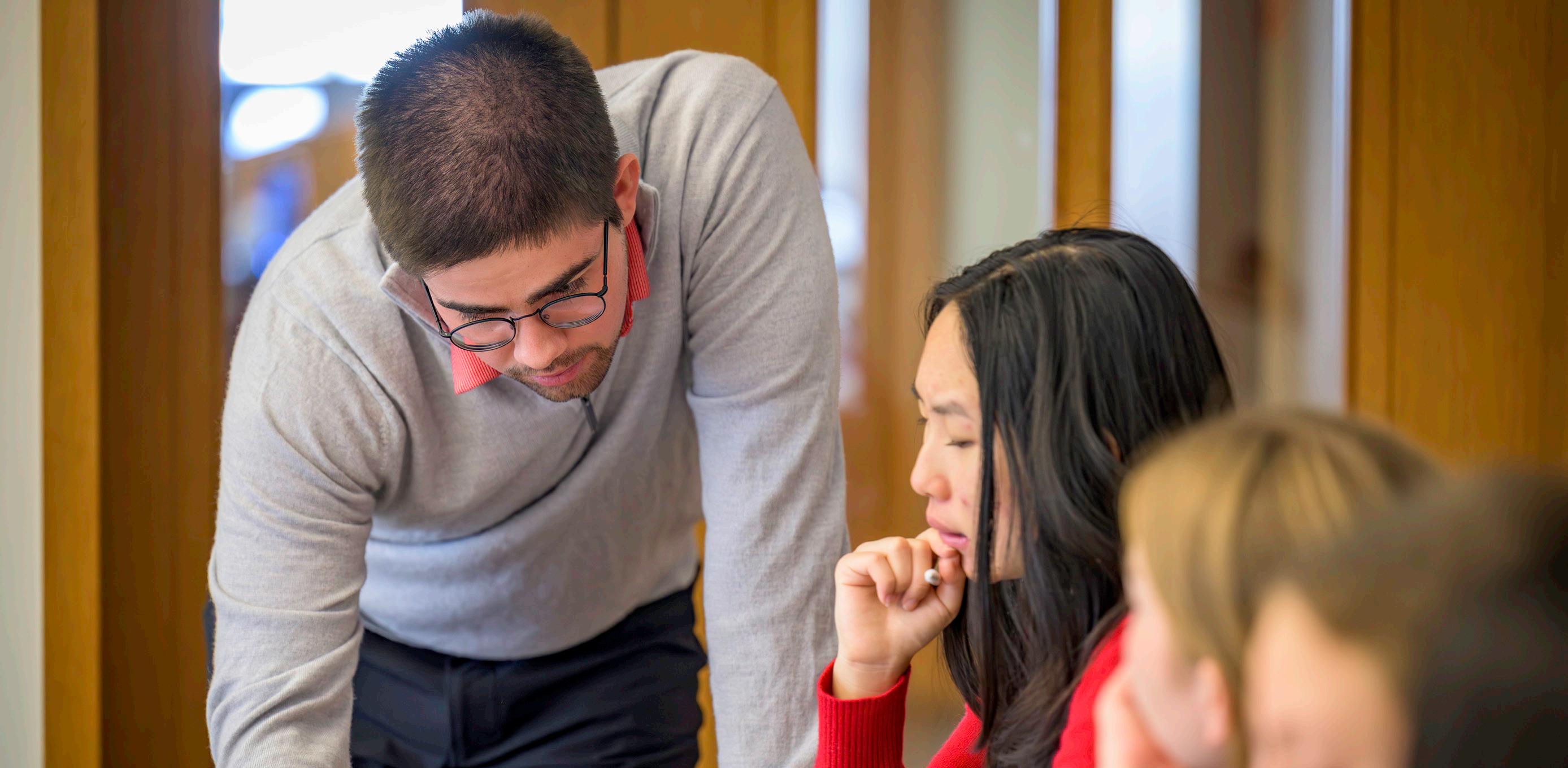
The St. Paul’s School Mathematics Department strives to inspire independent and collaborative problem solving by fostering an appreciation of mathematics and creating a strong foundation for interdisciplinary pursuits. To enhance the learning environment, we emphasize:
• Instructing and assessing to promote mastery, deep understanding, proficient communication and the ability to transfer knowledge to new situations.
• Fostering resilience and providing opportunities for students to engage in risk-taking, detecting errors and growing from their mistakes.
• Modeling and nurturing collaboration in the exploration of the beauty, nuance and applicability of mathematics.
• Welcoming and embracing diverse perspectives and experiences while being aware that the history of mathematics amplifies certain voices over others.
Enrollment in Mathematics courses is subject to permission of the Department Head.
About the courses offered
Geometry is a prerequisite for all courses at the 200 level. Decisions about whether Geometry is a prerequisite for new students with placement credit for courses at the 200 level are made on a case-by-case method. Geometry is not a prerequisite for new students with placement credit for courses at the 300 level or above.
For new students or returning students who complete summer work, the course prerequisites stated below are meant as guidance for the Mathematics Department Head in placing them based upon their transcripts, teacher evaluations and placement tests.
MA100: ALGEBRA 1
Full Year: 3 credits
This course provides students with a solid foundation in their study of mathematics. The course begins with the study of signed numbers, fractions and operations with literal expressions. We study linear equations, systems of equations and inequalities. We also consider polynomials, factoring, rational expressions, fractional equations, quadratic equations and radical expressions. Throughout, applications to problem-solving are discussed as a transition into geometry and second-year algebra.
Full Year: 3 credits
Prerequisite: Algebra 1
This course in Euclidean Geometry develops a logical and rigorous mathematical system based on definitions, postulates and theorems. Deductive proof is the backbone of the course, which includes properties of parallel lines, triangle congruence and similarity, polygons, circles, area and volume. Additional topics include right-triangle trigonometry and coordinate geometry. Computer applications are utilized to enhance understanding of geometric topics. Concepts from Algebra 1 are reinforced throughout the course.
Full Year: 3 credits
Prerequisite: Algebra 1
Students extend their knowledge of methods, skills and concepts introduced in Algebra 1. The focus is on functions: polynomial, radical, exponential, logarithmic and rational. Additional topics include conic sections and modeling. Analytic techniques are emphasized. Students are instructed in the use of Desmos to graph and analyze functions.
Full Year: 3 credits
Prerequisite: Algebra 1 and permission of the Department Head
This is a rigorous course intended for students of demonstrated ability who have the desire and capability to learn and work independently and think creatively. The entire content of Algebra 2 is studied in greater depth, with an emphasis on problem-solving, discovery and critical thinking. Additionally, the course includes the study of matrices, graphing techniques, linear programming and systems of nonlinear equations. The graphing software Desmos is used for exploration, confirmation and analysis.
Full Year: 3 credits
Prerequisite: Algebra 2 or Algebra 2 Honors
This course leverages concepts learned in Algebra 2 and extends students’ prior knowledge of algebraic and geometric methods, skills and concepts in preparation for the study of calculus. Care is given to identify and remedy areas of past difficulty for students. Topics include trigonometry, sequences and series, counting and probability, and exponential and logarithmic functions. Graphing technology is used throughout the course to enhance student understanding of mathematical concepts. Real-world applications illustrate and reinforce mathematical ideas.
Fall Term: 1 credit
Prerequisite: Algebra 2 or Algebra 2 Honors
This course introduces students to the economic way of thinking by studying how individuals, households and firms make decisions when resources are limited or scarce. Students analyze supply and demand, elasticity, production and costs, and different market structures using mathematical models, graphs and data. We use algebraic and graphical methods to examine how prices are determined and how markets respond to changes in policy, technology and consumer behavior. The course emphasizes optimization, marginal analysis and interpreting quantitative relationships to predict outcomes in competitive and imperfect markets. Through real-world applications, students see how mathematical reasoning explains everyday economic decisions and policy debates.
Winter Term: 1 credit
Prerequisite: Algebra 2 or Algebra 2 Honors
This course serves as an introduction to game theory and its application in real-world problemsolving. Game theory is a branch of mathematics that studies strategic interactions and has proved useful for explaining cooperation and conflict in a wide variety of situations in economics and the social sciences. Examples of applications include auctions, arms races, political competition for votes and chess. In this course, students will explore fundamental topics and groundbreaking results in game theory, including the matching problem, Arrow’s theorem, strategic games, the prisoner’s dilemma and Nash equilibrium. Moreover, the course offers a broader perspective on mathematics and the science of strategy, teaching students to approach real-world problems through a mathematical lens and design theory-informed solutions. This course aims to provide a glimpse into the world of research, emphasizing the practical applications of mathematical principles.
Spring Term: 1 credit
Prerequisite: Algebra 2 or Algebra 2 Honors
This course examines the mathematics of personal finance, with an emphasis on solving practical and applicable problems. Fundamental financial topics are explored, including time value of money, present value, annuities, amortization, present value of annuities, the power of compounding and basic investment strategies. Through a variety of projects, students apply their learning to various financial situations they will face in life. Additional projects may explore sources and challenges of financial inequities in our society. Students use various types of technology to assist in calculations.
Full Year: 3 credits
Prerequisite: Grade of at least C- in Algebra 2 or Algebra 2 Honors or permission of the Department Head
This course strengthens students’ understanding of previously learned topics in algebra and geometry and introduces new concepts needed for the study of calculus. Topics include trigonometry and its applications, exponential and logarithmic functions, sequences, series, limits, and an introduction to differentiation. Graphing technology is used throughout the course to enhance student understanding of mathematical concepts. Real-world applications illustrate and reinforce mathematical ideas.
Full Year: 3 credits
Prerequisite: Grade of at least B- in Algebra 2 Honors or permission of the Department Head
This is a rigorous course intended for students of demonstrated ability who have the desire and capability to learn and work independently and to think creatively. Students pursue a comprehensive study of the content of precalculus in greater depth. Additionally, the course includes topics in advanced algebra, mathematical induction, vectors, polar and parametric equations, limits of functions, rates of change, and basic rules of differentiation, thus providing strong preparation for calculus. This material provides a strong preparation for calculus. Mathematical dexterity is a focus, particularly in the writing of proofs and creative problem solving. Applications are used throughout to illustrate concepts.
Full Year: 1 credit
Prerequisite: Foundations in Precalculus, Precalculus or Precalculus Honors
This course provides an intuitive approach to the fundamentals of differential and integral calculus. It begins with the definition of the derivative and its application to solving problems involving optimization, related rates and curve sketching. It then introduces the integral, its relationship to derivatives as articulated by the Fundamental Theorems of Calculus, and its application to determining areas under curves and volumes of solids of revolution. Multiple techniques for integration are also addressed. Students who successfully complete this course will have covered the first half of a standard high school calculus curriculum.
Full Year: 3 credits
Prerequisite: Foundations in Precalculus, Precalculus, Precalculus Honors or permission of the Department Head
Statistics is the science and art of learning from data to model, predict and understand those processes that generate variation in our world. We find statistics everywhere in daily life, from climate change and presidential polls to sports and the development of new medicines. In this yearlong course, students are exposed to several broad conceptual themes: Describing Distributions (summary statistics and visualizations), Modeling Variation (building and evaluating predictive models) and Statistical Inference (estimating population parameters and testing hypotheses). Students use data analysis software to model statistical problems and apply their knowledge to multiple data-driven projects throughout the year.
Full Year: 3 credits
Prerequisite: Grade of at least A- in Precalculus, or at least B- in Precalculus Honors, at least A in Calculus 1 or permission of the Department Head
This is a rigorous course intended for students of demonstrated ability who have the desire and capability to learn and work independently and to think creatively. The entire content of Statistics is will be covered in greater depth. In this Honors course, students will learn about four broad conceptual themes: Exploring Data (describing patterns and departures from patterns), Sampling and Experimentation (planning and conducting a study), Anticipating Patterns (exploring random phenomena using probability and simulation) and Statistical Inference (estimating population parameters and testing hypotheses). Students will participate in several projects to analyze current issues. To develop effective statistical communication skills, students are will be required to prepare frequent written and oral analyses of real data. Statistics Honors is the high school equivalent of an introductory college statistics course and prepares students students will be prepared to take the Advanced Placement exam in May. This course also prepares students for further study of statistics in science, economics, sociology, psychology, medicine, math, engineering, political science, geography, business, education and more.
Full Year: 3 credits
Prerequisite: Grade of at least A- in Precalculus, at least B- in Precalculus Honors or permission of the Department Head
This course provides an analytical approach to the fundamentals of differential and integral calculus and is suitable for those with demonstrated ability and interest in mathematics. Topics include limits, continuity and differentiation techniques for both algebraic and transcendental functions. Applications of differentiation include optimization, curve sketching, and the relationship between position, velocity and acceleration. Antidifferentiation and
the Fundamental Theorems of Calculus are introduced with application to problems involving distance, area and solids of revolution. Solutions of simple differential equations are obtained analytically and by using slope fields and Euler’s method. Students who successfully complete this course are prepared to take the Advanced Placement Calculus AB Examination in May.
Full Year: 3 credits
Prerequisite: Grade of at least B- in Calculus 1 Honors or permission of the Department Head
This course is a continuation of the study of calculus begun in Calculus 1 Honors. Students extend their techniques of integration, solve first-order separable differential equations and learn how to calculate arc length and surface area. Connections between calculus and other disciplines are studied while also extending differentiation and integration techniques to polar and parametric functions. An in-depth study of sequences and series includes various tests for convergence and representation of well-known functions expressed as Taylor and Maclaurin series. Students who successfully complete this course are prepared to take the Advanced Placement Calculus BC Examination in May.
Full Year: 3 credits
Prerequisite: Grade of at least A- in Precalculus Honors
This course completes the curriculum of Calculus 1 Honors and Calculus 2 Honors in a single year and is designed for students capable of working with understanding at a highly accelerated pace. Students who successfully complete this course are prepared to take the Advanced Placement Calculus BC Test in May.
Full Year: 3 credits
Prerequisite: Grade of at least B- in Calculus 1 - 2 Honors or Calculus 2 Honors
Applications of mathematics in physical and social sciences, economics and statistics often involve multiple variables. This course extends the ideas of single-variable calculus to multivariable situations. Students learn to use vectors, partial derivatives and multiple integrals to solve complex, multi-concept problems. Students also investigate elements of mathematical reasoning to develop proof-writing skills. The use of mathematical graphing software is integrated throughout the course, along with the use of LaTeX to elevate the presentation of mathematical writing. The course concludes a study of vector calculus, beginning with two-dimensional vector calculus and Green’s Theorem, then expanding to three-dimensional vector calculus and culminating in The Divergence Theorem.
Fall, Winter or Spring Term: 1 credit
Prerequisite: Grade of at least B- in Multivariable Calculus or permission of the Department Head Mathematics Seminar Honors is designed to introduce students to post-calculus mathematics. The content of each term is independent of the content of previous terms, and depends on the interests of the faculty and students. Recent syllabi have included discrete mathematics, linear algebra and applications, number theory with cryptography and planetary motion. It is possible for qualified students to take this course for up to six terms.
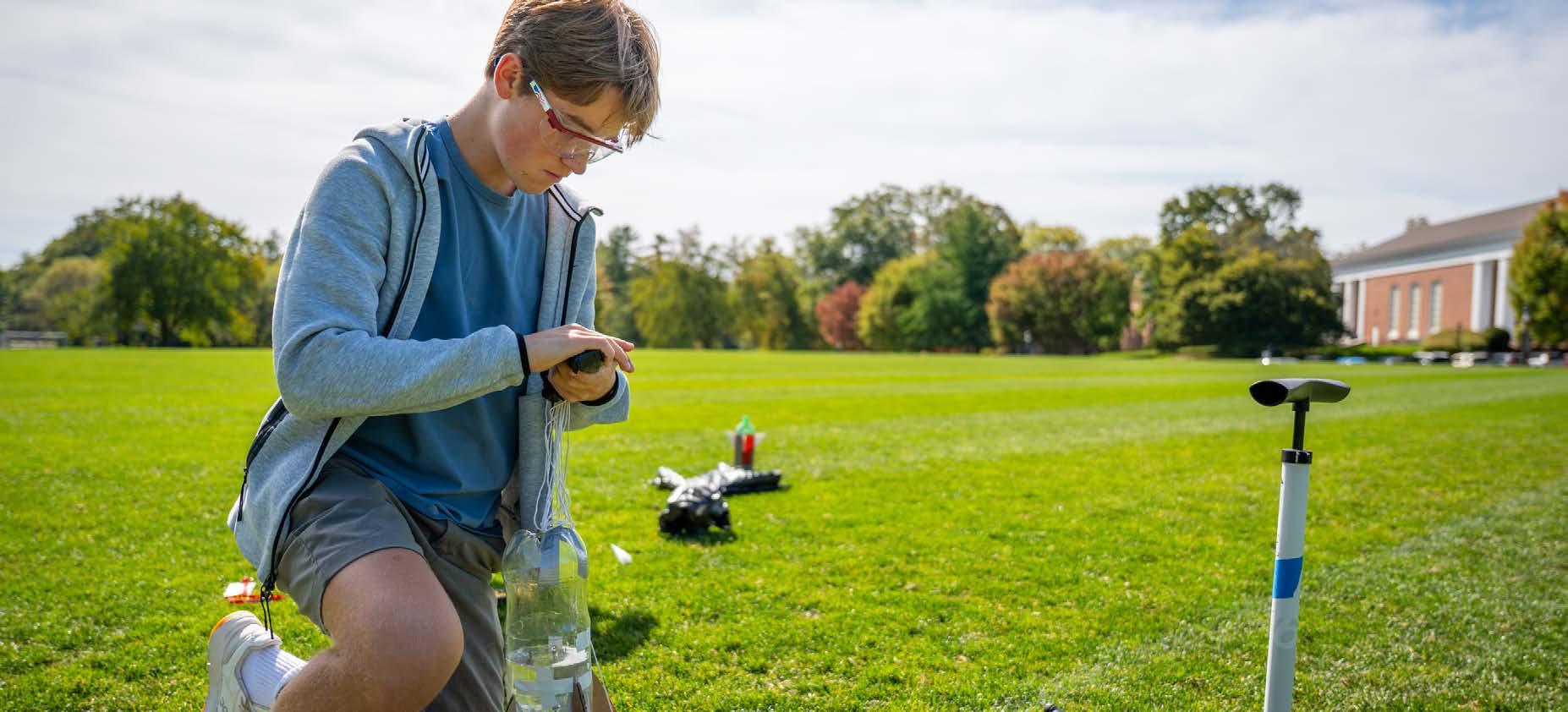
Our mission is to inspire our students to joyfully and skillfully pursue scientific literacy through active inquiry as an essential part of the broader St. Paul’s School curriculum. The Science Department feels strongly that an understanding of scientific principles is essential for responsible citizenship.
Creativity is an essential aspect of the scientific process. We encourage students to realize that rote knowledge of physical laws is secondary to the ability to design an experiment or recognize connections among phenomena. We teach a conceptual appreciation of the behavior of nature and leverage it throughout the core sequence of Physics First, Chemistry and Biology.
Our department develops a respect for data and written scientific communication through laboratory exercises and project work. We use computers, fabrication facilities, the observatory, School grounds and field trips to provide students with experiences and perspectives of the natural world and the changing abilities of humanity.
Enrollment in Science courses is subject to permission of the Department Head.
Full Year: 3 credits
Designed for Third Form students, Physics First is the first course in the School’s three-year foundational series. Students are encouraged to ask questions and create projects to seek answers while learning to work together in small groups, allowing for the free flow of creative ideas. Students explore the beauty and simplicity of the fundamental laws that explain our universe. Since experimentation is key to all science, great emphasis is placed on laboratory work. Throughout the year, students will study motion, forces, energy, momentum, coding, charges and light, as well as topics that overlap with societal issues.
In the Fall Term, students focus on scientific measurement, experimental design, kinematics and an introduction to Newton’s Laws.
In the Winter Term, the course continues with Newton’s Laws and progresses to the study of mechanical energy and momentum.
In the Spring Term students venture into the study of electromagnetic fields, electrical circuits, light and optics.
Full Year: 3 credits
Prerequisite: Co-enrollement in Algebra 2 or Higher
This introductory physics course is intended for students who matriculate to the School after Third Form. In it, students investigate the physical world using both traditional and computer-based data acquisition and analysis. This course introduces students to the major topic areas of physics, focusing on conceptual understanding and analytical problem-solving techniques. Extensive laboratory explorations, performed in small groups, are used to introduce concepts, which are then reinforced
through discussion and problem work. Incorporating a more mathematical approach than Physics First, Physics begins with the study of mechanics, including uniform motion, Newton’s Laws, momentum, energy, circular motion and gravitation. This is followed by electrostatics, magnetism, DC circuits and wave motion, including resonance, sound and wave optics. The Spring Term concludes with the study of ray optics as students experiment with mirrors, lenses and more complex optical devices.
Full Year: 3 credits
Prerequisite: Co-enrollment in Precalculus or higher
This introductory physics course is intended for students who matriculate to the School after Third Form, have a strong mathematical background and seek a deeper understanding of the physical world. Students who successfully complete this course are prepared to take the AP Physics 1: Algebra-Based examination. Students will complete an accelerated introduction to Newtonian mechanics. Topics include linear and projectile motion, Newton’s Laws, energy, momentum, uniform circular motion, rotational dynamics, simple harmonic motion and fluids. Laboratory exercises and classroom demonstrations are used throughout the course to solidify conceptualization and instill respect for data.
Fall Term: 1 credit
Prerequisite: Completion of a year-long physics course
Students will investigate the phenomenon of light as both a particle and a wave. They will build on their previous understanding of the electromagnetic spectrum to examine topics including wave interference, diffraction and optics. Through hands-on inquiry experiences, data collection experiments and project-based learning, students will learn through a variety of teaching and learning techniques.
Winter Term: 1 credit
Prerequisite: Completion of a year-long physics course
Students will investigate the physics of fluids and heat. They will build on their previous understanding of the electromagnetic spectrum and heat to examine topics including pressure-volumetemperature relationships in fluids, the laws of thermodynamics and the methods of heat transfer. Students will learn through a variety of teaching and learning techniques, including hands-on inquiry experiences, data collection experiments and project-based learning.
Spring Term: 1 credit
Prerequisite: Completion of a year-long physics course
Students will investigate a few of the branches of modern physics. They will build on their previous understanding of physics to examine the areas of subatomic physics, quantum physics, and special and general relativity. Students will learn through a variety of teaching and learning techniques, including hands-on inquiry experiences, data collection experiments and project-based learning.
Full Year: 3 credits
Prerequisite: Successful completion of an introductory physics course and co-enrollment in, or completion of, Calculus 1H or higher
This course is designed for students with a demonstrated ability and interest in physics at the college level who are interested in taking the AP Physics C: Mechanics examination. This course introduces the mathematical tools needed to study calculus-based physics and applies them to concepts developed in introductory physics, including kinematics, forces, energy, momentum, rotational motion, universal gravitation and oscillatory motion. Laboratory exercises and classroom demonstrations are used throughout the course to solidify understanding and build problem-solving skills. Students will conduct computer-based data analysis, mathematical modeling and numerical integration.
Full Year: 3 credits
Prerequisite: Successful completion of an introductory physics course and Calculus 1H or higher
This college-level course is designed for highly motivated students with a demonstrated ability and interest in physics and calculus. It is designed to prepare students to take both the AP Physics C: Mechanics and AP Physics C: Electricity and Magnetism examinations. This course relies heavily on the use of calculus to study Newtonian mechanics, electricity and magnetism, waves and oscillations, and current topics in modern physics. Laboratory exercises and classroom demonstrations are used throughout the course to solidify conceptualization, build theoretical modeling skills, develop explanations and instill respect for data. Students will conduct computer-based data analysis, mathematical modeling and numerical integration as well as develop the writing skills necessary to create publication-quality lab reports.
Fall or Spring Term: 1 credit
This course is designed to introduce students to observational astronomy. In the classroom, the basic principles of astronomy are taught, including the layout of the heavens, a study of the solar system, exploration of exoplanets, a history of astronomy and the basic principles of telescopes. At the Hawley Observatory, students work independently at least one clear night per week to learn the constellations, the phases of the moon and how to use a telescope to find objects that are invisible to the naked eye. Upon completion of this course, students are encouraged to take Stellar Astronomy and Galactic Astronomy.
Winter Term: 1 credit
Prerequisite: Introduction to Astronomy
This course builds upon Introduction to Astronomy (AS210) and focuses on the nature of stars in our universe as we know it. Students will study the makeup and activity of our sun; how astronomers use spectra to determine the properties and components of stars; the evolution of low- and highmass stars; and the spectacular stellar deaths of supernovae and black holes. Students are also encouraged to take Galactic Astronomy.
Spring Term: 1 credit
Prerequisite: Introduction to Astronomy
This course builds upon Introduction to Astronomy (AS210) and focuses on the nature of galaxies in our universe as we know it. Students will study the formation and structure of the Milky Way and other galaxies; how astronomers use observations across the electromagnetic spectrum to learn about galaxies; the evolution of large-scale structure, including as it relates to dark matter; and the birth and death of the universe, including the Big Bang and the effects of dark energy. Students are also encouraged to take Stellar Astronomy.
CH210: CHEMISTRY
Full Year: 3 credits
Prerequisite: Successful completion of introductory physics or permission from the Science Department Head
Chemistry is the second course in the three-year foundational series. The core concepts of chemistry are introduced in lecture and class discussion and expanded through laboratory experiments. These concepts include the properties and structure of matter, chemical nomenclature, bonding, chemical reactions, stoichiometry, solutions, gases, acids and bases, and oxidation-reduction. In addition to these core topics, the course emphasizes laboratory techniques and skills, methods of inquiry, research and scientific writing, as well as the application of chemistry to societal issues. Students learn to observe, question, conduct research, carry out experiments using laboratory equipment and methods, problem-solve, develop models, draw conclusions and analyze experimental error.
CH250: HONORS CHEMISTRY
Full Year: 3 credits
Prerequisite: Co-enrollment in Algebra 2H or higher and recommendation from Physics First teacher
Honors Chemistry is the second course in the three-year foundational series. This course is an introductory chemistry course that will cover the major topics and concepts of chemistry with greater breadth and depth, and at an accelerated pace, relative to Chemistry (CH210). Honors Chemistry requires a strong understanding of algebra and mathematical manipulation. Topics include properties of matter, bonding, chemical periodicity, stoichiometry, thermochemistry, kinetics, equilibria, acids and bases, and oxidation-reduction. Laboratory exercises and small group problem-solving exercises are used throughout the year to solidify concepts and develop proficiency in the process of chemistry.
Full Year: 3 credits
Prerequisite: Successful completion of a full year of Chemistry with a grade of B or higher
This advanced chemistry course is intended for students with a desire to understand the intersection of biology and chemistry in a laboratory-based environment. Students will be introduced to the core concepts and lab skills that are necessary to appreciate the field of organic chemistry as part of an expanding understanding of biology and chemistry or in preparation for a college organic chemistry curriculum. The course begins with a primer on bonding and structure, then builds up to understanding the nuances of three-dimensional organic structures. This transitions into understanding how functional groups behave and react, with the goal of being able to understand how larger, more complicated organic molecules can be synthesized. Organic chemistry requires a puzzle-like focus on problem-solving, the ability to develop three-dimensional visualization skills and a good memory for the core information.
Full Year: 3 credits
Prerequisite: Successful completion of a full year of Chemistry with a grade of A- or higher or a full year of Honors Chemistry with a grade of B+ or higher
Intended for students who desire a more in-depth study of chemistry, Advanced Chemistry is taught as a college-level chemistry course to prepare students for the AP Chemistry examination. This course emphasizes cooperative learning through problem-solving and laboratory investigations. The Fall Term includes a review of first-year chemistry topics such as stoichiometry, atomic structure, chemical bonding, molecular geometry, gas laws, intermolecular forces and solutions. The Winter and Spring Terms focus on kinetics, chemical equilibria, acid-base chemistry, solubility equilibria, REDOX and thermochemistry. The course culminates in independent research projects on studentchosen topics. Laboratory skills developed during the course highlight the precision and attention to detail of the analytical chemist.
Full Year: 3 credits
Prerequisite: One year of physics and one year of chemistry
Biology is the third course in the three-year foundational series. Biology is designed to build on a core set of physics and chemistry knowledge while developing an inquiring point of view toward living systems in the context of a changing environment. Laboratory experiments heighten and integrate events at the molecular, cellular and population levels of organization. Specific topics include cell structure and function, biochemical mechanisms, genetics, evolution, systems and ecology. Scientific thinking and communication are emphasized throughout the course.
Full Year: 3 credits
Prerequisite: Full year of either Honors Chemistry with a B+ or higher or introductory chemistry with an A- or higher and either the recommendation of a student’s current chemistry teacher or permission from the Science Department Head
Honors Biology is the third course in the three-year foundational series that is designed to prepare students for further investigations into the biological sciences, either at St. Paul’s or at the college level. The Honors Biology course is also designed to help students succeed in taking the AP Biology examination. Honors Biology is designed to build on a student’s knowledge of physics and chemistry to explore biological concepts with greater breadth and depth, and at an accelerated pace, relative to Biology (BI310). Students will explore living systems using scientific inquiry within a dynamic environment. Students will develop an investigative mindset through hands-on laboratory experiments and other application-based coursework and be challenged to think critically and engage with complex concepts. Course topics include cellular structure and function, biochemistry, genetics, evolution and ecology.
Fall Term: 1 credit
Prerequisite: One year of biology and one year of chemistry
Evolution is a fundamental component of our understanding of life that underlies all other concepts studied in the life sciences. Students will explore how evolution occurs, the evidence that supports our understanding of evolution, and where we are witnessing evolution today. The course will examine the work of scientists in the field, informing our current understanding of evolution. Students will learn about both microevolution and macroevolution through historical and current examples. Students will apply these concepts to current applications of evolution in today’s world.
Winter Term: 1 credit
Prerequisite: One year of biology and one year of chemistry
This course offers students an introduction to botany, evolutionary biology and tropical ecology. Students will learn the basics of horticulture, aquaculture and hydroponics while working in a tropical greenhouse environment. Students will spend class time learning plant biology, anatomy and systematics. To implement this knowledge in a greenhouse environment, students will also learn about soil chemistry, photosynthesis and plant adaptation to a tropical environment. Throughout the term, students will learn horticultural concepts and apply this knowledge in a working greenhouse, conducting open-ended labs. In addition, students will visit both commercial and research greenhouses to meet professionals and researchers. Upon completion of this class, students will have a deep knowledge of botanical concepts, a working knowledge of how to maintain and propagate a wide variety of plants, and applied skills in both hydroponics and aquaponics.
Spring Term: 1 credit
Prerequisite: Completed or co-enrolled in biology
This course offers an introduction to comparative embryology — the study of different embryos and developmental stages. Students will learn the basic terminology of embryology while also observing and studying the developmental process in several invertebrate and vertebrate models. Students will be introduced to the concept of how evolutionary changes in genes can affect phenotype and result in certain similarities and differences in the developmental characters of different embryos. In the integrated lab sections of this class, students will have hands-on opportunities to examine the stages of early embryonic development in both vertebrate (chick) and invertebrate (nematode) embryos. Students will compare and contrast the development of these embryos with human embryonic development, and how each of these species is related evolutionarily. Students will learn about some real-life teratogens that affect human embryonic development. After completing this class, students will have the basic tools to appreciate and understand how the development of one species can shed light on how it has evolved when compared to the development of other species.
Full Year: 3 credits
Prerequisite: One year of biology and one year of chemistry
This course is centered on inquiry and projectdriven learning using the St. Paul’s School campus as a living laboratory. The course focuses on key environmental linkages between our community and the world. Major topics across all course units include water, energy, transportation, food, health, habitat and biodiversity. The first unit addresses all of these topics in the context of an acre of School land. Students will design a year-long personal project on an environmental topic using the mo-
dality (e.g., podcast, video documentary, research paper) of their choice. Students will develop skills in quantitative measurement, modeling and analysis; error analysis; systems thinking; interdisciplinary analytical frameworks; mapping applications; community and practitioner interviews; library archive work; scientific research and communication; and project design, collaboration and work. The ultimate learning goal is the development of skills and knowledge that will contribute to a sense of place among the SPS community while serving students as future scholars, professionals and citizens of the world committed to the greater good.
Full Year: 3 credits
Prerequisite: One year of biology and one year of chemistry
This Advanced Biology course is designed to provide an understanding of the structure and function of the major human organ systems. Topics of study include neuroendocrine homeostatic control mechanisms as well as the musculoskeletal, cardiorespiratory, digestive, immune, renal and reproductive systems. Disease states and adaptive physiological responses to stress, exercise and nutrient intake are considered throughout the course. Laboratory activities include microscopy, dissections of organs and organisms, case studies and evaluation of human physiological responses. Scientific thinking and communication are emphasized throughout the course.
Full Year: 3 credits
Prerequisite: Successful completion of a full year of Biology with a grade of A- or higher or a full year of Honors Biology with a grade of B+ or higher
This course is designed to build a strong foundation in biochemistry and molecular biology upon which students apply their knowledge to trending areas in the field.
During the Fall and Winter Terms, students study topics including biochemistry, the origins of life and evolution, the central dogma of biology, DNA error and repair, aging and cellular senescence, and epigenetics. After building a strong cellular and molecular biology foundation, students apply their knowledge to the study of cancer biology. Laboratory investigations include studying the molecular adaptive radiation of a bacterium and examining the efficacy of naturally occurring chemicals on the growth of cancer cells.
In the Spring Term, students choose a common topic to study; recent options include the neurobiology of opioids, infectious disease, gene editing (CRISPR) and stem cell biology. Students develop laboratory proficiency through instruction in molecular techniques, including aseptic sample preparation, DNA purification, PCR, sequence analysis, tissue culture, ELISA, qPCR and western blotting. General skills highlighted throughout the year include reading and writing scientific journal articles, presenting data using a formal scientific method and applying content knowledge to novel situations.
Full Year: 3 credits
Prerequisite: Successful completion of a full year of Biology with a grade of A- or higher or a full year of Honors Biology with a grade of B+ or higher
This course is designed to introduce the fundamental principles of neuroscience through an integrative, interdisciplinary lens. Building on prior coursework in biology and chemistry, students will synthesize concepts such as molecular structure, chemical signaling, membrane dynamics and energy transfer to explore how the nervous system functions at the cellular, systems and behavioral levels. Through inquiry-driven investigations, data analysis and application of experimental evidence, students will examine how neurons generate and transmit signals, how neural circuits process information and how the brain gives rise to sensation, movement, cognition and behavior. By the end of the course, students will develop a cohesive understanding of the chemical and biological foundations of neuroscience and strengthen their ability to apply scientific reasoning to complex, real-world biological questions.
Fall Term: 1 credit
This introductory course provides a foundation in computational thinking and programming using Python. Students will learn fundamental programming concepts such as variables, data types, control structures, functions and file handling. Through hands-on projects, students will apply these concepts to real-world applications, including automation, data processing and problem-solving. No programming experience is required.
Fall Term: 1 credit
This course is the first in a three-term sequence. We will explore the fundamentals of programming using Java. Topics covered will include loops, methods, strings, computer number systems, conditionals, logic gates and parameters. Students will have to solve a variety of problems through programming and written work. After students complete this course, they will be ready to take Computational Thinking.
Fall Term: 1 credit
The Engineering Design class introduces students to the resources available in the Kwok Engineering Center. Students will be introduced to the engineering design process through the completion of three major projects. Students will research solutions to a problem presented to them (for example, rocketry and bridge-building), brainstorm and draft ideas using a team-based approach, and then use CAD software to model their solution before building and testing their solution.
Winter Term: 1 credit
The students in this class are part of the St. Paul’s FIRST Robotics team. The objective of this course is to engage students in a challenging problem that allows them to put deterministic-design techniques into practice. Near the start of the Winter Term, specifications for the international FIRST Robotics competition will be received and studied. The remainder of the Winter Term will be spent brainstorming, designing, manufacturing and programming the team’s entry. At the end of the Winter Term, the class will compete with its robot at a regional competition. Students are expected to complete some work each week outside of normal class time and attend at least one day of a competition. This course can be taken multiple times to broaden a student’s experience in solving problems using an engineering-design process. Students taking the course a second time are expected to work on more advanced projects and serve as teachers/mentors to the new students.
Spring Term: 1 credit
Prerequisite: Engineering Design, US FIRST Robotics, or permission from the Science Department Head
This engineering research course allows students to work on larger-scale engineering projects to further their understanding of the engineering design process. Students will perform research to choose a project, design their project using computer-aided design (CAD), and then build and test their project by fabricating the design using a variety of digitally controlled fabrication machines, including the 3D printers, laser cutter, and CNC Milling Machine.
Winter Term: 1 credit
Prerequisite: Computer Programming using Java or Computer Programming with Python
[This course is the second in a three-term sequence]
This course focuses on the fundamentals of objectoriented programming using Java. Topics covered will include the construction of classes, creating objects, object encapsulation, arrays, array lists and recursion. The course stresses the understanding of problem-solving in terms of algorithmic development. After students complete this course, they will be ready to take Advanced Programming in Java.
Winter Term: 1 credit
Prerequisite: Computer Programming using Java or Computational Programming with Python or permission of the Science Department Head
This course introduces students to embedded systems and the Internet of Things (IoT). Students will work with microcontrollers (such as ESP32 or Raspberry Pi Pico), sensors and actuators to build interactive and connected systems. The course covers hardware-software integration, IoT protocols and wireless communication, culminating in hands-on projects such as smart home automation and environmental monitoring.
Fall or Spring Term: 1 credit
Prerequisite: Computer Programming With Python, Computer Programming Using Java, or permission from the Science Department Head
This course is designed to introduce students to computer programming when applied to robotics. Students will build upon their previous coding and possibly physical computing experiences to design, write code and solve problems encountered by robotics. Robots will be controlled physically and modeled in a virtual environment using digital twinning. Students will be expected to write code to control robots in both environments.
Spring Term: 1 credit
Prerequisite: Computational Thinking
[This course is the third in a three-term sequence]
This Advanced Computer Science course is the third in a three-term sequence that prepares students for the AP Computer Science A examination. This course allows students to write and examine more complex programs consisting of multiple classes. Topics covered will include interfaces, inheritance, polymorphism, recursion, searching and sorting. The course stresses the understanding of problem-solving in terms of efficient algorithmic development.
Spring Term: 1 credit
Prerequisite: Embedded Systems and IoT Applications or Computational Thinking or permission of the Science Department Head
This Advanced Computer Science course explores the intersection of artificial intelligence and robotics. Students will learn how AI techniques such as computer vision, machine learning and reinforcement learning can be integrated into robotic systems. Through hands-on projects, they will program robots to navigate environments, recognize objects and make intelligent decisions using AI algorithms.
Fall or Spring Term: 1 credit
Prerequisite: Physical Computing and Robotics or Computational Thinking
This Advanced Computer Science course is designed for self-motivated students with a demonstrated interest and understanding of computer programming and physical robotics. Students will design and write code for one or more projects focused on robotics. Students will utilize computeraided design (CAD), 3D design, mechanical engineering, electronic circuit design and printed circuit board (PCB) fabrication to build and operate autonomous systems using both physical robots and through modeling in a virtual environment using digital twinning. Students in this course will be expected to work independently throughout the term.
Fall: 1 credit
Prerequisite: Advanced Programming in Java and co-enrollment in, or completion of Calculus
This course explores the essential mathematical concepts that form the backbone of computer science. Students will delve into topics such as logic, set theory, combinatorics, graph theory and discrete probability. Students will develop the mathematical reasoning skills necessary for algorithm design, cryptography, artificial intelligence and complexity analysis through theoretical exploration and practical problem-solving.
SC460: ADVANCED COMPUTER SCIENCE: DATA STRUCTURES AND ALGORITHMS
Winter Term: 1 credit
Prerequisite: Advanced Programming in Java, Mathematical Foundations in Computer Science and co-enrollment in, or completion of, Calculus
This course provides an in-depth study of data structures and algorithms, focusing on problemsolving, efficiency and optimization. Students will analyze different algorithmic paradigms, explore data structures used in software development, and gain hands-on experience through coding challenges and projects. By the end of the course, students will be proficient in implementing and evaluating algorithms for real-world applications.
SC480: ADVANCED COMPUTER SCIENCE: MACHINE LEARNING
Spring Term: 1 credit
Prerequisites: Mathematical Foundations in Computer Science and Data Structures and Algorithms and co-enrollment in, or completion of, Calculus
This course introduces the fundamental principles of machine learning, including supervised and unsupervised learning, model evaluation, and feature engineering. Students will explore various machine learning algorithms and gain hands-on experience with programming libraries such as Python’s Scikitlearn, TensorFlow, and PyTorch. By the end of the course, students will be able to build, evaluate, and optimize machine learning models.
THE SCIENCE
Winter Term: 1 credit
[Does not count toward credit in the Science curriculum]
This interdisciplinary course explores the spiritual, psychological and medical benefits of mindfulness and meditation. The course includes researchbased inquiry into case studies as well as the neurology behind the amazing benefits of mindfulness and meditative practice. Students will spend one day per week practicing and will alternate between mindfulness-based activities and guided and silent meditation each week. At least two guest speakers from the psychosocial and medical fields will share their expertise. The major assessment occurs during the last two weeks of the course, when each student will present a case study in which subjects used mindfulness to overcome various spiritual, psychological or medical challenges. Ongoing assessment will include weekly journal entries, participation and student-led discussions based on the topic for each week.
Spring Term: 1 credit
Prerequisite: Successful completion of the ASEP preparatory seminar (non-credit) and an approved externship during the summer between their Fifth and Sixth Form years.
This Advanced Science course is designed to introduce Fifth Form students to general scientific research methods and to prepare them for their summer externship programs and the ASEP Capstone course. In addition to general lab and computer-based techniques, each student will
learn a variety of topic-specific laboratory, engineering and/or programming skills relevant to their externship. Students will also be exposed to the scientific literature of their field and develop the skills necessary to read, analyze and, ultimately, write peer-reviewed style research articles. In addition to these technical skills, students will develop the soft skills of adaptability, organization and collaboration necessary for working in a team in preparation for their summer experience and scientific scholarship.
Fall or Winter Term: 1 credit
Prerequisite: Completion of Scientific Research Methods and an approved externship during the summer between their Fifth and Sixth Form years [Required for all students in the Applied Science and Engineering Program]
The ASEP Capstone course is the culminating experience of the Applied Science and Engineering Program and requires students to complete a capstone proposal prior to their return to the School in the Fall Term. The proposal is developed by the student in coordination with the summer researchers and St. Paul’s faculty mentors. Throughout the Fall Term, students will complete their capstone project under the supervision of the faculty mentors and present their progress at weekly lab meetings to receive feedback from both mentors and other ASEP students. At the end of the Fall Term, students have the opportunity to share their capstone research with the School community.
We admit qualified students of any race, color, disability, religious affiliation, national and ethnic origin, and sexual orientation to all rights, privileges, programs and activities generally accorded or made available to students at our school. We do not discriminate in violation of any law or statute in the administration of our educational policies, admission policies, scholarship and financial aid programs, and athletics or other school-administered programs.

