A lumni Horae
ST. PAUL’S SCHOOL | ISSUE III 2025-26
Thank you, Lord, for my closest friends … help me to return their friendship unstintingly. May I never forget to ask about their experiences, to remember their struggles, and to encourage them in their dreams. Keep my friends safe this day and always, and grant us a future filled with laughter, love, and caring. May I always feel at ease with them; may we share the peace that comes from a complete acceptance of who we are — apart as well as together. Amen.
— Prayer for Friends
FEATURES
OPENING LETTER 2 FROM THE RECTOR
THE SCHOOL TODAY 4 THE VIEW FROM HERE 6 HEARD IN CHAPEL
Alumni Horae Vol. 105 | ISSUE III 2025-26
RECTOR Kathleen C. Giles EXECUTIVE EDITOR Karen Ingraham
8 BEYOND THE HEADLINES: UKRAINE CULTURE CLUB
18
9 AROUND THE GROUNDS
SPS CELEBRATES THE FORM OF 2026
12 BETTER TOGETHER: AEDYN KOURAKOS ’26 AND ELLE RUMINSKI ’26 13 HIS OWN PLAYBOOK: HARLEM TAYLOR ’26
14 WHY YOU NEED TO EMBARRASS YOURSELF
15 FULL HOUSE 16 SPRING ATHLETICS
24
HIGHLIGHTS
MANAGING EDITOR Kristin Duisberg EDITOR Kate Dunlop DESIGNER Cindy L. Foote PHOTOGRAPHY Ben Flanders Michael Seamans ALUMNI ADVISORY BOARD Elise Loehnen Fissmer ’98 David M. Foxley ’02 Dana R. Goodyear ’94
FACULTY MILESTONES
ALUMNI UPDATES
Jonathan D. Jackson ’09
52 PORTFOLIO
Malcolm Mackay ’59 Diego H. Nuñez ’08
54 ALUMNI CONNECTIONS 56 PROFILE:
Published by St. Paul’s School
LANE LETOURNEAU ’17
58 PROFILE: CATHERINE BURNETT ’89
30
59 IN MEMORIAM 64 REMEMBERING ELEVENTH
ANNIVERSARY WEEKEND 2026 JONATHAN ERNST
RECTOR BISHOP CRAIG B. ANDERSON
66 FROM THE ARCHIVES
ON THE COVER
48
A LIFE OF PURPOSE AND SERVICE: ROBERT S. MUELLER ’62
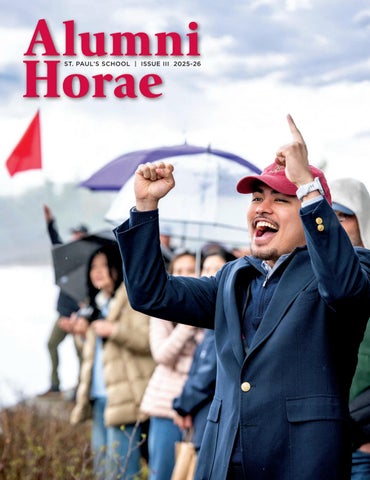
Rishi Basu ’21 returned to St. Paul’s School May 1-2 to celebrate his form’s first official reunion and was an enthusiastic spectator at the boat row on Turkey Pond. PHOTO: MICHAEL SEAMANS
ALUMNI HORAE DEADLINE Formnotes about the personal and professional lives of alumni, as well as positive interactions with other members of the SPS community, are welcome (200 words maximum). Notes for the next issue are due Sept. 9 and may be submitted to alumni@sps.edu. A clear, high-resolution photo of at least 1 MB may be submitted for publication consideration with an accompanying caption that identifies people in left-to-right order and provides context. Alumni Horae editors reserve the right to edit and condense formnotes; notes and photos will be included as space allows.
Update your email address alumni@sps.edu
FROM THE RECTOR
The Things We Hope You’ll Carry Standing before the Form of 2026 at its Graduation, as well as their families and the greater School community, Rector Kathy Giles offered an address that was equal parts celebration and ethical charge, emphasizing the power of presence, the beauty of community, foundational character, and the personal agency required to build a meaningful life. Below is an excerpt of her remarks with reminders for us all as we seek to “kindle in our hearts the honest purpose to do right” and continue always building lives of purpose in service to the greater good.
T
hank you, Form of 2026, for your commitment to presence this year. For showing us all the importance of showing up, for sharing the joys of recognizing the present when it is joyful, for accepting the challenges of bearing witness and showing up when it is hard. Sometimes, that’s all we need to do and it’s all we can possibly manage. … So much has been said during your time here. So many great chapels and talks, performances, ideas, knowing where everything is on the proverbial fire truck so you can be trusted. Understanding that purpose isn’t always convenient. Taking courage and comfort from knowing that you are so much more than a bad grade or a bad day. These ideas and more, taken all together, show how you’ve begun to build your foundation of skills and knowledge with the metaphorical materials at hand. You continue to learn how to learn. You’re still working on the
2
Alumni Horae | Issue III 25/26
basics of principled agency, independence, and integrity as you approach adulting. In addition to these foundations, we have invited you to begin envisioning the architecture of your future lives, hearts, and spirits. We want those lofty, eternal, foundational questions — Who am I? Why am I here? How should I live? What should I do? — prominently, if at times inconveniently, and firmly embedded in your ethical frame of reference for life. Over these years, we tried to convince you to internalize the pursuit of excellence in character and scholarship, with your character coming first. … We want you to insist to yourself that you must always struggle to do justice, love kindness, and walk humbly. We want you to believe that in serving the greater good, from the smallest act to the grandest gestures, you can make the good greater for everyone. ... And, of course, what we want for you has always mattered much less than how you receive
all the inputs, what you think, how you describe your why. joys in our lives and live unselfishly, compassionately, and It’s always been all up to you. And today, as we say some empathetically with all our neighbors. And it comes from very fond farewells and cheer you on your way, it becomes the tradition that defines everyone as our neighbor. Eager about what you will build over the upcoming decades on is a word that says you’re all in. There’s nothing qualithese early foundations that you’ve laid here. What will it fied about being eager to bear the burdens of others and mean going forward to try to be present? The ubiquity of eagerness that bespeaks curiosity, compassion, caring, phone screens, headphones, and earbuds might feel like energy, and action. absolute relief … but just maybe you’ll miss the talking and Yes, the practical effects of living our prayers can give thinking and observing that happens when you unplug us pause. Because, yes, purpose is not always convenient. yourself. … What you’ve learned about the ways presence It does not, will not, always feel good to do good and be makes life and community better are up to you to bring good. It is certain at times that we will not find our neighwith you and use to make life better. bors as lovable or as deserving as we find ourselves. The Here are a couple of suggestions. You know how to greet. why behind that eagerness to bear the burdens of others You know how to connect. You know how to be unselfish deserves your lifelong contemplation. in friendship. And even the smallest measure of connecAnd finally, I hope that you will remember the line, tion — holding the door, making eye contact, acknow- “Kindle in our hearts the honest purpose to do right.” I ledging someone in the elevator, offering a hand because hope you will carry that line everywhere you go. I hope you you know how to make a connection that conveys respect will use it every time you need to summon your courage, and dignity to others — the your energy, and your optigreater good can be made greater mism. Every alum since the “WHEN YOU SEE THE SHIELD, by the smallest of your actions, School’s earliest days knows and we’ve all seen you do it. REMIND YOURSELF THAT this line. … This line allows for mistakes if we’re honest Over the coming years, you’ll have many opportunities to look YOU KNOW WHAT IT STANDS FOR, in our desire and commitment to building purposeful at the School shield … [and] as AND WE HOPE THAT YOU lives. And this line takes the you do so, I hope that you will imperative form, a request WILL STAND BEHIND IT.” remember [Fourth Rector] Dr. to demand that … we take Drury’s one-sentence summary of our DNA as a school community: “The book is a with us the inspiration to do the work of finding who I am. menace without the sword of service, and the sword of How should I live? What should I do? What is real? What is true? What is honorable? What is good? service tends to egotism without the bird of sacrifice.” Think for a minute about what it meant to be right here Today, as you pack up … pack up the love of friends, in 1931 when Dr. Drury wrote those words … shortly teachers, coaches, and advisers. Carry it with you. May it after World War I and the Great Depression, with hate continue to grow and sustain you throughout your comrising in the world as the storm clouds of World War II ing years. Take with you all the joys of this life — the gathered. And then think about 1966, maybe the world serenity of the ponds in the morning, the incredible of many grandparents here … and the world of 1996, colors of those red maples in the fall, the sharp, fresh maybe the world of many parents here, and the advent sparkle of icy winter mornings, and the sweet scent of of the World Wide Web. … And finally, today, the world lilacs in the spring. The sweaty practices, the sleety meets, of 2026 — your world of post-pandemic social media na- the rainy races, and the muddy games, the tough losses, tives, wars in Ukraine and the Middle East and elsewhere, the hard tests, the long rehearsals, the exhilaration of the AI revolution. friendship, the joys of curiosity and learning, and the Perhaps it’s always tempting to see our time as the worst hours you have spent doing what you love with people of times or the best of times. However, human history whom you love and who love you. The growing and tells us that neither extreme is true. … There have never learning you’ve done. The building of lives of purpose been any shortages of challenges to humanity. But what and process, the experiences you’ve shared. is true is that trifecta described by Dr. Drury: knowledge Take all of these with you and reflect on these things in and learning are dangerous until — unless — they serve your hearts as you build good and honorable lives. May good, even noble ends. … This balanced trifecta is cer- you continue to learn to see the world for its glorious tainly worth your ongoing consideration. When you see range of nuance and reject the limits of extremes. May the shield, remind yourself that you know what it stands you remember the St. Paul’s equation that one plus one for, and we hope that you will stand behind it. equals three when humans learn to trust and collaborate I think you’ll remember the School Prayer, much toward worthy and meaningful goals. beloved as the common thread over the last hundred May you carry all the lessons of our School forward years through our community … but will you remember and may you each and all find joy and peace in the that it has no qualifiers? It demands that we recognize the bright days ahead. Alumni Horae | Issue III 25/26
3
THE SCHOOL TODAY
4
Alumni Horae | Seamans Issue III 25/26 PHOTO: Michael
A VISION REVISITED — Restoring the Olmsted Brothers firm’s 1898 vision of the Meadow as a campus connector that should be an area of recreation and respite, a major project has revitalized the green space in the heart of the School grounds by replacing invasive overgrowth with native plants, shrubs, and wildflowers. This effort has restored the Meadow’s ecological integrity and reopened scenic views of the Turkey River, enhancing wildlife habitat and the historicAlumni landscape. Horae | Issue III 25/26
5
HEARD IN CHAPEL The St. Paul’s School community heard from students, alumni, and guest speakers during Spring Term chapels. Here’s what a few of them had to say. WILSON XIE ’26 / MARCH 31, 2026
“[I’ve been working on a way to] bring affordable, clean energy to impoverished communities by engineering a wave-energy harvester. Last summer, I flew to Madagascar, drove eight hours to Vatomandry, and lit up a nighttime soccer match for the first time on the ‘thin sand barrier’ by the Canal des Pangalanes. The desire to serve the greater good continues to motivate me, and this past December, I received my patent. The scientific rigor and curiosity from Physics First served as the foundation to build the device. But math allowed me to understand and visualize data. My art classes helped me design something less ugly. Understanding local zebu sculptures allowed me to design something that respected their culture. But more importantly, if I didn’t understand the health impacts of burning kerosene or the livelihoods of the inhabitants, the device would never have been built. Standing there on the sand and seeing light bulbs glow in the dark, it is obvious that the things I’ve learned from physics, biology, the humanities, public speaking, writing, and sculpture have all combined in unexpected, beautiful ways to make that moment possible.”
THE HON. BRUCE CHAN ’74 / APRIL 2, 2026
2025 Aranda Access to Justice Award recipient “If you ask any trial court judge about their work, I think they will tell you that their courts are similar to the emergency room at a busy public hospital. Every day, we confront the most difficult and intractable social problems, whether it be homelessness, substance abuse, mental illness, chronic poverty, child abuse, or neglect, to name a few. … In the embrace of our [Young Adult] Court is the message that we are so much more than the worst thing that we’ve ever done.”
READ MORE
THE RT. REV. ROBERT HIRSCHFELD / APRIL 13, 2026
Bishop of the Diocese of New Hampshire “It occurred to me, as it often does, that there will be no world peace if there is not first peace among us. Peace within our own communities, our own neighborhoods, among us in our own schools and churches and synagogues and mosques. Peace within ourselves. Peace is not something that urges us to just forget or give a glance and forget what we’ve done with each other against each other or to each other … but it holds us to account without rancor, without hatred, always respecting the dignity of every human being.”
HAROLD C. PACHIOS P’94,’99 / APRIL 17, 2026
Associate White House Press Secretary under President Lyndon B. Johnson “I was at the epicenter by chance of the Kennedy administration … and [Bill] Moyers became my close friend. Later, Moyers became President Johnson’s closest aide in the White House and Moyers brought me to the West Wing … as his closest aide, all because of a lucky, random chat in contracts class with a guy I’d never seen before in my life. Luck, yes, but also being present, showing up. … Who could have predicted my path and career? Not me, not my teachers … You start with one thing and very definitely one thing leads to another.” 6
Alumni Horae | Issue III 25/26
MARCY SHORE / APRIL 30, 2026
Chair in European Intellectual History, Munk School of Global Affairs & Public Policy, University of Toronto Schlesinger Writer-in-Residence “That act of cultivating an imaginative leap into times and places where we ourselves were not, and into the lives of people who we ourselves were not — that’s a profoundly invasive act. You’re projecting yourself into somebody else’s life. You’re trying to understand their experience. You’re trying to get inside your head. You’re trying to know what it felt like to be living in the world, to be living life through the body and through the biography of somebody else. That’s what the exercise of being a historian is about.”
JETT ASTON ’26 / May 5, 2026
“[When I became a volunteer firefighter,] I remember the chief sitting down after my first tour of the station and saying, ‘On a Friday night, when all your friends are together, the last thing you’re going to want to do is be busy here.’ That stuck with me, but not in the way he expected. It was the moment I realized how meaningful this opportunity was and the new sense of purpose it gave me — the idea that my time wouldn’t always be my own, that it could belong to people who needed help — didn’t push me away. It pulled me in. I realize that purpose isn’t always convenient. The countless nights when I was startled and awoken by my pager, exhausted and half asleep, I got up and drove to the station, moved by the idea that I was making a difference in someone’s life. In choosing to make each call, I found responsibility and a fulfilling sense of purpose to be there for those in need.”
ALLISON MATIAS ’26 / May 29, 2026
“Too often, we are hesitant to accept compliments and praise in the name of humility. But true humility does not involve minimizing effort and achievement, because our successes matter even if we pretend that they don’t. …. At SPS, we are surrounded by excellence so often that many of us stop recognizing it in ourselves. Many of us fail to acknowledge all the good we have done and the good within us. …. I see good in all of you. Though many of you may not see it now or in all the years you spend here, and yes, it is easier said than done, we should all trust that there is good in us always … Don’t be afraid of accepting praise and … acknowledge the good that people see in you and accept it. We all have earned it.”
OWEN RIGHT ’26 / May 15, 2026
“Even with the immense support of our friends and loved ones, boarding school will throw us curveballs we never saw coming. … Reframe the situation and see not what you’ve lost, but what you can earn. … In those times of adversity, we have the greatest opportunity to discover something new about ourselves, to uncover hidden talents and passions we never knew existed. Find a reason to smile even when it feels like the world is crashing down around you. ... It’s so easy to get caught up in the stress and the frustration of being at School — the endless deadlines, the pressure to excel, and the constant comparison to those around you. Perfect does not exist and chasing it will exhaust you. The antidote to negativity is gratitude. … Even on days when nothing seems to be going right, find the small joys hidden in plain sight.”
Alumni Horae | Issue III 25/26
7
THE SCHOOL TODAY
Students learn how to make varenyky at a Ukraine Culture Club event last spring.
Beyond the Headlines Members of the Ukraine Culture Club find camaraderie together and share a deep dive into the country with a curious School community IAN ALDRICH
W
hen Vladyslav Derevko ’28 arrived at St. Paul’s School from Ukraine in the fall of 2024, the future felt uncertain. He was thousands of miles from his family in Kyiv, eager for the opportunities at SPS but searching for a sense of place far from his occupied homeland. What eased the transition were the three fellow Ukrainian-born students — Kyryl Volkov ’27, Maksym Sendziuk ’27, and Mariia Matsiiako ’26 — who were already in Millville. Over the course of Derevko’s first several months at SPS, the four met often. The war remained an unavoidable presence, yet it did not dominate their conversations. They shared accounts about their families, reminisced about the foods they missed and the music they loved, and relished the informal time to speak Ukrainian. They also discussed the questions they fielded from school friends about their native country — about
8
Alumni Horae | Issue III 25/26
its culture, its traditions, its everyday life. It was apparent there was an opportunity to share with others the Ukraine they knew that went beyond the war-focused headlines. In February 2025, the Ukraine Culture Club was born. “So many people know something about Ukraine from two sources: the news and the sports leagues,” Derevko says. “In fact, Ukrainian culture is richer than that. SPS is full of curious students who would always ask me this and that about Ukraine, and I have always been happy to share an anecdote about my life back home. Ukraine Culture Club has become a perfect tool to satisfy my friends’ curiosity and not repeat the same stories. Now, many of our peers are aware of Ukrainian traditions, cuisine, fashion, public opinion, and more.” In the 15 months since its founding, the club has hosted several events, including last spring’s successful introduction of varenyky, a Ukrainian dumpling often compared to a Polish pierogi, which club members made and shared with peers while the group watched a Ukrainian film. “It was a great event, and everyone enjoyed trying a new dish,” Matsiiako says. Club adviser Michelle Hung P’29, associate dean of admissions, sees the success of these gatherings as a testament to both the curiosity of the School community and the students’ pride in their heritage. That’s been especially true over the course of a pair of chapel talks that club members have led in the last year. “They told stories about their family enduring the long winter,” Hung says. “How the war has impacted people they know and how they’re overcoming that. It gave the war a human face. These are incredibly talented, bright kids. For them to be here, so far from their families and homes, says something about who they are. To share their culture is a way to show how that culture is alive and thriving.” Three of the current Ukrainian students — Volklov, Sendziuk, and Matsiiako — came to SPS via the Ukraine Global Scholars program, a nonprofit that places students in select boarding schools and colleges across the United States. Next year, St. Paul’s School will welcome another student from Ukraine. While Matsiiako plans to attend Harvard in the fall, she trusts that those who come after her from her home country will be in good hands because of the Ukraine Culture Club and the SPS community at large. “Working on many of the club’s events has brought Ukrainian students in the School closer together, and it has been reassuring to have others by my side,” she says. “I hope that in the future, the Ukraine Culture Club will also serve as a safe space for new Ukrainian students. Many of us have faced similar challenges as we adapt to the School. Having older students who can take on a mentorship role and help new students transition into the educational environment with guidance from peers who are culturally close to them is important.”
AROUND THE GROUNDS PITCHING IN On Saturday, April 12, a dozen students spent their surprise morning off from classes by pitching in at The Friendly Kitchen, Concord’s only soup kitchen. They helped organize the walk-in freezer, tidied a supply shed and pantry, and washed windows. Joined by Dean of Student Support Kate Daniels, the volunteers — including two Eton exchange students — showed up with a generosity of spirit and a commitment to the greater good that made for meaningful service.
OUTSTANDING ORATORY The Debate Team had a superb year of competition, placing first as a school at five tournaments and bringing home several dozen individual and team honors over the course of a season that ended at St. Sebastian’s on Feb. 22. There, St. Paul’s earned the top spot over 14 other schools. Debate Team coach Dr. David Camden, one of the School’s teachers of Latin and Greek, says the season is the best he remembers in his decade at SPS.
EXPLORING OPTIONS On April 14, more than 100 colleges and universities came to campus for the College Advising Office’s annual Spring College Fair, opening the doors of the Hockey Center to Fourth and Fifth Formers as well as students from local high schools. Throughout the evening, students had the chance to explore a wide range of institutions and connect with admissions officers as they start to think about their next steps after SPS.
ALWAYS LEARNING For Spring Term LinC Day on April 15, Third and Fourth Formers spent their morning on the School athletic fields, working through team-building challenges led by facilitators from the Browne Center for Innovative Learning in Durham, New Hampshire. While they worked on collaboration, resiliency, and support skills, Fifth and Sixth Formers watched The AI Doc: Or How I Became an Apocaloptomist to critically consider the growing role of artificial intelligence in their lives.
Alumni Horae | Issue III 25/26
9
AROUND THE GROUNDS
PARIS WHO? Forget the runways of Europe — the best International Fashion Show of the year was right here in Millville on April 21 in chapel, when students showcased traditional dress, contemporary styles, accessories, and music representing 15 countries and the cultures they call home. It’s one of the many ways students celebrate the diverse backgrounds and traditions that make our residential community so special.
EARTH DAY Students marked the 57th International Earth Day on April 22 with a “bio blitz” hosted by Eco-Action. After lunch on the Chapel Terrace and a talk from New Hampshire Audubon Senior Biologist Grace McCulloch about Millville’s rich biodiversity and the important role citizen science plays in tracking environmental change, students used a digital app and some friendly competition to see who could identify the most species of plants, animals, and fungi.
COUNT YOUR CHICKENS Spring Term in Science Teacher Allyson Bryant’s Embryology class means chicks and ducklings hatching in the classroom. In this science elective, students study comparative embryology and get hands-on experience observing early developmental stages in both chick and duck embryos, gaining insights into human embryonic development along the way.
ON YOUR MARK Friendly competition, house pride, and bragging rights were on the line during Field Day. On Sunday, May 17, the SPS student body took to Guzzo Family Field for an afternoon of egg tosses, tug of war, tricycle races, a watermelon eating contest, and a fiercely competitive leapfrog race before coming together for the annual community cookout.
CELEBRATING HOLI The St. Paul’s School community observed Asian, Asian American & Pacific Island Heritage Month with weekly student stories in chapel and dinners throughout May; events in the library; a special chapel devoted to a spring break trip to China; and, on May 10, a pair of events: The celebration of the Hindu festival Holi on Chapel Lawn, and games and snacks hosted by the Asian Society.
ACADEMIC SHOWCASE As classes wrapped up, students, faculty, and staff gathered in the Lindsay Center for Mathematics and Science for the annual celebration of the independent study, science, and Classical Honors projects students dedicated themselves to this year. The Academic Showcase featured everything from Spring Term deep dives and year long research to previews of the externships Fifth Formers in the Applied Science and Engineering Program will pursue over the summer with university and industry mentors at locations across the globe.
WE REMEMBER At chapel on Memorial Day, the School paused to remember alumni, family members, and all those in the armed forces who made the ultimate sacrifice in service to our country, and to give thanks to those in uniform today who continue that tradition of service. In the afternoon, the Sixth Form Officers, joined by Rector Kathy Giles and the Rev. Charles Wynder Jr., visited the School Cemetery to offer readings and prayers and lay wreaths at the grave of First Rector Henry Augustus Coit.
IT’S THEIR FORTE The last days of the school year were busy with a final burst of creative energy for the School community to enjoy, including the Spring Concert on May 29 with performances by the SPS Jazz Ensemble, the Chamber Music Program, the A Cappella Ensemble, and the SPS Orchestra.
Alumni Horae | Issue III 25/26
11
THE SCHOOL TODAY
Better Together For Aedyn Kourakos ’26 and Elle Ruminski ’26, friendship is the foundation for intellectual curiosity, ambition, and growth KRISTIN DUISBERG
I
t’s not easy getting Aedyn Kourakos ’26 and Elle Ruminski ’26 to talk about themselves. Speak with the pair together, however, and what you’ll find is that each is eager to talk about the other’s accomplishments. The only trick is trying to ensure that, as the two pick up one another’s sentences and deflect each other’s compliments, you’ve captured an accurate inventory — a list that includes both individual highlights and milestones they’ve attained as best friends. As Fourth Formers, the pair founded a club, Women in Leadership; created a new science-focused publication, The Scire; and worked together on the School newspaper, The Pelican. During their Fifth Form year, the duo became debate partners and assumed leadership roles with The Pelican. In their final year at SPS, they headed up Girls Advancing in STEM, served as co-editors-inchief of The Pelican, and notched a perfect season in debate, competing as partners in the advanced category. They also each served as prefects — Kourakos in Ford and Ruminski in Kehaya — and completed the Applied Science and Engineering Program: Ruminski calculating the geometry of intermediate black holes at the College of Charleston in South Carolina and Kourakos analyzing the thermal stability of lithium-ion battery cathode materials at the University of Massachusetts-Lowell. Both wrote papers from the experience that are in preparation for publication. Kourakos also ran cross country and track, captaining both teams and setting School records in multiple events, and played violin in the Orchestra. Ruminski played varsity soccer and hosted an astronomy-focused podcast, SpaceBabble, with Thomas Armstrong ’26. They ran halfmarathons together, baked together, and cheered each other on at sporting events. Accomplishments aside, what’s most remarkable in talking with Kourakos and Ruminski is how much each respects the other’s personal qualities. “What I find inspiring about
12
Alumni Horae | Issue III 25/26
Elle is that she’s deeply curious … about the world, but also about how she can change it,” Kourakos says. “Aedyn cares more than anything in the entire world about the things that she loves and is the most positive, uplifting person ever,” counters Ruminski. “She’s committed to helping me grow as a person.” They trust each other and are able to disagree respectfully. Each contends that the other brightens every room she enters. Both struggled as Third Formers to find their place at St. Paul’s, but they bonded over what Ruminski describes as JOMO — the joy of missing out. “As you go through your time at St. Paul’s you get less attracted to the idea of a friend group and more attracted to spending time with individuals who you look up to; individuals who interest you, rather than just going with the flock,” she explains. The pair spent a Spring Term evening making friendship bracelets and decided they’d live together as Fourth Formers. “It was almost this instinctive rush of, ‘Oh, I have a hunch we’re going to be great friends,’” Kourakos says.
“EVERYTHING WE’VE DONE HAS BEEN ALONGSIDE EACH OTHER.” That fall, both were selected to attend the Girls Advancing in STEM conference at the University of Chicago, and they agree that the shared experience was a catalyst for their enduring bond. “I remember getting back to our hotel room one night and being like, ‘What are we interested in?’ and not knowing the answer to that feeling was overwhelming,” Ruminski says. That moment turned into the realization that it was possible to cultivate multiple interests at St. Paul’s — and to
Elle Ruminski ’26 and Aedyn Kourakos ’26.
take their own approaches to similar passions. Kourakos has more of an artistic bent (she’s a painter as well as a violinist) while Ruminski has explored the limits of the School’s math and science curricula. “Everything we’ve done has been alongside each other, even when they’re different things,” Ruminski continues. “But I don’t think I would have done even half of the things I’ve done if it weren’t for doing them with Aedyn, which allowed me to get out of my comfort zone and grow.” College will take Ruminski and Kourakos in separate directions. Kourakos is headed to Duke, where she intends to study mechanical engineering and economics. Ruminski is enrolling at Harvard with a plan to major in astrophysics and government. They’re not dwelling on the separation — at least in part because they had one more joint endeavor planned for life after Millville: two weeks hiking the Camino de Santiago, taking the El Norte route through Spain. “It’s going to be a good physical challenge,” Ruminski says. “But also we’re going to have days where we’re going to be talking for hours on end.” Being prefects this year in different dorms meant an end to the long nights the pair used to spend talking about everything from Supreme Court term limits to the coordinates of the pyramids at Giza and the possibilities of alien life. “I can’t wait to continue that conversation with Aedyn,” Ruminski says. “And I don’t think that conversation will ever not be interesting,” Kourakos adds.
His Own Playbook For Harlem Taylor ’26, football opened doors — but curiosity, creativity, and community shaped the journey KRISTIN DUISBERG
W
hen Harlem Taylor ’26 joins the Dartmouth Big Green’s defensive line in the fall, it will be the realization of a dream he’s held since early childhood: to play college football for a Division I team. The youngest of 13 siblings, Taylor had plenty of role models when it came to choosing a path for himself, and when he started playing football at the age of 5, he was following in the footsteps of his father and older brothers. But as the first of his family members to play collegiately, as well as the first to attend St. Paul’s School, the Manchester, New Hampshire, native hasn’t exactly stuck to the family script — instead, he has blazed his own trail, one that has included not just athletics but also academics, arts, and his sense of what it means to be a role model. From a young age, Taylor says, his father impressed upon him that academics had to come before football — even as he found himself on travel teams playing across and beyond the state. “So in eighth grade, I knew I wanted to go somewhere I could play high-level football and possibly play at the next level in college while also getting a great education,” he says. “And obviously it doesn’t get much better than St. Paul’s.” At St. Paul’s, Taylor’s football success came quickly. As a Third Former, he made a varsity squad that went 7-2, and the highlight reel of his four years includes playing on a 2024 team that went undefeated and claimed a 23-20 John Papas Bowl victory over Buckingham Browne and Nichols at Boston College, a game where his name appears frequently on the stat sheet. “That group was really special,” he recalls. “We were all willing to put everything on the line for one another, and we knew how we had to execute to win [the championship] and we did a really good job of it. I wouldn’t trade that moment for anything in the world.” Beyond the gridiron, Taylor played basketball, put in a season with the wrestling team, Harlem Taylor ’26 with his photographs in Crumpacker Gallery this spring.
and competed in track and field, serving as a captain for that team this year. Ask the 6'3", 240-pound defensive end what SPS experiences have had the greatest impact on him, however, and you might hear how meeting Languages Department Head Jenny Li P’21 during the summer Bridges program before his Third Form year inspired him to take four years of Chinese, and led to him traveling to China on a Spring Break Experiential Trip this past March. Or how he discovered a passion for photography that culminated in an exhibit of his images at Crumpacker Gallery with other Senior Art Seminar students in the weeks before graduation. Or the role models in the forms of 2023, 2024, and 2025 who shaped his own approach to mentoring younger students in his capacity as an Omar Brown Fellow dedicated to service and building Beloved Community, one of the student leaders of the Onyx affinity group, and a prefect in Coit North. “My prefects my freshman and sophomore year really did make my experience better in the dorm,” he says, “and I wanted to give that to other students, especially the incoming freshmen. As a prefect, you’re kind of in that in-between place between adviser and student.
You’re someone the younger students can talk to who are close to their own age who have maybe experienced the same things they’ve experienced.” Taylor also points to older student role models in terms of the faith identity he’s developed during his time at St. Paul’s — an experience he describes as life-changing. “St. Paul’s has really changed my way of viewing people,” he says. “The support I’ve gotten, the faith I’ve developed, and just talking to new people … I’ve learned it’s possible to have things in common with people whose experiences are different from mine.” As he moves on from Millville, Taylor says that what he’ll miss most is the bonds he’s created with teachers and other students and the resources and support that made his four years at SPS such a success. Even as he prepares to trade his Big Red uniform for that of the Big Green, he says, he will carry those things with him. “I’m the first person in my family to attend a high academic school. I’m going to be playing football in the Ivy League,” he says. “I didn’t necessarily notice it in the moment, but looking back, I see that everything I’ve experienced at St. Paul’s really shaped me into the person I am today.”
Alumni Horae | Issue III 25/26
13
THE SCHOOL TODAY
Why You Need to Embarrass Yourself Catherine Allen ’29 wins the Hugh Camp Cup with a speech about vulnerability, performance, and refusing to let fear of judgment hold you back KATE DUNLOP
T
he Hugh Camp Cup speech competition was established by the formmates of Hugh Nesbitt Camp III, a member of the Form of 1918 who died at his family’s summer home in 1916 after a few days’ illness. The Horae Scholasticae sharing the news of his death described Camp as “retiring of nature, too shy to gain friends easily.” This year, Catherine Allen ’29 won the Hugh Camp Cup in its 100th year with her speech about overcoming the fear of embarrassment and embracing the inherent risk of putting yourself out there for others to judge. Drawing on her own journey from a reluctant middle-school musician afraid to appear before peers to a confident performer ready to take the stage anywhere, she argued that putting yourself in uncomfortable positions is essential to growth. “I am almost entirely incapable of catching moving objects, I can’t remember the last time I lifted something over 50 pounds, and I finished only three of 12 available cross-country races in the fall,” Allen said in her speech. “I would be way too embarrassed to get up here and tell you all those things if I happened to care about sports. Luckily for me, I don’t, and I learned from a lot of long and unsuccessful sports seasons as a child that sometimes it’s best to admit you aren’t built for certain things and move on. …That is how I found what I am good at: being on stage.” Early on, though, she didn’t want to perform in front of anyone who might know her, and certainly not her peers, lest they judge her. Enter the Minkles, a terrifying self-named group of “the prettiest, meanest, and most socially connected girls” at Allen’s “unfortunately small public middle school.” They walked into the restaurant where a 12-year-old Allen was performing her first paid solo music gig and things went downhill fast, musically.
14
Alumni Horae | Issue III 25/26
Back in school on Monday, things went downhill socially, when the Minkles caught up with her in math class. These days, avoiding life’s Minkles is no longer Allen’s tactic. “I’ve let [my fear of embarrassment] stop me from a lot of things … but in a bigger sense, I’ve let it push me … even when it feels as though I’m surrounded by Minkles,” Allen says. “As high school kids, we’re constantly aware of how much everyone is forming opinions about us. … Everybody is judging you, all the time, for every single thing you do. And this will not stop, ever, not even with changes in status, age, or social connection: You will never be immune to embarrassing yourself. …But the secret behind embarrassment is taking it into your own hands. You need to embarrass yourself … Because for the majority of decisions you will make in life, there will be Minkles: people who will doubt you, or think you are weird.” Allen’s message resonated with her peers, who recognized the vulnerability of her message and its truth and voted her speech the winning entry. “I only received positive and enthusiastic feedback from my peers and teachers. People were the kindest they could have possibly been, and it was a really nice conversation starter,” she says. “My favorite reactions were the quick interactions with people I hadn’t spoken to before who told me my speech meant something to them.” The short life of Hugh Camp is not well documented, and it’s impossible to know if his retiring nature and shyness might have stemmed in part from the embarrassment Allen describes that can come from making yourself known to your peers. One hopes that Camp was aware of how they actually saw him; the rest of the Scholasticae’s tribute added that he was “conscientious in his work
“Professional athletes don’t win championships without missing shots on high school fields. Professional actors don’t show up on your TVs without first being the weird kid in theater. . . . You cannot wait until you’ve reached perfection to share what you love with the world. Stop letting embarrassment stop you and start refusing to let others control how you feel.”
and play, high-minded, noble”; a boy who was “just beginning to expand into realization of his powers” and whose life “was always fine in aspiration and in the standards it maintained.” And, of course, they regarded him highly enough to create the speech competition that bears his name.
Full House A successful admissions cycle will bring a new cohort to SPS KRISTIN DUISBERG
W
hen 150 new Third, Fourth, and Fifth Formers join the SPS community in September, they will represent the largest cohort of applicants to the School in the past five years. They also will represent a broad diversity of talents, interests, and backgrounds. A total of 1,603 prospective students completed the application process for the 2026-27 academic year, up from 1,561 for 2025-26. Out of that pool of applicants, 222 were offered admission — an acceptance rate of 13.8%. The 150 students who said Yes to SPS will arrive in Millville from 28 U.S. states and 15 countries and will include the School’s first student from the country of Georgia, the School’s second student from Right to Dream Academy in Ghana, and an additional Ukraine Global Scholar, who will join two other students from that country.
“We had an excellent admissions cycle, which is a strong indication of the health of the School,” says Dean of Admissions and Financial Aid Dana Anselmi ’98. “It also made for a very challenging process, as we had far more qualified applicants than we did places. We evaluate each candidate based on intellectual curiosity, kindness, demonstrated perseverance, and predicted impact in our community, and we are very excited about this incoming class and the various life experiences, perspectives, and passions they will bring to SPS.” During admitted student visit days on March 31 and April 7, 160 of the 222 students
“WE EVALUATE EACH CANDIDATE BASED ON INTELLECTUAL CURIOSITY, KINDNESS, DEMONSTRATED PERSEVERANCE, AND PREDICTED IMPACT IN OUR COMMUNITY.”
who were offered admission visited the grounds with family members to experience life at St. Paul’s. Guided by current students, they started the day with a fair at the Athletic & Fitness Center that highlighted offerings for athletics and other afternoon activities, after which they experienced morning chapel, classes, lunch in Coit, and dorm tours. In the morning, parents attended a faculty presentation, and over lunch they listened to remarks from Rector Kathy Giles before reuniting with their children in the afternoon to hear current students discuss their St. Paul’s School experience. And while a storm that dropped measurable snow during the second visit day might have offered a reminder of how unpredictable spring weather in New Hampshire can be, it only enhanced the energy on campus and the sense of camaraderie among those who came from as far away as Africa, Asia, and South America to get a glimpse of their new home away from home. All new students will move in on Sept. 4, welcomed and guided by student leaders as well as the full community of St. Paul’s faculty. The academic year will commence on Monday, Sept. 7, following a weekend of orientation activities for new students and the move-in of returning members of the Forms of 2028 and 2029.
Admitted students started their visit with the opportunity to talk with coaches and captains, club advisers, and other afternoon program leaders at an activities fair that showcased a wide array of academic, artistic, and athletic offerings. Alumni Horae | Issue III 25/26
15
THE SCHOOL TODAY
Spring Athletics Results It was a chilly spring season that even had snowflakes flying for one afternoon of competition, but Big Red played with resiliency and skill. Girls JV lacrosse finished undefeated and all four tennis teams, with 72 players on the rosters, brought home multiple titles in singles and doubles from their Lakes Region Championships. BOYS Varsity Baseball *> Crew-1st boat Crew-2nd boat Crew-3rd boat Lacrosse Tennis *> Track & Field GIRLS Varsity Crew-1st boat Crew-2nd boat Crew-3rd boat Lacrosse > Softball *> Tennis Track & Field COED Varsity Golf BOYS JV Crew-4th boat Crew-5th boat Crew-6th boat Lacrosse Tennis* GIRLS JV Crew-4th boat Crew-5th boat Crew-6th boat Lacrosse Tennis*
WON LOST TIED 16 4 0 3 3 0 1 5 0 2 4 0 11 3 0 11 7 0 13 5 0 57 31 0 2 2 1 10 18 8 15 56
2 2 3 10 3 6 4 30
0 0 0 0 0 0 0 0
4 4
8 8
0 0
3 2 0 1 5 11
2 1 2 8 3 16
0 0 0 0 0 0
3 2 0 10 8 23
1 1 0 0 1 3
0 0 0 0 0 0
* Lakes Region League Champions > Lakes Region Tournament Champions 16
PHOTOS: Michael Seamans
STAY UP TO DATE ON ALL YOUR FAVORITE SPS TEAMS! Follow the SPS Athletics Instagram account @spsathletic
SPS Celebrates the Form of 2026 Graduates mark the culmination of their St. Paul’s experience with reflections on adaptability, purpose, and the enduring power of human connection KRISTIN DUISBERG
B
accalaureate speaker James Vanderbilt ’94 reflected on the opportunities that came his way when life went a different direction than the one he’d imagined for himself when he left St. Paul’s School. In his Graduation remarks, Student Council President Henry Wilson ’26 read from a letter he wrote in eighth grade that outlined a vision for high school that didn’t look at all the way he spent his four years at St. Paul’s. The theme of adaptability also came into play when the weather precipitated a few venue changes at the beginning of Graduation Weekend, May 30 and 31 — and yet the Graduation of
18
Alumni Horae | Issue III 25/26
the Form of 2026 was, like the experiences Vanderbilt and Wilson described, in some ways richer for the pivot: two days of connection and presence for the form’s 130 students and their families that might have started with cold rain, but ended with a traditional rose toss that took place under a bright blue sky. Leaning into the form’s theme of presence in her address, Fourteenth Rector Kathy Giles asked the graduating students to consider what it would mean to be present in the world beyond St. Paul’s. “The ubiquity of phones, screens, headphones, and earbuds may feel like an early relief from the rules at school,”
she said. “But maybe you will miss the talking and thinking and observing that happens when you unplug yourself — unless you choose to do it anyway. … You know how to greet, how to connect, how to be unselfish in friendship in even the smallest measure of connection — holding the door, acknowledging someone in an elevator — because you know how to make a connection that conveys respect and dignity to others. The greater good can be made greater by the smallest of actions. We’ve all seen you do it.” Wilson’s remarks followed a complementary thread as he encouraged his formmates
without knowing who we were, what awards we won, or what plans we once made. But if we have done this right, they will feel the legacy of how we lived here.” Even as Wilson turned the lens on the generations of students who would succeed his form, Giles noted that their connection to SPS would include many opportunities to look at the School shield in the years to come. “As you do so, I hope you will remember [Fourth Rector] Dr. Drury’s onesentence explanation of our DNA as a school and community: ‘The book is a menace without the sword of service, and the sword of service tends to egotism without the bird of sacrifice.’ … [T]his balanced trifecta is worth your ongoing consideration over the coming years and decades of your life. When you see the shield, remind yourself that you know what it stands for, and what, we hope, you stand behind.”
“IF WE HAVE DONE THIS RIGHT, THEY WILL FEEL THE LEGACY OF HOW WE LIVED HERE.”
Student Council President Henry Wilson ’26 urged formmates to treat every moment as an opportunity.
to be open to changes in their paths and to embrace the original intent of the phrase carpe diem. “Carpe diem never even meant ‘seize the day.’ The phrase most directly translates to ‘pluck the day.’ Not seize it. Not conquer it. Not optimize it,” he said. “The difference matters. In so many moments … activities can stop being experiences we live and start becoming accomplishments we collect. It stops mattering what something feels like — only what it adds up to.” Plucking, he explained, is more like the act of walking up to a tree and being open to accepting whichever of the many ripe fruits is ready to fall into your hand. “[W]hat I hope our time at SPS has taught us is simple: Stay open, stay attentive, pluck the day. As young adults, we are building purposeful lives in service to the greater good. But that purpose doesn’t need to be apparent in the plan — it almost always appears in the process. … In 50 years, we will just be names on a wall. Students will walk past us every day
Graduation Weekend began with a Friday night Spring Concert featuring the talents of the School’s chamber and a cappella groups, symphony orchestra, and jazz ensemble. Saturday morning began with the HalcyonShattuck club crew races and awards, followed by the Latin Play, Menaechmi, put on by Classical Honors students. The full School community gathered in Matthes Cage on Saturday afternoon for a Graduation Awards ceremony to honor students’ academic, athletic, and community achievements, after which Sixth Formers and their families heard from Hollywood film director, screenwriter, and producer Vanderbilt before the soon-tobe graduates processed down Library Road en route to their Sixth Form dinner. In their final evening together as students and in advance of Sunday’s Graduation Exercises, the members of the form of 2026 gathered in the Chapel of St. Paul for an emotional Last Night Service, emerging into the dark to share hugs and tears with the younger students who will follow in their footsteps and on unexpected paths of their own. Alumni Horae | Issue III 25/26
19
GRADUATION
On Success, Setbacks, and Showing Up for Others James Vanderbilt ’94 delivered a personal, insightful Baccalaureate Address to the Form of 2026
H
e has written Hollywood blockbusters that include Zodiac and several installments of the Spider-Man and Scream franchises. He’s directed two films starring Oscar-winning actors: Nuremberg, with Russell Crowe, and Truth, with Robert Redford. He’s made 22 movies for film and television, with another four in the works. And yet the message that James Vanderbilt ’94 shared with the members of the Form of 2026 in his Baccalaureate Address during Graduation Weekend was not about how they might define their futures professionally. Instead, he urged them to recognize the importance of “the things that are inside you, the things that you love, that excite you; your values, how you want to greet the world and show up for the people around you.”
20
Alumni Horae | Issue III 25/26
Noting that he is a storyteller and that it is a storyteller’s mandate to draw parallels between characters — in this case, himself and the form’s 130 soon-to-be graduates — Vanderbilt offered up memories of his own time as a St. Paul’s student that included slipping into the Chapel just before the doors shut, discovering his love of theater in New Space — and leaving Millville without a clear plan for his future after he was accepted only at his safety school, the University of Southern California, and his father dismissed his idea of taking a gap year and reapplying to the Ivy League. “So I went off to Los Angeles not knowing what the future held,” he said. “I knew I wanted to make movies, but I had no idea how to do it.” For those who might be heading to different colleges than the ones they’d thought
they’d attend, Vanderbilt’s advice was this: “Don’t panic. The journey you are on is the right one, even if it’s not the one you planned, because wherever you go, you will meet people and have experiences that will help you get to where you want to be and to become the person you want to become.” At USC, Vanderbilt took a class with John Furia Jr., a television writer whose credits included “Bonanza,” “Hawaii 5-0,” “The Twilight Zone,” “The Waltons,” and “Dr. Kildare.” Furia, he shared, told him something that became foundational to his own approach to his career. “He said, ‘everybody wants to know how to get their foot in the door, but that’s not the real trick. If you work hard enough, eventually you can break in. The real trick is staying in once you get there.’ And he was right,” Vanderbilt said. The specifics of Vanderbilt’s formula for success in both business and life remains between him and his Baccalaureate audience, but the bottom line, he said, is to do things with kindness. Illustrating the point with a story about the trust and generosity Redford extended to him while working on Truth, Vanderbilt’s directorial debut, he shaped a compelling argument for the importance of investing in others’ success. “Because when there are tough times in your career and your lives — and there will be tough times — people will remember your kindness and they will lift you back up and return it to you because that’s how you treated them. … [Y]ou have a choice in how you decide to go out and greet the world, in the person you want to be. I recommend doing it with curiosity and kindness.” Vanderbilt’s Baccalaureate Address was among the highlights of Graduation Weekend. His multi-day return to his alma mater also included spending time with Rector Kathy Giles, meeting with the members of the Student Council, and sharing with his family the place where he spent some of the most formative years of his life.
WATCH HIGHLIGHTS FROM GRADUATION PHOTOS: Jeremy Gasowski and Michael Seamans
GRADUATION
The Rector’s Awards were given to Sixth Formers Thomas Armstrong, Finlay Goring, Lily Campbell, Wrenn Ragsdale, Luna Huang, Elle Ruminski, Keijiro Hori, Chelsea Bell, and Ryan Su for selfless devotion to School activities and improving the School community.
Graduation Weekend Awards Ceremony Honors Achievement and Inspiration
T
he afternoon before the Graduation of the Form of 2026, the student body and faculty gathered in Matthes Cage to celebrate the academic, athletic, and community achievements of students in all four forms. A total of 38 academic awards culminated with the Charles S. Knox Memorial Cup, which is awarded annually to the student in the graduating form who has attained the greatest distinction in scholarship during their years at St. Paul’s School. Given by the Lord Fermoy of the Form of 1905 in memory of Knox, who taught at St. Paul’s for almost 50 years (1872-1920), the Knox Cup this year went to Junyi Liu ’26. Liu, who joined the School community from Beijing, China, as a Third Former, was a member of the Classical Honors Program and had earlier in the May 30 ceremony collected the Drumm Prize for attaining the highest distinction in Latin. A cellist, he played in the SPS Orchestra for four years. A deep thinker, he served as managing editor for Philosophy Vessel, a global, online forum for philosophy discussions run by a group of high school, college, and graduate students. He also served as captain of the School’s Math Team, was a member of the SPS Farm Team and a Library Proctor, and participated in a season each of
22
Alumni Horae | Issue III 25/26
cross country, JV tennis, and JV basketball. As a Fifth Former, Liu achieved the distinction of earning perfect papers on both the National Latin and National Greek exams, and over the course of his four years at St. Paul’s never earned a grade lower than HH or A while taking a courseload that included the highest-level math and science classes offered by the School. Described by his teachers as a “brilliant scientific and mathematical mind” and “superstar, truly outstanding,” Liu will attend Columbia University. The 2 p.m. ceremony also included a full slate of athletic and School awards. The 135th Gordon Medal, awarded to the best all-around athlete and sportsman, went to Blake Truchon ’26. A multi-year three-sport varsity athlete from Vermont who was a captain of the soccer and hockey teams, Truchon will play hockey for Babson. On the ice for SPS, he broke career records for saves and minutes played and led the team to a New England Tournament berth for the first time since 2019. On the baseball diamond for his Fifth and Sixth Form years after playing lacrosse as a Fourth Former, Truchon started in left field for almost every game. On the soccer pitch, Truchon was a four-year member (and three-year starter) and served as team captain
Junyi Liu ’26 earned the Knox Cup.
during the 2025 season. His contributions included his attacking endeavor and one-onone defensive commitment, with his overall athleticism being his most standout trait. Off the field, he exemplified a team-first mentality and first-rate work ethic. Jade Hill ’26 was recognized with the 55th Loomis Award for the girl who has made the greatest contribution to the School’s athletic program. Agile, quick, and smart, Hill shows good game sense, whether on the volleyball court, the ice, or the diamond. In volleyball,
her positive attitude, athleticism, and work ethic brought out the best in others, earning her a starting position and making her a key member of the team. On the ice, Hill was an indispensable member of the girls varsity hockey team for four years. As a captain her Sixth Form year, she helped lead the team to the Elite Eight tournament and earned New Hampshire All-State honors. While her coach says the kind, hardworking, and fun defender from Rhode Island could have played college hockey, Hill will stick with softball: She is the most decorated player in SPS softball program history, setting career records in hits, home runs, runs, and RBIs while also anchoring the infield as shortstop. She was the No. 1 recruit in her class at the University of Virginia, a top-25 Division 1 softball program, and will compete there in the fall. The ceremony concluded with School awards for extracurricular accomplishments and service to the SPS community. Nine Sixth Formers received Rector’s Awards for their “selfless devotion to School activities”: Thomas Armstrong, Chelsea Bell, Lily Campbell,
Finlay Goring, Keijiro Horii, Luna Huang, Wrenn Ragsdale, Elle Ruminski, and Ryan Su. Aedyn Kourakos was awarded the Rector’s Medal, which is bestowed at the Rector’s discretion for service to the School, and Henry Wilson, Student Council president, received the School Medal for excellence in the performance of School duties. Rector Kathy Giles opened the awards ceremony, the official start of Graduation activities, by observing that the honors being bestowed were to be taken in the greater context of student growth and attainment. “These awards and prizes celebrate special levels of achievement, performance, and contribution. And in offering these honors, we hope that they inspire as well as celebrate,” she said. “But it is very important that we also celebrate the work that each student here does every day to grow in mind and body and spirit. Because ultimately the process is the thing, rather than the outcome or the prize. ... So even right now as we celebrate specific achievements, everyone here should take pride in the work of the year.”
Sixth Formers Blake Truchon and Jade Hill earned the Gordon and Loomis Medals.
More than two dozen Big Red athletes in the Form of 2026 will compete at the collegiate level — catch a game near you and cheer them on! Back: Patrick Ricca, St. Lawrence basketball; Eoin Sheehy, Colby baseball; Jaden Ficek, St. Anselm lacrosse; Blake Truchon, Babson hockey; Carter Doherty, Lehigh lacrosse; Isabel Hunt, Swarthmore lacrosse; Thayer Demers, Colby field hockey and lacrosse; Danielle Choi, Penn crew; Maggie Berleth, Brown hockey; Tess Mulkerron, SUNY Plattsburgh hockey; Chelsea Bell, Middlebury hockey; Saylor Pachios, Trinity lacrosse, and Dave Osunde, Kenyon football. Front: Finn Ryan, Williams football; Kyle Gump, Brown alpine skiing; Theo Christoffersen, MIT crew; Theo Schneible, Middlebury football; Anderson Brady, Amherst football; Louisa Gosk, Duke crew; Jade Hill, University of Virginia softball; Raegan Otey, Duke crew; Lily Campbell, Dartmouth crew; Mekhi Simmons, Colby basketball; Trey Miller, Wesleyan basketball; Harlem Taylor, Dartmouth football; Borja Hernandez, Hamilton football; and MJ Nials Jr., Bentley track and field. Not pictured: Charlie Lussier, Duke wrestling, and Hunter Morton, Trinity squash and tennis. Alumni Horae | Issue III 25/26
23
FACULTY MILESTONES
Celebrating Faculty Milestones With nearly a combined century of service to St. Paul’s School as teachers, coaches, advisers, and more, three educators retire and two mark their 25-year anniversaries
Scott Heitmiller | Retired Devoted to the mission of boarding schools, math teacher retires after 28 years at SPS If a kid is the fastest on the soccer or lacrosse team but Scott Heitmiller ’81, P’10,’12,’15 knows he can run faster, or if a wrestler dominates his opponent but gets a little lazy on the way to victory, Heitmiller’s going to call them out. If an advisee faces a disciplinary action, he’s going to support them as they learn and grow through the repercussions. If a math student struggles, he’s going to guide them as they put in the extra work. He’s going to push those kids to go faster and further than they imagined, and to be the best versions of themselves possible, because he believes in them. It’s what he does — or did — for 40 years as an educator devoted to the mission of boarding schools and the students in their care. Throughout his own student days at a junior boarding school and St. Paul’s School, Heitmiller took notice when a teacher or coach was there for him in just the right way at just the right time. The lessons they taught in and outside the classroom inspired his own path and, in the last days of his last year coaching and teaching 24
Alumni Horae | Issue III 25/26
mathematics before retiring, Heitmiller was more certain of his career choice than ever. “I had some incredibly influential people in my life at the schools I attended,” he says. “They guided and pushed me in a caring way — they were tough, but they wanted what was best for me and in turn I wanted to do well for them. I wanted to go into teaching and be that person for others.” In emulating his mentors, Heitmiller adopted their tough love, never-quit, no-shortcuts philosophy — and a soft spot for the underdog. Given the choice of teaching an honors or non-honors class, he’d take the latter “all day long” because he wants to help the kids who struggle and is as proud of their results as they are. “My biggest love is when kids say they don’t enjoy math and then they finish the year and say, ‘I really liked this class,’ or they say, ‘I can’t do math’ and then they succeed. Nothing makes me feel better than that,” says Heitmiller, who holds the John G. Ordway Mastership in Mathematics. “My goal is always to push them past their comfort zone and make them, in their mind, overachieve, but in my mind, do what they should be doing because they’re capable of it. And when they get to the finish line, they feel great about themselves.”
Heitmiller was teaching and coaching at Brewster Academy with no intention of going anywhere when a former coach and teacher, the late Cliff Gillespie P’79,’81, called to tell him there was an opening in the Math Department at St. Paul’s and that he really wanted him back at the School. Heitmiller demurred, but Gillespie cajoled him into an interview, during which he fell in love with the School all over again. Returning to his alma mater in 1997, Heitmiller says, was one of the best decisions he ever made. St. Paul’s is where he and his wife Diane, a 22-year staff member who is currently the director of planned giving, raised their children: Caroline Darling ’10, Elisabeth Fisher ’12, and Kyle Heitmiller ’15. It’s where he embraced the opportunities unique to a fully residential boarding school, especially the chance to be part of kids’ lives outside the classroom. Even during forays into the Advancement Office, the Dean of Students Office, and the Athletics Department, which Heitmiller led for five years, he stayed student-focused through teaching, advising, and coaching. In 2007, that dedication and his impact was honored with the establishment of the de Sa Family Advising Award in Honor of Scott Heitmiller ’81 to recognize faculty members who excel in their role as advisers, mentors, and coaches to students. Heitmiller, of course, was the first recipient. After more than two decades at the School, Heitmiller was ready for his first sabbatical during the 2019-20 academic year. He was able to complete phase one of his proposal, which was to visit other schools to review their math departments and curricula, but phase two — personal travel — was tabled due to the pandemic. In retirement, though, there will be time for a long list of travel destinations — along with woodworking, golf, getting back to playing tennis and, most important, family. “Being a grandfather is the best thing ever,” Heitmiller says, lighting up as he talks about his two young granddaughters. “I missed the time when you hold your little child and they are so innocent, and now I can do that again but not worry about all the other stuff. I just love it.” St. Paul’s School is the place Heitmiller has called home longest in his life, and he knows he’ll miss it. But he’s also looking forward to his retirement, which has arrived faster than he could have imagined. “It’s a weird feeling. I’m like, wow, I’m actually retiring,” he says. “I would not have traded being at a boarding school for anything. It was the way we could have our family the way we wanted to have our family. I always explain to anybody who asks, I have quality over quantity. I didn’t go make a ton of money, but I have a quality of life that I can be proud of and happy with. And I would take that all day long.” — Kate Dunlop
John Bassi | Retired Medical director who steered St. Paul’s through the pandemic retires after 18 years at the School It was 2008 when family physician Dr. John Bassi P’17,’19,’21, then a partner at Family Tree Healthcare, started thinking he needed a change. He decided to reach out to an old friend, who was then the medical director at St. Paul’s School. “I called and said, ‘I’m just exploring, but what’s your job like?’” Bassi recalls. “And he responded, ‘How did you hear? I just gave my resignation yesterday.’” That fall, Bassi and his family moved to Millville. The first year was a challenge, he says, as he learned the School’s language and culture while adjusting to his new role, which included giving nutrition talks and running quality assurance meetings. But soon he began to understand the rhythm of his new home, establish new protocols for his team, and embrace the life of a school doctor. During his tenure, Bassi transitioned the health center to an electronic medical record system. He established comprehensive communication practices about illnesses from flu to norovirus, along with safety measures and
Drs. Julie and John Bassi P’17,’19,’21 with their therapy dog, Luca. Alumni Horae | Issue III 25/26
25
FACULTY MILESTONES concussion protocols. Under Bassi’s leadership, St. Paul’s also augmented its mental health services, enabling more patient visits; expanded the nurse practitioner role; and established a female health initiative. The COVID-19 pandemic proved to be the most professionally stressful period of Bassi’s career. Working with an infectious disease specialist at Concord Hospital and a team at SPS, Bassi developed standards for bringing students back safely, including pre-arrival isolation and testing requirements. The School successfully completed the 2020-21 academic year with in-person learning and interscholastic sports.
“WE LIVE WITH THESE KIDS. THEIR HOME DOC MIGHT HAVE KNOWN THEM SINCE THEY WERE TWO, BUT WE SEE THEM EVERY DAY.” Bassi’s leadership during the pandemic is among the many ways he has left his mark on individuals and the School as a whole. He helped one student navigate a cancer diagnosis and another identify and seek specialty care for a heart condition; he provided emergency medical care during athletic events — he’s relocated his share of shoulders — and he shepherded students through a variety of other health challenges. He also partnered with Vice Rector for School life Dr. Theresa Ferns ’84, P’19 to address a host of health and safety issues within the School community. After 18 years at SPS, Bassi emphasizes the advantages of residential healthcare. “We live with these kids,” he says. “Their home doc might have known them since they were two, but we see them every day and have lots of adults looking out for them.” Looking ahead, Bassi says he will still practice medicine and hopes to mentor and teach family medicine residents at the NH-Dartmouth Family Medicine Residency Program at Concord Hospital. He also will continue his rigorous workout routine, along with his beekeeping, fly fishing, and drumming hobbies (as the “perfect distraction” from his daily work, Bassi has played the drums in several bands and performed for the SPS community as well as in Nashville and at the Rock and Roll Hall of Fame). And he’ll remain local — he’s purchased a home just up the hill from St. Paul’s. When Bassi arrived at SPS almost two decades ago, he didn’t know what to expect, but he shares this sound advice for his successor: “Listen deeply to what people have to say while maintaining clinical judgment in decision-making,” he says. “This really is a great place to work.” — Jana F. Brown 26
Alumni Horae | Issue III 25/26
Dick Muther | Retired Educator who made his mark in athletics and in the classroom retires after 10 years at St. Paul’s School Throughout his career, Dick Muther has maintained lasting connections with former students, including with one whose Father’s Day greetings routinely land before those from his own children. “It’s become a competition to see who can text me first,” Muther explains. “This was one of those kids I taught and coached for four years.” It’s those lifelong relationships that the soft-spoken Muther has cherished the most in his 45-year tenure as an independent school coach (soccer, hockey, and lacrosse), math teacher, adviser, and athletic director. It’s also what he’ll miss most in retirement. Muther spent most of his career at Tabor Academy before arriving at St. Paul’s School in 2016 to serve as athletic director, a role he held for seven years before returning to the classroom in 2023 to teach algebra and geometry. During his decade at the School, Muther helped SPS navigate the transition from competing in the Independent School League to establishing membership
in the Lakes Region League. It was a move that required Muther to tap into his vast professional network to build from scratch a new slate of team schedules. His ability to collaborate also was key to shepherding the athletic program through the COVID-19 pandemic, which required coordination between administrators, faculty, students, and counterparts to manage the restrictions intended to keep athletes safe. “I learned how dependent we really are on each other,” Muther says of that time, “and that in order to make things happen, you have to work together.” Muther notes that the pandemic required the SPS athletics program to become more pliable — an approach that has persisted beyond the crisis. “COVID marked the beginning of us trying to do some things out of season,” he says. “That’s expanded a bit to what not only St. Paul’s but all of New England has done to recognize the [growing trend] of sports specialization. Now, coaches can work with a small group of kids out of season.” As post-COVID life returned to it new normal, Muther decided to step away from his post as athletic director and return his attention to the classroom, where he started his career four decades ago. That decision to shake things up echoed the one Muther and his wife, Cindy, made to leave Tabor 10 years ago. Though comfortable in their longtime roles at the Massachusetts prep school, the Muthers also yearned to experience life on another campus. Their summer home in Wolfeboro, New Hampshire, along with Dick’s years as a summer counselor at Camp Belknap in Tuftonboro, narrowed the search to the Granite State. Heading into retirement, Muther is keeping his options open, joking that he needs to find some new hobbies since he “can’t read all the time.” He knows he’ll spend more days in Wolfeboro with family (especially on grandparent duty). He recently earned his soccer officiating stripes and plans to seek meaningful volunteer opportunities. He’ll keep tabs on former students, particularly those who have yet to finish up at St. Paul’s. That should be easy, as Muther will not be going far. Since Cindy works in the Mathematics Department and serves as head of Armour House, the couple will continue to live on campus, meaning Muther will poke his head into the dining hall and appear on the sidelines at athletic competitions from time to time. While he’s ready to say farewell to the daily demands of boarding school life, Muther offers a paradoxical but honest reflection on how its challenges have become part of what has made it meaningful. “The thing we complain about most here is that there’s no time; we’re always in a hurry and we’re always going from one thing to another,” he says. “But I like the energy of the lifestyle. It sounds odd, but I do think I’ll miss the chaos.”
Lori Bohan | 25 years The vice rector for academics and faculty is an educator on every level, inside the classroom and out In her 25 years at St. Paul’s School, Lori Bohan P’24,’25 has taught mathematics at almost every level of the department curriculum, from geometry to linear algebra. And yet not only did she not intend to become a teacher when she went to college, she didn’t even plan to major in math. “I was a biology major with a philosophy minor,” Bohan says. “And then when I was looking at the course selections for my sophomore year, there were a lot of math classes I wanted to take, so I switched.” Drawn to what she describes as the puzzle-like quality and creative nature of abstract mathematics, Bohan went directly from her undergraduate degree to a graduate program at the University of Massachusetts-Amherst, which is where she got her first taste of life on the other
— Jana F. Brown
Alumni Horae | Issue III 25/26
27
FACULTY MILESTONES side of the desk — first as a teaching assistant for a freshman move into administration. After three years teaching and advising as an adjunct faculty member, she resumed fullcalculus class, and then as a teacher of her own classes. “I really loved working with the students, and I was time duties in 2016, just as the dean of studies position much more interested in what I could do to help them opened up. Bohan spent seven years in that role, continuing learn than I was in topology,” she says. Bohan completed to teach even as she took on working with students and her master’s degree and started applying to teaching jobs families on course planning and overseeing the registrar. at independent schools … but nearly canceled her inter- In 2023, when then-Vice Rector for Faculty Michael view at St. Paul’s because she already had several offers Spencer departed to lead Oregon Episcopal School, in hand. “My dad encouraged me to keep it,” she says. Bohan moved into that role, first as dean of faculty and “I came here and absolutely loved it — the people, the now as vice rector for academics and faculty. campus, the full life-of-the-mind “When I first took the position, I experience. I was sold.” had some people wish me ‘congro“THERE ARE THINGS I LOVE lences’— a sort of mix of condolences Bohan joined the SPS faculty in and congratulations,” she laughs. 2000, teaching math, serving as an ABOUT EVERY CLASS “But it’s been great working in this assistant coach for volleyball and AND REALLY, THE KIDS new way with my colleagues, and I’m track and field, and living in Midstill an adviser, and I still teach, which dle House. She met her husband, MAKE THE EXPERIENCE.” is important.” Chief Advancement Officer Scott Bohan ’94, P’24,’25, at St. Paul’s; the Much like mathematics, part of couple were married in the Chapel of St. Peter and St. Paul what appeals to Bohan about her current role is the in 2003 and raised their children, Conley ’24 and Meg ’25, problem-solving nature of the work — particularly the on the School grounds. Bohan left the School for the 2012-13 hiring of new faculty members. “It’s exciting,” she says. academic year to help launch The Beech Hill School, an “It’s fun finding the people you want to take a particular independent middle school in neighboring Hopkinton, job and making sure they want to take that job, too.” but returned a year later, having realized that her strongest Reaching the 25-year mark in Millville means that affinity was for teaching high school students. Bohan is now welcoming to SPS the children of those she “I really do think that my favorite class is whatever I’m taught early in her career. She has no plans to stop teachteaching at the time,” she says. “There are things I love ing, still finding the same satisfaction in the work that she about every class and really, the kids make the experi- discovered in that first calculus course she TA’ed at UMass. ence. They’re just fun to teach, and it’s great seeing them “The St. Paul’s School community is a big part of my life, puzzle over things and say, ‘Oh, my gosh. I get it now!’” and I am grateful for the many ways I am able to particiBohan’s return to SPS also marked the start of her pate,” she says. — Kristin Duisberg
Laura Hrasky | 25 years Math teacher celebrates 25 years at St. Paul’s School Walk into the garden-level classroom in the Lindsay Center for Mathematics and Science where Laura Hrasky P’18 teaches, and among the geometry and precalculus textbooks you’ll see lots of elephants (a nod to her alma mater, Tufts University, and its mascot, Jumbo), Escher sketches, a framed sign that says, “I teach. What’s your superpower?” and photos — lots of photos. At first glance, it’s hard to tell which show former students and which show family. That is Hrasky’s other superpower — the way that she connects with students to form relationships that endure decades after they leave her orbit at St. Paul’s School.
28
Alumni Horae | Issue III 25/26
For 25 of her 37 years in education, St. Paul’s has been the beneficiary of Hrasky’s warm, caring, and generous approach to building community in the classroom and beyond. A former head of the Mathematics Department, head of house, Student Council adviser, and field hockey and swim coach, she currently holds the Charles Bispham Levey Master Chair, advises, guides the Hillel Society, coaches girls JV tennis, and mentors the School’s newest teachers, the Penn Fellows. As an only child growing up in Newton, Massachusetts, Hrasky embraced the community aspects of her summers at a camp on Lake Winnipesaukee and hoped she’d call the Granite State home one day. She liked school but had a hard time with math in middle school, and she wondered what it would have been like to have a teacher who believed in her. She decided to become that person and found at boarding schools the same sense of community she’d cherished at camp.
Hrasky was teaching in Connecticut when the opening at St. Paul’s for the fall of 2001 came along. She, her husband, Keith, and their one-year-old son, Josh ’18, moved to Millville. The attacks of 9/11 happened during the first week of classes, accelerating the building of her network at the School as Hrasky joined forces with her new colleagues to take care of each other and the students. That dedicated care of those in her charge is the hallmark of Hrasky’s presence on campus. She cares about students and every aspect of their growth — mathematically, of course, but more so what they learn about themselves along the way. “I love when they get excited because something suddenly makes sense,” she says. “In precalculus, for example, we were proving identities and a couple of kids said, ‘I really love this unit,’ but two days ago they were saying, ‘This is really hard. I can’t do this.’ So, they learn that something can be hard, you can work through it, and when you see them get it, it’s just so exciting for them, which makes it exciting for me.” That excitement and dedication have been recognized with two Form of 1973 Mentor Fellowships; The de Sa Family Advising Award in Honor of Scott Heitmiller ’81; the gifting of a classroom in the Lindsay Center in her honor; and many notes and expressions of gratitude from families and students alike.
Outside the classroom, Hrasky loved being a head of house and found it rewarding to have the opportunity to build a culture with the residents. It’s through coaching though, that she gets to know students best. “Our kids are so good, and they want to talk with and spend time with adults, which isn’t true everywhere,” Hrasky says. “So, you get to hope that because they want to spend time with us and learn from us that we’re helping to mold what they’ll become at some point down the road.” That hope is realized again and again when Hrasky reconnects with former students. They come back for Anniversary Weekend or to deliver a chapel talk; often she hears from them out of the blue. “It’s pretty cool to follow them,” she says, glancing at the photos on her shelves. “I always think, ‘Wow, they’re doing such amazing things.’ It’s fun to hear what they’re up to.” As she looks forward to her 26th year at St. Paul’s, Hrasky knows she’ll feel the familiar first-day butterflies, but more than anything, she’ll feel lucky. “I’ll know it’s time to stop teaching when I’m not still nervous at the end of summer, but I love what I do,” she says. “Something happens every day that makes me feel good, and my wish would be that everyone can find that. I’m proud to be a part of this community.” — Kate Dunlop
Alumni Horae | Issue III 25/26
29
Anniversary Weekend 2026 Laughter, love, and caring were the hallmarks of Anniversary Weekend 2026 as about 740 SPS alumni and guests from 43 states and eight countries gathered in Millville to see old friends and get to know new ones amidst a full slate of programming. Conversations and memories flowed wherever people gathered: in the Archives while identifying alumni in photographs across the decades; at Crumpacker Boathouse for the boat row; on student-led tours; at open houses, student athletic competitions, and form dinners; and in the quiet moments before memorial services, panels, and other events.
PHOTOS: Jeremy Gasowski and Michael Seamans
VIEW A GALLERY OF ANNIVERSARY PHOTOS
SEE MORE FROM ANNIVERSARY
WATCH THE ANNIVERSARY HIGHLIGHT VIDEO
ANNIVERSARY WEEKEND
The Alumni Association Honors Excellence in Service and Character KATE DUNLOP WITH IAN ALDRICH
O
n Saturday, May 2, during Anniversary Weekend, the Alumni Association held its annual meeting. A joyful celebration of those committed to St. Paul’s School and its mission of building lives in service to the greater good, the afternoon event featured remarks from SPS Trustee and Alumni Association President Caroline Gilman LaVoie ’88, P’20,’21; SPS Trustee and SPS Fund Chair Amachie Ackah ’90, P’28; and Fourteenth Rector Kathy Giles, as well as an awards ceremony that honored Eliza Griswold ’91 with her 2025 Alumni Association Distinguished Service Award, Peter Neill ’59 with the 2026 Alumni Association Distinguished Service Award, and Bobby Clark ’61, P’82,’85,’88,’93 with the inaugural Alumni Leadership Award. “Our association is built on maintaining lifelong connections together and forging new ones,” LaVoie said in her welcome. “With that in mind, the association’s focus for the next year will be on helping our young alumni, who are building professional networks, connect with all of you … on the older end of the forms.” Ackah congratulated the Form of 1976 for raising the most dollars this year in the Race to Reunion challenge and the Form of 2006 for rallying the most donors.
32
Alumni Horae | Issue III 25/26
In her remarks, Rector Kathy Giles positioned the School within the broader currents of educational shifts, noting that many families increasingly favor a two-hour radius from home to school and that the Form of 2026 had done very well in a hyper-competitive college admissions landscape. She also shared that in contrast with the good news of the School opening its first fully electric building last year, the Fleischer Family Admissions Center, which allowed the historic Sheldon Library to be restored for student use, severe degradation from a century of New England winters has compromised the Chapel of St. Peter and St. Paul, shifting its restoration to the top of the board’s priority list. She closed by addressing the philosophical debate surrounding higher education and the contrast between creating and disseminating knowledge versus focusing on civic impact. Reaffirming the School’s commitment to character, Giles said that true human flourishing in the digital age depends on genuine inperson connections, communal grace, and a shared belief that the “we” is greater than the “me.”
Alumni Association Awards The Distinguished Service Award The highest distinction that can be bestowed on an alumna or alumnus by the association, recipients are those living alumni who, through outstanding service, have improved the quality of life in a community on a local, national, or global level. Nominated by the alumni body at large, recipients are selected by the Alumni Association’s Presidents Council, composed of the president and past presidents, as well as the executive director and past executive directors.
2025 RECIPIENT
Eliza Griswold ’91 Griswold, a Pulitzer Prize-winning journalist, translator, and poet who was recognized at last year’s meeting but was unable to attend and accept her 2025 Alumni Association Distinguished Service Award alongside Lars Egede-Nissen ’58, received her medal. “It’s such an honor to be here today,” said the longtime contributor to The New Yorker and director of the Program in Journalism at Princeton University. “No place in the world has shaped
Peter Neill ’59, recipient of the 2026 Distinguished Service Award.
my experience of being alive as St. Paul’s did. Being here, the time that I spent here, really helped me know who I was, discover who I was and in every way find the integrity and service that I do hope I live from now.”
2026 RECIPIENT
Peter Neill ’59
Eliza Griswold ’91, recipient of the 2025 Distinguished Service Award.
For Robert “Peter” Neill III ’59, the attributes required for making a positive impact on the world are creativity, a tolerance for risk, and the willingness to follow his heart. As a writer, educator, and thought leader, he has spent more than six decades following his own instincts and insights in pursuit of improving the lives of young people and advocating for greater awareness of the issues affecting the world’s oceans and promoting policies to improve their sustainability. In accepting his award, Neill shared a lyrical meditation on the “oceanic feeling” — a concept borrowed from Nobel Laureate Romain Rolland describing a spontaneous religious awareness of the eternal without limits. Recalling the stark, cold beauty of a black sand beach in Iceland, Neill said that the ocean represents an incorruptible universal good and framed its preservation as a core obligation for human survival. Neill has taught as an adjunct professor,
co-founded two public schools, headed the South Street Seaport Museum in New York City, and directed multiple social organizations. A prolific writer who studied English and creative writing at Stanford and earned an MFA at the Iowa Writers’ Workshop, he is the author of several novels and nonfiction books, including the well-received The Once and Future Ocean: Notes Toward a New Hydraulic Society. In 2003, he founded the World Ocean Observatory (W2O), a web-based portal that provides a space to trade science, technology, policy, and cultural ideas about the ocean’s impact on all aspects of human civilization. “My work has always had a purpose,” says Neill, who lives in Sedgwick, Maine. “There are these things that you can do in a life that aren’t measured by money, or real estate, or even how many degrees you have. It’s about the relationships you form and the kind of world you leave behind.” For Neill, receiving the Alumni Association Award for Distinguished Service represents a full-circle moment. In the fall of his Fourth Form year, his English teacher gave him the opportunity to be creative with a routine assignment. That short but profound shift changed everything for Neill: about how he thought of himself and how he could approach the world. Alumni Horae | Issue III 25/26
33
ANNIVERSARY WEEKEND “I don’t want to overdramatize it but everything I’ve done I can trace right back to that moment,” he says. “What it enabled me to do was to discover that I could have an avocation and a vocation that were the same. That’s a privilege not everybody realizes. I had been given permission to be who I was. It was a license to say what I think and say what I felt.” Neill learned something similarly impactful from Rev. John T. Walker, the School’s first Black faculty member and later the first Black Episcopal bishop of Washington, D.C. Under Walker, Neill discovered a version of religion that focused on the dimensions of a moral life. “I began to think about what I am part of, what I am enabling, and what I am complicit in,” Neill says. “That morality is everyday life and how you interact with the world. Reverend Walker was not a didactic teacher; he let you feel your way into moral behavior, not by commandments, but rather by empathy, clarity, consistency and quiet action.” Lately, he’s found himself looking at a photograph of his late father, who had encouraged him to attend St. Paul’s in the first place. “It’s on my bureau and … I’ve been looking at it a little differently,” Neill says. “I’m remembering him and what he wanted for me and thinking, ‘Hey, look at what we’ve done.’”
Bobby Clark ’61, P’82,’85,’88,’93, recipient of the inaugural Alumni Leadership Award
The Alumni Leadership Award The Presidents Council established the Alumni Leadership Award in 2025 to identify and recognize exceptional volunteer service and distinguished leadership in support of the St. Paul’s School community. This honor is bestowed at the discretion of the Presidents Council upon alumni who demonstrate a deep and enduring commitment to the mission and values of the School — both through their own generous contributions and by inspiring others to engage and give back. Their leadership strengthens the bonds of our community and helps ensure that the spirit of St. Paul’s School endures for generations to come.
INAUGURAL RECIPIENT
Bobby Clark ’61, P’82,’85,’88,’93
Neill offers remarks at the awards ceremony. 34
Alumni Horae | Issue III 25/26
Clark loves to do things for the long haul, as he puts it. He devoted 20 years to supporting the nonprofit Project Adventure. He built a 45-year career at the stock brokerage firm Wainwright and Co. He and his wife, Carroll, have been married for 63 years. And for 70 years, he’s loved and supported St. Paul’s — first as a student and then as an alumnus
who’s served as form agent, main agent and form director; as the Alumni Association assistant treasurer and president; on The SPS Fund Leadership Committee; and as a trustee from 1980 to 1999. Three brothers preceded him at St. Paul’s, but Clark made the School his own, especially as an athlete — by the time he graduated, he was a standout football player, captain of hockey and crew, and received the Gordon Medal. The generosity of spirit he showed teammates and competitors alike, along with the friendships he made and the lessons he learned at SPS in teambuilding, sportsmanship, and community, have endured. “St. Paul’s is where we developed our sense of values, and kids today are getting the same sense of values and community that we got,” says Clark, who, in addition to his four children, has had four grandchildren graduate from SPS. “Being a team player and giving back are the two big things. The School gave us so much and set us on our way.” When Clark thinks about his legacy of service to the School, what comes to mind are not decisions made during board meetings, helping to establish the Alumni Association Distinguished Alumni Award with the late Coley Burke ’59 in the 1990s or his 44-year streak of donating to The SPS Fund, but the form that he’s helped keep close and the students that he supported by showing up.
“I would hope that there are alumni out there who I had a small impact on while they were at St. Paul’s. I was very supportive of my kids’ athletic teams and tried to make the experience special by giving out sweatshirts and stuff like that,” Clark says. “I hardly ever missed a game, and my kids all played three sports, so I never really left the School. I tried to be a role model for supporting these kids, particularly when they lost a game.”
If Clark could give a message to the 13-yearold boy that he was when he arrived in Millville seven decades ago, he says he’d tell him to enjoy the moment, despite the academic struggles and the moments of unertainty. His words are another show of support for today’s students, too, as they navigate teenage life. “Make sure you work hard and enjoy the moment and the phase of your life where you are, because the next phase is going to come
and you’re going to do fine,” Clark says. “I’m now in the last phase, and I’ve made a lot of mistakes but in balance I’ve been very fortunate. I can honestly say I wouldn’t change anything in my life. I’ve gotten a whole lot more back from St. Paul’s than what I gave, but it was given with love. It wasn’t a chore. I hope I’ve made a difference.” WATCH THE MEETING
Alumni Journalists and Writers in Conversation
Brett Forrest ’91, Lizzie Widdicombe ’01, moderator Elle Ruminski ’26, Biddle Duke ’81, P’21, and Eliza Griswold ’91.
As part of the 80th anniversary celebration of The Pelican that included an exhibit of its history created by co-editors-in-chief Elle Ruminski ’26 and Aedyn Kourakos ’26, Ruminski moderated a discussion during Anniversary Weekend with alumni journalists and writers. Joining her were Biddle Duke ’81, P’21, Eliza Griswold ’91, Brett Forrest ’91, and Lizzie Widdicombe ’01. Over the course of an hour, the four reflected on their career paths, the future of media, and the enduring value of curiosity, storytelling, and human connection. Widdicombe, who wrote more than 200 Talk of the Town pieces and dozens of other stories for The New Yorker, often reporting from the intersection of business and culture, recalled her time as editor of The Pelican. “I did catch the journalism bug at St. Paul’s and it was, in some ways, a career high being the editor of The Pelican because I just remember it as being … fun to be … sort of a big voice in the community,” she says. “And there were all these controversies — I can’t remember exactly what they were — but we were writing about them, and it was just a fun way of
engaging with the community.” Forrest, a longtime national security writer, “blamed” faculty emeritus George Carlisle, with thanks, for setting him on his career path with a deep dive into authors of the Lost Generation, a sentiment echoed by his fellow panelists. “We’re all Carlisle nuts,” Griswold added. Ruminski’s final question asked what element of human reporting becomes more valuable in the age of AI, to which Forrest replied: sourcing. “I learned many years ago in this line of work that you’re nowhere without sources,” he said. “… Like so many things in life, it’s about developing trust, and that takes time and patience and, and you know what? It takes humanity, which AI will always lack.” The panel concluded with Duke, a veteran journalist, writer, and community organizer who’s lived in seven countries and four states, offering some advice for aspiring journalists and writers: speak up, develop a thick skin, be grounded in good research and absolute diligence, and do good work.
WATCH THE DISCUSSION
Alumni Horae | Issue III 25/26
35
ANNIVERSARY WEEKEND
Former SPS teacher and crew coach Dave Harman and Penelope Place Gleason ’76, a member of the St. Paul’s School girls crew that made history by winning the high school varsity eight title at the 1976 Women’s National Rowing Championships, reunite in Crumpacker Boathouse during Anniversary Weekend. PHOTO: Ben Flanders
36
Alumni Horae | Issue III 25/26
Alumni Horae | Issue III 25/26
37
ANNIVERSARY WEEKEND
F
or alumni returning to St. Paul’s School for Anniversary Weekend, there’s something about being back on the grounds that makes the years drop away and heightens the senses. The place that inspired their teenage selves emerges from memory into three dimensions, and even with the backdrop of the beloved familiar, there’s always something new to discover about the School today. The same is true of the people as well as the place: While memories surface and old stories are retold with a laugh, new friendships and connections form to expand the sense of community. Here, form volunteers offer their thoughts about the time their formmates shared together while celebrating their reunions.
70TH REUNION
(L. to r.) Jared Edwards, Phil Allen, Rennie Atterbury, Jock Pillsbury, Jay Bartol, Brent Scudder, Gerry Cox, Jim Roberts, and Harald Paumgarten.
FORM OF 1956: Nine of us showed up for our
70th Reunion, including three from the West Coast: Philip Allen from Portland, Oregon; Jock Pillsbury from Santa Barbara, California; and Jim Roberts from Bainbridge Island, Washington. Attending the chapel service and hearing the hymns and “O Pray for the Peace of Jerusalem” brought back all kinds of memories. Many sitting near me (Gerry) wiped away a tear or two. We were all enthusiastic about being piped down Rectory Road on Saturday morning during the Alumni Parade by a bagpiper. It gave us a real lift in our step! Students lined the route and greeted us with clapping and cheering. The great thing about going to reunions is not what one might first think: It is not so much about seeing old friends, but a chance to get to know better the people you barely knew, and deepening those newer friendships. Nicely absent from our reunion gathering were “cliques.” We found the interaction throughout the weekend to be so pleasant. A very nice feeling among us. Along those lines, there is talk of coming back to the School in two years, when we would be free of the formal obligation of an official reunion. Gerry Cox made this 38
Alumni Horae | Issue III 25/26
suggestion, and Jared Edwards and I (Harald) heartily agreed. In two years, we’ll be in our 90s, so we need to enjoy ourselves while we can! On Saturday night, we were treated to dinner at the Rectory, hosted by the Rector herself. At our table, we were also joined by a few members of the Form of 1959 who were back to support their formmate, Peter Neill, this year’s recipient of the Alumni Association Award for Distinguished Service. Real enjoyment the whole weekend. Let’s get together again! — Harald Paumgarten and Gerry Cox
FORM OF 1961: Our form numbered 82. Now,
39 are at peace. This year, 24 returned to Millville for our 65th reunion. Stuart Douglas traveled the farthest, having come from Oregon. Bill Matthews deserves special recognition for his 45 years with the School — he did it all. On Saturday, Bobby Clark was honored with the inaugural Alumni Leadership Award for 65 years of volunteer service to SPS. We all want to thank Melissa Walters for her years of kindness and help to our form; Ed Tiffany for being a deeply involved form director and bringing us together;
65TH REUNION
(L. to r.) front: Tad de Bordenave, Stu Douglas, Stoney Stollenwerck, Chris Jennings, John Jay, Bill Matthews, John Shattuck, Ed Tiffany, Sherm Barker; Row 2: Tod Rodger, Bob Rounsavall, Bobby Clark, Peter Pell, Peter McKellar, Jim Hatch, Luther Tucker, Ru Rauch, Winty Aldrich, Mike Van Dusen, John Ransmeier. Not pictured: Steve Connett, Eric Herter, John Mackay, and Rick Wilmer.
the School’s grounds crew for making everything look like a park (I loved the tulip designs!); and Bill and Marcia Matthews for being with us every day. Our pre-reunion on Thursday at Bobby Clark’s home was packed with hugs and enthusiastic conversations. After, we enjoyed a scrumptious buffet and shared memories at Myopia Hunt Club. Friday brought us to campus to enjoy rowing, athletic events, time in Ohrstrom Library to take in the John Walker exhibit, visiting new buildings, and just finding our favorite campus nooks in which to relax. Cocktails and dinner in the Upper provided quality time together. SPS is truly an oasis. Saturday featured the parade, form photos, awards in Memorial Hall, student-led campus tours, an Old Chapel memorial service led by our very own Rev. Tad de Bordenave, and our banquet at the Centennial Hotel for special remembrances. Two events on Sunday ended our uplifting four days together. At 8:30 a.m., yours truly led eight hardy seniors
around the Lower School Pond. At Tiffany Hill (thanks, Ed and Joan), brunch was superb and stickball was played. (Hitting skills were still OK, but beating the throw to first was another story.) Godspeed, everyone. See you in 2031, the good Lord willing! — Stuart Douglas
FORM OF 1966: Twenty of us, generally
accompanied by spouses or partners, made the trip to reminisce and gather a sense of the current School. On Friday afternoon, an admissions presentation educated us about the broad economic range of applicant families who qualify for financial aid. Most of us already had a sense of the stunning geographic range from which current students are drawn. The following afternoon, there was an illuminating presentation from Dean of College Advising Greg Buckles, who spotlighted dramatic changes in that thorny process, including varying takes on early admissions strategies.
60TH REUNION
(L. to r.) front: Alex Wall, Gordie Grand, Mark Mayer, Dick Dale, Dan Maxwell, Hugh Clark, Andy Roberts, Bill Jackson, Lincoln Cheng, Jim Phillips; Row 2: Rick Carrick, John Higgins, Paul Perkins, John Evans, Richard Woodville, Tom Streeter, John Gordon, Jeff Eastment, John Chapin. Not pictured: Bill Moorhead.
Alumni Horae | Issue III 25/26
39
The Alumni Parade on Saturday midday was as always. The current student body flanking our creaky progress felt genuinely welcoming. The afternoon featured the Alumni Association ceremony in Mem Hall, acknowledging striking accomplishments in a host of disparate fields. Later, a hardy few attended athletic events. The School also provided glimpses of the more refined cultural scene, including ballet rehearsal and artwork in the Crumpacker Gallery. Our form dinner on Saturday centered around awards enthusiastically presented to Hugh Clark and Jim Phillips for their decade-long service as form director and main agent. We also heartily acknowledged their efforts to whip into shape the launch of our $300,000 Form of 1966 Scholarship Fund. Lincoln Cheng from Singapore bagged the long-distance prize; he was with his son, Julian Cheng ’92, and to see us and two grandchildren currently at the School. I would highlight a serendipitous, fascinating, hourlong breakfast conversation in a now-stylish downtown Concord with a formmate with whom I had maintained only intermittent contact. Perhaps the possibility of such a satisfying interaction might be a sufficient hook to lure you to our 65th. Perhaps we could even gin up a robust turn-out to exceed the impressive attendance by the Form of 1961 for their 65th! — John Chapin
FORM OF 1971: It was a very good weekend. On Friday, alumni rowers assembled at the boathouse, but with a brisk wind, I left the rowing to “the kids.” As I left, Ted Bohlen showed up. Wendy and I visited the Crumpacker Gallery to see “From St. Paul’s to St. James: Photos from the Camino de Santiago” because she had hiked the Camino in 2013. There, we encountered David Atkinson ’59, who has hiked it several times. If you get two or more “Camino people” in the same room, be patient; Wendy and David broke up their talk after an hour. We saw the beauty of Ohrstrom Library, then checked into our hotel before returning to SPS for a lovely dinner. At Saturday’s Alumni Memorial Chapel Service, I saw the wonderful sculpture “Death and Youth” by Daniel Chester French. Then it was time for the Alumni Parade, with Cindi Davis, Riker Davis, and Chris Denison. There were 15 of us in our tasteful blue hats. We reassembled at Ohrstrom that afternoon for Epic Glory!: Presentation and Exhibition of Renowned Medallions; the newly minted ’71 Visionary Award Medallions were seen for the first time and presented to five of the Visionary Award winners. Special thanks to Trip Spencer and Terry Gruber for finding and interviewing all the award recipients and to Gil Parsons for spearheading the creation of the medallion. It’s truly a work of art! Several of us attended the ballet company’s rehearsal, which included Byam Stevens’ note session and coaching. Fred Stillman and Bill Wood, who participated in the first dance classes at SPS, were introduced to Director of Dance Kate Lydon and applauded by members of the company. Had an excellent dinner at The Oscar Barn with speeches, “awards,” and Peter Oliver’s wonderful slideshow, with an addendum for the past five years. Sunday morning, we parted ways with old friendships renewed and new ones started. — Dennis Dixon
55TH REUNION
(L. to r.) front: Trip Spencer, Dennis Dixon, Bill Wood, Peter Murphy, Ted Bohlen, Chris Denison, Peter Oliver, Riker Davis; Row 2: Terry Gruber, Woody Pier, Byam Stevens, Fred Stillman, George Litterst, Donn Randall, and Gregg Stone. 40
Alumni Horae | Issue III 25/26
50TH REUNION
(L. to r.) front: Phil Walz, Louisa Campbell, Katy Melody, Susie Burchill-Holden, Lee Walker Hughes, Cate Coombs Moye, Ann Jenkins, Pam Berry Pearson, Lisa Palache Carey, Anne Goodale Esmonde; Row 2: Peter Ginna, Elizabeth Purdy, Jennifer Stone, Alison Husting Zetterquist, Marny Kittredge, Victoria Wilson-Charles, Valerie Minton Webster, Dale Methven, Caryn Cross Hawk, Emily Bateson, Grace Tung, Sam Gruner, Lisa Huber, Daisy Douglas Savage, Julie Kellogg Coburn; Row 3: Charlie Altekruse, Don Keyser, Peter Henriques, Kim Bancroft, Mimi Anderson, Mar Bodine, Steve Vascov, Chuck Baldwin, Penelope Place Gleason, Betsy Cramer, Betsey Osborne, Matt Estes, John Queenan, Mark Anderson, Alexis Johnson, Doug Leland, Sue Proctor; Row 4: Malcolm Greenough, Rick Bushman, Carl Estabrook, Jim Brown, Jonathan Stone, Tilda Essig, Dean Kasperzak, Doug Owen, Elizabeth Higgs Newton, Suzanne Kluss Crawford, Severo Nieves, Spencer Fulweiler, Michael Ives, Peter Fleming, Sims McGrath, and Tim Bass.
FORM OF 1976: How does one encapsulate
a reunion that was so full of smiles, hugs, and lengthy chatter? From near and far, we met to celebrate our 50th. Some of us had not returned to campus or seen each other in many years, but judging from the buzz at any given point, this reunion was a great success; many remarked that it was worth the effort to return to Millville. The rowers returned for a turn on Turkey Pond to kick off the weekend; a poignant service led by Valerie Minton Webster to honor our fallen formmates was followed by an old-fashioned dinner at the Upper. The banter was nonstop, and the cameras captured every moment and smile. A small contingent did the 5K on Saturday; later we gathered for the Alumni Parade (we are getting too close to the front!) with the banner honoring us as this year’s largest donating form. At lunch, we assembled for the form photo (a handsome group indeed!) and continued our conversations. Dinner at the Manchester Country Club on Saturday began with a reading of the Cricket Holiday prayer, a slideshow of archival photos, and ’70s music playing in the background. A round of trivia topped off the evening. Kudos to the reunion committee for going the extra mile to put together an extraordinary weekend: Valerie, Suzanne, Alison, Elizabeth, Betsy C., Mike, Bruce, Peter, yours truly, and especially our leader, Tony; plus, Steve V. (music), Victoria (wine), and Betsey O. (contacts) among them and they should all be commended. And, thanks to everyone who was able to return — your presence made it even more special. There is little more powerful than celebrating a unique experience and doing so with humor, grace, and humility. And, for the rest of you, our 55th is coming! — Severo Nieves Alumni Horae | Issue III 25/26
41
ANNIVERSARY WEEKEND
45TH REUNION
(L. to r.) front: Mary Humes Quillen, Carl Weatherly-White, Sean McNally, George Soule, Biddle Duke, Gabriella Demenyi, David Lister, Sam Reid, Liz Breckinridge Silbaugh, Polly Boswell Wakeman; Row 2: Bill Batts, Chase Robinson, Damian Bolduc, Laura Higgs Furber, Alex Krongard, Peter Adamson, Scott Heitmiller, Lixy Paradis Carey, Peter Paine, Annie Proctor O’Keeffe, Julie Mott Munger; Row 3: Jamie Purviance, Rob Fowler, Andrew Binger, Philip Azar, Noel Danforth, Page Owen, Mike de Vegvar, Jim Hammond, and Nick Montgomery.
FORM OF 1981: We had a great turnout for our 45th reunion, with more than 30 formmates and a few brave partners enjoying a slightly chilly and drizzly May weekend. Thanks to Lixy Carey, Polly Wakeman, and Sam Reid, who each devoted time and energy to ensure the weekend was well organized and fun. The feedback has been fantastic — everyone loved our time together, whether rowing on Turkey Pond, competing in roofball, or simply strolling around the lovely campus. Our dinners were lively and fun, and we missed those who couldn’t make it. Out of many emails circulated in the days following the weekend, perhaps Nick Montgomery most aptly summarized what we all felt, writing, “It’s hard to explain what it was like to be in the intellectual candy store that was our reunion. At every turn ... and in every word ... intellect, curiosity, humility, and warmth. It was incredible.” So now we are on the clock for our 50th reunion, which also will be the School’s 175th anniversary. It will be a special weekend, and it would be great to have as many of you attend as possible. We will be in touch! Several people have offered to help, and the more the merrier. Please send me a note if you would like to be involved, and we will get together as a group to share ideas. A note: After many years at SPS, Scott Heitmiller has retired (see p. 24). He was a star at our reunion — the students absolutely love him, which was amazing to see. Congratulations, Scott! — Carl Weatherley-White
42
Alumni Horae | Issue III 25/26
FORM OF 1986: More than a third of our form reconnected after a 10-year absence due to the pandemic. The joy was palpable at being able to share hugs, catch up, and celebrate our 40th. Jan Eckstein came from Germany, Suzanne Ferlic Johnson from London, others from the West Coast, and some from as close as Concord. All were thrilled to reconnect. After a reception at the Fleischner Family Admissions Center on Friday, we enjoyed drinks in Concord with the Form of 1991. Saturday found us at choir practice and in chapel, hanging out in Friedman Community Center, walking around the pond in the rain, and looking in the library for books by our many form authors. Perhaps the most powerful experience was Saturday’s memorial service led by Laura (Hildesley) Bartsch in the Old Chapel, in which we gained a greater understanding of both those we’ve lost and our varied experiences at SPS. In the end, we resolved to link arms in support of one another as we struggle through challenges. Dinner on Saturday at the Kimball Jenkins Estate featured a slide show compiled by Liz Bigham Hotson, a vintage WSPS radio show with Emily Mackay-Smith Day and Eliza Laffin, and swag provided by Cee Cee Gammon Belford. The afterparty was hosted by the courageous Jacqueline and Jay Truesdale ’92, whose masochism extended to hosting us again for a delicious brunch the next morning. Many of us have experienced both joys and losses we couldn’t have imagined as teenagers. It was rewarding to see formmates connecting to support one another and share stories. We used every second of open time (when we weren’t napping) to immerse ourselves in SPS and one another. It was a wonderful, deeply impactful visit and we look forward to our 45th, albeit with more than a bit of denial. — Helen Fairman
40TH REUNION
(L. to r.) front: Sarah Hinman Whittle, Amy Sullivan, Kathy Carnighan, Cee Cee Gammon Belford, Abby Caldwell Walsh, Nils Eddy, Nicholas Stern, Suzanne Ferlic Johnson, Laurel Daniels Abbruzzese, Christina Unhoch Mason, Ashlee Patten, Nina Rowe Ward; Row 2: Lisa Faber, Jill Forney, Anthony Sehnaoui, Eliza Laffin, Laura Hildesley Bartsch, Will Bain, Chuck Fedolfi, Tony Brown, Liz Bigham Hotson, Helen Fairman, Tracy Brown Barsotti; Row 3: Jeff Comuniello, Craig Mallery, Emily Mackay-Smith Day, Matt Schmitz, John Lewis, Pier Carlo Talenti, Andrew Morrow, Will Muecke, Jan Eckstein, Ned Hoyt, Chris Doucette, Pam Lloyd, and Dion Lim.
FORM OF 1991: Our 35th Reunion exceeded
every reasonable expectation. We showed up 57 strong, including spouses and guests. People traveled remarkable distances to be there: Lucy Barzun Donnelly from London, Stephan Solzhenitsyn from Moscow, Kevin Riendeau from Tokyo, Darcy Skinner from Alaska, and Alex Eberts from outside Montreal. Friday, Sherry Shieh and Amy Remus Scott hopped right into a boat on Turkey Pond. The welcome reception buzzed with energy as people recognized faces not seen in years. Later, a group migrated downtown for conversations about career pivots, children, and aging parents. We sang Happy Birthday to Mayday Levine and Apple Gifford before ending the evening sharing chicken nuggets and fries with Kevin Riendeau and Brett Forrest. Saturday was a blur with chapel, the parade, lunch and form photos, and a memorial service in the Old Chapel to remember formmates we have lost. A highlight was witnessing our own Pulitzer Prize-winner, Eliza Griswold, accept an Alumni Association Award with powerful and inspiring grace. The evening’s main event was an exclusive show at the Mojalaki in Franklin by the SPS 1991 Band that only tours once every five years. Justin Kurtz and Alex Eberts (L. to r.) front: Jim Krayer, Marcy Chong, Eliza Griswold, Leila Hall, Darcy Skinner, Annie White, Kristin DiGaetano Tone, Lucy Barzun Donnelly, José Leos, Brett Forrest; Row 2: Stephan Solzenitsyn, Toti Ezpeleta, Sophie Backus, Amy Remus Scott, Sherry Shieh, Will Minton, Ramsey Ravenel, Doug DiSalvo, Charles LaCour; Row 3: Todd Mills, Apple Gifford, Tamsen Williams, Kevin Riendeau, John Keeton, Michael Mahony, David Fleischner, Jen Boyle, Rosie Stovell O’Donnell, Duncan Hatch, and Rob Kirby.
had gathered the band to rehearse over Zoom for weeks and built an incredible set. Will Minton, Phil Price, Ramsay Ravenel, Will Cook, and John Colpitts played many favorites and were joined on stage by Terry Wardrop ’73 on guitar. It was a poignant moment when Will dedicated Wish You Were Here to the late John Wagley. Peter Cole had not been back on campus since graduation. Toti Ezpeleta and her family joined for part of Saturday. Muffie Dunn jumped in for the parade. Former faculty member Colin Callahan joined us for Saturday dinner. Sunday morning, Will Minton sent a note to the WhatsApp group: “What a fun weekend. It’s been wonderful reconnecting with everyone.” During Saturday dinner, we took a moment to each think of an absent formmate we missed and wished could be with us. So, if around 8:30 you had a strange feeling of Millville reminiscence, maybe that was one of us calling out to you through time, space, and adolescent memories. The 40th will be here sooner than feels possible, and there are people in this form who genuinely want to know how you are doing. Come! And if you didn’t get in on the form T-shirt, you can still get one at sps91.printful.me. — José Leos and Marcy Chong
35TH REUNION
Alumni Horae | Issue III 25/26
43
ANNIVERSARY WEEKEND FORM OF 1996: The SPS Form of 1996
showed up in full force for an Anniversary Weekend with classic New Hampshire weather. We gathered first for a memorial chapel service honoring formmates Terrance Edney and Lindsay Morehouse, a grounding and meaningful way to begin our time together. The weekend brought together the usual suspects, along with welcome return appearances from some who had not been back in years, including Cameron Cooke, Nick Sze, Rod Cruz, Courtney Marshall Corkhill, and Will Taft. From there, the weekend unfolded into one long reconnecting session. There were conversations across campus, impromptu squash games, and walks through familiar buildings and pathways, followed by late-night banter in the hotel lobby that somehow picked up right where we left off decades ago. People arrived a little older, a little wiser, less interested in pretending to have it all figured out, and in many cases, not wearing makeup. There was laughter, the telling of absurd stories, nostalgia, and a lot of depth. Conversations moved easily from parenting to health, relationships, career pivots, grief, purpose, and divorce. A lot of people in our form are moving through major life transitions, and there was something meaningful about being able to support one another. Saturday night’s form dinner at Arts Alley included a rollicking, competitive game of SPS trivia, open mic storytelling, and tales that probably could not have been told anywhere else. Overall, the weekend felt nourishing,
connective, grounding, and deeply worthwhile. So much has changed, yet something essential is still there. If you’d like to stay connected, ask me about the SPS Form of 1996 WhatsApp group and upcoming SPS Sesh Series events, an online alumni-led speaker series featuring formmates sharing perspectives, experiences, and areas of interest. If something has been keeping you from coming to Anniversary, consider this your sign. We want you there. See you in 2031! — Caitlin Riley
30TH REUNION
(L. to r.) front: Emma Sze, Jocelyn Lee, Carol Fwu Lee, Abby Tarbox, Fredda Fae Cohen, Mordecai Cohen, Marion Cohen, Rod Cruz, Kevin Yuann, Nick Cohen, Hyun Cho, Alana Pietragallo Bedoya, Katie Zug Volkmar, Emily Chang Brands; Row 2: Nick Sze, Peyton Sze, Argo Caminis, Noelle Lee Okoth, Fran Reath Merrill, Amanda Filoso, Jess Martin Hayne, Isaac Ro, Caitlin Durham, Rick Eastland, Lloyd Walmsley, Christine Parker, Caitlin Riley, Jill Thompson Smith; Row 3: Janet Altman Scott, Alex Leigh, Sitso Bediako, Beth Cochrane Marinello, John Marinello, Matt Cohen, Ben Loehnen, Max Lamont, Todd Norris, Owen Weihman, Will Taft, and Christopher Phillips.
44
Alumni Horae | Issue III 25/26
25TH REUNION
(L. to r.) front: Feyi Olopade Ayodele; Row 2: Namaha Pinnamaneni, Myung Ro, June-Mee Hong, Ye-Jin Park, Jessica Schlacter, Diana Caba, Katie Fetter Stitch, Krista Oopik, Curry Uflacker, Emily Duarte, Daphne Morello, Abigail Feighner, Anne Ladenburger Feighner, Kate Feighner, Ivy Robinson, Taylor Robinson; Row 3: Dhi Pinnamaneni, Pramod Pinnamaneni, Pen Stanton, Carolyn Schaeberle Shafer, Andres Mendez-Penate, Phil Gover, Pen Stanton, Hannah Sherrill, Julia Sortwell Cottafavi, Valaer van Roijen, Lizzie Widdicombe, Jamie Iglehart Frasson; Row 4: Amanda McCroskery, Nick Ames, Andrew Meaney, Patrick Wade, Brad Reaume, Christian Dietrich, Sam Walsh, and Alan Zackheim.
FORM OF 2001: This was a special reunion for the Form of 2001 — a capstone to years of reconnecting, yet it felt more like the start of something new. We may have had a reputation of being an absent form, but the reunion made it clear that the love and bond between us runs deep. Get us in a room together and the years disappear. We arrived from different places and times in our lives to a shared place where we grew up together. Many of us had not seen or spoken to each other in decades, but we quickly found camaraderie — some very familiar and some new, but richer with age, life experience, and wonderful partners and children. We had dramatic entrances, old and new stories filled with laughter, and late-night hotel hangs. Millville welcomed us back and reminded us of how it shaped parts of us. Our form has had its share of ups and downs; we’ve always been a motley crew, and we’ve owned it well. It’s what made us, and it’s what makes us special. This reunion was not just the two days we spent together, but the five years we spent reconnecting. We showed up and we reminisced about those who couldn’t. For me, reconnecting over these last five years has been an incredible experience and brought true joy. I look forward to more of the same. A heartfelt thank you to all the significant others and children who joined us. You are an integral part of our form’s story now, and we are thrilled to have you all. The reunion showed us that we have grown up, but not apart. Three things are clear: It is amazing to see what we have become; I am proud to call you all friends; and the world would be a better place with Robert and Paul. Never change, Form of 2001. But do show up for the 30th. — Pramod Pinnamaneni Alumni Horae | Issue III 25/26
45
20TH REUNION
(L. to r.) front: Daphne Grayson Funston, Eli Mitchell, Alexander Pearce, Ben Needham-Wood, Ellie Ferguson McLane, Soyoon Cha; Row 2: Susan Widdicombe, Briana Soto, Charlotte Ross Canet, Giovanna Campagna, Clayton Sachs, Taylor Bergeron, Alex McLane, Lawrence Cheuk, Caila Johnson MacDonald, Anna Barden Hafner, Claire Beeuwkes Katt, Alison Randall Tyler; Row 3: Jack Eshelman, Bea Gordon, Alexis Burbank, Eleanor Foote Harte, Nicholas Foukal, Hank Garrett, Ethan Katz, John Coit, Connor Beatty, Anne Kiley, Spencer Salovaara, Mary Caroline Bubnovich; Row 4: John MacGregor, Annie Wattles Geier, Catherine Adams Wick, Bryant Detwiller, Will Harte, Bret Lineberry, Cory Sanderson, and Jay Clapp.
FORM OF 2006: A generous subset of the
great Form of 2006 convened in Millville for our 20th anniversary. We had some beautiful weather on Friday for the alumni row at the boathouse. The boys crew put out a fast eight coxed by Lawrence Cheuk and stroked by Jay Clapp. The rest of the crew consisted of Clayton Sachs, Nick Foukal, Cory Sanderson, Ethan Katz, Spencer Salovaara, John MacGregor, and Bryant Detwiller. On Saturday, we enjoyed some rain, which reminded us of the great Flood of ’06 and also put our form gift to work — pelican umbrellas designed by Hank Garrett. He designed some stickers for the weekend as well. We rounded out the festivities with a Grateful Dead cover band, Wolfman Jack, and dinner at the New Hampshire Audubon Society. The kids were also entertained by a magician and a lot of toys brought along by Ellie and Alex McLane. It was a really fun weekend with lots of kids in tow, exploring old and new buildings, and catching up with friends. A big thank you to all those involved in planning and to John MacGregor for helping rally the troops for The SPS Fund. Thanks to all of your generous support and
15TH REUNION
(L. to r.) front: Emma Marshall, Melissa DeMuro, Katharine Harper Fines, Olivia Dickey Foroughi, Claire Stanton, Torey Lee; Row 2: Carolyn Forrester, Caroline Yost, Sofia Vivado, Fuller Henriques, Harvey Hinman, Tom Owen, and Justine Gagnepain. 46
Alumni Horae | Issue III 25/26
John’s hard work, 2006 now holds the overall giving record for a 20th reunion! This record had not been broken since 2013 by the Form of 1993. Thanks to all who donated from our form and to everyone who tolerated the outreach. The best way to make it stop is to give! Finally, congrats to Jenna Lloyd-Randolfi, who welcomed her first child just weeks before our reunion. — Clayton Sachs
FORM OF 2011: The Form of 2011 came out in
shining colors. There were 13 of us (lucky number)! I was most looking forward to being back together with some of my best friends, who I coerced into coming with baffling enthusiasm and swift action. Harvey Hinman was there with his friends, too, and seemed to be the main motor behind their attendance. I’ve always enjoyed coming back to SPS, where the campus is like a memory palace: a walk around puts me into contemplative contact with scenes I’d forgotten that are still in me. It gives life a little more depth. This year, it rained all weekend, so we got soaked but didn’t get to soak in the ponds. Highlights included the smell in Ohrstrom Library, dancing at the dive bar after asking the instrumental band to play Take On Me for a second time, Sofia Vivado working for the School, Torey Lee goading me into giving a spontaneous speech at the form dinner, and exchange student Justine Gagnepaine showing up with her beautiful baby and asking if I was a preacher. A bunch of us are married and pregnant. We have jobs like: teacher, lawyer, artist, and salesman. We learned that you don’t get to do whatever play you want for Fiske Cup anymore, you have to adapt a fairy tale. And now the kids have cell phones that they zip up in bags before bed like they’re at a no-pictures performance. Long live landlines and the directory with those four-digit extensions. There was a guy in the Form of 2006 that Kitt II helped me message on LinkedIn for a date, but he still hasn’t responded. If we all reach out to our friends ahead of the 20th, it could be a seriously crazy party. So, hit your people, and I’ll hit mine (figuratively)! — Caroline Yost
10TH REUNION
(L. to r.) front: Lucia Lansing, Muriel Wang, Isabel Reid, Audrey Bischoff, Tade Waters, McKenzie Case, Isabelle DiGiacomo, Katherine Ko, Anna Stockman, Jess Cloutier, Ellie Parker; Row 2: Philip Malek, Alejandro Romero, Harrison Garrett, Sean Trupo, Sarah Boykin Fort, Antonia Bascombe, Nabeel Elabdeia, Marina Hostrop, Lucy Hochschartner, Evan Bohan, Abigail Stone, Sydney Pogue, Mary Louise Kehaya Beischer ; Row 3: Peter Curtin, Oliver Van Everen, Drew Eckler, Henry Parkhurst, Jamie Marshman, Cam Mackintosh, Jefri Schmidt, Will Jordan, Addy Kimball, Liam Li, Reid Noch, and Arthur Zaharko.
FORM OF 2016: Who can believe the Form of 2016 is already gathering again for our 10th reunion? It was amazing to see so many friends make the trip, especially West Coasters like Addison, Oliver, Tessa, and Tony. Congratulations were in order for Louisa and Jacob, and Ellie and Drew, our latest engaged form couples. We kicked off the weekend by admiring the Fleischner Family Admissions Center during dinner on Friday. A New York crew rented a huge house in Boscawen, so the form headed there after dinner for a bonfire. We had a great turnout for the Saturday parade and enjoyed saying hi to faculty like Mr. Bohan and Mrs. Hrasky and congratulating the Form of 2026. Although our beloved Tuck is long gone, the Freidman Community Center was a welcoming spot to duck into when the weather got testy. We ended the weekend with our form dinner at O’s and live music at Penuche’s. Shout out to Ms. Phillips for the recommendation and for updating us on campus news. Thanks to everyone who made it so special, especially all the partners and guests who endured our endless reminiscing and inside jokes. See you all back in Concord in 2031 — until then, keep in touch and be on the lookout for alumni events in your area! — Isabelle DiGiacomo
FORM OF 2021: It was incredible being back on campus. The weekend started strong with a reception at the Fleischner Center. It was amazing to be in the new building surrounded by old friends and faculty members. Everyone was so excited to see each other; some formmates traveled from California and the UK. Everyone was so happy to be back on campus; it was remarkable to experience the warm energy and enthusiasm that more than 70 formmates brought with them. I had been looking forward to catching up with everyone, but the highlight of my weekend was the Saturday chapel service. Sitting in those seats, singing the best three hymns there are (special shoutout to For the Splendor of Creation), I was covered in goosebumps and reminded of how special my four years on campus were. It was also special to look to my right and see my mom and her formmates sitting in the row behind me — I feel so lucky that we share a reunion cycle. To anyone thinking about coming to the next reunion, I highly recommend it. In the month after Anniversary, I met up with formmates four times. You never know who you will reconnect with or who might re-enter your life. Being back on campus is a reminder that it will always be there for you, and the bonds and love you created and shared at SPS are everlasting. — Blair Belford
5TH REUNION
(L. to r.) front: Gracyn Shaw, Katie Beran, Jay Pratt, Caroline Connolly, Stephanie Park, Martha Covo, Caroline Taggart, Mai Seay Gibson, Grace Bassi, McKenna Otey, Isabel Maney, Kingsleigh Cathey; Row 2: Seth McKenzie, Jin Chey, Emmy Ekstrand, Isabella Pargiolas, Virginia Lawrence, Annie Zhou, Jessica Lee, Shreya Kavuru, Arianna Morataya, Kam Oseni, Ellie La Voie, Maya Maloney, Victoria Chen, Sophia Joerger; Row 3: Beau Briggs, William Ho, Charles Bogatyrenko, Ben Scully, Tobias Benetton, Ronaldo Cabral, Robert Parrotta, Nick Case, Joe Henderson, Rishi Basu, Nikhil Vootkur, MaryGrace Beastrom, Bristol Fales-Hill, Nina Bohan, Abby Jankowski; Row 4: Graham Robinson, William James Desrosiers, Akintayo Salu, Reid Brown, Nick Shepard, Luca Steinert, Henry Baird, Christian Schlobach, Will Shiber, Blair Belford, Brennan Hoppa, Alexander Rowley, Thomas Leonard, Khuan-Yu Hall, Dubby Ugha, Matthew Yuan, Hannah Deng, and Margaret McMillan. Alumni Horae | Issue III 25/26
47
‘‘
I’ve always loved public service, the feeling of freedom you have to do what’s right, and the desire to give back.
‘‘
A Life of Purpose in Service to the Greater Good Robert S. Mueller III ’62 lived the School’s mission with dedication to justice and country KATE DUNLOP
T
here’s a bench in Coit’s cloisters just around the corner from the entrance to Center House. During the lunch block, students deposit their books and backpacks, coats, and gear for afternoon athletics there as they stream toward the dining rooms, following in the footsteps of those who came before them. One of those students was Robert S. Mueller III ’62, whose name is carved at the top of one of the form panels mounted above that bench. When Mueller died on March 20, 2026, at the age of 81, most coverage led with his 12 years as head of the Federal Bureau of Investigation; his service in the Marine Corps during Vietnam, which earned him a Bronze Star for rescuing a wounded Marine under enemy fire, a Navy Commendation medal, a South Vietnam Gallantry Cross, and a Purple Heart; and his high-profile investigation of Russian interference in the 2016 presidential election.
48
Alumni Horae | Issue III 25/26
But here at SPS, and among those who grew up in Millville and whose names surround Mueller’s on his form’s panels, the news of his death drew additional thoughts to mind — memories of time spent together in classrooms; of living in the house where he was supervisor and balanced authority with friendship; of competing together on the ice or on the soccer and lacrosse fields. Of the boy they knew who grew into a man the world knew. In a message to the SPS community honoring this extraordinary public servant, Fourteenth Rector Kathy Giles offered heartfelt sympathy to Mueller’s wife, Ann, and their family, writing in part, “Bob’s life and service to country embody the ancient definition of the good life from the Hebrew prophet Micah: ‘do justice, love kindness, and walk humbly with your God’ … Our community holds him in the highest esteem, with deep gratitude for his exceptional life.”
Mueller was born in Manhattan on Aug. 7, 1944, to Alice (Truesdale) and Robert Swan Mueller Jr., the eldest of their five children. He grew up in Philadelphia and Princeton and came to St. Paul’s School in the fall of 1958, where he demonstrated early on the intellect, integrity, and leadership skills the world would come to see on full display. Recipient of the Gordon Medal and a member of the Isthmian Athletic Club and the Shattuck Boat Club, he was captain of the soccer, hockey, and lacrosse teams and vice president of the Athletic Association. He was on the Student Council, served as chapel warden, was an inspector and supervisor, and also was active with the Missionary Society and Library Association. In the classroom, Mueller was an outstanding and disciplined student. “I was fortunate to go [to SPS], because it taught me how to write,” he told Brett Forrest ’91 for a 2015 story in Alumni Horae. “Not everybody has the advantage of getting that kind of education. And the other thing that made a difference was religion, going to chapel. … You don’t figure yourself to be particularly religious. But what I found is that it grew on me over a period of time, particularly in Vietnam. It’s one of those things that you don’t really recognize that you’re going to take away from St. Paul’s.” Mueller continued his education at Princeton, earning a bachelor’s degree in politics, and at New York University, where he earned a master’s in international relations. In 1966, he married Ann Cabell Standish, who taught children with learning disabilities. In 1968, a year after graduating from NYU, Mueller joined the Marine Corps and after Officer Candidate School, Army Ranger School, and Army Airborne School served in Vietnam, where he commanded a rifle platoon. Toward the end of his tour, he became aide-de-camp to the commanding general of the Third Marine Division. After his military service, Mueller went to law school at the University of Virginia, where he served on the Law Review and graduated in 1973. In 1976, he became a prosecutor in the U.S. Attorney’s Office, first in San Francisco and then, in 1982, in Boston. In 1986, he became an assistant U.S. Attorney. In 1990, he was named Attorney General for the Criminal Division of the U.S. Department of Justice; during his three years in the position, his name was linked with some of the biggest headlines of the time, including the prosecution of Manuel Noriega and the bombing of Pan Am Flight 103 over Lockerbie, Scotland. In 1993, Mueller accepted a partnership in the Boston firm of Hale and Dorr. Two years later, he surprised many by applying for a position in the homicide section of the U.S. Attorney’s Office in Washington, D.C. His record as a prosecutor caught the attention of U.S. Attorney General Janet Reno, and in 1998, President Bill Clinton appointed him as U.S. Attorney for the Northern District of California, where he served until President George W. Bush
TRIBUTES FROM MEMBERS OF THE FORM OF 1962 In school, I found Bob to be the most honest, straightforward, and well-rounded classmate I knew. Back in 2003 at a dinner in D.C., we sat next to each other and had a great conversation. We served in ’Nam at the same time. He was a patriot. — Dan Barbiero ***
Bob was one of those extraordinarily promising
youths that actually did fulfill his promise — a career of exceptional integrity … To save our world, we desperately need more leaders of character. Bob is the template. — Max King ***
Like many of us, I followed Bob’s career, was in awe.
And have several memories, all personal. One stands out: He and I were walking past the squash courts one spring afternoon. Quietly, simply, humbly, he paid me the kindest compliment I’d ever received. Haven’t forgotten it, nor Bob. — Tom Santulli ***
Like many of our classmates, I am sure, I followed Bob’s remarkable path and like many Americans I am grateful that we had his conscience alongside his leadership on so many occasions. We are a better nation for it. — Ralph Peer P’05 ***
Even at St. Paul’s, one could tell that Bob would lead an important and useful life. He was outstanding at everything to which he turned his mind and hand, and he was as straight as an arrow could be. As we used to say at evensong: “O Lord, support us all the day long, until the shadows lengthen and the evening comes, and the busy world is hushed, and the fever of life is over and our work is done. Then in thy mercy grant us a safe lodging, and a holy rest, and peace at the last.” — Toby Hall
Alumni Horae | Issue III 25/26
49
Perhaps, like many of us, our only real primetime
contact with Bob was during our SPS years. Nevertheless, that short period still gave us clear insight about whom he was and to become with the depth of his integrity, discipline, kindness, friendship, humor, and his athleticism. [As a Fifth and Sixth Former, sports were] his domain and we strove to catch up to him, follow his work ethic/example ... all the while knowing he was strides ahead, no one ever more deserving of the Gordon Medal. A couple of years later, at Princeton, a hockey game on their rink. We traded some surprised smiles and ribbing on skating past each other at the red line in opposing warmup circles prior to puck drop. After that, he was all business. Then, at the final horn, arm around shoulder with congrats and a squeeze goodbye. ... And for all the 60+ years thereafter, we’ve seen him in print, still the same as he was then ... with his choices to sacrifice personal enrichment and fight for the teams he led in the service and work, to make them the best they could be ... and finally for the largest, our nation. A great formmate, a great man through and through. [I feel] immense sadness for his family, friends, and all whom he loved and by whom was loved [as well as] immense happiness for all that he achieved in his love of family, work, and life [and] immense hope that his legacy rooted in “old school” decency and honor ... will grow ever stronger and regain its place as the core principle to remind us and those in the future of “truth, accountability, what’s right and to be done.” Whatever team he was on, he made everyone better. — John Sylvester
requested his return to D.C. to serve as Acting Deputy Attorney General. The longest-serving FBI director since J. Edgar Hoover, his work at the bureau began on Sept. 4, 2001. In his 12 years at the helm, he imposed what The New York Times calls “the most significant structural and cultural changes in the history of the FBI, seeking to transform the bureau into a 21st-century intelligence service that could protect both national security and civil liberties.” When Mueller came to the School in February 2004 for his first of two visits as a Conroy Visitor, he reflected on his years of service to the nation, saying, “One of the best ways to gain leadership experience is through service. … I am blessed and exceptionally fortunate to do what I love doing and that opportunity comes in the form of service. … I would not be where I am today if not for the growth I gained at St. Paul’s.” In a lighter moment, he shared that during his SPS days, he was most likely to be found “shooting pucks into the fireplaces in my dorm.” Later that year, during Anniversary Weekend, Mueller was awarded the Alumni Association Award for Distinguished Service. He returned to the School in May 2008 and discussed his work leading the FBI and how it had changed during his tenure, answering student questions that covered
***
Tough guy, and a very nice one. More like him, please.
— Gordon Walker
***
I would like to recount two episodes of [Bob’s] subtle
humor and a touch of mischievousness under that straightlaced demeanor. His 100-0 confirmation vote in the Senate says it all about the respect in which he is held. Bob and I had no classes, no dorms, and no sports together until we had to row our Sixth Form year due to injuries that prevented us from playing lacrosse and baseball, respectively. We got to know each other better and so he invited me to spend a few days at his home in Villanova to attend a few debutante parties. The next time I saw Bob was at a dinner in Washington, D.C., that the School put on as a preamble to our 50th Reunion. Bob was the FBI director and many of our classmates were there. He ambled upstairs by himself, like any Joe Blow, to a private room for our dinner. Most of us were there, and the immediate universal reaction was, “Where is the entourage?” His reply was, “Invisible, but you have never been safer in your entire lives.” — Tom “Tar” Roberts P’90
50
Alumni Horae | Issue III 25/26
Robert Mueller ’62 with Victoria Hetz ’09 during his 2008 SPS visit.
everything from DNA databases and terrorism to the FBI’s image in movies. During his 2015 interview for the Horae, Forrest asked about the concept of service to one’s country. Mueller replied, “I’ve been very lucky to have attended institutions that focus — and focus the individuals — on service. St. Paul’s did that. Princeton did that. I’ve always loved public service, the feeling of freedom you have to do what’s right, and the desire to give back.” When asked to elaborate on the freedom to do what’s right, Mueller said: It means you don’t look at the bottom line. And whether it be at St. Paul’s — being on teams, you sacrifice some of yourself to be part of a team. The same thing at Princeton. In the Marine Corps, it’s leading men, sometimes to combat. And certainly as a prosecutor, and then at the FBI. You have the freedom to do what you think is right. The great thing about being the director of the FBI is that you get to be aggressively apolitical, which is a huge freedom. And so you have the rewards of interesting work, working with great people, and the freedom to make the right choice. Hopefully. He was, as Rector Giles describes him, a template of what a principled servant leader should be.
Bob was an outstanding person who gave so much to his country. Although I was at St. Paul’s and Princeton with Bob, I really got to know him best when I served with him on the staff of Attorney General Dick Thornburgh during the administration of President George H. W. Bush. Robin Ross, who was the AG’s chief of staff, brought Bob and me on as assistants to the attorney general — Bob to keep an eye on the criminal division and other law enforcement components of the department and me to do the same for the civil side. (The attorney general was truly a nondiscriminatory employer, hiring a Delphian, an Isthmian, and an Old Hundred.) It was a very happy time for me, working with Robin and Bob. Bob was a wonderful colleague, at all times displaying just the right combination of hard work, humor, and understanding. And beyond that, he earned the admiration and respect of all those with whom he worked at the department. He truly will be missed. — The Hon. Tony Schall P’00 ***
It was in the late fall of 1981 or early 1982 and I
was preparing to leave the U.S. Attorney’s Office in Boston after four years, and I had not seen Bob since we graduated [SPS] almost 20 years before. There was a knock on my office door, and there was then-U.S. Attorney (and future Governor) Bill Weld, who said, “There’s someone here who says he knows you.” Bill stepped aside, and there was Bob, who looked the same as he did on that June day in 1962 on Chapel Lawn. Anyway, Bob was looking to move back East after a tour in the San Francisco U.S. Attorney’s Office and Weld offered him the job of heading the Criminal Division of the Boston Office, which Bob accepted and thereafter distinguished himself heading — in effect a training ground for what Tony Schall shared as to Bob becoming head of the Criminal Division of the U.S. Department of Justice under Dick Thornburgh. Bob thereafter was the perfect person to lead the FBI as the agency was transformed in the wake of 9/11, as he was the perfect person to be appointed Special Counsel to investigate the Russian collusion in the 2016 presidential election. … Bob was a wonderful guy, a supremely graceful athlete, and a great patriot. — The Hon. Lloyd Macdonald ***
No one that I have known has better displayed and practiced the best American values than Bobby … I knew him through high school, college, Vietnam (he a Marine hero and I in the Navy), San Francisco as young lawyers and Boston, and then his career rocketed up. He was a straight shooter, look-you-in-the-eye model of American values through all stages of his huge career and life. I should add that he was an extraordinary family man throughout. Well done, Bobby, on a champion’s life. Alumni Horae | Issue III 25/26 — William Ducas
51
PORTFOLIO
WAR AT ARM’S LENGTH Richard Bennet ’03 and Alexander Noyes Yale University Press, May 2026
ARTISTS & AUTHORS Charles Scribner III ’69 Simon & Schuster, 2026
LAKE WORTH Matt Vought ’78 Perceval Press, 2025
In War at Arm’s Length, Richard Bennet ’03 and Alexander Noyes offer a systematic look at military assistance in the 21st century, examining a frequently deployed but often misunderstood set of tools that allows the U.S. to leverage partner militaries to achieve national security objectives. The authors posit that two main factors — the degree of interest alignment on security issues and the level of institutional capacity of the receiving force — will be the most important variables in Washington’s ability to build militarily effective partners.
From the author of Scribners: Five Generations in Publishing comes this new collection of personal essays reflecting on the past 50 years of his pursuits and passions in literature, art, and music. Beginning with a memoir of his father’s tutelage through letters to a young son away at school, Charles Scribner III ’69 moves along to his “dual professions” on parallel tracks — book publishing and art history. Behind-the-scenes stories of famous Scribner authors F. Scott Fitzgerald, Ernest Hemingway, and Thomas Wolfe (whose editor was Maxwell Perkins, Form of 1902) give way to the section on Scribner’s forte, the art of the Baroque masters: a murderous Caravaggio and the two tycoons Rubens and Bernini.
Matt Vought ’78 has been patiently inspecting upper and lower decks at dawn and dusk, looking for the horizon, for ground and sky, sun and moon, quietly taking stock of the framework of masts and guy-wires that might hold him on-course. A steady and solitary captain, he assiduously reviews the course sailed thus far and takes the measure of the weather ahead. The delicately captured and edited collection of images and texts in Lake Worth condense a lifetime spent steering what is steerable and allowing wind and clouds to determine the rest.
SPRING, SUMMER, ASTEROID, BIRD Henry Lien ’88 W.W. Norton & Company, 2025 Discussions in the West around diversity in the arts often focus on the identities of characters and creators. Speculative fiction author and writing instructor Henry Lien ’88 argues that diversity is about more than just plopping different faces into stories that are 100 percent Western in spirit; it can — and should — encompass diverse structures, themes, and values. Using examples ranging from Parasite to The Thousand and One Nights to the Mario video game franchise, Lien shows how storytelling staples in the West, such as the three-act structure and themes of empowerment and change, are far from universal. He introduces the East Asian four-act structure (kishōtenketsu), as well as circular and nested structures, and explains how Eastern value systems such as collectivism can dictate form.
52
Alumni Horae | Issue III 25/26
MASCULINE BIRTHS Lynne Greenberg ’82 Northwestern University Press, 2026 In his History of Britain, John Milton writes, “Laws are Masculin Births . . . nothing [is] more awry from the Law of God and Nature, then that a Woman should give Laws to Men.” In her interdisciplinary study Masculine Birth, Lynne Greenberg ’82, professor of English at Hunter College, CUNY, explores the normative and nonnormative legal lives of early modern women as depicted in Milton’s works — unmarried and married women, mothers, heiresses, widows, and queens — providing cogent overviews of the laws of multiple jurisdictions to offer critical context for each case study. Greenberg explores a wide range of legal-juridical materials and previously unexplored archival and private family documents.
THE ROUTLEDGE COMPANION TO GLOBAL PHOTOGRAPHIES Edited by Lucy Soutter ’86 and Duncan Wooldridge London, Routledge, 2025 This anthology of newly commissioned essays co-edited by London-based artist, critic, and art historian Lucy Soutter ’86 provides in-depth surveys and case studies of global practices and theories, alongside interviews and roundtable discussions with key figures whose perspectives illuminate the contemporary field. Key topics include cultural translation, photography’s response to climate change, decolonial practices, network formation, new materialities, identities, and the role of photobooks.
SIGNS OF FRIENDSHIP Annie Silvestro ’93 Beach Lane Books, an imprint of Simon & Schuster, 2025 Two best friends, one deaf and one hearing, grow a garden and make room for a new friend in this picture book written by Annie Silvestro ’93. Sally and Sonia meet when they are very small. As they grow, their friendship grows, too. And when they realize Sonia struggles to hear, they learn sign language together. But when a new neighbor named Dev moves in with his puppy, Sonia spends so much time with them that she doesn’t seem to remember Sally at all. Can Sally find a way to share her feelings with Sonia — and maybe even welcome Dev as a new friend?
BREATHING MINDFULNESS Sarah Shaw ’86 Shambhala Publications, 2025 Breathing mindfulness meditation is a cornerstone of Buddhist practice, believed to be key to the Buddha’s own enlightenment. Oxford University scholar and practitioner Sarah Shaw ’86 guides readers through the history and contemporary interpretations of breathing mindfulness, emphasizing the Pali or Southern tradition of Buddhism. Her exploration reveals the enduring legacy of this practice, from its ancient origins to its contemporary resurgence.
All summaries adapted from publishers’ descriptions.
Alumni Horae | Issue III 25/26
53
ALUMNI CONNECTIONS
Community Barbecue in Washington, D.C.
T
wenty-one alumni, spanning the decades from 1982 to 2021, “had a blast” at the home of Kate Biddle ’14 on April 18 as they gathered for an afternoon BBQ on a beautiful spring day. “St. Paul’s means so much to our community, and there’s a real hunger in the DMV to do more alumni events,” co-host Charley Biddle ’12 said afterward.
Young Alumni Socials More than three dozen alumni from the Forms of 2011 to 2025 gathered in Chicago on April 9 and in Boston on May 20 to reconnect, network, and build new memories.
April 9, Chicago
April 18, Washington, D.C.
May 20, Boston
SPS Queer Alumni Event On May 19, SPS Queer Alumni hosted an evening at New York’s Signature Center to watch a revival of The Receptionist, a 2007 drama written by Adam Bock ’80. After, Bock talked with the group of alums about his experiences as a NYC playwright and his time at SPS.
Are you a member of the Hargate Society?
Plan ahead and leave a legacy — planned gifts of any size qualify for membership in the Hargate Society and help ensure St. Paul’s students will continue to benefit from the education and values that define the School. LEARN MORE OR SHARE YOUR PLANS
Visit sps.edu/giving or contact Diane Heitmiller P’10,’12,’15, director of planned giving, at 603-229-4875 or dheitmiller@sps.edu. 54
Alumni Horae | Issue III 25/26
At the Signature Center, (l. to r.) front: Dustin Brauneck ’99, Kate Finneran (the play’s lead), and Patrick Fisher ’19; back: Edward Stanley (Dustin’s husband), Adam Bock ’80, Natalie Guarnaschelli ’99, David Walters ’07, Ben Loehnen ’96, and Edward Marchese ’82.
Boston Summer Reception On Tuesday, June 23, alumni, current and past families, and friends of the School gathered at the Institute of Contemporary Art in Boston’s Seaport District for the summer’s first community reception. Rector Kathy Giles offered remarks about the School’s commitment to connection, service, and student wellbeing while offering an update on current initiatives and future plans. She encouraged intergenerational community-building, urging alumni and parents to mentor younger graduates through meaningful relationships and support, and reported that the School is “healthy, strong, and busy” with robust indicators in admissions, college placement, and philanthropy. Rector Giles concluded by outlining campus stewardship and renewal efforts — including the restoration of historic landscapes; the renovation and rebuilding of performing arts, dining, and health facilities; and urgent preservation work on the Chapel of St. Peter and St. Paul, all aimed at protecting heritage buildings while creating sustainable, community-centered spaces for the next century — with a call for shared stewardship so that St. Paul’s remains a strong, beautiful, and relevant school for future generations.
IN MILLVILLE AND BEYOND AUGUST 18 Alumni and Parent Reception with Rector Kathy Giles at the home of Lisa and David Scully ’79, P’21 Prouts Neck, ME SEPTEMBER 1 BIPOC Alumni Rooftop Soirée New York City Fall College Dinner Series Details to Come OCTOBER 4 Admissions Event, Bangkok 6 Admissions Event and Family Dinner Singapore 8 Admissions Event and Family Dinner Hong Kong 9 Asia Council Meeting, Hong Kong 10 Admissions Event, Beijing 11 Admissions Event and Family Dinner Shanghai 13 Family Dinner, Taiwan 15 Admissions Event and Family Dinner Seoul 23-24 Family Weekend St. Paul’s School DECEMBER 12-13 Merry and Bright Celebration St. Paul’s School Visit sps.edu/events often as more opportunities to connect are added.
Follow us on social media StPaulsSchoolNH StPaulsSchoolAlumni SEE MORE PHOTOS OF RECENT EVENTS
@StPaulsSchoolNH StPaulsSchool
Alumni Horae | Issue III 25/26
55
In Tune with her muse
With her eclectic interests, artist, illustrator, and animator Lane Letourneau ’17 looks toward a career in film JANA F. BROWN
You never know where the muse might strike, so when Lane Letourneau ’17 saw two foxes playing in a park late at night on a recent trip to the UK, her artistic brain kicked into gear. The simple observation sparked “Fox Hunt,” a story about sibling dynamics, as Letourneau transformed the foxes into hand-drawn cartoon characters representing herself and her brother, with a narrative reflecting her role as the responsible older sister tasked with following her younger sibling as he sneaks out after dark. The chase takes the sister onto a London sightseeing bus and through the gates of Buckingham Palace. “That story stemmed from those two foxes,” Letourneau explains. “He breaks out and I have to chase him down and make sure he doesn’t get in trouble from our mother.” As a story artist, illustrator, and animator, Letourneau’s imaginative themes often explore personal relationships to memory, time, and family. But she also draws inspiration from surrealism, German expressionism, and the intersection of technology and human experience. Her creative process involves extensive note-taking (“If you saw my notebooks, you’d be like, ‘You’re a madwoman’.”) — prompted by everyday moments like watching the foxes at play. Letourneau has known she was an artist since … forever. “That’s all I’ve ever wanted to do,” she says. Before arriving at St. Paul’s from her home in Idaho, Letourneau was completely self-taught. She soaked in every lesson from the robust SPS art program and was particularly inspired by now-retired teacher 56
Alumni Horae | Issue III 25/26
Lane Letourneau ’17 enjoys viewing art, like this piece by Tomokazu “Matsu” Matsuyama” at Frieze Los Angeles, as much as she does creating it, drawing energy from the city’s art scene.
THE ARTIST’S IMAGINATIVE THEMES OFTEN EXPLORE PERSONAL RELATIONSHIPS TO MEMORY, TIME, AND FAMILY. Colin Callahan and current arts faculty member Brian Schroyer. During her revisit day, before she was officially enrolled at SPS, she observed Callahan teaching students how to
stretch a canvass and was sold on that alone. “My eyes lit up,” recalls Letourneau, whose late father, Ray Letourneau ’87, introduced her to the School. “I was excited by the possibility of learning traditional mediums.” During her time at SPS, Letourneau created an independent project about her father’s addiction journey, turning her Hugh Camp Cup speech into an animated sequence. She went on to study fine art with a minor in film at Cornell. Initially focused on painting, Letourneau discovered an affinity for animation and new media art, taking her cues from
directors like Tim Burton and Guillermo del Toro, both of whom she admires for their ability to work across animation and live-action projects. Letourneau moved to Los Angeles after college to be in closer proximity to the major animation studios. While she’s dabbled in several art forms, including mural painting around L.A., creating pitch decks for feature films, storyboarding for commercials, and serving as a sculptor’s assistant, Letourneau’s most significant project ties her to the Yellow Brick Road. She’ll soon be wrapping up a four-year collaboration on a graphic novel with the great-great-grandson of The Wizard of Oz author L. Frank Baum. Letourneau is helping to adapt an unpublished Baum book from 1902 into a young adult graphic novel. As the sole illustrator, she’s been drawing daily, bringing the characters to life. “It’s this old-timey narrative, filled with fairies, gnomes, elves, and nymphs,” Letourneau explains. “There are battles, love and acceptance, and life lessons. We took the book and stripped it down. Now it’s become more of an homage to the original.” Expanding from magical creatures to her admitted love of an eclectic mix of puppets and monsters, Letourneau’s next move is enrollment at USC’s School of Cinematic Arts. She believes the threeyear immersion will steer her toward directing and writing animated and liveaction films in the vein of Burton and del Toro. “Guillermo del Toro can do Pinocchio, which is the most beautiful handdone stop-motion animation, and then turn around and do Frankenstein,” she says. “I love the dichotomy of those two mediums.” Letourneau expects that her fine arts background, along with her ability to notice details (like the frolicking foxes) and turn them into larger moments, will translate well to a future in film. “I think of every frame as a painting,” she explains. “You only have a split second to get something across to the audience, and I have a unique perspective because I’m so trained visually … I think there’s an interesting way to connect that to live-action filmmaking.” Alumni Horae | Issue III 25/26
57
outside the familiar How Catherine Burnett ’89 found her calling in conservation, impact investing, and education KATE DUNLOP
Zebras dozed on the dirt runway as the two-seater plane from Nairobi descended toward Lewa Wilderness at the foot of Mount Kenya. In the co-pilot’s seat, Catherine Burnett ’89 watched the pilot circle repeatedly to clear the wildlife before landing. Below stretched the savannah, where elephants, rhinos, and giraffes grazed and browsed — a world far removed from Burnett’s career in digital consumer product marketing in New York City, where she had increasingly felt called to pursue work more aligned with her values. In 2000, after saving enough money to take a year off, she volunteered at the then-young Lewa Wildlife Conservancy, now a UNESCO World Heritage Site. What began as a oneweek stay became a two-year role that included operations and marketing work, as well as leading horseback safaris. During that time, Burnett learned Swahili, became the first woman licensed as a professional safari guide in Kenya, and led community outreach initiatives, including welldigging projects, school meal programs, and small business development efforts. She also co-launched Lewa’s first marketing campaign in Europe to broaden tourism revenue. Living in Africa deepened Burnett’s sense of direction and connection across cultures. “Living outside the familiar, you are more open to seeing goodness in people,” she says. “It helps you focus on what really matters, such as human kindness and connection.” The Princeton English major realized she needed stronger business skills to advance her work, so Burnett earned an MBA at the University of North Carolina at Chapel Hill with a focus on sustainable enterprise strategy. She then returned to Kenya to work on projects aimed at improving public health and helping rural farmers gain access to sustainable irrigation. When she was invited to a rural church to share a prayer, she recited the St. Paul’s School Prayer because it is, as she says, “always on the tip of my tongue.” Eventually, Burnett returned to the U.S. to be closer to family and pursue a broader vision for social impact. “Back at home, I wanted to figure out how to bring social, financial, and environmental resources together to help disenfranchised people realize their potential and to protect the natural world,” she says. For the past 20 years, Burnett has advised family offices, foundations, and businesses on philanthropy and impact 58
Alumni Horae | Issue III 25/26
Catherine Burnett ’89 was the first woman licensed as a professional safari guide in Kenya. Leading horseback safaris created special moments for her and her guests — like this one with a giraffe at the Lewa Wildlife Conservancy.
investing, helping them align their values with measurable social and environmental results. Her work has included helping launch a homelessness initiative that reduced chronic homelessness in one city by 98% and co-launching an investment facility that supported racially equitable community development and environmental sustainability projects across the U.S. “There’s a false dichotomy between investing in alignment with your values and maximizing returns,” she says. “Returns are not just financial.” Burnett finds working with families particularly gratifying because “aligning wealth with values can unite multiple generations around a shared vision for impact, often deepening family engagement and directing more resources toward social and environmental good.” More recently, Burnett has devoted increasing time to another calling: teaching. After becoming certified in English as a Second Language (ESL) instruction with her partner, she taught in Thailand, worked with immigrants and refugees in North Carolina, and spent a year teaching at a public elementary school in rural Spain. Now back in the U.S., she continues both her impact advisory work and teaching ESL to refugees in her community. Looking back, Burnett sees a consistent thread running through her life and career. “My purpose from the start has been to help people and the natural world flourish,” she says. Her advice to younger generations: “Life is going to work out — but not at all how you think it will. Things are much more extraordinary and much more difficult than you can imagine, and there’s beauty and learning in all of it.”
IN MEMORIAM This section was updated May 29, 2026. Please note that deaths are reported as we receive notice of them. 1942 — David D. Ogden March 11, 2026 1944 — Robert O. Read Jr. Jan. 23, 2026 1945 — Philip B. Fisher Jr. April 16, 2026 1946 — Francis W. Murray III May 2, 2026 1948 — A. Burton Closson Jr. May 13, 2026 1948 — William W. D. Read Oct. 4, 2022 1950 — David W. Wyckoff March 23, 2026 1951 — Frederick Gardner Feb. 9, 2026 1958 — Devereux Milburn III March 4, 2026 1958 — William H. Moore III Dec. 21, 2025 1961 — Stewart J. Bell March 16, 2026 1961 — William H. Delavan Jr. May 29, 2026 1961 — Richard M. Jackson Jr. March 4, 2026 1961 — Derek P. Richardson Feb. 21, 2026 1962 — Robert S. Mueller III March 20, 2026 1962 — Benjamin D.W. Wilcox April 19, 2025 1964 — Sam M. Atherton Jr. March 11, 2026 1967 — John M. Johnson III Jan. 15, 2026 1967 — Satoshi Kubo Nov. 2025 1969 — Bryona Besse March 2026 1974 — Martina N. Miller May 27, 2026 1977 — Stephen T. Coenen Sept. 3, 2021 1986 — Nancy Rueda Ruple July 16, 2025 1998 — Blair F. Baldwin April 27, 2026 FACULTY/STAFF The Rt. Rev. Craig B. Anderson Jan. 17, 2026 Peter W. Bragdon April 2026 Robert E. Duke Jan. 10, 2026
1942 David D. Ogden died peacefully at home in Fernandina Beach, Florida, on March 11, 2026, surrounded by family. He was 101. David’s father came from an American family who lived in New York state, but much of David’s early childhood was spent in Europe. His mother traveled from the south of France to Torquay, England, shortly before his birth in 1924 so that he would avoid the mandatory military service then required of boys born in France. As tensions mounted in Europe, he left England with his father in 1939 aboard the S.S. President Roosevelt, bound for New York. Friends and family knew David for an unusual calmness and a reflective cast of mind. He possessed a deep curiosity about science and the natural world and was widely regarded within his family as a source of steady wisdom and perspective. Though he spent more than 60 years in the United States, he retained a faint but unmistakable British accent and mannerisms from his early upbringing, something friends found quietly distinctive. David was educated at Sunningdale School and Charterhouse School in England and at St. Paul’s School, where he competed in squash with Delphian and rowed with Shattuck. He entered Harvard University in 1942 but left to serve in the Army’s 10th Mountain Division. Stationed in the Colorado Rockies, David helped train troops in mountain combat and winter operations, rising from private to second lieutenant before completing his service in 1946. He returned to Harvard after the war and graduated in 1949. That same year, he married Joan Anable, who died in 1968. David began his career in finance at Kidder, Peabody & Co. and later worked at the University of Rochester. He subsequently joined Massachusetts Financial Services, one of the country’s earliest mutual fund companies. In
the late 1960s, he joined the Boston investment counseling firm Thorndike, Doran, Paine & Lewis, which later became part of Wellington Management Company. He eventually served as president. After leaving the firm in 1984, he worked independently as an investment counselor and trustee, advising families and institutions for many years. Beyond his professional work, David was active in several educational and cultural organizations. He served as a trustee of the deCordova Sculpture Park and Museum, the Children’s Museum of Boston, and the Bert L. and N. Kuggie Vallee Foundation, which promotes international collaboration among biomedical scientists. He also was chair of the board of trustees of the Cambridge School of Weston. He spent nearly three decades living in Lincoln, Massachusetts, where he took part in productions with the Lincoln Players with roles that suited him perfectly — the slightly eccentric, upper-crust Englishman, pipe in hand, delivering his lines with the accent that never quite left him. Whenever he could, David cast a line along the coast of Massachusetts and on Martha’s Vineyard, returning home with the day’s catch and often improvising a simple meal. In November 1978, David married the educator Judith Ellison Grosvenor, a union that became the central partnership of his life. Their marriage, which lasted 47 years until his death, was marked by deep affection and her devoted care. In his later years, David donated to the Morgan Library & Museum an original illuminated family copy of “A Visit from St. Nicholas” (“The Night Before Christmas”), written by his great-great-grandfather, Clement C. Moore. David was a member of the Harvard Club and the Concord Country Club. His interests also included stamp collecting, golf and tennis in his younger years, and collecting antiques and art. In addition to his wife, Judy, he is survived by his children, Ann Helpern and her husband David, Linda Squibb and her husband Ed, Sam Ogden, and David Grosvenor; his nine grandchildren and 10 great-grandchildren; his half-brother, Clement M. Ogden; his niece, Sarah Garbett; and his cousin, John Garbett.
Alumni Horae | Issue III 25/26
59
IN MEMORIAM
1944 Bayard Delafield “Barney” Clarkson
died Dec. 30, 2025, at the age of 99. Throughout his career as an oncologist and hematologist, Barney made significant contributions to the field of medicine through his exceptional clinical skills, innovative research, and outstanding leadership in training and developing healthcare professionals. Born in 1926, Barney spent his childhood in Bayville, New York. At St. Paul’s School, he played football with Old Hundred, rowed with Shattuck, and served on the Student Council and as a supervisor, proctor, and prefect. Because of a diagnosis of inactive tuberculosis, Barney was not eligible to serve in the Navy; he entered the American Field Service and drove ambulances for the British army in Italy and Germany. One assignment that deeply affected him was the evacuation of the concentration camp at Bergen-Belsen. After the war, Barney matriculated at Yale University and, in 1946, he married Ginny, his beloved wife for 73 years until her death in 2019. Barney earned his medical degree from the Columbia University College of Physicians and Surgeons in 1952. In 1958, he completed a Lasker Fellowship in clinical chemotherapy at what is now Memorial Sloan Kettering Cancer Center. Barney joined the faculty there in 1959 and held several leadership roles in his 50 years of service, including as chief of the hematology/lymphoma service, director of the Hematology and Medical Oncology Fellowship Training Program, and as associate chairman for research in the department of medicine. Barney played a critical role as the institution expanded its basic and clinical leukemia cancer research portfolio. His laboratory focused on
60
Alumni Horae | Issue III 25/26
developing curative therapies for various types of cancer, and he published more than 400 scientific papers. Barney also served as president of the American Society of Clinical Oncology and held four major leadership positions, including president, at the American Association for Cancer Research (AACR). Barney’s wide interest in basic science led to his service as a member of the board of trustees of Cold Spring Harbor Laboratory from 1968 to 1992. Beyond his medical interests, Barney was dedicated to the welfare of Clarkson University in Potsdam, New York, and served on its board of trustees for 57 years, including as chair for a decade and vice chair for an additional 39 years, guiding the university through critical periods of growth and change. Although Barney’s work commitment was paramount, he loved sailing along the Northeast coast and on Lake Sunapee in New Hampshire. He enjoyed family gatherings and traveled widely. He leaves four children, six grandchildren, and eight greatgrandchildren.
1948 A. Burton “Burt” Closson Jr. died May 13, 2026, in Cincinnati, Ohio, at the age of 95. He was the former president of A.B. Closson Jr. Co., a four-generation fine arts firm founded in 1866 by his great-grandfather, where he worked for 40 years. Burt was born Oct. 20, 1930, in Cincinnati, the son of Lucinda Rodgers Closson and A. Burton Closson. While attending St. Paul’s School, he played football and hockey with Delphian; was a member of the Missionary Society, the Glee Club and the Cadmean Literary Society; and was a camp counselor and a supervisor with Bill Standish ’48 in
Simpson. As an alumnus, he was a regional representative from 1960 to 1976 and a form agent from 2003 to 2026. After graduating from Yale University, he served as a sergeant in the Army from 1952 to 1954. Burt was a past vestryman of St. Thomas Episcopal Church, where he was a lay reader. He volunteered for the Radio Reading Service and served on the boards of the Cincinnati Art Museum, Cincinnati Symphony Orchestra, Playhouse in the Park, The Contemporary Arts Center, The Taft Museum of Art, and Spring Grove Cemetery and Arboretum. He was a past member president of the Camargo Club, the Racquet Club and the Yale Club of Cincinnati and was a member of The Commonwealth Club of Cincinnati, The Union Club of New York, The Little Club and St. Andrews Club in Gulf Stream, Florida, and the Abenakee Club in Biddeford Pool, Maine. He served as past governor of the Society of Colonial Wars in the State of Ohio. Burt was an avid reader of history; a passionate supporter of music, theater, and the arts; a nonstop storyteller; an ardent and lucky golfer (seven holes in one); and he enjoyed cooking clay pot gin chicken and making venison tartare. He was a lifelong inquisitive world traveler and visited more than 100 countries with his beloved late wife, Susan Mehnert Closson. He was the adored father of Lucinda Closson Dean ’75 (Paul ’75) and Laura Closson Hyde (Arthur), and stepfather of Sarah Reynolds O’Donoghue (Barry), Elizabeth Reynolds Stusnick (Michael), and Martha Reynolds Winter (Vincent). He leaves five grandchildren: Arthur Dwight Hyde IV (Lindsay), Henry Burton Hyde (Chelsea), Asa Maclay Hyde (Christina), Laura Closson Dean ’04 (Carmine Grimaldi ’04), and John Gunther Dean II as well as step-grandchildren Shawn O’Donoghue and Brendan O’Donoghue; and eight great grandchildren: Arthur, Lila, Wayne, Jackson, Closson, and Maclay Hyde and Nicolas and Lucia Grimaldi.
1948 Richard DeW. “Dick” Sawyer faculty emeritus at St. Paul’s School, died peacefully on Nov. 30, 2025, at Woodcrest Village Assisted Living in New London, New Hampshire. He was 95. His wife Mary Louise “Lou” Gilman Sawyer predeceased him on April 21, 2025. Dick was born on June 6, 1930, in Concord, New Hampshire. As a student at St. Paul’s School, he was active in choral groups and the Scientific Association, and he competed in basketball, football, and track. He studied French at Kenyon College, joined the Phi Kappa Sigma fraternity, and earned a BA in modern languages. He continued his studies at the Harvard Graduate School of Education, receiving an MAT in foreign languages in 1953. Dick and Lou married in 1953, and the couple moved to Lenox, Massachusetts. He also served as an Army reservist, attaining the rank of sergeant first class and acting company first sergeant. In 1962, the family moved to St. Paul’s, where Dick taught French and coached football, basketball, and (later) softball. He also held several administrative roles, including director of admissions during the School’s transition to coeducation in 1971, and later as executive director of the Alumni Association. The Sawyer home on the grounds was lively and hospitable as Lou welcomed and oriented new faculty spouses, hosted trustees and other dignitaries, and served teas after athletic events. Many students enjoyed time in the Sawyer home for dessert, watching sports on TV, and some family time. Although education and boarding school life shaped much of Dick’s career, he nurtured many passions. As a child, an extended illness confined him to bed, sparking a lifelong interest in collecting stamps and coins. After retiring in 1990, Dick and Lou wintered in Nokomis, Florida, and spent the rest of the
year in their lovingly restored 1789 Cape Cod home on Baker Hill in Newbury, New Hampshire. Lou — whom Dick always called “my best friend” — supported every project, even when a circular saw lived on the kitchen table for an entire summer or when the central staircase was reoriented. In addition to his wife, Dick was predeceased by his son, Richard D. Sawyer Jr. ’75. He is survived by his daughter, Karen Sawyer ’74, and his granddaughters Carly Sawyer (Ben) and Kaylyn Sawyer.
1952 Gerhard R. Schade Jr. died Nov. 19, 2025, at the age of 91. Born in Ridgewood, Queens, New York, on Sept. 18, 1964, Gerhard was the firstborn son of Gerhard Schade Sr. and Louise Grass Schade, recent immigrants from Germany, and German was his first language. Gerhard grew up in Concord, New Hampshire, where his father taught languages at St. Paul’s School (193671). His love of nature began as he played in the woods around SPS. After attending local schools, he joined SPS as a Second Former and was active in the Choir and Glee Club. He played ice hockey and was captain of the first varsity boat. Gerhard majored in physical sciences at Harvard on a Navy ROTC scholarship. After graduating and being commissioned as an ensign, Gerhard served three years aboard the USS Thomaston, LSD 28. He met and fell in love with Edith “Duffy” Harrison Royce of Millis, Massachusetts. They were married on June 27, 1958, and had two boys, Eric and Nick. After the Navy, Gerhard worked at Aetna Life Insurance Company. He and Duffy made their home in Glastonbury, Connecticut, where they had a small farm with donkeys and goats. He retired as an assistant vice president after 32 years, taking pride in his role helping the company lead in the health benefits field.
Gerhard regarded his early years of retirement as the best of his life. For the first time, he was his own boss. He was an amateur naturalist and trail builder. He volunteered for local organizations developing hiking trails, planning hikes, and organizing easy rides on bicycles every Wednesday. He also served on the Glastonbury Conservation Commission for a dozen years, supporting Glastonbury’s efforts to become a pedestrian and bike-friendly community. As a volunteer coach, he helped start the rowing program at Glastonbury High School. Gerhard and Duffy owned a house on the Maine coast and spent many summers hiking, canoeing, and kayaking with friends and family. The Schade sons gained a reputation in the kayaking world for designing, building, and paddling wooden sea kayaks. In 2018, Gerhard and Duffy moved to StoneRidge in Mystic, Connecticut. As a grounds and garden committee member, Gerhard cared about campus trees and invasive plants. Gerhard is survived by Duffy; Eric and his wife, Sue, and their sons, Andrew and Ben; Nick and his wife, Robin; and his sisters, Inge Eddy and Lucy Jackson. He was predeceased by his brother, Richard Schade ’62.
1953 William John Powell Jr. died peacefully at his home in Duxbury, Massachusetts, on Dec. 26, 2025, at the age of 90. He was surrounded by his family and beloved Scottish terriers. John was born in Pittsburgh, Pennsylvania, in 1935 and moved to Duxbury in 1945 with his parents, Geraldine and William Powell. He attended The Fessenden School before enrolling at St. Paul’s School, and went on to Harvard University, and Columbia University College of Physicians and Surgeons. Following his residency at Yale, he served out his tour of duty at the National Institutes of Health.
Alumni Horae | Issue III 25/26
61
IN MEMORIAM John was a research fellow at the Cardiovascular Physiology Lab at the National Heart Institute headed by Stanley J. Sarnoff, where he received the American College of Cardiology’s Young Investigator’s Award. His friendship with Dr. Sarnoff continued throughout his life as he served on the board of the Sarnoff Foundation, which awarded research scholarships to inspire future physician-scientists. John was a cardiologist at Massachusetts General Hospital from 1966 to 1987 and an assistant professor of medicine at Harvard Medical School. He served as the president of the Massachusetts Heart Association from 1984 to 1986. He expanded his research by joining Merck Pharmaceutical Co. as their vice president of research worldwide, retiring in 1999. John was a member of the Harvard Club of Boston and the Duxbury Yacht Club. He was passionate about family and enjoyed sailing, gardening, music, travel, and winters on Sanibel Island, where, as a child, he attended the island’s one-room schoolhouse. John is survived by Nan, his wife of 43 years; his son, John, and daughter-in-law, Britta; his daughter, Cynthia; and stepdaughters Jennifer Ratchford and Dara Grasso (Richard).
1953 Enos Richardson Jr. died Nov. 17, 2025, in Fredericksburg, Virginia, at the age of 91. Born in Mount Kisco, New York, on Oct. 31, 1934, to Enos Richardson Sr. of the Form of 1925 and Barbara Humphreys, he grew up at historic Brooke’s Bank Farm on the Rappahannock River in Essex County, Virginia. At St. Paul’s School, Enos sang in the Choir and Glee Club and was active with the Cadmean/Concordian Literary Societies and the Missionary Society. He played baseball and ice hockey with Isthmian. Enos graduated from Harvard in 1957 and served in the U.S. Marine Corps. He worked a few years on Wall Street before earning a law degree at George Washington University. He traveled and independently studied in the Middle East before settling down and opening a law office in Fredericksburg. There, his commitment to conservation of natural resources and preservation of open spaces became his life’s work. He helped form the Central Virginia Battlefields Trust, serving as its first president, and Friends of the Rappahannock River. 62
Alumni Horae | Issue III 25/26
Enos is survived by his wife, Ruth-Ellen; his sister, Jan Morris; stepsons, David Stephens (Tracy) and Scott Stephens (Kim); nieces, nephews, and many close friends.
and his honorary son, Randy Thomas. He is remembered with smiles by his partner, Carol Thomas, and honorary daughters Deborah Thomas and Theresa Cochran (Thomas); his honorary grandchildren Alex Daughtry and Makayla Cochran; sister Wendy Oehlert Adams; sister-in-law Dorothy Smith; nieces, nephews, great-nieces, and great-nephews.
1956 Benjamin Hilborn Oehlert III died on Oct. 7, 2025, in Charlotte, North Carolina, after a sudden illness. He was 87. Born on Feb. 26, 1938, in Washington, D.C., Ben was the son of Ambassador Benjamin Hilborn Oehlert Jr. and Alice Naomi (Green) Oehlert. His education included the AllenStevenson School, St. Paul’s School, the University of Pennsylvania, and Emory Law School. At. St. Paul’s, Ben played baseball, ice hockey, soccer, squash, and golf. After graduating from Emory Law School, he joined the U.S. Coast Guard and served in the reserves. On March 25, 1961, Ben married Joanne Helen Smith. They enjoyed traveling to sports car rallies and ice skating events across the country until Joanne died in 1987. Ben was associated with two law firms in Atlanta, then became an assistant district attorney with Fulton County (Georgia). He was also admitted to practice in the Supreme Court of the United States on May 21, 1973. After retirement from law and relocating to Syracuse, New York, in 1994, he taught a criminal justice course to high school seniors in Auburn, New York. Ben loved golfing and participated in winter sports (skiing, hockey), trap shooting, and bowling. He was a member of the PGA, River Hills Golf Club, and Charlotte Mecklenburg Library mystery book club and dinner group. He was generous with his time and creativity. He loved making things special with trophies on ski trips and personalized items on beach trips. Ben was preceded in death by his wife, Joanne; his parents; his brother-in-law, Glenn Smith; his sister-in-law, Linda Boyd;
1959 Barclay Gardner Howe beloved husband of Judith Du Lyn Howe, died peacefully at the age of 84 on Dec. 11, 2025. He was a resident of Simsbury, Connecticut, until moving to Bethesda, Maryland, in 2021. Born on Sept. 1, 1941, in Glen Cove, New York, to Nathaniel Saltonstall Howe and Margaret Barclay Howe, Barclay was raised in Oyster Bay, New York. He joined St. Paul’s School as a Second Former and was a captain for ice hockey and crew, served as class secretary and on Student Council, and was a member of the Library Association and president of the Athletic Association. As a Fifth Former, he was awarded the Frazier Prize for attaining the highest distinction jointly in scholarship and athletics. He graduated from Yale in 1963. After receiving his commission in the U.S. Air Force, Barclay served his country as a pilot in the 104th Tactical Fighter Group, Massachusetts Air National Guard, retiring as a major in 1979. He spent his civilian career as a purchasing agent and later as a contract administrator at Pratt and Whitney in Brussels, Belgium, and in Connecticut. Besides his wife, he leaves his children, Barclay Jr. ’94 (Johanna), Henry ’96 (Anne), and Margaret ’99 (Sergio Vera Gutiérrez); his grandchildren, Adler, Barclay III, Henry, Elizabeth, and Abigail; and his siblings, Nathaniel ’55 (Nancy) and Laura Danielson (David). He was predeceased by his sister, Margaret Howe Ford. He will be missed.
1961 Richard M. “Rick” Jackson Jr.
died peacefully in Naples, Florida, on March 4, 2026, surrounded by Ann, his wife of almost 59 years, and sons Chris, Carter, and Matt. He was 82. Rick grew up in Lloyd Harbor on Long Island, New York, the eldest of three siblings. At St. Paul’s School, he was active in the Choir, Acolytes Guild, Glee Club, Missionary Society, and Le Circle Français. After graduation, he studied in France for a year before entering Harvard; he graduated in 1966 and went on to Cornell Law School. He met Ann while at Harvard, and they married in 1967. The couple began raising their boys in New Canaan, Connecticut, where they developed friendships that lasted their entire lives, before moving to Cleveland, Ohio, in the late 1980s. Rick’s career began with a stint at Simpson Thacher & Bartlett; he became in-house counsel at General Electric, where he worked for almost 30 years, starting at GE Credit Corporation in Stamford, Connecticut, and ending as vice president and general counsel of GE Lighting in Cleveland. Rick enjoyed fishing, hunting, bicycling, tennis, golf, hiking, and skiing. He was a member of the Balsam Lake Club for more than 50 years and loved fly-fishing for trout on the Beaverkill River. After retiring in the early 2000s, Rick and Ann visited every continent. Travels included bicycling through the Dolomites, summiting Mt. Kilimanjaro, and witnessing the Great Migration in Kenya and Tanzania. In their golden years, Rick and Ann created havens in Dorset, Vermont, and Nantucket, Massachusetts, to entertain their family and friends. Rick was delighted by three amazing daughters-in-law, eight grandkids, and multiple dogs. His many passions included taking long hikes and bike rides, salt and freshwater charter fishing trips across the
U.S. and abroad, ski trips to the Rocky Mountains, enjoying a good book, and finishing a Times crossword puzzle. He was also tireless in giving back, donating his time and resources to The Nature Conservancy and the Dorset Theatre Festival, among other causes. No matter what he did, he did it fully. He had a love of life and especially enjoyed commemorating a moment with a well-turned phrase. Rick always said family is the most important and this was evidenced in his generosity, enjoyment, and devotion to Ann; his sons; daughters-in-law; grandkids; brother Bill ’66 and his wife, Linn; and his sister, Susanne.
1962 Benjamin D. Wilcox died peacefully at home on April 19, 2025, at age 81 after a long bout with Alzheimer’s disease. He is remembered for his generous and considerate spirit, his wonderful sense of humor, and his love of family and friends. Born on Jan. 10, 1944, in Houston, Texas, Ben was the son of George Jarvis Geer Wilcox, Form of 1928, and Mary Haven Sloan Wilcox. He spent his childhood in Lake Charles, Louisiana, before graduating from the Fay School in Southborough, Massachusetts, and St. Paul’s School, where he captained the Shattuck Boat Club. He received a BA from Yale University in 1967. Upon returning to Houston, and after serving in the U.S. Marine Corps reserves, Ben began a successful 50-year career in the marine and energy insurance industry, ultimately holding executive management roles at Wray, Couch & Elder; Marsh McLennan, Adams & Porter, Inc.; J.H. Blades & Co.; Energy Insurance International; Aon Corporation; and Houston Casualty Company. Among other notable accomplishments, he co-founded Capital Risk LLC, the successor of which was acquired by Alliant Insurance Services, Inc.
Ben lived a robust and adventurous life defined by dedication to family, friends. and interests that included art, photography, classical music, fly-fishing, hunting, shooting, tennis, marathoning, sailing, and rowing. He was considered by many to be a fierce backgammon opponent, and his remarkable acuity in bocce was undiminished by dementia. His epic frustration with the game of golf remains unresolved. Ben was an avid supporter of various organizations in Houston, including The Menil Collection and Chinquapin Preparatory School, where he was an active member of the board of trustees for 11 years. Ben is survived by his wife of nearly 57 years, Marion Wallace Wilcox; his son, McClelland Wallace Wilcox, daughter-in-law Augusta Carter Meyer Wilcox, and grandsons Benjamin Palmer Wilcox and Heyward Wallace Wilcox; and his son, Benjamin Geer Wilcox ’93, daughter-in-law Angela Cavendish Wilcox, and grandchildren Horatio Cavendish Wilcox and Winifred Geer Wilcox. He is also survived by his brother, George Jarvis Geer Wilcox ’60, and his spouse, Coke Anne Murchison Wilcox; and his sister, Mary Haven Wilcox Foster and her spouse, James Woodbridge Foster.
1964 Richard Satterlee Willis “Dick” Shepard died at home in McLean, Virginia, on Oct. 27, 2025. He was 79. He suffered from cancer and Parkinson’s disease, which the VA determined was a result of exposure to Agent Orange during the Vietnam War. Born in New York City to Vallory Willis Shepard and Frank Parsons Shepard Jr. of the Form of 1938, he grew up in Greenwich, Connecticut. He was named for his maternal uncle Richard Satterlee “Dick” Willis ’45, who died of wounds suffered in the battle of Iwo Jima.
Alumni Horae | Issue III 25/26
63
IN MEMORIAM After graduating from St. Paul’s School, he earned a degree in history from Trinity College. Dick then embarked on a lifetime of service to the nation, joining the U.S. Marine Corps and serving as an artillery officer in Vietnam (1969-70). He was in the reserves until 1987 and resigned with the rank of major. During his military career, he served on the USMC Shooting Team, competing in matches and winning the National Smallbore Rifle Championship’s American Dewar Trophy in 1978. Always a learner, he earned advanced degrees from Columbia and Johns Hopkins School of Advanced International Studies. Dick joined the CIA in 1973 and served as an analyst and manager, mentoring generations of analysts and operations officers working on South Asia and the Middle East. He wore his expertise lightly but shared it generously. Dick was an accomplished briefer, who leavened his presentations with a dry wit that U.S. presidents and senior leaders appreciated. He served at the CIA until 2018. One of Dick’s first and lasting loves was nature, especially birds, bats, and snakes. He served as a docent at the National Zoo’s Reptile House and was involved in raptor rescue efforts. The Shepard family’s railroad construction heritage was another fascination that led Dick to build realistic layouts for his collection of N gauge railcars. He also loved expedition cruises, sailing to remote places like Svalbard and South Georgia Island. A lifelong lover of classical music, he favored Richard Wagner’s operas. Dick is survived by his wife of 39 years, Celia Conlon Shepard, a fellow CIA analyst. He is also survived by his two children from his previous marriage to Margaret Addison Shepard, David Shepard (Eleanor) and Margaret Irons (Ned). He delighted in his four grandchildren, Annie and Nell Shepard, and Will and Lane Irons, as well as his stepgrandchild, Teddy. He also leaves behind three siblings, Katherine Shepard Graham (Arthur), Peter Shepard (Jane), and Nathaniel Shepard; two nieces, three nephews, and a great-nephew.
64
Alumni Horae | Issue III 25/26
Eleventh Rector Bishop Craig B. Anderson
T
he Rt. Rev. Craig Anderson of Odessa, Minnesota, who served from 1997 to 2005 as the Eleventh Rector of St. Paul’s School, died on Jan. 17, 2026. He was 83 years old. Anderson’s loved ones recall the dignity, humor, and steadfastness that he brought to his work, the joy and zeal with which he helped his friends and community, and the guidance and love he gave to his family, especially his wife of 55 years, Liz, and their children, Megan ’94, Ragnar, and Court. With Liz, he enjoyed golf, hiking, skiing, fly fishing, hunting pheasant, cooking, reading, watching movies, traveling, and being an active grandparent. Anderson was the son of Glenn and Alvin Anderson. Born and raised in Los Angeles, he graduated from Eagle Rock High School in 1959 and from Valparaiso University in 1963. After college, he received his draft notice and was selected to attend Officer Candidate School at Ft. Benning, Georgia; he was commissioned and served for two years at Ft. Ord, California, before joining Procter and Gamble Company in marketing management. He met Liz in 1970.
Answering a call to ministry and priesthood in the Bill Clinton, he was a member of the President’s ComEpiscopal Church in 1972, Anderson attended seminary mission on White House Fellowships. He also was a at the School of Theology, The University of the South in member of a presidential delegation to observe the Sewanee, Tennessee. He was ordained to the diaconate in election in Haiti in 1996. During the same year, Anderson 1974 and the priesthood in 1975. He went on to receive traveled to Russia, at the invitation of the patriarch of his MA and PhD in theology from Vanderbilt University the Orthodox Church of Russia, with two other military bishops to help restore the while fulfilling his military reserve chaplaincy to the Russian Armed obligation. Following his ordination AMONG ANDERSON’S Forces. to the priesthood, Anderson served SPS PROJECTS WAS as a reserve chaplain with the 115th Following a Fjellstedt Fellowship Field Artillery Battalion in Winat Uppsala University in Sweden durTHE BUILDING OF chester, Tennessee; taught at the ing the spring of 1997, Anderson and School of Theology of the University his family moved to New England, THE ATHLETIC & of the South; and served as priestwhere he served simultaneously as the FITNESS CENTER. in-charge at Christ Episcopal Church Eleventh Rector of St. Paul’s School in Alto, Tennessee. and as interim bishop in the Diocese In March 1984, the Episcopal Diocese of South Dakota of Vermont. While Rector, Anderson oversaw the restrucelected Anderson its eighth diocesan bishop. During his turing of the science and mathematics curricula and connine years as bishop of South Dakota, he concentrated tinued to develop the integrated Humanities program on ecumenical ministry; indigenous ministry, with an em- established by Tenth Rector David Hicks. Among the phasis on assisting Lakota people in pursuing ordained projects undertaken during Anderson’s eight-year tenure and lay ministries; and ordaining women to the diaconate were the wiring of all dorms for computer and phone and priesthood. Anderson continued his ministry as a mili- connections; the dedication of Blass Clubhouse; the rentary chaplain for the South Dakota Military Academy and ovation of and addition to the Hockey Center; and the was later appointed state chaplain of the South Dakota building of the Athletic & Fitness Center. National Guard. Following his departure from St. Paul’s School in 2005, From 1993 to 1997, Anderson served as the eleventh Anderson served for a year as an assistant bishop in president, dean, and professor of theology at The General the Diocese of Idaho and interim rector of St. Thomas Theological Seminary in New York City, where he founded Church in Sun Valley, Idaho, before moving with Liz to the College for Bishops and served as assistant bishop of Orcas Island, Washington, where he was the part-time the Diocese of New York. During his time in New York, he rector of Emmanuel Episcopal Parish and an assistant bishop in the Diocese of Olympia from 2007 to 2014. In was on the faculty of the U.S. Army Chaplain School. Anderson was an active member of the Council on retirement the Andersons moved to Taos, New Mexico, Foreign Relations in New York since 1994. Under President where he helped in the Diocese of the Rio Grande.
THEN AND NOW: On Saturday, May 31, 2003, the School broke ground for the new Athletic & Fitness Center after a two-year fund raising campaign supported by parents and alumni. Rector Anderson’s hope then that the facility would “promote physical fitness, wellness, and the joy of competition” and bring the community together has long been realized — the center opened its doors on Sept. 29, 2004. Alumni Horae | Issue III 25/26
65
FROM THE ARCHIVES
A Technological Breakthrough Ambassador Alanson Houghton, Form of 1882, made SPS part of communications history
O
ne hundred years ago, U.S. Ambassador to Great Britain Alanson B. Houghton, a member of the Form of 1882, sent the first image ever transmitted across the Atlantic Ocean by radio: a handwritten note to Fourth Rector Dr. Samuel Smith Drury at St. Paul’s School. A reproduction of that wireless transmission still hangs in the School’s archives. A century later, WGBH’s radio show “The Curiosity Desk” revisited the event — among others — after a reporter decided he wanted to learn more about a housewarming gift that had been left for him by his home’s previous owner: a framed copy of the April 21, 1926, front page of the Boston Post newspaper that included a brief story about the transmission. Deanna Parsi, School archivist, told WGBH that while Drury wasn’t the rector when Houghton attended, they knew each other. As to why Houghton chose to make history by sending the note Fourth Rector Dr. Samuel Smith Drury to his alma mater? “I guess the answer to that is lost to time,” Parsi said, before noting the close ties between alumni and the School.
Alanson Houghton (1863-1941) is among the School’s most distinguished alumni. A graduate of Harvard, he was president of Corning Glass Works, founded by his grandfather, and served two terms in Congress prior to entering the diplomatic service. The ambassador to Germany from 1922 to 1925 and to Great Britain from 1925 until his resignation in 1928, he established himself as one of America’s most capable diplomats; according to his obituary, “He was suavity personified. He seemed never to be in a hurry. He spoke in a Alanson B. Houghton, Form of 1882 measured and quiet way and his elegance always remained in a European’s mind after an argument.” Mr. Houghton, the obituary continues, was “a loyal St. Paul’s man and a generous contributor to all of her calls.” He was, it appears, the first member of his family to attend the School, but 16 family members from the next four generations have followed him to Millville in the decades since he roamed the paths and woods of campus. Close ties, indeed.
Scan and go to the 15-minute mark to learn more about the School’s place in an important piece of communications history.
66
Alumni Horae | Issue III 25/26
YOU DID IT! It was another record-setting year for The SPS Fund, thanks to you. This fiscal year, 2,921 alumni, parents, and friends made gifts totaling $8.1 million to support the people, places, and programs that make the St. Paul’s School experience possible. Those record-setting gifts included more than $5 million from alumni, and new high-water marks for three Reunion categories: 35th, 30th, and 20th. Congratulations to the Form of 1991, which raised $274,860; the Form of 1996, which raised $393,297; and the Form of 2006, which not only raised $162,041, but also saw participation from a record-setting 87% of the form. That’s generosity that’s transformational — and inspirational, too. For the third year in a row, every member of the graduating form contributed to their Sixth Form gift, inspired by the alumni who came before them and their deep appreciation of the role annual support plays in all aspects of life in Millville. Like you, they know that gifts to The SPS Fund make a difference to every student, every day. We are so grateful for your generosity. HEAR FROM MEMBERS OF THE FORM OF 2026 IN THEIR OWN WORDS ADVANCEMENT OFFICE | 603-229-4792 | SPS.EDU/GIVE
Alumni Horae St. Paul’s School 325 Pleasant Street Concord, NH 03301-2591
After Baccalaureate in the Chapel with speaker James Vanderbilt ’94, members of the Form of 2026 process to dinner on the eve of their Graduation. PHOTO: BEN FLANDERS