THAT ART KID
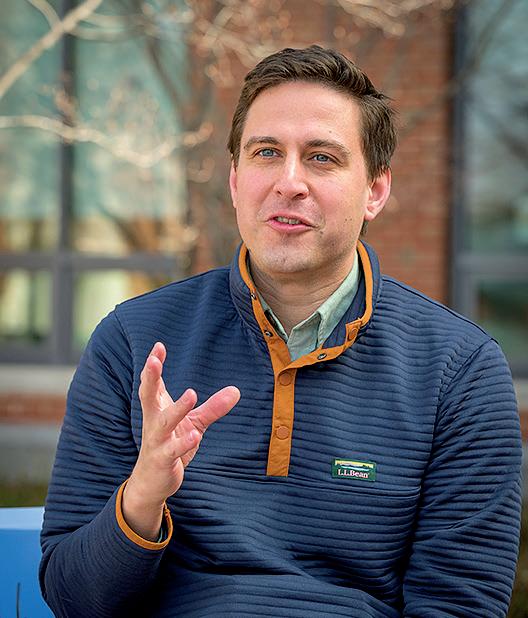
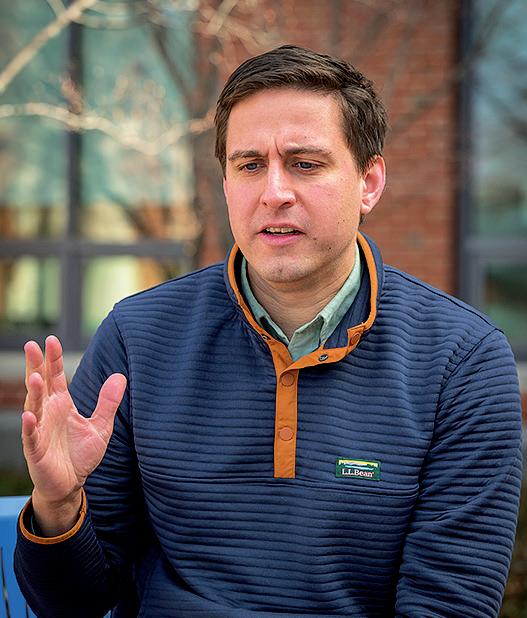
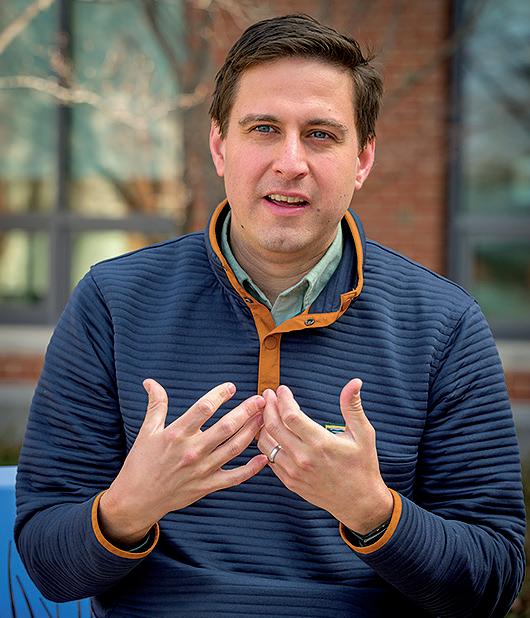
Introducing Fine Arts Teacher and Art Team Co-coach Eugene Sarmiento
“Being a child, everyone draws and paints, and sometimes that stops by middle or high school,” says Fine Arts Teacher Eugene Sarmiento. “I kind of kept on at it.” And as a first-year faculty member in the St. Paul’s School Arts Department, he wants to make sure his students get the opportunity to keep at it, too.
Sarmiento sits at a table in one of the Fine Arts Building’s eight studios, surrounded by sketchbooks and pencils awaiting the students who will come in and pick up where they left off. He says he likes working with teenagers and young adults because it’s as much a time for personal transformation as it is a time for professional decision-making, and he knows firsthand that art can be a career as well as a fun form of self-expression.

“I was like, that art kid in school,” he says as he talks about the sketchbook he would carry around in high school. Art, especially drawing, is something he has always been passionate about, but by his freshman year of college he was certain that he wanted to pursue it full time. Sarmiento went on to earn his BFA in printmaking at the University of Texas-Arlington and his MFA in printmaking and drawing at the University of Kansas. His work has been displayed in galleries and exhibitions all over the country, primarily in the South and Midwest.
“I had great mentors and knew I wanted to pass on that information and knowledge. I wanted to open different avenues for students to look at themselves and the wide representation of artists and art genres,” Sarmiento says of the decision he made to teach art. “I am interested in blurring the separation of art and everyday life within my teachings while still promoting academic excellence in creating art.”
Last term, he taught Animation, Painting and an art history class focused on postmodern to contemporary art; this term, he’s teaching Painting as well as Art of the Sketchbook and Art History: Museum and Curatorial Studies. “One thing I talk a lot about in most of my classes is how human history and art history run parallel to each other, and they’re both a reflection of each other,” Sarmiento says.
“St. Paul’s is a great opportunity to grow as an educator, especially since many commitments touch on aspects of living a holistic life beyond the classroom.”

In addition to teaching, Sarmiento is also co-coaching the first term of an afternoon visual arts pilot program known as the SPS Art Team.
The idea came from head of the Arts Department Leigh Kaulbach ’08, Sarmiento explains; the impetus being that creating an afternoon activity would give the School’s visual artists more time in the studio and additional exposure to galleries and studios beyond the grounds. Students in Art Team meet Monday through Friday, just like any other afternoon activity or club. Members participate in two group exercises a week and get plenty of time for solo work.
“Last week we did a still-life drawing where I brought in a bouquet of flowers and we all drew it together, and then we talked about it afterward,” Sarmiento says. “Then yesterday, the school photographer, Michael Seamans, brought over a couple of Polaroid cameras with film. The kids went and took snapshots and came back together as a group to talk about it. We usually only spend 30-45 minutes on the group activity, but yesterday’s took up the entire time. I think they enjoyed it a lot.”
Art Team, coached by both Sarmiento and Kaulbach and currently made up of only a handful of students, comes together regularly so team members can share what they have been working on. “We’ll have an impromptu or low-stakes critique,” Sarmiento says. “Not to be clichéd, but it’s more about the journey than the actual end product. If you can get to an end product that you like, then good, but at the same time, it’s a learning process.”
—Jacqueline Primo LemmonAnnabella Bernhardt ’24 is Called to Eco-Action

In the fall of her Third Form year, Annabella Bernhardt ’24 attended Eco-Fest, the annual festival put on by the St. Paul’s School student environmental action club, Eco-Action. Coming to SPS from a tiny North Carolina town near the Appalachian Mountains — think 15-studentsper-grade tiny — she had grown up surrounded by bluegrass music. “My grandma always says she danced my dad out at this bluegrass festival called MerleFest,” Bernhardt says of the genre’s roots in her family. So, when she heard Jamie Campbell ’23 and Anna Zoltowski ’23 playing bluegrass banjo music on the Chapel Lawn at Eco-Fest, “I cried, I cried, I cried,” she says wistfully, recalling her brush with homesickness. “That was the moment I wanted to get involved in Eco-Action.”
Bernhardt’s interest grew as she attended meetings and learned more about climate change and the club’s environmental initiatives. Now, as a Fifth Former, Bernhardt is one of two Eco-Action junior heads, along with Lilly Ehlinger ’24. Eco-Action’s four senior heads are Austin Evans ’23, Lucy Mason ’23, Ellie Sung ’23 and Katie Allen ’23, with Science Teacher Nick Babladelis serving as the faculty adviser. “We all really contribute equally and feel very passionately about these issues,” Bernhardt says.
At the School’s recent Spring Visit Days for accepted students, Eco-Action hosted a game where visitors got to rank the impact of a variety of climate solutions — from recycling to solar panels to electric vehicles. “Everyone who played was so surprised by plant-rich diets being at the top,” Bernhardt says of how an individual can make the biggest impact in lowering their own carbon footprint. The real takeaway of the game, however, was that all of these solutions are needed to address climate change.
While Eco-Fest’s educational carnival games, farm animals and pumpkin-carving signal the unofficial start of fall at SPS, the club works all year to raise awareness about different environmental and sustainability issues. Eco-Action engages an average of 40 students each week throughout the year, and the club’s heads meet weekly to talk about current events and initiatives. Recent discussions have focused on the Willow Project, an Alaska oil-drilling project that is anticipated to contribute an additional 9.2 million metric tons of carbon pollution to the atmosphere each year.
Closer to Millville, Eco-Action brings awareness to areas where there are opportunities to go green and proposes ways to decrease the School’s carbon footprint; Bernhardt names gas-powered leaf blowers as an example of equipment in use at the School that could potentially be replaced with electric versions. Elsewhere on the grounds, Eco-Action is also meeting with the deans to discuss how the SPS central heating plant, built in 1927, could incorporate renewable energy.
So, what’s something each member of the SPS community can do to improve the School’s environmental impact and sustainability efforts? “Put less food on your plate!” says Bernhardt with enthusiasm.
Faculty adviser Babladelis notes that, on average, the School generates about 500 pounds of food waste per day. Much of that is composted and converted into energy — in 2022, in fact, the School was recognized by Casella Waste Systems with a Sustainability Leader Award for its Grind2Energy food-waste-capture system. At the same time, Bernhardt encourages her peers to simply get back in the food line if they eat everything on their plate rather than overload their plates the first time through with food they don’t finish. As part of the group’s Earth Day work in April, Eco-Action ran a program focused on food waste reduction.
Another thing we can all do, Bernhardt says, is to eat local: The School’s dining service, she says, “puts a lot of effort into sourcing local foods in the Upper. Eat those things!” And don’t rule out the vegan and vegetarian options — even if you’re a carnivore.
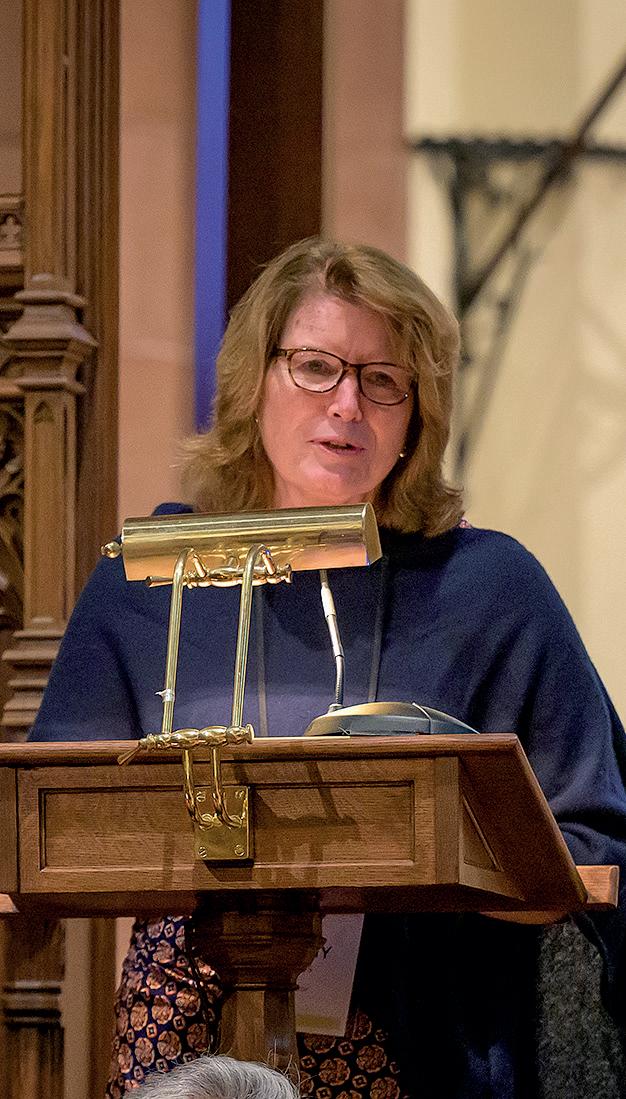
The Rt. Rev. Bishop A. Robert Hirschfeld, 10th bishop of the Episcopal Diocese of New Hampshire, delivered the SPRING TERM CONVOCATION on March 28. Reflecting on the power of humility, Hirschfeld shared, “But what thorny knot in a relationship, or a decision, what roadblock in self-awareness, what political quagmire could not be significantly resolved, melted, lessened and put at ease if more of us could learn to utter these statements with integrity of character and soul: ‘I was wrong. I am sorry. I don’t know. I need help’? Underneath and behind these sentences is an unmistakable courage, an inner security and strength, a fearlessness.”

On March 5, the SPS girls varsity hockey team claimed the 2023 NEPSAC Patsy Odden Large School Championship on away ice, with a 2-0 win over Taft. Guided by first-year head coach and Humanities Teacher Kelli Mackey, the squad put together a 19-8-2 season, which culminated in the program’s first NEPSAC title since 2020. The title was among the achievements highlighted during a WINTER ATHLETIC AWARDS CHAPEL on March 31, along with NEPSAC championship and AllAmerican wrestling titles for Lily Fitzpatrick ’25 and Maddie Morse ’26, a NEPSAC Class A championship for the boys alpine ski team, All-American honors for squash player Nathan Rosenzweig ’24 and more.
The School’s alumni exploration of SERVICE TO THE GREATER GOOD continued in February with a conversation between writer/teacher/activist Lorene Cary ’74 and filmmaker/environmental advocate Pete McBride ’89. Joined by Rector Kathy Giles and student co-host Pierce Trevisani ’25, the duo discussed their work as artists and activists and the meaningful place creativity can play in living a life of service.
DESIGN SENSE Meet Yoona Lee ’24


Last year, Yoona “Sarah” Lee’s grandfather fell suddenly ill, leaving him paralyzed from the waist down and confined to a wheelchair. When Lee returned to her home in Seoul, South Korea, that summer and saw her grandfather for the first time, she was heartbroken. As hard as it was to see him navigate his new physical reality, it was even more emotional to hear him talk about it. Hardest of all were his dashed hopes of flying to San Francisco to visit his daughter, Lee’s aunt.
“You could just hear the pain in his voice,” the Fifth Former says. “He hadn’t seen her in awhile and he just felt that because he was in a wheelchair, it would be too difficult to fly to see her.”

A new world began to emerge for Lee — one she started to see through her grandfather’s eyes. In particular, she thought about the many flights she had taken between South Korea and the United States. Had she seen anyone in a wheelchair get on the plane before? How had she missed them? What else had she missed about the challenges that many disabled people face in their day-to-day lives?
“I started thinking more and more about those long flights and what it must be like for someone in a wheelchair to be on them,” Lee says. “And then I came across this New York Times story about this paralyzed veteran named Charles Brown. He shared all the difficulties someone in a wheelchair has to face — getting through security, getting on the plane, going to the bathroom — in order to fly somewhere. That really opened my eyes and made me want to do something to support [the nonprofit group] Paralyzed Veterans of America.”
Lee felt there was a story to share; something that could be relayed to able-bodied airline passengers about a different kind of journey that others around them had to navigate. Partnering with a close childhood friend, Youjung Shin, a 10th grade student at Phillips Academy Andover,

Lee began work late last summer to leverage data from the Times article to create an infographic that visualizes the experience of a disabled veteran like Brown boarding and disembarking a plane. The work includes a “customer journey map” that illustrates the emotions that accompany each step, right up to when they leave the airport at the end of their flight. The result is a graphical arc that is quick and digestible. Something that, say, could be turned into a pamphlet and read on a plane or at an airport. Lee and Shin finalized the work in late January and submitted the infographic the following month to the Cooper Hewitt 2023 National High School Design Competition. In early spring, the duo’s work was selected from 707 entries as one of three finalists. The winner will be announced in June.
Lee hopes the increased visibility will help lead to her ultimate goal of more broadly sharing her design so that others can take notice of what she now sees.

“It’s about creating more awareness,” she says. “We don’t really treat disabled people with enough respect or acknowledge what they have to get through. Hopefully with this infographic, airplane passengers can pay more attention to disabled travelers and have a different point of view about all the things so many of us take for granted when we get on a plane.”