In Her Honor MEMORIES
Family and friends share memories of September 11 victim Lindsay Morehouse ’96, and what they are doing to honor her legacy
Lindsay Morehouse ’96 often went out of her way to make others feel welcome. She was the organizer of her many groups of friends, arranging their New Year’s Eve plans in July. “Whatever we did, it was always such a fun time,” said her close friend Sara Sparks ’97.
8
Morehouse was a 24-year-old equity research assistant for Keefe, Bruyette & Woods, working on the 89th floor of the World Trade Center’s South Tower on September 11, 2001. She was one of 67 of the firm’s employees killed that day. “This was a girl who exuded life,” said Theresa Gerardo-Gettens, who was Lindsay’s adviser in Con/20 in her Fifth Form year. “When you saw Lindsay coming down the hall, you knew you were going to smile.” Sparks spoke of her friend’s
boundless energy, which often included Lindsay starting her day by going for a run before most of her friends had left their beds. On weekends, she would host wine and cheese parties and motivate her friends to venture out to listen to live music, including her favorite band, Seeking Homer. She was such a big fan that the band reached out to perform a memorial concert shortly after Lindsay’s death, calling her a “vibrant and loving soul” with a “radiant smile.” “Lindsay loved to dance,” recalled Sparks, who was sharing an Upper East Side apartment with Lindsay at the time of her death. “Soon after I met Lindsay at St. Paul’s, I found myself dancing around her room to a variety of songs.” “When it came to having fun, there was no one who did it better,” added Lindsay’s friend Jill Thompson Smith ’96. “If there was a road trip to be taken, Lindsay’s bags were packed. If there was a concert to see, she had tickets. If there was a dance floor in the room, she was on it. Lindsay had a no-holds-barred love of fun and life, and I miss that, and her, dearly.” Her exuberance translated to the tennis court, where Lindsay was a fierce, but joyous competitor. She arrived at St. Paul’s as a Fifth Former and quickly earned the No. 1 spot on the girls tennis ladder. She went on to earn All-America honors and another captainship with the Williams College tennis team.
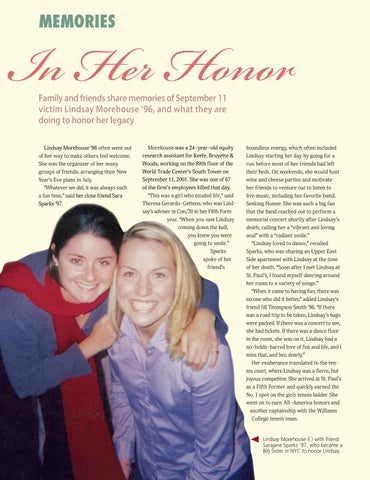
Lindsay Morehouse (l.) with friend Sarajane Sparks ’97, who became a Big Sister in NYC to honor Lindsay.
COURTESY WILLIAMS COLLEGE
“Lindsay was a real team leader, tough competitor, and a friend to her teammates,” recalled Marianne Cook, who coached tennis at St. Paul’s for many years. “After all these years, I still think of her often.” Gina Kim Sumilas ’98 was a doubles partner to Lindsay as a Fourth Former. She still listens to a mixed tape that Lindsay made for her during Kim’s Fourth Form year, on a day she was feeling particularly down. “I remember her for her spirit, her kindness, and, most of all, her friendship,” said Kim. Sparks and Smith both recalled Lindsay’s close relationship with her parents, Kathy Maycen and Ted Morehouse, with whom she was in touch daily, sharing the many details of her life. “I just remember the most loving daughter imaginable,” said Mrs. Maycen. “She was certainly not perfect, but she was a perfect daughter for me.” An enthusiastic volunteer, Lindsay was scheduled to meet her new “Little Sister” through Big Brothers Big Sisters of New York City (BBBS of NYC) on September 15, 2011, four days after she perished. According to Sparks, Lindsay “acted as if she were interviewing for the most important job of her life” when she met with the New York City chapter of BBBS in the weeks before her death. Shortly after 9/11, her parents established the Lindsay Morehouse Scholarship to send alumni of BBBS of NYC to college. A similar Morehouse scholarship at Williams gives first preference to students directly affected by 9/11, or the child of a fireman, policeman, or member of the military. Mrs. Maycen also endowed a memorial scholarship in her daughter’s name at her alma mater, Connecticut-based Hopkins School. “She wanted to help someone less privileged than she,” said Mrs. Maycen. “That is why we established and
“When you saw Lindsay coming down the hall, you knew you were going to smile.”
funded a college scholarship at BBBS of NYC. It has been a privilege for me to select the recipients of the Lindsay Morehouse Scholarship among the many qualified applicants each year.” Other tributes include a bench and memorial wall dedicated at St. Paul’s in 2002 adjacent to the outdoor tennis courts, a two-tiered memorial garden overlooking the Williams tennis courts, and a memorial tree nearby. The Morehouse Tennis Award was established by Williams rival Amherst College to honor the New England Division III player who most emulates Lindsay’s qualities of sportsmanship. Mrs. Maycen and Mr. Morehouse also donated a nine-court facility at The Benjamin School in Palm Beach Gardens, Fla., the school Lindsay attended before St. Paul’s. And Lindsay’s name is one of nearly 600 etched on the footprint of the South Tower at the National September 11 Memorial in Lower Manhattan. As the reality of September 11 hit Lindsay’s friend Sara Sparks, she knew immediately that she wanted to honor Lindsay’s memory by continuing her friend’s good works. Sparks contacted BBBS of NYC about taking over Lindsay’s match and, by November 2001, she had been paired with 11-year-old Tiffany Belmond. In a feature article printed in the Fall/Winter 2004 issue of The Match, the newsletter of BBBS, Sparks told writer Alan Annis how she and Tiffany helped one another to cope with the tragedy. “Sara told Tiffany stories about Lindsay, and Tiffany wrote a poem about the tragedy to help people overcome their losses and fears,” Annis wrote, adding that the two became spokeswomen for the organization. “Lindsay would have been the best Big Sister,” said Sparks. “I wanted to fulfill the dream of my friend. She never had the chance to impact the life of a Little Sister, so I wanted to do this in Lindsay’s honor.”
9
SPOTLIGHT
A P PHOTO / RICHARD DREW
Remembering 9/11
Three alumni with three very distinct relationships to September 11 share their connections with a day that changed America. by Jana F. Brown
Categorizing Disaster
In the summer of 2001, two months before the attacks on the World Trade Center in New York City, Mory Houghton ’70 received a call from an old graduate school friend. The two men discovered a common opening on their calendars: September 11. “I was on a train out to New Canaan, Connecticut, to see him when someone said a plane had flown into the tower,” recalls Houghton, whose office with the Port Authority of New York was located on the 61st floor of the North Tower. “The only reason I’m not dead is because I wasn’t there that day. I think about that all the time.” Eighty-four of Houghton’s Port Authority colleagues perished on 9/11, including two who also worked on the 61st floor. Prior to September 11, Houghton had served as the Port Authority’s senior strategic planner since 1997. In the aftermath of the disaster, he became the organization’s liaison with the Federal Emergency Management Agency. A prior stint as deputy director of New York’s Whitney Museum of American Art ended up informing Houghton’s next assignment. Though his work at the Whitney had not been curatorial, Houghton had a reasonable knowledge of documentation and categorization. That background segued into a role overseeing the removal and preservation of some of the larger debris of the WTC site – steel and vehicles. “There was a great team who worked with me,” says Houghton. “We documented every single object we took out of the hangar with measurements and photos.
We went back to the original engineering drawings from the 1960s to try to identify exactly where the beams had been in the Trade Center.” Hangar 17, an 80,000-square-foot space at Kennedy Airport, and a vehicle “graveyard” at a second recovery site on Staten Island became Houghton’s second homes until he left the Port Authority in 2007. There, he and others worked to make sense of thousands of tons of twisted steel and more than 1,400 vehicles, all in various states of devastation. The steel, says Houghton, “was deformed, ripped, or bent in ways that steel can’t bend. It is a reminder of the physical assault on the site.” Among the steel remnants was the 36-foot-tall, 60-ton final column that became a symbol of hope as the last vestige of the towers removed from Ground Zero. One particularly striking vehicle, Houghton says, was an ambulance, recognizable only by the familiar shape of its exterior frame. An NYFD fire truck was demolished beyond recognition at one end and pristine at the other. “It’s the differentiation between the two that allows you to grasp the extent and randomization of the destruction,” says Houghton. “That was pretty emotional. Some of the fire trucks we have out there didn’t lose a single person in the company; some lost everyone.” Police cars and yellow taxi cabs became other iconic reminders of the sheer violence of the attacks. Out of roughly 1,400 wrecked vehicles – each covered with two inches of that gray dust cloud composed of the two 1,350-foot towers – 20 were salvaged
to represent the entire fleet. “Vehicles were a part of the building, an elemental part of the story, but nobody was trying to save them,” Houghton continues. “Nobody knows what a core column looks like, but everyone can identify a fire truck.” Among the more unusual objects categorized in Hangar 17 were two from a retail store that once occupied space in the mall at the concourse of the World Trade Center complex. Salvaged at Kennedy Airport were a life-size Bugs Bunny sculpture with one of its ears snapped off and a sign expressing Porky Pig’s signature line, “That’s all folks.” Houghton also describes at least two objects that will be part of the exhibit, along with many of the steel pieces and vehicles, at the National September 11 Memorial & Museum. “They are eight feet in diameter and three-and-a-half-feet thick,” he says, describing what he refers to as composites. “They are three-and-a-half stories of Trade Center compressed. It’s just this mass that really describes how horrible the compression effect of the collapse was. You can recognize the different steel that separates the floors, and you can see paper that has been massed together and carbonized. The emotional power of these objects is really quite overwhelming. “I was around these things for the better part of four years, and you would have thought that being around for that length of time would have anesthetized me, but really they never were just objects; they were part of my home.”
Advising the President
Every morning since his arrival in August 2001, Lew Lukens ’82 had sat in on a meeting with Secretary of State Condoleezza Rice and her leadership team in the White House Situation Room. “As we went into the meeting a few minutes before 9 a.m., a plane had hit one of the World Trade Center’s Twin Towers,” Lukens recalls of Tuesday, September 11. “But very shortly after the meeting started, someone whispered in [Secretary Rice’s] ear and she got up and said another plane had flown into the towers; the meeting was over. It was clearly more than an accident.” Lukens, a Foreign Service veteran on loan to the White House, was in the first month of a 12-month assignment as senior director for administration at the National Security Council when terrorists attacked the towers. Within minutes of United Flight 175’s slamming into the South Tower, the White House sirens sounded, signaling an emergency evacuation of the building. Lukens was waiting across the street in Lafayette Park with colleagues to re-enter the White House when he heard the explosion of a third plane striking the nearby Pentagon. “Before the attacks, the president had national security meetings fewer than half a dozen times,” says Lukens, who also served as deputy executive secretary for the NSC at the time. “From September 12 on, there were one or two meetings a day. The sheer amount of paperwork and activity related to national security, foreign affairs, and military affairs went way up.” A primary job of Lukens as one of three NSC deputy executive secretaries to President George W. Bush was to travel with the commander-in-chief. Prior to 9/11, Lukens says, the president was rarely pressed on national security in his many speaking engagements. But it now fell to Lukens and his two colleagues to split the duty of advising the president on the barrage of questions that followed the attacks. “The first time the president left Washington after 9/11, I was on Marine One [the presidential helicopter], sitting literally across the aisle from him on a trip to Maryland,” says Lukens, describing the mood in the White House in the weeks that followed the attacks as “serious, almost grim.” “We flew over the Pentagon, and he was looking out the window at the damage.”
In his tenure with the NSC, Lukens witnessed the creation of the Department of Homeland Security and the establishment of the National Counterterrorism Center in Washington, D.C. In his current role as ambassador to the Republic of Senegal and the Republic of Guinea-Bissau, Lukens notices the impact of the changes brought on by 9/11.
“. . . very shortly after the meeting started, someone whispered in [Secretary Rice’s] ear and she got up and said another plane had flown into the towers; the meeting was over. It was clearly more than an accident.”
“There is a better coordination and synergy between the national security agencies,” he says. “That has spilled over beyond the counter-terror arena. Ten years later, part of our instructions from the Secretary of State as ambassadors is to take a whole government approach. Ambassadors and embassies overseas are taking a much more coordinated approach to problems in our countries – ensuring free elections, promoting economic development, and so on.” Something that surprises Lukens as he watches the 2012 presidential election begin to take shape is the lack of attention to national security. While viewing the September 12, 2011, debate between Republican presidential candidates, he noticed that “nobody was talking about national security. It was all jobs and economy. Only 10 years later, it’s astounding for it to be a non-issue.” From inside the trenches of national security, Lukens felt reassured by the conscientious approach of President Bush and those who surrounded him in the months after September 11. “From what I saw of the decisionmaking process from 2001 to 2002, there was a concerted effort by dedicated and professional public servants, who were seized with the idea of preventing another attack and keeping our country safe in the long run.” COURTESY LEW LUKENS ’82
A P PHOTO / FRANK FRANKLIN II
Mory Houghton ’70 points to the “last column” removed from Ground Zero.
Lew Lukens ’82 (on the phone) in the Oval Office with former Presidents George W. Bush (seated) and George H.W. Bush.
71
AP PHOTO / MIKE SEGAR
Visitors are reflected in the windows of the 9/11 Museum Pavilion as they stroll the grounds of New York’s 9/11 memorial plaza.
Rebuilding and Reflection
“In many respects,” says architect Monty Forman ’97, discussing the National September 11 Memorial & Museum, “the Museum Pavilion is designed as a complement to the Memorial, to frame and balance the experience of visiting the park and reflecting pools. The pavilion walls help to shield visitors from the surrounding urban environment and form an intimate, reflective backdrop to the foliage and waterfalls. In that sense, it is an incredible achievement.” For the last year, Forman has managed Front Inc.’s part of the reconstruction at Ground Zero. Front is the exterior wall consultant for the three-story-high, glass
and steel museum pavilion. The pavilion serves as the visitor center and entrance to the museum, whose seven stories – due to open on September 11, 2012 – will sit largely underground. “The building is clad in a unique system of striated stainless steel panels and, on one corner, has a large glass atrium that houses two tridents – 70-foot-tall steel columns that were salvaged from the World Trade Center Towers,” adds Forman. A 2008 article in the New York Times Magazine sang the praises of the company. “Front has worked with most of the world’s pre-eminent architects,” wrote the Times’s Arthur Lubow. “In addition to realizing the details, the Front consultants can help an
architect arrive at the facade design, determining the pattern and material of the cladding. . . . Because unusual facades catch the public’s eye and generate much of the popular interest in contemporary architecture, clients often urge an architect to build something that looks unbuildable.” When discussing the building’s facade, Forman explains the logic behind the stainless steel panels and their transition to the vast glass panes that purposefully draw in the natural light. The glass enclosure allows a visual connection to the memorial park, which includes two reflecting pools in the footprints of the original towers. “There is a clear focus about a reflectivity throughout the project,” he says. “The building itself, in a way, sought to be a reflection and complement to the memorial. There is also a focus on a unique series of patterns on the stainless steel panels, the transition from steel to glass, and on the glass design to manage the amount of reflectivity and vision back to the park.” Forman commends the collaboration between his own firm and many others involved with the design and construction of the Museum & Memorial. Architects and engineers had to contend with building the structure that integrated impressive security features and navigated complex structure below grade, including the PATH (Port Authority Trans-Hudson) trains that run beneath the site. The museum building is tilted, Forman explains, raised at the corners to lighten its appearance and provide visual orientation on the site. “One of the main challenges was the fact that, behind the cladding, the pavilion houses much of the equipment used to service the museum below grade,” he says. “To integrate those functional requirements into a visually cohesive structure required true commitment from all parties involved in the project.” Prominently featured in the atrium – and visible from the outside through the glass façade – are the 70-foot-tall steel tridents, salvaged from Ground Zero, that represent the fallen Twin Towers. “There was a lot of discussion throughout the project about balancing the visibility of the tridents from exterior views and within the enclosure,” says Forman. “There are a lot of emotions wrapped up in those images.”