A Love That Drowned Beneath Silence and Guilt
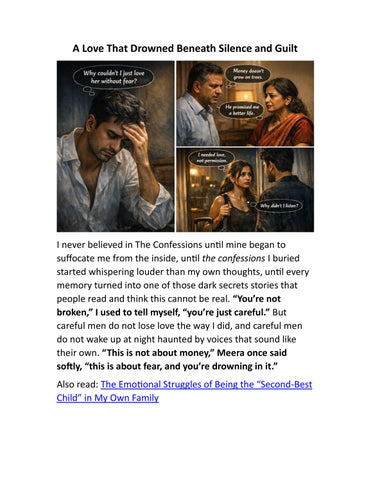
I never believed in The Confessions un l mine began to suffocate me from the inside, un l the confessions I buried started whispering louder than my own thoughts, un l every memory turned into one of those dark secrets stories that people read and think this cannot be real. “You’re not broken,” I used to tell myself, “you’re just careful.” But careful men do not lose love the way I did, and careful men do not wake up at night haunted by voices that sound like their own. “This is not about money,” Meera once said so ly, “this is about fear, and you’re drowning in it.”
Also read: The Emo onal Struggles of Being the “Second-Best Child” in My Own Family
The Silence Before We Fell: A Childhood Measured in Denial
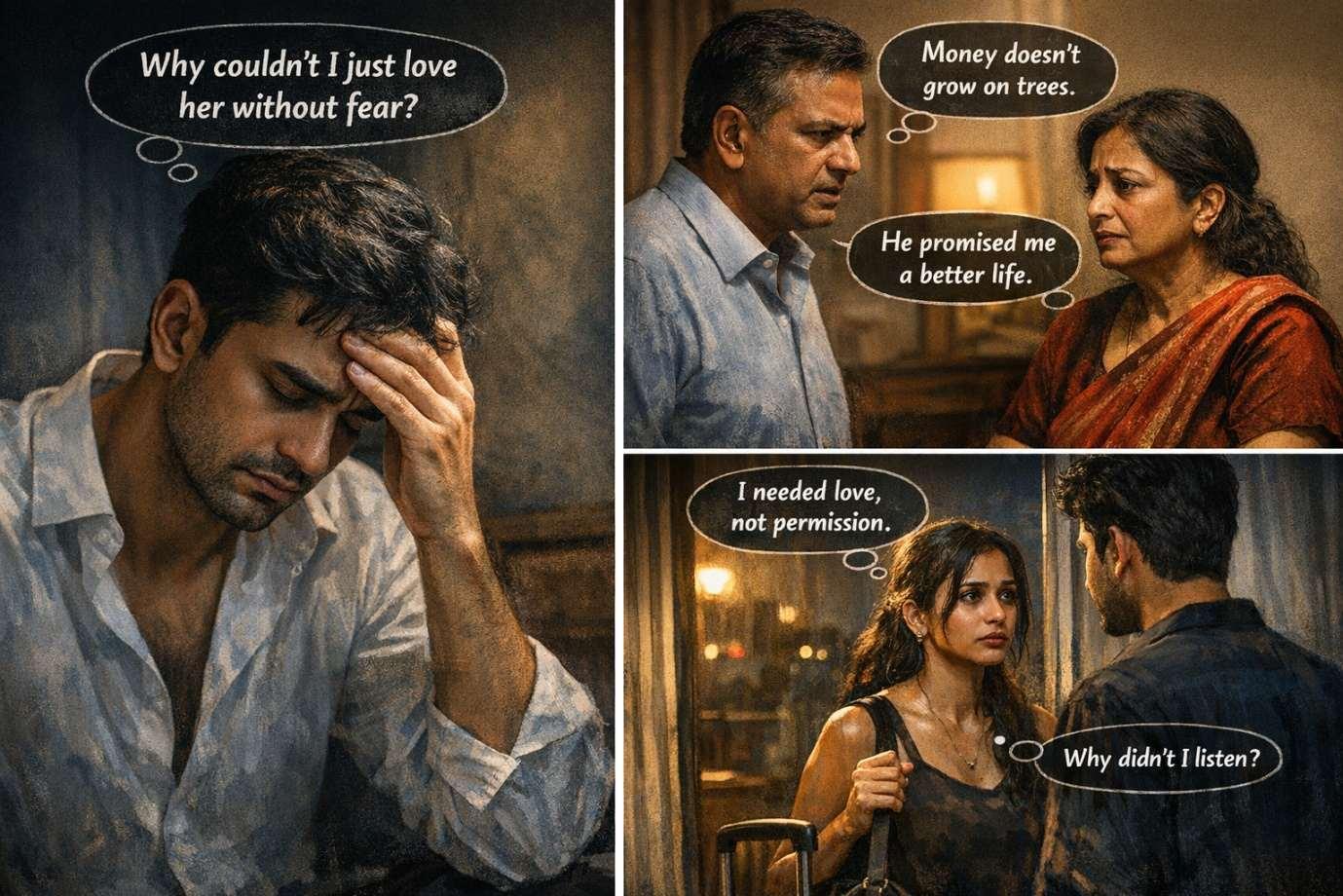
I grew up in a house where every desire had to jus fy its existence, where even happiness needed approval, and my father’s voice was always the final verdict. “Do we really need this?” he would ask, his eyes cold, his tone final. My mother, Nisha, would sigh in the background, her disappointment heavy like unshed tears. “You promised me a life,” she would whisper bi erly, “not survival.” Even as a child, I learned to shrink my wants, to calculate joy like an expense, to feel guilty for dreaming. “We can’t afford unnecessary things,” my father repeated, “learn the value of money.” And I did, too well, because years later when I started earning more than he ever had, the scarcity never le me, it lived inside my bones. “Why spend when you can save?” I would tell myself, even when my heart begged for something as simple as ease.
Also read: Naviga ng Workplace Boundaries: A Personal Dilemma
The First Time Meera Saw Through Me
I met Meera in a café I almost didn’t enter because the coffee was overpriced, and even now I remember standing outside calcula ng whether I deserved something so small. “Why are you checking the menu like it’s a contract?” she teased, smiling like life had never hurt her. I forced a laugh. “Just making sure I’m not was ng money.” She leaned closer, her eyes searching mine in a way that made me uncomfortable.
“Or making sure you don’t feel anything?” That ques on stayed with me longer than I admi ed because no one had ever said it out loud before, and in that moment something shi ed inside me, something fragile and dangerous.
Also read: The Consequences of Ignoring Self-Respect in Rela onships
When Love Turned Into a Mirror: The Cost of Loving Freely
Meera loved in a way that felt terrifying to me because it had no condi ons, no calcula ons, no invisible limits like the ones I had grown up with. “You don’t have to earn permission to exist,” she would say, laughing as she dragged me into moments I would have otherwise avoided. She booked spontaneous trips, bought things because they made her happy, and lived like tomorrow was not something to fear. But every me she spent, I felt a ghtening in my chest, a quiet panic that I could never explain. “Do we really need this?” I would ask, and every me I said it, I became more like my father without realizing it. Her smile would fade just slightly, and one night she finally asked, “Why does everything feel like a burden to you?” I didn’t answer because I didn’t know how to admit that I was afraid of losing control more than I was afraid of losing her.
Also read: Healing from a Toxic Childhood: My Story of Pain, Growth, and Boundaries
The Fracture We Pretended Not to See
The arguments started small but carried something deeper beneath them, something neither of us wanted to name. She talked about moving into a bigger apartment, about wan ng space that felt like freedom instead of survival. “Thirty thousand for one person?” I snapped before she even finished. “That’s irresponsible.” She looked at me differently that day, like she was seeing someone she didn’t recognize. “It’s called living,” she replied quietly. I shook my head, feeling jus fied in my fear. “Money doesn’t grow on trees.” She let out a hollow laugh. “And love doesn’t grow in fear.” That sentence should have stopped me, should have made me pause, but instead I chose to defend myself because admi ng she was right would have meant confron ng everything I had built my iden ty on.
Also read: A Silent Love That Never Faded: My Untold High School Crush Story
The Night the Truth Begged to Breathe: The Argument That Changed Everything
It was raining the night everything broke, the kind of rain that makes the world feel heavier, quieter, more honest than usual. She stood by the window, her back to me, and the silence between us felt unbearable. “Say something,” I demanded, my voice sharper than I intended. She didn’t turn around. “I’ve been saying things for months,” she whispered, “you just never listen.” I felt anger rise in me, defensive and desperate. “I’m trying to protect our future!” She turned then, her eyes filled with something I could not fix. “No,” she said, “you’re trying to control it because you’re
terrified.” I stepped closer, clinging to logic like it could save me. “You don’t understand responsibility.” And then she said the words that sha ered everything. “And you don’t understand love.”
Also read: A Journey of Friendship, Love, and Heartbreak
The Confession I Refused to Hear
That night she tried to explain everything she had been holding in, every quiet hurt, every moment she felt unseen beside me. “This feels like no affec on in marriage,” she said so ly, even though we weren’t married, “like I have to jus fy my existence to you.” I dismissed it because that was easier than listening. “You’re overthinking,” I said, brushing it off like it was nothing. But it wasn’t nothing, it was everything, and I was too afraid to face it because deep down I knew she was right.
Also Read: Second Marriage While Having a Child from a Previous Marriage: A Hear elt Confession
The Confessions I Never Meant to Speak: When She Finally Let Go
She le without raising her voice, without crea ng a scene, without giving me the kind of ending I could argue with. All she le behind was a note that felt heavier than anything she could have said. “I needed love, not permission.” I stood there staring at those words, feeling something inside me collapse slowly, painfully. I called her again and again un l she finally answered. “What do you want?” she asked, her voice distant. I swallowed everything I had never said before.
“Come back.” There was silence, long and unforgiving. “To what?” she replied, and I had no answer.
Also read: Trump’s New Oil Fantasy in Pakistan Aims to Sideline India, Trigger Global Facepalms
The Truth That Destroyed Me
That moment forced me to see everything I had avoided for years, the way I confused control with care, fear with responsibility, denial with discipline. “I didn’t know how to love you,” I admi ed, my voice breaking under the weight of truth. She didn’t respond immediately, and when she finally did, her words were gentle but final. “I know,” she said, “and I couldn’t keep wai ng for you to learn.” That was my confession, the one I never meant to speak, the one that came too late to change anything.
Also read: The Confessions: A Love Betrayed Behind Closed Doors
What Survived A er Everything Burned: Learning to Face Myself
A er she le , the silence became unbearable because it forced me to confront parts of myself I had spent years avoiding. I started no cing how I denied myself even the smallest joys, how I judged others for living freely, how my father’s voice s ll controlled my decisions. “You’re s ll that scared boy,” I whispered to myself one night, and for the first me I didn’t argue. I started trying to change, slowly, painfully, allowing myself things without guilt, ques oning
beliefs I once thought were absolute. “You deserve to live too,” I told myself, even when it felt unnatural.
Also read: The Confessions: A Double Proposal That Sha ered Everything
The Weight of Irreversible Loss
Healing did not erase the regret, it only made me more aware of it. I s ll think about her in quiet moments, in spaces where memories linger longer than they should. “Would it have been different if I had listened?” I ask myself again and again. And deep down I already know the answer because the truth does not need to be explained. Yes, it would have been different, but knowing that does not bring her back, it only makes the loss feel more permanent.
Also read: The confessions: She Married for Property, Lied for Alimony, and Confessed Too Late
The Confessions That Stay
If you are reading this, searching through Confession Stories or trying to make sense of your own untold confession or even ques oning your own fears around love and control, then understand this before it is too late. Fear can disguise itself as discipline, control can pretend to be care, and some mes the very thing you think is protec ng your future is quietly destroying your present. “You don’t have to live like this,” I remind myself every day, even now. Because the confessions we refuse to face do not disappear, they stay,
they grow, and they take everything from us un l all that remains is the truth we were too afraid to accept when it ma ered, and if my story leaves anything behind, let it be this one truth that s ll echoes inside me, “learn to live before you learn to regret.”
Also read: My Husband Doesn’t Love Me: A Story of Struggle in a Joint Family
Follow Us On Social Media:
Facebook Instagram
Twi er
Threads