STORY COUNTY CONSERVATION • NATURE PROGRAMS AND NEWS November 2019 - January 2020
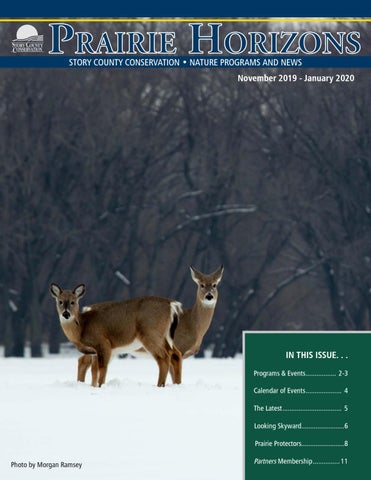
IN THIS ISSUE. . . Programs & Events.................. 2-3 Calendar of Events..................... 4 The Latest.................................. 5 Looking Skyward........................6 Prairie Protectors........................8 Photo by Morgan Ramsey
Partners Membership................ 11
— PROGRAMS & EVENTS — Providing people opportunities and inspiration to develop an appreciation and understanding of nature and humans as a part of it
NOVEMBER
DECEMBER
Wild Tots Family Lantern Walk
Sunday, November 3, 4:00 - 5:30 p.m. Tedesco Environmental Learning Corridor (1805 Collaboration Place, Ames)
Geocache Elf Hunt
This event is open to all familes and is designed to find the beauty in the darkness that comes with the end of Daylight-Savings time. Families will gather before dusk, sing songs, light lanterns, and enjoy an outdoor walk. For families who attend a Wild Tots program the week or two prior to the Lantern Walk, materials will be available for making lanterns or find a link for instructions on our website. Bring your lantern (or flashlight) and musical instruments for the walk if desired! This event is free and registration is not required.
Santa’s helpers have been playing in the park! Learn how to use a GPS, then go search the woods to find stockings of goodies and elves hiding nearby. Bring back an elf to claim a special prize! Spots in the hunt are limited so be sure to register early. Fee of $5 per collector (any child 3 - 14 years old) with registration is required by 4:00 p.m. on Tuesday, November 26.
Sunday, December 8, 1:00 - 3:00 p.m. McFarland Park
Soap from Scratch
Wednesday, November 20, 6:00 - 8:30 p.m. Story County Extension Christy Hall (220 H Ave., Nevada) Explore the art and science of making handcrafted soap from scratch with Siberian Soap Company Owner Ann Staudt! Using the centuries-old cold-process soap making technique, we will combine plant-based oils and lye to create soaps that are mild, moisturizing, and ecofriendly. Each participant will make and take home a 1.3 pound custom batch of soap just in time for holiday giftgiving. Long sleeves, long pants, and closed-toe shoes are required of all participants. We ask that participants are 16 years or older. Fee of $30 with registration is required by 4:00 p.m. on Thursday, November 14.
Explore Your Outdoors: Animal Tracks! Saturday, January 11, 1:00 - 3:00 p.m. McFarland Park
Join Naturalist Jess Lancial as we learn about common animal tracks. Look for clues around McFarland Park’s trails to discover our animal neighbors. This program is for children ages 5 and up plus their adult. Participants must be dressed to go and explore outdoors. This program is free but registration is required by 4:00 p.m. on Wednesday, January 8.
STORY COUNTY CONSERVATION 515.232.2516
2
56461 180th Street • Ames, Iowa 50010 Monday - Friday • 8:30 a.m. - 4:30 p.m. conservation@storycountyiowa.gov • www.storycountyconservation.org
O.W.L.S. Programs O.W.L.S. (Older, Wiser, Livelier Souls) programs are held each month at 11 a.m. at the Story County Conservation Center. These are designed for “boomers” or older -- but anyone can attend. An optional luncheon follows the program for just $7.50. Register for lunch by 4 p.m. on the deadline at storycountyconservation.org or call 515-232-2516. Wednesday, November 6 Remembering Iowa’s Buffalo Bill Roy Behrens, University of Northern Iowa William F. Cody (1846 - 1917), better known as “Buffalo Bill,” was born near Le Claire, Iowa, just north of Davenport. By the end of his life, he had become what some have called “the most famous American in the world.” Menu: carved turkey, mashed potatoes, and gravy, stuffing, corn, dinner roll, and pumpkin pie. Register for lunch by 11/1. Tuesday, December 3 Tales of Iowa History Darrin Crow, Storyteller State history comes to life in these delightful tales of early Iowa -- featuring the great Honey War of 1838, when Iowa was nearly invaded by Missouri! Menu: beef and noodles, mashed potatoes, mixed veggies, dinner roll, and chocolate pound cake. Register for lunch by 11/29. NOTE: This program will be held at Northcrest Community’s Fireside Building. Tuesday, January 7 Reflections on Iowa Rivers & Their Futures Dr. Jim Pease, Emeritus Professor NREM ISU Having paddled over 1800 miles of Iowa rivers for the Iowa Water Trails Program, Dr. Pease has some unique insights to share about Iowa rivers, their futures, and their importance to Iowa’s wildlife. Menu: baked potato bar and strawberry shortcake. Register for lunch by 1/3. NOTE: This program will be held at Northcrest Community’s Green Room.
JANUARY Beat the Blues Winter Activity Marathon Challenge yourself to complete a full marathon -- 26 miles! -between January 1 and March 1. Walk, run, ski, snowshoe, or bike 26 miles outdoors at your own pace, when it works for you and your family. Or play outside for 30 minutes to equal one mile. Record your mileage on the Mileage Log, available at McFarland Park or by download at http://bit.ly/SCCWinterMarathon2020. Turn in your completed log to win a discount on Story County Conservation online registrations or rentals.
Snowshoe Hikes at McFarland Park
Embrace winter with an invigorating snowshoe hike to explore McFarland Park. No experience is necessary and snowshoes are provided.
January 17 5 - 6:30 p.m. Register by 4 p.m. on January 15
January 25 2 - 3:30 p.m. Register by 4 p.m. on January 17
January 29 3 - 4:30 p.m. Register by 4 p.m. on January 27
These programs are outside, so please dress for the cold Iowa winter. Programs are dependent on snow levels. Fee of $5 with registration is required by deadlines above.
Animal Architects
Saturday, January 25, 10:00 -11:30 a.m. McFarland Park You might snuggle up with a blanket and hot cocoa in the winter, but what do the animals do? Some dig, some build, others weave homes. Learn about the builders of nature and then head outside to try making a snug winter shelter. All participants are welcome, but activities are targeted to school-aged children. Children must be accompanied by an adult. Dress warmly to be outside for part of the program. This program is free but registration is required by 4:00 p.m. on Friday, January 17.
3
— CALENDAR OF EVENTS —
Date Time Event Location NOVEMBER
Sunday, Nov. 3 4:00 p.m. Monday, Nov. 4 5:30 p.m. Wednesday, Nov. 6 11:00 a.m. Thursday, Nov. 7 6:30 p.m. Monday, Nov. 11 Wednesday, Nov. 20 6:00 p.m. Nov. 28 - 29
DECEMBER
Tuesday, Dec. 3 11:00 a.m. Sunday, Dec. 8 1:00 p.m. Monday, Dec. 9 5:30 p.m. December 24 - 25 Tuesday, Dec. 31
JANUARY
Wednesday, Jan. 1 Thursday, Jan. 2 6:30 p.m. Tuesday, Jan. 7 11:00 a.m. Saturday, Jan. 11 1:00 p.m. Monday, Jan. 13 5:30 p.m. Friday, Jan. 17 5:00 p.m. Saturday, Jan. 25 10:00 a.m. Saturday, Jan. 25 2:00 p.m. Wednesday, Jan. 29 3:00 p.m. Thursday, Jan. 30 7:00 p.m.
Wild Tots Family Lantern Walk Tedesco Environmental Learning Corridor Story County Conservation Board Meeting McFarland Park O.W.L.S.: Buffalo Bill McFarland Park Story County Conservation Partners Meeting McFarland Park SCC offices closed Soap from Scratch Story County Extension SCC offices closed
O.W.L.S.: Tales of Iowa History Northcrest Community Geocache Elf Hunt McFarland Park Story County Conservation Board Meeting Story County Admin. Building SCC offices closed SCC offices closing two hours early
SCC offices closed, but Beat the Blues Winter Activity Marathon Begins! Story County Conservation Partners Meeting McFarland Park O.W.L.S.: Reflections on Iowa Rivers & Their Futures Northcrest Community Explore Your Outdoors: Animal Tracks! McFarland Park Story County Conservation Board Meeting Story County Admin. Building Snowshoe Hike McFarland Park Animal Architects McFarland Park Snowshoe Hike McFarland Park Snowshoe Hike McFarland Park Story County Trails Advisory Committee Meeting McFarland Park
Photo by Natalie Welter
Don’t forget to take photos for our annual photo contest! Submissions are in March Visit our website for more details Need to locate one of our parks or areas? You can view individual maps and 911 addresses online.
www.storycountyconservation.org 4
— THE LATEST —
Timely and brief updates on ongoing projects
Heart of Iowa Nature Trail - Looking Forward
Story County Conservation staff and supporters met for a ribbon cutting at the Slater trailhead earlier this fall, celebrating the first paved section and looking towards the future. Phase two of this paving project is from Huxley east to the South Skunk River bridge -- about 3.32 miles and a total project cost of $1,077,000. So far, $730,000 has been secured through grants from the Central Iowa Regional Transportation Planning Alliance and the State Recreational Trails Program.
Fish Structure at Hickory Grove
A hardworking group from Alliant Energy spent a morning with us building fish habitat! These artificial structures can both create opportunities for anglers and provide valuable, durable habitat for the new fish being stocked once the lake refills next spring.
Partners Update
In fiscal year 2019, Partners raised $21,549 for the new Hickory Grove Park beach house. At our September meeting, 11 people toured the park to see their money in action. In addition to seeing the site of the future beach house, Park Ranger Luke Feilmeier and Director Mike Cox showed us the causeway and bridge to the island, drainpipe in the dam, new trail around the lake, and discussed the sediment removal process and species of fish to be stocked. Ranger Feilmeier said the project is on track and weather permitting will be completed by spring.
Habitat Award
The Izaak Walton League of Iowa presented Story County Conservation with the 2nd place 2019 Wildlife Habitat Improvement Award for counties with populations of 20,000 or more. Awardees are chosen based on a variety of factors including land acquisition, timber stand improvement, invasive species removal, pounds of native grass seed used in plantings, etc. These statistics are tracked and reported by SCC staff annually.
REAP Grant Awarded
Story County Conservation ranked 4th in the state for 2019 REAP (Resource Enhancement and Protection) grant applications. We were awarded $76,000 to go towards the purchase of a new 55-acre property north of Story City along the South Skunk River. The Wick’s Wildlife Area boasts some massive basswood trees and old river oxbows. We hope to open this new area in the coming year following restoration work.
5
Looking Skyward Pat Shehan, Special Projects Ranger When winter begins to wind down and many people start dreaming of summer, others like myself are planning for a less-appreciated natural phenomenon -- the spring migration of Snow Geese. While there is still plenty of snow on the ground, my friends and I will be busy sorting through decoys and other hunting gear in anticipation of the big warm up and the Spring Snow Goose Conservation Season. The Snow Goose population has more than tripled since the 1990s, and they are literally destroying their fragile Arctic breeding grounds. While a rapidly increasing population might not seem like a problem, Snow Geese are actually self-destructing and measures are needed to slow their explosive growth. Some of our nation’s greatest conservation stories have gone handin-hand with responsible harvesting. In preparation for the hunt, our group will find a suitable field we think the birds will visit for a snack or quick rest, and come up with a plan for the decoys. Our spread varies but typically consists of 1,200 – 2,000 decoys. Since Snow Geese travel and roost in very large flocks, one must mimic what they are accustomed to seeing. If conditions allow, we drive our trailer out into the field to unload; if it’s too wet, our backs become the trailer. In addition to the decoys, there are also layout blinds, guns and ammunition, electronic calls with speakers, and various “flyer” decoys to unload. During regular waterfowl seasons, no electronic calls or unplugged shotguns (limiting a gun to 3-shells) are allowed. These regulations were developed to stop market hunting in the early 6
1900s, but were lifted for this season in an attempt to increase the harvest. As is true with other hunting, every day is different. Some days you will see very few birds, and the next day the sky will be a constant stream of migrating “snows.” The adult snows follow the “snow line” in an attempt to reach the nesting grounds as soon as possible while the juveniles seem to lack that drive and tend to be later in their migration. It is common to have these early high-flying flocks break from their journey to circle your spread. The whole flock doesn’t usually commit to coming into the spread, but a few might break off to allow for a decent shot. Later in the season when the majority of the birds seen are juveniles, the decoy action really picks up with a higher potential of having the majority of the flock come down. These are the days where the hunting can be a time to remember. I have very fond memories of the last 15 years or so of this spring season. It is a time I get to spend with my friends and some of my family. My dad was able to join me on several hunts before his passing, and we are getting my seven-year-old son and five-yearold daughter out into the field as well. The diversity of other waterfowl taking part in spring migration is absolutely incredible. All species are in full plumage and put on quite a show. I routinely see Sandhill Cranes, Trumpeter Swans, and countless other species work our spread. One of the neatest (and most frustrating) spectacles is when a Bald Eagle flies right through a flock of migrating snow
geese. They do this looking for any injured or sick birds to prey upon, really hampering my attempts to lure the snows to the decoy spread.
spend the whole day grinding, mixing, stuffing, smoking, and packaging. It makes for a long day but is well worth the effort.
I still hear from many hunters, young and old, that Snow Geese are terrible to eat. Nothing is further from the truth. These birds have been gorging themselves with cereal grains, corn, and rice since flying over the Boreal Forest in September the fall before. I have come up with several different ways to cook the breast meat as well as utilizing the legs, heart, and even the liver. We routinely grind the breast and make them into a burger that can be grilled just like any other hamburger you buy from the store. The most popular alternative is making the meat into goose sticks. Rather than send it off to a locker, we now do it all in-house with my group of friends. We
This season is a great opportunity to not only extend one’s hunting window but also serves as a way to enjoy the outdoors during a time of year that most are still inside. While starting your own decoy spread can be costly, there are other options. There are numerous guide services that offer hunts in Iowa and the Midwest for this spring season. Booking a hunt with one of these guides might be a good way to see if this season is right for you. At a bare minimum, make sure your eyes are looking skyward this spring to witness the incredible spectacle of the spring Snow Goose migration.
Amy Yoakum, Natural Resource Specialist Natural resource professionals use terms to describe a prairie and its current condition. Remnant, restored, and reconstructed are descriptions that may be a little confusing. I hope that I can shed a little light on the differences (which will be helpful for the following article about two of our county’s greatest prairie advocates). Let us start with the crown jewels – the prairie remnants. A remnant prairie is one that is still intact, a survivor since before European settlement. These areas escaped row-crop cultivation, thus the diversity of plants, animals, and insects can be quite high. Prairie remnants are the rarest type. It is estimated that 85% of Iowa was historically covered in prairie vegetation. Only 0.1% of the original 85% remains, meaning a remnant prairie is a unique community in need of protection. The condition of a remnant prairie ranges from being nearly pristine to severely degraded (challenged by the presence of non-native plants, for example). Remnants in need of work to return them to a healthy condition undergo restoration. Restoration techniques may include brush removal, mowing, grazing, prescribed fire, and herbicide treatment. All prairie remnants in Story County are degraded and require restoration activities of some sort. A reconstructed prairie has been planted, from scratch, in an effort to provide native grassland habitat. This is done in county areas when we take acres out of agricultural production and plant permanent vegetation. The vast majority of prairie areas you see in county parks are reconstructed. Grazing, mowing, and burning all create a disturbance in the plant community. Construction and tillage create a different type of disturbance. Prairies can tolerate, heal, and recover from disturbance depending on the intrusiveness and duration of that disturbance. The best prairie remnant to visit in Story County is Doolittle Prairie State Preserve. The north portion of the prairie is in the best condition and closely resembles a pre-European settlement prairie. A few parks to visit with reconstructed prairies include McFarland Park, the Ronald “Dick” Jordan Family Wildlife Area, Jennett Heritage Area, and Roland Wildlife Area. Find more info about these parks on our website and enjoy exploring Story County prairies! 7
PRAIRIE PROTECTORS Erica Place, Outreach Coordinator
For over 30 years, Cindy Hildebrand and Roger Maddux have worked to preserve and restore Iowa’s original prairies. Their interest in conservation predates their 1977 arrival to Story County. They settled in town and within a few years, when Cindy wasn’t working as a volunteer for Audubon, she was adding prairie to their yard. “She was turning into a prairie woman,” Roger recalled. But it wasn’t until a 1987 seed collecting event at Doolittle Prairie south of Story City that things really clicked. George Patrick, longtime Story County Conservation volunteer and advocate for Iowa’s prairies, explained that the seed collected from local remnants like Doolittle was important. They were protecting Story County prairie genetics by using this seed in future plantings. “It was like I’d been hit by a lightning bolt,” said Cindy. “I’m gonna do that. That’s the thing to do.”
8
In the following years, Cindy and Roger had other formative experiences. Roger remembers an April 17, 1989 prairie burn led by then Park Ranger Steve Lekwa. He described it as the most aweinspiring wildlife spectacle he’d ever seen. Cindy worked to gain more plant knowledge from George and many others who were generous with their time. She traveled to conferences hungry to learn from other prairie enthusiasts; in fact conservations with them led to the 1990 birth of the Iowa Prairie Network -- a nonprofit organization dedicated to the preservation of Iowa’s prairie heritage.
A changed landscape
This idea of “Iowa’s prairie heritage” came up repeatedly when interviewing both of them. “We need good prairie plantings but we really need the originals. There’s something special about those originals,” Cindy explained. Less than 0.1% of those original prairies remain in Iowa today. A landscape once dominated by a diverse sea of grasses and flowers was home to everything from soil microbes to the regal fritillary to elk, bison, wolves, and bears. Fire was a natural part of
life on the prairie, and as the tops of these deeply-rooted plants burned, released nutrients back to the earth, and resprouted repeatedly over the course of thousands of years, the most valuable topsoil in the country was built. It wasn’t long after European settlement that this soil goldmine was discovered, and the original prairies began to disappear. Grasses and flowers gave way to agriculture and houses. Countless species of mammals, birds, insects, reptiles, and amphibians either disappeared from Iowa or are now listed as threatened or endangered due to this loss of habitat. The individuals that endure totally depend on the residual <0.1% but are separated from other members of their species by the distance between pockets of prairie. Beyond the obvious importance to wildlife, research is clear that prairie has answers for many human problems. The roots of prairie plants grow deep -- sometimes exceeding 20 feet -- and are excellent at holding soil in place and filtering pollutants in the water. Time spent in nature has mental and physical health benefits like stress reduction and enhanced
Bastard toadflax Larry Reis focus and creativity. This intricate and ancient habitat is connected to us in ways many of us don’t recognize. The more Cindy and Roger looked at prairie, the more they knew it was worth protecting. So it should come as no surprise that the couple set out to do prairie work.
It started with an acreage
Roger recalls the objective: “We wanted some good land to do a prairie reconstruction; if the house was ok then that was fine, too.” A series of plantings transformed the land into a 12-acre refuge of those age-old grasses and flowers. They purchased additional land (including original prairies) and continued to harvest seed, especially when small original prairies were about to be destroyed. “We went on some ‘prairie rescues,’” Cindy remembers. And in the early 1990s after R70 was built adjacent to their land, the couple first crossed paths with Story County Conservation. Joe Kooiker, now SCC’s Roadside Biologist, was onsite to reseed the road’s right-of-way. His boss took out two large bags and said, “We’re using this. Cindy wants us to use this seed.”
A beautiful partnership
SCC’s Integrated Roadside Vegetation Management program was being developed at the time. The program was established to maintain the county’s roadsides with a conservation focus. Native species were well-suited for the harsh roadside environment, plus they controlled soil erosion, sustained water quality, improved wildlife habitat, and provided the public with aesthetically pleasing roadsides. And while commercial seed was available, SCC wanted to harvest and plant seed from original local prairies. Not long after the R70 planting, Joe met Cindy at one of those “prairie rescues” -- a group was relocating orchids from a site about to be altered by construction. They had mutual strong enthusiasm for prairies, Cindy recalled. “It’s hard to remember now when I haven’t been talking prairie with Joe.” Their love of prairie gave rise to an idea -- we could team up to harvest and share seed from Cindy’s and Roger’s properties. The first time a combine ran through their acreage was in the late 1990s, and it was a full day’s work. “We were at it till 8 p.m.,” Roger chuckled,
“We need good prairie plantings but we really need the originals. There’s something special about those originals.” - Cindy Hildebrand
9
but it yielded 120 bags of seed that would later go directly into Story County’s roadsides and parks. Cindy, Roger, and their friends helped with these fall harvesting events. It was a tough job, especially if you had to ride in the hopper to bag the seed shooting out in a big cloud. One friend even wrote a song -- “Nine Days in the Hopper” -- a tribute to the worthwhile but exhausting task. And now that they had all these bags of seed, what was the best way to plant? Scatter it by hand? Use a broadcast seeder? Seed drill? “We had no idea what we were doing,” Joe remembers. “There was no manual. We learned through experience and there was no substitute for time.” One of the first experimental plantings was in a field at West Peterson Park that had just been taken out of production. Another large planting done almost entirely with combine-run seed from their property was at Jennett Heritage Area. Their seed would serve as a base mix for many more road and park plantings that followed. And it has taken time for those prairies to take shape. Cindy explained that all plantings are a work in progress: “No one would expect if they planted tiny trees that it would be a forest the next day. It takes time for diversity to develop.” Many lessons have been learned since our first plantings so many years ago.
Story County’s prairies today
A few decades later, and that harvesting agreement endures. Each fall our IRVM staff spends several days on Cindy’s and Roger’s land harvesting seed before it falls off the plants. Some years are easier and more fruitful than others: sometimes equipment breaks down, sometimes the weather doesn’t cooperate. But every year, the seed that ends up in the bags is divvied up (SCC gets more than half) to be planted locally, and that is a magical thing. Joe estimates that around 5,000 pounds of their seed has been donated to SCC. If we had instead purchased that seed, it would have cost at least $75,000. But then again, how can you assign a price when this is seed with local genetics? Genetics that go back thousands of years? SCC has planted 800 acres of roadsides since the harvesting partnership started, and their seed has been a part of it all. Story County’s landscape has changed from what Cindy and Roger remember when first arriving here. They feel there are better roadsides, more planted prairie, and 10
better thinking about its value. But “because of limited funding, what has happened in Story County does not even begin to match what we know we should do,” Cindy reflected. “And there’s no question about climate change. It is here right now. It is harder to time a prescribed fire, harder to manage the spreading invasive species. Crown vetch is a plague. And water pollution is a big problem. If we are ever going to have clean water, prairie will be one big way we get there.”
Doing your part
Roger recounted a recent conversation with a landowner who was disheartened about his plot of planted prairie. It wasn’t close to any other prairies and seemed too small. How could it make a difference? “What you do matters even more if no one else around you is doing it,” Roger urged. That tiny spot on the map matters a lot to the creatures calling it home, and what better way to get others to embrace prairie than by leading by example? While we don’t all own acreages that we can restore, we can all be prairie advocates in our own way. Convert a swath (or more) of your yard’s turf to native grasses and flowers. Use natives in your landscaping or flower pots. “Plant one or two milkweeds in your yard and you’re helping,” Cindy said with a smile. “Anything helps.” She also encourages you not to underestimate the power of introducing this landscape to children: “Take a kid to the prairie and show them a bumblebee.” She’s excited about what Iowa’s landscape could look like for them. “The prairies we’ve reconstructed are ‘toddler’ prairies. We don’t even know what an ‘elder’ prairie planting looks like yet. I may not live long enough to find out but I’m happy for those who will get to.”
Regal Fritillary Larry Reis
BOARD & STAFF Conservation Board
Craig Meyers, Chair Christine Laumer, Vice Chair Dr. Nancy Franz, Secretary Dr. Jim Pease, Member Ted Tedesco, Member Linda Murken, Ex Officio Member
Conservation Staff Conservation Center, Ames
HELP BUILD A SUSTAINABLE CABIN! Help us reach our goal of $24,000 Your Story County Conservation Partners membership will help build a sustainable cabin at Dakins Lake. You will receive a nature –themed magnet and a 10% discount on all programs, facility rentals, and merchandise. The Red Fox membership level and above will be recognized in the conservation center for their support. Red-tailed Hawk - $1,000 or more Great Blue Heron - $275 to $999 Red Fox - $125 to $274
Goldfinch - $70 to $124 Otter (Family) - $35 to $69 Great Horned Owl (Individual) - $30
Name
Michael Cox, Director Ryan Wiemold, Parks Superintendent Pat Shehan, Special Projects Ranger Marianne Harrelson, Financial Data Manager Elizabeth Jackson, Administrative Assistant II Jerry Keys, Environmental Education Coordinator Heather Hucka, Naturalist Jess Lancial, Naturalist Rebekah Beall, Naturalist Beth Waage, Naturalist Erica Place, Outreach Coordinator
Address
McFarland Park Shop, Ames
Or, join online! www.mycountyparks.com/ County/Story.aspx
Danny Simcox, Park Ranger Russ DeWall, Conservation Technician II
Brandon Clough, Trails/Natural Resources Technician
City State
Zip
Phone E-mail Enclosed is my check for $ My membership level is Make checks payable to: Story County Conservation Partners 56461 180th Street, Ames, IA 50010-9451; Phone (515) 232-2516
Joe Hill, Conservation Technician Ben Marcus, Conservation Technician
Hickory Grove Shop, Colo
Luke Feilmeier, Park Ranger Beau Hoppe, Conservation Technician Nick Keefer, Conservation Technician Amy Yoakum, Natural Resource Specialist
IRVM Office & Shop, Nevada
Joe Kooiker, Vegetation Management Biologist Tyler Kelley, Vegetation Management Specialist
The Story County Conservation Board typically meets the the second Monday of each month at the Story County Conservation Center at McFarland Park (56461 180th St.), northeast of Ames. Meetings are open to the public.
Thank you to all those who support Story County Conservation with donations of time, funding, and materials.
THANK YOU TO THE FOLLOWING FOR THEIR GENEROSITY CASH DONATIONS David & Marsha Heglund in memory of Don Ellingson Helen McRoberts in memory of Alan Abbott Helen McRoberts Kelly Messingham in memory of Jack Nordyke David & Barbara Celek in memory of Alan Abbott Outdoor Alliance of Story County AHS Class of 1955
Interpretive panel at Tedesco Environemtnal Learning Corridor Brian & Elaine Anderson Fishing Poles Paul Nelson Bird Feeders & Seed Ted Tedesco Photograph of Hickory Grove Duane & Alberta Stansbury
11
STORY COUNTY CONSERVATION 56461 180th Street Ames, Iowa 50010-9451
Nonprofit Org. U.S. POSTAGE PAID Ames, Iowa Permit 301
WELCOME TO THE TEAM! Hi Story County, my name is Nick Keefer. I grew up in the beautiful bluffs of southern Wisconsin in a small town called Baraboo. All throughout my childhood I carried and fostered a curiosity for natural resources. My family home is perched on 100 acres that summer after summer my old man and myself worked tirelessly to convert from fallow row crop to functional timberland. I received a bachelor’s degree in Natural Science with an emphasis in Forestry from Northland College in Ashland, Wisconsin. During and since my college studies, I have worked at Hashieder Habitat Management, the Northern Great Lakes Visitor Center, and EC3, an Environmental Consulting Agency. My fiancée, Janelle, and I enjoy visiting new natural areas, fishing, serving as a foster home for shelter dogs, and on days when the weather is not cooperating, I recently started brewing beer. I can’t wait to put the skills that I have gathered from past job experiences to use here in Story County. I hope to make a positive long-lasting impression serving as the county’s newest Conservation Technician and am looking forward to meeting and working with all of you.