STORY COUNTY CONSERVATION • NATURE PROGRAMS AND NEWS
February - April 2022
Scan the code to get this emailed to you IN THIS ISSUE. . . The Latest......................... 2 Updates & Stories............. 3 Programs & Events.............8 Calendar..........................10
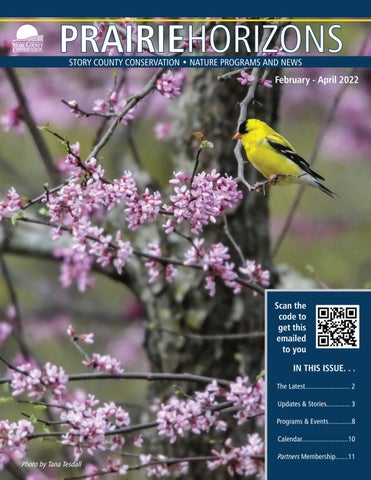
Photo by Tana Tesdall
Partners Membership.......11
— THE LATEST —
Timely and brief updates on ongoing projects
West Peterson Park Remnant Restoration
A grant through the Iowa Native Plant Society funded half the cost to hire Conservation Corps of Iowa for two days to restore a prairie remnant at West Peterson Park. We removed undesired trees and shrubs from the prairie to allow the native seed bed a chance to flourish. We determined that this site had excellent restoration potential by analyzing historic aerial images, native plants currently on site, and historic plant inventories of the area. The section of prairie boasts species such as prairie larkspur, pale purple coneflower, lead plant, and rough blazing star (pictured below). SCC staff will diligently provide follow-up maintenance to keep undesired plant species at bay while allowing desirable plants a chance to grow.
Story County Conservation collaborates with the Conservation Corps of Iowa on habitat restoration work several times each year.
In the parks... Christiansen Forest Preserve • Undesired brush removal in oak/hickory savanna with Conservation Corps of Iowa and Natural Resource Steward Bob Hartzler Dakins Lake • Renovation of primitive campground • Undesired brush removal on prairie remnant with Conservation Corps of Iowa Doolittle Prairie • Reed canary grass control Deppe Property (adjacent to McFarland Park) • Site plan development underway • Natural Resource Steward, Rick Dietz, removing honeysuckle East & West Peterson Park • Renovation of beach area • Undesired brush removal on prairie remnant with Conservation Corps of Iowa Heart of Iowa Nature Trail • New signage at Slater with more wayfinding signage planned soon Hickory Grove Park • Honeysuckle removal from Breezy Bay Campground Jennett Heritage Area • Undesired brush removal along Grant Creek with Conservation Corps of Iowa McFarland Park • Timber stand improvement (TSI)
Partners Update
We might blow this year’s goal out of the water! Our 187 members have given $22,350 so far, with quite a bit of the fiscal year remaining to reach our $30,000 goal. Donations this year will go towards the purchase of the Osheim property (see more on page 11). 2
Praeri Rail Trail • Ash tree removal • Undesired brush removal with Conservation Corps of Iowa Wakefield Woods • Undesired brush removal in oak/hickory savanna with Conservation Corps of Iowa Prescribed fire starting in April
on the cutting
edge of field practices Sara Carmichael
Treating tile outlets through a variety of edge of field practices can intercept nitrogen-rich water before it gets to the stream, creek, or river. These practices also play a crucial role in meeting the Iowa Nutrient Reduction Strategy of 45% reduction in total nitrogen and phosphorus loads leaving Iowa land. But what are edge of field practices, exactly? We’re talking about wetlands, riparian buffers, oxbows, terraces, drainage water management systems, and in the case of a new program we’re rolling out, bioreactors and saturated buffers.
Bioreactors are large underground trenches filled with woodchips. Tile-drained water is diverted to this area where microorganisms use the woodchips as a carbon source to covert nitrate in the water to nitrogen gas. The water is then allowed to drain into the nearby waterway. Bioreactors can drain anywhere from 30-100 acres with average nitrate removal of 43%.
Image by John Peterson
Both bioreactors and saturated buffers require minimal maintenance, have no impact to cropland, and show good lifespan with the bioreactor lasting up to 15 years and the saturated buffer lasting as long as the practice is in place. But, these practices have not been widely installed in Iowa due to a variety of factors including paperwork and financial burden to the landowner. In the past ten years, the state has been able to install only 100 of these edge of field practices. That all changed last year when Polk County figured out a way to scale up and installed 51 in one year. Year two they are planning on installing over 100, with some in Story County! With the help of
Saturated buffers are vegetated areas along a stream that remove nitrates from tile-drained water. This practice directs a portion of the tile-drained water into the buffer rather than discharging directly into a waterway. Saturated buffers have an average nitrate removal of 50%, but have been shown to remove up to 92% on an annual basis.
Both graphics from the USDA
federal, state, and private partners, Polk County took on the surveying, engineering, and financial burden for all landowners. Now, Story County, City of Ames, and other partners are joining this endeavor. In 2022 we hope to install at least 25 of these practices throughout Keigley Branch, East Indian Creek, and Bear Creek watersheds. Furthermore, all practices will be 100% covered for the landowners through a cost share PLUS will earn a $1,000 easement payment per tile outlet treated. For more information about this program and to see if your land is suitable for these practices, please contact Sara Carmichael, Watershed Coordinator at scarmichael@storycountyiowa.gov or 515-598-1652.
3
e c r
Established just last year, the Natural Resource Steward volunteer position has already proven itself to be hugely valuable, allowing us to better allocate resources to accomplish many natural resource projects at once. In this new model of invasive species managment, volunteers are empowered through more training and responsibility. They become licensed as commercial pesticide applicators, a necessary requirement in order to apply herbicide on public lands.
u ds o s r
e wa R l te a r S u t a N
Two individuals came forward right away when we announced the new volunteer opportunity and got their licenses in a hurry! Rick Dietz has been focusing on undesired shrubs (mostly honeysuckle) near McFarland Lake and at the Deppe Property, adjacent to McFarland Park, that will soon become a public area. Removing these dense shrubs near the water allows native grasses and forbs to grow, better stabilizing the soil and improving water quality. Bob Hartlzer has been tackling honeysuckle and oriental bittersweet in the oak/hickory savanna restoration at Christiansen Forest Preserve. This work is allowing sunlight to hit the forest floor that will help stimulate the native vegetation. We owe a big thank you to Rick and Bob for all their efforts this past year. If just two folks can get THIS much work done, we are extremely excited for what the future of this program holds. Are you interested in helping us restore native ecosystems, wildlife habitat, and water quality by obtaining this license? If so, visit the “Get Involved” tab on our website! Volunteers will be assigned a project in one of the parks and trained to remove undesired and invasive plants.
“It's satisfying to see an instant change when invasives (especially honeysuckle) are removed from a woodland or prairie.” ~Rick Dietz “I had hoped to get into conservation work when I started college, but was diverted by job availability. This position provides the opportunity to do the type of activity I had initially hoped to do.” ~ Bob Hartzler
4
Welcome new naturalist, Bobbi Donovan
...Wha� d�e� � na��r��is� d�? Beth Waage
Random questions and comments throughout my career have led me to believe that many people don’t know what a naturliast does when they aren’t teaching a program! Let me give a behindthe-scenes view of what goes on when we’re not in the public eye.
Coaches Special Olympics sports
Has been skydiving twice Has a Masters in Natural Resource Science and Management
The programs we teach, whether to a class, community group, or the general public, don’t just happen. They take preparation: making sure we have the materials, information, and plan. Sometimes all we need is some talking points and a trail while other programs require extensive outlines and a long list of materials. Especially in the case of bigger events like nature camps, a scouting trip might be necessary to first identify and clear any hazards or plan a route through the park. Sometimes just locating a prop for a program becomes a time intensive task. You can’t simple find a woman’s pioneer dress from 1869 on Amazon! Luckily, we have wonderful community members who are able to help us with some of our more unusual requests.
However, some other things we spend our time on include: • Writing for a variety of things like grant applications, articles, or interpretive panels in the parks • Caring for our education animals • Water testing in Story County streams • Attending or presenting at conferences and other professional development opportunities • Serving on committees or boards for professional organizations like Iowa Association of Naturalists or the National Association of Interpretation • Redoing displays in the conservation Center There are probably a few things I am missing. I became a naturalist because I enjoy interacting with people and teaching them about the outdoors, but those special moments take time to plan.
Preparing for and presenting programs is the bulk of our work.
Studied abroad in Australia 5
Photo by Linda Wendt Did you know the average impounded lake in Iowa has a “healthy” lifespan of about 30 years? McFarland Lake, visible from the Story County Conservation Center, was originally created in 1947 and came to its current size and shape in 1969. Quick math tells you that this lake is over 50 years old and 20 years past that average “healthy” age referenced above. So, what qualifies a lake as healthy? Lake health includes a range of biological, physical, and aesthetic functions. Aquatic species diversity and health, nutrient and sediment loading, and other components of water quality all interact in the delicate balance of a lake’s composition. How users value and interact with the water body also help create goals in relation to lake health. Citizens come to McFarland Lake for fishing, paddling, and wildlife viewing, all of which are directly tied to water quality. How was McFarland Lake’s health declining? After a considerable amount of data collection by ISU’s water quality working group, it was found that McFarland Lake had issues with seasonal algal blooms, low water transparency, reduced lake volume due to sedimentation, 6
and invasive carp and snails. None of these are abnormal for an impounded lake in an agriculturally-dominated landscape. They are problems for the plants and animals calling the lake home and for recreation opportunities. And the problems are all connected. Sediment travels into the lake from soil runoff and erosion, carrying phosphorous with it. The phosphorous provides food for an algal bloom. Sediment and algae both reduce transparency, meaning less sunlight reaches the bottom, which impedes beneficial aquatic plant growth. This can reduce oxygen in the water, which not only is negative for aquatic life, but can further contribute to algal blooms. Carp stir up sediment as they feed on the bottom of the lake, literally muddying the water, which again contributes to a lack of plant growth and low transparency. Lack of beneficial aquatic vegetation means less habitat for fish we do want. Much of the barren lake bottom is also covered with invasive apple snails, which actually help filter nutrients in the water, but can be detrimental to plant growth. Fluctuating external factors such as temperature and rainfall also contribute to the aquatic ecosystem’s standing. With all these intertwining pieces, it’s easy to see how the delicate balance can get thrown off.
SCC and ISU’s water quality working group have analyzed the lake and collected data during an extensive study referenced as the McFarland Lake Water Quality Assessment. This data-driven document tells us what is going on in the lake from a biological perspective. We then completed a Watershed Management Plan, which identifies solutions and best management practices for the lake and its watershed. The next step is packaging all this information into a design plan. SCC is currently working with a well-qualified engineering firm to create design documents that will be used for a contractor to complete a lake restoration.
are finalized and funding is secured. Sediment removal, shoreline stabilization, recreational access, improved lake depth, lake drawdown capabilities, and improved lake habitat are some of our goals for the project. We want to make McFarland Lake a healthy and enjoyable destination for another 50+ years!
Ryan Wiemold Parks Superintendent
Expect more updates in the near future after design plans
Last year, a little over 7,100 Iowa taxpayers helped boost wildlife conservation with donations to the Fish and Wildlife Fund on their state tax form. The number of people donating has continually declined and represents about 0.5 percent of total taxpayers in Iowa. However, even with that decline the amount of the donations increased by almost $25,000. This represents the biggest increase in donations in the last 20 years! “We are thankful for those who donated to wildlife conservation with their tax refunds as the funds go directly to habitat development and restoration programs for some of Iowa’s most vulnerable animal species,” said Stephanie Shepherd, wildlife biologist with the Iowa Department of Natural Resources (DNR) Wildlife Diversity program.
The Fish and Wildlife Fund, commonly known as the “Chickadee Check-off,” is a mechanism the Iowa Legislature created in the 1980s for Iowans to donate to wildlife conservation on the Iowa state income tax form. Before this time, so-called “non-game” wildlife had no dedicated funding. Non-game wildlife are the 1,000plus species such as songbirds, bald eagles, salamanders, turtles, monarchs and bees and more that make up the majority of wildlife in Iowa. The Chickadee Check-off is one of the only funding sources for the Iowa DNR’s Wildlife Diversity program, which is responsible for these species. Funding helps to improve wildlife habitat, restore native wildlife, provide opportunities for citizens to learn about Iowa’s natural resources,
and much more. Recent projects have been investigating the nesting success of barn owls and figuring out the status of the endangered rustypatched bumblebee. “The tax check-off line is pretty inconspicuous and can be easily missed. Be sure to remind your tax preparer that they have a client who wants to donate,” said Shepherd. Once located, donating is easy: simply write the amount to donate next to the Fish and Wildlife CheckOff, line 57 on Form 1040, and the sum is either automatically deducted from the refund or added to the amount owed. “If every Iowa taxpayer donated just $1, it would mean $1.5 million for wildlife and natural resource conservation,” Shepherd said. 7
— PROGRAMS & EVENTS — Providing people opportunities and inspiration to develop an appreciation and understanding of nature and humans as a part of it
LGBTQ+ Play OUTside
Walk the Trails!
Join Naturalist Jess Lancial for an opportunity for LGBTQ+ families (whether that means guardians or children) to meet and explore together in nature. These programs are free, but registration is required by 4:30 p.m. on the Friday prior.
April 12: Hertz Family Woods, Nevada (~ 1 mile) April 19: Christiansen Forest Preserve, Huxley (1 mile) April 26: East Peterson Park, Ames (1.5 miles) May 3: Robison Wildlife Acres, Maxwell (2-2.5 miles) May 10: McFarland Park, Ames (3 miles) May 17: Hickory Grove Park, Colo (3 miles)
Monday, February 7: Build a Fort! Tuesday, March 1: Create a Nature Mandala 4:30 p.m. - 5:30 p.m. McFarland Park
Tuesdays in April & May 9:00 a.m. - 11:00 a.m. Countywide!
Winter Presentation
Wednesday, February 23 7:00 p.m. - 8:30 p.m. Ames Public Library Joe McGovern, President of the Iowa Natural Heritage Foundation, will be speaking about their statewide land protection efforts and challenges in permanently protecting large blocks of wildlife habitat in central Iowa. This program is co-sponsored by the Outdoor Alliance of Story County. No registration needed.
LGBTQ+ & Allies OUTside Hikes
Monday, February 28 and Tuesday, March 29 5:00 p.m. - 6:30 p.m. Location emailed to registered participants This program is for anyone age 16+ who identifies as LGBTQ+ and allies. Join Naturalist Jess Lancial for an inclusive community-themed hike in a park! We’ll end our evening with a bonfire and s’mores and brainstorm ideas for future events. This program is free, but registration is required by 4:30 p.m. on Friday, February 25.
Join Environmental Education Coordinator Jerry Keys as we walk the trails in your county parks. This is a great opportunity to explore new places, meet new hiking pals, and have the opportunity to ask nature or park-related questions. These hikes are for ages 16 and up. The hikes are free, but registration is required for each by 9:00 a.m. the day prior.
Geocache Egg Hunt
Saturday, April 16 10:00 a.m. - 12:00 p.m. McFarland Park Your family will love this new-age way of hunting eggs. Join Naturalist Jess Lancial to learn how to use a GPS, then go search the woods to find the Conservation Bunny’s nests of hidden treasures! Discover prizes, candy, and nature’s treasures along the way, being sure to keep a watchful eye for the “golden egg,” which earns you a special prize. Spots are limited, so register early! Fee of $5 per collector (any child between 3-14 years old) is required with registration by 4:30 p.m. on Monday, April 4.
STORY COUNTY CONSERVATION 515.232.2516
8
56461 180th Street • Ames, Iowa 50010 Monday - Friday • 8:30 a.m. - 4:30 p.m. conservation@storycountyiowa.gov • www.storycountyconservation.org
Climate Conversations
Saturday, April 23 1:00 p.m. - 2:30 p.m. Conservation Center, McFarland Park Want to talk about climate change with friends and neighbors but not sure how to start? Find out why it is important to start the conversation, develop stories and strategies to communicate effectively, and feel empowered by community-based solutions. This conversation is best suited for high-school age and up. This program is free but registration is required by 4:00 p.m. on Tuesday, April 19.
Spring Walk
Saturday, April 23 3:00 p.m. - 4:00 p.m. McFarland Park Enjoy spring with a walk in the woods. We will focus on first wildflowers, but who knows how the season will surprise us? The route will include soft-surface trails with stairs and hills; not appropriate for strollers. This walk is free, but registration is required by 4:00 p.m. on Tuesday, April 19.
Weedin’ Out Wednesday April 27 & May 4 1:00 p.m. - 3:00 p.m. Locations TBD
Help us weed the parks! We’ll be pulling garlic mustard or using hand tools to cut honeysuckle, both of which are invasive plants taking the place of more valuable native plants. Work locations will be emailed to registered participants the week of the event. Registration is required by the Sunday prior. Participants ages 15 and under must be accompanied by an adult.
Feathers and Flowers Saturday, April 30 9:00 a.m. - 11:00 a.m. Robison Wildlife Acres
Romp through the woods to view the splendor of spring! We will look to the ground for wildflowers and to the sky for the birds. This event is free but registration is required by 4:30 p.m. on Wednesday, April 27.
O.W.L.S. Programs
O.W.L.S. (Older, Wiser, Livelier Souls) are designed for “boomers” or older, but anyone can attend. Program runs from 10:30 - 11:30 a.m.; doors will open at 10:00 a.m. for coffee/tea and chatting. Greater Des Moines Botanical Garden Thursday, February 3 Explore the history of Des Moines’ premier horticultural institution and the unique collections housed within. This presentation by Heather Wilson will highlight how the Botanical Garden came to be, give insight into future growth and development, and explain how members of the community can get involved. Natural Resource Stewards Thursday, March 3 Invasive species are not a new problem in Story County parks, but we are tackling them with a new approach. Hear from Outreach Coordinator Erica Place about the development of the Natural Resources Steward position, what species they are targeting, and see examples of what they’ve accomplished. An African Safari - Ty Smedes Tuesday, April 7 Ty will bring viewers along on an African safari. This presentation includes many striking and intimate images of Africa, including photos of birds and mammals with young, catching prey, and interacting in fascinating ways. If you’ve ever wondered what an African safari is like, come loaded with your questions for an experienced traveler who has led eight safaris to this continent. 9
— CALENDAR OF EVENTS —
Date FEBRUARY February 3 February 7 February 14 February 21 February 23 February 28
MARCH
April 7 April 11 April 12 April 16 April 19 April 23 April 23 April 26 April 27 April 30 May 3 May 4 May 10 May 17
Event
10:30 a.m. 4:30 p.m. 5:30 p.m.
OWLS: Greater Des Moines Botanical Garden LGBTQ+ Play OUTside: Build a Fort Story County Conservation Board Meeting Story County Conservation offices closed Winter Presentation: INHF LGBTQ+ & Allies OUTside Hikes
7:00 p.m. 5:00 p.m.
March 1 March 1 - 20 March 3 March 7 March 29
APRIL
Time
4:30 p.m.
Location McFarland Park McFarland Park McFarland Park Ames Public Library TBD
10:30 a.m. 5:30 p.m. 5:00 p.m.
LGBTQ+ Play OUTside: Nature Mandalas Annual Photo Contest Submission Period OWLS: Natural Resource Stewards Story County Conservation Board Meeting LGBTQ+ & Allies OUTside Hikes
McFarland Park online McFarland Park McFarland Park TBD
10:30 a.m. 5:30 p.m. 9:00 a.m. 10:00 a.m. 9:00 a.m. 1:00 p.m. 3:00 p.m. 9:00 a.m. 1:00 p.m. 9:00 a.m. 9:00 a.m. 1:00 p.m. 9:00 a.m. 9:00 a.m.
OWLS: An African Safari McFarland Park Story County Conservation Board Meeting McFarland Park Walk the Trails! Hertz Family Woods & Nature Preserve Geocache Egg Hunt McFarland Park Walk the Trails! Christiansen Forest Preserve Climate Conversations McFarland Park Spring Walk McFarland Park Walk the Trails! East Peterson Park Weedin’ Out Wednesdays TBD Feathers and Flowers Robison Wildlife Acres Walk the Trails! Robison Wildlife Acres Weedin’ Out Wednesday TBD Walk the Trails! McFarland Park Walk the Trails! Hickory Grove Park
Need to locate one of our parks or areas? You can view individual maps and 911 addresses online.
www.storycountyconservation.org
10
BOARD & STAFF
HELP PURCHASE A NEW PROPERTY!
Conservation Board
Craig Meyers, Chair Christine Laumer, Vice Chair Dr. Nancy Franz, Secretary Dr. Jim Pease, Member Ted Tedesco, Member Linda Murken, Ex Officio Member
The Story County Conservation Board typically meets the second Monday of each month at the Story County Conservation Center at McFarland Park (56461 180th St.), northeast of Ames. Meetings are open to the public.
Conservation Staff Conservation Center, Ames
Michael Cox, Director Ryan Wiemold, Parks Superintendent Pat Shehan, Special Projects Ranger Marianne Harrelson, Financial Data Manager Brittany Ridgway, Administrative Assistant II Jerry Keys, Environmental Education Coordinator Bobbi Donovan, Naturalist Jess Lancial, Naturalist Rebekah Beall, Naturalist Beth Waage, Naturalist Erica Place, Outreach Coordinator
Help us reach our goal of $30,000 Your Story County Conservation Partners membership will help purchase a new property along the South Skunk River south of Story City. You will receive a nature-themed magnet and a 10% discount on all programs, facility rentals, and merchandise. The Red Fox membership level and above will be recognized in the conservation center for their support. Eagle Business Level - $1,000 or more Red-tailed Hawk - $1,000 or more Great Blue Heron - $275 to $999 Red Fox - $125 to $274
Monarch Business Level - $250 to $999 Goldfinch - $70 to $124 Otter (Family) - $35 to $69 Great Horned Owl (Individual) - $30
Name Address City
State
Zip
Phone E-mail Enclosed is my check for $ My membership level is Make checks payable to: Story County Conservation Partners 56461 180th Street, Ames, IA 50010-9451; Phone (515) 232-2516 Or join online! www.mycountyparks.com/ County/Story.aspx
McFarland Park Shop, Ames
Russ DeWall, Operations Supervisor Vacant, Park Ranger Dillon Schmidt, Conservation Technician II Vacant, Conservation Technician Derek Seward, Trails/Natural Resources Technician
Hickory Grove Shop, Colo
Jake Smith, Operations Supervisor Vacant, Park Ranger Joe Hill, Conservation Technician II Hunter Simmons, Conservation Technician Brandon Clough, Natural Resource Specialist
IRVM Office & Shop, Nevada
Joe Kooiker, Vegetation Management Biologist Tyler Kelley, Vegetation Management Specialist
Administration Bldg, Nevada
We are grateful to all those who support Story County Conservation with donations of time, funding, and materials.
THANK YOU TO THE FOLLOWING FOR THEIR GENEROSITY All Partners members & volunteers Alex Krumm Kelly Uhlig Chris Gleason Elizabeth Astaire Jon Chelter & Margaret Armstrong Linda Severson Dan & Margaret Jaynes Fred & Karen Dohrmann
Dorothy Dake Carol Saffran Jane Lohnes Gordon Bivens Connie Hall Big Bluestem Audubon Societ Outdoor Alliance of STory County Joanne Eisenhart
Sara Carmichael, Watershed Coordinator
11
STORY COUNTY CONSERVATION 56461 180th Street Ames, Iowa 50010-9451
Nonprofit Org. U.S. POSTAGE PAID Ames, Iowa Permit 301