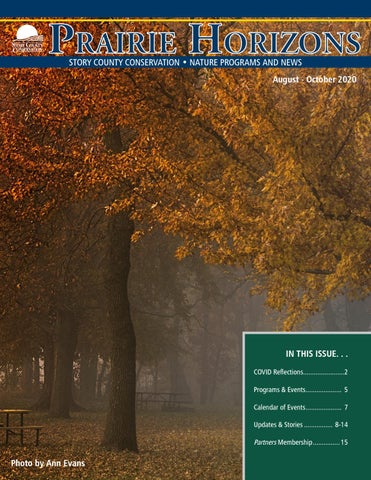
STORY COUNTY CONSERVATION • NATURE PROGRAMS AND NEWS August - October 2020
IN THIS ISSUE. . . COVID Reflections.......................2 Programs & Events..................... 5 Calendar of Events..................... 7 Updates & Stories................. 8-14
Partners Membership................ 15
Photo by Ann Evans
Reflections in a COVID-19 World
Rebekah Beall, Naturalist
I’m working on this article at a desk littered with towels wet with spilled water color paints, a two-year-old’s shoes, and a toy mailbox. These share space with my work notes and files, assembled months ago before I walked out of my office in the Conservation Center. Like you, our routines and normal settings have been disrupted as we adjust to the new challenge we all face. Some of our staff share how things have changed at Story County Conservation, how we are moving forward, and the role of a constant in our staff’s lives—and many of yours—nature.
How has your work changed?
Heather Hucka, Naturalist: “What has changed? Everything! As a naturalist I feel my job--and even more my purpose--is to connect people to nature. It is to build communities in which people feel a part of the natural world and directly linked to the plants and animals around them. Before the virus, April and May were a whirlwind of classroom programs merging into non-stop field trips. There would be days where I would teach groups of more than 100 students and adults at a time. Then June would sneak up behind May and summer nature camps would begin. At these camps we have the ability to foster deeper relationships with our participants and help build their personal connection to Iowa and its wildness. It would be common for me not to turn on my computer the entire day because I needed to get things ready for an all-day outdoor experience…” “I miss closeness. I miss not feeling awkward when I am near someone. I miss my community!”
Brandon Clough, Natural Resource Specialist: “For field staff the largest hurdle that we face is coordinating with each other while practicing social distancing. A lot of our job duties require multiple people working on the same page – the best example for this is controlled burns. We often work with a crew of 4-6 people and, while doing so, share equipment and travel to our remote parks. We have remedied some of these issues by driving to burns separately and giving people specified roles before the burn. Luckily, we already wear PPE [personal protective equipment] that helps limit the spread of germs, such as smoke masks and leather gloves. Burning with soot-covered gloves can also be a good indicator as to how much you touch your face!” “It forced us to miss the early prescribed burn window, and we had to focus all of our efforts on the late burn window. There has been a lot of research showing that the late burn window is the best time to burn for ecological purposes. This will further set back the non-native cool season grasses because it forces them to exert more energy to come back. It also allows for a more timely response by the later growing native species without the competition of the early growing invasive grasses. It also further sets back undesirable trees and shrubs because they already exerted the energy to bud out and produce leaves.” Elizabeth Jackson, Administrative Assistant: “The lack of routine was the hardest part for me… But, being home every day for lunch with my husband was a bonus. I had not been able to do that for over 10 years. Hearing voices in the office has been very helpful. Those voices we recognize—the laughs, the conversations, hearing about our work families and their families—have reminded me how much I love that part of my job. Likewise, not seeing certain faces on a regular basis, or at all, reinforces that we are still in the midst of this.” 2
What has been unexpected or changed your perspective? Brandon Clough, Natural Resource Specialist: “One positive that has come out of the pandemic has been our awesome volunteers. We normally have large volunteer events in the spring to pull garlic mustard. We obviously couldn’t host these this year, so Erica [SCC’s outreach coordinator] made an awesome video tutorial that she posted on social media to teach people how to correctly identify and pull garlic mustard. We received great support! I drove around to collect the yard waste bags that were filled with garlic mustard so that I could take them to a safe place to properly burn them to destroy the seed source. I filled my truck bed full at both Robison and East Peterson Parks. This experience has opened my eyes to what our volunteers are capable of if given a mission. Using this strategy in the future during post-pandemic could bolster our natural resources field work with more people-power!” Heather Hucka, Naturalist: “I have always been one to shy away from technology and see disconnect from it as a medicine. Because of social distancing, I can no longer live a life away from screens and computers. Zoom meetings, face time, online learning, and telecommunication have created a world that makes me feel anxious and disconnected in an entirely different way. But what I didn’t expect or realize would also be taken away was the powerful medicine I rely on from the people of Story County. The teacher’s smile when you walk into the classroom. The cheers and admiration we receive from the children when they arrive at the park. Hugs, heartfelt thank yous, long tall tales, laughter, and pure unrestrained excitement—gone. Replaced by my own frustrated and disappointed children who say home school is the worst. Cancelled family vacations and get-togethers.” Elizabeth Jackson, Administrative Assistant: “Prior to the stay at home measures, I wonder how many people thought to themselves, ‘I wish I had more time at home with my family, or I wish I had more opportunities to be out in nature.’ Lo and behold, we were given both. Did we see that as a blessing? Is this an opportunity to reflect on what’s most important? Simplicity, perhaps? We all know the serious health crisis that surrounds us, but if we set that aside--can we even do that--and see the good? I am always hopeful and optimistic. I know that’s not how everyone is, especially those who have lost loved ones or their jobs. I do hope we emerge more mindful of our neighbors. We can all learn something from this.”
How have you connected with nature during this time? Brandon Clough, Natural Resource Specialist: “Spending time in nature is extremely important to me. I haven’t increased my time in nature too much, but that is because it was a normal thing for me. Spring is always one of my favorite times to be outdoors. It’s awesome to see the new life in the spring—especially in the woodlands once all of the spring ephemerals start blooming! It’s a great time to be outdoors: morel hunting, turkey hunting, shed hunting, fishing, gardening, and just taking advantage of the warm weather to do your preferred method of exercise—hiking, biking, running, paddling. It’s been awesome to see the increased use of all of our parks and trails during this time. Both politicians and the media seem to be bringing up the importance of our park and trail systems for mental and physical health. I’m hoping that is one thing that remains constant post-pandemic.” Elizabeth Jackson, Administrative Assistant: “When I was home, my daily walks were a Godsend. The beauty, the randomness of others out for a walk, the fresh air, wow.” 3
Heather Hucka, Naturalist: “The weather is settling down, and I am enjoying being out more. But when I hike around the park or see a rare sight, I am left feeling alone. The bluebells were beautiful this year, but I didn’t hear a single child proclaim that they could hear them ringing. The garlic mustard was rampant this year, and I didn’t see the look of pride and achievement on the faces of a class who just completed their service learning project holding bags of pulled plants…”
Heather’s kids made their own swimming pool in their backyard!
“Life has most certainly changed since the virus. My family is as close and connected as we always have been. We play outside, go fishing and hiking, and spend a lot of our time outside. The virus has not changed that. What is has done is taken almost everything else away for now. I am hope-filled. I can’t wait to lead a hike again. I can’t wait to hear a never-ending story from a small child again. And I can’t wait until I am able to bring my community back face-to-face with nature.”
Along with the expected unfolding of spring—blooms of hepatica, followed by trout lily and bluebells, the sweet songs of white-throated sparrows and flicker of warblers in the trees—this novel virus arrived in our human lives. And in response, many people have recognized the benefits of nature and are seeking time outdoors. Like many park systems, Story County Conservation saw a tremendous increase in visitors to parks and trails in response to the pandemic, and that trend continued into the summer. Our staff is glad to know that the natural areas entrusted to our care have been so valued during this difficult time, and we strive to continue to connect our community to nature. Stay safe and get outside. Visit our website to find descriptions and a map of our parks across Story County, and for updates to our operations.
4
— PROGRAMS & EVENTS — Providing people opportunities and inspiration to develop an appreciation and understanding of nature and humans as a part of it
Nature Play Programs
Here is a chance for families to gather at McFarland Park and allow their kids to play freely with other kids outdoors. Let the imagination, discoveries, and friendships unfold! Families are encouraged to bring a picnic dinner and continue the fun at the Nature Playscape after playtime. Adults must remain present. Activities are most appropriate for ages 5 and up, but all are welcome. Tuesday, August 18, 5:30 - 7:00 p.m. A Frogging We Will Go! Bring your water shoes, and get ready to get wet and muddy! A naturalist will hand out scooping equipment and we will head to the pond to catch frogs, tadpoles, snails, and other fascinating pond creatures. Participants should wear closed-toe shoes and clothes that can get wet and muddy. This free program requires registration by 4:00 p.m. on Monday, August 17, and spots will be limited. Friday, October 23, 4:30 - 6:00 p.m. Into the Woods! A naturalist will lead the group to a designated wooded area and will facilitate fort building and unstructured nature play. Participants should wear long pants and closed-toe shoes. This free program requires registration by 4:00 p.m. on Thursday, October 22, and spots will be limited.
O.W.L.S. Programs
O.W.L.S. (Older, Wiser, Livelier Souls) programs are held each month at the Story County Conservation Center. These are designed for “boomers” or older -- but anyone can attend. Tuesday, September 1 10:30 - 11:30 a.m. (new program time) Exploring Madagascar Jess Lancial, Story County Conservation Located off the east coast of Africa, Madagascar is the world’s fifth largest island and known as a hotspot for biodiversity, boasting species like lemurs, fossas, chameleons, and flying fox bats. With 80% of its natural forests now gone, Madagascar is one of the fastest disappearing ecosystems on our planet. Join Naturalist Jess Lancial as she shares stories and photography chronicling her month-long excurison through Madagascar and its unique landscapes, cultures, and wildlife. There will be no lunch with this program. Coffee and tea will be available. Tuesday, October 6 10:30 - 11:30 a.m. (new program time) The Brenton Arboretum: Past, Present, and Future Melissa Burdick, Executive Director Nestled in the heart of Dallas County farmland, The Brenton Arboretum is one of Iowa’s premier botanical collections. Join us for an exploration of The Brenton Arboretum from pioneer farming days, to a seed of an idea in founder Buz Brenton’s imagination, to the stunning cultural attraction it is today. Plus, enjoy a sneak peek at the exciting projects in store for the future of the Arboretum with a glimpse at the newly updated master plan. There will be no lunch with this program. Coffee and tea will be available.
STORY COUNTY CONSERVATION 515.232.2516 56461 180th Street • Ames, Iowa 50010 Monday - Friday • 8:30 a.m. - 4:30 p.m. conservation@storycountyiowa.gov • www.storycountyconservation.org
5
Paddle Boarding Basics
Story County Pheasants Forever Youth Hunt
Stand up paddle boarding is the fastest growing paddle sport in the country. Come and learn about different boards and have fun trying your skills out on the water. Paddle boarding can provide an amazing full-body workout that addresses your core, cardio fitness, balance, and flexibility, all with the fluidity of a paddle sport. Fee of $15 with registration is required by 4:00 p.m. on Monday, August 17.
Story County Pheasants Forever is bringing their annual youth hunt back to Hickory Grove! Youth 11-15 years old will need to have completed Hunter Education or one season of trap shooting through school club/team. The day will include safety discussion, shooting practice, lunch, and a hunt (one bird per hunter). This event is free, but registration is required. To register, visit http://storycountypheasantsforever.com/.
Evening Prairie Walk
Wild Women of the Woods
Thursday, August 20, 6:00 - 8:00 p.m. West Peterson Park (55310 180th St., Ames)
Thursday, August 27, 7:00 - 8:30 p.m. Doolittle Prairie (14249 560th Ave., Story City) Join Dr. Thomas Rosburg on a prairie walk at the largest prairie remnant in Story County. See rare and common prairie flora, and learn about the history and ecology of Central Iowa prairies. Long pants, sturdy, closed-toe shoes, and bug spray are recommended. This walk is free and no registration is required.
SOAR Annual Release Party
Sunday, August 30, 1:00 - 2:00 p.m. Multiple Locations! Join Saving Our Avian Resources (SOAR) for an afternoon with some feathered friends! Rehabilitated birds will simultaneously be returned to the wild at several locations through the county. Watch our Facebook page for more details.
Community Campfire
Friday, September 11, 6:30 - 8:30 p.m. McFarland Park (behind the Conservation Center) Campfires have been bringing people together for centuries and have a very calming power. They also symbolize a community gathering place where folks are able to share experiences and knowledge. Join us as we tell stories and sing songs to celebrate the end of the day. This program will be canceled in the event of inclement weather.
6
Saturday, October 3, 9:00 a.m. Oriole Ridge Lodge, Hickory Grove Park
Saturday, October 10, 7:30 a.m. - 5:30 p.m. Hickory Grove Park (67464 250 Street, Colo)
Spots are still open in this annual workshop! We’ve revised the format to ensure we’re following COVID-19 best practices. Find the registration packet on our website.
Evening Exploration
Friday, October 23, 6:30 - 8:00 p.m. Story County Conservation Center, McFarland Park Discover the mysteries of the dark at the park! Test your senses and try your hand at talking with the owls. This hike is not intended to scare but to excite your imagination! This free hike requires registration by 4:00 p.m. on Wednesday, October 21.
Fall Foliage Walk
Thursday, October 29, 1:30 - 3:30 p.m. Soper’s Mill (meet at 56364 170th St., Ames) Take a stroll with others and appreciate the changing fall colors at Soper’s Mill. The hike will end in a picnic of whatever the hikers bring to share. No registration is required; hike will be canceled if the weather is unsafe. Please leave your dog at home. This hike is led by an Outdoor Alliance of Story County volunteer. Contact info@oasco.org for more information.
— CALENDAR OF EVENTS — Date Time Event Location AUGUST
Monday, August 10 Tuesday, August 18 Thursday, August 20 Thursday, August 27 Sunday, August 30
5:30 p.m. 5:30 p.m. 6:00 p.m. 7:00 p.m. 1:00 p.m.
Story County Conservation Board Meeting Conservation Center Nature Play: A Froggin We Will Go! McFarland Park Paddle Boarding Basics West Peterson Park Evening Prairie Walk Doolittle Prairie SOAR Annual Release Party Locations TBD
SEPTEMBER
Tuesday, September 1 10:30 a.m. Friday, September 11 6:30 p.m. Monday, Sept. 14 5:30 p.m.
OCTOBER
Saturday, October 3 Tuesday, October 6 Saturday, October 10 Monday, October 12 Friday, October 23 Friday, October 23 Thursday, October 29
O.W.L.S.: Exploring Madagascar Conservation Center Community Campfire McFarland Park Story County Conservation Board Meeting Conservation Center
9:00 a.m. 10:30 a.m. 7:30 a.m. 5:30 p.m. 4:30 p.m. 6:30 p.m. 1:30 p.m.
Story County Pheasants Forever Youth Hunt Hickory Grove Park O.W.L.S.: The Brenton Arboretum Conservation Center Wild Women of the Woods Hickory Grove Park Story County Conservation Board Meeting Conservation Center Nature Play: Into the Woods! McFarland Park Evening Exploration McFarland Park Fall Foliage Walk Soper’s Mill
As we head into fall, we may have additions or changes to our public programs, volunteer events, or scheduled meetings. Please watch our website calendar or social media for the latest information. Perhaps the oddest summer staff photo we’ve ever taken! These individuals have been busy with natural resource management and maintenance in the parks and on the trails. Give these future conservation professionals a wave if you see them on your next park visit! Back row: Josimar Palacio, Devin See, Jacob Smith, Kaleb Angell, Sean Vellinga, Nicholas Hadaway Front row: Richard Mortenson, Kevin Schlotfeldt, Emily Lemons Not pictured: Madeline Schill, Allison Stegmann, Hunter Simmons Need to locate one of our parks or areas? You can view individual maps and 911 addresses online.
www.storycountyconservation.org 7
— THE LATEST —
Timely and brief updates on ongoing projects
Trail Updates Praeri Rail Trail After a delay in construction last fall due to cold and wet conditions, the paving on the Praeri Rail Trail in Zearing is now complete. This paved section is from Highway 65 heading east into Zearing to meet up with West Main Street on the west edge of downtown. The grass planting is still very new, so please use caution when not on the paved trail to allow for a healthy stand of grass to develop. Tedesco Environmental Learning Corridor -- Phase III The last of the three project phases is well on its way! The project features a 10’ paved trail through a natural corridor and then along 260th Street past the ISU Dairy Farm. This 2.5-mile trail connects the Tedesco Environmental Learning Corridor in the ISU Research Park to the R-38 bike lanes leading to Slater. One of the four guiding concepts in the development of this park was connectivity; this connection to regional trails like the Heart of Iowa Nature Trail and the High Trestle Trail ensures the park will remain stitched into the network of surrounding communities. We anticipate the trail to be complete this fall. Heart of Iowa Nature Trail More progress is being made on paving the Heart of Iowa Nature Trail. The section between Slater and Huxley was finished last fall, and we’re now working on the section between Huxley and the bridge over the South Skunk River east of Cambridge. Over 72% of the funding for this section has come from various grants. If all goes well, the trail should be reopened this fall. Subsequent stretches will be paved according to the master plan (available on our website) as funding becomes available.
8
Land Projects Skunk River Flats Addition
An additional 40 acres of riverfront prairie and woodland has been added to the already established 117 acres at Skunk River Flats. The property offers increased river and floodplain protection as well as valuable habitat. This bargain sale is under contract for purchase which was aided by generous donations from both the Iowa State University Student Chapter and the Story County Chapter of Pheasants Forever. The site is currently open for public use.
Sleepy Hollow Addition
An additional 15 acres have been added to Sleepy Hollow Access (on the South Skunk River, across from Ada Hayden in Ames). This addition will offer more river protection, native habitat, and bowhunting opportunities for youth and disabled hunters. A reservation system will be created for two on-site blinds. Habitat restoration efforts in addition to tree plantings funded through grants will improve hunting opportunities. The site’s purchase was aided by a generous donation from Story County Pheasants Forever, ITC Midwest, Greg Vitale and Flo Hamrick, Big Bluestem Audubon Society, and the Outdoor Alliance of Story County. Opening is anticipated in 2021.
New Property South of Story City
A 35-acre parcel along county road E-18 and the South Skunk River is under a contract purchase and will offer river protection, native habitat, and archery hunting to the public in the near future. The property features a wonderful mix of native tallgrass prairie, wetlands, and floodplain timber. The previous landowner, Rosemary Osheim, spent years on restoration work to maintain and improve this natural habitat, and this will make a wonderful addition in Story County Conservation’s effort to continue protection of the Skunk River. This purchase has been aided by the Outdoor Alliance of Story County and is the next Partners fundraising project. The property is currently unnamed and will be made open to the public once restoration efforts and a site plan are further developed.
9
HGP update
SCC and the Iowa Department of Natural Resources (DNR) are partnering to renovate the remaining fishery in Hickory Grove Lake. The DNR will treat Hickory Grove Lake late this summer or early fall (pending workable weather conditions) with rotenone, a botanical pesticide, to eliminate the remaining fish population. An attempt was made last fall/winter to drain and dry the lake basin to rid the lake of common carp, grass carp, and black bullhead. These injurious fish species reduce water clarity, destroy aquatic plants, and prevent the fishery from reaching its full potential. Unfortunately, common carp were observed this spring as the lake was refilling. “The most effective method to eliminate the remaining fish population is to apply rotenone to the lake basin and tributaries,” said Ben Dodd, DNR Fisheries Management Biologist. Visit our website for more information about rotenone, the stocking plan, and other project updates.
Bird Friendly
Story County is being recognized for a commitment to protecting, restoring, and enhancing bird habitat, reducing threats to birds, and educating and engaging people in birding and conservation. Story County is now officially designated as a Bird Friendly County. “Birds are an extremely important means of connecting communities and citizens with our environment,” said Doug Harr of the Bird Friendly Iowa Steering Committee. “Birds serve as indicators of healthy soil, water, air, native vegetation, and other natural resources. Providing quality bird habitat can help reverse the dramatic decline of populations of birds, Monarch butterflies, and other critical components of biodiversity, locally or even at statewide and higher levels.” Staff from multiple county departments and members of the public collaborated to pursue the Bird Friendly County designation. The full application can be found at www.storycountyconservation.org. Are there ways we can help you make small changes at home to be more bird-friendly? Tell us what resources or conversations would be helpful!
10
Partners
A big thank you to Renewable Energy Group for becoming a “Monarch” level business member of our Partners Program. Their donation, made in honor of the 50th anniversary of Earth Day, will be used to support environmental education programs. At the end of fiscal year 2020, Partners contributions tallied $22,399.89 (the best year in the history of the program!). Since Partners started raising funds for specific projects in 2017, you have given over $80,000 and helped purchase 224 acres of land (Ronald “Dick” Jordan Family Wildlife Area and Carroll Prairie) and updated park facilities (Hickory Grove beach house). All donations received in fiscal year 2021 will go towards the contract purchase of an amazing 35-acre tract of land along the South Skunk River south of Story City (referenced on page 9).
West Peterson Park Updates
A new “U”-shaped dock replaces the previous “L”-shaped one located off the parking lot at West Peterson Park, offering more angling opportunities. The parking lot was also redone to provide safer and more efficient parking. A vault toilet and entrance monuments are slated to be installed in spring of 2021.
Derek Seward Joins SCC as Natural Resources/Trails Technician
I am originally from the small town of Hornick in western Iowa. My family has a 47-acre farm in the heart of the Loess Hills. I grew up exploring the farm hiking, hunting, and fishing with my three brothers and one sister. These hobbies led me to pursue the natural resources field. I graduated from Iowa State University with degrees in Forestry and Animal Ecology in 2019, then went to work in northern Indiana doing wetland and black oak savannah restorations near Lake Michigan. These experiences have prepared me to manage the amazing natural resources in Story County. I am looking forward to working with the public at volunteer events and managing the trails and recreational resources that we all enjoy.
Nature is for everyone?
conservation@storycountyiowa.gov
11
Friend or Foe?
Allison Laney, summer staff for IRVM program
You’re driving or exploring the Iowa landscape, or maybe you’re mowing or gardening in your yard, and you come across what you think is a problematic plant. Take pause and examine closely, because several problematic non-native plants have native and harmless (and even beneficial) lookalikes.
ORIENTAL BITTERSWEET VS. AMERICAN BITTERSWEET
Originally introduced as an ornamental, Oriental Bittersweet is a quick-growing woody vine native to Eastern Asia. Its bright berries make for attractive door wreaths... or so we thought. It is now rapidly taking over woodlands as it has no native controls, and is listed as a prohibited plant in Iowa (meaning it is illegal to possess it). This vine establishes easily and creates a thick shade, killing native plants below. It wraps itself around anything American Bittersweet Photo by Larry Reis it touches, choking and killing trees and other (Celastrus scandens) native plants. Its native counterpart is American • Native to Iowa Bittersweet, which doesn’t pose the same threats • Orange fruit capsules and is being outcompeted by this invasive • Fruit clusters at end of stem lookalike. The best and most effective method of removal and control of Oriental Bittersweet is pulling the plants by the roots before fruits grow. Place all pulled plants and fruits into a bag and remove from the area. The use of herbicide can be effective but is limited due to potential damage to nearby desirable plants.
• Food source for songbirds, pheasants, and squirrels
Oriental Bittersweet (Celastrus orbiculatus) • Not native to Iowa • Yellow fruit capsules • Fruit clusters along length of stem
WILD PARSNIP VS. GOLDEN ALEXANDER
We all recognize that bright yellow flower growing in roadsides across most of the country given its recent light in the media. But don’t get the dangerous Wild Parsnip confused with the native Golden Alexander. Wild Parsnip quickly spreads and can take over a prairie or roadside in a few short years. It is a biennial, which means a plant will grow and produce seed for two years before dying. This makes it difficult to control. Not only is it harmful to the landscape, but also to human skin. The plant causes Phytophotodermatitis; when any part of the plant comes into contact with bare skin in the presence of sunlight, a burn and blisters develop. This reaction is very painful and can leave scarring.
12
Telling the difference between Wild Parsnip and Golden Alexander can be quite the task for the beginner’s eye. From a distance, the species look almost identical with their lacy yellow flowers. You’ll have to get closer to spot the differences. Wild Parsnip (Pastinaca sativa)
Golden Alexander (Zizia aurea)
• Not native to Iowa • Large, rigid, forked leaves • Grows up to 5 feet tall • Causes burns when it comes into contact with skin in the presence of sunlight
• Native to Iowa • Smooth, finely serrated leaves • Grows up to 3 feet tall • Excellent source of pollen and nectar for insects with short mouthparts
If you’re looking to control Wild Parsnip, it’s best to use a combination of burning, spraying, and pulling/cutting before the seeds set.
NON-NATIVE VS. NATIVE THISTLES
You can find a handful of thistle species in Iowa. Bull, Musk, and Canada are some of the commonly found non-native ones, while Tall and Field are two examples of native thistles. Non-native thistles can be highly prolific. But our native thistles have important roles in the ecosystem; they’re a valuable source of food, and the fluffy down from their seeds lines the nests of our state bird, the American Goldfinch. So it’s important to be sure what thistle you’re dealing with before attempting to control. When comparing thistles side-by-side, the flowers are almost the same color and shape, and each has those pesky spines we all despise. The key to identifying the native thistle is to check the color of the underside of a leaf. Leaves of most of the native thistles will have a silvery-white underside. Control of non-native thistles varies by species; cutting, mowing, spraying, and burning can be effective tools when used under the right conditions and for the right species. Our native species have many great benefits to our natural world. They’ve evolved on this landscape along other species with which they interact. Not only do plants offer habitat, erosion control, and improved water quality, but their berries, seeds, and pollen are a large source of food for birds, butterflies, and other pollinators who are struggling. And, having a strong and diverse plant community is your best defense against invasive plants. So before you get out that weed whacker or spray bottle, make sure you’re not confusing a friend for a foe.
13
Beth Waage, Naturalist
Photo by Carl Kurtz The joy of capturing living light in a mason jar is one many of us experienced in our childhood. Waiting patiently (or not so patiently) for the sun to go down, dodging mosquitos, playing flashlight tag. And then, one flicker, maybe two, then four, then what seemed like thousands! Fireflies are as quintessential to Iowa summertime as sweetcorn. These flashing insects, however, are not actual flies. They are part of the beetle group, with hard outer shells and soft wings underneath. Most adult fireflies don’t eat, so the handful of grass or leaves that oftentimes accompanies them in the mason jar is more to make them feel at home than for food. They spend most of their lives, sometimes up to two years, as larvae! While it may seem like we’ve all got the same generic “firefly” in our backyards, there are actually over 150 species of fireflies in North America. Eighty percent of these fireflies use some form of flash, flicker, or glow to communicate. Their light-producing organs, called lanterns, are so super complicated that even scientists don’t fully understand how they work. This light is used to recognize other fireflies of the same species for mating. Fireflies are nocturnal (nighttime) creatures, and light pollution has posed a problem for them in recent years. Light pollution refers to artificial light used at night, which includes everything from large street lamps to the small lights a homeowner might use to illuminate a path or flagpole. The increase in light pollution might be obscuring their communication process, preventing them from finding each other to mate and leading to a decrease in firefly populations. To help bring dark nights back, reduce or eliminate the use of unnecessary outdoor lighting. There is also some research that points to red light bulbs having less of a negative impact on fireflies. A threat common among animals everywhere is equally a problem for fireflies: loss of habitat. There are some easy fixes that we can do on our own properties! Leave some leaf litter in places where you are able. This provides the moisture that many fireflies need and is a good place for shelter. When mowing, set your blade higher to leave a buffer between fireflies and the blade. Reduce or eliminate pesticide use. These small changes are helpful to many more creatures than just fireflies. Doing these and many other suggestions found at https://xerces.org/endangered-species/fireflies will ensure that you will be able to capture magic on a warm summer evening.
14
BOARD & STAFF Conservation Board
Dr. Jim Pease, Chair Christine Laumer, Vice Chair Dr. Nancy Franz, Secretary Craig Meyers, Member Ted Tedesco, Member Linda Murken, Ex Officio Member
Conservation Staff Conservation Center, Ames
Michael Cox, Director Ryan Wiemold, Parks Superintendent Pat Shehan, Special Projects Ranger Marianne Harrelson, Financial Data Manager Elizabeth Jackson, Administrative Assistant II Jerry Keys, Environmental Education Coordinator Heather Hucka, Naturalist Jess Lancial, Naturalist Rebekah Beall, Naturalist Beth Waage, Naturalist Erica Place, Outreach Coordinator
McFarland Park Shop, Ames
Danny Simcox, Park Ranger Russ DeWall, Conservation Technician II Derek Seward, Trails/Natural Resources Technician Joe Hill, Conservation Technician Dillon Schmidt, Conservation Technician
Hickory Grove Shop, Colo
Luke Feilmeier, Park Ranger Beau Hoppe, Conservation Technician Vacant, Conservation Technician Brandon Clough, Natural Resource Specialist
IRVM Office & Shop, Nevada
Joe Kooiker, Vegetation Management Biologist Tyler Kelley, Vegetation Management Specialist
The Story County Conservation Board typically meets the the second Monday of each month at the Story County Conservation Center at McFarland Park (56461 180th St.), northeast of Ames. Meetings are open to the public.
HELP PURCHASE A NEW PROPERTY! Help us reach our goal of $24,000 Your Story County Conservation Partners membership will help purchase a new property along the South Skunk River south of Story City. You will receive a nature–themed magnet and a 10% discount on all programs, facility rentals, and merchandise. The Red Fox membership level and above will be recognized in the conservation center for their support. Eagle Business Level - $1,000 or more Red-tailed Hawk - $1,000 or more Great Blue Heron - $275 to $999 Red Fox - $125 to $274
Monarch Business Level - $250 to $999 Goldfinch - $70 to $124 Otter (Family) - $35 to $69 Great Horned Owl (Individual) - $30
Name Address City State
Zip
Phone E-mail Enclosed is my check for $ My membership level is Make checks payable to: Story County Conservation Partners 56461 180th Street, Ames, IA 50010-9451; Phone (515) 232-2516 Or, join online! www.mycountyparks.com/ County/Story.aspx
Thank you to all those who support Story County Conservation with donations of time, funding, and materials.
THANK YOU TO THE FOLLOWING FOR THEIR GENEROSITY DONATED SERVICES Joe Sickels CASH DONATIONS Outdoor Alliance of Story County Story County Community Foundation Clayton Family in memory of Elmer Clayton
ISU Chaper of Pheasants Forever Michelle Ward REG Incorporated Schwab Charitable Trust
CASH DONATIONS cont’d D.L. Biechler in memory of Robert Lekwa Damon Herrold and Dianne Hetrick in memory of Sharon Hunter
15
STORY COUNTY CONSERVATION 56461 180th Street Ames, Iowa 50010-9451
Nonprofit Org. U.S. POSTAGE PAID Ames, Iowa Permit 301