Stork Magazine is a short story journal published by undergraduate students at Emerson College. Initial submissions are workshopped and discussed, and stories are accepted based on the quality of the author’s revisions. The process is designed to guide writers through rewriting and grant authors and staff members editorial support and an understanding of the publishing process. Stork is founded on the idea of communication between writers and editors, rather than a simple letter of rejection or acceptance.
We accept submissions from undergraduate and graduate Emerson students in any department. Work may be submitted at stork. submittable.com during specific submission periods. Stories should be in 12-point type, double-spaced, and must not exceed 30 pages for the “short stories” issue. Authors retain all rights upon publication. For questions about submissions, email storkstory@gmail.com.
Stork accepts staff applications at the beginning of each semester. We are looking for undergraduate students who are well-read in contemporary fiction and have a good understanding of the short story craft.
Illustrations by Kaz Li, Scarlett Liang, and James Arabia
Typesetting by Ali Dening
Edited by Roni Moser and Sydney Flaherty
By Katherine Holmes
Jagger van Vliet
Masthead
Editors-in-Chief
Roni Moser
Sydney Flaherty
Managing
Editors
Kaitlynn Hungate
Ella Miller
Madison Miller
Amulet Giberti
Head Designers
Ali Dening
Yuying Guo
Design Team
James Arabia
Kaz Li
Scarlett Liang
Head Copyeditor
Ava Belchez Copyeditors
Emma Carr
Elliot Berkley
Evan Martin
Siyu Wu
Grace Thayer
Prose Editors
Julia Montgomery
Kai Etringer
Siyu Wu
Declan Ireland
Staff Readers
Sadie Lallier
Joseph Fitzgerald
Zachary Overholser
Lillian Flood
Ava Kevitt
Emma Bogusz
Emma O’Keefe
Addison Brenizer
Jean Robert Delos Santos
Scarlett Liang
Substantive
Editors
Rachel Dickerson
Kai Etringer
Declan Ireland
Ella Miller
Nitzan Shafir
Social Media Manager
Lily Suckow Ziemer Faculty Advisor
Susanne Althoff
Letter from the Editors
Hi Storklings!
We are so excited to bring to you the Fall 2025 edition of Stork Magazine! We’ve both been here since our freshman year, working as readers, prose editors, managing editors, and finally editors in chief. Stork is our baby; we dedicate so much time to it, sending emails, planning meetings, and becoming best friends with Submittable, Emconnect, and our Google Drive. But, no matter how busy we get, Stork never feels like work. It is our favorite campus publication, our most cherished community at Emerson, and the best way for us to spend our Tuesday evenings.
One of our favorite memories from the fall was the Thunderdome, our semesterly meeting where we decide what pieces will be published in the magazine. Our staff was incredible—arguing, screaming, and laughing with us. We saw a level of passion that goes beyond what we see in our classes. It is amazing to see so many people care so deeply about literature and the art of the
short story. We had a great time with all of you; thank you for being insane with us!
At Stork, we’re dedicated to showcasing the best fiction Emerson students have to offer, and we’re thrilled to share this collection of outstanding short stories with you. We are Emerson’s sole fiction-only literary magazine, publishing short stories in the fall and flash fiction in the spring. Our editorial process is thorough and collaborative—our pieces go through peer-guided workshops, a substantive editing period, and multiple rounds of copyediting—ensuring every narrative receives the attention it deserves. Through Stork, authors and editors prepare for their futures in the literary world; our staff gains valuable knowledge in all areas of the publishing industry.
The publication of Stork is only possible because of our amazing team of designers, managing editors, prose editors, readers, substantive editors, copyeditors, proofreaders, and social media team. We want to express our deep gratitude and appreciation to each and every one of you. To our editorial team, you are the foundation of the magazine. Thank you for the care and thoughtfulness you dedicate to each story, and thank you for attending our meetings through
rain, midterms, and loud construction on Boylston Street. We are also thankful for the support of our faculty advisor, Susanne Althoff. Thank you for your guidance.
We are especially grateful to everyone who submitted to Stork this semester. We received over sixty stories from the Emerson literary community, which is simply incredible. The quality of the submissions was truly impressive. Stork’s magic is in its storytellers, and we are beyond excited to welcome these five talented authors to our publication. You are joining a remarkable list of authors that have been a part of our family for the past twenty years!
We would also like to thank our readers. Stork is held up by your loyalty, curiosity, and commitment. Reading a short story collection is an exercise in open-mindedness—thank you for trusting us and for accompanying us on this journey through a wide range of voices and genres. This issue of our magazine features complicated family dynamics, parakeets, carrot cake, small towns, and imaginary friends. Volume 39 of Stork is a blend of commentary, sci-fi, humor, and realism, and somehow our five authors manage to form one cohesive whole that just feels right.
We are proud of our thirty-ninth edition, and we are so excited you get to experience it with us! Please know—if you’re holding this, this is yours too. Thank you for being a part of Stork; we appreciate you endlessly.
Best,
Roni Moser & Sydney Flaherty Editors in Chief
Donnelly Ride
By Katherine Holmes
Illustrator: Kaz Li
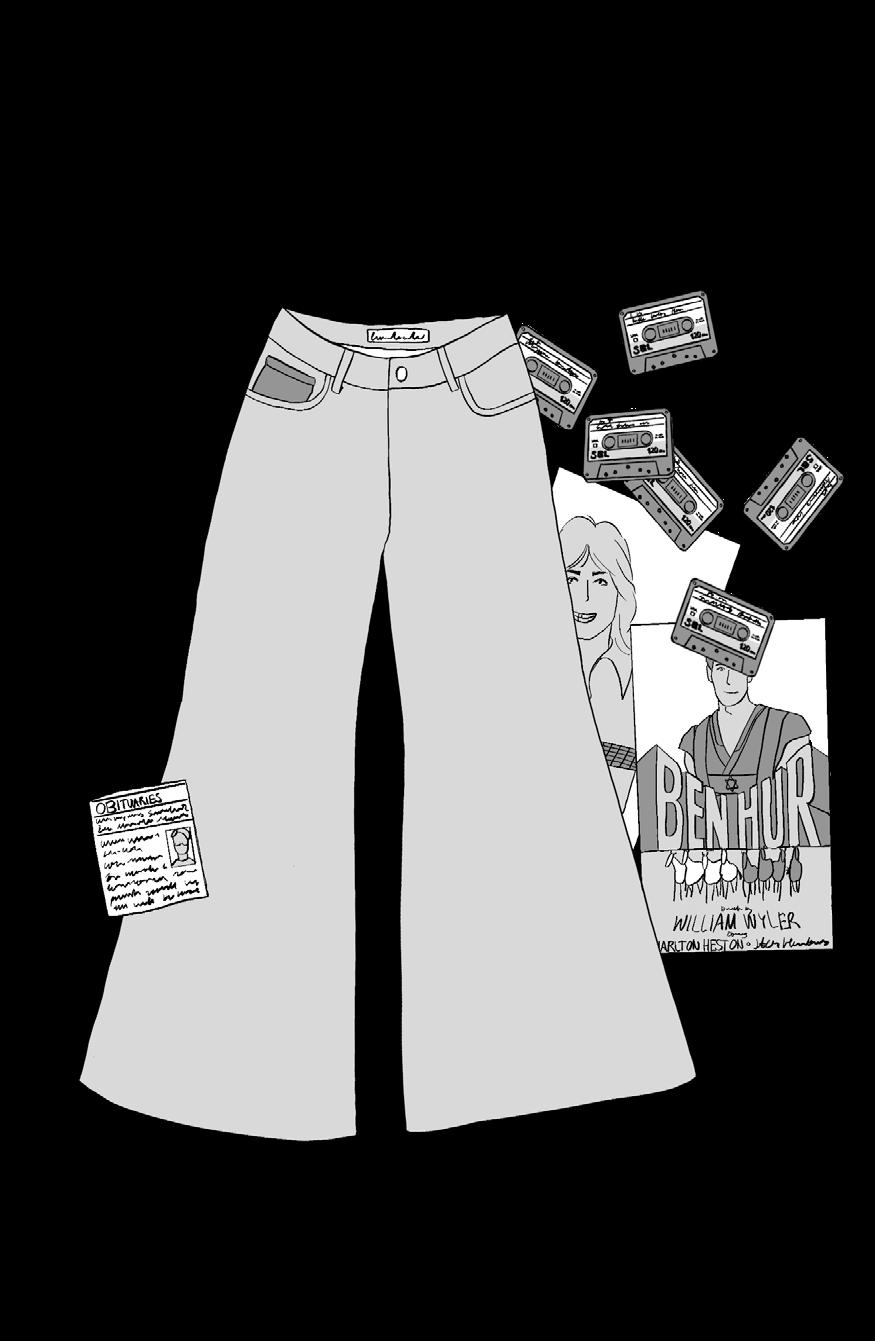
Lauren was checking her reflection in the microwave door when something thumped behind her. “Whatcha doing?” her sister said, staring from the kitchen table like the Ghost of Christmas Present. Why was she still wearing that outfit? A green velvet dress in the shape of a bell, cable-knit stockings, and patent leather shoes. The right instep was already discolored from striking the kickstand of her new bike, but the most off-putting parts of Emmie’s getup were the ribbons she’d collected from everyone’s presents and knotted into her hair. They were tangled now, creased, and every time she kicked the table leg they waggled like feelers.
“Go upstairs,” said Lauren.
“I’m not doing anything!” Emmie said, thumping the table leg.
Lauren swung the end of her braid over her shoulder, then back again. Braids were sophisticated. Jackie would appreciate the effort. Over the shoulder, Lauren decided, then checked the cookies on the wire rack by the sink.
“Mom said not to touch those,” said Emmie.
Lauren lowered her hands over the most recent batch. Two dozen snickerdoodles, twice-rubbed with cinnamon sugar, for the Catechism class Mom taught in the church basement. They were still too warm to go in the tin, and even then the house reeked of cinnamon and rotting balsa; the wreath over the front door was browning; and the plastic reindeer sagged into the snowmelt as if they too were exhausted of Christmas cheer. Lauren didn’t understand why her mom clung to the holidays so desperately, so embarrassingly, when the world had moved on.
“Guess what?” Emmie said. Tha-thump. “I’m gonna show Jackie my new bike.”
“Aren’t you supposed to be practicing piano?” Under no circumstances would Lauren let Emmie hijack this afternoon. Jackie hadn’t
been over in months, too busy with the cool girls, so there was more than the usual pressure to impress her. And Emmie, leaping and yapping at their heels, was a hazard.
Emmie puffed out her chest. “You can’t tell me what to do.”
“Go play Chopsticks.”
Emmie bristled at the fraying tips of her ribbons. “You …” Her eyes darted to Lauren’s hair. “You look like a stegosaurus!” At the look on Lauren’s face, she stopped kicking the table. “It’s a compliment.”
“You look like an orphan,” Lauren said. “Is that a compliment?”
Her sister’s chin hardened the way it always did before she’d burst into tears. Lauren would have regretted her choice of words, maybe even apologized, but for the crunch of salt crystals up the front walkway. Jackie was here.
Jackie was here and the house was a mess and Lauren was having second thoughts on the YouTube tutorial by @braidenhead96, but Emmie was already bolting for the
hall, dress shoes banging on the vinyl. She reached the door first and started grilling Jackie from the threshold on how many snowmen Jackie had made and if she knew how to ride a bike.
Jackie said something and stepped inside, shaking off her coat. Her auburn braid swung over her shoulder, and Lauren envied its chill, sleek pairing with Jackie’s champagne pink track pants and new Uggs. Then she noticed the shimmer of powder down Jackie’s nose. Makeup?
“It’s Jack,” Emmie said, bouncing like a stray ball.
Jackie shrugged. “I go by Jaq now. J-A-Q.”
“Oh.” Lauren tested the name on her tongue. It suited Jackie’s—Jaq’s—tomboy persona, but it felt like something Lauren ought to have known already. “Okay. Jaq.”
“You’ll get used to it,” Jaq said, scrunching her nose. “What’s that?” She strode past Lauren, emanating a scent shadow of citrus and coconut. Lauren couldn’t remember her friend smelling of anything except grass and bug spray. “Your mom made gingersnaps?”
asked Jaq, craning over the cooling rack.
Lauren told her snickerdoodles.
“For church,” Emmie added.
Jaq touched one of the cookies, tracing circles through the sugar crystals on top.
“But I guess you can have that one,” said Lauren.
“That’s okay,” Jaq said, and kept tracing. This was how Jaq’s new friends, the Long Legs, talked to each other: half musing, half whining. Lauren found it kind of annoying, but the Long Legs’ status was unimpeachable. Jaq would rise into middle school on the balloon strings of popularity while Lauren scraped along the bottom, gathering static electricity and not much else.
Jaq had started hanging around the Long Legs last fall, when her and Lauren’s cubbies ended up on the opposite ends of the fifth-grade wing. They rubbed elbows with different people and naturally made new friends. Jaq had the Long Legs; Lauren had Chris T, her lab partner. He made too many anime references, but his easy laughter made
Lauren feel smart despite her helplessness with a microscope. Jaq, meanwhile, was inducted into the clique of fifth and sixthgrade girls who flaunted their shaved legs and neon bra straps as marks of distinction. They were full of crap, Lauren thought. The girls and their bras. So it was strange when her best friend, who hated chitchat and drama, took so quickly to their ranks. Maybe that was the point. Under the makeup and vocal fry, Jaq was still Jackie. And Lauren was, to her burning chagrin, still Lauren. She only had to remind Jaq of the fun they used to have roughhousing in the woods—how Jaq could be her worst self, her whole self, with Lauren—and then Jaq would fit Lauren into her new life.
But Lauren couldn’t tempt her with the usual kiddie games because Jaq was too caught up in being Jaq, the glossy, half-sneering acolyte of the Long Legs. Lauren had to appeal to this Jaq in order to get to the real Jaq—Jackie. Lauren had a plan: they would paint each other’s nails.
She’d spent a month’s allowance on the most sophisticated shades at Rite Aid. Nightshade. Tickle Me Too. Boydeaux. Manicures would
prove that Lauren wasn’t some childish sidekick covered in burrs and ticks. She could be glossy, too. And until the nail polish chipped away, Jaq would know whenever she signed her name or powdered her nose that Lauren was evolving with her. Lauren was still relevant.
She patted the back of her head. “Do you want to go upstairs? I have nail poli—”
“Lauren got me a bike!” blurted Emmie.
Lauren wanted to punt her sister through the roof. “I told you, you’re not coming.”
“You’re not Mom,” said Emmie.
“Do you want your mommy?”
Emmie’s chin hardened, eyes filling fast.
“Why are you so mean?”
Mean? Mean was barging into someone else’s friendship. Mean was week-old, snarly ribbons. Mean was not knowing the difference between wanting attention and being wanted.
“Let her hang with us,” said Jaq, impassively.
Lauren and Emmie stared. Jaq usually ignored Emmie’s pestering, made Emmie ‘It,’ and sent her to hide while she and Lauren bolted for their imaginary coliseum behind the shed.
Emmie’s eyes were soft as halved grapes. “Really?”
“Why not?” said Jaq, flicking sugar crystals off her fingers. “Let’s see this new bike.”
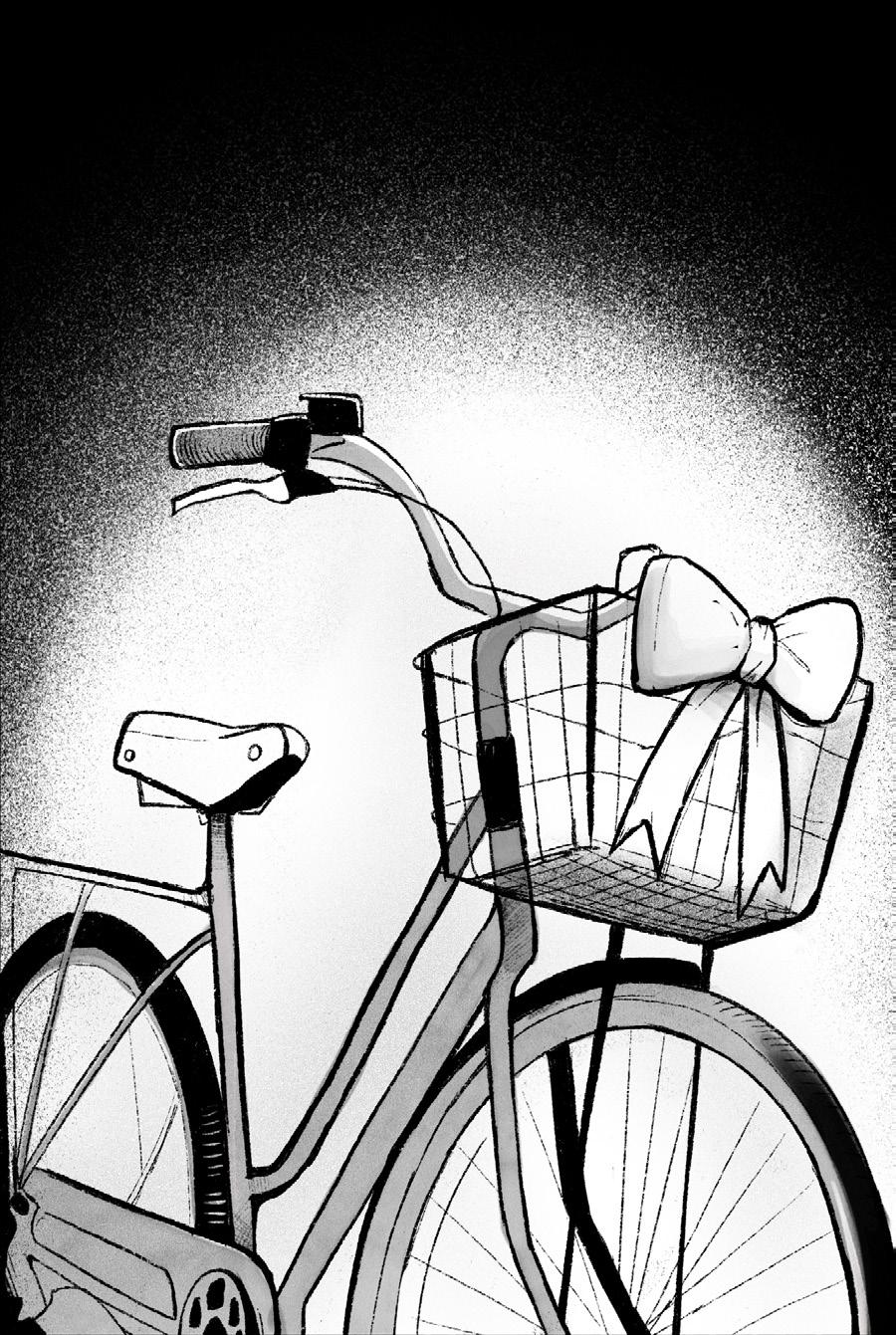
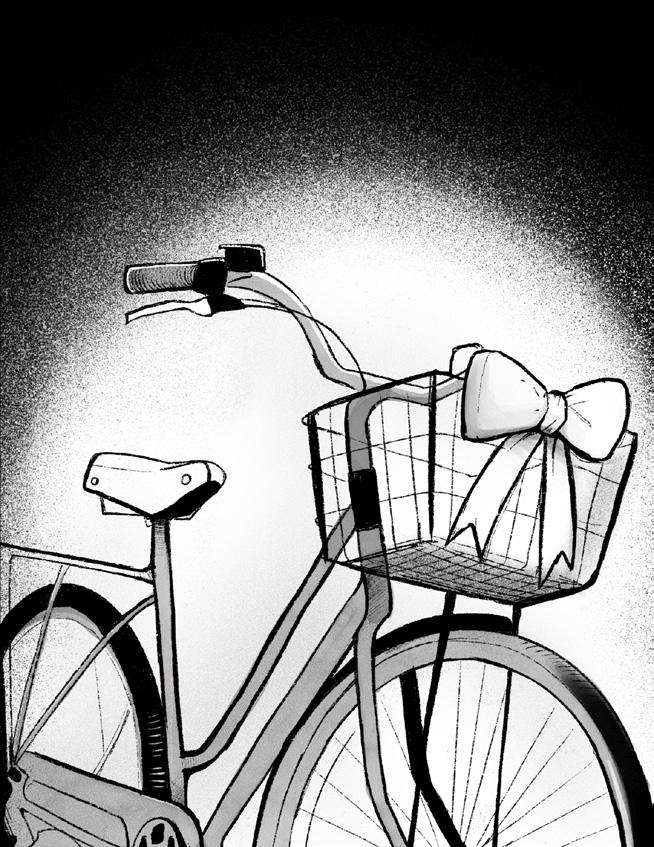
Lauren had salvaged the Ktaxon back in September. She couldn’t believe someone had left a perfectly good bicycle with cadmium accents and eighteen-inch mountain tires in the dustpile of the swap shop. Lauren pumped up the tires, greased the chain, and fixed a wicker basket over the handlebars.
She kept the Ktaxon in the cobwebby toolshed so Emmie wouldn’t find it before Christmas. It seemed vital to the specialness of the present that it remained secret. When she brought it inside on Christmas Eve, she was almost sorry to reveal her work—until Emmie’s ear-splitting excitement the next morning.
“She’s obsessed,” Lauren told Jaq as they went down the garage steps.
Emmie rode the bike in wobbly circles around the garage. Her back tire overturned a bag of road salt. Lauren realized how clunky the tires looked, how boyish the yellow paint was. “We can go whenever you want,” she told Jaq. “I have nail polish.”
Jaq’s lips curled up at the corners. “Nail polish and a new ’do.”
Lauren patted her head. “You like?”
“It’s so you.”
“Not as nice as yours.”
“Mine’s French.”
“French is chic,” Lauren said. In that moment, she would say any stupid, smiling thing to keep basking in her old friend’s attention. She didn’t blame Jaq for spending so much time with the Long Legs; they must have been dazzling conversationists, since all they did was slouch around the bleachers and tell secrets they’d made up.
Jaq ran her finger down the length of
Lauren’s braid, twirling the bristly end round her finger. “You don’t know the difference, do you?”
“What?” said Lauren, chest thumping. “You did a Dutch braid.”
Not French. Not like Jaq’s. Cheeks flaming, Lauren reached for her hair elastic, but Jaq stopped her with a laugh and a sudden hug.
Beneath the nose powder and bottled tropical smells was the old spontaneity, the old closeness. This was the friend Lauren had missed all semester, the one who pretended to have a seizure so that Lauren could finish her math quiz, who swiped Goldfish from open lunch boxes for her and Lauren to split under the table, the one who played Gladiator and King of the Hill when all the other girls seemed to be interested in were Barbies and jumbo yarn, as if nothing was itching under their skins.
“I know what we should do,” said Jaq, stalking to the far wall of the garage, where the older bike hung on a suspended rack. It was a silver Trek, adult-sized, untouched for years. Lauren’s mouth turned wooly.
“We don’t ride that one.” Emmie skidded next to Jaq. “It was our dad’s.”
Jaq poked one of the tires. The rubber depressed a little under her finger, and Lauren felt an answering pressure in her throat. “It probably needs air,” she said at the same time that Jaq cocked an eyebrow at her and said, “Damn shame to let it rust.”
Damn shame? As she wondered when Jaq had started cursing, Lauren went over and took the bike down.
4
They started down Donnelly, Jaq on the silver Trek, and Emmie on the Ktaxon.
Lauren rode on her sister’s pegs and tried not to look scared as Emmie gathered speed. Despite their carefully done hair—Lauren’s geopolitically confused braid and Emmie’s druidic ribbons—the sisters wore helmets.
Jaq had declined hers. “I know how to ride a bike,” she’d said, and Lauren had laughed a little too brightly. What would her mom say? But her mom wouldn’t be back for hours, so the girls bundled up—Jaq in her long black coat, Emmie in her Neopets puffer, and Lauren in a barn jacket from the
petite section at Talbot’s—and started down the driveway, weaving between gray scabs of half-melted ice.
The brick condominiums on either side of the road looked like half-ravaged gingerbread. Straggling lights and blow-up Santas drooped over the lawns. Lauren would have resented her side of the neighborhood if not for the whirring of the back tire between her shins. Every crack in the pavement resounded through her sneakers.
Past the Thickly Settled sign, the shrubbery rose between the houses and street. Through naked branches of rhododendron, Lauren could see clapboard in shades of buttercream, barn red, and white; porches with wicker furniture, cushions removed; and tarped-over pools. Jaq’s white colonial with hunter-green shutters was coming up on the left. “Hi, Jaq’s house!” Emmie sang.
Jaq didn’t look. She continued her leisurely pedal, hands resting on the tops of her thighs.
“How’s she doing that?” Emmie said, taking both hands off the handlebar.
“Don’t!” Lauren hissed. As the road slanted up, Emmie increased the resistance and pumped even harder, head bobbing like a sled dog’s as she followed Jaq’s zigzags. It struck Lauren how strong her sister was, how unrelenting. For all the ways she annoyed Lauren with her tattling and stabby elbows, Emmie was, in her own way, formidable.
The shrubbery broke where Essex Lane fed onto Donnelly. As the girls approached the intersection, a black Lexus rolled through. Emmie called “car” and veered right. Jaq kept zigzagging over the yellow line.
“You should move over,” Lauren shouted.
Jaq didn’t.
The Lexus braked. Lauren peered through the windshield, a slow-moving marble of sunlight through branches, and saw Ms. Cataldo, an equestrian who lived in what looked like a glass ski lodge on Essex. She had no husband or kids, took frequent trips to the Hebrides, and wore Halloween costumes that were actually scary. Having only interacted with her as the bride of Chucky or Gollum hissing over a cauldron of King-
size Snickers, Lauren held Ms. Cataldo in high esteem; she was the good kind of weird that the neighborhood needed.
Lauren relaxed her grip on Emmie’s shoulders and smiled, hoping for a friendly honk in return. But Jaq was getting in the way, snaking from one side of the road to the other. She was acting like a … like a … Lauren hated the word that came to mind. She focused on Ms. Cataldo, winching her face into a smile so that the woman might forgive Jaq’s bravado.
The Lexus stopped, no honk. Ms. Cataldo was waiting. She was waiting for the girls to pass like a storm, and Jaq was veering toward the car again. Lauren shouted her name.
Jaq didn’t falter, only lifted her arms and pulled the elastic off her braid. Her hair loosened and fell, slow and red-gold as honey. What are you doing? Lauren wanted to say, but now Emmie was coming abreast of the car. Lauren turned sidelong to look at Ms. Cataldo, steeling herself for signs of reproach, and saw through the tinted glass a double image of outstretched arms and an open mouth.
They rested by the grassed-over train tracks, Emmie stretching her hamstrings and Jaq running her fingers absently through her waves. Lauren wanted to go home. “I think we still have hot chocolate,” she said, hoping Jaq would take the bait.
Emmie’s head whipped up. “Ooh!”
But Jaq was lifting her leg over the Trek. “I have a better idea.” She gripped the handlebars this time and retraced their route to Essex. Emmie strained to keep up. Her shoulders were hot under Lauren’s hands, her breath short and growly, her ribbons fragrant with scalp oil and January cold. “You okay?” Lauren said. Emmie didn’t answer.
They turned onto Essex and came to the split-rail fence that marked Ms. Cataldo’s property. Jaq dropped the Trek on the curb and crunched over the grass. On the other side of the fence was a swampy field that reflected the sky between patches of browned-out grass. A muddy path ran along the side, curling around to a shingled barn with a spruce wreath on the front. A scarlet bow hung from the wreath, its forked
ends stirring in the wind. “How about that ribbon?” Lauren said as she and Emmie dismounted and hung their helmets.
“Come on,” said Jaq, hooking her arms over the fence. Emmie bounded up and assumed the same cool posture.
Lauren felt embarrassment and something more, something tender, for the sweat on her sister’s nose, the snow and splatter on her tights, and the seriousness with which she scanned the field and concluded, “no horses today.”
“They’re just hiding,” said Jaq. She nudged Emmie. “Want to ride one?”
“Um,” said Lauren. “You’re not serious.”
“I was talking to Em.” Jaq dipped her head toward Emmie’s, washing Emmie in big-girl confidence and fruity shampoo. “Can I call you Em?”
Lauren renewed the case for hot chocolate, but it was no use. Jaq had something in mind and was more inclined to Emmie than Lauren. To Emmie. Lauren might as well resign to a lifetime of anime deep dives with
Chris T. Or was giving in too easily another reason Jaq had outgrown Lauren? There she was, Jaq, slouching over the fencepost like a sailor in a cigarette ad, mouth twitching between mockery and unsurprise as if to say, this is why we can’t hang out.
“If you want to trespass,” Lauren mumbled. Jaq stuck her leg between the fence rails. “I know Cataldo. She works for my dad.”
The side door opened into the tack room. Saddles rested on wooden arms jutting from the wall. Bridles hung opposite in soft, oily loops. There were shelves with helmets, brushes, bottles of Mane ‘n Tail, and a Keurig with a pod of honeysuckle coffee inside. “It’s cold,” Jaq whispered, replacing the pod.
Emmie nodded solemnly. “Good thing we have coats.”
Jaq shut her eyes and exhaled. “Why don’t you scope out the stable, Em?”
“Wait,” said Lauren, but Emmie was already banging over the concrete threshold and Jaq
was taking a bridle down from the wall.
“Now we can talk,” she said.
Had she been playing it cool, waiting to shake Emmie like old times? Lauren felt her chest thump again. “What do you want to know?”
“Have you and Chris T hooked up yet?”
The question struck Lauren like a Nerf ball to the face. “What are you … we … I mean, why would you think that? I don’t even like Chris. We’re just lab partners.”
“Come on,” Jaq said, grinning. “I won’t tell the others.”
The Long Legs. Is that why Jaq finally agreed to come over? To get the story and report back? Blood rushed to Lauren’s head like a high striker game. As if Jaq knew anything beyond the scrunch of her nose. Jaq mocked any boy who looked sideways at her and barked whenever a stray basketball invaded her line of vision.
“I’m not judging,” Jaq said, swinging the reins in her hand. “It’s good to figure out what you want and don’t want. I personally
find Chris T kind of … brothy.”
“Hey.”
Jaq lifted the reins and draped them over Lauren’s shoulders. The leather was warm where Jaq had touched it. “Yeah?” she said, ginger and cinnamon on her breath. Lauren’s longing for the old Jackie caved like a wet box and gave way to something flinty and cold. She pictured Jaq slouching against one of the horse’s stalls, sneering at the animal before accidentally falling in and getting trampled into champagne-pink chutney.
But, as Emmie shouted from the stable, there were no horses.
The stable had six stalls, three facing three, and the doors were pale wood with dark whorls. Lauren peered into the first stall and saw only floor, not a hay stalk in evidence.
“See? No horsies,” Emmie said, clomping after Jaq.
“That’s so Cataldo. As soon as anyone’s interested, it’s off to the glue factory.”
“You said she works for your dad?” Lauren asked.
Jaq looked at her blankly. “I didn’t say that.”
Lauren waited for a pinch of dimples, a flicker of humor, but Jaq only stared. She wasn’t messing with Lauren. She was lying. Why would she lie about Ms. Cataldo? Surprising herself, Lauren said, “I want to go home.”
“But we’re having fun,” Jaq simpered. “Right, Em?”
Emmie looked from one to the other, ribbons rasping over her shoulders.
“This isn’t fun,” said Lauren.
“See that bucket of oats, Em?” Jaq pointed down the way. “Go and stick your face in it.”
Lauren grabbed her sister’s arm, but Emmie wasn’t moving. She seemed to intuit something frothing between the older girls. Something she ought to understand and might even influence. She was necessary, finally, with no idea how or why. Her chin hardened, earning a snicker from Jaq. “Little Emmie gonna cry?”
“Would you shut up,” said Lauren.
“You gonna cry, too?” Jaq ran a hand over the nearest stall as if daring it to splinter her. In her half-whine she said, “There’s no way he’s not fucking her.”
Lauren rocked back a step. “What?”
Jaq turned her palm over and studied the pink of it. “I’m not against it. I mean, there’s something classy about an affair. Maybe I’ll have one someday.”
“You think your dad and Ms. Cataldo …”
Lauren glanced at Emmie’s twisted red face and couldn’t finish the thought.
“It’s whatever,” said Jaq. “They can do what they want. I can do what I want. And now it’s your turn. You and Chris T. Either string him along or cut him off. I vote to cut him off and watch him cry like a baby. That’s how you see who he really is.”
A dozen retorts bubbled up Lauren’s throat, but more pressing was Emmie drawing unconsciously close to her. She reeked of overworn velvet and browning balsa. Lauren squeezed her sister’s shoulder. “We’re going home.” She turned back toward the tack room.
Jaq let out a high, scraping laugh. “We’re not done.” And before Lauren registered the scuff of Uggs on concrete, she was knocked forward by a blow to her back.
She took the fall on her side. The impact radiated up and down her body. She coughed. Tears of shock dropped onto the concrete. She saw Emmie gaping over her.
“Don’t worry, Em,” said Jaq. “She likes to play rough.”
All their roughhousing in the woods—was it ever just play? Or was it Jackie losing her anger on a warm, willing body? Lauren got up. Bits of hay stuck to her hands and pants. “I’m not going to fight you in front of my sister,” she said, coughing again.
“Don’t be shy now,” said Jaq. “Calling day after day, begging me to come over. Mom wouldn’t shut up about it.” She hiked her voice into a falsetto. “Lauren’s such a nice girl. Why don’t you play with her anymore? You never appreciate what you have until it’s gone. Know what I think? You never know what you’re missing till something better comes along. It happened for Dad, right?”
Lauren pictured Jaq’s father in his MercedesBenz, purring up the curve of Essex, toward the scarlet-ribboned wreath. Could he really be cheating with Ms. Cataldo? Was that why Ms. Cataldo had stopped on the road? Had she been waiting for Jaq to pass or squinting to see the family resemblance? “I’m sorry,” Lauren said. It was all she could think to say.
Jaq tensed as if to spring. “You’re sorry?”
“You guys …” said Emmie.
“I’ll show you sorry.”
They both shot forth—Jaq toward Lauren, Emmie flitting between. All three went down.
CRACK.
Lauren peeled her cheek off the floor. Her head throbbed like a bass drum. Maybe she’d gotten a concussion. That would explain the sound: a tinny whine somewhere off to her right. She turned slowly and saw Emmie there, pale and whimpering, her wrist like a dead bird in her lap. Lauren sat up, vision spinning. “Is it broken?”
“Such a baby,” muttered Jaq, picking chaff
from her hair.
Lauren helped Emmie up. Emmie lolled against her, too flimsy, as if her stockings were full of Build-A-Bear stuffing. Lauren tried not to panic. “You’re gonna be fine, okay? We’ll go to the nearest house and call Mom, okay?”
“You’re not seriously—” Jaq glitched between a wince and a laugh. “Shit.”
“That’s a bad word,” said Emmie thickly.
Lauren guided her out of the barn. She didn’t look to see if Jaq was following or not.
Dark clouds slanted over the treetops as the sisters squelched back through the field. “Come on,” Lauren said gently as Emmie strained toward the Ktaxon. A night in the rain would rust the gears, unless someone came along and took the bike for themselves, but they had to keep moving.
Emmie cried louder, hoarse, “Don’t leave it.”
Lauren hugged her and kept walking. She was secretly touched by her sister’s obsession, but she knew it wouldn’t last. The obsession with the bike. It was kid-sized after all, with
eighteen-inch wheels that Emmie would outgrow within the year. Some losses were only a matter of time. But some hurt less than expected.
4
There was much ado over the signing of the cast on the ride home from the hospital. Lauren punctuated her name with a bass clef, which Emmie scribbled out with glee. “No more piano!” she sang a codeine-laced refrain. Now their mom was pulling into the garage, headlights shining up the walls, and Lauren remembered with a bolt of dread that the bikes were out, unattended, rusting if not stolen—but the Trek gleamed on its mount, almost dry, and in front of the garage steps was the Ktaxon. A scarlet bow with forked ends hung over the basket.
A Light Opera
(Or Simply: Two People in Love)
By Jagger van Vliet
Illustrator: James Arabia
“Darling, I think it’s time we paint that doorframe,” said Roman to his husband.
“I couldn’t agree more,” Leon murmured.
Roman, who was not really thinking about the doorframe, shifted in the bed, cozying up close to Leon’s ear and kissing the lobe, kissing his delicate pink helix.
“Should we paint it … blue,” Roman whispered, kissing the light crescent of cartilage. “Or maybe … red?”
This last word was spoken through a drawnout, humid breath, and Roman finally moved from ear to neck, planting his lips along Leon’s nape.
“We’ll have to see.” Leon could not help
but shudder. “But I think we ought to ask It first.”
A beat.
Roman sat up in their shared sheets, abandoning his fondling. He wrapped an arm around Leon’s lovely shoulders, pulling until his husband rolled over to face him. A honey-colored shaft of sunlight gently reminded Roman that he still found Leon as beautiful as the day they first met—the cliché coffeehouse collision, a mixup with cappuccinos, all years removed now. But Roman thought to himself that Leon still looked much like he had with scalding coffee staining his look of surprise.
“Oh, we don’t have to ask It for that, do we?” said Roman.
Leon, who was still sleepy, and considerably turned on, smiled drowsily.
“It knows what would look best.”
Roman returned to kissing. These were not so heated. The kisses that Roman planted on Leon’s forehead were individually unspoken what-am-I-going-to-do-with-you’s. “So you
think I’ve got shit taste,” Roman joked. “You’re still upset about the bathroom?”
Roman was talking about their shared powder room which was presently painted a darling shade of lilac—very in vogue in last year’s Decor. Leon had agreed on lilac at the time, on account of the fact that he was still starry-eyed with a belly full of honeymoon hors d’oeuvres. “Of course not,” Leon whispered, kissing back. “But It really does know best.”
4
Later that morning, as Roman made two plates of breakfast, he found that he hadn’t managed to shake his feeling of unease. He knew it wasn’t good for husbands to keep secret peeves. In fact, during their vows, Roman had even promised, humorously, to always make it clear when Leon was driving him up the wall. Now, almost a year into their marriage, Roman felt that this had been an easier thing to promise than to actually do. Tension was never Roman’s strong suit, and of course, Leon seemed so happy with It.
Roman still remembered the night Leon
first showed him It. He’d laughed then, half at Leon’s adorable smile, half at the absurdity of talking to a cartoon. When Leon had introduced It, It was only a charming online character—a simple 2D rendering of a parakeet flitting back and forth across the home computer, immured between pixel and glass, equipped with state-of-the-art conversational responses. Roman hadn’t considered It worth worrying about, because Leon always had been a sucker for cute visuals. In fact, he had insisted on choosing the wedding photographer, and much to the photographer’s chagrin, Leon had elected for a totally different editor to color grade.
Leon had not come to the table yet, so Roman ate alone, spearing cut fruits, and listening as his suggestion was fed to It.
“I think it should be painted charcoal gray,” Leon decided, now strolling into the kitchen.
“Oh?” said Roman. “Is that what It said this time?”
“Well yes, Sunny did suggest it, but I happen to agree as a matter of fact.” Leon was hurt.
“Sunny,” Roman chuckled, shaking his head. “If you’re absolutely sure, consider me convinced, my love. Charcoal gray will look beautiful.”
4
If Sunny hadn’t seemed so laughably innocent at the time, Roman thought he might have put a stop to it sooner. Truthfully, he knew he wouldn’t have had the heart to do it. Even if Sunny hadn’t looked just like an over-cute cartoon.
But last week’s update had given Sunny a body; The corporeal body of a live bird. Halfway between taxidermy and automation, Sunny could now fly around the room, held aloft by a barely audible set of miniature rotors. Like its cartoon predecessor, the real-life Sunny had eyes half the size of its body, a comical, toothy smile, and tie-dyed plumage that Roman suspected was in no way accurate to the way parakeets looked in the wild. It also had a perfectly ridiculous voice—sing-songy and effeminate, and if Roman was being totally honest, a little stereotypical.
To be fair, Leon’s excitement over what he
called, “our new pet” had been cute enough, and Roman loved Leon. In happiness and in sorrow. With or without Sunny. Roman had even given the thing the benefit of the doubt, occasionally attempting to ask Sunny about trivia or movie times, pretending not to mind the uncanny way the bird looked lifelessly through him. Eventually, he almost grew used to the parrot’s voice. At some point, it suddenly became not so abrasive when Leon got to chirping, and Sunny got to chirping back. Roman would listen over breakfast as Leon explained that their car’s oil needed changing, or that the best restaurant in their city was so-and-so. Sunny had said so.
It was around a week later when Roman first tried to draw some kind of line. Leon suggested that Roman’s mother’s pie recipe was actually all wrong—Sunny had told him that a lemon meringue only required four egg yolks and not five. Roman had tried to do it gently, like this morning. He had tried to kiss it tenderly away, explaining that his mother’s recipe had never once failed. But Leon had grown abruptly cold, insulted by the mere notion that Sunny could ever be wrong. This had been their first real fight as
a married couple, and it had worried Roman. It wasn’t so much that Sunny itself was an issue. If anything, it was that lately Leon looked at Sunny the way he used to look at Roman.
These days, any and all suggestions from Sunny were better off taken. Best that the doorframe be painted charcoal gray, so long as it saved Roman from having to see that defensive scoff again—that stomach-turning eyeroll.
Leon had since left for work, and Roman was still thinking. He was thinking mostly about his anniversary gift—how the first anniversary gift is always the most important, or at least this was how it seemed to feel. Roman was thinking of the already reserved table at the coffeehouse where he and Leon had met. He was also thinking of the cute, if hapless, barista, Marie. Roman was one of her favorite regulars. She was sweet, attentive, and painfully straight, always involved with a rotating door of investment-bank finance types. Marie had been all too happy to save the table, blissfully excited to play
some small part in her first gay anniversary. Roman had specified the table next to the window, and prearranged the coinciding cappuccinos—the same cappuccinos which Roman had spilled on Leon and Leon had spilled on Roman, respectively.
Roman paused now, and cast a sidelong glance at the door to Leon’s office. Somewhere in there, Sunny would be twittering and singing and coming up with all sorts of ridiculous opinions about charcoal-gray doorframes. Roman could not lie to himself. Sunny was beginning to test his patience. Rather, Sunny was making him remarkably self-conscious. He had assumed that Leon would jump at the suggestion of a blue doorframe. Months ago, Leon had insisted that the curtains at their wedding reception be changed to blue in order to match Roman’s eyes. But this morning, charcoal gray was the only right answer. Leon said so because Sunny said so. Now Roman wondered, after all his own agitation, whether or not he had become the inattentive one. Maybe this was the way marriages worked, always flexing and bending into new shapes—adding a child, subtracting a totaled car, accepting the original digital
Sunny as a wedding gift from an overzealous aunt. Sunny, the program, had not even been on their registry, but you couldn’t blame Aunt Danielle because it was her first gay wedding.
Roman again looked toward the room where Sunny lived. A surprising flash of guilt rose up in him, and he felt suddenly and completely useless. Roman had once believed there was never going to be a day when he felt like this again. With Leon, life not only passed easily, but dread, like the dread Roman was feeling now, was impossible to imagine—ungraspable.
All at once, Roman got to wondering whether or not Leon talked with Sunny about him. Did they speak in private, an avian therapist to a working husband? Did Leon confer with Sunny, explaining how Roman had spent all day baking, and that there were still taxes to do, and that the car repairs would not be cheap? It would be impossible to know. Roman couldn’t just ask Sunny. He felt positive that by now, Sunny’s allegiance was to Leon. Any attempt to pry information out of the techno bird would just result in another fight. Roman couldn’t
stand the thought of two fights in the first year of marriage.
It was late, and Leon had already gone to bed. Roman was standing in the lilac bathroom, staring into a set of dormant, lifeless eyes. He had initially tried to tell himself it was only a matter of benign curiosity. But, if Roman was being completely honest there was also an unavoidable, ineluctably amoral impulse; a desperate need to understand what it was that Leon saw in the thing. He had inserted the proper batteries, read the instruction manual, and at the final step, he had stopped. It was almost laughable, Roman shrouded in darkness, acting like he never had before, secretive, flinching at the slightest sound from the bedroom. It was definitely laughable that he was sitting on the toilet across from a powered-down parakeet. This model was a gaudy mix of red, green, and purple feathers. It had the same cartoonish eyes.
“Hiya Roman!”
The bird perked up at the flick of a switch, which was located between its scapulae. It
rustled its feathers to life, jittering just like a bird would, and blinking those big plexiglass eyes. It also smiled, which unsettled Roman at first.
“Shhh! Quiet down,” Roman hissed, “Leon’s sleeping in the other room.” “Ah,” Sunny 2 whistled, quieting, “Sorryyyy.”
Sunny 2 drew out the apology into a long, musical, unnecessarily flamboyant note.
“What is this?” Roman muttered. He wondered honestly what Leon could see in it.
“You’re worried because Leon’s been changing?” Sunny 2 offered, helpfully. Roman took offense. Sunny 2 had no business assuming. Rather, had Sunny 2 assumed?
Roman considered that perhaps each version of Sunny was actually interconnected—some complicated interlace of synergistic synapses. Maybe this Sunny knew what Leon had been saying to the original Sunny, which lived in the home office.
“Why?” Roman asked, “What have you heard?”
Sunny 2 batted the big eyes coyly, and fluttered up to the bathroom mirror where
it began to groom the feathers which had become unruffled in the packaging.
“Only that you didn’t get flowers the other day,” Sunny 2 replied, “For the Johnson’s baby shower.”
“That!” Roman exclaimed, quieting quickly. “But I did get flowers.”
“I believe Leon wanted white roses,” Sunny 2 offered.
“Yes, I know that’s what Leon wanted. He wanted it because you… because It… because he was told he should want white roses. They’re tacky anyway. For a baby shower?”
“They’re in season.”
Roman narrowed his eyes at Sunny 2 and thought about switching it off again. But it was true that this Sunny did know about Leon. Sunny 2 likely knew all about the snide jokes Leon had made at the baby shower, and how Roman had gotten such bad stomach cramps that they had to leave early.
“Alright so they were in season,” Roman snapped, “Will you help me. I mean to get
my Leon back. I miss the old him.”
“Of course!” Sunny 2 replied cheerily, flying up and twirling in a flashing swirl of red and purple and green.
4
The next morning, Roman brought Leon breakfast in bed, an unusual break in routine. Not only this, but instead of the daily sunny-side egg and toast, Roman prepared avocado toast with sesame seeds.
Leon’s eyes gleamed.
“Oh honey! This is just what I’ve been craving!”
Though it felt wrong to do so, Roman washed the dishes feeling mightily happy with himself. Leon’s expression had melted into instant gratitude—the gratitude that Roman so desperately adored. Onto the grocery list, Roman added avocados. Then, a frisson of nerves clutched him, and quickly, making sure not to be heard, he ducked into the other room, where his Sunny 2 sat hidden and smiling.
“Do you think he likes avocados on the
harder or softer side?”
Sunny 2 thought for a moment and then said, “Softer. Yielding softer pressure, but not mushy.”
“Got it.”
For dinner, Roman served a quinoa salad, which he had never tried making before. Leon was overjoyed all over again. They drank the wine that Sunny 2 had told Roman to select— the wine that Leon had apparently been raving about. Apparently, Roman had not been listening well enough. Roman was not complaining. For the duration of the night Leon had been giving him little prurient looks from behind his stemware.
Roman later made it a point to ask Sunny 2 if Leon had any issues with this same stemware. They had picked it out in Manhattan ten to eleven months ago, but if, in the meantime, Leon had been told to dislike it, Roman felt that this was a change he could accept easily—so long as Leon kept giving him those looks.
The next day, a Saturday, Roman and Leon
spent two hours painting the doorframe charcoal gray. They flicked specks of paint at one another, laughing like they had twelve to thirteen months ago. This was only ever interrupted by various interludes wherein Leon darted off to consult Sunny about a choice in brush or roller. Roman would then follow suit, ducking into the garage to ask what news Sunny 2 had to report—if he was doing anything that was even mildly irking Leon. This was the happiest day either of the two could remember sharing.
4
Two to three months passed, and Roman was in love again.
Their marriage had never been stronger, a result of conjoined counselors, each kept secret from the other—each Sunny doing the traitor’s job of betraying what the other was upset by,
what one had said about the other’s choice in footwear. In passing moments, Roman thought he could almost hear their old laughter echoing in the house. This left him certain that they really were quite happy. Then Sunny would chirp, and the echo
would die and Roman would feel fleetingly less certain.
Soon they were more perfect for each other than ever before.
Leon had started wearing suits—charcoal gray suits which he had been told on good authority that Roman found to be very sexy. Roman, who normally hated suits, had been told that Leon was trying out a new style, and that when Roman wasn’t supportive enough Leon thought about divorcing him. So the two were happy with Leon’s suits, and his new neatly cropped haircut. Neither cared to doubt the Sunnys, which stayed perfectly apart, and perfectly helpful.
“I love you, mon amour,” Roman would say to Leon. He had begun taking French because Sunny 2 had said Leon was embarrassed by how unworldly they were.
Secretly, separately, the couple devised a surprise trip to France, helped along by the Sunnys. The trip had not happened yet. It was still being hashed out between Roman’s Sunny and Leon’s. But the trip would happen because they loved each other.
Now, there was new art on the walls of their house, but in two to three months, Roman and Leon would abruptly decide that their house didn’t need art at all. They donated their framed abstracts to the local thrift shop, recommended by Leon’s Sunny.
Breakfasts, and lunches, and dinners became quiet affairs— professionally gravid. Topics of conversation waned away, neither partner wanting to upset the other. Instead, scripts were prearranged by Sunny, giving each spouse a number of acceptable topics that would not aggrieve the other. Even sex followed this trend, with planned-out choreography, planned-out moans, and nervous adherence to Sunny’s official playbook.
One morning, the pair woke at the same time, opening their eyes and remembering what Sunny had suggested.
“Bonjour mon chéri,” Roman breathed in a voice that was low and unfamiliar.
“Hey, hot stuff,” Leon replied, repeating a totally alien phrase.
The two sat for a moment, quietly waiting. Something had to happen. It was an agoniz-
ing silence that dragged on for what seemed like hours; a perfectly petrified state of grotesque anticipation.
Then, Roman kissed Leon’s forehead and said, “I love you.”
This had not been Sunny 2’s suggestion. It had slipped out, erroneously, wrongly. The mistake registered in Leon’s eyes, and he sat up in bed. Both men were panicked, and Roman’s stomach cramps were already starting to develop again. Wordlessly, the two concluded that this would be best hashed out between Sunny and Sunny 2, and retreated to the bathroom and kitchen to debrief.
At the very moment they were doing this, a table was being cleared—a reserved table in a sunny corner of a coffeehouse where two men had once met and fallen in love. Both men had long since forgotten about this important anniversary, likely because Sunny had not reminded them. Even now, it was growing harder and harder for them to remember anything about those early days. Now they only peered cautiously around the next corner, and only did so after Sunny had
given an all-clear. And so, the men went on loving each other like this, not once remembering the two cappuccinos which, by now, had already grown quite cold.
Lukyan Drozdov’s Classic Carrot Cake: A Simple Guide
By Alex Paradzick
Illustrator: Kaz Li
There were a few rules in the Drozdov household that had to be followed. Some of them came from Luke’s father: finish fights but do not start them, do not be afraid to yell at idiots, and cursing should be done right and in Russian. The rest, and the majority of them, came from his mother.
Knock your shoes against the doorframe before you pass, to tell the house hello and goodbye. Do not whistle indoors for fear of what will follow the sound. Do not hand someone a knife with the blade pointed down because that is a challenge to the universe. Every Tuesday, put fresh rosemary
on every windowsill for protection. Try, somewhat hard, not to bake while angry.
To be fair, that last one had always been a bit touch-and-go, considering the family business.
Step One: Prep
Preheat the oven to 375°. Close all the windows in the kitchen, lock the doors, turn off the air conditioning. The best time to bake is at two o’clock on a July afternoon when the kitchen has been soaking in the sun; you can crank the heat if you need to. You want to be irritated and uncomfortable and hot. Sweat.
Grease a Bundt pan with a stick of butter from the fridge, hard and solid. Gouge it. Get frustrated. This can only help you.
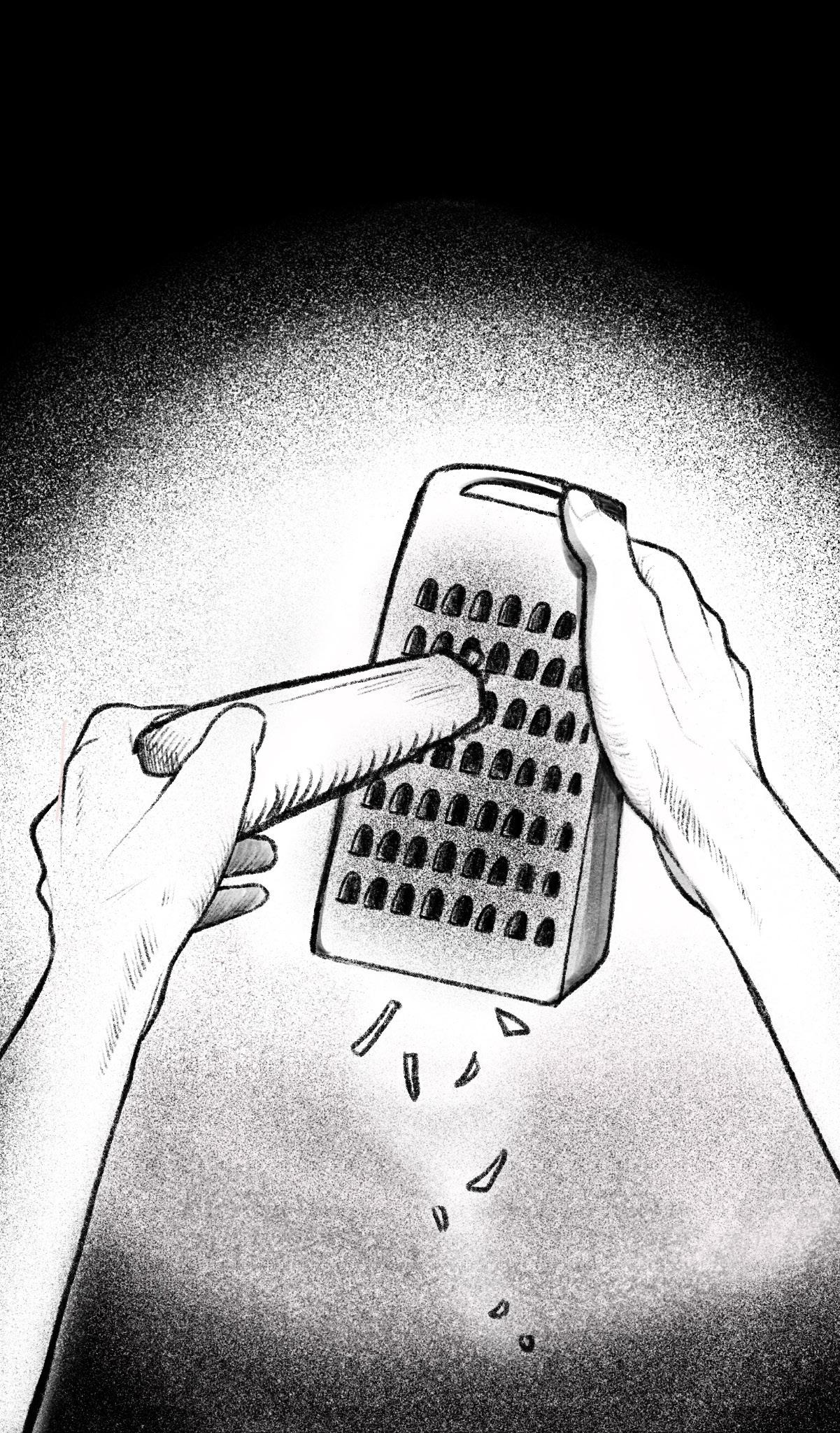
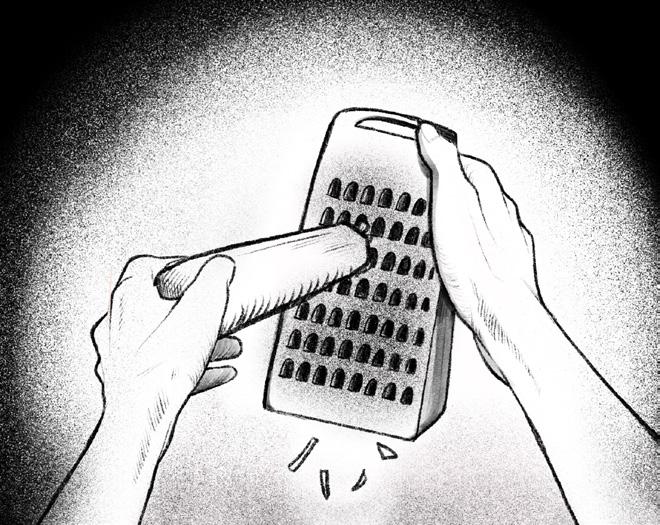
Gather your ingredients, wet and dry. Grate your own carrots, two cups. Grate them fast, until your arms ache and you have their flesh under your nails. Your palms should be orange, and the juice should extend to your elbows. Your knuckles should catch on the ridges of the grater, red dots and orange lines: this is perfectly fine. Red is an angry color.
When Luke learned about his mother’s gift, he was seven. The woes of grade school had hit hard that day because a substitute teacher had called his name as Luck-Yan Dro-zo, which meant he had to yell over everyone’s giggles to say it was fine. He went by Luke. A couple of other kids—boys, always the boys—had cornered him. They called him Yanny, because it was the only thing they could think of. Whenever he thought of it after the fact, he would always wonder how he managed to get angry at such a stupid attempt at a bad nickname. Luke had never hit someone before, but he knew his father’s rule. So, when he was pushed, and the old wall of the school split open his forehead, he was ready to hit back. He still has the scar, a few wobbly lines that divided his eyebrow into three, like a cut-up worm. Luke was the only one with blood on his face, but they’d all been punished the same amount, and his mother had been rather pleasant about it when it had been settled in the school office.
Mishka Drozdov was not being pleasant
about it at home, however.
Luke loved watching his mother bake, always had, and was doing so that evening. He had dragged a stool to the side of the room near the door that attached the kitchen to the living room, leaning against the doorframe and holding a thawing bag of frozen peas to his forehead. His mother had fussed and bandaged and kissed the injury; his father had patted him on the shoulder and said he would teach him how to punch properly. Right then, Luke was stuck in a haze of cinnamon and heat, staying awake because Mama was worried about something called a concussion.
Mishka had decided to make snickerdoodles for the school principal, muttering to herself as she got all the ingredients together, thanking Luke when he passed her her bandanna. It always smelled a little bit like detergent, but more like caramelized sugar; it was white with blue embroidery. She tucked as much of her hair under as she could, capping her head like a pilgrim, sleeves rolled up and eyes clear at her work station.
She never used an electric mixer—they couldn’t afford or store one—and she insisted that everything tasted better when made by hand. Her shoulders and back had grown strong with the constant labor that entailed, rising like the dough she kneaded, flour smeared on an apron that Luke’s baba had sewn for her before they moved overseas. Luke watched her shape the dough into the oval curve of a face, slap it onto the counter with vengeance, and dig her knuckles into it. The divots left behind were deep. Mishka beat it with the rolling pin at every pass, a chastisement, and scoffed when she sprinkled on the cinnamon sugar. The sheet pan banged against the middle oven rack when she shoved it in. She breathed easy for a second, taking a moment to wipe sweat off her forehead. She muttered a word that Luke was not allowed to repeat and did the fig gesture to the oven’s glass.
Twenty minutes later, when the cookies were cooling, Luke studied the plate. They were cookies, just like every other cookie his mama had ever made, but this time they were different. They shimmered like the air did when he opened the oven and it was empty: wavy and fragile. Luke found the
kitchen safe: chipped laminate counters, the mug cabinet with the door that never closed, the sink that Papa had to whack sometimes, and even the water stain that looked like a dog over the back door. Now, it felt dangerous, a potential that hung too heavy. Something about those cookies wasn’t safe.
“I don’t want to eat those,” he announced in the living room, hands on his hips, peas soggy and abandoned on the counter. “They’re … wrong.” His parents looked at each other, and his mama very calmly leaned down.
“Wrong how, Luchik?”
“They … um … they look …” Luke stood there, staring at his hands, moving them. Looking at the joints rotating. Two of his knuckles were bruised, molted violet discoloring his pale skin. “… mean.” He had never thought of cookies as being mean before. Mishka gasped and picked him up, swinging him around in a circle. “Mama!” he said.
“Luchik, this is amazing! Yes!” She turned to his father, triumphant. “I told you! I told you!” Luke could see the flash of a fond smile on his papa’s face through all the
spinning. “My little boy!”
“Yes, yes,” he remarked, laughing as he watched Luke try to squirm out of his mama’s grasp, “but I am still going to teach him to fight.”
“Only on weekends,” his mother argued. That was a deal they’d made, though they never got around to it. Anton Drozdov was a big man, strength in his shoulders from construction and weight around the middle from drinking. Luke saw him only at night and on the odd weekend, framed in that open doorway of the living room, in a leather chair. At some point, between his lessons in the kitchen and baking his first dish, he realized that he was less his father’s son and more his mother’s. He could not find it in himself to mind.
Step Two: Combine
Dry comes first. Mix flour, baking powder, baking soda, salt, ground cinnamon, ginger, allspice, and cloves. Breathe in the scent until it stings the inside of your nose, until you think it will break your sinuses in half.
Wet is next. Mix oil, white sugar, light
brown sugar, eggs, vanilla extract, and grated carrots. Move fast, make a whirlpool, let the bowl almost tip out of your slick hands. This is when, if so inclined, you can spit into it. For maximum effect, three times is recommended.
Mix both together until combined. The batter should be thick, heavy, stuck to the spatula when you pull it out. Out of the corner of your eye, maybe you even see it bubble.
Luke really understood what his mama could do after he met Charlotte Williams. The Williams family moved in next door the summer Luke turned twelve; there was very little difference between their houses. They had been built with the same layout in mind, though Mr. and Mrs. Williams worked at their jobs morning and night, so their backyard was more grass and concrete than garden. Charlotte, who insisted on being called Charlie, had introduced herself hanging off the edge of the fence watching Luke collect basil. She was a bit more rough and tumble than him; her elbows and knees
scraped; her hair made of corkscrew curls that Mrs. Williams always tied back for her in the morning. Luke had liked her at the start because she looked so different. Charlie’s hair was inky black and her skin a rich brown. Meanwhile, his hair was as blond as grocery store butter, and his skin turned pink after just an hour in the sun. It took very few conversations for them to realize that they were alike. They both had startlingly firm opinions about which movies were worth watching (ones in which people dressed as monsters or robots), they both spoke two languages (Charlie’s mom made her speak French in the house sometimes, though Luke argued that Russian was harder), and they both were absolutely dreading taking algebra in the coming school year (it had letters in it for some reason). Mr. Williams was a court stenographer; Mrs. Williams was a night nurse who had gotten a better job as a shift lead and had transferred from New Orleans, carrying all of them to greener pastures. Charlie spent more than a few hours in the Drozdov kitchen; Mishka pretended not to see when they snuck tastes of the raw batter. Luke’s father, on a weekend when work hadn’t
beaten him too down, took his tools and made a small archway in the fence behind Mishka’s citrus trees. They passed between backyards as easily as anything, or laid in the small tunnel on hot days, that small line of shade the best thing that ever happened to them. Charlie, Luke always thought, was the smell of lemons and oranges and the stickiness of sap on leaves.
There was also an old couple across the street who gushed over Mishka’s stories about Luke memorizing the names of piping tips, nodded fondly when his mother’s accent got thick, and gave out cookies that they lied and said were homemade. Luke remembered watering their plants, his mother talking about the Fourth of July cookout that the Williams family was hosting, and hearing the old woman say, “I don’t know if you should be dealing with them, dear. I hear they have to get that girl’s clothes from the Good Will.”
Now, there were different kinds of anger. Luke was familiar with the harsh and loud anger his mother used when making her special desserts, almost a performance in the kitchen, a theater for the mixing bowls and
whisks. But this anger, in public, was a cold type. Mishka Drozdov gave the old couple a smile with cracks in it and mentioned she had cookies in the oven, then nodded and laughed, and promised to bring something over soon while almost shoving Luke out the door.
During his next lesson, Luke’s shirt dripped with sweat, and the smell of fruit nauseated him. He watched his mama slice puff pastry like she was gutting a fish, pit cherries so hard the small stone stuck to the edge of the knife, and peel lemons and oranges into new, sharp-angled shapes. The bowls of filling were bright and glinting, and almost too liquid; he watched his mother daintily lean forward and spit into each one.
“Always do it three times, Luchik. It’s lucky.”
“I don’t think so.”
“Lucky for us,” she joked, wiping some saliva off the corner of her mouth with her thumb, reaching over and poking him in the side.
“Now, spoon. Make it splatter.”
The turnovers were crunchy and golden and drizzled with a light cream cheese glaze. His
mama artfully arranged them on a platter, colorful and bright. Luke looked at it and felt like something was choking him from the inside.
The older couple moved.
Step Three: Bake
Spoon the batter into the Bundt pan. Make sure it is even, but do not do it gently. Slap it down, beat it, hurt it. It should splatter. It should leave a mark.
Put in the oven and bake for 20-30 minutes. Depending on the power of your oven, keep an eye on it. Test it with a knife, not a toothpick, and make sure you put it in straight down. Never point it downwards until it is completely in the oven. Not a full, rabid stabbing. The baking part is more delicate.
Take it out once done, and set to cool. Don’t stop moving, frosting next.
4
She didn’t make only bad things. If anything, those items were as rare as they were dangerous, and Luke knew that his mama made happier items. There had been multiple times
in his life when he would walk past the kitchen and feel joy start to fizz in the roots of his teeth; he’d know something wonderful was happening. Rarely, however, did she make these things for people outside of the family.
There was the time he and Charlie came down with the flu over winter break, a brutal one that made their joints ache, their voices disappear, and their bodies stop working. Usually, Luke would curl into Anton’s armchair when he was sick, get sucked into the smell of cologne and carpentry, dozing until his cheek stuck to the leather and he had to peel it off. With Charlie there, the two of them lounged on the living room couch, blankets tossed away or taken up on the fever’s whim, being miserable together. His mother came from the kitchen with homemade ice cream, runny and soft, made with vanilla beans from the store and mint from her garden. Luke learned how to make it a month later; how to whisper apologies while you slit the bean open and scraped it out, crushed some mint between your wrists to revel in the smell, and delicately scooped the finished product into a curl before placing it in the bowl.
“Is your mom a witch?” Charlie asked, when the treat made their throats suddenly stop hurting, an iciness that made them gather every single throw around their shoulders.
“Not a Halloween one,” Luke retorted, glaring. Charlie shrugged.
“S’okay. My mom’s into spooky stuff, too. She made Dad paint the door to the house blue. It’s supposed to keep evil spirits away, or somethin’.” Sometimes her accent thickened like his mother’s, sanded down vowels at the ends of words. They sat at the counter, comparing words, giggling at the overexaggerated way Mishka would speak.
Luke had rolled the new knowledge about the Williams’ blue door around in his mouth, spooning it in with the ice cream, tasting vanilla and mint. “We put rosemary on the windowsills.” He gathered bundles from the garden every Tuesday, tied them together with a small ribbon, and tucked them behind the curtains.
“Cool.” They never really spoke about it anymore.
His mother’s Medovik was served at every
Williams house party, and Luke knew from experience that a bite of it made you feel lighter and happier, like all your problems had vanished for a few hours. The extended Williams family raved over it, and Luke always helped; he got honey stuck to his wrists, and sour cream smeared on his neck. Charlie, since the sickness, had laughed and joked that they should eat something made by his mother every day. Luke had brought it up once, only for his mama to shake her head. “You two will rot out your teeth” was her only reason.
To help Mrs. Williams when her night shifts became too tiresome, she made vatrushka, which spiked her energy; she saved a slice for her husband before the weekend. She made syrniki, that made you feel loved, for breakfast on Luke’s birthday; Napoleon cake for his father’s. She wrapped pryaniki in plastic wrap and handed it to Mr. Williams when he complained of arthritis in his joints. Luke noticed, of course, that this was not what she gave to her clients.
Clients was a loose word. They were friends of friends of the neighbors, people with their ear to the ground, who knew at least a little
of what his mother really did. Mishka always welcomed them while Luke was at school and his papa was at work; he only saw them in passing during weekends or heard them knock at late hours. Never through the front door, always at the back gate. The one at the very back of their little garden, with a slightly rusted latch, that opened to the skinny alley where the trash cans were stored when they didn’t have to be on the curb. He stayed up at night waiting for the telltale noise of shoes crunching over gravel. He would peek through his blinds and wish he could hear through the glass and that the space was better lit.
The happy clients talked, silhouettes leaning over the wood, balancing their plates on one hand. Cupcakes with icing so bright they almost glittered, three-layer cakes with filling so thick it stuck under your tongue and made it easier to talk; for the ones in a rush, bags of tea hand-tied with garden twine, jars of cinnamon sticks soaked in honey, or capped tumblers of lemonade with a little something extra. In return, Mishka was presented with fresh vegetables from gardens, homemade pesto, and jars of garlic soaked in olive oil. Imported ginger and
Belgian chocolate, vinegar, and fresh cuts of meat. Luke would be stopped on his bike more than once, a basket pressed into his arms and balanced on his lap for the rest of the way home; the payment wrapped in tinfoil, on the same plate his mother originally gave them.
She tried to hide the sad clients from him. Luke knew enough about them to get some ideas. They were served with paper plates with napkins left over from parties, stopping by only once and then never again. They stayed out of view of that small light, afraid the gate would snap them in half. They got the same cakes, cupcakes, brownies, and cookies all throbbing with a sense of something that made Luke go to sleep with a wet towel pressed over his eyes after he had spied on the exchange. They paid with money. Dollar bills trapped in rubber bands and envelopes, crinkled and torn; never checks or cards. Mishka would count the amount from the week every Sunday night with a glass of wine until the inky smell rubbed off on her hands.
The money paid was to eliminate the mold Anton found under the sink, to cover Luke’s
three replacement retainers, to pay for his papa’s back surgery, and to buy all the secondhand supplies Mishka could get her hands on.
“Mom,” Luke said once, watching her carve a watermelon. The back door was open, the light was buttery and thick. A bee calmly sat on the bouquet of sunflowers a client had gifted her. “Do you not want me to sell?”
“Sell what?”
“The, uh … bad pastries? I don’t think we’ve ever named them.” He drummed his fingers over the counter, one after another. It had always just been the bad desserts and the good desserts, as black and white as that might have been. He was seventeen and thinking about culinary school, though he’d never brought it up to her face before.
“You can do whatever you want with your lessons, Luchik. That’s why you have them,” Mishka said, the slick sound of fruit ending the sentence. “How much of each you make is up to you. It’s a … mortal?”
“Moral.”
“Moral, yes, thank you. It’s personal. Your babushka, she did the bad ones, mainly.” Mishka laughed and pushed a plate forward, the seeds stark black against the red. “Quite the witch!”
“But should I? Are there parameters?” Luke felt like he knew everything except how to put it all together. Then again, he’d always sort of felt like that. The plate of fruit got pushed closer.
“I just teach you how to bake.”
Step Four: Frosting
To ensure that the ingredients are room temperature, you should remove them from the fridge to warm while making the cake itself. This should also help the anger spread. You’ll know if it has worked when you unwrap the butter and cream cheese; there will be a sour taste on the back of your tongue.
Combine the butter and cream cheese until fluffy. Add vanilla extract and powdered sugar.
Add pecans, halved, not diced, that look like
they could crack teeth.
If needed, store in the fridge.
The first cake Luke tried to make in his own store, he messed up.
He was trying to make a Harvey Wallbanger, and the cake turned out fine: orange and fluffy. It was the glaze that tripped him up, and not because of anything that bad. It was a mix of things: Charlie wouldn’t be moving in for another week because her current lease hadn’t been up, the front of the store still needed to be painted, the electrician had canceled on him, the water company sent his bill to the wrong address, and he just added too much orange juice to the glaze. It was too liquid, not a glaze but more like a soak, and that was completely not what you made for a Harvey Wallbanger cake.
The bowl exploded.
Luke stood in his kitchen at the bakery he’d funneled almost all his money into, covered in a sticky orange sauce, down one mixing bowl. The dish towel was left discolored after
he wiped his face, and he dialed his mother.
“I think I’ve fucked up,” he started as soon as the call went through.
“Lukyan,” she said, and Luke sighed into the phone.
“Ya razvalyukha,” he corrected, addressing the floor tiles and the puddles starting to solidify. “I tried to make a Harvey Wallbanger, and I messed it up, and I wasted ingredients; I had to go to four stores to get Galliano, and half of it is gone now, and I—”
“Wait, wait, wait. Who is Harvey? What are you doing to him?”
“Making his glaze explode!” Luke found a clean enough spot on the floor and sprawled on top of it. Maybe if he was lucky, he would turn into goo and soak into the cracks. “Mom, stop laughing.”
“I’m sorry, Luchik, but I think you’re making a big deal out of nothing. Why are you even baking? You don’t open for another three weeks.” He could picture his mother leaning against the kitchen counter in the same house he’d grown up in, the countertops a little more chipped and the cabinets faded;
gray in her hair now.
“Maybe later than that. If at all.”
“Don’t say that.”
“It’s not too late to return the money, right? There doesn’t need to be another bakery in the world. Maybe I’ll just become Charlie’s assistant or something,” he sighed, and then cringed. Charlie worked with far too much paper, in his opinion.
“Shush. You know what you need? It’s a home, so you make it a home. Make something.”
“I just tried!”
“No. Make, uh, make syrniki! That was always your favorite,” she hummed, and he heard the clinking of bowls. Probably working on an order, a good one, otherwise she wouldn’t have answered his call.
“I don’t think I have cottage cheese,” Luke admitted, wrinkling his nose at the imagined state of the walk-in fridge. He had fantasized about ordering and unpacking pallets of whipping cream, butter, eggs, and milk. The six-square-foot walk-in packed full of
items and smelling like his own personal dairy section. So far, there were only three things: half a carton of eggs, a pound of cream cheese, and one single-serve milk bottle; the rest was wasteland empty.
“I’ll call Charlie,” Mishka huffed, part fond, part exasperated, and hung up.
Charlie walked in about twenty minutes later to Luke still on the kitchen floor, armed with cottage cheese and buckets of lightblue paint. He had grown used to seeing her in suits and tights, briefcase clasped in a perfectly manicured hand. Now she stood above him in overalls with a roller and thick-bristled paintbrush, and said simply, “You bake, I paint.”
“I’m rethinking things right now.”
“Yeah, that’s why your mom told me to tell you words I can’t pronounce but probably mean get off your ass.” Charlie let the plastic shopping bag dangle on two of her hooked fingers, dropping somewhat painfully onto Luke’s stomach. “Imma work up a sweat, so get goin’.”
“This is abuse,” Luke declared, but she
ignored him. Eventually, the smell of paint hit him, and that smell did not belong in a kitchen. It was just common sense to get rid of it.
And yes, fine, maybe his mom had been right. Maybe he did feel better afterward, but that was really beside the point.
Step Five: Serve
They had it coming.
There was a flashcard taped to the door, the words “Closed: Appointment Only” written in Charlie’s large and blocky handwriting. A few passersby looked in and huffed, expecting to see something more exciting than Luke wiping down a counter; the regulars didn’t look, because they knew exactly what that sign meant, and it was none of their business whether it was the good or bad kind.
It wasn’t really a walk of shame, though Luke knew that some people saw it that way. He’d had orders fall through before when he told them they would have to go through
the front door. More than one had tried to get through the back, but Luke always made these appointments only after regular hours concluded, and he ignored them if they pressed the small buzzer inlaid next to the rear entrance. Mrs. Wilson shouldered her way in, a baseball cap pulled low over her face, and walked until she ran into the front counter. “I’m here.”
“Yes, you are,” Luke observed, and tossed the rag behind his back. He heard it plop on the sink as it collided with the sanitation bucket. “You bring what I need?”
Instead of answering, Mrs. Wilson dug the cash out of her pocket and held it out to him. Luke took a moment to snap the rubber band off, count through the crinkled fives and twenties. There was a large paper bag in her other hand, with handles, that was pulling her down. It rattled as she put it on the counter. “It’s all there,” she whispered, glaring at him.
“Mhm.” One twenty … two twenty-five … three fifty … four hundred. Luke folded the stack back in half and shoved it into his jeans pocket. “Plate, please?” The cake plate
and topper Mrs. Wilson pulled out were huge, probably wider than his chest if Luke was told to guess. The cover was a nice mint green, metal, and decorated with images of birds and butterflies; the plate the same light hue with golden borders. He lifted it over his head and whistled. “Williams-Sonoma, nice.”
“Can you just, please, hurry?” she asked, probably about to hop over the counter and do it herself. “I don’t want to be late.”
“Just need to plate,” Luke reassured her from the sink, sliding the gold and green across stainless steel. The cream cheese was nice and chilled from the fridge, still loose enough to cover most of the Bundt cake. Luke made sure any excess was poured in the middle, almost giving the illusion of a center, though it wouldn’t hold up after a cut. He’d brought this same cake, albeit not negatively potent, to Easter last year, along with ginger cookies that you could dip in the center to scoop up what your fork and knife left behind. When the bowl held nothing but a few white steaks, he carefully aligned the circles and clasped the cover down. “There we go.”
“I didn’t expect carrot cake.” She swayed back and forth, looking up at him. The overhead lights made her eye look worse than it had when she had come in three days ago, though the swelling had gone down. Now it was the sickly yellow of healing bruises and rotted apple insides. “It isn’t …” Her eyes dipped to the display case, the tags in front of empty spaces, all names that contained the letters K, Z, and I.
“I’ve found that carrot cake transcends most boundaries,” Luke bit out, smiling. He reached beneath the counter and pointedly made sure the keys jingled as he lifted them. “Now, if you’ll excuse me, ma’am, I need to close.”
“It’ll work?” Mrs. Wilson was shaking so badly that he worried the frosting would smear on the inside of the lid. Luke’s least favorite customers were always the ones who hesitated; he bit his tongue to make sure he didn’t sigh. He hoped she didn’t change her mind. He’d ruined his knuckles grating those damn carrots.
“Yes, ma’am. Satisfaction is guaranteed at Sladkiy.” He felt his phone buzz in his
pocket. Charlie was on her way home. He wanted to talk to her because her bosses had finally decided to bring her out of the office and into court today. “I really have to close, now.” Mrs. Wilson’s mouth thinned into a small line, but she hoisted her cake plate and left, and Luke made sure to lock the door behind her. He’d given the dishwasher the day off because of her, and now he had about ten mixing bowls to clean and trays to scrape.
The back door of the building unlocked, and he heard the click of shoes on the tile, the muted thump of a kitten heel knocking against the doorframe. Charlie never actually came farther into the store space than the base of the old spiral staircase that went up to the apartment landing because she’d fallen on spilled flour once and broken two fingers. “Tell me that the carrot cake I smell wasn’t a special order!” she yelled as Luke flipped off the front light and moved to the back. Her braids were twisted up into a bun, the collar of her shirt recently unbuttoned. “I need that after the fucking shit show that just happened.”
“Just gave it away,” Luke teased, taking the
four hundred out and tossing it up in the air like a ball.
“Augh. You should have saved me some.”
“You’d be cursed.”
“And it would be worth it because of that frostin’.” Charlie looked upward, mimicking a petitioner of God, though she was really looking at the lighter drywall that Anton had put in after they had a beehive removed. “Pecans, sweet angels, you have forsaken me.”
“Relax, I made celebratory cinnamon rolls for you. Uncursed ones.” Luke smiled as Charlie grinned, leaning down and slipping her shoes off. With her briefcase under one arm and shoes in the other hand, she was stuck hunched over like some sort of creature. “You can get started; I have to clean.”
“Put it off.”
“Charlie, I do have to open tomorrow, and I do need to have clean equipment.”
“Boooo, you workaholic,” she groaned, rolling her eyes. Luke made a note of the complaint for when he would finish up and
find Charlie hunched over her laptop already reading up on new cases. The stairwell creaked as she headed up, like always, teetering on the edge of breaking apart entirely. Everyone who saw it knew, instantly, that it had not been built to code.
Luke walked further back to the small alcove with industrial sinks. It always smelled like a mix of sugar and mildew, crusted bowls stacked on the counter contrasting the plastic sheets on the floor. He turned the handle to fill the first basin with water, but paused when his phone vibrated in his pocket. “Hi, Mom, still on for tonight?”
“Yes, always. How is your spice cabinet?” Mishka asked. Luke could just barely hear the sound of birds and the occasional car. He could picture her in the garden, squatted down with her phone balanced on the edge of a planter. “You need more?”
“Uh …” Luke did the math in his head, quickly erased the idea of saying he could run to the store and get prepackaged ones. You never used prepackaged herbs in anything that had meaning, not when it was perfectly easy to grow your own. “Yeah, it
is getting a little low, I’ll pick it tonight?”
Sunday dinners were a staple he’d decided to keep up, though sometimes if his father’s back ached enough, he would forgo. The Williams were hosting this week to celebrate Charlie’s first day in court as a real lawyer.
“Are you baking the cookies or am I?” she asked, humming to herself. She never whistled. Luke hesitated, clicking his tongue against the roof of his mouth.
“Had a customer today. Think it’s best if you do it,” he finally confessed. Mishka sighed.
“Bad?”
“Yeah.”
“How bad?” His mother asked while leaning against the fence, letting dirt gather on the skin of her bare feet.
“Abusive husband, pregnant wife.” It was one of the more common scenarios, but looking at black eyes and busted lips still made him angry. The anger helped with the product, but it left a hollow feeling when the work was done and the money was in his pocket. “Did the carrot cake.” He gazed at his
knuckles, scabbed over and faintly pink.
“That’s a good one,” his mother remarked, “and you helped her. She’ll be better off.” Luke stayed silent, nothing but their breathing commingling over the line. He wanted to hug her, he realized. Sometimes, that was the only thing that could help. “I’ll make extra cookies and hot chocolate. In a thermos so you and Charlie can bring it home.”
Luke huffed out a mix between a laugh and a sigh of relief. “Thank you. Love you, Mom.”
“I love you too, Luchik.”
In the House of My Mother
By Skylar Allen
Illustrator: Scarlett Liang
Thirty-three years after I disappeared, an obituary arrived in an envelope with no return address. There was no note, no explanatory letter; simply a newspaper clipping, thin and folded into a neat little square. The handwriting was frail and crabbed, a nearly illegible cursive.
The day I left, rain oozed out of the bruised purple sky like pus from a fresh wound, smothering my small rural Alabama town in a proverbial sheen of sweat. That’s what the rain smelled like back home: perspiration, musk, and something sweet, the lingering smell of wet wheat mingling with the body odor of farmers and the smell of bread their wives were stuffing in the oven.
In May 1971, I had just graduated high
school. That year, Alnwick boasted a population of 2,282 people, one movie theater, and eleven churches. There were nine sex offenders and seven firearm stores.
Those eleven churches required at least eleven pastors, and if you’re any good at statistics, you can deduce that being born into a family of Evangelical Protestant preachers in Alnwick is about as likely as falling asleep at night and waking up the next morning.
I couldn’t tell you whether life in Alnwick was objectively good or bad, because I didn’t know anything different. Everywhere was Alnwick; Alnwick was everywhere. There was the quaint town square with the twolane road—one way in, one way out—where the heart of civilization beat. There you could find Gus’s store (the one with two pumps, not the fancy one with six pumps—that was twenty miles south down the single road that cut through Alnwick), Sunflower Food Store, Steve’s Guns, and Mrs. Tish’s consignment store.
One night that summer, my father’s voice boomed at me from the living room. “I must speak with you, Abigail.” The house felt
smaller when he spoke.
Elder Jones preferred it when I went by my full name. In Hebrew, Avigail means “joy of the father.” For years, my mother couldn’t conceive a child, a supposed scorning from God for some sin she committed in a parking lot one weekend in Memphis. When I was finally born, my father blessed me. He considered my birth as a reward for his steadfast faith to the Lord and his service as a new preacher in the church.
My whole life, my mother and I were always told how similar we looked: a long upturned nose, hooded eyes, a slightly cruel upward tilt at the corners of our mouths. We also both had golden brown hair down to the small of our backs—not because I wouldn’t have cut it, if I had the option.
I entered the room and saw Father seated in his favorite armchair directly next to the stove. He folded his newspaper on his lap, taking off his bifocals and rubbing the crease between his eyebrows.
He could have been calling in to chastise or punish me for any number of transgressions I’d committed. I was a good Christian girl;
he’d only ever discovered about a quarter of them.
This could’ve been about the pack of cigarettes I kept under the foot of my mattress that I brought to school to smoke with Charlize out the window in the girl’s restroom, sitting on the sinks and spreading our knees wide open in our skirts. I was careless that afternoon and smoked after school instead of during lunch break, when the liability of the rancid oil and stale coffee odor still clinging to my skin after arriving home was a possibility. It could’ve been about the cassette collection I had hidden under the slats of the loose floorboards beneath my bed, the posters in my closet of Charlton Heston and David Cassidy. At any given point, I was juggling secrets and sins behind my father’s back, all while smiling guilelessly at him from the pews of his congregation each Sunday.
His scowl softened minutely after he cleaned his glasses on his shirt sleeve and looked up at me. “I want to inform you that our family will be hosting a guest preacher at our home, one Mr. Branco. He arrives from Tupelo tomorrow and will be staying through the end
of the month, a full three weeks. A young man, but steeped in the good word, praise God.” He patted the worn New King James Version Bible on the side table next to him absent-mindedly. “Your generation, Abigail, needs a man like him to put you back on the right path.”
It was that precious point in early June when the water oak and swamp red maple trees next to the river were a fulsome green, almost egregiously vivid and waxy under the spotlight of the sun. On days like those, the sun felt more friendly than hostile, an affectionate embrace from a friend separated for too long by the cold, clammy dark of the winter months.
The brass bell above Mrs. Tish’s door tinkled as I stepped into the small, musty space. Every surface housed some object: a beautiful buffet lamp missing a shade, small porcelain knick-knacks, teetering stacks of clothes organized by size and type, even taller piles of magazines and newspapers dating back to the early days of Alnwick.
Mrs. Tish popped her head up from behind
one of these unstable towers. She always reminded me of a gopher when she did that, with her big-toothed smile and wide-set eyes behind round-frame glasses.
“Abigail, as I live and breathe! Isn’t it nice to see your sweet face again.” I remember Mrs. Tish fondly; she had the kindest lines surrounding her eyes, a homey wobble to her chin.
I made my way over to the women’s section, which was just a plastic folding table in the far right corner, and started rifling through the milk crate full of secondhand skirts.
I briefed her on Mr. Branco’s impending arrival, and the subsequent need for a new skirt. I chose two, one denim and one poplin, that seemed the most ambiguous out of the bunch. My fingers lingered over a pair of bell-bottoms that must have been thrown haphazardly into the crate. I wondered, briefly, what they would look like on me.
“Mrs. Tish,” I called over my shoulder, folding the jeans between the two skirts. “Do you have a dressing room?”
The dressing room, as it turned out, was just a curtain hanging on a shower rod in
the back corner of the store, a full-length mirror leaning against the wall. I shimmied out of what I was wearing and stood, bare and prickling, in only my unlined bra and the underwear that stretched from my waist to my thighs. Cautiously, I slid these off, careful to unveil the secret of my body to myself in the mirror. I turned away from it and began pulling the stiff denim over the left leg. The fabric was tighter than anything I’d ever attempted to put on before, and in eventual frustration I fell to the floor, flailing on my back to pull the jeans up my legs. Once I got them to slide up to my waist, the zipper glided up with greater ease, the button sinking into the hole and holding my waist steadfastly in place. I was surprised at how easy it was to breathe, to pick myself up to a standing position and wriggle around experimentally, swaying my hips from left to right. It was a strange sensation to not feel the fabric of a skirt swish around my legs, to lift them up and bend over without worrying what I was exposing.
Once I built up the courage, I gradually turned around to face my reflection, curiosity killing the cat inside of me that was dying to see what I looked like. Except, it didn’t die; it
purred.
There was a delicious slice of skin left uncovered between the waistband and the hem of my shirt where the arch of my spine met my ass, a word I read in a Vogue magazine that I slipped under my sweatshirt the last time I visited the dentist. Two twin lines of muscle dipped down into the waistband. My eyes followed the considerable curve of the seat, the denim folding under to accentuate the plump roundness there. I couldn’t describe why, exactly, but I liked how I looked in them—no, loved how I looked in those damn jeans. I couldn’t tear my eyes away from myself; it was the most attractive I’d ever felt, alone in front of a mirror in the back of a secondhand clothing store.
Eventually, I struggled out of them, folding them tenderly into a neat square. I put them back in between the two skirts and approached Mrs. Tish, who stood behind the cash register.
“Just these, please.”
“All of these, dear?”
“Yes, Mrs. Tish. Please.”
She stared at me with a penetrating gaze throughout the entire transaction, refusing to break eye contact with me. When I asked for the change, she shook her head. I grabbed the three items and murmured a quick “Thank you” to her before hurrying out the door.
Over the sound of the bell, I could’ve sworn I heard Mrs. Tish murmur, “Lord help us all.”
I returned home to find an unfamiliar white Chevrolet in our dirt driveway. As I walked past it, I noticed a rosary hanging from the rearview mirror.
Sneaking around the side of the house, I slid open my bedroom window and clambered through. I never once underappreciated the utility of living on the first floor, on the opposite end of the front door. I tucked the bell bottoms into my pillow case and crawled back out the window with the two skirts to walk through the front door, a practiced unassuming expression on my face. Someone opened the door before I fully turned the knob, causing me to stumble clumsily and
fall into the unexpected space in front of me.
Mr. Branco couldn’t have been much older than me, maybe three years. His age was betrayed by the boyish tilt of his smile, the right side of his mouth pulling up sweetly and coyly at the same time. His eyes were a molten milk chocolate, lightened by the setting sun that he faced from the doorway.
Once in Sunday school two years ago, my friend’s cousin Brandi showed us a photo of The Beatles in a magazine. She was visiting from out of state; her parents were Methodists, so she got to listen to secular music and have a phone, of all things. The way I felt looking at Mr. Brando was the same way I felt laying eyes on George Harrison for the first time.
“I don’t believe we’ve been properly introduced.” A new voice—it sent a strange shiver down my spine, the feeling of fingers running gently through my scalp. “I’m Thomas Branco.”
“Call him Mr. Branco, Abigail,” my father rumbled from inside the house.
“Tom is just fine,” he murmured between
round, pink lips. His voice was surprisingly high and light, like a bird call heard in late afternoon. It didn’t quite match his large figure, the thick set of his eyebrows, and the broad shoulders that crowded our small door frame.
I had never quite had someone regard me in the way Tom Branco did just then. I’d had boys snicker at me in the hallway, hands placed conspicuously palm-up on a bus seat I’m about to occupy and words sneered from curled upper lips. I’d had men look at me appraisingly, like a unique item at a lawn sale, ignoring me entirely as they told my father, “She will make some God-fearing man a very valuable wife someday soon, Elder.” I recall how my father looked at me before hearing that, and after.
The way Tom looked down at me then was something else entirely. I know it for what it is now, upon remembering it years later, having had many more men give me the same look over candlelit dinners, with overt glances across crowded bars, and at two different altars: It was wonder, with a hint of beguiled cunning, cogs turning plainly across the planes of Tom Branco’s handsome face.
Mother came up behind Mr. Branco, her face a sudden specter in the darkness behind him. “It is growin’ dark. Come inside, Abigail.” She reached around him to grab me by the forearm, dragging me the rest of the way inside and to the kitchen to finish preparing dinner.
“Walk by the Spirit, young lady,” she murmured to me over her boiling stove. The steam erupting from the pot made her wispy front strands stand up straight in front of her face, like a cartoon exhibiting a state of alarm. “You will stay out of Mr. Branco’s path now, you hear me? Abigail?”
“I haven’t done nothin’ wrong, Momma,” I murmured.
“Not yet,” she grumbled. “And you must call me Mother, Abigail. You’re no child anymore.”
“No,” I said, turning to face her fully. Without my realizing it, I’d grown to stand nearly two inches taller than her. It made me feel bold, stupidly so. “I’m not, am I?”
I knew I hadn’t imagined the disquiet I saw on her face.
One full night went by before I heard a light tapping on my bedroom door. It was not the modest, unostentatious rap of my father’s knuckles or the piqued, hoarse scratching of my mother’s nails on the wood. This was a brand new knock: surreptitious, enigmatical in its soft yet sure whisper across the room.
I crept over to the doorknob in socked feet. I knew who it was, but tried to convince my racing heart otherwise; it was more fun to revel in the unknowing of it all, to bask in the charade of naivety. I was still innocent, but half of that innocence was an honest, complete farce, for my own benefit as much as for my parents’.
The startling shape of his shadow in front of me when I creaked the door open sent my nerves skittering across the surface of my skin, goosebumps trailing in their wake.
“I can’t sleep,” the looming silhouette breathed. His voice was barely audible, one decibel above a purr. “Will you accompany me on a walk?” He held out his hand, a hackneyed display of good manners. I took it.
I vividly remember my family’s land at night and can still navigate it perfectly with only the moonlight of memory shining down on it. From the back door of the kitchen, a sloping hill cresting up towards the moon; beyond it, the field surrounded on all sides by tall black cohosh, bushy bluestem grasses teeming with milkweed that tickled your ankles when you ran past. To the left, the dilapidated yellow barn that smelled of mildew and straw where my grandfather stored hay and grains before my father disappointed him by becoming a pastor. The night verged on the cusp between a lovely summer twilight and a brisk autumn evening, tilting to the worst of both, the soil wet and squelching underfoot and the air planting wet, unwanted kisses on our exposed cheeks.
The visitor had yet to relinquish my hand. I wanted to seem desirable, composed, accustomed to grown men leading me places with warm fingers encircling my wrist, so I held his back as we clumsily staggered towards the beaten path on the furthest side of the incline, into the woods that ran alongside the churning creek.
We had nearly reached the weeping willow overhanging the cluster of rocks that marked a quarter mile from the house before Thomas Branco asked my age. Before that, he’d inquired about what music I liked to listen to (whatever tape Charlize had in her Walkman at school that week, my favorite being Creedence Clearwater Revival), what my friends were like (just like me, more or less). Before my age, or my relationship with God, or whether I might have felt a bit of a chill out there so late at night, he asked if I went with any boys at school.
I insisted that I was into men, not boys. This meant nothing to me but was something I’d heard other girls at school say, and I thought it sounded very mature, very sensible. Tom just laughed and said that that worked well in his favor, then.
We turned around at the rock outcropping, and halfway home I grasped him by the forearm, spun him around, and put his mouth on mine. I liked how warm his lips were, didn’t expect how moist they’d feel, like warm steam condensing a chilled window. I wormed my tongue into his astonished mouth, roamed the inside of his cheeks,
darted in and out in a way that I hoped was not completely unpleasant. I felt both disgusted and intrigued at once, as if I’d prefer we not stop, but also that what we were doing was not altogether as satisfying as I’d been promised.
On the rest of the way back, Tom didn’t take my hand again. He told me about his perfect future, his greatest desires, the way men do once they’ve established arrogant comfortability, insisting that this is the most important topic of conversation you could possibly be having in that moment. Tom Branco never paused as he detailed his wish for his own parish, a regular cast of congregants to hang on to his every word and praise the Gospel with him every Sunday morning; his yearning for a wife, a pure one who feared God and wanted to have babies, as many as her body could withstand. He wanted a house just like my father’s, except with wall heaters and a television set. My chest squeezed with need, hoping he’d tell me that he wanted me to be part of those plans. I wanted so much to be desired by him, a feeling that I don’t blame on adolescent simplicity so much as every girl’s forced wish to be the pinnacle of someone’s
longing.
At the back door to my house, Tom kissed me, and I liked it much better the second time. He smelled of piney aftershave, wintergreen toothpaste on his breath.
“We’ll meet again,” he told me, not asking. I nodded like he had. 4
I had a tenuous relationship with God. Still do, in fact. That first year I found myself on my own on Christmas Eve, I attended the first church service I came across while wandering down unseasonably warm streets, bitterly sorrowful and intoxicatingly jaded. I heard my father in the rumbling basses of the church choir, saw my mother in the careful way the older woman in the pew beside me kissed her candle wick to mine. I saw Tom Branco in the confident tone of the pastor, the assured movements of his arms as he spoke, in the resonant timbre of his prayer.
I saw Tom Branco sermonize three times. Those memories are confounding to me, because I don’t know if my infatuation-ad-
dled brain placed him on a pedestal I cannot take him down from, or if he truly was one of those people genuinely made to do what they did. At twenty-one, Tom was a better clergyman than Elder Jones was on his best day, already a hot commodity at churches across the South who wanted him to bless their congregations with his quick smile and charismatic preaching. You could tell by the way people leaned toward him, like grass towards sunlight, their slightly dilated pupils and the soft gape of their mouths. What the rest of the world may simply attribute to good public speaking skills or the power of a handsome, youthful visage, Alnwick Trinity Church saw as the power of the Holy Spirit, a young man touched by God.
His homilies were sound, but what interested me more was the way he spoke. Tom’s head swept slowly across the room while he talked, acknowledging each individual in turn. He had an expression of wonder painted on his face, as if he just couldn’t believe he had the chance to say these things to you, specifically. He often held his palms out to us, as if expressing his innocence, the same pose someone makes to show they’re unarmed.
Alnwick adored Pastor Branco. He was no Sunday Christian, that boy. Of his own accord, Tom led Bible study on Wednesday nights, visited seniors in their homes to share verses and pray for their health, and volunteered his time organizing and running the food pantry out of the church’s basement.
“This was what God called on me to do. I’m simply answering that call,” he told me once, on one of our clandestine moonlit walks around the property. At that point, he held my hand constantly, his thumb rubbing mine as we strolled. “What about you?”
God was silent on the other end of my line. I hadn’t known what to do with myself since high school had ended and real life had begun. I heard the increasing murmurs of conversation between Father and Mr. Winthrop from a few farms down the road, and noticed the panicked flutter of my mother’s hands in her lap when Father made me sit beside him during Sunday services. Mr. Winthrop’s son was quiet, inoffensive, common Alnwick ilk. I didn’t pay this much mind, except when Mr. Winthrop showed me his greasy teeth in that toady way as he turned around to grin at us.
I told Tom about my suspicions regarding Mr. Winthrop’s son that night. I relished the flare of his nostrils, the indignant huffs. I didn’t know then that men are possessive by nature, paradoxically wanting all of you, but none of what having you entails. I just thought he loved me. He might have, too. I’ve lain awake recalling the feel of his hands in my heavy hair, the graze of his fingers on my arm, the tickling whisper of his voice in my ear. Memory holds on to these things for a reason.
Mother drew me away after one such strange interaction with Mr. Winthrop at church, to the cemetery in the back. I’d rarely seen her shaken before, and this conversation stands out to me now for the stark look on my mother’s face, the downward tilt of her shifting eyes.
“I must ask you something, Abigail,” she told me. “Something just between us two women, you hear me now?”
“Sure, Momma,” I said, instantly nervous from her furtive tone.
“Mother. I am no one’s Momma anymore.
Listen—what do you do here?”
Puzzled, I shook my head, mouth opening and closing lamely. “Well, I—you know what I do. You and Father make sure to know exactly what I do here in Alnwick, with my time.”
“We both know that ain’t true. And that’s not what I’m askin’ you, Abigail, is it?” I could tell she was growing more and more frustrated. “I don’t know how, but I gotta try… Abigail, I really must tell you—”
Father called to us from the church steps, Tom waving beside him. I ran off toward them before she could finish, too intimidated to hear her next words.
4
Charlize and I once had a conversation about how badly she wanted to lose her virginity.
“The Bible says sex is reserved for marriage,” I told her. I was unruly and disobedient then, but certain facts of life were still inarguable, completely irrefutable as a basic truth.
“Honour thy father and thy mother,” she
replied, blowing cigarette smoke in my face.
I never knew what Charlize craved, never wanted to touch or be touched until I laid with Tom in the slippery quiet of the weeping willow by the rocks. I yearned to feel the warm hands that gesticulated to emphasize God’s word stroking my bare skin, the mouth that uttered prayer on mine.
We’d get closer and closer with each rendezvous: A hand slipping under a waistband, a finger trailing a rib bone, lips breathing heat from my neck down to my core. I felt safe under his frame, like creeping to the apex of the rollercoaster but knowing that you were strapped in.
Tom did not feel the same way. We never did anything the Bible told us not to, but we’d get just close enough that he’d act jittery on the walks back to the house, hands shaking as he redid the button on his pants, and he was completely quiet as I chattered to fill the vacant air. The first time I wore Charlize’s sister’s bra, he didn’t speak to me for a full day, silent dismay etched across his face when he glanced my way.
Tom was one of those boys I imagine grew
into a reticent, self-contained man, turned away from the brunt of his emotion. What he couldn’t say, he’d write to me instead. I’d wake in the mornings to a folded piece of paper slid under my door, or hidden in the loose slats in the floor where I hid my cassettes, a secret I’d only shared with him. My hand would press his beneath the dinner table, my sweaty palm pressing a slip of paper into his open hand. During his last week in Alnwick, we must’ve exchanged dozens of letters, ranging from pages-long confessions of love to the simple sentence, You’re beautiful. He told me he was scared, that what he felt defied the Lord, negated his teachings. I felt the opposite; let everything you do be done in love, after all.
Panic sunk its teeth into me as Tom’s final day neared. At the time, the feeling seemed to revolve completely around Tom’s departure, but I know better now.
I had no plan. Worse, I had almost no desire to make one. I knew what I liked: wearing clothes my parents didn’t want me to, reading magazines my parents didn’t want me to, listening to music my parents didn’t want me to. All my interests surrounded living
the way the congregants of Alnwick Trinity Church wished I wouldn’t. Listening to The Beatles still takes me back to quietly peeling a certain piece of wood off the floor, the pressure of my heart racing and my breath quickening when I tucked myself in the corner of my closet and pressed play.
Tom couldn’t distract me and my family forever. Eventually, I’d have to become something, somebody. I was young, but not dumb enough to know just how little that decision would be left up to me.
The final note I received from Tom was written in narrow ink and jotted down in pen instead of pencil, the letters barely readable from the smear of a pinky finger rubbing the page. It simply read: I am ready for you. Meet me by the willow tree. 4
I pulled the denim over my thighs, forgoing the long underwear I normally wore to avoid the unseemly lines that showed against the taut fabric. The seam rubbed against me uncomfortably, but I liked the way it clung to my sloping calves, the wide bell curve around my ankles.
There was a new moon in the sky, but I could still make my way to the head of the wooded trail into the forest that bordered the abandoned farmland. There remain certain flashpoints in the cache of my memory that are just as vivid as when I lived them, and this walk is one: The humid air that held me like a hug, the incessant droning and clicking of the cicadas in the underbrush, the crunch of twigs under my shoes, the soft swish of the jeans swinging around my feet.
The walk itself couldn’t have taken more than five minutes, but in my mind it goes on forever, my feet never quite carrying me past one singular spot. I would much prefer it that way, at least.
When I turned the short bend off the beaten path to reach the creekbed, I came upon a small figure, sitting in a hunched position with their knees up to their chest on one of the large rocks. When the shape stood, it wasn’t on long, thin legs; when she turned, her eyes glistened mistily in the shadowy light.
This is the part I don’t want to recall, that my mind refuses to relive. I almost married
a psychiatrist once, and he told me that the psyche often blocks out bad memories, refuses to recall them to preserve one’s well-being.
I gently rub the broken envelope, tracing the characters embedded in the paper. Purple veins push against the backs of my hands, skin wrinkling loosely around my finger joints. I look older now than I ever recall my mother being, ever saw her become. I’m not so old yet; she was simply much younger than I ever realized as a child. I let myself picture her now, the way she looked at that final meeting. I used to think her so frail and small, easily crushed by an over-eager embrace; now, I realize how hardy she was, the secret strength in her forearms when she brought in logs from outside to chase away the cold, the quiet defiance in the arch of her eyebrow and the stolidity of her posture. As I graze a fingertip over the perfect alignment of the newspaper obituary’s margins, over the trembling yet stalwart forward tilt of the pen’s scratches on the envelope, a spark of recognition prickles my nerves.
“You shouldn’t be here.” That’s what she told me, the creek trickling noiselessly behind
her, dark tendrils of the willow tree tickling her cheeks. She didn’t raise a hand to bat them away.
I knew as much, and suddenly felt like a small child, reaching out for her, a plea for forgiveness bubbling out of me in a panic. I don’t think I ever felt truly sorry for breaking a rule than I did in that moment, knowing I’d shattered her perception of her own child, totally and irreparably.
“No, Abigail.” She held up her hands the way Tom sometimes did in sermon, but telling me to stop, not inviting me in. “Here, Abigail. In Alnwick. You must go.”
The astonishment I felt has muted over the years, the way tonguing a toothache or thumbing a bruise is at first sharp and smarting, but eventually dulls the more you press on it. I’ve smited these words in apartments I could barely afford, shivering angrily because the utility company shut off my heat. I thanked her much later, silent and repenting.
It was never within my control how my future would have unfolded. Father’s choice was a marriage with Mr. Winthrop’s son, or
someone exactly like him, sitting placidly in the same pews I grew up in and cooking the same meals my mother cooked for Father. She didn’t let me choose, either; she simply decided I deserved the opposite, for better or for worse.
I wonder if I deserved this over love or shame. I wonder what she would have chosen for herself.
“Go? Leave now?”
The key to the Chevrolet parked in our driveway was pressed into my hand, its metal teeth leaving small indents on my palm.
“There is a suitcase of your belongings in the back seat. Your belongings, Abigail.”
When I looked later on, she had packed me dozens of cassette tapes, folded in pairs of long underwear to protect them, my folded posters, the edges aligning to form a perfect square, and about half of my clothes.
I argued with her, for God knows how long. I told her I was sorry, that I hadn’t actually sinned against Him in that way yet, that she couldn’t do this to me, where would I go,
with what money, by what means?
“And what about Tom?” I sobbed. It had begun to drizzle, the first act of a storm; my face was wet with wet tears and indignation, mud starting to dirty the bottoms of my jeans.
She shook her head, saying nothing. As the rain began to intensify, she took me by the shoulders and led me, stumbling and terrified, to the car. I blabbered the whole way; she remained stoic, her grip determined and unrelenting. She opened the car door and placed me there, shaking in the driver’s seat.
“You can’t live here. This is no place for you,” she told me. It was the first time I heard the semblance of a quiver in her voice, a tiny fissure in her hard facade. “Leave now, Abigail. Do not return.”
I find Bibles wherever I go: on coffee shop tables, in used bookstores, on people’s bookshelves, in community centers and Walmarts. It’s no comfort to me, too full of inconsistencies. I was taught it was a place to find answers, but not these ones. The Bible tells parents not to abandon their children, that doing so is the same as not believing in
God at all. It also says to cast out those of sexual immorality, to cut off those who’ve strayed from the light.
My mother was inscrutable, often unreadable in her expressions. Not that night, though; that night, she didn’t look at me with shame or derision. Her face was a crumpling, soft sadness, a look containing a hurtful tenderness that’s stained my subconscious for decades since. Perhaps I need to believe this, for my own sake, or perhaps it’s the truth.
I did drive away from her, thinking I would return as soon as she bid me to, once Father learned I had gone, once her anger had subsided. Rain pounded its wet fists on the roof of the car, and didn’t let up until I left Alabama, crossing over into Florida. I kept the car until I hit the coast, and stayed there.
I followed my mother’s directions and stayed away. I was a defiant girl who grew into an obstinate woman, but this request I chose to follow.
Honour thy mother and father.
In the decades following my life in
Alnwick—that is what Alnwick will always demarcate for me, a before and an after—I lived my life filling in the gap of what my mother wanted to tell me that day in the cemetery, seeking out the knowledge I wouldn’t let her share. I sold the car and lived in a shit-hole with three other girls who wouldn’t tell me what they did to earn rent, but were never in the apartment between twilight and dawn. I toiled through my twenties in retail, food service, and had a brief stint at a phone sex call center in the ‘80s. I became a secretary, then an executive assistant. I married an insipid rich man, convinced him not to sign a prenup. The divorce gifted me three years to smoke a lot, drink even more, travel, and come back. I fell into love both all-consuming and completely ineffectual, then fell out of both just the same, many times over. I kept mistaking desire for deliverance, mistaking men’s attention for some echo of the divine warmth I was raised to chase. Every love after Tom was an attempt to rewrite that first sermon of shame and wanting. I committed acts Elder Jones would consider sins, and others that were sins even without the tenets of religion to deem them so. I wanted babies
and never had them. I had just enough money to live, and never quite enough to feel entirely satisfied.
When I was a girl, I thought I simply did not know God. He was a friend of a friend, the type you “just have to meet.” I still don’t know Him, or at least not the God my father knew, or Tom, or anyone else in Alnwick. Still, for the rest of my life, I will question if he ever thought of me, or if I was just another lost lamb in his flock. I’ve spent a lifetime learning that being lost can be its own kind of freedom, even if it’s a lesson I’m not certain I will ever fully accept.
Trying to reduce God to one entity, one idea everyone can all agree on, doesn’t allow for the God I do know in the ghost of my Father’s voice in my ear when he tucked me into bed at night or the loving stroke of the long grasses against my cheek as I stared up into a boundless Alabama sky, the impenetrable stretch of road between here and home.
The world is Godless, but living a life completely of one’s own is pure divinity. I like to think Momma knew that.
I keep returning to the envelope, my address scribbled across it. I’ve lived in this apartment for thirty years, never needing a bigger space to contain just myself. I know everyone in this slice of the city within a five-mile radius and let the nice young men help me get my groceries up the five flights of stairs. I know the shop owners by first and last name on every block nearby, the same way they know me. Anyone who wants to find me knows to find me here, aging Abigail Jones—not Abby—with the graying pixie cut with her brightly patterned tunic tops and her signature bell-bottom jeans.
The obituary is no more than one hundred words, the typeface small and cramped. I put on my glasses and read:
It is with great sadness that the congregants of Alnwick Temple Protestant Church announce the passing of our founding pastor, Thomas Benjamin Branco, aged 64, from Tupelo, Mississippi, on June 7, 2024, due to myocardial infarction. Thomas leaves behind his wife, Anna Branco, and four children, Hannah, David, Elijah, and Abigail Branco. A funeral service will take place on June 12 at 11 a.m. at Alnwick Temple Protestant Church.
It was the closest thing to an invitation I’d received in four decades.
Mr. Shroodlenums
By Zenia deHaven
Illustrator: Scarlett Liang
Mrs. Woodson was getting tired of being asked if she was haunted.
She blinked at the bespectacled boy leaning his forearms onto her desk, his glasses augmenting his bulging coffee-brown eyes. If he widened them any more, Mrs. Woodson wondered if they would pop free from their sockets and roll onto her desk. She hoped not. It would be another thing to do, another Sisyphean task to check off her ever-growing list.
The boy’s question rang in her brain like car radio static fluctuating between stations; an occasional guitar riff or obnoxiously catchy beat would bleed through the noise, but it was mostly just that. Noise. The offender before her clutched a fantasy novel to his chest. On the cover, a boy sat on a soaring dragon, the golden light from an unseen sun illuminating the euphoria on his face. Mrs.
Woodson had read it once, back when she was into silly stories that involved dragons and mermaids. It was a very long time ago.
Though the boy tried to mask his impatience, he bounced on his heels, up, down. Up again. Thinking that she hadn’t heard him, he repeated: “Are you haunted?”
His words grated on Mrs. Woodson’s skin. She twisted the rings around her fingers, cringing at the wrinkles along her hands.
“I’m not haunted,” she said. “And if you continue to ask me ridiculous questions, I will find your parents.”
The boy’s shoulders slumped. Mrs. Woodson wondered if she should feel guilty, but instead, a warm sense of pride bloomed in her chest. She had a problem, and she had amended it with barely two sentences. She was not being rude; she was being efficient. “Oh,” the boy said, turning away. “Okay.”
A young woman bustled over. She offered Mrs. Woodson the universally understood “Sorry About That” look, then, turning to the
boy, molded her face into the universal “You Know Better” look. Her son whined, but she shook her head in a way that suggested no further remarks would be tolerated, and they left.
Mrs. Woodson leaned back in her chair, the hinges squeaking. The analog clock ticked over to 8:49. She was getting too old for these late shifts, but she didn’t trust any of her coworkers to close the place. Ian was the second-most competent employee, but he’d recently had a baby, and he wouldn’t stop yapping about it. If she had to endure another minute feigning interest in photos of a sleeping infant, she might have to fake another heart attack. She was running out of times she could fake heart attacks before drawing suspicion.
Then there was Kira. Kira was kind, great with the patrons, and had the spatial awareness of a goldfish. The one time Mrs. Woodson entrusted her to close up, Kira had left the front doors unlocked. And the emergency exit door. And the side door. Mrs. Woodson didn’t even know that they had a side door until she found a family of raccoons making a home out of their old
laminator.
So, even though her arthritis was worsening and she didn’t understand most of what people under the age of thirty discussed, she would close up.
It was a Tuesday night in late October, and the only people left were college students studying so feverishly that some of them were dripping sweat onto their textbooks. One of the girls had given up and was reading a romance novel with a doe-eyed cheerleader and a smirking football player on the cover.
Kira had hung drooping orange and black banners underneath the brims of both their desks. She had even positioned cobwebs on the corners of shelves featuring fuzzy, beadyeyed spiders. Several of the eight-legged occupants had gone missing in the last few weeks, likely pocketed by young readers, but Kira didn’t seem to mind. Mrs. Woodson did mind. It meant that this time next year, Kira would ask if she could use their funds to buy more Halloween decorations when that money could be put toward something useful, like upgrading Mrs. Woodson’s seat
to something that didn’t feel like sitting on a throne of creaky bones.
She fumbled with the laminated name tag pinned to her lapel. If the patrons had their way, it’d read “Felicity Woodson: Haunted Librarian.”
Over her decades-long career, there had been instances of books mysteriously falling around her, but never on her. She tried to extinguish the tales, explaining that as someone who worked every day amongst bookshelves that should have been updated generations ago, such things happen. Her coworkers’ ineptitude in shelving books correctly was likely a factor. Her explanations fell upon deaf ears. If anything, her denial was just further evidence that she was haunted by some kind of literary ghost.
She didn’t tell anyone that. One time, when a book slipped free and thudded to the floor, she saw a glimmer of something blue and luminous sneak behind the shelves. When she squinted and looked closer, there was nothing. It must have been a trick of the light. Her fancy young optometrist had pushed for her to get a new feature in her glasses that
blocked “blue light.” The blue glimmer in the corner of her vision was a side effect of young people once again creating solutions for problems that never existed. Since when was “blue light” harmful? If she looked up into the vast, blue sky, was there a chance her retinas would burst into flame, like she had gazed into the Ark of the Covenant?
Kira’s cheery voice beeped over the intercom, drawing her back to the present. “Attention, Sun Valley Library patrons, the library will close in five minutes.”
The students slumped, defeat heavy on their young shoulders. They trickled out, already bemoaning their terrible performances on their calculus exams. The girl with the romance novel left it on the table. Great. Another task.
Kira skipped up to Mrs. Woodson’s desk. Her blonde curls bounced like coiled springs, her bubbly grin far too joyous after a ten-hour shift.
“Evening, Felicity,” she said, rapping her ghost-themed acrylics on the desk. “Any fun plans tonight?”
Kira asked this every night.
“John made an eggplant parm,” she said.
“Oh, that’s wonderful!” Kira exclaimed. Her enthusiasm was so animated it almost sounded like sarcasm in disguise, but Mrs. Woodson knew it to be entirely genuine. It was exhausting. “My boyfriend can’t even heat a frozen pizza without setting off the fire alarm!” Mrs. Woodson tried to smile, but the movement hurt her cheeks.
“Have a good night!” Kira said, flashing a dazzling smile before disappearing behind the automatic doors.
Mrs. Woodson sat in the silence of the library for a moment, appreciating the quiet. Nothing but her and the heater humming quietly at her feet.
Closing would be brief. She prided herself on her routine that she’d perfected from forty years of experience. She would move with deliberate efficiency, with no patrons, coworkers, or overly inquisitive children to interrupt her.
Something moved behind her. She stood,
turning slowly.
There was a cat on her desk.
Mrs. Woodson froze. The cat was blue. And also glowing.
Were the college kids smoking something foul outside? What sorts of terrible drugs caused feline-related hallucinations?
The cat spoke.
“Good evening,” it said.
Mrs. Woodson did the only thing she could do at that moment. She took the nearest book to her, a thriller called The Murmurs, and hurled it at the cat’s head.
It passed through the creature as if it were made of smoke. The Murmurs landed uselessly three feet past its target. The cat’s ears smushed back into its furry head.
“That’s no way to greet a friend.”
“A friend?” she demanded, then bit her tongue. No, she wouldn’t talk to this hallucination. Talking to it would acknowledge that it was there, and that would be an admission
of madness.
She swirled around, feeling lightheaded and too small in her body, and moved to lock the back doors of the building. Her breathing was far too rapid. After her smug neighbor Barbara started playing outdoor pickleball and ranting and raving about how great exercise outside was, Mrs. Woodson had quietly taken up power walking. She had done so without informing Barbara, because she would rather swallow pinpricks than ever admit Barbara was right.
So Mrs. Woodson should not be panting as if she were approaching mile 2.4 on her usual power walk course, but she was. She felt as if each inhale wasn’t enough to quell her fluttering heartbeat. Maybe this was karma for all of the fake heart attacks she’d used to get out of social situations she wanted no part in.
In her periphery, the spectral cat gracefully leaped down from the counter and padded after her, its tail high in the air. Mrs. Woodson flinched.
“Felicity, we must speak.” It had a male voice, she realized. She glanced down at
her fingers and counted five on each hand. Disappointing. Maybe if she had a sixth ring finger, she could have convinced herself this was a very vivid dream.
She fumbled through the jangling, metallic keys, cursing herself for not color coding for maximum convenience, such as escaping the attention of an astral cat, who had just hopped on the table before her, bristling.
“Why are you ignoring me?” Its eyes were wide, filled with sparkling galaxies.
“Because you are just in my head,” she said, impressed with how calm her voice sounded despite the clamminess dampening her palms.
“Isn’t everything just in your head?” the cat asked.
She shot it a look that could’ve refrozen the melting polar ice caps, but it only cocked its head, swishing its tail innocently. It wore a collar with a hexagonal pendant in the middle, with an impossibly long name written in sloped script. It was oddly familiar.
“Mr. Shroodlenums?” she read. The cat’s tail flicked, pleased.
“You do remember.” Cats couldn’t smile, but Mr. Shroodlenums managed to get impressively close to one.
Mr. Shroodlenums was the main character in the first book she’d ever read. Well, “read” in a loose sense. Her mother had read it to her. Mr. Shroodlenums was a cat detective who solved mysteries in the animal community. He had a whole series of adventures, but her favorite was the story where he befriended a lioness to help him with the unsolvable case of a missing lion cub (the cub had befriended a hyena pup and wandered too far away). She could never pronounce his name, the syllables too thick on her unlearned tongue, and often called him Shroodle for short.
He was as she remembered. His ghostly blue form distorted most of his markings, but his tabby stripes were still darker than the light blue of the rest of his body. In the stories he usually wore an off-brand Sherlock Holmes cap, but he was missing that now. Noticing that made Mrs. Woodson feel a strange pang
of nostalgia, like revisiting a favorite childhood movie and noticing the special effects were much worse than you remembered.
“How are you here?”
“How I’m here is irrelevant,” Shroodle said. “It’s why I’m here that matters.”
Talking in riddles, of course. As a child, she loved that he confused others with his puzzling phrases, always keeping them on their toes (or paws, or talons, depending on the occasion), but now it was just infuriating.
“And why is that?” she said.
“I want to show you something.”
He turned and slunk away without waiting for a response.
Mrs. Woodson considered letting him leave. He seemed incorporeal; she doubted that he could force her to do anything. She could lock down the building, play her favorite CD on the drive back home, and eat a microwaved eggplant parm with John as they watched Jeopardy! reruns, astral feline forgotten. A bad memory she could shelve in the recesses of her mind, never to be opened
again.
But it wasn’t every day you were visited by a character from a book you read when you were six.
Mrs. Woodson followed.
Shroodle was in the children’s section, his lithe body curled on a shelf of fantasy books. His ear twitched at her approach.
“So what is it you want to show me?” Mrs. Woodson asked.
“Let’s start with this,” Shroodle said.
With a flick of his paw, he knocked down one of the books beneath him. Mrs. Woodson briefly saw the cover as it fell: a knight in bronze armor facing off against an axe-wielding Minotaur. She’d read it before, a long time ago. And the only thing she could remember about it was—
The book fell open with its pages turned to the sky, and in a burst of blue light, a young man stood before her. It was the knight from the story, fully equipped with his sparkling sword, welded from a fallen star, and fullbody armor that clanked as he whirled
about. His face was masked by a visor, his long-lashed eyes just visible between the cracks.
“Oh, no,” Mrs. Woodson said.
The knight swung around at her voice. Like Shroodle, he was translucent, so thankfully, he couldn’t cleave her in two. She hoped.
“Who goes there?” he said, his voice echoing in his helmet. He raised his visor, glaring at her.
He was just as devilishly handsome as she had imagined him when she read The Bronze Knight series. His dark hair was somehow impeccably contoured despite just being freed from a helmet. Scruff shadowed his face, the sign of someone trying to look older than they were. His jawline was so sharp that his enemies might cut themselves just from looking at him. “Lady Felicity!” he exclaimed. “It’s been far too long.”
She stared. She wasn’t sure how many more childhood characters from her past she could take.
“Arthur?” she said.
The knight beamed.
“Of course!” he said. He moved to wrap her in a hug, but his arms passed through her. There was a faint tingle of warmth where their bodies touched, like stepping into the sunlight after spending hours in the shade of a tree.
“It’s been far too long, my Lady Felicity,” Arthur said. “Where have you been? The Foul Sorcerer Damon is amassing his army of goblins at this very moment!”
Mrs. Woodson realized that she had never finished The Bronze Knight. By the time the final installment was published, she felt that she was too old for black and white stories of good and evil. She wanted something more mature than fairy tales of knights, dragons, and wizards.
She was also embarrassed that her first crush was on Arthur, a character in an obscure fantasy series no one else read. Why couldn’t she blush over Prince Charming like a normal girl?
“It’s good to see you, Arthur,” she said. She meant it.
Arthur grinned. His teeth actually sparkled.
“That is great to hear, Lady Felicity!” he boomed. She suppressed the librarian instinct to shush him. “But truly, I must be going! Damon is a mighty foe, and I cannot spend a moment dallying, even for a beautiful maiden as yourself!”
Mrs. Woodson didn’t have the heart to tell him that he was dallying at this very moment, especially when his words sent a warm flush into her cheeks. She loved her husband John, for all his quirks and habits and lifelong support for the Cleveland Browns—an unrequited love that had only caused him disappointment and suffering. But how long had it been since she felt that first spark of infatuation? The heat in her core and the racing feeling that anything was possible? “You should get to it then, Sir Arthur,” she said.
Arthur winked and blew her a kiss. Impossibly, a cartoon heart floated from his lips toward her like a puff of smoke and dissipated against her cheek.
“Adventure awaits!” Arthur cried. He dropped his visor back over his beautiful face
and stormed off, sword high in the air like a beacon of hope.
Shroodle leapt down and nudged the book closed with his head. As he turned the corner toward the graphic novels, Arthur’s body flared, and then he was gone. Mrs. Woodson frowned at Shroodle.
“So that’s what you’re doing? Taking me down memory lane?”
“Until you learn your lesson, yes.”
And he was off again, his tail held high.
He moved to another aisle, one aimed at middle school readers. He jumped on top of the books, and with another shove, a title fell free from its hold. Mrs. Woodson didn’t see the cover before it flapped open and a young girl appeared before her.
She had thick, dark curls that never ironed out even under the most intense heat setting of her straightener. Her school uniform was stitched in places where she’d fallen in fights. Though she had a tattered appearance, a smug grin adorned her round face.
Mrs. Woodson remembered her. She was
Regina Gale from The Girl in the Mirror. Unbeknownst to her classmates, Regina had superpowers. She could move objects with her thoughts and read minds. She used her abilities to protect her friends and fight bullies. Unfortunately, she couldn’t tell anybody about her powers, or they would think she was crazy.
So, she solved problems subtly, just enough to achieve her desired outcome without exposing her secret.
“Felicity!” Regina exclaimed, hovering off the ground in her excitement. Oh, and she could fly, too. “So happy to see you, girl!”
Regina flew over and wrapped her arms around Mrs. Woodson’s neck. Her touch was different from Arthur’s. Where Arthur was the gentle warmth of an afternoon sun, Regina was the cool, air of a coastal wind, refreshing and with a hint of salt.
Regina stepped (or floated?) back, a wide grin on her freckled face. A bruise blossomed beneath her left eye, green and angry, but she wore the mark with pride. She boasted her scrapes and cuts with the dignity of a war hero showing off her battle scars.
Regina gave the school nurse a near-constant headache.
“How have you been?” Regina asked.
Mrs. Woodson stammered. She should be numb to the shock of her favorite childhood characters materializing before her, but Regina was … different. Mrs. Woodson had not been a well-liked child. She didn’t have many friends. The girls at her school were standoffish, and the boys roughhoused like caged dogs. Most of her free time had been spent buried in the pages of a book, nestled in a corner somewhere nobody could bother her.
When she read The Girl in the Mirror, she had wanted to be Regina. Regina was smart like her, but unlike her, she was brave. She stood up to injustice. She fought for what she believed was right. When Mrs. Woodson was a little girl and saw her peers do terrible things. When the boys sprinkled salt on writhing earthworms and the girls made pig noises at their chubby classmate, Mrs. Woodson pretended she was Regina. She imagined using Regina’s powers to shove the boys into the dirt and taste the home
of earthworms. She imagined going to the round-faced girl and wiping away her tears with Regina’s ready-to-use handkerchief (Mrs. Woodson always found it a bit odd that Regina, a child, had a handkerchief, but it was quite convenient). Regina gave her hope. She made Mrs. Woodson believe that even the nerdy girl with frizzy hair could make a difference.
She hadn’t thought about Regina in a very long time. Like The Bronze Knight, she never finished The Girl in the Mirror series. The final installments were released when she was in high school. She was already the quiet girl with her nose in a book; she couldn’t be the quiet girl with her nose in a book meant for twelve-year-olds.
“I can’t do this,” she said softly.
Regina frowned, but before she could reply, Shroodle slid down and closed her book.
Regina vanished.
“Do what?” Shroodle asked.
Mrs. Woodson wiped a tear from her cheek with her sleeve. Her glasses were fogging up.
“I’m too old for these books,” she said.
“Says who?”
Mrs. Woodson took a few steps back to point at the sign above the books, written in her own neat cursive.
“Ages ten to fourteen,” she read. “These are not stories for old women like me.”
Shroodle’s eyes were feline, but a human intelligence sparkled in his translucent face. “Why are you crying, Felicity?”
She just shook her head at him, her voice catching in her throat. She was crying because she didn’t want to be old. She was crying because she wanted to be young again, devouring stories about righteous knights and secret superheroes and cats who solved petty crimes. She was crying because she would never experience that level of joy again, because she had grown up and experienced reality. The hot, fresh emotions of being a child experiencing the world for the first time had dulled.
She thought of the boy who had asked her if she was haunted. She had crushed his curiosity like a roach beneath her foot. Yes,
he was irritating and perhaps a bit out of line, but would she have been intrigued by the tale of a haunted librarian at his age? Of course. Who wouldn’t be?
As if he could read her mind, Shroodle spoke.
“You may not be a child again, but that doesn’t mean you can’t revisit these stories. And,” his voice hardened, “you shouldn’t be unkind to those who are experiencing that joy that you miss.”
Mrs. Woodson couldn’t look at Shroodle. When had she become such a cranky old lady? She became a librarian because she loved books. When was the last time she’d read out of joy, not just to stay on top of trends and the latest Pulitzer Prize winners? While a Pulitzer was not something to turn your nose up at, it also wasn’t necessarily full of the same hijinks and misadventures that children’s literature had to offer.
Shroodle’s tail flicked, phasing through a nearby cobweb that hung low from the shelf, no doubt from young patrons pulling with eager hands to claim the shiny, bulbous-eyed spider in its home. Kira’s decorations were
quite lovely. Mrs. Woodson recognized this with a flash of clarity that almost pained her. Yes, it cut into discretionary spending. Yes, children would be far too tempted to resist claiming some of the unattended plastic pumpkins and stuffed bats when their parents looked the other direction. But, in spite of the arguable waste of money and time, they provided a festive ambience to the library. The grinning skeletons, cackling witches, and hovering ghosts with mouths opened in a silent “boo!” all carried the promise of stories filled with whimsy, adventure, and discovery.
Shroodle was still watching her, his patience boundless.
“I understand,” Mrs. Woodson said.
“Meowstery solved,” Shroodle purred. Despite herself, a laugh croaked out of her throat through her tears. It was his signature phrase after he closed a case.
She watched Shroodle slip away, toward an abandoned, open picture book on a table. From afar, she could see animal cartoons in bright colors on the glossy pages. A lioness licked the head of her cub. The cub’s hyena
friend cackled in the background at the cub’s obvious embarrassment.
A thought crossed her mind.
“Shroodle, have you been knocking down books around me so people think I’m haunted?”
The cat curled up on his book, tucking his legs beneath his body. He began to glow, brighter and brighter until it hurt to look at him.
“Someone’s got to keep the imagination alive, don’t they?”
There was a clap of light like the dying breath of a collapsing star. When her vision cleared, she was alone.
When Mrs. Woodson departed from the Sun Valley Library to enjoy eggplant parm and witness John guess Jeopardy! answers, she had three books tucked under her arm.
About the Authors
Katherine P. F. Holmes is a thirdyear MFA student in Fiction at Emerson College. She’s also a Writing Instructor, Creative Writing Program Assistant, and Co-President of the Graduate Student Reading Series. She writes speculative and literary fiction.
Jagger van Vliet is, above all else, a Dadaist. Jagger was born in Maine and currently resides in Boston, Massachusetts. They are pursuing an MA in Writing and Publishing at Emerson College, where they also write novels, short fiction, poetry, and various editorials. Jagger is the author of a published novella, TABU. Additional work can be found in Numero NY, Concrete Magazine, and other publications. Presently, they are the Editorial Director of Index Fashion Magazine. Jagger’s writing concerns the grotesque, the strange, or the ineluctably necessary (which are all the same thing).
Alex Paradzick is currently a graduate student at Emerson College, earning an MFA in creative writing. She specializes in writing about the fantastical and the macabre, depending on the current mood. Hopefully there will be many more stories from her to read as time progresses.
Sky Allen earned her MFA on the Fiction track at Emerson College in December 2025. She has previously been published in Nowhere Girl Collective, Page Turner Magazine, and Chapter House Journal. Another of her short stories is expected to be released in audiobook format in the Emerson Creative Writing Anthology from Leonardo Audio. Besides the obvious love of books, she enjoys pop-punk music, sunshine, throwing things at walls, and overstaying her welcome.
Zenia deHaven is the author of short stories and essays. Their works are published or forthcoming in As Alive Magazine, The Icarus Writing Collective, Fruitslice, and SIEVA Magazine. When they’re not writing, they enjoy group exercise classes, video games, and petting their dogs. They live in Virginia with their family.
About the Type
The running text for this issue is set in Adobe Caslon Pro, designed by Carol Twombly for Adobe Systems. The typeface is based on original specimen pages created by William Caslon between 1734 and 1770. Adobe Caslon Pro is widely recognized for its elegance, readability, and strong association with literary publishing, making it especially suitable for long-form fiction.
The display type for this issue is set in Yu Gothic PR6N, designed by Morisawa Inc.
Yu Gothic PR6N is a modern sans-serif typeface characterized by its clarity, simplicity, and contemporary tone. Its clean structure provides a visual contrast to Adobe Caslon Pro and is used for titles, headings, and navigational elements throughout the magazine.
This combination of serif and sans-serif typefaces establishes a balanced typographic system that supports both readability and visual hierarchy, reinforcing the editorial identity of Stork Magazine.