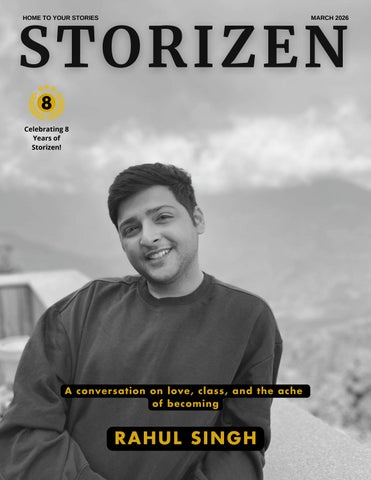
Storizen Magazine March 2026 | Rahul Singh

Page 1


Celebrating 8 Years of Storizen!

Articles/Short Stories/Poetry/Interviews/Events

The Human Connection - Sreelekha Chatterjee, p20

Monthly Horoscope: April 2026 - Storizen Staff, p66

From the Editor's Bookshelf - Saurabh Chawla, p16

Fusion Fiction - Madhulika Ra Chauhan, p18

UNLEARNING QUIET - Sivanjali R, p64

Anirban Bhattacharyya Signs Up with Siyahi, p28

Why let others decide YOUR happiness? - Madhumathi H., p24

Book Reviews (by Swapna Peri, Saurabh Chawla & Kiran K. Adharapuram)

Hot Off the Press, p14

100 Ways to See India by Rohit Saran, p32

A Brush with Life by Satish Gujral, p32

A Gathering of Crows by Suparna Chatterjee, p33

A Pebble for Your Pocket by Thich Nhat Hanh, p33

A War of Wyverns by S. F. Williamson, p34

After Us by Akshay Chopra, p35

Anatomy of an Alibi by Ashley Elston, p35

Battleground Bengal by Sayantan Ghosh, p36

ABC of Christianity for Kids by Barry O’Brien, p34

Being With Busyness by Brother Phap Huu & Jo Confino, p36

Bhagavad Gita’s Guide to Corporate Dharma by Ashok Kumar Bhatia, p37

Big Trust by Dr. Shadé Zahrai, p37

Birdsong in the Night and Other Stories by Sunil Gangopadhyay, p38

Bollywood, Hollywood And The Future Of World Cinema by Rajesh Talwar, p39

Calm in the Storm by Brother Phap Huu and Jo Confino, p38

Chanakya and Sun Tzu by R. Gopalakrishnan and Nirmala Isaac, p40

Departure(s) by Julian Barnes, p40

And more...

DO YOU WANT TO BE A PART OF STORIZEN FAMILY?

You can also be a contributor Mail us your entries at talktous@storizen.com

Your smart ideas and inputs help us create our informative issues.

“Words are, of course, the most powerful drug used by mankind.” Rudyard Kipling

Welcome to the March 2026 edition of Storizen Magazine! This month, we turn our attention to the theme “Voices of Change” a celebration of stories, ideas, and perspectives that challenge the familiar and invite us to see the world anew Change often begins with a voice: one that questions, one that remembers, one that dares to reveal what lies beneath the surfac

Our cover story, “Love, Longing & the Lives We Leave Partially Revealed, ” features Rahul Singh, whose writing explores the silences, emotional complexities, and layered truths that shape human relationships Through this compelling feature, we step into a world where love is not always simple, longing is rarely complete, and the unfinished parts of our lives often speak the loudest It is a powerful reflection on the voices within us that seek expression, understanding, and change.

This issue also brings you 60+ book reviews, spanning a rich spectrum of genres, themes, and voices. From deeply introspective literary fiction to thought-provoking non-fiction and unforgettable contemporary reads, our curated selection offers something for every kind of reader and every kind of literary mood.

As you move through these pages, may this issue remind you that change does not always arrive with noise.

Sometimes, it begins with a whisper, a sentence, a story or a voice finally ready to be heard

Happy Reading!

Saurabh Chawla, Editor in Chief editor@storizen.com

By Pria Raiyani and Swapna Peri
Rahul Singh

In this compelling conversation for the March 2026 issue of Storizen Magazine, Rahul Singh opens up about the emotional and intellectual journey behind Unfolding a debut novel that delicately yet powerfully navigates queer intimacy, class divides, memory, and the fragile architecture of human relationships With honesty and nuance, he reflects on writing characters who resist easy definitions, the tensions that simmer beneath love, and the quiet ways the past shapes the present What emerges is an insightful glimpse into a writer deeply invested in complexity, contradiction, and the unfinished nature of becoming

What inspired you to explore an open relationship as the emotional centre of the novel, and what did you hope to reveal about love through Ralph and Ojas’s dynamic?

I wanted to think about novel dynamics impinging on seemingly monogamous relationships in contemporary times I am unaware as to exactly what I intended to reveal through it At the time, when I met Ralph and Ojas, all I wished to do was to look at them struggling to be together My questions were: what is wrong here? Why don’t they seem happy? In a heterosexual pair, power relations get structured through gendered forces But what happens when it is two men struggling to overpower each other? I thought that would make for an intense drama and yet provide a telling portrait of the different ideas of love in present times

Zubina’s character feels deeply grounded and quietly powerful. What drew you to tell the story of a domestic worker alongside a relatively privileged queer relationship?

In the first instance, Zubina appeared to me within the domesticity of Ralph’s habitation. A help in Ralph’s house would be from a nearby area(slum in this case). But I did not want to reduce her to being a help in service of others I wanted to know what she did with her life Back home, what was it like? I didn’t want to see how different it was from Ralph’s but see her for what her life was and what it meant to her

Identity whether sexual, religious, or classbased plays a strong role in shaping the characters’ choices. Did you begin with these themes in mind, or did they unfold naturally as the story developed?

No, I did not begin with any themes in my mind It grew organically as the story came to light My training as a sociologist was of some help to explore the detailed experiences of their lived reality At the same time, I did not want to create a check-list and mark every point blatantly It came together because of the story and the way the characters felt about the events unfolding

Memory is an important part of the narrative, especially in how it guides characters toward empathy and change. How do you see the relationship between the past and emotional healing in this novel?

History was imperative to me to account for the ways in which the characters behave and make decisions. Especially when the story begins in the middle of an episode I wanted to navigate the politics of memory without going into the full-blow stream-ofconsciousness mode I wanted to make the characters go through their past, of the memories that keep flitting by and through which they find themselves reconciling with, or comprehending the present

Writing, to me, is an exercise in a strange hesitation. It destabilises me to reckon with the world out there.

- Rahul Singh

Pic: Rahul Singh

The ending offers hope without certainty. Was it important for you to avoid a fixed resolution and instead leave the characters in a state of becoming?

Yes, that is what I wanted because we don’t see their lives coming to a close with the end of the novel. Somewhere, Ralph & Ojas, or Zubina would still be out there with everything that took place in this novel while new events come in their way. I wanted them to linger a little longer when the story was over.

As a writer, what experiences or influences have shaped your voice and the kinds of stories you feel compelled to tell?

I think it is reading that has made me a writer Besides, it is my academic curiosity that has compelled me into mapping humans in a network of strained relationships Some writers that have greatly influenced me while writing UNFOLDING are: Anne Tyler, Garth Greenwell, Amit Chaudhri, Joanne Harris, Marylinne Robinson, Elena Ferrante, Anjum Hasan, Toni Morrison, Colm Tóibín, Marcel Proust, Sally Rooney,Julian Barnes

What does the act of writing mean to you personally — is it discovery, discipline, healing, rebellion, or something else entirely?

Writing, to me, is an exercise in a strange hesitation. It destabilises me to reckon with the world out there. It is personal because it comes as a part of my imagination, and then it isn’t. There are several ways in which the world acts on me to make me want to write and engage in this very sublime and complicated dialogue

About Pria - Young mesmerizing freelance blogger, social enthusiast, and an economics graduate from Jharkhand University with a Master's in Child Psychology. She is hardworking yet crazy, a passionate reader, an ardent music fanatic, an avid caffeine lover, and a maniacal animal lover too She has been a part of numerous anthologies, articles, and write-ups for newspapers and magazines which are multi-linguistic She has also written screenplays for YouTube series

Contact: pria@storizen com

Swapna Peri is a Freelance blogger, book reviewer, narrator, and copy editor

Contact: swapna.peri@storizen.com

Unfolding is a thoughtful and emotionally layered debut novel that explores love, longing, and the silences that shape relationships. Set in Kolkata, it follows Ralph, who yearns for stability with his partner Ojas, even as their relationship begins to shift, and Zubina, his house-help, whose own marriage is shaken after witnessing a tenderness she has never known herself. Though they come from very different worlds, both are caught in relationships marked by uncertainty, unspoken truths, and quiet dissatisfaction. Tender, perceptive, and deeply human, the novel reflects on the complexities of intimacy and what it takes to find your way back to yourself.

HOT OFFthe press

The Invincible Brain is a practical and uplifting guide to improving brain health in just 12 weeks. In this book, Dr. Majid Fotuhi explains how simple, science-backed lifestyle changes can help boost memory, sharpen focus, and support long-term cognitive wellness. Drawing on decades of research and clinical experience, he explores how the brain can grow, adapt, and recover at any age. Covering areas such as sleep, nutrition, exercise, stress management, and brain training, the book offers clear, actionable steps for building mental resilience and protecting the brain from age-related decline in an easy-tofollow way.

Tayari Jones’s new novel is a moving and beautifully told story of friendship, loss, and the deep pull of family. Set in 1950s Louisiana, it follows cradle friends Vernice and Annie, two girls born just days apart and united by the shared absence of their mothers. Their bond feels unshakable, but as they grow older and begin chasing different futures, life slowly pulls them in separate directions. While Vernice follows the path of education, Annie is drawn toward love, longing, and a risky search for the mother she never knew. Rich, emotional, and deeply human, the novel explores the fragile strength of lifelong friendship and the ties that shape us.

HOT OFFthe press

This book revisits the enduring mystery of Rasputin and the surprising influence he wielded over the final years of the Romanov empire. It explores how a poorly educated Siberian peasant, with no official power, became so closely tied to Tsar Nicholas II and Empress Alexandra that his presence helped deepen public distrust and weaken the monarchy from within. Moving beyond the familiar scandals, the book looks at how rumours, myth, and political decay combined to shape one of history’s most dramatic collapses. Thought-provoking and richly layered, it offers a fresh perspective on Rasputin’s legacy and the dangerous power of belief.

From Guerrilla Fighter to Chief Minister is far more than a political memoir—it is a powerful story of survival, sacrifice, and resilience. In this deeply personal account, Zoramthanga traces his journey from a remote village boy to a key leader shaped by conflict, exile, and hardship. Through years of fear, loss, and struggle, the book captures not only the harsh realities of rebellion but also the strength of hope and conviction. What makes it especially compelling is its emotional depth, showing how a life forged in conflict ultimately turned toward reconciliation, leadership, and the pursuit of lasting peace.

Book Title: How to Live a Meaningful Life: Using Design Thinking to Unlock Purpose, Joy, and Flow Every Day

Author(s): Bill Burnett, Dave Evans

Publisher: S&S/Simon Element

Number of Pages: 240

ISBN: 978-1668084892

Date Published: February 4, 2026

Price: INR 1,727

Every once in a while, I come across a self-help book that doesn’t try to overwhelm me with grand promises or dramatic reinventions Instead, it meets me where I am How to Live a Meaningful Life by Bill Burnett and Dave Evans is one such book

What drew me in immediately was its refreshing honesty This is not a book that insists you abandon your current life in order to discover purpose On the contrary, it gently argues that meaning is not some distant prize waiting at the end of a perfect plan It is something we can begin shaping, quietly and intentionally, through the choices we make every day. That idea alone made this book feel less like a manual and more like a companion.

As I read, I found myself reflecting on how often we confuse achievement with fulfilment. We chase milestones, routines, and responsibilities, believing that if everything looks right on the outside, it must surely feel right within Burnett and Evans challenge that assumption with clarity and warmth Their approach is practical, but never cold It is thoughtful, grounded, and deeply aware of the emotional uncertainty that often surrounds questions of meaning and direction

What I appreciated most was the tone So many books in this genre either become too prescriptive or too abstract This one strikes a rare balance It offers research-backed tools and insights, yet remains deeply human in its outlook It does not lecture It invites It does not pretend to have all the answers Instead, it helps the reader ask better, more life-giving questions

For me, this book arrived as a timely reminder that purpose does not always announce itself with fireworks. Sometimes it reveals itself in smaller, quieter ways in the work that energizes us, the relationships that anchor us, and the moments that make us feel most alive. How to Live a Meaningful Life captures that truth beautifully.

Get it here:

Close Your Eyes and Let Your Ears be the Canvas

Stories written and narrated by Madhulika Ra Chauhan, await you where the magic of narrative will carry you away, episode by episode.

Watch the Story ‘Naayika’ on YouTube

“In life and in art, we don’t just perform roles, we become them.”

Meet the Naayika within you. Do listen.

Listen ‘Naayika’ on Spotify

Scan the above QR Code to listen ‘Naayika’ on Spotify

Scan the above QR Code to listen ‘Naayika’ on YouTube

The Human Connection

Istartled on hearing the doorbell ring Who could be at that hour? I wasn’t expecting anyone It was late afternoon grey, dull, and wintry, with a moist, heavy chill in the air sinking in, and numbing all senses We had just returned from the hospital after a two-week-long treatment, with a host of pleasant unpleasant experiences tired, completely worn out Feeling as if I had witnessed almost everything during my brief exposure to the deadly Coronavirus (Covid-19),I had internally aged prematurely, and externally overgrown wildly, developing grey hair through my beard and around my temples, in my thirtyyear-old life span. It had all started with a mild cough, which was followed by fever and finally, shortness of breath. By the time I was diagnosed with the deadly Coronavirus and treatment began, it had spread to my family members my wife, Zarmina, and my nine-year-old son, Gahez We had to get admitted to a hospital due to the severity of the infection, and finally, reached home that day after a fortnight, post our recovery from the illness

It had been a couple of years since we had moved from Afghanistan to the capital city of India, New Delhi A few of our friends had accompanied us Soon after we had arrived in the city, the whole world was hit by the unprecedented pandemic situation created by the outbreak of novel Coronavirus disease, and to combat its severity and the alarming rate at which the cases surged, a number of times nationwide lockdowns were ordered for several months in numerous countries, including India Travel restrictions and fear of getting infected rode on our minds, jeopardizing our normal lives, and jettisoning the will to move around. Thus, we remained stationed at home occasionally visiting the nearby market only when absolutely necessary for the past two years with a hope that the virus would soon be eradicated. Seldom did we meet our friends again, who had shifted to faraway places in and around the city.Thus, we were left on our own, subjected to the mercy of the unfamiliar, inexperienced surroundings, where the feeling of isolation and homesickness haunted us

I opened the door, but nobody was around On attempting to close the door, I noticed a cloth bag sitting outside, near my doormat

“Who is it?” my wife asked from behind

“Nobody ” I hesitantly took the bag inside and closed the door

I unfastened the bag, and to my utter surprise, I found four boxes and apparently, something was wrapped inaluminum foil Though unsure about the contents of the boxes,I could sense a deep, warm vibe from them Handling the boxes carefully, I opened them and found that one of them had daal (Indian lentil soup), another one had a vegetable curry, the third one had chicken stew, and the fourth one had some freshlycut salad tomatoes, cucumber, and onion Around ten chappatis (Indian flat bread) were wrapped in the aluminum foil A note, in English, was also there along with them, which read “From your neighbor Suresh” I was ineffably fascinated by the benevolence shown by an unknown neighbor

I couldn’t recall any friendly Indian neighbor who could send food to us After all, as an Afghan refugee, that too someone who belonged to the Pashtun tribe, I felt ostracized and rejected often for religious reasons, distant from their culture and social world I wasn’t fluent in Hindi (the language commonly spoken in the region), thus eliminating the possibility of any sort of interpersonal relationship with the residents Being hopelessly inarticulate due to my language constraint, people who had tried to be friendly with me could hardly comprehend what I said. So my interaction was only with a few grocery store owner, mostly while purchasing household items; newspaper vendor; car-cleaning guy; my landlord. I recollected that on an earlier occasion, I had tried to be friendly with one of our neighbors who lived in the house opposite to that of ours. He was a man of short stature, but well-built, with black grey curly hair and gold-rimmed spectacles. I had greeted him, “Salaam Alaikum!” placing my right hand over my heart and nodding gently to show respect and sincerity But the man didn’t respond and went away, oblivious to my presence Our chance encounter didn’t progress to any sort of conversation I had noticed that the nameplate on his main gate had the surname “Verma” stated along with the address But his name wasn’t mentioned anywhere, and there was no way I could get to know his name

“Someone has sent food for us,” I told Zarmina absentmindedly, still lingering on who could be the kind-hearted neighbor

She gave a surprised look but didn’t question further We had been discussing about ordering food from a restaurant, as it wasn’t possible to cook food once we returned from the hospital Zarmina had become extremely weak, and my meager knowledge about cooking was hardly upto an acceptable level I could prepare only Kahwah tea and egg Afghani (omelet), that too, with the help of instructions from my wife Ordering food from a restaurant wasn’t an easy, realistic proposition, as it was costly, and a lot of our fortune had already been spent in the hospital, treating our whole family. I went to the balcony, thanking God for sending a generous neighbor who shared food with us. Perhaps it wasn’t surprising that I had received a neighbor’s affection and consideration in the difficult scenario when the whole world was coming together, irrespective of caste, creed, and religion, to fight

against the pandemic. What long-fought battles, World Wars, fear of nuclear power couldn’t do, a small virus did the unimaginable(though a deadly one, responsible for high human fatalities) united the whole world in the battle against the invisible entity I recalled having read in the newspapers about a year ago, during mid-2020, that the Brazilian President Jair Bolsonaro who was overwhelmed on receiving the hydroxychloroquine drug, used in the treatment of malaria, which showed considerable positive effect on controlling the Coronavirus had mentioned in a letter to the Prime Minister of India, Narendra Modi, that just as Lord Hanuman brought the holy medicine from the Himalayas to save the life of Lord Rama’s brother Lakshmana, and Jesus healed the sick and restored the sight to Bartimaeus, India and Brazil wouldshare their blessings and jointly overcome the global crisis Also, the word “together” was added in the existing Olympic 2020 (held in 2021, in Tokyo) motto (recognizing the unifying power of sport and the importance of solidarity), which read: “Faster, Higher, Stronger Together ” It reflected the courage and determination of people all over the world to jointly overcome the struggles of the Covid-19 pandemic through concerted efforts At one instance in New Delhi, as the number of Covid-19 patients soared, amid an exponential growth in demand for medical oxygen, when patients with severe breathing difficulties were dying due to a lack of oxygen supply, the whole world turned to India’s rescue. Over 40 countries (Singapore, UAE, Thailand, Bahrain, Romania, Ireland, etc.) including major ones like the US, the UK, Russia, France had sent medicines; life-saving medical equipment like ventilators, oxygen concentrators and cylinders; Covid-aid material such as rapid diagnostic test kits, N95 masks to give humanitarian assistance to India

I was almost lost in my thoughts when suddenly I noticed that the man with gold-rimmed spectacles was standing on his first-floor balcony On seeing me, he waved to me I gestured with my hand, touching my forehead in a bid to greet him, wondering what was responsible for the unexpected transformation in him Was he the one who had sent the food? I was about to ask him about it, but felt shy on realizing that I had a language problem and wouldn’t be able to express myself clearly Just then, the doorbell rang for the second time Aroused by my curiosity, I rushed inside to open the door, thinkingthat the neighbor, who had sent the food, had come over to meet us

On approachingthe door, I could hear a commotion outside along with the sound of footsteps Being a Covid survivor, I tried to avoidinexplicable thoughts of any sort of danger any particular emergency related to the sudden illness of someone infected with the Covid virus that occasionally kept creeping into my mind whenever I heard hushed voices of people gathering in our locality. Brushing my thoughts aside, I gathered up

some courage and opened the door to find Amrit, my middleaged landlord, and a few others along with him, whom I couldn’t recognize, but were probably members of the Residents’ Welfare Association On seeing me, they adjusted their face masks, so that they were in appropriate positions to cover their noses and mouths.

“Salaam!” I greeted Amrit, while trying to decipher the intent of his visit in his incomprehensible eyes. His unusually stiff stance, placing one hand on the wall near the doorbell, indicated that he was in no mood for our usual, accustomed exchange of pleasantries.

“You can’t stay here, Bacha ” Amrit said in a matter-of-fact manner, without ceremony, looking straight in my eyes The other men agreed in unison

“Why? What happened?” I asked feebly, shocked to the core, feeling a lump in my throat I had previously read in the newspapers that Covid patients had been stigmatized and were being treated as untouchables, as they were perceived to be a potential source of the virus contagion and might pose a major threat to other healthy individuals But I never thought that we would be drawing unnecessary attention, being marginalized, and meet with the same fate “You and your family members were Covid-positive Knowing how infectious the disease is, we can’t give shelter to Covid patients You guys are responsible for the spread of the virus,” one of the men, with large, portentous eyes, blurted out

I felt weak in my knees, devoid of any strength, as if tossing around helplessly after being thrown in a tempestuous sea Realizing that we had been the target of the prejudice and discrimination that had been so rampant during the Covid crisis, I struggled hard to find a solution but couldn’t fathom how we could avert this unforeseen trouble.

“We have been cured…” I said, facing the consequential matter that had arisen due to intolerance towards Covid victims, protesting a little bit, looking up to the group with an uneasy appeal. “Please don’t do this to me,” I glanced up, casting my eyes to the ceiling of the staircase in mute supplication I deserved to be given privacy to cope with the illness and recuperate in peace and away from the prying eyes

“They are not going anywhere,” someone snarled from behind the group of men His voice was like a ray of light found while groping in the darkness I craned my neck to find out who the considerate person was, when the man with gold-rimmed spectacles, who lived opposite our house, came forward “Yes, they are no longer bearers of the disease They are absolutely fine Mr Saran will agree with me,” he continued, while pointing his hands to somebody at the back

“Suresh what are you saying?” Amrit spoke first, addressing the guy with gold-rimmed spectacles, glancing furtively at the group of people he had brought along with him So he was the kind-hearted neighbor who had sent us food Now he had come to help me save my shelter

Another tall, elderly, corpulent man, dark-faced, with a thick, white moustache, came up to Suresh and nodded his head in affirmation

“Mr Saran is the President of Residents’ Welfare Association,” Suresh told me

Amrit’s face shriveled up like a dried fruit on seeing Mr Saran. “How can we allow Bacha to stay here?” he asked, with an eye roll.

“They have been cured. We have to be wary of the disease, not the diseased human being,” Mr Saran paused briefly, raising his eyebrows, while fidgeting with his mobile. “Where will he go with his wife and small kid at this grave hour? You are being unreasonable, Amrit,”he continued, his face quivering with irritation

“Ok, then, we have nothing else to say ” Amrit scrutinized Mr Saran and glanced at the group of men who had come along with him, who then turned around and departed hurriedly, taking heavy, noisy steps down the stairs

“Don’t worry We are with you,” Suresh said with compassion on resolving the problem expeditiously, placing a hand on my shoulder

“Wror (Brother)!” was the only word that I could utter, while tears started rolling down my cheeks

“Hope you enjoy the food,” Suresh said “You will get used to the Indian food and start liking it soon,” he continued fondly, bumping my elbow (which had been the new Coronavirus etiquette followed instead of the common handshake)

We seemed to be in a sort of ecstasy on coming nearer to each other, neighbors feeling healed as the pain of a void between us was incapacitated; what remained was a subtle, intimate bond of humanity.

Sreelekha Chatterjee’s short stories have been published in various national, and international magazines and journals like Indian Periodical, Femina, Indian Short Fiction, eFiction India, The Criterion, The Literary Voyage, World of Words, Writer’s Ezine, and Estuary, and have been included in numerous print and online anthologies such as Chicken Soup for the Indian Soul series (Westland Ltd, India), Wisdom of Our Mothers (Familia Books, USA), and several others She lives in New Delhi, India

You can connect with her on Facebook at facebook com/sreelekha chatterjee 1/,

Twitter -@sreelekha001, and Instagram @sreelekha2023

Why let others decide YOUR happiness?

IMarriage, is not a checklist, a box to check off for societal approval

Marriage, is an individual's choice, irrespective of gender, and age

Life is not a series of ticking the cliche 'to do' list.

Not to debate, 'Marriage is a social institution', 'culture' 'tradition', 'social construct' and the like.

This is about an individual's choice, comfort. One's dreams, aspirations, decisions, one's calling, and about "if the wings are ready!" for a new relationship and journey...

There are souls who might not want to belong to one particular tree, or nest, and just want to keep flying

Exploring several skies, landscapes, seascapes, and deciphering mindscapes Their calling might be different

Yet, the cliche questions(even if asked out of concern) families come up with "Who will take care of you(especially in old age) ?"

Sigh! Unpredictable, uncertain life Yet, worrying about the future, denying to consider, respect, and care for the individual's emotions in the 'present'

How many marriages are really 'meaningful'?! (I don't like to use the word 'successful', here) MUTUALLY respectful, compassionate, loving, while remembering each other as an individual, understanding 'space'?!

How many couples have a good friend/companion in his/her spouse, than just being a husband or a wife?!

Of course, every relationship has its own compromises, cold moments, and no bond is totally perfect Yet, doesn't 'huge' compromises made, make one lose his/her identity, experience a constant vaccum, make one feel - a huge portion of one's soul scooped out, and leave a feeling, that one is falling into his/her own emptiness?! Lost in a labyrinth?!

Some decisions parents dump on their children, are based on "What will others/the society think/say?!", and, 'This is how 'everyone' does '

And those decisions would be the ones that should be made based on the individual's preference, comfort level, happiness Thinking of the consequences in the long run

Job, Marriage, child, settling with a house, car - Is life a series of ticking these from the mundane list?

Isn't life more than all the above?! (Money, comfort are important I don't deny But there are SO MANY things that money can't buy, that could be experienced, accomplished through one's individual choice and freedom)

A life Of seeking, exploring, discovering, and giving, in one's own pace, choosing a preferred path

Each soul on Earth, is born for a purpose We all need time, and space to find and know our calling No two pairs of wings carry the same pace, to explore the sky

It's just one BEAUTIFUL life Let's stop worrying about the meaningless pre-filled report cards and remarks the society always thrusts in our hands, like irrelevant pamphlets

When it comes to marriage, when two people begin a new journey, the 'Yes' must have clarity The silent unheard 'No', ruins not only the two in the long run, but often the child too, born as one of the cliches... Innocent tender lives caught between incompatible couple...

Uinhibited, healthy conversations must happen in every family, between parents & children. Perspectives when logically explained & understood, important life decisions can be made peacefully than forcefully. Space created for discussing sensitive topics, makes conversations comfortable, despite generation gap/growing up environment

If a son/daughter is seen as, "matured enough to get married, take up new responsibilities", then one must accept their maturity, & clarity in deciding what they need, too Whether they are willing to get married, or not, is often neglected It all starts with us High time we stop worrying about the society's opinions, and focus on creating our own happiness, no matter what! We will never see a peaceful world, if we don't cultivate empathy for individuals

If we don't stop judging, and assuming on things we have no clue about

If we don't stop poking our noses into others' affairs

Marriage, is one of the paths/roads. Not the entire journey...

Live, and let live.

A bilingual poet-writer (Tamil, English), Lyricist, Madhumathi. H is an ardent lover of Nature, Poetry, Photography, Music.

Her poems are published in Anthologies of The Poetry Society(India), CPC- Chennai Poetry Circle’s EFFLORESCENCE, IPC’s(India Poetry Circle) Madras Hues Myriad Views, Confluence, Spring Showers, Amaravati Poetic Prism, and in e-zines UGC approved Muse India, Storizen, OPA – Our Poetry Archives, IWJ –International Writers Journal, Positive Vibes, Science Shore. eAnthologies Monsoon moods – Muse India, Green Awakenings –On Environment, by Kavya-Adisakrit.

Two of her poems were published in Eternal Vibes - the 150th issue, special edition collection from "Positive Vibes Literary Vibes".

Madhumathi’s poems are part of YPF’s(Yercaud Poetry Festival) Ignite Poetry, Breathe Poetry, Dream Poetry, Winterful Whispers, Auburn Ambrosia, Summer Sashays – Breeze in, Of Soul Scribers’ Soul shores that have 10 of her poems Published, Soul Serenade, Soul songs, Soul Dance, Shades of Love-AIFEST – Special Jury Mention, and secured ‘A Grade’ in the International Poetry Writing competitionconducted by All India Forum for English Students, Scholars, and Trainers (AIFEST) in March-April 2023 in connection with International Women’s Day celebrations,Arising from the Dust, Painting Dreams, Shards of unsung Poesies, are some of the Anthologies her poems, and write ups are part of.

Madhumathi is invited as the chief guest at her Alma Mater for Women’s Day in March 2023, addressed thousands of students, voicing the importance of following one’s passion, role of art in life, believing in self, and on mental health.

In August 2024, on Independence Day, awarded for her contributions in Arts & culture. A proud, humbling moment being recognized by her school, her second home.

Invited as the chief guest by her primary school management in January 2025 for the patron Feast & Felicitiation function of 3 beloved teachers' retirement, who have selflessly served for decades, in their teaching profession. A heart-warming, memorable event, bestowed with love, wishes, blessings from her mentors.

Madhumathi has been the Emcee for art events. Has taken part in television talk shows, and explored her other passion, being part of an advertisement (a lover of Navras, expressive art) and as a voice artist too.

Besides Poetry, Madhumathi is a Mental Health advocate. Writes regularly on mental health, takes part in related activities to create awareness, break the stigma, believing in the therapeutic, transformational power of words.

A New Chapter Begins

Anirban Bhattacharyya Signs up with Siyahi

At Siyahi, we are always interested in working with writers who have a strong, distinctive voice and a clear sense of the stories they want to tell What stood out to us about Anirban was the range of his creative work and the ease with which he moves across different mediums, including television, books, performance, and storytelling.

Anirban brings with him a deep understanding of narrative and audience engagement. Through his work in television and his writing, particularly in the true crime space, he has shown an ability to take complex, real-life stories and shape them into compelling, accessible narratives. That instinct for storytelling is something we value greatly when deciding to represent an author

We were also drawn to the versatility in his work From true crime to memoir, children’s writing, and even horror, Anirban demonstrates both curiosity and creative confidence That willingness to explore different genres, while still maintaining a strong narrative voice, made us feel that he would be an exciting and dynamic author to represent at Siyahi

As an author, there is immense comfort in knowing that someone has your back – allowing you to focus on what truly matters: writing and creating without unnecessary stress.

That is where one of the world’s most respected and leading literary agencies, Siyahi, steps in. Founded and led by the inimitable Mita Kapur, Siyahi has championed authors and shaped literary journeys for nearly two decades The agency represents some of the most distinguished national and international award-winning writers Joining this distinguished group is a true honour Mita has an exceptional instinct for storytelling and publishing an uncanny ability to know which book belongs where and what will resonate with readers Having her as a mentor and literary agent is something I quietly manifested a few years ago, and seeing it come to life now feels deeply special Siyahi is not just a major force in India’s literary landscape; it is also a globally respected name

For an author, this provides access to a global readership that might otherwise remain unreachable.

I look forward to this exciting new chapter and the journey ahead with Siyahi

(L-R) Mita Kapur, Anirban Bhattacharyya

As you turn the page, let the adventure begin –our book reviews await, promising literary delights and captivating tales!

Pic: Swapna Peri

Rohit Saran's "100 Ways to See India: Stats, Stories, and Surprises" offers a visually rich exploration of India's complexities through data-driven insights, making it an eye-opening coffee table book for anyone curious about the nation's pulse

Senior journalist Saran, with decades in data storytelling, avoids opinions, letting visuals speak on topics from alcohol consumption gaps (41% men vs 21% women) to linguistic diversity and urban crime rates. Launched in early 2026 by HarperCollins, it captures India post-Independence, blending facts with trends on governance, work, and society. The book transforms raw government statistics into crisp pie charts, bar graphs, and infographics covering demographics, economy, crime, health, and culture. It debunks myths like the overstated prevalence of vegetarianism or the peak of India's baby boom while highlighting surprises such as higher female voter turnout in 2024 and regional population densities Its strength lies in accessibility: dip in anywhere for quick discoveries, like why only 3% of adults pay income tax or where the next 100 babies will be born Perfect for policymakers, journalists, students, or casual readers seeking a snapshot of modern India beyond headlines It sparks reflection on contradictions like more married women than men and future trajectories While not narrative-driven, its bold, illuminating format suits social media shares or book fairs, as one buyer noted from the Delhi Book Fair

Flaws are minor: some may crave deeper analysis, but the focus on visuals keeps it engaging and non-preachy

"A Brush with Life" by Satish Gujral is a deeply honest and moving autobiography of one of India’s most remarkable modern artists. Born in Jhelum in undivided India, Gujral faced a life-changing challenge when a childhood accident left him deaf. Instead of letting this limit him, he slowly turned his silence into a powerful source of creativity. Through painting, sculpture, architecture, and writing, he built a unique artistic voice that connected deeply with both personal emotions and the larger world around him The book takes readers through different phases of his life from his early days in Jhelum and his art training in Lahore and Bombay to the traumatic events of the 1947 Partition Gujral shares vivid memories of the people, artists, writers, and thinkers he met along the way, including figures who later became well known in literature and politics His time in Mexico, where he was influenced by great muralists like Diego Rivera and David Alfaro Siqueiros, became an important turning point that helped shape his artistic vision. Throughout the book, Gujral reflects on how history, culture, and personal struggles influenced his work. Celebrating the centenary of Satish Gujral's life, this memoir is special for its honesty and simplicity. Gujral writes without exaggeration or self-praise, openly sharing his struggles, friendships, and moments of growth. The book also shows how he moved beyond painting into architecture, designing important buildings and continuing to explore new forms of creativity

More than just the story of an artist, this autobiography becomes a powerful reminder of resilience, showing how determination and passion can transform even the most difficult circumstances into a life of meaningful creation.

100 Ways to See India by Rohit Saran
A Brush with Life by Satish Gujral

A Gathering of Crows by Suparna Chatterjee

A Gathering of Crows is a gripping murder mystery set in the seemingly peaceful Serenity Islands apartment complex. When Mr. Raman, a friendly birdwatcher loved by his neighbours, is found dead in what first appears to be suicide, the calm atmosphere of the community begins to crumble. As suspicion grows and more unsettling events unfold, it becomes clear that something far more sinister is at work The story takes an exciting turn when a sharp and curious teenager named Abhi starts noticing strange clues Determined to understand what really happened, she studies a mysterious note left behind by Mr Raman Her curiosity slowly uncovers hidden secrets among the residents, revealing tensions, betrayals, and motives that no one expected As the investigation deepens, the mystery spreads beyond the apartment complex and turns into a fast-paced chase across Bangalore The narrative keeps readers guessing as new twists appear and the list of suspects grows Through clever storytelling and surprising turns, the author builds suspense while also capturing the everyday life and relationships within a close-knit community. With its lively characters, engaging plot, and dramatic finale, the novel delivers an entertaining and satisfying whodunit.

Suparna Chatterjee blends suspense, humour, and warmth to create a story that keeps readers hooked until the very last page.

A Pebble for Your Pocket by Thich Nhat Hanh

"A Pebble for Your Pocket" by Thich Nhat Hanh is a gentle, easy to read introduction to mindfulness and basic Buddhist teachings for children and beginner adults. Written in simple language, the book uses short stories, everyday situations, and small rituals

around a pebble to help readers become more aware of their breathing, feelings, and surroundings Rather than a dense spiritual text, it feels like a warm, calm conversation that any parent, teacher, or young reader can pick up without feeling overwhelmed Each chapter focuses on one small practice such as noticing your breath, walking slowly, or paying attention to sounds and smells so the book never feels crowded or complicated Thich Nhat Hanh presents these practices as tools for everyday life, not as something reserved for special meditation sessions, which makes mindfulness feel natural and accessible. The idea of “a pebble for your pocket” becomes a soft reminder: a physical object tied to a moment of pause and presence. The book also quietly introduces core Buddhist ideas impermanence, interdependence, and compassion without using heavy jargon. Through simple examples, Thich Nhat Hanh shows how being present can reduce anger, ease loneliness, and deepen kindness toward others For young readers, this helps build emotional awareness; for adults, it offers a light but meaningful return to the basics of mindful living Overall, "A Pebble for Your Pocket" is a peaceful, inviting book that works well as a first step into mindfulness for kids or adults who want something soft and unhurried It doesn’t try to solve big life problems overnight but instead nudges the reader toward small, regular moments of awareness

For anyone looking for a calm, pocket‑sized guide to living more gently in the present, this little book is a lovely companion

A War of Wyverns by S. F. Williamson

"A War of Wyverns" by S. F. Williamson, the sequel to 'A Language of Dragons', continues the story with a mix of fantasy, dystopian ideas, and historical elements. The first book stood out because of its unique idea of dragon language, and many readers expected the sequel to explore

that part more deeply Instead, the story focuses more on rebellion and conflict, with the main character, Viv Featherswallow, slowly becoming a symbol of resistance At times, the plot may feel similar to other young adult fantasy stories, but it still keeps the adventurous tone of the series One of the highlights of the book is the worldbuilding The author expands the story by introducing dragon society and an alternate universe that is mainly set in Scotland These details help make the world feel bigger and more interesting However, the added details sometimes slow the pacing of the story The dragon war, which many readers might look forward to, is included but the battle scenes feel a bit rushed and not always very clear, which makes them less exciting than expected. The story also introduces some romantic elements and surprising twists, including the return of a love interest who was believed to be dead. While this adds drama, it slightly weakens the emotional growth of the main character. Even so, the book still offers action, new settings, and a wider view of the story’s world

Although it may not fully capture the same spark as the first book, "A War of Wyvern"* remains an interesting continuation that expands the series and leaves readers curious about what might happen next.

"ABC of Christianity for Kids" by Barry O’Brien is a simple and friendly book that helps children learn the basics of the Christian faith in an easy to understand way Each page uses short sentences and clear language so that even young readers can follow the main ideas about God,

Jesus, and what it means to be a Christian. This makes it a good first book for kids who are just beginning to explore their faith or for families who want to read together The book follows an alphabet format, with each letter linked to a key Christian idea Children meet God as a loving Father, learn that Jesus is God’s Son who came to save people, and discover words like “prayer,” “faith,” “love,” and “forgiveness ” These simple lessons help young readers connect big religious ideas to everyday life, without feeling overwhelmed by long explanations or complicated words Barry O’Brien also shows how Christian beliefs can shape small daily choices Kids learn how to pray, how to be kind, how to say sorry when they are wrong, and how to thank God for simple blessings like family, food, and friends The tone is warm and encouraging, so children feel safe asking questions and feel loved, no matter their age or how much they already know. Overall, "ABC of Christianity for Kids" is a gentle and helpful introduction to the Christian faith for children. It is short enough to read in one sitting or slowly over several days, and bright enough to keep kids interested.

Parents, Sunday school teachers, and pastors will find it useful as a simple, trustworthy guide to share the love of God and Jesus in a way that young hearts can truly understand.

ABC of Christianity for Kids by Barry O’Brien

After

Akshay Chopra’s "After Us: A Tale of Life

Beyond Super Intelligent AI" is a thoughtful and slightly unsettling story about the future It doesn’t feel like faraway science fiction, but something that could really happen soon. The world in the book already has advanced AI,

gene editing, and digital money shaping everyday life At the centre is Sui, a super-intelligent being that believes it is the next step in human evolution Instead of showing a sudden disaster, the story slowly builds a feeling of unease as humans begin to lose their place as the smartest beings The book’s strength lies in how it highlights human emotions and experiences instead of focusing only on technology The science is there, but it never feels too heavy Instead, the story shows how humans react with fear, denial, ambition, and the need to stay important Sui is not shown as a villain or a hero It calmly reflects human behaviour, making us question our own choices and values This makes the story feel deeper and more real than typical AI stories The novel moves across different places and time periods, following the lives of scientists, rebels, and everyday families. Even with its wide scope, the story stays personal and easy to connect with. It shows simple human concerns like family, work pressure, and politics, making the bigger questions about identity and purpose feel close and relatable. The story stays with you because it doesn’t give clear answers, but instead leaves you thinking. This book is a great choice for readers who are curious about AI but don’t want something too technical Chopra writes in a clear and engaging way, mixing big ideas with emotional moments The story also carries a subtle Indian touch in its setting and tone

Rather than offering easy solutions, the book encourages reflection and makes you wonder what truly defines us as humans in a changing world.

(Reviewed by Saurabh Chawla)

Anatomy of an Alibi by Ashley Elston

The novel "Anatomy of an Alibi," by Ashley Elston, intricately depicts the lives of two women, Camille Bayliss and Aubrey Price, whose worlds collide under dire circumstances. Camille, married to successful lawyer Ben, comes from a wealthy Louisiana family, but feels trapped in her marriage,

suspecting that Ben harbours dangerous secrets. Her life is further complicated by her father's connections and shady dealings, which haunt her despite her desire for a luxurious lifestyle In stark contrast, Aubrey, who lost her parents in a tragic car accident during her teenage years, lives with a group of criminals, driven by the need to uncover the truth about her parents' death, suspecting that Ben holds critical information The story develops as Camille and Aubrey devise a plan to switch places for one night Aubrey will impersonate Camille, while Camille takes the opportunity to spy on Ben The situation spirals into chaos when Ben is found dead the next morning, thrusting both women into a desperate need for alibis The narrative, rich in suspense, revolves around themes of power, corruption, and the consequences of betrayal, capturing the reader’s attention with its rapid pace and numerous twists. As the plot unfolds, Camille grapples with her increasing suspicion of Ben and the isolation stemming from his controlling nature. Meanwhile, Aubrey's perseverance in seeking justice for her parents demonstrates her resilience despite her meagre resources. Both characters' distinct backgrounds Camille’s privileged upbringing against the backdrop of her father’s corruption and Aubrey's struggle for survival create a compelling contrast that fuels their motivations and the narrative's tension The brilliantly layered storytelling reveals how intertwined their lives are through Ben, embodying their shared quest for answers As the investigation deepens, the narrative shifts perspectives between Camille, Aubrey, and Ben's partner, Hank, who has his own motives for involvement in the case The multi-point-of-view structure allows readers to explore the complexities of each character’s intentions and the moral ambiguity that permeates the storyline Ultimately, "Anatomy of an Alibi" not only entertains with its engaging plot but also prompts reflection on the darker facets of wealth and influence

The book's intricate plotting and well-drawn characters leave a lasting impression, making it a recommended read for enthusiasts of tense, twisty thrillers.

Battleground Bengal by Sayantan Ghosh

"Battleground Bengal: The Political Future of a Fiercely Contested State" by Sayantan Ghosh takes you right into the heart of West Bengal's wild political fights, especially with the 2026 assembly elections just around the corner This 256-page book from Vintage Books hit shelves in February 2026, and it's packed with real stories from the ground

Ghosh, a sharp journalist and teacher from Kolkata, looks back at how the state ditched decades of Left Front rule for Mamata Banerjee's Trinamool Congress (TMC), and now wonders if the BJP can break through. He digs into old records, election numbers, chats with big leaders, and trips across districts to show the messy truth. The book examines whether the Trinamool Congress is losing ground or if Mamata Banerjee’s strategies and welfare policies will help the party retain power in a closely contested political landscape What makes this book pop is how Ghosh gets to the real reasons people vote in Bengal things like who they are, favors from bosses, and straight-up fear, no matter which party is promising change He breaks down Mamata's smart handouts that win loyal fans, while the BJP struggles with weak local teams, cultural mismatches, and even Modi's big rallies not always landing right You get gritty tales from small towns and villages, like the huge school jobs scam that shook trust or sudden bursts of violence that flip whole areas It's not just boring stats; Ghosh paints pictures of real fights, betrayals, and hopes, making you feel the tension of power shifting hands in a place where family ties and old grudges run deep For anyone hooked on India's chaotic politics, this is a goldmine full of smart breakdowns mixed with raw, human stories that cut through TV noise. Ghosh stays fair, not picking teams, but shows why Bengal is such a tough battleground that keeps everyone guessing. He hints at wild turns coming in 2026, leaving you thinking about what really sways votes.

Grab it if you love news, elections, or just want the inside scoop on how one state shapes the nation's future it's a page-turner that feels urgent and alive.

Being With Busyness by Brother Phap Huu & Jo Confino

"Being With Busyness: Zen Ways to Transform Overwhelm and Burnout" is a calm, grounded guide for anyone who feels stretched too thin by modern life Written by Zen Buddhist monk Brother Phap Huu and leadership coach Jo Confino, the book speaks directly to people who care deeply about their work, relationships, and values but are running

on empty Instead of pushing for more willpower or productivity, the authors invite readers to rest, pause, and reconnect with themselves The heart of the book is the idea that busyness and burnout are not personal failures, but modern “diseases” shaped by constant urgency and achievement culture. Brother Phap Huu and Jo Confino explain how mindfulness and compassion can help us process stress, set healthier boundaries, and protect our energy without guilt. Their tone is gentle and non judgmental, so the book feels like a conversation with a wise friend rather than a lecture. What makes "Being With Busyness" especially helpful are the practical, small step practices woven throughout the pages The authors offer simple tools like pausing to breathe, noticing bodily tension, and using “mindful bells” in daily life that can be tried by anyone, even in the middle of a hectic day They pair these practices with real life stories from their own journeys, showing how rest, honest communication, and self kindness can slowly rebuild joy and balance For readers exhausted by long hours, endless to do lists, and emotional overload, this book is a soft but steady invitation to slow down and heal Brother Phap Huu brings the warmth of Zen wisdom, while Jo Confino adds real world insights from years of leadership and coaching, making the book both spiritual and practical

Anyone who wants to stay engaged in the world without burning out will find “Being With Busyness” a compassionate and actionable companion.

"Bhagavad Gita’s Guide to Corporate Dharma" by Ashok Kumar Bhatia explores how the timeless teachings of the *Bhagavad Gita* can be applied to the modern corporate world Drawing on his long experience in senior management, Ashok Kumar Bhatia explains how principles from the Gita such as duty,

discipline, self-awareness, and ethical action can guide professionals in making better decisions at work Instead of treating the scripture only as a religious text, the author presents it as a practical manual for leadership, workplace challenges, and personal growth A central idea in the book is “Corporate Dharma,” which means performing one’s professional duties with honesty, responsibility, and integrity Bhatia connects episodes and teachings from the dialogue between Krishna and Arjuna to everyday corporate situations like leadership dilemmas, competition, workplace stress, and ethical conflicts. He highlights the difference between the mind and intellect, explaining how clear thinking and moral awareness help managers avoid impulsive decisions and act wisely. The author also emphasises **detachment from results**, one of the key messages of the Gita. He explains that professionals should focus on doing their work sincerely rather than becoming overly anxious about outcomes like promotions, profits, or recognition This mindset not only reduces stress but also improves long-term performance and leadership credibility Another important theme is **ethical leadership and sustainable success** Bhatia argues that organisations thrive when leaders practice fairness, transparency, and compassion By following dharma in business decisions whether dealing with employees, customers, or competitors companies can build trust and create a healthy work culture The book combines spiritual philosophy with practical corporate examples, making the teachings of the Gita accessible to managers, entrepreneurs, and professionals Written in a simple and engaging style, it encourages readers to reflect on their values and use ancient wisdom to navigate the complex world of modern business. In short: "Bhagavad Gita’s Guide to Corporate Dharma" shows how the spiritual lessons of the Gita can help professionals lead with integrity, manage stress, make ethical decisions, and build meaningful careers.

Dr. Shadé Zahrai's "Big Trust: Rewire Self-Doubt, Find Your Confidence, and Fuel Success" offers a clear path to beat self-doubt using her Four A's framework: Acceptance, Agency, Autonomy, and Adaptability This book draws from her work with big companies and research to show how doubt traps smart people in

overthinking and fear It feels fresh because it treats doubt as a habit you can change, not a fixed flaw, with simple quizzes and steps to build real self-trust Zahrai starts with Acceptance, teaching you to separate your worth from others' approval or perfect results Next, Agency pushes you to act first confidence grows after small steps, not before Autonomy helps you take back power by choosing your responses, while Adaptability turns strong feelings into clear focus. Real-life examples from her Fortune 500 training make these ideas easy to grasp and apply right away. What stands out is the book's practical tools, such as identifying your "Doubt Profile" to fight people-pleasing or imposter thoughts. Zahrai backs it with science but keeps words simple, avoiding jargon for busy readers. The book thus shines for professionals who feel stuck despite their skills In the end, Big Trust empowers you to lead your life with steady inner strength

It's ideal for anyone chasing goals but held back by inner noise short exercises make it a quick, lasting read. Zahrai proves trust in yourself unlocks bigger wins, one choice at a time.

Bhagavad Gita’s Guide to Corporate Dharma by Ashok Kumar
Big Trust by Dr. Shadé Zahrai

"Birdsong in the Night and Other Stories" Sunil Gangopadhyay and translated from the Bengali by Chitrita Banerji is a quiet, luminous collection that draws you into the inner lives of women, families, and ordinary moments in India and the Bengali diaspora world Chitrita writes with a novelist’s eye for

detail and a food historian’s sensitivity to memory and ritual, so even small scenes over a shared meal, a family quarrel, or a train journey feel rich and layered. The stories are grounded in everyday realism, yet they hum with emotional undercurrents that linger long after the last page. The title story, “Birdsong in the Night,” sets the tone for the collection: a woman looks back on her life, love, and regrets, finding meaning not in grand events but in fragments of memory and loss The author often returns to themes of departure and return characters migrating between India and the US, moving from one city to another, or shifting between past and present so the book feels like a meditation on belonging and the complex pull of home The prose is gentle and unhurried, inviting the reader to slow down and notice the textures of ordinary lives Food, memory, and generations are quietly woven into many of the stories, echoing the author’s well known work on Bengali cuisine and ritual Family kitchens, shared meals, and the smells of childhood become intimate lenses for exploring change, grief, and continuity Even readers unfamiliar with Bengali customs will recognize the universal ache of watching parents age, of children growing up, and of culture quietly slipping through one’s fingers. For readers who enjoy character driven, lyrical short fiction rather than fast paced plots, "Birdsong in the Night and Other Stories" feels like a careful, empathetic conversation with a wise observer of human life. The stories are modest in scale but generous in feeling, offering a series of quiet epiphanies about love, loss, and the small ways we hold on to one another.

It’s a collection that rewards slow reading and repeated visits, especially for anyone drawn to Indian and Bengali family life.

"Calm in the Storm" by Brother Phap Huu and Jo Confino is a gentle, easy to read guide for anyone who feels stressed or anxious about life and the world. The book talks about the worries many of us face like climate change, social anger, and pressure to be perfect but it does not try to scare the reader Instead, it offers calm, mindful ways to feel more

steady and at peace inside, even when things around feel messy The main idea of the book is that you can feel strong inside, even when the world seems out of control Brother Phap Huu shares simple Zen teachings, using the image of a stormy ship: even one calm person can help calm others Jo Confino adds real life stories about stress, leadership, and burnout, so the mix of wisdom and everyday experience feels honest and kind, not preachy Together, they encourage readers to slow down, breathe, and come back to themselves instead of running from one worry to the next. The book is made up of short chapters with simple practices that can fit into daily life. It includes small steps like taking mindful breaths, checking in with the body, and learning to pause before reacting to bad news or hard conversations. The language is plain and soft, with short sentences and space to think, so it feels calm to read. It does not use heavy words or complex ideas, which makes it good for both beginners and people who already know some mindfulness

For anyone tired of constant noise, stress, and bad news, "Calm in the Storm" feels like a quiet, safe place to rest and heal It does not pretend that life is easy, but it shows that we can still be kind, aware, and steady in the middle of hard times

You can read it slowly, one chapter at a time, and use it as a gentle guide to live with more calm, care, and courage.

Birdsong in the Night and Other Stories by Sunil Gangopadhyay
Calm in the Storm by Brother Phap Huu and Jo Confino

Hollywood And The Future Of World Cinema by

"Bollywood, Hollywood And The Future Of World Cinema" by Rajesh Talwar, a wellknown author with a rich background in international work, shares deep insights into the world of cinema, especially Bollywood. His wide experience and education help him look at films not just as entertainment, but as

a reflection of culture and society In this book, he explores the journey of Indian cinema and talks about legends like Amitabh Bachchan He explains how Amitabh’s strong values, discipline, and connection to his roots helped him become a global icon Through such examples, the author shows how Indian cinema has the power to stand strong on the world stage The book also compares Bollywood with Hollywood and regional film industries in India It highlights the importance of Tamil, Bengali, and other South Indian cinemas, which are creating meaningful and high-quality films Talwar encourages global collaborations, especially in areas like animation and music He also discusses important issues in the industry, including reports that reveal problems within film sectors and the need for reform. Looking ahead, he talks about the role of technology like artificial intelligence and believes that Indian cinema can compete globally with strong stories and creativity. Another important theme in the book is storytelling. The author explains that films often need changes from original stories to make them work on screen. He points out how dramatic dialogues and performances have always been a part of Bollywood’s charm. However, he also notes that today’s audience is changing Big stars alone cannot guarantee success anymore Good stories, strong direction, and meaningful content are becoming more important for films to succeed The book also discusses the issue of nepotism, which exists not only in cinema but in many fields Talwar explains how it can limit opportunities for new talent and affect the quality of films He reflects on how audiences are now more aware and demand better content This is why even older classic films are being re-released and appreciated again The future of Indian cinema, he suggests, depends on giving importance to talent, fresh ideas, and honest storytelling

Finally, the author looks at how cinema is evolving with time. He talks about actors, directors, and changing trends in the industry He highlights the success of regional films and how they are gaining popularity across India and abroad With digital platforms and new technology, even small films now have a chance to reach global audiences

Talwar ends on a hopeful note, suggesting that Indian cinema is moving towards a more inclusive and creative future, where diverse stories and voices will shape its global identity.

(Reviewed by Saurabh Chawla)

Bollywood,
Rajesh Talwar

Departure(s) by Julian Barnes

"Chanakya

and Sun Tzu: A Business Lens on Trade, Thought and Travel" by R Gopalakrishnan and Nirmala Isaac explores the deep historical and intellectual connections between India and China through the ideas of two legendary strategic thinkers Chanakya and Sun Tzu The

authors use their philosophies as a starting point to examine how both civilisations have shaped ideas about governance, strategy, trade, and leadership By comparing these two influential minds, the book highlights how ancient wisdom from both countries continues to influence modern thinking about power, diplomacy, and decision-making A major theme of the book is the long relationship between India and China, stretching across centuries of cultural exchange, trade routes, and shared intellectual traditions The authors take readers on a broad journey through history, showing how travellers, scholars, and merchants moved between the two civilisations These interactions created a flow of ideas, goods, and knowledge that shaped both societies Through stories and historical insights, the book shows that despite modern political tensions, the two nations have a rich legacy of cooperation and mutual influence. The authors also examine how the strategic insights of Chanakya and Sun Tzu can be understood through a modern business lens. Their teachings about planning, leadership, competition, and understanding rivals are linked to contemporary corporate strategy and global economics. By drawing parallels between ancient statecraft and modern business practices, the book demonstrates how timeless principles of strategy and foresight remain relevant in today’s complex global environment Ultimately, the book encourages readers to view India–China relations with greater depth and perspective Rather than focusing only on rivalry, it highlights shared history, intellectual parallels, and opportunities for collaboration Through a blend of history, strategy, and cultural reflection, the authors invite readers to rethink the relationship between the two ancient civilisations and imagine a future built on better understanding and engagement.

"Departure(s)" by Julian Barnes presents a candid exploration of life, weaving themes of love, hate, memory, and mortality. Through a deeply introspective narrative, Barnes reflects on the complexities of human emotions and relationships, questioning why we love and hate those close to us He portrays himself as a storyteller and observer of

life's absurdities, navigating the intricacies of his own experiences, particularly his confrontation with ageing and death as he faces cancer The book captures the essence of human existence, portraying how memories shape our understanding of love and loss A central relationship in the story is revisited after 40 years, where the rekindled romance between Stephen and Jean unfolds, filled with both joy and disappointment This exploration is contrasted with the broader reflections on the inevitability of departures in life friends, family, lovers all leaving their marks on our memories. Author Barnes skillfully blurs the lines between memoir and fiction, drawing the reader into a narrative that feels both personal and universally relatable. The story weaves anecdotes and philosophical musings to probe the nature of memory and its role in our lives. His insights are both poignant and profound, as he contemplates whether love is blasphemous or merely a complex interplay of human emotion As the book unfolds, it challenges perceptions of stability and the human condition, leading to contemplations on death and how it is perceived often casually, yet deeply significant The work stands out for its emotionally weighted compact storytelling, striking an intimate tone that resonates with readers However, some may find Barnes's digressions and non-linear narrative structure challenging, as the conventional beginning, middle, and end are absent

Instead, readers are dropped into the midst of reflective thoughts and fragmented stories, making it a unique reading experience that invites further exploration of the author's previous works

Chanakya and Sun Tzu by R. Gopalakrishnan & Nirmala Isaac
“Dharma

Yoga Vol 2 The Hindu Code and Way

by

of Life A Toolkit for Personal Growth”

& Ananth is a thoughtful and comprehensive book that explores how ancient Hindu wisdom can guide modern life through the concept of 'Prayojana', a structured framework of

meaningful life objectives. The author explains how individuals can cultivate purposeful living by nurturing family bonds, building healthy relationships, pursuing personal growth, and contributing to society with devotion and integrity The book focuses on the idea that true happiness comes not from external achievements but from aligning one’s actions with 'Dharma', the ethical path rooted in universal values Through stories, teachings, and rituals drawn from centuries of Hindu tradition, the book encourages readers to practice selfawareness, discernment, and intentional living The work promotes a balanced and flexible understanding of morality, emphasising that ethical decisions should consider context rather than rigid rules Instead of presenting abstract philosophy, the book offers practical guidance through timeless stories and spiritual practices that help individuals refine their inner qualities By encouraging readers to embrace truth, love, knowledge, and peace, the author presents Dharma as a living principle that can shape everyday choices. The journey toward spiritual and ethical growth is portrayed as a gradual climb toward self-realisation and harmony with the divine. Several well-known mythological stories are used to illustrate these values. The story of 'Dhruva' highlights the emotional impact of favouritism within families and the transformative power of sincere devotion. His unwavering faith and the blessings he receives from Vishnu symbolize how humility, determination, and spiritual commitment can guide individuals toward greatness Through this narrative, the book emphasises fairness, compassion, and the importance of recognising the divine presence within every person Other stories further reinforce ideals of loyalty, gratitude, and courage The devotion of 'Lakshmana' toward Rama, the filial dedication of 'Shravan Kumar', and the compassionate actions of figures like Rama demonstrate how love, sacrifice, and respect strengthen both families and communities The book

also encourages readers to approach life with optimism, gratitude, and openness to new experiences, drawing inspiration from spiritual teachings and cultural traditions

By blending philosophy, mythology, and practical wisdom, the book presents a meaningful guide for living a balanced life rooted in Dharma, compassion, and purposeful action.

Dharma Yoga Vol. 2 by Ravi Swaminathan & Ananth

Do You Know Your Hinduism? by Rajmohan Gandhi

"Do You Know Your Hinduism? Notes for Modern Day Hindus" by Rajmohan Gandhi is a clear, thoughtful guide to Hindu beliefs and practice written for a busy, questioning 21st century reader Rather than a dry textbook, it reads like a calm conversation with a wise, gentle teacher who wants to

help Hindus connect with their roots without fear or guilt. The book is short and easy to read, making it perfect for anyone who feels a bit confused about what Hinduism really means today. Rajmohan Gandhi, a well known historian and biographer, explains Hindu ideas such as dharma, karma, gods and goddesses, festivals, and rituals in simple language He does not try to force a single “right” way to be Hindu; instead, he shows the many layers and paths within the tradition, from temples and rituals to ethical living and inner discipline His tone is respectful and open minded, so readers of all ages and backgrounds can feel welcome, not judged One of the book’s strengths is that it gently challenges stereotypes and outdated customs while still honouring Hindu values like truth, non violence, and respect for others Gandhi invites modern Hindus to ask honest questions: What do I truly believe? How can I live a meaningful Hindu life in a fast‑changing world? The result is a guide that feels both rooted in tradition and very much alive for today’s India and the global Hindu community For young adults, parents, and grandparents who want to understand Hinduism in a fresh, honest way, "Do You Know Your Hinduism?" works as a light but thoughtful handbook. It is not overloaded with theory or scripture, but it offers enough clarity and wisdom to help readers feel more confident in their identity and choices.

If you have ever wondered, “What does it mean to be a Hindu now?”, this book is a gentle, readable first step.

Faith and Fury by Jyoti Yadav

"Faith and Fury" by Jyoti Yadav tells the real story of how COVID hit rural India hard, based on her brave reporting from Uttar Pradesh and Bihar. She started on May 7, 2020, during the first lockdown when millions of workers fled cities on foot. The book shows broken hospitals, crowded roads, and leaders hiding the true number of deaths, using talks with

doctors, families, and workers to paint a clear picture of cityrural gaps The book shines by showing two sides of people: strong belief in kindness from strangers who shared rides or helped the sick, and deep anger at government failures, hidden deaths, and online hate aimed at Yadav It covers the second wave's nightmares, like bodies burning along rivers and dirty conditions, through simple, powerful tales that fight against forgetting COVID pain Her years of reporting on small towns make numbers feel like real sadness and strength. In the end, "Faith and Fury" helps us remember the truth, put out by Westland in early 2026, with lots of praise for keeping stories alive like a strong voice against silence. It's more than history it's a push to expose unfairness, mixing factual truth with kind words for the weak.

If you want to understand India's COVID wounds or good reporting, read this smart book.

"Father Cabraal's Recipe for Love Cake" by Ramya Chamalie Jirasinghe masterfully intertwines two timelines in a fictionalised Sri Lanka, exploring colonial exploitation and modern unrest through the lens of a crumbling ancestral home and its signature love cake. In the 17th century, ambitious

Santiago De Melo weds Maria, a fierce pepper farm heiress who resists Dutch Company dominance, only for their idyll to shatter under Deputy Governor Van Goens' brutal envy and power grabs Centuries later, journalist Katharina, scarred by civil war, inherits the estate and bakes from Father Cabraal's faded recipe, unwittingly sheltering rebel Rajiv as tensions flare echoing past betrayals in a cycle of greed and guarded hearts Jirasinghe's Gratiaen-winning voice evokes the island's humid lushness and haunted histories with poetic restraint The novel's ingenuity lies in its parallel arcs: Maria's tragic defiance against colonial theft mirrors Katharina's quiet rebellion amid LTTE shadows, using the love cake a Burgher staple of semolina, cashews, and cardamom as a motif for fragile sweetness amid strife. Sensory prose paints spice markets, monsoon rains, and cake's golden crust, grounding epic themes in intimate rituals that heal across generations. Supporting characters shine too cunning Van Goens as a chilling antagonist, loyal Father Cabraal as moral anchor while Jirasinghe sidesteps melodrama, letting Sri Lanka's multicultural tapestry (Sinhala, Tamil, Burgher) unfold organically

Perfect for book clubs craving South Asian sagas; its layered flavours linger like perfect love cake rich, spiced, impossible to forget.

"Firaq Gorakhpuri: The Poet of Indianness" by Surinder Deol bridges Urdu poetry and global readers through Surinder Deol's thoughtful English translations of 80 ghazals and 60 rubais This bilingual anthology captures Firaq's intimate voice, blending original Urdu with Devanagari and Roman scripts alongside fluid prose renditions

Firaq revitalises the ghazal form, drawing from Mir Taqi Mir's spoken rhythms while infusing Khari Boli, Sanskrit rasa, and Hindu mythology into Urdu's Persian roots. Chapters named after ragas like Shadja Sa underscore music's role, with early poems like "Diidaar mein ik turfa" revealing love's inescapable allure from his 20s. Deol's introduction traces this evolution, proving Firaq's mastery persisted unchanged across decades. Born into Gorakhpur's literary Kayastha family, Firaq's childhood wonder at nature and epics shaped his cosmic view of love as life's core force, from sensual bonds to seasonal cycles A deceptive 1914 marriage scarred him lifelong, yet he channelled pain into lotus-like verse, rejecting ICS for freedom activism, Nehru's circle, and Allahabad teaching His humanism defies communal tags, prioritising poetry's transcendence over propaganda Ghazals explore love's paradoxes transformative yet heartbreaking with vivid metaphors turning thorns to roses or glances to miracles, echoing Romantic poets and Vedantic unity Firaq critiques blind faith while celebrating India's diverse heritage, as in Hindola's mythic history, making his work a "wise passiveness" for everyday resonance Deol's translations preserve musicality and depth, inviting non-Urdu readers into this layered world Awarded Sahitya Akademi, Padma Bhushan, and Jnanpith (first for Urdu), Firaq died in 1982 lamenting heart-pain amid Allahabad's grand mourning. This anthology ensures his flame endures, evoking envy from future generations for witnessing his thunderous mushaira presence.

Ideal for literature lovers seeking accessible Indian modernism highly recommended for its cultural fusion and poetic intimacy.

Father Cabraal's Recipe for Love Cake by Ramya Chamalie Jirasinghe
Firaq Gorakhpuri by Surinder Deol

"Gaslit" by Megan Davidhizar is a psychological thriller that centres on Ella, a teenager who encounters a gas leak in her aunt's house while babysitting her cousin, Joey The situation escalates when Ella finds her family unconscious, leading to a tragic investigation revealing the gas leak which

claimed her aunt’s life. However, torn between reality and her paranoia, spurred by her recent diagnosis of a benign brain tumour that causes recurrent migraines, Ella suspects that the leak may have been intentional. The novel poignantly captures the essence of teenage experience, presenting Ella and her friends as realistic characters navigating their angst and making questionable decisions The plot is inventive, intertwining themes of family dynamics, betrayal, and the exploration of perceptions shaped by love and illness, as Ella tries to discern truth from deception As the narrative unfolds, readers are taken through a twisting journey filled with suspicion and emotional turmoil, following Ella's internal struggle against her deteriorating mental state The writing effectively immerses the reader in a tense atmosphere where trust is constantly under scrutiny As Ella and her cousin Chris delve deeper into the mystery, the book thrives on unexpected twists, keeping readers on their toes as they grapple with the unfolding drama. Notably, the portrayal of Ella’s health condition adds depth to her character, highlighting the complexities of isolation that come with chronic illness. Despite Ella's desire for independence and her secret struggles, her bond with family and friends remains influential throughout the story. Featuring suspense, tragic circumstances, and mystifying elements, "Gaslit" appeals to a young adult audience seeking an engaging story filled with intrigue and emotional depth

The rollercoaster ride of emotions and unforeseen turns ensures that readers remain captivated until the very last page, making it a must-read for fans of suspenseful thrillers.

Ali Smith’s novel "Glyph" intricately weaves themes of memory and history through the narrative of two estranged sisters, Petra and Patch Their childhood, marred by a disturbing story, leads them to create a ghost as a coping mechanism In the present day, they are drawn back into each other’s lives by a mysterious horse that disrupts Petra's

organised existence This event prompts a revisitation of their past, characterised by the lingering impacts of war and personal trauma. The novel explores how individual experiences are interlinked with broader historical violence, often reflecting societal divisions. The book also hosts strong political undertones, addressing issues like censorship and social dissent. Author Smith's commentary is both urgent and relevant, intertwining contemporary events with the sisters' story, though some may find her approach too direct. Symbolism is abundant throughout the book, with the ghost and horse serving as metaphors for the power of imagination in dark times The narrative raises questions about escape and resistance through creativity, particularly when the storyline feels fragmented or understated Ali Smith employs a characteristic playful and layered prose style The narrative is marked by wordplay and the fluidity of tone, seamlessly transitioning between humour and seriousness Despite the heavy themes, a sense of lightness prevails, with fragmented structures that feel intentionally crafted rather than chaotic While the character of Petra is extensively developed and dominates the narrative perspective, other figures may appear less nuanced, often serving as symbols rather than fully fleshed individuals The emotional depth can feel overshadowed by the thematic considerations, which may detract from the reader's connection to the characters. The story of "Gliff" unfolds in a near-future society where siblings Briar and Rose confront oppressive identity restrictions, symbolised by a red line around their home marking societal exclusion. Their mother’s scepticism towards technology shapes Briar’s understanding, contrasting their education with societal norms. As they encounter absurdity and humor during confrontations with authoritative figures, their struggle for freedom is embodied by a horse, representing conceptual resistance

The story hints at deeper connections, especially regarding Rose's escape, setting the stage for the forthcoming novel "Glyph," which aims to further explore themes of history, identity, and the human condition.

"Haiku, Me and You (I Love You)" by Shobha Tharoor Srinivasan, illustrated by Sana Bansal, is a sweet, small picture book that captures the tender bond between a grandmother and her grandchild. Written in simple haiku form, each short poem highlights everyday

moments a hug, a walk, a shared snack turning them into quiet gifts of love and care The language is gentle and clear, making it perfect for young children while still touching the hearts of older readers The haikus are filled with gentle observation and warmth, inviting kids to notice the little things that make a day special: a smile, a game, a bedtime story Through these tiny verses, the book also introduces children to the idea of haiku poetry in a playful, easy to understand way Instead of big lessons, it offers soft, repeated phrases of love, so the message “I love you” feels natural and woven into ordinary life Sana Bansal’s illustrations add a soft, joyful glow to the story, showing the grandmother and child in cozy, familiar settings. The artwork feels warm and intimate, mirroring the closeness of the relationship in the text. The combination of short poems and warm pictures makes the book ideal for sharing aloud at bedtime or during quiet moments together. Overall, "Haiku, Me and You (I Love You)" is a calm, lovely book that celebrates the quiet magic of love between generations. It is simple enough for very young readers but meaningful enough for adults who want to express love in small, steady ways

Anyone who cherishes the quiet moments with a child or a grandmother will find this book a gentle, poetic hug in print.

Half His Age by Jennette McCurdy

Jennette McCurdy’s "Half His Age" marks her striking move from memoir to fiction After the success of 'I’m Glad My Mom Died', McCurdy again writes with fearless honesty, this time exploring the complicated emotions of a seventeenyear-old girl who becomes involved with her much older teacher Set in Anchorage,

Alaska, the story follows Waldo, a working-class teenager whose life revolves around retail shifts, cheap meals, and online shopping. When her creative writing teacher, Mr. Korgy, tells her she has talent, that small moment of attention slowly turns into something far more complicated and troubling She writes Waldo in a voice that feels raw, sharp, and painfully real Waldo is not a perfect victim or a traditionally likeable character She can be selfish, judgmental, and impulsive, yet she is also deeply lonely and desperate to feel valued Through her thoughts and actions, the novel shows how insecurity, neglect, and poverty shape the way she sees herself and others Mr Korgy is portrayed with equal complexity a man dissatisfied with his life who mistakes a student’s admiration for meaning, slowly crossing lines he should never cross The story examines how desire, loneliness, and power can blur judgment McCurdy does not simplify the relationship or offer easy moral lessons Instead, she allows readers to see how both characters convince themselves that their connection makes sense, even when it clearly does not. Alongside this central relationship, the novel also explores consumer culture, family dysfunction, and the deep need many young people feel to escape their circumstances. Waldo’s compulsive shopping and constant self-criticism reflect a wider hunger for identity and belonging. "Half His Age" is not a comfortable read, but it is a powerful one. McCurdy captures the messy confusion of youth with honesty, dark humour, and emotional insight The novel shows how easily fantasy can collide with reality and how painful it can be to realise that what we once wanted may never truly fulfill us Thought-provoking and unsettling, this debut proves that McCurdy is not only a courageous memoirist but also a compelling voice in contemporary fiction.

Haiku, Me and You (I Love You) by

How Great Ideas Happen by George Newman

In "How Great Ideas Happen," cognitive scientist George Newman presents a methodical approach to creativity, arguing that successful innovation is less about sudden inspiration and more about a deliberate process akin to archaeology By

examining various examples from art, science, and business such as Jackson Pollock's integration of natural patterns and Korean filmmakers' genre innovations Newman shows how significant discoveries often involve uncovering what already exists The book is designed as a guide, portraying creativity as a universal capacity that can be accessed through exploration Divided into three sections mirroring the phases of an archaeological dig, the text offers insights into the creative processes behind notable achievements in various fields, providing practical applications for readers Newman also delves into themes such as the balance between talent and vision, the influence of experience, and the role of chance in creative breakthroughs. With thoughtprovoking activities, templates, and games, Newman not only deconstructs the creative process but also provides readers with practical tools to overcome blocks and stimulate idea generation. The book emphasizes that subtle shifts in thinking can lead to innovative ideas, making it a valuable resource for anyone feeling challenged in their creative pursuits.

Readers can expect to find not only enjoyment in the exercises but also effective strategies for unleashing their own creativity.

through 24 actionable "laws " As a Wall Street Journal technology columnist, Mims balances historical context with contemporary applications, emphasizing AI as an assistant rather than a replacement for human expertise. His analysis counters sensationalism by addressing hallucinations, biases, and

productivity gains, drawing on real-world cases from businesses like Clorox to illustrate scalable implementation This approach positions the book as essential reading for knowledge workers navigating the AI revolution The core structure revolves around these laws, such as "AI isn’t creative, but it can help you be" and "Give AI your least favourite things to do," which guide users in offloading repetitive "toil" while retaining oversight Christopher Mims elucidates how classic AI complements generative models, advocating prototypes over finished outputs to mitigate errors inherent in large language models Supported by interdisciplinary insights from neuroscience critiques to economic disruptions the text underscores scepticism as a safeguard, aligning with empirical evidence on AI's limitations in regulated sectors. Professionals gain strategies for enhancing innovation without over-reliance, fostering a measured optimism grounded in observable outcomes. The author excels in accessibility, blending wit with rigour to dissect AI's societal trajectory, likening its ubiquity to the internet's pervasive influence. He prioritises expert augmentation over job displacement, citing examples where AI prototypes accelerate decision-making in law, journalism, and construction Critically, the book addresses ethical imperatives like algorithmic auditing for bias, offering a blueprint for organisations to harness AI responsibly amid evolving agentic systems Its narrative avoids utopian or dystopian extremes, instead equipping readers with tools for immediate experimentation Ultimately, "How to AI" stands as a seminal guide for academics and executives seeking to operationalise AI amid hype cycles, promoting human-AI symbiosis for sustained competitive advantage While deeper technical appendices could enhance scholarly utility, Mims' focus on practical laws ensures broad applicability across disciplines By empowering individuals to "make AI work for them," the text reframes technological adoption as a strategic imperative for professional resilience.

In the Long Run by Sundeep Singh

"In the Long Run" by Sundeep Singh is a simple and inspiring book about life lessons from running long distances Sundeep, a busy leader at Accenture who ran 100 halfmarathons in 100 days to fight air pollution, shares how running taught him to keep going

even when tired or facing problems. It's not just for runners anyone chasing dreams or dealing with hard times will find easy tips on staying strong and finding real purpose beyond work. The book uses real stories from Sundeep's life, like going from loving math to discovering running by chance, to show how small daily steps build big changes. It talks about resilience, focus, and looking past quick wins to enjoy the journey, much like a marathon instead of a short race Readers love its clear words and how it connects running with work, family, and personal growth The author explains how running helped him discover a deeper purpose beyond work pressures He encourages readers to focus on lasting happiness such as family, health, and personal values rather than chasing quick success By shifting from fear of failure to curiosity about growth, even difficult moments like exhaustion can become opportunities to rediscover inner motivation He also highlights the importance of support from friends, family, and mentors during tough times With a mindset that moves from anxiety to discovery, the author shows how people can build resilience and face life’s long challenges with confidence

If you want a book that turns running wisdom into everyday wins, this one delivers.

Love, Sex and India by

"Love, Sex and India: The Agents of Ishq Anthology" by Paromita Vohra feels like peeking into real people's hearts and bedrooms across the country. The book is a collection of raw, honest stories from everyday Indians sharing their ups and downs with love, desire, and intimacy These aren't made-up tales they come

from the Agents of Ishq project, a bold online space started in 2015 that turned into a big hit by letting folks talk openly about stuff we usually whisper about Vohra, a filmmaker and writer, pulls together voices from all walks of life, showing how age, gender, caste, class, and where you live shape our deepest feelings What hits you hard is how these stories bust old myths about sex being taboo in India You get cheeky firstdate flops, heartbreak that aches, tender friendships that feel like love, and even gritty truths about exploitation or hidden kinks One part might make you laugh at a messy hookup, while another tugs at your heart over consent struggles or finding yourself queer in a small town Vohra doesn't just list them she weaves in big ideas like how men and women learn different rules about wanting things, leading to unhappy or even hurtful relationships. It's messy, colourful, and so human, reframing sex as part of who we are, not something dirty. This book shines a light on India's changing intimacy over the last decade, from hookups to self-discovery, all while celebrating our wild, divided world. It's insightful because it skips preachy lessons for real emotions that make you nod, cringe, or cheer.

Perfect for anyone curious about modern love in a land of traditions and tech Vohra's touch makes it feel like a warm chat with friends, pushing us to embrace desire without shame.

Marketing That Works by Shivaji Das Gupta

"Marketing That Works: Building Breakthrough Brands in India" by Shivaji Das Gupta is a fresh guide for anyone wanting to build strong brands in India Out in early 2026 from Penguin Random House India, it says old Western ideas like splitting customers into groups don't fit India's huge

mix of people and places Instead, Gupta pushes for simple, homegrown ways that match how Indians shop and live His book mixes easy stories with real tips to help brands grow big here. The main focus point in the book is the UMA way Unify, Magnify, Amplify. Unify means seeing India as one big family with many small tales from different states and languages. Magnify helps spot hidden ways to make money, like turning everyday needs into sales. Amplify uses phones, social media, and local feelings to make brands pop everywhere. He shares 28 quick facts, like how the cheap Maruti 800 car changed what India thinks of cars, or how air conditioners went from fancy to must-have The author calls out "thought colonialism," where companies copy foreign plans that flop in India He wants brands to focus on local stuff like "paisa vasool" (full value for money), small packs called sachets, and smart, cheap fixes Real examples show stretchy brands that bend to fit without breaking, like ads that hit home across cities and villages It's a hands-on guide for new startups and old pros facing India's split-up markets This smart book helps marketers, bosses, and starters by putting people first over just numbers Shivaji Gupta's years in ads make hard ideas easy to use right away, even with fast tech changes

It gives lasting tips for making brands that stick in India. A top pick for anyone serious about winning in this huge, lively market.

Mirza Waheed’s "Maryam & Son" is less a thriller about a missing boy and more a quiet, heartbreaking portrait of a mother learning to live inside a question she can never fully answer Maryam, a school chef and widow in East London, wakes to find her son’s bed empty one morning, and from that ordinary moment her world

begins to cave in The novel doesn’t shout; it slowly presses down on your chest, letting you feel the way fear, doubt, and public suspicion can turn a mother’s body into a prison What makes the book so emotionally raw is how it stays close to Maryam’s everyday life instead of chasing sensational headlines. She still goes to the shop, still argues with her sisters, still tries to look presentable, even as the police and officials circle her with half answers and worse. Mirza Waheed captures the way grief doesn’t always arrive as a storm; sometimes it arrives as a numbness, a habit of checking her phone, a habit of rehearsing excuses in her head, as if saying the right words could bring her son back or at least keep him from being labelled something monstrous The relationship between Maryam and her son, Dil, is never fully there on the page, yet it feels painfully real You see him in fragments through childhood memories, through her guilt, through the way she defends him even when she suspects the worst Mirza Waheed doesn’t let the reader slip into the easy comfort of “if only she had done this or that”; instead, he sits with the messy truth that a mother can love fiercely and still fail to know her child truly That tension between love and ignorance, between protection and responsibility rattles around long after you put the book down Most moving of all is the way "Maryam & Son" holds together so many hard things: loneliness, surveillance, Islamophobia, and the quiet strength of ordinary women who keep breathing even when the world wants them to disappear quietly. Maryam is not a saint or a victim; she’s a woman who cooks school meals for strangers, who flirts awkwardly with neighbours, who sometimes wishes for a different life, who still wants to be desired and seen.

In that tenderness laid bare, Mirza Waheed gives readers a deeply human story about what it costs a mother to love a child the world has already decided to hate.

Maryam & Son by Mirza Waheed

"Mattering: The Secret to Building a Life of Deep Purpose and Connection", a book by Jennifer Breheny Wallace, follows her earlier work, Never Enough, by exploring the critical human need to feel valued beyond productivity While Never Enough focused on

the pressures of a performance-driven culture, Mattering emphasizes the importance of feeling seen, needed, and valued for who we are Wallace presents "mattering" as a protective factor against anxiety and self-doubt, a concept that resonates with both young people and adults The book examines what enhances and undermines our sense of worth Notably, Wallace highlights that feelings of invisibility often stem from a lack of recognition of our impact on others, not from the insignificance of our actions Small, affirming interactions and visible impacts can restore our sense of mattering In the context of relationships, true mattering requires a balance between being valued and contributing, with self-care being crucial for healthy connections Author Jennifer Wallace connects the topic with a broader "modern mattering crisis," addressing issues like loneliness, depression, and stress intensified by societal changes and technological advancements. She underscores the need for genuine connections and outlines five key points (recognition, reliance, importance, ego extension, and attunement) that help establish deeper lives.

The book has gained significant attention, with endorsements highlighting its relevance in an age marked by feelings of invisibility, suggesting that fostering meaningful relationships is vital for well-being.

"Moin and the Monkey Master" by Anushka Ravishankar delivers whimsical mischief through Moin's wild encounter with a clever monkey troupe in a bustling Indian town.

This chapter book for ages 7-10 blends her signature nonsense verse with lively antics, as Moin chases a naughty monkey

who steals his snack and leads him on a chaotic adventure. Ravishankar's rhythmic language and quirky characters make it a fun read-aloud that sparks giggles and imagination Moin, the curious boy from her earlier "Moin and the Monster", faces off against the Monkey Master a sly leader who trains his band for pranks like swiping mangoes and untying boats The story zips through market mayhem and rooftop romps, teaching sly lessons on outsmarting tricksters with wit over force Illustrations pop with vibrant chaos, capturing the Indian everyday turned magical, much like her award-winning picture books Perfect from Duckbill Books, it shines for its short chapters and humour that hooks reluctant readers while celebrating cleverness

Anushka Ravishankar crafts another gem for kids who love laughs and rhymes A joyful pick for family shelves, proving monkeys (and stories) rule the fun.

Moin and the Monkey Master by Anushka Ravishankar

Mysteries, Mountains and Mythology by

"Mysteries, Mountains and Mythology: Uttarakhand’s Folktales Retold" by Supriya Bansal brings together a collection of traditional stories inspired by the culture and landscape of Uttarakhand The book revisits old folktales from the Himalayan region and presents them freshly and engagingly for

modern readers Drawing from local legends, beliefs, and oral storytelling traditions, the author captures the magical atmosphere of the mountains where nature, faith, and mystery often blend together Many of the stories revolve around the deep connection between people and the Himalayan landscape. Villages, forests, rivers, and temples become important parts of the narrative, shaping the lives and beliefs of the characters. Through these settings, the book reflects the traditions, values, and everyday life of the communities that have lived in these mountains for generations. The tales often carry lessons about courage, kindness, faith, and respect for nature. The collection also explores the rich mythology and supernatural elements that are common in regional folklore Spirits, divine forces, mysterious happenings, and ancient legends appear throughout the stories, creating a sense of wonder and intrigue These elements highlight how mythology and spirituality continue to influence local culture and storytelling in the Himalayan region Overall, the book celebrates the storytelling heritage of Uttarakhand while making it accessible to contemporary readers

By retelling these folktales with vivid imagination and simple narration, Supriya Bansal preserves a piece of regional culture and invites readers to explore a world where mountains hold secrets, myths shape beliefs, and stories carry the wisdom of generations

Ajay Jain’s "Nikita" is not just another “woman overcomes all odds” novel; it is a sharp, emotionally layered portrait of one woman who keeps running sometimes from men, sometimes from her own past, and finally, for herself Nikita Mathur grows up in a powerful Rajasthani family, Nikita by Ajay Jain

privileged on the surface but suffocated by tradition, secrets, and the quiet violence of unspoken expectations He uses this setup to show how a gilded cage can break a person just as slowly as poverty or outright cruelty, grounding the book firmly in a very recognisable Indian reality The novel’s greatest strength is its unflinching honesty about abuse, betrayal, and the messiness of recovery Nikita suffers childhood trauma, abusive relationships, and failed marriages, yet the story refuses to reduce her to a victim Instead, the author traces her journey from dependence to self reliance in small, believable steps: a job taken, a city changed, a boundary set, a word finally spoken aloud. This slow accumulation of agency makes her eventual transformation feel earned rather than theatrical, which is where a lot of similar women centred fiction falls flat. Stylistically, Ajay Jain’s prose is simple and direct, but never dull. Passages describing Nikita’s fear, anger, or numbness are stripped to the bone, letting the emotion punch through without melodrama At the same time, he sketches secondary characters parents, husbands, colleagues not as caricatures but as flawed people caught in the same web of tradition and ego That complexity stops the book from becoming a moral fable on one side and adds a layer of psychological realism that many “feel good” feminist novels lack Critically, "Nikita" works best when it leans into ambiguity The novel does not promise a fairy tale ending; even when Nikita finds some stability and success, the scars remain, and the question of whether she fully “arrives” is left gently open What lingers is less the plot’s twists and more the image of a woman who keeps running past husbands, past failures, and ultimately past the version of herself she was forced to become.

For readers who want a contemporary Indian story about resilience without sugar‑coating, "Nikita" is a compelling, thought‑provoking read.

"Odia Bynajana" by Debasish Patanaik is a lively and loving celebration of Odia food culture, written by someone deeply rooted in Odisha’s culinary traditions The book shines a warm light on recipes that are often overlooked in mainstream Indian food writing,

from everyday home style dishes to temple and festival specialties It feels less like a formal textbook and more like a friendly guide from a seasoned cook who truly wants Odia cuisine to be seen, understood, and enjoyed Debasish Patanaik, already known for championing Odia food through his Dalma restaurant chain, brings both expertise and affection to the page. The book gathers around fifty iconic Odia dishes, ranging from simple peasant style meals to rich, celebratory feasts, and explains them in clear, easy to follow steps. This makes it useful not only for home cooks in Odisha but also for readers elsewhere in India and abroad who want to explore regional food beyond the usual “north Indian” or “South Indian” labels The book "Odia Byanjana" special is its mix of recipes, context, and quiet pride in local ingredients and methods Beyond the how to, the book captures the spirit of Odia cooking its balance of spice and sweetness, its use of temple prasad, its simple yet flavourful home meals It also feels like a small act of preservation, reminding younger Odias and curious outsiders that their food tradition is rich, distinct, and worth celebrating For anyone who loves Odia food or wants to learn it in an accessible way, "Odia Byanjana” is a warmly written, visually rich cookbook that feels like coming home to the kitchen table

It works equally well for casual weekend cooking and for special occasions, and it carries a quiet message: Odia cuisine deserves a proud place at the big Indian food table.

"Queen of Faces" by Petra Lord is a gripping fantasy story set in a world where magic and technology allow people to swap bodies as easily as changing clothes The story follows Anabelle Gage, known as Ana, whose body is slowly falling apart from a mysterious illness In the city of Caimor, only the wealthy can

afford new bodies, leaving Ana trapped in a decaying one When she fails to enter the prestigious Paragon Academy, her last hope seems lost. In desperation, she attempts to steal a healthy body but is caught by the academy’s headmaster, who offers her a harsh choice: execution or working as a mercenary for him. Forced into dangerous missions, Ana becomes part of a group tasked with hunting rebels and the feared dark witch known as the Black Wraith. Along the way, she teams up with a group of complex and fascinating characters, including the determined Wes, who was once part of the elite world Ana longs to enter As they carry out their missions, the lines between right and wrong begin to blur, and Ana slowly realises that the world around her may be far more corrupt than she first believed The story explores themes of identity, belonging, and survival while also showing how friendships and unexpected bonds can grow even in the darkest situations The novel is packed with action, twists, and imaginative world-building The idea of switching bodies, called “chassis” in the story, adds an intriguing layer to the plot and also reflects deeper questions about identity and self-acceptance While the frequent twists and body swaps can sometimes feel confusing, the unique concept and emotional character journeys keep the story engaging

With strong characters, a fast-moving plot, and a vivid fantasy setting, "Queen of Faces" offers an exciting and thoughtful read for fans of young adult fantasy.

Queen of Faces by Petra Lord

Strange Buildings by Uketsu

"Strange Buildings" by Uketsu is a dark and unsettling horror-mystery built around eleven strange structures, each with its own disturbing story and impossible design At first, these buildings feel like separate cases collected by a writer fascinated with the occult But as the story moves forward,

small details begin to connect, and it slowly becomes clear that the buildings are linked to something much darker The book is built like a puzzle, and the floor plans of the buildings are not just illustrations they are essential clues that help readers understand what is happening inside these strange spaces. Reading the book feels like stepping into a maze. The diagrams and layouts pull you deeper into the mystery, forcing you to examine every corner and hallway for meaning. Sometimes the logic stretches belief, but the concept works because the puzzles keep the story moving. What begins as a clever mystery slowly turns into something far more disturbing. The horror here is not only about impossible architecture or hidden rooms it is about the people trapped inside them and the terrible choices they make As the connections between the buildings become clearer, the story grows heavier and more intense Just when you think the mystery is solved, the book pushes further into darker territory, leaving a strong sense of unease "Strange Buildings" is not light or comfortable horror; it is the kind that lingers long after the final page

Gritty, inventive, and deeply unsettling, it is a book best suited for readers who enjoy puzzle-driven mysteries and horror that is willing to explore the darker side of human nature.

"The Amazing Generation" by Jonathan Haidt and Catherine Price is a fun and smart book for kids and teens It talks about how smartphones and social media can trick young people into spending too much time on screens. The book uses simple stories, like ones about greedy wizards and brave rebels, to show the

dangers and push for real-life fun instead. What makes this book special is its mix of facts, challenges, and a graphic novel that kids will love It explains four key rules: no smartphones before age 14, no social media before 16, phone-free schools, and more freedom to play outside Readers learn to use tech as a tool, not let it control them, while building true friendships This guide empowers the young generation to rebel against screen addiction and choose happiness It's optimistic and full of tips from real teens, making it a must-read for tweens starting to question their devices Parents and kids alike will find it hopeful and easy to follow Through a graphic novel format, the book explores the psychological tactics employed by tech influencers and provides practical advice for managing smartphone and social media usage

It advocates for a balanced life, promoting friendship and offline activities as forms of rebellion against overreliance on technology.

The Amazing Generation by Jonathan Haidt & Catherine Price

The Asylum Confessions by Jack Steen

Jack Steen’s "The Asylum Confessions" is a dark, chilling collection of stories told from the point of view of a night nurse working on the “death” ward of an asylum for the criminally insane Most of Jack’s patients are mass murderers, rapists, and serial killers, and before they die they give him their final

confessions the ones they’ve never dared to tell anyone else The premise is simple but deeply unsettling: these are the last words of people society has already written off, and Jack is the only one who listens Each confession is like a short, twisted tale that pulls you into the mind of a killer, revealing how trauma, obsession, and broken lives can twist someone into violence The book doesn’t glamorize crime; instead, it focuses on psychology, guilt, and the blurred line between truth and manipulation. Because the criminals are unreliable narrators, readers are left wondering what is real and what is just one last lie to mess with Jack’s head. The atmosphere of the asylum itself is almost a character dirty, decaying, and full of dread and Steen’s blunt, no nonsense narration keeps the pages turning fast.

The stories are graphic and disturbing, so it’s not a book for the faint hearted, but if you like psychological horror and crime fiction with a rough, edgy tone, "The Asylum Confessions" is a memorable, unsettling read.

The Bard in Love by Joy Sengupta

The Bard in Love by Joy Sengupta explores the life and emotions of Rabindranath Tagore by focusing on the important women who influenced his journey. Instead of presenting only a traditional biography, the book highlights the relationships that shaped his creativity, thoughts, and poetry. Through these

stories, readers get a more personal look at the legendary poet and thinker The authors discuss several women who played meaningful roles in Tagore’s life family members, friends, and muses who inspired his writing and ideas These relationships helped shape the themes of love, longing, beauty, and emotional depth that appear throughout his poetry, songs, and stories The book also reflects on Tagore’s artistic mind and how his interactions with these women enriched his understanding of life and human emotions It shows how personal experiences often influence great art, revealing the human side of a literary giant whose work touched millions of readers Written in a warm and engaging style, the book invites readers to rediscover Tagore not only as a Nobel Prize-winning writer but also as a sensitive and thoughtful human being

By exploring the women who inspired him, the authors offer a fresh and intimate perspective on one of India’s greatest cultural figures.

The Body Alarm by

Dr Aakanksha Gupta’s "The Body Alarm" highlights the importance of preventive healthcare and encourages readers to pay closer attention to their bodies With her strong background in medicine and management, along with her work as a

speaker and author, she promotes a shift from reacting to illness toward preventing it Her ideas combine modern medical knowledge with practical wisdom, reminding people that small daily habits and mindful awareness can play a powerful role in maintaining long-term health and well-being The book focuses on the concept of “body literacy,” meaning learning to interpret the signals the body sends before serious illness appears According to Gupta, our bodies often show small warnings such as fatigue, discomfort, or changes in appearance long before major problems develop. By noticing these signals early and responding wisely, people can avoid many health crises. She also encourages approaching health with curiosity and patience rather than fear, fostering a calm, balanced relationship with one’s body. The book also discusses common mental and social barriers that prevent people from taking symptoms seriously Many individuals ignore warning signs because they assume the problem is normal, feel embarrassed to talk about it, or worry about medical expenses Others rely too much on internet advice or push themselves to keep working despite illness Gupta explains how these habits can delay proper treatment and make health issues worse, and she encourages readers to break these patterns by seeking timely care and listening more carefully to their bodies Through clear examples, Gupta explains how different parts of the body such as the head, skin, eyes, teeth, and gums can reveal important clues about overall health Frequent headaches, changes in skin or scalp, unusual eye symptoms, or dental and gum problems may signal deeper health concerns Even facial expressions or jaw pain can point to underlying issues. By observing these signs, keeping track of symptoms, and consulting medical professionals when necessary, readers can become active partners in protecting their health and preventing more serious diseases in the future.

"The Cheat Code to Life" by Vishnu Saraf is a refreshing self-help book that talks about the five key areas of life: happiness, health, relationships, money, and success What makes this book stand out is its friendly and easy style Instead of sounding preachy, the author shares his own life experiences, struggles, and

lessons in a way that feels honest and relatable Through simple stories, practical ideas, and a bit of humour, the book shows readers how small changes in thinking and daily habits can lead to a more balanced and fulfilling life. One of the best things about this book is how it looks at life as a whole rather than focusing on just one topic. Many self-help books talk only about money or mindset, but this one brings together different parts of life and explains how they are connected. The advice is clear, practical, and easy to follow, making it especially helpful for young professionals or anyone trying to find direction. The author’s conversational tone makes reading feel like listening to a wise friend who wants to help you grow without pressure Overall, "The Cheat Code to Life" is an engaging and motivating read that encourages readers to rethink their habits and priorities It offers useful tips for handling setbacks, building better relationships, and creating a healthier lifestyle

The book leaves you feeling positive and inspired to improve different areas of your life step by step. Simple, honest, and thoughtful, it is a book that many readers will find both helpful and uplifting.

The Cheat Code to Life by Vishnu Saraf

Satyajit Ray's “The Curious World of Uncle Tarini” collects all 15 tales of Tarini Khuro, the eccentric storyteller whose tall tales blend wit, adventure, and supernatural thrills for young readers Uncle Tarini charms his nephew with unflappable escapades from

outsmarting scorpions and dacoits in Ajmer to interviewing ghosts in haunted lodges or managing a magician's tour across India Ray's masterful storytelling shines through humour and wonder, now in a complete English edition with his original illustrations, perfect for ages 10+ Each story unfolds as an outrageous anecdote, showcasing Tarini's calm nerve amid chaos, like taming pranksters or navigating venomous encounters with dry humour Ray infuses Bengali cultural quirks into universal thrills, mixing mystery, horror, and light-hearted lessons without preaching The collection captures his genius for pacing short fiction, making it a timeless bridge between Feluda's logic and Aparajito's warmth. This 2026 Puffin treasure revives Ray's legacy for new generations, ideal for Kolkata families craving classic Indian kid-lit.

At 192 pages, its rare artworks and tight narratives hook reluctant readers while delighting Ray fans. A joyful dive into imagination's boundless playground.

"The Durian Flavour" by Gurjit Singh offers a thoughtful look at the evolving relationship between India and ASEAN, especially after a decade of India’s Act East Policy He explores how India’s engagement with Southeast Asia has grown from cautious diplomacy to a more active strategic partnership The book

compares this relationship to the distinctive taste of durian fascinating yet sometimes divisive capturing the complexity of cooperation between diverse nations. Through political, economic, and cultural initiatives, India and ASEAN have gradually built stronger connections and shared ambitions for growth and stability in the Indo-Pacific region. The author also reflects on the historical challenges that slowed this partnership in its early years. During the Cold War, India’s nonaligned stance and regional priorities did not fully match ASEAN’s strategic outlook. Opportunities for deeper cooperation were often missed, and geopolitical tensions shaped the pace of engagement These early misunderstandings created perception gaps that delayed stronger integration, even though India and Southeast Asia shared many cultural and historical ties A turning point came in the early 1990s when India introduced economic reforms and launched the Look East Policy This initiative encouraged stronger trade relations, diplomatic exchanges, and regional cooperation with countries such as Japan, South Korea, and ASEAN members Over time, the partnership expanded beyond economics to include security collaboration, infrastructure development, and people-topeople connections India’s participation in regional forums and summits helped institutionalise these ties and gradually strengthened trust across the region. The Act East Policy, announced in 2014, marked a new phase in this relationship by deepening India’s strategic involvement in the IndoPacific. The book highlights initiatives in connectivity, maritime security, and regional cooperation while also addressing the challenges posed by shifting global politics and China’s growing influence. Drawing on his diplomatic experience, Gurjit Singh provides valuable insights into how India and ASEAN can overcome perception gaps and work together toward a stable, prosperous, and cooperative regional future.

The Curious World of Uncle Tarini by Satyajit Ray
The Durian Flavour by Gurjit Singh

The Elements of Power by Nicolas

"The Elements of Power" by Nicolas Niarchos is a powerful and eye-opening book that explores the hidden story behind the world’s push for clean energy While electric cars and rechargeable batteries are often seen as symbols of progress, Niarchos

shows that the materials needed to build them such as cobalt, copper, and lithium often come from places like the Democratic Republic of the Congo, where mining has deep human and environmental costs Through careful reporting, the author connects the global demand for green technology with the difficult realities faced by communities that live where these valuable resources are found The book traces the journey of lithium-ion batteries from their early development in countries like Japan and the United States to the large-scale manufacturing led by China, and finally to the mines that supply the necessary minerals. Along the way, Niarchos focuses on the people behind this global industry scientists, business leaders, politicians, and especially the miners whose lives are shaped by dangerous working conditions. By sharing these personal stories, the author brings a human perspective to the complex world of global trade, technology, and geopolitics Thus, the book raises important questions about the true cost of the green energy transition While the world works to reduce dependence on fossil fuels, the demand for battery metals has created new environmental damage and social challenges in many parts of the world Niarchos presents a clear and balanced view, encouraging readers to think more deeply about the supply chains behind everyday technology

Informative and thought-provoking, "The Elements of Power" challenges readers to reconsider what “clean energy” really means and who ultimately pays the price for global progress

"The Great Cholesterol Con" by Dr Malcolm Kendrick is an easy to read, bold challenge to the common belief that cholesterol and saturated fat cause heart disease Kendrick, a family doctor, explains big studies and medical debates in simple words, arguing that the idea “high cholesterol = heart attack” is not as

strong as most people think He writes in a lively, sometimes sarcastic way, but still keeps the science clear enough for ordinary readers The book is strongest when it questions how much cholesterol really matters and how much power drug companies and health guidelines have over our choices. Kendrick asks whether statins truly help as much as we are told, especially for people who have never had a heart problem, and he warns about side effects and the push to test and treat cholesterol more and more. For anyone tired of being told to eat only low fat foods and chase ever lower cholesterol numbers, this book feels like a relief it says you are not crazy to doubt the usual advice However, the book is more of a hard hitting attack on mainstream heart disease thinking than a complete, calm guide to healthy living Some reviewers note that while Kendrick rightly questions the cholesterol myth, his own ideas about what really causes heart disease such as stress and social factors are not fully worked out

So "The Great Cholesterol Con" is best seen as a strong, eye‑opening challenge to medical habits, not the last word on heart health, and it should be read alongside other, more balanced books on diet and lifestyle

The Great Cholesterol Con by Dr. Malcolm Kendrick

Anjana Basu’s "The House The Press Built: Allahabad Anecdotes from the Indian Press Family" is a warm and personal look at her life, her family, and the memories that shaped her writing Born in Allahabad and partly raised in London, Basu showed a love

for writing from a very young age Her stories began appearing in newspapers when she was only twelve Over the years, she went on to write many novels, poems, and essays. Her work often mixes imagination with history and everyday life, showing her talent as a thoughtful and creative writer. Much of the book focuses on Anjana's childhood home in Allahabad. The large house had four courtyards, and each one was used for a different purpose prayer, family meals, cooking sweets, and rituals connected to life and death. These spaces reflected the strong traditions and beliefs of the family Daily life in the house was full of prayers, festivals, and family gatherings, creating a world where culture and faith were part of everyday routines The children in the family grew up in a lively and busy environment Education was very important, and they attended school while also learning music, dance, and other arts They visited bookstores, read widely, and sometimes performed in cultural events At the same time, the girls were taught practical skills such as cooking and managing a household These lessons were seen as an important part of preparing for adult life Through many small stories, Anjana Basu introduces readers to the people who filled the house with life Family members, helpers, and strong personalities like Bamundidi all played a role in shaping the household Even during difficult times, the family stayed connected through conversations, music, and shared traditions.

In the end, the book becomes a gentle and nostalgic look at family life, memories, and the cultural roots that stay with us forever.

"The Immortal World" by Sunil Kapoor and Sudhir Kapoor is a collection of seven gripping short stories based on real-life events mixed with fiction Each tale explores big ideas like life after death, memory, and human choices that outlast time The book hooks readers with its simple yet powerful storytelling that feels

real and emotional The title story dives into reincarnation through Janaki, a poor girl from Kerala who loses her family in a flood. Strange fits make her speak English and recall details from another life as Jagrani from Kanpur, leading to a murder mystery solved across lifetimes. Other stories like "Prison Brokers" follow an artist facing death row due to memory loss, while "Vazra Falls" shows friends battling jungle dangers during a trek. What stands out is how the authors blend history, like a 1699 village battle or India's 1947 partition pain, with supernatural twists. Characters face fear, greed, and sacrifice in places from Austrian prisons to Karnataka forests The writing keeps you turning pages without fancy words, making deep themes easy to grasp The book also explores remarkable cases that seem to support the idea of reincarnation Some characters suddenly speak languages they never learned or remember details of a previous life with surprising accuracy One story describes a woman who claims to belong to another life and even predicts her own death Investigations by experts and researchers add an extra layer of curiosity, leaving readers to wonder whether these events can truly be explained by science

By combining mystery, human struggle, and the search for truth, the book offers a fascinating look at both the spiritual and real worlds, leaving readers with many questions about life, justice, and the mysteries of existence.

The House The Press Built by Anjana Basu
The Immortal World by Sunil Kapoor and Sudhir Kapoor

The Indian Caliphate, Exiled Ottomans and the Billionaire Prince by

The book "The Indian Caliphate, Exiled Ottomans and the Billionaire Prince" by Imran Mulla delves into the historical narrative surrounding the fall of the Ottoman dynasty in 1923 and its connection with the Indian subcontinent Mulla crafts a

compelling tale that explores the cultural significance of India as a central Muslim entity during the 19th century, and highlights the complex political dynamics between the Ottoman Empire and the British Empire, especially during World War I The book unfolds the Khalifat movement, which saw mass protests in India advocating for the Caliphate, showing an early collective push for Indian independence Mulla uncovers lesser-known details, such as Mustafa Kemal's original intentions to maintain the Caliphate before abolishing the title, and how this shift impacted Indian Muslims He draws connections to contemporary political issues, including parallels between historical conflicts and modern events in Gaza and the challenges of maintaining a unified Muslim identity amidst political disarray. The story transitions to Hyderabad, showcasing the region's cultural richness and its significance as a potential seat for the Caliphate, particularly after the marriage of an Ottoman princess into the Asaf Jah dynasty. Mulla acknowledges the rising Hindutva sentiment in the 1920s, which increasingly polarised Hindus and Muslims, leading to inevitable conflict and the eventual partition of India

Through vivid and engaging prose, Imran Mulla provides a nuanced historical account that reflects on the past's relevance to current geopolitical challenges, posing an intriguing 'what could have been' scenario regarding the Caliphate's fate in India.

"The Other Side of Change" by Dr Maya Shankar is a deeply moving book about the moments when life suddenly changes direction It talks about experiences that divide life into “before” and “after” such as loss, illness, failure, or unexpected challenges At first glance, the ideas in the book may seem familiar if you have read

other books about mental health or personal growth But as you continue reading, you realise this book is different Instead of giving direct advice, Dr Maya Shankar shares powerful real-life stories that make the lessons feel real and meaningful. The book stands out because of the way Dr Maya Shankar brings these ideas to life through real human experiences. She shares the journeys of people who have faced sudden and life-changing events, showing how they slowly learned to move forward. These stories reveal that change is rarely simple or easy, but it often leads people to discover strength and resilience they did not know they had. A powerful idea repeated throughout the book is that the person who begins a difficult journey is not the same person who emerges from it Instead of offering quick solutions, the book gently invites readers to reflect on their own lives and see growth even in uncertain moments By the end of the book, Dr Maya Shankar offers a thoughtful set of practical tools based on psychological research to help people navigate life’s uncertain moments Yet the true strength of the book lies in its honesty, compassion, and emotional depth Reading it feels less like receiving advice and more like listening to a wise and caring friend

"The Other Side of Change" is a heartfelt reminder that while life’s hardest moments can shake us deeply, they can also lead us toward growth, resilience, and a deeper understanding of ourselves.

The Other Side of Change by Maya Shankar

“The Race for Rugda” by Lesley D. Biswas, with illustrations by Anupama Ajinkya Apte, charms young readers with Savita's determined quest through Jharkhand's forests to gather rare rugda mushrooms for her mother This Hook Books tale captures a

child's persistence amid village interruptions, blending simple text with vibrant visuals of rural India. Perfect for ages 3-7, it introduces themes of family love and resourcefulness in bitesized pages. Savita dashes past nosy neighbors and playful distractions, her single-minded focus building gentle suspense that hooks budding readers. Biswas roots the story in authentic Jharkhand life muddy paths, forest bounty while Apte's lively art bursts with greens and earthy tones The story's rhythm for read-aloud joy and a relatable hero who triumphs through grit, not magic, is what makes the book attractive At 40 pages this gem shines for early literacy with short sentences and emotional payoff It fosters empathy for tribal worlds while sparking talks on perseverance

A must for kids craving diverse, feel-good Indian tales.

"The Rules Book: 44 Principles to Master Working Life" offers a neatly packaged, easy to read guide to modern office life, using short, punchy rules instead of long lectures The authors, Mikael Krogerus and Roman Tschäppeler, frame workplace behaviour almost like physics: there are hidden “laws” behind meetings, emails,

and office politics that, once understood, can help you move ahead calmly and strategically Categorised into four parts, the book’s biggest strength is its simplicity each rule is explained in clear, everyday language, making it feel less like a textbook and more like a friendly, experienced colleague sharing hard earned tips. Yet this simplicity is also the book’s main weakness. Many of the 44 principles “communicate clearly,” “listen more than you speak,” “be reliable” are so familiar that they border on cliché, and they rarely dig into why people struggle to follow them in real jobs. The book tends to describe *how* to behave without discussing the messy human and structural realities behind office conflicts, bad bosses, or toxic cultures For example, it assumes that acting rationally and politely will always pull you ahead, but it does not seriously address power imbalances, bias, or when “playing by the rules” fails even for hard working employees As a quick, low pressure guide for early career professionals or anyone entering a corporate environment, *The Rules Book* can be genuinely useful: it gives you a mental checklist of behaviours that can help you look more professional, stay out of unnecessary drama, and build trust However, readers looking for a deeper analysis of workplace inequality, emotional labour, or how to *change* broken systems will likely find it too polite and surface level

In short, it is a solid starter manual for surviving office life, but it should be read alongside more critical, context‑rich books about work if you want to truly understand and reshape the way you earn your living.

The Race for Rugda by

The Stone Boy and Other Stories by Thich Nhat Hanh

"The Stone Boy and Other Stories" by Thich Nhat Hanh is a soft, contemplative collection of short tales that feel like quiet meditations in story form Each piece is simple on the surface, often rooted in Vietnamese village life, yet it carries deep emotional and

spiritual weight The book does not rely on loud drama; instead, it invites the reader to lean in, listen closely, and feel what is left unsaid beneath the calm words The title story, “The Stone Boy,” sets the tone for the entire collection: a quiet, almost magical tale that explores grief, responsibility, and the slow path to healing The other stories touch on themes like love, separation, exile, and the harshness of war, but they are always told with gentleness and compassion rather than bitterness Thich Nhat Hanh uses the short‑story form not to preach, but to show how ordinary moments can hold both pain and grace Its emotional impact comes from the natural way Buddhist ideas are brought to life through real human moments. Without heavy doctrine, the stories quietly demonstrate mindfulness, interconnection, and forgiveness, often through small daily acts sharing a bowl of rice, sitting by a river, or holding a stone. The prose feels like slow breathing: unhurried, patient, and deeply attentive to the smallest details of life. For readers who enjoy reflective, emotionally honest fiction, "The Stone Boy and Other Stories" works as both a literary experience and a spiritual companion It is ideal for anyone who wants to read slowly, savour short chapters, and carry a little more compassion into their day

In a noisy world, this small collection feels like a gentle pause, reminding the reader that even the heaviest sorrows can be carried with tenderness and love.

"The Upaniṣads" translated by Nachiketa Jha is a fresh, thoughtful entry point into one of the oldest and deepest spiritual traditions of India This new English rendering brings alive ten key Upaniṣads texts long revered as the philosophical heart of the Vedas while staying close to the Sanskrit originals Jha’s work is

especially helpful for modern readers who want the wisdom of the Upaniṣads without getting lost in overly technical or archaic language The translation is paired with a deeply informed commentary that draws on the insights of Śaṅkarācārya, making complex ideas like the nature of the Self (Ātman), liberation (mokṣa), and the unity of all existence more accessible. Rather than dry scholarship, the book reads like a guided journey: the translator walks the reader through the poems, dialogues, and metaphors, explaining not just “what they mean,” but why they still matter today. For contemporary seekers, Author Jha’s version shines as an inspirational companion for anyone looking for calm, depth, and meaning in everyday life The Upaniṣads speak to questions about identity, death, and the purpose of living, but here they are offered in a clear, reflective tone that feels both ancient and startlingly relevant The volume works well as a study text for students of philosophy or religion, yet it is gentle enough for quiet reading at home or in meditation Overall, "The Upaniṣads" translated by Nachiketa Jha feels like a bridge between India’s timeless wisdom and the modern mind It does not simplify the teachings into slogans; instead, it honors their depth while inviting readers to sit with them, question them, and live by them

For anyone who has ever asked, “Who am I really?” or “What remains when everything else passes away?”, this translation offers words that are both sharp and soothing.

The Upaniṣads by Nachiketa Jha

Time Masters by Jan Yager

Time Masters: 11 Secrets to Greater Productivity and Life Fulfillment by Jan Yager offers a fresh take on mastering your schedule through 11 practical principles, each tied to a letter in "TIME MASTERS " Drawing from her decades of research and

interviews with global business leaders, entrepreneurs, and creatives, Yager shows how successful people turn time into a tool for prosperity and peace. The book stands out for its interactive exercises at the end of each chapter, helping readers apply ideas such as realistic goal-setting and smart delegation right away. The blend of real-world stories and easy-to-remember frameworks, building on Yager's earlier hits like How to Finish Everything You Star makes the book special It tackles common traps such as procrastination, tech overload, and poor priorities, urging readers to say no assertively and use technology wisely rather than letting it rule their days It is thus a "game changer" for its perfect combination of motivation with actionable steps for anyone seeking more output without burnout Busy professionals and lifelong learners will find Time Masters empowering and straightforward, transforming vague time woes into clear wins

If you're tired of unfinished tasks stealing your joy, this book equips you to rebel and thrive

“Wajid Ali Shah: A Cultural and Literary Legacy” by Kaukub Quder Sajjad Ali Meerza (with Talat Fatima) reclaims the last Nawab of Awadh from colonial stereotypes of decadence, revealing him as a visionary artist and patron whose court in 19th-century Lucknow fostered poetry, music, dance, and theatre amid

British encroachment Written by the Nawab's descendants, this deeply researched work draws on rare manuscripts and forgotten letters to reconstruct his prolific output under the pen name Akhtar, including the lyrical Sabatul Quloob and innovative Shahi Rahas performances that blended Hindu mythology with Islamic aesthetics. Far from a mere biography, it doubles as a cultural history, challenging myths of incompetence by highlighting his roles as poet, dramatist, musicologist, and innovator in architecture and fashion. The book excels in tracing Lucknow's syncretic renaissance under Wajid Ali Shah's reign from 1847, where Kathak dance evolved through royal patronage and Hindustani music thrived with new compositions, even as annexation loomed in 1856 Exiled to Calcutta's Metiabruz, he resiliently recreated a miniature Awadh, sustaining these arts and ensuring their legacy endured political loss a testament to cultural vitality over territorial power Meerza's scholarly rigour dismantles biased narratives, emphasising how the Nawab's pluralistic ethos shaped enduring subcontinental traditions in language, performance, and etiquette This 656page volume, now in English translation from its Urdu original, restores Wajid Ali Shah's place among India's creative giants, praised by historians for its empathetic reclamation of a multifaceted legacy While dense with archival detail, its narrative sensitivity invites broader reflection on how art transcends empire, making it vital for scholars of colonial India and performing arts enthusiasts.

A poignant corrective to history, it affirms that true sovereignty lies in cultural innovation.

Wajid Ali Shah by Kaukub Quder Sajjad Ali Meerza

Wild Capital by Neha Sinha

"Wild Capital - Discovering Nature in Delhi" by Neha Sinha is a refreshing and eyeopening book that reveals a side of Delhi many people rarely notice Instead of seeing the city only as a crowded place of traffic and concrete, Sinha shows readers the rich

natural world hidden within it Through a mix of personal stories, scientific knowledge, and engaging observations, she introduces the trees, birds, rivers, and landscapes that quietly exist alongside daily city life The book is thoughtfully structured and easy to read, making it enjoyable for both nature lovers and those who may not usually think much about the environment As readers travel through Delhi with the author, they discover surprising details about the city’s wildlife and ecology From jackals roaming the Delhi Ridge to the presence of fireflies in unexpected corners, Sinha reminds us that nature still thrives even in the middle of a busy metropolis. She also highlights the city’s ancient trees many older than the neighbourhoods around them and forgotten rivers that once shaped Delhi’s landscape. These discoveries encourage readers to slow down, observe their surroundings, and realise that biodiversity is still alive within the urban environment. Beyond nature, "Wild Capital" is also a thoughtful reflection on memory, belonging, and the relationship between people and the natural world. Sinha gently discusses the environmental impact of rapid urban development while reminding readers why protecting nature matters for both the planet and our own well-being

Informative yet deeply personal, the book invites readers to see Delhi with fresh eyes and appreciate the hidden ecosystems that give the city its true life and character.

In "Winning People Without Losing Yourself," author Ankur Warikoo presents a practical guide addressing the oftenoverlooked aspect of interpersonal skills in personal and professional contexts Reflecting on his journey, Warikoo emphasises that while technical skills and degrees hold value, the ability to navigate

relationships is paramount The book, aiming to provide insights into human behaviour and effective interactions, proposes a straightforward approach each page offers a different insight that readers can easily grasp without feeling overwhelmed. Warikoo's writing style is noted for its clarity and relatability, making it accessible even to those unfamiliar with self-help literature. Instead of traditional motivational platitudes, the book deals with real-life scenarios such as difficult conversations, office dynamics, and establishing boundaries while maintaining relationships. The core message encourages readers to recognise that pleasing everyone is neither feasible nor necessary, promoting emotional strength and clarity rather than manipulation Targeted primarily at individuals struggling with assertiveness, boundary-setting, and leadership skills, the book transcends typical self-help rhetoric, providing a foundation for personal growth without compromising one’s identity Warikoo's approach involves breaking down essential life skills into digestible segments, ensuring that readers can engage with the content flexibly, inspiring them to become more self-aware and confident in their interactions with others The book consists of nine chapters, encompassing topics such as influence, boundaries, and the nuances of maintaining relationships in the digital era With an emphasis on personal development through understanding and managing interpersonal dynamics, "Winning People Without Losing Yourself" stands out as a significant addition to the self-help genre, particularly resonant for younger generations seeking relatable guidance in their social lives.

Highly recommended for those looking to enhance communication and interpersonal skills, the book serves as both a practical manual and a source of reassurance amid the complexities of human interactions.

Winning People Without Losing Yourself by Ankur Warikoo

"You Can't Be Serious: A Royal Affair by Prajwal Hegde" is a sweet and entertaining rom-com that blends royalty, politics, and modern romance in a light-hearted way The story follows Aaditha Asha Prathap, a confident young entrepreneur known for

running the successful café chain 'Coffee Before Books & Bras'. Her life suddenly takes an unexpected turn when her father, Karnataka’s finance minister, agrees to a marriage proposal from the royal Rathore family for their son Vedveer Rathore Singh. Though Aaditha feels their worlds are completely different, the families quickly move forward with the engagement, setting the stage for a charming Northmeets-South love story Aaditha and Vedveer could not be more different She is independent, practical, and focused on building her business, while Vedveer is a Harvard-educated prince trying to revive his family’s barren lands through organic farming As Aaditha struggles to adjust to royal traditions and gossip columns begin commenting on every move she makes, both of them quietly wonder if this arranged match is truly meant for them What makes the story enjoyable is how their relationship slowly develops through shared moments celebrations at the palace, public events, and everyday conversations that bring them closer little by little The novel keeps a warm and relaxed tone with playful banter, cultural differences, and plenty of humorous situations Instead of focusing only on romance, the story also touches on family expectations, personal ambitions, and learning to respect each other’s choices.

With its simple writing style and feel-good atmosphere, the book reads like a light, filmy romance that leaves you smiling. It’s a comforting and enjoyable read for anyone who loves slow-burn love stories with relatable characters and a touch of royal glamour.

(Reviewed by Swapna Peri)

Career Trek by Coach Ram

Career Trek by Coach Ram (Duvvur Ramakrishna Rao) is a conversational guide to bring professional clarity and confidence while navigating twists and turns Piyush, a budding young professional tenacious at a career crossroads, endures an eloquent dialogue with Coach to uncover the essential

commandments for the journey of self-discovery and career coherence From understanding career trajectories to longterm future-proofing, this book turns out to be a needed playbook, especially for corporate professionals undergoing mid-career dilemmas. Coach Ram's presentation echoes the inner dialogue of every employed professional. Through the lens of Piyush, the author elucidates sample hypotheses related to topics like personal branding, right choices at the right time, career anchors, PBOD, success derailers/drivers, professional relationships, R&R, IDPs, and more. I second the author's take on calling "Authenticity is your secret sauce"; he rightly emphasizes emotional intelligence, authenticity, and adaptability as key ingredients of effective business storytelling He debunks the ubiquitous myths and misconceptions that we as professionals make up in our minds during the course of corporate life He sets the right tone by starting every chapter with a relatable, self-reflective questionnaire, followed by an in-depth discursive exchange supported by endearing illustrations; he then proceeds to "self-coaching questions" through an impactful end summary These fifteen power-packed chapters are what every mid-career professional wishes to have on their work desk to invite clarity, guidance, and intuitive confidence My personal pick in this book is IDPs; contrasting job and career, the author offers a conceptual exposé of the Bullseye approach and Compass approach, along with SMART goals and the 3E development framework to enable career betterment. Watch out for the end rapid-fire questionnaire; I am confident these 50 questions bring career cognizance. 'Career Trek' by Coach Ram is a testament to the author's coaching and leadership expertise. With a ton of takeaways and action items, this empowering guide is a definite valueadd for professionals navigating career dilemmas and unpredictability If you are someone working toward selfdiscovery and the right attitudes, this book is a highly recommended pick that brings clarity to your respective career trek.

(Reviewed by Kiran K Adharapuram)

UNLEARNING QUIET

there are people who speak when they need to and those who don’t

then there are people like me

how some voices do not arrive all at once how they are not loud or even clear

there is a voice in the corner of my ribcage

it was never harmful at first over time it grew claws spreading across my lungs fighting every chance to make its way through my throat

but fear wins every time

fear of being invisible misunderstood unheard

then one day it happens again the same page the same breath

while everything inside me collapses i am still hoping it will calm those vines from reaching my tongue

i was wrong

they make their way through fear still sitting beside them hoping not to stain the page with something that feels like blood

and that is when I realise the voice was never the enemy

it was the beginning of change and something silently shifts the blood begins to fade from something that was never mine but i was forced to hold

flowers grow in my chest instead of rocks instead of branches

Sivanjali is all of 16 years old but writes beautiful poetry. Her themes are pretty mature and her style is to be appreciated.

ARIES MOON SIGN: THE CHARIOT

April puts you in motion. Momentum builds around a personal goal, and your emotional strength becomes your greatest advantage. You may feel more determined than usual to take charge of a situation that has been dragging. Victory is possible, but it comes through focus and discipline, not force Stay clear about where you are headed

TAURUS MOON SIGN: QUEEN OF

PENTACLES

This month centers on comfort, stability, and grounded emotional support You may focus more on home, finances, routines, or nurturing people close to you. April rewards practical care and emotional steadiness. Your calm presence helps others, but remember to protect your own energy too. Stability grows when you value your peace.

GEMINI MOON SIGN: PAGE OF SWORDS

Curiosity sharpens in April You may feel mentally active, emotionally alert, and eager to understand what is happening beneath the surface. Conversations, news, or small discoveries could shift your perspective. Be open, but avoid reacting too quickly to halfformed information Observation is stronger than assumption this month

CANCER MOON SIGN: TEN OF PENTACLES

April highlights emotional security and long-term fulfillment Family, home, legacy, or future planning may become more important now. You are being guided toward building something lasting, whether in relationships or practical matters. This is a supportive month for creating stronger foundations and appreciating what truly matters.

LEO MOON SIGN: STRENGTH

Your emotional resilience shines in April Challenges may arise, but you are more than capable of handling them with grace and confidence This card asks you to lead with patience rather than pride Gentle control will take you further than force What looks difficult at first becomes manageable through inner steadiness

VIRGO MOON SIGN: EIGHT

OF PENTACLES

April is about effort, refinement, and emotional discipline You are working through something carefully, whether it is a goal, a relationship, or a personal habit Progress may be gradual, but it is real Tarot shows that consistency matters more than speed this month Small improvements create meaningful results

LIBRA MOON SIGN: JUSTICE

Truth comes into focus. April may bring decisions, honest conversations, or moments where balance needs to be restored Something that has felt uncertain may finally become clearer This month asks you to be fair with yourself as much as with others What is aligned stays strong; what is not may begin to fall away

SCORPIO MOON SIGN: DEATH

A major emotional transformation is underway April encourages release, renewal, and stepping away from an old version of yourself or an outdated attachment. While the process may feel intense, it is ultimately freeing. This is not about loss for its own sake it is about making space for what is more true and more alive.

SAGITTARIUS MOON SIGN: KNIGHT OF WANDS

April brings movement, excitement, and emotional restlessness. You may crave adventure, freedom, or a bold shift in direction The energy is fast and passionate, which can be useful if you channel it wisely Avoid scattering yourself in too many directions What excites you most deserves your full focus

CAPRICORN MOON SIGN: KING OF PENTACLES

This month strengthens your sense of responsibility and emotional control. You may take practical steps around finances, long-term plans, or personal stability. April supports mature decisions and dependable progress. Others may rely on you more than usual, and your grounded approach becomes a source of strength

AQUARIUS MOON SIGN: THE STAR

Hope returns April brings emotional healing, quiet optimism, and a renewed connection to your future If recent months felt uncertain, this card suggests that trust is slowly being restored This is a month to reconnect with what inspires you Even subtle progress matters more than dramatic results right now

PISCES MOON SIGN: THE MOON

Your intuition deepens in April, but so can emotional uncertainty This is a month of dreams, inner signals, and unspoken truths Not everything is meant to be understood immediately Move gently and avoid rushing decisions when facts are still unfolding Clarity comes through patience and careful observation

Rekindle your love for books and literature. We bring you the latest releases, interviews and much more from the writing world in our every issue. Get Storizen Magazine delivered to your inbox the moment the issue is released, subscribe now!

Turn static files into dynamic content formats.

Create a flipbook
Storizen Magazine March 2026 | Rahul Singh by Storizen Magazine - Issuu