Monthly Horoscope: March 2026 - Storizen Staff, p76
From the Editor's Bookshelf - Saurabh Chawla, p32
Fusion Fiction - Madhulika Ra Chauhan, p30
Life Serenades - Vidya Shankar, p72
Spectrum of Love Beyond Heart Emojis - Ankur R Gupta, p24
Hot Off the Press, p14
The Legend of Mayapuri: The Journey of King Vidyutumman towards Truth - Madhusudhanan S, p36
The Intimacy, of Being Each Other's Home... - Madhumathi H., p74
The Syllabus of the Heart: Love, Reimagined - Jyoti Mehta, p16
Nocturnal Eyes - Neelakshi Banerjee, p70
Rohit Saran’s 100 Ways to See India Launches at IIC Delhi, p34
The Launch of The Sage Who Reimagined Hinduism, p38
Book Reviews (by Swapna Peri & Kiran K. Adharapuram)
A Love Story From the End of the World by Juhea Kim, p42
Appetite by Shivranjana Rathore and Tino de Sa, p42
Being Carlos Alcaraz by Mark Hodgkinson, p43
Caste by Suraj Milind Yengde, p43
Citizen Under Siege by G.N. Devy, p44
City Limits by Tikender Singh Panwar, p44
Climate Change 2100 by Chetan Singh Solanki, p45
Colour My Grave Purple and Other Stories by Shehnab Sahin, p45
Daktarin Jamini Sen by Deepta Roy Chakraverti, p46
Era of India by Minhaz Merchant, p46
Every Last Girl by Safeena Husain, p47
For the Love of Art by Sajitha Madathil and Jayasree Kalathil, p47
Ghost-Eye by Amitav Ghosh, p48
Icarus by K. Ancrum, p49
In The Shadow of Freedom by Kaushik Raha, p50
It's Okay Not to Get Along with Everyone by Dancing Snail, p49
Glorious Failure by Robert Ivermee, p48
And more...
DO YOU WANT TO BE A PART OF STORIZEN FAMILY?
You can also be a contributor Mail us your entries at talktous@storizen.com
Your smart ideas and inputs help us create our informative issues.
“To love another person is to see the face of God.” Victor Hugo
Welcome to the February 2026 edition of Storizen Magazine, where our theme "Love, Reimagined" invites you to explore love beyond romance as devotion to country, commitment to ideas, and reverence for heritage and identity Love, in its many forms, shapes nations, movements, and the stories that endure across generations
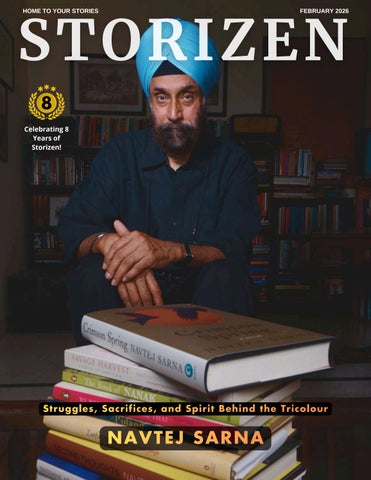
Our cover story, "More Than a Flag: The Struggles, Sacrifices, and Spirit Behind the Tricolour, " features distinguished author and diplomat Navtej Sarna In this powerful conversation, he reflects on the emotional and historical journey of India’s national flag uncovering the ideals, resilience, and sacrifices woven into its fabric It is a tribute not only to a symbol, but to the spirit of a nation
This issue also brings you vibrant event coverage from the literary world. We take you inside the launch of Rohit Saran’s “100 Ways to See India” at IIC Delhi, a celebration of data, diversity, and the many lenses through which we can understand the country. We also spotlight the launch of “The Sage Who Reimagined Hinduism,” a thought-provoking work that revisits faith, reform, and the power of reinterpretation in modern times.
As always, our pages are enriched with 53 thoughtfully curated book reviews, spanning genres and voices that challenge, inspire, and captivate Whether you are seeking historical insight, contemporary reflection, or literary escape, this issue offers a compelling collection for every reader
As you turn these pages, may you rediscover love not just as emotion, but as action, memory, and meaning
Happy Reading!
Saurabh Chawla, Editor in Chief editor@storizen.com
By Pria Raiyani and Swapna Peri
In this special feature for Storizen Magazine –February 2026, we are honoured to present a thoughtful conversation with Navtej Sarna, author of A Flag to Live and Die For: A Short History of India's Tricolour With a historian’s depth and a diplomat’s global perspective, Sarna traces the Indian tricolour’s extraordinary journey from ancient civilisational symbols to its emergence as the sovereign emblem of a modern republic Reflecting on figures like Pingali Venkayya and Mahatma Gandhi, pivotal moments such as the Quit India Movement, and the decisive debates within the Constituent Assembly of India, this interview explores how a banner of protest evolved into a sacred national symbol We also delve into his wider literary works, including The Exile and Crimson Spring, and reflect on how his diplomatic career and writings for publications such as The Week and The Hindu continue to inform and enrich one another.
Your book traces the tricolour's roots back to ancient symbols in epics like the Mahabharata could you share what inspired you to begin there and how these early references shaped the flag's evolution into a modern emblem?
It was important to set the national flag in a historical context and to examine first of all what a flag, or a pennant, has traditionally meant in India Looking at flags in the ancient epics or in ancient and medieval India helped to distinguishour traditions from the European traditions of heraldry We also see through this brief historical journey the transition from religious symbolism to more universalist ideas
Sri PingaliVenkayya's 1921 design and Mahatma Gandhi's refinements, including the charkha, played pivotal roles in unifying communities. How did you approach narrating this transformation from communal colours to universal ideals like courage, truth, and faith?
Well, I simply had to follow the debates and declarations of those who were involved in designing the flag and modifying it In many ways this debate reflects the broader inter-communal relations at different stages of our freedom
struggle. In 1921, Mahatma Gandhi initially gave a fully communal meaning to the colours in his first Swaraj flag, not in order to divide communities but rather to unify them in one revered symbol By the end of the 1920s, relations between communities had deteriorated while the flag had become increasingly important as a symbol of the national struggle It was expedient then to give a more universalist interpretation to the colours in terms of Indian values like truth, courage, sacrifice and so on
The Nagpur Flag Satyagraha and other protests vividly illustrate the tricolour as a symbol of resistance—could you reflect on the most compelling anecdotes from these events that highlight the flag's power in mobilising the masses against British authority?
The Nagpur, and before that the Jabalpur, Flag Satyagraha in 1923 represents a very important phase in the recognition of the flag as a symbol of resistance. We must remember that the flag had that time not yet been adopted by any resolution of the Congress It was powerful because it was backed by Gandhi The satyagraha was motivated by a desire on the part of the people who had owned the flag to have the right to march with it The more the authorites cracked down, the stronger became this resolution People marched with it and courted arrest willingly without breaking into violence- this was also in keeping with the example set by the Akalis in their non-violent protests for the reform of the Gurudwaras
Later, in the 30s, clashes with authorities over the right to fly the flag intensified One of the most dramatic incidents took place during the 1942 Quit India movement when seven students were shot dead by the police while attempting to hoist the flag over the Patna Secretariat.
From the 1931 Congress debates to the 1947 Constituent Assembly's final choice of the Ashoka Chakra over the charkha, your book captures tensions like Gandhi's reservations what insights do you hope readers gain today about the flag's journey from protest to sacred sovereign symbol?
Yes, the journey of the development of the symbol was not without tensions First there was the tension
Pic: Navtej Sarna
regarding the colours and their placement Then there was the tension between the tricolour and the Union Jack, between the tricolour and the religious flags, the communist flag and that of the Muslim League and of course, the princely flags Finally, there was also the critical change from the charkha to the chakra, and this is detailed in the book. This was seen, without losing the values associated with the charkha, as part of the change of the symbol from being a flag of resistance to a flag of a modern republic.
I hope the readers will appreciate that the tricolour was not given to us wholly made and adopted without reservation It went through an intense examination and debate and its journey is marked by great sacrifices on the path to freedom
What drew you to write historical novels like 'The Exile' about Maharaja Duleep Singh and 'Crimson Spring' on the Jallianwala Bagh massacre, and how does your Punjabi literary family heritage influence your storytelling?
Each of those books involved stories that that I deeply felt needed to be told Both those books though based on historical facts and events were framed as novels which allowed me to delve deeper into the emotional and psychological dimensions of the personalities involved. Maharaja Duleep Singh, for instance, had not been examined earlier with a sympathetic eye but was reduced to a footnote in history books or patronized by writers with an imperial slant. Crimson Spring is about Jallianwala Bagh but not only: it tries to capture life in an undivided Punjab with a shared history and a complete geography It also brings in the various historical streams which were running in parallel at that time – revolutionaries, ghadar movement, the Singh Sabha movement and the gurudwara reform, the freedom movement and so on Of course it is natural that I should be influenced by the strong Punjabi literary heritage of my family with both my parents having written extensively on Punjab – its history, culture and its partition
Pic: Navtej Sarna
As a retired diplomat now focused on writing and columns for publications like The Week Hindu, how do you see the interplay between your diplomatic career and your literary pursuits enriching each other?
My diplomatic career and literary pursuits have happily coexisted for decades In fact they have gained greatly from each other Diplomacy, with its travel and exposure to different lands, people and cultures, helped me expand my mental horizons and I feel it enriched my writing Similarly being a writer brought a certain sensibility of a different kind to my diplomatic interactions and opened doors that may have otherwise not been accessible.
About Pria - Young mesmerizing freelance blogger, social enthusiast, and an economics graduate from Jharkhand University with a Master's in Child Psychology. She is hardworking yet crazy, a passionate reader, an ardent music fanatic, an avid caffeine lover, and a maniacal animal lover too She has been a part of numerous anthologies, articles, and write-ups for newspapers and magazines which are multi-linguistic She has also written screenplays for YouTube series
Contact: pria@storizen com
Swapna Peri is a Freelance blogger, book reviewer, narrator, and copy editor
Contact: swapna.peri@storizen.com
In A Flag to Live and Die For, Navtej Sarna traces the remarkable journey of the Indian tricolour from ancient battle standards to the powerful national symbol it is today. Exploring its evolution through the freedom movement from early nationalist flags and Gandhi’s Swaraj banner to its adoption by the Constituent Assembly in 1947—the book reveals how the tiranga became a rallying emblem of sacrifice, unity, and resilience. Rich in history yet deeply moving, it also follows the flag’s place in modern India, celebrating its enduring power to inspire and unite a nation.
HOT OFFthe press
In Cancer: From Chaos to Clarity, celebrated nutritionist Shonali Sabherwal offers a thoughtful and reassuring guide for anyone facing cancer—whether personally or as a caregiver. Combining detox plans, nourishing recipes, and practical wellness tips, she presents a holistic approach that supports prevention, treatment, and recovery. Grounded in experience and compassion, this book goes beyond diet advice, empowering readers to take charge of their health with clarity, confidence, and hope during one of life’s most challenging journeys.
Fight Less, Win More is a hands-on guide to mastering negotiation in every area of life, inspired by the bestselling Never Split the Difference. Authors Jonathan B. Smith and Derek Gaunt reveal how Tactical Empathy —truly understanding and influencing others—can transform everyday conversations into meaningful wins. With practical strategies, real-world examples, and easy-to-apply tools, this book helps you navigate tough discussions confidently, strengthen relationships, and achieve better outcomes without resorting to pressure or manipulation.
HOT OFFthe press
Smarter Than the Storm by Amitabh Kant and Siddharth Sinha explores the powerful intersection of climate change and artificial intelligence at a time when both are reshaping our world. The book highlights how AI can accelerate climate action across sectors—from mitigation to governance—while also addressing its environmental footprint. Blending global case studies with clear insights, it presents a practical roadmap for building sustainable, inclusive, and tech-driven solutions that turn the climate crisis into an opportunity for collective progress.
Set by a river under soft cherry blossoms, Hot Chocolate on Thursdays revolves around the quietly magical Marble Café, where a woman with her notebook and a young waiter observe the lives unfolding around them. Through twelve interconnected, slice-of-life moments, the story shows how simple, everyday actions a warm drink, a shared glance, a small kindness—can unexpectedly change someone’s world. Gentle and heartwarming, it’s a reminder that even the smallest gestures can create lasting connections.
The Syllabus of the Heart: Love, Reimagined
by Jyoti Mehta
f you ask a child to draw love, they will almost always reach for the red crayon They will draw a heart, symmetrical and bold But if you ask a teacher, or a mother, or anyone who has weathered the changing seasons of life, they might not draw a shape at all They might draw an open hand They might draw a bridge They might simply leave the page blank, knowing that love is the space we hold for one another when the world feels too crowded
For years, I viewed love through the lens of milestones, the perfect grades, the well-behaved classroom, the harmonious home February often amplifies this metric, selling us a version of love that is polished and packaged But as bell hooks wisely noted, love is not a transaction; it is an act of nurturing It is the soil, not just the flower In my journey as an educator, I have learned that love is often disguised as patience. It is the quiet resolve to sit with a student who is struggling, not to fix them, but to witness them. It is the reimagining of authority not as power over, but as power with a love that says, "I see who you are becoming, even if you don't see it yet." This is love without the roses: gritty, repetitive, and profoundly transformative At home, as a mother of two, I am learning that the deepest form of love is often the one that feels the most counterintuitive: the love of letting go We spend years holding our children close, protecting them from the sharp edges of the world But there comes a moment when love demands we step back It is a terrifying, beautiful release, trusting that the roots we watered are strong enough to hold them upright in storms we will not witness This "love that lets go" is not an absence of care; it is the ultimate expression of faith in another human being
Perhaps the most radical reimagining of love, however, is the one we direct inward In the busy corridors of work life and the endless to-do lists of running a household, self-love is often the first casualty We mistake it for selfishness But I am learning that to nurture others, one must first be a reservoir, not a drain Love is the courage to say "no" so that our "yes" carries weight It is the forgiveness we grant ourselves for the days we were not perfect, for the patience we lost, for the answers we didn't have. This February, let us look beyond the grand gestures. Let us find love in the messy. Let us find it in the difficult conversations that lead to healing, in the friendships that survive silence, and in the brave act of accepting ourselves, works in progress, forever learning, forever growing
Love is not just what we feel; it is the resilient, quiet work we do every single day
Jyoti Mehta is an Academic Coordinator and a CBSE Resource Person with a deep-seated passion for educational transformation. With years of experience shaping young minds and guiding educators, she views the classroom as a vibrant space for emotional and intellectual growth. Beyond her professional accolades, she is a proud mother of two who navigates the delicate balance of parenting with humor and grace A lifelong learner and a reflective writer, Jyoti explores the intersections of education, relationships, and self-discovery in her work, believing that every day offers a new lesson in the art of living
The Legend of Mayapuri: The Journey of King Vidyutumman towards Truth
by Madhusudhanan S
ayapuri is a small kingdom that lies in the cradle of northern peaks – a realm defined more by its light than laws The sun crowns the granite pinnacles, striking the limestone embankments with a shine so fierce that the entire valley looks like a milky, dazzling bowl The sound of bees buzzing in the meadows is overshadowed by the noise of blades cutting wet grass A river splashes as it flows through water-gates into nearby fields
The wealth of the realm is evident even among the harvesters, with silver bangles clinking against their wrists as they work The kingdom sits at its pinnacle, where even the dirt on a harvester's boots cannot dull the flash of the silver on their wrists The gates are left wide open, guarded only by the shadows of the mountains.
The kingdom was ruled by Vidyutumman, a man who would sooner stain his royal silks helping a mired farmer than ride past a citizen in need. He was a humble and just king. When a wealthy merchant’s carriage destroyed a farmer's medicinal herb patch, he went himself and inspected the land. Then, he ordered the merchant not only to compensate for the loss, but also to till the land until the farmer was satisfied Thus showing that in Mayapuri, the labour is worth more than gold
He is so compassionate whenever people come to him with any problem, no matter how small or big, he always listens to them with full focus He did not just solve problems, but he worked to solve them until they were satisfied
As years passed by, one day he decided to hand over his kingdom to his son As he made this decision, he first informed his Kula Guru, who gave his approval Then, he discussed it with his courtiers and his ministers, who were also happy about it He also wanted to discuss his plans with friendly neighbour kings before passing the crown to his son So, he began his journey to meet them
Chapter 2 – Transition of Kingdom and Vidyutumman Journey
Vidyutumman chose humility over ceremony, deciding to walk the forest paths on foot rather than ride in a golden carriage Along the way, he paused to help a mired farmer, staining his royal silks with river mud without a second thought When he met the neighbouring kings, he bypassed the high-backed thrones for a simple wooden stool, choosing to look his peers in the eye as a friend rather than a superior There, he stated his willingness to crown his son All his friends agreed to his wish and discussed about the smooth transition without any hurdles
As per the plan, on the auspicious day, the crown was passed to his son After placing his kingdom in safe hands and thanking his people and friends, Vidyutumman felt light. He walked alone through the limestone gates, as his wife was no longer alive to walk beside him. As he passed, the streets of Mayapuri were a sea of bowed heads; the air was thick with the muffled weeping of a people losing a father, the sound rising like a low tide against the city walls. Vidyutumman did not look back; he walked with great satisfaction and a smile that reached his eyes.
As twilight deepened into a thick, starless black, his pace slowed To rest for the night, he cleared a patch of damp earth beneath an ancient tree He gathered broken branches to coax a small flame to life The fire flickered, serving as his only shield against the wild and providing warmth against the biting cold of the forest night
As Vidyutumman watched the flickering flames, his entire life flashed before him like a series – every decision made, every sorrow endured, and every moment of joy Despite his accomplishments, a deep void opened within him, a hollow space he could no longer ignore Being a wise man, he understood the impermanence of life, but that knowledge now disturbed him to his core
“What have I truly done?” he wondered He felt that instead of seeking the meaning of existence, he had spent his years entangled in the noise of the world Then, a quiet clarity returned. He realised he had simply fulfilled his duty to his people, and
finally, now the time had come to ponder the truth of who he was. By thinking thus, he fell asleep while the fire danced with the breeze.
Chapter 3 – Vidyutummans Journey towards Truth
“Come, my Child, I am eagerly waiting for you on the Eastern side. Wake up, it is dawn, and come towards me,” called the voice of a glimmering, white-bearded saint in his dream. Hearing the voice, Vidyutumman woke to find that it was already dawn The fire had burned out and turned into grey ash as the first rays of sunlight broke through the dense forest
Vidyutumman wondered whether the voice was only a dream or a real call Should he proceed towards the east or not? Deciding to get freshened up first, he stood and brushed the dust off his clothes He walked to the nearby river, washed his hands and suddenly, he saw a flower – the same one that had flashed in his dream The flower was one of the rare and beautiful Its petals are pure white, while spreading out like sunrays, but at its hear laya a core of deep, brilliant blue The fragrance was so unique that it mesmerised him, pulling him to follow it
The former king followed the scent and soon realised he was moving toward the East Forgetting his hunger and thirst, he focused only on the flower After walking for a few miles, he saw a group of picturesque thatched huts surrounded by a wooden fence. As he neared the settlement, two radiant young people came running toward him. Having walked so far without food or water, Vidyutumman was on the verge of collapse.
He forced himself to take a few more hard steps. As he saw two young people running towards him, his strength finally failed, and he collapsed to the ground. He couldn’t find the power to walk a few more yards As his eyes were slowly closing, he watched as those two radiant young people were nearing him; their faces were the last as he lost his consciousness
The two radiant young people picked him and ran towards the thatched huts And they waited for their Master to arrive A figure of medium height, yet
possessing a gigantic presence, entered the room Only his hands were visible as he reached out, gently caressing Vidyutumman’s head.
Chapter 4 – Face to Face with the Glimmering WhiteBearded Saint
As disciples lifted their eyes, they saw their Guru standing and gently caressing Vidyutumaman’s head. The gigantic saint, with his white glittering beard in the soft light, slowly turned to one of his young disciples, “Bring the herbs and start preparing the medicine”, he ordered Turning to the other, he added, “And you – go and fetch food and water for him ”
Both disciples silently left the room to obey their Guru's instruction While both the disciples were away, the Guru started rubbing the hands and legs of Vidyutumman When one of his disciples returned with herbs to prepare the medicine, he stood awestruck by the scene, as he never seen his Guru perform such a humbler act for anyone, no matter how serious the condition may be
Noticing him, Guru smiled and said, “What are you looking at and waiting for?, Go prepare medicine quickly ” The disciple shook himself and started preparing medicines by crushing the herbs The scent of the herbs was so powerful that the entire room was filled with it When the medicine was ready, the disciple handed it over to the Guru.
The Guru took the medicine carefully, slowly pouring a small teaspoon of it into Vidyutumman’s mouth. As the powerful medicine entered him. Vidyutumman slowly regained his consciousness. He could not believe what he was seeing, so he closed his eyes and opened them three times. He could not believe that the same glittering white-bearded saint was in front of him, sitting next ot him The Guru, realising what he is thinking, immediately said, “My Child, it is not a dream, you have reached where you are supposed to come ” Vidyutumman tried to sit up, but the Guru gently pushed him back to lie down Then Guru said, “You are still weak, my child Lie down for a while Your food will arrive now Have some food and water, and take some good rest Will talk tomorrow ” As the Guru finished his sentence, the other disciple entered the room with food and water for Vidyutumman
As the Guru left the room, his departure felt like a chariot moving in the street – Vidyutumman was awestruck with the gigantic presence of the glittering white-beard saint While the other disciple was helping him to make him sit up to take his meal and water, Vidyutumman’s gaze remained fixed on the doorway where the saint had gone, wondering who this mysterious saint could truly be
Chapter 5 – The Dawn of the Truth
As the early sun rose between the mountains, the chirping of birds, and the song of the flowing river filled the air, yet the Ashram remained in deep, asthethic silence. Vidyutumman woke up as the first rays of morning light fell gently over him. He stepped out of the room to find a serene scene of the ashram and the impeccably clean atmosphere. For a moment, he felt he was in a different world; it was the first time in his life that he had experienced such an atmosphere.
As he stepped out, one of the disciples approached him and said, “Sir, kindly refresh yourself and come to the dining hall for breakfast Guru will meet you once you have eaten If you want anything else, kindly let me know I am here to help you ” After saying, the disciple guided him towards the washroom and pointed out the dining hall Vidyutumman thanked him and went to get ready, his mind still racing: Where am I? And who is the glittering white-beard saint?
Vidyutumman got ready and went to dinning hall To his surprise, he saw more than twenty (20) disciples who were sitting there, in the immaculately clean dining hall He was served a plate and water, followed by breakfast As he took his first bite, tears welled in his eyes–it had been years since he tasted such a pure, tasty and nourishing food The meal was so rich in energy that Vidyutumman felt his strength returning instantly After finishing his breakfast, he went to clean the plate The disciple assigned to him stepped toward, “Sir, leave it here, we will do it It's our duty ” As he was about to step out, the assigned disciple showed him where his Guru was waiting.
Vidyutumman moved in the direction the disciple had shown him. The path led into the inner forests, to a massive banyan tree, where the glittering white-beard saint sat with a few disciples. The
disciples were asking their doubts, and the Guru was clearing them. When Vidyutumman arrived, the Guru looked at him and dismissed the others, saying, “That’s all for now; we will talk later. Kindly leave us alone.”
The disciples left both alone. Under the massive banyan tree, only Vidyutumman and the glittering, white-bearded saint remained. The Guru signalled Vidyutumman to take a seat; without hesitation, he obeyed. The Guru’s eyes were beaming with a smile, while Vidyutumman was still wondering who this mysterious saint could be A long Silence prevailed; no questions were asked, and no answers were given In fact, not even a single word was spoken For the first time in his life, Vidyutumman enjoyed an overwhelming peace within – a joy so unique it was beyond words
As time passed, the sun came to the pinnacle in the sky, yet no Single word was spoken The chirping of birds and the rustling of the breeze were the only sounds in the air When the Guru blinked his eyes, then Vidyutumman realised hours had slipped away He slowly rose and prostrated himself on the forest floor, performing sasthangpranam to the Guru with overwhelming tears in his eyes Without a word, both of them began to move slowly back toward the Ashram As they moved slowly back toward the Ashram, a single ray of light fell upon the Guru Seeing this, Vidyutumman felt as though a divine force had truly come to help him out of his void With his eyes filled with overwhelming tears of peace, he followed his guru to the ashram.
Madhusudhanan S is an Economist by profession He loves to write Fiction, Essays and issues on Economics He has published essays and stories in selfgrowth com, Storizen Magazine, Indian Journal and twist & twain
This combination is perfect for your "Journey towards Truth" because:
Symbolism: White represents purity and honesty, while blue is often associated with tranquillity, wisdom, and the infinite much like the sky or the deep sea Blue flowers are relatively rare in nature, making this discovery feel like a divine signal
Visual Contrast: The "blue eye" at the centre acts like a pupil, making it feel as if the flower is "watching" or "guiding" the seeker
BEYOND HEART EMOJIS
byAnkurR.Gupta
hen we hear the word "LOVE," our thoughts often drift toward heart emojis, candlelit dinners, and butterfly-fluttery feelings Yet love is more than what is found in Valentine’s card captions It does not appear solely as romance; it quietly grows where it is least noticed, and that is in selfless familial support, self-love, dedication to goals, compassion for strangers, or a friend's tough love Just as a rainbow is created from a blend of different colors, these forms of love, along with romance, combine to paint the full spectrum of life, making it a beautiful experience to relish
Let’s view this spectrum of love through the lens of the National Award-winning Bollywood movie 12th Fail, which exploresit with honesty. Inspired by reallife events, this movieshows a survival story of protagonist Manoj, who hits rock bottom after failing his 12th-grade and UPSC exams. However, a closer look reveals a masterclass in how LOVE acts as a catalyst for human potential.
Here, Manoj’s journey isn’t merely a battle against academic failure, crushing poverty, systemic hurdles, and the suffocating weight of societal expectations It is also about the fact that in such a harsh environment, talent alone is rarely enough to survive One requires a deeper fuel source, and that fuel is LOVE, appearing in every form around us
Love of Family
Unconditional support in a family is a vital psychological anchor Research shows that feeling supported increases resilience under stress
The movie 12th Fail resonates with this completely The solid support of his family despite their poverty encourages Manoj to follow his dreams In one scene, when Manoj is on the brink of quitting, he finds a letter from his father expressing his belief in him, which revives his determination This support helps him continue, not because success is certain, but because giving up would betray those who believe in him.
This film reminds us that familial love isn't a magic wand that vanishes obstacles; rather, it is the steady reinforcement that builds the inner strength needed to overcome them.
Self -Love
Self-love is often overlooked, yet it is the most transformative and powerful kind of love
After failing, Manoj could have accepted society’s judgment, but chose self-respect He embraces setbacks, pursues his goals without shortcuts, and
values growth He felt no shame in failure and readily accepted friends' support Manoj shows that self-love means believing in yourself and persevering despite obstacles
Importantly, this care isn't about vanity or indulgence; it's the quiet, stubborn voice that insists, "I am worth the effort "
This spark of self-love means forgiving mistakes, learning from them, and refusing to let setbacks define a lifetime
Self-love is the most fundamental aspect of our lives. Without it, even strong support can feel insufficient. It is precisely this inner strength that propels us through adversity and shapes who we become.
Love of Friends
As our journey expands, we see that love also flows from the people we choose as friends and mentors These relationships shape our paths by providing encouragement and accountability
The movie shows that true friendship and mentorship are not always comfortable They involve people who point out our blind spots and push us toward growth when we are tempted to settle for mediocrity In times of financial crisis or deep doubt, these bonds offer the perspective and direction needed to stay the course This brand of love transforms a person by holding them to a higher standard than they might set for themselves
Romantic Partnership
The film argues that, contrary to common belief, romantic love can actively support and enhance personal goals rather than distract from them Building on this, Manoj’s relationship with Shraddha shows that healthy romantic love is a pillar of strength and not a distraction. Shraddha values Manoj’s honesty and belief in his future, encouraging his preparation. Manoj respects her independence and appreciates her faith and support. Their relationship demonstrates trust and patience.
Furthermore, when a partnership is based on companionship and mutual respect, it strengthens ambition. This love provides sanctuary, a place for reassurance during ups and downs
Conclude
The real magic in our lives unfolds when these forms of love unite, as seen with Manoj He fulfilled his ambition of becoming an IPS officer
In our lives, it’s the spectrum of love that provides colours Family love provides roots, self-love gives dignity, mentorship offers guidance, and romantic love brings emotional stability Together they form a web of support that nurtures character and actions, and keeps us moving forward
The ultimate takeaway from our end is to keep nurturing every form of thislove So, set aside time for loved ones, practice self-kindness, and help strangers As you go about your day, take a moment to reflect on the love you give and receive Share the ways it has shaped your journey with others, as you may inspire someone else to embrace love in new, transformative ways.
Ankur R Gupta - Ankur R Gupta is a multifaceted individual with a passion for storytelling and a deep understanding of human psychology.
As an author, writer, and cybercrime intervention officer, her articles and stories delve into the complexities of human emotions, relationships, and the pursuit of personal well-being
Through her captivating narratives, she invites readers to embark on a journey of introspection and self-discovery
In addition to her writing pursuits, Ankur is an avid traveler She is particularly drawn to historical and adventurous destinations, where she immerses herself in diverse cultures, traditions, and histories These experiences serve as a wellspring of inspiration for her work, adding depth and authenticity to her stories and articles
THE FIRST EXPERIENCE OF LOVE
BY NEHA JAIN
he first experience of love is a different kind of feeling Thinking about it makes the heart happy, as if life has been filled with colors
Perhaps some such moments, memories that are always hidden in a corner of our mind and heart, and when all those things, memories are refreshed, it feels as if in a life full of sorrow and pain, even for a few minutes or moments, we have found a reason to smile in this life, perhaps someone's eyes even fill with tears Love is that part of life which is never filled, it always lives in hearts. Today I will tell you one such story. There was a boy whose name was Love. He liked a girl named Shikha, they often used to meet in college. And then they started meeting daily, but their talks were limited only to Hi, How are you, but both of them started liking each other, years passed like this, then one day that boy proposes to that girl on Valentine's Day with courage, gives a lovely rose and says will you be my friend and girl accepts the rose
Without saying anything, she starts leaving happily from there, that boy also lovingly waits for her to say something But she leaves from there The next day when they both meet, the boy asks her, you didn't answer, she smiles and leaves from there Like this a month passes, then 2 months, 2 years, time passes by, they used to meet daily, look at each other, smile and leave, but in their hearts they liked each other
Now it remains to be seen when that girl will answer, she thinks, what should I do, answer or not, in her heart she too started liking him, that foolish girl kept thinking, time kept passing, and doing this, the damn day passed, then one day she nervously, hesitantly calls him, and says hello, they were already friends, just waiting for her to speak. But maybe it was too late, a lot of time had passed for the friendship too. And then one day that girl comes to know that that boy's engagement happened. Hearing that news, the girl cries a lot. Their friendship could not reach love. Maybe she took too long to say yes. This one year of waiting separated her from that love forever And then that girl also gets married years later But if you are ready, you shouldn't wait Being away from your love forever is a punishment The whole life could have changed with just one yes So why don't we give importance to love in our lives and make our lives beautiful If you truly love someone, please don't delay in saying yes to them You won't get love again
Neha Jain lives in Kota. She is a homemaker and a finance enthusiast.
Close Your Eyes and Let Your Ears be the Canvas
Stories written and narrated by Madhulika Ra Chauhan, await you where the magic of narrative will carry you away, episode by episode.
Watch the Story ‘Naayika’ on YouTube
“In life and in art, we don’t just perform roles, we become them.”
Meet the Naayika within you. Do listen.
Listen ‘Naayika’ on Spotify
Scan the above QR Code to listen ‘Naayika’ on Spotify
Scan the above QR Code to listen ‘Naayika’ on YouTube
by saurabh chawla
Book Title: Vigil
Author: George Saunders
Publisher: Bloomsbury Publishing
Number of Pages: 192
ISBN: 978-1526624314
Date Published: January 27, 2026
Price: INR 532
There are some novels you admire for their craft And then there are those rare ones that quietly dismantle you while you’re still turning the pages Vigil by George Saunders did exactly that to me
I began this book expecting the wit and structural brilliance Saunders is celebrated for What I did not expect was the emotional undercurrent that kept tightening its grip as I moved deeper into the narrative Vigil feels less like a conventional novel and more like a mirror held up to our times reflecting our anxieties, our moral confusions, and our fragile attempts at connection.
Saunders has a way of writing that feels deceptively simple. His sentences are clean, almost unassuming. Yet beneath them lies an extraordinary compassion for human frailty. As I read, I found myself pausing not because the prose was difficult, but because it was piercing. He understands the quiet loneliness of modern life, the tension between who we present ourselves to be and who we are in solitude
What struck me most was the emotional honesty There is humor here sharp, observant, at times delightfully absurd but it never feels cruel Instead, it becomes a lens through which we can examine our own contradictions without turning away In a world
increasingly divided by noise and certainty, Vigil invites us into ambiguity It asks us to sit with discomfort rather than rush toward easy answers
As an editor constantly surrounded by stories, I am drawn to books that remind me why storytelling matters Vigil does that beautifully It reaffirms that fiction is not an escape from reality it is a deeper immersion into it Through its characters and quiet revelations, the novel insists that empathy is not optional; it is essential
February, often celebrated as the month of love, is also a month of introspection. And in its own profound way, Vigil is about love the complicated, imperfect, stubborn kind that persists even when certainty collapses.
This is not a book you simply finish. It lingers. It stays. And perhaps that is its greatest triumph.
Get it here:
n the evening of 17 February 2026, the India International Centre, New Delhi, played host to a compelling conversation on a subject often overlooked in everyday discourse data Senior journalist Rohit Saran unveiled his latest book, 100 Ways to See India: Stats, Stories, and Surprises, before a packed hall of policymakers, journalists, economists and engaged citizens.
The book does something deceptively simple yet profoundly important: it tells India’s story through numbers.
When Data Becomes Storytelling
India is frequently described as diverse, complex, contradictory but how often do we pause to measure that complexity?
Which Indian city has the most languages spoken within it?
Where will the next 100 babies in India likely be born?
Why do only 3% of adult Indians pay income tax?
Through accessible visuals, pie charts, and sharp contextual explanations, Saran transforms raw government data into insights that are not just informative, but revelatory. The result is a portrait of India over seven decades after Independence a country evolving at scale, often in surprising directions.
As one panelist aptly noted during the discussion, India is not data-poor; it is interpretation-poor And that is precisely where this book intervenes
A Power-Packed Panel on Policy and Perspective
The launch was followed by a thought-provoking panel discussion featuring senior Congress leader Jairam Ramesh, former G20 Sherpa and ex-CEO of NITI Aayog Amitabh Kant, and Secretary, Ministry of Statistics and Programme Implementation Saurabh Garg The conversation was deftly moderated by journalist and author Kaveree Bamzai
The discussion moved beyond the book to examine how data shapes governance itself.
Ramesh reflected on how public discourse often overlooks statistics that challenge assumptions Kant spoke about realtime data as a driver of administrative reform and measurable outcomes, particularly in aspirational districts and large-scale national initiatives Garg highlighted the government’s push toward improving data transparency and accessibility, ensuring that statistics serve citizens, researchers and policymakers alike
The consensus was unmistakable: data is not ornamental it is foundational
Why Data Matters — Especially in Politics
One of the evening’s strongest undercurrents was the reminder that governance without evidence is guesswork. In a country as vast and layered as India, policymaking demands more than rhetoric it requires numbers, trends, and measurable realities.
Data is necessary.
And perhaps most importantly, it is necessary for politicians Because when policy decisions affect over a billion people, clarity is not optional
A Book for the Curious Citizen
100 Ways to See India does not overwhelm with jargon Instead, it invites curiosity It allows readers to confront assumptions and see familiar narratives through a new lens one grounded in evidence
In an era where opinions often outpace facts, Rohit Saran’s work stands as a reminder that numbers, when thoughtfully interpreted, can illuminate more than they obscure.
The evening at IIC Delhi was not merely a book launch. It was a conversation about how India sees itself and how it must continue to see itself through data.
Because sometimes, the clearest way to understand a country is to count it carefully.
The India International Centre, New Delhi, witnessed an evening of reflection, scholarship, and civilisational introspection as The Sage Who Reimagined Hinduism was formally launched on February 19, 2026
Authored by Shashi Tharoor, the book brings national attention to the extraordinary life and legacy of Sree Narayana Guru one of modern India’s most influential yet under-acknowledged spiritual and social reformers.
A Sage Ahead of His Time
Born in 1855 into the Ezhava community in Travancore (present-day Kerala), Sree Narayana Guru rose from a socially disadvantaged background to become a transformative spiritual leader At a time when caste hierarchies were deeply entrenched, he consecrated temples open to all castes, championed education for the marginalized, and articulated a powerful ethical vision rooted in equality
His immortal message “One Caste, One Religion, One God for humankind” was not merely spiritual rhetoric but a radical social philosophy that challenged structural inequality Dr. Tharoor’s book situates the Guru alongside towering reformers such as Swami Vivekananda, B. R. Ambedkar, and Mahatma Gandhi, while arguing that his national recognition has not matched his impact.
The Launch: A Dialogue on Identity and Reform
The launch event evolved beyond a ceremonial release into a thoughtful dialogue on caste, identity, and reform in contemporary India
An engaging panel discussion featured Pavan K Varma, Ashutosh, and was moderated by Barkha Dutt
The discussion touched upon the continuing realities of caste discrimination while also addressing the complex question of caste identity Pavan Varma reflected that while discrimination must be dismantled, individuals must also remain aware of their roots identity, he suggested, should be understood with maturity rather than denial.
The evening underscored that reform is not achieved through erasure, but through recognition and transformation.
Why This Book Matters Now
At a time when debates around faith, equality, and cultural memory dominate public discourse, The Sage Who Reimagined Hinduism arrives with urgency It invites readers to revisit India’s reform movements not as isolated episodes, but as part of an ongoing civilisational evolution
If Kerala today stands as one of India’s most progressive and socially developed states, much of that transformation can be traced to the Guru’s pioneering efforts in education, temple entry reform, and social mobilisation
Through meticulous research and compelling storytelling, Dr. Tharoor reclaims a national figure whose influence deserves wider acknowledgment.
A Legacy Reintroduced
The February 19 launch was more than a literary gathering it was an act of historical restoration.
Some books document history
Some provoke debate
And some restore forgotten giants to their rightful place
As you turn the page, let the adventure begin –our book reviews await, promising literary delights and captivating tales!
Pic: Swapna Peri
Juhea Kim's "A Love Story From the End of the World: Stories" comprises ten evocative short stories that explore a broad range of emotions and human experiences The collection begins with "Biodome," depicting a future Seoul enveloped in yellow dust, where the protagonist grapples with memories of a freer past Themes of history and love manifest in varied forms across stories like "A Woman’s Life in 10 Scenes" and "Color of the New World," the latter introducing a gentle intellectual romance. In "KwaZulu-Natal," the tale connects a human protagonist and Rocky, an elephant, through rich cultural language, while “Older Sister” portrays the complexities of sibling relationships with humour and depth. Kim's storytelling is marked by a cinematic quality, allowing readers to immerse fully in each narrative. "Mountain, Island" tells of a young boy on a garbage-strewn island, striving for fame amid societal issues, highlighting the tension between celebrity culture and environmental neglect The titular story concludes the collection on a reflective note, as Bada searches for love on a desolate Arctic islet, ultimately realizing that what truly matters is the depth of one’s love Throughout the collection, Kim deftly captures the unspoken emotions within various human bonds, urging readers to confront uncomfortable truths about the world and their connections to it The stories challenge readers to step beyond their comfort zones, reflecting on the hidden realities of life and the enduring power of love in a troubled world
This is not a light or fast read, but a thoughtful collection that focuses on character and emotion rather than plot Best suited for literary fiction readers, it offers deep reflections on human weakness and fragile hope in an imperfect world.
A diverse anthology, "Appetite: New Writing from Goa" by authors Shivranjana Rathore and Tino de Sa offer an exploration of desire, identity, and culture through stories, poems, and essays reflecting the complexities of contemporary Goan life. It captures the essence of Goa, melding historical context with present-day realities. Contributors delve into themes of longing and belonging, portraying Goa as a site of socio-economic and emotional pressures, rather than a static cultural object The anthology interrogates contemporary anxieties through varied literary forms, including speculative fiction, domestic narratives, and political poetry Key pieces highlight the role of food as both a motif and a method, revealing the tensions between comfort and violence in cultural expressions The work emphasizes conversations across generations and forms, illustrating connections between written and visual art Essays broaden the discourse, addressing issues such as land, labour, and the ethics of desire in a rapidly evolving socio-political landscape. To sum up, "Appetite" avoids simple resolutions, presenting a mosaic of voices and perspectives that invite reflection and dialogue. It serves as a living archive, documenting the interplay of past and present, insider and outsider, urging readers to engage with Goa's multifaceted narrative.
The anthology’s focus on humility as a form of ambition reflects a deeper understanding of the complex appetites that define human experience, challenging the reader to seek meaning rather than consumption. A must-read!
A Love Story From the End of the World by Juhea Kim
Appetite by Shivranjana Rathore and Tino de Sa
Being Carlos Alcaraz by Mark
Hodgkinson
"Being Carlos Alcaraz" by Mark Hodgkinson, author of compelling biographies of Roger Federer, Andy Murray and Serena Williams, is an inspiring biography about one of tennis’s most exciting young players. Even though Carlos is still very young, he has already achieved great success. He won the US Open at just 19 and became the youngest men’s world number one For tennis fans, this book is a real treat because it shows both his victories and the hard work behind them The book follows Carlos’s journey from his small hometown of El Palmar in Spain to the biggest tennis tournaments in the world His father was a tennis coach, and Carlos started playing when he was only four years old. With early support from sponsors and strong guidance from his team, he slowly built his career. The author includes interviews with his coaches, teachers, and family, which makes the story feel personal and honest. We see not only the confident champion but also the young man who works tirelessly to improve. What makes this book special is how it shows Carlos’s kind and humble nature. Even with fame and Grand Slam titles, he stays close to his family and remembers his roots The story also talks about the long hours of training and the pressure that comes with being a global star
Overall, this is a warm, well-written, and enjoyable read. It is perfect for tennis lovers and for anyone who enjoys stories about talent, hard work, and staying grounded.
Caste by Suraj Milind Yengde
"Caste: A Global Story" by Suraj Milind Yengde challenges the view of caste as solely an Indian institution, arguing that it is a global phenomenon with ongoing impacts in diasporic communities and racial politics. Grounded in the ideas of B.R. Ambedkar and influenced by
Nicholas Dirks' analysis of colonialism's role in shaping caste, Yengde asserts that caste adapts and travels globally, rather than being confined to India The book connects Dalit struggles with broader global movements, particularly showing parallels with African American experiences and the Black Lives Matter movement Yengde's work enriches caste studies by framing Dalit thought within diverse traditions, including Black radicalism and Caribbean contexts, thus fostering a global dialogue on anti-caste activism. Despite its contributions, the book does have limitations, such as underdeveloped discussions of caste in the Middle East and gender, alongside a stylistic risk of prioritizing narrative over theoretical depth. The book is written with an activist’s passion, making complex themes accessible without oversimplification. His book repositions caste as a pressing global issue, vital for scholars, activists, and students who seek both rigorous analysis and transformative discourse
Ultimately, Yengde argues that acknowledging the global narrative of caste is essential for constructing a future free from caste-based oppression.
Citizen Under Siege by G.N. Devy
G.N. Devy’s "Citizen Under Siege" presents a compelling analysis of the erosion of civil liberties and democratic rights in India over the past decade. Through a series of essays, the book addresses critical social, political, and cultural issues, chronicling the struggles of
civil society, activists, and ordinary citizens since 2014 Devy delves into landmark events such as the antiCitizenship Amendment Act (CAA) protests, the murder of prominent activists, and the broader implications of state repression and censorship The essays serve as both a historical account and an accessible primer for readers, recalling significant moments that demonstrate the decline of rights in modern India Devy's nuanced approach offers insights into complex topics, from the role of language and historical interpretation to the consequences of dissent in the media and education system His writing is characterised by clarity and a deep understanding of the injustices faced by citizens, encouraging readers to reflect on their identity and rights. As authoritarianism rises globally, Devy’s book questions how to protect democracy and highlights the importance of constitutional values and diversity in Indian society. It serves as a poignant reminder that an engaged citizenry is vital for the health of democracy, making "Citizen Under Siege" essential reading for anyone invested in understanding their role within a democratic framework in India and beyond
In the end, the book argues against the normalisation of state overreach and reinforces the idea that resistance and critical questioning are crucial for sustaining democratic principles.
"City Limits: Crisis of Urbanization," edited by Tikender Singh Panwar and included in the Rethinking India series, discusses the problems caused by unplanned and uncontrolled development in Indian cities, which has worsened socioeconomic inequality and reduced quality of life Essays by well-
known authorities in urban planning and policymaking are included in this anthology, providing insights into the pressing issues that urban areas face as well as suggested fixes for building inclusive and sustainable cities The book assesses India's urbanization after the 1990s, showing how this time has resulted in heightened inequality, strained ecosystems, and a waning belief in cities as democratic places It challenges the widely held belief that cities are only hubs of economic expansion, contending that this viewpoint has produced environments that are not only exclusive but also unsustainable Following economic liberalization, which led to the privatization of basic services and the decline of the welfare state, "City Limits" explores the rise of the "neoliberal city" and the wealth transfer from the poor to the rich while marginalizing populations such as the homeless and migrant workers The book argues that urban policy frameworks like public-private partnerships and smart cities exacerbate social marginalization and turn cities into instruments for corporate exploitation. The book also advocates for the "Right to the City," highlighting the necessity for cities to serve as community centers rather than for profit-driven enterprises and the need for fair access to urban resources.
The book also promotes a rethinking of development towards inclusive and sustainable urban environments, emphasizing the value of a human-centric view of urbanization that takes community and dignity into account in the face of issues like housing shortages and climate change.
City Limits by Tikender Singh Panwar
Climate Change 2100 by Chetan Singh Solanki
The book "Climate Change 2100: Survive or Thrive?" by Prof Chetan Singh Solanki is a comprehensive exploration of climate change, aimed at educating and empowering readers to take action against this pressing issue. Structured in six parts with 22 chapters, it
combines scientific rigour with accessibility, making complex concepts understandable for both scientific and non-scientific audiences alike Solanki encourages readers not just to read but to engage in discussions, indicating that the book serves as both a source of knowledge and a catalyst for dialogue on climate issues The author presents climate change as a civilizational crisis, necessitating changes in how society consumes and lives The book methodically progresses from the evolution of energy use to the science and urgency of climate change, culminating in actionable solutions that require both personal accountability and systemic reform While the writing style prioritizes clarity over literary flair sometimes resulting in a functional tone its effectiveness lies in Solanki's insistence on practical frameworks, such as the AMG (Avoid, Minimize, Generate) approach and TUPEE (Tread Lightly, Use Less Energy, Produce Your Own Energy) habits, which translate theory into actionable daily choices. Maps and graphs, as well as tables of data and figures, add value to the book. Despite its strengths, the book at times underestimates the social and economic barriers to individual action, particularly in contexts of inequality, which is a whole study in itself Although Solanki acknowledges these complexities, the proposed solutions may feel overly optimistic in their universality Nevertheless, "Climate Change 2100: Survive or Thrive?" stands out as a sincere and timely guide, focusing more on holding readers accountable rather than instilling fear It serves as a valuable resource for educators, policymakers, and individuals who are eager to transition from awareness to responsibility regarding climate change, making it a recommended read for anyone interested in contributing to climate solutions
Overall, the book is an essential read for those concerned about the future of humanity and our planet, encouraging practical climate correction habits through innovative guidelines.
Shehnab Sahin’s debut short-story collection, "Colour My Grave Purple and Other Stories", is set in Assam during the 19th century, specifically post-Opium Wars in China, exploring the social transformations driven by the commercialization of tea. The narratives follow Samuel Paddington, a British
estate manager, and his Cantonese wife, shedding light on Assam's historical landscape marked by colonial influences and labour exploitation This collection aims to redefine Assamese representation in literature, moving beyond the dominant narratives of conflict and insurgency, where she emphasizes a broader portrayal of Assamese experiences Each story in the collection interrogates the complexities of identity, memory, and belonging within the historical context of Assam This collection shares similar narratives with a Telugu book titled ' Neelampu Rasi' that talks about farming in Andhra Pradesh during the colonial era by author Chandralata. One of the stories, titled - 'Two Leaves and a Bud', shows the readers the native struggles against colonial land appropriation, while another story critiques the clash between traditional healing and colonial medicine. Several stories challenge historical perspectives, such as those that reimagine the experiences of a real-life anthropologist through the eyes of the Naga people. The titular story, 'Colour My Grave Purple', connects personal grief with historical legacy, positioning mourning as an act of resistance and reclamation Through her vivid narratives, Sahin affirms the profound human experiences behind Assam’s turbulent history and challenges reductive representations of the region in Indian literary discourse
The collection ultimately serves as an act of reclamation, aiming to recenter Assamese lives within the broader narrative of India.
Colour My Grave Purple and Other Stories by Shehnab Sahin
Daktarin Jamini Sen by Deepta Roy Chakraverti
"Daktarin Jamini Sen" by Deepta Roy Chakraverti tells the inspiring story of one of the first Indian women doctors, Jamini Sen, who chose a life of service over comfort
The book brings to light a powerful yet largely forgotten figure in medical and social history Written in clear and engaging language, it traces her journey from a
determined student to a dedicated doctor working in difficult and often dangerous conditions The narrative not only celebrates her achievements but also places her life within the larger struggle of women seeking education and independence in colonial India One of the strongest parts of the book is its portrayal of Jamini Sen’s courage At a time when women were discouraged from stepping outside traditional roles, she pursued medical studies with focus and strength. The story shows how she travelled to remote regions and worked in hospitals that lacked basic facilities. She treated women who otherwise had no access to healthcare. Through these details, the book highlights the deep gender barriers that existed and how Jamini broke them quietly but firmly. The book also paints a vivid picture of the social and political climate of the period. Colonial rule, social customs, and limited opportunities for women form the background of her life Instead of presenting history as dry facts, the author connects these larger forces to Jamini’s personal experiences This helps readers understand how much effort it took for a woman to build a professional identity at that time The storytelling makes history feel alive and meaningful Another important theme in the book is sacrifice Jamini Sen’s life was not easy She faced loneliness, professional challenges, and a lack of recognition Yet she remained committed to her patients and her mission The book does not present her as perfect but as deeply human strong, thoughtful, and sometimes vulnerable This honest portrayal makes her story even more powerful and relatable In conclusion, "Daktarin Jamini Sen" is more than a biography; it is a tribute to resilience and service Written in simple and accessible language, Deepta Roy Chakraverti's book reminds us that progress often begins with individuals who dare to dream differently. It encourages us to value the contributions of women who shaped history quietly.
This is a meaningful read for anyone interested in women’s history, medicine, or stories of quiet strength that continue to inspire future generations.
Era of India by Minhaz Merchant
Minhaz Merchant's "Era of India" is a provocative analysis of global history, power dynamics, and economic transformation, asserting that history is returning to Asia after centuries of Western dominance The book argues that the West's exceptional period of influence, driven by colonialism and industrial advancement, will give way to a
new era dominated by Asian powers, particularly India and China Merchant draws on various domains, including economics and geopolitics, to support his thesis Inside the book the author examines Asia's historical leadership across various fields, noting its decline after 1800 due to Western dominance, particularly following the Industrial Revolution He anticipates transformative technological developments by 2050 that could reshape global relations. The text identifies a geopolitical framework led by the US, China, and India, implying Europe's decline due to fragmentation and weakened transatlantic ties. Merchant critiques Western progress for its ethical dilemmas linked to colonial violence while recognizing its cultural contributions. He evaluates China's economic reforms and governance under Xi Jinping, contrasting this with India's rise as a non-colonial power rooted in democratic values and economic cooperation Further, he calls for a reevaluation of Western narratives to include non-Western contributions and acknowledge the negative impacts of Western expansion The book is presented as a reinterpretation of history, articulating that nations rise and fall to their natural levels, with the tide of Western hegemony receding "Era of India" subsequently traces India's economic journey since 1947, assessing its trajectory towards becoming the world's third-largest economy by 2030, while discussing the historical impact of colonialism, modern infrastructure initiatives, and geopolitical relations
Overall, it is a deeply researched work that provides a comprehensive look at India's past and its implications for the future global order.
"Focus on girl education" is one of the most frequently stated pledges in the manifestos of all political parties in India's general and assembly elections. This is the promise that progressively wanes as the numbers stay the same. Across the nation, good Samaritans take action to empower school dropouts and young girls by giving
them access to a basic education. "Every Last Girl" by Safeena Husain chronicles the impactful journey of establishing Educate Girls, a grassroots initiative aimed at addressing the severe issue of out-of-school girls in India The book highlights systemic barriers such as poverty, early marriage, and rigid social norms that hinder educational access for girls, symbolized by the character Antimbala, representing those furthest from opportunity The initiative has expanded from a few regions in Rajasthan to over 30,000 villages, successfully bringing more than two million girls back to education Through firsthand experiences and heartfelt stories, Safeena illustrates the transformation that occurs within communities as they support girls' education, providing a compelling blend of data and storytelling The book is not just a memoir but a motivational account of grassroots movements, showcasing real stories of families and individuals who have overcome immense obstacles, thus illuminating a path towards positive societal change. Key themes in the book include education as a transformative right, the urgent need for gender equity, and heartfelt stories from the field that convey the grittiness and determination required to effect change. The book emphasizes the importance of community involvement in education, the shift in mindsets among families, and the journey from despair to hope Moreover, "Every Last Girl" serves as an inspiring resource for those passionate about social justice, education reform, and gender empowerment, making it vital reading for anyone interested in the future of girls’ education in India The work's profound emotional resonance and actionable insights into grassroots activism underline the significant impact of empowering young girls, illustrating how education can alter lives and communities
The honour of the Ramon Magsaysay Award further underscores the movement's importance and effectiveness.
Sajitha Madathil's phenomenal work"Malayala Nataka Sthree Charitram" translated into English as "For the Love of Art," by Jayasree Kalathil uncovers the neglected histories of women in Malayalam theatre, showcasing their contributions and experiences as significant and driven by passion rather
than mere necessity. Sajitha confronts the systematic erasure of these women from traditional accounts, which often highlighted male artists while relegating female performers to footnotes. Through interviews, analyses of forgotten plays, and biographical excavations, she asserts that women's artistic endeavours were not solely motivated by economic desperation but rather by a profound love for their craft. Translator Jayasree Kalathil, on par, emphasises the political dimensions of translating these narratives into English, aiming to reshape historical discourse by incorporating regional scholarship into global conversations about theatre and gender The book documents the lives of significant figures such as M K Kamalam and P K Rosy, whose stories challenge the historical narrative and highlight the intersections of caste, gender, and power dynamics The translation process involves not just linguistic conversion but also a nuanced retelling that captures the cultural and emotional weight of the original work The book models feminist historiography, presenting theatre history as a rich tapestry where women played essential roles despite societal challenges The book also critiques traditional narratives by acknowledging the emotional toll of artistic ambition on women, illustrated through personal testimonials of those who faced stigma and exploitation. Through this comprehensive examination, the book serves as a vital critique of how history is recorded and understood, establishing a platform for women as rightful creators of their cultural narratives in Kerala theatre.
It concludes with a recognition of the ongoing journey of women in theatre, highlighting their roles as innovators and the continued struggle for representation and space in the arts.
Every Last Girl by Safeena Husain
For the Love of Art by Sajitha Madathil and Jayasree Kalathil
Ace writer Amitav Ghosh's "Ghost-Eye" weaves a haunting tale of memory, reincarnation, and the fragile ties between humans and nature. Set against the shifting landscapes of 1960s Calcutta and the misty Sundarbans, the story follows a young girl named Varsha who claims vivid past-life
memories as a fisherwoman from the delta. Through the eyes of psychiatrist Shoma Bose and her nephew Dinu, Ghosh unfolds a mystery that spans decades, blending everyday life with whispers of the uncanny The novel shifts from Ghosh's usual epic backdrops to a tight whodunit style, probing cultural forgetfulness and clashes between science and the unseen Shoma, a rational thinker drawn to Varsha's "reincarnation case," grapples with folk tales of goddesses like Mansa Devi and Behula, set against real events like riots and pandemics The Sundarbans emerge as a living force, full of fish, floods, and climate warnings that mirror the characters' inner turmoil Author Ghosh's prose shines with quiet power, mixing magic realism and sharp details of cooking, migration, and loss He questions if reason alone can grasp lived wonders or ecological grief, using Varsha's story to link personal hauntings with global crises Side threads on rootedness versus movement add depth, though some historical touches feel light. Yet the book stumbles at the close, rushing resolutions without full payoff, diluting its spell. Still, it celebrates storytelling as a bridge over rational gaps, urging richer ways to face our warming world. Fans of The Hungry Tide will find familiar tides here, elevated by Ghosh's deft hand.
"Ghost-Eye" lingers like a delta mist, a bold call to honour the unseen in our stories and surroundings.
Colonialism in the Indian subcontinent is synonymous with the British Empire for a variety of reasons, the most significant of which is the 200-year British Raj. The second is the impact of the East India Company. However, if one is interested in the true history of those times, it is clear that French colonies in India, particularly southern India, were a significant period i
n the subcontinent's history To concretise the above statement, a recent book by author Robert Ivermee"Glorious Failure" highlights the significance of France's short-lived attempt to build an empire in Southern India The French Compagnie des Indes competed fiercely with British interests for control over trade, especially following the decline of the Mughal Empire Initially, the French found some success in establishing trading posts, securing five comptoirs that remained under French influence until the 1950s, despite challenges such as the inhospitable geography of their primary settlement in Pondicherry. Ivermee further asserts that the French colonial presence was not only impactful but also driven by violence and greed. Figures like Joseph François Dupleix, whose tenure marked French territorial expansion, utilised military force, often sacrificing local troops in pursuit of dominance. The story of French imperialism is woven with military engagements and the interplay of alliances among regional powers, including the East India Company, Hyderabad, Mysore, and the Maratha Confederacy The book juxtaposes military history with political machinations and local reactions, unveiling the complexities of French colonial ambitions and demonstrating that proclamations of benevolence were often overruled by imperialistic desires
Ultimately, "Glorious Failure" emphasises the miscalculations and lost opportunities that characterized the French imperial experience in India.
Ghost-Eye by Amitav Ghosh
Glorious Failure by Robert Ivermee
K Ancrum's "Icarus" spins the old Greek myth into a tense, queer YA thriller full of stolen art, family grudges, and first love Icarus Gallagher works for his dad, Angus, swapping real paintings for perfect fakes in rich homes always targeting one man, Mr Black, who blames for his mom's death
Icarus lives by strict rules to stay safe and hidden, sneaking in and out like a shadow. But one night changes it all when he meets Helios, Mr Black's son, locked away under house arrest Instead of snitching, Helios asks for company, trading silence for chats that break Icarus's walls What starts as wary talks turns into real friendship, then deep feelings neither expected They dig into family secrets abuse, revenge, and traps holding both boys back Icarus dreams of escape for them both, but his dad's anger grows, forcing hard choices between loyalty and the boy who sees him truly Ancrum nails the push-pull of toxic homes, with Icarus learning to feel soft after years of hardness The mansion feels alive, gothic and creepy, matching their hidden meets full of tension and sparks Romance builds slow and real, mixing trust with fear, while heists add pulse-racing thrills Side looks at mental health and found family hit home without preaching Pacing stays tight, mirroring teen urgency, though some twists feel rushed near the end. Fans of forbidden love, like in 'Aristotle and Dante', will eat up the emotional layers. Ancrum's voice shines bright, making heavy stuff hopeful and raw. Inside the book, every page's indentation looks spacious and easy to read.
Grab "Icarus" for a quick, heart-pounding read that flips wings into wings of escape perfect for YA lovers craving love amid the chaos.
It's Okay Not to Get Along with Everyone by Dancing Snail
In "It's Okay Not to Get Along with Everyone", Dancing Snail delivers a refreshing manifesto for interpersonal authenticity in a world obsessed with universal likability. Drawing from personal anecdotes and psychological insights, the author argues that not every connection
deserves our energy, challenging the toxic positivity culture that equates solitude with failure Snail's voice witty, unapologetic, and laced with humour hooks readers from the opening chapter, where she recounts ditching a draining friendship circle without regret. This slim yet potent book feels like a permission slip for the socially fatigued, blending memoir with self-help in a way that avoids preachiness. Author Snail's work looks special for her nuanced exploration of boundaries, not as walls but as filters for meaningful relationships. She dissects common scenarios like workplace frenemies or family obligations using relatable metaphors, such as pruning a garden to let the best plants thrive Backed by references to thinkers like Brené Brown and Eastern philosophies on detachment, the narrative empowers readers to identify "energy vampires" without descending into cynicism Snail's Indian-inflected perspective, subtly woven through cultural nods to arranged social norms, adds a layer of global relevance, making the book resonate especially for those navigating collectivist pressures Yet, the book's brevity occasionally skimps on depth; some chapters end abruptly, leaving readers craving more tools for implementation Snail excels at diagnosis but offers lighter prescriptions, like journaling prompts or "nope" scripts, which feel entry-level for veterans of therapy-speak This isn't a flaw so much as a deliberate choice Snail prioritizes mindset shifts over step-by-step guides, trusting her audience's intuition. Critics seeking rigorous data might find it anecdotal, but for everyday wisdom, it sparkles. On the whole, “It's Okay Not to Get Along with Everyone” is a vital antidote to performative people-pleasing, perfect for burnt-out millennials and Gen Zers reevaluating their social diets. Dancing Snail doesn't just validate solitude; she celebrates it as a strength. If you've ever apologized for your own authenticity, this book will liberate you grab it for that much-needed exhale.
Icarus by K. Ancrum
In The Shadow of Freedom by Kaushik Raha
Some stories of freedom are loud and celebrated Others live quietly in old trunks, in fading ink, and in family memory "In The Shadow of Freedom" belongs to the second kind Written by Kaushik Raha and based on the memoirs of his grandfather Lalit Chandra Raha, this book brings back the voice of a
young revolutionary whose sacrifices were nearly lost to time. Lalit’s journey begins with fire in his heart. As a young member of the Jugantor movement, he believed revolution meant driving the British out of India His path led him to secret meetings, bold actions, and eventually imprisonment in the dreaded Cellular Jail of the Andamans The prison years, however, changed him in ways he could never have imagined Behind iron bars and under harsh conditions, Lalit found something unexpected: books, debate, and deep thought The 1933 hunger strike, which cost the lives of fellow prisoners, became a turning point Pain gave way to purpose Yet revolution did not only test Lalit it tested his family At first, his father and uncle supported his patriotism in principle, proud of his ideals But when his studies began to suffer, and his future seemed uncertain, support turned into worry and anger As the only son, he was expected to become a doctor and bring stability to the family Instead, he chose secrecy. He hid his involvement, lied about his movements, and carried on his political life in silence. When he was finally arrested, the cost became unbearable. His father and uncle were also taken into custody, and the house was left in tears. His mother’s sorrow haunted him deeply. Even so, love did not fade. His uncle shared food with him in jail, and his family stood by him despite the pain. Later, out of guilt and duty, Lalit agreed to marry to ease his mother’s suffering though it brought its own struggles The freedom he fought for came at a deeply personal price Inside the jail’s small library, Lalit discovered Darwin, Marx, Lenin, and Hegel Science slowly replaced blind faith He began to see religion as something shaped by fear, and society as shaped by power and class struggle His idea of revolution expanded It was no longer only about removing foreign rulers It was about building a fair society based on equality and shared ownership He transformed from a
young man ready for armed action into an intellectual revolutionary who believed freedom must include social justice. But this book is not only Lalit’s story. It is also Kaushik Raha’s journey. The memoir he inherited was fragile waterdamaged, incomplete, written in cursive Bengali he could not read. Pages were missing. Dates did not always match history. Memories had gaps. To rebuild the story, Kaushik became historian, detective, and storyteller all at once He relied on translators, family recollections, and careful imagination The result is a narrative that lives between history and memory, stitched together with love and responsibility At times, the emotional weight of the reconstruction is visible, making the book feel deeply personal "In The Shadow of Freedom" is more than a freedom fighter’s memoir It is a story about how ideas evolve, how prison can become a classroom, and how independence is not a single event but an ongoing struggle It also reminds us that many who fought for India’s freedom faded into silence after Partition, carrying displacement and forgotten sacrifices By bringing his grandfather’s voice back into the light, Kaushik Raha ensures that freedom’s shadow still speaks.
This is a thoughtful, moving tribute to one life and to a generation whose dreams shaped a nation.
and Narayan Shankaran
"Kaayaa" by Guruprasad Kaginele introduces us to Dr Bheem Malik, a celebrated plastic surgeon in New York who sees himself as a sculptor of the human body. His clients are the elite of Manhattan, people willing to reshape their faces and figures in search of perfection.
For Malik, beauty is a craft, almost an art form. He believes he can design not just bodies, but better lives. On the surface, he has everything fame, wealth, influence, and a carefully curated personal life But when his name surfaces in a MeToostyle accusation, his flawless world begins to crack His medical career is threatened, and so is the political future of his powerful mother-in-law, Kasturi, a senator As scandal and public judgment close in, Malik is forced to look beyond appearance and confront uncomfortable truths about power, consent, and responsibility The story shifts from glamour to introspection, asking what remains when reputation and control begin to slip away Set largely in the United States, the novel explores migration, ambition, marriage, and identity Malik and Kasturi, both immigrants chasing the American dream, find their lives shaken by the very system they worked hard to succeed in The novel digs deep into enhancement culture, exposing the emotional and ethical tensions behind cosmetic surgery. It reminds us that changing the body is often easier than healing insecurity or loneliness. Beneath the theme of beauty lies a deeper question how much can we really reshape who we are? Beautifully translated by Narayan Shankaran, "Kaayaa" (“body”) is not just about cosmetic surgery or scandal. It is about love, ageing, belonging, and the quiet fear of losing relevance in a fast-moving world. Honest, sharp, and thought-provoking, this Kannada novel feels timely and relevant
It invites readers to reflect on the bodies we build, the secrets we carry, and the fragile truths we try to hide beneath the skin.
"Kink, Virgin and Cannabis" by Rajeev Anand is a bold and exciting collection of stories that takes readers on a journey through different emotions, desires, and worlds Each story pulls you in with strong characters, vivid scenes, and intense feelings that stay with you long after you’ve finished reading. Anand’s writing feels lively
and visual, almost like watching a movie unfold on the page The erotic scenes in the book are not just for shock they add depth and show the vulnerability behind the passion Stories like 'Virgin' and 'Tobacco and Tea Leaves' focus on how characters grow and change inside, not just what happens to them Each story has its own voice and tone, keeping the reading experience fresh and engaging. The stories come alive through their mix of genres, keeping readers constantly surprised. From thrillers and mysteries to romance, paranormal twists, and erotica, every story brings something new. While a few could have been a bit tighter, the mix ensures there’s always a surprise around the corner. It’s like enjoying a buffet where every dish leaves a lasting impression. The photos included in the book add more beauty Overall, "Kink, Virgin and Cannabis" is perfect for readers who want more than one kind of story It’s full of emotion, suspense, and desire, but also tenderness and reflection
Rajeev Anand has created a collection that entertains, provokes thought, and lingers in your mind stories you won’t forget anytime soon.
Kaayaa by Guruprasad Kaginele
Kink, Virgin and Cannabis by Rajeev Anand
Nostalgia From My Pen by Ishu Bhalla
"Nostalgia From My Pen - When Life Was Simple" by Ishu Bhalla by feels less like a book you simply read and more like a long, warm conversation over tea It’s the kind of book where you can almost hear the author smiling between the lines, gently guiding you through corridors of memory From the
very first page, you sense that this isn’t about grand drama it’s about life as it truly is: quiet, layered, and beautifully human When was the last time we experienced small joys that did not coincide with great occasions or large gifts? The book is noteworthy because it depicts how everyday moments are considered as treasures A childhood memory, a family tradition, a fleeting thought all are treated with care And while you listen (because this book truly feels like listening), you start to reflect on your own past. The old house. That familiar voice is calling your name. That one moment you didn't realize would be essential someday. The book gently nudges you and says, "See?" That mattered.” Family, of course, sits at the heart of everything. There’s affection here not loud or dramatic, but steady and sincere. The author reflects on elders, traditions, and values with gratitude, even when recalling difficult times It’s the kind of honesty that doesn’t pretend life was perfect, but still chooses to remember it kindly And isn’t that how memory works? We smooth the edges, we hold onto the warmth There are moments of struggle woven in too hints of hardship, lessons learned the hard way But what’s refreshing is that the tone never becomes heavy Instead, it feels reflective, almost wise Challenges are described not as wounds, but as teachers The message is simple: life shapes us, and that shaping even when uncomfortable is part of the beauty The chapter titles alone feel like they’re winking at us “My Best Friend” opens the gate, and suddenly the “Khaki Superman” postman strides in like a neighborhood hero Before we know it, we’re spinning lattu, diving for pithhu, screaming “Kat gayi!” in epic kite battles that truly were the gali World Cup. There’s school-day drama, crush confusion, ₹12.50 bus passes, cinema bunking, bell-bottom dreams, and those long board-exam nights powered by a table lamp and pure bhagwan bharose. Each title feels like a playful nudge,
reminding us that growing up was chaotic, funny, and absolutely unforgettable The language is straightforward and genuine, never making an effort to impress Its straightforwardness somehow increases its impact You have the impression that you are sitting in a room full of people sharing experiences honestly and openly, rather than studying literature The structure of the book is as simple as chewing a toffee, but it has a distinct sweetness. Let’s not forget the cute pictures that resemble the scribbles at the end of a notebook during a lecture. By the end, "Nostalgia From My Pen" leaves you with something gentle and lasting. It reminds you that your own memories however small they seem carry weight and meaning.
It doesn’t shout its wisdom. It whispers it. And sometimes, whispers stay with us longer than noise.
Notes from the Ginza Shihodo
by Kenji Ueda
"Notes from the Ginza Shihodo Stationery Shop" by Kenji Ueda tells quiet stories about a small shop in Tokyo's fancy Ginza area
The owner, Ken Takarada, sells pens, paper, and inks that feel just right in your hand. People come in for simple things like notebooks or cards, but they leave with
more. Ken listens to their worries and helps them write letters or notes that fix hidden pains in their hearts. Each chapter shows a different customer with a sad story. A young sushi chef wants to thank his grandma. A club hostess thinks about quitting her job. A schoolgirl deals with bullies, and an old worker faces being alone after retirement. Ken picks the perfect paper or pen for them. He lets them sit upstairs and write, unlocking old memories or unspoken thanks The book feels warm like a cozy café on a rainy day Words flow easily between Ken and his guests Simple tools like a coloured pencil or smooth ink help them say what they could not before You see how writing by hand heals better than typing on a phone Friendships grow, too, like Ken's bond with his neighbour Ryoko from the café next door In the end, this shop proves small acts can mend big hurts It's a gentle read full of hope and Japan's calm beauty
Perfect for anyone who loves stories about kindness and the magic of paper and pen.
Published as part of the Literary Activism series, "Of Least Concern” by Arvind Krishna Mehrotra is his ninth collection of poetry in which he focuses his astute observational skills on the commonplace gems and elegies of a Dehradun garden As if poetry alone could compete with the visual arts in evoking
sensory immediacy, Mehrotra, who is almost 80, infuses these poems with a painterly accuracy, capturing ephemeral moments in nature that feel both urgent and timeless. The title, which is derived from a remark about squirrels and birds, reveals a deep level of awareness: nothing in his universe is really "least" when examined closely. Mehrotra writes about many riches in the garden poems, such as blooming, insects, and seasonal changes, with a youthfulness that belies his advanced age He mixes joy in the ordinary with a hint of mortality A poet who has never been more straightforward is revealed in lockdown treks and domestic scenes, condensing walks, weather, and wildlife into words that pulsate with constraint and clarity The garden is a microcosm of life's contradictions, but its vibrancy coexists with loss Allusions to parental decline, lost family houses, and the ravages of time add a melancholy gravity His writing flourishes in subdued charm, eschewing overt activism in favour of subtly rebellious minutiae the smallest bits of nature seen up close, from flower ephemera to squirrel antics Amidst literary concerns, his voice shines out as a lesson in attentiveness that transforms the unnoticed into the timeless Critics applaud this development: although facing the shadow of aging, his eye is still "nothing if not fresh," as though he is just starting. Finally, "Of Least Concern" confirms Mehrotra's expertise; it is a compact 112-page book that is packed with life lessons. It is crucial for readers of modern Indian poetry who are looking for beauty in conciseness, demonstrating that even the "least" in poetry may be very meaningful.
In addition to continuing Mehrotra's legacy, this collection encourages us to take some time to visit our own underappreciated gardens.
Stationery Shop
Of
Pāṇini’s Perfect
Rule by Rishi Rajpopat
An argument that Sanskrit is considered an ideal language for computer science, particularly in artificial intelligence (AI) and natural language processing (NLP), due to its highly structured, logical, and rule-bound grammar (Pāṇini’s grammar), which minimizes ambiguity While not a
programming language itself, its precise syntax resembles algorithms is always debatable. The strict grammatical rules of Sanskrit mean it is context-free, making it highly effective for machine parsing and AI, and this statement is often taken into account To understand more about the argument, Rishi Rajpopat's insightful book, "Pāṇini’s Perfect Rule," addresses a long-standing debate among linguists regarding the mechanical generation of language and specifically re-evaluates the efficacy of Panini's grammar, which consists of 4,000 rules designed to construct Sanskrit forms Historically, mastering Panini's rules necessitated understanding an extensive array of commentaries that introduced complexities and exceptions, leading to inconsistencies in sentence formation Rajpopat's 2022 thesis challenges this by positing that Panini's core principle, "in case of conflict, choose the latter," actually pertains to the latter of two conflicting elements, not merely a sequential rule This interpretation leads to a straightforward application of Panini's rules, yielding correct outputs devoid of additional metarules. The author likens his findings to a Copernican revolution in grammar, highlighting how prior approaches resembled misguided Ptolemaic models, complicating rather than clarifying the process of language formation. His method illustrates using a computer simulation of Panini's rules to generate proper morphological forms from given Sanskrit roots, emphasizing specific rules to resolve conflicts The discussion extends to the nature of Panini's grammar, which, unlike the simple syntactic structure of languages like English, involves complex morphological adjustments Through examples, such as transforming “deva” into the plural “devā” for grammatical correctness, Rajpopat illustrates how Panini’s framework can produce accurate outputs while
acknowledging some limitations in addressing all forms presented in earlier Sanskrit texts like the Vedas Despite its scholarly rigor, the book's use of traditional Sanskrit terminology poses challenges even for advanced readers, as it contains extensive proofs supporting Rajpopat’s thesis, which may only appeal to those studying Sanskrit.
Overall, "Pāṇini’s Perfect Rule" enriches appreciation for both Panini’s grammatical innovations and Rajpopat’s transformative insights into how they function, highlighting the extent of Panini's legacy in linguistic science.
Putting The Toilet Seat Down by Harshveer Jain
"Putting The Toilet Seat Down" by Harshveer Jain offers an accessible introduction to feminism through a relatable, non-judgmental lens, particularly aimed at men in India. The book employs simple language, humorous stories, and effective illustrations to demystify feminist
concepts and encourage readers to reflect on their biases Key themes include the equality of all genders, the significance of small, everyday acts like putting down the toilet seat as steps toward broader change, and the importance of understanding the challenges women face Harshveer speaks directly to common misconceptions, emphasising that feminism is not about male inferiority but about equality, debunking the myth that feminists harbour animosity toward men By illustrating the ingrained habits of patriarchy, the text urges men to become better allies by sharing responsibilities and acknowledging their privilege without guilt. The engaging and positively entertaining book fosters empathy, guiding readers to examine their conditioning from a young age and how it shapes societal dynamics. Harshveer artfully discusses issues like the mental load women carry and the emotional constraints imposed on men by patriarchal norms.
Thus, the book serves not just as an informative piece but as a transformative call to action for men to embrace feminism in their daily choices, advocating for a more compassionate understanding of gender equality.
Nandini Vijayaraghavan’s book, "Rare: Investing the Rakesh Jhunjhunwala Way", offers a detailed and objective exploration of Rakesh Jhunjhunwala’s (RJ) investment journey, spanning from 1985 to 2002 The biography stands out as the fourth published work on RJ and provides an exhaustive analysis of his investment
portfolio, including fluctuations in value and performance estimation of unlisted stocks using diverse sources. The author highlights RJ’s significant contributions to the Indian securities market, emphasising his status as India's first professional investor to appear on the Forbes Global Billionaires list and his asset-class-agnostic approach to investing Author Nandini meticulously examines RJ's strategies and personality, juxtaposing his methods with contemporaries like Madhusudan Kela and RK Damani The narrative also draws parallels between RJ and Warren Buffett, underlining their long-term investment philosophies, while noting RJ's distinctiveness as an active trader who managed high-risk positions Additionally, the book contextualises key moments in market history, including notable scams, making it a comprehensive resource for both novice and seasoned investors Using insights from various interviews with figures from RJ's life, the book provides a balanced perspective on his investments and the broader socio-political and economic landscape of India.
With a narrative that seamlessly ties theoretical concepts to RJ's practical investment decisions, "Rare" is recommended for anyone interested in the intricacies of investing and the evolution of Indian capital markets.
Rebellion in Verse by Raghavan Srinivasan
"Rebellion in Verse" by Raghavan
Srinivasan takes readers back to sixthcentury Tamil Nadu, long before figures like Meera Bai and Kabir became symbols of devotion The book explores the early Tamil Bhakti movement through the lives
of poet-saints such as Appar, Sambandar, and Andal Many of these voices came from simple and even marginalized backgrounds, including fishermen and hunters Their hymns in Tamil were not only songs of devotion but also bold statements against caste divisions and priestly control
Author Srinivasan shows how powerful it was to use Tamil instead of Sanskrit By speaking in the language of the people, these saints made spirituality open to everyone Devotion was no longer limited to the learned or the privileged It became personal, direct, and deeply human The book highlights how Bhakti was not just a religious movement but also a quiet social revolution that questioned inequality and gave ordinary people a spiritual voice. One of the book’s greatest strengths is the way Srinivasan translates and explains the hymns with clarity and care. Even readers unfamiliar with Tamil history can follow the ideas and feel the emotion behind the poetry. He connects the movement to larger social changes of the time, showing how faith and equality were closely linked.
In the end, the book is a thoughtful and engaging work that brings forgotten voices back into conversation with warmth and insight.
"Tailored Realities" by the stalwart author Brandon Sanderson delivers a fresh mix of short stories that push beyond his usual fantasy worlds into sci-fi, horror, and wild what-ifs. This collection packs ten tales, including a brand-new novella called "Moment Zero," all tied by big questions about reality, choice, and what makes us
human Sanderson tests new ideas here, like fake worlds that feel real and leaders who rule made-up lands, showing his skill in short bursts of action and deep thoughts Standouts like "Snapshot" hook you fast with two cops, Davis and Chaz, diving into a perfect copy of one day to chase a killer They face simulated people who bleed, love, and die just like us, but vanish at day's end, sparking tough talks on right and wrong "Perfect State" flips it with a godking who learns his paradise is a lie, while "Moment Zero" blends time loops, cop work, and end-of-world scares that keep pages turning And those illustrations, what more a reader can ask for! Sanderson shines in tight plots and moral twists, but some stories feel uneven quick ideas that end too soon or mix genres in bumpy ways Fans of his big books might miss the huge casts and magic systems, yet these bites offer pure fun and brain food. His clear style makes hard sci-fi easy to follow, with endings that linger and make you think twice about your own life.
Overall, "Tailored Realities" proves Sanderson can flex in any style, perfect for quick reads that challenge your views on truth and power. If you crave smart thrills without a long commitment, this one's a win grab it for bedtime chills or commute wonders.
Tailored Realities by Brandon Sanderson
Tell My Mother I Like
by Suvir Saran
In "Tell My Mother I Like Boys", Suvir Saran
lays aside the authority of the chef’s coat and writes with disarming simplicity about his life The memoir moves beyond professional milestones and instead focuses on the quiet struggles that shaped him Rather than
celebrating fame, he turns inward, examining what it means to grow up different, to hide parts of yourself, and to slowly gather the courage to speak. The early chapters linger on his childhood in Delhi, where family rituals, faith, and memory shaped his sense of belonging. Yet beneath that warmth ran a current of fear. Saran reflects on the pressure of silence the cost of pretending. His coming out is not framed as a dramatic turning point, but as a gradual, deeply human process The tenderness in his writing, especially when speaking of his mother, gives the book its emotional depth Food, unsurprisingly, becomes both metaphor and refuge The kitchen is not only a workplace but a space of survival and self-expression He writes about cooking the way others might write about prayer with care, patience, and reverence Even moments of professional triumph are shaded with loneliness, reminding readers that success does not erase inner conflict What stays with you after finishing the book is its sincerity There is no attempt to polish pain into perfection
Instead, Saran offers a story that feels lived-in and honest It is a memoir about longing—for love, for acceptance, for home—and about the quiet strength it takes to finally live without disguise.
"The Alphabets of Africa" by poet-diplomat Abhay K. is a comprehensive 280-page poetry collection offering a vivid homage to the African continent. Drawing from the poet's extensive travels, the collection maps Africa's diverse history, landscapes, and cultures, challenging prevailing stereotypes while presenting an intimate
and fresh perspective on its multifaceted heritage The poems span from ancient civilisations like the Egyptian pharaohs to contemporary urban landscapes, including notable leaders and natural wonders The collection seeks to celebrate Africa's "stolen, plundered, and despoiled humanity" through verse, promoting a deeper understanding of its intricate complexities
The work can be characterised as "animated" and "soulful," combining elements of a personal travelogue with scholarly poetry It brings to life the diverse histories, customs, and traditions of the continent Arranged alphabetically, the poems take readers on a crisscrossing journey across the continent, akin to itinerant travelers Abhay’s poetry not only honours Africa as the birthplace of humanity but also reimagines its implications for global interactions The poems portray Africa as a vibrant tapestry filled with potential and heritage, exploring the diversity of its peoples, cultures, and historical contexts. Notably, he addresses the continent's past, from colonial exploitation to indigenous resilience, weaving together themes of hope and infinite possibility. On the whole, "The Alphabets of Africa" stands as a lyrical tribute to the continent's enduring legacy, acknowledging its rich biodiversity and the valuable resources it offers.
This collection is highly recommended for those interested in grasping the varied dimensions of Africa's past, present, and promising future, inviting readers to transcend preconceived notions and discover the true essence of Africa.
The Alphabets of Africa by Abhay K
The Art of Being Fabulous by Shalini Passi
"The Art of Being Fabulous" by Shalini Passi is a reflective memoir that fuses elegance, passion, and the essence of glamorous living grounded in authenticity The text emphasizes that true fabulousness stems not from perfection but from presence, purpose, and a commitment to intentional
living Shalini offers ten foundational principles that focus on individual strength, dignity, and the power of kindness, crafting a profound philosophy that is accessible and engaging. Throughout the book, Shalini dismantles myths surrounding grace, kindness, and optimism, advocating for a disciplined approach to life that embraces joy and sincerity. She provides a rich perspective on living beautifully, highlighting that how one treats others defines one's legacy. The memoir resonates particularly with younger audiences, as it bypasses condescending tones in favour of an invitation to embrace one's true self with improved posture and clearer boundaries Also, Shalini Passi’s insights are further illuminated through her personal experiences and wisdom, informed by her background in art and creativity A notable passage recounts her formative learning under artist Bishamber Khanna, emphasising the importance of depth in perception a principle she relates to everyday interactions and selfawareness Additionally, the book addresses the intricate balance of privilege and responsibility, weaving in discussions about the necessity of conscious living that respects oneself and others With a style that's both wise and stylish, Shalini's work is a celebration of individuality, making it not just aspirational but also achievable and relatable.
"The Art of Being Fabulous" invites readers to cultivate their unique brilliance while nurturing their inner strength, ultimately presenting a compelling case for a joyful, thoughtful approach to life.
Briar Boleyn's "The Bond that Burns", the second book in the gripping Bloodwing Academy series, pulls you right back into a world of magic, dragons, and tough choices The main character, Medra, is a strong young woman training at Bloodwing Academy, a school where blood magic and raw power decide who rises and who
falls. Early on, she accidentally wakes up a fierce dragon named Nyxaris from a long sleep, and this mistake turns her life upside down Now, big noble families eye her with greed, wanting to use her gift to control the dragon for their own gain, while dark secrets from the past start to bubble up and threaten everyone around her The heart of the story beats in Medra's big struggle between two bonds that pull her in different ways On one side, there's her soul bond with Blake, a cold and cruel prince from a top family who treats her badly but shares a deep, unbreakable link with her On the other, Nyxaris offers wild freedom and true power, far from the prince's control As lies about dragon history unravel, we learn about old wars between humans and dragons, plus twisted magic bonds that caused pain for generations Medra's close friends, like the loyal Florence and clever Theo, get dragged into the mess too they face fights, betrayals, narrow escapes, and hard questions about trust that make their friendships stronger or break them apart. Boleyn fills the pages with action that feels alive and pulls you in deep. Magic battles explode with bright spells and sharp claws, dragon flights soar high over stormy skies, and every chase or clash keeps your pulse racing without slowing down. The romance between Medra and Blake mixes sharp hate, burning need, and a slow build of shaky trust, though some parts feel too rough and intense for easy reading Side stories about school tests, hidden family plans, and academy rivalries weave in nicely, adding extra layers of danger and surprise without making things too crowded or confusing All in all, "The Bond that Burns" lights up with high stakes, raw feelings, and cliffhangers that leave you hungry for the next book It's a top pick for anyone who loves dark magic school tales packed with dragons, steamy ties, and edge-of-your-seat thrills
With simple words but a big heart, it delivers fun escapes and real emotional punches—grab a copy if fast-paced fantasy is your thing A treat to fantasy book lovers!
The Bond that Burns by Briar Boleyn
The Bookshop of Secrets by Kerry Barrett
Kerry Barrett’s "The Bookshop of Secrets" is a historical novel set in Lisbon in 1940, during the tense early days of the Second World War The story follows Lara, a young British actress who finds herself stranded in the city What begins as an uncertain pause
in her life soon turns into something far bigger when she is drawn into helping the British war effort As she moves from cafés and bookshops into the world of secret missions and coded messages, Lara slowly grows into someone braver and more aware of the risks around her Lisbon itself feels alive in the book The streets, the waterfront, the crowded cafés, and even the taste of warm pastéis de nata give the story a strong sense of place Barrett pays careful attention to detail, making it easy to picture the city as a crossroads filled with refugees, spies, and people waiting for news Lara’s friendships especially with the warm-hearted Miguel and the guarded Bea add emotional depth and show how connection can bloom even in uncertain times The story unfolds at a steady pace, letting tension build slowly. The writing is clear and smooth, with gentle moments of beauty that highlight the fear and hope people carry during war. Instead of focusing only on grand battles, the novel looks closely at ordinary lives caught in extraordinary events. Lara’s journey is as much about finding her own strength as it is about secret missions and danger. Blending coming-of-age themes with wartime intrigue, the book avoids heavy drama and instead offers a thoughtful look at courage, identity, and resilience With its strong sense of setting and engaging characters, "The Bookshop of Secrets" stands out as a moving piece of historical fiction
It leaves readers reflecting on the quiet roles people play in history and perhaps hoping to follow Lara’s story further.
"The Eternal Sun: The Legacy of Surya Deva," by Shalini Modi is a book in simple and clear writing that focuses on Surya Deva's myths in contemporary literature. The book begins with Lord Rama invoking Surya for clarity before battle, framing Surya not merely as a deity but as a principle guiding actions It artfully
intertwines Vedic and Puranic narratives without overt moralizing, portraying stories like that of the eclipsing Rahu and Ketu as allegorical reflections on desire and resentment Key chapters delve deeply into the tales of Surya's offspring, such as Yama, Shani, Manu, and Karna, displaying how these figures embody solar principles like justice and mortality. The text critiques some weaknesses, noting repetitive qualities of Surya and suggesting newcomers may find the mythological context challenging. However, it praises the respectful and psychologically nuanced approach of the author, culminating in a thoughtful and transformative conclusion. The book's extensive exploration of Surya's enduring role encapsulates his relationships and influence throughout Hindu philosophy and spirituality, drawing on diverse sources from Rigveda to Puranic texts It emphasizes Surya's illumination as the dispeller of ignorance, the source of vitality, and the divine connection we seek The narrative invites readers to engage with the myths, mantras, and mysteries surrounding this eternal luminary, suggesting a compelling intertwining of ancient beliefs with modern interpretations Moreover, personal reflections included in the book showcase the author's deep engagement with the scriptures, illustrating a connection between divine stories and everyday life The discussion extends to remarkable tales, such as Surya's interactions with his wives, especially the complexity surrounding Chhaya's story, enhancing the narrative's depth
Overall, "The Eternal Sun" resonates with mythology enthusiasts, offering a refreshing take on the stories of celestial figures like Yamuna and Karna, reinforcing Surya's status as both a divine source of light and an enduring figure within the human experience.
The Eternal Sun by Shalini Modi
"The Great Revival" by Natarajan Srinivasan tells the remarkable story of how CG Power moved from the edge of bankruptcy to becoming a strong and valuable company within just a few years The turnaround is described clearly and without exaggeration, making it both credible and inspiring Led by
Natarajan Srinivasan aka NS and backed by the Murugappa Group, the revival was not a quick fix but a carefully planned effort The book explains what went wrong, how trust was rebuilt, and how strong leadership, transparency, and quick decision-making helped restore confidence among employees, lenders, and investors. One of the book’s biggest strengths is how it shows that a turnaround needs more than financial repair. Projects like Mudra and Lean focused on improving systems, discipline, and teamwork. Lean principles, inspired by the Toyota Production System, were introduced not just to cut costs but to change how people thought about work and value creation. The emphasis was on asking the right questions, improving processes step by step, and building a culture where problems were addressed openly and quickly This approach helped CG Power move beyond survival and aim for excellence The book is short, practical, and packed with real lessons for managers, students, and investors It highlights the importance of patience, strong governance, and capable leadership in creating long-term value More than just a business success story, it shows how teamwork, integrity, and clear strategy can transform even the most difficult situations
For anyone interested in corporate turnarounds or building sustainable businesses, this is an insightful and rewarding read
Pavan K. Varma's "The Lady Who Carried the Monk Across the River" flips a classic Zen parable into a bold tale of desire, faith, and human limits. Set in the misty foothills of the Himalayas, it follows Guru Brihaspati and his strict disciples Kevala and Gyan as they meet Mandakini, a
mysterious woman who carries Kevala across a rushing river instead of the usual monk helping a lady This simple act sparks a five-day clash of ideas on life's true meaning, mixing deep talks on spirit and body with raw pulls of love and power Varma weaves Indian philosophy like Shakti energy into real choices that test old beliefs The story digs into the tug between sacred rules and earthly wants Kevala, the young monk, feels shaken by Mandakini's touch and strength, leading to fights with his guru over letting go versus holding tight to vows. Mandakini stands strong as a force of life itself, pushing the men to face if holy paths can mix with passion without breaking. The river turns into a big symbol cross it daily in body and soul, or stay stuck on one side. Varma keeps it tight at 160 pages, full of sharp talks that feel alive. Author Pavan Varma's writing shines with clear wisdom and tension, pulling from tales like the two monks to ask if we can drop the past like a stone in water. No long sermons here just people making hard calls amid beauty and storms It echoes his past works on history and spirit, but this one's fresh with women's power at the center Readers get hooked on the debate's back-and-forth, pondering their own lives between calm and fire
This quick, deep read suits fans of thoughtful stories on faith and flesh. It leaves you with questions as flowing as the river can love and light walk hand in hand? A strong pick for quiet nights when you want brains and heart stirred together.
The Great Revival by Natarajan Srinivasan
The Lady Who Carried the Monk Across the River by Pavan K. Varma
Shikhar Dhawan's memoir, "The One: Cricket, My Life and More," presents a candid exploration of his life as a celebrated cricketer and an individual grappling with personal challenges Known for his flamboyant and charismatic persona,
Dhawan chronicles his transformation from a wicketkeeper to an aggressive opening batsman, detailing his experiences in Delhi's competitive cricket scene The memoir offers readers insight into his vulnerabilities, addressing controversies, relationships, and professional setbacks with remarkable honesty. Structured chronologically, it begins with Dhawan's mischievous childhood and his initial introduction to cricket, highlighting influences like his coach Tarak Sinha and the dedication required to succeed. He provides an unflinching examination of significant personal struggles, including failed relationships and the impact of his divorce on his family life, particularly concerning his son. Dhawan also delves into the mental aspects of cricket, discussing visualization techniques and the influence of works like "The Secret," showcasing his evolution within the sport His writing style is conversational, balancing cricket-focused content with personal anecdotes and life lessons, making the narrative accessible to both hardcore fans and general readers The memoir sheds light on the mental pressures of international cricket, recounting debut nerves and the scrutiny athletes face Dhawan's mature reflections on his career transitions and acceptance of retirement illustrate his personal growth However, some philosophical and spiritual sections may feel disconnected from the cricket narrative
Overall, "The One" serves as a powerful testament to Dhawan's journey in cricket and life, offering valuable insights into the complexities of both.
In "The Robe and the Sword," journalist Sonia Faleiro examines the troubling rise of Buddhist extremism in South and Southeast Asia, where the traditional image of Buddhism as a peaceful faith is being subverted by radical monks and nationalist movements She travels to regions like Sri Lanka, Myanmar, and
Thailand, revealing the complicated dynamics that allow the Buddhist robe symbolically associated with peace to become intertwined with violence. Through detailed portraits of extremist figures, survivors, and those within the faith advocating for a return to its nonviolent foundations, Sonia documents how colonial histories, economic hardship, and political manipulation contribute to this extremism. Sonia’s descriptions addresse the real impacts of this violent transformation on communities, highlighting the persecution of Muslim minorities and the ways regimes, particularly Myanmar’s junta, exploit extremist monks to reinforce their power She captures the complexity of the situation, distinguishing between compassionate practices of Buddhism and its more aggressive manifestations, while conveying the urgent need for understanding and action against these developments The book serves as a critical exploration of how sacred traditions can be weaponized, risking the fabric of society and human rights in the region While the text does not delve deeply into Buddhist doctrine itself, it offers a necessary critique of the misuse of religion in pursuit of power, urging readers to recognize the potential for violence in any belief system when co-opted by radical elements
"The Robe and the Sword" is an essential examination of a pressing global crisis, compellingly presented through Sonia Faleiro's investigative lens and attention to the human lives affected by this complex issue.
The One by Shikhar Dhawan
The Robe and the Sword by Sonia Faleiro
The Sage Who Reimagined Hinduism by
Shashi Tharoor
"The Sage Who Reimagined Hinduism" by Shashi Tharoor is an inspiring and in-depth study of Narayana Guru’s life, teachings, and legacy The book highlights how he quietly reshaped Kerala’s social thinking through education, reform, and an inclusive vision of faith Divided into sections on his
life, lessons, and lasting impact, the narrative is clear and accessible It explains complex spiritual ideas in simple language and connects them to real social struggles, especially caste oppression Shree Narayana Guru (1856–1928) was a respected Hindu saint and social reformer from Kerala. Born into an Ezhava family at a time when caste discrimination was strong, he witnessed deep social injustice. Known lovingly as Gurudevan, he led a powerful reform movement that challenged the caste system and promoted spiritual freedom and social equality. His efforts helped transform Kerala’s society in meaningful and lasting ways. He was admired for his deep knowledge of the Vedas, his poetic talent, and his open and peaceful approach to change Rather than creating division, he showed a path to social progress rooted in dignity and unity He worked for the upliftment of marginalized communities by establishing temples and educational institutions In doing so, he questioned harmful superstitions and reinterpreted religious traditions in a way that emphasized equality and human worth While the book reflects deep admiration for the Guru and may not offer strong critical debate, it succeeds in bringing his message back into today’s conversations on religion and equality Shashi Tharoor’s graceful writing makes the biography engaging and thoughtful At a time when society often feels divided, Narayana Guru’s powerful message “One Caste, One Religion, One God for all humanity” reminds us that true progress begins with recognizing the equality of every human being.
Highly recommended for readers seeking both inspiration and reflection.
The Sea and the Horizon by Nujoom Al-Ghanem and Ibrahim Fawzy
"The Sea and the Horizon" by Nujoom AlGhanem is a beautiful collection of poems inspired by Japanese haiku and Sufi thought The poems explore love, longing, grief, and the many layers of human emotion. The book is divided into five “seasons” the Season of the Cold Winds, the Season of the Cherry Blossom,
the Season of the Sweltering Heat, the Season of Hiding, and the Season of Crying each showing a different emotional phase and the quiet movement of time The poems are simple in form but deep in feeling Images like herons standing still or shadows falling on sand quietly express emotions that are often hard to say aloud Ibrahim Fawzy’s translation keeps the softness and beauty of the original work, helping readers feel the loneliness, memories, and gentle pain of letting go Nujoom writes in a voice that feels personal and honest Each poem reads like a soft conversation with the heart, speaking about waiting, remembering, and hoping There is a calmness in the book, even when it talks about sadness The poems carry both hurt and hope at the same time This collection stands out not only for its beauty but also for its emotional honesty It offers comfort to readers who are thinking about love, loss, and life’s ups and downs.
"The Sea and the Horizon" feels like a quiet journey through the heart, reminding us to accept both the light and heavy moments in our lives.
Agatha Christie's "The Sittaford Mystery" kicks off with eerie fun in snowy Dartmoor A group at Sittaford House plays table-turning a séance game when the table spells out that Captain Trevelyan has been murdered Shocked, Major Burnaby braves the storm to check on his old friend in nearby Exhampton
He finds Trevelyan dead in his locked study, killed by a blow to the head Snow traps everyone, sparking whispers of ghosts or tricks among neighbours like Mr Rycroft, Mr Duke, and young Ronnie Garfield Enter clever Emily Trefusis, fiancée of suspect James Pearson, Trevelyan's nephew who stood to inherit big James has money woes and a fight history with his uncle, making him prime suspect Emily teams with reporter Charles Burnaby (Major's son) to dig deeper Inspector Narracott arrives but leans on their smarts. Suspects pile up: the captain's odd servant Mr. Duke, chatty retiree Rycroft, and even Mrs. Willett from the house. Christie weaves red herrings like a pro stolen wills, fake alibis, and that spooky séance. Emily pokes into homes, spotting clues like odd ski prints and hidden motives tied to gold mines. The isolated moor amps tension, with blizzards hiding tracks and secrets. Twists flip blame from James to surprise killers, all tied by Christie's tight logic
This 1931 gem shines for cozy fans, blending lockedroom vibes with amateur sleuthing no Poirot needed. Emily steals the show as a sharp, take-charge heroine. Quick, twisty read perfect for wintry nights pure Christie gold.
"The Snowman Code" by Simon Stephenson follows 10-year-old Blessing, who deals with bullying at school and her mother's depression exacerbated by winter. One snowy day, she encounters a magical snowman named Albert Framlington, who is 600 years old and whimsical yet kind-hearted. Albert adheres
to the Snowman Code, which compels him to assist Blessing Their friendship unfolds as Albert helps Blessing confront her bullies and reveals how they can potentially end winter by finding another snowman in London who won't melt The story tackles serious themes such as mental health, self-sacrifice, and love, similar to classics like Charlotte’s Web, while remaining accessible to young readers The author, Simon Stephenson, manages to deliver a delightful, humorous, and charming tale that encourages children aged 8 to 12 to embrace hope and imagination, with short chapters and illustrations enhancing its appeal The story subtly addresses Blessing's concerns about her mother's well-being without too heavy an exploration, maintaining an appropriate tone for middle-grade readers
At the end, it’s a sweet tale filled with magic and life lessons, perfect for an evening!
The Sittaford Mystery by Agatha Christie
The Snowman Code by Simon Stephenson
The Waking Dead by Rohan Monteiro
"The Waking Dead" by Rohan Monteiro is a gripping novel that seamlessly blends horror and humour within the backdrop of contemporary Indian life Central to the story is Samir Grey, a brilliant yet reluctant detective known for his grumpiness and dry
wit His investigation in a small Indian town uncovers an unsettling case involving ancient supernatural beings like vetalas and pishachs, which juxtaposes traditional folklore against modern investigative techniques, including CCTV and forensic analysis The captivating story emphasizes the coexistence of myth and reality, suggesting that true monsters also thrive within ignorance and human cruelty Samir's character is particularly compelling; his intelligent, socially awkward demeanour paired with humour makes the narrative both eerie and entertaining. The novel effectively explores how historical legends shape the present, providing readers with a culturally rich experience rooted in Indian mythology. Similar to his previous books, Rohan Monteiro's writing is fast-paced, filled with unexpected plots, humour, and highlights the tension of small-town secrets. The protagonist's commitment to logic against the chaotic influence of folklore creates an engaging interplay throughout the story
At the end, “The Waking Dead” stands out as a modern fantasy that reveals how traditional horror tales can have profound resonance in contemporary settings, making it a must-read for those who appreciate thrillers that incorporate folklore with a unique cultural perspective.
"The Yellow Metaphor: Poems from Assam" is a powerful collection spanning over three decades of poetry by Jiban Narah, translated by Anindita Kar Deeply rooted in Mising tribal culture and Assamese traditions, the poems revolve around the Brahmaputra River, displacement, memory, nature, and subtle
political undertones Known for its lyrical and metaphor-rich style, the collection captures both regional specificity and universal human emotions Narah, born in 1970 in Bokakhat, emerged in the early 1990s as a significant voice in Assamese poetry. Growing up in a bicultural and bilingual environment, he absorbed rich folk traditions that shaped his imagery and poetic sensibility. Despite limited formal education, he developed a diverse literary career across poetry, novels, essays, and non-fiction, reflecting societal transitions and intimate human experiences. His symbolic use of colour especially yellow has become central to his poetic identity, earning him the Yapanchitra National Poetry Award in 2023 The translation preserves the sensory depth and cultural nuances of the original work, retaining indigenous terms and the layered meanings of the “yellow metaphor,” which suggests ripeness, vitality, decay, and devastation Narah’s poems explore landscapes of love, loss, memory, and change, blending intimate domestic portrayals with philosophical reflections Rivers, seasons, music, and rural imagery become metaphors for time, mortality, and resilience Spiritual references to figures such as Krishna, Shiva, and Buddha coexist with the everyday lives of villagers, weaving existential inquiry into daily experience Recurring motifs of ancestry, identity, and impermanence highlight both suffering and endurance
Through vivid imagery and emotional depth, Narah bridges Assamese regional culture with universal concerns, presenting poetry that honours tribal life while speaking to broader themes of humanity, continuity, and the fragile beauty of existence.
The Yellow Metaphor by Anindita Kar
"Theo of Golden" by Allen Levi tells the touching story of an elderly man, Theo, who relocates from New York City to Golden, Georgia Upon arrival, he is captivated by portraits in a local coffee shop, leading him to purchase these artworks and gift them to
their subjects This act not only allows him to connect deeply with the subjects but also enables them to see the value in themselves, often for the first time, as he brings awareness to their hidden gifts and emotional wounds Theo, a passionate lover of the arts, uses his gifts to form authentic relationships with others, listening deeply and asking meaningful questions without seeking anything in return Despite his successful background as an entrepreneur with a troubled past, he remains humble and prefers to redirect any attention away from himself, focusing instead on enriching the lives of those around him The story presents a mix of enjoyment and reflection, as Theo's kindness and generosity shine throughout the book. He embodies an ideal of selflessness akin to being 'the hands and feet of Jesus,' demonstrating that even at a late age, one can profoundly impact others. However, some elements, such as Theo’s worries about the reception of his gifts, may slow the narrative, creating moments that feel draining. The only complaint readers from the copies published in India can have is the small font inside the book The story also includes a significant twist regarding Theo’s true identity, revealed later in a way that some readers may find unsatisfying due to the delayed exploration of its implications The overarching theme is one of connection and the transformative power of genuinely seeing and valuing others, making it a compelling character study and a recommendation for those seeking to understand the importance of empathy and connection in human interactions
A recommended read!
Tina by Niall Harbison
How rescuing an ailing dog, rendered as man's best friend, has led to a revolution?
"Tina: The Dog Who Changed the World" is a truly touching story that stays with you long after you finish reading Written for younger readers, but meaningful for adults too, the book gently shows how one act of
kindness can grow into something much bigger It follows Niall Harbison, an Irishman living in Thailand, who spends his days rescuing street dogs through his organisation, Happy Doggo Land. His love for these animals shines through every page. At the heart of the book is Tina, a weak, sick, chained up and close to death dog when Niall rescued her, but with care and patience, she slowly grew stronger. Tina only lived for six months after her rescue, but those months were filled with warmth, safety, and love. Her story touched thousands of people online and inspired Niall to begin building a veterinary hospital in her name The book does not hide the harsh realities faced by street dogs, but it tells these parts with sensitivity, always focusing on hope and healing What makes this book so special is the emotion behind it Tina’s recovery mirrors Niall’s own journey of personal healing, which makes the story even more powerful You can feel his deep bond with the dogs and his commitment to giving them dignity, whether they recover fully or simply find peace in their final days
This is a hopeful and heartfelt book, especially for anyone who has ever loved a dog. It reminds us that compassion can truly change the world—one life at a time
Theo of Golden by Allen Levi
Unfolding by Rahul Singh
"Unfolding", the debut novel of Rahul Singh, is a tender and searching story about love in all its uneasy forms The book with a beautiful and emotional cover picture introduces the readers to Ralph and Ojas, two men trying to hold on to each other
while also chasing freedom Their open relationship, which begins as an idea of possibility, slowly becomes a space filled with jealousy, doubt, and silent fear Love here is not soft or settled It stretches, it falters, it demands honesty that neither of them is fully prepared for The novel shows how even the most modern relationships can carry very old insecurities Running alongside their story is the life of Zubina, a domestic worker in Ralph’s home Her world is shaped by financial strain, marriage, motherhood, and quiet sacrifice. At first glance, her life seems far removed from Ralph and Ojas’s complicated romance. Yet her marriage to Aadil carries its own unspoken longings and disappointments. Through Zubina, the novel gently reminds us that love does not always arrive with grand declarations. Sometimes it hides in routine, in shared labour, in the small acts that go unnoticed. Her emotional journey becomes one of the most moving parts of the book What ties these lives together is the question of identity Sexuality, religion, class, and gender all weigh heavily on the characters They are not just lovers or spouses; they are people shaped by society’s expectations and judgments The novel asks what happens when love must struggle not only against personal fear, but also against social boundaries Ralph’s memories of his mother, Ojas’s fear of losing youth, Zubina’s reflections on her sister and daughters all show how the past quietly shapes the present Love becomes an act of courage in a world that constantly defines who we are allowed to be Written in clear and simple language, "Unfolding" carries emotional depth without becoming heavy It moves quickly, yet slows down just enough in the second half to let the characters breathe and change. This is not a story that offers neat answers. Instead, it opens doors to difficult conversations, to self-examination, to fragile hope.
By the end, what remains is a quiet truth: love is rarely perfect, often misunderstood, and always a work in progress. And still, despite everything, it is worth choosing again and again.
We Are Our Future by
Reading a successful business leader's memoir is a valuable practice that goes beyond simple entertainment or learning historical facts It offers an intimate, behind-the-scenes look at the, decisions and psychological fortitude required to achieve success, serving as a form of "narrative companionship" that can guide,
inspire, and educate In this connection, "We Are Our Future: Reflections on Life" by Ashok S Ganguly is a memoir blending personal career highs and lows with reflections on India's post-Independence socio-political landscape. Ashok Ganguly, the book's author, explains how he moved from being a curious boy who wanted to know everything to going to Hindustan Lever as a researcher and eventually rising to the position of chairman. He also discusses his encounters with powerful individuals like Indira Gandhi and Manmohan Singh, as well as the disputes that exist between the government and business. The book also stresses taking charge of one's future through life's circumstances by combining anecdotes like meeting a union leader at a store with more general life lessons on maturity and contemplation The captivating stories from his time at Hindustan Lever, such as his encounters with influential figures like Indira Gandhi and Manmohan Singh, provide a glimpse of his extensive experience as a witness to the nation's political and historical aspects By skillfully fusing memoir with life teachings, the book's underlying focus recognises the inspirational message of taking control of one's future through maturity and introspection
All things considered, the book is regarded as inspirational, encouraging readers to forge their own paths in the face of uncertainty.
Ashok S. Ganguly
We Are The Champions by Akshay Lokapally and Vijay Lokapally
Reading books about sports and iconic moments is important because they go beyond mere entertainment to offer profound lessons on the human condition, resilience, and teamwork These books provide a deeper, more detailed context than games or
documentaries, allowing readers to understand the motivations, sacrifices, and mental toughness behind legendary performances. Such Books often document the social and political atmosphere surrounding major sporting events providing a richer understanding of history. "We Are The Champions" chronicles 40 compelling stories that celebrate significant achievements in Indian sports. Authors Akshay and Vijay Lokapally highlight icons like Sunil Gavaskar and Mithali Raj, alongside groundbreaking athletes such as Avani Lekhara and Sumit Antil, showcasing their courage and perseverance The book captures the essence of India's journey in sports across various domains, including hockey, cricket, and athletics, from 1948 to 2024, including multiple women achievers and Paralympic stars
The authors' meticulous research and storytelling aim to inspire future generations, filling a gap left by earlier Indian sports writers The book primarily features celebrated moments and essential stories that inspire aspiring athletes and sports enthusiasts
The book thus serves as both a resource and motivation for the present and future. The legacy of past athletes continues to illuminate the path for new generations, emphasizing the importance of remembering and celebrating the history of Indian sports.
After gaining freedom through great struggle and sacrifice, how did India’s leaders choose the flag, emblem, anthem, motto, and Preamble to represent the values of the newly formed nation?
In "We, the People of India", T M Krishna, Sangita Kalanidhi awardee and a prominent public intellectual, explores how
these symbols were created and what they were meant to stand for He shows that they are not just images or words, but ideas filled with hope for a united and democratic nation. T.M.Krishna begins with a simple but important question: do we truly understand these national symbols? Through careful research, he uncovers the stories behind the tricolour and its chakra, the Ashokan lions, “Satyameva Jayate,” 'Jana Gana Mana', and even the debates around 'Vande Mataram'. He explains that there were many disagreements during their creation, and that such debates were a natural and healthy part of building a new country The book is thoughtful and honest in tone Krishna writes as both a researcher and a concerned citizen He reminds readers that these symbols were meant to represent equality, freedom, and respect for all people At the same time, he gently questions how they are sometimes used today His writing is clear, simple, and easy to follow, even when he discusses serious ideas Overall, "We, the People of India" encourages readers to think deeply about what it means to be a citizen It asks whether we are staying true to the values written into our Constitution
In today’s changing times, this book feels important and meaningful It invites us to protect the spirit of unity and fairness that these symbols were meant to uphold.
What's Your Dream?
By Simon Squibb
Simon Squibb's "What's Your Dream?" recounts his journey from homelessness at 15 to successful entrepreneurship, guiding readers through the process of defining and pursuing their personal dreams The book emphasises the importance of
understanding what one truly desires, challenging the reader to reflect on their aspirations beyond societal expectations by asking, “What would you do if money didn’t matter?” Squibb addresses the role of fear in pursuing dreams, presenting it not as an obstacle but as a signal of meaningful engagement He encourages readers to align their passions with a broader mission, stressing that purpose, rather than mere success or wealth, is essential The book encourages self-exploration, advocating for a more profound understanding of one's identity and ambitions, particularly for professionals crafting compelling CVs and pursuing career coaching. It serves as an uplifting prompt for those feeling stuck, framing Squibb's insights as practical tools for goal-setting and reframing fear. The book resonates with Squibb's energetic and relatable voice, reflecting his passion and enthusiasm. Moreover, it tackles common myths about success asserting that hard work alone does not equate to fulfilment, failure should not be feared, challenges should be embraced, and material possessions aren’t the ultimate goals The writing culminates in a call to action for readers to engage with others by learning their dreams and helping them realise those ambitions, suggesting that genuine connections enrich both individual lives and communities Squibb posits that assisting others in achieving their dreams can transform oneself, fostering a sense of empowerment and confidence that can extend to larger societal interactions
Finally, "What's Your Dream?" is portrayed as an engaging and informative read that challenges conventional notions and encourages meaningful conversations.
(Reviewed by Swapna Peri)
Beyond Profit by Victoria Hurth, Ben Renshaw, and Lorenzo Fioramonti
Beyond Profit: Purpose-Driven Leadership for a Wellbeing Economy by Victoria Hurth, Ben Renshaw, and Lorenzo Fioramonti is a persuasive handout for leaders seeking to achieve financial growth Drawing on ample research, this book proposes purpose-driven strategies for long-term well-being amid traditional
profit-first models It also emphasizes a paradigm shift toward core change across the economy, organizations, and business-as-usual (BAU) practices This presentation revolves around the demand for a "Wellbeing Economy" shift, guided by empowerment through innovative governance that balances economic, societal, and environmental needs. Spread across four sections, the book focuses on three aspects: MACRO, MESO, and MICRO levels. Each level makes a meaningful contribution to enabling purpose-driven leadership. I endorse the vision of long-term well-being governance to build a sustainable world powered by a well-being economy I adore the combined delivery of the author trio, who amalgamate their individual contributions on governance expertise, leadership insights, and practical tools including case studies and critical debriefs The work exhorts pioneers to question profit preeminence by blending governance, leadership, and economics The chapters delve into advancements in logic at the three levels, enabling the governance system The book also elucidates societal problems; sections like "Rethink," "Retool," and "Realise" ease readers through the complex offerings This work equips leaders with ingenious strategies to build an economy for people, society, and the globe Packed with takeaways, contextual knowledge, and resourceful tools, the book helps hit the bullseye of purposedriven governance.
Shout-out to the methodologies, market economy illustrations, and evolved value framework exegesis.
(Reviewed by Kiran K Adharapuram)
Money on Your Mind by Vicky
Reynal
“Money on Your Mind” by Vicky Reynal is a money-minded exploration that contemplates a personal quest and delves deep into money relationships In this psychodynamic psychotherapist's work, the author presents profound insights to readers, offering ways to
ameliorate financial emotional awareness and invite magical transformations toward healthier wealth habits. She emphasizes that financial habits aren't just about figures or numbers on a spreadsheet but about entrenched emotions and expertise. Handcrafted with twelve chapters, the author is modest in connecting life experiences to financial well-being. These chapters profoundly feature meaningful case studies, client stories, behavioral patterns, redemptions, and reclaims Thanks to her storytelling ability, it will definitely break the taboo around financial literacy The author rightly analyzes the emotional imprints of past relationships with money She emphasizes inculcating learning habits taught by our parents, especially those nostalgic daily pocket money calculations She also brings in illustrations of therapeutic sessions via an investigative toolkit to assist with better money management Chapters like generosity, control, self-sabotage, greed, and paradigm shift will definitely leave a mark, cautioning readers to reevaluate and set financial limits in their respective expenses My two favorite picks from this work are "Overspending and Its Many Drivers", the author rightly evaluates spending behaviors and the need to spend, postulating pointers for hopeful, magical self-transformation with meaningful examples. The next favorite is "Money and Other Relationships," where a rightful hypothesis is presented on money's impact on all stages and variants of relationships viz, parents and children, friends, siblings, and so on. I second the author's thoughts on placing defined boundaries to avoid future guilt. Though the book font could have been a bit bigger, I thoroughly enjoyed reading this money management guide I pledge to imbibe these learnings and perceptiveness into my daily expenses to prevent overspending, avoid financial traps, and thereby make effective financial choices All thanks to the efficacy and excellence of Vicky Reynal and her munificence in sharing knowledge and erudition for the benefit of those burning their pockets with disastrous financial approaches.
"The Future-Proof Career" by Isabel Berwick is a practical guide addressing modern workplace challenges The author is well known as an editor, host, podcaster, and analyst for Financial Times, a British daily newspaper It addresses post-COVID paradigm shifts in the workplace such as hybrid models
powered by AI and pre-trained tools Interestingly, this book is divided into two broader sections The first chunk addresses team members or employees; the other talks to leaders or managers. No matter your current role or responsibility, this work offers something valuable to its readers. This book starts by questioning its readers for pragmatic reasons about working, thereby drawing a thin line between ambition and monetary rewards to set a clear tone of understanding. Isabel draws reflections from stories backed by profound research, case studies, personal connections, and titbits from her podcast, explaining the respective strategic explorations She also taps into concepts like mid-life workplace extremities, aging, menopause, and its after-effects, and common concerns for older men that hinder diligent progress I second her thoughts on revisiting personal priorities from the moment we hit our mid-life epoch Thoughts like personal commitments to ameliorated family time and health made me relook at the deeper impact of the autopilot trap as a corporate professional Though the target readers for the second part of this work are managers and leaders, as an employee, Isabel offered me enough knowledge to handle the emotional chaos and guide me toward voicing my opinions before larger leadership groups and networks I agree with Isabel's perception of coining smart communication and networking skills as an efficacious gateway to building momentum and establishing visibility. With a bunch of takeaways, decent book recommendations, thoroughly researched content flavoured by generative AI, and tons of useful resources, this book is a boon for those prone to emotional oversight and willing to enhance their productivity. It is no less than an empirical cadence to articulate personal strength and ability.
(Reviewed by Kiran K Adharapuram)
The Future-Proof Career by Isabel Berwick
NOCTURNAL EYES
by Neelakshi Banerjee
Excitation in mind, sleep in exile
Banishment or a sweet rendezvous
Insomnia revels in the nocturnal eyes
A known trait long overdue
The clock struck backwards it seemed
Or a hope in desperation in the pale moonlight
The sweet anticipation or exhilaration mixed in sweat
Of a chilly molten midwinter night.
The fair horizon tinged in pink
The chirps sporadic in the rhythm
Never felt sweeter than a slumbering lullaby
As sleep finally descended in my nocturnal eyes.
My name is Neelakshi Banerjee Recently I have developed a budding interest to delve through the subtle beauty of art and articulate my imagination with the help of words.Music holds a pivotal place in my life.Though am an engineer by profession I believe both science and arts are equally imperative to make this world a more beautiful place.
LIFE SERENADES
by Vidya Shankar
I strum the guitar, hum and sing
Now low-intense
Now chirpy-playful
Sometimes steady, sometimes off note
Bhajan or the blues
My playlist different from what we put together that evening …
That evening you walked past me, whistling to yourself, or so you wanted me to think And I, with a friend, nodding my head pretending as if listening to her yet not
That evening
we wrote verses of love and life of tears, kisses, of walking togetherstep by step after step
We wrote poetry to music
Now a jazz, then some blues
An occasional hip-hop We revelled in our duets I singing, you reading the lyrics
My eyes in yours.
This evening
The melody a solo yet not
I strum the guitar, hum and sing my eyes closed
Still, you read the lyrics
Your eyes in mine
Three women. Swathed in grief. I wear mine like a jacket. They drape theirs, a saree. Every now and then, something about our losses. We speak, yet don’t speak about it. But we know. So, we laugh. As if all is well. And we sing. As if all is well.
Nilaveennidamnerungathe … Don’t come near me, Moon! It’s just a song, we don’t really mean it. Yet, the moon moves behind dark clouds. We change our song. Nilavevaasellathevaa… O Moon, please come to me, don’t go away, but come to me …There’s light again. All is well.
Sharad Poornima, the night of Raas Leela. Some years back, a crashed laptoptook with it my poem on this divine dance. The contents of the hard disk unretrievable. I remember this loss tonight. I don’t talk about it but look out at the autumn moon.
Later, at the resort, we sit by the poolside with other poets, revelling in the ambrosia of poetry. The moon, glorious in full bloom, continues to lead us on To find safety in joy
Vidya Shankar is a widely-published poet with her work appearing in prestigious anthologies such as the Yearbook of Indian Poetry in English, the Poetry Marathon, and the YPF. Vidya has been certified Storizen’s ‘Star Poet’ (2019), has received the GiteshBiva Memorial Award (2019) and the Prime International Poetry Award (2020), and her haiku longlisted for the Touchstone Awards (2024).
An English Language teacher, freelance editor, editing consultant, and writing coach, Vidya is, currently, Associate Editor of haibun for haikuKATHAjournal She is editor of two full length books and four anthologies, and has authored two poetry books: one in collaboration with her husband and the other on mental health A 'book' in the Human Library, Chennai Chapter, she has been featured in a coffee table book ‘50 Inspiring Women boys and girls should read about, Chennai Edition’ (2021)
In love, there are no awards for ‘’Letting Go’’, but Bouquets of smiles, streams of happy tears, in not giving up ‘’Breakup”, I wish is forgotten like passwords
‘’Let’s fix this”, should be the universal magic phrase
Love, is not expensive gifts, exotic dates, words that taste like Crème brulee
Real love stands on the verge of quitting, yet comes back running, sobbing
As memories, moments quiver questioning, “Weren’t you both, each other’s home?’’
Love, is made of all the seasons, unpredictable weather MUTUAL is the forever norm, when ‘’Efforts’’ are synonymous to love
We hurt, We annoy, We suffocate each other We understand, breathe patience, We forgive We repeat hurting a hundred times, repent, learn We handhold, hope, rise a thousand times together, transformed…
Poetry written upon each other’s soul, is intimacy
While sex, is just two bodies coming together
Giving, taking each other, is a surrender in love ‘’Mine. Yours”, the liberty, strength in owning…
Tattooing all the emotions, even the nameless, years of warm memories
Through every honeyed kiss, feather-like touch, eyes conversing…
The skin is just a doorway
To meet each other’s soul, two rivers becoming one ocean of love
Intimacy, is in the random warmest hugs, forehead kisses, gazes amid crowd, holding hands, chuckles
That beautifully say without words, ‘’Am there, as your forever”
Intimacy, is not just lust, romancing, youthful rosy days…
Being each other’s soul medicine, therapy, anchor, is real intimacy
When vision blurs, body shrinks, voice tremble, being the protective womb
Intimacy grows nurtured with respect, trust, empathy In the curiosity to discover each other’s magic, defying age, time…
Every time your mind says ‘’Quit. Leave”
Let your heart slap you hard, question,’’Is this love?”
Aren’t we all stories in the end? Ashes?
Why quit when you can always love, one more time, before we exit?!
Why can’t we all be mentee of love that never gives up?!
Love that embraces vulnerabilites, handholds to evolve, grow, and glow together?
Every time your heart says, “We hurt deep, yet we once kissed each other’s wounds”
Let your mind thaw, unfriend ego, adamancy, run into each other’s arm
Feign anger, ask, “How dare you chose to leave?!”
Whisper back, “Every step forward I took to leave, I sprinted back to you at heart”
Be each other’s go-to song, art, that make distances disappear
When absence ache deep, feel each other within, like summer rain…
Be the sweet nudges, root for each other, applaudi every tiny progress
REMEMBER! In love, there are no awards for ‘’Letting Go’’
Only poems written as souveniers, for being each other’s journey, and destination…
A bilingual poet-writer (Tamil, English), Lyricist, Madhumathi. H is an ardent lover of Nature, Poetry, Photography, Music.
Her poems are published in Anthologies of The Poetry Society(India), CPC- Chennai Poetry Circle’s EFFLORESCENCE, IPC’s(India Poetry Circle) Madras Hues Myriad Views, Confluence, Spring Showers, Amaravati Poetic Prism, and in e-zines UGC approved Muse India, Storizen, OPA – Our Poetry Archives, IWJ –International Writers Journal, Positive Vibes, Science Shore. e-Anthologies Monsoon moods – Muse India, Green Awakenings – On Environment, by Kavya-Adisakrit.
Two of her poems were published in Eternal Vibes - the 150th issue, special edition collection from "Positive Vibes Literary Vibes".
Madhumathi’s poems are part of YPF’s(Yercaud Poetry Festival) Ignite Poetry, Breathe Poetry, Dream Poetry, Winterful Whispers, Auburn Ambrosia, Summer Sashays –Breeze in, Of Soul Scribers’ Soul shores that have 10 of her poems Published, Soul Serenade, Soul songs, Soul Dance, Shades of Love-AIFEST – Special Jury Mention, and secured ‘A Grade’ in the International Poetry Writing competitionconducted by All India Forum for English Students, Scholars, and Trainers (AIFEST) in March-April 2023 in connection with International Women’s Day celebrations,Arising from the Dust, Painting Dreams, Shards of unsung Poesies, are some of the Anthologies her poems, and write ups are part of.
Madhumathi is invited as the chief guest at her Alma Mater for Women’s Day in March 2023, addressed thousands of students, voicing the importance of following one’s passion, role of art in life, believing in self, and on mental health. In August 2024, on Independence Day, awarded for her contributions in Arts & culture. A proud, humbling moment being recognized by her school, her second home.
Invited as the chief guest by her primary school management in January 2025 for the patron Feast & Felicitiation function of 3 beloved teachers' retirement, who have selflessly served for decades, in their teaching profession. A heart-warming, memorable event, bestowed with love, wishes, blessings from her mentors.
Madhumathi has been the Emcee for art events. Has taken part in television talk shows, and explored her other passion, being part of an advertisement (a lover of Navras, expressive art) and as a voice artist too.
Besides Poetry, Madhumathi is a Mental Health advocate. Writes regularly on mental health, takes part in related activities to create awareness, break the stigma, believing in the therapeutic, transformational power of words.
ARIES MOON SIGN: ACE OF WANDS
March ignites fresh passion. A new idea, opportunity, or romantic spark enters your emotional field. You’ll feel reenergized and ready to initiate something bold. Trust your instinct to begin but pace yourself so the flame turns into a steady fire rather than a quick burst
TAURUS MOON SIGN: JUSTICE
Balance and accountability define your month Conversations bring truth to the surface, and you may need to make a fair but firm decision Contracts, commitments, or relationship dynamics require clarity. What is aligned will strengthen; what isn’t will gently fall away.
LEO MOON SIGN: THE EMPEROR
Leadership energy rises. You’re called to take charge especially in career or personal boundaries. Stability comes from structure this month. Others look to you for guidance, so stand firm in your decisions. Authority suits you in March.
GEMINI MOON SIGN: NINE OF SWORDS
Overthinking may peak midmonth Anxiety or replaying conversations could drain you if unchecked Remember: not every fear is a fact Ground yourself in action rather than assumption By the final week, clarity replaces mental noise
CANCER MOON SIGN: TEN OF CUPS
Emotional fulfillment surrounds you March highlights family harmony, romantic warmth, or a deep sense of belonging Healing conversations and shared joy uplift your spirit. Allow yourself to fully receive happiness without waiting for doubt to interrupt it.
VIRGO MOON SIGN: PAGE OF PENTACLES
A practical new beginning unfolds. This could be related to work, studies, health, or finances The energy is steady and promising but requires patience Think long-term investments rather than quick wins Small consistent efforts bring solid results
LIBRA MOON SIGN: TWO OF CUPS
March centers on partnership. A romantic bond deepens, a new connection forms, or an existing relationship finds balance again Mutual respect and emotional reciprocity are strong themes Open your heart this energy supports harmony
SCORPIO MOON SIGN: DEATH
A powerful transformation is underway An emotional chapter closes, making space for rebirth While intense, this shift ultimately liberates you Release resistance your next version is emerging stronger and clearer.
SAGITTARIUS MOON SIGN: KNIGHT OF WANDS
Momentum returns. Travel, spontaneity, or bold communication define your month. You’re restless and craving expansion Follow excitement but avoid impulsive commitments Channel your adventurous energy into purposeful action
CAPRICORN MOON SIGN: EIGHT OF PENTACLES
Focus and dedication dominate March You’re refining skills, building something meaningful, or doubling down on responsibility The work may feel repetitive, but mastery is forming Stay consistent recognition follows soon
AQUARIUS MOON SIGN: THE STAR
Hope and renewal wash over you
Emotional healing accelerates, especially around long-term dreams March restores faith in a situation that felt uncertain Trust timing Your authenticity is your greatest magnet now
PISCES MOON SIGN: THE MOON
Heightened intuition defines your month Dreams, subtle signs, and emotional waves feel stronger than usual Not everything is clear yet and that’s okay Move slowly, observe carefully, and avoid reacting from assumption Clarity arrives by month’s end.
by Storizen Staff
Rekindle your love for books and literature. We bring you the latest releases, interviews and much more from the writing world in our every issue. Get Storizen Magazine delivered to your inbox the moment the issue is released, subscribe now!