STORIZEN HOME TO YOUR STORIES
DECEMBER 2025
8 Celebrating 8 Years of Storizen!
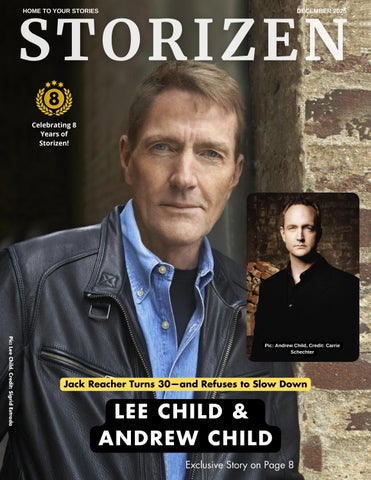
Pic: Lee Child, Credit: Sigrid Estrada
Pic: Andrew Child, Credit: Carrie Schechter
Jack Reacher Turns 30—and Refuses to Slow Down
LEE CHILD & ANDREW CHILD Exclusive Story on Page 8
Cover Story Jack Reacher Turns 30— and Refuses to Slow Down - Lee Child & Andrew Child
Brand Partners Aleph Book Company Bloomsbury India Fingerprint Publishing Hachette India HarperCollins India
Book Reviews Swapna Peri Kiran Adharapuram Saurabh Chawla
Editors Pria Raiyani Saurabh Chawla
For Advertising, Contact us attalktous@storizen.com
Pan Macmillan India Penguin India Roli Books Rupa Publications Westland Books
FOLLOW US ON:
Editor's Note, p7
CONTENTS
Cover Story, p8 Jack Reacher Turns 30—and Refuses to Slow Down - Lee Child & Andrew Child
Hot Off the Press, p14 Articles/Short Stories/Poetry/Interviews Notes from the End of the Year - Jyoti Mehta, p24 Monthly Horoscope: January 2026 - Storizen Staff, p60 From the Editor's Bookshelf - Saurabh Chawla, p54 Fusion Fiction - Madhulika Ra Chauhan, p56 Forgive Without Forgetting: Break the Trap - Ankur R Gupta, p26 Bid Adieu To Hard Times And Ring The Bells Of Happy Times Aparna Mukherjee, p20 Sales, Self-Doubt & Sweets: A Debut Author’s Festival Season by Richa Sharma - Richa Sharma, p34 2:29pm, Thursday, 11th January… - Madhumathi H., p58
Book Reviews (by Swapna Peri) Around India with Ruskin Uncle by Ruskin Bond, p30 Banku's Terrific Tails by Rachna Chhabria, p30
Cracks in the Wall by Neera Kashyap, p33
Creepy Crawlies by Kanika Sharma, p33
Call It Coincidence by Nona Uppal, p31 Dark Squares by Danny Rensch, p34 City of Kashmir by Sameer Hamdani, p31 Click Here by Alex Schultz, p32
Don't Leave Anything for Later by Library Mindset, p34 Food Intelligence by Julia Belluz and Kevin Hall, p35
Corporate Hostages by N. Raj Mohan, p32 Gone Before Goodbye by Reese Witherspoon and Harlan Coben, p35
Book Reviews (by Swapna Peri and Kiran Adharapuram) He Sees You When You're Sleeping by Alta Hensley, p36
Hot Wax by M.L. Rio, p37 Kaayaa by Guruprasad Kaginele, p38
Heartbeats: A Memoir by Björn Borg, p36 Mumbai by Sidharth Bhatia, p38 Heartbreak Unfiltered by Milan Vohra, p37 And more...
To read Storizen on the web, visit storizen.com. Follow Storizen on Instagram @storizenmag.
BOOKMARKED
Storizen Magazine November 2025
Books we are loving this month
CLICK HERE TO READ NOW! Exclusive Digital Issue For more columns and features, scan below
FOLLOW US ON :
HASHTAG: #STORIZENMAG
from the editor
calling all writers!
DO YOU WANT TO BE A PART OF STORIZEN FAMILY? You can also be a contributor. Mail us your entries at talktous@storizen.com. Your smart ideas and inputs help us create our informative issues.
“Year’s end is neither an end nor a beginning but a going on.” — Hal Borland Welcome to the December 2025 edition of Storizen Magazine, our final issue of the year, shaped by the theme "Reflect, Release, Renew." As the year draws to a close, this is a moment to look back with gratitude, let go of what no longer serves us, and step forward with renewed purpose and possibility. Our cover story, "Jack Reacher Turns 30—and Refuses to Slow Down," celebrates one of the most iconic characters in modern thriller fiction. In an exclusive feature, Lee Child and Andrew Child reflect on three decades of Jack Reacher—his evolution, enduring appeal, and why this unstoppable drifter continues to resonate with readers across generations. This issue also brings you 47 thoughtfully curated book reviews, spanning gripping thrillers, reflective literary fiction, insightful non-fiction, and inspiring memoirs. Whether you’re closing the year with a fast-paced page-turner or a book that invites quiet contemplation, our December selection offers the perfect companion. As we reflect on the stories that shaped 2025, may this issue encourage you to release the past year with grace and welcome the new one with curiosity, courage, and creativity. Storizen Magazine December 2025 Issue is Live Now!
editor@storizen.com Saurabh Chawla, Editor in Chief
COVER STORY Jack Reacher Turns 30— and Refuses to Slow Down.
A Storizen Exclusive Feature By Pria Raiyani and Swapna Peri
Pic: Lee Child, Credit: Sigrid Estrada
Lee Child
COVER STORY
F
or nearly three decades, Jack Reacher has been walking alone—down empty highways, into corrupt towns, and straight through danger with nothing but his instincts, his fists, and an unshakable moral compass. Towering at 6’5”, armed with little more than a toothbrush and folding money, Reacher is not just a character; he is a cultural force. And behind him stands Lee Child, the pseudonym of British author Jim Grant, whose improbable reinvention at midlife birthed one of the most enduring franchises in modern thriller fiction.
THE PLOT THICKENS: INSIDE EXIT STRATEGY
With Exit Strategy, the 30th Jack Reacher novel, released on November 4, 2025, Child and his brother, Andrew Child, reach a milestone that few writers ever approach. The novel doesn’t just extend the series—it places it at a crossroads, asking whether Reacher’s relentless momentum can still outrun the weight of its own legacy.
The novel widens Reacher’s world without abandoning his lone-wolf ethos. International tensions involving Iran and Turkey ripple beneath the surface, raising the geopolitical stakes while keeping the action grounded in warehouses, ports, and brutal close-quarters confrontations. The prose remains lean and muscular—coffee-black, bone-snapping, and relentlessly forward-moving. Fans will recognize the DNA immediately: chance encounters that escalate into moral warfare, coerced allies like Nathan Gilmour and Sabrina Patton, and Reacher navigating shadows where institutions fail. Action scenes crackle with urgency, reminding readers why Child’s thrillers remain compulsively readable.
FROM REDUNDANCY TO REINVENTION Born in Coventry, England, in 1954, Jim Grant grew up amid the grit of post-war Britain, devouring pulp novels and American crime fiction that offered escape and justice in equal measure. A history graduate from the University of Sheffield, Grant initially pursued a conventional creative path, working in television production and contributing scripts to acclaimed shows such as Brideshead Revisited. Then, in 1996, everything stopped. Corporate downsizing left him unemployed at 41—an age when most careers stabilize rather than reset. Faced with uncertainty, Grant made a radical vow: he would write a novel no reader could put down. Working on a cheap typewriter, with no safety net and no guarantees, he finished Killing Floor in just four months. The result was Jack Reacher—an ex-military police officer turned drifter, whose blunt intelligence and visceral sense of justice detonated on the page. Set in a small Georgia town steeped in corruption, Killing Floor became an overnight sensation, earning an Edgar Award nomination and launching Lee Child into literary stardom. Nearly 100 million books later, Reacher remains a staple of airport bookstores, bestseller lists, and screens— embodied first by Tom Cruise and later, more physically faithfully, by Alan Ritchson. DECEMBER 2025
Exit Strategy opens with classic Reacher simplicity: a Baltimore coffee shop, an elderly couple targeted by a scam, and Reacher stepping in without hesitation. But before he can walk away, a stranger slips a desperate note into his pocket. That small, almost accidental moment pulls him into a sprawling smuggling operation rooted in Baltimore’s docks, linked to war profiteering, blackmail, and a private security firm run by the coldly menacing Morgan Strickland.
FAMILIAR POWER, FAMILIAR FATIGUE Yet Exit Strategy also reflects the strain of longevity. Midway through the novel, investigative detours and dense exposition slow the momentum that once defined Reacher’s early outings. The co-writing process—Andrew Child officially taking the reins from book 21 onward—introduces bolder global elements, but sometimes at the cost of atmosphere and the laser-focused clarity that made the early novels iconic. Reacher himself has evolved. Once famously laconic, he is now more verbose, more openly sadistic in his confrontations. For some readers, this signals a character adapting to darker times; for others, it suggests dilution rather than depth. The debate mirrors the broader question facing longrunning series: how to evolve without eroding the core.
STORIZEN MAGAZINE
|
9
Pic: Andrew Child, Credit: Carrie Schechter
COVER STORY A Brotherhood Behind the Brand The collaboration between Lee and Andrew Child is central to the modern Reacher era. Andrew, formerly an executive in finance and a thriller writer in his own right, brings structural ambition and international scope. Their process is meticulous but familial: Lee outlines, Andrew drafts, and both refine together. What might seem like a risky handover has instead preserved continuity while allowing Lee Child to step back without stepping away. It is not a passing of the torch so much as a shared grip on it—brother to brother, storyteller to storyteller.
About Pria - Young mesmerizing freelance blogger, social enthusiast, and an economics graduate from Jharkhand University with a Master's in Child Psychology. She is hardworking yet crazy, a passionate reader, an ardent music fanatic, an avid caffeine lover, and a maniacal animal lover too. She has been a part of numerous anthologies, articles, and write-ups for newspapers and magazines which are multi-linguistic. She has also written screenplays for YouTube series.
THE MAN WHO LIVES LIKE HIS HERO Off the page, Lee Child has long mirrored Reacher’s restlessness. Post-success, he traveled across America in an Airstream trailer, absorbing landscapes, towns, and ports that later surfaced in his fiction. Though now based in New York, he remains a nomad at heart—cash-preferring, gadgetaverse, and resistant to the trappings of celebrity. Divorced, with a daughter, Child balances privacy with purpose. He supports literacy initiatives and remains deeply engaged with the craft itself, writing a disciplined 1,000 words a day, never revising until the draft is complete. The result is fiction that feels raw, immediate, and unapologetically physical.
Contact: pria@storizen.com
Swapna Peri is a Freelance blogger, book reviewer, narrator, and copy editor.
Contact: swapna.peri@storizen.com
LEGACY IN MOTION Exit Strategy may not redefine Jack Reacher, but it reinforces why he still matters. In a chaotic world, Reacher offers moral clarity—simple rules, decisive action, and consequences that feel earned. The novel may run on familiar fuel, earning cautious praise rather than awe, but for millions of readers, that reliability is precisely the point. Thirty books in, Jack Reacher is still walking. And Lee Child—architect of modern justice fiction— continues to prove that sometimes, the most powerful stories come from those who refuse to stay put. As Reacher drifts onward into his fourth decade, one truth remains unshaken: justice, in Lee Child’s world, never needs permission—only the courage to act. DECEMBER 2025
STORIZEN MAGAZINE
|
11
COVER STORY
In the latest Jack Reacher thriller, a routine day takes an unexpected turn when a chance encounter leaves Reacher with something he didn’t arrive with—a handwritten plea for help. What begins with coffee in a Baltimore café and a quick stop to buy a coat soon pulls him off his planned path and into a mystery only he can’t ignore. Guided by instinct, curiosity, and a fierce sense of justice, Reacher follows the message wherever it leads, proving once again that trouble has a way of finding him—and that he never walks away from it.
Some Other Bestsellers by Lee Child!
HOTthe OFFpress Past and present intertwine in this compelling novel about a young girl who may be remembering a past life, unsettling her strictly vegetarian family and challenging the beliefs of a psychiatrist who studies such mysteries. Decades later, the child’s forgotten case draws a new generation into its orbit, as a man searching for answers begins to uncover hidden truths about his own past. Moving between 1960s Calcutta and modern-day Brooklyn, Ghost-Eye is a resonant story of memory, fate, family, and the fragile world we inhabit.
In this deeply personal and refreshing departure from his earlier work, Gaur Gopal Das weaves a moving story set against a three-day wedding in Jaisalmer, where hidden tensions, unspoken fears, and unexpected truths surface within two families on the brink of celebration. Through quiet conversations, gentle humour, and hard-earned wisdom, he reflects on his own life’s journey while offering insight into the question so many of us wrestle with—can we truly have happiness, love, success, and peace all at once? You Can Have It All is an intimate and uplifting narrative about balancing ambition with fulfilment, learning to see life with clarity and compassion, and finding wholeness in a world that constantly asks us to chase more. 14
|
STORIZEN MAGAZINE
DECEMBER 2025
HOTthe OFFpress
Moving beyond myth, mistranslation, and misplaced fear, this book offers a clear and grounded understanding of Tantra as it has truly been lived for centuries. Writing from the Kaula lineage of Kamakhya, Rajarshi Nandy draws on both practice and experience to reveal Tantra not as superstition or spectacle, but as a disciplined path of awareness, perception, and inner transformation. The Truth About Tantra gently uncovers how Shakti is encountered, how consciousness is trained, and how the sacred flows quietly through everyday life, restoring depth and dignity to a tradition long misunderstood.
This luminous book brings together two classic collections by Mahadevi Varma—one of the most remarkable Hindi writers of the twentieth century— offering intimate portraits of ordinary people remembered with extraordinary care. Through vivid sketches of labourers, struggling women, artists, children, and quiet dreamers, Varma captures lives shaped by hardship, hope, and resilience, while also revealing glimpses of her own unconventional journey as a solitary, independent woman in early twentiethcentury India. Beautifully translated by Ruth Vanita, Portraits from Memory is a tender, deeply human tribute to the dignity, courage, and individuality of people whose lives continue to shape the India we know today. DECEMBER 2025
STORIZEN MAGAZINE
|
15
All in One Night
by Sreelekha Chatterjee
I
am suddenly flinging forward, head snapping up, stomach lurching, amid screaming bus brakes and screeching tyres. A brief disorientation, with blinking, heavy-lidded eyes, sensing something like glass shattering into a thousand pieces, followed by an uneasy silence. My heart continues to hammer against my ribs, while the phantom of sleep lingers in every muscle of my body. The city outside is gradually slipping into the hazy labyrinths of the winter night. A momentary quiet and then the rumble inside the bus resumes. I must be halfway through my journey home. Seated beside me is a young man, probably in his early twenties. Upper body stooping over his lap at the impact of the hurried freeze of the bus; his slender torso appears like a rope that is stretched too tight. He is busy conversing on the phone. “What the hell! This isn’t a bus stop.” His head and face are covered with wildly overgrown hair;his eyeballs, unusually shining—almost hidden beneath his hanging tresses—regarding the surroundings without any simulation of intelligence, along with his elongated nose and high cheekbones that protrude outward, lending him the physiognomic features of a belligerent fox. I get jittery, with shivering teeth, when he speaks, hissing like a snake, to no one in particular, or perhaps to the person at the other end. The bus has halted near a market. Illuminated with dazzling, multi-colored,showy light displays of strings, icicles, nets, themed shapeslike stars, balls, geometric patterns, Santa, reindeer for Christmas, there is a carnival going on witha smorgasbord of melodies and gustatory delights. At times, shoppers board the bus from here instead of the bus stop at a distance. “I will blow up this bus.” The lad says over the phone. “Yes, yes, I know. Everything is ready. So far, no one has doubted anything. It will be done seamlessly. You wait and see. Don’t forget to watch the ten o’clock news.” He continues, oblivious to my gaze. I can’t believe what I hear. Is he really planning a bomb blast? Shunning the throttling heat inside, I open the window, and the wind blows cold on my face. My entire body seems to be a refrigerated butter that will invariably melt at the slightest
DECEMBER 2025
touch of heat. An imperative desire to be with my family suddenly wakes up in me. I am almost thirty, and this person is going to cut my life short. But why? Fishing out my mobile from my handbag, I shoot a message to my nine-year-old daughter—“I love you so much! In case I don’t reach home, always remember Mama is there with you.” I had joined a law firm soon after completing my graduation degree. For the past six years, with single-minded absorption, I have spent countless hours preparing reports over the escritoire, ending up being a flightless cormorant who has forgotten to give wings to her family’s dreams and aspirations. I have always given priority to the law firm over my loved ones. The entire year, I haven’t been on any vacation, worked over the weekends only to ensure that the deadlines are met. Akin to some people who are by nature insatiable in drinking alcohol, I have exhibited a rapacious appetite for work and more work. In the process, I am losing out on witnessing my daughter’s precious growing years. A few years from now, she will be in her teens. An ambulance drives past. Its siren suddenly blares through the calm winter air. Life is so unpredictable. Visual warning beams of red–blue–white hint at emergencies that can come rushinginto our lives unexpectedly. A person who is healthy at present can need medical help in the very next moment. Who knew that my life would come to an end all of a sudden, and that too in the hands of an evil perpetrator? The seat before ours is empty. Why isn’t the guy moving to the seat at the front? I can send a message to my husband, informing him about the situation. Will he believe me? I click on the message icon on my phone. The last message I had received from him was an earnest request to join him for lunch in our favorite restaurant. Just the two of us, like old times when we were dating. I had turned it down, as all I did back then was poring over the office files to the level of excessive gluttony. But there is no point in lamenting now. If only I get a second chance, I will join in the most trivial conversations for hours together, sit and watch my family do their usual, daily chores and never complain again about missing work. Realizing I mustn’t bother him, intimating about the fate that will befall me, perhaps within the next few minutes, I type out a message—“Always be happy, and don’t miss me. I love you forever.” I tap the green “send” arrow. How do I alert the conductor and the bus driver?Is there any way this can be stopped? Can they overpower this man? There are now only a few of us left on the bus. The conductor has moved to the seat next to that of the driver and is having a chat, his words tumbling out of his mouth like a buzzing bee, irritating enough to cause a headache. Deep down, I am beginning to relinquish any hope of reuniting with my family. In this brief solitude and precipitating condition of melancholy, I pray thatwhatever I have heard isn’t true. Once again, the bus jolts forward. STORIZEN MAGAZINE
|
17
I wish to live and not die so soon. The man next to me continues to speak discreetly into the phone, shielding his mouth with his hand. I try hard to overhear but cannot understand a single word of what he is saying. Maybe he will change his mind. After all, extremists who have chosen the path of violence are also human beings. They have their own families. Perhaps he will not want to leave his loved ones and change his decision in time. If only I knew I would die this early, I would have left everything in the world and spent my time solely with my husband and daughter. My threatening attitude of a selfabsorbed workaholic has landed me here—bound on a visit I had not foreseen. Is there any way my fate can be altered? Incessant stress on my nerves brings in a point of fatigue. The bus halts a second time close to another market. The conductor calls out to aswarm of people, looking for potential passengers. I get off the bus and mingle with the crowd. A Santa in a red dress is standing near an alluring shop decorated with lights as bright as day, emitting a fragrance of hope. He is distributing gifts. I stand in the queue. My turn comes. I refuse to take the gift that he is offering. I know thatSanta can grant a wish, specially on Christmas Eve. “Close your eyes and make a wish. Don’t open your eyes until I say so.” Santa says, holding my hands softly. My only wish is to be with my family today and everyday of my life. Warm teardrops accumulate in my eyes. They leave me, trickling down my cheeks. “Ma’am, ma’am, what happened? Are you okay?” A loud, preposterous voice pierces my ears, followed by someone shaking me violently as if to my senses. I open my eyes to find the terrorist trying to wake me up. Completely dazed, a shriek leaves my throat. “What’s the matter, ma’am? Is everything alright?” He enquires, his eyes almost reaching his forehead. “Who are you? What are you up to?” I ask, in between gasps, finding nobody inside the bus. “I am a college student, ma’am. I am going home for Christmas.” So far, I haven’tspottedhis backpack and a big box that he had kept beside his seat. “What’s inside the box? A machine gun?” “Oh no, ma’am!” He unwraps the shiny ribbon and opens the box. Inside is a beautiful doll. “So, it’s inside this doll.” 18 | STORIZEN MAGAZINE
DECEMBER 2025
“What’s inside the doll?” “The bomb. You said you want to blow up the bus.” “No, no, ma’am! Sorry, I have this bad habit of cursing. I was talking to my elder brother about my plan to take my entire family out to a posh restaurant for dinner. I’ll meet them all directly at the restaurant.My brother will bring them along with him at ten o’clock sharp. I am a harmless citizen of this country. I bought this doll with the stipend I could save for my little sister. It’s a surprise for her birthday. I am going home for the winter holidays.” He says breathlessly, and then rests with a miscellany of shrill laughter and guffaws. Abashed and washed over with embarrassment, I bury my face in my hands. My imagination, gripped and misled, kept on producing false alarms, configuring fictitious shapes. When I open my eyes again, I notice the student has left. I take out my phone and begin texting. This one is for my boss. My vacation starts, too. Inside my veins is a strange warmth, as I sense wafts of a rich aroma of satisfaction, while my mind starts painting enchanting illustrations of happiness in volumes, knowing my heart is full of intoxicating love.
DECEMBER 2025
Sreelekha Chatterjee’s short stories have been published in various national, and international magazines and journals like Indian Periodical, Femina, Indian Short Fiction, eFiction India, The Criterion, The Literary Voyage, World of Words, Writer’s Ezine, and Estuary, and have been included in numerous print and online anthologies such as Chicken Soup for the Indian Soul series (Westland Ltd, India), Wisdom of Our Mothers (Familia Books, USA), and several others. She lives in New Delhi, India. You can connect with her on Facebook at facebook.com/sreelekha.chatterjee.1/, Twitter -@sreelekha001, and Instagram @sreelekha2023.
STORIZEN MAGAZINE
|
19
BID ADIEU TO HARD TIMES AND RING THE BELLS OF HAPPY TIMES
BY APARNA MUKHERJEE
N ew Year bells are ringing and you all are waiting to celebrate. Isn't it? We all wait for New Year, but we forget the lessons this year taught all of us. Everyone's life is different and so are the lessons. Not every year comes with pain. There are many years which give us a taste of success, peace and prosperity. In those times, thank the Almighty always.
There are a few years which come with challenges and lessons. Of course, you receive happiness in some way or the other from a year. In a bid to indulge in happiness, you need to remember what this year has taught us. 2025 has not been so good for me. With a series of challenges, I have learnt that anything worse can happen in life. You should keep in mind that life has not promised us a path of roses. There will be thorns and rocks that will hinder us from walking ahead. But, we have to know how to remove those thorns from our path. We should be strong enough to remove the rock-like obstacles from our path; if you want to keep moving in life. Worse times and happy times are the part of life. When you embrace happy times, you should also learn to embrace worse times. When life hits you hard, you become upset and utterly dejected. You feel your life has come to a halt. You feel all doors are closed in front of you. Instead of falling into the pit of depression, you should stand again, brush yourself and start your life with a bang. No matter how many challenges you face, do not feel weak. Learn to be strong. I have learnt that life favours those who deal with hard times with smiles on their faces. The next thing I have learned is that bad times are transient. When hard times hit you, depression makes a home in your mind. Instead of shedding tears, you should know that these bad times will pass. When you are living in this life, you should know that life will be full of highs and lows. If you are hit by hard times, remember, this will remain for a short while. So, do not get carried away by hard times which break you. Instead, stand tall and tell yourself, "Nothing can break you because you are strong." Good times will be back in your life again and the lips will have smiles again. 2025 has also made me learn that be prepared for the worst at all times. When you become mentally strong, you can face the worst experiences of your life with ease. Prepare your mind that the worst times can show up at any point of time. Hence, prepare your mind for the worst. DECEMBER 2025
STORIZEN MAGAZINE
|
21
Adapting to new changes is another thing this year taught me. Not all things in your life will be stagnant. With the growing technologies, old things will replace the new ones. You need to learn the new things that come in your life to hone your skills. Initially, you may feel that the new thing seems to be impossible. When you keep reminding your mind that "You Can Do It", new things will not seem to be tough for you anymore. Thanks to this year which has been an eye-opener to me. One of many things I have learned is that no one stands by your side when you are going through a rough patch of life. It is only you who has to walk over the thorns. If you are fortunate enough like me, you will have your family support which helps you walk through the toughest phase of your life. Come what may, tell yourself always, "Bad times are ending and good times are coming."
DECEMBER 2025
In a few words, Aparna defines a woman who beholds high aspirations and firmly believes in expanding her horizon. She holds a Master's degree in English Literature from Mumbai University. By profession, she is an Executive Content Creator. Her poems got published on the Indian Literature website named Facestory. Currently, her stories and poems get published in various anthologies published by the eminent Reflection Magazine and in the renowned digital magazine, Storizen. She has received many certificates in the field of writing. She is bestowed with Indian Global Award 2022 and has been felicited with a medal in the Tagore Literature Festival 2022 by Literoma. Her poem got published in the Romance And Compendium book at the Tagore Literature Festival. In 2022, she is again bestowed with the Women Achiever Award by Literoma. In 2023, she is again conferred with the prestigious award, Tagore Literature Award 2023, where she is bestowed with a trophy and a certificate. Her world revolves around creativity and writing. She wishes to make her mark in the literary world, hoping to leave an indelible imprint on the readers' minds.
STORIZEN MAGAZINE
|
23
Notes from the End of the Year
by Jyoti Mehta
air outside has finally turned cold. It’s that T he specific kind of December chill that makes you want to wrap your hands around a warm mug and just sit in silence. I’ve been staring at the calendar on my wall. It looks tired. If I’m honest, 2025 didn’t go exactly according to the script I wrote in my head this January. I look back at the version of myself from twelve months ago - so sure of the path, so rigid in the timeline. I smile at her now. She didn't know that the detours would teach her more than the destination. There were weeks that felt like they lasted seconds, and singular moment of heartbreak of losing the dearest elder of the family that felt like they lasted years. But amidst the chaos, there was resilience. I survived 100% of my bad days. That has to count for something. Tonight, I am making a physical effort to unclench my jaw. I realize how tightly I’ve been holding onto things that weren’t meant to be carried this far. The need to be perfect. The anxiety of "what's next." The quiet grudges I held against myself for not moving faster.
Jyoti Mehta, an educator by profession and a reflective writer by instinct, Jyoti Mehta finds meaning in moments of transition, loss, and renewal. She believes growth rarely follows a straight line. Through reflective writing, she captures the beauty of pauses, detours, and intentional new beginnings.
I imagine these things as heavy stones in my pockets. One by one, I am taking them out. I am forgiving myself for the projects that didn't launch, the calls I missed, and the rest I didn't take. I am leaving them here, in 2025. They do not have a ticket to the new year. The page turns. It’s not a magical reset, but it is a permission slip. Permission to start small. Permission to change my mind. As the fog settles outside, I feel a strange sense of clarity. I don’t need grand resolutions this time. I just need intention. I want to move with purpose, not speed. I want to listen more than I speak. I want to breathe easier. The heavy lifting is done. Now, I simply clear the space for whatever light is coming next.
DECEMBER 2025
STORIZEN MAGAZINE
|
25
"Forgive Without Forgetting: Break the Trap" (Self-Reflection)
by Ankur R. Gupta
“F orgive and forget; holding onto resentment only hurts you,” is a saying we’ve all heard. But anyone who has been deeply hurt knows it’s rarely that simple. Forgiveness can seem impossible when painful memories linger, etched in our minds. It makes us ask, “How can I truly forgive someone when I can’t forget what they did?”
Like many of us, I also struggled with this paradox during a recent phase of my life, when a close friendship ended abruptly and left me struggling with resentment. Seeing that person again and again intensified these feelings and made me wonder how to find peace while memories still hurt. It took me some time to truly understand the answer, and it came down to a single, powerful choice: I had to forgive, but not necessarily forget, and do it not for anyone else's sake, but for my own liberation.
experience that anger became my first honest step toward acknowledging that I was hurt. For months, I stayed in denial, pretending everything was fine while the hurt quietly lingered. Finally, I admitted, “I was hurt,” and it didn’t make me weak. It marked the beginning of healing. Talking to someone I trusted helped me untangle my feelings and made the pain feel less heavy. Once I began to face my emotions, I reflected on the role anger played in my life. I asked myself, is holding on to this anger helping me heal, or is it keeping me stuck in bitterness? I realized that while anger initially protected me, staying in it stopped me from confronting the grief beneath it. While going through this dilemma, I read an old article about Priyanka Gandhi forgiving her father’s killer. She said her forgiveness wasn’t about forgetting the grief, but about freeing herself from hatred and revenge so she could move forward. That perspective stayed with me.
How I Reclaim Peace Understanding the power of Forgiveness Reading “Forgiving What You Can’t Forget” by LysaTerKeurst helped me realize that forgiveness isn’t about pretending the past didn’t happen or excusing the hurt someone caused. Instead, it’s choosing to let go of resentment, bitterness, and the desire for revenge so healing can begin. What stood out to me most was how closely her message aligns with many psychological research studies. These studies show that people who forgive still remember what happened. But over time, the pain tied to those memories begins to fade. While those who hold onto unforgiveness continue to relive the hurt. This book changed my understanding of forgiveness. I realized I cannot rewrite the past or erase painful memories, but I can change how I respond to them. By loosening the emotional grip of these experiences, I can create space for my peace. With this mindset, forgiving without forgetting felt less impossible. It became a meaningful step toward healing.
I understood that forgiving someone who hurt me might not erase the pain, but it could help me release the anger holding me back. It could help me reclaim my peace. Feeling my worth When someone hurts us, we often think it’s about our own worth. We wonder, “What did I do wrong?” or “Why wasn’t I enough?” As the Bhagavad Gita says, “Everyone acts according to their nature.” People act out of habit and their own limits. Accepting this helped me let go of hurt. I learned to separate their actions from my worth. I reassured myself that their hurtful actions reflected their limits, not mine. This didn’t erase the pain, but it made it easier to bear. It also gave me a chance to reflect on my own choices and grow, while being more cautious with people who might hurt me again.
You don’t learn to forgive overnight. It takes time (took me almost two years), but it works! Dealing with Hurt Hurtshows up usually disguised as anger—sharp, loud, and overwhelming. At first, I didn’t realize that my anger was both protecting me and keeping me from facing the real pain underneath. But my instinct told me that the way forward was to sit with it and feel it fully, without judgment. Allowing myself to DECEMBER 2025
STORIZEN MAGAZINE
|
27
Boundaries became my shield Setting boundaries became important in my journey. I realized that forgiving someone doesn’t mean I have to welcome them back into my life or expose myself to more pain. True forgiveness is about letting go of anger and resentment, not sacrificing your own well-being. The Bhagavad Gita says, “One must elevate oneself by the mind, not degrade oneself.” For me, this meant recognizing that protecting my peace was necessary and an act of self-respect. Walking away from toxic people or situations, or simply limiting my interactions with them, wasn’t a sign of weakness. It was a conscious choice to honor my own emotional and mental health. Boundaries became my shield, allowing me to forgive without losing myself and to move forward without carrying the weight of ongoing harm. Redirecting Resentment can be draining. So, I redirected my energy toward things that nurtured me—writing, reading, and learning became my refuge. And with time, I felt that I was healing. Forgiveness releases emotional burdens, and boundaries protect your future. While pain doesn't disappear, moving through it with awareness lets you grow, learn, and move ahead with strength and clarity. “Forgive, but do not forget; learn, grow, and move forward.”
Ankur R Gupta - Ankur R Gupta is a multifaceted individual with a passion for storytelling and a deep understanding of human psychology. As an author, writer, and cybercrime intervention officer, her articles and stories delve into the complexities of human emotions, relationships, and the pursuit of personal well-being. Through her captivating narratives, she invites readers to embark on a journey of introspection and self-discovery. In addition to her writing pursuits, Ankur is an avid traveler. She is particularly drawn to historical and adventurous destinations, where she immerses herself in diverse cultures, traditions, and histories. These experiences serve as a wellspring of inspiration for her work, adding depth and authenticity to her stories and articles.
@ankurrastogigupta
https://inkmyword.medium.com
28
|
STORIZEN MAGAZINE
DECEMBER 2025
Pic: Swapna Peri
As you turn the page, let the adventure begin – our book reviews await, promising literary delights and captivating tales!
STORIZEN REVIEW Around India with Ruskin Uncle by Ruskin Bond "Around India with Ruskin Uncle: A Child’s Guide to the Country’s Wonders" is a warm and beautifully illustrated travelogue that introduces young readers to the richness of India. Ruskin Bond takes children on a charming journey across the country’s many states and union territories, sharing simple, engaging facts about history, culture, food, clothing, and geography. From Ladakh’s calm monasteries to Tamil Nadu’s coastlines and Arunachal Pradesh’s mountains, each stop becomes an inviting lesson in discovery, filled with wildlife encounters and regional flavours. Ruskin Bond’s familiar, gentle style shines throughout the book, making India’s vast diversity easy for children to understand and enjoy. He continues to write with clarity and affection, creating a travel companion that feels both nostalgic and fresh. The book blends storytelling with useful information, making it perfect for young explorers and for families who enjoy reading together. The themes of curiosity, unity, and environmental awareness run strongly through the narrative. Bond encourages children to appreciate India’s varied landscapes and cultures while also understanding the importance of preserving them. With its vivid scenes, wholesome facts, and gentle wisdom, "Around India with Ruskin Uncle" becomes more than a guide—it’s an invitation to see India with wonder.
Banku's Terrific Tails by Rachna Chhabria Rachna Chhabria's "Banku's Terrific Tails" delights young readers with a whimsical exploration of imagination through the curious adventures of Banku, a playful boy who daydreams about trying on animal tails. From fluffy monkey swings to scaly lizard climbs, each tail sparks lively escapades that blend fun with subtle lessons on choice and wonder, making it ideal for ages 3-7. The author's gentle narrative avoids preaching, instead inviting kids to imagine alongside Banku as he weighs the joys of different tails—from soaring like a bird to burrowing like a mole. Vibrant illustrations by Sefi George enhances the rhythmic text, perfect for interactive read-alouds that spark giggles and discussions. The book shines in fostering creativity without overwhelming young minds, celebrating curiosity as Banku discovers no single tail is "best"—they're all terrific in their way. A charming addition to picture book shelves, it encourages empathy for nature's diversity through pure, joyful play.
It’s a delightful read for anyone looking to introduce the country’s many charms to a younger audience.
30
|
STORIZEN MAGAZINE
DECEMBER 2025
STORIZEN REVIEW Call It Coincidence by Nona Uppal "Call It Coincidence," authored by Nona Uppal, is a warm and uplifting novel that explores themes of love, friendship, and second chances, particularly resonating with the millennial experience. The narrative centers around Naina, a young woman seeking a fulfilling job and lasting love, and Vatsal, an intern in Delhi preparing for a move to London. Their paths intricately intertwine through a series of encounters filled with misunderstandings, longing, and the chaos of life, reminiscent of a Bollywood romance. The writing is engaging and descriptive, effectively bringing everyday situations to life while blending humour and drama. The book opens with Naina going on a date and experiencing a comedic series of events, including her dismissal from a job she intended to leave. The relationship dynamics, such as Naina's bond with her supportive friends and evolving moments with her parents, add depth and warmth to the story. As the characters navigate their challenges, the narrative reflects on the imperfection of life and the beauty of unexpected coincidences. Central to the story is Naina’s character development, shaped by her struggles with career prospects and emotional growth. The author skillfully portrays her confusion and resilience as she navigates her feelings for Vatsal, especially after their relationship is interrupted by a traumatic event at a Diwali party, leading to a three-year separation. When they reunite, the tension and nostalgia between them are palpable, heightened by their contrasting emotional states—Naina's caution and Vatsal's familiarity. The novel's structure adeptly shifts between the past and present, revealing the characters' insecurities and formative experiences that influence their actions. Naina emerges as a relatable heroine, whose journey resonates deeply, while Vatsal represents a compelling love interest battling personal challenges yet capable of deep affection. Overall, Call It Coincidence is a delightful, relatable read that highlights the significance of life’s subtle moments and underscores the idea that love can flourish amidst the messiness of everyday living.
DECEMBER 2025
City of Kashmir by Sameer Hamdani "City of Kashmir" by Sameer Hamdani offers a comprehensive exploration of Srinagar, delving into its 2,000-year history through documented accounts, legends, and oral traditions. Authored by Sameer Hamdani, a seasoned heritage consultant with two decades of research experience, the book captures the city's geography and daily life, enriching the narrative with reflections and selected translations from Sanskrit, Persian, and Kashmiri poetry spanning medieval and early modern times. Hamdani presents a thorough overview of Srinagar's evolution across pre-Muslim and Muslim eras, spotlighting its cultural vitality and artistic heritage through illustrations and images. The book stands out not only for its scholarly depth but also for its engaging storytelling, positioning it as essential reading for those interested in Kashmir's heritage. Beyond the familiar depictions of beauty and conflict associated with the city, Hamdani emphasises Srinagar's role as a hub of cultural synthesis, connecting multiple civilisations from various geographies. He narrates the city’s resilience through a myriad of historical events—from the Mongol invasions to influences from Bactria and the Tang dynasty—illustrating a dynamic tapestry of interwoven histories. His research uncovers the intertwined narratives of religious practices, noting the significant Hindu past of Kashmir under the Karkota dynasty and the later Muslim influence. The narrative is richly backed by anecdotal evidence gleaned from personal experiences and rare manuscripts found in local libraries. In summary, Hamdani's "City of Kashmir" gives life to the layered history and societal complexities of Srinagar, broadening the understanding of its identity as a significant cultural crossroads. With its thoughtful storytelling and robust scholarship, the book on Srinagar is a vital resource for those seeking insight into Kashmir's rich past and cultural landscape.
STORIZEN MAGAZINE
|
31
STORIZEN REVIEW Click Here by Alex Schultz Alex Schultz's book "Click Here" serves as an essential guide for achieving business growth in the digital age, drawing on his extensive experience as CMO of Meta. Esteemed figures like Mark Zuckerberg and Sam Altman highlight his expertise in navigating complex growth challenges. The book outlines effective digital marketing strategies suitable for both startups and large corporations, emphasizing the importance of understanding marketing channels, testing creative strategies, and measuring gains. The author combines strategic insights with practical experience, providing actionable tips, real-world case studies, and clear frameworks for readers. His narrative blends theory with personal anecdotes, making it accessible to a wide range of audiences, from marketing novices to seasoned professionals. The principles in "Click Here" offer a foundational approach to driving incremental growth, recognizing the rapid evolution of digital marketing over the last 20 years. Ultimately, Schultz's work is recommended for anyone involved in marketing, growth, or product management, aiming to enhance their strategic thinking and impact in the digital marketplace.
Corporate Hostages by N. Raj Mohan N. Raj Mohan's "Corporate Hostages: Roads to Captivity, Paths to Liberation" incisively diagnoses the modern workplace as a psychological prison, where executives voluntarily surrender autonomy to globalization's relentless churn, consumerism's grip, and toxic employer-employee dynamics. Drawing from four decades of coaching Fortune 500 firms and Indian corporates, Mohan frames captivity through Buddha's Four Noble Truths—identifying suffering (dukkha) in hostage syndromes like Stockholm loyalty to abusive bosses, Lima favoritism traps, risk aversion, blackmail, greenback greed, and conscience burdens—exacerbated by post-Covid WFH ambiguities and attrition wars. The author then categorizes hostages with clinical precision: Stockholm sufferers bond irrationally with captors (e.g., spies currying favor), while Lima inverts this as bosses grow dependent on overworked favorites; risk-averse employees prioritize stability over growth, greenback cats chase money obsessively, and blackmail thrives in resignations or data thefts. He critiques Indian work culture's colonial remnants—like mandatory overtime beyond 48-hour laws and English fluency biases— fueling trust deficits and family erosion, with real-world cases from police orderlies to IT exits illustrating the toll. The book pivots to hope via an Eightfold Path analogue— right understanding, thought, speech, action, livelihood, effort, mindfulness, concentration—urging self-awareness, work-life recalibration, and ditching "Club Ninety-Nine" greed for inner harmony over status. Post-Covid insights on impermanence and well-being resonate, making this essential for burnt-out professionals seeking ethical exits from performative misery.
32
|
STORIZEN MAGAZINE
DECEMBER 2025
STORIZEN REVIEW Cracks in the Wall by Neera Kashyap The collection "Cracks in the Wall" by Neera Kashyap explores the lives of ordinary people through twenty-six short stories, revealing the often-unnoticed complexities of daily existence. Nikhil Kashyap, a versatile writer with a background in journalism and social communication, deftly portrays themes such as failed relationships, personal transformation, and the quest for connection against despair. Key stories include "Narratives that Live," which highlights a widow's spiritual journey for connection with Lord Krishna, and "Healing the Improbable," depicting the profound bond between two grieving mothers amidst loss. Throughout the collection, faith—both in the divine and human connections—emerges as a central theme, explored in narratives like "Supplication" and "Leave, Gentle Spirit." Additionally, deeper societal issues are addressed in stories such as "Tending Tender Things" and "A Woodpecker Hammers at my Throat," where violence and abuse surface beneath an exterior of normalcy. The characters' struggles illuminate a collective journey towards healing and resilience, highlighting community support as a vital element. The stories also celebrate the indomitable human spirit; for instance, in "Faske-Nikah," a woman's fight for her education against familial constraints is emphasized, while "Half-Life" portrays another woman's introspective battle with her fears and her eventual triumph. Similarly, narratives like "Memory Shafts" and "Where Love is No Driver" reflect personal quests for meaning and fulfillment, despite adverse circumstances. Ultimately, "Cracks in the Wall" presents a tapestry of narratives that not only tackle the ordinary but also infuse hope, resilience, and the intricate web of community and existence, urging readers to find harmony within themselves and their surroundings.
DECEMBER 2025
Creepy Crawlies by Kanika Sharma "Creepy Crawlies" by Kanika Sharma is a collection of ten short horror stories, each exploring a different kind of fear. Though the themes vary, every story is designed to unsettle the reader and create a lingering sense of dread. The author clearly sets the tone in the prologue, explaining that the real horror often lies within human emotions. One of the strongest aspects of the book is its endings—most stories conclude in unexpected and thoughtful ways, leaving the reader both frightened and impressed by how neatly they are wrapped up. The stories stand out for their rich mix of spirits and supernatural beings inspired by folklore from different cultures around the world. The stories are titled after creatures like Dybbuk, Ifrit, Ghoul, Jorōgumo, and Chitauli, each presented through the author’s own imaginative lens rather than strict folklore definitions. Some stories stand out more than others, and readers will naturally find their own favourites. The writing is smooth and engaging, and the author successfully blurs the line between what feels real and what is clearly supernatural, pulling the reader into a dark and eerie world filled with spirits, possession, blood, and disturbing situations. The book’s simple yet frightening cover matches the tone of the stories inside. What truly sets "Creepy Crawlies" apart is that it is rare to see an Indian author experimenting so boldly with horror short stories inspired by global folklore. While the book contains dark themes such as violence, abuse, and animal cruelty, horror lovers who enjoy short, twist-filled stories will find it worth reading. Overall, this is a vivid and imaginative horror collection that shows courage and creativity, making “Creepy Crawlies” a strong recommendation for fans of spooky and gothic fiction.
STORIZEN MAGAZINE
|
33
STORIZEN REVIEW Dark Squares by Danny Rensch
Don't Leave Anything for Later by Library Mindset
“Dark Squares: How Chess Saved My Life” by Chess.com co-founder and International Master Danny Rensch delivers a raw, unflinching memoir that transcends the chessboard, chronicling his harrowing childhood within the abusive Church of Immortal Consciousness cult in Arizona's deserts. Raised amid psychological manipulation, forced family separations—including years without contact with his mother—and relentless pressure to become a "special" prodigy channeling a 15th-century spirit, Rensch found solace in chess discovered during the summer of 1995. Mentored by an alcoholic Russian master, the game became his lifeline amid neglect, addiction, and health crises, propelling him from trauma to triumph in the online chess revolution. Rensch's narrative weaves personal catharsis with chess milestones, from early online forays to co-founding Chess.com and navigating scandals like the Magnus CarlsenHans Niemann cheating controversy, though he insists this is no mere chess manual. Bite-sized historical recaps enrich the autobiography, highlighting the sport's cultural shifts, while his balanced critique of cult figures—condemning abuses yet acknowledging their complexities—reveals profound integrity and forgiveness. Reviewers praise its gripping authenticity, blending startup grit, emotional wounds, and resilience without sensationalism. This haunting, heartfelt tale resonates as proof of survival's tenacity, ideal for memoir lovers and chess enthusiasts seeking depth beyond tactics.
"Don't Leave Anything for Later: Stop Waiting, Start Living " by Library Mindset emphasizes the importance of selfinitiation in life changes, noting that knowledge alone is ineffective without personal action. It is structured into three main sections: Death, Mindset, and How to Live a Good Life, each filled with relatable stories, quotes, and actionable advice aimed at improving one’s life. The author encourages readers to be present, stop waiting for the right moment, and avoid the common trap of postponing happiness. Key messages include the urgency of living fully, the interconnection between mindset and life transformation, and the value of gratitude. The book serves as a motivational reminder of mortality, urging individuals to take charge of their lives and pursue dreams without delay. It reassures that it’s never too late to start anew, focusing on immediate action over regrets. Overall, it offers a gentle yet assertive guide for those feeling stagnant, helping them to awaken and consciously choose to live a fulfilling life.
Rensch's virtuous reflection on reforming identity outside cult dogma inspires, proving chess's power to mend fractured lives.
34
|
STORIZEN MAGAZINE
DECEMBER 2025
STORIZEN REVIEW Food Intelligence by Julia Belluz and Kevin Hall "Food Intelligence: The Science of How Food Both Nourishes and Harms Us" is a clear and easy-to-follow look at why we eat the way we do. Authors Julia Belluz and Kevin Hall sort through the confusion created by new diet trends, bold promises, and mixed messages from “experts.” They break food down into the basics—how protein, fat, carbs, and vitamins work in the body—and explain metabolism in a way anyone can understand. They also explore topics like ultra-processed foods, blood sugar trackers, and how the world around us shapes our daily eating habits. A big part of the book focuses on how our food system pushes us toward overeating, often without us realizing it. The authors make it clear that conditions like obesity and type 2 diabetes aren’t simply about personal willpower. Instead, they show how these problems grow from food environments designed to make unhealthy choices easy and tempting. Their writing uses simple examples and relatable stories, making complex science feel friendly and practical. Health professionals will also find the book helpful, as it clears up many common myths about nutrition. Reading this book feels eye-opening and encouraging. It takes big ideas and turns them into something easy to use in everyday life. The authors don’t preach—they explain, guide, and give you tools to understand what’s on your plate and why it matters. Finally, "Food Intelligence" is a great read for anyone tired of fad diets and looking for honest, sciencebased answers about food.
Gone Before Goodbye by Reese Witherspoon and Harlan Coben "Gone Before Goodbye" is a fast-paced conspiracy thriller co-written by actress Reese Witherspoon and bestselling author Harlan Coben. The plot follows Maggie McCabe, a formerly esteemed Army combat surgeon who, after experiencing personal tragedies and losing her medical license, is offered a lucrative opportunity to work with high-paying, anonymous clients in a covert setting. This off-the-books position leads her into a perilous realm of wealth, power, and moral ambiguity where the truth becomes a dangerous currency. The story unfolds quickly, filled with tension and unexpected twists that may challenge readers' suspension of disbelief, yet it remains gripping. The among the readers is particularly noteworthy for its emotional depth and strong characters, making it an immersive experience. The authors portray Maggie with strength and vulnerability, while the other characters in the book enhance the storytelling, making the story easy to follow despite its complexity. The collaboration between Harlan Coben and Reese Witherspoon may initially seem uncommon, but it effectively merges Coben's talent for suspense with Witherspoon's narrative sensitivity and promotional prowess through Hello Sunshine. The novel is characterised by an unpredictable plot that keeps readers guessing, as revealed through the continual shifts in perspective and action. The plot escalates when Maggie receives a clandestine job offer from Dr. Evan Barlow, prompting her to travel to New York and then to Russia for high-stakes surgeries on enigmatic patients. Notably, she is offered a staggering sum for her discretion, which she cannot refuse, setting the stage for a series of gut-wrenching twists as the true nature of her clients and her own peril unfold. Overall, Gone Before Goodbye delivers an exhilarating reading experience, maintaining a relentless pace and satisfying resolution that captivate and challenge readers until the very last page.
DECEMBER 2025
STORIZEN MAGAZINE
|
35
STORIZEN REVIEW He Sees You When You're Sleeping by Alta Hensley "He Sees You When You're Sleeping" by Alta Hensley is a captivating stalker romance that blends suspense with holiday cheer, perfect for dark romance enthusiasts. The story revolves around jewellery influencer Chloe Hallman, who finds herself entangled with two men on Christmas Eve: a smouldering admirer of her online persona and Jack, a protective firefighter. Initially alone for the holidays, Chloe is unaware of Jack’s obsessive yet caring nature, as he stalks her, believing her to be his Christmas wish. The pivotal themes include the morally ambiguous aspects of obsession, showcasing Jack’s internal conflict and protective instincts as he watches over Chloe, who harbours her own secrets. The review praises the story’s excitement and pacing, describing Jack as an appealingly flawed character and Chloe as relatable but complex. Readers appreciated the dual perspectives, the chemistry between the characters, and the unexpected plot twists, which kept them engaged. Despite the dark themes, the novel successfully intertwines light-hearted elements typical of Christmas romance, providing a fun escape from reality. The recommendation comes with a caution regarding the content, urging readers to be aware of potential triggers inherent in dark romance stories. Overall, the book is a desirable read for its engaging narrative and character development.
Heartbeats: A Memoir by Björn Borg Björn Borg's "Heartbeats: A Memoir", released as an eBook, breaks the tennis legend's long silence with raw accounts of his rise to superstardom and the ensuing personal wreckage. The Swedish icon, winner of 11 Grand Slams including five straight Wimbledons, details his childhood drills, rivalry with John McEnroe—especially their epic 1980 Wimbledon final—and abrupt retirement at 26. More than match recaps, the narrative exposes fame's toll, from rootlessness across Sweden, Monaco, France, and the US to finding solace in Ibiza. Borg shines brightest chronicling posttennis turmoil, admitting cocaine addiction, near-fatal overdoses, bankruptcies, failed marriages, and suicidal thoughts in the "dark years" of the 1980s. He credits Italian singer Loredana Berte for saving him from a 1989 pill-alcohol crisis, though their volatile union gets brief, tense coverage. These confessions humanise the stoic baseline grinder, revealing how Beatlemania-level fame eroded his discipline and identity without proper guidance. The memoir's strength lies in its unfiltered vulnerability, blending tennis highs—like superstitions and global adoration—with lows of infidelity, parenting regrets, and public scrutiny. Borg's reserved prose gains expressiveness in inner struggles, offering insights into elite pressures off-court for fans craving the enigma's truth. Relatable anecdotes of wild 1970s-80s superstardom make it an indulgent read, though some career sections feel rote. Critics note unevenness—strong on personal lows, weaker on filling historical gaps or deeper analysis—yet praise its eye-opening honesty for tennis enthusiasts. At its best, “Heartbeats” proves Borg's life of extremes mirrors the sport's intensity, urging reflection on athlete burnout. Essential for Borg followers, it delivers authenticity over polish, cementing his legacy beyond the court.
36 |
STORIZEN MAGAZINE
DECEMBER 2025
STORIZEN REVIEW Heartbreak Unfiltered by Milan Vohra Milan Vohra's "Heartbreak Unfiltered" delivers raw, relatable solace through reallife stories of romantic wreckage, blending neuroscience, grief psychology, and selfcompassion tools for those reeling from love's abrupt exit. Drawing from anonymised true accounts—like Rakhi's ghosting nightmare or Ganga's identity-torn bond—the book demystifies why breakups trigger addiction-like withdrawal, dopamine crashes, and physical symptoms akin to trauma. In the book, the author dissects the five grief stages (denial, anger, bargaining, depression, acceptance) with unflinching honesty, exposing power imbalances, narcissistic traps, and repeated patterns rooted in brain wiring for survival-driven attachment. Personal diaries, manifestos, and a curated "Heartbreak Album" playlist guide readers to reclaim agency, urging "be like a buffalo" facing the storm head-on rather than limbo-dancing to rock bottom. Practical gems like the 3-3-3 no-contact plan, love/apology languages, and closure myths empower forward momentum, affirming healing's non-linear loop toward wholeness. Witty yet wise, this bestseller from India's romance pioneer transforms pain into resistance, proving love finds the self-aware heart.
DECEMBER 2025
Hot Wax by M.L. Rio "Hot Wax" by M.L. Rio, explores the dual themes of stardom's allure and the darker realities associated with it. The novel features a complex protagonist, Suzanne, who grapples with the traumatic legacy of her father's death and her experiences on the fringes of rock and roll fame. The story oscillates between two timelines, with young Suzanne shadowing her father's band, Gil and the Kills, during their rise in the late '80s, and her adult self confronting unresolved pain and seeking answers following his sudden death. Rio excels in character development, immersing readers in Suzanne's emotional landscape and her struggles with vulnerability. The book delves into the intoxicating yet perilous nature of performance and creativity, revealing how music can evoke powerful memories and emotions while simultaneously highlighting the industry's inherent chaos and the fleeting nature of fame. The tensions within the band foreshadow a violent reckoning, adding to the narrative's suspense. With a rich atmospheric style, Hot Wax serves as both a tribute to music's power and a gritty examination of its underside, portraying the cost of chasing greatness and the consequences of fame. Ultimately, it portrays Suzanne's journey of selfdiscovery and her attempts to reclaim her life amidst the remnants of her past, showcasing Rio's knack for pulling readers into a visceral and engaging story that lingers long after the final page.
STORIZEN MAGAZINE
|
37
STORIZEN REVIEW Kaayaa by Guruprasad Kaginele Guruprasad Kaginele's "Kaayaa", translated from Kannada by Narayan Shankaran, is a bold, unflinching novel set in the glittering yet grotesque world of Manhattan's elite cosmetic surgery scene. Protagonist Bheem Malik, a plastic surgeon who shed his Indian roots for a reinvented identity, navigates lawsuits, tangled relationships, and ethical quagmires as he sculpts bodies amid accusations of misconduct. Interwoven with the saga of Kasturi Rangan, a resilient Indian immigrant turned senator grappling with misdiagnosed HIV, family secrets, and cultural dislocation, the narrative probes the commodification of flesh in a post-apocalyptic haze of body horror and human disconnection. The author masterfully dissects identity's fragility, from Malik's name change and childhood scars to Kasturi's personified "HTLV" virus that reshapes her life without symptoms, challenging stigma and medical dogma. Relationships pulse with raw dysfunction— abuse, infidelity, self-harm, and transactional love—framed by surgical precision that blurs healing and violation. Praise from critics like Vasudhendra and B. Jeyamohan underscores its innovative fusion of Kannada sensibilities with American excess, evoking a world where bodies ignite and extinguish like fire. The novel's episodic structure, laced with dark humour and violence, builds to revelations about scandal, inheritance, and self-reinvention, culminating in Kasturi's defiant embrace of her "HIV" narrative despite its falsehood. Though dense with medical and migratory intricacies, its provocative language and cultural transplants make it a path-breaking work for readers of literary fiction exploring diaspora, desire, and bodily autonomy.
38
|
STORIZEN MAGAZINE
Mumbai by Sidharth Bhatia Sidharth Bhatia's "Mumbai: A Million Islands" offers a critical exploration of Mumbai's relentless transformation and its profound implications for its historical fabric and communities. The narrative highlights how redevelopment, often marketed as progress, serves to displace the working class in favour of luxury developments, erasing entire neighbourhoods overnight. Bhatia addresses the stark contrasts between the city’s new luxury towers and the communities forced into the peripheries, devoid of basic amenities. The book is a love letter to a city undergoing painful changes, portraying the stories of displaced families and celebrating the resilience of Mumbai's diverse cultures. Through engaging writing rooted in personal observation and historical contexts, Bhatia delves into the city’s identity shaped by its inhabitants over generations—migrants, artists, and ordinary families who have contributed to its rich tapestry. Every chapter provides a window into different aspects of Mumbai, illustrating the urgency of preserving the city’s essence amid rapid modernisation. The author does not shy away from critiquing the commodification of space and the human cost of development, urging readers to recognise the people behind the statistics. His honest representation refrains from idealising the city while capturing its complexities and beauty. Ultimately, the book serves as a reminder that genuine urban development must prioritise its inhabitants to avoid losing the very soul of the city it seeks to transform.
DECEMBER 2025
STORIZEN REVIEW Murderland by Caroline Fraser "Murderland: Crime and Bloodlust in the Time of Serial Killers" by Pulitzer Prizewinning author Caroline Fraser delivers a chilling fusion of true crime and environmental history, linking the 1970s1980s serial killer epidemic in the Pacific Northwest to toxic lead pollution from smelters like Tacoma's Asarco plant. Fraser meticulously traces how industrial negligence poisoned communities, correlating elevated lead levels with surges in violent crime, neurological damage, and killers like Ted Bundy, who prowled the region's shadowed landscapes. Her narrative weaves victim stories, forensic details, and corporate cover-ups into a propulsive account that indicts systemic failures without sensationalising gore. Caroline Fraser's writing is clear and unflinching. A seamless blend of memoir, psychology, and ecology, the book reveals killers not as lone monsters but as products of a society poisoned by toxic masculinity, isolation, and deep-rooted misogyny within law enforcement. It’s an absorbing and thought-provoking read. Extensive research, backed by over 100 pages of footnotes, elevates the book beyond typical true crime, offering a damning critique of how smelters' emissions infiltrated air, soil, and bloodstreams, fuelling an era of bloodlust. This exhaustive, 400-page book leaves readers outraged and enlightened, a moody masterpiece that demands confrontation with America's intertwined ecological and human devastation. Caroline Fraser's elegiac fury resonates as a cautionary tale, urging awareness of slow-motion violence in an age of environmental reckoning. True crime enthusiasts and social historians will find it mesmerising, if stomach-churning, proof that horror accumulates quietly until it erupts.
DECEMBER 2025
My Idea of Nation First by Uday Mahurkar Uday Mahurkar's "My Idea of Nation First" passionately advocates for a vision of India rooted in nationalism, underscoring the need to restore historical truths and national pride. His writing critically assesses the appeasement policies that have historically impeded India's unity and sovereignty, tracing the impact from colonial times through post-independence politics that prioritized minority rights over national integrity. Fundamental to this discourse is the role of figures like Veer Savarkar and Swami Pranavananda, whose contributions to national security and cultural nationalism are presented as essential to building a resilient India. Mahurkar calls for a celebration of true heroes, a reevaluation of misunderstood historical narratives, and an emphasis on spiritual and cultural revival intertwined with national security. Additionally, the text explores Chhatrapati Shivaji's legacy as a visionary leader, whose military strategies and administrative reforms laid the groundwork for future Indian sovereignty, culminating in a reevaluation of his historical stature. The relationship between Ambedkar and the RSS is also analyzed, highlighting commonalities rather than divisions, particularly regarding national unity and resistance to religious divisiveness. The emphasis is on the shared ideological ground between Ambedkar's secular vision and Hindutva ideals. Moreover, Mahurkar emphasizes the importance of the 96 Kuli Maratha Kshatriyas, tracing their lineage from northern Kshatriya clans, and their pivotal role in ending Mughal dominance, showcasing a history marked by resilience and valor. The integration of various Rajput clans into the Maratha Kshatriya community is portrayed as a significant aspect of their cultural identity and historical legacy. The overall message advocates for a consolidated effort to decolonize historical narratives and cultivate a strong sense of national identity for future generations, centered on cultural integrity and patriotism.
STORIZEN MAGAZINE
|
39
STORIZEN REVIEW Radical Doubt by Dr. Bidhan L. Parmar Dr. Bidhan L. Parmar serves as the Shannon G. Smith Bicentennial Professor at the Darden School of Business, University of Virginia, and is recognised for his expertise in business ethics and decision-making under uncertainty. His prolific research aids executives in stakeholder value creation amid complex challenges. Parmar has co-directed the Darden Experiential Leadership Development Lab and has contributed significantly to prestigious journals. His latest work, "Radical Doubt," presents a transformative approach to decision-making, arguing that doubt can be a strategic asset rather than a liability. The book explores how traditional decision-making frameworks often falter in real-world situations. Drawing from neuroscience, psychology, and moral philosophy, Parmar posits that using doubt intelligently can enhance judgment and lead to superior decision-making. Instead of relying solely on intuition or exhaustive analysis, he advocates for a synthesis of both, treating intuition as a hypothesis to validate. "Radical Doubt" provides practical tools for reframing problems, generating diverse scenarios, and embracing adaptability rather than rigid planning. Written in an accessible, engaging style, the book utilises real-world case studies to illustrate its points, making it relevant to a wide audience, including CEOs, managers, and entrepreneurs. Readers are encouraged to transform uncertainty into a decision-making superpower by leveraging the insights and strategies presented. Ultimately, "Radical Doubt" is more than just a business book; it offers a timely framework for navigating ambiguity, helping individuals to think critically and confidently in the face of uncertainty, while also promoting personal and professional growth. The book is praised for its humour, heart, and practical wisdom, establishing itself as essential reading for anyone facing challenging decisions.
40
|
STORIZEN MAGAZINE
Remain by Nicholas Sparks and M. Night Shyamalan "Remain" by Nicholas Sparks and M. Night Shyamalan is an unexpectedly effective collaboration that blends romance with supernatural mystery. While the pairing initially feels unlikely—Sparks is known for emotional love stories and Shyamalan for eerie, atmospheric storytelling—the novel settles into a thoughtful supernatural love story rather than a full-fledged horror. It leans more toward mood and emotion than scares, with only mild violence and grim moments. Readers who enjoy Nicholas Sparks’s work and are open to a paranormal twist will likely appreciate it more than those seeking something genuinely frightening. The story follows Tate Donovan, a grieving New York architect recovering from depression after the death of his sister. While staying in Cape Cod to design a house for his best friend Oscar, Tate meets Wren, a warm and engaging young woman living in the bedand-breakfast where he’s staying. Their connection feels natural and immediate—until it becomes clear early on that Wren is a ghost, bound to the house by unresolved trauma surrounding her death. During the day, she appears light and lively, but at night she is trapped in a horrifying replay of her final moments. Determined to help her find peace, Tate begins uncovering the truth behind her death, a journey that also helps him confront his own grief. The novel’s strength lies in its atmosphere and emotional themes rather than its characters, who feel realistic but not deeply compelling. The supernatural elements are handled with restraint, serving as a lens through which the book explores loss, mental health, and the healing process. While some twists are predictable and the acceptance of the paranormal feels rushed, the story remains engaging and well-crafted. Overall, "Remain" succeeds as a reflective, genreblending novel—more haunting than terrifying, more emotional than shocking—and stands as a creative risk that largely pays off.
DECEMBER 2025
STORIZEN REVIEW Revenge of Odessa by Frederick Forsyth and Tony Kent "Revenge of Odessa" with Tony Kent unfolds in the summer of 2025, commencing with the shocking murder of a US senator and terrorist attacks in both Washington and Berlin. Central to the story is journalist and podcaster Georg Miller, who uncovers connections between these violent events, all leading to a shadowy Nazi organisation known as the Odessa. As Georg digs deeper, he becomes the target of assassination attempts, revealing the group's intent to destabilise Western political systems from their Bavarian headquarters. This thriller, inspired by Frederick Forsyth's "The Odessa File," blends contemporary political themes with suspenseful action. It features Georg Miller, the grandson of Forsyth's protagonist, alongside Scott Brogan, a seasoned operative with MI6 experience. The plot explores the resurgence of extreme right-wing ideologies in modern society, presenting a grim view of political realities while maintaining gripping, fast-paced action. Readers can expect shocking twists, intense moments of suspense, and moral dilemmas among the characters. Themes of sacrifice, trust, and the quest for justice resonate throughout, highlighting the struggle between good and evil in a compelling narrative. Tony Kent’s ability to create engaging characters and maintain high stakes in the storyline ensures a captivating read, urging vigilance against political darkness while celebrating those who dare to act for the greater good. The book is not only a thrilling adventure but also a poignant reflection on moral courage amidst chaos.
Rice, Miso Soup, Pickles by Yoshiharu Doi In"Rice, Miso Soup, Pickles: The Japanese Secret to a Long and Happy Life," Yoshiharu Doi, Japan's leading food writer, describes the three elements of the meal - steamed rice, seasonal miso soup and salty pickles as not just a meal, but a life-saving philosophy for longevity and happiness. The Japanese culture, which emphasizes living in balance with the environment and one's own body, is the source of this traditional ichiju sansai diet, which is a way of life that reflects the seasons, simplicity, and the idea of a daily routine. According to Doi, a simple daily exercise like this provides the same health benefits as those seen in Okinawa's longevity villages. It also has the effect of reducing the turmoil of modern life through mindfulness in preparation. The book emphasizes cooking as a relaxing activity that provides mental nourishment and transforms the home into a comfortable haven, in addition to its nutritional value. Doi gives insights on how such a basic diet leads to mental serenity, drawing a large number of readers in Japan by emphasizing the importance of food for emotional well-being and family relationships. The book is now available in English for the first time. It provides useful information for making lifestyle changes without precise recipes, making it appealing to both philosophers and food enthusiasts. “Rice, Miso Soup, Pickles” becomes a joyful journey from Japanese aesthetics to the well-being of humanity as a result of Doi's insistence on accepting a routine life rather than continuously searching for new things. The book also depicts eating as an aesthetic system that sustains happiness by maintaining consistency. Thus, it is a great resource for people who are curious about different cultural diets, and it makes the readers feel that they would do well to take time and relish in the simple things, which have a lot of power even though they are quiet.
DECEMBER 2025
STORIZEN MAGAZINE
|
41
STORIZEN REVIEW Secrets Among the Stars by Sarita Mandanna "Secrets Among the Stars" by Sarita Mandanna is a gripping middle-grade adventure blending ancient Indian mythology with modern space science, set against the backdrop of ISRO's historic launches in Thumba, Kerala. The story follows ten-yearold Arya, who relocates to his grand-uncle Thatha's crumbling home after his father's death, uncovering a web of family secrets tied to vimanas— mythical flying chariots described in ancient texts like the Vymaanika Shaastra. Thatha, a former ISRO scientist haunted by suspicions of foul play in colleagues' deaths and foreign espionage, draws Arya into a quest involving star maps, hidden microfilms, and a concealed ancient vimana orbiting the moon. The author masterfully interweaves dual timelines: 2023's high-stakes chase involving a menacing man with a cane, disguised threats like a tattooed "gardener," and ISRO's lunar ambitions, with 1578 Fatehpur Sikri, where young Sameer witnesses his father illustrate epic battles over the Nectar of Immortality aboard golden vimanas. References to real figures like Vikram Sarabhai, A.P.J. Abdul Kalam, and Nambi Narayanan ground the narrative in India's space legacy, while motifs of "today's magic is tomorrow's science" bridge myth and innovation. Tense scenes, such as Arya's rain-soaked escape or secret passages in the house, propel the plot, though some contrivances, like sudden revelations, strain credibility. This debut shines in evoking wonder about India's unsung scientific heritage and familial reconciliation, making it ideal for young readers fascinated by thrillers, history, and STEM. Despite occasional didacticism on ancient tech, the emotional core—Arya's grief, Thatha's redemption— resonates deeply, urging readers to "face everything and rise." A thrilling page-turner that sparks curiosity about vimanas and ISRO alike.
42
|
STORIZEN MAGAZINE
Shadow Cell by Andrew and Jihi Bustamante “Shadow Cell” is an exciting true story by CIA operatives Andrew and Jihi Bustamante, who share their experiences working together as a couple in the secret world of espionage. They recount their experiences after being assigned to a sensitive mission in the code-named country "Falcon," where a mole had compromised the CIA’s intelligence efforts. Seen as inexperienced but loyal operatives, they leveraged their understanding of terrorist cells to pioneer a new intelligencegathering strategy while simultaneously serving as bait for the mole. The story unfolds as the Bustamantes assemble a team and establish a new cell within the CIA, shedding light on contemporary spycraft in a high-stakes environment. The book captures the complexities of 21st-century spy wars while offering an intimate look at the personal dynamics of working as a married intelligence team. Blending political intrigue with vivid, cinematic storytelling, it explores the fragility of modern intelligence systems, the growing influence of technology, and the constant tension between secrecy and transparency. The narrative’s psychological depth keeps the stakes high, drawing readers into both the mission and the marriage at its core. A mix of memoir and geopolitical analysis, the Bustamantes’ account delivers sharp insights into contemporary intelligence challenges— from cyberwarfare to the expanding role of private contractors. Their professional credibility enriches the discussion of adaptability, network-building, and the ethical dilemmas inherent in deception. They argue that future threats will come less from traditional nation-states and more from decentralized actors, signalling a major shift in how intelligence agencies and private firms must operate. Overall, "Shadow Cell" offers readers a rare insider's view into America's evolving spy strategies, making it both an exhilarating read and an educational resource on modern intelligence practices.
DECEMBER 2025
STORIZEN REVIEW Slashed Beauties by A.Rushby "Slashed Beauties" by A.Rushby unfolds across two entwined timelines, blending historical horror with modern unease. In 18th-century London, Eleanor flees her small town only to be abandoned and left with no viable options for survival. Her salvation seems to arrive in the form of Elizabeth, a charismatic sex worker who offers refuge within her carefully curated sérail—a supposed sanctuary built on sisterhood and safety. Alongside Elizabeth’s protégé Emily, Eleanor finds connection, love, and a sense of belonging. Yet beneath Elizabeth’s idealistic vision lies something far darker, and her desire for control and revenge soon places the women she claims to protect in grave danger. In the present day, antiques dealer Alys—Eleanor’s descendant—becomes entangled with the legacy of these women through the cursed Anatomical Venuses, wax models linked to disappearances, murders, and generations of misfortune. What makes the novel so effective is how it uses its chilling central concept to expose the brutal realities of women’s lives, particularly within the constraints of 18th-century society. Rushby brings historical London vividly to life, grounding the horror in meticulous research and emotionally complex characters. Eleanor, Emily, and Elizabeth are shaped by limited choices, systemic cruelty, and male violence, with sex work portrayed neither glamorously nor simplistically. Elizabeth’s dream of a protective sisterhood is compelling but ultimately corrupted by her need for power and vengeance, revealing how even wellintentioned resistance can become monstrous when agency is denied. The horror emerges not just from the supernatural, but from the everyday injustices the women endure. The modern storyline provides both balance and momentum, as Alys works with a coven of witches to undo Elizabeth’s curse and free the trapped spirits bound to the Venuses. As past and present collide, the novel delivers a sharp twist that underscores how unresolved violence echoes across generations. Rushby builds to a tense, satisfying conclusion that keeps the reader uncertain until the final pages. By merging gothic horror with incisive social commentary, “Slashed Beauties” becomes more than a chilling tale—it is a powerful reckoning with history, agency, and revenge, marking it as a standout work of feminist horror.
DECEMBER 2025
Strong Ground by Brené Brown Brené Brown's "Strong Ground: The Lessons of Daring Leadership, The Tenacity of Paradox, and The Wisdom of the Human Spirit" offers essential lessons and guidance for effective leadership in today's complex and rapidly changing environments. She underscores the need for a balance between performance and wholeheartedness while highlighting the importance of fostering deep connections and collaboration within organizations. Brené Brown emphasises that as the pace of technological change accelerates, leaders must build skills such as engaging in respectful conversations, strategic risktaking, and situational awareness. Through the lens of personal experiences and insights from various fields, Brené Brown draws parallels between athletic resilience and leadership, advocating for a mindset capable of embracing uncertainty and grounding itself in values like accountability. The book addresses generational challenges, particularly for Gen Z, and offers coping mechanisms, while acknowledging critiques about excess length and some repetitiveness of ideas from her previous works. Despite these critiques, "Strong Ground" provides a wealth of actionable tools and maintains a tone that delivers both humour and depth, aiming to equip readers to better handle turbulent times. It reinforces Brené Brown’s position as a leading voice in human-centred leadership, focusing on kindness and sustainability in leadership amid dysfunction.
STORIZEN MAGAZINE
|
43
STORIZEN REVIEW The Architect’s Dream by Nikhil Kumar Nikhil Kumar’s debut novel, "The Architect’s Dream", is a thoughtful and emotional story about memory, guilt, and the weight of the past. The book follows Vidhu Mirani, a famous architect who returns to India after forty years, when the Prime Minister asks him to design a new public library in New Delhi. What begins as an important professional assignment slowly turns into a personal journey, forcing Vidhu to face old memories, unresolved emotions, and losses he believed he had buried long ago. The writing style is calm and gentle, almost soothing, even though the story deals with heavy themes such as broken friendships, betrayal, and regret over missed choices. The pace of the novel is slow, which may test some readers’ patience, but this slowness allows emotions to grow naturally and gives the story greater impact in the end. Readers who take their time with the book will find it deeply moving and rewarding. The plot becomes more intense when a chance meeting in a park pulls Vidhu into unexpected political trouble and reconnects him with his past. He is drawn back toward his old friend Hanif Allana and Tanya Sinha, a woman they both loved but never truly understood. As their stories unfold, long-hidden secrets and painful memories come to light. In the end, "The Architect’s Dream" asks how much the secrets of others shape our lives, leaving readers with a quiet but lasting sense of reflection.
The Chabimaster by Harinder S. Sikka Through its layered characters, "The Chabimaster" by author Harinder S.Sikka explores the dark aspects of nuclear arms procurement, rooted in the fraught IndiaPakistan relationship. The narrative follows Samy, a R.A.W. specialist known as ‘Chabimaster,’ whose exceptional lockcracking skills position him at the center of a high-stakes mission involving the world's most secure safes containing potential nuclear triggers. The origin story of Samy, originally named Siva, unfolds with brutal intensity; after witnessing the murder of his parents, he becomes a street thief, honing his extraordinary abilities. Discovered by intelligence officer Ravi, he is transformed into 'Samy, the Chabimaster' through rigorous training. His partner, Divya/Meera, a hardened fellow operative who has undergone plastic surgery to mask her identity, serves as a calculated foil to Samy's inexperience. Author Sikka, drawing from his naval background, provides a technically rich narrative filled with insights into espionage and covert operations, appealing to readers interested in criminology and geopolitics. The plot intricately weaves together a military coup and the theft of nuclear blueprints by renegade Pakistani scientist Abdul Khan, revealing a web of corruption and power. Despite its engaging plot, the novel's familiar India-Pakistan theme may seem over-familiar to those acquainted with cinematic depictions, leaning towards a more generic "Bollywood masala movie" style as it veers away from the focus on Samy. Nonetheless, "The Chabimaster" remains a riveting read, balancing the tension of espionage with the harsh realities of covert warfare, making it a compelling introduction to the underbelly of South Asian intelligence agencies.
44
|
STORIZEN MAGAZINE
DECEMBER 2025
STORIZEN REVIEW The Defender by Ana Huang Ana Huang's "The Defender", the second book in the Gods of the Game series, masterfully blends sports romance with highstakes suspense. The story centers on Vincent DuBois, the stoic captain of Blackcastle Football Club, who faces a stalker threat that forces him into an unlikely living arrangement with Brooklyn Armstrong, a sharp-witted newcomer seeking her own fresh start. What begins as enemies-to-roommates tension evolves into a sizzling connection, fueled by snarky banter, forced proximity, and undeniable chemistry. Vincent emerges as a standout hero, portrayed with refreshing vulnerability—his fear and mental health struggles amid the stalking crisis add depth rarely seen in alpha athletes. Brooklyn matches her intensity with his independence and humour, creating a relationship that feels earned through honest communication and shared growth, rather than contrived drama. Their arc explores trust as a survival mechanism, where professional boundaries blur into personal intimacy, avoiding clichés like third-act breakups for a mature, adult-like resolution. Ana Huang excels at weaving emotional complexity with thrilling plot elements, from the psychological toll of protection to the thrill of forbidden attraction. While the second half occasionally drags, the balance of heat, heart, humour, and suspense makes it a compelling read for fans of contemporary romance. Found family elements and side plots enrich the narrative without overwhelming the central romance, solidifying Huang's reputation for addictive, character-driven stories.
The Invisible Sun by Attar and Sholeh Wolpé “The Invisible Sun” is the first comprehensive English collection of the poems of the 12th-century Persian mystic poet Attar, who is highly regarded by Rumi, and largely unrecognized among English readers. Translated by acclaimed poet Sholeh Wolpé, this anthology captures Attar's profound and elegant poetry, resonating with themes of comfort and inspiration amidst contemporary challenges. Attar's work as a leading Sufi poet parallels the influence of figures like John Milton in the West, teaching that the path to spiritual transcendence resides in self-purification and inward journeys rather than external reform. This collection serves as an introduction to Attar's vision of transformation through personal introspection—a response not to worldly crises but the clutches of egotism, which Attar metaphorically describes as a "cyclone of calamities." His allegorical and parabolic poetry emphasizes the need for self-transformation as a prerequisite for any meaningful change in the world. His metaphors, such as comparing existence to unstable water, highlight the illusion of human constructs when detached from their essence. Attar warns against human egotism, suggesting it creates barriers between individuals and the divine, and alludes to the current ecological crisis as a failure to harmonise with the earth. He posits that spiritual and ecological disruptions arise from a disconnection from the soul and nature, emphasizing that true healing begins with self-reflection rather than external domination. In times of ecological devastation, The Invisible Sun acts not just as a collection of poetry, but as a catalyst for personal, spiritual, and planetary transformation. It advocates that to mend global fractures, one must also work on healing the self, promoting a gentle yet profound call to see and serve the world with clarity and reverence. The burgeoning awareness cultivated through Attar’s verses, as simple and gentle as a drop of water, fosters an activism that emanates from awe rather than urgency. Each poem extends an opportunity for reflection and guides readers on a path toward profound inner change, ultimately serving as a companion for those dedicated to nurturing both their souls and the earth.
DECEMBER 2025
STORIZEN MAGAZINE
|
45
STORIZEN REVIEW The Liar Among Us by Bishhal Paul "The Liar Among Us" by Bishhal Paul is a gripping young adult psychological thriller set in the elite Valorhouse International boarding school amid Sikkim's misty hills. The story ignites when a boy vanishes, followed by a chilling anonymous confession broadcast over the school's abandoned underground radio, sparking paranoia and secrets among students. Freshman Angad Sandhu, eager for belonging, revives the forgotten radio club with a group of outcasts to unravel the mystery, exposing layers of lies, guilt, class divides, and something darkly vengeful lurking beneath the school's polished facade. Paull's cinematic prose builds relentless suspense, blending eerie supernatural hints with raw explorations of human flaws like ambition and fear of oblivion. Angad emerges as a relatable protagonist—flawed, ambitious, and courageous—while antagonists like Krish drive conflict through ruthless motives, making every character feel vividly human and deceptive. Beyond thrills, the novel probes why we lie to survive, the loneliness of youth, and the cost of buried truths, delivering twists that reframe trust until a haunting climax. This unputdownable debut captivates with its atmospheric tension and psychological depth, standing out in YA thrillers for memorable characters and reflections on self-deception that linger long after the final page.
46
|
STORIZEN MAGAZINE
The Lion’s Tale by Akhil K "The Lion’s Tale" by Akhil K is a slowburning crime novel set in the forested temple town of Ettunaad in Kerala. The story begins when Rajan, a hooch distiller, hires two poor brothers, Aadi and Saravanan, to pretend to be ghosts and scare people away from the mountain. The brothers are the sons of a famous Theyyam artist, and their plan works better than expected. Soon, Aadi comes up with a darker idea, and strange things begin to happen in the village. Over the next few months, people in Ettunaad start dying under mysterious circumstances. At the same time, Inspector George Alex and Sub-Inspector Anand arrive in the area to investigate a brutal double murder at a secret army facility called Area 11. As they dig deeper, questions arise about whether the village deaths and the army case are connected. The tension slowly builds, and the story keeps the reader guessing as secrets from the past begin to surface. The novel blends crime, folklore, and social issues in a simple but powerful way. Akhil K uses clear language and strong imagery to show village life, traditions like Theyyam, and the darker side of human nature. Themes of revenge, injustice, and social hierarchy run through the story, making it more than just a murder mystery. "The Lion’s Tale" is gripping, thoughtful, and atmospheric, marking a strong debut and a promising voice in modern Malayalam literature.
DECEMBER 2025
STORIZEN REVIEW The Man Who Saw Tomorrow by V. Pattabhi Ram and Sudhakar Rao "The Man Who Saw Tomorrow: The Untold Story of N.J. Yasaswy, the Founder of ICFAI" chronicles the life of a visionary educator who revolutionized higher education in India. Authored by V. Pattabhi Ram and Sudhakar Rao, the book draws on interviews with Yasaswy's admirers, colleagues, critics, family, and friends to paint a vivid portrait of his journey from a modest background to building the ICFAI Group brick by brick. Yasaswy's relentless innovation—blending academic rigor with practical learning—challenged conventional norms and empowered professionals through distance programs and bold experiments. Yasaswy's leadership shines through his fearless approach, establishing ICFAI in 1985 after forging key international ties, like with Alfred C. Morley of the USbased ICFA. The narrative captures his "alchemy" of education and branding, targeting working professionals rather than just fresh graduates, amid trials from 1985 to 1994 that tested his resolve. His sudden departure left the institution reeling, underscoring his irreplaceable stature, yet his legacy endures in ICFAI's global repute. This biography inspires with Yasaswy's ability to motivate ordinary people toward extraordinary feats, offering timeless lessons on visionary persistence in education. While occasionally hagiographic, its intimate voices make it a compelling read for those interested in India's educational transformation.
The Secret Master by Sumana Ramanan "The Secret Master: Arun Kashalkar & a Journey to the Edge of Music" by Sumana Ramanan is an intricate exploration of the musical world shaped by her guru, Pandit Arun Kashalkar. The book unfolds in three segments: Kashalkar's biography, Ramanan's personal experiences in music, and a broader discussion of music itself. The author aims to craft a compelling true story underscored by emotional resonance, allowing readers to delve into the musical universe. Ramanan intricately describes Kashalkar's journey from Maharashtra to Mumbai, detailing his musical evolution under various influences, including his father and esteemed gurus. Particularly poignant are her accounts of attending music lessons at his home, where the essence of raga flourished and was shared in a communal environment enhanced by homemade snacks. The narrative captures Kashalkar's synthesis of Gwalior, Agra, and Jaipur musical styles, with particular emphasis on his Agra roots. The book transcends a mere biography; it incorporates Ramanan's insights as a journalist covering Hindustani music, addressing relevant issues such as concert funding and the so-called 'star system.' Even as some digressions may seem peripheral, they contribute valid observations about the genre's dynamics. Ramanan uses diverse sources for reference, enhancing the book's authenticity while revealing Kashalkar’s teaching methodologies and musical philosophies through direct quotes. Noteworthy chapters include those discussing the rise of Hindustani music in smaller Maharashtra towns and vocal challenges faced by singers. The book appeals both to casual music enthusiasts through accessible theoretical explanations and to trained musicians with detailed insights into raag compositions and performance styles. Comparisons can be drawn with Namita Devidayal's The Music Room; however, Ramanan's approach is distinct, highlighting her later-in-life journey of learning from Kashalkar while ensuring an engaging narrative that enriches the understanding of music and its practitioners.
DECEMBER 2025
STORIZEN MAGAZINE
|
47
STORIZEN REVIEW The Social Life of Indian Trains by Amitava Kumar "The Social Life of Indian Trains" by Amitava Kumar, part of Aleph's Essential India series, chronicles the author's immersive journey on the Himsagar Express from Kashmir to Kanyakumari, capturing trains as a vital thread binding India's diverse social fabric. Through vivid encounters with migrant labourers like Ganesh Rajwar seeking construction work, families like the phone-obsessed Modis, and retirees debating politics, Kumar reveals railways as more than transport—they embody migration, aspiration, and stark class divides. Everyday vignettes, from overflowing unreserved coaches to bio-toilets masking persistent filth, highlight how 75 lakh daily Mumbai commuters and millions more rely on this network, second only to the armed forces in employment. Author Kumar deftly weaves personal nostalgia with historical critique, tracing railways from 1853's Bori Bunder-Thane line—built for colonial resource extraction and troop movement—to Partition's ghost trains laden with massacred refugees. Chapters like "Stations of History" remind Gandhi's third-class protests against overcrowding and unsanitary conditions, still resonant amid modern woes like jobless youth cramming exam-bound trains or Godhra's incendiary legacy fueling communal riots. "Train Dreams" and "Have You Ever Seen the Rain?" blend memoir with cultural reflections, from Satyajit Ray's cinematic villages to toy train reveries in Darjeeling, underscoring trains as dream-images of movement, desire, and shared vulnerability. This concise book excels as a poignant portrait of India's railways as a national unifier amid inequality, blending sharp observation with empathy for the common traveller. Kumar's prose—lyrical yet unflinching—illuminates progress like mobile banking alongside enduring struggles, from youth unemployment to digital divides, making it essential for readers exploring contemporary Indian identity. A reflective ode to rail life's chaos and humanity.
48
|
STORIZEN MAGAZINE
The Tree Within by Indranil Chakravarty "The Tree Within" chronicles Octavio Paz's profound love for India during his tenure as Mexico's ambassador in the 1960s. The book reveals how Paz immersed himself in India's diverse culture, forming significant relationships and producing inspired poetry. The book's author Indranil Chakravarty, meticulously reconstructs Paz's experiences, using various sources, to illustrate the poet's inner journey, intertwining biography, cultural history, and literary criticism. Chakravarty's portrayal is engaging and insightful, balancing scholarly depth with personal narrative. Any readers initially unfamiliar with Paz will certainly appreciate the book as it reveals the complexities of international relations and cultural interconnections. Author Chakravarty’s detailed account begins with Paz's birth in 1914 during the Mexican Revolution. It covers his diverse influences, including his father’s anarchist background and his education among peasants, as well as critical events in Paz's life, like his participation in the 1937 Congress of AntiFascist Writers in Spain, where he faced scrutiny for his political neutrality. Chakravarty emphasizes Paz's commitment to truth over ideology, using historical events to illustrate how these experiences informed his political thinking and writing. Paz distanced himself from communism after witnessing political conformism, a stance articulated in his later poetry. His connections in Europe, including friendships with luminaries such as Albert Camus, reflect his engagement with major literary movements, further solidifying his position in the literary canon. The book concludes with Paz's unexpected assignment to India, marking a pivotal shift in his life and work. The book serves as an enlightening exploration of the dynamics between India and Mexico, showcasing their intertwined histories through the lens of Paz’s life and work.
DECEMBER 2025
STORIZEN REVIEW The Truth About Tantra by Rajarshi Nandy "The Truth About Tantra: Structure, Sadhana, Shakti" by Rajarshi Nandy demystifies one of Hinduism's most misunderstood paths, offering a grounded guide for modern seekers. Drawing from his background as an engineer-turned-upasaka and founder of the Kamakhya Bhairava Upasaka Foundation, Nandy blends personal sadhana experiences with scriptural insights into Tantrika and Sakta traditions. The book dispels pop culture myths, emphasizing tantra as a disciplined weave of devotion, ritual, and shakti awakening rather than mere sensuality. The author structures the narrative around tantra's core pillars—structure for foundational practices, sadhana for daily discipline, and shakti for harnessing divine energy— making complex concepts accessible without diluting authenticity. His devotion to deities like Bhairava, Kamakhya, and Tara infuses the text with practical guidance, from mantra japa to navigating Kali Yuga challenges, rooted in gurushishya parampara. Readers gain tools for genuine upasana, warned against superficial approaches that invite pitfalls. This work stands out for bridging ancient wisdom with contemporary life, inspiring corporate professionals and spiritual novices alike to pursue dharma revival. Nandy's candid voice, honed through podcasts and pilgrimages, renders it essential for those serious about tantra's transformative power. While demanding commitment, it rewards with profound clarity on spirituality's "lateral entry" paths.
The War Elephants of Trigarta by Sarita Mandanna "The War Elephants of Trigarta" by author Sarita Mandanna is a sweeping tale that moves between ancient history and the present, opening with young Mili witnessing a brutal battle near the Vitasta river in 326 BCE. Guided by her father, Baba—a seasoned general responsible for hundreds of war elephants—Mili experiences the chaos of war for the first time, learning about courage and discipline amid the roaring elephants and clashing soldiers. The story then shifts to 2023, where Arya, a modern-day child exploring Persepolis, discovers relics of ancient civilisations. His fascination with statues, coins, and stories of Alexander the Great creates a bridge between past and present, showing how history continues to shape young imaginations. As the plot returns to Mili’s world, her bond with the elephants—especially the spirited Nathu—takes centre stage. Whether it’s the hunt for a mythical white elephant or her gentle attempts to soothe and train stubborn Nathu, the story highlights her empathy, bravery, and deep respect for these majestic creatures. The scenes reveal a rich world where mythology, tradition, and personal courage blend seamlessly. Through Mili’s adventures, themes of loyalty, compassion, and the delicate balance between humans and animals emerge with warmth and clarity. All the while, political tensions escalate as Alexander’s conquests inch closer, stirring fear and strategic planning among the kingdoms. Alliances shift, ambitions rise, and the threat of invasion looms large. Amid this turmoil, Mili dreams of proving her strength by secretly training Nathu for the Holi festival, hoping to showcase his intelligence before the royal court. These personal ambitions unfold against grander events—Raja Puru’s military inspections, Karan’s departure for Takshashila, and the vibrant Holi celebrations filled with elephants, colour, and ceremony. The story brings together history, adventure, and heart, offering a vivid portrait of a young girl finding her courage in a world on the brink of monumental change.
DECEMBER 2025
STORIZEN MAGAZINE
|
49
STORIZEN REVIEW Three Is Not Equal to One by Roopal Kewaliya Roopal Kewaliya's "Three Is Not Equal to One" is a tender children's book that delicately navigates the emotional landscape of family transitions, particularly divorce, through the innocent lens of a young narrator learning basic arithmetic. The poetic narrative reimagines the equation of a traditional family unit—mother, father, child—as something fluid and whole despite change, using rhythmic language that's perfect for read-aloud sessions with early readers. The author pairs simple, evocative verses with warm illustrations that capture heartbreak's quiet moments alongside hope and self-discovery. The story dismantles myths about togetherness equating happiness, instead celebrating independence and new family shapes without judgment or oversimplification. Its gentle tone makes complex emotions accessible, fostering empathy in young minds while reassuring that separation doesn't diminish love. Exploring regret as growth and the beauty of personal evolution, the book shines as an emotionally warm tool for parents and educators discussing change. Ideal for ages 4-8, it stands out for its humane truth and rhythmic charm, making it a heartfelt addition to diverse family literature.
Twice by Mitch Albom "Twice" by Mitch Albom is a story about second chances and the price that comes with them. The book begins unusually, with a man named Alfie Logan being questioned by casino security after winning at roulette three times in a row. The staff believe he must have cheated, but Alfie insists he is innocent and asks the investigator to read his journal instead. Through this journal, the story shifts back to Alfie’s childhood, where he discovers, at the age of eight, that he has a rare ability—he can relive moments of his life and change what happens. As Alfie grows older, he uses this gift to fix mistakes, escape danger, and shape his life more carefully. He eventually falls deeply in love with Gianna, believing she is his soulmate, and uses his power to perfect their relationship. However, Alfie soon learns that his ability has strict limits. He can only redo moments once, and every change has consequences. When he makes a selfish decision that affects his relationship, he discovers that some things—especially love —cannot be undone. This realisation adds emotional depth to the story and forces Alfie to face difficult moral choices. Mitch Albom’s writing is simple yet powerful, making the story easy to read but deeply moving. The novel gently asks readers to think about regret, desire, and whether having second chances would truly make life better. As Alfie’s story reaches the present day and his health begins to fail, the message becomes clear: life’s imperfections are what make it meaningful. "Twice" is a thoughtful and emotional book that encourages readers to reflect on their own choices and reminds us that sometimes, living once—and living honestly—is enough.
50
|
STORIZEN MAGAZINE
DECEMBER 2025
STORIZEN REVIEW Unmechanical by Shamya Dasgupta In "Unmechanical: Ritwik Ghatak in 50 Fragments", editor Shamya Dasgupta assembles a vibrant mosaic of fifty essays marking the centenary of India's most audacious filmmaker, Ritwik Ghatak, whose uncompromising vision captured partition's scars, class strife, and human resilience through bold cinematic grammar. Contributors—from family and collaborators to scholars and admirers—dissect Ghatak's genius, portraying him as an unflinching innovator who wielded melodrama as shock therapy, myths as revolutionary tools, and everyday motifs like trees to symbolize displacement and rebirth. Far from hagiography, the anthology confronts his flaws: alcoholism, irresponsibility, and a tempestuous life that mirrored his fractured narratives. Ghatak's underappreciation in his era yields to global reverence today, with essays illuminating his humanist depth, from 'Subarnarekha''s haunting climaxes to his rejection of Hindi cinema's commercial paths in favour of rooted Bengali realism. Analyses probe his musical borrowings from Tagore and Mozart, his disruption of time-space for epic storytelling, and Bengal's messy peripheries of fear, beauty, and cruelty that he refused to sanitize. This polyphonic tribute reveals a man who created cinema's grammar anew, voicing the voiceless amid poverty and oppression. To sum up, "Unmechanical" triumphs as an essential, multifaceted portrait, blending love, critique, and discovery to demystify Ghatak without diminishing his mystique, ideal for cinephiles and Indian literature enthusiasts craving cultural depth. Its fragments cohere into a revolutionary call, proving Ghatak's relevance endures in our fragmented world. A centenary gift that wounds like flowing water, it demands rereading.
DECEMBER 2025
What Remains After a Fire by Kanza Javed Kanza Javed’s anthology, "What Remains After a Fire", comprises eight poignant stories exploring contemporary life in Pakistan and the U.S., often through the experiences of international students facing nostalgia and dislocation. The stories delve into the lives of impoverished individuals in cities like Lahore, capturing themes of alienation and the fragility of human relationships. The story opens with ‘Rani’, illustrating the strained bond between a caregiver granddaughter and her Alzheimer’sstricken grandmother, intertwined with past familial traumas. In contrast, ‘The Last Days of Bilquees Begum’ explores the depths of feudal patriarchy through Bilquees, who shares her guilt and longing with her caregiver Noorie, both trapped in their pasts. Other stories highlight the struggles of Pakistan's working class, showcasing characters grappling with addiction and violence. ‘Stray Things Do Not Carry a Soul’ explores a boy’s descent into toxic masculinity, while the final tale, ‘Ruby’, depicts a resilient single mother navigating the challenges of motherhood amid societal violence. Javed vividly illustrates the contrast between life in Pakistan and the challenges faced by students in the U.S., where violence unexpectedly shatters their dreams. The characters’ personal traumas, from sexual assault to cultural dislocation, reveal the underlying pain that binds their stories together. Through a precise and evocative prose style, Javed crafts her narratives, depicting every setting as a layered space of memory and danger. The stories echo a legacy of grief and trauma, invoking literary influences while forging a unique voice that resonates with the struggles and resilience of her characters. Ultimately, “What Remains After a Fire” emerges as a mosaic of pain and catharsis, presenting a haunting reflection on the marks left by fire in both life and memory.
STORIZEN MAGAZINE
|
51
STORIZEN REVIEW When Birds Talked by Neha Negi "When Birds Talked" by Neha Negi is a beautifully illustrated collection of Himalayan bird folklore, rooted in Uttarakhand's oral traditions. The book explores the origins of various birds, including the Himalayan Monal and Fire-capped Tit, through compelling storytelling and artistic illustrations, creating a narrative that intertwines mythology, ecology, and human imagination. It serves as a tribute to the profound connection between people and nature while highlighting the need to preserve vanishing traditions and protect fragile Himalayan ecosystems. Neha Negi’s writing is pleasant, encouraging readers to reflect on environmental issues and cultural heritage. The book's rich illustrations add a luxurious feel, making it visually appealing to readers, including students and researchers. It is nostalgic and thus emphasises the urgency of safeguarding nature, linking the tales to climate change and the voices of voiceless entities like birds and trees. While incorporating dark themes of revenge and betrayal, the stories also resonate with caring messages about the environment. Finally, the book transforms readers' perceptions of the natural world and ensures that their interactions with wildlife are filled with the tales and history that surround them. All things considered, “When Birds Talked” is a captivating monument to memory, nature, and cultural heritage.
52
|
STORIZEN MAGAZINE
Who the F?ck Are You? By Harinder Singh Pelia Harinder Singh Pelia's "Who the F?ck Are You?", delivers a no-nonsense blueprint for professionals tired of invisibility despite hard work. Drawing from his marketing leadership at Amazon, Ajio Luxe, and Diesel, Pelia introduces the "Minimum Viable Self" framework—a five-step process to audit strengths, distill value into a crisp proposition, prototype it, prune based on feedback, and amplify what works. This 206-page book rejects performative personal branding, favouring authentic iteration over influencer theatrics. The book reframes identity as a dynamic tool rather than a fixed label, urging readers to build a repeatable "nucleus" of self that attracts opportunities without cringe-worthy spectacle. Pelia weaves in relatable scenarios—like overlooked annual reviews or fruitless job calls—positioning the reader as the protagonist with agency to shift narratives through small, testable experiments. Themes of ethical attention and experimental career-building resonate, borrowing product development logic to make selfpresentation practical and scalable. Harinder’s plainspoken, witty voice punctuates pretence with short sentences, conversational lists, and honest anecdotes from his career missteps, humanising the advice for young professionals, founders, chefs, and trainers. Real-world case studies illustrate the framework: a chef branding a signature dish, a trainer niching outcomes for loyal clients, each showing how clarity trumps hustle. Actionable exercises—like crafting a 30-second value script or soliciting perception feedback— drive momentum, though some may feel aspirational for time-strapped readers. While briskness risks alienating softer audiences and case studies stay skeletal, the book's strength lies in its urgency: stop borrowing identity, test small, and become findable. Endorsed by Nikhil Kamath and Ankur Warikoo for Indian career-builders, it stands out in self-help by prioritising outcomes over inspiration. Ideal for anyone escaping shadows without selling their soul, this rebellious guide proves authenticity is the ultimate unfair advantage.
DECEMBER 2025
STORIZEN REVIEW Wings of Valour by Swapnil Pandey "Wings of Valour: True Stories of the Indian Air Force’s Daring Operations" by Swapnil Pandey is a profound tribute to the indomitable spirit and valour of the Indian Air Force (IAF). The book opens with a gripping account of the IAF's C-130 Super Hercules landing at the hazardous Khartoum airfield during Operation Kaveri, an evacuation mission in Sudan, highlighting the crew's exceptional skills in navigating extreme darkness and uncertainty. Pandey explores various military operations, including Operation Sindoor against Pakistan, delving into intricate details of the IAF's strategic use of aircraft, drones, and precision-guided munitions. Throughout the book, the author sheds light on individual heroics and significant missions, such as the exemplary valour of Corporal Jyoti Prakash Nirala, who was awarded the Ashok Chakra posthumously, and insights into Operation Safed Sagar during the Kargil War. The book is enriched with firsthand accounts from Air Force personnel, veterans, and family members, showcasing themes of courage, loyalty, and the human essence behind military operations. Swapnil Pandey, known for her heartfelt storytelling and thorough research, offers a realistic portrayal of the challenges faced by Air Warriors. The prose balances cinematic storytelling with precision, avoiding glorification of warfare while capturing the raw emotions of duty and sacrifice "Wings of Valour" ultimately serves as a significant homage to the courage and resilience of those in the Armed Forces, inviting readers to appreciate the human narratives hidden beneath military exploits. (Reviewed by Swapna Peri)
Mahishasura by Anand Neelakantan Anand Neelakantan's "Mahishasura: The Legend of Kumarikandam" is a captivating work of Indian mythological fiction. The story is set 70,000 years ago and is infused with elements of science fiction and artificial intelligence. Set across the submerged continent of Kumarikandam, this conceptual narrative reimagines the 'devatas' and 'asuras' not as demons and demigods, but as hyper-advanced civilizations whose technology appears divine to ordinary humans. As a staunch admirer of Anand Neelakantan’s writings, I found this to be nothing short of a cinematic visionary effusion, a humongous 500+ page novella that continues to engage deeply with themes of faith, power, and the politics of who determines “truth” in society. The plot revolves around Queen Devi, the fierce embodiment of Parashakti, who is charged with protecting her island realm from an alien invasion led by Naqta, a brutal mastermind who bio-engineers 'Mahishasura' into a halfbeast, half-alien weapon of supremacy. An intensified clash between Queen Devi’s spiritual strength and Naqta’s scientific ambition keeps readers hooked, culminating in a powerful good-versus-evil ("Asūrasaṃhāram") confrontation. Staying true to the "Devi Puranam", the author uses this episode of 'saṃhāra' to explore the feminine form of supreme energy, portraying Devi’s strategic, errant, and profoundly humanistic intellect. Anand Neelakantan once again demonstrates his affinity for presenting 'Puranic' narratives through a speculative lens without losing their emotional core. He seamlessly weaves science, technology, ethics of technological power, and artificial intelligence into the timeless clash between 'Asura' and 'Shakti'. The author’s elucidation of Kumarikandam reflects his profound understanding of Tamil and Dravidian civilizations, Sangam literature, Silappadikaram, Manimekalai, and Purananuru. The submerged world of Kumarikandam stands as a powerful metaphor for forgotten histories and erased perspectives, lending the narrative an intellectual depth that transcends conventional mythological retellings. For readers who wish to explore a retelling of our 'Purāna Kathas' enriched with elements of artificial intelligence, technology, celestial warfare, and Devi-centric Shakti philosophy blended within Indian mytho-fiction, this book will be a memorable choice. The concept of ancient cosmic forces amalgamating with a technologically coherent cosmos is an admirable attempt by the author—one that will undoubtedly draw modern readers to rediscover and cherish our timeless epics and Puranas. I’m eagerly awaiting the next book in Anand Neelakantan’s "Devi Series". (Reviewed by Kiran K Adharapuram)
DECEMBER 2025
STORIZEN MAGAZINE
|
53
From the editor’s bookshelf by saurabh chawla
Book Title: Queens at War: England's Medieval Queens Author: Alison Weir Publisher: Jonathan Cape Number of Pages: 544 ISBN: 978-1910702147 Date Published: September 18, 2025 Price: INR 758
I picked up Queens at War expecting a solid work of historical non-fiction, but what I found was something far more immersive. Alison Weir doesn’t simply recount events; she brings forgotten queens into sharp, breathing focus, allowing their ambitions, fears, and political instincts to surface with striking clarity. As I read, I was reminded how often history reduces powerful women to footnotes or stereotypes. Here, however, they emerge as strategic thinkers, survivors, and rulers navigating brutal power structures with limited choices and immense consequences. I found myself pausing often—not because the narrative lagged, but because certain moments demanded reflection. These women were not merely reacting to history; they were shaping it.
nudging you to rethink whose stories get remembered and why. I closed it with a renewed respect for the women history often sidelines—and with gratitude for a book that restores their voices with intelligence and grace.
Get it here:
What impressed me most was Weir’s balance between scholarship and storytelling. The research is meticulous, yet the prose remains accessible and engaging. I never felt overwhelmed by dates or dynasties; instead, I felt guided through a complex political landscape by someone who understands both history and human nature. Reading this in December felt particularly apt. As the year draws to a close, Queens at War invites contemplation—about legacy, leadership, and the cost of power. It’s the kind of book that stays with you,
DECEMBER 2025
STORIZEN MAGAZINE
|
55
Close Your Eyes and Let Your Ears be the Canvas Stories written and narrated by Madhulika Ra Chauhan, await you where the magic of narrative will carry you away, episode by episode.
Watch the Story ‘The Green Bottle’ on YouTube
What happens when a man who avoids the world, becomes its keeper?
Listen ‘The Green Bottle’ on Spotify
DECEMBER 2025
Scan the above QR Code to listen ‘The Green Bottle’ on Spotify
Scan the above QR Code to listen ‘The Green Bottle’ on YouTube
STORIZEN MAGAZINE
|
57
TH
2: 29 PM, THURSDAY, 11 JANUARY…
BY MADHUMATHI H.
Time's footsteps, has an immutable rhythm The Past, present, or the tomorrows... It's our mind, that perceives the pace In acceptance, time might feel kinder... Pain, the only constant in decades of journeys on Earth Yet, mentored, moulded, showed me "how not to be" Still learning to "let go" without regrets Still wishing to hold on to "hope"... Listening to the heart, obeying the mind Isn't that a meaningful decision, pain teaches?! Heartbreak, after heartbreak, life taught unloving is an art, too Distancing, closure, are part of healing, too... When I write poems, hope gently sits beside me Gratitude looks deep into my eyes, I smile... My dreams put their arms around my shoulder Together, they make me see my own light within... If I can plant hope in art, foresee my healing Even after facing a thousand storms, i look forward to sail Let my poems be my own anchor, tour guide in the unknown For art never knows to abandon...
A bilingual poet-writer (Tamil, English), Lyricist, Madhumathi. H is an ardent lover of Nature, Poetry, Photography, Music. Her poems are published in Anthologies of The Poetry Society(India), CPC- Chennai Poetry Circle’s EFFLORESCENCE, IPC’s(India Poetry Circle) Madras Hues Myriad Views, Confluence, Spring Showers, Amaravati Poetic Prism, and in e-zines UGC approved Muse India, Storizen, OPA – Our Poetry Archives, IWJ – International Writers Journal, Positive Vibes, Science Shore. e-Anthologies Monsoon moods – Muse India, Green Awakenings – On Environment, by Kavya-Adisakrit. Two of her poems were published in Eternal Vibes - the 150th issue, special edition collection from "Positive Vibes Literary Vibes".
Drained, as i drown in my own tears I simultaneously journal the lessons learnt, too... "Abundance in loving, boundaries in giving", reiterated life "Not allowing" to be used, is a beautiful form of selfcare...
Madhumathi’s poems are part of YPF’s(Yercaud Poetry Festival) Ignite Poetry, Breathe Poetry, Dream Poetry, Winterful Whispers, Auburn Ambrosia, Summer Sashays – Breeze in, Of Soul Scribers’ Soul shores that have 10 of her poems Published, Soul Serenade, Soul songs, Soul Dance, Shades of Love-AIFEST – Special Jury Mention, and secured ‘A Grade’ in the International Poetry Writing competitionconducted by All India Forum for English Students, Scholars, and Trainers (AIFEST) in March-April 2023 in connection with International Women’s Day celebrations,Arising from the Dust, Painting Dreams, Shards of unsung Poesies, are some of the Anthologies her poems, and write ups are part of.
New year, new calendars, diaries mark new beginnings But it can happen on a random Thursday 2:29 pm, January 11th, too Life's unexpected turns, shifts, epiphanies... Beginning of one's demolishment, rebuilding back to back
Madhumathi is invited as the chief guest at her Alma Mater for Women’s Day in March 2023, addressed thousands of students, voicing the importance of following one’s passion, role of art in life, believing in self, and on mental health. In August 2024, on Independence Day, awarded for her contributions in Arts & culture. A proud, humbling moment being recognized by her school, her second home.
Every time life finds me sobbing, curled up in bed screaming within Invisible hands wipe my tears, hug... A kinder voice whispers, "You will grow, and glow" I know that's art, asking me to embrace the glimmers...
Invited as the chief guest by her primary school management in January 2025 for the patron Feast & Felicitiation function of 3 beloved teachers' retirement, who have selflessly served for decades, in their teaching profession. A heart-warming, memorable event, bestowed with love, wishes, blessings from her mentors.
"Forgive, let go, heal, hope, dream, work, dance, paint, sing, rest, rejoice..." Picking one from a jar of chits Let me live each day, without FOMO Reflect to unlearn, release to heal, renew to evolve. Choosing oneself any moment, is a new beginning...
DECEMBER 2025
Madhumathi has been the Emcee for art events. Has taken part in television talk shows, and explored her other passion, being part of an advertisement (a lover of Navras, expressive art) and as a voice artist too. Besides Poetry, Madhumathi is a Mental Health advocate. Writes regularly on mental health, takes part in related activities to create awareness, break the stigma, believing in the therapeutic, transformational power of words.
STORIZEN MAGAZINE
|
59
MONTHLY TAROT CARD READING FOR JANUARY 2026 by Storizen Staff
TO READ SIMILAR STORIES, VISIT WWW. STORIZEN. COM
ARIES MOON SIGN: ACE OF WANDS January ignites fresh motivation and enthusiasm. A new idea, goal, or personal mission lights a fire within you. This is a powerful month to initiate plans, take bold steps, and trust your instincts. Momentum builds quickly when you act with confidence.
LEO MOON SIGN: STRENGTH Inner power, patience, and emotional maturity guide you this month. Rather than force, calm confidence brings success. January asks you to lead through compassion and self-control, strengthening both relationships and personal goals.
TAURUS MOON SIGN: NINE OF PENTACLES Self-sufficiency and personal satisfaction define the month. You enjoy the rewards of past efforts and feel more secure emotionally and financially. January encourages independence, selfworth, and enjoying what you have built without rushing into the next phase.
VIRGO MOON SIGN: EIGHT OF PENTACLES Hard work and discipline dominate January. You are focused on improving skills, routines, or professional output. Progress may feel repetitive, but it is highly productive. This month lays a solid foundation for long-term success.
e GEMINI MOON SIGN: PAGE OF CUPS Emotional openness and curiosity shape your January. A message, invitation, or gentle romantic energy may appear unexpectedly. Creativity, intuition, and light-hearted connections help you start the year with emotional freshness.
CANCER MOON SIGN: TEN OF PENTACLES January highlights family, long-term security, and stability. Matters related to home, wealth, or legacy come into focus. You feel supported and grounded, and decisions made now can positively influence your future for years to come. DECEMBER 2025
LIBRA MOON SIGN: THE LOVERS January presents an important choice, often connected to relationships or values. Alignment between heart and mind becomes essential. This card signals deep connection, meaningful decisions, and clarity about what — or who — truly belongs in your life.
SCORPIO MOON SIGN: THE HIGH PRIESTESS A quiet but powerful month unfolds. You are guided to observe, listen, and trust your intuition rather than reveal everything. Hidden truths emerge gradually. January favors inner work, spiritual insight, and emotional discretion.
STORIZEN MAGAZINE
| 61
SAGITTARIUS MOON SIGN: THREE OF WANDS Expansion and future planning define the start of the year. You look ahead with optimism, considering travel, growth, or new opportunities. January confirms that your vision is valid — patience now brings bigger rewards soon.
by Storizen Staff CAPRICORN MOON SIGN: KING OF PENTACLES Stability, authority, and financial wisdom surround you. January places you in a strong position to lead, manage, or solidify material success. Your reliability earns respect, and long-term investments or career moves are favored.
AQUARIUS MOON SIGN: THE STAR Hope, renewal, and spiritual alignment guide the month. January brings healing after past challenges and restores faith in your path. You feel inspired again, with clarity about where you are heading emotionally and spiritually.
PISCES MOON SIGN: SEVEN OF CUPS Multiple choices or emotional distractions appear in January. While options may seem appealing, discernment is crucial. This month asks you to separate illusion from reality and make decisions grounded in truth rather than fantasy.
62
|
STORIZEN MAGAZINE
DECEMBER 2025
Rekindle your love for books and literature. We bring you the latest releases, interviews and much more from the writing world in our every issue. Get Storizen Magazine delivered to your inbox the moment the issue is released, subscribe now!
Subscribe
FOLLOW US ON -
Exclusive Digital Issue. For more columns and features, scan below