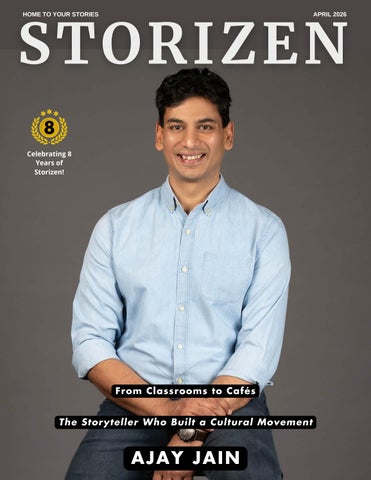
Storizen Magazine April 2026 | Ajay Jain

Page 1


From Classrooms to Cafés

The Storyteller Who Built a Cultural Movement

Articles/Short Stories/Poetry/Interviews/Events

The Cry Over the Boundless Hills - Sreelekha Chatterjee, p20

Monthly Horoscope: April 2026 - Storizen Staff, p68

From the Editor's Bookshelf - Saurabh Chawla, p26

Fusion Fiction - Madhulika Ra Chauhan, p28

Beloved Baba - Nagma Sinha, p64

A Home Without a Garden - Kavita Ezekiel Mendonca, p64

Dreams Never Age... - Madhumathi H., p62

Rain - Neelakshi Bannerjee, p66

Book Excerpt - Lilac by Preeti Shah, p30

Interview: Rupeen Popat, Author: Satyavati: The Queen Who Shaped the Destiny of the Kurus, p34

Book Reviews (by Swapna Peri, Saurabh Chawla & Kiran K. Adharapuram)

Hot Off the Press, p14

30-Something Millionaire by Mohit Chawla, p40

A Fire on Mount Everest by Siddharth Kak, p40

A to Z of Indian History by Archana Garodia Gupta and Shruti Garodia, p41

From Chaos to Clarity by Shonali Sabherwal, p43

From Guerrilla Fighter to Chief Minister by Zoramthanga, p43

Get Unstuck by Sunder Ramachandran, p44

Building India’s Upstarts by R.Narsimhan, p41

Glimpses of a Golden Childhood by Osho, p44 Catch Her If You Can by Tessa Bailey, p42

Eradication by Jonathan Miles, p42

Good People by Patmeena Sabit, p45

Gooday Nagar by Maithreyi Karnoor, p45

Heart the Lover by Lily King, p46

History Unpacked by Saisudha Acharya, p46

Hooked by Asako Yuzuki, p47

Hot Chocolate on Thursday by Michiko Aoyama, p47

In Her Defence by Philippa Malicka, p48

And more...

DO YOU WANT TO BE A PART OF STORIZEN FAMILY?

You can also be a contributor Mail us your entries at talktous@storizen.com

Your smart ideas and inputs help us create our informative issues.

“Small acts, when multiplied by millions of people, can transform the world.”

Howard Zinn

Welcome to the April 2026 edition of Storizen Magazine, where our theme “Seeds of Change” invites you to look closely at the quiet beginnings that shape powerful transformations Change rarely arrives all at once it takes root in ideas, in conversations, in stories that grow steadily until they redefine the world around us

Our cover story, “From Classrooms to Cafés: The Storyteller Who Built a Cultural Movement, ” features Ajay Jain, a visionary who has reimagined how stories are experienced and shared From intimate storytelling sessions to vibrant cultural gatherings, his journey reflects how a single idea, nurtured with passion and purpose, can grow into a movement that connects communities and keeps the spirit of storytelling alive

This issue also brings you a thoughtfully curated collection of 44 book reviews, spanning genres and voices that reflect the many ways stories can inspire change whether through quiet introspection or bold new perspectives. Each book is a seed, offering readers a chance to grow, reflect, and see the world differently.

Adding to this rich literary experience, we present an engaging book excerpt from Lilac by Preeti Shah, offering a glimpse into a story that captures emotion, depth, and the subtle nuances of human connection.

As you turn these pages, may this issue remind you that every idea, every story, and every voice has the potential to plant a seed And with time, care, and courage, those seeds can grow into something truly transformative

Happy Reading!

editor@storizen.com

Saurabh Chawla, Editor in Chief

By Pria Raiyani and Swapna Peri

In this special cover story, Storizen sits down with Ajay Jain a storyteller who seamlessly bridges nostalgia, resilience, and community From the evocative lanes of 1980s Delhi in Charlie’s Boys to the deeply personal and stirring journey of Nikita, Jain’s work reflects an enduring curiosity about identity, memory, and the human spirit

Beyond the written word, his creation of Kunzum as a cultural haven for readers and writers speaks to his belief in stories as shared experiences In this candid conversation, he opens up about the inspirations behind his books, the philosophy that shapes his narratives, and the evolving role of storytelling in a rapidly changing world.

Charlie’s Boys captures school life in Delhi during the 1980s with humour, nostalgia, and honesty. What made you decide to turn your school memories into a book?

While the book is seemingly about school memories, the intent behind it goes broader than that

All Columbans – especially those of our era –believed we were the best school in the country, and took pride in it An attachment to the institution was thus inevitable As a professional writer, I had been trying to write a book based on my school since 2010 but somehow could not get going I had even attempted a fictional plot based on real characters and situations but it did not add up

I re-visited the school on two occasions about a year before the book came out; one of those was for a memorial service for one the greatest teachers to have lived, Brother Eric Steve D’souza. I was overwhelmed with emotion, walking the fields and corridors with little changed. I reached home to make notes on whatever I was feeling, whatever memories floating in my mind And that’s when I felt this could be a book

A book not just about anecdotes from school, but reflective in nature About a time gone by, about values so dear to us, about men and women who gave their today for our tomorrow, about things

that need not change irrespective of the passage of time

The book is an ode, and a catharsis Not just for those who went to St Columba’s, but for everyone Because we all leave our schools, but the school never leaves us

The book mixes personal stories with historical moments from VHS and Nintendo to major political events. How important was it for you to place your coming-of-age story within the larger context of that era?

While the book reads like a diary of interesting and important things that happened while I was in school, these did not happen in isolation. It was an era of significant change – especially for a relatively closed society and economy like India. It was thus vital to talk of some of the significant developments so our own evolution could be understood.

For readers who were not around in the 1970s and 1980s, it is also a peek into slices of history – and helping them trace the progression from times then and now

The book is an ode, and a catharsis. Not just for those who went to St. Columba’s, but for everyone. Because we all leave our schools, but the school never leaves us.
- Ajay Jain
Pic: Ajay Jain

Nikita portrays a woman who keeps running sometimes from others and sometimes from her past. What inspired you to explore resilience and healing in such a raw and honest way?

Nikita is a based on a true story Except the names and settings, everything in the book happened to real people. It was important to narrate the story in all its honesty, exposing the state of the heart and mind in its entirety. Only then could I have achieved the purpose of writing this book: to show that the story of Nikita could be the story of any of us. And thus expand our own understanding and develop empathy over what others go through.

Nikita also sends a message to those reading her story: keep moving

Nikita’s journey from dependence to selfreliance happens through small, realistic steps rather than dramatic turning points. Was this gradual transformation a deliberate narrative choice to reflect real-life recovery?

Life is a daily drama for each of us, but it is not dramatic where single moments change the course of our lives Yes, there are exceptions when people suffer from significant events like war, violence, financial catastrophe, deaths, disabilities etc. – but it happens to very few as a percentage of the population. For most, life pans out at an incremental pace.

What is significant about Nikita’s story is that she does not allow static-quo (this phrase is deliberate) to dictate her life; she is ever on the move trying to make her life more meaningful despite the limitations imposed upon her Her quest to reach the top of the metaphorical Everest is not by being air-dropped there but climbing one (tricky) step after another

Both books explore identity at different stages of life adolescence in ‘Charlie’s Boys’ and adulthood in ‘Nikita’. Do you see these works as part of a larger exploration of how people shape themselves against the pressures of society, family, and time?

There are two kinds of people out there

The majority are like sheep, willingly being herded as per norms and customs set by society They will live through the established cycle of living: education, career, family, retirement

Then there are those who want to break the pattern Moving away from the herd comes with risks; but they would rather flirt with danger than suffocate in the crowd

So, you are right – the protagonists in both books want to change what they see in the mirror They bide their time, taking tentative steps, gaining in confidence, sidestepping the naysayers just so they carve a space of their own

Through Kunzum, you’ve created a space where books, coffee, conversations, and community come together. What inspired you to turn a travel café into a cultural hub for readers and writers?

As an author and a reader, I would seek out bookstores where curation and space design made it a delight to browse and discover great reads A place where one could strike up in-person conversations with consumers and creators of art

This need became even more pronounced during the pandemic; for two years, each of us lived through fear and the grief of loss The original Kunzum Travel Café was intended as a gallery for my photographic art and my books; it became a cultural hub because the community took over Towards the fag end of the pandemic, I decided to pivot; maintain the spirit of the original at its core, and build a bookstore around it

When anyone asks me about the sense of setting up a bookstore in current times (and this happens almost daily), I just reply: Someone, and more of us, has to. So we do not find ourselves in a desert without cultural oases like Kunzum.

Looking back at your journey from writing books like 'Nikita' and 'Charlie’s Boys' to building Kunzum what has been the most meaningful moment for you as a storyteller and community builder?

In Nikita, Ajay tells a compelling story of a woman striving to break free from the constraints of tradition and reclaim her life. As Nikita faces personal struggles and societal expectations, her journey becomes one of resilience, courage, and selfdiscovery, making for an emotional and empowering read.

In Charlie’s Boys, Ajay Jain takes readers on a nostalgic and humorous journey through his schooldays in 1980s Delhi. Filled with pranks, friendships, strict teachers, and youthful mischief, the memoir captures the essence of growing up in an all-boys’ school. Light, witty, and relatable, it brings back the charm and chaos of school life with warmth and fond remembrance.

Like in my books, I will not say there has been a singular moment as you describe But collectively, it has been nothing short of momentous

Kunzum is not merely a community, but a community of communities This is where its strength lies – where a few bring in many with them, a force multiplier in every sense of the word The faith and trust of these people is something money and marketing cannot buy

I have thus evolved as a human being In my outlook towards life, in my values, in understanding what the world at large needs and seeks. Not just limited to human beings, everything sentient, everything created by nature, everything in the cosmic scheme of things. By interacting with those from varied background, with their unique stories. And this reflects in my storytelling – articulated through my books and articles, what I see through my lens, and what I narrate to live audiences. Now under the banner: Stories With Ajay Jain

Finally, if you could give one piece of advice to aspiring writers or storytellers who visit Kunzum hoping to share their voice with the world, what would it be?

The best storytellers are those who have enriched themselves with lived experiences With an open mind, so they shed their prejudices, dust the cobwebs in their minds, allowing their five senses to absorb everything around them With a high emotional quotient

Of course, one has to work on their craft. Through training, and always staying in a student mode so the learning never stops.

And then there is the minor matter of actually showing up at their desks or even the couch – for stories will not write themselves.

Contact: pria@storizen com

Swapna Peri is a Freelance blogger, book reviewer, narrator, and copy editor About Pria - Young mesmerizing freelance blogger, social enthusiast, and an economics graduate from Jharkhand University with a Master's in Child Psychology. She is hardworking yet crazy, a passionate reader, an ardent music fanatic, an avid caffeine lover, and a maniacal animal lover too She has been a part of numerous anthologies, articles, and write-ups for newspapers and magazines which are multi-linguistic She has also written screenplays for YouTube series

Contact: swapna.peri@storizen.com

HOT OFFthe press

In The Book of Daily Brilliance: 111 Days to Transformation, author Pamela Puja Kirpalani offers a gentle and reflective guide to reconnecting with yourself amidst the noise of everyday life. Designed as a 111-day journey, the book invites readers to pause, reflect, and realign through thoughtful insights on themes like selfworth, relationships, and inner growth. Each entry serves as a moment of clarity, encouraging a deeper awareness without pressure or rigid structure. Calm and introspective, it becomes a daily companion for those seeking balance, mindfulness, and a more grounded sense of self.

In The School-Gate Kidnapping, author Kiran Manral delivers a sharp, entertaining mystery led by the fiercely opinionated and impossible-to-ignore Kay Mehra. What begins as a shocking abduction quickly spirals into a tangled web of deaths, secrets, and high-speed chaos, pulling Kay into a world she never planned to investigate. Armed with curiosity and a refusal to back down, she teams up with a professional detective to uncover the truth. Packed with wit, suspense, and personality, the novel blends humor with intrigue, making for a lively and unpredictable ride through crime and chaos.

HOT OFFthe press

In What I Wish I Knew About Luck, author Tina Seelig offers an engaging and practical guide to rethinking luck as something you can actively create rather than passively wait for. Drawing from her teaching and research, she blends real-life examples with actionable insights to show how mindset, effort, and relationships play a crucial role in shaping opportunities. With a clear and motivating approach, the book encourages readers to embrace challenges, stay adaptable, and turn setbacks into stepping stones. Insightful and empowering, it reframes luck as a skill that can be developed over time.

In Dungeon Crawler Carl, author Matt Dinniman delivers a wildly entertaining and darkly comedic adventure where the apocalypse turns into a brutal, intergalactic game show. Following Carl and a very opinionated cat as they navigate a deadly dungeon filled with bizarre creatures and unpredictable challenges, the story blends video game mechanics with high-stakes survival. As they fight to stay alive— and keep an alien audience entertained—the narrative becomes a fast-paced mix of humor, chaos, and tension. Bold and addictive, it’s a unique take on survival that’s as absurd as it is thrilling.

BELOVED BABA

ild thunderstorms were raging loudly with rainfall pattering down in complete melody

Adhir, seated in a taxi, was going to his ancestral home in Rabindra Nagar after a gap of eight months

There were an ocean of memories crowding his mind about his grandfather whom he fondly called Baba, and it was difficult for him to focus on any one of them.

The vehicle passed by the Midnapore head post office where he used to frequent to send letters to Rumi. She was posted in Kolkata after successfully clearing the CivilServices Examination. Back then, Adhir’s parents did not approve of an inter-religious marriage.It was his grandfather, Surendra Brijwasi, who convinced them to look beyond religion After intense arguments for two years, Rumi became a part of the Brijwasi family

The taxi driver interrupted Adhir from his thoughts, “Sir, we have arrived at Rabindra Nagar, do you know the way from here?” “Yes, keep going straight, I will guide you ”

Adhir was his favourite among the fifteen grandchildren from five children Although, he never announced this favouritism, it became unknowingly evident to all the family members

In the mornings, Baba would recite the prayers to the idols of gods neatly stationed inside a temple shaped structure He would instruct Adhir through his eye and hand movements to circle the lighted incense sticks around the idols and keep ringing the copper bell at the same time. After the prayers, Baba would distribute jaggery as prasad. In the afternoons, Adhir would wake Baba for two rupees when the sugar candy vendor would arrive at the front gate.

Then at five in the evening, they would walk to Purana Chowk to buy vegetables and fruits. On some days they would pay a short visit to Sohan Babu, Surendra’s closest friend and Adhir loved the besan pyaaz pakoda at his place

Baba, a retired professor of Philosophy, would coach students three days a week on the subject for free Adhir would sit attentively listening to him during some of his classes He

later accepted the Arts stream and much to the disappointment of his parents, he majored in Philosophy

When Adhir started earning from his teaching profession, he wanted to do all he could for Baba

Surendra had grown old and developed problems in his knees Adhir gave two lakhs of rupees from his savings for getting his knee replacements done

“I don't need such expensive treatment, beta The pain will heal naturally ”

Adhir still insisted and when he checked after a few weeks, he learnt that Baba lent the money to Sohan Babu for his granddaughter, Sudha’s wedding

“I had given it especially for your surgery! Why did you give it away?”

“His family is going through financial difficulties, and the groom’s parents were demanding dowry which Sohan’s family could not decline.”

“Dowry? All your life you have been against this practice and now you are supporting such draconian practice?”

“Beta, sometimes we cannot fight for our virtues and beliefs. Sudha had faced several rejections earlier due to her dark skin colour, so, they had to give in.”

“I will give you the money when I come next ” “No need, beta My walking stick is more than sufficient for me ”

Adhir was extremely agitated and felt extremely deceived

Adhir’s next visit was along with his two-month-old baby boy Baba took hold of him and gifted him gold anklets

“Why did you spend so much money? This was not necessary!” “This is your money! Sohan returned part of the money ” “I am taking you to Kolkata for the surgery ”

“Beta, I don’t want to get operated I cannot live with artificial parts inside my body ”

“It will get worse if you don’t!”

Baba patted his back, “I can bear the pain, it’s better this way!” “He fell on the bathroom floor yesterday and fractured his right knee.” informed Adhir’s mother, four months after his visit.

“I had told him so many times to get operated. All this happened because he never listened to me and his knees wore out.” vented Adhir.

“Will you come to see him, beta?”

“I can’t Ma. I’m quite occupied.”

“Ok, here I’m giving the phone to Baba, speak to him.”

Surendra held the instrument next to his right ear and said, “Hello! How are you, beta?”

“I’m fine Baba How are you feeling today?”

“I’m a little unwell but otherwise ok So, you will be coming during the DurgaPujo, right? Bring your family along We will go to see the cultural programs ” “It won’t be possible, Baba I won’t be able to take holidays from work ”

“I miss you a lot, beta Come home soon ”

Three months passed

“Baba is still bed-ridden He was asking about you last night ”

“Is there any further complication?”

“The fracture hasn’t healed and now, his left lung has degenerated!”

“Does he still smoke?”

“No. He left after Shyam babu was detected with lung cancer.”

“He might be smoking when no one’s around.”

“Don’t say that! Are you coming to see him or not?”

“Now, take this right and stop at the first house on the left ”

The driver stopped the car beside a house named Kailas Parbat

In the last one year, Baba had become frail and weak A man who had an elephant’s memory before was gradually caught with dementia He had been bedridden and could barely keep his eyes open On rare occasions that he did, he would only look for Adhir

Adhir walked inside and saw a room full of people sitting across each other in silence Baba’s body lay there lifeless He breathed his last the night before Adhir’s arrival at Rabindra Nagar

Tears rolled down his cheeks and all the memories with Baba came to life He regretted not arriving a week earlier and losing a lifetime opportunity of being with his beloved Baba.

He climbed over the cemented staircase towards Baba’s

room He sat on his bed and started crying uncontrollably, feeling remorse about the bitter conversations he had with him during his last days

After a few minutes, his eyes caught sight of a greeting card he had made for him on his seventieth birthday Baba had carefully kept it inside a glass cabinet displaying the front-page art of a bouquet of flowers coloured with pencil colours. He took it out from the cabinet and read the last line of his handwritten note at the bottom on the third side of the paper card.

It read, “You will and always will be my favourite person on this planet!”

Nagma is a senior executive at a multinational corporation who loves creative writing. She holds an MBA degree and is currently based in the Delhi NCR region Her short stories have been published in Contemporary Literary Review India, Kitaab, Setu Bilingual, Modern Literature and Litbop Her works have also been considered for publication by Indian Review, Muse India, Roe River Review, Phenomenal Literature and Spark Magazine A curated list of her published pieces is available on her LinkedIn publications pagehttps://www linkedin com/in/nagmasinha/details/publications/

Beyond fiction, she has written on politics, socioeconomic issues, culture, and the arts on her website, nagmasinha blogspot com

The Cry Over the Boundless Hills

“A

nugandika Hills are dying a silent death!” A smartly dressed female news reporter says on the TV, just as I am about to switch the channel

She is talking about the vast mountain range forming the northern border of our city that overhangs the titanic desert beyond our fertile land Beset by the news, I quickly sit up on the three-seater sofa, perk up my ears as I increase the volume, and gluemy face onto the TV screen, like a cat suddenly awakened from its doze.

“Forty percent of the Anugandika range is at risk after the recent classification, says conservation groups. As per the new definition, hills above 50metres will be considered mountains and henceforth will be protected. Hills below the 50metre-elevation threshold will remain open to mining and stone-crushing.”

“Did you hear this? What’s the difference between a hill and a mountain?” I ask my husband, Neil, who is busy scrolling through his phone, comfortably settled on the diwan toward the wall, behind my sofa In our post-pandemic, masked environment, my techie husband makes a trip or two to his office every week The rest of the time, he works from home, mostly engaged either with his phone or laptop

“Hmm!” He replies, without lifting his eyes from his cell phone “It’s the real estate business They need to measure the height from the sea level and not the foothills, which they aren’t doing ” He adds with clenched teeth

“Real estate erasing the hills? Encroachments? And what about the ecological collapse it will entail?” I briefly scan my yellow fingernails, recognizing the gauntlet being thrown down here. “What’s the matter, Ma?” My 12-year-old son, Kunal, gives an enquiring stare with large cartoon eyes, lifting his pen from the notebook.

“You concentrate on your studies.” I give a sidelong glance at him, seated on the other side of the same sofa, and flutter my eyelids like an impatient mother force-feeding her child The kids need a distraction to leave their homework and indulge in chatting With great difficulty, I try to recall the last time he had given considerable attention to his studies

I take a peek at Kunal’s notebook His handwriting seems like a bird’s messy footprints etched into the fine layer of dust on a handrail We were introduced to the fountain pens after our long odyssey with pencils, much before we were familiarized with the ballpoint pens Today’s

children are straightaway handed over gel pens that never bleed over paper

“Kids are using gel pens instead of fountain pens Blackboards are replaced with computers at an early age ” I turn my face toward Neil, while Kunal looks on

“Old methods don’t work now Moreover, that’s progress Isn’t it?” Neil responds, turning sharply on me

“At times an earth track offers the primal, heart-warming aroma of nature that an asphalt road denies, being cold and scentless ” I cocoon myself in my solitary allegiance to the lofty ideal, on noticing that I have lost the attention of both

I ruminate upon an insomniac thought The horizon is an endless wave of breathing mustard-colored haze, with the active desert slowly moving in Nothing to pin the sand down

Blustery and icy, the airstream conquers Bereft of a green cover and the brown barrier, thick dust is lifted in gusts into the air Now saturated and whitened, the wind is wing heavy, noisy as the gramophone needle stuck in a groove. Stinging, the dust abrades human skin, blankets roads, fields, and even the sky.

The news goes on, while a line of sweat appears on my forehead. The offenders have a strange immunity that restricts us from reacting suitably, let alone suspending the robbery that they are up to. If we ever lose our way, will it be possible to find our way back?

It’s almost the end of December, and we have left the glass sliding door to the balcony wide open for cool air A persistent warm wind stifles the chill in the air,similar toblocking a valve in the air conditioner Whatever is left ofthat air, is it really fresh? The entire city seems to be an enormous sagging lung breathing hard An ordinary mask is lying on the centre table Neil always leaves his stuff here and there I have told him several times to use the N95 one, but he never listens

A sudden cawing of the crows and loud banging somewhere outside draws my attention I rush barefoot to the balcony A horde of crows is perched on power lines as far as my eyes can travel, their voices a raspy chorus against the otherwise calm environment The silvery-white sky waits in quiet contemplation, whether to reveal a cerulean blue morning, and quite unwittingly, allowing in a pale tumult of wind

Out of nowhere, a troop of monkeys of all sizes, like a flash mob from young infants to adults emerges on the mango tree a few houses away What I supposed to be a small group turns out to be a never-ending bunch of great, heaving multitude pouring in, perhaps in hundreds, slowly proceeding toward our house chattering, whooping, screeching, howling, grunting, squeaking, and barking at an unaltered pace, confusing my comprehension of the very intention of their presence. Motionless, the stray dogs are looking where the simian action is going on like breathing stones.

I run inside and close the sliding door with a thud.

By that time, Neil and Kunal have stopped their respective activities and are gawking at the black plum tree adjacent to our house and visible through our living room glass door Several monkeys have pitched up one almost on every branch as if given limitless free rein to exert their dominion Their garrulous assemblies, as it seems to me, all the primates of the universe, stir my first sensation of fear Every now and then, when I glimpse a figure clinging to the branch that leads up to our balcony, a throbbing occurs deep in my veins They are almost everywhere I set my eyes on

Somewhere on a terrace, they are fidgeting and straining power lines, cable wires, and Dish Antennas to the splitting point as if the potential energy of an elusive, invisible gale has entered them, enabling them to burst with madness Over the houses, on the roofs, their fury has penetrated in the form of drumming the water tanks incessantly and hammering the water pipes to and fro At the balcony opposite our house, they are pulling the clothes from the dryer,along with other decorative pieces, throwing them helter-skelter as if in a belligerent mood, openly mocking us and in a stance that shifts toward a royal battle between man and animal.

“They come here often but I haven’t seen them in such large numbers. Isn’t it?” Kunal says all of a sudden, breaking into our silence.

Neil and I glance at each other for a moment, as the sudden siege by the primates leaves us feeling unmoored Our insides yawp and whistle like a stove, as if a cast of crabs is scuttling within

“They’ll go away ” Neil’s voice sounds loud and instantaneously, cracks like a finger squeak on a guitar His orbs roll down upon the overcrowded tree and remain stuck as if grappling with a horror seen

Mrs Sharma, our middle-aged, friendly neighbor, calls on my mobile

“Did you see that, Amla?” She says from the other end “Aren’t they really great in number? Haven’t seen anything like this before ” I say, wondering that for the first time we are into something other than neighborhood gossip or just shooting the breeze

“Yesterday night the leopards were here There were about 10 or 15 of them I woke up in the middle of the night on hearing someone pounding on our front door On checking our CCTV camera, we saw one of them up to this mischief. It was there all through the night and only went away at the crack of dawn.” She goes on, a few decibels higher than her usual volume, while I imagine her otherwise-pleasing face cloudy with unease.

“What are you saying? God knows why they are here ” I startle while pacing back and forth in the room, observing my outspread hand quiver

One of the monkeys is now on our balcony. Oblivious of our presence inside, it’s pulling all the plants from their pots and devouring the flowers, awkwardly rattling its tongue, inelegantly baring and covering its teeth as if muttering a gibberish of curses.

“There is a thin line between our world and theirs. We have already crossed the line.” I stare at the glass door between the monkey and us

Unexpectedly, the monkey picks up a flower pot and hurls it at the door The glass splinters into a thousand pieces with an ear-splitting noise, just like my courage that I had gathered in my palm, now existing in useless fragments It gapes at the shattered glass scattered everywhere on the balcony and the room,and sprints in an attempt to cross over “Ah no ” Screaming at the top of my voice, I close my eyes in trepidation

“What is it?” Mrs Sharma yells On opening my eyes, I find the glass door intact and the monkey still at the other side of it

“Nothing! Everything is alright ” I utter a sigh, as if exhausted from talking my palpitating heart through to slow down

“Really a matter of concern The forest department won’t be here until evening My husband just got the news from a friend working in that department They need orders, etc ”She informs before hanging up.

“Thank God it’s Sunday morning,and we don’t have to go anywhere. Or else…” I tell my family, watching the goons prominent on the peripheries of our house, an unrestrained invasion of perhaps the entire colony, and most likely, the whole city.

*

At around midday, the music of the monkeys ceases, though the accompaniment of the surrounding noises has long died away Are they really gone? Neil is watching a TV show, and Kunal is playing video games on my laptop I stand by the entrance and listen A strange noiselessness haunts Gently opening the door of our apartment, I go downstairs without making any unnecessary clatter, wondering whether I will meet the monkeys bunched up there As I reach the parking area, a faint scent of earth wafts in the atmosphere, but there is hardly any plant there, leave alone the existence of soil

Our front gate is left ajar In an impulse to close the gate, I proceed toward it I notice an elderly male monkey sitting on the hood of our car in the parking area On seeing me, he doesn’t move Unlike their mischievous and mindless conduct,

he appears like a Zen Buddha Hesitant, I survey him for a while Backing off the fear of danger, something in me says that I can walk toward him

When I am almost a foot away, he shuffles and rearranges himself Suddenly he jumps down and clutches my dupatta His hazel eyes are lost in meditation A sudden, trembling glimmer within him lits up his eyes, presenting a curious spectacle. As I plumb the depths of those eyes, I see thick, dry deciduous tropical woods on the illimitable Anugandika Hills and their foothills simple, yet splendorous in their intricate, pendulous bouquets of existence. Braving the rigors of climates, there is the never-ending repetition of trees, shrubs, and bushes I know not about.Practically impenetrable to man as the forest seems luxuriant and deep in all comprehensible shades of green and earthy brown with occasional hues of yellow, orange, and red, their rich, varied palette reflecting life, growth, and the cycle of decline and renewal Their leaves and blossoms intermingle in undying friendships and uniform tempi of their lives All through the vision of the serenity, the expressive, soothing background orchestra of the wind flowing through the forest, along with the operations of Nature, reigns Enamored by the freedom, the style, and the kineses that exist in the awe-inspiring Nature, I stand transfixed Unexpectedly, the wind-blown symphonies lose rhythm, become out of sync, lose the groove and turn into moaning sighs I close my eyes An incessant earth-shattering vibration dwells A deep, plangent, rumbling roar like an engine, combined with heavy metallic clatter and grinding of metal on metal, dominates the soundscape, while a tingling sensation persists all over my body with every loud scraping, digging, and heaving sound. Is it for real or a mere fragment of my imagination?

Just then, breaking into my hypnotic trance, the monkey pulls my dupatta as if asking me to follow him, appearing like a plenipotentiary envoy in an attempt to thaw our uncompromising views for one another through the way of his blandishments Though not meant for heroic deeds, I choose to heed the call

Crossing the main gate, we walk by the jungle of concrete, our seemingly habitable abode with negligible greenery After walking together for about half an hour, we reach the far end of the city, and see the wilderness of monkeys upon the hillside again The golden light of the sun plays along the desolate hills, while the strong winds

buffet their fragile slopes. Leaving behind the realities of our urban existence,Istart viewing the beginning of what seems to be a remnant forest where most of the big trees neem, sacred fig, babul, button tree have been mercilessly hewed and the floor cleared of vegetation, as if an unholy war has been waged against them out of mercenary motives

Appearing as if a giant carcass of an unknown animal the bare logs disorderly stacked like a framework of bones as white as ivory, the leaves and branches piled here and there like the moldering meat the forest lies in neglect, heartbroken and estranged from its threatened soul Filling the space with dread and confusion, the once-alive inhabitants painted in decaying green are silently screaming and making bold proclamations The ground seems parched for want of emotive moisture, as if a gaping wound that has remained unattended for long If only the plants could migrate, the unfortunate occurrence wouldn’t have been there for me to witness But the animals aren’t saved either Are they?

The monkey’s eyes don’t leave me for a moment, as I sense mine welling up with tears The sound of my plaintive sobs is absorbed by the wind that has seen the fall of leaf after leaf from every tree, as well as endured the hurricane of their catastrophic fall. Wandering through the devastation, I lose sight of the monkey.

With invisible eyes fixed on me in a leaden glare, the forest keeps looking at me with forlorn astonishment and ire, like one with a speeding wheel of punishment on its head, bound to transfer soon onto that of humankind The darkness herein refuses to degenerate but wildly ferments like food that has failed safe, proper storage Saturated with thoughts and worries that run in the margins of that great concern, I return home with a heavy heart, wondering why my fellow tribe has engaged in such questionable practices

*

The next morning when my eyes open slits, I don’t find Kunal in his bed I wake up Neil and inform him about it

We look for Kunal everywhere in the house, the terrace, the front yard, but he is nowhere to be found As we are about to go to the police station, my mobile chatters It’s from Mrs Sharma

“Kunal is missing!” I say breathlessly before she speaks

“So is my child, my daughter She has never done this before ” Mrs Sharma breaks into a lamentable cry, with a shriek of pain

“Even Kunal never left anywhere without informing.”

I recall my brief rendezvous with the Zen Buddha monkey the previous day. Has he turned into the vindictive piped piper who tricked the kids to oblivion?

“Switch on the TV, Amla. My husband says there is something we need to see. Oh my god!” Her tone changesas the words come speedily, intermittently pausing as if to swallow some bad medicine, followed by coughing and choking

I press the remote button in such abysmal fastness that it almost slips from my hand

On the TV, they are showing the human-wrecked land a disheveled forest on the foothills of the Anugandika range, where I had been yesterday A few remnants of trees and shrubs appear like a crescent of white hair on an old man’s head, with a bulging, empty bald patch on the crown Several children between 10 and 15 years of age are carrying plantlets in their hands, along with water bottles wound around their necks They prod the soil with their hands, establish the plantlets, and pour water from their bottles Their intent rings loud as if with thunder, syllabizing in all directions The dancing throng of tweens fills the azure sky with a peal of merry laughter decked with munificent splendor, bubbling with innocence, full of life and vitality like the young saplings

A flash of happy verve produces a mild, inward convulsion. Shock waves of surprise spread to our whole forms, as we pronounce bodily noises like wind catching a set of bells. Neil and I momentarily stare at each other, as we think we know who they are. They have understood what the adults have refused to realize. The predaceous enemy of man is man himself.

Bowing our heads in reverence to the little angels, we know they have matured taller than their grown-up neighbors and stand erect in their inspiration, faithful toward amaranthine beliefs of peaceful coexistence We know their plants will one day turn into giant trees, with towering branches soaring high up against the sky Both plants and animals will thrive there an unsaid understanding of sustainability bound and content by their mutual atmosphere

Sreelekha Chatterjee’s short stories have been published in various national, and international magazines and journals like Indian Periodical, Femina, Indian Short Fiction, eFiction India, The Criterion, The Literary Voyage, World of Words, Writer’s Ezine, and Estuary, and have been included in numerous print and online anthologies such as Chicken Soup for the Indian Soul series (Westland Ltd, India), Wisdom of Our Mothers (Familia Books, USA), and several others She lives in New Delhi, India

You can connect with her on Facebook at facebook com/sreelekha chatterjee 1/,

Twitter -@sreelekha001, and Instagram @sreelekha2023

Book Title: The Mountain Is You: Transforming Self-Sabotage Into Self-Mastery

Author(s): Brianna

Publisher: Amaryllis (An Imprint of Manjul Publishing House)

Number of Pages: 248

ISBN: 9355434146

Date Published: November 25, 2023

Price: INR 261

I picked up The Mountain Is You at a time when I thought I needed motivation What I didn’t expect was a quiet confrontation with myself

Brianna Wiest writes about a truth we often avoid: that the biggest obstacles in our lives are not external they are internal Patterns we repeat Fears we protect Comfort zones we refuse to outgrow And as I read, I began to recognize those patterns not as abstract ideas, but as lived experiences

This is not a loud, motivational book. It doesn’t push you to “hustle” or reinvent yourself overnight. Instead, it does something far more unsettling and ultimately, more valuable. It asks you to sit with your own contradictions.

Wiest explores self-sabotage with a kind of clarity that feels both personal and universal. She doesn’t shame the reader for it. She explains it. Why we stay in situations that no longer serve us Why growth often feels uncomfortable Why change, even when desired, can feel threatening

There were moments while reading when I had to pause not because the ideas were complex, but because they were uncomfortably accurate And yet, the book never feels heavy There is a quiet sense of

hope running through it, a belief that awareness itself is the beginning of transformation

What I appreciated most is that The Mountain Is You reframes growth It is not about becoming someone new It is about understanding yourself deeply enough to stop standing in your own way

April is often seen as a time of fresh starts But this book reminded me that meaningful change does not begin externally It begins with self-awareness honest, patient, and sometimes uncomfortable.

This is not just a book you read. It is a book you return to.

Get it here:

Close Your Eyes and Let Your Ears be the Canvas

Stories written and narrated by Madhulika Ra Chauhan, await you where the magic of narrative will carry you away, episode by episode.

Watch the Story ‘Naayika’ on YouTube

“In life and in art, we don’t just perform roles, we become them.”

Meet the Naayika within you. Do listen.

Listen ‘Naayika’ on Spotify

Scan the above QR Code to listen ‘Naayika’ on Spotify

Scan the above QR Code to listen ‘Naayika’ on YouTube

Excerpted with permission from Lilac by Preeti Shah, Indiepress.

Everyone around Anisha was a bit surprised to know that she was feeling miserable only out of boredom While these thoughts were racing in everyone’s mind, Rats started rebuking Anisha for behaving like a child “How can you compare my conflict to your sheer boredom? What you presented as suffering is not even close to it In fact, it’s absolutely frivolous Boredom doesn’t cause any serious emotional trauma Having said that, I don’t deny that it does diminish some of the allure of life ”

Sukoon and Aachal were about to agree with Rats when Anisha lifted her palm, indicating that they should hear her out. Looking at Rats, Anisha said curtly, “What made you think that my story is over?” Rats and the other two embarrassingly apologised and requested Anisha to carry on.

The reaction that Anisha received had shaken her belief in her new-found audience A fear of not being misunderstood had put her in two minds about continuation of her story When Anisha was still in her head debating about sharing the remaining part of her story she felt some’s hand on her shoulder It was Sukoon who had placed her hand on Anisha’s shoulder to reassure her, “None of us are in a position to be judgmental So, go on without fear ”

With slight hesitation, Anisha continued I was trying hard to make peace with my boring life when my childhood friend Disha called to inform me about her wedding to her boyfriend of five years, Sumit

I was excited to know that the wedding was scheduled to take place in Delhi in December A trip to Delhi in the winter with all the wedding fanfare was enough to temporarily break the monotony of my life Disha requested me to accompany her to Delhi a week prior to the wedding to double-check the arrangements After speaking to Amar about it, I accepted her request with pleasure.

We arrived in Delhi airport to find a city wrapped in a thick blanket of an evening fog and faint streetlights. Right outside the arrival gate we found Disha’s cousin Rahul waiting for us. I couldn’t help but admire Rahul’s killer looks. He was six feet tall with broad shoulders, a slender frame, intoxicating eyes, and an endearing dimpled smile After the warm greeting, we headed towards the car park Rahul’s good manners were instantly evident when he opened the car door for us As if his good looks weren’t enough, he happened to be a

gentleman too I didn’t even remember the last time a man was this chivalrous

His good looks coupled with chivalrous attitude were making my heart race over and over again I avoided any eye contact with Disha and Rahul throughout the journey, fearing that my eyes might reveal my embarrassing emotional tumult.

When we reached Disha’s home, I said a short goodbye in a rush avoiding any conversation with Rahul. I was in a hurry to discard the forbidden thoughts that had crossed my mind about Rahul. I didn’t know if it was infatuation or if I was genuinely drawn to Rahul

As I was reprimanding myself for these foolish feelings, my phone started buzzing and I was happy to see Amar’s number flashing on the screen

After speaking to him for about 15 minutes, I hit the bed with the hope of waking up without any memory of my inappropriate emotions towards Rahul

Next day, I woke up with the knocks on my door After tossing and turning in bed for a few minutes I groggily answered the door and to my dismay it was Rahul Rahul was glowing like a lotus flower with morning dew He said, ‘Morning, we are planning to check the wedding venue and meet the photographer in an hour Thought we will ask you to join us ’ My mind was telling me to decline the invitation, but I ended up saying, ‘Will be downstairs in 15 minutes ’

SUBSCRIBE TO STORIZEN ON MAGZTER

INTERVIEW

Who Shaped the Destiny of the Kurus

Rupeen Popat
Author: Satyavati: The Queen

In the vast landscape of the Mahabharata, Satyavati is often remembered as the catalyst for the Kuru dynasty’s complicated lineage a fisherman’s daughter whose ambition reshaped history However, in this illuminating interview, the author discusses their journey of bringing Satyavati from the periphery to the center of the narrative. By blending the strategic acumen of a former CEO with a deep-rooted empathy fostered under the guidance of Morari Bapu, the author explores the challenges of adopting a firstperson female perspective to humanize an epic queen. From the structural influence of screenwriting to the nuances of political leadership, we delve into how this retelling balances traditional fidelity with the raw, emotional authenticity of a woman navigating power, loss, and destiny

In your retelling of Satyavati, how did you balance creative liberty with the traditional narrative of the Mahabharata, especially while shaping Satyavati’s inner voice?

I took as little creative liberty as possible My intention was to stay true to the known narrative of the Mahabharata while shining light on perspectives that have often been overlooked

With Satyavati, I focused on stepping into her inner world, trying to understand what each defining moment must have felt like for her I didn’t want to portray her as a martyr, nor as a hero or villain I wanted her to be human That was the balanceremaining faithful to the epic while deepening emotional perspective

Your narrative adopts a first-person tone from Satyavati’s perspective what challenges did you face in sustaining her emotional authenticity throughout the story?

The biggest challenge was stepping intoand staying withina female perspective throughout the narrative To navigate this, I relied deeply on empathy My learnings under Morari Bapu, combined with my professional experience as a founder and former CEO, where understanding people’s motivations by putting myself in their shoes was essential This helped shape my approach to Satyavati

Having built and led a business in early years education, working closely with a predominantly female team, I’ve spent years developing the ability to see the world through perspectives different from my own - whether across gender, age, or life experience

So, this wasn’t about imagining Satyavati from the outside it was about stepping into her reality and

staying there And hers is an extraordinary journey She moves from being a fisherman’s daughter to a queen, then a queen mother, and ultimately a custodian of a dynasty, making decisions under immense personal and societal pressure

I had to move away from asking, “What would I do?” and instead ask, “What must this have felt like for her?”

That shift - from projection to understanding - is where her voice came from

The book highlights themes of political virtue and presence of mind how consciously did you intend to position Satyavati as a strategist rather than just a supporting figure in the epic?

Very consciously.

Satyavati was not a background figure; she was a leader After becoming queen, she effectively helped steer the kingdom alongside Bhishma for decades This is not a minor role; this is sustained leadership over 30–40 years She lost her husband, lost her sons, and still ensured the continuation of the Kuru lineage That required intelligence, resilience, and strategy

In many ways, I see this as a correction - bringing rightful attention to the influence she truly had

You begin with Sage Vasiṣṭha’s curse and connect it to Bhīṣma’s origin—what inspired this structural choice, and how does it influence the reader’s perception of fate and destiny in your story?

Bhishma has always been one of my favourite characters in the Mahabharata

In many ways, this book is as much his story as it is Satyavati’s His life is defined by sacrifice, duty, and ultimately suffering. There is no traditional “victory” for him.

Starting with that foundation sets the tone - that destiny is already in motion. It prepares the reader to understand that certain outcomes are inevitable, and that Bhishma’s path, however noble, is one of profound cost.

The book follows a “free-flow writing” style resembling a screenplay was this a deliberate stylistic decision to make mythological storytelling more accessible to modern readers?

Not entirely deliberate

Interestingly, I initially wrote the story as a screenplay and later adapted it into a novel So that influence naturally remained

Satyavati’s odyssey from the humble riverbanks as the fisherwoman Matsyagandha to the iron-willed matriarch of Hastinapur serves as a masterclass in calculated ambition and the high price of political survival. Her ascent was sparked by a fateful encounter with King Shantanu, but it was sustained by her own ruthless resilience as she maneuvered through a royal court rife with scandal and betrayal.

Faced with the potential collapse of the Kuru dynasty, she made the staggering decision to summon her firstborn, Sage Vyasa, to preserve the royal bloodline a move that secured her legacy while tethering her to a life of profound personal sacrifice. Set within the grand architecture of the Mahabharata, her story is a compelling portrait of a woman who rejected a supporting role, instead using her strategic foresight to single-handedly recalibrate the destiny of an empire.

Pic: Rupeen Popat

At the same time, I think my background - writing in English from a UK perspective, may bring a slightly different tone compared to traditional Indian English narratives. Perhaps that contributes to the pacing and accessibility as well

Satyavati is portrayed as a multifaceted figure queen, wife, and mother. Which of these roles was the most challenging to develop, and why?

The role of the queen, without question

As a wife, her meaningful time with Shantanu was limited As a mother, her role was overshadowed by early loss and the broader arc of the story

But as a queen, she faced immense challenges She entered Hastinapur as an outsider, following a revered queen like Ganga, and was likely unpopular She was indirectly linked to Bhishma’s sacrifice, and her own lineage becoming rulers was a major cultural shift

Despite all this, she had to lead, through loss, uncertainty, and political instability - without any formal preparation. That journey required strength, adaptability, and strategic clarity.

Why do you think reading Indian epics like the Mahabharata remains important for modern readers, especially in understanding human nature and moral complexity?

Because they are timeless Because they’re not just stories - they’re mirrors

The Mahabharata and Ramayana explore human nature at its deepest level ~ duty, ego, sacrifice, love, ambition, conflict These themes are as relevant today as they were thousands of years ago

For centuries, these stories were carried through oral traditions, and even today, through storytellers like Morari Bapu, they continue to evolve and reach new audiences The medium may change - books, television, digital - but the essence remains the same These stories help us understand ourselves

In today’s literary landscape, what role do women authors play in reshaping traditional narratives and bringing forward untold female perspectives?

While I am not a woman, I believe strongly in bringing forward female perspectives

The women of the Mahabharata have not been given enough attention. We know their names, but we rarely explore their experiences in depth.

Every warrior in the Kurukshetra war had a mother, a wife, a daughter Their emotional journeys, their losses, their strength, are just as significant

For me, the intention was not simply to “push a female agenda,” but to find a powerful narrative lens that allows the story to be seen more completely Satyavati provided that lens

As you turn the page, let the adventure begin –our book reviews await, promising literary delights and captivating tales!

Pic: Swapna Peri

"30-Something Millionaire" by Mohit Chawla is a simple and relatable guide to building wealth with patience and consistency Instead of promising quick success, the book shares the author’s own journey to financial independence in his 30s It focuses on three core ideas consistency, discipline, and patience and shows how these can be applied in personal life, professional growth, and overall life wisdom The writing is easy to follow, making it especially helpful for those in their 20s and 30s trying to understand money and investing. What makes it readable is its practical approach. It connects financial growth with everyday habits, decisions, and mindset. From savings and investments to work strategies and learning from successful people, the ideas are clear and doable. The concept of compounding is explained not just in terms of money, but also in life, habits, and experiences. While some parts may feel basic for those already familiar with finance, the simplicity makes it accessible and easy to apply More than just a finance book, it also talks about staying grounded while chasing success The author highlights the importance of values, discipline, and mental peace, along with wealth creation It’s not about escaping the rat race overnight, but about making steady progress without losing yourself

Overall, it’s a motivating and thoughtful read for anyone looking for a balanced and realistic approach to money and life.

Mount Everest has always held a strange pull on people. For some, it is a dream; for others, an obsession or even a curse. No one feels neutral about it. It has the power to test you, humble you, and sometimes break you. Even after thousands of successful climbs, its mystery and danger

remain untouched, reminding us how small we are in front of something so vast "A Fire on Mount Everest" by Siddharth Kak takes us back to India’s historic 1984 Everest expedition, where Bachendri Pal became the first Indian woman to reach the summit While this achievement is widely celebrated, the book goes beyond the headlines to show what really happened behind the scenes It is not just about reaching the top, but about everything that came before it the fear, the pressure, and the emotional weight the team carries What makes this book special is that Siddharth Kak was not just watching from a distance. As a filmmaker, he was part of the journey, documenting every moment with his crew. He shares stories of danger, rivalry, doubt, and courage never seen before. From crossing the risky Khumbu Icefall to facing lifethreatening situations, his personal experiences add honesty and depth to the story. More than a tale of success, this book is about the human side of ambition. It shows how Everest decides who can climb it, and how it pushes people to their limits It also gently touches on the strain the mountain faces today

Honest, raw, and deeply moving, this book gives a fuller picture of what it truly means to chase a dream as big as Everest.

30-Something Millionaire by Mohit Chawla
A Fire on Mount Everest by Siddharth Kak

A to Z of Indian History by

"A to Z of Indian History" by Archana Garodia Gupta and Shruti Garodia is a delightful read because history never looks easy to read The simplified A–Z style divides the heavy history content into manageable chunks that are easy to learn at any time The book feels vibrant and different from a standard textbook because of its colourful pages, pictures, and entertaining fact boxes It strikes a balance between amusing information and simple explanations facts like muslin fitting inside a snuffbox pique intrigue, while issues like Ashokan pillars and Ellora are explained clearly Though the brief format gives only part of the information, the book injects interest and makes the reading intriguing Nonetheless, it works as a light, fascinating introduction to Indian history, particularly for individuals who typically find the topic boring

A perfect summer book for enthusiastic young readers

India is quickly emerging as one of the world’s most exciting startup hubs, driven by a young population and growing digital access. From big cities to small towns, new ideas are turning into businesses every day Indian startups are not just chasing growth, but also solving real

problems across sectors This changing landscape is shaping a new generation of entrepreneurs focused on building lasting impact R Narsimhan's "Building India’s Upstarts: A Bootstrapped Entrepreneur’s Playbook for Success " comes at a time when the meaning of success in India’s startup world is changing For years, the focus was on big funding, high valuations, and fast growth This book shifts that focus back to the basics cash flow, strong distribution, fair pricing, and steady growth. It shows that in a complex market like India, long-term success comes from good execution, not just hype. The idea of a “post-unicorn” model feels both fresh and practical. The book also looks at the bigger picture. With more people entering the workforce and fewer jobs being created, sectors like agriculture, healthcare, manufacturing, and tourism become very important. These are often overlooked compared to tech startups, but they can create real impact and jobs. The book explains how bootstrapped companies, built with care and less dependence on funding, often stay stronger during tough times It also highlights how India’s diversity makes business challenging, but full of opportunity What makes this book stand out is its simple and practical approach It talks about building businesses step by step growing without losing profits, reaching more customers, and creating strong systems It also changes how we see entrepreneurs, showing that true leaders focus on building value rather than just raising money

Easy to understand and very relevant, this book is a helpful guide for anyone who wants to build something meaningful and long-lasting in India

Catch Her If You Can by Tessa Bailey

"Catch Her If You Can" by Tessa Bailey is a fun, light hearted marriage-ofconvenience romance with plenty of spice. The story moves between the past and present, which can feel a bit confusing at times, but overall, it still keeps things engaging. Even though it is part of the Big

Shots series, it works well as a standalone and delivers a sweet mix of longing, romance, and friendship Eve and Madden first met in high school He is drawn to her but waits because she is younger, while Eve tries not to fall for him since her best friend likes him Still, Madden only ever notices Eve When she is bullied because of her father’s strip club, he steps in and protects her They grow close but stay just friends, even when Eve supports him through his kidney illness and transplant Years later, Madden becomes a professional baseball catcher, and Eve runs a struggling burlesque club They meet again when Eve is under financial pressure while taking care of her niece and nephews. Madden offers a marriage of convenience so he can help her with health insurance, and this finally gives them a chance to be together. Madden really stands out he is caring, confident, and fully devoted to Eve. Their chemistry is strong, and the romantic scenes are exactly what fans of the author would expect. The “he falls first” trope adds to the charm. At the same time, the story feels a bit surface-level in places Their emotional connection does not always feel as deep as it could, especially considering their long history The timeline shifts also affect the flow, and the present-day parts feel stronger Still, the writing is smooth and easy to read, making it a quick and enjoyable book

The friend group adds fun and warmth, and side characters like Elton and Veda make readers curious.

Eradication by Jonathan Miles

Jonathan Miles' novel "Eradication: A Fable" follows Adi, a former jazz musician turned schoolteacher, who is hired to eliminate a population of invasive goats on the remote Pacific Island of Santa Flora Tasked by a foundation with restoring ecological balance, Adi grapples with the moral

complexities of his assignment, which involves killing innocuous creatures for a stated noble cause. The story reflects Adi's personal struggles, including the grief of losing his young son and the dissolution of his marriage, revealing how these experiences shape his ambivalence toward the task As he navigates the island's challenges, he saves an endangered bird and encounters fishermen illegally harvesting sharks, prompting critical reflection on human impact on nature The story crescendos in the final pages, where Adi is forced to confront the legitimacy of his mission Author Miles masterfully intertwines themes of grief, morality, and human interaction with fragile ecosystems

Ultimately, "Eradication" serves as a poignant reflection on contemporary environmental issues, challenging readers to consider the ethical implications of conservation efforts amidst a backdrop of personal tragedy and societal irresponsibility.

From Chaos to Clarity by

When life is shaken by something as overwhelming as cancer, people often seek more than just treatment they look for guidance that understands both the body and the mind. Books written by those who have worked closely with patients, like nutritionists,

carry a unique blend of science and empathy They offer not only knowledge about healing but also a gentle reassurance drawn from real experiences Through their words, food, care, and emotional strength become part of the recovery journey Such books become quiet companions, helping readers feel supported, informed, and a little more in control with every page Cancer can turn life upside down, bringing fear, confusion, and countless questions In " From Chaos to Clarity: Strategies for Cancer Prevention and Remission | A Holistic Cancer Diet Guide With Effective Lifestyle Strategies", author & nutritionist Shonali Sabherwal gently guides readers through this difficult space with care and understanding Whether someone is newly diagnosed, in treatment, or supporting a loved one, this book feels like a steady presence offering comfort, clarity, and a sense of direction when it is needed most. It reminds you that even in uncertainty, there are small, meaningful ways to take back control. With simple explanations, practical diet plans, and nourishing recipes, the book shows how healing is not just about medicine, but also about what we eat, how we live, and how we care for ourselves emotionally. Shonali draws from her experience to make complex ideas easy to understand, helping readers feel less overwhelmed Each chapter feels thoughtful and reassuring, like someone holding your hand and guiding you step by step through a challenging journey This book feels especially personal for anyone who has been touched by cancer It speaks with honesty about the fear, but also about hope, strength, and the possibility of healing

More than just a guide, it becomes a source of support offering not just information, but comfort and encouragement. It is a gentle reminder that even in the hardest times, clarity, strength, and care can still be found

"From Guerrilla Fighter to Chief Minister" tells the powerful life story of Zoramthanga, a boy from a small hill village who rose to become one of Mizoram’s most important leaders. This is not just a political memoir, but a deeply human story of struggle, loss, and strong belief. Set against a time of

conflict and uncertainty, the book shows how one man carried the hopes of his people and refused to give up, even in the hardest moments The story takes you through the difficult years of insurgency, exile, and survival You see life in jungle hideouts, the fear of being hunted, and the pain of hunger and separation But along with this, there is also courage, friendship, and a quiet hope that keeps going One of the most moving parts of the book is the shift from rebellion to peace, as Zoramthanga becomes part of the effort that led to the 1986 Mizo Peace Accord, bringing lasting change to the region Over time, he grows from a rebel fighter into a respected political leader and three-time Chief Minister of Mizoram His journey shows how leadership can evolve through experience, patience, and a desire to build peace

Simple yet powerful, this memoir gives a clear and honest look at Mizoram’s past while also sharing a story of resilience, faith, and transformation that stays with you long after reading.

Get Unstuck by

"Get Unstuck: Breaking Through the Middle Management Plateau" by Sunder Ramachandran comes across as a practical guide for professionals who feel stuck in middle management and are looking to grow The book focuses on real workplace challenges rather than complex theories Through simple examples and everyday

situations, it shows that growth is not just about hard work, but also about clear thinking, good decisions, and creating real value over time. One of the key highlights of the book is the 'VALUE framework', which breaks leadership into simple and easy-to-understand ideas. The author emphasises small, consistent habits that slowly build strong leadership skills. Instead of promising quick results, the book encourages steady effort and thoughtful action. The “Pause and Reflect” sections add depth by helping readers think about their own choices and progress What stands out most is the honest and relatable tone of the book The use of real-life examples and insights from experienced leaders makes it easy to connect with It shows that leadership often involves handling uncertainty and making difficult decisions

Overall, it is a grounded and encouraging read for anyone aiming to grow, think better, and step into stronger leadership roles.

Glimpses of a Golden Childhood by Osho Osho was a well-known spiritual teacher who shared simple ideas about meditation, freedom, and understanding oneself He encouraged people to think on their own, enjoy life fully, and become more aware of their thoughts and feelings His teachings mixed traditional spirituality with modern thinking, making them easy for people around the world to understand

"Glimpses of a Golden Childhood" by Osho is a disarmingly intimate autobiographical journey that lifts the curtain on the early years of one of the most controversial spiritual teachers of the twentieth century Dictated in conversational, almost storybook style, the book strips away the usual reverence around gurus and instead presents a mischievous, fearless child who questions authority, pokes fun at dogma, and treats life as a series of playful experiments The result feels less like a formal biography and more like a series of warm, slightly cheeky bedtime stories told by someone who has already seen the other side of enlightenment What makes the book so engaging is its blend of humour, rebellion, and deep sensitivity. Osho recounts school escapades, confrontations with pompous teachers and gurus, and childhood adventures that reveal an early hunger for truth and a refusal to accept answers simply because they are traditional.Alongside these uproarious episodes, he also shares tender moments his relationship with his grandparents, his first encounters with death, and the quiet beauty of nature so that the “golden” in the title does not refer to mere nostalgia, but to a childhood steeped in love, freedom, and wonder For readers, "Glimpses of a Golden Childhood" is both entertaining and quietly transformative It dismantles the idea that a spiritual person must be solemn, and instead shows how curiosity, laughter, and even rebellion can be part of a sacred path

At its heart, the book is an invitation: to remember one’s own inner child, to question assumptions without fear, and to see ordinary moments as infused with the same magic that colored Osho’s rebellious yet luminous early years

“Good People” by Patmeena Sabit is a compelling debut novel that follows the Sharaf family, Afghan refugees who achieve a seemingly perfect life in Northern Virginia The story is crafted through varied perspectives friends, neighbours, and media creating a multifaceted exploration of identity, cultural expectations, and the

pressures families face The book’s structure mirrors a documentary, with interviews and testimonies that deepen suspense and challenge the reader's understanding as new viewpoints emerge When tragedy strikes the Sharaf family, community judgments arise, exposing biases and the sensationalism of their experiences The author's unconventional style engages readers by making them feel like participants in an investigation, as they reconcile conflicting opinions about the family. Themes of immigrant struggles, the pursuit of the American dream, and the fickleness of public opinion resonate profoundly. Ultimately, “Good People” is both a gripping read and a thoughtprovoking reflection on how quickly society forms opinions based on incomplete narratives, leaving readers unsettled and contemplative long after the last page.

Author Patmeena's work stands out as a beautifully nuanced portrayal of the immigrant experience, making it a perfect selection for readers who prefer engaging and realistic narration.

"Gooday Nagar" by Maithreyi Karnoor paints a vivid, quirky portrait of urban India through interconnected stories set in a chaotic city that feels like every Indian metropolis rolled into one The lives of its women disillusioned playwrights, vacuum-cleaner salesmen, and ghosts without arms unfold amid the

disruptions of the Covid pandemic, mended oddly by thieving monkeys and everyday absurdities It's a tender reminder of how fragility binds us, evoking a quiet ache for the characters' resilience The thematic connection between 'Gooday Nagar' by Maithreyi Karnoor and Vinod Kumar Shukla's 'Blue Is Blue' lies in their shared emotional portrait of ordinary lives disrupted by modernity's chaos, yet sustained by quiet, resilient absurdities. Maithreyi Karnoor writes with deep feeling about how modern cities flatten everything think tacky malls, wild traffic, and lakes disappearing with a soft longing that pulls at your heart. Stories of old revolutionaries afraid of gobhi manchurian or sweet soan papdi meetings show our funny, human side that stays with you, making you smile and cry over what we all share. The book feels like a short slice of real life from pandemic days, pushing us to hold tight to quick, passing bonds However, despite its whimsical charm, the book occasionally shifts into unconnected narratives that leave emotional threads hanging and that readers wish for closure

Nevertheless, "Gooday Nagar" stands out as a mustread, combining sharpness and heart into a reflection of India's changing spirit.

Good People by Patmeena Sabit
Gooday Nagar by Maithreyi Karnoor

Lily King's "Heart the Lover" which is on the longlist for the Women's Prize for Fiction 2026, captures the raw, intoxicating pulse of young love in a way that feels achingly real, like flipping through a friend's dog-eared diary from college days The unnamed protagonist navigates a messy triangle of

desire, friendship, and fleeting connections with two men Jordan and Casey during her senior year, all while the haze of late-night talks and half-formed dreams hangs heavy. King's prose is deceptively simple, letting emotions simmer without fanfare, which makes the inevitable heartbreaks land like punches you didn't see coming. What makes this novel special is how it refuses to romanticise those early twenties flings; instead, it peels back the layers to show how they scar and shape us long after the dorm lights dim The relationships feel lived-in, with dialogue that's sharp yet tender, full of the awkward pauses and bold confessions that define real intimacy It's not just about the lovers themselves but the quiet grief of what slips away friendships frayed, selves halfdiscovered in the rush of growing up Lily's genius shines in her restraint; she trusts readers to sit with the discomfort of ambiguity, grief, and those "what if" echoes that linger into adulthood Echoes of Elena Ferrante's women pulse through the pages, alive with the speed of life and its careless losses, yet King's voice remains distinctly her own soulful, wise, and devastatingly human The shift from youthful chaos to reflective maturity flows seamlessly, revealing how our earliest loves are both fragile and formative. By the end, "Heart the Lover" leaves you breathless, pondering your own tangled pasts with a mix of fondness and ache proof that King's at the top of her game, crafting stories that gut-punch and heal in equal measure.

It's literary fiction at its most emotionally exacting, perfect for anyone who's ever chased a heart only to find it changed them forever.

Saisudha Acharya's “ History Unpacked” reflects on a transformative experience with history, moving from disinterest to appreciation through engaging nonfiction. The book provides a conversational narrative style, reminiscent of familial storytelling, covering ancient India's history and the arrival of Homo Sapiens It features

engaging elements like humorous illustrations, quizzes, and infographics, making learning interactive while asserting the importance of ordinary people's stories alongside elite narratives Arranged into ten chapters, it addresses significant historical events with a critical lens on power dynamics, emphasising that much historical documentation favours the powerful, often neglecting the common populace The content ranges geographically across northern India with focused discussions on southern and northeastern histories It discusses essential themes such as the beginnings of agriculture, the Harappan Civilization, the Aryans, and the development of major religions and empires. The author addresses complex historical queries, such as the decline of the Harappan Civilisation and the definition of 'Aryan', fostering a deeper understanding of these ambiguities.

Ultimately, the book focuses on the importance of historical understanding in making sense of contemporary issues and planning for the future.

Heart the Lover by Lily King
History Unpacked by Saisudha Acharya

"Hooked" by Asako Yuzuki is a quiet and unsettling story about loneliness, obsession, and human connection The novel follows Eriko, a successful but deeply lonely woman, and Shoko, a lifestyle blogger whose messy but warm life attracts attention. When Eriko arranges a meeting with Shoko, their

relationship slowly grows, but it soon becomes clear that it is not a simple friendship Through these two characters, the book explores how people can become fixated on others, especially when they see in them the life they wish they had Polly Barton’s translation is smooth and precise, keeping the tension steady and the narrative voice clear and engaging throughout One of the strongest parts of the novel is how real and uncomfortable the emotions feel Eriko’s loneliness is not dramatic, but very ordinary, which makes it easy to understand Shoko, on the other hand, seems simple at first but slowly reveals deeper layers Their contrasting lives control versus chaos drive the story forward The book also touches on themes like friendship, identity, and the pressure to appear happy. It shows how people often hide behind a version of themselves, and how this can affect their relationships. However, the novel can feel slow and repetitive at times. There is a strong focus on inner thoughts, which sometimes makes the story feel heavy and less engaging. Readers may expect a bigger turning point or more dramatic events, but the story stays quiet and controlled until the end. Even so, "Hooked" leaves an impact. It makes you think about your own relationships and how easy it is to lose yourself in someone else

It is a thoughtful read, even if it does not fully satisfy in terms of pace or intensity.

"Hot Chocolate on Thursday" by Michiko Aoyama is a comforting story that encourages readers to slow down and appreciate the beauty in everyday moments. The book, reminiscent of a warm conversation, invites reflection and introspection in a world that often rushes by Central to the story is Marble Café, where the lives of various characters

intertwine, each chapter introducing a new personality whose journey is gently connected to others, culminating in a satisfying and cohesive reading experience The author utilises a distinctive writing technique where each chapter opens with a colour, symbolising the varied emotions and experiences of the characters, thereby adding depth to the story This implies that colours correspond to different life phases and reveal unspoken feelings The characters, including Maco, Mary, Risa, and Ralph, embody relatable human experiences. Particularly, the poignant relationship between Shinichiro and Misako highlights how timing and choices shape connections, while Maestro exemplifies the transformative power of belief and encouragement in nurturing talent. Michiko's writing further exudes warmth and simplicity, inviting readers to appreciate intimate moments at a leisurely pace. The gentle and reflective tone makes the narrative especially comforting during uncertain times. The overarching themes of love, loss, hope, and personal growth weave a rich tapestry of interconnected lives, resonating with the everyday realities of readers Finally, "Hot Chocolate on Thursday" emphasises the significance of small encounters and gestures, showcasing kindness as a powerful force for change Similar in style to the author's earlier work, this story also incorporates magical realism to highlight the beauty of life's unexpected moments

Through interconnected vignettes, the book encourages readers to reflect on their daily lives and find warmth in shared struggles and joys, ultimately transforming the ordinary into something magical

Hot Chocolate on Thursday by Michiko Aoyama

In Her Defence by Philippa

Author Philippa Malicka's "In Her Defence" pulls readers into a tense courtroom drama where a young woman stands trial for a shocking crime that blurs the lines between victim and villain Her story unfolds through sharp flashbacks, revealing a life twisted by betrayal, hidden abuse, and a desperate bid

for freedom. Malicka's clever weave of legal twists and raw human moments makes it a page-turner that lingers in your mind The heroine's fierce voice shines brightest her defence isn't just words, but a creative storm of memories that paint power, pain, and quiet rebellion in vivid strokes You feel her anger bubble up like a storm, challenging old ideas of justice and guilt, while side characters like the doubting lawyer add real depth It's insightful how Malicka flips the script on "perfect victims," making you question who truly needs defending Yet, some story twists feel too clean, rushing feelings and leaving loose bits for shock over the heart

The fresh ideas grab you, but a slower build might punch stronger Still, "In Her Defence" hooks you with gutsy storytelling—a new voice to cheer in stories of broken trust.

"India’s Forests - Revisiting Nature and History" is a collection of essays by distinguished scholars exploring the multifaceted relationships between Indian forests and society throughout history. The essays contest traditional views of forests as static entities, instead emphasizing their dynamic nature shaped by power, culture, and conflict Spanning

from prehistory to contemporary times, the volume examines the impact of colonialism and the evolving significance of tribal and hill communities reliant on these vital ecosystems Its integrative approach sources evidence from diverse fields, including archaeology and contemporary wildlife studies, to showcase how forests have been perceived and utilized over centuries Co-edited by Arup Jyoti Saikia and Mahesh Rangarajan, the ten essays challenge romanticized notions of untouched forests and harmonious relationships with nature, suggesting that forests have long been sites of resource production, refuge, and rebellion The authors use historical texts and archaeological findings to argue against the idea of forests remaining unchanged, providing evidence that commercial exploitation and land conversion have deep historical roots. While the initial chapters effectively draw on ancient governance models and ecological histories, the nonlinear geographical sequence may confuse readers.

Despite this, "India’s Forests" is a great read for its scholarly contributions, offering rich insights into ecological and social interconnections, making it a significant read for those interested in environmental history and contemporary forest issues in India.

India’s Forests by Arup Jyoti Saikia and Mahesh Rangarajan

"Isles of Emberdark" by Brandon Sanderson throws readers into a fun skyworld of floating islands, bright embers, and old magic that pops like fireworks. Young hero Lira, a tough sky-jumper with a strange power inside, hurries to bring rival groups together against a dark force that

wants to eat everything. It's a fast ride full of big chases, secret places, and powers that change the world Sanderson's special magic rules feel new and full of life Lira's brave trip gets readers excited, as she jumps between stormy islands on wind-boards while finding secrets that tie her to saving the world Fun surprises like fire-beasts that eat fear and team-ups made in air fights make pages turn quickly, mixing wild action with smart story ideas that light up the mind Readers cheer for her mixed group of friends, laughing at their jokes in the mess But the quick speed skips some deep feelings at times, making friendships feel a bit too fast in the show Some bad guy moves are easy to guess, which dulls the fun a little

Still, "Isles of Emberdark" brings Sanderson's big magic to a bright new place—great for fans who want adventure that flies high.

In "Jivya's Talking Hands" by Mamta Nainy Jivya's life centers around his mother, Aai, and her sudden death plunges him into silence, causing him to stop speaking entirely. In his isolation, he begins to follow ants, observing their purposeful movements across various landscapes This act leads him to a mud wall decorated with geometric shapes,

which inspires him to express himself through Warli Art, a form of painting As he traces simple patterns with a stick in the mud, he begins to depict the lives of the villagers and the world around him, channelling his grief into creativity His art becomes a healing vehicle, diminishing his sorrow and gradually bringing him recognition, including the prestigious Padma Shri award from the Government of India The narrative, while expected to be a biography detailing his accolades as an artist, unfolds as a poignant exploration of how a grieving child finds his voice through art instead of spoken language The ants serve as a powerful symbol in the story, guiding Jivya through his emotional journey. Their unchosen companionship becomes a framework for Jivya to articulate his grief using rhythm and form. Furthermore, the book favours a portrayal of Warli art as a living entity rather than a static cultural relic, conveying its vibrancy and ability to communicate with those who are silent. The author's invitation to the reader to engage in personal artistic creation mirrors Jivya’s journey, encouraging young audiences and adults alike to express their feelings through art

The illustrations stand out as especially impactful, inspiring individuals to embrace their emotional depths through artistic expression. This book is highly recommended for readers of all ages.

Isles of Emberdark by Brandon Sanderson
Jivya's Talking Hands by Mamta Nainy

and the Monkey Monster by Anushka Ravishankar

"Moin and the Monkey Monster" is a playful children's book by Anushka Ravishankar that appears deceptively cute before evolving into a chaotic narrative The story centers on Moin and a monster whose antics remain equally troublesome, creating a relatable dynamic for young readers The

humour is effectively tailored for the audience, incorporating exaggerated situations and food-related chaos that elicits laughter. The writing style is breezy and conversational, enhancing the reading experience and making it suitable for read-aloud sessions through its repetitive structure. The illustrations by Anitha Balachandran significantly enhance the book, characterised by bold and expressive artwork that aligns with the story's whimsical nature.

Overall, "Moin and the Monkey Monster" successfully connect with its audience, blending silliness with meaningful moments and presenting a charming yet chaotic exploration of its themes.

The book "My Dead Flowers" by Buku Sarkar merges poetry and photography, delving into themes of love, memory, and survival. It traverses cities such as Paris, New York, and Calcutta, capturing the speaker's emotional journeys. Love is depicted as both fragile and chaotic, intertwined with a resilient sense of survival amidst pain and loss A notable

aspect of this collection is the harmonious blend of images and words, where photographs enhance the poems’ emotional resonance The writing is characterised as simple yet intense, resembling personal notes and fleeting thoughts, which might challenge some readers The collection is brief, leaving some readers desiring a broader range of poems to experience Sarkar’s voice fully Reviewers note its lasting impact derived from its honesty and emotional depth The poems resemble diary entries with a minimal structure, capturing observations and moments rather than traditional poetic forms. While some pieces resonate powerfully, others feel underdeveloped, and the fragmented style may not appeal to all. Black-and-white photographs complement the text, although some poems printed over these images may disrupt the reading experience. This collection provides a quick yet thoughtful read, suited for those who appreciate loosely structured writing. It portrays the complexities of human experience with a haunting intimacy, exploring memories, longing, loss, and raw love The natural, simple lines convey profound thoughts, reflecting the emotions and narratives inherent in everyday life

Ultimately, it offers a strong, real, and personal perspective on survival and enduring feelings despite life’s challenges, emphasising the quiet strength found in vulnerability.

Moin
My Dead Flowers by Buku Sarkar

AI is changing jobs by automating repetitive work while also creating new roles in tech and creative fields This makes life easier, but can also cause uncertainty about job security To adapt, people should learn new skills and stay flexible Instead of fearing AI, using it as a tool can help them grow.

"Open to Work" presents a timely and insightful look at how work is rapidly evolving in the age of AI Written by Ryan Roslansky and Aneesh Raman, the book challenges outdated ideas about careers where roles were stable, and growth followed a predictable path Instead, it highlights a new reality shaped by constant change, where adaptability and continuous learning are essential Drawing on data from millions of professionals and real-life stories, the authors show how individuals are already using AI to improve their work, switch careers, or even build businesses, making the future of work feel immediate and personal. Because the book’s strong focus on human qualities that machines cannot replace is primarily focused, the book looks promising. While AI can speed up tasks and provide insights, the authors emphasise skills like curiosity, courage, creativity, compassion, and communication as the true drivers of success. The book goes beyond theory by offering practical guidance, such as identifying which tasks to delegate to AI and how to build a flexible, future-ready career Its clear frameworks and actionable steps, including structured growth plans, make it especially useful for readers who want more than just ideas they want direction Overall, "Open to Work" reads like a thoughtful and encouraging mentor, blending real-world relevance with an engaging narrative It successfully bridges the gap between big-picture changes in the economy and everyday career decisions, helping readers rethink not just how to find work, but what kind of work truly matters

This makes it a valuable and inspiring read for anyone navigating careers, leadership, or personal growth in a world where AI is becoming a constant companion

"Polar War: Submarines, Spies and the Struggle for Power in a Melting Arctic" by Kenneth R Rosen is more of a harrowing report from the front lines of a warming, militarized earth than a traditional military history Rosen combines travelogue, firsthand reporting, and geopolitical analysis to demonstrate how the once-marginal Arctic

is quickly turning into the epicenter of a new great-power competition where strategic ambition and climate change intersect. The main revelation of the book is striking: the "frozen north" is turning into a military cockpit for the next world war as ice recedes, access routes open, and resource claims intensify. Author Rosen's human-scale storytelling is his strongest skill. He travels throughout the Arctic with scientists keeping an eye on the melting permafrost, military stationed on recently defended islands, and Indigenous leaders seeing the deterioration of centuries-old customs These portraits show how the stakes go far beyond espionage networks and submarines, and they keep the story grounded when it could easily veer into abstract policy abstraction Through interviews with stakeholders from about twenty nations, Rosen reveals a region divided by conflicting interests resource extraction, national security, and climate survival where the US and NATO seem to be frantically trying to keep up with China's expanding economic influence and Russia's more methodical Arctic build-up At the same time, "Polar War: occasionally strains to balance the granular and the panoramic The rush to cover everything submarine warfare, pipeline sabotage, undersea cables, thawing biological hazards, and Indigenous sovereignty can feel diffuse, blurring the book’s core argument. Yet these very gaps underscore Rosen’s underlying warning: the Arctic is not some isolated chessboard, but a nexus where climate, espionage, economics, and security converge in ways that demand a more integrated, less siloed understanding.

As both an elegy for a vanishing polar world and a sobering alarm about the next cold war, *Polar War* succeeds best when it forces readers to see the Arctic not as a distant abstraction but as the planet’s next flashpoint.

Open to Work by Ryan Roslansky and Aneesh Raman
Polar War by Kenneth R. Rosen

Than the Storm by Amitabh Kant and Siddharth Sinha

Climate change has become a pressing issue on our globe, endangering a number of industries, including food, health, and economic stability In "Smarter Than the Storm," Amitabh Kant and Siddharth Sinha examine the relationship between artificial intelligence (AI) and climate change,

highlighting both the potential benefits and environmental challenges associated with AI development. The authors argue that while AI can greatly enhance climate change mitigation and governance, it also poses risks due to its environmental footprint They present case studies demonstrating AI's capacity to address climate challenges and advocate for community-positive AI models, open data, and digital infrastructure to democratize access to climaterelated information With recent shifts in attitudes towards climate issues, the authors assert that AI is a potential ally in combating climate change's multifaceted threats They emphasize that AI's ability to optimize resource management, enhance transparency, and support accountability in climate actions can help transform existing challenges into opportunities The book encourages a systems-oriented approach, suggesting that effective climate solutions must integrate data collaboration as a core component Amitabh Kant and Siddharth Sinha advocate for incentivising open data and AI initiatives, particularly in the context of climate justice, calling for public funding to address these issues collectively, thus positioning AI as a critical tool for a sustainable future.

Overall, the book serves as an accessible call to action, aiming to engage readers and stakeholders alike in leveraging AI for meaningful climate solutions.

Whodunit novels are popular because they keep readers curious and involved from start to finish They turn the story into a puzzle, making you guess who the culprit is while following clues and twists There’s a sense of excitement in trying to solve the mystery before the final reveal These stories also bring a feeling of satisfaction when

everything finally makes sense Simple, engaging, and full of suspense, they make reading both fun and addictive. In this connection, "Soft Kill", a debut novel by journalist Shubhra Krishan, is a compelling slow-burn whodunnit set in preliberalisation Delhi. The story revolves around the murder of Andy Asthana, a wealthy man with a dark reputation, found dead in his home without a struggle or a clue, leading Inspector Vijay to navigate a list of intimate and plausible suspects, including a terrified wife, a reckless lover, and an old friend with secrets The narrative employs classic noir elements infused with emotional depth, exploring themes of power, marriage, and moral decay, culminating in a final twist that leaves a lasting impression Writing in the book is quite engaging The book, for its atmospheric quality, the believable pacing, and the complexities of its characters, which combine suspense and emotional richness in a manner that defies standard genre conventions, makes it readable Divided into 85 short chapters, the plot maintains a gripping thrill, keeping readers engaged through its thoughtful character development and meticulous storytelling

Ultimately, Soft Kill is characterised not only as a murder mystery but also as a study of human relationships and the silence that can conceal violence.

Smarter
Soft Kill by Shubhra Krishan

Stories about immigrants feel deeply personal and real. They show what it means to leave behind everything familiar and start again in a new place, often with very little. There’s fear, hope, loneliness, and also quiet strength in these journeys. It’s not just about moving to another

country, but about finding your place and holding on to who you are At the heart of it, these stories remind us how brave it is to begin again Lindsay Pereira's moving novel "Super" depicts the connected lives of Sukhpreet Gill and Maynard Wilson, highlighting the sharp contrast between immigrants' and Canadians' expectations of a happy future Sukhpreet, an enthusiastic young man from Jalandhar, mortgages his family's farm to pursue the dream of prosperity and comfort in Canada, only to face a society unconcerned about his necessities Meanwhile, Maynard, a Canadian dealing with unemployment and financial difficulties, reflects Sukhpreet's sorrow, demonstrating that disillusionment is not exclusive to immigrants. The story delves into themes of immigration, identity, and the high cost of dreams, as Sukhpreet's zeal fades into desperation and Maynard's frustrations grow. Their final confrontation reveals the bitter truth about the "Canada dream," which develops not as a triumphant story, but as a nuanced depiction of hardship. Lindsay skillfully depicts the emotional weight of their journeys, highlighting the sacrifices made in search of a brighter future, as well as the understanding that sometimes the most significant risk is achieving what one desires only to find it unsatisfactory

The story is a profound meditation on the complexity of chasing ambitions across boundaries, highlighting the quiet agonies of loneliness and survival in a globalized world.

Nedra Glover Tawwab's "The Balancing Act" serves as a comprehensive guide to achieving harmony in relationships by finding the right balance between connection and self-preservation The book discusses key concepts such as the distinction between setting boundaries and erecting walls, the dynamics of

avoidant and anxious attachment styles, hyperindependence, and the limitations of the self-made individual myth. The author in the book integrates various therapeutic tools, including parts work, to facilitate deeper selfexploration and emphasises the significance of community and diverse social connections Through practical advice and personal anecdotes, readers are equipped to identify their needs, manage conflicts, and cultivate trust within relationships, whether with partners, friends, or family The book targets individuals grappling with codependency, boundary-setting issues, or struggles with asking for help, fostering self-awareness, and healthy dependency Nedra aims to help readers maintain fulfilling relationships without losing their sense of self, addressing complex emotional dynamics in an accessible manner Each chapter concludes with reflective questions to encourage personal introspection Overall, "The Balancing Act" is a clear and practical self-help resource, ideal not only for those seeking to improve their personal relationships but also for mental health professionals looking for tools to assist their clients. The language remains relatable and engaging, ensuring readers can easily apply its insights to real-life scenarios.

This book provides clarity, empowerment, and actionable advice for nurturing balanced connections while fostering personal growth.

The Balancing Act by Nedra Glover Tawwab

STORIZEN REVIEW

The Best of Urdu Short Stories by Mehr Afshan Farooqi

"The Best of Urdu Short Stories," edited by Mehr Afshan Farooqi, serves as an essential exploration of Urdu literature, akin to navigating a vast, storied house filled with diverse stories This anthology combines classic and contemporary

voices, featuring celebrated authors like Premchand, Saadat Hasan Manto, Ismat Chughtai, and newer talents such as Khalid Jawed and Ali Akbar Natiq The editor's thorough introduction provides context on the evolution of Urdu fiction, clarifying trends from progressive literature to modernity without bias Each story is presented chronologically, facilitating a seamless reading experience that reflects the genre's dynamic history While some pieces portray detailed slices of rural and middle-class life, others confront more intense themes like sexuality and Partition violence, showcased in Manto's and Chughtai's works This collection not only captures the emotional depth and societal critiques characteristic of Urdu literature but also makes it accessible to English-speaking audiences through thoughtful translations by the editor and others. With the inclusion of well-known works like "Idgaah" by Premchand, this anthology represents a significant achievement in bringing notable Urdu short stories into the English language, making it a vital read for anyone interested in the cultural tapestry of the Indian Subcontinent.

Farooqi's insightful curation serves to enhance appreciation for Urdu storytelling, an art form that encapsulates entire worlds within mere pages, inviting both new and seasoned readers to engage with its rich legacy.

"The Director" by Daniel Kehlmann, shortlisted for the 2026 Booker Prize, tells the gripping story of G.W. Pabst, a real filmmaker caught in the Nazi era's dark pull. Fleeing to Hollywood for safety, he finds fame slips away under the bright sun, pulling him back to a Europe twisted by power and fear. Key quotes like "Art is

a mirror, but who holds it up?" and "One compromise, and the frame cracks forever" cut deep into his soul What moves readers most is Pabst's inner struggle his passion for filmmaking blinds him to the evil around him, like a deal with the devil for one last big chance Kehlmann paints raw scenes of threats, lost dreams, and quiet shame, letting you feel the heavy weight of "just this once" becoming a lifetime of regret These moments linger, showing how easy it is to bend when ambition pulls hard Pabst isn't drawn as a hero or villain, but as a real, flawed person talented yet insecure, often unsure of his own path His drive to make meaningful art crashes against his need to survive and thrive in a brutal world Still, the book sometimes rushes through the pain, leaving big questions like true guilt or hope hanging too loose amid its twists. While powerful, it could dig deeper into the heart without all the shadowy detours.

Even so, "The Director" shines as a sharp, emotional warning about art, power, and the soul's quiet breaks.

The Director by Daniel Kehlmann

India’s food culture & diversity is captured in "The Great Indian Tiffin Box," by Swarnavo Datta which explores various cuisines through curated dishes from each state and territory The book not only highlights popular and unique recipes but also shares intriguing

facts and stories related to India's culinary heritage. Its engaging writing, vibrant illustrations, and user-friendly recipes make it a delightful read for food lovers and cultural explorers. The illustrations are particularly noteworthy, bringing the food to life and enhancing the reading experience.

This beautifully crafted book, recognised for its artistic detail and authentic representation of Indian cuisine, serves as an inviting coffee-table addition that encourages readers to savour both the content and the dishes it showcases.

"The Greatest Bedtime Stories" and "Stories That Celebrate India" by Champak are lovely to read for their clear purpose and intent. The first is perfect for calm bedtime reading, while the second helps children learn about Indian culture, values, and everyday life. Together, they balance each other well one helps kids relax, the

other gently helps them learn new things. The best part of both books is the artwork The pictures are bright, lively, and full of fun, often telling the story on their own From cute animal scenes to familiar Indian places like festivals, schools, and streets, the illustrations keep children interested without feeling too busy The language is also very simple and easy to read, making these books great for reading aloud or for kids who are just starting to read by themselves At times, the stories follow a simple and familiar pattern, making them easy and comforting to read "The Greatest Bedtime Stories" focuses on short, gentle tales that are easy to follow, while "Stories That Celebrate India" teaches lessons that can sometimes feel a little obvious, considering Gen Z and their bright minds

Still, both books do what they are meant to do They are simple, enjoyable, and a good fit for any child’s bookshelf.

The Great Indian Tiffin Box by Swarnavo Datta
The Greatest Bedtime Stories & Stories That Celebrate India by Champak

The Humble Pie by Jory John

"The Humble Pie" by Jory John is a gentle, funny picture book from the bestselling 'Food Group' series that follows a modest pie who loves to stay in the background and let others shine When he is paired with his charismatic best friend, Jake the Cake, for a school project, Humble Pie learns that true

humility isn’t about disappearing it’s about knowing when to speak up and share your ideas With Pete Oswald’s warm, colourful illustrations and Jory John’s witty, relatable voice, the story turns a simple classroom project into a touching lesson on self worth, friendship, and emotional honesty.

Young readers come away with a light but powerful message: you can be kind and modest 'and' still let your voice be heard, because every voice pie, cake, or kid matters.

In "The Invincible Brain," Dr Majid Fotuhi presents a 12-week program aimed at reversing cognitive decline, enhancing memory, and optimizing mental sharpness for individuals of any age As a renowned neurologist and adjunct professor at Johns Hopkins University, Dr Fotuhi draws on over 35 years of research to unveil

strategies that can prevent and treat cognitive impairments, including Alzheimer’s disease and ADHD The program has shown remarkable clinical results, with over 80% of patients experiencing significant improvements in cognitive functions, backed by MRI evidence indicating increased hippocampal volume in elderly patients. The book outlines five essential pillars of brain health: fitness, sleep, nutrition, mindset, and brain training, alongside customizable exercises to boost cognitive skills, a brain-boosting diet plan, stress management techniques, and sleep optimization methods. Dr. Fotuhi reassures readers that they have the agency to influence their brain health, countering fears associated with aging and cognitive decline Written in accessible language, "The Invincible Brain" combines motivational insights with practical tools to empower readers It emphasizes that cognitive impairment can be delayed, prevented, or reversed, offering straightforward, science-backed guidelines for maintaining mental acuity through lifestyle changes

Dr. Fotuhi's culmination of scientific evidence and realworld outcomes illustrates a proactive approach to brain health, making this book an essential read for anyone aiming to improve their cognitive vitality as they age.

The Invincible Brain by Dr. Majid Fotuhi

Shabnam Minwalla's "The Pink Dress" is a pleasant simple story about seven-year-old Kanmani, who wishes to get a fresh new pink dress for her birthday Living in Ekta Nagar, she is used to receiving secondhand clothes from her mother's employer's daughter, Diva,

but this time she wants her own When her wish is not taken seriously, Kanmani tries to forge her own path, demonstrating calm persistence and fortitude Through her journey, the story softly illustrates disparities in people's lives and how tiny things may mean a lot to them Kanmani's optimistic nature, combined with the support of her friends, lends warmth to the story

The vivid illustrations make it much more appealing. Simple yet significant, the book reminds readers that children's wishes are important and need to be heeded.

Paulo Coelho's "The Supreme Gift" is an eloquent of the fundamentals of love, expressed through straightforward but impactful observations influenced by Henry Drummond. Instead than just defining love, the book aims to help readers feel it in everyday circumstances by portraying it as containing values like

patience, kindness, humility, and presence. Reminiscent of his earlier works, Coelho's prose has a serene, introspective aspect that makes reading it seem like returning home The story, which portrays love as the most powerful force in the universe, develops more like a dialogue than a conventional narrative Coelho highlights that love is a concrete expression of our everyday interactions and behaviors rather than an abstract concept Patience, kindness, generosity, humility, civility, unselfishness, good temper, guilelessness, and sincerity are the nine fundamental components of love that he examines, emphasizing how these qualities can give life and relationships more depth The book's detail and simplicity encourage readers to consider their own lives, frequently exposing the propensity to value accomplishments over love Coelho skillfully deconstructs love into practical attributes, proving that it is a method of being and engaging with the world rather than just an emotion. By avoiding expectations and shallow definitions, this viewpoint helps people to develop love from inside. In the end, "The Supreme Gift" is a claim that love, in its purest form, is humanity's greatest gift one that is sometimes misinterpreted or underappreciated as well as a gentle call to reflection.

This succinct yet powerful work, which presents love as a compass for a happy life, strikes a deep chord with people looking for a deeper knowledge of love that goes beyond simple feelings.

The Pink Dress by Shabnam Minwalla
The Supreme Gift by Paulo Coelho

The Trail of a Songbird by Jayesh Bhaware

"The Trail of a Songbird" by Jayesh Bhaware is an emotional and engaging story that follows Arjun, a young man struggling after a difficult incident that turns his life upside down At his lowest point, he chooses to follow a mysterious trail suggested by an online friend, hoping to find

some peace What begins as an escape slowly turns into a journey of healing, self-discovery, and second chances Along the way, Arjun meets new people, each carrying their own struggles, making the story deeply relatable and human The novel beautifully explores themes of love, friendship, and the importance of moving forward. The writing stands out for its simple yet powerful lines, especially moments that remind readers that no one is meant to live under the weight of others’ judgments. The connection with nature adds a calming and reflective layer to the story, making Arjun’s journey feel both physical and emotional. The presence of characters like Anjali and the mysterious “Birdie” adds depth and intrigue, as Arjun finds himself torn between what is real and what feels emotionally safe What keeps the reader hooked is the mix of mystery and emotion Questions around Birdie’s identity and Arjun’s final choice add suspense, while the steady focus on healing gives the story warmth Though the plot remains simple, it is the emotions and relatability that leave a lasting impact

The novel ultimately delivers a hopeful message that no matter how lost one feels, life always offers a chance to begin again.

The Way of Excellence by Brad

"The Way of Excellence" by Brad Stulberg addresses the quest for excellence as the title suggests, combining scientific research with personal development tactics to encourage long-term success and fulfillment in both personal and professional settings It contends that

greatness is not an unusual trait, but rather a basic human instinct directed at meaningful connection This concept is biologically based, as people have a desire for growth and learning, as seen by a journey through phases of competence from unconscious incompetence to unconscious competence demonstrating our intrinsic propensity for improvement The book portrays achievement as a solution for modern problems like void and burnout, which arise from a conflict between short-term needs and long-term goals. Philosophically, it asserts that connecting with what actually matters improves autonomy, competence, and relatedness, resulting in a fulfilling existence. The literature encourages readers to focus on important tasks, emphasizing quality as a source of stability in the midst of modern upheaval. Targeted at high performers, leaders, and anyone interested in mastery, the book emphasizes the importance of depth, intention, and presence over mere productivity It reframes excellence not as the pursuit of perfection but as a human experience that fosters meaning and connection By juxtaposing modern science with ancient philosophy, it advocates for striving towards excellence as essential to our human nature, emphasizing that fulfillment lies in engagement rather than superficial success

Ultimately, "The Way of Excellence" invites readers to pursue a more resonant way of living and working, advocating that true excellence is a quiet commitment to ongoing personal growth and presence.

Yen Ooi’s "The Zen Parent: Ancient Wisdom for Modern Families" presents a quietly ambitious reinterpretation of contemporary parenting, asking caregivers to move away from performance driven, outcomes oriented discipline and instead foster presence,

patience, and self awareness Drawing on her expertise as an East Asian scholar, Ooi bases her advise in Zen–adjacent principles non attachment, mindfulness, and acceptance while consciously translating them into approachable, everyday situations. The result is a guide that reads less like a rigid manual and more like a series of gentle invitations to halt, think, and readjust one’s relationship with both child and self. The book is unique in that it accepts the complexity of family life rather than trying to tidy it up with a neat set of "hacks." Ooi challenges the optimization culture that permeates popular parenting discourse, contending that ongoing monitoring, scripting, and correcting can undermine a parent's authenticity and a child's agency Even while her approaches which center on listening, observing, and responding without putting any pressure on participation seem novel and uncommon, some readers may anticipate a little more thorough guidance on how to carry out the practice At times, the author's serenity reaches such heights that the work may appear quite disconnected; also, the concept of Zen appears nebulous, particularly in light of the book's lack of concrete examples of how Zen may be used in everyday life However, what makes "The Zen Parent" particularly insightful is its analysis of both the parent and the child, and how factors such as ego, anxiety, and comparisons with others affect contemporary parenting Through the "parenting from the inside out," Yen Ooi forces parents to confront the emotional work that is often ignored in the process of trying to do everything "right." However, there is room for a deeper analysis of issues such as class, technology, and stress the factors that can render Zen parenting an unachievable ideal for many.

"The Zen Parent" is a compelling meditation on being present and compassionate in one’s interactions with children. However, while it will appeal mostly to those who have an interest in the topic, it can be rather hit-andmiss in places.

From café corners or shopping malls to muddy fields, this is a story where comfort is left behind, and chaos, courage, and plenty of laughter take over "Two Bandra Girls Buy a Farm" by Arti Dwarakdas follows Arti herself and Suzann as they leave behind city comfort to try their hand at organic farming in rural Maharashtra

What begins as a slightly wild idea soon turns into a fullblown adventure filled with surprises, chaos, and a lot of learning. If you’re imagining a calm, dreamy farm life this book gently (and hilariously) tells you to think again. The journey is far from easy. From dealing with tricky land paperwork and water shortages to unexpected visits from cows, snakes, and even the occasional troublemaker, every day brings a new challenge. But what makes the book so engaging is how Arti shares these struggles with humour and honesty. You’ll laugh at the missteps, feel the frustration, and celebrate the small wins like a good harvest that feels nothing short of a miracle It’s messy, unpredictable, and very real Beyond the humour, the book also shows a deeper side of farming It talks about patience, hard work, and learning to respect the land and the people who understand it best Arti and Suzann’s journey is not just about growing crops, but about growing as people becoming stronger, more grounded, and more connected to the world around them Their bond with the local community and their willingness to learn truly stand out Warm, witty, and inspiring, this book is perfect for anyone who has ever dreamed of escaping city life or at least wondered what it would be like

It’s a reminder that sometimes the best stories come from taking a chance, getting your hands dirty, and learning to laugh through it all.

The Zen Parent by Yen Ooi
Two Bandra Girls Buy a Farm by Arti Dwarakdas

Vikram and Vetala by Douglas Penick consists of 25 nested tales exploring themes of love, sorrow, sacrifice, and the power of the goddess Unlike typical renditions that merely present the stories, Penick crafts a compelling journey in which King Vikram cannot rely on force but must engage in patient listening, providing truthful answers to the Vetala's moral riddles. The prose is richly descriptive, evoking vivid imagery of cemeteries and moonlit landscapes, instilling both suspense and unexpected warmth. The emotional tone strikes a balance between horror, dark humor, and wisdom, fostering a unique bond between the living king and the dead spirit. Each story within the overarching tales is intertwined, reflecting profound narratives that delve into themes of mortality and the power of storytelling itself Overall, Penick’s version encourages readers to view folklore as a dynamic part of human experience, enhancing their understanding of moral complexities and the impactful nature of stories as both entertaining and instructive

Douglas Penick's retelling of the ancient Indian legend of "Vikram and Vetala" transforms the traditional narrative through three unique elements: an origin story for the Vetala, a meaningful conclusion, and a modern emotional core that resonates with contemporary audiences The narrative

Reading this book just a week after World Autism Awareness Day(April 2) made it feel even more special "Whatever It Takes" by Sangeetha Chakrapani is not just a memoir, but a very personal story of a mother who chose courage over fear. What starts with a high-risk pregnancy and the birth of quadruplets two on the

autism spectrum and one needing many surgeries slowly becomes a story of love, strength, and never giving up. Through every challenge, Sangeetha and her husband decide to do exactly what the title says whatever it takes for their children The book shares the real ups and downs of parenting There are emotional moments, life lessons, and also small bits of humour that make you smile The writing is simple and honest, which makes it easy to connect with her journey She talks about the hard times openly, but also shows how patience and love can slowly bring balance and hope into life What makes this book stand out is how her personal struggles turn into something bigger Sangeetha not only cares for her children but also dreams of creating a better support system for others living with autism

This retelling not only satisfies through its captivating narrative but also leaves a lasting impression on the reader's moral contemplation and appreciation for myth-making.

This book is warm, emotional, and inspiring It reminds us how strong a parent’s love can be and how much can be done when you don’t give up.

Whatever It Takes by Sangeetha Chakrapani
by Swapna Peri)

Digital Marketing for Non-Marketers

"Digital Marketing for Non-Marketers: An Irreverent Guide" by Harish Vasudevan is a technologically crafted guide for understanding the ideas of digital marketing for non-marketers Harish, known for his strategy, ideation, and execution skillset and multi-disciplined marketing communications

expertise, pens down this innovative offering, which explains the deeper insights of digital marketing This thoughtful offering demystifies the complex digital marketing concepts for tech consultants, entrepreneurs, and business proprietors without a marketing background The key aspect of this book is simplicity; Harish breaks down and offers complex concepts as an unambiguous treatise Metrics evaluation, market alignment, Google Search Ads, display ads, keyword planning, page rankings, search marketing, awareness advocacy, behavioural targets, content management, and so on are some of the concepts touched upon by Harish in this book The author combines his technical knowledge, case studies, real-life scenarios, relevant statistical data, illustrations, and screenshots to help readers succeed in their respective entrepreneurial ventures. This content-rich, no-BS guide will keep readers engaged and hooked till the end. He unveils the true meaning of most of the terminology that nonmarketers aren't aware of. Written in a simple vocabulary, I am sure that by the end of this book, most of the marketing aspirants can sense the right pathway to take their entrepreneurial journey forward. Being an IT consultant who regularly deals with customers and their business demands, the wisdom acquired from this read is truly helpful to reassess and handle their needs from a different perspective My pick(s) in this book is 'Social Media Marketing,' where Harish spent quality time on content engagement, influencer marketing, and building communities 'The Customer Journey' chapter elucidates tips and techniques on how not to lose customers " Overall, if you are someone who is striving to savour success in the market and are also looking for the right help to start, this book can serve you as a starter guide Blending humour with lucid explanation, Harish deserves applause for penning his experience and expertise as a marketing strategist and helping entrepreneurs with tools, techniques, and practices to make modern marketing run towards success and fulfilment

Not to be missed are the images, illustrations, samples, and tables, which serve as an aid to support the presented knowledge.

'Seal the Deal' by Subhash Bhaskaran is an essential encyclopedia for mastering deal closures smarter, faster, and more impactful. This tested playbook is an inhand guide for handling any enterprise sales negotiation. As the world is technologically driven, powered by artificial intelligence (AI) and other

advancements, Subhash's presentation can turn out to be a life saver for those dealing with sales in their respective job portfolios Being an IT consultant and handling customer deals, this book stood out as the right pick to strategise my mode of dickering Subhash offers frameworks, strategies, formulas, scenarios, case studies, and guides throughout this book as a supporting aid to his teachings and learnings in the field of Sales He gives equal weight to rapport, empathy, mindful listening, and ethical perceptions in closing deals Subhash's curated 4E framework serves as a roadmap for the salesperson's successful journey Mirroring the real salesperson, this crafted structure unveils the steps of formalizing deal readiness Built on the pillars of Explore, Engage, Execute, and Evolve, this pragmatic sales guide helps professionals navigate, adapt, outsmart, and outsell This influential guide is truly interesting; while the SNIPER formula serves as a secret weapon for deal closure, professional hygiene concepts assist in sticking to better sales behaviors, along with SEDUCE, Vali archetype, and Trumpcard approaches. Watch out for the concepts of 'Sales Brahmastra' to understand the psychological and strategic triggers in sales deals. My favourite section in this book is 'Personal Branding for the Salesperson'; a key enabler for a polished professional image " 'Seal the Deal' is a compendious benefaction for all those who are actively involved in closing sales deals Focusing on the navigation towards tangible results, this book lays a clear roadmap for not just securing commitments but rewriting the traditional sales closure rule books If you are someone involved in any sales aspect, this book will resharpen your expertise and empower you to become a confident star performer

After all, sales isn't just a job; it's an adventure blended with challenges and opportunities."

(Reviewed by Kiran K Adharapuram)

Seal the Deal by Subhash Bhaskaran

Dreams Never Age...

t's a world where women are often seen asa "number/age" than as a soul

The society will celebrate, almost mindlessly worship a popular artist in their 50s/60s/70s + , but will see a woman in the family/among friends, as "OLD" the moment she hits her lare 20s, 30+, and worst if she is in her 40s or 50s

Inconsiderate question:

"Why?! At THIS age? You are too old to try this/do this..." if a woman unfolds her wings, finding her own little happiness...

Grey hair, wrinkles, crow's feet, fine lines, age spot...

And a lot more signs of aging, are not just physical, visible signs, but they remind a lot of souls of, TIME.

How challenges/adversity in the past scooped out a huge portion of one's life

We never know the struggles pain in each one's journey, and what unexpected challenges turned the walks into trudging

Irrespective of gender, we are all SOULS and not just a body that shrinks, and decays Our dreams never age The sparks in our eyes, are everbright, and new

Our zest for life, thirst to pursue one's passion, the effervescent child in us - they need nurturing

Hold your dreams in your cupped heart Don't they shine, & shimmer like lamps of eternity?!

Change the way your eyes translate others' dreams too, that are full of passion

In this uncertain life, TODAY, NOW is the new beginning to do what we love

Let the change begin FROM EACH ONE OF US.

Let's cheer, root for those who dare to dream, & do, whatever their age....

Be kinder to each other. Respect others' journey, and even if you couldn't cheer someone when they try to fly, stop mocking at their wings. However fragile, it's their own flight in search of new skies

The seeds of change, grow into a banyan when collective efforts are consistently made, for innumerable souls to breathe hope, hold on to their dreams, spread their wings, and joyfully fly

A bilingual poet-writer (Tamil, English), Lyricist, Madhumathi. H is an ardent lover of Nature, Poetry, Photography, Music.

Her poems are published in Anthologies of The Poetry Society(India), CPC- Chennai Poetry Circle’s EFFLORESCENCE, IPC’s(India Poetry Circle) Madras Hues Myriad Views, Confluence, Spring Showers, Amaravati Poetic Prism, and in e-zines UGC approved Muse India, Storizen, OPA – Our Poetry Archives, IWJ –International Writers Journal, Positive Vibes, Science Shore. eAnthologies Monsoon moods – Muse India, Green Awakenings –On Environment, by Kavya-Adisakrit.

Two of her poems were published in Eternal Vibes - the 150th issue, special edition collection from "Positive Vibes Literary Vibes".

Madhumathi’s poems are part of YPF’s(Yercaud Poetry Festival) Ignite Poetry, Breathe Poetry, Dream Poetry, Winterful Whispers, Auburn Ambrosia, Summer Sashays – Breeze in, Of Soul Scribers’ Soul shores that have 10 of her poems Published, Soul Serenade, Soul songs, Soul Dance, Shades of Love-AIFEST – Special Jury Mention, and secured ‘A Grade’ in the International Poetry Writing competitionconducted by All India Forum for English Students, Scholars, and Trainers (AIFEST) in March-April 2023 in connection with International Women’s Day celebrations,Arising from the Dust, Painting Dreams, Shards of unsung Poesies, are some of the Anthologies her poems, and write ups are part of.

Madhumathi is invited as the chief guest at her Alma Mater for Women’s Day in March 2023, addressed thousands of students, voicing the importance of following one’s passion, role of art in life, believing in self, and on mental health.

In August 2024, on Independence Day, awarded for her contributions in Arts & culture. A proud, humbling moment being recognized by her school, her second home.

Invited as the chief guest by her primary school management in January 2025 for the patron Feast & Felicitiation function of 3 beloved teachers' retirement, who have selflessly served for decades, in their teaching profession. A heart-warming, memorable event, bestowed with love, wishes, blessings from her mentors.

Madhumathi has been the Emcee for art events. Has taken part in television talk shows, and explored her other passion, being part of an advertisement (a lover of Navras, expressive art) and as a voice artist too.

Besides Poetry, Madhumathi is a Mental Health advocate. Writes regularly on mental health, takes part in related activities to create awareness, break the stigma, believing in the therapeutic, transformational power of words.

A HOME WITHOUT A GARDEN

Without a garden a home seems unfinished

Incomplete as an abandoned painting or a poem

Half written that’s run out of words.

Without a garden there are no bird visitors

Or squirrels and rabbits playing on the grass

No bees buzzing happily on colorfulflowers.

Without a garden the home feels lost

Apples and cherries bought at markets

Don’t have the same sweetness as fruits

Plucked from the fruit trees in your backyard.

Without a garden the air in the home feels heavy

When seeds planted and watered with love

Sprout and bloom in life’s seasons

The home with a garden becomesparadise

For those who live within

The world is the sublime extension of a garden

To sow seeds of love is to reap peace

To spread seeds of peace is to bring hope

To our lives of suffering and grief.

In a career spanning over four decades, Kavita Ezekiel Mendonca has taught English in Indian colleges, AP English in an International School nestled in the foothills of the Himalayan mountains in India, and French and Spanish in private schools in Canada Her poems are featured in various journals and anthologies, including the four issues of the Yearbook of Indian Poetry in English Kavita has authored two collections of poetry, ‘Family Sunday and Other Poems’ and ‘Light of The Sabbath’, and a Centennial Celebration volume "Nissim Ezekiel Poet & Father " Her poems celebrate Bombay and her Bene Israel Indian Jewish heritage She lives in Calgary, Canada

RAIN

A cacophony like haze erupts from the ground

Pulverized dirt or flame after a rain

Smoke going up after a fire is doused

Scorched and charred,an ashy remains

Or an earthy smell

Sweet in texture carrying memory of love,faith and fear

Leaving a spaklinglegacy,reinvigorating Or washing out the residue making for newer path

Glistening like new polish or shattered glass

A thousand pieces,falling tears like crystal drops

A symphony buids as colors renew

A lost elixir,brown turning green

A silence ensues as order paints the notes

The smoke dissipates,earth gives way to new earth

The path never ends,only wended forward

New pair of eyes,or the fog lifted from the old ones

A rainbow dawning,but none can see

The rain fades,the dust became a memory.

My name is Neelakshi Banerjee Recently I have developed a budding interest to delve through the subtle beauty of art and articulate my imagination with the help of words.Music holds a pivotal place in my life.Though am an engineer by profession I believe both science and arts are equally imperative to make this world a more beautiful place.

ARIES MOON SIGN: KING OF WANDS

Reading: With Mars moving into your sign on May 11, your "commander" energy is peaking. This card signals a month of high-level decision-making and professional victories.

Focus: Directing your passion into one major goal rather than scattering your fire

TAURUS

MOON SIGN: SEVEN OF

SWORDS

Reading: The New Moon in your sign on May 16 is your personal "New Year " However, this card warns you to watch out for selfdoubt or people-pleasing that feels dishonest.

Focus: Integrity. Don't take shortcuts to reach your new goals.

GEMINI MOON SIGN: QUEEN OF CUPS

Reading: As Gemini season begins late in the month, you might find yourself feeling more sensitive than usual. You are learning to lead with your heart rather than just your head.

Focus: Emotional intelligence and deep, honest conversations.

CANCER MOON SIGN: SEVEN OF PENTACLES

Reading: You’ve been working hard, and now you’re in the "assessment" phase Venus enters your sign on May 18, bringing a much-needed period of rest and domestic harmony.

Focus: Patience. The rewards are coming, but they need a little more time to ripen.

LEO MOON SIGN: NINE OF CUPS

Reading: This is often called the "Wish Card " May is a month of satisfaction, particularly in your social standing and creative pursuits

Focus: Gratitude Enjoy the spotlight, but use this abundance to secure your future

VIRGO MOON SIGN: THE HERMIT

Reading: Saturn is demanding a reality check. You may feel like pulling away from the noise to reevaluate your life’s direction.

Focus: Solitude The answers you need won't be found in your to-do list, but in quiet reflection

LIBRA MOON SIGN: ACE OF SWORDS

Reading: A breakthrough is coming Around mid-month, a moment of sharp clarity will help you resolve a lingering conflict or a complex financial matter

Focus: Speaking your truth with precision and authority

SCORPIO MOON SIGN: DEATH

Reading: Don't be spooked this is your card of transformation

Starting the month with a Full Moon in your sign, you are shedding an old version of yourself.

Focus: Radical release. Let go of what no longer serves you to make room for your rebirth.

SAGITTARIUS MOON SIGN: THE WORLD (REVERSED)

Reading: You are closing a massive cycle with the Blue Moon in your sign on May 31. The reversal suggests you might feel a bit of "completion anxiety "

Focus: Tying up loose ends Don't start the next journey until you’ve properly packed away the last one

CAPRICORN

MOON SIGN: FOUR OF PENTACLES

Reading: You are in a protective stance regarding your resources. While stability is good, ensure you aren't closing yourself off to new opportunities out of fear

Focus: Finding the balance between "saving" and "living "

AQUARIUS MOON SIGN: TWO OF PENTACLES

Reading: Balance is the theme With Pluto retrograde in your sign, you’re reassessing your power and how you manage your daily energy

Focus: Adaptability Stay fluid as your priorities shift throughout the month

PISCES MOON SIGN: THE MOON

Reading: You are swimming in familiar, deep waters This month brings intense dreams and heightened intuition, but be careful not to get lost in illusions

Focus: Discerning fact from feeling Trust your gut, but verify with the facts

Rekindle your love for books and literature. We bring you the latest releases, interviews and much more from the writing world in our every issue. Get Storizen Magazine delivered to your inbox the moment the issue is released, subscribe now!

Turn static files into dynamic content formats.

Create a flipbook