
Desegregation and the teachers of color shortage
In the 1960s, before desegregation, only 5% of Black students attended integrated schools, according to a study by the National Bureau of Economic Research. By 1970, that number rose to more than 90%.
According to Cindy Long from the National Education Association, while desegregation was a major step forward for the civil rights movement, Black teachers in segregated schools had provided much-needed support for Black students. During integration, however, their numbers dropped, as many white parents and school board members didn’t want white students having Black teachers.

 By Jui Bhatia, Aren Framil and Soumya Sathyanarayana, Managing Editor, Co-Design Editor and Co-Webmaster


When sophomore Senae Harris thinks back to her time at Valley Forge Elementary School, she recalls walking through the hallway and seeing the only Black teacher in the school — one who never taught her.

“In elementary school, I didn’t even have the only African American teacher in the school, Mrs. Hayes, but just seeing her in the hallway made me feel so special,” Harris said. “Seeing somebody that looks like you makes you feel like you can do anything.”
In 2017, when Harris completed fourth grade, she was one of the 40% of the 532 students at Valley Forge Elementary School whose guardians identi ed them as people of color. In the same year, 9% of the 32 teachers at the school self-reported as non-white.
Today, these percentages remain the same at a district-wide level. At the beginning of the 2022-23 school year, 40% of the Tredy rin/Easttown School District’s student body self-reported as non-white during registration, as did 9% of the sta , according to Dr. Oscar Torres, Director of Equity and Public Programs for TESD.

At Conestoga, the pattern is similar to the district as a whole, with 37% of students and 9% of teachers self-reporting as nonwhite (see pg. 3, Fig. 1).

In 2021, TESD ranked second in Chester County in teacher diversity a er Coatesville Area School District.
Across Pennsylvania, 99% of public school districts have a lower racial diversity rate among their teaching sta than among their student population, according to the nonpro t research education organization Research for Action.
In April 2022, RFA released its project “ e Need for More Teachers of Color,” which investigated the racial diversity among teachers in Pennsylvania. In
e study found that in 36% of Pennsylvania public school districts, there is not one teacher of color, and in 56% of Pennsylvania public school districts, teachers of color make up less than 5% of the teaching sta .
In 7% of districts — including TESD — teachers of color make up 5-20 percent of the teaching sta (see pg. 3, Fig. 3).
Continued on page 3.

“With limited professional options, many well-educated Black people became teachers who passed on a thirst for knowledge to their pupils. ey developed rigorous curriculum that challenged and inspired them, and though society told Black children that they were second-class citizens, educators taught them that they had the same inner resources and potential as any human being,” Long wrote in an article for the NEA.
In the decades a er the 1954 Brown v. Board of Education ruling, which declared racial segregation in schools unconstitution-
Black teachers were an important factor in the drive to desegregate schools, as well. However, according to Vanessa Siddle Walker, author of the book “ e Lost Education of Horace Tate: Uncovering the Hidden Heroes Who Fought For Justice In Schools,” which details how southern Black educators fought for justice in schools, they had a di erent vision for education.
“What they wanted was access—to newer school buildings and textbooks, bus transportation, science equipment, and playgrounds,” Walker said in an interview with e Atlantic.
“ ey wanted for Black children what many white people already had for their children.”
But this wasn’t the outcome. Pushback from white administrators, parents and teachers who didn’t want Black educators teaching white children led to an overall decline in Black teaching sta .
“It was (Black educators’) expectation that integration would retain the aspiration and advocacy, and they would gain access.” Walker said. “Instead, with integration, they closed most of the Black schools and red many of the Black teachers — there goes the aspiring school climates.”
Wellness Week returns to student body
Tanisha Agrawal Sta ReporterLast year, a group of students led by then-sophomore Giulia Presa Vespa organized Conestoga’s rst-ever Mental Health week. is year, now under the name “Wellness Week,” Presa Vespa and her team of students are continuing to advocate for students’ mental health with a week dedicated to improving individuals’ well-being from Jan. 17-20.
Wellness Week is designed to give students a break from their regular school routines to de-stress and relax. e week will culminate in a “Wellness Fair” focused on self-care.

wrote in an email to Conestoga’s sta on Dec. 14.
TESD schools closed in observance of Dr. Martin Luther King Jr. Day on Monday, Jan. 16. On Tuesday, Jan. 17, speakers from Minding Your Mind, an organization dedicated to ending the stigma around mental health issues, will talk to ninth graders about their past challenges with the intent to inspire students to be responsive to their mental health.
Handel’s building developments
Handel’s Homemade Ice Cream and Yogurt, a cornerstone staple of the Conestoga community, le its home at 576 Lancaster Ave. last year. e ice cream emporium has since relocated across the street, but the fate of the old building remains uncertain.

In December 2019, Todd Pohlig of Pohlig Custom Homes and his team, David Della Porta and Don Tracy of Cornerstone Tracy LLC, proposed their development plan for the strip of now entirely abandoned buildings along Lancaster Avenue eir development would be “a four-story, 150,000-squarefoot mixed-use development with Handel’s and one or two small retailers on the ground oor, luxury apartments above, and a public plaza in the center. e complex also would have a two-story, 228spot parking garage,” according to a Philadelphia Inquirer article written by Steven Falk.
“ e neighbors appealed that decision (of the developers obtaining the waiver) to the Chester County Court of Common Pleas. Now that’s not unusual: people don’t like change to start with,” Pohlig said.
e court process took about a year, ending with the judge ruling in favor of the development team obtaining their variance.
However, the neighbors appealed the decision a second time to the Commonwealth Court. At this point, those involved with the project were facing a delay for at least another few years.
“At that time, Jason Dempsey, who was doing the (Fritz Lumberyard development) across the street approached our group and said he could make it work without the variance,” Pohlig said.
“One thing we didn’t want to happen was to have something occur there that interfered with the (Fritz Lumberyard development) that we were doing, so we approached the other developer and suggested that we perhaps take over the project,” Dempsey said.
Pohlig explained that once Buck Buchanan, the owner of Handel’s, decided to move, the team took Dempsey’s o er. e project is now set to be “a mixed use three-story, 107unit luxury apartment building, with scaled back retail space,” according to a Main Line Times and Suburban article by Ray Ho man. is is similar to DP Partners’ development across the street at what once was the Fritz Lumberyard.
e timeline for the project is dependent on when DP Partners decides to start, and from then, Dempsey believes it will take anywhere from 18-24 months to complete.
“ e Wellness Fair is for all students to participate in; it will be a day of activities for students that promote wellness of body, mind and spirit,” assistant principal Dr. Nicole Jolly
On Wednesday, Jan. 18, 10th and 11th graders will attend an assembly led by a representative from Common Sense Media, an organization that advocates for the safe usage of technology and social media. On Thursday, Jan. 19, Katy Kessner, an activist for the prevention of sexual assault, will speak to 12th graders about healthy
relationships and recovering from trauma.

Friday, Jan. 20, the last day of the rst semester, will be a Cornucopia-style day in which teachers can let their students participate in schoolwide events throughout the day. During rst period, the student group that planned the week will premiere a video of the week’s highlights and introduce the activities in which students can participate throughout the day. en, the Wellness Fair will run throughout the remainder of the day. According to Jolly, the sta is expected to not give any tests on Friday.
“One thing I really like about Friday is that it fits all personality types. There is a quiet room for people who are more introverted and want some time alone. Then there are loud, fun rooms with
games and dances for the people who are more extroverted and want to let out some energy,” Presa Vespa said.
According to Presa Vespa, each day of Wellness Week will have its own theme. Tuesday’s theme will be paying it forward; Wednesday’s will be self-a rmation; ursday’s will be community and friendships; and Friday’s will be self-care.
John Jones, the faculty adviser for the student-run initiative, found that other teachers have championed the initiative, as well.

“I do think teachers realize the importance of raising awareness for mental health. In general, there has been cooperation from the entirety of the faculty and 100% support from the administration,” Jones said.

Presa Vespa’s team hopes to make Wellness Week an annual and established initiative for Conestoga, even after they graduate.
“As a student body, we are the ones that need to speak out when we need some sort of break to help us,” junior and Wellness Week organizer Harshini Elavarasan said. “I’m really proud of the team for making sure that is something Conestoga can have.”
Mental health meeting: Junior Giu Presa Vespa leads a Wellness Week planning meeting. When she proposed her initiative to school administration last year, Presa Vespa’s goal was to help students prioritize their mental health and well-being. TESD, teachers self-report their race when the district rst employs them.Ben Shapiro/The SPOKE
Aren Framil Co-Design Editor al, the number of Black teachers in American public schools declined, according to a 2018 research paper by Amber Montalvo, a graduate from Trinity College.
Remington Vaughan Sta Reporter
e development team had to acquire a waiver of variance from the Township Zoning Board for the project, as the plan stood to build one story higher than the township’s construction code allows. Pohlig obtained the waiver, but not community support.
Jason Dempsey is the owner and developer of DP Partners, a real estate investment and development company.
Handel’s handoff: The ice cream parlor’s old building now sits abandoned. Buck Buchanan, the owner of the shop, moved the community staple across the street last fall.
Remington Vaughan/The SPOKE
Conestoga High School, Berwyn PA, 19312Volume 73
No. 3January 17, 2023 www.spoke.news
Photo Illustration by Aren Framil and George Zhang/The SPOKE
Scan the QR Code below to watch an accompanying video package!
Racial re ection: Sophomore Senae Harris looks into a mirror and sees English teacher Christopher Brown re ected back at her. A Research for Action study in 2022 showed that teachers of color can make students of color feel represented in their education
Some AP exams to be virtual, TESD stays
5% increase in Pa turn P ike tolls
As of Jan. 8, all tolls on the PA turnpike increased their charges by 5%. The increase will help fund improvements, including a project to widen the turnpike along a two-mile stretch from four to six lanes. The average toll will increase from $1.70 to $1.80 for E-ZPass customers and from $4.10 to $4.40 for Toll By Plate customers.
chester county Parks receive $4.67 million
Governor Tom Wolf announced grants for two projects, totaling $4.67 million for Crebilly Farm and Hidden River Park and Preserve in Westtown and East Pikeland Township, respectively. Wolf secured this money from the federal government’s Land and Water Conservation Fund.
Zoning change aPProves new luxury living com P lex in t redyffrin
In December, Tredyffrin Township supervisors voted 4-3 in favor of a zoning change that is allowing for LifeTime to build multi-family residential facilities on Swedesford Road. Originally, the land was zoned for business offices. LifeTime is planning to build 196 one to two bedroom units with garage parking and use of all of LifeTime athletics’ amenities. It will also provide a green roof and stormwater control.
f irst female d istrict a ttorney announces bid for judge seat
Deborah Ryan, Chester County’s first female District Attorney, is one of 13 candidates running for the county’s Common Pleas Judge. She has 20 years of experience as a prosecutor and has been the District Attorney since 2019.
Students across the world took digital AP exams for the first time in College Board history in May 2020. Three years later, College Board is issuing optional digital exams for certain subjects, as part of its larger, ongoing plan to make all AP exams digital.
College Board’s digital AP exams during the COVID-19 pandemic faced backlash for their adjusted format. A group of California lawyers filed a class-action lawsuit against the College Board on behalf of students who experienced technical difficulties while testing.
Most tests in 2020 consisted of one or two 45-minute sections of free-response questions, as opposed to the traditional format of a two to three-hour-long test with various question types. Senior Joely Pothier found that the most detrimental factor of the 2020 tests was the at-home aspect.

“I did take some AP exams in May of 2020. Luckily, I didn’t have any technical difficulties, but I found it super hard to focus since I was literally just in my room and had to test on my computer for hours straight,” Pothier said.
For junior Lily Jiang who chose to take the AP exams digitally instead of in person in 2021, the process was less smooth than paper testing.
“I know a lot of people couldn’t submit their (tests), and they did retake the test later. Mine submitted, but it was one with an error,” Jiang said. “You had to pick two answer choices, but the system only allowed me to pick one, so then I knew there was something wrong with mine. I submitted it and told my teacher, and she contacted the College Board after.”
This year, College Board is offering digital tests that schools can opt-in to for AP

Computer Science Principles, AP English Language and Composition, AP English Literature and Composition, AP European History, AP Seminar, AP U.S. History and AP World History: Modern.
College Board is piloting a new software, Bluebook, which it claims will make test day “easier, quicker, and more secure.” One of the company’s goals is to make the digital test as similar to the paper test as possible.
Respect for Marriage Act passes, secures LGBTQ+ rights
Lady Gaga’s hit song
“Born This Way” blasted on the South Lawn of the White House after President Joe Biden signed the Respect for Marriage Act on Dec. 13, solidifying the bill into law.
The Respect for Marriage Act gives security to millions of same-sex and interracial couples across the United States. It drew a vote of 258-169 in the U.S. House of Representatives and 61-36 in the Senate, not strictly divided among party lines.
The act resets the federal definition of marriage from “one man, one woman” to any two individuals. The Respect for Marriage Act requires all 50 states to recognize same-sex marriages and prohibits denying an individual rights or claims because of out-of-state marriages based on gender, race, ethnicity or national origin.
“I think it’s a much-needed solace for a lot of LGBTQ youth

because there’s been a lot of violence in the news,” said senior Camden Hadjiliadis, president of the Gender Sexuality Alliance Club. “And so this is something that kids can look at and see there is a future that doesn’t involve violence.”
39 Republicans in the House and 12 in the Senate voted for the Respect for Marriage Act, a pro-LGBTQ+ law. David Anderson, a U.S. Government teacher, believes that the number of Republican votes was expected due to modern trends: 71% of American adults support same-sex marriage — a 44% jump from 1996.
“I think that people’s perspectives and beliefs and ideas (have) changed,” Anderson said, “And so it has gained a lot of public support, including from members of the House and Senate.”
The Respect for Marriage Act’s policies are not new. The cases U.S. v. Windsor and Obergefell v. Hodges legalized
all the aspects of the Respect for Marriage Act. Justice Clarence Thomas’ suggestion that, after last summer’s overturning of the landmark case Roe v. Wade , protections for samesex and interracial couples could be “reconsidered” led advocates to push to secure the given rights into law.
“I think the Oberegefell v. Hodges Supreme Court case was historically more monumental and had a greater s hift. This (Respect for Marriage Act) law, on the other h and, is more of a support and an insurance policy for what already existed,” Anderson said.
Junior Charles Reynolds is happy that the Respect for Marriage Act is now a law, and believes that it shows that the country is making progress.

“I think that this is a small step,” Reynolds said. “It’s important because it makes it mandatory for everyone to recognize gay marriage — it adds more legitimacy to it.”
The format of a test may seem insignificant, but the differences can largely impact a student’s performance. AP English Language and Composition teacher Susan Gregory believes that paper tests provide an experience that cannot be replicated on a computer.

“I think that the process of writing something on paper, as opposed to typing something online, is more intimate. When you’re writing on paper, I feel like (the) process of your hand
moving against the paper (and) using a pen provides an experience that is much more authentic because the student is able to slow down their brain in time for their hand to catch up, as opposed to when you’re using (an) electronic medium,” Gregory said. “Sometimes, our fingers get ahead of our brains.”

Conestoga administration decided to not opt-in to digital AP testing this May. Counselor and AP coordinator Megan Smyth acknowledges that,
while
the
the
“Per College Board, there is no immediate road map for AP exams to be administered digitally only, and there will be plenty of advanced notice when that time comes,” Smyth said. “It is possible that we will administer two or three AP exams digitally in (the) spring of 2024.”
School board approves bus management upgrades

On Nov. 21, the school board approved an agreement with software company Tyler Technologies costing $34,579. It permits TESD schools to use Tyler Technologies’ Traversa software Advanced Automatic Vehicle Location (AVL) and electronic rollout sheet. The products will allow TESD to track and manage bus information more efficiently.
“The conversion to Traversa will utilize cloud-based technology allowing more access to busing information by the schools, the contractor, and provide additional logistical information,” district Transportation Supervisor Karen Henry and Business Manager Arthur McDonnell wrote in an email.
The Traversa software Advanced AVL allows the TESD Transportation Department to track the location of buses using GPS systems. It compares the planned bus route times with the actual bus route data to create efficient paths. Through AVL, department
staff can access bus locations and timeliness easily.
In addition to AVL, TESD will be using Tyler Technologies’ electronic rollout sheet which provides a way to manage the daily departure process of buses.
The district wants to switch from Tyler Technologies’ VersaTrans software to these products in order to access newer technologies. VersaTrans is an older bus transportation software that helps TESD plan bus routes and manages bus information.
“TESD has been using VersaTrans for several years and it has improved the District’s bus routing logistics considerably,” Henry and McDonnell wrote.
The conversion will let the district electronically manage the bus information. Currently, in addition to VersaTrans, an administrator at each school keeps track of which buses arrive. If any bus does not arrive as planned, the administrator contacts the department.
If the department is already aware of the unexpected changes, it will let the respective school’s administrator know. If not, it will look into the situation further.
Some students who regularly ride the bus have a positive view of the current bus system. Freshman Sanjith Dey rides the bus and had no negative bus experiences this year.
It (my bus experience this year) has been very good,” Dey said. “I’m the last stop in the morning and one of the first stops in the evening so I get home and go to school pretty quickly. (There have been) no bus changes (and) no delays.”
While the current bus system has proven to be effective in some regards, the new system’s implementation will improve student bus experiences as a whole as it will let the TESD Transportation Department see if buses are off schedule. It will also allow staff and students to be alerted of changes quickly.
As of now, the agreement will last for three years. TESD plans to implement the AVL and electronic rollout sheet in the near future.
“We want to get every child home safely,” 10th grade assistant principal James Bankert said. “That is the goal.”
Delaware Valley Friends, Timothy School receive state grants

Delaware Valley Friends School (DV Friends) and The Timothy School, both located within a minute’s drive of Conestoga, applied for government funding in July 2022. Each institution was awarded a portion of the Redevelopment Assistance Capital Program grant, administered by the PA Office of the Budget for regional economic, cultural, civic, recreational and historical improvement projects.
State Rep. Melissa Shusterman awarded a $2.5 million grant to DV Friends, which helps students with learning disabilities. Paired with support from donors, the money will fund the school’s upcoming campus renovations, expansion and stormwater management projects. Lisa Howell, Director of Marketing and Communications for the school, believes the changes will greatly benefit the larger community along with the students and teachers at DV Friends.
Shusterman also awarded a $750,000 grant to The Timothy School, a school for students with autism. The school will use the majority of the money for a renovation and expansion project.
Sarah Greim, executive director of The Timothy School, has worked there for more than 21 years.
“Our current school building is the former township building,” Greim said. “The Timothy School moved into there about 25 years ago and renovated it to classrooms, but they are not like traditional school classrooms.
So, renovating the building and expanding (the school) will help to make more advanced classrooms for our students.”
The schools hope to begin the projects as soon as possible, but the major changes will have to wait for when school is out of session this upcoming summer.
Greim expects The Timothy School’s renovations to be highly beneficial for students.
“The Timothy School works with students with autism, so
they have highly specialized needs. The hope is that these new classrooms and the new school building will be better fitted to meet their needs,” Greim said.
“For the staff and the teachers, it will be better equipped to help them help the students.”
Both schools are also hopeful that the changes will lead to an increase in student populations. Once the renovations and expansions are complete at The Timothy School, it is hoping to add around 15 students to its current 70-student population.
DVFriends simply hopes to be able to keep growing.
“We see ourselves as part of the local community and so we see it as an important part of our role to be there for local students who need the specialized education we provide,” Howell said. “The campus expansion and renovation project will enable the school to continue its trajectory of growth and serve even more students who fit our profile through expanded and improved facilities.”
2 Tuesday, January 17, 2023 News A BRIEF LOOK THE LATEST DEVELOPMENTS IN T/E AND NATIONAL NEWS
paper-and-pencil
Miya Cao and Saktisri Gowrishankar Staff Reporters
Faith Zantua Staff Reporter
Lizzie Sun Staff Reporter
Read more at NEWS In August 2022, the Biden administration proposed a three-step plan to relieve up to $20,000 for those with student loans. Three major setbacks in November alone made this forgiveness plan seem out of reach for many students. In early November, a Texas federal judge declared the plan unconstitutional and unlawful for not following federal procedures. Dear Writer’s Block, you have struck once again. I am le dumbfounded, speechless and tongue-tied at your sudden visit. Words have escaped me, and you have now made arduous work almost impossible. I now erase more than write and delete more than I create. Since November 2022, nationwide protests overtook China, driven by a single goal: easing COVID-19 restrictions. “It’s just really inconvenient to get around because of these strict COVID policies,” said sophomore Iris Zhang, who has family ties to China. “They’re just kind of extreme.” An open letter to writers block
Answering questions: College Board is offering digital AP exams for some subjects this year. Conestoga administrators chose to not opt-in and keep paper-and-pencil AP testing. Saktisri Gowrishankar/The SPOKE
restrictions spark protests in China
SPORTS Harsh COVID-19
e
Conestoga has a new wrestling coach, and he has brought some new energy to the mat and changes along with it. Gary Baker, replacing Tom Elicker, who stepped down last year, is now having practices run from 5:30-7:30 p.m. Last year,
-
Setbacks to Biden’s student loans forgiveness
plan
ect TESD
practic
es were immediately a er school. New coach, schedule for wrestling team OPINION
Conestoga is likely to offer digital AP tests in
near future,
school will administer all of its tests through the traditional pencil-and-paper format this year.
groups, and in this project, we will meaningfully improve stormwater management and retention on our property that
“Stormwater runoff is a well-known issue across Tredyffrin Township that has been a focus of community
Julia Harris Staff Reporter
directly affects our neighbors within the context of a bigger project to improve our campus,” Howell said.
Boarding buses: Conestoga’s approximately 40 buses line up to take hundreds of students home after school. TESD made an agreement with Tyler Technologies that will allow it to better track the buses.
Faith Zantua/The SPOKE
Painting pride: The mural “LOVE” by Lisa Marie Thalhammer is located in the back alley of Blagden Alley in Washington, D.C. Thalhammer created the mural using rainbow colors to represent all types of love.
Lizzie Sun/The SPOKE
Donating dollars: Delaware Valley Friends School is located in Paoli and helps students “who learn differently,” according to the school’s website. The Redevelopment Assistance Capital Program awarded the school a $2.5 million grant.
Julia Harris/The SPOKE
Implications of a disproportionate teacher diversity rate
E ects of racially diverse teachers on student performance

A low racial diversity rate among teachers can have educational consequences for students. Without racially diverse teachers, students are more likely to miss out on the important perspectives teachers of color can o er, according to Leanna Cabral, a Research Associate for RFA’s project.
“Students of color are more successful in their academic journey when they have teachers of color; they feel more seen and a rmed, they perform better academically and they’re just more successful when they have teachers that look like them,” Cabral said.
Senior Nargis Wardak, who identi es as Afghan-American, feels that although the district is improving, there is still a long way to go, and continuing to pursue racial diversity in education is important for both students and teachers alike.
“ e majority of teachers (in the district) are white. I’ve been here for eight years, since middle school. I feel like, in the district, I couldn’t really relate to any of my teachers or empty out my problems to my teachers, as they wouldn’t understand because they don’t have the same experience in life,” Wardak said.
A 2021 study by David Blazar, an Associate Professor of Educa-

tion Policy at Brown University, found that when fourth and hgrade students of all races had a teacher of color, they “performed better on end-of-year exams, were more engaged in class, and attended school more o en.” ese trends persisted up to six years later.
Similarly, Torres has seen rsthand how racially diverse educators can bene t students of all races.
“As educators, we bring ourselves to the classroom. We’re teaching not only the content but the connection that we have with the content and the impact that we have on our students,” Torres said.
“When I was teaching, I would give a little piece of my story to my students, and I remember some of them would say, ‘I never knew that.’ (Personal stories) help all of us to better understand each other.”
Senior Ariana Tanha, who was a student of a teacher of color for the rst time in her junior year, feels that racially diverse teachers add depth to a class’s content.
“I get that all teachers teach the same material, but if you have teachers of color, they would provide di erent insights,” Tanha said.
“ ey would give you di erent opinions and perspectives.”
A lack of racial diversity among teaching sta s also a ects discipline and attendance rates.


e Future Ready PA Index, a Pennsylvania Department of Education database submitted by public school districts across the state, found that Black students

in TESD, who make up 3% of the population, make up 10% of disciplinary action (see Fig. 4).


A 2021 study by Brown University states that Black, Asian and Latinx students who have at least one teacher of the same race are 3% less likely to face suspension than if they only had teachers of other races.
English teacher and African American Student Union (AASU) adviser Christopher Brown attributes the imbalance in disciplinary rates between students of color and white students to cultural di erences between teachers of color and white teachers.
“As a former administrator (in another district), I noticed that there were fewer absences and fewer disciplinary infractions with students when they had diverse teachers because diverse teachers were able to understand the culture and the background of the students, and with that, you eliminate implicit biases,” Brown said.
Acquiring racially diverse teachers


The national pool of teachers has a lower level of racial diversity than the pool of students, with teachers of color making up 6% of the workforce in the 2020-2021 school year, according to RFA. School districts often compete with each other to attract candidates of color.


e American Association of Colleges for Teacher Education attributes the small hiring pool to the fact that, in general, fewer people are choosing education as a career, with enrollment in undergraduate programs for education dropping by 11% from 2020 to 2022.


From this already small pool, despite making up 40% of the national population, people of color make up 13% of undergraduate education program enrollees, according to RFA.


Dr. Anthony Stevenson, the Director of Human Resources for TESD, partially attributes the low number of teachers of color in the hiring pool to the generational e ects that Black educators — like his parents — faced post-segregation.
“My parents were rst-generation college graduates, and they grew up in the segregated south. Teaching became the only option they had,” Stevenson said. “But, when it came to my generation and then the next, there are
more opportunities they have where they can a ord occupational aspirations.”
Accompanying the integration of schools in the 1960s was a 32% decrease in the employment of Black teachers in the South, according to study by Faculty Research Fellow Owen ompson from the National Bureau of Economic Research. School districts red Black teachers en masse during integration, as some white parents and administrators did not want Black educators teaching their children. From then on, American education of both Black and white students largely fell to white teachers.
Presently, the majority-white teacher workforce is a deterrent for teachers of color when applying for jobs, according to Stevenson.
“When you don’t have a diverse pool, sometimes it’s harder to attract folks because they don’t want to be (the) only person (of color) there,” Stevenson said.
Retaining racially diverse teachers
Ryan Howard, a new U.S. History and Government teacher at Conestoga, found that when he worked for the Owen J. Roberts School District, he ended up being the only voice speaking on diversity-related matters. He also experienced “overt racism and microaggressions,” which played a role in his ultimate decision to leave and seek a new job.
“As the only (Black) voice in my old school, I almost got to the point where I felt like I was the militant beating the drum every day,” Howard said. “It’s nice to have a place where there is more than one voice of a diverse background.”
Brown agrees with how stressful being the only voice can be and adds that the pressure to respond to diversity-related matters “leads to burnout.”
In his experience, a nity groups help with teacher retention and reduce the possibility of burnout because they provide much-needed support for teachers of color. Conestoga created an a nity group for teachers of color in the 2020-2021 school year, but according to Brown, it has not held consistent meetings in recent years.


Cabral, while conducting research for RFA, found that support systems among colleagues — such as a nity groups — are important to teacher retention.
“When there are more teachers of color, other teachers of color feel more comfortable. ey feel like there are others who may share experiences and commitments that they have. ey don’t feel like the token person of color,” Cabral said.
Dr. Wendy Towle, TESD’s Director of Instruction, Sta Development and Planning, recognizes the importance of attracting teachers of color to the district. To do so, TESD has reached out to organizations that are dedicated to increasing diverse educators’ visibility as candidates for teaching jobs.
“ e rst thing we do when we have a position available is we advertise it. We’ve been trying to broaden our reach to get the information out to a more diverse population. We use LinkedIn or organizations like the Delaware Valley Consortium for Equity and Excellence,” Towle said. “Actually, I rst met Mr. Brown through an online job fair for diverse candidates.”
As of this school year, seven of the 42 newly-hired teachers self-identify as non-white.
“I’m witnessing how the school is changing. It’s becoming way more diverse,” Wardak said. “We still have a long way to go, but it’s taking huge leaps and becoming more diverse because everyone is coming here.”
Tredyffrin, Easttown townships ban single-use plastic bags
Council,
Single-use plastic bags will soon be a waste of the past for T/E residents. Both the Tredyffrin and Easttown townships passed ordinances banning single-use plastic bags in 2022 under the Environmental Rights Amendment of the Pennsylvania Constitution.
Tredy rin’s Ordinance No. HR-454 passed in September 2022 and prohibits the use of single-use plastic carry-out bags, single-use plastic straws and polystyrene food containers by commercial establishments. It will go into e ect on March 19.
Easttown’s Ordinance No. 451-22 passed in June 2022 and solely disallows the commercial use of single-use plastic carry-out bags. It went into e ect on Jan. 1.


e nonpro t organization Pennenvironment rst approached townships in the Greater Southeast Philadelphia area before the COVID-19 pandemic as a part of its “Zero Waste Campaign,” advocating for ordinances banning
Members of the Easttown Environmental Advisory Council subsequently conducted a survey of 96 local businesses in Easttown, which revealed that the business
community
While support from the community was imperative, Cara Rash, Chair of the Easttown Environmental Advisory
“If there was a change in party from the (state) election, there was chatter that this ban
on (plastic) bans could be put back into place,” Rash said. “ at was a major push these past 10 months to try and get things done.”
e Easttown Board of Supervisors voted unanimously in favor of the ordinance, and the Tredy rin Board of Supervisors voted to pass the ban 5-1. Tredy rin Supervisor Sharon Humble voted against the proposal, noting that plastic can be repurposed, while other substances which pollute green spaces are of more immediate concern.
Some residents have voiced concern over the paper alternatives businesses are expected to provide for 15 cents in place of single-use plastic, noting manufacturing paper is a water and energy-intensive process. Rash believes that paper is not the perfect solution and is glad that the ordinance requires alternative bags to be made of 40% post-consumer recyclable material in addition to being compostable. is alleviates them from waste streams, unlike single-use plastic bags.
Commercial establishments in the T/E area are ex-


pected to begin phasing out single-use plastic bags over the course of the next few months. Signage encouraging residents to bring reusable bags and listing paper alternatives is available to businesses on both townships’ websites and through the Berwyn-Devon Business Association.

According to Rash, both townships’ ultimate hope is for residents to bring their own grocery bags when they shop, eliminating the need for establishments to provide paper alternatives. Senior Katie Hymel, president of the student-led environmental organization Greening ’Stoga Task Force, hopes the ban will encourage students and residents to be green in other aspects of their lives.
“If they’re not using plastic when they’re going grocery shopping, maybe they’re not using plastic water bottles; maybe they’ll feel more encouraged to buy a reusable water bottle,” Hymel said. “I think this will help the community be more reusable as a whole — not just with their grocery bags.”
3 Tuesday, January 17, 2023 News
Shrija Krishnan Sta Reporter
single-use plastic. e Tredyffrin Environmental Advisory Council polled residents in February 2020 and found that locals were highly in favor of an initiative, as well.
Reduce, reuse, recycle: A Wegmans employee bags a customer’s produce in a reusable bag. Wegmans transitioned out of using single-use plastic bags in September 2022 and now sells reusable bags for 99 cents. A er March 19, the townships will require all commercial establishments in the T/E to do the same.
Shrija Krishnan/The SPOKE
Continued
from page 1.
“Test Optional” doesn’t *really* mean that... Like a super-secret handshake to get in the door, competitive colleges really do want to see test scores, they just won’t tell you that. Grades alone aren’t going to get you there, so it’s time to think about doing your best on the SAT or ACT. Find out more at CrimsonReview.com.
was supportive of the initiative, as well.credits the state election as the major impetus for the ordinances’ passings.
Sophomores launch global initiative
Eva Kennedy and Abbie Preston Sta ReportersWhen sophomore Mary McDonald reached out to David Hardy, the T/E Middle School Junior Model United Nations advisor, in e orts to start a Model UN program in Shanghai, the two found an opportunity to connect students from Berwyn, PA, to the world.

McDonald, a former member of Junior Model UN at TEMS, was interested in leading and forming a team with Hardy to launch an initiative to interact with students of foreign nations.
e initiative aims to spread Model UN concepts to other countries and gain new perspectives on global issues.
“Our overarching goal with this is to create a space where people can learn about other cultures,” McDonald said. “We also want these students to learn about the UN and how their country interacts with the UN and in the world.”
e meetings, in which McDonald and her team connect with students from countries such as China, Mozambique, Turkey and Scotland, take place via Microso Teams. ey are planning to meet four times a year.
Conversations are rst introduced with a discussion of a current global issue, followed by a description of daily life in the attendees’ respective countries.
ough a structured conversation is helpful in organizing the dia-
talk about issues that people feel are pertinent to them,” McDonald said. “I want to know how issues are a ecting people based on where they are in the world and how that a ects their worldview.”
Hardy, the facilitator of the
a traveler, you get a di erent perspective when you are exposed to other countries. Well, this (initiative) is kind of the next best thing for us — to be able to connect with other individuals of the world and to see a di erent perspective.”
For sophomore Lauren Wu, another team member of the initiative, human connection is essential to truly understand global perspectives.
“You can go online, you can search what a country’s opinion (on a topic) is, but you won’t actually get to know the country itself if you don’t talk to the people to nd their experiences and what they’re like,” Wu said.
McDonald sees conversations and openness to opinions as crucial to prevent con icts.
New animal hospital to be built for Elmwood Park Zoo
In May 2021, the Elmwood Park Zoo received an anonymous $30 million donation to expand its park. A year and a half later, in October 2022, the zoo announced that it would build an animal hospital for its 100th anniversary in 2024.

is hospital will provide several care facilities for the zoo’s animals and will allow for visitors to watch the medical procedures and learn about the health care provided for the animals. e $30 million cover part of the $150 million plan to expand the park and its facilities, starting with a new care center and veterinary clinic for the animals, according to Jennifer Conti, the Development Director of Elmwood Park Zoo.
“In 2019, we began to develop a master level to take the zoo to the next level, and one of our main focuses was animal welfare in the zoo,” Conti said. “A veterinary hospital would not only allow us to increase the standard of care for our animal
collection, but also let it grow and provide an immersive experience between the animals and the visitors. is was made possible because of the pilot funding we received from the anonymous donor.”
The hospital will provide 17,000 square feet of new facilities to support and care for animals at the zoo, along with multiple exam rooms, quarantine areas, treatment centers, surgical rooms and recovery wards.
e hospital will also contain multiple viewing areas for visitors to watch the medical procedures that the animals will be receiving at the facility.
Sabrina Kelly, Elmwood Park Zoo employee at the Discovery Center, believes the hospital will be a valuable learning opportunity for visitors of the zoo, who will now get to see how these animals receive care.
“I think (the new hospital) is going to bring in more people to see different procedures. The hospital will also serve as a teaching hospital, and more people are going to
be able to learn about the animals up close,” Kelly said. “It’s going to take a lot of people from the community and inform them about taking care of different animals, and that’s part of our mission.”
The hospital will be beneficial for the Elmwood Park Zoo, allowing the staff to take care of the animals on-site. This will allow the zoo to provide a better overall experience for both the animals and visitors. According to Conti, being able to take care of the animals through a hospital will be an integral part of Elmwood Park Zoo.
“It (the hospital) is probably one of the most important things to have at a zoo. (If) we don’t have the hospital, we can’t get larger animals, quarantine correctly or provide them recovery areas as they need,” Conti said. “ e whole thing is designed for ease of access, not only for our sta , but also for the animals. It’s one of the most important things that we provide our animals in (terms of) upgrading their health care.”
logue, McDonald emphasizes the importance of allowing organic conversation, encouraging discussion about topics that are most important to the speakers.
“I’m not as worried about what I want to talk about; I want to learn what other people want to talk about. I want to know what their lives are like and what global issues impact their daily lives. I want to
meetings who solves logistical barriers, has faced challenges regarding time zones and linguistic di erences, but believes the e ect of the conversations outweigh the complications.
“It has been challenging, but rewarding,” Hardy said. “It’s an opportunity to collaborate with individuals from around the world and get a di erent perspective. If you’re
“Communication breaks down polarization. I think if we have more open dialogue on a large scale, it would prevent conicts,” McDonald said. “It’s a start to have people in dialogue with people from other countries; I think that brings people together and just humanizes people. I think if we could get the leaders of tomorrow who are sitting in high school right now to learn about other leaders in other places, then I think the world would be a much more peaceful place.”
Musical medley: Conestoga to host PMEA District 12 orchestra districts for the rst time
For the rst time in history, Conestoga will host the Pennsylvania Music Educators Association District 12 Orchestra Festival. e festival is set to take place from Jan. 26 –28, 2023 in the Hobson Wagner Memorial Auditorium.
Many hours of planning have gone into this occasion to accommodate the 32 schools competing. Christopher Nation, a music teacher at Conestoga, is hosting the event. Nation helps plan all the logistics in the events including hotels, meals, folders, repertoires and re-auditions. Guest
“It’s a very large, complicated process with a lot of moving parts,” Nation said. “We’ve got to coordinate between us and all of the other host directors, all the schools in District 12 as well as come up with a budget that’s going to work.”
In order to secure a spot in the festival, participants had to submit a video to a panel of judges. ey recorded ve scales and three excerpts, and were given a shortterm preparation excerpt to take the place of sight-reading. e audition pieces were released on Nov. 13, 2022. Videos of the partic-
ipants playing were required to be submitted by Nov. 19. e audition process has been conducted online for the past two years because of COVID-19, as opposed to the traditional in-person audition applicants are used to.
“I remember using a few attempts to get the right sound,” sophomore Frank Liu said. “I know a lot of people had technical issues, but for me it went really smoothly, and I think they did a great job with it.”
Some students, like senior Michael Levin, who played clarinet in last year’s festival, are not new to the PMEA districts.

“It’s a really memorable experience,” Levin said. “I remember

the rst time I went to my district’s band concert last year. It’s basically taking all the best players in the district. I don’t know if you’re familiar with the all-star game in the NBA — it’s kind of like that, but for all the best high school musicians.”
e excitement is not limited to returnees. Sophomore Lauren Wu, who is competing in districts for the rst time, has high hopes for the event.
“I think I’m really excited for the festival in general because I get to meet a lot of people from the area, learn about them and play stu , which is really exciting,” Wu said.
Students who quali ed for districts are required to re-au-
dition to qualify for regionals. Judges will listen to a selected excerpt of a piece and combine its score with their score from their previous audition (for districts). is will then determine who moves on to perform in regionals. Levin feels excited to compete in districts but knows there could be more to come.
“(Being selected for districts is) de nitely a big honor that I’m very proud of,” Levin said. “But you know, when you get selected for the district festival, you are obligated to re-audition, and try your luck at regionals and then possibly states so the journey doesn’t end.”
T/E LIFE Tuesday, January 17, 2023
Global connections: Sophomores Lauren Wu and Mary McDonald work on an initiative to connect with teens around the world to discuss international issues. McDonald and Wu hope to expand this project in the future to include more students.
conductor Timothy Dixon, a music educator at Camp Hill School District, has been invited to conduct the festival.
Abbie Preston/The SPOKE
Isabelle Emmanuel and Vaishnavi Sriadibhatla Sta Reporters
Impressive instrumentalist: Senior Michael Levin practices his clarinet piece for the upcoming PMEA orchestra districts. Levin competed last year in the PMEA districts as well.
Rohan Anne Webmaster
Isabelle Emmanuel/The SPOKE
Veterinary venue: The new animal hospital is set to be built around the entrance of the Elmwood Park Zoo. Since its founding in 1924, the zoo has been an important part of the community.
Rohan Anne/The SPOKE
I want to know how issues are affecting people based on where they are in the world and how that affects their worldview.
Mary McDonald Sophomore
Rising star: Freshman Anwen Deng builds music career with piano prowess

Playing the piano comes naturally to freshman Anwen Deng, who was featured on “Little Big Shots” when she was just 8 years old.
Deng started playing piano when she was 3 years old and has been taught by many teachers throughout her life. She was accepted to Juilliard Pre-College, a prestigious program for students ages 8-18 with exceptional talent and potential. Deng made history as the youngest performer to be accepted into the pre-college program at 6 years old. She now visits the Juilliard school every Saturday, taking several courses such as composition, music theory and ear training.
“I was told that Juilliard was this really great music school and I’ve always wanted to get into it. I was really happy,” Deng said.
Deng was featured on the popular show, “Little Big Shots”, at 8 years old. “Little Big Shots” showcases young talent from around the country and encourages young kids to pursue their dreams.
“It was such a surreal experience because I grew up watching that show and wishing I could be on it,” Deng said. “One day they sent me an email asking me to be on it and we ew out to LA, and I got to sit on the red couch. It was really cool.”
Some of the competitions Deng has been in include the 26th Chopin International Piano Competition, the Jacobs Music 2018 Steinway Piano Competition and, recently, the Vancouver Symphony Orchestra National Young Artist Competition. e 26th Chopin International Piano Competition was held in Poland in 2018 and is an internationally known competition that takes place every ve years.

Deng has a specific regimen that she follows to continue to practice, while getting her homework finished. She sections out her day into a few categories: school, piano, homework and more piano. When she gets home from school she practices piano all the way until dinner, and afterward, she starts her homework and practices again.
“Sometimes I have to stay up really late, but it’s worth it,” Deng said.

Deng composes her own pieces in her free time. Many aspects, like styles and key signatures, go into her compositions. She hopes to perform her current composition for the Juilliard composition recital on April 1. Deng also has many inspirations behind her music, including her parents.
“My family or my mom is my biggest inspiration because they have supported me so much through my entire life and my piano life, too,” Deng said.
Additionally, on Jan. 2122, Deng will perform in the Vancouver Symphony Orchestra’s 28th National Young Artist Competition’s final round along with eight other musicians. Deng was chosen from more than 100 applicants for her remarkable talent and musical skill. She would advise her younger self to find happiness in her music and work hard at her craft.
“Just enjoy the music and not worry too much about the competitions or the people around you,” Deng said. “A lot of music is dependent on your own progress.”
Shell-shattering news: Sophomores break world record

 Abby Bagby and Akshita Joshi T/E Life Editor and Social Media Editor
Located on the side of Gulph Road in King of Prussia, Plaza Azteca is a lively Mexican restaurant o ering an array of traditional foods.


Marketed as a “shortcut to Mexico”, the restaurant chain has several specialty dishes, including fresh guacamole made tableside. O ering three levels of spice — mild, medium or hot — this starter is surely a must-order. A hint of lime complements the savory red onions and tomatoes, making for a tasty start to any meal.
e birria tacos are another one of the restaurant’s specialties.

ree corn tortillas are dipped in hot broth and stu ed with beef birria, queso, white onions and cilantro. e tacos are served with a side of broth for dipping. e tender beef is nicely accompanied by the warm queso, and the onions and cilantro added a refreshing, savory dimension to the dish.
e tacos de carne asada o er corn tortillas lled with grilled steak and white onions. Served with a slice of lime, these tacos too are a tasty dish. Tender steak is seasoned well and balanced nicely by the slight sweetness of the warm tortillas. Adding the fresh lime juice further enhances the avor pro le of the dish. Accompanied by a side of rice and black beans, the entreé is well-portioned and lling.
For those who don’t eat meat, the restaurant o ers a unique menu encompassing traditional Mexican dishes modi ed to accommodate vegan and vegetarian diets. e sonora is a triad of Mexican staples, o ering a cheese enchilada, bean burrito, and spinach and cheese quesadilla covered in a rich cheese sauce.
e pastel de tres leches is, unfortunately, nothing special. e cake is rather dry and lacking in sweetness, while the icing holds an overbearing presence in the dish. e restaurant does, however, o er other traditional desserts such as an and fried ice cream, which may o er a better conclusion to your meal.
Pricing at this restaurant, like many, can ring in quite high. e birria tacos are priced at $17.25,
and the tacos de carne asada at $15.25. While the tableside guacamole o ers a substantial portion, it’s priced at a whopping $14.25 — quite high for such a simple starter. Despite he y pricing, the restaurant does o er tasty, lling dishes. Overall, Plaza Azteca is a worthy spot for a night out. With a variety of Mexican dishes, there’s sure to be a dish for anyone to enjoy.
On June 9, 2022, sophomores Charlie Gawthrop, Matthew Ma and Je rey Wang dropped a protected egg from the top of Teamer Field without breaking it. Not only did they build an e ective contraption to protect the egg, but they also broke a Guinness World Record, allowing their egg to sustain a 44-foot drop. eir feat, however, was accompanied by a long journey.
In September 2021, when Chemistry teacher and Science Olympiad adviser Derrick Wood announced a Science Olympiad project — one in which students can pursue any STEM-related activity — the boys knew that they wanted to incorporate eggs into their project. eir main struggle, however, was nding a realistic egg-related venture.
“Our original ideas were really bad. We wanted to launch an egg in a rocket and see if it got fried, but that got scrapped,” Gawthrop said.
A er conducting further research, however, the boys began generating realistic ideas. Taking direct inspiration from YouTuber Mark Rober, who dropped an egg from space, the boys decided that
they wanted to break the world record for the protected egg drop.
“ ey thought it was doable because the world record was previously 39 feet, and it seemed like we could (break) that. So they were inspired, like ‘Hey, that’s what we’re going to do,’” Wood said.
When Wood approved of their project, the boys immediately got to work. ey began by designing an e ective contraption — consisting of an arbitrary assemblage of straws, notecards, cardboard, plastic bags and other common household materials — that would protect their egg. ey created multiple contraptions and ultimately chose the most durable one for their o cial test.
With all their materials ready, the boys decided to attempt the record in January 2022. ey dropped the egg from the top of Teamer Field without breaking it, but, unfortunately, did not receive the award they were hoping to win.
“It was a very snowy day, and we had to clear o the snow. We had the witnesses lined up and everything was done. We dropped it. It didn’t break. Hooray. We broke the world record (and) submitted it. We waited forever and found out that snow was on the ground, so maybe that cushioned the fall,” Wood said.
Despite this setback, the boys continued their project. ey renovated the design of their contraption and continuously did practice trials on stairwells at school. Finally, they felt even more con dent in reattempting their project.
So, on June 9, 2022, Gawthrop, Ma, Wang, Wood and an o cial Guinness witness climbed to the top of Teamer Field. e boys placed their egg in the contraption and dropped it from a ladder. e sight of the unscathed egg lled the boys with joy.
“When Matthew texted me that we broke the world record, I was very excited and called him right away,” Gawthrop said. “I was a bit surprised though because I didn’t know if we were going to get (the award) a er our rst (attempt). But, just in general, I was very excited.”
Looking back, the boys understood the many bene ts that came from undertaking this project. Besides developing a strong camaraderie, they appreciated the role of teamwork in their success.
“I think working in a team environment was much better than (working alone). It allows us to have fun with what (we’re) doing,” Ma said. “If I just did it by myself, (the project) de nitely wouldn’t have been as enjoyable.”
T/E Life Tuesday, January 17, 2023 5
Audrey Kim and Maddie Pulliam
Sta Reporters
Piano perfectionist: Freshman Anwen Deng practices through her piece. Deng has been playing piano since she was 3 years old and was featured on the NBC show “Little Big Shots” at 8 years old. Deng will perform in the final round of the Vancouver Symphony Orchestra’s 28th National Young Artist Competition on Jan. 21.
Maddie Pulliam/The SPOKE
Rowan Chetty and Zara Samdani Sta Reporter and Copy Editor
Eggcellent Achievement: (From le to right) Sophomores Matthew Ma Je rey Wang Charlie Gawthrop and Science Olympiad adviser, Derrick Wood pose for a picture with their Guinness World Record. The team broke the Guinness World record for the highest protected egg drop last June.
Plaza Azteca Plaza Azteca 153 S. Gulph Rd King of Prussia, PA 19406 Price: $$$ Rating: Phone: 610-265-1173 Monday - ursday: 11 a.m. - 10 p.m. Friday - Saturday: 11a.m. - 10:30 p.m. Sunday: 12 - 9 p.m. : In-house specialty: The guacamole starter is a popular order. Served tableside, Plaza Azteca offered it mild, medium or hot. Tres tacos: Beef birria tacos are featured on the Plaza Azteca menu. They were accompanied by consommé broth, as well as rice and beans. Mexican medley: Beef quesadillas and seasoned rice are placed on a plate. The restaurant served them
fresh
Bagby/The SPOKE Abby Bagby/The SPOKE
/The
Zara Samdani/The SPOKE
alongside
salsa. Abby
Abby Bagby
SPOKE
NEW YEAR’S RESOLUTIONS
The ancient Babylonians have been recorded to be the first to make New Year’s resolutions about 4,000 years ago. In a religious festival known as Akitu, they would reaffirm their loyalty to their king as well as promise their gods to pay back debts. Failure to uphold their promise would result in one falling out of favor with the gods. Not too long after, Roman emperor Julius Caesar established January 1 as the start of the year in 46 B.C.. The month was named after Janus, a two-headed god sacred to the Romans. Similar to the Babylonians, they sacrificed for the divinity and made promises of good conduct for the new year. Christians also used the day to think about the year’s sins and resolve to do better. They would sing hymns and pray to celebrate and improve upon their shortcomings. Today, New Year’s resolutions are a little different; instead of a religious promise made to gods, one makes promises to themselves to improve and create new habits.
New Year, New You


“Some (of my New Year’s resolutions are) picking up old hobbies and getting better grades in classes.”


“One of my New Year’s resolutions is to stop procrastinating on all my schoolwork.”
“This year (my goals are) more (education focused) because last year (I) was a lot more relaxed about my grades.”
“(One of my goals is) just trying new things, especially since I’m a senior (and) I’m graduating soon, so just trying new things and doing more things that make you happy.”

“So my resolution is to make room for wellness in my life, whether that’s (through) meditation or exercise or just doing something that I enjoy.”
“You have to have time commitment to (accomplish your goal). So if you’re going to be healthy, that means taking time to cook and eat healthy, to exercise, find time to do those things. This is not the easiest thing, but you have to make time for yourself.”
“I (want to) finish (my) degree program, (play) the piano and stay active.”
“I think (one goal) would be to be less task-oriented, and to enjoy God more and enjoy people more.”
6 Tuesday, January 17, 2023 T/E Life
Stacy Katz, World Language
Calvin Lai, 11th Grade
Scott Best, Science
Vivian Peng, 9th Grade
Ryan Palmer, World Language
Avery Hillier, 10th Grade
Wendy DiRico, Math
Charlie Susanin, 12th Grade
Written by Vanessa Chen, Riddima Pandey and Raima Saha, Staff Reporters and Co-Design Editor
Designed by Raima Saha, Co-Design Editor
 Lu Co-Editor-in-Chief


How much is an hour of your time worth?

To some clubs, the answer is $10. at’s right: In exchange for a monetary donation of 10 bucks to your local food drive, you can earn one hour of service time. Such opportunities to trade money for volunteer hours through service clubs are on the rise the metastasis of a phenomenon that rests on shaky ethical foundations.
e premise of paid service hours is simple. Many students

lead busy lives split between sports practices, music rehearsals, homework and more. Paid hours are targeted towards those students who are employed as part-time workers, depriving them of the time to earn hours outside of school. Instead, they are allowed to exchange their hard-earned wages from bussing tables, washing dishes or babysitting nephews for volunteer hours, simulating the time commitment and impact of traditional community service activities. Despite this intention, paid hours pose obvious moral questions. On a fundamental level, paying for service hours seems suspect.
In an imperfect and unjust world, time is the great equalizer man or woman, child or adult, billionaire or blue-collar worker, all are humbled by the inevitable toll of the bell. However, by exchanging money for hours, one bypasses the limitations set by Mother Nature.
Plain and simple, paid hours are a violation of the sanctity of service. When drawing parallels to other domains, the inequity becomes blatant. Consider the world of gaming – in video games like Clash Royale or Overwatch, developers o er players the option to use real-world money to buy equipment, skills or simulated money within the game. is obvious grab for money from video game producers nearly always results in one outcome: Players with the nancial means and will to succeed can overcome those with lighter wallets, even without the same investment of time or dedication. e game is rigged; money trumps skill. Volunteer hours follow the same principle.
Plastic ban: Ine ective plan
processing trees, a process that uses a lot of water, toxic chemicals, fuel and heavy machinery.
Hiba Samdani Co-Editor-in-Chief

Nothing pains me more than forgetting my reusable shopping bag at Wegmans.
As someone who makes quick runs to pick up convenience items, the absence of plastic bags is not conducive to this type of shopping. On Sept. 22, Wegmans banned the use of plastic bags, replacing them with reusable or 5 cent paper bags instead. In the Tredy rin and Easttown Townships, plastic bag bans are coming in the near future, e ectively banning them in Easttown in January and in Tredy rin in March. While these environmentally conscious initiatives are a step in the right direction, they do not bear the effect they were intended to have.
Banning plastic bags has le two main alternatives — paper and tote bags — which come with their own drawbacks. Creating paper bags requires cutting and
According to NPR, because of the increased destruction of trees, using paper as a substitute for plastic increases greenhouse gas emissions. While the bans reduce nonbiodegradable litter, the Washington Post reported that paper bag manufacturing creates 70 times more air pollution and ve times more water pollution than plastic bags. Even cotton tote bags are not as e ective as some may think. A study done
found in trash bags, the sales of which have increased to supplant the original grocery store bags.
once
time, no cheat code that activates with the writing of a check. e system holds o enders accountable regardless of the size of their purse, an ideal that the school extracurricular service system should follow too.
Under extreme circumstances, there are exemptions to be made.
During the COVID-19 pandemic, paid volunteering thrived, justly so.
As traditional volunteering activities shut down amidst quarantine regulations and social distancing guidelines, service-minded individuals turned to other methods for demonstrating their passion for community. Yet the proliferation of paid hours remained constant as life returned to normalcy, a continuity that warrants serious examination.
Admittedly, there are select advantages to paid service hours. Students who work jobs have little time for volunteering, and donations are an admirable alternative.
Yet, in too many cases, it is overzealous parents who end up paying, bent on helping their kids accumulate service hours for gaming college admissions (though colleges equally value part-time jobs in the admissions process). On a grander scale, monetary donations are a form of philanthropy. Regardless of donors’ intentions, their donations carry a positive impact that helps real people. A er all, money is money, no matter where it comes from. Yet again, in too many cases, the ends cannot justify the means. ere are plentiful opportunities for outside donations to charity, but they have no place in school volunteering clubs that are founded on the basis of hours-based service.
Service organizations must reduce pay-to-play volunteering. ere are other ways to serve your community ones that don’t involve buying your way in with parent’s money.
Separating the art from the artist
by the U.K. government found that a tote bag must be used 131 times for every plastic grocery bag for it to positively a ect the environment. ese tradeo s end up damaging the environment in new ways making the changes not worth the cost.
Plastic bags serve a multi-purpose, and it is di cult to nd a comparable replacement. A er unloading groceries, most people reuse them to line trash cans, pick up a er pets or even pack lunches. eir versatility is not equally
In fact, according to NPR, small 4-gallon bags saw a 120% increase in sales, meaning 30% of the plastic eliminated by bans across the country came back in the form of trash bags. While the ban has some helpful components, there are unforeseen consequences that undo some of the positive e ects. is is not to say bans are completely wrong — they still have reduced the waste of plastic. e ban led to 40 million fewer pounds of trash per year, and people in cities with these bans use less plastic. However, there are better ways to be environmentally conscious than completely banning plastic bags. Rather than eliminating a type of bag, it is more important to ensure its reuse. A more e ective policy would implement a fee on all types of bags, regardless of the material they are made of. Such a policy would not only discourage excessive use of all types of bags, but it also o ers the exibility of using bags with material suited for one’s needs. While the plastic bag ban is a good attempt, more work needs to be done to successfully feel its e ectiveness.

Bad people can create good things. The reality is, however, good things are often hard to support independent of bad people. This is especially true in the case of personal creation, ranging from music to writing, where certain messages are permanently conveyed through various forms of expression. Whether it is possible to support the creator despite their creation is the real dilemma.
The widespread popularization of art from questionable artists is not a new phenomena. Although Pablo Picasso is one of the most influential artists in history, he was abusive and controlling to multiple women in his life. Arguably the most successful musician ever, Michael Jackson faced several counts of child molestation.
J.K. Rowling wrote the most popular series of novels of all time despite making several comments undermining transgender struggles.
Despite these clear discretions, many continue to support all of these artists and more. Oftentimes, inaction feels like the easiest solution. Instead of actively choosing to change their patterns of consumption, people opt to silently admit the artist’s wrongdoing and continue as they were. e result is equal
ing to fund both the artist and the message they represent. In the music industry, this most commonly takes the form of royalties, which are paid to the artist per stream their song receives. Contributing to these payments promotes further creation from the artist and also supports any of their future endeavors outside of art. This makes it virtually impossible to passively consume art without also condoning the artist’s behaviors.
what actions people are willing to overlook rather than what ideals they themselves believe in. As a result, the issue is very individualized as each person is responsible for creating their own boundaries.
Many people argue that because the art and the artist are o en heavily removed from one another, enjoying the art does not imply a condonation of the artist’s actions. is viewpoint is based upon the assumption that the art did not play a major role in the actions of the artist. While o en true, this perspective fails to consider the snowball effect any support may have. Consuming an artist’s work helps prompt further creation, making it impossible to passively enjoy their content without helping spread their message. Ultimately, no universal line can be drawn about what deserves public support and what does not.
to that of the bystander e ect — people are much less likely to admit wrongdoings.
ere is also a significant monetary aspect of the situation that cannot be ignored. By continuing to support artists via streams, purchases, clicks and more, people are choos-
ere is, however, a limit to be reached. Directly equating supporters of the arts to the actions of artists seems unfair. Everyone who reads “Harry Potter” is not automatically transphobic just because they chose to consume Rowling’s work. is choice more so re ects
Stop listening to Kanye West’s music
News and Info Wars, a far-right conspiracy theory website.
In an interview with InfoWars’ owner Alex Jones on Dec. 1, Ye declared, “I see good things about Hitler.” He also announced, “I like Hitler.”
In an age of the monetization of pretty much everything — including clicks on a screen — nancial trade-o s accompany all forms of media consumption.
So, the last time you listened to any of rapper Ye’s more than 200 songs, you indirectly gave him money and supported his platform.
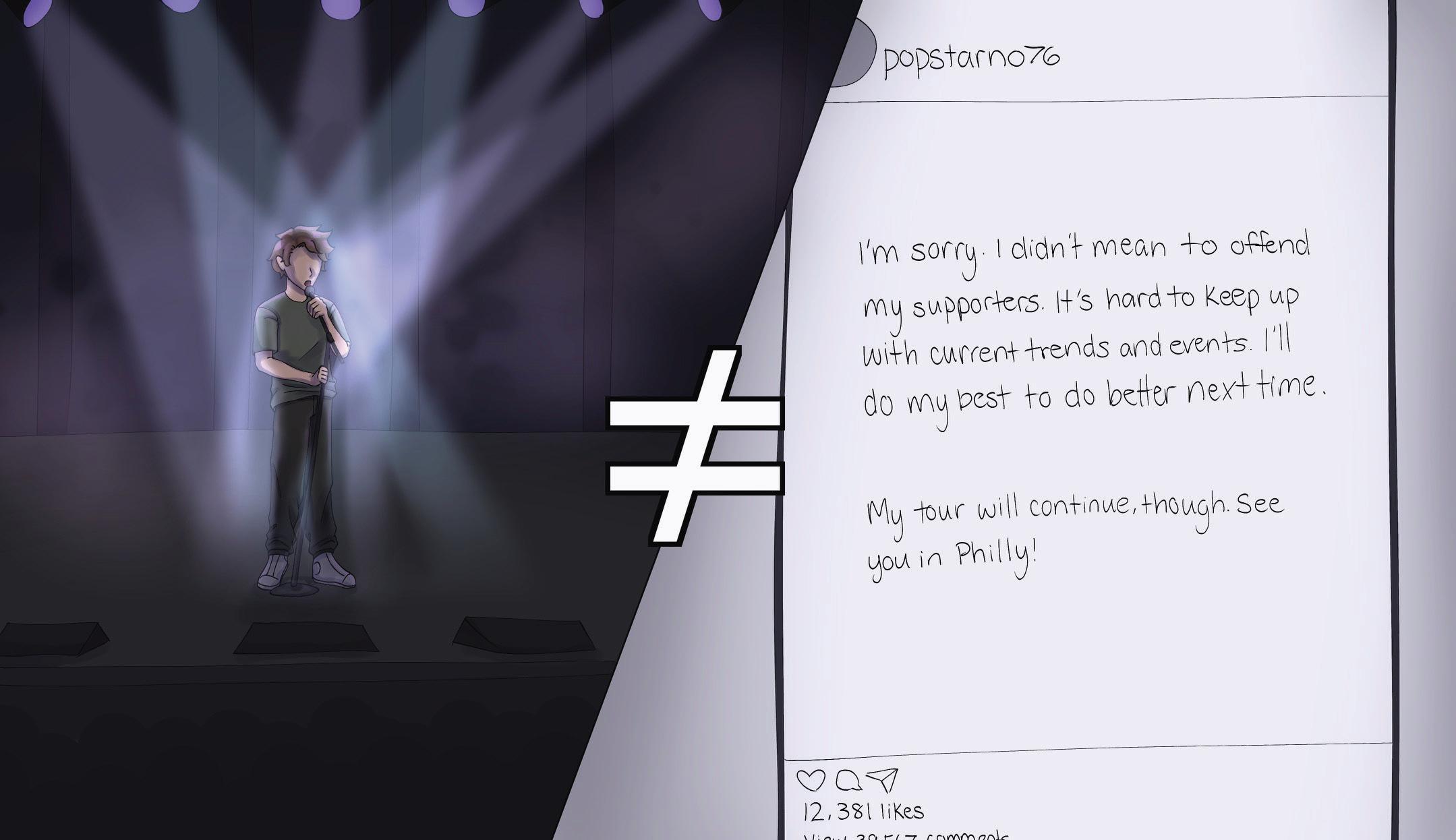
Ye, formerly known as Kanye West before ling to legally change his name in 2018, has faced tremendous public scrutiny over the past couple of months a er making pointedly antisemitic remarks on Twitter and in interviews for “Tucker Carlson Tonight” on Fox
ese comments were not oneo s. According to NBC News, Ye “made a string of antisemitic comments” across social media that was followed by a demonstration on Oct. 22 in which members of the Goyim Defense League, an antisemitic hate group, gave Nazi salutes while displaying a banner over Interstate 405 in California that stated, “Kanye is right about the Jews.”
e most troubling thing about Ye’s remarks, though, is that while the media, for the most part, condemns his speech, his fan base continues to turn a blind eye to his antisemitism and support his numerous careers — producing, rapping and fashion-designing.
According to Billboard, Ye was the 25th most-listened-to artist in 2022. He has produced
20 top-10 and four No. 1 hits. In 2021, Ye’s sneaker brand
condoning unacceptable, antisemitic behavior.
When you stream one of Ye’s songs, you send the message that antisemitism is acceptable and that a three-minute-long track holds more value than the safety of a people; that you support a public gure who has Tweeted, “I’m a bit sleepy tonight but when I wake up I’m going death con 3 on Jewish people.”


If you patronize a restaurant because the food is good and shop at a store because you like the merchandise, but would change your spending habits if you learned that the restaurant is infested with insects or that the store sells faulty products, the same logic can — and must — be applied to Ye’s careers.


A common defense from those who continue to support Ye is that
It is up to each individual to decide where they want to place their support and what ideals they hope to uplift. It is important that moving forward we think more critically about these decisions and understand the potential impacts our choices can have.
we need to cut him some slack because he is mentally ill. While mental illness is no joking matter, it is no excuse for antisemitic comments, threats or actions.
If Ye is truly mentally ill, he deserves help. However, until he gets help, he must be held accountable for the hate and violence he is inciting. No illness justi es bigotry.
Ye is antisemitic. By streaming his music, you are supporting Ye and giving him money. By continuing to support and give him money, you are condoning antisemitism.
e only way to combat this appalling wave of antisemitism is to oppose its perpetrators. Stop listening to Ye’s music. Stop buying Ye’s merchandise. Stop shrugging o blatant antisemitism.
Yeezy generated nearly $2 billion in sales.
ese successes, while impressive, were only achieved because of public support. Before Twitter suspended his account on Dec. 2, Ye amassed more than 31 million followers on the social media
SORRY, WE MISSPOKE
OPINION Tuesday, January 17, 2023
From the Editor: Pay-to-play community service has got to go
,
The Sta www.spoke.news @thespoke @thespoke /thespoke the_spoke hello@spoke.news Editors-in-Chief: Evan Lu, Hiba Samdani Managing Editor: Jui Bhatia News Editor : Ben Shapiro T/E Life Editor: Abby Bagby Opinion Editor: Shreya Vaidhyanathan Sports Editors: Howard Kim, Hannah Simon Beats Editor : Maya Shah Multimedia Editors: Katherine Emmanuel, Grace Kuryan Webmasters : Rohan Anne, Soumya Sathyanarayana Business Manager: Michael Tierney Photography Editor: George Zhang Social Media Editor : Akshita Joshi Copy Editor: Zara Samdani Design Editors: Aren Framil, Raima Saha Cartoonists: Angie Chen, Mia Hamilton, Chiho Jing, Leon Li, Shine Lin, Yuting Pu Sta Reporters : Prashi Agarwal, Tanisha Agrawal, Miya Cao, Alexander Carder, Vanessa Chen, Weihan Chen, Mareska Chettiar, Rowan Chetty, Abigail Chong, Ryan Ding, Isabelle Emmanuel, Saktisri Gowrishankar, Joanna Harris, Julia Harris, Je rey Heng, Evangeline Kennedy, Audrey Kim, Bailey Kreszswick, Soumya Krishna, Shrija Krishnan, Lexi Lin, Margaret Neary, Riddima Pandey, Lauren Pinheiro, Abbie Preston, Madeline Pulliam, Louisa Sandor , Emily Scheer,
Vaughan,
Willrich,
Wolters, Juliana Yao,
Zantua Faculty
Alison Ferriola, Laura Howard, Nicole
Non-sta contributions: Non-sta contributions from students, the community, graduates or other interested parties are welcome. Editors will decide which contributions are published based on space and relevance to the community. All contributions must conform to journalistic practices, including accuracy, timeliness, purpose and writing conventions.
work
All
signed
Paid advertisements: The
accepts paid
The Spoke is published seven times a year by Trumbull Printing. It consistently receives a Gold rating from PSPA and CSPA, and is a National Scholastic Press Association Pacemaker award-winning publication. The Spoke serves as a public forum for student expression.
Sousanna Sengal, Aashita Singh, Eshan Singh, Vaishnavi Sriadibhatla, Elizabeth Sun, Remington
Alexa
Mary
Faith
Advisers :
Zakorchemny
The Spoke reserves the right to
with the contributor to meet these standards.
outside contributions are bylined. Letters to the editor: Letters to the editor may be submitted to Editors-in-Chief Evan Lu and Hiba Samdani, or advisers Alison Ferriola, Laura Howard and Nicole Zakorchemny. Editorials: Unsigned editorials represent the views of The Spoke editorial board, not necessarily those of the administration, student body, community or advertisers. The opinions expressed in
columns are those of the writer and not necessarily the opinion of The Spoke.
Spoke
advertisements. Email hello@spoke.news.
money. And by continuing to pad his wallet, you are little short of
Ben Shapiro News Editor
platform. For a frame of reference, there are less than 15 million Jews in the world. An antisemite garnering more than double the number of followers on one social media platform than there are Jews in the world is concerning. By streaming Ye’s music or buying his merchandise, whether you like it or not, you are giving him
Maya Shah Beats Editor
In the November issue, on page 4, an article states that some choral ensembles planned to perform in Disney's Candlelight Vigil. Since 2020, the park has not involved high school choirs in that performance. On page 8, the cartoon by Angie Chen for “Curriculum conundrum” was misattributed to Yuting Pu.
Evan
In a more serious parallel, the justice system refuses to fall to this nancial loophole. In addition to
nes and incarceration, courts use mandatory community service as a form of public retribution that
crosses socioeconomic barriers. Even with the aws of the bail system that is employed before trial,
a felon is sentenced to community service, there is no alternative to spending the mandated
Angie Chen/The SPOKE
Angie Chen/The SPOKE
Yuting Pu/The SPOKE
Shine Lin/The SPOKE
We need more racial diversity in teachers
the district, they are few and far between. It is important that colleges handling enrollment and certi cation programs make serious e orts towards increasing diversity.
Vaidhyanathan Opinion Editor

e U.S. Department of Education nds that the elementary and secondary teacher workforce in the United States is neither as racially diverse as the students nor the population at large. According to the National Center for Education Statistics, about 80% of public school teachers were white in the 2017-18 school year, while approximately 50% of elementary and secondary public school students reported as white that same year.
roughout my 11 years in the T/E School District, I have not once had a South Asian teacher, and I know many others who have had a similar experience. While there are certainly teachers of color within

Non-pro t public policy organization Brookings Institution notes that racial minority students o en perform better on standardized tests, are less likely to drop out of high school and increasingly likely to pursue a 4-year college education when they have at least one teacher of the same race. Holistic bene ts of a diverse teacher workforce are also abundant, ranging from improved attendance to a lower risk of suspension.
Underrepresentation of racial minority teachers may a ect minority students’ educational success, in turn limiting strong economic and social bene ts students gain from graduating high school.
would have been bene cial, chie y during crucial developmental years
It
dents.
Some
80% in the 2017-18 school year. To this point, Pew Research states that while the number of “Black, Hispanic and Asian American teachers has increased in recent decades, it has not kept pace with the rapid growth in the racial and ethnic diversity of their students.”
One solution some propose involves going straight to the recruitment sector of the hiring process and implementing various diversity initiatives. However, as found in a study conducted at University of Nebraska, recruitment is not the problem; instead, retention of these teachers is the real issue.
Card
Eagles No. 1 seed in the NFC
+ headed to playoffs, hopefully the Super Bowl next!
+ broke both their wins and points records this season
A











experience
STUDENTS SPEAK OUT


-
Musk must resign as Twitter CEO
“I hope that even my worst critics remain on Twitter, because that is what free speech means,” Musk tweeted, gaining about 3.2 million likes.
“My pronouns are Prosecute/Fauci.”
That tweet did not come from a random troll online. In fact, it came from the CEO of Twitter himself, Elon Musk.
Musk is an established billionaire-CEO of several companies such as SpaceX and Tesla. On Oct. 27 of last year, he added another company to the list, acquiring Twitter. He started tweeting more often and reached about 122 million followers on Twitter, providing him with a stable fanbase.

After a few months, instead of prioritizing the substantial weight of his responsibility, Musk handled it aimlessly. By way of ridiculous rules, contradicting opinions and hate towards already fragile communities, he cannot shoulder the responsibility of being Twitter’s CEO.
One of Musk’s favorite topics to tweet about is his burning dedication to providing users “free speech.” He claims that free speech is “essential to a functioning democracy” and says he is fine with users who oppose him because he believes it is expected when practicing what he views as free speech.
However, Musk contradicted much of his view about free speech upon creating a new policy banning promotion of social media apps other than Twitter. e ban was so strict that users could no longer share links to competitor social media accounts. In response to criticism, Musk so ened the policy and banned behaviors that directly promote competitors.
“Casually sharing occasional links is ne, but no more relent-


nently suspended the account, accusing O’Sullivan of doxxing him.
“Criticizing me all day long is totally ne, but doxxing my real-time location and endangering my family is not,” Musk tweeted.
According to Merriam Webster, doxxing is “to publicly identify or publish private information about (someone) especially as a form of punishment or revenge.” O’Sullivan’s reports were limited to locations that were already accessible online. is has caused controversy regarding Musk’s true intentions in suspending O’Sullivan’s account.
Other than his confusing
white, compared with the aforementioned
While school administrations can involve themselves, the solution starts at the state level; according to e Education Trust, states must “create the right policy conditions to support educator preparation programs … in their e orts to prepare, recruit and retain teachers of color.” So, make it known to your legislators that their constituents want to see policies relating to the treatment and retention of diverse teachers in public schools. In the name of students everywhere, this is a battle worth ghting.
less advertising of competitors for free, which is absurd in the extreme,” Musk tweeted.
Alas, Musk’s policies continue to contradict his self-proclaimed love for free speech; if he wants users to be able to say what they want, why would he disallow users to promote their own platforms?
Another way Musk contradicts his moral view of free speech is by banning CNN journalist Donnie O’Sullivan for running an account called “Elonjet.” e account’s purpose was to report the locations of Musk’s private jet. Musk perma-
policies, Musk has also posted politically questionable tweets. For a while, Musk believed that the independent party, a political party consisting of centrist and unbiased opinions, was important and even encouraged Twitter users to vote for them. However, in early November, he tweeted his encouragement for “independent voters” to vote Republican.
“To independent-minded voters: Shared power curbs the worst excesses of both parties, therefore I recommend voting for a republican Congress, given
that the Presidency is Democratic,” Musk tweeted.
roughout the last months of 2022, he published statements that many would expect a rightwing activist to tweet. With his large following, the tweets he writes have a major in uence on how we view oppressed communities and can even lead to increased violence towards that community. In one tweet he mocks the transgender community, a community that uses pronouns di erent from their biological sex.
He tweeted last month, “I absolutely support (the transgender community), but all these pronouns are an esthetic nightmare.”
Supporting the transgender community includes respecting their pronouns. Musk cannot bring up his support for transgender individuals while also criticizing one of the things the transgender community stands by.
Musk has made some changes that are important to notice.
In early December, he made certain stricter changes on policies to regulate and decrease the amount of child exploitation on Twitter. However, the policy’s renovation only gives minor benefits to Twitter overall. Thus, making the policy almost invisible to the amount of harm he’s done.
Musk expresses his opinions in a childish manner, one that endangers minorities and radicalizes his fanbase to spread that hate.With how his confusing policies and harmful tweets outweigh the good he has done, he is not fit to lead Twitter.
As the nights grow colder and the ice freezes thick upon the ground, many families find themselves cooped up within their houses, huddling for warmth and awaiting the soft light of spring. For children, this time is especially difficult, as the frozen winter weather batters at their naive joy and unabashed optimism. We here at Sad Beige Inc. have a solution! Why allow your kids to slowly realize the prison that is society when you can break it to them all at once?
With our new “Existential Dread” children’s clothes and toys line, you are sure to make unforgettable memories for your child this winter.
The Tower of Despair Stacking Toy — $12.99

What better way to introduce your tot to the hardships of life than with the “Tower of Despair” stacking toy! When children first enter the world, they are giddy with the color and joy that surrounds them.
But past this naive illusion is the grueling real-
have to face all too soon. With the “Tower of Despair” stacking toy, your child will learn the soul-crushing, repetitive life that awaits them in the American capitalist workforce.
Sandy Cotton Summer Dress — $49.95
This free flowing summer dress makes a perfect gift for your kid this January. As it hangs in the closet during long winter months, they will have their first taste of disappointment, one of many.

C-
+ after 15 votes, Kevin McCarthy is finally named Speaker of the House
- lack of unity within the Republican party is concerning
Speaker of the House elected SZA’s album “SOS” tops the charts
+ cohesive and melodic, with striking lyricism and a complex journey
- some artist features felt rather haphazard and unfinished
“Ginny & Georgia” season two
+ Abby and Joe are the best characters hands down
- the writers of this season took character flaws and ran with them
Jackpot reaches 1.35 billion
+ second-largest Mega Millions jackpot in history
- any winner will receive much less than their actual winnings due to taxes
OpenAI releases ChatGPT + interesting to see self-learning technology
- could endanger academic and professional integrity
Sad beige children’s line!
Short Sleeved Slate Jacket — $79.99
With the “Short Sleeved Slate Jacket”, your child can finally experience what it is like to be invisible. What need is there for socialization and friendship when they can blend in seamlessly with the gray outdoors, feeling the cold wind against their forearms?

Clip On Kiddy Ties — $25.99
A fun playtime prop, our
“Clip On Kiddy Ties” come in three patterns and make your child feel like the true boss they are! If your kid has dreams of climbing that endless corporate ladder, becom-
ing a faceless agent of greed and exploitation and acting without regard for those which they have stepped on to reach their success, these ties will give them a glimpse of that dream life.

Report
C+ C-
B+ D
Q: How would having more diverse teachers impact your education?
“We can touch a lot of topics that are normally not discussed in class. It could help (prepare) for college and real-life situations, too.”
“It would be adults that know the (student) culture better. Kids would feel more con dent talking to their teachers about certain situations instead of struggling and trying to tell their friends.”
Akshara Anandkumar, freshman -Trinity
Steward, senior -Jackson
Kime, junior
Adam Song, sophomore -
“It would allow viewpoints from di erent backgrounds, like races, ethnicities and religions and allow for more diverse thought and a more engaging classroom environment.”
9 Tuesday, January 17, 2023 OP/ED
“I guess it would o er competing perspectives on di erent issues, but at the end of the day they are all teaching the same curriculum, so it wouldn’t really impact my education.
Leon Li/The SPOKE
Harvard Education Magazine expands on Ohio State professor Rudine Sims Bishop’s idea of mirrors and windows in education — mirrors for allowing students to see themselves and windows to allow them to
unfamiliar worlds. As a student of color in a predominantly white school district, I can attest that having teachers that look like me
in elementary school.
is important to acknowledge that students of color are not the only ones bene ting from diversity in their
teachers; a Brown University study con rmed that teachers of color are linked to academic, social-emotional and behavioral bene ts for all stu-
Student perceptions of teachers of color tend to be more positive, as students reported feeling cared for and more academically challenged.
argue that, although marginal, there have been improve-
ments in public school teacher diversity; in the 1987-88 school year, 87% of school teachers were
Aashita Singh Sta Reporter
Aren Framil Co-Design Editor
will
clothes Dress gift
Shreya
learn the ing, repetitive to slowly real-
for your uary. As it What better way to introwith the colity of existence, one they will Slate your is like ization when
Pu/The
Chiho
Jing/The SPOKE Yuting
SPOKE
Boys hockey thrives with new underclassmen
When four players graduated from the varsity boys’ ice hockey team last year, the remaining players were le wondering who their replacements would be and how the team would fare with its new additions. e underclassmen’s response?
One of the best season starts in the team’s history.
is season, the boys’ hockey team needed strong talent to ll those four holes in their roster, and they found that and more in eight underclassmen. Seven freshmen and a sophomore have brought new vitality and synergy to the squad both on the ice and in the locker room. is team chemistry resulted in a seven win streak to start o the season with the three new starters picking up right where their senior predecessors le o , adding their skill and energy to the team.
“ e vibe in the locker room before every game is just so upliing and so upbeat that it’s hard to get them to calm down before games,”
said Ross Hyatt, the team’s head coach. “I think the biggest key to a successful team is what they do together o the ice…and this whole team seems to thrive together.”
Another unexpected factor that played into the team’s chemis-
“I usually don’t see very condent underclassmen, which usually inhibits them from playing well, but every single one of this year’s freshmen has con dence in their game,” Hyatt said. “ ey know they belong on the ice with everyone


“A lot of the freshmen and I thought this adjustment would be very tough, and the upperclassmen have helped us ease into (the varsity level) a lot,” freshman center Shane Keller said. “ ey’ve been doing a great job helping us out at practices by running over plays and techniques twice to make sure we fully understand them.”
Fostering ice hockey CHAMPions
During the shutdown of 2020, a small mentorship between then senior AJ Carroll and also then fourth grader Sebastian Capurro would kickstart a district-wide hockey program for building bonds between players at each school level.


e Conestoga Hockey Assist Mentoring Program, or CHAMP, was initiated this fall. rough the program, athletes from the girls’ and boys’ ice hockey teams cultivate younger players’ hockey skills during training sessions and practice. CHAMP was rst presented when Carroll shared his memorable experience of coaching Capurro during the pandemic with the Conestoga ice hockey board. He had taken this role a er Jean Capurro, Capurro’s mother and current coordinator of CHAMP, reached out to the community about any high schoolers willing to coach her son.
“What AJ and Sebastian did was a baseline to create (CHAMP),” Capurro said. “It’s obviously about coaching and getting that support from a hockey perspective, but one of the additional things that came out of it was a friendship.”
is connection between the elementary, middle and high schools was what the board had already been looking for, and a mentorship was a way to do so while providing meaningful and unique experiences for the parties involved.
“It’s pretty important because it does kind of foster that community, that family aspect of the program that most programs really don’t have kind of makes it feel di erent, makes it feel special,” Carroll said.
e players nourish the communal aspects of CHAMP through both on and o ice events. e program’s rst o -ice event was at Teegarden park on Nov. 8, with a high turnout of around 40 kids from all the schools. Conestoga players manned stations, bonding and instructing the younger athletes as they rotated through.
“It (CHAMP) is good because you’re with your friends, playing hockey, learning stu and bonding with kids older than you. It’s just kind of fun too,” Sebastian Capurro said.
The high schoolers attend the middle and elementary practices, coaching them with their hockey skills. By also being at games, the younger players are able to receive more training and look up to role models.
“A lot of the kids think it’s really cool that high school students are giving their time to be at their events,” Jean Capurro said. In addition to helping younger athletes, the high school players are able to develop their own leadership and communication skills through CHAMP.
“It was incredible to see (the high school athletes) interact with the younger players,” head coach Ross Hyatt said. “They took the kids under their wings and it was great to see them latch on to this program and be excellent mentors.”
The program plans to arrange more on-ice activities and will create more off ice events when temperatures rise. While it primarily serves to increase the membership of the Conestoga ice hockey club, the players have personal goals for CHAMP.
“I just hope that we can inspire some kids to love the sport of hockey because I know a bunch of kids were excited to be there,” senior Jim Rosenblum said. “I think the most important part for me was just getting those kids to get more exposure to the game and really find their passion.”
try is time. ree years ago, Hyatt rst got the job as head coach of the boys’ varsity and JV hockey teams and began building a rapport with the players. e freshmen he bonded with that year are now seniors, and the whole roster is completely in sync with Hyatt’s style, allowing the team to reap the bene ts of having a capable batch of newcomers.
else and that they can make mistakes because they have strong upperclassmen who have their back.”
Getting accustomed to full check hockey and its faster, more aggressive nature is a crucial component of making the newcomers feel more comfortable on the ice and in the team, and the returning players made a point to ensure that happened.
ese moments of guidance and banter outside of the sport have helped the team forge new bonds as friends and teammates, and it is re ected in their success so far. e squad started their season with a crushing 8-1 win over Ridley and followed it up with another dominant 7-1 game against Garnet Valley. ey kept up the momentum with win a er win and currently sit at second place in the Central League with an 8-1-1 record. “ is season is going to be a core memory for me. I’m going to enjoy ending on this high note,” said Jim Rosenblum, a senior defenseman. “Our hockey team is pretty good, and I couldn’t be happier.”
New faces: Freshman girls basketball welcomes new coach
e Conestoga girls’ basketball team has welcomed a new coach onto their sta this season: current eld hockey coach Megan DuVernois. Prior to accepting the new position as the girls’ freshman basketball coach, DuVernois did not have experience in either coaching or playing basketball.


Growing up in the Montgomery County area, DuVernois played eld hockey and lacrosse for much of her life. She went on to play eld hockey at the University of North Carolina at Chapel Hill and was a three-time NCAA D1 eld hockey champion. For the past two years, DuVernois has coached junior varsity eld hockey at Conestoga. is year, she was asked to be the freshman girls’ basketball coach, and with no prior experience in basketball, she took the job.
“ is is my rst year (coaching basketball). I’ve never played basketball in my life,” DuVernois said. “I like getting out there and just trying our best to win and trying our best to have fun.”
DuVernois used strategies she learned from eld hockey to help the team improve. Using the resources around her, the young coach learned the game with her players as well as formed a close bond with the team and an understanding of their individual skills and personalities.
To further help her understanding of the game, DuVernois turned to a familiar source for guidance.
“My mom has been helping me too, which is awesome. So it’s been a good team e ort there, I’m very much enjoying it,” Duvernois said.

Together, the two of them have been navigating coaching.
In addition, varsity girls’ basketball coach Arnold ompson commented on her help with the team so far. According to the coaches and players around her, DuVernois is already starting to get into the groove of the game. ompson remarked on how her experience as an athlete has helped her coach a sport that is completely new to her.
“She’s been an athlete her whole life, so she knows what these kids are going through. Having practice, making sure your academics are up and time management —
“She
she can de -
“I would just say that from coaching before and playing I know what hard work looks like and the competitive spirit, I just like getting out there and just trying our best to win and have fun.” DuVernois said. “ e best part about team sports is you can have fun with each other and make friends and lasting relationships.”
Sports
10 Tuesday, January 17, 2023
Pregame prep: The boys’ ice hockey team prepares for a match against Upper Moreland-Dublin on Jan. 6 at Ice Line. They won the game 10-3 and currently sit at second place in the Central League with an 8-1-1 record.
Howard Kim/The SPOKE
Howard Kim Co-Sports Editor
Louisa Sandor and Sosi Sengal Sta Reporters
conestoga 37 Strath haven 44 WIN Jan 7 pts 13 3 reb 4 ast shooting guard
postgame interview Postgame interview Ben Robinson
those are all things
nitely help in,” ompson said.
Freshman player Lexi Lenehan comments on how her experience on the team has been with DuVernois as the coach.
is kind of just learning the game too, so it’s kind of fun,” Lenehan said. “We’re kind of coaching our own team sometimes, but she’s de nitely starting to learn it.”
DuVernois has coached the team with a di erent perspective than previous coaches. Her goal for the girls is to not only focus on winning, but also focusing on having a good time and bonding with their teammates. ese strategies help her shape the freshman basketball players into better competitors and stronger athletes.
Dream team: Coach Megan DuVernois (le ) laughs with her players. The team enjoyed a remarkable start to their season.
Sosi Sengal/The SPOKE
Juliana Yao/The SPOKE
Learning from the pros: Elementary school students line up next to the Conestoga ice hockey teams as they prepare for their game against Penncrest. The team won 7-2 at Ice Line on Dec. 22
Alexa Willrich and Juliana Yao Sta Reporters
Every single one of this year’s freshmen has confidence in their game. They know they belong on the ice with everyone else.
Ross Hyatt Boys Ice Hockey Coach
The final straw (March
CLOSING THE GAP
2016):
The final straw (March 2016):


When the United States Women’s National Team (USWNT) routed Japan 5-2 in the 2015 Women’s World Cup, over 25 million people watched, making that game became the most watched soccer match in US TV history. Not only did the team win an impressive trophy, but they also generated $16 million dollars’ worth of revenue that exceeded their projections. In all, the women brought in over $20 million more dollars more than the men’s team that season, but they received paychecks worth almost four times less. As a result, five players decided to draw attention to the injustice, and filed a federal wage discrimination complaint to the U.S. Equal Employment Opportunity Commission (EEOC). The fight for equal pay had just begun.
When the United States Women’s National Team (USWNT) defeated Japan 5-2 in the 2015 Women’s World Cup, more than 25 million people watched, according to ESPN. Not only did the team win a trophy, they also generated $16 million worth of revenue that exceeded U.S. Soccer projections. In all, the women brought in $20 million more than the men’s team that season, but they received paychecks worth almost four times less. As a result, five players drew attention to the injustice and filed a federal wage discrimination complaint to the U.S. Equal Employment Opportunity Commission (EEOC). The fight for equal pay was underway.
Raising the stakes (March
Raising the stakes (March
2019):
2019):
After two years and two more successful seasons, the women remained unsatisfied with the lack of progress to close the pay gap. The USWNT withdrew the federal complaint to the EEOC and heightened the issue by suing U.S. Soccer for gender discrimination. The suit addressed not only the significant difference in pay but also the equipment, staff and training conditions.
After two years and two more successful seasons passed, very little was done to significantly close the pay gap between the women’s and men’s teams. While the team had initially filed a federal complaint to the EEOC, they withdrew that and decided to heighten the issue by suing U.S. Soccer for gender discrimination. The suit not only addressed the significant difference in pay, but also the equipment, staff and training conditions. After filing the lawsuit, the team only needed to do one thing: prove they were worthy.
First hurdle cleared (February 2020):
First hurdle cleared (Feb 2020):
With the impending gender discrimination trial, U.S. Soccer sought an agreement with the USWNT before the issue went to court. The players asked for $67 million — the calculated total the team would have received based on performance, schedule and wins, if they were paid in the same proportions as the men. U.S. Soccer agreed. The women won their first battle off the field.
And another blow (April 2020):
Taking matters into their own hands (early 2017):
Taking matters into their own hands (early 2017):

With no immediate reaction by U.S. Soccer, the players took matters into their own hands and fired their union’s chief. USWNT players reorganized their Players Association by electing team members to management positions. Player-driven, the team stayed connected through meetings, text messages and emails, ordering top priorities to focus on during negotiation sessions with U.S. Soccer and its lawyers.
With no immediate change, the players took the issue upon themselves and decided they needed a fresh start. By firing their union’s chief, they reorganized their USWNT Player Association by electing team members management positions in the association. Player-driven, the team stayed connected through meetings, text messages and emails, deciding the top priorities to be fought for during negotiation sessions with the United States Soccer Federation (U.S. Soccer) and its lawyers.
Fans get involved (July
2019):
Fans get involved (July 2019):
By the summer of 2019 and the start of the Women’s World Cup in France, the players’ fight had gained notable traction. The USWNT was not just competing for a back-to-back World Cup title; they were out to prove to U.S. Soccer why they deserved a higher paycheck. The USWNT fans seemed to agree, as they went from celebrating to chanting “Equal pay!” in the stadium right after the USWNT secured the trophy. These thunderous chants drew the attention of the media.
By the summer of 2019, the player’s fight had gained notable traction, as the Women’s World Cup in France had begun. And the USWNT wasn’t just competing for a back-to-back World Cup title, they were out to prove to U.S. Soccer why they were worthy of a higher paycheck. The USWNT fans seemed to agree, as they went from celebrating to chanting “Equal pay!” in the stadium right after the USWNT secured the trophy. These thunderous chants drew the attention of the media, just what the team wanted.
Fight gets messy (March
2020):
Fight gets messy (March
With the impending gender discrimination trial, U.S. Soccer sought an agreement with the USWNT before the issue went to court. The players asked for $67 million –the calculated total the team would have received based off performance, schedule and wins, if they were paid in the same proportions as the men were. U.S. Soccer agreed. The women finally won their first battle off the field.
2020):
Still celebrating their first triumph, the USWNT was hit with a court filing from U.S. Soccer, whose lawyers argued that through “indisputable science,” the women on the World Cup winning soccer team were inferior to men. U.S. Soccer fired those lawyers shortly after, and the U.S. Soccer president, Carlos Cordeiro, resigned.
Finally, the ruling from the players’ suit from March 2019 was released, and it was not what the players had hoped for. The judge stated that their current salary was sufficient. In response, the USWNT filed an appeal.
And another blow (April 2020):
Finally, the ruling from the players suit from March 2019 was released, and it was not good news for the players. Not only did the judge state that their current salary was sufficient but told the team they would never win. Undeterred, the USWNT filed an appeal.
Hope on the horizon (February
2022):
A step in the right direction (November 2020):
Still celebrating their first triumph, the USWNT was hit blindsided. U.S. Soccer lawyers argued in a court filing that through “indisputable science”, the women on the World Cup winning soccer team were inferior to men. While U.S. Soccer shortly fired those lawyers, the case was detrimental to the USWNT’s cause and set them back significantly. Carlos Cordeiro, the U.S. Soccer president, resigned. Any other plans and compromises to be made were shattered.
With the federal court appeal looming, U.S. Soccer began to make travel, venue, staffing and hotel accommodations for the women as similar as possible to the men’s.
A step in the right direction (November

Equality at last (May 2022):
2020):
With the federal court appeal looming, U.S. Soccer began to make travel, venue, staffing and hotel accommodations for the women as similar as possible to the men.
After two years of negotiations and an expiring labor contract, U.S. Soccer reached a deal with the USWNT, awarding them $24 million for the years they made less money than the men. Additionally, they made a pledge to equalize pay between the men and women. This new labor deal was paused until it could be finalized.
Hope on the horizon (February 2022):

Suddenly, U.S. Soccer reached a deal with the USWNT, giving them $24 million dollars, mostly back pay for the years they made less money than the men. However, even better news that resulted from the deal: a pledge of U.S. Soccer to equalize pay between the men and women. This new labor deal was paused until it could be finalized.
Equality, at last (May 2022)
The pledge that U.S. Socce r made to the USWNT at long last, was enforced and the women got their deserved money.
After years of advocacy, the pledge that U.S. Soccer made to the USWNT was enforced, and the women got the money they set out for. In it, the two collective bargaining agreements — one for the men’s team and one for the women’s team — have “identical economic terms,” most notably including the equalization of World Cup money. Under the new deal, each team will evenly split 90% of their pooled total earnings from the 2022 and 2023 World Cups. U.S. Soccer receives the remaining 10%, according to CNN. Therefore, the USWNT will receive $6.5 million from the men’s team reaching the World Cup Knockout rounds — more than they garnered for winning their own tournaments in 2015 and 2019.
Blossoming baller: Freshman Ryann Jennings excels

Freshman Ryann Jennings dribbles up the court and makes an easy layup. Swish! Conestoga is now up 2-0.
The freshman starting shooting guard is quickly becoming an integral part of the girls’ varsity basketball team. Since fourth grade, Jennings has played elite basketball for the COMETS, a girls’ basketball club that sharpened her skills and enabled exposure to college national events. Her arrival on the team was anticipated because of these experiences.
“Coming in as a freshman, I felt like I had to step up, and I was scared to not be good,” Jennings said.
A major part of Jennings’ success has been her work ethic. She trains every day, either working on her shooting or playing practice games.
“On weekdays, I have school practice for two hours. Then I go and shoot and play more basketball after,” Jennings said. “On weekends, I go and play outside and work on shooting.”
This season has presented a few roadblocks for the girls’ basketball team. With fewer players, a limited number of substitutes and an altered roster, the team has been forced to adapt their strategy. Due to
these new changes, the team could not push the ball as fast this year. To combat this, Jennings and the half-court offense have stepped up, utilizing picks and screens to set up better shots. Turnovers brought by steals from the defense have also contributed to the team’s success.
“I hustle on defense and try hard to influence the team,” Jennings said.
To help Jennings adjust to the team, the girls participated in various team bonding activities, including having breakfasts and dinners together as well as hanging out in the locker room. The 5-foot11-inch point guard already made a significant impact on the team’s game against Ridley High School, accumulating 15 points, eight rebounds, four steals and earning the Big C award. The award goes to a player of the coach’s choosing based on their contributions in the game.
Jennings’ proficiency has proved to be more than just the cherry on top for the girls’ basketball team. Her in-game awareness and movement have allowed the team to pivot the ball on the court. For the Pioneers, she has become a fundamental part in dominating possessions in order to bring the team to victory. Despite having to face many challenges this season, the athlete continues to pursue her ambitions with a positive mindset.
Rapid rebound: Freshman Ryann Jennings plucks the ball out of the air and hustles to the center for one of her eight rebounds. She went on to tally 15 points contributing to a huge win over Ridley High School, proving herself to be a vital asset to the team.

The team hopes to win the coveted Central League title. In recent years, the team has earned itself a strong reputation, and despite a hard-fought loss against Haverford High School on Dec. 13, the team remains optimistic about their chances.
When asked about Jennings’ role in achieving the team’s goal and aiding their success, junior point guard and team captain Marisa Francione had several compliments for her freshman teammate’s skills.
“She’s a great three-point shooter. She’s knocked down several key shots for us in the past couple of games, is a really good rebounder and puts a lot of effort in,” Francione said. “I think she’s a great addition to our team.”
11 Tuesday, January 17, 2023 Sports
Written by Maggie Neary and Hannah Simon, Staff Reporter and Co-Sports Editor Designed by Raima Saha, Co-Design Editor
Ryan DIng/The SPOKE
Ryan Ding and Jeffrey Heng Staff Reporters
Written by Maggie Neary and Hannah Simon, Staff Reporter and Co-Sports Editor Designed by Raima Saha, Co-Design Editor
pioneer: Squashed on the court
New Face on the Sideline: new boys’ basketball coach steps up
paving the way for Forcine to rise as boys’ varsity head coach in August 2022.
Shoes squeak and fans yell as coach Sean Forcine starts his career with a win against Holy Ghost Preparatory School on Dec. 12. A er coach Mike Troy’s resignation over the summer, Forcine stepped up to take his place.
Forcine graduated from Conestoga in 2001 and later started volunteering for Troy. For the past 16 years, Forcine has worked at Conestoga as both the JV basketball coach and boys varsity assistant. Forcine worked closely with the previous head coach, Troy, before he stepped down,

“We pay a lot of attention to our team defense. We do a lot of teamwork exercises in order to get to know each other better and gain trust in each other,” Forcine said.
Forcine has worked hard to create a strong culture and trusting environment within the team. His motivational attitude inspires the players to continue to work hard and continue to have a love for the game.
“ e wins can come eventually. But really, we’re focused on just building a good culture and attitude is probably the biggest part of that,” said junior and boys’ varsity captain Brendan Styer.
A four-year varsity player, Styer loves Forcine’s intensity and his ability to always push the players to perform their best at every practice and game.
“(He is) really trying to instill a new culture and attitude aspect, like always having a next play mentality and keeping your head up and really doing the dirty work,” Styer said.
Forcine’s work ethic shines through as he teaches his players not only basketball skills but life skills as well. He highlights 10 specific principles that each player has not only learned about from their peers but also memorized.
“Once all the teammates have embraced these principles, it re-
ally sets us up to build a strong foundation based around staying positive at times of adversity, staying humble, trusting each other and getting the most out of every drill and opportunity,” Forcine said.
To illustrate these important life lessons further, Forcine has implemented a reward system for players who continue to improve and show up to practices and games with a positive attitude.
“Every time we bring the team in, it’s always ‘attitude on 3, 1-2-3 attitude’. is has been our way throughout the whole season. And we try and focus on (that) during the games,” senior boys varsity captain Peter Costigan said.
e community has been a huge inspiration for the team as students and fans help push the team to a new level of playing.
Forcine hopes to continue to build the atmosphere at basketball games and encourage student involvement.
“ e more student and fan participation at games, the better. e students really help push us and get us to an extra gear. We’re motivated by their energy,” Forcine said. “We strive to put a fun brand of basketball on the court for everyone to enjoy and be entertained by, so the more student involvement, the better, more fun atmosphere it’s going to create on the court and hopefully lead to a more successful future for our basketball team.”
Tryoneer pioneer: Squashed on the court
A er countless days of horrendous weather, I decided to take a break from pickleball and move on to a sport that could be played in more suitable conditions. I hopelessly searched day and night for the right activity but to no avail. at is, until one day, when I caught our paper’s business manager watching a sport that piqued my interest: an intense squash match. A er talking to him and a few other friends, I decided to make the switch. It turns out that our T/E Life section editor, Abby Bagby, also partakes in this sport. As a loyal member of the Sports section, I challenged her to a duel, with the honor of our respective sections on the line. We set our showdown on a Friday night at Berwyn Squash — with members of the Spoke editorial board coming to spectate. We followed the traditional rules of squash: Players play each game to 11 points and matches are decided in a best of three games series. As I walked into Berwyn Squash, I felt a wave of con dence.
A er all, I did watch a three minute video titled “3 MUST KNOW Beginner Squash Fundamentals Squash Tips” before leaving. I walked onto the court and saw my opponent already warming up. Copying what she was doing, I got a ball and hit it against the wall. e rst hit was clean, with the loud cracking sound ricocheting throughout the court. “Maybe this wasn’t going to be so bad,” I thought. I was terribly mistaken.
As the ball bounced back, I wound up my arms in anticipation, ready to slam the ball back into the wall. But I made a grave mistake: I did not account for the fact that squash balls bounce signi cantly less than tennis balls, so I whi ed the shot completely — in front of the entire editorial board.
e rst game went along the same lines. I either whi ed every shot directed towards me or did not get to the ball in time before it bounced twice. However, through these failures, I learned that positioning was a vital aspect of the game and that recovering during points was a crucial skill. And so, the next point I was sure to hit some shots back
and exchange some nice rallies with my opponent. I lost 11-0.
Bagby agreed to play the next game with a slight handicap — using her le hand to hold the racket.
e next game felt much easier as I hit a multitude of dropshots and volleys and ultimately won 11-3. Now it was time for the nal round — the true decider of the better section. Months of trash talk and banter nally came down to this moment. I have never felt more weight on my shoulders in my entire life.
We decided the handicap for this game would be my opponent not wearing any shoes. I served the ball and the game began. Soon, I started getting a cramp on my le ankle, but I decided to play through it. is led me to lose every point a er that, eventually nishing the game with a loss 11-3. at also concluded our match, in which my opponent won 2-1.
Upon re ection, I thought it was a great experience and that squash was genuinely a thrilling sport to play. Although I was hit with a loss in my rst ever match, I was able to learn a lot from my defeat and I will come back better than ever next time.

SPORTS e SPOKE Tuesday, January 17, 2023
Talking tactics: Coach Sean Forcine speaks to the varsity boys’ basketball team about their strategy and performance during hal ime of a match against Upper Darby High School. The team held the lead for most of the game and won it with a nal score of 70-66.
Tryoneer
Page 10
Closing the gap: USWNT graphic Page 11
Blossoming baller: Ryann Jennings Page 11
Postgame Interview : Ben Robinson
Page 10
George Zhang/The SPOKE
George Zhang Photography Editor
Abby Chong and Bailey Kreszswick Sta Reporters
Evan Lu/The SPOKE SCORELINE W L T scores as of 1/10 B Basketball G Ice Hockey B Ice Hockey B Swimming G Basketball G Swimming Wrestling 7 4 0 9 1 0 4 0 0 3 1 0 3 7 0 9 1 1 8 4 0
Locked in: Junior George Zhang concentrates in anticipation of hitting the ball in a game of squash. Zhang eventually lost with a record of 2-1 a er a tough battle.