commonwealth court sides with public schools


Pennsylvania Commonwealth
Court Judge Renee Cohn Jubelirer
ruled that Pennsylvania has failed to equitably fund public schools.
On Feb. 7, 2023, Jubelirer wrote in her ruling that “Students who reside in school districts with low property values and incomes are deprived of the same opportunities and resources as students who
reside in school districts with high property values and incomes.”
Six school districts — Greater Johnstown Area, Lancaster, Panther Valley, Wilkes-Barre Area, William Penn and Shenandoah Valley — along with the Pennsylvania Association of Rural and Small Schools, the NAACP of Pennsylvania and individual families came together as plainti s to ght the disparities within the current funding system.
“ e plainti s (were) interested in seeing a funding system that more equitably provides for educational resources for students,”
said Kati Robson of O’Melveny & Myers LLP, the counsel representing the plainti s.
e plainti s originally brought the case to the Commonwealth Court in 2014 in William Penn School District, et al. v. Pennsylvania Department of Education, et al. However, the judge ruled that the case was non-justiciable, or incapable of being decided by legal principles or a court.
“Respondents originally led preliminary objections to the Petition for Review, alleging, among other things, that this matter in-
volved political questions and, thus, was not justiciable under separation of powers principles,” Judge Jubelirer wrote in her ruling.
e respondents included the Pennsylvania Department of Education, the Pennsylvania State Board of Education, the Pennsylvania Senate and House of Representatives, and then-Governor Tom Wolf.
e plainti s appealed the 2015 ruling to the Pennsylvania Supreme Court which ruled that the case was, in fact, justiciable and sent it back down to the Commonwealth Court.
Once the court allowed the plainti s to make their case, the plainti s brought forward their main claim: that the Fair Funding Formula — the method by which Pennsylvania determines the funds it gives to each public school district — negatively a ects school districts across the state.
According to the House Appropriations Committee, the Basic Education Funding Commission’s Fair Funding Formula is student-based, meaning a district’s share of state funding is tied to its share of the student population. However, each school dis-

same funding per student.
“It (the Fair Funding Formula) is not a perfect formula. ere’s a lot of districts that do not fare well from that, and there’s other districts that fare extremely well from it. It’s probably an unnecessary evil, if you will, where at least something’s in place to fund schools,” said Dr. Edward Albert, the Executive Director of the Pennsylvania Association of Rural and Small Schools.
According to Robson, the process to create a more equitable system of funding started with two steps. e rst was to prosecute the
proposition that children in Pennsylvania had the right to a certain standard of education — the denition of which is currently in contention. en, the plainti s had to prove that the state was not meeting its constitutionally-required standard of education in some school districts as a direct result of the funding mechanisms.
“We are very grati ed by the court’s decision that students in Pennsylvania have a fundamental right to a thorough and e cient system of education,” Robson said.

Continued on page 3.
In early February, Gov. Josh Shapiro’s administration granted $148,208 to seven re companies and emergency service providers within Chester and Delaware Counties.
e money will go to the Paoli, Valley Forge Volunteer, Malvern, Radnor, Newtown Square, Berwyn and Goshen Fire Companies.
Most of the companies will utilize the money for both re and emergency medical services.
According to Zimmerman, the grant funds will advance members’ education and allow them to go from an EMT-Basic to an advanced EMT. An advanced EMT can provide more sophisticated medical care than a basic EMT.
“An EMT-Basic is splinting (and) putting oxygen on — things of that nature. An advanced EMT can do a few more things. ey can start an IV (or) they can give some medication,” Zimmerman said.
e Berwyn Fire Company, however, has a di erent approach to how it will utilize the funds. Its plan is to replace its current re house on 23 Bridge Ave. and build a completely new one. Much of the grant money will go toward funding that project. Due to the rising prices of fuel, it is also allotting another signi cant portion of the funds for the gas budget.
Paving the way: Bikers, walkers and joggers use the Chester Valley Trail. On March 13, Montgomery County opened a new extension to the trail which connects it to Philadelphia through the Schuylkill River Trail in Norristown.

Montgomery County added almost four miles to the 14.7mile Chester Valley Trail that previously stretched from Exton to King of Prussia. e new extension links the CVT to the Schuylkill River Trail in Norristown, which now connects Exton and Philadelphia. e CVT had 13.5 miles open in Chester County and 1.2 miles open in Montgomery County before the extension. It is paved in asphalt and is part of Greater Philadelphia’s Circuit Trails, a regional network of multi-use trails.
Some Chester and Montgomery County residents use the trail for walking, cycling
and skating. Sophomore Aditya Kothari uses the trail o en. “ ere’s a little pathway connecting my neighborhood to the Chester Valley Trail,” Kothari said. “I usually walk down, exit my neighborhood and enter the trail. So (it) really links me with tness and helps me stay connected.”
Montgomery County’s division of Parks, Trails and Historic Sites manages the extension. Construction began in spring 2020, and its planned cost was just over $13 million. County, private foundation and state funds — including money from the federal Congestion Mitigation and Air Quality Improvement Program — covered the cost. e CVT and the Schuylkill River Trail are the most-used
Circuit trails. e Schuylkill River Trail is a 75-mile path with a section from Philadelphia to Parker Ford, Pennsylvania. With the extension, the CVT extends from Exton, through Upper Merion and Bridgeport, to the Schuylkill River Trail, ultimately leading to Philadelphia. e project also included building three pedestrian bridges located on South Gulph, Henderson and Boro Line Roads. Another reason for the project was to improve transportation and tness opportunities for local residents. Kothari is one of the residents interested in using the extension.
“I would de nitely use that (trail extension),” Kothari said.
“I’ve used the Schuylkill River
Trail before, and I liked that trail, but it was hard to access from my house. So, if the Chester Valley Trail and the Schuylkill River Trail (were) connected, I think that would be a great plus.”
e addition’s opening ceremony was on March 13, marking the beginning of public use of the extension.

Mark Carberry, varsity Track and Field coach, nds the project to be bene cial for distance-running athletes.
“Opening up (the CVT) to expand more property is fantastic for all runners of all ages,” Carberry said. “So if there’s anything that is going to allow our kids more space and something new to see, we want to take advantage of everything we can.”
“ is is kind of a unique opportunity that we were able to get a hold of. It’s not something that is typically available every year,” said Brian Zimmerman, executive director of the Radnor Fire Company.

Due to the COVID-19 pandemic, many re companies are going through an EMS sta ng crisis. Since there is a low availability of paramedics, advancing the education of existing members is important in providing citizens with the care they need.

Justin Brundage, re chief at the Berwyn Fire Company, believes that these state grants will be an asset to the general community and will allow for greater safety and emergency regulations.
“It will help by having us properly equipped, trained and sta ed to respond to emergencies,” Brundage said. “I mean, that’s what we do.”

e Pennsylvania House elected Democrat Joanna McClinton as its rst female and second African American Speaker with the support of all House Democrats. First elected to be a state representative in 2015, McClinton was the rst woman and rst African American House Democratic Caucus Chair in 2018 and the rst female elected House Democratic leader in 2020.
SCHOOL BOARD APPROVES
ADMINISTRATIVE CHANGES
On Feb. 27, the Tredy rin/Easttown school board approved changes in ve administrators’ positions, which will go into e ect on July 1. As a result, current Director of Technology Dr. Mike Szymendera will become Director of Educational Programing while several principals will start at a di erent school in the district this fall.
PROPOSES NEW BUDGET
In his $44 billion budget proposal, Gov. Shapiro outlined several propositions, such as raising the income threshold for a property tax and rent rebate program for older Pennsylvanians — which will likely have wide bipartisan appeal. He introduced other plans, such as increasing education funding by $567 million and raising the minimum wage to $15 an hour.
SINGLE-USE PLASTIC BAG
BAN GOES INTO EFFECT IN TREDYFFRIN TOWNSHIP
On March 19, Ordinance No. HR-454 went into e ect, prohibiting commercial establishments from using single-use plastic items, such as bags, straws and takeout boxes in Tredy rin. It is the 12th Pennsylvania municipality to enact a ban on single-use plastic bags.
Read more at
T/E LIFE
Cakeposer: Paoli’s newest bakery
On Feb. 2, the botanical conservatory Longwood Gardens, located in Kennett Square, announced its acquisition of the Granogue estate in nearby New Castle County, Delaware. Granogue Reserve LLC (GRLLC) has been working with Longwood Gardens and e Conservation Fund on the transaction since 2016. Longwood Gardens did not disclose a date for when the estate will be open to visitors.

Irénée du Pont Jr. resided in Granogue until his death on Jan. 16, 2023. GRLLC is the legal entity that represents the estate, with Grace Engbring, daughter of Irénée and Barbara du Pont Jr., serving as the family representative.
“Preserving this beautiful land is important to our family,” Engbring said. “Longwood Gardens has shown great care in stewarding our great-uncle Pierre’s former estate, and I know Longwood will ensure Granogue thrives into the future.”
e sprawling estate has acres of farmlands, forests, pastures and meadows. Irénée du Pont Sr.’s family mansion, built in 1921, sits on a hilltop. Although

Granogue is privately owned by the du Pont family and not open to the general public, it o en hosts community events and fundraisers like foot races and Boy Scouts events. e 505-acre
lot is one of the last unprotected open spaces of its kind in the Brandywine River Valley area.
“Longwood Gardens is honored to play a part in the preservation of Granogue,” said Paul
Co-Webmaster
Hiram White, Isaiah White and Christopher Wilson were three native Pennsylvanian men who fought in the United States Colored Troop’s 25th regiment.
Their stories as Black soldiers from Pennsylvania fighting for the Union in the Civil War are now on display in the “17 Men” exhibit in the Chester County History Center. The center opened the traveling exhibit to the public on Feb. 10 and it will continue to be on display until July 1.
The 25th USCT trained at Fort William Penn near Philadelphia with soldiers from around the Mid-Atlantic region. During the Civil War era, Black men were not allowed to enlist in the military. So, they formed the USCT which fought for the Union war effort and placed troops throughout the North.
Ellen Endslow, Director of Collectionsand Curator
at the center, believes that the contribution of the USCT during the war was vital to the Union.
“It was an invaluable resource to help aid in the push for freedom and the abolition of slavery. It took everybody to make that effort succeed,” Endslow said. “I think that the USCT were as valued as any soldier on the field and proved themselves very worthy of their military.”
This exhibit only scratches the surface of local involvement in the Civil War, according to Endslow.
“I hope visitors come and take time to appreciate learning how these men served,” Endslow said. “It gives you some sense of the variety of people who participated in a Civil War and why it had such an impact on the community.”
Shayne Davidson, a professional illustrator, created the exhibit by adding color to old black-and-white pictures and using genealogy to trace the soldiers’ heritage. Even
with such technology, some men remain unidentified.
The Chester County History Center also used some of its previously-owned historical objects from other USCT regiments from Pennsylvania to enhance the exhibit, such as a letter from Dr. E. Chandler Oxford, who petitioned for a deceased soldier’s family to receive aid and relief. Other objects include death certificates, letters that soldiers sent home and certificates of their achievements. e center’s goal is to educate people about the U.S. Colored Troops and its many achievements during the war as well as emphasize its local connection to Chester County.
“I think a part of the exhibit that makes it important is the fact that these soldiers become really individual,” Endlsow said. “It delves into a topic that a lot of people don’t know. Few people know that there were United States Colored Troops who served in the Union army.”
Redman, president and CEO of Longwood Gardens. “We understand the important role this iconic landscape plays in our region’s ecology, community and quality of life, and we look forward to
working with our partners to ensure this treasure is stewarded for future generations to enjoy.”
e Conservation Fund is a national environmental nonpro t based in Washington, D.C.
that helps save land by leading the negotiations between property sellers and buyers. Blaine Phillips, the senior vice president and Mid-Atlantic director of e Conservation Fund, feels that the potential for overdevelopment is dangerous.
“We know that when we drive down (Route) 926, we see this beautiful countryside and rolling farmland. But, we also see that we’re losing it and that we’re getting more and more crowded and congested every year,” Phillips said. “It’s important to protect land, especially land that allows for recreation so people can enjoy the outdoors.”
Philadelphia is o en called “America’s Garden Capital” because it has more than 30 public gardens within 30 miles. Part of this is due to Éleuthère Irénée du Pont de Nemours’ descendants settling in the Brandywine Valley area, including both Pierre S. du Pont’s Longwood Gardens and Irénée du Pont Sr.’s Granogue Estate.
“We tend to take things that are in our own backyard for granted,” Phillips said. “ e Brandywine Valley is rare, and it’s a gem. I hope (we) can all recognize things that are right here in front of us and protect them.”
A warm and lively environment lled with aesthetic and delicious cakes, boba teas and more is the perfect place to get a quick drink, order a cake for a party or study with a group of friends. “I feel like (Cakeposer) is more of a lively space. There’s a lot more natural light, which I like, and it helps me usually when I go to study there,” Baig said.
Ca e Della Volpe brings authentic Italian recipes to life
Ca e Della Volpe, run by Jennifer Ehlers and Tom Martiniccho, makes authentic Italian food with a healthy twist. It opened in November 2022 at 312 Swedesford Road, Berwyn, and is open from 9 a.m. to 2 p.m.


Conestoga Science Olympiad prepares for Regionals
The Science Olympiad Club attended the regional competition on March 10, with hopes to advance to the state and national levels. The team, led by senior captains Evelyn Yu and Phoebe Zhou, competed in 23 di erent events that would showcase their scienti c prowess and competitive spirit.
OPINION
Women's History Month:

Making things international
As March storms in like a lion, the month reminds us to honor the women who have been fundamental to the development of this country. However, as we reminisce on historical successes, other parts of the world continue to struggle with these issues. Women’s History Month ignores a key detail: the work is not all in the past.
exhibit shows portraits and genealogically-collected information from soldiers’ lives. The Chester County History Center opened the exhibit on Feb. 10.

Some residents of Willistown Township are calling for the conservation of historic Rock Hill Farm a er the publication of plans to develop the land. Rock Hill Farm is rich in environmental, historical and sentimental value. e family of Tristram C. Colket Jr. owned the 246-acre property before land developer J. Brian O’Neill purchased the land for $25.4 million in December 2021.
O’Neill plans to convert the land into 22 luxury homes, but many Willistown citizens and administrators have expressed disapproval for the plan from a legal and personal standpoint. Save Rock Hill is one group of these citizens dedicated to preserving the farm through persuasive emails and letters to the township. Willistown Township Supervisor Bob Lange hopes Rock Hill will remain development-free, mainly because of his background as a farmer.
“Once (the farm is) developed, it’s never going to come back. at’s the problem we’re facing: we as a society in the United
States are the rst ones to criticize Brazil for taking down that rainforest, but then we do the same thing up here to a smaller degree. It’s really frustrating for me to watch this happen, especially being a farmer,” Lange said.
On Feb. 15, the township held a hearing at General Wayne Elementary School to review landscape plans submitted by developers to the Willistown Planning Commission. Willistown has held multiple hearings over the past two years, many of which members of Save Rock Hill attended. e Commission is at a standstill when it comes to making a decision.
According to Supervisor Lange, this lull in action is due to the developers repeatedly submitting plans that don’t comply with Willistown zoning regulations.
Members of the Willistown Conservation Trust have been closely involved with the developers’ plans as they discuss what will remain open land. Executive Director Kate Etherington and Director of Land Protection Erik Hetzel notes that the tributary that ows through the farm to Crum Creek and the habitat
for wildlife are what make it an asset to the community and viable for conservation.
“Conservation is important at any time because land is a commodity. Natural land areas are commodities that aren’t being created; they’re being used up,” Hetzel said. Development has not been uncommon in Chester County over the past 10 years. Various developing companies have turned old farmhouses like the 770 Dorlan Mill Rd. home, signi cant for the Dorlan family’s paper mill, and the 1010 Hershey Mill Rd property, signi cant for its acres of farmland, like Rock Hill, into newer residences. Hetzel doesn’t believe overdevelopment is currently a glaring problem.
“I grew up near Great Valley High School in the 1970s and it was nothing but farm elds. And overdevelopment is a loaded term,” Hetzel said. “It’s what I saw going around me when I was growing up that inspired me to become a land planner to stop it. And what I learned from that is you can’t necessarily stop it. But you can do better.”
Je rey Heng Sta Reporter
e Tredy rin/Easstown School District is discussing possible ways to manage projected enrollment in elementary schools. is includes strategies like maximizing space usage, expanding existing schools and redistricting.
In 2017, the school board conducted a redistricting process that reassigned approximately 100 students from Devon to either Beaumont or Hillside Elementary Schools in order to balance student distribution.
An October 2022 study at Valley Forge Elementary School found that the building is expected to become overcrowded in the upcoming decade. Superintendent Dr. Richard Gusick views future redistricting as a possible option, although it is not likely.

“It (the 2017 redistricting) was di erent because it only needed to involve three schools, and it looks like any kind of redistricting that would address the current enrollment disparity would need
to involve all ve (elementary) schools,” Gusick said.
Another proposition to mitigate enrollment disparities would involve maximizing school footprints. is could include the occupation of vacant classroom spaces or possible expansions of Valley Forge Elementary School in the surrounding land. “ ere’s been a lot of commitment from the community to provide resources for our schools,” Gusick said. “We’ve used them to provide great programs with amazing and caring sta , and that’s been attractive for people to come. But, in general, you’d need to be able to expand the current expense model to support the cost of the new school, and the biggest contributor to that are local taxes.”
Four of the ve elementary schools hosted live presentations regarding projected elementary enrollment between February and March. Beaumont Elementary School will host the nal presentation on March 20. Sue Tiede, school board Education Committee Chairperson, believes these presentations will

build engagement within the community and further help to meet the needs of children with special education.
“I think the presentations are important because we want to hear from the community about how we proceed going forward,” Tiede said. “We’re at a point now where we need to think about how we can provide (special education) programs in the space that we have. And it looks that going forward, we may need a sixth building to do that. But it’s a huge decision for the district as well as educational impact.”
A new building could serve to better accommodate a fullday kindergarten program and address student needs in greater depth, according to Tiede.
“We hope that (parents) will come in, ask questions and nd out the logic around thinking about this at this time,” Tiede said.
“We hope that they’ll come and share their feelings about full-day kindergarten programs. More parents have become dual income working parents, and they would like to have this for their children, so we’d like to hear about that.”
Continued from page
Although Jubelirer ruled that Pennsylvania’s funding allocation process for public schools is unconstitutional, she did not specify how the state should resolve the issue. Instead, she placed the responsibility of creating a new system in the hands of Gov. Shapiro, school districts and lawmakers.
Additionally, she gave no timeline for when they must have a resolution. In her ruling, she speci cally stated that the plan need not be entirely nancial.
“ e options for reform are virtually limitless. e only requirement, (imposed) by the Constitution, is that every student receives a meaningful opportunity to succeed academically, socially, and civically, which requires that all students have access to a comprehensive, e ective, and contemporary system of public education,” Jubelirer wrote in her ruling.
plied to a court of law containing advice or information relating to a case from a person or organization that is not a party to the case.
“ is Court should rule in favor of Petitioners and conclude that the General Assembly is violating its obligations under the Education Clause to provide all Pennsylvania children with a comprehensive, effective, and contemporary public school education,” Shapiro wrote in his amicus curiae.


Although the defense can still appeal this case to the Pennsylvania Supreme Court and the Commonwealth Court ruling is not the nal word, some school districts are hopeful about what the decision may mean for their schools and student populations.
“I’m just glad that the judge heard us and it was evident to her that there is a gap in funding in the state of Pennsylvania in public schools,” said Dr. Eric Becoats, Superintendent of the William Penn School District in Delaware County. “I am hopeful that this will begin to change the trajectory for public schools going forward, especially those who have populations of students who have needs that we don’t necessarily control.”
Current system’s e ects on less a uent school districts
e six school districts that joined as plainti s united over a common concern, but the problems each faces due to inadequate funding vary.
When the COVID-19 pandemic hit William Penn School District, Becoats struggled to ensure that all students could attend classes virtually due to an inability to provide the resources needed to support virtual learning.
“ e district sent one Chromebook home to every family when schools were shut down. So imagine having three children who have to share a Chromebook and be educated, and all of them are in school within the same span of time during the day, for the most part.
at’s challenging,” Becoats said. e COVID-19 pandemic additionally brought up new conversations surrounding mental health. For many students, access to mental health resources is limited to their educational environment. Becoats nds that the William Penn School District was — and still is — unable to provide this service to its students.
“We are not able to obtain some basic resources that you would expect to have in a school district. We do not have a social worker at every school. is is the rst year that we’ve had three, and we have 11 schools. So the social workers are split by level: elementary, middle and high school,” Becoats said.
Similarly, the School District of Lancaster in central Lancaster County saw similar challenges
following the COVID-19 pandemic. e district serves 11,300 students, according to Superintendent Matthew Przywara.
“A lot of our students just were not receiving the education they would have received in in-person instruction. We did a lot of hybrid or virtual instruction for a longer period of time than some other districts did, so we really need to make up (that) learning gap,” Przywara said. “Any money we would get is going to be toward lling those learning challenges or those learning gaps that we’ve been experiencing and really accelerating the learning for our students.”
While Przywara believes that the most important use of additional dollars within the School District of Lancaster is in closing the COVID-19 pandemic-created educational de cits, he also sees other problems that would bene t from additional state money. Established in 1836, the School District of Lancaster is Pennsylvania’s second oldest school district with buildings that are currently almost 100 years old and need renovations.
“We have buildings that date back to 1925-1935. So for us to renovate those buildings, that takes hundreds of millions of dollars. And we need that funding to help us do that and bring our schools up

to the 21st century because some of our schools haven’t been renovated since 1965,” Przywara said.
e Wilkes-Barre Area School District is facing similar problems. It encompasses the city of Wilkes-Barre, as well as seven additional townships, and serves 7,900 students. e district used to have three high schools, all of which were more than 100 years old, and consequently falling into disrepair, according to Times Leader, a media group that covers northeastern Pennsylvania.
“ at (buildings’) facade was actually crumbling, so it was falling and it was big pieces, and it would have caused injury. So, there was actually fencing that went around this whole area. But unfortunately, because of the lack of funding, we just were unable to address just the physical need of our buildings,” said Dr. Brian Costello, Superintendent of the Wilkes-Barre Area School District.
Due to the safety concern and the inability to build any new schools, the administration of James M. Coughlin High School of the Wilkes-Barre Area School District’s moved the students into one of the elementary school buildings while the other half remained in the high school.

How the ruling could possibly a ect TESD
according to superintendent Dr. Richard Gusick.
“If (the Pennsylvania General Assembly) decides in the process to take money out of T/E — either by reducing our state formula or changing to an entirely di erent way of funding schools — where we’re le with net less money to spend on the educational program, then that’s something that I would strongly oppose,” Gusick said.
Each year, every Pennsylvania public school district lls out an estimated budget summary for the upcoming academic year that breaks down funds between local, state and federal sources.
Based on the estimated funds for this school year as of June 2022, in TESD, about 15%, or $25 million, comes from the state, while 84%, or $134 million, comes from local funding which is based on property taxes. Only 0.8%, or $1 million, comes from the federal government and other sources.
In comparison, the Wilkes-Barre Area School District’s summer estimates placed the value of local funds around 45%, or $66 million, of this academic year’s funding. e district relies on the state’s 37%, or $54 million, and the federal government’s 18%, or $26 million, to make up for the smaller proportion of local funding.
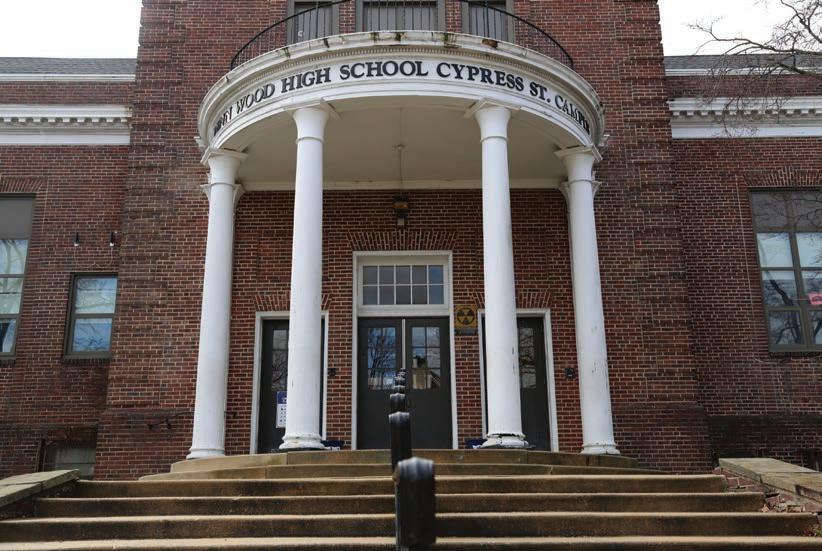
Schoolhouse gates: The Penn Wood High School’s Cyprus St. Campus is the William Penn School District’s ninth grade center located in Yeadon, Pennsylvania. The district and ve others won their lawsuit against the commonwealth of Pennsylvania.
Pennsylvania Congress introduces bill to ban TikTok on state devices
A bill that York County Senator and Republican Kristin Phillips-Hill proposed will prohibit the usage of the app TikTok on state devices and networks. Senate Bill 379 is currently on the oor of the Senate and open to debate.
“TikTok presents an unacceptable level of cyber espionage, collection of government data, and a threat to personal security,” Phillips-Hill said in a video posted to her YouTube channel. “At least 25 other states have addressed this, and Congress prohibited its use across a broad swath of federal agencies and departments.”
In 2020, a U.S. judge shut down an executive order by former President Donald Trump that tried to ban TikTok. Trump believed the Chinese government
ByteDance recently admitted to misusing third-party data to track multiple journalists, and the recent Chinese spy balloons over the U.S. led to increased concern over national safety and privacy. As a result, tensions between China and the U.S. are rising.
“To me, that (Pennsylvania TikTok ban) seems like something that would be reasonable and attainable,” said Aaron Lockard, a U.S. Government and World History teacher. “Much like that the government can classify documents, for example, I imagine that extension of con dentiality, secret access to government documents, and information or personnel being able to extend that to what sort of apps are on the cell phone seems reasonable.”
In addition to its popularity globally, TikTok is particularly popular in the Conestoga community, as well. Spending an average of two to three hours a day on TikTok, junior Timothy Corben is an active user of the app. He uses TikTok to unwind and gets paid to make TikToks for Handel’s Homemade Ice Cream and Yogurt.
“I don’t know a person who doesn’t (use TikTok),” Corben
Tackling TikTok: A student opens TikTok to pass the time. Pennsylvania Senator Kristin Phillips-Hill introduced a bill to prohibit the use of the app on state devices.

said. “I feel like almost at least 95% of everybody I know is using TikTok.” e bill would not make TikTok inaccessible to students currently using the app. If passed into law, the bill will not a ect personal devices such as phones not owned by the state.
e T/E School District already blocked TikTok on all school devices, including other
“In this case, (TikTok) just happens to be like a virtual market, which I think opens the doors up,” Lockard said. “It opens the door for something that could be used on public devices.”
The Tredyffrin/Easttown School District serves just over 7,000 students. As the decision about state funding for Pennsylvania’s public school districts is not set in stone, TESD’s budget will not be a ected as of right now,

Gusick acknowledges this discrepancy and would prefer a solution that supports the districts that need more funding without taking away from that of TESD.
“If (the Pennsylvania General Assembly) just tried to bring the level of funding up in other districts to a certain level without taking anything away from us,” Gusick said, “I’m not really as concerned.”
Collecting donations: ECHOES club members pose for a picture at a club meeting to brainstorm donation drives for the Turkish Earthquake on Feb. 8. The students set up six donation bins throughout the school.
Students aiding Turkey, Syria
Tanisha Agrawal Sta Reporter ed winter clothing, blankets, canned and baby food, menstrual products, ashlights, tents, heaters and sleeping bags.
To aid the people of Turkey, senior Leyla Yilmaz, president of the community service club ECHOES, initiated relief donations at Conestoga. Yilmaz was born and raised in Istanbul, Turkey, and believes living far away is not an excuse to not help.
e donation drive, held from Feb. 9 to Feb. 17, accept-

“Test Optional” doesn’t *really* mean that...
ECHOES sent the donations to the Turkish embassy in Washington, D.C.
“ e turnout from ’Stoga was good; however, in general, there wasn’t an uproar, call for change (or) solidarity within the school bounds. Unfortunately, the West has grown pretty apathetic to the Middle East and the pain that they experience,” Yilmaz said.
Donations are based on needs expressed by the Turkish Embassy. us, ECHOES has halted donations as the embassy is uncertain about what Turkey currently needs.
Amidst the grieving and destruction, as the Islamic month of Ramadan nears, Elif Acar, seventh grader at T/E Middle School and Turkish immigrant, aims to dedicate her fast to understanding the su erings of the people in Turkey and Syria.

“I am comfortable in my house, but it is freezing in Turkey. I have enough food and water, but they don’t. is makes me scared, sad and frustrated,” Naz said.
Yilmaz believes solidarity is of utmost importance in times of tremendous loss and grief. She hopes the attention the media and general public are giving to Turkey and Syria does not die down. Even years later, she believes, thepeople a ected will still need help.
Like a super-secret handshake to get in the door, competitive colleges really do want to see test scores, they just won’t tell you that. Grades alone aren’t going to get you there, so it’s time to think about doing your best on the SAT or ACT. Find out more at CrimsonReview.com.Courtesy Shannon Roberts Founded in 2016 by the Chinese company ByteDance, TikTok is a popular social media company ranked sixth among all other leading social networks. With a 142% revenue growth in 2021 and billions of users, the app has grown to be a dominant player in the social media world. Yet, more than half of the states in the United States have banned TikTok on all state devices, and Pennsylvania plans to join them. Lizzie Sun/The SPOKE was utilizing users’ private data to China’s advantage. Rejected three years ago, this idea is gaining traction again. social media websites. While this bill will have little e ect on Conestoga’s students, it paves the way for more bans that might a ect the T/E community. Ben Shapiro/The SPOKE Courtesy Wilkes-Barre Area School District Run-down stands: Penn Wood High School of the William Penn School District’s bleachers are cracked and decaying. The district sued the commonwealth of Pennsylvania, claiming the way it allocates funds to public schools is unconstitutional. Ben Shapiro/The SPOKE “Crumbling facade”: James M. Coughlin High School of the Wilkes-Barre Area School District is very run-down, according to Dr. Brian Costello, the district’s superintendent. In June 2021, the school closed because it was unsafe for student use.
Posters depicting French pastries adorn French teacher Ashley Strouse’s classroom. In uenced by the images and their curriculum, her students began to ask if they could enjoy some of the treats together.
“My students always ask if we can have parties with food, if they can bring in croissants, macarons or di erent things,” Strouse said. “I wanted to nd a way that we could have a fun experience together other than just bringing stu into the building.”
So, Strouse decided to take the students’ requests to the next level. She organized an opportunity for them to not just enjoy traditional pastries, but to immerse themselves in French culture and learn how to make desserts from scratch.
Strawberry Bakery in Malvern, where the students will be heading, is owned and operated by chef Jean Pierre Bournazel. He was born and raised in a suburb of Paris. Sophomore Yumna Tayea, one of Strouse’s students, has been familiar with the bakery because her dad o en buys desserts there.

“I told (Madame Strouse) (that) there was a bakery run by a French family. I love their pastries. My dad gets them because he’s supporting the small business, and it’s fresh and delicious,” Tayea said. “She told me (that) she already knew about it, and she heard that they had pastry classes. She mentioned to the class one day that she was able to get us a eld trip.”
During the approximately twohour visit, Bournazel will teach the students how to make di erent pastries, from the well-known croissant to the lesser known charlottes (bread pudding) and petit gâteaux (cupcakes).
“ e owner is going to present himself and talk a little bit about each dessert that the kids will be making. ey’re going to make four di erent pastries, and then they get to take them home with them,” Strouse said.
Strouse got so much interest for the trip that she was forced to adopt a lottery system to determine which students could attend. She was able to include 40 students, split into groups of 20 over the dates of March 7 and March 14.
Sophomore Shreya Venkatesan, one of the students who was chosen, is looking forward to the day.
“I am really excited for the trip. I love desserts and I love to bake, so I am very excited to go to the bakery and take lessons from the chef. I think it’s going to be a fun and educational trip with my friends,” Venkatesan said.
Both Venkatesan and Tayea are also hoping to connect the experience back to their current French knowledge. Along with learning about French culture, they will advance their speaking and listening skills by conversing with Bournazel.
“ e one thing that I think helps the most with learning and understanding language is being around people who speak it. So, just hearing (French) is going to
give us more exposure to the language,” Tayea said. “He doesn’t even know what we know so he’s just going to say what he would normally say, and it’s kind of our job to put the pieces together. I think that’s going to overall help learning and comprehension.”
is exposure to French culture was one of Strouse’s main goals when organizing the trip. She has noticed that students have a tendency to think that the language they are learning is not real nor something they can see in their own community.
“I love that this bakery is so close to school because it’s owned by a pastry chef from France who speaks uent French and brings French culture to the United States,” Strouse said. “Of course, French is spoken in other countries, and if you travel there, you’ll be surrounded by French. I want students to get that those opportunities exist here as well.”
Due to the level of interest and bene ts of such experiences, Strouse hopes to continue incorporating them into the language curriculum. She wants students to recognize that although the content of a language course may seem simpler than other classes, there are many cultures attached to that language.
“Seeing how excited my kids were about the bakery and being able to do this pastry class made me excited to o er it and go with them,” Strouse said. “So I am hoping that it turns out really well and then, potentially, it’s something we can add as a yearly trip.”
Wayne Art Center is hosting its 22nd Expressions of Radnor exhibition, an annual show focused on displaying art from local artists. All mediums are welcomed, leading to a diverse array of works from many di erent perspectives and backgrounds.

Expressions of Radnor was displayed from Feb. 13 to Mar. 10. An event of this scale takes months of planning, often starting as soon as the prior June. Executive director Nancy Campbell believes that Expressions of Radnor is an important event to highlight pieces the community can create.
“It’s very di erent than a typical exhibition that we would open up to just any artist,” Campbell said. “It became more impactful and meaningful. is was a way to thank not only the (Radnor) township for their support, but also all the residents for their friendship.”
Once everything was nalized, 87 original works were arranged in a unique composition in the Davenport Gallery and opened to the pub-
lic on Feb. 11. Artists could decide to put their works on sale with the price listed underneath the title.
One artist, Marianne Tebbens, a renowned sculptor and grandmother to Conestoga junior Jadyn Zahlaway, displayed two colorful pieces titled “Abstracted Light” and “Expressing Nature.”
From a young age, Tebbens was fascinated by clay. As she traveled and learned more techniques and mediums, her love for sculpture grew stronger.
“I try to feel an emotion when I’m throwing on the potter’s wheel. Sometimes I feel frustrated,” Tebbens said.
“Sometimes I feel joy when it centers and I nish the rim. When it collapses you feel like ‘Why am I doing this?’ But you always pick it back up because your passion is there.”
Another acclaimed artist with an extensive repertoire of oil and pastel, Anne Graham, presented a majestic pastel portrait titled “Phil Reading” this year. She studied at the Pratt Institute for several years before moving to England to further develop her skills.
Since the age of 5, Graham felt that she was destined to become a professional artist. Although pursuing art as an occupation is not suitable for all aspiring artists, she encourages those who feel a strong connection to consider it.
“If you’re passionate about (art) and you really love whatever medium you’re working on, you’re almost always successful,” Graham said. “Whether it’s each stroke of paint or each piece of pastel, if that’s the way you feel, go for it.”
On Feb. 26, the Wayne Art Center hosted an award ceremony and reception. Visitors from all over the community came in to enjoy snacks and view the exhibition. A er some brief pleasantries, Campbell announced the awards alongside program coordinator Pam McLean Parker.
Esteemed artist Dori Spector received the Wayne Art Center Award for her oil painting “Cupcake” alongside a monetary prize. She also submitted an oil painting of Ardrossan Farm, titled “Wheeler Field Radnor, Winter Twighlight.”
Spector specializes in figurative drawing and oil painting,

techniques she learned from studying at the Moore College of Art where she earned a bachelor’s degree in fine arts. From there, she attended the Arts Student League of New York on a merit scholarship. Although Spector nds inspiration in the life all around — even from something as common as a pair of ripe oranges — she nds herself particularly drawn towards the human body.
“ ey (people) just call to me. I love to think about how I would draw them,” Spector said. “I always have loved to watch people walking down the street (while) in restaurants, I think that is just more interesting than anything else.”
Many guests who attended the reception were enthralled by the complex imagery that rose from the gallery. e artists were also welcomed to come and watch the visitors’ reaction.
“I think art has to stir something in you to be true art,” Tebbens said. “It has to stir the artist, but when you put it in the environment, it should a ect people in some way – even if it’s just curiosity.”
Nestled in the heart of King of Prussia’s Town Center, Founding Farmers is a favorite amongst Conestoga students and community members alike.

Located in an upscale farmhouse inspired building, the North Dakota Farmers Union owns the restaurant, serving sustainable food in a hospitable atmosphere. With high
quality ingredients and homemade food, Founding Farmers puts a modern twist on the fresh, farm to table experience.
Making many of their meals from scratch, Founding Farmers provides an authentic dining experience. With almost every table filled, the restaurant’s lively ambiance makes for a fun meal.
Starting with an appetizer of garlic black pepper wings, the chicken was cooked to perfection and tossed in a savory
glaze. Served with a slice of lime, the sweet and tangy spice provides for a satisfying start to any meal. The Seven Cheese Macaroni and the Cacio e Pepe did not disappoint. Both handmade pasta dishes were cooked and seasoned well.
The cheddar cheeseburger, served on a toasted brioche bun, was topped with the restaurant’s zesty “Louie sauce” (a combo of mayo, ketchup, relish, lemon, and secret spices). The dish was a
standout classic served with a side of fries.

Capping o the meal, the Founding Farmers desserts were one of the restaurant’s strongpoints. e vanilla bean cheesecake layered with a seasonal fruit compote had a multitude of satisfying avors, and the slice of Chocolate Sinful Devil’s Food Cake was moist and bold in avor.
Generous portion sizes were more than ample to share with another.
Although Founding Farmers’ price point is higher than

When Terrence Lowery saw the despaired look on a young boy’s face as baseball player Willie Mays refused to sign his baseball card, he knew he wanted to start his own shop to sell a ordable collectibles. His shop, Underground Collectibles, is one of many vendors at the Berwyn Indoor/Outdoor Vintage and Antique Market.
Located on Swedesford Road, the market is lled with vintage collectibles and antiques from curated vendors. It opens every Saturday and Sunday from 9 a.m. - 4 p.m. through April. For
to find
Paint brushes and pastels fill the minds of artistic members of the community, especially now that the Chester County Library has developed the Maker-in-Residence Program.
The program allows for artists, musicians, song writers, designers and more to share their talents with the community. The program selects a maker who is passionate about their craft and can teach Chester County Library patrons. The residency has open studio hours for the selected maker to create at the library in front of the visitors, and will run through June. There is also a 90-minute workshop where guests can learn about the maker’s specific craft, and a culminating piece in June, which ties into the celebration of Juneteenth.
“It could be visual arts, music-related, writing related, (or) really any sort of creativ-

ity. It could even be theatrical or performing arts. It just depends on what kind of creative practice the maker engages in,” said Mary Gazdik, a Chester County Library Director.
The library selects a maker based on a combination of their artistic practice and focus on the community, as well as resources and space needed at the library. All interested makers filled out an application by Jan. 31; this year’s committee selected Megan Greenholt. Her residency will begin on March 27. Greenholt dyes her own fabric and yarn using different natural dyes. These include dried marigolds, indigo plant, pokeberry and goldenrod.
The goal of the program is to get members of the community more involved in artistic expression and utilize the resources available to them at the library, usage of which decreased during the COVID-19 pandemic. It also aims to expose people to the arts and provide them
ways to engage in different creative practices.
“We’re looking to get people engaging with the spaces to understand that makerspaces aren’t just places where you come and do 3D printing, or that kind of thing,” Gazdik said. “There are four areas of all kinds of creative practice.”
Prior to becoming the Chester County Library Director, Gazdik spent 10 years building a makerspace program for a library in Delaware County. As a result, she is very excited about the amount of applications the Chester County library’s makerspace has received. According to Gazdik, the program has reached many creative and artistic people.
“The more people can engage in different kinds of practices that engage that part of the brain, I think it’s really important to the overall development of a person,” Gazdik said. “It really fills in the role of the library and engages people in lifelong learning.”
Lowery, the Berwyn Flea Market is a great place for vendors to sell their collectibles.

“What I like about this particular market (in) the area is we have a wide variety of di erent dealers here and a pretty decent clientele on the Main Line,” Lowery said. e Berwyn Flea Market is an annual event, with regular customers such as Caroline Metzeger.
“I pretty much decorated my whole living room with everything from here about a year ago, so I came back to see what’s going on,” Metzeger said.
Jewelry, basketball posters, vintage magazines, wooden chairs, rusted door knobs
and intricate paintings are just some of the many unique items customers can find at the market. Community member Deavin Riley’s family found the market to be a great place to feature their various collectibles.
“We’re a family business, and we were looking for a new physical location for our shop,” Riley said. “Somebody told us there was an indoor flea market in the area, and we wound up becoming a vendor here. We deal with estates and appraisals mostly, but we collect a lot of knick knacks and stuff through the jewelry appraisals.”
Not only is the market enjoyable for customers, but, according to Lowery, it brings joy to vendors.
“I’m trying to make people happy — I’m trying to just pass collectibles on,” Lowery said. “Somebody can come in here and get something that they can value and want to collect; then you know everybody’s happy.”
Customers like Metzeger enjoy attending ea markets to nd pieces that tell a story.
“I like just giving something a second chance,” Metzenger said. “I like the history behind everything and thinking about how many places it saw and how many homes it went into.”
Quick Gateway runs, nail appointments and midday doughnut snacks are all ways Conestoga students can support Mini-THON this year.

Mini-THON is a smaller version of Penn State University’s THON, which involves a 46-hour dance marathon held in February. Conestoga will host a Mini-THON on March 24 to help raise money for Four Diamonds, an organization that supports pediatric cancer. e money will go toward helping families a ord meals, housing and medical costs for their children, along with providing money for cancer research.
“I know a lot of people that participate in Penn State’s THON, but I think it’s really cool that we get to
make a smaller version (and) still have the same purpose,” said sophomore Sydney Schwartz, who is on the attendance committee and promotes the event.
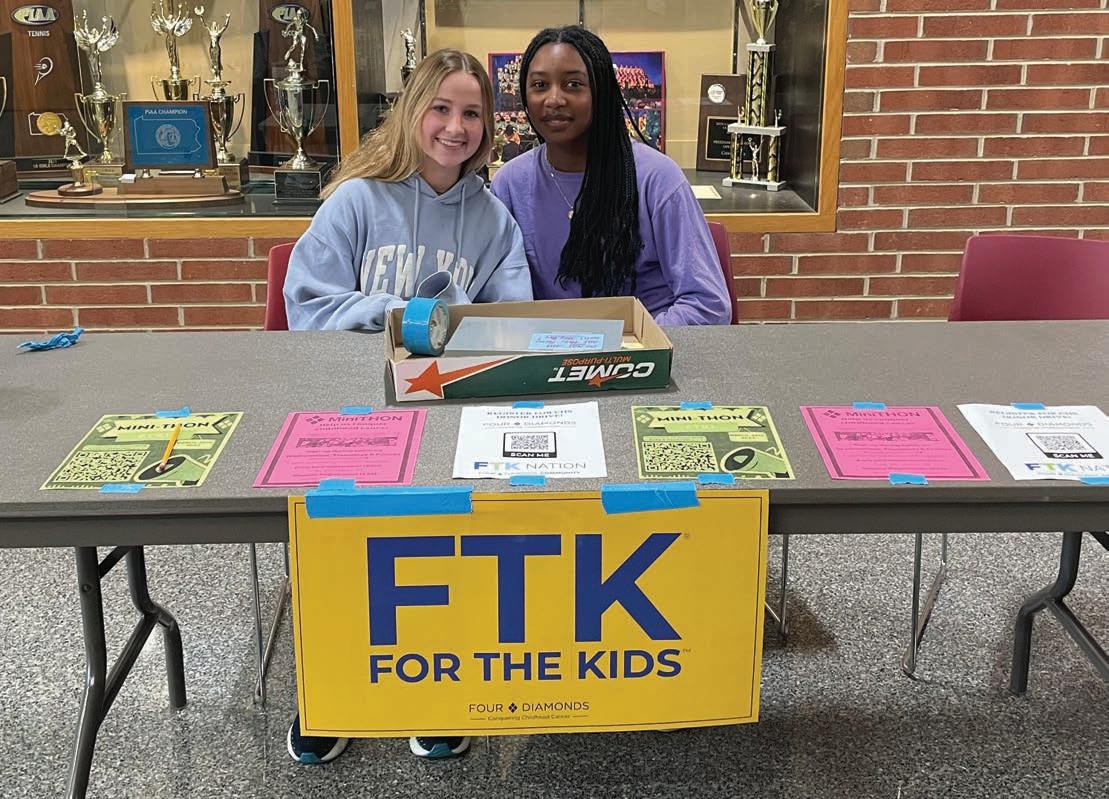
Conestoga’s Mini-THON is a four-hour event in the school gymnasium. e night starts o with a performance by the marching band, followed by dancing, games, cra s and more.
“It’s a super fun evening and there’s usually something for everyone. If you’re a quiet person, there (are) quiet activities. If you like to be very active, there (are) active activities” said Key Club adviser Allison Long. e Student Council and Key Club contribute to the organization of the event. Beyond the on-campus event, they work with restaurants and businesses to raise more money during February and March. Students perform di er-
ent roles and work as a team to plan the event.




“Overall, we have the MiniTHON committee, and (we) separate it into di erent (jobs) like registration (and) food advertising. We all work o each other. Registration and advertising go well together because they need to get the word out and are part of the group,” Schwartz said. e last three events have been more di cult to plan due to the pandemic. In 2020, the event was canceled, and in 2021, it was held virtually. However, in 2022, they had a record-breaking number of students attend the event.
“It’s a lot easier to plan this year since we’re fully back in-person, and we can get more organizations or companies to help us,” Schwartz said.
Based on popular demand, the Mini-THON committee, along
“It’s mostly restaurants, but we’re trying to be a little creative with some of them coming up in the next month or so,” Long said. Tickets are sold during lunches, and the rst 250 people to sign up will receive a free T-shirt. ose who cannot attend can support by purchasing a meal at select local restaurants, making an appointment at select nail spas or buying small items at school. Students may also send money directly through DonorDrive, a website that the Mini-THON committee uses to raise money, as well as cash donations at the registrations table.
“It’s just nice to see all di erent types of students coming together for a great cause,” Long said.




Secret love letters, 1930s dancing and a charming cast — this year’s spring musical, “She Loves Me,” leaves the audience “Hungary” for more.
On March 1, ’Stoga eatre premiered “She Loves

Me,” a romantic comedy set in 1930s Budapest. e musical follows the love story of two young clerks — Amalia Balash and Georg Nowack — who work at a local
parfumerie. In the days leading up to the musical, directors, stage-crew, cast and dancers worked hard to seamlessly piece together the Hungarian aspects of the production.
e large set portrays a typical 1930s scenery in Budapest. e interior of the parfumerie is complete with long windows, embellished furniture and antique signposts. e outer architecture resembles Art Nouveau, a popular European style that contains asymmetrical shapes, extensive use of arches and stained glass.
“One thing that’s really awesome is that there are
di erent kinds of rooms and settings within the set. e walls move in and out, and open and close the shop,” said senior Macy Danenhower, who plays lead character Amalia Balash. “ ere’s a hospital bedroom, a normal bedroom (and) a work room that actually revolves 360 (degrees), which is just such a cool thing to have in a high school production.”
Along with learning various 1930s dances, such as the waltz, ballet and jazz, dancers also play smaller characters in the background of scenes. Co-dance captain and junior Reese Oakes enjoyed blending the dance choreography with characters’ personalities, while acknowledging the inherent challenge in the task.

“A lot of (dancers) have been taught in a technical way, so it’s sometimes difcult to merge that with character. For example, being messy if you’re supposed to be messy, but also keeping the choreography (looking) clean is di cult,” Oakes said. “It’s been a bit of a balance, but I think we’ve gured that out along the way.”
Tasked with enhancing the physical features of the performers, the hair and makeup crew collaborated with directors Christopher Nation and Nathan Shugart to accurately depict the iconic 1930s appearance. For sophomore and hair and makeup crew co-captain Cindy Wang, a vital part of accurately depicting Hun-
garian culture lies within the characters’ appearances.
“ e two female leads will be very feminine. ey will have lots of curls and lots of warm red (and) pink eye shadow,” Wang said. “All the guys will have side parts (and) we’re going to do aging on some of the characters that makes them look older, as well as
attaching fake mustaches.” Along with distinct makeup and hair, characters wore upper-class, European clothing to resemble the fashion of the time period. e men wore traditional gray and white suits, while women wore vintage dresses accompanied by a velvet handbag or bonnet.

 Shreya Vaidhyanathan Opinion Editor
In December 1965, 13-year old Iowa student Mary Beth Tinker and her classmates wore black armbands to school in protest of the Vietnam War. School administrators quickly retaliated under the narrative that the students had disrupted the school day, passing a rule to ban armbands and suspending students who had participated in the demonstration.
e students’ parents challenged the suspensions on the grounds of the First Amendment and, upon losing at the federal level, appealed the decision and eventually made it to the Supreme Court. e Supreme Court ruled 7-2 in favor of the students, declaring that neither students nor teachers “shed their constitutional rights to freedom of speech or expression at the schoolhouse gate.”
Today, this conversation has shi ed to focus largely on student journalists. e Tinker standard — the policy that schools may not censor student expression unless proven that they are disruptive to the school day or invading the rights of others — has since been adopted by schools across the country, becoming a baseline of the fight against censorship. Now more than ever, scholastic and local journalism is important. Between local papers falling through the cracks during the COVID-19 pandemic and TV news organizations rising rapidly in popularity and revenue, as reported by the Pew Research Center, the lack of local newspapers is glaring.
Nonpro t media advocacy organization
Poynter Institute writes that many school papers had to switch to online or otherwise adapt to the COVID-19 pandemic. Likewise,

a professor Penelope Abernathy at University of North Carolina at Chapel Hill’s School of Media and Journalism reported that “the
ties. erefore, school papers are stepping into the role of covering local news and becoming papers of record for their community.
student journalists have the authority to determine their own content and that their media cannot be censored, save for certain rare cir-
legislation has already been passed in 15 states, and their Pennsylvania counterpart is currently awaiting introduction in the Pennsylvania House and Senate. At the time of publication, Representative Melissa Shusterman and Senator Carolyn Comitta have verbally committed to sponsoring this bill.
rise of the ghost newspaper” is prominent. In other words, local newspapers becoming less consistent is a loss for communi-
Loud. Flamboyant. Excessive. Unnecessary. A germophobe’s worst nightmare.
Those are the words I think to myself every time I see, or rather hear, them: those heinous hand dryers. I look with disdain at the hand dryers attached to the wall in school bathrooms as they blow stale air through their who-knowshow-old vents. On top of that, their discordant noises leave much to be desired in the hand washing realm.
The two types of hand dryers on the market, jet and hot air dryers, are not created equal. While jet air dryers use cooler air and greater amounts of force to remove water o your hands, hot air dryers, the ones installed in our school’s bathrooms, live up to their name by using warm air to evaporate water from hands. No matter the hand dryer, however, its brous paper towel counterparts are a much better option.
Simply put, hand dryers are not efficient; a Cambridge University study showed that paper towels removed residual water more effectively. They found that paper towels achieved 90% dryness after 10 seconds of drying versus hot air dryers, which took approximately 40 seconds to attain equivalent results. The jet air dryer also achieved comparable results to paper towels in a similar amount of time.
Although jet air dryers proved to be similarly efficient to paper towels, the latter are more hygienic. A study conducted by Mayo Clinic Proceedings found that paper towels reduced the number of all types of bacteria on hands. It was also found that jet air and hot air dryers increase almost all types of bacteria, though the jet air proved to deposit slightly less than that of the hot air dryer.
Additionally, friction aids with dislodging bacteria. Antibacterial hand soap o en has very little time to remove all bacteria from hands in a single hand washing session, so physical force can help eliminate remaining bacteria. A University of Hyogo study found that lots of bacteria was on the paper towel a er hand wiping, indicating further removal of bacteria. Because jet and hot air
dryers lack this feature, they are ine ective in cleansing hands any further.
Paper towels also eliminate cross contamination. The University of Westminster found that jet air dryers spread bacteria up to two meters, well in the range of other hand dryers in the vicinity, while hot air dryers were found to spread bacteria underneath its vents. This contamination can spread airborne bacteria to other dryers which can then blow them onto hands and potentially spread illness.
A common argument for the hand dryer is that they are environmentally friendly. According to the University of Melbourne, hand dryers emit less greenhouse gases into the air than paper towels. While hand dryers may be saving the trees, hygiene is a virtue that must not be taken lightly. Especially in professional health settings, clean hands could be the di erence between life and death.
Paper towels are beneficial in all settings. Fortunately, at Conestoga, you will never be subjected to using hand dryers, since paper towels are also provided. With allergy season fast approaching, hygiene is of utmost importance, and a little more vigilance could drastically reduce symptoms and promote immunity. It all starts with one paper towel at a time.
is resurgence of student media is exactly why Pennsylvania needs the Student Journalism Protection Act. e bill ensures that
cumstances. Additionally, the act provides protection for educators who refuse to censor students from professional repercussions. Similar
Pushback against this bill comes from the ruling in Supreme Court case Hazelwood v. Kuhlmeier that public schools should be able to disallow student speech if it con icts with the school’s educational mission, supporting the idea that the First Amendment o ers less protection to student publications in public schools than to independently-established student papers or forums for student expression. is standard, however, contradicts the idea established in Tinker v. Des Moines and lessens the impact and capabilities of student journalists. As Justice
Hugo wrote in his concurring opinion on New York Times Co. v. United States, “the purpose of the press is to serve the governed, not the governors.” e same logic can and should be applied at a scholastic level; the purpose of school newspapers is to serve the students, not the administration. Scholastic journalism can be a positive experience for anyone, not solely for those who plan to pursue it; our own Spoke alumni credit their time on e Spoke for strengths like interviewing skills and positive time management habits.
Peer-reviewed journal Higher Education Review writes that school newspapers can “improve the quality of education in your institution,” improving communication and boosting the educational process. Cementing students’ rights to self-expression with this legislation is vital to the preservation of scholastic journalism. If any of this work speaks to you, please reach out to the panewvoices@gmail.com and join the Pennsylvania New Voices task force, the driving force behind grassroots lobbying to get this legislation passed. We cannot cement these rights without the strength and support of the people.
 Juliana Yao Sta Reporter
Between eons spent perfecting English essays and allocating hours a er school daily for sports practice, it is almost impossible to nd time for lowstakes activities as a high school student. However, by engaging in these ventures, students can reduce the stress that comes with school and allow for self-improvement and con dence.
Hobbies like drawing, hiking and baking are enjoyable activities that we do in our free time.
Along with serving as a fun pastime, they can also reduce stress levels. A study conducted by Matthew Zawadzki in the Annals of Behavioral Medicine showed that engaging in leisurely activities yielded less stress and lower heart rates for participants. Hobbies can be an important factor in reducing burnout and promoting overall well-being.
The Sta
Editors-in-Chief: Evan Lu, Hiba Samdani
Managing Editor: Jui Bhatia
News Editor : Ben Shapiro
T/E Life Editor: Abby Bagby
Opinion Editor: Shreya Vaidhyanathan


Sports Editors: Howard Kim, Hannah Simon

Beats Editor : Maya Shah
Multimedia Editors: Katherine Emmanuel, Grace Kuryan
Webmasters : Rohan Anne, Soumya Sathyanarayana
Business Manager: Michael Tierney
Photography Editor: George Zhang
Social Media Editor : Akshita Joshi
Copy Editor: Zara Samdani
Design Editors: Aren Framil, Raima Saha
Cartoonists: Angie Chen, Hannah Gupta, Leon Li, Eden Liu, Shine Lin, Arianna Mu, Yuting Pu Sta Reporters : Prashi Agarwal, Tanisha Agrawal, Miya Cao, Alexander Carder, Vanessa Chen, Weihan Chen, Mareska Chettiar, Rowan Chetty, Abigail Chong, Ryan Ding, Isabelle Emmanuel, Saktisri Gowrishankar, Joanna Harris, Julia Harris, Je rey Heng, Evangeline Kennedy, Audrey Kim, Bailey Kreszswick, Soumya
Krishna, Shrija Krishnan, Lexi Lin, Margaret Neary, Riddima Pandey, Lauren Pinheiro, Abbie Preston, Madeline Pulliam, Louisa Sandor , Emily Scheer, Sousanna Sengal, Aashita Singh, Eshan Singh, Vaishnavi Sriadibhatla, Elizabeth Sun, Remington Vaughan, Alexa Willrich, Mary Wolters, Juliana Yao, Faith Zantua
Faculty Advisers : Alison Ferriola, Laura Howard, Nicole Zakorchemny
An important bene t of hobbies is the sense of accomplishment that comes with developing a new skill. Recently, I learned how to crochet. I found that it was easy to get the hang of, and quickly became immersed in the rhythmic and repetitive actions. While it was a pleasant experience itself, having a physical product of my work through the nished stu ed animals also instilled a feeling of pride in me. For long-term projects, such as growing your own plants or learning a language, this e ect would be magni ed. Hobbies can also be a way to connect with and meet new people. Joining a club or getting into an online group for a hobby can provide community and social connections. Forming meaningful relationships with people with similar interests is a greatly enriching experience to add with the hobby itself. As a study published in the Journal of Child and Family
Studies discovered, engagement in hobbies led to better peer functioning and more social opportunities among young teenagers. Even without these advantages, hobbies allow you to become a more interesting person. Whether it be when you are introducing yourself to someone or while writing a college application, being an avid photographer or chef can make you more intriguing to others. By having interests outside of school and work, your personality can have greater depth and you can become more well-rounded in your pursuits.
Despite the numerous bene ts, some may be hesitant to pick up a hobby in fear of the time and resources required. It is crucial to note that hobbies are merely pastimes that can be personalized to individual needs and schedules. Furthermore, there are a wide variety of hobbies calling for varying levels of
Non-sta contributions: Non-sta contributions from students, the community, graduates or other interested parties are welcome. Editors will decide which contributions are published based on space and relevance to the community. All contributions must conform to journalistic practices, including accuracy, timeliness, purpose and writing conventions. The Spoke reserves the right to work with the contributor to meet these standards. All outside contributions are bylined.
Letters to the editor: Letters to the editor may be submitted to Editors-in-Chief Evan Lu and Hiba Samdani, or advisers Alison Ferriola, Laura Howard and Nicole Zakorchemny.
Editorials: Unsigned editorials represent the views of The Spoke editorial board, not necessarily those of the administration, student body, community or advertisers. The opinions expressed in signed columns are those of the writer and not necessarily the opinion of The Spoke.
Paid advertisements: The Spoke accepts paid advertisements. Email hello@spoke.news.

commitment. If you have a tight schedule, consider entertaining a hobby that doesn’t demand a large time investment, such as cooking or baking.
As for hobbies that don’t break the bank — activities like coloring, journaling, learning magic tricks and reading — provide relaxation and a chance to learn. Additional hobbies include the mastery of coding, painting, editing videos, games and calligraphy. Exercising even for just a short period of time results in a large range of physical and mental gains. Going to the gym, running and yoga are just a few examples.
Of course, these are only some options of hobbies that people can enjoy. No matter what interests you have, trying something new will bound to have positive impacts on your well-being and life. Whenever you are thinking of picking up your phone, consider picking up a hobby instead.

e Pennsylvania public school funding system is broken. While the Philadelphia School District closed down buildings in February 2023 to manage lead and asbestos contamination, its neighbor in Lower Merion enjoyed ve 3D printers, an endless array of classes and readily available mental health support from its sta . is problem is an unfortunate reality of injustice in the Pennsylvania school system. A study commissioned by the General Assembly in 2005 found that Lower Merion spent $17,184 per student, despite needing only $12,211 per student to be adequately funded. Philadelphia School District, on the other hand, spent $9,947 per student, despite needing $14,141 to provide its student body with an adequate education.
Last month, the Commonwealth Court ruled this unequal distribution of funding unconstitutional, providing Pennsylvania with an unprecedented opportunity to remedy its history. Funding inequality only exacerbates racial opportunity gaps. According to nonpro t research group
Research for Action, Pennsylvania has the second-largest racial opportunity gap in the country. Districts can allocate their resources to institute a quality education, rather than to x prob-
understa ed libraries, replace outdated textbooks and laptops, and equally distribute resources. Such changes will open up possibilities that can slowly bring underfunded districts up to speed.
ey are related to systemic racism, generational trauma and an ongoing loop of poverty — things that cannot be xed by only money.
According to a Philadelphia Inquirer article, much of the taught

they shape their attitudes and perspectives in the classroom. On top of that, Judge Jubelirer, the judge who declared this spending unconstitutional, did not propose a solution to a com-
for the ruling to sit in Harrisburg, and for legislators to simply add it to their laundry list of bills to enact. It is even possible for state leaders to buy time to appeal the decision and make a clear-cut ruling on a bipartisan issue.
Chick-fil-A data breach
lems related to basic health and infrastructure — like an infestation of lead poisoning. is ruling is de nitely a victory for underfunded schools — reallocating money can x
So does this mean underfunded schools will no longer face many of these problems? Unfortunately, the solution is not that simple. Problems in Pennsylvania schools run deeper than just budgetary issues.
“I like to play the piano — which I’ve been playing for eight years — the saxophone, squash and chess. I also like to read, especially ctional books.

“My hobbies are watching and playing basketball, listening to music and going biking. I also like playing video games and cards. ”



From when it first started in 1997, Netflix went through major changes, not all of which were popular with its subscribers. However, what made Netflix worth it was its commitment to viewers and on-demand streaming, allowing viewers to watch what they want, when they want. Netflix’s new moves to cut down password sharing and cancel popular shows are testing its viewers’ limits. In an update released on its website on Feb. 8, Netix outlined its new policy for password sharing, stating that it will no longer allow users to share passwords across households. Users will have to set a primary location per account and must pay to add new pro les that are not in the primary location of the existing account. Any pro les not on the primary location will be locked out. Net ix rolled out these measures for Canada, New Zealand, Portugal and Spain in February, with plans to release them in the U.S. later this year. While this policy is an obvious drive to generate revenue by forcing individuals to buy
their own subscriptions, these measures also make it tough for people to access their accounts if they are not in their primary location. If one does want to access their account away from home, they will have to sign in and prove that they are not sharing a password and even then, will only be given access temporarily, making it tough to watch shows whenever and wherever they want.
Net ix has also le viewers unsatis ed with its recent turn to canceling well-performing shows le and right. Popbuzz reports that just by January of this year, Net ix canceled seven popular shows. A lot of these cancellations seem to come out of le eld for viewers, since
curriculum is based on the work of white educators such as Horace Mann and John Dewey rather than Black leaders like Carter G. Woodson. Many teachers are unaware of these unconscious biases and how
plex problem. Many advocates and policymakers are unsure of how to ll the gap, but estimates predict about $4.6 billion will be needed. Without a concrete source of income, it will be easy
erefore, while the ruling is a good rst step to challenging the educational system in Pennsylvania, the government needs to take more action. A single ruling can not simply replace a system that is unfairly biased against lower-income communities. As the potential bill sits in Congress, we must accelerate its progress through lobbying, writing letters or contacting legislators. It is critical that our leaders do not postpone the issue by waiting for appeals, as we risk losing a generation of students if Congress decides to stall. By advocating for equal education for all, we don’t only combat an educational issue, we also ght for equal opportunity, fairness and justice. Let’s show the children in Pennsylvania we believe in them, as they are our prospects for the future.
“My hobbies are swimming, tennis and many organizations and clubs, like Best Buddies and makeup crew.”

+ only less than 2% of mobile app users were affected - hackers may have obtained customers’ names, emails and payment information
Tiktok implements screen time
+ could help users develop healthy online habits - the features will likely not significantly change the current layout and usage of TikTok
NBA player Ja Morant’s suspension
+ pulled out a gun while he was on Instagram Live - given a two-game suspension for now, could potentially go up to a 50-game suspension
2023 Oscars winners announced
+ Michelle Yeoh is the first Asian
Best Actress Oscar winner
- host Jimmy Kimmel told too many jokes about “The Slap”
“The Rachael Ray Show” ends
+ host Rachael Ray plans to launch Free Food Studios, a production company - fans have to say goodbye after 17 glorious years
“Most of my hobbies are (related to) art; I like to draw and paint. I like to write a lot, too, and maybe (spend time) with my friends.
Ticketmaster cancels sale for BTS tour
+ amount of criticism Ticketmaster has faced may result in ticket-purchasing alternatives
- fans who want to attend must secure tickets with inflated prices
fects of binging — sleep problems, behavioral changes and psychological issues — the problem also leads to a self-cancellation loop, according to Tassi. is is when viewers do not want to get emotionally invested in a show to see it canceled again. is leads to fewer people watching the show, putting it up for cancellation anyway. However, Net ix does not have to care about the frustration its viewers are experiencing. In an interview with Bloomberg in January, co-CEOs Ted Sarandos and Greg Peters stated that Net ix is currently focused on trying to increase its numbers of subscribers. So, Net ix is focused on shows that attract new subscribers and not on its current ones. Additionally, in an age where it seems like you need at least ve di erent streaming services to keep up with every new show, leaving Netix does not seem plausible, so Net ix does not really have to worry about its subscribers leaving.

 Reporter
Imagine this: you’re walking to your next class in a good mood when suddenly, a teacher approaches, telling you to wear a jacket over your crop top. In a condescending tone, they tell you that students shouldn’t be wearing “bikinis” to school.
be honest, how many times do you see a student come into the school just wearing a bra? Instead, many students find themselves in a position in which they have to cover up because they’ve shown too much cleavage in the school administration’s opinion.
For example, in 2018, Braden High School student Lizzy Martinez decided to come to school wearing a long sleeved shirt and no bra. She was pulled out of class and told to cover up with anoth-


er up because they could see an outline of her nipples. It is safe to say that what Braden River High did was unacceptable. Their actions sexualized Martinez’s breasts, and to excuse their behavior, they made the age-old sexist justification that she was distracting other students.
Another reason many schools possibly police students’ clothing is for professionalism. Some schools have made it clear that restrictions over revealing clothing intend
these series seemed to be doing reasonably well, enjoying popularity in Net ix’s nationwide Top 10 and on social media platforms. According to Forbes’ Paul Tassi, however, Netix measures success using a completion ratio, which is the number of people who actually completed a show as opposed to those who stopped soon a er starting it.
Canceling a show based on this metric leads viewers feeling obligated to binge their favorite show to keep it from getting canceled. Aside from the negative ef-

Even though Net ix doesn’t have to care about what its viewers think now, its competition is fast approaching; at the end of 2022, Net ix held only 2% more of the market share for streaming services than Amazon Prime Video, according to data company JustWatch. With the release of popular shows like “ e Last of Us” and “Euphoria” on platforms like HBO Max, Netix must start catering to the subscribers it has.
As Net ix tweeted in 2017, “Love is sharing a password.” Netix needs to start living up to the expectation it set as the pinnacle of on-demand streaming services.
Every school has a dress code of some type. A dress code prohibits students from wearing certain clothing for several reasons, manyof the reasons being the clothing is revealing, unprofessional or harmful. Several dress codes seem to target girls and push a biased narrative of what professionalism is. This targeting starts to add questions about why these dress codes are pushed onto students.

Many school administrations believe that the clothing students wear could disrupt education because it is possibly too revealing and distracting. It could be understandable if the student is coming to school wearing only a bra but, let’s
er shirt. Her decision not to wear a bra to school that day was “distracting,” according to Martinez’s recount to USA Today of what her math teacher said to her.
The policing and sexualization of young girls’ bodies sparks a complex debate on whether it was acceptable for Braden River High School to tell a 17-year-old girl to cov-
to keep students professional and modest.
The idea of professionalism and modesty is more of a moral question. Everyone has their own idea of what professionalism and modesty are and what it means to dress in such a way for school. For some students, wearing a large hoodie and jeans is modest, and for an-
other student, a crop top and a skirt are. Fashion has allowed people to express what professionalism and modesty are to them. Hence, forcing students to adhere to the administration’s definition of professionalism and modesty seems incorrect. Now, the entire concept of a dress code itself is not a bad idea. It makes sense that we should limit certain clothing to students to make the school a safe space. For example, if a student were to wear clothing that promoted a terrorist organization that made individuals worried for their safety, it’s understandable for the administration to ask the student to wear something else. However, that means the dress code should only be enforced if students and sta are seriously impacted through the meaning of the clothing, not if it is unprofessional, immodest or distracting in the sta ’s eyes. Above all, U.S. public school dress codes are confusing. ere needs to be a change on what school administration can police. Since schools are trying to enforce a dress code through what their administration deems unprofessional or distracting, the regulations either come across as too biased or sexist. Enforcing a dress code that simply limits harmful phrases and speech is more understandable.
Following head coach Charlotte Bosco’s absence due to maternity leave, the girls’ varsity so ball team found themselves without coaching for some of the preseason. However, the players’ wait has nally come to an end with new assistant coach Adam Roseland joining the program and Bosco returning for tryouts.
During a normal preseason, the team would have practiced twice a week. Without Bosco however, the team was unable to schedule its typical workouts. Bosco, who gave birth in early February, believes Roseland’s arrival will be the solution to the team’s problems.
“Coach Adam is going to be hitting balls and running the drills for me,” Bosco said. “I will be there, but I’m on limited activity because of maternity leave. So, I’ll be walking around evaluating players, setting up drills and making sure everything’s running smoothly. But (I’m) not the one hitting or actively catching the ball for the next few weeks.”
Although Roseland is a fresh addition to the program, coaching a sports team is nothing new thanks to his plethora of coaching experience. Roseland coached multiple sports for more than 12 years, including baseball and so ball with the Berwyn, Paoli and Devon Stra ord Little Leagues. Moreover, he co-created and currently coaches the T/E under travel so ball program.
“I actually know about 80% of the families (on the











team) just from coaching in Little League,” Roseland said.
“I either coach the players, coach siblings of players or coach against them in sports, so I’m very familiar with the team already.”
One of these familiar faces will be senior and varsity captain, Casey Kovarick. Kovarick looks forward to the new additions Roseland will bring to the program and hopes to improve under his guidance.
“He’s very set on being more intense,” Kovarick said.
“He likes to work out a lot and really wants to build up our fundamentals.”
Kovarick has also worked on providing the players with videos and workouts to do on their own time. By relaying instructions from Bosco, she makes sure the players stay in peak shape.
“We don’t really have any practices right now, (so) coach Bosco sends workouts for us to do at home,” Kovarick said. “She basically sends elding and hitting drills that we can do on our own, throwing warmups and other drills.”
With the lack of practices, Kovarick feels that players will have a harder time connecting with each other. To combat this problem, she plans to incorporate more team dinners to increase team synergy. For now, the team’s main focus will be on the upcoming season.
“I’m there really to help support her in any way, shape or form that I can,” Roseland said. “But, at the end of the day, I believe she’ll be there and be able to make all the decisions that are needed.”

As music blares from the speakers and cheers erupt from the crowd, students and faculty alike are gathered in the stands to support their fellow classmates and teachers. Conestoga hosted its first-ever student vs. faculty basketball game that brought the community together to support their students, faculty, and their junior prom.
The junior prom is an exciting junior event, according to Lex Shah. In an attempt to raise money in a creative way, the student council and junior prom committee organized a student-faculty basketball game to bring the community
together. Featuring a student team consisting of all juniors who competed against a faculty team, the groups went head-tohead, creating a fun, yet competitive environment, according to Liam Smith. The event was held on Wednesday March 1 and drew in large crowds, packing the gym and raising around $600 for the junior prom. The playful banter between the teams helped bring in people to watch and support the cause. Social studies teacher Aaron Lockard shared his opinion before going into the game.
“I’m more confident in my team than I am in myself,” Lockard said. “I think our combined athleticism should be enough to surpass these
juniors, but I’m curious to see what they bring to the table.”

Health and Fitness teacher John Jones agreed.
“The faculty is just probably wiser and can play like a team more,” Jones said. “But I have no idea what to expect for talent, but I’m sure it’s going to be a fun time.”

The juniors also put in a lot of effort to get themselves and their class excited for the game. By promoting it on Good Morning ’Stoga and posting it on social media, they built up a great deal of anticipation for the event, as many students had been eagerly waiting for it to come, according to Shah. Since the fundraising aspect would help their junior prom,
many students attended to see their classmates face off against their teachers. The junior team believed their combined athleticism and teamwork was what would give them the edge over the faculty team, according to Smith.
“We have a lot of people on this team that can play really well,” junior Liam Smith said, “We see these teachers every day, so we really don’t want to lose.”
In addition, the large amount of planning that went into the event is also what drew in the crowds, according to junior class senator Lex Shah. He explained the hard work of the junior prom committee, student council and everyone involved was what made the
event so memorable, shown by the students in the stands.
“A lot of (factors) had to come into play. We had to get all the snacks for the concession stand, get the teachers to sign up and find the right time for the gym, but I think it all came together great,” Shah said. “I think it’s a good fundraiser for prom so it should continue.”
After a tight game, the juniors ended up with a win over the faculty team, narrowly beating them 52-49. Going into double overtime, the juniors launched themselves into the lead with 3-point shots. In the end, many students believe the event was memorable and hope it will become a lasting tradition.
Roaming the pool deck of the Phoenixville YMCA, artistic swimming coach Heather Johnson oversees the execution of her newest choreography. Beginning when she was 11 and coaching once she graduated high school, she watches as her favorite part of her job unfolds — athletes dancing in and out of the water, li ing their teammates to the count of the music. Now in her 16th year of coaching, Johnson cannot see her life without synchronized swimming.
“I love when something hits — a correction sinks in, and they are able to do something better than they were before and are excited about it,” Johnson said. “ e awe of accomplishing something they did not think they could.”
Currently, three Conestoga students are members of Philadelphia Freedom Valley Synchro. e team starts practices in September and the rst competition is usually in December with some clinics scattered around it. Competitions then continue through January into June, with qualifying meets progressing through three levels: association, region and nationwide. e team practices Sundays, Mondays, Wednesdays and Fridays, with practice sessions looking di erent depending on the age group or day. When in the pool, the team does lap workouts, along with exercises for di erent skills speci c to synchro. e team also utilizes the YMCA’s gym and track for strength training, endurance and dry-land training.
“Land-drilling” is an example of this, in which athletes interpret the routine on land to ensure everyone knows the elements.
“Synchro may look easy, but that’s the point. Anything that looks e ortless requires an inordinate amount of work behind the scenes,” Johnson said. “It demands strength, exibility, lung capacity, endurance, agility (and) creativity. ere are aspects of gymnastics, dancing and speed swimming, but upside down underwater. Swimmers usually hold their breath for 50% or more of the time in a four-minute routine.”
Formally known as artistic swimming, synchro is a sport where one or more members of a team perform coordinated movements in time to music. e sport was popularized in the late 1800s by Annette Kellerman, an Australian champion swimmer, and it was o cially added to the Olympics in 1984 during the Los Angeles games. e sport recently had a dramatic change in the way routines are scored for the 202225 competitive cycle. Routines are judged based on completely different guidelines, such as height, execution and synchronization.
“Everything changed this year, so it was really confusing,” sophomore swimmer Serena Dong said. “I’m interested (in seeing) how this plays out because our recent meets have been very messy and results really odd.”
From Jan 25-29 members of the 13-15 and 16-19 age groups attended a training camp at the U.S. Olympic and Paralympic Training Center in Lake Placid, New York, the home to both the 1932 and 1980 Olympic Winter Games. e
clinic, designated for older athletes on the team, ranged in skills both in and out of the water — from the best ways to do di erent moves in the water, to workouts aimed at speci c skills and exibility training, to ideas for choreography. Former coach, Canadian National Team Director and national team consultant — Sue Nesbitt — was at the helm, alongside her daughter Barb, a member of the national team who swam synchro at Ohio State University. Coaches were also invited to get an update in light of the changes.
“It was intimidating. You ate and lived around Olympians the entire time. I was scared that it was going to be a lot of intense training, but it was more tactical,” Dong said.
According to Johnson, communication, as in any team sport, is important, but especially in synchro. When somebody is not locked in physically or mentally, it
disrupts the team’s performance.
ough, the athletes have a deep bond, with the younger girls in the 13-15 division looking up to those in the 16-19 division; in this way, the synchro world is like a family.

“Of course we want to do well at competitions, so we train hard,
but we also want the swimmers to have fun and enjoy the sport,” Johnson said. “We help them work together as teammates to nd common goals to achieve together. e mission is for the motivation and desire to show up (and be) ready to do their best.”

The girls’ varsity lacrosse team was ranked 20th in USA Lacrosse’s preseason national Top 25 list. The team will kick off their season with a home game on Teamer Field against Bishop Shanahan High School on March 17.
PINS
Seniors Jake Allred and Hayden McClellan and sophomore Miles Warkentine qualified for the PIAA State Wrestling Championships and competed at the Giant Center in Hershey, Pennsylvania from March 9 to 11.
After placing second in the Central League Championship and finishing off the regular season with an unprecedented 18-4 record, the girls’ varsity basketball team came up short against Cardinal O’Hara High School on March 10 in the first round of the PIAA Class 6A playoffs with a final score of 50-42.
The boys’ ice hockey team lost 4-3 in overtime to Pennsbury High School in the quarterfinals of the Flyers Cup but not without putting a fight. In fact, sophomore goalie Jake Rotwitt recorded 41 saves, a season high record.
The Penn State men’s basketball team earned the No. 10 seed in the Midwest region of the 2023 NCAA’s Men’s Basketball Tournament, qualifying for the first time since the 2010-2011 season. All-American point guard Jalen Pickett led the team in performance with 17.9 points, 7.3 rebounds and 6.7 assists per game.
Senior Catherine Tian and her synchronized skating team, Skyliners Junior, placed first on March 2 at the U.S. Synchronized Junior Skating Championships in Peoria, Illinois. Nine days later, the team won the bronze medal at the 2023 ISU World Junior Synchronized Skating Championships held in Angers, France.
Maggie Neary and George Zhang
Sta Reporter and Photography EditorIt is almost 9 p.m. when sophomore Avery Hillier arrives home from diving practice. Unpacking her bag, she unwinds and completes her homework. Every weekday a er school, Hillier attends practice from 4-7:30 p.m. On top of those 3 1/2 hours of training, two more are spent in the car driving to and from Rutgers University, where her club team trains. When spectators attend a local diving competition, they o en see Hillier — rst as a name on the leaderboard, later as a medalist receiving her award on the podium. But what they do not see are the hours spent training for these moments.
Hillier started diving at the age of 8 and has since seen success in numerous competitions, such as the District I meet in which she placed rst and other tournaments where she broke the Conestoga six-meter dive and 11-meter dive records.
“I was very shocked and surprised (at placing rst). It was just a great feeling,” Hillier said.
Her mother, Megan Hillier, dove for Conestoga in the 90s and has been her daughter’s diving coach for two years. roughout this journey, Megan Hillier believes the student has surpassed the master.
“I’m more of a cheerleader, a motivator,” Megan Hillier said. “As far as coaching (Avery), she’s at a level that I wouldn’t
be able to actually critique and coach her.”

e Conestoga girls’ diving team practices once a week at the Lower Merion pool. Although Avery Hillier does not attend the ’Stoga practices because they interfere with her club practices, she feels at home during the meets.
“I was surrounded by a bunch of people who supported me and were happy for me,” Avery Hillier said. “We all cheer each other on, and it’s a very positive environment just to have people supporting you and then trusting and believing in yourself and knowing that you can do it.”
Junior Grace Gallagher also excels on the diving board and placed third at districts. Both girls qualied for the state meet on March 17 at Bucknell University, though Megan Hillier has some reservations about the new competition format.
“They (the girls are) not going to be able to do as many dives as they normally do, which really showcase their ability and their range. It’s been dumbed down to a sixdive meet (instead of 11),” Megan Hillier said. “I don’t know how it’s going to go, but they’re both going to have some big successes, I believe.”
Although Avery Hillier trains rigorously for the diving’s physicality, she also recognizes that there is a mental aspect to the sport.
“There’s a lot of mental challenges like trying new skills and new dives. It’s very hard because it’s scary to land
Into the deep end: Sophomore Avery Hillier dives into the pool at

the wrong way. It’s painful and you don’t want to hit the diving board. And physically, it requires a lot of strength. We do a lot of strength training as well as ‘in the water’ training,” Avery Hillier said.
Through the long drives and late nights, Avery Hillier has proven that she can rise to the top. The aspiring collegiate diver is an athlete who maintains an strong work ethic and mentality.

e scent of chlorine lls the air as water drips on the oor. Shiny medals adorn the necks of the Conestoga swimmers as they take home rst and second place at the PIAA District 1 meets.
On Feb. 24 and 25, the girls’ varsity swim team took home the title while the boys came in second. e girls earned a total of 316 points, defeating North Penn High School with a total of 207 points and winning their third consecutive year. At the district meet, Conestoga secured many
rst place nishes, including the girls’ 200 medley with seniors Keira Haas, Naomi Furman and Lily Robinson and freshman Maddie Fox. ey also won the 200 individual medley and 100 breaststroke with junior Jake Wang. Robert Kirkby, one of the girls’ varsity team’s swim coaches, has been with the swim teams for 34 years and continues to push for the teams’ improvement.
“ ey (the teams) have a great group of seniors that are very supportive and enthusiastic. We have four high school All-American swimmers in that group of seniors, (and) they want to see another re-
peat. I think their attitude (and) experience (as) the league leaders and district leaders really buoys everybody else along,” Kirkby said.
Encouragement from fellow swimmers is an important part of meets. Audrey Laganelli, a senior committed to swim at the Air Force Academy, participates in and receives cheers from her teammates.
“Everyone’s in it together. When someone swims, you’re not sitting there thinking about your race. You’re getting up, and you’re cheering for them. e energy is always really high,” Laganelli said.
Senior and captain Noel Park has been a member of the boys’ swim team since his freshman year and believes the energy before, during and a er their meets is crucial to the team’s success.
“We have the energy and whenever you’re swimming and you see the whole team cheering behind your lane, (you) just (have) that feeling where you want to be faster,” Park said.
Although the team consists of many graduating seniors, Kirkby believes that the future of the team looks prosperous as the underclassmen and in-
coming freshmen step up to the challenge.
“I think we have a wonderful opportunity to be the league leaders for many years to come with the enthusiasm that we have with the swimmers that are coming back next year,” Kirkby said. Not only is the girls’ team set for future years, but the boys’ team also plans to continue to improve with new and old swimmers. “The future looks bright. I know our incoming freshmen for next year are also really fast, so I have faith in the team that we’ll go undefeated again,” Park said.
Bradley Zhang, a freshman on the boys’ varsity team, recalls his positive experience while on the team. e captains, coaches and fellow swimmers have supported him through his rst district and Central League meets.
“I’m really enjoying (the team). I’m really close with everyone, and it’s just really fun racing with each other,” Zhang said. e captains have le their mark on the team as they nurture future swimmers. Freshman Will Galef has been inspired by these seniors.
“When I’m a senior (I want to) make an impact on the
freshmen and underclassmen so that they can further the legacy that has already been created from the further up generation,” Galef said. As the season comes to an end, the coaches and younger players will miss the swimmers who will be graduating this June. “ is is kind of nostalgic,” Kirkby said. “Seeing kids that are seniors now and having worked with them for three or four years (and) just seeing how much they’ve grown, and how much they still love the sport of swimming, is one of my biggest enjoyments every year.”
There are less than two minutes left in the Super Bowl. The score is tied at 35. The Kansas City Chiefs face a third and eight at the Eagles’ 15-yard line. If the Chiefs convert, they have essentially won the game. Chiefs quarterback Patrick Mahomes drops back and throws the ball to the end zone. It lands well in front of Mahomes’ intended receiver, Juju Smith-Schuster. You rejoice, thinking the Eagles might win after all.
But wait! A penalty flag flies onto the field. Watching from home, your hope of another Eagles Super Bowl win is crushed as the referee announces that the Chiefs will get an automatic first-down because cornerback James Bradberry held Smith-Schuster. But your disappointment turns to anger as the replay shows that Bradberry barely touched Smith-Schuster. The Chiefs win the game, and every Eagles fan watching is left with a bad taste in their mouth.
Referees are ruining the fun and integrity of sports, and they need to be held accountable for errors that a ect players, fans and bettors.
e NFL says that it uses the best o cials in the league during the playo s. However, calls like these are simply not good enough in such high stakes situations. O cials even get calls wrong with the help of video review. During the Super Bowl, Eagles wide receiver Devonta Smith made an incredible one-handed catch along the sideline. It was reviewed, and despite the lack of indisputable evidence, which is a requirement for a call to be overturned, the o cials reversed their decision. e Eagles were forced to settle for a eld goal when they could have scored a touchdown.

Getting a call wrong with the assistance of video review should never happen. is problem could be solved simply by the NFL rewarding referees who make the right calls a er reviews and punishing those who don’t. Bonuses and high-pro le games should be given to excellent o cials, while refs who make bad calls should be ned and given low stakes regular season games.
Not every referee ga is obvious. Some mistakes appear minor and insigni cant at rst; however, they add up. For example, penalty yardage can add up in the NFL and drastically improve or worsen a team’s eld position. ese small but game-a ecting decisions are not as noteworthy to fans but are
just as bad as a major missed call in the fourth quarter. Another problem is that different officials call games differently. According to USA Today, during the 2018 NFL season, one officiating crew called an average of 20.4 penalties a game, while another crew only called an average of 13.1 per game.
Not only are there inconsistencies between different referees, but there are also disparities within the same game. For example, even in the most recent Super Bowl, Eagles cornerback James Bradberry may have technically committed holding, but the officials were allowing that type of contact throughout the game.
These mistakes should not be happening. All officials should interpret the rules the same way all the time. It is simply not fair that something could be called holding one play but not the next.
The NFL could easily remedy this spotty officiating by going through all the games every week and punishing refs whose penalty decisions did not conform to the standard while rewarding those who made good choices.
Admittedly, o cials are generally right. e NFL says that
98.9% of calls are correct. However, in a league as big as the NFL, good isn’t good enough, and the 1.1% of bad calls referees do make can completely change the results of games. Not only is this problem unfair to the teams and fans, but
it also causes huge amounts of money to change hands. According to Legal Sports Betting, about $100 billion is wagered during the NFL season, and an American Gaming Association survey said 50.4 million people planned to wager a
total of $16 billion on the Super Bowl alone. As more states legalize sports betting, these numbers will only increase, meaning the NFL needs to do something about its refs. It does not have to be complicated. Just reward good of-
ficials and punish bad ones. So the next time the refs make a horrible call, speak up. Take to social media to complain and demand more accountability. If enough people do so, maybe leagues like the NFL will listen.