By Lily Chen, Vanessa Chen and Ashley Du, Co-News Editor and Sta Reporters
During spring 2020, then-sophomore Aishi Debroy founded Sunrise Berwyn, a local chapter of an organization called Sunrise Movement dedicated to involving young people in ghting global climate change. Her goal was simple: to raise awareness about the climate crisis and advocate for sustainability in the local community.
“ e inciting incident (for creating Sunrise Berwyn) was when I went to India one time in middle school and I watched this massive ood,” Debroy said. “It really reminded me of the very tangible e ects of climate change. So, when I came back to the U.S., I had this very big desire to do something in my own community.”
Later, Debroy joined classmates Lilly Shui and Clara Steege as they helped write the Renewable Energy Resolution and advocated for its approval. On Nov. 22, 2021, the Tredy rin/Easttown School District school board passed the
resolution, making a commitment to provide “a sustainable, healthy future for its students and sta by making tangible changes to mitigate climate change.”
The document outlines plans to transition the district’s electricity use to 100% renewable energy by 2025; implement renewable energy sources for heating, ventilation and air conditioning (HVAC), cooking and transportation efforts by 2040; consider ways to incorporate more sustainability-focused topics into the district’s curricula; and prioritize renewable energy and sustain-
ability in future construction projects and renovations.
“Schools are just like any other member of the community. We have a responsibility to make sure we’re using our resources e ciently, and we’re beholden to taxpayers in that regard,” school board president Todd Kantorczyk said. “ at includes things like electricity and whatnot, and that we’re using it in a sustainable way so future generations can enjoy the same sort of resources that we’re enjoying now.”
During the Nov. 19, 2024 school board facilities committee meeting, school board business manager Arthur McDonnell re-
ported that TESD had only reached 10% renewable energy sources for electricity at that time. e Alternative Energy Portfolio Standards Act of 2004 mandates that electric distribution companies and electric generation suppliers — such as PECO — reach at least 8% electric energy from tier 1 renewable energy sources by 15 years a er the legislation’s e ective date.
According to the meeting notes, the facilities committee “decided to transition to 100% renewable sources for electricity beginning the 25/26 scal year” in July 2025. At the meeting, McDonnell said that the switch would increase
electricity costs by $42,000 for the rst year and $94,000 by the end of two years.
“We just need some more time to see what that cost will be and the energy supplier hasn’t provided that yet — especially with the new (federal) administration coming in and what energy sources are going to be on the forefront,” Singh said. “So, there’s still a lot of things that we don’t know between now and June, but that doesn’t mean that we’re not going to do it for the 25-26 school year. We’ll get it done.”
Members also discussed the option of transitioning from 10% renewable energy to 100% for the remainder of the 202425 scal year for $22,000, according to McDonnell. Facilities committee chair Dr. Robert Singh said that members felt that switching partway through the scal year would not make “economic sense” because the district would renegotiate and pay for another contract in June for the 2025-26 scal year. He said that the committee will discuss the matter in upcoming meetings until it nalizes the contract with the district’s electricity supplier.
Chester County installs AI interactive kiosks to assist visitors
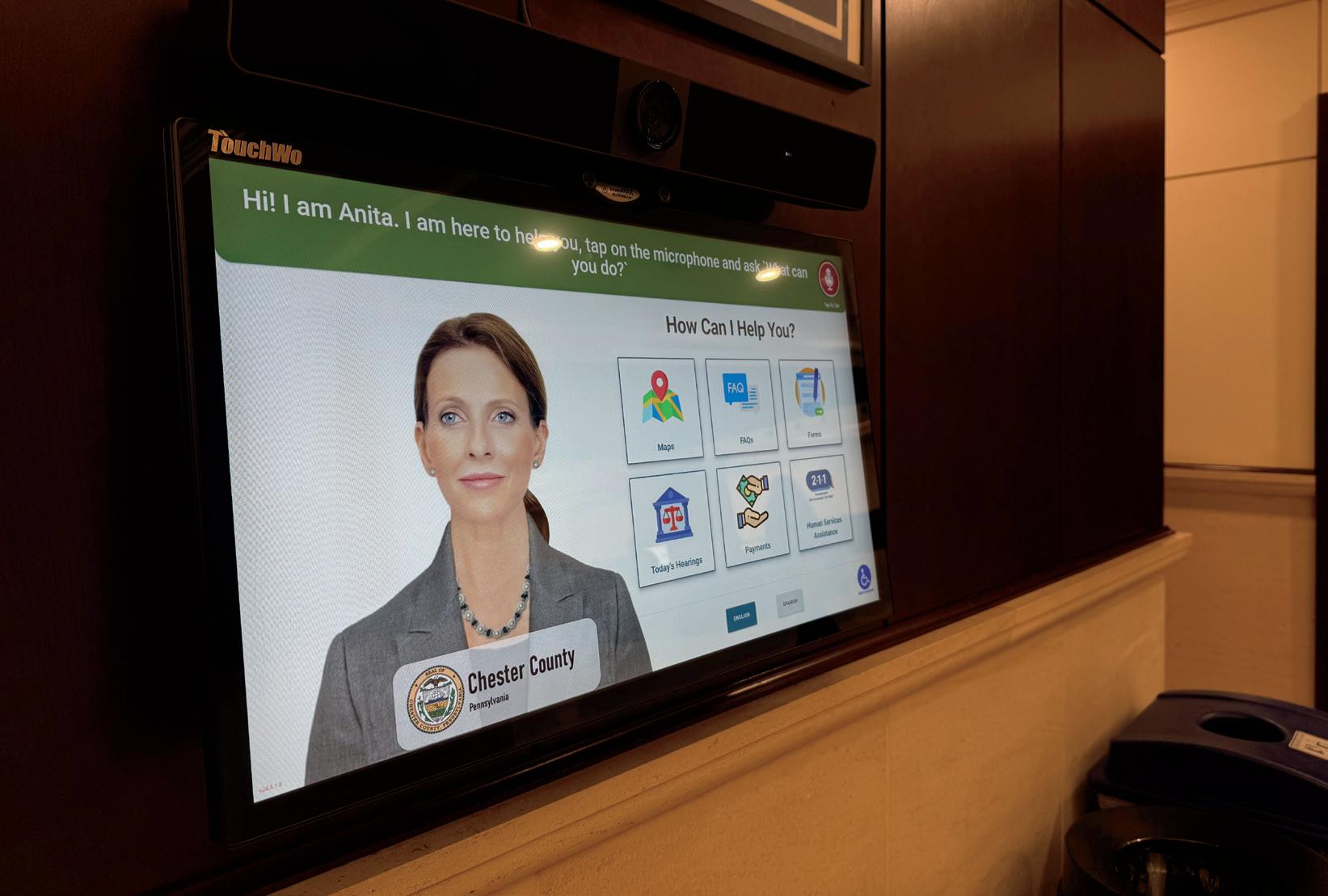
In January, the Chester County Court Administration installed artificial intelligence-powered interactive information kiosks in several locations throughout the county. The touchscreen and voice-activated kiosks assist users with accessing court forms, locating court offices and paying fines or bail with a credit card. The kiosks can also access the county’s Human Needs Network, other court departments and community partner organizations.
American Rescue Plan fully funding the kiosks. Chester County Court of Common Pleas President Judge Ann Marie Wheatcraft feels that AI can better facilitate the public’s access to courts and their services.
Chester County is the first in the state to implement interactive AI kiosks, with the
“We are installing AI-driven kiosks in several locations to make information and resources more accessible,” Wheatcraft said in a news release on Feb. 6. “Chester County courts are committed to investing in the improvement of services to Chester County citizens.”
The court administration installed the kiosks with an aim to ease the language barrier for Spanish-speaking visitors to the courthouse.
According to the U.S. Census Bureau, 13.3% of Chester County residents speak a language at home other than English. Chester County Court Services Administrator Suzie Marker helped create the kiosks and believes they can serve Chester County’s diverse demographic.
“We have a huge Spanish-speaking population in Chester County, and we don’t, unfortunately, always have people on staff here that speak Spanish to help them. So, we looked at different technology,” Marker said. “A couple people (who work for the county) saw this kiosk that had been developed in New Mexico for an area that had a lot of dialects.”
Marker also believes the kiosks will help visitors navigate the large courthouse.
“A lot of times people come here, and they don’t know where they’re supposed to be,” Marker said. “It’s not always your best day when you’re coming to court. Usually, it’s not for a good reason. People are upset or maybe anxious.
Conestoga High School, Berwyn PA, 19312
75 No. 5 March 21, 2025
Nolan Talley Sta Reporter
Je rey Heng/The SPOKE
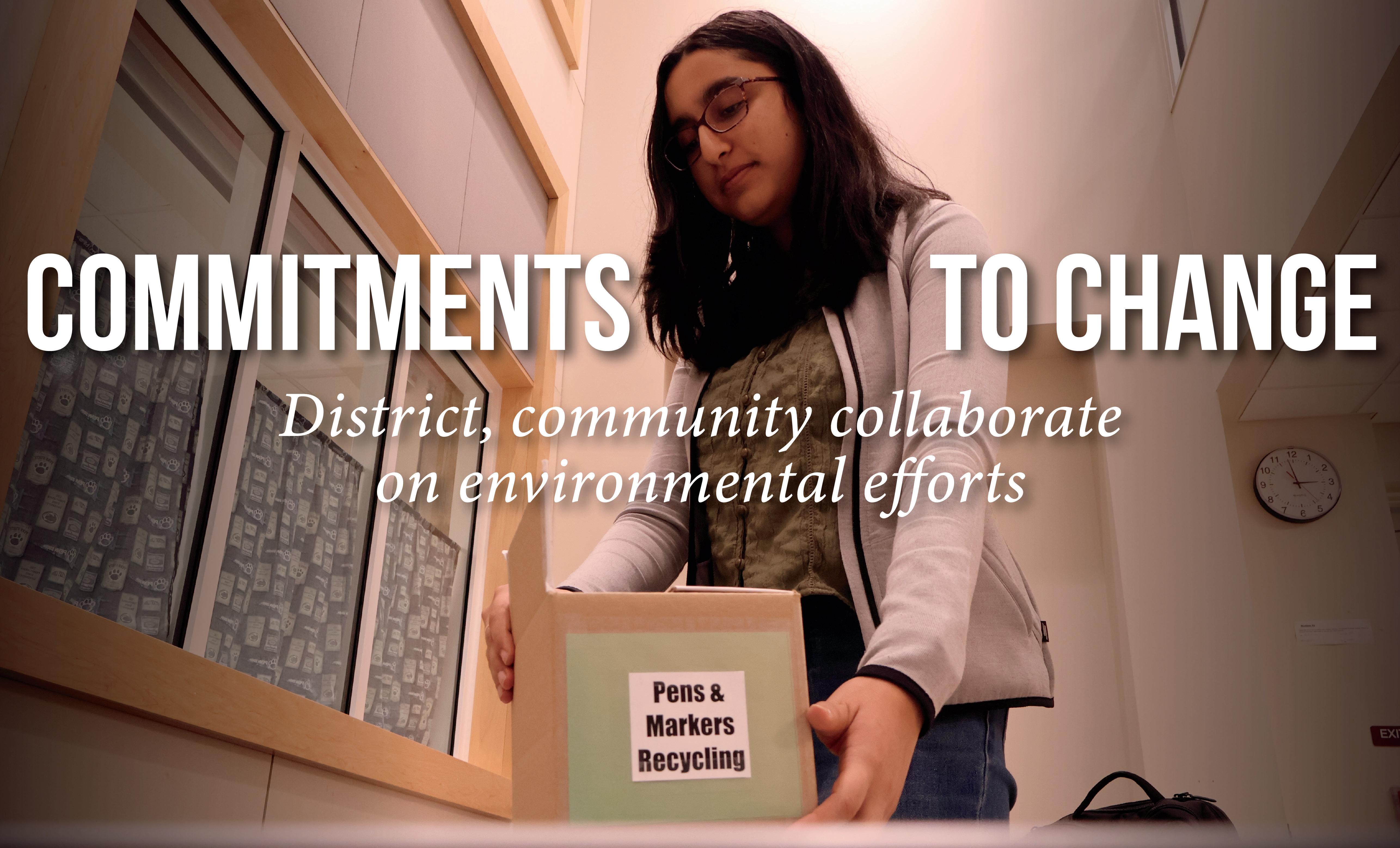
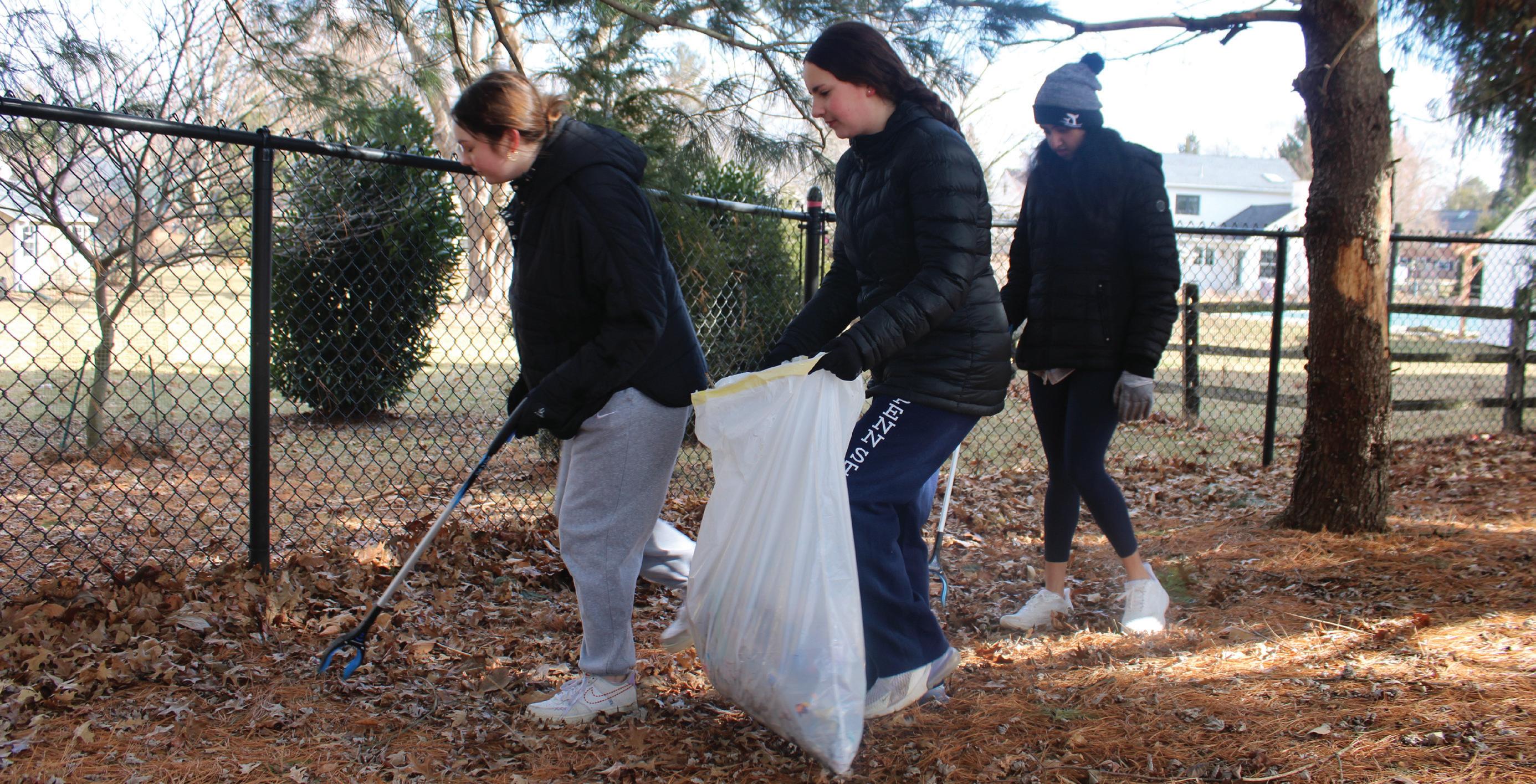
Setting sustainable standards: Senior Shriya Prakash places a collection box on a table
THE LATEST DEVELOPMENTS
IN T/E AND NATIONAL NEWS
PRESIDENT SIGNS
EDUCATION-RELATED ORDERS
President Donald Trump has issued various education-associated executive orders, receiving support and defense to criticism and legal challenges. Orders include the “Ending Illegal Discrimination and Restoring Merit-Based Opportunity” to end “diversity, equity, and inclusion” or “diversity, equity, and accessibility” federal systems, and the “Ending Radical Indoctrination in K-12 Schooling” to remove federal funding for K-12 schools with “gender ideology and discriminatory equity ideology.”
LOCAL FIRE, EMERGENCY SERVICES RECEIVE GRANTS
On Feb. 13, the Pennsylvania O ce of the State Fire Commissioner announced grant awards for more than 2,500 re departments and emergency medical services. Berwyn Fire Company and Paoli Fire Company received around $62,000 in total.
On March 5, the Pennsylvania Department of State announced the implementation of Civix as the new election management system for the Commonwealth. Administration aims to nish the systems by 2028 with features such as election night reporting, campaign nance, and lobbying disclosure. It replaces the current Statewide Uniform Registry of Electors system.
EASTTOWN TOWNSHIP
NEW ADVISORY BOARD
On Jan. 21, Easttown Township created the Citizen Communication Advisory Board, a group of volunteers to evaluate and recommend ways the township can reach out to the community as well as provide information. Township administration is accepting applications for members.
Paoli Fire Company, senior living community open new substation
During a conversation between the re company and Echo Lake discussing ways they could help each other, members decided to pursue the substation project.
a transport unit to the substation once it carefully evaluates response times and distances.
“Time is life, whether it’s a heart attack or a stroke. Time is brain, time is heart,” Wert said.
“It’s
On Feb. 3, a new Paoli Fire Company Emergency Medical Services substation opened at the Echo Lake Senior Living Community in Malvern. To speed up response times for residents and neighboring communities, the Paoli Fire Company and senior living community collaborated to build the smaller facility with equipment and personnel.
Timothy Wert, the Paoli Fire Company Advanced Life Support coordinator, acted as the liaison between the Emergency Medical Services division and the Malvern county government communication center. He set up radio identi ers, completed paperwork and met with the center’s department heads to work on the station.
“Our biggest concern was our response times, whether it was Echo Lake or the residents in that general area,” Wert said. “ rough conversations with them and just a great partnership that we had already established, we made a mutual decision to work together.”
To prepare the facility, the senior living community provided the o ce space, parking spots and outlets for operating equipment, while the re company sta ed it with personnel. e process took around seven to eight weeks.
“It was really a mutual conversation that we started talking about and nding ways that we could better collaborate and guring out what we could do to overall help each other out,” Wert said. “We communicated with the municipalities, (made) them aware of what we were doing, then met with department gures at the county level to orchestrate the county dispatch system.”
Prior to the new substation, long-term construction on the nearby Morehall Road increased the re company’s response times to Echo Lake from its main location on Darby Road. Approximately 11-and-ahalf minutes, the re company aimed for a new response time of around eight minutes with the Echo Lake substation.
In the future, the Paoli Fire Company may consider adding
School administrators review schedule for next year
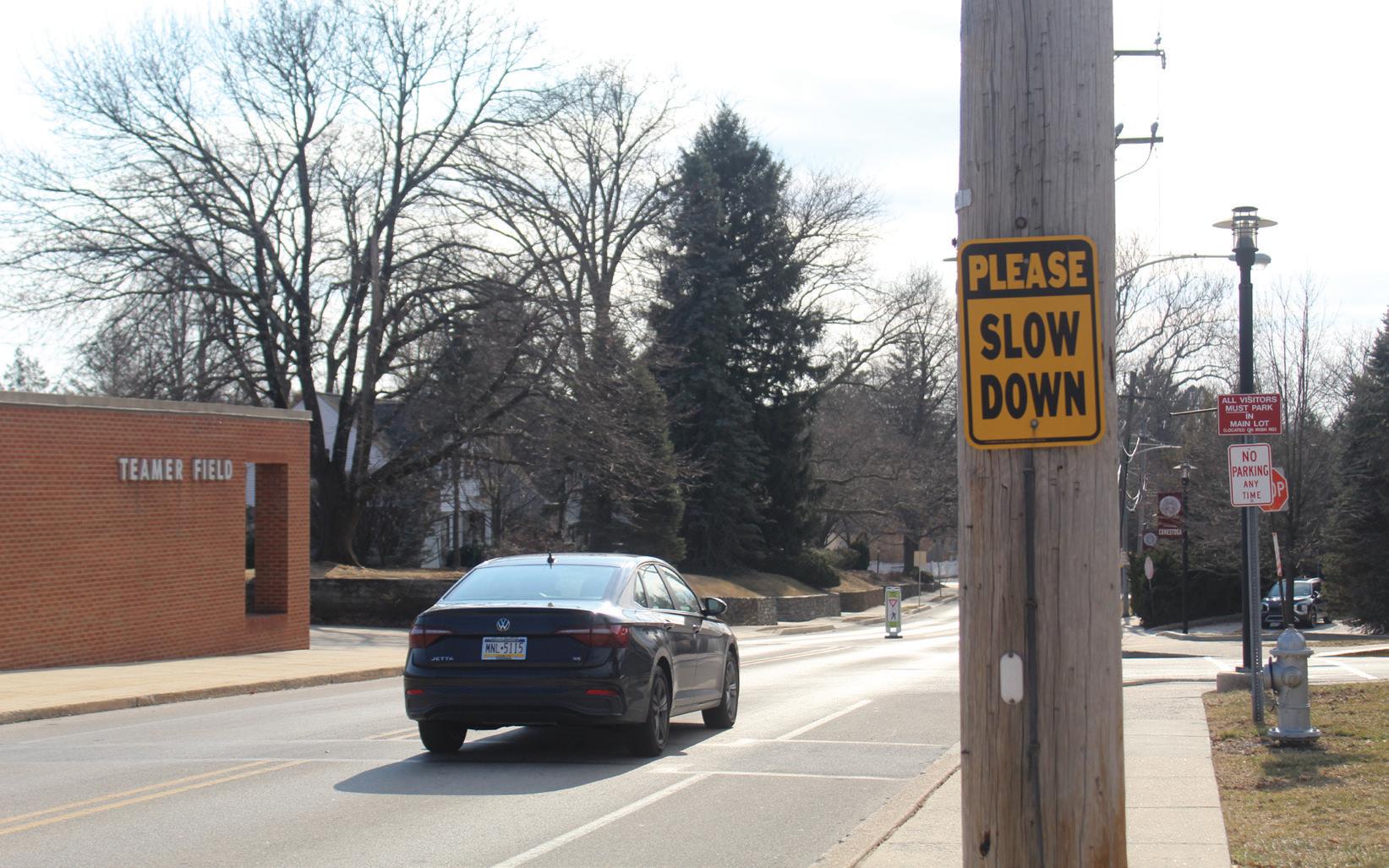
is January, Tredy rin Township o cials revised the speed limit on Conestoga Road, decreasing it from 35 mph to 25 mph. e street borders Teamer Field, and sta and students use it to travel from school.
e change addresses longstanding concerns from community members about speeding vehicles, especially in school areas. TV studio aide Francesca Einstein created a video announcing the change, and on Feb. 4, the package aired on Good Morning ’Stoga.
er Alexandra Williams uses the road o en to travel from home to school as well as meet friends in Paoli. As she normally is more careful around the area, Williams found that remembering the change was the most signi cant part of the process and did not personally feel it had immediate e ects.
“This is mostly because I’m already cautious, especially around the middle school,” Williams said. “It’s a pretty short stretch of the road that they changed the speed on.”
course available to 10th, 11th and 12th graders to learn how to drive safely. He hopes that the speed limit decrease encourages students to be more cautious when driving around the school.
“All drivers need to understand the reasons for speed limits,” Moran wrote in an email. “These are not set to give us a hard time or make our travels more challenging. Speed limits are set based on road conditions, risk, and many other factors.”
Since the change, Einstein has seen drivers slowing down when near the road for lming.
Last year, the Tredy rin/ Easttown school board approved a new mixed-model schedule that Conestoga implemented at the beginning of the 2024-25 school year. Students and teachers follow an alternating “Garnet” and “Gray” ve-day schedule instead of the previous six-day cycle. Wednesdays and ursdays consist of four block classes and a onehour “Lunch and Learn” period for the whole school. e school board reviews the schedule for the upcoming school year each March, and this year, it intends to maintain the current schedule. Eleventh grade assistant principal Dr. Matthew Sterenczak said that the layout of the Program of Studies is an important factor in the decision to keep the schedule unchanged.
“When we did the schedule change going into this year, you get rid of the six-day cycle. Your points to credit courses became 0.25 credit courses, so no changes were made from that degree be-
cause we already have (the credits) laid out,” Sterenczak said. “I don’t anticipate any changes, but if there was something coming down the line, it would be more complex than just saying, ‘We’re gonna do this now,’ because we have our courses lined up under the new schedule.”
Students and sta have expressed mixed opinions about the mixed-model schedule. Advanced Placement Physics C: Mechanics teacher John Kim expressed concerns about the growing workload for students who miss block days.
“I’ve noticed students who are stressed out because they miss a block day, and it’s hard to catch up when you miss two days (worth of material), and when they’re taking six AP classes or ve AP classes, it becomes overloaded and really di cult to catch up on (schoolwork),” Kim said. Others believe the mixedblock schedule o er bene ts, such as the new Lunch and Learn period. Senior Joaquin Orellana Herrera feels that the Lunch and Learn period allows
for more exibility and opportunities than the previous sixday cycle schedule.
“You can meet with teachers much more easily,” Orellana Herrera said. “I run a couple of clubs, and we’ve seen a lot more people when we do a Lunch and Learn meeting versus an a erschool meeting. I think it helps with the involvement of the student body a lot.”
School administration received feedback from the teacher and student surveys sent out on March 7 and 14, respectively. In the future, administration may re ne the schedule if needed based on feedback given.
“We always want the schedule to be beneficial for students and staff. That’s why we (created the mixed-model schedule),” Sterenczak said.
“If 70% of the staff came back and gave very pointed feedback about a specific thing we could change, and people said, ‘Hey, do this.’ We want to see that, we want to hear that, take that feedback, listening to the different concerns and make adjustments accordingly.”
“An elderly lady lives in the community, and she’s brought it up a few times at school board meetings. (She) is concerned about people speeding down that road, and so it was implemented about a month ago (for such concerns),” Einstein said.
Students have had various reactions to the limit adjustment. Junior and student driv-
Junior Allie Frederick drives on the road and feels that the lower speed limit is bene cial for members of the community.
“People are not used to going that slow. They usually want to get to where they’re going faster,” Frederick sent in a text message. “I think most people support this change, probably more parents than students. But it makes the road safer for everyone.”
Jim Moran teaches Highway Safety, a Conestoga
“Recently, we were outside filming, and we saw that the cars were going slowly so that was impressive. We thought, ‘All right, maybe this is gonna be a good change,’” Einstein said. “We want to make sure everybody’s safe going to and from school, so I think it’ll be a great opportunity for the community to come together and respect each other.”
Local investors form nonpro t to save historic theater
A group of local investors have launched the nonpro t Anthony Wayne eater (AWT) in hopes of saving the Anthony Wayne movie theater in Wayne. e theater, which was built in 1928, closed down in March 2020 due to the lack of business during the COVID-19 pandemic. e non-
pro t is laying the groundwork to revitalize the historic building through funding its reopening and transforming its interior.
Local business owner Todd Scott leads AWT, which plans to
District, community pursue environmental e orts
District targets additional aspects of sustainability plans
Aligning with the Renewable Energy Resolution’s commitments, the district has implemented various sustainable features on school properties and developed further environmental-based goals.
As part of the athletic fields project, the district plans to install photovoltaic solar panels on the roof of the field house. The district aims to publish a web page detailing the output and performance of the photovoltaic solar panel systems on a daily, weekly, monthly and yearly basis.
To help fund the solar panels, the district will receive money from the Solar for Schools Grant Program, which the Pennsylvania Department of Community and Economic Development established to reduce the cost of integrating solar energy systems into schools across the commonwealth.
“We’ve pursued the first item on sustainability (in the Strategic Plan): a robust process to pursue various avenues and consider innovative solutions,” school board ad hoc legislative committee chair Maryann Piccioni said. “That’s a very strong statement to make as the first item on our sustainability goals, so earning that Green Ribbon School District designation will provide us with the parameters to show that we have fulfilled as much of the sustainability Strategic Plan as possible.”
District, township work together to further environmental efforts
The Renewable Energy Resolution was initially based on a similar resolution the Radnor Township School District passed in August 2020.
“Contracts and engineering approvals are in place, with the installation scheduled between March 2025 and October 2025. The project aims to reduce the school’s reliance on conventional energy by generating solar power,” district Director of Equity and Public Programs Dr. Oscar Torres wrote in an email. “This grant will support the district’s Continued from page 1. Additionally, TESD has committed to more sustainable efforts through its 2022 Strategic Plan, such as providing more sustainable infrastructure and resources to accommodate its evolving needs. As it continues to pursue the sustainability goals, the district aspires to receive a Green Ribbon Schools award from the U.S. Department of Education that recognizes schools, districts and postsecondary institutions for their sustainable efforts.
commitment to sustainable resources. We look forward to the benefits this project will have on our energy goals.”
Over the last three years, the district has also renovated schools’ HVAC systems to be more energy efficient and, in turn, produce a smaller carbon footprint. Starting on June 19, the last schools — Beaumont, New Eagle, T/E Middle and Conestoga — will undergo HVAC renovations.
“It’s one of those things that are improving the district without being something that you can necessarily see from the outside,” Singh said. “People can see the new elementary school, people will see the new athletic fields. But there’s a whole sort of (system) that supports that.”
Debroy, Shui and Steege collaborated with members of the Tredyffrin Township Environmental Advisory Council (EAC) to write a version tailored to TESD and worked with the school board facilities committee to finalize the now adopted resolution.
“In the beginning, we didn’t know how impactful a resolution could be. In our journey, we o en felt like, ‘Is this going to actually make a di erence? (Does) what we’re doing actually have long term e ects?’” Debroy said. “I wanted to help the global climate crisis but also make a tangible effect on my community. I was just so grateful for this big opportunity: the three of us to write the resolution and try to get it passed.” Throughout the process, the members of Tredyffrin
EAC guided the students by providing advice and resources on sustainability options as well as resolution writing. The Tredyffrin EAC is a group of volunteers that the Tredyffrin Township Board of Supervisors appoints to help improve the township’s environmental quality through advising citizens and organizations on sustainable and environmentally friendly practices.
In September 2019, the council succeeded in helping advocate for the township’s passage of a resolution that commits to transitioning to 100% renewable electricity by 2035 and in all energy sectors by 2040. To promote the resolution, the EAC hosted a “clean energy tour” that highlighted clean energy efforts in the community. According to Tredyffrin EAC member Jennifer Cox, the group hoped to encourage other local organizations to increase their environmental efforts and felt that it was important to help the Conestoga students push for a similar resolution in the school district.
“That message coming from the students is so much stronger than anybody else telling the school district what to do. If it comes from within, and the students are pressing and saying, ‘This is what we want,’ the school district will listen so much more,” Cox said.
In the past, the EAC has also worked with TESD students and administrators on initiatives such as stormwater management. In 2021, then-seniors Sofia Khugaeva and Keira Celebuski worked with EAC members to test the conductivity and salinity of nearby Crabby Creek. The goal of the project was to investi-
gate if using salt on local roads
created unlivable conditions for Pennsylvania trout and other wildlife. Over the course of several months, Khugaeva and Celebuski sampled the water at several points of the creek, before ending their project with a presentation to the EAC on their conclusion: The salt created unlivable conditions in the creek.
“ at project showed me that even though we were high school students, these important elected o cials at the EAC were open to listening to us and taking our suggestions,” Khugaeva said.
in data analysis for the project.
Since then, the group has continued the stormwater management initiative through other efforts, such as moni-
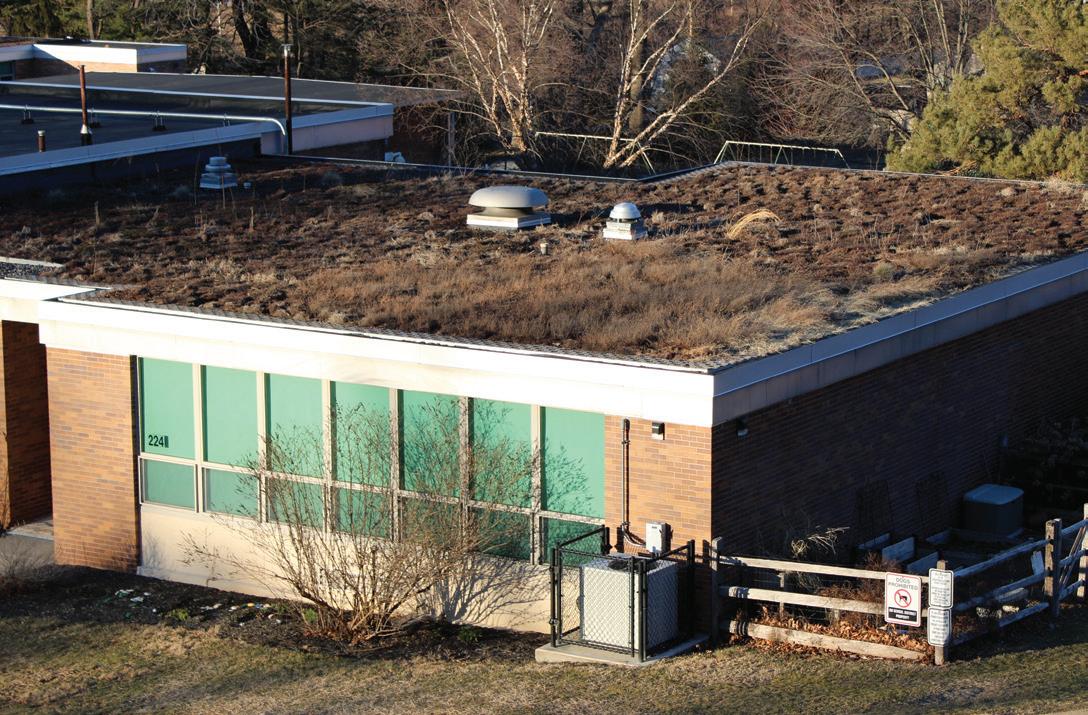
and funded the project through a Growing Greener grant administered by the Pennsylvania Department of Environmental Protection as well as a matching grant from the Valley Creek Trustee Council. By encouraging plant growth and facilitating ecient drainage, the roof reduces the volume of stormwater runo and moderates temperatures in the winter and summer.
It’s really important to think about not just our futures, but future generations. If we aren’t able to live sustainably, how are future generations supposed to do that? Lilly Shui
Class of 2022 alumna
toring the biodiversity levels in local streams and installing rain gardens and rain gauges.
The Tredyffrin EAC provided equipment and assisted
In 2010, the district and Tredy rin Township also collaborated to build the Hillside green roof
Governor aims to increase minimum wage to $15
Gov. Josh Shapiro presented his 2025-26 budget proposal to the state general assembly on Feb. 4. e proposal outlines various ways to improve the lives of Pennsylvanians, such as lowering healthcare and housing costs. Additionally, the plan discusses developing the workforce, investing in the economy and supporting students. To achieve these goals, one of
Shapiro’s main objectives is to increase the Pennsylvania minimum wage from the federal minimum wage, $7.25, to $15 per hour.
“We’ve spent so much time passing laws to put more money back in people’s pockets by cutting taxes. How about we put more money in people’s pockets by raising their wages?” Shapiro said in his Feb. 4 address. “ is budget places a special emphasis on lling critical workforce gaps. It makes strategic, common-sense
investments to give every Pennsylvanian a shot at success.” Shapiro’s plan projects to add $100 million in increased annual revenue to the commonwealth once implemented. With the wage increase, Shapiro hopes to help Pennsylvanians achieve nancial stability and decrease their reliance on public assistance programs. Senior Siyona Deb worked as an assistant German teacher outside of school and is excited about the proposed change.
“With an increase in pay, I would de nitely want to work more,” Deb said. “In this economy, a lot of people work two to three jobs just to pay living expenses, so doubling the wage would be a really good idea.”
e Commonwealth of Pennsylvania stated in a press release regarding Shapiro’s Feb. 4 address that Pennsylvania must take action to increase the minimum wage and compete with neighboring states that have already implemented
higher wages, like Maryland at $15, Delaware at $15 and New Jersey at $15.49. Freshman Sophie Norris, who works as a retail associate and cashier at a local shop, is hopeful that the proposal will be implemented.
“If everyone else is doing it, I think there’s probably a good chance that we’ll end up following their footsteps at least somewhat,” Norris said. “Even if it’s not as big of an increase as we’d hoped, I’m hopeful there will be one.”
e state House of Representatives passed a bill in 2023 to raise the minimum wage to $15 by 2026, but it has yet to make it out of committee in the Pennsylvania Senate for a potential vote. According to the Keystone Research Center, if the legislature passes the bill, more than 1.3 million Pennsylvanian workers’ wages would increase.
“As a high schooler, especially living in an a uent area, I don’t really need that money compared to people who need to work to support their family, relatives and stu like that,” Deb said. “While it doesn’t really impact me, it does impact other people, especially kids who have sick mothers or fathers and they need that money.
ey don’t have time to work a lot a er school because they need to stay in school, so with an increased wage, they would have to work less hours and can focus on their education and other parts of their life rather than just needing money.”
Jonathan Wilson is the Tredyffrin EAC chair and feels that the group’s efforts for sustainability and the environment within the community have been beneficial throughout the years — such as TESD’s commitments for sustainability and renewable energy.
“We’re going through this interesting energy transition where we’re moving to more renewable (energy), and in a lot of places, it’s become significantly cheaper than a fossil fuel source,” Wilson said.
“It’s a good thing for schools and for the public because it can both benefit everybody’s pocketbook and balance sheet, but also you reduce the costs that come from excess carbon emissions and pollution.”
Students lead clubs, community efforts to combat climate crisis
e district has also collaborated with clubs to continue its sustainability e orts. e Greening ’Stoga Task Force, a club focused on spreading sustainability within the
school and community, has taken various strides toward the goal.
It audited Devon Elementary School last year, when its members, including senior and co-president Shriya Prakash, analyzed the school’s different environmental impacts. This year, the club audited Beaumont in February and plans to audit Hillside.
“We’re looking at the environmental impacts of elementary schools in multiple di erent areas, so in consumption and waste, water, energy use, food, all of that kind of stu ,” Prakash said. “We come together with all of these to (create) a report, which is basically what we found and some recommendations to make it better.”
Prakash and other club members attended the school board’s strategic planning committee meeting on Jan. 30, where they presented their audit ndings and suggestions for improving the elementary schools’ sustainability to district administrators. In addition, the club is hanging up posters with eco-friendly messages around Conestoga as well as placing collection boxes to recycle pens and other writing utensils.
By working with the district, Greening ’Stoga Task Force and other students have led the initiative to increase awareness of the environment and sustainability e orts.
“I feel like we’re getting to a really pivotal point where the e ects of climate change (are) starting to become irreversible, and if we don’t take action now, it’s going to reach a certain point where there’s nothing we can really do about it,” Shui said. “It’s really important to think about not just our futures but future generations. If we aren’t able to live sustainably, how are future generations supposed to do that?”
Growing green: Hillside Elementary’s green roof, built in 2010, helps manage stormwater by reducing runo . Since then, TESD has worked to continue its environmental initiatives in the district and community.
Vanessa Chen/The SPOKE
Tvisha Jani Sta Reporter
Heading to work: Freshman Sana Bhattacharyya arrives at the Trinity Presbyterian Church of Berwyn’s nursery school, where she works with freshman Sophie Norris on the weekends. She has volunteered at the church
Artistic immersion: Spanish 4 students visit Museum of Modern Art in New York
Nishta Subramanian Staff Reporter
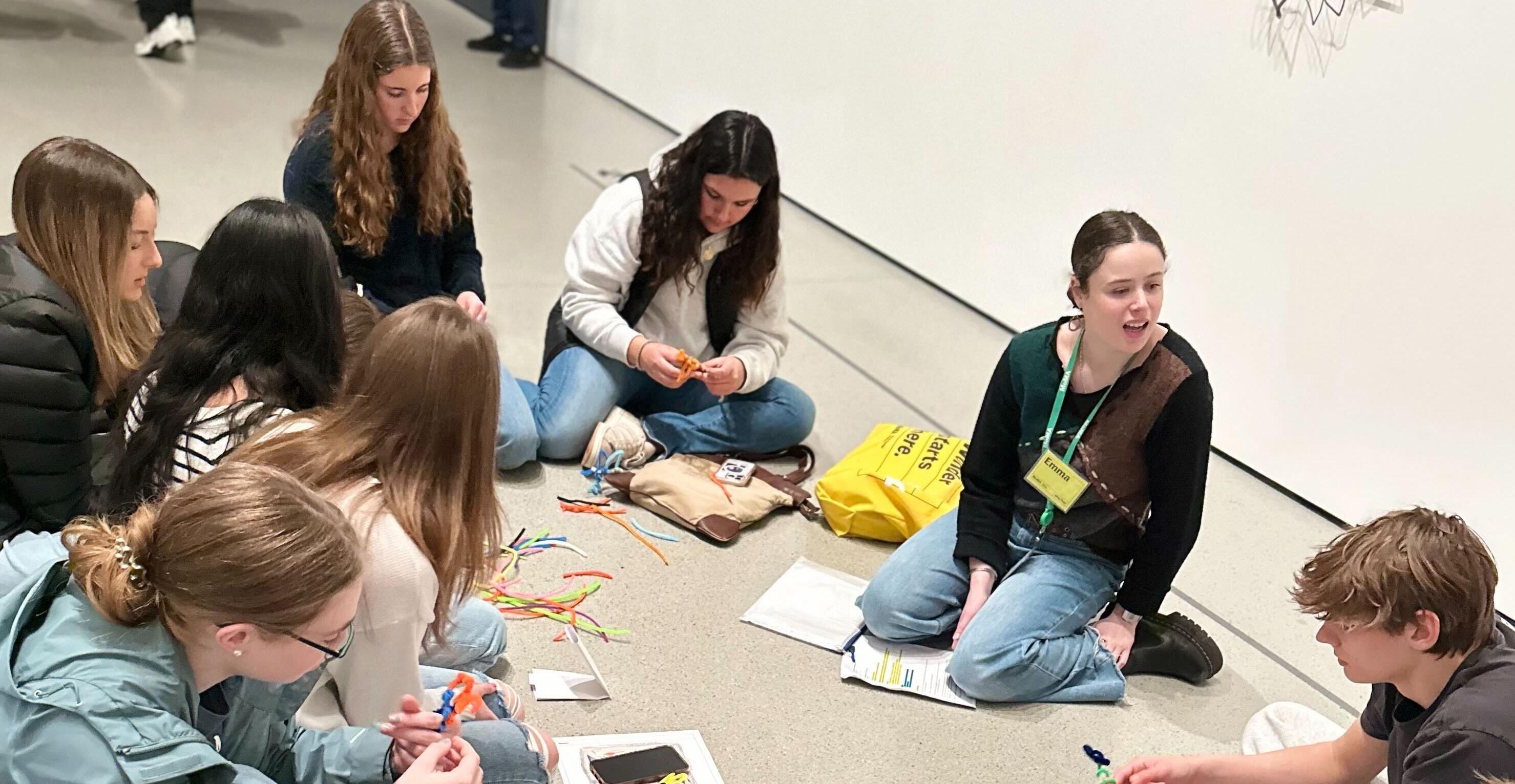
Wanting to teach Hispanic culture not just from textbooks but through field trips and projects, Conestoga’s Spanish department organized a field trip for Spanish 4 students to The Museum of Modern Art (MoMA) in New York on March 3. Forty-four students went on the field trip, learning
and connecting to their three class units about famous Spanish artists.
Until this year, the class field trips for Spanish students had been suspended because of the COVID-19 pandemic. Spanish and French teacher Alice Havrilla planned this trip for the first time this year, taking inspiration from the French class trip to the Barnes Foundation, an art museum in Philadelphia.
“The goal of the trip was to get a feeling of what paintings from these artists that we’ve been talking about in class look like in person,” Havrilla said. “My hope is that students can recognize (the paintings) in the museum, and feel like, ‘Oh, wow. This is something that we did in class that’s so cool. I recognize this characteristic about this artist.’”
Having emphasized different Hispanic artists in class, the Spanish 4 teachers gave the guides at MoMA a list of artists the classes learned about, and they chose the best paintings and art to showcase. Some unique artists that the classes studied were Diego Velázquez, Frida Kahlo and Fernando Botero.
“If somebody really likes history or introspection into an artist, the guides are trained professionals, and they can tell them more about it, maybe some fun facts that I wouldn’t know to tell them in a lesson,” Havrilla said.
The itinerary for the day consisted of a two-hour chartered bus ride to New York, a guided tour of Spanish artists in MoMA, then a 10-minute walk to The Hugh food court in Manhattan and finally the bus ride back to Conestoga. Sophomore Chloe Proud attended the field trip and enjoyed seeing the different paintings in the museum.
“We got a tour from a tour guide in the museum, which I thought was really cool because we learned more about the pieces than we would have if we had just walked around,” Proud said. “My favorite part of the day was walking around and being able to see all the different kinds of art.”
Coding with a purpose: Students create online options trading simulator, see success
Mary Wolters Design Editor
Over the pandemic, junior Jeffrey Wang developed an interest in an aspect of market trading: stock options, which are contracts that give the buyer the right to buy or sell a stock for a specific price at a later point. However, due to the complexity of option buying, Wang noticed a lack of resources and free option simulators online. To help introduce youth and beginners to option trading, Wang teamed up with senior Rohan Anne to develop and launch the award-winning website LemonadeChains, named after the example of a lemonade stand to explain basic economic concepts. This January, the program placed second in the Congressional App Challenge, a state-level competition where high schoolers can submit computer science programs and earn recognition from government officials.
“Something that I like doing is thinking about how to take my skills and make something out of it,” Wang said. “You’re going to run into a lot of problems in life. And for me, that problem
was I couldn’t find any simulators online that I wanted to try. After you’ve run into those problems, you’re going to realize that you actually have the ability to solve a lot of them.”
In LemonadeChains, users can complete educational lessons using stock options. The website has two sections, LemonadeLearn and the Simulator, to help users develop trading skills and then apply them in a simulated market.
The goal is to get users comfortable and help them succeed in the real market. Since its public launch in 2024, LemonadeChains has engaged over 534 users who have made accounts and participated in the Simulator by buying and selling stock options. The team used multiple computer science languages and libraries to implement this project.
“There’s a reason why no one has done this before. It’s because it’s pretty difficult to do, but then (by) embracing that and seeing there are resources online that are free, we’re able to take advantage of (them),” Wang said. The duo submitted its website to U.S. Rep. Chrissy Houla-
han for the Congressional App Challenge. The competition was first launched in 2015 to inspire students around the country to develop online programs to solve real-world problems.
“It (the award) helps when talking to other people about (the app),” Wang said. “But I think for me, personally, it mattered more that we created something that was usable and could actually do something.”
In the future, Wang and Anne plan to continue developing LemonadeChains and improving its technical interface. Wang hopes that the users of LemonadeChains will benefit from trading in the Simulator and have the skills to make informed choices in the future.
“We’re not trying to create something just because we want to practice our coding skills,” Wang said. “It’s because we wanted to reach that group of people that I know exists because I was part of that group of people who were looking for a simulator online that was free (and) easy to use. I’m hoping other people gain that experience that I didn’t have.”
NECTAR Restaurant & Lounge :
Raima Saha Co-Managing Editor
Warm, ambient lighting and vaulted ceilings lead the way to an 18-foot silk-screen depiction of the Buddha as my family and I enter Nectar Restaurant and Lounge. One Direction’s “What Makes You Beautiful” plays in the air, an unexpected but not unwelcome choice in music.
An Asian and French fusion restaurant, Nectar uses fresh, locally sourced and sustainable ingredients in every dish. Included on the website is a list of local farms it works closely with, a nice touch to ensure transparency with its customer base.
We started off with the chicken curry dumplings served with a spicy red curry peanut sauce for $12. The perfectly crisped dumplings alongside the dipping sauce provided complex savory notes that balanced out the dish. The crispy calamari and edamame, $19, came with a spicy papaya and tamarind hoisin sauce. The calamari was white and rubbery and the edamame seemed to be an afterthought that didn’t complement the calamari.
For the entree, we ordered the wok Amish chicken and gulf shrimp for $29. The Vietnamese lime basil sauce was gelatinous and overly sweet, diminishing the simple flavors of the crispy chicken, shrimp and lots of vegetables. The portion size was smaller than expected, though it did come with a side of rice.
We also ordered the saffron-infused basmati fried rice for $17. The saffron gave the rice a subtle aroma that added flavor and went well with the veggies and chicken. The chicken lo mein for $19 did not disappoint either, with a garnish of baby greens adding levity and freshness to savory, smooth noodles.
To finish off the meal, we ordered the “hot fresh” mini doughnuts for $12 to indulge in a sweet treat. The “doughnuts” would be best described as mini churros, reinforced by their cinnamon sugar coating and three dipping sauces: spiced chocolate, raspberry vanilla and coffee caramel. Misnomer aside, the doughnuts were delicious, and each sauce provided a variety of flavors that satisfied my sweet tooth.
of
but I
For $14, the Nectar Valrhona chocolate cake was divine, with rich raspberry coulis surrounding the decadent mousse. However, the raspberry coulis was pungent, and its tang overpowered the chocolate, making it difficult to eat. Nectar is a higher-end restaurant with prices to match. The total came to $129.32 excluding tip for the four of us. At such a high price point, I expected more
and
Pro programmer: Junior Jeffrey Wang codes in Python using Visual Studio Code, a code editor that allows users to code in multiple languages. He worked with senior Rohan Anne to develop and create LemonadeChains, which placed second in the state Congressional App Challenge.
Mary Wolters/The SPOKE
Raima Saha/The SPOKE
Viewing art: Spanish 4 students view an exhibit at the Museum of Modern Art in New York as part of a class field trip on March 3. Prior to the trip, Honors and Accelerated Spanish 4 students learned about different Spanish, Mexican and Colombian artists across three units.
August Zangrilli/The SPOKE
Working together: Spanish 4 students complete an activity as part of their class trip to the Museum of Modern Art (MoMA) in New York. The Spanish teachers gave a list of the artists they focused on in class to the museum tour guides so that they could highlight these artists’ work at MoMA.
Courtesy Alice Havrilla
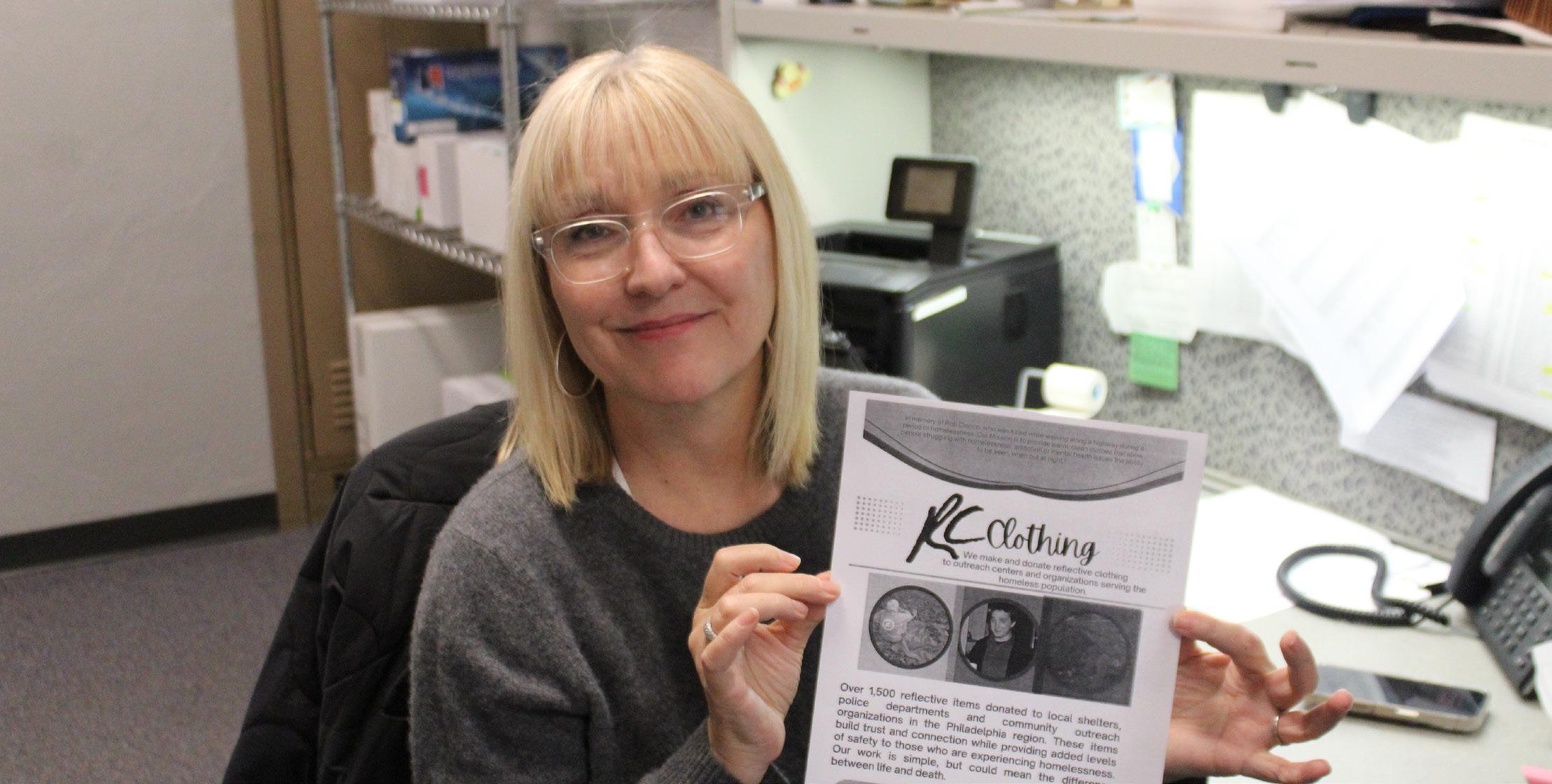
Staff member helps homeless community
After the loss of her son
family decided to start
RC Clothing, a platform that raises awareness and donations to help homeless people across Chester County. Understanding the difficulties in helping people facing mental health challenges, the Ciocco family believed it would be beneficial to lead with acts of kindness to help people stay safe while traveling at night. Donating reflective gear to those in need who walk at night became a priority.
RC Clothing’s mission is to aid homeless people in the Chester County community in a way other than shelter or treatment. It hopes to raise awareness about the daily risks the homeless community faces and encourage others to contribute through small but meaningful actions.
“Our mission is to provide warm, clean clothes that allow people struggling with homelessness, addiction or mental health issues the ability to be seen out in low visibility situations,” Alice Ciocco said. “It’s a small and simple act with significant impact.”
To kick off the initiative, the Ciocco family started an online fundraiser to garner
support and funds. The family then began to work with multiple organizations across the Philadelphia area to expand RC Clothing.
“We started with a GoFundMe page for Rob and raised over $11,000,” Alice Ciocco’s daughter Nicole Ciocco said. “From there, we partnered with a nonprofit organization to help us transition into a nonprofit to help
increase funding and supplies for the community.”
Afterward, the family began to work at local community events to raise awareness about the mission. The family decided to expand and partner with a wider range of platforms to grow the initiative.
“We have partnered with an online platform to sell T-shirts with the RC brand for fundraising and with the
police departments to give gear to people in need,” Nicole Ciocco said. “We have also partnered with homeless shelters, rehabs and other community support for people in need.”
RC Clothing hopes to extend a helping hand to the Conestoga community as well. By donating reflective clothing and aiming to aid even those who do not seek
help, the family aspires to create a safer and more compassionate environment for those in need.
“I truly hope that this helps people understand that we are not powerless. We can choose to do something,” Alice Ciocco said. “Any act of kindness can make a difference in this world. You never know whose life you may change for the better.”
NAHS plans first-ever spring craft fair
Madeline Pulliam Co-Staff Development Director
In December, the National Art Honor Society (NAHS) displayed handmade bracelets, crocheted keychains and paintings on tables throughout the atrium, giving students an outlet to share their creations as a part of its first-ever craft fair.
For the winter season, the items for sale varied from stuffed animals to holiday cards. After the success of the winter sale, NAHS members are planning another craft fair this April, marking the first NAHS spring craft fair.
“We wanted to host the craft fair as a community event so that students who were a part of NAHS and also students who were just involved in the arts who were not a part of the honors society could have the opportunity to sell their art and engage the school more in the art department,” senior and NAHS president Katelyn Wang said.
There are a wide variety of art classes available at Conestoga, including Ceramics, Drawing and Painting and Studio
Art, which is a four-year visual arts program. Most of the participating students made their creations independently for the fair, but some sold art they made in their art classes.
“There is so much talent in the organization, and we all have the opportunity to encourage each other and make each other even better artists,” senior and NAHS treasurer Annie Carson said. “It is so cool for NAHS members to be given the chance to share their work with the whole school community.”
The December craft fair was strictly for NAHS members, but NAHS board members hope to open it up to more of the Conestoga community for the spring fair. They also aim for the event to unite more of the school community and for the fair to become an annual event.
“Look out for the upcoming craft fair hopefully in April,” Wang said. “We called it the first annual craft fair because we are hoping that this becomes a tradition the future leaders of the National Art Honors Society can continue doing and make it even bigger and better.”
Sisters volunteer at Latin American community center
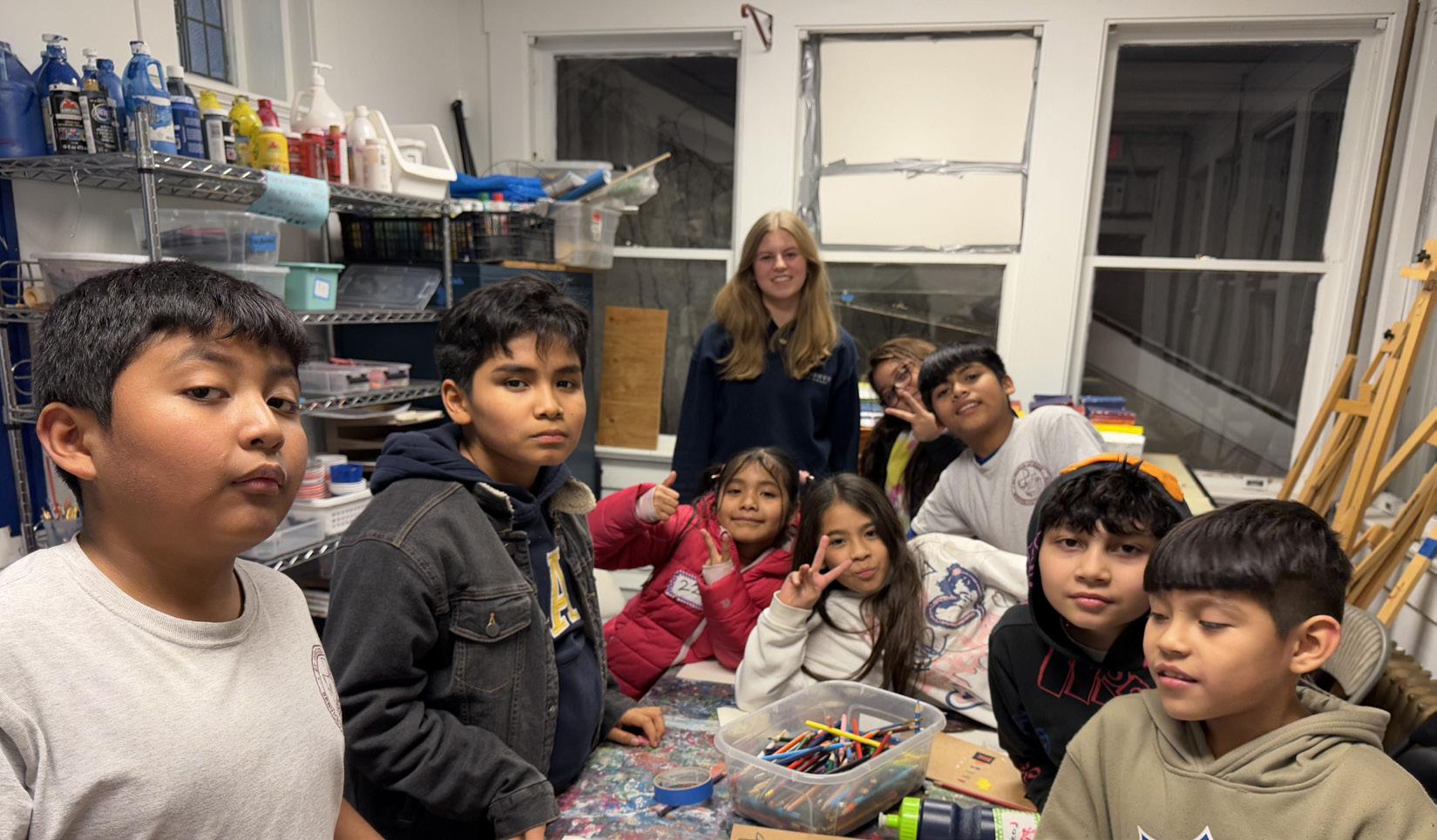
In the heart of Norristown, Centro de Cultura, Arte, Trabajo, y Educación (CCATE) has become a lifeline for local Latin American families, offering after-school care, language classes and a sense of belonging for kids. Founded in 2009, the organization now serves hundreds of people in the community.
Sisters junior Louisa Sandorff and senior Sabrina Sandorff are part of this community, both of whom starting as students at CCATE and returning as volunteers last year, teaching classes and mentoring younger children.
Sabrina Sandorff’s journey began when she was in middle school and joined the center to take music classes. Having played the ukulele
since sixth grade, Sabrina Sandorff quickly realized she wanted to share her passion with others.
“I knew how to play the ukulele and guitar, and when I started volunteering, I thought, ‘I want to teach these kids what I know,’” she said. “Now, I teach ukulele to middle school students every week, guiding them through chords and helping them play their favorite songs.”
Louisa Sandorff, who has always been interested in language and storytelling, took on a different role at CCATE. She teaches Babel, a class inspired by the Biblical story of the Tower of Babel, and focuses on communication and language.
“The director knew I was interested in journalism and writing, so I proposed to him
this Babel class last year,” Louisa Sandorff said. “I now have kids from 8 to 12 years old who I give prompts to. They write and sometimes put a little picture along with their writing. Then, I publish it to CCATE’s magazine, Rearte.” The Sandorffs share a strong connection to their Hispanic roots, which has allowed them to bridge cultural and language gaps in the classroom. They often address the classes in Spanish, ensuring all students feel included, regardless of their language proficiency.
“There’s actually a big (Hispanic) community out in Norristown. There isn’t such a big community around here but definitely going over there and seeing how many people there are that come from sim-
ilar roots as us is really cool to see because we didn’t have that much of that community growing up,” Louisa Sandorff said. For both sisters, the most rewarding part of their volunteer work is building relationships with the children. In the future, they plan to continue their work with CCATE, even after they graduate high school.
“Sometimes it can be a little chaotic, but the kids are really good at working. I definitely think that being in an organization like this honestly just makes you a better person,” Louisa Sandorff said. “Not just that, but it also makes you feel better about yourself, so I would say that in college or beyond, I would like to be part of an amazing organization like this.”
Zara Samdani
Co-Managing Editor
Rob Ciocco in November 2021, Conestoga parent and Business Office secretary Alice Ciocco and her
Sosi Sengal Staff Reporter
Working for change: Junior Louisa Sandorff teaches a writing class for CCATE, a Norristown-based organization that empowers Latin American youth. Sandorff joined the organization three years ago, now mentoring 20 students.
Courtesy Sabrina Sandorff
Working for change: Business Office secretary Alice Ciocco poses with a flyer for RC Clothing, promoting the organization and sharing its goals. She started the organization to donate reflective clothing to homeless people in Chester County.
Sosi Sengal/The SPOKE
’Sto ga Theatre presents...
CHICAGO
This year, ’Stoga Theatre presented “Chicago: Teen Edition,” a jazzy Broadway musical about two women in jail for murder and their lawyer’s attempts to turn their trials into glamorous shows.
Seniors Emma Arruda and Caroline Morrissey played the roles of Roxie Hart and Velma Kelly, respectively, and senior Orlando Campos Cruz as their lawyer, Billy Flynn.
The multilayer set captured the ambiance of
Chicago in the 1920s. Additional features, such as the drop-down sets and items, color-changing lights and integrated audience seating, allowed for more dynamic action in the musical. Performers served audience members at tables on the bottom level of the stage with Chicago-style snacks like deep-dish pizza, Wrigley's gum and party dogs. Arruda felt that the set this year elevated her experience on the stage.
“The set this year is really awesome. The stage crew this year worked really hard to make sure that it really showcases the entire cast,” Arruda said. “Not only do we have cast members on different levels, but we also have the pit on stage, which is something we have never done before, and it is super cool.”
Scenes like “Cell Block Tango” featured life-sized jail cells coming out not only from the wings but also from the ceiling, with moving lights and props such as chairs that made each
dancer's experience and individual parts unique. In the scene “Nowadays,” two boxes came out from each side of the wings with the lit-up words “Velma” and “Roxie”, amplifying the main characters’ presence on the stage.
“Chicago: Teen Edition” featured some alterations in dialogue and lyrics from the Broadway version. However, for a handful of songs, the actors danced the original Broadway choreographies in the show.
“In the beginning of ‘All That Jazz,’ and in the end with me and Caroline, who plays Velma, it’s that original choreography,” Arruda said. “So it added
another layer to throw in the learning process that we haven’t done before.”
Members of the cast were proud of their work and the final show they were able to create. The performance attracted large audiences and standing ovations.
“It's the best feeling getting to perform for an audience and show everyone what you've been working so hard on because we've almost been rehearsing every day for the past month or so,” Morrissey said. “I'm up there with some of my best friends, and so I just have fun every night, and I look forward to all the shows.”
Hair and Makeup Crew
The Pit
pit
started
for
early January, rehearsing every Wednesday after school. The ensemble kept most of the original songs, only cutting small parts or changing keys to accommodate the cast.
This year, the pit was on stage under the musical set with stand flashlights to help them read sheet music in the dark.
With different sections designated for various instruments, the front row had two violinists, three clarinetists and three saxophonists. Behind the violins, the trombones were on a riser, with the trumpets further back. The setup also included a drum set, while beneath each staircase, there were two pianos, a tuba player, a bassist and a guitarist.
Ryan Crill, a senior alto and soprano saxophone player, enjoyed the integration of the pit orchestra and the set.
“I thought it was really fun to be able to see what's going on and just be able to follow the plot pretty well,” Crill said. “It just also was a cool arrangement to be able to see the set and everything that was happening.”
With over 50 actors to get ready, the hair, makeup and costume crews were busy during rehearsals and before shows. The costumes were made to fit the jazz theme of the 1920s. Morrissey appreciated the outfits for this unique theme.
“Between the set and the costume designs, the vision of the show just came to life,” Morrissey said. “I was able to see my character then be represented through costume.”
Sophomore Joely Lin was a part of the makeup crew this year. As a member,
Written by Bailey Kreszswick, Lexi Lin and Anvita Mohile Co-Multimedia Editor, Social Media Editor and Staff Reporter
Designed by Mary Wolters, Design Editor
she did touch ups to get ready for the excitement.
“The music hallway, we'd do all the makeup there. It's a narrow hallway, so it got chaotic,” Lin said. “It’s stressful for the first hour when everyone's there because there were 50 people that came in for two hours to get the actors ready, but I’d say that’s really fun.”
Since “Chicago” covered important motifs of glamour and fame, the costumes, hair and makeup crews used bolder designs for their dresses and makeup.
“The girls, they have to wear a bright red or pink lipstick,” Lin said. “Everyone gets a lot of blush, but the guys get eyeliner. A lot of the featured ensemble had to wear wigs too.” For her first year in the musical, Lin enjoyed the overall experience. She met many actors throughout the duration of the musical.
“Getting to know the actors whose makeup I was doing was nice,” Lin said. “They were really nice and a lot of my friends were there as well, so it was fun.”
Don’t mess with Mama: Junior Izzy Abramowitz plays the role of the prison warden, Matron Mama Morton. She sang her solo “When You’re Good to Mama” in Act I to demonstrate her social in uence in the Chicago jail system.
Rowan Chetty /The SPOKE
The
orchestra
preparing
the show in
Fluttering fans: Senior Orlando Campos Cruz sings the song “All I Care About Is Love” as Billy Flynn, the lawyer. The featured ensemble accompanied Cruz throughout his solo number.
Je rey Heng /The SPOKE
Flashing lights: Lead characters Roxie and Velma, played by seniors Emma Arruda (le ) and Caroline Morrissey (right), end the show with the cast performing alongside them. With the illuminated Chicago sign displayed in the back, they closed with "Nowadays."
Rowan Chetty /The SPOKE
Dazzling duo: Seniors Emma Arruda (le ) and Caroline Morrissey (right) who played lead characters Roxie and Velma respectively, sing their duet “My Own Best Friend.” They took center stage together for the dramatic nale of Act I.
Rowan Chetty /The SPOKE
Scan the QR code to watch an accompanying package
Biology teacher, senior search Conestoga for new species of yeast
Sadie Chronister Sta Reporter
In 2022, biology teacher Derek Bosworth began researching yeast after meeting Dr. Robert Ballard, a professor at Clemson Universi-
ty who found a new species of yeast. Bosworth had the question of where somebody might go for yeast. He decided to answer this question in his biology master’s final project at Clemson University. Since then, he has continued his
research and brought it to Conestoga. Senior Mahlon Bierly got the opportunity to work with Bosworth through his Science Olympiad class, which Bosworth teaches.
“This time, it is less geared towards answering the ques-
tion and more towards exploring what is out there. We are trying to work on the protocols of how to successfully research and find a new species of yeast,” Bosworth said.
Previously, Bierly had been researching genetic engineering and yeast for his class project. As he gained experience, Bosworth asked Bierly to assist him with the yeast research. Now, Bierly searches the Conestoga courtyard and surrounding nature for samples of yeast. He finds them on trees and bark and then transfers the samples into a yeast extraction media.
“I find the research really cool because it lets me use equipment and resources that I wouldn’t be able to use on my own,” Bierly said. “Certain equipment is really expensive, so I wouldn’t have access without this class or Mr. Bosworth. Working with him has helped me learn about stuff that I couldn’t learn without him.”
With Bierly’s assistance, Bosworth can continue his research and pass on his knowledge. He has taught Bierly how to analyze yeast and to be aware of the properties that are present
dent receive a $2,000 grant for the accomplishment.
During the summer before his junior year, senior Faizaan Siddique began working on an AI tool that detects early signs of glaucoma. Siddique’s research paper “Opening the Black Box: A Novel, Cost-Effective Pipeline for Automated, Explainable Glaucoma Diagnosis and Blindness Prevention” won him the title of Regeneron Science Talent Search (STS) Scholar, one of 300 recipients internationally. The Society for Science hosts the annual Regeneron STS competition, which recognizes and awards high school students who present new discoveries and research in science and math. Both the school and the stu-
A er seeing a family friend diagnosed with glaucoma, Siddique decided to create a tool that analyzes fundus images, images of the back of the eye, to output the percent likelihood of someone having glaucoma. He did this as an independent project in his free time, relying on prior research experience.
“I had worked on a research paper on a separate topic that gave me the foundational knowledge that I needed for this independent project,” Siddique said. “ at machine learning expertise that I gained in addition to the coding side of things and the medical side of knowledge that I (gained) really helped me conduct this project.”
Siddique designed the AI tool to operate in a user-friend-
ly and transparent manner, displaying what methods it uses to compute its results. Siddique’s goal is to make it more accessible and cost-e ective in order to enable widespread use.
“That is the ‘black box’ part of my research title, where most AI tools out there are a black box in that it’s taking an input, giving you an output, without you, the user, ever knowing how it got to that point,” Siddique said. “The part of opening the black box and making this AI tool explainable, in addition to being cost-effective (so) that users like clinicians and patients are able to see why the AI tool arrived at the diagnosis.”
Siddique presented his research to a panel of science and math teachers before he submitted to Regeneron STS. e
panel included teachers Jacqueline Gontarek, Dr. Scott Best, Janet Wolfe and Travis Hartley.
“It was fascinating to see the math behind (the tool) and the computer science behind it. ose are two things that I don’t know much about, so it was a huge learning opportunity for me,” Gontarek said. “He did so much work, and it was so impressive to see how he put it all together.”
In the future, Siddique looks forward to joining the academic space in medical research and AI application. He aims to work in the eld of medical research, combining technology and healthcare.
“I’m still thinking about what I want to do,” Siddique said. “But I do want to make sure that I’m being a young innovator who makes the world a better place using technology and science.”
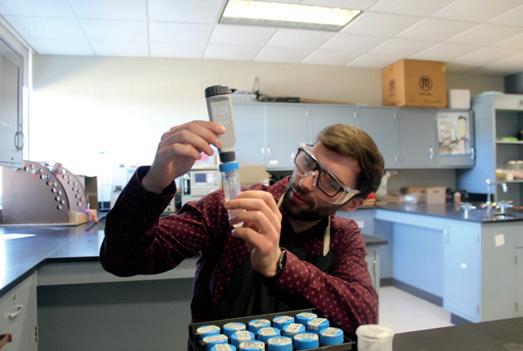
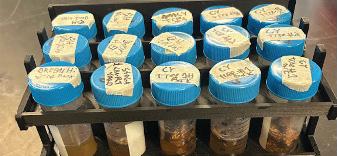
Yeast storage (top) : Multiple labeled yeast samples stand in a test tube rack. Biology teacher Derek Bosworth and senior Mahlon Bierly conducted most of their research during eighth period science olympiad class and ensured that it was an organized and controlled process.
in certain samples. Every sample of yeast presents new challenges and characteristics that Bierly must identify. Bosworth enjoys the variety of their ndings and the unprecedented processes throughout the research.
“There are so many species of yeast that exist and we just simply don’t know what they do, yet yeast is the most studied eukaryotic organism,” Bosworth said. “These
species may be applicable, which would be important to our lives. That is why the research is so important.”
Bosworth has taught about the abundance and importance of yeast through his and Bierly’s research at Conestoga. Bierly’s ndings on trees and bark in the courtyard and surrounding nature have aided the process and added to their knowledge about di erent species of yeast.
rough this work, Bierly has learned the bene t of researching yeast and about the real world applications of it.
“I think it has helped me appreciate my natural surroundings a little more. Yeast is everywhere, and it is so important, especially to the medical eld and to our life,” Bierly said. “Seeing yeast and microorganisms all around has made me recognize them more.”
Sophomore shares passion through baking club
Riddima
Pandey Co-Multimedia Editor
Sophomore Ananya Ahluwalia founded a baking club last year that has held multiple events since its inception. e club bakes and donates brownies once a month to an organization called Hand4Hand, which is part of a larger organization called DOPE (Doing Our Part Eclectically) which gives out food to homeless people in Philadelphia. Club advisor and world language teacher Alice Havrilla believes that giving students the chance to bake and learn to bake brings them joy.
“I think baking is really something that gives you selfworth. I feel like it gives you that ful llment and self-worth that I think we’re all looking for in life,” Havrilla said. e club held a Hallow-
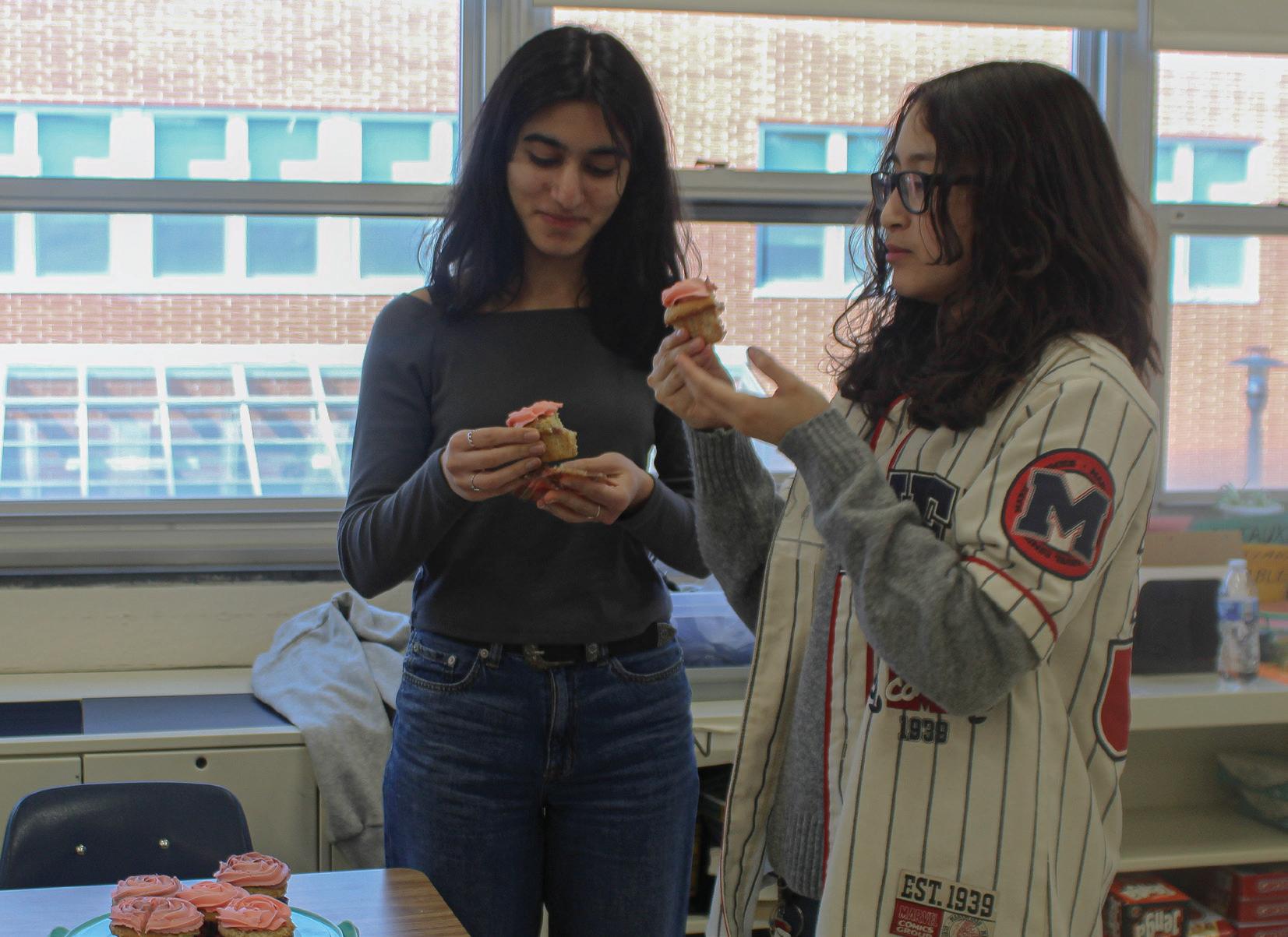
een bake sale in October and a spring bake sale on March 18. While they do not bake in school, members bake goods at home and bring them into club meetings for other members to test and critique them.
“It’s not published anywhere, but it’s a physical book. But if I want to get a job or an internship, it’s something I can show them,” Ahluwalia said. Recently, she designed her own menu called “Ananya Bakes” and has already gotten ve to six orders. It is a way she can share her baking creations with the community. Ahluwalia not only sees her love for baking as a passion but also a stress reliever.
“I honestly think it’s therapeutic because with school, there’s a lot of times where I’m really stressed out with whatever tests or if I have any events coming up,” Ahluwalia said. “But then (when) I know I have to make something over the weekend, I get really excited.”
“I think if anyone wants to try it out, I think they should look at a bunch of recipes and see commonalities between them,” Ahluwalia said. “ ere are a lot of simple recipes if you want to get into baking and if you like it, then you can try more complex recipes.” When she was 11, Ahluwalia started baking a er watching baking shows and competitions on TV. is led her to decide to become a pastry chef in the future and go to culinary school. She currently has a portfolio called “Rise” that contains stories of all the treats she has baked so far. In addition, she has a social media page named @ananya_ bakes where she posts her baking creations. Ahluwalia shares what she hopes to use her portfolio for in the future.
try home-baked goods to potentially sell at the spring bake sale.
Rowan
Chetty
Co-T/E Life Editor
Accounting and personal nance teacher Bernadette D’Emilio has taught at Conestoga since 2006. A er obtaining a degree in Accounting at the Smeal College of Business at Penn State, D’Emilio worked at a public accounting rm before transitioning to teaching business classes at Sun Valley High School in 2003 for three years. Q: What led you to a career in teaching?
taught business education. I really loved, obviously, the business world, so I went and observed one of her classes, and I enrolled at Gwynedd Mercy, got my certi cate, and I’ve been teaching ever since.
Q: Why is financial literacy important?
make your nancial life a lot easier as you go.
Q: How do the lessons you teach translate into your daily life?
Teacher Feature: Bernadette d’emilio
A: I worked a er college at Arthur Andersen, which was a public accounting rm. I audited a bunch of di erent companies, and I got my CPA certi cate. I loved my job, but Arthur Andersen went out of business because of the Enron scandal. Literally, we got to work one day, the doors were shut. We were all out of a job. I decided to go work for another company in their internal audit department, and I didn’t enjoy it. I met one of my husband’s friends that he had gone to
A: Financial literacy is so important for so many reasons. I always say to kids, “You’re not gonna walk out of here a nancial expert.” Because I do teach personal nance to a lot of freshmen, I think that sometimes they don’t understand everything I’m saying, but if I can help kids avoid a lot of the nancial pitfalls, if I can help them get started investing early, I think it can change their lives. High school is a good time — because so many kids work, they’re more engaged and interested in money. I have a lot of my students who end up opening up mutual funds and investing in Roth IRAs, so it’s the perfect time to hit them with that literacy.
Q: If your students had one takeaway from your class, what would it be?
A: I say this to them all the time: Start early. If you start investing early, then you’re gonna
A: I’m learning every day as I teach. A lot of times I have students do projects where they research public companies to invest in, and almost every semester, based on their presentations, I pick companies to invest in. Every day at home, I’m talking to my own kids about stu that we talk about here, so it’s a constant thread throughout my life.
Q: What do you like about teaching at Conestoga?
A: I love the classes that I teach because they’re pretty relatable to the real world. Kids are pretty engaged because they’re worried about money. ey like to invest. ey like money, and I love teaching at Conestoga (because) I live in the district. I have four kids, two of which are here, so my kids walk in with me every day, which is pretty cool.
Q: What is a piece of advice you would give to your students?
A: Students here are so wrapped up in success, whatever success means, if anything. Just be true to yourself, be kind, and success just naturally follows.
Rowan Chetty/The SPOKE
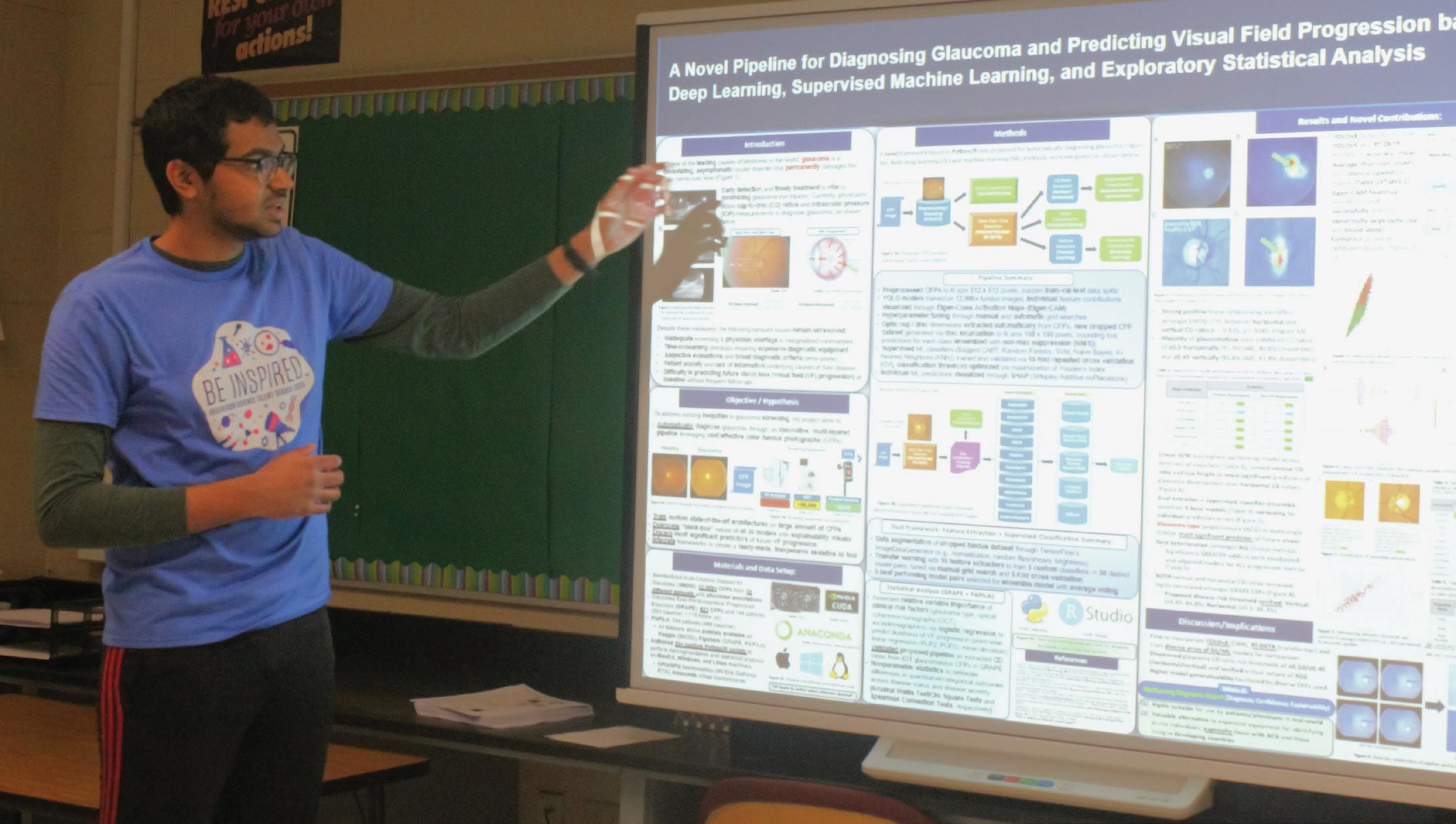
Science scholar: Senior Faizaan Siddique presents his research. Siddique was one of 300 students internationally that won Regeneron STS scholar. Mareska Chettiar/The SPOKE
Mareska Chettiar Co-T/E Life Editor
Keep calm and bake on: Sophomores Ananya Ahluwalia (left) and Montserrat Gonzalez-Rivas (right)
Ahluwalia created the club last year.
Riddima Pandey/The SPOKE
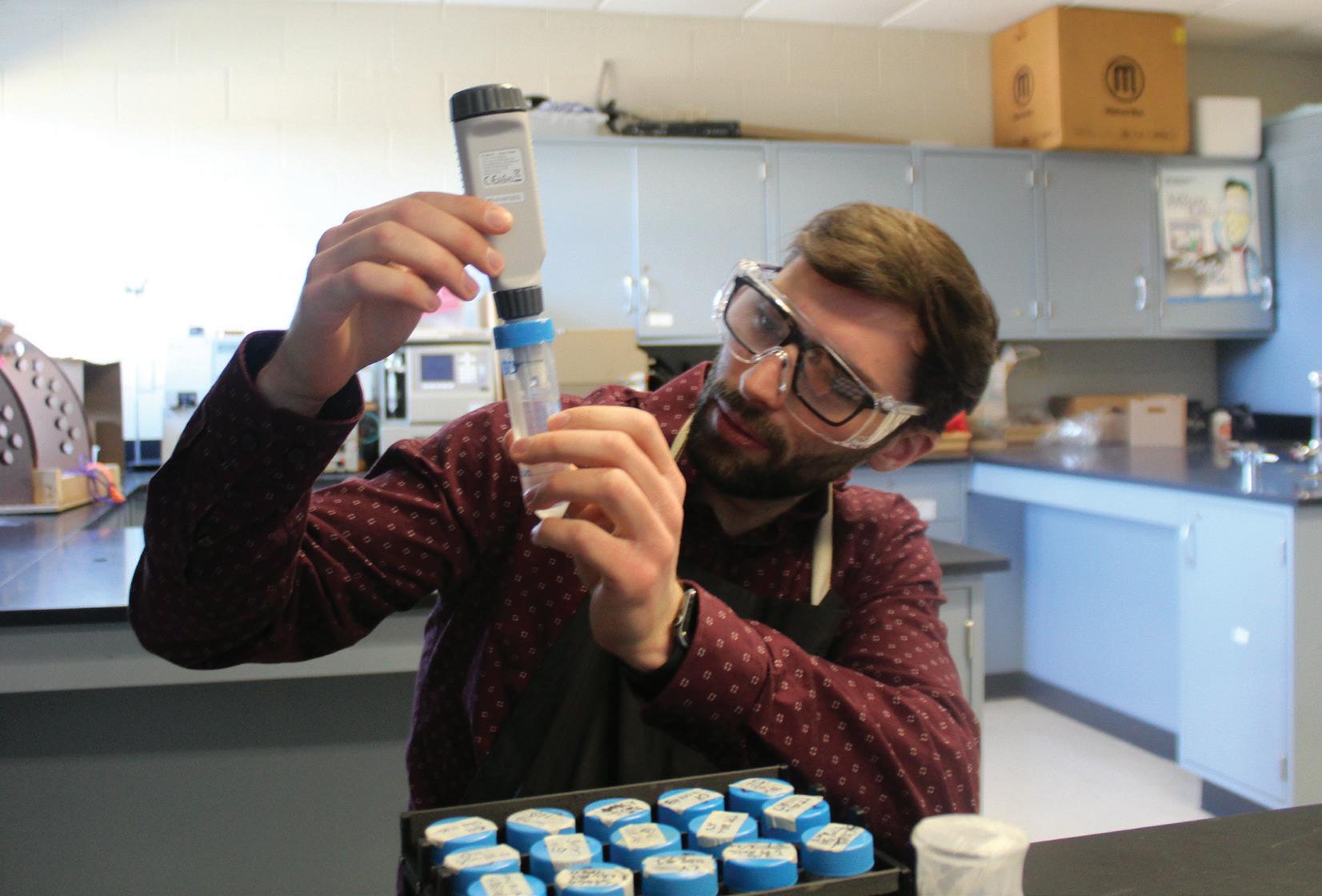
Yes to yeast: Biology teacher Derek Bosworth examines a yeast vial during eighth period Science Olympiad. Bosworth started researching yeast in 2022 and has worked with senior Mahlon Bierly throughout the year.
Sosi Sengal/The SPOKE
Courtesy Mahlon Bierly
Courtesy Mahlon Bierly
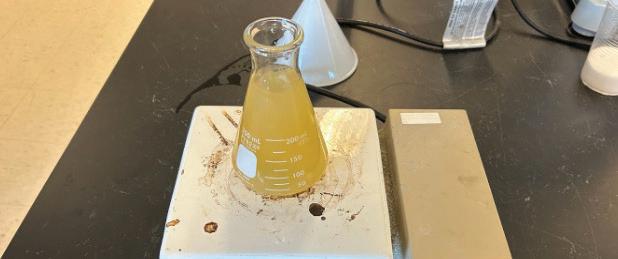
Lab rats (bottom): A sample of yeast heats on a hot plate during a Science Olympiad class. Senior Mahlon Bierly has assisted biology teacher Derek Bosworth with his yeast research throughout the year. Bosworth plans to continue researching yeast.
Je ’s Gist: To be an introvert in loud political climates
Take a glance at the articles you see across pages eight and nine. You will notice commentary from aviation sensationalism to cuts in research funding and gender markers — subject matter stemming from politics and the media. Reporting on topics like these, however, complicates things when you note that we’re introverts.
Being belittled as an introvert has been di cult on my con dence. My family insists over and over again that if I want to be successful, I need to be an extrovert. ey tell me that if I nd comfort in living a solitary life, I’m not going to accomplish anything.
Society is also systematically biased toward extroversion, according to an article by consulting rm Zweig Group. Even in school, students are pressured to have high participation. ey realize how conforming to societal standards, such as being an extrovert, is favored.
When put that way, the thought of driving social change as an introvert feels laughable. If I crack under pressure for just raising my hand, I can’t even think about having an impact
But according to an August 2024 article by e Platform for the
to be equally impactful in social change as anyone else and “shake the world.” ey use a
Industry, around 40% of business leaders are introverts, the same percentage as extroverts.
Review: Kendrick Lamar takes victory lap with ‘GNX’
Last month, longtime fans of hip-hop tuned in to see rapper Kendrick Lamar perform at the Super Bowl LIX hal ime show. Much of this performance consisted of his most recent project “GNX,” a compact 44-minute record that proves his mastery of both mainstream appeal and artistic integrity. Released on Nov. 22, 2024 and spanning 12 tracks, the album returns Lamar to his West Coast roots, blending punchy beats and G-funk with multi-layered, introspective lyricism. e opener “Wacced out murals” immediately grounds the album in Los Angeles’ streets. With thumping basslines and alarm-like synths reminiscent of early Dr. Dre, the track introduces the album’s love letter to Lamar’s hometown. e aptly named track “Squabble up” follows with this same raw energy as a subtle reminder of Lamar’s recent rap beef victory against Drake. However, instead of
dwelling on the con ict, Lamar shi s the album’s focus onto his own career. e production in “GNX” is a standout element throughout. Collaborators such as Sounwave and Jack Antono merge roughedged West Coast beats with a modern, almost pop sound. Lamar’s lyrics also range tonally from aggressive domination to sentimental re ection, with “Heart pt. 6” o ering the album’s emotional climax.
Some listeners and critics suggest that “GNX” lacks the con-
itself rmly in West Coast culture.
Tracks such as “Dodger blue” feature local underground artists Wallie the Sensei and Siete7x, who authentically represent LA’s streets. ese collaborations underscore Lamar’s prevailing message: His success is inseparable from his community.
e title track, “Gnx,” named a er the 1987 Buick, captures Lamar’s connection to his hometown and speaks to those with his same competitive drive. e catchy G-funk hook and hard-hitting underground verses from Hitta J3, Young reat and Peysoh solidify Lamar’s cultural ties. With a more introspective tone, Lamar follows “Gnx” by exploring his connection to his cra in the closing track, “Gloria.” Lamar personi es his pen with the complexities and turbulence of a relationship, re ecting on how writing has dened his career.
ceptual depth in Lamar’s earlier projects. However, they overlook the intentionality behind this stripped-down approach. While slightly less high-concept, “GNX” pares down the excess to concisely deliver its messages.
“GNX” also challenges mainstream rap’s bias toward wellknown featured artists by rooting
“GNX” acts as Lamar’s victory lap to reinforce his dominant presence in rap. Beyond its inspiring context, “GNX” holds an impressive track list with only one exception: the overly repetitive and lyrically underwhelming “Peekaboo.”
While this may not be Lamar’s most high-concept release, its clever lyrics, bold performances and genuine West Coast connections pack a punch in an era where so many play it safe.
roz emphasize the notion of a “Quiet Revolution” and how introverts have the potential
metaphor of stretching like a rubber band, stating that “You can do anything an extrovert
can do, including stepping into the spotlight. ere will always be time for quiet later. Just return to your true self when you’re done stretching.”
Introverts are not exempt from doing extroverted things. I remember going through a period of extrovertedness at some point in middle school, but deep down, I knew I was “intro” at heart. Now, in 2025, I’ve found a specialty in journalism that allows me to communicate e ectively without strictly conforming to a talkative persona. Yes, talking to people faceto-face is inevitable, but that’s only part of the job. In the past, I’ve conducted interviews on heavy topics for as long as one-and-a-half hours. I was eager to get them over with because my energy was
at an all-time low. Yet, I stuck through them because that’s what gives me the edge in being introverted — having the strength to listen and digest the minute details of a story. Even in the middle of a rally or council meeting, I’ve used my camera to amplify my voice. Sharing my photography has become an indirect way to network with more communities than I could have imagined.
If you ever doubted the ability of introverts, you would be wrong. The writers of the stories I mentioned above are the writers who make the Opinion section — and The Spoke — so strong. We’ll speak when the time comes, with each message more meaningful than the last.
Aviation reaches sky-high sensationalism
Flying has never been safer, yet it’s never seemed more dangerous. is year, January and February saw signi cantly fewer aviation accidents compared to historical averages. January recorded 10 fatal incidents, and February had six, both well below the typical averages of 15-17 per month across all aviation types in the past 15 years, according to data from the National Transportation Safety Board. e odds of dying in a
Don’t fall for food fearmongering
Make sure to avoid toxins, dyes, seed oils, ingredients you can’t pronounce, anything that’s banned in Europe. Eat natural, not processed. Natural is better, unless you want chronic in ammation or cancer — at least, that’s what the Make America Healthy Again (MAHA) movement has claimed since its introduction in July 2024.
Led by U.S. Secretary of Health and Human Services Robert F. Kennedy Jr., the MAHA movement is a grassroots coalition that aims to combat chronic disease through clean eating and preventative healthcare, according to its super PAC website. While the U.S. does face a chronic disease epidemic — a ecting 50% of Americans and consuming 85% of healthcare costs — MAHA’s methods are rooted in fear and pseudoscience rather than facts and research.
Fearmongering is the raising or exciting of alarms needlessly, a strategy that the MAHA movement and its followers employ — and it’s e ective. People are more likely to respond to sensational, all-or-nothing, oversimpli ed headlines because they’re easy and actionable. Similar to how disordered eating occurs, cutting
out canola oil or other foods arbitrarily gives people a sense of control over their health. Food is not inherently clean or dirty, and it should not be labeled as such without consideration of the serving size. Everything, even water, is toxic in high enough doses. e movement also vili es processed foods, yet research from e American Journal of Clinical Nutrition indicates that processing alone does not make food unhealthy. Pasteurization, for instance, is a form of processing that prevents bacterial contamination. e real issue isn’t processing — it’s nutrient quality, food access and education.
MAHA takes advantage of Americans’ real experiences with chronic disease and the healthcare system, erodes trust in science by disregarding scienti c consensus and distracts from meaningful
solutions. For example, MAHA’s philosophy includes removing uoride from tap water, which has been in water since 1945 to reduce tooth decay in children. In Kennedy’s X post where he said he would “advise all U.S. water systems to remove uoride from public water,” he linked a video from prominent anti-vaccine advocate and conspiracy theorist Del Bigtree. e people who will su er most from Kennedy’s ignorance and pseudoscience are children and those who cannot a ord oral hygiene products with uoride.
A truly healthier America isn’t built on fear-driven narratives. Instead of banning Doritos, we should focus on science-backed policies that empower citizens to make informed choices and promote accessible healthcare and trust in research.
plane crash sit at roughly one in 11 million, according to the International Air Transport Association, making commercial aviation one of the safest forms of transportation. Despite these facts, today’s media seems determined to convince the public otherwise.
On Jan. 29, an American Airlines ight and a United States Black Hawk helicopter collided over the Potomac River in Washington, D.C., claiming the lives of 67 people. Two days later, a ight crashed into the Castor Gardens neighborhood in Philadelphia, striking multiple buildings and homes. ese devastating accidents rightfully captured immediate global attention. However, the a ermath revealed a concerning trend in the media. What began as a focus on grief and investigation soon shi ed into a narrative of crisis, overwhelming public perception with sensationalized
coverage. By doing so, the media overlooked the broader reality of aviation safety.
On social media, algorithms heightened the panic. Dramatic in- ight footage, oversensationalized headlines and self-proclaimed aviation experts speculating about systemic failures ooded platforms like TikTok, X and Instagram. ese apps prioritize engagement and clicks through fear, resulting in a distorted sense of how common or dangerous these incidents actually are, with outlets like the Daily Mail and Metro labeling small accidents as “terrifying near misses” or “narrowly avoided collisions,” respectively.
Some argue that every incident, no matter how minor, deserves attention. e public has a right to know when things go wrong, even if the outcome isn’t catastrophic. But there’s a line
between transparency and alarmism — the tendency to exaggerate dangers and incite fear — and too o en, coverage crosses into the latter. Reporting on a diversion or turbulence encounter with accuracy is one thing. Packaging it as a near-tragedy to drive engagement is another entirely. e facts are undeniable: Air travel is safer than ever, with each year bringing new advancements in technology, pilot training and regulatory oversight. If the media and social media platforms shi ed their focus from sensationalizing isolated incidents to highlighting these developments, the public would have a clearer understanding of aviation’s safety. While there are real risks in air travel, the fear o en pushed by the media is far out of proportion. It’s time for the public to see past the media’s narrative and recognize the progress in aviation safety.
In their 2016 book “Quiet Power,” authors Susan Cain, Gregory Mone and Erica Mo-
Je rey Heng Co-Opinion Editor and Columnist
Miya Cao Co-Copy Editor
Milan Agarwala Sta Reporter
Audrey Kim Sta Reporter
Juliana Yao/The SPOKE
Editor’s note: The member of the editorial board who wrote this opinion has elected to remain anonymous due to legal risk that may arise from his identity being attached to the contents of this article. The opinions in this article represent his views and experiences alone, not those of The Spoke editorial board.
In the over two months since Donald Trump assumed the position of president of the United States, he has passed 89 executive orders on issues ranging from government spending to birthright citizenship. Although some of his unconstitutional efforts have fallen flat in the federal courts, he has succeeded thus far in instituting a two-gender mandate on federal documentation, restricting gender-affirming healthcare for Americans under 19, prohibiting transgender people from military service and banning female transgender athletes from competing on the correct sports teams.
In the over two months since the inauguration, I’ve had to
I’m proudly trans: Trump won’t erase us
look my parents in the eyes and ask to ee the country.
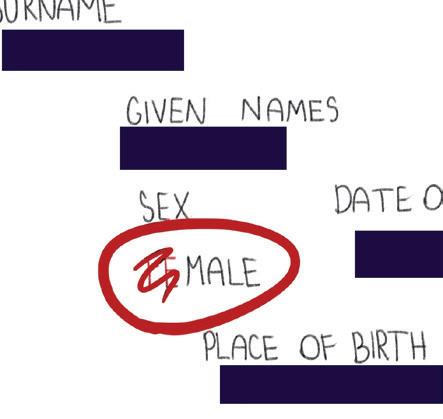
I’m transgender. Since 2021, I’ve lived my life openly as a trans man, going by a new preferred name instead of my birth name and answering to he/him pronouns. at same year, I took a trip to the doctor with my mother to get a prescription for the hormone progesterone. In 2023, I stood in front of a judge and o cially changed my rst name in civil court, beginning the process of changing my legal documentation. Now, as a senior in high school, my passport, Social Security card and driver’s license all say “M” next to my new legal name. I’m a proud transgender American, and I’m happier than I’ve ever been. Now, with the Trump administration bent on attacking transgender individuals, the life I’ve built for myself may be in danger.
peers, probably saved my life. Or, more importantly, it gave me a life worth living, bringing me out of a depressive
decision that if my healthcare provider decides to stop providing my life-sustaining care due to an executive order,
Gender-affirming care, along with the support and affirmation of my friends and
state and helping me feel at home in my body. But despite the efforts of federal judges to suspend Trump’s ban on gender-affirming care, it remains at risk. After talking with my parents, I’ve had to make the
I will pursue the option of leaving the U.S. Leaving the country may become necessary not only because of the bans on gender-affirming care but also because of the theft and ma-
nipulation of trans individuals’ federal documentation. Individuals who changed their gender markers or obtained an “X” marker are receiving passports with the incorrect gender. Some have even received ripped up passports or not been returned their documentation at all. A State Department directive has put the visas of trans people entering the U.S. at risk. By defining a changed gender marker as “fraud,” this directive not only poses a risk to international trans travellers but also forebodes an inevitable escalation toward prosecuting citizens who have changed their gender markers. When I renewed my passport two years ago with an “M” gender marker, I did not anticipate this. While my document arrived intact and correct, any retroactive policies on passports with changed gender markers will affect me. I do not know whether this means that I wouldn’t be able to leave the country or that I would be prosecuted for fraud. But it’s barely been two months. In four years, a lot can happen. So I’ve sorted through my options. I want to stay and protect my fellow trans people by studying and practicing journalism at university. I want to be loud and proud, even if it scares me. But since this administration seems to want the transgender community excluded and criminalized, I may not have a choice but to flee. Many don’t get that chance. But wherever I am, whatever I choose to do with the rest of my life on college decision day a few weeks from now, I still exist. I am trans, and I’ve passed you in the hallways, sat in your classroom, written an article you nodded or laughed at. These executive orders seek to erase my existence and the existence of our classmates, teachers and community members. We won’t let them. I am trans. I am here. I exist. That will never change.
“To be honest, I really wanted to mature and grow up quicker. I think experience is what forces you to mature the fastest, and as you go through life, you'll experience things that will change you as a person.” Kaden Liu, freshman -
STUDENTS SPEAK OUT
“I think that I may have a warped perception of coming of age due to media that I've consumed that glamorizes it or makes it seem more exciting than it actually is. I've only experienced (a) small part of it, so while it's not what I expected it to be, it's still a very good experience.”
Q: Is coming of age what you expected it to be?
“I've gotten interested in just moving on and getting into the ow of things and having more independence. I dreaded it when I was younger, but now I appreciate the leverage that comes with being older.”
“As a kid, it's very daunting or intimidating. But as you get closer to (coming of age), you feel more prepared. I get lectures from my parents about it, and I get advice from teachers and counselors. ere's going to be obstacles I'll have to overcome, but it's de nitely less intimidating now.”
Venkatesan, seniorBo Phillips, junior -
We pay a he y price for NIH funding cuts
When scientist Osamu Shimomura rst began studying a particular species of jelly sh in the 1960s, it was easy to trivialize his work. At the time, it was likely near-impossible to see the value of poking around with jelly sh that glowed in the dark, of all things. irty years later, Martin Chal e’s NIH-funded research making tiny roundworms light up using Shimomura’s glowing discovery may have similarly raised eyebrows. But, the results of their work allowed scientists to, for the rst time, look at the previously invisible movement and position of proteins by making them glow. eir Nobel Prize-winning research now underlies one of the most foundational research tools in biology, contributing to countless innovations in cancer research, Alzheimer’s and medicine as a whole.
Along with this discovery, the NIH has been instrumental in innumerable medical and scienti c developments. However, impending NIH funding caps on how much the agency can support institutional research could potentially threaten this role. According to respective university departments, the University of Pennsylvania, the University of Pittsburgh and Carnegie Mellon University may stand to lose over $400 million combined in NIH grants. For scientists, this means losing funding for life-saving research and innovative technologies. For others, though, it
ing taxpayer dollars on what they view as frivolous pursuits, some foresee institutions vetting their research projects because of funding cuts to only choose the ones that will truly bring scienti c value. Only one problem — scienti c discovery doesn’t work like that.
As exempli ed by Shimomura and Chal e, the kinds of topics that yield innovation can be unexpected and wild. Places we may expect to see consequential results may not yield them, while giving ies alcohol may reveal ways to combat alcoholism and addiction issues in humans.
seems unclear whether all this money actually goes toward grand ideals of research. e sensationalism of scienti c projects that seem to have no purpose, such as getting ies drunk or analyzing sea slugs, sparks doubt. Instead of spend-
Research is a mixed bag of projects that may contribute greatly to science or not, but they come together without labels. If it were possible to identify which labels will be which in advance, we wouldn’t need research at all. e best way to approach scienti c progress is through casting a large net and granting freedom for exploration. Scientific research is complex but necessary in our society, and as such, we should feel justified in dedicating all the time, space and resources that it needs. Most importantly, we need to ensure that it is accessible to everyone and that science is a pillar that is free and just for all.
Akshaya
Debunking the coming-of-age story
As a kid, I always thought being a teenager would be a lot of driving with the windows down at night, sneaking out and loud laughter. Coming-ofage movies taught me to see it as an end-all, be-all. Entering high school, I thought, “ is is when everything clicks.” ose movies have always made me pine for something. e idea of nding a place to belong and self discovery speaks to everyone. I’m still waiting for my moment. I’m 17 now, and I don’t feel like it. ere’s a part of me that wants to be a kid again, and there’s a part of me that wants to
get this all over with and grow up already. It’s an awkward liminal space — on the cusp of something new but still digging your heels into the so ness of before. We’ve all been fed this narrative that adolescence is a one-of-a kind experience, one that you’ll miss for a lifetime. Movies like “ e Breakfast Club” and “High School Musical” tell you that by 17, you should have already discovered the secrets of the universe and the terrifying truth of who you are. ere should be a tight-knit group of friends, parties, late nights and adventures you’ll fondly reminisce about to your future children. When I think of my adolescence, I think of long hours cooped up in my room and a blur of faces I don’t think I’ll recognize in a few years. ere’s good stu , too, the kind of stu that makes my stomach hurt if I think about leaving it behind. But it’s not the vibrant Technicolor I imagined it to be. We all want to live out that quintessential teenage dream, but
in reality, it’s not attainable for a lot of us — and that’s okay. Coming of age manifests in di erent ways for everyone. High school has been more of a bad experience than a good one for me, and the same is true for many others. Researchers from the Yale Center for Emotional Intelligence and the Yale Child Study Center found that high schoolers report negative feelings about school 60% of the time. What teenagers should focus on is making the best of what they have. Going to that hangout. Eating that piece of cake. Taking a fun trip. Doing what they can to make high school as not-bad as they can. Practicing patience. ey might discover themselves along the way, but they also might not. Coming of age is really all about the waiting.
ey should try not to get caught up in the beauty of college and moving away either. Coming of age might happen years down the line, at 30 and working. at’s the beauty of coming of age. It is a deeply
personal experience that strikes when one least expects it. I don’t blame movies for marketing an idealized version of teenagehood to people. ere’s something very enchanting about realizing yourself on a random Tuesday in your senior year of high school. What we shouldn’t do is overromanticize these unrealistic visions of adolescence and lose sight of the valuable experiences right in front of us. You don’t need to be cool, popular and spontaneous to have a good time. You can have an enjoyable high school experience from the comfort of your own home if it really comes down to it. Maybe you never thought high school would be like the movies and no expectations were fallen short of. Great. e sentiment still stands. Don’t just accept mediocrity. You might not have a life-altering moment of self-realization, but you can still have fun and make memories that you’ll always cherish. Keep that in the back of your mind as you navigate the rest of your time at Conestoga.
Sophia Salvati, sophomore -
Jaelynn Pikalyuk/The SPOKE
Saktisri Gowrishankar Sta Reporter
Juliana Yao Co-Opinion Editor
Karen Hang/The SPOKE
Girls’, boys’ swim teams clinch Central League title for 10th year
After five days of competing in individual and team swim and dive events, both the girls and boys’ swim teams became Central League champions for the 10th year in a row.
The championships took place from Feb. 4-8 at Ridley High School Natatorium. The teams competed against 11 schools across Chester, Delaware and Montgomery Counties. The boys’ team finished with two gold, three silver and five bronze medals, scoring 567.5 points. For the boys’ team, junior David Ivory won two gold and two silver medals. The girls’ team finished with four gold, two silver and three bronze medals, scoring 425.5 points. For the girls team, junior Olivia Tudge won two gold, one silver and one bronze medal. Team members worked during club swim trainings and school practices to prepare for the Central League championships. Most swimmers practiced every day, and some also worked out at the gym for additional dryland conditioning.
“Training is always really, really tough. We always have a bunch of hard practices and hard sets,” said sophomore and
girls’ swim team member Joyce Chen. “You just have to keep on showing up. You just have to keep on trying your best at practice, and then eventually you’ll see the efforts pay off.”
The teams strengthened their bonds by practicing relays together, participating in spirit days and spending time together outside of school. According to senior and girls swim and dive co-captain Avery Hillier, their close relationships that they have built have contributed to the teams’ success.
“I think that our dedication (sets the team apart). All the girls always work so hard at practice and at meets,” Hillier.
“We also just have that factor. We always support each other. We’re always at the end of the lane cheering each other on, and we’re just a really strong and hardworking team.” Additionally, the boys’ team had an addition to its coaching staff this year, Jared Messics, who brought different ideas and coaching methods to practices. Senior and boys swim co-captain Hutch Wood feels that Messics’ methods contributed to the teams sustained success.
“A big change this year was not having (previous coach Mark) Tirone,” Wood said. “So coaching was a bit different just because Jared used more sets from UMLY, so it was a lot of
speed work and just getting used to his coaching style.”
After the districts competition, various swimmers and divers made it to states from both the girls and boys’ teams. Girls’ swim team members seniors Hadar Miller and Hillier, juniors Maddie Fox, Reilly Dolan and Tudge, sophomore Chen and freshman Lauren Goelz advanced to the 2025 PIAA Swimming and Diving State Championships. Boys’ swim team members seniors Wood, Stanley Cui, James Oken and Justin Cuevas, junior Ivory and sophomore Liam Haas also went to states. The competition was held at Bucknell University in Lewisburg from March 12-15.
At the state championship, the girls’ swim team placed 12th out of 58 teams and the boys’ swim team placed 29th out of 55 teams.
Apart from maintaining their undefeated streak in the Central League, Hillier and Wood focused on enjoying their time and building a supportive environment among the boys and girls’ swim teams throughout the season and beyond.
“My goal was really to encourage people to get up and cheer and just bring the energy that we’ve always kept. Keep the same traditions, maybe make some new ones, which I think we did,” Wood said. “Keep up the energy. Keep the win streak, too.”
Perfect pin: Senior wrestler wins 8th at states
From March 7-9, senior and wrestler Lauren Sweet competed at the PIAA Girls Individual Wrestling State Championships. The state championship took place at the Giant Center in Hershey and showcased talent from across the state.
Sweet was one of two members on the Conestoga wrestling team to qualify for and attend the state championship. At states, Sweet placed eighth in her weight class and won a medal. With her win, Conestoga earned its first wrestling medal since 2017.
“I was really excited (to have won a medal). It was my first year, so my expectations were pretty low,” Sweet said. “I was like, ‘I really don’t have anything to lose — I might as well just go in and go for it.’”
Sweet had always wanted to join the wrestling team but finally decided to sign up during her senior year. She has practiced
jiu-jitsu since her freshman year. Sweet feels that they are similar sports, which helped ease her transition into wrestling.
“Jiu-jitsu intersects with wrestling a lot — there is a lot of people that wrestle there. Everyone that I train with, black belts and higher-ups, would always be giving wrestling lessons and stuff like that, and it got me interested in wrestling,” Sweet said. To prepare for the championships, Sweet attended team practices for an hour each day, five days a week. At the practices, she worked on a variety of drills, ranging from endurance training to agility challenges. Additionally, she worked on honing her wrestling techniques and perfecting her form. To simulate real-time matches, she would partake in short 30-second bouts with her teammates.
Sweet attributes a large portion of her success to the unwavering support of her teammates and coaches. Their support helped her remain mentally
Winter track team competes at state championships
strong and helped boost and maintain her morale.
“The entire time I’m in a match, (the coaches are) giving me instructions, telling me what to do and just basically yelling at me to not stop,” Sweet said. “And that really helped — it shows they really care. They want us to succeed.”
Sweet is one of three girls on the team, a record-high female participation on the Conestoga wrestling team. All wrestlers, male and female, are part of the same team. They train together and the same staff coaches them.
Sweet hopes to see increased female participation in the sport and hopes that Conestoga can form its own girls’ wrestling team in the near future.
“I hope that the three of us girls starting wrestling brings in more (girls) next year. I mean, girls wrestling is the fastest-growing (high school) sport in the U.S.,” Sweet said. “So, I’m just hoping that more girls get into it because it’s such a fun sport.”
the race, and the racers sprang into action, dashing along the track. The winter track team was in season from November to March. All winter track qualifiers on the team culminated their season by competing in the Pennsylvania Track & Field Coaches Association Championships. Freshman Price Orcutt ran the 60-meter dash and was part of the 4x200-meter relay team at states. She appreciated the support and motivation the team provided for her as a new runner.
“Everyone on my team helps (me) a lot because I’m new. My coaches both helped me a lot. They taught me a lot of new things I haven’t learned before,” Orcutt said. “I like to push myself a little, and sometimes when it’s hard, I just say, ‘I’ll get better at it.’ Having a lot of friends on the team and my coach helped me with my motivation to keep going.”
Having participated in both winter track and field hockey together, Orcutt developed a strong friendship with senior Lexi Patterson, who supported Orcutt throughout each season.
“At the beginning of the field hockey season, we got paired with a freshman, so we had a senior-freshman duo, and I was assigned to Price,” Patterson said. “From there, we developed a connection and a relationship. I think
both (field hockey and track) helped (us) push each other to be our best.”
Beata Artz, art teacher and long and triple jump coach, feels that the team’s bond was a key part of its success. She appreciates the fundraisers, dinners and parties that the booster club organized for the team and believes they were an effective way of developing and strengthening the sense of community among the team.
“As a team, we want to be competitive but positive, and we’ve tried to foster a sense of unity the last couple of years,” Artz said. “So, when the students are competing, they feel more of a family not as separated, and so that everybody gets to know each other a little bit better. The sense of unity is something that our head coach has really been trying to push.”
Sophia Cui and Alexa Willrich Staff Reporters
Vaishnavi Sriadibhatla Co-Sports Editor Takedown
Courtesy Lauren Sweet Grace Hu and Erin Zhang
Relay runners: 4x200-meter relay runners (from left to right) sophomores Bianca Antonacci and Kate Gennarelli, freshman Price Orcutt, and junior Fure Abhuli-
men prepare to run at the state championships. The team achieved its personal record at the championship and placed 11th overall.
Courtesy Price Orcutt
Star swimmers: The girls’ swim team celebrates its 10th consecutive Central League Championship win. The team sent six swimmers and divers to the PIAA Swimming and Diving State Championships from March 12-15 at Bucknell University.
Courtesy Megan Hillier
Equestrian excellence: Junior competes in horseback riding
Hurdling over obstacles and bounding across the riding ring, junior and equestrian Izzy Bolton sits atop her horse as she competes in a horseback riding competition.
Since she was 7 years old, Bolton has participated in horseback riding. She trains every Monday, Tuesday and Thursday at Out of Reach Farm in West Chester. In addition to practice, Bolton participates in national competitions. Last year, she won Horse of the Year in the junior hunter 3’3” category.
“I just liked horses as a kid, and I didn’t like soccer and the other things that I was doing,” Bolton said. “So, we just tried horseback riding, and I really liked it.”
Bolton got her current horse Dream HF, known in the barn as Moose, two summers ago. Since then, she has built a strong bond with Moose, which plays a crucial role in their success during competitions.
“Horses have strong personalities. They all act very different and have different mannerisms. It’s super fun working with Moose specifically because he’s so great. He’s such a good horse — a total saint. Whenever we’re showing, he’s very mature,” Bolton said. “Honestly, I like him because when I’m not doing my stuff, he kind of calls me out. If I’m not doing what I’m supposed to, he’ll get a little pissed. He won’t do anything bad, but you can see in videos and stuff, he’ll express that he’s angry. He’s like ‘Girl, we gotta get it together.’”
Each competition typically has three jumping rounds where riders and horses jump
over obstacles and one round on the at where judges evaluate their walk, trot and canter. Judges score the rider seperately for each round, and the rider may receive a ribbon based on their points, en, the competition totals the points and awards a champion.
“There was a big show during the summer in Saugerties, New York that I went to. It was one of the first big shows that I was doing with my horse Moose that I’d gotten a couple months before,” Bolton said. “We just went in and put down a really nice
JV boys’ squash team wins National Interscholastic Championships
Divit Gupta and August Zangrilli Sta Reporters
Following an intense final, the JV boys squash players gathered together in an emotional huddle, celebrating their hard-fought victory. The win marked a significant moment for the team.
From Jan. 24-26, the boys’ JV squash team competed in the 2025 National Interscholastic Team Squash Championships at the Arlen Specter US Squash Center in Philadelphia, winning rst place. is success came after a series of wins throughout the season.
Competing in a pool of teams from across the country, the Pioneers battled through matches that tested the team’s endurance.
Sophomore and player Calvin Kan viewed the team’s strategy as critical to its success before entering the championship.
“None of us had competed in this tournament before, so we all tried to come in with a fresh mind, and making sure we got through it as a team, because we weren’t sure of the skill level of the teams we were playing,” Kan said.
While Conestoga has participated in Interscholastics before, this year’s championships marked its first-ever win.
Junior Andrew Galka highlighted how he adapted his mindset to nd success in his matches. He stressed the importance of staying focused and maintaining a positive attitude.
“The way the matches were set up, if I was down a game, I could just reset my mental state so that I could win the next match,” Galka said.
Kan emphasized that players consistently pushed each other both on and off the court. He believes that the team’s unity played a crucial role in its success.
“Squash is a very individual sport, but our cheering on the sides and the support from our teammates was not only motivating for our players but also demoralizing for the opponent,” Kan said. “One of our main strategies was to cheer as loud as possible so that our support could be heard by everybody.”
Echoing this sentiment, Galka attributed the team’s high placement to a supportive environment.He viewed the team’s culture of supporting one another as essential in building confidence and motivation throughout the matches and during the competition.
“I feel that everyone is really supportive, and if you are struggling with a speci c skill,
then people are always willing to help because everyone is willing to improve,” Galka said.
Kan observed that the team consistently refined its approach to adapt to various challenges. He reflected on his performance at the competition and noted areas for improvement moving forward next season.
“I think I could have been more aggressive with how I played,” Kan said. “It wasn’t dramatic enough to make me lose a match, but I will definitely have to become more offensive in my future matches because I will be playing against better players.”
The victory at the Interscholastic competition has paved the way for the JV teams’ future accomplishments. Coach Jeremie Fischer believes that the team’s commitment to continuous improvement will be key to its continued success.
“I think that in the future this experience will help the players understand how important it is to individually put in the work for the best of the team,” Fischer said. “I’m condent the Stoga squash program will remain competitive and keep growing to reach higher divisions to compete in.”
course. All our jumps were really good, and he was very good. I was doing everything that I should be, so we got champion in that.”
Even though horseback riding can sometimes be scary, Bolton believes that everybody should try the
sport at least once. She encourages beginner riders to not be afraid to fall and fail.
“Sometimes it can definitely be scary because horses are pretty big. You’ll usually start on a pony or something smaller and more manageable. You really have to just
have some sort of confidence about it. I’ve fallen off loads of times. It happens, but you have to get up and keep going,” Bolton said “I totally recommend it. It’s very fun, and it’s honestly good for your mental health too. If you fall off, just keep trying.”
Kim Co-Editor-in-Chief
Since I was a little boy watching the Olympics, fencing with its intricate style, split-second parries and fancy gear has always intrigued me. A few weeks ago, Inally got to try out sabre fencing in all of its glory with the help of my friend, junior Ritchie Zhang, at the Delaware Valley Fencers Club.
Before even putting on any gear or touching a sabre, we began with the fundamentals. Starting o with footwork, Zhang showed me the stance that I would hold while fencing the en garde stance: feet shoulder-width apart in an L-shape, while knees remain bent. I learned that it is illegal to cross your legs while stepping forward, and we practiced various drills such as stepping forward and backward, lunging, and returning to en garde.
Next, we began putting on gear, and its complexity blew me away. By the end, I wore an underarm protector for my dominant arm, a fencing jacket to protect my body, a glove for my sabre hand and a mask to protect my head. en, we put on the lamé, a jacket that conducts electricity and allows a sensor light to indicate which fencer’s blade hit the other. We nished by
connecting wires to the back of the lamé, sabre and mask and checking the conductivity of our setup. Upon saluting to each other and our referee, we nally began the real fun. At rst, it was a bit overwhelming. Every half step came with a moment of hesitation as I remembered that I couldn’t step forward like normal. Zhang took advantage of this, scoring numerous hits and readily defeating me. Eventually though, I eased into the rhythm of fencing and realized that once I got past the basics, like most things in life, it was ultimately a mental battle of patience and discipline. Due to the “right of way” rule in fencing, the advancing fencer will win the point over the retreating fencer if both hit each other simultaneously. On top of that, fencers also win a point if their opponent steps outside of the designated fencing strip. I quickly discovered that winning the initial game of chicken when both fencers step toward each other at the beginning — was incredibly helpful for giving me a shot against my much more experienced adversary.
Once I had this advantage, I realized that sometimes the best form of attack is the possibility of one rather than the slash itself. In fact, the rst point I managed to
score on Zhang was when I forced him to retreat and continued to feint until he had no choice but to step out of bounds. A er losing round a er round, I was absolutely overjoyed, and it was such a rewarding feeling to have truly earned the point rather than having my friend just go easy on me.
A er shattering the initial mental block of facing a far more experienced opponent, I kept improving and scored hits more frequently, although I never ended up winning any of our matches. I continued to get more comfortable, varying my footwork from small steps to even ying lunges and my bladework from overhead slashes to sudden jabs.
Overall, I truly enjoyed the unique experience of ghting a
Abby Chong Co-Sports Editor
En garde: Senior Howard Kim (left) fences with junior Ritchie Zhang (right)
to Zhang but eventually found his rhythm, learning valuable lessons about
Howard
Warmup routine: Senior Warren Schrader warms up the ball before his match. The boys competed at the 2025 National Interscholastic Team Squash Championships and took rst place.
Courtesy Calvin Kan
Winter track team competes in state championships Page 10
SPORTS
Girls’, boys’ swim teams clinch Central League title for 10th year Page 10
JV boys’ squash team wins National Interscholastic Championships Page 11
Friday, March 21,
Tryoneer Pioneer: Sabre-ing the challenge Page 11
Boys basketball wins district championship
On Feb. 28, for the rst time in 38 years, the Conestoga boys’ basketball team won the District 1 6A championship. Conestoga faced o against Plymouth Whitemarsh High School in Hagan Arena during the district championship. e two teams were neck-and-neck for four quarters, with Plymouth Whitemarsh gaining an additional point in the fourth quarter , tying the score at 43-43 and sending the game into overtime. With 5.7 seconds remaining in overtime, senior and co-captain Ben Robinson hit two free throws, putting Conestoga up 54-50 and securing the Pioneers’ victory in the district championship. is marked boys basket-
ball’s rst district championship win since 1987.
“To win a district title a er not doing it for the past 38 years wins a lot of pride and satisfaction, not just for myself but for the community. I’ve had countless alumni and community members reach out to me and tell me how special it is to nally bring the championship back home,” head coach Sean
Forcine said. “It’s been a great ride but not one that’s ending. We are going to make a strong push for the state tournament, and I think as long as we stick to our core principles, we have as good of a shot as anyone.”
Junior and forward Cory Hogan emphasized the bond the team has as well as the importance of team chemistry.
“Handling pressure in the playo s is very di cult. But, it’s
easy to manage pressure when you have teammates you can rely on and talk with and it doesn’t feel like you’re going out there alone,” Hogan said. “Pressure comes easy because we have an amazing team where I feel comfortable talking to everyone. ere’s no arguing, and they trust my opinion.”
Robinson has played basketball at Conestoga since freshman year. He hopes that a er he graduates, the team will continue to build and improve.
“We played for people that came before us and the players that came before them because they all helped build the program,” Robinson said. “It means a lot to be one of those teams to nally get over the hump and win the district championship. Hopefully (more wins) and dis-
trict championships will happen in the future. I hope it’s just a stepping stone for the program.”
Forcine believed that feeling like an underdog motivated the team this season. e road to the district championship started with both the o season work that built the team’s physicality and the e ort his players put in during the practices that led up to games.
“Size doesn’t make a di erence to us. We know how physically strong we are, we know how hard we’re willing to work and outwork teams on the court and play as a team,” Forcine said. “In my history as a coach, I strongly believe teams who are willing to outwork the other and be more unsel sh to play as a team will beat size and talent nine days out of 10.”
Forcine highlights how the players’ support for one another has contributed to the team’s success this season.
“Our program is based on attitude. at’s what we call our culture — controlling what you can control. ere’s referees that make bad calls, teams are going to make amazing plays and you might foul out — but you can’t control that. Control your mentality and your positive nature,”
Forcine said. “When people come to our games and the whistle blows, watch our team. Watch the urgency for them to support each other. It’s a true team culture, and I hope it’s noticed by adults who come and watch us play. Most importantly, I hope it’s noticed by the next generation of players, and they start to incorporate that into their own play.”
Sports Opinion: March Madness is the best sports tournament
Brackets. Upsets. Buzzer beaters. Cinderella runs. e NCAA Division I men’s basketball tournament, known as March Madness, can be counted on to provide high-quality entertainment and remains the most exciting tournament in sports.
Sixty-eight teams qualify for the tournament, with a play-in round reducing the eld to 64. e teams are divided into four regions and seeded from one through 16. A six-round single-elimination bracket with no reseeding narrows down the teams to one national champion, with each team playing one game in a round. In many other playo formats, like those used by MLB, the NHL and the NBA, teams play a series to determine which team advances to the next round. is reduces the stakes of games and increases teams’ margin of error, resulting in less exciting matches. In March Madness, single games matter much more to the players and coaches because teams don’t get additional chances to advance
a er losing a game, forcing them to put in maximum e ort and resulting in a more entertaining game. Games with higher stakes make fans more invested in the outcome and give them an improved viewing experience, compared to watching Game 1 of a seven-game series. is “one-and-done” format makes upsets common, as it’s easier for a weaker team to win a game than a series. According to the NCAA, in the last 39 March Madness tournaments, there were about 8.5 games on average where the winning team was at least ve seeds lower than the losing team. Upsets are exciting for fans due to their unexpectedness and fans’ tendency to root for underdogs. Additionally, the number of games in March Madness gives the tournament quantity to go along with quality. e large number of rounds results in more upsets and exciting nishes and longer Cinderella runs, where a low-seeded team advances far in the tournament. It gives March Madness its most unique advantage over other competitions: fan-made brackets. Filling out a bracket, comparing
it with your friends’ and rooting for its accuracy is more fun when there are more matchups and more upsets.
Some may feel that the reduced quality of play compared to professional basketball weakens March Madness, but in actuality it does the opposite. Since fewer points are scored, baskets matter more than in an NBA game, making successful shots more exciting.
College athletes being less experienced and less skilled means that they’re more inconsistent, which makes the national champion very hard to predict — according to March Madness research website BracketResearch.com, 36% of March Madness champions weren’t one-seeds. In contrast, in the 2024 NBA playo s, the Boston Celtics, the team with the best regular season record, cruised to the championship. In March, the weather is dreary, but thankfully, fans can stay inside, turn the TV on and enjoy the top-tier entertainment that is March Madness. No other sports tournament can come close.
Dribbling on defense: The boys’ basketball team faces off against Upper Darby on Dec. 17. In addition to winning the game, the Pioneers went on to win the District 1 6A Championship for the first time since 1987.