Senior Destinations MaP








On
By Rowan Chetty and Faith Zantua, Co-T/E Life Editor and Co-News Editor
For the past 59 years, Tredyffrin/Easttown School District students have attended five elementary schools: Beaumont, Devon, Hillside, New Eagle and Valley Forge. In fall 2027, a sixth school will open its doors.
ce park for more than $15 million. e district is beginning to convert the site, which includes a commercial building, to meet the needs of an elementary school.
Superintendent Dr. Richard Gusick said that TESD pursued the project due to low elementary school space and high enrollment. e increased needs for special education, new changes
to the state science curriculum that the district must implement by the 2025-26 school year and interest in full-day kindergarten factored into the decision.
“We don’t have enough space in our current elementary schools to meet all the programming needs that we have right now or will have,” Gusick said. “Our numbers of students in our existing schools, plus the demands for more specialized programming for students with special needs, plus the changes that are
coming with science instruction and engineering, plus the full-day kindergarten need — we weren’t going to be able to do it with the existing ve schools.”
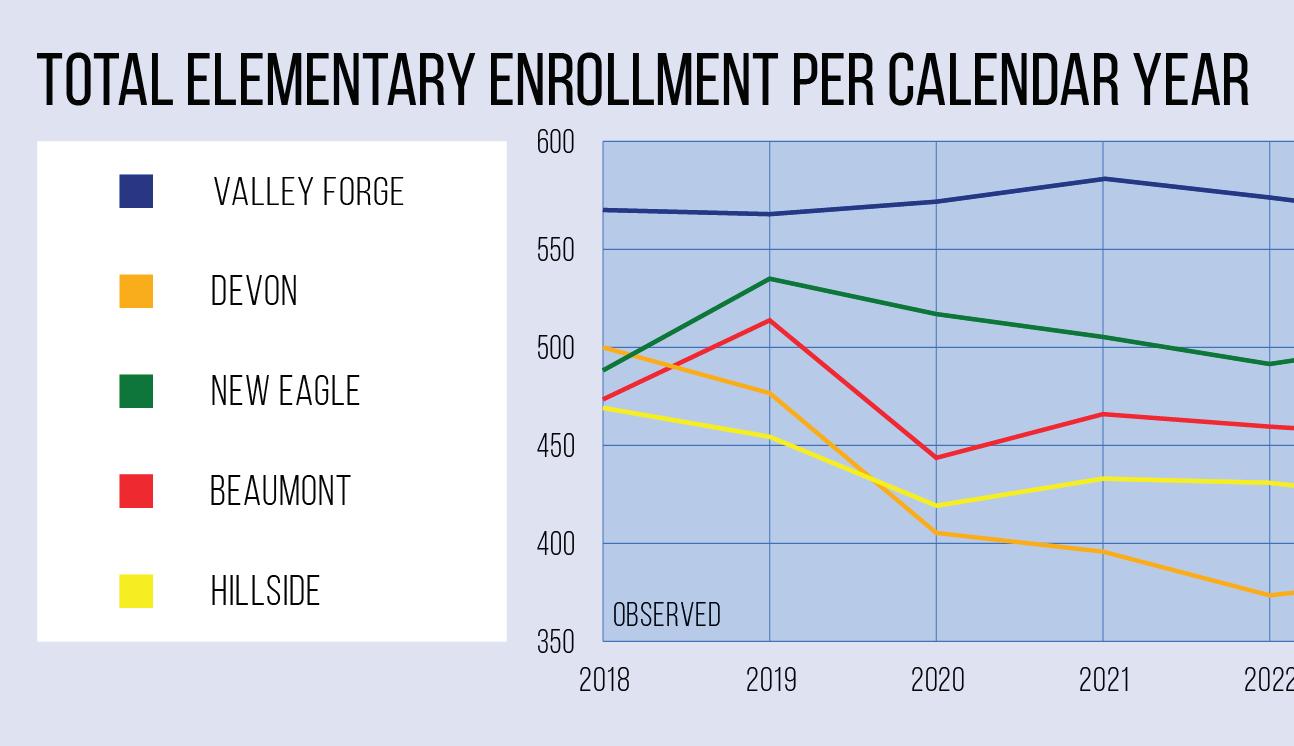
e district started looking more extensively into solutions to the rising elementary enrollment rates around the 2016-17 school year. In 2018, TESD redistricted Devon, Beaumont and Hillside elementary schools to address the uneven distribution of students. During the COVID-19 pandemic, rates

County unveils crisis response initiative
Supervised by nonpro t Woods’ Legacy Treatment Services, the teams include two people: one clinician and one “peer,” someone who has previously gone through a crisis and can empathize with the caller.
“We need someone to actually take an action to help those folks because they most likely aren’t in a position to help themselves,” Maxwell said.
While the network has several long-term facilities, such as Haven Behavioral Hospital of West Chester, members are working to establish more short-term mental health inpatient facilities, as longterm facilities tend to be full.
“It’s a safe place to help the person to stabilize, get their feet under them and then gure out what the next appropriate re-
source for them is,” said Patrick Bokovitz, director of the Chester County Department of Human Services. Call centers can also access technology that documents individuals and areas with a high frequency of calls. Additionally, facilities use an app that tracks the location of teams so that they can dispatch the one closest to the individual in crisis. It also documents the teams’ response times and if they used other resources, such as police intervention.
“I do know that what we’ve set in place, the technology, will help us understand the needs,” Bokovitz said. “It’ll give us a sense of the trends, and subsequently, more quickly plan for what the next step needs to be.”



lowered. ey stabilized to the district’s current “steady, high enrollment,” according to director of educational program Dr. Michael Szymendera.
Across all elementary schools, TESD has 130 classrooms, with one that is available for exible use. Szymendera said that, of the 10 elementary school science labs, the district is reusing one for non-science instructional use. TESD predicts that it will need to repurpose two more labs to accommodate the increase in
“We o en use the phrase ‘maximize the footprint’: An elementary school building has a footprint of the outside, and we can make some modi cations to take advantage of every available space (inside),” Szymendera said. “We’ve really exhausted all of those ‘maximize the footprint’ strategies.”
District resident Jyothirmai Patwari, whose two children attend Valley Forge Elementary School, feels that the sixth elementary school will allow the district to provide better education with the additional space.
“It is going to help the existing school district,” Patwari said. “Students are going to bene t. Teachers are going to bene t. e overall education will have more quality.”
District to implement new faculty induction program
Eshan Singh Co-Copy Editor
Beginning in the 2024-25 school year, all faculty members who are newly employed by the district will undergo a modi ed induction program, with the exceptions of aides and paraprofessionals.
TESD changed the program in response to the Pennsylvania Department of Education extending the mandated length of induction from one year to two, in addition to mandating other changes to the process.
“We’ve been required by the state to provide an induction program for a very long time,” said Dr. Wendy Towle, director of curriculum, instruction, sta development and planning. “It’s been modi ed slightly (before) but not a big change like this one.”
e district’s sta development advisory committee is responsible for designing the induction program. When the department changed the requirements, the committee decided to remake the induction process instead of just extending it. e state also requires that the program includes culturally responsive practices, structured literacy training and increased focus on professional ethics. Culturally responsive practices involve delivering instruction that includes multiple perspectives and looks at each student as an individual with speci c needs. Structured literacy focuses on the foundational skills that are part of reading instruction, such as phonics, vocabulary and comprehension.
Biology teacher Sabrina Bates joined the district in summer
2023 and received a mentor to help her transition to Conestoga as part of the current one-year induction program. Bates feels that the new two-year process will be bene cial to teachers as they will have a mentor for another year.
“Having those extra supports will help prevent teacher burnout because they’ll have more resources available to them,” Bates said.
Towle said that the district faces some logistical issues with managing the new program but feels optimistic overall.
“One of the biggest challenges is that every year now, we will basically be running two separate induction programs: one for the people who are in year one and one for the people who are in year two,” Towle said. “But I think what we came up with in the end is really excellent.”

Responding e ectively: The Human Needs Network utilizes long-term mental health facilities, such as the Haven Behavioral Hospital of West Chester, to help those in crises. Chester County opened the system in mid-April to aid community members facing mental health or housing related issues.
improve responses to housing and mental health crises, the Chester County Department of Human Services and board of commissioners opened the Human Needs Network in mid-April. e county devised the idea in 2019 to improve information referral systems and better address mental health crises, beginning formal planning in 2021. Funded through American Rescue Plan Act grants, the network includes mobile resolution teams as well as walk-in crisis and local call centers. e calling stations, based in West Chester’s Government Services Center, utilize the 988 national mental health and 211 state human services hotlines. e county created and sta ed the facilities in conjunction with Holcomb Behavioral Health Systems, a branch of the organization Chimes. Counselors work at the mental health locations, providing support and connecting people to mental health nonpro ts. “We need someone on the phone who answers the phone quickly and then speaks to the person until their issue is resolved,” Chester County Commissioners’ Chair Josh Maxwell said. “Being able to control that phone system is really important.” Call centers remotely dispatch street outreach or mobile crisis resolution teams to connect callers to housing services or mental health hospitals, respectively.
To
1200
o
April 2, the district bought a 15-acre property at
West Swedesford Road in an
Continued
on page 3.
www.spoke.news
Conestoga High School, Berwyn PA, 19312 Volume 74 No. 7 May 29, 2024
Emily Wang Sta Reporter
Faith Zantua/The SPOKE
TESD administration started extensively discussing solutions to the district-wide high elementary enrollment around the 2016-17 school year. student enrollment next school year. e
and added
existing schools to make more space
fore
new
Addressing enrollment: Students from Valley Forge Elementary School, which has the highest elementary enrollment rates in the district, board a school bus.
district also combined
rooms to the
be-
it assessed properties for the
elementary school.
types on a computer. She joined the district in summer 2023. Eshan Singh/The SPOKE
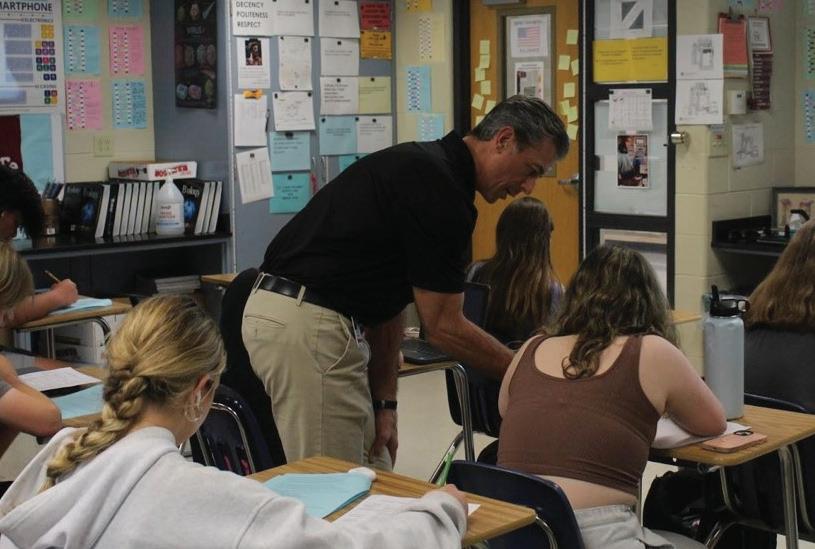
Inducting sta : Biology teacher Sabrina Bates
Pages 6-7
U.S. collegeS reSpond to campUS proteStS
Since mid-April, students have been holding pro-Palestinian protests on college campuses around the nation, many calling for divestment from munitions companies involved in the Israel-Hamas war. Some university administrators have asked for police to break up the protests. On certain campuses, protestors have willingly dismantled after receiving opportunities to negotiate their demands with officials.
Biden and trUmp agree to preSidential deBateS
President Joe Biden and former President Donald Trump accepted invitations to presidential debates on June 17 and Sept. 10 with CNN and ABC News, respectively.
Dana Bash and Jake Tapper will moderate CNN’s debate while Linsey Davis and David Muir will moderate ABC News’ debate.
School Board adoptS
propoSed final BUdget
During its April 29 regular meeting, the TESD school board adopted the proposed final budget of $187.5 million for the 2024-25 fiscal year. The state granted TESD a tax rate referendum exception to the Pennsylvania Special Session Act 1 of 2006 for special education expenditures. The school board will vote on a final property tax rate at its June 10 regular meeting.
coUnty planning com-
miSSion adoptS new heritage toUriSm plan
The Chester County Planning Commission adopted a new Heritage Tourism Plan on April 24. The plan aims to increase heritage tourism, encourage preservation of heritage sites and raise public awareness and support for local and regional preservation.
Historic Tredyffrin Township property to be demolished
At the April 15 Tredyffrin Township board of supervisors meeting, the board voted 6-0 in favor of a mitigation plan for a property called Glenilse in Malvern with the Pennsylvania Emergency Management Agency (PEMA) and the Federal Emergency Management Agency (FEMA). FEMA and PEMA are organizations that work to help people and places recover from natural disasters. The plan involves a $182,000 grant from FEMA for demolition of the historic house and maintenance of a pool on the property. The estate at 1289 Yellow Springs Road, which includes a pool, was built in 1937 for a prominent Main Line family. It was then sold to Charles E. Hires Jr. and his wife Ilse Hires, who gave the property the name Glenilse, with “glen” referring to the mountain stream on the property. The current private owner purchased the 6.8-acre property in 2014 with plans to renovate the house. The house experienced flooding in 2018 from a near-
by stream and in 2021 during Hurricane Ida. Due to the stormwater damage, the owner decided to demolish the house with aid from FEMA, PEMA and Tredyffrin Township. Pat-
tye Benson, president of the Tredyffrin Historic Preservation Trust, a local nonprofit, has been working with PEMA and the township on the mitigation plan.
“I thought it’d be wonderful to leave the very unusual, unique swimming pool,” Benson said. “That’s historic, intact and it shouldn’t be that much (work) to continue to
operate. It’s by the creek, it’s really neat and you can see the water going into it from the stream. It’s a beautiful pool.”
FEMA officials have been monitoring Glenilse since

3 AP exams administered digitally this school year
For the first time since the COVID-19 pandemic, Conestoga selectively administered Advanced Placement exams digitally. Although the College Board has made digital exams available for eight AP courses, administration opted into online testing for three this year: AP Computer Science Principles, AP United States History and AP World History: Modern. Bluebook, a software program the College Board created as an online testing application, provides practice and official tests for the PSAT, SAT and AP exams. While Conestoga had the option of digital exams starting last year, it continued administering paper AP exams. Megan Smyth, guidance counselor and AP coordinator, said
that the administration decided to switch some classes to digital exams due to students already having Bluebook software downloaded and being familiar with it after using it for the PSATs last November.
“We want to take this process slowly so we run into as little technical difficulties as possible,” Smyth said. “Now that we have already set up the Bluebook software for the PSATs, we feel a little more comfortable offering the digital option for AP exams.”
Students used Bluebook for their digital AP exams on either a school-issued or personal laptop. During the week of April 29, teachers of courses with digital exams used class time to ensure that their students knew how to use Bluebook. Bluebook also provides sample multiple choice and free response questions that students can use for
practice within the testing application. Smyth believes this is an advantage of switching to digital software.
“Having one place to both take the test and practice will allow students to organize their studies before the exam,” Smyth said. “Online practice will allow students to both prepare for online exams and study for the content that they will be tested on.”
For some students, taking digital AP exams was a positive experience. Junior Kyle Xu, who took the Computer Science Principles exam on May 15, prefers taking the exam digitally through Bluebook over the paper format.
“It felt a lot like the digital PSAT that we’ve had this year,” Xu said. “Me personally, I do like that it was digital, especially for the written section, because it’s a lot easier to type and (it’s) a lot less strain on your hands.”




the floods and found that the property was eligible for listing in the National Register of Historic Places, the U.S. government’s official list of sites, buildings and objects that the government deems worthy of preservation. Because of the property’s age and historical value, FEMA sought to carry out a mitigation plan instead of total demolition.
The township will use part of the grant to hire a historical consultant to evaluate the property and train the township historical commission on assessing properties for historical significance. If the plan is successful, ownership of the property and the responsibility of maintaining the pool will transfer to the township. Township manager William Martin addresses concerns that the township will take on unexpected expenses with this project.
“There’s a little bit of risk to the township, but the homeowner has already committed to it. I think it’s the right thing to do,” Martin said. “We are doing some good faith with some concerns with supervisors, but at the end of the day, it should be a good outcome.”
Pennsylvania switches to digital format for Keystones, PSSAs
On April 18, the Pennsylvania Department of Education announced the mandated transition to online testing for the 2026 Pennsylvania System of School Assessment (PSSA) and Keystone exams.
Over the next two years, every public school in Pennsylvania will make the transition to online testing for standardized exams. The department will issue a specialized software program for administering standardized tests. TESD plans for students in elementary school to use their district-provided iPads, and all middle and high school students to use a laptop. Conestoga hopes to pilot the online Keystones in the winter of 2026 with a group of students who were absent for the main Keystones. The district will of-
ficially administer online exams in May 2027.
“I think (these changes) are going to be a good thing,” English teacher Dori Madigan said. “It will save our school time, save the state a lot of money and it’s going to cut down on paper usage.”
The department also announced two significant changes to the exams in addition to online testing: Technology-Enhanced Items (TEI) Question Types and the Benchmark Assessment Tool. TEIs will implement new questions using drag-and-drop options, sorting and graphic manipulation, which many students are already accustomed to using. Paper tests will remain available to students who require additional accommodations.
The optional Benchmark Assessment Tool allows educators to gauge student progress and whether their students are on
track to succeed on the end-ofyear exams.
Sophomore and American Voices student Gisele Albert feels that the digital format will be advantageous to students taking the Literature Keystones.
“Especially for the (Literature) Keystone, it’ll be easier to write your response and type it out instead of handwriting. It takes less time and will be easier to edit,” Albert said. Online exams will also shorten the time that scores return to students. James Bankert, 10th grade assistant principal and assessment coordinator, feels that these new changes will benefit both teachers and students.
“Keystone teachers don’t see how their students did until September, when they’ve already got a new crop of students for the next year,” Bankert said.
“I haven’t seen how fast the turnaround time will be, but it’ll make things more efficient.”
FAFSA issues delay college commitment days
In December 2023, technical glitches delayed the Free Application for Federal Student Aid (FAFSA) form’s release after implementing an updated application aimed to make the process quicker and easier to complete.
This caused more than 100 colleges and universities across the United States to postpone National College Day on May 1, the day students confirm their enrollment to the school of choice, to late May or early June.
The FAFSA is the official application that determines how much financial aid a student is eligible to receive from the federal government. This year, the U.S. Department of Education made several revisions to the form, including cutting the maximum number of questions from 108 to 46. Normally, the FAFSA form is available on Oct. 1, but the delay pushed back the release date to Dec. 30 due to data and processing errors. During the first two days after its release, another glitch caused the form to be only sporadically
available for about 30 minutes at a time. By Jan. 8, the FAFSA administration fixed the glitch and made the form fully available.
“While I was completing the FAFSA, there were occasional glitches where I couldn’t access my already-existing form, and sometimes, nothing would load,” senior Joshua Baek said. “I think doing the FAFSA after completing all my college applications made it less of a burden, as I didn’t have to think about all the things I needed to submit before the deadlines.”
Many colleges and universities require the FAFSA form to determine students’ total amount of financial aid that is received, known as a financial aid package. When the form is completed, it is automatically submitted to the student’s selected colleges. With a delay in the form, students may not receive their financial aid packages in time and miss out on scholarship opportunities, as some aid programs operate on a first-come, first-served basis.
“Usually within a couple weeks you’re accepted, the colleges are able to give you a
financial package,” guidance counselor Rachel Reavy said.
“The delay meant that students are waiting to hear what the financial package will look like for each school. A lot of the students have been trying to wait and see which school gives more merit money or more scholarship money so they can make a good decision. It’s really pushed a lot of things back in terms of the decision timeline.”
The delay may also affect the next graduating Class of 2025 with more possible glitches. With concerns over potential delays in next year’s FAFSA processing, Reavy advises students to stay proactive.
“Pay attention to the deadlines, make sure you don’t miss them on your end,” Reavy said. “You can’t control the federal government, which is frustrating. Know that all of the colleges know it’s happening. It’s not a single student that has this issue, but the whole country. Communicate with the financial aid officers at the college and ask questions. You can’t ask a bad question.”

2 Wednesday, May 29, 2024 News A BRIEF LOOK THE LATEST DEVELOPMENTS IN T/E AND NATIONAL NEWS
exams in May and his students prepared for more than a month. Ashley Du/The SPOKE Online preparation: Junior Kyle Xu logs in to the Bluebook software in preparation for the AP Computer Science Principles exam. Conestoga administration opted to administer three exams online this year. Rohan Anne/The SPOKE Historical home: Built in 1937, Glenilse sits in a private corner of a Malvern neighborhood. The house sustained stormwater damage from floods in 2018 and 2021. Miya Cao/The SPOKE Delayed forms: Junior Lauren Wu looks at the Free Application for Federal Student Aid (FAFSA) application. This year, data and processing errors caused the release date of the form to be pushed back to December. Audrey Kim/The SPOKE Miya Cao Co-Copy Editor Rohan Anne Webmaster
Audrey Kim Staff Reporter The SPOKE Read more at T/E LIFE OPINION SPORTS GSA holds first-ever spring formal On May 18, juniors attended the prom hosted at the Sheraton Valley Forge from 6-10 pm. The dance’s theme, “The Great Gatsby,” could be seen through sparkling decorations and feathered centerpieces as students entered the venue and joined their friends throughout the lobby, dining area and dance floor. From blasting music to colored lights, students danced and laughed in Conestoga’s small courtyard on May 8 at the Gender Sexuality Alliance’s (GSA) first-ever spring formal. Gatsby Glamour: Juniors go to first prom Historically, Congress has altered the governmental structure of the United States to reflect shifts in society. The judiciary is now in need of similar reform. The nine justices who preside over the Supreme Court of the United States (SCOTUS), are responsible for the ultimate interpretation and application of the nation’s laws. SCOTUS justices need term limits On May 16, the girls’ lacrosse team competed against Henderson at Teamer Field in the second round of the PIAA District 1 3A Girls Lacrosse Tournament. The game began as ’Stoga scored six goals in a row by the middle of the first quarter. In the end, Conestoga won 17-5. Girls lacrosse dominates in second round of district playoffs 17-5
Social Media Editor Lauren
Helping hand: Biology teacher Dante Mucci helps his students prepare for the Biology Keystones. Conestoga administered the Keystone
Ashley Du and Rajan Saha Staff Reporters
Lexi Lin,
Pinheiro, Photography Editor
Louisa Sandorff, Staff Reporter
Business
LIFE
Shrija Krishnan,
Manager T/E
TESD buys property, plans for fall 2027 opening
District’s design proposals for the project
Continued from page 1. “It was also an area that could be segmented pretty easily and was o to the side and not in the middle of an o ce park.”
When the district began ofcially pursuing the project, it considered building the elementary school on one of two district-owned properties, on First Avenue in Berwyn and on Je erson Lane in Chesterbrook.
Administration also explored the option of adaptive reuse of an ofce building, working with Vista Realty Partners, a real estate advisory organization, to help choose a commercial site. e group identi ed around 18 locations that met some of the project’s requirements, and the district eventually deemed the West Swedesford Road property the most suitable option for adaptive reuse.
“We quickly zeroed in on the 1200 West Swedesford Road property because it had some unique characteristics associated with it in terms of its current size. It had enough available land space to be able to accommodate the amount of elds, playgrounds and parking that you need for an elementary school,” school board president Todd Kantorczyk said.
Project surveyors found issues with the two district-owned properties regarding size, topography, accessibility and location in relation to the student population. A er comparing all three sites, the district pursued an agreement of sale for the West Swedesford property, beginning a due diligence period from Jan. 17 to March 18, when the district surveyed whether the property suited its needs. At the March 13 special school board meeting, members of the project team presented their ndings, including the proposed designs, budget and timeline for the project.
2007 Conestoga alumnus and Tredy rin Township resident Hans van Mol attended the March 13 meeting and supports the district’s decision to reuse the corporate building.
“I think this is a great opportunity. People talk about wanting to take a lot of these empty buildings and convert them into schools. at’s not something that you can just go do. ere’s a lot that goes into that, and so the district accounted for that,” van Mol said.
“It utilizes an existing building and still keeps the desirable land size that the district is looking for.”
e property has a three-story, approximately 80,000-squarefoot o ce building with parking to the north, south and west of it. Kindergarten and rst grade classrooms will be located on the rst oor, second grade classrooms on the second oor, and third and fourth grade classrooms on the third oor.
Plans include reusing the current structure of the building and performing construction at the site to establish 30 classrooms, 14 seminar or teacher preparation rooms, two science labs, one “gymnatorium” serving as both a gymnasium and a stage, one soccer eld and one baseball eld.
e district is considering installing a middle-school-sized gymnatorium at the school instead of an elementary-sized one. Conestoga parent and president of the Paoli Wildcat Basketball organization Aubrey Dirkes said that a larger gymnatorium would allow more TESD students to play basketball.
“ e only reason that we can’t have more kids playing basketball from November through the end of February is capacity of gym

State creates student-teacher stipend program
On the opening day of the Educator Pipeline Support Grant Program, the Pennsylvania High Education Assistance Agency received thousands of submissions. Administered through the Pennsylvania Higher Education Assistance Agency, the program began on April 11 to address the statewide teacher shortage by providing stipends to student-teachers, as districts do not normally pay them for their work.
As part of Act 33, a bipartisan legislative e ort that Gov. Josh Shapiro signed on Dec. 13, 2023, the Educator Pipeline Support Grant Program allocates $10 million to fund student-teachers,
who can receive up to $15,000 of aid each. Eligibility requirements include a commitment to working as a teacher at a public or non-public school in Pennsylvania for a minimum of three years a er nishing a student-teacher cooperative. Host teachers may receive a grant of $2,500. Nicolette Rondeau, a former student-teacher at Conestoga High School and T/E Middle School, works as a French teacher at the Villa Joseph Marie High School in Holland, Pennsylvania.
“I think in general (stipends) would allow for less stress and even for student-teachers to dedicate more time to their teaching duties,” Rondeau wrote in an email. “I know it may be too late for me, but I would love

to see this change happen for future student-teachers.”
As TESD does not pay student-teachers during their co-op, throughout her time in the district, Rondeau balanced working a job to pay bills, attending college classes and serving as a student-teacher for 40 hours per week. She believes the stipend program could be benecial for others in student-teacher programs because of thenancial support it provides.
e program is on a rstcome, rst-served basis. It provides $10,000 to student-teachers and another $5,000 if they are working in “high-needs areas,” according to Shapiro’s website. Dr. Anthony Stevenson, the TESD director of human resources, feels that the program could incentivize student-teachers to work away from districts close to their college campuses. However, he believes that the program should prioritize providing stipends to those who wish to work in high-need districts where it is di cult to attract and retain teachers.
“If (the state has) unlimited money, I think everybody who’s a student-teacher should get (a stipend),” Stevenson said. “But if there’s only a certain amount, you should put the priority on those higher-need areas.”
Shapiro’s 2024-25 budget proposal includes a $5 million increase for the program that aims to strengthen the program and encourage more student-teachers to continue teaching.
“Having a stipend certainly will not hurt,” Rondeau wrote. “It could show how teachers (are) valued in Pa., and maybe with time, more people will be interested in the profession.”



space. e elementary school gyms are too small for us to have games in them,” Dirkes said. “We want to make sure that we can provide that service to as many kids as possible.”
Plans to nance the school
TESD is nancing the project through the fund balance, or the money that it has gathered in the past. e district also plans to issue bonds and use annual revenue, the largest source being from local taxes, according to Gusick. e total project cost is estimated at more than $69 million according to the March 13 proposed project budget, including payments for a variable refrigerant ow heating, ventilation and air conditioning system replacement and an in ll of the site’s stormwater pond.
“I think a lot of people thought this might be signi cantly cheaper, but because you have to pay for the building and the property and then we had to do significant renovations, it’s about the same as if we had built a school from scratch,” said school board nance committee chair Dr. Roberta Hotinski.
To help finance the district’s new elementary school, athletic fields and yearly infrastructure projects moving forward, Hotinski said that TESD plans to borrow around $100 million over the next five years through three issuances of bonds.
Gusick said that operating the new school would cost approximately $8 million per year. The district is in the pro-
cess of determining the project’s financial details, such as the local tax increase.
“It’s pretty disruptive if you all of a sudden try to get an $8 million increase in one single year. So, a smart thing to do can be to gradually raise taxes to the limit where you need it. And if there’s money in the meanwhile that can be contributed to the construction costs, then you borrow less and then that saves the taxpayers long term money,” Gusick said. “But it does involve a higher tax rate.”
We pay more, we get better results. So, if more tax means better education, I’m totally fine with that.”
Educational e ects on students, teachers and curriculum e district aims to sta the sixth elementary school with both new and existing teachers. Director of curriculum, instruction, sta development and planning Dr. Wendy Towle is in charge of employing new sta and predicts that the district will need to hire
I agree with those parents who have this concern about the tax increase. But, this is our T/E school district. We pay more, we get better results. So, if more tax means better education, I’m totally fine with that. Haihan Ma Parent of a Hillside Elementary School student
Haihan Ma, father of a rst grader at Hillside Elementary School, has concerns about the tax increase but nds it justiable due to the project’s bene ts for the district.
“I agree with those parents who have this concern about the tax increase,” Ma said. “But, this is our T/E school district.

around 15 teachers leading up to fall 2027, some of whom may work at existing schools prior to the new building’s opening.
“What we’ve been talking about is asking if there are teachers who would be interested in moving to the new school. And if it works out with numbers of (classes) and it will make a good mix between new and experienced teachers, then we’d like to try to accommodate them,” Towle said. To redistribute enrollment, the district plans to redistrict all elementary school students in preparation for the 2027-28 school year.
Currently, TESD splits students who graduate from Hillside Elementary School to attend either Tredy rin/Easttown or Valley Forge middle schools. e addition of the sixth school and redistricting will prevent this separation, and each middle school will receive incoming h graders from three elementary schools.
With the sixth elementary school adding 30 classrooms, TESD will implement full-day kindergarten across all elementary schools. Currently, kindergarten classes run on a half-day schedule with a.m. and p.m. classes. According to the September 2023 TESD Status Update on Elementary Enrollment and Facilities Utilization report, approximately 90% of Pennsylvania school districts o er full-day kindergarten.
Valley Forge Elementary School kindergarten teacher Jessica Shepherd is excited for the full-day
schedule and emphasizes that it would provide more time for students to learn in the classroom.
“A full day gives us much more time to develop more curriculum, more stories, more writing, more freedom, more free play, more exploration,” Shepherd said. rough the new school, TESD science curriculum supervisor Kim Morris feels that the district can also better ful ll new curriculum requirements through increasing opportunities for science activities. By the 2025-26 school year, the Pennsylvania Department of Education requires schools to implement science curriculum updates in order to meet the recently established Science, Technology & Engineering, Environmental Literacy & Sustainability standards.
“It’s awesome to be able to have the opportunity for our kids to have smaller classrooms, two labs, science classes with space and room to breathe,” Morris said. “I think it’s phenomenal.”
Future logistical objectives
As TESD prepares to redistrict and adjust the curriculum, the project’s architects and engineers are designing a land development plan for Tredy rin Township. As the property is currently in an ofce zoning district that does not normally allow for schools, the district is requesting for a conditional use approval. Gusick said that the general approvals process could take multiple months.
“For larger projects, they tend to say, ‘All right, we’re okay with these things. But we want you to bring these things back next month,’” Gusick said. “So that could take several months where you look at the property, and there’s no (construction) going on. But that’s because the architects and engineers are developing plans, revising them, taking them to the public authorities, getting the necessary approvals that we need.”
As the district prepares for approvals, it will explore potential solutions to ease current room use in the elementary schools, such as establishing modular, or temporary, classrooms at the existing buildings until the new school is nished.
According to the March 13 projected timeline, necessary documentation, bidding and awards will take place from July 2024 to November 2025, followed by construction. e district will continue to hold meetings regarding the project. Community members, such as Dirkes, look forward to the project’s implementation.
“It’s a good project. Adding capacity so that the school can maintain its current class size is an important thing,” Dirkes said.
“So if this is what we need, then this is what we need.”


Wednesday, May 29, 2024 News
O ce turned school: The1200 West Swedesford Road property includes a three-story, approximately 80,000-squarefoot o ce building that the district plans to reuse for a new elementary school. The district purchased the site on April 2.
3
Rowan Chetty/The SPOKE
Support stipends: Decorations ll French teacher Alice Debu’s classroom. Nicolette Rondeau worked under Debu as a student-teacher and said that the Educator Pipeline Support Grant Program could be bene cial to other student-teachers.
e SPOKE
Lily Chen/The SPOKE
Day full of activities: Kindergarten students listen to a lesson as part of their morning half-day class at Valley Forge Elementary School. The district decided to implement full-day kindergarten while looking into a sixth elementary school.
Faith Zantua/The SPOKE
Lily Chen Co-News Editor
Senior excels in national level of Chemistry Olympiad
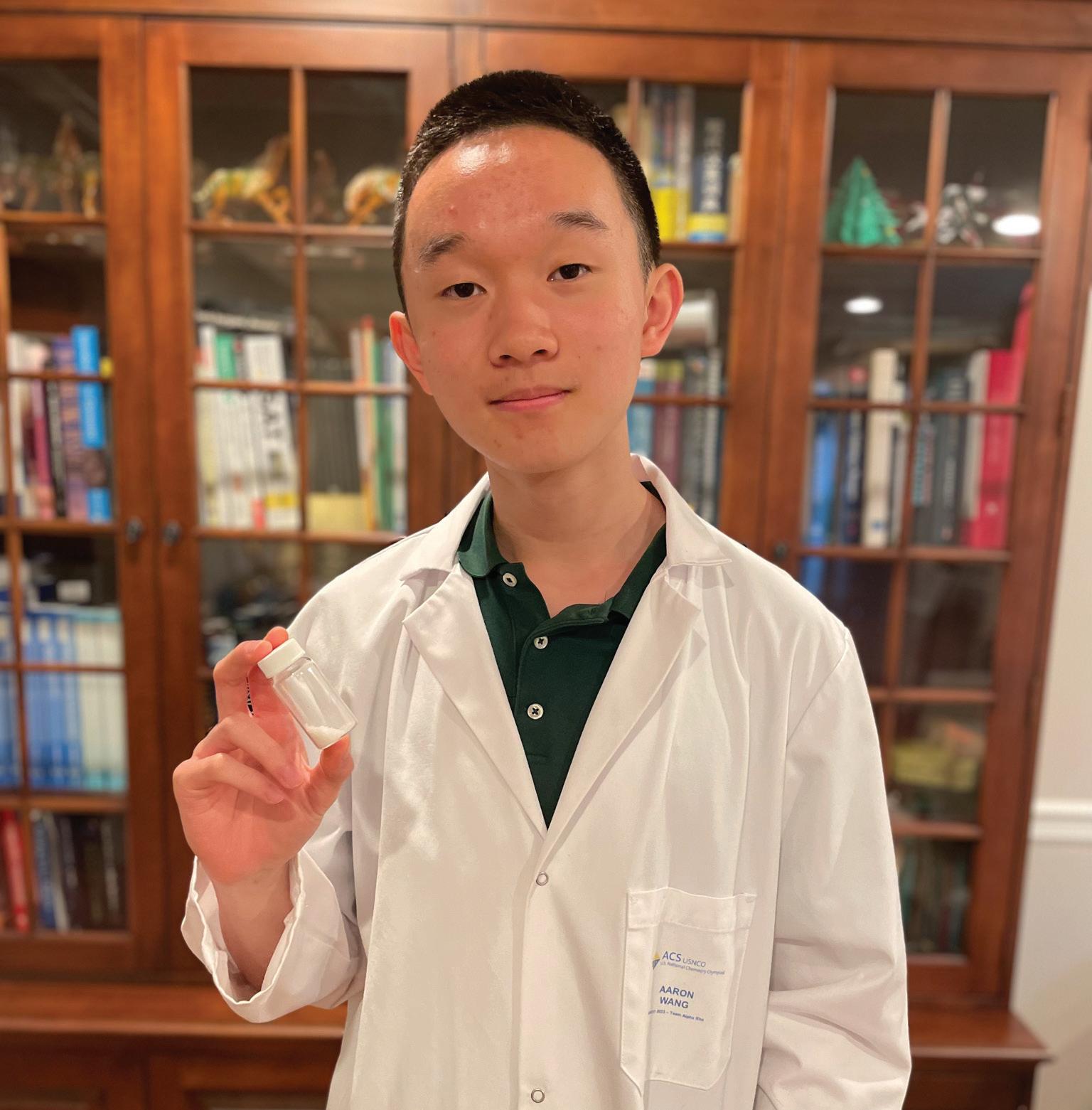
Senior Aaron Wang was among the top 20 chemistry students nationwide to attend the U.S. National Chemistry Olympiad Camp to prepare for the International Chemistry Olympiad last year. This year, he hopes to repeat his success. The U.S. National Chemistry Olympiad is a chemistry competition with around 16,000 student participants each year. The competition consists of two rounds, the local exam and national exam. After these rounds, the top 20 highest scoring students from the national exam receive invitations to participate in a two-week-long study camp in the summer. Of these students, four go on to represent the United States at the prestigious International Chemistry Olympiad.
Wang’s success involved countless hours of dedicated studying. According to Dr. Scott Best, Wang’s Advanced Placement (AP) chemistry teacher, Wang would often spend hours of his free time studying chemistry.
“Aaron's a great student. He's intelligent, curious and probably one of the best chemists that I've had a chance to teach here,” Best said. “He was coming in on his free time. I don't know how many periods he came in to just practice experiments and work basically on his own at home studying.”
Wang began learning chemistry in sophomore year as part of the AP Chemistry curriculum. Despite starting later than many of his competitors, Wang caught up quickly.
“I found that I really liked to do chemistry, and naturally, I would invest a lot of time
into the subject,” Wang said. “I would just do it for fun and then study camp just sort of came as the added benefits of just doing what I love.”
Though Wang did not make the national team last year, he hopes to represent the United States in the International Chemistry Olympiad this year. After high school, he plans to pursue chemistry further at the Massachusetts Institute of Technology, which he will be attending in the fall. Wang believes his success with chemistry can be attributed to his passion for the subject.
“In the end, (what) allowed me to actually do what I did was that I was doing what I really love to do,” Wang said.
“That principle can really be generalized to anything no matter what you like to do, so long as you're passionate about it and you invest the time into it.”

Wayne Art Center hosts 16th annual Plein Air Festival
Through their paintings, artists bring the intricacy of the outdoors to life. The Wayne Art Center Plein Air Festival provides a platform for imaginative artists around the country to gather and let their creativity take over in the form of art.
The 16th Plein Air Festival, held at Berkley Farm in Wayne, brought 32 nationally acclaimed artists to Wayne to compete and paint from May 5 to May 10 for $25,000. Artists typically adhered to the theme of “local treasures” by painting landscapes, architectural features or small towns within a 25-mile radius of Wayne. Their art will be displayed and sold in an exhibit in the Wayne Art Center until June 22. The Plein Air Festival in Sedona, Arizona inspired the executive director and founder of the festival, Nancy Campbell, to bring it to Wayne to showcase the uniqueness of the area. “The nature that surrounds us is very different from what you see in Arizona. We have
our own beauty, and they have their own beauty,” Campbell said. “We have a lot of generations of families that recognize the beauty of our area, like if they have been to the Devon Horse Show or taken the train from Wayne. That's the thing people relate to and that the community and this festival embrace.”
Many local artists participated in the Plein Air Festival this year, where they could paint over a span of six days. Elaine Lisle, a rst-time participant from Bryn Mawr, had mixed feelings about the festival.
“I’m always nervous for these kinds of things since it’s painting 24/7 for six days, and it’s exhausting. I think the adrenaline kicks in though, and it’s exciting to be a part of a group painting the community,” Lisle said.
At the end of the sixth day, May 10, a collector’s preview and sale was held to award $25,000 in cash prizes to the top winners. e juror who chose the winners this year was Jill Carver, a full-time professional artist from Colorado.
Another artist who competed in the festival, Mick McAn-
 Mareska Chettiar Co-T/E Life Editor
Sweet and delicious aromas lter through my nose as I entered the small waiting area of M&M Dim Sum and Hong Kong BBQ. A er walking past a large sh tank, the waitsta welcomed me to the restaurant and into a large dining space, ranging from tables for two to a party table. Music played so ly over the speakers and warm lighting surrounded the seating space, creating an inviting atmosphere.
A er being seated, servers provide paper menus that customers can mark o and write on in addition to traditional menus. e selection includes a wide range of dumplings, dim sum, noodles, Hong Kong-style BBQ options, fried rice, clay pots, pork, beef and dessert options.
I started with a pot of light and fragrant jasmine green tea for just $4. For appetizers, I ordered pork soup dumplings and the scallion pancake for $6 each and shrimp rice noodle wraps for $8. e soup dumplings
“Theirs”
“I like being with the other artists. We spend time together and have meals together and just enjoy each other’s
company, but it’s also competition,” McAndrews said. “To be honest, art shouldn’t really be competitive, so that aspect, I find a little disconcerting, but the people that are involved with art in general and at these festivals are wonderful people and just good people to spend time with.”

were steaming and an absolute delight, though I would have preferred more soup in them rather than more meat. However, the dish overall was lling and satisfying with the great texture of the dumpling and the umami-rich soup. e scallion pancakes were crispy and aky, with a ginger-garlic sauce that I could not get enough of. I was also excited to try the shrimp rice noodle wraps. ey lived up to my expectations, with a light sauce to complement the slightly chewy texture of the wrap. ey were bursting with the avor of shrimp and an overall great dish. For the entrée, I ordered roasted pork Hong Kong BBQ style. It was chewy and surprisingly sweet, and it had a great quantity for just $15. e jasmine tea and shrimp noodle wraps served as great palate cleansers as I switched between dishes. Finally, I had the restraunt's "homemade mango pudding" for dessert. e texture of the pudding was more like jelly, and though there was an a ertaste of mango, the rst avor was primarily of condensed milk. As it lacked texture and avor, I would not rate it as highly as the other dishes.

My experience at M&M Dim Sum and Hong Kong BBQ was excellent overall. e ve items I ordered totaled up to $54.06, which I considered very reasonable for the quantity and quality of dishes. e waitsta were very friendly, the aesthetic of the drews from Downingtown, was a returning participant and enjoyed the aspect of engaging with other artists but had a varying opinion on the competitiveness of the event.
restaurant warm and welcoming, and the food was
I will de nitely be



T/E LIFE 4 Wenesday, May 29, 2024 e SPOKE
competition, which lasted until May 10. The painting will be displayed in the Wayne Art Center exhibition until June 22.
/THE SPOKE
Painting in the rain: Jennifer Sampson, a participating artist, takes inspiration from the scenery in front of her and paints with precision. Sampson traveled from New York the day before to attend the
Prashi Agarwal
Ryan Ding Sta Reporter
In the lab: Senior Aaron Wang prepares to conduct an experiment involving vanillyl alcohol. Wang spent numerous hours studying chemistry and conducting experiments in order to succeed in the U.S. National Chemistry Olympiad.
Courtesy Ji Luo
Brilliant barbecue: (From le to right) Scallion pancakes, shrimp rice noodle wraps and Hong Kong BBQ-style roasted pork ll the table.The dishes were delicious and the wait sta were very friendly. M&M Dim Sum and : M&M Dim Sum and Hong Kong BBQ 1776 E Lancaster Ave, Paoli, PA 19301 Price: $$ Rating:
Mareska Chettiar/The
SPOKE
SAT prep that’s friendly, not factory
yes
are going to have to take a summer SAT course. Our classes are small, fun, and personalized.
are big, boring, and repetitive. It’s a pretty easy choice, right? Find out more at CrimsonReview.com
Prashi Agarwal Sta Reporter
You,
you,
Prashi Agarwal/The SPOKE
Precise painter: Ed Praybe analyzes the scenery he is painting to make his art as accurate as possible. Praybe worked under rainy conditions the rst day of the competition, which was May 5.
top-tier.
visiting again.
Hong Kong Barbecue
Fresh out the oven: Junior runs bread-baking business
Her target audience is usu-
From mixing dry ingredients to taking fresh, warm loaves out of the oven, junior Eleanor Turner knows her way around making bread. Her passion for bread-making started as a hobby, but she has since turned her interest into a business.
Turner launched her business in 2019, with inspiration from her experiences making bread with her dad when she was younger. Now, she sells her bread, seeing around one customer a week.
“My dad has been making bread for a while. Then I started making it with him, but it was boring because he only used one recipe,” Turner said. “So, I tried more recipes to build upon his work.”
Turner has expanded her business through the use of an Instagram account she created last year, @turnylovesloaves, which she dedicates to photos of her bread. She also creates videos to advertise her loaves, which she generally sells for $5 to $7.
ally high schoolers, but Turner has also sold her bread to others outside of Conestoga. This past year, Turner baked around 30 loaves for 15 customers. She hopes that, through her Instagram account, she can reach a wider audience and make bread for a variety of customers.
“ e Instagram account showcases my bread to an audience and really shows that, ‘Hey, I make bread,’” Turner said. “You can get this bread which I sell for a reasonable price.” Junior Allie Naiva, a returning customer, has helped Turner throughout the process of building her business in the bread-making world.
“I find (the business) quite amusing. It started out as just her baking bread every other week, and I suggested she should make an Instagram account,” Naiva said. “Occasionally, I’ll go over to her house and help her film, and it’s become like a fun little project to do, which I’ve been trying to help her to work this into a business.”
While baking bread is an enjoyable hobby for Turner, she said that balancing her business with her schedule is a challenge.
“Making bread takes the whole day, so if I have plans I would have to shift them around, and I can’t bake bread at night or I miss the rising time,” Turner said. “I always plan ahead before I make a loaf. I have to look at my schedule and make sure I’m not over-planning for one day or promising to make bread for too many people in one weekend.”
Alongside Turner’s inspiration from her dad, her friends have also have helped her manage the responsibilities of running a business.
“My friends definitely are my biggest supporters. They have helped me through this process,” Turner said. “Last year, I would bring bread every Monday at lunch so they could test and review. My friends have always been there for me, cheering me on and making sure my business is thriving.”

Marching band performs in Memorial Day Parade
Conestoga’s marching band paraded down Constitution Avenue in Washington, D.C. over Memorial Day weekend. From May 26 to 27, the marching band and color guard performed at the capital in the National Memorial Day Parade. Performers traveled from Conestoga on the morning of May 26 and began their trip around the capital later that day. Preparation for the parade began in the weeks prior to the trip.
“We are marching in a parade with a bunch of di erent bands from each state as a preshow. We’ll start practicing parading, which is a little bit dif-
ferent than on the football eld, and we will have the music, so just practicing that,” junior and trumpet section leader Matthew Ma said.
On the trip, they also visited various tourist locations around Washington, D.C.
Upon arrival, they went on a motorcoach tour of historic Washington, D.C., visiting local landmarks. Senior Shea O’Connell, a baritone section leader, was excited for the sightseeing.
“We’re going to this space museum where we see airplanes and NASA things,” O’Connell said.
“I’m really excited for that, and I think it will be really fun because we’re going together as a school group, so it’s not like I am going
with my parents or something like that.”
ey also attended the ofcial National Memorial Day Concert on the West Lawn of the United States Capitol, featuring the National Symphony Orchestra, which was broadcast on PBS. Junior and color guard section leader Claire Arnault looked forward to the trip.
“I am really excited to be back with the band again,” Arnault said. “We don’t really get to do this because it’s basically in the fall for football season, so it is going to be really fun, especially to see the seniors one more time before they go and get to perform with them again.”

Sophomore leads environmental cleanup
On a sunny a ernoon in April, sophomore Noe Rowe and her friends led a park cleanup event in Fairmount Park as part of a community service project facilitated by the Live Like Blaine Leadership Academy.
Based in Philadelphia, the academy teaches sophomore female athletes to elevate their voices in their sport and community for a good cause. Rowe’s squash coach recommended she apply to the selective program last summer, and since September, she and the other girls in the program have been attending
in-person workshops and speaker events in the Philadelphia area to enhance their leadership skills.
As part of the program, students worked in teams throughout March to lead local community service projects. Rowe and her two teammates chose to focus their project on helping the local urban environment.
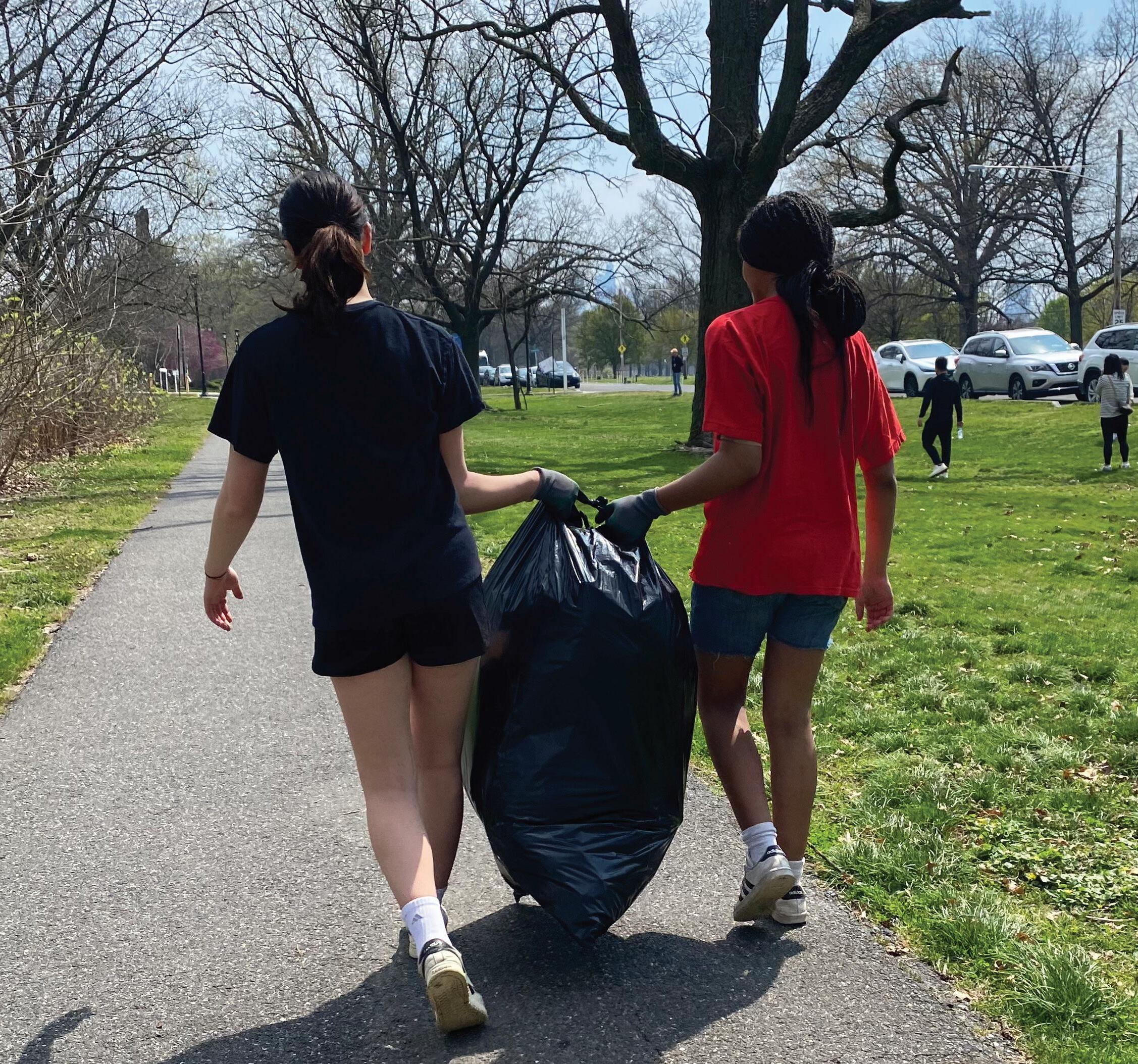
“I’m interested in sustainability and making sure the environment is clean, and I know that parts of Philadelphia are super dirty,” Rowe said. “ e other two girls (and I) are really passionate about making the earth clean.”
On Wednesday, April 10, the sophomores hosted a trash cleanup at Fairmount Park outside of the Please Touch Museum in Philadelphia. They advertised the event on Instagram and organized necessary materials for the cleanup, ultimately leading a group of about 10 people to pick up trash for two and a half hours.
“It felt really good because we were able to see di erent parts of the area that we cleaned up,” Rowe said. “We had collected this huge wire that was tangled in a tree, and that made such a di erence just by looking at it. We were able to directly see our impact.”
The Live Like Blaine Leadership Academy ended in early April, and the sophomores have completed their community service projects. Rowe hopes to start a similar project in the future to continue her contribution to helping the environment.
“As a person, I’m more inspired to connect with girls more. I think connection can bring so much good,” Rowe said. “In terms of service projects, I’m much more inspired to go out and make a change because now I know it’s not just something you think of as ‘Oh, I should be doing this’ but something that you can actually go out and do.”


Teacher Feature: Jillian Harris

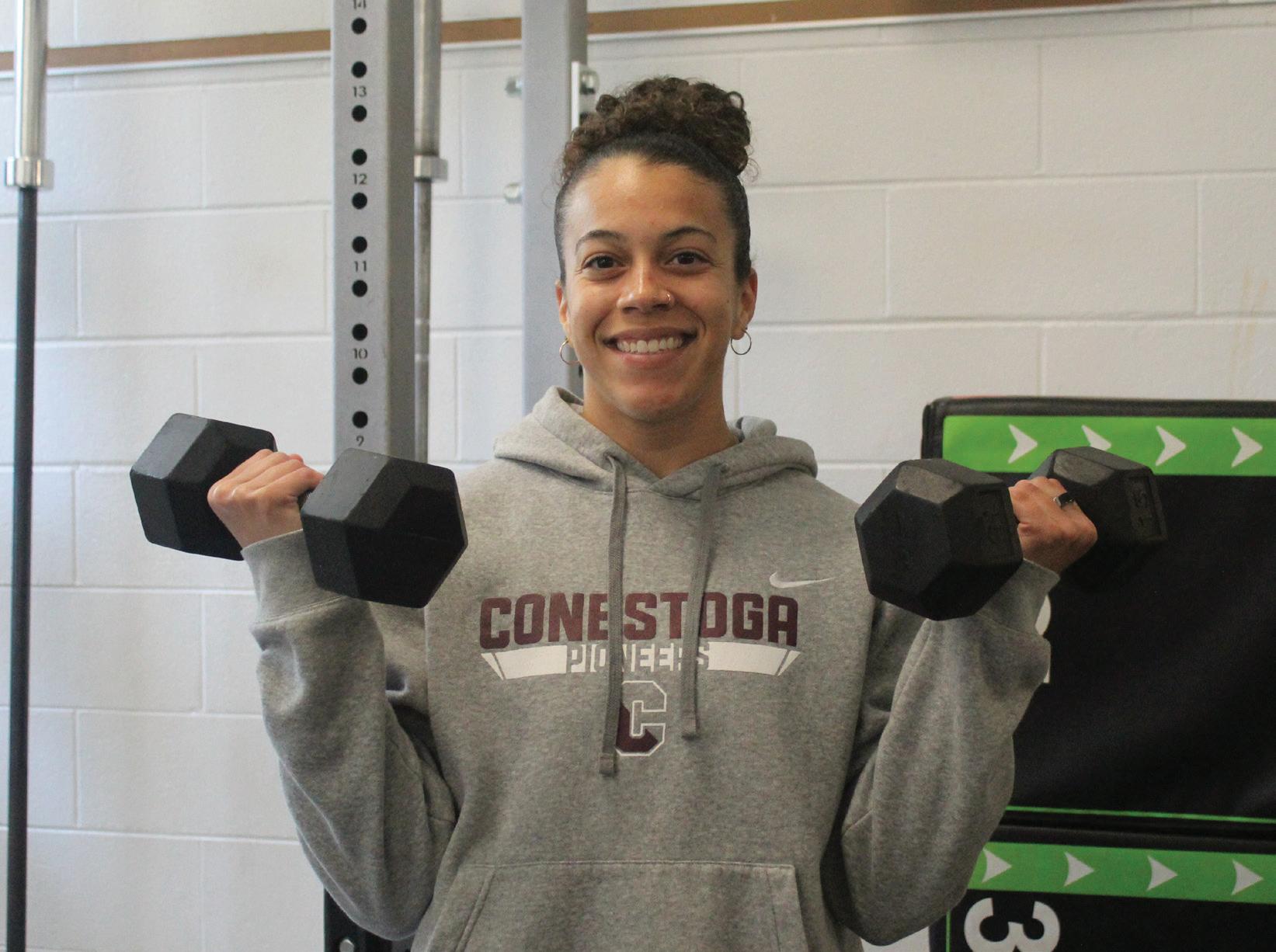
A er obtaining a bachelor’s degree in kinesiology from Temple University, Jillian Harris was unsure of what profession to pursue. To combine her love for teaching with kinesiology, she decided to become a health and tness teacher. Harris is in her third year at Conestoga and currently teaches Health and Fitness, Personal Fitness, Physical Education (PE), Mind-Body PE and Adaptive PE.
Q: What inspired you to follow the health and tness pathway?
A: When I originally started (college), I wanted to be a chiropractor, but I really wanted to do something that I knew I was going to be passionate about, which was working with students and the youth. Since I had a degree in kinesiology, I thought I could be a health teacher and teach about health and wellness to students who would take to it.
Q: Who inspired you to pursue a career as a teacher?
A: My mom’s actually a teacher, and my grandma is a teacher as well. I really like working with people who are younger than me. I had a lot of experiences growing up with teachers who mentored me, and I wanted to be that type of person for students.
Q: What is your favorite part about working with high school students?
A: Students have come to me to talk about anything. I like being that person who kids can come to and act as a condant for them or help them with the situation.
Q: What are some memorable moments from ’Stoga that you would like to share?
A: I feel like every day is such a di erent experience. e ninth graders this year have been surprising. ey keep me on my toes and help me stay excited to come to school. ere’s lots of funny things that happen, sometimes
not the best things, but we make the most of it anyway. ey’re just a silly group this year.
Q: What is your favorite type of exercise to do when you li ?
A: I’ve been liking squats recently. ey’re probably my favorite. I train more for hypertrophy, which is for muscle growth, and overall strength. So any type of strength training, I’ll say, is my favorite type of thing. But mainly squats.
Q: What music do you listen to when working out?
A: I listen to a lot of Meek Mill, Future and Young Thug — any type of rap music to get me in the zone.
Q: What is a fun fact about you that your students might not know?
A: My favorite animal is a giraffe. When I was younger, I watched this dinosaur movie. I loved the dinosaurs that were really short with stubby legs and long necks. I think that’s
why I like giraffes. I don’t really know where it came from, but it just happened.
Q: Where is an interesting place you have traveled?
A: I’d say Costa Rica. I went on a mission trip a while ago, so we did a lot of service work with a local orphanage. Afterwards, we had an excursion, which was pretty fun. We went ziplining and things like that. I would go back and experience more of the culture whenever I get the chance to.
Q: How do the lessons you teach in school translate to your own daily life?
A: I’m relatively young, so I think that helps me communicate certain things and letting students know that it’s okay to mess up or it’s okay, nutrition-wise, to enjoy the things you enjoy. Mental health-wise, it’s okay to give yourself a break. I try to live by that myself every day.

Courtesy Noe Rowe Wednesday, May 29, 2024 T/E Life
5 e SPOKE
Isabelle Emmanuel Sta Reporter
Halftime performance : Conestoga’s Marching Pioneer Band performs during hal ime at a football game this past fall. From May 26 to 27, the marching band performed in the Memorial Day Parade in Washington, D.C.
Prashi Agarwal Sta Reporter
Fun with tness: Health and tness teacher Jillian
li s
in the ’Stoga weight room.
taught Health and Fitness, Physical Education,
Physical Education
Isabelle
SPOKE
Harris
dumbbells
Harris has
Personal Fitness, Mind-Body
and Adaptive Physical Education.
Emmanuel/The
Vanessa Chen Sta Reporter
Madeline Pulliam Co-Sta Development Director
Making dough: Junior Eleanor Turner takes a fresh loaf out of the oven. Turner was initially inspired by her dad to pursue her bread-making business.
Park cleaning : Volunteers carry a bag of trash in the cleanup event at Fairmount Park. Sophomore Noe Rowe and two other volunteers led the event as part of the Live Like Blaine Leadership Academy.
Lily Chen/The SPOKE
Prashi Agarwal/The SPOKE
WEST
Arizona
Arizona state university (2) CALIFORNIA
california institute of technology (1)
stanford university (1) university of california, santa barbara (1) colorado
united states air force academy (1) university of colorado boulder (6)
UTAH
brigham young university (1)
MIDWEST
illinois
northwestern university (1) school of the art institute of chicago (1) university of chicago (2) university of illinois (3) indiana
indiana university (1) purdue university (7)
michigan
ferris state university (1) university of michigan (3)
washington
university of washington (3) gonzaga university (1)
wyoming
western welding academy (1)
minnesota
university of minnesota (2)
missouri
washington university (1)
ohio
case western reserve university (1) miami university (2)
wisconsin
university of wisconsin-madison (2)
2024 SENIOr destina

A total of 391 seniors responded to The Spoke’s request for information about their post-graduation plans. Responses were recorded via an optional survey shared to students through Instagram. Of the 391 seniors who responded, 9 abstained. Around 296 seniors did not respond to The Spoke’s senior destinations map form.
SOUTH
ALABAMA
auburn university (1)
university of alabama (1)
georgia
emory university (3)
georgia institute of technology (4)
university of georgia (4)
florida
barry university (1)
FLORIDA atlantic UNIVERSITY (1)
FLORIDA STATE UNIVERSITY (3)
nova southeastern university (1)
university of FLORIDA (8)
UNIVERSITY OF MIAMI (1)
university of TAMPA (1)
kentucky
university of kentucky (1)
university of louisville (1)
louisiana
louisiana state university (2)
tulane university (1)
north carolina
elon university (5)
university of north carolina (2)
wake forest univerfsity (2)
south carolina
clemson university (2)
college of charleston (1)
university of south carolina (8)
Wednesday, May 29, 2024 T/E Life e SPOKE 6
All this content reflects information volunteered to The Spoke by the Class of 2024. Thus, it is not an exhaustive list of all seniors’ post-graduation plans.
dESIGNED BY MARY wOLTERS, Design editor
Information
compiled by Ashley Du, Aren Framil, Howard Kim, Rajan Saha and Mary Wolters, Staff Reporter, Co-Editors-in-Chief, Staff Reporter and Design Editor
destinations MAP
tennessee
university of tennessee (1)
vanderbilt university (2)
texas
rice university (1)
southern methodist university (1) university of texas (1)
virginia
college of william & mary (1) hampton university (1)
james madison university (5) university of richmond (2) university of virginia (1)
virginia polytechnic institute and state university (7)
INTERNATIONAL
canada
university of toronto (1)
italy
bocconi university (1)
ireland
trinity college dublin (1)
england
university of kent (1)
Netherlands
university of groningen (1)
MIDAtlANTIC
delaware
university of delaware (9)
maryland
hood college (1)
JOHNs hopkins university (2)
loyola university maryland (1)
stevenson university (1)
towson university (1)
university of maryland (3)
united states naval academy (2)
new jersey
camden county college (1)
princeton university (2)
rutgers university (3)
washington, d.c.
georgetown university (4)
george washington university (6) the catholic university of america (1)
OTHER PLANS
ARMED FORCes (1)
eture fc, spain (1)
gap year (2)
NORTHEAST
Connecticut
Fairfield University (4)
sacred heart university (1)
University of connecticut (1)
university of new haven (1)
yale university (3)
new hampshire
dartmouth college (1)
massachusetts
boston college (2)
boston university (3)
brandeis university (1)
harvard university (3)
massachusetts institute of technology (1)
northeastern university (10)
tufts university (2)
WELLesley college (2)
Maine
university of new england (1)
new york
barnard college (1)
colgate university (2)
columbia university (2)
cornell university (3)
fashion institute of technology (1)
fordham university (4)
ithaca college (1)
long island university (1)
marist college (1)
new york university (7)
pratt institute (1)
rensselaer polytechnic institute (1)
roberts wesleyan university (1)
rochester institute of technology (3)
state university of new york (1)
syracuse university (6)
united states military academy (1)
RHODE ISLAND
brown university (4)
vermont
university of vermont (4)
PENNSYLVANIA
carnegie mellon university (4)
dickinson college (4)
drexel university (9)
duquesne university (2)
elizabethtown college (1)
franklin & marshall college (3)
haverford college (1)
kutztown university (1)
lafayette college (2)
lehigh university (5)
pennsylvania state university (46)
saint joseph’s university (3)
temple university (11)
thomas jefferson university (1)
THE PATHWAY SCHOOL (1)
ursinus college (1)
university of pennsylvania (7)
university of pittsburgh (19)
university of scranton (2)
villanova university (6)
west chester university (8)
wilkes university (1)
number of students per state 0 1-5 6-10 11-15 16-20 21+ Wednesday, May 29, 2024 T/E Life The SPOKE 7
e SPOKE

ere I was, blowing out the candles for my “Salty Sixteenth Birthday” — and looking over me, 23 of my friends who were about to embark on the infamous sophomore slump — or shall I say su er more stump. Already a week into the school year, my birthday wish was quite subdued: “I hope everything will be ne” — that the very decisions and outcomes from high school would grant me and the friends surrounding me satisfaction in the future.
Fast forward a few weeks later, I open Schoology to the “disaster” that was my rst chemistry test grade: 65%. For a second, I felt like a failure, heck, even a op.
Grit, gratitude and a grain of salt
Surprisingly though, I cried laughing. Rivulets of salty tears dissolved on my face, and I savored the moment. In alignment with the oating rock mentality, I no longer felt like a futile rubble for my future.
we evolve into frogs. Learning from the saltwater chaos drives us to become more determined
With life’s uncertainties, we never know how concentrated the saltwater solution will be.
concentration gradient, so we should not beat ourselves up over it. We are living adventur-
than dwelling on failure, take a second to embrace the chaos.






















e oating rock mentality is a motto for not taking life too seriously and embracing the chaos, based on the premise that we “ oat on a rock”: the earth. It promotes the concept that “nothing matters” and that you should not succumb to hopelessness. e most intriguing way I can explain this is in the light of a metaphor: the life cycle of a saltwater frog. As tadpoles, we embrace the saltiness of the pond until













































































to grow legs and eventually become multifaceted frogs with many capabilities.
An open letter to perfect LinkedIn pro les

Dear O’ver A. Cheever,
Did you know that your LinkedIn account is 19 years old? is is especially impressive because you are only 17 years old. is means that your parents created your LinkedIn account before they created you. Apologies for being so harsh, I just needed to get it out of my system. Let me be more speci c: Your account has over four pages of unnecessary awards, useless accolades and extraneous coursework. Instead of going through the trouble of creating an online account to demonstrate your academic prowess, why not just staple your resume to your forehead?
Yes, your friends may lie to you and say that your account is outstanding. Yes, you may have over 500 connections. However — and this brings me no pleasure to say — what use are hundreds of virtual connections when you only have one physical one in real life: your computer? We marvel at your ability to transform a grocery run into a “strategic procurement initiative” and a weekend spent mastering the art of napping into a “workshop on optimizing human capital potential.” Your vocabulary makes us question every conversation we’ve ever endured. Who knew “disruptive innovation” could be used to describe a particularly stubborn jelly stain on your shirt?
And the endorsements? You possess the uncanny ability to receive acclaim for every conceivable skill created since mankind. “Master negotiator?” Check. “Expert in competitive egg-scrambling?” We don’t doubt it for a second. But here’s the thing: we see through the veneer. We know your “passion for excellence”
sometimes translates to simply a “mild preference for getting out of bed in the morning.” We suspect your “growth mindset” might involve stretching the truth on your resume by a hair — or two. And those motivational quotes? Let’s be honest, they’re mostly just an attempt to ll the awkward silence between your carefully curated “experiences” section and your questionable sel e taken at a corporate building. However, we salute you. In this digital race, you’ve mastered the art of playing the game. You’ve weaponized the language of corporate speak and turned yourself into a formidable ghter against the harsh realities of college admission and the job market.
So the answer is yes — I still hate you. But keep on posting, keep on connecting because in the land of LinkedIn, the most important skill might not be what you can do, but how well you can say you can do it.
Signed, The Society of Awkward Yet Secretly Admiring LinkedIn Lurkers (SAYSALL)





ere are so many events that are out of your control. Life will always nd a way to change its




ous and spontaneous lives that elicit an unpredictable rollercoaster of emotions, so rather
With this mindset, improving our well-being and our mental health becomes a priority once we stop expecting so many things from the highly salinated, busy, stressful and oversaturated environment that is life. Taking time for yourself and recognizing the courage it takes to be where you are today is one of the grittiest things you can do. e oating rock mentality, or in this case oating frog mentality, by no means frees anyone from overbearing obstacles. Even with its sentiment that “nothing matters,” it certainly doesn’t excuse anyone from ignoring their problems

or responsibilities. Even so, the idea of accepting the chaos may be bene cial to invest time in no matter where you are in life. It is a reminder that feeling lost in life now is not an accurate depiction of what frog you will become; no matter how hard you crash in life, no matter how bitter the solution tastes now or no matter how many ’Stoga 55%s you end up receiving. You wouldn’t be the ambitious saltwater frog you are today without enduring the curveballs of living in brackish water as a tadpole.

Performative activism needs to get off stage
 Saktisri Gowrishankar Sta Reporter
Performances can be boring, funny or even life-changing, but people should never perform some acts. When I see performative activism, I want to boo it off stage.
Performative activism is when someone participates in activism to increase their own social capital instead of for the sake of the cause. It has become particularly prevalent with the use of social media. It is easier to simply post a symbolic image to feel good about yourself rather than to support a movement
because you care. In a way, activism has spiraled into a trend. With the ongoing Israel-Hamas war, online platforms became critical in the spread of information. Anyone can nd boycotts, fundraisers and statistics online, but the ease of posting on social media has detrimental e ects.
In social media activism, people tend to repost images or stories with no authentic understanding of the issue at hand.
Large corporations will post things like Pride ags and advocate for Black Lives Matter in support of marginalized groups to gain societal approval and following, then promptly forget the issue. Individuals will say they are supporters of a movement to seem like a good person, while remaining largely uneducated.
Maddie Possamai, a collaborator at Power in Place, an organization for women in politics, found that “performative activism may be successful in spreading aware-
ness about issues but it is limited in creating tangible change.”
Another issue arising from social media activism is the investment of energy into the wrong topics. For example, due to constant reposts and miscommunications, the Starbucks boycott became people’s priority because they believed the company was supporting Israel. Starbucks sta unionized in boycotts due to overworking and underpayment. However, some people mistakenly believed the boycott to be related to the Israel-Hamas war.
Online activists are calling out individuals, often celebrities, for not participating in the boycott — but what does that advocacy really do? It has no effect on that individual’s actions or the larger cause at stake. People only participate in this kind of activism because they want to feel morally superior to others and obtain self-gratification.
Trista Lara, a writer for the University of California, Irvine’s newspaper New University, notes that in the Black Lives Matter movement, “reposting the BLM black square could be a symbol of allyship, or it could be done for fear of looking like a bad person. The latter is counterproductive to activism as a whole.”
Participating in activism is better than doing nothing, but at what point is that activism just as futile as sitting by without action?
Mindless reposts and callouts tread that thin line. Social media can still be e ective in advocacy. Some more constructive strategies include posting about upcoming protests or events that will urge lawmakers and politicians to consider their decisions. Providing links to fundraisers, marches and petitions will show real care for a problem. People need to stop putting on an act for everyone else and just take action.

OPINION 8 Wednesday, May 29, 2024
Je rey Heng Co-Opinion Editor
Even adult frogs who adventure the vast Earth nd that the moisture from these waters is still necessary to thrive. If you nd yourself struggling, remember to live life with a grain of salt — you should always be grateful for making it so far in this salty pond society. Put on your frog bucket hat. Slide on some cool shades. Dri on that lilypad. Raise a toast with a salt packet to savor. A er all, there’s no other species of frogs like us who can thrive in such high concentrations of saltwater.
Photo illustration by Raima Saha/The SPOKE
Hannah Gupta/The SPOKE
Zara Samdani Co-Managing Editor
Niki Chen/The SPOKE
Why we need to take entertainment addiction seriously

Entertainment, such as movies, video games and social media, has become an instantaneous, almost necessary part of our everyday lives. ink about it: How many times do you nd yourself scrolling through Instagram, sending Snapchat pictures, watching TikTok videos or just falling into Internet rabbit holes? If you’re like me, it’s way too many. We justify it as a little break from our strenuous, daily lives — but how much is too much?
According to Mayo Clinic, addiction is a person’s inability to control use of a substance or behavior, despite its negative consequences. When de ned this way, it’s easy to see how
problematic entertainment consumption can be, especially when le unchecked. e problem is that it’s o en dismissed as not being a real issue due to lack of awareness —something that needs to change to properly address it. Entertainment addiction can be dangerous, especially considering that constant entertainment consumption wastes time. What begins as seemingly harmless, mindless scrolling can turn into chronic procrastination. is lessened productivity can seep into other aspects of life and can leave one less ful lled and motivated as a person.
Extreme entertainment consumption promotes instant gratification as the short-term solution to long-term prob-
that there was a close relationship between avoidant and impulsive problem-solving styles and internet usage

lems rather than discipline. A study published by the International Journal of Mental Health and Addiction found
amongst 371 university stu-
dents aged 17-36. Using entertainment as an escape from solving problems in life rather

STUDENTS SPEAK OUT









than addressing them directly encourages problematic character traits that can harm rather than help. Most evidently, excessive entertainment usage takes away everyday moments and increases disconnection to the real world. A study by professors at the International College of National Institute of Development Administration in Bangkok, ailand found that people plagued with social media addiction tended to have lower levels of mindfulness and increased emotional exhaustion. What seems to be a quick dopamine release ends up making you



Pineapple on pizza deserves justice

“Ewww!” was the rst reaction my younger self had when I heard of pineapple on pizza. In my mind, the two foods obviously had nothing to do with each other and would surely clash when paired. Around 54% of Americans shared my sentiment, according to a 2017 survey of more than 10,000 people by the pizza delivery app Slice. In
the same year, Michelin Star chef Gordon Ramsay famously expressed his disgust of the combination on “ e Nightly Show,” using profanity to insist that the fruit had no place on pizza. But to my surprise, a er trying Hawaiian pizza just last month, the ne culinary experience dispelled all my premature judgments. e sweet and slightly tangy avor of pineapple complements savory tomato sauce, cheese and ham perfectly, without being as overpowering or watery as I had previously believed. And it seems like my experience isn’t unique. In 2019, Washington Post writer Tim Carman gathered a group of self-proclaimed Hawaiian pizza lovers and haters together over some Hawaiian pizza to see if their labels held up.
Many of theirs didn’t — the so-called “haters” expressed that the pizza was much better than they expected. Some of Carman’s colleagues at the gathering theorized that a portion of the hate for the food pairing stems from an unpleasant rst experience of a badly executed Hawaiian pizza. But for me and many others, it originated from believing the combination was simply too weird, causing the hesitancy to even give it a try. is phenomenon is not limited to pineapple or pizza. On an individual level, we tend to create negative preconceptions of things that we think are strange or that make us uncomfortable. Food, yes, but also music, and television, and ideas, and people. It holds
us back from challenging our standards and beliefs, from nding something novel that we may actually enjoy.
Of course, some people dislike new concepts like pineapple on pizza even a er trying them, and to each their own. We can’t control our personal preferences. We can, however, moderate unjusti ed beliefs of objects, people and ideas before we experience them. ere is merit in giving things a second chance instead of letting one incident determine our entire mindset on a
more unhappy, a strange paradox that makes you crave more of that unful lling “drug.” Many may argue that entertainment is harmless since it’s merely a pleasurable act to take a break or unwind. That is true. Entertainment is harmless … until it isn’t. Too much of anything isn’t good. The lack of moderation of screen use is what makes entertainment addiction harmful. This can result in numerous mental health issues such as anxiety, depression and disrupted sleep, showing that entertainment is not fun and games all the time. Entertainment addiction is a serious issue that we need to address, and it all stems from the same place as most other addictions: the need to escape reality. Any addiction takes time and effort to break, more so with entertainment addiction because of the prevalence of screens in our daily lives, but escaping the chains of these unhealthy coping habits can only happen if we take it seriously and acknowledge it as a real problem.
“My rst impression (of pineapple on pizza) was actually from social media and that made me think that ‘Oh, it must not be good because so many people are hating on it,’ but a er actually trying it, I think that it can be done correctly, and I kind of like it.”
-


A little while ago, I was looking to make a nice, warm grilled cheese sandwich, but when I opened up a new loaf of bread, I found that the slices were much smaller than I remember them being. No, this was not just my mind playing tricks on me — it all came down to a phenomenon known as shrink ation.
Shrinkflation occurs when consumer goods shrink in size but stay at the same price. is is a common technique used by large corporations to increase pro t on their products. But why don’t they simply raise their prices instead of decreasing their overall sizes? Well, the answer is simple: Consumers are less likely to notice a decrease in volume than an increase in price. Increasing prices will likely drive consumers away from buying companies’ products, and corporations need to make sure that their
consumers keep coming back for more while still raising their pro ts. So, companies turn to one of the least ethical solutions possible. ey decrease the volume of their products without telling their consumers and hope that they won’t notice.
According to U.S Sen. Bob Casey from Pennsylvania, from 2019-2023, 10.3% of the measured price increase for household paper products and 9.8% of the measured price increase for snacks can be attributed to shrink ation. is is outright deceptive because most brands are not transparent with consumers while making these volume changes.
brands. is will inevitably lead companies to lose many of their loyal customers and cause their pro ts to plummet. Instead of wasting their e orts on greedy, short-term solutions, these corporations should focus on building strong and transparent relationships with their customers so that their brands can earn a trustworthy reputation.

Corporations tend to believe that shrink ation is a necessary strategy in keeping their businesses alive. While it may work as a short-term solution, it could be very detrimental for their brand image later on. In the highly likely scenario where consumers eventually do notice the changes in product size, they may lose trust and satisfaction with those respective
Shrink ation has become widely recognized recently as unethical, with President Joe Biden discussing the issue in his State of the Union speech, claiming that companies are “charging more and more for less and less.” He promoted a new bill known as the Shrinkation Prevention Act in his speech, which Casey introduced to the House on Feb. 28. e bill aims to allow the government to establish shrinkflation as an unfair or deceptive practice. It is important that we do not feed our money into unethical business practices such as shrink ation. If we notice any changes in product volume without appropriate disclosure, we should go in search of di erent brands to avoid supporting dishonest businesses. As consumers, we have the power to control the market, so we must do our best to advocate for fair pricing and clear transparency in brands.

Wednesday, May 29, 2024 Opinion 9 e SPOKE “I think that pineapple on pizza is kind of gross, but that’s just because I think all cooked fruits and vegetables are kind of gross.” Q: How do you feel about pineapple on pizza?
like pineapple on my pizza, but I don't hate on other people who do like it.” “Never tried (pineapple on pizza), but I’m sure it’s great.”
“Personally, I don't
Cindy Wang, junior -
Prranit Arora, sophomore
Cate Holbert, freshman -
Kaam Karakas, senior -
Anjali Chand/The SPOKE
Juliana Yao Co-Opinion Editor
Karen Hang/The SPOKE
Sowmya Krishna Appmaster
Jessica Li/The SPOKE
in ated
Shrink ation is too
topic. Now that Hawaiian pizza is one of my culinary favorites, I try to strive for open-mindedness. When we take the rst step to leave our comfort zones, sometimes the things we believe to be the strangest end up being the most ful lling.
Lia Piccoli/The SPOKE Report Card Editor Recs Editors: Rohan Anne and Howard Kim, Webmaster and Co-Editor in Chief Movie: “Tenet” “The movie is a perfect blend of plot, acting and suspense. Ludwig Göransson’s soundtrack is the ideal complement.” BDrake vs. Kendrick Lamar battle C A B + Incredible music coming out of the diss tracks - Serious accusations that have implications Met Gala: The Garden of Time + Showed interesting looks and propelled models like Anok Yai to greater stardom - An exorbitant show of wealth that has already been criticized by many ‘Challengers’ movie release + Incredible cinematography, acting and music - Morally questionable characters and decisions ‘The Tortured Poets Department’ album drop + Great mix of catchy love songs and poetic stories - Too long and the songs are quite repetitive
Raima Saha Co-Managing Editor
Boys tennis wins PIAA state title a er successful season
is year, the boys’ tennis team won the PIAA 3A State Championship for the second year in a row.
Since the start of the season the team won most of its matches, nishing with an almost undefeated status. Last season they won the state title, beating their biggest competition , the Lower Merion Aces, in a close match.
is year, the team made its rst advancements to states a er senior Voyin Markovic and junior Rohan Rao won the PIAA District 1 3A boys’ tennis doubles tournament on May 12. e team won its rst round of states against St. Joe’s Prep on May 14. It headed to Hershey from May 17 through May 19, ultimately advancing to and winning the nals.
e team pursued the state title through consistent practice and teamwork. Sophomore Jake Tsang, who has played with the team for two years, believes that the team members’ bonds help them in matches.
“In Conestoga tennis, the whole team is very close as everyone knows each other,” Tsang said. “I think it helps us do even better during matches as everyone has each other’s back.”
The team sets itself apart from the other teams in the Central League by emphasizing the importance of team spirit. The players’ spirits
are evident during matches through the players’ cheers and congratulations in between matches and during games. According to Tsang, support from one another drives the team towards success.
“Older players have told me to always be focused and keep a positive attitude during the match,” Tsang said. “ Making sure you are involved and cheering for your teammates when they win a good point (is important).”
Tsang hopes that the team will maintain the tight bonds that they have formed this year and continue to motivate each other, train hard and have a good time. Tsang also hopes that they can work together to uphold their legacy and defend their state title in the coming years.
“My hopes for the rest of my Conestoga career is to win states a couple more times with this team, while also making sure everyone on the team can have a great time and a fun experience,” Tsang said.


’Stoga alumnus swims to success in NCAA

“Brrring!” The sound of the whistle goes off as swimmer Brendan Burns jumps off the starting block at NCAA Divsion I Finals. At the meet he defended his title for NCAA Champion in the 100-yard backstroke event.
Brendan Burns, a 2019 Conestoga alumnus and decorated swimmer, now competes at the Division I level for Indiana University (IU). He is a three-time NCAA champion, 22-time individual Big Ten champion, holds multiple team championship titles at Big Ten and All-American competitions and has multiple national high school records. Brendan Burns graduated from IU this spring and re ects on his transition from swimming at the Upper
Main Line YMCA (UMLY) and Conestoga to competing at a competitive college level.
“I was very fortunate to receive a lot of o ers from a lot of di erent schools, but ultimately (with choosing) IU, I think I got some really good advice, and basically it was that you should go to a school where you see yourself outside of your classroom and outside of your sport,” Brendan Burns said.
Since he was six years old, Brendan Burns’ mother Heather Burns enjoyed seeing her son compete in summer swim leagues. Until he broke national high school records, she never thought that he would find a career in swimming as he was also heavily involved in baseball and hockey. When Brendan Burns was young, Heather Burns and her husband made sure to priori-
tize family time, personal well-being and academics over swimming.
“It’s a sport that’s lled with burnout and injury, so we really just tried to take it one (step) at a time and enjoy where we’re at, and we’re still doing that with both of our children. We made it very clear that at any point, they can stop,” Heather Burns said. “ is is their journey; it’s not our journey.” Brendan Burns attributes his success to ’Stoga and UMLY’s swim teams. e competitive environment and network of support he got from older mentors and coaches growing up helped him pursue his passion for swimming.
“I’ve done several di erent types of swimming in my life, like summer league swimming and college swimming and club swimming, but ’Stoga swim and high school swim, man, those
were some of the most fun memories I’ve ever had in my life,” Brendan Burns said.
Brendan Burns plans to attend and partake in the Olympic trials in June at Lucas Oil Stadium in Indianapolis, Indiana. A erwards, he hopes to get a job in the sports industry to conclude his swimming career. He thanks older Conestoga alumni, like Brian McKenrick, who graduated in the Class of 2017 and Nic Graesser, who competed at the Division I level in college and graduated from Conestoga in 2012 as his mentors who inspired and guided him to progress in the sport.
“I was really lucky to have a lot of great support at UMLY, at Conestoga and with my family,” Brendan Burns said. “I have been blessed to have had the success that I’ve had, and I feel like I should share that with everyone.”
Promising potential: Boys varsity lacrosse adds seven freshmen to its roster
Louisa Sandor Sta Reporter team, each bringing their own strengths and specialties. To further develop their skill sets, their fellow players say they have worked exceedingly hard to keep up with their teammates and adapt to the varsity level of play.
Cheers echo through Teamer Field as freshman Whit Lukens dodges an opponent and makes a clean sidearm pass to his teammate. One of the youngest players on the roster, Lukens is a defender on the boys’ varsity lacrosse team. is spring, the team welcomed seven freshmen onto the varsity team: Lukens, Henry Cook, Liam Donovan, Brian Ford, Happy Mayer and Noah Uhrich. ey are an integral part of the team, with two of them serving as starters.
“I commend all the freshmen for all the work they have put in and the fact that they have stepped up to play such a big role in the o ense and defense,” sophomore defender Gunnar Flesher said.
e new players occupy a wide variety of roles on the
“ ey bring di erent skills to the table that help make our defenses more diverse,” Flesher said. “ ey do make their mistakes, sometimes more than other players, but that is expected of them, and I think they are doing exceedingly well this year.”
Many of the freshmen played together on club teams for several years before joining the Conestoga team. rough their prior experiences together, they have become familiar with each other’s style of play and have formed strong bonds with one another.
e freshmen attribute their success on the team to the sup-
port of upperclassmen players, their consistent training regimen and playbook strategies.
e team emphasizes ne-tuning smaller skills during practices to ensure that mistakes don’t occur during games.
“At practice, the biggest thing we work on is just making sure the little things are perfect, even if it’s just passing and catching, shooting or our plays. e little things should be perfect,” Flesher said. Team members believe that bonding and having a strong sense of unity are just as important as practicing and they help players come together cohesively on the field. One way the team prioritized unity this year was by including new players in team bonding activities such as volunteering at youth lacrosse clinics and dinners.
“We typically gather at a teammate’s house for a team

dinner on the night before our home games,” Lukens wrote in a text message. “Everybody has been welcoming and supportive. ey helped me nd my role on the team.”
is strong bond has helped it have a successful season, winning 14 of its 20 games. It also helped Conestoga qualify for the postseason, winning in the rst round of district playo s against Council Rock South with a score of 9-3. e team advanced to the next round of districts, where they ultimately lost to Spring eld on ursday, May 16. Lukens is excited for the possibilities that the future holds for the team.
“I hope we can put together a nice run in the playo s next year,” Lukens wrote in a text message. “I hope that in the next couple years we can become a dominant Central League team.”

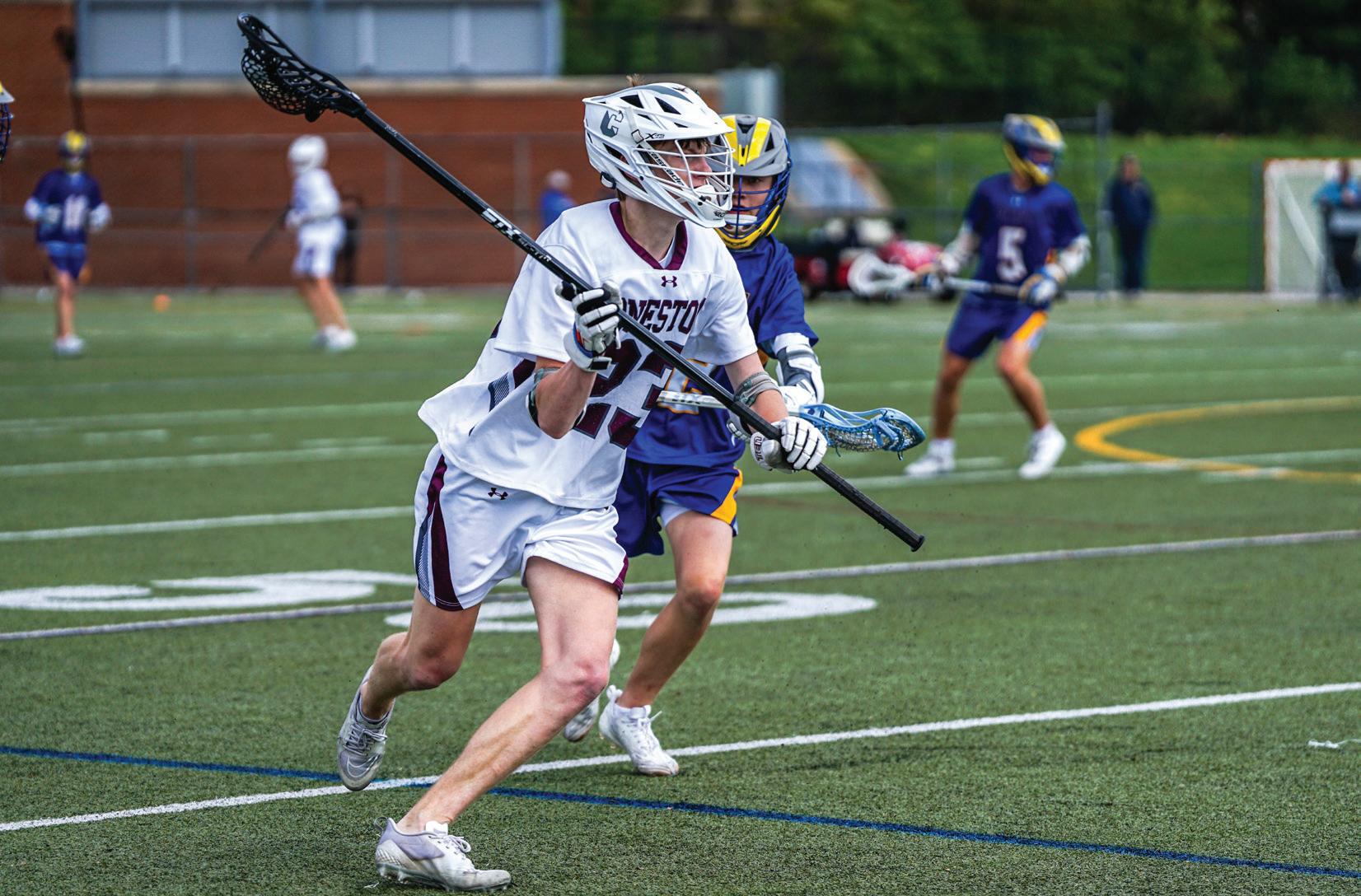





10 Wednesday, May 29, 2024 Sports
a final score of 7-0. With the conclusion of their regular season, the boys advanced to states and won the finals. They hope to repeat their success and defend their title in the years to come. Miya Cao/The SPOKE Sosi Sengal Sta Reporter e SPOKE “I chose it for its academic programs, and it has a lot of opportunities for students, really good facilities and support, and I chose it for the proximity to home. It’s close, so I can come home. I also really loved the supportive community withCharlotte Hagerman
Serving up: Senior Derek Qin serves in his match against Garnet Valley, where
’Stoga won with
Accomplished athlete: 2019 Conestoga alumnus Brendan Burns competes at Indiana University at the Division I level. He has won multiple NCAA individual titles, including in the 100m backstroke in 2024. He will attend the Olympic trials at the Lucas Oil Stadium in Indianapolis, Indiana from June 15 to June 23.
Lauren Pinheiro Photography Editor
Courtesy Trent Barnhart
Scan the QR code to watch an accompanying package
Lily Chen/The SPOKE
Dodging defender: Freshman Whit Lukens outruns an opponent from Downingtown East. Lukens was one of six freshman that made it onto the varsity team. He hopes to advance to the playoffs next year.
Student athletes embark on college recruitment journey
Vaishnavi Sriadibhatla
Co-Sports Editor
In the crisp September air, pandemonium erupts from the sidelines as field hockey team captain and senior midfielder Addie DelOrefice drag flicks yet another goal in the net. DelOrefice committed to the University of Vermont for field hockey during her junior year.
While DelOrefice was in the college recruitment process, coaches and scouts would visit and watch her play at games for the school and for her club team, Powerhouse Field Hockey. DelOrefice describes these games and the recruitment process as being especially stressful because of the pressure to perform well in front of recruiters.
“It’s definitely really stressful going through (recruitment) because you’re talking to coaches and you want to impress them,” DelOrefice said. “Going to showcases can be really stressful. I think in the end, you end up where you should be going.”
Many student-athletes will start their recruitment journeys near the end of their sophomore year. After June 15, college coaches can contact student-athletes. This date is extended for football, baseball, softball and women’s basketball players, who can only be contact coaches starting Sep. 1 of their junior year. As student-athletes weigh their options of schools, they will also decide whether to play at a Division I, II or III level program. The division dictates the intensity and emphasis placed on sports by the college, with Division I being the most intense.
“Only a small percentage get recruited and play at the next level. It’s under 10% on

average. It’s not an easy thing to have a high school kid play collegiately. (Their) pool gets expanded so much because all the kids (are) vying for one spot,” athletic director Kevin Pechin said.
To prepare for recruitment, student-athletes usually email coaches to express interest in a particular school and attend clinics, training camps and showcases. Emailing coaches and attending these events is a common way to make athletes known to coaches. Gunner Flesher is a sophomore and plays defense in
lacrosse for Conestoga and his club team, Team Ten. Flesher will enter the recruitment process this summer and uses his goal of playing collegiately to motivate his training.
“I feel like in the back of my mind, I always had this dream that I wanted to play in college, but I wasn’t 100% sure about it,” Flesher said. “I’ve always been training like I would want to play because it’s the only way I feel like you’re going to get better. If you train like you’re going to be the best, at some point, you might become the best.”
Starting their junior year, all interested athletes can go on o cial and uno cial visits to the schools that they are interested in or that they received o ers from. Coaches can start to make o ers, to which students can only uno cially commit. During their senior year, athletes can o cially commit to a college by signing a national letter of intent.
When recruiting students, coaches consider more than just the student’s athletic abilities. Coaches also take several other factors into account,
including a student’s academics, work ethic, ability to work well with others, character and how they can fit in with the existing team.
“The (recruiters) don’t want academic risks. That’s what makes Conestoga so appealing. Our kids are not academically a risk. We perform academically and athletically,” Pechin said. Flesher describes the recruiting process as extremely rewarding, despite how stressful it is in the beginning. As he continues to explore his
options, he is excited for what the future holds.
“I feel like it seems like a lot of stress right now for me. I’m just excited because I know that wherever I go will be the right fit for me,”
Flesher said. “I’m just trying to pick where I want to go.
I don’t want to to go somewhere where someone else wants me to go or where my coaches feel. I feel like even though I honor their decision, I feel this is what’s best for me. I’m just really excited for it to come along.”
Scaling heights: Students participate in rock climbing
Abby
Chong Co-Sports Editor
According to junior Allie Naiva, rock climbing is more than just scaling walls; it is a sport that pushes the body and tests the mind.
Climbing involves ascending rock formations, which requires strength, agility and problem-solving skills. Naiva began their climbing journey at Gravity Vaults in Radnor in eighth grade. ey were rst drawn to the sport for its physicality, but found that they enjoyed the complexity of the sport as well.
“I wanted to do a sport that is challenging intellectually as well as physically. ere’s a lot of problem solving to it. It’s not
just about strength, and I liked that,” Naiva said. Naiva emphasizes how climbing is about overcoming challenges and connecting with others. Despite the initial discomfort that newcomers may feel while climbing, Naiva encourages others to try the sport.
“You’re going to be sore a lot. Your hands are going to be ripped up constantly. You just have to know that’s how it’s going to be going into it and know that your current strength is not going to be very strong and you’re not going to be very good at it, and that’s okay,” Naiva said. “If you persevere through that, then it can be a really enjoyable experience. Don’t get discouraged by everyone around you being a pro.”
Naiva believes that climbing fosters lasting relationships that help bring young people into a welcoming community. ey nd that climbing allows them to connect with others on a deeper level.
“I’ve met so many random strangers who I’ve just talked to for hours while climbing because of that culture around it,” Naiva said. “I’m an introvert.
I don’t really talk to people in public who I don’t know, but when I climb, I’m like a completely di erent person because of this culture surrounding it. I think that’s really cool.”
Sophomore Dani Malstrom climbs at Philadelphia Rock Gyms in Malvern. Her practice routine includes warming up, then tackling challenging
climbs and nishing with an hour of workouts.
“You get to know a lot of people through climbing,” Malstrom said. “It’s really cool to see yourself improving because when you send a climb, you know that you could do something now that you couldn’t do before.”
For Naiva and Malstrom, climbing o ers an opportunity for personal growth.
“Climbing is one of those sports that’s really inclusive of everyone. At the place where I climb I nd that everyone is always really friendly,” Naiva said. “If anyone is interested in climbing, I think that it’s a really great activity not only if you want to do it competitively, but if you want to just have fun. It’s just a really great social experience as well.”

’Stoga football welcomes new head coach
After two interviews and careful deliberation, Scott Gee became the new head coach of the Conestoga football team.
Gee is also a certified strength and conditioning coach.
“I’m always there to support (Gee) and the kids in the program. I wish him nothing but
Gee assumed the position after former coach Matt Diamond announced his retirement in late December. Diamond retired after 19 years as part of the Conestoga football program and six years as head coach. Gee coached football at Wallenpaupack Area High School for six years and Octorara Area High School for four years and was the defensive coordinator at Kennett High School for five years.
the best and look forward to seeing Conestoga have continued success,” Diamond said. Fi een candidates applied for the position of head coach and went through a screening process. e applicants that advanced past the screening process received an interview with a selection committee. If the selection committee approved them, applicants had an additional interview with principal Dr. Amy
Meisinger. Once Meisinger approved the coach, they were sent to the board for approval. e selection committee was looking for someone who was organized, knowledgeable, understood the history of Conestoga football and knew the demands of being a head coach.
“Even before we met him, on paper, his resume was one that de nitely drew attention and one where I was like, ‘I de nitely
want to meet this guy,’” athletic director Kevin Pechin said. Gee had a meeting with the football team and parents on March 19 where he talked about his attitude on work ethic and preparation for the season. Gee also wants to get the team involved in the community with volunteer opportunities. Gee has been hosting lifting practices Monday, Wednesday and Friday for ath-
letes in the off season, to give him a chance to get to know the players better.
“In the weight room, it is much more hands-on, and (Gee’s) always there to help and show you what to do if you don’t know what to do or talk to kids in the weight room,” said sophomore football player Aidan Smith.
Along with the li ing sessions, Gee will hold nine spring
practices before the end of the school year. Over the summer, there will be more li ing sessions and 7v7 games that the team will participate in until camp starts in August. “I want as many guys that are willing to come out, (and) do the work to be involved and be part of the program as possible,” Gee said. “Everything I want to do works better if we have more people.”

11 e SPOKE Wednesday, May 29, 2024 Sports
HIGHLIGHT REEL THE LATEST DEVELOPMENTS IN SPORTS SWING In a game against Neshaminy High School on May 11, sophomore so ball player Janie Lo and got her hundredth hit. ROW From May 11 to May 12, Conestoga Crew competed in the USRowing Mid-Atlantic Youth Championships. On the second day of the event, Conestoga’s Womens’ Youth 2V 4x and Mens’ Youth Novice 4x placed rst in their events. SHOOT On April 30, senior and lacrosse player Chloe Brown scored her hundredth goal against Springfield. During this game, she also received her two hundredth draw control. PASS Conestoga girls lacrosse hosted Henderson on May 16 at Teamer Field in the second round of districts. ’Stoga girls started strong, scoring six consecutive goals during the rst quarter. They eventually defeated Henderson 17-5. SLIDES On Sunday, May 19, the Conestoga sailing team won the MLSSA Spring Trophy and the Bell Cup. Sailors Bella Cremer, Ava McAveney, Bailey Kreszswick and Wyatt Small took rst place overall.
Building bonds: Scott Gee (far left) stands with members of Conestoga’s football team following his meeting with them shortly after becoming head coach. Gee has started interacting and becoming closer to members of the team with lifting sessions multiple times a week.
Alexa Willrich Sta Reporter
Challenging climb: Junior Allie Naiva practices a climb at Gravity Vaults. They dedicate specific days to developing different skills, such as building endurance, perfecting techniques and practicing difficult climbs.
Courtesy Allie Naiva
Live, love, lax: Sophomore Gunnar Flesher (right) plays defense during a game against Downingtown West on April 20. He awaits his entry into the recruiting scene this summer. He has dreamt of playing collegiately and participated in numerous clinics and showcases to capture the attention of coaches.
Lily Chen/The SPOKE
Courtesy Scott Gee
Boys tennis wins PIAA state title a er successful season Page 10
SPORTS
’Stoga alumnus swims to success in NCAA Page 10
’Stoga football welcomes new head coach Page 11
Scaling heights: Students participate in rock climbing Page 11
Junior PuLLs more weight, hopes for healthier life
In a negative mental state, then freshman Ally Wen turned to her local YMCA, searching for solace in exercise.
“When I started, my confidence was definitely down,” Wen said. “It takes a lot of time to build confidence, but I feel like the main thing with confidence is knowing that you’re putting work into yourself and not cheating yourself out of your goals.”
Now, two and a half years later, the junior has found her condence in the sport of powerli ing. Powerlifting is a strength sport that consists of three
lifts: squat, bench and deadlift. In competition, the goal is to get the highest total weight with all three lifts within your weight class. With the help of her coach Colleen Donahue, Wen trains four times per week at the PWRBLD Gym in King of Prussia. She recently competed in the 2024 USA Powerlifting Pennsylvania State Championship on May 4 and 5, where she hit personal records at squat with 237 pounds and deadlift with 292 pounds. Wen qualified for the 2025 USA Powerlifting High School Nationals, which she will compete in next March.
To track her progress, Wen began an Instagram profile,
@allyw_lifts. She posts regularly, sharing advice, progress and lifts.
“I started that page just to post my lifts and put myself out there,” Wen said. “But now I mainly use it to connect with our community because I made so many friends through Instagram that I would not have made because they’re in other states.”
Both Wen’s mental and physical preparation extend beyond the gym. On Sunday mornings, Wen prepares meals for the week that stick to a strict nutrition plan. Wen balances her workout schedule with an Advanced Placement and honors course load.
According to Wen, building discipline was difficult at first, but focusing on simple choices each day has helped her develop resilience.
“I feel like people tend to overcomplicate it a bit, or people are like, ‘I need to do everything right now.’ I feel like you can’t go from 0% to 100% and expect perfection every single day,” Wen said. “It’s about readjusting my expectations and (recognizing that) not every day I’m gonna be 100%, and that’s okay as long as I’m just trying my best.”
While Wen has become well versed with the mechanics of powerli ing, she is constantly learning about perseverance, te-
nacity and commitment. Values that once inspired her journey now motivate her to continue.
“The sport has taught me so much that nothing else could ever teach me. For this prep, at least, I have gone through so many injuries. My hip flexors are strained. I sprained my wrist. I twisted my knee. I’ve had elbow pain,” Wen said.
“There was a point in this prep where I was thinking about quitting, but then I kind of gathered myself back together, and I was like, ‘No, I’m doing this despite my injuries.’ The sport has taught me resilience and that nothing great comes easy. If it was easy, then everyone would do it.”
Swimming sensation: ’Stoga senior takes on 2024 Olympic Trials
Senior Jake Wang is set to swim the 100-meter breaststroke in the 2024 U.S. Olympic Team Trials at the Lucas Oil Stadium in Indianapolis, Indiana from June 15 to June 23. According to Wang, this accomplishment will lead to future opportunities and allow him to compete in a more intense environment.
“I get to go to the next level of swimming,” Wang said. “ ere’s more to do, but it’s just exciting to get to that next level.” Wang currently swims for the Suburban Seahawks Club, and he recently finished his senior season with ’Stoga swim. He typically has seven practices each week, with two on Monday. He spent most of his last season training 25-yard short courses, but he qualified for the Olympic trials by swimming the 100-meter
breaststroke in a long-course, or 50-meter, pool. He plans on continuing his training in a long-course pool as he prepares to compete in the Olympic trials.
“He tries really hard at practice,” Wang’s teammate and fellow senior John Yeniay said. “He’s also really focused on what he wants to do, and he’s really locked in to what he wants to achieve.”
Wang credits his success to his teammates for supporting him as he heads to the 2024 U.S. Olympic Team Trials. He highlights the impact that the ’Stoga team has had on him, emphasizing the encouragement and motivation of the other swimmers at practices and meets.
“ e team is extremely important,” Wang said. “Without the team, I wouldn’t be nearly as dedicated. I wouldn’t be nearly as competitive or committed to getting better because we’re all pushing each other.”
Wang tries to manage his time so that he can get most of his homework done in school and focus on swimming. He encourages other student-athletes to do the same.
“Make sure you maintain a good work-life balance,” Wang said. “Get sleep and stay dedicated to the sport that you play.”
As Wang advances to the Olympic trials with the 100-meter breaststroke, he also aims to qualify for the 200-meter individual medley, 50-meter freestyle and 100-meter freestyle within the next two months. His goal this summer is to reach the semifinals in the upcoming Olympic trials. In the future, Wang hopes to compete on the 2028 U.S. Olympic team.
“It’s the top meet you can go to, and the next step is the Olympics,” Yeniay said. “Being able to go to that meet is just an amazing achievement.”
 Game face: Junior Ally Wen readies herself before starting her next lift. Wen began working out two and a half years ago at her local YMCA before moving to PWRBLD Gym. She competed in the 2024 USA Powerlifting
Pennsylvania State Championship and will compete in the 2025 USA Powerlifting High School Nationals in March.
Hannah Simon/The SPOKE
Game face: Junior Ally Wen readies herself before starting her next lift. Wen began working out two and a half years ago at her local YMCA before moving to PWRBLD Gym. She competed in the 2024 USA Powerlifting
Pennsylvania State Championship and will compete in the 2025 USA Powerlifting High School Nationals in March.
Hannah Simon/The SPOKE
W L T Baseball B Rugby G Lacrosse G Rugby B Lacrosse So ball 6 10 0 12 6 0 B Tennis 14 3 0 5 2 0 1 2 0 15 4 0 20 1 0 scores as of 5/22 Scoreline
Hannah Simon Co-Sta Development Director
Joanna Harris Sta Reporter
Swimming success: Senior Jake Wang celebrates a er winning the 100m Breaststroke at the PIAA 3A boys swimming championships. Wang is headed to the 2024 Olympic Trials in Indiana. In the next two months, he will be working towards qualifying for the 2028 U.S. Olympic Team.
Courtesy Mark Pynes
Wednesday, May 29, 2024 e SPOKE
