
In 1996, Glenn Baskin entered Conestoga to receive a T/E education. His mother, Sheryl Baskin, said that he worked with TESD’s first one-on-one instructional aide and was the first student at Conestoga “with a more severe disability” to receive special education.
Since Glenn Baskin attended Conestoga, TESD’s special education programs have expanded. In the 2022-23 school year, the district employed 57 special education teachers and spent more than $32 million on special education costs.
Before starting high school, Glenn Baskin received his education from the Chester Coun-
ty Intermediate Unit (CCIU), which at the time provided more extensive special education than Conestoga. Sheryl Baskin felt that as a student with Down syndrome not attending a TESD school, he was secluded from the T/E community. She wanted him to attend Conestoga alongside Michael Baskin, his older, nondisabled brother.
“No one knew that Michael had a brother. If we went shopping at a local place, nobody knew who Glenn was,” Sheryl Baskin said. “When it was time for him to go into ninth grade, I wanted him to be a Tredyffrin/Easttown student.”
Enrolling Glenn Baskin at Conestoga was only the first
step. Sheryl Baskin said that her son’s transition from attending the CCIU’s elementary and middle school programs to starting his freshman year at Conestoga had its hardships.
“Parents came to the principal at the time complaining that (Glenn) was a distraction,” Sheryl Baskin said. “After we all sat down and created a plan and used more of the resources from the Intermediate Unit, Glenn did much better the rest of the year.”
The 1990 Individuals with Disabilities Education Act established that students with disabilities are entitled to a free and appropriate public education until the day before their 22nd birth-
day. With the help of a full-time aide and Conestoga’s developing special education programs, Glenn Baskin spent six years in high school and graduated from Conestoga in 2003. In 2000, while Glenn Baskin attended Conestoga, academic seminar teacher Kate McGranaghan started working as one of the school’s five special education teachers. Now, she serves as chair of the academic support department, which hosts 18 teachers and serves students of varying needs. “My obligation is to meet the needs of students,” McGranaghan said. “Some of my students see me multiple times a day. Some
see me one time a cycle. It depends on where they are with their level of independence.”
This school year, 1,267 students, or 18.3% of TESD’s enrollment, carry Individualized Educational Programs (IEPs) — an increase from the 15.4% 10 years ago. The district currently employs 57 special education teachers and stated its intent to hire three more for the 2024-25 school year at the Feb. 8 Education Committee.
“People heard about all the great things that we had to offer for different populations in our school district, and then they came to us,” said Dr. Elizabeth DePascale, a special education teacher at T/E Middle School. “The more people who would move who needed or benefited from these services, the more the program grew and grew.”
The growth rate of TESD’s special education programs aligns with state and national patterns. The TESD school board intends to increase the special education budget by $1.6 million for the 2024-25 school year. To meet the funding goal, the board filed for a tax rate referendum exception to the Pennsylvania Special Session Act 1 of 2006, which would allow the district to increase the property tax rate by up to 1%.
it’s a situation where they need to search a building quickly, the dog’s going to give them a little bit more advantage to being able to search that building a little more efficiently.”
Mike Handshoe, one of the unit’s officers, works with a dog to patrol and detect around the mall. He views K-9 programs as a regrettable necessity.
During its Feb. 26 regular school board meeting, the TESD school board voted 8-0, with one abstention, in favor of the Resolution in Support of Fair Funding of Education. The decision opposes Pennsylvania Senate Bill 757, which aims to institute the Pennsylvania Award for Student Success (PASS) program. The bill would create private school scholarships — known as school vouchers — of up to $15,000 for students in households below 250% of the federal poverty level, which is dependent on household size. Vouchers would only be available to students attending schools scoring in the lowest 15% of statewide performance tests. The state Senate approved Bill 757 on Aug. 30, 2023 and sent it to the House of Representatives’ Education Committee for consideration. The school board’s resolution asserts that the PASS program “diverts public money away from public schools and into non-public schools” and would “make the court ordered mandate for the fair funding of public schools more difficult to achieve.” The PASS program would renew scholarships annually for students who qualify regardless of changes in household income level or student academic success. The school board ad hoc legislative committee, which monitors how relevant pend-
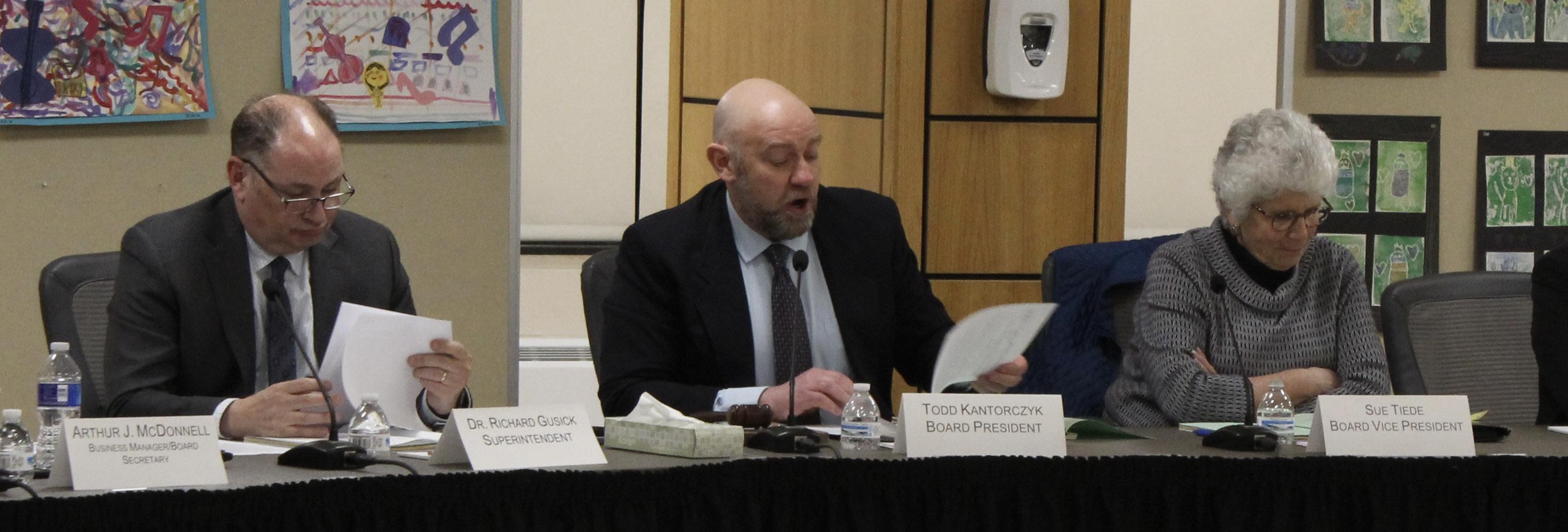
Voting for change: The TESD school board meets in the Conestoga cafeteria for a regular school board meeting. On Feb. 26, the board voted 8-0, with one abstention, in favor of the Resolution in Support of Fair Funding of Education and opposing Pennsylvania Senate Bill 757.
On Feb. 20, the Tredyffrin Township board of supervisors approved a memorandum of understanding with the Chester County Emergency Response Commission to implement a new Emergency Response Team K-9 program. The program involves Tredyffrin Township Police Department Corporal Eric Meoli working with a Dutch Shepherd dog. Township police captain Tyler Moyer said that the dog is currently operational and acts only for “tactical purposes,” such as searching buildings, pursuing suspects and detecting narcotics. “There’s a lot of different components to it that give them an advantage,” Moyer said. “If somebody would run from them or
Around a year ago, the commission proposed the idea of the K-9 program to improve the township’s emergency response force. Since then, Meoli and the dog have completed the necessary training to become certified as a K-9 team. Township assistant manager and financial director Joseph DiRocco said at the Feb. 20 meeting that the commission is handling most of the financial responsibilities.
“I think (needing dogs) is just an unfortunate way that our world is going these days,” Handshoe said. “It’s just another level of different avenues you can take.”
Unlike the dogs in Allied Universal’s unit, the Tredyffrin Township dog is not working as a patrol animal, which Moyer attributes to a lack of officers. Moyer said that there are no plans to expand the program.
The initiative resembles nearby K-9 programs established by security organizations in recent years, such as security contractor Allied Universal’s K-9 unit stationed in King of Prussia Mall.
“Right now we don’t have the staffing to dedicate someone to just K-9, and there’s also a lot of other factors that go into operating a K-9 unit on patrol,” Moyer said. “It (the current plan) was proposed to us, and we felt it was the best option at the time.”
Gusick, the Pennsylvania General Assembly is considering different strategies to resolve the inequities in public education funding.
“I think they’re in the process of figuring out what it is they need. It’s always hard to get agreement — everybody’s got a different idea or approach that they want to take,” Gusick said. “If there needs to be more funding for inadequately funded public schools, then the state has different mechanisms they could use to raise those funds and make sure those school districts are adequately funded.” Aren


The U.S. House of Representatives passed the Protecting Americans from Foreign Adversary Controlled Applications Act 352-65 on March 13. If approved, the bipartisan bill would bar internet hosting services for apps controlled by “foreign adversary” entities, as defined in the bill. It would require TikTok’s parent company, ByteDance, to sell the app in order to maintain service in the U.S.
t eac H er ind U ction program to cHange
At the March 7 TESD education committee meeting, director of curriculum, instruction, staff development and planning Dr. Wendy Towle presented a new teacher induction plan with features following recent state Department of Education regulations. The plan will go into effect next school year.
p enn S ylvania H o US e paSSeS Solar bill
On March 26, the state House of Representatives advanced a bill that would create community solar programs if passed. House Bill 1842 aims to allow residents to use third-party-owned community solar facilities instead of personal utilities. It will also assign responsibilities to the Pennsylvania Public Utility Commission, electric distribution companies and subscriber organizations.
Senate diStrict to receive tranSportation fUndS
On March 26, Sen. Carolyn Comitta announced that the Commonwealth Financing Authority designated $2.5 million to 19th Senate District projects enhancing roads and sidewalks through the Multimodal Transportation Fund. Easttown Township will receive $500,000.
On Feb. 16, the Pennsylvania Department of Education’s Office of Commonwealth Libraries issued more than $4.4 million to 17 libraries across 14 counties. The department distributed funds through the Keystone Grants for Public Library Facilities, which support the renovation and construction of public libraries. The Easttown Library received $45,000 to upgrade its infrastructure. The library administration plans to use the grant money to replace two of its heating pipes and the current ozone-depleting substance, HCFC-22. The pipes have operated for nearly 22 years. “This will assure that we don’t have service interruption if anything were to happen to these old heat pumps,” said Easttown Library director Amber Osborne, who oversaw the grant application process. “If one were to break and go out of commission, then we wouldn’t be fulfilling our full duty to the community.” The library administration began the application groundwork for the grant in late fall
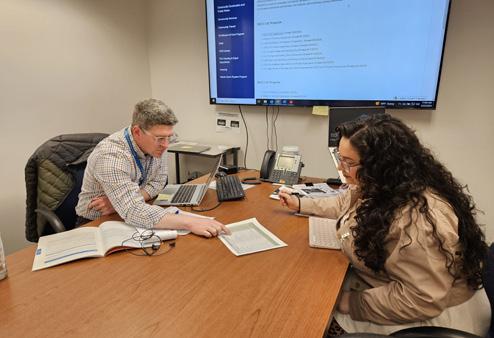
ect from an engineer, Osborne attended Easttown Township meetings and gained approval to move forward with the grant application from the township board of supervi-
sors. She then gathered letters of support from the board of supervisors, the Easttown Library board of trustees and the Chester County Library System. The library adminis-

At the Feb. 26 regular school board meeting, facilities committee chair Dr. Robert Singh announced a project for heating, ventilation and air conditioning unit renovations at the district’s networking operating center, both middle schools, New Eagle Elementary School, Valley Forge Elementary School, Devon Elementary School and Conestoga High School. Upgrades will take place from June 19 to Aug. 21.
The total cost of more than $5.2 million covers fees for the general contractor, electrical company, architects and engineers. The school board divided the process into two bid packages. General trade contractor Donald E. Reisinger Inc., mechanical contractor Clipper Pipe & Service Inc. and electrical contractor Schipsi Electric
are overseeing the construction processes for both bids.
“Public schools have to choose the lowest bid submitted by a contractor, and we look to see if the contractor has usually done work in the district before,” Singh said. “If not, references are checked prior to awarding the contract.”
The school board pursued the project due to some schools reporting problems and inconsistencies with the systems.
The first bid package covers New Eagle Elementary School, Valley Forge Elementary School, both middle schools and the district’s networking operating center. The second package expanded the plan to Devon Elementary School and Conestoga High School.
President of Donald E. Reisinger Inc. Stephen Reisinger said that the upgrades will mostly occur over summer break to avoid interrupting school activities as much as possible.
“We wanted to make sure that the maximum amount of time was allocated for the summer renovations this year outside of the school year, as we don’t know what problems we could run into with the upgrades of all of these systems with the large number of schools we are working with,” Reisinger said. “We will start right as summer break starts and end as close as we can before the district needs time to prepare for the school year, making our current construction timeline ideal for this purpose.” Singh emphasized the importance of the project to ensure that district staff and students do not experience problems with heating, ventilation or air conditioning. “HVAC units provide some of the most important services that a school needs to be functional and productive,” Singh said. “It’s important that we make sure that these systems are up to par in our schools.”


tration officially applied for the grant in October 2023. Sophomore Anthony Zhang frequently goes to the library after school to complete schoolwork. He often sees community members there and finds the grant beneficial.
“The money could definitely be used to modernize the facilities,” Zhang said.
“There should be more public libraries providing a really good community space.” Osborne said that the library administration is in the process of determining the details regarding the construction portion of the project such as bid packages, contractors and the schedule.
With the funds, Osborne feels that the library will be able to provide more consistent and quality service.
“Just the fact that we are able to continue the service (the community) knows and loves on a daily basis will be proof that we’re also taking care of all this back-end stuff,” Osborne said. “We will be able to continue doing what we always do without having to stop and close because the heat’s not working or the air conditioning is not working.”

On Feb. 6, the state House Education Committee cleared House Bill 1519. If passed, it would allow students at public schools to designate three mental health days a year as excused absences. Montgomery County Rep. Napoleon Nelson presented the bill on June 26, 2023 with the help of Sens. John Kane and Judy Schwank. While on a call with Nelson, a Pennsylvania student originally suggested to the representative the idea of excusing absences for mental health. Children First, the Jewish Healthcare Foundation and the Pennsylvania Youth Advocacy Network supported the bill. “The thing that I always want to highlight is just talking about passing this legislation and making sure that we’re codifying students’ mental health helps to elevate (mental health) to the forefront of conversation,” Napoleon said. “It’s just
another reason to talk to our students and to talk to your classmates about taking care of yourselves and prioritizing your mental well-being.” Conestoga allows for excused absences for reasons that can include mental health. Tredyffrin/Easttown School District Administrative Regulation 5113 states that absences are excused “when the student is prevented from attendance for mental, physical, or other urgent reasons,” such as illnesses, in accordance with the Pennsylvania Public School Code. Mental health specialist Jenna Grabiak said that Conestoga administration works with students and families to allow excused absences for mental health as needed. She believes that formalizing the process could aid students in other schools who do not have similar systems in place. “I think that Conestoga does a great job with allowing for mental health days already, but
this could really help to standardize that process and also bring more awareness to mental health,” Grabiak said.
House Education Committee members raised some concerns while voting on the bill, including that it could enable chronic absenteeism and that it is unnecessary as schools are already required to allow excused absences for health related reasons.
Senior Kat Nguyen, a member of Conestoga’s Mental Health Club, believes that the bill is important to bringing more awareness toward mental health as an option for excused absences.
“It is necessary because when a lot of people say they want to take a mental health day, (they) can just call out sick,” Nguyen said. “But it’s important to have the mental health days installed to reduce the stigma surrounding (mental health) and normalize that it’s okay to take a couple days off.”
After five and a half years of passing budgets, improving transit service, investing in park development and mounting a response to the COVID-19 pandemic, Robert Kagel resigned from his position as the Chester County administrator on April 5. Kagel originally joined the county government as an emergency medical technician in 2002. A volunteer in Kagel’s fire company informed him about a newly created position in the Chester County Department of Emergency Services that would create a fire and emergency medical service reporting software and make it accessible to the county.
“I looked at it, and I ended up fighting for it and got offered the job,” Kagel said. “The rest, they say, is history.”
In 2007, Kagel earned the department title of assistant director for quality, and in 2010, he became the department’s deputy director. In August 2018, Kagel became county administrator, the highest
non-elected position in the Chester County government.
As the overseer of the county’s operations, he worked through the COVID-19 pandemic, which he found to be one of the most challenging experiences of his career. Kagel said that he worked 20-hour days to manage the outbreak and drew on his previous experience in emergency services.
“Sometimes it’s about the right person being in the right place at the right time,” Kagel said. “I had a 16-year career in our department of emergency services, and I made a real impact on our preparedness efforts. Being in this role helped steer the ship from a larger policy perspective.”
Kagel’s background as a first responder contributed to the implementation of tax credit for fire and emergency medical service volunteers. Chester County board of commissioners chair Josh Maxwell said that one of Kagel’s greatest accomplishments was more personal: developing community within the government. “He has worked for the county for 22 years — he started in his
early 20s — so I think he has a unique ability to relate to everybody,” Maxwell said. “He’s able to build connections with us.”
The long working hours during the pandemic and concerns over mail-in ballots prompted Kagel to discuss his resignation with his wife a year ago.
“You can’t be everywhere at once. We can’t be all things to everybody, and setting boundaries and enforcing those boundaries is critical to success,” Kagel said. “I want opportunities to really prioritize my family and not feel like I’m shortchanging or not giving my all to my other obligations.”
As the county administration looks for a replacement, Kagel plans to take around a month to spend time with his family and afterwards continue working in policy or the government.
“I feel like the things that we have done have helped make people’s lives easier and better. I don’t think there’s many people in this world that can say day in and day out that’s what they get to do,” Kagel said. “It’s been an incredibly rewarding career.”

TESD’s special education programs’ history and growth
In 1973, the federal government passed Section 504 of the Rehabilitation Act, which protects against disability-based discrimination. Two years later, the Individuals with Disabilities Education Act created the IEP, which outlines a specialized instructional plan to meet a student’s unique needs.
Continued from page 1. cific support area: intensive reading and learning support at Beaumont, autistic support at Hillside, emotional support at New Eagle and life skills at Valley Forge. The district arranged for students to attend the school that housed their needed support area regardless of the student’s home address.
The Pennsylvania Department of Education expects schools to place students with IEPs in general education classrooms as much as possible. Nicole Roy, TESD’s director of special education, said that the district aims to achieve a least restrictive environment for all students, as outlined in the 1975 act.
“We’re not just sitting a kid in class to pretend to take notes. We have purposeful inclusion,” Roy said. “They have a curriculum that runs parallel to what the class is doing. Our philosophy at T/E is to have the kids out as much as they possibly can be and still benefit from their education.”
Before 2021, four of the five district elementary schools had specialized programs in only one spe-
When Roy became the director of special education, she prioritized expanding every school’s special education programs. By 2022, all eight district schools had reading and learning support, autistic support, emotional support and life skills classes.
“Our special education programming is fantastic,” Roy said. “But the biggest change for me was allowing the students to be at their home school, ride the bus with their own friends from their neighborhood and get the support and services that they need in their school where all of their friends and family go.”
Parents report varied experiences with TESD’s special education programs
At the onset of the COVID-19 pandemic, T/E resident Tanja Praefcke moved to the district from

Germany. Her daughter, Charlotte Praefcke, who has autism, started attending Conestoga in June 2020.
Tanja Praefcke said that Conestoga “couldn’t have been more accommodating,” helping translate IEP documents from her daughter’s former school and creating new plans. However, she noted that their family faced some difficulties while Charlotte Praefcke went through online classes. “She had her one-on-one on the other end, but still I had to sit next to her because she has to have someone in person with her,” Tanja
Praefcke said. “When it finally got back in person, it was so much better for her because they could really work on her social skills: sitting down, looking at someone, talking to someone, following rules and activities of daily living.”
Other parents reported less streamlined experiences with TESD’s special education programs.
Alison Swanz Nagle said that she had to do most of the legwork to ensure that her 12th grade daughter received the necessary educational support for her 22q11.2 deletion syn-

drome (22q) with comorbidities of ADHD and autism. She felt that her daughter’s case managers had always been agreeable to learning more about 22q, but their lack of experience with the genetic condition led them to minimize her primary diagnosis and focus on her autism when creating educational plans.
“It’s what they hone in on because they’ve heard of autism,” Swanz Nagle said. “They’ve never heard of 22q. For me, it’s frustrating because I have to educate them on her educational needs.”
Swanz Nagle felt that when she started considering her daughter’s post-high school plans, no one within the district could sufficiently answer her questions. She found that district staff did not know enough about 22q to guide her through her daughter’s later high school years.
“My questions seemed to get punted between special ed, her guidance counselor, the CCIU, Technical College High School and the Office of Vocational Rehabilitation,” Swanz Nagle
said. “And talking to other high school parents, I know I’m not the only one.”
Conestoga’s Best Buddies chapter expands special education opportunities
Alongside the growth in the district’s special education programs came Conestoga’s Best Buddies club, which has been running for more than 25 years. A chapter of the national non-profit organization, the club is dedicated to creating opportunities for inclusive living and development for individuals with intellectual and developmental disabilities (IDDs).
The Best Buddies club matches “peers,” students without IDDs, with “buddies,” students with IDDs. Students meet in smaller groups and organize social outings between monthly club meetings. Senior and Best Buddies club co-president Sophie Kunsch has been a peer since her freshman year. She said that the outings provide opportunities for students with IDDs to form friendships and
continue their social interactions outside of school.
“We have so many kids that don’t have IDDs in the club, and it is amazing,” Kunsch said. “A group of four or five guys went bowling, which is fun because they make a lot of friends, and it’s a smaller environment than the meetings.”
On March 21, the club invited neighboring schools’ Best Buddies chapters to Conestoga for an annual talent show. Conestoga’s chapter prepared a group dance to the song “YMCA,” during which peers and buddies performed on stage together.
Freshman Sam Porter, a member of the Best Buddies club, said that he “loved” the talent show and that it was “really fun.” Senior Nagarjun Besagi agrees.
“I liked (the talent show).
It was amazing,” said Besagi, a buddy in Conestoga’s Best Buddies club. “I liked singing songs and dancing.”
Besagi will graduate in June and plans to attend West Chester University next year through its transitional living program.
“I love my life,” Besagi said.
“It’s so good.”
From April 13 to 20, school board member Dr. Roberta Hotinski will travel to Germany as part of the first international study group hosted by the Pennsylvania School Boards Association (PSBA), a non-profit association for school board members.
During the trip, 15 PSBA members will examine the German K-12 educational system, focusing on aspects such as dual education and pre-kindergarten preparation. The group’s goal is to identify and recommend aspects of the German school system for implementation in school districts across Pennsylvania.
After discovering the program through a PSBA announcement, Hotinski submitted an application to the organization explaining why she would be a valuable member of the trip and citing her various experiences with German culture and language. She learned that the organization accepted her on Dec. 5.
“I wanted to go because I felt like I had a lot of experience that would help make it a successful trip,” Hotinski said. “I thought that I would bring a good set of skills to it that would help make sure that we get useful information from this trip and help them (and) that I’d be a good person to help gather information and bring back lessons learned.”
Hotinski grew up in Germany, where her father was stationed in the Air Force, and picked up the language early on. She then majored in German in college and traveled abroad to a German-speaking region of Switzerland for part of her postsecondary education. Her husband is a German immigrant, and they frequently speak the language within their household.
Before traveling, the study group held three Zoom meetings with leaders in Germany’s education system, business sector and government agencies to gain familiarity with the way the country approaches education. After the trip, members will compile a re-
port of their findings to present to the PSBA at the 2024 Pennsylvania Association of School Administrators and PSBA School Leadership Conference in October.
Throughout the trip, members will focus on four main topics: teacher employment, recruitment and retention; pedagogical practice K-12 and emerging strategies; career pipeline and career and technical education center programming; and funding, structures and governance. Hotinski said that she hopes to learn more about the way the German education system allows for students to have real-world work experience prior to entering the workforce as adults.
“It’s seen as a strength of their system that they have this opportunity for students,” Hotinski said. “There’s a close relationship between industry and the educational system that helps students prepare and also is helpful to industry because then (employers) are getting workers with the kinds of skills that are needed. There are positives on both sides there.”

Howard Kim/The SPOKE

The Pennsylvania Department of Human Services established the Women’s Service Program in late January, aiming to provide increased access to advanced and inclusive women’s healthcare services. According to the department’s website, “The program will expand access to comprehensive, evidence-based care, support, and education across the Commonwealth.”
The department chose grantees, which each preside over an assigned region of Pennsylvania, through an application process this summer. The department chose the Maternity Care Coalition as the grantee for the Chester County area. The Maternity Care Coalition provides women’s health services, specifically programs meant to help pregnant women and par-
enting families with children between 0 and 3 years old. Through state-issued grants, the coalition can not only choose to build upon its programs but also award smaller portions of the money to local women’s health clinics. Samia Bristow, vice president of programs at the Maternity Care Coalition, believes the grant will help the organization expand its reach and impact.
“Getting this grant is super rewarding,” Bristow said. “Having access to an opportunity like this really supports us, addresses those inequities that exist in reproductive health and ensures that people have access to quality health service.”
A group of health and social justice activists founded the Maternity Care Coalition in 1980 in response to concerns for the well-being of infants and pregnant women. Since then, the coalition has established a vari-
ety of programs that aim to help pregnant women, women with children and older women.
With the grant from the Women’s Service Program, the coalition will receive between $2.7 and $2.9 million in funds.
The Maternity Care Coalition plans to use the grant to broaden the services it offers, with a focus on providing additional reproductive health services and expanding its reach.
The coalition currently provides services to Berks, Bucks, Chester, Delaware, Montgomery and Philadelphia counties. Some of the coalition’s programs include Home Visiting, Early Head Start, Newborn Care, Community Doula Services and Behavioral Health. It is in the process of recruiting staff members to better cater to the families
As a grantee, the coalition is able to partner with and fund local businesses to expand its services. Currently, it is partnered with clinical service providers AccessMatters and Maternal and Family Health Services. Both organizations provide access to additional services that the coalition does not have, including cervical screenings and STI testing.
Junior Soumya Sathyanarayana, vice president of womens’ rights advocacy club New/ Gen ’Stoga, looks forward

Putting a spin on his everyday classroom experience, junior Justin Cuevas is taking his education overseas to collaborate with fellow sea cadets and the Australian government in an international program.
A study abroad program selected junior Justin Cuevas among thousands of applicants to visit Australia this spring. Cuevas, as well as four other United States cadets, will travel from April 10 to 27 with the International Exchange Program for Sea Cadets.
e exchange program, which the United States Naval Sea Cadet Crops oversees, offers students the chance to visit a foreign country and interact with other students from various nations while serving as
an ambassador for America. Cuevas and fellow cadets will work alongside the Australian government and experience the country’s culture.
“I'm interested in seeing di erent cultures and di erent people around the world and being able to see what they do, how they live and how it’s different from here in the U.S.,” Cuevas said. Cuevas has been a sea cadet for the last four years, and has worked with the U.S. Navy firsthand. Prior to the study abroad program, Cuevas taught younger cadets seamanship, military, boating, aviation, medical and science, technology, engineering and math skills. He has worked with various crasized boats and has sailing experience on the Barque Eagle, a 295-foot ship. Cuevas will take
the skills he learned on the trip and apply them while representing America.
When applying to the program, Cuevas obtained various certi cations and participated in multiple training programs, including the Petty O cer Leadership Academy Program: a week-long leadership training program in which cadets learned from other leaders in the elds of the U.S. Navy and Coast Guard. “ ey can’t make you a leader at that academy, but they can provide you with the tools.
ey then know that you will be a great leader since you have experienced it,” Cuevas said In preparation for his trip, Cuevas has studied the life and culture in Australia to familiarize himself.
“I’m talking with the other people that are going to see
what information they got,” Cuevas said. “I’m also watching some history documentaries and looking at the Australian news to see what’s going on there. I’m getting a feel of what Australia might be like so when I show up there I’ll have a good idea of what’s going on.”
While traveling, Cuevas will get exposure to different cultures through museum tours, talking to locals and sightseeing. He will also work with the Australian government and to see how it operates on a day-to-day basis while also training in seamanship and military service.
“I’m excited to experience something that not many other people get to do, which is something I love doing,” Cuevas said. “Being one of the few to be able to do something is a great feeling for me.”

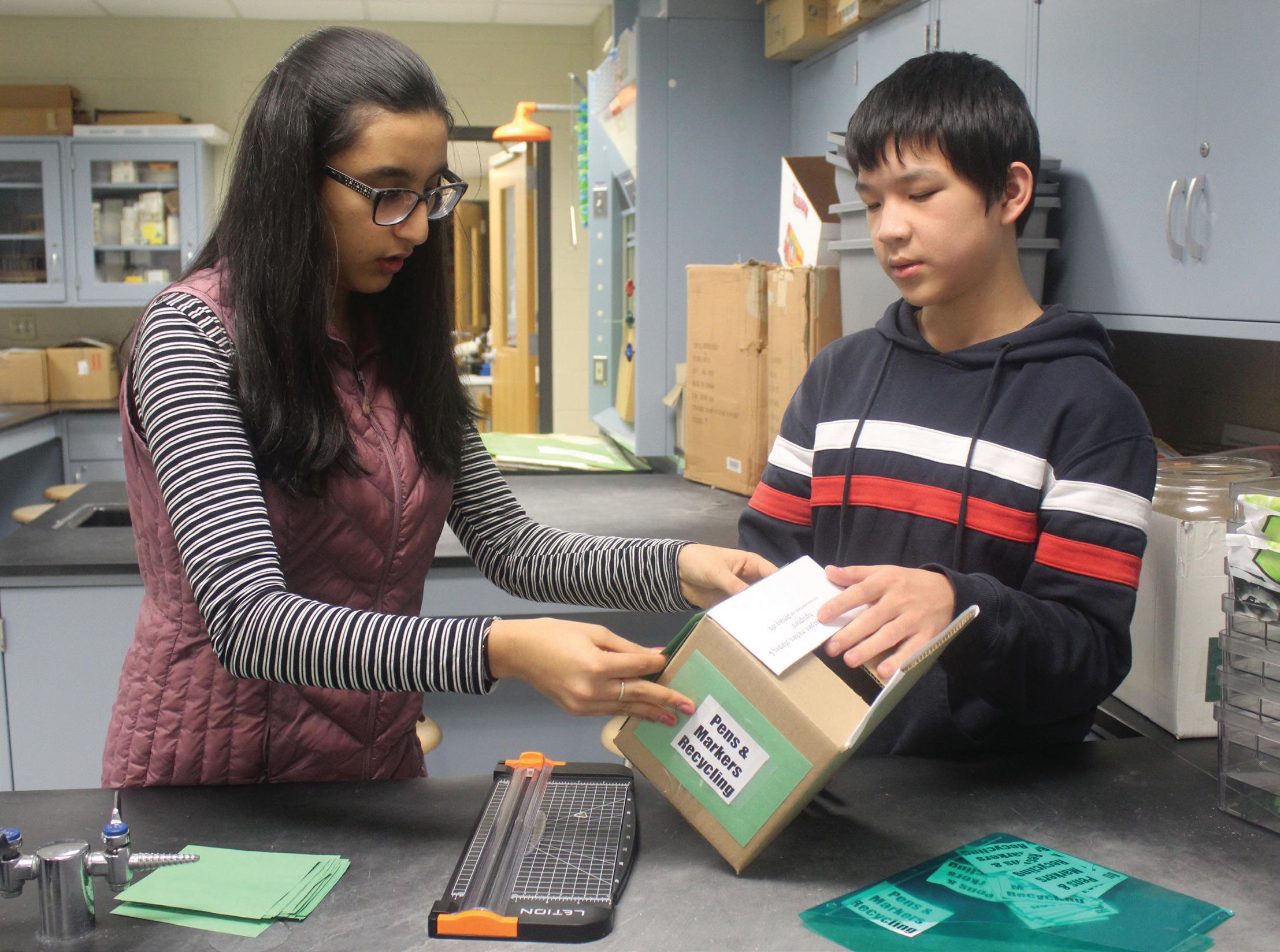
The environmental toll of disposed pens unsettled thenthird-grader Shriya
“They just stay in landfills for years and years,” Prakash said. “There’s over 2 billion thrown away (annually).”
founded PenSavy in 2016 to address the issue of writing
saw pens get thrown away the most was in schools. Countless times when the markers didn’t work, teachers would just chuck them into the trash can,” Prakash said. “So school was a really easy and accessible place to start trying to collect these and try to prevent them from going into landfills.”
A er launching the initiative, she secured grants from e Pennsylvania State University to fund collection boxes. She decorated the exterior of boxes and began to place them in her elementary school.
versity,
PenSavy’s mission arose from a simple observation. Prakash, a third-grader at the time, was looking for an easy way to make a positive environmental impact. When she noticed the constant stream of discarded pens in the classrooms, she decided to target schools first.
“At the time, because I was so young, the place where I
When a colored writing utensil dries out, a student or teacher can deposit them into the boxes for recycling. Currently, she has situated a few boxes in public spaces around Conestoga, such as the library and in classrooms. However, Prakash’s initiative extends beyond school doors. “I used to focus on individual classrooms, individual people, but something that I’ve been working toward is trying to go more on a bigger scale,” Prakash said. “I wanted bigger boxes at bigger community locations, or just libraries and companies, rather than just have one box here.”
Prakash is currently partnered with several organizations to distribute boxes, such as e Pennsylvania State Uni-

 Hannah Simon Co-Copy Editor
Takumi is a Japanese word meaning “artisan,” and at Takumi Bistro & Bar in Wayne, the restaurant’s name matches the food’s quality.
Dark paneling and leather booths covered the restraunt from oor to ceiling. Arti cial orange roses deck the interior walls and wood-toned decor and organic-form light xtures further create a warm ambiance for customers. A youthful soundtrack nicely o sets the atmosphere, and the menu, featuring modern Japanese-inspired dishes, boasts a one-ofa-kind sushi and cocktail selection that complements the restaurant’s upscale verve.
I began my meal with a comforting twist on a traditional favorite: spicy edamame. A $7 bite-sized, snappy treat, the edamame packed a punch. My taste buds wanted more, so we ordered the $12 jalapeño wings. Dipped in a cumin seasoning and deep-fried, the ve golden brown wings arrived with a slice of jalapeño on the top to make for a aky, spicy appetizer.
I opted for the wagyu fried rice for my entrée and was excited to see what its $40 price tag had in store. A visual stunner, the dish was in a beautiful, goldand-blue marbled bowl — with matching oversized silverware at the side — and garnished with an herb sprig. Featuring a medley of A-5 wagyu, asparagus, corn, egg and scallion, each bite brimmed with texture and a sweet avor from the vegetables that grounded the tender wagyu. Chicken teriyaki was next. Another staple perfectly executed at $23, its mushroom, asparagus, bell pepper and teriyaki glaze worked harmoniously to create a refreshingly tangy yet lling meal — not to mention its gorgeous appearance when arriving at our table. Fresh, tasty and a ordable, the $8 California roll and $9 spicy crunch tuna roll were great options t for sharing among three, as the rolls were quite large. eir organized and creative presentation, like many of the other dishes at Takumi, received my compliments. e atmosphere at Takumi conveys a re ned warmth. A couple sat at the bar and chatted
You, yes you, are going to have to take a summer SAT course. Our classes are small, fun, and personalized. “Theirs” are big, boring, and repetitive. It’s a pretty easy choice, right? Find out more at CrimsonReview.com


about their days, friends from work laughed over drinks, and the sta was cheerful, attentive and more than knowledgeable about the menu. Although on the pricier side, Takumi is a combination of culture and expertise and a perfect place for a dressier night out.



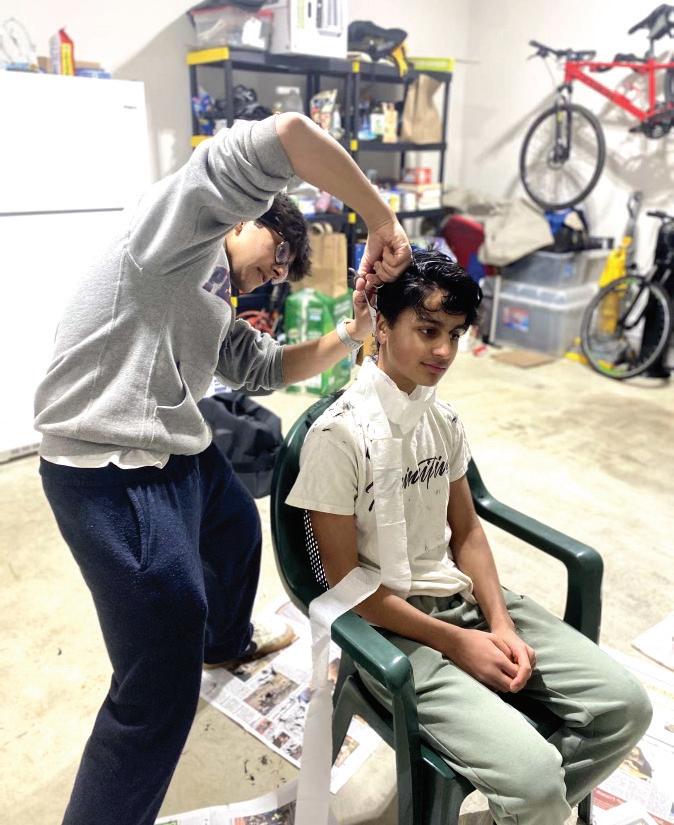
For many students, Friday a ernoons signal the end of the work week and the start of the weekend. However, for freshmen Rodger Cole, Jaiden Cox and Jonah Sokolove, Friday a ernoons consist of cutting hair in Sokolove’s house for their newly opened nonpro t, J&R Barbershop.
e freshmen o cially opened the shop in December 2023, but business did not pick up until February, when they increased the shop’s social media presence. ey now have multiple customers a week.
“I kind of wanted to become a barber back in eighth grade.
I’ve always been known as the entrepreneur back in middle school,” Sokolove said. “All the other (businesses) kind of failed, but I think this one is the one that’s going to stick because of this amazing team.”
Currently, J&R Barbershop distributes business cards around the community and posts on its Instagram, @jandr_barbershop. Prospective customers can message the shop to schedule an appointment, typically on Fridays, Saturdays or Sundays. When the freshmen do not have customers, they said that they are busy honing their skills.
“We practice on each other a lot. We also watch YouTube videos to learn what type of equipment we need, and then we deck out the whole shop,” Cole said. Cox said that cutting hair provides joy to both the barber and client.
“I think it’s cool how you can take someone’s hair

Madeline Pulliam Sta Reporter
From pencils and paper to scissors and clippers, juniors and self-taught barbers Rish Debroy and Ayan Kumar have been running a new hair-cuting business: KD Clipz.
Debroy and Kumar started the business in February, and it has been growing ever since. ey advertise the business through its Instagram page @kdclipzzz, and customers can message the account to book an appointment. Prices are either $10 or $12 depending on the cut.
was credible because my mom used to cut my hair, so I always kind of knew how to cut hair.”
A mutual friend of the juniors inspired them. Debroy and Kumar continued cutting their own hair to sharpen their skills and then moved onto trimming other people’s hair.
“Some people saw my haircut, and they were like, ‘Oh can you try my hair?’ I also knew Ayan cut hair and was already good at it, so then we joined forces,” Debroy said.
from looking like how it is and transform it into think that when you have a more confident.”
For 2023 Conestoga alumnus Theo Simard, “Family Feud” is more than just a TV show. Since seventh grade, the show has provided him with a daily dose of laughter as he immersed himself in the antics of the two families battling on the screen to win a prize. Watching the show became part of his daily routine. “I would always come home after school, sit on the couch and watch two episodes,” Simard said. “I just love it. It was really fun to watch and play along with too.”
Little did Theo Simard know that he and his family would be part of the experience one day. In early February 2024, “Family Feud” episodes featuring the Simard family aired on television.
Kathleen Simard, Theo Simard’s mother, started watching “Family Feud” when she was 10 years old and admired her son’s interest in the show. She promised him that when he turned 15 years old, the minimum age to appear on the show, she would apply for their family to participate. The Simards auditioned during the COVID-19 pandemic. “We had an hour-long call with one of the casting directors where we literally played a round of Family Feud,” Kathleen Simard said. “We cleared the board, had tons of energy and the casting director notified us probably within two or three days that we’d been cast.”
Filming for the show began in summer 2023. Theo Simard said that the experience was different than what he imagined.
“Watching it on TV and actually being at the studio is completely different. When you’re in there and Steve’s asking you questions, the pressure is on,” Theo Simard said. “You are put on the spot. It’s not like at home, where you can pause the TV show and you can take your time. You’re always thinking and it’s stressful.”
The Simard family lost its first game against the Brooks family after second-guessing the answer on the last question. However, since the producers found the family’s energy entertaining, they called back the Simards to film another episode the next day.
With the pressure on, the Simards competed against the Butler family but lost again. Theo Simard looks back on the experience fondly, and said that his favorite moment was interacting with the host, Steve Harvey.
“For me, it was making Steve Harvey laugh, but unfortunately, they cut it out of the show. ere is a scene in the episode where he says I’m funny,” eo Simard said. “I really do think just getting to talk to Steve Harvey is the coolest part.”
Despite the two losses, the family’s energy impressed the producers, and the Simards received an invite to play for a third time. Kathleen Simardhopes that her family will be able to appearance on the show one more time. “I’ve been in contact with the casting director to see if we can find another date when we can all make it,” Kathleen Simard said. “So,
“I was experimenting with hair cutting, and I thought it was fun. I always wanted to save money on my own haircuts, so I thought of a way to be convenient with it,” Kumar said. “I watched multiple YouTube videos to verify I was cut-
So far, they have completed eight haircuts in Debroy’s basement. e room has mirrors, chairs and other necessary tools. While Kumar does all of the cuts that need scissors, Debroy uses clippers, which he said allow him to serve a wider variety of students who want di erent haircuts. Although they are con dent in cutting short hair, they are more hesitant about longer hairstyles.
As they have gained more experience, Debroy and Kumar said they have increased their con dence and client base. ey tagram and see who reaches out. “ e rst haircut was like an experiment, and we were happy our client gave us a chance to try it out,” Debroy said. “We knew once we had more experience, he would come back as something better. It’s like a canvas: You can create what you want,” Cox said. “It’s fun meeting new people, and I think that when you have a good haircut, it changes your personality. It makes you Currently, the barbershop is a nonpro t. e freshmen plan to wait until they graduate high school before obtaining their o cial barber licenses
tinue to promote the shop
to wait until they graduate and charging for their services. For now, they conand hope to expand further in the future.
“We’re going to try to expand as much as we can,” Sokolove said. out our high school ing to get our name out, going to di erent ing to see if we can ship there. at way when we graduate high school, we can make it an o cial
“We’re going to try
“Especially throughyears, we’re just tryto barbershops and tryget an apprenticeship there. at way graduate high school, we can make business.”




As colorful rocks lined Conestoga’s cafeteria tables, decoration: ey were a show of support for a local cause. e Interact Club held a rock painting event on March 16 in honor of former Conestoga student
“Oliver went to Conestoga and grew up in this community,” said senior and Interact Club co-president Tory Gauthier. “He’s someone who was very close to us and to this

community. It’s important to give back to him and to respect him and appreciate his life and keep that in our memories.”
According to the American Cancer Society, osteosarcoma disproportionately affects teenagers in comparison to other age groups. Oliver Feldman’s mother, Lauren Feldman, said that because the disease inflicts a relatively small part of the population, it receives minimal government funding. As a result there is a lack of scientific research and effective treatment for the disease.
Interact Club members hoped to raise awareness for the disease through its rock painting event. “It gives us a sense of being thankful for what we have,” said sophomore Jenna Khalil, who attended the event. “We’re able to draw on these (rocks) with both of our arms. Oliver couldn’t use one of his arms because the cancer spread in it.”
Conestoga’s Interact Club is a branch of Rotary International, an organization that assigns service projects to chapters around the country to provide students with opportunities to give back to their community and help those in need.
“To me, (painting rocks) resembles happiness through the rock itself as a beautiful way of bringing someone’s life who has passed away and keeping his memory with us,” Gauthier said.
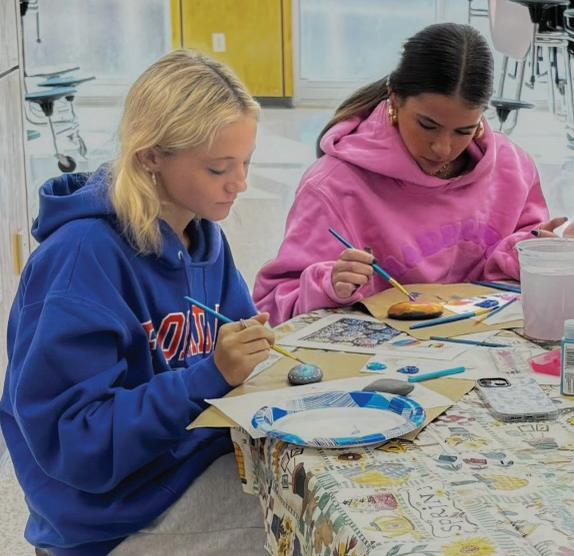
Lauren Feldman said that her son loved art and always made a point to be a positive and kind inuence to those around him. His personality inspired her to create the Oliver Rocks program, which organizes events like the one at Conestoga. Oliver Rocks also provides supplies for people to paint rocks and to display them around their communities to spread joy.
“In the world today, there’s a lot going on, and sometimes we feel really powerless, helpless and maybe sad about it. I think that (although) things are out of our control, we still have the ability to decide
how we’re going to respond to something,” Lauren Feldman said. “Spreading joy out into the world, just as a way of living, is really important.”

Juniors Jiong Li and Matthew Ma won DECA state leadership positions at the 2024 Pennsylvania State Career Development Conference in February. e conference is the organization’s Pennsylvania-level competition and takes place annually at the Hershey Lodge in February.
DECA is an international organization that aims to prepare high school leaders and entrepreneurs for careers in business, and Conestoga’s chapter is one of the largest clubs at the school with more than 220 members.
In order of rank, the organization delegates state leadership to the president, vice president, executive council and district representative positions. Candidates running for the state roles aim to win the votes of representatives from each Pennsylvania high school chapter at the state competition, but the campaigning process starts long before. Li, who won a position on the executive council this year, structured his campaign around social media outreach. “Instead of waiting for people to reach out to me, I reached out to other people. I just tried to find my target
market and tried to find the right people to talk to,” Li said. “I didn’t really (expect to win), but as I got closer to the mini award ceremony, I felt a little bit more confident after seeing how I performed compared to the other candidates.”
For Ma, the third time was the charm. A er joining DECA his freshman year, he won the vice president position following unsuccessful campaigns for district representative and a role in the Conestoga chapter’s leadership.
“I ran for district representative because I didn’t think I could win (state) executive council because I don’t have experience with Pennsylvania DECA leader-
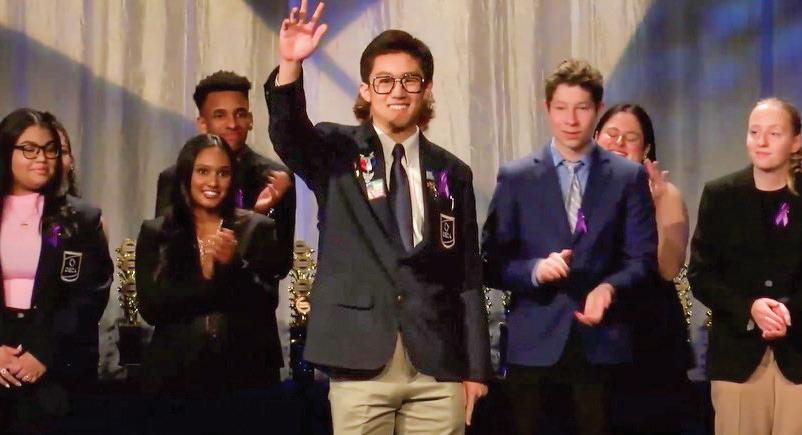
ship,” Ma said. “I didn’t get ’Stoga representative, so I went for district representative. I didn’t win district rep, so I was like, ‘I might as well try,’ ran for (vice) president, and it worked out.”
Ma’s campaign focused on fostering connections between DECA members at the state conference. Although gaining recognition initially challenged Ma due to his lack of previous leadership experience, he distinguished himself from other candidates by hosting his version of the popular speed dating show, “The Button,” with a DECA-themed spin and by turning the lights off during his campaign s peech.
“I hosted ‘ e Button’ dating show and morphed it into a connection show about meeting new people and encouraging people to step out of their comfort zone,” Ma said. “For my speech, I actually turned o the lights. It was about how DECA helps you get over that fear of the unknown. Turning o the lights for my speech and ‘ e Button’ (were) what set me apart.”
As vice president, Ma hopes to improve the state competition and bring “DECA Glass,” the popular glass trophies awarded to top winners at the International Career Development Conference (ICDC), to the state-level competition.
“Compared to making states, a lot less people make ICDC,” Ma said. “So I think we
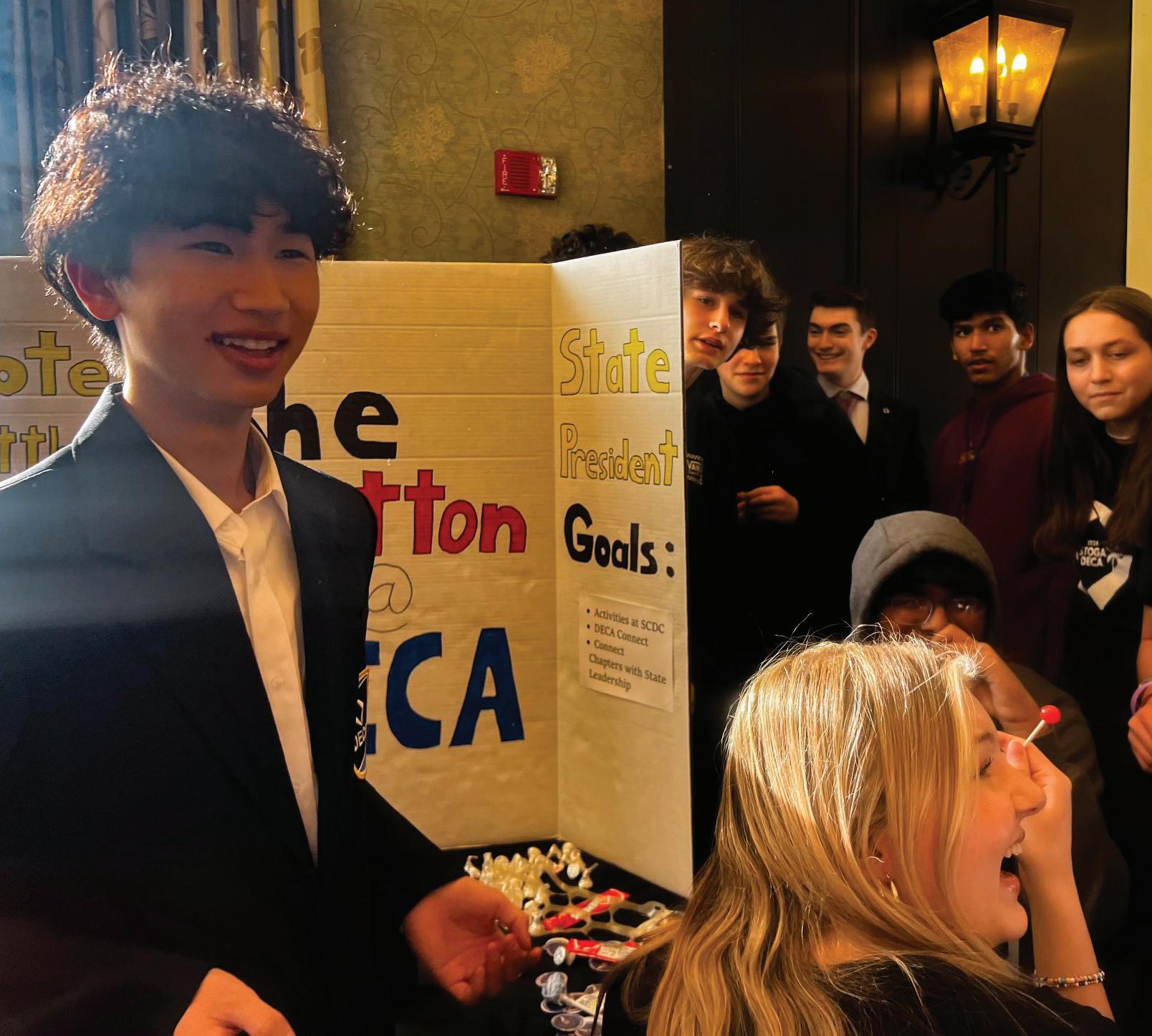
should make states a little more exciting because that’s where (the) DECA journey ends for a lot of people.” Li said that members of the Conestoga chapter were very supportive of his campaign.
ey advocated for his platform and handed out campaign stickers on his behalf. Ma said that he found support from club adviser Je rey Conner. “I’m really glad Mr. Conner has joined DECA this past year.
I don’t think I would have been able to do it without him,” Ma said. “I really liked the new structuring, and I think he’s provided us with a better opportunity to go for these positions beyond the DECA chapter here.”
A er taking Conestoga’s studio art classes, art teacher Beata Artz discovered a passion
In 2015, Artz began as the primary art instructor at Devon Elementary School before transferring to Conestoga, where she is currently in her sixth year of teaching. She has instructed a variety of classes throughout her time at Conestoga, including studio art, Drawing and Painting, 3D Sculpture and Cra s, Ceramics and Art History. “I had a wonderful high school experience. I went to Conestoga, and from the art teachers that I had, I knew that I wanted to go into teaching pretty early,” Artz said. “I had a good hunch that it was something I wanted to pursue. I was always deciding between being a teacher and getting a ne arts degree, and I ended up getting both.” Artz found some differences between teaching art at the elementary and high school levels.
“It (the elementary school) was a bit different,” Artz said. “There’s a lot of energy there, which is amazing. You’re teaching them not only the foundations of art making but fine-hand coordination and how to be a good citizen. Up here, you can foster more technical skills so that the concepts can become more complex and developed. The skills are obviously much different, but some of the personalities haven’t changed a whole lot. I still get really fun, exciting kids at Conestoga.”
Outside of the classroom, Artz serves as the assistant sprints and horizontal jumps coach for the Conestoga track and eld team. Her high school track career as a sprinter and jumper inspired her to coach the team at Conestoga. Artz admires how art and athletics complement each other in necessitating order and practice. “Both need a lot of discipline,” Artz said. “Both require patience and lots of practice. There are a lot of parallels that I can make between the two, but it’s also a great balance. I find art to be a little bit more meditative, quiet and obviously more stationary.”
When Artz is not teaching art or coaching track, she enjoys visiting national parks and traveling around the world with her husband. Most recently, Artz visited Athens, Santorini and Naxos in Greece.
“I do get inspired by places I visit,” Artz said. “One of my teacher examples for a project this fall was a little tile of the Parthenon on the Acropolis. I love being absorbed in the culture of new places, learning about older things and just seeing what’s out there.”
Artz noted that, throughout her nine years of teaching, she has enjoyed fostering a constructive environment for her students and athletes.
“It’s important to give students grace and encourage them to make mistakes in a safe way so we can learn that things aren’t always going to be perfect,” Artz said. “Both my track athletes and art students know that, and I help them work through it. I try to be a teacher that creates a positive environment so students feel okay making mistakes and then either xing them, trying again or moving on in a matter where they’re not feeling negative about their experience.”



Ever since they strummed their first chords on the guitar at the age of 7, sophomore Keira Beachell has been honing their musical talents. By the time Beachell was 10 years old, they discovered a new passion: jazz guitar.
This year, Conestoga’s jazz ensemble picked Beachell as its sole jazz guitarist. Beachell has been studying guitar with their teacher, Michael Simmons, for almost seven years.
“I genuinely like jazz music, and my mentor is really wellversed in jazz as well,” Beachell said. “It felt like one of the right things to do. Plus, I could do school with (jazz guitar).”
In February, when Beachell was in Canada visiting their sister, they went to the Modavie Jazz Club in Montréal. Their sister convinced the band to play one more song, and the band members invited Beachell to play on stage with them.
Along with playing in Conestoga’s jazz ensemble, Beachell also participates in Stage Crew. For this year’s musical, “The Little Mermaid,” Beachell learned audio and sound production skills. When reflecting on their growth, Beachell credits jazz en-
semble teacher Christopher Nation and the music department at Conestoga. “He (Nation) plays guitar, and I love having conversations with him,” Beachell said. “’Stoga music in general has made me feel more comfortable playing in public. If I were in eighth grade and I was asked to go on stage with professional musicians, I would have said no. e department has just helped me be more con dent.”
For Beachell, navigating music during the COVID-19 pandemic was challenging because they were not able to meet with their teacher in person. They said that they
It was intimidating, and I was definitely in an adrenaline rush. It was one of my key moments in my life. I’ve never been so thrilled.
Keira Beachell Sophomore and guitarist
“One of the most unmotivating things about guitar is sight-reading because of how complicated it gets,” Beachell said. “Going into jazz guitar, sight-reading is an important thing. It was a feat I had to get over, but I eventually did.”
In the future, Beachell plans on continuing jazz guitar as a hobby, aiming to refine their skills and build a community around their passion for music.
“I want to have fun with the musicians I know,” Beachell said. “I’m not worried about making a career out of music but about making joy out of it.”
BERKLEY COLLEGE OF MUSIC
BERKLEY COLLEGE OF MUSIC faced difficulties maintaing their sight-reading skills while taking online classes.
Abbie Preston Sta Reporter
For senior Cosmo ompson and his brothers, Gus and Finn ompson, music is a constant presence in their household. The Thompson brothers entered the world of music at an early age. From “Rush” and “Boston” mixtapes and sounds of their parents playing the trumpet and guitar to learning instruments on their own, they eventually channeled their shared passion and formed a band.
They’re with me all the time, so they’ll get on my case about performing songs. But it is something that me and my two brothers will do for the rest of our lives: just playing music together. I think it’s really fun.
Cosmo Thompson Senior and guitarist

“My parents both played music a lot, so music has always been a part of us growing up,” said Cosmo ompson, bassist for the band. “It wasn’t a big leap from listening to awesome songs to playing these awesome songs because I wanted to do that anyway. I thought it would be so cool to play this music and then get to do it with my brothers.”
The band’s name, Three and One Band, stems from its members: three brothers and one drummer, Neil Goldenthal, who is friends with the Thomspon brothers. Specializing in classic rock and pop, the band covers popular songs
for regional events, ranging from weddings to block parties, with the help of minivans crammed with sound equipment. One of the band’s annual events is “Thursdays on the Lawn,” a weekly summer concert series in which Three and One performs in Stone Harbor, New Jersey. “ e people there know us and appreciate us, and we get free ice cream,” Cosmo ompson said. “ e best part is that we learn new music every single time we play there, and we always pick good songs that are so fun to play.”
Nguyen said that her songwriting process varies. For her, inspiration usually comes from emotional catalysts.
e band practices in what is called the “music room” of the ompson household. As most of the bandmates are in college or have jobs and do not live together, practice relies on individual preparation. For Cosmo ompson, being in a band with his brothers serves as a source of motivation and accountability.
The band aspires to explore song writing, mixing the eclectic musical taste of the bandmates. “I would love something that I worked really hard on and be able to point that out and say, ‘Look at this thing that I did,’” Cosmo ompson said. “I want to mix all the di erent kinds of music that we like.” For Cosmo Thompson, being involved in the band has fulfilled a lifelong passion for music. “It’s just something really cool that I love to do,” Cosmo ompson said. “I think it’s awesome when somebody will come up a er a gig and say, ‘ at was awesome.’ Like, yeah, we worked for that. It is awesome.”

With a deep passion for music, junior Audrey Nguyen engages in many musical activities, including singing, music production and songwriting.

“Usually (writing a song) starts with
them. To do this, she utilizes the music production software Logic. Last summer, in order to learn more about songwriting and music production, Nguyen attended a program at the Berklee College of Music.
Rajan Saha Sta Reporter
Nguyen began her music journey by taking piano lessons and participating in school-sponsored music programs, such as chorus and band in third grade. In eighth grade, she started attending formal voice lessons, taking music more seriously and pursuing pop and classical singing. She also sings in Vietnamese.



“The summer program was a really great experience for me to collaborate with other people and kind of just solidify my passion for songwriting,” Nguyen said.
Nguyen uses social media as an integral part of her music expression. She has a music Instagram account, @audreymei.music, on which she posts covers of other artists’ music as well as her own original songs.
While balancing schoolwork and extracurriculars, junior Isabella Florendo finds the time to practice her most prized instrument: the piano. From using a $1 keyboard to playing at the White House, Florendo has come a long way in her musical journey. Florendo has been playing the piano since she was 5 years old. Her passion for music began when she saw someone play the piano at her ballet lessons. Since
Pre-Collegiate Piano Competition, George Gershwin International Piano Competition and Geneva International Music Competition. She even performed at the White House on two separate occasions.
which provide live performances to kids who do not have access to music lessons or instruments.
for and practiced for,” Florendo said.
I like, when I play piano, the emotions I can put into it. If I’m having a bad day, I can just sit on my piano and play something. It just helps me get my feelings out on the piano.
Florendo said that her parents always supported her passion for music.
“My dad has always
“I don’t feel nervous at all (during performances). I’m pretty calm, but
Florendo’s teacher, Ronaldo Rolim, is a professional concert pianist. Due to his workload, he holds lessons online, and he sees improvements in Florendo’s skills.


One of her covers of a Vietnamese song received recognition through an Instagram story post by the original artist who created the piece.

“She’s what we call in the industry a utility player, meaning that she’s strong in several areas,” Nguyen’s vocal coach Grant Birchard said. “Even in the areas where she’s up and coming, she still has the ability to make herself better.” is year, Nguyen participated in the Pennsylvania Music Educators Association’s choir competition. Nguyen quali ed for the regional level of the competition. In addition to participating in the organization, Nguyen performs at recitals recommended by her vocal coach and o en seeks out opportunities to perform at local areas such as co ee shops. Nguyen also has a passion for writing and composing her own songs.
an intense emotional experience or feeling that I’m going through,” Nguyen said. “I just like to sit at the piano and start writing things down. Sometimes it starts with the lyrics, and sometimes it starts with the melody.” Nguyen produces her own songs in addition to writing
I’ve always been really interested in writing and poetry.I’ve found a lot of joy in combining my two passions of music and writing. I found that through (songwriting), I was able to express a lot of ideas that through music alone or through writing alone I couldn’t really convey.”
Audrey Nyugen Junior and singer/songwriterIn the future, Nguyen hopes to be able to pursue a career related to music production and songwriting. She also hopes to release her own songs, regardless of what she chooses to study in college.
“I’m just excited to see her career grow,” Birchard said.
“At some point, the student surpasses the teacher, at least in terms of needing to take it to the next level and starting to knock on all the doors that they need to knock on.”
COLLEGE

then, she has won or placed at vari- ous piano contests such as the Princ- eton Festival Piano Competition, Tri-County Youth Festival, West Chester University Annual


kept on driving me to lessons even when he is so busy with his life, and then my mom also worked extra hours just to keep up with all (of it),” Florendo said. “My parents have driven me, stayed with me, have listened to me practice and have been there since I started and seen me grow.” Florendo maintains a consistent schedule of balancing piano and schoolwork by practicing for an hour and a half every day before she starts her homework. She is also a part of the Back to Bach Project and the Harmony for Peace Foundation, both of











during performance, I feel excited to be performing for an audience. I’m excited to share my music and what I worked hard

BERKLEY COLLEGE OF MUSIC

“It’s always been extremely impressive to see her development continue to grow. It’s never stopped for a moment, even now that we don’t have lessons on a regular basis,”

Rolim said.


 Jui Bhatia Co-Opinion
The feminist movement goes all the way back to the 1800s, starting as the fight for suffrage: the right to vote. Today, the increasing commercialization of feminism is only hurting the movement. Feminism seems to have lost much of what made it a radical movement in the first place, and it’s important for feminists to find those roots again.
The commercialization of feminism is not a new problem by any means. The use of the color pink in advertising products for women is a common example of this, as are the vaguely feminist phrases used in these advertisements. In recent years however, people have been increasingly using feminism as a trend. The biggest indicator so far of the commercialization of the movement has been the “Barbie” movie. It was a great movie on the surface but ran under the banner of promoting a feminist agenda while actually just making points that other media has made before.
Moreover, it did not do anything to further the movement: Feminism today is at the same place it was before,
and all that changed is that people wore a bit more pink.
This is not to say the “Barbie” movie or this commercialised version of feminism is ineffective — it is a great starting point to bring people into feminism in a convenient way. However, it is distracting from the actual goal of feminism, which is equality and eradication of hurdles for women today. Supporting or defending the “Barbie” movie does not make someone a feminist; actions are what make someone a feminist.
The obsession with commercial feminism also leaves women of color without the spotlight they deserve. In the buzz that followed the Oscars snubbing Greta Gerwig, the recognition of Lily Gladstone as the first Native American
It’s about time we leave the ‘basic’ label behind

someone as basic is usually a form of judgment that confines them to a harmful stereotype. The term is often associated with privileged white girls and supports the stereotype that traditionally feminine “dumb blondes” are obsessed with conforming to trends, and thus, have no unique qualities worth acknowledging. It also suggests that their interests lack depth and meaningfulness. Not only does calling someone basic overlook the
People have a history of using the term “basic” as an insult to describe people who buy brands that are so popular among female audiences that they seem tasteless and dull. According to the data gathering site Statista, the label “basic” gained popularity on social media around the mid-2010s, with a rise in usage coinciding with the significant growth of Instagram and Tumblr. Even after many social media users shifted their activity to newer platforms like TikTok, they still utilize the term to describe many of the same products. From its associations with UGG boots to Starbucks drinks, basic is as relevant as ever. It is also as problematic as ever. While basic may seem like a lighthearted term, labeling
complexity of their individuality, but the insult also reinforces the idea that it is okay
to make fun of things that are inherently “girly.” These microaggressions pave the way for casual misogyny. Some may claim that it is reasonable to use “basic” as an insult when it describes rejecting cultural heritage for a mainstream identity. For example, to align with what is popular in white culture, someone who is not white may feel the need to suppress their personal cultural backgrounds or they may feel ashamed of them. In these cases, calling them basic criticizes their alleged neglect of their cultural roots.
Describing girls who are not white as basic devalues their cultural identities by suggesting that they are whitewashed, meaning they have assimilated into mainstream white society at the expense of their cultural heritage.
However, basing a claim that someone has renounced their heritage based only on what they are wearing or what they buy is problematic.
Society should not normalize judging someone’s personality and identity based on appearance. As with any outdated trend, it’s time to ditch using basic.
woman nominee in all of Oscars history went largely unnoticed — something that people should have celebrated more than they did.
A simplified and pink-focused idea of feminism is also misleading in its ideology, often pushing an “I hate men” narrative that really only serves to cause fights and alienate any men who would be willing to be a part of the movement.
It is crucial at this point that feminists recognize where the movement is and where it must go. We have to move away from this commercialized idea of feminism and consciously recognize when someone or some group is misusing the movement for a company or individual’s gain.

Dear lawmakers, I would have assumed you had to pass a high school biology class to propose laws on abortion, but that does not appear to be the case.
In the 2019 debate in which Alabama’s senators first banned abortion, Sen. Clyde Chambliss casually dismissed the issue of separating miscarriage from abortion and could not define an “attempted abortion,” a part of the bill that carried penalty by up to 10 years in prison. He seemed unbothered and unconcerned by these gaps in his knowledge.
cident,” and added, “that may be true with incest a little bit.”
Whatever Niselen is “of the understanding” of is a far cry from the realities of rape. If he genuinely cared about reproductive health and rights, he would have taken a second to crack open a basic biology textbook.
Can you think of any laws that control men’s bodies? Supreme Court Justice Brent Kavanaugh could not, stuttering when California’s then-Sen. Kamala Harris asked him that very question during his 2018 confirmation hearing. If the govern-

In 2016, Idaho’s then-Rep. Pete Nielsen said in an official hearing that he was, “of the understanding that in many cases of rape it does not involve any pregnancy because of the trauma of the in-
ment passed laws on men’s bodies, would it let a woman that was uneducated on male anatomy make the legislation? Absolutely not. The hypocrisy is evident.
One of the largest controversies with abortion bills by doctors is that the bills do not include exceptions past common miscar-
riages and ectopic pregnancies. To ensure the safety of patients and protect doctors, bills about health issues should have input from medical professionals. Pregnancies can be extremely complicated, and leaving abortions up to lawmakers leaves doctors liable. The true root of the problem is America’s appalling lack of proper sex education. If my eighth grade classmates could handle watching a video of a woman giving birth, a grown man with children of his own can too. Lawmakers like you have undergone extensive schooling, but many do not understand the basics of pregnancy, even without the controversies of conception or viability.
You love to talk about medically questionable fetal milestones and the sanctity of motherhood and life, but when it comes to the biology of the issue, you shy away. You do not need a female reproductive system to understand how it works, especially when an entire sex’s autonomy is at stake. No matter your stance on abortion, knowing the facts should be a requirement to enact legislation on such vulnerable matter.
Sincerely, A concerned, young woman


In a couple of days, the tradition will continue: cleansing my face with scented water, devouring Cambodian beef skewers and probably coming face-to-face with an unknown, distant cousin. All these practices I know all too well, yet these aspects of my Khmer culture are still so unfamiliar.
This tradition is that of the Cambodian New Year, a threeday holiday in mid-April that celebrates the transition to new beginnings. From family reunions to showering Buddha statues in flower-scented water, the festivities drawing near are a collection of spiritual values within the Cambodian community. Piecing together the roots of my Khmer identity grants me a greater comprehension of the holiday — albeit an inexplicable story of my family’s history as well. Both of my parents lived through the horrors of the Khmer Rouge, a four-year genocide starting in 1975 that stole the lives of nearly two million Cambodians — onefourth of the Cambodian population. Forced to take action, many refugees and victims of the regime immigrated to America with the slim chance of making a living for themselves, including my parents. To me, the Cambodian New Year is now more than just a reunion — it is a culmination of trauma-stricken lives and a commemoration of determined Cambodian survivors and immigrants’ commitment to upholding their families’ legacies despite underlying challenges on the journey toward healing and prosperity.
To shed light on existing problems, a 2021 data brief by Stanford Medicine’s Center for Asian Health Research and Education revealed that 42% of Cambodian Americans suffer from PTSD and major depression, illustrating the persistent barriers these communities face in attaining mental stability.
Cambodians have a history of disparities, represented by underfunded communities and never-ending censorship that continues to stifle Khmer voices not only in the U.S. but also in Cambodia. Last month, The Phnom Penh Post, a Cambodian newsletter, ran into financial issues, prompting it to discontinue its print publications. Not only is this a reflection of the lack of resources that Cambodians receive but of the social divide between Cambodia and other nations.
According to a 2011 Asian American and Pacific Islander study in California, Cambodians are ranked among the lowest test performers and household incomes compared to other ethnicities. These statistics are evidence that Khmer communities are living amidst insufficient support.
The Khmer Rouge forced refugees into America with barely anything to their name, yet they and their descendants are overshadowed and deemed as underachieving — in a sense, we are a minority within a minority.
Whether or not you celebrate Cambodian culture, the resilience of Cambodians to rebuild a community and foster a safe place for posterity is undeniable. From here on out, the Cambodian New Year is something I will never take for granted — I will always be thanking my parents.

and Howard


deadlines, I poured every waking moment of my high school career into every interview, every article, every issue of The Spoke.
is to not stress too much about the little things because all of it will 1,000% work out in the end. Everything seems so big in the moment, but you will end up where you’re supposed to be. To my Spokies — take advantage of any and every opportunity you can
Grace Kuryan,Co-Multimedia Editor
I’m nervous about the state of
Be your own biggest advocate! For every opportunity where you nd someone discouraging you, remember there’s only truth in what they say once you begin to believe it. Trust your own abilities because you are beyond capable of achieving your goals.
— Katherine Emmanuel, Co-Director of Sta DevelopmentBeware of procrastination! As ironic as it is that I happen to be writing this at 12:13 a.m. the deadline was 13 minutes ago strong time management skills can be a lifesaver even in the face of the all-too-well-known daunting Conestoga course load.
— George Zhang, Co-Director of Sta DevelopmentTry everything you can. Embrace challenges and learn from failures. Trust your gut instincts, but welcome feedback with open arms. You’re only going to nd your passion if you give yourself the opportunity to do so. Above all, never stop growing, because life’s greatest lessons are learned outside your comfort zone. DGUTS.
— Michael Tierney, Business ManagerIn high school, we can experiment without the foreboding consequences of adulthood. So, join that club, schedule that elective that catches your eye in the course selection booklet, talk to that new peer sitting next to you. Take advantage of all opportunities Conestoga has to o er because you may stumble across something awesome!
— Abbie Preston, Sta Reporternervous about the relentless attempts — even at The Spoke, even this issue — to block student journalists from reporting the news and making the editorial decisions they see fit. And I’m nervous about the constant, undemocratic and unconstitutional censorship that student journalists
to lead The Spoke’s 75th
that future generations
Board. Their passion, dedication and vision will undoubtedly shape the future of The Spoke and maintain its high standard as the paper of record for the Tredyffrin/Easttown community. To the entire Spoke family — staff members, editors and advisers past and present — thank you for your support, both professionally and personally. To The Spoke’s advertisers, thank you for trusting and partnering with us — your financial contributions are invaluable. To our readers, thank you for providing us with a platform to publish the news. Without you, we would have no




It’s election season, and again, it’s Joe Biden versus Donald Trump. But it doesn’t have to be that way.
The spoiler effect is when voting for a third party takes votes away from the major party closest in ideology, causing that party to lose votes. Because of this, voting for a third party is futile, and your vote will go to waste. Problems like this, as well as gerrymandering, have made voting in the United States difficult because the major candidate from each party is almost guaranteed the position of president.
States and counties across the U.S. should implement ranked choice voting, or instant runoff voting, as an alternative voting system to help combat this problem. Instead of the current system in Pennsylvania, which only allows voters to pick one candidate, ranked choice voting allows people to rank candidates in order of preference. That way, people will not feel pressured to vote for the candidate they think will win but for the candidate they actually want.
After voters submit ballots in the ranked choice voting system, the votes are tallied for the person’s first preference. The system then takes out the candidates with the least votes in that round. The process

es a cross-court forehand winner out of his opponent’s reach.
Ranked 60th in the nation among the Class of 2027, Sun has earned the No. 1 singles spot on Conestoga’s boys’ tennis team this year.
Sun began playing tennis when he was 5 years old and has competed in tournaments across the country. He trains at Legacy Youth Tennis and Education in Philadelphia and works with multiple private coaches. Last year, Sun won the United States Tennis Association National Level Two Boys 14 Tournament in Hudsonville, Michigan.
“Whenever I watch him, it’s really nice to see him at the baseline just getting really aggressive,” said senior and fouryear ’Stoga tennis player Basil Lubiniecki. “I see him (hitting) balls that normally I wouldn’t play as an aggressive shot. He’s just going out there.”
During the o season, Sun’s daily routine consists of one hour of workouts followed by two hours of tennis practice. Sun competes in tournaments across the country around twice a month. Playing on the Conestoga team has allowed him to focus more on collaborating with his teammates.
“It’s de nitely more fun because you have teammates that are always trying to get you ex-
cited, and if you lose, they’re still there,” Sun said.
To earn the No. 1 singles position, Sun challenged junior Rohan Rao, who has played on the team for three years and helped the group win the state championship last year. Competing against Rao forced Sun to play more aggressively.
“I think the team is just happy that we have a really good player at the top,” Lubiniecki said. “I watched Ethan play against Rohan, which was a challenge match, and I saw both of them were giving their all. So I de nitely see that Ethan’s getting people to work really hard.” Sun hopes to continue learning from his teammates and opponents throughout the season.
“ ere’s some players that I’m never able to beat, and it’s really frustrating. ( ere is) one kid who I’ve lost to 13 times, so I’m always working to try to get better,” Sun said.
Lubiniecki hopes that Conestoga’s boys’ tennis team will win the state tite this year as it did in 2023. He views Sun as a valuable asset to the team, and is excited to see how the season goes.
“I’ve done the lineup in my head a couple of times to see what the matchups against other schools are like and predicting what they’re going to be,” Lubiniecki said. “I think shoving Ethan for rst (singles) gives us a really good chance to win.”


Sadie Chronister Sta Reporter
a run
senior
Ar-
is fall, the boys’ rugby team won the Fall Sevens State Championship for the rst time in program history. Coming o the win, the boys’ rugby team is looking to make a mark this spring. Twenty-two of the 40 players on the team are seniors this year, most of whom are returning members.
Led by senior and team captain Caius Michlitsch, the boys’ rugby team seeks to keep up its momentum from the fall season. Teams play spring rugby in a 15-player format, which di ers from the 7-player format played in the fall. e group is making adjustments as needed.
While the boys came up short in the state playo s the past two spring seasons, they
new
Bravo
Michlitsch looks forward to the spring season and is condent that the team’s new strategies will make a di erence. “I believe what’s going to separate us from the other teams this year is our more structured layout across the eld. Everyone knows what their job is, and each and every player can get the job done successfully,” Michlitsch said. Assistant coach Marsh Pennington has played rugby since he was 18 years old. He has been coaching Conestoga’s boys rugby for almost a decade and has a strong outlook on this year’s team due to its experience and senior players. “We have a lot of experience on this squad (due to) a lot of se-
nior leadership. ese guys have been playing together since they were in middle school,” Pennington said. “We’re a pretty physical team. We’re going to try and play a very quick game of rugby. That’s our strength.”
Sophomore Dylan Hessels plays for the team and participated in the past Fall Sevens State Championship. He holds similar hopes for the new season.
“We feel a little pressure going into this season to back up our performance in the fall, but we look to feed off of it and turn it into motivation.
I definitely have personal goals for this season, but winning matches comes first and as long as we’re doing that I’m happy,” Hessels said. Michlitsch said that the group’s energy and enthusi-

asm entering the season make the year unique. He believes that such an attitude is a key attribute of the boys’ success. Mitchlitsch is looking forward to seeing what is in store for the team this season.
“ is is a club sport, so everyone who is here wants to be here, wants to thrive as a group and wants to win badly,” Michlitsch said. “ is is a special group and I can’t wait to see what we can accomplish this season.”


running with her mom in the park as a child. She continued to run recreationally throughout college. She nds a great release in the sport and said that it helps her maintain her composure while teaching and navigating daily life. “Having that calm head makes you a little bit more patient. By taking a little time for yourself, you just naturally become a more patient person,” Bailey said. “I think continuing to run has increased my patience as a teacher and mother.”
One of Bailey’s favorite parts of running is the view.
She often chooses to run near water as she finds the sights and sounds of nature peaceful. She especially enjoys running in the snow. “I’ve run in a couple snow storms, and I have always really loved that. Those runs are very memorable because they sound different. The sound is dampened by the snow,” Bailey said. “I also have an appreciation for nature as well. I really like trails more than roads. Seeing nature and just slowing down as the seasons change is really nice.”
Bailey uses her runs to brainstorm ideas for her classes. Being in the fresh air allows her to think more clearly and analyze her current lessons so that she can make changes in the future.
Freshman Sophia Rohe, one of Bailey’s students, runs cross-country and indoor track. She enjoys connecting with Bailey through a shared passion for running and ap-
preciates her adaptability when teaching.
“I think she is really resilient. If a lot of us are not understanding something in math class, she knows how to change the way she teaches it, which is really helpful,” Rohe said. “I think she learned how to be resilient through running and other sports.”
The feeling of self-fulfillment motivates Bailey when chasing her goals. She values taking time for herself to pursue her own interests. She sees running as key to being more present in her day-today responsibilities.
“When you have kids, you give a lot to them. I never regret that, especially when I hold a little something for myself,” Bailey said. “What is funny is that at first I thought of (running) as doing something for (myself), but it influenced my kids. Now my daughter is so excited to run with Mom.”

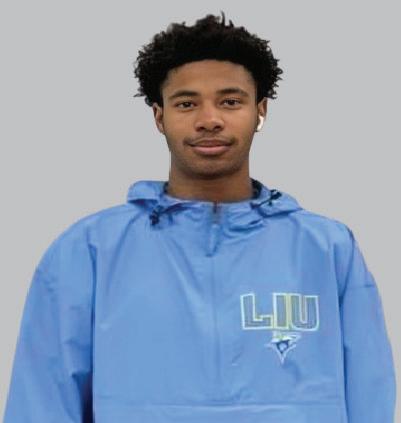
On March 12, the girls’ varsity basketball team came up short 37-33 in overtime to Archbishop John Carroll High School. Despite the loss, the team nished its season with an overall record of 25-4.
e team won 25 of its 29 games with a group of experienced members and award winners: sophomore Ryann Jennings as the girls’ basketball All-Central League Most Valuable Player; senior and co-captain Marisa Francione in the girls’ basketball All-Central League First Team; and junior Janie Preston in the girls’ basketball All-Central League Second Team.
Entering playoffs, Conestoga was the top team in the Central League, beating Garnet Valley High School twice and scoring more than 50 points in each game. The girls took a loss to Spring-Ford Area High School, followed by a win over North Penn High School in which Conestoga scored 75 points. It then beat Wilson High School before ending the season with an overtime loss to Archbishop John Carroll High School.
Francione said that the team’s morale before the season started was high, coming o of the rst season in 45 years that resulted in a playo berth.
“Last year, we had a great end,” Francione said. “We went pretty far and went to states for the rst time in a while, so we had high expectations for this year. We did even better this year than last year.”
e season began with games against Dunmore Ju-
nior-Senior, Haverford, Ridley and Lower Merion High Schools. A er beating each team by at least 10 points, Jennings said that she knew the season would be special.
“In the first five games, we were 5-0. We were like, ‘We got this, we can go far,’ because we had a really high morale,” Jennings said. “I feel that definitely helped us throughout the season.”
e team won its initial 17 games. Even a er its rst loss against Haverford High School, Preston said that the team was still con dent in its ability to win due to its chemistry. “We were undefeated for a while, and then losing that first game — we all felt it. It was just the bond that we already had that was helpful,” Preston said.
e team had two-hour practices every day a er school, and some players continued to stay late in order to practice. Jennings said that the team’s work ethic in uenced its successes during the season. “We de nitely put in a lot of work, and I feel like that really shows how dedicated we are,” Jennings said. “We have a really high team chemistry. We’re all very close, and I think that de nitely impacts how we play on the court.”


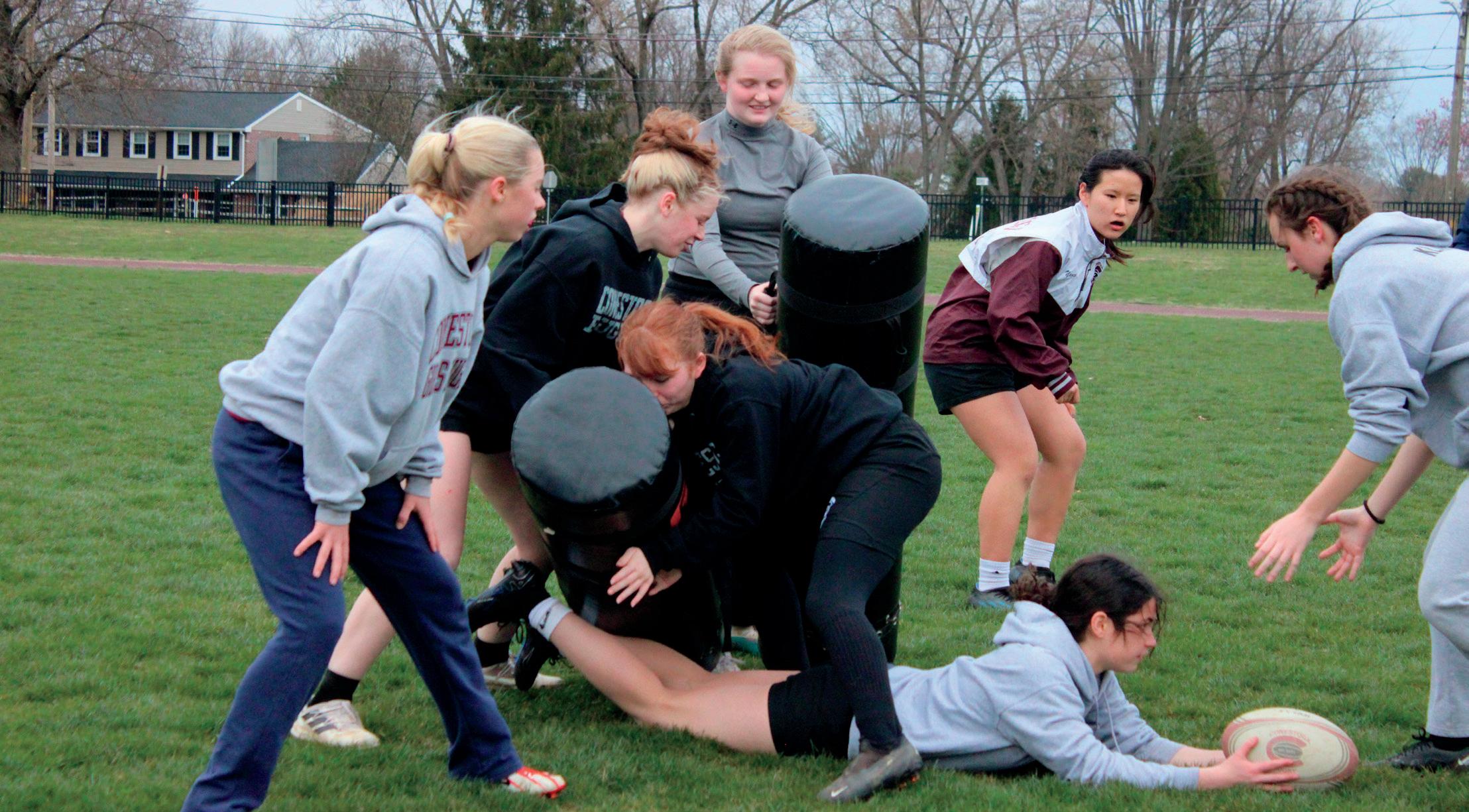
Abby Chong Sta Reporter
On Feb. 7, Rugby Pennsylvania began a new initiative, Emerging Girls Rugby, to encourage the creation of school-sponsored rugby teams throughout the state. e organization designed the Emerging Girls Rugby program to help establish 25 rugby teams in Pennsylvania schools.
Once the organization reaches its goal of establishing 25 teams, Rugby Pennsylvania will apply for an emerging sport status from the Pennsylvania Interscholastic Athletic Association. Currently, there are only nine schools in the state that have an established girls’ rugby program and 10-15 schools with club-based programs.
Brittany Vegso, the coach of the Conestoga girls’ rugby team, is involved with Emerging Girls Rugby and provides mentorship and guidance to local schools interested in forming rugby teams.
“We’ve gotten quite a lot of interest,” Vegso said. “I can’t speak to the exact number of teams that are getting off the ground this spring, but I know there’s a couple in the works.”
Vegso hopes that the new program will broaden the accessibility of rugby to high school players statewide and believes it will serve as a way to grow the sport.
“Rugby in general empowers players both physically and mentally. It makes them better people on the field and off the field (and) makes them leaders and decision makers,” Vegso said.
Junior Paulina Yang, a three-year member of the rugby team, believes that expanding rugby programs will provide a gateway for more girls to experience the sport’s inclusive and enriching environment.
“Offering it all over Pennsylvania would be good for girls everywhere who are like, ‘Oh, I’m scared to join a sport because I don’t think I’ll be
able to run fast enough,’” Yang said. “It’s a really good way for people to get involved and just have fun while exercising.”
Yang believes that official recognition as an emerging sport will not only elevate rugby’s status but will also help provide young athletes with opportunities to play rugby after high school.
“Not a lot of people know that rugby has so many opportunities that you can access just by playing it,” Yang said. “By becoming an emerging sport, it’ll offer so many young girls the ability to play such an amazing sport.”
Yang encourages others to join rugby and said that one does not need prior athletic experience to excel in the sport.
“I’ve played a lot of sports in my life, but I really feel like rugby is the one that honestly anyone can play,” Yang said. “It’s so inclusive. No matter how tall, short, fast or athletic you are, there is a place on the field for you.”
Junior Jason Xu is well versed in taekwondo, specifically breaking, a form of taekwondo involving the breaking of boards and other objects. Xu has placed in many state competitions and competed in national events.
Xu began the sport while living in China when his mother enrolled him in a local school that taught discipline and self-defense. After moving to the U.S. in 2016, he continued his taekwondo training at Tiger Kicks Martial Arts, a local dojang in Exton. “My mother saw me getting bullied, so she enrolled me in this local school to learn some self-defense,” Xu said. “Over time, it kind of just became a hobby of mine.”
“Usually when it’s competition season, I practice around four hours a week,” Xu said. “I usually focus more on taekwondo when it’s in season.” Through taekwondo, Xu said that he has found not just self-defense but also valuable connections that have propelled him toward excellence in other aspects of his life.
“I went to this really prestigious seminar, and in that seminar, I met national-level coaches and competitors,” Xu said.
Last year, Xu won a gold medal in a New York state championship. He also placed second in breaking in a Virginia state championship and palced h overall for breaking in the 2023 U.S. Taekwondo National Championship in Florida. Xu practices taekwondo throughout the week and trains extra hours during the competition season from February through May. He said that he manages his time between his workload and the sport.
“I’ve been in close relationships with them ever since.”
Xu’s teammate Insaaf Imtiyaz said that his expectations, work ethic and dedication to the sport are motivating
“I think we encourage each other by setting higher standards and trying to be the best each day,” Imtiyaz said.
“Naturally, this makes people around you aim higher and motivate you to be better.”
In the future, Xu plans to practice taekwondo as a hobby. He is looking to possibly compete in college, but does not currently have any plans set in stone.
“It depends on the university I attend,” Xu said. “If I manage to get accepted (to universities with taekwondo programs), I plan to continue my taekwondo career after high school. Either way, I would like to keep it as a hobby and as a part-time job.”

Freshman tennis player ranks nationally
Math teacher has passion for running Page 10
Girls basketball nishes season 25-4 Page 11
Junior excels in Taekwondo competitions Page 11

High
and
are just temporary obstacles for 2023 Conestoga alumnus Connor Demming as he cruises across the finish line at his regattas. Recently, he competed at the 2024 Olympic Sailing Trials in Miami for a spot on the United States Olympic Team for 2024.
Demming has been sailing ever since the age of 6 when his father, who also competed in sailing, introduced him to the sport. He said that the scenic nature of sailing and its high intensity are aspects of the sport that he loves.
“Usually, most sailing is done when the weather’s warm, which I like,” Demming said. “Some people don’t take (sailing) as being very athletic, but when it’s windy and you really have to use your body, that’s when it becomes very athletic.”
At Conestoga, Demming was the captain of the sailing team and won the All-State athlete award in 2023. He also competed individually and has sailed in Ireland, Portugal and Canada. Now, he sails for the College of Charleston where he is pursuing a degree in business. With a busy training schedule, Demming notes that time management skills are crucial to successful as a student-athlete.
“We usually have practices on Tuesdays, Wednesdays and Thursdays, and then we have regatta races on the weekends. Tuesdays and Thursdays are usually our biggest days since we have workouts at 7:45 a.m., and then we have practice around 2 that goes to 6,” Demming said. “I think managing your schoolwork with also being an athlete at the same time is crucial.”
Demming qualified for the Olympic trials through a resume pull — an alternate selection process based on applicants’ past achievements — as he was not able to participate in the qualifiers last summer. He submitted his application in January.
“We had a sailing get-together with all of our parents and all the sailors. It was during Parents Weekend, and I got this huge email from one of the Olympic committee members saying, ‘Congratulations, you have been accepted to compete at the trials,’” Demming said. “I was super happy. My parents were super happy, and it was a cool experience. I was so excited.”
The trials took place over an eight-day span from Feb. 15 to 24 in Miami. Demming was one of the youngest in the single-handed category, in which solo riders guide a small boat.
“The competition was crazy. I was one of the youngest
people there. It was probably a range of people from 17 to 40 years old,” Demming said.
Although he came up short in the trials, Demming still remains motivated and hopes he can qualify for the USA Sailing team at the 2028 Trials. Until then, he looks to focus on improving his college sailing career and maintaining his skills to achieve victory next Olympic season. “My goal is to give (the trials) another shot and see how that goes. But right now, it’s just really focusing on college sailing, and during the summer, I’ll be doing more of the Olympic class boat so I’m not rusty,” Demming said. “My dream is de nitely to get to the Olympics.”
e 2025 Women’s European Basketball Championship qualier in Latvia was tense when the Irish women’s basketball team opted not to shake hands with its Israeli opponents. e decision stemmed from comments by Israeli player Dor Saar, who labeled the Irish team as “antisemitic” due to its criticism of the Israel-Hamas war and its long-standing support for the Palestinian territories.
Like countless others, this instance underscores an undeniable truth: Sports and politics are inextricably linked. Athletes, with their massive global followings, are increasingly using their platforms to champion social justice causes. San Francisco 49ers ex-quarterback Colin Kaepernick’s act of kneeling during the national anthem in 2016 sparked a national conversation about police brutality and racial injustice.
Beyond individual actions, international sporting events serve as stages for political expression. e founders of the Olympic Games, for example, conceived the event as a means to foster peace and international understanding.
While the 1936 Berlin Olympic Games were an extravagant display of Nazi propaganda, the events also witnessed moments of deance, such as Jesse Owens’ victories shattering Adolf Hitler’s myth of Aryan supremacy. 36 years later at the Munich Olympics, Black September, a Palestinian militant group that wanted 240 Israeli-imprisoned Arabs released, murdered 11 Israeli athletes. is violent act of de ance cast a shadow over the Olympic Games. On the other hand, the global campaign against South Africa’s apartheid era highlighted the power of sports as a tool for social change. Sports boycotts played a crucial role
Yusra Mardini, a Syrian refugee who swam for the 2016 Refugee Olympic Team, captivated audiences with her athletic prowess and story of resilience in the face of war. Her journey to the Olympic games transcended sports, becoming a symbol of hope and perseverance for refugees around the world.
in isolating the apartheid regime, ultimately contributing to its dismantling.
e relationship between sports and politics is not always a force for good and is o en the face of hypocrisy and propaganda.
Nearly 65 countries boycotted the 1980 Moscow Olympic Games in protest of the Soviet Union’s invasion of Afghanistan. However, rarely did the International Olympic Committee — or any athletic confederation — condemn the U.S. for its war crimes in Korea, Vietnam, Iraq and Afghanistan, which killed millions of civilians.
Sports and politics may seem like two parallel universes. However, that does not stand true and acknowledging the dynamic relationship between them is crucial. is allows us to appreciate the power of athletes as agents of social change and understand how governments utilize sports to further their agendas.
e next time you witness a dramatic sporting moment, remember that a sport is more than just a game. It could be a powerful political statement waiting to be unpacked.