




By Eshan Singh and Faith Zantua, Co-Copy Editor and Co-News Editor
From eating at local restaurants and attending cultural festivals to visiting family and meeting friends, senior Kyle Nguyen is no stranger to Philadelphia’s Chinatown. On Sept. 7, however, he joined protestors lling the streets of Center City Philadelphia with a di erent goal: “No arena in the heart of our city.”
“Seeing that a bunch of people — (I estimate) 3,000-4,000 people
— were walking out, marching on the City Hall over to Chinatown. It goes to show that people care about it,” Nguyen said.
In July 2022, Philadelphia 76ers’ managing partners David Blitzer and Josh Harris announced a plan to build 76 Place, an approximately $1.3 billion privately funded stadium for the team. e 18,500-seat arena would open in the Fashion District around September 2031, when the 76ers’ lease on using the Wells Fargo Center, its current building, expires.
Since the announcement, various worker unions and organizations have voiced support for the project, feeling that it would
bring more job opportunities and visitors to the area. Meanwhile, groups have organized to prevent the project’s implementation, such as the Save Chinatown Coalition which planned the Sept. 7 march.
With developers proposing to build the arena around a block away from Chinatown’s southern end (see pg. 3, Fig. 1), members believe that its construction could harm Chinatown and other nearby communities, such as Washington Square West. Concerns include the stadium driving attention away from local Chinatown businesses, bringing increased tra c, reducing visitors to the area and gentrifying local communities.
Among the students who attended the Sept. 7 march, senior Charlize Ko is the social media lead of the organization No Arena in Chinatown Solidarity (NACS) and fears that the project may signi cantly harm Chinatown.
“With six years of construction, what comes with that is gentri cation of the nearby neighborhoods,” Ko said. “Major roadways are gonna be blocked, which is literally going to drain Chinatown of all its liveliness that we see right now. Businesses are going to have to close.”
On Sept. 11, Philadelphia Mayor Cherelle Parker hosted a meeting for the public to speak about


the proposal. One week later, Parker announced on her social media that her administration came to an agreement with the 76ers for a Center City arena and would send the related legislation to the city council for approval, aiming for introduction on Oct. 24. “ is is a historic agreement,” Parker said in a video on her social media. “It means an economic opportunity plan quite frankly the likes of which have never been seen in our city, and it represents the start of an unprecedented revival of Market Street, Philadelphia’s very rst commercial quarter.”
Senior Audrey Nguyen, the co-vice president of Conesto-
“I know that this may not seem like a huge deal to a lot of people, especially those who aren’t part of the Asian American community or don’t have an attachment to Chinatown,” Audrey Nguyen said. “An arena seems like a very exciting thing on the
but I think that there isn’t a place or circumstance in which having something
As the bell rings, students ll up the cafeteria, walk through the hallways and rush to meet friends. Benches occupy the space where lockers used to be, cleaning stations are located around the building and food is allowed in the atrium.


On Jan. 2, the Tredy rin/ Easttown school board approved a new mixed-model schedule that Conestoga implemented at the beginning of the school year. Students and teachers follow a “Garnet” and “Gray” alternating ve-day schedule instead of the previous six-day cycle, with three lunch blocks in place of four. Wednesdays and ursdays consist of four block classes and a one-hour “Lunch and Learn” period for the whole school. Principal Dr. Amy Meisinger feels that the new schedule was a necessary change to promote the well-being of students and faculty.
“We’ve had the same schedule since 1994,” Meisinger said. “We also had noticed that a number of schools around us had gone to this Lunch and Learn concept. We also wanted to see if this was something that might be benecial to our students and something that we could do with a school of our size.” e administration introduced Lunch and Learn incrementally, with Meisinger hosting an orientation for each grade during the second week’s Lunch and Learn periods. Teachers showed a video created by Peer Mediation to famil-
iarize students with the rules of Lunch and Learn. Students can eat in the cafeteria, courtyard, hallways, classrooms and non-carpeted areas of the atrium. A “Grab-and-Go” food kiosk in the atrium during Lunch and Learn provides a variety of foods that students can purchase using their school pin.
Additionally, lunch privileges permit seniors to leave campus for the Lunch and Learn period. Senior Allie Hickey acknowledges the advantages and challenges of the new privilege.
“I really like that with Lunch and Learn, I’m able to not feel rushed. My friends and I have more time to sit down and enjoy a meal instead of rushing to get back,” Hickey said. “Trying to sign out and back in with the Powerschool ID has been an is-

With the implementation of the new
sue, but I know they’re trying to change that with the iPads. Overall, I think being able to leave for a longer period o ers more freedom, and it’d be even better if the sign-out was made quicker.”
Lunch and Learn also o ers opportunities for students to review content with teachers, partake in school-wide activities and attend club meetings.
Twel h grade assistant principal Dr. Patrick Boyle posts a weekly schedule of such options on Schoology. On assigned days of each month, certain departments are unavailable to meet as faculty collaborate with each other.
e new schedule introduces a passport system during Lunch and Learn for freshmen and those who misuse the privilege. Excessive violation of Lunch and Learn rules will result in a loss of privilege, and eventually, detention.
During every Lunch and Learn in September and October, freshmen must have a teacher sign o in a booklet to conrm which Learn activity they completed and are not allowed to go to the atrium and library.
Freshman Elaina Wang likes the schedule due to block days despite it taking some adjustment.


have
“I like the block days because there’s less classes (students) have to think about, and even though they’re longer, they don’t feel that long to me,” Wang said. e
THE LATEST DEVELOPMENTS
IN T/E AND NATIONAL NEWS
Voters to fill out reVised mail-in ballots
With the upcoming 2024 Election Day on Nov. 5, voters in Pennsylvania using mail-in ballots will follow an adjusted format in hopes to reduce “naked ballots”: ballots submitted without a secrecy envelope. Voters used the modified versions during the spring primaries, including altered envelopes and instructions aiming to be clearer for voters to follow.
Conestoga updates Code of ConduCt for sChedule, Cheating, attendanCe
The 2024-25 Code of Conduct includes changes centered around the new privileges associated with the mixed-model schedule, academic integrity and attendance. Administration can cumulatively count multiple tardies as absences, and potential disciplines now include a loss of participation in “Lunch and Learn.”
septa plans to stop some fare disCounts
On Sept. 5, the Southeastern Pennsylvania Transportation Authority (SEPTA) announced proposals to discontinue certain fare discounts, such as the Travel Wallet fare on buses, subways and trolleys. The last fare increase was in 2017, and SEPTA deferred alterations planned for 2020. Public meetings regarding the modifications will occur in October, and changes necessitate board approval.
goVernor signs order for housing aCtion plan
On Sept. 12, Gov. Josh Shapiro signed an executive order to create Pennsylvania’s Housing Action Plan to increase affordable housing as well as aid housing shortages and homelessness. The Department of Community and Economic Development is implementing the plan.
Conestoga reinstated the five-day-a-week parking privilege for seniors this year, bringing an end to last year’s four-day-a-week parking policy. The current graduating Class of 2025 is smaller than the previous year’s by almost 100 students, leading administration to revert to the previous regulation.
Originally, the administration implemented the four-day policy with nearly 700 students in the Class of 2024 to aid parking spot shortages. Last year’s “Do Not Drive Day” required each senior to take one day off from parking on campus to accommodate Conestoga’s 350 parking spaces. It introduced transportation challenges for some students, especially those involved in sports who had to find alternative ways to practice on their designated “Do Not Drive Day.”
“On the tennis team last year, the seniors struggled a bit,” said senior and member of the girls’ tennis team Lauren Wu. “Sometimes our matches would fall on the no-park days, and more people would
have to carpool to matches, which was inconvenient.”
Some students with free periods find the return to five-day-a-week parking beneficial as it provides the flexibility to drive to school daily. Senior Elliott Havel is grateful for the convenience.
“On days where I have to go to school at normal times, I have to wake up even earlier to get to school due to traffic piling up between 7:30-7:50,” Havel said. “But when I can arrive late to school, I’m able to get to school just before homeroom and save upwards of 30 minutes each morning, which lets me sleep more or catch up on additional assignments.”
As the school year progresses, Wu hopes that the full-week parking privilege continues and feels that the additional privileges from the new mixed-model schedule helps student drivers in general.
“I’m really glad that the five-day parking is back, and it works out especially well with the new schedule because now I can leave for lunch,” Wu said. “I hope ’Stoga keeps this going because I think it makes a lot of students’ lives easier.”


New lights installed in TV studio, to be in auditorium
Over the summer, Conestoga began implementing a series of lighting improvements for the TV studio and auditorium.
The TV studio received new lighting fixtures, while the auditorium is undergoing theatrical lighting and dimmer upgrades. At the Nov. 14, 2023 school board facilities committee meeting, the committee projected the new lighting in the TV studio and the auditorium upgrades would total $50,000 and $350,000, respectively. Before the new lighting features, the TV studio had the same lighting board since the 1990s. Students that used the TV studio experienced lights blowing out as they were halogen instead of LED lights. Although companies made re-


pairs, they were mostly shortterm improvements.
“We had to turn (the lights) on and off with the fuse box a few years ago,” said Tredyffrin/ Easttown Television adviser Alison Ferriola. “We had planned about two years ago to replace all the lights with LED lights that would never go out. They have tens of thousands of hours of use before they have to be replaced, so it saves us a lot of money and from having to get up on ladders and change the lights.”
Beginner and Intermediate Television classes are learning how to use the new TV studio lights for their activities. Meanwhile, film students can alter the lighting in the studios depending on the atmosphere or scene that they want to create.
Ferriola believes that all television and film classes are bene-
fiting from the new lighting and the enhanced creative possibilities that they offer.
“It’s pretty cool that we can make these lights strobe, we can change color, we can really control them a lot more,” Ferriola said. “If a student wants a certain aesthetic in their film, we can create that for them a lot easier.”
Once the company in charge of the improvements finishes the theatrical lighting and dimmer upgrades, staff and students will be able to use the technology for events, such as plays and musicals.
“In our auditorium, they are still in the process of finishing up the lights,” Ferriola said. “That was a much bigger undertaking than the two small studios. The ceiling is a lot higher, they had to bring in more equipment, and there’s way more lights.”
College and Career Transition (CCT) is a required class for students during their junior year. Due to the new mixed-model schedule this school year, the curriculum changed to foster a unified feeling for students and cover more material in depth.
CCT class time increased from meeting two times every six days to every “Garnet” or “Gray” day for one semester.
Danielle Sculley-Ellett, Conestoga’s only CCT teacher, and mental health specialist Dr. Christine Dunleavy adjusted the curriculum before the 2024-25 school year.
“In years past, what really dictated the course was that we had the cycle-day schedule where I could really only see kids two times per six days,” Sculley-Ellett said. “We built a curriculum based off the timing that we had, and a lot of it was very college-centered in terms of post-secondary (education). Some of the topics that we’re still doing today are pretty much the same topics that
we did, but now we just have more time.”
Topics that are covered in the class include financial literacy, post-secondary career and education options, signs of depression and suicide and the college application process. Material also involves completing four Pennsylvania high school graduation requirements through the site SmartFutures.
Changes include students maintaining a notebook of CCT concepts as well as participating in more community building activities. Sculley-Ellett hopes to teach more “soft skills” during classes, such as active learning, and emphasize material related to healthy relationships in work and personal settings.
“I want to make sure that throughout the course I’m trying to build better social connection,” Sculley-Ellett said. “The reason why is that if you look at when you establish healthy relationships, healthy relationships are basically at the center of all of our societal interactions. So in the past, where I may have taught healthy relationships for two days, now
it’s going to be interwoven throughout the course.”
Senior Isabella Florendo took CCT last year and found material in the course helpful for college applications and relaxation techniques. She feels that the expanded focus on relationships is beneficial for high school students.
“I do think there should be an emphasis on healthy relationships because high school is really hard,” Florendo said. “I think learning when a relationship becomes toxic between friends and knowing if it’s a true friend is important to know.”
Sculley-Ellett is optimistic about the expanded course aiding students as well as the additional time to interact with them.
“I love teaching the course. I love that we’re going to expand it a little bit more,” Sculley-Ellett said. “I really enjoyed the last two years very much so. But, I am looking forward to having more time with students because I think that will give me a little bit more time to build deeper personal relationships with students as well as really get them excited about adulting.”

Starting May 2025, the College Board will discontinue administering paper tests and switch to digital or hybrid formats for 28 Advanced Placement exams out of the 39 in total. Schools are to administer the assessments through Bluebook, the application used for the digital SAT and PSAT exams. The change differs from previous years when schools could select which tests to provide digitally.
Conestoga will offer 14 online and nine hybrid digital AP exams, with the other five exams remaining on paper.
The College Board originally planned to transition AP exams to a digital format over a longer period, but in July, the organization accelerated the process for the security of the assessments. Megan Smyth, guidance counselor and AP exam coordinator, believes online testing with Bluebook offers a more secure process than paper testing. “Once a student opens the Bluebook app and logs in, it
creates a lockdown browser so they cannot exit it, minimize it, access anything else in their computer,” Smyth said.
“They’ve been using this technology for a couple years now.
It is definitely secure in terms of cheating prevention.”
offers online practice for multiple-choice and free-response questions through the AP Classroom website. Junior Jessica Joseph believes that the digital format makes testing easier, such as when selecting answers for multiple-choice questions. “If someone was to accidentally skip a line and bubble in something wrong on a paper, that would mess up their tests,” Joseph said. “But since it is digital, you just have to click on the

answer and there’s more of a probability that you’re choosing (what you meant to choose).” For 12 digital tests with calculator active sections, Bluebook will have a built-in option to use Desmos as an online calculator application. Other reference materials, such as equation sheets and periodic tables, will be accessible through Bluebook. If a computer runs out of battery during testing, the student can recharge it and continue their work without losing any exam time as Bluebook uses autonomous timers for each individual computer. The software also offers the ability to highlight text, cross out answers and mark questions for review.
“The feedback we’ve
Stakeholders await legisla-
tive authorization
The 76 Place at Market East website states that the arena project’s purpose is to have a “modern and permanent home” for the 76ers that also “aligns with the city’s need to revitalize Market East.”
In response to criticism from various members of the public, the project team “has held over 100 meetings with community members” according to its website. e 76ers pledged to invest $50 million into a Community Bene ts Agreement, which includes providing Philadelphians a ordable residential housing, support to small businesses, local events, increased safety and cleaning initiatives. During the mayor’s Sept. 11 public meeting, Service Employees International Union district leader Daisy Cruz spoke in favor of the arena because of the jobs it could provide.
the year 2000, as well as a prison and casinos,” said Vivian Chang, the organization’s executive director. “I think Chinatown has been trying to protect itself for so long, and (the stadium) comes as a threat. Folks saw through this as yet another attack on Chinatown.”
e project team is looking to have 11 ordinances and resolutions related to real estate transaction, tax increment nancing, neighborhood improvement district areas, zoning and planning, and streets approved by the city council to move forward. e legislative package, which the team has not o cially introduced to the council,
Following the proposal’s unveiling two years ago, various students in the area have followed its reception as fans of the 76ers and visitors of Chinatown.
For senior Nathan Frazer, watching basketball has been a pastime for him since middle school. Having played the sport since a young age and holding 76ers season tickets, Frazer believes that moving from the current arena in the South Philadelphia Sports Complex would not be beneficial.
We want to understand what the reports are saying and the stakeholders are saying as
e
“A project of this magnitude will be a powerful job creator that the working class of the city of Philadelphia desperately needs,” Cruz said. “We cannot let an opportunity like this go anywhere else.”
In past years, developers proposed construction projects that had possible negative effects for Chinatown, which residents protested against. Asian Americans United (AAU), an organization committed to fight the oppression of Philadelphians with Asian ancestry, was involved in previous prevention efforts.
“AAU has fought against a ton of different predatory developments for many years. There was the Vine Street Expressway in the ’60s. There was the baseball stadium in
“I just think that would cause a lot more tra c in the city and would be really tough to build more parking garages for everyone around them,” Frazer said. “It would be more of a project than (the team) probably (thought) it would’ve been.”
Mark Squilla Philadelphia City Councilmember
is available on the city of Philadelphia’s website.
Philadelphia City Councilmember Mark Squilla presides over District 1, which includes 76 Place’s proposed location and Chinatown. In the event of proposed legislation, Squilla said that he would take into consideration community stakeholders’ input.
“We want to understand what the reports are saying and the stakeholders are saying as far as what concerns, what bene ts there are,” Squilla said. “It gives us a month of time to look into that legislation, and if we are going to introduce it, what amendments we would need to add to that legislation in order for it to be introduced that would take into account all the concerns and safeguards that we think would need to be put in place.”
Students with connections to Chinatown and 76ers respond
Similarly, junior and 76ers fan Aiden Lin attended a game at their current stadium this February. He finds no significant problems with the experience at the Wells Fargo Center.
“I don’t have a strong opinion on this because I don’t have the information. I haven’t looked into it enough, but the current arena, I don’t have many complaints about it. I could see how it could get jammed up in high-stakes games or playoff games, and I’m certainly not in favor of destroying Chinatown,” Lin said.
“I like the stadium as it is.”
Senior Gavin Dirkes has also gone to 76ers games with his friends and played basketball for Conestoga in the past. He feels that the proposed stadium would not serve as a better alternative to the current one, which is located next to other sports arenas in the complex.
“I think the new arena is a pretty bad idea because it’s already given how all three sta-

diums — the Phillies’, the Eagles’, and the Sixers and Flyers’ — are on the same area, and it’s very convenient,” Dirkes said. “With a new arena, I think it’d be too tight with parking.”
Greater Philadelphia students have also kept up with Save Chinatown efforts, fostering personal relations with the community. One of the lead organizers of Students Against Sixers Arena (SASA), a high school student group, is Erica Zhong, who is a senior at Philadelphia’s Central High School and grew up in District 1.
“My family immigrated from China to America like 30 years ago, and the first place that they went to was Philadelphia’s Chinatown,” Zhong said. “Chinatown has served as a home to many of us, and growing up, I’ve always been going to Chinatown for family
reunions. I’ve always went to Chinatown for hangouts with friends after school, so it’s pretty much a second home to me.”
Kyle Nguyen works within NACS’ research “hive,” a group of volunteers analyzing the arena project, its possible effects and related case studies. As a member of NACS and SASA, he feels the stadium would lessen the number of customers visiting Chinatown businesses, such as his parents’ dessert shop, and significantly hurt the community as a whole.
“Chinatown is such an integral part of my identity as well as my childhood because I’m always there. I’m always walking around. It’s something that means a lot to me,” Kyle Nguyen said. “It (the arena) will de nitely impact our business a lot. I think it’s really important because I want to see my community thrive.”
Ko also feels that the project would diminish Chinatown’s value as a space for people of diverse cultures.
“Having a Chinatown in Philly is a way for other people of di erent cultures and backgrounds to explore other cultures,” Ko said.
“You don’t even have to be East Asian or Asian to feel like you belong in that area because I think it’s just a safe space.”
Motivated by their experiences with Chinatown, local students formed groups aiming to prevent the project. Among them, Faye Liu is a senior at Central High School and a lead organizer for SASA. e group frequently hosts informational events and gathers signatures to support the cause. Members also run Ginger Arts Center, a youth art center in Chinatown established with a college group called Students for the Preservation of Chinatown.
“ is space was built on the idea that ‘Look at what we can do with Chinatown that’s not building an arena. Look at something we can do to the community that will bene t everyone,’” Liu said. Additionally, Ko makes posters, distributes yers, organizes NACS members to create social media posts and talks to business owners about the project. As stakeholders await legislative decisions on the project, Ko feels that the experiences and collective e orts from involved groups has motivated her to continue her work.
“For other people in Chinatown, that’s their whole life. ey were born and raised in that area,” Ko said. “Being in person and talking to these people, feeling they’re passionate and feeling that power emanate o of our conversations — it’s just very empowering. I found so much community.”

At the Aug. 26 school board meeting, Tredyffrin/ Easttown School District entered into an agreement with Language Testing International to administer a language mastery test known as the Assessment of Performance toward Proficiency in Languages (AAPPL). The online examination assesses mastery of foreign languages across several modes of communication. The district plans to pilot the test in fourth level world language classrooms in Conestoga during the second semester. e AAPPL focuses on testing students’ abilities in writing, listening, reading and speaking based on guidelines set by the American Council on the Teaching of Foreign Languages.
e exam has a section for each skill and takes around two hours to complete. e district intends for AAPPL to replace the STAMP Language Pro ciency Test, which the district currently uses to test language mastery. According to Dr. Patrick Gately, TESD curriculum supervisor, the main di erence between the STAMP and AAPPL tests is the level of education at which each test is administered.
“ e STAMP has been a great option so far, and both the STAMP and AAPPL tests align with our standards, but the main di erence that makes the AAPPL more appealing is its level,” Gately said. “ e STAMP is mainly used at the
middle school and even elementary school
but the AAPPL is mainly administered at the university level.”
Teachers who teach a
will be
in the
gression, according to world languages department chair Patrick Cupo.

“Test Optional” doesn’t *really* mean that...
Like a
“We’re looking for interested teachers to pilot the exam at the fourth level of language learning because that’s also a good point where we can see how language learning has progressed with each student,” Cupo said. “We’re also trying to gure out whether this AAPPL test meets the mark and how we can align our teaching with the skills that the AAPPL tries to test our students.” e AAPPL aims to test how well students have learned their language over the course of their education, which senior Rowan Bellew feels will allow students to re ect on their own language-learning journey and see where they can improve.
“A student might know writing really well, but they might not have reading comprehension (skills) to put it into writing,” Bellew said.
“ is (test) is going to help them assess areas where they might need improvement.”



out more at CrimsonReview.com.
e online dating scene has risen in popularity over the past decade, o ering algorithms that pair people with each other based on a variety of factors. Annie Xu, a 2014 alumna, launched a Philadelphia-based startup dating service called Pairfect that o ers real matchmakers to create a more intentional and personalized online dating experience.
“A lot of modern dating is in apps, (and) a lot of women feel like it can be a very isolating, super cial experience,” Xu said.
“I wanted to create a solution that felt much more personalized, where we could really support someone going through the modern dating world.”
A er signing up for Pairfect, members create their prole and receive a link to schedule a call with a matchmaker to nd a match in the Philadelphia area. e matchmaker will eventually pair them with someone who they deem to be a good t for them. When Xu rst launched Pairfect in Oc-
tober 2023, she was the only matchmaker, working alone to pair people together. Since then, she has grown her team to 13 members, many of whom come from therapist backgrounds like Xu.
“Generally, people’s intentions who come to our service are that they want to enter a relationship. ey’re not just there to play games or ghost people,” Xu said.
Xu reached out to 2015
alumnus Connor Lake, Lead Technical Consultant at Pairfect, to build the V1 prototype of the platform. Xu and Lake knew each other from their time together at Conestoga and in Science Olympiad.
“She (Xu) reached out to me over a year ago, asking if I knew any developers looking for work,” Lake said. “I told her I could think of some people, but I had a consulting company, and maybe we could work together that way, and she was on board.”
Xu and Lake spent about five months building Pairfect. Though Lake is no longer actively involved with
the platform, he designed its structure and functioning, prioritizing security, user experience and functionality.
“Annie was a pleasure to work with,” Lake said. “She's thoughtful towards the experience she wants to create towards users and she's a great team problem solver. It felt like Annie was very much part of my team as we built this together.”
Pairfect currently has a reach of about 2000 people, and operates entirely online, with members talking to matchmakers over video calls. Pairfect has also partnered with restaurants and cafes around Philadelphia to encourage matches to meet in person. Pairfect matches who meet at these locations will receive a discount on their order.
“Our main focus is to really bring people together, from the messaging and texting to in-person dates,” Xu said. “ e restaurants we partner with offer coupons, so any couple we set up are able to get discounts as a perk for going on their rst date and trying a new spot in the city.”


Rowan Chetty Co-T/E Life Editor
To increase local awareness on the issues of climate change and social injustice, then-freshman Ayan Kumar decided to take a creative approach: writing a series of blogs that later evolved into his own book.
After two years of writing, the now-senior published his book “Social Trends and Policy Making: A 2-Year Recap (2022-2024)” in June 2024. Available on Amazon, the book is a compilation of Kumar’s blogs that he released on his website ayankumarsblog. com. Kumar discusses current events, social injustice and climate change, as well as the potential impact of policymaking.
“ e initial goal was mainly to engage awareness about what's going on in the world and why we should care,” Kumar said. “I wrote about current events, mainly social injustice and climate change,
because those are two of the issues that are really important to me. I wanted people in my community to be motivated and driven by what's going on.”
When writing each blog, Kumar aimed to tackle every
I
issue from multiple perspectives. To ensure this, he tried to write about these issues neutrally, consulting multiple news sources before beginning the writing process.
“I use (information) from a variety of sources. The point of the blog is to come at a neutral perspective because I want people to be able to understand the different per-

Aren Framil Co-Editor-in-Chief
Nestled amongst bookshops and cafes in downtown Wayne, Christopher’s a Neighborhood Place blends the cozy with the contemporary. A twist on the all-American restaurant, international influences elevate familiar dishes while maintaining the integrity of familiar classic comfort foods.
At 4 p.m. on a weekday, the restaurant was relatively empty when I got there, and service was exceptionally prompt. Seated outside, I listened to the bustle of the street as I perused the truly massive menu. After ordering a Coke at $3.50 (with free refills), I selected the focaccia as my starter for $8. The airy interior contrasted perfectly with a crunchy crust topped with tomatoes and herbs, and the side of whipped ricotta offered cheesy tanginess that didn’t overpower the bread.
For my entree, I ordered the fresh Scottish salmon, roasted with honey mustard horseradish glaze, for $26.
The first bite melted like butter in my mouth, savory salmon flooding my taste buds. While the dressing was at times too sweet for my liking, the layer of skin underneath brought back a punch of the fishy flavor. The salmon came with two sides: I decided on the spicy pickled tomatoes and the five cheese mac and cheese. I tried the tomatoes first, and the dish didn’t hold back, the texture of the tomatoes sturdy against the torrent of spice. My taste buds still burning, I then dug into the mac and cheese. Costing an extra $2, the silky sauce offered tangy and buttery notes that brought new life to my favorite dish. Although I felt full to bursting after the proteinand carb-heavy food, I knew the meal wouldn’t be complete without a sweet treat. The dessert menu was presented as a tray of fake food — a novel but helpful approach — and I picked out the creme brulee for $10.50.

spectives before they have their own beliefs,” Kumar said.
After Kumar had written about 75 blogs, he made the decision to compile them into a book. Kumar then contacted a publisher and quickly
Following its publication, he was excited to see the impact of his book and how it resonated with his readers. For Kumar, the positive and critical reviews have motivated him to continue writing more about the issues covered in the book.
Ayan Kumar Senior
began working on achieving his goal.
“I wanted to compile (the blogs) into the book because I thought it was a succinct way to document history. Scrolling through the blog website is complicated to find things, but putting it all in one big document just simplifies it and allows people to access it,” Kumar said.
“On Amazon, I have 21 reviews, and a lot of it is saying how great (the book) is. A lot of people have come to me and told me things they admired, (as well as) things they thought could have been better,” Kumar said. “The whole goal is to engage awareness, so the fact that people are actually reading it and have constructive criticism about (the book) means a lot to me.”
Alongside his blogs, Kumar also drives policy change as the founder and president of the Public Policy Club — a club focused on driving local change on a variety of issues. In the future Kumar hopes to work with public policy, relating to the environment or economic issues.

caramelized sugar covering soft, creamy custard.
Not including tax or tip, the meal came to a total of $50 — a bit pricey but totally worth it. Christopher’s, while a bit out of the way for most TESD residents, offers up a wide menu, delicious dishes and intimate atmosphere that satisfies anyone who sits at one of its tables. Next time you’re craving comfort food,


stop by and enjoy a meal and the fresh autumn air of downtown Wayne.


In September 2023, then-freshman Dom Pecora hosted the grand opening of his store, Dom Fixes Bikes, in Malvern. One year later, Time Magazine named him an honoree for 2024 Kid of the Year. Five years ago, 10-year-old Pecora started his bike repair business. He launched the business after raising money in his community to purchase an expensive bike. He decided to return the favor to his community by donating bikes to people in need. The company’s mission is to deliver bikes to anyone passionate about biking regardless of age, race, gender or financial ability. In July, Time Magazine contacted him for an interview about his company. The Time reporter initially told him they were interviewing
young people making a difference in their communities, and later informed him that he had been selected a s an honoree for Kid of the Year.
“It (being recognized) was pretty cool,” Pecora said. “I felt very thankful because it took a lot of people and community.”
Since the opening of his business, Pecora has donated 200 bikes to a village in Africa, as well as 121 over the holidays and 100 throughout the year to local communities. His mother Karen Pecora runs the business while he is at school and handles the administrative work. She is proud of her son’s growing business.
“It’s been an amazing progression through donating more bikes, being involved in more community events and making a larger impact across Chester County,” Karen Pecora said.
Jamie Joyce, a freelance reporter working with Time Mag-
azine, wrote the article about Dom Pecora. She sees the qualities in him that Time Magazine is looking for in its candidates.
“ ere’s a real passion for what he’s doing,” Joyce said. “All of these young people exemplify real initiative, taking something that they’re passionate about and applying it and nding ways to help other people, either on a really personal basis or to help writ large.”
Dom Pecora plans to hire a full-time mechanic in the fall, open the shop for longer hours and launch another store.
“Being recognized as a Time Kid of the Year honoree amplifies what he’s trying to do, and (when) you think about the ripple effect of that, it means that he’s able (to) eventually give bikes to even more young people because more people are aware of what he’s doing,” Joyce said. “That is one important impact of being honored in this way.”
’Stoga


e Conestoga hallways boast two new murals, with art ranging from planets and animals to chemistry and molecules. Students painted the murals at the end of last school year and over the summer in the upstairs and downstairs science hallways.
e upstairs mural is chemistry-themed, including images of model kits, the periodic table and
Lewis structures. e downstairs mural has a strong emphasis on biology, with elements of science from Conestoga’s various electives such as astronomy.
“If you look closely, it goes from a small molecular kind of area to the big planets all the way down (the hall),” said senior Amanda Henry, who helped paint the downstairs mural. “It slowly goes up to more complex life forms.”
e planning process for the downstairs mural started in April,
when art teacher Leanne Argonish gathered a group of interested students from the National Art Honors Society. With the help of science teacher Amy Hawkins, the students nalized the design in June, and over the summer, available painters came in to work on the artwork.
“Eventually, we got to sketching up these rough designs and the nal designs. Everyone kind of had a certain part to do,” said senior and painter Karen Hang.
“For example, I drew (the) DNA

digitally and everyone else did a di erent part, like some people (drew) a bee and a deer.” For the upstairs mural, art teacher Amy Cruz recruited seniors to paint the mural as part of their senior internships. This caught the attention of Samantha Meaney, a 2024 Conestoga alumna. She asked her friend Kaan Karakas, also a 2024 Conestoga alumnus, if he was interested, and the pair painted the mural in May 2024. The painters and teachers hope the murals will positively impact the students and staff who see it. “I just want (the murals) to brighten up the environment,” Henry said. “It brings vibrancy and helps build school spirit.”


A crowd watches as an aerial lift raises Science Olympiad head coach and chemistry
Gawthrop and Je rey Wang, and Valley Forge Middle School sixth grader Breckin She erwood, performed the drop on Sunday, Aug. 18 at the

& Education Center. In June 2022 the boys set a Guinness World Record for “Greatest height to drop a protected egg without breaking.”
On Sept. 25, Guinness approved the drop, making the team the record holder of this category for the second time. The boys’ first Guinness World record, a 44 feet drop, started in their Science Olympiad class. In December 2023, a college student from India beat the team’s previous record by 10 feet, which motivated the team to try again.
“We always said that if (anyone) broke it while we were in school, we would do it again. Because why not?” Gawthrop said. “ ey broke it at the start of last year, so then we started building (our contraption) again a little a er that and started redoing everything.”
e team tweaked its last design by improving the egg’s parachute and changing the contraption from a rectangular shape to a triangular one to distribute weight more evenly. Its objectives this time were to nd a higher place to drop the egg and involve more people.
“We had a public event that was able to showcase (the drop). 6ABC News came out to video that, so it seemed like a bigger deal,” Wood said. “Last time it was just eighth period; we walked out to the back of the stadium and did the drop. is time, it felt like a little bit more of an accomplishment.”
By reaching out to state senators and the museum for their help posting about the

event, renting a lift and buying customized shirts, the team expanded the scope of its accomplishment. Wood helped find a venue for the event after their first location fell through, and Shefflerwood made sure they had enough video evidence to submit to Guinness.
Additionally, Ma conducted an egg drop workshop at Easttown Library to fundraise for the drop. Ma taught the participants physics concepts, which the students applied to create their egg drop. The
workshop helped cover the costs of the drones while getting kids more excited about STEM education. In the future, the team looks forward to conducting more workshops, at libraries, schools and museums.
“It’s one thing to do an egg drop. There’s not really that big of an impact in the community,” Ma said. “But if we do some workshops, we can actually make a difference in someone’s life. I think that’s a lot more impactful. That’s why I’m more excited for that.”
From posting photos on social media to celebrating a spirit day at T/E Middle School, #Jumping4Juliet is only one of the ways the community overwhelmed the Zangrilli family with love and support.
On March 12, Juliet Zangrilli, who is currently an eighth grader at T/E Middle School, was diagnosed with hemophagocytic lymphohistiocytosis. Following Juliet Zangrilli’s diagnosis, her mother Molly Zangrilli created an Instagram page and hashtag, #Jumping4Juliet, where friends, families and community members could share photos and videos of them jumping for Juliet Zangrilli. On May 20, Juliet Zangrilli began the treatment process at the Children’s Hospital of Pennsylvania (CHOP). She rst received chemotherapy for eight days. en, Juliet Zangrilli’s brother, Henry Zangrilli, a 6th grader at T/E Middle School, underwent the procedure of harvesting his cells to donate to her for a bone marrow transplant. Later that day, she received his cells and began “Day 0” of the recovery process. e Zangrilli family started sharing Juliet Zangrilli’s story
on CaringBridge, a nonprofit website that allows patients to share their journey to keep friends, family and the community up to date.
“Our rst step was just creating the CaringBridge blog,”
Molly Zangrilli said. “It was really just because we couldn’t eld everyone’s questions anymore. We kept running into the fact that a lot of people didn’t know what was happening with Juliet, so I decided it was time to have one central location for people to get information about her.”
Molly Zangrilli was hoping to nd a way to keep Juliet

Zangrilli entertained during her treatment, and she came up with the idea for the hashtag #Jumping4Juliet. Supporters could take pictures of them jumping and either tag or send them to the Zangrilli family, giving Juliet Zangrilli positive messages and pictures to see every day.
“When seeing these jumps on Instagram, it lets me know that people still remember me and care about me. It makes me feel really good and appreciated,” Juliet Zangrilli said.
Soon a er, the Zangrilli family worked with local business Crush on Creative to create personalized merch that people could wear in support of Juliet Zangrilli. e merch store opened in May and has since sold over 500 T-shirts and hats. A portion of the proceeds were donated to CHOP research in Juliet Zangrilli’s name. e design of the shirts feature a silhouette of Juliet Zangrilli and her friend Taylor Muhly, an eight grader at T/E Middle School jumping in the waves in Avalon, New Jersey.
“It makes me so happy seeing everyone wearing the shirts because (Juliet) is a big part of our school. Everyone was friends with Juliet, so seeing everyone come

together as a whole for her makes me so happy and excited because she deserves it,” Muhly said. e support and love from the community overwhelmed the Zangrilli family. From gi baskets and handwritten cards, to friends who lled their ow-
er boxes so they had something pretty to look at,
Zara Samdani Co-Managing Editor
As a participant in the government-sponsored National Security Language Initiative for Youth (NSLI-Y) program, senior Mary McDonald spent six weeks studying Mandarin Chinese in Taipei, Taiwan, during the summer. McDonald’s journey began with a deep-rooted interest in global a airs. Her involvement in Junior Model UN since seventh grade piqued her interest in exploring different cultures and learning foreign languages. A er hearing about the NSLI-Y program from a friend, she decided it was the perfect opportunity to ful ll this aspiration.
Following a rigorous selection process that included interviews and short-answer questions, McDonald was thrilled to learn in March 2024 that she had been chosen to participate in the program. rough NSLI-Y, she joined a group of 24 students from across the nation to study Mandarin in Taipei, Taiwan. Arriving in Taipei with a limited understanding of the language
I’ve
Upon arrival, a host family that consisted of two parents and their 8-year-old daughter greeted McDonald.
“I loved my host family.
ere was food everywhere, and it was super cheap and convenient, so we ate out a lot.”
always been interested in language learning. I think
(NSLI-Y) sparked
more interest for me, but
I’ve
always enjoyed it.
Mary McDonald Senior
“I’ve always been interested in language learning. I think (NSLI-Y) sparked more interest for me, but I’ve always enjoyed it,” McDonald said.
In September 2023, McDonald began the application process for the NSLI-Y program. After considering NSLI-Y’s seven options, she selected Mandarin Chinese as her target language.
and culture, McDonald quickly adapted to her new surroundings. She found that the program was designed to accommodate students of varying language backgrounds, creating a supportive and inclusive environment.
“We had a whole range of language pro ciency — we had someone who was almost uent, who had been studying their whole life. And we had some people who had never spoken (Mandarin) before,” McDonald said.
ey’re like my second family (and were) absolutely amazing,” McDonald said. “ ey were super welcoming, super inviting, and I loved them so much.” McDonald followed a typical daily routine, waking up at 8 a.m. to enjoy breakfast with her host family. Alongside her cohort, she attended intensive language classes at a local university. With an emphasis on writing, conversational speaking and reading, the seven-hour classes provided McDonald with exposure to the Mandarin language. In the a ernoon, McDonald explored the landmarks, visited local markets and practiced her conversational skills with her host family.
“My host dad would get home at
Despite the language barrier, McDonald found that adapting to Taiwanese culture was rewarding.
“It was di cult to navigate everyday tasks like ordering
co ee or asking for directions,” she said. “It was sometimes frustrating, but it forced me to think critically and communicate e ectively.”
Through her experiences, McDonald gained a newfound appreciation for Taiwanese
culture. She realized that the country’s portrayal in Western media often falls short of capturing its true essence.
“Before the trip, my understanding of Taiwan had been limited by what’s portrayed by Western media, but I think af-
terward, I really understood the political landscape, the language and culture on a new level,” McDonald said. “I think every student should have the opportunity to study abroad because truly, it’s a lifelong, transformative experience.”

Written by Vanessa Chen and Lauren Pinheiro, Sta Reporter and Photography Editor
Designed by Mary Wolters, Design Editor
Heather Zezzo teaches accelerated Algebra 1 and honors Geometry classes. She is currently in her third year of teaching and taught eighth grade math at Penndale Middle School prior to coming to ’Stoga. Zezzo has two dogs, both Bichon Frises, and is getting married to her fiance Jon in December. Zezzo originally went to Dartmouth College to study engineering but then pivoted to working in finance in New York City until moving home with her mother to work remotely during the pandemic. It was then that her mother, a teacher at Central Bucks School District for over 25 years, helped Zezzo realize she wanted to pursue education. Zezzo completed both her Master’s of Education and her Master’s in Educational Administration at St. Joseph's University.


Q: Why did you decide to teach math?
A: “I love working with numbers. Engineering has the numbers and the physics. I am not very good at memorizing dates and timelines of things. I always liked working with numbers in nance (too), and then when I was switching to education, math just made the most sense. I always loved math the most. And then I was really inspired by my high school math teacher who taught me AP Calculus BC (because) she was and has been my favorite teacher. I'm still in touch with her, and I actually went to her wedding last summer.”
Q: What are your favorite books and movies?

Q: Why did you decide to become an English teacher?


A: “I love the show ‘Emily in Paris’ and I really like the book ‘The Nightingale’ by Kristen Hannah. For movies, I love ‘27 Dresses’ with Katherine Heigl. It’s a chick ick or a rom-com.”
Q: What is your favorite part of teaching and what are you looking forward to at Conestoga?


A: “I was not a good student at all, so I always wanted to be that teacher that I needed (to say) ‘Hey, I didn't love English when I was a kid, but because I didn't love it, I have tips and tricks’, and I really strive to make it interesting and applicable for kids. English really lends itself to getting to know your students really well because it's very discussion based. American Voices is all about identity, and so I love that community (grows) in your classes when you're having those discussions.”
Q: Do you have any interesting hobbies?


A: “My favorite is seeing my students because all Conestoga students always have a smile on their faces, so it's just nice to see everybody and check in with them and then help them to succeed. I'm most looking forward to building relationships with my colleagues. I'm brand-new, and I've only spent one month basically with them, so I'm looking forward to developing those relationships and friendships with my colleagues.”

Q: What is your favorite part of teaching?



A: “I snowboarded all through college, and then I cracked my tailbone, so I don't do that anymore. But my daughter recently started ice hockey, and so I'm taking her to practices, and I'm like that ice hockey mom. We love going to Flyer games and all that good stu . On the artsy side of things I do, I’m very inspired by TikTok and my For You page, and I like doing air dry clay and painting it and then also doing embroidery.”


A: “I feel like the best part of teaching is creating that community with your kids every day. The seniors that graduated last year were my only class that I had at Conestoga (previously). And so it was really cool (because) a lot of them reached out to invite me to graduation, and some of them invited me to their kente ceremonies for the Black Student Union. It's just really neat to feel like you made an impact, not even just academically, but in life in general. It's cool to be remembered.”
Roheem Roten is an academic support teacher for grades nine through 12. He has been in education for eight years and teaching for six and a half. He began his career in stocks at Vanguard but transitioned to teaching a er realizing he preferred interacting with and helping people. Roten previously worked in elementary special education at Chester Community Charter School before applying to Conestoga for academic seminar support last year. Roten initially got his Bachelor’s in history and now holds a Master's in special education and early childhood from Lincoln University. Additionally, Roten enjoys rock climbing and coaching at local climbing gyms. Roten lives with his 7-year-old dog Nova.




Erika Lucas teaches 10th grade accelerated and honors American Voices classes. She is currently in her 14th year of teaching and taught rst grade, second grade and fourth grade for six years before moving to TESD to teach for the gifted seminars at both VFMS and TEMS. Lucas then taught at ’Stoga for a year before taking time to nish her doctoral program. She started studying at community college for two years and then transferred to Kutztown University for her bachelor’s degree. Lucas then got her master’s through an online program at Augustana University in Sioux Falls, South Dakota, and nished her doctoral program at West Chester University. Lucas has a husband who teaches in Owen J. Roberts School District, a daughter named Cordelia in kindergarten and a golden retriever named Emmy.





Q: What sparked your desire to specialize in education?
Q: What are your favorite books or TV series?





Q: What made you want to pursue a career in education?
A: I enjoy helping people out. I coach as well, and I have always been a people person, so at Vanguard, there are no face-to-face interactions with the people you work with, so any time you would talk to another human being who is your coworker, and it was during lunch. Other than that, you were just on the phone all day. I realized this wasn't what I wanted to do, so I took a leap of faith, and then I left.”
Q: What is an uncommon hobby you enjoy?


A: “I rock climb a lot. It's a great hobby for me. It's taken me around the world to di erent places in the country that I would have never gone to. If you'd told me eight years ago that I would be climbing in a forest in West Virginia, I would’ve just looked at you like you were crazy.”


What has been your favorite or most memorable part of teaching?


You could teach for an entire school year and may not think you're getting to a student. A lot of times you’ll feel like, ‘Am I even making a di erence in this child's life?’ or ‘Is anything I'm doing even working?’ Then something will happen where they will say something or use a technique that you taught, or they'll improve on a social skill, and then it's that joy that you're like ‘Okay, I did make the right decision, right?’ Just watching people grow and nd themselves and become who they were meant to be.”


A: “I always had a passion for education…I felt that without knowledge, it is very di cult for people to have critical thinking skills and make sound decisions. I think it's really important for every participant in society to have exposure to education.”


A: “I try to be as diverse as a reader as I can. Lately, I've been reading a lot of books about equity. Also now, I'm reading a book called ‘The Kitchen House’. Over the summer, I tried to read all di erent types of genres. I do love reading. I am kind of a sucker for some reality TV shows. ‘Love is Blind’ is a little bit of my guilty pleasure. I also love ‘Abbott Elementary’…Anything that's sort of like a parody of my everyday life always keeps me engaged.”


Q: What is your favorite part of teaching?


A: I really enjoy creating connections with students and giving them a purpose for coming to school and watching them grow, and watching that progress that they make and igniting, really, that motivation for them to be strong students.”






strong relationships. engaged.”


Michelle Mercogliano is an academic support teacher for grades nine through 12, and works as an adjunct faculty professor at Immaculata University teaching Italian. Her career started nine years ago when she taught within the district at Hillside Elementary and spent one year in the Oxford Area School District. Mercogliano graduated from Conestoga in 2007 and furthered her education at Dickinson College for her bachelor's degree in Italian studies. After deciding to pivot her career to be a teacher, she completed the post-baccalaureate program at West Chester University and eventually got a master's at West Chester. Now, Mercogliano is working on a doctorate at Immaculata University in education. Outside of teaching, she enjoys traveling, reading and spending time with family. Mercogliano values creating connections with students and overcoming obstacles through kinder


As you’ve seen on our front page this issue, e Spoke covered the “Save Chinatown” movement in Philadelphia in response to the proposal of the 76ers arena that would likely gentrify and displace many residents in the area. e ongoing ght not only demonstrates unjust discrimination toward the oppressed in Philadelphia, but also toward youth and marginalized groups as a whole, a conclusion I’ve come to from my experiences working with multiracial kids this summer and the Sept. 7 “Save Chinatown” rally at City Hall. is past year, I worked at a summer camp where I assisted a small class of elementary school campers who had English as a
second language and a variety of backgrounds coming from Africa and South America. Socializing them with one another posed challenges as there was conict due to the language barrier. eir assigned teacher, however, failed to realize the obvious language barrier between them and the campers — that half of their class was not able to understand a word they said. e teacher made no e ort, despite the given resources, funds and support, to make class engaging. I always le that classroom disheartened, seeing kids’ education restricted by people in power. After the teacher left, I spent time with the camp-
ers, toggling between languages as best as I could. Sitting down with one of the
they taught me to realize that each individual comes from different backgrounds, educa-
American author and activist bell hooks pushes against boundaries and challenges

Spanish-speaking students, I taught them their times tables within minutes; in return,

Shrija
Krishnan Business Manager
After a summer of chart-topping singles, from “Espresso” to “Please Please Please,” Sabrina Carpenter released her highly anticipated sixth studio album, “Short n’ Sweet”, on Aug. 23. On this album, the pop star playfully embraces the role of “the other woman” on songs like “Taste,” a shift from her previous album, “Emails I Can’t Send,” where she sings a more sincere, injured tale of society villainizing her for her personal involvement in a love triangle on songs like “because i liked a boy.” Carpenter’s songwriting makes this transition especially successful. Her characteristic dry humor, reflected in the witty one-liners and at times nonsensical ad libs riddled throughout the album, perfectly complements the nonchalant, detached character she attempts to craft.
Additionally, the maximalist pop instrumentals and audio layering revert the eeting moments of sincerity on even the album’s most vulnerable tracks, like “Sharpest Tools,” into lighthearted, fun choruses, circling back to the nonchalant theme of the album. While pop clearly remains Carpenter’s forte, with songs like “Bed Chem” and “Good Graces” having “Espresso” worthy choruses, the pop-star does experiment with other genres on the album, joining in on the country renaissance

with songs like “Slim Pickins” and “Coincidence” and ending the album with a reverb, sorock number, “Don’t Smile.” Rather than genre experimentation though, perhaps Car-

penter should focus on the storytelling in her songwriting. Although the majority of songs are strong individual numbers, there is a lack of continuity between the tracks on this album. For example, the rst song, “Taste,” which revolves around a love triangle, abruptly transitions to “Please Please Please,” in which Carpenter sings about an established relationship. Listeners may have enjoyed seeing the character development of the persona Carpenter constructs on this album rather than a one-dimensional portrayal. Unfortunately, the lack of continuity leaves this album feeling more like an arbitrary collection of solid singles than a cohesive presentation of a storyline.
Additionally, although her lyricism is clever and sultry, there is still an amateurish ring to it. However, the lyrics were likely designed for the purpose of becoming sound bites on TikTok. Perhaps in the future, when Carpenter is able to showcase a more mature lens of her artistry, this is an additional avenue for her to explore.
For an album following a summer of great singles, this album didn’t disappoint. e 12 tracks on this album leaves listeners with just the perfect blend — something short n’ sweet.
tion and experiences at home. In the essay collection “Teaching to
forms of oppression like racism, sexism and classism as well as the failure of teaching. She
states, “My teachers made sure they ‘knew’ us … our parents … economic status, where we worshipped, what our homes were like, and how we were treated in the family.” Hooks speaks to cultural competency — being able to respect and understand people of different cultures — and presents a message applicable beyond our classrooms.
Similarly, the intersectionality of multiple identities compelled me during the Sept. 7 rally. Guest speakers on stage were not composed of only Asian Americans: Black people, Latinos, LGBTQ community members and other groups were the same
ralliers who gave speeches, who fought for Chinatown, who protested against city officials, who got drenched in pouring rain with a common purpose — representing the foundation of our city’s cultural significance. Chinatown is not just a space for Asian Americans; it’s shared by and is a home for numerous social groups who suffer under the same umbrella of struggles. Rich billionaires and people in power try to pit minority groups against each other while ignoring the detrimental consequences to our ethnic community, an all-too-familiar phenomenon evident from history. However, people ghting against injustices such as the arena know better from the innumerable acts of discrimination toward our neighbors, families and friends.
When we chant
“Hands o Chinatown,” it really means this: we will stand up and ght back for our communities, our elders, our children, our liberation and our representation — the culture that we all champion in solidarity.

Everything is getting bigger, but our options are shrinking

Juliana Yao Co-Opinion Editor
One — that’s the number of corporations there are predicted to be per industry in the U.S. by 2070 with our current rate of corporate consolidation, according to the Economic Security Project. Mergers and consolidation have been at an all-time high, and this concerning trend is becoming ever more apparent in our own community. Just this spring, a large organization acquired my pediatrician’s o ce.
e more I looked at our area, the more I found that independent clinics and even larger hospital systems have been merging with bigger groups: Local OB-GYN practices allied with Axia, and Penn Medicine acquired major institutions like Doylestown Health. Consolidation, where smaller businesses combine to form a larger one, inevitably leads to reduced choice in marketplaces. More importantly, however, it results in less access to necessary services. House Health Committee Chair Dan Frankel testi ed last year on the significant role of healthcare mergers in closing hospitals in poorer areas, in favor of building hospitals in richer neighborhoods. Mergers will only further class inequality in America. If fewer options aren’t enough, those few choices are also more expensive. We’re fa-
miliar with the College Board’s exorbitant prices, a feat it is only able to pull o because of its near monopoly on higher education preparation. We now risk having a private “College Board” dominate every industry, eliminating the need for corporations to o er the best services or products at the lowest prices to compete with others in their market. is private equity domination is especially concerning for healthcare: a 2022 Doximity poll of over 1,700 physicians showed 68% were very concerned with consolidation. Dr. Daniel Block, a psychiatrist in West Grove participating in the poll, commented that doctors’ views were being increasingly minimized by profit-driven corporations. A major reason consolidation happens in the rst place is due to nancial di culties.
Dominant businesses tend to absorb their smaller competitors with the promise to keep them a oat. But once they merge, many of these large units still struggle. Reading Hospital acquired ve hospitals in 2017 but soon closed two of those ve and has been ghting bankruptcy since. Since nancial issues force many businesses and clinics to merge or close, we need to seek out ways to sustain smaller entities through voting and monetary support. It’s up to us to aid physician unionization and government intervention initiatives, as well as antitrust policies, to protect our rights as consumers and as future industry members.
With large corporations only getting larger, it’s time we ask who is really bene ting and who is getting lost in the money shuffle.
Each school year, e Spoke Editorial Board presents the policy that will guide the paper’s direction. We hope to be as transparent as possible as we continue to cover the T/E community.
Our Mission
e Spoke serves as a public forum for student expression. We strive to objectively cover stories of interest within our school and community. We understand our responsibility to report in an unbiased and ethical manner.
e Spoke sta aims to include a diverse range of issues and voices within the paper. While some of the topics within e Spoke may be considered controversial, our reporters work to cover the stories with care, precision and impartiality. All content is created without the use of generative arti cial intelligence. e Spoke follows the Society of Professional Journalists’ Code of Ethics.
Publication
The Spoke releases seven print issues a year. The paper is printed by School Paper Express and copies can be found in Conestoga High School, as well as in select lo-
cations around the community. Readers who subscribe to The Spoke receive issues mailed directly to their homes. If interested in a subscription, contact our business manager at skrishnan@ spoke.news for more information. Our publication is also available on issuu.com and spoke.news.
What We Cover Each issue, staff members collect and suggest timely story ideas to submit to the editorial board for review. The Spoke makes an effort to report on the achievements and activities of students, faculty and community members. To suggest a story idea, email The Spoke at hello@ spoke.news. The views represented in signed opinion articles are not reflective of
the opinions of the staff as a whole. An unsigned editorial represents the consensus of the editorial board. Our Rights Our paper is not subject to administrative prior review
nor restraint, meaning that TESD administration does

not see the paper before it is printed and cannot censor content unless it is obscene, libelous or would materially and substantially interfere with the educational process.


Dear ca eine, Writing this is incredibly difcult, but it’s important for me to espresso my honest feelings about where we are in our relationship. Ever since I met you in that co ee shop six years ago, it was love at rst sight. From that initial sip of iced co ee, I never would’ve imagined what would follow. We’ve made countless memories together: waking up at the crack of dawn to leave for the Pennsylvania School Press Association statenals at Penn State, cramming for my acid-base bu ers test until 4 a.m., conjugating verbs in my third period Spanish class on three hours of sleep (“Yo estoy exhausto”). Whether it was fun or not, I will always look back on those memories fondly. However, a er a great deal of introspection, I think it would be best if we took some time apart. When we rst met, I was just a little boy with a less-than-ideal sleep schedule in the midst
of virtual school, falling asleep during social studies and snoring during Algebra 2. Due to the compounding e ects of my borderline nocturnal teenage circadian rhythm and the monotony of staring at Microso Teams all day, I was dozing o le and right. en, I met you. With you by my side, I felt invincible. Whenever I was feeling downcast or sleepy, you were a ray of sunshine, piercing through whatever storms were brewing in my life. I no longer cared how late I went to bed or how much I procrastinated because I knew that no matter what, you would get me

Anjali Chand/The SPOKE
through whatever the next day had in store. en, high school hit. As my stress levels and workload increased, so did my procrastination — and with it, my dependence on you. Every passing year would only exacerbate it. During freshman year, I would only begin studying for AP Biology tests a er 9 p.m. In sophomore year, it seemed like the immutable law of
physics prevented me from opening my AP Seminar annotated bibliography Word documents until the clock struck midnight. Junior year was the last straw for me. Nothing happened before 12:30 or 1 a.m. Studying for chemistry? Espresso. Analyzing literature for my AP Research paper? Tea. Editing front page for e Spoke? Monster. Every time I burned the midnight oil, I would come home the next day and fall asleep immediately on my bed, waking up hours later with a ca eine crash. As my tolerance grew, I needed more and more of you just to keep me going, but I wasn’t gaining energy. I was just running from my own exhaustion. I trusted — depended — on you to keep me going, but it only resulted in me wearing myself down. With the vast majority of my nal and busiest year of high school remaining, I’ve realized that my overdependence on you is not healthy for either of us. You deserve better, and I need some time to grow and focus on myself to regain control over my daily life. It’s not you. It’s me. I will always cherish the time we spent together. ere is no one else I would rather have embarked on this journey with, and the fairest thing for both of us is to recognize that this is the end of our road.
Best wishes,
Your Ex(presso)
Advisers serve as educators and consultants only, leaving the editorial board to make decisions on how content will be treated. With all stories, the editorial board considers the journalistic and ethical implications of publication. All editorial, journalistic and publication disputes are approved by an absolute majority of the editorial board.
Online Presence Spoke.news is a student-run and student-owned website; no district employees are responsible for the content and coverage on spoke.news nor any of The Spoke’s social media platforms. Social media includes but is not limited to The Spoke’s Instagram, YouTube, X (formerly known as Twitter), TikTok and Facebook. The Spoke does not


Maryorie Urbina, senior
tolerate comments on these platforms that contain racism, homophobia, transphobia, personal attacks or other discriminatory remarks. Only comments that do not adhere to The Spoke’s policy will be removed.
Your Voice The editorial board always hopes to include diverse voices from our school and community. To contribute to The Spoke, contact the editorial board at hello@spoke. news or Co-Editors-in-Chief Aren Framil and Howard Kim at aframil@spoke.news and hkim@spoke.news. We welcome Letters to the Editor with commentary on our coverage and current events.
Advertising Businesses can support The Spoke by buying advertisements in the paper or sponsoring features like Commitment Corner or Teacher Feature. We reserve the right to reject, edit or cancel any advertisement at any time. Interested parties should contact our business manager at skrishnan@spoke.news.


Cao Co-Copy Editor
If you bring up nance anywhere, chances are you’ll hear people mention the movie “ e Wolf of Wall Street.” e tale of the narcissistic nancial fraudster Jordan Belfort and his wrongdoings has changed the way young people see Wall Street. e image of serious men in suits remains, but there is a certain dramatic appeal that was not present before the movie came out in 2013. Although the industry is broad, most people refer to entry-level analysts who do the
grunt work of providing nancial services to corporations as investment bankers. e obvious perk is the salary, ranging from $70,000$90,000, with performance bonuses that could double the total compensation received. e rigor and prestige of the job also lead to invaluable exit opportunities in higher nance or other industries.
In recent years, banks have upped their recruitment efforts at elite colleges. ey play into the competitive nature of high-achieving students, with internships starting the summer a er freshman year. is pre-professional culture can become toxic quickly and also can begin in high school. College admissions culture is notorious for placing too much emphasis on prestige and rankings, but it forces students into a vicious cycle of chasing the next milestone.
In author Kevin Roose’s book “Young Money” about entry-lev-
el analysts, he describes how he “saw disillusionment, depression, and feelings of worthlessness that were deeper and more foundational than simple work frustrations.” Entry-level analysts are not respected on the corporate ladder and can face verbal abuse for simple mistakes. Most of their 100-hour workweek is not spent doing work, but waiting for it. As one analyst explains in “Young Money,” the worst part is the lack of control of your working hours and feeling like your life doesn’t belong to you anymore. e banks convince students from all majors and backgrounds that they can empower students to achieve their dreams of anything from societal validation to venture capitalism, but only if they give the banks their lives for two years. However, these two years can morph into an extension of college and delay serious life and career decisions.
People join the industry for a
variety of reasons, but one commonality is that many expect to leave a er two years. ey get used to a lifestyle that almost no other industry can fund, especially

Last year, the Conestoga boys’ soccer team ended its season as the PIAA 4A boys soccer champions with a record of 24-0-1.
With 17 seniors graduating last year, the team is in the process of rebuilding. e boys are testing new formations and styles of play while adjusting to this change. Head coach David Zimmerman looks forward to this transition and the challenges it may bring.
“As a coach, I love the idea of putting together a new team. It is like a puzzle I have to solve. I nd it very stimulating,” Zimmerman said. “As much as I liked having that group that was very good, I also really like having to gure out (the team).”
As Zimmerman and the other coaches continue to rebuild the team, upperclassman players are rising into leadership positions.
Senior Luuk Stewart has played for Conestoga for four years and is determined to be a role model for younger players.
“I have to be a leader now that all the seniors are gone. It is my time to step up. I’m trying to show them (younger players) what Conestoga soccer is and what our core values are and also what we need to do to get the win at the end of the day,” Stewart said. Along with new responsibilities, the returning players are also challenged with building connections on the eld. e team has two freshmen and 10 sophomore
players, as well as a di erent lineup for the new season. Junior Derek Boyer hopes to continue to bond with the team as it moves forward.
“A lot of us haven’t really played together, so as we play, we need to really nd our groove and hopefully improve our team chemistry,” Boyer said, “We want to make states and hopefully win, so I look forward to having fun with this team.”
As the boys continue to brave the change of a new season, Zimmerman intends for the team to stick to the team’s value of sportsmanship.
“Who the players are as people is far more important to us than whether we win or not. One of the things I am most proud of is, despite the fact we win the Central League (title) almost every year, sometimes undefeated, the other coaches in the Central League have given us the sportsmanship awards nine out of the last 10 years,” Zimmerman said. “To me, that says something about how we go about doing things.”


Sosi Sengal Sta Reporter
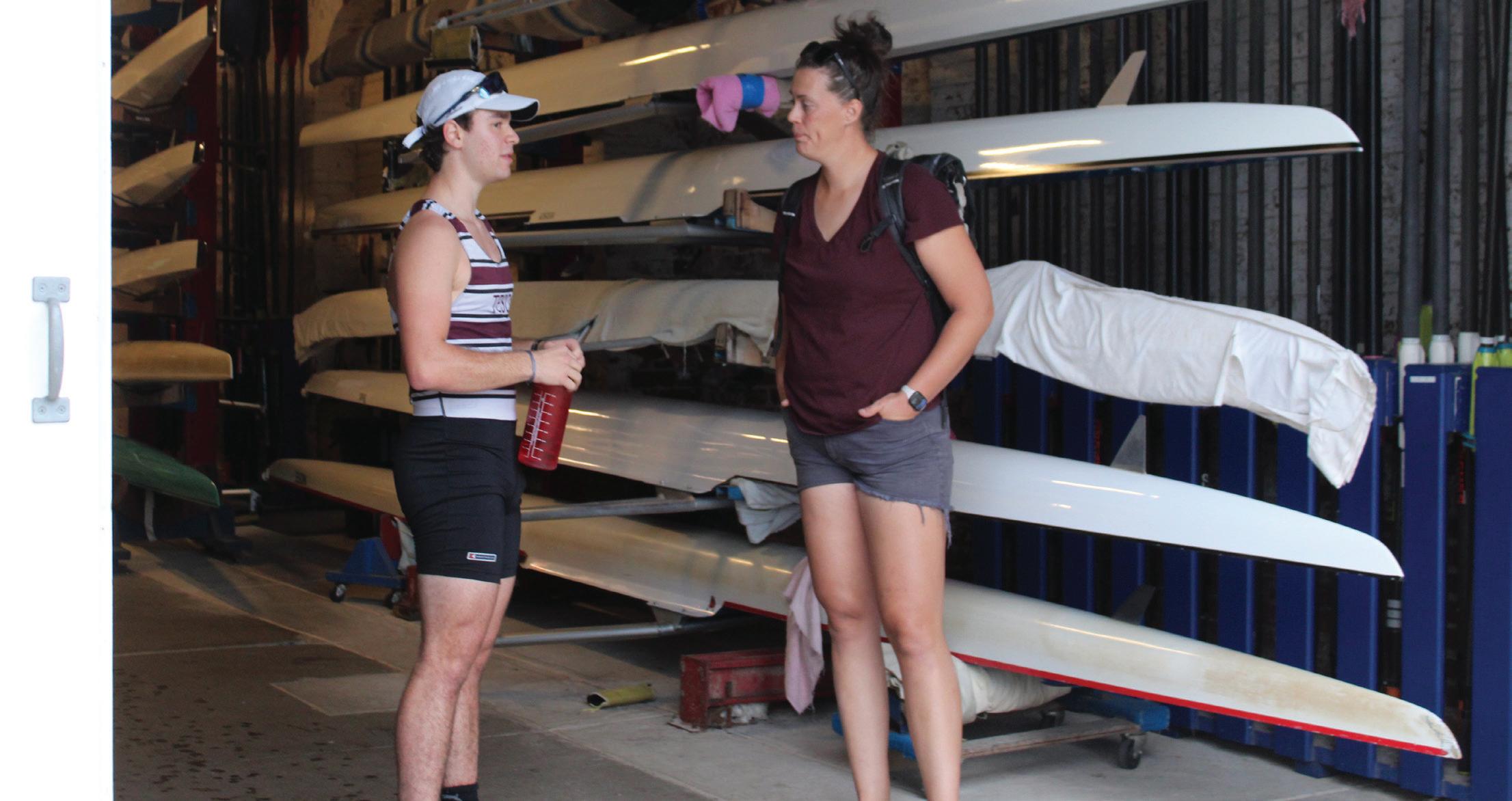
After the departure of its former coach, the crew team welcomed a new face, Bailey Chick. She took over as the new head coach for both the boys’ and girls’ teams at the beginning of the fall crew season in September. Chick began rowing as a walk-on novice at Temple University in 2006 and has been coaching crew for a total of seven years. She is a USRowing Level 3 certified coach and got her start coaching a novice boys program at the Wilmington Youth Rowing Association. Before joining the ’Stoga crew staff, she was the head coach of the North Allegheny Rowing Association in Pittsburgh for six years, where she led the team to many podium finishes.
“I really enjoy and find value in being the person who introduced and crafted some-
one’s experience with something that was so important to me,” Chick said. She enjoys being able to introduce the sport to new athletes while simultaneously creating a strong community built around the sport and its participants. She also works to improve the team as a whole by making small tweaks to the already strong program.
“I wanted to bring my experience in rowing by turning up the systems that were already working and observe what wasn’t working as well,” Chick said. “ e team has a really strong foundation, but as a person on the outside looking in, I can make little tweaks to the way that we do things.”
Boys’ crew captain and senior Peter Jacovini believes Chick’s commitment to the her prior accomplishments and her extensive coaching experience make her a valuable addition to the coaching sta and the team.
“My rst impression of (Chick) was that she would be a great addition for the coaching sta and the team as a whole,” Jacovini said. “She immediately demonstrated her passion for both rowing and making this the best season possible for our team.”
As a new coach, Chick brings an outside perspective, which she believes will enhance her ability to improve the team. Her strategy is to make small changes while highlighting the tactics that have already been working well for the team. Overall, she sees a lot of potential in the rowers, and believes the team will achieve new heights this season.
“I think there’s a lot of potential in this group. I’m looking forward to nding more speed, whether that’s individual athletes or the boats as a whole,” Chick said. “I want to up the expectations on top of the great expectations of the team already.”
Sowmya Krishna Appmaster contributed to the team’s success by starting in 67 of her matches. Allen began her eld hockey career at 12 years old at her local church’s team thanks to the in uence of her older sister –who also played eld hockey at Conestoga and Harvard. “I just started naturally loving ( eld hockey), and I really took to it,” Kiley Allen said. “I loved it because it was social. It was fun. I always have loved (to play) sports.”
Kiley Allen, a 2017 Conestoga graduate and a 2022 Harvard alumna, joined the Harvard eld hockey coaching sta as an assistant coach this past summer. Allen played varsity eld hockey all four years during her time at Conestoga and served as captain during her senior year. At Harvard, she served as captain during her nal year and al-

Progressing from her church team, Kiley Allen naturally progressed to play for a club team – WC Eagles, where she quickly improved her eld hockey skills. ese skills set her up to be one of the two freshmen that were selected to play on the varsity team at Conestoga in 2013.
’Stoga eld hockey proved to be a valuable experience for Allen, providing her with a support system to help her through high school.
“I genuinely think that everyone (on the team) helped each other out a lot just by being there,” Allen said. “You’ll have girls saying, ‘Hey, good job,’ and it can actually just turn around your whole day, even if everything else is going downhill.”
Allen committed to play eld hockey at Harvard at the beginning of her sophomore year, where she joined her older sister on the team. Her sister playing there was an in uential factor in her decision to continue her athletic career at Harvard. Allen’s mother was especially happy to hear of Kiley’s commitment to Harvard.
“I felt so much joy as a parent, knowing she wanted to be with her sister and be up (at Harvard) and
kind of continue their relationship,” Kiley Allen’s mother Jean Allen said.
Kiley Allen graduated from Harvard with a bachelor’s degree in psychology and went on to be a sales representative at an arti cial intelligence company in New York. However, a er being let go along with the rest of her colleagues, she decided to interview for the assistant coaching position at Harvard Field Hockey a er a phone call with the head coach. Following a hiatus from eld hockey, Kiley Allen decided she wanted to get back into the sport.
“I just felt like a er leaving Harvard eld hockey, just that spark, that competitiveness, that motivation, just wasn’t the same,” Kiley Allen said.“My whole life, I’ve always loved coaching, teaching, that sort of thing.”
Now, as a coach, Kiley Allen dedicates her e orts to fostering a familial environment on the team. She hopes to provide the girls with a rewarding eld hockey experience and leave an impact on both the girls and the team in general.
“I had a great time at Harvard,” Kiley Allen said. “But as a coach, I can help these girls have an even better time.”





Written by August Zangrilli, Sta Reporter
Designed by Mary Wolters, Design Editor


“I

Nicholas







“I








Fame. Glory. National pride. ese are what are at stake at the Olympics, whether you are a player representing your country or a spectator watching the best athletes in the world compete in their events. Host countries are responsible for ensuring an unforgettable experience for the Olympians. And unforgettable it was. From rooms with no air conditioning, limited protein options and uncooked meat to a dirty Seine River that sent some athletes to the hospital with stomach problems, the 2024 Paris Olympics were a op. omas Ceccon, Italian gold medalist in the men’s 100-meter backstroke, was even found sleeping on the grass next to a park bench due to fatigue from hot rooms and noisy conditions.
The common denominator behind all these problems, surprisingly, is sustainability. In compliance with the International Olympic Committee’s (IOC) Sustainability Strategy, Paris used existing venues, implemented a geothermal cooling system and doubled plant-based food options to reduce carbon footprints. While this commitment to sustainability is commendable, it back red. And it’s not entirely Paris’ fault. e Olympics have a history of wrecking host cities. A study conducted by researchers at the University of Oxford


Raima Saha Co-Managing Editor in 2012 found that every Olympic Games since 1960 has gone over budget, leaving the host city to pay the debts. In the 1976 Olympics, Canada built the stadium Big O, which took 30 years to pay o and has cost Quebec $43 million in ongoing repairs. It would cost $135 million to demolish it, resigning many residents to live with it. Additionally, many countries spend billions on “white elephant” infrastructure: impressive but unprofitable stadiums that receive little use after mega-events, such as the Olympics, are over. According to ESPN, only 15 of the 27 venues Brazil spent $13.6 billion on were used after hosting the 2016 Olympic Games, with the rest remaining abandoned. Many residents have to leave their homes to make way for these new facilities. Marginalized communities such as homeless people and migrant workers are o en pushed from sight to encourage tourism and economic growth. According to a report by the Center on Housing Rights and Evictions, the Olympics displaced more than two million people between the years 1988 and 2008, a gure that has only grown with time. Even though the Olympics has a long list of problems, it’s impossible to ignore that Paris is the most successful Games yet. Many athletes found success in Paris,









Boys soccer looks to continue success a er 17 players graduate Page 10
Welcome to the crew: ‘Stoga receives new head coach Page 10
‘Stoga alumna coaches eld hockey at Harvard Page 10
Sports opinion: Our Olympic athletes deserve better Page 11

On June 11 at the Stadion am Schönsbusch in Ascha enburg, Germany, the U.S. Under-16 Women’s Youth National Team (USYNT) lined up to play its second international friendly game against Germany.
Junior Kate Kemmerley was one of 20 girls nationwide who the team invited to attend the training camp in Germany. Players trained under the direction of head coach Patricia Toledo from June 3 to June 13. e team’s training culminated in two international friendly matches against the German team on June 8 and June 11. e
international friendly matches were meant to help the team prepare for upcoming tournaments. Kemmerley describes the experience as very serious and methodical.
“It was just very intense. Everyone on the national team is so talented, so you are only surrounded by great players. Everything is taken very seriously, and everything has a plan,” Kemmerley said.
Talent scouts recruited Kemmerley for the USYNT at the regional, state and national levels before sending her an offer. She attracted the attention of scouts after she played a major part in helping her club team, Penn Fusion Soccer
Academy, win the U16 Elite Clubs National League Girls National Championship this past summer.
On May 15, the USYNT informed Kemmerley that she had been invited to train at the highly selective camp in Germany. When she first saw the email, Kemmerley was surprised. Growing up, she had never dreamt of playing for the U.S. because she thought it was too unrealistic.
“I was in school, and I just got the email. I was like ‘this is a scam; this cannot be real.’
I call my club coach and he’s like ‘oh yeah, by the way congrats.’ And I (was) like ‘are you kidding? Is this real?’ I was
shocked and immediately nervous,” Kemmerley said.
To prepare, Kemmerley continued to train with her club team three days each week. Leading up to the camp, she did some additional conditioning with her sister, senior Keira Kemmerley, who has played soccer alongside Kate Kemmerley for all their lives.
Keira Kemmerley is proud of how far Kate Kemmerley has come and has drawn inspiration from her work ethic.
“I was just so happy for her because I knew she worked so hard. It’s just awesome because I don’t know a ton of girls on my club team that have had an experience like that. So for
her, it’s just amazing,” Keira Kemmerley said.
In the future, Kate Kemmerley plans to keep working hard and looks forward to attending more USYNT events and camps. She describes attending the camp as an eye-opening experience, where she played with some of the best talents in the country and understood how it feels to play at the next level.
“It helped me want to improve and chase something. That specific event has made me like ‘I want to be the best’,” Kate Kemmerley said. “Seeing those other girls and seeing what it (the work) took them makes me want to be like, ‘Okay, I want that too.’”
In her 25-plus year mountain biking career, the only time Conestoga parent Lisa Gares ever paused was when she was pregnant with twins. erefore, it was only natural that at four years old, her children, now-seniors Kevin and Lizzie Gares, began to ride as well.
“It’s my favorite thing to do, and I’m beyond thrilled that both of my kids participate. Lizzie in particular is very gung ho about riding,” Lisa Gares said. “She tried gymnastics for seven years, and it wasn’t really her sport. She also is on the cross country team, which surely helps with endurance, but she just loves to ride.”
This past summer, Lizzie Gares competed in USA Cycling’s Cross-Country Mountain Bike National Championships at Bear Creek Mountain Resort in Macungie, Pennsylvania, from July 17 to July 21. Lizzie Gares decided to submit her placings from pre-
vious races to qualify for the competition only a week before. Competing against 56 other girls in the 17-18 age division, she placed 24th in her first ever national race.
“I didn’t even know I was going to race. I decided the week before, and I wasn’t really expecting anything. I’ve never been in that big of a race, so I did it for experience,” Gares said. “I definitely want to keep racing in college. That’s my biggest goal. I’m not sure if I’m going to go on a (college) team, but a club team at least.”
Lizzie and Kevin Gares are members of the Tredyffrin/Easttown Mountain Bike Club, a coed youth mountain biking team for sixth through 12th grade students. Practices begin July 1, with all athletes invited to compete in five regional and statewide races and an adventure weekend hosted by the Pennsylvania Interscholastic Cycling League. The team welcomes all athletes, no matter their experience or fitness level, as its main goal is
to instill confidence and promote mountain biking as a lifelong activity for everyone.
“Getting more girls into (mountain biking) is a really big goal for the team. There’s a whole program for that,” Lizzie Gares said. “Seeing it in the Olympics was also really good, so I think it is growing.”
Both Lisa and Lizzie Gares speak to the positive yet challenging nature of mountain biking. They believe it is an opportunity to de-stress in an adventurous way while spending time with like-minded people. Most importantly, the pair gets to spend time with one another as mother and daughter.
“Well, we certainly spend a ton of time together, including this summer, where I was a coach at a camp in Vermont. There were 90 people, 40 coaches and 50 riders, and being a part of that as a counselor at her camp: how awesome is that?” Lisa Gares said.
“I’m really going to miss her when she goes to college. (The camp) is by far the best thing that we have done together.”
