Conestoga’s rising student population A loop of enrollment:


 By Rohan Anne, Evan Lu and George Zhang, Co-Webmaster, CoEditor-in-Chief and Photography Editor

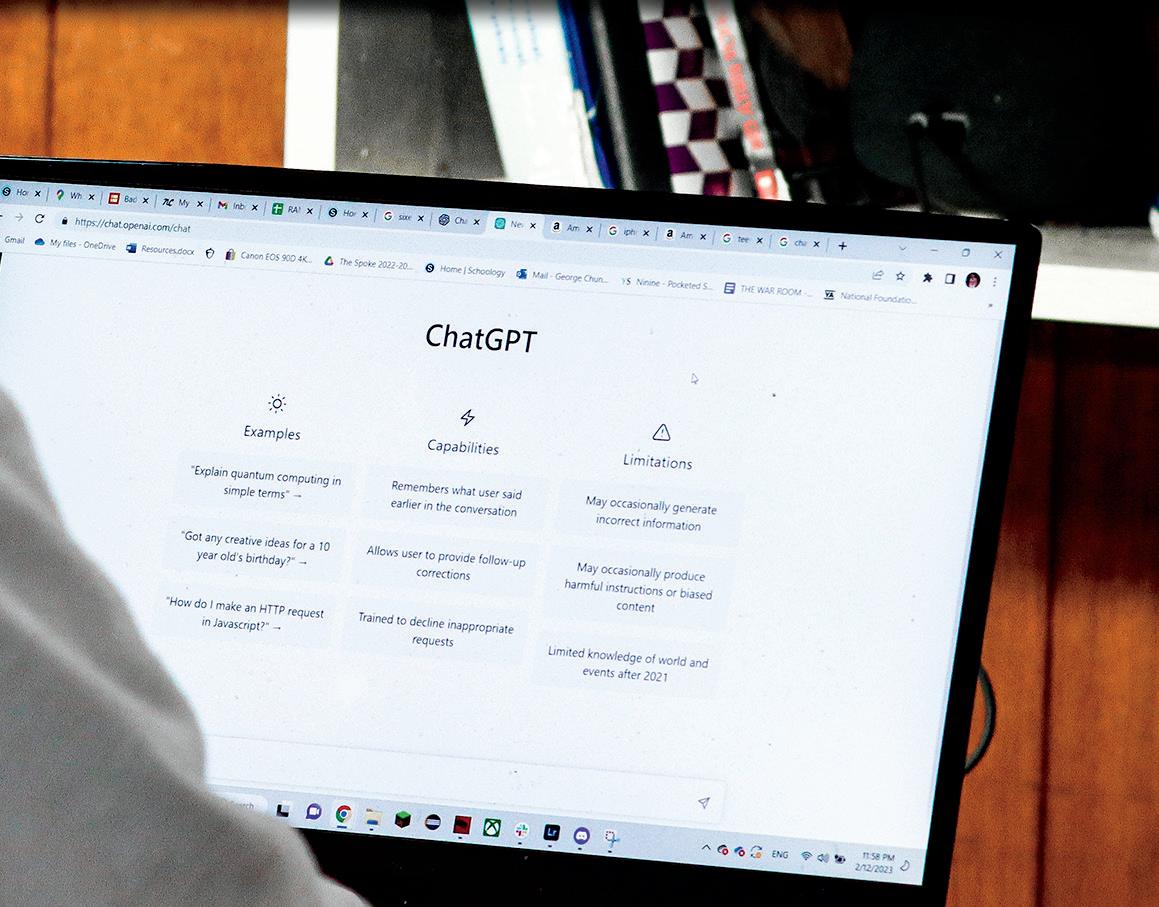
As ChatGPT continues to chat up a storm, some teachers and students are starting to feel a little uneasy about this talkative AI’s rise to power. With its uncanny ability to generate human-like text, it is no

laughing matter that this technology could be used to cheat on exams and assignments faster than you can say “plagiarism.” By giving educators a real run for their money, the consequences of this model could be a real page-turner in the world of education.
In fact, the previous paragraph was written by Chat Generative Pre-trained Transformer (ChatGPT) using the prompt, “write an interesting, funny lede for a newspaper article about the
rise of ChatGPT in academic settings, such as cheating in schools.”
is is one example of generative arti cial intelligence (AI), a technology that can be used to create new content. Research laboratory OpenAI launched the chatbot in late November 2022 before it took to the national stage.

TESD Director of Technology Mike Szymendera spent the past two months investigating ChatGPT.

“When we talk about (ChatGPT) internally with teachers and administrators, I demo it and show them what it can do,” Szymendera said. “Usually, a third of the people have never heard of it. e middle third have seen it on the news but never used it themselves. And then the other third — they’ve been using it and really thought about it.”
In the Conestoga community, debate around controversial uses for generative AI is common. In


4 courses added to Program of Studies
Ben Shapiro News Editor
With more than 150 course o erings, Conestoga provides a wide selection of classes, co-curriculars and ensembles in which its students can enroll. Every year, the school’s administration reevaluates its Program of Studies, a catalog of every course Conestoga o ers, and makes changes for the next academic year.
For the 2023-24 school year, Conestoga will pilot four new courses: Fundamentals of Organic Chemistry, Comparative Literature: Coming of Age and Community, Comparative Literature: Science Fiction and Dystopia, and App Development 2. Additionally, in accordance with state regulations, Conestoga will o er a more robust dual enrollment program with Drexel University next year.
e semester-long Fundamentals of Organic Chemistry course is the science department’s sole addition next year. According to chemistry teacher Dr. Derrick Wood, the class is three years in the making. He noted that the process to build a course from the ground up takes careful consideration.
“It takes some time to talk with the administrators about what the strategic plan is for the district, what’s the plan here at Conestoga, what types of course o erings we have and where the needs (are),” Wood said.
Fundamentals of Organic Chemistry will be o ered at the accelerated and honors levels. It is designed for students who want to continue their education in chemistry either without or a er taking the AP course. It will be heavily lab-based and the
rst true physical science course o ered at Conestoga.
Junior Samantha Meaney is currently hoping to pursue a career in either medical research or pharmaceuticals post-college. She is planning on taking Fundamentals of Organic Chemistry next year and is excited to do so as it will allow her to take a third year of chemistry — a er taking AP Chemistry 1 and 2 in her sophomore and junior years, respectively.
“It (AP Chemistry 2) is my favorite class; I’m super interested in it,” Meaney said. “So, being able to continue chemistry next year is something I really want to do.”
Along with its science counterpart, the English department will also see changes in its course o erings next year. However, in addition to simply adding new courses, it is chang-
ing its graduation requirements for students, as well.
Starting next school year, students must take one credit in either Comparative Literature or AP Literature and Composition during 12th grade.
Accompanying this change, the English department will offer two special topic courses in comparative literature: Coming of Age and Community, and Science Fiction and Dystopia. They will both be offered at the accelerated and honors levels.
Assistant Principal Dr. Matthew Sterenczak is excited to hear students’ responses to the new courses. He noted that the best gauge of student interest in a course is seeing how many people take it.
“We always want to hear feedback. Actually, the feedback is
who enrolls for those courses,” Sterenczak said.
Students will see two additional di erences in the 2023-24 Program of Studies. e class previously titled Coding: Games, Apps and the Arts will now be Coding and the App Development course will become a twopart series with the addition of App Development 2.
Wood agrees with Sterenczak’s sentiment about student feedback. He nds that by simply asking his students what they are interested in, he is able to scale the popularity of a potential course.
“Student interest is de nitely a key part of (proposing a new course). Whenever we have the idea, we go to our students and we ask, ‘Hey is this something you’d be interested in?’” Wood said. “We do a lot of informal poling with our classes at the di erent levels.”
January, the New York City Department of Education blocked access to ChatGPT due to “concerns about negative impacts on student learning.” e decision to block ChatGPT varies by district as AI is not included in the Children’s Online Privacy Protection Act that mandates school restrictions. Following conversations with other Chester County districts, none of which have blocked ChatGPT, Szymendera remains
undecided on the question of restricting access.
“ChatGPT is having its moment, but really what we’re talking about is a whole form of technology. at makes the blocking conversation sort of challenging because you could go block one site, but we’re talking about the concept of arti cial intelligence and its e ect on education,” Szymendera said.
Now, the development of technologies that allow students to
generate novel, unique responses to a diverse range of questions threatens to lower the barriers and stigma of cheating.
“We want to learn about (ChatGPT). We want to hear people’s perspectives. We want to help teachers understand it,” Szymendera said. “Ultimately, we want teachers to be empowered to set expectations for how work should be done in their class.”
$800,000 allocated for Tredy rin Library renovations
e Tredy rin Board of Supervisors unanimously voted in December to allocate $800,000 for renovations to the Tredy rin Public Library’s roo ng and heating, ventilation and air conditioning as a part of the township’s ve-year expenditure plan.

e building’s humid air during the summer and rampant drywall cracks are caused by the poor, leaking condition of its roof, aggravated by the buildup of stormwater moisture. e project is expected to start around midMarch and nish by August.
e Tredy rin Public Library building is uniquely made up of three distinct roofs: a brown shingled roof, a rubberized roof with gravel and a “living” roof.
e “living” roof operates as both a roof and a functioning ecosystem — it consists of organic matter, which thrives as the rainwater naturally saturates the soil, as op-
posed to draining o the building and into gutters.
e three di erent roo ng styles will be maintained during the renovation process in e orts to preserve the building’s historic value. Dave Dudda, the capital improvement manager for Tredy rin Township, explains that although there are likely better ways to carry out the project, modifying the building would degrade its original architecture.
“In a township, you’re going to have people that don’t see the historical value in the building, and say the ($800,000) could be put to better use just building a new library,” Dudda said. “ e majority of people, I feel, want to keep the integrity of the historic value of the building. Our goal is to upgrade it where upgrades are needed, but not to the point where it becomes something completely di erent than intended by the original architect.”
e plan is to strip the roof down to its skeleton and rebuild
from there, while simultaneously taking the HVAC controls o the roof to nish building underneath the unit. en, once the HVAC unit is reinstalled, the project will wrap up with interior xes to the drywall and windows.
F.W. Houder Inc. and Hirschberg Mechanical are the expected roo ng and HVAC contractors, respectively. Part of the HVAC reinstallment process is “balancing” the building, a technique designed to ensure the ow of air and heat is consistent throughout the library.
Junior Gladys Cai, a summer library volunteer, hopes the renovations will improve the library’s overall atmosphere and working conditions.
“It was pretty hot and stu y, especially since I worked downstairs in the children’s area,” Cai said. “ ey (the renovations) will make visitors a lot more comfortable while browsing for books, and I’m glad that people volunteering next year will hopefully have a less humid experience than me.”
on page 3.
Continued
On call: Junior raises sheep for 4-H club Page 5
George Zhang/The SPOKE
Page
Page 10
Dear Mindy, this isn’t what asked for
8
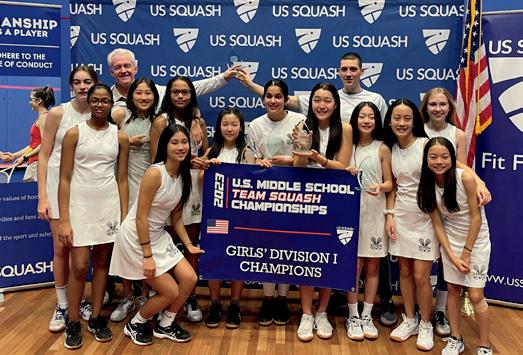
Middle school girls’ squash team wins national championship
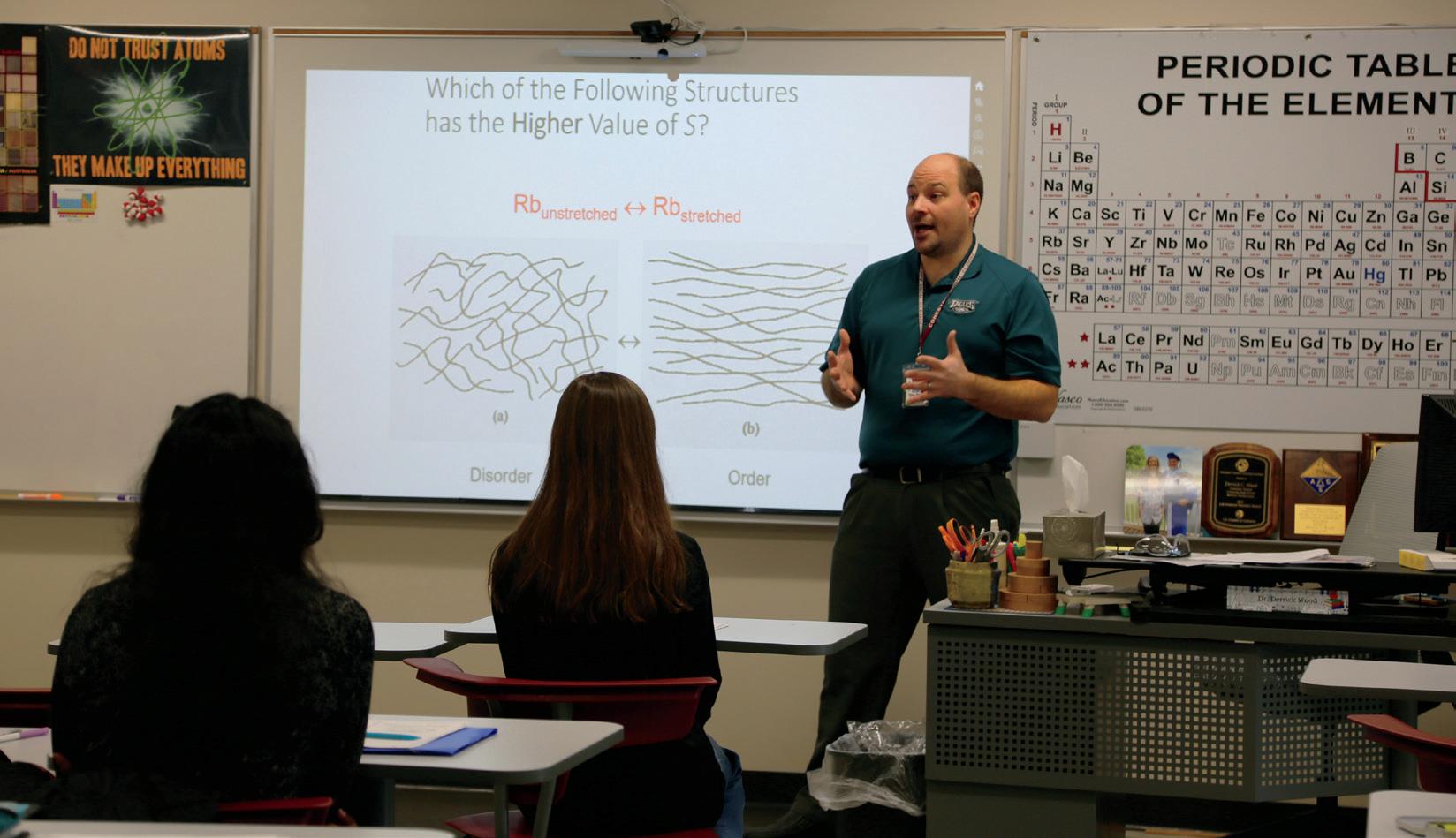
Studying science: Chemistry teacher Dr. Derrick Wood teaches his fourth period AP Chemistry 2 class. He helped develop the curriculum for the new Fundamentals of Organic Chemistry course over the past three years and oversaw its approval by Conestoga’s administration and TESD’s school board. Wood will likely teach the course next year. Ben Shapiro/The SPOKE Conestoga High School, Berwyn PA, 19312 Volume 73 No. 4 February 21, 2023 www.spoke.news
Shrija Krishnan Sta Reporter
Building of books: Some nd that the Tredy rin Library is humid in the summer due to its poor roof. The township’s Board of Supervisors allocated $800,000 to renovate the roof, among other things at the library, over the next ve years.
Shrija Krishnan/The SPOKE
B IDEN DONATES $500
MILLION TO LOCAL PIPELINES
President Joe Biden alongside Vice President Kamala Harris visited the Belmont Water Treatment Plant in Philadelphia on Feb. 3 to award $500 million to lead service removal and water upgrades. Philadelphia water facilities will use $160 million and the Environmental Protection Agency will use the remaining $340 million to upgrade water systems.
HILLSIDE ELEMENTARY RUNS FIRST EMERGENCY PREPAREDNESS DRILL
On Jan. 25, Hillside Elementary School ran its rst district-planned emergency preparedness drill. Sta and local law enforcement o cers worked together to run drills aimed to help the school prepare for emergencies. Conestoga will do the same on April 26 and all students will have an early dismissal at 11:45 a.m to accommodate for the procedure.
L ONGWOOD G ARDENS
BUYS G RANOGUE ESTATE
The Granogue estate, built in 1923, is a 505-acre lot in Centreville, Delaware. After the death of its owner Irénée du Pont Jr. on Jan. 16, the Granogue Reserve LLC sold it to Longwood Gardens to preserve it as a future public space.
PA SCHOOL FUNDING SYSTEM RULED TO BE UNCONSTITUTIONAL
e Commonwealth Court judge ruled on Feb. 7 that Pennsylvania’s school funding structure was inadequate. According to the presiding judge, the Pennsylvania public school funding system violates the rights of low-income students to get an education at the same level as their more a uent classmates.
Read more at
NEWS
PA Turnpike toll increases in prices
Waynesborough Country Club’s trap shooting faces controversy

Remington Vaughan Sta Reporter
In October 2019, a small group of Easttown Township citizens came together over a common concern: Waynesborough Country Club’s trap shooting program. Every Sunday from early November through the end of March, participants use shotguns to shoot clay discs that are ung from a spring device.
Once the golf season at Waynesborough Country Club comes to a close, the main driving range is turned into a trap range at which the club hosts practices and tournaments.
Not every community member views this as a relaxing Sunday pastime. Donna Loyle, a member of the Stop the Noise Now coalition, sees the program as a danger to the health of the surrounding neighborhoods.
“ ere are two primary issues that have brought this group of concerned neighbors together, and it’s the decibel levels of the loudness — which clearly breaks Easttown township’s noise ordi-
nance — and the environmental concerns with the lead pellets being dumped,” Loyle said.
e group met with then-Waynesborough Country
cerns regarding the noise and environmental impact.
“We (took) their requests and (saw) what we could accomplish — if not all in the rst year, (then)
Life Time to build luxury housing in Wayne
Faith Zantua Sta Reporter
Life Time Athletic, a luxury tness club, opened in Wayne in 2017. Six years later, Life Time Living is now planning to open a residential facility near it.

On Dec. 5, the Tredy rin Township supervisors approved a zoning amendment that will allow the company Life Time to build luxury apartments next to its athletic club. Tredy rin Township Planning and Zoning Director Erin McPherson took part in handling the approval.
“It (Life Time Living) is really a high-class facility,” McPherson said. “Life Time is looking to have something on that site that can work in conjunction with Life Time (Athletic).”
According to its website, Life Time is dedicated to “the healthy way of life” and has 161 athletic country clubs with tness areas and equipment nationwide. Junior Laila Awad regularly exercises at the Wayne location and nds it enjoyable.
“It (Life Time) is really good. Everyone is really sweet there,” Awad said. “ ere’s a lot of Conestoga people that go there, so it’s nice to see familiar faces.”
Life Time Living is partnering with Canoe Brook Development, a real estate development company, to construct the housing. According to the preliminary plan, it will include 197 multifamily apartment units, a garage with 355 parking spaces, an amenity courtyard and a fountain. Future residents’ rent includes Diamond Level membership to all Life Time club locations.
Econsult Solutions Inc., a rm providing analytical services, predicted that the new housing will bring approximately 342 new residents to the area. Children who live in the new apartments will attend TESD schools. It may also attract current Conestoga High School students and alumni.
“I’d like to get a house next to the gym so I don’t have to pay for the gym (and rent separately),” Awad said.
Despite the addition of more residents, McPherson believes that the housing will not signi cantly change current trafc. Tra c levels may even go down as some people who used to drive to the athletic club will no longer have to.
“When sites are being constructed, there’s always some construction-related activities that may a ect some areas directly around (them),” McPherson said. “But knowing the location of (the Life Time Living facility), this is in an area where you have Swedesford Road that’s really a larger thoroughfare that can handle that amount of tra c.”
Life Time Living is working on submitting a land development plan to the Tredy rin Township in order to continue with the construction. ere is currently no announced construction timeline.
According to Life Time General Manager Lance Vugteveen, the company is hoping to have renderings and more information before summer.
e coalition hired Michael Goldberg, an independent environmental engineer, to help test and record the decibels emitted from the gun re. According to his ndings, at all times during the trap shooting, the sound of the shots violated
the Easttown Township Noise Ordinance — and by as much as 33.2 decibels above the allowed 55 decibels on weekends.
e coalition then met with Easttown Township’s Board of Supervisors to request an enforcement of the noise ordinance.
According to Michael Wacey, the Chair of the Easttown Township Board of Supervisors, in 2021, the township cited the country club under the zoning ordinance in district court. However, the presiding judge, Tom Tartaglio, denied the citation.
According to a letter from Waynesborough Country Club to the community, the club has lowered the range, altered the direction in which members shoot, attempted to use low recoil ammunition which can be quieter and reduced the number of shooting days and hours to only Sundays from 12 p.m. to 4 p.m.
Previously, members shot on Sundays and occasionally on Saturdays from 12 p.m. to 5:30 p.m. e coalition’s second concern lies with the lead pellets emitted from the shot.
“Given that a stream runs through the range and (it) is in close proximity to wetlands, the amount of lead being embedded into the soil from the lead pellets also poses a threat to contaminating the stream that, in turn, connects to other streams, including Crum Creek, that ultimately provide a source of drinking water and groundwater,” Loyle said.
In its letter, the club stated that the pellets pose no threat to the surrounding environment as it vacuums them up to remove much of the debris from the clay targets and the shot fall. e club also spreads lime over the soil to increase pH levels, reduce acidity and reduce the chance of leaching from the pellets.
Loyle is not convinced that the club can minimize the noise and possible environmental impacts.
“Given that I don’t think that’s possible to do — especially reducing the noise to township limits — I’d like the club to do what it did during last season’s course renovation and move the shooting program permanently o -site,” Loyle said.
Assessment days discontinued
to accommodate her students when she felt as though they needed her to postpone a test.
A er piloting assessment days during the rst semester, Conestoga administration removed the practice for the rest of the year due to mixed feedback. e initial goal of assessment days was to help alleviate possible stress felt by students when multiple tests and due dates fell on the same day. Under this system, world language and English classes tested and had assignments due on cycle Days 1 and 4, math and electives on Days 2 and 5, and social studies and science on Days 3 and 6.
Especially in AP classes with strict schedules, some teachers found that they could not a ord to lose lesson days.
“I think (assessment days) had a good purpose to try to make kids a little bit less stressed, but I think what ended up happening (was that) I felt more constricted by it and I couldn’t be exible when kids asked me, ‘Can we move the test?’” Gontarek said. “I’m personally glad that (the) restriction has been li ed.”
side the school’s control. Junior Sarah Phillips emphasized the importance of having enough time to study.
“I don’t really have a problem with the assessment days. I don’t think it (was) a big deal for me to have more than two tests in a day,” Phillips said. “I think it’s more important that I had enough time to prepare.”
On Jan. 8, the Pennsylvania Turnpike Commission raised the price for passing through the PA Turnpike toll by 5%. The average toll price rose from $1.70 to $1.80 for E-ZPass customers and from $4.10 to $4.40 for Toll by Plate customers.

T/E LIFE
Folio hosts Inkwell to celebrate its winter issue
Senior internship process launches
On Saturday Feb. 4, Conestoga’s literary magazine, the Folio, hosted their annual “Inkwell” issue release party at the Tredy rin Library from 6-8 p.m. The celebration, Folio’s rst since 2020, had an Alice in Wonderland theme and included drinks, food and dessert for all attendees.

SPORTS
Archers wrap season with successful tournament
For the past three years, COVID-19 pandemic restrictions made it di cult for some seniors to nd internships to round out their high school careers. However, this year, students and faculty are optimistic that nding ideal internships will be easier.
e senior internship process is carried out in two phases.
On Jan. 28 and 29, archery club members partook in the largest tournament of their season. Six archers from ’Stoga participated in The Easton Youth and Collegiate Tournament, a national competition held in Manheim.



Student skaters: Girls ice hockey trains new players





This season, a third of the girls’ ice hockey team are rst-years, with some never playing the sport before. The reason it worked? A nurturing team environment and girls who are willing to put the work in to adapt. Due to a large class of seniors who graduated last year, there was a large hole in the team’s roster, and 18 out of the 30 girls on the team are juniors or seniors.
“An online (internship) would be preferred because it will be easier to handle the internship, school and my job, which takes up to 25 hours a week,” senior Cherise Chettiar said.
Phase I launched on Jan. 5, enabling all 560 seniors to begin re ecting on their interests and reaching out to companies under the guidance of community and volunteer services coordinator Jeanne Braun. But, before seniors dive into their internships, Braun has critical advice to o er.
“Try to think more broadly (about internship hunting). Have a plan B. e internship doesn’t have to be something you plan to major in; it can be something you are interested in. Take these four weeks to learn something you have always wanted to learn about,” Braun said.
With fewer COVID-19 pandemic restrictions this year, Braun believes that students will have more opportunities than last year to nd internships. However, coming o the pandemic, some workspaces may only o er positions online or through a hybrid model.
Last year, students had the option to enroll in EduCare, a four-week paid online course for business and management, as an alternative to a traditional internship. Braun is o ering the program to this year’s seniors, as well, for those who would prefer to not have an in-person internship.
By March 24, students will submit their internship proposals, wrapping up Phase I.
During Phase II, students will complete their internships, which take place from May 8 to June 2.
Seniors like Juliana Urbina, who plans to pursue biomedical engineering in college, hope to gain work experience to serve as a practical first step into their field.
“I’ve been working for the past couple of years at a store or a restaurant, but now I just want to see how the actual workforce of my eld is,” Urbina said. Braun has been the senior internship adviser for 8 years. Her biggest piece of advice to seniors when it comes to nding their internships is to get started now.
“ ink about it now; reach out now. e key is to be ahead and not wait until the last minute.
I want you to think broadly and search for an internship that in-
“I like it for math because I would always have two or three extra days of review because we (would) miss our (assessment) day by one day,” freshman Dani Werner said.
Biology teacher Jacqueline Gontarek found that because of the assigned days, she struggled
As recommended by the American Psychological Association, students should spread out their studying over a few days before a test. e original intent of assessment days was to prevent students from having to study for multiple assessments in one night.
However, test preparation can look di erent for each student depending on factors out-
With assessment days eliminated, principal Dr. Amy Meisinger advises students to “reach out in advance directly to their teachers to make alternate arrangements” in the case of excessive testing on any given day, as stated in a Schoology post.
“I think the theory behind (assessment) days makes a lot of sense,” sophomore Sarah Weng said. “If there (was) a way to alter the plan so that (assessment) days for all students’ classes are spread out — no matter the subject area on which a student chooses to focus — I think it could be very e ective.”

Gov. DeSantis opposes AP African American Studies
Vanessa Chen and Isabelle Emmanuel Sta Reporters
In August, the College Board announced a new AP course: African American Studies. is addition came with no shortage of controversy. It has faced backlash from conservatives for its inclusion of contemporary topics like the Black Lives Matter Movement, critical race theory, queer life and incarceration.
In Florida, Governor Ron DeSantis, a prospective Republican candidate for the 2024 presidential election, threatened to ban the course in the state after viewing its early curriculum, claiming historical inaccuracy and violation of a Florida law that controls how educators teach race-related issues.
internships: Senior internship adviser Jeanne Braun addresses an auditorium full of seniors. On Jan. 5, Phase I of the internship process launched. Seniors will intern at companies of their choosing from May 8 to June 2.
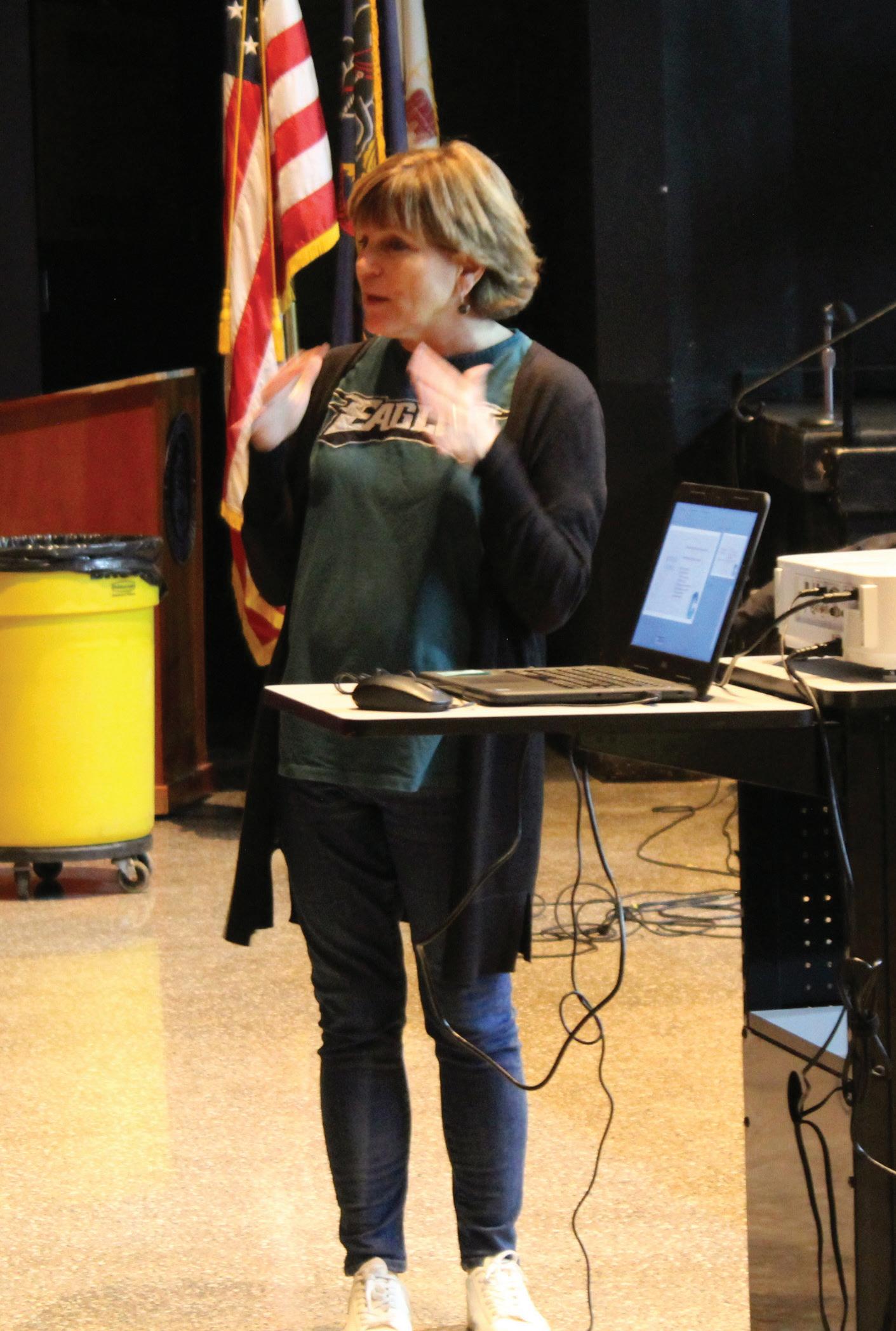
terests you. Chip away with it as you go,” Braun said.
As the senior internships hunt warms up, students like Nathan Baker are grateful for the opportunities they may get to experience as they round out their time at Conestoga.
“I am glad that we have the opportunity (to end high school with an internship) because I know a lot of other schools don’t do it anymore,” Baker said. “It’s so much better than just sitting in school for the last month.”
On Feb. 1, the College Board released a revised course curriculum that focused more on fact-based teachings than theoretical analysis. While the College Board kept topics of Africa, slavery, reconstruction, the civil rights movement, redlining, discrimination, Afrofuturism — a view of the future through the Black perspective — and other aspects of African American history and achievements were kept in the curriculum, it removed
many of the contemporary topics, including reparations and Black feminism, from the AP exam.
Many have voiced their disapproval of the backlash and curriculum change reactions, including senior Jaela Eaton, who took Conestoga’s own African American Studies course last semester.
“Black history is American history whether people accept that fact or not,” Eaton said. “It’s just disheartening to know that there is a generation of students that is not getting the full extent of an education simply because of one individual’s beliefs.”
The College Board has outlined plans for the course with further piloting in the 2023-24 school year and the first AP tests for pilot students occurring in May 2024. AP African American Studies will become available to all schools during the 2024-25 school year. At Conestoga, the potential addition of the AP course could attract more students to the class.
“I would have (taken AP African American Studies),” Eaton said. “Not only would it have been interesting to see what topics were discussed, but it also would’ve given me another AP credit in a class that I actually enjoyed.”
2 Tuesday, February 21, 2023 News A BRIEF LOOK THE LATEST DEVELOPMENTS IN T/E AND NATIONAL NEWS
Miya Cao and Lauren Pinheiro Sta Reporters
Taking note: Sophomore Isabella Florendo studies for an AP Spanish test in the library. Conestoga administration discontinued assessment days with the hope that it will increase exibility for both students and teachers.
Miya Cao/The SPOKE
Luxury living: Life Time Athletics in Wayne is located next to where the company plans to build Life Time Living. On Dec. 5, Tredy rin Township supervisors approved the company’s plan to build a new facility.
Faith Zantua/The SPOKE
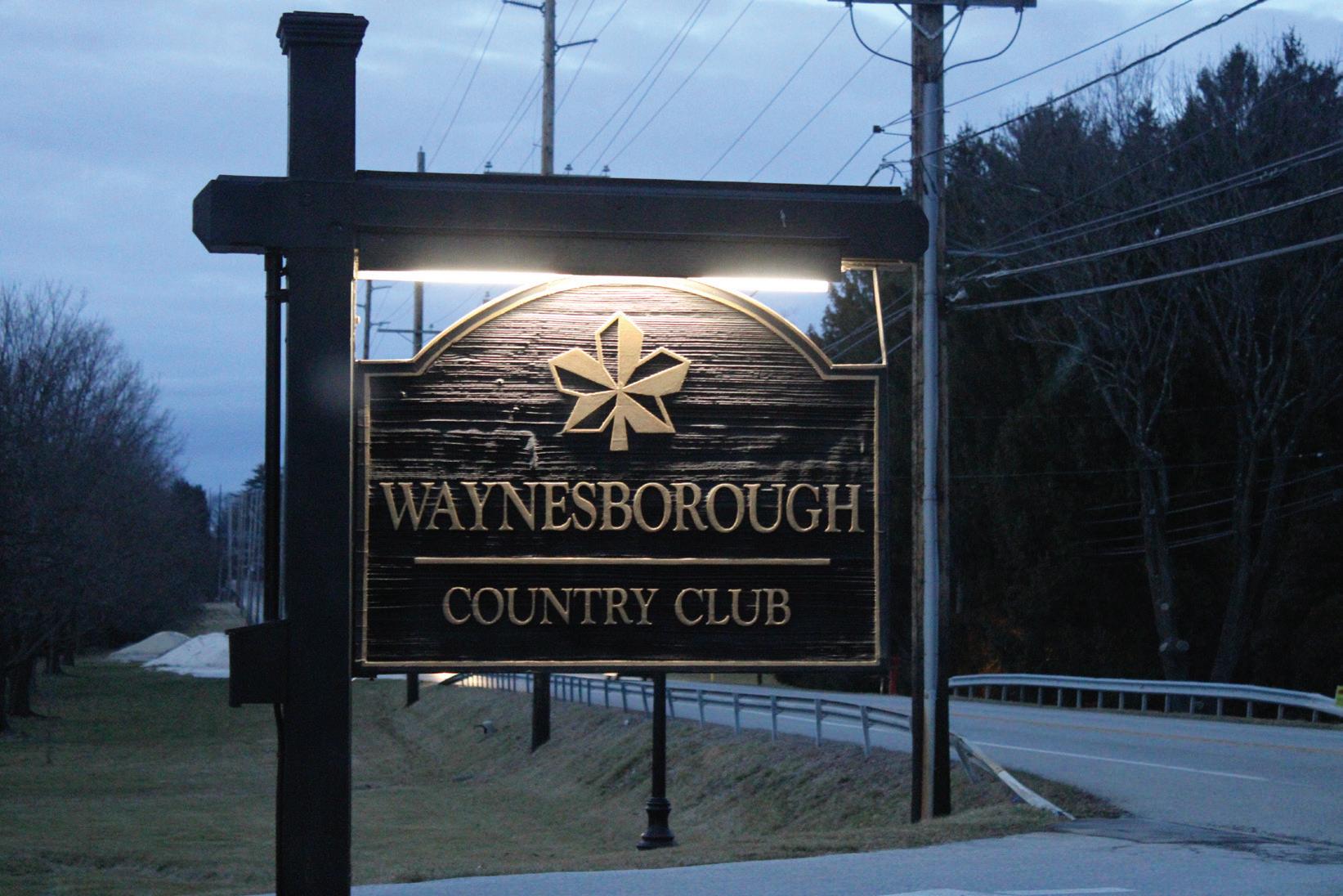
Controversy at the club: Waynesborough Country Club is located off Darby Paoli Road. In 2021, the Stop the Noise Now coalition brought claims against the club in court regarding its trap shooting program.
Remington Vaughan/The SPOKE
Introducing
Tanisha Agrawal/The SPOKE
Tanisha Agrawal Sta Reporter
Classroom implications of generative arti cial intelligence
Continued from page 1.
Rise of the bots

Generative AI is a speci c genre that creates content from human input which can include audio, text, images and more. For example, generative AI can create an image based on human instruction or write an analysis of an image. e technology devises an in nite number of unique responses to the same prompt.

“ e fact that you can just throw freeform content in there and it can spit out reasonable answers is pretty amazing,” said University of Pennsylvania nance professor Itamar Drechsler. “You could throw in my homework — I mean, I tried that. e answers aren’t really right but they weren’t ridiculous. ey sound like they were in the ballpark. at’s really an amazing level of exibility and adaptability for this kind of so ware.”
While di erent forms of generative AI have existed since 2014, many applications gained publicity in 2022. One example is DALL-E 2, which creates art from a human description. According to Conestoga computer science teacher Edward Sharick, the most impressive feature of ChatGPT is its ease of access.
“ ey’ve done a nice job of packaging it together in terms of ease of use, and their user interface and the way it formats the output for the user is really nice,” Sharick said.
Academic implications
English teacher Lauren Nordsiek rst heard about ChatGPT in December 2022 when an educator friend shared an article in e Atlantic titled, “ e End of High School English.”
e article’s author, Maybeck High School English teacher Daniel Herman, warned that ChatGPT destroys the intrinsic trust that underlies assignments, casting doubt upon future submissions of written material by students.
“ChatGPT may signal the end of writing assignments altogether — and maybe even the end of writing as a gatekeeper, a metric for intelligence, a teachable skill. If you’re looking for historical analogues, this would be like the printing press, the steam drill, and the light bulb having a baby, and that baby having access to the entire corpus of human knowledge and understanding,” Herman wrote in e Atlantic.
e article quickly circulated through Conestoga’s English de-
partment, generating considerable buzz about ChatGPT’s cheating potential. Nordsiek compares modern techniques to how students cheated during her own tenure as a high schooler from 2000 to 2004.
“Obviously there was the internet, but it was still in the early days. Instead, it was still very popular to buy physical SparkNotes summaries for every book: they were yellow, with black stripes on them. In my day and age, that’s how kids were ‘cheating,’” Nordsiek said.
However, the rise of generative AI raises new worries for teachers. Students can prompt ChatGPT to provide responses to any question and each response generated by the bot — even responses to the same prompt — is unique.
“Since I’ve become a teacher, kids have become more savvy using the internet. e resources on the internet change and get more savvy as well. It’s not just the SparkNotes, it’s other websites and platforms now that kids can use in order to get help, support or cheat,” Nordsiek said. Far from limited to English classes, the technology wields broader in uences that can help in STEM and social science courses, just as easily.
“I’ve heard of students writing short essays, science labs, Econ
responses and English re ections using ChatGPT. ere are even rumors of students copy-pasting ChatGPT-generated responses into their resumes or college essays,” junior Aryan Rana said.
Still, there are students and teachers who question the negative reputation surrounding the use of AI tools. In certain cases, ChatGPT can help facilitate creative processes and deliver structured feedback in a manner similar to peer editing.
“It gives good ideas that save a lot of time. Really, it’s like asking your dad for an idea,” senior James Johnson said. “When writing your college essays, did you not ask anyone, ‘How do I write this’ or ‘How can I reword this?’”
Nevertheless, according to Nordsiek, ChatGPT is not advanced enough to replace student writing. When she plugged in a prompt from her American Voices class, the AI returned a well-written but vague response that failed
to include nuanced tidbits of information that were covered during in-class discussions. College essay counselor Elizabeth Dankoski agrees. While there are fears that students may misuse AI to write their college applications, Dankoski believes that AI “can never compete” with human editors.
“It does not have the capacity to take reams of personal experience and distill them into 250 words,” Dankoski said. “So many people don’t understand that the college essay process is meant to be a deeply self-re ective celebration of who you are. ere’s a lot of fear that somehow AI is going to come in and steal our humanity — that’s impossible.”
Teachers continue to develop strategies to combat technological academic dishonesty. Nordsiek is a strong believer in Turnitin, an internet-based plagiarism detection so ware used within TESD that recently announced updates to detect ChatGPT-generated submissions.
She held open conversations with her classes, discouraging AI plagiarism by discussing the pitfalls of ChatGPT. She plans to enforce the Conestoga Code of Conduct through grade reductions, Saturday detentions and out-of-school suspensions if any incidents arise.
Into the future
In the ever-changing classroom environment, AI is bound to grow in in uence. e development of generative AI is not unlike other historical paradigm shi s — from the implementation of state-sponsored public education to the creation of educational technologies like YouTube, Google Translate, Photomath and Khan Academy. Spanish teach-
Potential statewide gas price decrease
Pennsylvania has the highest gas tax in the nation, averaging 61.1 cents per gallon. Although Pennsylvania does not have one of the highest gas prices, it is still above the national average by 29 cents. A recently-introduced Senate bill hopes to help ease these gures by lowering two central factors for gas prices.
Senate Bill 35 passed with a vote of 29-19 in the Pennsylvania state Senate on Jan. 11. Its objective is to stop the gas tax from increasing from 57.6 cents to 61.6 cents and the diesel tax from rising from 74.1 cents to 78.5 cents in 2023.

Additionally, the bill would set the average wholesale price for gas at $2.99, 18 cents lower than the state’s average in 2022. is bill, currently in examination in the House of Representatives, would reduce the current gas prices.
“ ey (cheaper gas prices) will be really helpful because I drive a lot,” said Yun Shin Park, a parent of a student at Beaumont Elementary. “I drive on a daily basis for my work and ll up a full tank once a week.”
e gas tax funds Pennsylvania’s infrastructure. With the gas tax capped, the state will lose around $200 million in state funds, and programs the government funds will be negatively affected, according to the secretary
of the Pennsylvania Department of Transportation.
“Every policy would have a trade-o , so one potential decision doesn’t mean it’s necessarily the best or the most optimal,” said AP Economics teacher Justin Davey.
“For example, if you start to pay less for gas, you’re gonna have to pay more to get your tires xed because the infrastructure on the highway isn’t going to be as good.”
e COVID-19 pandemic and the Russia-Ukraine War contribute to the sharp uctuation of gas prices. e average fuel cost per gallon in Pennsylvania rose dramatically during the pandemic, reaching a record high of $5.07 on June 12, 2022.
“When the (COVID-19 pandemic) restrictions ease and return to daily travel routines, de-
mand for gas rapidly gets back to normal,” Davey said. “Producers simply weren’t able to just open the taps back up and keep up with this demand placing upward pressure on the price.”
While this bill may result in a $200 million loss for the state government, it will help alleviate the burden on families, as intended by bill sponsor Senator Wayne Langerholc Jr. of the 35th District, Serving Cambria, Centre and Clear eld Counties. Senior Bella Rowe drives to school every day and feels as though the bill would positively a ect people’s lives.
“I think it would help people be able to get gas at a more affordable price,” Rowe said. “ ey won’t have to sacri ce other things in their life for other necessities.”
Guzzling gas: A driver lls their car’s tank at a gas station. Senator Wayne Langerholc Jr. introduced Senate Bill 35 with the hopes of reducing gas prices.
er Maria Delora believes that the power of AI can be harnessed in a responsible way that doesn’t do the work for students.
“I think (ChatGPT) could be another source, kind of like a dictionary. It’s advanced in the way that we can access information, but we need to know how to use it in the school environment.”
While playing around with the so ware, computer science and math teacher William Dewees found useful applications for ChatGPT’s personalized programming feedback.
“I wanted to know speci cally what a typical programmer would do with some code that (ChatGPT) had given me, and what I found really interesting was that it was able to comment on its own coding style and suggest stylistic alternatives,” Dewees said.
For others, ChatGPT is a valuable resource for independent learning. Johnson is using the program to teach him Swi , the programming language made for developing Apple so ware.
“You can literally ask, ‘How do I import the Spotify application programming interface?” It’ll give you the steps. If I need it to elaborate, it’ll do that too,” Johnson said.
Generative AI continues to push the technological frontier, forcing the educational system to adjust. Szymendera feels that as ChatGPT matures, educators will adopt a new status quo as needed.
“ e iPhone came out in 2007 and it was incredible, but it was the worst iPhone in history. For ChatGPT, it’s also really exciting to think that this is the worst it’s ever going to be,” Szymendera said. “Disruptive things come out and we have to learn how we’re going to live with them or adapt.”
$500,000 to Valley Forge Park Alliance
Saktisri Gowrishankar Sta Reporter e Valley Forge Park Alliance is an organization in philanthropic partnership with Valley Forge National Park that focuses on citizen stewardship of and inspiring appreciation for this historical landmark.
Pennsylvania’s Redevelopment Assistance Capital Program gave the Valley Forge Park Alliance a $500,000 grant in October to administer new changes to the Maurice Stephens House in Valley Forge National Park.

Maurice Stephens, a farmer in the 1800s, built the house on the edge of a meadow in the Grand Parade Trail around the year 1816 and now it is an important xture in the scenic trail system. George Washington and his Continental Army trained on these grounds during the 1777 winter encampment at Valley Forge.
“We are eager for the completion of the Maurice Stephens House, where we will have outdoor seating, meeting spaces and rentable space for small parties,” said Amy Johnson, the Board Chair of the Park Alliance. “Our reach as citizen stewards of this great park will extend even further.” e alliance leased the house from National Park Services and is partnering with it on this
Like a super-secret handshake to get in the door, competitive colleges really do want to see test scores, they just won’t tell you that. Grades alone aren’t going to get you there, so it’s time to think about doing your best on the SAT or ACT. Find out more at CrimsonReview.com.



project. It will be setting up new headquarters for the group on the second oor and converting the rst oor into a café operated by Aneu Catering of Paoli. Other additions will be the rehabilitation of the area around the Maurice Stephens House, including new walkways and an upgraded parking lot. “It (the project) is really a good thing for the park service itself because the vacant building is being restored. It’s a great thing for the Valley Forge Park Alliance because it’s going to enable us to be a bigger, stronger organization,” said Molly Du y, the Executive Director of the Park Alliance. “It’s a great
thing for anybody who comes to the park because it’s going to be this beautiful community gathering space.”
Rehabilitation of the house began in January and it will be nished and open for public use by the fall. Valley Forge Park continues to hold historical and emotional signi cance for many members of the community.
“When I was a child, (my family) spent a lot of time in this park,” said George Meng, a frequent visitor to Valley Forge Park. “My father and I hiked all around the park and all the areas around. So, everytime I come here, I think of my father.”
3 Tuesday, February 21, 2023 News
“Test Optional” doesn’t *really* mean that...
Saktisri Gowrishankar/The SPOKE
Studying science: The Maurice Stephens House is located o the Grand Parade Trail in Valley Forge Park. Maurice Stephens, a farmer, built the house in 1816. With its $500,000 grant, the Valley Forge Park Alliance will convert the house into a new headquarters space with a rst- oor café.
Sun/The SPOKE
Lizzie
Lizzie Sun Sta Reporter
Leveling up: Freshman is professional Overwatch player
Professionalism in any field requires great amounts of hard work and time commitment. For freshman Kiran Stanislaus, this is no exception, as he is currently a professional Overwatch player.
For those who are not familiar with the game, Overwatch is a five vs. five-person multiplayer action shooter involving 30 unique characters, each of which have different abilities and their own respective weapons.
Stanislaus has professionally competed in various competitions all over the world, both online and in person. Some of his notable achievements include peaking at No. 3 in Overwatch 1 and No. 5 in Overwatch 2 in North and South America.
Stanislaus’s journey as a pro-gamer started around seven years ago when he first began playing Overwatch, but it only took off seriously around two years ago.
“I realized I was good at Overwatch when I hit top 500 in North and South America on my main role (Tracer) back a year (ago) to go on Xbox
servers. And then I moved to PC eventually where I am now playing professionally,” Stanislaus said.
In order to maintain his skills, Stanislaus practices in a professional environment ranging from one to three hours daily. When competing, he mainly engages in online competitions, as in-person tournaments are more difficult to attend. Prize pools of these competitions vary greatly, ranging from $500 to $50,000. Currently, he is practicing with his team for the Inaugural North America Open Division Tournament.
In addition to competing in prestigious competitions, Stanislaus enjoys the community aspect of Overwatch. He considers himself lucky to have such great teammates.
“I’ve been signed to a team with a lot of players that I’ve really looked up to and admired for years now. And getting to play with them has been a big accomplishment,” Stanislaus said.
However, being a professional gamer at this age comes with its obstacles, as Stanislaus faces discrimination due to how young he is. Because of this reason, many people
avoid signing with him and often doubt his credibility or find his level of skill hard to believe. As a result, they accuse him of cheating.
On the brighter side, Stanislaus feels that his competitive journey has brought forth many positive and enjoyable experiences allowing him to encounter new people and culture, especially during in-person tournaments. “There was one recently called the Will English IVitational 5 LAN. (There were a) lot of cool people I met there; a lot of friends (I) have met online and over the years,” Stanislaus said.
For other Overwatch players who are eager to improve their gaming skills, Stanislaus suggests reviewing one’s gameplay and game plan.
“Analyze the mistakes you made and try and improve. And definitely seeking professional coaching helps a lot,” Stanislaus said.
In the future, the pro-gamer hopes to reach No. 1 in the world and play with an even more professional team. More importantly, he wants to extend his career and become more of a notable player in the Overwatch community.
Gluten-free bakery opens in Gateway
Sunlight filters through the windows of The Happy Mixer, reflecting off of glass cases that display baked confections ranging from wafers to tiered cakes. Founders Lisa and Tim Mourer brought their vision of an old-fashioned bakery to life, but with a twist: everything is gluten-free.
Although they only recently opened The Happy Mixer Gluten Free Bakery in Gateway Shopping Center, the Mourers are no strangers to gluten-free baking. After spending a year and a half creating recipes and the bakery’s custom flour blend, the Mourers’ business has grown to include locations in Chalfont, Newtown and Wayne. In that time, The Happy Mixer had been recognized nationally in magazines and on QVC, a channel specializing in televised home shopping.
“It’s wonderful to be voted the No. 1 gluten-free bakery in Pennsylvania because that’s an amazing accomplishment, but I think the thing that means the most to us is the reaction that we get from our customers,” Lisa Mourer said.
While a gluten-free diet may be recommended for a variety of reasons including celiac disease, gluten sensitivity and wheat allergy, some choose to live a gluten-free lifestyle because they find it easier to digest or consume foods that do not contain gluten. Because of this, they are not able to consume many baked goods.
Victoria O’Malley, an employee at The Happy Mixer, has first-hand experience when it comes to helping customers with a gluten-free diet.
“I have seen people come in here and just start crying because they haven’t had a doughnut in years, or they’ve never had
one before,” O’Malley said. “I think it brings this community together, being able to have this shared experience. I hear people saying they’re driving all the way out to our other locations. Now, they won’t have to go as far.”
Freshman Chris Han is grateful that gluten-free options for foods such as pizza and bread have grown since he started with dietary restrictions in third grade. However, cross-contamination is still an issue he faces. According to the Mourers, The Happy Mixer has strict regulations regarding cross-contamination, something Han is quick to point out.
“It’s definitely nice to have a bakery dedicated to gluten-free (goods) because a lot of the time, even if restaurants say something’s gluten-free, there’s a lot of cross-contamination involved,” Han said.
For junior Alice Richards, The Happy Mixer provides an opportunity for her to be able to enjoy
fresh baked goods that other stores don’t offer.
“I still go to the grocery store to buy things, but I do like (The Happy Mixer’s) birthday cakes,” Richards said. “I feel like that’s a benefit because there’s not really any other places that do (offer fresh gluten-free cakes).”
Giving others the experience of enjoying baked goods is at the heart of The Happy Mixer. Once at a grocery store, Lisa Mourer met a woman and her daughter. When the girl learned that the Mourers were opening a gluten-free bakery, she gave her a hug.
“She (the girl) was probably about 10, and I’ve never met her in my life,” Lisa Mourer said. “And then she says, ‘I’m so excited. I thought I’d never get to have a wedding cake.’ I still think about it, and it still brings me so much joy. The greatest blessing from all of this is to have those kinds of moments and to have that kind of impact on people’s lives.”
Students advance to PMEA region-level choir
fun. I felt really connected with people, and overall it was a great experience,” Morrissey said.
In a traditional PMEA festival, two to three excerpts are selected from concert material provided. A blind acapella audition is conducted with several judges.
A point-system out of 15 is used; it is evaluated based on tone, musicality and rhythm. If students place at that level, they will have to re-audition with different excerpts to advance to the next level.
Conestoga has advanced to regions almost every year since it started competing.
Students who advanced to regions this year said that choir director Nathan Shughart provided soundtracks to the concert material in order to help prepare finalists for singing the excerpts at regions. Junior Charlie Henderson found the sound tracks helpful while preparing for regions.
“Mr. Shughart, our choir teacher, finds us rehearsal tracks that help us practice singing with the tracks, so it’s basically going over them like a thousand times,” Henderson said.
(winning) streak going. I have a competitive spirit,” Danenhower said. “I also thought it would be a great way to set things out, and PMEA is such a wonderful and welcoming community. It really doesn’t matter what place you got.”
At the time of COVID-19, auditions were conducted virtually in a single day. Auditions were single-day last year as well, but in-person. This year was the first “normal” year of the traditional threeday festival after prompt adjustments were made in previous years due to COVID-19.
Whether virtual or in-person, the experience provided an opportunity for those who had a passion instilled with singing. Sophomore Claire Arnault, who also competed in regions, reflects on how she found her love for singing.
“I did musical theater in elementary school and choir in middle school and I’ve just always loved it and do it as much as possible. So, I’m really grateful for PMEA, which I’d heard about back in middle school, and thought, ‘Why not give it a shot?’” Arnault said.
This year’s Pennsylvania Music Educators Assoication choir is the first year where everything is back to normal. Six students from Conestoga advanced from the district level to regions. Students can only audition from 10th-12th grade,
with the exception of ninth grade tenors. PMEA is split up into three competitive levels: districts, regions and an all-state choir. Conestoga falls into district 12 and region 6. A total of 20 students from each voice part are selected for Districts; 10 for Regions, and six for states. Districts took place on Jan. 14
at Octorara High school, and regions took place Feb. 16-18. Conestoga sent 14 students to districts, six of them qualifying for regions. For some students like sophomore Caroline Morrissey, it was their first time competing in districts.
“I was really surprised when they said I placed. As my first time, I had a lot of
Senior Macy Danenhower has been competing in PMEA choir since she was a sophomore. Danenhower has placed first almost every time in her three years in districts, regionals and states; she has also been to nationals — the highest level a high schooler can reach.
“This being my senior year, I really wanted to keep that
Overall, PMEA gave many a chance to enjoy the art of singing and audition for their passion.
“I feel like the festivals and PMEA are just an amazing opportunity to meet new people and sing amazing pieces for choirs,” junior Ethan Marshall said. “So, I realized I couldn’t miss out. I had to audition to get that experience.”


T/E LIFE Tuesday, February 21, 2023
Floral flourish: A cake sits atop a cake stand at The Happy Mixer’s new location in Gateway Shopping Center. The bakery opened on Dec. 10th and has been recognized nationally.
Lily Chen Staff Reporter
Lily Chen/The SPOKE
Prashi Agarwal Staff Reporter
Prashi Agarwal/The SPOKE
Lin Staff Reporter
Lexi
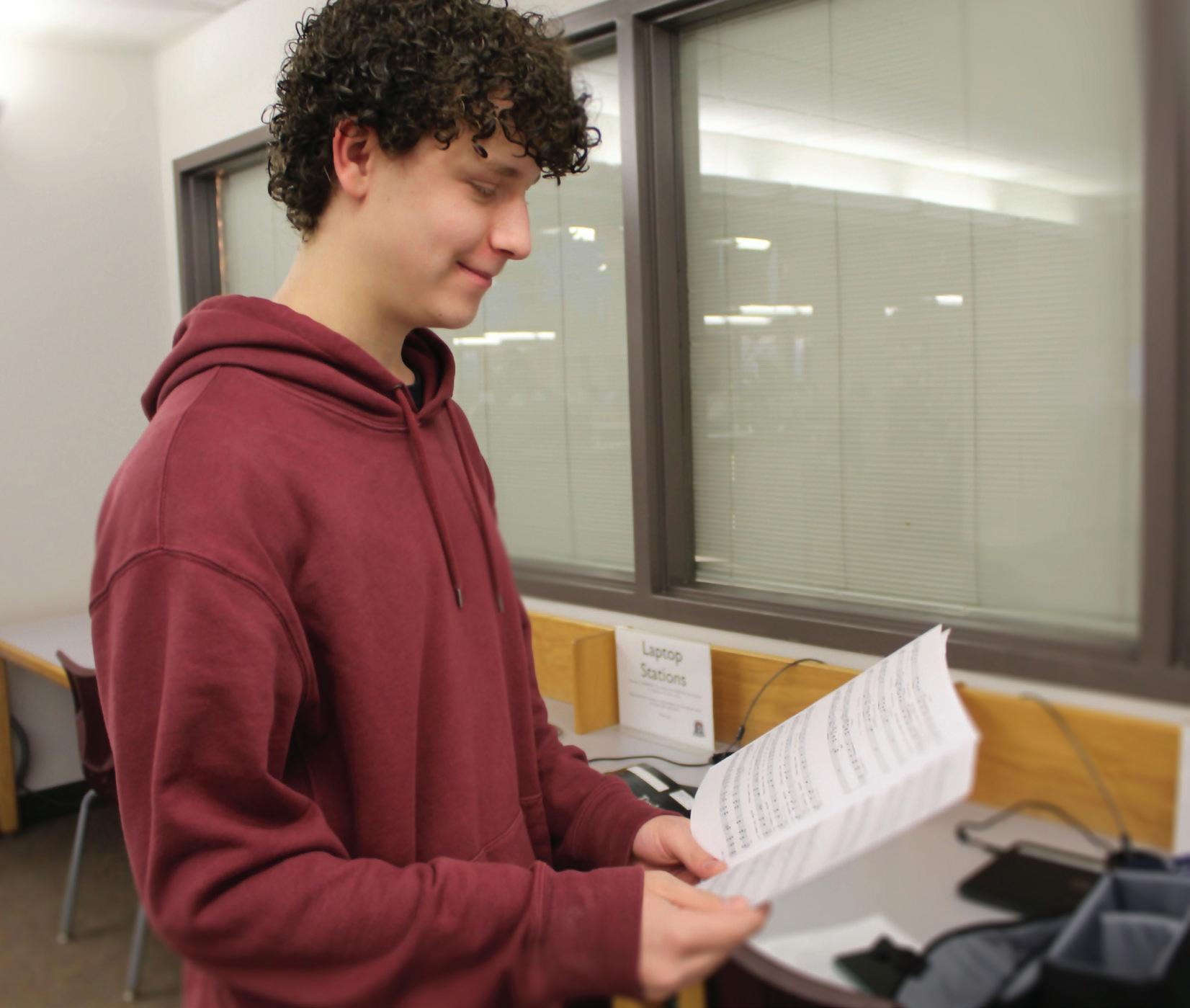
Practice makes perfect: Junior Ethan Marshall reads concert material to prepare for regions. Marshall placed at districts for the first time this year and advanced to regionals.
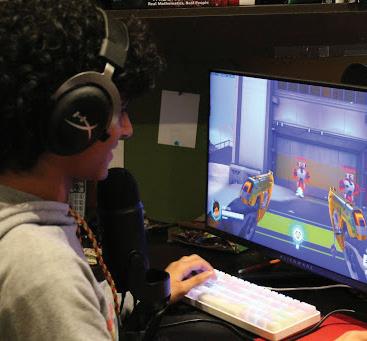
Overwatch showdown: Freshman Kiran Stanislaus practices professionally with his team to prepare for upcoming Overwatch competitions. Stanislaus began playing about seven years ago.
Lexi Lin/The SPOKE
Candelario’s
Abby Bagby T/E Life Editor
Not far from the doors of ’Stoga lies Candelario’s Pizzeria and Restaurant, a local Italian eatery serving hearty, homestyle dishes. Offering in-house dining, takeout, delivery and catering, the pizza shop serves customers in a variety of fashions.

An extensive menu provides numerous options for appetizers, sandwiches, entrees, and — of course — pizza. Service is quick and courteous, with a reasonably priced menu affording the customer substantial portions.



The chicken parmesan panini offers house-made chicken cutlets and tomato sauce sandwiched in between toasted, thick-sliced Italian bread. Tender chicken was well-cooked and seasoned with savory Italian breadcrumbs, topped with fresh mozzarella cheese. The sauce was sweet and finished the sandwich nicely.
The restaurant’s cheesesteak was double the size of most, thus providing the customer with their moneysworth. The thinly-sliced
Juniors form knitting, crocheting club, chapter of Warm Up America! foundation
those to the organization. And that just benefits different types of people in need,” Harrill said.
Warm Up America is a club recently formed by juniors Raegan Kelly and Peyton Harrill. The club is an affiliate of Warm Up America!, a nonprofit organization that provides knitted and crocheted blankets, clothing and accessories to those in need across the country.

With over 30,000 volunteers, the WUA foundation has made over 1 million donations to a variety of social service agencies that have benefited from the effort.
Inspired by their work, juniors Raegan Kelly and Peyton Harril recently formed the Warm Up America club, an affiliate of the nonprofit. They founded the organization to be unique because they accept a large variety of items including blankets, clothing and accessories, which are donated to those in need across the country.
“We have our members make the crochet and knitted items. And then at the end of the year, we’ll collectively give
Members of the Warm Up America club meet once a month to spend time together working on various projects.
Hot chocolate and snacks are set up, and students have the opportunity to be productive in a lively environment. The club has held two meetings thus far and received completed hats, gloves and scarves, as well as squares for blankets.
“For beginners it was perfect because you could just donate squares, but for more advanced people, they could do whatever they want. It was a really good way to let everyone of all skill types join,” Kelly said.
Freshman Danielle Douglas started crocheting and knitting when she was in seventh grade. Douglas saw the club as an opportunity to get back into an activity she enjoys while creating a positive impact on the community.
“I’d like to contribute a couple of squares towards a blanket,” Douglas said.
Kelly and Harrill express their ambitions for the club as one that can provide a lively and supportive space for its members. They also hope that through their efforts they can contribute many knitted and crocheted items to the Warm Up America foundation.
“We hope that everyone has maybe one or two projects by the end of the year. And since it’s our first year, from then we’ll expand and then maybe have more set or definite goals,” Harrill said.
The impact of the Warm Up America club will continue expanding to its full potential with the support of its Conestoga community. Interested students can get involved by talking to Harrill, Kelly or a club member to join the Schoology group and attend meetings. Members can bring their own supplies, and extra yarn and hooks will be provided.
“It means a good amount because I (can) do something I enjoy”, Douglas said. “And I get to help other people, which is something I care about.”
On call: Junior raises sheep for 4-H club
steak was tender and coated with cheese. Fried onions added a savory dimension to the sandwich. Soft, pillowy, house-baked bread provided a superior roll for the sandwich.
The classic calzone involves the restaurant’s traditional pizza dough, stuffed with ham, mozzarella and ricotta cheese. The dish was wellcooked, with a crispy, golden-brown crust, and served alongside their tomato sauce.
The classic pizza was a must-order at the restaurant. The crust was crispy on the bottom and softer at the top. Sweet tomato sauce was well-proportioned with fresh mozzarella. A hefty proportion is sure to serve multiple upon your visit to this Italian eatery.
Nurturing nature: Junior Katie Lavallee holds one of this year’s newborns as the mom looks up at her. This event was one of the only single-lamb births this year because of the Cache Valley virus.

It is 2022 Super Bowl night, but junior Katie Lavallee is not watching the game. Instead, she is shivering in the bed of a truck, trying to stay calm on the 45-minute drive to the animal hospital.
Just hours before, Lavallee’s group leader called her in because Lavallee’s ewe (female sheep) was going into labor. However, the birth did not go exactly as planned, resulting in signi cant complications.
“I held (the ewe’s) uterus and we slowly loaded her into the truck,” Lavallee said. “It was like 20 degrees. It was really intense because if the uterus ruptures, that could cause her to pass away. She was oating side to side so I just had to make sure nothing happened.”
Eventually, they made it to the hospital and Lavallee’s ewe recovered back to health. e experi-
ence only strengthened Lavallee’s dedication to working with sheep, and she now leads the Sheep Club at Delaware County 4-H. She is still taking care of the same ewe, while mentoring and teaching the other kids in the club.
4-H is a national organization centered upon teaching young people about agriculture. Lavallee’s program is located at the Garrett Williamson Barn in Newtown Square, which a community member donated so 4-H could teach about agriculture and raising animals. e 4-H program has since expanded to include STEM and creative activities. “ ere’s a bee club. ere’s archery. ere’s gardening. It’s more than just agriculture. I would say it started out as that but it has really expanded in the last 10-20 years,” Lavallee said. Lavallee rst became involved with 4-H when her dad saw an advertisement in the newspaper.
Although 8 is the minimum age to become involved with the animals, Lavallee started spending time in the barn at 6 years old. She would help her older sister with her Horse Club chores, while observing the other animals in the barn.
“While I was there in the winter they always had breeding and lambing, and lambing was a really cool experience,” Lavallee said. “I would go in the barn, and they have heat lamps and the lambs would be there. I just adored them. ey’re like stu ed animals. at’s what really made me want to join (Sheep Club).”
Being in Sheep Club soon became a year-long commitment for Lavallee. e adult instructors at 4-H bring in a ram to breed with the 13 ewes from August to November. e ewes give birth from late January into February.
en, the club members raise the babies for half a year, feeding
and training them for outside fairs. Finally, they sell most of the ewes o by the end of the year, but keep two to three of them.
“ ere’s so much to it,” Lavallee said. “I’ve learned the true meaning of hard work and passion, getting up at 5 a.m. to go see a birth or being on call just to be there when my ewe is in labor. I also have learned a lot about leadership. I am currently the leader of the Sheep Club, so I organize events and am in charge of the club’s agenda.”
For Lavallee and her group members, situations like that on Super Bowl night are not entirely uncommon. During the regular birthing period, from late January to February, Lavallee must be on call and ready to come in at any time of day or night if her ewe goes into labor.
is year, due to the uncommon Cache Valley virus, there have been many miscarriages and
stillbirths. e virus also caused many of the sheep to have twins. “Animals are a lot of work and I think it has taught me that a lot of times you’ll put so much into things and they don’t always work out,” Lavallee said. “You just have to trust that it’ll all work out eventually.”
Scan the QR Code below to watch an accompanying video package!

T/E Life Tuesday, February 21, 2023 5
Joanna Harris Sta Reporter
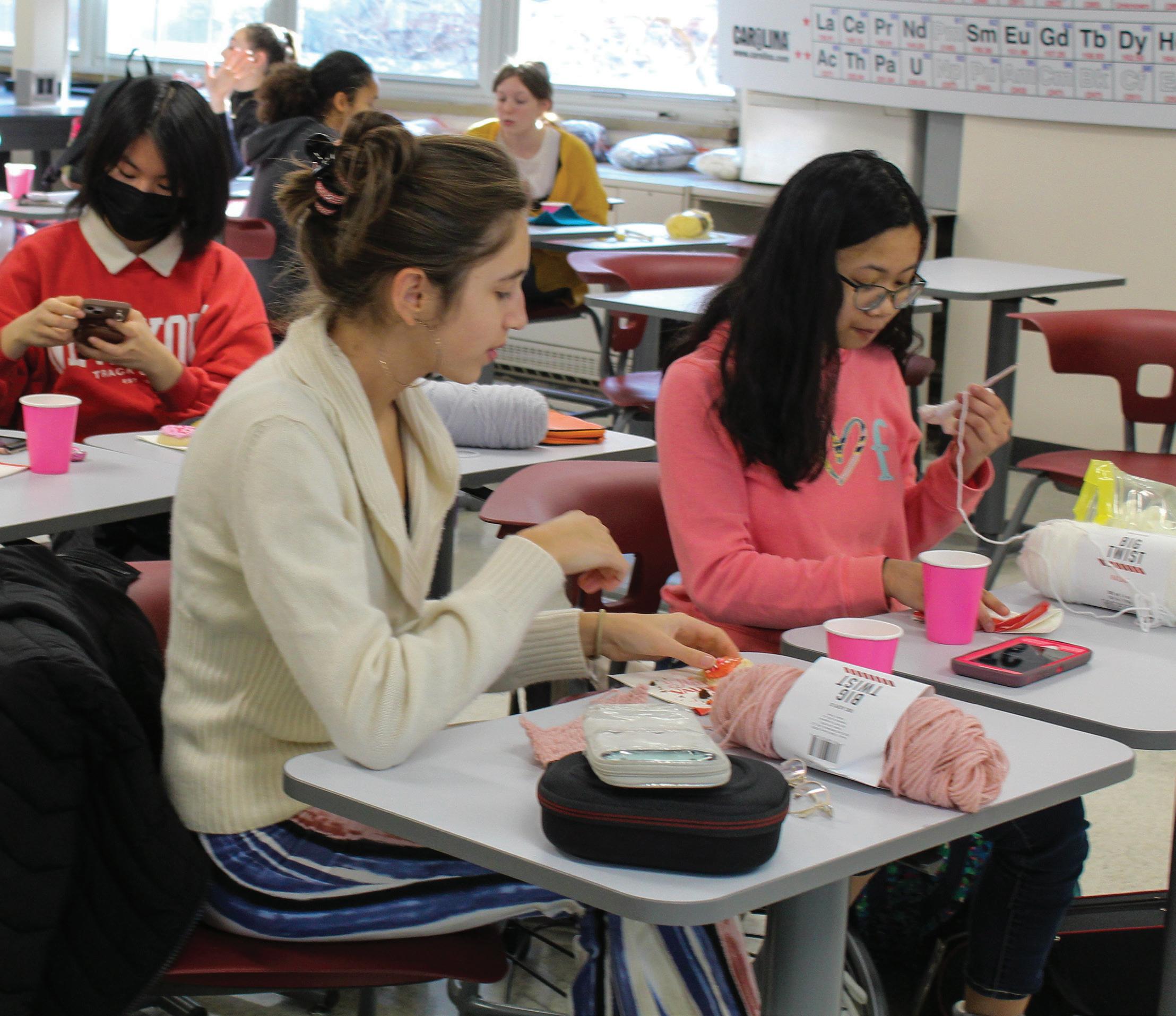
Crafting with passion: Students in a Warm Up America meeting enjoy Valentine’s Day themed snacks while knitting and crocheting. The club was formed during this school year. Yarn squares will be donated to Warm Up America! and joined with others to create a blanket.
Joanna Harris/The SPOKE
Julia Harris Sta Reporter
Julia
Harris/The SPOKE
Friday
10
10
Sunday: 12
8
:
Candelario’s 802 Lancaster Ave Berwyn, PA 19312 Price: $ Rating: Phone: 610-889-0669 Monday - ursday: 10 a.m. - 9 p.m.
- Saturday:
a.m. -
p.m.
-
p.m.
Hot and fresh: The chicken parmesan panini is served alongside french fries. The restaurant o ered a variety of
sandwiches.
Abby Bagby/The SPOKE
T/E Middle School teacher named 2022 Educator of the Year by World A airs Council

T/E Middle School teacher
David Hardy spent the past seven years developing his approach to teaching and advising the members of the Junior Model United Nations club. The World Affairs Council of Philadelphia recently recognized his efforts, naming him the 2022 Educator of the Year. Hardy, upon learning of this recognition, attributed it to the club as a whole, more so than simply himself. He appreciates the honor for the club’s collaborative efforts, and views it as a culmination of several years worth of work. By organizing events such as a schoolwide cultural museum and guest speeches known as TEM Talks, Hardy provides unique opportunities for engagement.
“At first, I was excited for us as a group. Since this award, we’ve been getting a lot of notice. I’m just happy for them,” Hardy said.
Hardy holds JMUN club members to a high standard. He values character and leadership abilities, and aims to
instill passion for their work with the club.
“I’m looking for commitment; I’m looking for leadership. But mostly, (being) thoughtful, kind, polite. My approach is to try to exhibit those things, and then expect those things from the students who are in the program,” Hardy said.
Seventh-grader Tvisha Jani is a member of the JMUN club and appreciates the lessons she’s learned from her experience in the program.
“(I’ve learned) definitely resiliency, and also working hard to bring out the best in yourself. The Junior Model UN really helps us get a perspective into other countries, and it’s really fun,” Jani said.
Although the club faced challenges during the pandemic, Hardy emphasizes that the JMUN club maintained its traditional commitment. Through navigating new logistical approaches, the club was highly active.
“Even (during) COVID time, we did extremely well. We kind of reinvented how we did things — we went virtual, and I don’t think we lost
a beat,” Hardy said. “One of the benefits we got from using Microsoft Teams was that we could find ways to connect with other countries, and I think it was pretty successful.”

Seventh-grader William Simon values Hardy’s approach to advising the club and developing the students. Despite past setbacks due to the pandemic, Simon feels that the club’s perseverance was evident.
“Our resiliency made us better,” Simon said. “(We’ve learned) definitely hard work and grit, and just trying your best.”
Hardy aims to promote inclusivity at TEMS through the JMUN program. He hopes that students of various backgrounds feel recognized and appreciated for their culture’s unique customs and traditions.
“I just want them to feel good about themselves,” Hardy said. “I think that’s one of the most important things I want to instill in these students. You’re beautiful, your family’s beautiful, your community’s beautiful, and therefore you don’t need anyone to make you feel that way.”
BOP: Asian-influenced food truck opens in Devon
Copy Editor
What has three letters, four wheels and scallion pancakes?
Of course, BOP does!
In November 2022, two
TESD residents — Sung Jung, a New York City chef, and Joseph Chang, a Conestoga parent — launched BOP, an Asian-influenced food truck in Devon.
The name BOP originates from the Korean word “Bap,” which translates to “rice.” Jung and Chang believe the name is appropriate because, along with meat, drinks and dessert, BOP primarily serves hand-crafted rice bowls. “We created dishes that are hopefully reminiscent of home, comfort, warmth and with a modern, fresh flavor,” Jung said. “Proteins over rice is our one-line. The break-
down of a single (rice bowl) would compose of a main component, a protein — beef, chicken or pork — (and) two veggies sitting over rice.”
e creation of the BOP bowl originates from Jung’s and Chang’s experiences decades earlier. e pair rst bonded over their passion for cooking while attending college. A er graduation, Chang entered the business eld, while Jung pursued his hobby further. He took culinary classes, worked for New York City’s ABC Kitchen and eventually worked his way up to a renowned restaurant in South Korea.
For Chang, however, the hobby never died. Utilizing the skills he gained from studying business, Chang formulated an idea with Jung that reconciled their two skills — business and cooking.
Initially, the two wrestled amongst several options that served food, including opening a restaurant, starting a home-delivery service and catering for large parties. However, given their physical surroundings, the evolution of a food truck seemed natural for them.
“I talked to (Jung), saying ‘Hey, you know what?
I’ve been here for over 35 years, and I’ve never seen a food truck in the suburbs.
It’s always in the cities, but there are really none of them in the suburbs,’” Chang said.
“Because the demographic has changed so much since I first moved here, I feel (a food truck) would provide things that were just never available here.”
According to Chang, among these benefits include serving food fresh to custom-

ers rather than from a prepackaged container. Yet, for Jung and Chang, opening a food truck had its challenges. Shipping the truck from Florida to Pennsylvania and receiving licenses of approval from counties were among the few hurdles they had to overcome before starting their business.
Once they retrieved their truck and began serving customers, they appreciated the benefits of the business. Jung and Chang receive a sense of fulfillment from operating a food truck. They attend multiple events, do what they love and serve hot meals, providing them with a sense of satisfaction.

“This is what I love,” Chang said. “I love cooking (because) you see people enjoying the food. And that makes me happy.”
Seventeen years ago, math teacher Vincent Russo founded Conestoga’s Math Competition Team for students passionate about exploring the world of mathematics through competitions. Now, the MCT is on track to take rst place in the Pennsylvania Math League.
e Pennsylvania Math League is a six-question test taken every month, from October to March. e ve students with the highest scores are counted for the team’s total score. is year, ’Stoga has held the rst place position since the rst PAML test in October. e varsity captain, junior Rhea Malik, has been on the team since she was a freshman. Along with receiving high PAML scores this year, Malik also coaches other members on concepts commonly seen on math competition tests.
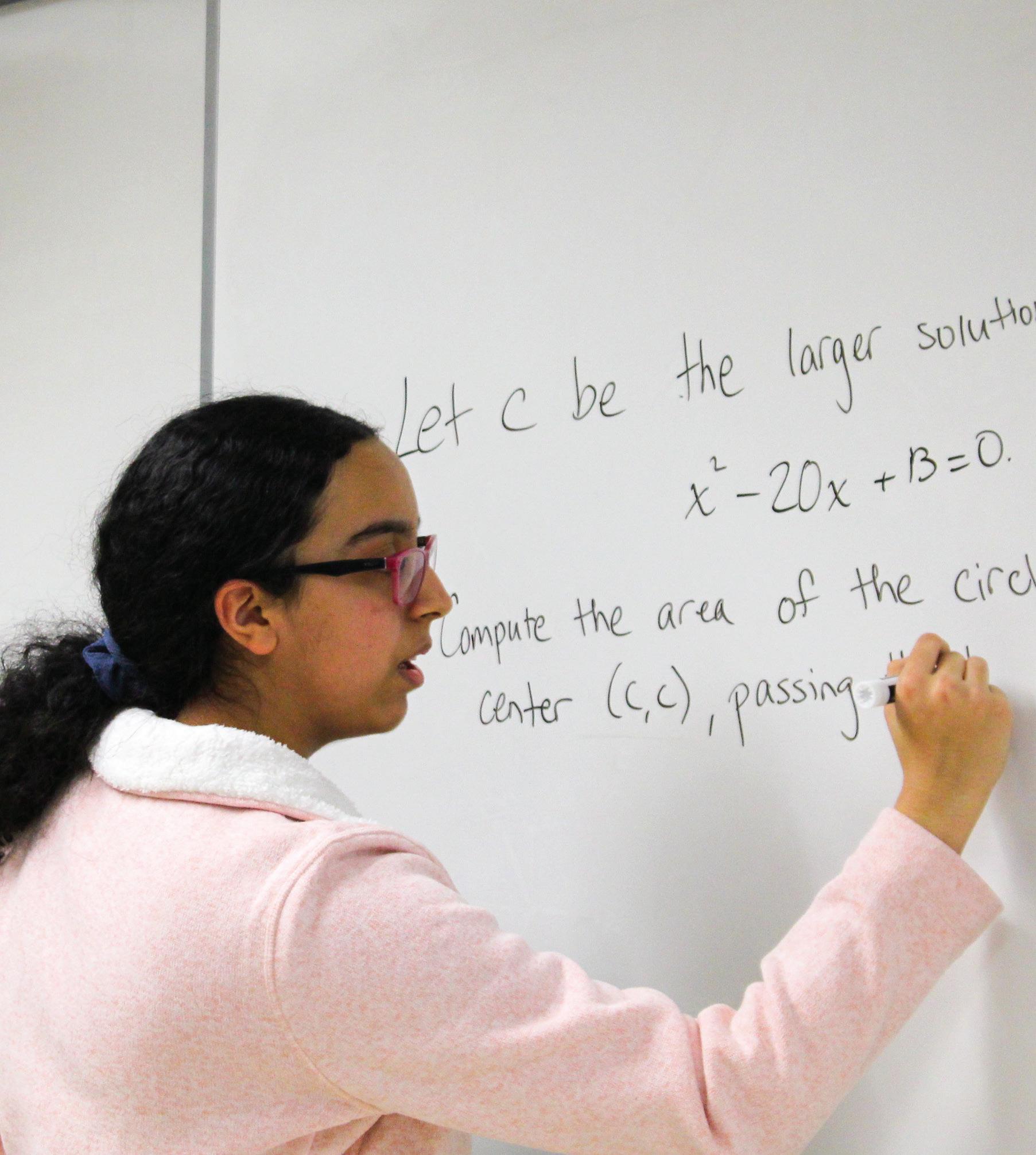
“Leading the lessons helps solidify the knowledge (of math concepts) for myself,” Malik said. “When I’m teaching (lessons) to people, I have to know what I’m doing.”
A major goal of the MCT is to be a place where students

who love math can develop a variety of problem solving skills and to provide an opportunity for them to perform in mathematical competitions.
“In high school a lot of people have less time, so they slow down (their participation in math competitions) even though they love doing math,” Malik said. “With the club, we hope to keep (that) interest going.”
One of the MCT’s newer members is freshman Je rey Wang. Before joining the MCT, Wang competed in Mathcounts during middle school. is year, Wang and a group of his fellow freshmen joined the MCT, where they engage in friendly competitions over their PAML scores.
“When I see my friends doing (math competitions) I feel inspired to repeat a er them and (to) do the same as them,” Wang said.
e MCT has a history of placing either rst or second every year from 2014 to 2021. e team attributes their success to perseverance.
“We have really smart people on the team, and we also put in a lot of practice,” Malik said. “Practice makes perfect.”
However, ‘Stoga’s long history of success is not without difculties. e team faced many challenges during the pandemic.
Last year, Conestoga placed seventh in the state PAML. Senior Evelyn Yu, a four-year MCT member, felt less motivated to participate due to the virtual format feeling less exciting than in-person math competitions.
“One of the things that the math competition team does is have actual matches with other schools, but we couldn’t do that with COVID,” Yu said. “A lot of our competitions (were) changed from being on paper to online. Just the experience was di erent, (so) less people wanted to (compete).”
Closing out the season, the team hopes to hold their place in first for the final PAML test in March and to continue to expand their membership. They plan to achieve this by participating in more matches against other schools, where members can obtain more experience. Although many might attribute ’Stoga’s success to their strong mathematicians, Yu credits their success to hard work and experience.
“People who do (well) on math competition tests are people who have done math competition tests before,” Yu said. “Not even people who are good at math. You just have to be willing to try.”
Tuesday, February 21, 2023 T/E Life 6
Rowan Chetty and Mary Wolters Sta Reporters
Math competition team cons-tan-tly places first
Zara Samdani
T/E Life
Abby
/The
Abby Bagby
Editor
Zara Samdani/The SPOKE
Bagby
SPOKE
Project planner: T/E Middle School’s Junior Model United Nations adviser David Hardy poses next to a display of Lebanese culture in the school’s library. The club coordinated numerous projects around the school promoting inclusivity and cultural awareness.
Competitive captain: Varsity captain, junior Rhea Malik writes a math competition problem during one of the team’s practices. Conestoga has been ranked first in the state for the Pennsylvania Math League since October. The team hopes to hold their place in first for the final PAML in March.
Rowan Chetty/The SPOKE
Cooking up a storm: BOP owners Joseph Chang and Sung Jung and prepare for an event at West Chester University. BOP has catered for tailgate games, church gatherings and graduation parties since their founding. They will expand their catering services in other locations in the future.
Ever since high school, Joseph Spiotta had a deep interest in history and was eager to learn about the subject. Spiotta now teaches AP U.S. Government and Politics and sociology. Strangely enough, it was not a history teacher that sparked his love for teaching, but his high school science teacher, Mike Gyra.
“The way he approached teaching I thought was really cool. There was a lot of stuff that he did, (that was inspiring)” Spiotta said.
Spiotta’s first career choice was never teaching — rather it was food service management. Spiotta grew up in Boston and attended Boston College. He pursued a career in restaurant administration, but felt burnt out after working in corporate dining for seven years. He then turned to his passion: teaching.


“The desire (to teach) was always there, but I had other things going, and once it turned out that was not going to be for me the rest of my life, it became time to reevaluate options. Teaching was the thing that I was drawn to and was the thing that made sense, and it turned out to be the right move,” Spiotta said.
Spiotta began working at ’Stoga as a long-term sub until the pandemic hit and his world turned upside down.
By the time school had returned to normal, he had barely been in the building except to pick up textbooks, so coming back for his first full in-person year last year was a radical change.
“Seeing the students and physically being in the same space as them is like night and day,” Spiotta said.
“There’s much more of a connection (being in person), and for me at least, getting out of the house is a really good thing.”
Spiotta also emphasizes the importance of a positive worklife balance, as he is a new father and spending time with his son is the highlight of his day.
“We have an 18-monthold at home, so there’s a lot of time spent with (him). A lot of going to the park, going for walks and hanging out with him,” Spiotta said. “That takes up a lot of the day. But (being a father) has been awesome. I mean, it’s a lot and you don’t sleep as much, but it is so cool to see that development happen right in front of you.”
Spiotta’s favorite parts of teaching include meeting people with different backgrounds and perspectives, helping them understand the greater diversity of perspectives and developing a positive relationship with his students.


“I like working with students and seeing them make connections,” Spiotta said.
“Those ‘aha!’ moments are something I always look forward to.”
7 Tuesday, February 21, 2023 T/E Life
Isabelle Emmanuel Sta Reporter
Teacher Feature: Joseph Spiotta
Isabelle Emmanuel/The SPOKE Lesson plans: AP U.S. Government and Politics and sociology
stands next to his desk in his classroom. Spiotta taught at ’Stoga for three years.
Courtesy Brooke Hauer
teacher Joseph Spiotta
Dear Mindy, this isn’t what I asked for
in “ e Sex Lives of College Girls,” she informs the audience of her high school woes. Malhotra announces that she is no longer an “Indian loser with cystic acne, sweaty armpits and glasses.” In the Net ix show
Shreya Vaidhyanathan Opinion Editor
Mindy Kaling is a phenomenon. From writing for “The Office” to developing “The Mindy Project” to executive producing and starring in “Velma,” not to mention receiving six Emmy nominations, her resume is more than impressive. More than that, Kaling is a pioneer for brown women and South Asian representation in the film industry. She has made space for brown writers and producers everywhere, especially at her production company Kaling International, which she launched with the goal of “telling stories about the inner lives of women of color that have long been missing from TV,” according to Time Magazine.
So, what went wrong with her brown characters on screen?
Within 30 seconds of college
freshman Bela Malhotra’s debut
“Never Have I Ever,” protagonist Devi Vishwakumar takes a scissor to her “barbershop oor” arm hair in the rst scene of the show. Most recently in “Velma,” two police o cers joke about South Asian Velma’s size and “hairy gorilla arms.” e same jokes about brown girls’ appearances that seem
nes as “having a wide range of raced and gendered tropes projected onto their bodies.” e struggles that racial stereotyping causes in girls of color prove that it is high time to let go of the “ugly brown girl” trope. is isn’t to say that current brown representation is all bad, or that good representation must always be positive. e mere existence of characters like Devi and Bela is a step in the right direction for Hollywood and small-screen media. However, we must be aware that these characters perpetuate the “Indian loser” stereo-
a single creator. A er all, South Asian comedians like Lilly Singh and Russell Peters have been making jokes about their cultures since the beginning of their careers, possibly out of a need to satirize their experiences before someone else does. Brown creators may feel like they have to feed into stereotypes in their work as a result of the racism and backlash they have experienced in their own lives.
to emerge in every show with a South Asian character are stale and worn out. A study at University of Illinois focuses on the damaging impacts of “misrecognition” on the development of younger brown and Black girls, which the study de-
type and treat their brownness as something to overcome, and how characters’ actions can in uence the self-image of brown girls.
Pinning this problem squarely on Kaling is out of the question; we cannot attribute racism and microaggressions on TV to
e portrayal of brown women in the media was riddled with issues long before Kaling was involved in the conversation, and her inclusion in Hollywood as more than a diversity hire is a signi cant measure for South Asians in the entertainment industry. Now more than ever, we must think critically about work produced by brown creators, and take into account all the messaging that comes from how brown characters are presented on TV. Consider supporting more positive representation like season 2 of “Bridgerton” on Net ix and being more conscious about the content you consume. Allowing the “ugly brown girl” and “Indian loser” tropes to drag on means allowing the misrepresentation and misrecognition of South Asians to persist, a disservice to both audiences and brown creators themselves.
Anti anti-aging: Old is okay
path. e obsession with looking younger must stop, and we need to learn to embrace aging.
Jui Bhatia Managing Editor
Just yesterday, TikTok showed me a video of a woman drinking something through an “anti-wrinkle straw.” Barrett Plastic Surgery, a clinic based in Berkeley Hills, posted the video, and the idea of the straw was to avoid wrinkles to keep looking younger for longer, because apparently, normal straws cause wrinkles earlier.
A 2016 study by market data company Stella Rising shows that 18% of the women under 34 surveyed are using anti-aging products, including creams and gels. is is not an isolated case of increased concern over aging. As teenage girls see videos like the one put out by Barrett Plastic Surgery, they are in uenced to go down a similar
Exposure to anti-aging primarily occurs through lters and editing on social media. Many of the pictures that celebrities post online are edited using apps like Facetune, if the built-in lters on TikTok and Instagram are not enough. As older celebrities edit their pictures, they look younger than they are which building a skewed perception of what a certain age looks like. is directly affects girls and women 16-23 years old, according to data company Market Charts. As teenage girls see these seemingly young-looking older women online, they are set up to want to keep looking young as they age. It sends a message to these young girls that they need to look young to stay attractive.
Looking young or wanting to continue to be healthy is not bad.
ere are many ways to maintain oneself that do not involve contributing to the anti-aging industry. Exercising is one of the most e ective ways to keep oneself energetic and t. Sunscreen and basic skincare are a few other ways to maintain your skin and
protect oneself from the e ects of air pollution and UV rays.
Anti-aging in uencers are gaining popularity on platforms like TikTok, with hashtags like “skin uencers” gaining 66.9 billion views. According to social media marketing company Fanbytes, Gen Z makes up about twothirds of their viewerbase. ese in uencers inform teenagers about the various components of their everyday lives that could be making them age faster. Worrying about aging, ironically, makes one age faster according to a study in e Journals of Gerontology. By promoting anti-aging tools, these in uencers ensure that they, along with the companies they partner with, are pro ting o of these girls and making them lifelong customers. is tactic works: in 2020, the Anti-Aging Products market was estimated at $11.6 billion, and is estimated to reach $47.8 billion by 2027.
However, the most important way to keep t is to embrace aging. Worrying about aging causes you to age faster and most anti-aging tools are not certied by the U.S. Food and Drug Administration. Growing old-
AI generated images are not art

origin, I only got the answers right about half the time. On a surface level, AI-generated images seem as though they can easily slip under the term “art.”
Stop gentrifying Chinatown

is at risk of extinction. is predatory development needs to end.
George Zhang Photography Editor
Gentri cation, which Merriam-Webster de nes as a poor area experiencing an in ux of middle-class or wealthy people rebuilding homes and businesses, o en results in an increase of property values and the displacement of former residents. is is currently a key issue of an ongoing battle in Chinatown…yet again.
In 2022, the Philadelphia 76ers unveiled an ambitious plan to build a new stadium for fans. Located between 10th and 11th Streets on Market Street and dubbed 76ers Place, the privately funded $1.3 billion establishment will hold up to 18,500 spectators and is slated to open its doors in 2031. Less than a block away sit the century-old homes and businesses of Chinatown, an ethnic community that
76ers Place would be detrimental to the everyday lives of residents. According to the Centers of Disease Control and Prevention, gentri cation can lead to public health disadvantages caused by greater socioeconomic inequality, increased living costs and the exposure of vulnerable populations to hazardous construction materials such as lead paint.
76 Devcorp, the arena’s construction rm, has voiced in their inclusivity statement that they want to “form a long-term partnership with the community” and “collaborate to address local priorities.”
In reality, this is not the case as the rm has mostly discussed them during closed-door meetings. e Philadelphia Inquirer reported that attorneys of the rm tried unsuccessfully to sneak a clause into an unrelated parking garage bill that would have fast-tracked the arena’s construction by requiring the garage owners to consent to future demolition to clear space for the arena, showing that these promises are nothing but empty rhetoric. is is not the rst case of predatory developments in Chinatown. In the past 20 years, residents successfully blocked the
Editors-in-Chief: Evan Lu, Hiba Samdani
Managing Editor: Jui Bhatia
News Editor : Ben Shapiro
T/E Life Editor: Abby Bagby
Opinion Editor: Shreya Vaidhyanathan


Sports Editors: Howard Kim, Hannah Simon

Beats Editor : Maya Shah
Multimedia Editors: Katherine Emmanuel, Grace Kuryan

Webmasters : Rohan Anne, Soumya Sathyanarayana
Business Manager: Michael Tierney
Photography Editor: George Zhang
Social Media Editor : Akshita Joshi
Copy Editor: Zara Samdani
Design Editors: Aren Framil, Raima Saha
constructions of a baseball stadium, casino and even a federal prison. Unfortunately, similar communities across the nation have not been as successful, as seen with the construction of the Capital One Arena in Washington D.C. Chinatown, causing a community of 3,000 people to dwindle to just 300, according to the Washington Post. e solution is simple: don’t build a stadium at all. What good would a new arena even serve? For chairman of the arena development corporation David Adelman, the answer is to encourage more customers to visit restaurants and stores in Chinatown. However, what Adelman doesn’t understand is that Chinatown isn’t a tourist attraction — it’s a cultural haven with a fragile and rich history.
What started out as a single laundromat blossomed into a vibrant community protected from prejudice and hate. However, the fate of this community now rests in the hands of activists stopping at no end to champion this cause and spread awareness. Playing my part, I also echo the same seven words as my brothers and sisters.
There must be no arena in Chinatown.

Whether it be a photorealistic image of a dog performing surgery or a Da Vinci-style portrait of Donald Trump, any coherent text prompt fed into recently released arti cial intelligence systems like DALL-E 2 or Midjourney can shoot out original digital images in seconds.
I experimented with these programs myself and was awed by this perceived creativity. However, I can’t help but disagree with the sentiment that this qualies AI images as art. e overlap between AI images and art can be partially attributed to the fact that telling the di erence between them is dicult. Ahmed Elgammal, director of the Art and AI Laboratory at Rutgers University, describes that AI programs use algorithms to learn from countless existing artworks in order to mimic them in his New York Times article. A er identifying a variety of artistic elements, AI can replicate them when given a text prompt. As an artist myself, when quizzed on choosing whether an artwork was of AI or human
Cartoonists: Angie Chen, Hannah Gupta, Mia Hamilton, Chiho Jing, Leon Li, Eden Liu, Shine Lin, Yuting Pu, Tashikaa Senthilkumar
Sta Reporters : Prashi Agarwal, Tanisha Agrawal, Miya Cao, Alexander Carder, Vanessa Chen, Weihan Chen, Mareska Chettiar, Rowan Chetty, Abigail Chong, Ryan Ding, Isabelle Emmanuel, Saktisri Gowrishankar, Joanna Harris, Julia Harris, Je rey Heng, Evangeline Kennedy, Audrey Kim, Bailey Kreszswick, Soumya Krishna, Shrija Krishnan, Lexi Lin, Margaret Neary, Riddima Pandey, Lauren Pinheiro, Abbie Preston, Madeline Pulliam, Louisa Sandor , Emily Scheer, Sousanna Sengal, Aashita Singh, Eshan Singh, Vaishnavi Sriadibhatla, Elizabeth Sun, Remington Vaughan, Alexa Willrich, Mary Wolters, Juliana Yao, Faith Zantua Faculty Advisers : Alison Ferriola, Laura Howard, Nicole Zakorchemny
However, to argue whether AI-generated pictures qualify as art is a philosophical undertaking. e de nition of art is varied and subjective, but the few key requirements are imagination, technical skill and expression, as gathered from ethics journal Philosophy Now and Encylopedia Britannica. For example, Oxford Languages includes the spark of human imagination and how it is expressed as a parameter for the term, while Webster emphasizes the skill developed from experience in the eld.
tent. To create AI pictures, the user must rst translate mental images and concepts into words for the AI. However, art is meant to convey exactly what the artist cannot convey through language; a direct depiction of the mind to a canvas.
Intent is not achieved through AI programs because users have no hand in what AI creates a er supplying a text prompt. is sacri ces the artistic process, in which artists use particular hues and linework to establish certain imagery, a level of intent and authenticity that AI art lacks. Whenever I had a speci c image in mind that I wanted AI to replicate, nding the precise wording to do so proved impossible. Users are forced to adapt to
One of the most important aspects of art that AI art does not meet is e ort. For an artist to be able to cra an artwork that captures their intended purpose, dedication and discipline is necessary. A work of art does not only represent the artist’s ideas, but also the hours of practice to develop the cra smanship behind it.
Nevertheless, I have seen people argue that AI-art requires skill, which makes it art: the skill to develop prompts that will most closely produce the desired image. Creating a prompt requires practice and time, and they liken this to learning and practicing artistic techniques. While I can con rm that it takes work to create the best prompts, equating this to actual artistic skill is similar to saying that spending 30 years to master the FIFA video game will put you on equal footing with Lionel Messi.
what it creates instead of
While I agree with these guidelines, I would add that art is a form of communication that requires in-
forming a
into the

that they desire to tell the viewer.
SORRY, WE MISSPOKE
AI art generators weren’t created to replace human-made art, but as a tool for artists to build upon. Making AI-generated images is an admittedly fun hobby, but it’s never too late to pick up a pencil and start experimenting.

In the January issue, on page 11, Jeffrey Heng’s photo for “Blossoming baller: Freshman Ryann Jennings excels” was misattributed to Ryan Ding.
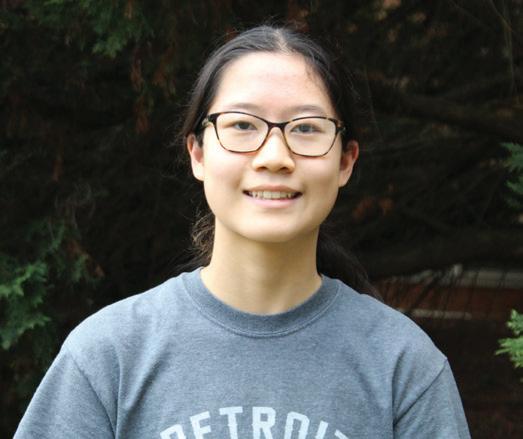
On page 12, an article misstates the score of a squash match. The correct scores are 11-0, 11-6 and 11-3, respectively. On page 12, the boys swimming record should be listed as 5-0-0.
Non-sta contributions: Non-sta contributions from students, the community, graduates or other interested parties are welcome. Editors will decide which contributions are published based on space and relevance to the community. All contributions must conform to journalistic practices, including accuracy, timeliness, purpose and writing conventions. The Spoke reserves the right to work with the contributor to meet these standards. All outside contributions are bylined.
Letters to the editor: Letters to the editor may be submitted to Editors-in-Chief Evan Lu and Hiba Samdani, or advisers Alison Ferriola, Laura Howard and Nicole Zakorchemny.
Editorials:
OPINION Tuesday, February 21, 2023
trans-
canvas
message
The Sta www.spoke.news @thespoke @thespoke /thespoke the_spoke hello@spoke.news
accepts
advertisements. Email hello@spoke.news. The Spoke is published seven times a year by Trumbull Printing. It consistently receives a Gold rating from PSPA and CSPA, and is a National Scholastic Press Association Pacemaker award-winning publication. The Spoke serves as a public forum for student expression.
Unsigned editorials represent the views of The Spoke editorial board, not necessarily those of the administration, student body, community or advertisers. The opinions expressed in signed columns are those of the writer and not necessarily the opinion of The Spoke. Paid advertisements: The Spoke
paid
Juliana Yao Sta Reporter
Tashikaa Senthilkumar/The SPOKE
Yuting Pu/The SPOKE Shine Lin/The SPOKE Hannah Gupta/The SPOKE
Unsigned: The future of AI in the classroom
Whether you need an essay on the Civil War, a proof for the Vertical Angle eorem or a script for a comedy movie, ChatGPT meets your demands in a matter of seconds. In November 2022, OpenAI, an arti cial intelligence research laboratory funded by Microso , developed a chatbot that can retrieve and repackage information a er a simple input of a prompt. e so ware extrapolates from a dataset of over 10 billion words and 8 million documents to synthesize an appropriate and cohesive response.
While the prospect of a chatbot that can generate information was met with delight across the internet, many educators were less than amused. Within the same week, the Atlantic declared the death of the college essay and the end of high school English, and teachers are wary of the implications of a new technology. According to Forbes, a growing number of schools are banning ChatGPT due to a growing concern of academic dishonesty and sti ing creativity.
But before we declare this to be the end of the future of English, we
must look at the invention as an opportunity to reshape learning in the classroom. e program inputs information and returns a response derived from previous searches on Microsoft’s search engine, Bing. e essays, while containing advanced diction and syntax, are distinctively lacking in creative adjectives, features that distinguish human writing. Rather than a solution, the technology should be utilized as an insightful starting point: a student can use ChatGPT to generate ideas and construct a rudimentary outline. With an e ective antidote to writer’s block, students can focus
on weaving complex thoughts, imagery and descriptive language.
Teachers, too, can bene t from the AI program. While it can be used at their own discretion, teachers can
and ask it to generate prompts and questions to facilitate discussion.
According to a nationally representative survey of teachers conducted by the Edweek Research Center, the
ask ChatGPT to give students feedback on assignments, create rubrics and even give inspiration for lesson plans. Furthermore, they can use the application to write sample essays,

average teacher works 54 hours a week, but less than half of that time is spent teaching students. By simply pasting essays into the program or asking it to type an email, Chat
“Last year, when my science teacher recommended me for honors, I wasn't entirely sure that it would go well, but (now) I’m so glad that I chose not to override it because I'm doing so well in it.”
STUDENTS SPEAK OUT


GPT can assist educators with general administrative work and grading. However, this isn’t to say that it can replace human feedback and interaction in the classroom. Just as students can use it as a tool to complete essays, teachers have that same flexibility to brainstorm ideas and create a more enriching classroom experience. ere is still a concern with potential cheating, as the so ware can produce a basic essay. However, Chat GPT is not breaking an education system, but rather calling attention to a system that is already broken. With the prevalence of rubrics and
standardized test essays, many classes have tailored their essays to the notorious ve paragraph structure.
However, rather than resisting the chatbot, we should consider whether assignments completed by a chatbot are really a worthwhile measure of learning. Nothing can follow a formula writing style better than a computer program that works o of algorithms. Rather than have students mindlessly follow a set structure, teachers should teach students to start with ideas and work on how to best express them.
Because we cannot completely ban Chat GPT, we should embrace it with caution. Humans have made similar technological advancements — such as PhotoMath, which can complete a math problem with a quick scan — and Chat GPT is only one of them. Already, a Princeton University student has developed a program to detect the use of Chat GPT, meaning teachers will soon be able to see if the so ware was used for more than just a skeletal outline. Chat GPT is another development, and we have to de ne what its future will look like — not have the program write it for us.

“Some of them (recommendations) are good, some of them not so much; I've de nitely sometimes underestimated a level of a course that they recommended.”
Q: Have you always agreed with your teacher’s course recommendations?
“I agree with my teachers’ recommendations, but sometimes if they recommend me for AP or something, I sometimes go down. I guess it depends if I'm interested in the course.”
...Deserve the love
Maya Shah Beats Editor
O en disregarded as a ctional underdog, the romantic comedy has blossomed into an irreplaceable genre. While some may view rom-coms as a straightforward form of entertainment, unanticipated bene ts lay beneath their surface.
From the beginning, middle and end, viewers have much to gain from something as short as a one hour lm.
Although rom-coms o en come across as lighthearted and silly, producers have used these traits as a way to delve into more serious topics. e simple storylines and happy endings allow for themes of loss and trauma to be explored within a comfortable space. By bringing forward conversations about such topics, romantic comedies discuss loss with a silver lining that makes it more digestible for the viewer. The benefits behind romantic comedies go far beyond just their structure. A 2016 Media Psychology study con-
Report Card
Super Bowl LVII

D
+ Rihanna kept the crowd’s energy up during halftime with banger after banger
- referees Carl Cheffers and James Bradberry were the real MVPs for the Chiefs
Ticketmaster’s Senate hearing
B-
+ definitely a sight to see Taylor
Swift references coming from dignified lawyers
- lawyers not taking the hearing seriously is slightly concerning
“I feel like in order to help you select an elective, (teachers) need to know you a lot better, like your personal interests and hobbies. But for main courses, ask your teachers because they're the ones that will help you the best.”
ducted by Matthew Gizzard, a researcher at the University of Buffalo, found that those with prolonged exposure to films with high levels of romance experienced increased sensitivity in multiple areas, including care and fairness. By bringing forth emotionally-charged plotlines, romantic comedies create a sense of moral openness amongst their viewers. A similar article by Jessica Migala of Women’s Health Magazine finds that the endorphins from a happy ending can prevent insomnia if watched before sleeping. Needless to say, our brains are big fans of the genre.
At their very core, romantic comedies are a representation of both love and humor. By exploring the many different paths love can take, rom-coms push the boundaries on what a relationship “should” look like. Whether it is the classic meet-cute or an accidental run in, there are numerous ways that romantic comedies can unfold, each one offering a different perspective on the course love takes.
Doubters of the romantic comedy claim it warps people’s perceptions of love and relationships. The Daily Mail deemed this the “Notting Hill Effect” after the classic 1999 film, which refers to the idea that those who watch romantic comedies are more likely to believe in predestined love. While this may be the case, the effects of this phenomenon are not necessarily harmful. By raising viewers’ standards, romantic comedies encourage people not to settle for less than they deserve. The examples set by rom-coms are to be taken lightly, but this doesn’t mean they cannot help their viewers by showing the various ways love can look.
Romcoms deserve the benefit of the doubt.
Whether it is the quirkiness of an original like “When Harry Met Sally,” or a modern adaptation of a classic in “Fire Island,” there is something for everyone. If you have yet to cave to the genre, both the psychological and emotional benefits are clear — romantic comedies do more than just entertain. So next time you are endlessly scrolling through movies at a loss of what to watch, consider choosing to indulge in the magic of romantic comedies — you will not regret it.
Raima Saha Co-Design Editor
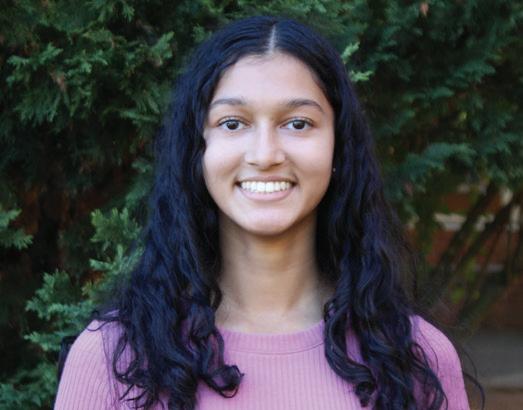


It is that time of year again. With Valentine’s Day on the horizon, movie production studios are churning out light-hearted romantic comedies to get people in the spirit of Cupid. Another gimmick to get you to believe in love and show you that, yes, it does still exist. It is all in good fun — until we think about the unintended, harmful impacts they have on our perception of love. ink about it: these seemingly harmless movies set unrealistic expectations for love that are impossible to meet.
A study conducted by the American Journal of Family erapy found a correlation between romantic media consumption and relationship dissatisfaction, showing that viewers felt their current relationships weren’t meeting the standards of relationships portrayed on-screen. emes, such as “love conquers all” and “they know me better than I know myself,” are far-fetched and impractical. In the Net ix movie “Love in the Villa,” the two main characters, who live in di erent countries, fall in love when visiting Verona, Italy but do not discuss the logistics of what happens a er, such as how their newly forged connection will survive across the span of continents and how their di ering back-
grounds will a ect their relationship. Are we as viewers supposed to believe that love will conquer all, that no obstacle is too great for love to surpass? Audiences can not help but internalize these ideas when considering traits they value in a partner, contributing to sky-high expectations that no one can achieve which ultimately lead to heartbreak.
Rom-coms also portray harmful stereotypes that could hinder viewers from nding love. Most movies show romance between white, heterosexual people, which may convey that a person of col-
+ Beyoncé breaking her own records and we love to see it
- Sam Smith and Kim Petras’ ”Unholy” won an unwarranted Grammy for their performance
2023 Grammy Awards “Outer Banks” season 3
+ trailer shows that Pope finally gets a love interest
- in light of all the cast drama, fans can expect that the chemistry will not be genuine as before
Oscar nominations released
+ Austin Butler nominated for Best Actor for his performance in “Elvis” is well-deserved
- Best Picture nominations are random at best
Soldier, Poet or King Quiz
+ reminiscent of BuzzFeed quizzes
- tells you things about yourself you did not want to know
Rom-Coms ...Deserve the hate
not be loved as they are. ese implications can have detrimental e ects on how people view their own relationships, contributing to dissatisfaction with their partner and their relationship. Continuous pursuit, also known as disguised stalking, is yet another trope that Hollywood has painted as romantic and endearing. Julia Lippman of the University of Michigan found that people who watched romanticized versions of persistent pursuit were more likely to support “stalking myths,” statements that undermined stalking as a real crime. ough not considered a comedy, the widely popular romance movie “Twilight” shows vampire Edward coming into Bella’s bedroom window and watching her sleep. ese mixed messages confuse viewers with harmful ideas of romance, potentially putting them in danger and skewing their perspectives of a healthy relationship.
or or someone who identi es as LGBTQ+ can not nd love. While progress has been made with movies such as “To All e Boys I’ve Loved Before” and “Love, Simon,” they are few and far between for viewers of color or of di ering sexual orientation.
Additionally, tropes such as the makeover send the wrong message. In the movie “He’s All at,” the Net ix spin-o of “She’s All at,” the romantic interest is othered and uncool, and they only become attractive once they have undergone a makeover. is conveys the notion that one must conform to certain societal standards to be considered desirable, and they can
However, many argue that rom-coms are not meant to be over-analyzed. It is a genre that one can watch after a long, taxing day that doesn’t desensitize you to the realities of life. While they may appear to be providing escape, they create more problems than they solve. One is more likely to fall for these idealistic relationships unknowingly and set them as their bar, something that is far more dangerous than rom-coms themselves.
So go out and celebrate Valentine’s Day, whether that’s with someone special, by yourself or with a group of friends. And if you do happen to watch a rom-com, make sure you don’t fall prey to their half-baked truths of romance.


9 Tuesday, February 21, 2023 OP/ED
Leon Li/The SPOKE
A-
C+ C-
-
Alexandra Williams, freshman -
-
Khani Valasa, senior - Eric Xu, junior
Stella Aguiar, sophomore -
Angie Chen/The SPOKE Mia Hamilton/The SPOKE
18 in favor of this editorial,
1 person abstaining. Chiho Jing/The SPOKE tell me 3 things TV SHOWS MOVIES BOOKS PRide and prejudice love and other words lovely war book lovers young royals heartstopper emily in paris clueless 10 things i hate about you how to lose a guy in 10 days love, rosie set it up Hometown cha-cha-cha from scratch when harry met sally sleepless in seattle bridgerton jane the virgin the oc the summer i turned pretty gilmore girls
The Spoke Editorial Board voted
with
Rugby player transitions to Division I-level play
Hannah

Simply needing to play a sport to stay in shape, senior Macyn Bass joined the Conestoga rugby team last spring. With no expectations of playing rugby in college and less than a year’s worth of experience, Bass is now on the cusp of signing a full-ride scholarship to play at Long Island University, a Division I program.

Editor coach of a di erent Division I team approached Bass, inquiring about his possible interest in playing at the collegiate level.

“I was like, ‘Oh my God, I had no idea I had this kind of potential.’
You know, I was having one of those crazy moments where I (couldn’t) believe this (was) happening. And so I went around looking at schools that had programs, and I lled out LIU’s questionnaire,” Bass said.

Middle school squash team wins nationals
With a new coach and a fresh roster, the Tredy rin/Easttown and Valley Forge Middle School girls’ squash team dominated its league, nishing their season undefeated and becoming the rst public school team to win a U.S. Squash National Championship.
In recent years, the middle school girls’ squash team had not seen much success, with few girls interested and rotating coaches. Now coached by Jeremie Aiss-

aoui-Fischer, a Berwyn Squash pro, the team is the only public school competing in the Division I Middle Atlantic Squash Association’s middle school league. e girls defeated last year’s champions Agnes Irwin Middle School 7-0 and ended the season leading the league 6-0. ey won the U.S. Middle School Squash Championship 4-1.
“I think it’s just we have a good group with a good environment,” Aissaoui-Fischer said. “Everything makes it so that everyone feels good, so I just think it’s the vibe.”


Aissaoui-Fischer started playing squash 14 years ago. He believes good athlete relationships are what make the team so successful.
“We do a lot of workouts together. We hang out outside of the courts, and we just really love each other’s company,” Kim said. is is only the rst year the current players have all been on this team together and in a short amount of time, they have developed a tight bond.
“Last year was our rst year as a team and we have already gotten so far. e wins
are also amazing and surprising. We knew our team would be great. but to actually see it unfold is incredible,” seventh grader Jiya Naik said. Qualifying for and winning the U.S. Division 1 Middle School Squash Championship brings a lot of recognition to the T/E girls’ squash programs.
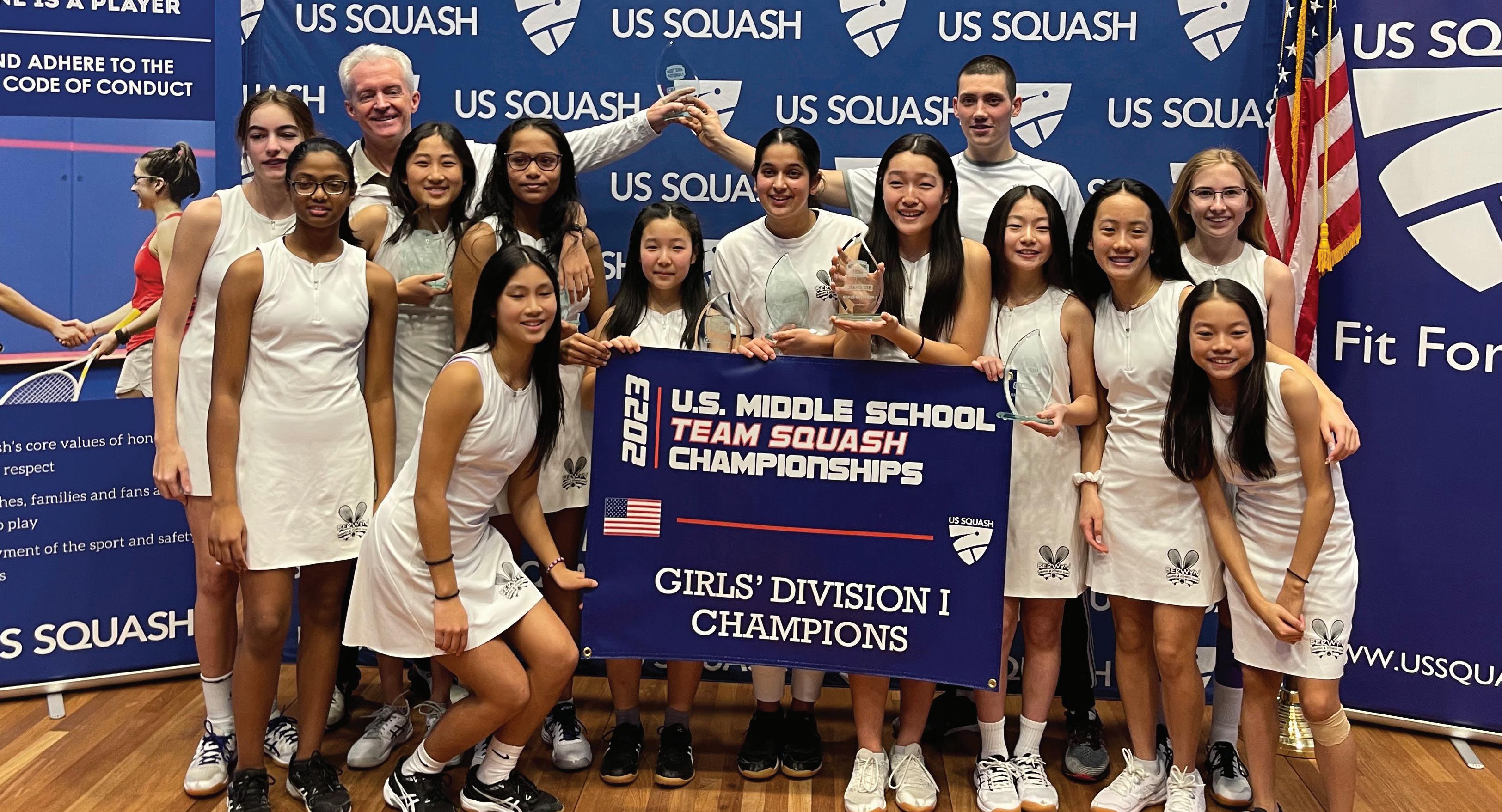
“I have a really good feeling about the Conestoga girls’ squash team because a lot of these girls are training so hard.” Kim said. “I think in the future, we’re going to be really good.”
Girls squash enjoys exceptional season
Maggie Neary Sta Reporter
Last year, Conestoga girls squash entered the 2022 U.S. High School Championships seeded 11th. ey pulled o three wins and su ered one loss at the tournament, nishing h in their bracket. is year, however, the girls’ noteworthy start to their season shows they are out for more.
Since last year, three freshmen moved up in the ranks on varsity, lling the No. 2, No. 3 and No. 4 spots. Additionally, U.S. Squash lowered the number of
players required on a high school team from nine to seven, creating a more competitive roster.
“We’re de nitely stronger as a team (since last year). We’ve had to sit out our top two players for a bunch of matches, simply to make it more even,” freshman Noe Rowe said. e key to the girls’ success this year lies in their work ethic. Between training over the summer and practicing every day a er school, the team has watched their hard work pay o .
“Our top two, Abby Bagby and Anthea Lin, have been com-




peting on their own in accredited junior squash tournaments across the country for many years and are putting in the extra time and e ort to anchor the team,” coach Sunil Desai said. With leaders on the team setting a strong example, other players are encouraged to grow on and o the court.
“A bunch of people on the team have been getting more into squash and practicing on their own, which has just caused the entire team to (grow),” freshman Anthea Lin said. is growth was re ected not only in the team’s per-
“My rst practice, I said I’ve never felt better walking o a eld in my entire life, and I’ve been playing sports since I was a little kid,” Bass said. Having played varsity soball for two years, Bass turned to rugby a er an internal con ict on the team. Also having played football freshman year, rugby’s scrappy and intense style was similar to that of the previous two sports, suiting his past athletic experience. Since beginning, Bass has played for the Phoenixville White Horse Rugby team, as well as Conestoga’s 7-v-7 in the fall. Most recently, this winter, Bass was named co-captain of the team for the upcoming 2023 season. While playing in a tournament this past fall, a head
Within a couple of days, Bass heard back from their coach, Joseph Rasmus, who wanted to set up a meeting via Zoom. At one point concerned about getting accepted into college, the more Bass got to know Rasmus, the more the prospect of playing at LIU seemed probable. e two continue to have meetings, with Bass recently visiting the campus in New York, and currently waiting on his o cial letter of intent.
“Macyn is a very, very strong player,” junior teammate Elsa Burgo said. “He picked (rugby) up super fast, so he’s able to understand the game and give assistance to those who haven’t been playing for as long which is really helpful.”
Openly a part of the LGBTQ+ community since seventh grade — originally as a lesbian and re-


cently a transgender man — rugby is one of the few sports Bass feels safe in his identity. According to Bass, people are generally familiar with the idea of gay and lesbian people but tend to misunderstand the trans experience, leaving him o en feeling isolated.
“ ere’s a big di erence when it comes to changing your gender identity and being more open about that because people don’t really get it. It’s hard to really comprehend what it can feel like to feel wrong in your own body,” Bass said.
However, there is a huge LGBTQ+ population in the women’s side of rugby, and the community has been vital in allowing Bass to fully express himself. Finding a safe haven in the Conestoga’s Gay Straight Alliance and then rugby, where a lot of people use pronouns that they weren’t assigned at birth, has provided multiple allies for Bass to lean on.
“I met a guy who plays for West Chester University’s women’s rugby team. It was really cool to meet someone like me,” Bass said. “It’s just been so accepting and nice to have coaches and teammates who understand it or are part of the community.”
formance but also its chemistry and the friendships that have blossomed from the team.
“I know a lot of people from di erent grades I wouldn’t (normally) be friends with, so squash is a nice place to bond with other people,” junior Rhea Malik said. “When we are practicing, it’s a fun vibe,” Malik said. “ But when we get to matches, its game mode.” e varsity roster that competes against other schools is comprised of the top seven performers. However, any student with an interest in squash can join the club to play for fun.
opinion: Club sports must be recognized equally
Last year, the Conestoga crew team’s top quad placed h in the country in combined nationals, which includes both private and public schools. Boys rugby peaked at 10th place nationally, and the boys’ squash team nished 10th place at combined nationals and was ranked the best public school squash team in the country. What do these teams have in common? Success. Clearly. en, what if I told you that these teams receive a disproportionate amount of funding from school-sponsored sports from Conestoga High School? e reason? A century-old technicality.
According to Jen Grassel, the Assistant Executive Director of the PIAA, the independent nonpro t group that oversees Pennsylvania interscholastic championships, the organization recognizes a high school athletic team as a ‘sport’ when it is played in at least 100 high schools in the state. None of the previously mentioned teams are considered sports under PIAA regulations, meaning it is the same under Conestoga’s rules. Instead, they are categorized as ‘clubs.’ is is a re ection, she says, of including the teams that have a more substantial following and participation level, regardless of success.


In 2021, based on the increased popularity of non-PIAA recognized sports, PIAA created the “Emerging Sports Process Guide” to provide “a roadmap towards potential sponsorship by PIAA.” Several sports are currently in this program, including ice hockey, rugby and girls wrestling. Grassel said that the same 100-school policy would be in e ect for these “emerging sports.”
However, this means that with the 100-school rule intact and no plans to expand these sports across the state,
the PIAA is still stagnant. Regardless of a team’s success, it will not receive funding and support unless it satisfies the current strict PIAA regulations. The PIAA was founded in 1913, yet still procrastinates in making any major adjustments to help club teams grow and develop. It is unacceptable that nationally recognized club teams are neglected due to this minor subtlety.
Conestoga Athletic Director
Kevin Pechin acknowledged Grassel’s comments and added that any attempt to initiate a change in status would likely have to go before the Tredyffrin/Easttown school board.
One tangible di erence between Conestoga sports and clubs is the expense burden on families. Club participants, unlike sport players, are responsible for a seasonal fee to cover facility rentals, transportation, coaches’ salaries and uniforms,
whereas the school underwrites these costs for sports’ players and families. Pechin, however, added that Conestoga does subsidize clubs with a $300 per student stipend, although club fees can exceed $1,000 per student.
Success should equate to funding and support. Our club teams are some of the best, if not the best, in the country.
e PIAA and T/E School Board need to act on this lack of recognition and funding.
Our club teams, which represent our school at the national level, deserve it. eir success needs to be recognized and commended. Sports are evolving, and the PIAA and T/E school board need to evolve as well.
Commitment Corner Commitment Corner
Stopping the play: Senior Macyn Bass (number eight in red) drags down his opponent from behind, thwarting the run of play. He committed to continue his athletic career with Division I rugby at Long Island University.
Sports
Winning streak: The TEVF squash team poses a er winning the U.S. Middle School Squash National Championships. The team became the rst public school team to become national
10 Tuesday, February 21, 2023 Michael
Sports
champions.
Tierney Business Manager
GRADE: 12 Why USMMA: “I chose USMMA because the coaches gave me an opportunity to swim there. It will also allow me to strengthen my leadership skills and get commissioned as officer into the U.S. Armed Forces. I will also be majoring in Marine Engineering and learning how to build, and operate marine vessels to prepare them for use.” Noel Park US MERCHANT MARINE ACADEMY SPORT: SWIM AND DIVE Raima Saha/The SPOKE
Sosi Sengal Sta Reporter
Courtesy Dominic Hughes
Courtesy Macyn Bass
Simon Co-Sports
Disproportionate pro t: Pro athletes deserve higher salaries
“Breaking: Devin Booker has just signed a four-year, $224 million contract extension with the Phoenix Suns.”
Outrageous, right? The median American salary is less than $55,000, and here is Devin Booker making more than a thousand times that — just because he is good at basketball. Every year, it seems, there is another headline announcing a record salary with too many digits to count.
However, most fans only see what the players make.
What fewer people are aware of is the astronomical growth of the franchises controlling them. According to CNN, since 1995, the average value of an MLB, NBA or NFL team has surged from between $200 million and $300 million to a jaw — dropping range of $2 billion to $3.5 billion — an increase of 1,000%.


How much have athlete earnings increased? According to the same CNN investigation, average MLB salaries have increased from $1.4 million to $4.4 million since 1990; NBA salaries have increased from $1.9 million to $9.6 million; and NFL salaries have increased from $790,000 to $3.3 million. In other words, MLB, NBA and NFL wages have increased by about 400%, 505% and 418%, respectively. at is less than half of the growth of franchise value.
ese franchises are becoming more valuable because of the greater publicity that their athletes attract. e owners of the franchises are not doing anything di erently from 30 years ago, but they are taking twice as much pro t than the athletes that make them money. at does not seem fair.

On top of that, the biggest money maker for major sports leagues is broadcasting deals.
For example, the NFL agreed to

a 10-year, $100 billion deal with various networks in 2021. ese deals are so valuable because sports generate high numbers of viewers, and viewers equal pro t.
And why do these people watch sports? Because they want to see their favorite, elite athletes play. It is no coincidence that the teams with the most popular players get the most primetime TV slots. The point is that growth in franchise value and athlete sal-
aries depend on regular people to make money. Thanks to the rise of the Internet and social media where these players serve as influencers bringing in even more revenue, more people are becoming invested in sports. The Internet has also made it easier for fans to spend on sports. People can now buy tickets and merchandise from home rather than having to go to a store or stadium. All of this means that
these massive franchises and broadcast networks are raking in even more money — money that the athletes aren’t getting a cut of, even though they’re the reason the whole operation exists.
e next time you see a number like Devin Booker’s $224 million, think about how little the athlete is making compared to the money that the athlete is making the franchise and how much more they’re really worth.

11 Sports
Raima Saha/The SPOKE
Tuesday, February 21, 2023
Eshan Singh Sta Reporter
Commitment Corner Page 10
Dominating the court: Girls squash Page 10
Remebering a legend: Pelé graphic Page 11
Opinion: Athlete salaries Page 11
Terri c Tubbs: Freshman sets multiple indoor track record
A crowd of cheering spectators erupts as freshman Alexia Tubbs rounds the final curve of the Collegeville High School track at a blistering pace. Ten seconds of intense sprinting later, Tubbs flies across the finish line.
“I actually started (running) in third grade with Girls on the Run,” Tubbs said. “I stopped for several years, and I picked it up again (during) COVID because there was nothing else to do.”
Tubbs is an accomplished runner as the third fastest freshman in Pennsylvania. During the rst meet of the season at the Collegeville High School Invitational, Tubbs ran 3000 meters in 11 minutes and six seconds. e performance shattered the 3000 meter season record — previously held by a senior — and earned second place on the alltime freshman records.
Tubbs’s success is the product of hard work and persistence. She trains six days a week, either running by herself or at school practices.
“Practice starts (at) three, so we get a quick overview, and then we go on a run around 3:30,” Tubbs said. “It normally takes about 45 (minutes) to an hour. I (also) often do shorter three to four mile runs on my own (during) the weekend.”
Tubbs also goes on runs with fellow freshman Laura Traineau, her running partner and longtime friend. The two began their partnership during the seventh-grade track season and have been running together ever since.
“It always helps when there’s someone who sticks by you even (on) the days you don’t want to run,” Tubbs said. “It really makes the runs a lot more enjoyable. And practice is more enjoyable when you have a great group of people to spend time with.”
Tubbs’s coach and the head coach of the program, Mark Carberry, attributes her success to the positive environment built up around her.
“Alexia is in a great position because she’s relatively new to the sport. And her ability now
to create the ecosystem around her, to be successful, is still in the building blocks,” Carberry said. “So utilizing her teammates (gives her people) that she can train with that can either push her, motivate her or sometimes allow her to maybe take a step back and allow her body to recover.”
To promote a good atmosphere within the team, players host three pasta dinners over the course of the season. e families of the sprinters, distance runners and eld event participants each organize one.
“Before every meet, we do a pasta dinner where most people bring pasta or some type of food or dessert,” Tubbs said. “And it’s great because everyone just sits down to eat, talk and have a great time.”
With the winter track season coming to a close, Tubbs hopes to perform well at the Meet of Champions on Feb. 19 and advance to the PIAA State Championship. She also aims to continue running during the spring season, where the 3000 meter event will be stretched up to a full two miles.
“(In track), we have winter and spring seasons. She (Tubbs) will be joining both, and in the winter season, she actually quali ed for what’s called the Meet of Champions, which is the step below the state championship,” Carberry said. “However, there are some really talented kids (in) Pennsylvania. To reach the state championship would still mean another big step up, and we’re going to give it a go. She’ll have one more chance to (qualify) at the Meet of Champions, so we’ll see where the chips land.”
Eyes on the prize: Boys wrestling makes League Duals
is season, the boys’ wrestling team has surged forward to a 19-2 record under new head coach Gary Baker. e group of senior captains and fresh additions made it to district duals for the rst time in 13 years.
“I knew we had the talent. It’s just a matter of getting everyone aligned,” Baker said. “Things came together and we stayed healthy, and I knew we had to have a shot.”
The team’s new training schedule allowed the players to elevate their level of play, leading them to a successful season.
“We have practice six days a week, every week. And if not, one of those days is a competition,” senior and varsity captain Jake Allred said. “We’re working really hard. We really set ourselves up to succeed.”
Baker has added insightful skills that have allowed the seniors to better communi-
cate with the upper and lower classmen on the team.
“(We’re) led by four really strong senior athletes that have been a part of the program all four years and have been wrestling for a long time,” Allred said. “He (Baker) gives us a lot of power to inspire the team and get down to that level of ‘we’re all one team’ so we can better communicate with (other) players.”
August Mullin, a sophomore wrestler, shared his experience as a rst-time wrestler at Conestoga.
“My rst win ever wrestling, I was just super, super happy. Everyone’s been along for the ride with me and helpful with everything,” Mullin said.
The major factors in the team’s success this year have been the constant support from students, parents and each other.
“Our community is really good this year. We’ve had more spectators and fans than I’ve ever seen and that not only makes it more fun for us to compete, but it just brings more attention (to the team) and people want to be more involved,” Allred said. eir hard work has shown throughout the season as they were able to claim the Central League title for the rst time in 17 years a er their beating Ridley on Feb. 1. “It was the rst time in a while Conestoga has been in (the district duals), so we’re definitely proud,” Mullin said. In the future, the players hope to become a force to be reckoned with alongside the best wrestling teams in their league. “ is is the rst step to building a new expectation for our team,” Allred said. “If we continue doing what we’re doing, we’ll build a new legacy — something that’s going to be a threat so that we’re a team to be scared of in the future.”


SPORTS e SPOKE Tuesday, February 21, 2023
Courtesy Megan Tidmore
Tanisha Agrawal/The SPOKE SCORELINE W L T scores as of 2/9 B Basketball G Ice Hockey B Ice Hockey B Swimming G Basketball G Swimming Wrestling 11 11 0 19 2 0 8 0 0 7 1 0 4 9 0 13 2 1 18 4 0
Ryan Ding Sta Reporter
Ready to race: Freshman Alexia Tubbs (third from right) lines up at the starting line at the beginning of a race and prepares for the signal. The fleet-footed freshman performed well in her first meet of the season.
Alex Carder and Abby Chong Sta Reporters
I knew we had the talent. It’s just a matter of getting everyone aligned.
Gary Baker Head Coach
Grappling for victory: Sophomore Miles Warkentine wrestles his opponent to the ground during the team’s meet against Marple Newtown High School on Jan. 18. The boys obtained a 20-point lead after the fourth round and held it to the end with a final score of 59-7.
