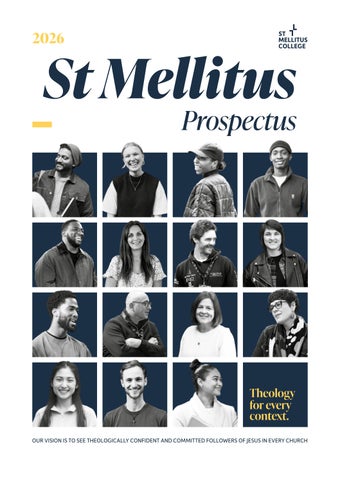
2026
ST MELLITUS COLLEGE
St Mellitus
Prospectus
Theology for every context. OUR VISION IS TO SEE THEOLOGICALLY CONFIDENT AND COMMITTED FOLLOWERS OF JESUS IN EVERY CHURCH
“ The glory of God is a human being fully alive; and the life of the human consists in beholding God.” Irenaeus
" At St Mellitus, worship and study are inseparable: we worship the One we study, and we study the One we worship. God is not abstract but particular; in our learning and our worship, the Spirit draws us into the Son’s loving response to the Father.” Dr Jane Williams McDonald Professor in Christian Theology
Thank you so much for your interest in St Mellitus College. This prospectus will give you a glimpse into the life of the college; it is our privilege to share about who we are. St Mellitus College is a place of hope and commitment to the Gospel. We long to see people come alive with a passion for theology, to be filled with a sense of the mission of God, and to be confident in the good news of Jesus Christ. Our vision is to see theologically confident and committed followers of Jesus in every church. Our mission is to provide innovative theological education and training for those called to serve Christ in the Church and the world. Our approach to training enables Christians to explore their faith deeply whilst remaining rooted in the church. As you study and train at St Mellitus College, the most important question is, ‘Am I becoming more like Jesus?’ That is what matters. Our desire is that every student has a heart and a vision for the Gospel and is formed into Christlikeness. It is exciting and a privilege that we get to fan into flame the work that God is doing in the lives of our students. Our passion is to walk alongside every individual, helping you develop a theological imagination that shapes the way the world is viewed. We are a diverse group of people from different walks of life who desire to listen to the Spirit and deepen our understanding of God, His Word, and His world. It is a privilege to journey with and equip each student to make a difference for the cause of Christ wherever they are. Our life is rooted in prayer and the values of God’s Kingdom; we hold our convictions generously and are committed to the Church’s unity. Those who study at St Mellitus College come from different backgrounds, cultures, and traditions, and may serve in a range of contexts, but all are committed to loving and serving Christ. This is a place of prayer and worship where you will cultivate friendships and networks which will sustain and resource you. Our model of training combines theology with practice, enabling you to apply your learning directly to your workplace, church, and community. We will equip you to grow in your relationship with God, deepen your understanding of faith, and develop your ability to communicate that faith to others. We train people who are passionate about the Gospel, called to serve Jesus Christ, and are energised by the life of the Spirit and the unity of the Church. We hope you will join us, and we look forward to journeying with you.
Message From St Mellitus College
Welcome,
Vision, Mission & Values
Generous
Orthodoxy
Vision Our vision is to see theologically confident and committed followers of Jesus in every church.
Mission Our mission is to provide innovative theological education and training for those called to serve Christ in the Church and the world.
Values
We serve and bring together those of different traditions in the Church to help us learn from each other.
The following values characterise life at St Mellitus College:
Excellence
Missional
First-rate academic staff comprising worldleading scholars, enriched by visiting professors and supported by an excellent administrative team.
A commitment to the life and growth of the Church for the sake of the world inspires all we do.
Hopeful
Innovative
We encourage a culture of fun, and as we learn and study together, we take God seriously, but not ourselves.
A commitment to innovation that enables students to invest fully in the call of God on their lives.
'Generous Orthodoxy' was a phrase that the founders of St Mellitus College used to describe the college's approach to bringing together the mainstream traditions of the Church in a mission-focused and Spirit-inspired way. In that same spirit, we continue to train students from the breadth of the Church and seek to be open to the Holy Spirit’s transforming power at work in the Church and the world. We celebrate a commitment to creedal orthodoxy – ‘the faith once handed on to the saints’ held in a generous way.
Our Centres St Mellitus College is one national college, based in three centres spread across England. Our aim is for a ‘partnership in the gospel’ that brings together the best of missional and ministry distinctiveness in different regions and provides education and training opportunities to enlarge this partnership. Every student and staff member at St Mellitus College is part of a growing, diverse community rooted in a number of different contexts across the country.
East Midlands Trinity Church, Nottingham, NG1 3HX St Mellitus College, East Midlands offers full-time context-based ordination training and part-time ordination training, as well as full-time and part-time undergraduate and postgraduate programmes. Contact - eastmidlands@stmellitus.ac.uk
London HTB Courtfield Gardens, London, SW5 0LX St Mellitus College, London offers fulltime context-based ordination training and undergraduate and postgraduate programmes on Mondays. It also offers part-time ordination and undergraduate programmes on Tuesday evenings.
South West St Matthias Church, Plymouth, PL4 8HF
Our introductory programme Beginning Theology In-Person is delivered on Thursday evenings.
St Mellitus College, South West offers fulltime context-based ordination training, as well as full-time and part-time undergraduate programmes.
Contact - london@stmellitus.ac.uk
Contact - southwest@stmellitus.ac.uk
ONLINE
Our introductory programme, Beginning Theology Online, is delivered on Tuesday evenings. Contact - beginningtheology@stmellitus.ac.uk
Why Study Theology?
Study theology to deepen your own love of and faith in God. An unexamined faith is often an untrusting one. Some people think that doing theology is bad for your faith, but that suggests that when you face a tough situation, or are asked a hard question, your faith will die. Here at St Mellitus College, we believe that God gets bigger, more beautiful and more trustworthy as you gaze more and more deeply. Paul says this in Romans 8.31: ‘If God is for us, who is against us?’. If death can’t separate us from the love of God in Christ Jesus, the study of theology certainly can’t. Study theology for the sake of your church. It is not everyone’s calling to do formal academic study of theology, but it is the calling of every Christian disciple to do all they can to deepen their faith.
Those of us who are called to this kind of study are one of the varieties of the Spirit’s gift to the church. As you study, always think, how can this help my Christian friends? What are the questions and situations they are wrestling with? Study to be a resource for your church. Study for the sake of those who don’t know God. Do you believe that Jesus Christ is good news for the whole world? If so, how is the whole world going to find that out? There are a lot of strange ideas about God around in our culture, and a lot of damaging ideas about what life is for. We need to equip ourselves to be confident in the good news we have to share. Finally, study theology to be a gift to this community of joyful study here at St Mellitus College. Help the community you study with, staff and students alike, to grow in the knowledge and love of God, and in Christ-like lives in the power of the Holy Spirit.
Dr Jane Williams, McDonald Professor in Christian Theology
Why Study Theology at St Mellitus College? St Mellitus College has experienced remarkable life and growth and is one of the most innovative and exciting places to study theology, ministry and mission in the UK. We have students studying across three teaching centres, with nearly 200 ordinands in training, over 140 undergraduates and postgraduate students following validated programmes, and a further 200 students on introductory and non-accredited courses.
What can you expect from St Mellitus College? Academic Rigour We have a first-rate academic and teaching staff, with our courses taught by some of the leading theological scholars in the nation. We are also privileged to draw on the expertise of a wide range of visiting professors.
High Calibre Teaching In the recent 2024/25 National Student Survey (NSS), a UK-wide survey managed by the Office for Students (OfS), 96% of students at St Mellitus College rated the quality of teaching as excellent.
Context-Based Training St Mellitus College pioneered context-based training in 2007 when the college was founded. For all students, this style of learning allows you to remain rooted in your local church or ministry community while pursuing your theological training. For ordinands and Future Generation students, the college is not the only classroom; your placement is as well.
Worship and Prayer We believe the work of theology is not just an intellectual discipline but a spiritual one. Done properly, theology grows out of and leads back into prayer and worship as our vision of who God is enlarges.
Student Support Supporting our students is of paramount importance to us. In the most recent NSS, we received an outstanding 99.2% satisfaction rate for academic support. In addition to academic skills, we also offer support for students with specific learning differences.
From Peter Stream to Ordination Training Derek – East Midlands Ordinand
1. Tell us a bit about yourself I come from a Catholic family background. Born in Pakistan, I lived in Iran as a toddler and later moved to Dubai at 23, where I spent over 24 years. Even at a young age, my curiosity as an altar boy, volunteering in church activities, and singing in a choir left an impression that God wanted me to be different. As a young adult, this calling to serve and see God’s people empowered became clear. Worship music and leading have played an important role in my life. Seeing a community of believers adoring the Lord in worship is a priceless experience I feel God has led me into. Through serving in various church expressions, God instilled in me a passion to see new expressions grow in churches grounded in good theology and authentic discipleship. I am grateful for mentors who inspired and challenged me to see God’s work in others and help them see it too. I’ve always been drawn to how Jesus treated people – His understanding of culture and demonstration of Kingdom values not of this world (Mt. 8:5-9). This has led me to dig deeper into the Word and Sacrament, recognizing how valuable these gifts are as they are entrusted to us to glorify Him. God is a King who has established a Kingdom with a unique way of living and engaging with others. I long to be part of that and help others live that way too.
2. W hat first drew you to study at St Mellitus College? I was at HTB Focus with my food truck a few years ago when a Chaplain friend came to get some food. In our conversation, he suggested that I consider doing the Peter Stream, as he knew my heart and passion was to serve the Lord. Later that day, I met the Lead for the Peter Stream, who advised that I needed to be in an Anglican church to be considered for enrolment. The next day at Focus, a vicar friend came by to buy some food, and I casually mentioned my desire to pursue ordination and the Peter Stream. His encouragement and invitation to join his church community was very welcoming and gave me a sense of direction that I felt was God-sent. After six months at this new church, I enrolled at St Mellitus to be part of the Peter Stream, and during that time, the discernment process there and in my Diocese made it clear that God’s calling on my life from an early age is now being continued through ordination training.
3. H ow has your experience at St Mellitus surprised or challenged you? To be able to connect with the wider college community, engage in deep and meaningful conversations, lead worship, and make new friends in such a short time has taken me by surprise. The atmosphere at the college is very welcoming and friendly, and both fellow students and lecturers intentionally connect and check in on you. It feels like a massive family.
4. C an you share a moment or experience at St Mellitus that has been particularly meaningful or transformative for you?
Experiencing different worship styles from traditional to contemporary has been a joy for me. To see so many students lead, respond and engage during morning worship, taught me the vast richness of God’s tapestry of people that are seeking His face, is such a privilege to be part of. To see each other grow as one body in Christ has been life giving and transformative for me. One of the sessions was led by a lecturer in which there was an image we had to contemplate. The waiting, the gazing and the process of seeing God in it was amazing. It just tells us that God is present in all things and we are surrounded by His designs.
5. H ow have your studies shaped your understanding of God, faith, or your calling?
Learning about the Anglican way of life and the Church of England, I feel drawn to her missional values and sense of newness. Quoting the Archbishops’ Council of 1999, I am inspired by the vision of a “younger and more diverse church,” “revitalized parishes,” and “new Christian communities” living out the five marks of mission. Serving on the PCC, in church leadership, and in Sunday services at my own church has deepened my sense of calling. “The harvest is plentiful, but the workers are few” (Mt. 9:35–38) is a serious reminder to me that the Lord is seeking labourers for His vineyard. My discernment has been clear since an early age, and I continue to see the Lord using that call today. I have a strong passion to serve young people, encourage diversity and inclusion, and equip a multigenerational congregation that worships God through the five marks of mission. I am keen to explore a “Eucharismatic” approach to Communion and Liturgy that celebrates both the intimacy and reverence, and the invitation of the unworthy. I believe we need to be better at communicating our Christian faith more effectively by making our Sacraments and Liturgy not only accessible but engaging and inviting, leaving worshippers hungry for more of God. Through training for priesthood, I hope to perhaps represent these passions richly and help in building a community that is genuinely challenged to love God and His people.
6. W hat tips or advice would you give to someone thinking of studying theology or joining St Mellitus College?
I would say, "God is painting a picture of you in His grand design. He always had you in mind. Your life may have taken many turns and perhaps even left you uncertain. But what is certain is that He is painting you into something new and it will be wonderful because He is just getting started."
Routes Overview At the heart of every pathway is our St Mellitus College ethos – theological study embedded in a local church or ministry context. Whatever route you follow, your training will reflect creatively on theological study alongside serving in your community. Below is a list of our routes into study and vocational pathways. For more details on vocational pathways, please scan the QR code.
Ordination Training We specialise in training ordinands for the Church of England. We are excited to partner with you as you grow into the priest God is calling you to be.
Independent Study We offer a range of programmes to suit anyone interested in theological study. Our first-rate teaching staff will stretch you academically and deepen your faith. Future Generations Training is also an optional focus for those called to Children's & Youth Ministry where we offer specific training that combines deep theology with practical skills.
Peter Stream The Peter Stream is a programme designed to identify and encourage the gifts and calling of people from underrepresented backgrounds and prepare them for the Church of England national discernment process.
Elizabeth Pathway The Elizabeth Pathway is a development of the programme called the Caleb Stream, enabling mature lay leaders to train for potential ordination in the Church of England in two years.
Introductory Beginning Theology is an introductory course for anyone who would like to study theology. We cover all the basic principles so that you leave the course with a good understanding of theology, equipped to speak into your context, and with a valuable foundation for further theological study.
Ordination We specialise in training men and women for ordination in the Church of England. To train for ordination, any prospective student must have a recommendation for training from a Church of England Bishop. Both full-time and part-time programmes are available, combining academic excellence and practical experience, with a strong focus on the personal formation of each candidate for ordained ministry. We draw on a pool of experienced church practitioners who help develop each ordinand’s capacity for effective church leadership.
All our ordinands are rooted in local churches or mission contexts whilst undertaking their theological study. Students engage in academic study, leadership development and theological reflection throughout each term, in addition to having one to two days per week for personal study.
We expect that students’ formation includes regular and ongoing engagement with the world, whether in mission, relationship building or pastoral ministry.
On the full-time route, ordinands spend half their week on placement in a church context, learning under a training supervisor, while our part-time ordinands learn to integrate their theological studies into their working life or local church context.
This then creates ongoing opportunities for theological reflection, with the interaction between theology and practice happening ‘live’ in both the classroom and the placement-church context. In this sense, the placement is also a classroom.
To reinforce this, full-time ordinands also complete a ‘Preparing for Ministry’ module, in which ordinands undertake a number of reflection-based tasks that enable them to crystallise what they learn in their placement context, and the ways in which they are being shaped, formed and prepared for ordained ministry.
These reflection-based tasks focus on five aspects of ministry and mission drawn from the Ordinal:
1. Christian Discipleship 2. Pastoral Ministry 3. Preaching Ministry 4. Missional Engagement 5. Anglican Vocation
Ordinands from our various centres come together to attend five weekends and one annual residential week across the year for teaching and worship, and one retreat weekend during their time in training. This formative experience allows for spiritual growth and friendships to form across the breadth of traditions in the Church of England and is part of how we live out the value of ‘Generous Orthodoxy’.
Further, all ordinands engage with one of two formational leadership programmes: The Forge (for full-time ordinands) and Refine (for part-time ordinands). Given the qualities of the Church of England Formation Framework, both programmes are designed to equip ordinands for a life of faithful and innovative ministry and mission. Ordinands engage in sessions within three streams: 1) Christlike Disciples; 2) Missional Church; and 3) Transformed World.
In The Forge, ordinands hear from and engage with external speakers from a wide range of faith and community organisations. Each ordinand is also part of a Formation Group, consisting of a small group of ordinands who journey together through training, with their Tutor acting as the primary point of contact for academic and pastoral support and formation.
Independent Study We believe that studying theology is a joyful and transformative journey, a privilege that invites you into life’s most exhilarating and profound questions about God, faith, salvation, and the Bible. Imagine diving deeply into the questions that matter most, reshaping the way you read and understand Scripture, and growing as a disciple in ways that prepare you to share your faith with a world in need of hope. Whether you are leading in church or simply looking to bring a fresh perspective into your work, family, or community, studying theology empowers you to engage deeply with your calling and live out a practical faith, transformed and equipped to share that transformation wherever you are planted. As an independent student, you will study as part of a diverse cohort of students all committed to rich engagement with theological study and exploration of God's call on their life. Throughout each term, you will delve into academic study and theological reflection, with one to two days of dedicated time for personal study and exploration each week. This approach allows you to fit your studies around your context, while helping you explore what it might look like to study and live out a practical theology immersed in your locality.
Theology at St Mellitus College isn’t about being removed from the world but about equipping you to serve God’s kingdom in every sphere of influence from workplace to church to home. Alongside regular termly teaching in your local centre, full-time independent students attend one non-residential teaching week each academic year* at our London Centre (part-time students starting at Level 4 also attend one teaching week per year). Here students from across the country and from diverse traditions gather to worship, learn, and experience the richness of ‘Generous Orthodoxy’ in community. These gatherings are a highlight of the year – a time of friendship, growth, and spiritual stretching as you engage with others who are asking challenging and inspiring questions right alongside you.
* Students who start a full-time Level 6 programme in September 2026 may need to attend two teaching weeks, depending on choice of modules.
Future Generations Training For independent undergraduate students, there is also the option to select modules that focus on ministry and mission to younger generations. Our Future Generations training is for those with a heart, or developing sense of call, to work with children and/or young people in a variety of contexts. This training offers core theology alongside bespoke modules exploring youth and children's ministry theology, skills and practice. Students choosing a focus in Youth or Children's Ministry should be working or volunteering in a context involving a minimum number of contact hours with children or young people and regular supervision. Scan the QR code for more information about Future Generations Training.
read more
Peter Stream Jesus saw Peter’s gifts and potential for ministry, even though others couldn’t see it at first (Acts 4). The Peter Stream is a year-long programme designed to identify and encourage the gifts and calling of people from under-represented backgrounds and prepare them for the national discernment process.
It offers a distinctive experience, complementing the Church of England’s discernment process by offering candidates a diverse community of peers to journey closely with throughout the year, as well as theological and formational teaching within the context of a worshipping community at St Mellitus College.
read more
Because the Peter Stream exists to redress the most significant underrepresentation in ordained leadership in the Church of England – ethnic, social, educational – it is only open to candidates from those demographics.
Elizabeth Pathway Elizabeth was miraculously enabled by God to give birth in her advanced years to a son, who became John the Baptist (Luke 1). She is the biblical figure inspiring the name for the new national training and discernment initiative launched in 2025 by the Church of England, the Elizabeth Pathway. This pathway enables mature lay people with leadership experience, who have the backing of their diocese, to train for potential ordination over two years.
We pioneered training for older candidates with the launch of the Caleb Stream in September 2019. The Elizabeth Pathway builds on the success of this.
The cohort will journey together through teaching and learning in-person, as well as the national discernment processes. The Elizabeth Pathway aims to mobilise a generation rich in Christian leadership and life experience to serve in parishes across the UK.
Its first cohort of 23 candidates has reflected a wonderful diversity of background, church tradition and gifting, all united by a desire to serve Christ and His Church. Across the programme, each student will receive teaching and formation, drawing on the strengths and gifts they bring, and investing in the ministry God is calling them to step into.
read more
Miranda's Story. Self-Supporting Minister
1. W hen did you study at St Mellitus College and in which programme? I studied for ordination part-time on Tuesday evenings in London. It all started during the pandemic. Our church had a WhatsApp group for the women, where people sent prayer requests and others gently replied with praying emojis. I remember God saying, You’re here, it’s lockdown, you’re not busy, so send your actual prayers. So I did, responding with the real prayers I was praying for those women. Soon after, my vicar asked, “Have you ever thought about ordination training?” I laughed and said, “No, I couldn’t do that, I’m a woman!” Coming from a Roman Catholic background, I wasn’t used to seeing women lead in church. I also hadn’t finished secondary school, so I told him, “Even if I wanted to, I couldn’t. It’s just not possible.” He just smiled and said, “Well, you should think about it.” Some time later, he invited me to meet again, saying the team had been praying and felt God had a word for me. I told him it was strange but I sensed God calling me to do something with women, and he said, “That’s exactly what we sensed too.” So I began building a small community of women who gathered to pray and worship. It was really lovely. Not long after, my vicar said, “We think you’re being called to something more. We’d love for you to pray about it. There’s a pathway we think might be right for you, it’s called the Peter Stream.” As he explained it, I thought, Maybe it’s not just me. Maybe God really is calling me to ordination. And that’s how I ended up at St Mellitus. The day before starting at St Mellitus, my husband and I visited the college so I could see where it was. Standing outside, I prayed, Lord, am I really meant to be here? I didn’t finish school, I’m scared of exams, and I don’t think I can do this. And I felt God say, My strength will come through your weakness. So I said, Alright, Lord. If you need me to be weak, I’m feeling very weak right now, but if that’s your promise, I’ll take it one day at a time. I’ve always been obedient, so that’s what I did. The next morning, as I walked through the doors of St Mellitus, I immediately felt a sense of belonging, as if God whispered, this is home.
2. W hat are you doing now vocationally? It was through training that I began to see God gently building a picture of my pathway. When I first felt called to explore ordination, it was during the pandemic and at the height of our eldest son’s drug addiction – a time of real turmoil. I remember a lecture where the speaker said God often interrupts our lives and calls us in the midst of it all, and that really hit home. Part-time training turned out to be such a gift. Though we had many ups and downs, the support was incredible, and the pace gave me room to breathe. Another surprise was when the diocese raised the idea of self-supporting ministry. At first I wasn’t sure – part of me wondered if I wasn’t good enough for full-time ministry – but by the end of my second year, I knew God was calling me to serve this way. I’d always imagined ordained ministry as working full-time in a church, but I love people, and I’m a bit of an evangelist at heart; I love those everyday conversations, especially with people who don’t yet know Jesus. During that second year, I prayed for something that would let me study and serve locally. Two weeks later I saw a part-time job advert at my local pharmacy. I popped in – they knew me already – and when I said I was enquiring for myself, they said, “Well, you’ve got the job.” Just like that! Working there alongside training helped me see what self-supporting ministry could look like. I’ve always said I have one foot inside the church and one foot outside, and God showed me how it all fits together. Now I love being a self-supporting minister. I work three days a week at the pharmacy and see it as part of my ministry – praying for people, talking about Jesus, inviting them to church. Then I serve the church on Sundays and Tuesdays, leading, planning, and attending meetings. At St Mellitus, I also discovered I have ADHD, which explains why I’m so chatty, but it also means I thrive on variety. The mix of ministry and secular work keeps me energised and connected. That’s what ministry looks like for me, and I absolutely love it. It’s a real joy.
3. L ooking back, how would you
describe your time at St Mellitus?
Probably the thing that's mostly my love language, which is the diversity. I absolutely love the diversity of the college. Culturally, there’s so much richness. I was born in Australia, my parents are Italian, and my mum was born in Egypt, so already there’s a beautiful mix there. I’m also married to a British-born Sri Lankan, and we have four children, so there’s a lot of cultural richness in our family. That’s one of the things I love most about St Mellitus, it’s so wonderfully diverse, and to me, it feels reflective of Heaven. But it’s not just cultural diversity; it’s also generational. I’m 54 and I love that at St Mellitus you’ve got young people, middle-aged people, and older people all learning and worshipping together. And it’s not even just that, there’s diversity in faith backgrounds and church traditions too. I think diversity is one of the most beautiful things God ever created: that we can all be so different, and yet so united. St Mellitus does that so well because of its ethos of ‘generous orthodoxy’. If I could add one more thing, it would be the incredible quality of teaching from the lecturers and guest speakers we were privileged to learn from. They’re not only gifted in their craft but also encourage real critical thought and open debate, not just among students, but with them. That, to me, is the mark of a great teacher. I have so much respect for their academic and theological skill, but also for their pastoral hearts.
4. W hy would you encourage someone to study theology?
I think everyone should study theology, whether they feel called to ministry or not. Because it’s not just about theology itself; it’s about learning alongside others who each bring something unique to the table. The conversations, the different perspectives, it’s wonderful. It’s honestly impossible to leave a class or a discussion without thinking about what you’ve just learned, reflecting on it, and somehow letting it shape your day-to-day life. I really believe the world would be a better place if everyone studied theology because whether or not we’re called to ordained ministry, we’re all called to something. For anyone who’s even a little curious or who has that deeper desire to explore faith and life, it’s such a gift. You can’t study theology and not be impacted by it. And that impact naturally flows out, changing the way you live and influencing the people around you.
Programmes Overview We offer a range of programmes to suit anyone interested in theological study. Our excellent teaching staff will stretch you academically and deepen your faith.
Introductory Beginning Theology (online and in-person)
Undergraduate Foundation Award in Theology, Ministry and Mission Certificate of Higher Education in Theology, Ministry and Mission Certificate of Higher Education in Christian Ministry and Mission Diploma of Higher Education in Theology, Ministry and Mission BA (Hons) in Theology, Ministry and Mission Graduate Diploma in Theology, Ministry and Mission
Postgraduate Postgraduate Certificate in Theology, Ministry and Mission Postgraduate Diploma in Theology, Ministry and Mission MA in Theology, Ministry and Mission PhD Partnership with Durham University
Validation - all undergraduate and postgraduate academic awards offered by St Mellitus College are validated by Durham University.
Beginning Theology Introductory Course - Certified by St Mellitus College “ Beginning Theology has made clear one particular direction I want to take in my life. It has highlighted my interests, passions, and gifts, and has affirmed some of the next steps. It has also encouraged and motivated me to invite others around me to reflect on the questions studied during the course in my day-to-day interactions and conversations. I think the course has equipped me to feel more confident in my faith; both sharing it but also in answering questions people may have about my faith. The course has satisfied the growing curiosity I had before starting the course and opened up a world I didn't know before. It has led me to ideas, people and opportunities that I hadn't anticipated.” Melissa, Beginning Theology Student
Programme Overview Beginning Theology is an introductory programme for anyone who would like to study theology. It is the perfect place to start if you’ve never studied theology before. We cover all the basic principles so that you leave the programme with a good understanding of theology, equipped to speak into your context, and with a valuable foundation for further theological study. Participants who attend at least 80% of the module will receive a St Mellitus College Certificate of Completion.
Centres London and Online
Programme Duration This is a modular course enabling termly participation.
Entry Requirements Beginning Theology is an access course designed to provide a foundation for further study. For that reason, there are no formal entry requirements.
read more
Undergraduate Programmes Our undergraduate programmes offer a broad range of modules that provide a strong theological foundation alongside reflection on key topics in theology, ministry and mission.
Programmes Overview Whether you want to gain a strong grounding in Christian theology through a one-year course in theological foundations or build on that foundation with a degree offering deeper and richer exploration of the Christian tradition, we have a pathway for you. Our undergraduate programmes build on each other with the Foundation Award or Certificate
giving an excellent foundational understanding, the Diploma allowing the student to build on that foundation, and the BA giving the opportunity to engage in theology more deeply still. In addition to these programmes, we offer the Graduate Diploma for graduates in subjects other than theology, giving them the opportunity to study theology deeply over one to two years. We offer both full-time and part-time study options to suit different students and stages of learning.
read more
Foundation Award in Theology, Ministry and Mission Undergraduate Programme - Validated by Durham University
Programme Overview The Foundation Award (60 credits at Level 4) introduces students to the essential building blocks of Christian theology. Through core subjects such as Biblical Studies, Mission, and Theological Reflection, students begin to explore how faith and practice inform one another. The programme encourages theological reflection on practical aspects of theology, ministry and mission, providing an accessible entry point for those beginning formal theological study or exploring vocational discernment.
Centres The Foundation Award is available at all our centres.
Programme Duration Part-time (1 year) We recommend a minimum of one to two additional day(s) of private study per week.
Entry Requirements Applicants will normally have one A Level (grade C / grade 4 or above) or equivalent for direct entry on the Foundation Award TMM (60 credits).
Certificate in Theology, Ministry and Mission Undergraduate Programme - Validated by Durham University
Programme Overview
Centres
The Certificate (120 credits at Level 4) gives an excellent foundation across the major disciplines of theology.
The Certificate is offered full-time in our East Midlands, London Monday and South West centres and part-time in our East Midlands and South West centres. Youth and Children’s Ministry focus is available on London Mondays.
Alongside Biblical Studies, Mission, and Theological Reflection, students engage with Christian Doctrine and Church History, gaining a broader grasp of how theology has shaped, and continues to shape, the life of the Church. The Certificate strengthens both understanding and practice, helping students integrate theology with the realities of ministry and mission today. For independent students choosing a focus on Youth and Children’s Ministry, alternative modules that focus on this area will be undertaken.
Programme Duration Full-time (1 year) or Part-time (2 years) We recommend a minimum of one to two additional day(s) of private study per week.
Entry Requirements Applicants will normally have one A Level (grade C / grade 4 or above) or equivalent for direct entry on to the Certificate TMM (120 credits).
Sample Module List This list provides an idea of the modules a student might engage with during their studies with us. Please note that modules taught in any given year or teaching centre may vary depending on a number of factors, including academic programme, focus or ministry pathway, staff availability, timetabling, minimum class size, or other factors.
Level 4 (Foundation Award/Certificate/Dipoma/BA) Exploring Globalisation, the World Church and Mission Introduction to the Old Testament Introduction to the New Testament Introduction to Christian Doctrine and History Foundations for Ministry and Worship in Context Creating New Christian Communities Elementary New Testament Greek Elementary Biblical Hebrew Introducing Theological Reflection Introduction to Preaching Introduction to Theology & Human Development in Childhood & Adolescence (20 credit) Introduction to Spirituality and Discipleship Christian Discipleship Basic Youthwork Skills & Practice Elements of Mission and Evangelism
Level 5 (Diploma/BA) Bible in Context Topics in Christian Doctrine Christian Faith and Ethical Living Ecclesiology Exploring Leadership and Theology for Ministry and Mission Intermediate Biblical Hebrew Intermediate New Testament Greek Pastoral Care Theology, Social Context and Diversity in Youth and Children’s Work Developing Ministry and Mission in Context Reflective Practice in Context (Short) Preparing for Denominational Ministry Sacramental Theology and Ministry
Level 6 (Graduate Diploma/BA) Mission and Apologetics in Contemporary Culture The Arts, Culture and Christian Ministry and Mission Further New Testament Text Study in Context Further Old Testament Text Study in Context Sacramental Theology and Ministry Christian Doctrine in Context A Key Christian Figure Further Reflective Practice in Context (Short) Independent Learning Project (Long) Reflective Practice: Ministry and Mission with Young People
Certificate in Christian Ministry and Mission Undergraduate Programme - Validated by Durham University
Programme Overview The Certificate in Christian Ministry and Mission (180 credits at Levels 4 & 5) builds on the foundational learning in Level 4 Certificate by introducing more advanced study at Level 5. Students deepen their engagement with Christian Doctrine, Biblical Studies, and Theological Reflection, while also exploring new areas such as Bible in Context, Ethics, and Ecclesiology. This programme provides a bridge between introductory study and more advanced theological reflection, equipping students with both the theological depth and practical insight needed for ministry and mission in varied contexts.
Centres The Certificate in Christian Ministry and Mission is offered on London Tuesdays.
Programme Duration Part-time (2 years)
Entry Requirements Applicants will normally have two A Levels (grade C / grade 4 or above) or equivalent for direct entry on to the Certificate.
Diploma in Theology, Ministry and Mission Undergraduate Programme - Validated by Durham University
Programme Overview
Centres
The Diploma continues the progression from Certificate-level study, offering opportunities to expand and deepen theological understanding.
The Diploma is offered full-time in our East Midlands, London Monday and South West centres and part-time in our East Midlands and South West centres. Youth and Children’s Ministry focus is available on London Mondays.
Students engage with intermediate and applied topics such as Doctrine, Ethics, Biblical Studies, Ecclesiology, and Leadership. The Diploma fosters integration between academic learning and ministry, preparing students for greater responsibility in ministry or further academic study. Independent students specialising in Youth and Children’s Ministry undertake tailored modules that focus on ministry within these contexts. Full-time context-based ordinands on the Diploma also complete a Preparing for Ministry module, which includes reflection-based tasks designed to help them integrate learning from placements and to discern how they are being shaped for ordained ministry.
Programme Duration Full-time Independent Students (2 years) Part-time Independent Students (4 years) Full-time Context-Based Ordinands (2-3 years*) *Dependent on the training pathway agreed by their diocese. We recommend a minimum of one to to two additional days of private study per week.
Entry Requirements Applicants will normally have two A Levels (grade C / grade 4 or above) or equivalent for direct entry on to the Diploma.
BA (Hons) in Theology, Ministry and Mission Undergraduate Programme - Validated by Durham University
Programme Overview The BA (Hons) degree offers a broad and rigorous grounding in theological understanding and develops advanced skills for thoughtful application in practical ministry. Students engage with Advanced Biblical Studies, Advanced Topics in Doctrine, and Issues in Contemporary Culture, learning to apply theology thoughtfully within today’s Church and world. Those focusing on Youth and Children’s Ministry continue this specialism through modules that build on Diploma-level study. Full-time context-based ordinands on the BA also complete a Preparing for Ministry module, which includes reflection-based tasks designed to help them integrate learning from placements and to discern how they are being shaped for ordained ministry. Independent degree students undertake a substantial piece of written research in theology, exploring a topic of personal interest and developing advanced skills in independent theological inquiry.
Centres The BA Degree is offered full-time in our East Midlands, London Monday and South West centres. Youth and Children’s Ministry focus is available on London Mondays.
Programme Duration Full-time (3 years) We recommend a minimum of one to two additional day(s) of private study per week.
Entry Requirements Applicants will normally have three A Levels (grade C / grade 4 or above) or equivalent for direct entry on to the BA.
Graduate Diploma in Theology, Ministry and Mission Undergraduate Programme - Validated by Durham University
Programme Overview The Graduate Diploma offers students who already hold a degree and have some understanding of theological basics the opportunity to undertake advanced-level theological study, equivalent to the final year of the BA (Hons). Students explore Advanced Biblical Studies, Advanced Topics in Doctrine, and Issues in Contemporary Culture, alongside a major independent research project in theology. This programme is ideal for those with prior academic experience who wish to gain in-depth, rigorous theological study and to engage critically with contemporary issues in faith and ministry.
Centres The Graduate Diploma is offered full-time in our East Midlands, London Monday and South West centres and part-time in East Midlands and South West (subject to viability).
Programme Duration Full-time (1 year) Part-time (2 years)
Entry Requirements Applicants must normally have a 2:1 Honours Degree in a humanities-based subject or a Diploma (HE) in Theology with a substantial proportion of their graded credit at Merit/2:1 level.
Postgraduate Programmes Validated by Durham University
Programmes Overview When it comes to theology, the deepest rewards come from serious engagement with the Bible and key Christian figures and texts. This programme is ideal for Theology or Religious Studies graduates looking to advance in higher research, or practising church leaders seeking deeper engagement with core Christian texts and themes. Our postgraduate programmes are structured so that you can study at different levels depending on your context and goals: Postgraduate Certificate (PGCert) – 60 credits, normally completed part-time over one year. Postgraduate Diploma (PGDip) – 120 credits, normally completed part-time over two years. Students take the same taught modules as the MA, but without the dissertation. MA in Theology, Ministry and Mission – 180 credits, normally completed part-time over two years. Students complete the taught modules and seminars and write a 15,000-word dissertation under expert supervision. All three awards share the same ethos: rigorous theological study that is both academically stretching and spiritually formative.
Centres The PGCert, PGDip and MA are offered at our East Midlands and London Monday centres. All postgraduate programmes are subject to viability and may require elements of hybrid delivery. Students will be informed about this prior to the commencement of the course.
Postgraduate Certificate in Theology, Ministry and Mission Postgraduate Programme - Validated by Durham University
Programme Overview The Postgraduate Certificate (PGCert) is a 60-credit qualification, normally completed part-time over the course of one year. Students will engage with a range of MA-level modules that provide both academic depth and theological breadth, such as Research and Reflection: Resources and Methods, Advanced New Testament Studies, and Christian Doctrine and Contemporary Culture (or Advanced Topic in Christian Doctrine in the East Midlands). This programme offers a focused yet flexible pathway for developing advanced understanding and critical reflection in key areas of theological study.
Centres The Postgraduate Certificate is offered at our East Midlands and London Monday centres.
Programme Duration PGCert (1 year part-time)
Entry Requirements Submission of a degree-level academic paper of no less than 2,000 words, written in the last five years, forms part of the application process. A 2.1 degree in theology is normally required for direct entry to any of the postgraduate programmes. Where applicants do not meet one or both of these requirements they should contact the admissions team.
Postgraduate Diploma in Theology, Ministry and Mission Postgraduate Programme - Validated by Durham University
Programme Overview
Programme Duration
The Postgraduate Diploma (PGDip) is a 120-credit qualification, typically completed part-time over two years.
PGDip (1 year full-time* or 2 years part-time).
Students complete the same taught modules as those offered in the MA programme, allowing for comprehensive engagement with advanced theological study, but without the requirement to complete a dissertation. This structure provides an ideal option for those seeking in-depth academic formation and critical reflection without the extended research component of a full master’s degree.
Centres The Postgraduate Diploma is offered at our East Midlands and London Monday centres.
*The full-time (1 year) PGDip is available only for those undertaking modules that allow for specialism in Mission in Contemporary Culture (cohort viability dependent). This is only offered at the London centre.
Entry Requirements Submission of a degree-level academic paper of no less than 2,000 words, written in the last five years, forms part of the application process. A 2.1 degree in theology is normally required for direct entry to any of the postgraduate programmes. Where applicants do not meet one or both of these requirements they should contact the admissions team
MA in Theology, Ministry and Mission Postgraduate Programme - Validated by Durham University
Programme Overview Our MA course is for those who want to think more deeply, asking the most exciting and challenging questions. Rooted in rigorous theological study and taught by leading academics, the programme is both academically stretching and spiritually formative.
Centres The MA is offered at our East Midlands and London Monday centres.
Programme Duration 1 year full time* or 2 years part-time *The full-time (1 year) MA option is only available for those undertaking modules that allow for specialism in Mission in Contemporary Culture (cohort viability dependent). This is only offered at the London Centre.
Entry Requirements Submission of a degree-level academic paper of no less than 2,000 words, written in the last five years, forms part of the application process. A 2.1 degree in theology is normally required for direct entry to any of the postgraduate programmes. Where applicants do not meet one or both of these requirements they should contact the admissions team.
Sample Module List at the London Centre The modules listed are indicative and may be subject to change. In London, students can choose between two specialist routes (viability-dependent): • Biblical Studies • Mission in Contemporary Culture Both routes share a set of core modules while also offering distinctive pathway modules. Together they equip students to bring scholarship and ministry into a fruitful conversation. Core modules: •R esearch and Reflection: Resources and Methods – How should theology be done? This module introduces key ways of engaging Scripture, church tradition, and culture as foundations for advanced study. •A dvanced New Testament Studies: Mission – What is “the good news”? Students explore how the New Testament frames the gospel and the mission of God, from Paul to the Synoptics to Hebrews. •C hristian Doctrine and Contemporary Culture – Core doctrines such as Christology, the Trinity and salvation are brought into dialogue with cultural issues like cancel culture and Christian nationalism. •D issertation in Theology, Ministry and Mission – The capstone project: a 15,000-word dissertation on a topic of your choice, supervised by an expert, offering a sustained deep dive into your area of passion. Biblical Studies pathway: •A dvanced Study of a Theological Text: Douglas Campbell – An in-depth engagement with Campbell’s The Deliverance of God, exploring Paul, Romans, and the meaning of faith and justification. •A dvanced Old Testament Studies: Leviticus – Exploring priestly traditions, holiness, and atonement, with attention to Hebrew texts and their ongoing theological significance. • I ssues in Biblical Theology – Tracing the development of monotheism and Christology from Israel’s Scriptures to the New Testament and the earliest expressions of Christian faith. Mission in Contemporary Culture pathway: •M ission and Ecclesiology in Contemporary Context – What does it mean to be the Church today? Exploring Fresh Expressions, online communities, intercultural worship, and the Missio Dei. •G od, Beauty and the Imagination – Examining the role of art, imagination, and aesthetics in theology and mission, and how the arts can enrich the Church’s cultural witness. • T heologies in Global Perspective – This module explores how theology is shaped in contexts such as Asia, Latin America, and Africa. Students reflect on how these global perspectives challenge and enrich the theology in Britain today.
Sample Module List at the East Midlands Centre The modules listed are indicative and may be subject to change. This is a similar but distinct route. It has the same Postgraduate ethos, as in London, and similarly runs Research and Reflection: Resources and Methods, as well as the Dissertation in Theology, Ministry and Mission. It is distinct in that all MA students take one route, that includes: •A dvanced New Testament Studies, with a focus on Hebrews. This module explores the theological peculiarity of this text, its Christology, its often misunderstood account of the atonement and more besides. •A dvanced Topic in Christian Doctrine examines central theological topics, from the doctrine of God, creation, Christology, eschatology and more. •A dvanced Study of a Theological Text: John Barclay offers an in-depth engagement with John Barclay’s Paul and the Gift, one of the most influential recent studies of Paul’s theology of grace. •A dvanced Study of a Christian Figure, zeros in on Dietrich Bonhoeffer, pastor, theologian, and martyr. Through a close reading of his writings in their historical context, students reflect on how Bonhoeffer’s theology can continue to shape the life of the Church. •A dvanced Topics in Christian Ethics explores embodiment as a key theme in Christian ethics, engaging issues such as mental health, trauma, women’s bodies, and life in community.
PhD Partnership with Durham University Postgraduate Programme - Validated by Durham University
Programme Overview The PhD partnership with Durham University allows successful applicants to undertake the Durham PhD programme while based at St Mellitus College. Students will be co-supervised by a member of Durham’s Department of Theology and Religion and a member of St Mellitus College staff. If you’re interested in exploring a PhD with a St Mellitus faculty member, please email research@stmellitus.ac.uk with details of your proposed research area.
Centres Academic team in all centres are available to be contacted for PhD Supervision.
Entry Requirements Please note that PhD students on this route become students of Durham University and can only enter the programme by applying to and being accepted by Durham University. However, initial discussion should take place with St Mellitus College prior to contacting the university. Scan the QR code below for more information.
read more
Academic Team Our teaching staff consists of leading scholars and practitioners committed to academic rigour and a deep, thoughtful exploration of theology. Each lecturer is an expert in their field of study, bringing a wealth of knowledge and a passion for their discipline that makes every course both intellectually enriching and spiritually engaging. Our lecturers are not only esteemed academics but also dedicated mentors who believe that studying theology is a transformative journey, one that invites students to deepen their faith and broaden their understanding in meaningful, lasting ways. They offer not only inspirational content but also world-leading, cutting-edge perspectives that drive the field of theology forward. With expertise spanning biblical studies, systematics, church history, ethics, and more, our teaching staff lay a foundation of scholarship that challenges students to think critically, engage deeply, and approach theological concepts with discernment. Our staff do more than teach theology – they live it, bringing a relational, rigorous approach to learning that values questions, embraces complexity, and encourages each student to wrestle with faith’s big questions in a supportive, encouraging environment. Here are a few of our teaching staff across our three centres. You can see a full list of the academic team on our website by scanning the QR code.
Dr Jane Williams McDonald Professor in Christian Theology Dr Jane Williams is the McDonald Professor in Christian Theology at St Mellitus College. Along with Bishop Graham Tomlin and Dr Michael Lloyd, she helped found St Mellitus College and has held a number of roles within the College before being appointed to this Professorship. Book publications include Giver of Life (2025), The Art of Christmas (2021), The Merciful Humility of God (2019). The Art of Advent (2021), Why Did Jesus Have to Die? (2016), Approaching Christmas (2012), Lectionary Reflection Years A,B & C (2011), Faces of Christ: Jesus in Art (2011), Approaching Easter (2006), Angels (2006), Who Do You Say That I Am? (2005), and Perfect Freedom (2001).
Revd Dr James Harding Tutor and Senior Lecturer in Contextual Theology and Director of St Mellitus College, South West Revd Dr James Harding is Senior Lecturer in Contextual Theology and Director of St Mellitus College, South West, where his work focuses on how the gospel engages with contemporary contexts and the life of the Church. He holds a PhD in Theology from the University of Bristol, an MProf in Practical Theology from the University of Chester, and an MA in Interfaith Philosophy of Religion from Heythrop College, University of London. His book publications include Babylon and the Brethren: The Use and Influence of the Whore of Babylon Motif in the Christian Brethren Movement, 1829–1900 (2015).
Dr Anna Westin Tutor and Lecturer in Theology and Ethics Dr Anna Westin (BA, Dip Appl. Ethics, Mag., MA, PG Cert HE, PhD) has completed a PhD in the philosophy of addiction, engaging in the existential and phenomenological approach of Kierkegaard and Levinas at St. Mary’s University, London. Book publications include Embodied Trauma and Healing: Critical Conversations on the Concept of Health and Rupture (forthcoming) and An Existential Phenomenology of Addiction (2020).
Revd Dr Hannah Steele Tutor and Lecturer in Missiology and Director of St Mellitus College London Monday Revd Dr Hannah Steele holds an MA and PhD from King’s College London and a BA in Theology and Philosophy from the University of Oxford. Her research interests focus on new contextual forms of church, mission and evangelism within postmodern culture, and the emerging church. Book publications include Living His Story Together: Being a Community of Missionary Disciples (2024), Living His Story: Revealing the Extraordinary Love of God in Ordinary Ways (2021), and New World, New Church?: The Theology of the Emerging Church Movement (2017).
Revd Dr Mark W. Scarlata Tutor and Senior Lecturer in Old Testament Revd Dr Mark Scarlata grew up in the U.S. and completed his theological studies at Gordon-Conwell Theological Seminary and Yale Divinity School and completed his PhD from Cambridge University. Book publications include Leviticus: Baker Commentary on the Old Testament (forthcoming), Wine, Soil, and Salvation: A Biblical Theology of Wine (2025), A Theology of Leviticus: Theology of the Old Testament (2025), Journey Through the World of Leviticus: Holiness, Sacrifice, and the Rock Badger (2021), Sabbath Rest: The Beauty of God’s Rhythm for a Digital World (2019), The Abiding Presence: A Theological Commentary on Exodus (2018), An Analysis of Maimonides’ Guide of the Perplexed (2018), An Analysis of C. S. Lewis’ Mere Christianity (2017), “Am I My Brother’s Keeper?”: Christian Citizenship in a Globalized Society (2013), and Outside of Eden: Cain in the Ancient Versions of Gen. 4:1-16 (2013).
Dr Girma Mohammed Tutor and Lecturer in Global Theology Dr Girma Mohammed is a scholar of theology and political philosophy with extensive experience in public engagement and leadership development across Africa. He holds a PhD in Social Theory (focused on religious nationalism) and an MA in Political Philosophy from VU University Amsterdam, as well as a BTh from the Evangelical Theological College in Addis Ababa, Ethiopia. Book publications include Culture, Scriptures and Leadership in Africa (2018), The Healing of Memories: African Christian Responses to Politically Induced Trauma (2018), Christian Citizenship in the Middle East: Divided Allegiance or Dual Citizenship? (2017), Democracy, Conflict and the Bible: Reflections on the Role of the Bible in International Affairs (2015) and Understanding Religion and Social Change in Ethiopia: Toward a Hermeneutic of Covenant (2012).
Dr Chris Tilling Graduate Tutor and Senior Lecturer in New Testament Studies and Head of Research Dr Chris Tilling is a research-active New Testament scholar, and his work focuses on Pauline theology, early Christology, and the relationship between Scripture, theology, and the Church, alongside wider interests in Christology, the Trinity, and the theology of Karl Barth. He holds a PhD in Theology and has contributed extensively to international scholarship through teaching, publications, and supervision across the UK and North America. Book publications include Eschatology & History: A Critical Engagement with N. T. Wright’s Gifford Lectures (2026, forthcoming), The Second Epistle to the Corinthians (forthcoming), Reading Romans (forthcoming), The T&T Clark Handbook of Christology (2025), Paul’s Divine Christology (2015), How God Became Jesus (2014), Beyond Old and New Perspectives on Paul (2014), and Paul’s Divine Christology (2012).
Dr Anna Hutchinson Tutor and Lecturer in Theology Dr Anna Hutchinson’s research explores the hermeneutics of Evangelical Christians, with a particular focus on how the Doctrine of Scripture shapes interpretation and theological education. Her academic interests include hermeneutics, the Doctrine of Scripture, practical theology, and evangelicalism. She holds a PhD in Theology from the University of Birmingham, an MSt in Theology (Modern Doctrine) from the University of Oxford, and a BA in Theology and Religion from the University of Durham. Book publications include The Influence of the Doctrine of Scripture: How Beliefs about the Bible Affect the Way It Is Read (2024).
Dr Jonny Rowlands Graduate Tutor and Lecturer in New Testament Dr Jonny Rowlands is a New Testament scholar whose research explores how Scripture is used, and should be used, within the life of the Church. His work sits at the intersection of biblical studies and systematic theology, with particular interests in the doctrine of Scripture, theological hermeneutics, and the Gospels of Matthew and Hebrews. He holds a PhD in Theology and Religious Studies from the University of Nottingham, an MPhil in New Testament Studies from Jesus College, Cambridge, and a BA (Hons) in Theology and Religious Studies from the University of Nottingham. Book publications include Befriending Scripture: A Theology of Reading (forthcoming) and The Metaphysics of Historical Jesus: A Prolegomenon to a Future Quest for the Historical Jesus (2022).
see more
Rhyan's Story. Future Generations Student
1. Tell us a bit about yourself. I’m in my second year as an independent student diving deep into theology and youth ministry. By day, I work as a Social Media Executive at Alzheimer’s Research UK, creating content to connect with people and raise dementia awareness. When I’m not working, you’ll probably find me hanging out with friends at arcades or thrill-seeking at Thorpe Park – I love creating fun memories with those around me! I’m passionate about serving the youth in my church community, and that’s what brought me to St Mellitus in the first place.
2. What drew you to study at St Mellitus College? I was drawn to St Mellitus because it felt like the perfect place to blend my growing passion for faith with my desire to serve others, especially through youth ministry. I loved the idea of learning in an environment that encourages both deep theological reflection and practical ministry. Plus, the culture is very welcoming and the people here are just as passionate about faith and service as I am, so it felt like home right away!
3. H ow would you describe the culture at St Mellitus College? St Mellitus is diverse, supportive, and challenging in the best way. There’s this incredible balance of academic rigour and pastoral care that makes it feel like you’re not just learning about God but also being comforted and equipped to live out your faith in the world. Also, it's a place where a wide range of ideas and beliefs come together, creating an environment where you’re constantly challenged to think differently. Whether in classes or conversations, you’re surrounded by people from all kinds of backgrounds and perspectives, which makes for rich discussions and growth.
4. W hy did you want to pursue a career in Youth Ministry? Growing up in Peckham, I was surrounded by a lot of challenges and didn’t always have the best influences around me. There were a lot of distractions, and I saw how easy it was for young people to go down the wrong path. I often wished I had someone who could have guided me, helped me make better choices, and shown me a positive way forward. That’s what fuels my passion for youth ministry today - I want to be the kind of role model I never had. I want to help young people navigate life’s complexities with faith as their foundation. I want to help guide them away from pitfalls and offer the support I felt was missing in my own life. I feel like youth ministry is a powerful way to make a real difference, helping others avoid the mistakes I made and giving them the encouragement and love they need to thrive.
5. W hat difference have your studies at St Mellitus College made in your life and faith?
Studying at St Mellitus has made me realise how important it is to be intentional in all areas of life, much like in youth ministry. I’ve become more mindful of how I respond to and encounter people, whether it's showing more compassion or taking the time to really listen. It’s helped me approach relationships with a deeper sense of purpose. As for my faith, studying has sparked a new passion for diving deeper into theology. I no longer want to rely on blind faith, but instead, I want to be able to defend and ground my beliefs in something solid. I’ve found myself reading more devotional material, watching videos on apologetics, and soaking in scripture in a way that’s deepening my faith and love in Christ.
6. W hat tips or advice would you give a prospective student thinking of studying here?
If you're thinking about studying at St Mellitus, my main advice would be to really think about your motivation for studying here. It’s not just about getting a qualification; it’s about diving deeper into your faith and your calling. Be prepared for a blend of academic challenge and personal growth - it’s going to push you in ways you might not expect. Make sure you’re ready to engage, ask tough questions, and explore your faith in new and sometimes uncomfortable ways. I’d also suggest visiting the college on an Open Day or speaking to current students to get a real sense of the community, which is an important part of the experience. The friendships and support networks you build here can be life changing. Finally, be ready for a place that’s both academic and practical - if you want a place that challenges your mind and shapes your faith, St Mellitus would be a great fit!
Formation During your time with us, you will be stretched by the theology you study and have the opportunity to reflect on the person that you are becoming, the qualities you inhabit, and the way you engage in relationships with others as a disciple of Christ. We call this formation. At its most fundamental level, ‘formation’ is the shaping of the whole person after the likeness of Christ, dependent on the transforming work of the Spirit. To facilitate this, we focus on aspects of development that include personality, character, relationships, leadership, collaboration and community. The process of formation in the Spirit can be exhilarating, stretching and liberating as we grow in self-awareness, recognising the impact we have on others. The experience is an exciting time of discovery. Formation can also be challenging and painful, as we encounter aspects of ourselves which are unexpected or surprising. This is often the most important part of the formational journey, and the more honest we are, and able to engage with the demands of the process, the more profound the possibility of growth and change. All students study theology alongside being engaged in some form of Christian mission and ministry, either in the workplace or in the context of the church and world. This model of training, with theology and practice intertwined, facilitates the formation of strong theological reflectors and reflective practitioners. Formation groups are offered to Ordinands, Undergraduate and Postgraduate students, and play a vital role in the life of the college. Under the guidance and support of a Formation Group Tutor, they provide a regular opportunity for prayer, mutual support, reflection and discussion. A Formation Group Tutor acts as the student’s primary point of academic and pastoral support during their time in the college, and for ordinands on placement, is the contact point for supervisors.
Student Support Chaplains and Counsellors
Academic Support
The college makes available a team of chaplains for all students and has access to a counselling service for ordinands to discuss anything they may be dealing with whilst undertaking their studies.
We recognise that students who come to study each have their own experience of academic learning.
We know that taking on academic study can be a big challenge and often coincides with other changes in people’s lives. Therefore, this aspect of our pastoral provision offers places to find listening and encouragement as you study and are formed in the college community.
Community Students have a Formation Group and Formation Group Tutor while at the college. Formation groups meet regularly and are a key support structure while studying, a place to be rooted and formed during your time at college. The college also hosts events to build community, such as social events during Residentials and Teaching Weeks so that students can develop friendships and connect with one another.
It is normal to feel nervous about assignments and in need of help. The academic skills team are here to offer support with these concerns, large or small. Support is primarily delivered through 1:1 appointments and drop-in sessions. During a 1:1 appointment, it is possible to discuss an assignment question, go through the details of referencing, find out how to read effectively for assessments, or review how to plan and manage your time effectively. In addition, there are many online resources available to encourage and develop key academic skills. The academic skills team also offers regular support to students who have a specific learning difference (SpLD), such as dyslexia or ADHD, ensuring that all students can thrive in their academic work.
Spouses and Key Supporters Learning Resources Once students are enrolled, they are granted access to our online learning platform, Moodle. Moodle is a great tool, catered to each student’s bespoke needs, with module guides, student handbooks, assignment schedules, reading lists – everything you might need to excel at St Mellitus College. Moodle also provides an extensive and growing suite of digital learning resources. To support your learning, we also offer a well-focused collection of books and other resources which are easily accessible either on site in our print libraries or electronically from home.
Training for ordination is a time of change and challenge for ordinands and for those who support them, and we have different ways for spouses and key supporters of ordinands and Elizabeth Pathway candidates to participate in college life. These include a termly email which gathers resources and details of events and other organisations which may be helpful as you prepare for a new season. In addition, there are regular opportunities to attend mid-week teaching days across our centres.
see more
Open Days We hold Open Days across our centres throughout the year to give a feel for what it’s like to study and train with us. Scan the QR code to visit our website for a list of upcoming Open Days.
read more
Application Process The application process varies depending on your route of study as indicated below. To complete an application form, visit stmellitus.ac.uk/apply For further information relating to the admissions process, please consult the Admissions Policy available on our website. All programmes and their mode of delivery are subject to change and dependent on cohort viability.
Introductory Students To enroll in our introductory theology course, Beginning Theology, visit stmellitus.ac.uk/beginning-theology
Independent Undergraduate & Postgraduate Students 1. Book your place on an Open Day on our website or by emailing info@stmellitus.ac.uk 2. Attend an Open Day 3. Apply online at stmellitus.ac.uk/apply 4. If you meet the entry requirements, we’ll invite you for an interview 5. Attend an interview 6. Await an offer letter
Ordinands 1. Apply online at stmellitus.ac.uk/apply 2. Book your place on an Open Day on our website or by emailing info@stmellitus.ac.uk 3. Attend an Open Day and interview 4. Await an offer letter
Fees & Finances Visit stmellitus.ac.uk/apply/fees for further information.
Find Out More 020 7052 0573 info@stmellitus.ac.uk stmellitus.ac.uk read more
ST MELLITUS COLLEGE
Our vision is to see theologically confident and committed followers of Jesus in every church.
stmellitus.ac.uk