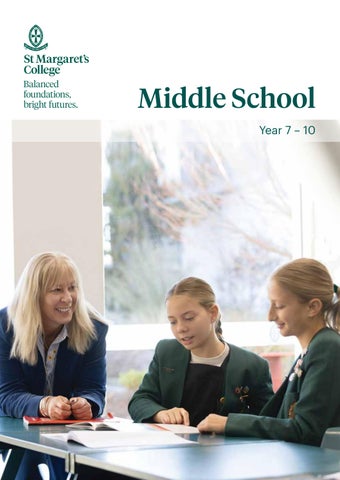
Middle School Year 7 – 10
School Office 12 Winchester Street, Merivale, Christchurch 8014 PO Box 25 094, City East, Christchurch 8140 Phone: 03 379 2000 admin@stmargarets.school.nz Office Hours: 8:00am until 4:30pm Maggie’s Shop 12 Winchester Street, Merivale, Christchurch 8014 Phone: 03 363 1901 Direct Dial Numbers Principal’s EA: 03 363 1902 Admissions Manager: 03 353 2563
Contents Middle School vision statement
2
Year 8
Social Science
27
Introduction
3
Year 8
Health and Physical Education
27
Pastoral care
4
Year 8
Languages
28
Our dual education pathway
6
Year 8
Mathematics
28
Philosophy
6
Year 9
31
Assessment
7
Year 9
Arts
32
Homework
7
Year 9
Creative Technologies
34
Learning Enhancement and Enrichment
8
Year 9
English
36
Senior qualifications
9
Year 9
Health and Physical Education
36
Learning pathway
12
Year 9
Languages
37
Year 7
15
Year 9
Mathematics
39
Year 7
Arts
16
Year 9
Science
40
Year 7
Creative Technologies
17
Year 9
Social Science
41
Year 7
ENSS
18
Year 10
43
Year 7
Health and Physical Education
19
Year 10 Arts
44
Year 7
Languages
19
Year 10 Creative Technologies
46
Year 7
Mathematics
20
Year 10 English
49
Year 7
Science
21
Year 10 Health Physical Education
49
Year 8
23
Year 10 Languages
50
Year 8
Arts
24
Year 10 Social Science
53
Year 8
Creative Technologies
25
Year 10 Rite Journey
54
Year 8
English
26
Year 10 Mathematics
55
Year 8
Science
26
Year 10 Science
56
Middle School vision statement Young adolescents are developing intellectually, physically, emotionally, socially and ethically. Our Middle School provides multiple opportunities for students not only to discover their strengths and passions, but also to develop their character and essential skills.
2
We offer a holistic programme that is inclusive, challenging and innovative within a nurturing environment. Our students are encouraged to be empathetic critical thinkers. They are challenged to pursue their convictions and to contribute to, and improve, the world around them for themselves and others. Each student is empowered to leave our Middle School as a future-ready, curious learner who is excited to take on their next challenge.
Introduction Welcome to the St Margaret’s College Middle School. We offer a set of specific educational experiences for students in Year 7–10 that complement our Junior and Senior School curicula. The Middle School programme has been developed with a thoughtful adoption of intentional approaches to teaching and learning. Our programme allows our students to develop their opinions, challenge their thinking, learn how to succeed and fail, and experience diverse opportunities, enabling them to gain confidence and grow as people. Students will experience a balanced, broad curriculum, which introduces a wide range of academic, cultural, sporting, and recreational activities. The curriculum covers the eight areas of the New Zealand Curriculum framework. All students study English, social sciences, mathematics, science, technology, music, physical education and health, along with religious education, nurturing well rounded curious thinkers. As the students move through the Middle School, they will experience a range of compulsory offerings. In Year 10 they start to have a greater element of choice, allowing them to develop in areas of strength and passion. We want students to emerge from the Middle School well-informed, with an appreciation of literature and the arts, a good understanding of history, geography, mathematics, and the sciences,
and the skills to know how to assess and utilise information. Our aim is for students to be ready to take on the challenges of the Senior School. Information Communication Technology (ICT) is embedded in many learning areas of the curriculum framework, ensuring that classroom practice is seamlessly linked to curriculum learning outcomes. Throughout the Middle School, students will become competent and confident in using a range of ICT to gather, analyse and present information clearly, logically, concisely and accurately. Recognising the rapid evolution of digital tools, we teach artificial intelligence (AI) skills enabling students to leverage these powerful technologies ethically and responsibly to enhance their research and creativity. We teach students that they are the most important part of this, given that the person doing the thinking is the person doing the learning. So we aim to teach the why, how and when to use such tools. All Year 7–10 students use their own Apple laptop to facilitate this learning. As each girl progresses through our Middle School, she will be learning about herself as a global citizen and will have opportunities to contribute to the wellbeing of the wider world. She will be encouraged to make the world a better place. We look forward to sharing this exciting journey through Middle School with you. Ngā mihi nui, Kathryn Gray, Head of Middle School
3
Pastoral care Alongside our curriculum, we are proud of our pastoral care programmes. Middle School students are placed in vertical tutor groups of approximately 16-18 girls, with each group arranged according to the House system. The Year 10 students within the group act as leaders to the younger girls. A tutor leads these groups and meets and greets students daily. Tutors look after their day-today wellbeing and can support them with their organisation. The tutor is also responsible for overseeing their academic progress and is the first point of contact for parents. This is an important part of the pastoral care at St Margaret's College. An opportunity is provided for parents and their daughter's tutor to meet early in Term 1 to discuss goals of the year and establish a relationship, which is a key partnership for the welfare of each student. The tutors have the support of the Year 7/8, Year 9, and Year 10 Deans, the Deputy Head, and Head
4
of Middle School. Together they ensure a positive learning and social environment for each student. We believe this collaboration has several advantages: › It ensures academic, social, and any other needs of each girl are being taken care of. › It enables each tutor to be an effective pastoral caregiver, since each is responsible for a small group. The ages of the girls in the group vary and they will have different needs throughout the school year. › It enables Senior girls to take responsibility and be mentors for younger girls. › It enhances the ‘family spirit’ of the school, by enabling older and younger students to get to know one another better. › It enhances the House system by having a structure, which enables Houses to meet regularly and sustain House-based activities, such as drama and sport.
5
Our dual education pathway Year 13
NCEA Level 3
International Baccalaureate Diploma
NZQA scholarships may be taken from Year 12 on either pathway
Year 12
NCEA Level 2
International Baccalaureate Diploma
Year 11
Senior School Foundation Diploma Year 7 – 10
New Zealand Curriculum Year 1 – 6
New Zealand Curriculum
Philosophy Over the course of the Middle School, the students will be involved in a broad curriculum. They will complete a compulsory programme and a series of options. The number of optional offerings increases as they progress through the Middle School.
Once we have laid the foundation for lifelong learning, the students will then select the subjects they would like to continue to develop their skills in. We encourage the girls to: › keep their options open › ensure they select some subjects they enjoy › seek enrichment and advancement.
6
Assessment We collect, analyse, and report on good quality assessment information that draws on a range of evidence to evaluate the progress and achievement of students. We like to build a comprehensive picture of the students’ individual learning styles
and needs across the curriculum. Through providing constructive feedback, we guide the students towards their next learning steps and teach the skills required to achieve them.
Homework Homework plays a vital role in building effective study habits and consolidating long-term memory. Beyond completing set tasks, regular independent study strengthens the neural connections formed during classroom instruction; moving working memory into durable, accessible knowledge. We aim for homework to promote active, study habits. The type of homework your daughter engages in might be:
We encourage your daughter to create her own homework space that provides an area free from distraction whilst doing homework, and not to be using other technology, such as watching movies in the background or listening to music. To support well-being and allow balance with co-curricular commitments, we recommend the following daily guidance:
› Active Retrieval Practice: Students practise
› Years 9–10: Up to 1 hour per day of focused study
recalling information from memory (e.g., selfquizzing, flashcards, or explaining concepts without notes), which significantly boosts long-term retention.
› Consolidation of knowledge by revisiting work previously learned.
› Years 7–8: Up to 45 minutes per day of focused study and reading. and consolidation. Daily consistency is more valuable than long, irregular study sessions. Establishing a predictable routine helps students build self-regulation, independence, and the core learning habits required for senior academic success.
7
Learning Enhancement and Enrichment The Learning Enhancement Faculty (LECK) offers extension and support across the Middle School in a variety of ways. Learning Enhancement for students occurs both within and outside the classroom and is designed to best meet the needs of the individual and their specific area(s) of difference. Qualitative and quantitative data is gathered from caregivers, previous schools, current teachers, and students to enable the LECK Faculty to identify and support those with learning differences. If you have any documentation or information to support your daughter’s need for learning enhancement, please make this available to us. You are also more than welcome to make a time to meet the Head of Middle School Learning Enhancement.
Support or Extension may look like: › Targeted diagnostic assessment for identified students › Support/extension in class › Small group or individual tuition › LEC (Learning Enhancement Class) one to three periods per week for those students for whom a language is not a viable option. Gifted and Talented We have a rigorous identification process, and once identified, girls are added to our ‘Enrichment Beyond the Classroom’ group. As part of this group, they are overseen by our Gifted and Talented Education Coordinator. There are a range of opportunities made available to them across academic disciplines. English Language Learning Students who are English language learners are offered extra support in English language acquisition through small group and individual programmes.
Previous school
Diagnostic report
Teacher
Parent
Student
LECK Centre for Learning Enhancement Data gathering includes: Class assessments Class work Observations External reports Parental feedback Student voice Leck battery of tests Lucid diagnostic tests
Identification and support of student's individual needs
Support pathway
8
Independent pathway
Extension pathway
Senior qualifications We are the only girls' high school in New Zealand's South Island to offer the dual academic pathway of either International Baccalaureate or the New Zealand National qualification. Our Senior School programme begins with our Year 11 contemporary curriculum, the Foundation
Diploma, which ensures our girls maintain a strong pathway to achieving their potential in Year 12–13 and beyond. Please refer to our Choosing Your Pathway Handbook for further details, available via School Bridge.
The St Margaret's College Foundation Diploma Our Year 11 Foundation Diploma programme has been designed to take students through from Middle to Senior School, building on the specialist subjects they have been introduced to at Year 9 and 10 in preparation for moving into Year 12 and 13. Across the Foundation Diploma, students will study English, mathematics, and at least one science subject. In addition to this, they choose three further subjects from the wide range on offer. All girls will also spend two periods a week in supervised study, two periods a week engaged in a physical activity course, and a further two periods in Step-Up, a life skills programme leading on from Rite Journey. Students in Year 11 will be introduced to the content, concepts and skills required for success in both NCEA and IB, and practise the types of assessment
used in each. The Foundation Diploma ensures that academic rigour is maintained and built upon on Year 11, so that students can successfully transition into either of our Year 12 pathways. Each course will contain four assessments, which may include in-class work, homework projects and portfolios, class tests, and formal examinations. Assessments will be weighted to give a total of 100 percent across the year. Within a subject, students will be given a grade for each individual assessment, as well as an overall grade across the course, and a total out of 42 across all six subjects. Wider holistic elements of school life and personal development will also be recorded and reported on, including spiritual, culture, co-curricular involvement, character and leadership.
9
10
New Zealand’s National Qualification By 2030, when your daughter is in Year 12, we will be in our second year of the NZCE. The current proposal from the Ministry of Education is that assessments are both external and school-based assessments, with a proposed curriculum that shares many of the features we have already
introduced through our Foundation Diploma for Year 11. Our St Margaret’s College curriculum leaders and teachers are experienced at curriculum and assessment design and will be well prepared for a smooth transition to a new New Zealand national qualification.
IB – The International Baccalaureate Diploma Programme The International Baccalaureate Diploma Programme (IB) is a two-year course, studied in Years 12 and 13 as an alternative to NCEA. It provides an internationally-recognised qualification for entry into tertiary education in New Zealand or further afield.
The students select one subject from each of the first five subject groups, with one further choice, either from the arts, or a second subject from individuals and societies, sciences, or language.
The programme develops inquiring, thoughtful, and knowledgeable communicators, who understand the benefits of taking risks, are openminded, balanced, and reflective. Their approach to life beyond school is a global one. They develop a conscious, ethical, and forward-thinking mindset as they strive to play their small part in creating a better world.
› Individuals and societies
The programme is made up of three compulsory Core components and six subject groups.
› Studies in language and literature › Language acquisition › Sciences › Mathematics › The Arts. At least three of these subjects, but not more than four, are studied at Higher Level (HL), with the others at Standard Level (SL). While both are two year courses, HL has more content and requires deeper thinking.
11
Learning pathway English Mathematics Science Humanities and Social Sciences Religious Education Health and Physical Education Languages
Year 7
Year 8
English & Social Science
English
Mathematics
Mathematics
Science
Science
English & Social Science
Social Science
Religious Education
Religious Education
Health and PE
Health and PE
Chinese
Chinese
French
French
Spanish
Spanish
Te Reo Māori
Te Reo Māori LEC
Arts
Creative Technologies
12
Performing Arts
Performing Arts
Visual Art
Visual Art
Digital Technology
Biotechnology
Food Technology
Design & Visual Comms
Hard Materials Technology
Soft Materials Technology
Year 9
Year 10
English
English
Mathematics
Mathematics
Science
Science
Humanities and Social Sciences
Social Science
Social Science
Health and Physical Education
Health and PE
Health and PE
English Mathematics Science
Rite Journey Religious Education Languages
Arts
Religious Education Chinese
Chinese
French
French 102, 105
Spanish
Spanish 102, 105, 109
Te Reo Māori
Te Reo Māori
LEC
LEC
Dance
Dance
Drama
Drama
Music
Music
Visual Art
Painting & Printmaking Photography & Design
Creative Technologies
Biotechnology
Biotechnology
Design & Visual Comms
Business
Digital Technology
Design & Visual Comms
Food Technology
Digital Technology
Hard Materials Technology
Fashion Technology
Soft Materials Technology
Food Technology
13
14
Year 7 In Year 7, the students complete a compulsory course. The aim of this is to allow them to explore a wide range of curriculum areas that challenge and engage them. Each course provides them with a foundation so they can begin to identify their passions and skills. Students complete two languages and three of the technology areas as introductory courses. They will experience a performing arts course that combines elements of dance, drama, and music, and a full year of visual arts to hone their skills in this area.
Individual students, in consultation with the Head of Middle School, Dean, and the Learning Enhancement Faculty, may be offered Learning Enhancement (LEC) to provide personalised support or extension. Additionally, students for whom English is an additional language, may be advised to attend English language support classes.
Compulsory
Creative Technologies
periods/wk ENSS
10
Health and Physical Education
3
Mathematics
5
Performing Arts
3
Science
3
Religious Education
1
Visual Art
2
Note: As students move through the Middle School, they are offered greater opportunity to choose the subjects they would like to pursue.
One third of the year of the following: periods/wk
Digital Technology
2
Food Technology
2
Hard Materials Technology
2
Languages Half year of two of the following:
periods/wk
Chinese
1
French
1
Spanish
1
Te Reo Māori
1
15
The Arts
Year 7 Performing Arts The arts are a fundamental form of expression, both personal and cultural, and provide powerful, life-enriching experiences. Year 7 has a compulsory
arts course covering the disciplines of dance, drama, and music.
Dance Students will explore the elements of dance through creative processes. They will develop movement and performance vocabularies in a variety of genre and cultural dance forms. Students will discuss and include dance in meaningful social and historical contexts.
Content includes: › Cultural dances › Musical theatre › Creative choreography, focusing on spatial and body awareness.
Drama Students develop independent skills and techniques through process drama, performance, and the creative use of drama elements (voice, body, movement, and use of space) and conventions. They identify and discuss how drama creates meaning and engages an audience.
Content includes: › Improvisation › Role-playing › Process drama › Class production › Character study.
Music Music covers a wide range of historical, social, and cultural contexts, exploring its relevance to students’ lives and communities. Practical musical knowledge and ideas are developed as students listen and respond to music. Students will develop performance skills, and reflect on live and recorded music. They will begin to interpret the musical elements through the use of music technology.
Content includes: › Ukulele, keyboard, percussion instruments, and singing › Elements of pitch, rhythm, dynamics, and notation › Music theory, composition, history, and different genres of music › Instruments of the orchestra › Music composition using technology.
Visual Art The theme for Year 7 is ‘Nature’ towards abstraction, looking at botanical subject matter and pattern. Students will look at plants, leaves and flowers, through drawing still-life. Through observation and developing drawing skills, students then look at methods of abstraction, using painting, printmaking, mixed media methods, and processes based on contemporary artists.
16
Content includes: Developing practical knowledge Explore art-making techniques, and apply knowledge of elements and principles through the use of materials and processes. Developing ideas Develop and revisit visual ideas in response to a variety of motivations, observation, and imagination, supported by the study of artists’ works. Art research and context Investigate traditional and contemporary art practice. Identify its context and understand the ideas in their own and artists’ artworks.
Creative Technologies Year 7 Students in Year 7 get an opportunity to experience three different technology contexts, spending one third of the year on each context. The following are studied in Year 7.
Digital Technology The emphasis is to understand how digital technology works. Students will engage in a variety of activities that enable them to apply technology terminology and produce a digital outcome on an aspect of the course that impacts on them.
Skills developed: › Computational thinking › Decomposition › Sequencing › Technological systems.
Food Technology Students learn to make a range of snack foods and then reflect on the appeal and key basic nutritional attributes of these. Using the design process, they plan and develop a food product that better meets the requirements of their peer group.
Skills developed: › Key food preparation skills › Safe and proper use of equipment › Confidence when working in a food preparation environment › Building a positive attitude to new food experiences › Creativity.
17
Hard Materials Technology Students will select and develop a series of designs suitable for a personalised identity tag made from wood. They will then embellish the surface with paint and other materials, ensuring the final product is both meaningful and decorative.
Skills developed: › Practical working skills › Creativity › Planning › Brief development › Drawing.
ENSS Year 7 ENSS is the combined study of English and social sciences. Blending these two learning areas together allows students to see how texts and contexts interact, enabling them to engage more deeply with inquiry learning. Each term is based around a different topic, and texts are chosen to support and explore that theme. In Year 7 ENSS, students develop core skills to set them up for success throughout the rest of their schooling journey. Students develop the knowledge and practices required to understand, interpret, and respond to a range of texts through listening, reading, and viewing. They also learn how to apply these practices to communicate ideas and perspectives through speaking, writing, and presenting. The course focuses on empowering students to work both independently and collaboratively with their peers.
Skills developed: › Reading and writing › Speaking and listening › Viewing and presenting › Structured literacy › Inquiring and exploring values. Content: Me and my world – Understanding New Zealand's diverse cultures, immigration, and the stories that shape our identities. Students will explore their own cultural identity and experiences, as well as those of others, through a range of texts, research, and the development of a speech. Stories of survivors – Understanding the tools and techniques used by early explorers. Students will complete a piece of creative writing, conduct an inquiry, and perform a speech. Pitch your product – Students will develop a product or service that addresses a real-world challenge, complete a graphic novel study, and deliver a presentation. Our land, our animals – Understanding our connection to the land and our responsibility to protect Aotearoa New Zealand's unique environment. Students will explore these ideas through a research report and a short text unit.
18
Health and Physical Education Year 7
Our vision for students in health and physical education is to create healthy, empowered, positively engaged young women, who can grow and develop sustainable and meaningful connections. Course outline: Health and physical education units are designed specifically for students to develop a range of skills, strategies, and knowledge pertaining to issues and topics relevant to this age group. We aim to provide practical experiences that are varied, fun, and promote a positive attitude towards movement and physical activity.
Skills developed: › Communication › Creativity › Time-management › Collaboration › Confidence › Grit › Critical-thinking › Game strategies and tactics › Physical skills in a variety of contexts › Positive self-esteem. Content: Making connections – All about us, adventure-based learning and personal identity, Te Ao Kori Everyone counts – Hockey and friendships Bend, stretch, and grow – Rhythmic gymnastics Relationships and sexuality education Flipper ball – Pool based activities and fun!
Languages Year 7 Learning a new language is not just about learning new words; it’s also about discovering other cultures and becoming more aware of your own. It’s about learning to see things from different points of view and thinking about how other people see you. The course is made up of four language modules over Year 7 and 8: French, Spanish, Te Reo Māori and Chinese. Each module lasts for two terms, and students will study two languages each year so that prior to Year 9 they can make an informed decision on which language to continue studying. The exact order of languages they study depends on the College timetable.
Skills developed: Language knowledge › Productive skills – speaking and writing › Receptive skills – listening and reading. Cultural knowledge › Ability to recognise that the other cultures are organised in particular ways › Ability to make connections with known culture(s). Content includes but is not limited to: › Self-introduction, including: name, age, birth date, family members, pets › Colours, numbers and animals › Sports, food, free time activities › Cultural practices, such as festivals, legends, traditions, songs, dances etc.
19
Mathematics Year 7
Having mathematical understanding is a vital skill for everyone in our society. All students need to leave school with the ability to calculate, estimate, solve problems, think logically, gather and process information, and communicate ideas effectively. In addition, mathematics is an essential tool in many other subjects.
Skills developed: In a range of meaningful contexts, students will be engaged in thinking mathematically and statistically. They will solve problems and model situations that require them to: › Generalise mathematical properties › Investigate and/or gather information › Use technology where applicable
Course outline: The mathematics programme is based on the National Curriculum and is comprised of three strands: › Number and algebra › Geometry and measurement › Statistics and probability. All three strands are covered each year with a cyclic approach to covering the curriculum.
› Build on mathematical knowledge from previous years › Communicate methods. These skills are demonstrated in hands-on project-based learning, including designing mini golf courses, competing in the Measurement Olympics, and building our own geometry houses. Knowledge and concepts covered: › Use number strategies to solve problems › Explore patterns and relationships › Use appropriate measures and scales › Solve measurement problems › Classify shapes and solids › Locate position and orientation › Use transformations to explore properties of shapes › Plan and carry out a statistical investigation › Understand statistical literacy › Investigate situations involving elements of chance › Calculate probabilities.
20
Science Year 7 Year 7 science introduces students to the exciting world of scientific discovery through hands-on investigations, collaborative learning, and critical thinking. Learners begin to explore how science works in everyday life and in the natural world around them. Using a wide range of practical activities and real-world contexts, students build foundational knowledge across biology, chemistry, physics, and earth and space science. Curiosity, creativity, and questioning are at the heart of our programme.
Skills developed:
As part of the course, students complete a Science Badge relating to one of our programme’s focus areas, and are then encouraged to complete other badges. Science Badges are an engaging way to explore topics of personal interest and encourage students to extend themselves in the areas of science they’re passionate about.
› Work safely and accurately in science laboratory
› Understand a range of scientific ideas and concepts › Plan and carry out fair tests and investigations › Record and interpret observations and measurements › Communicate findings clearly using diagrams, graphs, and written reports › Foundation dissection techniques › Independence and self-management › Work collaboratively and reflect on their learning. Ideas and concepts: › Identify the characteristics of living things and use them to classify organisms › Explain how adaptations help organisms survive in their environments › Investigate the behaviour of light, including reflection and refraction › Explore the solar system and appreciate the vast distances between its components › Understand the particle makeup of solids, liquids and gases and compare physical and chemical changes.
21
22
Year 8 In Year 8, the compulsory offerings are a continuation of what was offered in Year 7, ensuring that by the end of the year girls are ready to make informed subject choices for Year 9.
Enhancement (LEC) to provide personalised support or extension. Additionally, students for whom English is an additional language may be advised to attend English language support classes.
Individual students, in consultation with the Head of Middle School, Dean, and the Learning Enhancement Faculty, may be offered Learning
Note: As students move through the Middle School, they will get greater opportunity to choose the subjects they would like to pursue.
Compulsory
Creative Technologies
periods/wk English
5
Social Science
4
Health and Physical Education
3
Mathematics
5
Performing Arts
3
Science
4
Religious Education
1
Visual Art
2
One third of the year of the following:
periods/wk
Biotechnology
2
Design and Visual Communication
2
Soft Materials Technology
2
Languages Half year of two of the following:
periods/wk
Chinese
1
French
1
Spanish
1
Te Reo Māori
1
23
The Arts
Year 8 Performing Arts The arts are a fundamental form of expression, both personal and cultural, and provide powerful, life-enriching experiences. Year 8 has a compulsory
arts course covering the disciplines of dance, drama, and music.
Dance Students will create, develop, and present movement ideas through the use of creative improvisation skills, dance elements, and choreographic processes within given themes. They will explore and extend their knowledge of genre and performance techniques through a range of dance forms and cultural context.
Content includes: › Showquest performance › Storytelling through dance › Cultural dance › Musical theatre.
Drama Building on skills learned in Year 7 drama, students take the initiative in devising, planning, and executing presentations, incorporating a variety of stage forms, acting styles and themes.
Content includes: › Silent film (editing, directing) › Script writing › Performance › Production techniques.
Music Music will cover a wide range of historical, social, and cultural contexts, exploring its relevance to students’ lives and communities. Practical musical knowledge and ideas will be developed as students listen and respond to music. Students will develop music performance skills, and reflect on live and recorded music.
Content includes: › Soundscapes and composition to a picture book › Ukulele, keyboard, guitar, percussion instruments, classroom band and singing › Elements of pitch, rhythm, dynamics, and notation › Music theory, composition, history, and different genres of music › Musical theatre research › Music technology.
Visual Art The Year 8 theme is ‘Contemporary Consumer Culture’. Using imagery from popular culture, such as New Zealand advertising, comic books, and news, students are introduced to a range of methods and ideas, which is informed by pop art and neo expressionist movements.
24
Content includes: Developing practical knowledge Explore art-making techniques and apply knowledge of elements and principles through the use of materials and processes. Developing ideas Develop and revisit visual ideas in response to a variety of motivations, observation, and imagination, supported by the study of artists’ works. Art research and context Investigate traditional and contemporary art practice. Identify its context and understand the ideas in their own and artists’ artworks.
Creative Technologies Year 8
Students in Year 8 get an opportunity to experience three different technology contexts, each undertaken for one third of the academic year. The following contexts are studied in Year 8.
Biotechnology Students learn to make a range of products based on scientific knowledge of agriculture and entomology. They then reflect on whether their designs are fit for purpose.
Skills developed: › Understanding a range of science ideas and concepts › Planning and executing design briefs and conceptual statements › Researching and communicating ideas › Independence and self-management › Participating in group work › Safe behaviours and correct use of equipment.
Design and Visual Communication Students are given an interior design task. The students use the skills to follow a brief, apply the design process, and produce a scale model of their final design solution, a bedroom.
Skills developed: › Isometric drawing › Sketching › Presentation techniques › Development process › Research and idea generation › Functional modelling.
Soft Materials Technology Students design and construct a tote bag. Through applying their own technological practice, they then produce an outcome that meets their specifications, is creative, and is fit for purpose.
Skills developed: › Creativity › Planning › Brief development › Sewing construction › Drawing › Materials understanding.
25
English Year 8
The Year 8 English course is designed to engage students with a rich variety of text types, including novels, poetry, short stories, visual texts, and a range of non-fiction. Each unit is structured around a central theme such as: connections, the heart of a story, kaitiakitanga, and appearance vs. reality. These themes will provide a meaningful context for students to explore and connect with different texts. Through thematic study, students will develop key literacy skills, including close reading, inferencing, and language analysis. They will learn how to examine texts carefully, identifying techniques used by authors and creators of texts to convey meaning, influence audiences, and create narratives.
expand vocabulary, and develop grammatical accuracy. Overall, the Year 8 English course offers a balanced and dynamic programme that nurtures a love of literature, while equipping students with essential skills for interpreting and creating texts in a range of forms. Skills developed: › Reading and writing › Speaking and listening › Viewing and presenting › Structured literacy. Potential themes and concepts:
The course includes a variety of engaging creative tasks. Students will write their own narratives, experiment with poetry, develop visual presentations, and build speaking and listening skills through discussions, speeches, and oral presentations. These activities are designed to foster both imaginative thinking and effective communication.
Intertextuality – Promoting connections between genres and texts.
Students will refine their reading and writing through explicit literacy instruction. This will support their ability to structure written responses,
Appearance vs reality – Examining how media and digital texts are constructed to shape our perceptions, influence audiences and convey ideas.
The heart of a story – An exploration of characters’ perspectives and how texts can deepen understanding of relationships and the world beyond the text. Kaitiakitanga – Exploring the roles of individuals in nurturing and caring for our environment through the study and creation of a variety of text types.
Science Year 8
Year 8 scientists dive into a wide range of exciting topics from all areas of the New Zealand science curriculum, all taught in our well-equipped, purpose-built laboratories. Students take on the challenge of designing and carrying out their own Science Fair project, building skills in investigation, creativity, and scientific thinking. Independent judges select standout entries to represent the College at the prestigious Canterbury-Westland Science Fair, where our students consistently perform with distinction. To extend their learning even further, all students are encouraged to earn Science Badge: fun, selfpaced projects covering a variety of topics. These badges allow students to pursue their interests, build confidence, and discover how science connects to everyday life.
26
Skills developed: › Understand a range of scientific ideas and concepts › Plan and carry out fair tests and investigations › Record and interpret observations and measurements › Communicate findings clearly using diagrams, graphs, and written reports › Identify patterns in data and draw reasoned conclusions › Independence and self-management › Work collaboratively and reflect on their learning. Ideas and concepts: › Practise safe and precise laboratory techniques › Explore resources and impacts on our environment, including sustainability › Relate chemical and physical properties of a range of materials to their uses › Explore and describe the physical phenomena of forces and motion.
Social Science Year 8
The overarching theme of the Year 8 course is ‘Navigation,’ to help us understand the world around us and our place within it. We are learning to gain a greater understanding of those who have come before us and how they navigated a pathway towards a better future. The purpose of the course is to enable students to become the guide for their own learning journey and to develop their skills to navigate their own path to a greater understanding of both concepts and content.
Skills developed: › Research and inquiry skills › Communication › Mapping and graphing skills › Questioning
Contexts and themes: ›
›
›
›
Whakapapa me te whanaungatanga: Our culture, our identity – Navigating our place as women in history and understanding how those who came before us have helped to define the path for us to follow. Kōwhiringa ohaoha me te whai oranga: Economic activity – Navigating through the development of our modern world and looking ahead to where we can go from here. Tūrangawaewae me te kaitiakitanga: Place and environment – Navigating the diversity within Aotearoa and how we fit within a diverse world. Tino rangatiratanga me te kāwanatanga: Government and organisation – Navigating our pathway as individual learners to explore key ‘Changemakers’ in our history.
› Exploring and interpreting information › Thinking critically › Problem solving › Collaboration › Values exploration and understanding different perspectives › Creativity and presentation skills.
Health and Physical Education Year 8
Our vision for students in health and physical education is to create healthy, empowered, positively engaged young women, who can grow and develop sustainable and meaningful connections.
Skills developed: › Communication › Creativity › Time-management › Collaboration
Course outline: Health and physical education units are designed specifically for students to develop a range of skills, strategies, and knowledge pertaining to issues and topics relevant to this age group. We aim to provide practical experiences that are varied, fun, and promote a positive attitude towards movement and physical activity.
› Confidence › Grit › Growth mindsets and positive self-esteem › Critical-thinking › Game strategies and tactics › Physical skills in a variety of contexts. Content: Sink or swim – Aquatics and water survival with our Beach Education day out Big life journal – Health education Jump to it – ‘Jump’ based physical activities (cheerleading, Jump Jam, skipping, marching) with a link to how these different activities contribute to the promotion of wellbeing in our society. Manaakitanga - everyone counts – Badminton or touch, depending on facilities available Relationships and sexuality education Big bash – Cricket.
27
Languages Year 8
Learning a new language is not just about learning new words; it’s also about discovering other cultures and becoming more aware of your own. It’s about learning to see things from different points of view and thinking about how other people see you. The course is made up of four language modules over Years 7 and 8: French, Spanish, Te Reo Māori and Chinese. Each module lasts for two terms, and students will study two languages each year so that prior to Year 9 they can make an informed decision on which language to study in Years 9 and 10. The exact order of languages they study depends on the College timetable.
Skills developed: Language knowledge › Productive skills – speaking and writing › Receptive skills – listening and reading. Cultural knowledge › Ability to recognise that the other cultures are organised in particular ways › Ability to make connections with known culture(s). Content includes but is not limited to: › Self-introduction, including: name, age, birth date, family members, pets › Colours, numbers and animals › Sports, food, free time activities › Cultural practices, such as festivals, legends, traditions, songs, dances etc.
Mathematics Year 8
Having mathematical understanding is a vital skill for everyone in our society. All students need to leave school with the ability to calculate, estimate, solve problems, think logically, gather and process information, and communicate ideas effectively. In addition, mathematics is an essential tool in many other subjects.
Skills developed: In a range of meaningful contexts, students will be engaged in thinking mathematically and statistically. They will solve problems and model situations that require them to: › Generalise mathematical properties › Investigate and/or gather information › Use technology where applicable
Course outline: The mathematics programme is based on the National Curriculum and comprises of three strands: › Number and algebra › Geometry and measurement › Statistics and probability. All three strands are covered each year with a cyclic approach to covering the curriculum. The students follow the same course, but the classes in each year level are streamed to meet the needs of all students.
› Build on mathematical knowledge from previous years › Communicate methods. Knowledge and concepts covered: › Use number strategies to solve problems › Use number knowledge to express ideas › Form and solve simple linear equations › Manipulate algebraic expressions › Explore patterns and relationships › Use appropriate measures and scales › Solve measurement problems › Classify shapes and solids › Locate position and orientation › Use transformations to explore properties of shapes › Plan and carry out a statistical investigation › Understand statistical literacy › Investigate situations involving elements of chance › Calculate probabilities.
28
29
30
Year 9 In Year 9, as well as the compulsory subjects, students choose one language, and this will be a full year course that they intend to continue to study in Year 10. They also select three subjects from the creative technologies groups and these will be module courses. Every effort will be made to enable students to take the subjects they choose, but not every combination can be guaranteed. Some subjects may not be offered if demand is not sufficient. Individual students, in consultation with the Head of Middle School, Dean, and the Learning Enhancement Faculty, may select Learning
periods/wk
Compulsory
Enhancement (LEC) in place of a language. Additionally, students for whom English is an additional language may be advised to attend English language support classes. Note: In Year 10, students will select from a wider range of subjects. Any subject that a student has taken in Year 9 may be continued in Year 10. The language taken in Year 9 will be continued in Year 10. In some languages there is the opportunity for extension. Acceptance into an extension class is subject to approval by the Curriculum Leader Middle School Languages, or the Head of Faculty.
Creative Technologies *Digital Technology is a compulsory course for one third of the year. Choose two further of the following: periods/wk
English
4
Health and Physical Education
3
Mathematics
4
Biotechnology
3
Science
4
Design and Visual Communication
3
Social Science
4
*Digital Technology
3
The Arts
4
Food Technology
3
Religious Education
1
Hard Materials Technology
3
Soft Materials Technology
3
Languages Choose one of the following:
periods/wk
Chinese
3
French
3
Spanish
3
Te Reo Māori
3
31
The Arts Year 9 Arts Rotation
The arts are a fundamental form of expression, both personal and cultural, and provide powerful, life enriching experiences. Students will complete four rotations of: dance, drama, music, and visual art over the year.
Dance This is an opportunity for students to discover the basic elements of dance (body, time, energy, space, and relationships) and to begin to explore movement. They will also choreograph and present their own dance sequences, as well as experiencing a variety of dance styles. Students have the opportunity to work on both individual and collaborative tasks, exploring movement vocabulary from a range of dance styles. Students will view, respond to, and gain understanding of the purpose of dance within the modern world. By exploring the performance skills and applying them to known dance sequences, students will be given the opportunity to develop their self-confidence, focus, and ensemble awareness.
Content includes: › Line dance › Lyrical dance › Group choreography › Musical theatre.
Drama Designed to develop confidence and imaginative skills, drama enables students to engage with the process of creating and presenting performance work. They are guided to structure their work and to reflect upon it, and they extend their communication skills through collaboration, cooperation and negotiation. Students develop their ability to use drama techniques of voice, body, movement and use of space, and learn to be present and confident on stage, developing skills in performance and stagecraft in a safe and nurturing environment.
32
Content includes: › Improvisation › Mime › Flashbacks › Script work › Theatre history research project about a theatre genre or time period › Children's theatre.
Music Students are encouraged to explore and appreciate music, and experience first hand the powerful ability of music to convey emotion. The course encompasses listening to music from a wide range of genres, the elements of music, knowledge of musical instruments, an introduction to music theory and notation, elementary aural training, and composition. It also includes singing, practical instrumental work, creative writing, and music technology. A varied repertoire of music representing different countries, styles, and periods may be covered. Students are also encouraged to attend and be involved in live music performances. They work in small groups that cater to individual needs and strengths.
Content includes: › Garageband composition › Group performances › Instruction on ukulele, guitar, bass guitar, keyboards, and percussion instruments › Theory of music › Listening skills › Music genre study › Classroom band.
Visual Art Year 9 visual art focuses on the bi-cultural nature of New Zealand. Using native and introduced animals, students use artworks from historical and contemporary Māori and European artists to inform their understanding of New Zealand cultural values.
Skills developed: Developing practical knowledge Apply knowledge of selected conventions from established practice, using drawing, painting, and printmaking processes and procedures. Developing ideas Generate, develop, and refine ideas in response to a variety of motivations, including the study of established practice. Art research and context Investigate and consider the relationship between art works, their contexts, and influences. Comparing and contrasting the ways in which methods and ideas communicate meaning.
33
Creative Technologies Year 9 Students are offered the following six contexts from which they will study three modules. Students will have an opportunity to rank the contexts in order of preference. Every effort is made to give the student a selection from their top rankings. Digital Technology is a compulsory course for one module.
Biotechnology Students learn to make a range of products based on scientific knowledge of the physics of sunscreen, how to combat bacterial and viral infections, and acids and bases. They research and design their own prototypes and finish with a final evaluation.
Skills developed: › Understanding of a range of science ideas and concepts › Planning and executing design briefs and conceptual statements › Researching and communicating science ideas › Independence and self-management › Participating in group work › Safe behaviours and correct use of equipment.
Design and Visual Communication Students have the opportunity to create an architectural design project in Arthur’s Pass. Students are taught to explore a range of concept floor plan ideas, instrumental drawing skills, sketching, and presentation techniques. The students have to apply these skills in order to develop a brief, go through the design process, and produce a final design solution.
Skills developed: › Creativity › Isometric drawing › Presentation techniques › Development process › Research and idea generation › Computer aided design.
Digital Technology (Compulsory) Digital technology is about developing designers of the future. This is an exciting learning area that leads into and is a part of any pathway a student chooses. Our aim is for our students to become digitally capable students. Students have fun and learn new skills while becoming accustomed to the Digital Technologies environment. This course puts a focus on students building skills so they can be innovative creators of digital solutions, moving beyond solely being users and consumers of digital technologies.
34
Skills developed: › Project management and communication skills › Problem solving individually and in teams › Creative expression › Algorithmic/computational thinking › Designing and developing digital outcomes › Establishing fundamental digital skills (specialist language symbols and texts).
Food Technology Students will embark on a culinary adventure around the world, exploring a new country each week through its traditional flavours, ingredients, and cooking methods. Students can discover the cultural significance of food while developing essential cooking skills. Students will apply their learning by creating their own fusion recipe, combining elements from two or more cultures they have studied.
Skills developed: › Food preparation skills › Safe and proper use of equipment › Creativity › Confidence and enjoyment when working with food.
Hard Materials Technology Students will look at individual storage needs. As part of this, they will test joins and finishes suitable for a wooden box. In the development of this product, they will research properties of wood and complete a final outcome.
Skills developed: › Creativity › Planning › Brief development › Machining › Drawing › Material understanding.
Soft Materials Technology Students are taught a variety of techniques using specialist equipment and sewing machines. Through applying their own technological practice, they then design and construct an outcome that meets their own brief and specifications.
Skills developed: › Creativity › Planning › Research › Drawing › Sewing construction methods › Materials exploration.
35
English Year 9 Students continue to develop their appreciation for language and literature by building upon the key concepts explored in Year 8. The thematic focus of Year 9 English is ‘The Stories That Shape Us’. Students will explore how stories help us understand ourselves, others, and the world around us. The year begins by investigating identity and belonging through the Tōku Tūrangawaewae unit. They will also be introduced to new aspects of literature studies, exploring universal characters and themes through archetypes and examining how different genres shape the way stories are told and understood. Over the course of the year, students will experience a range of text types, including films, novels, short stories and poetry. Text selection will be tailored to the abilities and interests of the class. Text Studies develops students' ability to analyse, interpret, and respond to a range of literary and non-fiction texts. Language Studies builds on this understanding by developing students' skills to create effective spoken and written texts for different purposes and audiences. Students also take part in a personal reading challenge throughout the year.
Extension Year 9 English classes are challenged with more complex texts and encouraged to go deeper with their critical thinking. Skills developed: › Reading and writing › Speaking and listening › Functional literacy skills. Content: › Tōku Tūrangawaewae › Written text study › Visual text study › Close reading › Speech › Genre studies › Archetype studies › Creative writing › Independent reading › Paragraph/essay writing.
Health and Physical Education Year 9
Our vision for students in health and physical education is to create healthy, empowered, positively engaged young women, who can grow and develop sustainable and meaningful connections.
Skills developed: › Communication › Creativity › Time-management › Collaboration
36
Course outline:
› Confidence
Health and physical education units are designed specifically for students to develop a range of skills, strategies, and knowledge pertaining to issues and topics relevant to this age group. We aim to provide practical experiences that are varied, fun, and promote a positive attitude towards movement and physical activity.
› Grit › Knowledge of biophysical and sociological principles › Interpersonal Skills › Leadership Skills. Content: Home base – Softball and hauora Making great decisions – Reading the play (invasion games) and drugs and alcohol Being physically active – How the body responds to movement Relationships and sexuality education Whakamana tangata empowering girls – Body image and gender constraints through aquatic fun.
Languages Year 9
Chinese Chinese has a rich and diverse culture stretching back over 5,000 years. It is spoken as a first language by more than one fifth of the world’s population. As China’s impact on the New Zealand economy has increased in recent years, it has become more important for New Zealanders to study Chinese.
Skills developed: Language knowledge ›
Productive skills – speaking and writing
›
Receptive skills – listening and reading.
Cultural knowledge ›
Ability to recognise that other cultures are organised in particular ways
›
Ability to make connections with known culture(s).
Content includes but is not limited to: ›
Self-introduction, including: Name, age, birth date, family members, pets
›
School subjects
›
Describe where you live
›
Colours, numbers and animals
›
Sports, food, free time activities
›
Cultural practices such as festivals, legends, traditions, songs, dances etc.
French The arrival of the first settlers in our region has ensured that the French language and culture has a very special place in Aotearoa. Our countries are linked through history, trade, tourism, and geography, our closest neighbour being the French speaking New Caledonia. French language, literature, food, films, and music have always been close to the heart of New Zealanders. In Years 9 and 10, students will be taking their first steps on the fun journey to becoming competent speakers of French, skilled future workers, travellers, and true francophiles.
Skills developed: Language knowledge › Productive skills – speaking and writing › Receptive skills – listening and reading. Cultural knowledge › Ability to recognise that other cultures are organised in particular ways › Ability to make connections with known culture(s). Content includes but is not limited to: › Self-introduction, including: Name, age, birth date, family members, pets › School subjects › Describe where you live › Colours, numbers and animals › Sports, food, free time activities › Cultural practices, such as festivals, legends, traditions, songs, dances etc.
37
Spanish Spanish is spoken as a first language in 22 countries by almost 520 million people. That number increases to over 636 million people when counting those who speak it as a second or third language and those learning it. This makes it the third most widely spoken language in the world. Learning Spanish in Years 9 and 10 will make any interactions with Spanish speakers here or overseas more fulfilling and enjoyable. There is the opportunity for extension for those who come to St Margaret’s College with prior knowledge.
Skills developed: Language knowledge › Productive skills – speaking and writing › Receptive skills – listening and reading. Cultural knowledge › Ability to recognise that other cultures are organised in particular ways › Ability to make connections with known culture(s). Content includes but is not limited to: › Self-introduction, including: Name, age, birth date, family members, pets › Colours, numbers and animals › School subjects › Describe your town › Sports, food, free time activities › Cultural practices, such as festivals, legends, traditions, songs, dances etc.
Te Reo Māori “Ko te reo te taikura o te whakaao mārama.” "Language is the key to understanding." Research shows that the opportunity to learn an additional language has many cultural, social, cognitive, linguistic, economic, and personal benefits for students. While these benefits apply to all language learning, there are specific advantages for New Zealand students in learning Te Reo Māori, one of the official languages of Aotearoa. Māori language and tikanga (Māori protocol and way of doing things) are intertwined, and learning the language introduces students to te Ao Māori – the Māori way of seeing the world, a world view that is different and complementary to a Pākehā world view. This insight and experience will enrich and broaden students' understanding of the way that culture shapes the ways people think and behave, and add to their appreciation of our history, the Treaty of Waitangi, and our national journey as Treaty partners. Learning Te Reo Māori will enhance students’ ability to participate in our society with insight, respect, dignity, and confidence.
38
Skills developed: Language knowledge › Productive skills – speaking and writing › Receptive skills – listening and reading. Cultural knowledge › Ability to recognise that Māori culture is organised according to different values than Pākehā culture › Ability to make connections between culture(s). Content includes but is not limited to: › Mihi and pepeha › Self-introduction, including: name, age, birth date, family members, pets › Colours, numbers and animals › Sports, food, free time activities › Tikanga, marae protocol, waiata, karakia, traditional crafts.
Mathematics Year 9 Having mathematical understanding is a vital skill for everyone in our society. All students need to leave school with the ability to calculate, estimate, solve problems, think logically, gather and process information, and communicate ideas effectively. In addition, mathematics is an essential tool in many other subjects.
Skills developed: In a range of meaningful contexts, students will be engaged in thinking mathematically and statistically. They will solve problems and model situations that require them to: › Generalise mathematical properties › Investigate and/or gather information › Use technology where applicable
Course outline: The mathematics programme is based on the National Curriculum and comprises of three strands:
› Build on mathematical knowledge from previous years › Communicate methods.
› Number and algebra
Knowledge and concepts covered:
› Geometry and measurement
›
Use number knowledge to express ideas
› Statistics and probability.
›
Use number strategies to solve problems
All three strands are covered each year with a cyclic approach to covering the curriculum. The students follow the same course, but the classes in each year level are streamed to meet the needs of all students.
›
Explore patterns and relationships
›
Manipulate algebraic expressions
›
Form and solve linear equations
›
Use appropriate measures and scales
›
Use formulae to solve measurement problems
›
Communicate and interpret locations and directions
›
Explore angle properties of points, lines, and shapes
›
Investigate situations involving elements of chance
›
Calculate probabilities.
39
Science Year 9
Science is an exciting way to explore, understand, and explain the natural world and the wider universe. In Year 9, students experience the full breadth of the New Zealand Science curriculum: biology, chemistry, earth and space science, and physics, through hands-on investigations, real-world problem-solving, and engaging practical work. With many new students joining our College at this level, we ensure that all learners are confident and capable in the laboratory, revisiting the essential skills of working safely, accurately, and responsibly. A strong focus is placed on learning through doing, with plenty of opportunities to experiment, observe, and discover. Year 9 science encourages curiosity and critical thinking, while laying a strong foundation for future scientific learning.
Skills developed: › Understand a range of scientific ideas and concepts › Plan and carry out fair tests and investigations › Record and interpret observations and measurements › Communicate findings clearly using diagrams, graphs, and written reports › Identify patterns in data and draw reasoned conclusions › Research to learn more about scientific ideas › Basic anatomical dissection techniques › Independence and self-management › Work collaboratively and reflect on their learning. Ideas and concepts: › Work confidently with care and precision in the laboratory setting › Explore the nature of mixtures and separating techniques › Develop an understanding of the organisation of life at the cellular level › Investigate the key structural features and functions involved in the life processes of plants and animals › Explore and describe the physical phenomena of light and sound › Discover atoms and the periodic table › Examine the human circulatory system.
40
9Social Science Year 9
Social science is about people, how they think, feel and act, how they interact with others, and how they meet their needs and organise their way of life. It builds on the concepts and skills learned in the Year 7 ENSS and Year 8 social science programmes, and looks to extend and deepen those understandings. The Year 9 course has one overarching purpose: to understand ourselves and the world around us. This is linked to a key concept from Te Ao Māori, that of Tūrangawaewae. This literally translates as ‘a place to stand’ - a place where we feel safe and at home. This is a concept that is very relevant to our young people as they seek to understand who they are, and the cultures and groups to which they belong.
Skills developed: › Writing skills: from paragraphs to essays › Research and inquiry skills: learning how to gather, analyse and evaluate information › Values exploration: understanding differing perspectives › Social science skills: analysis of maps, charts, graphs and visual sources, recall of knowledge › Collaborative skills: working together to find things out and solve problems › Communication and presentation skills: sharing information and solutions with peers and the wider world. Concepts and themes: SMC and beyond: Te Kura and Te Taiao This is an introduction to the school environment and history, that then broadens to include the history and geography of Christchurch and Canterbury. Te Raruraru: New Zealanders at war This topic focuses on New Zealanders' participation in conflicts over the last 100+ years, from World War I to Afghanistan. Kiritata: Asian Pacific population studies This topic analyses the demographics of our neighbours, concentrating on the differences both large and small populations make to life in these diverse countries. Insiders and outsiders This topic focuses on the theme of power. There are case studies from Aotearoa New Zealand history, focusing on who was 'in' and 'out' at different times in the nation's story, as well as discussions about local and global inequality.
41
42
Year 10 Students study compulsory core subjects, and select specialisation subjects in the arts, technologies, and languages. In Year 10, students continue with the language they studied in Year 9. Students of Spanish and French can choose which level they study in Year 10 (refer to pages 50 and 51). Every effort will be made to enable you to take the subjects you choose, but not every combination can be guaranteed. Some subjects may not be offered if demand is not sufficient. Advancement is offered in mathematics, science, some languages, e.g. Spanish 109 and English.
The Head of Faculty, in consultation with the Dean and Head of Middle School, will make the final decision as to who will participate in an advanced/ enriched subject. Individual students, in consultation with the Head of Middle School, Dean, and the Learning Enhancement Faculty, may select Learning Enhancement (LEC) in place of a language. Additionally, students for whom English is an additional language may be advised to attend English language support classes.
periods/wk
Compulsory
periods/wk
English
4
Biotechnology
3
Mathematics
4
Business
3
Physical Education
2
Design and Visual Communication
3
Rite Journey
3
*Digital Technology
3
Science
4
Fashion Technology
3
Social Science
4
Food Technology
3
Chinese
3
French – 102
3
French – 105
3
Options *Digital Technology is a compulsory course for one third of the year. Choose two arts, two further technologies and one language: periods/wk Dance
3
Spanish – 102
3
Drama
3
Spanish – 105
3
Music
3
Spanish – 109
3
Visual Art – Drawing and Painting
3
Te Reo Māori
3
Visual Art – Photography and Design
3
43
The Arts Year 10
Dance This course will broaden students’ movement vocabularies by giving them the opportunity to explore and develop choreographic and performance skills. A range of skills associated with viewing and responding to dance histories will be introduced. Students will learn a range of dance genres, including hip hop, contemporary, and jazz. They will analyse and apply the stylistic features of the dance form to their own performances. The course aims to continue to develop enthusiasm for the study of dance and to teach students to work together in developing choreographic and performance skills in a safe and supportive environment. It will give students more confidence in themselves and their ability to create and perform dance. At Year 10, students will develop the ability to reflect and give feedback on their own work and the work of others.
Content includes: › Jazz › Hip hop › Dance choreography › Analysing dance › Contemporary dance.
Drama This course extends students learning about the arts process from Year 9 in a two-term programme. Students will broaden their expressive range in techniques of voice, body, movement and use of space, and collaborate with others in the shaping and presentation of original and scripted work. They explore the elements and conventions of drama through guided improvisation, workshopping and devising tasks. As in Year 9, they are guided to structure and reflect on their work in a safe and nurturing environment.
Content includes: › Script work › Soundscapes › Poetic drama › Monologues › Melodrama.
Music In music, there is a focus on creating, performing, appreciating and enjoying music through a mix of practical and investigative activities. Students will tap into their creativity as they experiment with creating original musical ideas. They will develop the confidence to present performances of music in small groups. Class Band is an important component of this music course too. Students will experience performing different musical genres using a combination of different instruments. Through participation in music classes, students will learn to think critically, express their ideas, improve confidence, and build collaborative and leadership skills.
44
Content includes: › › › › ›
Group performances The elements of music Music technology – learn to be a DJ Class band Music literacy.
Visual Art Year 10
Painting and Printmaking Inspiration is taken from contemporary international artists in drawing, collage, painting, and printmaking. Contemporary drawing methods are used to help students understand figurative proportions and spatial perspective. The collage process is used to juxtapose elements and create individual and unique paintings and prints. Based on a theme of ‘self in the environment’.
Skills developed: Developing practical knowledge Apply knowledge and skill to a range of art-making conventions, processes, and methods. Developing ideas Generate, develop, and clarify ideas, showing some understanding of established practice. Sequence and link ideas systematically as they solve problems in a body of work, using observation and invention with an appropriate selection of painting and print making materials. Art research and context Investigate, analyse and evaluate the way art communicates meanings, its processes, context, and the relationship between the value of artworks and their production.
Photography and Design Students will practise the various elements of art making: photographic basics, design compositions, lighting, techniques, texture and colour, and are encouraged to incorporate personal creativity. Students create photographic images and graphic design solutions using either St Margaret’s College virtues or Hauora as inspiration. Using the work of New Zealand and international photographers and designers, students will develop their creative thinking using digital media. The finished works will then be exhibited in an online gallery.
Skills developed: Developing practical knowledge Apply knowledge of a range of conventions from established practice, using photographic and design processes and procedures. Developing ideas Generate, develop, and clarify ideas, showing some understanding of established practice. Sequence and link ideas systematically as they solve problems in a body of work, using observation and invention, with an appropriate selection of photography and design materials. Art research and context Investigate, analyse and evaluate the way art communicates meanings, its processes, context, and the relationship between the value of artworks and their production.
45
Creative Technologies
Year 10
Students are offered the following six contexts from which they will study three modules. Students will have an opportunity to rank the contexts in order of preference. Every effort is made to give the student a selection from their top rankings. Digital Technology is a compulsory course for one module.
Biotechnology Students learn to make a range of products based on scientific knowledge of fermentation, bioethics, and acids and carbonates. They research and design their own prototypes and finish with a final evaluation.
Skills developed: › Understanding of a range of scientific concepts › Planning and executing design briefs and conceptual statements › Researching and communicating ideas › Independence and self-management › Participating in group work › Safe behaviours and correct use of equipment.
Business Students will learn the key concepts and skills to develop their personal financial capability. This will enable students to plan and effectively manage income, spending, saving and planning for their future financial freedom. In addition, students are introduced to the ‘design thinking process’ and its role in creating successful start-up businesses. Students will create a small business start-up, write a ‘lean canvas’ business plan, carry out market research, prepare a minimum viable product prototype, carry out a marketing campaign, and participate in a market day product launch based at the College, followed by a business review.
Content includes: › Money personality types › Job seeking – including CVs, interview skills and your personal brand › Employee rights and responsibilities › Earning an income – wages and salaries, payslips, the role of unions › Taxation – IRD numbers, tax codes, tax rates › Kiwisaver – providers, funds, contributions, risk and return, buying a first home, hardship › Bank accounts – opening an account, completing online bank transactions › Saving – savings goals, simple vs compound interest, comparing savings accounts › Debit and credit cards – advantages and disadvantages › Flatting – flat selection, tenancy agreements, flatting expenses, flat rosters › Buying a home – getting on the property ladder › Budgeting – income, expenses, savings, surplus deficit, budgeting accuracy, budgeting apps › Buying goods and services – needs and wants, payment methods › Insurance – risk, insurance types, premiums, claims › Investment – growing your money, risk and return, the sharemarket, property › Consumer protection – The Fair Trading Act and Consumer Guarantees Act › Scams – recognising scams, avoiding and reporting scams
46
› Entrepreneurship.
Design and Visual Communication Students create a sustainable architectural design project. Students are taught to be: creative in their thinking; research throughout the design process; and reflect and evaluate their work. They will use a range of visual communication techniques to communicate their design ideas, such as, instrumental drawing skills, sketching, and presentation techniques, as well as computer aided design. The students have to apply these skills in order to develop a brief, go through the design process, and produce a final design solution.
Skills developed: › Creativity › Isometric drawing › Presentation techniques › Development process › Research and idea generation › Computer aided design › Functional modelling.
Digital Technology (Compulsory) By the end of this course, students’ digital technological knowledge and skills will enable them to follow a predetermined process to design, develop, store, test, and evaluate digital content to address a given issue. This exciting learning area offers many different skills that will prepare students for the future. It teaches the importance of selecting the right tool for a given task, rather than relying on a one-size-fits-all approach, and a future-focused mindset. Our aim is to empower our students with the skills, knowledge, and dispositions they need to become the creators of tomorrow.
Skills developed: › Project management and communication skills › Problem solving individually and in teams › Creative expression › Algorithmic/computational thinking › Designing and developing digital outcomes › Establishing fundamental digital skills (specialist language symbols and texts).
Fashion Technology In this technology option, students are taught a variety of fashion design techniques, looking at fabrics, stitch techniques, and design based skills. They then demonstrate their understanding of this knowledge by applying it to their own hoodie design and construction.
Skills developed: › Planning › Research › Materials exploration › Garment construction techniques › Evaluation.
Food Technology Students develop skills to prepare nutritious and well made food. Following the design process, they plan and develop meals for a family group of their choice that meet its specific needs and demonstrates understanding of The Balanced Plate Model through a cooking tutorial video.
Skills developed: › Food preparation skills › Safe and proper use of equipment › Knowledge of The Plate Model › Creativity › Confidence and enjoyment of the challenges related to working with food.
47
48
English Year 10 This course has been specially designed to build on knowledge and skills from Year 9, and to prepare students for the Year 11 Foundation Diploma and beyond. The thematic focus of Year 10 English is ‘Foundations: Understanding our Literary Heritage’. Students begin the year by exploring the history of literature and storytelling in New Zealand. They engage with a range of storytelling modes and develop an appreciation for the authors who have shaped New Zealand’s literary landscape over time. Over the course of the year, students will experience a range of text types, including films, novels, short stories and poetry. Text selection will be tailored to the abilities and interests of the class. Text Studies develops students' ability to analyse, interpret, and respond to a range of literary and non-fiction texts. Language Studies builds on this understanding by developing students' skills to create effective spoken and written texts for different purposes and audiences. Students also take part in a personal reading challenge throughout the year.
Extension Year 10 classes are challenged with more complex texts, such as Shakespearean plays, and encouraged to go deeper with their critical thinking. Skills developed: › Reading and writing › Speaking and listening › Functional literacy skills. Content: › Spotlight on New Zealand literature › Written text study › Visual text study › Close reading › Speech › Creative writing › Independent reading › Paragraph/essay writing.
Health and Physical Education Year 10 Our vision for students in health and physical education is to create healthy, empowered, positively engaged young women, who can grow and develop sustainable and meaningful connections.
Skills developed: › Personal leadership skills › Communication › Creativity › Time-management
Course outline: Physical education units are designed specifically for students to develop a range of skills, strategies, and knowledge pertaining to issues and topics relevant to this age group. We aim to provide practical experiences that are varied, fun, and promote a positive attitude towards movement and physical activity.
› Collaboration › Confidence › Grit › Critical-thinking › Game strategies and tactics › Physical skills in a variety of contexts › Knowledge of biophysical and sociological principles. Content: Kotahitanga – promotion of unity and togetherness through kī-o-rahi Motor learning concepts – through 3v3 basketball, hockey and football Dare to be challenged – through volleyball and rugby Personal leadership – through badminton and tennis.
49
Languages Year 10 Students continue the language learning journey they began in Year 9. This year, some languages offer differentiated pathways. In French and Spanish, students
can choose between 102 and 105 levels. In Spanish, students may also be eligible for the 109 extension class. The availability of these classes is subject to student numbers.
Chinese Chinese has a rich and diverse culture stretching back over 5,000 years. It is spoken as a first language by more than one fifth of the world’s population. As China’s impact on the New Zealand economy has increased in recent years, it has become more relevant for New Zealanders to study Chinese. Year 10 Chinese provides students with a continuation of their learning pathway from Year 9 and prepares them for their studies in Year 11 and beyond. The course provides students with foundational linguistic and cultural knowledge, and skills that allow them to communicate and engage with native speakers and other language learners at school and beyond. Taking a language in Year 10 is a prerequisite for the students’ participation in language trips and exchanges.
Skills developed: Language knowledge › Productive skills – speaking and writing › Receptive skills – listening and reading. Cultural knowledge › Ability to recognise that other cultures are organised in particular ways › Ability to make connections with known culture(s). Content includes but is not limited to: › Festivals and celebrations › Housing › Currency › Making weekend plans › Food and drink › Sport and leisure.
French French is spoken in all 5 continents by 80 million native speakers and 300 million non-native speakers. It is the language of diplomacy. Year 10 French provides students with a continuation of their learning pathway from Year 9 and prepares them for their studies in Year 11 and beyond. The course provides students with foundational linguistic and cultural knowledge, and skills that allow them to communicate and engage with native speakers and other language learners at school and beyond. Taking a language in Year 10 is a prerequisite for the students’ participation in language trips and exchanges. French 102 This course is designed for students who are suited to learn a language at a slower pace. Students gain cultural knowledge and basic practical language skills. The course focusses on developing conversational skills based on more simple language.
50
French 105 This course is designed for students who aim to gain a sound knowledge of vocabulary and grammar skills and to use language more independently. The course provides students with cultural knowledge and foundational language skills. Students who choose this pathway prepare to continue their language studies in Year 11. Skills developed: Language knowledge › Productive skills – speaking and writing › Receptive skills – listening and reading. Cultural knowledge › Ability to recognise that other cultures are organised in particular ways › Ability to make connections with known culture(s). Content includes but is not limited to: › In town › Daily routine › Weekend plans › Meeting people and going out › Holidays › Sport and leisure › Food and drink › France and other French speaking countries › Customs and traditions in the French speaking world.
Spanish Spanish is spoken as a first language in 22 countries by around 520 million people and 120 million non-native speakers. This makes it the third most spoken language in the world. Year 10 Spanish provides students with a continuation of their learning pathway from Year 9 and prepares them for their studies in Year 11 and beyond. The course provides students with foundational linguistic and cultural knowledge, and skills that allow them to communicate and engage with native speakers and other language learners at school and beyond. Taking a language in Year 10 is a prerequisite for the students’ participation in language trips and exchanges.
Skills developed: Language knowledge › Productive skills – speaking and writing › Receptive skills – listening and reading. Cultural knowledge › Ability to recognise that other cultures are organised in particular ways › Ability to make connections with known culture(s). Content includes but is not limited to: › Describing a holiday, using the past tense › Describing one’s likes and dislikes in regards to music, television, and movies › Food – ordering in a restaurant and discussing what is eaten for each meal › Daily routine
Spanish 102
› Making plans for the weekend and in the future
This course is designed for students who are suited to learn a language at a slower pace. Students gain cultural knowledge and practical language skills. The course focusses on developing conversational skills based on more simple language.
› Using three different tenses together (present, past, and future) › The Spanish speaking world and their customs and traditions.
Spanish 105 This course is designed for students who aim to gain a sound knowledge of vocabulary and grammar skills and to use language more independently. The course provides students with cultural knowledge and language skills. Students who choose this pathway prepare to continue their language studies in Year 11. Spanish 109 Designed for high achieving students from Year 9, this course is for those with a passion for language learning. Students in this course commit themselves to a faster pace, and a more in-depth study of grammar and vocabulary, aiming to become skilled communicators. Students who choose this pathway prepare to continue their language studies in Year 11 and beyond. Participants in this course need to be approved by the Curriculum Leader Spanish.
51
Te Reo Māori “Tōku reo, tōku ohooho; tōku reo, tōku māpihi maurea.”
Language knowledge
"My language is my awakening;
› Productive skills – speaking and writing
my language is my precious adornment."
› Receptive skills – listening and reading.
Research shows that the opportunity to learn an additional language has many cultural, social, cognitive, linguistic, economic, and personal benefits for students. While these benefits apply to all language learning, there are specific advantages for New Zealand students in learning Te Reo Māori, one of the official languages of Aotearoa. In Year 10, students will gain a fuller understanding of Te Ao Māori: the Māori way of seeing the world, a world view that is different and complementary to a Pākehā world view. This insight and experience will enrich and broaden students understanding of the way that culture shapes the ways people think and behave, and add to their appreciation of our history, the Treaty of Waitangi, and our national journey as Treaty partners. Becoming more proficient in Te Reo Māori will enhance students’ ability to participate in our increasingly bicultural society with insight, respect, dignity, and confidence. The Year 10 course revisits much of the kaupapa of the Year 9 course, adding to the depth and complexity of what is being communicated.
52
Skills developed:
Cultural knowledge › Ability to recognise that Māori culture is organised according to different values than Pākehā › Ability to make connections between culture(s). Content includes but is not limited to: › Mihi and Pepeha › Communicate about age, birth date, family members, and pets › Communicate using colours, numbers, date and time › Talk about sports, food, and leisure activities › Communicate about school – subjects, objects used, facilities, food, likes and dislikes › Become confident with the structures for past, present, and future tenses in action sentences › Learn vocabulary and structures for descriptive sentences › Research aspects of tikanga and pūrākau (traditional stories) › Learn tikanga Māori such as karakia, waiata, kīwaha, whakataukī, haka, pūrākau, kēmu (games) › Visit a marae and learn about marae protocol.
Social Science Year 10 The Year 10 social science course looks outward and asks one overarching question: ‘What does it mean to be a global citizen?’ This is linked to a key concept from Te Ao Māori, that of Manaakitanga. This is a tricky word to translate, but can mean making someone feel at home, showing kindness and hospitality, caring for the environment, and treating people with respect. These are qualities that we want to grow in our young people.
Skills developed: These skills are consolidated and extended in the Year 10 social science course: › Writing skills: building greater confidence with essay-writing › Research and inquiry skills: learning how to gather, analyse and evaluate information › Values exploration: understanding differing perspectives › Social science skills: analysis of maps, charts, graphs and visual sources, recall of knowledge › Collaborative skills: working together to find things out and solve problems › Communication and presentation skills: sharing information and solutions with peers and the wider world. Concepts and themes: Tika Tangata: Human rights and responsibilities ‘What are our rights and responsibilities as 21st Century citizens?’ This is an introduction to concepts of fairness, discrimination in gender and other areas, and social justice, using historical and present-day case studies. Kaitiakitanga: Environmental change ‘How do people live sustainable lives?’ This seeks to review and expand students’ understanding of local and global environmental issues and give them experience and power to act. Ōritetanga: Gender equality ‘What are the current gender issues in our society?’ This is a brief exploration of the complex world of gender and sexuality in society, using present-day and historical case studies. Rangitiratanga: Politics and government ‘How do societies make decisions and why does it matter?’ This is a survey of systems of government and how they affect people’s lives in New Zealand and overseas.
53
The Rite Journey Year 10 All Year 10 students take part in The Rite Journey, an innovative and purposeful life skills programme designed to foster self-awareness, resilience, and a strong sense of personal responsibility. This modern approach to the traditional rite of passage supports students as they navigate the transition from childhood to young adulthood. Each student is supported by three key mentors throughout the year: her teacher, her mother (or equivalent), and a chosen adult mentor selected in consultation with her family. The programme integrates key aspects of health and religious education. The year concludes with a powerful and reflective five-day camp in November, marking a significant milestone in each student’s personal journey.
Skills developed: › Leadership › Decision-making › Communication › Assertiveness and listening › Tolerance › Acceptance of yourself › Acceptance of diversity › Positive self-esteem. Content: There are five key areas involved to explore and discover: Consciousness – Raising awareness of the issues that they may currently be facing, as well as the skills and understanding required to navigate their way through issues. Connection – Acknowledging the importance of relationships (and providing time to allow these connections to build and strengthen). Communication – Understanding self-talk, communication, and listening. Celebration – Teachers and parents providing ceremony and celebration. Challenge – Providing physical, social, emotional, and spiritual challenge as a learning experience. These are all covered in four parts of the course: › Who am I really? › How do I get on with others? › Is there something more? › What is my purpose? What do I have to give?
54
Mathematics Year 10
Having mathematical understanding is a vital skill for everyone in our society. All students need to leave school with the ability to calculate, estimate, solve problems, think logically, gather and process information, and communicate ideas effectively. In addition, mathematics is an essential tool in many other subjects.
Skills developed: In a range of meaningful contexts, students will be engaged in thinking mathematically and statistically. They will solve problems and model situations that require them to: › Generalise mathematical properties › Investigate/gather information › Use technology where applicable
Course outline: The mathematics programme is based on the National Curriculum and comprises of three strands:
› Build on mathematical knowledge from previous years › Communicate methods.
› Number and algebra
Knowledge and concepts covered:
› Geometry and measurement
›
Number knowledge to express ideas
› Statistics and probability
›
Use number strategies to solve problems
All three strands are covered each year with a cyclic approach to covering the curriculum. The Year 10 mathematics programme provides a sound preparation for the SMC Foundation Diploma. The students follow the same course, but the classes are streamed to meet the needs of all students.
›
Manipulate algebraic expressions
›
Form and solve linear and quadratic equations
›
Explore linear and quadratic patterns and relationships
›
Use trigonometric ratios and Pythagoras theorem in two dimensions
›
Use formulae to solve measurement problems
›
Understand statistical literacy
›
Investigate situations involving elements of chance.
55
Science Year 10
The focus of Year 10 science is to provide students with a broad overview of the different branches of the New Zealand Science Curriculum. This foundation prepares students for specialisation and fosters a continued interest in science as they move into the senior school. The course is designed to offer both extension opportunities for students with a strong aptitude in science, and additional support for those who need it. Students who excelled in Year 9 have the opportunity to further their learning through one of two dedicated extension classes. These classes aim to prepare students for studying the pure sciences at Year 11. Regardless of the pathway taken, all students will be well equipped for the full range of Year 11 science courses offered at SMC.
Skills developed: The main science skills taught throughout our Middle School programme are consolidated in Year 10: › Understanding of a range of science ideas and concepts › Planning and carrying out investigations › Researching and communicating science ideas › Independence and self-management › Participating in group work. Ideas and concepts: › Safe behaviours and correct use of equipment in the science laboratory › The interdependence of living things (including humans) in an ecosystem › The basic processes by which genetic information is passed from one generation to the next › Explore and identify action and reaction forces in a range of contexts › How the atomic structure varies between different elements › Investigate the chemical and physical properties of acids and bases › Describe the energy changes that occur in simple electrical circuits.
56
12 Winchester Street Merivale, Christchurch 8014 03 379 2000 stmargarets.school.nz