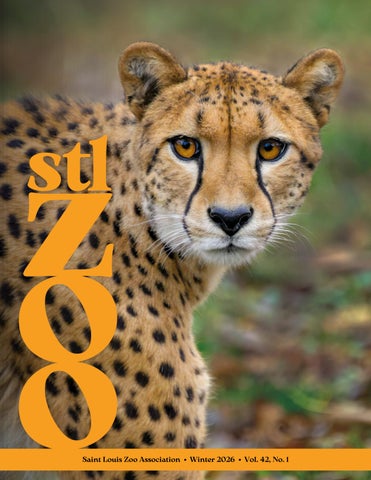
Saint Louis Zoo Association • Winter 2026 • Vol. 42, No. 1
Commentary Michael Macek, Director, Saint Louis Zoo; and Sabarras George, Director, Saint Louis Zoo WildCare Park
COMMISSION OF THE ST. LOUIS ZOOLOGICAL PARK SUBDISTRICT Chairman Lawrence E. Thomas Vice Chair Winthrop B. Reed III Treasurer Will R. Ross, MD, MPH
Happy New Year! We hope you had a wonderful holiday season with loved ones and are ready for new adventures in 2026. We are, for sure. This year marks the opening of the Henry A. Jubel Foundation Destination Discovery, our new experience for children and families that is sure to be the highlight of St. Louisans’ year! We’ll be sure to introduce you to new animals that will soon call it home; some of those new faces are in this issue! In the cover story on page 8, learn more about the Zoo’s “new kids on the block,” including the Chilean flamingo chicks that will reside at Destination Discovery. Some of the other “freshmen” included at the Zoo are the Amur leopard cubs, cheetah cubs and Komodo dragon. The Saint Louis Zoo isn’t the only campus with new faces. Different species are frequently arriving at Saint Louis Zoo WildCare Park, including reticulated giraffes and southern white rhinos. These large ungulates came to WildCare Park this past fall, and as our team members will tell you, transporting these animals is no small feat. Flip to page 14 and get the scoop on how they prepared to welcome these iconic symbols of the African savanna. As you can tell, we’re in preparation mode for the future, and our teams are working hard to give animals the best possible habitats and quality of life. Those efforts extend to our 100-yearold Bird House. In early 2026, the Bird House will temporarily close for renovations, which will include a new roof, HVAC system, skylights and more. The last major renovation to this building was in 1978, which helped usher this structure into a new era while maintaining its character. This renovation will accomplish the same. In the meantime, make sure you see our colorful bird residents during your next visit! You’ll see a lot of cheetahs in this issue — an animal near and dear to many hearts. Our new cheetah cubs, lovingly called “Cora’s Quints” are included in our cover story, and on page 20, you’ll see some of our fieldwork in action to help these fast cats. Journey alongside Zoo team member Carolyn Kelly as she recounts her travels to Somaliland to work with the Cheetah Conservation Fund, one of the Zoo’s conservation partners. Winter is a great time to visit the Zoo — it’s quieter and the cold-hardy animals, like Sichuan takins and Amur tigers, are usually out. And there are plenty of cozy buildings (like the Bird House!) if you need a break from the winter chill. Stay warm and safe, and we hope to see you soon.
stlzoo
Commissioners Vincent Bennett Karl A. Grice Alicia McDonnell Robert F. O’Loughlin Fred Pestello Neal F. Perryman Dana Tucker Redwing Michael W. Riney Dr. Joyce Roberts Chairs Emeritus Honorable James F. Conway Jerald L. Kent Steven F. Schankman Mark J. Schnuck SAINT LOUIS ZOO ASSOCIATION BOARD OF DIRECTORS President Michael J. Hickey Vice President Linda J. Hunter Treasurer Andrew T. Miedler Secretary Maria G. Taxman Immediate Past President Robert B. Smith III Executive Committee Kathleen W. Bilderback Frances G. Pestello Jason D. Sapp Robert B. Smith III Lisa K. Sullivan
Board of Directors SAINT LOUIS ZOO Barbara C. Archer YOUNG PROFESSIONALS Nicholas Barto ADVISORY BOARD Natalea Simmons Beaudean President Cenia D. Bosman Emily Carter Christine Boushka Kevin Buie, Sr. Secretary Debbie A. Caplin Katie Doherty Hazel Alethea R. Donald Brad M. Edwards Vice President, Kathy S. Federico Education Logan W. Finerty Joe Palumbo G. Andrew Franz Lauren Thomas Fries Vice President, Matthew W. Geekie Events Amy A. Gill Christian Wargo Brett G. Gilliland Janis G. Goldstein Vice President, Mark Graham Nominations Heather Grewe Brittany Mayfield Davida Lichtenstein Grindstaff Vice President, Ryan L. Hyman Volunteers Jason Janisse Betsey Crites Robert F. Johnston Annette L. Kelly Treasurer Carol S. Klein Justin Diecker Lee C. Kling Derek Larson, MD Immediate James P. Leonard Past President Dr. Dan W. Luedke Whittney Dunn Dr. Matthew R. MacEwan Melissa Markwort Board Members Alicia S. McDonnell Andrew Besand Patrick J. Moore Joel Carter Dr. Stanley J. Niemann Charles Cella Bhavik R. Patel Katherine Dockery Angela M. Rhone Hannah Dove Quirsis V. Riney Teghan Duhigg Diane Saftic Katherine Fash James G. Sansone Maya Gann-Bociek Angela D. Schaefer Anthony Graham Margaret Schneithorst Donald Hageman James R. Schnurbusch Allison Heininger Stephanie Valier Jack Hogan Schwendinger Jennifer Jeffries Rachel Kent Shlien Rei Kato Torbjorn B. Sjogren Kelly King Zachary A. Smith Chance Lacey Rick Stevens Maggie Lohmeyer Steven Stone Shawn Mann Dianne Sutcliffe Amy Molitoris Matthew A. Wagner Tim Nielsen Gerald E. Wiley Tambra Pendleton Robert M. Williams, Jr. Hannah Randolph Geoffrey Wilson Kate Schwarze Heather Wood Megan Schwedtmann Alex Stepanek Emerita – Emeritus Michael Stoecklin Members Jake Thessen James G. Berges Alex Wallach Marguerite Garrick Kathleen Walsh Douglas E. Hill Matthew Warren Joseph F. Imbs III Karla Weidner John K. Wallace, Jr. Lisa Wilson Luke Yamnitz Ex-Officio Devyn Yates Emily Carter, President, Zoo Young Professionals Advisory Board
All lists as of December 2025
in this issue 6
Did you know?
8
New kids on the block
There are several actions you can take to keep animals, people and our planet healthy. Check out some One Health-themed resolutions!
From Charlie the Komodo dragon to Cleopatra the king penguin chick, there are many new faces at the Zoo. Meet and learn more about them!
14
Giants on the move
18
Construction on the century-old Bird House
The Saint Louis Zoo WildCare Park crew is getting larger — it’s now home to rhinos and giraffes! Get the inside scoop on how they made their move to St. Louis.
Come see the Bird House before it temporarily closes for renovations and read about its almost 100-year history.
20 Saving cheetahs,
one cub at a time Get a glimpse of the Cheetah Rescue and Conservation Centre in Somaliland, where Zoo team member Carolyn Kelly traveled to help cubs rescued from the illegal pet trade.
On the cover Cheetah
Photo by Ray Meibaum stlzoo is published quarterly as a member benefit by the Saint Louis Zoo Association, One Government Drive, St. Louis, MO 63110. Managing Editor: Rebecca McMiller; Editorial and Email Assistance: Billy Brennan, Jill Gordon, Erin Heffernan, Erin Krippene, Kirby Meyer and Elaine Vydra; Graphic Design: McCord Design Group; Contributing Photographer: Ray Meibaum; Contributors: Members of the Zoo staff.
At the Saint Louis Zoo, we not only care about the conservation of animals, but also about the conservation of the environment. That is why stlzoo magazine is created using FSC- (Forest Stewardship Council) certified paper with recycled materials and eco-friendly inks.
Winter 2026
1
membership matters In this section, we’ll briefly highlight top Zoo happenings in January, February and March 2026, from event and attraction updates to member-specific reminders. If you have questions about your membership, please visit stlzoo.org/membership or contact us at (314) 646-4771, option 2.
Attractions and experiences Giraffe Feedings $2 discount per person The feeding schedule is 11:30 a.m. and 2:30 p.m. daily, weather and conditions permitting Emerson Zooline Railroad
Be sure to check out Animals Aglow starting on March 13; members get discounted tickets!
Reminder about your membership and benefits As of March 1, 2025, our membership levels and benefits have changed. If you purchased or received a membership prior to March 1, you’ll continue to receive the same benefits until your membership expires. You’ll receive detailed information about the changes before it’s time to renew. As always, thank you for supporting our Zoo!
Summer camp registration for Zoo members
Open year-round, weather permitting Mary Ann Lee Conservation Carousel Included in premium member tickets; free for children 0-23 months Open year-round, weather permitting
We value your membership support and want you to have priority registration for 2026 camps! Marlin Perkins Society registrations are open from Feb. 3-8 (ending at 4 p.m. on Feb. 8), and Zoo member registrations open at 10 a.m. on Feb. 10. Stay tuned for more information via email and check back to stlzoo.org/education for more about camps. Our summer camps fill up quickly, so mark your calendar now!
Sea Lion Show presented by Together Credit Union
Pay-upon-exit system now in Zoo parking lots
Stingrays at Caribbean Cove presented by SSM Health Cardinal Glennon Children’s Hospital
To help alleviate traffic congestion around the Zoo and provide the best experience for all guests, we’ve implemented a pay-upon-exit system in our parking lots. All members must scan their cards to enter the lots. Unlimited $5 Parking Per Visit • Members at the Explorer, Navigator and Protector levels. Upon scanning your membership card, you'll receive a ticket. Please pre-pay, keep your ticket and scan at the kiosk at the parking lot exit. Unlimited Free Parking • Members at the Champion and Benefactor levels • Members at levels prior to March 1, 2025 • Marlin Perkins Society members
Parking instructions and step-by-step videos are available at stlzoo.org/parking.
2
Included in member tickets; free for children 0-23 months
stlzoo
Included in member tickets; free for children 0-23 months Resuming in spring 2026
Included in premium member tickets; free for children 0-23 months Resuming in spring 2026 Wild Explorer VR Experience $2 discount per person Showings daily
presented by Wells Fargo
Wednesdays through Sundays,
March 13-May 17, 2026
Check back to for more information.
wild Growing herds
As of this writing, about 100 animals now make a home at WildCare Park, representing more than a dozen species. This includes 17 endangered and critically endangered animals born at the park since 2024, some of the first successes in line with the park’s conservation breeding mission.
Sable antelope
We’re excited to bring you updates about Saint Louis Zoo WildCare Park, a safari park and conservation center set to open in 2027 on 425 acres near the confluence of the Mississippi and Missouri Rivers. In addition to stlzoo magazine, please follow us on social media for the latest updates about this one-of-a-kind wildlife experience.
New happenings at WildCare Park Change is happening fast these days at Saint Louis Zoo WildCare Park. Each season brings new animals, updated habitats and major construction milestones as we move closer to the day guests will board the park’s first guided safari tours. Zoo teams have spent years planning this once-in-a-lifetime project, and we can’t wait to share it. Here’s a look at some of the latest progress.
4
stlzoo
This year, three new species that will be part of the park’s Woodland Safari experience joined the WildCare Park herds: 1
Bactrian Camels: Three young camels arrived last July and were named by WildCare Park keepers after precious gemstones: Jasper, Opal and Sardonyx. All under 2 years old when they arrived, the trio is already thriving together.
2 Eland: Among the largest antelope species in the world, eland can stand 6 feet tall at the shoulder. The park welcomed its young first eland, Edna, this fall. Her arrival marks the first time in decades that the Saint Louis Zoo will care for this spiralhorned species. In December, seven more eland joined Edna! 3 Sable Antelope: Another species returning to the Zoo after decades, one sable antelope male and four females arrived to WildCare Park last summer. Native to the savannas of southern Africa, the species has a striking contrast between the sexes: males are typically deep black with sweeping curved horns, while females have shorter horns and a warm chestnut color.
news... Buildings taking shape
By late 2025, construction at WildCare Park began to shift from animal barns to key guest spaces and support facilities — including two of the largest additions on the horizon. 1
2
Animal Health Center: This facility under construction today combines a veterinary hospital and a 2,800-square-foot quarantine barn where newly arrived animals will stay before joining herds in the pastures at WildCare Park. The hospital will feature 3,500 square feet of clinic space, including a pathology lab and radiology area. While most medical care will happen in the fields to avoid separating individuals from their herds, this space allows for more intensive treatment — and even behind-the-scenes tours for guests.
Animal Health Center construction
Zoo Museum: A former event hall on the property is being transformed into an impressive, 27,300-square-foot building featuring a Zoo Museum, gift shop and welcome area. Inside, guests will find an experience that blends immersive exploration with zoo storytelling. The Zoo Museum will use the latest technology to let guests explore how animals experience the world around them.
Eland
Zoo Museum construction
Winter 2026
5
did you 1 As we begin 2026 and you consider New Year’s resolutions, now is a great time to support One Health — by caring for animal, human and planetary health. As the late, great Jane Goodall famously stated, “You cannot get through a single day without having an impact on the world around you. What you do makes a difference, and you have to decide what kind of difference you want to make.”
How about starting with a One Health resolution?
Environment Spend wisely. Use your purchasing power to reduce pollution and waste. Plant native species. They can benefit the environment by preventing soil erosion (they reduce water runoff and subsequential flooding) and reducing air pollution. Clean up the trash and leave the leaves! Fallen leaves add nutrients to the soil, create a layer of mulch that holds moisture in the ground, and provide shelter for insects and other animals during winter.
6
stlzoo
know? 2
Animals Make your garden a pollinator’s happy place by planting pollinator-friendly native plants. It’s estimated that 35% of the world’s food crops depend on animal pollinators to reproduce. Keep your pets healthy with routine vaccinations and parasite control. Make sure they have a leash on when outside (cats especially pose a big threat to birds). Be kind to wildlife: slow down on the roads and watch for wildlife crossing.
3 Humans Eat foods that are heart healthy and that have a low impact on the planet (like locally grown food). Get out into nature and walk, while leaving only footprints! Minimize your exposure to microplastics by decreasing single-use plastic (like plastic water bottles and cutlery).
What is One Health? As defined by the World Health Organization, One Health is an integrated, unifying approach that aims to sustainably balance and optimize the health of people, animals and ecosystems. It recognizes that the health of humans, domestic and wild animals, plants, and the wider environment (including ecosystems) are closely linked and interdependent.
Learn more about our Saint Louis Zoo Institute for Conservation Medicine team who are experts in the field of One Health at stlzoo.org/icm.
Winter 2026
7
NEW
KIDS ON THE
BLOCK
By Members of the Saint Louis Zoo Animal Care Team; Photos by Colin Dabbs, Laurie Dahle, Ray Meibaum, David Merritt and Natalie O’Dell
8
stlzoo
We’ve welcomed several new faces to the Saint Louis Zoo over the past year, and just like a new student meet-and-greet, we thought we’d tell you a little more about these new kids on the block!
CHILEAN
FLAMINGO
CHICKS Homeroom: Henry A. Jubel Foundation Destination Discovery
About Us: We’re found in South America
from Peru through the Andes to Tierra del
Fuego. We live in huge colonies, sometimes up
to 10,000 or more birds. Our group came from Zoo Atlanta and were reared here from eggs. We’re “teenagers,” so we’ll stay grey until we molt into adult, pink feathers.
Favorite Activity: We love to eat! We can
eat up to 10% of our body weight in a day!
We forage for and eat tiny invertebrates and
microorganisms in the water. Here at the Zoo, we eat krill and a special, tiny pellet, designed just for flamingos. It has all the nutrients and pigments to help make sure we stay pink.
Most Likely To: Be heard from far away.
We communicate with other flamingos with different calls and honks. Even among
thousands of colony members, other flamingos
can distinguish individual birds when they call. Conservation Goals for the Future: Our care team is excited for you to meet us
at Destination Discovery in the second half of
2026! Guests can feed our flamingo colony and enjoy up-close encounters with us. Our wild
habitat is wetlands, but these are disappearing. Guests’ connections to animals like us foster
understanding of how protecting water benefits us all.
Winter 2026
9
CHEETAH
CUBS (Chirpa, Malani, Bozzie, Wicket and Asha)
Homeroom: River’s Edge
Most Likely To...
About Us: We’re Cora’s Quints! We were born May 5, 2025, and named after the Ewoks of
Endor in honor of our parents, Cora and Vader, who also have Star Wars character names. We’re the first successful cheetah births at the Zoo in more than seven years.
Malani: Reach the highest nook in the tree. Bozzie: Smack a sibling and start a game of chase.
Wicket: Eat anything offered. Asha: Say “please and thank you” — she’s timider in a “polite” way.
Favorite Activity: Romping, running,
climbing everything as high as we can,
playing, investigating, trying new things,
and all-around young cub antics punctuated by well-earned cat naps.
Chirpa: Be within 5 feet of mom.
Conservation Goals for the Future: In the wild, cheetahs were found
throughout Africa and Asia. Today, fewer
than 7,000 of us inhabit a broad section of
Africa. Over the past 50 years, cheetahs have
become locally extinct in at least 13 countries. The Saint Louis Zoo WildCare Institute
partners with Cheetah Conservation Fund
(CCF) to support the conservation of cheetahs in the wild. CCF works in Namibia and
Somaliland to ensure the protection and
future of this species. (Read our article about our team’s work with CCF on page 20).
Our Zoo is also a partner of the Association of Zoos and Aquariums (AZA) SAFE
(Saving Animals From Extinction) Cheetah program, which supports increasing cheetah populations through collaborative conservation efforts.
We’re the first successful cheetah births at the Zoo in more than seven years.
10
stlzoo
KOMODO DRAGON
(Charlie)
Homeroom: Charles H. Hoessle Herpetarium About Me: I hatched in 2018 at the Denver Zoo, then was transferred to the Bronx Zoo. I’m excited to now call the
Saint Louis Zoo home! I have some growing to do — I’m just a teenager, after all — but I’ll likely get to 6 or 7 feet.
Most Likely To: Have the cleanest teeth. There are many
misconceptions about Komodo dragons harboring bacteria in our saliva, but we actually have very clean mouths and teeth. Conservation Goals for the Future: Komodo dragon conservation focuses on protecting the remaining wild
populations found on a few Indonesian islands through habitat preservation, population monitoring and anti-poaching
measures. Breeding programs and community-based initiatives also play key roles in ensuring our long-term survival. Like my fellow freshmen, I’m part of an AZA Species Survival Plan (SSP) too. When the right lady is ready for me, I’m ready!
Favorite Activity: Moving around my solarium habitat and basking in the sun as it moves.
KING PENGUIN
CHICK (Cleopatra) Homeroom: Penguin & Puffin Coast
About Us: I was born on Sept. 5, 2025, and my mom and dad (Ethel and Elliott) are first-time parents. King penguins are the second largest penguin of 18 species, all of which live in
the southern hemisphere. King penguins lay only one egg per breeding season, which occurs only once a year. Both parents
take turns keeping chicks like me warm and fed. I will become independent and leave my mom and dad when I’m around 13 months old.
Favorite Activity: Like my fellow freshmen, the Chilean flamingos, I love eating! I need to gain about 10 to 15%
of my body weight daily for my first four to six months.
At Saint Louis Zoo, an adult king penguin can eat an average of two pounds of fish per day while a 2-month-old chick can easily eat more than three pounds of fish.
Most Likely To: Win a diving competition, once I get older. In the wild, king penguins dive as deep as 100 to 200 meters in search of lanternfish and squid.
Conservation Goals for the Future: Climate change
is causing our primary fish food source to seek cooler waters, so king penguins are forced to swim even further. This burns valuable energy and can take parents away from the chick
for a long time. Competition for fishing resources with the commercial fishing industry puts pressure on all penguins.
Seeking sustainably wild caught or farmed fish when grocery
shopping is an easy way to protect the ocean and the penguins that rely on it. Check out Seafood Watch to learn more!
Winter 2026
11
ASIAN
ELEPHANT
CALF (Jet) Homeroom: River’s Edge
About Me: I was born on Nov. 23 and am just over a year old! I’m the first Asian elephant at
the Saint Louis Zoo to be born from artificial
insemination (that’s not awkward for me to say at all).
Favorite Activity: Walking along large logs, like a balance beam, trying to be graceful.
12
stlzoo
Most Likely To: My care team says I’m
a valedictorian when it comes to learning.
Every day, I’m eager to participate in training sessions with my keepers. I surpassed every
training goal ahead of schedule and learned over 30 trained behaviors that allow me to
voluntarily participate in my own healthcare. Conservation Goals for the Future: The wild Asian elephant population continues to decline due to habitat loss, fragmentation, human-elephant conflict and poaching.
My endangered species has an estimated
population of 41,410 to 52,345 Asian elephants
left in Southeast Asia, which are scattered across fragmented habitats in 13 range countries.
Me and my family at the Saint Louis Zoo are
a part of an SSP that provides a genetic safety
net should wild populations continue to decline.
AMUR LEOPARD
CUBS
(Domovoi and Vasilisa) Homeroom: Big Cat Country About Us: We were born on Aug. 13, 2025.
Our births mark an important contribution to
Conservation Goals for the Future: Amur leopards are the most endangered
big cats in the world. We are the result of a
successful breeding recommendation by the AZA Amur Leopard SSP, a cooperative program responsible for maintaining a
genetically healthy population of Amur leopards in North American zoos. The SSP works closely with global conservation partners to safeguard this species from extinction, making each
successful birth a step forward for the future of the Amur leopard.
the population of one of the most endangered big cats in the world; only about 100 of us
remain in the wild. There have been nine cubs in six litters born at Saint Louis Zoo since 1991. Favorite Activity: Making scary tough cat
faces and snarling at each other. Also romping, exploring new things and developing new skills.
Most Likely To... Domovoi: Climb on mom’s head. Vasilisa: Boldly check out new things before her brother.
Our births mark an important contribution to the population of one of the most endangered big cats in the world; only about 100 of us remain in the wild.
Winter 2026
13
Zoo team members prepare to welcome the new southern white rhinos and reticulated giraffes
GIANTS ON THE MOVE: How Rhinos and Giraffes Found a Home at WildCare Park By Erin Heffernan, Public Relations Manager Photos by Erin Heffernan, Ray Meibaum, Danny Recklein & Robin Winkelman
K
eepers at Saint Louis Zoo
her new home. With those steps,
Mississippi Rivers, WildCare Park
to shoulder in neon safety gear one
at WildCare Park safe and sound.
of the Zoo in Forest Park. As of this
WildCare Park stood shoulder
afternoon this September, eyes fixed
Amani’s journey from San Diego
on a moment of history.
Zoo Safari Park marked the beginning
lifted a massive crate that showed
WildCare Park, the Zoo’s safari park
Above them, a crane slowly
no outward hint of what was inside: One 5,200-pound southern white rhino named Amani.
As the crate touched down beside
WildCare Park’s new rhino barn, a team of keepers went into
coordinated motion, securing gates
and checking on Amani before safely lifting crate barriers from above. After a few moments’ pause,
Amani cautiously backed out into
14
the first rhino had officially arrived
stlzoo
of a remarkable season of arrivals for and conservation center opening
will be more than four times the size writing, about 100 animals already live
at the park today, but the newly arrived
rhinos and giraffes will be its largest —
and among its most iconic — residents. “It’s a big moment for any zoo
in north St. Louis County in 2027.
when you bring in one giraffe or one
welcomed five southern white
General Curator Martha Fischer.
In recent months, the park
rhinos and four giraffes. Each will be a member of the founding
herds at WildCare Park, one of the most ambitious expansions in the
Saint Louis Zoo’s 115-year history. Located on 425 acres near the
confluence of the Missouri and
rhino in a year,” said WildCare Park “At WildCare Park, we’re bringing
together whole herds over just a few months. It’s an incredible time for
the team and the Saint Louis Zoo.”
Building from the ground up Long before the first rhino stepped
foot at WildCare Park came years of
planning, design, ecological restoration and collaboration.
Soon after the Zoo purchased
the land for WildCare Park from the
multispecies pastures planned for
“We picked the best of everything
the park, Fischer said.
we saw,” said Fischer. “The barns were
arrive, however, the land itself needed
today, but for decades of future care
Long before any animals could
to be prepared.
Former Plumbers & Pipefitters
built not just for the animals here and growth.”
The rhino barn is built to house
Plumbers & Pipefitters Local 572 in
golf fairways were restored into
up to 10 rhinos and features sturdy
giraffes as two of the keystone species
grasses, lakes and trees. The result:
mud wallows, and a rhino-safe scale.
2018, leaders identified rhinos and
for the park. Both are iconic symbols of the African savanna, but their selection was also driven by purpose.
“They both have compelling
conservation stories,” said Fischer.
nearly 260 acres of native Missouri habitats that support grazing herds
while also providing habitat for native wildlife and improving the area’s ecological health.
Meanwhile, architects, animal care
“And we knew bringing them into
experts and operations teams traveled
strengthen the species’ populations and
across the country. They studied barn
WildCare Park would be a great way to build on our longtime commitment to giraffe and rhino conservation.”
Both species also thrive in large
herds and the type of sprawling,
Below: Southern white rhinoceros; Right: Keeper Jamie Lombardo oversees the giraffe in their barn
to accredited zoos and safari parks layouts, safety systems and habitat design for inspiration.
“
materials, specialized water troughs, The 38.5-foot-tall giraffe barn, the
tallest animal care building planned
for WildCare Park, can house up to
15 giraffes and includes a second story that allows keepers to work at head-
height to the herd. Both heated barns
include large community spaces where the herds can stay together, as well as individual stalls.
The barns were built not just for the animals here today, but for decades of future care and growth.
”
Winter 2026
15
How to move a rhino? We often get this question.
process of permits, inspections
as rhinos and giraffes involves far
teams conducted thorough health
Transporting animals as large
more than a truck and a highway. The process began nearly five
years ago, when the Zoo reached
out to the Association of Zoos and Aquariums’ (AZA) collaborative
breeding programs — the Species
and legal documentation. Veterinary
crates weighing some 10,000 pounds with a rhino inside.
Each animal traveled in unassuming
evaluations to ensure each animal
crates and trailers hauled by heavy-
the sending institutions spent months
never realized a rhino or giraffe was
was fit for the move, while keepers at gently training the animals to enter and get comfortable in their travel
duty trucks. Most drivers passing by just a lane away.
The five southern white rhinos
crates and trailers.
arrived over four days in September:
for WildCare Park’s first herds.
acclimating them before the move
and Amani from San Diego Zoo
issued formal recommendations
“They need to comfortably walk into
Survival Plans — to begin planning In spring 2025, those programs
identifying which rhinos and giraffes from AZA zoos around the country were the best genetic matches for the park’s first herds.
From there, the Zoo’s registrars
took over, navigating a lengthy
“With animals this large,
is especially important,” said Fischer. the crates and relax on their own.” When moving days finally
arrived, each journey relied on
experienced animal haulers, specialized equipment and — in the case of the rhinos — cranes capable of lifting
Four females, Helene, Nikita, Future, Safari Park, and one male, Newton, from Omaha’s Henry Doorly Zoo
and Aquarium. The four giraffes — Mo, Daniel, Ajali and Dilly —
followed one by one from accredited zoos across the country, with more expected to arrive in 2026.
Below: The five southern white rhinos arrived over four days in September: Four females, Helene, Nikita, Future, and Amani from San Diego ZooSafari Park, and one male, Newton, from Omaha’s Henry Doorly Zoo and Aquarium
“
16
With animals this large, acclimating them before the move is especially important. They need to comfortably walk into the crates and relax on their own.
”
stlzoo
Above: Giraffe and southern white rhinoceros
Settling in Although WildCare Park will not
open to guests until 2027, the early
arrival of the animals is intentional. Over the next year, animal
care team members will focus on
acclimation — helping the animals
adapt to new herd members, sights, sounds, people and routines.
“We try to introduce one new
experience at a time,” Fischer said. “It’s a slow, careful process.”
First the animals get used to the
barns, then smaller outdoor spaces and finally they begin to explore the park’s large safari pastures:
“
We try to introduce one new experience at a time. It’s a slow, careful process.
The Savanna Safari A 101-acre grassland dotted with
lakes, will be home to giraffes, zebras, wild cattle, ostriches and several rare antelope species.
The Woodland Safari
”
Many of the animals selected
for the founding herds already have experience living in some of the
country’s best safari parks, which should help with acclimation, Fischer said.
Even now as the animals are
A 63-acre rolling landscape of trees
just beginning the process of settling
southern white rhinos, camels, eland,
seeing them together is extraordinary.
and open clearings will be shared by
into WildCare Park, Fischer says
impala, sable antelope and ostrich.
“There are days I step inside
Eventually, the WildCare Park
herds will be introduced to the park’s safari vehicles to prepare them for
the guided safari tours that will carry
guests into their habitats. There will be
no barriers between guests and wildlife, just open landscapes.
the giraffe barn and think:
‘They’re really here,’” she shared.
“There’s relief they arrived safely,
but it’s also a deep excitement for the future. Each new animal is
part of the park’s commitment to
conservation here and in the wild.”
Winter 2026
17
Construction on the century-old Bird House By Anne Tieber, Curator of Birds; Photos by Adam Sprouse and Robin Winkelman
The Saint Louis Zoo has many
to open to the public in 1930.
they worked toward a zoo that would
Bird House at nearly 100 years old.
considered state of the art. It set
the thought process that the guests
notable buildings, one of which is the As with anything, time ages us, and this beloved building needs some renovations. The Bird House will
be closed for much of 2026 so it can receive a new roof, HVAC system,
skylights and outer-building repairs. We hope you’ll see the Bird House and all its colorful residents before the renovations begin, likely in
March 2026. Once renovations begin, many birds will go to
other institutions per breeding recommendations, or they will
reside in habitats behind the scenes. A little history The Bird House, which was designed by architect John E. Wallace, was
the last of the three Historic Hill
buildings, after the Primate House
and formerly named Reptile House,
At the time, this building was
the bar high for other zoological institutions to house animals in
naturalistic settings and to provide a wonderful experience for the
guests. The cost of the project was
$2.5 million and provided 56 glassfronted habitats, as well as a large open-flight habitat, which was a
forward-thinking idea to display birds
stlzoo
were always in the lighted areas
and the animals in the darker areas. The addition of skylights over the
animal areas helped to showcase the birds’ beauty as well as increase the
welfare of the animals by providing
natural photoperiods that are critical for their breeding and molting.
The Bird House was renovated in
in a lushly planted, open-fronted aviary.
1978 and re-opened to the public in
with the heavy beams, antique lighting
as larger habitats (reducing the number
The original Spanish-style architecture, and the detailed artwork on the
cornices and capitals adorn all three of the historic houses.
Wallace knew very little about
animals when he took the job of designing the historic buildings, but working alongside then-
Superintendent George Vierheller,
The exterior and interior of the historic Bird House; photos estimated to be taken in the 1930s
18
stress naturalistic settings and reverse
1979 with much-needed updates, such of habitats from 56 to 36), replacing
glass fronts with piano wires (making
the barriers almost invisible), replacing the original Terrazzo floor with carpet and adding lush planters to soften the
spaces. These enhancements created the warm tropical feeling the Bird House is known for today. These renovations
Guam kingfisher
The front of the Bird House
Congo peafowl
earned the Zoo a Significant
Species Survival Plan program
brought into human care, and the
Association of Zoos and Aquariums
program managers, we ensure the
the Wild.” The tree snake managed
Achievement Award in 1980 by the
(AZA). This renovation also showcased porcelain bird sculptures in a side wing of the Bird House named
“The Whitaker Room.” The 26-piece
manager. Working together with
best genetic matches possible for
sustaining a valuable population in the care of zoos and aquariums.
People often ask us what the most
collection was valued around $100,000
important bird in the Bird House is,
for about 20 years.
and critically endangered species,
and remained a part of the Bird House Through the years, the Bird House
has been home to hundreds of
different species of birds, from large birds of prey (eagles, vultures and
large hornbills) to smaller species
(bee-eaters, fruit doves, pigeons and
shorebirds), as well as small perching birds such as finches and weavers.
The birds go about their life breeding and cohabitating, just as they would
in the wild, with many of the species having oversight from an AZA
and while we have several endangered the most important species we have is the Guam kingfisher, or sihek,
which is officially listed as “Extinct in
sihek was officially declared “Extinct in to drive all but two species of birds to extinction and cause ecosystem
devastation to the island; to this day,
there is still a heavy snake population on the island of Guam. The Saint
Louis Zoo participates in this valuable conservation breeding plan with the hope of one day returning the sihek to the wild.
As we near the 100-year
the Wild” by the International Union
anniversary of the Bird House, these
was driven to extinction by the
building and its inhabitants looking
for Conservation of Nature. The species introduction of the brown tree snake in the 1940s during World War II. Due to the climbing nature of this
snake, it fed on birds and nests in the
trees. In the late 1980s, the remaining 20 or so birds were captured and
renovations are needed to keep the and feeling their best. This much-
needed facelift will carry this beautiful building into the future, and when we
reopen, you might see several new and exciting species of birds waiting to say hello!
Winter 2026
19
CRCC cub, Aiden, relaxing in the spacious cub yard
Two cheetahs interact with each other
Saving cheetahs, one cub at a time By Carolyn Kelly, Assistant Manager, Tours
It’s not easy to Google search
night. I found a land of spiced tea, and
with proximity to the Gulf of Aden,
Somaliland is technically not a
hijab winding their way between
point for cheetah cubs to illegally be
“travel to Somaliland.” First,
country. It’s an independent region within the country of Somalia, and it’s not recognized by the
United Nations, so any search inquiries typically pull up information for
Somalia, not Somaliland. Americans don’t often travel to Somaliland.
So, it’s understandable that I didn’t
know what to expect as I embarked on an adventure to work with
Cheetah Conservation Fund (CCF),
a Saint Louis Zoo WildCare Institute
donkeys and goats en route to class.
I found afternoon storms that rolled in from the bushland, pummeling
tin roofs with torrential rain. I found quiet nights under starry skies, with the lights from pastoralists winking at one another in the endless dark. And I found a team of people
passionately dedicating years of their
life to the conservation of a remarkable species of cat.
Though it’s not internationally
partner, at their Cheetah Rescue and
recognized as a country, Somaliland
outside of Hargeisa, Somaliland.
democratic elections. And, as it turns
Conservation Centre (CRCC) just
What I found was not at all what
Google interpreted for me. I found a dry, thorny landscape with wind that threatened to steal my hat during
the day and rattled my windows at
20
hundreds of schoolgirls in dust-colored
stlzoo
has its own government, and peaceful, out, it’s an incredibly advantageous location for CCF’s latest outpost. The purpose of the CRCC is to
rescue cheetahs from the illegal pet
trade. Located in the Horn of Africa,
Somaliland is a convenient launching sent to the Middle East as part of
the pet trade. Cheetahs are not pets. They are wild animals, and they
belong in the wild. Many of the cubs smuggled into the pet trade are kept in horrific conditions. The majority
are sick or don’t survive. The dedicated staff of CCF Somaliland work
hard to intercept these cubs before they begin their journeys to the
Middle East. They confiscate cubs
and take them to the CRCC, where they are cared for by professional
staff and can live out their lives in
acres-large, fenced enclosures in the
African bush. To illustrate just what a problem the illegal pet trade is for cheetahs in 2025, it’s important to
note that the CRCC now has over 120 cheetahs in residence, all rescued from
an uncertain fate. Fortunately, CCF
expect lots of sleeping and lots of
large, so there is plenty of space for
residents. The CCF keepers and I
Somaliland’s bush property is quite
future expansion to give these cats a
lifelong home in an environment that
is as similar to their wild counterparts as is possible.
After a 45-hour journey, I arrived
playing from the CRCC’s youngest worked to give them ample time to
exercise in the spacious outdoor cub
yard, naturally followed by long naps in their indoor homes.
The cubs receive top-notch care
at the CRCC in Somaliland around
at the CRCC and live extremely
started?” CCF’s In-Country Manager,
that only a few weeks before I made
noon. “Do you want to rest, or get Chris, asked me. I didn’t travel all
that way to rest, so I jumped right in. My role at the CRCC was to assist
the CCF staff with cub care. At the time of my arrival, the CRCC was
home to 20 cheetah cubs, ranging in age from 2 to 7 months. One group
of 10, known as the Salaxaley Group, arrived only a few weeks before me.
Because these cubs were taken from
their mothers, they all had to be hand-
enriching days. It struck me, however, their acquaintance, they were living in the wild with their own cheetah mothers. It isn’t fair that they were
snatched from that life and thrust into an entirely new one. These cheetahs
belong in the wild. As an apology of sorts for the behavior of my species, I did my best to work hard and give these cubs the best life possible,
Less than two weeks after my
return from Somaliland, another
Our days started at 6 a.m. I left the
and taken to the CRCC. Only eight
little yellow house that I shared with
three women in the rattling wind and
enjoyed the sight of an African sunrise as I made my way to the clinic to care for the cubs. We fed the cubs three times a day. The cubs ate a mixture of goat chunk, milk and calcium
supplements, interspersed with daily bones. Between feedings, I worked
the keeper routine, making sure the
11 cubs were confiscated by CCF have survived so far. This work is
ongoing and important. I hope that one day I can return to Somaliland
to use my skills to assist with cheetah care at the CRCC, and to learn
from their worldly staff about the
of life on the frontlines of cheetah
conservation in the Horn of Africa. If I’m lucky enough for a next
time, I know what to expect:
I worked as a Carnivore Keeper at the
complex and truly magical land
Saint Louis Zoo for over a decade,
and from my experience working with cheetah dams at the Zoo, I knew to
Kelly at the CRCC’s new Education Center
continuous challenges and triumphs
cubs had a clean home and plenty
of playtime in their expansive yards.
A cheetah cub enjoys time in the trees
considering their new circumstances.
raised, which is a very different process than caring for “mother-raised” cubs.
Kelly in the vast landscape in Somaliland
A life-changing experience in a where a small band of scrappy
caretakers are working to save the cheetah, one cub at a time.
A cheetah cub receives an injection while receiving a food reward; positive reinforcement training is an important part of animal health care
Winter 2026
21
Humboldt penguin
the hap January, February and March Details are subject to change. See what’s new and get the latest at stlzoo.org.
Want to go behind the scenes? Share an experience like no other when you book a behind-the-scenes tour at
Zoo Hiring Events Dates: Jan. 20 and Jan. 28, 2026 Times: 4-7 p.m. Zoo Location: The Living World stlzoo.org/jobs Experience a fun, friendly and unique work environment with a job at the Zoo. Learn about our open positions!
the Saint Louis Zoo! There are several tours offered during winter, including: • Birds of a Feather • Gentle Giants • Here, There and Grizzly Bear • Hippo Howdy • Penguin Encounter • Planet Protectors • Reptile Rendezvous • Sloth Slowdown • Tour de Tortoise Learn more and book at stlzoo.org/tours.
22
stlzoo
Trivia Gone Wild presented by Coca-Cola Dates: Feb. 27, 2026 Time: Doors open at 6 p.m. and trivia begins at 7 p.m. Price: See table options at stlzoo.org Age: Adults 21+ Zoo Location: The Living World and Lakeside Cafe stlzoo.org/triviagonewild Recruit some friends and get ready to expand your craniums at our Zoo’s trivia night! Trivia will cover a wide range of topics. Sponsored by Coca-Cola.
Animals Aglow presented by Wells Fargo Dates: Friday-Sunday, March 13-15, 2026; Wednesdays-Sundays, March 18-May 17, 2026; Sensory-Friendly Nights: March 29 and April 8 Time: Wednesdays, Thursdays and Sundays: 6:30-9:30 p.m.; Fridays and Saturdays: 6:30-10 p.m. Price: Check back to stlzoo.org for ticket prices. stlzoo.org/animalsaglow Animals Aglow is back and with all new lanterns to see! Walk around the Zoo at twilight amidst the luminous glow of towering wildlife lanterns. Plus, enjoy specialty menus featuring Asian cuisine, entertainment and more. Sponsored by Wells Fargo, Mid America Chevy Dealers and Coca-Cola.
appenings Sea Lion Show Spring Training presented by Together Credit Union Dates: March 14-29, 2026 Showtimes: 11 a.m. and 1 p.m. Price: $2 for all Zoo guests; Free for children 0-23 months Zoo Location: Judy and Jerry Kent Family Sea Lion Sound stlzoo.org/sealionshow The sea lions are back and reporting for training! Care teams are working with the intelligent pinnipeds on their athletic behaviors, including high dives and jumps.
Hours
Western lowland gorilla
Jan. 19: Martin Luther King, Jr. Day 9 a.m.-4 p.m Feb. 16: Presidents Day 9 a.m.-4 p.m
Winter Hours: Jan. 3-Feb. 28 Monday-Friday: 10 a.m.-4 p.m. Saturday-Sunday: 9 a.m.-4 p.m. March 1-May 21 9 a.m.-5 p.m. Please note that the South Entrance of the Zoo on Wells Drive will be closed on select dates from January through March. Learn more at stlzoo.org.
Winter 2026
23
A growing collaboration By Emily Garrett, Saint Louis Zoo WildCare Park Educator
On Nov. 7, 2025, shovels broke ground
built a greenhouse connected to
and lasting. By the end of the year,
School greenhouse. To many, it looked
just 10 miles away? It was agreed
for the greenhouse they helped
on the new Hazelwood Central High like the beginning of a partnership between the Hazelwood School
District and the Saint Louis Zoo. In truth, it was the celebration of something that had already
taken root. This collaboration, with
support from The Boeing Company,
Saint Louis Zoo WildCare Park, that the best way forward was
to let students decide how the
was a partnership built on trust
not just celebrating a new building.
and community. What developed and shared purpose.
In September 2024, 35 students
and student voices.
Zoo staff joins them in class to guide,
District have worked together for
years, but when Hazelwood Central adopted its Real-World Friday’s
schedule — an initiative that prompts students to undertake long-term
projects that are focused on real-world issues and challenges — a new idea started to grow. What if the school
When those same students
gathered for the groundbreaking
joined what became known as the
The Zoo and Hazelwood School
bring to life on their campus.
greenhouse could serve their school
began more than a year ago, inside a classroom filled with ideas, curiosity
their ideas had become the blueprint
Greenhouse Project. Each Friday, listen and collaborate. Students
surveyed their peers, led focus groups with district leaders, researched
potential sites, worked within budgets, and presented their final greenhouse designs to Zoo staff and community
members. They were treated as experts in their own school experience and as leaders shaping something real
Model of greenhouse that will be built on the Hazelwood Central High School campus, which will also serve Saint Louis Zoo WildCare Park
a couple months ago, they were
They were celebrating the power
of their own voices. Their greenhouse will grow native plants for WildCare Park and for their school campus,
produce enrichment food for Zoo
animals, and use an aquaponics system to conserve water while connecting plant and animal care. More than a
structure, it represents trust and the belief that when students are given the chance to lead, they grow into the conservation and community leaders of tomorrow.
Garrett and Hazelwood Central High School students before the greenhouse groundbreaking ceremony
Students, Zoo staff and Hazelwood Administration members break ground on the greenhouse
24
stlzoo
into our environment and not be at odds with it.”
Libby’s giving is a reflection of
her values and her desire to make a
difference, today and into the future. In addition to her membership in
the Marlin Perkins Society, Libby is supporting the development of the
Saint Louis Zoo WildCare Park and the work of the Saint Louis Zoo
Libby Yunger
A scientist, storyteller and champion for conservation: Meet Libby Yunger By Millicent Dohr, Manager of Major Gifts
When you meet Libby, you quickly
Today, you’re likely to find
WildCare Institute, extending her
reach locally and globally. A member
of the Heritage Society, Libby also has included the Zoo in her estate plan to help sustain and strengthen our
mission of Animals Always for years to come.
Libby’s favorite shirt bears a quote
sense her passion — for science,
Libby near the peccary exhibit
by Charles Darwin: “The love for
With a Ph.D. in Neuroscience and
step closer and learn about these
attribute of man.” It is a fitting motto
for animals and for conservation. a career as a research biochemist, Libby spent her days steeped in analysis, discovery and problem
solving. When she retired in 2009,
she was ready to channel her curiosity and expertise into something new.
“I knew I wanted to volunteer and
talk about conservation,” she reflects. “Becoming a docent at the Zoo was the perfect way to do that.”
Her inspiration reaches back to
in River’s Edge, inviting guests to fascinating animals. She relishes sparking “good conversations”
with guests — discussions that, in her words, “get people to
think more deeply about what’s important.” She also loves the
the immersive setting tells the
story of wetlands and the critical role they play in sustaining life.
Another passion of Libby’s is
aviation. She is a proud member of
her imagination. Later, during docent
organization founded in 1929 by
training at the Saint Louis Zoo, she
remembers watching young elephants Maliha and Jade splashing happily in
their waterfall. Those joyful moments
reaffirmed her belief in the importance of connecting people and animals.
for someone who lives this mission
daily — whether it is engaging with
Zoo guests in meaningful conversation or ensuring the Zoo’s work will thrive for generations.
Zoo’s Cypress Swamp, where
childhood visits to the Cleveland Zoo, where Frieda the elephant captured
all living creatures is the most noble
the Ninety-Nines, an international 99 women pilots who, like her,
love to fly. As a scientist and a pilot, Libby has a unique perspective,
a literal bird’s-eye view of our world. “We must take care of our planet,” Libby emphasizes. “We need to fit
Discover the Difference YOU Can Make with Tax-Wise Planning The Saint Louis Zoo offers complimentary and confidential estate planning consultations! If you would like to learn more or schedule an introductory meeting with our consultant, please email plannedgiving@stlzoo.org.
Winter 2026
25
Wild places, lasting impact: Explore the world through conservation travel By Jayne Ullstrom, Manager of Stewardship & Special Initiatives
Galapagos penguin, Galapagos Islands
The Saint Louis Zoo is excited to
to habitat restoration projects
global conservation travel company,
for future generations.
partner with Rewild Safaris, a luxury to offer exclusive, five-star experiences
a journey through some of Southern
efforts being made to protect it.
ecosystems. Begin in the Makgadikgadi
In 2026, the Zoo will host two
extraordinary 10-day conservation
journeys: the Galapagos Islands trip departs April 26, and the Botswana adventure begins Oct. 16. Hosted by Dwight Scott, Dana Brown
President & CEO, and Amy Dove,
Vice President of Philanthropy, these
Africa’s most diverse and breathtaking Salt Pans, walking with Zu/’hoasi Bushmen and meeting meerkats
amid ancient baobabs. Explore the
Okavango Delta’s rich wildlife, from elephants to big cats, then head to
Mababe’s remote grasslands to track lions, wild dogs and hyenas.
Guided by seasoned experts,
carefully curated experiences go far
each experience offers rare wildlife
meaningful engagement with some
understanding of the delicate balance
beyond traditional travel, offering of the planet’s most remarkable
ecosystems and the conservation work that sustains them.
In the Galapagos Islands, travelers
Lion roaring, Okavango Delta
In Botswana, travelers embark on
that deepen travelers’ connections
to the natural world and to the vital
Leopard at sunset, Okavango Delta
preserving this fragile environment
will explore a living sanctuary of
biodiversity. Each island reveals its
own natural wonders. You can snorkel
encounters and strengthens
between people, animals and the land they share. Whether walking beside
a giant tortoise or watching elephants cross a delta at sunset, these journeys inspire awe, understanding and a
lasting commitment to conservation.
with sea lions, penguins and turtles
off Isabela; hike past marine iguanas on Fernandina’s lava fields; or spot
blue-footed boobies along the cliffs of North Seymour. A visit to the
Charles Darwin Research Station on Santa Cruz offers insight into Snorkeling alongside wildlife, Galapagos Islands
26
stlzoo
decades of conservation in action, from tortoise breeding programs
Book the trip of a lifetime! To learn more or reserve your place, visit stlzoo.org/travel or contact the Zoo’s Development team at (314) 646-4691.
ZOOFARI 2025: A “tort-ally” grand evening By Hannah Stater Jensen, Partnership Marketing Coordinator
On Friday, June 20, over 2,000
Diamonds Direct bubbly wall.
at ZOOFARI 2025 presented by
the opportunity to bid on exciting
Saint Louis Zoo advocates gathered Wells Fargo, raising over $887,000
in celebration of the event’s featured animals, the Galapagos and Aldabra tortoises.
Guests savored delicious creations
from over 30 local restaurants and
caterers, as well as scrumptious bites
from the Zoo’s own culinary team at
the Pre-Party. Throughout the evening,
The silent auction offered guests experiences like a dinner with
evening with the Asian elephants. As night fell, the festivities
continued with entertainment by
national cover band The Block Party
We’d like to extend our gratitude to the following
Experience, turning the Zoo into a
premier sponsors:
dance floor under the stars.
• Wells Fargo
Thank you to our supporters for
making the Zoo’s annual fundraiser
Conservation Carousel and journeyed
demonstrating the strength and
around the Zoo.
Special activities included the gift
card wall, wine pull, bourbon tasting, Rawlings Gold Glove photo op,
Hearth & Soul pop-up shop and
Party with a purpose and join us on Friday, June 12! Tickets are a great gift for a birthday, anniversary or an adultsonly night out! Plus, members receive discounted tickets. Learn more at stlzoo.org/zoofari.
the Zoo’s polar bear twins and an
attendees rode the Emerson Zooline
Railroad, enjoyed the Mary Ann Lee
ZOOFARI 2026 tickets are on sale now!
a success once again, and for
resilience of the St. Louis community. Your partnership reflects sincere
commitment to the Saint Louis Zoo
and our local and international wildlife
• World Wide Technology • Anheuser-Busch • Bayer • Edward Jones • Mid America Chevy Dealers • Underdog • U.S. Bank
conservation efforts.
Winter 2026
27
Marlin Perkins Society The Saint Louis Zoo is extremely fortunate to have the support of more than 1,300 generous individuals, foundations and corporations through the Marlin Perkins Society. We welcome our newest members to the Society and thank them for joining this wonderful group of supporters. To our current members who have increased their financial support, we are pleased to recognize you as well. We are grateful for your commitment to our mission. New Marlin Perkins Society Members August 1 – October 31, 2025 Jane Bollinger & Dr. James Debnam Ray & Karen Bond Carolyn & Brandon Brown Natalie Franz-Hollaran & Michael Hollaran Marlene & Labib Haddad Ms. Amy S. Long Raymond J. Marek Molly H. McHugh Barbara O’Brien Michael & Quirsis Riney Paul & Rebecca Romine Judith A. Runk Joseph & Kelly Schaefer Evan & Carolyn Willmore Current Marlin Perkins Society Members Who Have Increased Support August 1 – October 31, 2025 Larry Absheer Jeffrey & Mary Ackerman Philip & Marjorie Alderson (15) David & Bobbi Ault (15) Stephen G. Bell (10) Nancy W. Benson (15) Titus & Gloria Blackmon Marghuretta Bland & Chris O’Connor Tim & Beth Bland (10) Dr. Stuart Bogner & Marsha Hogan (10) Shelby & Simon Brett Susan S. Brogan (10) Susan E. Burns Phil & Darcy Callahan Dale & Kate Cammon Dr. & Mrs. David Caplin Bob & Connie Carr Janice & Wayne Case (15) Ryan & Melissa Claus Barbara Bush Cook (15) Edward J. & Vicki Crawford Mr. & Mrs. Paul Dalba Donna Davis Paul Davis Charles Bernard Derbak (15) Glen & Patti Deutsch Dirxion LLC (15) Thomas & Kimberly Donahue Kathy & Justin Durel Deborah Kettler Engelke Charlie & Synthea Fischer Pat Flynn & Molly Flynn (10) Orion & Brittany Foeller Dr. & Mrs. Robert H. Friedman (20)
28
stlzoo
Cheryl & Terry Gilchrist Mark Gilje & Caroline Gilje, DVM (15) Mr. & Mrs. Joseph F. Gleason (25) Patricia & Timothy Goldsbury Lauren & Jose Rodriguez Goldstein Michael & Abby Goldstein Robert & Susan Goldstein Family (15) Arthur Grimm & Jenny John Irene & Bob Gulovsen Mr. & Mrs. Steve and Lynda Haberberger William Hall Andrew, Erin, Zayne & Ryker Haskins Dessa & John Hellige Ed & Joy Hennessy Michael & Emily Hickey Michael Hinkebein & Cynthia Whited Jean & Gary Hively Ann Hogan (20) Tony Holdener Debra F. Horwitz James & Lisa Huff Richard Humphrey & Eileen Dunn Humphrey Jeffrey L. Huntington (10) Matt & Karen Jacobs (10) Marjorie E. Johnson Tom Keefe Michael Kennedy Charles & Polly Klasek Nancy G. Koller (10) Mr. & Mrs. Edward J. Koplar (15) Constance C. Kovach Rachel Kyllo & Karl Staser Dr. & Mrs. Jerome F. Levy Edward & Barbara Little Judith D. Lohaus & Michael S. Mudd Paul & LaVerne Lorenzini (20) Joel & Tracy Malke Mrs. Peggy J. Mangiaforte Jay P. Marshall, M.D. (25) Mr. John R. McFarland Ray & Jan Meibaum Ann Meuleman Art & Heather Meyer Ted & Linda Meyer Aaron Molitor James & Merry Mosbacher (15) Lawrence G. Mrazek Charles & Jean Naslund Vince & Tami Natoli Angie & Ken Nettleton Sue & Tom O’Meara (10) Beth A. Paulitsch & Danny S. Recklein Nick Pierce-Cramer & Family David & Adrienne Piston (10) Michael & Lisa Pogue (10) Dr. & Mrs. William J. Popovic (10)
Gale Rahmoeller Rick & Christine Ratkowski Bianca & Martin Resch Rhodey Construction (15) Richards Roofing & Exteriors, Inc. (10) Ken & Bev Riley (10) Roofers Mart Inc. Mr. & Mrs. John W. Rowe (10) Karen E. Ruecker Mary Jane & Jason Ruff The Jay & Gina Ryan Family Jason & Abigail Sapp (10) Dr. & Mrs. Robert R. Schlueter (20) Terry & Sally Schnuck (10) Mark F. Schumm (10) Dr. Susan Sczepanski & D.J. Searle Dennis Sedlak & Georgine O’Donnell Robert E. Semon Susan G. Sherman (20) Ms. Sharon Sofian Daniel & Mary Speciale Dr. James & Maura Speiser Vince & Caroline Stegman Edna & Curtis Stepanek Mark & Jennifer Stirnemann Tegner Stokes Striler Group The Simmons Charitable Foundation (10) Pam, Craig & Avery Toder Eric & Melissa Trautman (20) Annette Tulley Ms. Ellen Uhlemeyer Patricia & Charlie Valier (15) Buzz & Joy Vierling (10) Mr. Ryan Hayes & Ms. Laura Vierling (10) Tim & Alli Vierling James & Wendy Walsh James & Malinda Watson Linda & Peter Werner (25) Tom & Jane Wulf (10) The Yoder Family (10) denotes member for at least 10 years (15) denotes member for at least 15 years (20) denotes member for at least 20 years (25) denotes member for at least 25 years Please contact the Development Office at (314) 646-4859 if you: • Would like information on how you can join or increase your support to the Marlin Perkins Society. • Discover a discrepancy or have a question (the Zoo makes every effort to acknowledge all gifts and to maintain accurate records).
Honor Roll The following list represents new major and planned gifts and pledges, excluding Marlin Perkins Society and other membership gifts, made to the Saint Louis Zoo Association from August 1 to October 31, 2025. Donors are listed in the category of their most recent giving to the Saint Louis Zoo. Leadership Gifts $1,000,000 and Above Marion & Van-Lear Black Major Gifts $749,999 – $500,000 Adorjan Family Kathy & Jim Snowden $499,999 – $250,000 Dr. David & Marge Perkins Estate of Robert S. Vosburgh $249,999 – $100,000 Ms. Kathryn A. Aschenbrenner Carl & Jeanne Deutsch Foundation Edward K. Love Conservation Foundation Jane S. Tschudy Donald L. Ulrich Special Gifts $99,999 – $50,000 Boeing Company Stephen & Breaux Daniel Lawrence P. & Alexis M. Fahle Charlie & Marilyn Hoessle Caroline Loughlin Fund $49,999 – $25,000 F. Holmes Lamoreux & Ann Tretter The Lorenzini Family John & Maureen Riffle The Simmons Foundation $24,999 – $10,000 Anonymous AEN Foundation American Wolf Foundation Rudy & Sandy Beck Ms. Betty Beckmann Adele Dilschneider Jim & Lionelle Elsesser First Bank, Inc. Edward Chase Garvey Memorial Foundation In Loving Memory of Marilyn Hoessle: Charlie Hoessle Marty Hoessle Kirk Hoessle Tracy Hoessle Malke Bradley Hoessle The Koller Family John and Carolyn Peterson Charitable Foundation, Inc. Estate of Aileen & Mel Rabushka Mr. & Mrs. Gary Reim
Estate of Lawrence R. & Jacqueline T. Rugg Berkley Shands, in Memory of Beverly Sparks-Shands, Oscar Sparks, Dorothy Sparks, & George Wicks Mr. & Mrs. Torbjorn B. Sjogren Society for Information Management $9,999 – $5,000 Anonymous Leo R. Buder Foundation Trust Kaye Campbell-Hinson & Phil Hinson Jackie Full Tony Holdener Eugene Lehr Estate of Melva Long H. Smith & Janet McGehee Angie & Ken Nettleton Estate of Robert Oppliger Jeffrey & Karen Stokes The Trio Foundation of St. Louis Libby Yunger $4,999 – $2,500 Anonymous Rosemary Boustany Diane & Joe Carenza Dot Foods, Inc. Gary A. Hansen & Linda D. Hansen Michael S. & Julie B. Pfister David Porter & Carol Imo Ranken Jordan Pediatric Bridge Hospital Jim & Sheila Rotter Mrs. Maureen Thenhaus Ms. Ellen Uhlemeyer $2,499 – $1,000 Anonymous Alaska Wildland Adventures Katherine & Kirk Baldwin Dennis & Joan Costello Rose Mary Dieckhaus John & Margaret Dozier Roger & Earleen Duncan Mrs. Gilbert G. Early Todd Ferguson Dr. & Mrs. Charles S. Furfine Thomas Galvin Mrs. Carol K. Gravens Marie Guariglia Brenda Haalboom Mr. Patrick J. Kleaver Mr. & Mrs. David Lazaroff Neil & Pam Lazaroff Janice R. Loudenslager Mrs. Talbot Leland MacCarthy
Lesley McIntire Mrs. Mildred T. Moody Alan & Jeannette Nissenbaum Ms. Diane Saftic Stephanie & Nathan Sanders Ms. Angela D. Schaefer & Mr. Collin Cox Michael Schwartz & Joan Dykman Marion Weinreb & Paula Pilecki in honor of our daughter, Gloria Weinreb Mr. & Mrs. Jess Yawitz $999 – $250 Acropolis Investment Management Mr. Gary Andrew Mary L. Barlow Keith R. Barrett Clara E. Brown Estate of Laurance & Virginia Browning Dona D. Cernansky CHS Alumni Luncheon Committee Jennifer & Lee Demertzis Carl Duraski Mr. David R. Ganz Dr. & Mrs. Ted Garrett Michael & Nancy Georgen Michael & Maureen Hoock Chris & Lisa Imbs Keefe Family Charitable Fund Craig Landon Suzanne G. Levin Mr. & Mrs. Jean F. Mason Mrs. Margaret McKinney Dr. Robert Eric Miller & Dr. Mary Jean Gorse Neuberger Berman Group LLC Martin D. Olson Mr. & Mrs. William S. Port James & Darlene Renken Estate of Viola J. Reynolds Virginia Ruch George H. Shattuck Nancy Sido & Lee Hoffman Carol & Francis Trotter William & Mary Vassar Ms. Kerry Vetter John & Ellen Wallace Jessie Williams The Saint Louis Zoo Development Office regrets any errors or omission of any gift. If you would like to change your honor roll listing, contact Katie Meyers at meyers@stlzoo.org.
Winter 2026
29
Tribute Fund Donors providing the Saint Louis Zoo Tribute Fund with gifts of $25 or more from August 1 to October 31, 2025, to honor or memorialize events and loved ones include: In Memory Of Margaret Baldwin Donald W. Anthon Katherine & Kirk Baldwin Mrs. Mary Randolph Ballinger Mary L. Barlow Mr. & Mrs. Charles L. Barnes Mr. Albert F. Bender III Mrs. Carol C. Bitting Mrs. Van-Lear Black III Linda A. Bond Ann Brightman Ms. Letah Carruthers Mrs. Lois M. Cook Mrs. Donald Danforth, Jr. Mrs. Josephine Dietz Mrs. Adele B. Dilschneider Elizabeth J. Douglass Kathleen C. Downey John & Margaret Dozier Caroline Dullmeyer Jill B. Duval Mr. Tim Ewing Mr. & Mrs. Lucien R. Fouke, Jr. Dr. & Mrs. Ted Garrett Mr. & Mrs. Robert F. Gellman Mr. Kenneth L. Green Ms. Tracy C. Green Greenbriar Investment Syndicate Mr. & Mrs. Nelson C. Grumney, Jr. Mrs. Susan Hall Mr. & Mrs. Frederick O. Hanser Mrs. Maggie Holtman Chris & Lisa Imbs Mr. Thomas E. Kahn Mrs. Talbot Leland MacCarthy Jane Mackey Mr. & Mrs. Jean F. Mason Madison C. McCarty Mr. & Mrs. James S. McDonnell III Mrs. Margaret McKinney
30
stlzoo
Neuberger Berman Group LLC Wallace D. Niedringhaus Mr. Jackson C. Parriott, Jr. Raymond & Cynthia Peters Lauren Rhyne Richards Roofing & Exteriors, Inc. Mr. & Mrs. William M. Rowe, Jr. Caroline M. Sant George H. Shattuck Carolyn Simpson Peter & Nancy Smith Mr. & Mrs. W. Todd Terry, Jr. Mr. & Mrs. John K. Wallace, Jr. Rolla & Anne Wetzel Terry M. Whittemore Margaret Williams Brenda K. Banjak Mr. & Mrs. Jean F. Mason Carter J. Bennett Mark & Nancy Ebert Jayne Erwin Lorie & Steve Falvey John Levesque Mary Mills Paula & Mark Nunes Cheri Pierce Mary C. Reilly Melanie Bircher Patricia Guttmann William A. Borchardt Ms. Eleanor Hecht Ronald A. Brown Clara E. Brown Nancy E. Burgess Liana Ables
Ruth Conlin Victor & Jennifer Conlin John & Evelyn Costello Dennis & Joan Costello Arthur J. Duraski Mrs. Maureen Thenhaus Rosalie I. Eickhoff Kathy Cartwright Jordan Finley Jodi Gallop Marilyn Hart Marc & Priscilla Alper Marcia Kaminsky Marilyn Hoessle Michael T. & Patricia M. Abbene Alaska Wildland Adventures Lucy E. Bailey Margo Barnidge Laurel Beattie Mr. & Mrs. Steve Bircher Dr. William J. Boever John & Debria Boley Mrs. Marie C. Brauer Christopher J. Casten Patricia Casten Christine & David Chadwick CHS Alumni Luncheon Committee Sandi & Ken Byerley Stephen C. & Margaret Culver Shelly & James Daly Mark A. & Barbara E. Doering Valerie Doud Darlene Eyster & Jeffrey Dreyer Julie Dueber Mrs. Gilbert G. Early
Mark & Carmen Freeman Lawrence & Barbara Haaser Ms. Eleanor Hecht Leslie Hubbs Mr. Jeffrey L. Huntington Dr. Charles Kilo Donna Kniest Robin & Michael Kraujalis Mr. & Mrs. Stuart J. Krawll Mr. Philip H. Loughlin III Thomas Loughrey Beth & Phillip Louis Mr. & Mrs. Charles A. Lowenhaupt Regina M. Massie Ian Meyer Mr. Louis Meyer Rebecca Meyer Dr. Robert Eric Miller & Dr. Mary Jean Gorse Kate Moore Chris & Judi Potter Ms. Janet L. Powell Linda M. Ritter James & Diane Robinson Virginia Ruch Peter & Pamela Sanocki Ms. Kathryn Schramm Elizabeth A. Seise Diane G. Senske Alice & Scott Seyfried Ms. Valerie Smith Susie & Steve St. Cyr Ilene Tretter The Trio Foundation of St. Louis Mr. & Mrs. Orville E. Vogel Amy J. Wind Jacqueline R. & Robert G. Zeller Susan C. Jackson Timothy & Patricia Rafferty
F. Holmes Lamoreux Mr. Jeffrey L. Huntington Jan Lange William & Mary Vassar Peter Mackinaw Alan & Nancy Brown Lois D. Herron John R. Mier Jessie Williams Jerry P. McNeal Mr. Charles H. Hoessle Linda L. Olson Janet Erb Ilene M. Mustapha Martin D. Olson John Raniero Jan & Vince Misuraca Charles E. Sanders Ms. Carol A. Sanders James R. Savage Lisa Reynolds Mary & Steve Sinnett Jack Schneider Jim Schneider Barbara Slattery & Terry Slattery Karen & Carl Spalinger Carol & Ricky Statler Rivie Soll Gary A. Hansen & Linda D. Hansen Harvey Weber Janet Ashlock
In Honor Of Dr. Arthur I. Auer Mr. & Mrs. Art Silver Ms. Cynthia J. Brinkley Dr. & Mrs. Sherman Silber Dr. Kristen Buehne Robin R. Tipps Mr. James L. Eoff Becky Boerner Ms. Faith Maddy Judy Glazer Mrs. Sheilah Cohen Reeve Hillis Katie & Keith Hanson Theo Hobbis Tiffany & Jesse Rafferty Cheryl Newmark Tina Gonzenbach Mr. & Mrs. David R. Raich Sharon Cliffe Ryan & Tyker Rimkus Mary Linda Brinker Kevin Schmelder Katherine L. Ravenssberg Margaret & Christopher Schneithorst Michael & Nancy Georgen Gloria Weinreb Marion Weinreb & Paula Jean Pilecki
Winter 2026
31
spot
Can you THE DIFFERENCES? IMAGE A
Malani
Cora
Asha
Bozzie
Chirpa
Wicket
32
stlzoo
Now that our five resident cheetah cubs — lovingly called “Cora’s Quints” — have been out and about in their River’s Edge home, it’s helpful to have good spotting skills to help you find all of them! We’re going to test your cheetah spotting skills and see if you can find all 10 differences in the pictures below.
IMAGE B
Malani
Cora Asha
Bozzie Chirpa
Wicket
Differences: 1) The sky color; 2) Malani’s position in the tree; 3) Cora’s spots; 4) Bozzie’s ball color; 5) The number of boulders; 6) Chirpa’s face markings; 7) The butterfly above Chirpa; 8) Asha’s background; 9) Wicket’s tail; 10) The color of the front log. Winter 2026
33
Non-Profit Org. U.S. Postage
P A I D
One Government Drive St. Louis, MO 63110
Saint Louis, MO Permit No. 2096
POSTMASTER: send address changes to stlzoo, Saint Louis Zoo, One Government Drive, St. Louis, MO 63110. CHECK IF APPROPRIATE: MY NAME IS MISSPELLED. MY ADDRESS IS INCORRECT. I RECEIVED MORE THAN ONE COPY. I NO LONGER WISH TO RECEIVE stlzoo. Please clip this address panel and mail it to us, noting your request.
Address Service Requested
stlzoo, Saint Louis Zoo, 2026
Photo by Ray Meibaum The Newest Camel Crew: Three young Bactrian camels, Opal, Jasper and Sardonyx, became the first camels to live at Saint Louis Zoo WildCare Park in 2025.