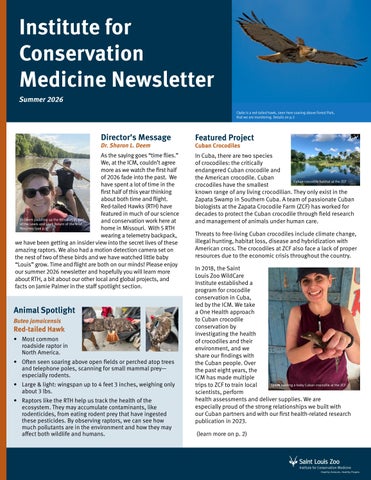
Institute for Conservation Medicine Newsletter Summer 2026 Clyde is a red-tailed hawk, seen here soaring above Forest Park, that we are monitoring. Details on p.3
Director's Message Dr. Sharon L. Deem
As the saying goes “time flies.” We, at the ICM, couldn’t agree more as we watch the first half of 2026 fade into the past. We have spent a lot of time in the first half of this year thinking about both time and flight. Red-tailed Hawks (RTH) have featured in much of our science Dr Deem paddling up the Missouri as part and conservation work here at of the Lewis and Clark Return of the Wild Resurvey (see p.4) home in Missouri. With 5 RTH wearing a telemetry backpack, we have been getting an insider view into the secret lives of these amazing raptors. We also had a motion detection camera set on the nest of two of these birds and we have watched little baby “Louis” grow. Time and flight are both on our minds! Please enjoy our summer 2026 newsletter and hopefully you will learn more about RTH, a bit about our other local and global projects, and facts on Jamie Palmer in the staff spotlight section.
Animal Spotlight Buteo jamaicensis
Red-tailed Hawk • Most common roadside raptor in North America. • Often seen soaring above open fields or perched atop trees and telephone poles, scanning for small mammal prey— especially rodents. • Large & light: wingspan up to 4 feet 3 inches, weighing only about 3 lbs. • Raptors like the RTH help us track the health of the ecosystem. They may accumulate contaminants, like rodenticides, from eating rodent prey that have ingested these pesticides. By observing raptors, we can see how much pollutants are in the environment and how they may affect both wildlife and humans.
Featured Project Cuban Crocodiles
In Cuba, there are two species of crocodiles: the critically endangered Cuban crocodile and the American crocodile. Cuban Cuban crocodile habitat at the ZCF crocodiles have the smallest known range of any living crocodilian. They only exist in the Zapata Swamp in Southern Cuba. A team of passionate Cuban biologists at the Zapata Crocodile Farm (ZCF) has worked for decades to protect the Cuban crocodile through field research and management of animals under human care. Threats to free-living Cuban crocodiles include climate change, illegal hunting, habitat loss, disease and hybridization with American crocs. The crocodiles at ZCF also face a lack of proper resources due to the economic crisis throughout the country. In 2018, the Saint Louis Zoo WildCare Institute established a program for crocodile conservation in Cuba, led by the ICM. We take a One Health approach to Cuban crocodile conservation by investigating the health of crocodiles and their environment, and we share our findings with the Cuban people. Over the past eight years, the ICM has made multiple Jamie holding a baby Cuban crocodile at the ZCF trips to ZCF to train local scientists, perform health assessments and deliver supplies. We are especially proud of the strong relationships we built with our Cuban partners and with our first health-related research publication in 2023. (learn more on p. 2)
Page12 Page
ICM Newsletter Summer 2026
Project Updates
Galapagos Tortoise Movement Ecology Programme (GTMEP)
Cuban Crocodiles April 2026: Jamie and Kathleen spent 10 days in Cuba at the Zapata Crocodile Farm (ZCF), working with the local team to collect samples from 200 juvenile crocs for pathogen screening and pre-release health assessments. These crocodiles are part of a larger, 500 animal release plan that is slated for later this year. Because of the constraints due to the economic embargo, the ZCF can no longer care for and feed all their animals, and so the only option is to release many of them. We are most proud of the team effort it took to get 200 animals sampled during what is an incredibly difficult time for Cuba. The Cuban team learned the sample collection techniques quickly and spent six long days with us to get the job done. By keeping the U.S. team small, the Cubans were able to gain hands-on experience and practice. This was the first sample collection trip for our team since 2019. If you remember from earlier newsletters, we imported the first of our samples back in October, 2024.
We are very proud to share the most recent publication from our Galapagos tortoise health work. In this paper, we provide reference intervals Drs. Nieto-Claudin, Deem and Fessl at the field on hematology and plasma site on Santiago Island, Galapagos. biochemistry values of tortoises on Isabela Island (full citation on page 5). Partnering with Mariantú Robles, a veterinarian and Master’s student at Pontifical Catholic University in Valparaíso, Chile, we have provided temperature dataloggers for deployment on sea turtles in Galapagos. Data collected from this study will be compared to our data from giant tortoises. We’re very excited about this new project! One Health in Brazil Dr. Lilian Catenacci’s team in Brazil continues to do amazing One Health work. Through the efforts of Dr. Catenacci and the ICM, the Saint Louis Zoo has established a collaboration agreement with the Federal University of Piaui.
Dr. Catenacci (center) and lab managers, Clara and Mariana.
In April, Lilian traveled to remote communities along the Amazon River as part of the Workshop on Rabies Risk Analysis. This workshop brought together a team of public health representatives with Indigenous leaders. Their One Health approach to rabies surveillance and health education includes collaboration and appreciation of the knowledge of traditional peoples. Kathleen holding her first Cuban crocodile.
Want to know more?
ZCF keepers Tato, Flaco and Mandi collecting blood from a juvenile Cuban crocodile.
Visit the ICM website (stlzoo.org/ICM) or click the links below to view our latest project Impact Reports. Chelonian Conservation Cuban Crocodile Forest Park Living Lab Page 2
ICM Newsletter Summer 2026
St. Louis Box Turtle Program (SLBTP) Each Spring, the ICM returns to our field sites in Forest Park (FP) to monitor the box turtles as they emerge from winter brumation. In addition to collecting health and movement data on this understudied species, these small reptiles play a big role in our conservation efforts. Box turtle field work is an essential training for our interns. They are also ambassadors for many of our outreach programs. This summer we have a variety of tours and kid’s camp activities centered around our box turtles.
ICM summer interns with box turtle in Forest Park.
Yellow line shows recent movement of Artemis, the red-tailed hawk.
Forest Park Living Lab (FPLL) We’ve deployed GPS tags on five red-tailed hawks (courtesy of a generous donation from Keith Phoenix). This includes two bonded pairs—Bonnie & Clyde and Oakland & Caliber—who have both successfully fledged chicks this season. One of the nests was right across I–64, on the window ledge outside of the Biology Department at St. Louis Community College at Forest Park. Artemis is a young male who had some bruising on his wings when we caught him for tag deployment. Before being released, he was successfully rehabilitated by World Bird Sanctuary for rat poisoning. Since release, he has been exploring the region and heading far north toward Canada (see photo).
A motion-activated camera allowed us to monitor the hawks’ nest and newborn chick.
In March, we successfully trapped and collared our first whitetailed deer in Forest Park! The deer, whom we named Blondie, spends most of her time with a small herd of adults and juveniles in Kennedy Woods. They occasionally travel between Forest Park and Clayton. In May, we placed 18 new wildlife cameras in Forest Park to collect data that will contribute to the Lewis & Clark Return of the Wild Survey (see p.4). Blondie with GPS collar
Page 3
ICM Newsletter Summer 2026
Outreach Highlights
Education
When we’re not in the field or the lab, we are often in the community, spreading our message of One Health and conservation. Here are a few of our recent activities: March 2026: Sharon and Kaitlin both presented at the St. Louis University Water Summit. Sharon gave the keynote address "Water – the Good, the Bad, the Ugly in One Health." Kaitlin presented her work on heavy metals in Blanding’s turtles and was a speaker on the One Health and Water in the Wild panel. May 2026: We partnered with Dr. Roland Kays and the Lewis and Clark Return of the Wild Survey team, from North Carolina Natural History Museum. Sharon and Steve Blake are the local experts for the St. Louis leg of their cross-country trip, retracing the explorers’ historic route. While in St. Louis, the team checked camera traps in Forest Park, they visited the Missouri History Museum, and canoed along the Missouri and Mississippi Rivers. This research project will compare current wildlife data to the observations documented in Lewis & Clark’s original journals to see how animal populations have changed over the past 220 years. https://rolandkays.com/lewisclark
Red-tailed hawk in FP feeding chicks (from VIDEO below).
Kaitlin, Steve, and Roland Kays checking a FPLL wildlife camera trap.
An education team led by ICM's Conservation Education Liaison, Grace Warshaw, was granted internal funding to complete a co-design project with longtime ICM partner Chris Hwande and her Captain Elementary science students (Clayton School District). A cohort of 20 students from 3rd - 5th grade came together to learn more about the Forest Park Living Lab and design a program tying it back to their school curricula. These students went above and beyond in designing these programs! Here are some highlights: Beautiful Birds 3rd Graders used field guides and technology to identify birds in the park and do a bird beak adaptation activity.
Captain Elementary students looking for signs of animals.
Comparative Camera Traps 4th Graders used camera traps to compare species that call the park and possibly Captain Elementary home! They also used field guides to look for signs of animals, scat, tracks, etc., in both locations.
3rd Graders designing their own bird nests from natural materials.
Forest Park Predator-Prey Game 5th Graders created a game that explored the intricacies of the food chain in the park through role play, movement, and supply gathering. There were chance cards in place that would provide a variety of impacts on gameplay that tied back to real life issues for species as well.
Click these links to check out their field notes and a short video from their time in St. Louis:
Field Notes: Forest Park Field Notes: St. Louis Riverfront VIDEO: Red-tailed hawk chicks, Forest Park
Page 4
ICM Newsletter Summer 2026
Publications
Something Egg-stra for you
2026 has been a productive year for research. So far, ICM staff members have published seven research papers (first-author* on four of them).
Our recent publications include a whole flock of BIRDS. Can you match these pics to the North & South American species mentioned at the left?
• *Novel Herpesvirus in a Wilson’s Plover (Charadrius wilsonia: Charadriidae, Charadriiformes) in Piauí State, Northeastern Brazil. DOI: 10.7589/JWD-D-25-00087 • Circulating Nutrients in Guanay Cormorants and Peruvian Pelicans from Punta San Juan, Peru. DOI: 10.1002/ zoo.70062 • A decade of tracking reveals strong nest site fidelity in four Galapagos giant tortoise species. • *Evaluation of medetomidine-tiletamine-zolazepam as a partially reversible field anesthesia combination for mesocarnivores. DOI: 10.1371/journal.pone.0346586
1
2
3
4
5
6
• *Pathogen assessment of Galapagos landbirds reveals novel herpesviruses and adenoviruses. DOI: 10.1016/j. actatropica.2025.107955 • *Urban habitat restoration increases native bird diversity in the midwestern United States. DOI: 10.1002/eap.70207 • Haematology and biochemistry reference intervals of Galapagos short-eared owls (Asio flammeus galapagoensis) from Floreana Island. DOI: 10.1093/conphys/coag013
Latest Research: Galapagos Giant Tortoises
Internships
all photos from ebird.org
Answers:
1. Wilson’s Plover - Brazil 2. Guanay Cormorant - Peru 3. Peruvian Pelican - Peru 4. Galapagos Martin - Ecuador 5. American Robin – Midwestern United States 6. Short-Eared Owl – Ecuador
Emily Buege Donovan (Southern Illinois University, Carbondale, PhD student), has been working with Sharon and the Charles Darwin Foundation to study the reproductive and movement ecologies of Galapagos giant tortoises. Their most recent research shows that female tortoises often return to the same nesting grounds each year. Historically, it was difficult to observe how many times a free-living tortoise nested. Use of GPS tracking and accelerometry tags show that nearly all tracked females nested multiple times in a single season, with some laying eggs as many as four times. This information will help agencies better protect these habitats from invasive species and development.
Do you know someone interested in valuable, hands-on work experience with One Health and conservation medicine professionals? Encourage them to apply for a Fall/Winter, Spring, or Summer internship with the ICM! stlzoo.org/employment/internships
Page 5
ICM Newsletter Summer 2026
Employee Spotlight
We hope you enjoyed this newsletter. Thank you for being a friend of the ICM. Your support helps us continue our work and strengthen the next generation of conservation medicine practitioners.
Jamie Palmer, Wildlife Biologist ICM Lab & Field Technician Director, WildCare Institute Program for Crocodile Conservation in Cuba Areas of Expertise • Conservation Medicine • Field and lab techniques • Hematology* • Program Management
Jamie being greeted by a chameleon in Madagascar.
Jamie earned her M.S. in Ecology, Evolution & Systematics at University of Missouri, St. Louis and worked as a keeper at the Saint Louis Zoo before joining the ICM. Jamie’s interests are in wildlife health and conservation medicine. Her favorite species is the babirusa (Indonesian ‘deerpigs’) and she is particularly passionate about turtles. In her 13 years with the ICM, Jamie has been instrumental in the development of the St. Louis Box Turtle Project (SLBTP), Madagascar Radiated Tortoise health project, Ecuadorian crocodile health project and the Cuban Crocodile Conservation Program. Her favorite part of the job is being in the field and developing new partnerships. *Hematology: The diagnosis, treatment, and prevention of diseases related to blood, bone marrow, and the lymphatic system.
If you would like to contribute to the ICM, please go to the Saint Louis Zoo website (stlzoo.org), select GIVE in the upper right, and select “General Gifts and Conservation Contributions” near the bottom. Under Ways to Give, use the dropdown menu to select the Institute for Conservation Medicine. We are also happy to accept paper checks mailed to: Institute for Conservation Medicine Saint Louis Zoo P.O. Box 790290 St. Louis, MO 63179-0290 To learn more about how you can contribute to the future of the ICM, contact Director Dr. Sharon Deem at (314) 646-4708 or deem@stlzoo.org. Our wish list includes post-doctoral fellows and a mobile molecular lab to assist Dr. Lilian Catenacci with her One Health research in Brazil. For more information on the Institute for Conservation Medicine, visit stlzoo.org/ICM.
Our Mission: The Saint Louis Zoo Institute for Conservation Medicine takes a holistic approach to wildlife conservation, public health, and sustainable ecosystems to ensure healthy animals and healthy people.
ICM Team (and Charlie, our plush coyote) at the Saint Louis Zoo, Endangered Species Day, May 2026
Page 6