S P A N I S H L A K E
Consulting Corps Recommendations



S P A N I S H L A K E
Consulting Corps Recommendations
The Counselors of Real Estate® is an international organization of commercial property professionals from leading real estate, finance, law, valuation, and business advisory firms, as well as real property experts in academia and government.
Counselors have created and endowed the MIT Center for Real Estate; resolved the dispute between the developer of the World Trade Center and its insurers post-September 11, 2001; led the privatization of U.S. Army Housing; developed a multi-billion-dollar, 10-year master plan for Philadelphia Public Schools; and valued both the Grand Canyon and Yale University.
Counselors practice in 22 countries and U.S. territories, with only 900 professionals holding the CRE® credential worldwide. Thought Leadership is a core competency of the CRE organization as exemplified by the peer reviewed journal, Real Estate Issues, and presentation of major real estate symposia in partnership with Harvard and Stanford Universities.
CRE Members. Membership in The Counselors of Real Estate is selective and extended by invitation to commercial real estate practitioners with at least 10 years of proven experience. The stringent membership criteria ensure CRE members possess:
• Recognized records of accomplishment
• A commitment to excellence
• Uncompromising adherence to high standards of professional conduct
• Visionary, yet practical approaches to real estate issues
Finding the Right CRE. Members of The Counselors of Real Estate, awarded the CRE credential, are available to assist with your real estate challenge. Visit the CRE website to find the right CRE at https://cre.org/find-a-cre-search/ or contact CRE staff for assistance in identifying Counselors with the right skill sets and experience to address your need

The CRE Consulting Corps, a public service program of The Counselors of Real Estate, provides real estate analysis and action plans for municipalities, not-for-profit organizations, educational institutions, and government agencies that address their clients’ real estate dilemmas and often enhance the performance of a property or a portfolio. Each Consulting Corps project is conducted by a small group of volunteer members selected for their experience and skillsets to specifically address the needs of the client. The extensive talent base available within the CRE community ensures that teams can provide expertise on virtually any real estate issue, providing:
• Feasible, achievable solutions from experienced professionals
• Non-partisan, objective advice
• Extremely cost-effective service
• Advice and recommendations provided quickly onsite
Consulting Corps Program Staff: Samantha DeKoven, Director of Public Service Initiatives sdekoven@cre.org
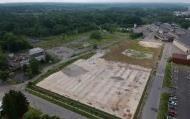
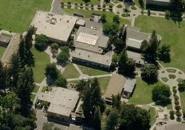
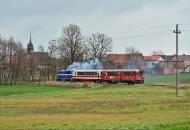
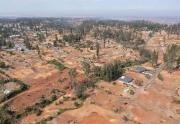
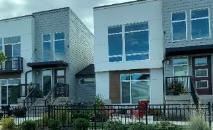
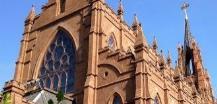
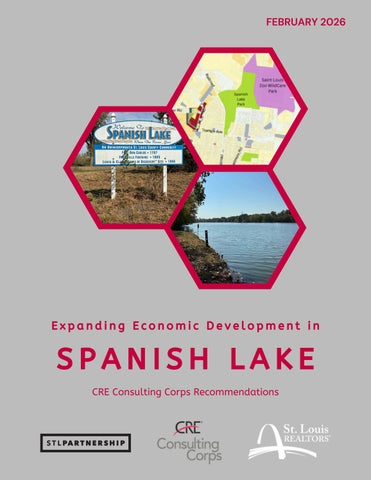
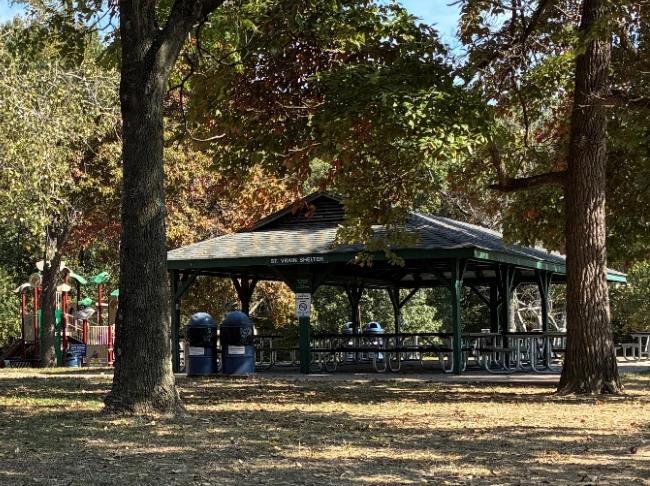
Spanish Lake, an unincorporated community of approximately 18,000 in the north part of St. Louis County, grew as a suburban residential community starting largely in the 1950s. The Spanish Lake community has a strong foundation, with largely intact housing stock, engaged residents, and ongoing planning efforts. The community boasts a number of assets, including beautiful outdoor amenities. Spanish Lake Park offers 245 acres of parkland, three lakes, playgrounds, ball fields, hiking/ biking/ horseback trails, restrooms, and other offerings. The nearby Fort Belle Fontaine was established in 1805 as the first American fort west of the Mississippi River. It is a historic attraction known for its Grand Staircase and trails. The confluence of the Missouri and Mississippi Rivers and Columbia Bottom Conservation Area are also neighboring draws, and the community has nearby highway access.
However, the population has declined since its peak of 21,340 in 2000 (Census data reported in Spanish Lake Town Center plan). The community has a higher-than average poverty level, with 13% of households lacking access to a vehicle. Additional challenges include underdeveloped infrastructure and public transit options, as well as limited commercial and business activity.

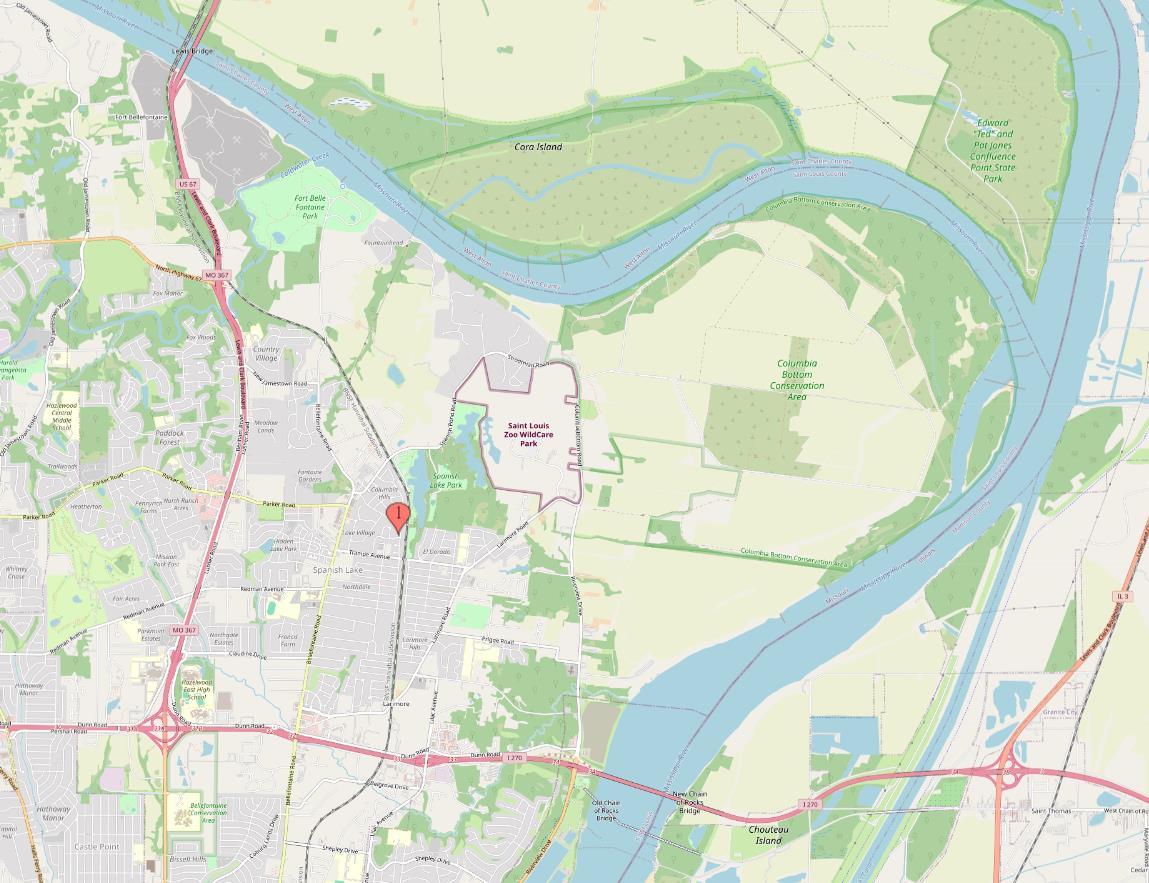



Recent planning efforts include community engagement to plan a town center master plan in 2021 and Thriving Neighborhoods planning in 2025. The Spanish Lake Town Center Master Plan outlines a vision for mixed-use development, streetscape improvements, and the creation of community-focused amenities. This plan was informed by extensive community engagement; it proposes strategies such as creating a multi-use town square, enhancing pedestrian and bike infrastructure, and attracting retail, dining, and community services to the area.
The Thriving Communities Program Work Plan included technical assistance to improve mobility, reduce flooding, and expand multimodal access along critical corridors, and the community is working to implement this plan. In addition, St. Louis County has recently adopted St. Louis County 2050: An Equitable and Sustainable Comprehensive Plan, its general plan; and resources have been allocated to develop a Spanish Lake Small Area Study in 2026. Also underway is a Riverview/Columbia Bottom Great Streets planning project The Small Area Study will build on these other efforts, as well as this report.
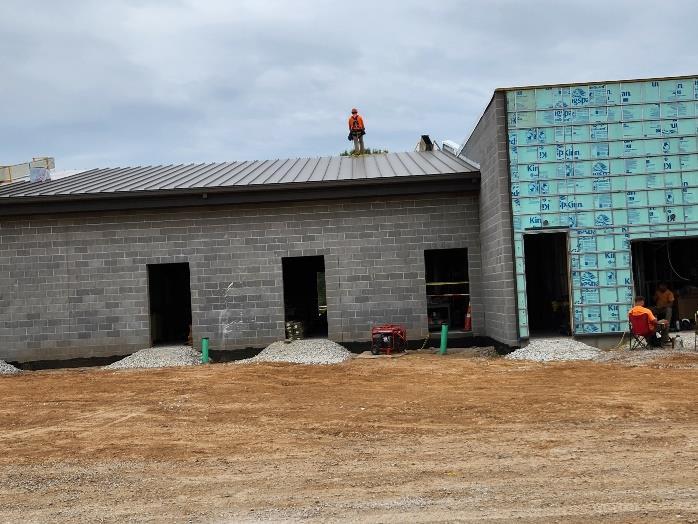
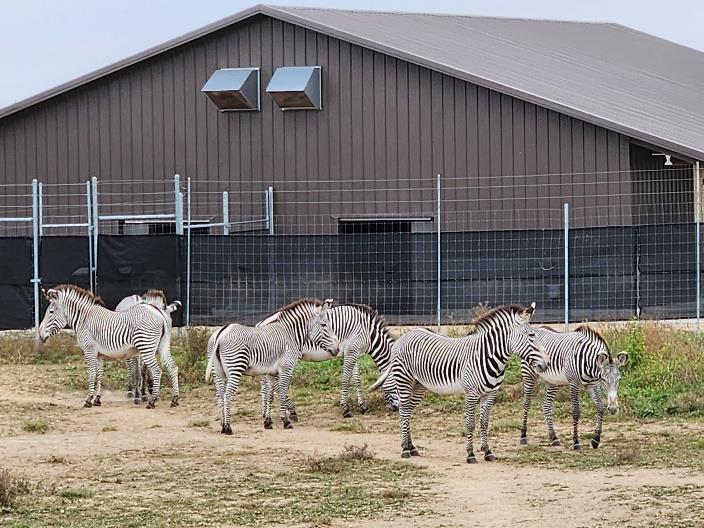
Saint Louis Zoo WildCare Park is a unique large-scale conservation center focused on endangered species, featuring immersive habitats with free-roaming animals, a towering observation deck, walking safaris, and a dedicated research facility, allowing public interaction like giraffe feeding in a naturalistic setting, all while supporting local ecosystems and global conservations. The Park expects to open in 2027 and is projected to attract an average attendance of more than 420,000 guests each year after opening. The Saint Louis Zoo WildCare Park Economic Impact Analysis estimates that over 10 years (2024-2034) WildCare Park will generate more than $660 million in total economic impact in the St. Louis metropolitan region.
The planned development of WildCare Park and increased interest in finding ways to take advantage of the confluence of the Missouri and Mississippi rivers present a unique opportunity for potential growth and investment in Spanish Lake. Stakeholders requested CRE Consulting Corps assistance to identify
ways to align infrastructure, businesses, and public spaces to capitalize on these opportunities and create an equitable and sustainable model for future growth, benefiting the residents and existing community, as well as serving visitors to the area.
Through the Transforming Neighborhoods Program, the National Association of Realtors® (NAR) is collaborating with the CRE Consulting Corps to deliver strategic real estate problem solving to select projects. NAR issued a call for applications and submitted these for review by the CRE Consulting Corps. The Expanding Economic Development in Spanish Lake, submitted by the St. Louis REALTORS® in conjunction with the St. Louis Economic Development Partnership (STL Partnership), was selected.
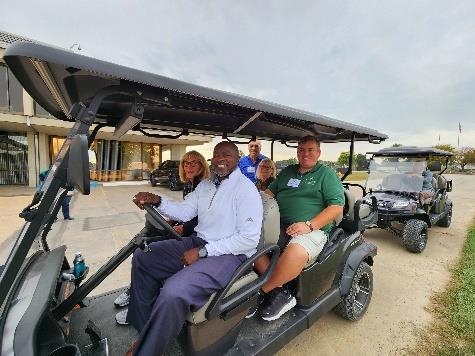
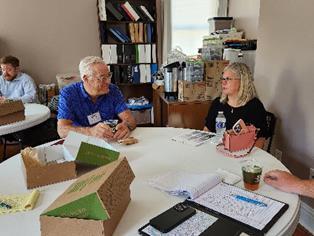
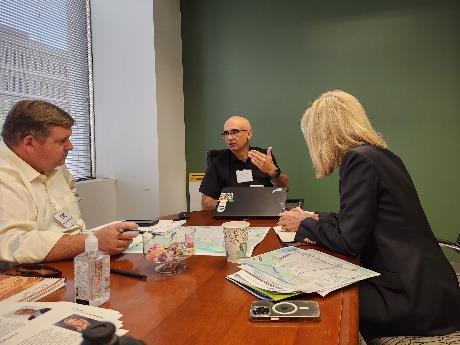
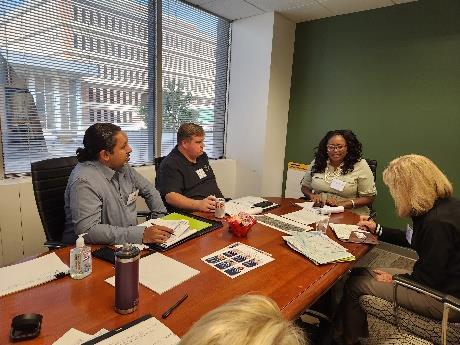
The Consulting Corps team visited St. Louis in October 2025. In advance of the visit, the team reviewed studies, plans, and market data to provide a solid foundation for on-site research and investigation. During the time the Consulting Corps team was in St. Louis, the team toured WildCare Park, the Spanish Lake community, and the surrounding areas. The team interviewed more than 50 local and regional stakeholders to develop a broad understanding of the diverse and dynamic perspectives within the region. Additional materials were requested, provided, and reviewed during the on-site isit to enhance the team’s analysis and recommendations. Finally, the team researched, analyzed, discussed, and developed recommendations presented to stakeholders on Oct. 17, 2025.
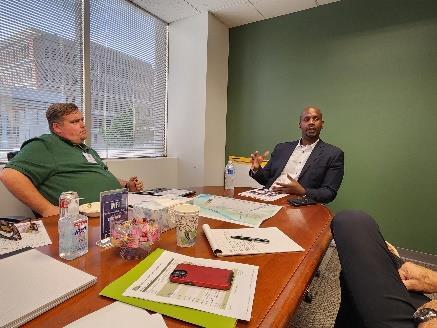
Interviewees include the STL Partnership, St. Louis County, Saint Louis Zoo, WildCare Park, Spanish Lake Community Association, North County Incorporated, Greater North County Chamber of Commerce, St. Louis REALTORS®, property owners, developers, business and economic development representatives, community development representatives, and other civic/community/business stakeholders. A list of those interviewed is included in the Appendix; the team very much appreciates the input provided by all these individuals. Many of the ideas and concerns shared are included in the Appendix III –“What We Heard.”
The Saint Louis Zoo is preparing to open a new 425-acre safari park and conservation center known as WildCare Park in Spanish Lake, within north St. Louis County in 2027. Spanish Lake is an unincorporated community of St. Louis County with a population of about 18,000 with a long and storied history that has experienced declining population and disinvestment since the 1990’s
WildCare Park is expected to attract approximately 400,000 visitors annually, generate over $600 million in regional financial impact, and create hundreds of jobs in an area that has historically seen disinvestment and a lack of County services. Stakeholders interviewed by the CRE Consulting Corps team consistently shared their excitement about the new WildCare Park and the opportunities it presents. However, despite crime statistics declining and education improving over the last several years, much of the region continues to view Spanish Lake unfavorably, a perception that needs to be reversed.
While the consensus is that WildCare Park is a tremendous asset and will be a major benefit to the St. Louis area long term, the potential impacts of WildCare Park upon Spanish Lake are unknown and may not benefit the immediate community. Indeed, excessive unmanaged traffic to WildCare Park along residential streets could negatively impact neighborhoods. The Zoo has conducted traffic studies to help with traffic planning and management, and County planning and investment can foster benefits for the community. Several recent plans have been undertaken such as Thriving Neighborhoods planning in 2025 and The Spanish Lake Town Center Master Plan. Both plans provide a good foundation. Further helpful efforts are underway, such as the Great Streets Initiative and the Spanish Lake Small Area Study This report provides additional action-oriented guidance.
The building blocks of a thriving community are its location/accessibility to live work and play, how safe a place it is, the quality of its residential products, and access to amenities - including green space. The financial sustainability of the community is critical in that long term, revenues must be able to pay for the infrastructure and services needed. Consistently, thriving communities generate immense pride amongst their constituents. Residents are proud to be from that community, neighbors support neighbors. WildCare Park can be a catalyst for improvement in the community of Spanish Lake, but the basic building blocks of a potential thriving community must be addressed.
• Transportation/Access. Visitors to WildCare Park will arrive via multiple routes, taking the most convenient and efficient method available to them. These various routes have the potential to create value for Spanish Lake. Furthermore, multimodal connectivity including public transportation will benefit WildCare Park and the community. Building on efforts underway, focus should be on identity and traffic management coordination that may include wayfinding signage, placemaking, gateway treatments, art installations, lighting, and streetscaping, branding anish Lake as the “scenic route” to WildCare Park Consistent with the view of WildCare Park,
our belief is that investment in multiple modes of access and egress as discussed within this report will benefit Spanish Lake more than greater investment in one primary access route.
• Safety. Crime has steadily declined over the last two years in Spanish Lake. The St. Louis County Police department can be commended for youth sports and other youth programming, which contributes to community-building and increased trust. Neighborhood Associations, businesses, and landlords should increase their cooperation and involvement with the police in these outreach programs. Leaders should implement a communications strategy to let everybody know that Spanish Lake has seen steady improvements in safety and offers a place to live, work, and play with many amenities Promote successes.
• Residential Revitalization. Building wealth through home ownership is a critical component of building a thriving community. Not everyone can afford to own a home but enhancing the pathway to home ownership is important. Owners generally take care of their homes and take pride in their residence. Programs that create access to capital for first-time buyers and for existing homeowners for home improvements are important measures to revitalize the neighborhoods.
• Commercial Business. Everybody wants new restaurants, hotels, and businesses within the community. To attain those businesses, there needs to be population growth and increased density of residents. Without density, business growth will not be sustainable, even if initially created and subsidized. The community must determine whether it desires growth. If it does, additional population is required to enable success for retail, restaurants, and similar amenities.
• Land Development. Align development with the planning efforts that have already been undertaken, including the STLCO 2050 Master Plan and specifically applying permissive commercial zoning along the Dunn Street corridor. County owned land in the area can be a catalyst for growth.
• Special Uses. The County should consider long-term land leases or sale to encourage ricultural echnolo y (“ ech”) within the community inancial su sidies or fa ora le financing offerings will likely be necessary to launch an Eco-Tourism corridor, taking advantage of the nearby Columbia Bottom Conservation Area, the confluence of the Missouri and Mississippi rivers, and Fort Belle Fontaine. Investment in incubator space is already happening and can and should be augmented. Incubation of entrepreneurial businesses can spur job growth and enhance residential demand, as well.
• Leadership & Communication. The critical next step in turning the momentum into a thriving community is unifying leadership – leadership capable of aligning independent efforts, earning trust, and channeling collective commitment toward shared, measurable outcomes. The STL
Partnership is the logical choice to serve in this leadership role and has the ability to attract the resources necessary to make the effort fruitful and successful, provided the initiative is treated as a high priority within the Partnership. Furthermore, communicating the successes is critical to the sustainable growth and development of the community.
The CRE Team was impressed by stakeholder dedication to the community, as well as the natural beauty of Spanish Lake and the surrounding area. WildCare Park promises to be a treasure and a major destination attracting visitors from the metro area and beyond.
The path forward is for Spanish Lake to work at the building blocks of creating a thriving community and be the best suburban community it can be. Spanish Lake has the assets, institutions, and community spirit needed for renewal. Achieving long-term stability will depend on resident engagement, collective responsibility, and strategic action. By expanding homeownership opportunities, strengthening nei h orhood associations holdin a sentee landlords accounta le le era in the area’s natural and institutional strengths, and growing entrepreneurs, Spanish Lake can reverse decades of decline. Progress will come house by house and street by street, driven by residents and community partners committed to reclaiming the future of their neighborhoods. To drive these desired outcomes, commitment to the work is required, and the STL Partnership is the organization to focus attention, take action, and implement the recommendations.
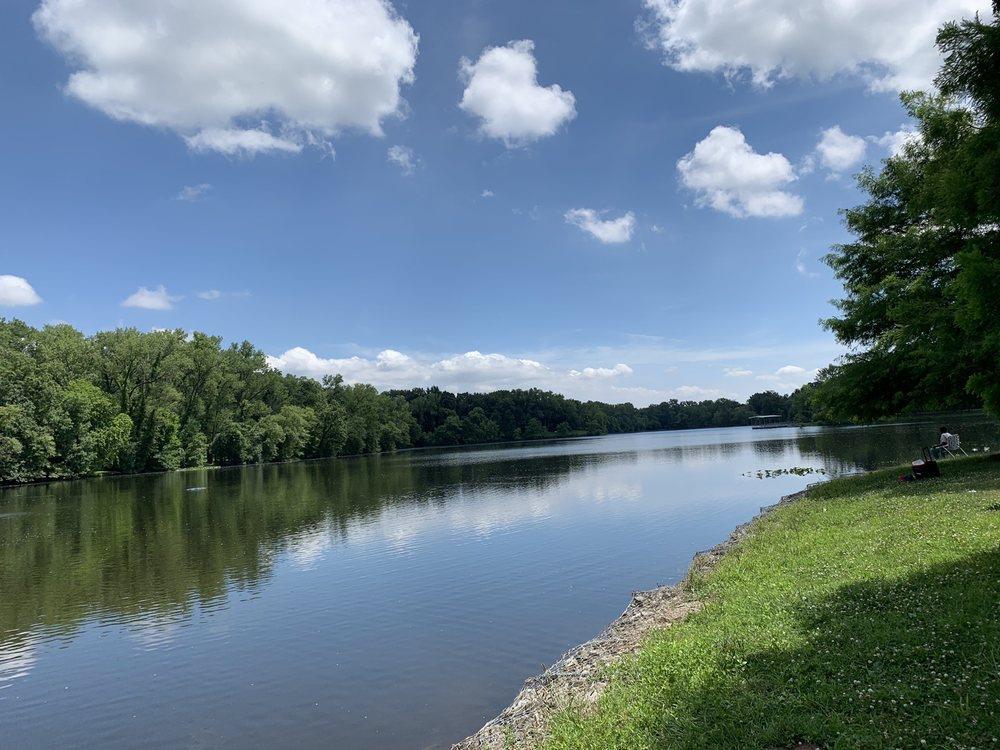
The following is a strategic view on access routing to the upcoming WildCare Park in Spanish Lake, articulating how corridor decisions must serve broader public-purpose goals, while recommending funding sources and policy tools for investment in the surrounding community.
WildCare Park will be a major attraction, and visitors will reach WildCare Park via multiple routes Thoughtful public policy will ensure that infrastructure and transportation investments that serve visitors will also benefit the broader citizenry, and Spanish Lake residents, in particular. Thus we consider the question, “how do the arious routes they take collecti ely create alue for anish Lake?”
Economic development doctrine is clear: with destination routing, corridor selection, and infrastructure investment, public decisions must advance a clear public purpose which is grounded in fairness, efficiency, and long-term benefit, not merely to bring people to and from that given destination. Public funding should support connectivity, safety, equitable access, and managed growth, with a data-driven analysis consistent with regional and local plans.
Publicfundingshouldsupportconnectivity,safety,equitableaccess,andmanagedgrowth,with adata-drivenanalysisconsistentwithregionalandlocalplans.
Our on-the-ground tour and stakeholder engagements revealed numerous roadways from I-270, including Bellefontaine Road, Lilac Avenue, Riverview Drive, Dunn Road service roads, and Larimore/Trampe Road, that can connect to WildCare Park. Each method provides valid connectivity options, and no single solution should be designated as the exclusive means of access. Importantly, traffic-impact modelling (CBB Study) indicates that current intersections operate at acceptable levels of service (LOS C or better), meaning the roadways have sufficient capacity for all potential visitors to WildCare Park without causing traffic backups.
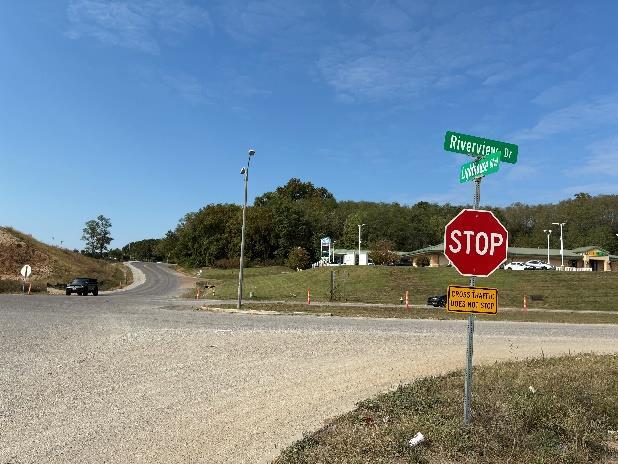
he Ri er iew ri e corridor emer es as the most intuiti e “ ateway” a roach; howe er focusin solely on Riverview Drive risks concentrating benefits narrowly and overlooking the commercial potential of Bellefontaine Road, Lilac Avenue, and Larimore/Trampe Road corridors. Roadwork on I-270,
spanning from Route 367 (Lewis and Clark Boulevard) to the Mississippi River, will result in detours and changes to traffic patterns. Clear signage, effective wayfinding, and careful management of detours will be essential during the construction period from 2025 to 2028.
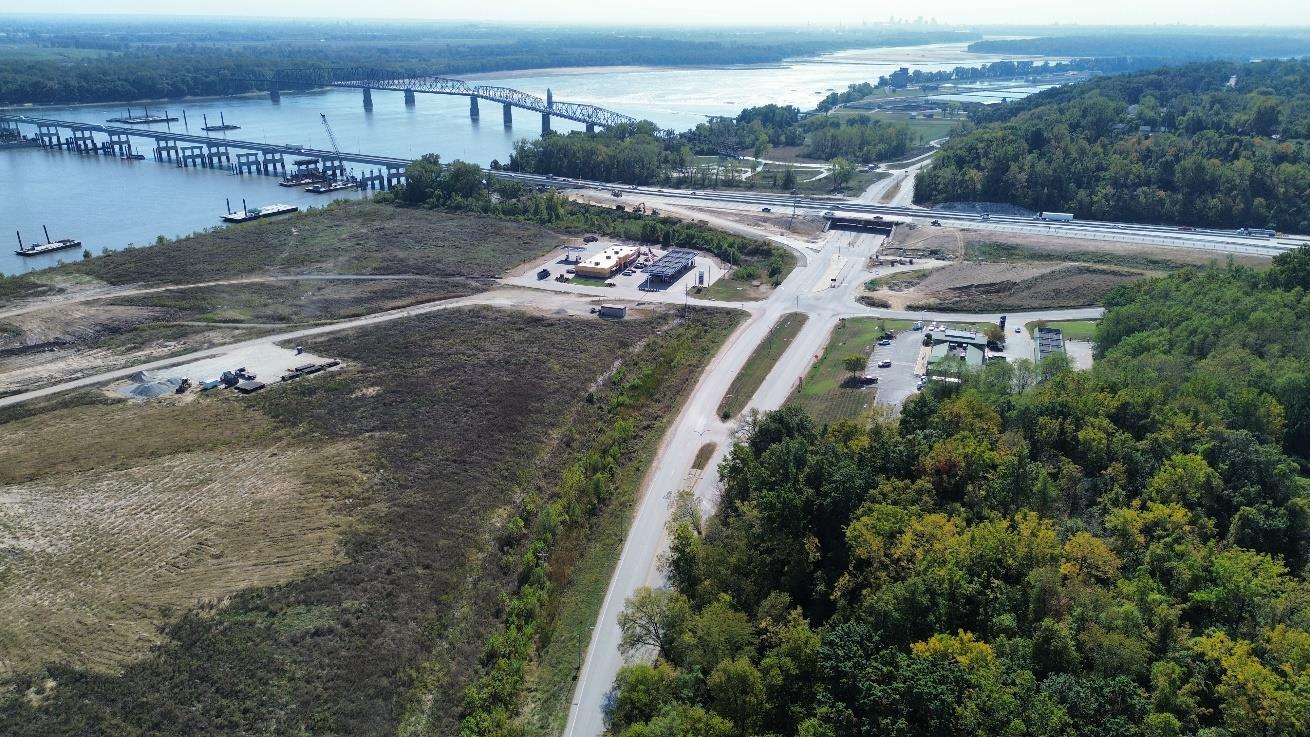
Dunn Road and Riverview Drive are important corridors providing access to Spanish Lake and linking to WildCare Park. Dunn Road functions as a critical connector, linking major entrances into Spanish Lake from the south and serving as a gateway to the community. Its proximity to Riverview Drive positions this corridor as a high-visibility, high-access location for commercial growth. Leveraging these assets aligns with the St. Louis County 2050 Comprehensive Plan goals for corridor revitalization and mixeduse investment.
To realize this vision, permissive zoning through the forthcoming Spanish Lake Small Area Study should encourage commercial and service expansion. Redevelopment should concentrate along commercial parcels facing interstate embankments to minimize residential im act n “all o tions” a roach smallscale retail, adaptive reuse, mixed-use infill, and civic amenities will create flexibility and resilience. Institutional anchors such as the National Archives facility and Hazelwood East High School provide stability and can catalyze corridor vitality when paired with infrastructure upgrades like streetscape improvements and lighting.
Implementation will require a coordinated task force to enforce property maintenance codes, pursue violations on neglected sites, and demolish unsafe or vacant structures. These actions clear the way for redevelopment and signal commitment to revitalization. Complementary programs such as a Façade
Improvement Program and Clean/Green Program will enhance corridor aesthetics and market confidence. The façade program would provide matching funds through forgivable loans for signage, lighting, awnings, and accessibility upgrades, while the Clean/Green initiative would maintain highvisibility corridors through litter removal, mowing, landscaping, and community service partnerships.
The Riverview Corridor presents unique challenges and opportunities. East of Riverview lies bottomland prone to flooding, while the west is defined by river bluffs and scenic topography. These environmental constraints limit development but also create potential for eco-tourism and visitor-oriented uses. As the primary gateway to WildCare Park, Riverview is well-positioned for targeted commercial investment that complements the park experience.
A Riverview / Columbia Bottom Great Streets planning project is underway and will create a master plan for the Riverview corridor from Chain of Rocks Park to Columbia Bottom Conservation Area, including technical analysis of development potential, infrastructure needs, and potential for flooding. Incorporating these recommendations into the Spanish Lake Small Area Study will ensure consistency and momentum. Strategic investment in infrastructure and placemaking create the potential to transform Riverview into a vibrant, welcoming corridor, consistent with the community vision.
The Bellefontaine Corridor, central to the Spanish Lake Town Center Master Plan, offers opportunities for incremental, low-cost interventions that build momentum for long-term change. Tactical improvements such as midblock crosswalks, access management, signage, and placemaking pilot projects can enhance safety and create a sense of lace While these “quick wins” risk iecemeal im lementation they are critical for demonstrating progress and attracting future investment.
The Small Area Study should include a phasing matrix to prioritize short-term projects and sequence them toward comprehensive redevelopment. Pilots on Bellefontaine can serve as demonstrations of success, reinforcing community confidence and guiding future efforts. Ultimately, adopting land use recommendations from the Town Center Master Plan will ensure cohesion and alignment with broader revitalization goals.
Rather than only investing in heavy infrastructure, the early years of the project should focus on identitylayer investments and traffic-management coordination building on the Riverview / Columbia Bottom Great Streets Initiative and Spanish Lake Small Area Study. This may include wayfinding signage, placemaking, gateway treatments, art installations, lighting, and streetscaping of a cohesive design, randin anish Lake as the “scenic route” to WildCare Park. This will raise awareness of the Bellefontaine/Lilac/Dunn corridors as alternative approaches that support local commerce.
The STL Partnership should actively engage with MoDOT, St. Louis County DOT, and Great Rivers Greenway to coordinate and communicate detours, major construction notifications, and visitor wayfinding during the I-270 build-out. Short-term investment mechanisms includin “Zoo- ilot” impact fees, grant matching, and façade improvement funding for small businesses should be launched quickly to demonstrate momentum and catalyze private investment.
Over the longer horizon, the strategy should evolve toward full corridor modernization, including multimodal infrastructure such as sidewalks, bike lanes, micro-mobility stations, enhanced roadway lighting, and pedestrian safety upgrades along Bellefontaine, Trampe, Larimore, Lilac, Dunn, and Dunn service roads.
This also means expanding microtransit service (on-demand, shared ride services), evaluating new Metrobus routes connecting MetroLink, and considering a branded shuttle connection from transit hubs to the Metropolitan Zoological Park and Museum District (ZMD) institutions: Saint Louis Zoo, new WildCare Park, St. Louis Art Museum, St. Louis Science Center, Missouri Botanical Garden, and Missouri History Museum.
This long-term strategy can be paid for by establishing a Community Improvement District (CID) or Transportation Development District (TDD) to capture visitor-based increment for reinvestment; utilizing TIF to fund infrastructure and relaunch commercial nodes; employing NFL settlement funds for catalytic public realm investments. Furthermore, St. Louis County should consider relocating its offices or service hubs to Spanish Lake to anchor the market, support commercial growth, and stabilize workforce presence.
By executing this layered strategy starting with identity and wayfinding, transitioning to corridor investment, and culminating in anchor-tenant commitments Spanish Lake stands to benefit in multiple ways.
1. Enhanced visitor experience and routing to WildCare Park will channel economic spillover into the local commercial node, supporting small business growth and job creation.
2. Infrastructure improvements and multimodal access will enhance neighborhood safety, connectivity, and resident mobility, thereby advancing equitable development and compliance with civil rights obligations.
3. A diversified access network (rather than reliance on a single route) spreads benefits across several corridor fronts, supporting a healthier commercial ecosystem and reducing trafficbottleneck risk.
4. The mobilization of TIF, NFL settlement funds, and federal capacity-building grants positions Spanish Lake to be competitive for federal and state infrastructure dollars, accelerating transformation.
5. Relocation of county offices or civic services brings a stable daytime workforce, foot traffic, and ancillary demand for retail, hospitality, and service‐commercial development.
In short, the development of access routes should not be viewed solely as a transport function. Rather, they should be viewed as a community-building lever: every path taken to WildCare Park should also stren then anish Lake’s economy u lic realm and identity
The federal Thriving Communities Program (TCP), administered by the U.S. Department of Transportation, provides planning and technical assistance funding for communities poised for infrastructure and access transformation, particularly those impacted by historic disinvestment.1 Given its location in North County and proximity to transit options, Spanish Lake is precisely the type of community positioned to leverage these resources to render it a new regional destination.
To this end, an effective access strategy should prioritize fairness and multimodal connectivity instead of the sheer volume of vehicles. Such a strategy should ensure safe pathways for pedestrians and cyclists, offer micro-mobility choices, incorporate public transportation and paratransit, and include wayfinding solutions that integrate visitors to WildCare Park with the Spanish Lake community.
Intheearlyimplementationphaseofinfrastructureplanningandcommunityrevitalization,itis imperativetodeploytargetedinvestmentmechanismsthatdemonstratemomentum,build stakeholderconfidence,andcatalyzeprivate-sectorengagement.
In the early implementation phase of infrastructure planning and community revitalization, it is imperative to deploy targeted investment mechanisms that demonstrate momentum, build stakeholder confidence, and catalyze private-sector engagement. Two such mechanisms, among others discussed herein, warrant particular focus:
1. A short-term latform of “zoo- ilot” im act fees matchin rants and façade-improvement funding for small businesses to deliver visible achievement in the near term.
2. A long-term structured financing vehicle such as a Community Improvement District (CID) or Transportation Development District (TDD) capable of capturing visitor-based increment (spending) and reinvesting it in the corridors that serve the destination and the community alike.
These mechanisms are consistent with recognized standards in economic development practice. For example, small-business façade improvement programs have been used nationwide to stimulate exterior upgrades, commercial vitality, and investment confidence in underserved corridors.2 Similarly, CIDs and TDDs3 are proven alue ca ture strate ies in issouri ermittin local jurisdictions and ro erty‐owner coalitions to levy modest taxes or assessments that fund infrastructure, mobility enhancements, streetscapes, and public realm improvements.4 Adopting streetscape improvements noted in 2021 Spanish Lake Town Center Master Plan will demonstrate public commitment to neighborhood improvement.
issouri’s Local a ncrement inancin (“ ”) framework allows munici alities and counties to capture incremental property and sales tax revenues derived from redevelopment in designated “ li hted ” “conser ation ” or “economic de elo ment” areas 5 Under RSMo §99.845 et seq., a redevelopment plan is required, a base valuation is defined, and incremental revenues are directed to enable eligible infrastructure, land-acquisition, remediation, utility, street-improvement, or professional service costs.6
For Spanish Lake, a thoughtfully scaled TIF (or hybrid mechanism) could help capture visitor-driven increments to reinvest in corridor improvements and placemaking.
The settlement of approximately US$790 million from the St. Louis Rams/National Football League relocation lawsuit created a unique regional funding opportunity.7 The City and County shares of this fund present a once-in-a-generation infusion of capital that may be directed toward infrastructure, public realm, and economic-inclusion projects with fewer constraints than traditional federal funds. Public sentiment polling underscores strong support for using such funds in underserved corridors and neighborhoods 8
When combined with the mobilization of TIF, Tribal/regional technical assistance grants, and other public-private tools, the NFL settlement funds provide Spanish Lake with a rare financial platform from which to accelerate corridor revitalization.
In parallel, the contemplated relocation of St. Louis County offices from Clayton to North County represents a strategic anchor-tenant opportunity. Embedding county service delivery, workforce offices, and community‐facing departments in or adjacent to Spanish Lake would anchor daily activity, stabilize foot traffic, create public-sector jobs, and elevate property valuations along the mobilized corridors. om lementin the uilt en ironment with a ci ic “anchor” ali ns with real-estate market best practices for community regeneration and longer-term stabilization.
WildCare Park’s de elo ment is an im ortant moment for anish Lake o make the most of it continue to prioritize multiple routes and modes of transport, focusing on supporting the local community as well as increasing numbers of visitors. By connecting corridor investments with larger planning goals, making smart use of financing options, and using anchor-tenant strategies, better access can be turned into genuine opportunities, transforming Spanish Lake into a place that is attractive to tourists, and for growth, connection, and long-term benefits for residents.
Spanish Lake possesses major strengths abundant natural amenities, strong institutions, an active police presence, and residents who care deeply about their community. Yet the area faces serious housing challenges driven by institutional investor purchases, limited affordable inventory, rising rents, and inconsistent property maintenance tied to absentee ownership. This section of the report outlines those conditions, the barriers preventing residents from becoming homeowners, and the steps needed to restore stability. Central to these recommendations is the development of neighborhood-level associations that strengthen accountability, support renters on the path to homeownership, and rebuild a shared culture of responsibility and pride. With coordinated action, Spanish Lake can reclaim its identity as a thriving and stable suburban community.
Institutional Investor Activity. Like many regions of St. Louis, Spanish Lake has seen a sharp rise in investor purchases of single-family homes, with large firms using aggressive cash offers that outcompete first-time buyers. This practice removes affordable homes from the owner-occupied market, inflates rents, increases displacement risk, and leaves families who generally rely on mortgage financing at a systemic disadvantage. The shift diverts wealth-building opportunities away from residents and consolidates ownership in the hands of absentee investors.
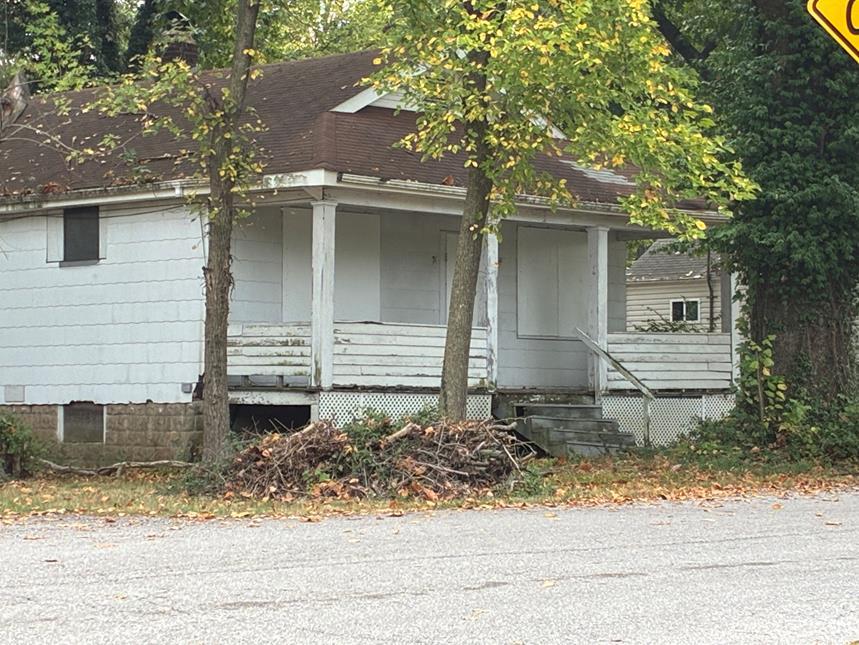
Limited Affordable Housing Stock. First-time homebuyers are disproportionately affected by the aging housing stock with years of deferred maintenance The preponderance of existing homes is not just dated, but old; 83% of homes (4440 of 5308) in Spanish Lake were built from 1950 – 1979, with only seven homes built since 2010.
An analysis of recent residential sales in Spanish Lake (from March 15 – September 15, 2025) indicates that of the 104 home sales, only 30 were priced and in lendable condition for starter home purchases.
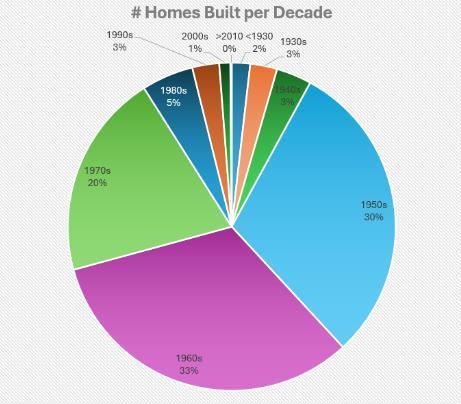
Apartments: Spanish Lake contains 3516 apartment units in 14 complexes, with the largest being Spanish Lake with 790 units; the others with more than 500 units are Trinity Park (516 units) and Oak Park (758 units).
: Absentee ownership contributes to uneven maintenance, declining curb appeal, and erosion of neighborhood stability. While the rental homes are spread throughout the area, several of the larger subdivisions are dominated by rental homes, with Northdale having the largest number of rental homes. Other large subdivisions with a disproportionate share of rentals are Larimore Hills, Columbia Hills and Broadlawns.
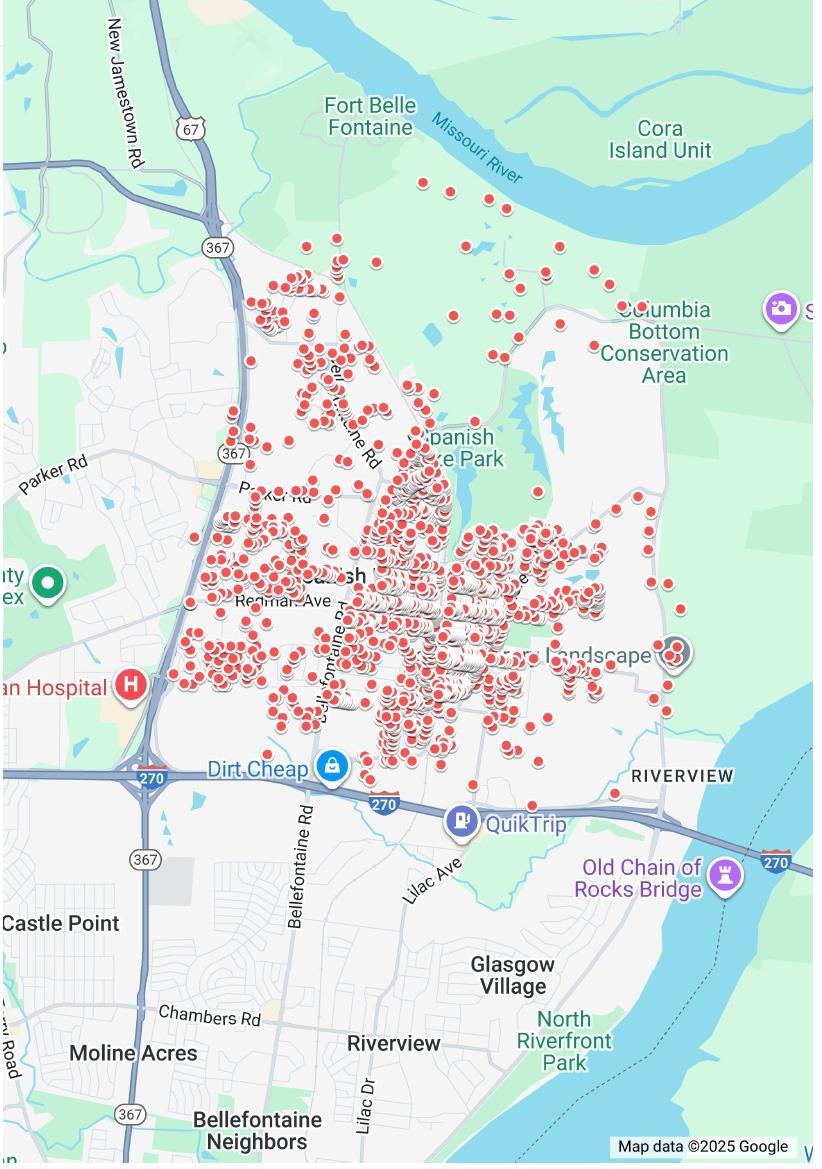
The table below shows the subdivisions with more than 100 houses and more than half of the homes as rentals:
Between the apartments and houses, 62% of all residential dwellings in Spanish Lake are rental. The table below shows the allocation of homes by type of property and type of occupancy:
High rents make it difficult for residents to save for down payments; in many cases, monthly rent exceeds what a mortgage would cost. Awareness of mortgage products FHA, VA, USDA, downpayment assistance remains limited. Many households struggle with debt-to-income challenges driven by student loans, auto loans, and consumer credit.
Rent payments for both houses and apartments are rarely reported to credit agencies, depriving renters of the positive credit history that would strengthen mortgage applications. Some of the apartment complex management companies do offer the tenant an opportunity to have their on-time payments reported to the credit agencies, charging the tenant an additional $5.00 per month. All these factors compound the most persistent barrier: competition from investors whose cash offers reduce supply and push prices upward, particularly as the area anticipates growth connected to the nearby WildCare Park fueling investor speculation.
Statistics show that crime has steadily declined over the past 22 months; however, the community perception is that it is a crime-ridden area. While crime is spread amongst all neighborhoods and types of property, there are pockets with more crime than others. Spanish Lake Townhomes, Oak Park, Trinity Park, Windham Chase, Victorian Village and Meadowglen Apartments represent the highest
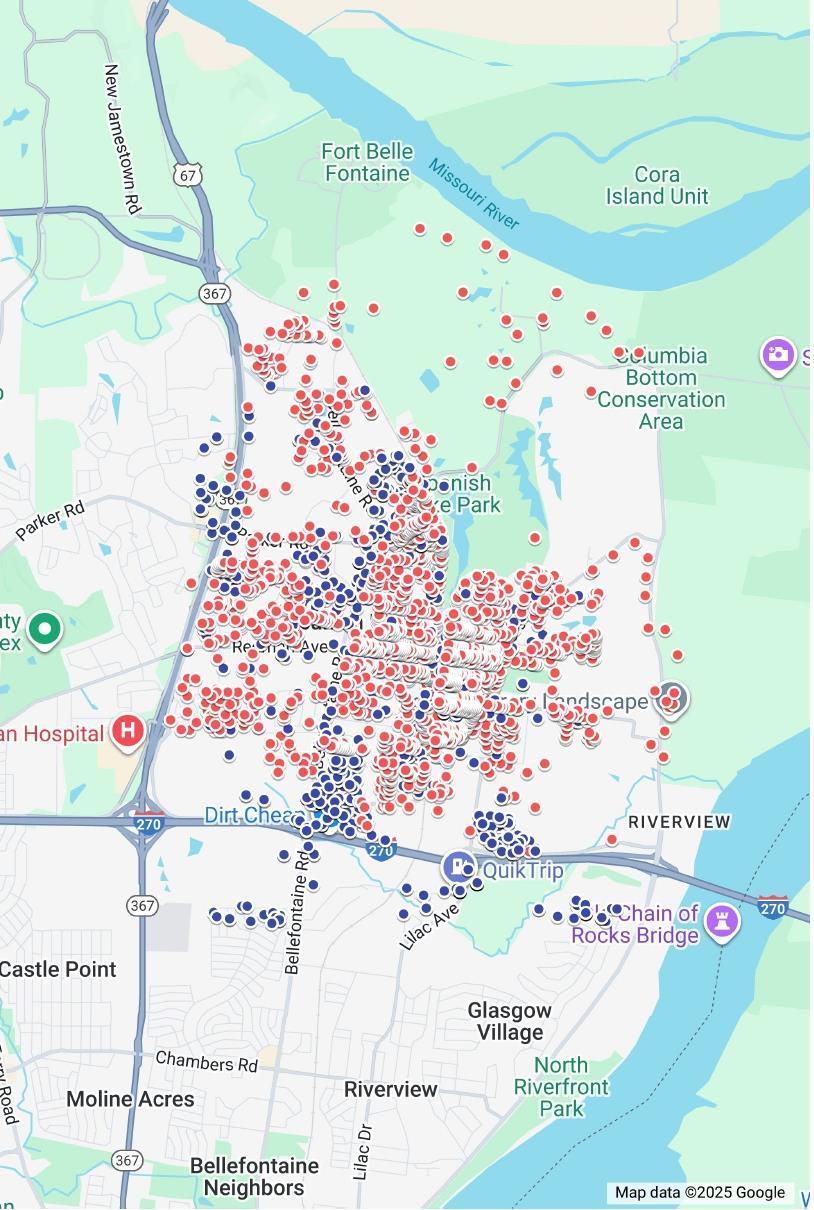
concentrations of crime in the community. Of the neighborhoods, the area bound by Bellefontaine, Spanish Pond Rd and Larimore, particularly the area east of Criterion Ave has a higher concentration of crime than the rest of the community. This area also has the highest concentration of rental homes. However, in studying the maps in detail, crime is not restricted to or concentrated in individual rental homes; it is more prevalent in these areas overall.
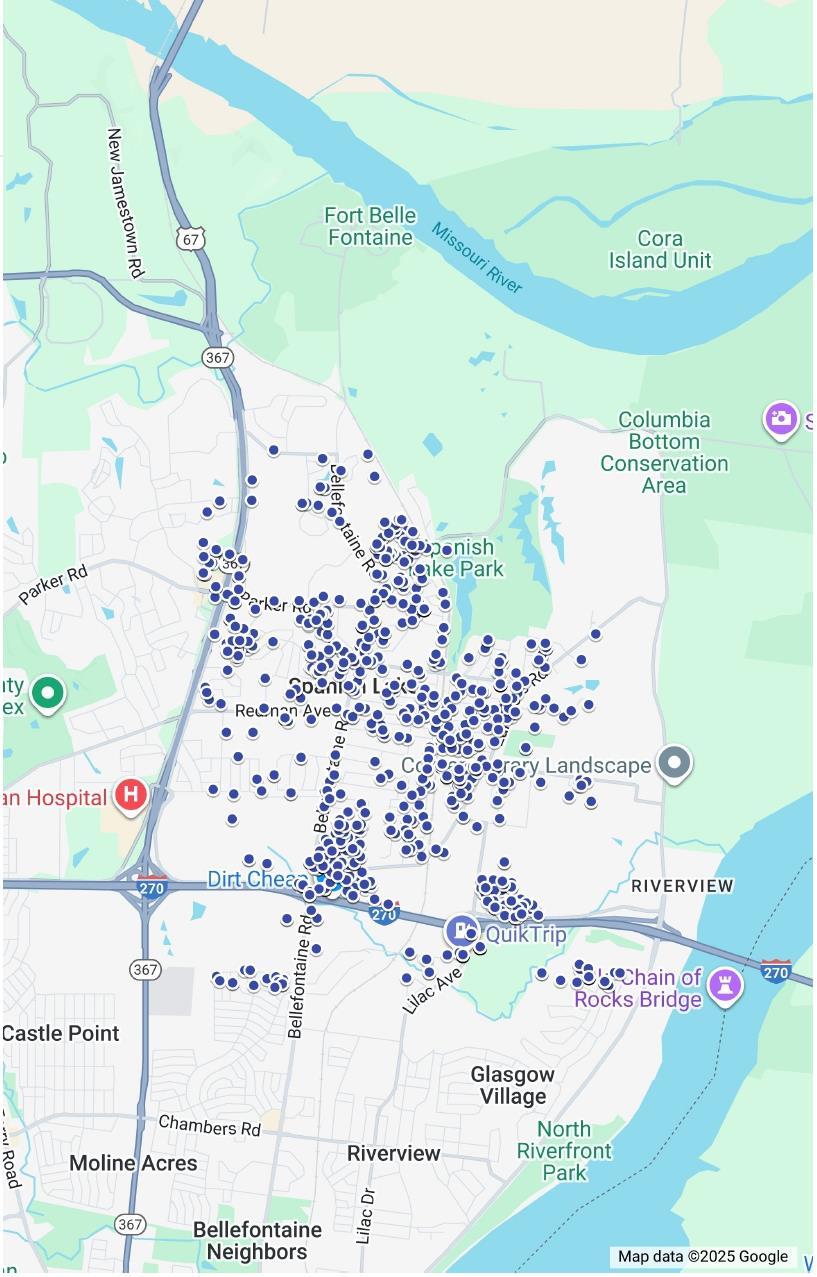
The active police department is working to increase its presence in the community through various initiatives, including outreach into the neighborhoods and after school activities, including sports teams and a chess club, with approximately 500 youth participants. The decline in crime indicates that these efforts are working.
LOCATIONS OF REPORTED CRIMES MAY 15-NOV 15, 2025 (BLUE)
OVERLAID WITH RENTAL HOME LOCATIONS (RED)
anish Lake’s stren ths remain su stantial Its natural and recreational amenities including Spanish Lake Park, Columbia Bottom, Fort Belle Fontaine, and a network of riverfront landscapes make it one of North ounty’s most scenic communities Institutional anchors include Christian Hospital and St. Louis Community College–Florissant Valley. Local pride is evident in the well-ke t homes a li ely farmers’ market and active community programming, much of it propelled by the Spanish Lake Community Association. These assets create a strong foundation for renewed investment.
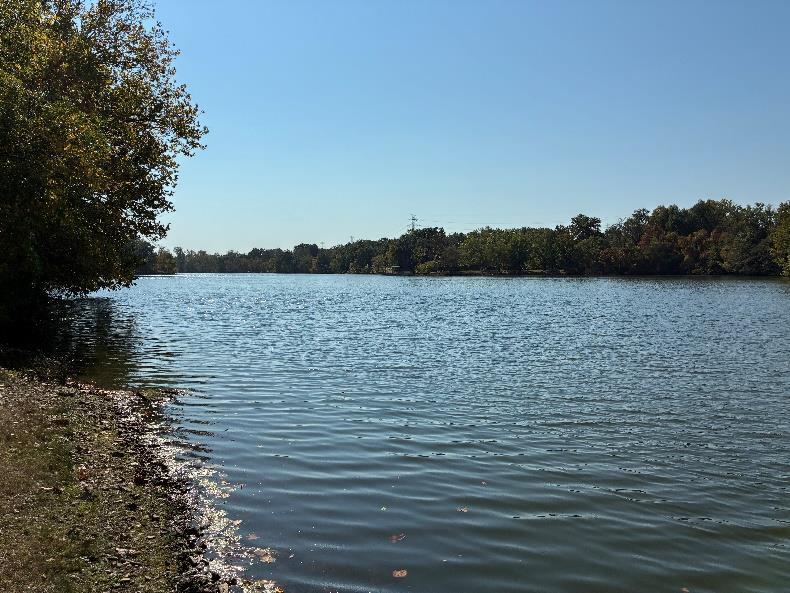
An oversupply of poorly maintained rental housing strains neighborhood appearance and safety, especially when landlords fail to screen tenants or address deterioration. Broader economic pressures –including regional job losses, limited local employment options, food access challenges, and declining commercial activity exacerbate instability. Decades of disinvestment, a legacy of predatory lending, and fra mented social ser ices further undermine the area’s resilience.
Neighborhood associations offer one of the most practical tools for strengthening Spanish Lake. While the Spanish Lake Community Association provides essential leadership, it cannot monitor every block. Hyperlocal associations allow residents to identify issues early, communicate with authorities, and maintain neighborhood standards. Communities that fail to self-organize tend to decline quietly, much like a family member who resists help until deterioration becomes unavoidable.
NeighborhoodassociationsofferoneofthemostpracticaltoolsforstrengtheningSpanishLake.
Effective associations encourage landlord accountability, improve relationships with police and code enforcement, foster beautification and upkeep, welcome new residents, and cultivate a shared sense of identity. Safety and security through programs such as neighborhood watch are also dramatically enhanced Neighborhood associations can take advantage of their strength in numbers when reporting deteriorating or problem homes to code enforcement and the police department – one person calling on
behalf of 300 homes carries substantial weight with the various agencies. Though voluntary and not feebased, these associations can still deliver measurable value; several university research studies show that homes in organized neighborhoods consistently sell at higher prices. Public or philanthropic dollars can provide seed funding to launch or grow neighborhood associations.
Strengthening pathways to homeownership should be a priority. Expanding employer-based and other downpayment programs, increasing financial and homebuyer education through banks and credit unions, promoting rent-payment reporting by the landlords, and improving awareness of mortgage options are cost-effective, successful interventions. At the same time, housing quality must improve through stronger code enforcement and greater pressure on absentee landlords to maintain standards. The land bank is also a useful tool that can strategically support homeownership.
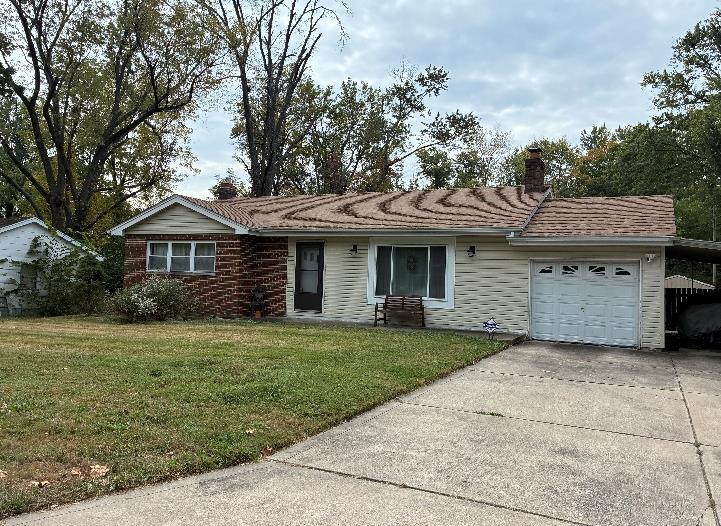
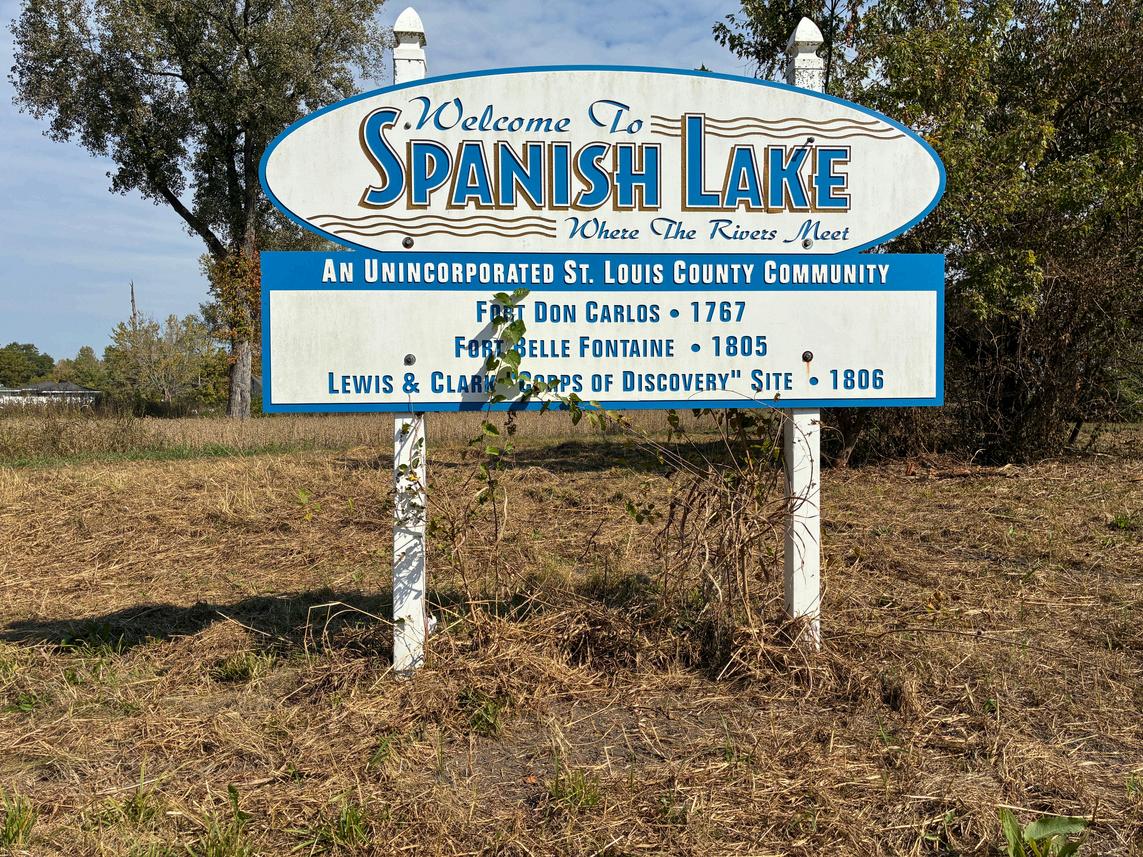
Community appearance also matters. Repairing the Riverview Road entry sign and advancing beautification projects can reinforce neighborhood identity. In addition, rehab programs can assist homeowners with maintaining homes. With an abundance of developable lots and $11 million in state funding dedicated to addressing deteriorated homes in North County, Spanish Lake is well-positioned to add new and improve existing housing and to attract future commercial investment. Deeper collaboration with police, social service agencies, churches, educational institutions, and workforce development partners will strengthen the area’s roader su ort network
A revitalized Spanish Lake is one where residents choose to remain, invest, and build their futures. Such a community is characterized by safe and walkable streets, well-kept homes, strong neighborhood identity, accessible amenities and green space, diversified housing options, and meaningful economic opportunities. High levels of homeownership and long-term stability anchor this vision, supported by acti e nei h orhood associations and a shared commitment to maintainin the community’s character Spanish Lake has the assets, institutions, and community spirit needed for renewal. Achieving long-term stability will depend on resident engagement, collective responsibility, and strategic action. By expanding homeownership opportunities, strengthening neighborhood associations, holding absentee landlords accounta le and le era in the area’s natural and institutional stren ths anish Lake can re erse
decades of decline. Progress will come house by house and street by street, driven by residents and community partners committed to reclaiming the future of their neighborhoods.
Byexpandinghomeownershipopportunities,strengtheningneighborhoodassociations,holding absenteelandlordsaccountable,andleveragingthearea’snaturalandinstitutionalstrengths, SpanishLakecanreversedecadesofdecline.
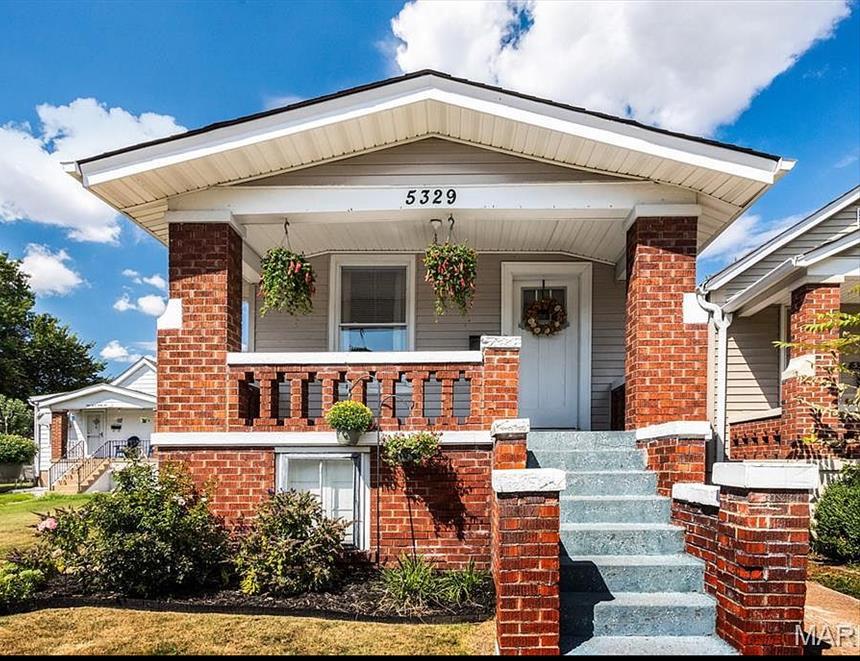
The hope is that the impressive new WildCare Park will spur economic development in the Spanish Lake community to revive and introduce commercial assets such as new restaurants, hotels, entertainment and grocery stores. These are very worthy goals, so the purpose of this section is to examine their viability in the community and identify actions that can be implemented to advance these goals.
The development of any of these asset types requires private sector expertise, capital, and risk-taking. Developers specialize in specific types of assets because each has its own eco-system of suppliers. Each uses specialized market research firms, architects, builders, leasing brokers, attorneys, marketing firms and property managers. Grocery stores are entirely different than restaurants. Apartments and MultFamily developers are completely different from Single-Family Home or Condominium builders. Hotels, hospitality, and entertainment are a world apart from clothing retailers or antique stores.
Fundamental to the development of any of the commercial asset types is an analysis of the residential community in the impacted draw area. For instance, grocery stores are most sensitive to 1-mile rings of population size and income, while regional destinations like Costco may look at 15-mile rings, and a museum may look at a 100-mile ring.
lusterin of acti ities can also affect this analysis he “Rule of 3” su ests that three of any use in close proximity enjoys a greater draw. For instance, three shoe stores, three restaurants, or three hotels establish a destination that can pull customers from outside the normal ring. Retail malls are designed around this concept children’s stores and acti ities in one area ladies fashion in another athletic clothes, shoe stores, home design, etc. each grouped together. Clusters of four, five or more create “critical mass” and are e en etter than three
This can also work with a mix of uses in a compact, walkable area hence the economic argument for placemaking. With a mix of perhaps a couple food and beverage choices, a grocery store, a hair and nail salon, a hardware store, and maybe a community center or a library on the same block, or clustered around a plaza or green space, the draw is synergistic because it is appealing to many different populations at different times of the day.
Grocery stores are a low margin-high volume business and therefore exceptionally sensitive to disruption. More specifically, their overall net profit margins run just 1-3% so they need a large volume of buyers to make the business viable. In general, they look for a population of over 25,000 in a three-mile radius, and with a median household income of $55,000 ($45,000 for value chains like Food 4 Less; $60,000 for mid-market chains like Kroger and Safeway) to justify the operating risk. In addition, average opening costs run from $100,000 to $1,000,000, not including the greater amounts needed for space
remodeling or construction of real estate. Organic and specialty grocers can see 3-5% net profit but are generally smaller in size and have more limited appeal and therefore need higher than median incomes to make up for the smaller volume.
With a population of just 18,000 over 7.5 square miles and below-median annual household income ($51,000 for Spanish Lake vs. $66,000 for Missouri and $83,000 nationally in 2023) the demographics of Spanish Lake are low priority for national chains and are difficult at best for smaller regional chains or independents.
Moreover, the safety concerns of the area are discouraging. Costs of vandalism and/or shoplifting can be devastating to such a low margin business. As an example, if a grocery retailer sells $25,000 of goods in a week, that will likely net a profit of $750 at most. Replacing one broken window can wipe that profit out, and frequent or multiple problems can quickly lead to store closure.
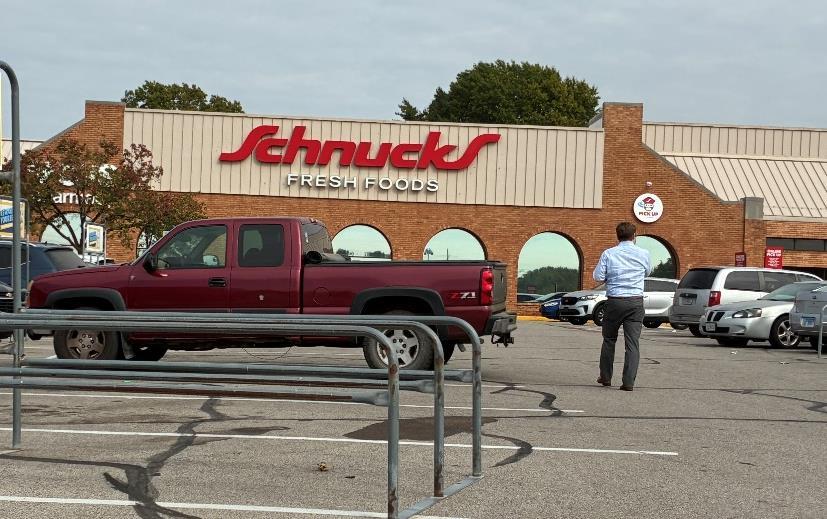
To supplement food needs, Community Gardens are a first step. Common in many neighborhoods, an empty lot or parcel can support a volunteer garden. Once procured for this use (even on a temporary basis until other uses are found), these become beloved places for building community, as well as sources of healthy fruits and vegetables. Great candidates for non-profit support, they teach residents about food sourcing and growing and have broad appeal ranging from children to seniors.
Urban Agriculture is even more powerful. This is a growing industry that can operate on a for-profit or non-profit basis and generates greater volumes of food. Often offering more structured education and jobs, excellent examples can be found in Detroit where large areas of vacant land have been successfully converted to this use. Spanish Lake is fortunate to already have Rustic Roots Sanctuary and City Blossoms, and support for their endeavors and others like them should be encouraged.
armer’s arkets are popular and often prescribed but are surprisingly difficult to sustain. While they appear to be spontaneous, they require strategic curation of foods and activities, specific locations, upfront capital, and ongoing knowledgeable management. That said, when well done and widely supported by the community they are a powerful draw contributing to food sourcing as well as placemaking.
The residents of Spanish Lake are particularly hungry for more restaurants. This is not surprising since food and beverage is the most common anchor for retail today. That said, restaurants are widely regarded as among the riskiest of all commercial businesses. Over 15% fail in the first year, and 50-80% fail within five years. This is due to insufficient capital, poor financial management, operational inefficiencies, stiff competition, and low profit margins. As a result, demographic circles are a particularly critical analysis for restaurant developers and operators.
Margins depend on the type of restaurant. For instance:
• Quick er e ( c onald’s Bur er Kin u way): 6-9% net profit
• Fast Casual (Chipotle) fresh food prepared on site: 6-9%
• Sit Down (Olive Garden) with wait staff: 3-5%
• Pizzerias: 10-15%
• Bars: 10-15%
Franchises are increasingly common to cut risks, as are standardized menus and procedures. And Electronic Point of Sale systems (food ordering online) are becoming more frequent with growth in technology.
Even though the demographic circles of Spanish Lake are difficult for national operators, there are many kinds of small scale and entrepreneurial strategies and alternatives.
Small scale specialty shops are often more viable, especially if they can cut their real estate costs. Depending on the kind of menu, restaurant kitchens can be exceptionally expensive with special hoods and venting required, let alone room décor, furniture, fixtures, and equipment needed for a seating area. On the other hand, less intense food prep requirements for coffee make it more affordable, are demanddrivers, and are therefore prolific in most communities. Ice cream shops do require some cold storage, but this can be leased equipment, and they too offer broad appeal, especially for families. A recent local e am le is lley’s akes and ies a akery that just o ened that also offers coffee and limited seatin This has drawn notice already so is well on its way. Community support to ensure this venture is successful will be helpful as other entrepreneurs consider opening businesses.
current uzzword and strate y in the industry is “e eriential retail” meanin consumers are particularly drawn to things that offer an unusual and memorable overall experience. This is often tied to the environment (for example “ lam in ” in WildCare Park) or the sense of discovery of a location, or unexpectedly good food. Instagram photo ops are often incorporated into those businesses to smartly market how special they are.
Local entrepreneurs are great sources of these smaller concepts, and they can be especially delightful and feasible in shared spaces. Think about coffee shops in libraries or bike shops. Vintage clothes with a dessert bar. Barbecue with local music on the weekends.
A pop-up restaurant space is a temporary location, like a gallery, warehouse, or existing restaurant's offhours spot, used to host short-term dining events, ideal for testing concepts, building buzz, or generating income with low commitment. Working with platforms like Peerspace and Storefront may help create opportunities that have not been considered. There may be examples such as offering diverse settings from lofts to industrial spaces, rented hourly or for days/weeks to create unique culinary experiences without long-term leases.
A proven low-cost way to launch entrepreneurs are pop-ups in street carts or small kiosks on the sidewalk not so different from hot dog stands or the ice cream man of yore, but now offering everything from burritos to Japanese milk tea.
Short term leases in otherwise empty spaces can also be a low-barrier location for start-up concepts and is usually a win-win for both the landlord and the user. New tenants in empty strip mall shops or even more non-traditional locations can create buzz, attract curious customers, and add value to the property.
Food incubators are a powerful long-term strategy to support entrepreneurs and bolster economic development. Working with community colleges, teaching restaurant business skills as well as food skills is invaluable for starting a successful restaurant at any scale. These incubators are good subjects for both public and non-profit grants and supporting them should be a priority for Spanish Lake.
Foodincubatorsareapowerfullong-termstrategytosupportentrepreneursandbolster economicdevelopment.
Food Trucks are another alternative that should not be overlooked. They require less upfront capital, carry lower overhead and can yield higher margins than fixed facilities. Moreover, they are mobile so can follow the demand rather than waiting for customers to come to them. They love following community gatherings, sports, or events, providing food outside brewpubs or bars, or parking near hospitals, colleges and offices feeding hungry workers.
Though Spanish Lake was conceived as and remains a suburban residential community, office is still a worthwhile consideration in the economic development strategy. The average commute for Spanish Lake residents is about 25 minutes, so for those with location flexibility, a nearby workspace could hold strong appeal. And office workers help support restaurants, retail and hotels, all of which the community seeks
The COVID-19 years totally disrupted the traditional office world. Work from home experiences made many hesitant to resume commutes and affected the traditional office schedule and culture. While there are recent gains for employers wanting employees to return to workplaces five days a week, it appears that one to two days a week, most office employees have workplace flexibility. This has been a boon to both restaurants and offices in many suburban communities where workers are seeking to be closer to home and work in more casual environments. As further evidence of this office trend, companies are providing smaller suburban locations for workers, such as medical office and local urgent care facilities.
This has also led to many new suburban co-working or shared office spaces, which can be done in small spaces, and in creative locations with little tenant finish required. Vacant retail spaces or shared spaces with food and beverage concepts are prime opportunities. This can help preserve historic buildings as well because the old office adage holds true:
“Oldcompanieslikenewbuildingsandnewcompanieslikeoldbuildings.”
Today, office owners are having to be more creative and flexible than ever before. In suburban office, lease terms are dramatically shorter even by the week or month in shared spaces and closer to five years than the traditional 15 years in larger office buildings. Similarly, lease rates are usually more negotiable and at lower prices since the pandemic. Still, permitted zoning, reasonable building costs, good location and good tenant quality are essential to the office developer or owner.
With the advent of WildCare Park, the Saint Louis Zoo may need some ro imate “ ack office” s ace that is more convenient and more affordable than available elsewhere in the St. Louis region. Furthermore, like any other attraction, the Zoo will be concerned about the customer experience accessing the Park and being in the community. No matter which route visitors take, Spanish Lake is WildCare Park’s “front door ” hus, the Spanish Lake experience will also be a part of WildCare Park visitor experience and first impression. Accordingly, the Zoo should be considered a partner in community building initiatives, be it office or other commercial investments.
Often overlooked is the value of public sector tenants to anchor office uses. Rather than the expense of building their own facilities, governments often have more flexibility and better accommodations in privately-owned buildings. For the property owner, they are highly valued for their credit quality and substantial traffic they frequently draw doing public business. In addition to St. Louis County (as mentioned previously in this report), police substations, community centers, a range of government offices, and libraries can often lease space in existing buildings at a much lower cost, and their presence can jump-start a near y cluster of acti ities im ro e safety and “re rand” a district
Also seen from time to time are government master leases to support incubators or entrepreneurs. The jurisdiction then su leases the s ace to youn usinesses at discounted rents or on a “ ercenta e rent
asis” where the rent ayment rows as the usiness re enue rows he increased ta es from the growth of incubator or entrepreneurial businesses will often justify this investment by government
Hospitality lodging options come in a wide variety of choices starting with country Bed and Breakfasts and small inns and ranging all the way to full-service hotels with an extensive array of amenities in prime locations. The key feature they have in common, however, is that they are all open 24 hours a day, seven days a week, 365 days a year. Just to break even, they need to fill all their room at least 60% of the time or say 220 days a year. This is a heavy lift, so they too rely on demographic analysis to determine their locations albeit also considering visitor numbers and patterns, and highway and road traffic counts.
For all but destination resort locations, whether limited service (simpler, standardized rooms and perhaps a breakfast buffet like Quality Inn) or full service (includes restaurant food service) concept, virtually all hotels rely on business travelers for occupancy Monday-Thursday, and on leisure visitors for occupancy Friday-Sunday and holidays.
Suburban hotels are thus often located near highway interchanges (ie I-270) to extend their draw as has been the case with previous Spanish Lake hotels. Net profit margins vary greatly depending on hotel type, location and management, but generally range from 10-20%. While this can be an attractive return, the operational efficiencies are essential to profitability so standardization and large chains have been absorbing a lot of the market. Securing one of these operators (Marriott, Hyatt, Best Western) or “fla s” offers extensive design, training and marketing advantages to a local franchise so small independent hotels are increasingly rare.
Beyond operating costs, the upfront capital costs of hotels can be prohibitive. Currently, the cost of construction in the St. Louis area is running about $200,000/room. Since hotels rely on economies of scale to reduce their operating costs, they prefer to ha e at least 150 “keys” (rooms) o uild a 125-room facility costs $25,000,000, requiring a room rate in the $250/night range. With all the nearby competition at the airport, Alton, etc., this is daunting. Moreover, travel patterns have not yet recovered to preCOVID levels, and the current interest rates are making financing particularly expensive.
WildCare Park will include a restaurant, observation tower, gift shop and ten “ lam in ” structures within its gates. This will capture the immediately obvious economic development initiatives being considered. If the glamping experience is successful, it could seed the demand for other natural experiences outside the gate, like camping, cycling paths, river boat rides or nature tours near the Confluence. While clearly desirable and beneficial, the scale of these activities means they will have only measured economic impact for the greater Spanish Lake community.
And without economic incentives, a hotel will not be the first thing built. Hotels are followers following business activity first, and leisure demand second. WildCare Park is a 2 ½ hour experience just a 25minute drive north of St. Louis. The zoo and WildCare Park can both be visited in one day, so an overnight trip will only be a consideration for the visitors coming from outside the region, with already many hotel options in good proximity.
Spanish Lake was originally designed and built as a low density, residential suburb far from the hubbub of the city of St. Louis. The perception of a visitor to Spanish Lake is it is a beautiful area with many nice homes, spacious lots, lush greenery, the stunning Spanish Lake Park, close proximity to the Confluence, and good highway access.
The development and investment community views the area very differently. They also see good highway access but very limited transit service, below-average household incomes, buying power further limited by the low density, location far from the job centers, and a reputation for above average crime. It ultimately all comes back to the demographic circle analysis.
The path forward is for Spanish Lake to go back to its roots; be the best suburban community it can be. Build the sense of community with neighborhood groups to lobby for strict code enforcement to improve street appearance, housing quality and ultimately property values. Pursue the Town Center Plan to create a walka le commercial “heart” of the community ursue the Rule of 3 to create the critical mass so fundamental to restaurants and retail. Focus on making Spanish Lake better for residents, and visitors will come to discover and enjoy the authentic places.
FocusonmakingSpanishLakebetterforresidents,andvisitorswillcometodiscoverandenjoy theauthenticplaces.
Support local businesses and entrepreneurs with incubators, education, low-interest Community Rein estment ct ( R ) loans and rants to uild their usinesses “Bi ” is not as im ortant as “ ood ” Both locals and visitors will go out of their way for a special experience, be it shopping, food and beverage or hospitality. Enhance activities at Spanish Lake Park, certainly for families and children, but also for seniors. Consider low intensity games like life-sized chess pieces or shuffleboard, bocce ball, etc.
The choice the community must make is whether to grow, and to add more housing. Housing can take many shapes and forms, from granny-flats, to duplexes, triplexes and patio homes, to yes, even wellmanaged condominiums and apartments. And it can be done carefully and strategically to blend into the neighborhoods, enhance the charm of Spanish Lake and bring it back closer together. With as spacious as
the land parcels are, increasing housing density can be done in a way that does not change building heights or sensitive neighborhoods’ character. Or, it can be done in a different, more visible manner, in locations where activity and change are desired. Both strategies would be appropriate to support revitalization efforts. Building the appeal of the community in this way will attract developers and homebuilders as well as cafes and stores. Reaching a population of even 25,000 would expand Spanish Lake’s economic development options enormously.
Should the community decide against a quality growth agenda, however, it should expect limited increase in economic activity even after WildCare Park opens in 2027.
The previous section reviewed the specific eco-systems of retail, hotel, and office property types, noting that commercial development requires various factors including private sector expertise, capital, and risk-taking in order to be viable. From a broader perspective, land development opportunities can be considered through the lens of general demand and supply. Demand characteristics include a desired land use, appropriate location, and attainable price for the end user. Supply characteristics include a reputable and experienced developer/investor with an entrepreneurial spirit, financial feasibility, and a reasonable rate of return commensurate with undertaking the investment.
Financial feasibility is of paramount importance to bring into reality a potential use which appears to meet the supply and demand parameters. As noted by late, great land economics professor James A. Graaskam “ real estate roject is ‘feasi le’ when the real estate analyst determines that there is a reasonable likelihood of satisfying explicit objectives when a selected course of action is tested for fit to a conte t of s ecific constraints and limited resources ” his statement a lies to a broad range of potential land uses, keeping in mind market economics. As stated in onald R ley h ’s article in Real Estate Issues® published by The Counselors of Real Estate®, Volume 34, Number 2, 2009 - Initial Feasibility as a Recommended Procedure1:
Typicalprocedurereliesheavilyonthedevelopmentfeasibilityconceptrecommended inthemanypublicationsbyGraaskamp,whothoughtprojectsshouldproducean acceptablereturntothecontributorsofcapital.Thefirststepisastaticrate-of-return analysistoproducenumbersforthedevelopertodeterminetheprofitabilityofthe proposedproject.Initially,costiscomparedtovalue,whichenablesthedeveloperto injectmarketnumbersoncomparableproperties.Thesecondusesincomeand expenseestimatestoassesstheadequacyoftheprojectedincome.Thisapproach canbeviewedasaninitial“financialfeasibility”approachtoanewproject.Ifthe valuedoesnotexceedcostinthefirstyear,andthedeveloper’sexpectedincomeand expensefiguresdonotmeetexpectedlevels,theprojectisnotviable.
Further financial feasibility is defined as 1) One of four criteria of highest and best use. For a land use to be considered financially feasible, the value of the land use must exceed its cost. 2) The capability of a physically possible and legal use of property to produce a positive return to the land after considering risk and all costs to create and maintain the use.2 Based on the foregoing, the pursuit of undertaking land development opportunities is governed by arious factors he anish Lake area’s land de elo ment
1 https://cre.org/real-estate-issues/initial-feasibility-recommended-procedure/
2 The Dictionary of Real Estate Appraisal, 7th Edition. Appraisal Institute, 2022. Chicago, IL.
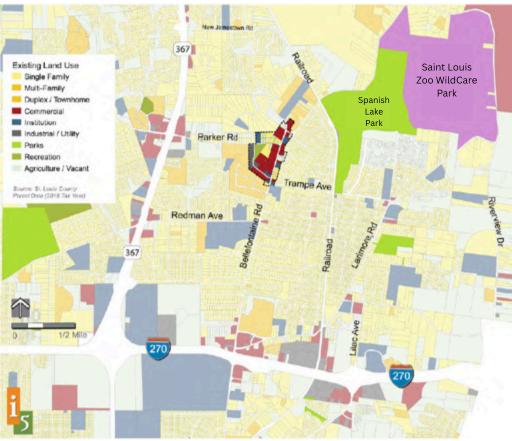
opportunities can be considered by examining the existing land uses in order to build upon the current assets, as noted in the following map. The majority of the existing land uses in the Spanish Lake area is characterized as single family residential; additionally, there are some higher density residential, commercial, parks, and agricultural/vacant parcels.
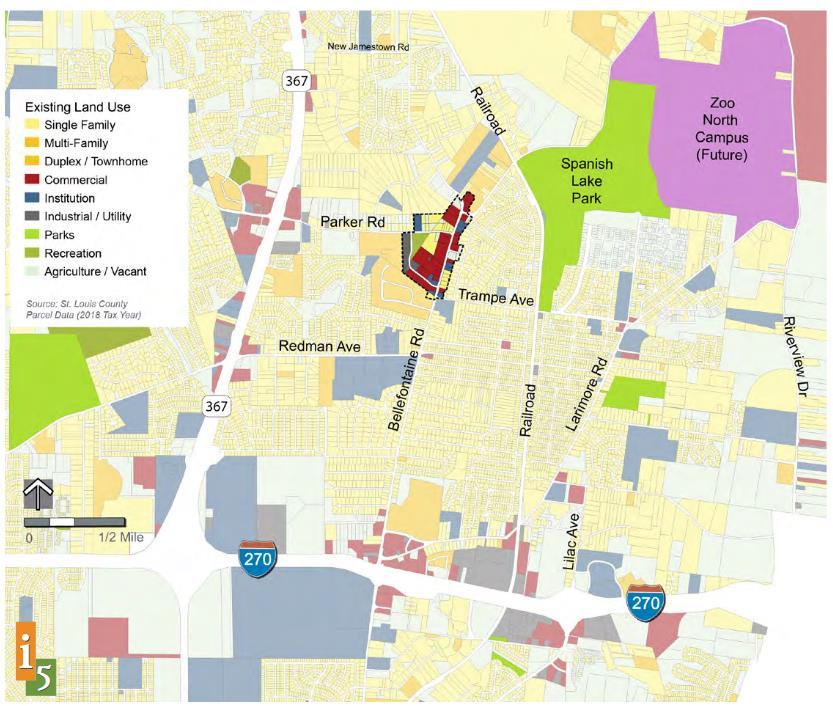
Source: Spanish Lake Town Center Master Plan

Potential land uses for the existing vacant land parcels will be presented further in this report, and it is important to align any development effort in this area with the various planning efforts that have already been undertaken in the broader Spanish Lake Area including but not limited to the following reports: the 2021 Spanish Lake Town Center Master Plan, 2022 Jamestown Mall Market Analysis and Feasibility Study, Thriving Communities Research/Plans, 2030 Jobs Plan, and STLCO 2050 Master Plan. The recently published STLCO 2050 Master Plan included the following priorities: 1) Inclusive Economies, 2) Complete Communities, 3) Sustainable Infrastructure, 4) Responsible Growth, and 5) Leading the Region.

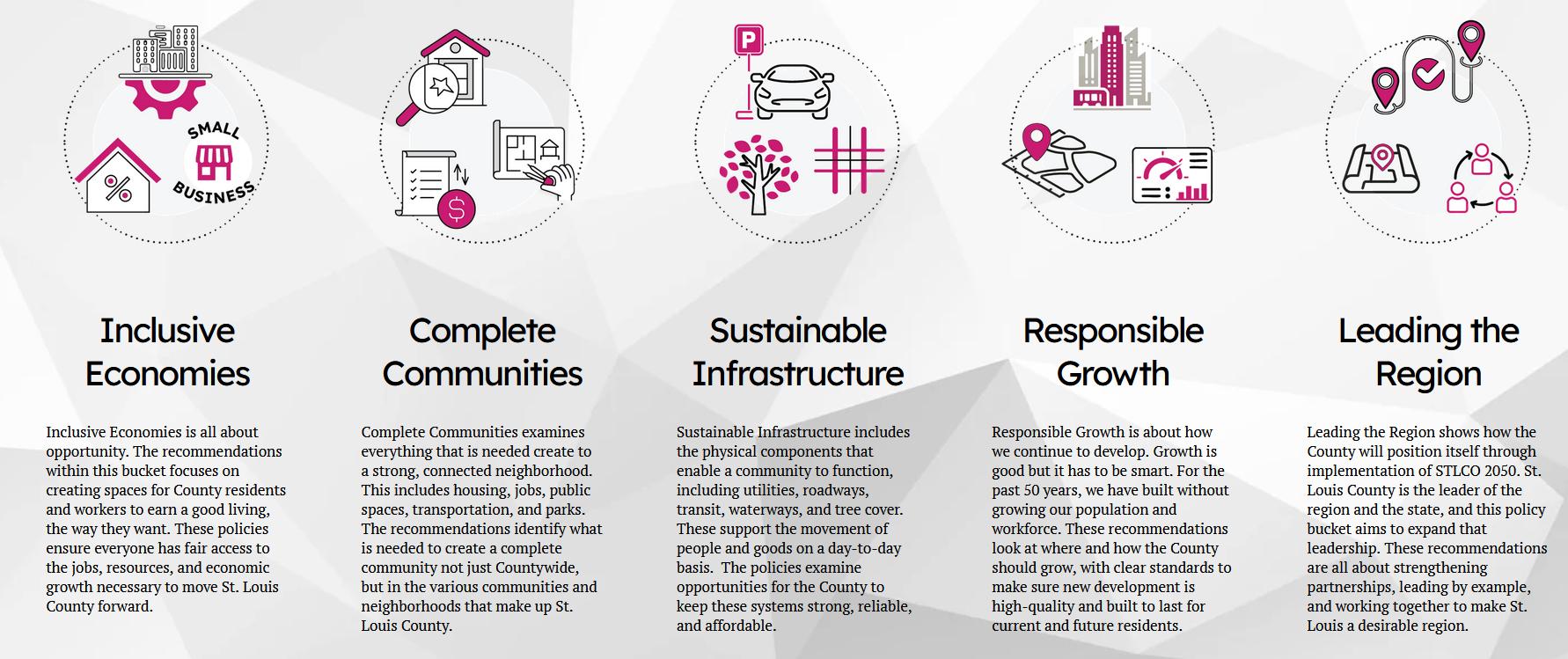
Aligning and complementing the directional initiatives provided by these plans would be a prudent undertaking moving forward.
As noted in the previous Commercial Growth section of this report, commercial growth is not feasible unless there is significant growth in residential population within the community. This growth may come from a variety of products, but almost certainly requires increased density. Of the various potential land uses possible for vacant parcels, the retail land use, if coupled with a growth strategy, has some potential to take advantage of the increased level of attention towards the new WildCare Park
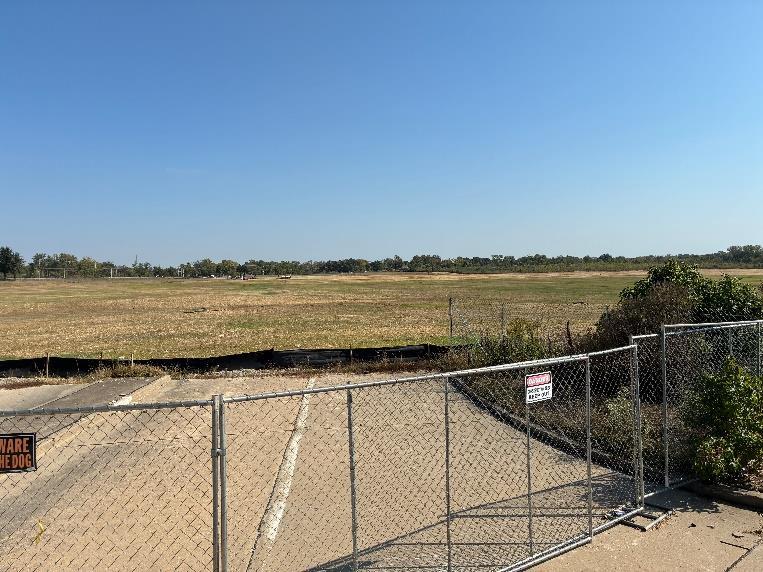
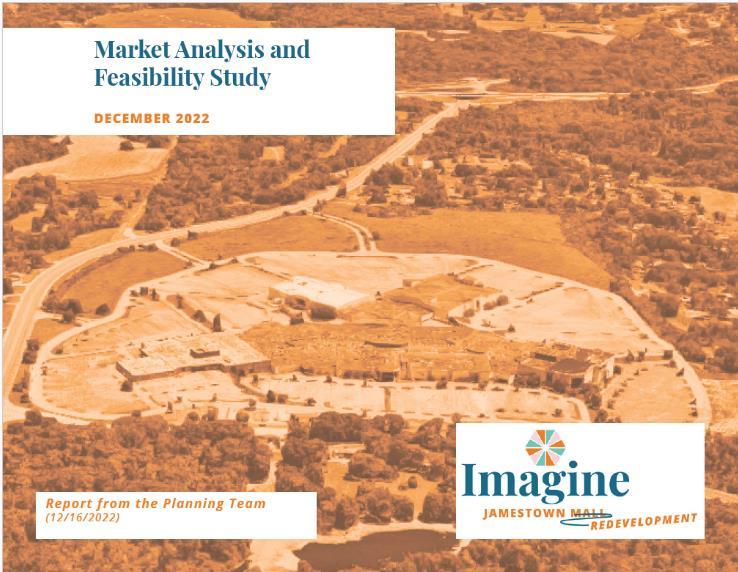
The Jamestown Mall Market Analysis and Feasibility Study (December 2022) provided a detailed analysis for the 100+/- acre site situate approximately three miles from the subject. Notably, WildCare Park was mentioned on a e 17 of the re ort and notes the followin : “While the Jamestown all site enjoys proximity to WildCare Park there is unfortunately no direct route etween the two ” ccordin ly the development of retail corridors requires collaboration with various other infrastructure and growth components to facilitate a critical mass of real estate development. While presently, this timeframe is unpredictable, it is important to keep a broad perspective to envision potential future land uses for the area. The STL Partnership website presented the following summary for the Jamestown Mall Market Analysis:
Basedontheinitialmarketanalysisandcommunityinput,thereportrecommendsAgFoodTechnologyCampusasthepreferredlandusefortheJamestownMallsite.The reportalsooutlinedanalternativelanduseofsenior(55+)residentialwithagriliving.3
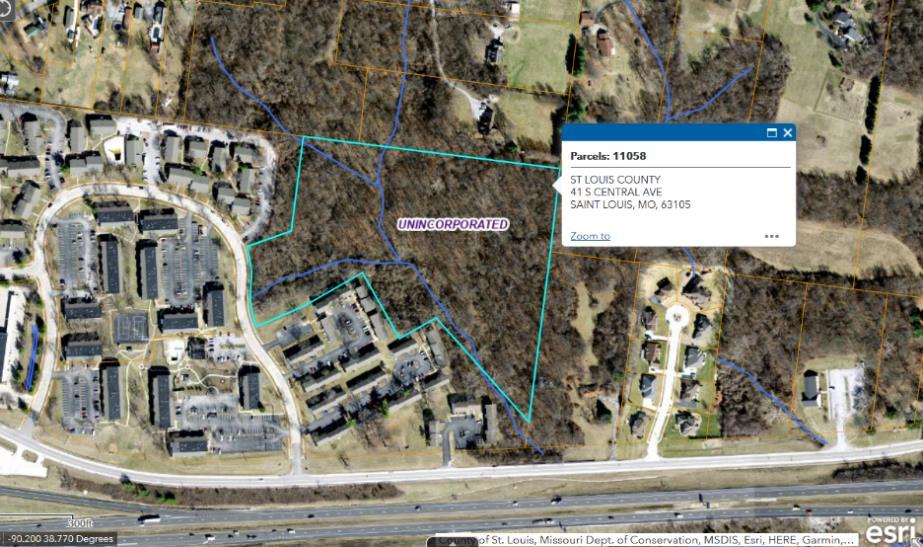
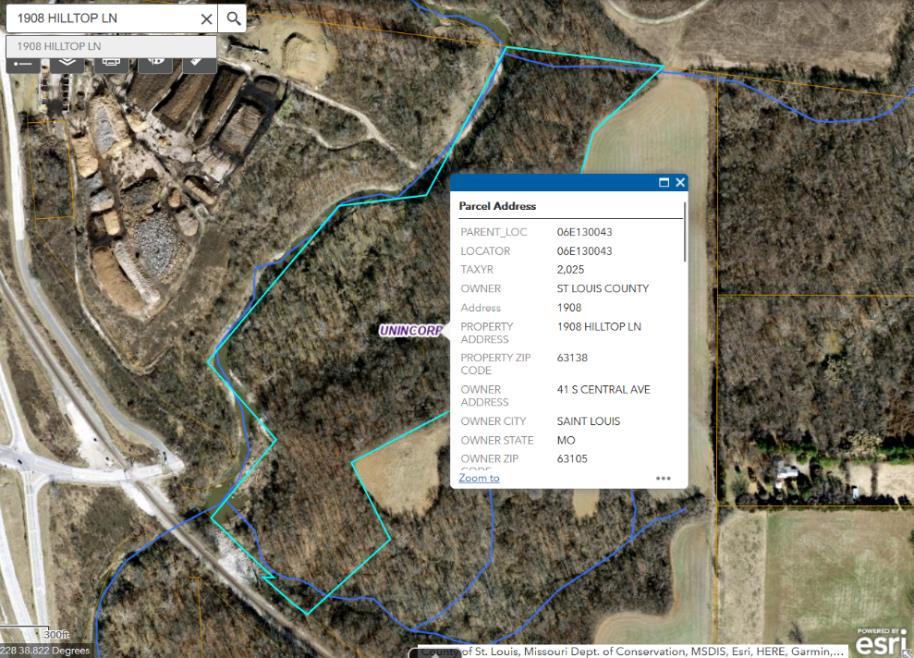
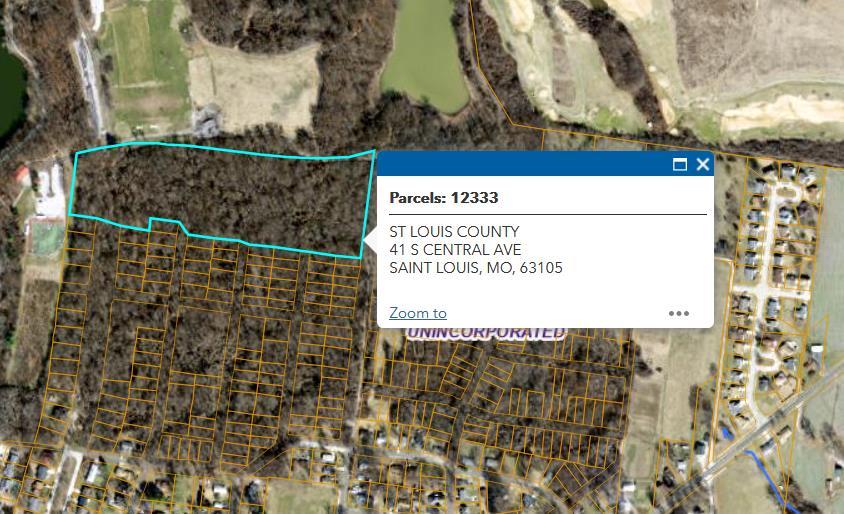
he recommendations for the Jamestown all ha e some a lica ility to the su ject’s area as well particularly in terms of the Ag-Food Tech concept. We will discuss this concept in further detail along with other broad possibilities including eco-tourism and business incubators. An asset that Spanish Lake has is the availability of land parcels, including but not limited to the below. These larger land parcels have been identified as County-owned land based on our review of the GIS/Public Records.
3 https://stlpartnership.com/jamestown-mall-market-analysis-and-feasibility-study-report/
Consider County-owned land for special uses via long-term ground lease. For example:
• 11058 Mollerus Dr.
• 1908 Hilltop Lane
• 12333 Lavida Ave
These land parcels, among others, can potentially be pursued for a long-term ground lease to facilitate economic development through these roader ‘transformational’ land uses including Ag-Food Tech, eco-tourism and business incubators while still maintaining County ownership of the land. ther e istin ‘corridor’ locations for development could include the Route 367 cluster, Town Center retail cluster in Spanish Lake, and larger undeveloped land areas near Riverview Drive and I-270.
We now present the three broad ideas for Spanish Lake including Ag-Food Tech, eco-tourism and business incubators, which may ha e the “ emand” side of the equation for which the “ u ly” of land can provide a site for facilitating the creation of these uses to strengthen the Spanish Lake area.
Agricultural Food Tech (AgTech) in eneral is defined as follows hort for “a ricultural technolo y ” AgTech is a burgeoning field where the latest technology and the traditional practice of farming meet.4 The 2030 Jobs Plan identified ech as a ‘Ne t-Generation’ sector he 2030 Jo s lan noted that AgTech “a lies a wide ariety of technolo ies to a riculture science and roduction ractices with the aim of im ro in yield efficiency rofita ility and sustaina ility ”
As mentioned earlier, the Jamestown Mall Market Analysis and Feasibility Study report from December 2022 presented this possibility for the Jamestown Mall area but it is also applicable to the Spanish Lake area near WildCare Park. As noted in that study:
Notwithstandingthisprojectedjobgrowthanalysis,anAgTech/Ag-Fooddevelopment willnotlikelycreateagreatmanyjobsonsiteattheJamestownMallsite.The industryisn’tallthatlargeanditdependsmoreonlandandfacilitiesforgrowing plantsthanonintenseemployment.Mostjobswouldbehighlyskilled,butlikelynotin largenumbers.Insomeways,however,thiscancontributetotherelativeserenityof residentiallifeinNorthCounty,particularlyaroundthemallsite.Therecanbe importanteconomicdevelopmentwithoutsubstantialcommutingorothercommercial traffic.
Perhaps the Ag Food Tech offering can be a better fit for the Spanish Lake area near WildCare Park to complement the environmental initiatives on a more hyperlocal basis. The efficient utilization of vacant land parcels in the Spanish Lake area could have a broader economic impact if the subject area is able to attract investment in the AgTech realm. Nota ly the su ject’s area could ro ide a more com etiti ely priced alternative for land for this type of development, especially if offered as part of a ground lease with strategic adjacencies to various existing natural features in the Spanish Lake Area.
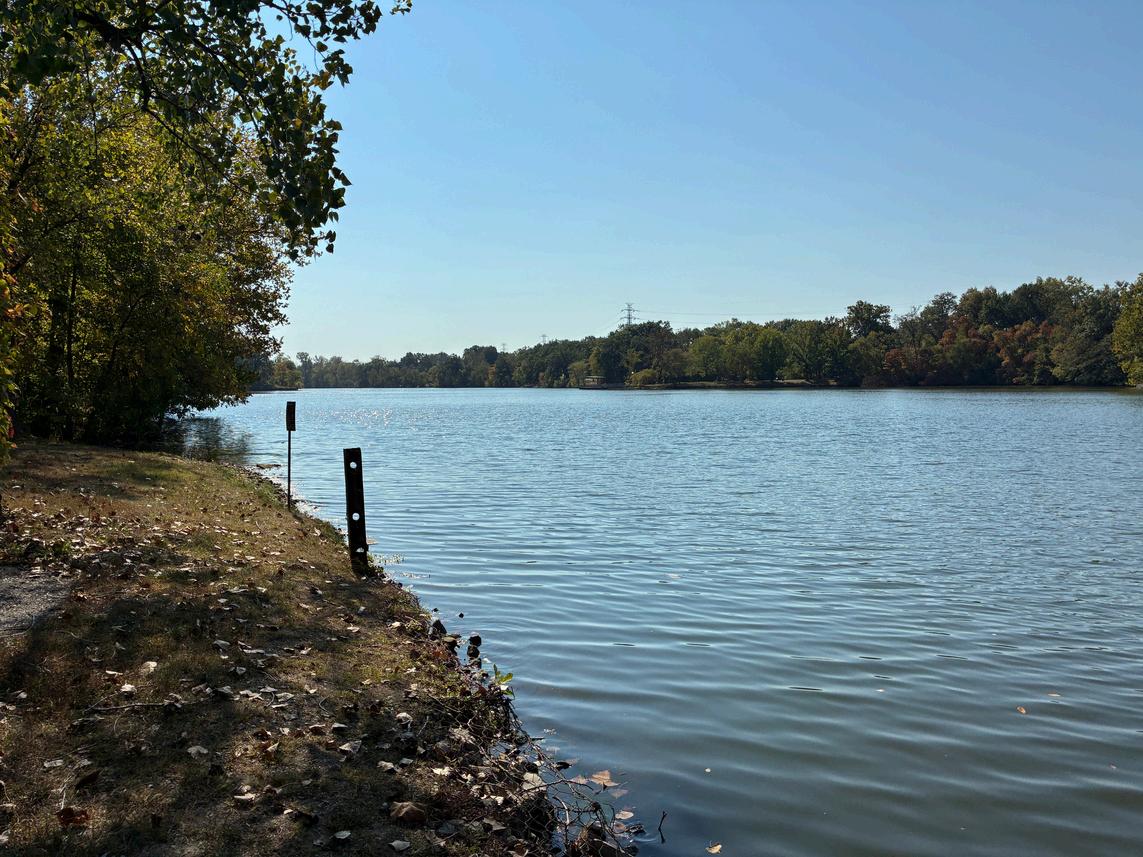
At the confluence of two rivers, the Mississippi and Missouri, the Spanish Lake area has the potential to unlock new possibilities of drawing tourists to its ecological and environmental positioning, especially when coupled with WildCare Park opening. From boating, bird-watching, sunflower gatherings at the Columbia Bottom Conservation Area, and other activities, the critical mass of attractions for eco-tourism in the Spanish Lake area can potentially be realized. Subsidies or favorable financing offerings will likely be necessary to launch the eco-tourism initiative.
4 https://www.monarchtractor.com/blog/what-is-ag-tech
Subsidiesorfavorablefinancingofferingswilllikelybenecessarytolaunchtheeco-tourism initiative.
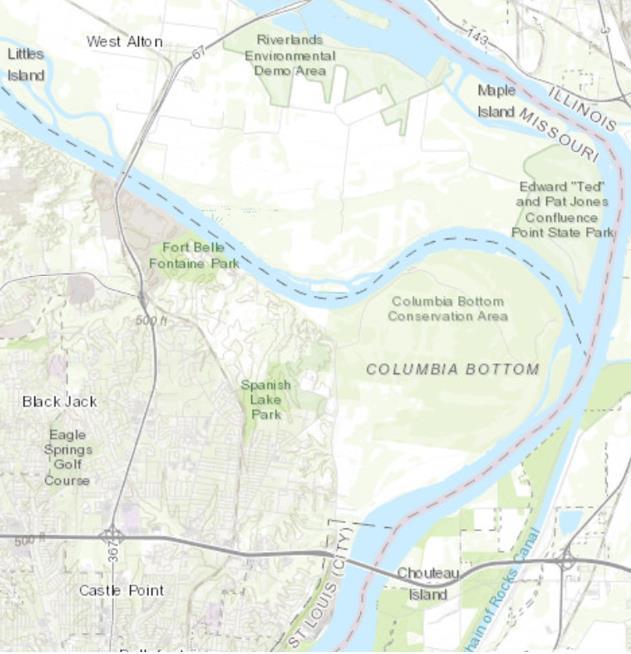
Source: databasin.org
The Spanish Lake Park is well positioned to be a complement to WildCare Park, Columbia Bottom, Confluence of rivers, and other natural attractions. However, it should be noted that the subject area is currently a tertiary offering in terms of recreational appeal due to the other competitive offerings within Missouri as well as Illinois. A multimodal transportation network could help facilitate the Eco-Tourism concept.
Continued support for business incubators can also bolster the other two broad possibilities of AgTech and Eco-Tourism, as well as economic development in general. It is notable that North County Business Incubators have been supported by Councilwoman Webb based on insights prepared by Eagle Productions LLC including the following capacity-building initiatives:
• Co-Working and Pop-Up Retail Space
• Business Training & Mentorship
• Technical Assistance
• Access to Capital
• Partner-Led Workshops
• Digital Resources
The utilization of County-wide as well as local area resources to build upon the assets of Spanish Lake by putting vacant land and other vacant spaces to economically productive use is possible through initiatives such as these.
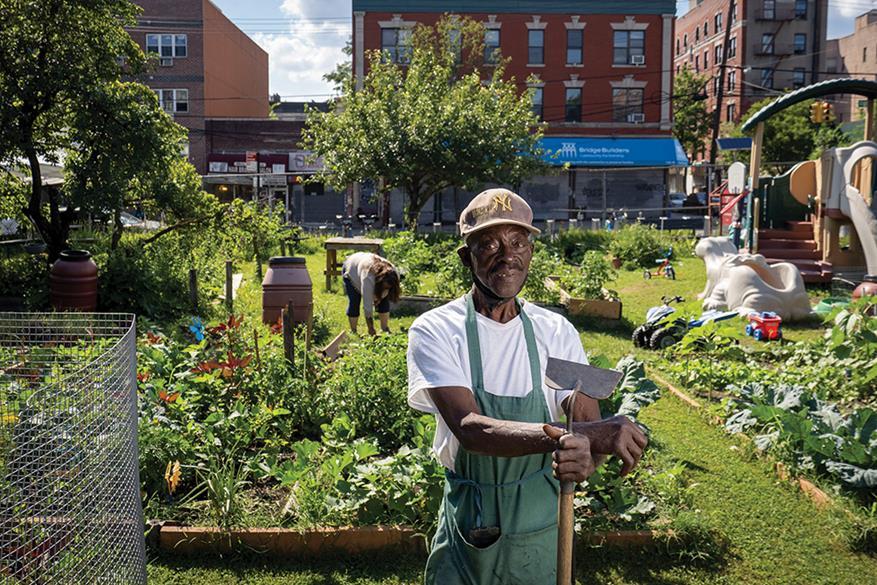
AgTechandUrbanFarmingcancreateentrepreneurialopportunitiesforbusinessincubationas wellashelpfeedlocalresidentswithqualityfood.
Safety remains the highest priority in Spanish Lake. Constituents of Spanish Lake must commit to outreach and partnership opportunities with the St. Louis County North County Precinct Police Department. Expand successful initiatives and promote their successes. A robust marketing campaign such as “North County Rising” de elo ed y a le roductions, LLC should highlight community assets and linkages with WildCare Park Real safety measures and lower crime must continue to be a priority – and then communicating those facts to the public will ultimately change the perception of Spanish Lake.
Promote linkages with WildCare Park around educational programs with St. Lous Community College and Hazelwood East High School regarding programming, education, and internships. In addition, urban gardening initiatives, healthy food programs, farmers markets, and monthly convenings will create positive community engagement. Expand code enforcement and invest in neighborhood associations and other private networks to further promote property maintenance. Finally, physical improvements such as anners and “Welcome to anish Lake” si ns will reinforce a i rant welcomin identity
One of the most impressive things we observed in St. Louis was the number of people genuinely excited about the future of Spanish Lake. The energy, dedication, and sincere desire to do good work are abundant. The critical next step in turning that momentum into a thriving community is unifying leadership – leadership capable of aligning independent efforts, earning trust, and channeling that collective commitment toward shared, measurable outcomes. The STL Partnership is the logical choice to serve in this leadership role and has the ability to attract the resources necessary to make the effort fruitful and successful, provided the initiative is treated as a high priority within the Partnership.
A revitalized Spanish Lake is one where residents choose to live, invest, and build their futures. Such a community is characterized by safe and walkable streets, well-kept homes, strong neighborhood identity, accessible amenities and green space, diversified housing options, and meaningful economic opportunities. High levels of homeownership and long-term stability anchor this vision, supported by acti e nei h orhood associations and a shared commitment to maintainin the community’s character WildCare Park, as well as other nearby outdoor amenities, presents an opportunity for Spanish Lake. To make the most of it, continue to prioritize multiple routes and modes of transport, focusing on supporting the local community as well as increasing the numbers of visitors. By connecting corridor investments with larger planning goals and regional connectivity goals, making smart use of financing options, and using anchor-tenant strategies, better access can foster genuine opportunities transforming the area into a place that is attractive to tourists, and for growth, connection, and long-term benefits for residents. Start with identity and wayfinding, transition to corridor investment, culminating in anchor-tenant commitments with clear signage, effective wayfinding, and careful management of detours which will be essential during highway construction.
Collaboration among public and private stakeholders is critical for large-scale economic development; subsidies should be pursued to capitalize on the eco-tourism corridor. Supporting AgTech initiatives can further diversify economic opportunities. Creating incubator facilities and organizing monthly networking events will strengthen the business ecosystem. Promoting policing and safety – as well as communicating successes to change perceptions – is essential. To attract more services, increasing the local population is key. Retail and amenities follow rooftops.
Spanish Lake has the assets, institutions, and community spirit needed for renewal. Achieving long-term stability will depend on resident engagement, collective responsibility, and strategic action. By expanding homeownership opportunities, strengthening neighborhood associations, holding absentee landlords accounta le le era in the area’s natural and institutional stren ths and growing entrepreneurs, Spanish Lake can reverse decades of decline. Progress will come house by house and street by street, driven by residents and community partners committed to reclaiming the future of their neighborhoods. To drive these desired outcomes, commitment to the work is required, and the STL Partnership is the organization to focus attention, take action, and implement the recommendations.
Saint Louis Zoo WildCare Park Economic Impact Analysis
https://files.stlzoo.org/production/site/PDFs/Saint-Louis-Zoo-WildCare-Park-Economic-ImpactReport.pdf?dm=1718318058
1. U.S. Department of Transportation – Thriving Communities Program https://www.transportation.gov/grants/thriving-communities
2. Commercial Façade Improvement Programs – Overview & Best Practices https://antidisplacement.org/tool/commercial-facade-improvement-programs/
3. Missouri Department of Transportation – Transportation Development Districts (TDDs) https://www.modot.org/transportation-development-districts-tdds
4. Federal Highway Administration – Missouri Community Improvement Districts (Value Capture in Practice)
https://www.fhwa.dot.gov/ipd/value_capture/strategies_in_practice/mo_community_improve ment_districts.aspx
5. Missouri Department of Revenue – Local Tax Increment Financing (TIF) https://dor.mo.gov/taxation/business/tax-types/sales-use/local-increment-financing
6. Gilmore & Bell – Missouri TIF Overview (PDF) https://www.gilmorebell.com/TIF_101_Part1.pdf
7. NFL Settlement Announcement – Rams Relocation Case https://www.nfl.com/news/790m-settlement-reached-in-lawsuit-over-rams-st-louis-departure
8. Greater St. Louis, Inc. – Public Sentiment Toward Investment in Underinvested North City/County https://www.greaterstlinc.com/news/downtownstl/st-louis-voters-rank-investinginfrastructure-underinvested-neighborhoods-north Land Development/Redevelopment Opportunities
1. InitialFeasibility as a Recommended Procedure, by Donald R. Epley, Ph.D., CCIM, MAI. in Real Estate Issues® Volume 34, Number 2, 2009, published by The Counselors of Real Estate® https://cre.org/real-estate-issues/initial-feasibility-recommended-procedure/
2. The Dictionary of Real Estate Appraisal, 7th Edition. Appraisal Institute, 2022. Chicago, IL.
3. Imagine Jamestown Mall: Market Analysis and Feasibility Study. Report from the Planning Team. December 2022. https://stlpartnership.com/jamestown-mall-market-analysis-andfeasibility-study-report/
4. What is AgTech? Monarch® retrieved November 2025. https://www.monarchtractor.com/blog/what-is-ag-tech
UpTogether https://www.uptogether.org/ Maurice Lim iller’s or anization provides no services or advice directly. What it offers are a structure and a platform within which families can strengthen their social networks, along with small payments for tracking their own behaviors and reporting them on a monthly basis. With these assets, they can discover what works for themselves and their peers, share or emulate their successes and assist one another.
Urban Institute. Pursuing Housing Justice: Interventions for Impact. Retrieved December 2025. https://www.urban.org/apps/pursuing-housing-justice-interventions-impact/strategic-code-enforcement
Center for Community Progress. Strategic Code Enforcement. Retrieved December 2025. https://communityprogress.org/resources/strategic-code-enforcement/
Energy and excitement about the new WildCare Park
• I think this is a big opportunity
• This is going to be a big attraction
• Saint Louis Zoo doesn't do anything half-way
• WildCare Park ought to be viewed as a catalyst with the right infrastructure and development around it
• We have the ability to bring people in from outside the region
The Spanish Lake community wants amenities
• Community wants retail, sit-down restaurants, community center, activities for the kids
• It would be cool if we could get local chains - Sugarfire. Get them another location up here. Would go over better than Chili's. Local fast casual. Steve's Hot Dogs
• 9 Mile in Afton is a retail center. Had leftover space -converted to a food truck park
• I would hope that services, stores, places to spend would be generated as a result of this development we are discussing
• I would like to see benefits that help existing residents of the Spanish Lake area
• What I'd want to see - something like Clayton - mixed use
• Something like Ballpark Village - mixed use office space, retail - tough to support in a low density place - to make it something that people want to live there
Challenges include negative perception, resistance to density and rental, lack of growth
• Many years of neglect
o I think a lot needs to happen to it [Spanish Lake].
o [Spanish Lake community] has a lot of good bones but has been left unattended for a long time
o Spanish lake has the seeds to be decimated or to regrow
o There's a lot of work that needs to happen
o Spanish Lake is a struggling area
o It's been declining for more than 20 years
o This area has been ignored for too long
• This is a long term project
• Comments on financial resources
o This area is not a priority in terms of funding and economic development. It is so far away from the centers of economic development in the region
o The climate in the legislature will be bad this year and next year [for funding]. All of the House is up for election next year
o County doesn't have finances to maintain the parks
• School district is not great. That determines real estate values. Housing values are low
• Our school district as a whole is not good. That's unfortunately the state of a lot of the districts in St. Louis
• We need housing. We need good housing. We need talent attraction. We need people to move here. Housing is old and not great.
• Negative perceptions of rental housing
o A lot of pushback re multifamily
o Concern about single family being converted to rental
o When people hear multifamily they think of large rental buildings
o Political and social resistance to the idea of density without a recognition that that shoots yourself in the foot regarding potential for development
• North County has a lot of retail but not vibrant retail. Demographics aren't there and access is a real issue
• A lot of older people are leaving because they don't feel safe. They are selling to "I buy ugly houses" people. That sets the environment for more of the same instead of being a good place for families
• Access [to WildCare Park] is a huge issue
o Community doesn't have infrastructure, no plan to turn this into the catalyst it could be
o Larimore is residential
• Without something intervening, [visitors will] stay in St. Louis, drive to the park and leave
• Outdoor activities presently underutilized
o People think of the river as something you drive over
o As a region we do not encourage people to recreate on the Mississippi River
o They are no longer staffing programming onsite (at Columbia Bottom)
• We're a zero growth region. St. Charles County continues to grow but they're sucking people from other parts of the region
• One of the huge problems facing the area is we don't have the growth. What will draw someone from south stl co to move to spanish lake. Can we improve the quality of life for people there by providing some jobs along this corridor?
• County is too fragmented. It's a quagmire. Developers don't want to deal with two different sets of regulations [when sites are crossing jurisdictions]
• [We must] take a regional approach
• So much opportunity but a lot of challenges in that part of the region
• St. Louis is on a bit of decline. We stand in our own way a lot.
• In terms of how St. Louis functions as a region, the numerous local jurisdictions has been a major issue. One municipality fighting another for potential development instead of working together strategically
• Very fragmented system for permitting and zoning
• Lack of vision about where the region should/can go
• There's not a direct transportation link from WildCare Park to Jamestown. You have to go through the neighborhood. No easy connection. No natural visitor overlap between Jamestown mall site and WildCare Park
• Greenhouse idea was acceptable to the community
• Alternative recommendations: housing for seniors -55+ - agri-living model -community open space or productive farmland - this was acceptable except concern that homes would turn into rental
• Jamestown study - we looked at other commercial nodes - along 367 - there's quite a bit of undeveloped space - built and unbuilt - vacant lots and vacant spaces
• Lower incomes, declining population, topography - you really hit some physical development barriers that make it difficult to develop up there
• Indoor sports facility would serve kids during the week and visitors on the weekend
o We have one of the biggest volleyball tournaments at The Dome
o We underperform in sporting events that bring families – think there’s otential to target travel teams, especially girls 12 and under.
• Economic development opportunities
o Logistics and light manufacturing are good for the region. Logistics is too easy to not do. We are great for logistics
o We are working on workforce upskilling, better bus routes, better connectivity
o AgTech needs greenhouse space - biosciences is a growth sector. They are located in Olivette but want to be closer. Creve Coeur too expensive so they are moving farther out
o ort uthority fundin would contri ute to lans desi n if there’s an economic enefit
o Get more businesses to come in. Maybe something to do with animal feed, Purina
o Get people from this community working at the Park
o Greenways – opportunity to enhance connectivity
o Incredible economic development potential. I would love to see this develop in a responsible way that generates revenue for the county, opportunities for the county and protect open space. Have density in specific locations
• Eco-tourism - Note: Ecotourism usually has to be subsidized
o This area has lots of natural resources, natural beauty
o They haven't developed fully the gorgeous views
o he reason t Louis e ists is due to the confluence of the ri ers…Lewis and lark uck Finn
• There's money for urban outdoor recreation
• Mississippi greenway terminates at Chain of Rocks Park. Want to continue
• Columbia Bottom
o 60k visitors per year to take photos in front of the sunflowers
o Sunflowers bring a lot of people to get their Instagram photo
o Hunting, fishing
o Approximately 120k visitors per year
o Public access boat ramp - a lot of people use that to access the river
o Columbia Bottom could be outdoor nature paradise that it isn't
• Back office space for the zoo - HR, staff training - could that be located in Spanish Lake
• Complementary Ideas
o Rainforest café, themed boutique hotel
o Think about this nature corridor
o Chain of Rocks Park
o People love Route 66
o We have used Spanish Lake Park to do programming. It is a viable park to be programmed
• There is a partnership between the schools and the Saint Louis Zoo. Opportunity to grow the partnership between WildCare Park and schools
o I would like some collaborative effort between WildCare Park and the school system, such as a greenhouse partnership. Connection between what [students] are learning and what happens in the real world
o Internships for kids to work in the summer
o Students will be leaving high school and seeking jobs - opportunity for partnership between WildCare Park and the school district
o Could become a link to an educational program - Brooklyn Zoo has a zoology educational program
• Bike shops, coffee shops could locate along Riverview
• Recognize that Spanish Lake can benefit from Riverview development
• I see this as an eco-tourism corridor. Would be great to see an eco-lodge with cabins you could rent that would draw people in for an extended stay
• Younger travelers seek eco-tourism – this region offers urban amenities and green space
Recommendations
• Establish the vision
• Need a high capacity nonprofit [focused on Spanish Lake]
• Do some streetscape
• Opportunities for improvement to code enforcement
• Need a good strong bus service
• Supplier diversity as part of our anchor work - we encourage anchors to diversify their procurement – the Zoo is a big anchor for St. Louis - they're a big employer, they buy a lot of stuff
• Will require some infrastructure and investment and a plan
• Rezoning needs to allow for progressive development
o I hope there's development controls to require setbacks
o I don't want this to turn into bad tourist crap all along the way unless the county has progressive zoning and development controls
• Be supportive of revenue generation district to support infrastructure improvements for safety and to bring volume of traffic, large vehicles bringing tour groups and large animals
o If the plan recommends that larimore intersection with riverview needs to be reconfigured that the county be supportive of a taxing district to rebuild - value capture strategy
o For the region, for this to be as successful as it can be, we have to capture revenue from people traveling from outside the region.
• It would be a missed opportunity if the Zoo brings people by bus directly from the Zoo to WildCare Park
• Help create more homeownership
• Land bank should sell properties to real people and not to LLCs
• Visitors coming to the region [take advantage of] art, history, culture, music (as much) as sports
• Youn er eneration (20s/30s) are findin somethin attracti e [that’s rin in them to the re ion]
• "There's always money."
• BJC Live Near Your Work
• Food is Medicine program
NAR has several resources available to state and local REALTOR® associations through the REALTOR® arty that mi ht e useful in kee in the momentum oin once the ounselors of Real state’s Consulting Corps final report is received. The goal of these resources is to enable REALTORS® to strengthen ties with their community, to develop relationships with public officials, and to spur economic growth and development.
• Smart Growth Grants Smart Growth Grants support state and local REALTOR® ssociations’ efforts to ad ance ro rams olicies and initiati es ali ned with one or more of the 10 Smart Growth Principles.
• Housing Opportunity Grants Housing Opportunity Grants support state and local R L R® ssociations’ acti ities that create or im ro e systems ro rams and olicies that expand access to housing that is affordable. The goal of the program is to position REALTORS® as leaders in improving their communities by creating affordable housing opportunities.
• Placemaking Grants Placemaking Grants fund state and local REALTOR® association led projects that create new, outdoor public spaces and destinations in a community on unused or underused sites and create new public gathering places. Support for benches, playground equipment, and signs within existing public spaces is permitted.
• Growth Polling on land use and transportation issues. The State and Local Growth Polling program offers REALTOR® Associations the opportunity to conduct polling on growthrelated issues in their areas he ro ram connects state and local associations to N R’s public opinion firm to perform a survey on the opinions of the local or state residents concerning land use and transportation issues. The surveys, generally of 400 registered voters living in the defined area, can be used as a powerful tool to focus the opinions of your community for local and state government officials. Other resources may be used to boost the number of respondents by 300 for a total of 700.
This report provides policy and strategic analysis for informational purposes only. It is not legal advice, and neither the author nor any organization should be relied upon as counsel. Any public-sector entity or private partner should obtain appropriate legal review prior to implementation of zoning, tax-increment, transit, or development initiatives.
We thank the National Association of REALTORS® for their support of the CRE Consulting Corps through the Transforming Neighborhoods program, and tremendous gratitude to the St. Louis Realtors® for introducing The Counselors to the STL Partnership. We express our sincere appreciation to Rodney Crim, Kristin Lappin, Kellie Shelton, Maude Trost, and the rest of the staff for their extraordinary hospitality and all their work hosting the team. Thanks also to Hugh Morris and Charlie Hinderliter for photographing many buildings, land, and street signs used in this report
The CRE Consulting Corps team was privileged to talk to a wide variety of stakeholders while onsite in St. Louis. Some of those people are listed below, and we thank them for their time.
Terrecita Adams, NettWork Global
Gary Andreas, H&H Consulting
Rob Arbuthnot, State Senator Brian Williams
Dr. Angelia Bills, Eagle Productions
ara Blanchard ara’s er s
Billy Brennan, Saint Louis Zoo WildCare Park
Gary Calvert, Missouri Department of Conservation
Dr. Nettie Collins-Hart, Hazelwood School District
Jeff Colona, STL Partnership
Rodney Crim, STL Partnership
Brad Dean, Explore St. Louis
Jamie Edwards, City Blossoms
Eric Jason Engebretson, Integra Realty Resources
Martha Fischer, Saint Louis Zoo WildCare Park
Kylee Garretson, Greater St. Louis, Inc.
Sabarras George, Saint Louis Zoo WildCare Park
Matt Green, Big Muddy Adventures
Julie Griffith, Spanish Lake Community Association
Sam Hall, St. Louis REALTORS® 2026 President
Joel Hensley, STL County Planning
Charlie Hinderliter, St. Louis REALTORS®
Paul Hubbman, East-West Gateway Council of Governments
Stephen Ibendahl, The i5Group LLC
Jaime Jenkins, Greater North County Chamber of Commerce
Tabitha Locke, MO Department of Transportation
Madelin Mattli, East-West Gateway Council of Governments
Kevin Navarro, Integra Realty Resources
Beth Noonan, Community and Economic Development Solutions
Steve O'Loughlin, LHM
Clinton Owenby, Missouri Department of Conservation
Elizabeth Perkins, St. Louis Community College
Bryan Rogers, Bi-State Metro Development/ Metro Transit
Dan Sale, St. Louis REALTORS®
Stacey Sanders, St. Louis REALTORS® 2025
President
Brian Schaffer, STL County Parks Department
Timothy Schoemehl, Integra Realty Resources
Bradley Schopp, Integra Realty Resources
Lt. Corey Simons, STL County Police
Clem Smith, Hazelwood School District Board Member
Rick Stevens, Christian Hospital
Michelle Syberg, Mid America Property Partners
Julia Thompson, Julia's Farm STL
Jacob Trimble, STL County Planning
Tammy Tuggle, Glasgow Village Neighborhood Association
Mark Vogl, Great Rivers Greenway
Councilwoman Shalonda Webb, St. Louis County Council 4th District
Jackie Wellington, Community and Economic Development Solutions
Janet Wilding, University of Missouri-St. Louis
Otis Williams, St. Louis Development Corporation
Mel Wilson, STL County Planning
Andrew 'Roo' Yawitz, Big Muddy Adventures
Aaron Young, East-West Gateway Council of Governments
Rebecca Zoll, North County Inc
Pastor Dr. LiLi, True Gospel Miracle Church STL
The Counselors of Real Estate Consulting Corps team assisting the STL Partnership:

Eric D. Swanson, CRE
Managing Director
StarCap Group LLC
Boca Raton, FL
Eric Swanson, CRE, is a seasoned real estate executive with over 35 years of experience in development, construction, and investment across diverse asset classes including industrial, office, residential, and infrastructure. He has held leadership roles at firms such as Codina Group, LandBank, The Broe Group, Flagler Development, Odebrecht USA, and Treadwell Franklin Infrastructure Capital, Avison Young and currently serves as Managing Director of StarCap Group LLC. His expertise spans Public-Private Partnerships, environmental redevelopment, and largescale entitlement projects. Eric has led transformative developments such as Great Western Industrial Park, Port Everglades Logistics Center, and Beacon Pointe office park. His work reflects a deep commitment to the principles of ethical land use and community building. He holds a BA in Economics/Finance from the University of Illinois and has served in leadership roles with ULI, NAIOP, and Rotary. Eric’s a roach is defined y creati ity erse erance and a res ect for land and legacy, consistently delivering value through complex real estate challenges.

Garner Chandler, CRE
Washington, DC
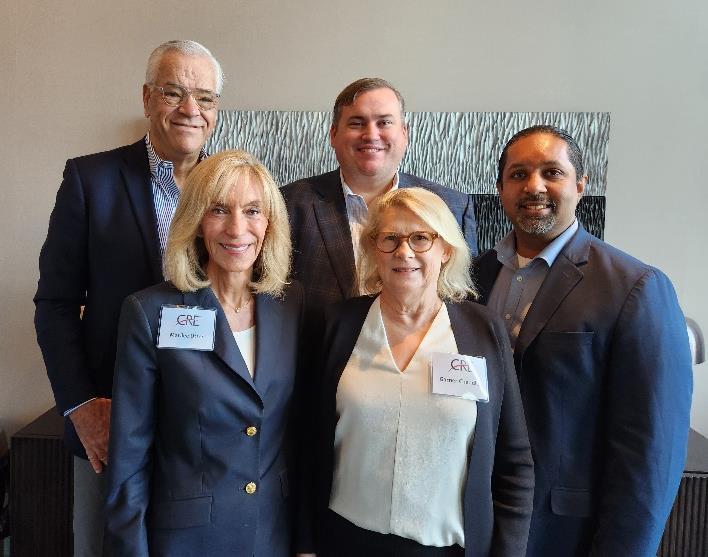
Garner Chandler, CRE, CCIM, is a real estate data and analytics expert with over 40 years of experience in valuation, sales, consulting, and Proptech innovation. Garner founded Chandler Reports, one of the first interactive real estate market data services online, and has led data-driven consulting projects for clients including the FBI, City of Memphis, and Shelby County. Garner’s work has su orted liti ation ta a eals and public policy decisions through advanced database integration and analysis. As a broker in Northwest Florida, she facilitated over $75 million in residential and vacation home sales, earning Realtor of the Year honors. She holds a BA in Economics from Smith College and has served on multiple boards and committees for The Counselors of Real Estate and CCIM Institute. Her career reflects a unique blend of
technical innovation and deep market insight, making her a sought-after expert in real estate analytics and strategic consulting.

Matthew T. McDonough, Esq., CRE Founding Member
McDonough PLLC
Babylon, NY
Matthew McDonough, Esq, CRE, is Attorney/Founding Member at McDonough PLLC. With extensive experience in transactional law, regulatory compliance, and economic development, he serves as outside counsel to businesses and municipalities, guiding complex real estate and infrastructure transactions, public-private partnerships, and corporate governance matters. His legal expertise spans mergers, acquisitions, development agreements, labor negotiations, and regulatory enforcement. Previously, Matt served as CEO of the Babylon Industrial Development Authority and president of the Babylon LD Corporation II, managing economic development projects and community benefit programs. He also clerked for the Supreme Court of New York.
Matt holds a JD from CUNY School of Law, where he was a Law Review staff member and Moot Court Chairman, and a BA in Economics from NYU. He is admitted to practice in New York, Washington D.C., and multiple federal courts, and serves as Chairman of Jovia Financial Credit Union. He was named one of City & State’s 2025 Trailblazers in Economic Development.

Marilee A. Utter, CRE President
Citiventure Associates, LLC
Denver, CO
Marilee Utter, CRE, is President of Citiventure Associates, LLC, a real estate advisory firm specializing in development strategy, Public-Private Partnerships (P3s), and TransitOriented Developments (TODs). With a career spanning leadership roles in both public and private sectors, she previously served as Executive Vice President of the Urban Land Institute, overseeing global o erations and local im act across 75 cities er ack round includes mana in en er’s entral latte Valley redevelopment, directing asset management for the City of Denver, and pioneering TOD initiatives for the Regional Transit District. arilee’s expertise lies in transformational real estate and urban redevelopment, and she is a nationally recognized speaker and advisor on innovative land use strategies.
he holds an B from L ’s nderson chool and a u lic olicy certificate from ar ard’s Kennedy School. The 2022 Global Chair of The Counselors of Real Estate, she also serves as adjunct faculty at the University of Colorado Denver and sits on multiple boards including the Metropolitan State University of Denver Foundation and the Urban Land Institute of Colorado.

Raja P. Waran, CRE
Senior Managing Director
IRR-Philadelphia Philadelphia, PA
Raja Waran, CRE, MAI, is Senior Managing Director at Integra Realty Resources – Philadelphia, part of a national valuation and consulting firm serving financial institutions, law firms, public agencies, and investment entities. With 20 years of experience in commercial real estate, land use, and the built environment in general, Raja specializes in valuation and advisory services for loan underwriting, financial reporting, and litigation support. He holds the MAI designation from the Appraisal Institute and is a Certified General Real Estate Appraiser in six states (PA, NJ, NY, MD, DE, and DC). His previous roles include positions at TD Bank, FTI Consulting, American Appraisal Associates, and the NJ Housing and Mortgage Finance Agency. His academic background includes an MBA in Finance from Villanova University, a Master of City and Regional Planning from Rutgers University, and a BA in Planning & Public Policy. He has also completed specialized training in hotel investment analysis as part of his ongoing continuing education. His work reflects a deep commitment to precision, public policy, and strategic real estate consulting.