St. LouiS AmericAn
Still rebuilding
Six months later, North St. Louis coming together – one block at a time
By Sylvester Brown Jr., Zaria Mac and Ashley Winters St. Louis American
On May 16, 2025, a ruthless tornado tore through parts of St. Louis City, County and the Metro East. In less than 30 minutes, the storm carved a 20-mile scar across North St. Louis, flattening blocks in Fountain Park, Penrose, The Ville and Kingshighway West. Nearly 5,000 homes, churches and businesses were destroyed, with damage estimates topping $1.6 billion.

Six months later, the city is still in the midst of healing — physically and emotionally. The most powerful storm to hit in nearly a century left some neighborhoods unrecognizable. Yet amid the devastation, St. Louisans have shown remarkable strength and generosity, with thousands pitching in to deliver food, clear debris and comfort neighbors where official help lagged.
Across North St. Louis, recovery remains slow and uncertain. But stories of resilience and community continue to define the city’s long road home.
Food
By Nia Hightower For The St. Louis American
With more families across the St. Louis region struggling to make ends meet, community groups and local governments are expanding food distributions and pantry services to meet growing demand before the holidays.
“Ever since the announcement of a reduction or pause in SNAP benefits, we’ve seen a huge increase in visits to our six food pantries across the region,” said Michael McMillan, CEO
By Kenya Vaughn St. Louis American
For decades, Mill Creek Valley was dismissed in headlines as a “slum.” In truth, it was a cultural and civic powerhouse — a place where jazz, blues and ragtime thrived. Black-owned businesses, churches, schools and social clubs flourished there, and nearly 20,000 residents built lives rooted in joy, resistance and community. On Saturday, Nov. 15, the Missouri
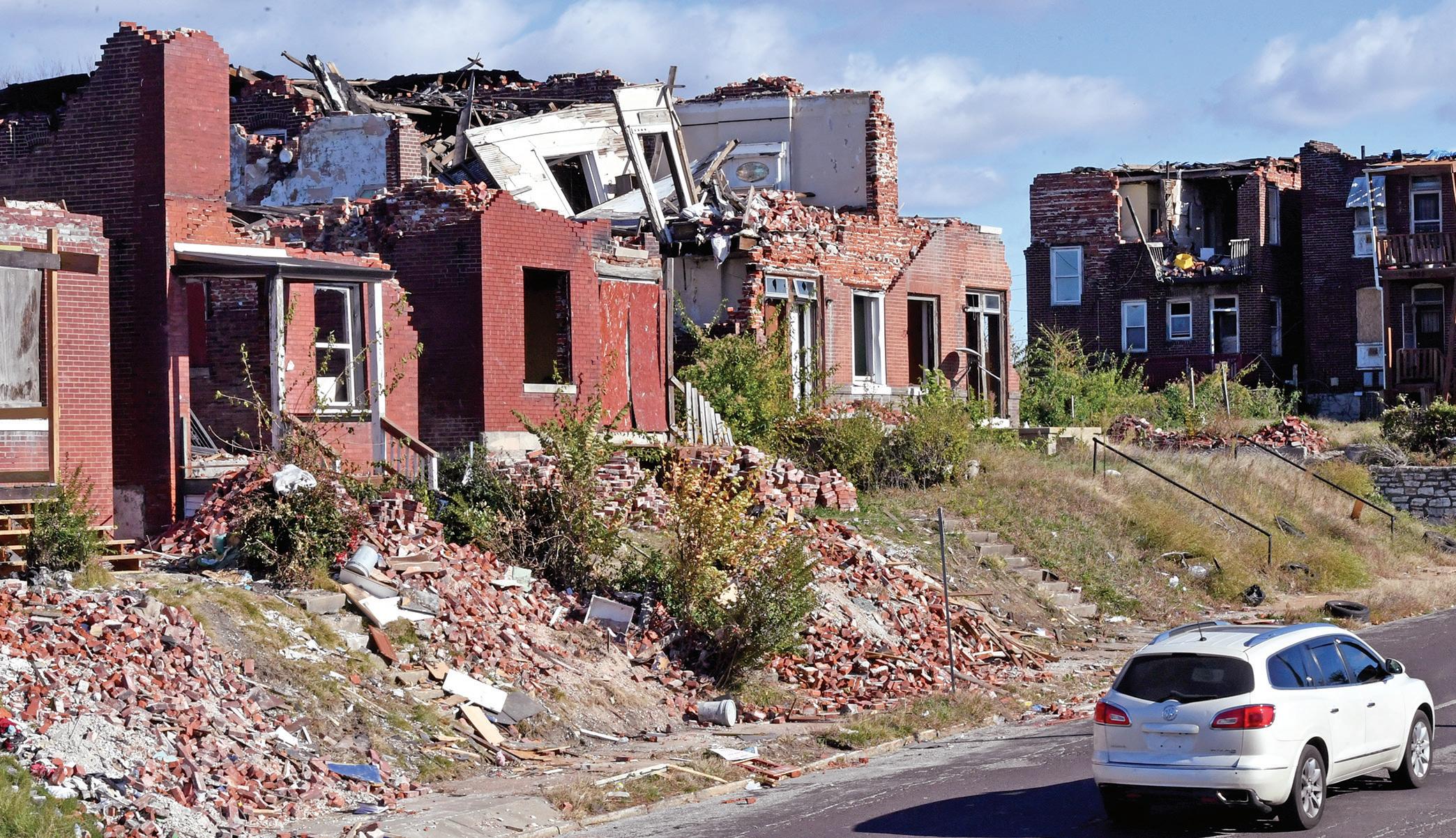
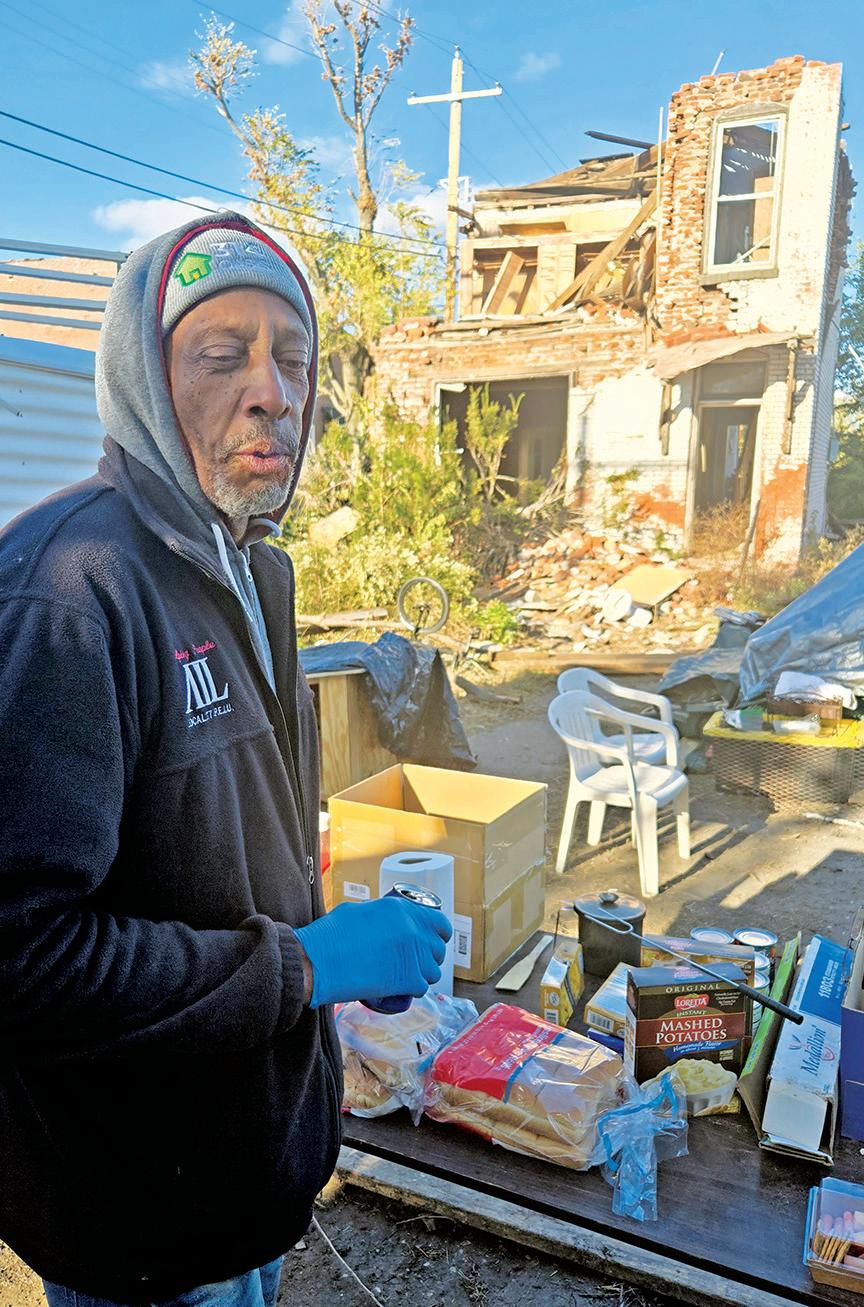
Homes along the 4200 block of St. Louis Avenue destroyed by the May 16 tornado that swept through north and west St. Louis neighborhoods are still in need of serious repairs. Photos taken November 10.
Photo by Wiley Price / St. Louis American
Photo by Sylvester Brown Jr. / St. Louis American
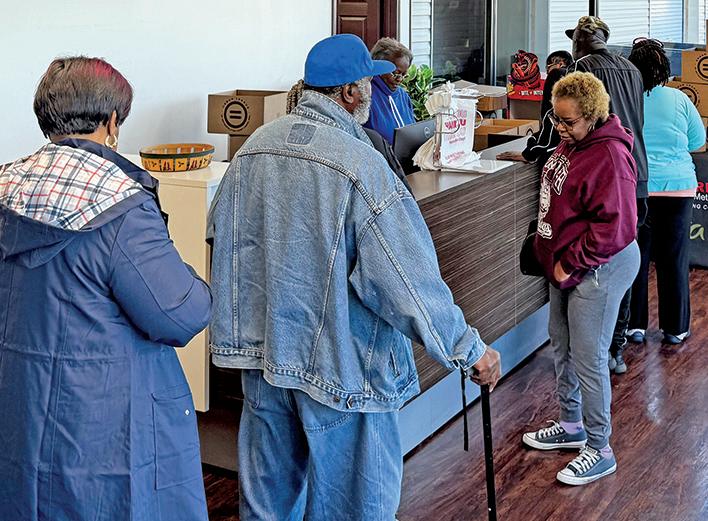
The Panera Pantry, at the headquarters of the Urban League of Metropolitan St. Louis, serves food to area residents.
Photo courtesy of the Urban League
Guest Editorial
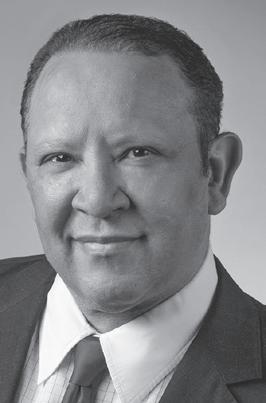
Congress must SNAP back on Trump
By Marc Morial
“The loss of SNAP benefits leads to food insecurity, hunger, and malnutrition. … Low-income children who go without nutritious food will struggle to learn in classrooms, impacting their educational performance and advancement.
… Suspending SNAP benefits also has economic consequences beyond hunger and public health. Without SNAP funds, SNAP recipients will not be able to frequent retailers, causing a significant loss in revenue, increased food waste, and a negative impact on Plaintiff States’ economies overall.”
— Lawsuit filed by 25 states against the Trump administration
While the federal government shutdown is nearing an end, America’s most crucial food assistance programs remain in limbo, threatening nutritional support for millions of families, children, and expecting mothers.
On Monday, the Trump administration continued pressing the U.S. Supreme Court to overturn lower court decisions requiring the federal government pay for full Supplemental Nutrition Assistance Program (SNAP) benefits.
out of options to keep families supported. SNAP still has two-thirds of the funding needed to sustain another month of benefits, in resources that are already available under the program’s emergency procedures.
Yet, the White House has chosen to challenge federal rulings and withhold some of the authorized funding sources to provide full benefit to families.
Later that day, a Massachusetts federal judge kept in place an order canceling a USDA memo to states over the weekend asking them to “undo” full November benefits, while chastising the administration.
SNAP and the Special Supplemental Nutrition Program for Women, Infants and Children (WIC) together support nearly 50 million Americans. These programs are lifelines, ensuring access to essentials like nutritious food, breastfeeding support, and infant formula. Yet both programs still await immediate action from the White House to use contingency funds and other already authorized measures, millions of vulnerable Americans will soon be without food assistance.
SNAP and WIC resources have remained available during past shutdowns. But state agencies are running
Earlier this month, the USDA funded WIC through the end of the month, though advocates warned it was only a short-term fix to keep the program afloat. Unless the administration relents, the WIC program will run out of money and more will needlessly face hunger and devastating health consequences. This is a policy choice, not an unavoidable consequence of the recently ended shutdown. By refusing to act, the administration is choosing to inflict avoidable hardship on families already struggling with inflation, rising costs, and record food insecurity. Following the passage of the “Big Ugly Bill,” which imposed the largest SNAP cuts in history, even more Americans are now at risk of losing access to the nutrition assistance they rely on to survive.
For an administration that claims to champion the well-being of mothers, children, and working families, this move goes directly against the things it claims to stand for. Parents should not have to choose between paying bills and feeding their children. No mother should worry that her newborn might go hungry because of political leaders. Congress must stand up for families. Send a message to lawmakers: they must demand that the White House follow the law by releasing available SNAP funds immediately and exercise its authority to transfer additional funding to WIC and SNAP. Families cannot wait. Americans need support now, not after the damage has been done.
Marc Morial is president/CEO of the National Urban League.
Commentary
Black voters are architects of Democratic victories
By Mustafa Ali
When we vote, the ground itself shifts. The air feels different the next morning — ike the earth took a deep breath it had been holding since Reconstruction.
I’ve seen it happen. Tuesday night, Nov. 4, 2025, felt like one of those moments when history stopped pretending to be distant. Mississippi turned its head toward justice again. Georgia rose up, stubborn and radiant. The ghosts of 1867 looked down from on high as Virginia found its reflection once again in the faces of young, determined candidates who refused to wait their turn.
That’s the power of the Black vote. Not just a number. Not a statistic on some D.C. spreadsheet. But a pulse. A force. A rhythm older than this Republic, born in fields that once tried to silence us. It’s the sound of ancestors humming through ballots. The echo of those who couldn’t vote, who prayed we’d one day stand tall enough to mark our own destinies with ink instead of blood.
And this time — we did.
consultant class; they came from church basements, barbershops, and beauty salons. They built their own permission slips, signed in faith and filled with fire.
These weren’t accidents. These were seeds planted years ago, watered by resilience and protected by the shield of faith.
Kamala Harris’s run in 2024 did more than inspire — it organized. Her campaign with many of our organizations including #WinWithBlackWomen and The Divine Nine helped register hundreds of thousands of new voters, many of them Black and Brown first-timers. Her presence reminded us that leadership can look like us, sound like us, and dream like us.
And now, the Democratic Party seems to have remembered something, too. The truth is, we’ve always shown up. Even when nobody thanked us.
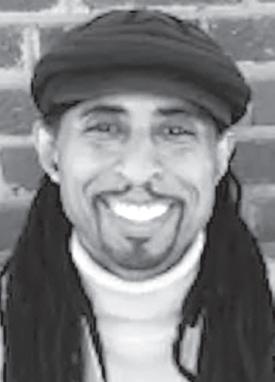
Downstate Mississippi, once written off by the pundits, delivered surprise after surprise. Theresa Gillespie Isom broke barriers in DeSoto County, becoming the first Black woman ever elected to the State Senate there — flipping a seat that had been red since before she was born. In nearby Hattiesburg, Johnny DuPree, the city’s first Black mayor, rose again — winning a state Senate seat and helping to break the Republican supermajority that tried to strangle progress at its roots.
And in Georgia, Alicia Johnson made history as the first Black woman elected statewide, winning a Public Service Commission seat on a platform of energy justice and affordability.
In Conyers, Connie Alsobrook became the city’s first Black mayor, while Lily Ann Brown did the same in Swainsboro, Georgia — proof that when Black women organize, whole towns shift direction. Their campaigns didn’t come from the
Black voters are not just the backbone of the party — we’re the architects of its victories. The invisible hands shaping the map. The strategists who know how to win in places most folks never even visit. The thinkers and doers who make miracles look methodical.
So yes, we will celebrate these wins. But we will also demand equity in how these victories are built. This means including Black political consultants at the table—not as an afterthought, but as equal partners. It requires early investment in Black-led voter organizations that have been working long before the cameras arrive.
We can’t keep outsourcing our genius while begging for recognition. We can’t keep saving democracy while starving the very hands that feed it.
When we vote, we don’t just elect candidates — we shift the country’s moral compass. Black folks remind America that progress has a color, that is birthed in power, a cadence that is anchored in elegance, a cost that has been paid in sacrifice. Activist and poet Mustafa Ali is an
Commentary Democrats must focus on affordability
By Irv Randolph
The future of the Democratic Party can be bright if they learn the right lessons from the general election on Nov. 4.
In the first general election since President Donald Trump returned to the White House, Democrats dominated races across the country.
Polling leading up to the election and exit polling showed that while not on the ballot, Trump was a motivating factor for why Democrats won big across the nation including winning the governor’s races in New Jersey and Virginia and the race for mayor in New York.
In Pennsylvania, despite a well-funded campaign by conservative activists aligned with Trump to unseat three Democratic justices on the Pennsylvania Supreme Court, all of whom were up for retention, voters chose to retain the Democrat justices.
In New York, Zohran Mamdani, a 34-year-old Democratic Socialist beat former New York Governor Andrew Cuomo, who ran as an independent and was endorsed by Trump.
In New Jersey, Democrat Mikie Sherrill, a former Navy helicopter pilot, federal prosecutor and U.S. representative, won a decisive victory over Republican candidate Jack Ciattarelli by approximately 13 percentage points in a race that garnered national attention as a potential indicator of voter sentiment toward Trump and the Republican Party.
living and property taxes in New Jersey. Mamdani made “making New York City a city we can afford” the core of his campaign. His key proposals include a rent freeze on stabilized apartments, universal child care, free city buses and cityrun grocery stores, funded by higher taxes on the wealthy.
In response to the Democrats’ dominance in the Nov. 4 general election Republicans are trying to dismiss the victories as Democrats winning in cities and states that already lean Democratic and that the results should not be read into as a national trend.
However, Democratic victories in the Virginia gubernatorial race (a prominent swing state currently led by a Republican governor) and in various suburban and traditionally Republican-leaning areas in New Jersey and Pennsylvania suggest a broader shift in voter sentiment beyond just deep-blue strongholds. For instance, in New Jersey, Sherill flipped counties that Trump had won the year before.
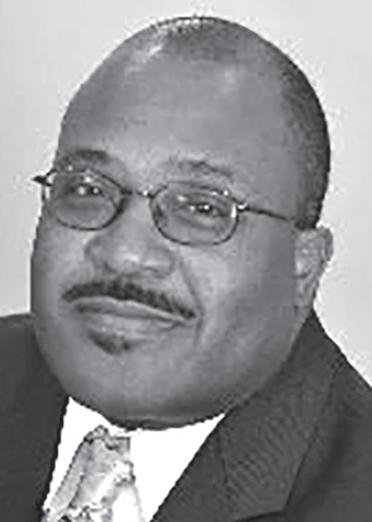
Democrats also achieved a significant victory in the deep red state of Mississippi by breaking the Republican supermajority in the state Senate. They also flipped an additional seat in the state House.
In Pennsylvania, New Jersey and Virginia, Democrats won in swing areas and expanded their margins in suburban areas, a key battleground demographic in national elections.
In Virginia, Democrat Abigail Spanberger, a former CIA case officer and U.S. representative, easily defeated Republican Winsome Earle-Sears. The common ground between Spanberger and Sherill, both centrist Democrats and Mamdani, a Democratic Socialist, is that their campaigns made “kitchen table” economic issues the core of their campaigns. All three campaigns were laser focused on affordability and other economic concerns.
Spanberger made the “struggles of everyday voters” her primary focus, emphasizing concerns like the cost of living, health care access and the impact of the federal jobs cuts and tariffs on Virginians.
Sherrill’s campaign heavily focused on economic issues, such as the high cost of
The hard truth for Republicans to embrace is that the Nov. 4 election was a referendum on Trump and the Republican Party.
Affordability and the economy were the dominant issues in the 2025 elections according to exit polls. Under the Trump administration there has been slower job growth compared to the prior Biden administration and ongoing rising costs due to the new round of extensive tariffs. While Trump and Republicans focus on divisive issues, Democrats should not become distracted and should campaign and govern on making education, housing, health care, public transportation and the cost of living in general more affordable for Americans.
Irv Randolph is the managing editor of the Philadelphia Tribune.

Donald M. Suggs Publisher ADMINISTRATION
Dina



“Clashes between Christian farmers and Muslim herders are driven by resource scarcity and competition for land, not religion alone.”
- Congressman Greg Meeks on President Trump threatening to send troops into Nigeria to protect Christians.
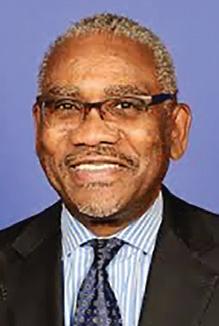
Democrats score major national victories
By Alvin A. Reid
St. Louis American
While the midterm elections are still nearly a year away, a series of major Democratic victories in Virginia, New Jersey, Pennsylvania and Georgia have energized party members in Missouri and across the country.
“Donald Trump has spent his time in office gutting Medicaid, taking away health care and food assistance, and making everything more expensive with reckless tariffs — all while giving further tax breaks to billionaires and the biggest corporations,” U.S. Rep. Wesley Bell told The St. Louis American. “Last week’s election should put Trump and MAGA Republicans on notice: Americans are fired up, and ready to vote them out in the midterms.”
In Virginia, Democrat Abigail Spanberger made history as the first woman elected governor of the state, winning by the largest margin in at least 40 years and nearly sweeping
every county.
“We sent a message to the whole world that in 2025 Virginia chose pragmatism over partisanship. We chose our commonwealth over chaos,” she said after easily defeating Republican Lt. Gov. Winsome Earle-Sears, who is Black.
Democrat Ghazala Hashmi also won her race for Virginia’s lieutenant governor, defeating Republican John Reid to become the first Muslim woman ever elected to statewide office in the U.S. Democrats further expanded their advantage with a double-digit seat gain in the Virginia House of Delegates.
In neighboring New Jersey, U.S. Rep. Mikie Sherrill, a former Navy pilot, trounced Trumpbacked Republican Jack Ciattarelli by 13 percentage points to become the state’s next governor — a race that many polls had incorrectly predicted would be close. It marks the first time since the 1960s that New
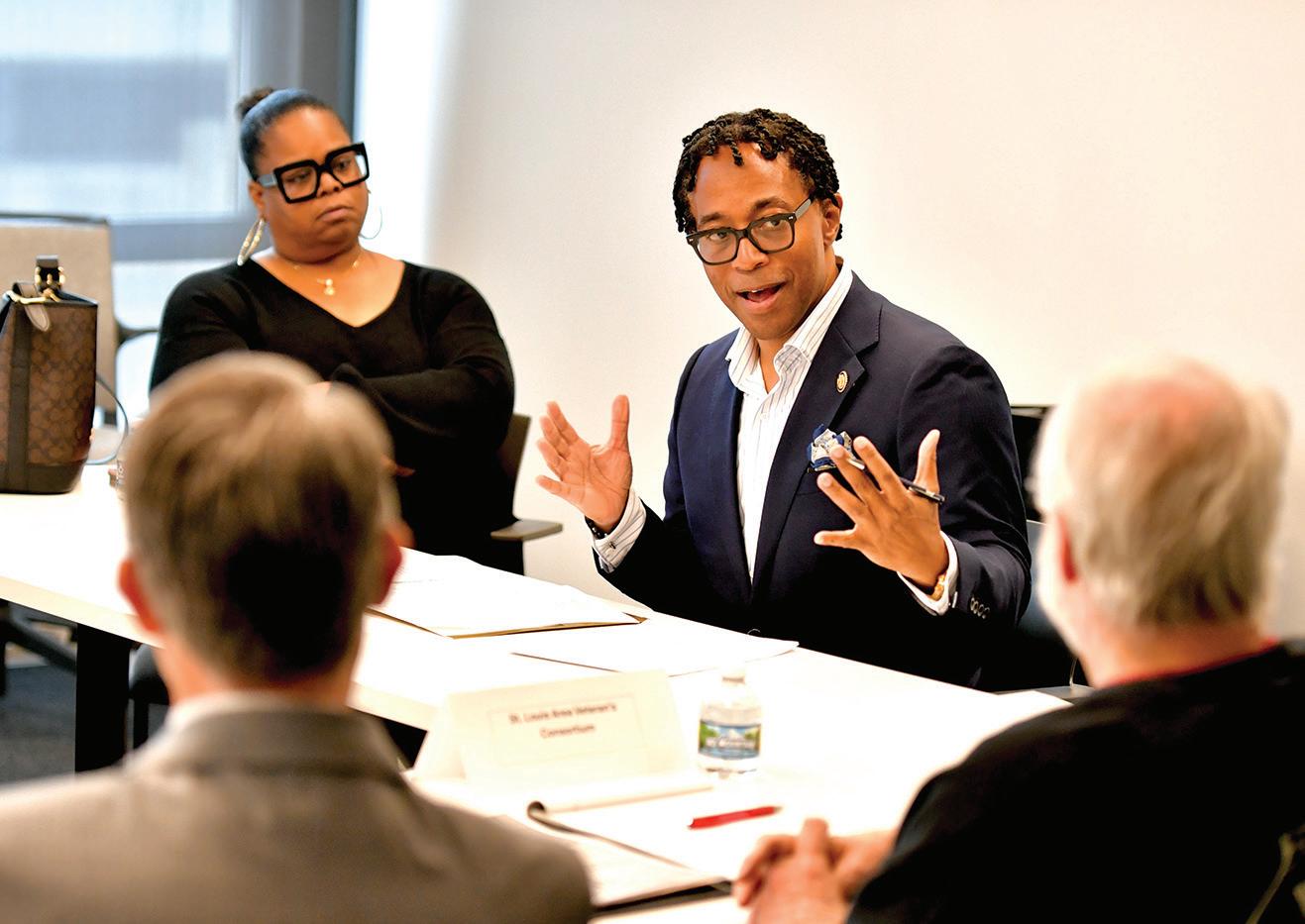
Jersey voters have elected a governor from the same party three terms in a row. Sherrill also reversed Trump’s 2024 gains among Black, Hispanic and Asian voters.
In Pennsylvania, voters overwhelmingly supported three Democratic state Supreme Court justices — Christine Donohue, Kevin Dougherty, and David Wecht — granting them new terms on the bench. Republicans had hoped to
unseat them and force the seats onto the 2027 ballot, which could have opened a path to retake control of the court. The trio was first elected in 2015 as part of a Democratic sweep that flipped the court from Republican control.
In Georgia, Democrats Alicia Johnson and Peter Hubbard won seats on the Public Service Commission — the first time in nearly two decades that Democrats have
claimed non-federal statewide offices there.
“Democrats won big across the country,” Missouri Democratic Chair Russ Carnahan said in a statement.
“This historic ‘Blue Sweep’ is a result of our strong Democratic candidates, in red, blue, and purple districts alike, meeting voters at the kitchen table and running campaigns focused on affordability.”
Carnahan also addressed Trump and the GOP directly, saying, “we will stop your efforts to rig the midterms, and we’re coming after your jobs next. We will earn every vote, and we will win.”
Elsewhere, Democrats made progress in key ballot initiatives and urban races signaling a possible nationwide resurgence.
In California, voters approved Proposition 50 by a wide margin, allowing state legislators to redraw political maps ahead of the midterms — a move aimed at countering GOP-led gerrymandering efforts in states such as Missouri.
And in New York, democratic socialist Zohran Mamdani defeated former Gov. Andrew Cuomo, who ran as an independent after losing to Mamdani in the primary, to become the city’s next mayor.
“American voters just delivered a Democratic resurgence. A Republican reckoning. A Blue Sweep,” said Democratic National Committee Chair Ken Martin in a statement.
“It happened because our Democratic candidates, no matter where they are, no matter how they fit into our big tent party, are meeting voters at the kitchen table, not the gilded ballroom.”
Photo By Wiley Price / St. Louis American
Metro East students build leadership skills at SIU-C weekend program
St. Louis American staff
The 20th annual Metro East Youth Leadership Weekend brought high school students from across the region to Southern Illinois University Carbondale recently for workshops on artificial intelligence, civic engagement and college success.
Hosted by SIU’s Paul Simon Public Policy Institute, the two-day program featured speakers Tobias Merriman and Jermaine Hughes, along with keynotes by Rodney H. Holmes, magistrate judge for the U.S. District Court in St. Louis, and Tommy Van of Marriott International.
Students gathered for small-group discussions with SIU mentors about college life, academic success and civic engagement. They also joined SIU Chancellor Austin
Lane at the university’s Homecoming football game and participated in leadership challenges at Touch of Nature Outdoor Education Center.
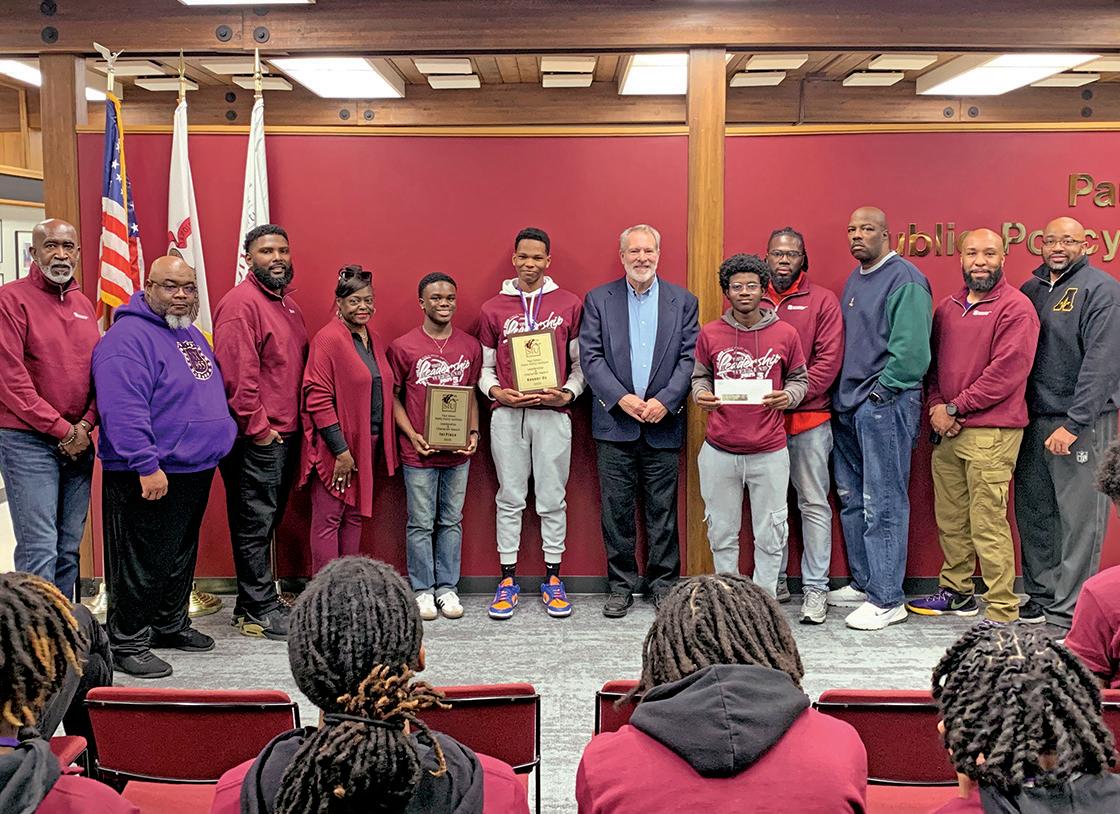
D’Lando Wooten Jr. of Cahokia High School earned first place in the Paul Simon Leadership and Character Awards. Kennedy Crawford of East St. Louis and Aningo Aningo of Clayton High School were runner-up and third-place honorees, respectively.
On Sunday, students attended a morning worship service, a keynote address by Darius Robinson and additional leadership exercises.
The Metro East Youth Leadership Weekend aims to strengthen civic awareness and personal development among students in the region.
Commentary
When silence can be fatal
By E. Faye Williams
Democratic friends have called, inquiring about how they can help a food bank — and they don’t have as much money as Trump and his friends have gotten by hook and crook.
The people in need are just hardworking, honest and caring people wanting to help those who have even less than they have. They think about the children, the elderly, handicapped, unemployed, the underemployed, the laid off from several paydays and understand that whatever they have, those I have named have even less, and they want to share what little they have with others.
Those are the people I’m proud of and the ones I call whenever I have something I can share.
cerns. I see it happening with the government to whom we pay taxes.
Our government is now being just as mean-spirited to the people elected to represent them. For too many, cruelty is the order of the day. Many people have more food than they need, while others are threatened with having nothing.
Those who could remedy the problems stand idly by with neither care nor concern. Some people withhold what they have and act in opposition to sharing with others. How do you have the gall to take food from the mouths of poor babies, the handicapped, the elderly and so many have-nots?
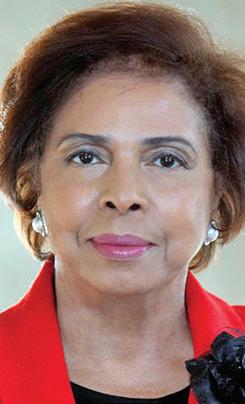
Sojourner Truth, who had nothing at times, once said, “If my cup won’t hold but a pint, and yours holds a quart, wouldn’t you be mean not to let me have my little half measure full?”
Through challenging circumstances, I’ve not had a paying job since 2022, when I became ill and faced being unable to continue working. During my illness, I was threatened with being relieved of duty if I didn’t resign.
During the worst illness of my life, I realized how uncaring some people can be and how insensitively they act toward others who are experiencing significant difficulties. That didn’t matter to those forcing my resignation.
God blessed me with the opportunity to save a portion of what I earned through the years, and when I was forced to live on fewer earnings, I have learned to do that. While my income is lower than ever, I still feel an obligation to share what I have with others who may have even less.
This goes on in America for those who have nothing. Many hardworking individuals are looking for their next meal, while their Republican representatives have shown little attention to these con-
How do you work so hard to fire or lay off people who want to work, but are barred from doing so? How do those in charge of the well-being of people simply go home for weeks at a time, and not even remain in Washington to try to resolve the problem of hunger? Why does a judge have to order them to do their jobs after many weeks of procrastinating and neglecting their duties?
Well, those are questions Republican Party leaders are not concerned about resolving.
We witness a failure of our government as Republican leaders stand by with no concern for their fellow citizens to have access to health care at an affordable rate. When asked about their health care plan, they can only say they have a “concept” for a plan!
Vice President J.D. Vance said, “Things are going to get a lot worse.” Well, silence is only fatal if we let it be.
E.Faye Williams is president of The Dick Gregory Society.
The recent 20th annual Metro East Youth Leadership Weekend at Southern Illinois University Carbondale concluded with the presentation of the Paul Simon Leadership and Character Awards. D’Lando Wooten Jr. of Cahokia High School earned first place, Kennedy Crawford of East St. Louis was runner-up and Aningo Aningo of Clayton (Missouri) High School placed third.
Photo courtesy of Paul Simon Institute
E. Faye Williams
Closing the gap
Reform, not rhetoric, will increase Black homeownership
By Dr. Anthony O. Kellum
For the Michigan Chronicle
In the United States, property has always been more than land and lumber. It has been a proxy for power, access and stability a silent determinant of who belongs and who prospers. Yet as of the second quarter of 2025, the Black homeownership rate stands at 43.9%, its lowest point since 2021, according to Redfin.
By contrast, the white homeownership rate remains above 72%. That nearly 30-point gap is not just a statistic; it is a mirror reflecting how systemic inequality continues to shape economic opportunity in America.
The legacy of exclusion
Understanding why this gap persists begins with recognizing its historical roots. For generations, government policy codified racial exclusion from redlining maps that starved Black neighborhoods of mortgage capital, to the GI Bill that expanded suburban opportunity for white veterans while sidelining their Black counterparts. Even as explicit discrimination was outlawed, the residue of those policies hardened into new barriers, lower neighborhood appraisals, higher loan denials and unequal access to financial literacy resources.
Black homeownership as of 2025
White homeownership as of 2025

St. Louis entrepreneurs honored for success
By Alvin A. Reid
Louis American
While Black Friday is among the busiest and most profitable days of the year for major retailers, Small Business Saturday is just as crucial for entrepreneurs and small-business owners. November is also National Entrepreneurship Month, and with Small Business Saturday falling on Nov. 29, Legal Services of Eastern Missouri is celebrating a trio of local entrepreneurs whose businesses have flourished with help from its Community Economic Development–Microenterprise Program.
cuisine into a full brickand-mortar restaurant.
“This month is about more than just shopping small. It’s about recognizing the power of entrepreneurship to transform lives and communities,” said Marlene Elliott, managing attorney for the Microenterprise Program. “We’re honored to stand beside these inspiring business owners as they achieve major milestones and continue to grow.”
The Microenterprise Program provides legal and business support to low- and moderate-income entrepreneurs “who are building businesses that strengthen neighborhoods and create economic opportunity,” Elliott said. “From food trucks to retail products, these small business owners are proving
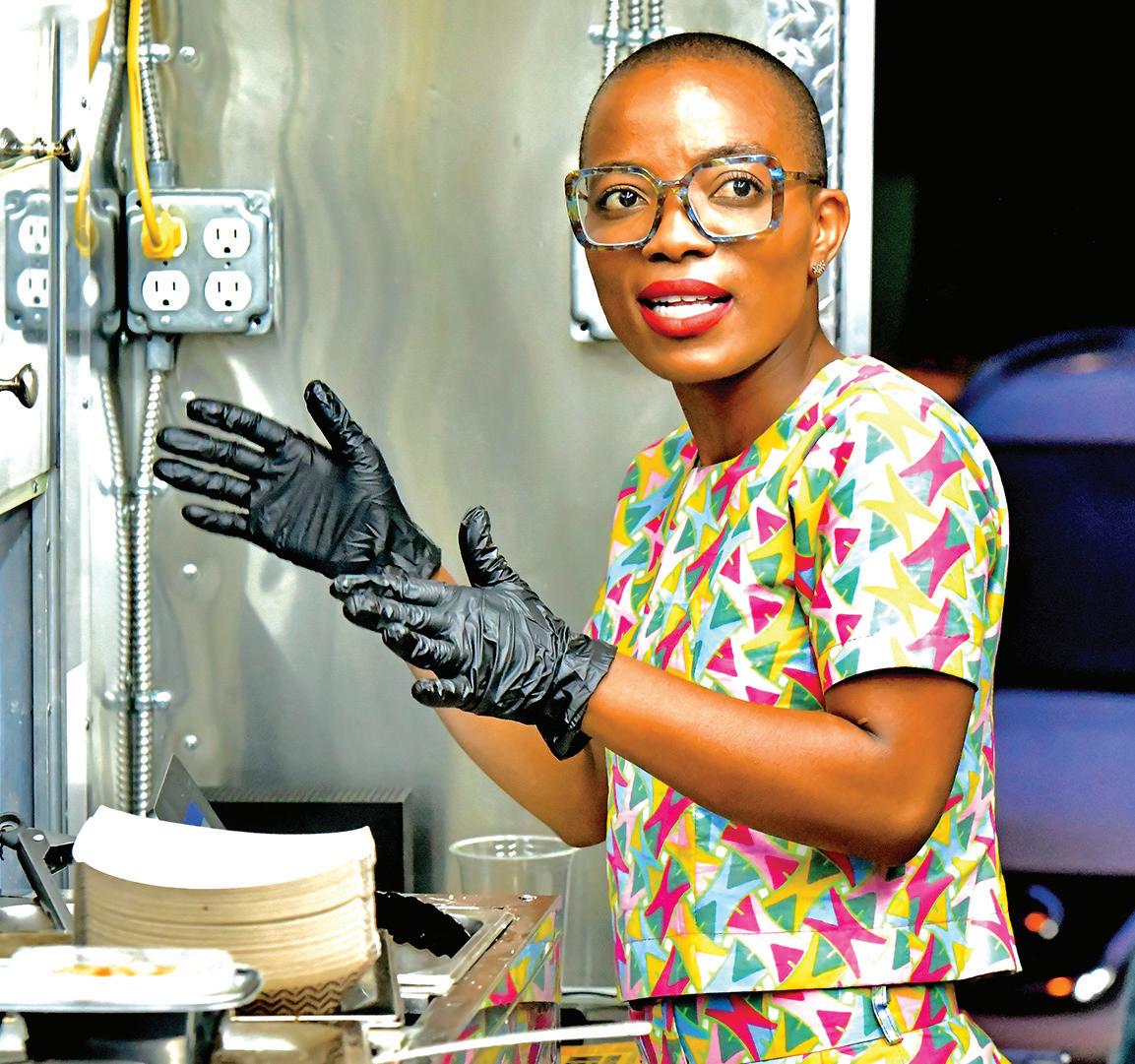
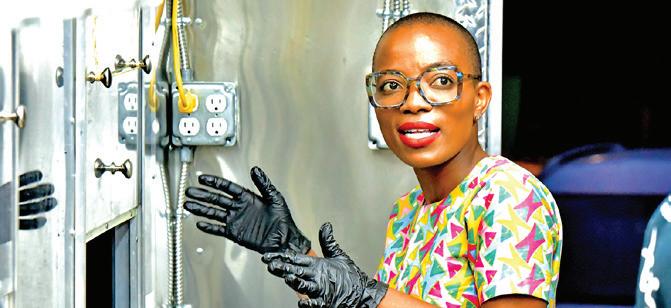
Adjo Honsou, owner
that with the right guidance and perseverance, dreams can become sustainable livelihoods.” Among those being spotlighted is Adjo Honsou and her business, FuFu N
Photo by Wiley Price / St. Louis American
Marvin Teer
St.
of FuFu N Sauce food truck, was busy taking orders in Tower Grove Park in June 2024. FuFu, Mr. Fresh and Nacho Average Lemonade are being celebrated as successful participants in the Legal Services of Eastern Missouri Community Economic Development-Microenterprise Program.
Honsou
Sauce,
James Jackson
Continued from A5
The Center for American Progress notes that homes in majority-Black neighborhoods are still undervalued by tens of thousands of dollars compared with similar homes in majority-white areas. That undervaluation limits equity gains, constrains mobility and suppresses intergenerational wealth. Meanwhile, iEmergent data shows Black borrowers are denied mortgages at nearly twice the rate of white borrowers, even after adjusting for income and credit.
This is not a “market failure.” It is a reflection of the market working exactly as it was designed to advantage capital already in motion and penalize those still catching up. A modern wealth divide
The consequences are profound. Homeownership remains the cornerstone of wealth in America, accounting for roughly 68% of total household net worth for the average family. When that pathway is obstructed, it doesn’t just limit where people can
Entrepreneurs
Continued from A5 Housing
After growing up in Togo and moving to the United States at 14, Honsou said she missed her homeland’s cuisine but couldn’t find it locally. Becoming a chef and restaurant owner felt natural, she said, because she had spent so many hours in family kitchens.
“From a young age you are just around cooking. My grandma’s cooking, my mom is cooking, my aunts are cooking, every-

Closing the Black homeownership gap is not charity it’s economic strategy. When Black families own property, entire communities stabilize. Schools improve, local businesses thrive and civic engagement rises.
live, it defines how their children will live.
According to the Federal Reserve’s 2024 Survey of Consumer Finances, the median net worth of white families now exceeds $285,000, compared to just $45,000 for Black families. That difference is not explained by work ethic, education, or aspiration it is the compounded effect of generations denied the tools of property.
body is cooking. Cooking for us is such a community thing to do. For example, Sunday’s everybody gets together, everybody’s doing their part, and so I just always grew up around the kitchen.”
Honsou gained national attention after winning Season 3 of “The Great American Recipe” on PBS, which airs locally on Nine Network. Her winning dish was Oxtail in Palm Nut Stew.
Before opening her restaurant, her food truck became a favorite at major regional events including
Current Headwinds
Today’s environment adds another layer of difficulty. Rising home prices and mortgage rates have placed ownership further out of reach for first-time Black buyers, many of whom carry disproportionate student loan debt and less generational wealth to draw from.
High-cost insurance premiums, appraisal bias and stricter underwriting
the Taste of St. Louis Festival, the Juneteenth Festival, St. Louis Pride Festival, the Festival of Nations, and numerous “Food Truck Fridays” with Feast Magazine. Also being recognized by Legal Services are Josh and Shay Danrich, the mother-son team behind Mr. Fresh, and Rita Wright-Jones, owner of Nacho Average Lemonade. What began as a local business selling air fresheners has grown into a national brand. Mr. Fresh recently signed a deal with Walmart, bringing
further strain affordability. And while new lending programs exist, they often fail to reach those who need them most due to bureaucratic complexity or lack of outreach. In short the structural disadvantages of yesterday are meeting the market pressures of today.
What can be done
The solutions must be as multidimensional as the problem.
its signature scents to store shelves nationwide, according to a Legal Services release.
“I’m the only kid in the world with my own air fresheners in Walmart,” 16-year-old Josh Danrich recently told The American. “Never give up on your dreams, no matter how big they seem. I’m incredibly grateful to Legal Services of Eastern Missouri for believing in me and helping Mr. Fresh become a global brand.”
Meanwhile, Nacho Average Lemonade, located at 730 Carroll Street
• Community-Based Interventions: Grassroots organizations, churches and nonprofits must reclaim their traditional role as centers of economic education. Communitybased homeownership programs offering down-payment assistance, credit repair and group-buying strategies can close gaps that mainstream banks overlook. The Property is Power approach begins with knowledge, helping families see that ownership is not a distant dream but a disciplined strategy.
• Lenders and Policymakers: Mortgage lenders must go beyond diversity statements and adopt measurable equity outcomes by rethinking underwriting standards, funding community development initiatives and partnering with trusted local entities. Policymakers can expand first-generation homebuyer tax credits, enforce fair appraisal oversight and incentivize mixed-income development that doesn’t displace long-standing residents.
• Individual Preparation: Ownership begins in mindset. Each potential buyer should approach the process not
inside Soulard Market, is known for its colorful specialty lemonades, mocktails, and Mexican-inspired dishes. Wright-Jones recently secured a new manufacturing contract that will allow her products to be bottled and distributed on a larger scale.
“We started in 2021 as COVID first hit. As a family, we ate together, we cooked together and we decided to expand what we normally did at home and share it with others,” Wright-Jones said during a recent appearance on FOX 2 with family members.
as a transaction but as a transformative decision that requires budgeting, credit strengthening and long-term vision. It means shifting from a consumption mentality to an asset-building mentality. Financial literacy and mentorship should not be optional; they are prerequisites for empowerment.
The path forward Closing the Black homeownership gap is not charity it’s economic strategy. When Black families own property, entire communities stabilize. Schools improve, local businesses thrive and civic engagement rises. Property ownership is the engine that turns income into equity and equity into influence. The dream of homeownership cannot remain an exclusive club guarded by legacy and luck. It must stand as a measure of participation in the American promise, extended not through rhetoric but through reform.
Dr. Anthony O. Kellum is a homeownership advocate, speaker, author and CEO of Kellum Mortgage, LLC.
“We decided to do events, and the first year we did 40 events ourselves. We grew and got into Soulard Market.” Legal Services’ Microenterprise Program has helped hundreds of local entrepreneurs secure licenses, contracts, trademarks, and other essential legal supports over the years.
“Each business story reflects a shared mission— to create equitable economic opportunities and foster inclusive community growth,” Elliott said.

Courtesy photo
HealthMattersHealthMattersHealthMatters
The doc is out

New insurance policy could push more physicians out of private practice
By Dave Williams The Atlanta Voice
n initiative by insurance companies to reduce high-cost doctor visits could cause physicians to abandon private practice and work for big hospital chains, independent practitioners warn. They say the trend could drive up patient costs.
Cigna implemented a policy last week to flag bills that appear to be too high. The insurance company may reduce payouts by one billing level “when the encounter criteria on the claim does not support the higher-level” payment code, the new policy says.
Dr. David Eagle, vice president of the American Independent Medical Practice Association (AIMPA), expects the new cost containment approach to erode income for private doctors, with long-term consequences for their patients.
St. Louis American staff
Menopause may finally be having its moment in mainstream media, but the conversation is still catching up when it comes to Black women.
A groundbreaking new survey from the Black Women’s Health Imperative (BWHI) aims to change that. The first-ofits-kind national study offers an in-depth look at how Black women ages 30 to 65 are navigating perimenopause and menopause — often with limited support, unclear medical guidance, and systemic barriers to care.
More than 1,500 Black women participated in the largest online survey of its kind, sharing deeply personal expe-
riences that confirm what many have long known: the midlife journey can be isolating and complex, shaped by cultural,
Two survivors, two journeys
Faith and resilience after breast cancer
By Andrea Stevens The AFRO
Two breast cancer survivors from very different walks of life are sharing their deeply personal journeys of surviving mastectomies and the long, emotional road toward healing. Their stories highlight the importance of faith, support and self-acceptance for women facing one of the most difficult health battles of their lives.
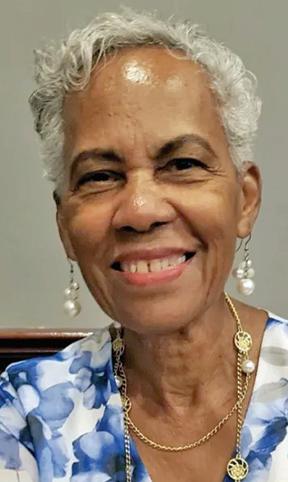
Clorie Tildon, 84, was first diagnosed with Stage 4 breast cancer in 2003. A widow living independently, she went into remission but faced a second diagnosis just 18 months later.
“The second diagnosis followed with a mastectomy. That was my choice,” she said. Her decision to undergo a mastectomy came from a place of clarity.
Tildon credits her unwavering faith as the foundation of her strength.
“My faith in God helped me to realize that this is just my time to deal with this problem and to seek the Lord’s help and strength to get me through,” she said. Her advice to others is simple but powerful.
“You have to be in sync with your body. Your body does give you symptoms many times; you just need to be more aware of what to do in order to zero in on those symptoms,” she said. “I would certainly urge others to walk with faith. The oncologist said to me, being positive about dealing with this
CANCER, A8
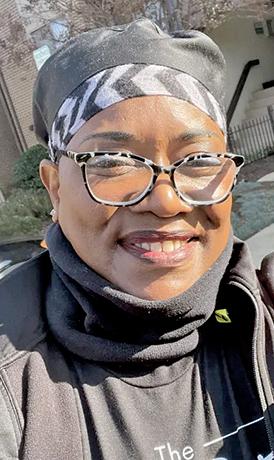
Millena Smith
Clorie Tildon
Courtesy photo
HealthMattersHealthMattersHealthMatters
‘Taking Care of You’
Menopause
Continued from A7
respondents said they didn’t know which medical recommendations to follow, 46% lacked adequate information to manage their symptoms, 43% reported discrimination or unfair treatment when seeking healthcare, and 42% struggled with depression during this stage of life.
“This survey lays bare what too many of us already know,” said Joy D. Calloway, president and CEO of BWHI. “Black women are navigating menopause with too little support, too few resources, and not enough trusted information. At BWHI, we are committed to changing that reality.”
The findings also highlight what many Black women say they want: culturally grounded education beginning in their 30s, affordable treatment options, access to trusted providers, and safe spaces to share experiences without stigma or shame.
“The women who participated in this study represent an educated, insured, and professionally active group — yet
Cancer
Continued from A7
illness is the best medicine he could recommend,” Tildon acknowledges that mastectomies carry emotional weight, especially for women, but she sees the surgery as a nec-
the data reveal profound gaps in care and understanding,” said Dr. Ifeoma C. Udoh, executive vice president of policy and research at BWHI. “We need deeper, ongoing
essary step toward health.
“It’s her body, and her understanding has to be clear that that doesn’t make or break her. It’s just something that needed to happen, and it doesn’t diminish her in any way,” she said.
Her trust in her medical team also played a key role in her recovery. She
research to understand the biological, cultural, and systemic factors shaping Black women’s experiences of menopause.”
The survey is part of BWHI’s national Power
encourages women to seek the best care possible.
“You want the best doctor you can get. Think, would your mother use these doctors? You want a doctor who has done it often and does good work,” Tildon said.
According to the National Library of Medicine, after women got
in the Pause initiative, which combines research, advocacy, and community programs to reduce stigma, improve care, and empower women to take charge of their health
mastectomies “the rate of depression, anxiety, and stress were 27.8 percent, 31.5 percent and 24.8 percent, respectively. Most patients (92 percent) experienced body image disturbances, and BC (breast cancer) survivors who completed treatment within 12 months were more likely to have body image disturbances than women who had a long time since completion of treatment.”
Millena Smith, 49, was diagnosed with breast cancer at 41 and underwent eight surgeries on one breast. Then doctors discovered cancer in the other breast. It was then that she decided to move forward with a double mastectomy.
Smith’s journey was marked by emotional turmoil and addiction. She found herself on a self-destructive path. She
Insurance
Continued from A7
Providers will be able to appeal downgraded billing claims by sending detailed medical records, but it is a labor-intensive process, said Eagle, a blood and cancer specialist in New York. He suspects such “downcoding” decisions will be made using algorithms that rapidly assess claim forms containing few details. Small doctors’ offices won’t be able to keep pace, he said. “Basically, they’re going to be underpaying the doctors based on information on the claim form.”
Cigna said only about 1% of providers in its network will be affected by the new policy, which “aims to reduce overbilling.” A one-level claim downcode will result in an average $50 reduction in payment, the company said in a written statement.
But $50 per visit adds up for a practice that runs on thin margins, said Dr. Bradley Sumrall, a blood and cancer specialist in Macon.
“I see 25, 30 patients a day. If you take out fifty bucks a patient, that’s $1,500 a day. That’s several employees,” he said. “We run on thin margins. We need money coming back to us in a timely manner, and anything that erodes that or slows it down puts more pressure
during midlife. For more than 40 years, BWHI has been the only national nonprofit solely dedicated to the health of Black women and girls. This latest effort continues
walked away from her marriage, her children and lived on the streets by choice during her lowest point mentally, although she was in remission physically.
“I couldn’t take the fact that it felt as if they took my womanhood. My breasts made me a woman, and I didn’t handle that loss well and began to self medicate,” she said. “I lost everything during my battle with addiction. But I got past it. I went to treatment, got myself together, and it’s been almost 10 years,” she said. Her path to self-acceptance was hard-fought.
“For years I felt like I was a phony or a fake because I didn’t have real breasts. But now I throw my shirt on and keep it moving,” she said.
For Smith, healing
on us to stay afloat.”
Aetna has had a similar downcoding policy for at least a couple of years. A spokesperson responded in writing that the company is obliged to monitor payment claims for its clients and members and to prevent fraud, waste, and abuse of Medicare and Medicaid.
Independent providers worry that such cost-saving policies will erode their income and drive more of them to work under the umbrella of big businesses with robust billing departments.
Independent doctors’ billing offices typically lack the firepower to push back as effectively as a hospital’s or a health system’s, Eagle said.
The proportion of physicians who left independent practice for employment under hospitals and health systems doubled over the past dozen years, rising to 55% in 2024, according to a study by the Physicians Advocacy Institute.
Independent doctors say downcoding policies could accelerate that trend, with long-term consequences for patient costs.
Dr. Elizabeth Burns, an Atlanta dermatologist, said she understands the motivation of the insurance companies, adding that it conflicts with a provider’s mission.
“They’re trying to save money. That’s their main objective,” she said. “The
that legacy — centering Black voices, challenging medical inequities, and pushing for a future where every woman can thrive through every stage of life.
began with faith. “Pray, be still and listen. That’s what I took from my journey,” she said. “I learned most of the negative thoughts or emotions are just passing feelings. It’s not eternity. I control my emotions, I no longer let them control me.” Now, she sees her struggle as part of a larger calling. “I would ask God ‘why did I have to go through all of that just to learn.’ Then I realized there’s a lot of people who didn’t get the opportunity to snap out of addiction. They’re still stuck, because of their trauma or negative thoughts,” she said. “By serving God, I realized advocating is my purpose.”
majority of doctors, their main objective is for the patient to get the best care.” Some “outlier” physicians might overbill and should be audited, Burns said. “But it shouldn’t affect all the other people who are correctly coding and whose medical visit notes justify the codes that they’re submitting.” Eagle predicted that this money-saving maneuver will drive up costs for patients.
He said he was previously in an oncology group in North Carolina that joined a hospital system to cope with expanding administrative burdens and decreasing reimbursements. His patients then encountered new facility fees and increased co-pays, he said.
“So, I’ve lived it. This does have an impact when physicians move from the private setting to the [employed] setting,” Eagle said. “Everything else was the same. I was the same doctor, it was the same patient, they came to the same building, they got the same service. And many of them, because of the facility fees, paid a lot more for their co-pays. And some of my patients just said, ‘Look, I can’t keep seeing you anymore.’ So, it can have an impact, no doubt about it. All of a sudden, that doctor that you’re used to seeing is now in a health system.”
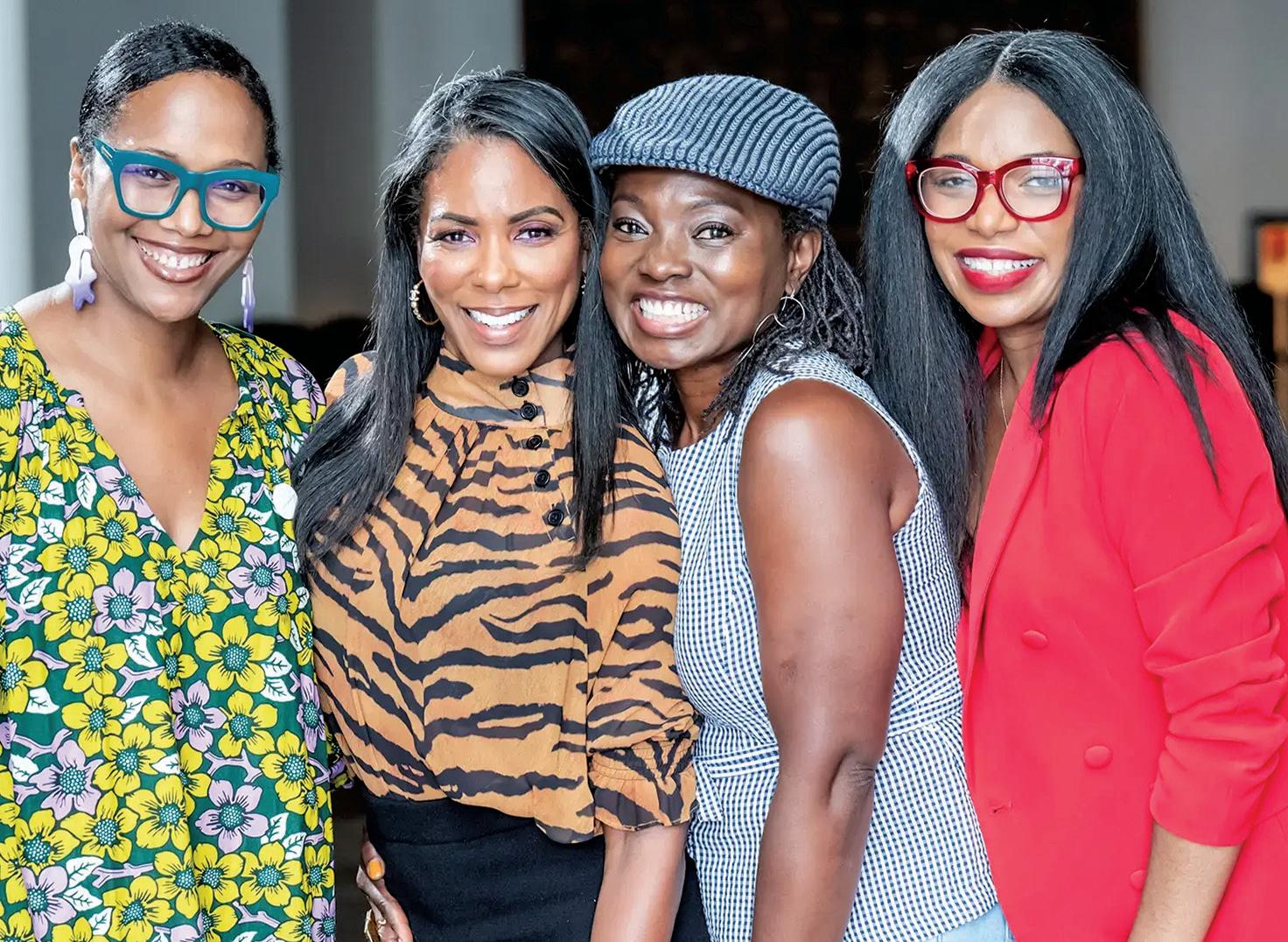
Four friends, left to right, Andrea Harry Bibbs, Dr. Jessica Shepherd, Agatha Achindu and Tanika Gray Valbrun attend a ‘Power in the Pause’ event last fall in Atlanta.
Photo courtesy of the Black Women’s Health Imperative
Diddy in hot water for violating prison phone call regulations

Sean “Diddy” Combs is reportedly facing disciplinary action for an unauthorized phone call. The news came just days after he was transferred to a federal prison in New Jersey that he might temporarily lose phone and commissary privileges for the violation.
Combs was moved to the Fort Dix prison on Oct. 30 after being sentenced to more than four years on prostitution-related charges.
Within a few days of his arrival at the prison, Combs made a three-person call on Nov. 3, in violation of prison rules. According to CBS News, he told officials it was a conversation with his legal team about issuing a statement to The New York Times.
The Bureau of Prisons prohibits inmates from adding multiple people to a call, and inmates can only speak to people on prison phones from previously approved call lists, under longstanding security rules.
According to prison documents, Combs said no one had informed him about the regulations on phone calls, and he said he never received the prison admission and orientation handbook.
Prison officials recom mended Combs lose 90 days of phone privileges and 90 days of commissary privileges for the infraction. Their ruling was filed on Nov. 4 — Combs’ 56th birth day. It’s unclear if the recommended penalty has been implemented.
Marley: One Love” (60.1 million).
Set to premiere in theaters on April 24, 2026, “Michael” stars Jaafar Jackson — the late King of Pop’s nephew — in the lead role.
SZA baffled by Nicki Minaj Twitter spat
Three months ago, Nicki Minaj dragged singer SZA for hours on end during one of her Roc Nation rants on X (formerly Twitter).
In a recent interview with GQ Magazine, SZA admits she was confused by the attack because she doesn’t even know Nicki...

Michael Jackson biopic trailer shatters viewing records
The upcoming Michael Jackson “Michael” doesn’t hit theaters for nearly six months, but it has already made history.
Billboard.com reports that the teaser trailer for the Antoine Fuqua-directed film racked up more than 116.2 million views within its first 24 hours, making it the most-viewed music biopic trailer of all time. It is also the largest trailer launch in Lionsgate history, according to analytics firm WaveMetrix. It now sits ahead of previous record holders including “Taylor Swift: The Eras Tour” (96.1 million) and “Bob
“‘I don’t know her,’ SZA says slowly, drawing out each word,” the interview said. “We have no connection to each other. There’s no backstory. Like, there was no through line narrative. It was just like, ‘Roc Nation’.... I don’t know where it came from. That’s not even my place to correct a narrative that I don’t got [expletive]to do with. It was a little strange. It was very like, ‘Why?’ But also, you know, ‘I guess.’
Tyler Perry donates $1.4M to Atlanta food banks
As Americans lost Supplemental Nutrition Assistance Program (SNAP)
Tyler Perry has donated nearly $1.4 million to organizations in the Atlanta region that support families most impacted. Atlanta Community Food Bank, Baby2Baby, Meals on Wheels Atlanta, Caring for Others, All for Lunch, Ron Clark Academy and Goodr are among them.
“If you’ve never been poor then you may not fully understand the life changing impact SNAP benefits mean to hard-working people, to our seniors and to our children,” Perry told PEOPLE in a statement. “For millions of people, it could mean extreme hunger. For newborns, it could mean a lack of access to formula.”
Perry, who has spoken publicly about his childhood trauma and homelessness, calls the loss of vital food assistance programs “heartbreaking” in his statement. “Compassion is not political, it’s humanity and we seem to be missing both right now.”
Sources: CBS News, Billboard.com, People.com, GQ Magazine








The St. Louis American’s award winning NIE program provides newspapers and resources to more than 8,000 teachers and students each week throughout the school year, at no charge.
and
to
than 8,000
and students each week throughout the school year, at no charge.
Questions or comments? Contact Cathy Sewell csewell@stlamerican.com or 618-910-9551
Questions or comments? Contact Cathy Sewell csewell@stlamerican.com or 618-910-9551
Questions or comments? Contact Cathy Sewell csewell@stlamerican.com or 618-910-9551


CLASSROOM SPOTLIGHT
Students

Thompson and
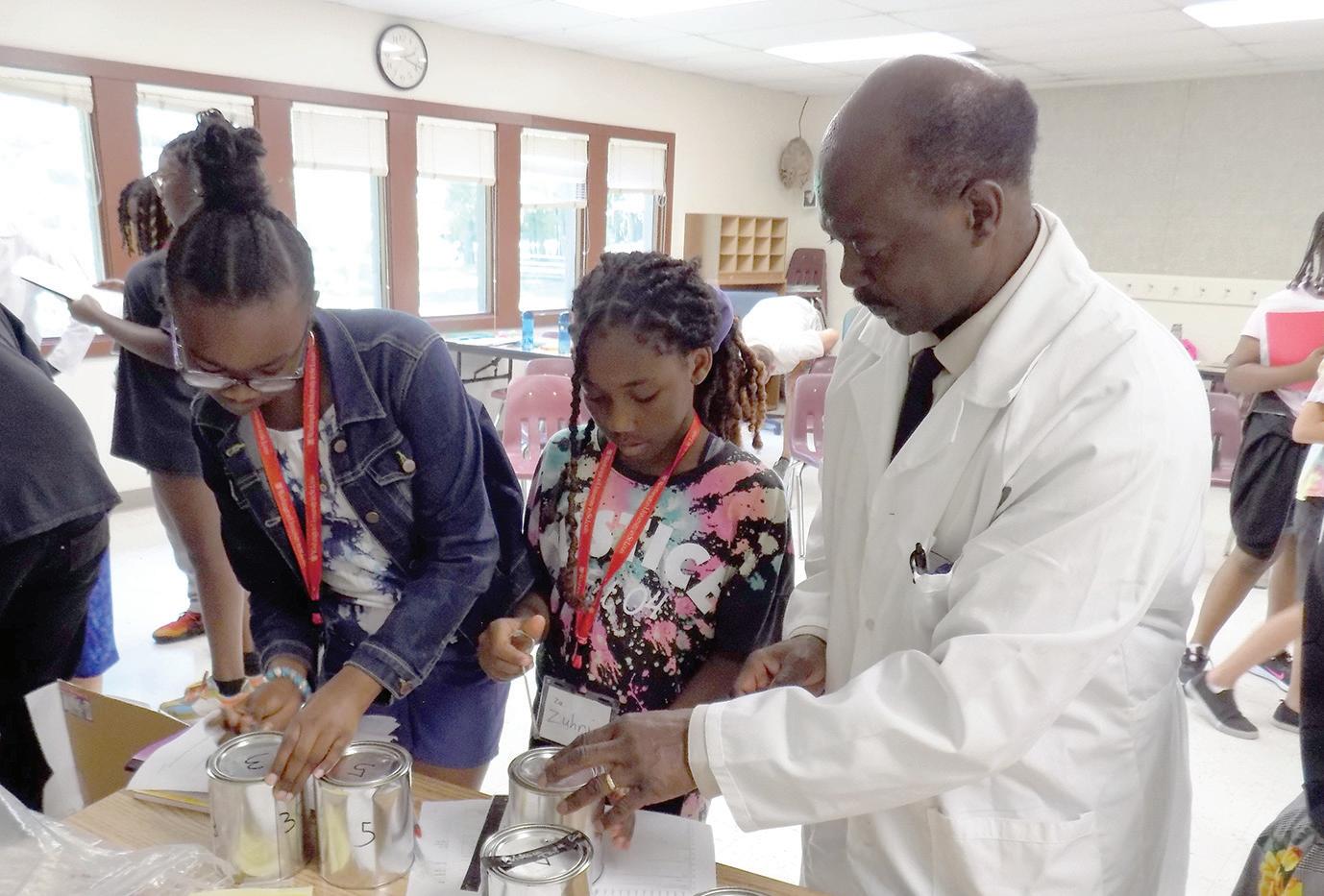
On Forensics Day at The St. Louis American’s Summer Science Academy, forensic scientist James
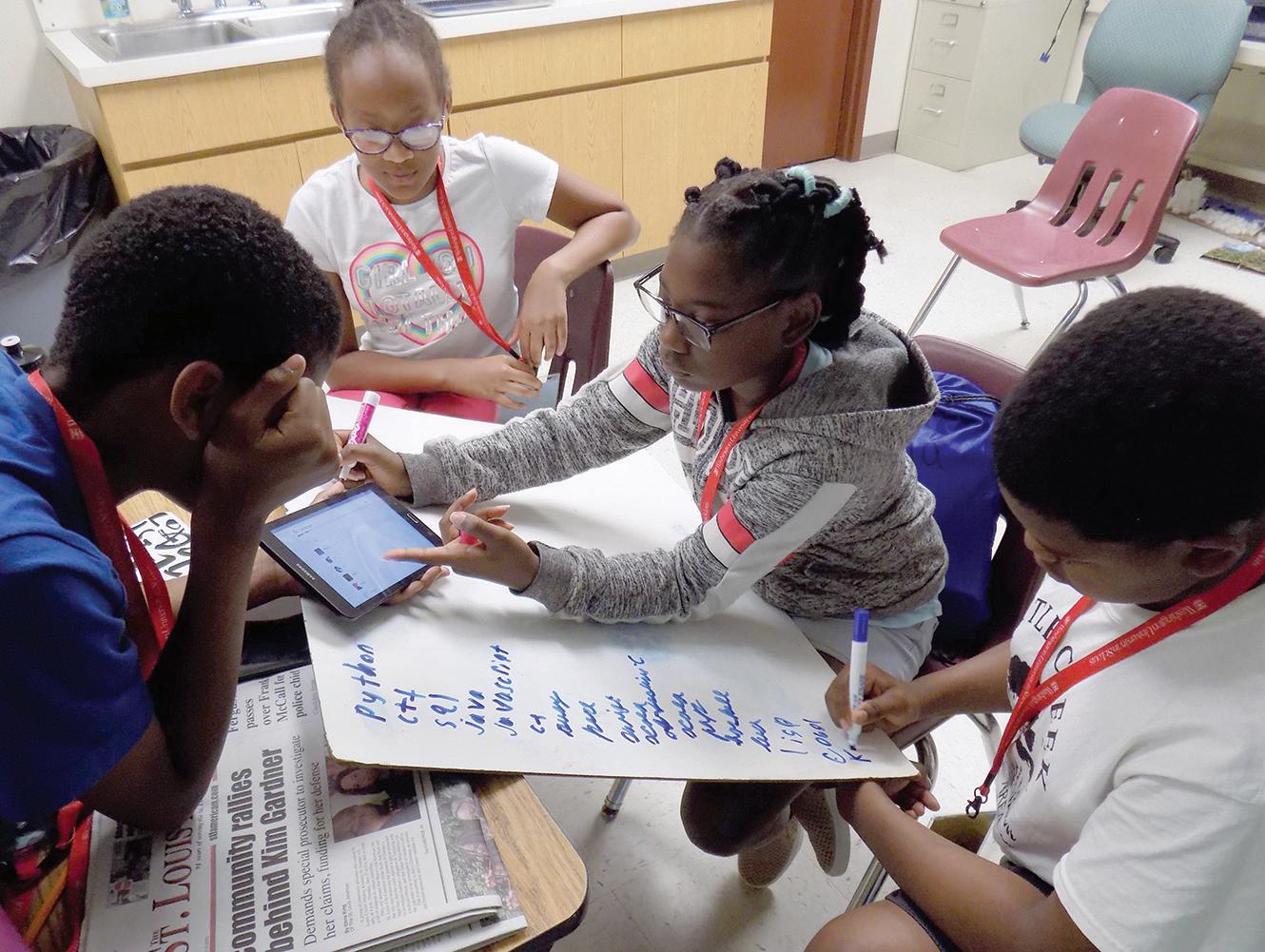
Students at The American’s Summer Science Academy work in teams to discover the many different computer programming languages.
SCIENCE CORNER
SCIENCE CORNER


A hurricane forms over tropical and subtropical ocean water. Warm water and cool, moist air combine to create strong winds that can gust up to 200 miles per hour! These winds create waves that bring the storm on shore. Hurricanes are very destructive. They can flip cars, sink boats, uproot trees, and demolish houses.
SCIENCE CORNER


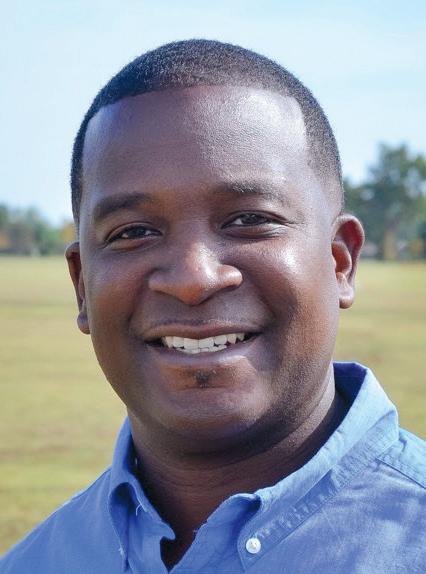
African American Meterologist William “Bill” Parker
AFRICAN-AMERICAN MYCOLOGIST AND EDUCATOR: Jeanette Jones
Paul Goodloe: Weather Science and Climate Champion
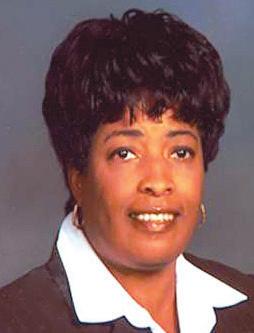
Jeanette Jones was born on September 19, 1950, in Fort Valley, Georgia. Jones graduated from Fort Valley State University in 1972 with a bachelor’s degree in biology education. In 1973, Jones received her master’s degree in botany and mycology (a branch of biology that studies fungi) from The Ohio State University. In 1976, she received her doctorate (Ph.D.) degree.
She also studied at the University of Nevada, the University of California Medical School, the National Center for Disease Control-Atlanta, and the Massachusetts Institute of Technology.

In addition to powerful winds, hurricanes bring a lot of rain. (Taiwan received 114 inches of rain in three days during a hurricane.) These rains can cause landslides and flash floods.
Meteorology is the study of the atmosphere, weather, and weather predictions. A meteorologist is a person who studies meteorology. There are many different types of tools used to predict the weather. A thermometer will give information about the temperature. A barometer measures air pressure. A hygrometer measures humidity, which is the amount of water vapor in the air. Technology, in the form of satellites, radars, and computers, are also used. When meteorologists make weather predictions, they look at temperature, humidity, dew
SCIENCE INVESTIGATION

Fungi are organisms made of filaments (called hyphe) that are stacked together. Unlike plants, fungi do not have chlorophyll, so they cannot make their own food. Some fungi are parasites, which mean they live off of other organisms. Some fungi feed off of dead and decaying matter. Fungi are everywhere in the environment, including the soil, lakes, river and seas, air, and on plants and animals. Fungi (plural of fungus) help organic matter to decay and release carbon and oxygen into the environment. Unlike plants, fungi do not have
In this experiment, you’ll create a replica of a hurricane and identify how the forces work together to create a hurricane.
SCIENCE INVESTIGATION
point, air mass, and fronts. They look at the sky to see if it is clear, and they study types of clouds. Meteorologists make observations and predictions based on these facts and on previous weather trends.
Are Fungi ?
Hurricanes can last a few hours or several days. Most hurricanes occur during the fall months. How can you stay safe? Have an evacuation plan and an emergency kit prepared. Meteorologists can track these storms and keep you informed. For more hurricane facts, visit: http://www.sciencekids.co.nz/ sciencefacts/weather/hurricane.html.
leaves, stems, or roots. Fungi use spores to reproduce. One common type of fungus is the mushrooms you find on your pizza. Mold, yeasts, and mildew are also types of fungus.
For a list of vocabulary terms associated with weather prediction, visit: http://www. weatherwizkids.com/weather-words.htm.
For More Information, Go to: https://kids.kiddle.co/Fungus
Learning Standards: I can read nonfiction text for main idea and supporting details.
Learning Standards: I can read nonfiction text for main idea and supporting details. I can make text-to-text connections.
Learning Standards: I can read nonfiction text to gain background information about fungi.
Make Your Own Hurricane!
SCIENCE INVESTIGATION
create a watertight seal. Continue taping 1 to 2 inches above and below the seam.
Growing Mold!
t Hold the bottles by the middle and lift the jugs.
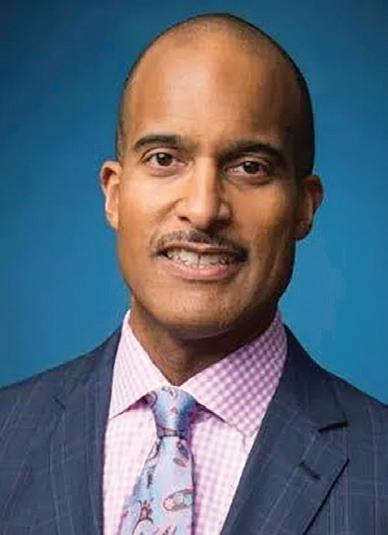
Paul Goodloe is a meteorologist who helps people understand how weather and climate affect our world. He grew up in New Rochelle, New York, and always loved learning about the sky, storms, and the environment. His curiosity led him to study geography at the University of Texas at Austin and climatology at the University of California, Berkeley. That curiosity became a lifelong mission— to help people stay informed and safe through science.
William (Bill) Parker grew up in New Orleans. He graduated from JFK High School, which focused on math, science, and engineering. Parker was interested in hurricanes at a young age, but he became interested in the weather after a high school statistics class. In this class, he learned how to predict the chance of rain. Parker wanted to attend a historically black college/ university (HBCU), so he chose Jackson State University to study meteorology. He graduated with his bachelor’s degree, in 1994.
After graduation, Alabama A&M University hired Jones as an assistant biology professor. In 1986, she served as an adjunct professor in the College of Pharmacy and Pharmaceutical Services at Florida Agricultural and Mechanical University and worked on a project with NASA. In 1991, Jones served as the first female vice president of research and development at Alabama A&M University. She also served as President of Alabama A&M University’s Faculty Senate from 2001 to 2006. In 1992, she was appointed to the U.S. Army Science Board by the U.S. Secretary of the Army, Togo West. Since 2004 Jones has been the director of the Center for Biomedical, Behavioral, and Environment Research at Alabama A&M University. She also worked as a consultant with federal agencies to help them develop training programs to attract women and minorities to STEM education and careers.
Paul joined The Weather Channel in 1999 and has become one of its most trusted meteorologists. He reports on hurricanes, snowstorms, floods, and heatwaves, both from the studio and out in the field. Viewers appreciate his calm explanations during severe weather, when accurate information can save lives. Paul believes that understanding science helps everyone make better choices, from preparing for storms to caring for the planet. Beyond his daily forecasts, Paul is passionate about fairness and representation in science. At international events like the United Nations Climate Change Conference (COP26), he spoke about how communities of color are often affected the most by extreme weather. He believes everyone should have a voice in finding solutions to climate change. Paul uses his platform to raise awareness about environmental justice and to inspire more young people of color to see themselves as scientists.
Materials Needed:
In this experiment, you will witness how a thermometer works.
• 2 Soda Bottles • 3 Paper Clips
Materials Needed:
• 3 Peanuts • ¼ C. Sand • Funnel
In this experiment, you will learn how mold grows best. Mold is an important fungus that has several uses, including breaking down dead organic material. Some purified molds are actually used as an antibiotic to treat illnesses.
• Water • Duct Tape
• Clear, plastic bottle (empty water bottles work perfectly) • Water • Rubbing Alcohol
Procedure:
Materials Needed:
• Clear Plastic Drinking Straw
• 3 slices of bread • Water • 3 Ziploc bags
• Modeling Clay • Food Coloring Procedure:
q Fill one bottle with the paperclips, peanuts and sand. These represent the debris and help make the movement of water easier to see.
• 10x10 square centimeter grid • Ruler
Process:
q Fill about 1/4 of the bottle full with equal parts of water and rubbing alcohol.
w Add a few drops of food coloring.
w Place the funnel in the mouth of the bottle and pour water into the bottle until it is 3/4 full, then remove the funnel.
q Wet one slice of bread enough to make it moist and place it in a bag. Seal the bag very tightly.
e Put the straw in the bottle, but don’t let it touch the bottom.
e Turn the second empty bottle upside down and hold it over the first bottle so that the mouths of the bottle are aligned. The bottles will look like an hourglass.
w Place the two other slices of dry bread in two separate bags and seal them, as well.

r Tape the seam, pressing the duct tape firmly to
e Place the bag with the wet slice of bread and one of the bags with a dry slice of bread in a dark place, such as a closed cabinet or closet.
Flex those brain muscles as you answer these word problems!
r Place the third bag with a dry slice
z After the temperature had risen 16°F, the temperature was 9°F. Write and solve an addition equation to find the starting temperature. ______
z A hurricane has moved 456 miles in 6 hours. How many miles per hour is the hurricane traveling? ______ If it continues to travel at that speed, how far will it travel in 10 hours? ______
MATH CONNECTION
x Each yard in the neighborhood had 3 trees. The hurricane blew 1/2 of them down. There are 26 yards in the neighborhood. How many trees are left standing? ______
r Use the modeling clay to seal the neck of the bottle to secure the straw in place. (Make sure the straw does not touch the bottom of the bottle.)
y Quickly, turn the bottles over so that the water-filled bottle is on top. Set the bottles on the table again.
t Hold your hands on the bottom of the bottle and watch the mixture move up through the straw. Reflection: When the mixtures in a thermometer get warm, they expand. Your hands provided the heat in this experiment.
u Observe the water as it drains into the bottle below. The water competes with the air from the empty bottle. Both substances push to pass through the neck.
i Turn the bottles over again. This time, shake the bottles in a circular motion. Be sure to keep the bottles vertical.
t For five days, measure the square centimeters of mold on each piece of bread through the bag. Use a grid, if possible, or a ruler. If mold covers more than half a square centimeter, it is counted as one full centimeter. If it is less, it is counted as 0 centimeters. This will give you the area of mold on each slice of bread y At the end of a week (5 days of measuring) or longer, use your final results to say what percentage of the bread was covered in mold. Make a table or graph to display the information.
o The water will form a vortex as it drains into the next bottle. The water will flow along the outside of the neck, while air moves quickly up through the center of the vortex. The water will drain much faster.
Analyze: How did water and air create a hurricane?
Learning Standards: I can follow sequential directions to complete an experiment. I can draw conclusions and analyze results. I can make text-to-world connections.
Learning Standards: I can follow sequential directions to complete an experiment. I can make observations and draw conclusions.
Discussion Questions: How much mold was on the bread? Which location had the most mold? Which had the least? What conclusions can you draw about the conditions in which mold grows? How can food manufacturers and restaurant owners use this information to help them?
Weather Works!
Learning Standards: I can follow sequential directions to complete an experiment. I can display my results, make observations, and draw conclusions.
c An average of 3 1/8 inches of rain fell each month from April-October. What is the total amount of inches that fell during that time period? ______
temperature dropped 7°F, what is the temperature now? ______
Math Storms!
Scientists often use tables and graphs to display the results of their research. Looking at these displays, you can draw conclusions.
x Hurricane Frederick is traveling at 86 miles per hour. If the hurricane is 129 miles from the coast, how many hours will it take until the hurricane reaches the coast? ______

c A tropical storm takes on a hurricane status when the winds reach 74 miles per hour. After three days, Tropical Storm
DID YOU KNOW?
YOU KNOW?
X has grown to have wind speeds of 48 miles per hour. How much faster will the winds have to become for Tropical Storm X to become Hurricane X? ______
Analyzing a Bar Graph
v If it is -2°F in Alaska and it is 75°F in Honolulu, what is the temperature difference between the two cities?
As we approach spring weather (and increased rain), create a bar graph that displays the amount of rain that falls for several consecutive days or weeks. (Day 1: 1.5 inches, Day 2: 0 inches, Day 3: 1.5 inches, etc.)
n The daily temperatures for the past week were 71°, 82°, 66°, 58°, 67°, 75°, and 63° degrees Fahrenheit. What was the average temperature? ______
Discussion Questions: Which day had the most measured rainfall? Which day(s) had the least? Looking at the bar graph, what might you conclude about rain patterns in March/April? What other observations can you make?
v Upon landfall of a Category 4 hurricane, local officials ordered an evacuation. City A has a population of 9,613, City B has a population of 5,013 and City C has a population of 3,972. How many people were evacuated in all?
Learning Standards: I can add, subtract, multiply, and divide to solve a problem.
b In Buffalo, New York, the temperature was -4°F in the morning. If the
$115,264 in damage, City B reported $236,096 and City C reported $436,869 in damages. What was the total cost of damages rounded to the nearest thousand? ______ If the state and federal government promised $500,000 in aid, how much would the local people have to raise by themselves? ______
Learning Standards: I can use a bar graph to display information. I can use the information to make deductions and inferences.
Learning Standards: I can add, subtract, multiply, and divide to solve a problem.
b After citizens returned to their houses after the evacuation, reports of damage were totaled. City A reported

This special Newspaper In Education initiative is made possible, and delivered to classrooms through the St. Louis American Foundation and its NIE Corporate Partners:





Through his work, Paul Goodloe shows that meteorology isn’t just about predicting rain or sunshine, it’s about protecting people and the planet. His dedication reminds us that science connects us all and that knowledge can create safer, stronger communities.
ELA Questions:
In 1993, he began to gain experience in the field when he worked as a student meteorologist. One year later, he was a meteorologist intern at Shreveport. In 1998, Parker became a general forecaster, and ten years later, a lead forecaster. In 2012, he became a warning coordination meteorologist (WCM). There are only 122 people with this title in the United States, and Parker was the only African American. Parker is currently the meteorologist-in-charge (MIC) at the National Weather Service, leading a team of 26 weather professionals. Parker is also very active as a volunteer in his community. He is a member of the Shreveport-Bossier Mayors’ Prayer Breakfast Executive Committee, La Cima Bilingual Leadership Academy, Bossier Chamber of Commerce Education Committee, Volunteers for Youth Justice, and a coach for Bossier Parks and Recreation. Parker is also an associate minister at Elizabeth Baptist Church in Benton, where he has been serving the congregation since 1997.

In 1975, Jones was listed in the World’s Women’s Who’s Who and she was named an Outstanding Young Woman of America in 1978. Beta Beta Beta National Biological Honor Society awarded her the distinguished service award. Jones also received the Significant Service Award from the NASA Space Life Sciences Training Program and the Extramural Associate Research Development Award from the National Institute of Health. In 1990 and 2006, she was named Woman of the Year at Alabama A&M University and was given the Outstanding Leadership Award by the Faculty Senate. The U.S. Army presented Jones the Commander’s Award for Outstanding Civilian Service as a member of the Army Science Board.
• Paul Goodloe uses his career to help others and raise awareness. What is one way you could use your interests to make a difference in your community?
Discussion Questions: Dr. Jones received many awards and honors. How would you describe her achievements and her contributions to science? Dr. Jones is studying how fungi might be used as agents of war. What purpose do you think fungi serve in modern warfare? Are fungi beneficial or harmful?
• The article uses the word “meteorologist.” Based on the sentences, what do you think this word means?
Parker believes in serving as a role model to the youth and to recruiting African Americans in the STEM field. Personally, he has hired three African-American meteorologists. In addition, he has recruited minorities for summer intern positions.
Standards:
Science (5.ESS2.A.1)
Science (5.ESS3.C.1) English Language Arts (ELA.RI.4.1) English Language Arts (ELA.RI.4.4)
Learning Standards: I can read a biography to learn about an African American who has made contributions in science, math, technology, or engineering.
Parker has also mentored an Airline High School student for his senior project. Parker’s advice to students interested in meteorology is to take as many math and science classes as possible. Learn about summer opportunities in your community. If you are interested in meteorology, visit National Weather Service offices and serve as a volunteer or intern, and find leaders in your community to serve as your personal role models.
Learning Standards:

a person who has made contributions to the fields of science, technology,

Enjoy these activities that help you get to know your St. Louis American newspaper.


Use the newspaper to complete the following activities: Types of News: Use the front section of the newspaper to evaluate the types of news stories presented: local, national, and international. Sort the articles into the three categories and create a bar graph that displays the amount of coverage each type
Enjoy these activities that help you get to know your St. Louis American newspaper. Activities — Weather Headlines: weather headline that you like. Write a poem using the headline as the first line of the poem. Weather Prep: Write an editorial to persuade newspaper readers to get prepared for severe weather emergencies.
Activities — Who works where? a picture of a building in the newspaper and of jobs people who work in that building could have.



Mystery Story: Cut out several pictures from the newspaper without reading the caption. Place the pictures in a bag, and without looking, pick your mystery picture from the bag. That’s your stimulus for writing. Construct a graphic organizer to identify the 5Ws (who, what, when, where, and why) of your story by looking at your picture. Then, continue the writing process.
Learning Standards: I can use the newspaper to locate infor mation. I can write for a specific purpose and audience. I can make text-to-text connections.
Problem and Solution: Over a period of weeks, clip articles from newspapers that deal with problems and issues facing your local or county government. Discuss the reasons for these problems and how the government hopes to solve them.
Learning Standards:
I can use the newspaper to locate information. I can categorize and summarize that information.
Learning Standards: I can use the newspaper to locate information. I can discuss problems and solutions. I can identify types of jobs. I can make text-to-world connections.





Aariyah
Savannah Fisher, in Ms. Stovall’s firstgrade class at Gateway MST Elementary School, are learning how to construct a series circuit.
Photo by Ms. Stovall
Riggins, from the Illinois State Police Forensic Science Laboratory, shows students how to use trace chemistry to solve a crime.
Photo by Cathy Sewell
MAP CORNER
Mill Creek
Continued from A1
exhibit shifts the narrative toward the brilliance and everyday dignity of the people who called Mill Creek home.”
Mill Creek Valley stretched across downtown St. Louis, pulsing with the energy of Black excellence. It was a hub for Black-owned business, with dozens of enterprises — including a then-emerging Black newspaper, The St. Louis American — housed within the legendary People’s Finance Building. The neighborhood was also home to the only Black YMCA on Pine Street, and nearby stood storied institutions such as People’s Hospital and Union Memorial Church.
Among its most famous residents were Josephine Baker, Scott Joplin and civil-rights leader Roy Wilkins, who later became executive director of the NAACP. Black hair-care
Food
Continued from A1
of the Urban League of Metropolitan St. Louis, which serves St. Louis, St. Louis County and St. Clair County, Illinois.
Federal food-aid payments under SNAP are caught in legal limbo, leaving millions of families uncertain about what they’ll receive this month.
The U.S. Department of Agriculture has told states that only partial payments — about 65% of the usual level — can proceed for now.
Full benefits may be closer to returning after the Senate approved legislation that could end the historic government shutdown, which has lasted more than 40 days.
The House must still pass the bill before it goes to
pioneer Madam C. J. Walker called Mill Creek home when she moved to St. Louis in the 1880s, learning the business that would make her a household name under the tutelage of Annie Malone — who built an empire there through her groundbreaking Poro Hair Care brand.
Global treasure Dr. Maya Angelou frequented the Phyllis Wheatley YWCA as a young girl living in St. Louis. Jazz legend Clark Terry was a product of Mill Creek, and his mentee Miles Davis was a regular presence in the neighborhood.
Mill Creek’s legacy also includes notable figures beyond the Black community. Civil War Gen. William Tecumseh Sherman lived there, as did poet, essayist and journalist Walt Whitman, who stayed in the neighborhood while visiting his brother.
The 5,000-square-foot exhibition features rarely seen moving images
the White House for final approval.
In response, city and state leaders are channeling emergency funds to help food banks meet surging demand.
St. Louis Mayor Cara Spencer launched the City Food Insecurity Fund last week to support food banks as requests surge.
“One in 5 residents in the City of St. Louis relies on SNAP benefits to make ends meet,” Spencer said. “These residents have been left in limbo by funding cuts and uncertainty at the federal level, and for those still recovering from the effects of the May 16 tornado, this adds yet another challenge for many of our residents to contend with as they try to rebuild.”
The Children’s Trust Fund and its board of directors also approved $400,000 in additional funding last week to help
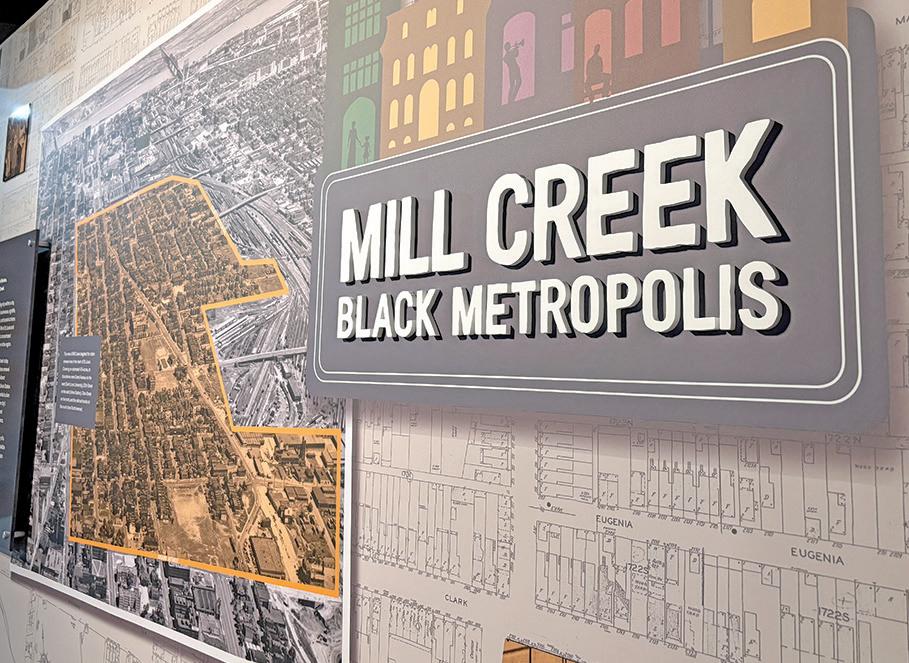
— including footage of Richmond Heights’ first Black mayor, Reginald Finney — and artifacts that speak to the soul of the neighborhood: a stained-glass window from Union Memorial Church, the original People’s Hospital sign and records from iconic local clubs.
Oral histories and per-
sonal collections bring the hum of neighborhood life into focus — Sunday services, NAACP organizing, sports leagues, music clubs and everyday moments of joy.
The exhibition will remain on display through July 12, accompanied by a robust lineup of programming. Opening-weekend
Helping
events, Nov. 15-16, will include lectures, storytelling and a screening of “Remembering Mill Creek: When We Were There,” a documentary by The Last Children of Mill Creek author Vivian Gibson, along with other opportunities to explore St. Louis Black history through the exhibition and related programs.
“Preserving these memories is not nostalgia,” said Dr. Malaika Horne Wells, a community advisor for the exhibition. “It is continuity — a way to carry forward the strength that was planted there.”
Presented by the James S. McDonnell Charitable Foundation and Bank of America, “Mill Creek:
Black Metropolis” is part of the Missouri Historical Society’s ongoing effort to amplify untold stories and honor the diverse history of St. Louis.
“For decades, the people of Mill Creek have deserved for their story to be told in full,” said Dr.
hungry neighbors
Free community drive-thru food distribution
Nov. 15, noon–3 p.m.
Urban League of Metropolitan St. Louis Regional Headquarters 1408 N. Kingshighway Blvd., St. Louis
St. Louis area Foodbank free food distribution
Nov. 20, 9 a.m.–2 p.m.
Ralph Kort Stadium Parking Lot, Southern Illinois University
Edwardsville
Serving up to 3,000 households
Need help? Call the United Way at 211 for assistance finding food, housing, safety and health resources.
Want to help?
Local food banks, pantries and outreach programs welcome donations and volunteers. Visit their websites or call directly to learn how to get involved.
Missouri families facing food insecurity. The fund will donate $100,000 to Feeding Missouri, which
will distribute the money to six regional food banks statewide, specifically for buying infant formula and

Jody Sowell, president and CEO of the Missouri Historical Society. “This exhibit is an act of remembrance and respect — a way to say that their community mattered and continues to matter to the heart of St. Louis.”
Gwen Moore, Curator of Urban History, made it her mission to tell Mill Creek’s story with nuance and care.
“I was shocked at how my community was represented in newspapers,” Moore said. “The people were faceless, anonymous, smeared. In this exhibit, we put faces back on Mill Creek: doctors, lawyers, grassroots citizens, musicians, students, church elders.”
“Mill Creek: Black Metropolis” opens at The Missouri History Museum (5700 Lindell Blvd.,St. Louis) on Saturday, Nov. 15, and continues through July 12, 2026. For more information, visit mohistory.org/exhibits/mill-creek
is so great,” Kinkead said. “That’s just for our Thanksgiving Together distribution, and we’ve also made thousands of additional meals available to our network of pantry partners.” Food Outreach, which serves clients living with HIV and cancer, is also feeling the surge in demand while keeping its focus on nutrition tailored to specific health needs.
“We’re not a typical food pantry,” said Brittany Rudy, director of nutrition and programs at Food Outreach. “Our clients are referred by doctors, nurses or case managers, and we provide groceries or medically tailored meals created by our dietitians and chefs.”
baby food. Of the more than 655,000 Missourians who receive SNAP benefits, 40% are children, according to the USDA.
Poverty and hunger rates in St. Louis outpace both state and national averages. In the city, 19.8% of residents live below the poverty line, compared with 9.6% in the county, 12.6% statewide and 10.6% nationwide.
Food insecurity also is higher in the city, affecting 18.4% of residents compared with 12.8% countywide, according to the University of Missouri’s Interdisciplinary Center for Food Insecurity and its 2025 Missouri Hunger Atlas.
As winter approaches, the St. Louis County Department of Human Services, in partnership with The Salvation Army, has opened the Winter Warming Emergency Shelter. The facility offers overnight refuge, three daily meals, hygiene and shower access, and other support services.
The St. Louis Area Foodbank, like the Urban League, is seeing unprecedented demand. The foodbank supports about 600 pantries in 14 Missouri counties and 12 in Illinois and occasionally holds large-scale food distributions. It will host its largest yet on Nov. 20, aiming to serve 3,000 families.
Ericka Kinkead, a spokeswoman, said monthly distributions typically feed 200 to 300 families, but even in August that number rose to 500 — and more increases are planned for Thanksgiving.
“We’ve increased the number of households we’re serving this year to 600 because the need
The organization has seen its client visits nearly double in recent weeks.
“Last Tuesday, we served almost 80 clients. Normally, that number is closer to 40 or 45,” Rudy said. “We’ve also seen a significant increase in referrals from hospitals and case managers.”
Despite operating with a small staff of just 18, Food Outreach depends on a network of more than 2,000 volunteers who contribute about 20,000 hours of service each year. The organization will hold a holiday food distribution later this month.
Like the St. Louis Area Foodbank, both Food Outreach and the Urban League are planning Thanksgiving distributions. The Urban League’s event will feature traditional holiday staples — turkeys, stuffing, mashed potatoes and vegetables — along with milk, eggs, meat, cheese and other essentials. McMillan said the goal is to help families stock up on at least two weeks’ worth of groceries. Food Outreach will offer Thanksgiving meals, including a turkey or chicken if donations allow.
As the holidays approach, the region’s network of food banks and service organizations is striving to provide more than nourishment. They’re offering stability, comfort and dignity to families facing hardship.
“People are trying to navigate daily life, care for their families and make sense of shifting public policies around food, housing and energy assistance,” McMillan said. “We’ve been part of the solution for more than 100 years, and we’ll continue to be here for this community as needs evolve.”

Photo courtesy of The Missouri History Museum
‘Mill Creek: Black Metropolis,’ a 5,000-square-foot exhibition devoted to the historically Black neighborhood once located in downtown St. Louis, opens on Saturday at The Missouri History Museum.
Bishop A. John McCoy Sr., who nurtured generations of ministers, dies at 92
By Nia Hightower For The St. Louis American
Bishop A. John McCoy Sr., a revered metro St. Louis faith leader whose ministry spanned more than seven decades, died last week at age 92, just hours after leading his final Monday prayer call.
McCoy, the founding pastor of Grace Apostolic Worship Center in Florissant, was known as a gentle giant with “quiet power,” a disciplined and humble leader who nurtured many aspiring ministers and helped form congregations across the region.
“A. John McCoy was a leader of leaders who birthed over a dozen churches from his ministry, and a spiritual father to countless souls across Missouri and beyond,” said his son, Art J. McCoy II, CEO and social entrepreneur for SAGES LLC and a distinguished fellow and superintendent-in residence in Saint Louis University’s School of Education.
eulogy at McCoy’s homegoing service, 11 a.m. Nov. 8 at Greater Grace. “He has a legacy that will not be forgotten.”
Those who knew him recall his storytelling as part of his ministry.
“He always attempted to speak the truth wrapped in a story of love. He knew that a story would connect with people and have them remember it for a lifetime,” McCoy II said.
Born and raised in St. Louis, McCoy endured challenges early in life. He lost his leg at age 3 after a playground accident, then as a teenager left high school during his 11th-grade year, experiencing poverty, drugs, gang activity and crime. It wasn’t until he saw his sister get shot that McCoy made a pivot that would change the course of his life, leading him into the ministry, his son said.
McCoy was baptized in October 1955, and by November he was drawn into preaching. His mission took him across Missouri into prisons and jails, onto radio stations and street corners, where he believed ministry was most needed.
Bishop Larry Jones, pastor of Greater Grace Church in Ferguson, began watching McCoy from afar before entering ministry himself. Later, he worked alongside him as McCoy became a district elder.
“He was very gracious, very kind, consistent and truthful. Someone you could turn to,” said Jones, who will deliver the
McCoy and his wife, Norma Jean McCoy, were married 69 years and raised four children — Belinda Fennessey, the late Timothy McCoy, Crystal Swanigan and Art J. McCoy II — each serving the church in various ways. He is also survived by seven grandchildren and seven great-grandchildren, many of whom are involved in ministry in Missouri, Florida and beyond.
In August, the couple celebrated the 58th anniversary of Grace Apostolic Family Worship Center with congregants. Under their leadership, the church grew through multiple relocations, renovations, bus purchases and the creation of a daycare and learning center. McCoy also served as district elder and then suffragan bishop, as well as assistant treasurer of the Midwestern District Council. He earned a doctor of theology and a doctor of Christian service from the Institute of Theology of the International Association of Apostolic Apologetics.
His drive, family and colleagues said, came from a deep belief and perseverance. Despite the challenges he experienced, he went on to raise a family and build a ministry. Later in life, he survived colon cancer and later developed chronic lymphocytic leukemia, a type of blood cancer. Even then, he continued leading, preaching and praying — including on the morning of his death.
“He taught us that you can face obstacles with courage and that God will not place any more on you than you’re able to bear,” his son recalled. “You can be more than a conqueror, more than victorious.”

The Elections were an opening, not an ending
By Jamala Rogers
If the Nov. 4 elections were measured on the Richter scale like earthquakes, they would likely register a magnitude of 4.0.
The Richter scale indicates the strength of an earthquake and the level of destruction it causes. A 4.0 rating means those closest to the source of energy had minimal damage. While voters have reason to celebrate these historic victories, it will take efforts with intensities closer to 9.5 or 10 to counteract the destructive impact of the MAGA movement.
There were seismic election outcomes for sure.
New York voters elected Zohran Kwame Mamdani, a democratic socialist, named after Ghanaian President Kwame Nkrumah. Virginia, a target of Trump’s vicious policies, sent the administration a stinging message by reclaiming the state’s executive branch. New Jersey elected its first female governor.
Then there was Prop 50 in California, where historic voter turnout will allow a redistricting map that favors Democrats.
Americans struggling and preoccupied with basic survival.
The Democratic elites should not try to claim the November elections. The historic turnout was more a rebuke of MAGA and its authoritarian scourge. The Democratic Party has fallen out of grace with its constituents because it has been bullied into submission. It’s past time for Dems to get off their knees and represent the mighty working class.
Since the Trump inauguration, fire and brimstone have been unloaded on working people every single day. Black folks’ lives have always been precarious under racial capitalism. The color of our skin and our economic status still determine our standard of living and our mortality.
We are not alone. Trump and his minions have trashed just about every constituent group imaginable, from veterans to LGBTQA+ to workers. Voters, weary of being broke and unhealthy, rose up in one chorus to sing, “No Kings.”
The scheme was formulated decades ago to dismantle the government, concentrate power in the hands of a few and establish a police state. This was set in motion long before Trump’s elections and before Project 2025.
What we are witnessing now is merely the surface of a deeper issue, with roots that run deep. Chaos and confusion are being deliberately created to keep most

The Democrats who stood up, showed some courage, and expressed new ideas got results, like California Gov. Gavin “Fight-fire-with-fire” Newson. In three months, his campaign was able to galvanize millions of voters to the polls in response to MAGA’s illegal redistricting campaign to steal the 2026 midterm elections. Mamdani excited voters with a turnout not seen in a mayoral election since 1969. Many were inspired by the unflinching stance of Chicago Mayor Brandon Johnson and Illinois Gov. J.B. Pritzker to Trump’s threats to send in the military to a city he claimed to be out of control.
Trump has caused irreparable harm to this country in ways we do not fully know or understand — harm that will set us back for generations. We, the people, have been slow to take decisive action, perhaps waiting for the executive, legislative or judicial branches of government to address the overwhelming abuse of power. The vote is a powerful tool for participation in a democracy, but it cannot compare to the strength of a united effort at all levels to halt and correct the dangerous path this country is on.
History must be rewritten to tell the story of our remarkable, sustained resistance and the strengthening of a broken democracy.
Jamala Rogers is an opinion writer and one of the founding members of the Organization for Black Struggle, based in St. Louis.


Earl A Childress, II Chairman & CEO

GET A FREE FUNERAL QUOTE
Know before you go. Funeral homes vary widely in the services and amenities they offer, the experience they create, and the price points they serve. Whether you’re facing an immediate need or making Advance Arrangements, understanding the different types of funeral homes before you go can help you choose the right funeral home that fits your family’s vision, values and budget. Call for a Free Quote Today!
Bishop A. John McCoy Sr.
Columnist Jamala Rogers
Black journalists group honors local ‘Living Legends’
By Sylvester Brown Jr. St. Louis American
The St. Louis chapter of the National Association of Black Journalists will honor four veteran area journalists and media professionals during its annual Living Legends Honors on Saturday.
The event celebrates journalists who have used their platforms to inform, inspire and strengthen their communities while mentoring the next generation of storytellers.
This year’s honorees are Shirley Washington, a longtime, award-winning St. Louis news anchor and reporter; Mike Claiborne, St. Louis Cardinals radio broadcaster and former KMOX Radio host; Reginald Riddle-Young, a 34-year veteran writer and reporter with the East St. Louis Monitor; and Gloria Ross, a veteran public relations professional and entrepreneur.
Rod Hicks, executive editor of The St. Louis American, will deliver the keynote address, and recently retired KSDK-TV news director Art Holliday will serve as emcee. The event begins at 5 p.m. at Il Monastero, 3050 Olive St., on the campus of Saint Louis University, with a reception for the honorees followed by the awards ceremony.
Tickets are $40; $50 the day of the event. Proceeds support NABJ-St. Louis’ historic Minority Journalism Workshop for metro-area high school
students, which provides thousands of dollars in annual scholarships. Founded in 1976 as the Greater St. Louis Association of Black Journalists, NABJ-St. Louis serves journalists, media professionals, educators and students across the region.
Sylvester Brown Jr. is the Deaconess Foundation Community Advocacy Fellow.

Holiday spirit meets community giving

where Winterfest will be in full swing—offering ice skating, local eats, live entertainment, and the dazzling Ameren Festival of Lights. Together, the events promise a vibrant kickoff to the holidays, with something for everyone to enjoy.
St. Louis American Staff
The heart of downtown will come alive with holiday cheer on Saturday, November 22, as two beloved traditions unite to mark the start of the season. The 41st Annual Thanks-For-Giving Parade returns to Market Street at 2:00 p.m., joining forces with the Gateway Arch Park Foundation’s 10th Annual Winterfest for a day packed with festive fun, family-friendly activities, and community spirit. The parade will wind its way to Kiener Plaza,
“Winterfest is back and bigger than ever for its 10th year,” said Camille Brooks, Director of Programming and Events at Gateway Arch Park Foundation. “This partnership with the Thanks-ForGiving Parade creates the perfect atmosphere for the community to gather and make memories in downtown St. Louis.”
Beyond the festivities, the celebration carries a deeper purpose. Both events support the St. Louis Area Foodbank, which has served local families for five decades.
Ken Mallin from Holidays in St. Louis highlighted the partnership’s charitable impact,
Ritenour High School students marching in a recent ThanksFor-Giving Parade
noting the continued support of the St. Louis Area Foodbank, which serves as the charity partner for both the Thanks-For-Giving Parade and the Ameren Festival of Lights at Winterfest.
“The St. Louis Area Foodbank has been serving the needs of local families for 50 years,” Mallin said.
“We encourage everyone to consider a donation this holiday season to help neighbors in need.”
Jessica Fox, Vice Chair of Celebrate St. Louis, emphasized the power of collaboration.
“Our volunteers work tirelessly to bring the Thanks-For-Giving Parade to life,” Fox said. “ We’re proud to be part of a team creating unforgettable experiences for families across the region.” For parade details, visit CelebrateSaintLouis.org. For Winterfest schedules and skating sessions, visit archpark.org/winterfest.

in Downtown St. Louis.
Photo courtesy of Celebrate St. Louis
Reginald Riddle-Young Gloria Ross
Shirley Washington Mike Claiborne
Tornado
Continued from A1
Faith, loss and rebuilding
When the tornado struck, DeMarco Davidson, executive director of Metropolitan Congregations United, was inside Centennial Christian Church in Fountain Park. The storm reduced it to rubble, killing beloved church member Patricia Ann Penelton.
“It’s hard to believe it’s been six months,” Davidson said.
“Sometimes it feels like a year ago; other times, like yesterday.”
He’s still recovering from back and hip injuries.
“I was the last person to see Mrs. Pat alive,” he said. “That connection will always stay with me.”
Nine members from his home church, St. John’s UCC, dug him out of the rubble. “God is community,” Davidson said. “When I saw how people showed up, I knew I had to keep doing the work.”
That work now includes organizing food networks and faith partnerships to support families still struggling — what he calls his “survivor’s responsibility.”
A few blocks away, Larry Gray was sitting in his truck when the storm hit.
“I laid down in my truck. It only seemed to last two minutes, but when I looked up, almost everything was destroyed,” he said.
His rented home was spared demolition but suffered heavy roof damage. “If they’d gone inside, they probably would have condemned it,” he said.
T he next morning, Gray fired up his grill to cook for neighbors. What began as an act of kindness became a community ritual. On cold mornings, he’s still outside with a blackened half-barrel smoker, flipping burgers and handing out free clothes and household goods.
“It wasn’t a plan,” he said. “It started with me feeding my neighbors. People started bringing more food, and it grew.”
Now, cars pull up for hot meals or to drop off donations. “It feels nice when someone comes along who doesn’t have a coat and you can give them one,” Gray said. “God put this in my hands.”
A few miles away, contractor Erion “Prop Man” Johnson launched a tiny home initiative to teach teens construction skills while building temporary housing for displaced residents.
“It showed we can do things that seem impossible,” Johnson said. “North and West St. Louis can come from this — we’re going to do it together.”
‘Pretty much on me’
When the tornado hit, Rochel Starling was away on a women’s retreat in Kentucky. She had an international trip planned immediately after, keeping her away for two more weeks. By the time she returned, her house was unrecognizable.
“My chimney had fallen, splitting my den in half,” she said. “My roof was gone, two trees were uprooted, every ceiling on the second floor except one had fallen in — and all the ceilings on the first floor except for two.” Without insurance — her policy lapsed two years earlier — Starling was left to rebuild alone. “All the companies helping people, I missed them,” she said. “When I came back, it was pretty much on me.” Her grandfather had restored the home “room by room.” Losing it meant losing a piece of him. “The only thing to survive was his dining room table.”
Starling scraped together what funds she could: $1,000 from her employer, $600 from the Red Cross,
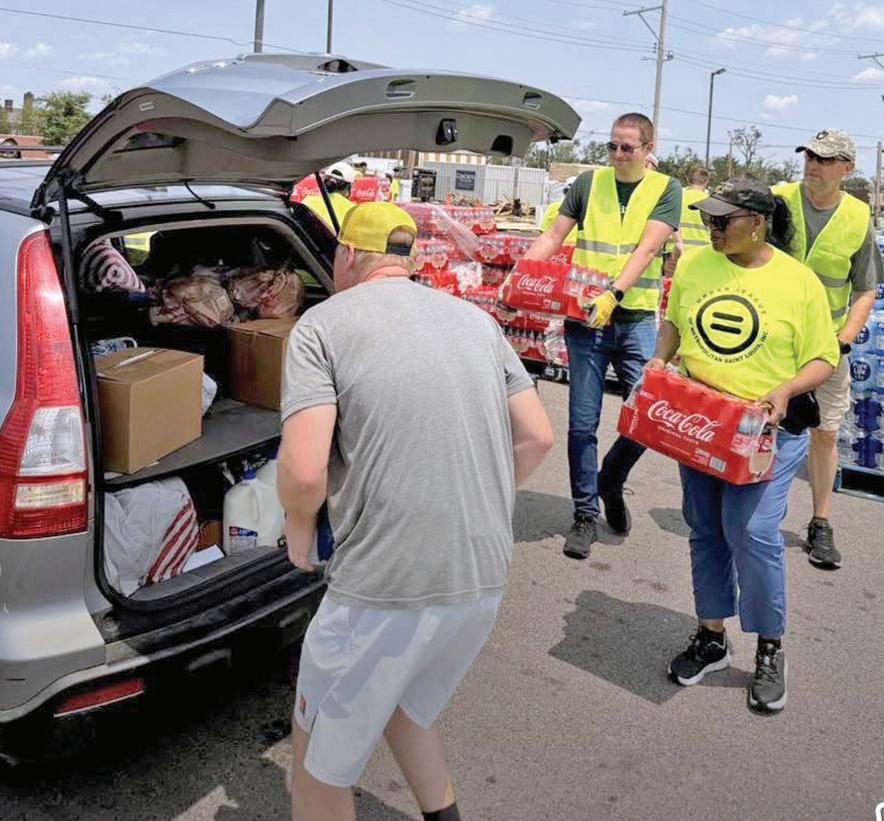
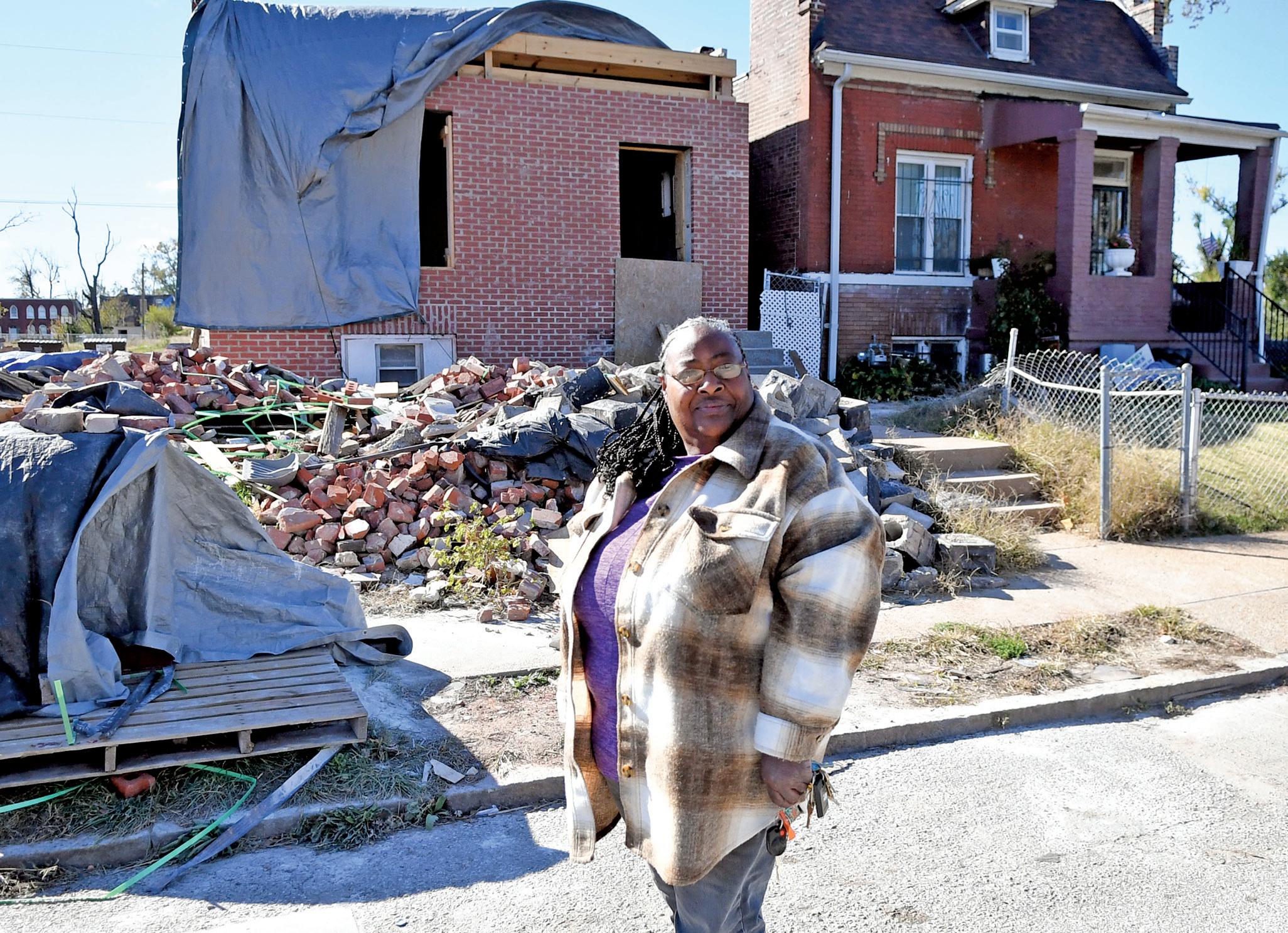
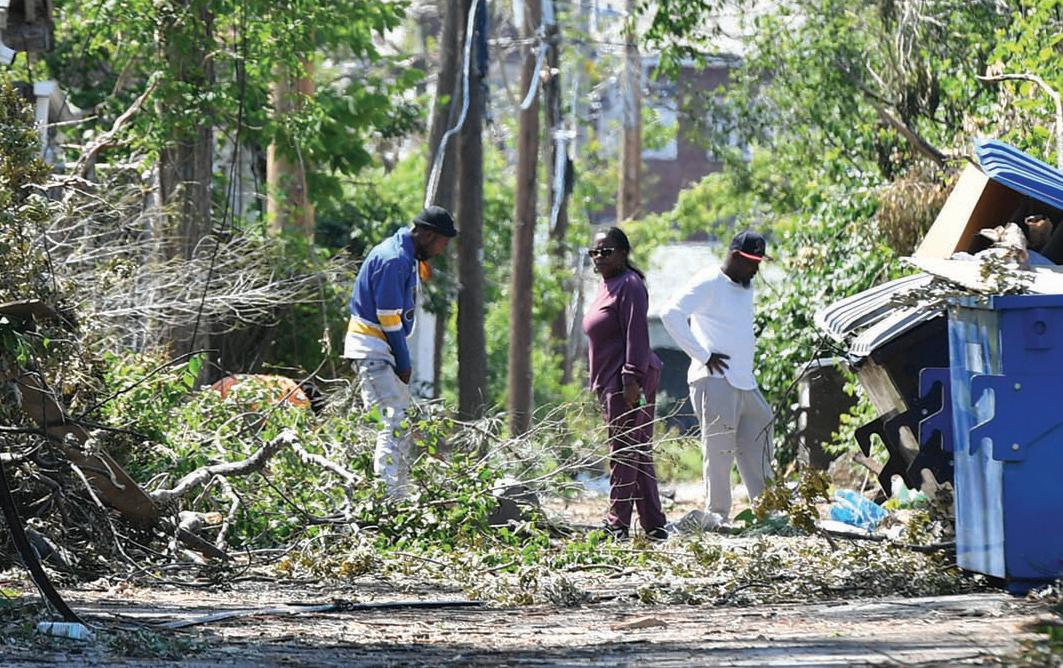
$1,000 from Veterans Affairs and $35,000 from FEMA. She even withdrew $25,000 from her 401(k). A family friend and contractor, Rusty Watts, helped her rebuild one room at a time — just like her grandfather did.
“He understands I’m on a budget, so we’re taking it one room at a time,” she said. “The roof is finally done, and the den is patched.” Today, she’s staying with her grandmother, mother and daughter — four generations under one roof.
“I still can’t go to my house,” Starling said. “It’s
going to be a long-term recovery, but without my parents and sister, I don’t think I would’ve survived.
When I saw devastation, they saw opportunity — and reminded me it was fixable.”
Still, she worries about others. “I still see people staying in tents next to their houses,” she said. “We need to figure out somewhere for them to go before winter.”
Filling the gap
In the storm’s aftermath, city officials urged residents not to self-deploy. Local nonprofits
mobilized on their own.
Aaron Williams, president of 4theVille, was leaving Sumner High School’s graduation when the tornado struck. “I had just pulled away from our storefront on MLK 10 minutes before it hit,” he said. By morning, the 4theVille storefront had become a command center. “I came back with a chainsaw,” Williams said. “That turned into a call for help, then people showing up asking what they could do.”
Working with Invest STL, Dream Builders for Equity, Action St. Louis
and others, Williams helped distribute supplies and coordinate volunteers to stabilize homes.
“The major programs hadn’t been mobilized yet,” he said. “What was being offered was what we created — ‘we’ being the community-based and advocacy organizations.”
The people’s response
Action St. Louis was among the first groups on the scene. Executive Director Kayla Reed said her team knew government relief would be slow.
“We knew folks would immediately need food,
water, hygiene products — and help cleaning up,” she said.
Action St. Louis and ForTheCultureSTL helped compile “The People’s Response Impact Report,” documenting how residents “self-deployed” while government systems caught up. Created with the University of Missouri’s Community Innovation and Action Center, the report found nearly 90% of renters and 67% of homeowners in the hardest-hit neighborhoods were uninsured. Between May 16 and June 28, more than 10,000 volunteers cleared debris, distributed 8,000 supply packages and served 21,000 meals.
“North St. Louis is our North Star,” the report declared. “Black families deserve stability, safety and the resources to thrive.”
Six months later
Some homes are rebuilt; many remain in ruins. In The Ville, 86-year-old Rita Henderson’s historic home — once owned by civil rights advocate Homer G. Phillips — still stands roofless, wrapped in tarp. Her daughter, Bernetta Thornton, looks down their block on Cottage Avenue. “The neighborhood still looks the same,” she said. “But we’re hopeful. This block ain’t going anywhere.” City leaders have committed millions of dollars in recovery aid, but rollout has been slow. Thornton worries that recovery north of Delmar Boulevard lags behind wealthier areas.
“The Central West End is back up,” she said. “Their neighborhoods don’t look raggedy like ours.” Still, Henderson finds faith in her neighbors.
“When the kids came around handing out water and saying, ‘It’s gonna be alright,’” she said, tears welling, “we had to believe them.” As winter approaches, North St. Louis continues to rebuild — one block, one home and one heart at a time.
St. Louis
and
American Arts
Entertainment Editor Kenya Vaughn contributed to this report.
Above: Rita Henderson, in front of her home six months after the May 16th tornado, in the historic Ville neighborhood Nov. 11, 2025.
Photo by Wiley Price / St. Louis American
Hundreds of volunteers have joined the Urban League of Metropolitan St. Louis effort to distribute needed food, toiletries and other supplies to storm victims since the May 16, 2025 tornado. The Urban League’s third major distribution event is on Saturday June 14.
Photo courtesy of the Urban League
Residents try to clear an alley behind thier homes in the 4400 block of Margaretta Ave. in the city’s Penrose neighborhood May 24, 2025.
Photo by Wiley Price / St. Louis American
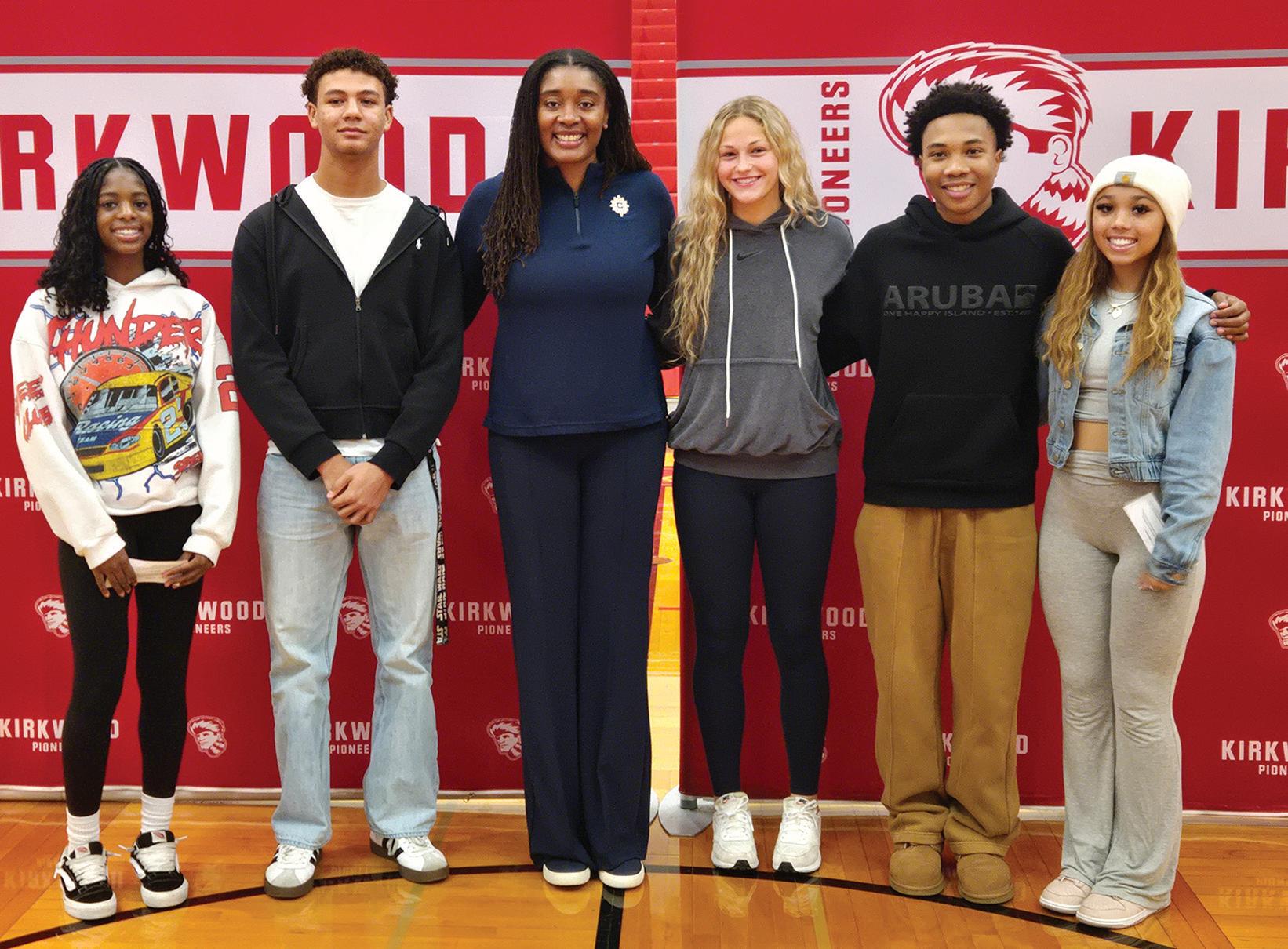










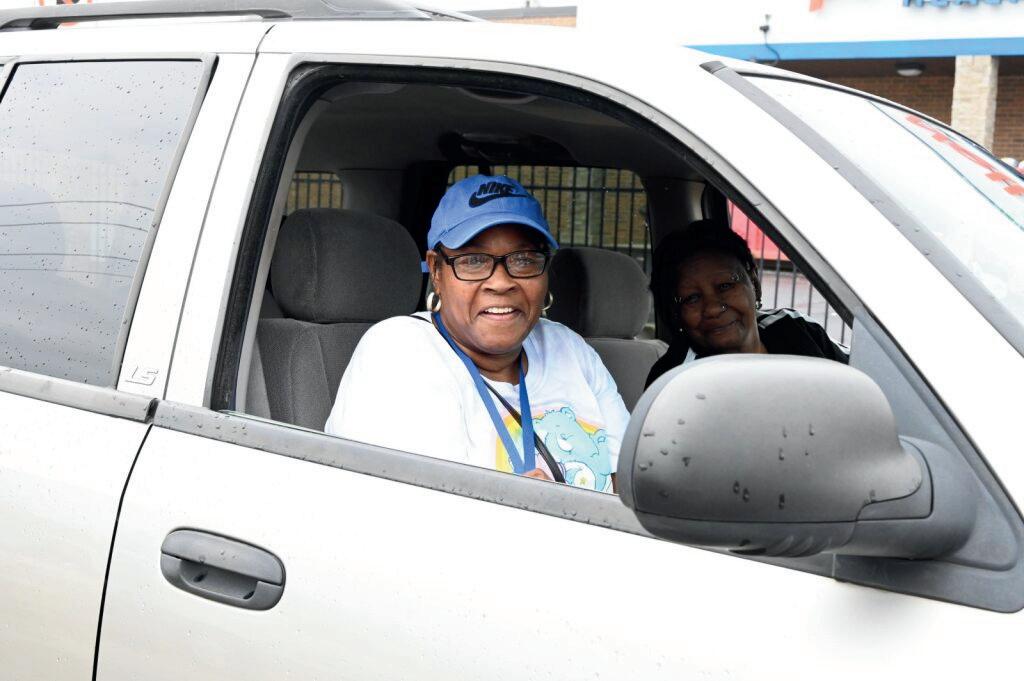

Photo courtesy of Kirkwood High School
Morgan Tuck, WNBA champion and General Manager of the Connecticut Sun, joins Kirkwood student panelists for a Q&A session following her keynote address on Thursday, November 6. Pictured left to right: Niah Brooks (8th grade, Nipher Middle School), Cruz Wise (10th grade, KHS basketball), Morgan Tuck, Brooke Rose (12th grade, KHS basketball), Noah Taylor (11th grade, KHS basketball) and Janell Burgett (12th grade, KHS, Black Achievement Culture Club).
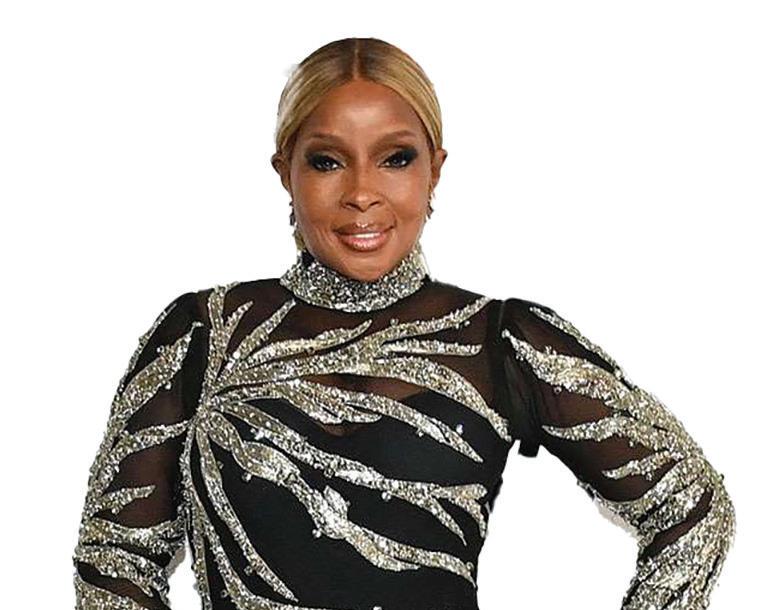
Living It
Culture, Fashion & Community Culture, Fashion & Community
“I just can’t believe that both of them are gone. If they let you in, that means you were special because they didn’t mess with a lot of people.”
- Mary J. Blige on the passing of D’Angelo and Angie Stone
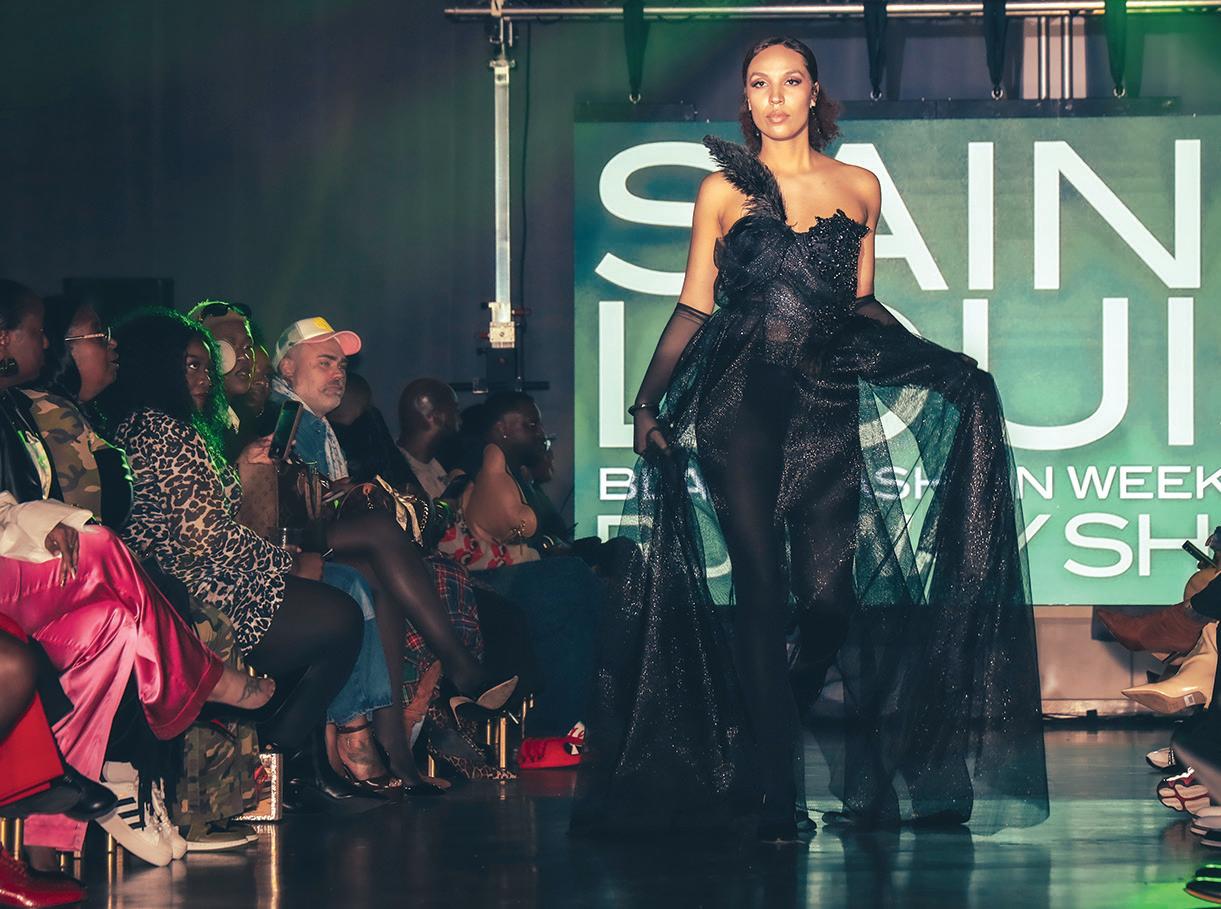
By Zaria Mac St. Louis American
Saint Louis Black Fashion Week 2025 affirmed what the style industry has always known: Black fashion doesn’t follow trends—it defines them. This year’s runway experience was a marvelous blend of culture, craftsmanship, and community.
The Palladium event space was nearly unrecognizable Sunday evening as it transformed into a glamorous, high-fashion runway for the week’s culminating show. Soaring white columns, sleek leather seating, and beams of light slicing through the air like searchlights gave the venue a Hollywood shimmer. Yet beneath the opulence, the night was rooted in something far deeper.
From the opening gospel medley that filled the room with soulful harmonies to the hip-hop and R&B beats that pulsed throughout the evening, this was more than a fashion show. It was a cultural
statement—a celebration of artistry, identity, and the creative spirit of St. Louis’ Black community. The evening opened with BPLR (Born Poor Live Rich), led by creative director
From bomber jackets and hoodies to polos and sweatshirts, each piece radiated confidence and resilience—streetwear that speaks volumes.
Ashley Jackson, who continues the legacy of her late husband, Quinton Jackson. She keeps his mantra, “It’s not about how you start, it’s about how you finish,” alive.
Models strutted to Chris Brown’s “It
Depends” and Don Toliver’s “Attitude,” wearing black-and-white ensembles sparkling with diamond embellishments. From bomber jackets and hoodies to polos and sweatshirts, each piece radiated confidence and resilience—streetwear that speaks volumes.
Darrius Whitfield, founder of Syrus Klothing, brought an urban edge to the runway. Inspired by his late brother and a mission to uplift others, Whitfield’s models marched to YC’s “Racks” and Louisiana Cash’s “Walk Wit a Dip” in oversized jackets, letterman bombers, and T-shirt dresses. Described as “up and coming, urban, and personal,” the collection was raw, authentic, and full of heart.
Designer Kasey Harvey, founder of Kyo-C—which translates to the Japanese word for “community”—took the audience on a journey of reinvention. Her
See FASHION, B3
John Legend gets lifted—again
Grammy winner brings his debut album’s 20th anniversary tour
to The Factory
By Kenya Vaughn St. Louis American
When John Legend released his debut studio album “Get Lifted” during the last week of December of 2004, he did the impossible. With singles like “Used to Love U” and the pop-crossover ballad “Ordinary People,” Legend managed to loosen the grip Usher had on the male R&B lane — a reign that stretched from the last three years of the 20th century to the first four years of the 21st century.
And Legend had the nerve to do so from behind a piano.
“Get Lifted” wasn’t just a debut. It was a declaration — that Legend wasn’t simply releasing music, but building a legacy.
Twenty years later, that legacy speaks for itself. In 2018, he became the second-youngest artist in history to achieve EGOT status. Now, he’s returning to where it all began with the “Get Lifted” 20th Anniversary Tour, which stops at The Factory on Monday, November 17.
“I love playing in St. Louis,” Legend said. “I’m especially excited to bring this particular tour to St. Louis. St. Louis and a few other Midwestern cities (Chicago, Detroit, Milwaukee) were some of the areas where I found the most love and

excitement for my debut album, I’m so ready to celebrate 20 years of ‘Get Lifted’ there!”
An Ohio native living in New York City, the album grew out of him writing songs that spoke to his experience.
“I was a young bachelor in my 20s,” Legend recalls. “I sang about love and loss, infidelity, reconciliation, commitment—everything in between.”
His musical inspirations were just as
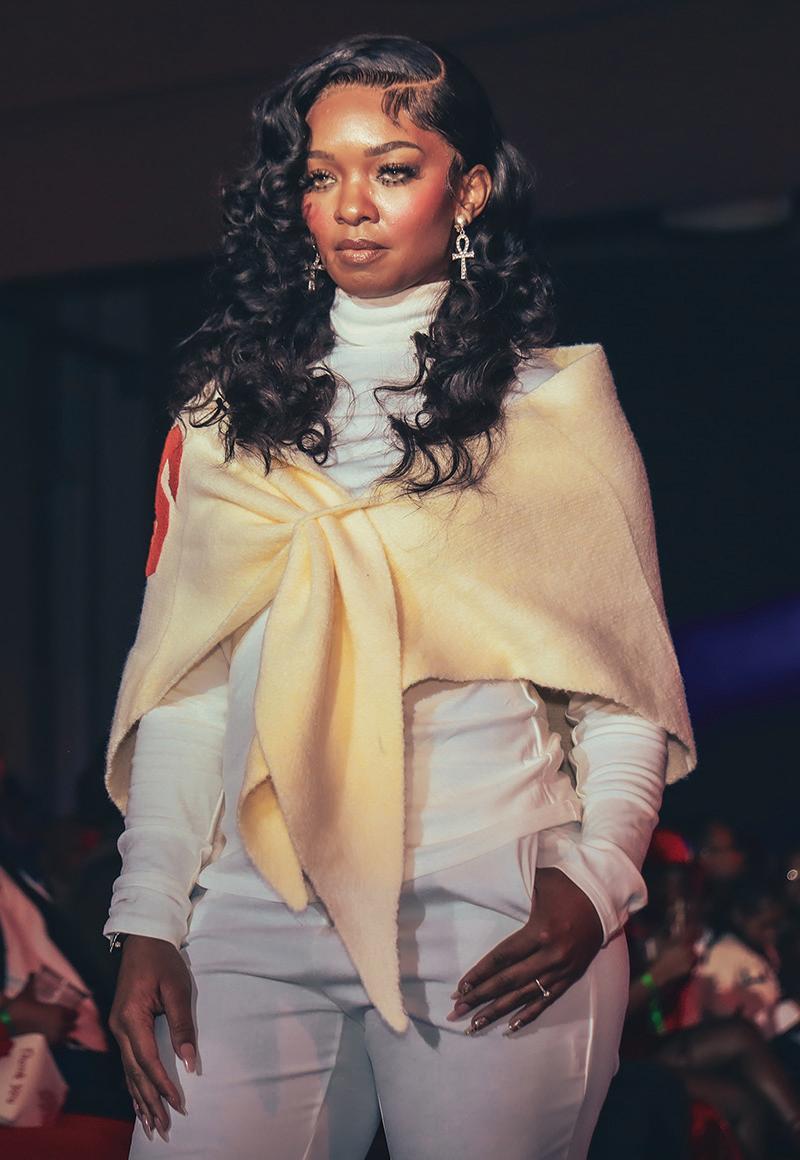

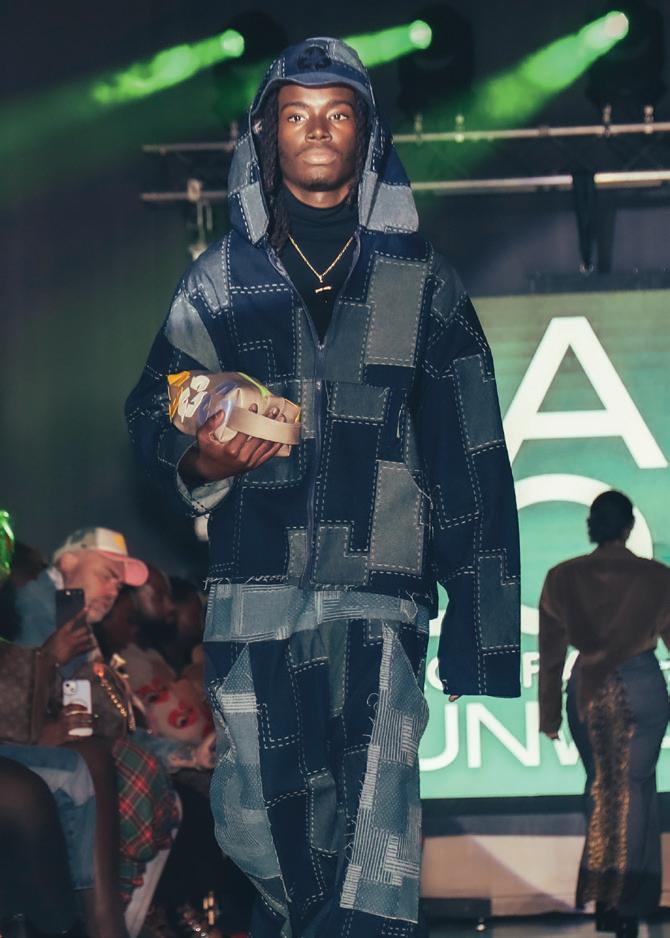
The
“I’m especially excited to bring this particular tour to St. Louis. St. Louis and a few other Midwestern cities (Chicago, Detroit, Milwaukee) were some of the areas where I found the most love and excitement for my debut album, ‘Get Lifted.’” John Legend
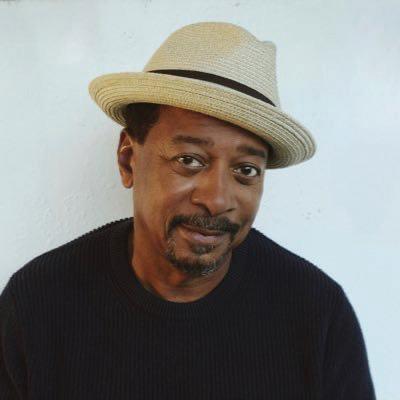
Black Hollywood legend Robert Townsend’s story comes to the stage in Kirkwood
layered: Marvin Gaye, Stevie Wonder, Kanye West, Lauryn Hill. That last name holds special weight. It was on her iconic debut solo studio album that Legend earned one of his first major label writing credits.
“I was still young and shy and not sure of what mark I could leave on this industry,” Legend said. “I’m so glad I had the
By Kenya Vaughn St. Louis American
Actor, director, filmmaker and producer Robert Townsend is bringing his oneman show ‘Living the Shuffle’ to the St. Louis region this weekend. The show will play Nov. 15-16 at The Kirkwood Performing Arts Center.
Photos by Taylor Marrie/St. Louis American
St. Louis and national designers ripped the runway for Saint Louis Black Fashion Week’s culminating fashion show Sunday night at The Palladium.
Photo courtesy of John Legend
CONCERTS
Thurs., Nov. 13, 6 p.m. & 9:30
p.m. Keke Wyatt, City Winery St. Louis, 3730 Foundry Way, St. Louis, MO 63110. For more information, visit https://citywinery.com.
Sat., Nov. 15 – Nov. 16, The St. Louis Symphony Orchestra presents The Lion King in Concert, Powell Symphony Hall. For more information, visit www.slso.org.
Sun., Nov. 16, 7 p.m. The Boy Is Mine Tour with Brandy and Monica with special guest Kelly Rowland and Muni Long, Enterprise Center, 1401 Clark Ave, St. Louis, MO 63103. For more information, visit www.enterprisecenter.com.
Mon., Nov 17, 6:30 p.m. doors, John Legend Get Lifted - 20th Anniversary, The Factory, 17105 N Outer 40 Road, Chesterfield, MO 63005. For more information visit, www. thefactorystl.com.
Wed., Nov. 19, doors 7 p.m.
Tye Tribbett with Mike Todd and Melvin Crispell, The Pageant, 6161 Delmar Blvd, St. Louis, MO 63112. For more information, visit www.thepageant.com.
Fri., Nov. 21, doors 7 p.m. Playadoors with Kudda & Friends, Delmar Hall, 6133 Delmar Blvd, St. Louis, MO 63112. For more information, visit www.thepageant.com.
Sat., Nov. 22, 8 p.m. Sexyy Red & Friends Glorilla, G Herbo and more, Enterprise Center, 1401 Clark Ave, St. Louis, MO 63103. For more information, visit www.enterprisecenter.com.
LEGEND
Continued from B1
courage to sit at that piano and show her what I could do. That one opportunity led to others and gave me the confidence to create my own body of work as an artist. But it also made me a part of history, as a small contributor to one of the greatest albums of all time.”
Last week he experienced a full circle moment when Hill joined him on stage for the tour’s Brooklyn stop.
“We’d never performed on stage together before,” Legend said. “It was incredible to have her grace our tour with her surprise appearance. I was on cloud 9 and the crowd was too.”
Legend’s body of work now spans decades, genres, and platforms. But “Get Lifted” remains foundational. “The songs were basically the demos I played for labels, hoping they would sign me,” he says. “For years, I tried and failed to break through. But eventually, I was signed to Columbia
STL Sites & Sounds

SPECIAL EVENTS
Fri., Nov. 14, 7 p.m. City Nights: Local Dive (21+), City Museum, 750 N 16th Street, St. Louis, MO 63103. For more information, visit https://citymuseum.org
Fri., Nov. 21, 7 p.m. New African Orleans: A Short Film and Concert with Senegalese composer Alune Wade, .Zack Theatre, 3224 Locust Street, St. Louis, MO 63103. For more information, visit https://kranzbergartsfoundation.org.
Sun., Nov. 30, 7 p.m. R&B Bowling After Dark, Tropicana
Records in May 2004.
Once I was signed, we re-recorded the songs in major studios in New York and LA.”
The album’s breakout single, “Ordinary People,” remains his favorite of all the songs he’s written.
“That song changed my life,” Legend says. “It will always be a quintessential part of my catalog.”
Two decades later, Legend is revisiting “Get Lifted” in full—on stage and in the studio. The deluxe remix LP features reimagined versions of the original tracks and new verses from artists he admires. “It was cool to give the music a new treatment.”
Beyond music, Legend’s creative reach has expanded into film, television, and publishing through Get Lifted Film Co. and Get Lifted Books. “Turn Me Loose,” a one-man show about St. Louis-born activist Dick Gregory, was one of his standout projects.
“Joe Morton is incredibly gifted, and making ‘Turn Me Loose’ was so cool,” Legend says. “I got to spend time with Mr. Gregory and his family.
What a life!”
Lanes, 7960 Clayton Rd, Richmond Heights, MO 63117. Purchase tickets here, www. eventbrite.com.
COMEDY
Fri., Nov. 14, 5 p.m. Gallery Laughs with Kym Whitley, St. Louis Art Museum, 1 Fine Arts Drive, Forest Park, St. Louis, MO. For more information, www.slam.org.
Fri., Nov. 14 - 16, Special Event: Bill Bellamy, Helium Comedy Club, 11151 St. Louis Galleria Street, St. Louis, MO 63117. For more
The same could be said for Legend, who has been politically engaged and committed to social justice since the beginning of his career.
“I always believed that was part of what it meant to be an artist,” Legend said. “I don’t want to waste my privilege and my platform. I have the opportunity to make the world better and I’m going to continue to use it.”
When he takes the stage Monday night, St. Louis audiences can expect their own full-circle experience.
“We do the entire ‘Get Lifted’ album plus some of my greatest hits,” Legend said. “We also play some of the songs from the pre-‘Get Lifted’ era that inspired me, and I tell some of the stories from that time leading up to my debut.”
Legend said the tour is a trip down memory lane, back to his first couple of tours.
“My day one fans are especially loving the nostalgia of it all,” Legend said. “And I’m loving this tour so much.”

information, visit https://st-louis. heliumcomedy.com.
Fri., Nov. 28 – Sun., Nov. 30, St. Louis’ own Lavell Crawford, Helium Comedy Club, 11151 St. Louis Galleria Street, St. Louis, MO 63117. For more information, visit https:// st-louis.heliumcomedy.com.
ST. LOUIS MUSIC
SPOTLIGHT
Fri., Nov. 21, 8 p.m. (7 p.m. doors) Through The Fire: A Chaka Khan Tribute featuring Cherise Louis Mason and Tish Period, Live By Loews, 799 Clark Avenue.
Through Dec. 31, 11 a.m. Jazz Sunday, Beatnik Bob’s in City Museum, 750 N. 16 St. St. Louis, MO 63103. For more information, visit https://citymuseum.org.
THEATRE
Fri., Nov. 14, 8 p.m. First Run Theatre Presents: Deposition, Kranzberg Black Box Theatre, 501 N Grand Blvd, St. Louis, MO 63103. For more information, visit https://kranzbergartsfoundation.org.
Nov. 15- Nov. 16, Robert Townsend: Living The Shuffle, Kirkwood Performing Arts Center, 210 E. Monroe Avenue, 63122. For more information, visit www.metrotix.com or call 314.534.1111.
Through November 16, The Repertory Theatre of St. Louis presents The Brothers Size, Emerson Studio Theatre, 130 Edgar Rd. Webster Groves, MO
63119. Matinee showtimes available. For more information, visit www.repstl.org.
Through Nov. 16, The Notebook: The Musical, Fabulous Fox, 527 N Grand Blvd, St. Louis, MO 63103. Purchase tickets here, www. metrotix.com.
Sat., Nov. 22, 7 p.m. IMPROV TROUPE: COCA IGNITES!, Center of Creative Arts, 6880 Washington Ave, St. Louis, MO 63130. For more information, visit www.cocastl.org.
Nov. 25- Dec. 7, The Fabulous Fox presents The Wiz. The Fabulous Fox. For more information, visit https://www.fabulousfox.com/
ART
Through February 1, 2026, Jennie C. Jones: A Line When Broken Begins Again, Pulitzer Arts Foundation and Museum, 3716 Washington Blvd, St. Louis, MO 63108. For more information, visit https://pulitzerarts.org.
Through February 8, 2026, Teresa Baker: Somewhere Between Earth and Sky, Contemporary Art Museum, 3750 Washington Blvd, St. Louis, MO 63108. For more information visit, https://camstl.org.
Through June 2026, The Future Is Female, 21c Hotel and Museum Hotel St. Louis, 1528 Locust St, St. Louis, MO 63103. For more information, visit https://21cmuseumhotels.com.
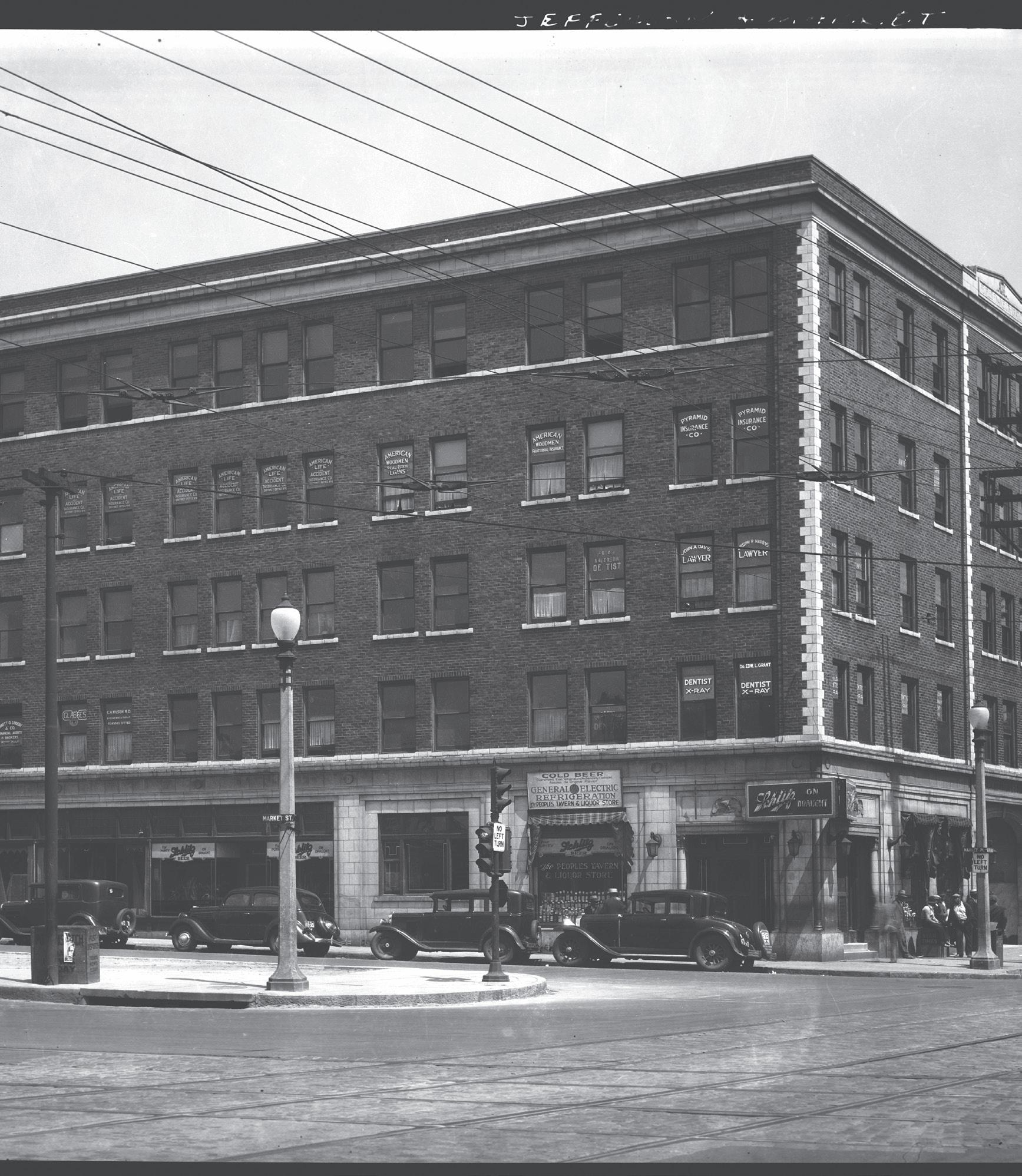


The St. Louis leg of the highly
TOWNSEND
Continued from B1
entertainment history have shaped the landscape as deeply and quietly as Townsend.
He is known for classics like “Hollywood Shuffle,” “The Five Heartbeats,” “Meteor Man,” and “BAPS*.” Townsend has spent over four decades building stories that mirror the Black experience with humor, honesty, and hope. Now, he’s taking audiences on a new journey with his one-man show, “Living the Shuffle,” coming to the Kirkwood Performing Arts Center November 15-16.
“I’ve been in this industry for a long time, and I’ve got these unbelievable stories — things people don’t believe really happened,” Townsend laughed. “So, I started performing them. I workshopped scenes with Ivana Chubbuck, one of Hollywood’s top acting coaches, and began touring it around the country. It’s really my life — on stage.”
One of his favorite stories is how he met Keenen
FASHION
Continued from B1
grunge streetwear collection celebrated sustainability and upcycling. Models walked with intention to Victoria Monét’s “Take Me Thru Dere” and “On My Mama,” wearing cheetah prints, denim patchwork, and inventive pieces like shirts made from men’s ties. Harvey called them, “classic pieces reimagined.” And they were. Energy soared as Lillian Tiner introduced her children’s brand, LAHA Clothing. A coach to young models aged 5 to 16, Tiner filled the room with color and joy. Her models twirled to Cardi B’s “Hello,” sporting bright wigs in blue, pink, and green. Outfits layered with ruffles, tulle, and faux fur radiated playfulness. The little models beamed with pride, embodying the growth and confidence Tiner nurtures in her pupils.
Designer and model Pierre McCleary brought sophistication and empowerment with her brand, 1026 Styles. Models
Ivory Wayans at an audition and became writing partners for “Hollywood Shuffle.” Together, they created a bold response to the flood of negative depictions and stereotypes of Black people on screen — and forged a lifelong friendship in the process.
“I’m so excited to come to Kirkwood and just be on stage and feel people’s energy,” Townsend said. “There’s nothing like a live response.”
“Living the Shuffle’s” stop in St. Louis is more than a tour date.
“My co-producer, Don Reed, told me about the Kirkwood theater — said it was beautiful, and I had to experience it,” Townsend shares. “But my family’s here too. My grandfather is from St. Louis.” Townsend’s Aunt Janet lives in the St. Louis region, and will be coming to the show this weekend.
Because of Townsend’s late grandfather, Charlie Marshall, St. Louis can claim a part of his success. “A lot of my love of movies came from him,” Townsend said. “He loved all kinds of movies.” Marshall passed that love down to his grandson when the Chicago native spent summers in his
walked to Victoria Monét’s “Alright” and Beyoncé’s “Cozy” in structured silhouettes, pleated details, and bold pastels. From sharp blazers and power blouses to satin gowns and statement gloves, McCleary’s collection captured a modern boss-girl aesthetic—feminine, fierce, and self-assured.
Karla Burgett’s KB Made It added a luxurious twist. A St. Louis native, Burgett channeled the sophistication of fashion houses like Dolce & Gabbana with a contemporary flair. Models glided to Lil Baby’s “My Dawg” and Chief Keef’s “Fanito” in maroon satin gowns, fur bombers, tweed skirts, and leather corsets. The standout piece—a silver ruched satin gown with a sweetheart neckline— shimmered under the lights, marrying elegance and boldness in one unforgettable moment.
Designer Julius Evans, founder of Wej, continued the theme of reinvention with a refined streetwear collection. Dreaming of department store shelves, Evans showcased tailored cotton-duck fabrics reminiscent of Carhartt, elevated with high-fashion finesse. Models strutted to

“Living the Shuffle” isn’t just a timeline of Robert Townsend’s life and industry success. The show is an emotional excavation of a dreamer who made it – thanks to radical faith, resilience and imagination.
mother’s hometown of Hannibal, Missouri.
In fact, after he finishes his Kirkwood run, he will be driving to Hannibal.
“I’m going to head there to see some relatives, and have some Maid Rites (a Midwest restaurant chain that specializes in loose
Drake’s “Hotline Bling” and Glorilla’s “I Love Her” in patchwork denim, fur-trimmed coats, and oversized hooded jackets—a blend of rugged utility and polished sophistication.
The grand finale belonged to Beeombi, the couture brand by celebrity designer Derron Cherry, whose clients include Oprah Winfrey and Nia Long. As a soft lo-fi jazz orchestra played, models sashayed in breathtaking creations of feathers, sequins, and satin. From asymmetrical cuts and pearl accents to flowing chiffon skirts, every detail exuded refinement. One showstopper—a jewel-encrusted corset with a high slit and cascading pearl strands—drew audible gasps. Cherry’s designs weren’t just garments; they were moving works of art.
By night’s end, the applause was thunderous. The show was more than a display of style—it was a celebration of Black artistry, resilience, and unity. From emerging voices to seasoned creators, each collection reflected the richness and diversity of Black expression in fashion.
meat ground beef sandwiches),” Townsend said. “That’s a hometown specialty!”
“Living the Shuffle” isn’t just a timeline of his life and industry success. The show is an emotional excavation of a dreamer who made it – thanks to radical faith, resilience and imagination.
“There’s a story in the show about the time Frank Sinatra called to say he loved ‘The Five Heartbeats’ — and then sent a private jet to Vegas for his 77th birthday,” Townsend teases. “You won’t believe what happens next. But you’ve got to come to the show to hear it.”
The show includes celebrity encounters, but the resounding theme is the faith and fortitude that made “Hollywood Shuffle” possible — a film Townsend co-wrote, directed, and financed independently with $100,000. “Hollywood Shuffle” was shot in 12 days. “That movie was made on pure hustle,” Townsend said.
The film went on to make $8 million, a pay day that turned Townsend into a millionaire. The box office jackpot wasn’t the true measure of the film’s success. The “no excuses, all heart” pathology of “Hollywood Shuffle” became a blueprint for creatives who were balked at by the mainstream film industry for their efforts to tell authentically Black stories. The film served as a blueprint for a new generation of Black guerilla filmmakers, like Tyler Perry— and Townsend himself.
Whether it’s the soul of “The Five Heartbeats” or “Holiday Heart’s” groundbreaking portrayal of family and identity, Townsend’s work has always centered on human truth, fortitude and the power of family. That same spirit drives “Living the Shuffle.” “I want to bring joy, but also inspiration,” Townsend said. “When people leave, I want them to say, ‘I’m not an actor or a filmmaker — but I’m ready to live my dream.’”
Townsend’s impact stretches across generations — from the Wayans comedy empire to Dave Chappelle and
the comedians and filmmakers of today. “Dave told me, ‘You raised me,’” Townsend said. “He said, ‘‘Partners in Crime’ was the blueprint for ‘Chappelle’s Show.’’ That’s the highest compliment.”
The reverence goes both ways. Townsend beams when fans tell him about the emotional connections they have with his body of work, like the fan that told Townsend that their family watches “The Five Heartbeats” every Thanksgiving. “It’s one thing to say, ‘I love your movie,’” Townsend said. “It’s another to say, ‘This is part of my life.’ That’s the power of art.” He’s confident that his artistic power will translate on stage through “Living the Shuffle.”
“If you want to see an artist painting on a canvas like never before — a show that’ll make you laugh, cry, and inspire you — this is the show for you,” Townsend said. It’s a promise from a man who’s been blending heart, humor, and history his entire career. From the west side of Chicago to the lights of Hollywood, Robert Townsend is still living the shuffle — and reminding us all that dreams don’t expire; they just evolve.
“Living the Shuffle” will play November 15-16 at the Kirkwood Performing Arts Center, 210 E. Monroe, Kirkwood, MO 63122. For tickets, showtimes and additional information, visit www. metrotix.com.


Courtesy Photo

The galas just keep on going! Even though my body was still bruised and battered from squeezing this 2X shape in a medium pair of Spanx for Salute, nothing but death could have kept me from the Kwame Foundation’s Gala Friday night at the Ritz. I had to be in the building to see my best work friend Dr. Suggs receive the Lifetime Achievement Award. He’s so low key that he will probably feel a type of way that I mentioned him. If it gets out, I know it was one of y’all. But anyway, I’m so glad I listened to my inner voice and decided against plopping “Aunt Brenda” (my cropped cocktail wig) on this head, dusting my most bedazzled Burlington Coat Factory moo-moo and jazzing it up with a belt and some bedazzled flats. What? Dr. Suggs knows that the only gala I usually only dress like I have a fulltime job with benefits and a place to live is for Salute! Anyway, I’m so glad that I fought through the pain and tried to look like something, because I would have been too shame to be in that banquet room full of baddies! They clearly came to slay – and many of them slayed last week at Salute, too! Kaci and Mellve Shahid refuse to get off our necks! If she had called me on the phone and said, “I’m wearing a pea green velvet gown,” I would have replied, “put it in the fire pit!” And yet, on Kaci, I wanted to ask if it came in an 18W. I was shook by her gown, and his velvet black tux. And don’t even get me started on Shaunte Shields Ryan and that “living my life like it’s golden” gown of hers! She was serving Nicole Murphy
with a sip of Wendy Raquel Robinson! And after seeing him Friday night, I’m convinced that Kwame Thompson is gonna be fine forever. I’m not being fresh; I’m just stating facts! And while I’m talking about him, I have to point out that as dignified as his remarks were, he still pulled a “U City” out of the bag. What did they give y’all over there? Because y’all will rep any time and any place and under any circumstances ! I promise, I have never been to the funeral of anyone from U. City, because I’m legit afraid that if somebody starts reppin’ they might prop up out the casket on us! But back to the gala, it was wonderful and I want to congratulate the whole Kwame Foundation team for what they are doing for our young people!
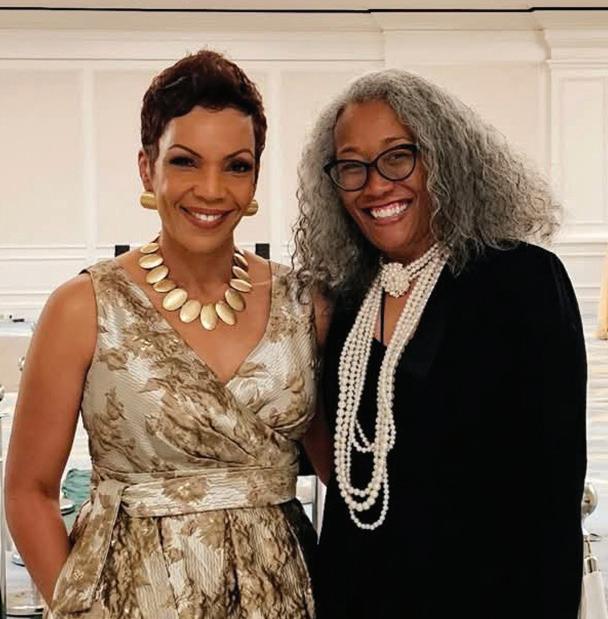
Black Fashion. Period! Now I know I’m a week late with this, but I wanted to give T.Moore and his team plenty of space to shout out the wonderful experience they provided us with the Saint Louis Black Fashion Week Runway Show last Sunday at The Palladium. They had me feeling like I was somebody with those beams of light slicing through the air like we were on a movie set. I got my whole entire life from the ambience – and the outfits! The energy was electric and the clothes had me ready to pull out the handheld sewing machine I bought at Aldi and pull some lewks (yes, lewks) together! Who am I kidding? My creations could never compare! All of the designers brought that thunder! BPLR’s diamond-studded streetwear, Kyo- C’s creative upcycled denim, our favorite home-

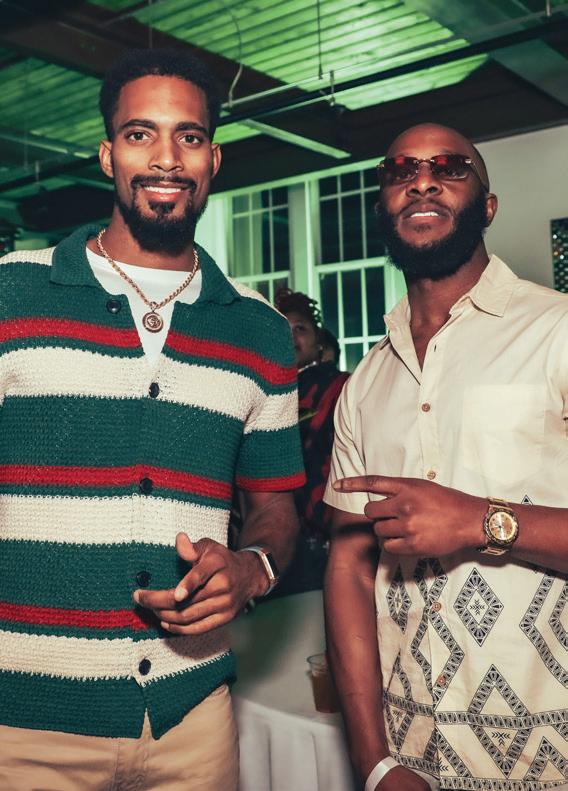
full of waffles, eggs, and wings, washed down with margaritas on the side—because who needs rules when it’s brunch in the Lou? Jarrion Stacker of JStackz Entertainment was the birthday boy, but all eyes were on celebrity host (Omari Hardwick 2.0) Tyler Lepley Some ladies froze up when they saw him, others brought that bold St. Louis energy—walking right up and demanding a picture. He seemed cool enough, but I heard he can be standoffish. But the STL girls don’t have time for that! Don’t believe me, ask the lovely lady in the fur coat and leather shorts – who made sure to show Tyler what she was twerking with. I wanted to go up to her and say, “Ma’am, he’s not single! DJ Climate kept the vibes perfect, mixing Sexyy Red for the ladies as well as Future and Yo Gotti for the fellas.
girl Pierre McCleary brought the boss-lady fits — it was art, power, and pride all stitched into fabric. And don’t even get me started on LAHA! Lillian, girl, you’ve done it again, again and again – and yet somehow blow me away every single time! By the time Derron Cherry’s couture finale floated down the runway, I was clapping like I was front row at Paris Fashion Week! It wasn’t just fashion — it was us, shining. I left that building feeling like I’d been sprinkled in stardust – and ready to rip the runway my own doggone self!
Celebrity Brunchin’ at The Marquee. Only in St. Louis can brunch turn into a full-blown day party. This past weekend’s “Birthday Behavior” Brunch at Marquee Nightclub proved it. Produced by the ever-so-talented Morgan Casey of Date Ideas and Things to Do, this wasn’t your regular mimosa meetup. The crowd came dressed to impress. Thank God the temperature dropped, or some of y’all would have evaporated in that fur and those boots! I was here for every bit of the knit dress and lace tights combos the girls were serving! Plates were
Thanks, and giving at Bliss! Since I already talked U. City up, was I the only one so excited I almost fell off my futon when I saw the promo Nelly posted on IG about the upcoming party at Bliss? He had my FULL attention when he said, “We ain’t trying to make no money, we trying to raise money.” All of the proceeds will go to help feed families in St. Louis this Thanksgiving. And just when I thought I couldn’t be any more shook, he said “Y’all whatever we raise, I’m doubling it!” It’s going down this Saturday (November 15) at Bliss (11836 W. Florissant). Doors open at 7 p.m. and the party is powered by Topher.

Garden Glow is back at the Missouri Botanical Garden, and it’s brighter than ever. Enjoy all the wonder you’ve come to love, plus dazzling new displays just waiting to be discovered. Then make the season even sweeter by sharing festive treats and beverages with family and friends. It’s the most magical way to celebrate the season.
For tickets and information, visit mobot.org
1. Shaunte Shields Ryan and Linda Robinson on the green carpet for the Kwame Charitable Foundation Gala Friday night at The Ritz-Carlton St. Louis
2. Briana Isom-Brummer and Alexis J. Davis brought their own style to Saint Louis Black Fashion Week at The Palladium last Sunday
3. Nick Dawson and Stephan Hickman were two of many dapper gents who hit up Saint Louis Black Fashion Week last Sunday at The Palladium Photos by
“Humbly speaking, I’m the best rebounding guard ever.”
—Russell Westbrook
PreP Football Notebook
With Earl Austin Jr.
CBC, Lafayette put perfect records on the line Friday
There will be some championship hardware handed out this weekend as Missouri high school teams play for district titles on Friday and Saturday.
The biggest matchup of the weekend will be at CBC on Friday night when the host Cadets take on Lafayette in the Class 6, District 2 title game. Both teams enter the contest with perfect 10-0 records. Kickoff is set for 7 p.m. Here is a look at the other district championship games involving St. Louis area teams. All games are scheduled for Friday at 7 p.m. unless otherwise noted.
Catholic St. Clair at Borgia
Ladue, Lift for Life pull off big comeback wins
Ladue and Lift for Life advanced to Friday night’s championship games after rallying from big deficits to pull off dramatic victories.
Class 6 Northwest Cedar Hill at Jackson Ritenour at Pattonville, Saturday, 1 p.m. Troy at Fort Zumwalt West
Class 5 Eureka at Kirkwood Ladue at Cardinal Ritter Parkway West at Fort Zumwalt North
Class 4 North County at Festus Sullivan at Vianney
Lutheran North at St. Mary’s, Friday, 6 p.m. Orchard Farm at Parkway North, Friday, 6:30 p.m.
Class 3 Lift for Life at Valle
Ladue was trailing host Hazelwood East 19-0 with less than eight minutes left in their Class 5, District 3 semifinal game. The Rams proceeded to score 21 unanswered points to score an improbable 21-19 victory. Lift for Life fell behind Ste Genevieve 21-0 in the first half of its Class 3, District 2 semifinal game. The Hawks stormed back to score the next 34 points and went on to post a 54-41 victory.
Standout Playoff Performers from last week
Jonathan Moore (Lutheran North): The junior quarterback threw three touchdown passes and rushed for another score in the Crusaders’ 34-0 victory over Gateway STEM.
Myson Johnson-Cook (East St. Louis): The junior running back rushed for 257 yards on 12 carries and three touchdowns, including a 99-yarder, in

the Flyers’ 53-14 victory over Chatham-Glenwood.
Reese Shanklin (East St. Louis): The junior quarterback completed 13 of 16 passes for 301 yards in the Flyers’ 53-14 victory over ChathamGlenwood.
Jeff Jackson’s office is abuzz with activity throughout the year, and his schedule as Missouri Valley Conference commissioner keeps him on the move.
Alvin A. Reid
While many St. Louisans are familiar with the MVC Arch Madness men’s basketball tournament that tips off annually in March at the Enterprise Center, Jackson oversees a conference that fields 18 sports, eight men’s and 10 women’s.
Five of its member universities compete in Division I FCS football. Two others compete in the Pioneer Football League, which is also D-1 FCS.
Two weeks ago, Jackson was at the men’s cross-country championship in Evansville, Indiana, then made it to Sioux Falls for a football clash between South Dakota and North Dakota. On Sunday, Jackson was in Normal, Illinois, to watch the University of Illinois-Chicago top
Chatham-Glenwood.
Nick McClellan (CBC): The senior quarterback rushed for 188 yards and a touchdown and passed for 188 yards and two touchdowns in the Cadets’ 56-35 victory over DeSmet.
Vic Williams (CBC): The senior running back rushed for 118 yards on 10 carries and two touchdowns in the Cadets’ 56-35 victory over DeSmet.
Jayden Burleson (Fort Zumwalt North): The junior running back rushed for 147 yards on 18 carries in the Panthers’ 45-0 victory over Timberland.
Manny Ellis (Cardinal Ritter): The senior running back rushed for 214 yards on 22 carries and two touchdowns in the Lions’ 44-7 victory over Chaminade.
Jerail West (Pattonville): The junior wide receiver had five receptions for 141 yards and a touchdown in the Pirates’ 56-0 victory over Hazelwood West.
Sam Deen (Vianney): The senior quarterback completed 14 of 22 passes for 224 yards and two touchdowns in the Golden Griffins’ 49-14 victory over Westminster.
SPortS eye
With Alvin A. Reid
Ronnie Gomiller (East St. Louis): The junior wide receiver had five receptions for 181 yards and a touchdown in the Flyers’ 53-14 victory over
Jackson has MVC on the move
Illinois State University on penalty kicks to claim the MVC women’s soccer championship.
“Sometimes I can get bogged down in the minutiae. When I get to some events, it’s great to see the kids having fun,” he said.
He noted it is also satisfying to see MVC teams “win games in NCAA tournaments.”
Jackson’s home is also in the St. Louis area, which he calls “beautiful.” He adds that its location makes Arch Madness a manageable drive for fans attending the tournament.
“St. Louis is such a central location. It’s a natural nexus point,” Jackson said.
Jackson began his tenure as MVC commissioner in July 2021, and his impact was immediate. The college athletics landscape was also about to dramatically change Belmont, UIC, and Murray State joined the MVC that year, which expanded the conference to 12 members for the first time in its 117-year history.
Jackson ushered in the era of NIL (Name, Image, Likeness) and expanded the league’s television package.
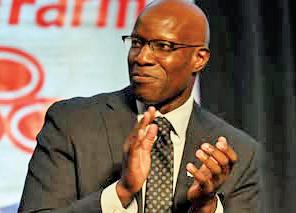
He describes himself as an avid reader, but NIL has limited his time with novels and non-fiction works.
“Now, it’s reading contracts and legislative proposals. It’s time consuming, but that’s the gig,” he said.
Jackson said MVC schools “have embraced NIL.”
“Our members look at it as long overdue. We look at it as an opportunity to reward student athletes that certainly bring something to their campuses. It’s a cost to be productive on the national stage.”
Jackson was appointed MVC commissioner after serving as executive
associate commissioner of the Big 12 Conference. Among his responsibilities were coordination of the Phillips 66 Big 12 Men’s Basketball Championship and officiating management.
He had previously served as Big South Conference deputy commissioner.
A former collegiate basketball player, Jackson would coach for three decades including guiding Furman as head coach from 2006-13. He was at the helm of New Hampshire University from 1996 to 1999 before becoming an assistant coach and recruiting coordinator at Vanderbilt
Jeff Jackson, Missouri Valley Conference commissioner, favors expanding the NCAA men’s basketball tournament to 76 teams.
University from 19992006.
When “Selection Sunday” for the NCAA men’s basketball tournament begins each year, Jackson admits to being anxious “because I want [our teams] to be appreciated. The Arch Madness champion earns an automatic bid to the NCAA Tournament, but it has been difficult getting a second team an invitation.
“I’m an advocate of expanding the [NCAA Tournament] field to 76 teams,” Jackson said. Jackson also applauds Chris Zimmerman, St. Louis Blues president and CEO, and Todd Mitchell,
Keenan Harris (SLUH): The senior running back/linebacker rushed for 241 yards and two touchdowns and had eight tackles on defense in his final game as a Jr. Billiken in their loss to Lafayette.
Carter Dowell (Troy): The senior running back rushed for 227 yards on 23 carries and two touchdowns in the Trojans 48-20 victory over St. Dominic.
vice president and general manager at Enterprise Center, for helping the MVC stage one of the nation’s top-rated tournaments. Jackson’s office and MVC headquarters on Chouteau Avenue is within walking distance of the Enterprise Center. Before he makes that walk in March, Jackson will be doing a lot more traveling by air.
The Reid Roundup
Lenny Wilkens, one of the classiest former professional athletes and coaches I ever interviewed, passed away on Sunday, Nov. 9, at age 88. Wilkens’ Hall of Fame career began with the St. Louis Hawks. He played here for eight seasons before being traded to Seattle in 1968, where he served as player-coach until 1972. He led the SuperSonics to the franchise’s only NBA title in 1979. Wilkens coached Team USA when the men’s basketball team won the gold medal in the 1996 Atlanta Olympics. He was inducted into the Hall of Fame for his college, professional, and coaching careers.
Earl Austin Jr.
Senior wide receiver Tony Woolfolk Jr and the Lift for Life Hawks will visit Ste Genevieve Valle on Friday night in the Class 3, District 2 championship game. Kickoff is at 7 p.m.
Photo by Earl Austin Jr. / St. Louis American
Photo courtesy of MVC


Washington University in St. Louis offers rewarding opportunities in various fields at all levels, with positions in engineering, nursing and health care, research, administration, technology, security and more.
WashU is currently recruiting for a Medical Assistant II - FPP Ambulatory Cancer Building
You will be responsible for preparing and maintaining the exam rooms, preparing charts, and obtaining reports and records. You will also be responsible for assisting with patient flow and ensuring the overall smooth running of the clinical office.
WashU is currently recruiting a Clinical Service Representative II - Faculty Practice Plan
You will provide clinical office support including greeting and registering patients, scheduling appointments, verifying insurance benefits and referrals, and collecting co-payments.
Up to 22 days of vacation, 10 recognized holidays, and sick time. Competitive health insurance packages with priority appointments and lower copays/coinsurance. Take advantage of our free Metro transit U-Pass for eligible employees. WashU provides eligible employees with a defined contribution (403(b)) Retirement Savings Plan, which combines employee contributions and university contributions starting at 7%.
For the full job description and to apply, visit jobs.washu.edu, JR90419 or JR90286
We seek people from diverse backgrounds to join us in a supportive environment that encourages boldness, inclusion, and creativity. EEO/AA/VET/Disability Employer
ST. LOUIS MENTAL HEALTH BOARD (MHB)
Accepting Letters of Interest from November 3 –November 21, from qualified organizations with experience providing behavioral health and prevention services for St. Louis city residents. Some organizations will be invited to submit a full application due in January 2026, which may result in financial support. Details available at www.stlmhb.org
BID NOTICE: MCKELVEY RIDGE PROJECT
Fairway Construction seeks bids from subcontractors, suppliers, and MBE/WBE businesses covered under the HUD Act of 1968 for the construction of: McKelvey Ridge
• 60 units, 66,664 sq ft Multi-family apartment building
• Location: 12204 McKelvey Rd, Maryland Heights, MO 63043.
Minority and WomenOwned Businesses are encouraged to apply. MWBE certification assistance available: call 470-367-2639.
Proposals accepted for all work divisions.
Bids Due: 11/13/2025
For bid documents, contact: Aslam Hayath ahayath@ fairwayconstruction.net
Fairway Construction 3290 Northside Pkwy, Suite 310 Atlanta, GA 30327 (404) 935-0077
FWC is an AA/EOE Employer and reserves the right to waive any bid informalities.
REQUEST FOR PROPOSALS FOR ENVIRONMENTAL REMEDIATION & DEMOLITION
4690
AND 4700 GOODFELLOW BOULEVARD
Issued: November 5, 2025
Responses Due: November 26, 2025
The Land Clearance for Redevelopment Authority of the City of Saint Louis (“LCRA”) invites proposals for environmental remediation and demolition services to support the preparation and redevelopment of commercial and industrial properties located at 4690 and 4700 Goodfellow Boulevard.
LCRA is seeking a qualified firm to perform the environmental remediation, hazardous materials abatement, and demolition work required to prepare the properties at 4690 and 4700 Goodfellow Boulevard for future redevelopment.
Responses will be received at 1520 Market Street Suite 2000 St. Louis, Missouri 63103 (Attention: LCRA) and STL City Permits, city website, SLDC website until 2:00 p.m. on November 26, 2025.
The services to be provided through this RFP will be funded by The Coronavirus State and Local Fiscal Recovery Fund allocated to the City of St. Louis by the United States Department of the Treasury and passed through the City’s Community Development Administration to LCRA. The project may also be partially funded through an EPA.
The full invitation and all other documents may be downloaded at: https://www.stlouis-mo.gov/government/procurement. cfm
NOTICE TO CONTRACTORS
Sealed bids for the NFL Fund Subdivision Program Package 5 project, St. Louis County Project No. CR-1936, will be received electronically thru the County’s Vendor Self Service portal at https://stlou iscountymovendors. munisselfservice. com/Vendors/default. aspx, until 2:00 PM on December 10, 2025.
Plans and specifications will be available on November 10, 2025 from the St. Louis County Web Site (www.stlouiscounty mo.gov) or by contacting Cross Rhodes Print & Technologies, 2731 South Jefferson Avenue, St. Louis, MO 63118 (314) 678-0087.
DIRECTOR OF PROCUREMENT ST. LOUIS COUNTY
REQUEST FOR PROPOSALS
STL Partnership Advocacy solicits proposals to provide liaison services with state-level governmental officials, agencies, and elected representatives for up to a three-year period. A copy of the full RFP is available at https:// stlpartnership.com/rfprfq/. Submissions should be received no later than 3 PM CT on Friday, December 12, 2025 Equal Opportunity Employer
ADVERTISEMENT FOR BIDS
Sealed proposals for Food Service Management will be received at Epworth
Children & Family Services, Inc., 110 N. Elm Ave. St. Louis, Mo. 63119 until 9:00 am on Saturday, January 31st, 2026 and then publicly opened. To receive copies of November 1st, 2025, RFP or for more information contact Kimberly Mims at (314) 918-3400.
PUBLIC NOTICE
Notice is hereby given that the Metropolitan St. Louis Sewer District Requests for Quotes, Bids and Proposals are posted online for public download. Please navigate to www.msdprojectclear.org > Doing Business With Us > View Bid Opportunities
SEALED BIDS
Bids for New Campground at Missouri State Fairgrounds, Project No. F2307-01 REBID, will be available for public bid in December 2025. When released, bid documents will be available at: http://oa.mo. gov/facilities
NEIGHBORHOOD AFFORDABLE HOUSING PLAN
Seeking experienced urban planning firm to develop an affordable housing plan for the West End / Visitation Park Neighborhood
Please send statement of qualification and list experience to WeCollab c/o Cornerstone 6026 Etzel St. Louis, MO 63112
REQUEST FOR PROPOSALS
STL Partnership Advocacy solicits proposals to provide liaison services with federal-level governmental officials, agencies, and elected representatives for up to a three-year period. A copy of the full RFP is available at https:// stlpartnership.com/rfprfq/. Submissions should be received no later than 3 PM CT on Friday, December 12, 2025. Equal Opportunity Employer
EVENT TENT PORTABLE
RESTROOM II
RFP 2025
The Saint Louis Zoo seeks bids from qualified firms to submit proposals. Bid documents are available as of 11/12/25 on the Saint Louis Zoo website: stlzoo.org/vendor
1:30
SEALED BIDS
Bids for Constructions Services –East Region, Project No. IDIQMCA6004, will be received by FMDC, State of MO, UNTIL 1:30 PM, November 20, 2025. Project information available at: http://oa.mo. gov/facilities
SEALED BIDS
Bids for HVAC Improvements at Fulton Reception and Diagnostic Center, Project No. C240601, will be received by FMDC, State of MO, UNTIL 1:30 PM, December 18, 2025. Project information available at: http://oa.mo. gov/facilities
SEALED BIDS
Bids for Bronze Door Vestibule, Missouri State Capitol Building, Jefferson City, Missouri Project No. O2203-02 will be received by FMDC, State of MO, UNTIL 1:30 PM, December 18, 2025. Project information available at: http://oa.mo. gov/facilities
ST. LOUIS HOUSING AUTHORITY
SOLICITATION RD26-02 UNIT REPAIRS
Parkview Elderly Apartments 4451 Forest Park Ave, St. Louis, MO 63108
The St. Louis Housing Authority (SLHA) seeks bids to perform the following project:
The replacement/repair of all damaged flooring, walls, ceilings, electrical, light fixtures, plumbing, HVAC, door and door hardware, and attachment components as noted on the plans and specifications at the Parkview Elderly located at 4451 Forest Park Ave., St. Louis, MO 63108. Performance period to be 120 days.
The pre-bid conference will be held at 10:30 AM on Tuesday, November 18, 2025 at the project site.
Sealed bids are due at 1:00 PM on Tuesday, December 16, 2025 via QuestCDN or hand delivered to the SLHA Main Office at 3520 Page Blvd, St. Louis, MO 63106.
Latasha Barnes Contracting Officer
AN EQUAL OPPORTUNITY EMPLOYER
REBID
REQUEST FOR PROPOSALS #: 57825315
Project Representative to Support Project Director and Help Coordinate and Enhance Services to Victims and Survivors of Sexual, Domestic, Stalking and Dating Abuse
Harris-Stowe State University (HSSU) is requesting proposals from qualified individuals or organizations to provide the above listed requirement.
If interested, a copy of the request for proposals can be obtained by emailing Barbara A. Morrow at email address: morrowb@hssu.edu and freemanc@hssu. edu.
Proposals are due no later than 10:00 a.m. Central Standard Time (CST) on Tuesday, December 2, 2025 and must be emailed to: morrowb@hssu.edu and freemanc@hssu.edu
The University reserves the right to accept or reject any or all responses received, or to cancel this request in part or in its entirety if it is in the best interests of the University to do so.
CITY OF PINE LAWN
Sealed Bids Needed for Bid Opening @ Pine Lawn City Hall (6250 Steve Marre Ave.)
5:30pmThursday -November 20, 2025 for:
1. New roof over City Hall &Police Bldg.
2. Demo of Existing Damaged Salt Shed Roof
3. HVAC for Court Room Bid Specs available @ City Hall or call 314-261-5500 (press 1)
REQUEST FOR QUALIFICATIONS
Great Rivers Greenway is requesting qualifications for Project Controls Software to assist GRG with its Capital Budget projects. Go to www.greatrivers greenway.org/ven dors and submit by December 11, 2025.
REQUEST FOR BIDS
Great Rivers Greenway is requesting Bids : Guardrail repair, pedestrian gate and fence installation. Go to www.greatrivers greenway.org/bids and submit by November 18, 2025.



NOTICE TO SMALL (SBE), DISADVANTAGED (DBE), MINORITY (MBE), & WOMEN’S (WBE), SERVICE DISABLED VETERAN OWNED (SDVOB) & VETERAN OWNED (VOB) BUSINESSES ADVERTISEMENT
RIVER CITY CONSTRUCTION, L.L.C., 6640 AMERICAN SETTER DRIVE, ASHLAND, MISSOURI 65010, (573) 657-7380 (PHONE) (573) 657-7381 (FAX) IS SEEKING QUALIFIED SMALL, DISADVATANGED, MINORITY, & WOMEN’S BUSINESSES FOR THE UNIVERSITY OF MISSOURI MEMORIAL STADIUM FACILITIES –CONCOURSE RESTROOM & CONCESSION STAND UPGRADES FOR THE SUBCONTRACTING OPPORTUNITIES IN THE FOLLOWING AREAS: SELECTIVE DEMOLITION, CONCRETE, MASONRY, THERMAL AND MOISTURE PROTECTION, OPENINGS, FINISHES, SPECIALTIES, FURNISHINGS, PLUMBING, HVAC, AND ELECTRICAL. ALL INTERESTED AND QUALIFIED SMALL, DISADVANTAGED, MINORITY AND WOMEN’S BUSINESSES SHOULD CONTACT, IN WRITING, (CERTIFIED LETTER, RETURN RECEIPT REQUESTED) BROCK BURSOTT, TO DISCUSS THE SUBCONTRACTING OPPORTUNITIES. ALL NEGOTIATIONS MUST BE COMPLETED PRIOR TO THE BID OPENING BID DATE OF 11/18/2025 @ 1:30 PM. PROPOSALS WILL BE EVALUATED IN ORDER ON THE BASIS OF LOW RESPONSIVE BID RECEIVED..CERTIFICATION OF DBE/WBE/MBE/SDVOB/VOB STATUS MUST BE SUBMITTED WITH BID. BID DOCUMENTS MAY BE OBTAINED BY:
1) Email your company name, contact name, and phone number, as well as the project you are interested in to bid@rccllc.com
2) You will then receive an email invitation for that project with a link to our SmartBidNet system.
River City Construction, LLC is an Equal Opportunity Employer.
Religion
Black Catholic Messenger marks five years amplifying voices of faith
By Rev. Dorothy S. Boulware Word in Black
November is Black Catholic
History Month, set aside to acknowledge and celebrate the sacrifices, contributions, and achievements of the 3 million Black Catholics in the United States.
An instrument of that history-keeping task, the Black Catholic Messenger, is marking its fifth year of gathering and distributing news of and to the ever-growing body of faith and its supporters.
While Nate Tinner-Williams, co-founder and editor, is not the sole visionary behind the Messenger, he is the engine that solicited writers and supporters to bring it to fruition.
imagine I would be a Catholic, so to imagine I’d be writing about an American pope — who’s sort of Black — in 2025, is unbelievable, truly. But you know, that’s how God works.”
From Rome to the roots of Black Catholicism
”As we’ve become more of a traditional news operation, the team of writers has grown exponentially and the coverage area has expanded from just being national to also international,” he says.
”We’ve covered stories in Rome. We’ve covered the deaths of two popes. We’ve grown quite a bit in the last five years, and we’re so excited about what’s coming in the future.”
Tinner-Williams says he never imagined writing a story about an American pope.
”In 2018, I couldn’t even
As for the month being set aside, he says, “This is the 35th year of this commemoration. It was founded in 1990 by the National Black Catholic Clergy Caucus, which, during the time of the Black Catholic Movement, promoted the visibility of Black Catholics throughout history. So they decided to institute this month. They had months commemorating different things in the Catholic Church.”
The Messenger website lists national and state-by-state events throughout the nation.
”It’s incredible to see all that goes on and the bishops that participate, the different organizations that put together events online and in person. And it just so happens that there are other official commemorations in the Catholic Church that happen in November, like the feast of Saint Martin de Porres and the founding of the Knights of Peter Claver.”
Documenting the path to sainthood
And the Messenger continues to cover the process of sainthood for prospective African American Catholics.
“There’s never been an
African-American to reach either of the consecutive stages, which is when you can start naming churches after someone, build official shrines, and all that. So we’re still waiting for the first African-American to be beatified or canonized,” he says.
“I can tell you all their names,” he says. “You have Servant of God, Thea Bowman, Servant of God, Julia Greeley, Venerable Pierre Toussaint, Venerable Augustus Tolton, Venerable Henriette DeLille, Venerable Mary Lange, and the latest is Servant of God, Martin
FREE Heallth Insur ance is STILL Available
You may have heard that health insurance costs are rising or about changes in Washington. They don't tell you the whole story. For 2026, $0-PER-MONTH health plans are STILL AVAILABLE for lowincome individuals and families. The government shutdown and the confusing news are designed to make you give up. Don't.
WARNING: Protect Your Identity.
Scammers are targeting our community. Identity thieves use fake websites, aggressive phone calls, and confusing texts to steal your Social Security Number and bank information. NEVER give personal info over the phone to someone who called you NEVER pay a "fee" for enrollment help. Real help is FREE. NEVER trust a social media ad offering "free cash" to sign up. These scams can lead to identity theft, fake medical bills, and ruined credit. Don't risk it.
Don't guess. Don't try to figure it out alone online. And don't talk to a stranger on the phone who could be a scammer. Come to a place you can trust. We are local, licensed, and certified to enroll you in the Health Insurance Marketplace. We are not a random 1 -800 number.
We are part of your community, and our help is always 100% FREE. We can check your options in 10 minutes and make sure your information is safe and secure.

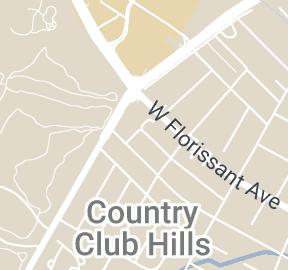
Maria de Porres Ward, who was the first African American member of the Conventual Franciscans.”
Tinner-Williams says he likes “to celebrate an eighth as well because there’s a Black Puerto Rican who’s on the path to sainthood as well, Venerable Rafael Cordero.”
As Tinner-Williams easily rattled off the names with precision, he made the distinction between the differing titles.
“The ones who I mentioned as servants of God, that’s the first stage. Second stage is venera-
ble. Mary Lang from Baltimore actually just advanced to the second stage recently, within the last year or two, I think. And so getting people from one stage to the next can often take a while,” he says.
“But yeah, there has been movement recently on those causes. Servant of God, Thea Bowman’s cause was just opened in 2019. And the guy who worked in Brazil, who was from Massachusetts and DC, his cause was opened the year after in 2020.”
He says some of these causes are actually quite new, even though the person may have died several decades ago, or, in the case of some of the older causes, more than 100 years ago.
A generation focused on social justice
As for the younger Catholics, the Messenger appeals to them through its podcast, which covers social justice.
“I know the younger people listen to a lot of podcasts. It’s also in a video format. But I think young people who are still involved in the Catholic Church, especially young Black Catholics, are very much interested in the social justice focus of the church — Catholic social teaching. Some of those principles often get de-emphasized among the laity and sometimes even among our bishops,” he says.
”So if they’re not going to get it from the leaders, they can find it in certain segments of Catholic media. We hope Black Catholic Messenger is a place where they can find it.”
Why You Feel Stuck at Work (and How to Break Free)
T. KIMBROUGH Chairman and CEO, Midwest BankCentre Author, Twice Over a Man
I’ve been stuck before.
Not just in a job, but in my own head — questioning my worth, secondguessing my choices, wondering if I’d already hit my ceiling.
Stuck-ness isn’t just frustrating — it’s costly. It drains your energy, steals your confidence, and makes you wonder if you’re wasting your best years.
Stuck-ness isn’t always about the role itself. It’s about the story you tell yourself while you’re in it.
That’s why I created the 3R Model — Reframe, Reclaim, Rename — to help people move from stuck to strengthened. Here’s how it works when your career feels stalled.
1. Reframe Your Thinking When you’re stuck, the mind whispers lies: “You’re not good enough. You’ve missed your chance. You’ll never get ahead.”
I’ve heard those whispers too. But here’s the truth: your past pain and current plateau don’t define your future. They prepare you for it.
Reframing means shifting from “I’m overlooked” to “I’m being sharpened.”
From “I’m behind” to “I’m being prepared.”
Your Move: Write down one negative thought that loops in your head. Then rewrite it into a truth that lifts you. Example: “I’m stuck” → “I’m in training for my next opportunity.”
2. Reclaim Your Personal Agency Feeling stuck is dangerous because it convinces you that you’re powerless. But you’re not. Agency means you don’t have to wait on a promotion, permission, or perfect
timing to move forward.
When I stepped into banking, people doubted me. Some even said, “Any idiot can run a bank.” I could’ve accepted that label. Instead, I reclaimed my agency. I defined my narrative, not them.
Your Move: Take one bold step this week that reminds you you’re in the driver’s seat. Update your résumé. Enroll in a new course. Schedule a coffee with someone who inspires you. Each small move compounds into big confidence.
3. Rename Your Social Networks Here’s a hard truth: you may feel stuck because of the company you keep. If your circle only reinforces fear or mediocrity, your vision will shrink to their expectations.
I learned early on that you have to rename your networks. Surround yourself with people who see not just who you are, but who you’re becoming. Mentors, sponsors, and truth-tellers make all the difference.
Your Move: Do a quick audit of your circle. Who challenges you to rise higher? Who drains your energy? Then, make one intentional connection this week. Send a message to someone who embodies growth and ask for a conversation.
The Bottom Line
You’re not stuck because you’re unworthy. You’re stuck because it’s time for a shift.
Reframe your thinking. Reclaim your agency. Rename your networks.
Do that, and you won’t just break free — you’ll rise stronger, with scars that shine like gold.
Reflection Question
Which “R” do you need most right now: Reframe, Reclaim, or Rename?
Nate Tinner-Williams, co-founder and editor of the Black Catholic Messenger.
ORVIN
The Next MOVE
The Black Catholic Messenger, is marking its fifth year of gathering and distributing news to the ever-growing body of faith and its supporters.