
St. LouiS AmericAn
Serving, empowering and advocating for equity in St. Louis since 1928
City layoffs on the horizon?
By Sylvester Brown Jr. St. Louis American
Police budget proposal raises fears of service cuts
A proposed increase in the police department’s budget could force layoffs and cuts to city services.
Warning that a proposed increase in the police department’s budget could force layoffs and cuts to city services, the St. Louis Board of Aldermen last week adopted a resolution opposing the spending plan under the city’s return to state control.
Resolution 258, introduced by 14th Ward Alderman Rasheen Aldridge, is a nonbinding measure urging the state-appointed Board of


Police Commissioners to reconsider its proposed budget increase and negotiate with city leaders over police funding.
The full board approved the resolution after a public hearing before the Board of Aldermen Public Safety Committee, where city officials and residents raised concerns about the city’s finances.
See Police, A10
Building stronger connections
Vacant buildings, safety concerns drive new prosector outreach
By Ashley Winters St. Louis American
Public safety concerns in the Sherman Academy Park neighborhood are often tied to the condition of the area’s vacant buildings, says Rhonda Jones, a former neighborhood association president. Abandoned structures have become gathering places for drug activity and can pose safety risks when they fall into disrepair, she said. She knows firsthand what it’s like to be a property crime victim — her car has been stolen four times.
The St. Louis Circuit Attorney’s Office hopes a new initiative will help address concerns like Jones’ by building stronger connections between prosecutors and neighborhood residents.
The effort, called the Circuit Attorney’s Neighborhood Collaboration program, assigns attorneys to neighborhood associ-
See Buildings, A10
Circuit Attorney Gabe Gore said the program was created to establish a deeper relationship between law enforcement and neighborhoods.
The American celebrates 98 years
‘We needed it then and we need it now!’
By Sylvester Brown Jr. St. Louis American
It was almost the end of the Roaring ’20s, not quite a decade before the start of World War II.
It was March 17, 1928, and The St. Louis American newspaper was born. At that time, there were scores of Black newspapers — almost 250 — published in the United States.
Streetcars clanged down St. Louis’ cobblestone streets; Mill Creek Valley was still a vibrant hub for Black residents, businesses and culture; and notables like Scott Joplin, Vincent Price, Betty Grable, Josephine Baker and 2-year-old Chuck Berry all had ties to St. Louis. It was March 17, 1928, and The St. Louis American newspaper was born. At that time, there were scores of Black newspapers — almost 250 — published in the United States, including several in St. Louis. The American, however, outlived almost all its local peers and eventually became the largest Black weekly newspaper in Missouri.
Founded by Judge Nathan B. Young and several prominent African American businessmen, including attorney Homer G. Phillips, The St. Louis American was originally an eight-page, paid-circulation tabloid with a circulation of just over 2,000.
In 1929, Nathaniel Sweets became the owner and publisher. Along with his wife, Melba A. Sweets, a former English teacher, and editor Bennie G. Rodgers — known as the “dean of Black journalism” — the newspaper grew steadily from the 1930s through the 1970s. Since its birth, the pages of The American have documented African American triumph and tragedy. It was an anchor of information during the civil rights movement and a must-read publication that shared the voices of residents
See American, A10

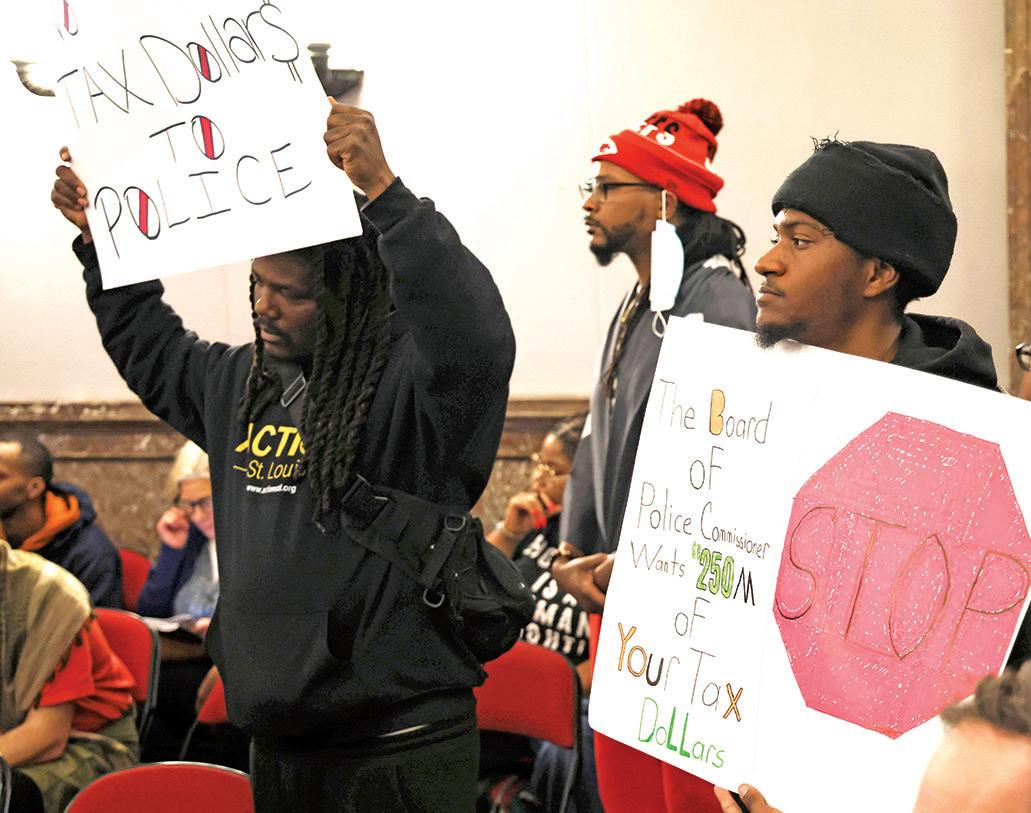
Braxton Clemonts of Action St. Louis joins fellow residents inside City Hall.
Photo by Lawrence Bryant / St. Louis American
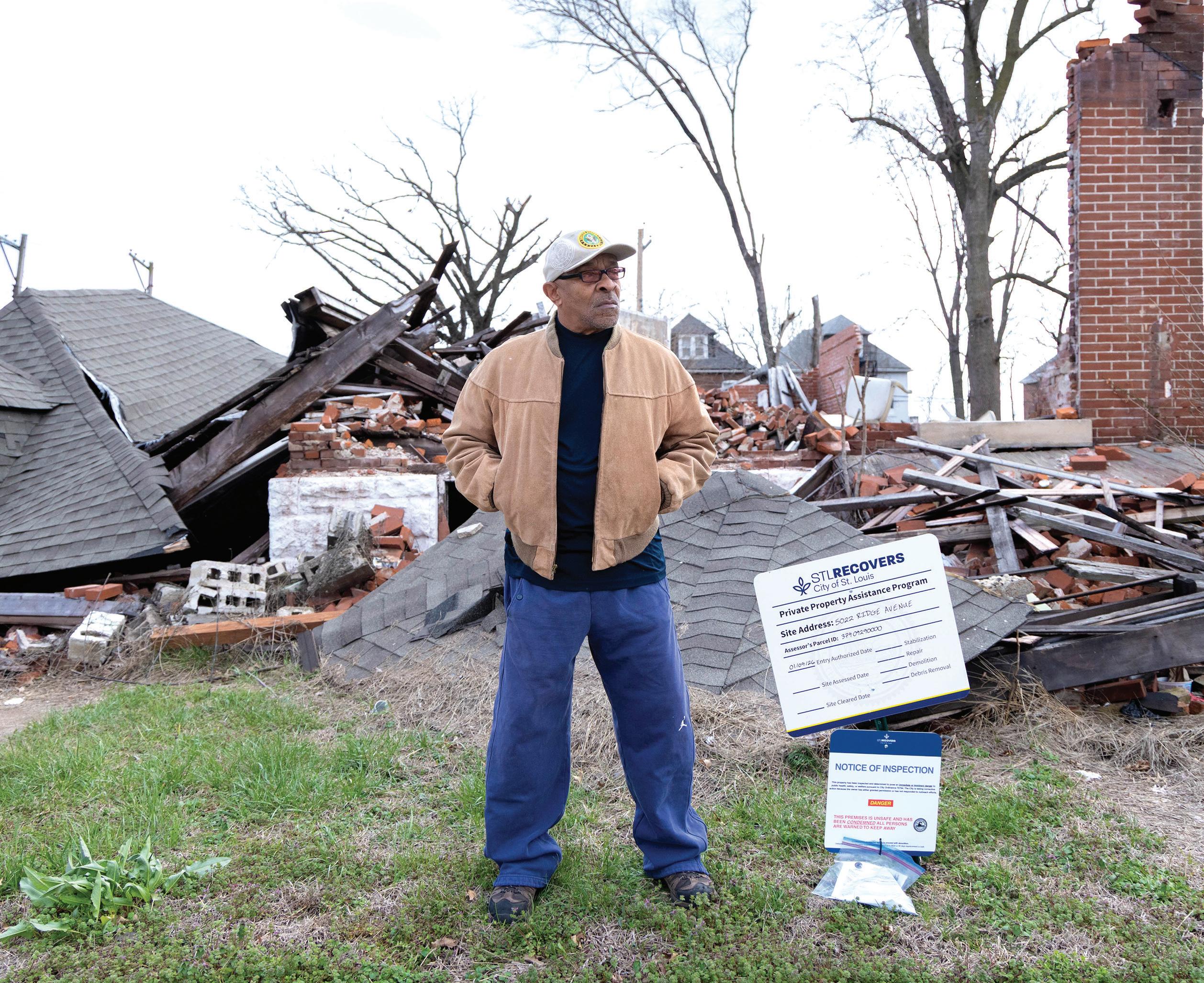
Rufus Shannon stands on his property in the Sherman Academy Park neighborhood as the remains of a collapsed structure and scattered debris show the extent of the damage.
Photo by Lawrence Bryant / St. Louis American
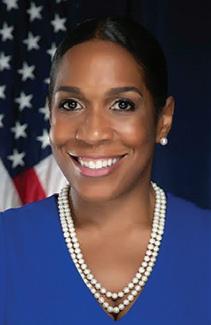
Guest Editorial Standing up for Howard University women
By Julienne Louis-Anderson
The women of Howard University are taught to push boundaries. From novelist Toni Morrison and former Vice President Kamala Harris to fashion designer Kahlana Barfield Brown and actress Taraji P. Henson, Howard women show that Black women were never the afterthought of movements — we were often the architects of them. As a Howard alumna, I carry that legacy with pride.
That’s why I’m joining the growing outcry from students and alumni across the globe over the university’s new policy banning kneeling during the national anthem.
The policy comes after Howard’s women’s basketball team kneeled during a game against the United States Military Academy at West Point, continuing a long tradition of protest on Howard’s campus. In 2016, Howard cheerleaders knelt in solidarity with former NFL quarterback Colin Kaepernick. Four years later, during the racial reckoning of 2020, Howard’s women’s basketball team carried the tradition forward — kneeling in solidarity with Black women, men and children facing injustice across the diaspora.
Now the university says kneeling is no longer allowed.
after enduring racist booing and jeering there. In 2020, players across the WNBA — a league made up largely of Black women — wore “Say Her Name” shirts honoring Breonna Taylor and others lost to racial violence. At Howard, that blueprint meets a long-standing expectation that students speak out — and the basketball team did.
I know the power of sports firsthand.
During my high school years as a member of two varsity teams, I learned self-advocacy — and the importance of advocating for others. Our coaches had a phrase: one band, one sound. If one teammate made a mistake, the entire team ran extra laps in the New Orleans heat. The lesson was clear — we were responsible for one another.
Those lessons followed me to Howard.
Silencing Black women just after Black History Month and during Women’s History Month sends a troubling message — one that reflects a broader pattern in this country: the minimization of Black women’s voices, even when we are central to the movement.
When journalist Georgia Fort was arrested alongside Don Lemon during protests, her name rarely trended.
When Joy-Ann Reid lost her show months before controversies surrounding Jimmy Kimmel prompted national outrage, many boycotts only mentioned the latter.
Black women are used to being erased. But being silenced by your own institution — one that claims to value truth and service — is a different kind of pain.
Sports have long been one of the spaces where women learn to use their voices. According to research from EY and espnW, 94% of women in C-suite leadership roles played sports growing up. Participation builds confidence, resilience, and leadership — skills that help women challenge systems that expect their silence.
It’s why Black women athletes, in particular, have often stood at the intersection of sport and protest. Tennis champion Serena Williams famously boycotted the Indian Wells tournament for 14 years
On campus, I joined a legacy of women who refused to stay silent. I joined my sorority because my founders fought for women’s right to vote at a time when they faced opposition from both white and Black men. Later, I helped coordinate events around the 30th anniversary of the Million Man March. My classmates and I walked from Howard’s campus to the U.S. Capitol, reciting historical speeches and sharing our own demands. We believed we had a responsibility to speak — to advocate — to be heard.
Howard has never been perfect. But it was a place where I felt empowered, supported, and encouraged to speak truth to power. And I told the girls this: sports taught me community, and Howard empowered me to use my voice.
The team has chosen to continue its protest by remaining in the locker room during the national anthem for the rest of the season. Their decision reflects the courage the university has historically encouraged in its students.
But the policy banning kneeling sends a different message — one that risks muting the very voices Howard helped Black women create.
When those young women look back on their time at Howard, will they remember the legacy of empowerment that shaped generations before them? Or will they remember that the place meant to nurture their voices was also the place that tried to silence them?
Julienne Louis-Anderson is Howard alum and Public Voices Fellow of The OpEd Project in partnership with the National Black Child Development Institute.

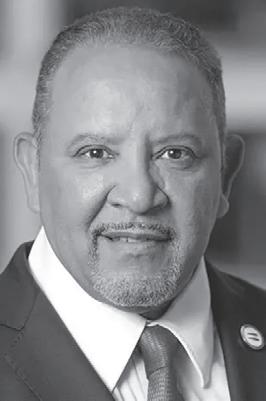
By Marc Morial
“If they don’t give you a seat at the table, bring a folding chair.”
— Shirley Chisholm
It’s no secret that women, specifically Black women, have been a driving force for freedom in this country since its inception.
From the words of Phillis Wheatley condemning the evils of slavery on the eve of the American Revolution, and Sojourner Truth’s indelible “Ain’t I a Woman?” speech at the 1851 Women’s Rights Convention held in Akron, Ohio, Black women have been the heartbeat of this movement.
What troubles me in a modern context is how little Black women are recognized for their contributions to this country and the sordid attempts to strip them of political power and influence today.
We saw it in the attacks on Kamala Harris in the 2024 presidential election. The reduction of Justice Ketanji Brown Jackson’s appointment to a DEI hire.
Urban League has become a national model for workforce development and community investment, helping prepare the next generation of leaders while ensuring opportunity reaches those too often left behind.
The attempts to push out Federal Reserve board member Lisa Cook and Susan Rice from the Netflix board.
The Urban League movement is an embodiment of the resistance to that line of thinking or suppression of history. Of our 93 affiliates, 46 are led by women nationwide.
In Atlanta, Nancy Flake Johnson has led the Urban League of Greater Atlanta through moments of economic uncertainty and opportunity alike, expanding workforce development, entrepreneurship, and housing programs that help thousands of families build stability and generational wealth. Her leadership reflects what the Urban League movement has always understood: that economic justice is foundational to freedom.
In Columbus, under the leadership of Stephanie Hightower, the Columbus
In Louisiana, Judy Reese Morse has helped guide the Urban League of Louisiana through some of the most complex challenges facing the Gulf region, from disaster recovery to economic resilience, while building pathways for Black families and businesses to thrive in a rapidly changing economy. And in Tennessee, where we’re holding our Annual Conference this summer in Nashville, Dr. Laurie Shanderson leads the Knoxville Area Urban League, focusing on expanding access to education, economic mobility, and community empowerment work that continues the long tradition of women stepping forward to lead when their communities need them most. And those numbers are not symbolic. They are proof of a legacy.
These women and dozens more across the Urban League movement are not simply administrators or executives. They are architects of opportunity. They are advocates, bridge-builders, and champions for communities that too often must fight harder just to be seen.
Their leadership reminds us that the legacy of Phillis Wheatley and Sojourner Truth did not end with speeches written in history books. It lives on every day in boardrooms, classrooms, community centers, and neighborhoods where women continue the work of expanding freedom in America.
And during Women’s History Month, the Urban League movement proudly recognizes that this work and this leadership remain essential to our collective future.
Marc Morial is president and CEO of the National Urban League.



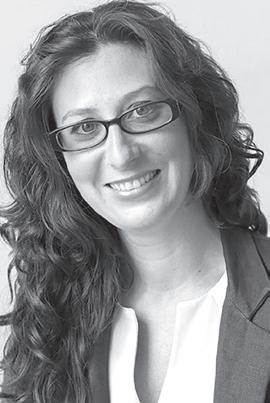
By Megan E. Green
This time last year, Missouri took control of the St. Louis Metropolitan Police Department and put it in the hands of a state-appointed Board of Police Commissioners — ending 13 years of local control that Missouri voters approved in 2012. Republican lawmakers, and even some Democrats, argued the change was necessary despite consistent year-over-year reductions in crime.
From overturning a vote of the people to outright ignoring crime statistics and trends, it was clear from the beginning that this was never about making St. Louis safer — it was about controlling urban areas that differ politically from the state.
The same legislation that created the Board of Police Commissioners also requires the city to allocate a minimum of 25% of its general revenue fund to the police department and bans elected officials from holding office if they interfere with the board’s work. That means local elected officials could be removed from office for attempting to hold the police board accountable.
If the Board of Police Commissioners fails to consider other resident priorities in the budget process — and if Missouri makes good on its promise to punish local officials for pushing back — the only option for the city will be to scale back other departments, which could put St. Louis on a path toward privatizing key services like trash pickup, water and street maintenance. Shifting essential services to the private sector — a view held by policymakers on the right who value small government — drives up costs for consumers and makes it even harder for people to afford daily life.
Shortly after Gov. Mike Kehoe signed that bill into law, I sued Missouri to protect local decision-making and the city’s financial interests.
While that case moves through the legal process, the Board of Police Commissioners is making moves of its own. As the city’s budget division, department heads and local officials prepare for annual budget conversations, the police board proposed a staggering $250 million allocation from the city’s general revenue fund for the police department — pushing its request over the city’s proposal by nearly $50 million. With virtually no room for new spending this year, that would mean roughly $50 million less for crime prevention programs, tornado recovery, infrastructure repair and other services residents rely on.
What’s more, at a time when effective policies, crime prevention and traditional law enforcement practices are working together to drive success, cutting funds for alternatives to policing would be a major setback for St. Louis. Thanks to Police Chief Robert Tracy’s leadership and the success of the city’s Office of Violence Prevention, crime has dropped. Last year alone, the overall crime rate in the city fell by 16%, and youth-involved shootings plummeted by 50% in 2023.
Budget decisions that affect any city department should never be made in a vacuum or without buy-in from city residents. Balancing our budget is more than staying within a defined spending ceiling. It is the responsibility of elected leaders — the people who are accountable to the public — to align city spending with residents’ priorities. As president of the Board of Aldermen, I’ll continue to challenge Missouri’s overreach in court, and as a member of the Board of Estimate and Apportionment, I’ll vote no on any budget proposal beyond what state law requires because, in more ways than one, we simply can’t afford to give in.
Megan E. Green is president of the
St. Louis Board of Aldermen.
Guest Columnist Megan E. Green
Columnist Marc Morial Guest
Prosecutors
say greed fueled $19.7M scheme meant for hungry children
St. Louis American staff
A federal judge has sentenced former nonprofit executive Connie Bobo to 16 years in prison, concluding a fraud case drained $19.7 million from a program intended to feed low-income Missouri children. U.S. District Judge Audrey G. Fleissig also ordered Bobo to repay the full amount.
Bobo, 46, of St. Charles, led New Heights Community Resource Center, which received public reimbursement funds to provide meals to school-age children after school and during the summer. Federal prosecutors said she built the scheme from the beginning, using false enrollment materials to get the organization into the program and then filing hundreds of bogus reimbursement claims over a period that stretched from 2019 through 2022. According to the U.S. Attorney’s Office, the fraud accelerated during the COVID-19 pandemic,
when many children who depended on school for regular meals were especially vulnerable. Trial evidence showed Bobo collected $19.7 million in reimbursement money but spent only $6.8 million on food and milk. Prosecutors said the entire sum was fraudulently obtained because her entry into the program itself was based on deceit.

Instead of using the money for its intended purpose, prosecutors said, Bobo diverted millions into real estate, luxury purchases and benefits for people close to her. The Justice Department said the spending included a new home for herself, homes for relatives, a $200,000 Mercedes-Benz G550 Wagon for her boyfriend and a $2.2 million commercial real estate investment. Authorities said the home, the vehicle and four additional properties have been seized.
“Connie Bobo’s trial clearly showed that this was the largest public

A federal court exhibit shows property, including homes and a Mercedes-Benz, authorities
with funds from a pandemic-era program meant to feed children in need.
assistance and pandemic fraud in state history,”
U.S. Attorney Thomas C. Albus said in a Justice Department press release. “Hungry children were turned away when Bobo’s distribution events ran out of food, all because she was spending public money on luxury goods, real estate and an extravagant vehicle.”
The government said Bobo did not simply siphon money away from a children’s nutrition program, but also tried to conceal what she had done once scrutiny intensified. Prosecutors said she cre-

ated fake board members, fake bylaws and fake training records as part of the nonprofit’s enrollment paperwork.
Later, after learning of the FBI investigation, she produced fictitious food invoices and attendance logs listing children who did not exist, according to the sentencing memorandum summarized in the press release. Prosecutors also said she lied on the witness stand during her trial.
A jury convicted Bobo in October on three counts of wire fraud, one count of aggravated identity theft
and two counts of obstruction of an official proceeding after a three-day trial, according to the U.S. Attorney’s Office.
In the same press release, FBI St. Louis Special Agent in Charge Chris Crocker framed the case as a betrayal not only of taxpayers, but of children whose meals were supposed to come first.
“Connie Bobo’s greed is beyond reprehensible. She stole millions of dollars meant to feed low-income children in our community,” Crocker said. “Instead of helping hungry kids, she used that
money to buy a $1 million home, a Mercedes-Benz G-Wagon, and four additional properties — all of which the FBI has now seized. Those stolen funds from a taxpayer-funded program could have provided meals for children across Missouri.”
The case was investigated by the FBI and the U.S. Department of Agriculture Office of Inspector General. Assistant U.S. Attorneys Derek Wiseman and Jonathan Clow prosecuted it.






















Photo courtesy of the U.S. Attorney’s Office
say Connie Bobo purchased
Connie Bobo
Commentary
Page urges discussion of city-county cooperation
St. Louis County Executive Sam Page is urging residents and local leaders to begin discussing whether St. Louis and St. Louis County should cooperate more closely or consolidate some services as both governments face financial pressure.
Page said rising costs, limited revenue growth and declining state and federal support are straining local budgets. He suggested the city could potentially rejoin the county as a municipality, though he emphasized the idea
Bill proposes Gateway Arch park expansion into East St. Louis
Members of Congress from Missouri and Illinois have introduced legislation that would expand Gateway Arch National Park to include land in East St. Louis.
The bill would increase the park’s authorized size from 100 acres to about 102 acres and allow the National Park Service to add portions of Malcolm W. Martin Memorial Park and nearby riverfront land.
Supporters say the change could spark redevelopment along East St. Louis waterfront.
is meant to start a public conversation rather than advance an immediate policy proposal.
Page said combining certain services — such as policing, street maintenance and public health — could create efficiencies and help preserve services without raising taxes.
The city and county separated in 1876. Mayor Cara Spencer said the city is open to discussions about regional collaboration.
St. Louis Fed seeks applicants for student advisory board
The Federal Reserve Bank of St. Louis is seeking applications from high school seniors for its Student Board of Directors for the 2026-27 school year.
Participants learn about the Federal Reserve, economic policy and financial decision-making.
Applicants must be rising seniors attending public or private schools in the St. Louis area. Applications are due April 3 at stlouisfed.org.
Strategies for nonprofit resilience
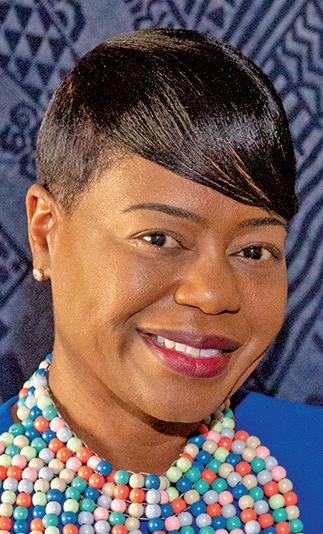
By Michelle D. Tucker
The evolving funding landscape for nonprofits isn’t just a challenge; it requires us to fundamentally rethink our approach. With increasing competition for reduced resources, we must be strategic in how we forge our path forward. As April arrives, I’m reminded that it’s been nine years since I made the leap from a 20-year corporate career to nonprofit leadership. This journey has given me the opportunity to lead two major nonprofits, including seven turbulent yet transformative years with United Way of Greater St. Louis. Time has flown by, however, the insights gained are more relevant than ever.
The key to nonprofit strategy is agility
In a world where change is the only constant, agility is essential. As nonprofit leaders, we must remain ready to pivot and adapt our strategies to meet shifting funding priorities and community needs. I prioritize staying informed by engaging daily with local and national publications and posts, allowing me to keep a finger on the pulse of trends that could impact our mission. This proactive approach helps shape strategic adjustments and positions organizations ahead of the curve. Organizations that embrace flexibility are far more likely to succeed.
Building a future-ready workforce
efficiency. Although funding constraints can limit access to advanced tools, many cost-effective solutions are available. By exploring AI and other accessible technologies, organizations can boost operational capabilities without breaking the bank. Numerous nonprofits have leveraged digital tools to streamline processes and improve service delivery, proving that innovation is possible even on a tight budget.
Collaboration: A path to strength, sustainability
Collaboration is key to maximizing our impact in the nonprofit sector. By forging partnerships with both for-profit and nonprofit organizations, we can reduce costs and boost productivity. Whether through joint ventures, shared administrative resources or strategic mergers, the potential for a stronger operational foundation is tremendous. One strong organization can achieve far more than several struggling ones. It’s worth asking, “Are we better together?” Careful due diligence on potential collaborations can reveal opportunities for greater efficiency and effectiveness.
As we navigate these complexities, I encourage fellow leaders to adopt a three-step action plan:
• Stay informed: Dedicate time each day to monitor industry publications and key trends. Use this knowledge to adapt your strategies and stay ahead of emerging challenges.
Chuck Stone
Bell proposes naming St. Louis post office for journalist
U.S. Rep. Wesley Bell has introduced legislation to rename a St. Louis post office for journalist and civil rights leader Charles “Chuck” Stone Jr.
The proposal would designate the U.S. Postal Service facility at 8390 North Broadway as the Chuck Stone Post Office. Stone, a St. Louis native and Tuskegee Airman, later became a prominent journalist and first president of the National Association of Black Journalists. He died in 2014.
Jennings opens 60,000-square-foot community center
Jennings officials have opened a new $7 million community center, expanding recreational and educational space for residents. The nearly 60,000-square-foot facility includes a gymnasium, fitness area, multipurpose rooms and computer lab on an 11-acre site.
City leaders said the project is intended to support youth programs, wellness and community gatherings.
Our staff is our greatest asset. While investing in current employees remains critical, we must also focus on attracting new talent that can help us thrive in the future. As we look ahead to the next 24 to 36 months, it’s vital to make accurate projections about industry trends. What skills will be in demand? By evaluating our current capabilities alongside future needs, we can tailor training for existing staff while recruiting individuals who bring fresh perspectives and expertise. This dual strategy strengthens our organizational capacity and equips us to tackle future challenges with greater confidence. A diverse and skilled workforce will help us remain adaptable in an ever-evolving nonprofit landscape.
In this digital age, technology presents significant opportunities for nonprofits to enhance
• Invest in your team: Assess current staff skills and implement training programs tailored to future needs. Focus hiring strategies on recruiting individuals who align with your long-term vision.
• Collaborate and innovate: Actively seek partnerships and shared solutions that enhance efficiency and reduce costs. Don’t hesitate to explore mergers that could consolidate strengths and amplify impact.
By embracing agility, strengthening our teams, leveraging technology and fostering collaboration, we can better navigate the complexities of the nonprofit landscape. Together, we can create a future where nonprofits not only endure challenges but thrive while continuing to leave a lasting impact on our communities.
The time for action is now.
Michelle D. Tucker is president and CEO of United Way of Greater St. Louis.

Michelle Tucker
Business
MARCH 19 – 25, 2026
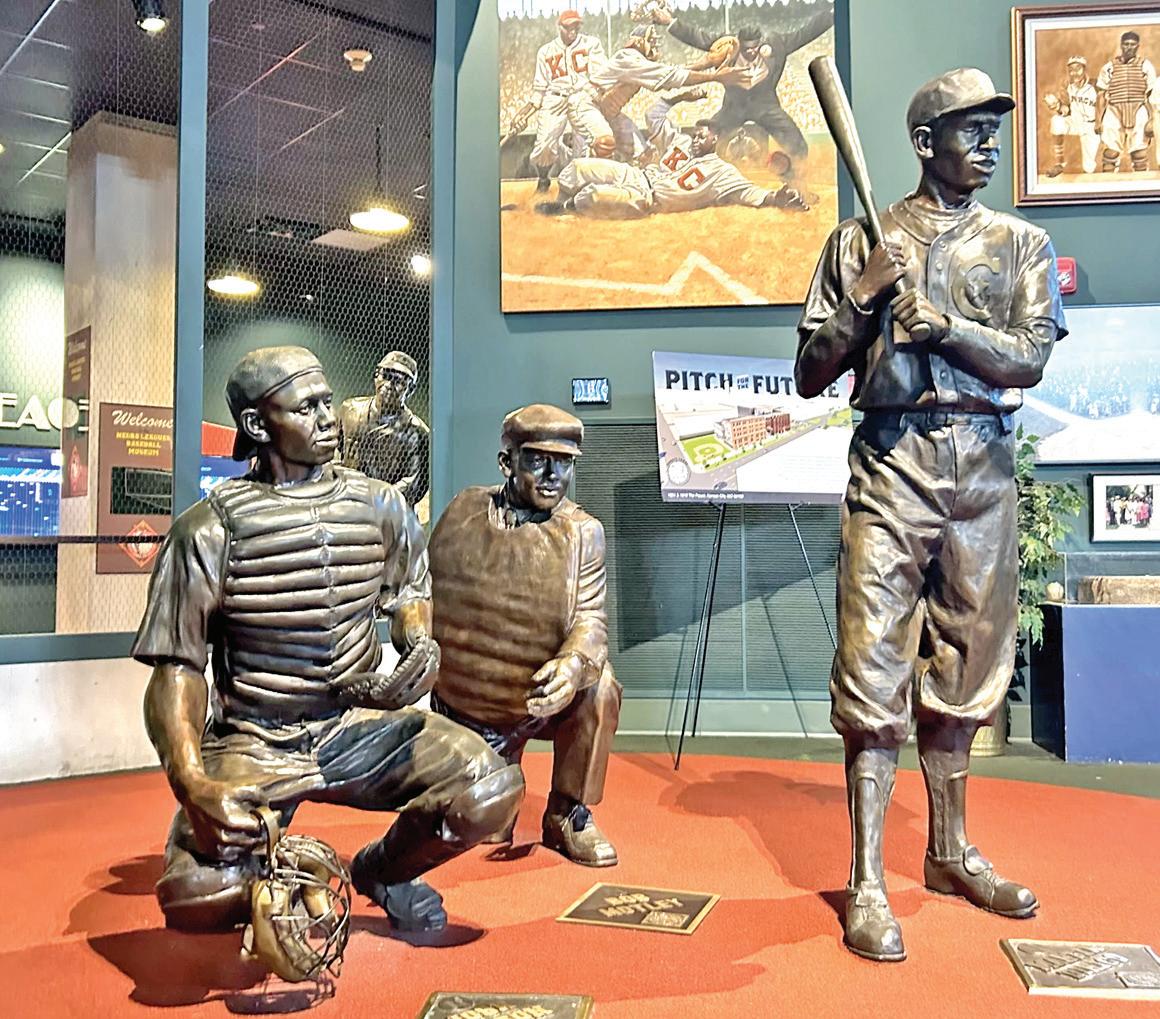
negro Leagues BaseBaLL MuseuM
North St. Louis project enters city approval process
By Chad Davis
St. Louis Public Radio
Developers behind a proposed Negro Leagues Baseball Museum in North St. Louis say they are making progress after seeking a conditional use permit, which lets a project move forward even if that type of structure isn’t normally allowed in the area. The site in the JeffVander-Lou neighborhood was announced more than three years ago and would serve as a satellite location of
the Negro Leagues Baseball Museum in Kansas City.
The project would reuse a former Land Reutilization Authority property — the former United Railways substation on North Spring Avenue.
The development will be completed in two stages.
The first phase will focus on the museum, while the second phase will center on construction of 34 senior housing units.
Developer Guyton Harvey said the museum will be near the Herbert
St. Louis County MWBE director sues over alleged retaliation
The director of St. Louis County’s Minority and WomenOwned Business Enterprise program has filed a lawsuit accusing county leaders of retaliating against him after he raised concerns about how the program operates. Nathaniel Adams alleges he was suspended after publicly advocating structural reforms and working with county council members on proposed legislation. The suit claims the county’s actions violate Missouri whistleblower protections and seeks damages. County Executive Sam Page’s office declined comment on the allegations.
Data center proposals face scrutiny across St. Louis region
Local governments across the St. Louis area are weighing several large-scale data center proposals this week, setting up a series of public meetings that could shape the region’s technology infrastructure. Officials in St. Louis, Foristell and Franklin County are reviewing zoning changes, annexation requests and a conditional-use permit tied to proposed facilities. While developers tout investment and jobs, residents have raised concerns about transparency, environmental impact and the speed of negotiations.
WWT initiative supports women entering tech careers in Costa Rica
World Wide Technology recently partnered with the nonprofit Ideas in Action to launch a professional development program aimed at helping women in Costa Rica pursue careers in technology. Participants completed training in
Hoover Boys & Girls Club, the Brickline Greenway and the site of the former Sportsman’s Park stadium.
“It will do a lot to complement some of the existing anchors to the community, and we hope that it will catalyze other investment and interest in improvements in an underserved community,” Harvey said.
The city’s Public Safety Department held a conditional use hearing earlier this month.
Harvey said the museum plans to operate from 9 a.m.
to 5 p.m. Monday through Saturday, with varied hours on Sunday to account for church services. The museum will include a gift shop.
During the hearing, some Jeff-Vander-Lou residents said developers had not updated them on the museum plans. Jeff-Vander-Lou Neighborhood Association member Carla Alexander said she supports the museum.
“We are not trying to stop progress of the Negro Leagues Baseball Museum
cybersecurity, networking and data analytics through WWT’s Advanced Technology Center learning platform. The initiative also included career preparation sessions focused on resumes, LinkedIn profiles and interview skills, part of the company’s broader effort to expand access to technology education worldwide.
United Way opens applications for regional Safety Net grants
The United Way of Greater St. Louis is accepting applications for its 2027–2029 Safety Net funding cycle, offering three-year contracts to nonprofit agencies that provide essential services across its 16-county region in Missouri and Illinois. The grants support programs addressing urgent needs such as food, housing and health services, as well as initiatives that help families build long-term stability. Virtual information sessions are scheduled March 24 and March 26, and applications are due April 17 through the organization’s online grant portal.
UMSL secures federal funding for pharmaceutical manufacturing hub
The University of Missouri-St. Louis will use more than $1 million in federal funding to expand an initiative aimed at strengthening domestic production of essential medicines. The project, developed with the API Innovation Center, focuses on advanced manufacturing methods for active pharmaceutical ingredients used in widely prescribed drugs. University leaders say the effort could help reduce reliance on overseas suppliers while creating workforce training opportunities and positioning the region as a center for pharmaceutical innovation.
Givens-Williams named Givens principal
The Webster Groves School District has named Dr. Sharnez Givens-Williams as the next principal of Givens Elementary School, effective July 1, 2026. She is the niece of Dr. Henry Givens Jr., for whom the school is named.
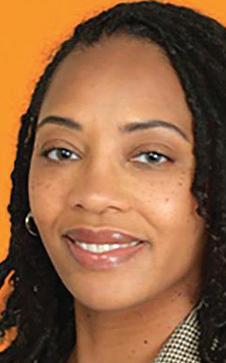
She is currently the assistant principal at Berkeley Elementary in the Ferguson-Florissant School District. Prior to her work in administration, Givens-Williams served as a reading interventionist and teacher in the Ritenour School District and St. Louis Public Schools.
Smith appointed SLPS chief of student support
St. Louis Public Schools (SLPS) has announced the permanent appointment of LaTisha A. Smith as the district’s chief of student support services.
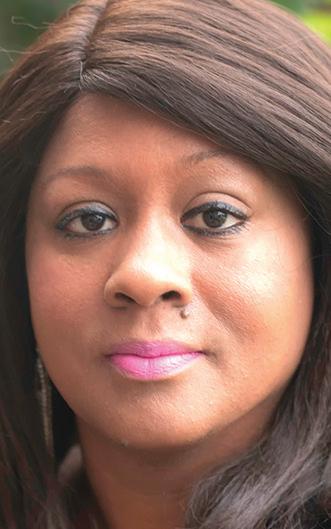
Smith has served as interim chief since February 2025, advancing initiatives that support the academic, social and emotional well-being of students across the district.
She recently completed her Education Specialist degree and superintendent certification from the University of Missouri–St. Louis.

Deyana Chism named a BPD director Deyana Chism
Deyana Chism, a graduating senior Baccalaureate Social Work student at Lincoln University, was selected as one of only five students nationwide to serve as a 2026 Association of Baccalaureate Social Work Program Directors (BPD) Student Fellow — a nationally recognized honor that provides support, training and leadership opportunities to an exceptional group of social work students.
Chism, who attended the 2026 BPD Annual Conference in New Orleans, serves as president of the Student Social Work Association and the Phi Alpha Honor Society Chi Chapter and is a member of the Baptist Student Union College Ministry.

Crystal Officer selected as St. Louis Titan 100 Crystal Officer
Crystal Officer, the chief executive officer of Beverly Farm Foundation, has been named a 2026 St. Louis Titan 100 honoree. Beverly Farm Foundation is a planned community with nearly 400 individuals with developmental and intellectual disabilities. The campus includes homes and jobs, recreation and equestrian centers, shops, a pool, medical services and therapies.
The Titan 100 program recognizes the top 100 CEOs and C-level executives in the St. Louis region who have built extraordinary companies and redefined leadership “through their vision, passion, and integrity,” according to the organization.
See Baseball, A6
Sharnez GivensWilliams
Photo by Noah Taborda / KCUR
The St. Louis Negro Leagues Baseball Museum would be a satellite of the Kansas City location.
LaTisha Smith
Business Briefs
High prices push buyers to share homes
Co-buying is rewriting homeownership, and marriage is no longer the standard.
By Laura Onyeneho Houston Defender
You’ve been saving.
You’ve been budgeting.
You’ve cut back on brunch, skipped the vacation and maybe even moved back in with your parents for a year. But every time you check Zillow, the houses you can afford are farther away, smaller or in neighborhoods you don’t want to live in. And the ones you actually want? They’re expensive.
So homebuyers are pooling money with friends, siblings and people they trust to buy property together.
Welcome to the era of co-buying, where homeownership is less about waiting for “the one” and more about refusing to wait at all.
If this sounds familiar, you’re not alone.
The Kinder Institute for Urban Research at Rice University released the 2025 State of Housing in Harris County and
Baseball
Houston report, which examines a range of issues influencing housing affordability and the residential options available to residents.
It shows that families with a median income can only afford homes close to $195,000, while the median property price in Harris County has increased to almost $325,000. For many families, homeownership is becoming increasingly unaffordable due to this affordability gap.
Co-buying is the practice of purchasing property with friends, siblings or other non-romantic partners. According to a recent study by JW Surety Bonds, nearly 15% of Americans have co-purchased a home with someone other than a romantic partner, and another 48% would consider it.

Society historically viewed homeownership as a post-marriage goal. Co-buying breaks that norm, making it acceptable to enter the market with a “platonic” or “romantic-but-unmarried” partner.
Continued from A5 in our residential area,” Alexander said. “But what we are reporting is that the residents right across the street, down the street, around the corner, in close proximity, even neighbors and stakeholders in our ward did not even know about the project.”
Another resident expressed concern about what the development could mean for residential parking and housing. “That is a detriment to parking, potential crime and it actually takes away housing for potential res-
Buyers typically choose between joint tenancy, where owners hold equal shares and have rights of survivorship, or tenancy in common, which allows unequal ownership shares and lets each party sell or pass on their share independently.
“Younger people are absolutely being shut out of home buying due to unaffordability and inaccessibility,” says Ayesha Shelton, co-founder of Park Street Homes in Houston. “The ability to co-purchase property is one way that millennials
idents where we just dealt with the tornado,” Penrose Neighborhood Association and North Newstead Association board member Yolanda Owens said. “We did not even know about this. There has to be a better way to let the community know about these things.”
Harvey said he met with multiple neighborhood groups, attended two Jeff-Vander-Lou neighborhood meetings and held a community meeting at the Divoll Library. He said he also met with Azariah Missionary Baptist Church representatives to discuss possible addition-
have the ability to access homeownership and investing.”
Gen Z and Millennials are leading a surge in co-buying, with roughly 32% of Gen Z and 18% of Millennials considering purchasing homes with friends, family or partners to combat high interest rates and limited affordability.
The benefits and risks
Shared down payments, split monthly costs and earlier market entry are just a few of the benefits. Houston’s abundance of duplexes makes the city particularly well suited for co-buying.
“I think it’s an amazing idea for two people to come together and buy a duplex together. The piece that’s most easily overlooked is we are in agreement at this time,” Shelton says. “It’s important to evaluate what your steps will be if there ever comes a time when you all are not in agreement.”
Kristina Modares, a co-buying strategist at Joynt who has co-purchased property 10 times, sees it as a natural evolution.
“This is just like another thing that’s being
al parking for the museum, though it is not clear whether an agreement has been reached.
Alderwoman Laura Keys, who represents the 11th Ward where the museum would be built, said she supports the project and that Harvey met the necessary benchmarks.
“It’s right down the
introduced to them that’s maybe not so crazy as it may have been to their parents,” she says.
Legal agreements are essential. Modares recounts helping a woman who bought with her boyfriend, only to have him unexpectedly end the relationship and demand that they sell.
“She was like, I wish I had known my options,” Modares says.
Operating agreements should spell out ownership percentages, exit strategies and what happens if someone wants out early.
Shelton recommends involving an attorney from the start because “If you don’t, then it can get pretty messy.”
While some see co-buying as a temporary workaround for high interest rates, Modares believes it’s a long-term solution.
“As things get more expensive, this is still going to be a really popular idea,” she says. “It all depends on how the market moves.”
Modares offers straightforward advice to prospective co-buyers: vet partners carefully, have difficult money conversations early and put everything in writing.
street from the original hotel where the Black baseball players had to stay,” Keys said. “It’s a historic area that lends itself to having this venue right there.”
Harvey said the plan is to break ground on the museum later this year, possibly by September.

Many Gen Z buyers are purchasing homes with parents or siblings, a trend that has grown rapidly in recent years.
Photo by Breno Assis / Unsplash
HealthMattersHealthMattersHealthMatters
A WashU study found no clear evidence linking federal nutrition programs such as SNAP, WIC and school meals to higher rates of

Weight in line
WashU study finds no clear link between food aid and childhood obesity
By Ashley Winters St. Louis American
sweeping review of decades of research is challenging a long-standing claim in food policy debates: that federal nutrition assistance programs contribute to childhood obesity.
Researchers at the Washington University School of Public Health and the Brown School at Washington University in St. Louis analyzed 75 peer-reviewed studies spanning more than four decades and found no consistent evidence that children who participate in programs such as SNAP, WIC or school meal programs are more likely to
“Our review found that the evidence does not support a simple or consistent link between participation in federal food assistance programs and higher rates of childhood obesity”
– Sarah Moreland-Russell
experience unhealthy weight.
“Our review found that the evidence does not support a simple or consistent link
See Obesity, A8
A counselor reflects on Black maternal health
After the death of a Black midwife shook a South Carolina community, therapist Lawrence Lovell joined a panel discussion on men’s roles in advocating for maternal health.
Jennifer Porter Gore Word In Black

Her death shocked the community and her colleagues who are determined to address concerns about Black maternal health.
In 2024, the number of U.S. mothers who died as a result of pregnancy or childbirth dropped compared to 2023. But while slightly fewer Black mothers died that year, they still had three times the mortality rate of white women. South Carolina’s rates of maternal deaths outpaced even the national rates. In fact, the state’s overall rate of maternal deaths between 2019 and 2023 was higher than all but eight states and the District of Columbia. Last month healthcare leaders, birth workers, and community members gathered to honor the legacy of Charleston native Dr. Janell Green Smith, a nurse-midwife and doctor of nursing practice who died in January from childbirth complications. She had participated in more than 300 births and specialized in helping Black women give birth safely. Her death shocked the community and her colleagues who are determined to address concerns about Black maternal health. The event also covered the importance of protecting mental health
See Gore, A8
Another settlement in long fight over Henrietta Lacks’ cells
By Joseph Williams Word in Black
For decades, the story of Henrietta Lacks has carried a painful contradiction: cells taken from her body helped transform modern medicine, yet the Black woman behind them died poor and unknown, buried in an unmarked grave. Now, more than 70 years later, her estate has reached a settlement with pharmaceutical giant Novartis — ending a lawsuit that accused the company of profiting from a medical system that historically exploited Black patients like Lacks.
It’s the second settlement in a series of legal battles brought by the Lacks family, which argues that biotechnology and pharmaceutical firms built fortunes from Lacks’ cells while her descendants struggled with chronic illness and limited access to health care.
Terms of the agreement, announced
The case underscores a larger reckoning in American medicine: the long history of research practices that used Black bodies without consent — and the question of who benefits from the scientific breakthroughs that followed.
Monday, were not publicly disclosed. But the case underscores a larger reckoning in American medicine: the long history of research practices that used Black bodies without consent — and the question of who benefits from the scientific break-
See Lacks, A8
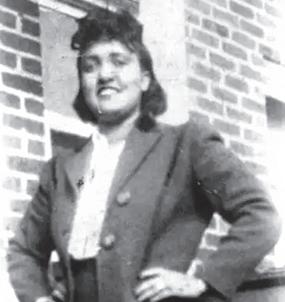
Photo by Ketut Subiyanto / Pexels
Courtesy photo
childhood obesity.
Cells taken from Henrietta Lacks without her consent in the 1950s helped transform modern medicine. Her estate has now reached a second settlement with a major pharmaceutical company.
HealthMattersHealthMattersHealthMatters
Lacks
Continued from A7
throughs that followed.
Dr. Uché Blackstock, a physician and health equity advocate, says the exploitation of Lacks was so pervasive that even she used HeLa cells during her medical training at Harvard Medical School without knowing their origins.
“I used those cells without knowing they came from Henrietta Lacks or that her cells were taken without consent,” Blackstock said.
The settlement with Novartis “is a step toward accountability and a reminder that medical progress should never be built on exploitation,” said Blackstock, an emergency physician, author and founder of Advancing Health Equity, a consulting firm.
Obesity
Continued from A7 between participation in federal food assistance programs and higher rates of childhood obesity,” said Sarah Moreland-Russell, an associate professor at both schools and one of the study’s authors.
“Across 75 U.S. studies, we did not see a clear pattern showing that any one federal nutrition program reliably increases or decreases obesity risk in children.”
The findings come as policymakers in several states and at the federal level debate potential restrictions on foods eligible for SNAP benefits and other policy changes aimed at improving diet quality.
The review also examined studies evaluating updates that strengthened nutrition standards — including those under the Healthy Hunger-Free Kids Act — and found either mixed or beneficial effects on children’s weight, with no evidence of harm.
Of the 75 studies examined, 20 showed beneficial associations between participation in nutrition programs and childhood weight outcomes, 32 produced mixed results and 16 found no relationship. Only seven studies reported adverse associations, and those findings were more common in lower-quality research, Moreland-Russell said.
“The strongest takeaway is that these pro-
Gore
Continued from A7 during grief and of men’s role in solving the maternal health crisis.
As both a therapist and a father, Lawrence Lovell, a licensed professional counselor and founder of Breakthrough Solutions, discussed ways the event’s attendees could process their grief over Green Smith’s death. He also shared ways male partners can advocate for women’s maternal health during pregnancy and childbirth.
Lovell spoke not just as a therapist but also as a father whose own family had briefly crossed paths with Green Smith. The event, he said, emerged organically from a moment of collective mourning. Despite the grief, “it was still, like, a really beautiful event, a much-needed event, and it almost felt like we were all giving each other a collective family hug,” says
The woman whose cells changed science
Lacks was just 31 when she died of cervical cancer in 1951.
A tobacco farmer from southern Virginia, she had moved with her husband to Turner Station, a historically Black community outside Baltimore, where the couple was raising five children. When she noticed a knot in her abdomen, Lacks sought treatment at Johns Hopkins Hospital — at the time the only hospital in the region that treated Black patients.
Doctors there discovered a malignant tumor on her cervix. During a biopsy, physicians removed a sample of her cancer cells. Like countless other patients of the era, Lacks was never told the tissue would be used for research.
What happened next would change the course of medical science.
grams operate within a much more complex social and economic context,” she said. “Results often differed by age, sex, food security status, income, race and ethnicity, or program design.”
For families across the St. Louis region, those programs often play a critical role in ensuring children have consistent access to nutritious food, said Melissa Weissler, chief program officer at Operation Food Search.
“These programs and the food they provide are crucial to kids’ health,” Weissler said. “The meals a child receives at school are often the healthiest meals they consume, increasing their fruit, vegetable and whole grain intake.”
Many of the families served by the nonprofit face significant barriers to accessing healthy food, she said, including a lack of reliable transportation to grocery stores and limited household income to spend on fresh produce. In those circumstances, school meals and federal nutrition programs can make a measurable difference not only in diet quality but also in children’s well-being.
“A healthy diet influences academic performance and improves social-emotional health,” Weissler said.
For parents like Brittney Laden, a single mother of four who relies on SNAP benefits, the program is essential to keeping food on the table.
“It helps because the food is so expensive, and
Lovell. His connection to Green Smith, Lovell says, was brief but meaningful during his wife’s pregnancy with their second child. Green Smith was practicing at the same birthing center where they had their child. She began practicing in Greenville a short time later. Even that short connection carried significance for Lovell, given the small number of Black maternal health professionals.
Lovell did not initially plan to become a mental health practitioner; he chose the career path after graduating from college, when someone suggested he consider psychology. His interest deepened when he noticed how few Black men work in mental health.
“Being Black man and playing football in college, there weren’t a lot of people that look like me talking about mental health,” says Lovell. “[I wanted] to give people that look like me an opportuni-
Unlike most human cells, which die quickly outside the body, Lacks’ cells survived and multiplied in laboratory dishes. Scientists soon realized they could reproduce them indefinitely, making them the first human cell line capable of continuous growth.
Known as HeLa cells — derived from the first letters of her name — the cells became one of the most important tools in biomedical research. They helped scientists unlock discoveries about cancer biology and genetic mapping and were instrumental in developing the polio vaccine.
Researchers later used them to study HIV, Ebola and tuberculosis, and the cells even traveled aboard early space missions. More recently, HeLa cells contributed to research behind COVID-19 vaccines.
The scale of their impact is staggering. By
2011, researchers estimated that more than 50 million metric tons of HeLa cells had been produced and used in over 60,000 scientific studies worldwide.
A family kept in the dark
Yet for decades, the Lacks family knew nothing about the role Henrietta’s cells played in science — or the profits generated by companies producing and distributing them.
That story became widely known after journalist Rebecca Skloot published The Immortal Life of Henrietta Lacks in 2010, a bestselling book that explored both the science behind HeLa cells and the family’s struggle to understand how Henrietta’s tissue had reshaped medicine. Oprah Winfrey later portrayed Henrietta’s daughter, Deborah Lacks, in an
HBO adaptation of the book.
The lawsuits filed by the Lacks estate argue that companies using HeLa cells benefited from a medical system that, during the Jim Crow era, routinely treated Black patients’ bodies as resources to be exploited without consent or compensation.
Civil rights attorney Ben Crump, who represents the family, said the settlements represent at least a measure of long-overdue accountability.
“For the family and her grandchildren, this is certainly justice because people said they would never realize any benefit or compensation from her immortal HeLa cells, even though these pharmaceutical companies were profiting billions and billions of dollars,” Crump told The New York Times.
But, he added, no settlement can undo what
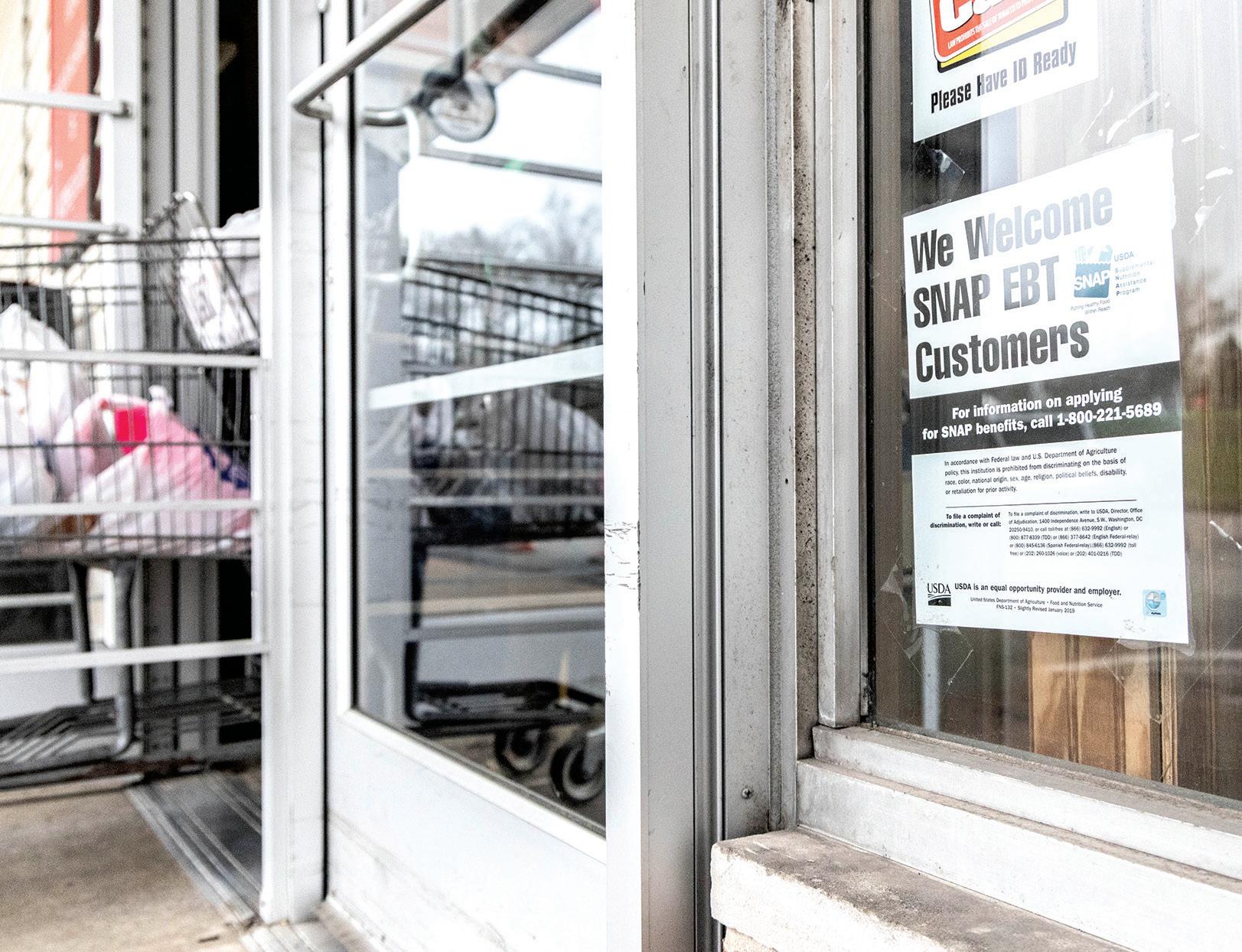
my kids don’t go hungry,” Laden said. “I can buy more food for my kids.”
She said SNAP has also made it possible to purchase healthier options that might otherwise be out of reach.
“The fact that I can now afford to buy my kids healthy food — I don’t understand why healthy food has to be so expensive,” she said.
While policymakers in some states are considering limiting certain foods that can be purchased with SNAP benefits, MorelandRussell said the body of research reviewed does not support the idea that federal nutrition programs themselves are driving unhealthy weight gain
ty to work with someone that looks like them.”
Working with expectant and new parents
Lovell often counsels couples preparing for parenthood by, helping partners understand what a successful pregnancy, childbirth, and postpartum recovery look like. That often means helping women manage postpartum depression.
As a man, Lovell says, it’s “humbling” that a woman “just trusts me enough to work with me through their pregnancy or their postpartum recovery.”
In his work, Lovell has noticed how few men understand pregnancy before they experience it with their partner. Because early pregnancy symptoms are often invisible, he says, men may underestimate how much support a momto-be actually needs.
“Sometimes they may not realize they don’t know much about preg-
among children.
“Our evidence argues for caution against framing SNAP as a cause of childhood obesity,” she said.
Laden said she understands some concerns about restricting sugary items but questioned broader limits on what families can buy.
“She agrees with lawmakers to a certain extent on sugary items,” Laden said. “But why should seafood be a restriction? It just makes it that much more difficult to buy. Just because someone is on SNAP doesn’t mean they shouldn’t enjoy so-called luxury food.”
Weissler said the policy debate should also take into account the financial
nancy and what to expect in those three trimesters,” Lovell says. “I tell a lot of the men that just because you can’t see [she’s pregnant] doesn’t mean that she won’t appreciate your intense support in that first trimester.”
Education about pregnancy and postpartum recovery, he says, can change how men support their partners.
Teaching advocacy in the delivery room
Another major focus of Lovell’s counseling is preparing men to advocate for mothers during labor.
“Helping men understand what pregnancy looks like: what delivery is going to look like, and what are the realistic expectations that I should have of myself in postpartum,” he says.
Lovell encourages partners to be honest about their expectations for what will happen during delivery. He helps them prepare for the big day by dis-
happened.
“If it was truly justice, none of this would have happened to Henrietta Lacks,” Crump said. “She wouldn’t have been the victim of medical racism at Johns Hopkins. But you can pray to get some measure of justice, to offer respect and dignity to the life that was taken.”
For the Lacks family — and for many advocates in Black communities — the settlements represent something beyond a financial agreement. They are another step in an ongoing effort to confront the legacy of medical racism and ensure that the people whose bodies advance science are treated with dignity, consent and fairness. More than seven decades after her death, Henrietta Lacks’ cells are still alive in laboratories around the world — and her story continues to reshape the ethics of medicine.
families afford healthier foods. Through Operation Food Search’s MetroMarket — a mobile farmers market that brings fresh food directly to neighborhoods — thousands of families use SNAP benefits to purchase fruits and vegetables each year.
Weissler said the program recorded nearly 3,900 transactions using SNAP benefits last year.
Many of the shoppers have extremely limited incomes; at least 23% report annual household earnings below $10,000, while more than 39% work full-time.
realities families face when trying to feed their children.
“They need to understand that no one wants to ask for food. No one wants to struggle to feed their children,” she said. “The financial realities faced by the people we serve are overwhelming, and the investment we as a society make in food assistance has incredible returns.”
Programs that support nutrition during pregnancy, ensure children have enough to eat at school and help seniors access healthy food ultimately benefit communities and reduce long-term health costs, she said.
On the ground, those programs can also help
cussing the birth plan and knowing how to quickly recognize problems. Clear communication, he says, prevents misunderstandings.
He regularly trains men to ask their partners detailed questions about their expectations during and after pregnancy. Advocacy in medical settings can be especially important and requires attention to details the mother may not be able to address.
“It’s always important to fine-tune things and truly understand what helps your partner feel most supported,” Lovell says. “Instead of guessing, you should ask.”
Lovell recalls a moment during the birth of his first child when he had to take that role.
During the delivery, “I felt like something wasn’t as sanitary as I’d like it to be,” he says. “I asked, ‘Hey, can you switch those out? Can you change your gloves?’” Lovell has a succinct
“These are people who struggle to get healthy food,” Weissler said. “Getting the nutritious food they need at reduced prices allows them to save money for other necessities like transportation and prescriptions.”
Moreland-Russell said the broader research suggests policymakers should focus less on program participation itself and more on the conditions that shape children’s diets and health.
“Our review points to the importance of looking beyond program participation alone and focusing on the broader conditions shaping children’s diets and health,” she said. “That includes household economic hardship, the affordability of healthy food, neighborhood food environments, and whether children have regular access to nutritious meals at home and at school.”
but powerful message he regularly shares with clients’ families, and he shared it with attendees at last month’s event.
“\Just to believe women,” he says. “I’ve worked with different couples, and sometimes I’m not really sure that there’s enough empathy from the men.” That includes how women express pain.
“If a woman says, ‘my pain is at a nine,’ just because how you would express yourself at a nine is different than how she’s expressing herself at [that level] doesn’t mean you shouldn’t believe her,” he says.
Empathy, he says, can change outcomes far beyond the delivery room.
“We’ve got to believe women when they’re talking about their experiences and their feelings and their pain,” he says.
“I think there’s a lot that we can prevent if we empathize better.”
Photo by Lawrence Bryant / St. Louis American
Many people rely on SNAP benefits to keep food on the table.

Sinners wins four of 16 nominations, makes history with Best Cinematography win
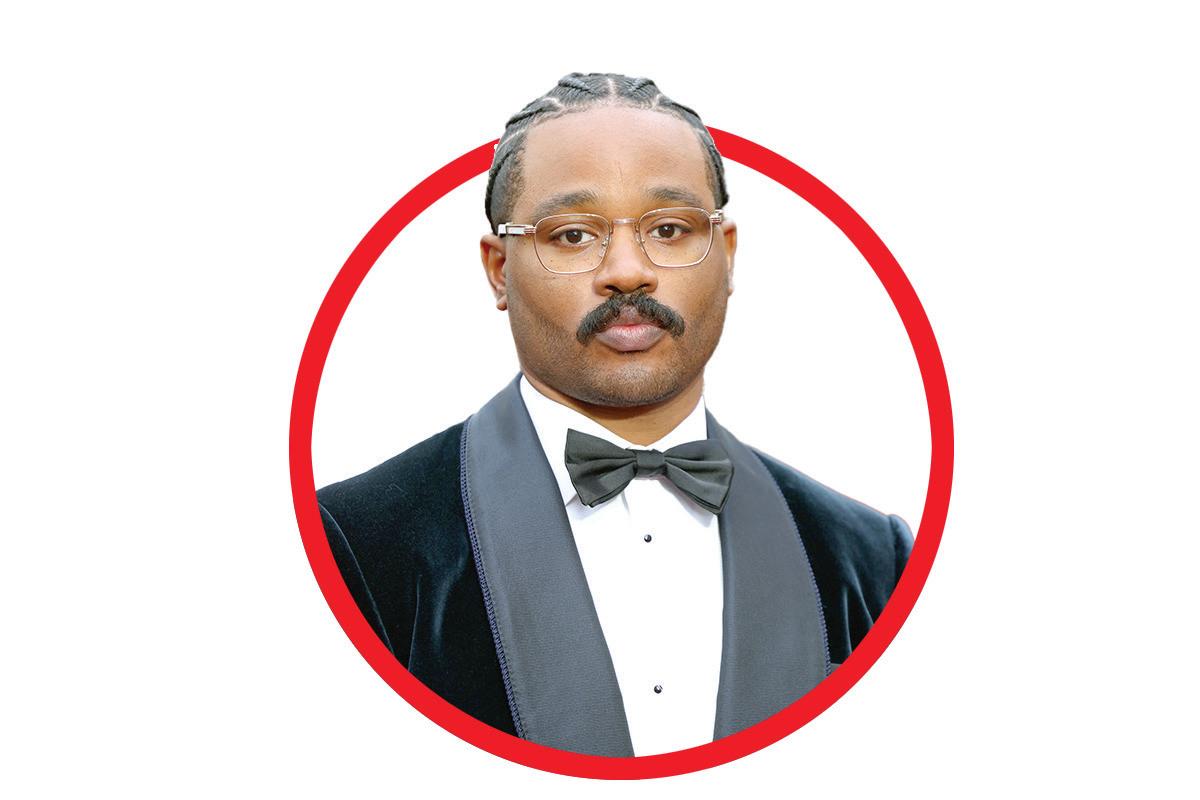
Ryan Coogler and his longtime creative part ner Michael B. Jordan left the Dolby Theatre as first‑time Oscar winners thanks to Coogler’s cine matic masterpiece Sinners.
“I’m so grateful to call you a collaborator and a friend,” Jordan said of Coogler. “You gave me the space and opportunity to be seen and I love you for that. I love you to death.”
Through Sinners Autumn Durald Arkapaw became the first woman ever to win a Best Cinematography Oscar.
Composer Ludwig Göransson, whose collabora tions with Coogler have become a signature of their storytelling, won Best Original Score— echoing the honor he first received for Black Panther.
Legendary actress and model Judy Pace passes at 83
Judy Pace, a model and actress known for her roles in Peyton Place and the celebrated TV movie Brian’s Song, has died. She was 83.
Pace’s daughters, attorney Pace Mitchell and actress Pace Mitchell, announced through a spokesperson that their mother “died peacefully in her sleep” on March 11 while visiting family in Marina Del Rey, Calif.
to Harlem (1970), Frogs (1972) and Cool Breeze (1972). She starred in the celebrated 1971 TV movie Brian’s Song, playing the wife of football legend Gale Sayers. The movie, which also starred James Caan, was watched by 55 million people. According to Variety, the ratings reflected that half of those in the United States who owned a television at the time viewed the movie when it originally aired.
Diddy’s legal team appeals sentence
According to TMZ.com, Lawyers for Sean “Diddy” Combs are arguing his sentence is far too harsh. The celebrity news and gossip site says Combs’ team is accusing the judge in a new legal filing of punishing him for crimes for which he was acquitted.
An appeal was filed on Friday that points out a jury found Combs not guilty of sex trafficking and RICO charges. His lawyers claim he received a sen tence that is roughly four times higher than normal for his prostitution related Mann Act convictions.
Combs’ lawyers say that his 50 month sentence as a “perversion of justice.”
Pace was born in Los Angeles in 1942. Before beginning her acting career, she trained as a model, becoming the youngest in the Ebony Fashion Fair’s 1961 1962 tour. She made her film debut in 1963’s 13 Frightened Girls, playing a Liberian teenager, a role that launched her career and led to her becoming the first Black woman under contract at Columbia Studios.
Pace went on to star as Vickie Fletcher in the primetime drama series Peyton Place from 1968 to 1969. She won an NAACP Image Award for Outstanding Actress in a Drama Series in 1970 for her trailblazing role as Pat Walters in The Young Lawyers (1969 1971).
Her other film and television credits include The Fortune Cookie (1966), Three in the Attic (1968), The Thomas Crown Affair (1968), Cotton Comes
They say the judge engaged in “acquitted con duct” sentencing – the practice of increasing punish ment based on rejected allegations – which they insist has been criticized across the legal
Combs’ team wants an appeals court to order his “immediate release and grant a judgment of acquittal or at least vacate and remand for resen
Paramount buys out Tyler Perry, shuts down BET+
Tyler Perry partnered with BET to launch the BET+ streaming app.
According to The Hollywood Reporter, streaming service BET+ is shutting down, and its program ming will be folded into Paramount+, the company announced Friday.
“Paramount Skydance has bought out Tyler Perry Studios’ equity stake in BET+, which will help facil itate the move,” The Hollywood Reporter said.
According to the publication, BET Networks pres ident Louis Carr said in a memo to staff that the move will “ensure the stories we champion, the cre ators we support and the culture we represent [will] go further than ever before.”
The changeover will happen in June, when about 1,000 hours of BET+ programming will become part of Paramount+, including the Perry produced All the Queen’s Men and Zatima, The Ms. Pat Show and the critically acclaimed Diarra From Detroit.
Sources: ABC.com, The Hollywood Reporter, People.com, TMZ.com, Variety.com
















Ryan Coogler
Police
Continued from A1
Board of Aldermen President Megan Green said the debate over police funding and state oversight is only beginning.
“Today is the first day of public conversations on this, not the end,” Green said.
Proposed police budget sparks concern
The dispute centers on a proposal from the Board of Police Commissioners to increase funding for the St. Louis Metropolitan Police Department from about $146 million to more than $200 million.
State law requires the city to devote a minimum share of its general revenue to police funding. City officials say the increase could force cuts elsewhere in the budget.
Last month, Mayor Cara Spencer warned the plan could lead to layoffs and reductions in city services.
“The budget certified by the Police Board today is wildly out of sync with what the City of St. Louis can afford to do without crippling other departments, cutting services like trash pickup, park maintenance and fixing our roads,” Spencer said.
“If the Board of Police Commissioners does not change the budget they certified today, they will force the city to look at mass layoffs in other departments to compensate for the cost,” she added.
Aldridge said Resolution 258 signals that the city expects accountability from the state-appointed police board.
“This is not anti-police,” Aldridge said. “This is about fiscal responsibility and making sure the city can meet all of its obligations.”
Residents weigh in
Nearly 100 residents attended the hearing last week. Some wore sweatshirts reading “Invest in Communities,” while others held signs criticizing the state’s renewed control of the police department.
One speaker who identified himself as a lifelong resident and business owner urged aldermen to resist the spending plan.
“This bloated budget is a punishment orchestrated by Jefferson City and proposed by unelected, out-oftouch prominent business owners who stand to gain and profit from a police department flush with cash,” he said.
Crime trends part of debate
The debate comes as crime has declined in St. Louis. City data presented in year-end public safety briefings show overall crime dropped about 16% last year, while homicides fell to their lowest level in more than a decade, according to the mayor’s office and the city’s Office of Violence Prevention.
Some city leaders say those trends reflect investments in violence prevention and community initiatives.
Return to state control
The conflict stems from legislation passed last year returning the St. Louis police department to state control.
In March 2025, Gov. Mike Kehoe signed a bill that reversed a 2012 voter-approved measure that had placed the department under local authority.
Supporters argued that state oversight could improve public safety and police morale.
“This is about supporting public safety and solving a public safety crisis in the St. Louis region that’s affecting the entire state,” said state Rep. Brad Christ of St. Louis County, who sponsored the bill.
Opponents, including former Mayor Tishaura O. Jones and other city leaders, argued the change would reduce local accountability and shift power to an unelected board.
Lawsuits challenge the law
On her final day in office, Jones joined Green in filing a lawsuit challenging parts of the law, including provisions allowing elected officials to be removed from office for interfering with the police board and requiring the city to devote a set percentage of its general revenue to police funding.
U.S. District Judge Matthew Schelp dismissed the case, citing jurisdictional issues and previous rulings limiting the city’s ability to sue the state.
Separate lawsuits filed by Green, Jamala Rogers of the Organization for Black Struggle and activist Mike Milton remain active. Represented by ArchCity Defenders, they argue the law singles out St. Louis and violates the Missouri Constitution’s Hancock Amendment, which limits unfunded mandates.
Green and Rogers said the city’s decision not to join those lawsuits weakened the legal challenge.
“It would have been much easier if city resources were dedicated to this and not just community attorneys doing this because they care about the issue,” Green said.
“We’re definitely disappointed,” Rogers added. “We thought it would have been strengthened if all three lawsuits had moved forward.”
Budget decisions still ahead
Despite the dispute, city officials emphasized that the police board does not have final authority over the city’s budget.
Green said the Board of Estimate and Apportionment — composed of the mayor, the president of the Board of Aldermen and the comptroller — will play a central role in drafting the city’s spending plan.
“I want to make it clear that the authority over this lies with the Board of Estimate and Apportionment,” Green said.
Aldridge warned that legislation under consideration in Jefferson City could expand the police board’s authority.
“They want full control,” he said.
The city’s proposed budget is expected to be introduced in mid-April, followed by hearings before the Board of Aldermen.
“We’re already meeting the requirements that we’re supposed to meet,” Aldridge said. “They’re saying that’s not enough. They want more and more and more. At some point, we have to say no.”
Sylvester Brown Jr. is the Deaconess Foundation Community Advocacy Fellow.
American
Continued from A1
demanding fair employment, integrated schools and the freedom to live where they wished.
The paper mourned the assassination of Dr. Martin Luther King Jr., the horrific deaths of civil rights workers and the lynchings of Black people not only in the South but across America. It also celebrated milestones of progress, reporting on the city’s first Black aldermen, its three Black mayors and the state’s first Black state representatives and senators.
It heralded the election of William “Bill” Clay, Missouri’s first Black congressman, and Barack Obama, the nation’s first Black president.
Current Publisher Donald M. Suggs became
Buildings
Continued from A1
ations so they can serve as direct points of contact for residents with questions about public safety, criminal cases and support for victims and witnesses.
Prosecutors are expected to attend neighborhood meetings, explain how cases move through the justice system and help connect residents with resources.
Circuit Attorney Gabe Gore said the program was created to establish a deeper relationship with communities.
“The goal is to provide a direct, consistent point of contact so residents can better understand how cases move through the system and feel more connected to the work being done on their behalf.”
Jones said many of the safety concerns residents talk about stem from the number of abandoned properties scattered throughout the neighborhood.
“Vacant buildings are a big issue,” Jones said. “They’re falling apart, people are using them for drugs and sometimes they’re dangerous because of the condition they’re in.” She also said residents frequently hear gunshots in the area.
City data underscores the scale of the issue.
According to the St. Louis Vacancy Map, which compiles information from the city’s Building Division
the sole owner of the publication in 1984. When he took over, the newspaper had a circulation of approximately 4,400. His first major change was moving the paper from a limited-circulation paid newspaper to a widely distributed free weekly publication.
“The objective was to extend our reach — to make it available to more people, expand our stories and extend our overall coverage,” Suggs said. With that move — and by adding more distribution locations — the newspaper was able to reach a larger share of the St. Louis region’s Black population. By the end of the 1980s, its audited circulation had risen to more than 70,000 weekly.
In an increasingly competitive and challenging print media environment, The St. Louis American has developed a
and other sources, the combined Academy and Sherman Park area has more than 100 registered vacant buildings.
Research has repeatedly linked vacant properties to crime and neighborhood disorder. The December report “From Policy to Progress” found that abandoned structures often become sites of repeated break-ins, drug activity and other chronic public safety problems. The report also noted that the city spent about $9.25 million in 2024 responding to incidents tied to vacant properties, including roughly $7.4 million in police calls.
Even with those challenges, crime in the Academy neighborhood has been trending downward in recent months.
According to the St. Louis Metropolitan Police Department’s Crime Tracker, total reported crime in the Academy neighborhood has fallen 12.3% compared with the same period last year. Data from the police department’s 2026 year-to-date homicide report shows the neighborhood had no homicides as of March 14.
The police department’s February monthly crime summary shows that while some property crimes such as motor vehicle theft have fluctuated, most other crime categories have remained stable or declined.
Citywide trends show a similar pattern. St. Louis recorded a 16% drop in crime last year and a
wide portfolio of creative initiatives to sustain the publication. This includes community events such as its annual “Salute to Excellence” events honoring business leaders, educators and young professionals.
“The traditional sources of income-producing methods for newspapers have changed dramatically,” Suggs said. “There’s no way, as a free newspaper, we could survive on print advertising alone, so we have created a broad range of new revenue.”
The American has served as a training ground for numerous Black journalists, many of whom have gone on to careers at national news organizations and other major media outlets. The historic newspaper has never missed a Thursday publication date — ever.
On the newspaper’s anniversary, Suggs
12-year low in homicides, according to year-end public safety briefings from the mayor’s office and the city’s Office of Violence Prevention.
For residents like Rufus Shannon, a longtime block captain for the 5000 block of Ridge Avenue, public safety is shaped as much by neighborhood conditions as by crime statistics.
“I, nor any of my neighbors, have mentioned the prosecutor’s office as a resolve or tool for neighborhood uplift,” Shannon said.
Shannon, who is also a member of the Area 5 Planning Committee, said residents often deal with quality-of-life issues tied to property neglect.
Reckless driving, speeding through residential streets, abandoned vehicles, trash and overgrown vacant lots are common concerns, he said. Cluttered alleys, deteriorating buildings and hangouts where people openly drink or use drugs can also affect residents’ sense of safety.
Despite those challenges, Shannon said the neighborhood — between Kingshighway and Union boulevards and from Dr. Martin Luther King Drive to Delmar Boulevard — has strong development potential.
“This area has the potential to be one of the most profitable in the city, especially in North St. Louis,” he said. “There are vacant lots, but we’re also close to major thoroughfares.”
acknowledged the donors, subscribers, advertisers and others who have supported the publication for nearly a century.
“We want to thank our loyal print and digital readers, our rapidly growing online audience and the advertisers and supporters who have helped keep our content free to the public,” he said.
Looking back on the newspaper’s 98 years of operation, Suggs emphasized its enduring importance to the region.
“Although the Suggs family is the current owner, The American truly belongs to the community and is with, for and of the community,” Suggs said. “So onward with The St. Louis American. We needed it then, and we need it now!” Alvin A. Reid contributed to this report.
Urban planning research suggests that improving property conditions can play an important role in public safety. Efforts to secure vacant buildings, remove debris and rehabilitate abandoned properties have been shown to reduce firearm violence and improve neighborhood stability.
Jones said that during her time leading the Sherman Academy Park neighborhood association, prosecutors rarely attended neighborhood meetings or communicated directly with residents.
“They weren’t a part of the meetings,” she said.
The Circuit Attorney’s Office began introducing the neighborhood collaboration program in Dutchtown and Mount Pleasant and plans to expand it to additional neighborhoods, including Sherman Park, the Shaw Neighborhood Ownership Model and Ellendale.
Gore said building trust with residents will require consistent engagement.
“Trust is built through consistency and transparency,” he said. “This program is about showing up, listening to residents, and maintaining open lines of communication over time.”
Jones said the program’s success will ultimately depend on whether that engagement continues.
“Our neighborhood needs consistency, structure and follow-through,” Jones said. “That would help our community become more successful.”
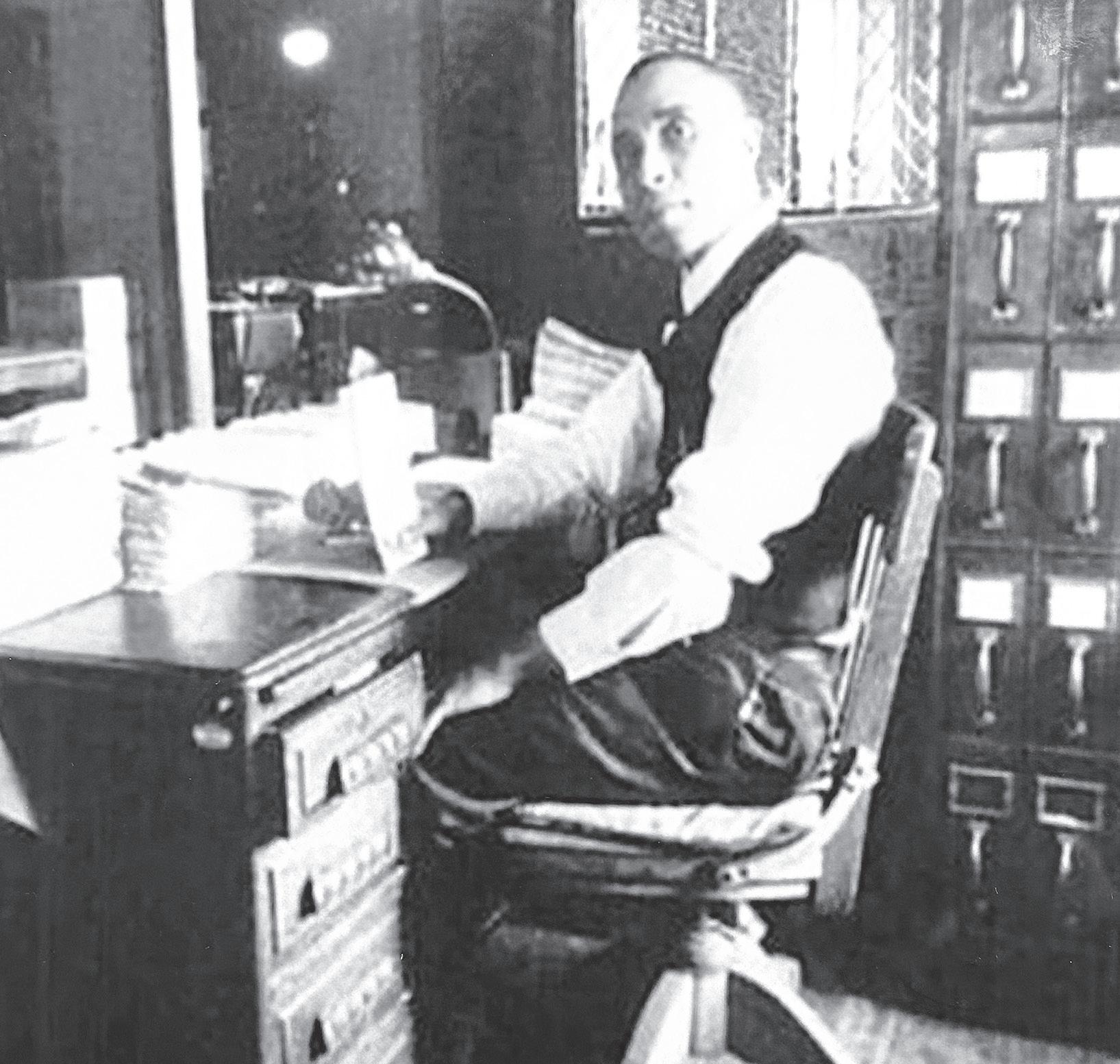
Nathan B. Young sits at his desk in the original office of The St. Louis American at Jefferson Avenue and Market Street, a few blocks from the newspaper’s current location on Pine Street.
St. Louis American archives






Living It
‘Flyin’ West,’ where Black women lead
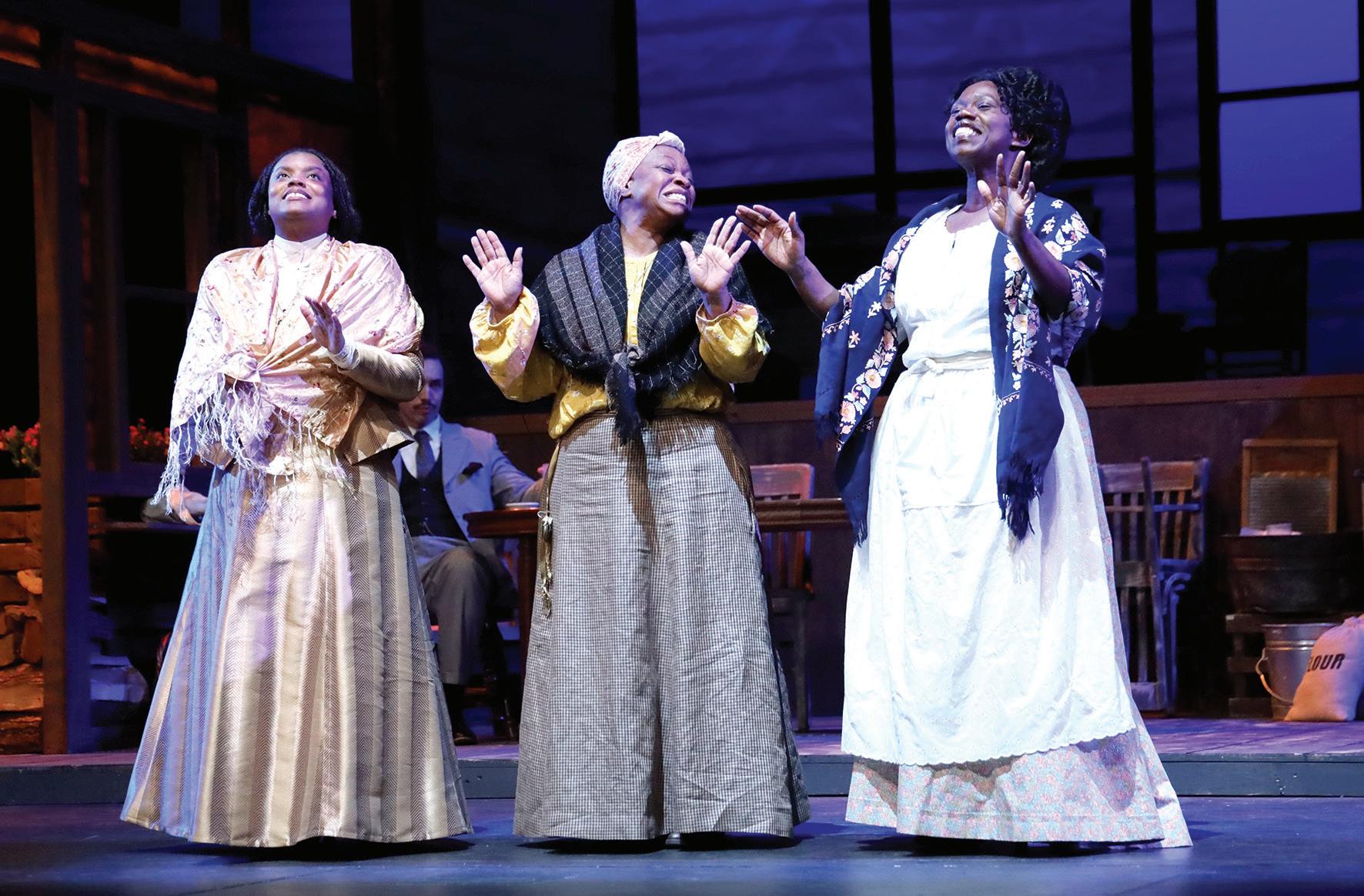
Black Rep’s season 49 continues with intentional staging of Cleage period piece
By Kenya Vaughn
St. Louis American
The
Pearl Cleage writes plays that feel like an invitation to pull up a chair—quietly, respectfully—and witness the conversa tions Black women have long relied on to survive. The kitchen‑table strategy ses sions. The beauty‑shop truth‑telling. The whispered confessions and the loud decla rations. For generations, these exchanges have been dismissed as gossip, but Cleage treats them as the sacred structure of endurance. In these rooms, around these
tables and in these seats Black women sharpen the tools they need to navigate a world that too often underesti mates them. In honor of Women’s History Month, The Black Rep brings Cleage’s “Flyin’ West” to the stage. The play opened last weekend at the Kirkwood Performing Arts Center and the turn‑of‑the‑cen tury drama rooted in the all‑Black homesteading town of Nicodemus, Kansas continues through March 29. In Nicodemus, blood sisters and a chosen matriarch stake their claim to land, safety, and self‑deter mination while white encroachment looms just beyond the horizon. Before
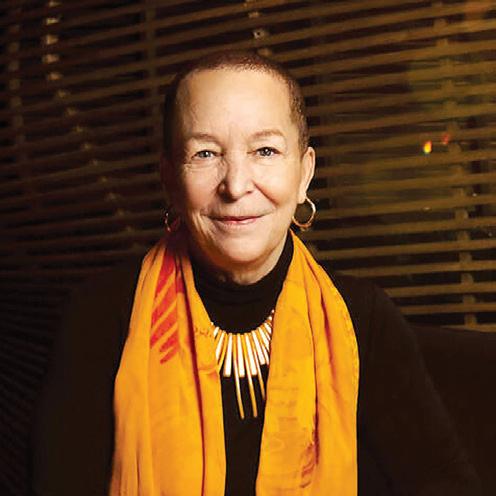
there was language for gentrification, there was speculation—and Sophie Washington is determined to pro tect her community from both. Sophie, played with steely conviction by Margery Handy, is the eldest of three sisters and the archi tect of their shared dream. In Memphis, they were expected to uphold the machinery of white soci ety. In Nicodemus, they are building a refuge where Black women can be the protagonists of their own lives. Sophie carries that responsibility like armor, convinced that
314 Day Joy

the Fabulous Fox and Ballpark Village, Joy made her rounds like a hometown ambassador.
I Define Me mascot made her rounds to celebrate STL
By Kenya Vaughn
The St. Louis American
STL native brings genre blurring ‘Apartment Tour’ to Delmar Hall
By Zaria Mac The St. Louis American
The new wave of R&B is getting loud er, smoother, and more experimental — and one of its most exciting architects is St. Louis native Jordan Ward. Friday night at Delmar Hall, the rising singer showed exactly why his name keeps coming up in conversations about the genre’s future. Performing his THE APARTMENT TOUR, Ward delivered a captivating set that blurred the lines between R&B, hip hop, and soft rock while turning everyday chaos into irresistible melodies.
The night opened with a warm set from vocalist Nali before Ward stepped into the spotlight. He entered to the opening notes of “STRANGER,” immediately revealing the show’s creative concept. The stage resembled a modest apartment living room — two cushioned chairs, an end table with a glowing lamp, leafy houseplants, and a countertop where the DJ worked the

Friday night at Delmar Hall
St. Louis native Jordan Ward showed exactly why his name keeps coming up in conversations about the genre’s future.
Emerging music star and St. Louis native
for
the rhythmic complexity popularized by Kendrick Lamar. That fusion sits at the heart of his album BACKWARD, and it translated seamlessly onstage.
As “STRANGER” faded, the music swelled into “NOISY NEIGHBORS,” a track that chronicles the drama of apartment life — from financial stress to messy relationships. Despite the chaos in the lyrics, Ward’s silky delivery softened the edges and pulled the audience into the story. The gentle groove shifted into explo sive energy when he launched into “ROSS FIT.” The track pushed further into rap territory, showcasing his ability to ride aggressive beats without losing the soulfulness that defines his sound.
Joy didn’t just show up for 314 Day—she spent nearly two full weeks moving through the city like a burst of sunshine in her bright yellow sneakers. Before St. Louis reached the day set aside for civic pride, the I Define Me Movement mascot—whose name stands for Just be an Original You— popped up at landmarks across the region. She posed for selfies in the Grand Center Arts District, stood beneath not one but two arches— The Gateway Arch and the arch that extends across the entrance of Harris Stowe State University. She leaned against the “I Love STL” display out side the Missouri History Museum. In every photo captured by Videll, Joy radiates exactly what her name promises. And in a few frames, she’s joined by the woman who dreamed her into existence—Tracie Berry‑McGhee, the St. Louis‑born therapist, author, and empower ment architect behind the I Define Me Movement.
“Joy is an I Define Me Movement mascot focusing on social media positivity. She has books, journals, affirmation cards and a YouTube presence.”
Terry Berry‑McGhee
Long before Joy became a mascot with books, journals, affirmation cards, and a YouTube presence, Berry‑McGhee was building a blueprint for girls’ wellness that stretched far beyond traditional mentoring.
She launched the I Define Me Movement many years ago as a response to what she saw in her work with girls and young women. She rec ognized an urgent need for safe spaces, positive identity development, and tools that help them define themselves before the world tries to do it for them. Through workshops, school part nerships, mental‑health programming, and her signature “SistaKeeper” model, Berry‑McGhee has reached thousands of girls locally and globally. Joy has become the movement’s newest exten sion—a playful, approachable way to bring affirmations and emotional well ness into everyday spaces, especially online.
“Joy is an I Define Me Movement mascot focusing on social media pos itivity,” Berry‑McGhee said. “She has books, journals, affirmation cards and a YouTube presence.”
boards. The setup felt intimate and inten tionally simple, inviting the crowd into Ward’s world like guests hanging out in his living room.
From the first notes, it was clear Ward occupies a unique space in modern R&B. His vocals glide with the smooth polish of Ne‑Yo, while the production leans into
Photos by Videll/Courtesy of I Define Me
From Best Steak House to Imo’s, from Union Station’s Ferris wheel to
Photos by Taylor Marrie/St. Louis American
The Black Rep continued season 49 with Pearl Cleage’s ‘Flyin’ West,’ which continues through March 29 at the Kirkwood Performing Arts Center.
Jordan Ward brought his experimental R&B home
an impressive showing Friday night at Delmar Hall.
Photos by Taylor Marrie/ St. Louis American
Pearl Cleage
CONCERTS
Thurs., Mar. 19, 7:30 p.m., Final Draft: Slow Dance Tour, City Winery St. Louis, 3730 Foundry Way, St. Louis, MO 63110. For more information, visit https://tickets.citywinery.com.
Fri., Mar. 20, 8 p.m. The 18th Annual Gateway Blues Festival, Chaifetz Arena, 1 South Compton Avenue St. Louis, MO 63103. For more information, visit www.chaifetzarena.com.
Fri., Mar. 27, 8 p.m. The New Edition Way Tour featuring New Edition, Boyz II Men and Toni Braxton, Enterprise Center, 1401 Clark Ave, St. Louis, MO 63103. For more information, visit www.enterprisecenter.com.
Thur. Apr. 16, Boys 4 Life Tour featuring B2K & Bow Wow, Chaifetz Arena, 1 South Compton Avenue St. Louis, MO 63103. For more information, visit www.chaifetzarena.com.
SPECIAL EVENTS
Thur. Mar. 26, 10 a.m. Cardinals Opening Day, Ballpark Village, 601 Clark Ave, St. Louis, MO 63102. For more information, visit https://stlballparkvillage.com.
Fri., Mar. 27, 7 p.m. SLAM Underground—SUMMIT, Saint Louis Art Museum, 1 Fine Arts Drive, Forest Park, St. Louis, MO 63110. For more
STL Sites & Sounds
information, visit www.slam.org.
Thur., Apr. 7- 8, 7:30 p.m, Live at The Pulitzer, Pulitzer Arts Foundation, 3716 Washington Blvd, St. Louis, MO 63108. For more information, visit https://slso.org.
April 10-11, Dance St. Louis presents Ailey II, The Touhill Performing Arts Center, One University Place, St. Louis MO 63121. For more information, visit www.dancestlouis.org.
COMEDY
Thur. Mar. 19, 7:30 p.m.
Special Event: Sapphira Cristal One Slue Over the Cuckoo’s Nest, Helium Comedy Club, 1151 St Louis Galleria St, St Louis MO 63117. For more information, visit https://st-louis. heliumcomedy.com.
Fri., Mar. 27, doors 7 p.m. Sherri Shepherd in the Make It Make Sense Tour, The Pageant, 6161 Delmar Blvd, St. Louis, MO 63112. For more information, visit www.thepageant.com.
Fri., Mar. 27, 7:30 p.m., St. Louis’ own Gary “G-Thang” Johnson, City Winery St. Louis, 3730 Foundry Way, St. Louis, MO 63110. For more information, visit https://tickets.citywinery.com.
Fri., Apr. 24, 8 p.m. We Them Ones Comedy Tour starring Mike Epps, Karlous Miller, DC Young Fly and many more, Chaifetz Arena, 1 S Compton Ave, St. Louis, MO 63103. For more information, visit https:// www.chaifetzarena.com.


ST. LOUIS MUSIC SPOTLIGHT
Fri., Mar. 20 - 21, 7:30 p.m.
Anita Jackson: Jazz in Protest, Steward Center 3536 Washington Ave, St. Louis, MO 63103. For more information, visit https://my.jazzstl.org.
Sun., Mar. 22, 4 p.m. Music as the Message: Stepping Into Peace starring St. Louis’ own Adrienne Danrich, The Sheldon, 3648 Washington Blvd, St. Louis, MO 63108. For more information, visit https://www. thesheldon.org/events.
Wed., Apr.1, 7 p.m. SLSO Community Concert –
Creative Music Making, Powell Hall, 718 N Grand Blvd, St. Louis, MO 63103. For more information, visit https://slso.org.
THEATRE
Mar. 19 – Mar. 29, Soul Siren Playhouse presents Robbin, from the Hood, .Zack Theater in the Grand Arts District, 3224 Locust. For more information, visit www.playsiren.com
Through Mar. 25, Promenade the Musical, The Marcelle Theatre, 3310 Samuel Shepard Dr. St. Louis, MO 63103. For more information, visit https:// kranzbergartsfoundation.org. Fri., Mar. 27 – Sun., Mar.
29, Metro Theater Company presents Life Doesn’t Frighten Me by Paige Hernandez, Based on the poem, Life Doesn›t Frighten Me from the book And Still I Rise by Maya Angelou, The Sun Theatre, 3625 Grandel Square. For more information visit metroplays.org.
Through March 29, The Black Rep presents Pearl Cleage’s Flyin’ West, Ross Family Theatre, Kirkwood Performing Arts Center, 210 East Monroe Ave, Kirkwood, MO 63122. For more information, visit www. theblackrep.org.
Sun., Apr. 12, 5 p.m. Je’Caryous Johnson Presents: Set It Off Live!, Stifel Theatre, 1400 Market St, St. Louis, MO 63103. For more information, visit www.stifeltheatre.com.
ART
Fri., Mar. 20 - Jun. 28, Martine Syms: Soliloquy, St. Louis Art Museum, 1 Fine Arts Drive, Forest Park, St. Louis, MO 63110. For more information, visit www.slam.org.
Through June 2026, The Future Is Female, 21c Hotel and Museum Hotel St. Louis, 1528 Locust St, St. Louis, MO 63103. For more information, visit https://21cmuseumhotels. com.
Through Aug. 9, Teaser by Ayana Evans, Contemporary Art Museum, 3750 Washington Blvd, St. Louis, MO 63108. For more information, visit https:// camstl.org.




Black Rep
Continued from B1
her personal happiness is a small price to pay for her family’s freedom.
Guiding her is Miss Leah, portrayed by veteran actress Renee Lockett in a Black Rep debut that is equal parts sage wis dom and comedic balm. Miss Leah has endured the unthinkable as a for merly enslaved woman, yet Lockett refuses to let her be defined by trauma. Instead, she offers a por trait of a woman who has learned to hold grief in one hand and possibility in the other.
Jazzma Pryor’s Fannie is the soft center of the sisterhood—joyful, patient, and the perfect counterweight to Sophie’s rigidity. And Christina Yancy brings a heart breaking tenderness to Minnie, the youngest sister whose return from London reveals the emotional cost she pays at the hands of her husband. Aaron Allen’s Frank, tormented by his biracial identity in Jim Crow America, sees his Blackness as a burden rather than a birthright. His unraveling is a painful reminder of how white supremacy distorts even the most intimate relation ships. On the opposite end
of that spectrum is Will Parrish, played with grounded warmth by Reginald Wilson. Will embodies the kind of pro tection rooted not in dom inance, but in devotion—a man who understands that safeguarding Black women is both duty and honor. Director Jon Royal gives the production room to breathe. He lets the humor land, lets the ten sion simmer. He also lets the conversations linger long enough for the audi ence to feel their weight. The ensemble meets the moment with a shared sense of responsibility, fully aware that Cleage’s work demands both preci sion and heart. That commitment was tested in real time when tornado warning alerts pierced the air midway through the second act. As phones blared and the Kirkwood Performing Arts Center initiated its shelter‑in‑place protocol, Black Rep Founder and Producing Director Ron Himes stepped onstage and paused the show. Audiences from other the aters were ushered into the mainstage space, and once everyone was settled, the cast resumed as if nothing had happened. Their focus never wavered—and the newly gathered audience stayed until the final bow. It was a testament to the power of live theater and the professionalism of this cast.
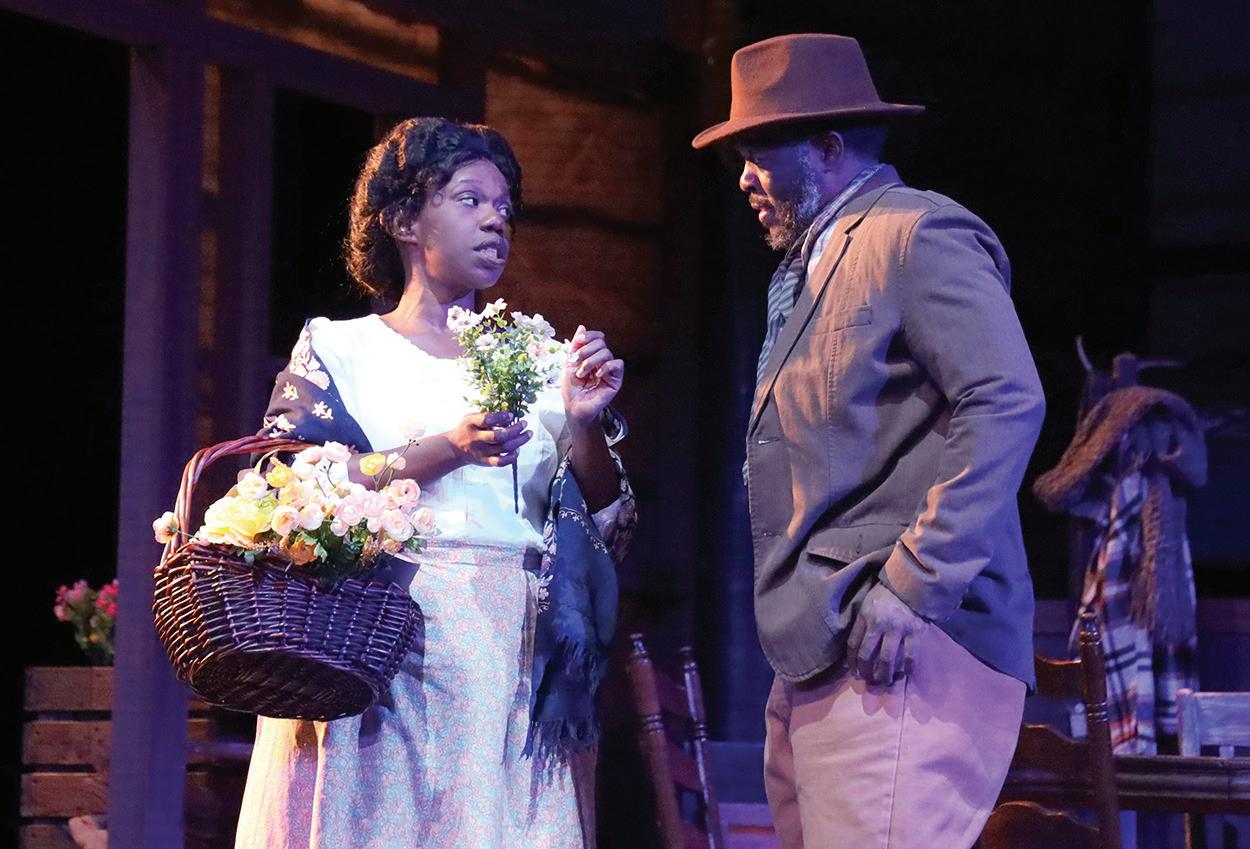
Jazzma Pryor and Reginald Wilson in The
week and continues through
Scenic designer Chris Cumberbatch and costume designer Michele Siler craft a visual world that feels both lived‑in and aspirational. And sound designer Justin Schmitz adds a clever touch with a bluegrass cover of Blu
Continued from B1
Oversized hoodies and denim jackets bounced in the crowd as fans shouted the line, “I’m having too much motion.”
Midway through the set, Ward paused and grinned. “Where my smokers at?” he asked. Within seconds, clouds drifted through the venue as the crowd erupt
Continued from B1
And this March, Joy had a mission.
“We literally did a photo shoot spotlighting places to go and we posted them every day starting 3/1–3/14,” Berry‑McGhee said. “Joy wanted to spread some STL 314 Day joy for the kids.”
ed. The moment flowed naturally into “SMOKIN POTNA,” his hazy ston er love song featuring SAILORR. Bathed in cool blue lighting, the room set tled into a mellow groove as Ward’s vocals floated through the smoky air. Just when the audience thought they had the night figured out, Ward shifted again — this time lean ing into a soft rock vibe. The bass line pulsed as fans clapped along, and a guitar eased into the
From Best Steak House to Imo’s, from Union Station’s Ferris wheel to the Fabulous Fox and Ballpark Village, Joy made her rounds like a hometown ambassador.
The tour doubled as a celebration of the 20‑year milestone of 314 Day and an introduction to Joy her self—a character designed to help young people embrace authenticity, well ness, and self‑love. Joy is available for
mix as he began “HIGH FUNCTIONING,” sere nading the room as they kept rhythm with their feet. He kept that energy alive with “Lil Baby Crush,” one of his early favorites. The reaction was instant. Fans shouted the chorus in unison as Ward paced the stage casually, like he was hosting friends in his own apartment. Throughout the night, he moved effortlessly through R&B gems like “Jealousy”
wellness events, book signings, and school vis its—places where young people need a reminder that they are enough, exactly as they are.
“Celebrating the city has been a joy,” Berry McGhee said. “We hope we brought STL a little joy. Find some joy – and remember to just be you.”
For more information on Joy and the movement she represents, visit www. idefinememovement.com.
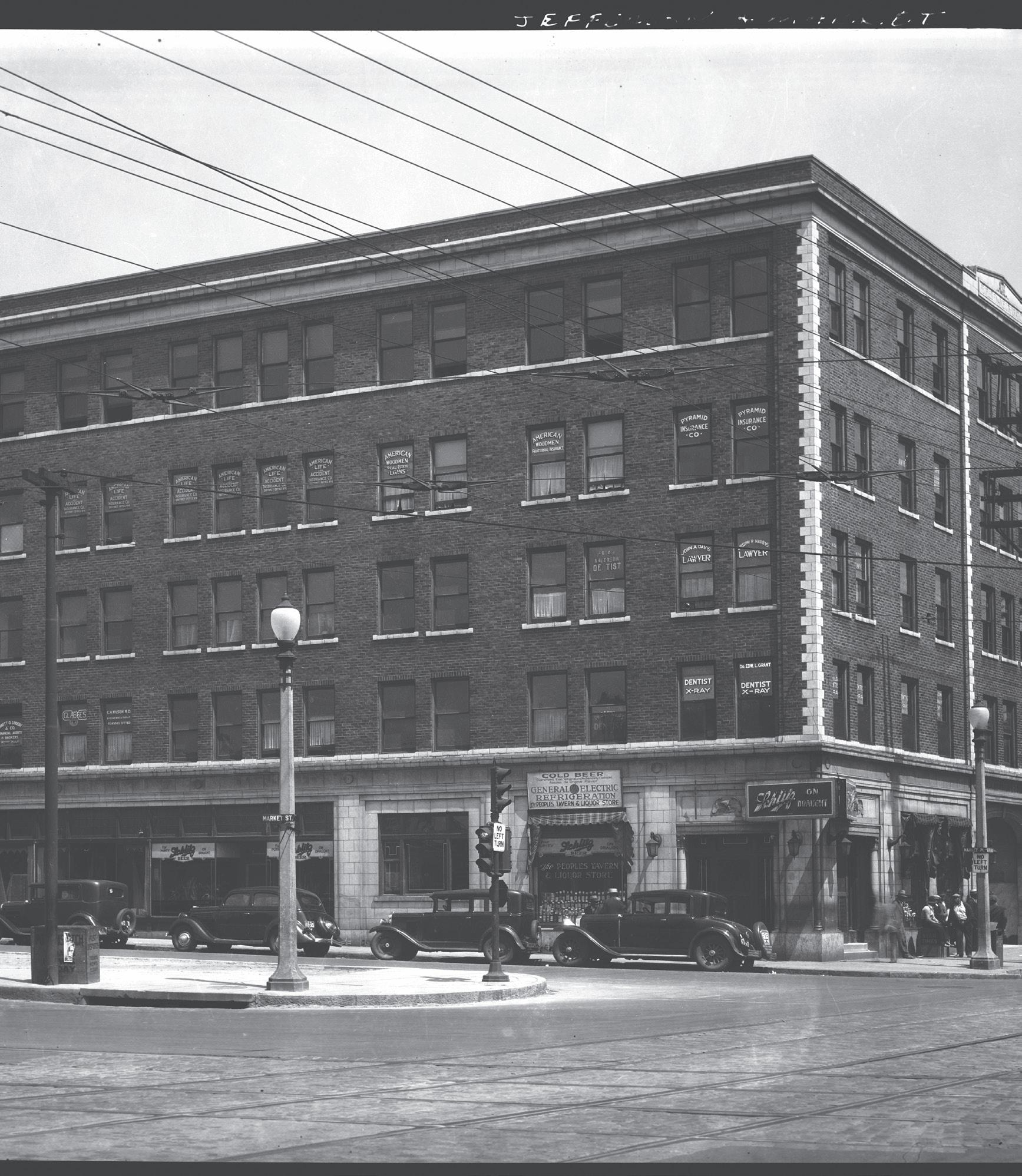

Cantrell’s “Hit ’Em Up Style,” a wink that bridges past and present. But beyond the perfor mances and production elements, “Flyin’ West” is a reminder that Black women’s stories are not niche, supplemental, or optional. They are
with Joony, “CHANGE OF SCENERY,” and “TAKE‑OUT.” Each track highlighted a different facet of his artistry — soulful, introspective, and sometimes playful. When “CUTTI” hit, the room erupted. Orange strobes swept across the crowd as fans jumped and danced, transforming the apartment‑themed stage into a full‑blown house party. Ward kept the momentum
essential to the canon of American—and global— theater. Cleage’s work insists that the emotional lives, dreams, and strat egies of Black women deserve center stage. And The Black Rep’s staging reinforces that truth with every scene.
going with “Player Two,” “CHERIMOYA,” and the fan‑favorite “WHITE CROCS.” Every word echoed back from the audience, who stayed locked in from start to finish.
After a brief exit, Ward returned for an encore.
Under soft blue lights, he closed the night with the sorrowful melody “Y.”
The gentle lighting ampli fied the longing in the song, giving the perfor
The Black Rep’s presentation of Pearl Cleage’s Flyin’ West continues through March 29 at the Kirkwood Performing Arts Center. For more information, visit www. theblackrep.org or call 314.534.3807.
mance a reflective, almost cinematic ending. If the goal of THE APARTMENT TOUR is to invite fans into Ward’s creative world, Friday night proved the concept works. By blending the storytelling of hip hop with the emotional depth of R&B — and adding rock for texture — Jordan Ward is carving out a lane that feels both nostalgic and refreshingly new.


Photo by Taylor Marrie/St. Louis American
Black Rep’s staging of Pearl Cleage’s ‘Flyin’ West.’ The show opened last
March 29 at the Kirkwood Performing Arts Center.

314 Day rewind. I am typing with a straw in my mouth right now because I took it way too far in the name of 314 Day this weekend. In all fairness to me, 20 years is worth going hard in the paint for. After that last Mobb Out that was in perfect sync with Koko C’vere, I knew the rest of the week was gonna be a problem. I got in my car and heard a pop in my shoulder when I turned the steering wheel. I thought about mobbing up into Christian Northeast! But y’all didn’t come here to hear about this battered, bruised and tore up borderline elderly shape, so let’s get to it. March 14, 2026 will go down in history as an absolute movie in St. Louis city, county and surrounding areas. Actually beyond the surrounding areas if you count what went down in Texas, Georgia and D.C. And it got cracking before the actual 314 Day. Nothing but death or wisdom tooth pain could have kept me from Chevre Friday night for the Animal House reunion party. When I tell you a time was had. Ben Gay and Icy Hot had to be involved afterwards, because we tore it up like we were up in the Lewis and Clark Tower. I got up bright and early to make my way to Overland Plaza for the 314 Day Block Party at Hibbett Sports. And by bright and early, I mean 2 p.m. I knew it was packed to the gills because the Page exit on 170 South was lowkey looking like Hollywood Casino Amphitheater on a show night. I pulled up in that parking lot and was absolutely right. It was a sea of red and blue thanks to the St. Louis Cardinals and Blues gear. Can somebody tell y’all’s cousin not to wear that yellow wig with her Blues jersey next year? It was a bit much.
Anyway, it was all the way live outside. Does anybody else have “You Stupid” stuck in their heads? And Overland Plaza let me know exactly what to expect when I made my way to The Pageant for the 314 Day Concert of all 314 Day Concerts. I also scooted over to the 314 Day Party with Nine PBS and it was litty lit just like everything else!


314 Day part deux. Phil Assets and Friends (I see you, Vanessa Townsend-Vann) have most certainly made my best of 2026 end of the year round up with that epic 314 Day Concert they pulled off at The Pageant. And I’m saying this knowing full well that it is only March. The crowd pulled up dressed for the city—red and white for the Cardinals, blue and yellow for the Blues and there were even some St. Louis Rams era blue and gold blended in. Yo…Shorty Da Prince, The Lunatics and all kinds of other folks hit the stage and had me realizing what I put my knees through with all that early 2000s twerking. Webbie had us in a trance the moment he touched the stage. And if I had the concert to do all over again, I wouldn’t have let my phone die before “Not a Stain on Me” dropped, so y’all could see for yourselves how lit it was. Can someone please explain how is it that I can remember every single word to Murph’s verse, but have to reset my Hulu password every time I accidently log myself out?
314 Day swag best in show. Because folks were repping the city with style – whether it
3.Darvetta and Deshaun taking in the atmosphere of STL Love at the Nine PBS 314 Day Block Party Saturday afternoon
4. Emerging STL R&B star Jordan Ward had the full attention of his
Friday night at Delmar Hall
was storebought, custom made or homemade – I’ve decided to give a moment to the folks who slayed STL style for 314 Day. Tierha, if you don’t give me that electric blue clutch that matched your St. Louis Blues jersey! I must admit that I have never wanted to become a purse snatcher so bad in all my life. And if I did, I would be the first robber in the history of doing hoodrat stuff who could care less about what’s inside the bag! Lucy, your STL red overalls were absolutely every single thing. It was understated, but I really enjoyed Louise of Epiphany Boutique’s quilted crop bomber jacket and STL cap. Don’t get it twisted. Her name might give “Rough Side of the Mountain” or Mississippi Mass Choir, but her style game utterly undefeated. Speaking of caps, Kawanna’s custom fitted ballcap with denim embellishments baseballs and bats on it made me take a second look.

Yes, it was busy. No it was not tacky. Breonna Hargrove, that Blues Jersey you turned into a belly blouse was life more abundantly. Can you sew me one in a 2X. I said what I said…and yes, I said I wanted a 2X belly shirt. Y’all better get into this body positivity era! And I didn’t catch his name, but the brother at the Overland Plaza block party in front of Hibbett Sports with the hoodie that had the highway 170 insignia on the sleeve deserves a nod. And since we’re talking about Overland Plaza, I won’t call you out by name, but I saw a couple of the folks walking out of Ross Dress For Less with bags and changing into their 314 Day fit as they made their way across the parking lot. Your secret is safe with me.
Jordan Ward is on his next level. Eight or nine years ago, I talked about how this young singer who was a featured artist at a Delmar Hall show. I

said with some polishing he had the potential to rep for St. Louis R&B on a national scale. I love it when I get to say I told you so! Last week Jordan Ward came back to Delmar Hall for his headlining THE APARTMENT TOUR. He proved he has the potential to be a major player of an R&B renaissance among the Gen Z folks. I can’t wait for the rest of the world to catch on, because he had me in that concert ready to proclaim him the prince of R&B’s next era. Anybody in the building Friday night knows that he is ALREADY a star.
And the nominees are…I’ve been bigging up the first-ever St. Louis American Reader’s Choice Awards for weeks. What made you think I was about to stop now? I couldn’t let it slide that the window will be closing for you to make your nominations at the end of the month. Please don’t leave your people hanging. Nominate them at www.stlamerican.com/readerschoice/


1. St. Louis stars Tahir Moore and DJ Cuddy at the Hibbett Sports 314 Day Block Party Saturday afternoon in Overland Plaza
Gabrielle Hays, Aliyah Lipnick and Reyna Spencer celebrating 314 Day at the Nine PBS 314 Day Party
Photos by Lawrence Bryant and Taylor Marrie/St. Louis American
“I had to learn how to build a culture.”

— Howard University basketball coach Kenny Blakeney, after leading the Bison to their first NCAA Tournament victory with a 52-46 victory over Deerfield. Senior forward Jamison White led the Flyers with 19 points, 17 rebounds, four assists, two steals and three blocks. Senior guard Alex Johnson scored 18 points and grabbed 10 rebounds in the Flyers’ 59-40 victory over Chicago Leo in the semifinals. The Flyers finished the season with a 33-4 record.
InSIdE SportS
With Earl Austin Jr.
Principia, East St. Louis bring home state championships
Basketball programs from the St. Louis metro area brought home three state championships from both Missouri and Illinois last weekend.
The boys’ and girls’ teams from Principia swept both Class 3 state championships at last weekend’s Final Four at the University of MissouriColumbia. On the Illinois side, the East St. Louis Flyers won the IHSA Class 3A state championship in Champaign. It was the second state title for the Flyers, who also won in 2019.
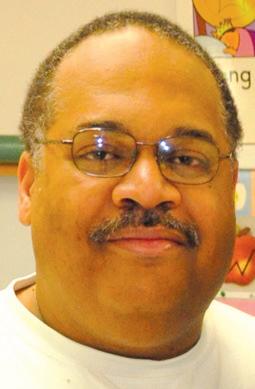
Principia’s boys stormed to a repeat state championship with a 98-34 victory over Miller Career Academy in an All-St. Louis final. Senior guard Quentin Coleman concluded a stellar high school career by scoring 50 points in the championship game. The 6-foot-4 Coleman also had nine rebounds and seven assists while making five 3-pointers.
The Principia girls’ team joined its boys in the winner’s circle by winning the program’s first state championship. The Panthers defeated St. Vincent for the state title last Thursday night. Sophomore guard Loganne Love led the Panthers with 19 points in the state championship game. Allstate junior forward Dasia Scott scored 25 points in the Panthers’ victory over Skyline in the semifinals.
East St. Louis finished a stellar season by winning the state championship
Large schools take center stage in Columbia
The St. Louis area will be well represented at this week’s Missouri large school state championships at the Class 4, 5 and 6 levels.
The Vashon Wolverines lead the field at the Class 4 Final Four. The Wolverines are seeking their sixth consecutive state championship. Also joining Vashon from the area is Clayton, which is making its first Final Four appearance since 1975. Vashon will face LoganRogersville in a big showdown in the semifinals on Friday at noon. Clayton will take on St. Joe Benton on Friday at 10 a.m. The winners will meet for the state championship on Saturday at 4 p.m.
The Class 6 boys Final Four will feature local teams Cardinal Ritter and DeSmet. Cardinal Ritter will face Blue Springs South in the semifinals on Friday at 2 p.m., followed by DeSmet vs. Rockhurst at 4 p.m. The winners will meet for the state championship on Saturday at 6

p.m. Cardinal Ritter has won four state championships in the past six years.
In Class 5, MICDS is making its first Final Four appearance since 2002, when it won the Class 3A state championship. The Rams will face Hillcrest in the semifinals on Friday at 8 p.m. Sikeston will face Raytown South in the other semifinal game at 6 p.m. The winners will meet for the state title on Saturday at 8 p.m.
The girls Final Four features national power Incarnate Word Academy, which is seeking its sixth consecutive Class 6 state
championship. The winner of Wednesday’s semifinal game between IWA vs. Lee’s Summit West and Jackson vs. Staley will play for the state championship on Thursday at 6 p.m. In Class 5, Lift for Life returns to the Final Four, seeking a third consecutive state championship. The Hawks have endured season-ending injuries to standout guards Amaya and Cara Manuel to make another trip to Columbia. MICDS is also back in the Final Four after finishing in fourth place in Class 4 last season.
SportS EyE
With Alvin A. Reid
The winners of the Lift for Life-Grandview and MICDS-Marshfield semifinal games will play for the state championship on Thursday at 8 p.m.
In Class 4, Cardinal Ritter is one of the teams to watch. The winner of the Ritter-Strafford semifinal game on Wednesday will play either Doniphan and Benton for the state championship on Saturday at 4 p.m.
SLU and Mizzou earn NCAA Tournament berths
Saint Louis University and Missouri will par-
Academy in an
ticipate in the NCAA Tournament, which begins this week. Both teams earned at-large berths to the tournament. Saint Louis is the No. 8 seed in the East regional. The Billikens will face No. 9 seed Georgia in the first round on Thursday night at 8:45 p.m. (CT). The game will be televised on KMOV-TV. Mizzou received a No. 10 seed in the tournament. The Tigers will face No. 7 seed Miami on Friday in St. Louis at the Enterprise Center. Tipoff is at 9:10 p.m. The game will be televised on TruTV.
Mizzou gets sweet St. Louis favor in NCAA Tourney
After tumbling to Kentucky in the SEC Tournament, Missouri coach Denis Gates had no idea what the NCAA Tournament Committee thought of his team.
Mizzou learned Sunday it enters the tournament as a No. 10 seed, avoiding a play-in game.
With Easter near, it is a season of miracles. The Tigers somehow landed an opening-round game in St. Louis against No. 7 seed Miami. The Hurricanes probably aren’t happy with the deal, and neither is Purdue. The No. 2 seed Boilermakers are heavily favored to beat Queens and would take on the Missouri-Miami winner.
tution when it comes to those moments that we’ve been on the other side of being unlucky,” Gates said.
“But that also helps the fandom that we do have, the support that we do have. I will never push away the criticism I receive as the head coach. It comes with the territory.”
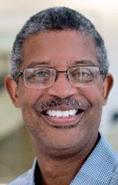
Does Gates being Black add to the unfair appraisal he receives from some Mizzou fans? Yes, but that too “comes with the territory.”
Miami’s Black coach, Jai Lucas, is hailed as a conquering hero. The former Duke assistant coach inherited a team that lost 24 games last year and turned them into a 25-game winner.
Gates, who contends with a fickle Mizzou fan base that refuses to acknowledge his outstanding work, has his team in the NCAA Tournament for a third time in four years.
He acknowledged his detractors with serenity on Sunday after learning his team is headed to St. Louis.
“There’s a lot of doubt in the fabric of our insti-
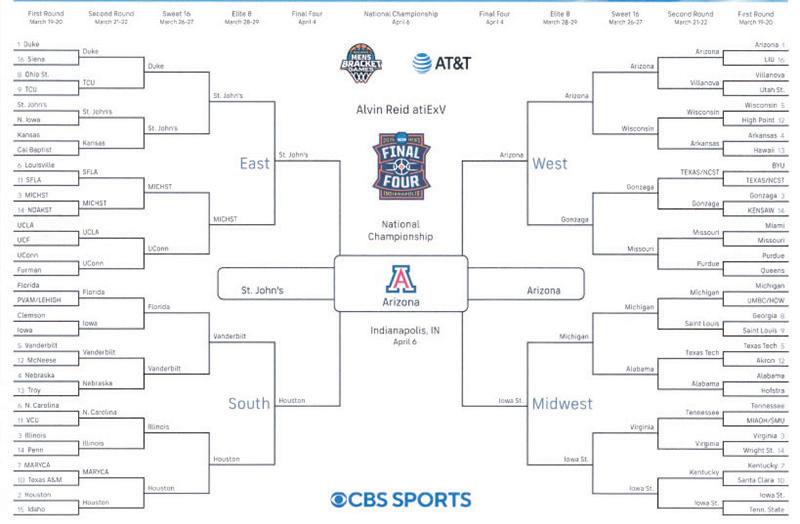
“I wanted to win (in rebounding), win the free-throw line and control the paint, which isn’t just posting up but also having guards that can get downhill,” Lucas said during last week’s SEC Tournament.
“What we do travels. We’re not going into games banking on making 12 or 13 3s. What we do is what leads to winning.”
Regardless of the favorable crowd, the Tigers could lose to Miami, which was an outstanding 8-2 in road games during the season.
Hurricanes forward Malik Reneau, an Indiana transfer, averages 18.8 points, 6.6 rebounds and 2 assists per game, and was named to the All-ACC team.
Tre Donaldson, Miami’s second-leading scorer with 16.5 points per game, was a teammate
of Missouri’s Anthony Robinson II at Florida State High School. The senior forward also dishes out about six assists per game.
While Gates knows he found a four-leaf clover on Sunday, he is playing down the location of the game.
“At this point in the season, everybody has had road games, everyone has had neutral site games, everyone has traveled. It’s going to be a game that
both teams show up,” he said. The “get rid of Gates” crew will be obnoxiously loud should Miami top Missouri. It won’t happen.
In fact, Missouri is Sweet 16 bound following a resounding win over Purdue. The Boilermakers were No. 1 when the season began. I doubted them then, I doubt them now.
The Reid Roundup Lots of basketball…
After its heartbreaking loss to Dayton in an A-10 semifinal last Saturday, No. 9 seed SLU will take on No. 8 Georgia on Friday in Buffalo. I’ve got the Billikens winning that game before bowing to top-seed Michigan… Jaden Bradley, Big 12 Player of the Year, and his Arizona Wildcats will be cutting down the nets in Indianapolis as national champions — at least on my bracket…I’ve got St. John’s reaching the title game, led by KU transfer and Big East Player of the Year Zuby Ejiofor Also reaching the Final Four will be Houston and Iowa State…The Darryn Peterson saga at KU will come to an end against St. John’s in a Round of 32 game. Peterson, who battled cramps, injury, and illness (so he says), could be a great NBA player but his lone season at KU is a massive disappointment… The Missouri Valley Conference placed a conference-record four teams in the National Invitation Tournament, led by No. 4 seed Illinois State who takes on Dayton. Also in the NIT are Bradley, Illinois-Chicago and Murray State…
Principia’s boys stormed to a repeat state championship with a 98-34 victory over Miller Career
All-St. Louis final.
Alvin A. Reid
Alvin Reid picks the University of Arizona to win the 2026 NCAA Tournament.
Photo by Lawrence Bryant / St. Louis American
Earl Austin Jr.
and
St. Louis
award
NIE program
to St. Louis area teachers and students each week throughout the school year, at no charge.
Questions or comments? Contact Cathy Sewell csewell@stlamerican.com or 618-910-9551

CLASSROOM SPOTLIGHT

Students at The St. Louis American’s Summer Science Academy study animal pelts to learn about their habitats and physical attributes.

Students at The American’s Summer Science Academy work in teams to discover the many different computer programming languages.
Photo by Cathy Sewell
Teachers,
CORNER
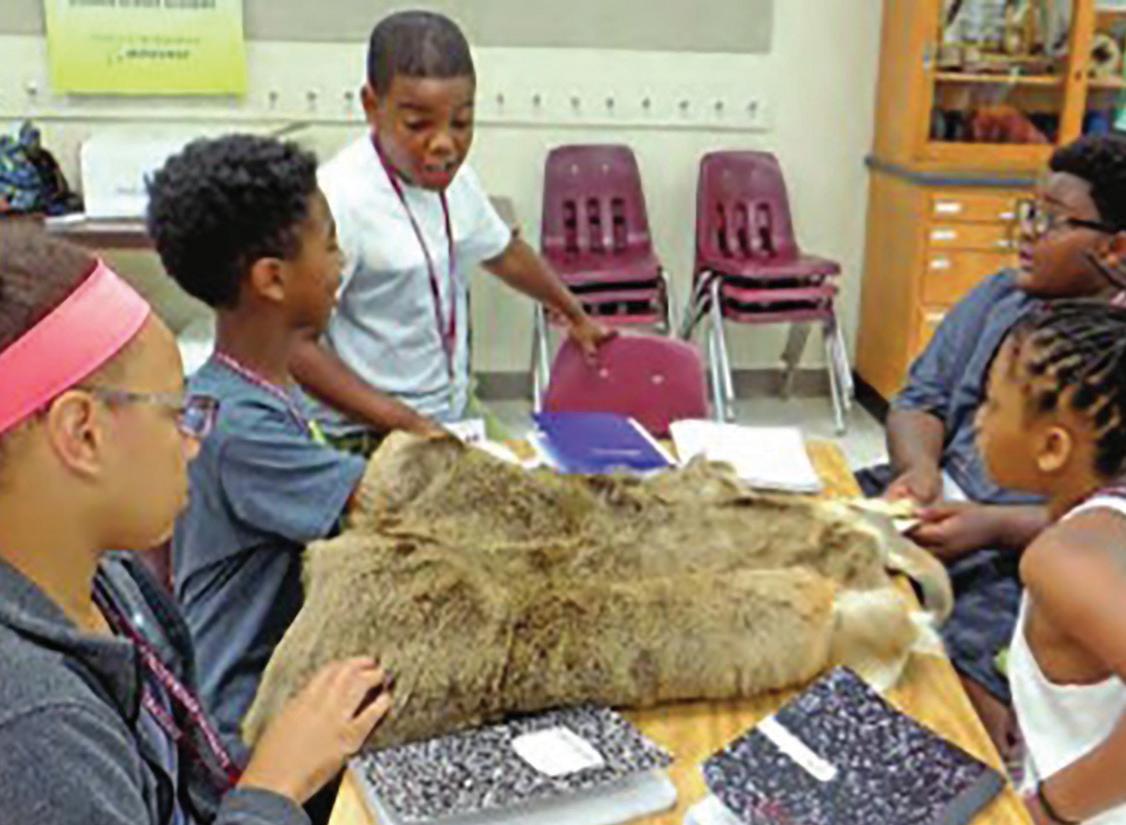


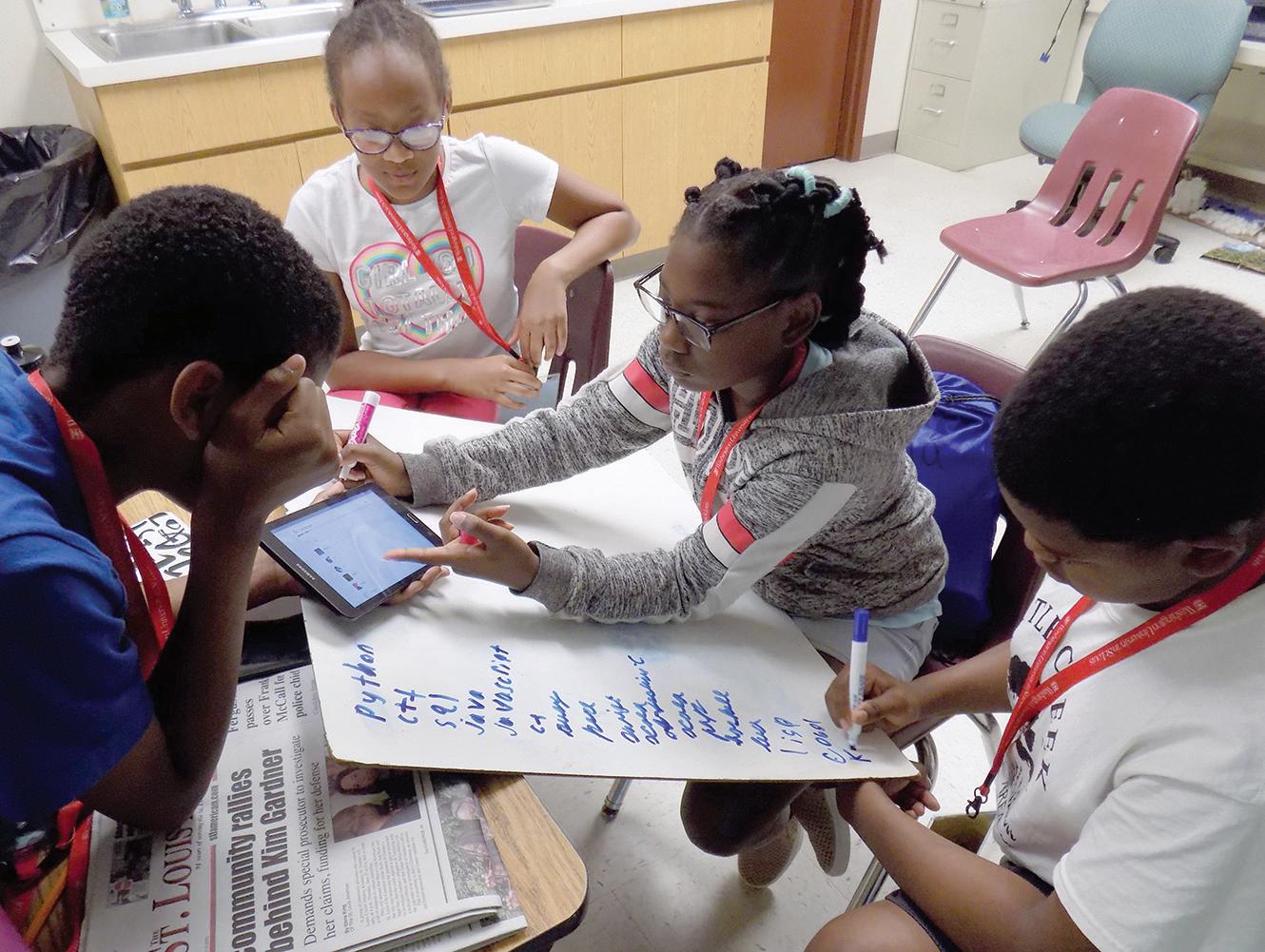
SCIENCE STARS
FAMILY SPOTLIGHT SCIENCE STARS


SCIENCE STARS
Dr. Cece Calhoun: Doctor and Scientist
African American Meterologist William “Bill” Parker
AFRICAN-AMERICAN MYCOLOGIST AND EDUCATOR: Jeanette Jones
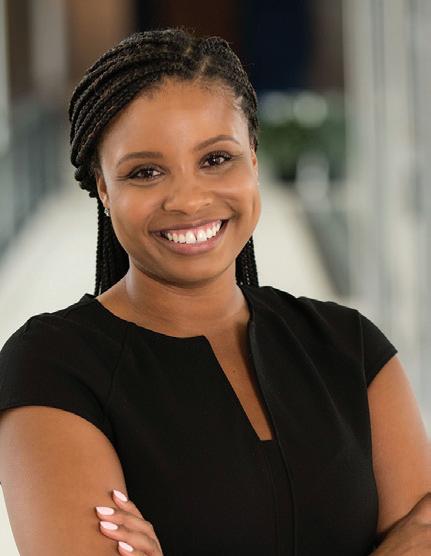
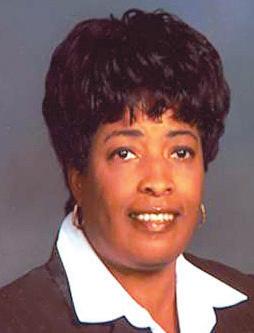
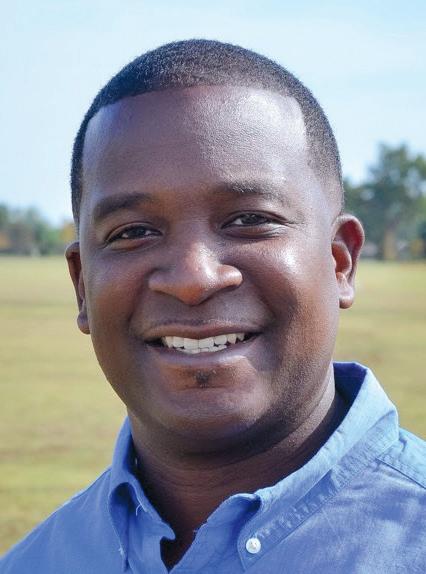
William (Bill) Parker grew up in New Orleans. He graduated from JFK High School, which focused on math, science, and engineering. Parker was interested in hurricanes at a young age, but he became interested in the weather after a high school statistics class. In this class, he learned how to predict the chance of rain. Parker wanted to attend a historically black college/ university (HBCU), so he chose Jackson State University to study meteorology. He graduated with his bachelor’s degree, in 1994.
A hurricane forms over tropical and subtropical ocean water. Warm water and cool, moist air combine to create strong winds that can gust up to 200 miles per hour! These winds create waves that bring the storm on shore. Hurricanes are very destructive. They can flip cars, sink boats, uproot trees, and demolish houses.
What Does An Environmental Scientist Do?
SCIENCE CORNER
An environmental scientist uses their knowledge of science to protect nature. They work to find a balance between human needs and the needs of organisms in their environment. Their goal is to preserve nature for future generations.

Are Fungi ?
In addition to powerful winds, hurricanes bring a lot of rain. (Taiwan received 114 inches of rain in three days during a hurricane.) These rains can cause landslides and flash floods.
SCIENCE
Some environmental scientists conduct research. They may study how processes or chemicals affect the environment, or they may study endangered animals. Environmental scientists develop and enforce policies (rules) to protect the environment, and are often employed by government agencies.

Fungi are organisms made of filaments (called hyphe) that are stacked together. Unlike plants, fungi do not have chlorophyll, so they cannot make their own food. Some fungi are parasites, which mean they live off of other organisms. Some fungi feed off of dead and decaying matter. Fungi are everywhere in the environment, including the soil, lakes, river and seas, air, and on plants and animals. Fungi (plural of fungus) help organic matter to decay and release carbon and oxygen into the environment. Unlike plants, fungi do not have
In this experiment, you’ll create a replica of a hurricane and identify how the forces work together to create a hurricane.
SCIENCE INVESTIGATION
Materials Needed:
• 2
• Water Duct
In this experiment, you will learn how mold grows best. Mold is an important fungus that has several uses, including breaking down dead organic material. Some purified molds are actually used as an antibiotic to treat illnesses.
Procedure:
Materials Needed:
q Fill one bottle with the paperclips, peanuts and sand. These represent the debris and help make the movement of water easier to see.
Process:
w Place the funnel in the mouth of the bottle and pour water into the bottle until it is 3/4 full, then remove the funnel.
e Turn the second empty bottle upside down and hold it over the first bottle so that the mouths of the bottle are aligned. The bottles will look like an hourglass.
r Tape the seam, pressing the duct tape firmly to

Hurricanes can last a few hours or several days. Most hurricanes occur during the fall months. How can you stay safe? Have an evacuation plan and an emergency kit prepared. Meteorologists can track these storms and keep you informed. For more hurricane facts, visit: http://www.sciencekids.co.nz/ sciencefacts/weather/hurricane.html.
Also, environmental scientists work as consultants and give advice to companies.
For example, they can tell architects how their buildings will affect the environment.
leaves, stems, or roots. Fungi use spores to reproduce. One common type of fungus is the mushrooms you find on your pizza. Mold, yeasts, and mildew are also types of fungus.
If you are interested in becoming an environmental scientist, read and learn all you can about plants, animals, and protecting the environment.
For More Information, Go to: https://kids.kiddle.co/Fungus
Learning Standards: I can read nonfiction text for main idea and supporting details.
Learning Standards: I can read nonfiction text to gain background information about fungi.
create a watertight seal. Continue taping 1 to 2 inches above and below the seam.
Growing Mold!
t Hold the bottles by the middle and lift the jugs.
For more information, visit: http://www.epa.gov/students/. Learning Standards: I can read nonfiction text to learn about careers in science.
y Quickly, turn the bottles over so that the water-filled bottle is on top. Set the bottles on the table again.
u Observe the water as it drains into the bottle below. The water competes with the air from the empty bottle. Both substances
t For five days, measure the square centimeters of mold on each piece of bread through the bag. Use a grid, if possible, or a ruler. If mold covers more than half a square centimeter, it is counted as one full centimeter.

z A hurricane has moved 456 miles in 6 hours. How many miles per hour is the hurricane traveling? ______ If it continues to travel at that speed, how far will it travel in 10 hours? ______ x Hurricane Frederick is traveling at 86 miles per hour. If the hurricane is 129 miles from the coast, how many hours will it take until the hurricane reaches the coast? ______
MATH CONNECTION
Solve
At the end of a week (5 days of measuring) or longer, use
The water will flow along the outside of the neck, while air moves quickly up through the center of the vortex. The water will drain
X has grown to have wind speeds of 48 miles per hour. How much faster will the winds have to become for Tropical Storm X to become Hurricane X? ______
Analyzing a Bar Graph
Problems with Hurricanes!
Scientists often use tables and graphs to display the results of their research. Looking at these displays, you can draw conclusions.
As we approach spring weather (and increased rain), create a bar graph that displays the amount of rain that falls for several consecutive days or weeks. (Day 1: 1.5 inches, Day 2: 0 inches, Day 3: 1.5 inches, etc.)
w The
c A tropical storm takes on a hurricane status when the winds reach 74 miles per hour. After three days, Tropical Storm
DID YOU KNOW?

DID YOU KNOW?
v Upon landfall of a Category 4 hurricane, local officials ordered an evacuation. City A has a population of 9,613, City B has a population of 5,013 and City C has a population of 3,972. How many people were evacuated in all?
Discussion Questions: Which day had the most measured rainfall? Which day(s) had the least? Looking at the bar graph, what might you conclude about rain patterns in March/April? What other observations can you make?
$115,264 in damage, City B reported $236,096 and City C reported $436,869 in damages. What was the total cost of damages rounded to the nearest thousand? ______ If the state and federal government promised $500,000 in aid, how much would the local people have to raise by themselves? ______
e There are 2,157 homes in a town preparing for a hurricane. The townspeople were told to store water in preparation for a hurricane. If each home had to store 15 gallons of water, how many total gallons of water would the town have to store?
Learning Standards: I can use a bar graph to display information. I can use the information to make deductions and inferences.
b After citizens returned to their houses after the evacuation, reports of damage were totaled. City A reported

This special Newspaper In Education initiative is made possible, and delivered to classrooms through the St. Louis American Foundation and its NIE Corporate Partners:

Learning Standards: I can add, subtract, multiply, and divide to solve a problem.
Learning Standards: I can add, subtract, multiply, and divide to solve a problem.


Dr. Cece Calhoun is a doctor and scientist who helps young people with Sickle Cell Disease (SCD). SCD is a condition where red blood cells change shape, which can cause pain or serious health problems.
Dr. Calhoun wants to make sure kids with SCD grow up to be healthy adults and know how to take care of themselves.
Jeanette Jones was born on September 19, 1950, in Fort Valley, Georgia. Jones graduated from Fort Valley State University in 1972 with a bachelor’s degree in biology education. In 1973, Jones received her master’s degree in botany and mycology (a branch of biology that studies fungi) from The Ohio State University. In 1976, she received her doctorate (Ph.D.) degree. She also studied at the University of Nevada, the University of California Medical School, the National Center for Disease Control-Atlanta, and the Massachusetts Institute of Technology. After graduation, Alabama A&M University hired Jones as an assistant biology professor. In 1986, she served as an adjunct professor in the College of Pharmacy and Pharmaceutical Services at Florida Agricultural and Mechanical University and worked on a project with NASA. In 1991, Jones served as the first female vice president of research and development at Alabama A&M University. She also served as President of Alabama A&M University’s Faculty Senate from 2001 to 2006. In 1992, she was appointed to the U.S. Army Science Board by the U.S. Secretary of the Army, Togo West. Since 2004 Jones has been the director of the Center for Biomedical, Behavioral, and Environment Research at Alabama A&M University. She also worked as a consultant with federal agencies to help them develop training programs to attract women and minorities to STEM education and careers.
Dr. Calhoun grew up in Detroit, Michigan, and decided at a young age that she wanted to become a doctor. While in medical school, she met a young girl with SCD who had suffered a stroke. That experi- ence inspired her to focus on helping young people with this disease. She studied very hard and earned her MD at Wayne State University, followed by residency and fellowship training. She also earned a master’s degree in population health science and an MBA to learn about leadership and improving healthcare systems. Today, Dr. Calhoun works at Yale University, where she is an assistant professor and the Medical Director of the Sickle Cell Program. She studies how young people with SCD move from pediatric (kids’) care to adult care, which can be a risky time for their health. She uses a method called implementation science to make sure treatments that work are actually used in clinics. Dr. Calhoun also cares for patients directly, listens to their stories, and teaches teens and young adults how to manage their disease and get the support they need. Her work is important because it combines medicine, science, and fairness. She helps people understand their disease, improves healthcare systems, and ensures that young people with SCD have better opportunities to stay healthy. Dr. Calhoun’s story teaches us that when we see something that is not fair, we can choose to help fix it, and that hard work and following your passion can make a big difference in the lives of others.
In 1993, he began to gain experience in the field when he worked as a student meteorologist. One year later, he was a meteorologist intern at Shreveport. In 1998, Parker became a general forecaster, and ten years later, a lead forecaster. In 2012, he became a warning coordination meteorologist (WCM). There are only 122 people with this title in the United States, and Parker was the only African American. Parker is currently the meteorologist-in-charge (MIC) at the National Weather Service, leading a team of 26 weather professionals. Parker is also very active as a volunteer in his community. He is a member of the Shreveport-Bossier Mayors’ Prayer Breakfast Executive Committee, La Cima Bilingual Leadership Academy, Bossier Chamber of Commerce Education Committee, Volunteers for Youth Justice, and a coach for Bossier Parks and Recreation. Parker is also an associate minister at Elizabeth Baptist Church in Benton, where he has been serving the congregation since 1997.
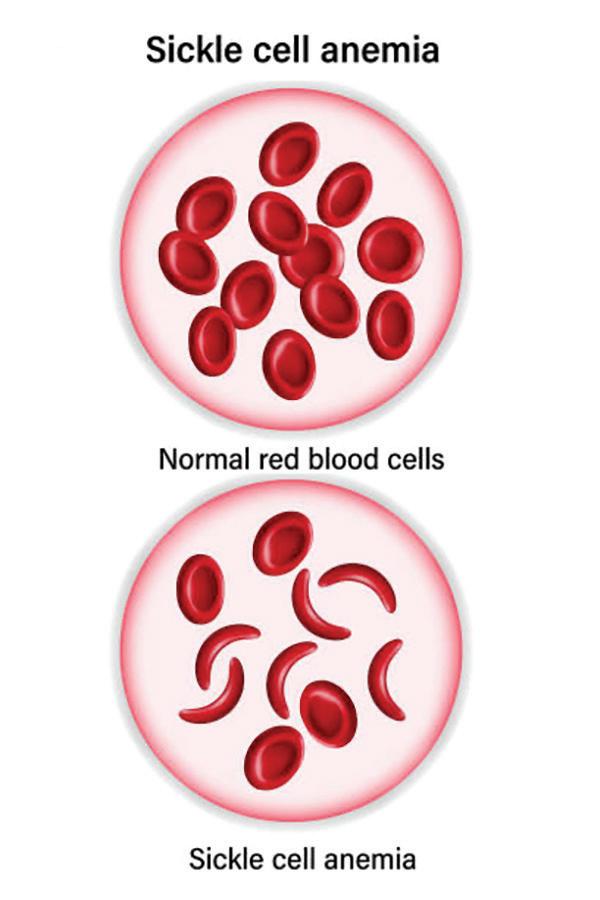
In 1975, Jones was listed in the World’s Women’s Who’s Who and she was named an Outstanding Young Woman of America in 1978. Beta Beta Beta National Biological Honor Society awarded her the distinguished service award. Jones also received the Significant Service Award from the NASA Space Life Sciences Training Program and the Extramural Associate Research Development Award from the National Institute of Health. In 1990 and 2006, she was named Woman of the Year at Alabama A&M University and was given the Outstanding Leadership Award by the Faculty Senate. The U.S. Army presented Jones the Commander’s Award for Outstanding Civilian Service as a member of the Army Science Board.
ELA Questions:

Discussion Questions: Dr. Jones received many awards and honors. How would you describe her achievements and her contributions to science? Dr. Jones is studying how fungi might be used as agents of war. What purpose do you think fungi serve in modern warfare? Are fungi beneficial or harmful?
What problem does Dr. Cece Calhoun work to solve, and why is it important?
How does Dr. Calhoun combine science, medicine, and fairness to help young people with SCD?
Learning Standards: I can read a biography to learn about an African American who has made contributions in science, math, technology, or engineering.
Parker believes in serving as a role model to the youth and to recruiting African Americans in the STEM field. Personally, he has hired three African-American meteorologists. In addition, he has recruited minorities for summer intern positions. Parker has also mentored an Airline High School student for his senior project. Parker’s advice to students interested in meteorology is to take as many math and science classes as possible. Learn about summer opportunities in your community. If you are interested in meteorology, visit National Weather Service offices and serve as a volunteer or intern, and find leaders in your community to serve as your personal role models.

a person who has made contributions to the fields of science, technology,
Use the newspaper to complete these activities:
Use the newspaper to complete the following activities:

Activity One: Can I quote you on that?
Types of News:
Enjoy these activities that help you get to know your St. Louis American newspaper.
When quoting their interviewees, reporters must think of interesting ways of saying, “said.” Use quotes in your newspaper to see how reporters quote their subjects. Make a list of at least 10 different ways that were used. Share your results with your classmates.

Use the front section of the newspaper to evaluate the types of news stories presented: local, national, and international. Sort the articles into the three categories and create a bar graph that displays the amount of coverage each type of news story received.
Activities — Who works where? a picture of a building in the newspaper and tell what kind of jobs people who work in that building could have.



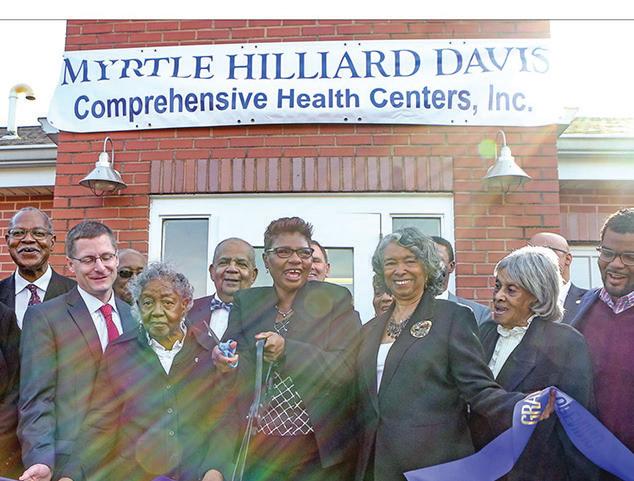


Activity Two: Students will choose a person featured in a news story to evaluate for character traits. Students will describe the featured person in a character chart. They will draw an outline of the person, write the person’s name in the head, write an inference about the personality in the body, and details that support the inference in the arms and legs.
Mystery Story: Cut out several pictures from the newspaper without reading the caption. Place the pictures in a bag, and without looking, pick your mystery picture from the bag. That’s your stimulus for writing. Construct a graphic organizer to identify the 5Ws (who, what, when, where, and why) of your story by looking at your picture. Then, continue the writing process.
Learning Standards: I can use the newspaper to locate information. I can categorize and summarize that information.
Learning Standards: I can use a newspaper to locate information. I can make inferences and support them with specific details.
Problem and Solution: Over a period of weeks, clip articles from newspapers that deal with problems and issues facing your local or county government. Discuss the reasons for these problems and how the government hopes to solve them. Learning Standards: I can use the newspaper to locate information. I can discuss problems and solutions. I can identify types of jobs. I can make text-to-world connections.





SCIENCE
Students Aariyah Thompson and Savannah Fisher, in Ms. Stovall’s firstgrade class at Gateway MST Elementary School, are learning how to construct a series circuit.
Photo by Ms. Stovall
Dr. Martin Luther King, Jr. Photo by Howard Sochurek/LIFE
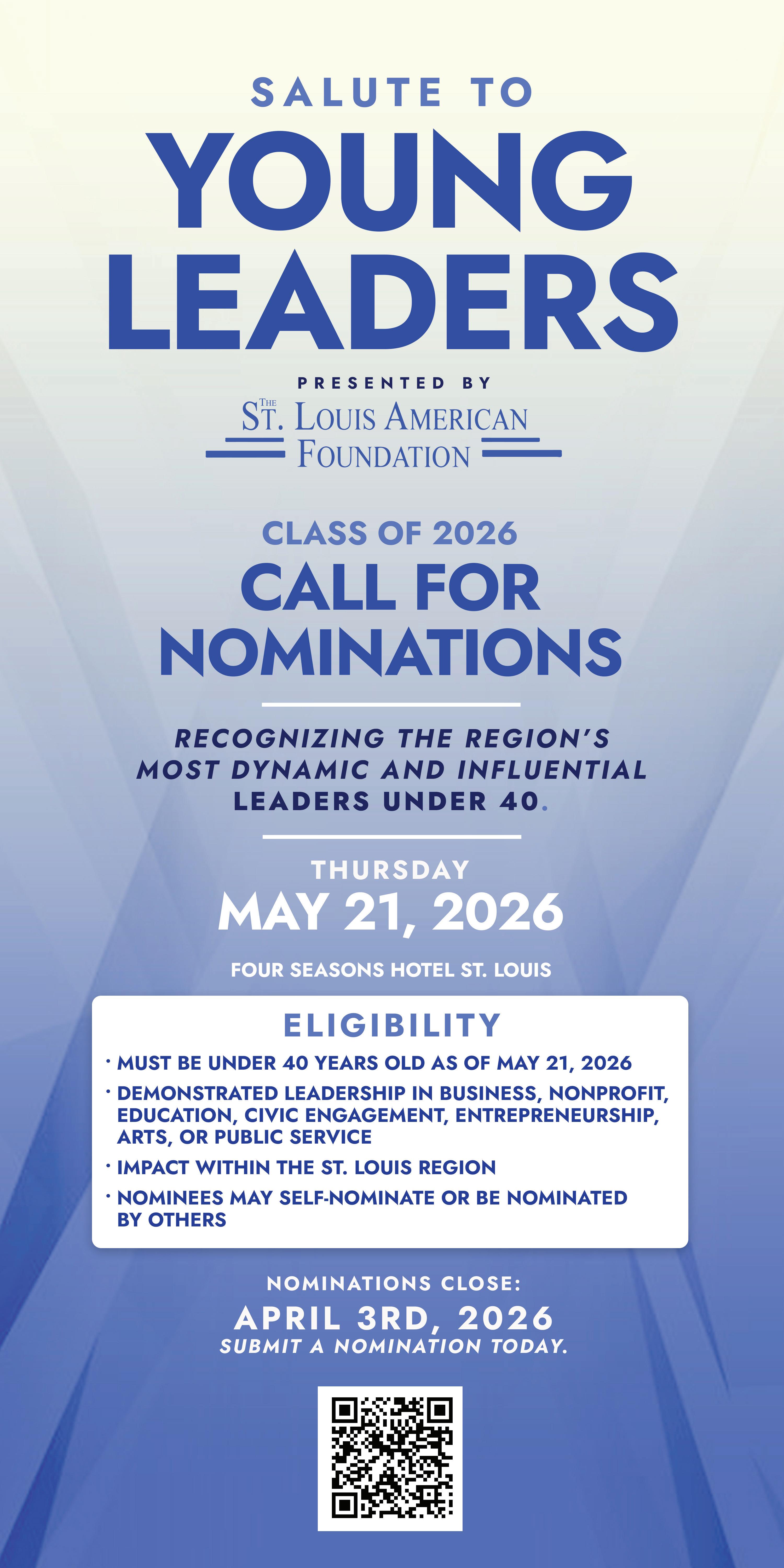
By Cicely Hunter
Black Women Making History
Black women whose leadership helped shape St. Louis history
Stories of agency, courage, strength and resilience have long been passed down through oral traditions in Black communities. Through those stories, generations learned about their lineage, life lessons and the people who helped carve pathways toward freedom and opportunity.
In the St. Louis region, the lives of Priscilla Baltimore, Annie Turnbo Malone and Margaret Bush Wilson have been remembered in that tradition — through church histories, community storytelling, family accounts and historical scholarship.
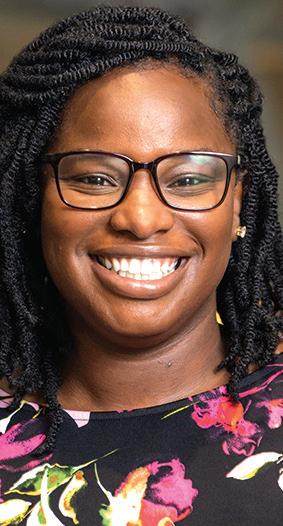
Each woman lived in a different era, yet all helped shape the region’s future.
One helped establish a freedom settlement across the Mississippi River. Another built a business empire that created jobs and opportunity for Black women. The third fought for justice through the legal system and civil rights activism.
Together, their stories illustrate how Black women helped move St. Louis and Missouri forward.
Priscilla Baltimore: Building a freedom community
The history of Brooklyn, Illinois — just across the Mississippi River from St. Louis — centers on Priscilla Baltimore, often called Mother Baltimore. Baltimore was born into slavery around 1805 in Bourbon County, Kentucky. She was sold several times, including by the man believed to be her enslaver and biological father. Through persistence and sacrifice, she eventually purchased her freedom in 1861.
According to historical accounts, Baltimore later worked to secure freedom for members of her family, first her mother and
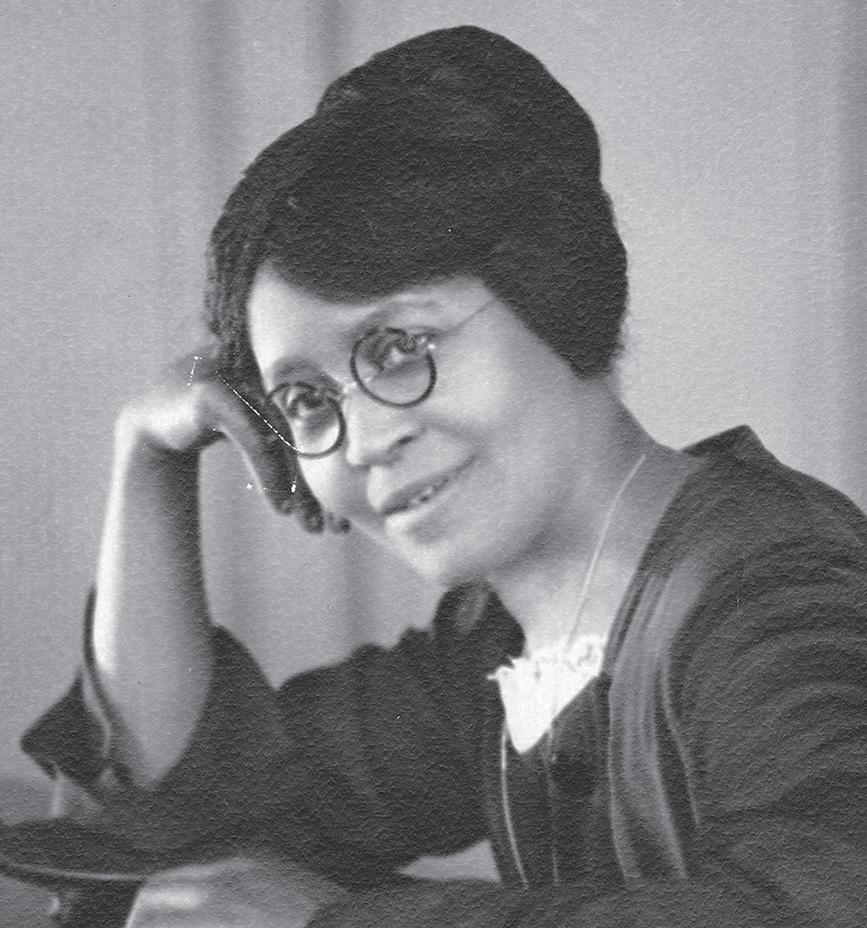
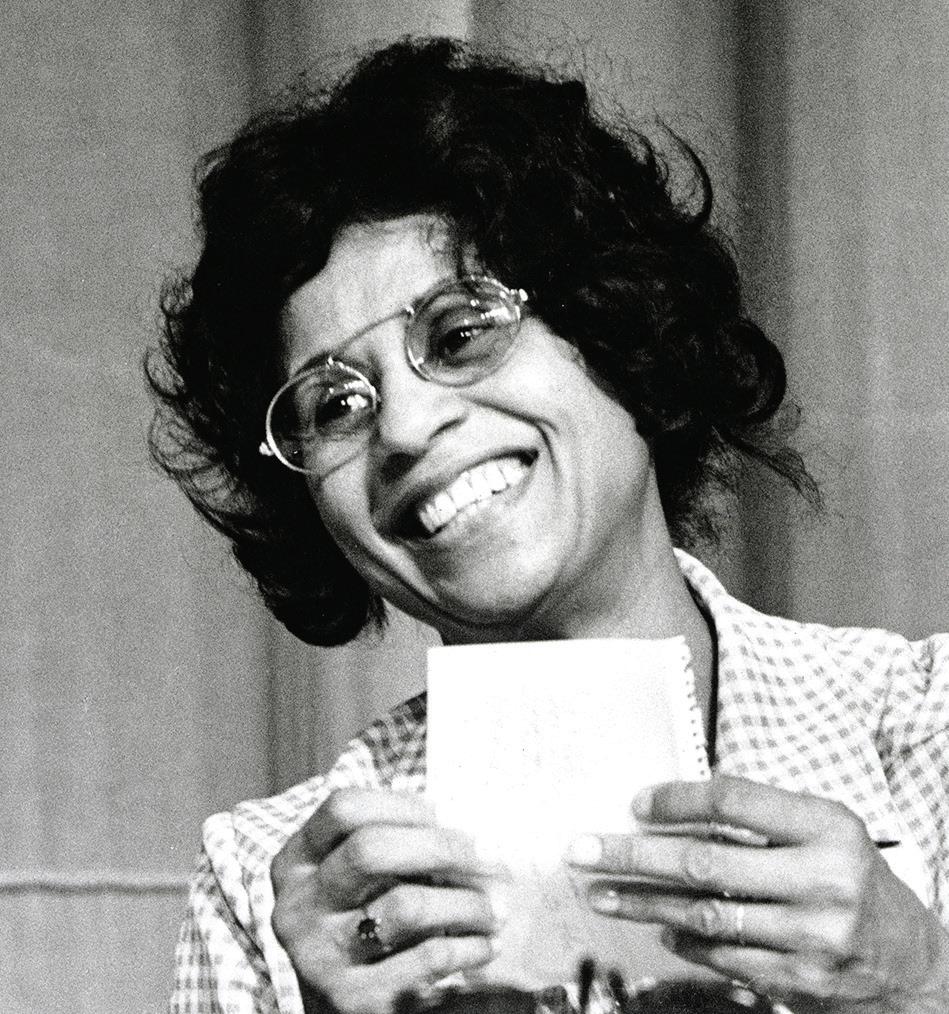
then her second husband, John Tobias Baltimore, by mortgaging property in St. Louis.
In 1829, Priscilla and John Baltimore led 11 families from Missouri across the Mississippi River into Illinois. The group included John and Matilda Anderson, Philip and Josephine Sullivan, James and Elizabeth Singleton, Daniel and Sarah Wilson, Russell Cox, a woman known as Mrs. Wyatt and Nicholas Carper.
Their settlement became Brooklyn, founded as a community for newly emancipated and free Black residents seeking safety and independence. Faith and family were central to the town’s foundation, and Brooklyn also became a stop on the Underground Railroad.
Although the growth of nearby East St. Louis limited Brooklyn’s development as a regional economic center, the community endured. By 1880, census records showed 371 Black residents and 203 white residents. Baltimore’s influence extended well beyond the town itself. She helped establish St. Paul African Methodist Episcopal Church and was later described by her pastor, the Rev. Henderson, as the “mother of African Methodism in the West.” By 1882 the congregation
had grown to more than 2,000 members. She was also remembered for an extraordinary act of leadership. Historical accounts report that Baltimore once recruited 300 enslaved people to cross the Mississippi River to attend a religious service led by Bishop William Paul Quinn, a traveling AME missionary. When a ferry captain hesitated to transport them, Baltimore reportedly assured him, “I will be their security.”
Baltimore died in 1882, but her legacy continues to shape regional history. In recent years, archaeologists working with local leaders have explored artifacts from the original 19th-century settlement in Brooklyn.
Annie Turnbo Malone: Building economic opportunity
Nearly a century after Baltimore helped establish a freedom community, Annie Turnbo Malone transformed St. Louis through entrepreneurship and philanthropy.
Born in Metropolis, Illinois, in 1869, Malone recognized an opportunity to create hair care products designed specifically for Black women. In 1900 she introduced Wonderful Hair Grower in Lovejoy, Illinois, and soon expanded her business to St.
Louis. By 1910 she had trademarked “Poro,” a line of beauty products that became a nationwide brand.
Malone’s company created opportunities for Black women across the country as sales agents, clerical workers and factory employees. Among those she trained as a sales agent was Sarah Breedlove McWilliams — later known as Madam C. J. Walker.
As her business grew, Malone built Poro College in the Ville neighborhood, one of St. Louis’ most prominent Black communities. When it opened in 1920, the $1 million complex became far more than a training site for beauty professionals.
Poro College served as a cultural and economic hub for African Americans who were often excluded from hotels, entertainment venues and other public spaces during segregation. The campus included classrooms, laboratories, a theater, dormitories, manufacturing facilities and gathering spaces.
Malone also became known for her philanthropy. She donated generously to institutions including the Pine Street YMCA Branch, St. James AME Church and the St. Louis Colored Orphans Home, which was later renamed in her honor.
Her contributions extended beyond St. Louis as well, including major gifts to Howard University Medical School, Tuskegee Institute and Wilberforce University.
Although a difficult divorce in 1927 reduced much of her wealth, Malone’s legacy as a pioneer of Black entrepreneurship and philanthropy remains deeply woven into the history of St. Louis.
Margaret Bush Wilson: Fighting for justice
Margaret Bush Wilson carried that legacy into the fight for civil rights.
Born in St. Louis on Jan. 30, 1919, Wilson grew up in the Ville during segregation. Her parents, James T. Bush and Margaret Casey Bush, were active members of the NAACP, and her childhood was shaped by educators and community leaders committed to Black advancement.
Wilson graduated as valedictorian of Sumner High School in 1935 and later earned honors at Talladega College. While studying there, she traveled abroad through the Juliette Derricotte Fellowship and met Mahatma Gandhi, an experience that strengthened her commitment to civil rights.
She continued her education at Lincoln University School of Law,
created after the U.S. Supreme Court ruling in Gaines v. Canada required Missouri to provide in-state legal education for Black students. In 1943 Wilson became the second Black woman admitted to practice law in Missouri. She and her husband, Robert E. Wilson, opened the law firm Wilson & Associates, serving the St. Louis community for more than 40 years.
Wilson played a role in the landmark Supreme Court case Shelley v. Kraemer in 1948, which struck down racially restrictive housing covenants. She also helped mobilize legal support during the 1963 Jefferson Bank demonstrations protesting discriminatory hiring practices.
Beyond her legal career, Wilson served nine terms as chair of the NAACP’s national board of directors and later led the St. Louis chapter. In 1948 she also made history as the first Black woman in Missouri to run for Congress. Wilson died in 2009 at age 90, leaving a legacy that continues to shape the region’s civil rights history.
A shared legacy
Priscilla Baltimore, Annie Turnbo Malone and Margaret Bush Wilson lived in different centuries, but their lives reflect a shared tradition of leadership. Baltimore helped create a place of refuge for freedom seekers. Malone built economic opportunity and invested in Black institutions. Wilson used the law to challenge injustice and expand civil rights.
Their stories — preserved through oral history, community memory and historical scholarship — remind us that the progress of St. Louis and Missouri has been shaped in profound ways by Black women whose courage and vision helped move the region forward.
Cicely Hunter is the public historian for the African American History Initiative at the Missouri Historical Society.

Cicely Hunter
Annie Turnbo Malone
Margaret Bush Wilson
Priscilla Baltimore
Photo courtesy of the Missouri Historical Society
Photo courtesy of the Missouri Historical Society

INVITATION FOR BIDS
Affinia Healthcare would like to announce a request for bids related to an office construction project at 3396 Pershall Road, Ferguson, Missouri 63135
Interested parties please address all correspondence to Chris Overmann, Assistant Vice President of Operations, at bids@ affiniahealthcare.org, to request a bid package with the detailed RFP requirements and to receive a schedule for the building walk through. The closing date for sealed bids is Wednesday April 1st, 2026 at 2:00PM (CST).
AUDITING SERVICES
The Missouri Lottery is accepting bids for the purpose of establishing a contract for Auditing Services. The bid document with the specifications can be obtained by going to https://www. molottery.com/bidopportunities or by contacting Melissa Blankenship at melissa. blankenship@molottery. com or 573-751-4050.
JANITORIAL SERVICES LOTTERY HEADQUARTERS
The Missouri Lottery is accepting bids for the purpose of establishing a contract for Janitorial Services at Lottery Headquarters. The bid document with the specifications can be obtained by going to https://www. molottery.com/about-us/ bid-opportunities.jsp or by contacting Melissa Blankenship at melissa. blankenship@molottery. com or 573-751-4050.
CITY OF ST. LOUIS BOARD OF PUBLIC SERVICE
REQUEST FOR QUALIFICATIONS for CONSTRUCTION SUPERVISION AND MATERIAL TESTING FOR THE RECONSTRUCTION OF RECONSTRUCTION OF RUNWAY 12L30R FROM TAXIWAY SIERRA TO TAXIWAY LIMA AND RUNWAY 6-24-PROJECTS 1 AND 2 AT ST. LOUIS LAMBERT INTERNATIONAL AIRPORT. Statements of Qualifications due by 5:00 PM CT, APRIL, 14, 2026 through the Bid Express online portal at https://www.bidexpress.com/ businesses/20618/home?agency=true. RFQ may be obtained from BPS website https://www.stlouis-mo.gov/ government/departments/ public-service/bps-online-planroom.cfm under On Line Plan Room-Plan Room, or call Board of Public Service at 314-589-6214.

NOTICE OF PUBLIC MEETING
MEETING DATE: FRIDAY, APRIL 10, 2026 10:00 A.M. – 11:30 A.M.
1, 2026
In accordance with Ordinance No. 65597, the St. Louis Living Wage Ordinance (“Ordinance”) and the Regulations associated therewith, the City Compliance Official for the City of St. Louis has determined that the following living wage rates are now in effect for employees of covered contracts:
1)Where health benefits as defined in the Ordinance are provided to the employee,the living wage rate is $17.08 per hour (130% of the federal poverty level incomeguideline for a family of three); and
2)Where health benefits as defined in the Ordinance are not provided to theemployee, the living wage rate is $22.63 per hour (130% of the federal poverty levelincome guideline for a family of three, plus fringe benefit rates as defined in theOrdinance).
3)The prevailing fringe benefits rate, as required under the Ordinance anddefined by section 6.20.010 of the Revised Code of the City of St. Louis, is $5.55 per hour.
These rates are based upon federal poverty level income guidelines as defined in the Ordinance and these rates are effective as of APRIL 1, 2026. These rates will be further adjusted periodically when the federal poverty level income guideline is Page adjusted by the U.S. Department of Health and Human Services or pursuant to Chapter 6.20 of the Revised Code of the City of St. Louis.
The Ordinance applies to employers who are covered by the Ordinance as defined in the Ordinance, where the contract or grant is entered into or renewed after the effective date of the Ordinance, which is November 3, 2002. A copy of the Ordinance may be viewed online at Ordinance 65597 | City of St. Louis Ordinances (stlouis-mo.gov) or obtained from:
City Compliance Official c/o St. Louis Airport Authority St. Louis, Missouri (314) 426-8111
PUBLIC NOTICE
Notice is hereby given that the Metropolitan St. Louis Sewer District Requests for Quotes, Bids and Proposals are posted online for public download. Please navigate to www.msdprojectclear.org > Doing Business With Us > View Bid Opportunities Metropolitan St. Louis Sewer District is an Equal Opportunity Employer.
SEALED BIDS
Bids for Troop I Headqrtrs & CDL Erosion Control, Pav. Repairs & Reno, Rolla, Project No. R2405-01 will be received by FMDC, State of MO, UNTIL 1:30 PM, April 23, 2026. Project information available at: http://oa.mo. gov/facilities
PINE
City of Pine Lawn Seeking Sealed Bids for Demolition and Land Clearance at 2525 Kienlen. Bid Opening is 6 pm Thursday, March 26 @ Pine Lawn City Hall (6250 Steve Marre Ave.) Public is invited. Direct questions to 314-261-5500 (press 1)
REQUEST FOR PROPOSALS
The St. Louis Economic Development Partnership requests proposals for architecture and design services in preparation for the remodel of the interior of its West County Business Incubator, located at 743 Spirit 40 Park Drive, Chesterfield, Missouri 63005. A copy of the complete RFP is available at https://stlpartnership. com/rfp-rfq/. To be considered, proposals must be received no later than 3PM CST on April 10, 2026.
INVITATION TO BID
The Twenty-Second Judicial Circuit is currently soliciting proposal for Clyde S. Cahill Courts Building Ceiling Tile Replacement Project under the direction of the Circuits Court in the Clyde S. Cahill Courts Building, 10 N. Tucker Blvd., St. Louis, Missouri 63101;
The Request for Proposal is available on the Court’s website http:// www.stlcity circuitcourt.com, click on General Information, then Request for Proposals.Proposals must be received no later than 10 a.m. on April 7, 2026
The Missouri Department of Elementary and Secondary Education is holding a public meeting on Friday, April 10, 2026, relating to the Missouri School Improvement Program (MSIP) 6 Comprehensive Guide as required by Section 161.092 (14) RSMo. This meeting will be conducted at the Missouri Research and Education Network, (MOREnet), 221 North Stadium Boulevard, Columbia, MO 65203. The meeting is scheduled from 10:00 – 11:30. The meeting room will open for public seating at 9:30 a.m.
A tentative agenda is as follows:
1. Summary of changes to the Comprehensive Guide used for the 2026 MSIP 6 Annual Performance Report (APR) and classification of school districts
2. Receipt of public comment
Individuals who are unable to provide testimony at the public meeting may submit comment to the Missouri Department of Elementary and Secondary Education in writing to P.O. Box 480, Jefferson City, MO 65102-0480 or by email at msip@dese.mo.gov by close of business on April 24, 2026.
Anyone attending the meeting who requires auxiliary aids or services should request such services by contacting the Executive Assistant to the Office of Quality Schools, telephone 573-751-4234, or Relay Missouri, 800-735-2966, no later than 48 hours before the meeting. The news media may obtain copies of this notice by contacting DESE Communications
P.O. Box 480 Jefferson City, MO 65102 573-751-3469 communications@dese.mo.gov

NOTICE OF FINDING OF NO SIGNIFICANT IMPACT AND NOTICE OF INTENT TO REQUEST RELEASE OF FUNDS
Date of Publication: 3/19/2026
City of St. Louis: Community Development Administration (CDA)
1520 Market Street
St. Louis, Missouri 63103
314-657-3700 / 314-589-6000 (TDD)
These notices shall satisfy two separate but related procedural requirements for activities to be undertaken by the City of St. Louis (“The City.”) REQUEST FOR RELEASE OF FUNDS
On or after 4/6/2026, the City will submit a request to the U.S. Dept. of Housing & Urban Development (HUD) for the release of the City’s Federal HOME Investment Partnerships Program (HOME) funds under Title II of the Cranston – Gonzalez National Affordable Housing Act of 1990, as amended, to undertake the following project:
Project Title: Morgan Ford Homes
Purpose: New construction of 4 single-family homes, each approximately 1,576 square feet in size and containing three (3) bedrooms and two-and-a-half (2.5) bathrooms, to be sold to buyers at 80 percent or less of the Area Median Income (AMI)
Location: 3506 Morgan Ford Road, St. Louis, Missouri 63116
Estimated Cost: Total development cost of this project is approximately $1,679,406, with an estimated $775,000 of funding coming from St. Louis City’s Year 2024 Federal HOME Program Funds, Grant #M-24-MC-29-0500, and awarded in the Spring 2024 NOFA
FINDING OF NO SIGNIFICANT IMPACT
The City has determined that this project will have no significant impact on the human environment. Certain conditions will apply to this project. Therefore, an Environmental Impact Statement under the National Environmental Policy Act of 1969 (NEPA) is not required. Additional information for each project is contained in the Environmental Review Record (ERR) on file at the City CDA, at the above address, where the ERR is available for review and may be examined or copied, weekdays 8 A.M. to 4 P.M., or visit https://cpd.hud. gov/cpd-public/environmental-reviews to review the HUD ERR.
PUBLIC COMMENTS
Any individual, group, or agency may submit written comments on the ERR to Trey McCarter, Community Development Planner III, CDA, at the address listed above. All comments received by 4/5/2026 will be considered by the City prior to authorizing submission of a request for release of funds. Comments should specify which notice they are addressing.
RELEASE OF FUNDS
The City certifies to HUD that, Matt Moak, in his capacity as Executive Director, consents to accept the jurisdiction of the Federal Courts if an action is brought to enforce responsibilities in relation to the environmental review process and that these responsibilities have been satisfied. HUD’s approval of the certification satisfies its responsibilities under NEPA and related laws and authorities and allows the City to use the City’s above-referenced HUD program funds.
OBJECTION TO RELEASE OF FUNDS
HUD will accept objections to its release of funds and the City’s certification for a period of 15 days following the anticipated submission date or its actual receipt of the request (whichever is later) only if they are on one of the following bases: a) the certification was not executed by the Certifying Officer of the City; b) the City has omitted a step or failed to make a decision or finding required by HUD regulations at 24 CFR Part 58; c) the grant recipient has committed funds or incurred costs not authorized by 24 CFR Part 58 before approval of the release of funds by HUD; or d) another Federal agency acting pursuant to 40 CFR Part 1504 has submitted a written finding that the project is unsatisfactory from the standpoint of environmental quality. Objections must be prepared and submitted in accordance with the required procedures (24 CFR Part 58.76) and shall be addressed to the HUD St. Louis Field Office, CPDRROFSTL@hud.gov. Potential objectors should contact HUD to verify the actual last day of the objection period.
Matt Moak Certifying Officer


REQUEST FOR PROPOSALS
Alberici Constructors, Kwame Building Group and the Saint Louis Zoo seek bids from qualified firms to submit proposals for a project at the Saint Louis Zoo WildCare Park. The project consists of assembly, erection and foundations for a motorized vertical lifting observation tower. To request bid documents, please send an E-mail to stlzoobids@alberici.com
REQUEST FOR SUBCONTRATORS
Hankins Construction Co. is requesting that subcontractors who employ qualified Section 3 employee submit bids in accordance with Section 3 requirements for the St. Louis Housing Authority – California Gardens South Building Unit Repairs & PTAC Replacement Project. To access the bid documents, or if you have any questions, please email/call Nicole at Office@HankinsMidwest. com /314-426-7030. Please submit bids to Bids@ HankinsMidwest.com by 3:00 PM on 3/23/2026 Hankins Construction Co. is an Equal Opportunity Employer.
REQUEST FOR PARTNERSHIPS
MBG is seeking partners for the revitalization of the Leo Hardin Sr Building located at 4500 Washington Blvd—a project worthy of our involvement because of who it serves and what it restores. We are looking for partners who understand legacy and stewardship. We offer a chance to honor a veteran, a pastor, a father, and a son who refuses to let that story fade. If this resonates, we would like to build this together—not as bidders, not as vendors, but as people committed to work that matters.
This opportunity to serve our community includes 31 apartments and a community room for veterans. Additionally, we will recreate the Citizens for Community Improvement offices to serve as a hub for the community this project is committed to serving.
Pre-bid walkthrough: Christ Temple First Church, 532 N Taylor Ave, St. Louis, MO 63108, on Wednesday, April 15, 2026, at 9:00 a.m. The church is located directly across the street from the project site.
If you are interested in partnering with MBG on this project, please attend the pre-bid walkthrough and request the project information package. DBE, MBE, WBE, and veteran-owned partners are highly encouraged to participate. To confirm your interest and receive project information, contact Michael Harris at mharris@mbg built.com or 314-614-7247. Please confirm your interest by April 29, 2026, at 3:00 p.m.
REQUEST FOR PROPOSALS
Hazelwood School District is seeking bid proposals to clean and repaint the roof at Barrington Elementary School.
Interested parties should submit their bid proposal through Bidnet via the district’s website at https://www. hazelwoodschools. org/Page/2238 on or before Tuesday, April 7, 2026 not later than 10:00 a.m.
REQUEST FOR BIDS
Great Rivers Greenway is requesting bids for the Repair of Suspended Basket Lounge Chairs at Katherine Ward Burg Garden. Go to https://greatriv ersgreenway.org/bids/ for details and submit by April 02, 2026.
2 BEDROOM HOUSE FOR RENT 52XX Maffitt Ave., 63113, Nice, Quiet Street 314-315-1027

Do you talk to your neighbor in church? Not everyone does
The famous Black church call-and-response tradition sparks debate among worshippers
By Rev. Dorothy S. Boulware Word In Black
Down through history, Black children have had their lives threatened — or at least strongly disciplined — for misbehaving in church, especially for talking during the service.
Adults, however, were often allowed — even encouraged — to respond during worship.
Amen. Preach, Pastor. Say it again.
At its best, Black worship is defined by a lively call-andresponse between preacher and congregation — a tradition rooted in African spiritual practices and carried forward in the secret worship gatherings known as hush harbors.
“The Black sermon is a communal event,” said Henry H. Mitchell, author of “Celebration and Experience in Preaching.”
“The congregation does not merely listen; it participates in shaping the moment.”
Biblically, call-and-response patterns appear throughout Scripture. The Psalms were designed for responsive reading — Psalm 136 repeats the refrain “for his mercy endureth for ever” in the King James Version. In the New Testament, the public affirmation “Amen” itself functions as a congregational response (1 Corinthians 14:16).
While rooted in Black church culture, the practice spread widely during 20th-century revival
movements. Television evangelism and large conferences helped popularize the now-familiar instructions from the pulpit: Tell three people… or Turn to your neighbor…
Today, these moments are common in Black Baptist churches, Pentecostal and Holiness traditions, charismatic ministries, and many nondenominational megachurches.
The Origin of “Neighbor, Oh Neighbor”
The Right Rev. Frank Madison Reid says he helped popularize one of the most recognizable versions of the phrase.
“Neighbor, oh neighbor.”
While many preachers simply say “Turn to your neighbor,” Reid delivered the phrase in a distinctive cadence that congregants quickly remembered.
Reid says he first heard it as a child when he occasionally slipped away from the African Methodist Episcopal church his father pastored to visit nearby Church of God in Christ congregations, particularly St. James AME in St. Louis.
“That’s where I heard it. I guess I just popularized it,” Reid says, adding that the phrase now serves as a powerful community-building tool.
“I grew up in a church where people didn’t speak to each other until after the service was over,” he says. “And then it was often things they probably shouldn’t have been saying.”

After COVID, Rebuilding Connection
Reid says the practice took on renewed meaning after the COVID-19 pandemic disrupted church gatherings.
“But COVID — when we couldn’t meet — and then the fear when we resumed meeting made it necessary to bring people together again,” Reid says.
“And now we can go from saying something to your neighbor to praying for your neighbor.”
For some congregations, the simple act of speaking to the person sitting nearby became a way to rebuild the sense of community many churches lost during months of isolation.
Social Media Has Thoughts
An informal and decidedly unscientific social media survey produced mixed reactions.
Some worshippers say they find the practice distracting.
“‘Tell your neighbor’ is a passive-aggressive reply to sleeping in church,” Charlene Ndi joked.

all sermon long. It’s the preacher’s job to do that.”
Mylika Richardson Scatliffe says repeated prompts feel “distracting and awkward, especially when it goes on for more than one sentence.”
Others see it differently.
Sherri Brown Jackson says when she preaches she sometimes avoids the neighbor exchange altogether.
“I may say, ‘Point to your own self,’” she sats.
Travis J. Robertson sees the tradition as deeply rooted in Christian fellowship.
Lynn Taylor was more direct.
“It’s — for lack of a better word — irky,” Taylor says. “I like talking to people, but when I want to hear the Word, I don’t want to turn to anyone. Preach the gospel. Stop with the theatrics and just preach.”
Others say they simply opt out.
Lenora Howze admitted that refusing to participate might eventually cost her church membership.
“Well, I might do it the first time,” she says. “But after that, I won’t even look at my neighbor, let alone tell them anything.”
She recalled a meme circulating online that captured her feelings: Why do I have to tell my neighbor anything? They heard you just like I did.
Out of 10 people who responded to the survey, five said they typically do not participate at all.
“I don’t mind it once,” Jaye Matthews says. “But don’t keep telling me to tell them something
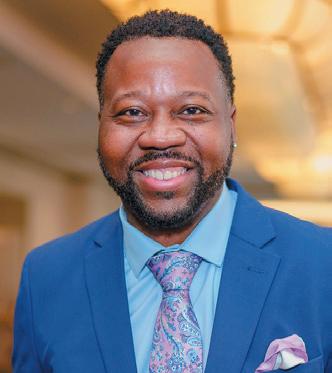
Confidence is one of the easiest things to celebrate in leadership circles — and one of the hardest things to embody when your story includes trauma, setbacks, failure, or years of being underestimated.
People often assume confidence is the absence of pain. But the deepest confidence I’ve ever carried wasn’t born from ease. It was forged in the places where I was most broken.
I know what it feels like to be underestimated before you finish your first sentence. I know what it feels like to wonder if your story disqualifies you from the seat you’re sitting in. I know what it feels like to believe — quietly, privately — that maybe your trauma made you too damaged, too sensitive, or too complicated to lead at high levels.
But here’s what life — and God — taught me:
You don’t build confidence by outrunning your past. You build confidence by integrating it. Your scars are not reminders of weakness. Your scars are proof of survival. Your scars are internal credentials — evidence that you’ve endured what would have broken other people. And leaders who’ve suffered deeply often lead with a depth the world cannot manufacture.
Here’s the truth I had to stand on:
1.Confidence grows when you stop hiding your wounds
For years, I believed if people really knew where I’d come from, they would question my ability to lead. But the opposite became true.
The more I embraced my story, the more my leadership resonated. I didn’t need to imitate anyone else. My authenticity carried its own authority. Your wounds don’t weaken your leadership. They humanize it.
“It’s about community,” he says. “The early church was all about fellowship and neighbors.” Robertson pointed to Acts 2:44-47, which describes early Christians sharing life and resources with one another.
“We are supposed to love thy neighbor,” he says.
A Tool for Community Building
Despite the mixed reactions, many pastors say the practice has evolved into a powerful tool for building community.
For newcomers in particular, it can break the ice in congregations where people may sit beside each other for months without ever speaking.
“It reinforces memory,” says Teresa L. Fry Brown, professor of homiletics at Candler School of Theology at Emory University.
“When worshippers speak the message aloud, it moves from hearing to internalizing.”
What once seemed gimmicky to some has, for others, become another way Black churches nurture connection, conversation, and collective worship.
2.Confidence is built through mastery of meaning. Your past only controls you when you haven’t made meaning of it. The moment I reframed my trauma — from shame to assignment — everything shifted.
I wasn’t leading despite my story. I was leading because of it. Meaning turns wounds into wisdom. Meaning turns setbacks into stewardship.
3.Confidence expands through disciplined action, not positive thinking.
I didn’t “feel” confident when I walked into banking. Most days, I felt like I was stepping onto a stage I had no script for.
But confidence didn’t arrive with the feeling. It arrived with the doing. I became confident by doing the things that confidence required. Action strengthens identity. Movement builds belief. You do the work — and confidence begins to follow you.
4.Confidence flows from identity, not performance.
When you know who you are before the world names you…
Before the room validates you…
Before the results impress anyone…
Confidence stops being fragile. It becomes rooted. It stops shaking every time the environment shifts or the critics speak. Identity anchors confidence long before titles reinforce it.
Here’s your Reframe: You don’t need to become someone new to be confident. You need to embrace who adversity already shaped you to be.
Here’s your Reclaim: Your trauma didn’t weaken you. It trained you.
Here’s your Rename: You’re not “rebuilding confidence.” You’re reclaiming power.
Reflection Question: What wound still tells you a false story about who you are — and what truth will you replace it with?
For more, visit OrvinKimbrough.com or MidwestBankCentre.com.
Photo by PNW Production/PEXELS.com