
St. LouiS AmericAn
Familiar choice, different visions
Bell, Bush bring contrasting views to 1st District rematch
By Sylvester Brown Jr.
and Na’Porsha Williams
St. Louis American
Much has changed since Wesley Bell defeated Cori Bush in the 2024 Democratic primary for Missouri’s 1st Congressional District.
Bell is now the incumbent. Bush is trying to win back the seat she lost. The war in Gaza has reshaped political debate, and Democrats face a different political landscape under President Donald Trump. But one thing has changed very little.
St. Louis
outfielder Jordan Walker follows through on his winning home run swing during the 2026 Home Run Derby at Citizens Bank Park in Philadelphia. Walker became the first Cardinals player to win the competition.
Bell is now the incumbent. Bush is trying to win back the seat she lost.
Bell is again making the case that he is the pragmatic Democrat who can deliver results, while Bush argues the district
See 1st District, A11
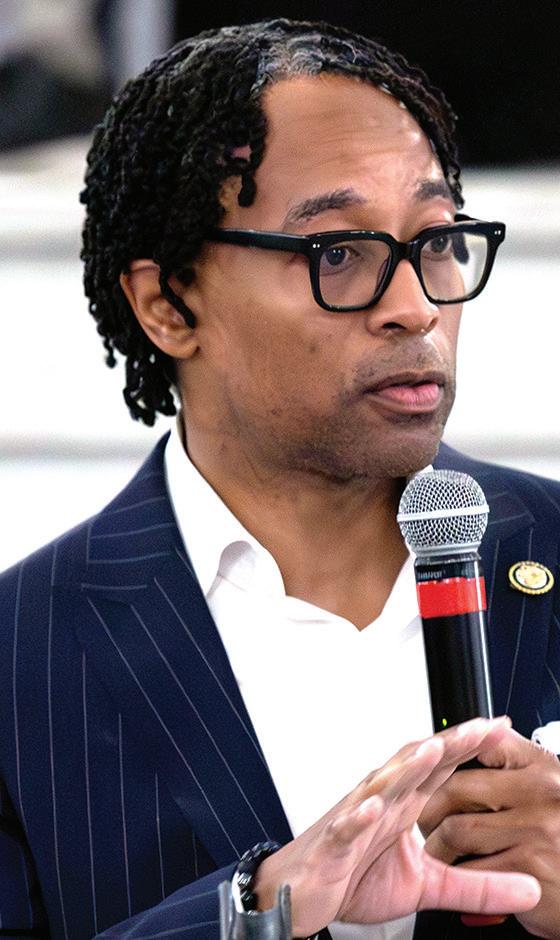
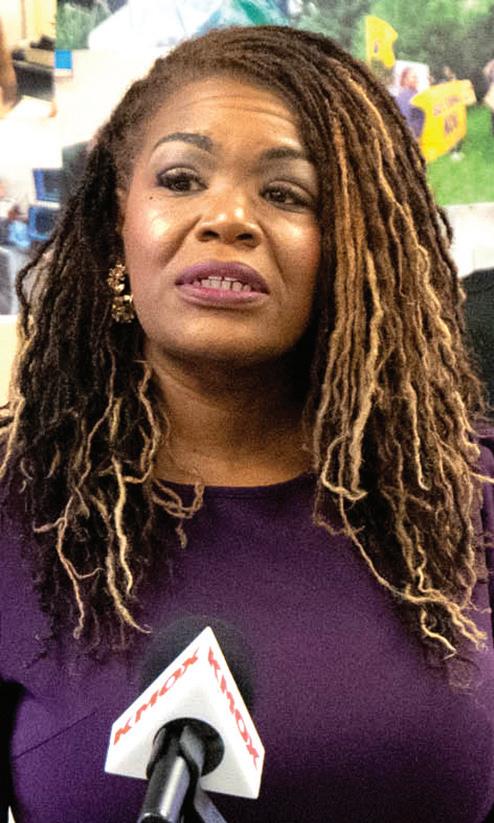


Cori Bush will challenge incumbent Wesley Bell in the Aug. 4 Democratic primary for Missouri’s 1st Congressional District.

$120 million isn’t all for tornado recovery
Board Bill splits North St. Louis investment between storm recovery and redevelopment
By Sylvester Brown Jr.
Louis American
Walker walks it off specifically reserved for rebuilding neighborhoods damaged by the May 16, 2025, tornado.
City leaders and news reports have described the city’s Rams settlement spending plan as directing $120 million to North St. Louis tornado recovery. A review of Board Bill 22 reveals a more detailed story.
The legislation divides the $120 million into two separate funds with different purposes. The ordinance sets aside $89 million for long-term tornado recovery and $31 million to implement North St. Louis neighborhood plans. The disagreement is over how much money is
A year after the St. Louis Rams football team left St. Louis in 2016, the city, St. Louis County and the Regional Convention and Sports Authority sued the NFL and Rams owner Stan Kroenke for violating the league’s relocation rules. In 2021, the plaintiffs won a historic $790 million settlement. After legal fees, St. Louis County received $169 million, the Convention and Sports Complex Authority received $70 million and St.
See $120 million, A11
The disagreement is over how much money is specifically reserved for rebuilding neighborhoods damaged by the May 16, 2025, tornado.
Four Dems compete to succeed Sen. Brian Williams
North County state Senate race gets lost amid marquee contests
By Rebecca Rivas
Missouri Independent
Four Democrats are running to succeed state Sen. Brian Williams in North St. Louis County — and struggling to get anyone to notice.
Democrats are focused on turning out voters to oppose two constitutional amendments, while television and social media advertising is intensifying in the St. Louis-based 1st Congressional District rematch between incumbent Wesley Bell and former U.S. Rep. Cori Bush.
Wilson, who has not endorsed a candidate, said longtime Northwoods resident John Bowman likely has the strongest name recognition.
Perhaps the biggest draw in the district is the race for St. Louis County executive, where Williams himself is a candidate.
“It’s gonna be tough for the people who don’t have name ID,” said Terry Wilson, a Jennings councilman and longtime North St. Louis County political organizer. “People are going to get drowned out by all of that.” Whoever wins the Aug. 4 Democratic primary will be the overwhelming favorite in November against Republican Vernon Norman in the heavily Democratic 14th Senate District.
Wilson, who has not endorsed a candidate, said longtime Northwoods resident John Bowman likely has the strongest name recognition. Bowman is president of the St. Louis County NAACP, a political consultant and former state representative. He said outgoing state Rep. Raychel Proudie of Ferguson also has a high profile because of her impassioned speeches during House debate that have drawn attention on social media.

Courtesy photos
St.
Cardinals
Photo courtesy of St. Louis Cardinals/mlb.com
Editorial / CommEntary
Guest Editorial
America 250 was narcissistic embarrassment
“The 1976 celebration was a more
and happy one because of a broad belief that two years earlier the system had worked, and we were celebrating a system that had cleansed itself. We were in a period of renewal and
and today we’re in a period of fear and loathing. We don’t have any reason to celebrate our founding documents, because we’re
in an
— Jonathan Alter
By Marc Morial
In a proclamation declaring 1976 The Bicentennial Year, President Ford called upon “every man, woman and child to celebrate the diversity of tradition, culture and heritage that reflects our people and our patrimony.”
A half century later, President Trump used the occasion of the nation’s 250th anniversary to celebrate Trump.
In 2016, a bipartisan act of Congress created the United States Semiquincentennial Commission, branded America250, to “foster shared experiences that spark imagination, showcase the rich tapestry of our American stories, inspire service in our communities, honor the enduring strength and celebrate the resilience of the United States of America”.
tended Great American State Fair, Trump denigrated immigrants as “murderers, gang members, drug dealers and dangerous criminals” and bragged about eliminating racial justice initiatives.
In 1976, the nation was struggling to recover from one of the most notorious episodes of presidential corruption in our history up to that point: a political espionage program, illegally funded by donor contributions, which the Nixon administration tried to cover up by destroying evidence, obstructing investigators and bribing burglars.
In 2025, the Trump administration began diverting funds intended for the nonpartisan commission to “Freedom 250,” a public-private partnership through which donors could purchase access to Trump and millions of dollars could be funneled to Trump allies Among the events it produced were an IndyCar street race around the National Mall and a mixed martial arts combat event on the White House lawn.
sion
On July 5, 1976, President Ford addressed newly naturalized Americans in Virginia: “‘Black is beautiful’ was a motto of genius which uplifted us far above its intention. Once Americans had thought about it and perceived its truth, we began to realize that so are brown, white, red and yellow beautiful ... You came as strangers among us and you leave here as citizens, equal in fundamental rights, equal before the law, with an equal share in the promise of the future.”
In a speech to open the sparsely-at-
The bipartisan resolve with which Congress confronted the Watergate scandal seems unthinkable today. Not only did a congressional committee vote unanimously to subpoena audiotapes that exposed the President’s guilt, members of the President’s own party stood ready to vote not only for his impeachment, but for his conviction, and urged him to resign.
But the reforms passed in the wake of the scandal did not anticipate a future president willing to flout institutional norms and test the limits of every available safeguard.
In his Bicentennial speech, Ford asked, “Are the institutions under which we live working the way they should?
Are the foundations laid in 1776 and 1789 still strong enough and sound enough to resist the tremors of our times?
Are our God-given rights secure, our hard-won liberties protected?”
Fifty years later, these questions no longer sound like a celebration of American resilience—they stand as an urgent test of whether our democracy can still summon the courage, accountability and civic faith that once enabled it to correct its own course.
Marc Morial is National Urban League president and CEO.
Children’s nutrition should not be for sale
By Julianne Malveaux
They are calling it a budget cut. But let’s be clear: when Congress cuts WIC, it is taking food from pregnant women, babies, toddlers, and young children.
WIC is not cash welfare. It is not a giveaway. It is one of the most efficient and humane nutrition programs this country has ever created.
It provides targeted food support, breastfeeding support, nutrition counseling and health care referrals to pregnant and postpartum women, infants, and children up to age 5.
It helps families buy milk, eggs, cereal, formula, fruits, vegetables and other basics that make the difference between nourishment and hunger.
Now the House has decided that these families should do with less.
food and buying the cheapest calories available. A cut does not have to be large to be cruel. Sometimes the last $16 is the last straw.
This is what cruelty looks like when it wears a green eyeshade.
We are told, endlessly, that this nation cares about children. Politicians pose with babies, praise mothers, salute families, and campaign on “values.” But values are not measured by slogans. They are measured by budgets. And a budget that takes food from women and children tells us exactly whose lives are expendable.
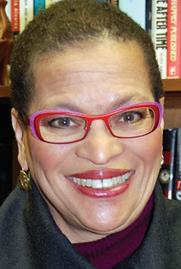
WIC also supports farmers, grocers, and local food economies. When a mother uses WIC dollars, that money goes to grocery stores, farmers markets, dairy producers, food distributors, and growers. Less WIC money means fewer dollars circulating in local communities.
On June 4, the House passed the fiscal 2027 agriculture appropriations bill, including a $200 million cut to WIC and a reduction in the fruit-and-vegetable benefit. For a family already stretching every dollar, that is not an abstraction. That is fewer apples. Fewer greens. Less formula. Less food at the very moment when food matters most.
The numbers are stark.
The House bill cuts WIC by $200 million and reduces the fruit-and-vegetable benefit. The White House proposal goes even further, slashing the monthly produce benefit for young children from $26 to about $10. That is a $16 cut per child each month — more than 60% — in the very part of WIC designed to put fresh food on the table.
Now the House has decided that these families should do with less.
What kind of country negotiates over the nutrition of infants? What kind of Congress looks at pregnant women and toddlers and says, “You cost too much”? What kind of Congress spends nearly $2 billion a day on an undeclared war against Iran, then skimps on food for children?
Donald M. Suggs Publisher ADMINISTRATION
Dina M. Suggs – Sr. Vice President
Julie Erickson – Chief Operating Officer
Raven Whitener – Director,
The St. Louis American Foundation and Special Events
Reba Smith –Executive Assistant-Coordinator
EDITORIAL
Rod Hicks – Executive Editor
Alvin A. Reid – City Editor
Kenya Vaughn – Arts and Entertainment Editor
Earl Austin Jr. – Sports Editor
Lawrence Bryant – Visual Journalist
Sylvester Brown Jr. – Deaconess Advocacy Fellow
Na’Porsha Williams – Breaking News Reporter
Fred Sweets • Ellen Sweets
Mike Terhaar – Art Director
Dawn Suggs – Digital Director James LeBine – Multimedia Specialist
Courtney Thompson – Digital Editor SALES
Pam Simmons – Senior Account Executive
Angelita F. Houston – Classified Manager Ashley Simmons – Account Executive
Some will say that $16 a month is not much. But $16 is only “not much” to people who have never been down to their last $16. For a family living on the edge, $16 is milk and bananas, eggs and apples, bus fare to the grocery store, or the difference between buying fresh
The House has acted. The Senate’s version of the bill — and whatever compromise emerges between the two chambers — will decide whether these cuts survive. That means advocacy matters now. Not next month. Not after recess. Now. The ask is simple: fully fund WIC. Reject cuts to the fruit-and-vegetable benefit. Preserve the virtual and remote services that make WIC accessible to working mothers, rural families, and those without easy transportation. Do not balance the budget on babies.
Julianne Malveaux, a former college president, is an economist, author and commentator based in Washington, D.C.
Our nation is forgetting its history
By Ben Jealous
When we forget the first fights over voting rights, we forget who profits when the many are divided.
Voting rights is back in the news because some people are still trying to decide whose votes deserve trust. In Georgia, the Justice Department and FBI under President Donald Trump have reopened questions around Fulton County’s 2020 election records after agents seized hundreds of boxes of ballots. The Associated Press reports the FBI has assigned 260 analysts and operations staff to review them.
Fulton County includes most of Atlanta and sits at the heart of Georgia’s transformation. It has a large Black electorate, growing Latino and Asian American communities, and many newer residents drawn by the Atlanta region’s jobs and universities. It voted against President Trump. Yet Georgia’s 2020 result was not some partisan rumor. Local officials counted the ballots. The state counted them three times, including once by hand. Republican officials certified the result. Each count confirmed the same outcome.
That matters because vote suppression has often followed the same pattern: discredit the voters, divide the people, deprive enough citizens of the ballot, and move power upward.



There is irony in President Trump’s love of President Andrew Jackson. Jackson and his allies built the Democratic Party with a founding promise: government should answer to the landless many, not merely the propertied few.
Jackson’s democracy was badly bounded. It excluded Black people, women and Native people. His politics also embraced slaveholding white supremacy. Still, he saw one danger clearly. In his veto of the national bank, he warned that “the rich and powerful too often bend the acts of government to their selfish purposes.”
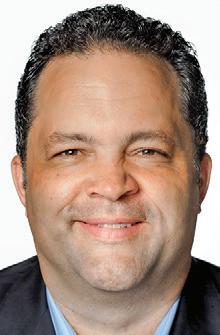
That warning fits this moment. Vote suppression has often worked by discrediting voters, dividing working people against one another, and depriving the many of their full voice so some rich and powerful people can bend government toward themselves.
The country has largely forgotten one of its earliest broad voting rights victories: the campaign to end property qualifications for white men. In many states, a man could be white, free, taxed, armed and called to defend the Revolution — and still be denied the vote because he did not own enough property.
Those men did not suffer as long as Black men, women, Native people or others shut out of democracy. Their exclusion still reveals the old fault line. Power rightfully belongs to the people. Yet wealthy interests have often tried to keep too much of it for themselves.
Some people profit from our forgetting. If we forget that landless white men once had to fight for the vote, we can miss the pattern when it returns in new clothes.
That was much of the logic of monarchy: divide and conquer. It was much of the logic of Jim Crow: tell poor white people their enemy is Black freedom. It was true in the 1820s. It was true in the 1920s, when immigrants from predominantly Catholic countries like Ireland and Italy were cast as threats to real America. It is true today, when immigrants from predominantly Catholic countries like Haiti and Mexico are made into scapegoats again. Tell rural voters their enemy is city voters. Tell Election Day voters their enemy is mail voters. The burden comes as paperwork, deadlines, long lines, missing names and ballots questioned after the people have spoken. Restricting mail ballots can tax seniors, disabled voters, rural voters and caregivers.
The right is in the people. Every generation that won more democracy ultimately did so by resisting efforts by the few to divide the many. That is our work now: remember the history, reject the division, and defend the vote for every one of us.
Ben Jealous is a professor of practice at the U. of Pennsylvania and former president and CEO of the NAACP
Columnist
Columnist
“If the roles were reversed and you had three young Black men on a boat with a young white man and that young white man ended up dead, what kind of investigation would be being conducted by the Mississippi law officials?”
— Ben Crump, attorney for the family of Nolan Wells, who died during an outing with friends
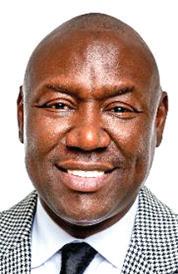
Trading summer comfort for rainforest science
St. Louis nonprofit sends next generation of Black female ecologists to Costa Rica
By Na’Porsha Williams
St. Louis American
Grace Clark admits she is not exactly an “outside person.” The rising eighth-grader is a bit nervous about navigating her very first cold shower, but she isn’t letting a few minor discomforts stand in the way of her opportunity.
Instead of a traditional summer vacation, Clark and nine other students from St. Louis nonprofit Black Girls Do STEM will spend five days studying Costa Rica’s rainforest ecosystems. On July 26, the group will immerse themselves in the country’s ecosystems, wildlife and native plants.
six weeks of workshop preparation into practice. In partnership with Friends of the Rain Forest and the Missouri Department of Conservation, they have spent the early summer developing field research skills.
“The purpose is always to empower our students.”
Rather than just sightseeing, each student is currently working on a research project that began right here in Missouri and will span the duration of their trip. For her project, Clark is focusing on local plants.
– Cynthia Chapple
“What we’re going to be doing is more handson,” Clark said. “We’re not going to the beach; we’re not staying at an Airbnb. We’re going to be outside learning and getting that real rainforest experience. I am excited to learn more about what nature truly is in an environment that is more nature-oriented.”
The trip is far from a standard vacation. The students will be acting as junior ecologists and conservationists, putting
“I want to focus on the flowers and wild plants because I don’t really know much about them,” she said. “I want to learn more about different plants that we might not see here in America — what their purpose is, how they’re made, and where they come from.”
The curriculum is designed to help students understand how everyday environmental choices in St. Louis can affect ecosystems thousands of miles away. On their final night in Costa Rica, the program will host a scientific symposium where the students will present their final discoveries.

“The purpose is always to empower our students to act locally and understand how their local actions impact the global community,” said Cynthia Chapple, founder and executive director of Black Girls Do STEM. “And so we like to say kids can act locally to impact globally.”
To get to this point, the students had to prove they were ready for the realities of field research. Chapple noted that the program’s orientation often weeds out students once they hear the gritty details of the stay.
“We really want them to know what they’re signing up for,” Chapple said. “You can’t flush tissue, and there’s really no hot
water. We really want the kids to understand what a field experience is.”
Each girl attending the trip has already completed at least one year in the Black Girls Do STEM “STEM Saturday Academy” program, which focuses on fostering a deep curiosity for science, technology, engineering, and math.
Chapple, a scientist herself, founded the nonprofit out of a desire to change the industry after realizing there was little to no representation of Black women in STEM fields. According to data released by the National Center for Science and Engineering Statistics, while Black
Black Girls Do STEM students formulate their own lip balm during a hands-on cosmetic science workshop.
workers make up about 8% to 9% of the science and technology workforce, Black women make up just 2% to 3%.
“We want young Black girls to realize that they can achieve whatever they would like to,” said James Turner, founder of STEM on Wheels. “But they need to be introduced at a young age to give them time to develop the memory muscles and the foundation of what it takes to succeed.”
The impact of this international trip extends far beyond the five-day experience. Joy Barsh, a graduate of the program who attended the Costa Rica trip in 2024, said the
experience changed the way she thinks about conservation.
Barsh recalled the excitement of their daily hikes, exploring streams to study algae, native fish, and crustaceans. She was particularly inspired by Costa Rica’s reforestation history, witnessing how local communities stopped destroying ecosystems for quick profits, choosing instead to protect the land.
“My greatest takeaway from the trip is to be more selfless,” Barsh said. “They had to put that personal gain aside and think about how they wanted the other plants and animals and microbiomes to live and survive as well.”
As the departure date approaches, Clark and her fellow students hope the St. Louis community will step up to back their academic journey.
“Think of it as not losing money, but pouring into young Black girls who are hoping to have a great experience in Costa Rica without worrying about if there’s enough money for this or that,” Clark urged. “Think about it from your own perspective and how you would want somebody to pour into you.”
The organization is accepting donations to fund the students’ research gear and travel expenses through July 20.

Courtesy photo
News Briefs
Urban League, churches launch gun lock, Narcan initiative
The Urban League of Metropolitan St. Louis and a coalition of 40 churches will begin distributing free gun locks and Narcan kits Saturday as part of an effort to reduce accidental shootings and opioid overdose deaths.
The initiative comes after several incidents involving youth gun violence, including the death of 7-month-old Kiyomi Parker, who was fatally shot in June. Organizers said
residents may obtain gun locks without providing identifying information, and the Urban League will offer home visits to help families install the devices and safely store firearms.
Supplies will be replenished every three to four months, and an updated list of participating churches will be available on the Urban League’s website, www.ulstl.com.
Kehoe signs downtown redevelopment incentive bill
Gov. Mike Kehoe has signed legislation creating new economic incentives intended to encourage redevelopment in downtown St. Louis and other Missouri commercial districts.
The bill authorizes cities to seek state designation as “innovation zones,” making qualifying projects eligible for incentives that include
office-to-residential tax credits, tax abatements and infrastructure support.
Supporters say the law could help finance redevelopment of long-vacant downtown properties, including the AT&T Tower and the Railway Exchange building.
Charter to close Town and Country operations center
Charter Communications plans to permanently close its Network Operations Center in Town and Country, eliminating 107 jobs, according to a notice filed under the federal Worker Adjustment and Retraining Notification (WARN) Act.
The company did not disclose a reason for the closure. Charter said the affected employees are not represented by a union and will not have “bumping rights,” which allow senior workers to displace junior employees during layoffs.
Zion visitor center celebrates 100th anniversary
Zion Cemetery will celebrate the 100th anniversary of its Visitor’s Center with a community event Aug. 1 at its 49-acre campus in Greendale.
The free event will run from 11 a.m. to 2 p.m. and include food, refreshments, live entertainment,
Commentary
The strongest people lift others
By Michelle D. Tucker
If someone asked you to name the strongest person you know, who would come to mind?
Would you picture someone who can bench press hundreds of pounds? A successful executive? An accomplished athlete? Or perhaps someone who has overcome incredible adversity?
I’ve been thinking about that question lately, and I’ve come to realize my definition of strength has changed over the years.
Today, I believe the strongest people aren’t necessarily those who carry the most weight themselves. They’re the ones who make life a little lighter for others around them.
When I reflect on the leaders, mentors, family members, teachers and friends who have had the greatest impact on my life, one thing stands out. None of them are memorable simply because of their titles or accomplishments. They are memorable because they lifted others. They encouraged people to dream bigger, opened doors that otherwise would have remained closed, shared their knowledge freely, and believed in others before those individuals fully believed in themselves.
how much encouragement people need, especially when they’re quietly carrying burdens no one else can see.
Sometimes it means mentoring someone who reminds you of yourself years ago. Share your experiences, your mistakes, and the lessons you learned along the way. Investing in someone else’s growth is one of the most meaningful gifts we can give. Other times, lifting means becoming a sponsor instead of simply a supporter. Recommend someone for an opportunity. Make an introduction. Speak their name in rooms they’re not yet sitting in. Your influence may be the bridge that helps someone reach their next level.
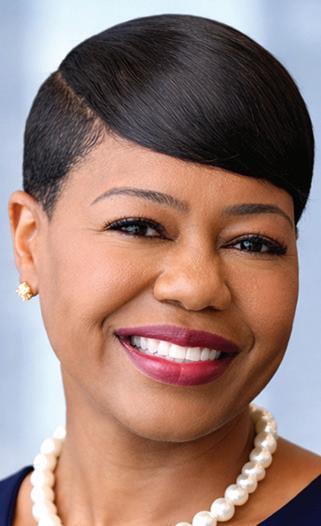
Lifting others also extends beyond the workplace. Every community is strengthened by nonprofits working tirelessly to meet needs that none of us can solve alone. Whether you volunteer your time, serve on a board, mentor a young person, make a charitable contribution, or simply show up when help is needed, you become part of something much bigger than yourself. Every act of generosity strengthens the fabric of our community and creates opportunities for someone else to thrive.
self-guided tours and family activities. Visitors also can explore the cemetery’s pet columbarium, native plant gardens, walking trails and bee hives. Zion Cemetery, founded in 1883, recently renovated the Visitor’s Center.
Health centers launch back-to-school care initiative
Affinia Healthcare, Betty Jean Kerr People’s Health Centers and Family Care Health Centers have launched “STL First Bell Health,” a back-to-school initiative offering school and sports physicals, childhood immunizations, behavioral
health screenings and other preventive services.
The federally qualified health centers also will host events providing dental services, health screenings, referrals and connections to primary care and family support programs.
That’s the kind of strength that leaves a lasting legacy.
We’re often encouraged to focus on building something like our careers, our businesses, our financial security or our next achievement. Those pursuits certainly have value. But I’ve come to believe our greatest success isn’t measured solely by what we build for ourselves. It’s measured by how many people are stronger because we crossed their path.
The good news is that lifting others doesn’t require extraordinary wealth, a leadership title, or unlimited time. Every one of us has opportunities to do it every single day.
Sometimes lifting someone begins with something as simple as expressing gratitude. A handwritten note, an unexpected phone call, or a sincere text message can remind someone that their efforts matter. We often underestimate
I’ve learned that lifting others isn’t an occasional act of kindness. It’s a way of living. Each of us has something someone else needs, including our experience, our encouragement, our network, our compassion, our resources or simply our willingness to care..
Imagine what would happen if each of us intentionally lifted just one person every day. One encouraging conversation. One introduction. One volunteer hour. One generous gift. One opportunity created. Those moments would ripple far beyond what we could ever measure, creating stronger families, stronger workplaces, stronger nonprofits, and stronger communities.
I’ve come to believe the strongest people aren’t remembered because of how much they achieved on their own. They’re remembered because of how many people they helped rise.
That’s the kind of strength the world could use a lot more of.
Michelle D. Tucker is president and CEO of United Way of Greater St. Louis.
Michelle Tucker
Dispute clouds future of minority program
Officials disagree over whether contracting ordinance has expired
By Sylvester Brown Jr.
St. Louis American
A dispute over when St. Louis County’s Minorityand Women-Owned Business Enterprise (M/WBE) program expires has evolved into a bitter political fight, with County Executive Sam Page’s administration and members of the County Council offering sharply different interpretations of the law. At the center of the dispute is whether the ordinance governing the program auto-
matically ended it or whether the County Council must take formal legislative action before it can expire.
The disagreement centers on language in the ordinance.
Page says the original M/WBE ordinance included a sunset provision that ended the program in May 2026. Because the program was created by ordinance, he says only the County Council can reestablish it through legislation. Some council members
disagree.
Councilwoman Shalonda Webb, D-4th District, said county officials previously gave the council a different timeline.
“We asked, ‘When was the renewal needed’ for the M/WBE program … we were told February of 2027, and now this date or goalpost has moved to say that it was the beginning of May or in May of 2026,”
she said. The disagreement centers on language in the ordinance stating the M/ WBE program “will sunset in eight years from adoption of the program.” Because the County Council repealed and reenacted that section in 2022 — establishing the M/ WBE program “by adoption of this section” — Webb and other supporters argue the eight-year clock may have restarted.
The county commissioned
See Dispute, A6
Blacks feel deepest impact of Trump budget law
Health and food cuts weigh heavily on many households
By Jennifer Porter Gore Word In Black
When President Donald Trump signed the One Big Beautiful Bill Act into law last July 4, health advocates, academics and economists warned that the spending legislation — which cut trillions of dollars from Medicaid and food assistance budgets — would force millions of people to forgo health care and push millions more to the brink of hunger. The budget law and its anticipated effects were so
See Budget, A6

On The Move
Sullivan lands Central Trust leadership position
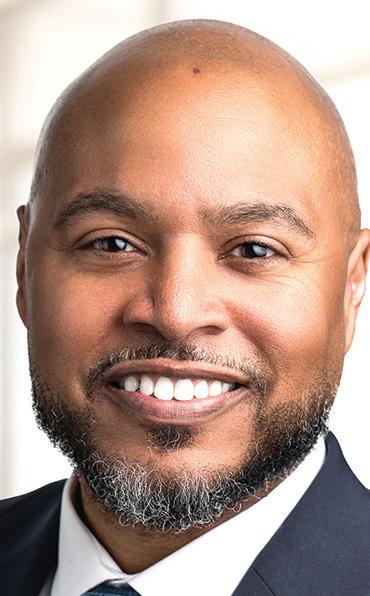
Kevin L. Sullivan has joined Central Trust as vice president and financial planning officer. Sullivan brings nearly 20 years of experience in financial services, including advisory and financial planning roles with several firms. Most recently, he worked as a financial planner at a national brokerage firm, where he helped develop a fiduciary financial planning program for highnet-worth clients.
Bridget Jones named interim president
Bridget Jones has been named interim president and CEO of Unleashing Potential, succeeding

Bridget Jones
Darlene Sowell, who retired May 29. A St. Louis native, Jones has more than 20 years of leadership experience with nonprofit organizations. She previously founded and led a workforce development organization focused on expanding economic and digital opportunity and most recently served as president and CEO of the Youth and Family Center. Jones holds a bachelor’s degree in psychology from the University of Georgia and an MBA from Webster University.
Stafford named Children’s Hospital president

Nikki Stafford
Nikki Stafford, a pediatric health care executive with more than two decades of experience leading children’s hospitals and health systems, has been named president of St. Louis Children’s Hospital. Stafford most recently served as president of American Family Children’s Hospital and system vice president of pediatric services for UW Health Kids in Madison, Wisconsin, where she oversaw pediatric operations and services across the health system.
Before joining UW Health, Stafford held leadership positions with Prisma Health Children’s Hospital-Upstate and other South Carolina health systems.
Dr. Martin honored by counseling association

Dr. Claire Martin
Dr. Claire Martin, an assistant professor in Webster University’s counseling department, has received the Ohana Award from the Counselors for Social Justice, a division of the American Counseling Association. Martin also was elected president-elect of the Association for Multicultural Counseling and Development, the association’s largest division. She will become president on July 1, 2027. She recently presented research at the International Association for Wellness Counseling’s annual conference on the relationship between epistemic injustice, racial trauma and health outcomes.
your
Kevin Sullivan
Envato photo
Photo by Lawrence Bryant / St. Louis American
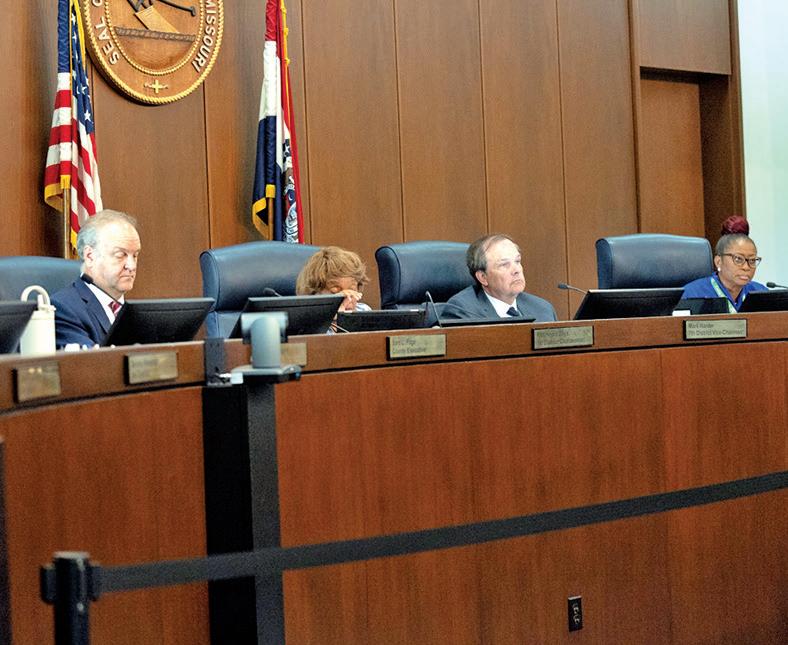
St. Louis County Council members meet as questions remain over the future of the county’s Minority- and Women-Owned Business Enterprise program.
Dispute
a disparity study completed in 2024. It found minorityand women-owned businesses received about 17% of county contract dollars despite representing roughly 40% of firms available to perform the work, and recommended continuing and refining the program.
Webb argues the study and the ordinance require additional review before the program can expire.
In a letter to Page, Webb — a self-described advocate of the M/WBE program — wrote that because of the repeal and reenactment of the 2022 ordinance, “there remains a legitimate question as to whether the sunset period should be measured from the original date or the 2022 reenactment.”
The dispute is the latest communication breakdown between the administration and some council members. Last month, a budget dispute over health care funding for the St. Louis County Jail and Juvenile Detention Center required the council to approve a $3 million emergency measure just days before funding expired.
The disagreement has since become increasingly personal.
Speaking with First Alert 4 on June 24, Webb
Budget
Continued from A5 controversial that Vice President J.D. Vance cast the tie-breaking vote after the Senate split 50-50.
A year later, a range of experts say those predictions are coming true. The budget cuts are landing
accused the administration of trying to dismantle the program without being transparent.
“For the county executive and the Department of Administration to try through the cover of night to dismantle that program and not be forthcoming and open about it is disrespectful and despicable,” she said.
Page disputes that characterization.
In a letter to Webb, the county executive wrote that although he believes the M/WBE program has sunset under the ordinance, he remains committed to expanding opportunities for minority- and women-owned businesses.
He said his administration will continue promoting opportunities for minority businesses “whenever possible and as permitted by law.”
Page also urged the council to work with his administration on “a longterm strategy” and find “common ground on a path forward.”
Page spokesman Doug Moore rejected claims that the administration eliminated the program.
“Any statements claiming the program has been eliminated by the county executive are patently false,” Moore said, adding that only the County Council can reestablish the program through legislation.
hardest on the low-income Americans who rely on them most — and hitting Black communities especially hard. The law’s dismantling of the health and nutrition safety net is already measurable. Medicaid and enrollment in the Children’s Health Insurance Program, or CHIP, fell by 4.6 mil-
Moore also blamed Webb for the impasse, saying she has refused for two years to move Chapter 107, a rewrite of the county’s procurement code that includes language supporting the M/WBE program.
“She has held this up for two years because she did not like the people in
lion people nationwide between April 2025 and March 2026, according to an enrollment tracker by KFF, a nonprofit health policy research organization.
Enrollment in Affordable Care Act marketplace plans has dropped even further, from roughly 22.3 million enrollees in 2025 to as

the procurement office,” Moore said. “It is through her pettiness that we are where we are today.”
In a letter responding to Webb, Rodney Gee, director of the county’s Department of Administration, accused her of making “untrue assertions” and “spreading
few as 16.5 million this year. Average deductibles on ACA plans have simultaneously climbed 37% to a record $3,786, squeezing people who have managed to keep their coverage.
What’s more, the expiration of the enhanced ACA premium tax credits at the end of 2025 caused many households purchasing coverage through the Affordable Care Act marketplace to see their monthly premiums soar.
The cuts have hit Black Americans particularly hard because Black households depend on Medicaid, the ACA marketplace and SNAP at higher rates than the general population. Almost 26% of SNAP participants, or approximately 10.2 million people, are Black. Participants receive an average of $187 a month — just over $6 a day.
The strain is also visible in the loss of health infrastructure that many Black and low-income communities depend on.
More than 1,000 hospitals, clinics and maternity wards have closed or reduced services since the law passed. Nearly 30 Planned Parenthood health centers have also closed, two-thirds of them in rural or medically underserved areas. Researchers caution that most of the law’s provisions will not be fully
lies” that misled fellow council members, county officials and the county executive’s staff.
Webb did not respond to Moore’s or Gee’s criticisms.
Council Chair Rita Days also did not respond to the St. Louis American’s request for
phased in until 2027 and 2028, meaning the full scope of their impact on Black health outcomes is still to come.
The law also cut nearly $187 billion from SNAP funding — the largest reduction in the program’s history. The changes led to the nation’s first interruption of SNAP benefits last November.
By March, more than 4 million people, or 10% of enrollees, had lost SNAP benefits, and participation had declined in every state. All but eight states saw decreases of at least 5%.
In 21 states, SNAP enrollment dropped by at least 10%, and at least 700,000 children nationwide lost food assistance.
U.S. Department of Agriculture Secretary Brooke Rollins has attributed the decline in SNAP participation to the administration’s efforts to prevent what it says is widespread fraud in the program and to an improving economy.
The law also defunded Planned Parenthood, contributing to the closure of nearly 30 health centers since July 2025. Two out of three of the closed facilities were in rural or medically underserved communities or in areas with shortages of primary care providers. All were located in counties considered
comment after Moore said Page repeatedly sought meetings with her over the issue but that she had been “a no-show for at least four months.”
The St. Louis County branch of the NAACP has urged county leaders to resolve the uncertainty.
In a memorandum to Days, NAACP President Adolphus M. Pruitt II wrote that the ordinance contemplated both an eight-year time limit and a required disparity study before the program sunsets. While acknowledging Page’s position that the program has expired, Pruitt said the council should determine whether the ordinance has expired, remains partially operative, or should be reenacted or amended.
“The core question is whether the Executive’s position fully reflects what the ordinance actually requires,” Pruitt wrote.
The NAACP recommended the council review the disparity study, clarify the ordinance’s legal status and publicly explain which portions of the M/ WBE framework remain in effect.
For now, county officials, council members and community leaders remain divided over whether the ordinance automatically ended the county’s M/ WBE program or whether further legislative action is required.
“contraceptive deserts.”
Since the law took effect, Planned Parenthood says its distribution of birth control packs has fallen by 25%, visits for breast exams have dropped 20%, and STI testing has declined 10%.
Though the law has been in effect for a year, many of its largest Medicaid and SNAP changes will not take effect until 2027 and 2028. Last year, the nonpartisan Congressional Budget Office estimated that the nation’s poorest households would lose about $1,200 in annual income on average because of the health care and food assistance cuts, while the wealthiest households would gain about $13,600 through the law’s tax provisions.
The Commonwealth Fund, a public-interest nonprofit, projected an even steeper impact for the lowest-income households, estimating they would lose an average of $1,600 annually while the highest-earning 10% of households would gain about $12,000.
Researchers say the full effect of the law on Black Americans — and on the nation’s health and wealth disparities — may not become clear for several more years.

Photo by Lawrence Bryant / St. Louis American
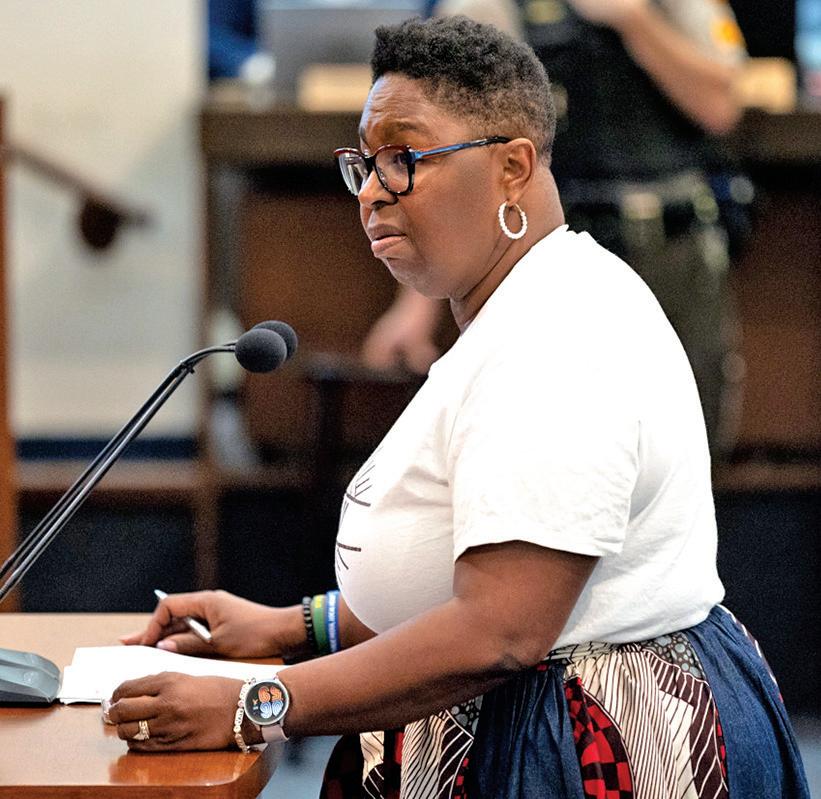
Nicole Adewale speaks during a St. Louis County Council meeting as officials debate the future of the county’s Minority- and Women-Owned Business Enterprise.
HealthMattersHealthMattersHealthMatters

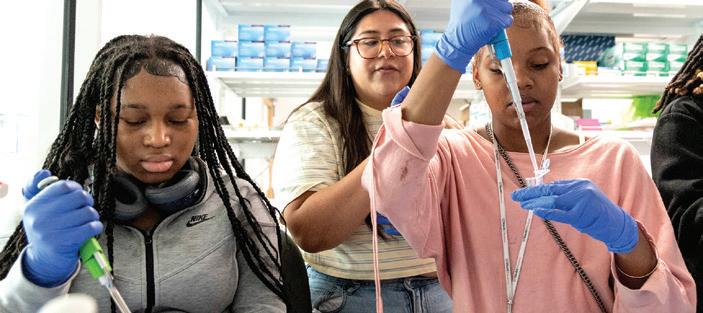
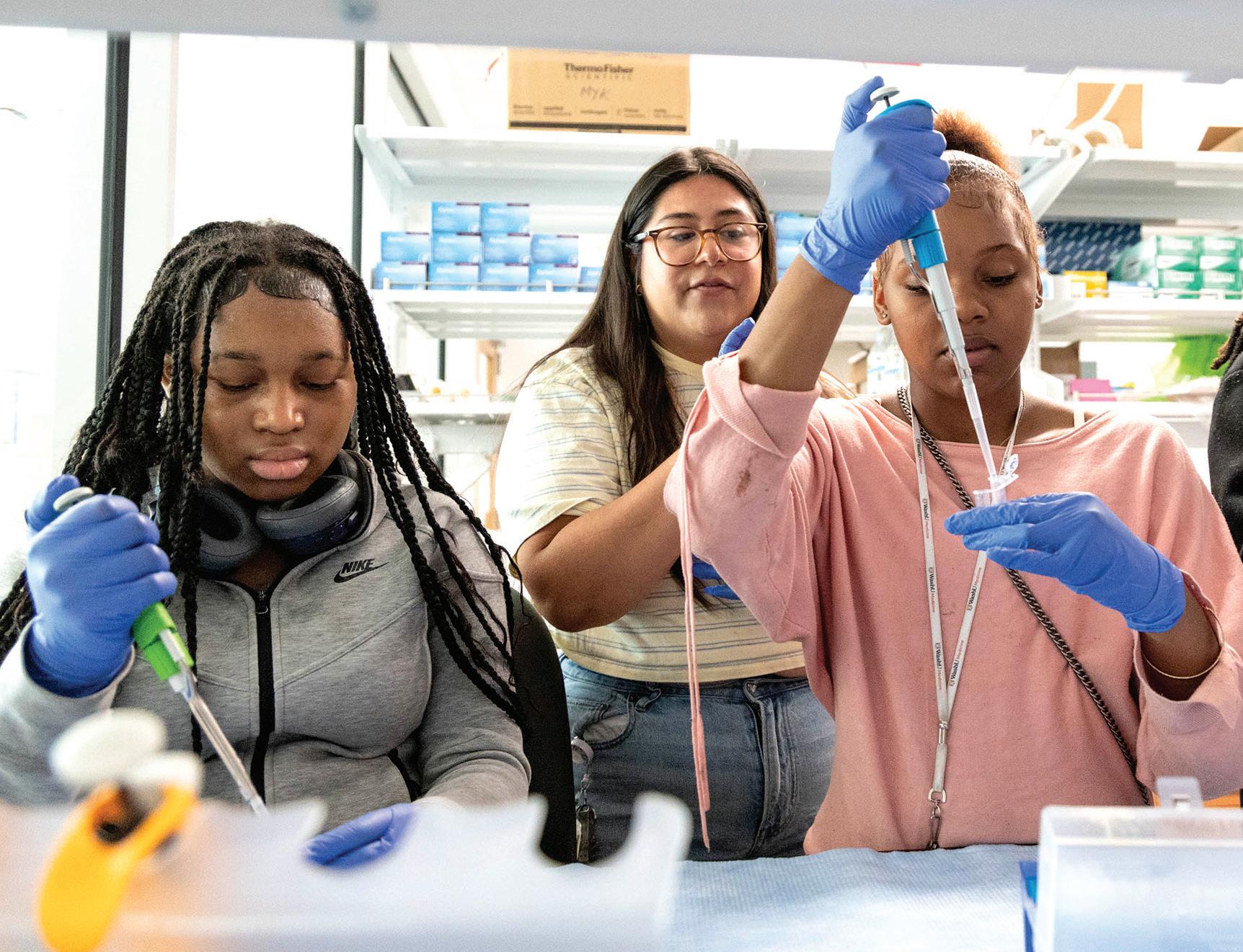
Journi Reese practices pipetting
PRIME for success
WashU
program gives students a
closer look at medicine
By Lawrence Bryant St. Louis American
Inside a WashU Medicine lab, science became something students could see, measure and try for themselves.
Participants in the PRIME, or Precollege Immersive Medical Training Experience, Program stepped into an RNA lab, practiced pipetting and learned about the precision researchers use when studying genetic markers connected to cancer.
For Journi Reese, a rising sophomore at McCluer High School, the program opened up a field she thought
“I never really thought of how many things go into being inside a medical career.”
– Journi Reese
she already understood. “I never really thought of how many things go into being inside a medical career,” Reese said.
The four-week program gives high school students exposure to health care careers through workshops, simulations, shadowing experiences and guided tours of clinical and community health settings. It also includes classroom instruction and academic support in math and English, subjects that help students strengthen skills needed for STEM and health science careers.
National workforce data show why early exposure to these fields matters. In 2021, Black workers made up 8%
Woman’s calling leads to national recognition
Can your breakfast help lower cancer risk?
By Dr. Graham A. Colditz
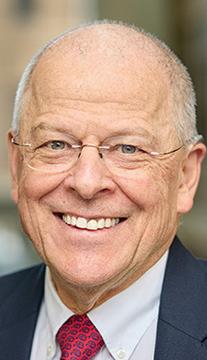
Don’t sleep on the cancer prevention benefits of a healthy breakfast. Whether it’s oatmeal, whole-wheat toast, berries in Greek yogurt or other healthy combinations — starting the morning with simple, whole foods is a great way to help lower the risk of cancer while also energizing your day and boosting your overall health. Try to steer away from refined and processed foods like pastries, white bread, sugary cereals, sausage and bacon. These are popular choices, but they can increase the risk of some serious diseases, including cancer. Other options that focus on low-fat dairy, whole grains, fruit and other healthy plant foods can be just as tasty — and are also rich in nutrients and other compounds that are quite good for us. Here are some ways to get the most out of your mornings:
Try to steer away from refined and processed foods like pastries, white bread, sugary cereals, sausage and bacon.
Enjoy your coffee. Coffee has over 1,000 compounds that could help improve health. And studies have linked moderate coffee drinking with a lower risk of stroke, heart disease, diabetes, gallstones, Parkinson’s disease and some cancers. If you like your morning coffee, keep enjoying it. But try to keep it simple — and in moderation. Unsweetened black coffee, or with just a little milk and sugar, is the healthiest choice. Specialty coffee drinks are often more like desserts, high in sugar and extra calories.
Mix it up. Experiment with new breakfast options that break the usual mold but keep things healthy. Add fresh spinach to your fruit smoothie.
Family crisis inspires student’s mental health mission
By Jennifer Porter Gore Word In Black
The conversation with her mother lasted only a few minutes. But for Kyra Wagner, it changed the trajectory of her life.
During the isolation of the COVID-19 pandemic, Wagner learned that one of her brothers was struggling with his mental health. Watching her family navigate a crisis shared by millions of American households, the Nashville teenager found herself asking a difficult question: Who helps children through moments like this? The answer became her
A 21-year-old rising senior at Spelman, Wagner has been named the undergraduate recipient of The Jed Foundation’s 2026 Student Voice of Mental Health Award.
calling. Wagner enrolled at Spelman College to study psychology, determined to become a child therapist and help young people — particularly Black children
— find support before a crisis becomes a tragedy.
Pandemic shapes a calling
As rates of anxiety, depression and suicide among Black youth climbed during and after the pandemic, Wagner’s family experience became a lifelong mission. It has now earned her national recognition.
A 21-year-old rising senior at Spelman, Wagner has been named the undergraduate recipient of The Jed Foundation’s 2026 Student Voice of Mental
See Mental, A8
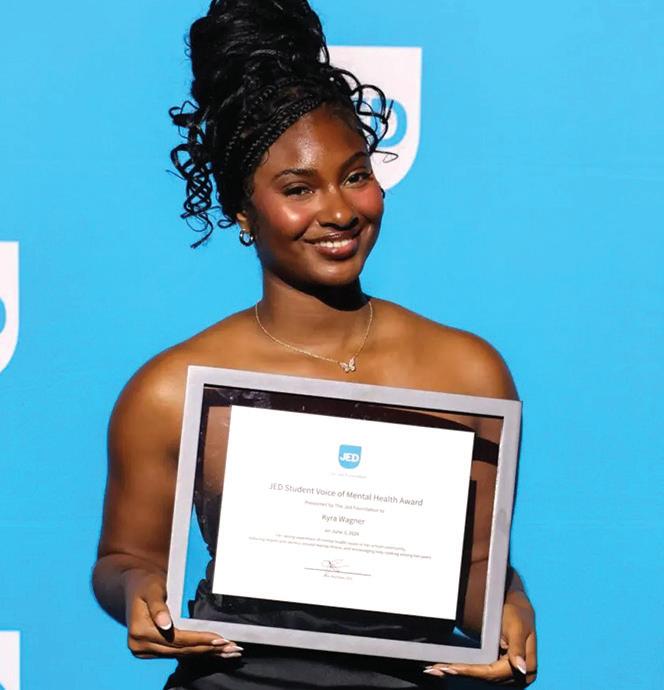
Photo by Lawrence Bryant / St. Louis American
during a hands on lab session as Dayden Hentz observes through the PRIME Program at WashU Medicine. The four week program introduces high school students to careers in medicine, research and health care. See PRIME, A8
See Abortion, A8
Dr. Graham A. Colditz
Photo courtesy of the JED Foundation
A family mental health crisis during the COVID19 pandemic inspired Kyra Wagner to pursue psychology at Spelman College.
HealthMattersHealthMattersHealthMatters
Care of
PRIME
Continued from A7 of workers in STEM occupations, below their 11% share of the total workforce. Hispanic workers made up 15% of STEM workers, below their 18% share of the total workforce, according to the National Science Board.
The gap also shows up in medicine. In 2018, 5% of active physicians identified as Black or African American and 5.8% identified as Hispanic, according to the Association of American Medical Colleges.
PRIME is a partnership among WashU Medicine, BJC Goldfarb School of Nursing, the Institute for School Partnership, Integrated Health Network and the FergusonFlorissant School District. Students rotated through nursing, physical therapy, orthopedic surgery, oncology and medical genetics, with each week focused on a different field.
For Dr. Tracey Hermanstyne Jordan, assistant dean of Academic Pathway Programs at WashU Medicine, the goal is to place students in spaces where they can picture their own future.
“You cannot be something if you haven’t seen it,” Jordan said. “You can-
Colditz
Continued from A7
Try a breakfast chicken salad made with olive oil
not imagine yourself being in the space if you never saw community engagement research, if you never saw a scientist, if you never saw a surgeon.”
Jordan said the program is built to show students the many layers of health care, from hospitals and labs to community clinics.
The experience extended beyond the lab. Students toured an inflatable colon to learn about cancer prevention and saw how health educators work
and slices of apple and wrapped in a whole-grain tortilla. Or try a morning mixed green salad with vinaigrette along with your toast. Adding more healthy plant-based foods to your
in communities to prepare people for screenings. The goal was to show that cancer care includes research, education, prevention and community outreach.
Vetta Sanders Thompson, the E. Desmond Lee Professor of Racial and Ethnic Studies at Washington University’s Brown School and a member of Siteman Cancer Center’s Cancer Education Research and Training Core, said students need to see the full range of
weekly meals is a great way to help lower the risk of many diseases.
Grab and go — but healthy. Life is busy — and mornings can

Kristen Taylor Harris, left, and Kamille White build their laboratory skills while working with pipettes during a PRIME cancer research session at WashU Medicine.
careers connected to cancer care and research.
Many young people think of doctors and nurses when they hear “medical field,” Sanders Thompson said, but there are many other roles that shape health care and medicine.
“Exposure to a real research lab is rare for most students,” Sanders Thompson said. “To see how the scientists are working, to see new technology that’s used in research, can be exciting.”
feel doubly so. But that doesn’t mean you need to skimp on, or skip, a healthy breakfast. Try quick, on-the-go options: a banana wrapped in a whole-wheat tortilla, whole-grain granola and berries added to a cup of Greek yogurt, or the ever-reliable peanut butter sandwich on whole-wheat.
Go ahead with eggs — but not too many. Eggs can be filling and really enjoyable — plus they’re a good source of protein and other important nutrients. It’s generally best to eat no more than one a day, and to pair them with healthy choices, like whole-wheat tortillas and avocado instead of foods like white-bread toast, bacon and cheese. Or try a
Mental
Continued from A7
Health Award, which honors college students who are transforming the emotional well-being of their campuses and communities.
“I’ve always believed turning lived experiences into action is one of the most powerful ways to create change,” Wagner said. “I remain committed to building solutions that improve mental health outcomes for groups with limited access to resources or opportunities and inspire others to do the same.”
Wagner’s path to the award was shaped by her upbringing in Tennessee, where she was known for academic excellence and a deep commitment to family. Like many teenagers with divorced parents and blended families, she navigated shifting roles — the eldest child in one household but not the other — while watching her mother manage financial strain and family transitions.
But it was a pivotal conversation with her mother during the COVID-19 pandemic, while Wagner was still in high school, that became the “aha” moment, point-
be overwhelming, but it helped her make friends, build confidence and see the medical field more clearly.
“It gave me an open eye about the medical field,” Avidal said. During the cancer research session, she said practicing with RNA and lab tools gave her an experience she had not had before.
“I always wanted to be a scientist,” she said. “Now I’m able to see and experience the things that I thought I was unable to do.”
Reese entered PRIME thinking she wanted to become a pediatric nurse. After shadowing patients during physical therapy week and learning about cancer research, she said the program showed her how broad the medical field is.
Sanders Thompson said representation matters because communities are often more willing to engage with screenings, vaccines and health education when they see people who look like them involved in research, treatment and community care.
For Franchezka Kiara Avidal, a student from the Philippines, PRIME made science feel reachable. She said she first thought the experience would
healthier omelet with kale and turkey.
Make it whole grain. Whole grains and fiber lower the risk of cancer and other diseases, and can be as much a part of breakfast as your morning coffee. And only a surprisingly small number of us actually get the recommended amounts of whole grains each day. So, breakfast is a great opportunity to boost that number. Oatmeal, whole-grain dry cereal or whole-wheat toast can top the classic whole-grain breakfast list. You can also look for foods labelled “100% whole grain,” “100% whole wheat,” “100% whole-grain oats” or something very similar. It’s said a lot, but a
ing her toward mental health advocacy. Her brother was struggling, and the family was unsure what to do.
The experience influenced Wagner’s decision to pursue a degree in psychology with the goal of helping children. Her brother’s struggle reflected what many Black families experienced during the pandemic.
Black youth at risk
According to the CDC’s 2021 Youth Risk Behavior Survey, about 29% of high school students reported using alcohol, marijuana or misusing prescription opioids. About one-third of those students reported using two or more substances.
A related CDC survey, the Adolescent Behaviors and Experiences Survey, found that during the first six months of 2021, when much of the nation was under COVID-19 restrictions, 31.6% of high school students said they used tobacco, alcohol or marijuana to cope. Alcohol use alone reached 19.5%, with a notable share of students reporting binge drinking.
The toll was especially severe for Black youth ages 10 to 24. They experienced a 37% increase
Reese said PRIME gave her pride and optimism for McCluer students.
“We are McCluer,” Reese said. “We are something.” She said the experience helped her see more possibilities for herself and other students of color.
“I can do more than what people say I can,” Reese said. “I can be more than just what they expect for a Black person or someone of color to be.”
good breakfast really is an important way to start the day. And we don’t need to overthink it to get real health benefits. Many of the classic breakfast foods have healthy, easy options. At the same time, there’s a lot of room to be creative and explore new foods and new approaches if we’d like.
Find out what works best for you — and your family. And turn a good morning into a healthy one as well.
Dr. Graham A. Colditz, an internationally recognized leader in cancer prevention, leads prevention research at Siteman Cancer Center at BarnesJewish Hospital and WashU Medicine in St. Louis.
in suicides between 2018 and 2021 — the largest increase of any racial group in the country. At Spelman, Wagner has built a record of leadership rooted in community and entrepreneurship. She serves as the inaugural president of the college’s Center for Black Entrepreneurship and as co-director of events for the local chapter of the nonprofit Sisters in Sync. Wagner is also conducting research examining how stress and financial pressures affect maternal mortality among Black women. She mentors young girls in her community and was selected as a Rare Impact Ambassador through Selena Gomez’s Rare Beauty brand. The Jed Foundation’s Student Voice of Mental Health Award recognizes students who build peer support systems and advance suicide prevention efforts on campus and in their communities. Wagner’s selection places her among a small group of young advocates nationally recognized for transforming personal hardship into public service.
“This award reaffirms that the work I am doing matters and our stories deserve to be seen and heard,” Wagner said.
Photo by Lawrence Bryant / St. Louis American

The Louisiana Department of Public Safety & Corrections confirmed to TMZ that rapper Mystikal, born Michael Tyler, now resides at Louisiana’s infamous Angola prison. Officials placed the Grammy nominee in protective custody, where he will occupy a cell by himself. Angola’s reputation precedes it. Nicknamed the “Alcatraz of the South,” the sprawling 18,000-acre penitentiary confines over 5,000 men and stands as the biggest maximum-security lockup in the country. Mystikal pleaded guilty in March 2026 to third-degree rape over a 2022 attack at his home in Ascension Parish, Louisiana and was sentenced to 20 years. His original arrest carried charges of first-degree rape and false imprisonment, and a conviction on the top count could have meant life behind bars.

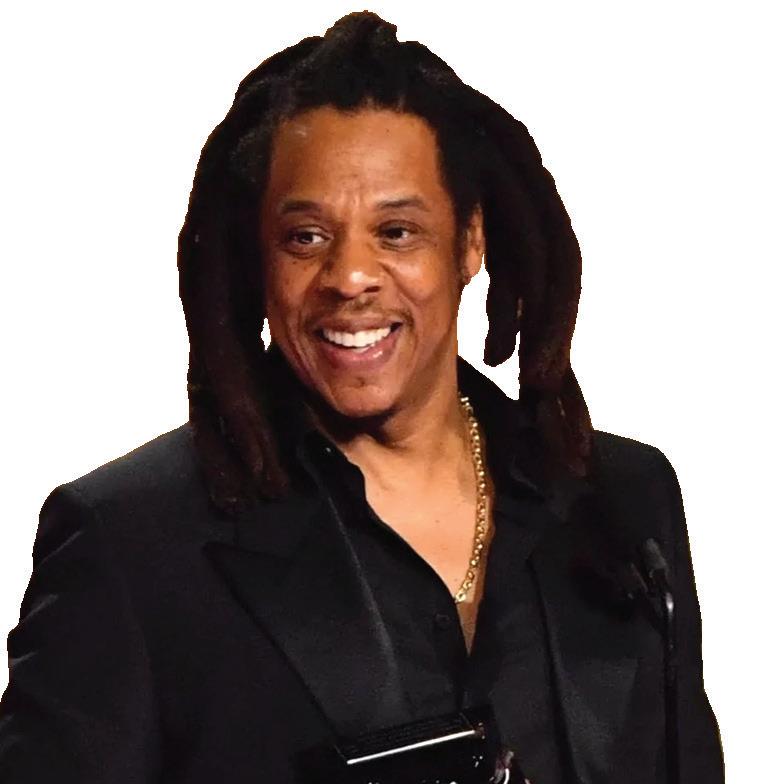
Before the start of his three-night Yankee Stadium residency this weekend, Jay-Z received a haircut from wife Beyoncé as they sat inside the venue. Footage of the trim was released on their respective social media accounts. For the final night, Jay-Z apologized to fans after the show of his three-night Yankee Stadium residency was delayed by more than three hours. “It was like ten thousand people outside, and we closed all the doors, and somebody rushed the door,” Jay-Z told the crowd. “They closed the door for you guys’ safety and everyone’s safety outside. I don’t want to start the music and people get trampled. I’m really sorry for the inconvenience, but I had to make sure everyone was OK.”
Atlanta hip-hop veteran T.I. confirmed his retirement from the rap game in a new cover story for PEOPLE. He called his recently released album “Kill the King” his farewell project. “I’ve gotten everything I prayed for from the game,” the Grammy winner told the outlet. This October, the rapper celebrates 25 years since his 2001 debut, “I’m Serious.” “I feel blessed to have had such a long career,” T.I. said. “To go from the kid that was praying to be a part of something, to having such a significant role.”
Brandy responds to concerns about her appearance
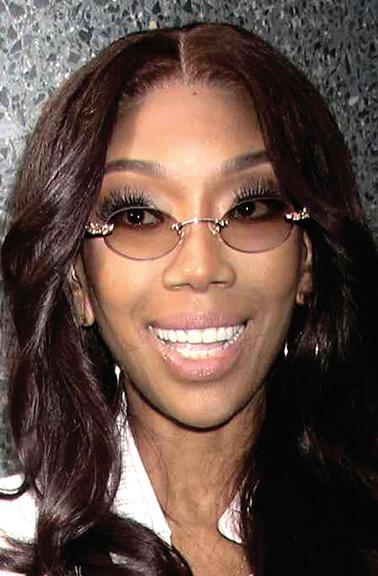
A visit to her hometown of McComb, Mississippi has compelled Grammy Award-winning singer and actress Brandy to respond to online speculation about her appearance. The R&B star received multiple honors recognizing her decades-long career, including the first-ever Key to Pike County. The City of McComb and state leaders also celebrated her. And during her visit she announced a partnership through her Norwood Kids Foundation to provide musical instruments and expanded arts opportunities for students at C.D. Higgins Middle School. But the moment was marred by remarks about how frail she appeared. Brandy took to Instagram on Saturday with a heartfelt post about the onslaught of remarks. An excerpt from the post reads as follows: “I’ve learned that it takes only a moment to form an opinion about someone’s appearance, and a lifetime to understand what they’ve lived through. So may we become gentler with one another. Not because everyone is fragile, but because everyone is carrying a story we cannot see. Before you speak about someone’s body, before you speak about someone’s face, before you decide who they are by what you see, remember, you are looking at someone’s child. Someone’s friend. Someone’s dream. Someone’s life. A soul.”
Hot Sheet Sources:

Mystikal
Brandy
Jay-Z
Senate
Continued from A1
Joe Palm of University City has spent decades in state and federal public health leadership, while Shante Duncan of University City has built a nonprofit serving women and girls and operates a political consulting business.
“I think everybody has a unique story,” Wilson said. “It’s a good field of candidates to choose from because they all bring some type of experience to the table, which is what we need.”
John Bowman
Bowman’s organizing roots began in organized labor.
A North St. Louis County resident for more than 40 years, he spent most of his career as an electrician at the Chrysler plant while belonging to the United Auto Workers and the Coalition of Black Trade Unionists.
“I saw firsthand how
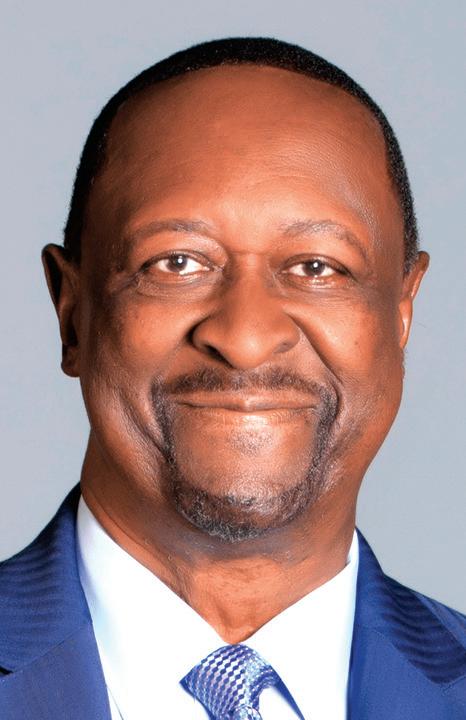
powerful organized labor can be in lifting working families like mine and creating opportunities for advancement,” Bowman said.
His union work led him into politics, first as a Northwoods alderman and later as a state representative from 2004 to 2008, where he served on the House Budget Committee and sponsored a financial literacy requirement for high school students.
His tenure ended after he pleaded guilty to a misdemeanor tied to a bank scheme. Bowman said
he was not involved in the underlying fraud and accepted the plea rather than exhaust his family’s college savings on a legal defense. He later served as chief of staff to former Sen. Robin Wright-Jones before becoming NAACP president.
Bowman said he has spent years advocating for grocery stores in food deserts and greater equity in economic development.
“It’s an obligation for people like me,” he said, “who have the experience and knowledge of how to

get things done to stand in the gap.”
Shante Duncan
As a young journalist, Duncan placed an advertisement in The St. Louis American seeking women interested in joining a sister circle called S.H.E.R.A.H. — Sisters Helping Each Other Reach Higher Heights.
The group focused on building community through activities such as yoga, meditation and mutual support.
“Then it took on a life of its own,” Duncan said.
Its growth eventually led her to open the Joan B. Quinn Safe House in 2018, providing housing for women recovering from domestic violence, sexual violence and sex trafficking.
While attending the University of Missouri–St. Louis, Duncan also created the LOVE Project, a self-esteem program that expanded into area schools. She said it has served more than 6,000 women and girls of color through workshops, healing circles and retreats.
Duncan later founded SMD Consulting, advising nonprofits and businesses before becoming a campaign strategist and regional field director for the Missouri Democratic Party.
“I do have experience, not as an elected official,

but as someone moving in communities,” she said.
“I have these relationships that I can leverage to help ensure that I am ready for the fight ahead.”
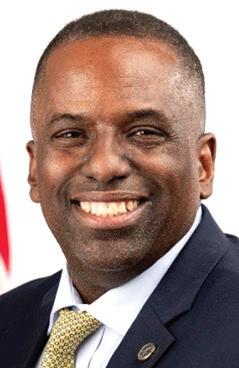
Joe Palm
Palm began his public service career as a St. Louis firefighter, an experience he says shaped his approach to leadership.
“As a firefighter, you have to go in when people are running out,” he said.
“No matter what barriers you run into, you keep your focus on getting the job done.”
Over the past two decades, Palm has served in state and federal public health leadership. As chief of the Missouri Department of Health and Senior Services’ Office of Minority Health, he oversaw programs addressing the opioid crisis, violent crime and health disparities, including the rollout of COVID-19 testing and vaccination sites.
In 2022, President Joe Biden appointed Palm regional director for the U.S. Department of Health and Human Services, where he oversaw operations across 15 states and territories.
Palm attended Berkeley Middle School and graduated from Ritenour High School before settling in University City.
“I have great experience on a local, state, and
federal level at a time such as this where that knowledge can be helpful for the communities across this district,” he said.
Palm said the candidates largely share similar goals but believes his experience implementing programs sets him apart.
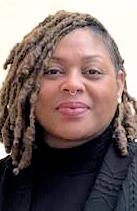
Raychel Proudie
Proudie, who grew up in Ferguson, began her career as an elementary school teacher in Baton Rouge after Hurricane Katrina, working with students displaced from New Orleans.
“Those children were still expected to perform on those tests,” she said. “There wasn’t a deep appreciation, like it is now, for the trauma that those children experienced.”
The experience inspired her to earn a master’s degree in mental health counseling. After returning to Ferguson in 2016 to raise her nephew, she worked as a counselor in the Riverview Gardens School District, serving students from neighborhoods still affected by the aftermath of Michael Brown Jr.’s 2014 police shooting.
She was elected to the Missouri House in 2018.
Proudie points to legislation she has sponsored, including a law clarifying that pregnancy cannot prevent a divorce from being finalized, along with measures providing state assistance for testing toxic nuclear waste and banning race-based hair discrimination in public education.
As the only St. Louis County member of the House Budget Committee, she said she has secured millions for local infrastructure projects.
“We have to go about this another way, because that same old, same old, is how we found ourselves in this position in the first place,” she said. “So right now, we need different and we need stamina.”

John Bowman Shante Duncan Joe Palm Raychel Proudie
1st District
Continued from A1
needs an independent progressive willing to challenge both Republicans and her own party.
The Aug. 4 Democratic primary offers voters two familiar candidates making sharply different arguments about how the district should be represented in Washington.
Three other Democrats
— Carl E. Harris Sr. of St. Peters, Alissa Murphy of Clayton and Carl Ernest Henderson of Hazelwood — and Republicans Paul Berry III and Andrew Jones are also on the ballot, but none has raised enough money to emerge as a serious contender in the heavily Democratic district.
According to Federal Election Commission reports through March, Bell had raised about $1.9 million and reported about $1.2 million cash on hand. Bush had raised more than $831,000 and reported about $120,000 cash on hand.
Governing philosophy
Bell points to his record on criminal justice reform and says he’ll continue fighting the Trump administration while protecting affordable health care, lowering costs for working families and bringing federal resources back to the district.
He accuses Bush of missing votes and breaking with Democrats at critical moments.
“When she was in office, she voted against President Biden and the Democrats,” Bell said.
“While everyone else understood the assignment in the last election was keeping Donald Trump out of office, Cori — days before the election — was calling Biden and Kamala ‘fascists.’ That lack of judgment matters.”
Bush says voters deserve a representative willing to challenge both parties while continuing to advocate for universal health care, reproductive rights, voting rights and lower costs for working families.
She also says the dis-
$120 million
Continued from A1
Louis received the largest share, about $280 million.
After months of contentious debate, the St. Louis Board of Aldermen voted 12-3 on July 2 to approve a $255 million spending plan directing the city’s share of the settlement toward tornado recovery, neighborhood redevelopment, infrastructure improvements, downtown revitalization and efforts to reduce vacant properties.
Sharon Tyus is the alderwoman for the city’s 12th Ward, which sustained some of the heaviest tornado damage. She expressed doubt that North City wards will receive a large portion of the settlement money.
When asked what she hoped to see the $120 million do in North St. Louis, Tyus gave a blunt answer.
“There is no $120 million coming,” she said.
Tyus said the $31 million designated for North St. Louis neighborhood plans is the portion she believes residents can count on.
Board Bill 22 confirms the distinction. It creates an $89 million Long-Term Tornado Recovery Fund for resident, housing and business recovery while dedicating $31 million to implementing neighborhood plans already adopted — or under development — in North St. Louis.
The neighborhood plans identify long-term housing, infrastructure, business and public-space projects in North St. Louis. The
trict should speak out on humanitarian issues, including the war in Gaza.
“I know people want to see their representative stand on the side of humanity,” Bush said. “But also, not give money over to war when that money could be used right here in St. Louis for tornado relief, for education, for health care, for our community violence prevention, for economic development and so many of our current issues.”
Bush defended her vote against President Joe Biden’s Build Back Better legislation, saying she opposed the final version because provisions she fought to include were removed.
“My vote wasn’t against the bill,” Bush said. “It was to get the actual, true 30-year investment into roads, bridges and infrastructure — not the 10-year investment it was dwindled down to be.”
Campaign money
The campaign has also featured sharp disagreements over fundraising and outside political groups.
Bush argues Bell has become too dependent on billionaire-backed super PACs and pro-Israel political groups.
Bell has questioned Bush’s 501(c)(4) social welfare organization, created after the May 2025 tornado, saying she has yet to demonstrate how it has helped tornado victims.
“I think Cori is about Cori,” Bell told The St. Louis American. “She literally set up a 501(c)(4), claiming that it was about tornado disaster relief … she exploited that and paid herself and her husband’s salaries.”
Bush has not publicly discussed the nonprofit in detail, and federal law does not require 501(c)(4) organizations to disclose their donors.
“I’m a former prosecutor,” Bell said. “I know a scam when I see one.”
Bush dismissed Bell’s criticism, arguing spending is the larger issue.
“It’s science,” Bush said. “We don’t have to match AIPAC, big crypto, big pharma, big real estate or any of these folks dollar-for-dollar. We need
$31 million is intended to carry out those plans rather than provide direct tornado recovery assistance.
Cristina Garmendia, policy director to Board of Aldermen President Megan Green, said the city already operates a tornado Recovery Office through Mayor Cara Spencer’s administration.
“The city’s Recovery Office primarily focused on coordinating FEMAreimbursable activities, like demolition and debris removal,” Garmendia said. Its primary purpose is to help with home repair and rental assistance for tornado-impacted households.
Garmendia said city leaders intentionally kept the Recovery Office’s mission narrowly focused. The Rams settlement money, she said, will primarily focus on coordinating long-term home repair and helping tornado-impacted families access the resources they need to “hopefully return to their homes.”
Tyus remains skeptical. She pointed to the “impact areas” listed in Board Bill 22, which include the Central West End, Skinker/DeBaliviere and Forest Park. All were damaged by the tornado, but they are not geographically located in North St. Louis.
Pointing to decades of disinvestment in North St. Louis, Tyus remained skeptical that North St. Louis neighborhoods like hers will receive as much of the Rams settlement money as many residents expect.
Kevin Bryant, founder

To the victor go the spoils
enough money to hit the doors, have literature and truly organize.”
Bush has repeatedly criticized Bell’s relationship with AIPAC and its affiliated super PAC, the United Democracy Project, which spent millions helping Bell defeat her in 2024 and has committed more than $1.2 million to help defend his seat.
Gaza
One major difference between this campaign and the 2024 race is the political climate surrounding the war in Gaza.
When Bell challenged Bush two years ago, he sharply criticized her calls
and president of Kingsway Development LLC., is the developer leading redevelopment efforts in Fountain Park, one of the neighborhoods hit hardest by the tornado.
Bryant admits he hasn’t been “engaged by City Hall thus far,” but wants to see the settlement money go toward communities that were “devastated” by the tornado.
“I would hope that money goes toward affordable housing primarily, as well as infrastructure,” Bryant said. “As a developer in Fountain Park, you would think some of those funds would go toward the housing crisis there.”
Margaret Starks, 84, said she’s attended several public meetings where politicians promised help for tornado victims. She’s lived in the Pershing/ DeBaliviere neighborhood for about 30 years and said she and several of her neighbors are still waiting for home repair assistance.
Starks said her home still needs roof and structural repairs. She’s frustrated because she hasn’t received enough help from her insurance company or the city. She wants to see the settlement money help homeowners repair their homes and bring them “up to code.”
“A lot of us are getting discouraged. We can pray but sometimes you gotta get up off your knees and do something,” Starks said. “With all this money coming in, I’m just hoping it will help people replenish their homes. I’m hoping it turns out well for all of us.”
Jackie Dupree, 64, has
for an immediate ceasefire and positioned himself as a strong supporter of Israel.
An AP-NORC poll this month found Democrats are increasingly supportive of Palestinians and more likely to believe the United States is too supportive of Israel than during the 2024 campaign.
Bell rejected accusations that Israel is committing genocide.
“There are things that all actors in this conflict — including us — that I disagree with, but Israel has the ability to wipe out Gaza. That’s why I push back on that description,” Bell said.
“What I want to see is durable and lasting peace
lived most of her life in the 4400 block of San Francisco Avenue in North St. Louis. Her home suffered roof, window and structural damage during the tornado. She has received some government assistance, but not enough
in that region so that Gazans as well as Israelis can live peacefully. I’m not a big fan of our president nor am I a fan of the prime minister of Israel right now. But I’m also not a fan of Hamas.”
Bush believes public opinion has shifted.
“Two years ago, a lot of people just didn’t know where the money was coming from,” Bush said.
“Now they know.”
Campaign record
Bell has also faced criticism over St. Louis County’s $500,000 settlement of a discrimination and retaliation lawsuit filed by a veteran prose-
to address all of the damage. There are still homes on her block with visible storm damage. When asked how she hoped the settlement money would be spent in North St. Louis, Dupree offered a simple reply.
cutor. Bell defended the charging decision at the center of the dispute. “I did that and I’d do it again,” Bell said. Although Bell was the central figure in the allegations, workplace discrimination lawsuits generally are filed against employers rather than individual supervisors. Campaign similarities and political differences aside, Democratic voters will decide Aug. 4 who will represent Missouri’s 1st Congressional District in Congress.
Sylvester Brown Jr. is the Deaconess Foundation Community Advocacy Fellow.
“I just want to see everything that was damaged by the tornado fixed and repaired.” Sylvester Brown Jr. is the Deaconess Foundation Community Advocacy Fellow.

Jordan Walker displays the Home Run Derby trophy he won with an epic performance on Monday night at Citizens Bank Park in Philadelphia.
Photo courtesy of Sty. Louis Cardinals/mlb.com

Living It
King of Broadway
Cedric The Entertainer, Taraji P. Henson handle ‘Joe Turner’s Come and Gone’ with care
By Kenya Vaughn St. Louis American
(New York, NY) – New York City may have the highest concentration of theater lovers per capita, but much of the crowd lining both sides of West 47th Street on Wednesday night was likely drawn to the Ethel Barrymore Theatre for a different reason: celebrity. St. Louis’ own King of Comedy Cedric The Entertainer and Taraji P. Henson — both with stars on the Hollywood Walk of Fame — headline the critically acclaimed Broadway revival of August Wilson’s Joe Turner’s Come and Gone, running through July 26.
The initial applause when Cedric and Henson stepped onstage was unmistakably for the stars. But once the performance settled in, the audience responded to the
skilled and convincing that many who arrived hoping for an upclose encounter with celebrity quickly forgot they were watching anyone other than Seth and Bertha Holly.
The production marks the stage debut for both actors, yet they appeared fully at home as a couple running a Pittsburgh boarding house during the first wave of the Great Migration. Bertha is introduced as the voice of reason as Seth complains about a new lodger whose youthful behavior he fears may disrupt the home’s reputation. Cedric’s interpretation of Seth verifies his stage name — a performer who has parlayed comedy into film, television, literature, and now a commanding stage presence without relying on punchlines. His chemistry with Henson is natural, and their timing — together

and individually — is impeccable. Watching them interact evokes the ease of a long-married couple who understand each other’s strengths and share equal footing.
Wilson’s story centers on the residents of the Holly boarding house in 1911, each carrying histories of migration, separation, and searching. Seth and Bertha offer stability to boarders navigating a country still reshaping itself a generation after Reconstruction. The boarding house becomes a crossroads — a place where people confront what they’ve endured and what they hope to reclaim. The rhythm shifts when Herald Loomis arrives with his daughter, Zonia. Loomis, illegally imprisoned for seven years by Joe Turner, moves through the home with a guarded presence as he searches for his estranged wife and a sense of direction after years stripped of auton-

A hero’s story in motion
Lolo marks 20
By Kenya Vaughn St. Louis American
When Diádié Bathily steps onto a stage, he carries West Africa with him. This month, he brings that legacy to the Touhill Performing Arts Center as Afriky Lolo presents Sundiata: The King of Mali, an original work inspired by one of West Africa’s most enduring historical epics.
Performed Friday and Saturday, July 17 and 18, the production marks Afriky Lolo’s 20th Annual Dance Celebration. Presented by UMSL Music, it continues the company’s tradition of sharing the richness and vitality of West African culture through dance, music and storytelling.
“This story has lived in the hearts and memories of West African people for centuries,” Bathily said. “As we celebrate 20 years of Afriky Lolo’s African Dance Celebration, I wanted to honor a story that reminds us of the power of resilience, community and cultural identity. Sundiata teaches us that our challenges do not define us, but rather it’s how we rise.”
The production tells the legendary story of Sundiata Keita, founder of the Mali Empire, whose journey from a childhood marked by adversity to becoming one of Africa’s most influential leaders has inspired generations across West Africa. “Every

By Kenya Vaughn St. Louis American
When Anthony Jones was a child, his family navigated housing insecurity and the instability that comes with it for a decade. But while everything around him shifted, one thing stayed constant.
“I always knew I was going to be a filmmaker.”
– Anthony Jones
“I always knew I was going to be a filmmaker,” Jones said. That certainty became his refuge. When reality felt too heavy, he escaped into stories — filling sketchbooks with heroes he created and writing adventures where courage conquered fear and hope had the final word. “My daydreams were my safe place,” he said. “If I could write them down, I could keep them forever.”
This weekend, one of those childhood creations — Kid Electric — will make its festival debut at the 26th Annual St. Louis Filmmakers Showcase, presented by Cinema St. Louis. The film screens Saturday, July 18 at the
Photo courtesy of Afriky Lolo
See Cedric, B3
Afriky Lolo will celebrate 20 years of dance celebration with ‘Sundiata: The King of Mali’ at 7 p.m. July 17–18 at the Touhill Performing Arts Center.
Sundiata: The King of Mali is an original work inspired by one of West Africa’s most enduring historical epics.
Wilson’s story centers on the residents of the Holly boarding house in 1911, each carrying histories of migration, separation, and searching.
Cedric The Entertainer
CONCERTS
Thur., July 16, 7:30
p.m. MATI presents Jon Baptiste Live: A Fantastical Musical Journey, The Fox Theatre, 527 N Grand Blvd, St. Louis, MO 63106. For more information, visit www.fabulousfox.com
Fri., July 17-July 19, Music At The Intersection (MATI) 2026, various times and locations within the Grand Center Arts District. For more information, visit matistl.org.
Fri., July 17, 7:30 p.m., Avery Wilson, City Winery, 3730 Foundry Way, St. Louis, MO. For more information, visit www.citywinery.com
Tue., July 21, 7 p.m.
The R&B Tour starring Usher and Chris Brown, The Dome at America’s Center. For more information, visit www.livenation. com.
Fri., July 24, 7 p.m.
doors, Buddy Guy 90 with Carlise Guy & The Nu Blu Band, The Factory, 17105 N Outer 40 Rd, Chesterfield, MO 63005. For more information, visit www.thefactorystl.com
Wed., July 29, 7:30 p.m., Babatunde: The HipHopera Tour, 3730 Foundry Way, St. Louis, MO. For more information, visit www.citywinery.com
Thurs., July 30, 7 p.m., Lil Wayne: 20 Years of Carter Classics with

2 Chainz, Hollywood Casino Amphitheater. For more information, visit www.livenation.com.
Sat. Aug. 1, The City Winery welcomes Kindred The Family Soul, City Winery, 3730 Foundry Way, St. Louis, MO. For more information, visit www.citywinery.com
SPECIAL EVENTS
July 17 – July 18, Sundiata King of Mali: Afriky Lolo 20th Anniversary Celebration, Touhill Performing Arts Center. For more information, visit www.touhill.org.
Saturday, July 25, 5 p.m., Be The Change presents Living Legends 2026. This year’s honorees are Zaki Baruti, Arriel Givens-Biggs, Sheila Forrest, Sharee Nicole Galvin, Bernie Hayes, Wiley Price, Anthony Shahid and Lady Ada Taylor, Missouri History Museum, 5700 Lindell Blvd. Visit www. eventbrite.com for more information.
Thurs., July 30, 6 p.m., Black Tech Midwest presents SIP & TECH Mixer St. Louis Edition, The Post Building, 1190 Cole Street. For more information, visit www. eventbrite.com Sat., Aug. 8, 3 p.m., The Golden Era of Black Radio, the fundraising event will feature a tribute to the late Doug Eason. The Post-Dispatch Building, Tucker and Cole Street.
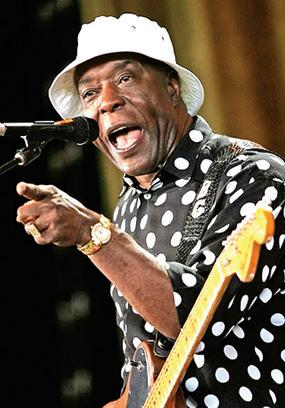
July 17 - 19, Special Event: George Wallace, Helium Comedy Club, 1151 St Louis Galleria St, St Louis MO 63117. For more information, visit https://st-louis.heliumcomedy.com
Sun., July 19, 7 p.m., Shama Mrema, City Winery, 3730 Foundry Way, St. Louis, MO. For more information, visit www.citywinery.com

Blues legend Buddy Guy returns to St. Louis with his Buddy Guy 90 tour at The Factory. See CONCERTS for more details.
CWE Jazz and Blues Festival, Euclid and Laclede in the Central West End. For more information, visit cwescene. com.
THEATRE
July 16 – July 22, The Muny presents Disney’s Newsies, The Muny, 1 Theatre Dr, St. Louis, MO 63112. For more information, visit muny.org
July 17 - 26, 7 p.m. Disney’s The Little Mermaid, Catherine B. Berges Theatre at COCA, 6880 Washington Ave, St. Louis, MO 63130. Various showtimes, for more information, visit www.cocastl. org
July 27 – Aug. 2, The Muny presents Ain’t Too Proud, The Muny, 1 Theatre Dr, St. Louis, MO 63112. For more information, visit https://muny.org
ART
Sat., July 25, 2 p.m. Urban Arts Expo, 5261 Delmar Blvd, St. Louis, MO 63108. For more information, visit https:// artbydeonne.com
Fri., Aug. 7, 7:30 p.m., D’Lai: I Beg Your Pardon Tour, City Winery, 3730 Foundry Way, St. Louis, MO. For more information, visit www.citywinery.com
ST. LOUIS MUSIC SPOTLIGHT
Fri., July 24, 9 p.m. Ish Ensemble feat. Alayna Lovelyy, The Dark Room, The Dark Room, 3610 Grandel Sq, St. Louis, MO
63103. For more information, visit https://kranzbergartsfoundation.org
Sat., July 25, 9 p.m. T-Dubb-O & The Blue City Syndicate: A Live Cinematic Recording Experience, The Dark Room, The Dark Room, 3610 Grandel Sq, St. Louis, MO 63103. For more information, visit https://kranzbergartsfoundation.org
Sat., Aug. 15, 1 p.m.
Sat., July 25, 8 p.m. Art, Mimosa and Pancakes, The Hawthorn, 2231 Washington Ave, St. Louis MO 63103. For more information, visit https:// ampexhibit.com/
Through Aug. 9, Teaser by Ayana Evans, Contemporary Art Museum, 3750 Washington Blvd, St. Louis, MO 63108. For more information, visit https://camstl.org

Cedric
Continued from B1
omy. His arrival unsettles the household, and Seth is the first to notice the depth of Loomis’ turmoil — a suspicion Cedric interprets with precision.
Bynum Walker, expertly portrayed by Tony Awardwinner Ruben SantiagoHudson, serves as the spiritual counterweight to Loomis’ pain.
Bynum believes every person has a “song” — a sense of identity and purpose that must be found and claimed. Through him, Wilson threads the idea that liberation is both physical and spiritual.
Bynum’s quiet insistence that Loomis must find his song places the boarding house at the center of a larger conversation about memory, loss, and rebuilding oneself.
Cedric’s portrayal leans into his natural comedic timing without oversaturating the role. His Seth is humorous but grounded — a man with a legacy to uphold and a household to protect.
And he makes it clear that Bertha stands beside him, not behind him. Henson’s Bertha carries the throughline familiar in her work: women who command agency. Her Bertha is an anchor — a partner with opinions and equal stake in the home they provide for those seeking footing up north.
The chemistry established by Cedric and Henson ripples throughout the cast, including child actors Dominique Skye Turner and Christopher Woodley as Zonia Loomis and Reuben Scott. Debbie Allen’s direction is a masterclass in honoring Wilson’s language, understanding that its rhythm is as essential to Black audiences as the words themselves. She also gets to the heart of the familial camaraderie that extends beyond bloodlines — a constant element of the Black experience — especially in the ebb and flow between Bynum and the Hollys.
The technical elements are as rewarding as the performances. Scenic designer David Gallo was intentional about every
audience member’s experience, creating visual elements that draw the eye to the top of the stage — from floating windows to a steep, sturdy staircase that rises toward the curtain’s header.
Paul Tazewell’s costumes are meticulously accurate for the era, and sound designer Justin Ellington offers an early glimpse of the emotions that unfold through his Delta Blues soundtrack.
Joe Turner’s Come and Gone affirms that firsthand accounts of Black experience belong in the canon of American theater beyond characters crafted by others that reduce Blackness to the lowest common denominator. And Cedric The Entertainer embodies the strength with which Black men protected the small piece of the American dream they were afforded — and shared it with others seeking their own.
August Wilson’s Joe Turner’s Come and Gone continues through July 26 at The Ethel Barrymore Theatre. For tickets or additional information, visit joeturnerbway.com.

Jones
Continued from B1
Con.
“I grew up homeless for 10 years,” Jones said. “Storytelling became the one thing that kept me grounded.”
Heroes Among Us: Kid Electric follows Warren Ryder, a homeless teenager whose electric powers are tied to his emotions.
As the story unfolds, Warren learns that becoming a hero isn’t about defeating villains — it’s about choosing compassion in a complicated world.
“I didn’t want another superhero who was chosen or born special,” Jones said. “I wanted a kid who had to build himself from scratch.”
The character grew out of moments when Jones felt pulled in different directions by peers and circumstances. “I remembered that I had written a story about a kid dealing with that — trying to get his powers under control because they were tied to his emotions,” he said.
“That’s where the inception of him came from.”
But Kid Electric is also Jones’ challenge to the narrow roles Black characters are often confined to.
“Why can’t a hero be dark-skinned?” he said.
“Why can’t that person also be a person of color? I don’t want to tell the slave stories. I don’t want to tell stories about us in the hood killing each other. Those stories have been told. Now let’s start showing people where we want to go — what we want to be.” Jones was one of three siblings born to a Jamaican mother. He lived all over before landing in the Metro East. A graduate of Collinsville High School, the 30-year-old said growing up Black and housing insecure meant adults often assumed they already
knew how his story would end. “They already had a narrative for me,” he said. “But I didn’t want to be somebody else’s statistic.”
This year’s St. Louis Filmmakers Showcase takes place July 17–26.
The festival features 69 films across 14 curated programs, including work by 26 student filmmakers, 15 first-time directors, and 25 filmmakers under age 30.
Festival Director Emmett Williams describes the theme as “A Shared Light” — a reflection of the collaborative spirit fueling the region’s growing film community.
“Year after year, St. Louis artists push boundaries and capture the true heart of our film community,” said Cinema St. Louis Festival Director Emmett Williams. “This showcase proves that when we share our light, we show the world exactly who we are.”
Jones said that spirit is woven into Kid Electric
“So many of the people who worked on this film are my friends,” he said. “We’ve all come up together. Nobody believed in us early on. This showcase gives all of us a chance to celebrate what we created together.”
The festival also includes new work from St. Louis filmmakers Cami Thomas and Travis Haughton, whose latest projects continue their commitment to telling emotionally grounded, community-centered stories.
Jones’ path to the showcase was long and often difficult. He attended Southwestern Illinois College before leaving to pursue filmmaking full time. He worked at Walmart by day and spent nights directing independent projects while building experience as a camera assistant and crew member. He later worked on productions across Louisiana, Texas,
California, and Arizona before returning to St. Louis to build his directing career.
“I just kept asking myself, ‘What’s the next set I can get on?’” Jones said. “I knew I had to keep getting better.”
That persistence paid off. He is a successful director of commercials. And Kid Electric has already earned invitations beyond St. Louis, including its upcoming screening at Comic-Con. But Jones said premiering the film before a hometown audience may be the most meaningful moment of all.
“The filmmakers here have just as much to say as anybody coming in from out of town,” he said. “We can tell stories about this community because we live them.”
At its heart, Kid Electric isn’t about superpowers. It’s about choosing hope — and believing in possibility even when the world tries to define you by circumstance.
Asked what he would tell his younger self, Jones didn’t hesitate.
“Everything you believe about yourself — keep believing it,” he said. “People are going to call you crazy and weird. Let them. One day your film will be at Comic-Con.”
For Jones, this moment is simply another chapter in the story he started writing long before anyone else believed it could come true.
“And this is just 30-year-old me telling you that,” Jones said. “Imagine what 40-year-old me is gonna tell you!”
The 26th Annual St. Louis Filmmakers Showcase will take place from July 17–26 at the Hi-Pointe Theatre, 1005 McCausland Ave. (at McCausland and Clayton). For tickets, additional information, and a full schedule of films, visit www.cinemastlouis.org

Bridging world through art
By Lyah LeFlore-Ituen
Every city has a story. But only a few cities create artistic movements that change the way the world sees itself. St. Louis is one of those cities. We have always been a city that nurtures artists whose gifts refuse to be confined by geography—artists whose work crosses neighborhoods, oceans, cultures, and generations while carrying the unmistakable imprint of home. That is the power of art. It travels, it transforms, and it builds bridges.
As we close out July, I am honored to help launch what I believe will become an important new tradition in our city’s cultural landscape. At Thursday Nights at the Museum on July 30, the Missouri Historical Society’s African American History Initiative (AAHI) presents Bridging Worlds Through Art: An Evening with Basil Kincaid, a new two-part series celebrating internationally acclaimed St. Louis artists whose work has reached far beyond our city while remaining deeply rooted in it. The evening begins with a community happy hour at 5pm, followed by a conversation at 6:30pm featuring internationally acclaimed fiber and textile artist Basil Kincaid and celebrated St. Louis–born artist, curator, and educator Lamerol Gatewood. This is more than an artist talk. It is an intergenerational conversation between two remarkable St. Louis natives shaped by different eras but connected by the same creative soil.
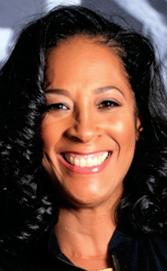
create without boundaries. BAG understood that creativity was never meant to exist in separate silos. Music informed painting. Poetry inspired theater. Movement shaped visual art. Together, they built a movement that still echoes today. Through that creative ecosystem, Afro-Cuban painter Emilio Cruz came to St. Louis, facilitated primarily through the vision and relationships of BAG cofounder Julius Hemphill. His presence, collaboration with other BAG artists, and youth art classes strengthened the city’s place within the national Black Arts Movement. That legacy continues through visionary visual artists born here in this city. Many St. Louis–born Black artists still thrive and create here. Others may have moved into global spaces but hold this city in the heart of their work, like Cbabi Bayoc, D. L. Warfield, Ronald Jones, Suzanne Jackson, Vaughn Davis, Bill Murphy, and Solomon Thurman. Multimedia artists like Damon Davis, Aaron Fowler, Shabez Jamal, Brock Seals, De’Joneiro Jones, and others continue expanding the boundaries of artistic practice through painting, murals, film, storytelling, design, and public art. Through their beautiful minds and hands, they all help define the richness and depth of Black visual expression emerging from here. Collectively, they remind us that St. Louis remains one of America’s great centers of Black artistic innovation.
Gatewood represents a generation that helped carry the artistic legacy of St. Louis into institutions across the country, following in the footsteps of St Louis greats like Oliver Lee Jackson. Kincaid represents a new generation whose monumental textile works explore ancestry, memory, and the Black experience with a vision that now resonates internationally.
Their conversation asks a question that reaches far beyond the walls of a museum: What does it mean to be shaped by a city—and to carry its mark across the world?
Having grown up in a family where art was not simply admired but lived every day, I have long understood that creativity is one of our greatest inheritances. Art teaches us how to remember, how to dream, and, perhaps most important, how to see one another.
That is why this moment matters. The artistic legacy of St. Louis did not begin with this series. It stretches back through the groundbreaking multidisciplinary Black Artists Group (BAG) founded in 1968, where musicians, visual artists, poets, dancers, and actors challenged one another to
As AAHI Director, I often say that history is not something we simply preserve—it is something we activate. History lives in archives, but it also lives in quilts, canvases, murals, films, performances, and the stories artists dare to tell. They transform memory into meaning and remind us that culture is not static—it is alive.
The work of an artist is never simply to create something beautiful. It is to leave behind a map that leads us back to our ancestors—a map that helps us understand the present and points the next generation toward possibility. This is what most excites me about this upcoming program with the dynamic Basil Kincaid. Beyond that, the kinship I have developed with Lamerol Gatewood makes this inaugural conversation especially meaningful. To witness them sharing the stage is to witness one generation pouring into another while both continue teaching all of us. That is how legacy endures.
That is what the July 30 program offers our city. Not simply a conversation. A bridge. And if St. Louis has taught us anything, it is this: When Black artists build bridges, generations find their way across.

Anthony Jones will make his film festival debut when Heroes Among Us: Kid Electric screens on Saturday, July 18 as part of Cinema St. Louis’ 26th Annual St. Louis Filmmakers Showcase, taking place July 17–26 at the Hi-Pointe Theatre.
Photo courtesy of Anthony Jones
Lyah LeFlore-Ituen

Photos by Lawrence Bryant / St. Louis American
Y’all better WerQ! When I tell you I got my whole life at the 7th Annual WerQfest Saturday at Atomic by Jamo! It goes without saying that I have a way with words, but I really feel like WerQfest is better experienced as opposed to explained. I will still try my best to describe the explosion of Black queer joy put together by two of my faves. Hey Tre and Shelton! Let me start with the lewks (yes, lewks). As an ally, I’m sure I appeared very demure with my clothing choices. But my nieces and nephews did the absolute most in the best way imaginable and were turning heads all up and through Jamo’s inside and patio. My favorites were the ones that looked regular at first sight but had a surprise. Did anyone see the young man sitting down in the unassuming black shirt and pants who stood up to reveal a cut out that had a turquoise thong covered in lace on full display? Then there was the talent! Kris Lay was serving so heavy I was almost ready to grow this menopausal mustache and beard out and rock it with a Catholic school girl uniform! And do not even get me started on the Veronica Frost revue! I got every bit of my life! You cannot tell me that drag performance is not a talent after seeing the Frost crew stomp and twerk the stage down! Especially with how she came in clutch and kept us occupied until JT hit the stage. I promise if she were on the mic at Yankee Stadium for the folks waiting on Jay-Z, that three hours would have flown by. Girl, If you are still doing shows in 2071, I would love it if you would host the afterparty for my repast.
WerQfest round two: Late in more ways than one. I know that JT usually stands for Jatavia, but Saturday night it meant “just tardy.” This is absolutely no shade to Shelton and Tre for what they pulled off overall, but was I the only one who felt like JT could have kept that little bite-sized set? Every single body else on the bill brought it, only for her to end the epic night with a fizzle. It felt even more underwhelming after how Veronica Frost, PBNJeffy and Tre Hitz held it down as we waited an extra hour and some change for those two (and a possible) little songs. The best part of her show was that superfan dynamic duo who rapped every word like the rent was due in lieu of her finale. If I’m keeping it a buck, JT was a blip on the radar that was the epicness that was WerQfest 2026. I can’t wait to be in the mix for 2027!
Turning up with the grownups. I should have known that Gen X wasn’t gonna plop on their moo moos and shorts with closed-toe sandals and retreat to the couch to watch the stories or listen to the game on the radio in a lawn chair in the garage! These folks are out here at a certain age turning up! I didn’t have to bother changing out of my church clothes when I went to go kick at the Moonrise for the Aunties & Uncs Grown Up Rooftop party Sunday afternoon. Full disclosure, I was still in recovery from my full day (and night) of WerQfest shenanigans, but that roof was a whole vibe! Was I the only one who had to resist the urge to recreate that “Bon Jour” TikTok video because of how the sun was hitting my face?
You know the party is grown when there is a saxophone player in the DJ booth! I wasn’t mad at it, I’m just sayin.’ I also wasn’t mad at Mocha Latte’s little crochet hat. I really feel like I would look like I need to be perched on the shelf of somebody’s granny’s rag doll display shelf or guest room bed if I tried to pull it off. It was super cute on her though. What was also cute was Mocha and BJ the DJ tag teaming on the microphone to hype us up!
It’s MATI time! I know I’m not the only one super excited to take in the revamped vibe for Music at the Intersection 2026 this weekend! I’m gonna be wore out, but it’s gonna be worth it! I can’t imagine it will be hotter than

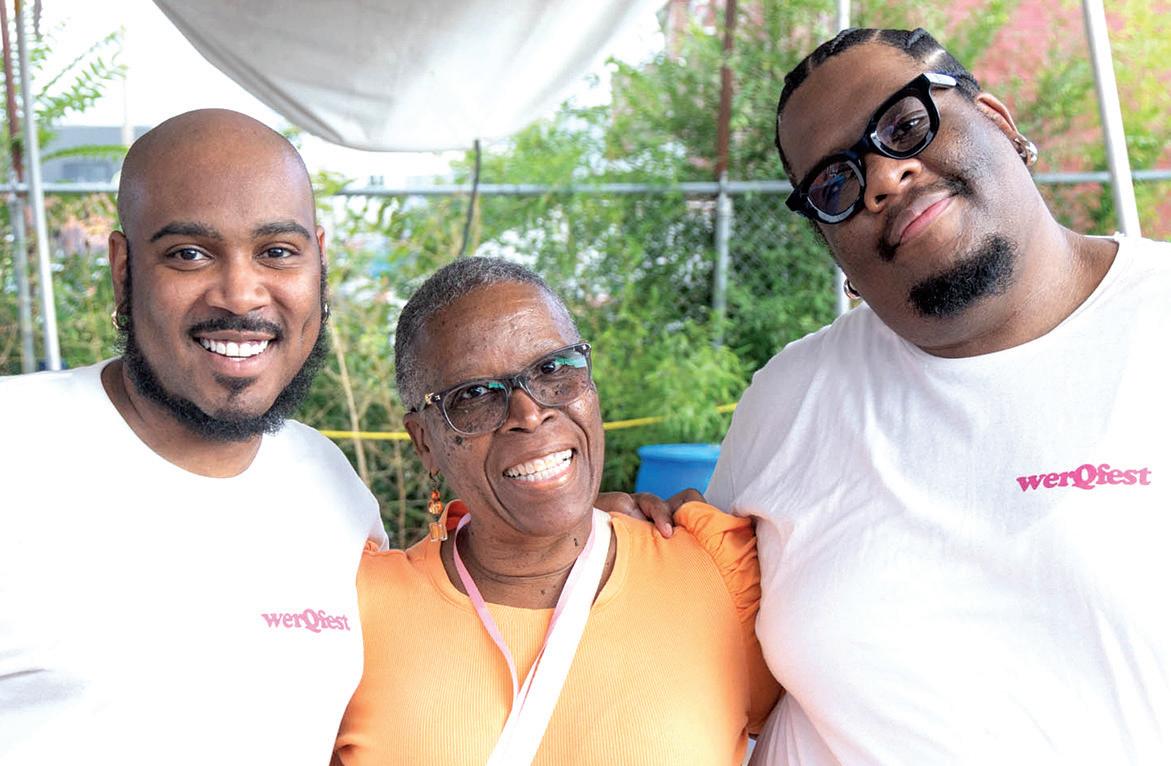
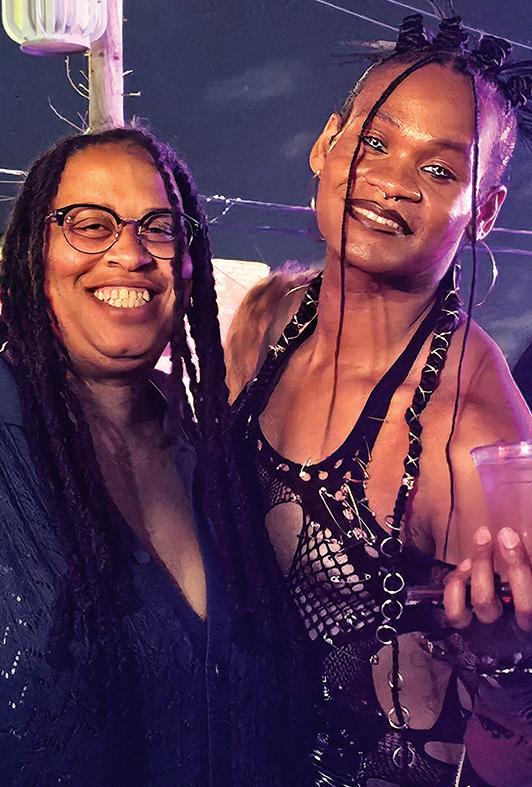

it was last year, but I used a wheelbarrow and a window unit to create my own portable a/c machine just to be safe. I’ll park it outside for the indoor shows. Stay tuned for the recap.
Afriky Lolo
Continued from B1
history has its heroes,” Bathily said. “In West Africa, it is Sundiata. He overcame all odds, triumphed over evil and rose to become the Mali Empire’s King of Kings.”
Audiences will journey through villages, kingdoms, sacred landscapes and historic encounters as the story unfolds through movement, rhythm and theatrical spectacle.
The milestone production comes during a landmark year for Bathily, who gained international attention in March after performing the traditional Zaouli dance of Côte d’Ivoire during the live broadcast of the Academy Awards as part of the musical performance from the film Sinners. The appearance introduced millions of viewers to one of West Africa’s most revered dance traditions and highlighted Bathily’s commitment to preserving and sharing authentic cultural traditions.
“This moment is for all African dancers in the USA and Africa who struggle every day and still believe in your dream,” he said. “Please follow your dream – it is your guide.”
Passed down through centuries by griots, musicians and oral historians, Sundiata: The King of Mali follows Sundiata’s rise from a young boy unable to walk to a unifying leader who defeats the sorcerer king Sumanguru Kanté and establishes one of the greatest empires in African history.
Through traditional West African dance, live drumming, music and theatrical storytelling, Afriky Lolo brings this story of perseverance, leadership and destiny to life on stage. Sixty artists are performing in the 20th Anniversary Dance

Celebration, including adult, youth and alumni dancers, 10 musicians, three guest artists and five musicians from UMSL’s music department.
Founded in 2003, Afriky Lolo has become one of the Midwest’s leading ambassadors of West African dance and culture. What began as something small has grown into a large, vibrant company. Through performances, classes, workshops, school residencies and community programs, Afriky Lolo has introduced thousands of students and audience members to the richness and diversity of West African artistic traditions.
To prepare for Sundiata: The King of Mali, Bathily traveled to Mali to conduct research, gather music and deepen his understanding of the historical and cultural traditions surrounding the story. “Dance is also research,” he said. “I wanted to return to the source, to learn from the people, the music and the history so that audiences can experience the spirit of this story as authentically as possible.”
Drawing from both historical accounts and mythic elements, the production embraces the griot tradition, where history and storytelling intertwine to preserve cultural memory. The result is a visually striking and emotionally resonant performance that invites audiences into a world of prophecy, perseverance and triumph.
Afriky Lolo is a St. Louisbased nonprofit organization dedicated to sharing and celebrating West African dance with local, national and international communities through performances, classes, workshops, educational programs and cultural exchange. Founded by Bathily, the company introduces audiences of all ages to the rich traditions, rhythms and stories of West Africa while fostering cultural understanding through the performing arts.
“For more than 20 years, I’ve taught African dance, bringing it from my birthplace in Ivory Coast, West Africa to St. Louis, the city I now call home,” Bathily said.
“This blessed community gave me the platform to carry my vision around the world and transform lives through dance and music.” He said his gratitude for the St. Louis community cannot be overstated. “I am so thankful to everyone who has stood by me all of these years and believed in what I do,” Bathily said.
“Because of you, I can train and prepare the future generations and keep our culture thriving.”
Afriky Lolo’s 20th Anniversary Dance Celebration — Sundiata: The King of Mali 7 p.m., Friday and Saturday, July 17–18 Touhill Performing Arts Center, 1 Touhill Circle, St. Louis, MO 63121 For tickets and additional information, visit afrikylolo.org.
WerQfest co-creators Tre and Shelton with Vanessa (center) as the party got started Saturday afternoon at Atomic by Jamo
Kris was happy to pose with hip hop star Infinite Coles after their set Saturday night at WerQfest
Lucy and Tierha at the Mentors In Motion Gala recently at Saint Louis University
Founded in 2003, Afriky Lolo has become one of the Midwest’s leading ambassadors of West African dance and culture.
Photo courtesy of Afriky Lolo
“That was the greatest Home Run Derby I’ve ever seen.”
— Baseball legend Barry Bonds, congratulating St. Louis Cardinal Jordan Walker after his derby championship
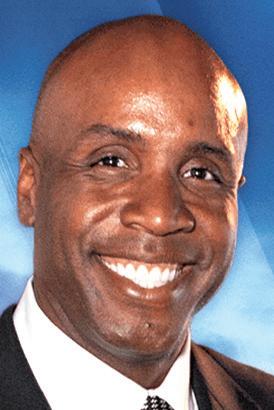
SportS EyE
With Alvin A. Reid
Wetherholt’s deal is financial music to Walker’s ears
St. Louis Cardinals rookie second baseman
JJ Wetherholt signed an eight-year, $112.5 million contract extension, which kicks in next year. With incentives, the deal could total $132 million.
Jordan Walker received a raise too.
Walker’s increase in pay will likely wait until after the season — or until after a Dec. 1 lockout if owners and players have not reached a new collective bargaining agreement — but it’s coming.
Wetherholt’s new deal paves the way for Walker to make at least that much, depending on the length of a new deal. He will make considerably more if he completes a second half of the season that compares to the first.
Trout, $35.6M; Fernando Tatis Jr., $24.3M; Teoscar Hernandez, $22M; Nick Castellanos, $20M; Starling Marte, $19.5M; Kyle Tucker, $16.5M; Tyler O’Neill, $16.5M; Corbin Carroll, $13.9M. If I’m Walker’s agent, I’m seeking at least $22 million per season for my client. And the deal would have to be for at least eight years. Thank you, JJ.
My guess is that pitcher Dustin May is traded by the Aug. 3 deadline, and his 2027 mutual option — worth $20 million if exercised by both sides — would follow him to his new team.
May has a mutual option clause, meaning both he and the team would have to exercise it, and May could decline it to test free agency.
The All-Star right fielder reached the break with 22 home runs and a National League-leading 74 RBIs. His .294 batting average, 105 hits, and 32 walks mean he is consistently on base. Walker also has a team-leading 13 stolen bases and has developed one of the most feared defensive arms of all MLB right fielders.
According to Spotrac. com, Walker’s 2026 compensation is $799,400. He’s obviously worth a lot more than that, especially since Wetherholt will be raking in an average of $14.1 million per year.
Spotrac also lists the top 10 highest-paid right fielders in baseball as follows: Juan Soto, $51 million; Aaron Judge, $40M; Mike
If May is gone, there is more money available for Walker while the Cardinals continue rebuilding.
Granted, he could return to mediocrity, but I doubt it. If he closes this season strong and adds a productive 2027, Walker could command as much as $30 million annually. It would be better to sign him to an extension now than wait until 2028 and pay him considerably more.
Wetherholt’s deal and a pending extension for Walker leave me concerned. Shortstop Masyn Winn could be the odd man out and left without a ticket on the money train. Winn, like Jordan, is making $799,400. He

been a bit suspect this year. His throwing error surrendered a ninth-inning run to the Atlanta Braves last Sunday in a
InSIdE SportS
4-3 Cardinals’ loss. He has made eight errors this season, compared to three in 2025. (Remember that he made 18 in 2024.)
Winn and Wetherholt make a dandy double-play combination, with Winn taking part in an NL-leading 57 double plays this year.
Winn’s future is bright but the pay level for a great shortstop is higher than a right fielder or second baseman. St. Louis will have to make a financial decision if Walker receives a deal that tops Wetherholt’s.
We don’t know where that will leave Winn. For now, the Cardinals have been a pleasant surprise in 2026. It’s never too soon to talk about money, but for now I’m going to concentrate on baseball.
The Reid Roundup I’m thrilled for Jordan Walker but worried that he participated in Monday’s All-Star Home Run Derby even though he won it. Players in the past have plummeted offensively after the derby… Victor Scott II was hitting .190 when he was sent down to Triple-A Memphis and has not improved. In 90 at-bats, Scott is hitting just .200 with no home runs and eight RBIs… Nolan Gorman is doing even worse at Memphis. Heralded as a star of tomorrow for several seasons, Gorman was sent down last month and he’s hitting a woeful .121, with three home runs and six RBIs.
Run 4 Roses puts STL in spotlight
When the second week of July rolls around, I take my annual trip to Louisville, Kentucky, to watch the action at the Run 4 Roses Classic.
Billed as the world’s largest girls’ basketball showcase, the Run 4 Roses has become a permanent part of my summer travel basketball schedule. Nearly 1,000 girls’ grassroots basketball teams from around the country convene at the Kentucky Exposition Center. This was the sixth year I attended this event and I’m still amazed at the spectacle. It resembles a huge carnival of basketball activity with games going on at nearly 100 courts inside the convention hall and several exhibits outside to keep the players engaged. It is quite a deal.
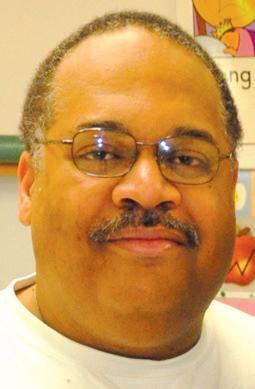
that also attend, including several from the St. Louis area. That is why I travel to Louisville. I love to watch our local girls compete against the best in the country at this event. One team that received a tremendous opportunity was the Napheesa Collier Elite 17U team, coached by Webster University head coach Jordan Olufson.
The Run 4 Roses also attracts some of the best girls’ high school players from around the country along with a throng of college coaches from every level of competition.
There are many teams from the state of Missouri
The Phee Elite squad played a nationally televised game against Sister’s Keeper from Canada on ESPN2. A big crowd gathered at “Court 49” to watch Phee Elite battle its way to a 61-58 victory. The team was led by 6’3” junior Bridget Fitzgerald of Incarnate Word Academy, who scored 15 points. Senior guard Nylah Scales of Cardinal Ritter added 10 points, utilizing her dazzling speed and quickness. I arrived early to make sure I had a good courtside seat to watch our local girls show out on national television. It was fun sitting at the front table, discussing St. Louis area girls’ basketball — which

was on full display — with the college coaches.
It is always an enjoyable trip to Louisville to visit with family and also see some great girls’ basketball. It is also fun to see our St. Louis area players perform well on the big national stage.
Catching up on football recruiting
It has been some time since we last updated you on football recruiting
Cardinal Ritter College Prep guard Nylah Scales of Napheesa Collier Elite was one of the top local players on display at last week’s Run 4 Roses Classic in Louisville. Scales scored 10 points in Phee Elite’s 61-58 victory over Sister’s Keeper in a nationally televised game on ESPN2.
around the St. Louis area.
As usual, St. Louis is producing some quality high school football talent and many players have already committed to colleges during the spring and early summer. Here are some of those commitments.
Kingston Miles, a fourstar running back from St. Mary’s, committed to the University of Missouri. The 6’0”, 195-pound Miles had originally committed to Auburn before flipping to Mizzou. As a junior,
Miles rushed for 2,095 yards and 25 touchdowns in leading the Dragons to the Class 4 state semifinals. He also caught 12 passes for 236 yards.
Senior running back Tristan Moss of Lift for Life Academy has committed to Illinois. The 6’0”, 190-pound Moss played at Timberland last season before transferring to Lift for Life. As a junior, Moss rushed for 1,081 yards and 16 touchdowns. He averaged more than seven yards per carry.
Antonio Pinkston, a standout defensive end from Festus, has committed to Lindenwood University. The 6’2”, 250pound Pinkston had eight sacks and 12 tackles for loss while helping lead the Tigers to the Class 4 state semifinals last season.
Senior wide receiver Royce Searcy of De Smet has committed to Northern Iowa. The 5’8” Searcy amassed 910 all-purpose yards as a junior as a receiver and kick return specialist.
Senior wide receiver Isaac Hudson of Chaminade has committed to South Dakota State. Hudson is a big receiving
target at 6’3” and 210 pounds. Senior defensive tackle Chase Dixon of Fort Zumwalt West has committed to Missouri State. Dixon is a 6’4”, 325pound lineman who was an All-Conference performer.
Tarris Reed Jr. making an impact in NBA Summer League Former Chaminade College Prep basketball standout Tarris Reed Jr. is making a positive early impression in the first week of the NBA Summer League with the San Antonio Spurs. The 6’10” power forward averaged a double-double in the two games at the California Classic in Oakland. He had 10 points and seven rebounds against the Miami Heat and followed that up with 12 points and 12 rebounds against the Los Angeles Lakers.
In his first game at the Las Vegas Summer League, Reed had 14 points, 10 rebounds and two assists against the Atlanta Hawks. Reed was the Spurs’ first-round pick, selected with the No. 26 pick of the NBA Draft.
JJ Wetherholt’s eight-year, $112.5 million contract extension will likely pave the way for a Jordan Walker deal soon.
With Earl Austin Jr.
Alvin A. Reid
Photo courtesy of mlb.com
Earl Austin Jr.
Photo by Earl Austin Jr. / St. Louis American

Arts In The Lou Arts In The Lou
Zeeoma
Where African excellence is touched, worn and lived
On the second floor of West County Center sits St. Louis’ premier destination for excellence in African craftsmanship, lifestyle and heritage: Zeeoma. Founded by a St. Louisbased couple with roots in Nigeria, Zeeoma was built on a single, simple conviction: African fash-
The name Zeeoma means “seeing goodness.” That is the standard for everything inside the store.
ion and lifestyle products belong everywhere, including in St. Louis, Missouri. Zeeoma also serves as a bridge. On one side stands the creative energy of the African continent, with its designers, artists, weavers, jewelry makers and storytellers creating original works that reflect

its rich heritage. On the other stands St. Louis, the Gateway City, long recognized as a doorway

for pioneers, traders and explorers heading west. Zeeoma brings the two together in one place and invites everyone in.
The name Zeeoma means “seeing goodness.” That is the standard for everything inside the store and the spirit behind it: to look at Africa and see goodness — in its craftsmanship, its color and its people — and to help others see it, too.
Zeeoma is not a souvenir shop. It is a carefully curated home for African fashion and lifestyle, featuring clothing by leading and emerging Nigerian designers; hand-loomed Akwete and Aso-oke textiles; hand-dyed Adire fabrics; raffia bags and apparel; bold jewelry; beaded purses; art; beauty and wellness products; and books. Each piece is selected because it carries the story, artistry and skill of its maker. The point is not to argue for the ingenuity of African artisans. The point is simply to display their work and let it speak for itself.
Zeeoma is also more than its shelves. It is a gathering place for conversation, for learning craftsmanship and for celebrating the people who embrace African fashion and lifestyle every day — the teacher wearing her gele to church on Sunday, the student in Adire palazzo pants on campus, the family that fills its home with the textures, colors and scents of the continent. Here, African style is not a costume or a trend. It is a way of life, worn with joy, and Zeeoma honors the people who live it.
That spirit took center stage at the first Zeeoma Open Door, held in Lagos in July — the city where the story begins. The name says exactly what it means: a door held open between two worlds. The first door had to open at home, in Lagos, among the makers, the markets and the people who give Zeeoma its heart.
The day celebrated the journey ahead — one familiar to thousands of people in Africa and throughout the diaspora who have crossed an ocean while carrying home with

home for
them. To travel from Lagos to St. Louis is to carry a whole world in your suitcase: the fabrics, the flavors and the language of home. Too often, that world stays folded away. Zeeoma unfolds it. What opened in Lagos now continues in St. Louis — rooted in heritage and reaching toward what comes next.
St. Louis has deep roots for a story like this. This is the city where Katherine Dunham carried African dance, ritual and pride into American life and taught generations that heritage is something you practice, not simply remember.
Zeeoma stands in that tradition. When the region asks what a rising Africa looks like on the ground, Zeeoma offers a living answer: African creativity, present and thriving, in the heart of the Midwest.
Zeeoma’s mission is to serve as a gateway to
African craftsmanship, lifestyle and heritage. There is no better place to begin than St. Louis, the Gateway City, home of the Gateway Arch and a place built on the promise of passage. Zeeoma gives that promise a new direction. Walk through the door, and Africa’s finest craftsmanship is in your hands. Walk through the door, and discover a lifestyle you can wear and live. Walk through the door, and heritage is no longer far away — it is here. Africa. Curated. Worn. Touched. Lived. Bridged. So come and see. Walk through the open door. Run your hand along the cloth, try on the beads and ask where each piece began. Visit Zeeoma in St. Louis and discover what “seeing goodness” feels like when you can finally hold it in your hands.
Zeeoma is the premier destination in St. Louis for fashion, craft, and lifestyle experiences rooted in contemporary Africa — a concept store and creative marketplace, and the first space of its kind in the city. Ericsson Raphael models some of the store’s merchandise.
Photo courtesy of Zeeoma
Zeeoma is a curated
African fashion and lifestyle. Mutiat Aromasodun, left, and Bisola Komolafe model some merchandise.
Photo courtesy of Zeeoma

REQUEST FOR PROPOSALS
The Land Clearance for Redevelopment Authority of the County of St. Louis (the “LCRA”) and STLVentureWorks (“STLVW”) requests proposals from qualified contractors to provide general fire safety services at five (5) different properties located in St. Louis County. The requested services shall be for a one-year period with two successive options for renewal for terms of one year each. A copy of the RFP is available at https://stlpartnership.com/ rfp-rfqs/. Proposals must be received no later than 3:00pm CST on Friday, August 7, 2026.
St. Louis Economic Development Partnership Equal Opportunity Employer
REQUEST FOR PROPOSALS
The Land Clearance for Redevelopment Authority of the County of St. Louis (the “LCRA”) and STLVentureWorks (“STLVW”) requests proposals from qualified contractors to provide general janitorial services at five (5) different properties located in St. Louis County. The requested services shall be for a one-year period with two successive options for renewal for terms of one year each. A copy of the RFP is available at https://stlpartnership.com/ rfp-rfqs/. Proposals must be received no later than 3:00pm CST on Friday, August 7, 2026.
St. Louis Economic Development Partnership Equal Opportunity Employer
SEALED BIDS
Bids for Military Vehicle Compound, Fencing and Site
Improvements at Jefferson Barracks, Project No. T2504-01, will be received by FMDC, State of MO, UNTIL 1:30 PM, August 11, 2026. Project information available at: http://oa.mo .gov/facilities
SEALED BIDS
Bids for Replace Chiller & HVAC, Headquarters & Garage Buildings, Project No. R250701 will be received by FMDC, State of MO, UNTIL 1:30 PM, August 13, 2026. Project information available at: http:// oa.mo.gov/ facilities
REQUEST FOR PROPOSALS
The Land Clearance for Redevelopment Authority of the County of St. Louis (the “LCRA”) and STLVentureWorks (“STLVW”) requests proposals from qualified contractors to provide general Pest Control services at five (5) different properties located in St. Louis County. The requested services shall be for a one-year period with two successive options for renewal for terms of one year each. A copy of the RFP is available at https://stlpartnership.com/ rfp-rfqs/. Proposals must be received no later than 3:00pm CST on Friday, August 7, 2026.
St. Louis Economic Development Partnership Equal Opportunity Employer
REQUEST FOR PROPOSALS
The Land Clearance for Redevelopment Authority of the County of St. Louis (the “LCRA”) and STLVentureWorks (“STLVW”) requests proposals from qualified contractors to provide general Security Systems and Alarm services at five (5) different properties located in St. Louis County. The requested services shall be for a one-year period with two successive options for renewal for terms of one year each. A copy of the RFP is available at https://stlpartnership.com/ rfp-rfqs/. Proposals must be received no later than 3:00pm CST on Friday, August 7, 2026.
St. Louis Economic Development Partnership Equal Opportunity Employer

REQUEST FOR PROPOSALS
The Hazelwood School District is seeking bid proposals to remove and replace electrical panels at Larimore Elementary.
Interested parties should submit their bid proposal through Bidnet via the district’s website at https://www. hazelwoodschools. org/Page/2238 on or before Tuesday, August 4, 2026 not later than 10:00 a.m
PUBLIC NOTICE
Notice is hereby given that the Metropolitan St. Louis Sewer District Requests for Quotes, Bids and Proposals are posted online for public download. Please navigate to www.msdprojectclear.org > Doing Business With Us > View Bid Opportunities
Metropolitan St. Louis Sewer District is an Equal Opportunity Employer.
REQUEST FOR PROPOSALS
The Land Clearance for Redevelopment Authority of the County of St. Louis (the “LCRA”) and STLVentureWorks (“STLVW”) requests proposals from qualified contractors to provide general Landscaping services at five (5) different properties located in St. Louis County. The requested services shall be for a one-year period with two successive options for renewal for terms of one year each. A copy of the RFP is available at https://stlpartner ship.com/rfp-rfqs/. Proposals must be received no later than 3:00pm CST on Friday, August 7, 2026.
St. Louis Economic Development Partnership Equal Opportunity Employer
the bidding process.
Minority-owned, women-owned, veteran-owned, and disadvantaged business enterprises are encouraged to submit bids.
INVITATION TO BID
Lemay Child and Family Center, at 9828 South Broadway Saint Louis Missouri, is soliciting bids for a parking lot resurfacing project at our location, 9828 S. Broadway St. Louis, MO 63125. Interested parties to contact Denise Wiese at dwiese@lemaychildandfamily. org to request a bid information package that defines the scope of the project and bid requirements. All bids must be delivered to the Lemay Child and Family Center by no later than 5:00 pm on August 7, 2026. Sealed written bids can be dropped off at the facility or emailed to Denise Wiese at the above email address.
All bidders to be aware that this work will be awarded by August 10, 2026 and needs to be completed by December 31, 2026. All received bids will be privately opened and reviewed by selected Lemay Child and Family Center board members. Project to be awarded to the best overall proposal/bid received.
No bid bond or performance and payment bonds are required. All bidders to submit the other required info found in the bid information package.
By: Denise Wiese, Executive Director

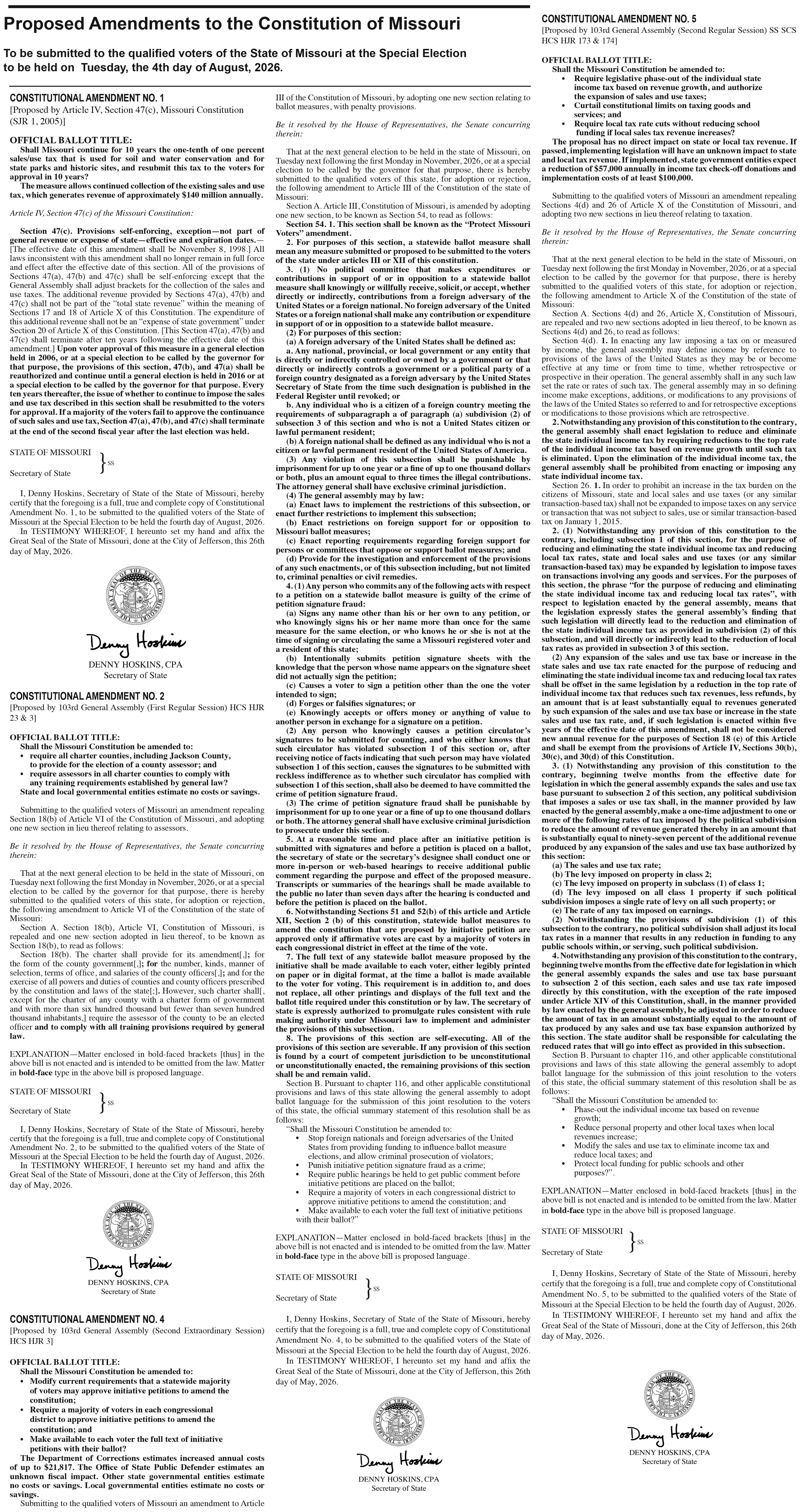
St. LouiS american Bids & Public Notices St. LouiS american
REQUEST FOR PROPOSALS
The Land Clearance for Redevelopment Authority of the County of St. Louis (the “LCRA”) and STLVentureWorks (“STLVW”) requests proposals from qualified contractors to provide general Trash Removal services at five (5) different properties located in St. Louis County. The requested services shall be for a one-year period with two successive options for renewal for terms of one year each. A copy of the RFP is available at https://stlpartnership.com/ rfp-rfqs/. Proposals must be received no later than 3:00pm CST on Friday, August 7, 2026.
St. Louis Economic Development Partnership Equal Opportunity Employer
HAZARDOUS MATERIALS ABATEMENT/ THIRD PARTY ABATEMENT MONITORING AND AIR MONITORING RFP 2026
The Saint Louis Zoo seeks bids from qualified vendors. Bid documents are available as of 7/15/26 on the Saint Louis Zoo website: stlzoo.org/vendor
NETTING & INSTALLATION SERVICES RFP 2026
The Saint Louis Zoo seeks bids from qualified vendors. Bid documents are available as of 7/15/26 on the Saint Louis Zoo website: stlzoo.org/vendor.
REQUEST FOR PROPOSALS
The Land Clearance for Redevelopment Authority of the County of St. Louis (the “LCRA”) and STLVentureWorks (“STLVW”) requests proposals from qualified contractors to provide general HVAC services at five (5) different properties located in St. Louis County. The requested services shall be for a one-year period with two successive options for renewal for terms of one year each. A copy of the RFP is available at https://stlpartner ship.com/rfp-rfqs/. Proposals must be received no later than 3:00pm CST on Friday, August 7, 2026.
St. Louis Economic Development Partnership Equal Opportunity Employer
SEALED BIDS
Bids received by Zion Travelers Community Involvement Association
Bids for Commercial Flat Roof Replacement Bids for A/C Units w/ Warehouse Ceiling Fans Full Details Available At: ZTCIA.ORG
CANDIDACY FILING 2026
On Tuesday, Nov. 3, 2026, the Castle Point Street Light District will be looking to fill one seat (six-year term) on the Board of Directors who operate and maintain streetlights in the Castle Point Subdivision. Candidates must appear to file a declaration of candidacy on Tuesday, July 7, 2026, from 8:00 a.m. -11 :00 a.m. and Tuesday, July 28 from 3:00 p.m.6:00 p.m. Must come to the Lewis & Clark Library 9909 Lewis & Clark Blvd. (Hwy. 367). Ask Sharon, Secretary. Candidates must be 18 years or older, have a current MO State Driver’s License or Missouri State ID which shows an address within the Castle Point Subdivision, possess a current military ID
SEALED BIDS
OA-FMDC, State of MO will have the following MO National Guard projects that will be open for public bid through September 2026, subject to available funding. When released, bid documents will be available at https://oa.mo. gov/facilities/ T2411-01 Construct Solar Array, Whiteman AFB ANG Readiness Center, Knob Noster T2526-01 Install New Emergency Generator, Hangar Helicopter AASF, Whiteman AFB ANG Readiness Center, Knob Noster
James House Apartments 4310 St. Ferdinand Ave., St. Louis, MO 63113
BIDS
Bids for New Outdoor Pavilion, Missouri Veterans Home, St. James, MO, Project No. U261001 will be received by FMDC, State of MO, UNTIL 1:30 PM, July 30, 2026. Project information available at: http://oa.mo. gov/facilities
The St. Louis Housing Authority (SLHA) seeks bids to perform the following project:
The General Scope of Work for this project consists of but is not limited to the removal and replacement of the rooftop HVAC equipment including air cooled chiller, energy recovery units, CHW pumps, air separator, expansion tanks, air handling units, pump starter, and associated piping, ductwork, and electrical work. The anticipated performance period for this project is 180 calendar days.
The pre-bid conference will be held at 10:00 AM (local time), Tuesday, July 14, 2026 at the project site.
Sealed bids are due at 1:00 PM (local time) Tuesday, August 4, 2026 via QuestCDN or hand delivered to the SLHA Main Office at 3520 Page Blvd, St. Louis, MO 63106.
Latasha Barnes Contracting Officer
AN EQUAL OPPORTUNITY EMPLOYER


Religion
Rising Black pastor reaches audiences in MAGA circles
By Rev. Dorothy S. Boulware Word In Black
For years, Pastor Philip Anthony Mitchell, founder of Atlanta’s rapidly growing 2819 Church, has built a national following by preaching biblical authority, discipleship and cultural conservatism while resisting easy political labels.
He’s also avoided the Black church tradition of social justice and civic engagement, instead emphasizing personal holiness and what he describes as orthodox Christianity. That includes preaching to Black parents that they should stop blaming police for the deaths of Black children and instead teach them to obey authority.
Georgia megachurch, hosts the event, which draws tens of thousands of participants to his home state. But Franklin is not simply another megachurch pastor.
Pastor Franklin, the senior pastor of Free Chapel, a nondenominational, multi-campus church, has spent years as one of Trump’s trusted advisers.
Franklin, the senior pastor of Free Chapel, a nondenominational, multi-campus church, has spent years as one of Trump’s trusted advisers, praying with him at the White House and publicly defending the polarizing president. This week, Franklin serves on the president’s Religious Liberty Commission and delivered the invocation at Trump’s America 250 Great American State Fair event on the National Mall.
Now, Mitchell has appeared as a featured speaker at Forward Conference 2026 — a massive annual gathering for evangelical youth and young adults, convened by a preacher with close ties to President Donald Trump.
Franklin and MAGA
Jentezen Franklin, the charismatic founder of a
“Lord, … touch our president, touch his cabinet,” Franklin said. “Bless our Supreme Court, bless our Congress and bless our Senate.”
Star lineup
At Forward Conference 2026, Mitchell joined a lineup that included Franklin, evangelist Reggie Dabbs, Elevation Rhythm, Girls Gone Bible and several other speakers and worship leaders. Conference promotional
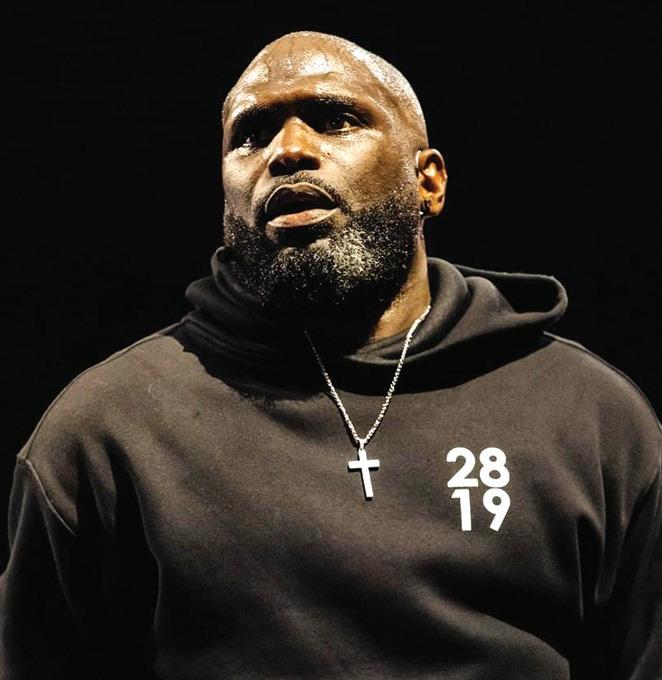
materials prominently featured a photo of Mitchell, in his signature black hoodie, among the event’s headliners.
Though there’s little reporting on what he said, Mitchell’s presence was apparently well received, according to Franklin’s Facebook page.
“Night one of Forward Conference was something special,” Franklin wrote in a post just after midnight Friday. “Thank you, Philip Anthony Mitchell and Free Chapel Music. Day two, we’re ready.”
Mitchell’s presence on that stage is significant because conferences often function as evangelical

Pastor Philip Anthony Mitchell, founder of Atlanta’s 2819 Church, was among the featured speakers at Forward Conference 2026, an evangelical gathering hosted by Pastor Jentezen Franklin, a leading supporter of President Donald Trump and the MAGA movement.
Christianity’s informal credentialing system. Invitations signal not only popularity but theological trust, institutional acceptance and growing influence.
Sharing a platform with nationally recognized pastors introduces speakers to new audiences and embeds them within networks that shape the future of American evangelicalism.
That network has been expanding for Mitchell, a new-media-savvy millennial preacher whose ministry and personal aesthetic draw heavily from rap and hip-hop.
Over the past several years, Mitchell has
increasingly appeared alongside influential evangelical leaders. That includes Tim Timberlake of Celebration Church in Jacksonville, Florida. Besides appearing together on tour, Timberlake and Mitchell co-host the “Street Preachers” podcast.
Elevated profile
His association with Franklin, however, puts Mitchell on a new level.
Although their ministries differ in style — for example, Franklin favors tailored suits in the pulpit, while Mitchell’s preaching uniform is black jeans, a black hoodie and Nike
Dunks — they share several defining characteristics. They preach biblical authority, prioritize church growth, rely heavily on digital platforms and appeal to younger, racially diverse Christians who often feel disconnected from traditional denominations.
Though Mitchell does not have an obvious political profile, his theological commitments — including traditional views on sexuality, gender, biblical authority and abortion — largely align with the broader movement that has overwhelmingly supported Republican candidates over the past decade.
For generations, the Black church has served not only as a spiritual institution but also as the moral and political center of Black civic life. Mitchell represents a younger cohort of Black pastors who continue to preach orthodox theology while placing less emphasis on institutional activism and more on discipleship, personal obedience and spiritual formation. Whether that trajectory ultimately reshapes Black evangelicalism — or simply broadens Mitchell’s own national platform — remains to be seen. But his appearance alongside Franklin at Forward Conference suggests that one of Black Christianity’s fastest-rising pastors is no longer speaking only to the Black church.
Courtesy photo