
St. LouiS AmericAn
and
Earnings tax faces scrutiny
By Sylvester Brown Jr. St. Louis American
St. Louis to vote on the critical measure April 7
Since 1959, St. Louis residents have paid
a 1% earnings tax on income to help fund city services such as police, fire, streets and trash collection. Next week, voters will decide whether to continue the tax under Proposition B, a measure that appears on
the ballot every five years. If rejected, the tax would be phased out over 10 years.
Each year it has appeared on the ballot, voters have approved it. But Cheryl Walker will not be among them this year, but not because she has gripes with the city.
“It’s because of the current climate
in this country. I believe we all need to keep as much of our funds in our pockets as possible,” Walker said. “At this time, I’m against it because I need to look inward.”
Mayor Cara Spencer is urging voters to take a different view, encouraging support for Proposition B while acknowledging the city’s heavy reliance on the



earnings tax and the need to identify additional revenue sources.
“We do have some work to do to make sure that we have a more robust stream of revenue going forward, and that’s something that you’ll be hearing from us as we move forward through
Saint Louis U. Billikens deliver on biggest stage
By Earl Austin Jr. St. Louis American
As many of you know, I am one of the radio voices of the Saint Louis University Billikens basketball team. I just completed my 35th season, and it was one of the most rewarding years of my broadcasting career.

Led by head coach Josh Schertz and his talented staff, the Billikens won a school-record 29 games along with a share of the Atlantic 10 Conference regular-season championship. A great season culminated in a berth in the NCAA Tournament, the first for SLU in seven years.
The Billikens were a perfect 19-0 in Chaifetz Arena, and there were sellout crowds for the last
St. Louis ‘No Kings’ protesters push back on Trump’s power, cruelty
By Rod Hicks St. Louis American
Linda Oliver stood among thousands of protesters in downtown St. Louis last weekend, voicing what she said many in the crowd were feeling: fear, frustration and a growing sense that President Donald Trump is acting with cruelty while consolidating too much power.
“He hasn’t even been in a year, and he’s caused problems for so many people,” said Oliver, who lives downtown. “Some of it is just downright mean. He hurts people.”
Other St. Louis participants described the Saturday “No Kings” demonstrations — locally
and nationwide — as a way to be seen and heard, to push back against an expansion of presidential authority and to signal to elected officials that opposition is building, even as many acknowledged the protests may not produce immediate change.
New national polling underscored the moment. A Reuters/Ipsos survey released last week, just four days before the demonstrations, showed Trump’s approval rating at its lowest point of his second term, with 36% of Americans approving and 62% disapproving. A UMass Amherst poll released earlier this week found approval even
New lead prompts search in decades-old missing teen
By Na’Porsha Williams For The St. Louis American
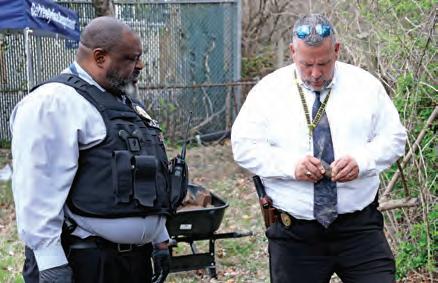
Police say they found what appears to be a bone and several small fragments after a tip led investigators to search a backyard in Berkeley. The search was part of the ongoing investigation into the disappearance of 16-year-old Shemika Cosey, who went missing 17 years ago. Officers searched in the 6100 block of Jefferson Avenue using search dogs. Officer Ryan Young, who recently took over the case, said investigators
Cold Case, A12

The UConn Huskies will be making their third trip to the Final Four of
Paris LeFlore marches with demonstrators during the No Kings March on March 28, joining a crowd advocating for democracy and civic action.
Photo by Lawrence Bryant / St. Louis American
Earl Austin Jr.
Steve Runge, Interim Police Chief, stands with an officer while reviewing a fragment during an active search effort in a backyard, as Berkley Police continue investigating a long-term missing person case.
Photo by Lawrence Bryant / St. Louis American
Editorial
The city earnings tax is essential
Next Tuesday, St. Louis voters will again decide whether to keep the city’s 1% earnings tax.
That means choosing whether to continue the tax that funds a large share of basic city services or to eliminate it and force the city to cut basic services. It is a decision voters face every five years. And each time, they have voted to keep the tax — not out of habit, but out of necessity.
They should do so again.
The earnings tax is not an abstract policy debate. It is the backbone of city government, generating roughly onethird of St. Louis’ general fund, about 36%, and bringing in more than $200 million annually. The tax funds core services such as police, fire, streets and parks. Without it, the city would face a fiscal shock unlike anything in its modern history. There is no realistic replacement. That has been studied, debated and tested. A past analysis under former Mayor Francis Slay examined a range of alternatives, including sales taxes, property taxes and other fees, and found they would fall short and require multiple new taxes, many needing voter approval. In other words, there is no simple replacement if voters eliminate the tax, only a series of difficult choices that may still leave gaps. Eliminating it would be a gamble, one that risks destabilizing the very services residents depend on most.
They deserve transparency, accountability and reform where needed. But they do not justify dismantling the foundation of the city’s finances, especially not now.
Residents already are carrying heavier burdens. Grocery and energy costs remain elevated, while housing costs continue to strain budgets in St. Louis and beyond. And although wages have risen in some sectors, they have not consistently kept pace with inflation for many working families.

Still, the concerns about the tax have merit. St. Louis, along with Kansas City, are the only cities in Missouri that can levy an earnings tax, and critics argue it can discourage economic growth. Some elected officials have raised questions about how the tax is applied, including exemptions and incentives that may benefit corporations more than residents. The city has seen population decline and has faced ongoing concerns about corporate departures downtown. Those concerns deserve attention.
The earnings tax supports the infrastructure and public systems that residents rely on every day. It is the foundation that allows neighborhoods, businesses and families to function and grow. For many residents, particularly in Black communities that have long faced disinvestment, that stability is not optional. It is essential. Voting to keep the earnings tax is not a vote for the status quo. It is a vote to avoid disruption while continuing to push for a better, fairer system. City leaders should take seriously the calls for greater oversight, including clearer reporting on tax abatements and a closer look at who benefits and who does not. If residents are asked to continue paying into this system, they deserve confidence that it is being managed equitably and effectively.
But the choice before voters on April 7 is more immediate.
Rejecting the earnings tax would not lower the cost of living. It would not raise wages. It would not solve the city’s long-term economic challenges. It would simply create a hole, one so large that filling it would require painful cuts, uncertain replacements or both.
St. Louis has real challenges. But self-inflicted instability should not be one of them.
Voters should approve the earnings tax and then demand the accountability and vision needed to make the most of it’s proceeds.

We
By Marc Morial
“The continued slide into authoritarianism is made possible by the twin assaults on our democracy and the pursuit of racial justice. In this time of crisis, we need elected officials who stand up against efforts to render us without meaningful participation in the democratic process, have our histories censored from our cultural institutions, and be shorn of the protection of our hard-earned civil rights.”
— Kimberlé Crenshaw, professor of law at UCLA and Columbia
Knowing who to vote for in today’s political climate feels like navigating a minefield. You hear one thing about a candidate in a campaign ad, another at the barbershop or beauty salon, and something different from influencers and podcasters on social media. Rarely is any of it aligned — or true. This has led to Americans turning out to vote but not trusting the process. Confidence that state or local governments will run fair and accurate elections has fallen from 76% to 66% since 2024. Only 63% of Black Americans and 57% of Latinos say they are confident. More than eight in 10 Americans say it is either very likely or likely that political content created by artificial intelligence will spread misleading information about elections.
the-vote campaign, Reclaim Your Vote, and this week launched “America 250: A Guide for Defending Democracy.”
This guide does not support or oppose any political party or candidate for public office. What it does is help voters research where candidates stand on issues that impact us, including:
● Protecting civil rights and voting rights
● Rejecting racism, discrimination and dehumanization
●
Expanding equal opportunity and fair access It also gives advocates guidance on the questions to ask candidates to determine their commitment to defending our democracy — questions like: “What specific steps, if any, will you take to protect every eligible American’s right to vote and to have that vote fully counted?” and “Can you give an example of a time when you were willing to follow the Constitution even when it was politically difficult?”
This is not an election we can afford to sit out. It’s not an election we can afford to have our priorities buried under misinformation. And we cannot afford to be distracted by lazy attacks on identity, diversity initiatives and people who align themselves with broken promises and attacks on our democracy. We stand alongside our partners in saying enough is enough. And we’re standing beside you as you register to vote and cast your ballots this fall.
We know that misinformation targets Black voters disproportionately — as do laws like the SAVE Act, which is currently holding Congress hostage in another attempt at a power grab by the far right.
The Urban League movement is prepared to inform our communities and voters no matter what comes our way this November. We’ve reactivated our get-out-
Fighting for our rights and our interests takes all of us — and arming ourselves with the right information is the best place to start.
Marc Morial is president and CEO of the National Urban League.
By Ben Jealous
Recently, I drove from my father’s birthplace in Biddeford, Maine, to my mother’s birthplace in Petersburg, Virginia. Two different towns. Two different states. Two different regions. And yet, oddly, different ends of the same sad street.
Most Americans now live at the same address: “We live where there used to be a factory. And when it shut down, what shot up was joblessness, hopelessness, meth, opioids, homicide and suicide.”
That is not just the story of one town. It is the story of a wounded nation.
Factories were never just factories. They gave whole towns their rhythm. They filled lunch pails and church pews. They paid the mortgage. They kept the corner store open. They let a mother or father look a child in the eye and say, “You can make it here.”
Then the factory closed. The people did not disappear. They stayed. They stayed by the same schools, the same porches, the same churches, the same graves of the people who raised them. They stayed and watched storefronts empty, tax bases shrink and hope grow thin. Families are burying their too-young dead again and again. Meanwhile, the pundits who get rich dividing the nation keep working overtime.



Corporate consolidation mattered. But NAFTA still stands as a warning bell in our history. It reminds us what happens when we confuse what is good for corporate profits with what is good for the country.
Communities lose. The nation suffers.
Most Americans now live at the same address. They live in the places the economy left behind. They live where the factory closed, the jobs vanished and the pain stayed.
But there is a road to a better day.
We became a great nation because we planned. We looked ahead. We decided what we needed to build, what we needed to make, what kind of work would support families and what kind of country we wanted to become. Then we trained our people, built our strength and did the work.

The suffering caused by deindustrialization does not stop at racial lines, state lines or the old border between North and South. It reaches across most of the lines that people on television and social media work so hard to inflame. This one stokes racial resentment. That one blames immigrants. Another turns rural against urban, white against Black, native-born against newcomers. And most Americans suffer for it.
Divide and conquer has always been the surest way to blunt the ability of working families to rise together. It keeps our votes divided and cancels one another out. Since NAFTA took effect in 1994, the United States has lost well over 65,000 manufacturing plants and factories. NAFTA was not the only reason. Automation mattered. China mattered.
We need that spirit again.
We need an industrial plan county by county, state by state and for the nation. We need to know what jobs will be needed 10 and 20 years from now, where they should be and how we will prepare our people to do them. Our schools are still too often preparing young people for an economy that is already gone. They need to do a better job preparing them for the jobs of the future. And as artificial intelligence starts doing more of the work people once thought would always need a person, we need to be ready to rethink the future for every worker and every community.
A nation is not a stock chart. A nation is not a quarterly report.
A nation is built on belief — belief in each other and belief in our future. And in America, we believe that if life has knocked you down, you deserve a chance to rise again.
The question is whether we will keep accepting that as normal.
Or whether we will choose to love this country, our children and each other enough to make sure we all rise again.
Ben Jealous is a professor of practice at the University of Pennsylvania and former national president and CEO of the NAACP.

Black mayors say leadership means navigating pressure, perception
By Na’Porsha Williams
“Being
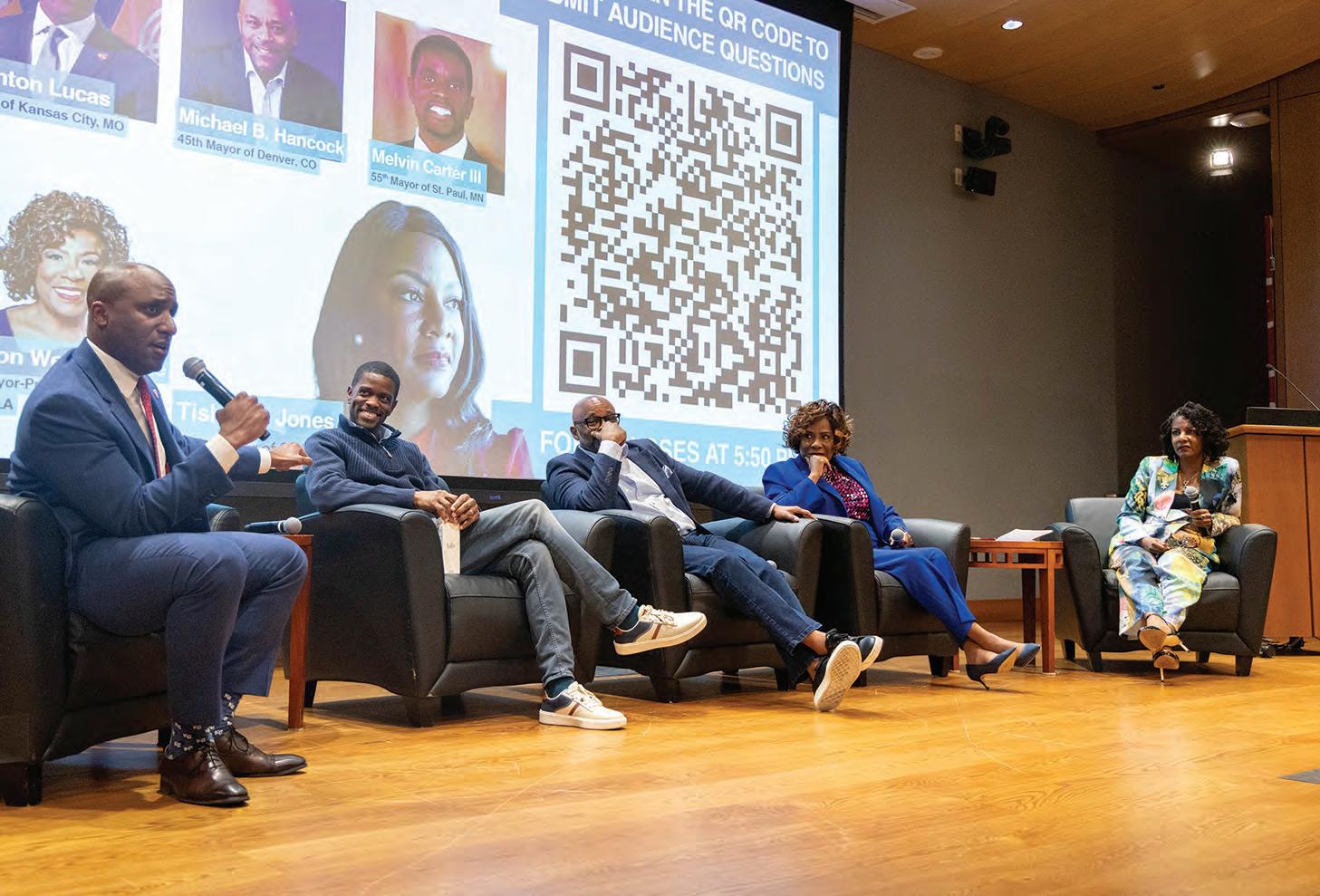
white fear and Black expectations,” former St. Louis Mayor Tishaura O. Jones said, framing the panel discussion she hosted at Washington University.
The conversation brought together Kansas City Mayor Quinton Lucas, former Denver Mayor Michael B. Hancock, former St. Paul Mayor Melvin Carter III and former Baton Rouge Mayor-President Sharon Weston Broome, who shared insights into how they communicate with constituents, prioritize policies and build coalitions.
A central theme of the discussion was authenticity — and the pressure Black leaders face to conform to expectations.
Hancock pointed to his tenure in Denver, where he became the city’s only African American mayor to win reelection, as an example of resilience and self-definition.
“The reality is that when I was campaigning for mayor the first time, I realized I felt much more comfortable when I was myself instead of the box your campaign team likes to put you in,” he said. “I felt like I was never Black enough, and I was too Black for some audiences.”
Realizing the importance of authenticity, Hancock said he made a decision to remain himself regardless of the audience.
The panelists also spent significant time discussing media coverage, misinformation and what they described as a decline of authentic journalism. They said misinformation remains a persistent challenge, often creating distractions and straining relationships with the public.
“I found out that we were not getting the type of coverage that the mayor now is getting,” Broome said. “It always had a slant to it.”
Her observation drew agreement from other panelists, who said such coverage can shape public perception in ways that are difficult to correct.
“It’s harder to disapprove a false story because the more you try to disprove it, the worse it looks,” Hancock said. Those pressures, the mayors said, are layered on top of broader racial dynamics that influence


how their leadership is judged.
They concluded with a call for Black communities to use their voices to drive change and to take greater control of their narratives by building and supporting their own media platforms. Jones, who is serving




this spring as the inaugural fellow in residence with WashU’s Center for the Study of Race, Ethnicity & Equity, hosted the panel as part of her campus work on civic leadership. The fellowship brings a civic leader to campus to engage students and the public
through discussions and programming.
She will continue that work Tuesday, March 31, at 5 p.m. with a student-centered conversation, “Your Voice, Your City,” on how civic participation, activism and public feedback shape
local governance. The discussion will draw on examples from her time in office, including responses to housing insecurity and citywide crises, and is presented in collaboration with the university’s Gephardt Institute.

















Photo by Lawrence Bryant / St. Louis American
From left, Kansas City Mayor Quinton Lucas, former St. Paul Mayor Melvin Carter III, former Denver Mayor Michael B. Hancock and former Baton Rouge Mayor-President Sharon Weston Broome joined former St. Louis Mayor Tishaura O. Jones during “Perspectives in Public Leadership: A Mayoral Conversation” at Washington University on March 24, 2026, discussing governance, policy, and community engagement.
State Sen. Mosley enters St. Louis county executive race
State Sen. Angela Walton Mosley has entered the race for St. Louis County executive, joining state Sen. Brian Williams and County Assessor Jake Zimmerman in a three-way Democratic primary to succeed incumbent Sam Page. Mosley, who represents a North County district that includes Florissant and Jennings, filed on the final day of candidate filing, adding a
Jury award $37 million to man shot by police at age 14

A jury has awarded $37 million to Tyron Edwards, who was shot in the back by St. Louis Metropolitan police at age 14 in 2016. The verdict includes $30 million in punitive damages. Jurors found Officers Thomas Streckfuss and Ryan Murphy, who were involved in another teen’s fatal shooting that same year, wrongfully shot Edwards and lied about the case. The Missouri attorney general defended the officers.
Urban League, Bell distribute gift cards to TSA workers
The Urban League of Metropolitan St. Louis partnered with U.S. Rep. Wesley Bell to distribute gift cards to Transportation Security Administration workers at St. Louis Lambert International Airport. TSA employees received $100 Schnucks gift cards and additional QT cards, organizers said. The distribution was intended to support workers who reported to their jobs during financial uncertainty tied to the partial federal government shutdown and to recognize their continued service.
Summit to focus on leadership, financial literacy for girls
Girls in the Know will host its Empowerment Summit on April 18 in
late twist to the contest. Page, a Democrat, announced in December that he would not seek reelection. Mosley, first elected to the Missouri Senate in 2021, represents the 13th District. She was involved in a Sept. 25 fistfight with County Councilwoman Shalonda Webb following a town hall in Bellefontaine Neighbors.
St. Louis, offering a day of workshops and discussions for girls ages 9-13. The program includes a keynote by Miss Black Missouri USA Dierra Williams and sessions on leadership, self-esteem and financial literacy led by local professionals. Organizers say the event is designed to help participants build confidence and practical life skills. For information, call 314-884-1621.
City SC to host World Cup watch parties, youth events
St. Louis City SC will host a series of soccer-themed events this summer to coincide with the 2026 World Cup, despite the city not being a match site. The “Summer of Soccer” initiative will include watch parties at Energizer Park, youth tournaments and activities across the region from June 11 to July 19. Events are aimed at engaging fans and expanding local interest in the sport.
Market Street segment of Brickline Greenway set to open
A grand opening celebration for the Market Street segment of the Brickline Greenway is scheduled for Monday, April 13, at Harris-Stowe State University. The segment connects Energizer Park and the university and includes a new installation from artist Damon Davis’ “Pillars of the Valley” project. The free event will feature food, music, performances and family activities from 4:30 to 6:30 p.m.

Commentary
Giving Black women their due
By E. Faye Williams
There are many days on which we honor men, but precious few that recognize women’s contributions.
Women’s History Month concluded Tuesday, March 31, but I must share a bit of Mayor Johnny Ford’s work honoring the history of Black women through his organization, the World Conference of Mayors.
I pray that you will share it with your families — especially your children. I ask since it seems popular to harm my sisters through government layoffs, firings and disrespect in many forms.
I share this because of what some of our sisters have gone through, and what many are still going through. Black women go through more hardship than anybody in our nation. Some have been used and abused precisely because they are leaders.
We are the highest educated, hardest working and most active in public service in our communities — often neglecting ourselves so that we have more time and resources to help others. We all know Black women who go without food so there is food for their children. It’s not right, but it’s real. So in case you didn’t know, let’s look at a bit of the history of what Black women are doing and have done for the world.
We thank Mayor Ford and his members for honoring us. Please share this article with as many people as you can — show Black women you notice their accomplishments and appreciate their sacrifices.
Ford, a former Tuskegee, Alabama, mayor and Alabama state representative, current Tuskegee council member and founder of the World Conference of Mayors, put forth this resolution to his organization: WHEREAS, March is set aside as Women’s History Month to honor the numerous contributions of women to our nation and the world;
WHEREAS, women’s history is honored throughout the world, we hold special celebrations to acknowledge women here at home; WHEREAS, Fannie Lou Hamer suffered greatly to gain voting rights for Black Americans; WHEREAS, Rosa Parks risked her life when she refused to give up her seat to a white passenger, sparking the Montgomery Bus Boycott and the legal fight to desegregate public transit; WHEREAS, Diane Nash, co-founder of SNCC, organized students to travel to the dangerous South on buses during the Freedom Rides; WHEREAS, Dr. Patricia Bath, a pioneering ophthalmologist, invented a laser device for cataract treatment; WHEREAS, Dr. Gladys West, a mathematician, did work in satellite geodesy that was fundamental to the development of GPS technology; WHEREAS, Mae Jemison, an engineer, physician and former astronaut, was the first African American woman to travel to space;
WHEREAS, Dorothy Vaughan, Katherine Johnson and Mary Jackson served as human computers at NASA during some of the greatest strides in space exploration;
WHEREAS, Sojourner Truth was the first Black person to sue a white man who had taken her son into slavery — and she won; WHEREAS, Harriet Tubman was a renowned abolitionist and armed scout for the Union Army, known as the most famous conductor on the Underground Railroad; WHEREAS, Ketanji Brown Jackson is the first Black woman to serve as a Supreme Court justice; THEREFORE, BE IT RESOLVED THAT we honor all women who continue to work to make America great for all. We thank Mayor Ford and want him to know: We are together, and we are up to the challenge. E. Faye Williams is president of The Dick Gregory Society (www.thedickgregorysociety.org).

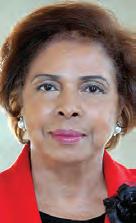
E. Faye Williams
Angela Walton Mosley
APRIL 2 – 8, 2026

Building wealth early
$5,000 investment program for students returns in St. Louis
On The Move
Troy Doyle to remain Ferguson police chief

The City of Ferguson has renewed Police Chief Troy Doyle’s employment agreement, extending his tenure through Jan. 31, 2030, according to Mayor Ella Jones. Doyle served more than 20 years with the St. Louis County Police Department, where he rose through the ranks of sergeant, lieutenant and captain. He later held the rank of lieutenant colonel before resigning and joining the Ferguson Police Department.
Hunter named to Rung for Women board

Esperanza Hunter has been named to the board of directors of Rung for Women. Hunter is director of Aura Implementation for Reinsurance Group of America. She previously held executive roles with Charter Communications, TforG Group in Belgium, Kforce and NII Holdings. Since launching programs in 2021, Rung has assisted more than 600 women, focusing on career advancement in fields including manufacturing, technology and geospatial.
By Ashley Winters
St. Louis American
A new effort to put $5,000 into the hands of hundreds of St. Louis-area students is returning — this time with a stronger focus on trust, guidance and long-term financial planning.
The St. Louis Junior Bonds program, previously known as On Our Block, was launched with a $1.8 million investment from the James S. McDonnell Foundation. The concept mirrors “baby bonds” initiatives that seed
investment accounts for children at birth, though this model accelerates the timeline. Instead of newborns, selected eighth graders receive $5,000 accounts that become accessible after high school graduation. Students can use the funds for higher
Instead of newborns, selected eighth graders receive $5,000 accounts that become accessible after high school graduation.
education, purchasing a home, starting or buying a business or opening a retirement account. Now administered by The Scholarship Foundation of St. Louis, the program is working to fill approximately 200 remaining slots before a June 1 deadline. The organization has added locally
based partners to enhance financial education and is placing greater emphasis on guiding students and families as they plan how to use their funds. The current version builds on an earlier phase of the program, which operated as On Our Block. That effort included outside partners and relied more heavily on digital engagement. The Scholarship Foundation’s approach emphasizes in-person relationships and local trust,
KAI-led team delivers Jennings community center
St. Louis American staff
A design and construction team led by KAI Enterprises has completed work on the $6.8 million Jennings Community Center, part of a long-planned redevelopment of the former River Roads Shopping Mall site. The 15,595-square-foot facility at 2315 Ada Wortley Ave. is the first project finished under a 2019 master plan to remake the area with public amenities, including a park, city hall and outdoor spaces.
KAI, a Black-owned architecture and design firm, served as architect of record and provided engineering, interior design and cost estimating services. Navigate Building Solutions was the owner’s representative, and Aspire Construction Services was the general contractor.
Jennings officials said the project reflects years of planning and community support.

“This is a
I really don’t know how to put into words,” Mayor
Gary Johnson said during the ribbon-cutting ceremony. “This is a big part of
our community and a big step toward real progress in our community.”
The project was delayed by the COVID-19 pandemic but ultimately moved forward after the city broke ground in November 2024.
The facility includes a full-court gymnasium, fitness areas, multipurpose rooms, an after-school study space, computer lab, locker rooms and an outdoor events plaza.
KAI Senior Project Manager Joel Kerschen said, “Jennings’ residents of all ages [have] a great place to go in the community.”
“Residents and visitors can use [the community center] for gatherings, different types of exercise classes, as well as having after-school space for the youth to come in and gather or do homework in a safe environment.
City leaders said the community center fulfills a
See Center, A6

Dr. Andrisse addresses prison program grads Dr. Stanley Andrisse
Stanley Andrisse, who earned his doctorate from Saint Louis University, delivered the commencement address for graduates of the university’s Prison Education Program. Andrisse, an associate professor of physiology at Howard University and executive director of From Prison Cells to Ph.D., was incarcerated at a young age before earning his doctorate. The ceremony was held March 23, 2026, at the Eastern Reception, Diagnostic and Correctional Center. The program provides accredited higher education opportunities to incarcerated individuals and prison staff in Missouri.
Crayton named LFCS clinical supervisor

Mercedes Crayton has joined Lutheran Family and Children’s Services as a behavioral health clinical supervisor. Crayton previously served as a clinical director with Methodist Family Health. Lutheran Family and Children’s Services is a statewide agency providing adoption, pregnancy support, parenting education, counseling, foster care and child development services.
Promotion, board appointment, new hire, award... please submit your People on the Move item (including photo) to areid@stlamerican.com.
Troy Doyle
Photo courtesy of The Scholarship Foundation of St. Louis
Ricky Hughes engages with a student during a discussion.
Esperanza Hunter
Mercedes
Mercedes Crayton
Jennings Mayor Gary Johnson, city officials and representatives from KAI Enterprises cut the ribbon on the city’s new community center March 14. The 15,595-square-foot facility includes a fitness center, full-court gymnasium, multipurpose rooms and an after-school study area.
Photo courtesy of KAI
St. Louis launches online building permot portal
St. Louis has launched its online building permit portal in an effort to streamine the application process and reduce approval times.
The portal could also limit in-person visits to City Hall, according to Mayor Cara Spencer.
“The development community and everyday citizens have been demanding a simple, easy and 21st century way to apply for building permits,” said Mayor Cara Spencer.
“This is one more important step toward making St. Louis a city that supports growth and new housing, and we’re going to keep finding ways to make progress.”
The new system allows residents, contractors and developers to submit applications, upload plans, pay fees and track permit status online.
Residents and contractors can access the STL City Permits online building permit portal on the city’s website (www. st.louis-mo.gov) under the Building Division section.

Black-owned engineering and design firm KAI has completed work on the $210 million expansion and renovation of the Cervantes Convention Center at America’s Center in downtown St. Louis.
KAI helps keep Convention Center among nation’s elite feet of exhibit space and 30,000 square feet of service and support areas. Improvements to the loading docks along Cole Street were also included, while modernization of the Washington Avenue entrance remains underway.
The AC Next Gen project modernized and expanded the America’s Center Convention Complex, marking the facility’s first major expansion since the early 1990s.
The upgrades added 75,000 square
The multi-year renovation and expansion created thousands of construction and hospitality jobs and supports St. Louis’ convention and tourism industry.
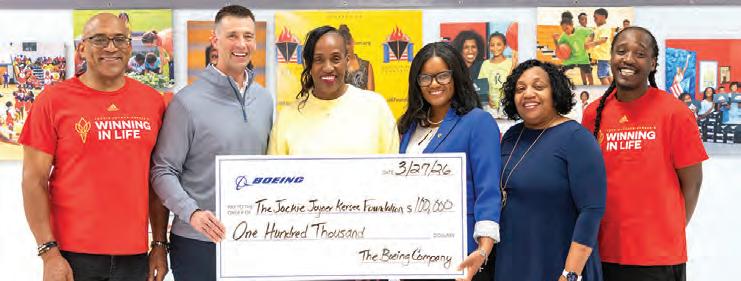
Boeing grant supports JJK youth program expansion
The Jackie JoynerKersee Foundation has received a $10,000 grant from Boeing to expand its Winning in Life program, which serves youth in East St. Louis and across the Metro East.
The program is designed to equip young people with skills and support to succeed in school, careers and life, according to founder and CEO Jackie
Joyner-Kersee.
“This grant represents more than funding—it represents belief in our youth,” she said. “We are teaching young people how to dream big, stay disciplined, and overcome obstacles.”
Rooted in 14 principles from her autobiography A Kind of Grace, the program focuses on academics, athletics and nutri-
tion while incorporating social-emotional learning, leadership development and workforce readiness.
The foundation plans to use the funding to expand access to curriculum materials, provide additional training for educators and mentors and strengthen partnerships with schools and community organizations.

The University of Missouri-St. Louis announced its Geospatial Workforce Development Pilot Program, designed to accelerate education, training, certification and research in geospatial science and technology across the St. Louis region.
The initiative supports the mission of the National Geospatial-Intelligence Agency and strengthens the nation’s geospatial workforce at a pivotal moment for U.S. national security and economic competitiveness, according
UMSL announces new Geospatial Workforce Development program to a university statement. Reda Amer, executive director and UMSL’s principal investigator for the program, said the effort will connect K-12 schools with higher education institutions, industry, government agencies and nonprofit partners. U.S. Sen. Eric Schmitt introduced the National Geospatial Innovation Hub Advancement Act to strengthen America’s geospatial intelligence workforce and support the Department of Defense’s mission.
Black-owned businesses are Downtown Retail Award recipients
Karsyn’s Soule and Pop Pop Hurray were recently recognized by the Downtown Retail Incentive Program, a partnership between Greater St. Louis, Inc. and St. Louis Development Corporation today announced the recipients of the latest awards from the Downtown Retail Incentive Program.
The awards by SLDC, which is now led by President and CEO Stephen Westbrooks, and GSI are part of the duo’s effort to attract new businesses and increasing street-level vibrancy in downtown St. Louis. Pop Pop Hurray is opening is third location at 1100 Locust St. in downtown St. Louis.
Wealth
Continued from A5
according to reporting by St. Louis Magazine.
Executive Director Faith Sandler said the initiative fits within the foundation’s mission.
“We devote our work to providing financial resources where the need is greatest,” Sandler said. “But just as important, we strive to provide young people the information they need to make sound decisions for themselves.”
She said $5,000 can be transformative — but only with careful planning.
“Without proper guidance, a sum like that won’t have the impact intended,” she said.
Brooke Dyer, vice president at J.P. Morgan Private Bank in St. Louis, said the program’s emphasis on financial literacy is critical.
“The main thing is, it helps young people understand financial literacy,” Dyer said.
Dyer said early investment can have long-term impact.
“The thing to understand is the power of compounding growth,” she said. “Basically, a dollar saved in a child’s early years is significantly worth more than a dollar saved later due to those compounding returns.”
Sandler said each stu-
Center
Continued from A5
dent will receive a share of a pooled investment fund that began as $1.5 million and is expected to grow over time, depending on market conditions.
“That philosophy has shaped how the foundation is approaching the program differently.”
“This is St. Louis,” Sandler said. “We want to know the address, the zip code, and the people behind the words before we commit to believing or trusting.”
Families applying must provide confidential financial information and meet income requirements — at or below 80% of the 2025 median income for St. Louis County — and reside in St. Louis or participating North County districts, including Ferguson-Florissant, Jennings, Hazelwood, Normandy, Ritenour and University City.
Sandler acknowledged that communities eligible for the program “have reason to be skeptical when something sounds too good to be true.”
“Person-to-person trust is essential,” she said.
Skepticism is understandable, Dyer said, but she urges parents to understand the long-term value of early investment.
“There’s no one-sizefits-all approach to financial planning,” Dyer said.
To ensure students are equipped to use their bonds wisely, the foun-
long-standing goal for the area.
“This has been a dream for the City of Jennings for a long, long time and it finally came true,” said Allan Stitchnote,
dation has invited subject matter experts, including St. Louis Community Credit Union, the Small Business Empowerment Center and Edward Jones. Participants will begin with basic financial education through an online platform known as MoneyByrd, followed by more targeted support in areas such as homeownership, entrepreneurship and investing.
Ricky Hughes, the Junior Bonds project manager, said the program is about more than distributing money.
“Five to 10 years from now, I hope participants walk away with more than just financial resources,” he said.
Recruitment efforts rely on school counselors, educators and community leaders who are trusted voices for families.
Success, Sandler said, will not simply be measured by how many accounts are funded.
“If students have solid financial footing for their plans and a network of local resources to depend upon,” she said, “that will be a success.”
For now, the focus is clear: reach eligible families, deliver every dollar, and ensure that when these students graduate, they step into adulthood not only with an investment account — but with the knowledge and support to use it wisely.
Jennings Ward 1 councilman and Parks and Recreation Committee chair. “I want to thank everybody for voting for it; this is your community center, and we encourage you to use it. It is a beautiful place; I just love it. I just can’t stay away from it.”
Photo courtesy of KAI
KAI, one of the nation’s leading Black-owned engineering and design firms, recently completed engineering and consulting work on the $210 million expansion and renovation of the Cervantes Convention Center at America’s Center in downtown St. Louis.
Boeing and the Jackie Joyner-Kersee Foundation have announced a $10,000 grant to support the Foundation’s Winning in Life program, which serves the East St. Louis and other Metro East communities. From left are Kendall Norris, JJK Foundation; Troy Rutherford, Boeing; Jackie Joyner-Kersee; Dr. Candace Howell, Boeing; Lecia Rives, JJK Foundation: and Travon Kellys, JJK Foundation.
Photo courtesy of JJK Foundation and Boeing
HealthMattersHealthMattersHealthMatters
‘Taking Care of You’

Racial trauma
‘We deserve wellness. It is our birthright.’
Ashley McGirt-Adair has spent her career confronting what racism costs Black people’s health — and building the care system that should have always existed.
By Aaliyah Amos Word In Black
hen Ashley McGirtAdair was 9 years old, she began journaling to cope with depression and suicidal thoughts after her grandmother died. What she found instead of care was a white school counselor who didn’t understand what that loss meant for a grieving Black child.

“She didn’t understand the role of grandmothers in Black families, so at a very young age I found myself having to educate a grown white woman on race relations in America,” McGirt-Adair says. “Even in my youth, I knew that wasn’t OK.”
By Rebecca Smith KBIA
In 2020, McGirt-Adair founded the Therapy Fund Foundation (TFF), a nonprofit providing free mental health services to Black communities in Washington State.
That moment, being unseen in her grief, is one many Black children experience, and what researchers now recognize as an early encounter with racial trauma — the cumulative emotional and psychological harm caused by racism. Decades later, that gap between trauma and culturally competent
See Wellness, A8
Disparities in Black maternal health demand action
By Vern Anthony Michigan Chronicle
Black history calls us not only to remember the past, but to confront how that past continues to shape the lives of Black mothers and babies today. In maternal health, that history is both painful and powerful.
Though medicine has advanced, research shows bias in pain assessment and treatment persists.
An important and often overlooked figure in maternal health history is Anarcha Westcott. Enslaved and only 17 years old, Anarcha endured a traumatic childbirth that resulted in the death of her baby and severe injury. She was later subjected to repeated experimental surgeries by J. Marion Sims, without consent or anesthesia. These procedures were used to refine surgical techniques later used to treat white women, including versions of the speculum still used today. At the time, a dangerous and false belief persisted that Black people did not feel pain the same way white people did. Surgeries on white women were performed with anesthesia, while Black women were denied it. Though medicine has advanced, research shows bias in pain assessment and treatment persists. The legacy of that injustice is not distant history; it echoes in today’s maternal health disparities.
Black history in maternal health is not defined solely by exploitation. It is also defined by extraordinary leadership and service. Women like Maude Callen served rural South Carolina for more than 60 years, delivering thousands of babies and training other midwives; Mary Francis Hill Coley, a Georgia midwife, delivered more than 3,000 babies; and Biddy Mason, born
See Maternal, A8
Missouri officials warn of potent new opioid, nitazene
Multiple state agencies put out a warning this month about a potent new opioid that appears to be increasingly prevalent in the state — nitazene.
The Department of Public Safety, the Department of Health and Human Services, the Department of Elementary and Secondary Education, and the Department of Mental Health wrote in their alert that nitazene can be five to 10 times more potent than fentanyl.
Capt. Scott White of the Missouri State Highway Patrol said nitazenes were first identified in the Missouri illicit drug supply in 2023, but following recent wastewater surveillance reports from Missouri schools, it appears to be becoming more common in the state.
“In many communities, and especially the smaller ones, the schools are the hub of activity,” White said. “The children are there, but then you also have
The Department of Public Safety, the Department of Health and Human Services, the Department of Elementary and Secondary Education, and the Department of Mental Health wrote in their alert that nitazene can be five to 10 times more potent than fentanyl.
parents, you have other family members that are there. For it to be located in the schools or in the wastewater, it’s in that community.”
The school-based wastewater surveilSee Nitazene, A8

is a medication that can reverse the effects of an opioid overdose. It is widely available across Missouri and comes in intranasal and intramuscular forms. Officials warn it may take multiple doses of naloxone to reverse the effects of the new opioid nitazene.
Envato photo
Photo by Rebecca Smith / KBIA
The Therapy Fund Foundation (TFF) helps eliminate barriers to healing for Black community members by providing free mental health services and education all focused on mental health.
Naloxone
Nitazene
Continued from A7
lance program is operated by DPS, and schools across the state can sign up to participate. White said 37 schools are currently participating, and since mid-January, 26 of them have tested positive for the
Wellness
Continued from A7 care sits at the center of her work.
Indeed, as a trauma therapist, nonprofit founder, and author, McGirtAdair is using her forthcoming book, “The Cost of Healing in Silence,” to name what too many Black people and providers already know: healing is harder when the system erases you.
“The goal of this book is to give a voice to those who have suffered in silence, support the helpers and healers doing this work, and guide communities toward collective liberation,” she says. “It serves as both a testimony and practical guide for transforming how we care for ourselves and one another.”
In 2020, McGirt-Adair founded the Therapy Fund Foundation (TFF), a nonprofit providing free mental health services to Black communities in Washington State, with a pilot program expanding into San Diego. Through the foundation, she’s building a model of care rooted in cultural understanding, trust, and community accountability.
“My organization eliminates barriers to healing for Black community members by providing free mental health services, education, and advocacy, all focused on mental health,” she says — and TFF has distributed $60,000 to support Black clinicians in the process.
But healing, she argues, cannot stop at the therapist’s office. Without
Maternal
Continued from A7 into slavery and later a respected nurse and midwife in Los Angeles, provided free care to the poor. These women built systems of care rooted in dignity, trust and community — principles that remain essential today. In Michigan, progress is measurable. The state recently reported the lowest recorded infant mortality rate in its history. In 2023, 607 infants under age 1 died, and the rate declined to 6.1 deaths per 1,000 live births, down from 6.3 the year before. Deaths among Black infants also fell to a record low of 11.9 per 1,000 live births, down from 14.1 in 2022. Yet the reality remains stark: Black infants in Michigan still die at nearly three times the rate of white infants. Nationally, according to 2023 data from the CDC’s National Vital Statistics System, Black women had a mortality rate of 50.3 deaths per 100,000 live births — more than three times the rate for white women, at 14.5. It is impossible to improve maternal health without acknowledging this history. It is equally impossible to move forward without intentionally dismantling the inequities rooted in it.
presence of nitazene. He said since the positive tests, the Highway Patrol’s school resource officers have been working closely with schools to ensure they have adequate education on nitazene and access to naloxone, a medication that can reverse opioid overdoses.
Dr. Heidi Miller, the chief medical officer for
HealthMattersHealthMattersHealthMatters
‘Taking Care of You’
DHSS, said that due to the potency of nitazene, infinitesimal amounts of the drug can lead to overdose.
“So, this is a reminder for us to be vigilant, to do everything we can, to educate our children and ourselves to not even try it once. But really, because this is so potent, it is possible for one dose to overdose,” Miller said.
According to the state’s alert, nitazene can show up in many forms and in many other illicit substances, such as counterfeit pills, unregulated cannabis products and even vape liquid.
“A lot of people don’t know that they may be taking it, and they’re so potent that it takes very little bit of a nitazene —
maybe a few granules of powder — to have a very strong effect on the human body,” Miller said. Miller stressed to first call 911 if an overdose is suspected, then administer naloxone. She did note, however, that due to nitazene’s strength, it could take multiple doses to fully reverse an overdose.
Naloxone is available

Black-led organizations receive just 1% of philanthropic dollars, Ashley McGirt-Adair says, even as they absorb the heaviest demand for community care.
structural change — in funding, training, and access — it remains out of reach for many Black communities.
And the work surfaces a painful reality about who gets resourced and who doesn’t. Black-led organizations receive just 1% of philanthropic dollars, McGirt-Adair says, even as they absorb the heaviest demand for community care. Her foundation regularly fields requests it can’t fulfill — such as forensic assessments related to gun violence and support for those affected by incarceration.— needs that fall
outside TFF’s scope but land at her door anyway.
She connects this pressure directly to her book’s central argument.
“We deserve wellness. It is our birthright, and through colonization, racism and other oppressive systems, it has been stripped away from us for so many years,” she says. “I can speak to being a Black woman and the trope of the strong Black woman. My grandmother was a strong Black woman and it killed her. I don’t want that for us.”
A Roadmap for healing
“The Cost of Healing in Silence” doubles as personal testimony and practical guide. Each chapter closes with reflection prompts and actionable strategies, and the book’s roadmap touches on three interconnected challenges: destigmatizing mental illness, confronting bias, and returning to indigenous and African-centered healing practices. On stigma, McGirtAdair is direct. “When we see someone behaving erratically or suffering
from a disease they did not choose, and then shame them or talk about them, that needs to change,” she says.
She points to public conversations around figures like Kanye West, and Gucci Mane’s recent disclosure of a schizophrenia diagnosis, as examples of how Black communities are conditioned to pathologize rather than support one another. But racial harm shows up for Black folks in quieter, everyday ways. McGirt-Adair draws from a memory that stuck with her since she was 18,

This is where the mission of the Southeast Michigan Perinatal Quality Improvement Coalition (SEMPQIC) becomes vital. The coalition works to reduce disparities in adverse maternal, perinatal and infant outcomes by building a coordinated, equitable network for perinatal care across southeast
Michigan.
SEMPQIC partners to increase access to doulas, a resource shown to improve birth outcomes, particularly for Black mothers.
It also works with the Michigan Health and Hospital Association, supporting 23 birthing hospitals in Wayne, Oakland and Macomb
counties in efforts to reduce maternal morbidity and mortality. More than 600 participants have completed its health equity and implicit bias training, and its outreach has included vaccine education for expectant mothers.
We stand on the shoulders of giants. Honoring them means more than
throughout the Boone County area at public distribution boxes, as well as at Columbia/ Boone County Public Health and Human Services. This story was provided through a partnership between The St. Louis American and St. Louis Public Radio
traveling in Thailand and encountering a wide range of skin-toned bandages — something the U.S. brand Band-Aid didn’t offer until after George Floyd’s murder in 2020. It’s a small example, she says, of how medical and mental health systems have long defaulted to whiteness.
“If you are not practicing from a culturally responsive, anti-oppressive psychotherapeutic lens, what are you really even doing?” she asks. “You have to embed culturally responsive care into your practice, and not just in mental health but in medical and physical health as well.”
Building a movement
Ultimately what McGirt-Adair is building through her practice and foundation is part of a broader vision of what racial healing can look like: care that sees Black people fully, holds their pain without dismissal, and makes room for something beyond survival.
For young professionals entering racial healing-related health work, she points to mentors like Dr. Beverly Tatum and Dr. Joy DeGruy — whose work on “Post Traumatic Slave Syndrome” McGirt-Adair first encountered as an undergraduate, prompting her to write DeGruy a handwritten letter. DeGruy has since become a mentor. “If this is something you want to focus on, be specific about it. Find the leaders,” McGirt-Adair says. “And reach out to me. I’m willing to walk alongside you on this journey.”
telling their stories. It means dismantling inequities and carrying forward their commitment to community care.
We honor Anarcha, Maude, Mary and Biddy not only with remembrance, but with action.
By committing to equity in maternal and infant health, we ensure the next chapter of this history is
Nationally, according to 2023 data from the CDC’s National Vital Statistics System, Black women had a mortality rate of 50.3 deaths per 100,000 live births — more than three times the rate for white women, at 14.5.
defined not by disparity, but by dignity, justice and healthy beginnings for all. Vern Anthony is lead consultant with the Southeast Michigan Perinatal Quality Improvement Coalition, a regional collaborative focused on improving maternal and infant health.
Envato photo
Envato photo
Black infants in Michigan still die at nearly three times the rate of white infants.

Chilli denies MAGA rumors following Trump donation controversy
Rozonda “Chilli” Thomas of TLC is pushing back against claims that she’s aligned with the MAGA movement after public records appeared to show a donation to Donald Trump’s 2024 presiden tial campaign.
Chilli, 55, took to Instagram on March 28 to set the record straight.
“I WANT TO BE CLEAR: I am not MAGA and do not support any of the many policies that are causing great harm to the American people,” she wrote. “I made a mistake too many make: I did not read the fine print. I thought I was supporting causes against human trafficking and for veterans.”
Cheryl “Salt” James — who will hit the road with Salt N Pepa, TLC and En Vogue — quickly stepped in with support.
“Chilli, please keep your pretty little head up,” Salt wrote on Instagram. “We know your heart and I truly pray that you don’t lose one minute of sleep or peace over any of this.”
The controversy comes just weeks after Chilli faced backlash for repost ing a debunked social media video claiming Michelle Obama was transgender.
Pinky Cole’s creditors ordered to turn over her seized home
It was a major win this week for Slutty Vegan founder Pinky Cole federal judge ordered creditors to return a home they seized during her ongoing bankruptcy case.
Asset Management recently seized a Loganville home owned by Cole.
The judge agreed, ordering the locks changed and the property turned back over to Cole. Cole’s legal team is expected to present a formal repayment plan to the court in the coming days.
Dipset’s ‘First Lady’ Jha Jha dies at 40
Natoya Handy — known to hip hop fans as Jha Jha — has died at age 40.
The news was shared by fellow Diplomats affil iate J.R. Writer, who posted the cover of her 2007 “Git It Girl” album on his Instagram Story with the caption, “RIP Jha Jha.” No cause of death has been released.
Handy rose to prominence in the early 2000s as the lone woman in the Harlem‑bred Dipset collective, earning the nickname “First Lady of Dipset.” She made her mark on “Diplomatic Immunity 2” in 2004, appearing alongside Cam’ron and Juelz Santana on the track “Get From Round Me. “ The verse helped cement her as one of the era’s standout voices.

“I feel relieved that the court gave me authority to reclaim my property,” Cole told Atlanta ABC affiliate WSB‑TV reporter Audrey Washington on Thursday.
Court filings show Cole owes $1.2 million to the U.S. Small Business Administration and $192,000 to the Georgia Department of Revenue. Attorney Schuyler Elliott, who is not involved in the case, told the station that bankruptcy often serves as a legal pause button. “Usually, when something is hap pening, like a foreclosure or a lawsuit, filing bank ruptcy will stop all of that,” he said.
But despite that protection, creditor Guardian
Tiger Woods involved in car crash, arrested for DUI
Golf legend Tiger Woods was arrest ed for DUI Friday after a rollover crash on Jupiter Island, according to Florida authorities.
The Martin County Sheriff’s Office told NBC News the crash happened just after 2 p.m. along South Beach Road near Hobe Sound Beach. Sheriff John Budensiek said Woods was attempting to pass a truck at a high rate of speed when he clipped its back end and flipped his Land Rover. Both drivers escaped injury, and Woods crawled out through the passenger door.
“They believe from on scene that he was not impaired on alcohol, they believe that it was some type of medication or drug,” Budensiek said. “He was lethargic on scene but that we believe was because of what he was intoxicated on.”
According to Kiro7.com, Budensiek described Woods as lethargic. Woods reportedly agreed to a breathalyzer test that showed no signs of alcohol, but he refused a urine test and was arrested.
Florida law required that he spend at least eight hours in jail before he could post bail, which Woods did before his release.
Sources: Instagram.com, Kiro7.com, NBC News, WSB-TV













Rozonda “Chilli” Thomas

Youth-led initiative to end youth violence
Billikens
Continued from A1
two months of the season.
The kiddos played an exciting brand of basketball as they averaged nearly 90 points per game. The season ended with a loss to No. 1 seed Michigan in the second round, but the highlight of the week was the Billikens’ 102-77 victory
over the Georgia Bulldogs in the first round. It was a marvelous performance by the Billikens against a very talented Georgia team from the powerful Southeastern Conference. The victory over Georgia was a near-perfect performance and one that I have waited 35 years to witness. I’ve enjoyed many great moments over the years with the Billikens, but this particular beatdown of Georgia
just hit different. The fact that it was against a team from a power conference on national television, on the biggest stage — the NCAA Tournament — was a big reason why. That meant everything to me. That was because throughout the season, there were many who questioned how good the Billikens really were, despite their gaudy record. I heard those comments

from the naysayers. “Yeah, they’re OK, but they haven’t played anybody. Wait until they play a real team from a power conference. They will have no chance.”
That chance came on a cold Thursday night in Western New York against that very talented Georgia team. I couldn’t wait for tipoff, and our kids delivered in a very big way. At one point, we had them down by 40 points. I looked up at the scoreboard and it read “10060.” It wasn’t even close. Back in the hotel, I stayed up until 3 a.m. because I was so excited. I told the coaching staff, fellow media colleagues and anyone else who would listen, “I’ve waited 35 years for this night to happen.”
Another reason was seeing how many Billikens fans clad in blue made the trip to Buffalo for the game. Buffalo is not an easy place to get to from St. Louis, especially on a few days’ notice. But thousands of them were in the house, and it was a beautiful sight.
The national television audience got a chance to see what Billiken basketball was all about. The teamwork, ball movement and unselfishness were on full display. Everyone had a chance to see the greatness of A-10 Player of the Year Robbie Avila. They saw the electricity of St. Louisan Kellen Thames, who threw down a thunderous dunk over 7-foot-3 Aday Mara of Michigan.
And if this season proved anything, it’s that this group belonged on that stage all along. For me, after 35 years, it was a reminder that some moments are worth the wait.
Cold Case
Continued from A1
were following leads in the case.
Cosey was 16 when she vanished while spending the night at her cousin’s home. Investigators have said there were no immediate signs of forced entry, and she did not have a cellphone at the time.
“My niece said they stayed up to like 1:30 a.m. watching movies,” Cosey’s mother, Paula Hill, told the National Center for Missing and Exploited Children. “And when she went to bed, Shemika was there on the couch in the living room.”
The next morning, Cosey’s aunt discovered the teen was gone and

the door was unlocked. Her purse and jacket were missing, but her clothes and overnight bag were still inside the home.
“That’s when she called me and asked me, ‘Did Shemika come home?’” Hill told the National Center for Missing and Exploited Children. “And I said, ‘no.’ She was like, ‘Shemika is not here.’”
Young, said the department received a tip that prompted Tuesday’s search but could not share additional details because the investigation remains active.
Hill was present as officers and search dogs combed the property, describing a rush of emotions as she watched.
“I’m nervous, scared.
I’m a little angry because of how long it’s been,” she
said. “I mean, I’m just all over the place right now. I just want some answers.” Her friend, Theda Wilson, stood beside her, reflecting on the long road the family has endured.
“I think about how many administrations we’ve gone through since the disappearance of my friend’s baby,” Wilson said. “All I could do is thank … the officers who are now willing to do what we wanted done years ago.”
Police excavated the Jefferson Avenue property into the afternoon. The fragments were found that evening in a backyard marked earlier for a more in-depth examination. The current resident of the property is not believed to be connected to the case, Fox 2 reported.
Hundreds of young people, community leaders, and violence‑prevention advocates marched through north St. Louis on Monday, Mar. 30 during the Movement Not a Moment Violence Prevention March. The youth‑led initiative was supported by the Urban League’s Public Safety Division and Mentors in Motion. The marchers called for accountability, action, and a renewed commitment to ending youth violence following the tragic killing of former Cardinal Ritter student Isis Mahr. Among those in atten dance was her father, Atif Mahr.
Photo by Lawrence Bryant / St. Louis American
Former Pattonville High standout Kellen Thames of Saint Louis University scores on a layup during the Billikens’ 102 77 victory over Georgia in the first round of the NCAA Tournament in Buffalo, New York. The Billikens finished the season with a school record 29 wins.
Photo courtesy of the Saint Louis Billikens

Thousands of demonstrators fill the streets near Busch Stadium during the No Kings March on March 28, carrying signs and flags as they rally for justice and collective action in downtown St. Louis.
No Kings
Continued from A1
lower, at 33%.
Oliver was among several protesters who complained that Trump is too authoritarian and said she hopes the event sends a message to politicians who enable him.
“I want political leaders to know this is not what we want, and the way it’s going you will be out of office,” she said. “Everything is going Trump’s way, and there is no way everything can keep going Trump’s way, as evil as he is.”
The main march and rally began and ended at Aloe Plaza on Market Street. Other “No Kings” events were held across the region, including at the Tamm Avenue overpass spanning Interstate 64 and in Metro East. Organizers estimated that more than 8 million people participated in over 3,300 events worldwide, including protests across the United States and in more than a
Continued from A1
the next few years.” Residents and non-residents who work in the city pay the earnings tax, which applies to wages, salaries, commissions and other compensation.
Nearly 80% of voters approved the tax in 2021.
The tax generates more than $200 million annually. Alderman Michael Browning said it is the city’s largest single source of revenue and accounts for more than one-third of the budget.
dozen other countries.
For many in St. Louis’ Black communities, the protests also echoed a long tradition of public demonstration tied to civil rights, voting access and political power.
Protesters held signs addressing a range of issues, including the war with Iran, aggressive immigration enforcement, high energy and food costs and what they described as corruption by Trump and his allies.
Iesha Dixon of Sauget, Illinois, participated in the demonstration with her activist husband, JD Dixon. She normally leaves protesting to him, but she felt compelled to participate for the first time. She said she hopes the event helps people see the harm Trump has caused.
“I hope people see the real Trump and the way things are going,” she said. “It doesn’t look good for the USA.”
“The United States doesn’t need a king, and Donald Trump is doing everything to show us that
Former St. Louis Fire Chief Sherman George said the tax is essential to maintaining city services.

“If you look at your tax bill every year, you’ll notice it makes up the largest chunk for the city, but it is not the biggest tax on your bill,” Browning said.
According to the city’s 2026 second-quarter general revenue report, the current fiscal budget is tracking above estimates, driven in large part by earnings tax collections. Refunds have come in below projections, and overall revenue growth remains positive, the report states.
“I think we need it to meet our budget. We need it to make sure we can pay our bills. I’m still a city resident so, yeah, we need to cover city services,” George said. The tax has also drawn scrutiny from state lawmakers who have proposed legislation that would limit who must pay it or reduce the revenue it generates.
he’s going to do everything he wants to do,” said Sam Washington of University City. “He doesn’t care about the people. He’s concerned about himself.”
David Bryant sees such marches and rallies as examples of collective resistance that politicians can’t ignore. He believes each event puts pressure on them to change policies that rile up voters.
“We’re not going to continue to tolerate these things that our government is doing to us,” said Bryant, who grew up in St. Louis but now lives in Florissant. “We’re gonna stand up, we’re gonna wake up and we’re gonna clean up and we’re gonna get woken up to start using our voice to shut down America.”
During the march, passing motorists honked and shouted — most indicating support for the event, others signaling support for Trump. St. Louis Public Radio reported that at least a small number of counterprotesters appeared at the
the tax adds to an already heavy burden.
“As someone who works for his living, I feel that being taxed on the money we’re making is a bit overbearing, especially when we’re working very hard for a living and it doesn’t make sense especially when we’re being taxed in other ways.”

Andy Taylor, executive chairman of Enterprise Holdings, donated $100,000 to a committee supporting the tax. Last month, Spencer held a campaign kickoff rally, joined by elected officials, police and fire representatives and labor leaders urging a “yes” vote.
Former Mayor Tishaura o. Jones created a task force in 2024 to study the city’s revenue structure, but it did not release a promised report.
Some voters remain opposed. Ayodeji Ojo, a Dogtown resident, said
Others say the tax is necessary. Local radio broadcaster Robin Boyce said she supports Proposition B.
“It’s one of the many taxes we have that takes a portion of our income taxes that adds a safety net to the city’s budget. It’s needed. St. Louis has benefitted from this tax as far as taking care of everyday needs in the city.”
Boyce said her experience working in the comptroller’s office shaped her view.
“After working in the comptroller’s office, being a steward of the citizens of St. Louis’ taxes, that’s one tax I can say we definitely need. When it flows through, it really saves our butts — for real!”
Sylvester Brown Jr. is the Deaconess Foundation Community Advocacy Fellow.
downtown rally, including Reagan Pulliam, an 18-year-old from west St. Louis County, who held a sign reading “ICE IS GOOD.”
“I’m out here today because I want to defend the lives of everyone who’s been killed by these illegal immigrants,” Pulliam said, adding that
she believes Trump “is doing a great job” enforcing immigration laws. Republican officials nationally were more broadly dismissive, with a White House spokesperson characterizing the protests as driven more by media attention than widespread public concern.
Protesters acknowledged that big, flashy events draw attention, but on their own will not change the issues they are protesting. Yet they said it is within their power to force change. Iesha Dixon explained it in simple terms: “Vote the right way next time,” she said.

Photo by Lawrence Bryant / St. Louis American
Robin Boyce
Cheryl Walker

It
A night of R&B royalty
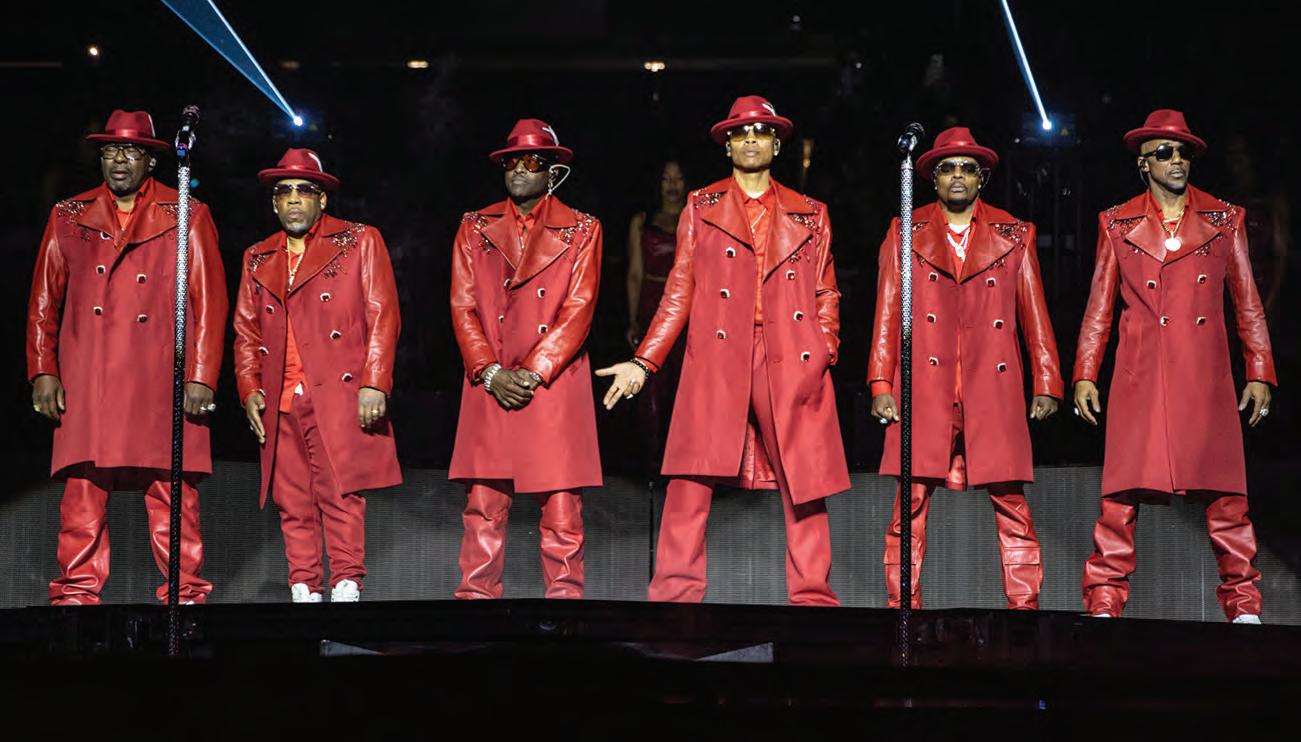
Show stopping performances from New Edition, Boyz II Men and Toni Braxton
By Zaria Mac St. Louis American
All microphones were most defi nitely on when The New Edition Way Tour rolled into Enterprise Center on Friday night with Boyz II Men and Toni Braxton. With decades of hits and more than 160 million records sold between them, the trio of R&B powerhouses deliv ered a premium, hit‑stuffed experience to a crowd of roughly 20,000 fans who came ready to sing every word.
Instead of the traditional one‑act‑at‑a‑time setup, the artists rotated throughout the night. The format made the concert feel like a perfectly curated personal playlist. New Jack Swing, clas sic R&B, and 90s slow‑jam nostalgia flowed into each other seamlessly, turn ing the arena into a full‑scale old‑school party. Couples swayed, friend groups two‑stepped, and longtime fans relived
the soundtrack of their coming‑of‑age years.
The fashion on stage was its own spec tacle. Each return to the spot light came with a fresh, more elaborate look. Toni Braxton opened in silver fringe and crystals before slipping into crushed velvet later in the night. The crowd matched her energy—sequins, chrome, and metallics shimmered from every section, transforming the arena into a glittering cel ebration.
New Edition leaned into a bold red motif, stepping out in leather trench coats for their R&B numbers and jeweled hoodies for their swing‑era hits. Boyz II Men comple mented the palette with jew el‑accented velvet suits that caught the light with every step.
Three acts, over 160 million records sold, all on one stage. This is history you are witnessing tonight.”
New Jack Swing, classic R&B, and 90s slow‑jam nostalgia flowed into each other seamlessly, turning the arena into a full‑scale old‑school party.
“I want you to really wrap your head around what’s happening here tonight,” Boyz II Men’s Shawn Stockman told the crowd. “This has never happened in music history—especially Black music.
Ailey II and Chuck Berry share St. Louis moment 60 years in the making
By Kenya Vaughn St. Louis American
For its 60th anniversary, Dance St. Louis decided to dig deeper than present ing a performance. The organization com missioned a moment. That moment arrives April 10 and 11, when Ailey II returns to the Touhill Performing Arts Center with the St. Louis premiere of “Berry Dreamin’.” The new work is inspired by the life, music and cultural imprint of Chuck Berry as the world approaches the centennial of his birth. The visit isn’t merely a booking. It is a reunion. Dance St. Louis invited Ailey II to St. Louis for the company’s 50th anniversary two years ago. Now they are back to help Dance St. Louis celebrate 60 years.
“It feels full circle,” said Ailey II Artistic Director Francesca Harper.


And it truly felt historic. Fans surrounded every side of the stage, belting out clas sics like “Motownphilly,” the group’s breakout hit. From the opening notes, Boyz II Men made it clear they came to celebrate.
They moved effortlessly into ballads like “Please Don’t Go” and “Do What I Gotta Do,” delivering each note with the emotional precision that earned them four Grammy Awards—including wins for “I’ll Make Love to You” and “End of the Road,” songs that helped define 90s R&B. Toni Braxton brought her signature elegance and unmistakable vocal power. Toni Braxton brought unmatched elegance and vocal power to the stage. Her performance of “He Wasn’t Man Enough”—which earned her a Grammy Award for Best Female R&B Vocal Performance—was filled

“There’s a real bond with St. Louis.”
In addition to Dance St. Louis bringing Alvin Ailey American Dance Theater and second company Ailey II to St. Louis countless times over the past six decades, that bond extends to Alvin Ailey American Dance Theater Artistic Director Alicia Graf Mack. Her husband Kirby Mack is a native St. Louisan. And one of her closest friends, former Ailey principal dancer Antonio Douthit Boyd, is from St. Louis as well. Mack spent several years here during her graduate studies at
Washington University and the region is home base for her family.
“She has a deep relationship with the St. Louis community,” Harper said. “She’s very excited that this commission could happen.” Commissioned specifically for Dance St. Louis’ milestone season, “Berry Dreamin’” is choreographed by former Ailey dancer Chalvar Monteiro—an artist
with confidence and attitude. She fol lowed with crowd favorites like “You’re Makin’ Me High” and “Please” before slowing things down with “Long As I Live” and “How Many Ways”.
One of the night’s most dramatic moments came when Braxton rose from beneath the stage to a soaring violin intro by St. Louis native Bell Darris. Dressed in a white sequined gown with a high slit and winged backpiece, she delivered “Un‑Break My Heart,” one of the best‑selling singles of all time and another Grammy‑winning performance in her catalog. The audience joined in almost instantly, turning the moment into a shared emotional release.
New Edition kept the energy sky‑high with “If It Isn’t Love,” complete with their iconic choreography and the orig inal music video playing overhead. They brought out more of their staccato moves for “Get Me Off” and “N.E. Heart Break,” circling the stage with the kind of swagger that transported the crowd straight back to an 80s dance floor.
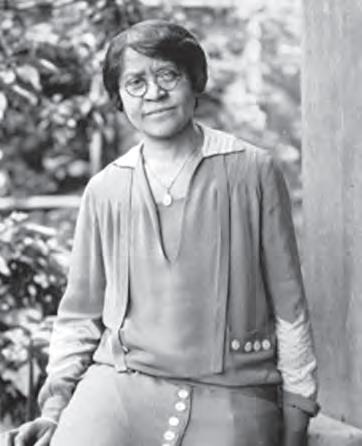
documentary brings Annie Malone’s
On Thursday night in St. Charles, the crowd filing into Lindenwood Theatre carried a sense of occasion. Dressed to
By Zaria Mac St. Louis American
Photos by Taylor Marrie/St. Louis American
The New Edition Way Tour rolled into St. Louis on Friday, March 27 at Enterprise Center. The legendary group was joined by Toni Braxton and Boyz II Men for a well‑rounded blend of 80s and 90s R&B.
Photos courtesy of Dance St. Louis
Ailey II will help Dance St. Louis celebrate 60 years with a weekend of performances at The Touhill that include the premiere of ‘Berry Dreamin,’” a new work inspired by the life and legacy of music icon and St. Louis native Chuck Berry.
New Edition
Boyz II Men
Toni Braxton
Courtesy photo
Annie Malone
CONCERTS
Sat., Apr. 4, 7:30 p.m., Kia
Monger Soulful Glory Vol. II presented by Townsendx3.live, City Winery St. Louis, 3730 Foundry Way, St. Louis, MO 63110. For more information, https://tickets.citywinery.com.
Sat., Apr. 11, 9:30 p.m., City Winery welcomes Jonathan Butler, City Winery St. Louis, 3730 Foundry Way, St. Louis, MO 63110. For more information, https:// tickets.citywinery.com.
Sat., Apr. 11, 8 p.m. Curren$y: The Winners Circle Tour w/ The 747 Band, Fendi P and Stoney Jackson, The Hawthorn, 2231 Washington Ave, St. Louis, MO 63103. For more information, visit www.thehawthornstl.com
Thur. Apr. 16, 7 p.m., Boys 4 Life Tour featuring B2K & Bow Wow, Chaifetz Arena, 1 South Compton Avenue St. Louis, MO 63103. For more information, visit www.chaifetzarena.com.
Thurs., Apr. 16, 8 p.m., Floetry presents the Say Yes Tour featuring Raheem DeVaughn, Stifel Theatre. For more information, visit www.stifeltheatre.com.
Fri., Apr. 24, 7 p.m. Bone
Thugs-N-Harmony, Pop’s Nightclub & Concert Venue, 1403 Mississippi Ave, Sauget, IL 62201. For more information, visit www.ticketweb.com.
Fri., May 1, 7:30 p.m., The Love and Relationship Tour starring David and Tamela Mann, Stifel Theatre. For more
STL Sites & Sounds
information, visit www.stifeltheatre.com.
Sun., May 10, 7 p.m. The Queens: 4 Legends, 1 Stage with Chaka Khan, Pstti LaBelle, Gladys Knight & Stephanie Mills Enterprise Center, 1401 Clark Ave, St Louis, MO 63103. For more information, visit www.enterprisecenter.com.
SPECIAL EVENTS
Thur., Apr. 7- 8, 7:30 p.m., Live at The Pulitzer, Pulitzer Arts Foundation, 3716 Washington Blvd, St. Louis, MO 63108. For more information, visit https://slso.org.
Sat., Apr. 4, Motown Throwdown w/ DJ Mahf and Pretty Dope Mike, Sophie’s Artist Lounge, 3333 Washington Ave, St. Louis, MO 63103. For more information, visit https:// kranzbergartsfoundation.org.
Thur., Apr. 7- 8, 7:30 p.m., Live at The Pulitzer, Pulitzer Arts Foundation, 3716 Washington Blvd, St. Louis, MO 63108. For more information, visit https://slso.org.
Apr. 8 – Apr. 9, Webster University’s 10th Diversity, Equity and Inclusion Conference, the theme for 2026 is The Audacity to Persist: Reclaiming Space, Voice and Justice, Webster University. For more information, visit webster. edu/dei2026.
Fri., Apr. 10, 10 p.m. LOVER/ FRIEND Vol. 4, Atomic Garage, 4140 Manchester Ave, St. Louis, MO 63110. For more information, visit
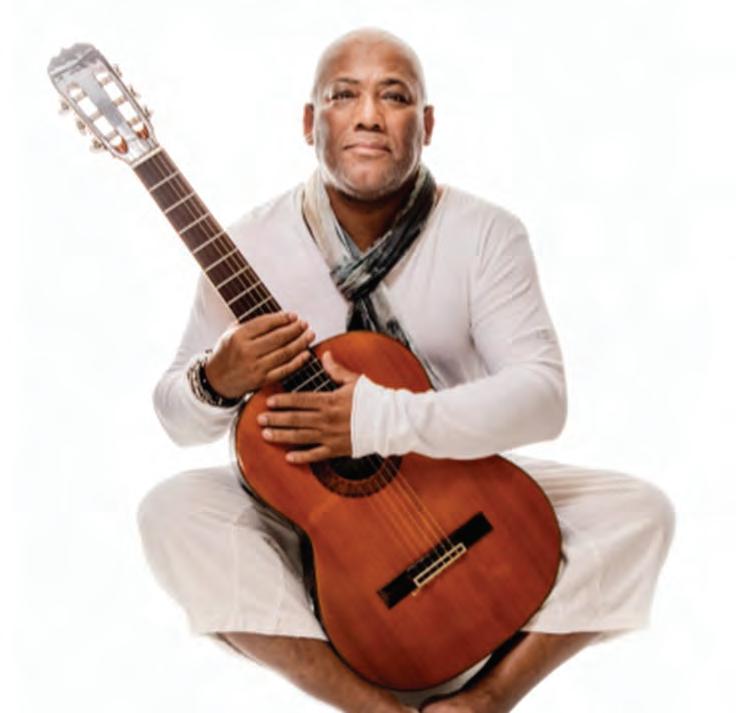
www.jamopresents.com.
April 10-11, Dance St. Louis presents Ailey II, The Touhill Performing Arts Center, One University Place, St. Louis MO 63121. For more information, visit www.dancestlouis.org.
Sun., Apr. 12, An Evening with Sir Ervin Williams, author of Mr. Duplicity, Emerson Theatre, Harris-Stowe State University, 3026 Laclede. For tickets, visit www.sirervinwilliams.com.
COMEDY
Fri., Apr. 17 - 19, 7 p.m.

Special Event: Arnez J, Helium Comedy Club, 1151 St. Louis Galleria St, St. Louis, MO 63117. For more information, visit https://st-louis.heliumcomedy.com.
Wed., Apr. 22, 7:30 p.m., Brandon “Hotsauce” Glover presented by Townsendx3.live, City Winery St. Louis, 3730 Foundry Way, St. Louis, MO 63110. For more information, https://tickets.citywinery.com.
Fri., Apr. 24, 8 p.m. We Them Ones Comedy Tour starring Mike Epps, Karlous Miller, DC Young Fly and many more, Chaifetz Arena, 1 S Compton Ave, St. Louis, MO 63103. For more information, visit https://www.chaifetzarena.


com.
Sat., Apr. 25, doors 6:30 p.m.
The Surviving and Thriving Tour with Michelle Buteau, The Pageant, 6161 Delmar Blvd, St. Louis, MO 63112. For more information, visit www.thepageant.com.
THEATRE
Thur., Apr. 2, 8 p.m. 9 to 5 with music and lyrics from Dolly Parton, Tower Grove Abbey, 2336 Tennessee Ave, St. Louis, MO 63104. For more information, visit www.straydogtheatre.org.
Sun., Apr. 12, 5 p.m.
Je’Caryous Johnson Presents: Set It Off Live!, Stifel Theatre, 1400 Market St, St. Louis, MO 63103. For more information, visit www.stifeltheatre.com.
ART
Thur., Apr. 7- 8, 7:30 p.m., Live at The Pulitzer, Pulitzer Arts Foundation, 3716 Washington Blvd, St. Louis, MO 63108. For more information, visit https://slso.org.
Jun. 28, Martine Syms: Soliloquy, St. Louis Art Museum, 1 Fine Arts Drive, Forest Park, St. Louis, MO 63110. For more information, visit www.slam.org.
Through June 2026, The Future Is Female, 21c Hotel and Museum Hotel St. Louis, 1528 Locust St, St. Louis, MO 63103. For more information, visit https://21cmuseumhotels. com.

















Grammy winner Jonathan Butler is bringing his soulful sound to City
Harper had been watching long before this opportu nity emerged. Monteiro immersed himself in Berry’s catalog and per sonal history, pairing icon ic riffs with atmospheric contemporary sounds that stretch and sample his music. The result is a lay ered dreamscape.
“It really became a reimagining of his ori gin story,” Harper said. “You see the playfulness of his youth, but also those deeply introspective moments—the kind that shape an artist before the world ever knows their name.”
The work moves between joy and reflection, rhythm and interiority— capturing not just the leg end, but the life. “We want the audience to feel the full scope of his journey,” Harper said. “Not just the music, but the essence of his artistry.”
That intention resonat ed with the people who knew Berry best. His son, Charles Berry II, said the family gave its blessing to Dance St. Louis and Ailey II without hesitation.
“It’s the highest honor,” Berry said. “They could have chosen anybody— Miles Davis, Tina Turner, anybody—but they chose my dad’s music and his legacy to help celebrate their 60th anniversary. That’s awe inspiring.”
His father’s influence on global music has long been cemented, but he admits the recognition hasn’t always felt as strong at home.
“In the United States— and even more specifically in St. Louis—for the lon gest, he wasn’t revered the way he should have been,” he said. “But internation ally? He’s always been recognized.” Now, as tributes emerge

That thread runs throughout the evening’s program, which also includes “Down the Rabbit Hole,” a tech‑inspired contemporary work, and concludes with Ailey’s iconic Revelations. “Berry Dreamin’” explores imagination and identity.
“Revelations” turns the story of Black America into motion—where sor row, resilience and joy all find their place onstage. “It’s a journey through the Black experience,” Harper said. “Sometimes sorrow ful, sometimes jubilant— but always hopeful.”
Founded in 1974 as a bridge between training and professional careers, Ailey II showcases dancers at a pivotal moment— refined, hungry, and on the verge.
“You’re seeing them at the height of their devel
II, his son and another grandson of Chuck Berry. A “Speaking of Dance” conversation with Ailey II, moderated by Dance St. Louis Artistic Director Michael Uthoff, will unfold alongside a visu al art exhibit created by CVPA and Grand Center Arts Academy. Sumner High School will present a fashion tribute honor ing the Ville native who changed the sound of the world.
“We’ll be in the foyer, doing it the way Chuck Berry music is supposed to be done,” Berry said. “With family, friends, and people who lived it.”
Dance St. Louis’ 60th anniversary season is a testament to endurance, evolution and community. Over six decades, the orga nization has brought more than 500 companies and
Louis, but whose legacy has too often been left in the shadows.
“Annie Turnbo Malone: The Untold Story,” a new documentary from the Annie Malone Film Project. Through the voices of descendants, scholars, and keepers of local history, the film rein troduces Malone beyond that of beauty pioneer. Through their lens – and in truth – she was a visionary whose influence shaped generations of Black entrepreneurship, community care, and cre ative possibility.
The project—led by filmmakers Kim Love, Demetrius Davis, and Giovanni Joseph—made its red‑carpet debut March 26. The evening blend ed film, fashion, and fellowship, with a panel discussion and curated exhibitions that nodded to Malone’s era while celebrating the artistry she inspired. Midway through the night, State Senator Angela Mosley presented the team with a state reso lution honoring their work.
“This was a moment to pause and recognize citizens who are contrib uting greatly to the arts,” Mosley said. “And we recognize them for docu menting the life of such an esteemed historic figure.”
The premiere doubled as a fundraiser for the res toration of the historically registered 1922 Annie Malone Children and Family Center, ensuring that the institution born from Malone’s generosity continues to serve families for generations to come.
The film traces Malone’s journey from her early years in south ern Illinois—where she
watched her entrepreneur ial siblings carve out their own paths—to her rise in St. Louis, where she devel oped a hair‑care product she believed in enough to take door‑to‑door, city‑to‑city. By the early 1900s, Malone had built a beauty empire that stretched from St. Louis to Chicago, reshaping the landscape of Black beauty culture and business own ership.
Love admitted during the panel that he didn’t fully understand Malone’s magnitude until he moved to St. Louis. “I just
Through the voices of descendants, scholars, and keepers of local history, the film reintroduces Annie Malone beyond that of beauty pioneer.
assumed she was an activ ist,” he said. “Then Netflix came and told that crazy story,” he added with a laugh. “And I said, ‘No, we’ve got to do some thing.’ That’s really what drove us.”
“The drive was to set the record straight—not to take anything away from Madame C.J. Walker,” Davis added. “But to show that both of these women did something major in our community.”
The film reveals that Walker sold Malone’s Poro products before established her own busi ness – and that white beauty industry entrepre neurs used Malone’s busi ness model as a blueprint During the post show panel discussion, Davis credited Lindenwood pro fessor Chajuana Trawick,
whose deep research on Malone helped shape the film. “She gave us so much information,” Davis said. “As we peeled through the layers, things became more and more interesting as we saw what she had done and created.”
The documentary paints a vivid picture of Malone’s world: the trusted products she crafted for her com munity; the advertisements that centered Black beauty long before mainstream media dared to; and the crown jewel of her legacy, Poro College. The sprawl ing institution—an entire city block in The Ville— served as a cosmetology school, business hub, and community gathering place. Residents came for classes, but they also came for the rooftop garden, the ice cream parlor, and the sense of belonging.
The film also revisits a question Malone was asked throughout her life: why she gave so much of her wealth away.
“It’s not my money,” Malone said, according to the film. “It’s God’s money.” Though her name faded from national memory over time, her impact remains alive. It can be found in the programs offered today through Annie Malone Children and Family Services—and in the countless Black entrepreneurs who walk the path she paved.
“St. Louis is rich in Black history,” Davis said. “We have some major people in every industry, but as history has shown, their contributions are often covered up, and other companies take our ideas and make them seem like their own.”
For more information about “Annie Turnbo Malone: The Untold Story,” visit www.anniemalonefilm.org

nostalgia: “Mr. Telephone Man” and “Cool It Now,” performed with the same youthful charm they had when the group first hit the scene. “Candy Girl” sent the arena into a frenzy— especially when Bobby
a Grammy Award for Best Male R&B Vocal Performance—along with “Roni” and “My Prerogative,” still carrying that unmistakable “bad boy” charisma. The night closed with a
One Author, One Kirkwood One Author, One Kirkwood Presents: Kashana Cauley Presents: Kashana Cauley
Wednesday, May 6 at 7 pm Wednesday, May 6 at 7 pm

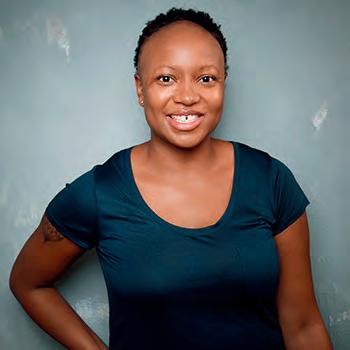


party come to life. Even after hours of music, the crowd drifted out still singing, their voices echoing through the concourse like a final reminder that this night belonged to R&B history.




Supported by the Edward Chase Garvey Memorial Foundation
Photos courtesy of Dance St. Louis
Founded in 1974 as a bridge between training and professional careers, Ailey II showcases dancers at a pivotal moment—refined, hungry, and on the verge.

An R&B show for the ages. From the moment I got word that New Edition’s New Way Tour was swinging our way, I was over the moon. The idea that New Edition, Boyz II Men and Toni Braxton would all be hitting the same stage on the same night had me laying out potential looks on the bed months ago! When I tell you The Black Promoters Collective put their ankle, foot, elbow and shoulder in this show for us! The folks who packed out Enterprise Center Friday night know exactly what I mean. The clothes, the spectacle – and the voices were top tier from start to finish. Who else is still bopping to that new track “We Outside?” That show was epic, y’all. From this point forward (or until they fall off), Boyz II Men are officially renamed Boyz II Snatched Men. All of their bodies were tea. Yes, Wanya too! Because I am a Christian, I don’t want to say that anybody sold their soul to the devil. That being said, nearly all of New Edition have looked too good for too long to not have some sort of sorcery involved. Uncle Bobbaye was giving the girls vocals for filth with his solo portion and Johnny Gill was Johnny Gill-ing all night long. I felt so proud of the toddler Delores Shante who heard “Cool It Now” and knew she was partaking in something special. I had no idea how right I would be. More than 40 years later, that song still snaps – even after voices dropped. And I can’t recap the show without mentioning my girl Toni! Girl, how did you slay in the STL after having a full-on health crisis the week before?!
Real talk, I’ve seen Mrs. Birdman countless times and she has never given me a bad showing. Now I can’t say the same about her wigs when she’s acting on Lifetime Television For Women, but that has nothing to do with this. The 90s R&B trifecta that took over Enterprise and had everybody’s aunties, uncles and big cousins back outside (and too worn out to clean up Saturday morning) was pure perfection.
Opening Day did that! I heard folks were dry hating on me for recycling my 314 Day outfit for the St. Louis Cardinals Opening Day 2026 festivities… and did! In all fairness to me, how many times do you get to wear a jersey and some mom jeans if you don’t go to the games like that? It was still cute the second time. But not as cute as festivities in Ballpark Village last Thursday. When I tell you that Opening Day is one of those events that lets me know our city is capable of coming together as one Cardinals Nation under a groove! And the icing on the cake was that we won the game! Take that Tampa Bay!

Big ups to the Battlehawks. Now y’all heard me talk big stuff about how I was gonna be perched up in the Dome ka-kawing to the heavens. I said this never having attended a St. Louis Battlehawks game before Saturday. My little ka-kaw might as well have been a whisper compared to how lit the folks were in the name of the Battlehawks! I was not ready!
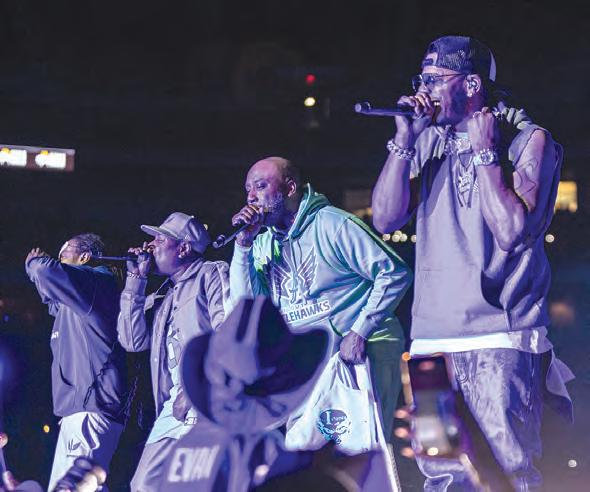

since the
win.
Listen, Todd and Brad from the accounts receivable team might look regular in their quarter-zips and khakis during the week. But they are up in the Dome doing the absolute most for St. Louis Battlehawks home games! I got there early to peep the scene and the Dome was already packed with folks pre-gaming for their fandom moments. My seat neighbor was straight practicing his ka-kaw. When he did it the first time, I instinctively said “bless you.” He turned to me and said, “Is this your first Battlehawks game?” It was that obvious. The folks were decked out in face AND body paint, customized gear from head to toe. It took everything inside of me to not ask this gentleman where he found his half-bluehalf-white shake and go wig. And don’t even get me started on the BattleHulk, the man


dressed up as Hulk Hogan in full Battlehawks regalia, including a glued on handlebar mustache and a Battlehawks bandana covering his head. And where did y’all get those Battlehawks supersized chains with the massive medallions? I feel like it would set my favorite blue wrap dress all he way off! But back to the game. I had an absolute ball. And then Nelly and the St. Lunatics took ten minutes and made it feel like a whole headlining set for the Kia Halftime Show. And what shocked me the most was how the little kids up in there knew all the words and were straight up vibing to Nelly and the ‘Tics’ music. Their grandparents were in high school when those songs came out. Did that make y’all feel as old as it made me feel? Saturday was my first game, but it most certainly won’t be the last – especially
An STL connected Verzuz. I normally leave the national news for social media – unless it has a St. Louis connection. Well last week’s Verzuz Battle where Tyrese took on Tank absolutely did. Tank’s wife is from St. Louis. And y’all know Tyrese’s whole family is from the STL and he did his second home town a solid when he brought my boy Chingy on stage. The sound system tried to not let him be great, but he did his thing! But can we talk for a second about how dirty Tank did Tyrese with that bridge harmony breakdown that roasted him over an open fire for wearing that turtleneck? It was a cute watch and it reminded me of how hilarious and charming Tank is in real life. It reminded me of the time he was at the late great Loft and drove a fellow celebrity – who was far less famous – for acting funny when interacting with fans. He even told Drexel he was gonna need some extra security to keep the groupies away. Tank ate him up while engaging with said groupies. “Don’t nobody want your ole B-list [expletive],” Tank said while hugging and cheesing it up with them. Those weren’t his exact works, but I tried to make it as safe for Partyline as possible.
Stayed tuned for more St. Louis American Reader’s Choice. The nominations have closed, but we’re just getting started! Trust and believe that I will update you on the top nods once things have been tallied!





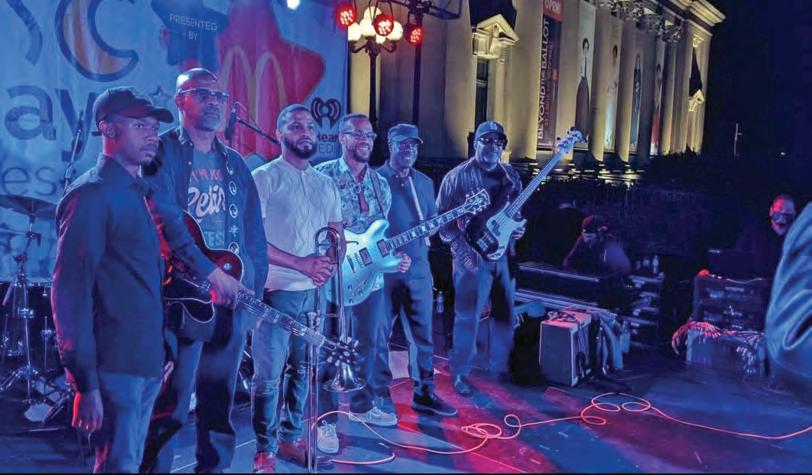




Battlehawks brought home the
“I don’t need it. It’s a stupid award.”
— Joe Mazzulla, head coach of the Boston Celtics, on the NBA Coach of the Year award

InSIdE SportS
With Earl Austin Jr.
Tarris Reed Jr. leads UConn to NCAA Tournament Final Four
The UConn Huskies will be making their third trip to the Final Four of the NCAA Tournament in four years, and St. Louisan Tarris Reed Jr. is one of the major reasons why it’s happening.
The former Chaminade College Prep standout was a dominant force in the Huskies’ 73-72 victory over the Duke Blue Devils in the East Regional finals last Sunday in Washington, D.C.
The No. 2 seed Huskies rallied from a 19-point deficit to stun the No. 1 Blue Devils.
A dramatic 35-foot 3-pointer by freshman Braylon Mullins with 0.4 seconds left gave UConn the victory, but it was the play of the 6-foot-11 Reed that carried the day. Reed finished with 26 points, nine rebounds, four blocks and three assists. He got the Huskies off to a fast start by scoring eight of his team’s first 10 points. While the Huskies were struggling from 3-point range throughout the game, Reed was a force in the paint with consistent scoring. Reed was named the Most Outstanding Player of the East Regional after averaging 21.7 points and 13.5 rebounds during the Huskies’ tournament run. It was one of the most impressive runs in recent memory.
round and 20 points and five rebounds against Michigan State in the regional semifinals.
UConn will face Illinois Fighting Illini in the first national semifinal game Saturday evening in Indianapolis. Tipoff is scheduled for 5:09 p.m. Central time. The second semifinal game will be Arizona vs. Michigan. The winners will play Monday, April 6, for the national championship.
Alex Johnson commits to Maryville
Standout guard
Reed had 31 points and 27 rebounds in the first round against Furman. He followed with 10 points and 13 rebounds against UCLA in the second
Alex Johnson of East St. Louis has committed to Maryville University and new head coach Kramer Soderberg. The 6-foot-3 Johnson was a key player in the Flyers’ run to the Illinois Class 3A state championship. As a senior, Johnson averaged 17.3 points, 4.9 rebounds, 3.7 assists and 2.3 steals while helping lead the Flyers to a 33-4 record. In the state semifinals against Chicago Leo, he had 19 points and 10 rebounds in the Flyers’ 59-40 victory. Another new Maryville commit is 6-foot-2 guard Ben Karsten from Vianney. Karsten was one of the area’s top 3-point shooters this past season. He made 89 3-pointers and averaged 16.5 points per game while leading the Golden Griffins to a 24-6 record and a district championship.
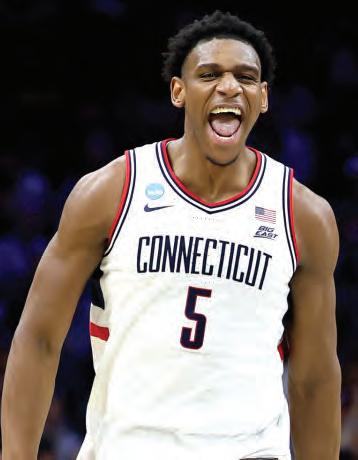
St. Louisans Martin Fletcher shine in NCAA Tournament
One of the big stories of the first weekend of the NCAA Tournament was
High Point. The Panthers pulled off a stunner in the first round with an 83-82 victory over Big Ten power Wisconsin. In the second round, High Point pushed
SportS EyE
With Alvin A. Reid
Southeastern Conference Tournament champion Arkansas to the limit before losing 94-88.
Former St. Louis-area prep standouts Rob Martin and Cam’ron Fletcher
were central figures in the Panthers’ late-season run, which also included 31 victories and the Big South Conference championship. Martin, a former CBC standout, delivered in both games. He had 23 points and 10 rebounds in the upset of Wisconsin, then followed with 30 points against Arkansas, going head-to-head with All-American point guard
Darius Acuff Jr. Fletcher, a former Vashon High standout, had 14 points and 11 rebounds against Wisconsin, then added 25 points and eight rebounds against Arkansas.
Tony Irons leads Mineral Area to Region 16 championship
Coach Tony Irons of Mineral Area College led the Cardinals to the National Junior College Athletic Association Region 16 championship and a berth in the national tournament in Hutchinson, Kansas. Irons is in his second year at Mineral Area after a standout career at Vashon, where he guided the Wolverines to seven state championships. Mineral Area finished the season with a 21-12 record.
Three key players on the Cardinals also played for Irons at Vashon on state championship teams: 6-foot-6 guard Terron Garrett, 6-foot-4 forward Nassir Binion and 6-foot-5 forward Jordyn Richard.
Nelly, a blast at Battlehawks game
Let’s start with a confession. It’s not earth-shattering.
I had never seen Nelly and/or the St. Lunatics perform live. I saw him perform on Saturday Night Live in November 2002 and thought he was excellent.
I’m not into rap, hiphop or whatever it is called today, but the show was energetic, and St. Louis could be proud of a native son.
My wife and I have been to the Black & White Ball, but if he performed, we didn’t see it because we had called it an evening before midnight. I got my chance to see the multiple Grammy winner at halftime of the St. Louis Battlehawks’ season-opening game against the D.C. Defenders. The sound was hit or miss for parts of the show; however, Nelly should be commended for again putting St. Louis in a positive national spotlight. The UFL should also be recognized for staging an entertaining product. St. Louis will again lead the UFL in attendance by
a wide margin, based on crowd sizes for this week’s opening games.
Fans seem to really enjoy the games, even though many of the players at the beginning of a season are unknown.
Andy Banker of FOX 2 fame must be exhausted after every game. As the public address announcer, he hypes every positive Battlehawks play and exhorts the crowd to get louder when the opposing team faces a third down.

After trailing 10-6 at halftime, St. Louis battled back to score a 16-10 victory over the defending UFL champion Defenders. Unlike the NFL, the UFL institutes rule changes designed to move the game at a faster pace while creating more offense and scoring.
This includes: Field goals from beyond 60 yards are now worth four points. Defenders kicker Matt McCrane booted a 60-yard field goal in the first quarter, putting his team up 4-0 and his name in the UFL record book as the first to achieve the feat.
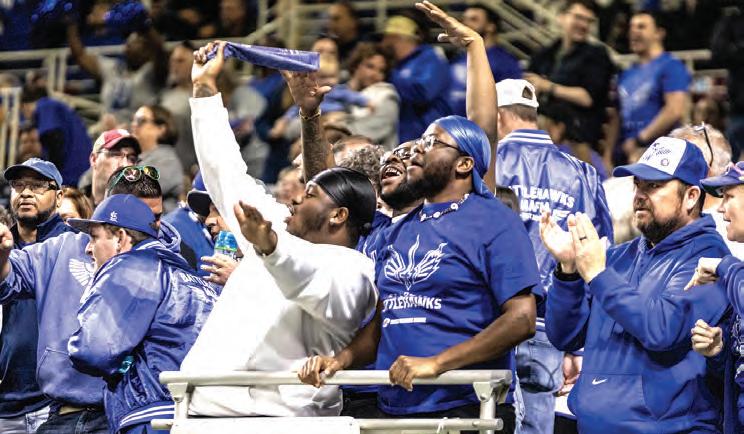
Teams can no longer punt from inside the opponent’s 50-yard line. This is true even if a penalty or loss of yards pushes a team back after crossing midfield. It leaves two choices: either try a long field goal or run a fourthdown play. This rule is waived during the final two minutes of each half. One foot in bounds is good enough for a reception or interception. It’s the college football rule, which gives receivers a
slight edge. The UFL says it could reduce injuries and help officials. I don’t buy either, and I don’t like this rule change.
Speaking of college, the UFL has gone there with its overtime rules, too. Overtime is now three alternating drives from the 5-yard line. It’s gimmicky, but for the most part, so is the UFL. The rule change the NFL should immediately adopt is the UFL’s ban on the “tush push.” This
is not a football play. It’s a rugby play, at best, and it should have had a oneyear run in the NFL before it was banished.
The UFL has selected St. Louis as host of its championship game in both years of the league’s existence. Twice, the Battlehawks have blown the chance to host a home title game by losing a semifinal game.
My guess is that the third time will be the charm.
The Reid Roundup
Three games into the season is too early to talk much about the St. Louis Cardinals’ season. But… JJ Wetherholt looks like he is a legitimate hitter…Jordan Walker seems to have found his batting stroke. He was hitting .400 with a home run and two doubles in the season-opening series against the Tampa Bay Rays…Victor Scott II was hitting a robust .500 with a team-leading five hits…Pitching could be a big problem. Matthew Liberatore pitched well in the home opener on March 26, but former L.A. Dodger Dustin May’s first start was a disaster. The team ERA was 5.21 after three games, good for 23rd in MLB…I picked Arizona to win the NCAA national title, and I’m sticking with that prediction… There isn’t much to say about Tiger Woods. His latest episode with alleged impaired driving left him climbing out of the passenger door of his flipped Range Rover and under arrest. It is a new chapter in what now is a very dark novel.
Former Chaminade College Prep standout Tarris Reed Jr. is a major reason why the UConn Huskies just made the Final Four for the third time in four years.
Alvin A. Reid
A bevy of Black fans enjoyed a St. Louis Battlehawks victory over the DC Defenders and a Nelly halftime performance in the March 28, 2026 home opener at the Dome of America’s Center.
Facebook photo
Earl Austin Jr.
Photo by Taylor Marrie / St. Louis American
A cultural beacon goes quiet
National Blues Museum to cease operations after nearly a decade
By Kenya Vaughn The St. Louis American
A somber note settled over St. Louis on Friday morning with the announcement that the National Blues Museum will cease operations on March 27, 2026. Its doors closed to the public with two final performance. For many, the announcement felt like
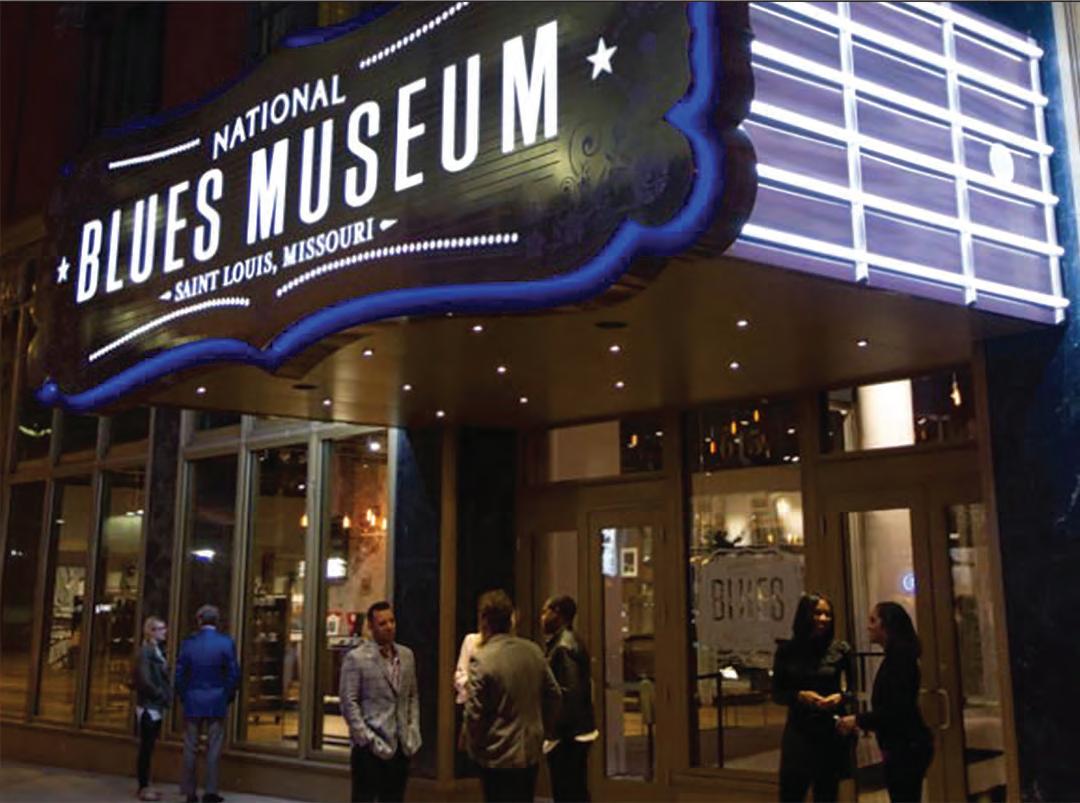
the end of a chapter that began with so much hope. When the museum opened in 2016, it was heralded as a transformative moment for Washington Avenue and for St. Louis’ identity as a cradle of American music. Founding executive director Dion Brown, in an interview with The St. Louis American at the time, spoke with a mix of pride and urgency about
what the institution meant.
“We’re telling a story that belongs to all of us,” Brown said then. “The blues is the root. Everything else grows

If
owe more than
in credit card or other unsecured debt, see how National Debt Relief can help resolve your debt for a fraction of what you owe.
We work with you to set up a monthly payment that fits within your budget.






from it. And St. Louis deserves a place that honors that truth.”
For nearly a decade, the museum did just that. It welcomed thousands of visitors, educators, and artists—locals and tourists alike—into a space that celebrated the legends, the unsung heroes, and the everyday people whose lived experiences shaped the blues. The museum became a gathering place through interactive exhibits, live performances, and educational programming.
But the realities of downtown’s economic climate proved too steep to overcome. According to the Board of Directors, the visitor economy has not rebounded to pre-pandemic levels, and the drop in pedestrian traffic has been significant. The recent elimination of federal funding sources com-
pounded the strain, leaving the organization unable to operate sustainably.
“Serving at the helm of the National Blues Museum has been one of the most meaningful chapters of my career in music,” said current executive director Robert Nelson in a statement.
“This institution was built to preserve the legacy and honor the history of the music that gave voice to generations, and being part of that mission has been a privilege I don’t take for granted.”
The museum’s closure marks a stark contrast to the optimism that surrounded its opening. Brown, who helped shepherd the project from vision to reality, often spoke about the museum as both a cultural anchor and an economic catalyst for downtown. In those
early days, he emphasized that the blues was more than a genre—it was a living archive of resilience, migration, innovation, and Black creativity.
“This music came from struggle, but it also came from joy,” Brown told The American during the museum’s inaugural year. “We wanted people to walk in and feel that. To understand that the blues is American history.”
That mission resonated with visitors from across the country. School groups filled the galleries. Local musicians found a stage that honored their craft. Tourists discovered the depth of St. Louis’ musical lineage. And for many residents, the museum became a point of pride—a reminder that the city’s cultural contributions run deep.
The Board says the organization will continue to exist as it winds down operations and explores a reimagined path forward to preserve the museum’s legacy. They are also urging local lawmakers to engage in long-term conversations about sustainable economic development in downtown St. Louis. Ticket refunds for canceled performances are already being processed. In its statement, the Board extended gratitude to the staff, artists, supporters, educators, partners, and visitors who helped shape the museum into a respected cultural institution.
“We set out to show people just how deep the roots of the blues go, and I’m proud of what we accomplished together,” Nelson said. “While this is an incredibly difficult moment, I believe the story of the blues will continue to be told. It lives on through us.”

Happy 1st Anniversary to Arielle Vivian Randolph MD. and Jerell Alexander Blakeley, Ed.M. The couple was married on April 6, 2025, in the elegant Solarium at the Ritz Carlton Hotel in Saint Louis, MO. Arielle and Jerell’s paths first crossed 13 years after they graduated from Howard University in Washington, DC. They graduated on the same day in 2010 during the all-school commencement, they never met while there.
Jerell Blakeley is a native of Trenton, New Jersey. He serves as the Assistant Executive Director of Programs for the Ohio Education Association (OEA). Jerell is an alumnus of Rutgers University-New Brunswick’s Graduate School of Education. He is a doctoral student at University of Indiana – Bloomington.
Arielle is a physician, boarded in Pediatrics at #1 Cincinnati Children’s Hospital. She is a third-generation physician. Now deceased, her proud grandparents Billie Jean and Bernard C Randolph Sr. MD. were thrilled to see her follow in her grandfather and father’s footsteps. Her grandfather, Bernard Randolph Sr., MD. practiced medicine in St. Louis, MO for 50 years.
Jerell is the son of Jackie Blakeley of Lawrenceville, NJ, and T. Aaron Williams of Trenton, NJ. Arielle is the daughter of Bernard C. Randolph Jr. MD (Kathleen Smith) - St. Louis, MO, and Andrea Haynes Telfair (Honorable Oscar Telfair III)Houston, TX.
Photo courtesy of Explore St. louis
The National Blues Museum announced Friday that it will cease operations after last weekend’s final two performances. The doors closed to the public the same day.


POSITION: LAVENDER LABORER
The College Hill Foundation is seeking a lavender laborer to assist with the maintenance and its’ lavender farm located in the College Hill Neighborhood in the City of St. Louis.
Key Responsibilities:
• Plant and cultivate lavender plants according to seasonal schedules.
• Perform regular maintenance tasks, including weeding, grass cutting, watering, fertilizing and pruning to ensure plant health.
• Harvest lavender flowers at peak bloom for optimal quality.
• Operate and maintain outdoor equipment and tools safely.
• Assist in the processing of lavender for essential oils and other products.
• Sale lavender at Farmers Markets.
• Follow safety protocols and maintain a clean work environment.
Qualifications:
• Previous experience in agriculture or horticulture preferred.
• Ability to perform physical labor in various weather conditions.
• Knowledge of lavender cultivation practices is a plus.
• Strong attention to detail and ability to follow instructions.
• Good communication skills and teamwork abilities. Please submit your resume to Fred Kimbrough at chffred@gmail.com

STEM LAB DIRECTOR
The Principia Corporation dba Principia College /Principia School seeks STEM Lab Director in St. Louis, MO. Apply at jobpostingtoday. com/ Ref# 13212.
PUBLIC NOTICE
Notice is hereby given that the Metropolitan St. Louis Sewer District Requests for Quotes, Bids and Proposals are posted online for public download. Please navigate to www.msdprojectclear.org
> Doing Business With Us
> View Bid Opportunities
Metropolitan St. Louis Sewer District is an Equal Opportunity Employer.
SEALED BIDS
Bids for Constructions Services –Central Region, Project No. IDIQMCA6008, will be received by FMDC, State of MO, UNTIL 1:30 PM, April 9, 2026. Project information available at: http://oa.mo.gov/ facilities
SEALED BIDS
Bids for Troop E HeadquartersRenovate Restrooms & Replace All Cast Iron Piping, Headquarters Building, Project No.R2520-01 will be received by FMDC, State of MO, UNTIL 1:30 PM, 4/30/26. Project information available at: http://oa.mo. gov/facilities
SEALED BIDS
Bids for Renovate Interior & Exterior, Readiness Center Building, Project No. T2421-01 will be received by FMDC, State of MO, UNTIL 1:30 PM, 4/30/26. Project information available at: http:// oa.mo.gov/ facilities
REQUEST FOR PROPOSALS
&
at www.stlamerican.com
NOTICE TO CONTRACTORS
Sealed bids for the ARSCRS2 Improvement Program, Package 2 project, St. Louis County Project No. AR/CR-1940 will be received electronically thru the County’s Vendor Self Service portal at https://stlouiscounty movendors.munisselfser vice.com/Vendors/ default.aspx, until 2:00 PM on May 6, 2026
Plans and specifications will be available on March 30, 2026 from the St. Louis County Web Site (www.stlouiscountymo. gov) or by contacting Cross Rhodes Print & Technologies, 2731 South Jefferson Avenue, St. Louis, MO 63118 (314) 678-0087.
DIRECTOR OF PROCUREMENT ST. LOUIS COUNTY
SEALED BIDS
Bids for Add Cabins & Renovate Lodge at Current River State Park, Project No. X2207-01, will be received by FMDC, State of MO, UNTIL 1:30
PM, May 12, 2026. Project information available at: http://oa.mo. gov/facilities
SEALED BIDS
Bids for Generator Installation, Project No. R23MP13 will be received by FMDC, State of MO, UNTIL 1:30 PM, April 30, 2026. Project information available at: http://oa.mo. gov/facilities

The St. Louis Economic Development Partnership (“SLEDP”) solicits proposals from qualified certified public accounting firms to conduct annual independent audits for multiple affiliated entities and to perform a Single Audit for one entity and for all related tax compliance services for up to a three-year contract period. The services shall include SLEDP and affiliate entities, including the Land Clearance for Redevelopment Authority, St. Louis County Port Authority, Industrial Development Authority, STL Partnership CDC, STLVentureWorks, and the World Trade Center –St. Louis. A copy of the full RFP is available at https:// stlpartnership.com/rfp-rfq/. Submissions should be received no later than 3:00 PM CT on Monday, April 27, 2026.
St. Louis Economic Development Partnership Equal Opportunity Employer
2026
The Saint Louis Zoo seeks bids from qualified vendors for: Fuel Services; Automatic Door & Gate Services; Elevator Services; HVAC-R Services; Fire Sprinkler Backflow & Repair Services; and Generator Services. Bid documents are available as of 3/1/26 on the Saint Louis Zoo website: stlzoo.org/vendor

REQUEST FOR PROPOSALS
Alberici Constructors, Kwame Building Group and the Saint Louis Zoo seek bids from qualified firms to submit proposals for a project at the Saint Louis Zoo WildCare Park. The project consists of assembly, erection and foundations for a motorized vertical lifting observation tower. To request bid documents, please send an E-mail to stlzoobids@alberici.com
LETTING NO. 8795
COMPTON AVE BRIDGE OVER UPRR REPLACEMENT FEDERAL PROJECT NO. STP-5451(602)
Electronic bids submitted through the Bid Express Online Portal will be received by the Board of Public Service until 1:45 PM, CT, on MAY 5, 2026, then publicly opened and read. Proposals must be submitted electronically using “Bid Express Online Portal” at https:// www.bidexpress.com/businesses/20618/home
Plans and Specifications may be examined online through Bid Express at https://www.bidexpress.com/businesses/20618/home and may be downloaded for free.
A pre-bid conference for all contractors bidding on this project will be held April 14, 2026 at 10:00 a.m. The pre-bid conference will be held in City Hall, 1200 Market Street, Room #301, St. Louis, Missouri 63103.
The project has a DBE goal of 0%, and an On the Job Training (OJT) goal of 1 slot for 1,000 hours.
Bidders shall comply with all applicable City, State and Federal laws (including MBE/WBE policies).
All bidders must regard Federal Executive Order 11246, “Notice of Requirement for Affirmative Action to Ensure Equal Employment Opportunity”, the “Equal Opportunity Clause” and the “Standard Federal Equal Employment Specifications” set forth within and referenced at www.stl-bps.org (Announcements).
Black women built the Black Church.
Why can’t they lead it?
By Rev. Dorothy S. Boulware Word In Black
Born into a free Black family in the late 1700s, Jarena Lee was just 24 when she heard the call to ministry as a member of the newly-formed African Methodist Episcopal Church. Though founders banned women from the pulpit, Lee persisted: “If the man may preach, because the Savior died for him, why not the woman, seeing He died for her also?”
After seeing her captivate an audience with a sermon, church leaders eventually gave Lee permission to preach.
In the nearly two centuries since Lee’s historic accomplishment, Black women have made significant progress in ministry across historically Black denominations. That includes the elevation of Rev. Vashti Murphy McKenzie, the AME’s first female bishop.
Yet even as generations of Black women quietly became the spiritual backbone of Black denominations — organizing missionary societies, leading choirs, teaching Sunday school, even preaching — most pulpits and highest leadership offices in are still overwhelmingly reserved for men.
In the pews, not at the pulpit
Researchers estimate that
fewer than one in ten Black Protestant congregations is led by a woman, despite the increasing number of women entering ministry. Studies show most Black church congregations are overwhelmingly female.
Talk to Black clergywomen, however, and they say the challenge is not calling or preparation but acceptance.
“We are a culture that has historically put more value in the men’s voice,” said the Rev. Dr. Erika D. Crawford, a pastor in the African Methodist Episcopal Church and leader of its Commission on Women in Ministry.
Rev. Christine A. Smith, a theologian, author and senior pastor of Restoration Ministries of Greater Cleveland, Ohio, summarized the challenge: “We do have some very successful African American pastors. But those women are the exception, not the rule.”
It is commonly known that the influence of women in the Black Church has long exceeded their official authority. Studies estimate that women comprise between 66% and 88% of the membership in many African American congregations, making them the majority presence in pews and volunteer ministries.
Yet leadership roles, particularly the senior pastorate, have lagged behind that demographic reality.
Overcoming stigma

the
Dr. Nicole Davis, author of “Eve, Where Are You? Confronting Toxic Practices Against the Advancement of Women,” wrote in her book that women “are meant to lead and serve fully in ministry.” But she also believes that harmful or toxic practices among male leaders hold women back.
Davis hadn’t always felt this way. Her perspective changed after a confrontation with her son, who was appalled to discover the church their family attended didn’t believe in female pastors. While Davis knew it wasn’t right, she had accepted it until that conversation.
Confirmation from God, in the form of her graduate studies, followed.
“I pursued a doctorate in conflict analysis and resolution, and studied the impact of the patriarchal system on gender imbalance,” Davis wrote. The research clarified “how various female pastors overcame the stigma that I came to accept as facts of life.”
Not long afterward, ”I changed churches and was soon thereafter ordained to function as an associate pastor,” Davis wrote. By embracing her iden-

tities — specifically, her gender and faith — Davis wrote she “can now fully recognize my value and ministry opportunities in all these areas” and concentrate on what truly matters.
“It is God whom I desire to please, and I’ve learned that He needs the women He calls to show up and step into the light,” she wrote.”
The stained-glass ceiling
Bishop Andrea Foster of Kingdom First Assembly Church in Rock Hill, South Carolina, acknowledges there are problems, but says there is clear evidence of progress, especially in the last 30 years: “I think you’re finding more women in top-tier leadership positions.”
In the Episcopal church “more women are breaking the glass ceiling,” Foster says.
Nevertheless, women are usually held to a higher standard than men, Foster says, as well as expected to suffer “the foolishness and abuse” of men in church leadership. But greater expectations, she says, can cut both ways.
“I think churches are open to
Let me tell you a truth most people won’t admit out loud: managing up feels uncomfortable for a lot of leaders — not because they don’t know how to do it, but because they don’t want to look political, needy, or manipulative.
But managing up isn’t manipulation. Managing up isn’t flattery. Managing up isn’t kissing up.
Managing up is alignment. And alignment is stewardship.
When I became part of executive teams — and later when I led them — I learned quickly that leaders who don’t manage up well create friction for themselves and confusion for their organizations. And often, the problem isn’t competence or effort — it’s misalignment.
Here’s the mindset shift most leaders need to make:
1. You’re not managing a person. You’re managing clarity. Every leader — no matter how gifted — has blind spots, bandwidth limits, and information gaps. Managing up isn’t about making your boss comfortable. It’s about making the mission clear. You’re stewarding alignment, not stroking ego. When clarity rises, conflict drops.
2. Executives don’t want updates. They want understanding. This was one of the earliest lessons I learned: Don’t just report
the nurturing theological because if you’re a woman in ministry, for the most part, you can’t come raggedy,” she says. “You have to know your stuff. I don’t know too many women coming to pulpit ministry or other types of ministry with fluff.”
While she loves “my brothers,” Foster says, the different expectations for women often cultivates “a fearlessness” at the pulpit that men sometimes lack. Women “are coming with sound doctrine. They’re coming with sound teachings,” she says. “And I think it takes a boldness and a prophetic edge” to do so.
Recognition, not representation
Despite institutional barriers, attitudes among churchgoers appear to be shifting. A Pew Research Center survey found 86% of Black Americans believe women should be allowed to serve as senior religious leaders, including strong support from both men and women.
Historians note that while progress has been gradual, the trajectory is clear. The combination of theological education, congregational support, and persistent advocacy continues to open doors.
For many clergywomen, the goal is not simply representation but recognition of a calling that has always existed. Yet even with public support, women often find themselves serving in smaller congregations or in associate roles rather than leading large churches.For many clergywomen, the goal is not simply representation but recognition of a calling that has always existed.
As scholars of African American church life often note, women have long been the spiritual lifeblood of the Black Church. The current generation is working to ensure that the authority of the pulpit reflects the faithfulness already present in the pews.
information. Interpret it. Don’t just share the “what.” Explain the “so what.” Clarify impact. Clarify risk. Clarify decisions that need to be made. Managing up well turns you from a task completer into a valueadded thinker.
3. Managing up is really about managing expectations. Most conflict between leaders and their bosses isn’t personal — it’s misalignment. And misalignment grows in silence. When expectations are clear, trust increases. When expectations are unclear, resentment grows quietly in the corners of the work.
4. Your relationship with your leader is part of your leadership responsibility. People treat managing up as optional. It’s not. If your leader is unclear, your team will be unclear. If your leader is misaligned, your work will drift. Leadership isn’t just downstream — it’s upstream, too. You can’t lead your team well if you aren’t aligned with the person leading you.
Here’s the Reframe: Managing up isn’t about how your leader perceives you — it’s about how effectively you advance the work.
Here’s the Reclaim: You’re not trying to impress. You’re trying to align.
Here’s the Rename: You’re not kissing up. You’re clarifying up.
Reflection Question: What expectation with your leader needs clarity before it becomes conflict?
How Do I Manage Up Without Feeling Like I’m Kissing Up? (The Difference Between Alignment and Approval-Seeking)
The Next MOVE
ORVIN
Envato Images
Black women have been
backbone of the Black church practically since its inception. Yet even though more Black women are entering ministry, fewer than 1 in 10 leadership positions in the Black church are held by Black women.