
St. LouiS AmericAn
Mill Creek’s Mile
Artist and ‘Pillars of the Valley’ creator Damon Davis joined Great Rivers Greenway and partners on Monday, April 13, as they celebrated the opening of the new Brickline Greenway segment on Market Street. The stretch expands the monument’s footprint honoring the legacy of the historically Black community Mill Creek Valley.

Brickline Greenway opens along Market Street
By Kenya Vaughn St. Louis American
What unfolded this week along Market Street didn’t feel like a ribbon-cutting.
The Harris-Stowe State University Swarm Drumline buzzed as Double Dutch ropes slapped the pavement, turning Monday’s opening of the Brickline Greenway’s newest segment into something closer to a family reunion — a block party rooted in history and reaching toward possibility.
In many ways, that’s exactly what it was.
The celebration introduced nearly a mile of new greenway between Compton Avenue and 22nd Street, part of the larger Brickline Greenway. The long-planned network is designed to connect neighborhoods and destinations such as Energizer Park
See Greenway, A13

St. Louis American names its boys ‘Fab Five’ for 2026 Quentin Coleman of Principia, after leading the Panthers to their second consecutive Class 3 state championship, was named the St. Louis American Player of the Year. Coleman, along with four others, make up this year’s ‘Fab Five’. ~ Page B5 ~


Video undercuts police shooting account
By Sylvester Brown Jr. St. Louis American
Newly released body camera footage is raising serious questions about the fatal police shooting of a 17-year-old in St. Louis nearly two years ago, challenging initial accounts from authorities and intensifying calls for accountability.
The video shows Emeshyon Wilkins running from an officer during a brief foot pursuit in June 2024 before he is shot from behind. Authorities initially said the teen had turned and pointed a gun, but the footage appears to show he had nothing in his hands at the time he was shot.

KSDK obtained the officer’s deposition interview about the shooting, which shows the officer involved invoked his Fifth Amendment right against self incrimination more than 100 times. The officer involved remains on the force, assigned to desk duty, according to attorneys for the family.
What opened Monday is more than pavement — it’s a new connection through the city, linking communities and carrying forward the legacy of Mill Creek Valley.
Building bridges
Chess makes its move between students, first responders
C.H.E.S.S. program
By Na’Porsha Williams For The St. Louis American
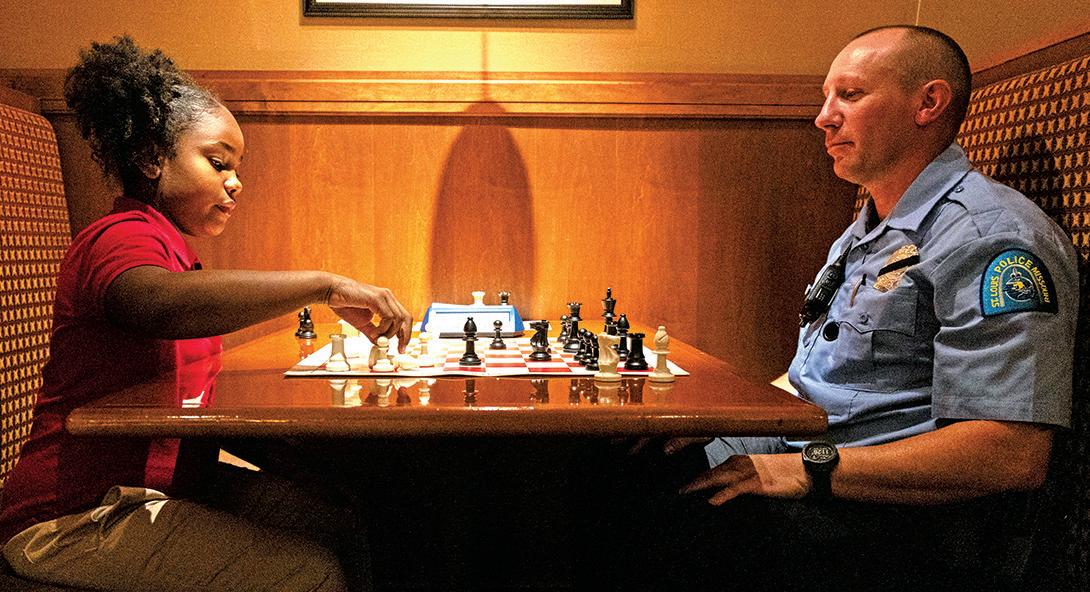
The field-level concourse at Busch Stadium usually echoes with the crack of a bat. Last Thursday, it was filled instead with the rhythmic clicking of chess pieces. The First Responders Chess Helping Enhance Student Skills (CHESS) program brought local students, police officers and firefighters together in the Cardinals’ dugout, using competition to build connections.
“It’s a unique experience for the kids,” said Rex Sinquefield, president of the Saint Louis Chess Club. “They get to roam the ballpark, but they also love meeting the first responders. They’re in the news so much; it’s nice to interact in See Chess, A12
“Our community is once again being asked to accept the unacceptable. A 17-year-old is dead, and the officer responsible has chosen silence,” said Kayla Reed, executive director, Action St. Louis, an activist organization formed following the 2014 killing of Mike Brown, Jr. “That is not justice. That is obstruction. Our families deserve answers, transparency and a system that values Black
See Shooting, A13
SLPS turns to Dr.
Immediately gains support of Teachers Union
By Alvin A. Reid St. Louis American
Facing a budget shortfall, declining enrollment and leadership turnover, St. Louis Public Schools has named Dr. Myra Berry as its latest superintendent after months in an interim role.
The Board of Education voted unanimously in a closed session last week to appoint Berry, a longtime district educator who has led the system since October following the abrupt firing of Superintendent Millicent Borishade.
Ray Cummings, AFT St. Louis Local 420 president, said in a release on Tuesday the union “offers enthusiastic support,” for the Berry hire, establishing a relationship that will be critical to SLPS future success.
“We have worked with Berry and I look forward to continuing the relationship.
Berry becomes the district’s third superintendent in less than two years, a period marked by instability at the top and mounting challenges across the system. Her appointment comes as the district
See Berry, A12
Photo by Lawrence Bryant / St. Louis American
Photo by Lawrence Bryant / St. Louis American
Malia Gerdine makes her move across the board as Benjamin Bayless looks on during a chess match at the First Responders
at Busch Stadium on April 9, 2026.
Kayla Reed
Guest Commentary America at its worst
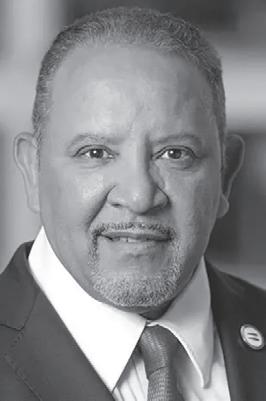
By Marc Morial
“All persons born or naturalized in the United States, and subject to the jurisdiction thereof, are citizens of the United States and of the State wherein they reside. No State shall make or enforce any law which shall abridge the privileges or immunities of citizens of the United States; nor shall any State deprive any person of life, liberty, or property, without due process of law; nor deny to any person within its jurisdiction the equal protection of the laws.” — the 14th Amendment
They hoped we weren’t paying attention.
While the country was watching fighter jets and debating troop deployments, while the administration’s shockand-awe news cycle churned through one manufactured crisis after another, a quieter and far more dangerous move was playing out in plain sight.
On the first day of his second term, President Donald Trump signed an executive order attempting to end birthright citizenship in the United States. Not through Congress. Not through the constitutional amendment process the framers required. Through the stroke of a pen.
was written to protect Black people and then argues that its protections should be narrower than the text plainly states.
This is not a legal argument. It is a political ideology rooted in white supremacy, seeking to redefine who counts as American.
The assault on birthright citizenship is anti-Black not only in its history but in its logic. When you establish the principle that citizenship can be conditioned on the legal status of your parents, you create the infrastructure for a permanent underclass. You open the door to generations of people born in America, raised in America, who are American in every lived sense, but who can be told they do not belong.
If Trump’s order were allowed to stand, an estimated 2.7 million additional people would be unauthorized by 2045, and 5.4 million more by 2075. These are not abstractions. These are children. And disproportionately, they are children of color.
This is one of the most brazen assaults on American democracy this administration has attempted. And it was designed to slip through the noise. It must not — and will not.
The 14th Amendment, ratified in 1868, includes a citizenship clause that confers citizenship on anyone “born in the United States, and subject to the jurisdiction thereof.” The amendment constitutionalized longstanding precedent rooted in English common law.
It was also a direct repudiation of the Dred Scott decision, which denied Black people the protections of U.S. citizenship. The amendment was the nation’s promise to itself that never again would the government decide that a person born on this soil was something less than American. That promise is now under attack.
Trump has argued that the amendment “was meant for the slaves, for the children of slaves.” Let that land for a moment. The administration’s own framing acknowledges the 14th Amendment
Advocates warn this risks creating a “permanent underclass” for some immigrant groups, reshaping the cultural and civic fabric of the country. Communities of color, already navigating the cumulative weight of structural inequality, would face an additional burden: proving their belonging in the only country they have ever known.
That is not America at its founding promise. That is America at its worst.
Every federal court that has considered a challenge to the executive order has struck it down. The Supreme Court heard oral arguments this week, and several justices appeared skeptical of the administration’s position. Chief Justice John Roberts noted that while times may change, the Constitution does not. A ruling is expected at the end of June or early July.
To the communities living under the shadow of this executive order, we see you. To the children whose citizenship should never have been in question, you are American, and we will defend that truth.
And to those in power who believe the noise of the moment will drown out accountability, it will not.
Marc Morial is president and CEO of the National Urban League.
Commentary
Tipped wages are a legacy of slavery
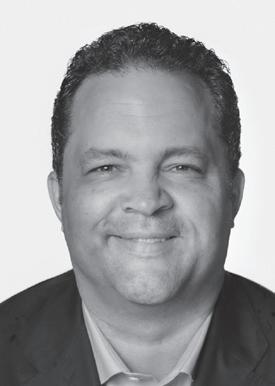
By Ben Jealous
The subminimum wage for tipped workers is a legacy of slavery.
After the Civil War, many employers in hospitality and rail service hired newly freed Black workers into jobs where tips often replaced wages. For too many workers, tips became the wage itself. That injustice still lives on today in the form of a lower minimum wage for tipped workers. We should call that system what it is: an old injustice that never ended. Today, it does not just hurt Black workers. It hurts tipped workers of every race. It leaves millions with unstable incomes. Too many workers finish a shift without knowing whether they earned enough to cover rent, groceries or child care. It also leaves workers more vulnerable to harassment. When your livelihood depends on pleasing the customer in front of you — even when that customer is drunk, crude or predatory — the power imbalance is obvious. No worker should have to put up with humiliation to earn enough to live.
No decent society should accept that as normal.
Because this fight is bigger than restaurants.
We are living through twin crises of affordability and democracy. The first shows up at the kitchen table: Rent is too high. Groceries are too high. Child care is too high. Too many families work hard and still cannot get ahead. The second shows up in the growing number of working people who no longer believe democracy can improve their lives.
Those crises are connected.
When government moves quickly to protect loopholes for powerful interests and slowly to raise wages for working people, faith in democracy erodes. People start to believe the system is rigged because, too often, it is. But when leaders stand up to lobbyists and fight for the people who do the work, democracy starts to feel real again.
That is why this matters. The issue here is dignity. It is whether a woman serving your dinner should have to tolerate harassment to make enough to buy groceries. It is whether a man working a late shift should have to wonder if a slow night in tips means his child goes without. It is whether labor will be respected in this country or merely used.
On Further Reflection
It’s not personal, it’s business
By Mike Jones
Black commentators and political leaders rarely use their platforms to address foreign policy issues. It’s as though what happens outside the borders of the United States doesn’t affect the approximately 50 million Black people who live here. Black leadership then assumes whatever white people in the United States say about the world, they’re speaking for us also — and we’re OK with that. That’s a subject for another column. This column is specifically about the war.
To provide some context, the United States will commemorate the 250th anniversary of the signing of the Declaration of Independence in July. That’s how old the United States is. Iran, on the other hand, is one of the world’s oldest continuous civilizations, with roots as a unified empire dating back to 625 B.C.
But the issue isn’t historical legitimacy. It’s how the events of the last seven weeks came to pass. The short answer, in two words: Donald Trump. The reason you’re paying $4 a gallon for gas — Donald Trump. The reason the Strait of Hormuz is closed and the world is facing an imminent energy crisis — Donald Trump. You get the idea.
In January 2025, there was an international agreement about Iran’s nuclear development signed by Iran, the United States, the European Union, Russia and China — everybody signed it. Everybody wasn’t happy, but everybody was cool.
estimated at 7%, approximately 24 million people. In the November 2024 general election, more than 155 million people — 64% of eligible voters — cast ballots, the second-highest turnout in more than 100 years. Here’s the profile of that turnout: 71% were white, 11% African American, 11% Hispanic and 3% Asian.
We know how many Americans there were in 2024, and we know the racial profile of the population. We also know how many people voted in the November 2024 presidential election, and we know the racial makeup of those voters. The question is who they voted for.
Here’s what that looked like: Black voters gave Harris 83% of their votes. Asian voters cast 57% of theirs for Harris, and Harris also got a majority of Hispanic voters — 52%. Donald Trump received 55% of the white vote, which made up 71% of the turnout, almost three times that of the other groups combined. That, along with the eccentricities of America’s Electoral College system, made Donald Trump the president.
At the beginning of February this year, the Strait of Hormuz was open and 100 cargo ships a day were passing through, hassle-free and without charge.
On Feb. 28, Trump chose to go to war with Iran. Now Iran controls the Strait of Hormuz and nobody’s going through it. I’m not being hyperbolic when I say every problem the United States is confronting right now is because Donald Trump is president of the United States. That proposition begs a question that deserves an answer: How does somebody like Donald Trump become president of the United States — not just once, but twice? That question also has a two-word answer: white America.
Donald Trump is president because in November 2024 the majority of white Americans voted for him. Said another way, but for white America, the people of the United States and the world would not be suffering the consequences of a Trump presidency. But I don’t want you to take my word for it. The numbers can speak for themselves.
The racial profile of America circa 2024: White Americans were the largest group, approximately 56% to 59%, with an estimated 190 million to 200 million people. Black Americans were approximately 12% to 14%, with an estimated population between 40 million and 49 million. Hispanics were 20%, with an estimated population between 65 million and 68 million. The Asian population was
What does it all mean? It means Donald Trump isn’t a mistake or an anomaly. He was the choice of a majority of white Americans. The first time they voted for him, they could have feigned ignorance. But Trump is nothing if not transparent, because he’s too shallow to be intellectual. So the second time, nobody gets to say they didn’t know. Like the fable about the snake, white America knew who he was when they picked him up. This is where foreign policy comes into play. Henry Kissinger said countries don’t have friends — they have interests. This means it’s serious — everything is about business, nothing is personal. In that arena, there’s one character flaw that’s never forgiven or excused — becoming unreliable. A blind man could have seen Trump was unreliable — it’s who he is. It’s the failure to manage and contain the mistake of the Trump presidency that creates the reliability problem. But Trump is the hired help. He’s to blame, but he’s not responsible.
The presidency of Donald Trump is the responsibility of those who retained him. It’s white America that has the reliability problem. It’s white America on the hook for unhinged behavior that has disrupted the normal order of business. Right now, in rooms all over the world, there are meetings about how affairs can be rearranged without the necessity of the United States.
America is the problem because it can no longer be depended on to handle the business of the world. So people make other arrangements. Here’s something I’ll make book on: When the Strait of Hormuz reopens, it will be Iran the world accommodates, not the United States.
Mike Jones is a political analyst, columnist and member of the St. Louis American Editorial Board.

Yet for decades, the corporate restaurant lobby has fought to preserve exactly that arrangement. Its argument is always the same: Pay workers fairly and the industry will suffer. But what it is really defending is a business model built on paying some workers less and making customers close the gap.
Chicago is right to reject that model.
Today, tipped workers in Chicago can still be paid $12.62 an hour before tips, while the full city minimum wage is $16.60. The city’s 2023 law was designed to close that gap over time, ending the tip credit by July 1, 2028. When the City Council moved last month to freeze that progress, Mayor Brandon Johnson vetoed the measure and fought to keep the phaseout in place. He deserves credit for that.
A tip should be what it was always supposed to be: extra. It should not be an employer’s excuse not to pay a real wage.
And the principle should not stop with tipped workers. In a country as rich as ours, the minimum wage should be a living wage, with no carveouts, no loopholes and no second-class categories of worker. Chicago has a chance to say something to the nation: Work has dignity, and every worker deserves a full wage.
Mayor Johnson is right to keep fighting. Now the city should finish the job.
Ben Jealous is a professor of practice at the University of Pennsylvania and former national president and CEO of the NAACP.
Columnist Mike Jones
Guest Columnist Ben Jealous
Columnist Marc Morial
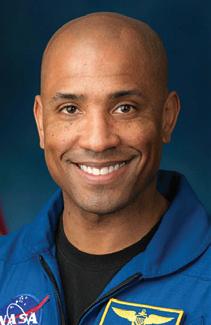
- Astronaut Victor Glover, Jr. after
Spencer finally joins push to halt state control of city police
By Alvin A. Reid
St.
Louis American
Last June, St. Louis residents
Jamala Rogers and Mike Milton
filed suit challenging Missouri’s effort to take control of the St. Louis Metropolitan Police Department through House Bill 495.
A similar suit was filed in April by Board of Aldermen
President Megan Green with the support of then-Mayor Tishaura Jones. Green followed with a separate lawsuit as the sole plaintiff in May.
Mayor Cara Spencer, who took office in April, chose not to sue — until last Thursday. Spencer announced at a City Hall news conference that her administration had filed a lawsuit seeking clarity on the city’s legal and financial obligations under the state law.
“Regrettably, we are at an impasse in terms of what the law requires the city to provide, so we must ask the courts to intervene and provide that necessary clarity,” Spencer said.
“While this was a difficult decision, this is an essential step to prevent a financial crisis and bring legal certainty back to our city’s governance.”
The dispute centers on a $333 million budget request from the state-controlled Board of Police Commissioners. City officials say the proposal could significantly affect the city’s finances and lead to reductions in the workforce.
Spencer’s lawsuit contends that the board improperly included restricted funds, reserves and Rams settlement funds in calculating the city’s required contri-
bution to the police budget.
Like the earlier legal challenges, the city’s filing argues that the state takeover law is unconstitutional. The lawsuit seeks to restore local control of the department and relieve the city of funding and legal obligations tied to the state oversight structure.
In a separate lawsuit filed by ArchCity Defenders, Rogers and Milton argue that the law violates the Missouri Constitution by imposing special legislation on a single jurisdiction and by creating an unfunded mandate on St. Louis taxpayers.
Green’s legal filings similarly challenge the state’s authority to impose control over the city’s police department. Her April lawsuit was filed with the backing of Jones, while her May filing was brought independently.
In a statement, Green called Spencer’s decision “a major step in joining the ongoing fight for local control.”
“From the beginning, challenging the state’s takeover of our police department wasn’t just about protecting local decision-making and residents’ rights, it was also about challenging an unfunded mandate that takes money away from crime prevention programs, infrastructure repair, and the many essential services residents rely on,” Green said.
Rogers criticized Spencer’s earlier decision not to take legal action.
“Now, here we are facing an illegal and unethical budget that has been presented. Now, she wants to fight,” Rogers said.
“What she showed the voters of St. Louis and Missouri
[was] that she was not willing to fight the hostile takeover by the state.”
State officials have defended the law as necessary to address public safety concerns and improve oversight of the police department.
ArchCity Defenders called the city’s lawsuit “a much-needed and long-overdue action by




the mayor and the City Law Department,” adding, “They are right to listen to the people of St. Louis and stand up against this illegal and destructive legislation.”
At the same time, the group criticized the delay, saying, “But we should also understand that we got here by the same mayor and law department neglecting
to take up this fight for nearly a year. And that failure has been at the expense of the citizens of St. Louis.”
Spencer’s lawsuit names members of the St. Louis Board of Police Commissioners — Brad Arteaga, Don Brown, Sonya Jenkins-Gray, Edward McVey and Chris Saracino — as defendants.


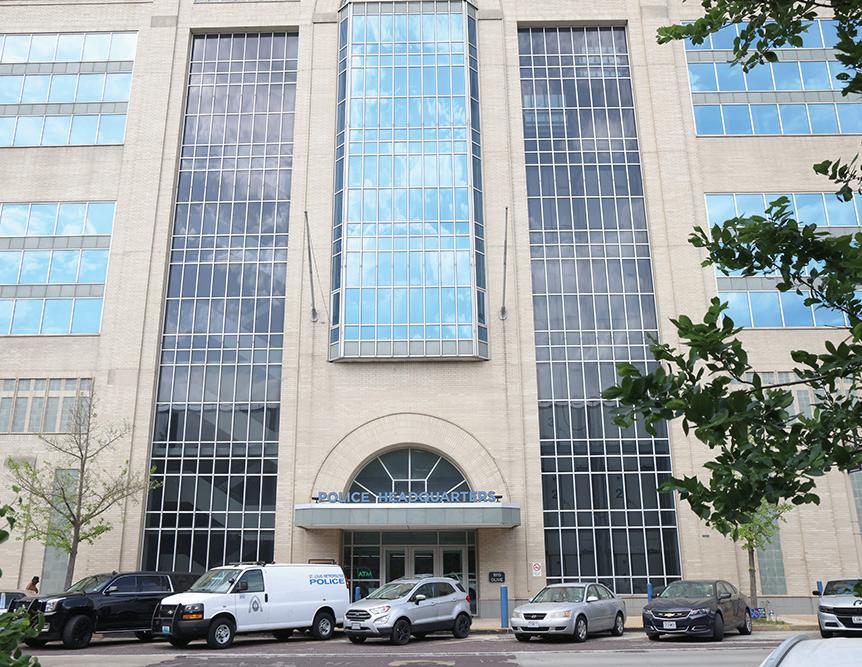
Photo by Lawrence Bryant | St. Louis American
The St. Louis Metropolitan Police Department headquarters stands in downtown St. Louis, serving as the central hub for city law enforcement operations.
Commentary
NAACP calls for probe of deaths at St. Louis jail
The St. Louis NAACP is calling on Circuit Attorney Gabe Gore to investigate a series of deaths at the St. Louis City Justice Center, citing concerns about possible medical neglect, according to reporting by St. Louis Public Radio.
At least 22 people have died in custody since 2020, with many cases tied to medical emergencies. Advocates say detainees’ medical records are often not shared with hospitals, potentially delaying care.
The circuit attorney’s office confirmed it has received the request and will review wheth-
Senate panel scraps new college funding plan
A Missouri Senate committee has proposed keeping funding for colleges and universities at last year’s levels, scrapping a House plan that tied dollars to enrollment.
The move avoids major gains for some schools and steep cuts for others, including Harris-Stowe State University. The budget still requires approval from both chambers.
State Sen. Brian Williams said stable investment remains critical as lawmakers weigh competing priorities.
South St. Louis wards to host Democratic candidate forum
Democratic Ward Organizations representing South St. Louis will host a joint candidate forum April 30 at a.casa, 3723 South Kingshighway Blvd.
The event will bring together candidates from federal, state and local races ahead of the August primary, giving voters a chance to compare positions on key issues.
er the information supports opening a formal investigation.
Officials also said no warrant applications related to the deaths have been submitted by police.
Recent cases include multiple in-custody deaths last year and another in January. Public records show several deaths were linked to health conditions, while others were ruled suicides or overdoses.
The jail has faced ongoing criticism over conditions, including extended lockdowns and concerns about medical care and oversight.
Voting opens for American’s Reader’s Choice Awards
Voting begins Thursday, April 16 for the inaugural St. Louis American Reader’s Choice Awards, where readers get to show support for their preferred local places for products and services.
The ballot includes businesses, organizations and individuals across a range of categories, with Lifestyle and Beauty, Churches and nonprofits drawing the most nominations.
Schnucks employee wins car in United Way drawing
A St. Louis grocery worker has won a new 2026 Ford Maverick through the United Way of Greater St. Louis’ annual Watch.Enter.Win! campaign. The winner was identified as Meghan J., a Schnucks employee. The vehicle, donated by Auffenberg Dealer Group, is part of a longtime effort to encourage workplace giving.
Organizers say the promotion helps boost participation and raise awareness of United Way programs across the region.
By Janice Ellis
Defining the Republican Party
A political party is defined by the governing philosophy, values, policies and actions of its leaders and members.
How would you define the Missouri Republican Party? The national Republican Party?
One could argue that the behavior we are witnessing on the national stage is an extreme manifestation — not who the Republican Party really is. Or one could conclude that how President Donald Trump operates, and how the Republican-controlled Congress and state governments capitulate and abdicate their constitutional responsibilities, reflects what the Republican Party has become.
The behavior of Republican lawmakers in Jefferson City and in Washington is similar in many ways, differing more in degree than in kind.
Consider the tendency to promote the welfare of the wealthiest at the expense of the working class and the poor.
Republicans in the U.S. Congress passed the “Big Beautiful Bill,” with massive tax cuts that deliver major benefits to the wealthy while cutting funding, eliminating programs or placing constraints on programs — Medicaid, education, Social Security and affordable health care — that benefit the working class, the poor and seniors.
to overhaul higher education by allocating more funding to community colleges and four-year institutions to meet the needs of more students. Will it survive and be passed into law?
State lawmakers, once again, have failed to fully fund public schools in accordance with the state foundation formula, and basic transportation needs for school districts remain underfunded.
But it doesn’t stop there.
At the national level, where do the needs of America’s children fall on the list of legislative priorities?
What’s in the “Big Beautiful Bill” for them?
We see the negative impact on low-income children in changes to Medicaid benefits and funding, reduced access to affordable health care services, and cuts to educational programs and resources at every level.
In Missouri, as the state’s record surplus has been depleted, Republican lawmakers are pushing a constitutional amendment that would phase out the state income tax. If they succeed, who would benefit most? The wealthiest Missourians.
If they increase the sales tax on goods and services to make up for the loss in revenue, who will bear the heaviest burden? The working class and the poor.
At the federal and state levels, who is the GOP working for — and what determines its policy priorities?
Another part of the “Big Beautiful Bill” is the elimination of the Department of Education and many programs that benefit K-12 and higher education. Most recently, a program that would have provided relief in how student loans are repaid is being eliminated. Who is most likely to have student loans to get through college or advanced training? Children of working-class and poor families.
In Missouri, lawmakers are considering a bill
The same question can be asked of Missouri lawmakers.
So far this legislative session, lawmakers have failed to restore millions of dollars in cuts to programs that provide child care for low-income and foster children. Failure to fund these programs has a ripple effect on how participating child care providers are able — or unable — to operate.
More importantly, the most vulnerable and at-risk children are denied access to needed care and developmental programs that would improve their well-being and readiness for school. Working parents are denied the support they need to keep their jobs while trying to improve their quality of life.
The presidency, U.S. Senate, House of Representatives and a majority of state governorships and legislatures are currently controlled by the Republican Party.
But who is the Republican Party?
Is it a party of one?
At critical periods in this country’s history, the Republican Party was defined by the actions of its leaders. It was once known as the party of Abraham Lincoln and, more recently, the party of Ronald Reagan — because of the policies they advanced on behalf of the country.
Many Missourians and Americans before us have confronted defining moments that required them to look within and take a stand on what they wanted their state and country to be.
Irrespective of party affiliation, or none, now is our time to stand up.
Janice Ellis is a Missouri Independent political columnist.

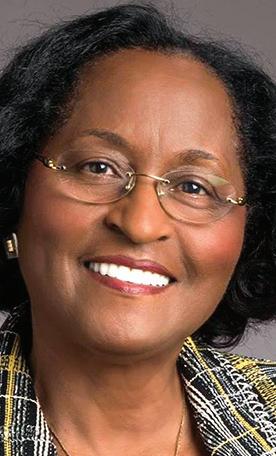
Janice Ellis
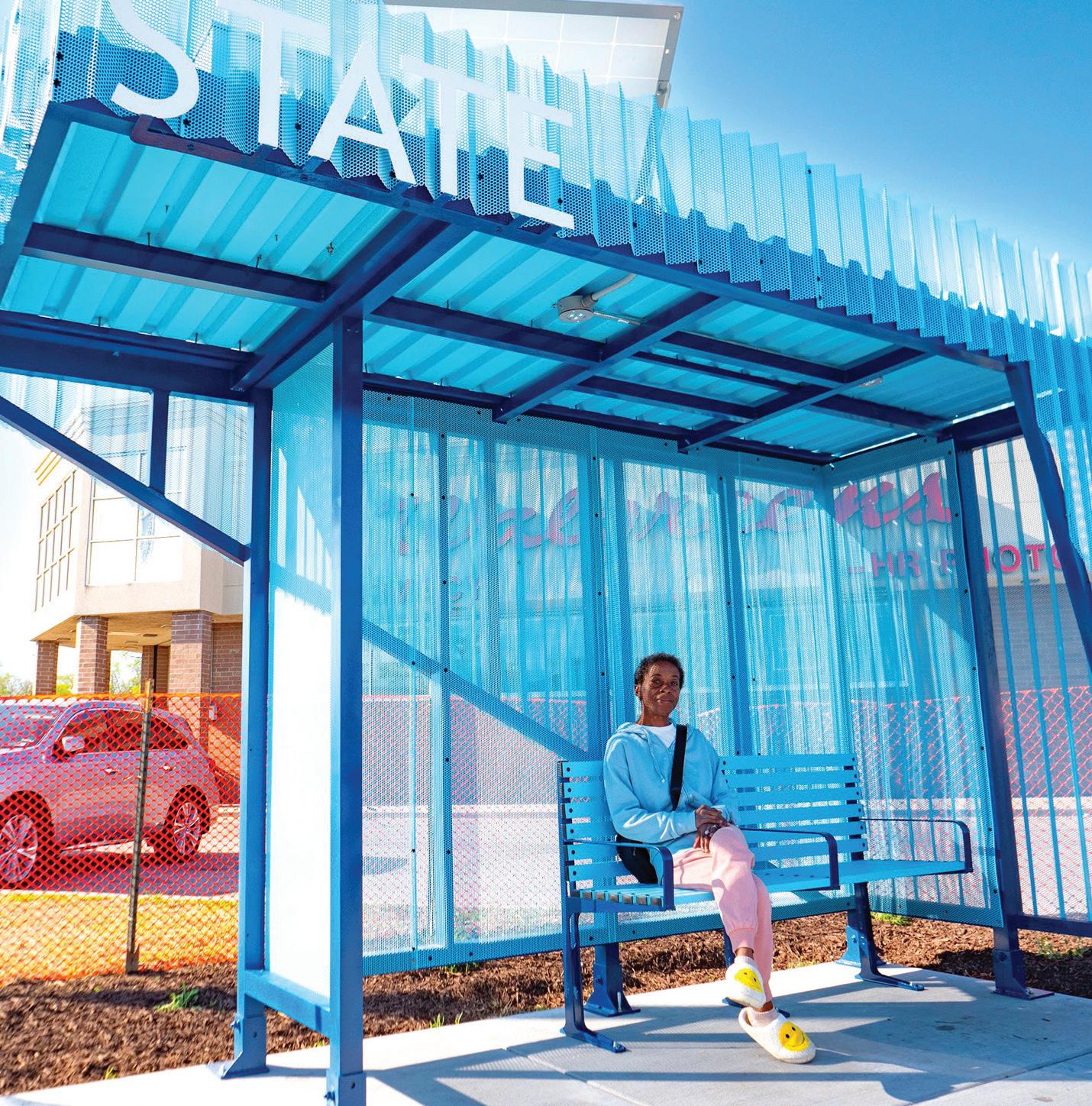
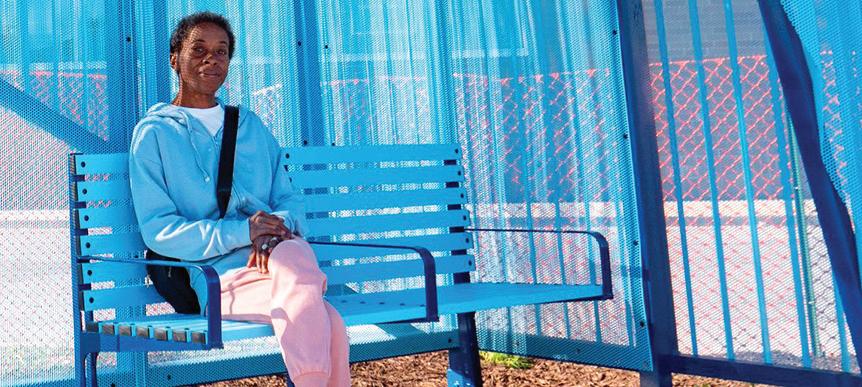
A patron awaits a MetroBus at the newly unveiled bus stop at 2510
formation of a dated bus stop includes a new bus
$90,000 upgrade
New bus stop links riders to jobs, retail in East St. Louis
By St. Louis American staff
A $90,000 transit improvement project aimed at strengthening access to jobs and retail destinations opened last week in East St. Louis, Illinois, following an 11-month planning and construction process. The upgraded MetroBus stop, at 2510 State St. near a Walgreens, serves as a key connection point linking nearly half of St. Clair County transit riders to employment centers, shopping areas and multiple Metro Transit Centers. The project was developed through a partnership involving Citizens for Modern Transit, the St. Clair County Transit District, AARP St. Louis and Metro Transit. Improvements include a new bus shelter, additional seating, lighting upgrades and green space.
The project is the fifth completed in St. Clair County under the Transit Stop Transformation Project, part of a broader regional effort that has invested more than $750,000 in transit-related upgrades.
Raising the roof
By Alvin A. Reid St. Louis American
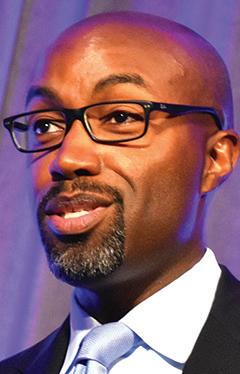
Helping current owners stay in their homes is key to increasing Black homeownership in the St. Louis region. Midwest BankCentre and the Rising Together Foundation have launched an affordable home repair initiative backed by an $865,000 grant from the James S. McDonnell Foundation. The program is designed to help homeowners pay for major repairs without relying on high-cost borrowing options.
“Some homeowners don’t have the equity required for traditional lines of credit,” said Orvin Kimbrough, chair and CEO of Midwest BankCentre. “In many cases, the loan amounts needed for repairs fall into an
ucts.” The program offers what

er-risk borrowing. Payday loans can carry annual percentage rates approaching 400%, while credit card rates often exceed 20%, increasing financial strain.
Yusef Jackson to head Rainbow PUSH
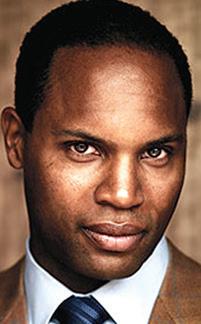
The Rainbow PUSH Coalition board of directors has named Yusef Jackson president and CEO of the organization. Jackson, the son of Jesse Jackson, who died Feb. 17, has served as chief operating officer since 2024. He led his first Saturday Forum at the group’s Chicago headquarters on April 11. “The challenges we face are enormous. There is a tremendous roll back of the rights we have. I don’t want this to be the end of the third reconstruction, and so we must fight,” Jackson said.
Adams joins Webster U. Board of Trustees
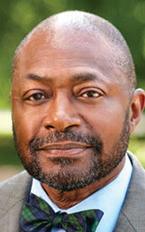
Kelvin Adams
Kelvin Adams, president and CEO of the St. Louis Community Foundation, has been appointed to the Webster University Board of Trustees. Adams previously served as superintendent of St. Louis Public Schools for 14 years, during which the district regained full accreditation from the Missouri State Board of Education.
He holds a bachelor’s degree in elementary and special education from Northeast Louisiana University, a master’s degree in elementary education from Xavier University and a doctorate in educational leadership and administration from the University of New Orleans.
Kirkwood senior wins $25,000 scholarship

Seron Stimage, a senior at Kirkwood High School, has received the fourth annual Sister Roch Rocklage Sisters of Mercy Meacham Park Legacy Scholarship. The $25,000 award is funded by Mercy in partnership with the Meacham Park Neighborhood Improvement Association, which also awarded $2,000 scholarships to Jaedyn Jones, Jasiah Jones and Zaelyn Jones.
Stimage plans to attend MidAmerica Nazarene University in Olathe, Kansas, on a partial football scholarship and study business.
Rabekah Stewart new VP of Stephens College
Rabekah D. Stewart has been named vice president for student success and engagement at Stephens College. She previously served as assistant vice president for student affairs at Missouri State University in Springfield, Missouri.
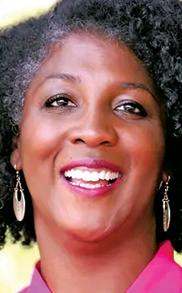
Rabekah Stewart
Stewart holds a doctorate in higher education leadership from Walden University in Minneapolis, a master’s degree in higher education administration and urban leadership from the University of Missouri-Kansas City and a bachelor’s degree in English and secondary education from Lincoln University of Missouri.
Yusef Jackson
Photo courtesy of Metro Transit
Envato photo
Seron Stimage
Jason Purnell
Ameren completes North St. Louis substation
Ameren Missouri has finished a $30 million substation in North St. Louis designed to improve electric reliability for about 8,000 customers and support rebuilding after the May 16 tornado. The project includes storm-hardening upgrades, underground lines and smart-grid technology that can detect outages and restore power more quickly.
Officials say the new facility will reduce strain on nearby substations while helping meet growing energy demand tied
to redevelopment efforts, including Delmar DivINe and Metro Transit’s DeBaliviere bus facility.
Nonstop St. Louis–London flights set to begin Sunday
British Airways will launch nonstop service between St. Louis and London Heathrow on Sunday, April 19, creating the region’s only direct link to the United Kingdom.
The airline plans four weekly flights during the summer season, with introductory fares starting at $599.
The service is expected to improve international
Business Briefs
travel options for Midwest passengers while also bringing overseas visitors directly into the St. Louis region for business and tourism.
Youth financial literacy competition planned on Delmar
The 100 Black Men of Metropolitan St. Louis will host its Dollars & Sense Youth Investment Competition at 1 p.m.
Saturday, April 18 at 4631 Delmar Blvd.
Local high school students will present financial plans after completing a program on budgeting, saving and investing.
Winners will advance


to the group’s national convention in New York this summer. The event follows a recent academic competition that also sent students to nationals.
Get more information at 314-498-2128 or 100blackmenstl.com.
Harris-Stowe to host entrepreneurship Demo Day
Harris-Stowe State University’s business school will host its “Nxt Lvl” Demo Day on April 20 at 3203 Olive Street, highlighting graduates of its entrepreneurship accelerator.
Fifteen participants are expected to pitch business ideas developed over several weeks of training to judges and a public audience. The event will feature ventures across multiple industries and marks the conclusion of
Home Repair
Continued from A5
Access to traditional credit can also be limited.
Homes in majority-Black neighborhoods are valued about 23% lower than comparable homes in non-Black neighborhoods, according to the Brookings Institution, which can reduce access to equity-based lending.
“Even homeowners with steady incomes and long histories of paying their bills can struggle to qualify for traditional lending products,” said Jason Purnell, president and CEO of the foundation.
“With many families facing increasing repair needs across the region, we saw an opportunity to support a more sustainable solution.”
Housing advocates
the program. The showcase is free and open to the public, with organizers inviting community members to attend.
African Diaspora Council plans wealth summit, gala in St. Louis
The African Diaspora Council Inc. will host a daylong wealth summit and evening gala May 30 at the African Diaspora Federal Credit Union in St. Louis.
The daytime program will focus on financial literacy and wealth-building through panels and workshops, followed by a ticketed gala highlighting culture and community achievement.
Organizers say the event aligns with World Africa Day and aims to connect attendees with
say delayed repairs can affect more than individual households.
“Delayed repairs at multiple households in a neighborhood can contribute to declining property conditions, loss of household wealth and increased housing instability,” said Gigi MacMullan, the foundation’s director.
Program details
The Affordable Home Repair Program offers loans of up to $20,000, with terms of up to five years. It is aimed at homeowners who may lack sufficient equity, comparable property values or strong credit histories — factors that often limit access to conventional financing despite stable income.
Eligible households include those earning below 80% of the area
resources and strategies tied to long-term economic stability.
10,000 letters urge Gov. Kehoe to veto hemp ban
Missouri hemp advocates delivered 10,000 handwritten letters to Gov. Mike Kehoe urging a veto of legislation that would ban intoxicating hemp products statewide.
Opponents say the proposal could shutter businesses and disrupt farmers, especially as federal policy remains unsettled. The measure would restrict sales to licensed marijuana dispensaries and remove many products from shelves by November.
Supporters argue the bill is needed to curb unregulated sales and limit youth access to high-THC items.
median income or living in low- to moderate-income census tracts.
The program also includes support services such as financial coaching, contractor referrals and homeowner education. Midwest BankCentre will originate and service the loans.
Organizers say the model is intended to be repayable and scalable, allowing funds to be reused over time rather than relying solely on onetime subsidies. Similar efforts elsewhere have shown potential neighborhood-level impact. In Philadelphia, a city home repair initiative was associated with lower crime rates on blocks where homes were repaired, according to research from the University of Pennsylvania.

HealthMattersHealthMattersHealthMatters
‘Taking Care of You’

A recent study found that a cohort of Black and Hispanic adults who followed a tailored Dietary Approaches to Stop Hypertension regimen saw a drop in blood pressure that was double that of those who used other methods.
When diet advice fits the culture
Study links tailored food programs to lower blood pressure among Blacks
By Jennifer Porter Gore Word in Black
There’s some evidence that healthy recipes tailored to cultural tastes, combined with a dietitian’s guidance, can help adults managing high blood pressure see significant improvements.
That’s the finding of a study presented Monday at the American College of Cardiology conference in New Orleans. It found that a cohort of Black and Hispanic adults who followed a tailored Dietary Approaches to Stop Hypertension regimen saw a drop in blood
pressure that was double that of those who used other methods.
The DASH diet program is centered on fruits and vegetables, nuts, whole grains and lean proteins, while limiting salt, sugar, saturated fats and processed foods.

“It’s not enough to just tell people to change their dietary behaviors,” said Dr. Oluwabunmi Ogungbe, an assistant professor at the Johns Hopkins School of Nursing and the Johns Hopkins Bloomberg School of Public Health in Baltimore and the study’s lead author.
“We asked, ‘What if we actually prescribe what they should eat, give it to them, coach them on how to prepare those
See Diet, A8
Forming a web of support
doulas reclaim the power of the village
By Constance Harper
We have all heard the phrase, “it takes a village,” a reminder that raising children and sustaining life has never been the responsibility of one person alone. For Black communities, this has never been a metaphor. It has been practice. It has been tradition. It has been survival. Long before care was medicalized, childbirth was held by a collective. Mothers, grandmothers, aunts, neighbors and midwives formed a web of support that surrounded birthing people with wisdom, protection and care.

Knowledge was shared across generations. Birth was understood not only as a clinical event but as a communal and spiritual experience. Care extended beyond delivery into the daily rhythms of life, where meals were prepared, children were tended to and rest was protected. Doulas have always been a part of this broader ecosystem of care. They are not an addition to the village. They are a continuation of it. Alongside family and community, doulas provide emotional, physical and informational
Doulas, A8
What to know about GLP-1 drugs
By Dr. Graham A. Colditz
As many of us know, keeping weight in check can be hard. National data reflect that reality. Rates of overweight and obesity in the U.S. have steadily climbed since the early 1980s. The impact on health and well-being is significant. Weight gain and obesity increase the risk of 13 cancers, diabetes, stroke, arthritis, mobility problems and many other serious conditions.

So, the recent rise of GLP-1 medications for weight loss has become a promising development.
Officially known as glucagon-like peptide-1 receptor agonists, GLP-1 drugs were first approved to treat type 2 diabetes — and later for weight management. The most commonly used GLP-1 drugs are semaglutide, sold as Ozempic or Wegovy, and tirzepatide (a dual GIP/GLP-1 receptor agonist), sold as Zepbound. They’re usually given as a once-a-week self-injection, but a semaglutide pill recently became available.
GLP-1 drugs were first approved to treat type 2 diabetes — and later for weight management.
“GLP-1 receptor agonists are based on hormones that are made naturally by the body when we eat,” said Dr. Cynthia Herrick, a professor in the Division of Endocrinology, Metabolism and Lipid Research at WashU Medicine. “They slow the movement of food through the gut and have a complex effect on signals of fullness in the brain.”
In response, people eat less — and lose weight. Those using the most common once-a-week GLP-1 drugs have been shown in studies to lose about 15% to 20% of their body weight.
In addition to weight loss, studies have found a range of health benefits, which can vary depending on the specific drug. Herrick said they can help treat type 2 diabetes, prevent future heart attacks and strokes in people who See Colditz, A8

Envato photo
Photo courtesy of the Black Doula Directory
Black doulas are not just service providers; they are part of a broader infrastructure of care. Demand for their services is growing, and policymakers are taking notice.
Dr. Graham A. Colditz
Constance Harper
HealthMattersHealthMattersHealthMatters
Care of You’
Doulas
Continued from A7
support. They help navigate medical systems, offer comfort through prayer, song or affirmation and remain present well beyond birth. Their work reflects a truth our communities have always known: No one brings life into the world alone.
Global Black Doula Day, held last Saturday, was an opportunity not only to celebrate and honor this work but to name what has too often been overlooked. Black women have long created and sustained systems of care that have been essential to the health of families and communities. At the same time, those contributions have been routinely undervalued, under-resourced and, at times, erased within formal health systems.
Even within this reality, it is important to hold a
Diet
Continued from A7 foods in ways that reflect their culture and taste preferences, and then see whether they will be more likely to sustain the change going forward?’” Participants who followed the DASH program were compared with individuals who received an equal amount of fresh produce — but no guidance on how to prepare or eat it. Researchers found that those who got both the produce and the guidance saw the greatest benefit.
Appealing to the taste buds helps
Nearly half of all U.S. adults have hypertension, which contributes to heart disease, stroke and other cardiovascular conditions. Heart disease remains the leading cause of death in the U.S., and stroke is the fourth-leading cause.
Together, heart disease and stroke were linked to more than one in four deaths in the U.S. in 2023. Nearly 60% of Black adults have high blood pressure, a rate the American Heart Association says “is among the highest in the world.”
fuller truth. Black women are knowledge holders, innovators and caregivers whose practices have sustained life across generations. The challenge is not the absence of solutions within our communities. It is the failure of systems to recognize, invest in and follow our lead. That failure has real consequences. In Missouri, approximately 70 women die each year during pregnancy or within the first year postpartum, and 80% of those deaths are considered preventable, according to the state’s PregnancyAssociated Mortality Review. Black women are disproportionately impacted. These outcomes are not inevitable. They are the result of systems that too often fail to listen to, believe or adequately care for Black women. And yet, there are signs of progress. Missouri has taken an important step by expanding Medicaid coverage to include doula care, allowing mothers to
access up to 16 visits for nonclinical support. This is meaningful. It reflects a growing recognition that care extends beyond clinical interventions and that doulas play a vital role in improving outcomes. At the same time, this progress must be understood for what it is: an incremental step, not a final solution.
Expanding access without fully investing in the doulas themselves, through fair compensation, sustainable infrastructure and respect for their autonomy, risks folding this work into a system that was not designed with them in mind. If doulas are treated as another credentialed extension of the medical system, rather than as community-rooted prac-
In Missouri, approximately 70 women die each year during pregnancy or within the first year postpartum, and 80% of those deaths are considered preventable.
titioners, we risk losing the very essence of what makes their care effective. This is where a health justice lens matters. Health justice lives in the understanding that health is shaped not only in hospitals but in homes, neighborhoods and communities. It centers the leadership and lived experience of those most impacted and calls for investment in the conditions that make healthy lives possible, including stable housing, nutritious food, economic security, child care and transportation. Within this frame, Black doulas are not simply service providers. They are part of a broader infrastructure of care that must be resourced, protected
and sustained. Their work sits at the intersection of community knowledge, cultural continuity and improved health outcomes.
Integrating Black doulas into birthing plans is not a trend. It is a return to what has always worked, now supported by policy that is beginning to catch up to practice.
There is reason to be hopeful. The demand for Black doulas is growing. Policymakers are paying closer attention.
Communities are organizing to reclaim and rebuild the village. Missouri is moving in the right direction, even as more work remains.
The path forward is clear. We must continue to invest in community-based models of care. We must support and compensate Black doulas in ways that honor their expertise. We must strengthen the networks of mothers, families and neighbors who make up the village. And we must hold systems
accountable to the people they are meant to serve. Each of us has a role to play in building and sustaining that village. This can look like supporting local doula collectives, advocating for policies that protect and expand this workforce, checking in on new mothers in our own circles or contributing resources to organizations doing this work on the ground. Care is not an abstract idea. It is something we practice every day. Black women deserve to be seen, heard and believed. We deserve care that is compassionate, culturally grounded and rooted in dignity. And we deserve systems that recognize what our communities have always known: When the village is strong, families thrive.
Constance Harper is vice president of impact and innovation at the Deaconess Foundation.

Black adults are also more likely to have severe cases of the disease, and it can develop at younger ages than in other populations. Diet control is a well-recognized method for reducing heart disease risk, but many Americans with hypertension struggle to follow a heart-healthy, low-sodium diet. Recently, “food is medicine” strategies have gained popularity, but the best ways to implement them remain unclear.
“We already know there is efficacy; we’re not testing something completely new. But we’re trying to see how we can situate this within clinics and the community,” Ogungbe said. “Our study demonstrates that this is feasible; we can find ways to integrate this into the health system, and we can do it in a way that truly meets people where they are.”
Having guidance led to better results
Researchers conduct-
Colditz
Continued from A7 have had them, and lessen certain liver and kidney conditions.
“The newest once-weekly drug, tirzepatide, has also been approved to treat moderate to severe sleep apnea,” Herrick added.
As with any medication, there can be downsides. Serious side effects are rare but can include gallstones, an inflamed pancreas and problems with food moving through the digestive system. There is also some concern that GLP-1 drugs may increase
the risk of thyroid cancer, but so far studies have not shown this.
More common side effects include nausea, occasional vomiting, bloating, mild diarrhea and constipation. To help minimize these, people are started on low doses, which are then increased monthly, Herrick said. Since research on these drugs is still relatively new, it will take time before we have more complete information about their long-term safety and benefits.
In addition to diabetes, GLP-1 drugs are most commonly prescribed for weight loss for people with a body mass
ed a pilot trial with 80 Maryland adults who have hypertension, were about 55 years old on average and live in areas where it is difficult to buy fresh produce.
Sixty-two percent of participants were Black. Before the trial began, researchers worked with members of the target communities to design the program and create culturally relevant recipes that followed DASH guidelines.
Half of the participants were randomly assigned to the food intervention group,
index, or BMI, of 30 or higher, or a BMI of 27 or higher who also have a related condition, such as high blood pressure or unhealthy blood cholesterol. Someone who is 5 feet 6 inches tall and weighs 186 pounds would have a BMI of 30, for example.
Insurance coverage for GLP-1 drugs can vary. Most plans cover a GLP-1 drug to treat diabetes, but they are less commonly covered for weight loss or other approved conditions. Even with insurance, monthly costs on some plans can exceed $1,000 until people meet their deductibles.
which included a $30 bag of produce. The remaining participants received fresh produce and general nutrition information, but no additional guidance. Participants in the intervention group met with a dietitian every other week for one-onone sessions to discuss meal planning and strategies to support a heart-healthy diet. The sessions were adapted to participants’ individual needs, and when possible, participants were matched with a dietitian from their own cultural background. At the end of the
24-week trial, participants who received both counseling and fresh produce saw double the reduction in their systolic blood pressure — the top number in a blood pressure reading — compared with other participants.
The improvement was even greater for those who incorporated the DASH diet into their routine. Researchers said the results suggest improvements comparable to some blood pressure-lowering medications, though they cautioned that a larger
Some options, though, can help. “There are now direct-to-consumer programs from the pharmaceutical companies that can lower the cost to $150 to $450 per month, depending on the medication and dose,” Herrick said. Since people on GLP-1 therapy will likely take it long term, affordable access is especially important. “I tell people to think of these the way we think of blood pressure and cholesterol medicines,” Herrick said. “These work to reduce heart disease risk, but only when taking the medications. When people stop them, weight can increase.”
Maintaining physical activity and healthy eating remains important while taking GLP-1 drugs and is a key recommendation from many organizations. It can boost the benefits of medication, improve quality of life and help maintain weight loss.
“I’ve had patients note that they no longer have a taste for sugar-sweetened beverages or alcohol after starting these medications. They find it easier to limit processed food intake and to control portions,” she said. “And as people begin to lose weight, they often find regular physical activity
Diet control is a well-recognized method for reducing heart disease risk, but many Americans with hypertension struggle to follow a hearthealthy, low-sodium diet.
study is needed to confirm the findings.
“This information is really actionable for clinicians, because they can tell patients, your blood pressure is more likely to be lowered if you have the right support in place—the ability to access and afford healthy foods, the confidence to cook with them, culturally aligned guidance from someone who understands your background, and consistent encouragement along the way,” Ogungbe said.
easier to do.” Interest in GLP-1 drugs is growing. A recent KFF survey found that as many as 12% of people in the U.S. already take one, and that number is likely to increase. While we still have much to learn about their longterm risks and benefits, early evidence shows real potential to improve health and well-being.
Dr. Graham A. Colditz, an internationally recognized leader in cancer prevention, leads prevention research at Siteman Cancer Center at Barnes-Jewish Hospital and WashU Medicine in St. Louis.
Envato photo

Usher and Chris Brown announce joint tour
R&B titans Usher and Chris Brown sent fans into a frenzy Friday after announcing they’re joining forces for a massive joint tour. The move instantly became one of the most talkedabout reveals of the year.
The news dropped through a synchronized social media blast featuring a cinematic teaser. The two superstars were seen riding motorcycles through city streets before stepping into an elevator.
“ITS TIME,” Brown, 36, and Usher, 47, captioned the Reel, revealing news of the R&B Tour, nodding to both of the artists’ last names.
The R&B tour will touch down in St. Louis on July 21, 2026 at the Dome at Americas’s Center.
Cardi B seeks sanctions, claims Tasha K Keeps violating the gag on her circle
Cardi B is asking a judge to hit blogger Tasha K with sanctions — claiming the YouTuber keeps violating a nondisclosure agreement by speaking on her, Offset Diggs despite a courtordered gag.
According to court filings obtained by TMZ, Cardi says Tasha has been on a “relentless” campaign to tar get and provoke her through thinly veiled posts — knowing her mil lionplus followers will immediately connect the dots. Cardi’s legal team, led by attorney Lisa Moore time they flag an offending post, Tasha deletes it… only to pop back up with anoth er one. Cardi told the court she’s done with the “cat and mouse” routine.
The lien gives the government the right to claim Mayweather’s assets until the debt is settled — marking yet another financial headache for the 49-year old, who recently announced he was coming out of retirement. It also adds to a growing list of money troubles Mayweather has been hit with in recent years, as previously reported by Business Insider
Afrika Bambaataa dies at 68 after prostate cancer battle
Afrika Bambaataa — the hiphop pioneer whose influence helped shape the culture’s earliest blueprint — has died at 68 after a battle with prostate cancer.
Born Kevin Donovan in the South Bronx in 1957, Bambaataa passed away on April 9 in Pennsylvania, where he had been receiving treatment for complications related to the disease.
Bambaataa was long regarded as one of the architects of hiphop’s foundation. His work as a DJ in the 1970s and his creation of the Universal Zulu Nation helped define the culture’s early sound, style, and philosophy. His 1982 classic “Planet Rock” became a global anthem and cemented his status as a visionary who pushed the genre beyond block parties and into international consciousness.

Tasha still owes Cardi $4 million from their defamation case, and Cardi says the blogger has violated the bankruptcy agreement tied to that judgment by continuing to trashtalk her and her family. Court docs say Tasha has racked up at least 25 violations.
Floyd Mayweather Jr. hit with $7.3M tax lien from the IRS
Floyd “Money” Mayweather Jr. is back in the ring — but the IRS is trying to land the first punch.
According to Business Insider, the boxing legend is facing a $7.3 million federal tax lien tied to unpaid taxes from 2018 and 2023. The lien was filed last month in Las Vegas, where Mayweather owns property, and the notice shows the balance was still outstanding as of March 26. His attorney declined to comment.
But in recent years, his legacy became deeply contested after multiple men came forward accusing Bambaataa of sexual abuse during their youth.
Bambaataa denied the allegations.
K. Michelle gets candid about her past with R. Kelly on ‘The Jason Lee Show’
K. Michelle, who was once menR. Kelly early in her career, didn’t shy away from the emotional truth of their dynamic during an inter“The Jason Lee Show.” “I loved Robert Kelly. I loved him,” she told Lee. “Rob didn’t hit me. I didn’t go through an abusive Rob. My truth with Robert Sylvester Kelly is that Robert saw me as nothing more than motivation for writing. I wasn’t the woman he wanted. Even though I wanted him.”
K. Michelle also addressed the crimes that ultimately put Kelly behind bars — saying the people around him helped enable the behavior that led to his downfall. “He was absolutely wrong in what he did, but nobody corrected him,” she said. “That’s not an excuse.”
Kelly is currently serving a 30year federal sentence after being convicted in 2021 on racketeering and sextrafficking charges tied to decades of abuse involving minors and young women.
Sources: BET.com, BusinessInsider.com, Instagram, Rolling Stone, TMZ.com

















Floyd Mayweather
The St. Louis American’s award winning NIE program provides newspapers and resources to more than 8,000 teachers and students each week throughout the school year, at no charge.
Questions or comments? Contact Cathy Sewell csewell@stlamerican.com or 618-910-9551

CLASSOOM SPOTLIGHT

Students
Students

Savannah
Photo by Ms. Stovall
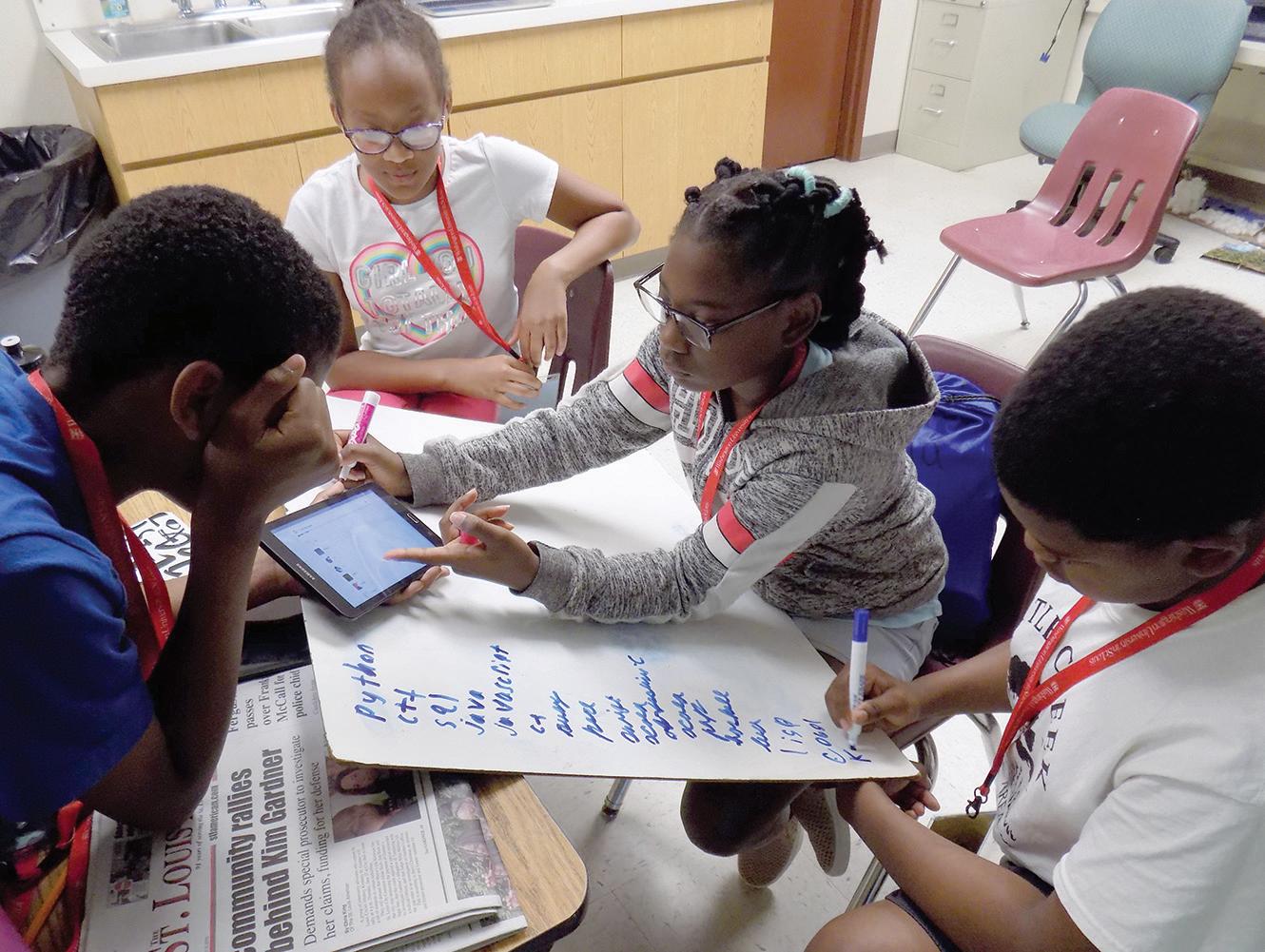
Students at The American’s Summer Science Academy work in teams to discover the many different computer programming languages.
csewell@stlamerican. com
SCIENCE CORNER



SCIENCE STARS

SCIENCE STARS
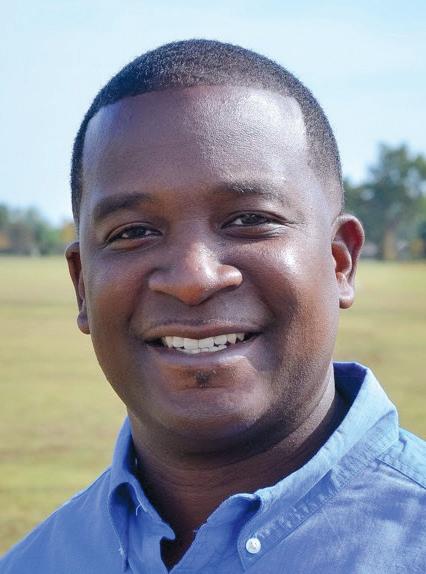
African American Meterologist William “Bill” Parker
AFRICAN-AMERICAN MYCOLOGIST AND EDUCATOR: Jeanette Jones
Sofia Ongele: Engineer and Technology Advocate
SCIENCE CORNER
A hurricane forms over tropical and subtropical ocean water. Warm water and cool, moist air combine to create strong winds that can gust up to 200 miles per hour! These winds create waves that bring the storm on shore. Hurricanes are very destructive. They can flip cars, sink boats, uproot trees, and demolish houses.
SCIENCE CORNER
Civil engineering includes the design and construction of buildings, roads, bridges and dams. It is one of the oldest forms of engineering and involves further specialty areas such as transportation, water resources, surveying and construction. Civil engineers may work in offices or at construction sites.

In addition to powerful winds, hurricanes bring a lot of rain. (Taiwan received 114 inches of rain in three days during a hurricane.) These rains can cause landslides and flash floods.
Civil engineers must be creative, analytical, inquisitive, and detail oriented. They must be able to work well as part of a team and communicate well in speaking and writing. Important classes include algebra, geometry, physics, and chemistry. A
SCIENCE INVESTIGATION

Fungi are organisms made of filaments (called hyphe) that are stacked together. Unlike plants, fungi do not have chlorophyll, so they cannot make their own food. Some fungi are parasites, which mean they live off of other organisms. Some fungi feed off of dead and decaying matter. Fungi are everywhere in the environment, including the soil, lakes, river and seas, air, and on plants and animals. Fungi (plural of fungus) help organic matter to decay and release carbon and oxygen into the environment. Unlike plants, fungi do not have
In this experiment, you’ll create a replica of a hurricane and identify how the forces work together to create a hurricane.
Are Fungi ?
Hurricanes can last a few hours or several days. Most hurricanes occur during the fall months. How can you stay safe? Have an evacuation plan and an emergency kit prepared. Meteorologists can track these storms and keep you informed. For more hurricane facts, visit: http://www.sciencekids.co.nz/ sciencefacts/weather/hurricane.html.
leaves, stems, or roots. Fungi use spores to reproduce. One common type of fungus is the mushrooms you find on your pizza. Mold, yeasts, and mildew are also types of fungus.
bachelor’s degree is required to begin a career in civil engineering. The middle 50 percent of civil engineers earn between $41,800 and $74,550. To Learn More About Civil Engineering, Visit: https://www.youtube.com/ watch?v=cJaRjI7K-Lw
Learning Standards: I can read nonfiction text for main idea and supporting details.
For More Information, Go to: https://kids.kiddle.co/Fungus
Learning Standards: I can read nonfiction text to gain background information about fungi.
Learning Standards: I can read nonfiction text to learn more about careers in math and science.
SCIENCE INVESTIGATION
SCIENCE INVESTIGATION
Materials Needed:
• 2 Soda Bottles • 3 Paper Clips
• 3 Peanuts • ¼ C. Sand • Funnel
Have you ever wondered how quicksand works? In this experiment you will create quicksand.
• Water • Duct Tape
In this experiment, you will learn how mold grows best. Mold is an important fungus that has several uses, including breaking down dead organic material. Some purified molds are actually used as an antibiotic to treat illnesses.
Materials Needed:
Procedure:
Materials Needed:
1 Box of Cornstarch • Water • Large Bowl • Spoon
q Fill one bottle with the paperclips, peanuts and sand. These represent the debris and help make the movement of water easier to see.
create a watertight seal. Continue taping 1 to 2 inches above and below the seam.
Growing Mold!
t Hold the bottles by the middle and lift the jugs.
r Drop a plastic toy into the quicksand and then try to pull it back out. What happens?
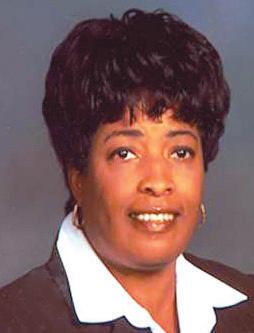
Jeanette Jones was born on September 19, 1950, in Fort Valley, Georgia. Jones graduated from Fort Valley State University in 1972 with a bachelor’s degree in biology education. In 1973, Jones received her master’s degree in botany and mycology (a branch of biology that studies fungi) from The Ohio State University. In 1976, she received her doctorate (Ph.D.) degree.
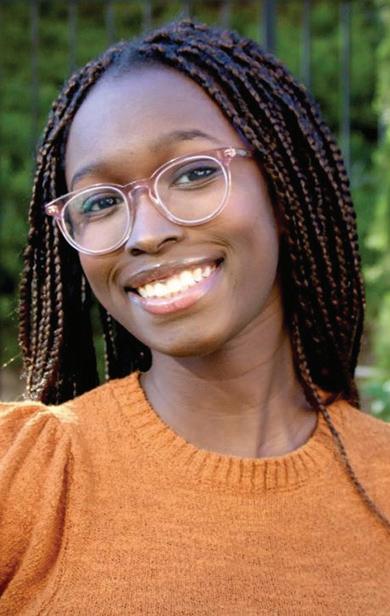
Sofia Ongele is a young engineer and computer scientist who uses technology to help people and make the world fairer. She grew up in California and was curious about computers and coding from a young age. Sofia first experimented with programs on her calculator and later attended Kode with Klossy, a special coding camp for girls, where she learned more about computer science and technology. This early experience inspired her to use technology to solve real-world problems.
William (Bill) Parker grew up in New Orleans. He graduated from JFK High School, which focused on math, science, and engineering. Parker was interested in hurricanes at a young age, but he became interested in the weather after a high school statistics class. In this class, he learned how to predict the chance of rain. Parker wanted to attend a historically black college/ university (HBCU), so he chose Jackson State University to study meteorology. He graduated with his bachelor’s degree, in 1994.
In school, Sofia studied computer science and information science and became skilled at building apps and digital tools. One of her biggest achievements is creating an app called ReDawn, which helps survivors of sexual violence safely log incidents and find support. She also worked with Gen-Z for Change, a youth-led nonprofit, designing digital tools to help people advocate for social justice and community safety. Sofia has spoken at TEDx events and other platforms, sharing her work and inspiring young people, especially girls and kids of color, to explore coding and engineering.
Today, Sofia’s mission is to show that engineering and technology are for everyone who is curious and wants to make a difference.
She also studied at the University of Nevada, the University of California Medical School, the National Center for Disease Control-Atlanta, and the Massachusetts Institute of Technology. After graduation, Alabama A&M University hired Jones as an assistant biology professor. In 1986, she served as an adjunct professor in the College of Pharmacy and Pharmaceutical Services at Florida Agricultural and Mechanical University and worked on a project with NASA. In 1991, Jones served as the first female vice president of research and development at Alabama A&M University. She also served as President of Alabama A&M University’s Faculty Senate from 2001 to 2006. In 1992, she was appointed to the U.S. Army Science Board by the U.S. Secretary of the Army, Togo West. Since 2004 Jones has been the director of the Center for Biomedical, Behavioral, and Environment Research at Alabama A&M University. She also worked as a consultant with federal agencies to help them develop training programs to attract women and minorities to STEM education and careers.

y Quickly, turn the bottles over so that the water-filled bottle is on top. Set the bottles on the table again.
u Observe the water as it drains into the bottle below. The water competes with the air from the empty bottle. Both substances push to pass through the neck.
t For five days, measure the square centimeters of mold on each piece of bread through the bag. Use a grid, if possible, or a ruler. If mold covers more than half a square centimeter, it is counted as one full centimeter. If it is less, it is counted as 0 centimeters. This will give you the area of mold on each slice of bread

• 3 slices of bread • Water • 3 Ziploc bags • 10x10 square centimeter grid • Ruler Process:
• Gallon Size Zipper-lock Bag • Small Plastic Toy Process:
w Place the funnel in the mouth of the bottle and pour water into the bottle until it is 3/4 full, then remove the funnel.
q Wet one slice of bread enough to make it moist and place it in a bag. Seal the bag very tightly.
e Turn the second empty bottle upside down and hold it over the first bottle so that the mouths of the bottle are aligned. The bottles will look like an hourglass.
q Pour 1/4 cup of the box of cornstarch into the bowl, add 1/2 cup of water and stir. It might be easier to mix with your hands. Continue adding cornstarch and water until it is the consistency of honey. This will use the entire box of cornstarch and 1 to 2 cups of water.
w Place the two other slices of dry bread in two separate bags and seal them, as well.
r Tape the seam, pressing the duct tape firmly to
e Place the bag with the wet slice of bread and one of the bags with a dry slice of bread in a dark place, such as a closed cabinet or closet.
w Sink your hand into the bowl of quicksand and move your hand around slowly and then very quickly. What is the difference? Is it harder to move quickly?
e Sink your entire hand into the quicksand and try to pull it out. This is the sensation of sinking in quicksand.
r Place the third bag with a dry slice

z A hurricane has moved 456 miles in 6 hours. How many miles per hour is the hurricane traveling? ______ If it continues to travel at that speed, how far will it travel in 10 hours? ______
MATH CONNECTION
MATH CONNECTION
In 1993, he began to gain experience in the field when he worked as a student meteorologist. One year later, he was a meteorologist intern at Shreveport. In 1998, Parker became a general forecaster, and ten years later, a lead forecaster. In 2012, he became a warning coordination meteorologist (WCM). There are only 122 people with this title in the United States, and Parker was the only African American. Parker is currently the meteorologist-in-charge (MIC) at the National Weather Service, leading a team of 26 weather professionals. Parker is also very active as a volunteer in his community. He is a member of the Shreveport-Bossier Mayors’ Prayer Breakfast Executive Committee, La Cima Bilingual Leadership Academy, Bossier Chamber of Commerce Education Committee, Volunteers for Youth Justice, and a coach for Bossier Parks and Recreation. Parker is also an associate minister at Elizabeth Baptist Church in Benton, where he has been serving the congregation since 1997.
i Turn the bottles over again. This time, shake the bottles in a circular motion. Be sure to keep the bottles vertical.
y At the end of a week (5 days of measuring) or longer, use your final results to say what percentage of the bread was covered in mold. Make a table or graph to display the information.
o The water will form a vortex as it drains into the next bottle. The water will flow along the outside of the neck, while air moves quickly up through the center of the vortex. The water will drain much faster.
Analyze: How did water and air create a hurricane?
t At the end of the experiment, pour the quicksand into the zipper-lock bag for disposal. Do not put it down a drain. It will clog the drain. Reflect: The cornstarch and water mixture acts like a solid sometimes and a liquid at other times. This “quicksand” is an example of a suspension — a mixture of two substances, one of which is finely divided and dispersed in the other. In the case of the cornstarch quicksand, it’s a solid dispersed in a liquid. When you sink your hand into the cornstarch quicksand, you force the long starch molecules closer together. The impact of this force traps the water between the starch chains to form a semi-rigid structure. When the pressure is released, the cornstarch flows again.
Discussion Questions: How much mold was on the bread? Which location had the most mold? Which had the least? What conclusions can you draw about the conditions in which mold grows? How can food manufacturers and restaurant owners use this information to help them?
Learning Standards: I can follow sequential directions to complete an experiment. I can make observations and draw conclusions.
Learning Standards: I can follow sequential directions to complete an experiment.
Math Storms!
Learning Standards: I can follow directions to complete a procedure and analyze the results.
I can display my results, make observations, and draw conclusions.
Analyzing
X has grown to have wind speeds of 48 miles per hour. How much faster will the winds have to become for Tropical Storm X to become Hurricane X? ______
One mathematical concept that civil engineers use is slope. Slope is the change in height divided by the change in length. Use that formula to answer the following problems.
x Hurricane Frederick is traveling at 86 miles per hour. If the hurricane is 129 miles from the coast, how many hours will it take until the hurricane reaches the coast? ______
Example Question: A civil engineer surveyed a 360 feet section of country road. He placed one stake at the top of the hill, 18 feet higher than the other stake placed at the intersection at the bottom of the hill. What is the slope of the incline on this section of the road? __________
Problem of the Slope!
Scientists often use tables and graphs to display the results of their research. Looking at these displays, you can draw conclusions.
a Bar Graph
q Tony Hawk is building a new skate board ramp in his backyard. Beginning at the origin, the base of the ramp is 10 ft. long and it is 15 ft. high. What would be the slope of his ramp?
As we approach spring weather (and increased rain), create a bar graph that displays the amount of rain that falls for several consecutive days or weeks. (Day 1: 1.5 inches, Day 2: 0 inches, Day 3: 1.5 inches, etc.)
v Upon landfall of a Category 4 hurricane, local officials ordered an evacuation. City A has a population of 9,613, City B has a population of 5,013 and City C has a population of 3,972. How many people were evacuated in all?
c A tropical storm takes on a hurricane status when the winds reach 74 miles per hour. After three days, Tropical Storm
Example Answer: Slope is the change in height (18 feet) divided by the change in length (360 feet), which is .05. Therefore, the slope is .05.
DID YOU KNOW?

DID YOU KNOW?



Discussion Questions: Which day had the most measured rainfall? Which day(s) had the least? Looking at the bar graph, what might you conclude about rain patterns in March/April? What other observations can you make?
$115,264 in damage, City B reported $236,096 and City C reported $436,869 in damages. What was the total cost of damages rounded to the nearest thousand? ______ If the state and federal government promised $500,000 in aid, how much would the local people have to raise by themselves? ______
Learning Standards: I can use a bar graph to display information. I can use the information to make deductions and inferences.
w You’re celebrating the first snow of the season by sledding down your favorite hill. The hill is 18 feet tall and 7 feet wide, what is the slope of the hill?
b After citizens returned to their houses after the evacuation, reports of damage were totaled. City A reported
This special Newspaper In Education initiative is made possible, and delivered to classrooms through the St. Louis American Foundation and its NIE Corporate Partners:

Learning Standards: I can add, subtract, multiply, and divide to solve a problem.
Learning Standards: I can use a for mula to calculate slope.





In 1975, Jones was listed in the World’s Women’s Who’s Who and she was named an Outstanding Young Woman of America in 1978. Beta Beta Beta National Biological Honor Society awarded her the distinguished service award. Jones also received the Significant Service Award from the NASA Space Life Sciences Training Program and the Extramural Associate Research Development Award from the National Institute of Health. In 1990 and 2006, she was named Woman of the Year at Alabama A&M University and was given the Outstanding Leadership Award by the Faculty Senate. The U.S. Army presented Jones the Commander’s Award for Outstanding Civilian Service as a member of the Army Science Board.
She teaches coding workshops, mentors young students, and creates tools that address issues like safety, access to resources, and fairness in communities. Sofia believes that technology is not just about computers; it’s about using creativity, problem-solving, and compassion to help people and improve the world. Her story teaches us that being an engineer isn’t just about building machines or apps, it’s about building hope, fairness, and solutions for real problems. Sofia Ongele’s achievements show that curiosity, hard work, and caring about others can lead to inventions and projects that make life better for many people. She inspires kids to explore science, engineering, and technology while thinking about how their work can help the community.
ELA Questions
What is Sofia Ongele’s mission, and how does her app ReDawn help people?
Discussion Questions: Dr. Jones received many awards and honors. How would you describe her achievements and her contributions to science? Dr. Jones is studying how fungi might be used as agents of war. What purpose do you think fungi serve in modern warfare? Are fungi beneficial or harmful?
How does Sofia’s story show that technology and engineering can be used to make the world fairer and safer?
Learning Standards: an African American who has made contributions in science, math, technology, or engineering.

Parker believes in serving as a role model to the youth and to recruiting African Americans in the STEM field. Personally, he has hired three African-American meteorologists. In addition, he has recruited minorities for summer intern positions. Parker has also mentored an Airline High School student for his senior project. Parker’s advice to students interested in meteorology is to take as many math and science classes as possible. Learn about summer opportunities in your community. If you are interested in meteorology, visit National Weather Service offices and serve as a volunteer or intern, and find leaders in your community to serve as your personal role
Learning Standards:
Use the newspaper to complete these activities:
a person who has made contributions to the fields of science, technology,
Use the newspaper to complete the following activities: Types of News: Use the front section of the newspaper to evaluate the types of news stories presented: local, national, and international. Sort the articles into the three categories and create a bar graph that displays the amount of coverage each type of news story received.
MAP CORNER

Enjoy these activities that help you get to know your St. Louis American newspaper.

Activity One — Science and Technology: There are various social, economic, and environmental issues that can be overcome by the use of science and technology. Use the newspaper to locate an example of a problem that can be overcome by the use of science and/or technology. Explain the solution and how society created the need and development of science.



a picture of a building in the newspaper and tell what kind of jobs people who work in that building could have.



Activity Two — Shortages and Surpluses: Students will work in groups to find newspaper stories about shortages and surpluses of natural resources. After discussion, students will write down their thoughts about how such shortages and surpluses occur and how they affect the community.
Mystery Story: Cut out several pictures from the newspaper without reading the caption. Place the pictures in a bag, and without looking, pick your mystery picture from the bag. That’s your stimulus for writing. Construct a graphic organizer to identify the 5Ws (who, what, when, where, and why) of your story by looking at your picture. Then, continue the writing process.
Learning Standards: I can use the newspaper to locate information. I can categorize and summarize that information.
Learning Standards: I can st ate a claim and support it with evidence. I can use the newspaper to locate information.
Problem and Solution: Over a period of weeks, clip articles from newspapers that deal with problems and issues facing your local or county government. Discuss the reasons for these problems and how the government hopes to solve them. Learning Standards: I can use the newspaper to locate information. I can discuss problems and solutions. I can identify types of jobs. I can make text-to-world connections.




MAP CORNER
grows on fruit
Aariyah Thompson and
Fisher, in Ms. Stovall’s firstgrade class at Gateway MST Elementary School, are learning how to construct a series circuit.
faces difficult decisions about its financial future and school footprint. The district also faces increased external scrutiny, including an upcoming Missouri state auditor’s review of its operations.
Berry said her priorities include improving literacy and attendance while stabilizing the district’s finances, with a goal of reaching a balanced budget in the coming years.
She also said the district may consider “consolidation and restructuring” as it addresses declining enrollment and potential school closures, issues compounded by school disruptions and displacement following the May 2025 tornado.
“We have already begun the important work of rebuilding trust, strengthening our community and reestablishing partnerships,” Berry said.
Berry, who has worked in the district for more than two decades, began her career as a special education teacher and later served as a principal, instructional coach and administrator. Before being named interim
Chess
Continued from A1
such a positive, friendly way.”
Founded in 2017 by the Saint Louis Chess Club, the program is part of a broader effort to bring chess into schools through structured partnerships and classroom-based instruction. The club has worked with educators and researchers to study how chess can support student development, including academic and behavioral
superintendent, she was interim chief of human resources.
Board President Dr. Karen Collins-Adams said Berry’s familiarity with the district and her performance in the interim role were key factors in the decision.
“She understands this district, and she has delivered results during one of the most complex periods in recent history,” Collins-Adams said. Cummings agreed that Berry’s longstanding with the district is vital to its success and improvement.
“She is a known member of the SLPS family,” said Cummings. He called her hiring “an excellent decision.”
Berry’s elevation follows a turbulent period that has drawn scrutiny and concern from educators, families and community leaders.
Borishade’s dismissal in October capped a contentious tenure marked by union opposition, controversy over proposed school closures and broader concerns about the district’s direction.
A no-confidence vote by more than 2,000 teachers and staff underscored tensions between district leadership and educators.
Borishade has since
outcomes.
Sinquefield said the initiative also encourages school engagement, citing surveys conducted by the club that show increased attendance on days when chess is offered. The program’s growth reflects a broader trend: chess is having a moment among young people. Once seen as niche, the game is gaining traction in classrooms and afterschool programs, where its mix of strategy and competition is drawing in a new generation of players. Research has suggested
filed a lawsuit in St. Louis Circuit Court alleging she was wrongfully terminated, claiming she was fired without cause and in retaliation for raising concerns about misconduct within the district. District officials have said a leadership change was necessary and that the matter will be resolved through the courts.
Her firing followed the earlier removal of Superintendent Keisha Scarlett in 2023. Board members cited violations of hiring protocols, including offering high salaries without approval. Scarlett has denied wrongdoing.
The rapid turnover has raised concerns about stability and transparency in district leadership, with calls for more openness in board decision-making and a steadier path forward.
Berry’s appointment reflects a shift toward internal leadership rather than a national search, a move some board members had supported as a way to provide continuity during a difficult period.
Berry’s contract as superintendent is set to begin July 1.
St. Louis Public Radio contributed to this report.
academic and cognitive benefits tied to chess instruction. A study by educational psychologist Dr. Stuart Margulies found that students in a New York City chess program improved reading scores more than a control group, with gains that were statistically significant. More broadly, educators say chess can help students develop critical thinking, decisionmaking and problem-solving skills, while some studies have linked participation to gains in academic performance and confidence, though

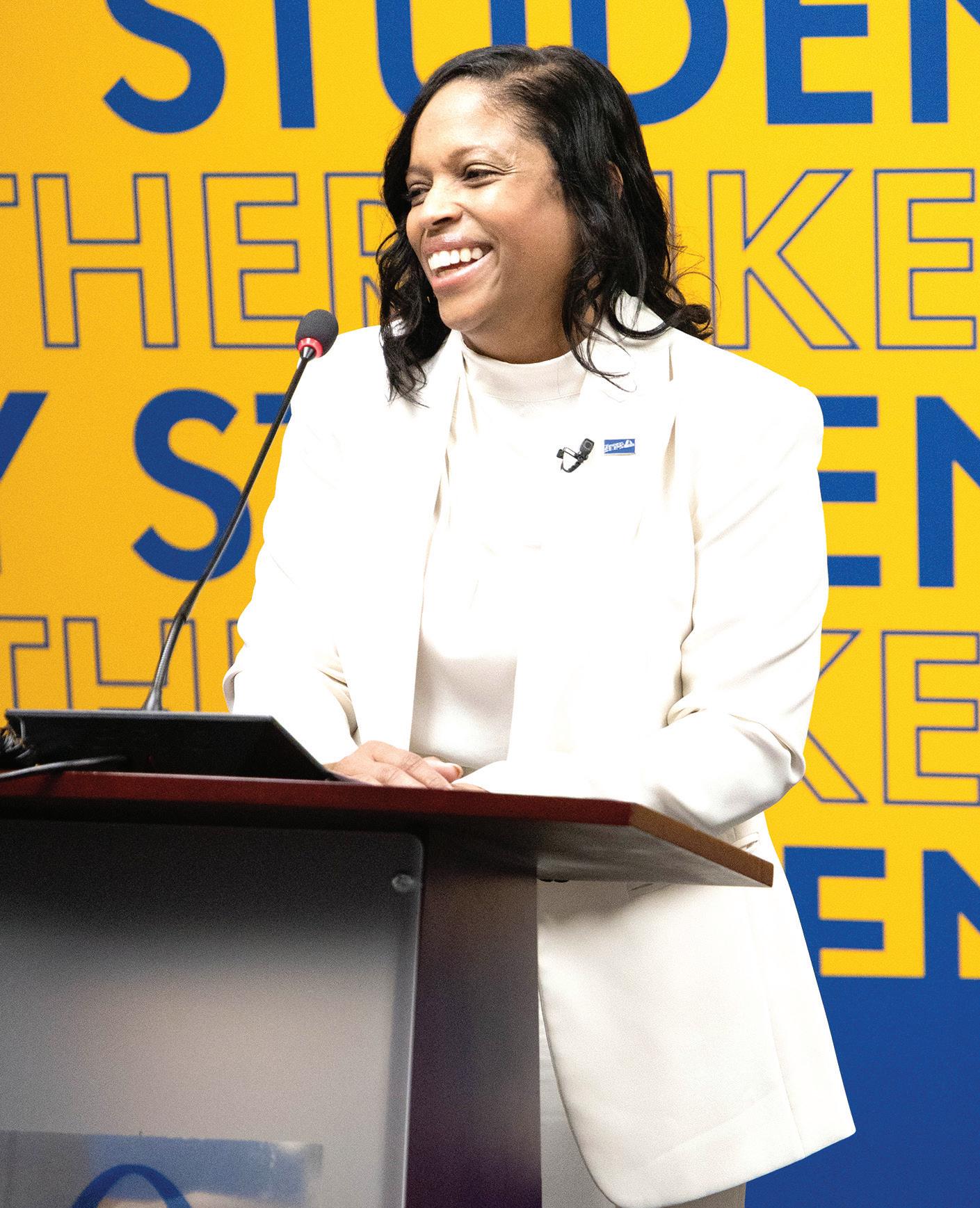
results can vary depending on how programs are structured and how often students play.
For students, however, the impact is immediate.
“You get to pause and take control over your words and your body,” said Amiyah Miller, a student at Lift for Life Academy. “It’s like, should I say this before they say something? Is this a good thing to say?”
As chess programs expand in schools, first responders say they are embracing opportunities to connect with students out-
side emergency situations.
“I believe this is important because there is a gap between the kids and adults,” said Brian Jackson, a captain with the St. Louis Fire Department.
“They say it takes a village to raise them; I just want to be a part of that village. Life is a game of chess — it’s all about decisions.”
Programs like the one at Busch Stadium also reflect a broader shift toward using chess as a tool for engagement, rather than just competition. Research tied to the club’s Chess in Education initiative has
found that more intensive, classroom-based chess instruction can be linked to gains in math performance and improvements in student behavior, particularly when lessons are integrated into the school day.
To date, the Saint Louis Chess Club says it has taught tens of thousands of students through its scholastic programs. The event at Busch Stadium offered a different kind of playing field — one where strategy replaced speed and conversation replaced confrontation.


Photo by Lawrence Bryant / St. Louis American
Dr. Myra Berry smiles as she addresses the audience after being announced as the permanent superintendent of Saint Louis Public Schools on April 9, 2026.
By James T. Ingram
It’s been nearly 61 years since the capstone, completing construction of the iconic Gateway Arch, was laid on my late father’s birthday, October 28, 1965.
For those six decades, the Arch has stood as a gleaming monument to westward expansion, while East St. Louis, Illinois, the city just across the Mississippi River, has long been defined by its political and financial struggles.
But on March 10, 2026, on an unseasonably warm, sunny afternoon, a bipartisan bill sponsored by U.S. Rep. Nikki Buszinski, a Democrat from Springfield, Illinois,
East St. Louis deserves a place in the Arch’s story
and co-sponsors Wesley Bell, a Democrat from St. Louis, Missouri, Mike Bost, a Republican from Murphysboro, Illinois, and Ann Wagner, a Republican from Ballwin, Missouri, was proposed to expand Gateway Arch National Park across the river into roughly 50 acres of vacant riverfront parcels, including the Malcolm W. Martin Memorial Park grounds.
The goal would be to expand the park from 100 to 102 acres, initially, and drive Metro East redevelopment, with the potential to eventually add a museum, natural amphitheater and other features to bridge the MissouriIllinois divide.
Greenway
Continued from A1
and Harris-Stowe. But what opened Monday is more than pavement
— it’s a new connection through the city, linking communities and carrying forward the legacy of Mill Creek Valley.
St. Louis City Planning Director Don Roe reminded the crowd that the Brickline Greenway was designed with intention. Inspired by projects like New York’s High Line and Atlanta’s BeltLine, St. Louis chose a different path — one that deliberately moves through culturally significant corridors, including North St. Louis.
“We weren’t picking an old railroad,” Roe said. “We had to choose our route. And we chose to connect history, culture, people and place.”
That intentionality shows up in every detail — from the dual pathways that invite both movement and reflection, to the mural honoring the St. Louis Stars, to the way the greenway slows traffic and prioritizes people.
The new segment stitches together more than destinations. It connects Energizer Park to campus life, small businesses to foot traffic and — perhaps most powerfully — present-day St. Louis to the legacy of Mill Creek Valley.
“This is what good public-private partnership looks like when it’s grounded in shared purpose,” said Penny Pennington, managing partner at Edward Jones and Brickline Greenway campaign co-chair. “Students moving across campus. Neighbors gathering. Families walking. Artists creating. Communities meeting one another with greater ease.”
Her remarks reflected the tone of the event at
Shooting
Continued from A1
life enough to tell the truth.”
The shooting followed a police pursuit of a stolen vehicle that began in North St. Louis and ended in the Ville neighborhood, according to multiple reports. Wilkins and another teen fled the vehicle on foot while officers gave chase. Within seconds, an officer opened fire.
Attorneys for Wilkins’ family say the video contradicts the narrative provided in the immediate aftermath.
This proposed bill signals that East St. Louis may finally move from being an afterthought to being part of a shared narrative of regional growth.
After all, when the Cardinals have won World Series titles, the former St. Louis Rams won their Super Bowl and the Blues won their Stanley Cup, aerial footage of the Arch and stadiums was shot from the East St. Louis riverfront — some of the most prime real estate in the region.
the gathering organized by Great Rivers Greenway, the city of St. Louis and Harris-Stowe.
As the program shifted from celebration to reflection, speakers centered the moment in the story of Mill Creek Valley — a once-thriving Black community erased from the physical landscape but not from the hearts of those who remember.
“First of all, I’m a child of Mill Creek,” said Gwen Moore, curator of Urban Landscape and Community Identity at the Missouri History Museum. “My parents lived in Mill Creek. My grandparents lived there. When I decided to do this exhibit, I said, ‘We are going to tell this story through a Black lens.’ Through the lived experiences of the people who resided in Mill Creek.”
Moore has spent years reclaiming the narrative of Mill Creek through the museum’s Black Metropolis exhibit. She made it clear that Monday’s celebration — like her work — was not just about infrastructure. It was about restoration.
“I wanted to disrupt that negative narrative,” Moore said. “We were not slum dwellers. We built something amazing under the conditions of segregation and Jim Crow.”
She spoke of a community of 20,000 residents, of Black-owned banks and hospitals, of institutions that met every need in a city that denied them access elsewhere.
“The only thing that was not segregated in St. Louis was the public library — and thank God for that,” Moore said. “Otherwise, St. Louis was just as segregated as any city in the Deep South. The people in Mill Creek did what they had to do. They built a vibrant community that met the needs of the people who lived there.” Behind her, the green-
“Video shows there was no weapon,” family attorney Albert Watkins told KSDK. “The young man was not turning around, was not aiming a gun.” Police have since acknowledged that early information shared publicly was inaccurate and based on witness accounts that did not match what investigators later found.
“The entire police department was complicit in a cover up that has left a family without their loved one and without answers,” Reed said.
The St. Louis Metropolitan Police Department said the information initially pro-
erfront, facing the Arch, complement, not distract from, its beauty and symbolism.
However, I am not so naïve as to ignore that the proposal comes with challenges. The first phase will begin with a feasibility study to evaluate the environmental and economic impacts of such a development.
So it would only be fitting that the Illinois riv-
Anyone who has read this space over the years is well aware that East St. Louis has long grappled with entrenched political dysfunction, corruption scandals, patronage systems, fiscal mismanage-
ment, an erosion of public trust and the depletion of its population and business community.
For example, in 1959 East St. Louis was named an All-America City by the National Civic League and featured in Look magazine.
Then, between 1960 and 1970, the city lost 70% of its businesses. Between 1970 and 2000, it lost 55% of its population, according to author and historian Dr. Andrew Theising, formerly of Southern Illinois University.
To ensure this proposed expansion succeeds, there must be safeguards to provide clear accountability and transparency in politics and funding, while maintaining strong
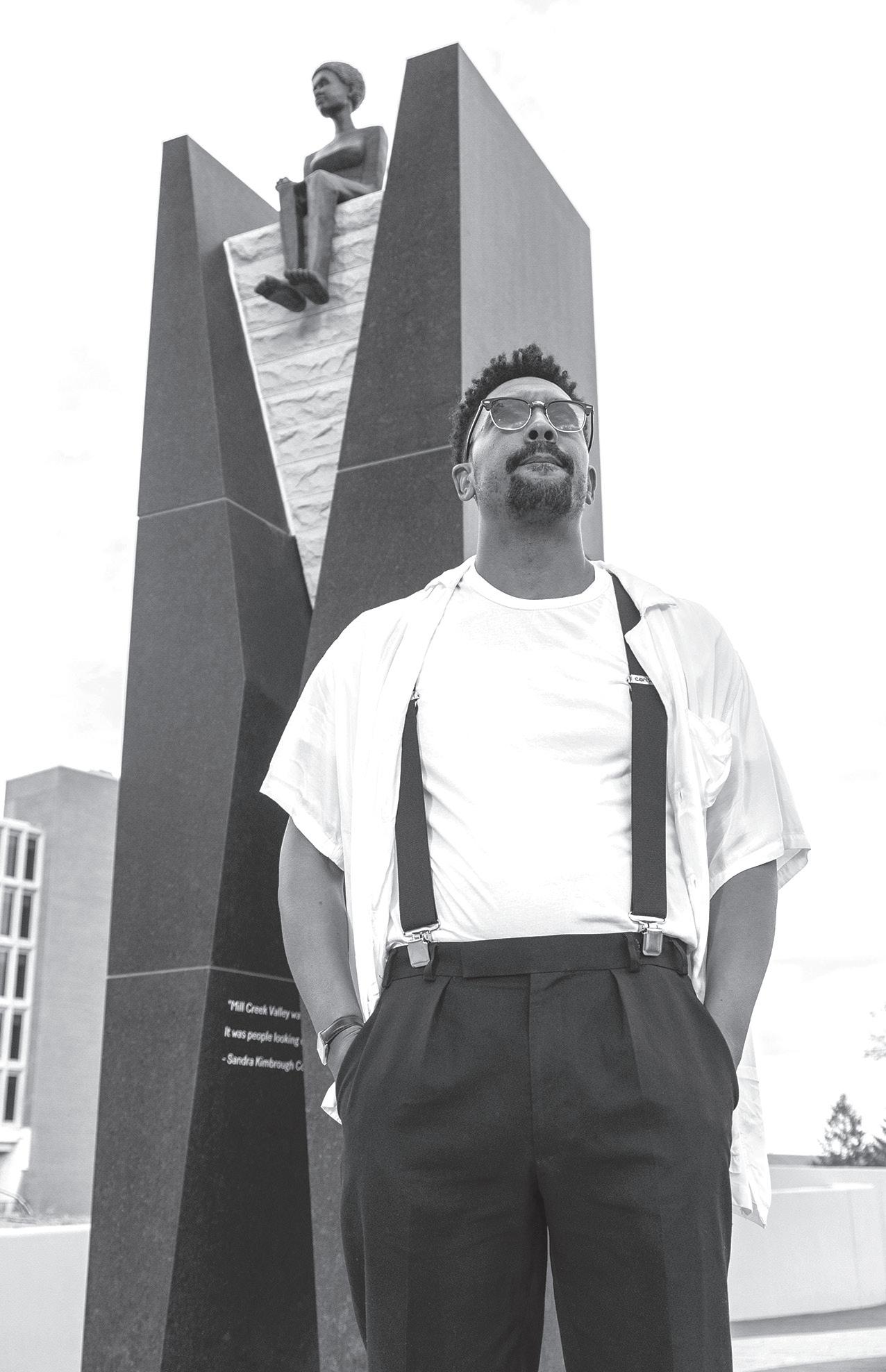
way — lined with native plants, art installations and pathways designed for both movement and pause — became a living extension of that story.
Few embodied that connection more directly than artist Damon Davis.
For nearly a decade, the Emmy Award-winning multidisciplinary artist worked to bring Pillars of the Valley to life — the evolving monument that now stretches farther west along the greenway. His work stands as both tribute and testimony, anchoring memory in a city that once tried to erase it.
vided to the public “was not consistent with the actual events” and noted that policies have since been updated to ensure body camera footage is reviewed more quickly before details are released.
The footage also shows officers approaching Wilkins after the shooting and handcuffing him as he lay motionless on the ground.
Investigators later said Wilkins had parts of a firearm in his pocket, but attorneys for the family say the weapon was disassembled and not capable of being fired.
An independent analysis cited in reporting by St.
collaboration among federal, state and local entities, including East St. Louis residents. In short, the symbolism and aspirations of this proposal must be matched by sound structure, feasibility and practicality. Because there is no question that East St. Louis deserves this investment. In fact, it’s long overdue. Yet this may be the final opportunity for the Arch to stop being, for East St. Louis, what it has been for six decades — a beautiful symbol just out of reach.
James T. Ingram, an East St. Louis native and writer, covers the Illinois political scene.
etched into the landscape.
“I’m a native of this region — East St. Louis,” Davis said. “As a Black kid who grew up here, I never knew this neighborhood existed. And I found that crazy. I wanted to make sure that after me, there are no more kids who grow up not knowing.”
But celebration did not overshadow urgency.
“It was made in honor of people who were displaced,” Davis said, referring to families impacted by the devastating May 16 tornado. “Right now, in St. Louis, there are people displaced because of a natural disaster on the North side.” He made a bold request.
“I hope that in 20 years I don’t have to make another one for the North side,” he said. “We should press the government and the people in power to make sure those neighborhoods are saved.”
For Jo Ann Taylor Kindle of the Enterprise Mobility Foundation, that people-centered approach is the point.
“This is our home,” Kindle said. “We have a responsibility to help create opportunity, connection and belonging for everyone who calls this region home.”
By the time the ribbon was cut, the symbolism was clear.
Investment can coexist with remembrance.
Development can honor displacement instead of ignoring it. A city known for its divisions can still find ways to move — literally and figuratively — together.
“There is power in remembrance. There is power in listening. There is power in building together,” Pennington said.
He wasn’t speaking metaphorically. Families with direct ties to Mill Creek Valley stood among the crowd — living witnesses to the history now
“It’s a monument, not a memorial,” Davis said. “They are alive. You see them over there. This is a living thing. These people helped make St. Louis what it is today. We need to acknowledge them and thank them.”
Louis Magazine concluded that the shooting may have violated department policies, including standards for use of force and pursuit guidelines. The report also questioned whether officers properly identified themselves or issued clear warnings before firing.
Zaki Baruti, president of the community advocacy group the Universal African People’s Organization, said justice must prevail in Wilkins’ death.
“Again, the discrepancies that’s come forth from the release of the video speaks volumes to the usual intent of covering up police violence toward
“This greenway is alive. Students are already moving along it. Neighbors are gathering on it. Artists are shaping it. And new possibilities are already taking root.”
our people,” Baruti said. “The officers should be fired because of their false reporting of the incident and charged accordingly.”
The family filed a federal lawsuit alleging excessive force and a broader failure by the department to follow established procedures. The suit also claims there was a delay and lack of transparency in informing the family about what happened.
Wilkins’ mother, Shaina Wilkins, said the release of the video has been painful but necessary.
“He should be wearing a cap and gown this week,” Watkins said, referring to what would have been Wilkins’ high school graduation.
Sylvester Brown Jr. is the Deaconess Foundation Community Advocacy Fellow.
“I’m just slowly getting answers,” she told KSDK. “I’m still learning new stuff that happened to my son that day.” The case remains under review by the St. Louis Circuit Attorney’s Office, which said it does not comment on open investigations but is responsible for determining whether criminal charges are warranted. For the family, the wait for answers has been difficult.
James T. Ingram
Artist Damon Davis stands in front of his creation ‘Pillars of the Valley’ that now stretches farther west along the greenway.
Photo by Lawrence Bryant / St. Louis American

A mother’s search for her son — and the truth
By Jamala Rogers
I first became acquainted with Christian Ferguson’s story on the June 11 news in 2003.
My interest was piqued for several reasons, starting with the account given by his father, Dawan Ferguson. It was an illogical story that raised more questions than it answered.
Christian was a 9-year-old with a rare congenital medical condition that required life-saving medication. That meant it was a race against time to find the nonverbal child before his body shut down.
with special needs, but her work on behalf of missing and murdered Black victims brought broader attention. A recent documentary, “Theda Roxanne,” by St. Louis filmmaker Alana Marie, explores part of her healing process.
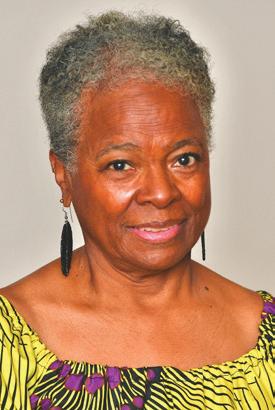
The alleged abduction happened near a business in the former 22nd Ward, an area I know well because it has long been home to the Organization for Black Struggle. My gut told me it was unlikely someone would leave a cellphone in a running car to make an emergency call at a phone booth. It was later learned that the account was all a big lie.
The Organization for Black Struggle committed to prominently displaying Christian’s missing poster until his case was resolved. His smiling face remained on that board until July 1, 2022, when his father was convicted of murder and sentenced to life in prison without parole.
According to the Missouri State Highway Patrol, an estimated 416 children and juveniles are missing in the state. Children of color, particularly Black children, often receive less attention than their white counterparts. Cases involving working-class families can also receive fewer resources than those involving more affluent families.
The public knows names like Natalee Holloway, but far fewer know cases such as Hope Brown or Jennifer Blackmon. Race and class play a role in who receives attention from law enforcement and the media. It is not only about missing persons; it is also about homicide victims. St. Louis has about 1,000 unsolved homicides, many involving Black victims.
Christian’s birthday is a few days before mine. Each year, it was a reminder that he was still missing.
Christian’s birthday is a few days before mine. Each year, it was a reminder that he was still missing. Even now, I still calculate how old he would be.
Theda Thomas is Christian’s mother. From the beginning, she suspected foul play by Dawan Ferguson. Her life became a living hell as she fought to uncover the truth and seek justice. She chose to be a warrior instead of a victim, a role that has carried her into years of advocacy.
She raised awareness about children
Theda Thomas joins a growing number of mothers advocating for missing and murdered loved ones, often while navigating grief and limited institutional support. She fought for years to hold Dawan Ferguson accountable, and he will spend the rest of his life in prison. Because he’s a despicable human being (also convicted of sexually assaulting two relatives), Ferguson refuses to disclose what happened to Christian or the location of his remains.
Theda continues her work through her foundation, Looking for an Angel, helping other families search for missing loved ones. She has come to terms with the fact that while justice was secured, the whereabouts of her son may never be known.
Court weighs who has authority to name interim sheriff
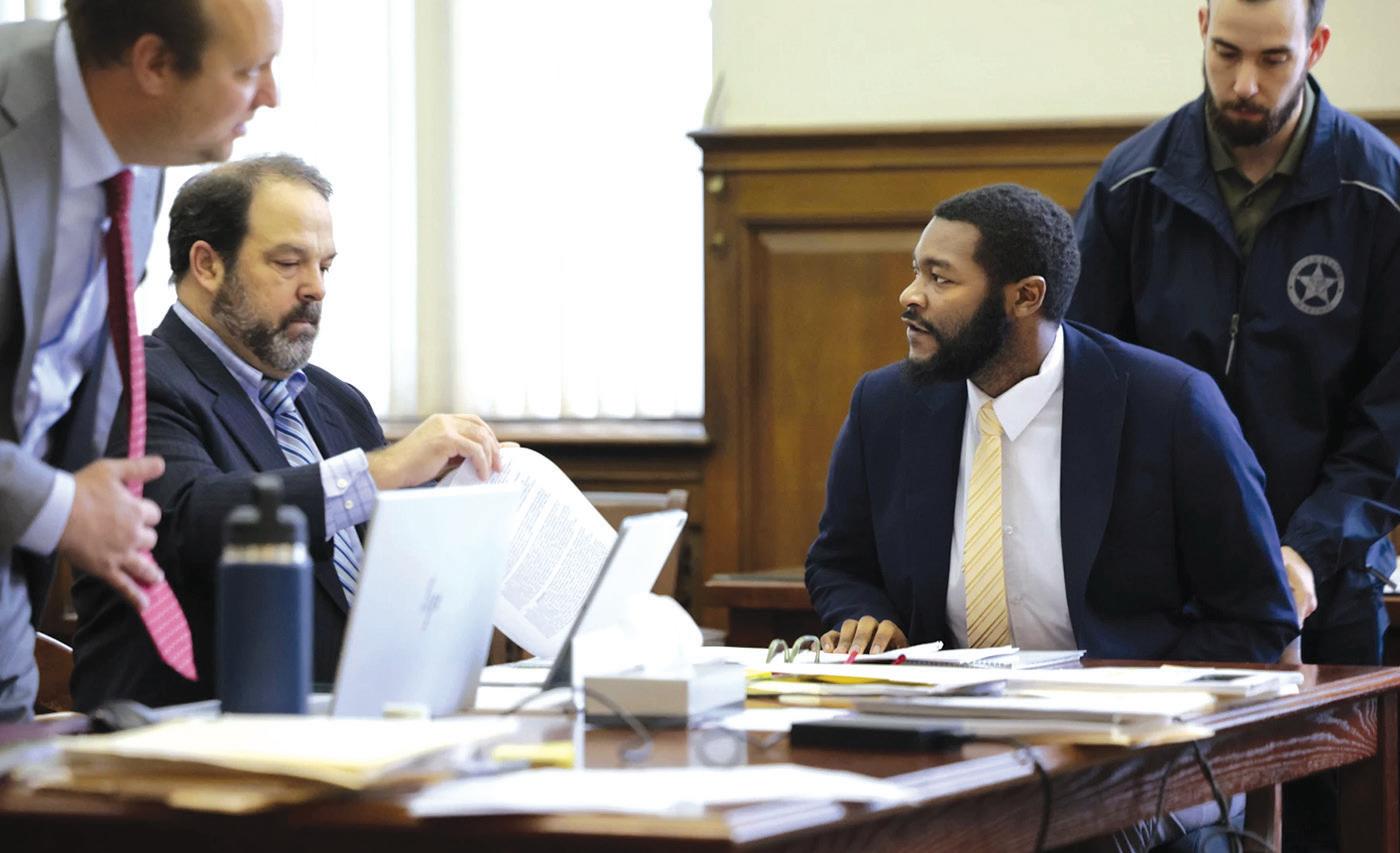
By Chad Davis St. Louis Public Radio
A St. Louis judge is weighing whether the St. Louis City Sheriff’s Office can be part of a lawsuit over who has the authority to select the interim sheriff.
Judge Thomas McCarthy heard arguments Wednesday from attorneys representing the state, the city and the sheriff’s office.
Lawyers for the sheriff’s office filed a motion to intervene, arguing that an October order by Judge Christopher E. McGraugh appointing John Hayden Jr. as interim sheriff was a final decision.
“The time to appeal has passed, and that order
remains final,” said David C. Mason, a retired judge representing the sheriff’s office.
The dispute is the latest in an ongoing battle over who has the authority to appoint an interim sheriff.
The city filed a lawsuit in December arguing that power rests with the mayor. The St. Louis Board of Aldermen sought to intervene, but McCarthy removed the board from the case in January, ruling it could not file a separate lawsuit from the city.
The Missouri attorney general’s office has argued that Gov. Mike Kehoe holds that authority. State attorneys also opposed the sheriff’s office motion to intervene, saying it had not established a legal right to do so.
The state further argued there is a conflict of interest because the same attorneys represent the sheriff’s office and former Sheriff Vernon Betts’ successor, Alfred Montgomery, who is seeking a new trial after being removed from office.
“The goal of that representation is at odds,” Assistant Attorney General Greg Goodwin said. Mason said there is no conflict and submitted written consent from Montgomery and Hayden regarding the shared representation. McCarthy said he will issue a decision at a later date.

Columnist Jamala Rogers
Photo by Christian Gooden / Pool via St. Louis Post-Dispatch
Former St. Louis Sheriff Alfred Montgomery, seated at right, is seeking a new trial after being removed from office. A judge is weighing whether the sheriff’s office can be part of a lawsuit over who has the authority to select an interim sheriff.

Living It
A bridge of dance, sound and Black creative imagination
Ailey II salutes Chuck Berry and lifts up Dance St. Louis’ legacy
By Zaria Mac St. Louis American
This year marks a century since the births of musical giants — including John Coltrane and the region’s own Miles Davis and Chuck Berry. And in a season where Dance St. Louis is celebrating its 60th anniversary, it feels fitting that the organization chose to honor St. Louis’ own Berry not with nostalgia, but with new creation. Ailey II’s St. Louis stop at the Touhill Performing Arts Center delivered a tribute engrained in legacy, but pulsing with the urgency of now.
The centerpiece of the evening was Berry Dreamin,’ a new work choreographed by Chalvar Monteiro and set to the unmistakable twang and fire of Chuck Berry’s catalog. The ballet, commissioned by Dance St. Louis as part of its milestone anniversary, unfolded like a stream of consciousness. It became a dreamscape where thoughts don’t arrive in straight lines but in bursts, loops, and flashes of color.
Monteiro’s staging made that inner world visible. Dancers drifted through a gray void, their movements loose and searching, until Berry’s music cracked open the space. The backdrop would flare red like a synapse firing, and suddenly the dancers shifted from wandering to creating. They swung, slid, and ricocheted off one another, embodying the way ideas collide and reshape themselves in the mind of an artist.
The emotional palette was wide. There was frustration that tightened the body, peace that softened it, joy that spread like a ripple. Each shift felt like a window into the subconscious — the place where creativity is born long before it becomes something the world can hear or see. And as the music moved from “Maybellene” to “Oh Louisiana,” the dancers’ energy deepened, mirroring the evolution of Berry himself as he carved out a place in American music history.
Dance St. Louis extended the tribute beyond the stage. The pre-show transformed the Touhill lobby into a multigenerational celebration of Berry’s life and
Theda’s story
Filmmaker Alana Marie offers rare glimpse of the woman still fighting for answers
By Kenya Vaughn The St. Louis American
For nearly twenty-five years, Theda Wilson has lived a mother’s worst nightmare. In 2003, her son Christian Ferguson disappeared under mysterious circumstances from a St. Louis intersection. Christian was nine years old at the time. He lived with special needs due to a rare genetic condition, and his disappearance gripped the St. Louis community.
Filmmaker Alana Marie was only 13 when Christian went missing, but the case stayed with her.
“It just stuck in my spirit,” Marie said. “I would see his poster and see his face on the bus stop, and what happened to him was always a lingering question. And I would wonder how his mom was doing.”
The curious teen grew into an emerging

centerpiece
Dancers drifted through a gray void, their movements loose and searching, until Berry’s music cracked open the space.
influence. Students from Grand Center Arts Academy and Central Visual and Performing Arts High School filled the space with drawings and sculptures of
Berry and his iconic guitar. Students from Sumner High School, Berry’s alma mater, curated an exhibit featuring artifacts. They ranged from a replica of Berry’s conk to performance costumes and archival clippings that connected the legend to the community that shaped him. And then there was the music. What the Chuck!, the tribute band led by Berry’s son Charles Berry Jr. and grandson Charlie Berry, warmed the crowd
Dance, B3
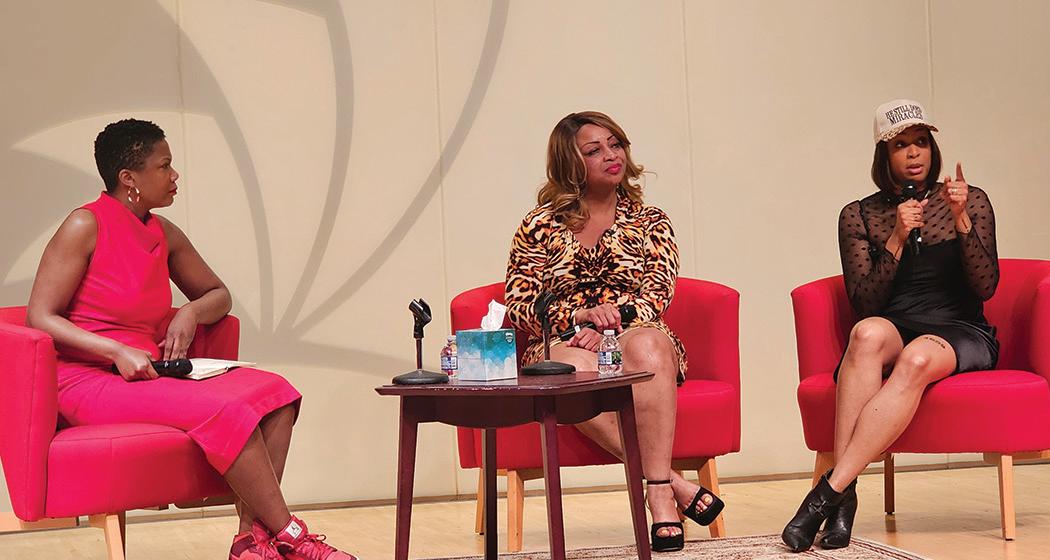
Cara Anthony, Theda Wilson and Alana Marie discuss the film ‘Theda
following a special screening Saturday afternoon at St. Louis Public Library’s Central Branch.
filmmaker. And on Saturday afternoon at the St. Louis Public Library’s Central Branch, she presented her short film “Theda Roxanne.”
What began as a lingering question about a familiar case evolved into a story about the woman who woke up each day determined to find the truth about her son. In that pursuit, Wilson also found the strength to help other mothers and families searching for their missing loved ones.
“I’m learning how to live,” Wilson said in the film. “Actually telling my story is… it’s a burden, but it’s a blessing. A burden blessing.”
After the screening, Cara Anthony of
Kaiser Health News moderated a conversation with Marie and Wilson.
“This film has been a lot of work, a lot of labor that I am grateful you entrusted us with,” Marie said.
The small but dedicated team of three spent five years bringing Wilson’s story to the screen — a commitment Wilson did not take lightly.
“It was wonderful to know that somebody wanted to see that I wasn’t just ‘that little boy’s mama,’” Wilson said.
While the film offered glimpses of Wilson through the eyes of family and
A quiet giant honored

Redmond earns national recognition for a lifetime of shaping Black literary culture
By Kenya Vaughn St. Louis American
There are honors, and then there are affirmations.
For Dr. Eugene B. Redmond, the distinction matters. After decades of shaping the voices, visions and vocabularies of generations of writers, the 2026 Writers for Writers Award from Poets & Writers felt like a full-circle moment.
Founded in 1970, Poets & Writers has long stood as the nation’s literary backbone — an institution whose reach extends far beyond workshops and directories into the infrastructure of American letters. The Writers for Writers Award carries particular weight because it is peer-driven. It honors service — the labor of lifting others, of shaping community, of making space. To be recognized by Poets & Writers is to be acknowledged not just as a writer, but as a steward of the literary community.
For the organization to select Eugene B. Redmond is to affirm a lifetime of cultural labor that often took place beyond the spotlight but at the center of impact. It signals that the work rooted in East St. Louis classrooms, Black Arts Movement spaces and global literary circles carries the same weight as any canonical contribution — and that Redmond’s legacy is essential to the story of American literature.
The honor places Eugene Redmond alongside literary heavyweights like Tina Chang and Khaled Hosseini.
“It was overwhelming,” Redmond said, reflecting on the March 23 gala in New York City. “I was very pleased. I was very humbled by it.”
The honor places him alongside literary heavyweights like Tina Chang and Khaled Hosseini. And in a room filled with Pulitzer Prize winners, publishing executives and some of the most influential figures in literature, Redmond — a heavyweight in his own right — found himself thinking not about accolades, but about East St. Louis.
“He cherishes the upbringing he received there,” said Redmond’s daughter Dr. Treasure Shields Redmond, who accompanied him to the gala. “The award was a well-deserved honor.”
The gala itself was a spectacle, even for someone who has spent a lifetime in historic literary spaces.
“I’ve never seen that many billionaires and millionaires in one place,”
Photo courtesy of Dr. Eugene Redmond
Dr. Eugene B. Redmond accepted the 2026 Writers for Writers Award at the Poets & Writers Gala in New York City on March 23.
Photo by Kenya Vaughn/St. Louis American
Roxanne’
Photos by Taylor Marrie/St. Louis American
The
of the evening was Berry Dreamin’, a new work choreographed by Chalvar Monteiro and set to the unmistakable twang and fire of Chuck Berry’s catalog.
CONCERTS
Thur. Apr. 16, 7 p.m., Boys 4 Life Tour featuring B2K & Bow Wow, Chaifetz Arena, 1 South Compton Avenue St. Louis, MO 63103. For more information, visit www.chaifetzarena.com.
Thurs., Apr. 16, 8 p.m., Floetry presents the Say Yes Tour featuring Raheem DeVaughn, Stifel Theatre. For more information, visit www. stifeltheatre.com.
Fri., Apr. 24, 7 p.m. Bone Thugs-N-Harmony, Pop’s Nightclub & Concert Venue, 1403 Mississippi Ave, Sauget, IL 62201. For more information, visit www.ticketweb.com.
Fri., May 1, 7:30 p.m., The Love and Relationship Tour starring David and Tamela Mann, Stifel Theatre. For more information, visit www.stifeltheatre.com.
Sun., May 10, 7 p.m. The Queens: 4 Legends, 1 Stage with Chaka Khan, Patti LaBelle, Gladys Knight & Stephanie Mills Enterprise Center, 1401 Clark Ave, St Louis, MO 63103. For more information, visit www.enterprisecenter.com.
Wed., May 13, 7 p.m. doors, Ari Lennox Vacancy Tour
The Factory at The District, 17105 North Outer 40 Road Chesterfield, MO 63005. For more information, visit www. thefactorystl.com.
SPECIAL EVENTS
STL Sites & Sounds
Fri., Apr. 17, 9 p.m.
HITZWORLD w TheHitz, + DJ Naybahood, Sophie’s Artist Lounge, 3333 Washington Ave, St. Louis, MO 63103. For more information, visit https://kranzbergartsfoundation.org.
Fri., Apr. 17, 6 p.m., Spark: CAM’s 2026 Gala, 21c Museum Hotel St. Louis, 1528 Locust Street. For more information, visit http://camstl.org
Sun., Apr. 19, 1 p.m., Saint Louis Art Museum Family Sunday – Echoes in Motion: Antiquity in Ballet featuring Riley Adams, artistic coordinator and Brown Girls Do Ballet ambassador. Inspired by Black Ballerina, a photo by Leroy Henderson, Saint Louis Art Museum. For additional information, visit www.slam.org.
Sun., Apr. 19, 5 p.m. Slow Spread Love Presents: Big Slowskii and Friends, The Key STL, 3225 Olive St, St. Louis, MO 63103. For more information, https:// kranzbergartsfoundation.org.
Sat., Apr. 25, 6 p.m. 3 Stripes: An Adidas Experience, The Post Building, 900 N Tucker, St. Louis, MO 63101. Purchase tickets here https://web.myle.com.
COMEDY
Fri., Apr. 17 - 19, 7 p.m.
Special Event: Arnez J, Helium Comedy Club, 1151 St. Louis Galleria St, St. Louis, MO 63117. For more information, visit https://st-louis.heliumcomedy.com.
Wed., Apr. 22, 7:30 p.m., Brandon “Hotsauce” Glover
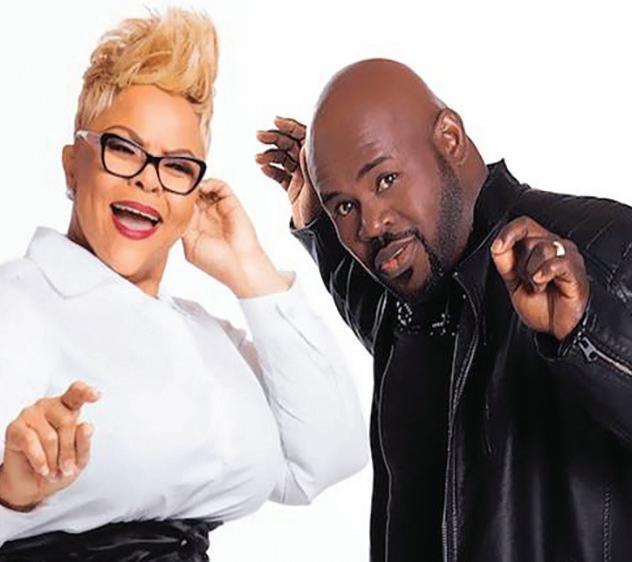
presented by Townsendx3.live, City Winery St. Louis, 3730 Foundry Way, St. Louis, MO 63110. For more information, https://tickets.citywinery.com.
Fri., Apr. 24, 8 p.m. We Them Ones Comedy Tour starring Mike Epps, Karlous Miller, DC Young Fly and many more, Chaifetz Arena, 1 S Compton Ave, St. Louis, MO 63103. For more information, visit https://www.chaifetzarena. com.
Sat., Apr. 25, doors 6:30 p.m.
The Surviving and Thriving Tour with Michelle Buteau, The Pageant, 6161 Delmar Blvd, St. Louis, MO 63112. For more information, visit www.thepageant.com.

ST. LOUIS MUSIC SPOTLIGHT
Fri., Apr. 17 - 18, 7:30 p.m. Good 4 the Soul with Horns, Steward Center, 3536 Washington Ave, St. Louis, MO 63103. For more information, visit https://my.jazzstl.org.
Fri., Apr. 17, 9 p.m. Marquise Knox, Broadway Oyster Bar, 736 S Broadway, St. Louis, MO 63102. For more information visit www.broadwayoysterbar. com.
THEATRE






Fri., Apr. 17 - 25, La Cage Aux Folles, Third Baptist Church, 620 N Grand Blvd, Saint Louis, MO 63103. For more information, visit www.taketwoproductions.org.
Fri., May 1 - 3, 8 p.m., The Black Rep presents August Wilson’s Jitney in Italian with English supertitles, Strauss Black Box at Kirkwood Performing Arts Center. For more information, visit www.theblackrep.org.
Sat., May 9, 3 p.m., JPEK Creative Works presents “Respect My Shoes: If These Shoes Could Talk,” a compelling and emotionally charged stage play starring acclaimed performer and storyteller Drea Kelly, .Zack, 3224 Locust St. For tickets or more information, visit www.metrotix.com. ART
Jun. 28, Martine Syms: Soliloquy, St. Louis Art Museum, 1 Fine Arts Drive, Forest Park, St. Louis, MO 63110. For more information, visit www.slam.org.
Through June 2026, The Future Is Female, 21c Hotel and Museum Hotel St. Louis, 1528 Locust St, St. Louis, MO 63103. For more information, visit https://21cmuseumhotels.
Wed., Apr. 22, 6 p.m. WNJJ: feat. Tanner Caldwell & Liminal Spaces, The Dark Room 3610 Grandel Aq, St. Louis, MO 63103. For information, visit https://kranzbergartsfoundation.org.















friends — including her friendship with Paula Hill, mother of missing Berkeley teen Shemika Cosey — Anthony guided the discussion back to the case that thrust Wilson into the public eye.
“Tell us a little bit more about who your son was,” Anthony asked. “Or do you refer to him in the present?”
Even without answers, Wilson has had to face a painful truth in the two decades since she last saw Christian.
“I acknowledge the transition that has happened,” she said. “But he’s still quite present. I do understand absence from the body, present with the Lord.”
Christian’s father, Dawan Ferguson, is serving two life sentences for first-degree murder in connection with the case. Wilson still has no clarity about what happened to her son before or after his disappearance, but she knows his medical needs made survival without medication impossible.
“I’m thinking about

making a plan to go and visit him and see if he will tell me the truth,” Wilson said. “Even though I know how he is — he just loves to see me go through.”
Dawan’s incarceration has not brought the answers or justice she deserves, but it has brought a measure of peace.
“I’ve learned to live without knowing,” Wilson said. “But I felt like I was in prison while he was out there.”
Out of her pain came purpose. Wilson founded the Looking For An Angel Foundation, which provides services, support, and information to families searching for missing loved ones. The organization also advocates for legislation and standard best practices for law
enforcement.
Still, the past 23 years have been anything but easy. Wilson shared the emotional toll of enduring Dawan’s trial.
“I was suicidal,” she said. “I was in the courtroom ready to jump from the ninth-floor window. But look at me now. I’ve come to a point where I can tell my story to help people know who I am and why I do what I do.”
During the Q&A, Wilson’s mother, Sandra Wilson, praised the film and the women behind it.
“I never thought, in all my years, somebody would do something like this for my daughter,” she said. “At one time, we sent information to Oprah Winfrey and were turned down. We sent information to NBC and ABC and were turned down.”
Sandra Wilson also appreciated the care taken to show her daughter fully — the singer, the educator, the advocate, the activist.
“This documentary is important because I remember how the news portrayed my daughter,” she said. “They were putting us down. And what does that say to our community? So it is important that people see my daughter as she is.”
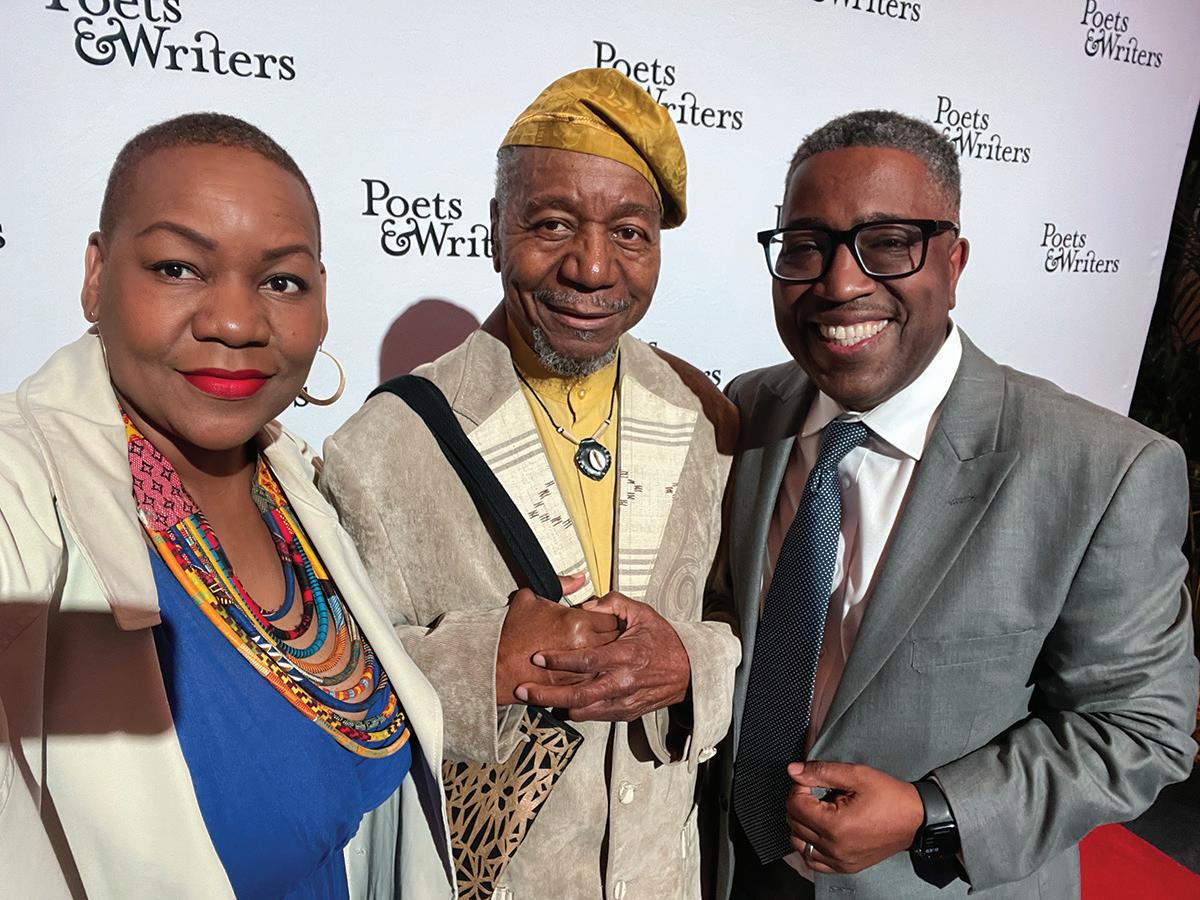
has taken him to Nigeria, Europe and beyond, he has never severed his connection to home.
he said with a chuckle.
“Every major publisher in the world was there.”
with classics like “Too Much Monkey Business” and “Rock and Roll Music.” Grandson Jahi Eskridge provided lead vocals. The groove was contagious. A couple started dancing. Then a group of kids joined. Two generations moving side by side — a reminder that Berry’s sound still knows how to call people to the floor. The pre-show performance and art perfectly set the tone for Ailey II’s performance.
After intermission came the moment the audience was waiting for: Revelations. Even before the curtain rose, the opening strains of “I Been ’Buked” drew a rousing applause. The reaction was a testament to how deeply this work lives in the collective memory of Black audiences. Alvin Ailey’s 1960 masterpiece is a spiritual archive. A map of our sorrow, our resilience, our praise.
Ailey II approached it with reverence and youthful fire. The dancers’ grounded, weighted movements made the struggle sections feel lived-in, not performed. And when the piece shifted into its joy — the sunburst yellows of

“Rocka My Soul” — the theater felt lifted. No matter how many times those in the audience have seen Revelations, it still reaches into something ancestral, something that remembers.
In a season marking Dance St. Louis’ six decades as the region’s GATEWAY TO WORLD DANCE™, this program felt like a full-circle moment. Ailey II honored a St. Louis icon, carried forward a national treasure, and reminded the audience that Black creativity — in music, in
movement, in memory — is a legacy that continues to evolve.
In a season marking Dance St. Louis’ six decades as the region’s GATEWAY TO WORLD DANCE, this program felt like a fullcircle moment.
Ailey II honored a St. Louis icon and carried forward a national treasure. They also reminded the audience that Black creativity — in music, in movement, in memory — is a legacy that continues to evolve.


From Penguin Random House to Simon & Schuster, the industry’s powerbrokers filled the room. But one of the most meaningful moments came not from the stage, but from his table. A former student — Elliot Figman, who would later help shape Poets & Writers itself as executive director for nearly 40 years — was seated beside him.
“I didn’t know he was going to be sitting at my table,” Redmond said. “That was just… wow.”
It was a reminder that his impact cannot be measured solely in books or awards, but in people — in those he taught, mentored and inspired long before their own influence rippled outward.
Redmond’s acceptance speech didn’t begin with credentials or career highlights. It began with rhythm.
“Ever since I was a little child, I’ve been fond of rhythms and language,” he said, recalling how he rooted his remarks in the oral traditions of Black culture — “the jonin’, the signifyin’, the musicalized speech.”
That philosophy has defined his life’s work.
A central figure in the Black Arts Movement, Redmond has long emphasized what he calls the “musicalization of language” as the foundation of Black literature. It is a concept he carried from East St. Louis classrooms to global lecture halls. And even as his scholarship
“I’m bringing that here,” he said. “East St. Louis and St. Louis — I wear that proudly.”
Born into a city too often defined by its challenges, Redmond has spent a lifetime reframing its narrative. He speaks of East St. Louis as a wellspring of excellence. From Miles Davis to Jackie Joyner-Kersee, he drops names to contextualize rather than boast.
“I could have gone on and said a hundred names,” he said. “People from East St. Louis who stepped on it.”
In that way, Redmond has functioned as both ambassador and architect. He has carried his beloved city into rooms where it had been historically excluded, while building pathways for others to follow. His work at Southern Illinois University Edwardsville and beyond helped institutionalize Black Studies programs at a time when such efforts required both courage and conviction.
“We were among the first,” he said. “We were traveling, setting up programs… it blew up like an explosion.”
His literary journey is also marked by proximity to greatness. He has worked alongside and preserved the legacies of figures like Toni Morrison, Maya Angelou and Amiri Baraka — relationships that speak to both his stature and his integrity. But even as he stood among literary giants, he never lost sight of his own purpose: to ensure that Black language, history and creativity were not only preserved, but centered.
At 88, Redmond is still thinking forward. His advice to emerging writers — especially those from communities like his own — is both simple and profound.
“Gather the knowledge and the skill,” he said. “And then at the center of that, place your heritage.”
It’s a directive shaped by lived experience — by decades of navigating spaces not designed with him in mind.
“You still have to be prepared,” he said. “Know enough about the rest of things, but concentrate on your Blackness. It will take you back to the beginning of time, and forward to the end of time.”
As the evening in New York unfolded — with its grandeur, its recognition and its reflection — Redmond found himself measuring the moment not by where he was, but by where he started.
“From East St. Louis… to be there,” he said, pausing. “Just thinking about that.” It is a journey that defies expectation and redefines possibility.
And while the Writers for Writers Award recognizes his generosity to the literary community, those who know his work understand the deeper truth that Eugene B. Redmond didn’t just contribute to the culture. He helped build it.
“My dad and the entire cadre with Black Arts Movement giants like Amiri Baraka, Sonia Sanchez and Nikki Giovanni are worthy of recognition,” Treasure Shields Redmond said. “They laid the very ground we continue to walk today.”

Photo courtesy of Treasure Shields Redmond
Treasure Shields Redmond, Dr. Eugene Redmond and poet Major Jackson at the 2026 Poets & Writers Gala, where Dr. Redmond was one of three recipients of the Writers for Writers Award on March 23 in New York City.
Photo By Taylor Marrie I St. Louis American Ailey II’s St. Louis stop at the Touhill Performing Arts Center delivered a tribute engrained in legacy, but pulsing with the urgency of now.

A time to choose. I promised to keep y’all up on what’s going down with the inaugural St. Louis American Reader’s Choice Awards, powered by the one and only St. Louis City SC. In fact, I’m sitting here in my custom Tina Turner jersey right now! But back to my point. The nomination period has passed, but now it’s time to vote! You still have a chance to have an impact and make sure your favorite people, places and things get the love they deserve. Voting starts TODAY (Thursday, April 16). Y’all better get to it! Visit www.stlamerican.com/readerschoice/ for the deets.
Jessie Taylor’s Tuesday night sing along. I’m trying not to make a habit of hitting these streets in the middle of the week, but for the second Tuesday in a row I was out here living it up! Tenika (?) and ‘nem had me typing Partyline in my office with the lights off last week. And my boy Jessie Taylor had me hollering as I tore the club up thanks to his Tuesday night karaoke at Treasures.
Y’all, it was sold-out…yes, on a Tuesday. And it was a whole entire vibe! Where else could you hear/ see Earth, Wind and Fire, “End of the Road” and NWA being “re-enblacted” for my listening and viewing pleasure? Well, mostly for my pleasure. That poor thing singing “End of the Road” had heart for days, but no soul to speak of. I commend her bravery. And to be honest, can karaoke truly be the blast that it is capable of without at least one, “girl, what are you going through” performance?
Absolutely not! So bless you “Girl to Woman,” for having the nerve – even when you knew you didn’t have the notes. Please don’t stop doing what you do. I was in my feelings about all the taxes I had to pay, and you made me temporarily forget all about Uncle Sam. And only at Jessie’s presentation of a karaoke moment would that tear-jerker ballad be followed up with some legit hood rat stuff. When ole boy got into “Gangsta Gangsta,” he was Ice Cube –and all of us were his N.W.A. I was cutting up like I used to do when I bumped “Straight Outta Compton” on cassette tape on the porch by way of a boom box. I was so fresh back then. You could catch me in a pair of blue Dickies and matching Chucks fresh from Gus and some Cholo French braids with black eyeliner on my lips. Tuesday took me back – and will bring me back to Treasures. So be ready to hear about some more of Jessie’s karaoke shenanigans sooner than later.
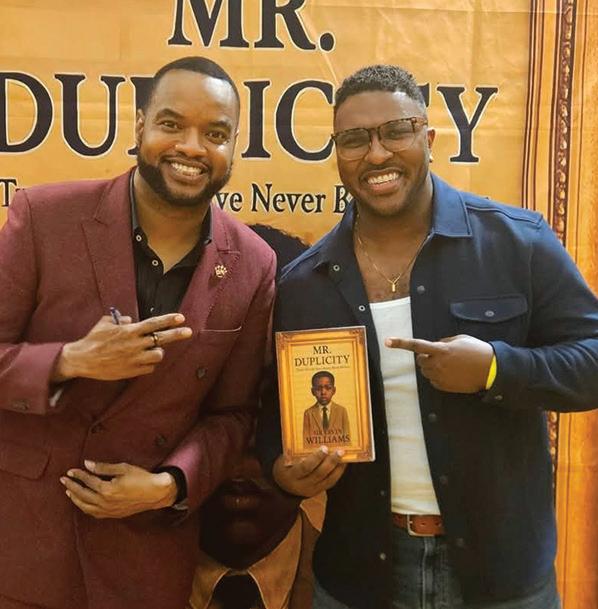
STL’s California love. A few of The Lou’s finest were doing big on the West Coast this weekend. First off, our boy SKB – also known Sterling K. Brown – celebrated his big 5-0 and some of my faves were on hand to help him celebrate. When his nephew Anthony Slaughter hopped on “The Book” to report live from L.A. about the bash. According to Anthony, the festivities included a roast. I thought to myself, “I wonder if my girl Leslie Christian was going to be there too. And was! For those


who don’t know, Ryan Michele Bathe a.k.a. Mrs. Sterling K. Brown, is Leslie’s little sister. Not only was Leslie and the fam on hand to join in the festivities, Leslie’s signature pheromone fragrance was included in special gift bags for the guests. I’m waiting for Leslie to get settled back in so she can give me the low down on how that roast went. ‘Cause y’all know that anybody from the STL can hold their own when it comes to jonin’. Now I know SKB was probably the “jonee” for the roast, but his STL family probably fired him up in the most loving way.
STL’s California love: take two. Speaking of firing somebody up, I have a bone to pick with Miss Skee Yee a.k.a. Sexyy Red. Miss Ma’am! At minimum, you could have dropped your


auntie a hot note letting me know that you were going to be taking the stage at Coachella. At maximum, you could have flewed me out to check out your set. You are lucky I am EssenceFestival-years-old. If I were six months younger…who am I fooling? I heard your set was cute, and as much as I love you, you couldn’t have paid me to be in a mosh pit full of millennials who bounced themselves musty all day only to see Justin Bieber mail it in on that stage. What? That’s what the masses said, not me. Honestly, I’m not surprised that his show wasn’t giving after he came out on the Grammy stage in his drawls (yes, drawls) and some tube socks only to punch some buttons on a laptop while he sang his little song. I wasn’t mad at that little TV performance. However, I would have been furious if I went all
the way to Cali for him to give a show that looked like he handed one of his roadies his game controller and said, “keep me alive on Call of Duty: Black Ops 7 while I do this little show.” Meanwhile, Beyoncé mounted a whole “School Daze: The Musical” production for Beychella when she headlined. Now I would suffer through y’all’s nieces and nephews in the desert for Beychella 2.0. The R&B show of all R&B shows. While we are on the subject of top tier R&B shows, by now y’all have already heard, that Usher and Chris Brown are bringing their R&B Tour (as in Raymond and Brown, get it) to the Dome at America’s Center this summer. July 21 to be exact. But I feel compelled to mention it again. I don’t know what they will be serving us, but my expectations are high as all get out. The only show that would have me more excited is if Michael Jackson came down from glory to do a 78-second press conference announcing a one-night only performance! Can you blame me after Usher brought Skate King to the stage and Chris Brown hunched, high kicked and back flipped for hours for their solo shows at Enterprise Center? I just feel like all the antics and stunts are in store. The friendly competition of one trying to outdo the other is going to make for an unforgettable night at The Dome. Visit livenation.com for the details on the presale (which starts April 21) and general ticket sale (April 27) information.

1. Ervin Williams celebrates the release of his book ‘Mr. Duplicity’
alongside fellow actor Zach Taylor on Sunday at HSSU’s Emerson Performance Center
2. Kimberly, Melanie, CaMesha and Kenya felt accomplished after finishing their race at the Greater St. Louis Marathon Saturday morning
3. Caitlyn and Aaron were all smiles after the Greater St. Louis Marathon Saturday morning in the heart of downtown
Photos by Lawrence Bryant and Taylor Marrie/St. Louis American
InSIdE SportS
With Earl Austin Jr.
One ‘Fabulous’ team
St. Louis American names its Boys ‘Fab Five’ All-Stars
The members of the St. Louis American “Fab Five” All-Star First Team have experienced significant winning during their careers. All five members have either won a state championship or played for a Final Four team during the past two seasons. Quentin Coleman of Principia and Jamison White of East St. Louis led their respective teams to state championships this season. Jimmy McKinney III of Vashon and Scottie Adkinson of Webster Groves experienced championship glory last season and followed up with excellent individual seasons.
Chaminade senior Jonny Jordan helped lead the Red Devils to a pair of Final Four appearances.
Here is a look at the First Team members of the St. Louis American Fab Five All-Stars:
Scottie Adkinson (Webster Groves): The 6’3” junior guard followed up a tremendous sophomore season with another big year. The future Missouri Tiger put up some big scoring numbers throughout the season, including back-to-back games of 40 and 38 points in the Webster Classic. As a junior, he averaged 27 points, five rebounds, four assists and two steals. He also made 65 3-pointers while shooting 45% from long-distance. He is ranked among the top shooting guards nationally in the Class of 2027.
Quentin Coleman
(Principia): The 6’4” senior guard is the 2026 St. Louis American Player of the Year after leading the Panthers to their second consecutive Class 3 state championship. In his final game in a Principia uniform, Coleman scored a career-high 50 points in the state championship game against Miller Career Academy. As a senior, he averaged 23.1 points, 6.1 rebounds, 3.9 assists and 2.4 steals while making 78 3-pointers on better than 50% shooting from beyond the arc. Coleman recently committed to the University of Illinois.
Jonny Jordan (Chaminade):
The 6’2” senior guard stepped into a major role as a senior and led the Red Devils to the Metro Catholic Conference championship. He is a smooth offensive player who can score from all three levels. He made an impressive 80 3-pointers while shooting 38% from long-distance. As a senior, he averaged 22 points per game, leading the MCC in scoring. He also averaged three rebounds and four assists per game. He is headed to NebraskaOmaha next season.
Jimmy McKinney III (Vashon): A talented junior guard who has followed in his father’s footsteps as a standout player for the Wolverines. The young sharpshooter led the Wolverines to a 24-5 record and a berth in the Final Four of the Class 4 state tournament.

As a junior, he averaged 17.5 points, 4.1 rebounds, 3.7 assists and 2.1 steals while shooting 50% from the field and making 68 3-pointers. Multiple Division I programs around the country are actively recruiting him.
Jamison White (East St. Louis): The 6’8”
senior forward had a magnificent senior year, leading the Flyers to the Illinois Class 3A state championship. He was a dominant force around the basket as a scorer, rebounder and shot blocker. As a senior, he averaged 19.6 points and 13 rebounds while shooting 45% from the field and
SportS EyE
With Alvin A. Reid
making 30 3-pointers. He led the Flyers to a 30-4 record. White will play for Penn State in the Big Ten Conference next season.
St. Louis American Fab Five All-Star Teams
Second Team Sebastian Bolden 6’3”
So far, the numbers are right for
While it is not logical mathematically, there is something to be said for “addition by subtraction.”
Jordan Walker is making that case during the first month of the Major League Baseball season, and the St. Louis Cardinals are benefiting.
After belting his eighth home run in a 9-3 loss to the Cleveland Indians on Monday night, Walker led MLB in homers.
His early-season home run blitz had already put him in elite Cardinals company. A Sunday home run against the Boston Red Sox made Jordan just the fourth Cardinal to hit seven or more home runs in the team’s first 15 games of a season.
While he still strikes out a bit too much — 18 strikeouts in 60 at-bats — Walker has posted an impressive .333 batting average. He has also scored 15 runs and stolen a base.
“Amazing” is one way to describe his start to the 2026 season.
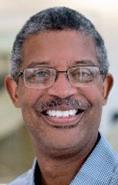
To his credit, Walker is not basking in early success. He is avoiding the overthinking that plagued him in the past, though he admits it remains a challenge.
“I don’t honestly think I’m there yet when it comes to completely shutting my mind off. It’s still difficult.
He joined Albert Pujols, Scott Rolen and Mark McGwire. Walker hit just six home runs in all of 2025, and had just 11 home runs in 162 games previous to the 2026 season. His 15 RBIs was MLB’s best and Walker’s .767 slugging percentage ranks among the league leaders.
It’s hard to do every at-bat. I think [I’m] on the right track,” he told Brenden Schaeffer of MLB.com following Sunday’s game.
The Cardinals opened a three-game series Monday against the visiting Cleveland Guardians. It is too early to label Walker an MVP candidate or assume his torrid start will continue through the summer.
Still, he looks comfortable at the plate and more confident than he has since

earning an Opening Day start in right field three years ago.
What has changed?
Derrick Goold of the St. Louis Post-Dispatch reported in December that Walker trained at Driveline Baseball in Arizona “for an assessment and the beginning of an offseason commitment to adjust his swing, alter his stance, and dive eagerly into a totalbody program.”
That work may be paying off, but it might not be
the only factor. John Mozeliak, who led baseball operations through 2025, is no longer in that role.
Whether that change has eased pressure on Walker is open to interpretation, but the results are evident. He looks freer at the plate and more decisive in his approach.
Fifteen games is the proverbial small sample size. At his current pace, Walker would hit more than 60 home runs — an
Walker
Walker’s eight home runs have fueled an early-season resurgence that has become one of baseball’s top storylines.
unlikely outcome — but he appears poised for a productive season.
“You can enjoy it when it happens,” Walker said. “But the main goal is to keep it going.”
The Reid Roundup
A trio of other young Black MLB stars have joined Jordan Walker with outstanding early seasons…Pittsburgh Pirates center fielder Oneil Cruz is hitting .339 with five
home runs and 13 RBIs. His Pirates were also in first place on April 13… Washington Nationals right fielder James Wood has five home runs, 14 RBIs and walked 11 times after 15 games. He also has a home run-robbing catch to his credit… Wood’s teammate, shortstop CJ Abrams, has four home runs, 16 RBIs and four stolen bases… How is wide receiver Hakeem Butler not on an NFL team roster? He’s clearly more talented than any UFL receiver, and he proved it again last Sunday in the St. Louis Battlehawks’ 34-30 victory over the Birmingham Stallions. Butler had 146 yards on four receptions and a touchdown…The Chicago Sky traded AllStar forward and irritant Angel Reese last week to the Atlanta Dream for 2027 and 2028 WNBA first-round draft picks. The two-time All-Star averaged 14.7 points and 12.6 rebounds during a season when she was critical of the organization and teammates. The Sky immediately gave Reese’s No. 5 to newly acquired guard Rickea Jackson.
Quentin Coleman of Principia, the 2026 St. Louis American Player of the Year, poses with the first place trophy after leading the Panthers to their second consecutive Class 3 state championship.
Alvin A. Reid
Jordan
Photo by Lawrence Bryant / St. Louis American
Earl Austin Jr.
AP photo by Michael Thomas


Washington University in St. Louis offers rewarding opportunities in various fields at all levels, with positions in engineering, nursing and health care, research, administration, technology, security and more.
Now Hiring: MFM OB/GYN Ultrasound Sonographers!
The WashU Department of OB/GYN is seeking friendly and reliable sonographers to join our Maternal–Fetal Medicine team.
What You’ll Love:
• Mon–Fri | 7:45am–4:15pm
• No nights, weekends, or call
• Scan high risk patients & work with MFM specialists
• Supportive, team oriented environment
Pay & Benefits:
• $35.99–$55.79/hr (based on OB/GYN/MFM experience)
• Up to 22 vacation days, 10 holidays, and sick time
• Comprehensive medical, wellness programs, mental health support
• 403(b) with 7%+ university contribution
• 4 weeks caregiver leave
• Tuition assistance for you & dependents
Whether you’re a dedicated sonographer or a new grad looking to grow in a supportive, high impact environment — we’d love to meet you!
For the full job description and to apply, visit jobs.washu.edu, JR92023.
We seek people from diverse backgrounds to join us in a supportive environment that encourages boldness, inclusion, and creativity.
EEO/AA/VET/Disability Employer
SEALED BIDS
Bids for Replace Windows and Blinds, Project No. R2509-01 will be received by FMDC, State of MO, UNTIL 1:30 PM, May 14, 2026. Project information available at: http:// oa.mo.gov/ facilities
SEALED BIDS
Bids for HVAC System Upgrades, Missouri State Highway Patrol, Troop C, Weldon Spring, Missouri, Project No. R2415-01 will be received by FMDC, State of MO, UNTIL 1:30 PM, May 14, 2026. Project information available at: http://oa.mo. gov/facilities
FACILITIES
SEALED BIDS
Bids for
Replace Roof & Renovate Basement and Access, Support Services Building, Project No. R2508-01 will be received by FMDC, State of MO, UNTIL 1:30 PM, 5/12/26. Project information available at: http:// oa.mo.gov/ facilities
MANAGEMENT SERVICES RFPS 2026
The Saint Louis Zoo seeks bids from qualified vendors for: Roof Services; HVAC Filter Supply; Plumbing Services; & Fencing Services and Tree Services at Sears Lehmann Jr. Wildlife Reserve. Bid documents are available as of 4/15/26 on the Saint Louis Zoo website: stlzoo.org/vendor.
SEALED BIDS
SEALED BIDS

Bids for Means of Egress, Project No. E2332-01 Means of Egress, Missouri School for the Blind, St. Louis, Missouri, will be received by FMDC, State of MO, UNTIL 1:30 PM, May 14, 2026. Project information available at: http://oa.mo. gov/facilities
Bids for Improvements to HVAC/ Chiller, Troop C Service Center, Park Hills Project No. R2515-01 will be received by FMDC, State of MO, UNTIL 1:30 PM, May 14, 2026. Project information available at: http://oa.mo. gov/facilities
Sealed Bids for:
NO. 089360.000
Will be received by the Administration of the St. Louis Art Museum, Owner, at 1 Fine Arts Drive, St. Louis, Missouri 63110 at 2:00 p.m. on May 12, 2026. The bids will be privately opened and read.
A mandatory Pre-Bid Meeting will be held on Tuesday, April 21, 2026 at 10:00 a.m. on the West Loading Dock, 1 Fine Arts Drive, St. Louis, Missouri.
Requests for electronic copies of the bid documents or questions regarding the scope of work should be directed, in writing, to Jeff Scott at McClure Engineering, jscott@ mcclureeng.com. Questions over the phone will not be accepted. Bid documents will be available beginning on Friday, April 17 at 12:00pm.
The Owner reserves the right to waive informalities in bids or to reject any and all bids.
Construction Estimate: $1,000,000
SEALED BIDS
Saving Our Children (SOC) is soliciting competitive sealed bids from qualified Food Service Management Companies (FSMC) to provide unitized meals for its Summer Food Service Program (SFSP) for summer 2026.
The estimated annual meal volume is approximately 163,040 meals consisting of breakfast, lunch, snack, and supper. Bid packets may be obtained by contacting: Saving Our Children 222 S Meramec Ave Ste 201 Clayton, MO 63105 314-529-7660 info@socmo.org
Sealed bids must be received no later than: Friday April 24, 2026
A public bid opening will be held at: Monday April 27, 2026 @ 1pm 222 South Meramec Ave. Ste 201, Clayton, Mo, 63105 All bids must comply with USDA, Missouri DHSS-CFNA, and federal procurement regulations.
Saving Our Children reserves the right to accept or reject any or all bids.

4/16/2026
City of St. Louis: Community Development Administration (CDA) 1520 Market Street St. Louis, Missouri 63103
314-657-3700 / 314-589-6000 (TDD)
These notices shall satisfy two separate but related procedural requirements for activities to be undertaken by the City of St. Louis (“The City.”)
REQUEST FOR RELEASE OF FUNDS
On or after 5/4/2026, the City will submit a request to the U.S. Dept. of Housing & Urban Development (HUD) for the release of the City’s Federal HOME Investment Partnerships Program (HOME) funds under Title II of the Cranston – Gonzalez National Affordable Housing Act of 1990, as amended, to undertake the following project:
Project Title: Benton Park Place
Purpose: New construction of one (1) three-story residential building. When completed, this development will contain thirty-six (36) one-bedroom, and thirteen (13) two-bedroom residential units for seniors 62+.
Location: 3101 South Jefferson Avenue, St. Louis, Missouri 63118
Estimated Cost: Total development cost of this project is approximately $14,515,289, with an estimated $850,000 of funding coming from St. Louis City’s Year 2021 Federal HOME Program Funds, Grant #M-21-MC-29-0500, and awarded in the Spring 2021 NOFA.
FINDING OF NO SIGNIFICANT IMPACT
The City has determined that this project will have no significant impact on the human environment. Certain conditions will apply to this project. Therefore, an Environmental Impact Statement under the National Environmental Policy Act of 1969 (NEPA) is not required. Additional information for each project is contained in the Environmental Review Record (ERR) on file at the City CDA, at the above address, where the ERR is available for review and may be examined or copied, weekdays 8 A.M. to 4 P.M., or visit https://cpd.hud. gov/cpd-public/environmental-reviews to review the HUD ERR.
PUBLIC COMMENTS
Any individual, group, or agency may submit written comments on the ERR to Trey McCarter, Community Development Planner III, CDA, at the address listed above. All comments received by 5/3/2026 will be considered by the City prior to authorizing submission of a request for release of funds. Comments should specify which notice they are addressing.
RELEASE OF FUNDS
The City certifies to HUD that, Matt Moak, in his capacity as Executive Director, consents to accept the jurisdiction of the Federal Courts if an action is brought to enforce responsibilities in relation to the environmental review process and that these responsibilities have been satisfied. HUD’s approval of the certification satisfies its responsibilities under NEPA and related laws and authorities and allows the City to use the City’s abovereferenced HUD program funds.
OBJECTION TO RELEASE OF FUNDS
HUD will accept objections to its release of funds and the City’s certification for a period of 15 days following the anticipated submission date or its actual receipt of the request (whichever is later) only if they are on one of the following bases: a) the certification was not executed by the Certifying Officer of the City; b) the City has omitted a step or failed to make a decision or finding required by HUD regulations at 24 CFR Part 58; c) the grant recipient has committed funds or incurred costs not authorized by 24 CFR Part 58 before approval of the release of funds by HUD; or d) another Federal agency acting pursuant to 40 CFR Part 1504 has submitted a written finding that the project is unsatisfactory from the standpoint of environmental quality. Objections must be prepared and submitted in accordance with the required procedures (24 CFR Part 58.76) and shall be addressed to the HUD St. Louis Field Office, CPDRROFSTL@hud.gov. Potential objectors should contact HUD to verify the actual last day of the objection period.
Matt Moak Certifying Officer

PUBLIC NOTICE
Notice is hereby given that the Metropolitan St. Louis Sewer District Requests for Quotes, Bids and Proposals are posted online for public download. Please navigate to www.msdprojectclear.org > Doing Business With Us > View Bid Opportunities
Metropolitan St. Louis Sewer District is an Equal Opportunity Employer.
SEALED BIDS
Bids for Troop E HeadquartersRenovate Restrooms & Replace All Cast Iron Piping, Headquarters Building, Project No.R2520-01 will be received by FMDC, State of MO, UNTIL 1:30 PM, 4/30/26. Project information available at: http://oa.mo. gov/facilities

To Advertise Real Estate, Rentals, Contact Angelita Houston at ahouston@ stlamerican.com 314-289-5430
ROOMS FOR RENT Midtown, near downtown, $150-$600/mo W/D, All Util., Heat Cent. Air, Cable TV, Internet, Off Str. Park. 314-397-8422




Seven Last Words services highlight Black church preaching tradition
By Rev. Dorothy S. Boulware Word in Black
The Friday the calendar annually designates as Good offers some of the best preaching in the African American faith community. Representing the sayings of Jesus while dying on the cross of Calvary, it also represents the genius, creativity and diversity of scriptural interpretation by those who are called and trained for pulpit ministry.
To one who loves good preaching, Good Friday offered the best of the best. With the help of contemporary technology, one could feast on sermons from 7 a.m. to 10 p.m., with hardly a break for the mandatory fish dinner.
There were young preachers. Women preachers. Senior preachers. Men preachers. All accented by song and dance and instruments.
From suffering to redemption
“The Seven Last Words is a storied and sacred preaching tradition in the Black church,” said the Rev. Melanie Jones Quarles, associate professor of preaching at Union Presbyterian Seminary, in a recent interview with Religion News Service.
“It allows preachers to interpret Jesus’ final utterances in ways that speak to the lived realities of their communities.”
The format is widely recognizable: seven clergy, often invited from different congregations or denominations, are each assigned one of Christ’s final sayings. Among them are “Father, forgive them,” “I thirst,” and “It is finished,” which together trace a theological arc
from suffering to redemption.
The tradition’s emphasis on preaching also reflects the central role of the pulpit in Black church life, scholars say. According to Quarles, the format provides a unique opportunity for multiple voices to engage a single biblical narrative while showcasing the diversity of preaching styles.
In many cities, the service has become a collaborative event, drawing together churches and clergy across denominational lines. In Atlanta, Chicago and Baltimore, ministerial alliances annually organize joint Seven Last Words services that fill sanctuaries and, increasingly, draw livestream audiences.
Elevating women in ministry
The Meyerhoff Concert Hall in Baltimore was the first site of such a service, hosted by Bishop Donte Hickman, a prolific preacher and pastor of the Southern Baptist Church. Every seat was filled, and even the walls seemed to shout with the gospel and sing with the traditional hymns.
It’s not unusual to see the same pastor preach in more than one such gathering. Rev. Reginald W. Sharp, senior pastor of Fellowship Missionary Baptist Church in Chicago, hosted seven Morehouse graduates in a 9 a.m. service and then preached for one of them — Rev. Dr. Otis Moss III, senior pastor of Trinity United Church of Christ — at a later service.
In Houston, Wheeler Avenue Baptist Church, where Dr. Marcus D. Cosby is senior pastor, hosted seven of its former interns. All are now senior pas-
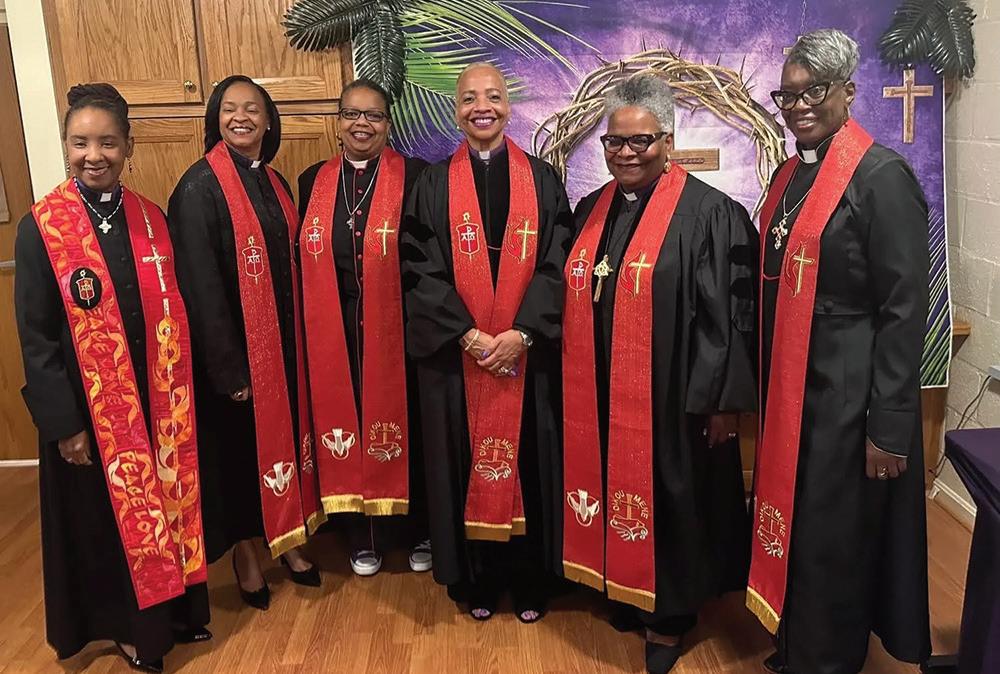

tors in their own right.
In more recent years, the Seven Last Words has also become a platform for elevating women in ministry.
Led by Dr. Judy Fentress Williams, a renowned Old Testament scholar, Alfred Street Baptist Church in Alexandria, Virginia, continued its tradition of seven women preachers telling the Good Friday story.
Faith and social justice
Rev. Jason O. Jordan-Griffin, senior pastor of St. Mark United Methodist Church in Hanover, Maryland, held a service featuring the preaching of seven


bishops who are Black women.
The Reverends Kennetha J. Bingham-Thai, Robin Dease, LaTrelle Easterling, Cynthia Moore-Koikoi, Sharma D. Lewis Logan, Tracy Smith Malone and Delores J. Williamston marked a historic moment for representation in a space long dominated by men. Leaders say such developments reflect broader shifts within Black church communities, where women have long played central roles in ministry, yet have traditionally been excluded from prominent preaching opportunities. At the same time, many congregations used the service to
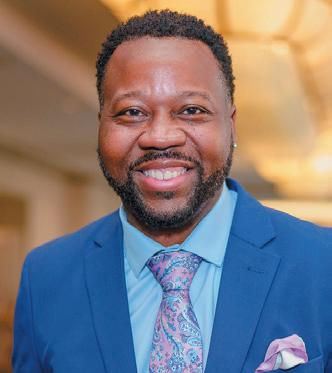
I’ve been thinking a lot about systems lately — not just as tools, but as a form of leadership. When you’re building something meaningful, systems aren’t just operations. They are protection. They are stewardship. They are the guardrails that keep the mission from collapsing when life happens, when people change directions, or when seasons shift.
And this week, I felt that deeply. Because behind every system conversation — HubSpot, Sales Navigator, CRMs, commission models — there’s an unspoken fear leaders rarely admit out loud: What happens to the vision if the person holding it suddenly walks away?
I’ve lived through that before. Someone leaves, and suddenly you’re chasing down passwords, files, contacts, threads, conversations — all the things you thought were in place, tucked safely away, but were actually living in one person’s head or personal account. And when that happens, it hits you: You didn’t just lose a team member. You lost momentum.
I carry the weight of that lesson with me. So now when I think about sales, I don’t think about “closing deals.” I think about continuity. I think about resilience. I think about building something that can stand when circumstances change — because circumstances always change.
It’s easy to pretend these things are just administrative details, but they’re not. They are the backbone of a business that intends to outlive the personalities inside it.
A CRM doesn’t just store contacts. It carries the history of your relationships. It holds your follow-ups. It protects your opportunities. It gives your mission a memory. Without that, your business becomes emotional — dependent on how someone feels, how someone shows up, how long someone stays. And emotional business is dangerous business.
address contemporary social concerns. Some incorporated themes of racial justice, economic inequality and communal grief, drawing parallels between the suffering of Christ and modern-day experiences.
“The cross speaks to suffering in every age,” said Moss III of Trinity United, in a Good Friday sermon archived by the church. “It reminds us that God is present even in the midst of pain and injustice.”
Remember, reflect, renew
Such interpretations are consistent with the historic role of the Black church as both a spiritual refuge and a center for social witness, particularly in times of national crisis.
Despite these evolving themes, the core of the Seven Last Words remains unchanged: a sustained meditation on the sacrifice of Jesus, held in tension with the hope of resurrection.
Worship services are often marked by solemnity, with congregants dressed in dark attire and choirs offering selections that range from traditional hymns to contemporary gospel. The altars are bare, having been stripped following the Maundy Thursday service that includes foot washing. The preaching builds in intensity as each speaker approaches the final word.
“It is a time when the whole community comes together to remember, reflect and renew its faith,” Quarles told Religion News Service. “The power of the Seven Last Words is that it invites us not only to hear Christ’s suffering, but to understand its meaning for our lives today.”
That’s why I’m building differently this time. I want a system that can breathe if someone steps away. A system that can scale without breaking me. A system that doesn’t confuse charisma with structure.
Because here’s the leadership truth we don’t say enough: You can’t build a future on hope alone. You build it on design.
That’s where compensation comes in. Paying people fairly is important. Rewarding impact makes sense. But buried inside every compensation conversation is this question: What motivates people in a way that still honors the mission?
Ten percent, five percent, flat fees — those are numbers. But alignment is spiritual. It’s about honoring value without compromising stewardship. Because people aren’t selling a product — they’re selling you. Your story. Your work. Your purpose. And that means you owe the mission more than charm. You owe it a structure that can carry the weight.
So now, I’m centralizing everything: every contact, every company, every deal stage, every follow-up, every communication. Not because I enjoy software — trust me, I don’t. But because I’m thinking 10 years out. And 10-year thinking requires discipline today.
When you stop building around people and start building around systems, something shifts in you. You stop reacting and start creating. You stop chasing and start choosing. You stop fearing transitions and start trusting what you built.
Because at the end of the day, here’s the lesson I keep returning to: If your mission depends on one person, it was never a mission — it was a personality. And I didn’t come this far to build something fragile. I came to build something that will last. Something aligned. Something transferable. Something resilient.
So yes — I’m investing in systems. Because systems create freedom. And freedom gives your story room to grow. What about you? Are you building something that can grow, scale, and last?
For more, visit OrvinKimbrough.com or MidwestBankCentre.com.
Facebook photo
A sacred Black church tradition rooted in Christ’s final words is evolving — embracing livestreams, diverse voices and modern interpretations that connect ancient scripture to today’s struggles for justice, community and hope. An all-female group of bishops — from left, Kennetha Bingham-Thai, Sharma Lewis-Logan, Robin Dease, Tracy Smith Malone, LaTrelle Easterling and Delores Williamston — participated in the event.