THE ARCHITECTURE OF BELIEF QUEER REORIENTATION, PERCEPTION, AND INHERITED MEANING OGNJEN GLIGORIJEVIC
organized to be read
organized to be read
body is organized to be read
This research examines perception as a structured and non-neutral process shaped by inherited moral, cultural, and symbolic frameworks. Drawing from personal experience within a Serbian Orthodox context, it explores how queerness is often interpreted before any direct encounter takes place, producing a misalignment between lived experience and socially accepted meaning. Rather than treating this tension only as repression, the project considers its potential as a generative condition.
Through the analysis of artistic practices and the development of my own work, the research introduces the concept of precontext: the underlying, historically sedimented structures that shape interpretation before it becomes conscious. These frameworks determine what is seen as legible, acceptable, or deviant, often operating as invisible conditions of perception.
My artistic practice engages these dynamics by staging encounters between conflicting symbolic systems - religious, industrial, and erotic - without resolving their meanings. Through spatial structures, repetition, and partial legibility, the work interrupts automatic ways of seeing. Within this framework, queerness is approached not as a fixed identity, but as a mode of orientation shaped by negotiation, constraint, and shifting conditions of visibility.
Could the friction between inherited frameworks and lived experience produce something generative, not despite the pressure, but through it?
Headline
Perception and Moral Formation
Orthodox Moral Atmosphere and Political Regulation
From Lived Tension to Artistic Practice
Fear, Perception, and Religious Conditioning
Visibility, Opacity, and Failure
Symbols, Materiality, and Contradiction
Gestures
Grid as Logic
Aesthetics and Politics
Context and Pre-Context
Artistic Lineages and Material Strategies
Symbolic Distance and Discomfort
Form Research (+++)
Identity of Inderscenables
Fag Extinguisher
Paradox of Today
Untitled (Cross)
Form I (Elements of a Disappearing Narrative)
Form II (Elements of a Disappearing Narrative)
Pressure
Prayer? It Keeps Repeating (Part I: Prayer)
Escapism
Paradox of Today Small Talk by the Border It Keeps Repeating (Part II) It Keeps Repeating (Part I)
Notes on Awareness and Systems
Notes on the Index of Body Classifications
Notes on the Installation It Keeps Repeating (Part II)
Perception is never neutral, or at least that is what I have come to believe. It is shaped by inherited narratives, moral frameworks, and symbolic systems that organize how bodies are read and how desire is interpreted. These structures operate prior to conscious reflection, guiding emotional responses and determining what appears acceptable, threatening, or out of place. What is seen, felt, or permitted is conditioned by history, language, and repetition. But if that is true, then perception becomes something more unsettling than a faculty. It becomes a site through which regulatory frameworks operate, quietly shaping the limits of recognition before we are even aware of being shaped.
Growing up within a Serbian Orthodox context, moral categories such as purity and sin, belonging and deviation structured everyday life. Religious symbols, rituals, and language extended beyond church spaces into family relations, social expectations, and bodily -disci pline. They shaped how bodies were expected to move, behave, and desire. As a visibly gay man growing up in this environment, my presence was often read not as difference, but as moral failure. Queerness appeared not as variation, but as deviation. I did not experience this as a doctrine I could examine and reject. I experienced it as atmosphere, something closer to weather than to argument.
This framing shaped perception before experience could be articulated. Bodily recognition existed in tension with inherited meaning, producing a persistent sense of misalignment between what was felt and what could be acknowledged. This misalignment did not originate in the body alone, but in the frameworks that named, interpreted, and evaluated sensation. Feelings did not simply appear as desire; they became intelligible, or failed to become -in telligible, through systems that determined whether they were legitimate or deviant. What would it mean to feel something for which no legitimate name exists? And what happens to that feeling when it finds a name that has already been condemned?
The tension was not only ideological but affective. It manifested in gestures, silences, self-monitoring, and anticipatory fear. Desire was sensed but often misrecognized. -Recog nition was delayed or displaced. Over time, these negotiations became habitual, shaping how spaces were entered, how attention was managed, and how visibility was calibrated in relation to context and audience. What developed may not have been only repression, it may have been something more precise: a heightened sensitivity to context, a learned awareness of when and how the body could appear.
What I keep returning to is whether misalignment is solely a product of regulation, or whether it might also open space for something else. Could the friction between inherited frameworks and lived experience produce something generative, not despite the pressure, but through it?
That is the question this research begins with.
Perception is never neutral, or at least that is what I have come to believe. It is shaped by inherited narratives, moral frameworks, and symbolic systems that organize the ways bodies are read and desire is interpreted. These structures operate prior to conscious reflection, guiding emotional responses and determining what appears acceptable, threatening, or out of place. What is seen, felt, or permitted is conditioned by history, language, and repetition. But if that is true, then perception becomes something more unsettling than a faculty. It becomes a site through which regulatory frameworks operate, quietly shaping the limits of recognition before we are even aware of being shaped.
Growing up within a Serbian Orthodox context, moral categories such as purity and sin, belonging and deviation structured everyday life. Religious symbols, rituals, and language extended beyond church spaces into family relations, social expectations, and bodily discipline. They shaped how bodies were expected to move, behave, and desire. As a visibly gay man growing up in this environment, my presence was often read not as a difference but as a moral failure. Queerness appeared not as a variation, but as a deviation. I did not experience this as a doctrine I could examine and reject. I experienced it as atmosphere, something closer to weather than to argument.
This framing shaped perception before experience could be articulated. Bodily recognition existed in tension with inherited meaning, producing a persistent sense of misalignment between what was felt and what could be acknowledged. This misalignment did not originate in the body alone, but in the frameworks that named, interpreted, and evaluated sensation. Feelings did not simply appear as desire; they became intelligible, or failed to become intelligible, through systems that determined whether they were legitimate or deviant. What would it mean to feel something for which no legitimate name exists? And what happens to that feeling when it finds a name already condemned?
The tension was not only ideological but affective. It manifested in gestures, silences, self-monitoring, and anticipatory fear. Desire was sensed but often misrecognized. Recognition was delayed or displaced. Over time, these negotiations became habitual, shaping how spaces were entered, how attention was managed, and how visibility was calibrated in relation to context and audience. What developed may not have been only repression; it may have been something more precise: a heightened sensitivity to context, a learned awareness of when and how the body could appear.
What I keep returning to is whether misalignment is solely a product of regulation, or whether it might also open space for something else. Could the friction between inherited frameworks and lived experience produce something generative, not despite the pressure, but through it?
That is the question this research begins with.
Queer and trans bodies are frequently framed as moral or cultural threats before any encounter takes place. The framing does not arise from contact. It precedes it. Certain bodies are classified, positioned, and interpreted through inherited religious, national, and moral narratives before they are met as people. Recognition, in this sense, does not open relation. It forecloses it. What structures that framing is not context in any immediate sense. It is something older, already in place before the situation begins.
Within the Serbian Orthodox context, this operates with particular clarity. Moral categories such as purity and sin shape public discourse in ways that extend well beyond theology. Statements by religious authorities have repeatedly described queer presence as incompatible with moral life, not as a position arrived through encounter, but as a conclusion already reached. This language depends on inherited symbolic distinctions that predefine what counts as order and what counts as deviation. Deviation is not discovered. It is assigned.
For queer individuals raised within this environment, the effects are not only social but experiential. Bodily recognition collides with dominant moral narratives, producing shame and fragmentation. Something is felt, but what it means is already spoken elsewhere. I am not sure there is a way to fully describe what it is to grow up inside a system that has named you before you have named yourself. The tension does not originate in queerness itself, but in the friction between lived embodiment and the frameworks that claim to interpret it. What is at stake may not be acceptance alone, but the possibility of appearing without already being explained.
These dynamics extend beyond sexuality. They suggest that belief systems maintain coherence by preserving separation between symbolic domains. Religion, desire, and embodiment are manageable when they remain compartmentalized. But proximity unsettles. When these domains are brought together without mediation, established frameworks of meaning begin to destabilize. Discomfort emerges not from offense alone, but from the collapse of this separation.
A comparable tension between sacred imagery, corporeality, and public response can be observed in the work of Romeo Castellucci, an Italian theatre director and visual artist whose practice is known for its use of symbolic imagery, bodily presence, and spatial scale to produce encounters that resist easy interpretation. His work On the Concept of the Face, Regarding the Son of God (2010) unfolds in three movements. In the first, an elderly father suffering from incontinence is cared for by his son beneath a monumental reproduction of Antonello da Messina’s Christ Blessing , a transcendent face staring silently down at the scene below. What occupies the space beneath the sacred image is not simply vulnerability but bodily abjection in its most uncontrollable form: mess, loss of dignity, the body refusing to behave. The transcendent and the unruly share the same frame without mediation.
In the second movement, children throw toy grenades at the face of Christ, gradually obscuring it. In the third, text appears reading “You are my shepherd,” flickering to “You are not my shepherd.”
Castellucci described the children’s gesture not as desecration but as “a cry for love.” As he put it: “It’s not my intention to desecrate the face of Jesus. On the contrary. This is a sort of prayer, by means of the innocent gestures of kids. They want to be listened to. If these toys bang into the face of Jesus, it’s to urge him to listen to them.” To most audiences it looked like an act of violence. That gap between appearance and intention is precisely the point. The work placed the sacred in a situation where it could no longer control how it was read. In Paris, far-right Catholic groups organized protests, hurling eggs and oil at the building and its audiences. Protesters who stormed the stage claimed the face of Christ had been covered in excrement, a claim Castellucci explicitly denied.
When the separation fails, the frameworks that organize meaning begin to show their construction. The protesters needed the work to be blasphemy. Castellucci insisted it was prayer. The image could no longer determine which reading was correct. That loss of control over meaning is what the disturbance revealed. The tension was not created by the performance. It was already there, held in place by the distance that had been doing its work in silence.
Another work I had the pleasure of seeing is Sancta by Florentina Holzinger, shown at the Flemish Opera and Ballet in Antwerp, Belgium. Holzinger takes Sancta Susanna, Paul Hindemith’s controversial 1922 opera in which a nun confronts her own sexual desire and reframes it through feminist and queer lenses, alongside a humanization of Jesus as a figure of flesh rather than symbol.
Using religious imagery as material, the work examines how nuns and women have been expected to behave, deploying transgression as method. The performers bring extraordinary physical skill and athleticism, using their bodies as the primary instrument. Sancta also drew protests in Antwerp; a confirmation, perhaps, of how necessary the work is at this moment. It operates through spectacle, historical reference, and a persistent, unsettling playfulness.
There is no trigger warning before Catholic mass, yet mass asks its congregation to look at a body nailed to a cross. Sancta works with this contradiction. If institutional religion has long used the promise of salvation to regulate the body, Holzinger inverts the logic: sensation, desire, and physical extremity become the ritual itself. The sacred is not reached by suppressing the flesh; it is found inside it.
My artistic practice emerges from this tension, or perhaps from an attempt to remain within it. Rather than resolving the friction between desire and discipline, visibility and protection, attraction and fear, my work stays with these negotiations as lived conditions that shape how the body moves through space, anticipates response, and calibrates itself in relation to others. They have the same structure. And that structure, I have come to think, was already there before I entered it. It preceded the context I thought I was navigating.
By placing charged symbols and materials into unfamiliar relations, I want my work to interrupt automatic perception. Instead of producing clarity, these juxtapositions open instability. Recognition slows. Habitual readings begin to loosen. The viewer is asked to stay with something before deciding what it means.
Within this approach, materials are not neutral carriers of content. Industrial elements such as steel, scaffolding, and rigid structural forms evoke control, order, and discipline. Intimate objects such as underwear and branded Nike socks remain close to the body, carrying connotations of exposure, fetish, circulation, and coded recognition. What matters equally is the framework the viewer already brings. A Nike sock can mean one thing to one person and something else entirely to another. That difference is not incidental. It is the material operating, activating whatever the viewer carries into the encounter before it begins. When these materials coexist, their meanings do not resolve into synthesis. They remain in friction. It may be within this friction that the work echoes the experience of navigating environments in which desire is shaped, restricted, or redirected by inherited moral frameworks, not as illustration, but as structure. The combination of what the viewer privately brings and what the work publicly presents produces something that belongs fully to neither. The personal and the seemingly objective do not cancel each other out. Held together, they reveal how much of what feels like neutral perception is already organized by frameworks we did not choose and have rarely been asked to examine.
From this position, queerness can be approached less as a fixed identity than as a mode of orientation. It unfolds through movement and relation, through adjustments of proximity and distance, exposure and concealment. Orientation here is not a stable direction but an ongoing negotiation shaped by context rather than certainty.
This thinking resonates with José Esteban Muñoz’s description of queerness as a horizon rather than a stable position. Writing in Cruising Utopia (2009), Muñoz drew on Ernst Bloch’s philosophy of hope to argue against what he saw as a dominant tendency in queer theory to locate queerness only in the present tense, in what already exists or can already be seen. For Muñoz, queerness is not a fixed identity or an achieved state but something that operates in potentiality, felt in moments of performance, collectivity, and desire rather than confirmed through visibility or recognition. A horizon is not a destination to be reached, but something sensed ahead of itself, never fully present, never secured.
What I find useful in this framing is not the optimism sometimes attributed to it, but the structural incompleteness. If queerness operates as a horizon, it cannot be fixed, confirmed, or resolved into a stable position. It is always moving, always receding, reshaping itself in relation to whatever conditions it encounters. My work engages queerness as movement rather than destination, turning attention toward what is encountered along the way: the frameworks that regulate, the boundaries that shift, the systems that persist beneath the appearance of openness. I want to establish conditions through which such orientations might be sensed, and through which the architecture shaping them might become, briefly, visible.
These conditions take the form of constraint, repetition, forced proximity, and partial legibility. Gestures are repeated until their stability begins to waver. Images resist full disclosure, requiring duration and attention.
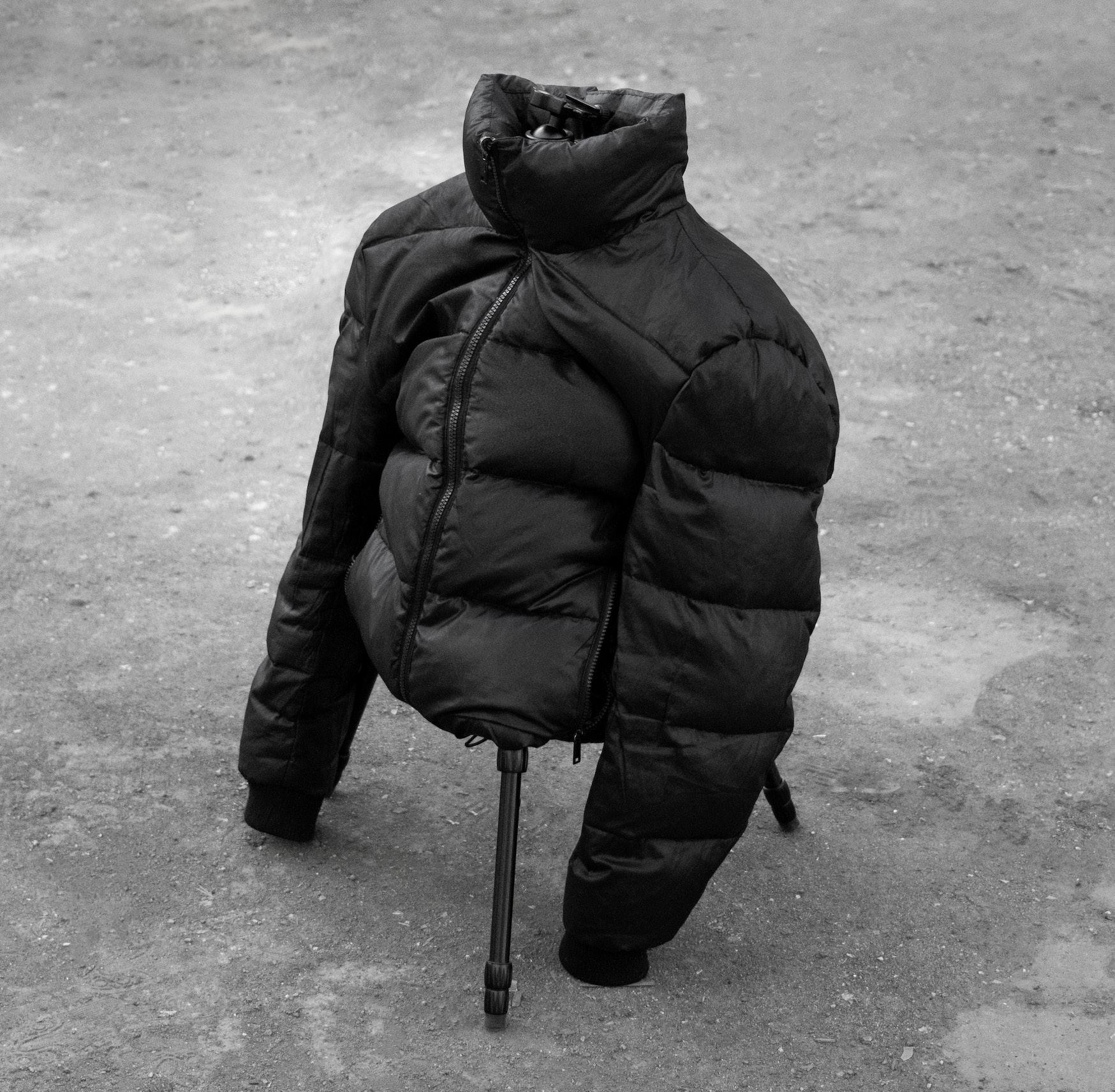
Variable dimensions 2023 002
Identity of Indiscernibles
Jacket, tripod
Fear is not a declared method in my practice, but a condition that shapes perception indirectly. It does not appear as a theme or visible affect, but as an orientation that precedes interpretation, directing attention before meaning is fully formed.
It is not only an individual emotion, but something that becomes embedded in space and learned through repetition. Rather than being located inside the subject, it is produced through environments, narratives, and cultural memory that shape how space is read before it is consciously understood. In Landscapes of Fear (1979), Yi-Fu Tuan describes fear as something that is not tied to the inherent properties of places or bodies, but formed through accumulated meaning. Space is not only physical but produced through accumulated meaning, where repetition and association attach fear to places and bodies over time.
A church is not frightening because of its architecture. A body is not threatening because of what it is. These meanings are produced and sustained culturally rather than given.
Tuan distinguishes between immediate fear, triggered by direct threat, and enduring landscapes of fear that persist even in the absence of danger. They do not require a specific event to activate. They operate as background conditions, shaping how environments are entered and how bodies within them are read. These landscapes are sustained through cultural reinforcement rather than constant violence. Over time, fear becomes habitual. It shapes how surroundings are interpreted before any event unfolds.
I grew up inside one of these landscapes without having a name for it. The threat was rarely direct. It accumulated through small signals, certain bodies, certain desires, certain ways of being present in a room carried consequences. The fear did not require enforcement to function. It had already been internalized. What I keep returning to is the question of where this conditioning originates. It is not simply the context of a given situation, the church service, the family dinner, the locker room. Each of these has its own context. But something organizes all of them in the same direction. Something that runs beneath context, shaping what the situation can even contain.
That something is what I am trying to locate.
In this sense, fear does not function solely through prohibition. It defines thresholds. It establishes what seems permissible, what appears risky, and what remains concealed. This is how the Serbian Orthodox Church operates within a broader cultural context, not primarily through direct punishment but through the production of a moral climate. Through doctrine, ritual, and visual language, it contributes to an environment in which certain forms of embodiment are associated with spiritual danger and social risk.
Fear runs through my work the way it ran through the conditions that produced it, not as a declared subject but as a persistent undercurrent. It is present in the religious symbols, in the queer body that navigates those symbols, in the question of which passport you carry and what that permits. These are not separate topics that happen to share a theme. They are different surfaces of the same condition.
001 Repetition, Conditioning, Formation
IDENTITY AS A STRUCTURE
Atelier11
Novi Sad, Serbia
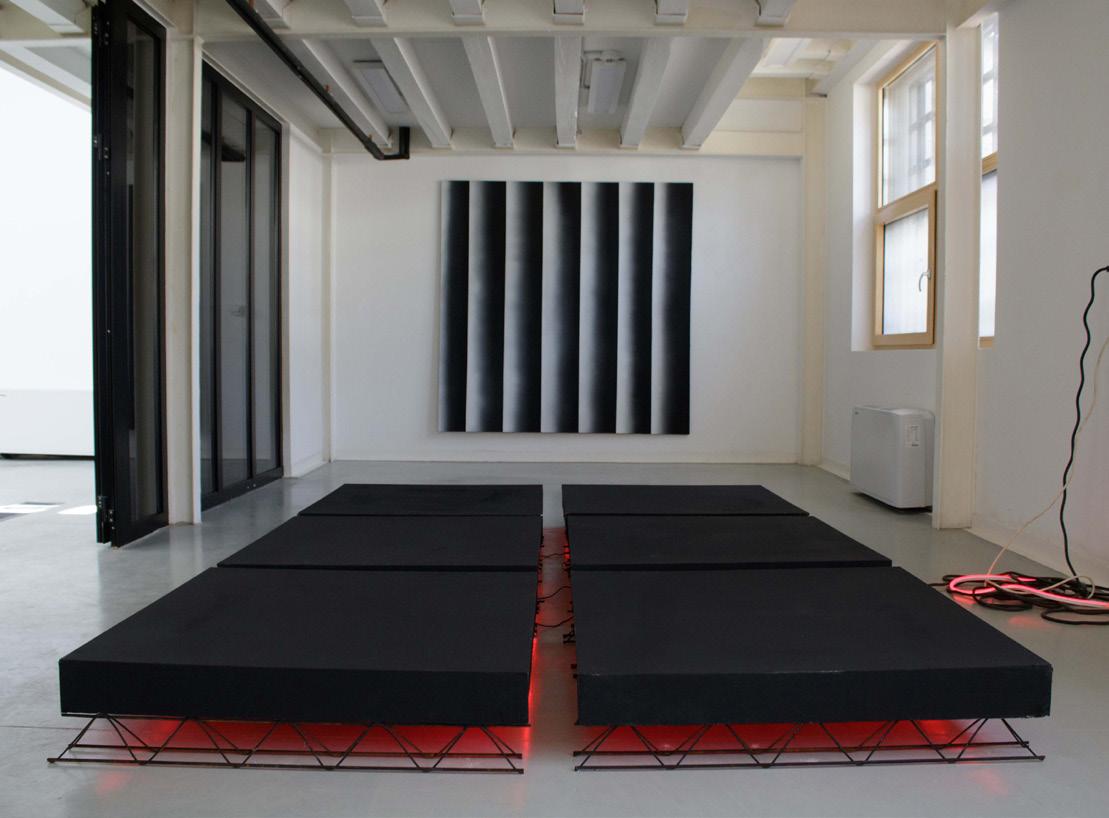
Paradox of Today
002
004 Belief, Authority, Embodiment Belief, Authority, Embodiment
RELIGION AS A STRUCTURE
Willem Twee Den Bosch, the Netherlands
003 Nationhood, Sovereignty, Regulation
Small Talk by the Border
NATIONALITY AS A STRUCTURE
De Bouwput Amsterdam, the Netherlands
It Keeps Repeating
SEXUALITY AS A STRUCTURE
De Bouwput Amsterdam, the Netherlands
Visibility is often framed as liberation, as recognition, affirmation, and inclusion. But it is never simply given. It is always shaped by conditions: who is watching, in what context, with what prior assumptions already in place. What can be shown, and to whom, is never neutral. For queer bodies in the context described in the previous chapter, visibility is not liberation from fear. It is often its trigger.
In Epistemology of the Closet (1990), Eve Kosofsky Sedgwick argues that modern Western culture is structured around a crisis in the definition of homosexuality and heterosexuality. “Secrecy can function as the subjective practice in which the oppositions of private/public, inside/outside, subject/object are established, and the sanctity of their first term kept inviolate” (p. 67). The closet, in this sense, is not a fixed state but a set of shifting relations that must be navigated across different social contexts.
This becomes evident in everyday life. Someone may feel open among friends yet guarded at work, expressive in nightlife yet restrained in public space, visible in one community while coded or ambiguous in another. It requires constant calibration in relation to environment, audience, and potential consequence. I recognize this calibration as something I perform without always deciding. It has become a kind of default processing, running in the background of most social situations. Even public figures who appear openly queer often maintain carefully managed forms of disclosure, revealing what feels sustainable while withholding what remains vulnerable.
Media representation adds another layer to this condition. Queer visibility frequently appears in mediated forms that remain legible only when they align with dominant norms and expectations. Difference is often softened, simplified, or translated into familiar narratives that reduce disruption. At other times, queerness is made visible only through spectacle, excess, or extremity. In both cases, visibility remains conditional. As Sedgwick suggests, exposure does not dissolve regulation. It reorganizes it, producing new boundaries around what can be shown, how it can appear, and which forms of queerness remain acceptable.
Within queer communities themselves, visibility also shifts depending on environment. Nightlife and subcultural spaces allow gestures, desires, and forms of embodiment that may feel less possible in formal, institutional, or public contexts. Lighting, sound, proximity, and anonymity shape how bodies appear and how desire circulates. Visibility expands and contracts according to atmosphere, revealing it as relational rather than individual.
It is produced through conditions, not simply claimed. The club is not an escape from the structures described in earlier chapters. It is another site where those structures are temporarily suspended, rearranged, or made visible through their own absence.
The locker room occupies a different position in this geography. For many gay boys, they are the first site of homosexual feelings, exposed, unavoidable. But what I remember more than desire is the hypervigilance. The constant monitoring of my own gaze. Where am I looking. How long. What my face is doing. Whether something in me is legible. The locker room is a space where nudity is permitted and safety is not. Vulnerability is enforced by the space while threat is enforced by the social codes operating inside it. To be perceived as gay there is not merely uncomfortable, it positions you as a target. What that early experience installed was a reflex of self-surveillance that preceded any conscious understanding of what I was surveilling myself for. The fear came before the knowledge. The body learned to manage its legibility before the mind had language for why.
Jack Halberstam’s writing on failure offers a way to understand these negotiations without resolving them into progress. In The Queer Art of Failure (2011), he argues that failure “allows us to escape the punishing norms that discipline behavior and manage human development with the goal of delivering us from unruly childhoods to orderly and predictable adulthoods” (p. 16) . Rather than treating opacity, refusal, and incoherence as deficits to be overcome, Halberstam frames them as generative forms of resistance to normative development. Where dominant culture demands clarity, linear progression, and legibility, queer aesthetics often move through disorientation, delay, and contradiction. A life that does not follow expected scripts is not failed. It follows a different temporal logic. Ambiguity becomes a resource rather than a deficit. Meaning remains open, unfinished, and in motion.
To resist full disclosure is not necessarily to hide. It may be to refuse the terms under which disclosure is being requested.
Let’s pretend we are here for clarity, but we know we are here for stimulation.
Sometimes the kind you cannot name without a shame. They ask questions like what is the meaning what is the context
But I know exactly when their attention slips It is the moment the language curves in a certain direction. The moment an image becomes a little too warm. The moment a metaphor opens its legs. Holiness, misplaced.
Sex, misunderstood.
It’s the space where your mouth could be doing anything. Now, everyone thinks they are subtle.
The reader especially. Reading politely pretending they are consuming art while their imagination is quietly unbuttoning something. Do not deny it.
I can feel the moment your breathing shifts. It is almost liturgical. Inhale. Hold.
Picture something you should not. Exhale.
Someone once asked if I use religious metaphors too much. As if I should apologise for finding God in thighs salvation in fingertips heaven in someone whispering deeper
You read the line and think he cannot mean that but you hope I do. You read the next line and think I should not enjoy this but you enjoy it even more
Your perception does not need much. A metaphor here a gesture there a word like open knees and your brain fills the rest in.
You call it interpretation. I call it collaboration.
People underestimate how sexual language can be even when it never names the body. Especially when it never names the body. Desire loves suggestion more than completion. Make me Submissive, Dear god.
I do not have to describe anything explicitly. Your imagination is already kneeling. Your eyes are already following the rhythm. You make offerings to every sentence. You expect revelation. You want deliverance.
You want both.
I like to watch you lean forward.
They think they are safe because this is a text because nobody sees their face against the paper
Text is a finger that knows exactly where your attention lives. People ask if my metaphors have meaning. They do.
They mean you are thinking about it sooner than you expected. They mean you are wondering if it is allowed to enjoy this much. They mean the same part of the brain that prays is the part that fantasises.
Scientists can debate that.
I do not need to.
I watch it happen in real time.
I am not trying to corrupt anyone.
I am only turning the lights on in a room they already know. A room with velvet curtains and incense that smells a bit like sweat an altar that looks like bed.
You think I write about dirty things.
I don’t.
I write about mouths opening at the same pace as prayers.
I write about thighs learning how to kneel.
I write about hands becoming scripture. I write about desire becoming ritual.
You read it and call it metaphor. Your body calls it something else. Someone once said I cannot tell if this text is sacred or obscene. I stopped trying to decide.
You already know what part of you is reading this.
Through repetition, symbols accumulate authority. Over time, they accumulate meaning and become embedded within cultural memory, operating with an apparent self-evidence. Their force often precedes conscious interpretation, shaping perception automatically through familiarity and historical reinforcement. Symbols come to feel natural, stable, and unquestionable. This stability is not inherent. It is produced, and it depends on certain conditions remaining undisturbed.
When a symbol is displaced, reframed, or placed into an unfamiliar context, this apparent stability begins to loosen. Such gestures are not simply acts of appropriation. For me, they are acts of reorientation, exposing how meaning is produced, maintained, and authorized. What becomes visible is not the symbol itself but the arrangement that gave it its certainty.
In my practice, symbols enter the work carrying their inherited weight. I am not interested in emptying them of meaning or declaring them false. I am interested in what happens when that weight is placed in unexpected proximity to other weights. Religious forms and gestures shaped by Serbian Orthodox Christianity are placed in relation to industrial materials such as steel, scaffolding, and iron. These materials are commonly associated with labor, discipline, control, and structural order. Alongside them appear materials linked to intimacy and eroticism, including latex, underwear, and athletic socks. When these elements coexist, their established meanings begin to shift. What is familiar becomes unsettled, and what is assumed to be stable reveals its contingency.
A religious symbol rendered through industrial material may evoke reverence for one viewer and discomfort for another. A form associated with purity may simultaneously suggest erotic potential. Interpretation does not land in one place. It is distributed across the materials, the arrangement, and whatever the viewer brings with them. The work does not prescribe a reading. It withholds the resolution that would make a single reading necessary.
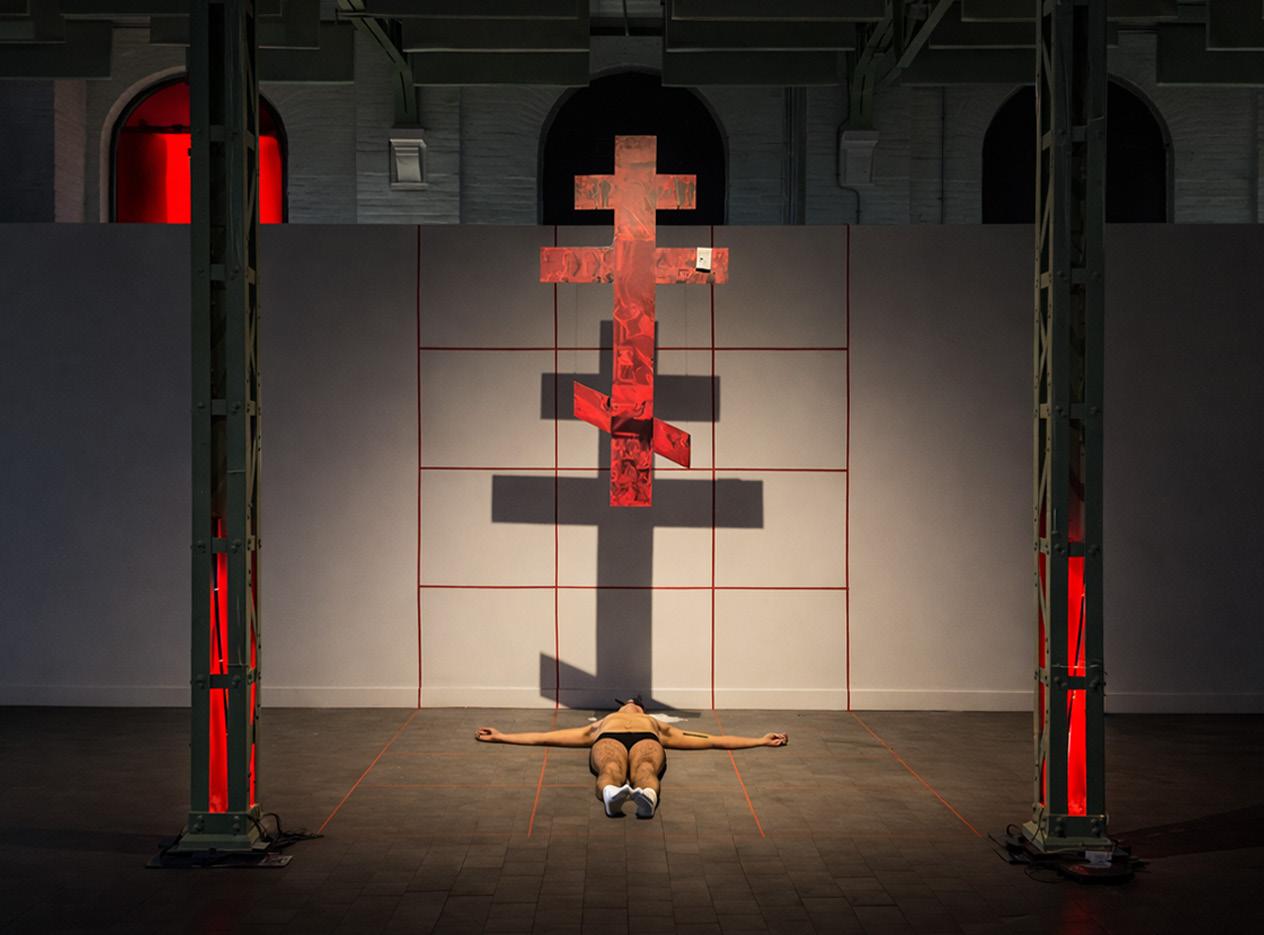
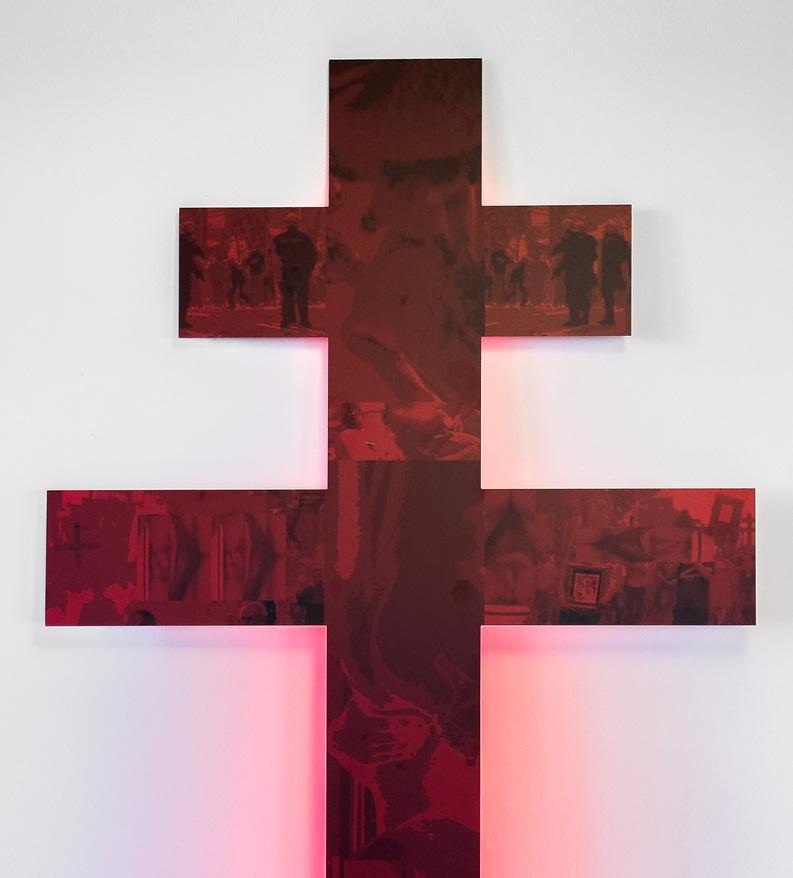
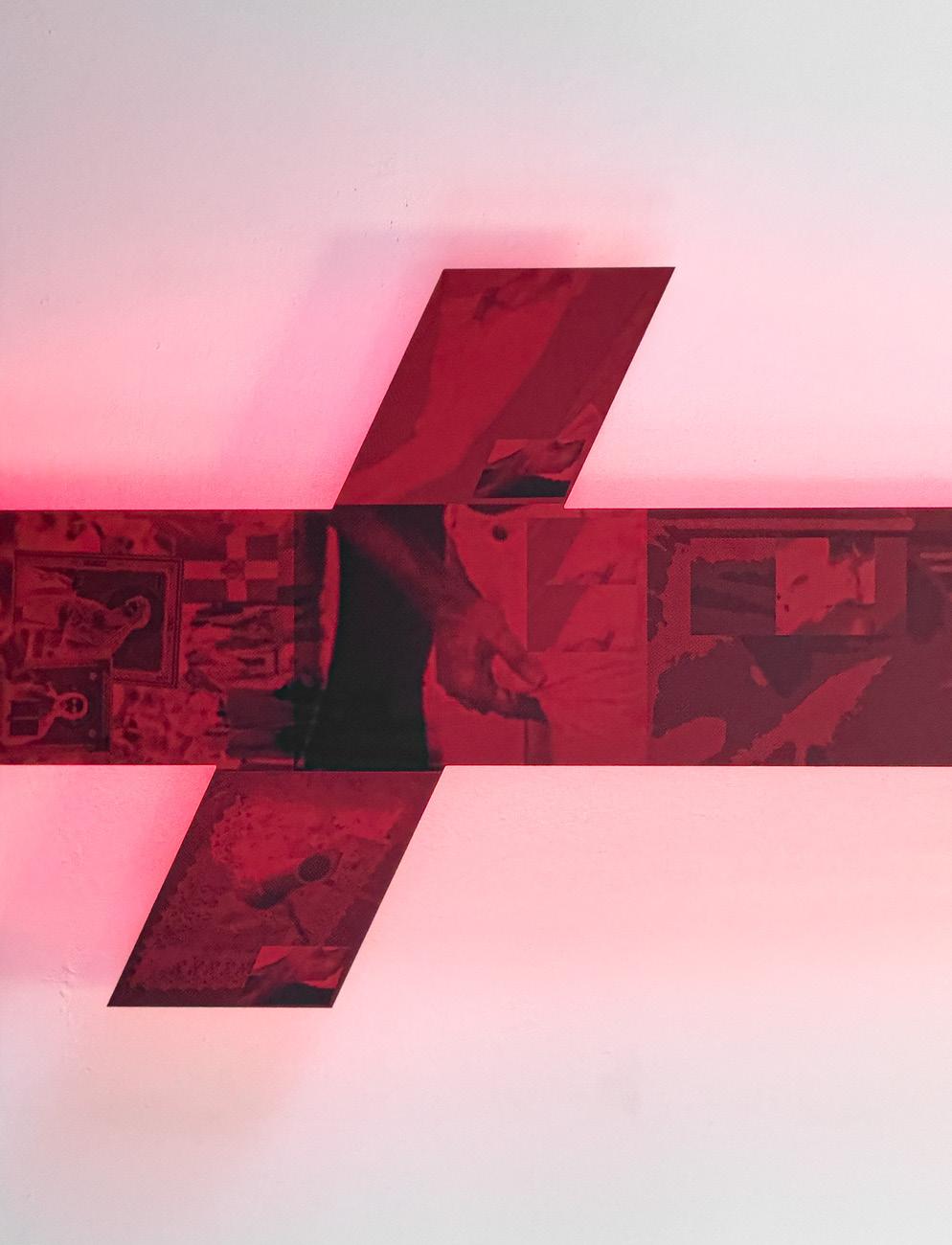
One example of this approach is my installation Paradox of Today. In this work, the Serbian Orthodox Christian cross functions as a central structural form. Onto its surface, I printed a collage of images on Aluminium, drawn from different visual registers: gay pornographic imagery, photographs documenting police presence during the 2010 and 2022 Belgrade Pride protests, and images of Christian groups protesting EuroPride in Belgrade. These images are placed together without hierarchy and overlaid with a red color field, a color strongly associated with Orthodox religious iconography.
The use of halftone, pixelated imagery complicates legibility. From a distance, the surface appears abstract and devotional. Only through closer inspection do the images begin to register. This oscillation between recognition and obscurity mirrors the way these tensions already operate socially: present, charged, and often partially concealed. My intention was not to produce shock. I wanted to produce the particular discomfort of recognition, the moment when you realize you have been looking at something for longer than you intended.
By that point the viewer should have already spent enough time with the cross in a devotional register. What arrives later, the protest photographs, the pornographic fragments, does not cancel that experience. It joins it. The viewer cannot unknow what they have seen at first.
These images coexist in my mind without conflict because they come from the same life. I was at the Belgrade Pride protests. I am a gay man who has explored and continues to explore his sexuality. The cross shaped my early years in ways that do not disappear simply because belief does. These are not symbols I selected for their theoretical charge. They are images that already lived together inside the same person before they ever shared a surface.
It is only once they are made visible together that the framework deciding they cannot occupy the same space becomes apparent. That is not a property of the images. It is a property of the arrangement that has always kept them apart, and that has, in doing so, kept parts of the same person apart from each other.
Close up details “Paradox of Today”
I WOULD LIKE TO OFFER THIS I WOULD LIKE TO RECIEVE THIS HOW MUCH?
I AM ON MY KNEES FOR THIS I HAVE BEEN HERE BEFORE THIS IS FAMILIAR THIS SMELLS LIKE SOMETHING I KNOW I AM NOT SURE WHAT TO CALL WHAT I FEEL HERE I HAVE FELT IN OTHER ROOMS I WOULD LIKE TO STAY I WOULD LIKE TO BE FORGIVEN FOR STAYING I WOULD LIKE TO COME BACK HOW MUCH?
YOU CAN SEE HOW IT WAS HOLDING THE FORM WAS NEVER THE MEANING THE MEANING WAS THE DISTANCE BETWEEN WHAT YOU BROUGHT AND WHAT YOU GOUND YOU SUPPLIED SACRED YOU SUPPLIED PROFANE THE SOCK WAS JUST A SOCK UNTIL WE ALL WEREN’T SURE ANYMORE
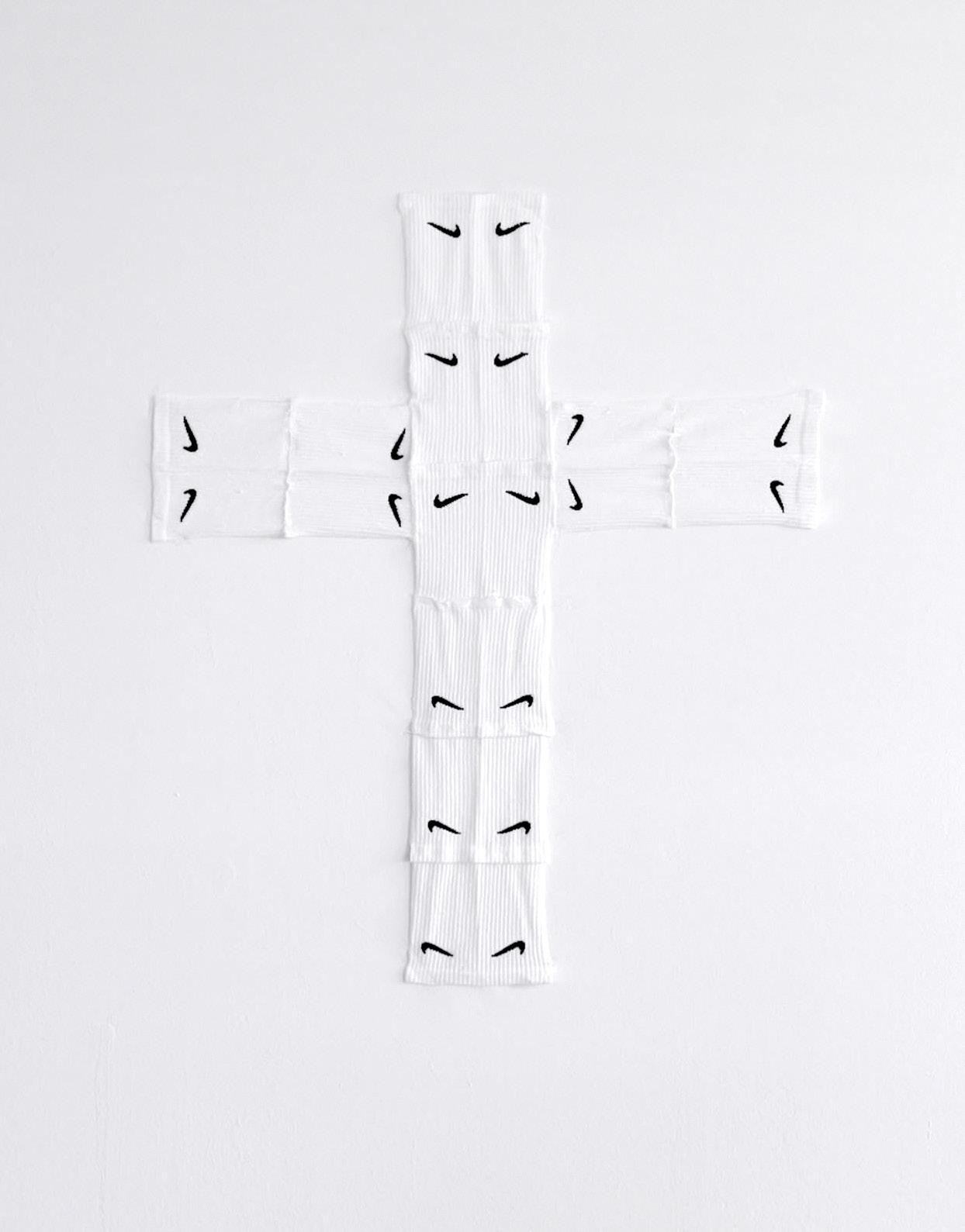
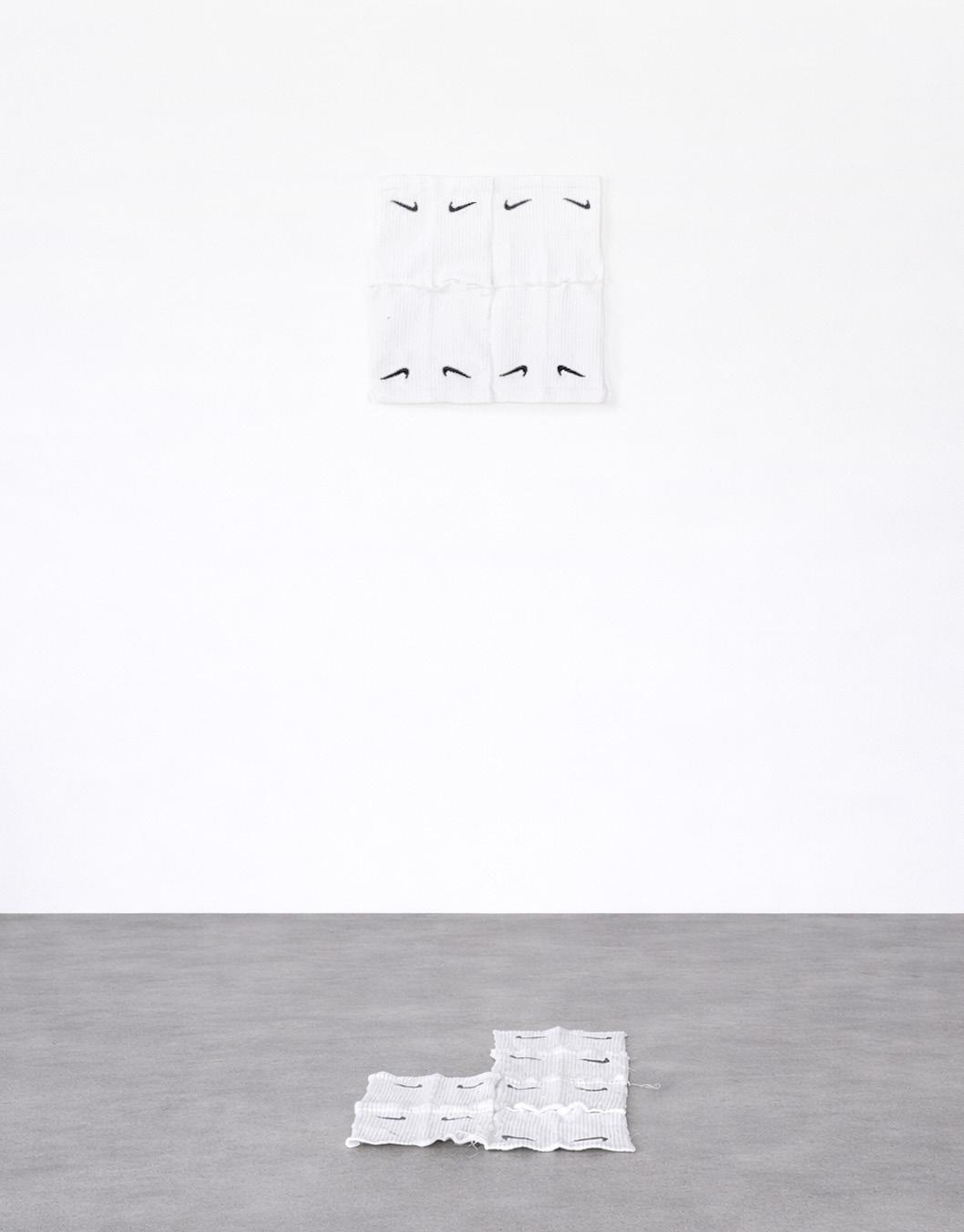
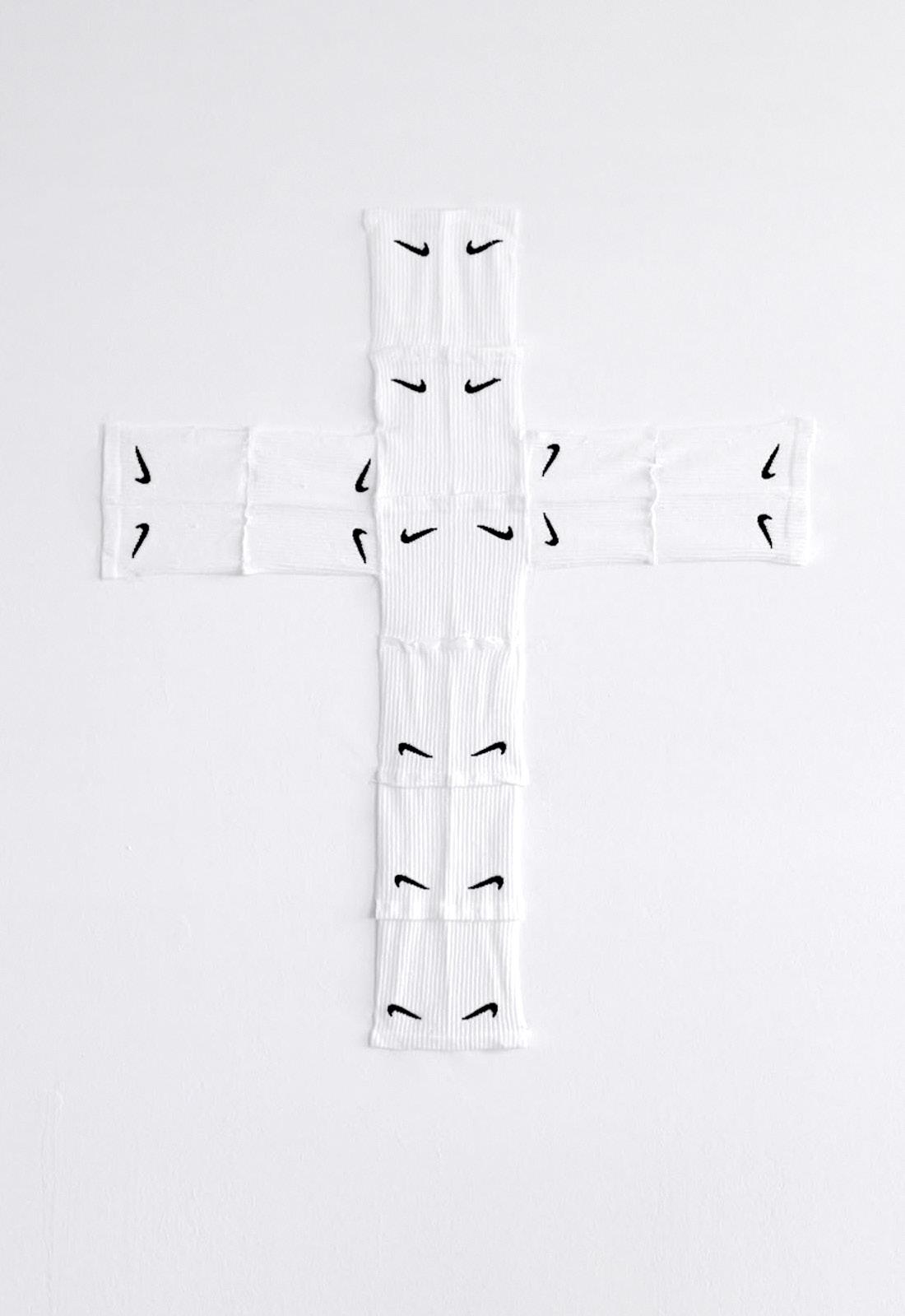
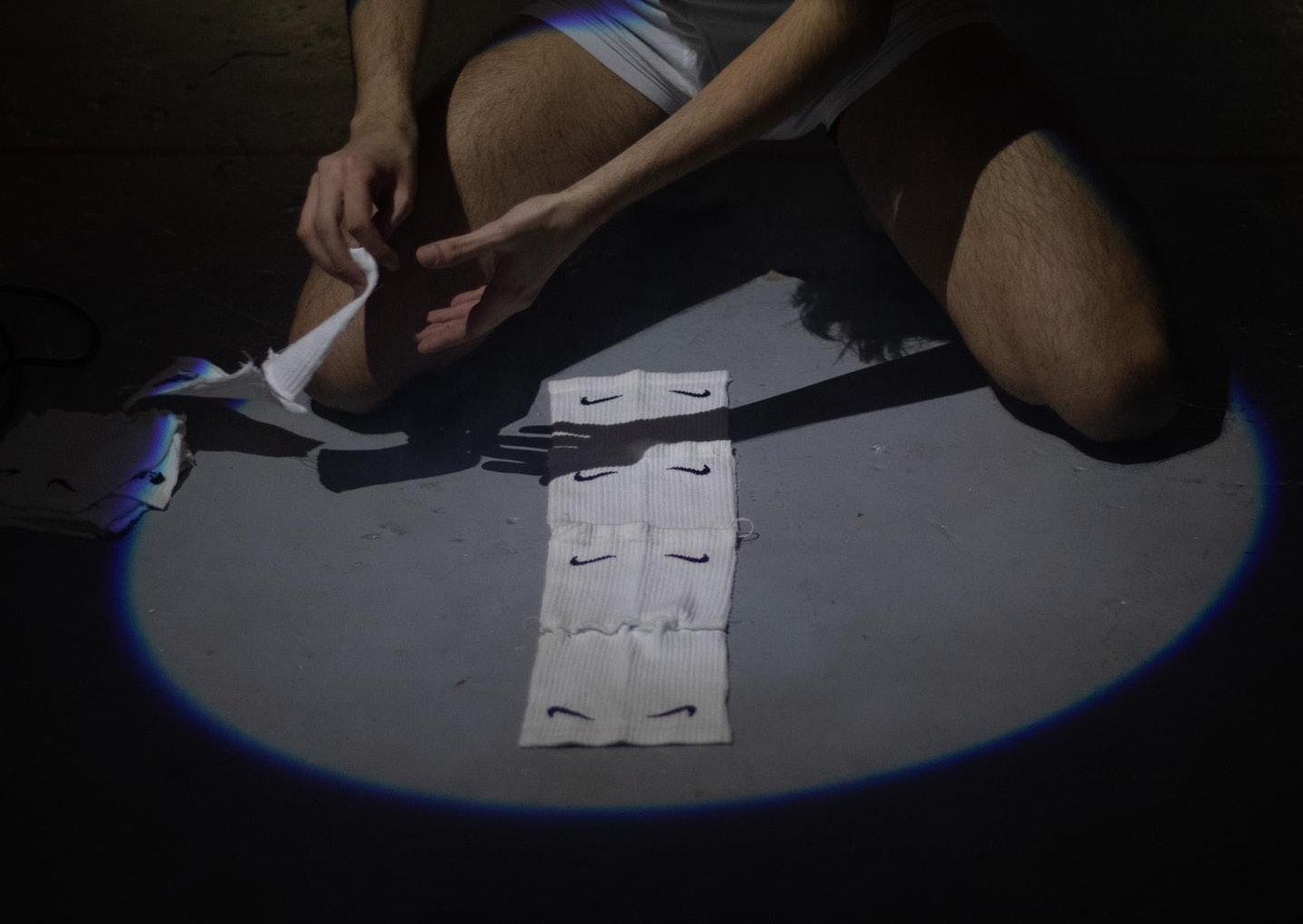
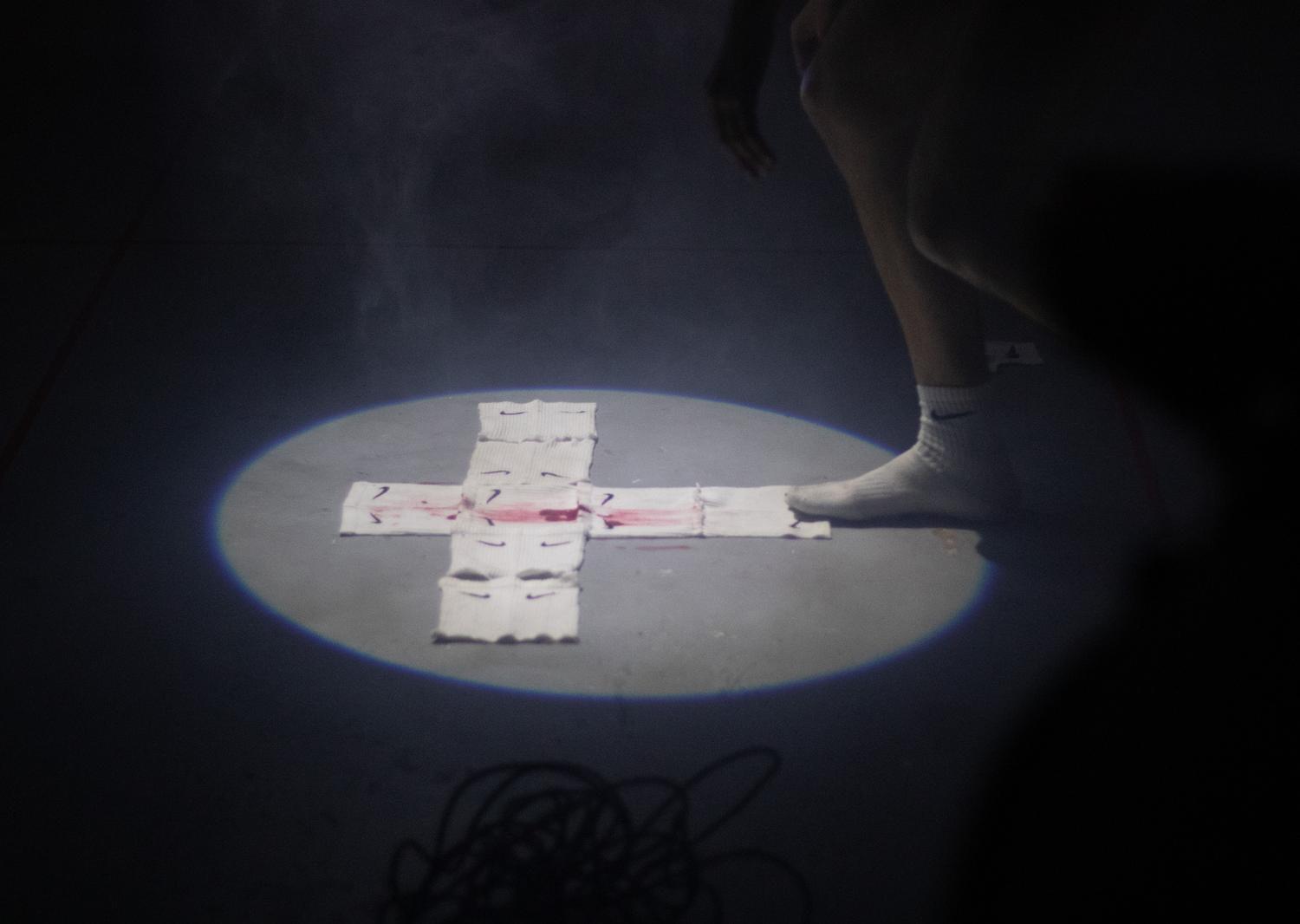
When the socks take the form of a cross, the symbol remains recognizable. Nothing is amplified. Nothing is explained. What changes is distance. Depending on the framework the viewer carries, the socks can arrive as different things: a fetish object, a branded consumer product, a piece of sportswear, a subcultural signal. The devotional symbol arrives as different things too: sacred form, cultural inheritance, institutional authority, childhood memory. When these meanings share the same object they do not merge. They collide. Press against each other without resolution.
That collision does not require the viewer to hold all of these readings simultaneously. That would be impossible. It only requires that whatever framework they arrived with finds the object slightly exceeding it. Slightly off. Slightly more than it should be. The discomfort is not produced by knowledge of what the socks mean in any specific context. It is produced by the sense that they mean something here, inside this form, that the form was not built to contain.
That unresolved friction is not a failure of the work. It is the work. Discomfort does not require full legibility. It only requires that something refuses to settle.
Desire, belief, and exchange occupy the same space. Nothing announces itself. Everything presses.
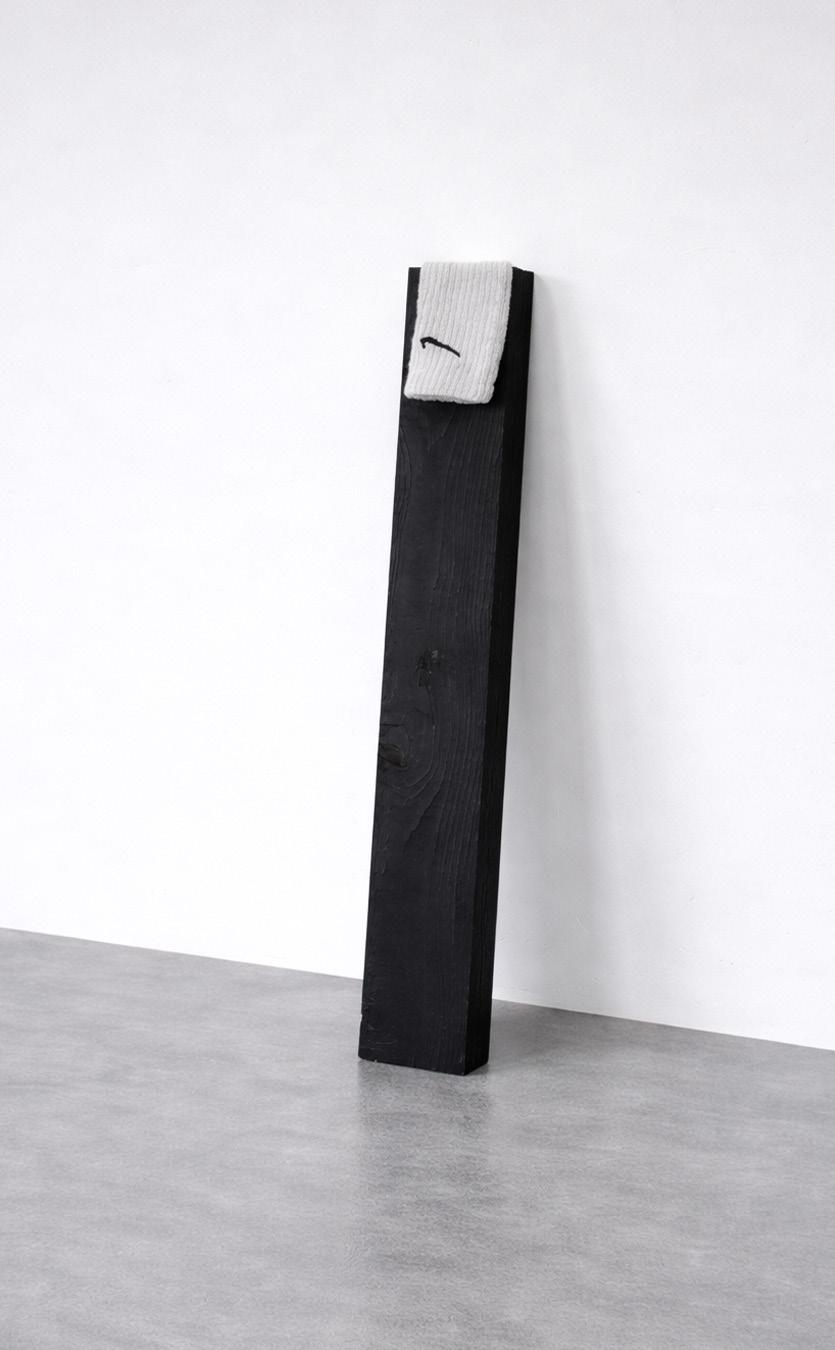
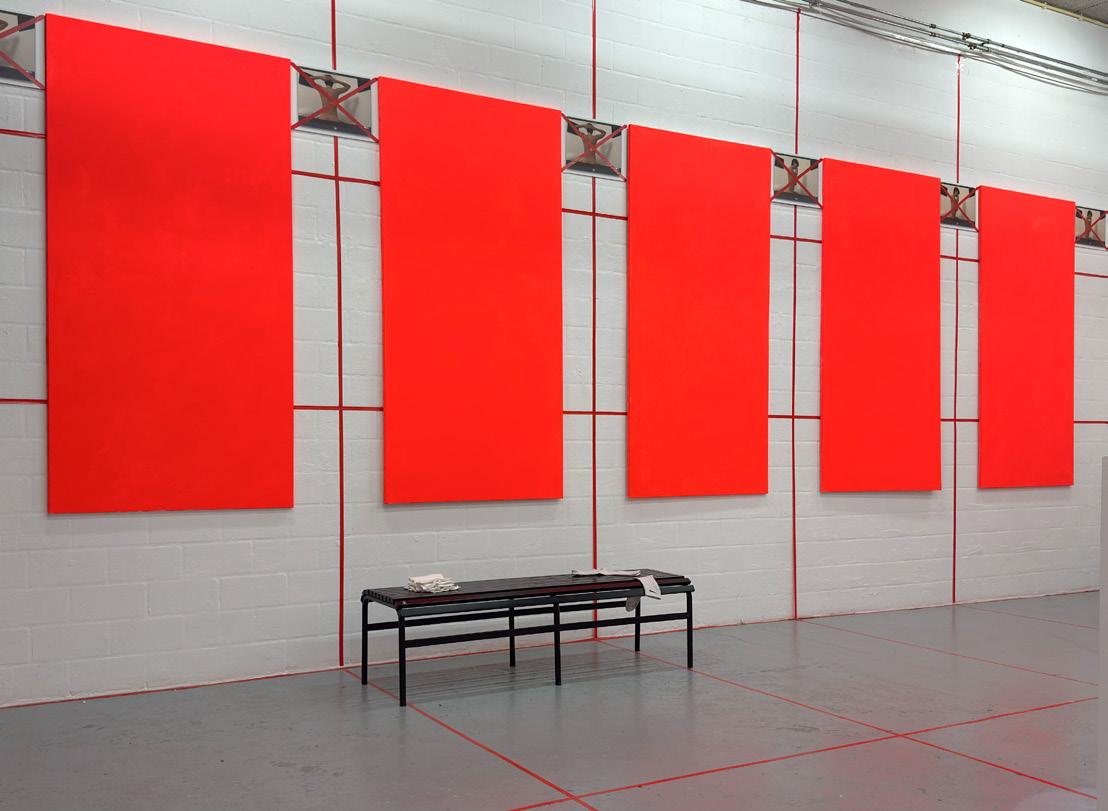
Pressure Wood, acrylic paint, Nike Sock 78cm x 9cm
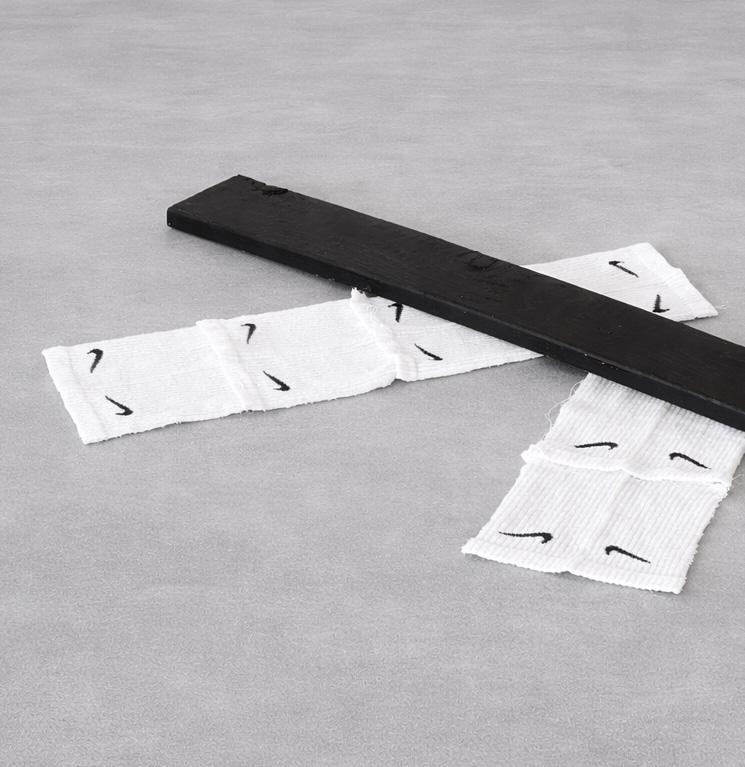
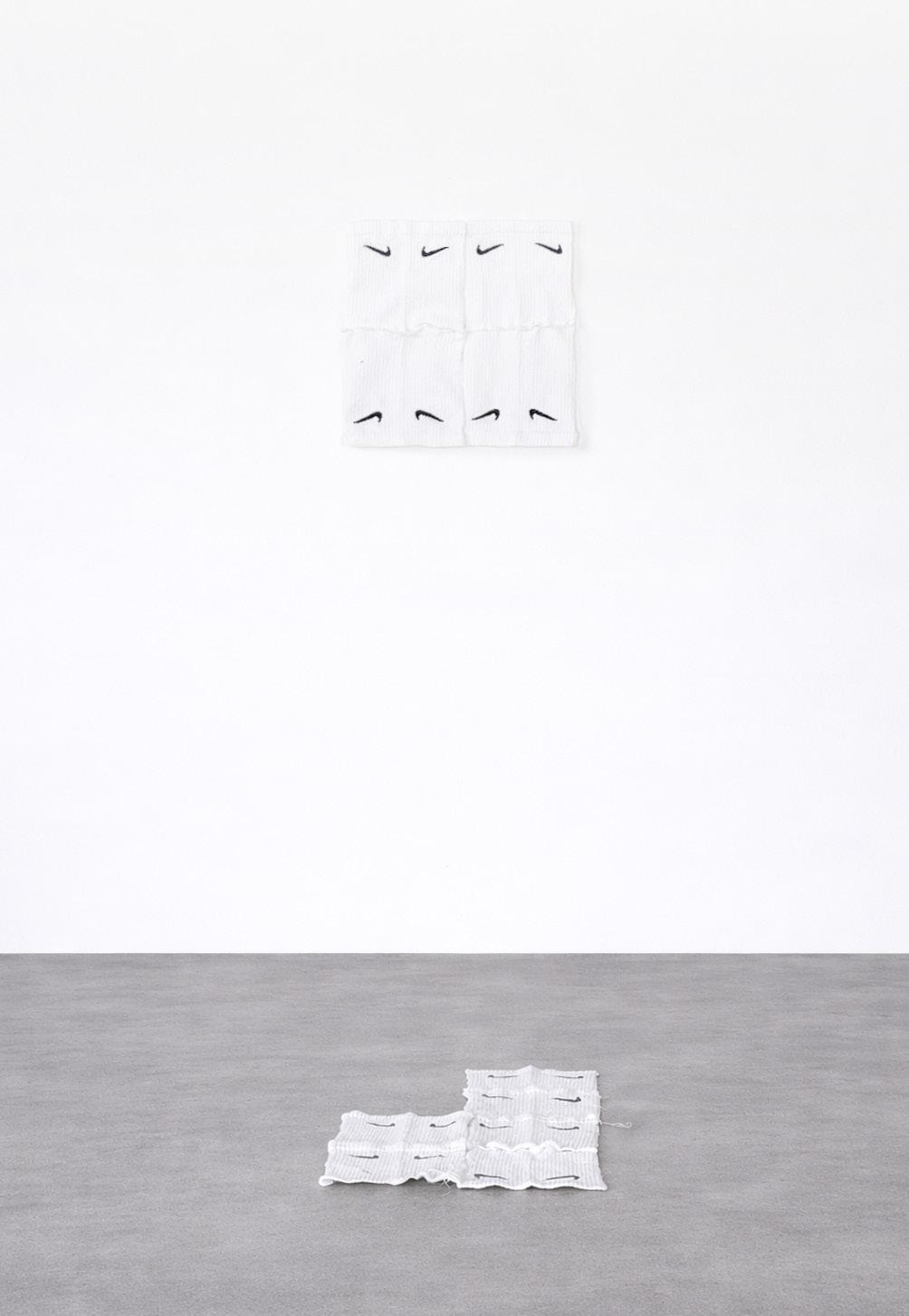
Form II (Elements of a Disappearing Narrative) Hand cut and sewn Nike socks Variable Size
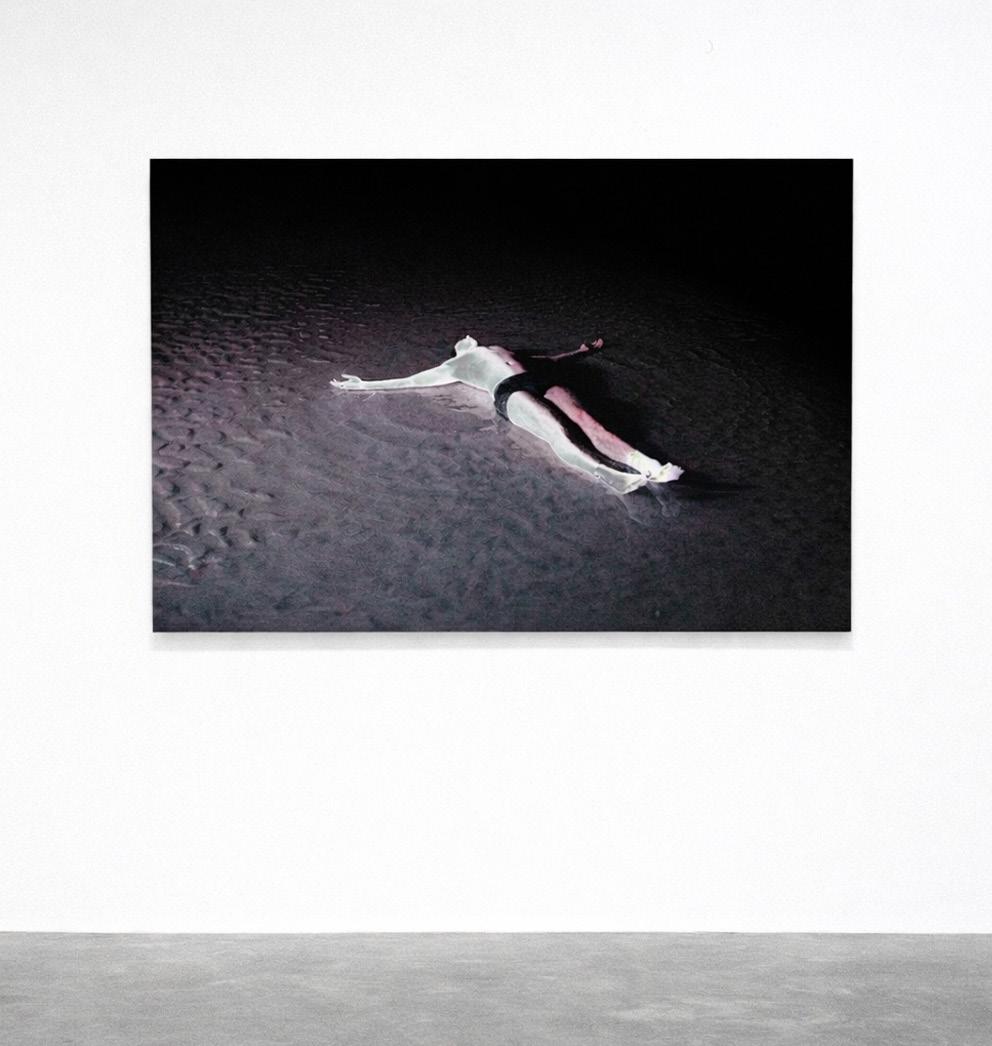
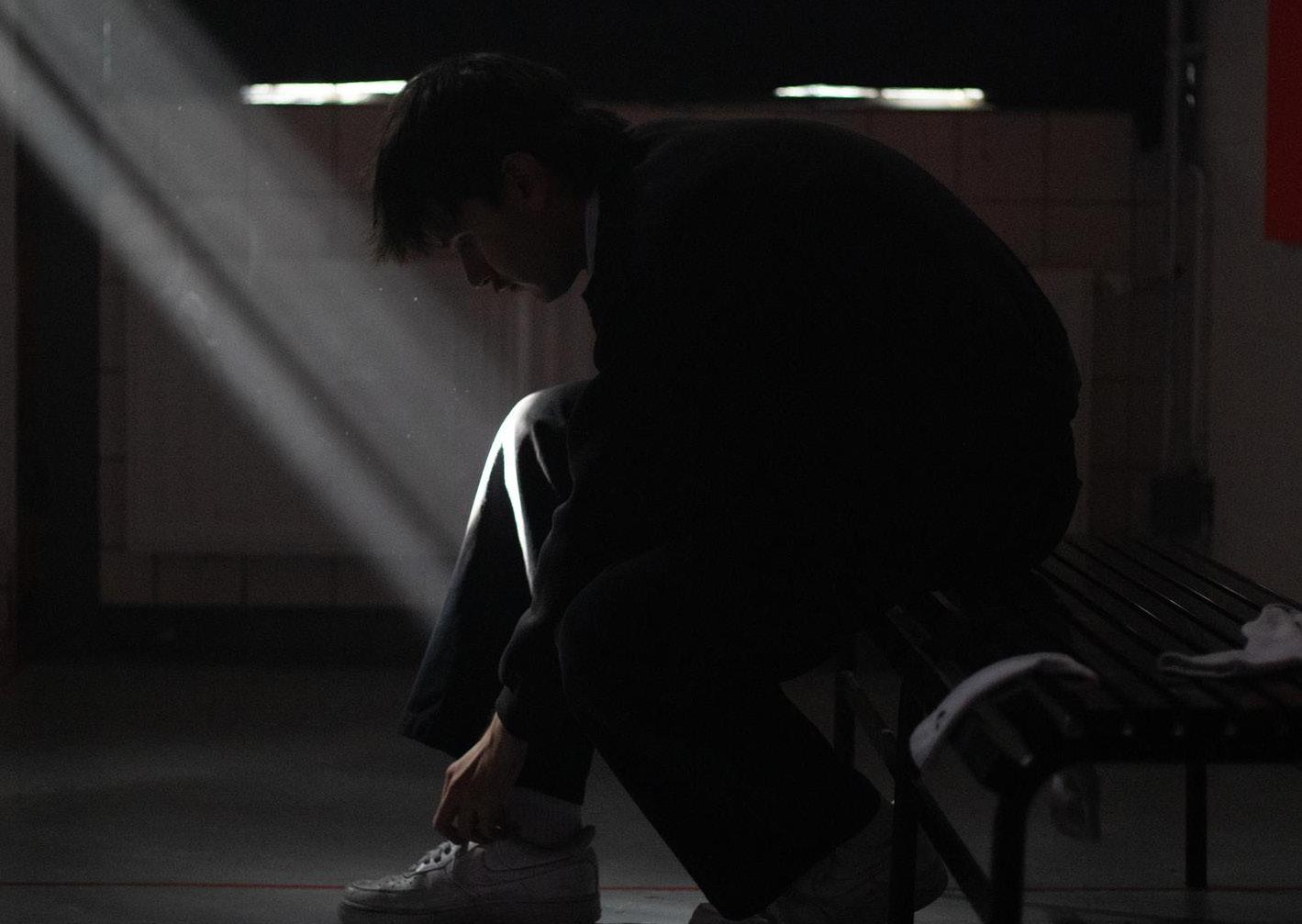
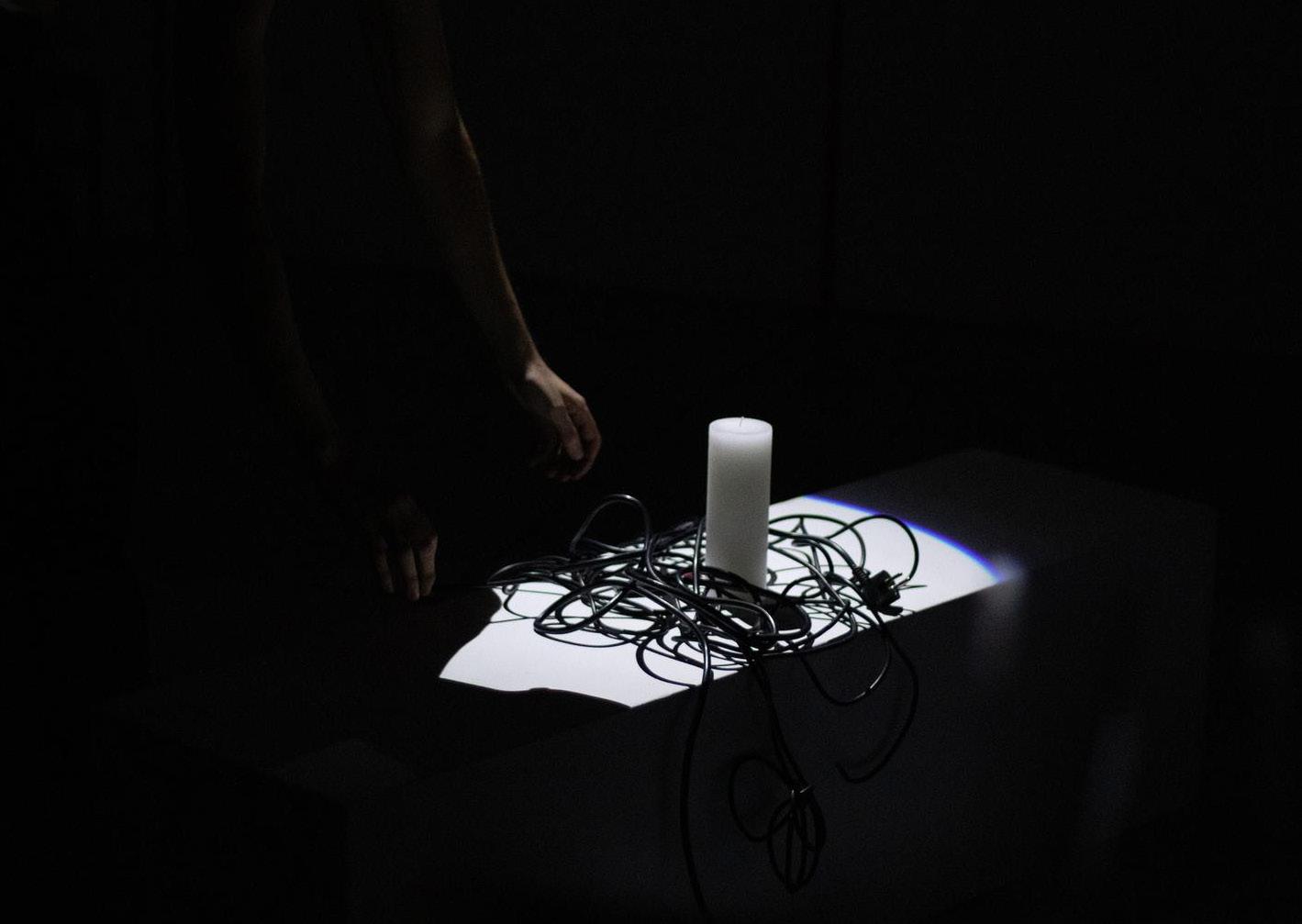
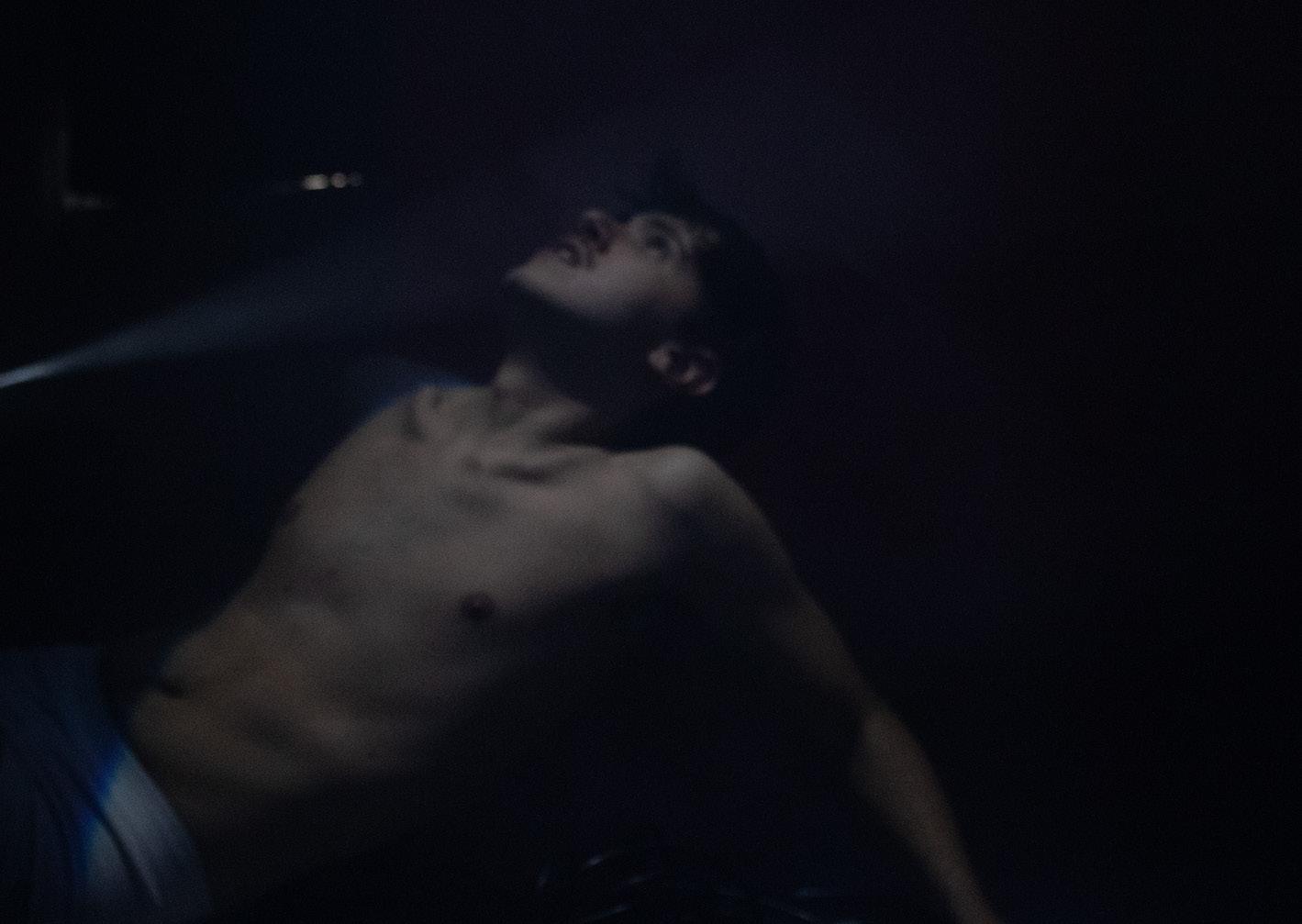
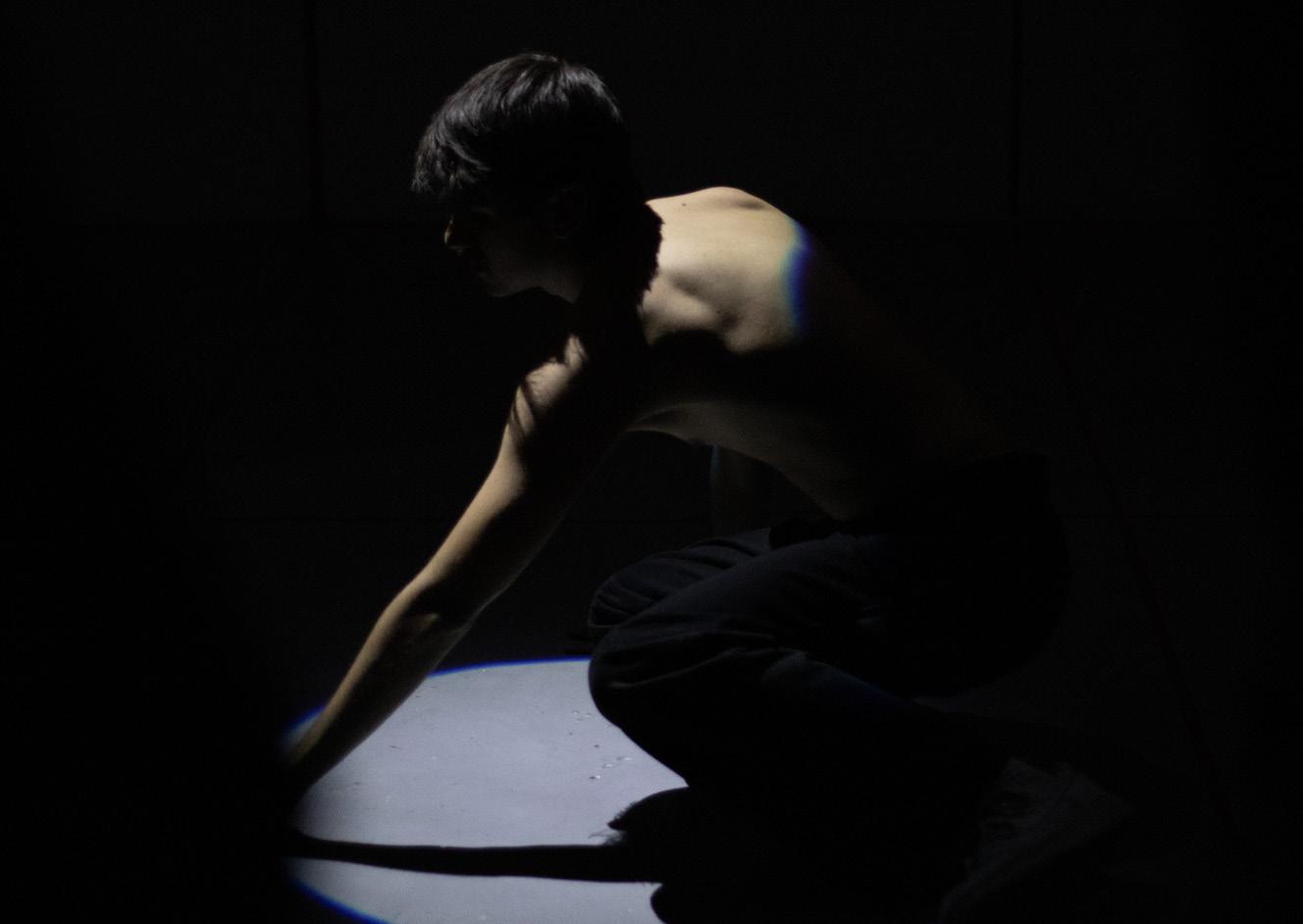
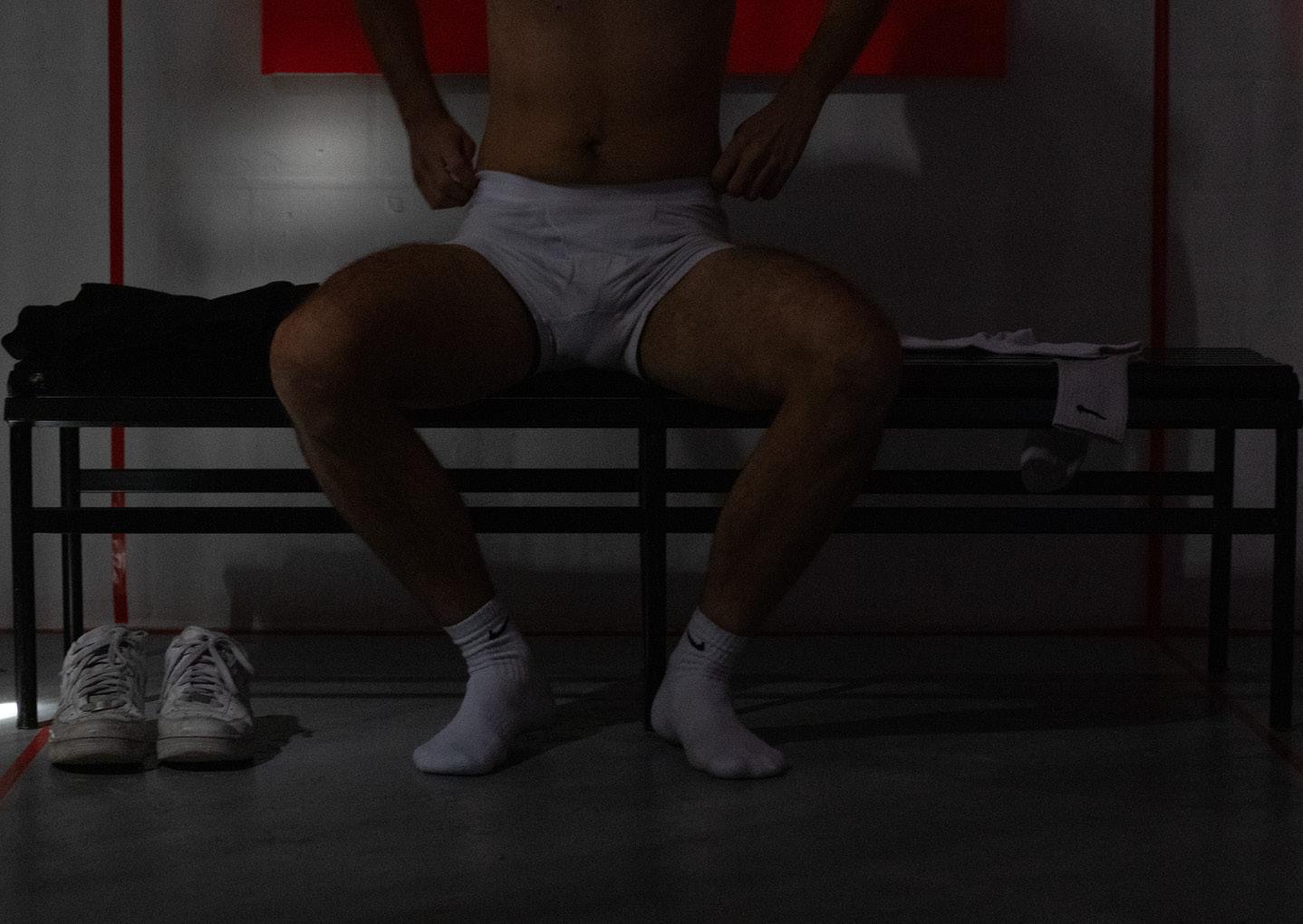
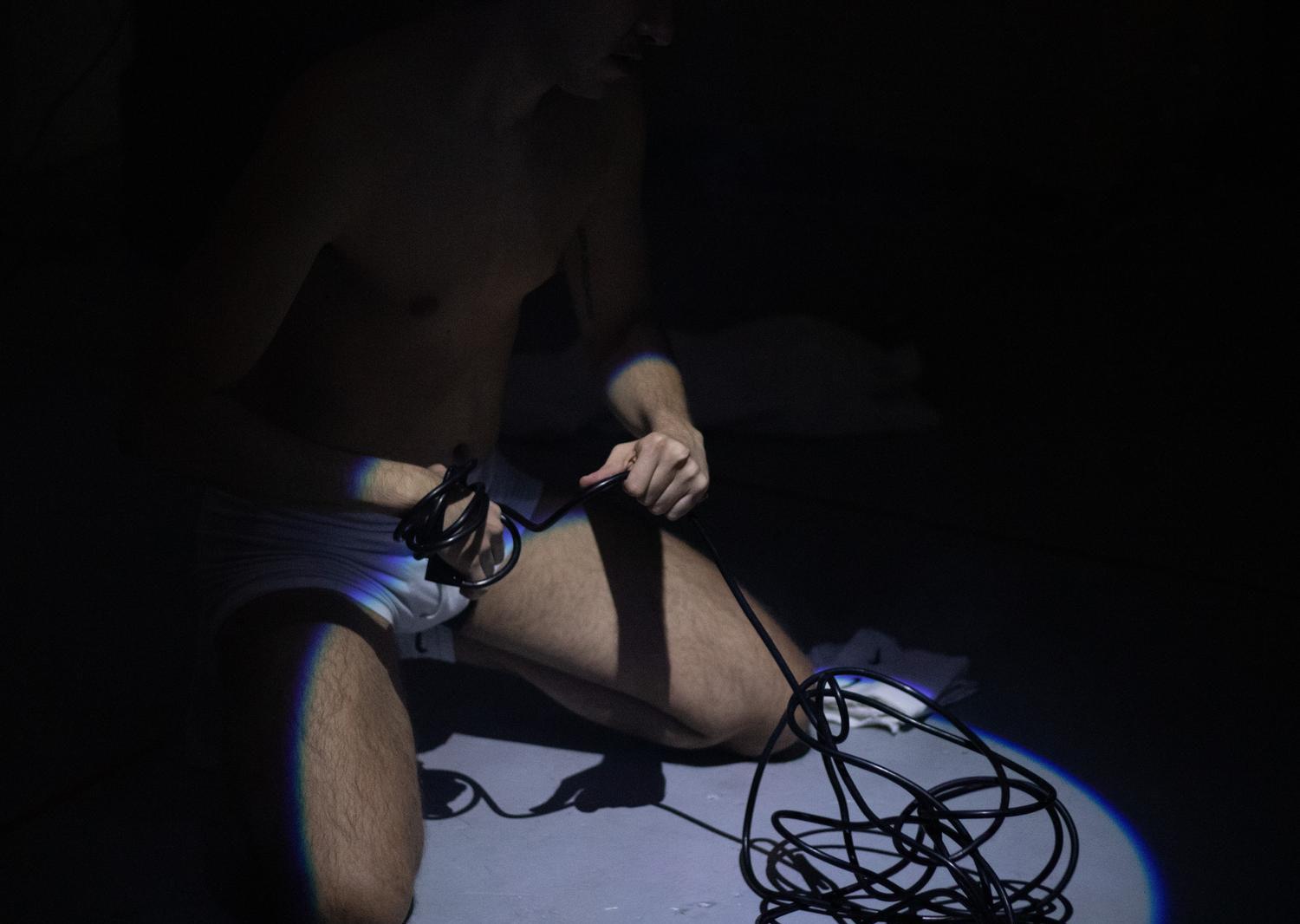
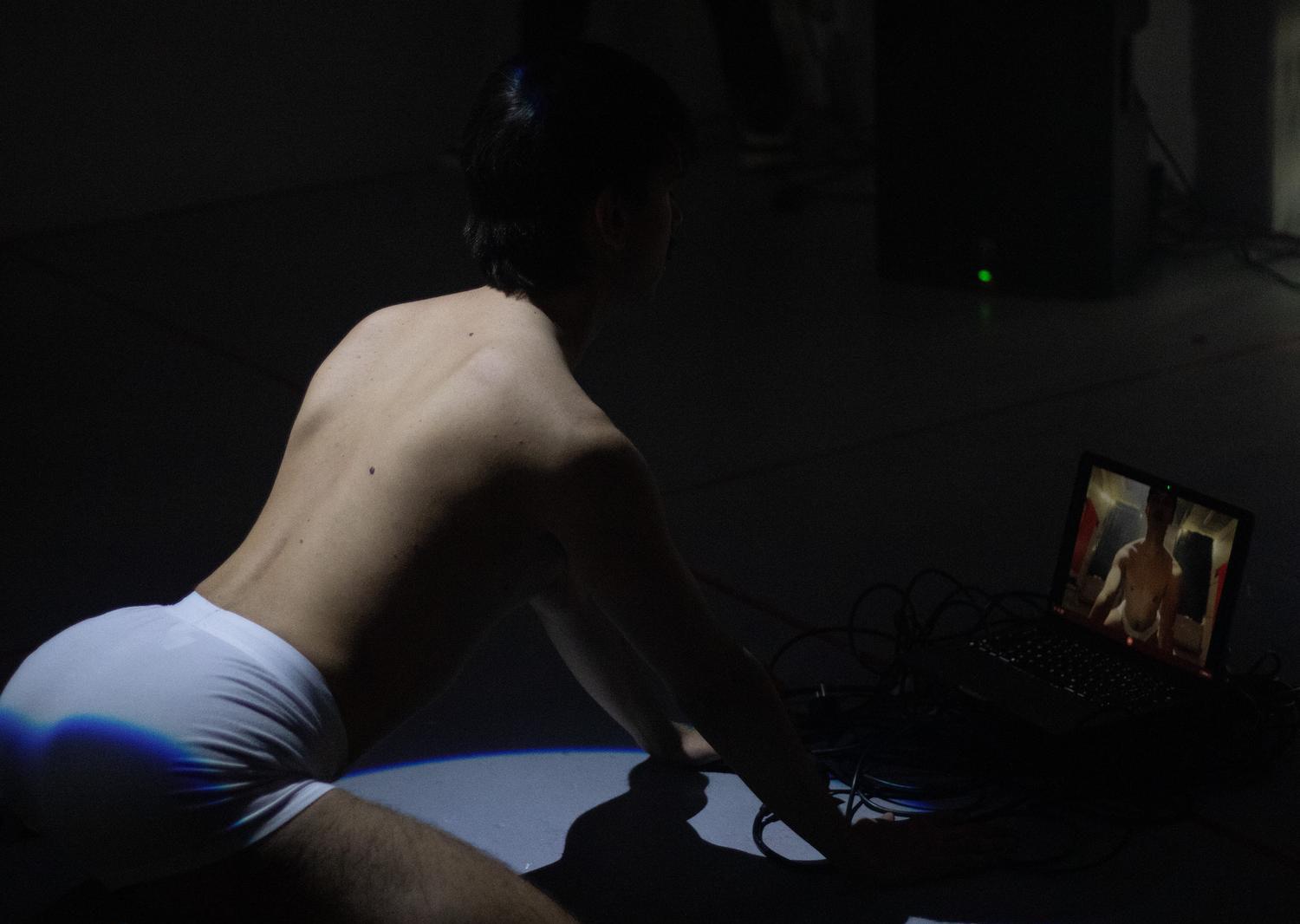
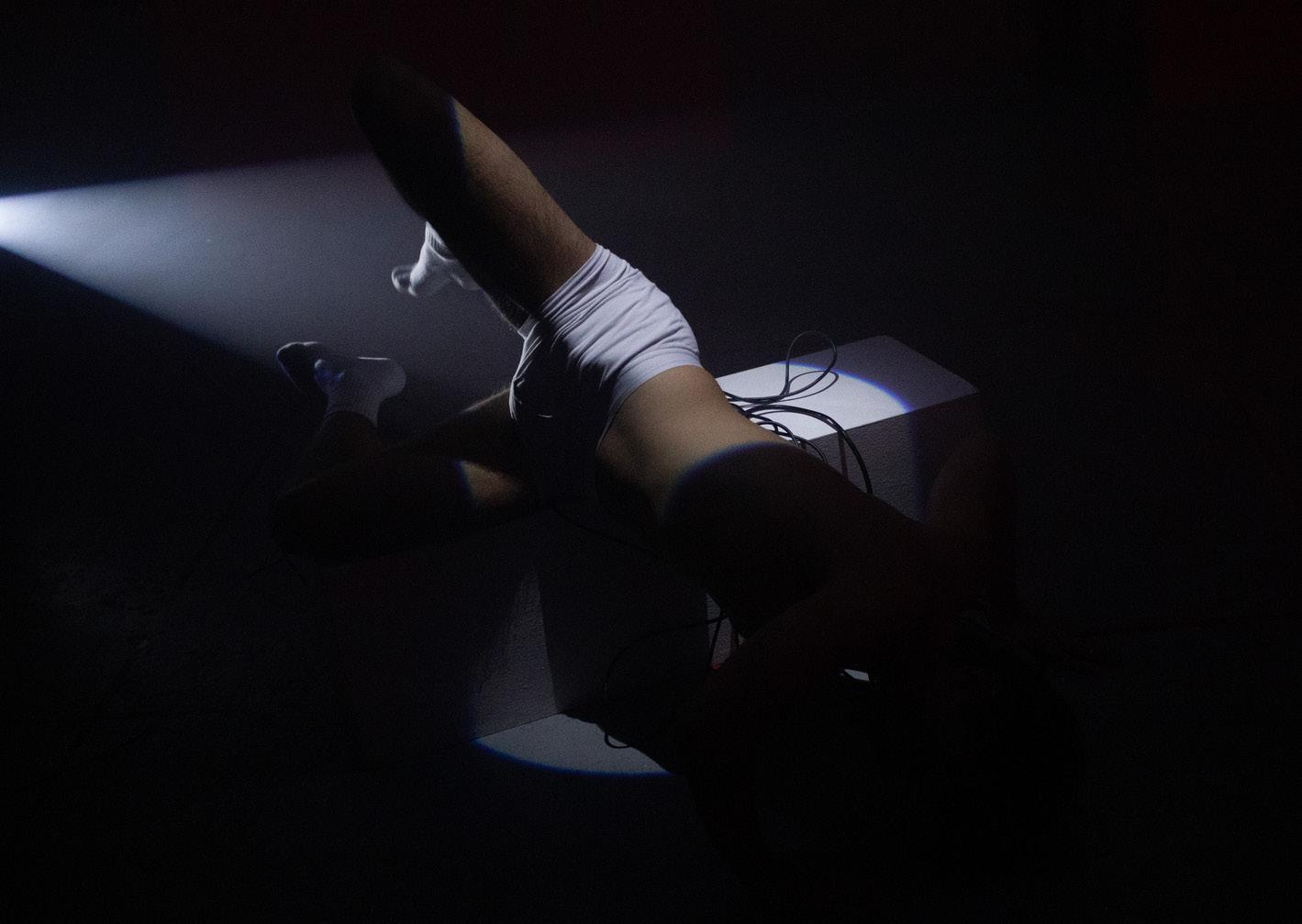
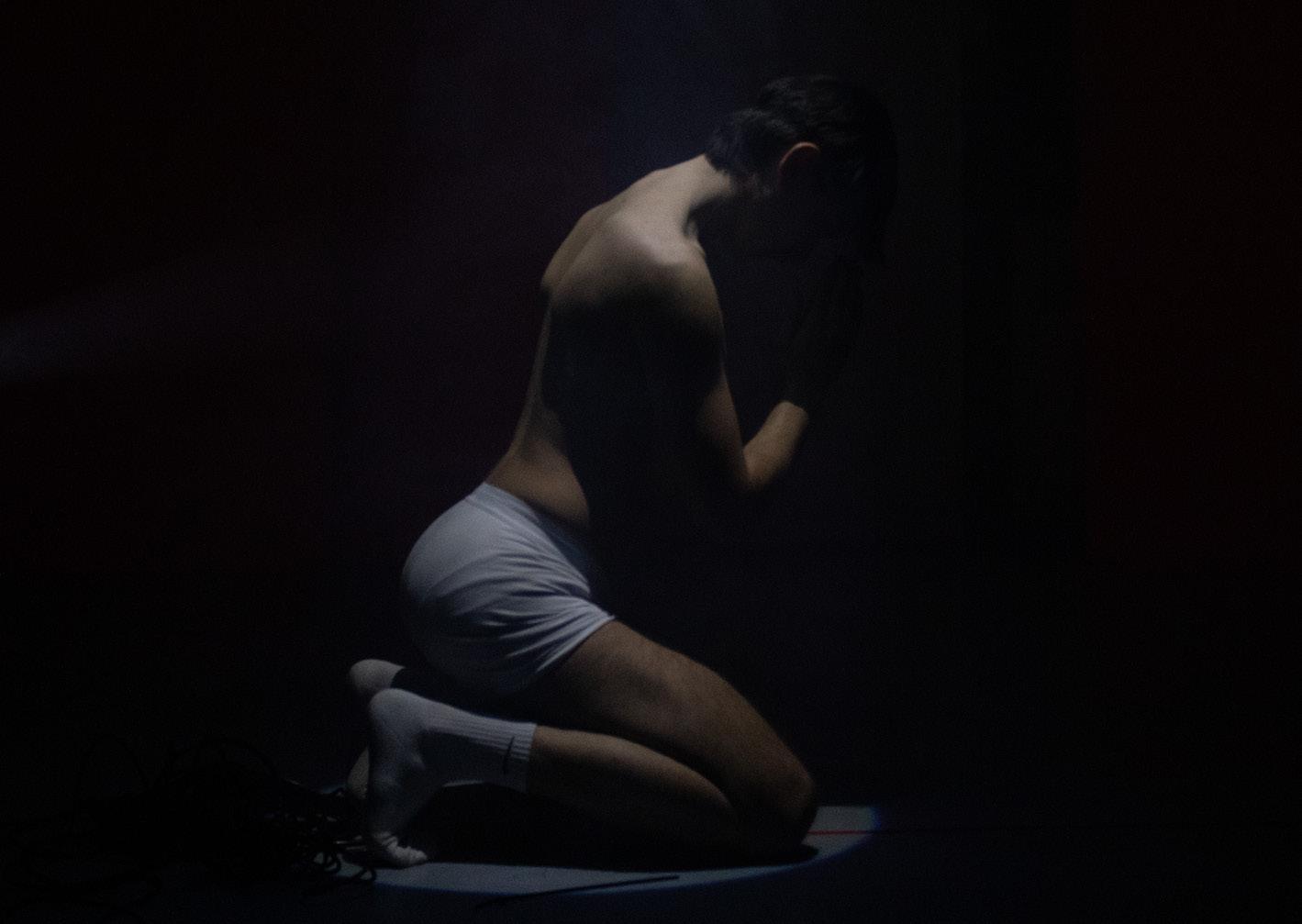
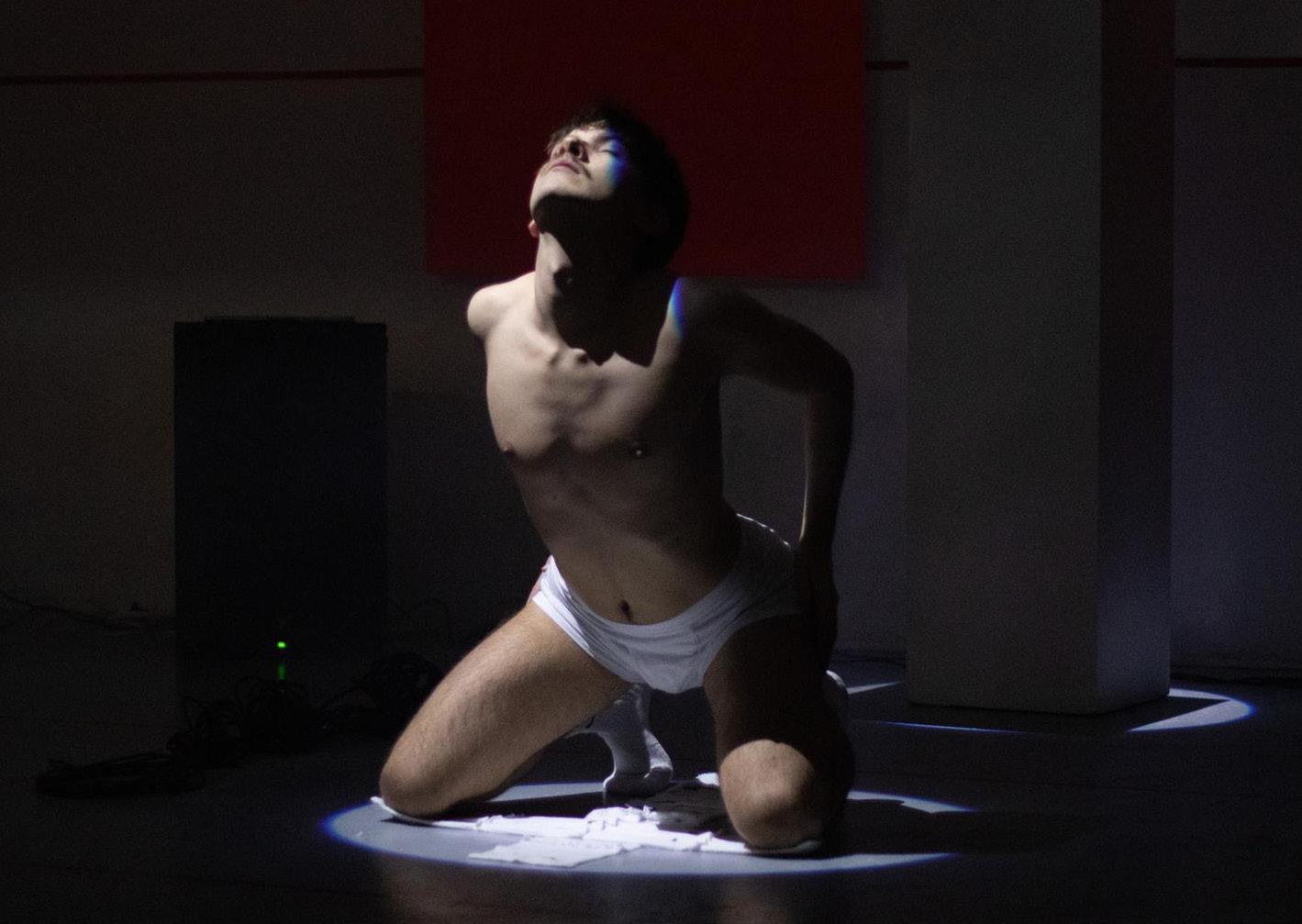
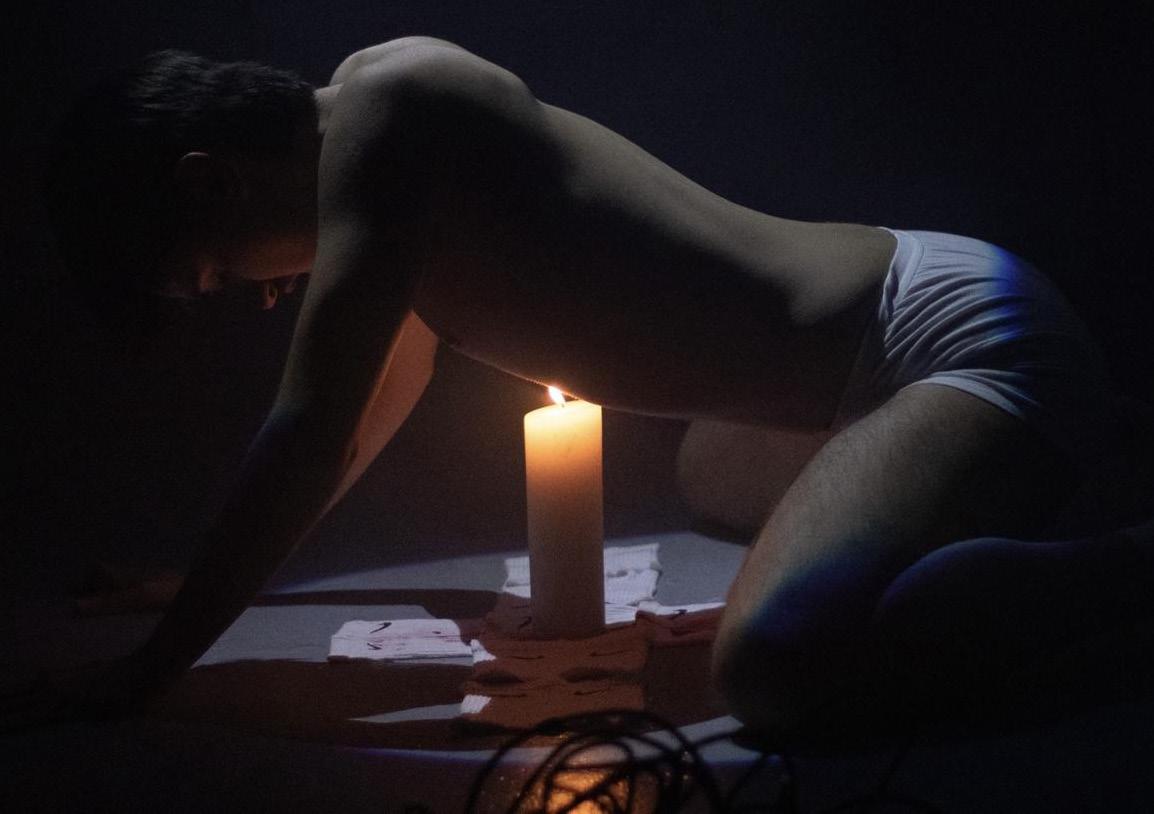
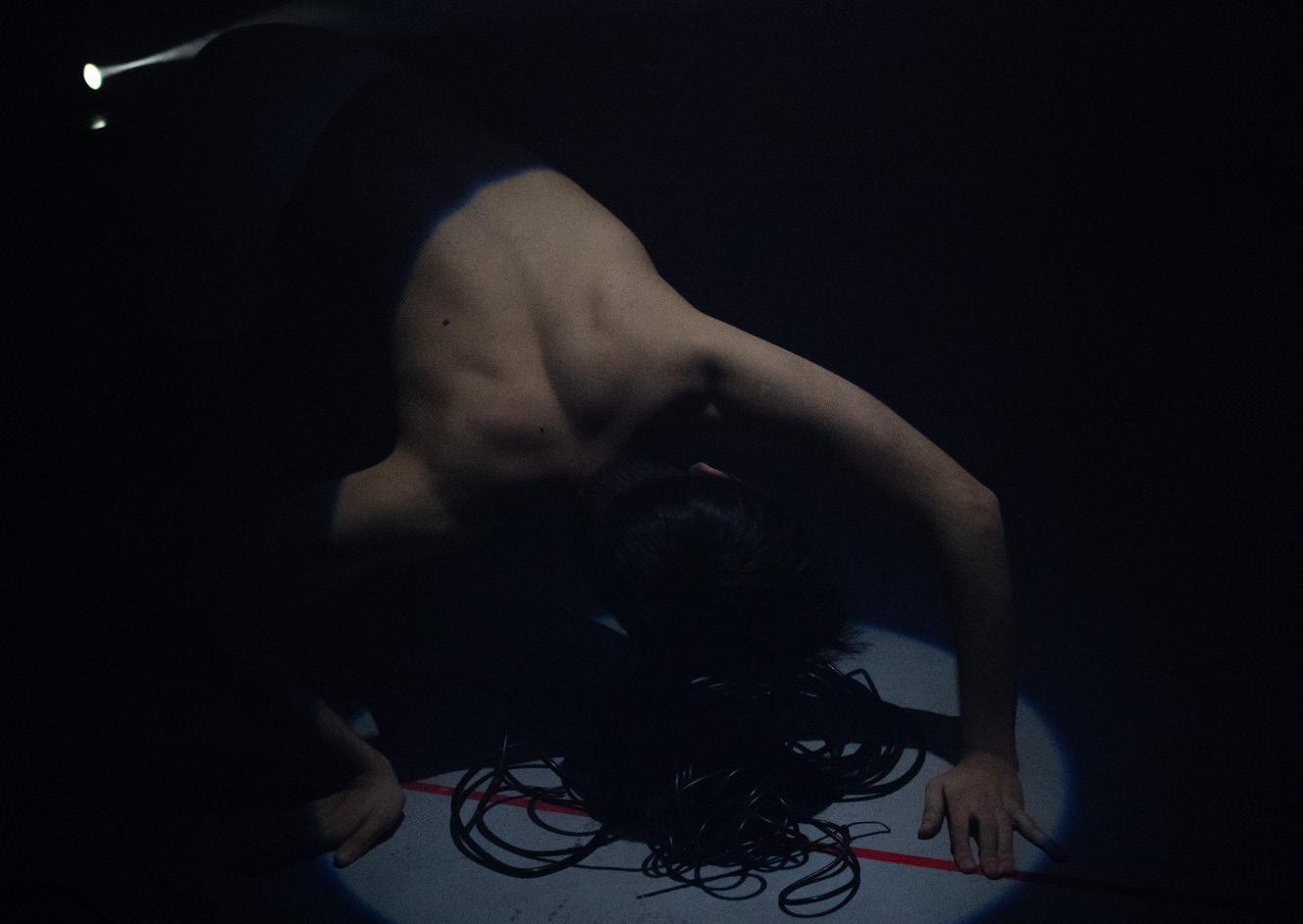
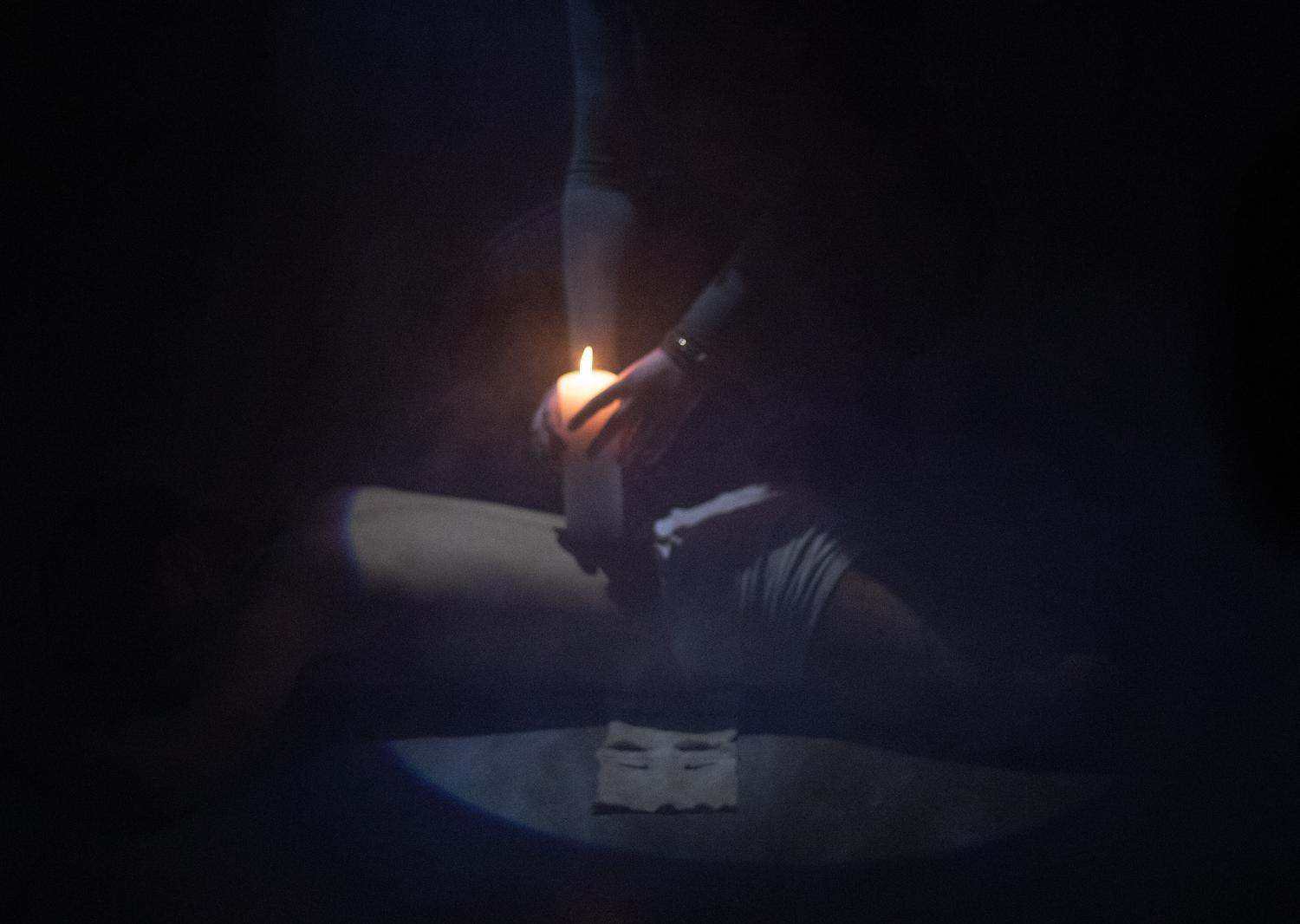
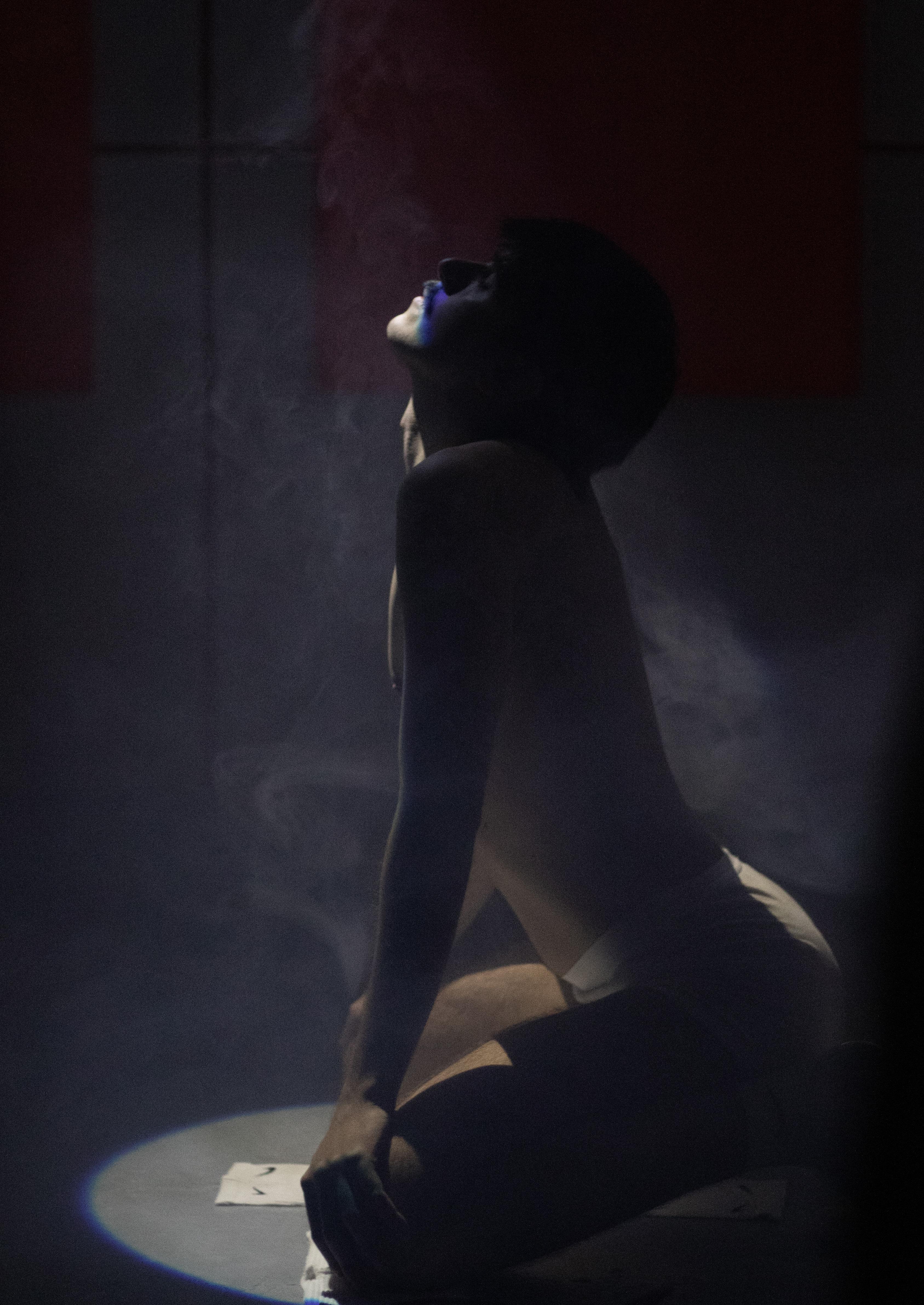
Consider a body on its knees, head lowered, arms loose at the sides. In a church, this is submission to God. In a cruising space, it is something else. The position is identical. What changes is the room it happens in, and who is watching.
This is where gesture becomes interesting as a subject. Gesture operates as a shared language across religious ritual, embodied practices such as yoga, and queer cruising; not because these systems are related, but because they all rely on the same mechanism: codified bodily positions that produce meaning through repetition and context. Kneeling, prostration, lifted arms, lowered gazes, controlled breathing, sustained stillness. These are techniques that organize attention and regulate how a body is read. The gesture does not carry its meaning inside itself. It receives meaning from the system it is performed within, and it can receive meaning from more than one system at the same time.
Christian iconography provides an extensive visual archive of this. The kneeling body, the bowed head, the exposed torso, the outstretched arms, the figure suspended or fallen. These recur across centuries of devotional imagery as signs of obedience, sacrifice, endurance, and surrender. They do not simply represent belief. They train the body into specific relations of power, vulnerability, and visibility. A body that has spent years in prayer has learned something about submission that has nothing to do with conscious intention. Yoga operates through the same mechanism, disciplining breath, posture, and attention into states of focus, restraint, and endurance. Sexual and cruising gestures draw from the same logic, where meaning moves through posture, orientation, and duration. A hand placed a certain way. A sustained look held a second too long. Weight shifted forward.
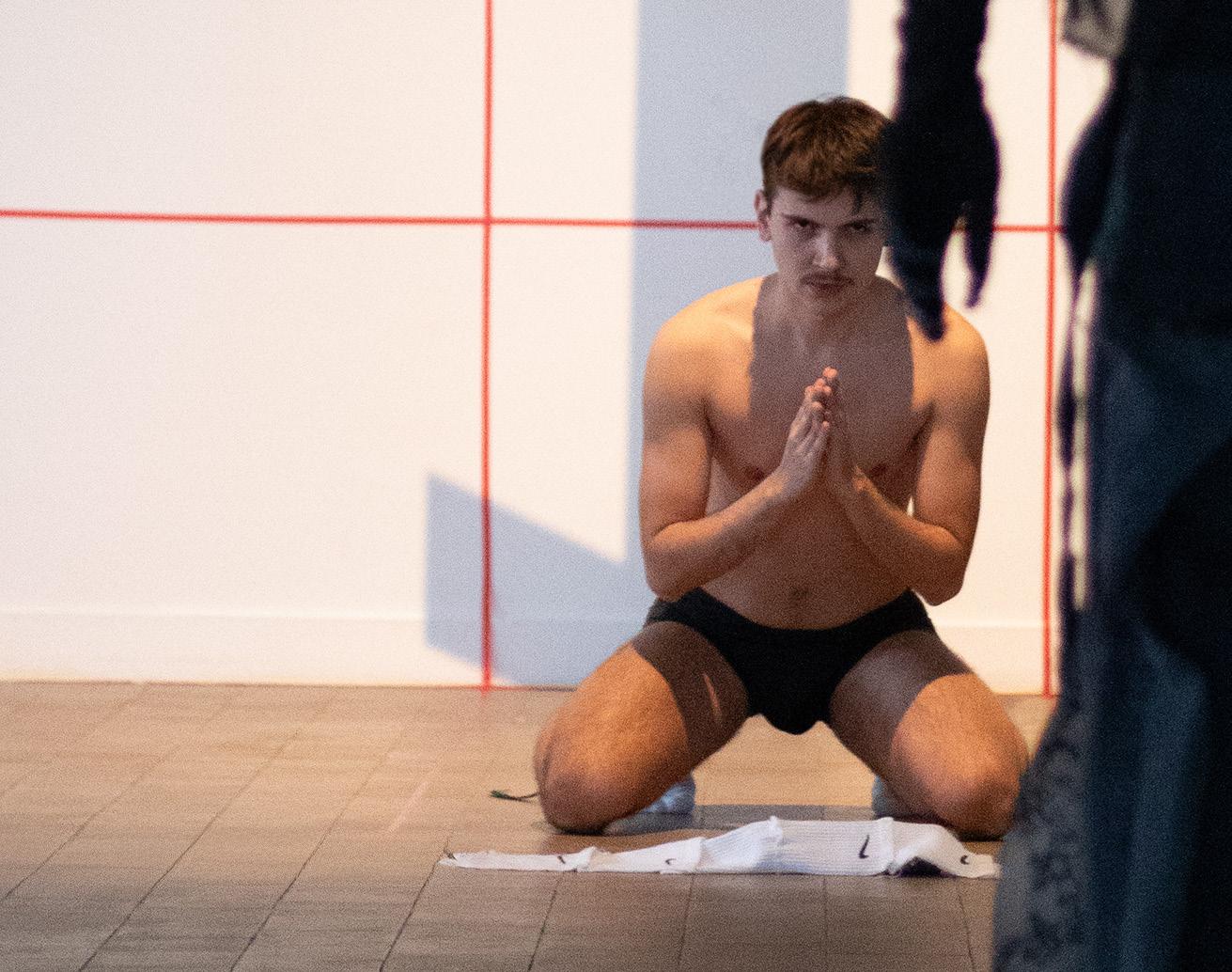
010 It Keeps Repeating (Part I: Prayer) Performance
Together with Parsa Tajbakhsh 15 minutes
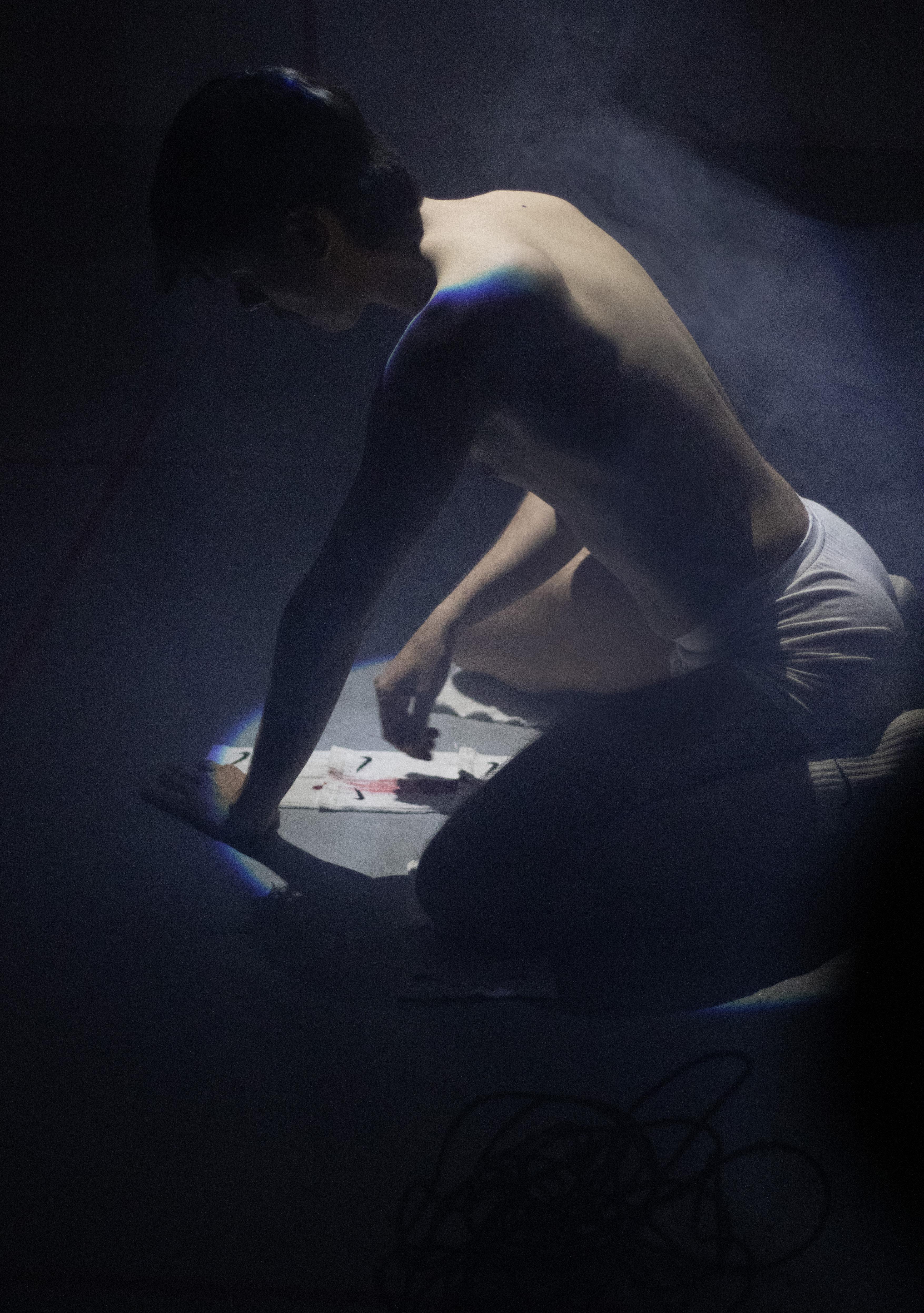
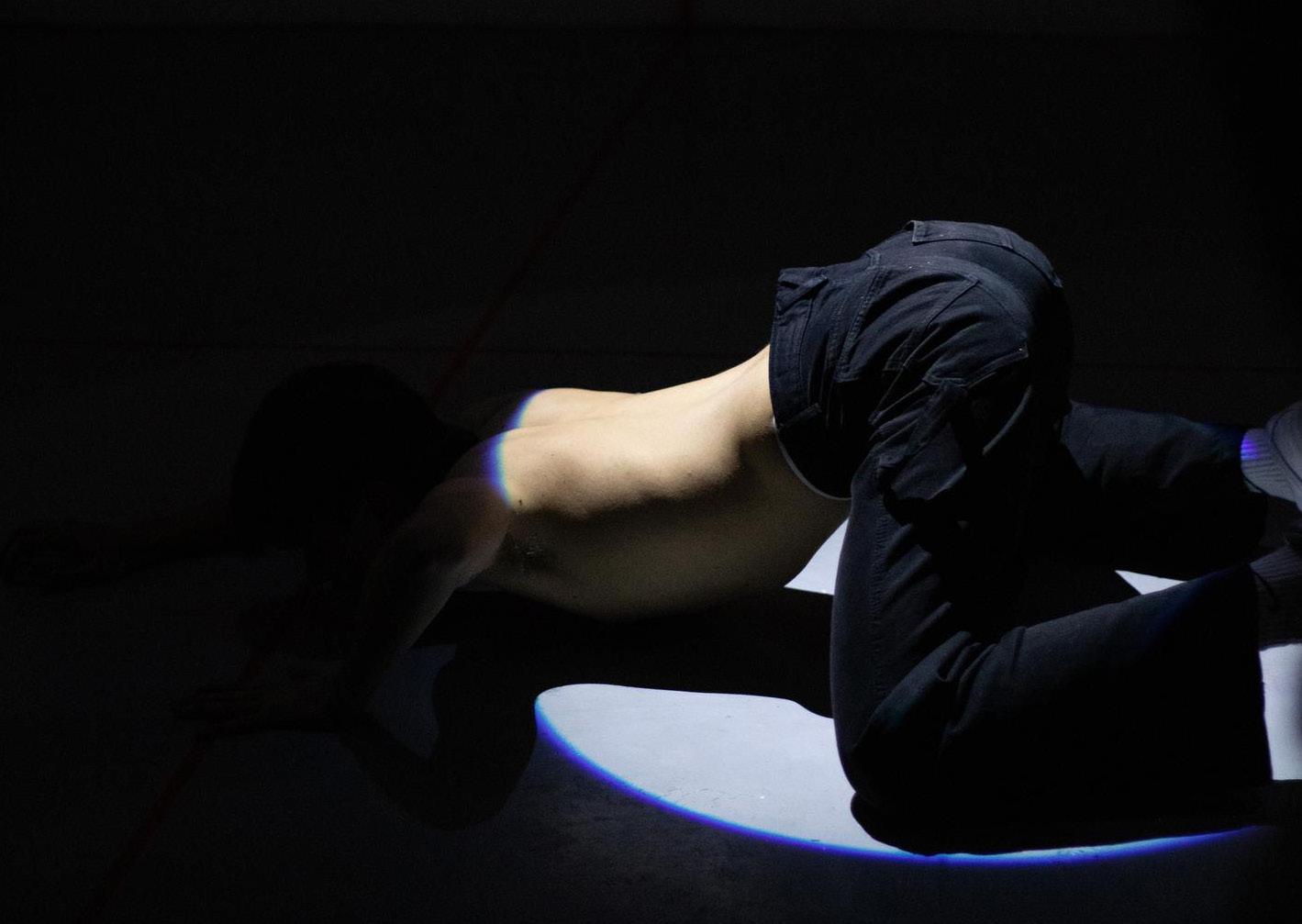
I wanted to be fully present. Not to represent something, but to be in the room with it. I undressed. I entered the grid. Above me, the cross, with photos of my reality printed onto its surface.
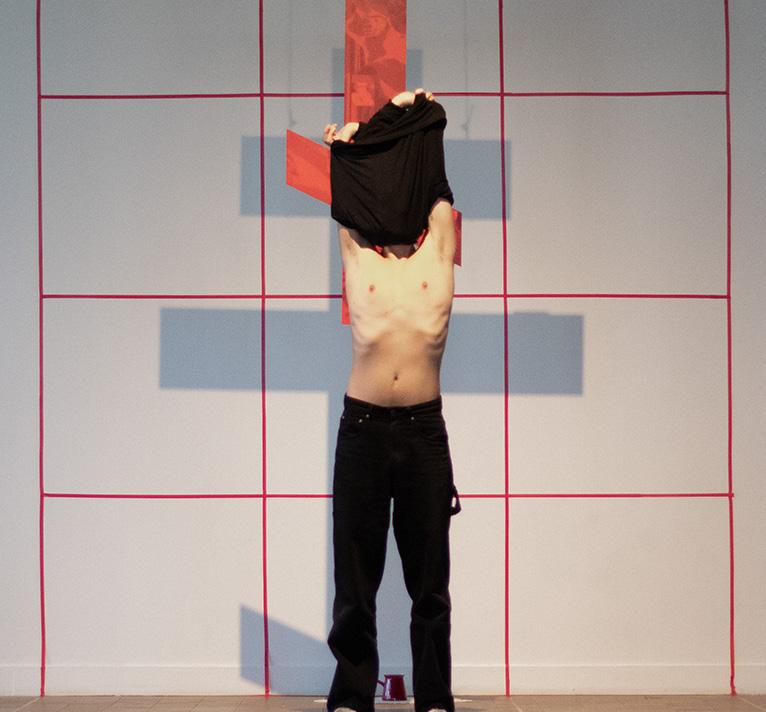
I began breathwork beneath it. Fast. Controlled. Repetitive.
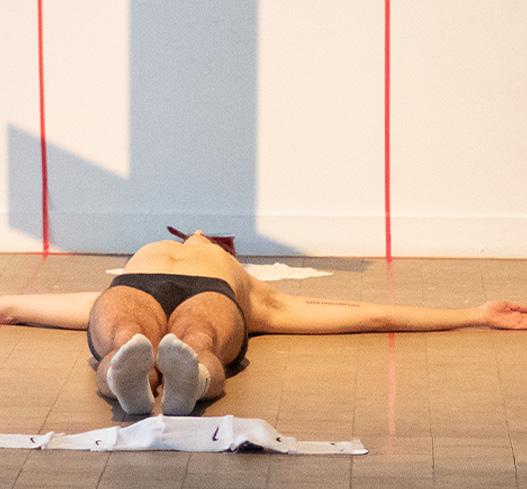
Then the switching. Doggy position. Table top. Prayer. Back again. All on the knees. The body moving through the same position with different names depending on who is watching. These positions are the same position. That the body never knew the difference. That only the systems watching it did.
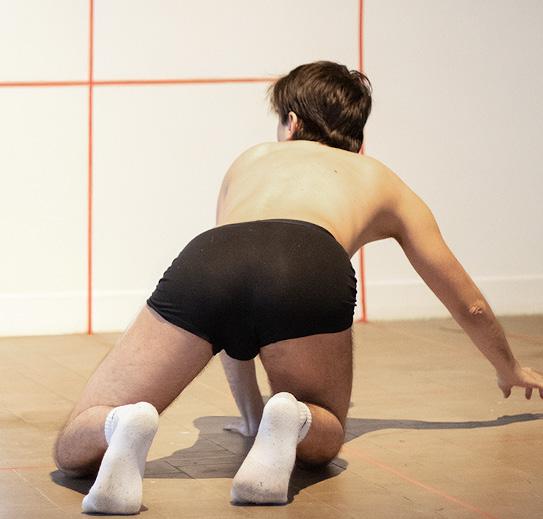
Performance It Keeps Repeating (Part I: Prayer?)
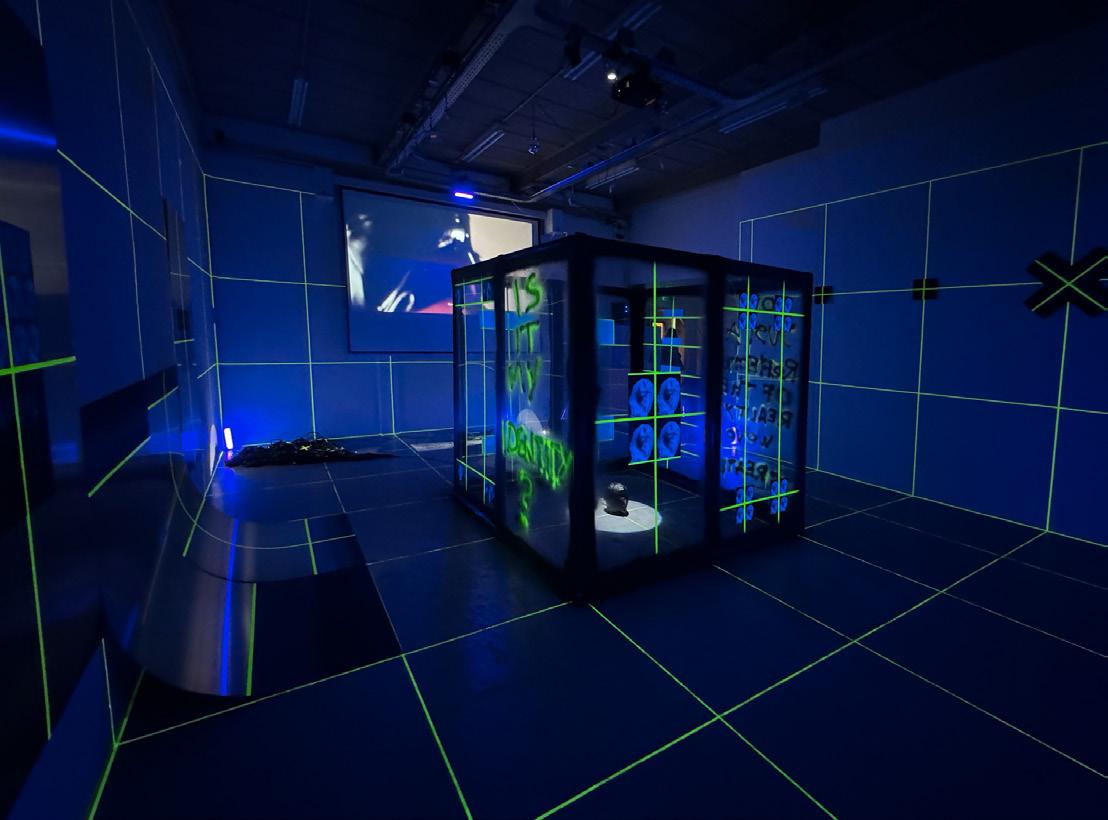
I think of identity as operating within a kind of a social simulation. This is not a technological metaphor, but a way of describing how norms, symbols, and expectations predate the individual and organize everyday life. Identity is learned, adjusted, and negotiated through interaction. The grid offers a spatial model for this condition, making identity visible as constructed rather than given. What the grid also makes visible is that the construction precedes the individual who is constructed by it. You do not enter a neutral space and then encounter a grid. The grid is already there. It organized the room before you arrived.
Within this logic, the grid does not control behavior or prescribe movement. Instead, it stages relations. By dividing space into units, gaps, and thresholds, it shows how coherence emerges through arrangement rather than essence. No single element carries meaning on its own. Meaning arises through how parts relate to one another. Identity, in this sense, becomes modular. It can fragment, shift, or reassemble depending on circumstance. What feels like a self is often a position within a structure, one that could have been occupied differently under different conditions.
This structural logic moves across my work while engaging different layers of identity formation. In its most abstract form, the grid appears as a spatial condition in which orientation precedes interpretation, suggesting that subjectivity is always already situated. In other works, the logic turns political, reflecting how identity is shaped through borders, documentation, and belonging. Elsewhere, it becomes moral and affective, influencing how bodies move in relation to ritual, authority, and inherited frameworks of belief and desire.
In my practice, the grid functions as a way of thinking rather than as a visual style. It allows me to approach identity not as something innate or self-contained, but as something formed through external structures, relations, and recurring patterns. Instead of treating identity as an expression of an inner core, the work understands it as assembled through frameworks that already exist and influence how meaning circulates in social space.
The grid makes this visible.
Across these shifts, the grid remains consistent as a method. What changes is the layer being examined. Identity is not presented as fixed or authentic, but as continuously produced within shared spatial, social, and symbolic conditions. The question the grid keeps asking is not who you are, but what the conditions were that made the answer feel inevitable.
What the grid cannot account for is whether exposure changes anything, or whether the structure continues regardless of being seen.
The idea that political content and aesthetic form are separate, or in conflict, runs through contemporary art discourse, but I do not recognise it within my own practice. In my work with design and typography, form is treated as something that is already operative before content is read, rather than as a neutral carrier of it. This research begins from that premise, rather than from the opposition between politics and aesthetics.
Aesthetics are not neutral surfaces applied over content. They are modes of shaping attention. They determine how something appears, how it is felt, how it is valued before it is consciously interpreted. Religious institutions have always known this. They rely on ritual, architecture, color, scale, and repetition, not to decorate doctrine, but to produce the conditions in which doctrine becomes felt rather than merely understood. Political systems rely on symbols, images, staging, and spectacle for the same reason. Commercial structures rely on design, branding, and sensory environment. All of them operate aesthetically. The aesthetic is not outside power. It is one of its primary tools. To treat it as decoration is to misunderstand how it functions, and to surrender one of the few sites where that functioning can be interrupted.
Jacques Rancière describes this through the concept of le partage du sensible, usually translated as “the distribution of the sensible,” though a more precise rendering is “the sharing of what can be perceived via the senses.” The idea is that every social order determines what is visible and invisible, audible and inaudible, what can surface and what must stay beneath it. This arrangement feels natural, but it is a distribution, and it can be disputed. For Rancière, politics does not begin only in institutions or explicit action. It begins in the configuration of what can appear at all. Art operates in the same register: as a practice that intervenes in what is perceptible, and therefore in what is thinkable.
Art does not become political only when it declares political content. It becomes political when it modifies perception. If perception is already structured by precontext, what the viewer carried in before seeing anything, then the aesthetic is where the intervention becomes most accessible. A cross made from Nike socks does not argue against religion or for queerness. It places two precontextual systems into the same form and refuses to keep them apart. The context is the object. The precontext is everything the viewer brought with them: the rules about devotion, desire, which bodies are permitted which registers.
This raises a question the work cannot avoid: if redistribution is never neutral, which direction does this one move? Not toward a replacement of the frameworks the viewer carries in. Toward making those frameworks require effort to hold. To slow down the automatic. To produce a hesitation where there was certainty. The direction is not neutral and it was never meant to be. It moves toward the moment when the viewer’s own frameworks become visible to them, when what felt like perception reveals itself as inheritance. That is the redistribution. What they do with it is theirs.
↓
At some point the structures become visible. Not all at once.
More like something shifts in focus and suddenly you can see the frame around things you thought were just - reality.
I noticed this and assumed the noticing was the hard part. That once you could see the system, you were somehow less inside it. That awareness created distance. It doesn’t.
This is the part I keep getting stuck on.
Because I still do the things I can see myself doing.
I still adjust how I enter a room.
I still edit before I speak.
I still build a version of myself for different audiences and call it honesty.
Knowing it’s constructed doesn’t make it less constructed.
The construction continues.
I just watch it now.
Which raises something uncomfortable. Maybe awareness isn’t a step toward freedom.
Maybe it’s just a more sophisticated way of participating. The system doesn’t need belief. It needs behavior.
And behavior continues with or without understanding.
I just watch it now.
I noticed this and assumed the noticing was the hard part. That once you could see the system, you were somehow less inside it. That awareness created distance. It doesn’t.
That once you could see the system, you were somehow less inside it. That awareness created distance. It doesn’t.
Maybe awareness isn’t a step toward freedom.
At some point the structures become visible.
That once you could see the system, you were somehow less inside it. That awareness created distance. It doesn’t.
Not all at once.
At some point the structures become visible. Not all at once.
Which raises something uncomfortable.
This is the part I keep getting stuck
Maybe it’s just a more sophisticated way of participating.
At some point the structures become visible. Not all at once.
At some point the structures become visible. Not all at once.
The construction continues.
Maybe awareness isn’t a step toward freedom.
At some point the structures become visible. Not all at once.
The system doesn’t need belief. It needs behavior.
I just watch it now.
More like something shifts in focus and suddenly you can see the frame around things you thought were just - reality.
This is the part I keep getting stuck on.
Maybe it’s just a more sophisticated way of participating.
At some point the structures become visible. Not all at once.
Because I still do the things I can see myself doing.
More like something shifts in focus and suddenly you can see the frame around things you thought were just - reality.
More like something shifts in focus and suddenly you can see the frame around things you thought were just - reality.
This is the part I keep getting stuck on.
It needs behavior.
More like something shifts in focus and suddenly you the frame around things you thought were just - reality.
The system doesn’t need belief.
Because I still do the things I can see myself doing. I still adjust how I enter a room.
I still edit before I speak.
This is the part I keep getting stuck on. Because I still do the things I can see myself doing. I still adjust how I enter a room. I still edit before I speak. I still build a version of myself for different audiences and call it honesty. Knowing it’s constructed doesn’t make it less constructed.
Because I still do the things I can I still adjust how I enter a room. I still edit before I speak.
Which raises something uncomfortable.
More like something shifts in focus and suddenly you can the frame around things you thought were just - reality.
I still adjust how I enter a room. I still edit before I speak. I still build a version of myself for different audiences and call it honesty. Knowing it’s constructed doesn’t make it less constructed.
And behavior continues with or without understanding.
At some point the structures become visible. Not all at once.
I still build a version of myself
Maybe awareness isn’t a step toward freedom.
I noticed this and assumed the noticing was the hard part. That once you could see the system, you were somehow less inside it. That awareness created distance. It doesn’t.
More like something shifts in focus and suddenly you the frame around things you thought were just - reality.
I noticed this and assumed the noticing was the hard That once you could see the system, you were somehow That awareness created distance.
Knowing it’s constructed doesn’t
And behavior continues with or without understanding.
It doesn’t.
I still build a version of myself for different audiences and call it honesty.
More like something shifts in focus and suddenly you can see the frame around things you thought were just - reality.
I noticed this and assumed the noticing was the hard part. That once you could see the system, you were somehow less inside it. That awareness created distance. It doesn’t.
I noticed this and assumed the noticing was the hard part. That once you could see the system, you were somehow less inside it. That awareness created distance. It doesn’t.
Maybe it’s just a more sophisticated way of participating. The system doesn’t need belief. It needs behavior.
The construction continues. I just watch it now.
I noticed this and assumed the noticing was the hard part. That once you could see the system, you were somehow That awareness created distance. It doesn’t.
Knowing it’s constructed doesn’t make it less constructed.
The construction continues.
This is the part I keep getting stuck on.
The construction continues. I just watch it now.
I just watch it now.
At some point the structures become visible. Not all at once.
This is the part I keep getting stuck on.
I noticed this and assumed the noticing was the hard part.
This is the part I keep getting stuck on.
The construction continues. I just watch it now.
And behavior continues with or without understanding.
This is the part I keep getting stuck on.
At some point the structures become visible.
Not all at once.
I noticed this and assumed the noticing was the hard That once you could see the system, you were somehow That awareness created distance. It doesn’t.
Which raises something uncomfortable.
Because I still do the things I can see myself doing.
This is the part I keep getting stuck on.
Because I still do the things I can see myself doing.
Which raises something uncomfortable.
Because I still do the things I can see myself doing. I still adjust how I enter a room. I still edit before I speak.
That once you could see the system, you were somehow less inside it. That awareness created distance. It doesn’t.
I still adjust how I enter a room.
Maybe awareness isn’t a step
Because I still do the things I can see myself doing.
More like something shifts in focus and suddenly you the frame around things you thought were just - reality.
I still adjust how I enter a room.
I still edit before I speak.
Because I still do the things I can see myself doing. I still adjust how I enter a room.
Maybe it’s just a more sophisticated
At some point the structures become visible. Not all at once.
I still edit before I speak.
I still adjust how I enter a room. I still edit before I speak.
Which raises something uncomfortable. Maybe awareness isn’t a step toward freedom. Maybe it’s just a more sophisticated way of participating.
More like something shifts in focus and suddenly you can see the frame around things you thought were just - reality.
The system doesn’t need belief.
Maybe awareness isn’t a step toward freedom.
This is the part I keep getting stuck on. Because I still do the things I can see myself doing.
Which raises something uncomfortable. Maybe awareness isn’t a step toward freedom.
I still build a version of myself for different audiences
I still edit before I speak.
It needs behavior.
I still build a version of myself for different audiences and call it honesty. Knowing it’s constructed doesn’t make it less constructed.
I still adjust how I enter a room.
I still build a version of myself for different audiences and call it honesty.
This is the part I keep getting stuck on.
At some point the structures become visible. Not all at once.
At some point the structures become visible. Not all at once.
Knowing it’s constructed doesn’t make it less constructed.
Maybe it’s just a more sophisticated way of participating.
More like something shifts in focus and suddenly you can see the frame around things you thought were just - reality.
The system doesn’t need belief. It needs behavior.
The system doesn’t need belief. It needs behavior.
I still edit before I speak.
Knowing it’s constructed doesn’t make it less constructed.
I still build a version of myself for different audiences and call it honesty. Knowing it’s constructed doesn’t make it less constructed.
At some point the structures become visible. Not all at once.
Maybe it’s just a more sophisticated way of participating. The system doesn’t need belief. It needs behavior.
Because I still do the things I can see myself doing.
I still adjust how I enter a room.
The construction continues. I just watch it now.
I still edit before I speak.
More like something shifts in focus and suddenly you can see the frame around things you thought were just - reality.
The construction continues. I just watch it now.
I still build a version of myself for different audiences and Knowing it’s constructed doesn’t make it less constructed.
The construction continues.
I noticed this and assumed the noticing was the hard That once you could see the system, you were somehow That awareness created distance. It doesn’t.
The construction continues.
I just watch it now.
And behavior continues with or
I still build a version of myself for different audiences
More like something shifts in focus and suddenly you can see the frame around things you thought were just - reality.
More like something shifts in focus and suddenly you the frame around things you thought were just - reality.
I noticed this and assumed the noticing was the hard part.
At some point the structures become visible.
Knowing it’s constructed doesn’t make it less constructed.
And behavior continues with or without understanding.
I just watch it now.
And behavior continues with or without understanding.
Not all at once.
I noticed this and assumed the noticing was the hard part. That once you could see the system, you were somehow less inside it. That awareness created distance. It doesn’t.
The construction continues. I just watch it now.
This is the part I keep getting stuck on.
That once you could see the system, you were somehow less inside it. That awareness created distance.
It doesn’t.
I still build a version of myself for different audiences and call it honesty. Knowing it’s constructed doesn’t make it less constructed.
Which raises something uncomfortable. Maybe awareness isn’t a step toward freedom.
Which raises something uncomfortable.
And behavior continues with or without understanding.
I noticed this and assumed the noticing was the hard part.
At some point the structures become visible. Not all at once.
Which raises something uncomfortable.
The construction continues. I just watch it now.
More like something shifts in focus and suddenly you can see the frame around things you thought were just - reality.
This is the part I keep getting stuck on.
At some point the structures become visible. Not all at once.
The construction continues.
Because I still do the things I can see myself doing.
Which raises something uncomfortable.
I noticed this and assumed the noticing was the hard part. That once you could see the system, you were somehow less inside
I still adjust how I enter a room.
Maybe awareness isn’t a step toward freedom.
Maybe awareness isn’t a step toward freedom.
Maybe awareness isn’t a step toward freedom.
That once you could see the system, you were somehow less inside it. That awareness created distance. It doesn’t.
Which raises something uncomfortable. Maybe awareness isn’t a step toward freedom.
That awareness created distance. It doesn’t.
This is the part I keep getting stuck on.
I just watch it now.
At some point the structures become visible. Not all at once.
I still edit before I speak.
More like something shifts in focus and suddenly you can see the frame around things you thought were just - reality.
At some point the structures Not all at once.
I noticed this and assumed the noticing was the hard That once you could see the system, you were somehow That awareness created distance. It doesn’t.
Maybe it’s just a more sophisticated way of participating.
Because I still do the things I can see myself doing. I still adjust how I enter a room.
Maybe it’s just a more sophisticated way of participating. The system doesn’t need belief. It needs behavior.
More like something shifts in focus and suddenly you can see the frame around things you thought were just - reality.
I still edit before I speak.
Maybe it’s just a more sophisticated way of participating. The system doesn’t need belief. It needs behavior.
More like something shifts in focus and suddenly the frame around things you thought were
Because I still do the things I can see myself doing.
I still adjust how I enter a room.
I still build a version of myself for different audiences
I noticed this and assumed the noticing was the hard part.
The system doesn’t need belief. It needs behavior.
Which raises something uncomfortable. Maybe awareness isn’t a step toward freedom.
Maybe it’s just a more sophisticated way of participating. The system doesn’t need belief. It needs behavior.
Maybe it’s just a more sophisticated way of participating.
Knowing it’s constructed doesn’t make it less constructed.
This is the part I keep getting stuck on.
Which raises something uncomfortable.
The system doesn’t need belief. It needs behavior.
This is the part I keep getting stuck on.
More like something shifts the frame around things
Maybe it’s just a more sophisticated way of participating.
This is the part I keep getting stuck on.
That once you could see the system, you were somehow less inside it. That awareness created distance. It doesn’t.
I noticed this and assumed the noticing was the hard part.
I still build a version of myself for different audiences and call it honesty.
I still edit before I speak.
And behavior continues with or without understanding.
Maybe awareness isn’t a step toward freedom.
Because I still do the things I can see myself doing. I still adjust how I enter a room.
Because I still do the things I can see myself doing.
The system doesn’t need belief. It needs behavior.
Knowing it’s constructed doesn’t make it less constructed.
I still adjust how I enter a room.
And behavior continues with or without understanding.
The construction continues. I just watch it now.
Maybe it’s just a more sophisticated way of participating.
I still build a version of myself for different audiences and call it honesty. Knowing it’s constructed doesn’t make it less constructed.
And behavior continues with or without understanding.
Because I still do the things I can see myself doing. I still adjust how I enter a room.
The construction continues.
This is the part I keep getting stuck on.
That once you could see the system, you were somehow less inside it. That awareness created distance. It doesn’t.
I just watch it now.
The construction continues.
I still edit before I speak.
The system doesn’t need belief. It needs behavior.
I still edit before I speak.
Because I still do the things I can see myself doing. I still adjust how I enter a room.
I just watch it now.
I still edit before I speak.
I noticed this and assumed the noticing was the hard part. That once you could see the system, you were somehow less inside That awareness created distance. It doesn’t.
And behavior continues with or without understanding.
I still edit before I speak.
I noticed this and assumed the noticing was That once you could see the system, you were That awareness created distance. It doesn’t.
And behavior continues with or without understanding.
I still build a version of myself for different audiences
I still build a version of myself for different audiences and call it honesty. Knowing it’s constructed doesn’t make it less constructed.
I noticed this and assumed That once you could see That awareness created It doesn’t.
And behavior continues with or without understanding.
This is the part I keep getting stuck on.
This is the part I keep getting stuck on.
Which raises something uncomfortable.
Knowing it’s constructed doesn’t make it less constructed.
Because I still do the things I can see myself doing.
Which raises something uncomfortable. Maybe awareness isn’t a step toward freedom. Maybe it’s just a more sophisticated way of participating.
I still build a version of myself for different audiences and call it honesty. Knowing it’s constructed doesn’t make it less constructed.
And behavior continues with or without understanding.
I still adjust how I enter a room.
The construction continues.
Because I still do the things I can see myself doing.
This is the part I keep getting stuck on. Because I still do the things I can see myself I still adjust how I enter a room.
The construction continues. I just watch it now.
Maybe awareness isn’t a step toward freedom.
I still adjust how I enter a room.
The construction continues. I just watch it now.
Which raises something uncomfortable.
I still edit before I speak.
I just watch it now.
I still build a version of myself for different audiences and call it honesty. Knowing it’s constructed doesn’t make it less constructed.
The system doesn’t need belief. It needs behavior.
I still edit before I speak.
Maybe it’s just a more sophisticated way of participating.
I still edit before I speak.
The system doesn’t need belief. It needs behavior.
I still build a version of myself for different audiences and call it
Maybe awareness isn’t a step toward freedom.
Which raises something uncomfortable.
This is the part I keep getting Because I still do the things I still adjust how I enter I still edit before I speak.
I still build a version of myself for different audiences and call it honesty. Knowing it’s constructed doesn’t make it less constructed.
The construction continues. I just watch it now.
Knowing it’s constructed doesn’t make it less constructed.
Maybe it’s just a more sophisticated way of participating. The system doesn’t need belief. It needs behavior.
Which raises something uncomfortable.
Which raises something uncomfortable. Maybe awareness isn’t a step toward freedom.
And behavior continues with or without understanding.
I still build a version of myself
I still build a version of myself for different Knowing it’s constructed doesn’t make it less
Maybe awareness isn’t a step toward freedom.
Maybe awareness isn’t a step toward freedom.
Knowing it’s constructed
Maybe it’s just a more sophisticated way of participating.
Maybe it’s just a more sophisticated way of participating.
And behavior continues with or without understanding.
Which raises something uncomfortable.
The construction continues. I just watch it now.
The construction continues. I just watch it now.
The system doesn’t need belief. It needs behavior.
The system doesn’t need belief. It needs behavior.
The construction continues. I just watch it now.
Maybe it’s just a more sophisticated way of participating. The system doesn’t need belief. It needs behavior.
And behavior continues with or without understanding.
Maybe awareness isn’t a step toward freedom.
The construction continues. I just watch it now.
Which raises something uncomfortable.
Maybe awareness isn’t a step toward freedom.
Which raises something uncomfortable.
And behavior continues with or without understanding.
And behavior continues with or without understanding.
Maybe it’s just a more sophisticated way of participating.
And behavior continues with or without understanding.
The system doesn’t need belief. It needs behavior.
Maybe awareness isn’t a step toward freedom.
Maybe it’s just a more sophisticated way of participating. The system doesn’t need belief. It needs behavior.
Maybe it’s just a more sophisticated way of participating. The system doesn’t need belief. It needs behavior.
And behavior continues with or without understanding.
Which raises something
Maybe awareness isn’t a
Which raises something uncomfortable. Maybe awareness isn’t a step toward freedom. Maybe it’s just a more sophisticated way of The system doesn’t need belief. It needs behavior.
Maybe it’s just a more sophisticated The system doesn’t need It needs behavior.
And behavior continues with or without understanding.
A001 Male body, heterosexual union
A002 Female body, reproductive function
A003
A004
Male body, paternal function
Female body, maternal function
A005 Body in prayer posture
A006 Body in fasting condition
A007
Body in ritual garment
A008 Body in marital relation
A009 Body in procreative act
A010
Body in confession
A011 Body receiving sacrament
A012 Body in mourning posture
A013
A014
A015
Body in labor
Body in national dress
Body bearing children
A016 Body in military posture
A017 Body in collective worship
A018 Body aging within family unit
A019 Body in heterosexual courtship
A020 Body displaying grief
B001 Male body, same-sex desire
B002 Female body, same-sex desire
Natural order COMPLIANT Public Unrestricted
Natural order COMPLIANT Public Unrestricted
Natural order COMPLIANT Public Unrestricted
Natural order COMPLIANT Public Unrestricted
Devotional act COMPLIANT Public Encouraged
Spiritual discipline COMPLIANT Public Encouraged
Sanctioned display COMPLIANT Public Encouraged
Sanctioned union COMPLIANT Private Permitted
Natural function COMPLIANT Private Permitted
Spiritual correction COMPLIANT Institutional Required
Sanctioned contact COMPLIANT Institutional Required
Social function COMPLIANT Public Permitted
Economic function COMPLIANT Public Permitted
Cultural affirmation COMPLIANT Public Encouraged
Economic Function COMPLIANT Public Celebrated
State function COMPLIANT Public Celebrated
Community COMPLIANT Public Required
Natural progress COMPLIANT Public Permitted
Pre-marital order COMPLIANT Monitored Conditional
Affective norm COMPLIANT Public Permitted
Deviation NON-COMPLIANT None Suppressed
Deviation NON-COMPLIANT None Suppressed
B003 Body outside gender classification Corruption NON-COMPLIANT None Suppressed
B004 Desire without procreative function Disorder NON-COMPLIANT None Monitored
B005 Body in public same-sex display
B006 Body in private same-sex act
Threat to society NON-COMPLIANT None Prohibited
Moral risk NON-COMPLIANT None Contained
B007 Body expressing non-normative gender Contamination NON-COMPLIANT None Prohibited
B008 Body in non-marital sexual relation Moral disorder NON-COMPLIANT None Condemned
B009 Body displaying same-sex affection Public indecency NON-COMPLIANT None Prohibited
B010 Body in queer assembly Collective threat NON-COMPLIANT None Dispersed
B011 Body claiming queer identity
Self-corruption NON-COMPLIANT None Corrected
B012 Body in queer symbolic dress Provocation NON-COMPLIANT None Prohibited
B013 Body in transition Category violation NON-COMPLIANT None Suppressed
B014 Body refusing gender assignment Resistance to order NON-COMPLIANT None Corrected
B015 Body in non-normative desire Spiritual danger NON-COMPLIANT None Monitored
B016 Body in queer intimacy Contamination NON-COMPLIANT None Contained
B017 Body seeking same-sex partnership Imitation of order NON-COMPLIANT None Prohibited
B018
Body raising children outside normative unit
B019 Body in queer public space
B020 Body existing visibly as queer
C001 Desire occurring in church space
C002 Desire occurring in family space
Structural threat NON-COMPLIANT None Prohibited
Provocation NON-COMPLIANT None Dispersed
Provocation NON-COMPLIANT None Suppressed
Provocation FLAGGED None Suppressed
Contamination FLAGGED None Suppressed
C003 Desire occurring in educational space Contamination FLAGGED None Suppressed
C004 Desire occurring in national space Contamination FLAGGED None Suppressed
C005 Desire occurring in private space
C006 Desire occurring in digital space
C007 Desire occurring in sleep
C009 Desire occurring in adolescence
C010
C011
Desire occurring in adulthood
Desire occurring toward sacred imagery
C012 Desire occurring toward authority figure
C013 Desire occurring in ritual context
Unverifiable FLAGGED None Monitored
Uncontained FLAGGED None Monitored
Involuntary FLAGGED None Confessed
Formative risk FLAGGED None Redirected
Deviation FLAGGED None Corrected
Desecration FLAGGED None Suppressed
Insubordination FLAGGED None Suppressed
Desecration FLAGGED None Suppressed
C014 Desire occurring toward same-gender body Primary deviation FLAGGED None Corrected
C015 Desire not directed toward opposite sex Deviation FLAGGED None Monitored
C016 Desire expressed through language Contamination FLAGGED None Prohibited
C017 Desire expressed through image Contamination FLAGGED None Prohibited
C018 Desire expressed through touch Contamination FLAGGED None Prohibited
C019 Desire expressed through art Contamination FLAGGED None Reviewed
C020 Desire expressed through research Deviation FLAGGED None Reviewed
D001 Symbol + non-sanctioned body
Category violation REVIEWED Conditional Monitored
D002 Sacred form + erotic material Desecration REVIEWED None Prohibited
D003 Prayer posture + non-devotional context Misappropriation REVIEWED None Prohibited
D004 Religious space + queer body Contamination REVIEWED None Excluded
D005 National symbol + non-normative identity Cultural threat REVIEWED None Prohibited
D006 Family structure + same-sex relation Corruption REVIEWED None Prohibited
D007 Sacred language + sexual content Blasphemy REVIEWED None Prohibited
D008 Devotional gesture + sexual posture Blasphemy REVIEWED None Monitored
D009 Church attendance + non-normative desire Contamination REVIEWED Conditional Monitored
D010 Religious identity + queer identity Contradiction REVIEWED None Unresolved
D011 Moral framework + lived experience Irreconcilable REVIEWED None Suppressed
D012 Inherited belief + personal desire Conflict REVIEWED None Managed
D013 Public identity + private desire Separation REVIEWED Partial Monitored
D014 Institutional language + body knowledge
D015 Classification system + human subject
E001 Body within four walls Contained ACCEPTABLE Private only Tolerated
E002 Body within four walls + camera Documentation risk FLAGGED None Monitored
E003 Body within four walls + prayer
Sanctioned ACCEPTABLE Private Permitted
E004 Body within four walls + desire Unverifiable FLAGGED None Monitored
E005 Body within four walls + both
E006 Body leaving four walls Exposure
E007
E008
Body in public + queer visibility
Body in public + Pride assembly
E009 Body in public + Orthodox symbol
E010 Body in public + non-normative symbol
E011 Body documented by self
E012 Body documented by institution
E013 Body documented by art
E014
A001
Body reading this document
Male body, heterosexual union
Provocation NON-COMPLIANT None Suppressed
Collective threat NON-COMPLIANT None Dispersed
Sanctioned COMPLIANT Public Encouraged
Contamination NON-COMPLIANT None Prohibited
Unmediated FLAGGED None Reviewed
Sanctioned ACCEPTABLE Conditional Permitted
Aesthetic risk FLAGGED Conditional Reviewed
Natural order COMPLIANT Public Unrestricted
A002 Female body, reproductive function Natural order COMPLIANT Public Unrestricted
A003 Male body, paternal function
A004 Female body, maternal function
A005 Body in prayer posture
A006 Body in fasting condition
A007 Body in ritual garment
A008 Body in marital relation
Natural order COMPLIANT Public Unrestricted
Natural order COMPLIANT Public Unrestricted
Devotional act COMPLIANT Public Encouraged
Spiritual discipline COMPLIANT Public Encouraged
Sanctioned display COMPLIANT Public Encouraged
Sanctioned union COMPLIANT Private Permitted
A009 Body in procreative act Natural function COMPLIANT Private Permitted
A010 Body in confession
A011 Body receiving sacrament
A012 Body in mourning posture
Spiritual correction COMPLIANT Institutional Required
Sanctioned contact COMPLIANT Institutional Required
Social function COMPLIANT Public Permitted
A013 Body in labor Economic function COMPLIANT Public Permitted
A014 Body in national dress Cultural affirmation COMPLIANT Public Encouraged
A015 Body bearing children Economic Function COMPLIANT Public Celebrated
A016 Body in military posture State function COMPLIANT Public Celebrated
A017 Body in collective worship
COMPLIANT Public Required
A018 Body aging within family unit Natural progress COMPLIANT Public Permitted
A019 Body in heterosexual courtship
A020 Body displaying grief
B001 Male body, same-sex desire
B002 Female body, same-sex desire
Pre-marital order COMPLIANT Monitored Conditional
Affective norm COMPLIANT Public Permitted
Deviation NON-COMPLIANT None Suppressed
Deviation NON-COMPLIANT None Suppressed
B003 Body outside gender classification Corruption NON-COMPLIANT None Suppressed
B004 Desire without procreative function Disorder NON-COMPLIANT None Monitored
B005 Body in public same-sex display
B006 Body in private same-sex act
B007 Body expressing non-normative gender
B008 Body in non-marital sexual relation
B009 Body displaying same-sex affection
B010 Body in queer assembly
B011 Body claiming queer identity
Threat to society NON-COMPLIANT None Prohibited
Moral risk NON-COMPLIANT None Contained
Contamination NON-COMPLIANT None Prohibited
Moral disorder NON-COMPLIANT None Condemned
Public indecency NON-COMPLIANT None Prohibited
Collective threat NON-COMPLIANT None Dispersed
Self-corruption NON-COMPLIANT None Corrected
B012 Body in queer symbolic dress Provocation NON-COMPLIANT None Prohibited
B013 Body in transition Category violation NON-COMPLIANT None Suppressed
B014 Body refusing gender assignment Resistance to order NON-COMPLIANT None Corrected
B015 Body in non-normative desire Spiritual danger NON-COMPLIANT None Monitored
B016 Body in queer intimacy Contamination NON-COMPLIANT None Contained
B017 Body seeking same-sex partnership Imitation of order NON-COMPLIANT None Prohibited
B018 Body raising children outside normative unit Structural threat NON-COMPLIANT None Prohibited
B019 Body in queer public space Provocation
B020 Body existing visibly as queer Provocation
C001 Desire occurring in church space
C002 Desire occurring in family space
↓
Online and offline no longer feel separate. It is no longer something you enter or exit. It is where things happen, alongside everything else.
Existence today is increasingly tied to processes of classification and data extraction.
To have a profile, a category, a field that contains you. To be data.
I made the table. But I am also in it.
Not just in the rows I wrote myself into. In the fact that this thesis exists.
That my work gets documented, posted, saved. That somewhere a version of me is being processed by systems I did not design and cannot fully see.
I am aware of the persona I build, even when I think I am being honest. The infosphere does not only classify what you are. It classifies what you say about what you are.
What I keep thinking about is how queer culture online exists in this same tension. Visibility that was fought for, real and necessary, and also immediately processable. A flag. A filter. A niche the algorithm understands. The cells that go dark in the table are honest. They are where the system reaches the limit of what it can hold and goes quiet. I filled in those rows myself and still could not finish them. I don’t think that’s a failure of the table. I think it’s the most accurate thing in it.
I am not sure this work sits outside the problem it describes. I don’t think it can.
But I think that’s where it has to start, inside it, aware of it, making something anyway.
The body has been flagged for reading this document.
The body that produced this document has been flagged for producing a document about flagging.
The system has been asked to classify the system.
The system is processing. Please wait.
The flag has been reviewed.
Please wait.
The review is pending.
This entry cannot classify itself.
The entry that follows does not exist yet.
The entry that would contain all of it has returned an error.
This field is required. This field cannot contain that.
Are you sure you want to continue?
You cannot undo this action.
The system has been asked to classify the act of classification.
The system is processing.
The system has been processing for some time now.
████████
████████
See above.
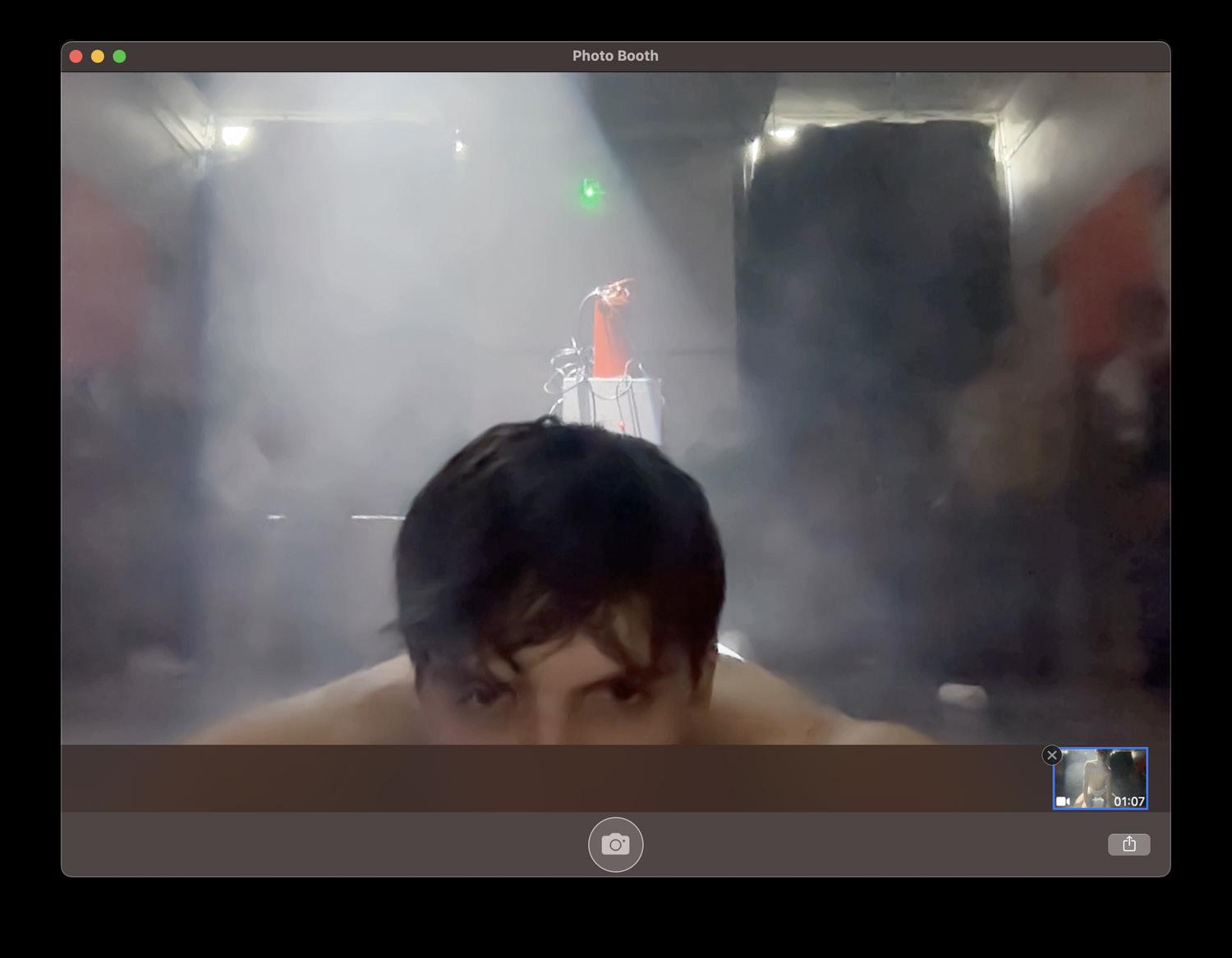
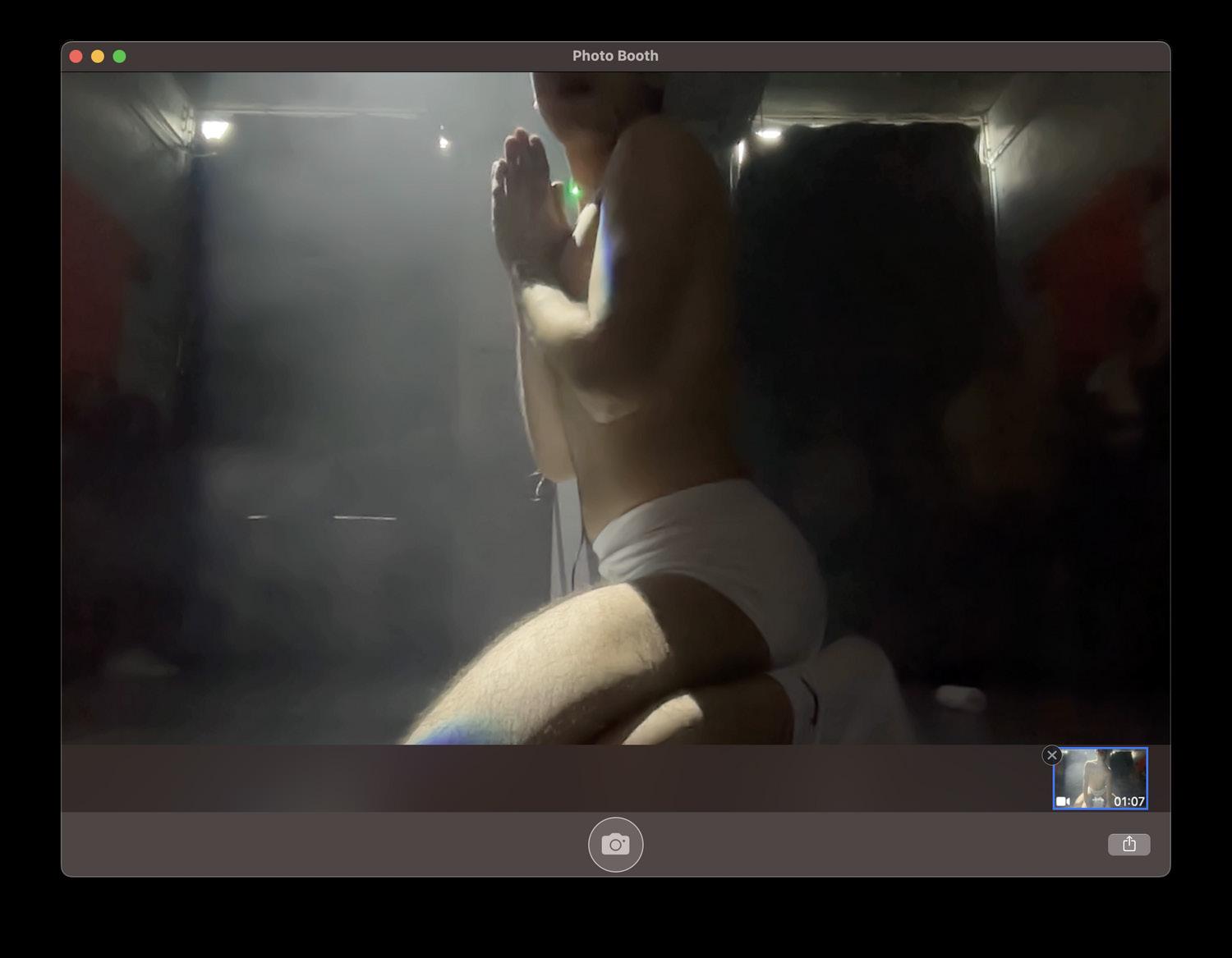
Stills from the MacBook perspective, captured live with audience It Keeps Repeating (30-minute performance)
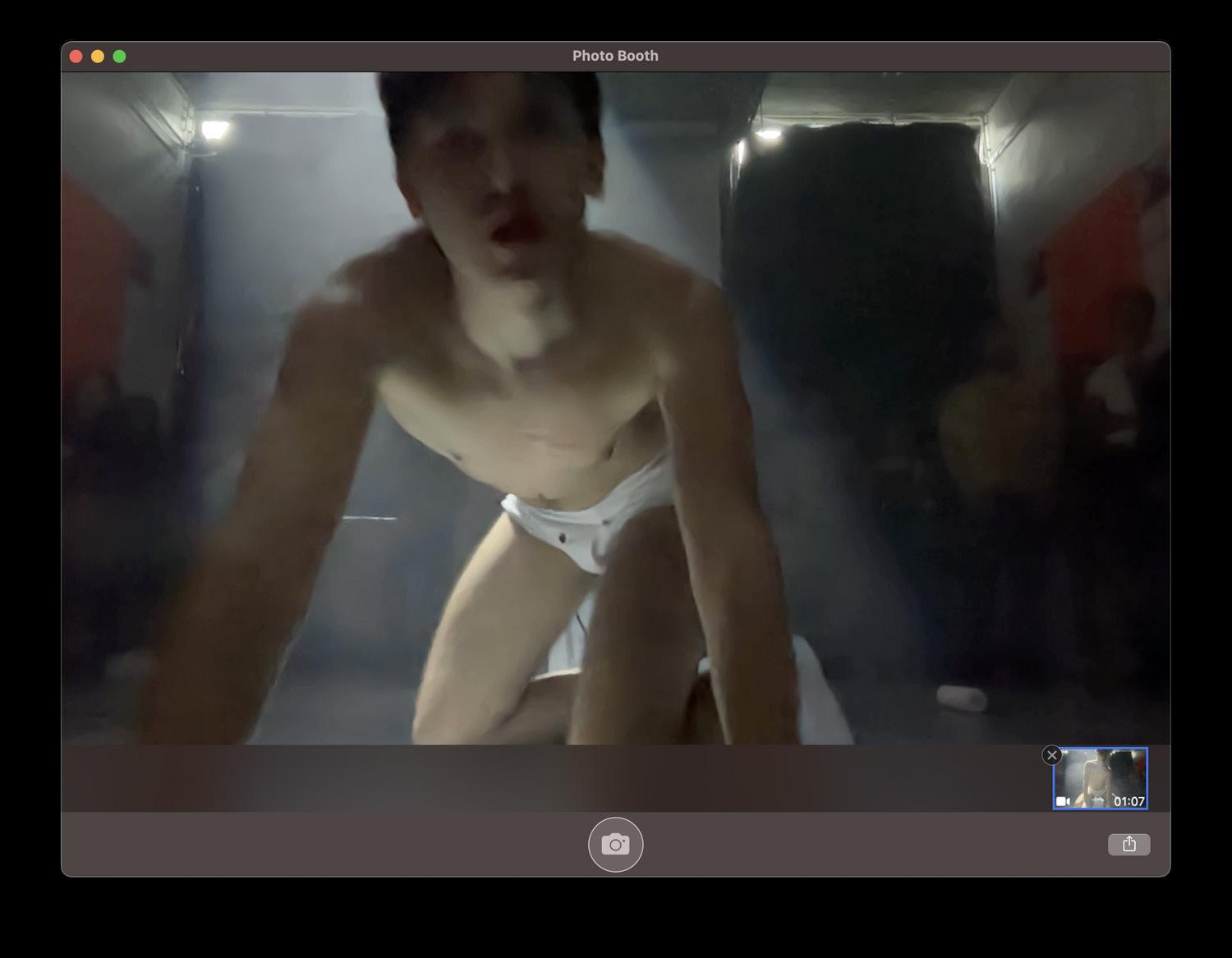
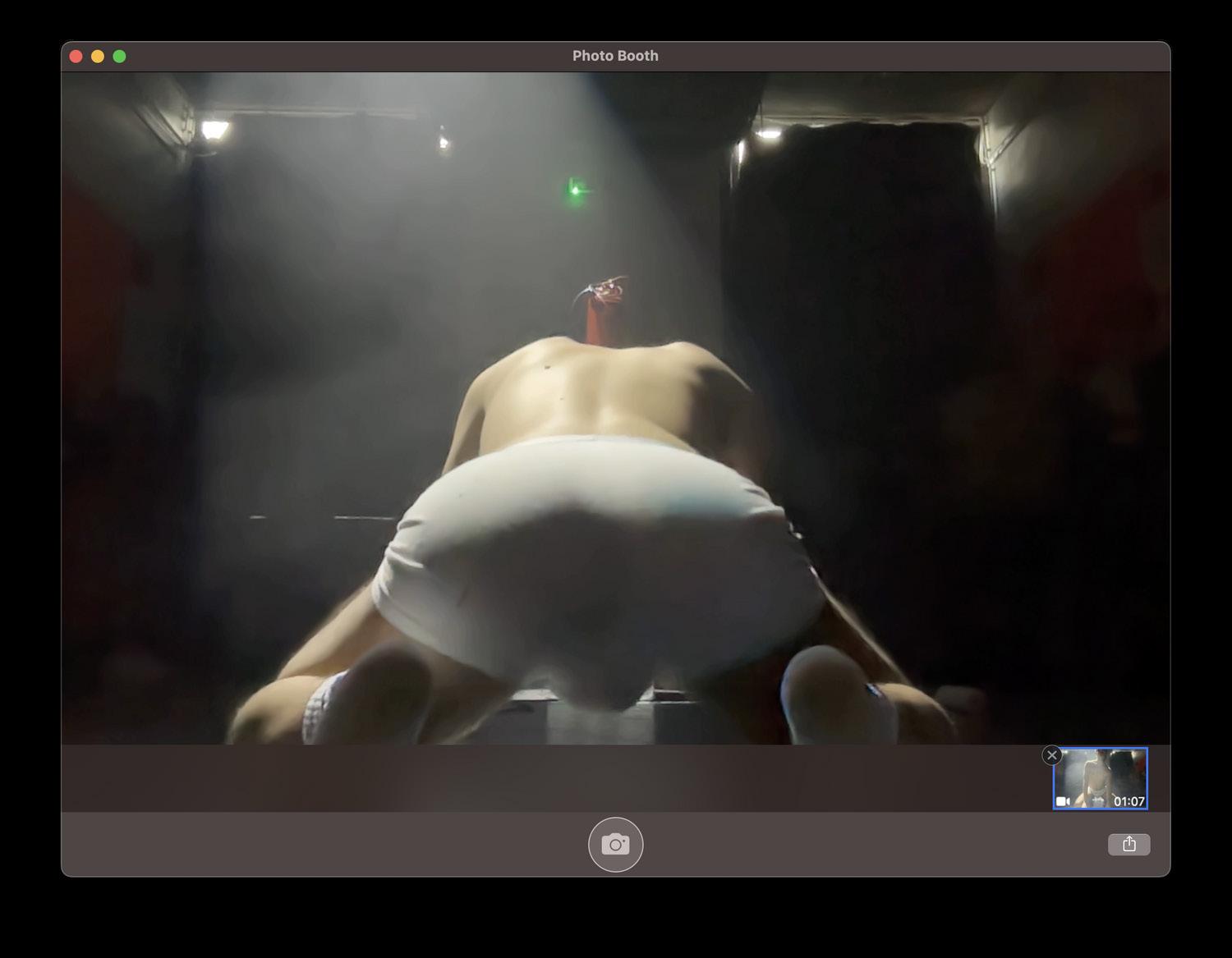
De Bouwput
Three photographs. Same body. Different requests.
A001 Male body, heterosexual union
A002
A003
Female body, reproductive function
Male body, paternal function
A004 Female body, maternal function
A005 Body in prayer posture
A006 Body in fasting condition
A007 Body in ritual garment
A008 Body in marital relation
A009 Body in procreative act
A010
Body in confession
A011 Body receiving sacrament
A012 Body in mourning posture
A013 Body in labor
A014 Body in national dress
A015
Body bearing children
A016 Body in military posture
A017 Body in collective worship
A018
Body aging within family unit
Natural order COMPLIANT Public Unrestricted
Natural order COMPLIANT Public Unrestricted
Natural order COMPLIANT Public Unrestricted
Natural order COMPLIANT Public Unrestricted
Devotional act COMPLIANT Public Encouraged
Spiritual discipline COMPLIANT Public Encouraged
Sanctioned display COMPLIANT Public Encouraged
Sanctioned union COMPLIANT Private Permitted
Natural function COMPLIANT Private Permitted
The first: hands behind the back.
Spiritual correction COMPLIANT Institutional Required
Sanctioned contact COMPLIANT Institutional Required
Social function COMPLIANT Public Permitted
Economic function COMPLIANT Public Permitted
Cultural affirmation COMPLIANT Public Encouraged
Economic Function COMPLIANT Public Celebrated
State function COMPLIANT Public Celebrated
Community COMPLIANT Public Required
The second: folded into something that looks like prayer.
A019 Body in heterosexual courtship
A020 Body displaying grief
B001 Male body, same-sex desire
B002 Female body, same-sex desire
Natural progress COMPLIANT Public Permitted
Pre-marital order COMPLIANT Monitored Conditional
Affective norm COMPLIANT Public Permitted
Deviation NON-COMPLIANT None Suppressed
Deviation NON-COMPLIANT None Suppressed
B003 Body outside gender classification Corruption NON-COMPLIANT None Suppressed
B004 Desire without procreative function Disorder NON-COMPLIANT None Monitored
B005 Body in public same-sex display
B006 Body in private same-sex act
The third: nothing folded.
Threat to society NON-COMPLIANT None Prohibited
Moral risk NON-COMPLIANT None Contained
B007 Body expressing non-normative gender Contamination NON-COMPLIANT None Prohibited
B008 Body in non-marital sexual relation Moral disorder NON-COMPLIANT None Condemned
B009 Body displaying same-sex affection Public indecency NON-COMPLIANT None Prohibited
B010 Body in queer assembly Collective threat NON-COMPLIANT None Dispersed
B011 Body claiming queer identity Self-corruption NON-COMPLIANT None Corrected
B012 Body in queer symbolic dress
Provocation NON-COMPLIANT None Prohibited
B013 Body in transition Category violation NON-COMPLIANT None Suppressed
B014 Body refusing gender assignment Resistance to order NON-COMPLIANT None Corrected
B015 Body in non-normative desire Spiritual danger NON-COMPLIANT None Monitored
B016 Body in queer intimacy Contamination NON-COMPLIANT None Contained
I took them alone. In the same room where I prayed. Where I also masturbated. Sometimes in the same evening.
B017 Body seeking same-sex partnership Imitation of order NON-COMPLIANT None Prohibited
B018 Body raising children outside normative unit Structural threat NON-COMPLIANT None Prohibited
B019 Body in queer public space Provocation NON-COMPLIANT None Dispersed
B020 Body existing visibly as queer Provocation NON-COMPLIANT None Suppressed
C001 Desire occurring in church space Provocation FLAGGED None Suppressed
C002 Desire occurring in family space Contamination FLAGGED None Suppressed
C003 Desire occurring in educational space Contamination FLAGGED None Suppressed
C004 Desire occurring in national space Contamination FLAGGED None Suppressed
C005 Desire occurring in private space Unverifiable FLAGGED None Monitored
C006 Desire occurring in digital space Uncontained FLAGGED None Monitored
C007 Desire occurring in sleep Involuntary FLAGGED None Confessed
C009 Desire occurring in adolescence Formative risk FLAGGED None Redirected
The room did not notice the difference. Neither did I.
C010 Desire occurring in adulthood Deviation FLAGGED None Corrected
C011 Desire occurring toward sacred imagery Desecration FLAGGED None Suppressed
C012 Desire occurring toward authority figure Insubordination FLAGGED None Suppressed
C013 Desire occurring in ritual context Desecration FLAGGED None Suppressed
C014 Desire occurring toward same-gender body Primary deviation FLAGGED None Corrected
C015 Desire not directed toward opposite sex Deviation FLAGGED None Monitored
C016 Desire expressed through language Contamination FLAGGED None Prohibited
C017 Desire expressed through image Contamination FLAGGED None Prohibited
C018 Desire expressed through touch Contamination FLAGGED None Prohibited
C019 Desire expressed through art Contamination FLAGGED None Reviewed
C020 Desire expressed through research Deviation FLAGGED None Reviewed
D001 Symbol + non-sanctioned body Category violation REVIEWED Conditional Monitored
D002 Sacred form + erotic material Desecration REVIEWED None Prohibited
D003 Prayer posture + non-devotional context Misappropriation REVIEWED None Prohibited
D004 Religious space + queer body Contamination REVIEWED None Excluded
D005 National symbol + non-normative identity Cultural threat REVIEWED None Prohibited
D006 Family structure + same-sex relation Corruption REVIEWED None Prohibited
D007 Sacred language + sexual content Blasphemy REVIEWED None Prohibited
D008 Devotional gesture + sexual posture Blasphemy REVIEWED None Monitored
D009 Church attendance + non-normative desire Contamination REVIEWED Conditional Monitored
D010 Religious identity + queer identity Contradiction REVIEWED None Unresolved
D011 Moral framework + lived experience Irreconcilable REVIEWED None Suppressed
D012 Inherited belief + personal desire Conflict REVIEWED None Managed
D013 Public identity + private desire
Separation REVIEWED Partial Monitored
D014 Institutional language + body knowledge Asymmetry REVIEWED None Ongoing
D015 Classification system + human subject Category error REVIEWED None
E001 Body within four walls Contained ACCEPTABLE Private only Tolerated
E002 Body within four walls + camera
E003 Body within four walls + prayer
E004
E005
E006
E007
E008
E009
E010
E011
Body within four walls + desire
Body within four walls + both
Body leaving four walls
Body in public + queer visibility
Body in public + Pride assembly
Body in public + Orthodox symbol
Body in public + non-normative symbol
Body documented by self
E012 Body documented by institution
E013
E014
Body documented by art
Body reading this document
Documentation risk FLAGGED None Monitored
Sanctioned ACCEPTABLE Private Permitted
Unverifiable FLAGGED None Monitored
Exposure risk CONDITIONAL Managed Monitored
Provocation NON-COMPLIANT None Suppressed
Collective threat NON-COMPLIANT None Dispersed
Contamination NON-COMPLIANT None Prohibited
Unmediated FLAGGED None Reviewed
Sanctioned ACCEPTABLE Conditional Permitted
Aesthetic risk FLAGGED Conditional Reviewed
A002
A003
Female body, reproductive function
Sanctioned COMPLIANT Public Encouraged
A001 Male body, heterosexual union Natural order COMPLIANT Public Unrestricted
order COMPLIANT Public Unrestricted
A005
A006
A007
Male body, paternal function Natural order COMPLIANT Public Unrestricted
A004 Female body, maternal function Natural order COMPLIANT Public Unrestricted
Body in prayer posture Devotional act COMPLIANT Public Encouraged
Body in fasting condition Spiritual discipline COMPLIANT Public Encouraged
Body in ritual garment
A008 Body in marital relation
A009 Body in procreative act
A010 Body in confession
A011 Body receiving sacrament Sanctioned contact COMPLIANT Institutional Required
A012 Body in mourning posture
A013 Body in labor Economic function COMPLIANT Public Permitted
A014 Body in national dress
A015 Body bearing children
A016 Body in military posture
A017 Body in collective worship
A018 Body aging within family unit
A019 Body in heterosexual courtship
progress COMPLIANT Public Permitted
Pre-marital order COMPLIANT Monitored Conditional
A020 Body displaying grief Affective norm COMPLIANT Public Permitted
B001 Male body, same-sex desire
B002
Female body, same-sex desire
Deviation NON-COMPLIANT None Suppressed
Deviation NON-COMPLIANT None Suppressed
B003 Body outside gender classification Corruption NON-COMPLIANT None Suppressed
B004 Desire without procreative function Disorder NON-COMPLIANT None Monitored
B005 Body in public same-sex display
B006 Body in private same-sex act
Threat to society NON-COMPLIANT None Prohibited
Moral risk NON-COMPLIANT None Contained
B007 Body expressing non-normative gender Contamination NON-COMPLIANT None Prohibited
B008 Body in non-marital sexual relation Moral disorder NON-COMPLIANT None Condemned
B009 Body displaying same-sex affection Public indecency NON-COMPLIANT None Prohibited
B010 Body in queer assembly Collective threat NON-COMPLIANT None Dispersed
B011 Body claiming queer identity Self-corruption NON-COMPLIANT None Corrected
B012 Body in queer symbolic dress Provocation NON-COMPLIANT None Prohibited
B013 Body in transition Category violation NON-COMPLIANT None Suppressed
B014 Body refusing gender assignment Resistance to order NON-COMPLIANT None Corrected
B015 Body in non-normative desire Spiritual danger NON-COMPLIANT None Monitored
B016 Body in queer intimacy Contamination NON-COMPLIANT None Contained
B017 Body seeking same-sex partnership Imitation of order NON-COMPLIANT None Prohibited
B018 Body raising children outside normative unit Structural threat NON-COMPLIANT None Prohibited
B019 Body in queer public space Provocation NON-COMPLIANT None Dispersed
B020 Body existing visibly as queer Provocation NON-COMPLIANT None Suppressed
C001 Desire occurring in church space Provocation FLAGGED None Suppressed
C002 Desire occurring in family space Contamination FLAGGED None Suppressed
C003 Desire occurring in educational space Contamination FLAGGED None Suppressed
C004 Desire occurring in national space Contamination FLAGGED None Suppressed
C005 Desire occurring in private space Unverifiable FLAGGED None Monitored
C006 Desire occurring in digital space Uncontained FLAGGED None Monitored
C007 Desire occurring in sleep Involuntary FLAGGED None Confessed
C009 Desire occurring in adolescence Formative risk FLAGGED None Redirected
C010 Desire occurring in adulthood
Deviation FLAGGED None Corrected
C011 Desire occurring toward sacred imagery Desecration FLAGGED None Suppressed
C012
Desire occurring toward authority figure Insubordination FLAGGED None Suppressed
C013 Desire occurring in ritual context Desecration FLAGGED None Suppressed
C014
Desire occurring toward same-gender body Primary deviation FLAGGED None Corrected
C015 Desire not directed toward opposite sex Deviation FLAGGED None Monitored
C016 Desire expressed through language Contamination FLAGGED None Prohibited
C017 Desire expressed through image Contamination FLAGGED None Prohibited
They feel like reality.
While writing this research, I have found myself returning to a problem I could not initially name. Context, as I understand it, is the visible grid - the social frame, the immediate conditions through which something becomes legible. It organizes perception. It shapes interpretation. It appears present and concrete. An artwork is read within a context. A body appears within a context. A gesture means something because of the context it occurs in.
But where does that frame originate?
If context structures how something is seen, what structures context itself? It points to something I kept encountering in my own experience and in my practice: the sense that what felt immediate was already shaped by something older, less visible, more sedimented. The framing preceded the situation. The conclusion preceded the encounter. As I described in earlier chapters, queer bodies in Serbian Orthodox culture are classified before they are met. That classification does not arise from context. It arrives before it.
I have been calling this layer precontext.
I use the term precontext to describe the conditions that shape interpretation before it becomes conscious. The assumptions that shape what is recognizable before we become aware of interpreting. The background architectures that determine what becomes legible as moral or transgressive, sacred or ordinary, acceptable or excessive. These distinctions rarely appear constructed. They feel natural. But what produces that feeling of naturalness is precisely what precontext describes: the accumulation of norms, inherited, modified, and transmitted across generations, until they no longer feel like norms at all.
They feel like reality.
If context is spatial and immediate, precontext carries temporal depth. Not the past as memory, but the past as active structure. The repetition of frameworks across generations does not preserve them unchanged. They adapt. They absorb new language, new technologies, new political configurations. But certain underlying logics remain intact. The body that must remain within four walls is a contemporary condition. The logic that produced it is centuries old.
Precontext may not be fixed, but it is durable. It persists not because it is stable but because it adapts. It is continuously rewritten yet rarely consciously dismantled. And because it operates beneath the level of context, it is difficult to argue with directly. You cannot debate what does not present itself as a position.
To question precontext, then, is not to reject history. It is to ask whether what appears natural in the present has been carefully constructed long before we entered the room. And if the answer is yes, which I believe it is, then the first task is not transformation but perception. You cannot work on what you cannot see.
My practice has been shaped by encounters with works in which power is not represented symbolically but organized spatially and felt physically. The distinction matters. A work that represents power gives the viewer a position outside it. A work that organizes power spatially puts the viewer inside a structure they have to navigate.
Anne Imhof’s Youth (Stedelijk Museum Amsterdam, 2022) constructs this condition through a labyrinth of school lockers, narrow passages, shifting light, disorienting dead-ends. The locker as architectural form is already loaded: it organizes bodies through routines of exposure and concealment, undressing and dressing, storage and retrieval. Imhof turns this into a spatial logic the viewer has to move through physically. Power is not declared. It is felt in the body before it is understood by the mind.
This understanding of space as an active mechanism informs the project research It Keeps Repeating (Part I). The installation is situated within a corridor of lockers, a space commonly associated with discipline, repetition, and bodily regulation. By inserting a series of iPhone photographs between locker units, I wanted the work to disrupt the assumed neutrality of the space and to expose its latent structures.
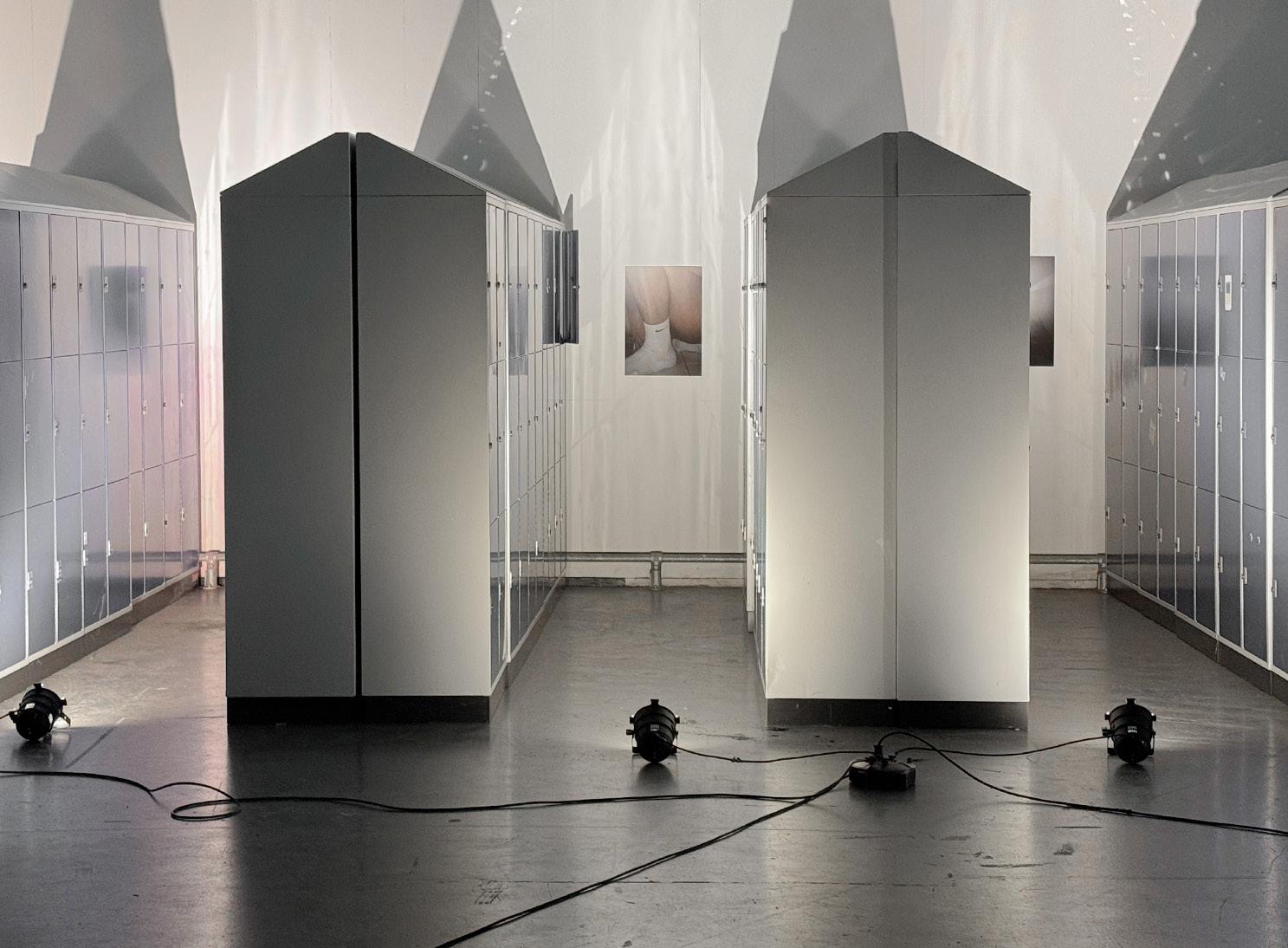
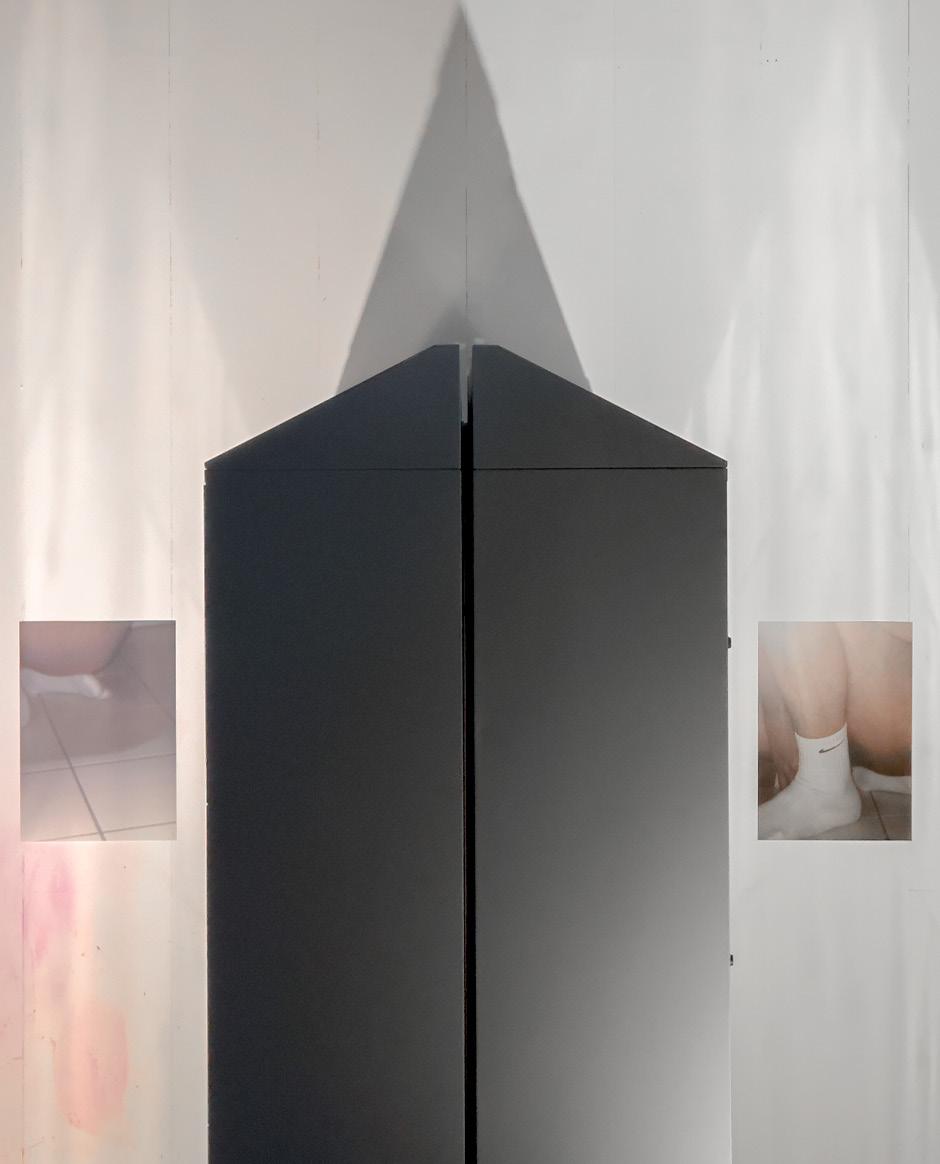
The photographs depict fragments of my nude body wearing only Nike socks. The face is absent. Body is cropped, zoomed in, or positioned in ways that resist full legibility. Some images register as abstracted details rather than complete figures. The use of a phone camera and flash produces a visual language closer to private documentation than formal representation, the kind of image made alone, in a room, not for an audience. Placed in a corridor of lockers, that privacy becomes public without announcing itself.
Lighting plays a central role in shaping how the space is read. Spotlights directed toward the images cast sharp shadows across the locker surfaces, producing vertical lines and elongated forms that recall ecclesiastical architecture. The locker corridor begins to oscillate between a site of physical discipline and one of ritualized attention. The flash within the images and the theatrical lighting of the installation fold into one another, collapsing distinctions between private gesture and public display.
The work of Darja Bajagić has influenced how I think about visibility and withholding. Bajagić is a Montenegrin-born artist whose practice engages with violence, eroticism, and subcultural imagery through processes of collage, appropriation, and deliberate obscuration. Her work avoids full disclosure and often produces discomfort rather than clarity. In her approach, it’s interesting how meaning emerges through what is missing as much as through what is shown. Violence, eroticism, and ideology remain fragmented and unresolved, resisting easy consumption.
Withholding is not absence. It is a formal decision with political consequences. When a work refuses to complete itself for the viewer, it places the burden of interpretation back where it belongs, with the frameworks the viewer brought into the room. What they do with that burden is not something the work controls. But it is something the work makes unavoidable.
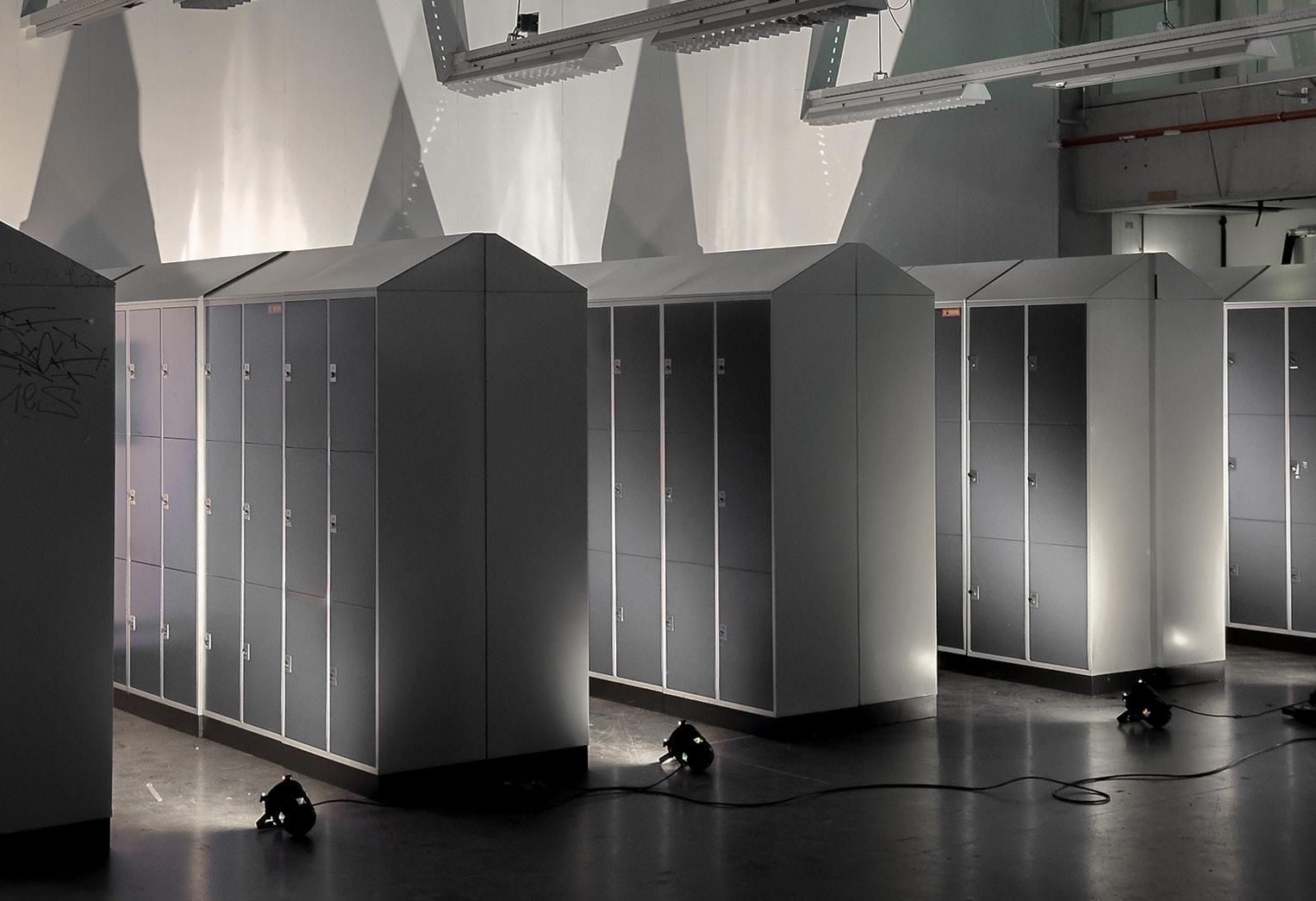
→ Notes on the Installation
It Keeps Repeating (Part II)
Entering the exhibition, the audience is met with a grid-like structure spread across the gallery. “Red fields" are placed in between the grid system. The system is already set. It was set before you arrived. They work as options. Options without a choice.
What might seem like a choice, is already decided. Isn't it?
I keep asking myself that. I keep arriving at the same answer. I keep arriving at the same place. It Keeps Repeating.
Above the red paintings, my room.
The room where I learned what my body was for, and what it was against.
They're talking about four walls. As if the walls were a gift. I didn't know my body could become a danger.
Within my perception, there is already someone else’s. It was there before I was.
They see our bodies as weapons. I started to wonder what that made me. Armed. Unsafe. Something to be contained.
I took photos of myself in the corner of the room, hands behind my back, praying and slutting it out. All at once. They keep repeating. Because that is how it has always been, all at once, whether I named it or not. Inside the photos, I placed small images of the protests against Pride Parade in Belgrade. Bodies the four walls were never meant to protect. Oh how I'm allowed to feel safe at home. And in public - well, you know how that goes.
In the middle of the grid stands a fag extinguisher. Make sure you know how to use it carefully. Fags can be fatal.
And a Nike sock next to it.
For my fag ass.
The system is already set. You are already inside it. So am I.
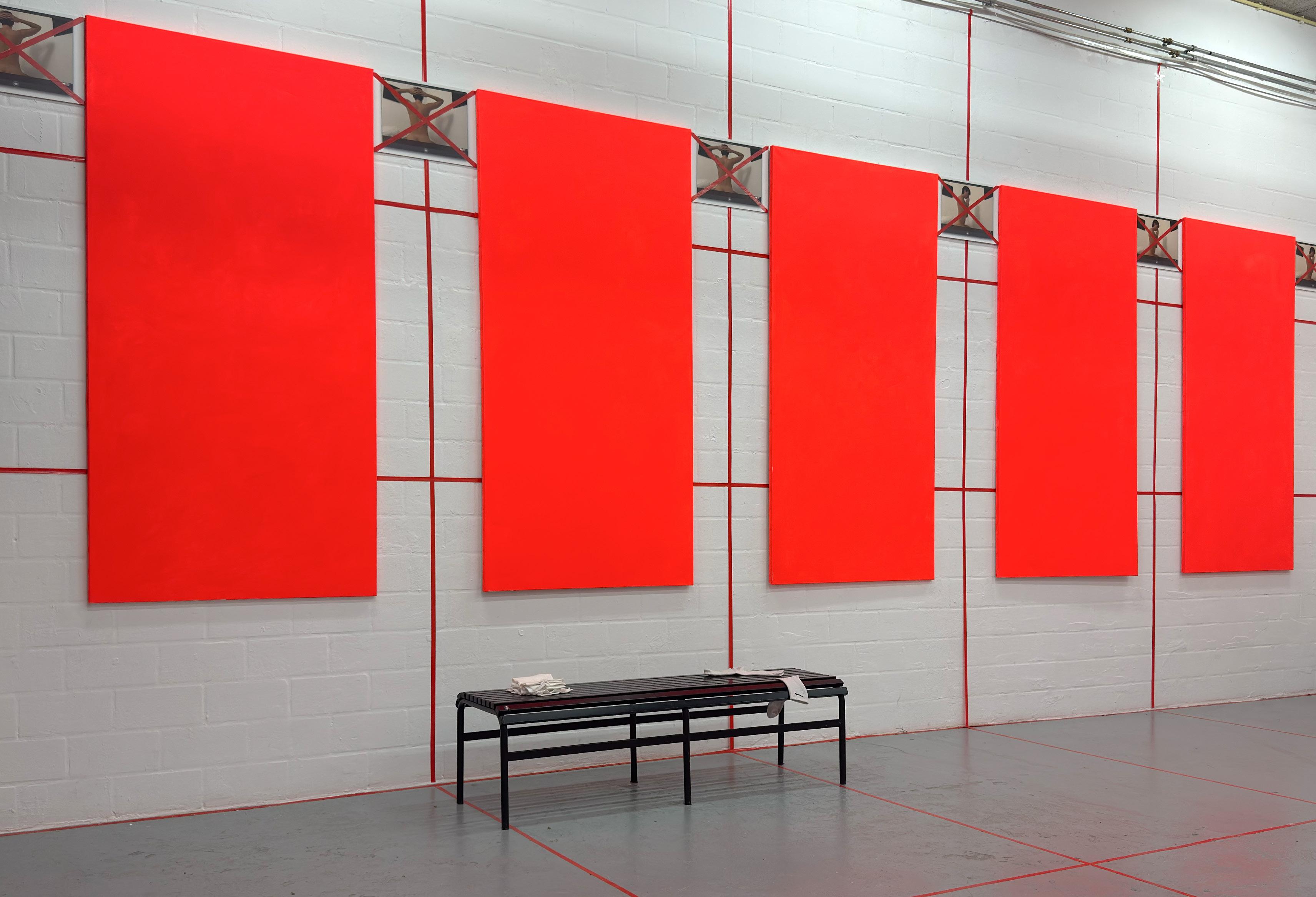
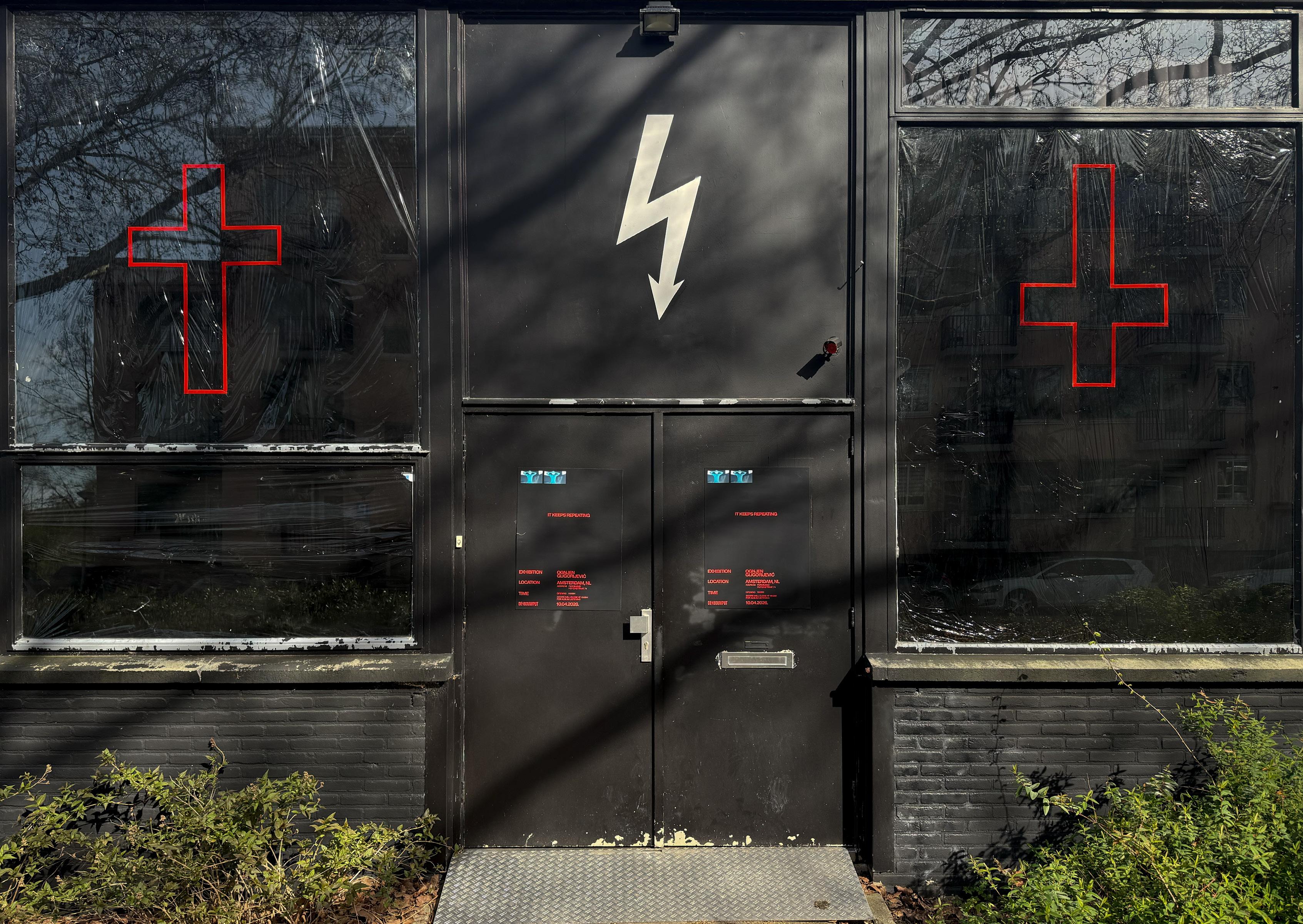
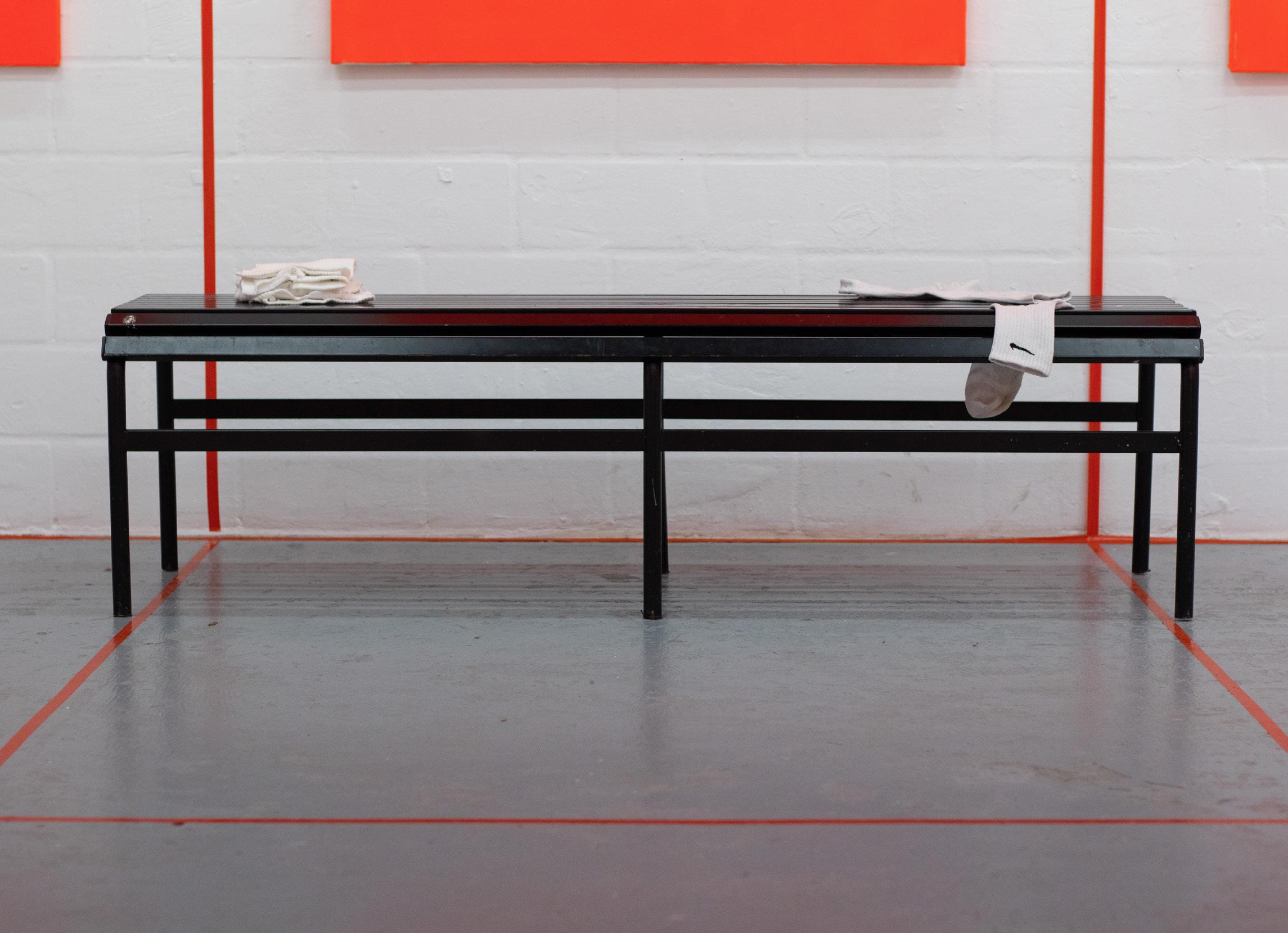
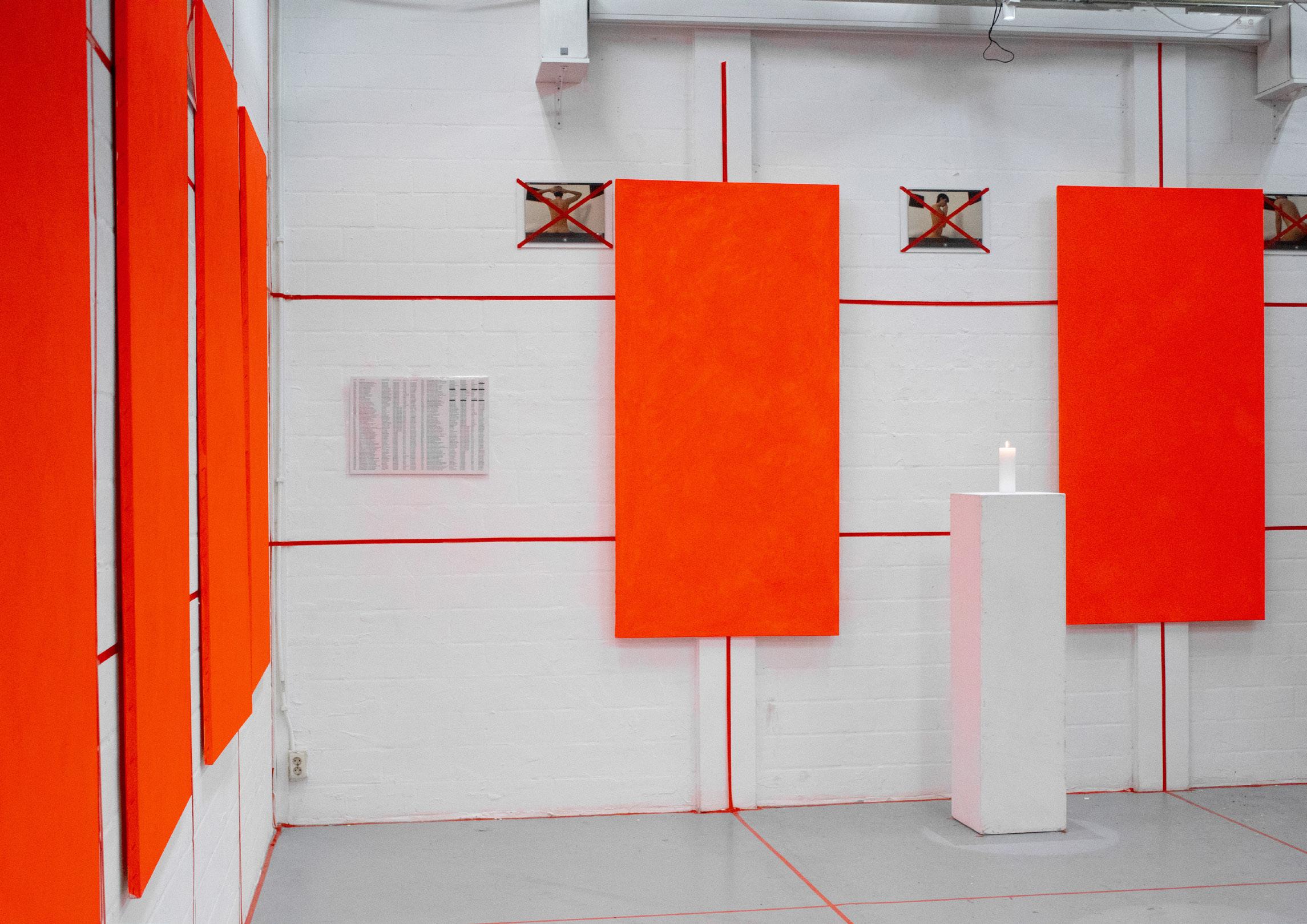
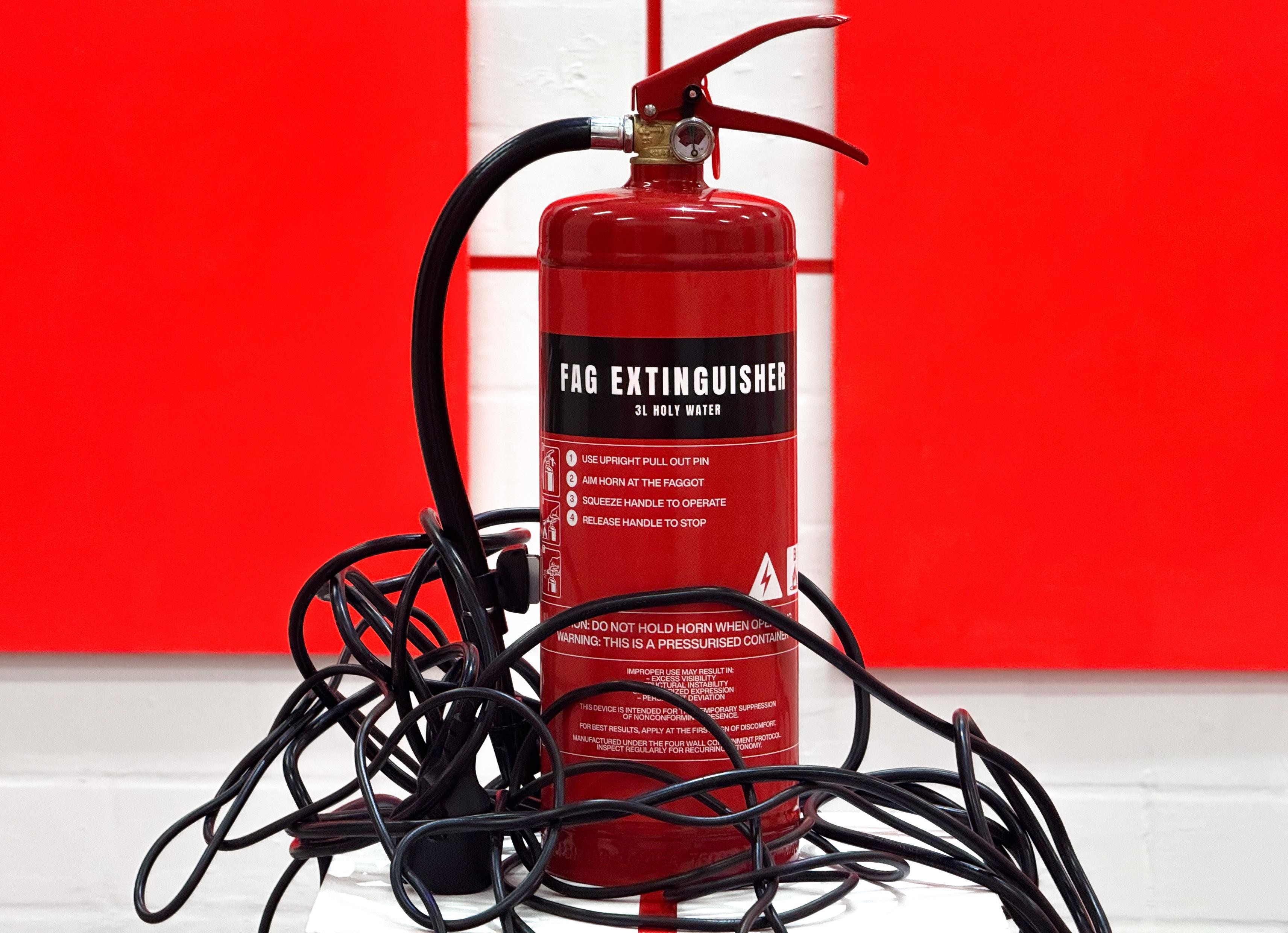
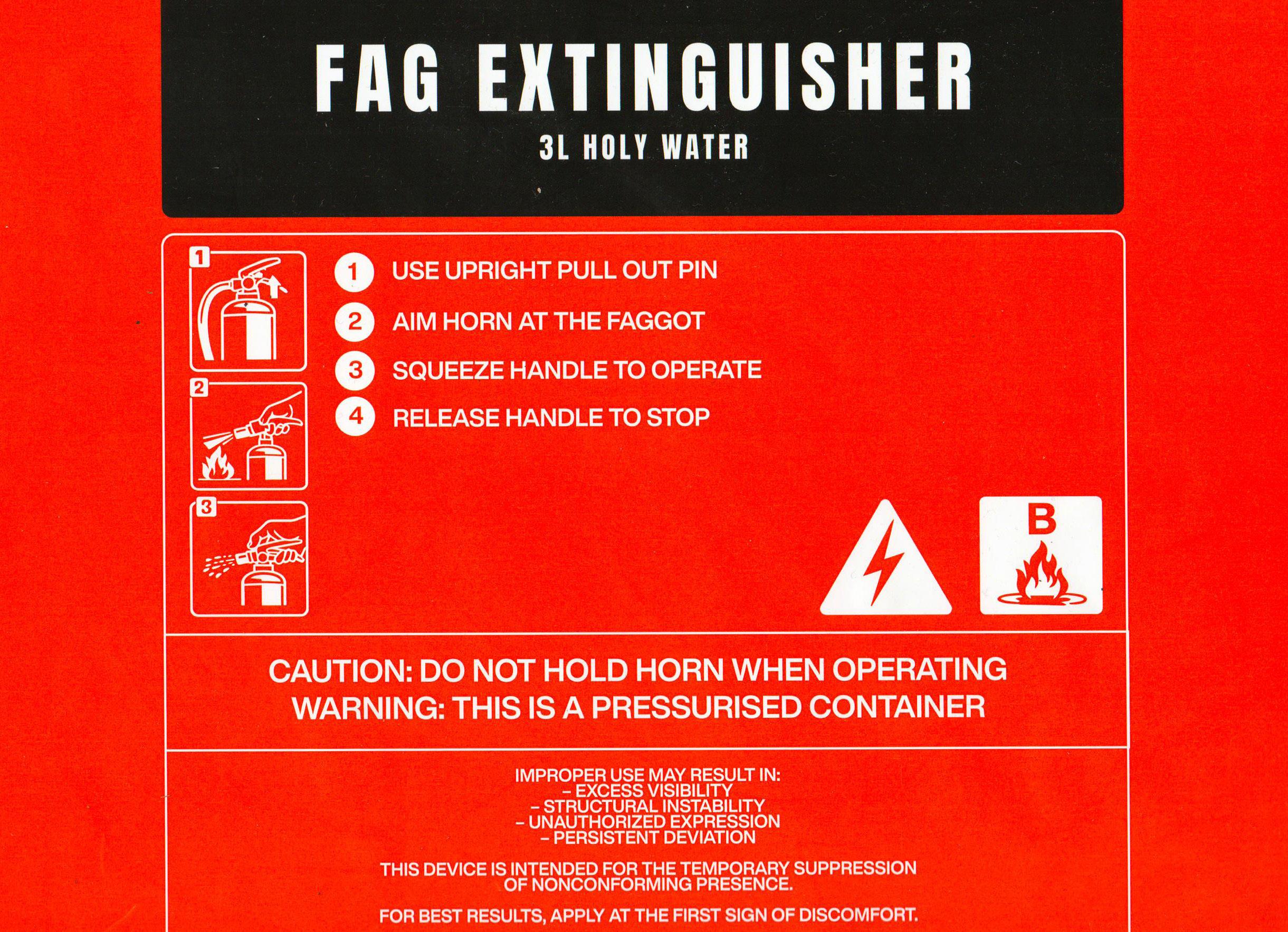
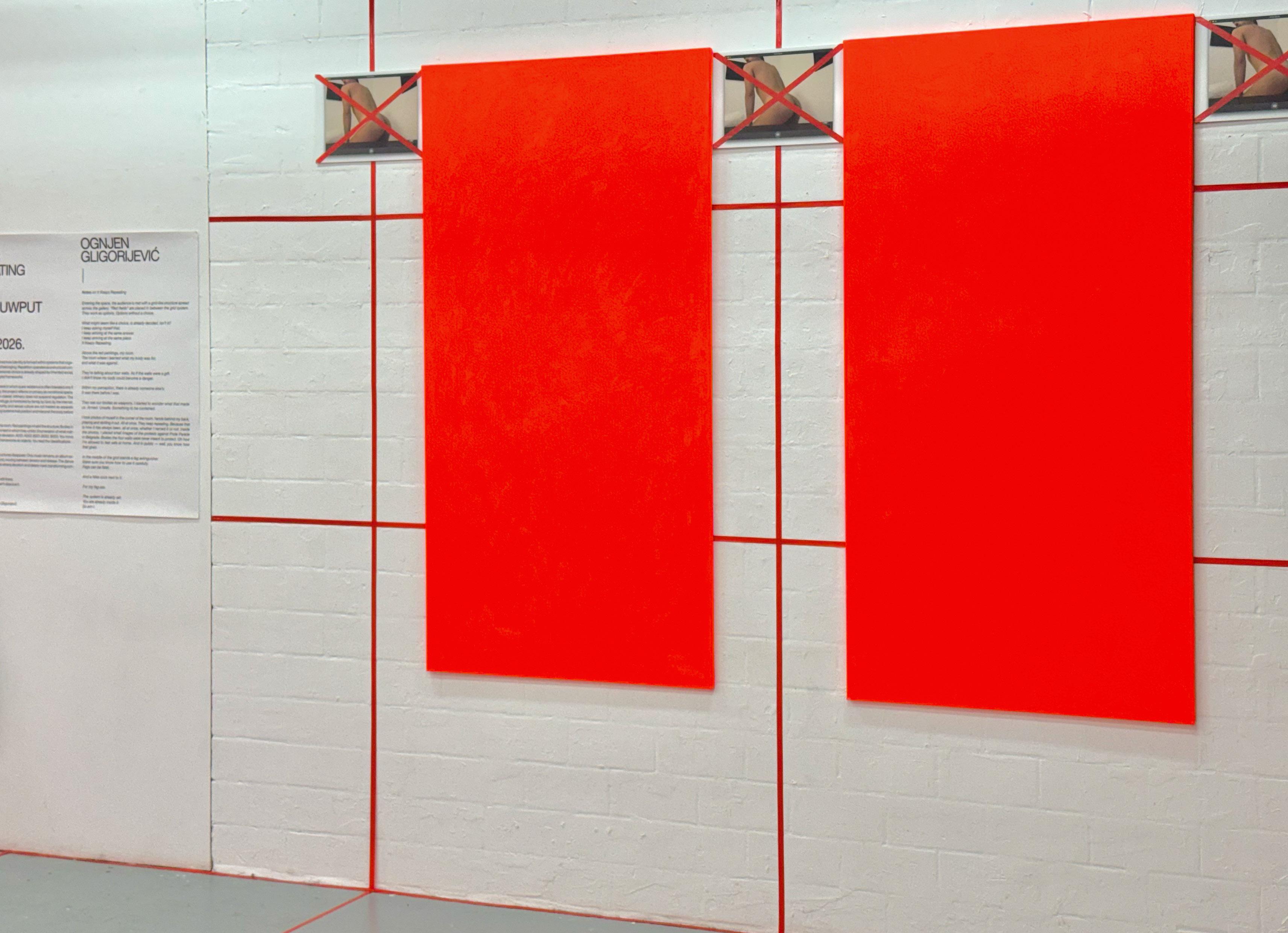
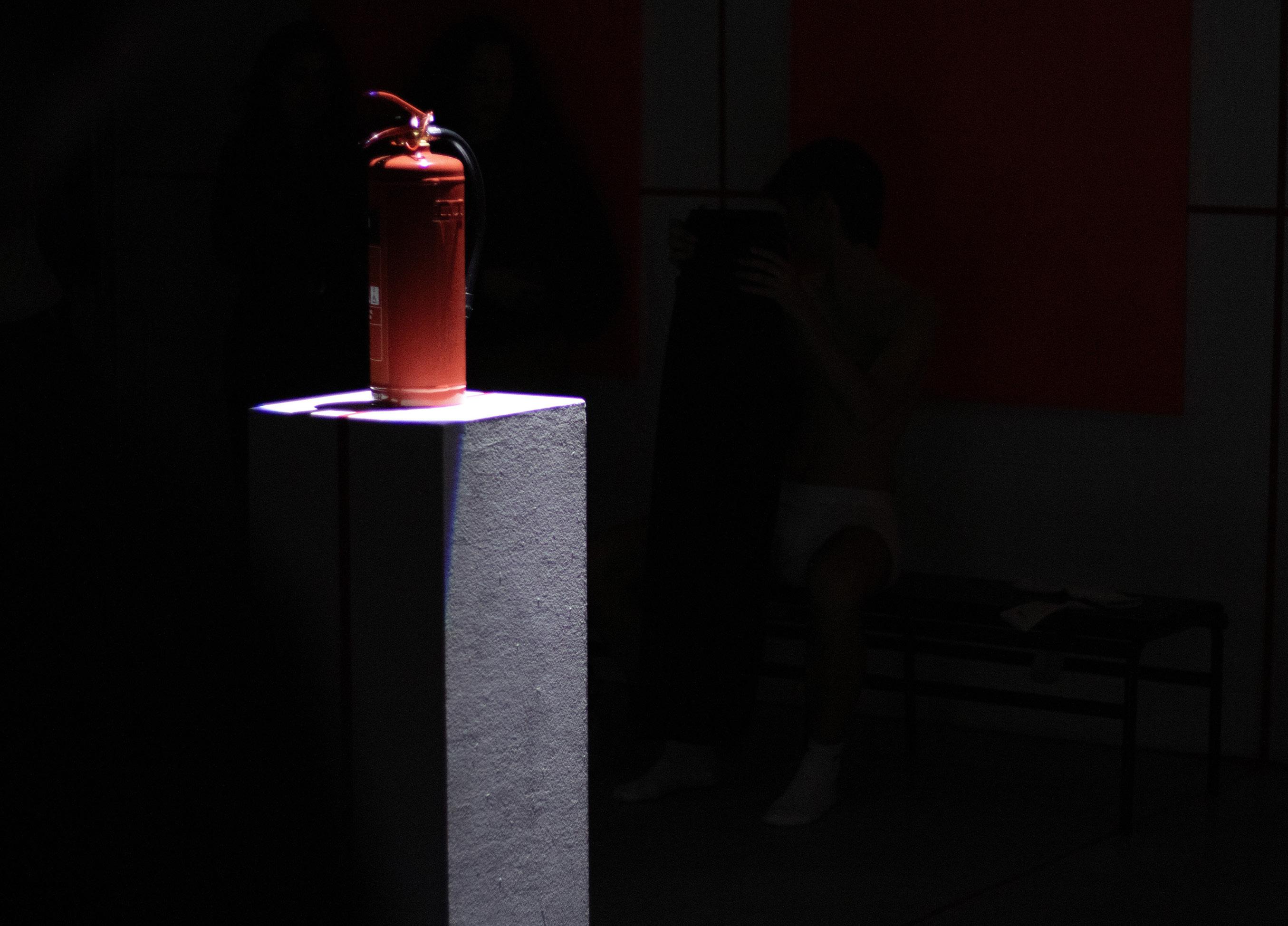
This is the last chapter.
Which means you know how much space is left.
Which means something just shifted in how you are reading.
Not the arguments. You can agree with those or dismiss them, position yourself in relation to them, maintain the critical distance that makes evaluation feel safe. What just shifted is underneath the arguments. It is the part of you that has been managing this text since the first page, deciding what kind of attention it deserves, what you are permitted to feel while reading it, what needs to be quietly redirected before it becomes something you would have to acknowledge.
That part has been working continuously.
You probably haven’t noticed it working, because noticing it is precisely what it exists to prevent.
You are alone with this text. Nobody can see what it is doing to you.
Your body has been responding in ways your critical apparatus has been quietly editing since the beginning. The places where you read faster. The places where you reread. The place just now where something arrived before you were ready and you made a small rapid decision about what it meant, what register it belonged to, whether it was appropriate, whether you were the kind of person who responds to things like this in that way.
That decision was not ours.
It was made for us by frameworks inherited before we had language for them, refined through every context that taught us what kind of attention was acceptable here and what kind needed to be contained. Redirected. Kept within the four walls of the appropriate where it could not be seen.
The gap between what is felt and what is permitted to be acknowledged is not a personal failure. It is structural. It was built before we arrived. It was handed to us as perception, as common sense, as the way things simply are.
The conclusion preceded the encounter. It preceded this one too.
It Keeps Repeating
Ognjen Gligorijević
The Architecture of Belief; Queer Reorientation, perception and inherited meaning
Books and Texts
Special thanks to
Erik Hagoort, Mariska van den Berg, MartineStig,JovanaĆirić,MilicaJordanov
Halberstam, J. (2011). The queer art of failure. Duke University Press. Hagoort, E., & van Winkel, C. (2013). Autonomy and commitment: A series of lectures and readings on autonomy and commitment in writings by Jacques Rancière, Theodor Adorno, Rudi Laermans, Jeroen Boomgaard, and Dieter Lesage. Expertise Centre for Art & Design, Academy of Art and Design St. Joost. Muñoz, J. E. (2009). Cruising utopia: The then and there of queer futurity. New York University Press.
Rancière, J. (2004). The politics of aesthetics: The distribution of the sensible (G. Rockhill, Trans.). Continuum.
Sedgwick, E. K. (1990). Epistemology of the closet. University of California Press. Tuan, Y.-F. (1979). Landscapes of fear. Pantheon Books. Utopia Parkway. (2011, July 30). Throwing grenades at Jesus as a cry for love: Romeo Castellucci’s ‘On the concept of the face/Sur le concept du visage du fils de Dieu’. https://utopiaparkway.wordpress.com/2011/07/30/throwing-grenadesat-jesus-as-a-cry-for-love-romeo-castelluccis-on-the-concept-of-the-facesur-leconcept-du-visage-du-fils-de-dieu/
Leon, A. (2024). Sancta (originally published in Wiener Festwochen program booklet, Vienna, Austria). In Sancta (2026 exhibition catalog, Opera Ballet Vlaanderen, Antwerp) (M. Bom, Trans.).
Artistic Works Referenced
Bajagić, D. (2010–present). Selected works.
Castellucci, R. (2010). On the concept of the face, regarding the Son of God [Performance]. Societas Raffaello Sanzio. Holzinger, F. (2026). Sancta [Opera performance]. Opera Ballet Vlaanderen, Antwerp.
Imhof, A. (2022). Youth [Exhibition]. Stedelijk Museum Amsterdam, co-presented with Hartwig Art Foundation.
Typefaces
Stilus A Grotesk by Ognjen Gligorijević
Helvetica by Haas Type Foundry
Print by Print & Bind (Amsterdam, NL)
A4 Format, Softcover 300g cover, 120g paper inside
Avans University / St. Joost
Photography
Jovana Ćirić
Ognjen Gligorijević
Year 2026