Mahyasadat Maddahpour - The Body as an Unknow Object - 2026
The Body as an Unknown Object
Mahyasadat Maddahpour
Thesis supervisor: Ollie Palmer and Marton Kabai
Submitted to: Master Institute of Visual Cultures, St. Joost School ofArt & Design, Avans University ofApplied Sciences, s’Hertogenbosch
The Netherlands In partial fulfillment of the requirements for the degree of Master ofArt in Fine Art & Design s’Hertogenbosch, The Netherlands
Abstract
This research asks: how can internalized cultural control and self-censorship within the female body be translated into artistic practice? Grounded in my lived experience as a woman raised in Iran, it examines how bodily regulation is absorbed through everyday behavior: posture, silence, and the constant negotiation between the desire to exist and the fear of consequence. Mirrors serve as the central medium, not toreflect the body, but toconstruct situationsinwhich thebody becomes aware of itself under conditions of visibility and control. Rather than offering resolution, the work aims to make these structures perceptible, shifting the body from a site of control to a site of recognition. Through this process, something gradually shifts: not a complete transformation, but a growing awareness of the body as one's own.
IwrotethisthesiswhileIranwasunderattack.WhileIworkedonthesepages, therewereblackouts, and reaching the people I love became uncertain. I did not always know whether they were reachable or safe.
There is something unbearable about watching from a distance. Seeing your home go dark, not metaphorically, but literally, while trying to hold yourself together somewhere else. Trying to build something here while something is being destroyed there. It felt, at times, like a violation I had no language for and no way to stop.
I do not know what will happen. I do not know what will be left. Maybe something beautiful remains.
Whoever delights in war has no homeland, no law, no home.1
I wrote anyway. Not because the work felt more important than what was happening, but because writing was the only way I knew how to stay present.
I am sad. I am homesick. I am exhausted. I am confused. And I am still here.
1 "That wretch, that monster, that delights in war: Whose lust is murder, and whose horrid joy to tear his country, and his kind destroy." Homer, Iliad, IX. 63–64 (tr. Alexander Pope)
Introduction
Speaking from the body
After my parents separated, I lived with my grandmother. I was ten, maybe eleven, and suddenly the rules of the world changed. I was told that I could no longer play with the boys I grew up with, that I should sit properly, laugh softly, dress decently. I remember being confused more than anything else. My body hadn’t changed, but everyone’s eyes around me had. That was the moment I learned that a girl’s body could be both a lesson and a warning; a space of discipline, a field of control.
In that house, I learned that visibility was a kind of danger and silence a form of safety. To be a “good girl” meant to take up less space, to move quietly through rooms, to keep desires small and gestures careful. My grandmother always used to say a girl’s laughter should sound like running water sh sh sh and I tried to make my voice thinner, my laughter softer, my steps lighter. I did not understand then that I was learning to disappear politely.
This is a social and cultural space built ontenderness and love, but also on fear, shame, and control. A world where you are watched before you are known. Where the body becomes both the subject and the boundary of culture itself.As a woman raised in Iran, this is where my story begins, but not where it ends. These experiences of bodily regulation and self-censorship resonate far beyond one place, touching the lives of many women, particularly within the Middle East. At the same time, I acknowledge that for some women, these norms can offer a sense of safety, comfort, or belonging, and are experienced as a chosen way of living
When I think about self-censorship, I do not think in abstract terms. I think about how my chest tightens when I want to speak, how my throat closes when I decide not to. It feels like holding air inside a balloon ready to burst. There is a constant negotiation between the desire to exist and the fear of consequence. Over time, this negotiation becomes muscle memory. Self-censorship stops being a behavior and becomes a physiology.
This research is concerned with the quiet erasure that occurs when a girl learns to apologize for her own presence, and with the subtle ways control enters the body not as force, but as habit.
From Experience to Form
Tracing a Personal Process
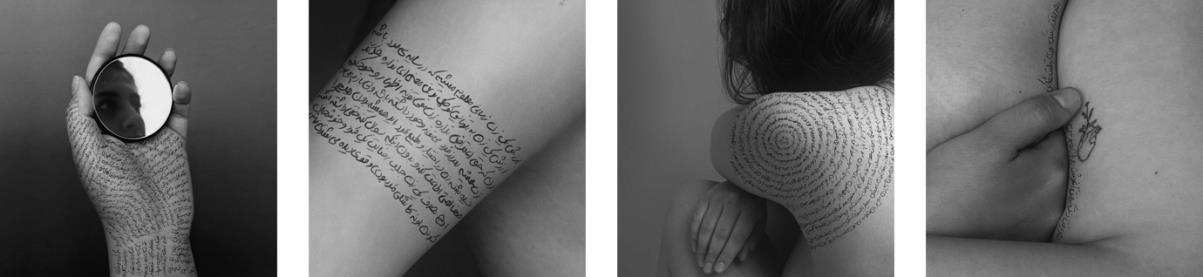
There was something that had occupied my thinking for a long time: the difference between who we become in the presence of others and who we are when no one is watching, when there is no need to adjust or perform. I began by looking for this gap in others. I started with a general exploration of identity, producing a video that observed people across different environments. The aim was to understand how identity shifts depending on context. While this approach revealed that identity is not fixed, it remained too broad and lacked focus. At this point, I recognized that my own experience as a woman withinan Iranian cultural context had been present from the beginning but not directly addressed. This led me to shift the focus from observing others to working from my own experience. I then began working with self-portrait photography2. This marked a turning point.
Writing alone was not sufficient to access these experiences. The forms of control I am working with are not only conceptual, but embodied. They appear through posture, hesitation, and physical response rather than through language alone. For this reason, the body needed to be involved in the research process. Working through material and spatial form allowed these conditions to emerge in ways that could not be fully articulated in text. Rather than describing the experience, the work creates situations in which similar responses can be triggered, making the body both the subject and the site of investigation.
Instead of observing from a distance, I started to confront my own embodied experience, recalling moments when, before going out, I would stand in front of the mirror and face myself, looking at my own body as both subject and object. The process brought discomfort, uncertainty, and a heightened awareness of my body. Alongside the images, I began writing, tracing memories, sensations, and recurring moments. This recurring condition became the starting point for translating experience into form. These moments involved a quick check, a sense of tension, and an impulse to move on. The body would contract and adjust almost automatically. What initially appeared as a minor gesture revealed itself as a consistent pattern. Rather than continuing with direct representation, I began to translate this recurring condition into spatial and material form. The mirror became a central element, not as a tool for producing an image, but as a way to reconstruct a situation in which the body becomes aware of itself under conditions of visibilityand control.
It also brings back a recurring question: whether the image I see in the mirror reflects who I am, or who Ihave learned tobecome; ‘what isleft of amirror invested bythe (masculine) subject to reflect himself, to copy himself'’(Irigaray, 1985, p. 30)
2 Independent Studio Practice 2 called Reclaiming My Body: A Visual and Written Journey Through Shame and Control. Using self-photography and handwritten text on the images, the project confronted the shame and bodily restrictions shaped by cultural expectations and family dynamics.
Working with mirrors allowed me to move from representation toward construction. Instead of showing the body, I began to build situations in which the body responds. This led to the use of fragmented mirror surfaces and spatial arrangements that require physical negotiation. Each step of the process involved testing and adjustment. Initial attempts at broader representations were reduced in scale and focus. The work moved from observing others, to working with my own body to constructing spatial situations. Each decision was guided by what intensified the bodily experience and what reduced it, allowing the work to move closer to the condition I was trying to understand.
I didn’t want to follow a fixed method; instead, I followed a condition. The process moves between three elements that are not separate from one another: living, reading, and making.
The memories and experiences I return to in this research were not chosen because they are dramatic or exceptional. They were chosen because they kept coming back. Writing became a way of slowing down long enough to notice them, to recognize patterns that had been so familiar they had become invisible. Through writing, what was once automatic began to appear as something constructed.
Making was the third way of knowing. Some things cannot be reached through writing or reading alone. They live in the body, in tension and the instinct to adjust. Each work in this research was not made to illustrate an idea but to create a situation inwhich the body could respond. The making itself became part ofthe research. Deciding what toshow and what towithhold, how muchtoreveal and how much to keep back, these were not separate from the investigation. They were inside it.
The theoretical references in this research were not the starting point. They arrived later, as a kind of recognition. Reading those texts felt less like learning something new and more like finding words for something already lived. This is an important distinction. The theories did not shape the experience. They confirmed it.
The Body Before It Belonged to Itself
Control,
Repetition,
and the Formation of the Body
The night before my ninth birthday, I was playing with my cousin inside the house. At some point, my father said that from tomorrow, this would have to stop. He pointed to a headscarf3. I thought he was joking. Maybe it was a game. The next morning, when I forgot, he reminded me. His face was serious. That was the moment I understood: something had changed overnight, not inmy body, but in how my body would be read from now on.
The female body is not something simply lived in. It is shaped, corrected, and regulated through cultural expectations that define what is acceptable and what must be concealed. From childhood, these expectations settle into the body through small, repeated moments; a way of moving learned without being taught:
- Sit properly
- Don’t be loud
- Keep your body in place
- Don’t lick an ice cream in public
- Close your legs; you are not a whore
- Don’t wear those jeans; they are too tight
Even in momentsof play withother children, I wouldsuddenly become aware of my own behavior, questioning whether I was acting “appropriately.” This constant self-checking did not come from direct correction in the moment, but from an already internalized sense of how the body should behave.
These everyday gestures can be understood as forms of disciplinary power, where control becomes internalized through repetition, producing what he describes as “docile bodies” (Foucault, 1977, p. 138).
In many cultural contexts, modesty is framed as a virtue. However, modesty is not treated here as an ethical choice but as a survival code; a learned response that hides fear behind politeness. The body becomes a siteof continuous adjustment, shaped through repeated correction rather than open expression. As in Foucault’s notion of the panopticon, the body learns to regulate itself in anticipation of observation, even when no authority is visibly present (Foucault, 1977, p. 201).
Within the cultural context in which I was raised, the female body is not fully recognized as something that belongs to itself or as a subject but is often positioned as an object; something that can be possessed, regulated, and defined in relation to others. Authority over the female body extends to shaping its appearance, behavior, and presence in public space. Restrictions on clothing and movement are often justified as forms of protection, shown as necessary for maintaining social order and preventing moral disruption.
3 In Islamic jurisprudence, a girlreaches the age ofreligious obligation (taklif) atnine lunar years. Fromthis point, covering (hijab), prayer, and other religious duties become required.
In everyday life, this regulation was reinforced within the domestic space. In the presence of my father, I became more aware of my posture, sitting more upright, limiting movement, and paying attention tohow my bodyappeared through clothing.While I was recalling the repetitive warnings:
- I’m telling you this for your own good…You don’t want people talking!
- Too much! Keep it in!
Even in ordinary moments, the body would contract, as if reducing itself to avoid attention or correction
However, these forms of “protection” simultaneously limit autonomy, shifting responsibility onto the body itself, requiring it to regulate, limit, and adjust its own presence. This raises a question within my own experience: when control is exercised over the female body in the name of protection, who is being protected and from whom? Is this protection truly for the individual, or is it a way of preserving a system where the body never fully belongs to itself, but remains structured by imposed norms?
Clothing became one of the clearest sites of this regulation. The body what we eat, how we dress, the daily rituals through which we attend to the body is a medium of culture (Bordo, 1993). There were things I wanted to wear and was not allowed to, not because of modesty in any neutral sense, but because certain colors, certain forms, certain ways of being seen were considered provocative or inappropriate. What could not be permitted was instead mocked. I understood early that this was not about protection but about containment.
There were times I tried to resist. I would leave the house dressed as expected, then find a quiet place to change. But even in those moments, I felt no freedom. The anxiety followed me. The awareness of being wrong, of crossing something, stayed in the body even when no one was watching. Control had become so internalized that resistance offered no relief.
The body does not simply exist but is continuously produced through cultural codes, a process that echoes the understanding of the body as an effect of power rather than its origin (Foucault, 1977, p. 136). This is not something I learned through theory, but something I had already lived before I could name it.
Shame as a Second Skin
Visibility, Conflict, and the Emotional Body
When my body started to change, I felt something being added to me, something I hadn't asked for and didn't know how to carry. I remember wishing the change would never come, or at least keep getting delayed. I wished I had no gender at all. Not a girl, not a boy. Or maybe a girl with nothing to betray her, nothing that could be read, nothing to feel ashamed of having.
In family gatherings, even in front of my father, I would hunch my shoulders inward. I wore the largest, loosest clothes I could find, not to be comfortable, but to make myself unreadable. To slow down the announcement that I was becoming a woman. Shame arrived long before I had a word for it. Emotions are not private psychological states but social forces that move between bodies, shaping how bodies appear, move, and relate to space (Ahmed, 2004)
Shame, in particular, plays a central role in the regulation of female identity. It emerges at the moment of visibility, when one is seen but feels unauthorized to be seen.
Unlike guilt, which relates to a specific action, shame attaches itself to the self. Shame transfers the “badness” of an action onto the subject herself (Ahmed, 2004, p. 103). Within cultures that closely monitor female behavior, this distinction is crucial. The body itself becomes the problem; its presence, visibility, and form are treated as potential moral failures.
This condition became particularly tangible to me during an earlier stage of my practice, in the project Reclaiming My Body: AVisual and Written Journey Through Shame and Control, where I used self-photography and text to confront the shame and restrictions that had shaped my relationship to my body, and to begin questioning a sense of ownership that had long felt uncertain.
This tension between visibility and shame was also the starting point for my self-portrait practice in ISP2, which drew directly from the work of Shirin Neshat. Neshat positions the female body as a site of meaning, control, and resistance, exploring the distance between interior experience and exterior image within the context of Iranian culture, religion, and politics. Her series Women of Allah (1993–1997) uses the body as a surface on which cultural inscription becomes visible, informing my own investigation into how the body carries and performs the expectations imposed upon it.
However, the process of making this work was not experienced as a straightforward act of expression. It was accompanied by a constant internal resistance. I found myself repeatedly thinking “This is wrong…You shouldn’t do this”, “This is inappropriate”, or in conflict with the
values I had grown up with. Even as I was producing the images, I experienced guilt and hesitation, as if I was crossing a boundary that should not be crossed.
Rather than resolving shame, the act of making brought it closer, making it more perceptible within the body. At other times, the tension fades without resolution. The body does not resist, but withdraws, becoming distant and silent, not as a choice, but as exhaustion. This tension created a contradictory position:
- Show it
- NO! Hide it
- Should I continue?
- Stop it!
While part of me wanted to reclaim the body and make it visible, another part continued to anticipate judgment. I was not only thinking about the work itself, but about how I might be seen through it. Shame requires a witness:
- They will see you
- They will judge
Even in solitude, it operates through an internalized gaze, an imagined observer who continues to judge and regulate. Over time, this gaze becomes embodied, transforming into self-surveillance. In this way, shame becomes felt through the body, shaping hesitation, withdrawal, and restraint This condition extends beyond the act of making.
As a woman, I have rarely experienced my body as a neutral or comfortable space. My awareness has often been directed outward; toward how others might perceive me, rather than how I experience myself. This extends even to speaking or expressing personal opinions, where selfcensorship emerge.
Fear restricts bodily mobility and frames openness as danger. Disgust is produced through repeated cultural associations that mark certain bodies as inappropriate or threatening (Ahmed, 2004). These emotions settle into thebody, producing anticipatory behaviors; shrinking posture, a lowered voice, and limited movement, where being seen becomes more important than seeing.
Seeing and Being Seen
The Gaze, the Mirror, and Self-Surveillance
There was a mirror near the entrance of our house. Before leaving, I would stop in front of it, not to see myself, but to check whether I was acceptable. The question was never how I looked, but whether I had gone too far. Whether something needed to be adjusted, covered, or reduced. I did not always know exactly what I was looking for. I only knew I was looking for what others might see before I did.
Ways of Seeing 4reveals how visual culture positions women as objects rather than subjects of vision. It asserts that “men look at women, women watch themselves being looked at” describes a split within the female subject: one part lives, while another observes, evaluates, and corrects. Berger’s distinction between being naked and being nude clarifies this dynamic. To be nude is not simply to be without clothes, as we call it naked, but to be seen without agency, to exist for the gaze of another. Nudity becomes a performance shaped by expectation. The female body is not freely inhabited but displayed, monitored, and adjusted.
In my experience, this distinction between being naked and being nude does not fully exist in the culture I grew up in. There is little separation between the body as something that simply is, and the body as something that is judged. Visibility itself becomes charged. Even a minimal presence of the body, a gesture, a trace, or a subtle form, can be interpreted as excess.
Beauty cannot exist openly. It is expected to remain contained, private, or unspoken. When it becomes visible, even unintentionally, it is quickly pulled through judgment.Awoman who allows herself to be seen, even in a minimal or ordinary way, risks being reduced to a negative label. The act of seeing is not neutral. It does not allowthe body toappear as it is, but translates itimmediately intomeaning. Evenappreciationbecomesunstable; toacknowledgebeautycanitselfbequestioned, redirected, or denied. Over time, the body is never met directly; it arrives already wrapped in the meanings others have placed on it.
This way of understanding the gaze, as something that is not only external but gradually internalized, resonates with my own experience, where the body was constantly monitored, both by others and by myself. There was an unspoken but persistent rule in our home, enforced by my father: even in his absence, I was expected to check myappearance before leaving. The mirror near the entrance functioned as a kind of filter. Standing in front of it:
- Is it okay?
- NO! Too much!
- Stay within the frame!
- Check again!
Encountering any mirror would trigger an automatic self-check, repeating the same gesture shaped by my father’s rule. The mirror did not simply reflect my body, but positioned me within a way of seeing that was already shaped by expectation.
4 Berger, J. (1972). Ways of Seeing. Penguin Books.
Even in the absence of others, I continued to monitor and adjust my body, as if I were always being watched. This is the point where the body becomes both the object and the agent of control. Until the gaze is no longer something you feel from outside. It becomes the way the body sees itself
The mirror occupies a complex position. Traditionally associated with vanity, the mirror instead functions as a tool of self-surveillance. It reflects not only the body but the social gaze that has been internalized. The mirror is never neutral; it carries the presence of others even in solitude. It remembers. It carries the instructions accumulated over the years. Like a filter that has absorbed everything it was told to catch, it functions less as a surface and more as a surveillance device: always present, always watching, always ready to remind. Wherever it appears, in a hallway, a shop window, a bathroom, the glance toward it triggers the same response. When I look into the mirror, it does not return an unbiased reflection: You look, and something looks back, not you, but what has been learned…
Adjust it.
Control it.
Contain it.
Don’t be shy, decline the offer!
It brings back these learned interpretations, the judgments, the expectations, the language that has shaped how the body is read.
This experience became the starting point for my use of mirrors as a material, not to reflect the body, but to question the conditions under which the body is allowed to appear. Then, the mirror shifts from a tool of control into a space of confrontation. This shift from surveillance to confrontation became the foundation for the artistic decisions that followed. I wanted to explore how internalized cultural control and self-censorship within the female body could be translated into my artistic practice.
The Body in Practice
Translating Control into Artistic Form
I remember sitting in a corner on my first day5, watching others move and speak freely. I felt embarrassed on their behalf. That was when I understood how deep the regulation had gone, deep enough to make someone else's freedom feel wrong. When the environment changed, the contrast became sharper. Like an elephant that has been tied to a tree for years and learned not to pull, the rope and the tree were gone, but the stillness remained. I would wait, almost unconsciously, for someone to come and set the limitsagain. To tell me where to stand, how to be, what shape to take. The new geography made visible a gap that had always been there: between what was once considered normal, even beautiful, and what now appeared strange. The body had learned its boundaries so thoroughly that even in open space, it kept looking for walls. Experiences of bodily control didnotenter mylife asisolatedorexceptional moments.They developed gradually, through repetition, becoming embedded in everyday perception. When I attempt to recall situations in which this sense of control becomes visible, the body often reacts before memory does, through tension, hesitation, or a subtle resistance to remembering. What follows is not always clarity, but a quiet accumulation of frustration and fatigue. The persistence of this sensation is not marked by intensity, but by its ordinariness.
Domestic space played a central role in forming these bodily orientations. In my childhood home and in the homes of my grandmothers, spatial arrangements reinforced gendered separation and supervision. Curtains divided rooms, regulating visibility and movement. Silence was framed as politeness and as virtue. Control was not always enforced through direct authority, but often through symbolic gestures. When no adult man was present in the house, a pair of men’s shoes was deliberately placed near the entrance to suggest male presence. The object itself functioned as a signifier of protection and authority. Over time, such gestures taught the body that safety depended on male supervision, real or simulated, and that visibility required regulation. These arrangements were not experienced as extraordinary but as normal, becoming internalized postures that extended beyond the domestic interior.
This internalization became particularly apparent after I left this environment. Although the external systems that once enforced control were no longer present, bodily regulation persisted. Distance during conversation, restrained gestures, reduced laughter, and subdued clothing continued without conscious intention. Control no longer required an external authority; it had become self-administered. Even in spaces where external control was no longer openly present, the body continued toanticipate judgment.This persistence resonates with anunderstanding of gender as a repeated bodily practice rather than a fixed identity:
“Gender is the repeated stylization of the body” (Butler, Gender Trouble, 1990, p. 43).
Restraint was not simply imposed, but continually performed. Living within a different cultural context further complicated this awareness. While the familiar controlling gaze became less explicit, encounters with bodies that moved freely, confidently, and without hesitation often produced discomfort rather than relief. The ease of others felt unfamiliar to my own body, which had not yet learned to be otherwise
Depending on where I was, being seen in certain ways still felt like too much; excessive, inappropriate, or simply not allowed. These embodied experiences directly inform my artistic decisions. Instead of presenting the body as fully visible or resolved, my work favors indirect
5 First day of first semester atAvans Hoge School
presence. Mirrorsare usednot toclarify, buttofragment anddefer visibility.Soundis often reduced or absent, echoing learned silence. Forms remain partial, interrupted, or withheld, reflecting hesitation rather than exposure. This tradition was also central to the work of Monir Shahroudy Farmanfarmaian (1922–2019), the first Iranian artist to bring Ayeneh-kari6 into contemporary art, combining traditional mirror mosaic techniques with geometric abstraction. Her principle of breaking unity and reforming it into something new resonates with my use of fragmented mirrors, but in an inverted direction. Where Farmanfarmaian moves toward a new wholeness, my installationdoes not resolve. The fragmentation remains, reflecting a self that was shaped by others and never fully returned to itself.
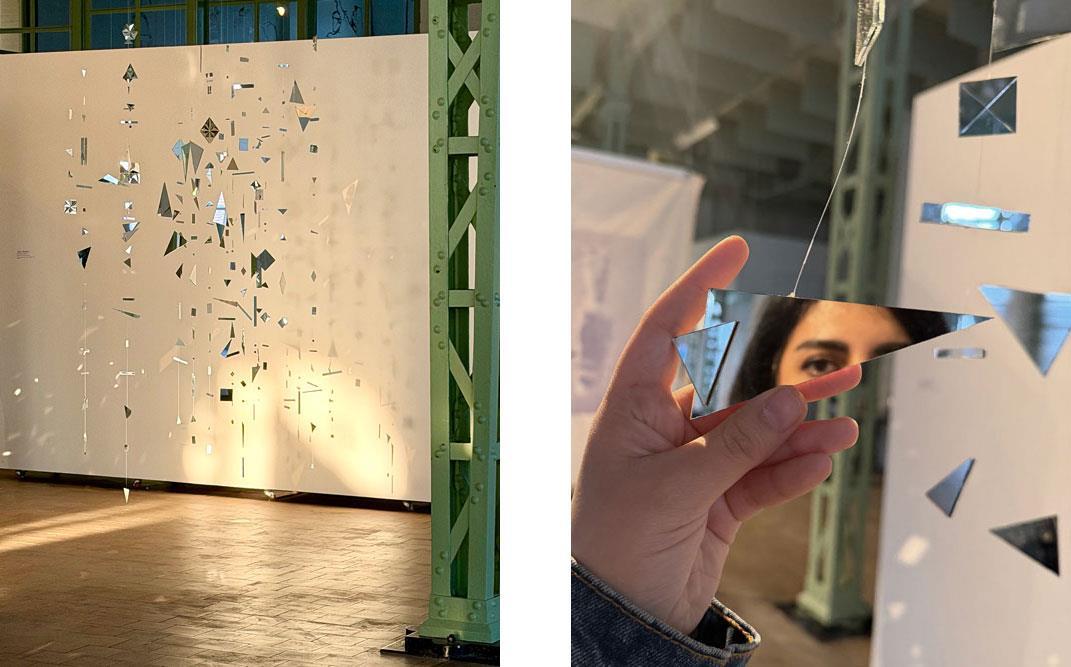
Later7, I developed a suspended mirror installation composed of fragmented mirror pieces. The mirrors were sourced from Iran. This was not incidental. The specific thickness required for mirror work, no more than two millimeters, was impossible to find in the Netherlands. Everyone I asked was surprised that such thin mirrors existed. In Iran, mirror work is an ancient and widely practiced art form, found in architecture, shrines, and domestic interiors. Bringing the material from there introduced a direct connection to the cultural context I was working with, not as decoration, but as evidence. The mirrors were cut into geometric forms, triangles, rectangles, and angular shapes, combined with ornamental patterns inspired by Iranian mirror work. The decision to fragment the mirrors came from two directions at once. The first was cultural: in traditional Iranian mirror work, the body is never reflected whole. Standing inside a mirrored interior, you see yourself in pieces, multiplied and displaced across hundreds of small surfaces. This fragmentation is not experienced as a loss. It is simply how you appear in that space. The second was more personal. When I tried to define myself as a woman within Iranian society, I would pause. Not because I had nothing to say, but because the image was never fully mine. Each fragment had been shaped by something else: by religious expectation, by education, by my father's presence in the room. There were moments, in gatherings or ordinary conversations, when someone would ask me a question, and I would glance toward my father before answering, waiting to see how much space I was allowed to take. Sometimes I would say nothing and let him answer for me. Fragmenting the mirrors was not a gesture of destruction. It was a way of being honest about what was already broken. The mirror does not illustrate the theory. It reproduces the condition.
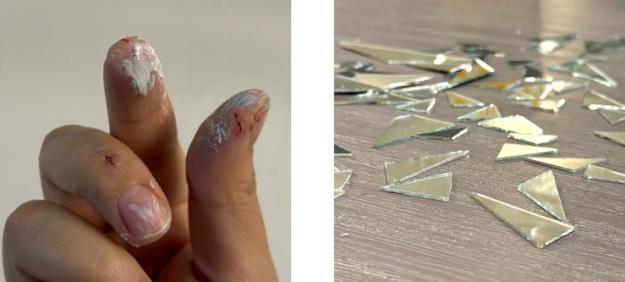
The process required constant attention. The edges were sharp. I cut my hands many times. This became part of the logic of the work itself: to engage with this material was to risk harm. The installation not only represents tension, it also produces it. If you come too close, you get cut. The sharp edge functions like an unspoken rule: approach carefully, adjust yourself, or be punished. The same logic that once operated through social expectation now operates through the object itself.
6 Ayeneh-kari (یراکهنیآ) is a traditional Iranian art form in which finely cut mirror pieces are assembled into geometric, calligraphic, or floral patterns. Historically used in shrines, palaces, and domestic interiors, it carries symbolic associations with light, purity, and truth. The technique requires mirrors no thicker than two millimeters, which are widely available in Iran but largely inaccessible in Western contexts.
7 Indipendent Studio Practice 3 ; called Unknown Object
The mirrors were suspended rather than fixed. This decision came from a specific state I had lived in for a long time: the tension between wanting to resist and not feeling brave enough to do so. Between the desire to refuse and the pull tocomply. Neither fully won. The body stayed suspended between the two, never fully at rest, never fully committed to either direction.
The installation does not offer stable ground. The mirrors move slightly with air, with the presence of a body nearby. They catch light. From a distance, the space appears bright, even beautiful, but as the viewer moves closer, the experience shifts. A complete image of the self is never accessible. The body appears in fragments, partial reflections that change with movement and position. Some reflections come from unexpected directions, including from behind, as if someone is watching without beingseen Thesharpness introduces hesitation. Viewers often sloweddown, became more careful, or adjusted their movement. Some hesitated to enter, others interpreted the reflected light as festive, one viewer described it as resembling a disco. Thisgap between the visual attraction and the underlying tension was not a failure. It mirrored the condition I was investigating: a form of control that is deceptive, a mode of regulation that presents itself as care. Female viewers often engaged differently, recognizing this condition more directly, not only through vision, but through a shared bodily awareness.
Conclusion
Speaking from the In-Between
Ibegan witha bodythathad learned todisappear politely.Notthroughforce, butthroughrepetition, through the quiet accumulation of instructions, gestures, and silences that over time became posture, became instinct, became self. What I set out to investigate was not a distant condition, but one I was still living inside of.
Instead of positioning myself as a victim or producing empathy through exposure, I moved toward something more uncertain: visibility without resolution. The aim was not to argue, but to make perceptible, to construct situations in which what had been internalized might, for a moment, surface. Emotions that had been held in the body without name, shame, hesitation, and also anger, began to take shape. Not resolved. Not released. But recognized.
Internalized control does not translate into practice through explanation. It translates through the act of standing in front of something that reflects you back incompletely and staying there long enough to notice what the body does next. This is how I began to answer the question I had set out with: how can internalized cultural control andself-censorship withinthe female body be translated into artistic practice? Not through theory, but through the body itself.
I liveina context where meaningsare notfixed, but shiftdepending ontime, position,and distance. What was once felt as protection, or even as the natural shape of things, can from another position be recognized as a form of control. This shift does not erase the past. It allows it to be seen differently. And that seeing is not only conceptual, it is lived through the body. At first, I wanted others to say: Yes, I recognize this too, but that impulse shifted. These sensations belong to this body, shaped by a specific place and time. The work does not ask to be universally understood. It asks to exist.
What continues is the practice itself. This morning, before leaving, I stood in front of the mirror by the door. I found myself wondering where my father is right now. Whether he is well. I have not spoken to him since the internet in Iran was cut. I miss him. But I paused on that; what exactly do I miss? The look he would give me, searching for something to correct? Or the version of him that might simply say: I am proud of you. But I noticed that my body was waiting. The way it used to wait to be told how much space it was allowed to take.
This time, everything was quiet. Just me and my own reflection. And somewhere behind that looking, something that was once shame is slowly, cautiously, stepping into the open. I don't know yet what it will become.
Bibliography
Homer. Iliad. Translated byAlexander Pope, 1715. Book IX, lines 63–64.
Ahmed, S. (2004). The Cultural Politics of Emotion. Edinburgh University Press.
Berger, J. (2008). Ways of Seeing. Penguin Books.
Butler, J. (1990). Gender Trouble: Feminism and the Subversion of Identity. Routledge.
Foucault, M. (1977). Discipline and Punish: The Birth of the Prison. Pantheon Books.
Bordo, S. (1993). Unbearable Weight: Feminism, Western Culture, and the Body. University of California Press.
Irigaray, L. (1985). This Sex Which Is Not One. Cornell University Press. https://www.iranicaonline.org/articles/aina-kari-mosaic-of-mirror-glass/ https://www.monirff.com/about smarthistory.org/shirin-neshat-rebellious-silence-women-of-allah-series/