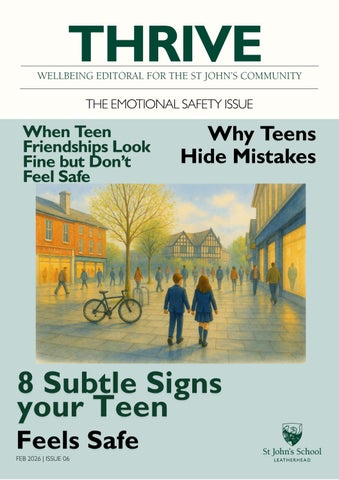
Thrive - February 2026

Page 1


THRIVE

WELLBEING EDITORAL FOR THE ST JOHN’S COMMUNITY

When Teen

THE EMOTIONAL SAFETY ISSUE Why Teens

Friendships Look

Fine but Don’t

Feel Safe

8 Subtle Signs your Teen Feels Safe

WHY THIS ISSUE MATTERS

Welcome to the February issue of Thrive! This month, we ’ re spotlighting psychological safety, an often-overlooked key to happiness, connection, and genuine growth. Whether you ’ re a parent, teacher, or friend, understanding psychological safety can transform the way you relate to others and yourself

So, what is psychological safety? It’s the confidence to speak up, share ideas, ask questions, and even challenge others—without fear of embarrassment or punishment Imagine a classroom where every hand goes up, a family dinner where all voices are welcome, or a workplace where mistakes lead to creativity Psychological safety is the soil where trust grows and people thrive.

Within families, psychological safety is transformative. When children know they can make mistakes, voice worries, and share dreams without harsh judgment, they build lifelong confidence and resilience. This sense of acceptance deepens trust, strengthens family bonds, and helps everyone grow and adapt together.

Of course, it’s not always easy, especially with teens who naturally test boundaries. How do you keep communication open while maintaining expectations and accountability? This issue shares practical strategies for building and sustaining psychological safety with teenagers, and finding the right balance between empathy and structure. Don’t miss this month’s Thrive podcast with Associate Professor Hannah Sherbersky from the University of Exeter She offers practical insights on what psychological safety looks like in real life and how you can start building it today Listen here!

VanessaSokal

ON OUR RADAR

Children’s Mental Health Week runs from February 9–15, with the theme “This is My Place.” The focus is on creating environments and support systems that help children feel connected and valued. A sense of belonging is vital for positive mental health.

THRIVE PODCAST

This month, we ’ re focusing on energy and motivation, especially how to help your young people feel more energised and engaged. Join me as I share 7 practical strategies to boost energy and motivation in young people! Listen Here!

February is a peak month for self-monitoring. Research indicates that when children’s internal resources are depleted, they must work even harder to manage social impressions, leading to increased cognitive strain

Valentine’s Day can spike social comparison among young people, heightening awareness of inclusion, visibility, and social status, not just romantic pressures

BOOK OF THE MONTH

The Power of Showing Up

This isn’t a “how to parent better” book it offers a relational lens on building emotional security Siegel and Payne Bryson show children don’t need perfect responses, deep talks, or constant attunement. What matters most is that adults are predictable, emotionally available, and repair when things go wrong

During low-energy months, children instinctively gravitate toward sameness and routine,such as repeating meals, maintaining consistent afterschool activities, and following familiar social patterns. This behaviour is a powerful form of self-regulation, not a sign of stagnation.

WHEN TEEN FRIENDSHIPS LOOK FINE BUT DON’T FEEL SAFE

As a parent, you probably know that popularity isn’t the same as happiness. But when it comes to your teenager, the question of belonging is incredibly complicated and often invisible. Even if your teen isn’t being left out, they might be included in ways that feel conditional or uncertain:

They sit with the group. They’re on the group chat They’re invited.

They laugh at the right moments

From your perspective, your teen may seem happy and part of the group. But inside, they might be constantly second-guessing themselves or feeling anxious.

Understanding the Teenage Social Reality

Adolescence is a period of intense social learning

Teenagers are figuring out:

Who they’re allowed to be

What gets approval

What risks exclusion

How quickly things can change

Peer culture at this age often rewards blending in and adhering to the non-verbal rules of: don’t be too much, don’t stand out the wrong way, and don’t be honest about how you feel What’s really interesting is that this isn't necessarily related to confidence Instead, it’s more closely tied to a sense of emotional safety Teenagers quickly learn how to be likable, but that doesn’t always mean they feel they truly belong

Why being liked can still feel unsafe

Feeling emotionally safe within a relationship requires a sense that you can: hesitate midsentence, change your mind, have a low day, and disagree without social consequences The difficulty is that many teenage friendships don’t offer this kind of containing safety Not because anyone is unkind, but because the group itself can feel fragile Approval becomes conditional: “I’m okay here as long as I stay within the lines.”

For some teenagers, especially those who are thoughtful or deeply aware of others, this can create a quiet pressure to constantly self-edit. You might sense this uneasiness in your own child, even if you can’t quite name it Some thoughts parents often have include:

"They have friends, but they never really seem settled "

"They seem worn out after hanging out with friends "

"They rarely talk about how they really feel with their friends "

Belonging shows up in ordinary moments

Real belonging in adolescence rarely looks obvious, like buying friendship lockets or bracelets. The presence of friendship belonging often looks quite boring:

being quiet without being questioned saying something awkward and not being teased setting a boundary and staying included having a wobble and not being sidelined

If your teenager feels socially safe, they may not look happier, but you might notice they seem less tense and less guarded around you

The Parenting Tightrope: Watching and Supporting Your Teen

This is where parenting gets tricky. You may find yourself watching from the outside, trying not to overreact or interfere, while still worrying about whether your child is truly thriving or just coping well enough to get by Instead of scrutinising every friendship, try to notice how your teenager recovers after social interactions. Ask yourself:

Do they come home more themselves, or less? Do friendships leave them neutral or on edge? Are they allowed to have off-days without social fallout?

By asking these questions, you respect your teen’s independence while still keeping an eye on their emotional safety

If You’re Concerned: What to Do Next

If you notice your teenager seems more on edge after spending time with friends, the most helpful response is rarely to analyse the friendship itself Most teens don’t want their relationships dissected they’ll likely shut down if you try Instead, focus on naming the experience rather than the people: try saying, “You seem tired how was the get-together?” or “Some friendships just take more energy than others ” These statements offer clarity and help your teen process their feelings, without making them feel like their friends are being judged Support your teen in setting boundaries by reminding them it’s perfectly okay to step back or take space without feeling like they’ve failed socially Focus on the bigger picture, not just moments of crisis: one demanding friendship doesn’t always mean something is wrong, but patterns over time do matter Try to keep perspective on the overall direction of their friendships: Are they gradually expanding their social connections? Is there at least one or two relationships where they can truly be themselves? Are they recovering more easily after social events as time goes on?

If you notice ongoing social tension especially if it’s getting worse or accompanied by withdrawal, anxiety, or low mood it’s time to seek extra support.

8 SUBTLE SIGNS YOUR TEEN FEELS SAFE

THEY DISAGREE WITHOUT ESCALATING

Sturdy relationships allow teens to calmly disagree and tolerate differences while maintaining their connection

THEY CHANGE THEIR MIND OUT LOUD

Revising a thought process suggests low fear of being judged or corrected

THEY DON’T RUSH TO EXPLAIN THEMSELVES

Pausing and leaving things unsaid can signal trust that they won’t be misunderstood

THEY SHOW INCONSISTENCY

Safe children can be confident one day and unsure the next without feeling exposed.

THEY ASK “OBVIOUS” QUESTIONS

Asking what they could have worked out alone, shows comfort with not performing competence

THEY RECOVER QUICKLY AFTER SMALL WOBBLES

A brief wobble followed by repair is often a sign of relational safety

THEY SET SMALL BOUNDARIES WITHOUT DRAMA

Saying “ no ” , or opting out, or asking for space relfects confidence that connection will still be there afterwards

THEY BRINGS THINGS UP LATE, OR INDIRECTLY

Sharing at unexpected times often means they trust the response

WHY TEENS HIDE MISTAKES

Plus, what helps them grow & learn

Most parents hope young people see mistakes as chances to grow But whether they learn from mistakes depends less on what we say and more on how safe they feel When young people feel secure, mistakes become information to explore, not fear. Without that safety, even small errors can feel overwhelming.

Why do mistakes feel risky for some teens?

Studies show young people hide mistakes when they worry it will change how others see them. If being “smart” is praised, mistakes start to feel personal

Some teens: avoid attempting difficult work ask fewer questions copy or mask uncertainty become distressed over small errors

It’s not a lack of resilience; being wrong just feels costly, especially if your teen worries it might change your view of them That fear is human, but we can help them move past it

Psychological safety changes what a mistake means Psychological safety isn’t about lowering expectations It means showing young people that mistakes don’t define them When they trust mistakes won’t change how we see them, they’re more willing to try again Teens are sensitive to our reactions. When your young person makes a mistake, ask yourself: Is your curiosity stronger or is your correction? Is the focus on process rather than performance? Does the relationship remain stable?

Why reassurance alone doesn’t work

When your teen makes a mistake, it’s natural to offer comfort "It’s okay " But research shows young people need to know your support is steady, even when things go wrong Teens notice less what we say, and more that you ’ re still there

What helps in real life

You don’t need to micromanage to help your teen feel safe with mistakes. Small changes in how you respond make a difference:

Narrate thinking, not outcomes

“Let’s look at what this tells us ” rather than “What went wrong?”

Delay evaluation

Jumping quickly to fixing can signal urgency rather than safety

Normalise uncertainty before difficulty

“This is the kind of thing people usually get stuck on. ”

Stay stable

A calm response after a mistake often helps more than praise Patience turns setbacks into growth.

Psychological safety makes mistakes temporary and helpful, not a threat to who they are When young people trust that being wrong won’t cost them, learning becomes something they can step into, not something to avoid.

COMFORTING & SATISFYING

Butternut Squash Mac and Cheese

SERVES 9

Ingredients

560g peeled and cubed butternut squash

300ml vegetable broth or chicken broth

300ml milk

3 cloves garlic, minced

454g uncooked pasta

70–140g roughly chopped kale, stems discarded (optional)

80g plain Greek yogurt

1 teaspoon salt

1/2 teaspoon ground black pepper

small pinch ground nutmeg

225g shredded cheese (I like Gruyère)

optional topping: 30g breadcrumbs

optional topping: fresh thyme

leaves and/or extra freshly ground

black pepper

COOK & PREP TIME: 1 HOUR & 10 MINUTES

Method

Combine squash, broth, milk, and garlic in a saucepan. Bring to a boil, then simmer for 20 minutes until squash is very tender. Set aside.

Preheat oven to 375°F (191°C).

Cook pasta in boiling water until al dente Add kale (if using) for the last 1-2 minutes. Drain and set aside.

Blend the squash mixture with yogurt, salt, pepper, and nutmeg until smooth Stir in cheese Adjust seasoning to taste.

Combine pasta and kale with sauce Pour into a baking dish

Top with breadcrumbs and extra cheese if desired.

Cover with foil and bake 20 minutes Uncover and bake 5 more minutes until bubbly

Serve with extra cheese, thyme, or black pepper. Store leftovers in the fridge for up to 5 days

GETTING PSYCHOLOGICAL SAFETY RIGHT WITH TEENS

This month on the Thrive podcast, University of Exeter, Associate Professor Hannah Sherbersky joins us to explore psychological safety; what it means for teens, why it’s challenging for parents, and how small shifts at home can make a real difference. Hannah shares practical ways to help teens feel calm, open, and comfortable being themselves.

Check

GROWING TOGETHER

YOUR MONTHLY PARENT/TEEN ACTIVITY

Short prompts to help your family enter the year ahead with clarity and calm.

I FEEL MOST LIKE MYSELF WHEN...

THINGS THAT HELP ME SPEAK HONESTLY...

TICK ALL THAT APPLY

Not being interrupted

Knowing I won’t be in trouble

Being able to change my mind

Someone staying calm

Not having to explain everything

Time to think before answering.

WHEN SOMETHING FEELS HARD, IT HELPS IF ADULTS...

CIRCLE YOUR TOP TWO

Listen without fixing

Don’t rush me

Don’t ask too many questions

Trust me to handle things

Give me advice

Reassure and comfort me.

Ask me directly what I need or what would help

IT'S HARD FOR ME TO TALK ABOUT...

THIS HELPS ME FEEL BETTER AFTER A TOUGH DAY

FIND ALL THE WORKS CITED IN THIS ISSUE BELOW

Some content was developed in collaboration with AI tools, reviewed by the author

Turn static files into dynamic content formats.

Create a flipbook