
At St James, our Stepping into Adulthood GCSE options programme has been carefully developed over several years to provide a curriculum and co-curricular experience that reflects the diverse interests of our pupils.
By starting the GCSE programme in Year 9, students gain the advantage of exploring each subject in greater depth. This not only strengthens academic performance but also fosters a genuine curiosity for learning. We guide your son in recognising his full potential, encouraging him to build on his strengths and develop a passion for his chosen subjects. Furthermore, extensive consultation with university admissions tutors have reinforced that the quality of GCSEs achieved and the results obtained are far more significant than the number of subjects taken.
Beyond academics, our three-year programme plays a vital role in supporting students on an emotional, spiritual and physical level. These formative years are essential in preparing them for life beyond school, whether in higher education or the working world. Our programme is designed to help students identify opportunities, make the most of them, and build lasting friendships. Above all, we instil in them a deep understanding of our shared responsibility to support and care for one another - an invaluable mindset in today’s challenging world.
To ensure a well-rounded education, our Guided GCSE Options Programme allows most students to take nine GCSE subjects while continuing with philosophical education, singing, drama and participation in Cadets or the Duke of Edinburgh Award. This balanced approach is not only beneficial for your son’s personal development but is also highly regarded by universities, art colleges, drama schools and future employers.
Madame Virginie Quartier Deputy Head
Choosing the right subjects for GCSE is an important and exciting step in your academic journey. It’s a decision that should be made thoughtfully, balancing your interests and strengths with a well-rounded selection of disciplines. As you explore your options, it’s helpful to consider not only which subjects you enjoy and excel in but also how they will support your future ambitions.
At St James, we believe that a strong academic foundation is built on developing reasoning skills across a variety of subjects. Each discipline provides a distinct way of thinking and problem-solving:
• Mathematics and Sciences teach you to approach problems from different angles, apply logical thinking and understand real-world applications.
• History helps you analyse the past, evaluate sources and form well-reasoned arguments.
• Classical Languages strengthens your understanding of language structure, communication and abstract thinking.
• Modern Languages build communication skills and broaden your cultural awareness.
• Creative subjects such as Art, Photography, Drama, and 3D Design encourage self-expression, innovation, and problem-solving in different ways.
The right combination of subjects should challenge and inspire you while playing to your strengths. Striking a balance between these disciplines will help you develop a versatile skill set, preparing you for future academic and career opportunities.
All students will study Mathematics, English Language and English Literature as part of their GCSE programme. We also recommend that they study:
• Two Sciences
• One Language
• One Humanity
• A creative subject
To support you in making informed decisions, discussions take place between the Deputy Head Academic, subject teachers, and Form Tutors to help identify your strengths and potential pathways. We encourage you and your child to reflect on the guidance provided and to consider which subjects resonate most with them. While we offer recommendations, the final choice is yours - this is a chance to take ownership of your learning and shape your future.
Students begin their decision-making process with a series of assemblies, where they learn about each GCSE syllabus and how different subjects align with future career opportunities.
During this week, students sit formal assessments in most academic subjects during their regular timetabled lessons. These exams help teachers evaluate each student’s suitability for GCSE subjects. To support their preparation, students attend ‘Revision Guidance’ assemblies and receive ongoing assistance throughout the year.
As part of our Stepping into Adulthood programme, Madame Quartier will lead a session outlining the GCSE options process. This event provides an opportunity for parents to engage with teachers and students to gain deeper insights into each subject.
2.MAY
Once students and parents have gathered all necessary information, GCSE choices must be finalised.
Each student will have an individual meeting with a senior member of staff to discuss their subject choices and receive personalised advice, ensuring they make confident and informed decisions.
This carefully structured process ensures that every student is well-supported in choosing the subjects that best align with their strengths, interests, and aspirations.
SUBJECT OVERVIEW
The GCSE 3D Design course covers a wide range of areas within design, from Architecture through to Product Design. The subject offers complete flexibility, allowing students to pursue individual design interests and focus on different areas of 3D design.
This subject is perfect for students who have a passion for creativity and want the opportunity to express themselves through various 3D forms. If you are thinking about a creative career that requires individual, creative, and flexible thinking, this course will be an excellent start. Throughout the course, students will not only develop technical skills but also cultivate personal attributes such as self-confidence, resilience, perseverance, discipline, and commitment. These qualities are essential for success in any creative or professional field.
Particular careers could include:
• Professional Designer
• Jewellery and Fashion Designer
• Interior Designer
• Architect
• Product Designer
• Furniture Designer
• Prop Maker
• Film Director
• Sculptor or Ceramic Artist
• Set, Exhibition, or Theatre Designer
• Model Maker
• Designer for Film and Television
Students will develop a large portfolio of work linked to the themes set in the course. Additionally, they will create sketchbooks to document their ideas, track the evolution of their work, experiment with different materials, and make connections to the work of other designers.
Throughout the course, students will develop their skills and experiment with various media, including:
• Drawing
• Model Making
• Sculpture/3D Materials
• Ceramics
• Photography
• Constructing
• Surface Treatment
• Assembling
• Wood
• Metal
• Plastic
• Modelling/Carving
• Design Historical Writing
Unit 1: Personal Portfolio in 3D Design
• 60% of the marks including a controlled assessment (45 hours).
Unit 2: Externally Set Assignment in 3D Design
• 40% of the marks 20 hours of preparation time culminating in a 10 hour (controlled conditions) sustained focus. It consists of one broad-based thematic starting point. There is no written examination.

SUBJECT OVERVIEW
Our Art & Design course offers students the creative freedom to express their opinions, thoughts, and feelings through the physical process of making art. By visiting exciting art galleries and exhibitions, students gain first-hand inspiration and insights into the work of other artists.
The course encourages experimentation with a wide range of 2D and digital 3D media, while fostering critical analysis of art to understand how the work of others relates to students’ own creations. The skills developed throughout the course provide a strong foundation for creative expression, problem-solving, and artistic development.
This subject is perfect for students who have a passion for creativity and want the opportunity to express themselves through various art forms.
If you are thinking about an artistic career that requires individual, creative, and flexible thinking, this course will be an excellent start. Throughout the course, students will not only develop technical skills but also cultivate personal attributes such as self-confidence, resilience, perseverance, discipline, and commitment. These qualities are essential for success in any creative or professional field.
What future opportunities will I have?
Particular careers could include:
• Professional Artist
• Games Designer
• Graphics Designer
• Jewellery and Fashion Designer
• Interior Designer
• Architect
• Art Dealer
• Product Designer
• Animator
• Web Designer
• Creative Director
Throughout the course, students will experiment with various art forms and media, including:
• Drawing
• Painting
• Printmaking
• Sculpture/3D
• Ceramics
• Lens-based media, including Photography/ Filmmaking
• Typography
• Modelling/Carving
• Illustrations
• Text-based Art and Art historical writing
Unit 1: Personal Portfolio in Art and Design
• 60% of the marks including a controlled assessment (45 hours).
Unit 2: Externally Set Assignment in Art and Design
• 40% of the marks 20 hours of preparation time culminating in a 10 hour (controlled conditions) sustained focus. It consists of one broad-based thematic starting point.
SUBJECT OVERVIEW
Students will study the structure and function of cells, organ systems in animals and plants, inheritance patterns, and how organisms interact with their environments. The course also emphasizes practical skills and investigations, allowing students to apply theory to observable phenomena.
Biology GCSE suits curious, analytical students who enjoy exploring how living organisms work and who are interested in health and the natural world. Students develop scientific and critical thinking, practical laboratory skills, data analysis and problem-solving abilities. The course builds confidence in handling scientific information and applying knowledge logically, supporting progression into a wide range of career paths.
SUBJECT INFORMATION
Content
1 Cell Biology
2 Organization
3 Infection and Response
4 Bioenergetics
5 Homeostasis and Response
6 Inheritance, Variation and Evolution
7 Ecology
Practical work is essential in Biology and central to the GCSE syllabus. There are three main reasons for its inclusion:
• To reinforce scientific concepts by applying and deepening understanding of abstract ideas and models.
What future opportunities will I have?
GCSE Biology opens the door to a wide range of careers in fields such as healthcare, research, and the environment. With a strong understanding of living organisms, it leads to opportunities as a doctor, nurse, veterinarian, researcher, environmental scientist, or laboratory technician.
It’s also valuable for careers in biotechnology, nutrition, sport science, forensics, agriculture, and conservation.
• To develop investigative skills, including formulating testable questions, controlling variables, and analysing results.
• To build practical skills in using equipment, taking measurements, and handling risks safely.
This GCSE is linear with two papers at the end of the course:
Paper 1: Topics 1-4 (100 marks)
Paper 2: Topic 5-7 (100 marks)
SUBJECT OVERVIEW
A GCSE in Business offers the opportunity to explore businesses and how they work. It is an introduction to business terminology and concepts, including a consideration of their practical application in the real world.
Why Choose Business Studies?
It will be of interest to those who have an entrepreneurial flair as it will help with the basic principles that are necessary for bringing a business idea to fruition.
What future opportunities will I have?
Business Studies can provide direct access to an A-level or a degree in Business, Marketing, Management, or Finance. It also gives practical knowledge useful for running a business or managing personal finances.
SUBJECT INFORMATION
Content
The modules include:
• Business in the Real World
• Influences on Business
• Business Operations
• Human Resources
• Marketing
• Finance
Two 1 hour 45 minute exams: 22% multiple choice/short answers and 88% case study/data response. Basic maths (addition, subtraction, multiplication, division) is needed. Calculators are allowed and recommended.
SUBJECT OVERVIEW
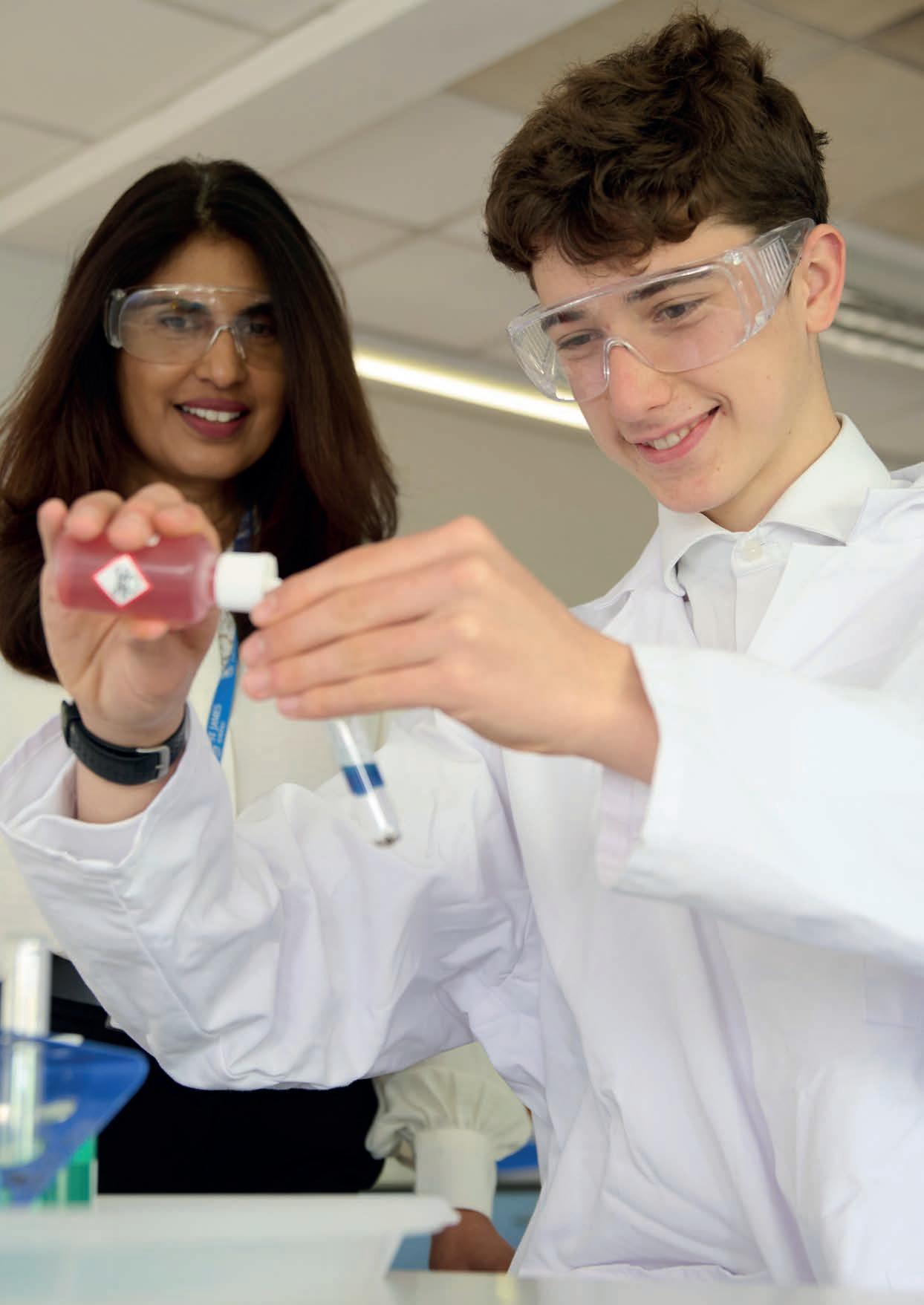
Students will explore the chemical principles that govern both the visible and invisible worlds, investigating the molecular forces behind real-world phenomena. This helps them understand how chemical reactions impact the environment and influence biological processes in humans.
What future opportunities will I have?
Students will gain a solid foundation for future studies in fields like medicine, veterinary science, dentistry, engineering, education, and environmental science. It also develops valuable skills relevant to many careers. Chemists are addressing global challenges such as climate change, health, resources, and sustainable energy which are issues that affect everyone.
SUBJECT INFORMATION
Content
1 Atomic Structure and the Periodic Table
2 Bonding, Structure, and the Properties of Matter
3 Quantitative Chemistry
4 Chemical Changes
5 Energy Changes
6 The Rate and Extent of Chemical Change
7 Organic Chemistry
8 Chemical Analysis
9 Chemistry of the Atmosphere
10 Using Resources
Assessments
The GCSE is linear, with two 1 hour and 45 minute written exam papers at the end of the course:
Paper 1: Topics 1-5 (50%)
Paper 2: Topics 6-10 (50%)
Each exam is 1 hour and 45 minutes.
SUBJECT OVERVIEW
Computing focuses on the design, development and analysis of software and hardware used to solve problems across business, scientific and social contexts. As technology is designed to serve people, the subject also explores the human aspects of computer science, emphasising problem-solving, innovation and real-world applications.
Why Choose Computing?
Computer Science is a modern, fascinating subject. The world depends on computers. In this GCSE you will learn about how computers work, the networks they use and how programming can create solutions to everyday problems and future challenges. There’s a career for everyone; Create your own future and ideas; Create a future for other people; Give yourself great problem-solving skills; Give yourself a brilliant career; Challenge yourself to be the best; Challenge yourself to change the world.
What future opportunities will I have?
By developing strong problem-solving skills, learning through exploration, tackling real-world challenges, you will open the door to a wide range of future career opportunities:
• Software Engineer
• Data Engineer
• Computer Vision Engineer
• Python Engineer
• Data Scientist
• IT Director
• Analytics Manager
• Business Intelligence Developer
• Computer and Information Systems Scientist
• Information Systems Developer
• Database Administrator
• DevOps Engineer
• Systems Analyst
• Games Programmer
• Cloud Consultant
• Data Warehouse Architect
• Technology Officer
• IT Project Manager
SUBJECT INFORMATION
Topics covered include problem solving, data, communication, programming, computers and the Internet and the bigger picture. Around 40% of the entire course is spent learning and developing coding skills using the high-level language Python that gives students good preparation for the second paper and also, an excellent foundation for the next steps towards a career in one of the many IT and computing related areas of work.
There is a minimum requirement of 20 hours of coding practice, equivalent to roughly half of the time spent in Years 9 and 10. This directly supports Paper 2 questions and prepares students for A level standard.
Paper 1: Computer Systems (50%)
• 1.5 hour exam – Theory Paper
Paper 2: Computational Thinking, Algorithms & Programming (50%)
• 1.5 hour exam
SUBJECT OVERVIEW
GCSE Drama explores how theatre is created and performed.
Why Choose Drama?
Studying Drama will help students develop skills in creative thinking, collaboration, organisation, presentation, performance, evaluation and many more.
What future opportunities will I have?
Studying Drama can lead to a wide range of careers including acting, directing, producing, choreography and special effects. It can also open pathways into teaching, arts, community arts and media research.

SUBJECT INFORMATION
Our GCSE course offers opportunities to study many different elements of Theatre, including:
• Devised thematic work
• Improvisation
• Physical theatre
• Set design
• Costume design
• Make-up and masks
• Puppetry
• Lighting and sound
• Stage management
Component 1: Understanding Drama (40%) 1 hour 45 minute written, open book exam.
• Knowledge & understanding of drama and theatre.
• Study of one set play from a choice of six.
• Analysis & evaluation of the work of live theatre makers.
Component 2: Devising Drama (40%)
Practical assessment: Devising log and devised performance.
• Process of creating devised drama.
• Performance of devised drama (students may contribute as performer or designer).
• Analysis & evaluation of own work.
Component 3: Tests in Practice (20%)
Practical performance of two extracts.
• Performance of two extracts from one play (students may contribute as performer or designer). Free choice of play but it must contrast with the set play chosen for Component 1.
SUBJECT OVERVIEW
English Language & English Literature are both compulsory at GCSE and students will leave with two separate qualifications. GCSE English Language develops essential communication skills. Students will respond to a range of fiction and non-fiction texts and will write for different purposes and audiences. They will develop their use of vocabulary, punctuation, and grammar to express themselves clearly and fluently. They will also complete a spoken language component. GCSE English Literature gives students the opportunity to study a range of texts from across the literary canon. The study of English Literature develops critical thinking and analytical skills, as well as fostering empathy. Students will gain insight into the past and inspiration for the future.
What future opportunities will I have?
A GCSE English Language pass is essential for accessing future education and employment. GCSE English Language & English Literature support the study of both subjects at A Level. They also complement the study of Law, Media Studies, History, Drama, and Psychology.
English is an important stepping stone into a range of careers, including Advertising, Media, Journalism, Teaching, Content Creation, Marketing, Public Relations, and many more!
SUBJECT INFORMATION
Content
GCSE English Language
Paper 1: Explorations in Creative Reading and Writing
• Written exam: 1 hour 45 minutes
Paper 2: Writers’ Viewpoints and Perspectives
• Written exam: 1 hour 45 minutes
GCSE English Literature
Paper 1: Shakespeare and the 19th-century novel
• Written exam: 1 hour 45 minutes
Paper 2: Modern texts and poetry
• Written exam: 2 hours 15 minutes
Students study both English Literature and English Language from Year 9, each leading to a separate GCSE. Both subjects are assessed through final exams at the end of Year 11, with no coursework. Students will be given formative and summative assessments by their class teacher as the course progresses.
English Language
• Two exams: Paper 1 (Fiction) & Paper 2 (Non-Fiction)
Speaking and listening component (not contributing to the final grade)
English Literature
• Two exams: Paper 1 (Shakespeare & the 19th Century Novel) & Paper 2 (Modern Texts & Poetry)
These exams are designed to develop analytical thinking, critical reading, and written communication skills essential for academic and professional success.

SUBJECT OVERVIEW
Geography is a dynamic and relevant subject that connects us with the world we live in and to our future. It encourages discussion on current affairs, with a particular focus on environmental issues. This course combines practical fieldwork with investigative learning, providing a comprehensive understanding of how people interact with different environments.
Why Choose Geography?
“Geography illuminates the past, explains the present and prepares us for the future. What could be more important than that?”
SIR MICHAEL PALIN Past President RGS
SUBJECT INFORMATION
Content
Living with the Physical Environment: Focuses on natural processes (tectonic, geomorphological, biological and weather systems) and how humans interact with them. Students learn how these processes shape different environments and why sustainable management is needed to reduce human impact on the Earth and atmosphere.
Challenges in the Human Environment: Focuses on human processes and how places change over time and across different levels of development. Students explore why human environments vary, the need for sustainable management and the challenges and opportunities they face now and in the future.
What future opportunities will I have?
Achieving a good grade at GCSE opens doors to A level or vocational courses, with subjects like Biology, Geology, Environmental Science, Government and Politics, Economics, and Travel and Tourism having close links to the material studied in Geography. Geographical skills are highly valued in various employment sectors, including journalism and media, law, engineering, accountancy, finance, business management, ICT, planning, teaching, marketing, and leisure and tourism.
Assessments
Three exams:
Paper 1: Living with the Physical Environment (35%)
• 1 hour 30 minute exam focusing on physical geography.
Paper 2: Challenges in the Human Environment (35%)
• 1 hour 30 minute exam focusing on human geography.
Paper 3: Geographical Applications (30%)
• 1 hour 30 minute exam testing issue evaluation and geography fieldwork.
SUBJECT OVERVIEW
Our history curriculum provides a comprehensive exploration of significant events, stories, and individuals from both British and world history. It fosters a deep and nuanced understanding of the past and its ongoing impact on the present.
Studying History enhances critical thinking, analysis, and literacy skills, as well as the ability to evaluate sources and construct well-supported arguments. Intellectual curiosity is central to the subject, with pupils encouraged to question, debate, and examine the complexities of historical developments. The aim is to cultivate knowledgeable, articulate, and thoughtful individuals who can interpret the world and its history with clarity and insight.
History teaches valuable skills such as:
• Critical reasoning and analytical thinking
• Constructing arguments by selecting and deploying relevant evidence
• Communicating in a clear, structured, and persuasive manner
• Thinking objectively
SUBJECT INFORMATION
In Year 9, students follow a preparatory syllabus before beginning the GCSE course in the summer. This course covers a broad range of 20th-century world history, providing students with a rich and varied understanding of global events and their lasting impact. Key areas of study include:
• The outbreak of World War I
• The Russian Revolution
• The rise of Nazism and the Holocaust
• The war in Asia and the use of atomic weapons
• British decolonisation in India, Africa, and Northern Ireland
• The Vietnam War
• The Civil Rights Movement in the United States
What future opportunities will I have?
History students often progress to careers or further study in Law, Business, Finance, Marketing and Media as it is a subject that teaches a wide range of analytical and communication skills.
Paper 1: 1 hour 20 minute exam (30%)
• Migrants in Britain c.800-present (20%)
• Historic Environment, London and the Notting Hill 1948-70 (10%)
Paper 2: 1 hour 50 minute exam (40%)
• British Depth Study, Anglo-Saxon and Norman England 1060-88 (20%)
• Period Study, Superpower relations and the Cold War, 1941-91 (20%)
Paper 3: 1 hour 20 minute exam (30%)
• Modern Depth Study, Weimar and Nazi Germany 1918-1939
SUBJECT OVERVIEW
Latin provides an opportunity to study the language, literature, and culture of the Roman world. Through this, students not only enhance their writing and speaking abilities but also deepen their understanding of English and other Romance languages. This subject offers a rich exploration of the classical world while developing essential skills in communication and language comprehension. You will need to have a passion for learning languages and an interest in Roman history!
Latin is a fascinating subject that challenges your mind and strengthens your analytical and problem-solving skills. Studying Latin provides valuable insight into language structures and improves both English proficiency and the learning of modern languages. Universities highly regard a strong background in Latin, particularly for careers in law, medicine, science, archaeology, and academia. Latin is also an asset for professions that demand analytical or detailoriented thinking.
SUBJECT INFORMATION
Content
Year 9: Begin the language component of the course with John Taylor Book 1.
Year 10: Continue developing language skills using John Taylor Book 2 and study the prose set text.
Year 11: Focus on the verse set text and exam revision.
What future opportunities will I have?
Studying Latin can lead to careers in:
• Law
• Medicine
• Civil Service
• Journalism and Politics
• Government and Diplomacy
Language (50%)
• 449-word defined vocabulary list
• Passages based on Roman history and mythology
• Unseen translation, comprehension, and grammar questions
Literature (50%)
• 25% Prose set text (approx. 110 lines)
• 25% Verse set text (approx. 110 lines)
• Authors typically studied include Virgil, Julius Caesar, Ovid, Catullus and Tacitus
GCSE Mathematics fosters strong knowledge, skills, and understanding of key mathematical concepts. It teaches pupils to apply techniques to solve problems, think logically, and draw conclusions. Pupils will also learn to interpret and communicate mathematical information effectively in different contexts.
A GCSE Mathematics pass is essential for various aspects of life, from managing finances to solving spatial problems. High achievers can pursue Mathematics at A-level, leading to university courses and careers in fields like Engineering, Medicine, Science, Finance, Accounting, Business, Economics, and more. Even subjects such as Psychology and Geography benefit from a solid mathematical foundation.
Pupils are grouped into three ability sets, with most taking the higher tier exam in Year 11 and covering the full higher-level syllabus.
Key areas of study include:
• Number
• Algebra
• Ratio, Proportion & Rates of Change
• Geometry & Measures
• Probability
• Statistics
Set 1 students explore Level 2 Further Mathematics (AQA) in Years 10 and 11, gaining exposure to advanced topics.
Students also take part in the UKMT Intermediate Mathematical Challenge, where many qualify for higher rounds.
The GCSE Mathematics course offers two tiers, Foundation and Higher, each with specific content, and pupils can choose to take assessments in either tier. The qualification includes three equally weighted written exams, all taken at the same tier and within the same assessment series. Each paper lasts 1 hour and 30 minutes and is worth 80 marks.
• Paper 1: Non-calculator assessment
• Paper 2 & Paper 3: Calculator allowed
The content for each tier is assessed across all three papers.
Proportion & Rates of change
& Probability 12-18% 12-18%
SUBJECT OVERVIEW
Learning a second language is priceless. Impressing future employers, creating richer travel experiences and developing your mind in a way no other subject can are only some of the ways in which continuing with modern foreign language is the right choice. With the world becoming ever more international, those who can speak more than one language have an enormous advantage in business. Not only that, knowing a second language helps you understand your own language better and better develops your communication skills.
• Builds relationships: Speaking to anyone in their own language breaks down barriers and allows them to feel more comfortable and confident.
• Valued skill: Being fluent in two or more languages gives you an edge over monolingual candidates in job interviews. Being able to speak a foreign language allows you to go abroad to do business; you can use the language of the country you are heading to without having to rely on a translator.
• Higher salaries: Employees who learn a foreign language command a higher salary. A recruitment agency recently stated that knowing a foreign language can add between 10-15% to your salary.
• Wide range of carer opportunities: Language skills can be used in almost any career and particularly in businesses that trade internationally.
What future opportunities will I have?
Languages don’t just help you pass exams – they open doors across the world. Did you know that employers consistently value language skills because they show communication, confidence and cultural understanding? With a language qualification, you could work in:
• Diplomacy and international relations
• Intelligence and investigative services
• Global media and journalism
• International business and marketing
• Travel, tourism and aviation
• Teaching and academic research
Speaking another language makes you more employable, increases your earning potential and gives you the opportunity to live and work abroad.
SUBJECT INFORMATION
Theme 1: People & Lifestyle
• Topic 1: Identity & Relationships with others
• Topic 2: Healthy Living & Lifestyle
• Topic 3: Education & Work
Theme 2: Popular Culture
• Topic 1: Free Time Activities
• Topic 2: Customs, Festivals & Celebrations
• Topic 3: Celebrity Culture
Theme 3: Communication & the World Around
• Topic 1: Travel & Tourism, including places of interest
• Topic 2: Media of Technology
• Topic 3: The environment & where people live
Paper 1: Listening (25%)
• Written exam
• 35 minutes (F) & 45 minutes (H)
Paper 2: Speaking (25%)
• Non-exam assessment
Paper 3: Reading (25%)
• Written exam
• 45 minutes (F) & 1 hour (H)
Paper 4: Writing (25%)
• Written exam
• 1 hour 10 minutes (F) & 1 hour 15 minutes (H)
SUBJECT OVERVIEW
GCSE Music is a fantastic choice for anyone who loves music, and who already has instrumental or singing lessons. You will learn about a wide range of musical genres, across the three main strands of Performing, Composing and Listening.
Studying GCSE Music offers a range of benefits. It helps to develop creativity, discipline, and teamwork, while also enhancing skills in performance, composition, and analysis. It deepens the understanding of music theory and different musical styles and strengthens the ability to express yourself through sound. GCSE Music also improves listening skills, attention to detail, and problemsolving, all of which are valuable in many careers. Whether you pursue a career in music or another field, the skills gained from studying GCSE Music are transferable and highly regarded.
SUBJECT INFORMATION
Content
The course includes:
• Composing music – developing creativity and attention to detail.
• Performing music – building self-discipline and commitment.
• Studying a range of musical genres – expanding knowledge and deepening appreciation of different styles.
Assessments
Performing (30%)
• Two recordings (one solo, one group) submitted
• Minimum 4 minutes total performance time
• Full marks achievable at Grade 5 standard
GCSE Music is unique in demonstrating a huge range of talents, mixing creativity with academic rigour which is impressive on CV. It leads seamlessly into A Level, followed by university. Career opportunities in Music include performing, composing for film and the media, sound engineering, journalism and concert/ festival/artist management.
Composition (30%)
• Two compositions as coursework submitted of any style or genre
• Music technology can be used to support (e.g. Cubase and Sibelius)
Listening & Appraising (40%)
• 1 hour 45 minute listening exam
• Focused on 8 set works studied in Years 10 &11:
• Instrumental Music (Bach, Beethoven)
• Vocal Music (Purcell, Queen)
• Music for Stage and Screen (Star Wars, Wicked)
• Fusions (Esperanza Spalding, Afro Celt Sound System
SUBJECT OVERVIEW
Our Photography course gives students creative freedom to express ideas and emotions through image-making.
Students develop technical skills in lighting, aperture, shutter speed, depth of field, movement, and both darkroom and digital processes. They are supported in exploring personal interests and producing a final portfolio with supporting work. Students may work in areas such as portraiture, studio and location photography, documentary, landscape, experimental imagery, photojournalism, or fashion. The course encourages experimentation, critical analysis, and creative problem-solving.
This subject is perfect for students who have a passion for creativity and want the opportunity to express themselves through photographic art forms.
If you are thinking about an artistic career that requires individual, creative, and flexible thinking, this course will be an excellent start. Throughout the course, students will not only develop technical skills but also cultivate personal attributes such as self-confidence, resilience, perseverance, discipline, and commitment. These qualities are essential for success in any creative or professional field.
Content
Throughout the course, students will experiment with various art forms and media, including:
• Digital and Analogue Photography: Using DSLR cameras and working with film, photographic papers, and chemicals in darkroom practices.
• Image Manipulation and Editing: Utilising software to enhance and alter images.
• Experimental Photography: Creating photograms, time-lapse photography, stop-frame animation, and photomontage.
• Physical Media Manipulation: Drawing, painting, or stitching directly onto photographic prints.
CLICK HERE: See subject specification code: Specification: 1PY0
• Professional Photographer (fashion, portrait, sports, wildlife, travel, weddings)
• Advertising or Product Photographer
• Creative Director
• Photojournalist or Press Photographer
• Camera Operator or Cinematographer
• VFX Technician
• Social Media Content Creator
• Digital Marketing
• PR Photographer
• Mixed Media: Combining photography with textiles, ceramics, and graphic materials.
• Installation and Moving Image: Developing 3D installations and working with film, video, and animation.
Assessments
Unit 1: Personal Portfolio in Photography
• 60% of the marks including a controlled assessment (45 hours).
Unit 2: Externally Set Assignment in Photography
• 40% of the marks 20 hours of preparation time culminating in a 10 hour (controlled conditions) sustained focus. It consists of one broad-based thematic starting point.
SUBJECT OVERVIEW
This course has both elements of practical performance and theoretical study. Theoretical content allows the students to understand the science behind their performances whilst also highlighting relevant social issues in modern day sport such as professionalism, performance enhancing drugs and the role of the media. Students will also be assessed in three different sports as well as completing a project where they analyse their performance and design a training programme to improve.
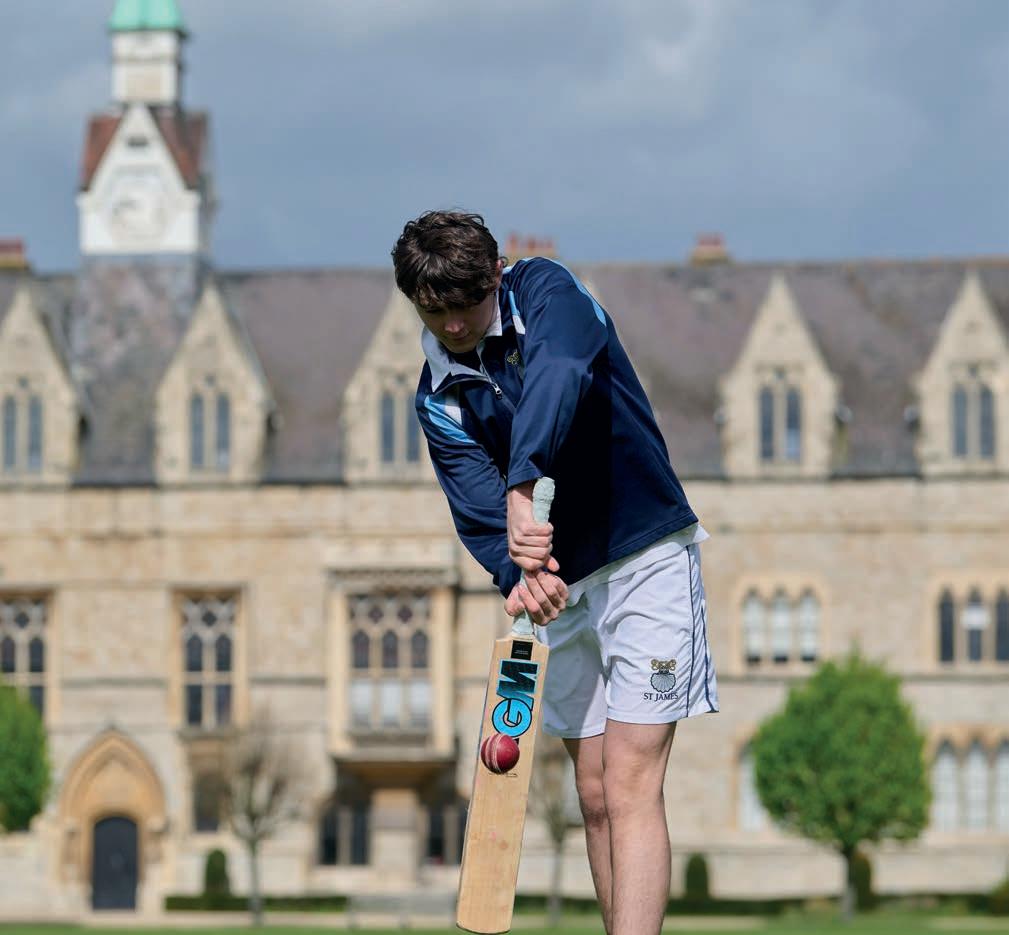
At St James, we believe that everyone is a sports person, so we also believe that everyone has the potential to be a student of Physical Education. If you are willing to work hard both in GCSE PE lessons and in the core PE lessons, have an open mind and a positive approach to learning, this will be an enjoyable course to complement any course of studies.
The study of Physical Education opens the doors to a wide variety of career paths and educational opportunities as it sits in one of the fastest growing areas of employment. There are the obvious pathways of coaching, teaching and management as well as the more specialised areas of sports psychology, sports nutrition and sports sociology. Sports marketing, development and advertising are also big business, and sports analysis is developing rapidly as teams and athletes try to gain the competitive edge.
SUBJECT INFORMATION
GCSE PE offers a wide range of team and individual sports, including:
• Badminton
• Basketball
• Cricket
• Dance
• Field Hockey
• Figure Skating
• Football
• Ice Hockey
• Netball
• owing
• Rugby
• Sailing
• Squash
• Tennis
• Volleyball
• Table Cricket
• Boxing
• Athletics
• Canoeing
• Cycling
• Golf
• Gymnastics
• Kayaking
• Rock Climbing
• Sailing
• Snowboarding
• Swimming
• Trampolining
Component 1: Fitness & Body systems (36%) 1 hour 30 minute exam
• Applied anatomy and physiology
• Movement analysis
• Physical training
• Use of data
Component 2: Health & Performance (24%) 1 hour 15 minute exam
• Health, fitness and wellbeing
• Sport psychology
• Socio- Cultural influences
• Use of data
Component 3: Practical Performance (30%) (105 marks, 35 per activity)
Internally marked & externally moderated
• Skills during individual and team activities
• General performance skills
• Assessment in three physical activities from a set list (at least one team activity)
Component 4: Personal Exercise Programme (PEP) (10%)
• Aim and planning analysis
• Carrying out and monitoring the programme
• Evaluation of the PEP
SUBJECT OVERVIEW
Physics explores how the universe works, from forces and energy to electricity, waves, space and atoms. You will learn how to explain everyday phenomena using scientific models, equations and practical investigations. The course develops problem-solving skills through experiments, data analysis and mathematical reasoning, helping you understand both natural processes and modern technology.
Physics suits curious students who enjoy problemsolving and understanding how things work. You will gain practical skills, mathematical confidence and the ability to think logically and critically. It is a highly respected subject that keeps many career paths open, strengthens applications for further study, and develops transferable skills valued by employers across science, technology and beyond.
SUBJECT INFORMATION
Topic 1: Energy, electricity, particle model of matter, atomic structure.
Topic 2: Forces, waves, magnetism and electromagnetism, space physics. 10 x required practicals will be completed, as well as other optional practicals to support understanding.
What future opportunities will I have?
GCSE Physics supports progression to A-level Physics and related subjects such as Maths, Engineering and Computer Science, leading to degrees and careers in engineering, medicine, data science, renewable energy, research and teaching. Physics also builds valuable life skills including logical thinking, numeracy and analytical reasoning, useful in many careers and everyday decision-making.
Two written exams:
Paper 1: Covers topic 1 (50%)
Paper 2: Covers topic 2 (50%)
Both exams will include various question formats such as multiple choice questions, short-answer questions, longer structured questions, and calculations (applying physics equations).
Practical skills are assessed within the written exams, with required practicals helping students develop the skills that are tested.
SUBJECT OVERVIEW
Sanskrit is an ancient language from India and is the eldest sister to Greek and Latin. What is unique about St James is not only that the school teaches this language but that it does so for examination purposes. As with any other classical language trains the mind to be focused on detail and to do that, patience is cultivated. Linguistically, Sanskrit is extremely rigorous and trains the student to think logically while understanding and appreciating the structures of language. Essentially, it develops those invaluable higher order skills. The study of Sanskrit provides young people with many transferable skills to use in many areas of their future lives, especially in the workplace.
Students at St James Schools have been studying Sanskrit since the age of five years onwards or from the age of 11 years on joining the senior school. The O Level in Sanskrit (replacing the IGCSE qualification) which is held by Cambridge Assessment International Education (CAIE) is offered to those students who feel they have been able to comfortably grasp what they have covered in the subject in the years preceding Year 9. As with any Key Stage 4 exam, commitment is needed but those students who have taken it for GCSE thus far have enjoyed the intellectual challenge while at the same time appreciating the beauty of the Sanskrit language.
Sanskrit provides a strong foundation for further academic and professional opportunities. As the language with the most complete and systematised grammar among classical languages, it is the root of all Indo-European languages. St James is recognised globally as a centre of excellence in teaching Sanskrit, with some students progressing to study the language at prestigious institutions like Oxford. This offers pathways to careers in linguistics, academia, translation, and cultural research.
SUBJECT INFORMATION
Apart from greater study of the language itself, the course includes the study of, in Sanskrit of course, select verses from the Bhagavad Gita as well as basic Paninian grammar.
Two exam papers, each lasting 1 hour and 30 minutes and worth 90 marks.