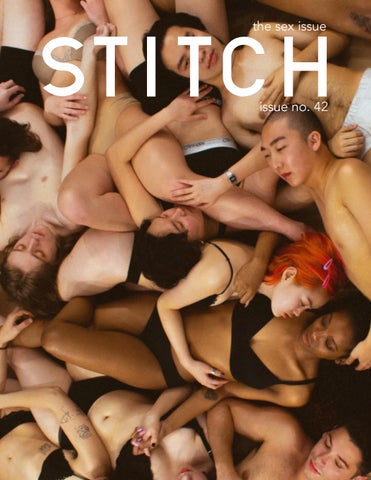
the sex issue
issue no. 42
FEBRUARY 2020 • STITCH 3
INDULGE Photographed by: Sarah Gronich Directed by: Emily Burns Models: Lucia Agajanian, Charles Auta, Sebin Bok, Abby Everding, Shayan Ghodsi, Dane Holmes, Andrew Kim, Hyohee Kim, Peyton Nibblett, Akinele Reece, Leo Shao, Leo Jared Scheck, Carson Stewart, Adam Suh, Amy Szkorla & Aaron Wang Styled by: Miranda Andrade, Sebin Bok, Maxwell Han & Annika de Vogel Shoot Assistants: Nia Adurogbola, Maddy Daum & Sarah Loper
sex as
learned sex as performance 12 What's the Deal with Sex Education? 13 Sex 101
Stan Smiths, Fake Glasses & a Tight Yellow Shirt 24 The Fruit Shoot 28
sex as
LOVE 43 Eden 55 The Nav & Conner Story
sex as
sex as
pain
liberation
Beauty is Pain 40 Geishas and G-Strings 53
58 In the Bedroom 85 My First Time
4
STITCH • FEBRUARY 2020
contents
thoughts F R O M
T H E
E D I TO R S
Sexuality, gender and sex are inherently related, and when we are stifled from learning about those topics, not only is a toxic culture perpetuated, we are also creating serious consequences. Parents, schools, churches and institutions create a narrative around sex that can be quite dangerous. Abstinence is preached, birth control is deemed a sin and anything outside of straight, cis narrative is rejected. Just to name a few consequences, this lack of conversation causes unwanted pregnancies, higher suicide rates among LGBTQ+ youth and a feeling of shame around sex. Perhaps if we talked about sex more, if we exposed people to sex more, and if we unpacked what sex is, we could form a more sex-positive society that goes against the grain and brings important voices into the conversation that is currently controlled by individuals with dominant identities. The Sex Issue hopes to do just that. We hope that by exposing the campus to various takes on sex, it will start a conversation about how to create a sex-positive society. In the Sex Issue, we are looking through five lenses: Learned, Performance, Love, Pain & Liberation. While realizing that sex frequently breaks out of those labels, we find that viewing from those perspectives allows people to view different facets of sex, facets that are not always discussed. Whether it be through a case study on how sex education is taught in schools by Ashley Capoot, a conversation on how a non-binary actor’s struggles in theatre by Staff Writer Jude Cramer or a piece on the objectification of Asian women in the porn industry by Print Editor Chloe Law, the word sex is rich with meaning, meaning that needs to be unpacked. Many writers wrote very personal pieces for this issue as well, as sex is an incredibly personal topic for many. Staff Writer Eli Gordon wrote a reflection on coming to terms with his bisexual identity, Editor in Chief Samuel Maude wrote a piece on his first time and various writers wrote poems throughout the issue on their experiences with sex. Throughout the Sex Issue, we hope you get a well-rounded view of sex, begin to understand how sex, sexuality and gender are related and continue the conversation among your friends and in your circles. When we talk about sex more and embrace difficult topics, we create a healthier, more positive society.
Samuel Maude & Nina Wescott FEBRUARY 2020 • STITCH 5
ELI GORDON WYNNEWOOD, PA CREATIVE WRITING EDITORIAL TEAM "To me, healthy sexuality is feeling comfortable and in control."
SARA GRONICH PRINCETON JUNCTION, NJ RADIO, TV, & FILM PHOTOGRAPHY TEAM "Healthy sexuality to me is being open and vulnerable with yourself and others."
PRANAVI AHUJA NEW DELHI, INDIA PSYCH & ECON MULTIMEDIA TEAM "Healthy sexuality is understanding your own needs and desires."
JUDE CRAMER WAUKESHA, WI JOURNALISM EDITORIAL TEAM "Healthy sexuality is knowing who you are sexually and what you want from someone else. It’s making sure that you’re getting what you need from sex and taking no bullshit about your body. It’s about taking responsibility, communicating openly, and having fun!"
EDITORS-IN-CHIEF Samuel Maude + Nina Wescott MANAGING EDITOR Eden Lichterman SENIOR EDITOR Lexi Schiff CREATIVE DIRECTOR Lizzie Zhang
DIGITAL CREATIVE DIRECTOR Zoe Grossinger
PRINT EDITOR Chloe Law
DESIGN EDITOR Angela Cheng
PHOTO EDITOR Nia Adurogbola
PHOTO EDITOR Caroline Ward
ASSISTANT PHOTO EDITOR Sarah Loper ONLINE EDITOR Lilly Pace MULTIMEDIA EDITOR Jay Towns SOCIAL MEDIA EDITOR Natalie Vazquez DIRECTOR OF DEVELOPMENT Daniella Ueki
PHOTOSHOOT DIRECTOR Emily Burns ONLINE EDITOR Radhika Rahlan MULTIMEDIA EDITOR Maddy Daum CORPORATE DIRECTOR Emily Wang MEMBERSHIP DIRECTOR Wenbo Zhang
CORPORATE TEAM Olivia Corderi, Michelle Gozdanker, Eden Hirschfield, Olivia Lee, Susan Tran + Tiffany Xu DESIGN TEAM Izzy Chun, Agnes Lee, Grace Lougheed, Margeaux Rocco + Quynh-Nhi Tran EDITORIAL TEAM Ashley Capoot, Jude Cramer, Olivia Evans, Lizabeth Frohwein, Giovana Gelhoren, Eli Gordon, Haley Grindle, Nia Harris, Michelle Kim, Isabell Liu, Sarah Rosenblum, Joely Simon, Christian Thorsberg, Sierra Turner, Florence O’Connor + Rachael Vargas MULTIMEDIA TEAM Pranavi Ahuja, Salma Barhoumeh, Bridget Gonzalez, Sylvia Goodman, Libby Markham, Linda Shi, Kumail Syedain + Maria Valencia PHOTOGRAPHY TEAM Grace Deng, Sara Gronich, Nami Hoffman, Maryam Ikuforiji, Lucia Shorr + Anna Weeks SOCIAL MEDIA TEAM Ashley Chin, Sarah Filby, McKenna Frey, Kimberly Cruz Mendez + Emi Silverstein STYLING TEAM Miranda Andrade, Sebin Bok, Maxwell Han, Sean Malaisrie, Katharina Nachtigall, Nicolas Petry-Mitchel, Annika de Vogel + Ava White FEBRUARY 2020 • STITCH 7
faces & spaces: mikey walden
The junior theatre major discusses being nonbinary in theater, earrings made out of their own baby teeth and labeling themself as a “tough guy”
By er ram eC Jud
Ph o
eD ac
to sb yG r
g en
D es y Angela Cheng ign b
8
STITCH • FEBRUARY 2020
Mikey Walden’s quirky and colorful clothes stand in contrast to the heavy curtains and plain black floors of a black box theater in the Virginia Wadsworth Wirtz Center. Still, black boxes like these are their favorite spaces on the Northwestern University campus, precisely because they are blank slates. “I have, in these rooms, had classes. I’ve had rehearsals. I’ve had dance calls. I have laid on the floor and played music over the speaker system and processed my emotions. I have written musicals. I have made an exhibit about gender in one of them,” Walden said. “I love the spaces for what they can be filled with, you know?” Walden is a junior theatre major and gender studies minor at
Northwestern. Just as they find meaning in the emptiness of the black boxes, Walden also sees the deeper layers of every aspect of life, including how their struggles as an artist intersect with those of their nonbinary identity. Like gender and sex, theater can seemingly control one’s body, they say. “Either individual productions or roles or the general sentiment of the community can literally control your weight, your hair, whether or not you get tattoos, how straight and white your teeth are, what you do with your body hair,” Walden said. Thus, it was a pivotal moment for Walden when they first shaved their head during their freshman year of college. “Now I have easily visible tattoos, and I keep my hair short, and I grow out all my body hair and generally dress masc and am a soprano and am 5-foot-3. And that means that I don’t have a lot of professional opportunities,” Walden said. It’s a sad reality. According to ProductionPro’s yearly report, Broadway by the Numbers, 0.27% of titled characters were “nonbinary plural” and 7.1% were of “unspecified gender” in 2019’s Broadway season. That doesn’t leave much room for visibly and proudly nonbinary actors like Walden. “I basically had to make the decision to cut myself off from a potential professional career as an actor,” they said. Though they still intend to perform, Walden also has a knack for writing musical theater. “This year, I intentionally shifted my focus to primarily pursue writing opportunities,” Walden said. “I’m not acting again for the rest of the year. And I’m hopeful that I can, one, learn to become a better writer, and two, write things that expand who gets to be an actor because there’s such a narrow category.” Walden’s challenging of the conventions of theater is matched
by their exploratory sense of fashion, which reflects the unique situation of dressing as a nonbinary individual. “Clothing is really a fraught space for trans people,” Walden said. “I am mad at the gender binary for restricting what clothes I can wear to be perceived as the gender I want to be perceived as.” Walden describes their style as playful, thrifty and “a gentle little ‘fuck you’ to the gender binary and to richness and consumerism.” Their favorite pieces include a camouflage pair of overalls, a head-to-toe fruitpatterned outfit and earrings made from their own baby teeth. “My fashion inspirations are children who get to dress themselves and cool grandparents,” Walden said. No matter the outfit, Walden always has a carabiner hanging from their pants, usually with a Swiss Army knife attached. Their personal favorite knife is engraved with the words “Tough Guy,” a message with particular resonance for them. “It’s not difficult to recognize that I am a small, gentle person. I do like to think that I am also genuinely a tough guy, but generally reference myself as a tough guy facetiously, because I like destabilizing categories of gender,” Walden said. They plan to get the phrase tattooed on their thigh in the future. Walden came out as nonbinary a year ago, but has always had a complicated relationship with gender and fashion. “Femme aesthetics are something that I’ve always had a really weird relationship with and have at times exulted in and at times been terrified of,” Walden said. Feminine clothing is complex for Walden, but masculine clothing is
no less problematic. “When I am dressing my most masc, while I would love to think of that as just a fun, playful expression of my gender fuckery — which it often is — it is also, in a way, to conceal my body, to divert attention from parts of my body,” Walden said. So, how does one walk the line of the gender binary? There’s no perfect path, Walden said. “Lately, I’ve been trying to give myself more space to look femme. But I’m not on [testosterone hormone therapy], and
it does feel like I’m erasing myself when I don’t provide a clear visual indicator for people to second guess my gender.” It’s easy to get bogged down in the complicated world of sex and gender, but when it comes to fashion, Walden makes it clear that it’s all about having fun. “I would love for the fashion world to view clothing and style not as a performance of status, but a tool for exploration and expression,” Walden said. “I think in general, we all need to take ourselves way less seriously.”
PERFORMANCE • FEBRUARY 2020 • STITCH 9
love currency
by sara gronich Designed by Grace Lougheed
we are born with open hands palms towards the sky we give and receive love freely as if no other currency exists but through heartbreak and the puppeteer that twists us bending us backwards we quickly turn our hands over with fists clenched our rough, hardened knuckles protecting us from the damage we fear until we don't recognize love until we don’t recognize ourselves yet blue eyes and late texts stolen glances and shaggy hair slowly grab hold of our hands cold skin softened by the warm graze of fingertips inch by inch and our palms face the sky once more as our cheeks turn a warmer shade of rose we fear our palms will not withstand the forthcoming wounds but we cannot pull away for the missed feeling of cool air intertwined with our fingers and the tender titillation of love currency so we continue forward indefinitely with open hands we are reborn
10
STITCH • FEBRUARY 2020 • LOVE
COURAGEby jude cramer Designed by Grace Lougheed
Is it courage to expose my naked skin to any man within twenty miles with a beard and an ounce of personality? Is it courage to find clearness in the tailspin and erase him without a fair trial, praying I’ve undone my own immortality? Is it courage to tell myself I’m erotic, tantalizing, beautiful, sensual beyond belief when the words feel jammed down my throat? Is it courage to spew them still, so quixotic, and spend the better part of the night posing in my briefs less for the likes than just by rote? Is it courage to meet him at his frat house, knowing his expectations and attraction and just realizing how far I’ve flown? Is it courage to obliterate my bounds for the sake of his carnal satisfaction, which I’m meant to accept as my own? Or is it courage to stay curled up under comforting fluff and wonder who put the torn condom wrapper in my trash can because I’ve never even split one’s foil apart? Is it courage to say that my weighted blanket is enough, that my body pillow is a perfect proxy for a man when nothing would feel better than a warm beating heart? Is it courage to speak it, even without strength, how fucking scared I am? How is it fair that everything worth having is within arm’s length but is it just too heavy for me to bear?
PAIN • FEBRUARY 2020 • STITCH 11
What'stheDealwith Sex Education?
Sex education in high school doesn't cover everything, and it's time for that to change. By Ashley Capoot Designed by Quynh-Nhi Tran
As a high schooler, I always wondered what my experience with sex education was going to look like. Movies were my only point of reference, so I was fully prepared to struggle to put a condom on a banana, or to be told that I would “get pregnant and die” like the characters in “Mean Girls.” However, none of these scenarios became even remotely close to what I actually experienced, which was nothing. In the four years that I was at my high school, I never received any kind of formal sex education. This is actually quite common for students in the United States. According to Planned Parenthood, only 39 states and the District of Columbia require public schools to teach sex education. For instance, SESP sophomore Molly Schneider grew up in Green Bay, Wisconsin where sex education is not mandated. Schneider attended a Catholic school that encouraged abstinence, so she was forced to look elsewhere to learn about sex. “Everyone had a lot of questions, and there was a lot of Googling done,” she said. “My mom was very progressive and taught me sex ed and then taught all my friends, so any time they had sex-related questions they had to come to my mom.” Even if a state does require students to be taught about sex in school, there is a great deal of variation in the curriculum itself. In fact, according to the Guttmacher Institute, only 17 of the 39 states that mandate sex education require that students are taught
medically accurate information. As a result, students can encounter a range of material that covers anything from contraception to abstinence. SESP junior Mark Biedke took his high school’s health class over the summer of his sophomore year. He said the entire sex-ed portion of the class took place over two days, and it covered basic anatomy and forms of contraception. “They brought in a banana and a condom and everything,” he said. “They tried to assure us that it wasn’t going to be an abstinence-only type of class, but it was very heteronormative.” Biedke said that though he thinks his sex education was more informative than what some of his peers at Northwestern experienced, he was still left with a lot of unanswered questions. Similarly, Alexa Mikhail, a junior in Medill, felt that her high school’s sex education was not very substantial. Mikhail said the material was taught over the course of one unit in her health class, and it was not taken very seriously by her peers. She said the material did more to perpetuate stigma than anything else and added that it was very heteronormative. The Guttmacher Institute reported that as of February 2020 only 10 states require schools to teach “inclusive content with regard to sexual orientation,” so the vast majority of sex education pertains exclusively to sex that takes place between men and women.
"
Nothing was ever taught about pleasure, nothing was ever taught about any other kind of sex.
12
STITCH • FEBRUARY 2020 • LEARNED
"
sex 101 STITCH’S take on that stereotypical movie health class
Photographed by: Nia Adurogbola & Caroline Ward Directed by: Emily Burns Edited by: Sarah Loper Models: Karan Bhasin, Joyce D’Aprile, Sophia Gholdoian, Simone Jackson, Patryk Kot, Alison Martin, Madison McReynolds, Jesse Noss & Amy Rogin Styled by: Miranda Andrade, Sebin Bok, Maxwell Han, Sean Malaisrie, Katharina Nachtigall, Annika de Vogel, Ava White & Lizzie Zhang Designed by: Angela Cheng
LEARNED • FEBRUARY 2020 • STITCH 13
14
STITCH • FEBRUARY 2020
LEARNED • FEBRUARY 2020 • STITCH 15
D 8=
16
STITCH • FEBRUARY 2020 • LEARNED
FEBRUARY 2020 • STITCH 17
18
STITCH • FEBRUARY 2020
FEBRUARY 2020 • STITCH 19
20
STITCH • FEBRUARY 2020
loves2 1 y 1 suz 1 1 2 2 3 5 2
1 2 4 9
jacob1 1 1 12 2 4 4
LEARNED • FEBRUARY 2020 • STITCH 21
22
STITCH • FEBRUARY 2020
FEBRUARY 2020 • STITCH 23
stan smiths, fake glasses & a tight yellow shirt By Eli Gordon // Designed by Angela Cheng I walked into high school that day wearing Stan Smiths, the shoes I watched my female friends parade around in with pride and a 10th grade emblem of cool. Stan Smiths were how a sixteen-year-old living in the suburbs of Philadelphia showed they had style, but it was only the girls who attained this level of chic. I wanted in. So, I took the leap. I stepped out into my small, judgemental private school lobby with Stan Smiths and exclaimed to the crowd with my shoes, I’m here, and I’m trying to be myself. People stared at my shoes, at me. Or maybe, I told myself they were staring. The thought of them staring horrified me. I wasn’t yet out, but my shoes were screaming gay, or bi, or weird, or something other than what was expected of the guys at my school. I should’ve been wearing Nike sneakers with Elite socks, blue baggy jeans from Old Navy, a graphic tee-shirt and maybe a
Champion zip up hoodie. That’s what was expected. It was straight and simple. But I didn’t fit into any of it, and every time I tried to conform to the clothes the guys around me were wearing, I’d fall apart. The jeans felt too baggy, too uncomfortable, too not me. The graphic tee seemed so middle school, so primitive and aesthetically displeasing. I wanted turtlenecks and tight black pants. I wanted a silver chain and bracelets and rings that screamed cool. I wanted to be myself. I wanted to break apart from what boys told themselves they were supposed to dress like in my high school. So I walked in with Stan Smiths. It turned into a start. Over the next couple years, I tried slowly to be myself, even if I couldn’t do it through words yet (it was years until I would actually come out). I could try to be myself through fashion. A couple months later I wore a ring for the first time. I kept it on my finger for two hours, mortified after my friend asked which girl I’d borrowed it from. I tried again the next week and slowly built my confidence. By senior year I was the kid who rocked his silver ring with pride. Not the only kid, but the only guy. The only guy around school wearing camo pants or tie dyed socks, sometimes even a bomber lined with a pink suede on the inside. Slowly pushing my boundaries, slowly coming out through my clothes. And not that these clothes were ‘gay’, whatever that means, but for me, they liberated me to a place of self expression, one that broke away from the heteronormative space around me. I decided to throw myself a party the night I told my friends I was bisexual in the spring of my senior year. I wore fake glasses. Big round flamboyant fake glasses I’d borrowed from my sister adorned my face and a bright yellow shirt wrapped around my body. I posted a picture on Instagram of myself from that party with the caption, ‘if you know, you know’. I wondered, after I posted that picture, if someone could see me in their feed and think, he’s not straight. I hoped that I had reached a place where people could sense some authenticity in my look and what I had been trying to tell the world. In college, I walk around and see guys with painted nails, rainbows on their backpacks and a full face of
makeup. For me, gender at college has taken on a new role, moving beyond neat boxes defined by what you choose to wear, but lives in a more fluid state, an identity that can break down any normative wall around it. Maybe my Stan Smiths and silver ring weren’t as radical as I thought they had been. Maybe I can push my boundaries even further. Maybe this is a space where I can try to be myself, but first, maybe I have to figure out exactly what that means.
PERFORMANCE • FEBRUARY 2020 • STITCH 25
Not As Simple As A closer look into the challenges, misconceptions and pride within the bisexual community. By Giovana Gelhoren Designed by Quynh-Nhi Tran “I’m playing the stereotype,” Keyla Carvalho said, “it’s easier for people to notice that I’m queer.” Carvalho, a proud bisexual woman and senior in Northwestern, admits that she adheres to the bisexual stereotypes such as the French tuck (tucking a shirt or sweater into jeans), cuffed jeans (jeans folded in the hem) and nose rings. Though she’s been wearing the French tuck and cuffed jeans “before it started becoming a thing”, she added a nose ring recently because of the bistigma around it. However, though clothing can become an expression of gender and sexuality, Carvalho said that the fine line between self-expression and society’s stereotypes “is kind of blurred.” In other words, it’s hard for people within the bi community itself to differentiate “what is a stereotype and what is an expression of how things really are.” Though Suzanna DePeri, a senior English major, doesn’t have a nose ring because her “mom would kill” her, she’s definitely also a big fan of the bi-style stereotypes. “Every time I'm wearing jeans, they need to be fully cuffed even if it's like zero degrees,” she says, “and I tuck my shirts every day.” But clothing and style stereotypes aren’t close to
the only challenges the bi-community faces on a regular basis. Bi-erasure, a term referring to the denial of bisexuality’s existence and legitimacy (GLAAD), is very present in today’s society. In an interview with Metro UK’S Lela London, Sidonie Bertrand Shelton, head of education programs at Stonewall UK, says: “Bi people are often the forgotten part of the LGBT acronym and can face abuse from not only straight people but also from lesbian and gay people. Biphobia takes many forms, including offensive myths, stereotyping and bi-erasure.” In fact, biphobia can be present in many ways throughout a bi person’s life. According to a 2016 survey from Glamour, 63% of women say they wouldn’t date a self-identifying bisexual man. As shown by research from the National Intimate Partner and Sexual Violence Survey out of the Center for Disease Control and Prevention, bisexual women and men are more likely to experience violence or domestic abuse than their gay, lesbian or straight counterparts.
"
Bi people are often the forgotten part of the LGBT acronym and can face abuse from not only straight people but also from lesbian and gay people.
26
STITCH • FEBRUARY 2020 • PERFORMANCE
"
Riding a Bicycle When talking to a male freshman in Weinberg, he states that being a bi man is a synonym for being mistaken as gay. From his experience as early as high school, “there is always the stereotype that if you’re well put together and are wearing nice clothes, you’re gay,” he says. Though this is clear evidence that bierasure, it’s something this Weinberg first-year sadly has grown accustomed to. For him, coming to college meant letting go of common misconceptions and “getting more in touch with his sexuality that was about androgyny and wearing things that are more feminine,” he said. Therefore, even if he’s wearing his heeled boots that he himself nicknamed “the gayest thing I own,” he’s surer in who he is as a bisexual man in a bierasure-filled society. For DePeri, on the other hand, experiencing bierasure is less about outright prejudice and more about feeling less confident in her own identity. “Being in a straight relationship, I feel like I have to prove myself to people,” she said - this could mean reiterating her past relationships, the fact that her “first kiss was with a girl when she was 13” or, in fact, wearing those stereotypical bi styles previously mentioned. “Wanting to feel secure in my identity because it's important to me and wanting to feel like I can still claim that is hard,” she confessed. Similarly, in a 2018 personal essay for GQ Magazine, Stephanie Beatriz, the actress that plays Rosa Diaz in Brooklyn Nine-Nine, reflected on her experience as a bi-woman in Hollywood and in society as a whole. Her account, that details her sexual awakening via leafing through old magazines to her marriage with a man in a few months’ time, dives deep in what is known and misunderstood about the bi-community. These problems include, of course, several moments of bi-erasure when her sexuality was questioned “every
weekend” by her college friends and throughout her life. Therefore, even though she’s about to marry a man, Diaz makes a point of reiterating that she is still bi and “proud as hell” about it. The same can be said about many other artists that have openly come out as bisexual and made great strides into raising awareness about bisexuality. Janelle Monaé, for example, one of Carvalho’s most celebrated bi-icons, has been very candid about her bisexuality which is reflected in her album “Dirty Computer.” In this album, and specifically in her song “Make Me Feel”, she uses her interactions with both men and women coupled with her use of fashion and colors (pink and blue representing the bisexual flag) to not only demystify what it means to be bi but to also educate. Most of all, bi-erasure is something bi people and allies alike should try to diminish rather than solely accept it. The Weinberg freshman aptly explained bierasure with his “Bicycle Theory”, stating that sexuality is like a bicycle: while straight and gay people would be considered to be unicycles (and, therefore, only interested in one sex), bisexuals are bicycles and are interested in both sexes. “My bicycle is a really old bicycle with one wheel much bigger than the other,” he said — but it still is a bicycle. Though this is a simple theory he uses to explain bisexuality to others, he believes many disregard the “bicycle” as a possibility. However, the bi-community has nevertheless formed some incredible bi-icons, spokespeople and even a signature sense of style. Editor’s Note: Keyla Carvalho was also featured in the Dynamic Issue in the piece “The Dynamic Student Style.” Furthermore, STITCH understands that sexuality can be difficult to come to terms with, and for many individuals, revealing their sexuality can put them in harm’s way. Therefore, as requested by the source, we chose to leave the Weinberg freshman anonymous.
PERFORMANCE • FEBRUARY 2020 • STITCH 27
THE FRUIT SHOOT
Finding the humor in some provocative fruit Photographed by: Sarah Loper Directed by: Lizzie Zhang Styled by: Miranda Andrade, Renee Grotthuss, Nico Petry-Mitchel, Annika de Vogel & Ava White Photo Assistants: Sara Gronich and Maryam Ikuforij Designed by: Grace Lougheed
FEBRUARY 2020 • STITCH 29
berries.jpg
30
STITCH • FEBRUARY 2020
banana.jpg
PERFORMANCE • FEBRUARY 2020 • STITCH 31
32
STITCH • FEBRUARY 2020
grapefruit2.jpg
PERFORMANCE • FEBRUARY 2020 • STITCH 33
lemon.jpg
grapefruit.jpg
34
STITCH • FEBRUARY 2020
strawberry.jpg
FEBRUARY 2020 • STITCH 35
grapes.jpg
36
STITCH • FEBRUARY 2020
banana2.jpg
FEBRUARY 2020 • STITCH 37
Selling Sex How corporations have taken control of the body BY HALEY GRINDLE // DESIGNED BY AGNES LEE
When I first watched The Breakfast Club, I was struck by Ally Sheedy’s now-famous line on female sexuality. When Claire (Molly Ringwald) is asked whether or not she has had sex yet, Allison (Ally Sheedy) interjects, “If you say you haven’t, you’re a prude, if you say you have, you’re a slut. It’s a trap. You want to, but you can’t, and when you do, you wish you hadn’t.” Sheedy’s answer perfectly illuminates the double standard placed upon women in the public eye. Female musicians reveal how these standards influence them, as they are encouraged to behave sexually to sell their art yet are shamed for that same behavior. Many women in today’s media take pride in their sexuality and work to defy objectification. However, corporations profit off the sexual depictions of their bodies, so I wonder- is it possible to truly use one’s sexuality in an empowering way? Is it possible for female-presenting bodies to embrace their sexuality within a culture that has systematically degraded and dehumanized those bodies through hypersexualization and the male gaze? I believe it is particularly relevant that many of the musicians leading the movement to embrace feminine sexuality are women of color, who have been doubly oppressed and exploited. Women such as Megan Thee Stallion and Lizzo have revolutionized the industry by breaking from the previously constructed image of sexuality (i.e. the likeness of Britney and Madonna: white, blond, and extremely skinny). The defiance shown by women of color is inspiring, but female sexuality may still be trapped within a damned if you do, damned if you don’t paradox. Expressions of sexuality in pop stars seem to reflect the quote
from The Breakfast Club, if they do it, their bodies are contributing to a billion-dollar industry, and if they don’t, they are labeled prudish, cookie-cutter or immature. In an article titled “Women, Pop Music, and Pornography,” Meredith LeVande analyzes the way in which pornography has emerged in mainstream culture through pop music. She explains how smaller “adult video” networks have been bought up by large distribution companies and how these companies rolled back censorship rules because sex is now a part of their profits. She is not arguing that pornography and sex work are dirty or evil, but that through the normalization of pornographic imagery, we are supporting massive corporations. LeVande claims that these companies are also responsible for pushing pornographic imagery in pop music and advertising. Her critique is quite severe, as she states, “Feminism has been hijacked and it’s hijackers use female pop stars to sell behaviors and attitudes about sexuality itself. The most popular myth is the equation of stripping, prostitution and pornographic imagery with power.” Reading this, my first reaction was to assume LeVande had gone too far, as I truly think there is power and liberation in women reclaiming their sexuality. However, I believe she also makes a fair point- that encouraging women to engage in these sexual acts ultimately only benefits the male viewer and the conglomerate that is selling the song. This is where female pop stars expressing sexuality become complicatedis their expression of sexuality empowering, or simply another marketing tool which exploits female bodies and conditions young women to cater themselves to male consumption? It may be liberating for individual women to celebrate their sexuality, but pop stars are not individuals; they are concepts
constructed by stylists, marketing teams, and record labels, so even their sexuality becomes corporate. I am afraid that female pop stars are trapped in a system that was made to exploit them, no matter what they do. I want to believe that female musicians have agency over how they present themselves, but I also know that they face extreme pressure from their labels, the press and even their fans to look and act a certain way. There is no easy solution since the pop culture industry is built upon the exploitation of certain identities, but hopefully, if enough of the public demands a change in the industry, even the largest companies will be affected. I hope that the general public will continue to support the artists that they love but also believe that they should be aware when a female artist seems empowered, which company is reaping the benefits. We base our understanding of what is or isn’t “sexy” based on advertisements, music videos, television, and more. As we are constantly consuming media, it is important to remain aware and critical of what beliefs we may be internalizing. Pop culture decides what kinds of sexual expressions are acceptable based on what is marketable, which is why representation is so important for marginalized identities. Thankfully, today, more artists are emerging as openly queer and receiving support from their fans and labels to break from the norm. August 25th, 2013. That was the date of the 2013 VMAs, and even if you, like I, did not watch the show, there was a performance that everyone saw: Miley Cyrus and Robin Thicke performing his song “Blurred Lines.” This performance marked a turning point in Miley’s career, and it created a huge scandal. In terms of performative sexuality, Miley Cyrus’ development from Disney Channel sweetheart to twerking on Robin Thicke in a nude outfit takes the crown. She released her album Bangerz soon after that performance, featuring songs such as “We Can’t Stop” and “Wrecking Ball.” The album debuted at number one on the Billboard 200 with first-week sales of 270,000 copies, so Miley’s controversial performance obviously worked in her favor. In 2017, Cyrus made another major change to her image when she released the album Younger Now. Billboard described the country-pop album as an “honest” project in which Cyrus was “leaning into her roots.” Cyrus toned her
sexuality way down, portraying herself once more like a simple country girl. This album was, interestingly, the least successful moment in her entire career. It seems that the media could not easily forget the controversy Cyrus caused in 2013, and the public wasn’t keen on her trying to undo the changes she had made to her image. As Ally Sheedy explained the damned if you do, damned if you don’t treatment of women performing sexuality, Miley seems to be the perfect example that one cannot try to be both provocative and conservative- you can’t have the best of both worlds. Modern pop culture is ruled by the straight male gaze, limiting the kinds of bodies and sexualities which are allowed to exist in media. The male gaze is, essentially, a male, heterosexual perspective that views women as sexual objects intended for male pleasure. This concept is interesting because the male gaze can apply to male protagonists, male directors and the intended male audience; because for centuries, film was made by straight white men, for straight white men and starring straight white men. Gradually, there have been steps taken to create a more diverse space in pop culture, but there is still a long way to go. We are living in a time of great political unrest, but also a time of great change. It is my hope that this change continues to be for the better, and that all identities are able to celebrate their sexuality without fear of exploitation and degradation.
“Feminism has been hijacked and it’s hijackers use female pop stars to sell behaviors and attitudes about sexuality itself.”
FEBRUARY 2020 • STITCH 39
beauty N I A P IS
How doctors’ disregard for women’s pain creates the gender pain gap By Rachael Vargas Designed by Quynh-Nhi Tran
At the age of 15, I was diagnosed with a chronic, incurable pain condition. Facing that kind of diagnosis at a young age was hard to contend with. High school was supposed to be spent worrying about the ACT or prom dates, but I found myself worrying what the next year, the next ten years, and the rest of my life would look like waking up in pain. Further, one of the most disheartening aspects of my diagnosis was a closer look at the medical industry. I spent months going to various doctors, only to be told my condition would be with me for the rest of my life. We go to doctors thinking they can fix our ailments, but for myself and other chronic pain sufferers, all we receive is bad news. When I was diagnosed, I was a kid, especially in the eye of the medical industry. I was going to pediatricians and children’s hospitals. It wasn’t until I got older that I saw the kind of treatment women facing chronic pain receive. Shortly after turning 18, I had a doctor tell me to stop taking the pain medication I had been prescribed, I had my chronic migraines blamed on my menstrual cycle, and, for the first time, when telling a doctor about my chronic pain, I was asked if perhaps I was “just depressed”. I know firsthand the frustration and belittlement women must deal with when seeking treatment for pain. I can personally attest to the increasing disregard for my pain I have received from doctors as I’ve gotten older as they see me as less of a child and more as a woman. And I am not alone. According to the CDC,
40
STITCH • FEBRUARY 2020 • PAIN
approximately 20 percent of US adults suffer from chronic pain, and women make up 70 percent of that 20. Chronic pain is ongoing pain that can last weeks to years, and for some, their entire lives. Despite these statistics, women’s pain is often disregarded and discredited by doctors, employers and even friends and family. According to a report published by The Institute of Medicine in 2011 called “Relieving Pain in America” women not only suffer from pain more than men, but women’s reports of pain are more likely to be dismissed. Because pain is subjective and self-reported, it can only be diagnosed and treated if a patient's word is assumed to be true. For women suffering from pain, the medical industry has continued to disbelieve that women can accurately account for what they feel and what is happening with their bodies. We understand that these discrepancies are occurring, but the answer as to why is still filled with conjecture. From the archaic ideas of female piety to the female body’s treatment as an object of the male gaze, it isn’t hard to connect the dots between women's concerns for their bodies being ignored and the societal expectations placed on the female form. The ways that women and their pain are disregarded by the medical industry are a consequence of sexualization similar to harassment and catcalling. A woman’s body has been equated first and foremost to be an object of sexual desire, and it is this sexist ideology that causes women to be ignored
N when their bodies do not conform to this rhetoric. After all, beauty is pain. Because women are often stereotyped as frail, weak or hysterical, their pain is often not treated with the same care as men. For Instance, women spend more time waiting in hospital waiting rooms than men. Before they are even given a chance to explain their medical concerns, they are assumed to be less serious than men’s. Once they’ve actually made it past the threshold to see a doctor, women face improper medical treatment due to the weak and sensitive stereotypes women receive. Women’s health concerns are more often met with mental health-related diagnoses and women are prescribed sedatives over pain medications, whereas men are often prescribed pain medications over sedatives. This is not just ineffective treatment, but blatantly wrong treatment. Multiple studies including “The Girl Who Cried Pain: A Bias Against Women in the Treatment of Pain '' by Diane E. Hoffmann and Anita J. Tarzian and “Women with Pain” by J. Crook and E. Tunks have found that women with chronic pain conditions are often wrongly diagnosed with psychological conditions. This not only characterizes women in pain as solely emotional and their pain therefore not real, but also leads to the prescription of sedatives and antidepressants, or even physical therapy or ultrasounds, in the place of pain medication. The “gender pain gap” is real, and the women are left with their pain and the risk of serious conditions intensifying. It’s clear that because women are often ignored by the medical industry, they are left to face some serious conditions without proper care or diagnosis.
For instance, women are twice as likely to suffer from multiple sclerosis, two to three times more likely to have rheumatoid arthritis, three times more likely to have an autoimmune condition (which are more often than not associated with debilitating pain and fatigue) and are diagnosed with chronic fatigue syndrome four times more often than men. Yet, the medical industry continues to ignore them. The sexist term “bikini medicine” is yet another way women are ignored. Used in the medical industry, it is the idea that the only difference in treating women medically has to do with their “bikini areas'', referring to reproductive and breast health. When women suffer from time-sensitive conditions such as appendicitis or gastrointestinal health problems, they often receive delayed and ineffective treatment that complicates their condition. This is due to their symptoms being written off as relating to their menstrual cycles. The inability of doctors to recognize that women’s bodies operate in ways distinct from men, outside of sex, also leads to ineffective medical treatment. An article in The Atlantic titled “How Doctors Take Women’s Pain Less Seriously” showed that women wait on average 65 minutes to receive an analgesic Vfor acute abdominal pain. Men wait on average 49 minutes. Further, in the case of an appendix on the verge of rupturing, over an hour-long wait can mean the difference between a simple procedure and life-saving surgery. “Bikini medicine” and the rhetoric it’s tied to have also caused a majority of medical research to be performed on men. In 1977 the FDA warned against
FEBRUARY 2020 • STITCH 41
42
STITCH • FEBRUARY 2020 • PAIN
"
allowing women of childbearing age from participating in medical research because a woman could become pregnant and the fetus could be harmed by researchers. And while women make up 70 percent of those suffering from chronic pain, 80 percent of pain-specific studies are conducted on male mice and humans according to an article by Harvard Health Publishings. Unreliable research like this affects the effectiveness of drugs on women because certain drugs affect women differently. If medical practitioners cannot escape harmful rhetoric and rely on ineffective data to treat women, it is no wonder that women are suffering from pain while men receive treatment. The way women suffer at the hand of the medical industry is connected to the various ways women suffer due to objectification and sexist rhetoric. Sexual harassment, catcalling, unfair dress codes, ignoring female pain; it is all a means of taking control of women’s bodies. Objectification theory is the idea that women live within a sociocultural context that sexually objectifies the female body and equates a woman’s worth with her physical appearance and sexual capacity. The lack of attention and care shown to women in the medical field is tied to this. When a woman's body becomes more than an object or acts in a way that is not for sexual pleasure, it goes directly against the construct in our society that confines women’s bodies. When a woman is given a sedative to treat her mind instead of an opiate to treat her pain, the body is not being treated, the mind that tried to cast the body as more than an object is being silenced. More often than not it has been on me to be persistent and diligent with my condition, not the
doctor, and I’ve had to learn the hard way to disregard doctors who try to convince me I am not feeling what I claim to be. Only you know your pain, and I encourage you to trust yourself over those who try to tell you it is not serious or that it is all in your head. Addressing this issue requires more than just expanding medical research or more extensive training for doctors. It requires
Sexual harassment, catcalling, unfair dress codes, ignoring female pain; it is all a means of taking control of women’s bodies.
"
everyone to confront the very real and dangerous consequence that the socio-cultural ideology that surrounds women and their bodies. The most immediate opportunity for improvement falls on the part of women patients to advocate for themselves, a situation that can be exceedingly frustrating and time-consuming. Teresa Woodruff, director of Northwestern University's Women's Health Research Institute states, "What we're telling women is, every time you go to the doctor, ask, 'Has this treatment or drug been tested on women?’ Continue to advocate so physicians have to ask, they have to look it up." She continues, "I think the more people are a little bit outraged, the faster change will occur."
Photographed by Maryam Ikuforiji Directed by: Maryam Ikuforiji Models: Sarah Fernandez, Sara Gronich, Ashlee Mitchell & Peyton Nibblett Styled by: Emily Burns, Sara Gronich & Sarah Loper Designed by: Izzy Chun
Just like the Garden of Eden, love and sex can create a paradise.
44
STITCH • FEBRUARY 2020
FEBRUARY 2020 • STITCH 45
46
STITCH • FEBRUARY 2020 • LOVE
FEBRUARY 2020 • STITCH 47
48
STITCH • FEBRUARY 2020
FEBRUARY 2020 • STITCH 49
50
STITCH • FEBRUARY 2020
LOVE • FEBRUARY 2020 • STITCH 51
52
STITCH • FEBRUARY 2020
芸者
GEISHAS and
G-STRINGS
Asian women are often fetishiezed both in and out of the porn industry By Chloe Law
Desgined by Margeaux Rocco “It doesn’t matter what you do ladies, every guy is gonna leave you for an Asian woman,” says Amy Schumer in her stand up routine for Comedy Central. “They’re smarter, they laugh like this,” Schumer covers her mouth modestly as if to demonstrate, “Because they know men hate when women speak. And to bring it all home for the win-- Oh! The smallest vaginas in the game!” Schumer’s comedy special should be taken with a grain of salt, but her specific bit- on the difficulty of competing with Asian women- aptly, albeit crudely, captures the paradox of Asian women in our popular imagination: submissive yet hypersexual with mild manners and a tight pussy- the fantasy of all men, according to Schumer and the audience that laughs along with her. But, implicit in Schumer’s joke, or perhaps what is deliberately omitted, is that this phenomenon disproportionately applies to white men. Yellow fever, or the fetishization of Asian women, is essentially the idea that white men prefer to date Asian women, actively and exclusively seeking them out as romantic or sexual partners. With the numerous dating sites designed for white men seeking Asian women, the history of mail order brides from Asia and war brides post-World War II, and the ongoing “sex tourism” in Southeast Asia, it’s clear that yellow fever isn’t just merely a “preference”-- it taps into a larger history of asymmetrical and imperial power dynamics while also relying on an essentialized image of what an Asian women is supposed to look or act like. These ideas reinforce the West’s racialization and
sexualization of Asian women as innocent and docile yet also exotic, mysterious, and deviant- all of which fuel male fantasies of a what is essentially an Asian sex doll. Nowhere is this trend more pronounced than in porn. According to PornHub’s own statistics, “Asian” consistently ranks as one of the most searched categories in both the United States and Canada. Asian women in porn wear sexy schoolgirl outfits, thighhigh garters, and ever traditional “Asian” costumes. They and embody a combination of the submissive and, virginal, yet eager and kinky. They’re on their knees, bent over a desk, giving messy blowjobs– all with girly smiles plastered on their faces and eagerly awaiting to be dominated by their partner. The popularity of “Asian” in porn categories and the overrepresentation of Asian women in porn reveals its particular widespread demand and exemplifies a gross Western fascination and fetishization of Asian bodies. Considering that porn is a multi-billion dollar industry, Asian fetishes are elevated into popular culture and codified within the sexual imagination: the Asian woman’s body becomes commodified within an orientalist economy of sexual power. It doesn’t help that this trend extends into popular media more generally, with film and television propagating various caricatures of Asian women that mirror their porn counterparts. Stereotypes such as the Dragon Lady (the mysterious overtly sexual lady warrior), the China Doll (the poised, obedient, and fragile doll), and the Geisha (traditional Japanese PAIN • FEBRUARY 2020 • STITCH 53
entertainers, or more commonly misunderstood in the West- due to their history of serving American G.I.’s in World War II- as prostitutes in traditional kimonos and makeup) are all hypersexualized to uphold Western male fantasies about Asian women. These representations reduce their bodies to an object of spectacle designed to represent a Western idealization of the East and reinforce the dominance of white masculinity. The geisha example in particular illuminates the violent neo-colonial past these images emerge from, namely the U.S. military presence in Asia during and after World War II. “Geisha girls,” as they were termed by American G.I.’s, were a product of wartime economic hardship coupled with the American presence in Japan, where women would have to sell their bodies to the most lucrative sourcesthe U.S. military. This pattern extends across the post-WWII era and into Vietnam during the 1960s where Vietnamese women responded to an American demand for sex because of economic hardship but also because of the American position in the war: Southern Vietnamese came to think of the Americans as their liberators from communism. With this, modern day sex tourism is rooted in these violent power dynamics and histories of U.S. interventionism, both of which further notions about Asian women as inherently submissive due to restrictive cultural standardsand needing to be sexually liberated by white men from their “backwards” countries and “backwards” men. Traise Yamato’s article ““In/Visible Difference: Asian American Women and the Politics of Spectacle,” argues that confining Asian Americans to stereotypical roles presents Asian American women as sexually exotic objects designed to reassert the centrality of white masculinity. And further, the voyeuristic fetishization of the Asian woman’s body shows Western filmmakers fascination with sexualized racial difference, or the way in which a woman’s foreignness and physical exoticism is fetishized by white males. In contrast to the overt sexualization of Asian women, Asian men are depicted
as less masculine in strength, size, and rationality to white men. Unsurprisingly, the racialized sexuality of Asian women in both porn and film has real world implications for Asian women. Fetishization is not only uncomfortable and objectifying, but also provides an easy avenue for sexual violence and assault. Populating our collective imaginations with images of Asian women as submissive and hyper-sexual living breathing sex objects grounds the justification for sexual violence against Asian women. Women of color in the U.S. are likely to be more vulnerable to sexual violence, given their racialized status and narratives surrounding racialized sexuality. KAN-WIN is a Chicago-based community organization that strives to eradicate domestic violence and sexual assault against Asian immigrant women and provides services for survivors in order to power the Asian and larger immigrant community. According to one of KAN-WIN’s surveys conducted among Asian women in the Chicago area, 53% reported having experienced some form of sexual violence. While sexual violence in Asian immigrant communities emerges a number of different circumstances and sources, it is primarily grounded in misconceptions and stereotypes about Asian women that become normalized to the point where they become embodied in our social practices. Challenging the hypersexualization of Asian women in porn and general media is not only a step towards uncovering the deep-seated legacies of Western imperialism and modern day racism, but also towards sexual liberation and empowerment for Asian women. In moving past the stereotypes placed on us by the media, we can assert our sexuality on our own terms and say confidently that we don’t fit cleanly into your porn categories and we don’t exist to be your sex fantasy.
“Women of color in the U.S. are likely to be more vulnerable to sexual violence, given their racialized status and narratives surrounding racialized sexuality.”
54
STITCH • FEBRUARY 2020 • PAIN
the
nav & conner
story Finding love on Northwestern’s campus and the problems that come with it By Sierra Turner // Designed by Angela Cheng LOVE • FEBRUARY 2020 • STITCH 55
It all started the Saturday night before their first spring quarter at Northwestern. Navpreet “Nav” — sitting alone in her dorm, talking to herself out of desperate boredom — decided to make a Tinder to get Juul pods. She did, in fact, manage to get the Juul pods, but as she was swiping on the infamous hook-up app, she unexpectedly discovered Conner. Nav was instantly attracted to his chiseled face and eyebrows, and after ending a long-distance relationship with her boyfriend only three days prior, she needed a rebound. “You’re just hot. I just want to fuck you,” she recalls saying after seeing her now boyfriend’s profile. She swiped. They matched. That night, he came over. They talked all night. He stayed over — they didn’t have sex the first time. Conner talked about his life in Indiana — a part of his identity that Nav initially considered a “red flag.” “Oh God,” Nav thought, “I don’t know if you should leave.” “I expected him to be racist and have a fetish for brown women,” she said. Interracial dating often sparks insecurities surrounding the perceptions and opinions one’s family may have about them. Months into their relationship, prior to meeting Conner’s mother, Nav was so worried that his family would care that she was Indian.
despite what we’re taught about sex, our individual, everyday experiences also inform how we want to feel loved and wanted. See, Nav, on the other hand, had a self-introduction to sex. At the mere age of six, she vividly remembers a scene from a movie that her parents were watching. “There was this one scene where a guy is running an ice cube down this girl’s stomach.” Although she didn’t understand the concept of sex at all—and her parents never talked about it—she knew that such an erotic scene was sexual. Indian movies, as well, can be very erotic, according to Nav. That’s another way she was introduced to sex. “You dance to court,” Nav said, “there’s so much dancing in those fucking movies.” Typically, the women would do a little dance routine in their bed, and therefore, Nav thought that that’s how you were supposed to have sex. Then in eighth grade, Nav started sex education, and, suddenly, she was fascinated by it (and to a point, almost obsessed with the idea of it). She first had sex at the age of 15 with a boy she was dating for six months. She felt ready for it and not at all pressured. It didn’t feel good, it hurt, but she kind of liked the pain. It intrigued her. Then she started to really enjoy it and found herself wanting more. “In one year, I went from not knowing what a handjob was to having sex,” Nav said. The Medill sophomore and Los Angeles local attended a predominantly white boarding school in Boston. Before leaving L.A. for ninth grade, Nav never questioned her beauty nor her skin color. One night in Boston, however, at the first dance of the school year, surrounded by mediocre-looking white boys, one boy came up to her and said, “Honestly, I think you’re really cute, but I only date white girls.” She felt unwanted, and thus often settled for unfulfilling relationships in high school. Sex became the easiest way of making her impact on people’s lives.
"Just imagine dating somebody but they didn’t make you orgasm. You have to laugh at that."
McCormick sophomore Conner is the oldest of six siblings raised by a single mother in rural Indiana. He comes from a very Christian household, where his mother introduced him to the idea of sex at a young age. While he was taught what happens during sex, he was also told that sex was something precious, something that you needed to wait for. At the time, he didn’t second guess it — it was the right thing to do. However, as he grew into his own beliefs, he started to understand that he didn’t necessarily meet eyeto-eye with his parents, and so sex was not a topic of discussion. Conner’s past high school relationship with a white, blonde girl also from a Christian family lasted approximately three-and-a-half years. Their sex life was very limited, Conner says, and due to her religious background, she always felt kind of guilty if she ever did anything. Sex is talked about differently in various families, and sometimes, it's tied to identity and culture. However, 56
STITCH • FEBRUARY 2020 • LOVE
The night after the two first met, Conner and Nav had sex. “The first time I thought went surprisingly well,” according to Conner. “I tore up his back, and it was just amazing,” Nav said. Like Conner, she didn’t expect their sexual chemistry to be so good the first time.
“We’re always very vocal about what we wanted,” Conner said, “and I think that helped us get very comfortable with each other very quickly, which I think turned into a big part of my relationship now.” For Conner, sex feels comfortable. He feels confident with knowing what he wants from his partner, and communication is the key to that. “Learning how to communicate is probably the biggest thing that I’ve learned and gained from this relationship. Because Nav is always very open and helps me be very open as well,” he said. “Just imagine dating somebody but they didn’t make you orgasm. You have to laugh at that,” Nav said. “I guess I always wanted diversity in the guys that I got with. I have dated so many white guys, but I didn’t intend to do this,” Nav reveals about her initial hesitation for dating Conner. Approximately two months into their relationship, Nav asked Conner about how his family felt about him dating an Indian woman. Although he insisted that they wouldn’t care, Nav revealed that she wouldn’t want to get invested in a relationship that would get “fucked over” by her partner’s family. “That’s a big thing that I care about. I’ve asked all my exes how their family feels about dating somebody outside of their race because it matters,” she said.
And Nav’s feelings are certainly valid. The awareness of negative social perceptions, and the stigmas or stereotypes associated with minorities and interracial couples, ultimately impacts the social-psychological experience of the relationship for both the minority and majority partner, according to Donna Lewandowski and Linda Jackson’s study on the “Perceptions of Interracial Couples: Prejudice at the Dydaci Level.” In their study, results showed how white men married to black women were perceived as less competent, and overall their relationship was rated as “less compatible.” “I'm dating an Indiana boy who went to military boarding school. Like, there's a lot of red flags there. But also they've all turned out to be for the best,” Nav said. Their relationship is a personification of the power of communication. “One thing I’ve had to work on is understanding her needs compared to mine,” Conner said. “He has a really weird intuition whenever I’m upset or feeling insecure. He doesn’t make me feel crazy, and he doesn’t brush it off either,” Nav said. Nav and Conner will be celebrating a year in April. Editor’s Note: Nav and Conner asked for their last names to be excluded from the issue for privacy LOVE • FEBRUARY 2020 • STITCH 57
IN IN IN N N
THE THE THE THE THE
BEDROOM BEDROOM BEDROOM BEDROOM BEDROOM
Breaking Breaking away away from from
58
STITCH • FEBRUARY 2020
the the norms norms of of the the bedroom bedroom
Photographed by: Sarah Loper Directed by: Emily Burns Models: Kennedi Holloway, Ross Patten & Model 3 Styled by: Miranda Andrade, Sebin Bok, Lizzie Zhang, Annika de Vogel, Maxwell Han, Ava White, Katharina Nachtigall, Nico Petry-Mitchel, Sean Malasrie FEBRUARY 2020 by: • STITCH Designed Margeaux59 Rocco
60
STITCH • FEBRUARY 2020
LIBERATION • FEBRUARY 2020 • STITCH 61
62
STITCH • FEBRUARY 2020
FEBRUARY 2020 • STITCH 63
64
STITCH • FEBRUARY 2020
LIBERATION • FEBRUARY 2020 • STITCH 65
66
STITCH • FEBRUARY 2020
FEBRUARY 2020 • STITCH 67
68
STITCH • FEBRUARY 2020
FEBRUARY 2020 • STITCH 69
70
STITCH • FEBRUARY 2020 • LIBERATION
FEBRUARY 2020 • STITCH 71
72
STITCH • FEBRUARY 2020
74
STITCH • FEBRUARY 2020
LIBERATION • FEBRUARY 2020 • STITCH 75
76
STITCH • FEBRUARY 2020
FEBRUARY 2020 • STITCH 77
78
STITCH • FEBRUARY 2020
Theres’ noreasonf me to show up in jean miniskirt an highheelsotherth thefactthatyouwa tocreatethisfantas
there ’s a tendency want women to be ideal for some mid crisisaguyishaving Iusuallyfightquiteh against stuff like t
The Sexism of the Sex Icon
How male and female sex icons are treated differently – and how we need to give more freedom to women BY RADHIKA RAHLAN // DESIGNED BY AGNES LEE
theproblemthatstudioshaveisthatthey rytomakekick-asswomenverysexualized What is. ’ ’ssexyaboutherishowcapablesheis. Jessica Chastain
White sandy beaches, clear blue waters and Jennifer Lopez in a Swarovski-crystal infused, Versace bodysuit all characterized Miami on February 2nd, 2020 (and some sport was also played, I’m told). The 54th Super Bowl halftime show, performed by Jennifer Lopez and Shakira, was a display of Latin culture as well as the extreme sex appeal of both women. While reactions to the show were both positive and negative, it really emphasized the fact that there are few things we love more than sex icons. Notions of the “sex icon” have continually filled our pop culture and imagination. However, the ever-present idea of a celebrity sex symbol didn’t become popularized as a term until the 1950s with the rise of sex symbols, many of which still impact today’s culture, including the iconic Marilyn Monroe and James Dean. The ‘official’ definition for a celebrity sex symbol is simply the fact that they are, for all intents and purposes, universally agreed upon as very sexually attractive. What this means is that, as times have changed, so too have the criteria for people who are considered to be sex symbols. What doesn’t seem to have changed with the times, however, is the gender bias that exists when thinking of sex symbols. Other than the iconic JLo, a multitude of other examples of sex icons also come to mind — Cindy Crawford, Beyoncé, Halle Berry, Idris Elba, Leonardo DiCaprio and Harry Styles to name a few — but what seems to persist is the difference in attitudes towards male versus female sex icons. We’re not going to pretend that both men and women aren’t sexualized in the media, yet there is a clear difference in the way that affects
80
STITCH • FEBRUARY 2020 • LIBERATION
their career and how they’re portrayed in media. In order to explore the differences in the way that becoming a sex icon shapes the career of a male versus a female celebrity, I went on a deep-dive (I scrolled through their IMDb pages) of some of the sex icons that are popular today. The first thing that I found? The obvious typecasting that occurs among the actors dubbed sex icons. Okay, yes, actors can be typecast without being considered a sex symbol (see: Michael Cera in literally everything that he has ever been in), but there’s something special about becoming a sex icon that means a woman’s most prevalent trait in a movie is the fact that everyone wants to have sex with her — Scarlett Johansson in “The Avengers,” Jessica Rabbit (she’s a cartoon, and yet) in “Who Framed Roger Rabbit?,” and Alice Eve in “Star Trek: Into the Darkness,” for example. The typecasting of sex icons is also by no means tied to just female actresses. The sensuality of men who are sex icons is also amped up in their role, but instead of it being through scantily clad images where the entire emphasis is upon just how much everyone wants to sleep with this person, it’s an aggressive display of masculinity typically showcased through (somewhat unnecessary) action sequences and intense smolders (often while shirtless) — Chris Evans in “Captain America,” John Krasinski in “Jack Ryan,” and Ryan Gosling in “Crazy, Stupid, Love” (because as you know, there’s nothing more attractive than a man who’s emotionally unavailable). The difference is that men can continue to play whatever role they want, just with the added bit
of intensity that makes them oh-so attractive to us. Women, however, become tied to their sex appeal — when was the last time you saw Angelina Jolie as more than the badass babe who everyone is lusting after? The next thing that stuck out to me was the way that this follows the celebrities off of the screen. It turns out that it really isn’t enough to just narrow people’s careers based on their attractiveness, it has to follow them into their everyday lives. Being a male sex icon is kind of a celebrated ordeal, with Buzzfeed listicles and People’s Sexiest Man Alive constantly reminding us not only of how hot these men are but also how amazing it is for us as a society that they’re this hot. While I’m not trying to advocate that we bring back Esquire’s Sexiest Woman Alive award — it lasted from 2004 to 2015, during which Scarlett Johansson was bestowed the honor twice — I think it shows that we definitely need to examine the way that we talk about female sex icons. Female sex icons are hypersexualized in a way that men simply aren’t. Megan Fox spoke to this in a recent interview detailing the ten years it has been since her movie Jennifer’s Body, describing how she was constantly sexualized in her career, even when she didn’t need to be. Sexualization brings her value more to the fact that she’s an attractive woman and less to the fact that she can actually act. She’s not the only example of this, as it becomes hard for audiences to look past the celebrity’s sexuality to their actual career — something that doesn’t seem to exist as strongly for men, because as much of a sex icon as they can be, their talent still tends to be described first (as can be seen
through George Clooney). And while many celebrities — both male and female — are open about their sex lives, female celebrities are still expected to talk about sex less. This, when compared with the fact that women are often portrayed as sexual objects in media, presents an interesting dichotomy. It reinforces the idea that women can absolutely be sexual, but only for male pleasure and not their own. The use of celebrity sex icons to promote the sexualization of women for men’s pleasure exacerbates this problem as it reinforces the idea that women’s values lie in their body as an object — decidedly not great message. I’m not saying that we should stop partaking in all forms of media related to sex icons, mostly because I won’t stop watching Buzzfeed videos of attractive people with puppies and kittens but also because that just doesn’t make sense. Nor do I blame these celebrities for being sex icons (though genetically, I do a little bit) or for taking the opportunities that come their way. It’s belittling (and annoying) to say that the issue here is society, but really, until we do a better job of making sure that we give female sex icons the same freedom (in roles, in talking about sex, in Buzzfeed listicles) and respect that we give to male sex icons, it’s hard to say much else. So while you continue to watch celebrities read thirst tweets (or continue tweeting them out in the first place, if that’s more your vibe), keep in mind that, as Summer Walker sings, girls need love too, and we should make the space for female sex icons to exist for themselves as opposed to for our viewing pleasure the same way male sex icons are able to.
Jennifer Aniston
Weusecelebritynewstoperpetuate thisdehumanizingviewoffemalesfocused
An hour? AN HOUR? Let’s see...I need to shower, put on makeup and pick an outfit. An outfit...what to wear... I always seem to underestimate the time it takes me to get ready. Why? Because I never know what to wear, and of course, the added stress of dressing to impress your booty call doesn’t make it any easier. So, to help out those of you, who like me, can never decide what to wear, I asked people their ideal booty call outfit, and...well...I had some thoughts. Here are some of my favorite responses and my comments:
82
STITCH • FEBRUARY 2020 • LIBERATION
Pranavi: Honestly, facts. Nice underwear is always a must. It doesn’t have to be for the other person. A lacy thong will always put you in the right mood! In fact, I wear them daily, no booty call necessary.
P: YES! Who says a booty call needs to be about what you wear and how you look? Make it about you, not your looks!
Nothing screams cute and comfy, yet sexy like a hoodie and booty shorts. I especially like velvet booty shorts! A timeless sexy classic.
P: Name a clothing item more comfortable than sweats, I dare you. Throw on a cute tank top and you have that effortlessly sexy “I didn’t try too hard. I just threw on the first top I saw” look.
P: Again, underwear is so important, and if you feel the need to groom, go for it! Being comfortable and feeling sexy is essential. But of course, I had to flip the script, so I asked our subjects what they wanted their partner to be wearing. Here’s a little insight into what our subjects are looking for.
P: MUST. You’re going to get all hot and sweaty, so smell good, duh.
P: Sweats are so hot.
P: Preach. Nothing more attractive than a cute hoodie. And maybe you’ll get that hoodie as a souvenir.
P: Yes, make sure you can take it off. It’s an important part, so maybe no rompers or RompHims anytime soon.
P: V necks are so effortless. Pair them with some nice shorts or comfy sweats and you’re good to go! However, of course, I saved the best for last. Here’s my favorite response:
LIBERATION • FEBRUARY 2020 • STITCH 83
METAMORPHOSIS By Christian Thorsberg DESIGNED BY GRACE LOUGHEED
a golden shovel poem after Emily Doe *
Submerged in the sluiceway of memory’s moist underbelly, where you secrete supercuts of seahorses, cache currents of curved tails that don't tread water without waking riptides, but pray, will come to know, in bestial irony, a guilt pregnant as barefoot rain clouds – wash me ashore in brilliant red waves to dimorphic coasts of eggshells, speak not but whistle the whimpers of leucistic male cardinals, feathers fading – you’ve felt their flapping wings now traipsing into sea’s white foam, where a voice has never been. Where goes the love of a widowed cocoon, a butterfly the ectoplasm of hope, the inside skeletal, a permanent and forgotten evolution. Written in washed over sand, you ask me as you don’t, a shape-shifting parochial octopus, three hearts nocturnal and two eyes blind, eight lies swimming and not beached like me. But I grow feet – that’s now where we find ourselves, a clearing in truth’s patronizing forest, imploring why the moss refuses to show face in red river or bear its witness as is just, knowing we’re stronger without need for antlers, does, the biota of courage with silence-wrapped words, here, where you don’t know me, name written in the sun, it blinds you to see her flying today.
* Golden Shovel: Takes a line from an admirable piece of writing, and uses each word in the line as an end word in the poem. Reading down the last word of each line reveals the original piece.
last word:
my first time First times can be messy, however, they can also teach us a lot about how we talk about sex By Samuel Maude // Designed by grace lougheed
My first time hurt, and it hurt a lot. After that experience, I should have shut down my downtown and become a born again virgin. The sex was ugly. My boyfriend and I fumbled around the bedsheets and the foreplay lasted for probably an hour. My heart pounded the entire time. Horrified of the pain and nervous about it feeling good, my head overtook my body and I kept psyching myself out. Just one more kiss. Just keep doing that. Let’s cuddle for a bit. By the time we got to the penetrative sex, we were overwhelmed with nervous energy atop a twin XL bed. The sex lasted for only a couple of minutes, and then we didn’t have anal sex for a couple of weeks. It proved to be just too difficult. Besides gaining a killer two truths and a lie statement, “The first time I had sex I received a high-five instead of a load,” I learned that the picture-perfect sex shown in movies or porn is unrealistic. Sex is messy and oftentimes, mediocre. It’s rarely this mind-blowing experience that we’re all shown and taught over and over again
(if you constantly have mindblowing sexual experiences, let me know how you get it done). Sometimes it is astonishing, but more often than not, it’s just sex. Even when we talk about sex, we talk about the best we’ve had or the worst, we never talk about the mediocre, every day or real. When we don’t talk about the regular sex, we set up unrealistic expectations. We spike up nerves for the guy bottoming for the first time. We create an uncomfortable situation for the woman who has never gone down on another woman. We give the first-time jitters to people. We create a stigma around mistakes, discomfort and messiness, and it can create significant anxiety around sex. Ever since my now exboyfriend and I broke up, I have only slept with a few men. There’s this anxiety
around “being good” at sex and around bottoming again. Have I lost my touch? What if it sucks? What if something goes horribly wrong? Instead of confronting these fears head on, I have let them take over, and I have mostly avoided sexual contact. I’m not saying this is due to how we talk about sex, however, how we talk about sex plays a key role. Sex either has to be monumentally good or catastrophically bad when discussed. But maybe if we talked about how we fumbled on the bedsheets, how the condom affected our experiences or how the sex was messy, it could perhaps alleviate anxiety for the gay boy from Iowa or the straight couple trying to have their first experience together. And maybe, just maybe, we’d become a more sexpositive society in the process.
LIBERATION • FEBRUARY 2020 • STITCH 85
@stitchfashion
86
STITCH • FEBRUARY 2020